Advances in Clostridial Neurotoxins: Passage of the Intestinal Barrier and Targeting of Specific Neuronal Cells


Abstract
1. Introduction
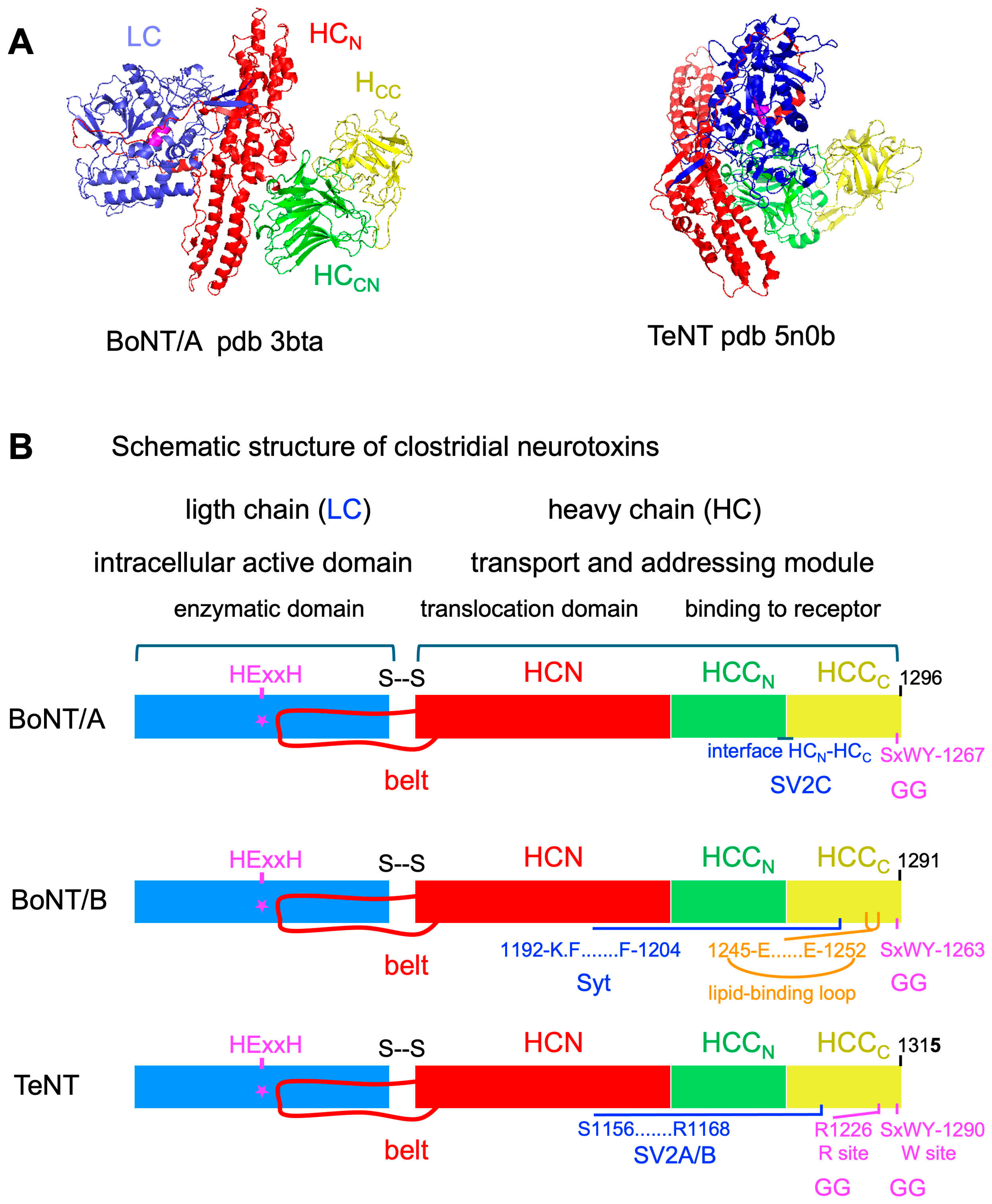
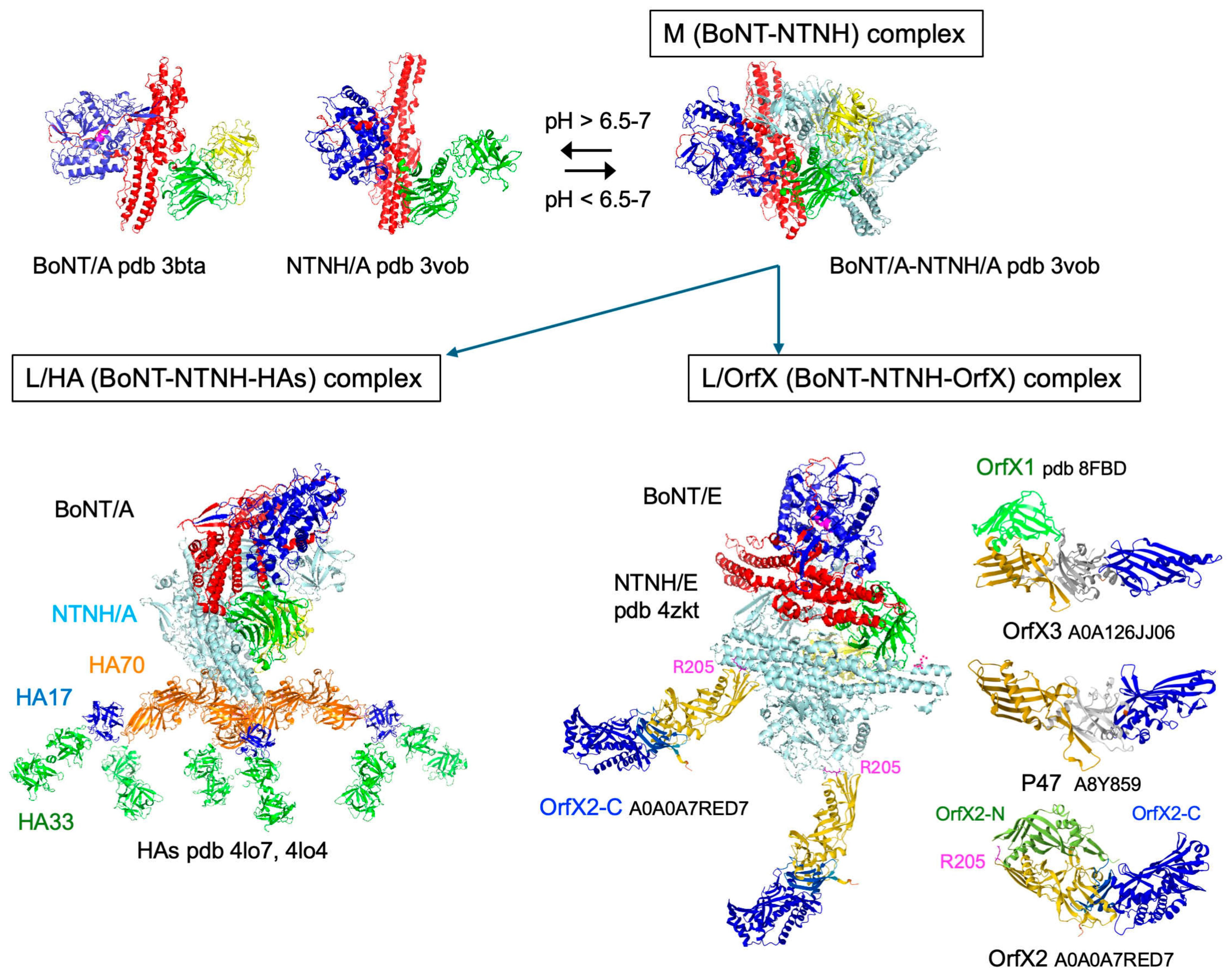
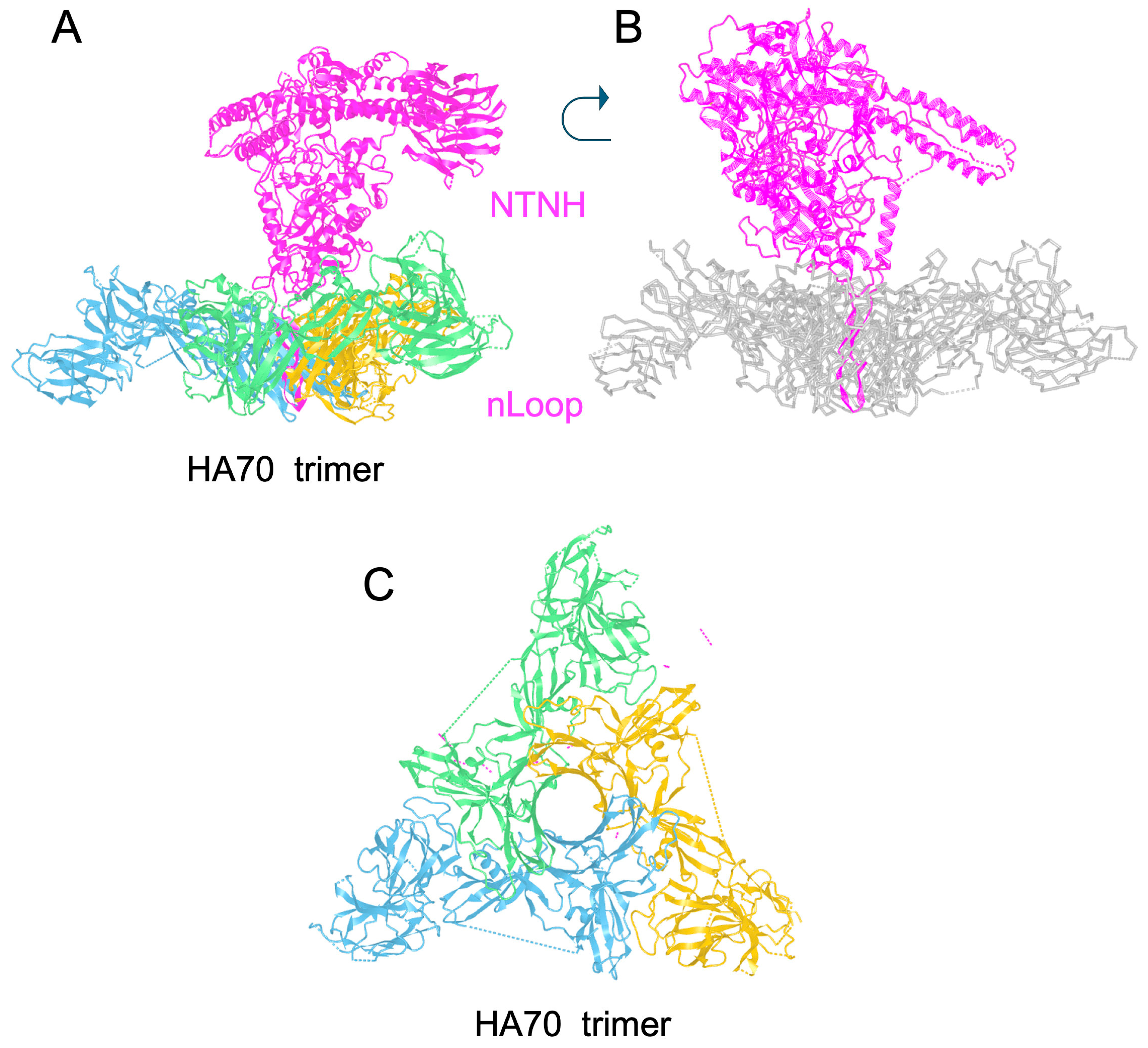
2. Structure of Clostridial Neurotoxins and Associated Proteins
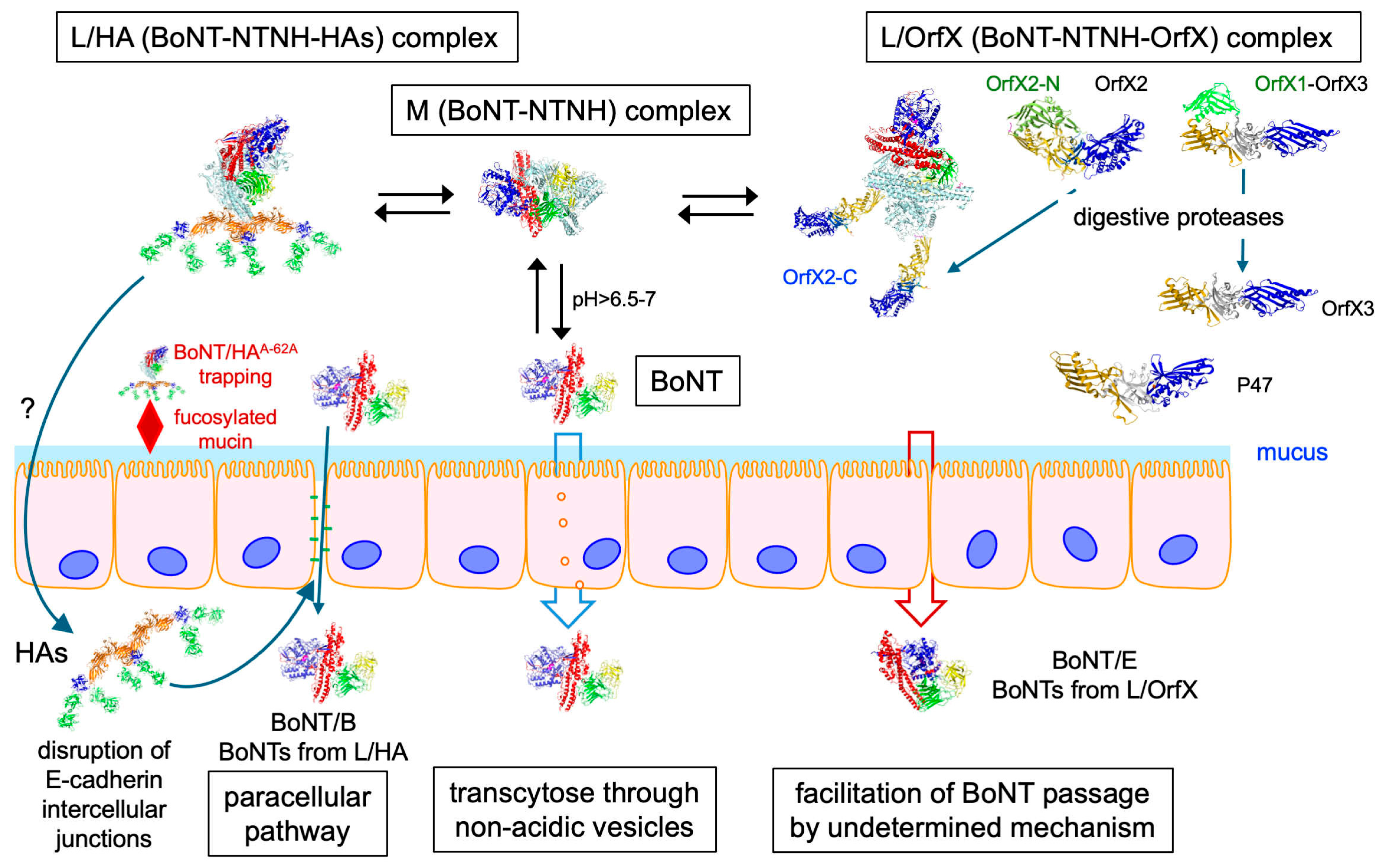
3. Botulinum Neurotoxin Passage Through the Intestinal Barrier
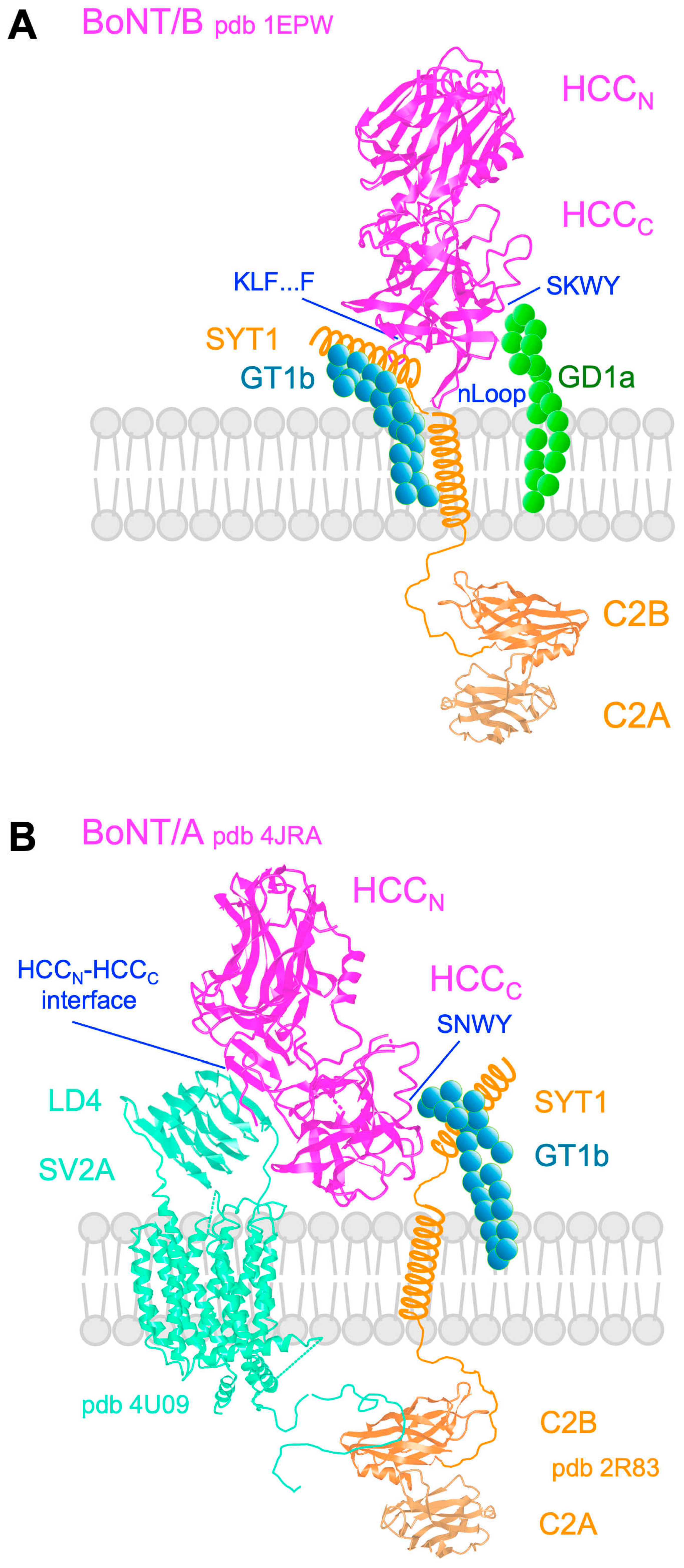
4. Neuronal Cell Surface Receptors of Botulinum Neurotoxins
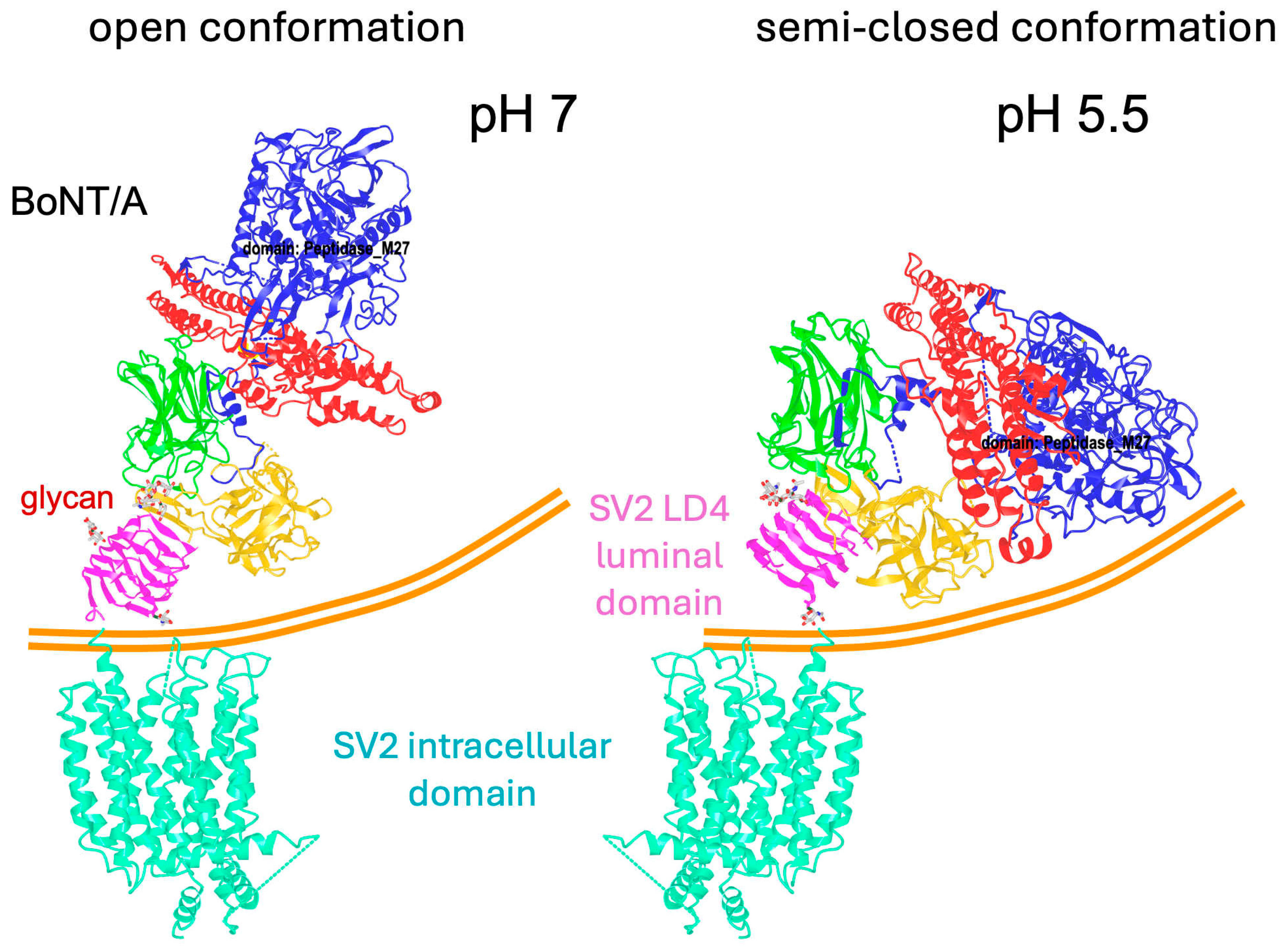
5. Intraneuronal BoNT Activity, BoNT/A Versus BoNT/E
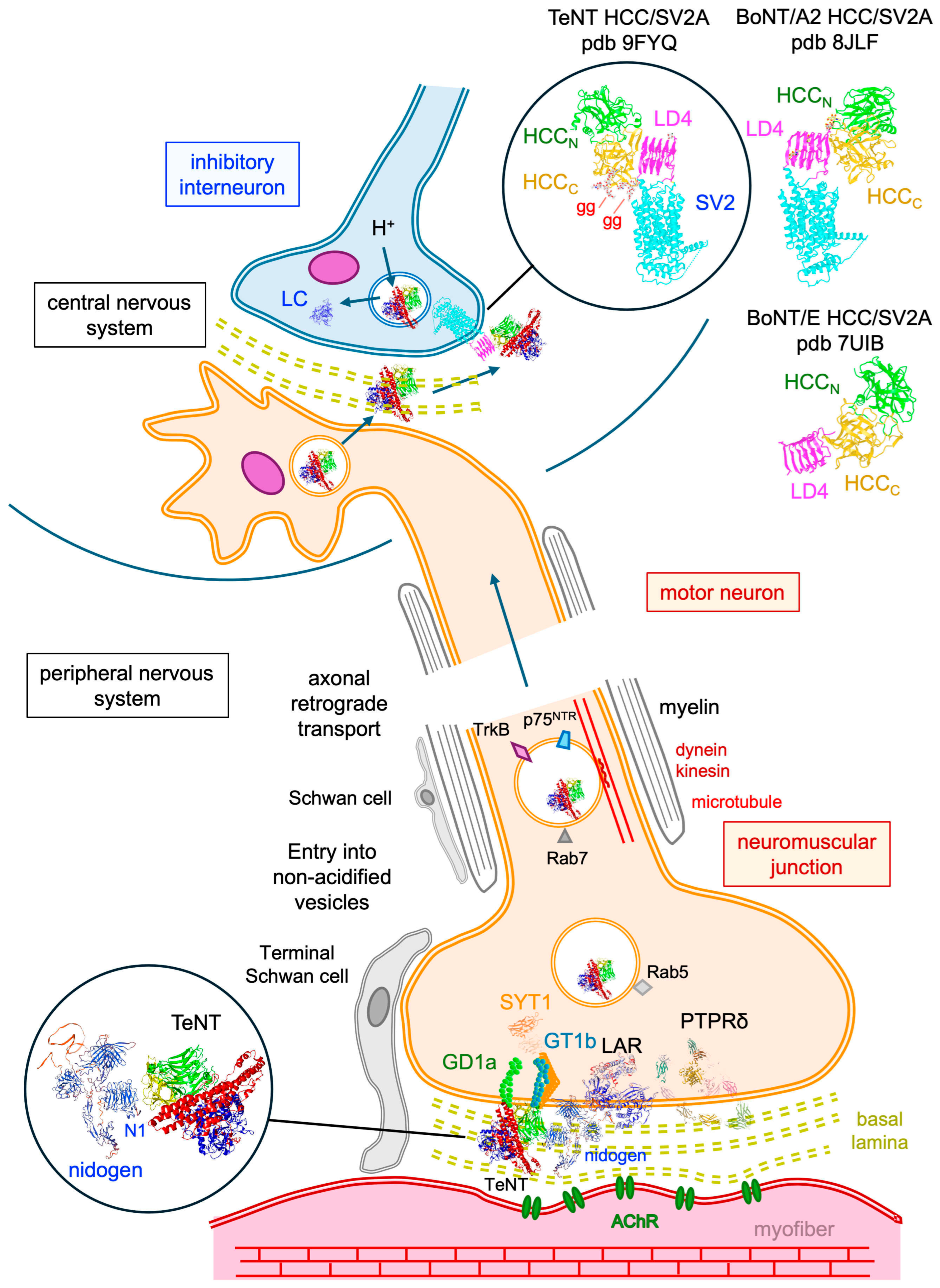
6. Neuronal Cell Receptor(s) of Tetanus Neurotoxin and Retrograde Transport of TeNT and BoNT

7. Conclusions
Funding
Institutional Review Board Statement
Informed Consent Statement
Data Availability Statement
Conflicts of Interest
Abbreviations
| BoNT | Botulinum neurotoxin |
| TeNT | Tetanus neurotoxin |
| CNS | Central nervous system |
| HA | Hemagglutinin |
| LC | Light chain |
| HC | Heavy chain |
| HCN | Heavy chain, N-terminal domain |
| HCC | Heavy chain, C-terminal domain |
| HCCN | HCC, N-subterminal domain |
| HCCC | HCC, C-subterminal domain |
| NTNH | Non-toxic non-hemagglutinin |
| LD4 | Luminal domain 4 |
| SNARE | Soluble N-ethylmaleimide-sensitive-factor attachment receptor |
| SNAP | Synaptosomal-associated protein |
| SV2 | Synaptic vesicle protein 2 |
| SYT | Synaptotagmin |
| LAR | Leucocyte common antigen-related protein |
| PTPRδ | Protein tyrosine phosphatase receptor δ |
| VAMP | Vesicle-associated membrane protein |
References
- Dong, M.; Masuyer, G.; Stenmark, P. Botulinum and Tetanus Neurotoxins. Annu. Rev. Biochem. 2019, 88, 811–837. [Google Scholar] [CrossRef] [PubMed]
- Pirazzini, M.; Rossetto, O.; Eleopra, R.; Montecucco, C. Botulinum Neurotoxins: Biology, Pharmacology, and Toxicology. Pharmacol. Rev. 2017, 69, 200–235. [Google Scholar] [CrossRef]
- Poulain, B.; Popoff, M.R. Why Are Botulinum Neurotoxin-Producing Bacteria So Diverse and Botulinum Neurotoxins So Toxic? Toxins 2019, 11, 34. [Google Scholar] [CrossRef] [PubMed]
- Barash, J.R.; Arnon, S.S. A Novel Strain of Clostridium Botulinum That Produces Type B and Type H Botulinum Toxins. J. Infect. Dis. 2014, 209, 183–191. [Google Scholar] [CrossRef] [PubMed]
- Dover, N.; Barash, J.R.; Hill, K.K.; Xie, G.; Arnon, S.S. Molecular Characterization of a Novel Botulinum Neurotoxin Type H Gene. J. Infect. Dis. 2014, 209, 192–202. [Google Scholar] [CrossRef]
- Kalb, S.R.; Baudys, J.; Raphael, B.H.; Dykes, J.K.; Lúquez, C.; Maslanka, S.E.; Barr, J.R. Functional Characterization of Botulinum Neurotoxin Serotype H as a Hybrid of Known Serotypes F and A (BoNT F/A). Anal. Chem. 2015, 87, 3911–3917. [Google Scholar] [CrossRef]
- Hill, K.K.; Smith, T.J. Genetic Diversity within Clostridium Botulinum Serotypes, Botulinum Neurotoxin Gene Clusters and Toxin Subtypes. In Botulinum Neurotoxins; Springer: New York, NY, USA, 2012; Volume 364, pp. 1–20. [Google Scholar] [CrossRef]
- Peck, M.W.; Smith, T.J.; Anniballi, F.; Austin, J.W.; Bano, L.; Bradshaw, M.; Cuervo, P.; Cheng, L.W.; Derman, Y.; Dorner, B.G.; et al. Historical Perspectives and Guidelines for Botulinum Neurotoxin Subtype Nomenclature. Toxins 2017, 9, 38. [Google Scholar] [CrossRef]
- Chapeton-Montes, D.; Plourde, L.; Bouchier, C.; Ma, L.; Diancourt, L.; Criscuolo, A.; Popoff, M.R.; Brüggemann, H. The Population Structure of Clostridium Tetani Deduced from Its Pan-Genome. Sci. Rep. 2019, 9, 11220. [Google Scholar] [CrossRef]
- Hodgins, H.P.; Chen, P.; Lobb, B.; Wei, X.; Tremblay, B.J.M.; Mansfield, M.J.; Lee, V.C.Y.; Lee, P.-G.; Coffin, J.; Duggan, A.T.; et al. Ancient Clostridium DNA and Variants of Tetanus Neurotoxins Associated with Human Archaeological Remains. Nat. Commun. 2023, 14, 5475. [Google Scholar] [CrossRef]
- Kumaran, D.; Eswaramoorthy, S.; Furey, W.; Navaza, J.; Sax, M.; Swaminathan, S. Domain Organization in Clostridium Botulinum Neurotoxin Type E Is Unique: Its Implication in Faster Translocation. J. Mol. Biol. 2009, 386, 233–245. [Google Scholar] [CrossRef]
- Swaminathan, S. Molecular Structures and Functional Relationships in Clostridial Neurotoxins. FEBS J. 2011, 278, 4467–4485. [Google Scholar] [CrossRef]
- Gao, L.; Jin, R. NTNH Protein: More than a Bodyguard for Botulinum Neurotoxins. FEBS J. 2024, 291, 672–675. [Google Scholar] [CrossRef]
- Gu, S.; Rumpel, S.; Zhou, J.; Strotmeier, J.; Bigalke, H.; Perry, K.; Shoemaker, C.B.; Rummel, A.; Jin, R. Botulinum Neurotoxin Is Shielded by NTNHA in an Interlocked Complex. Science 2012, 335, 977–981. [Google Scholar] [CrossRef] [PubMed]
- Dekleva, M.L.; Dasgupta, B.R. Purification and Characterization of a Protease from Clostridium Botulinum Type A That Nicks Single-Chain Type A Botulinum Neurotoxin into the Di-Chain Form. J. Bacteriol. 1990, 172, 2498–2503. [Google Scholar] [CrossRef]
- Pitel, S.; Barnea, A.; Diamant, E.; Torgeman, A.; Noy-Porat, T.; Falach, R.; Zichel, R.; Hayouka, Z.; Ben David, A. Elucidating the Activation Mechanism of Botulinum Neurotoxin a: Role of α-Clostripain and NTNH. Sci. Rep. 2025, 15, 37324. [Google Scholar] [CrossRef]
- Stringer, S.C.; Carter, A.T.; Webb, M.D.; Wachnicka, E.; Crossman, L.C.; Sebaihia, M.; Peck, M.W. Genomic and Physiological Variability within Group II (Non-Proteolytic) Clostridium Botulinum. BMC Genom. 2013, 14, 333. [Google Scholar] [CrossRef] [PubMed]
- Hosomi, K.; Sakaguchi, Y.; Kohda, T.; Gotoh, K.; Motooka, D.; Nakamura, S.; Umeda, K.; Iida, T.; Kozaki, S.; Mukamoto, M. Complete Nucleotide Sequence of a Plasmid Containing the Botulinum Neurotoxin Gene in Clostridium Botulinum Type B Strain 111 Isolated from an Infant Patient in Japan. Mol. Genet. Genom. 2014, 289, 1267–1274. [Google Scholar] [CrossRef]
- Krč, A.; Košenina, S.P.; Nowakowska, M.B.; Masuyer, G.; Stenmark, P. Structure of the Complete 14-Subunit Botulinum Neurotoxin B Complex Reveals a Unique Anchoring through the Narrow Central Pore of HA70. Sci. Adv. 2025, 11, eadx5058. [Google Scholar] [CrossRef] [PubMed]
- Lam, K.-H.; Gao, L.; Przykopanski, A.; Chen, B.; Huang, T.; Krüger, M.; Bartels, A.-M.; Dorner, M.B.; Perry, K.; Dorner, B.G.; et al. A Nut-and-Bolt Assembly of the Bimodular Large Progenitor Botulinum Neurotoxin Complex. Sci. Adv. 2025, 11, eadx5831. [Google Scholar] [CrossRef]
- Lee, K.; Gu, S.; Jin, L.; Le, T.T.N.; Cheng, L.W.; Strotmeier, J.; Kruel, A.M.; Yao, G.; Perry, K.; Rummel, A.; et al. Structure of a Bimodular Botulinum Neurotoxin Complex Provides Insights into Its Oral Toxicity. PLoS Pathog. 2013, 9, e1003690. [Google Scholar] [CrossRef]
- Hasegawa, K.; Watanabe, T.; Suzuki, T.; Yamano, A.; Oikawa, T.; Sato, Y.; Kouguchi, H.; Yoneyama, T.; Niwa, K.; Ikeda, T.; et al. A Novel Subunit Structure of Clostridium Botulinum Serotype D Toxin Complex with Three Extended Arms. J. Biol. Chem. 2007, 282, 24777–24783. [Google Scholar] [CrossRef]
- Franciosa, G.; Floridi, F.; Maugliani, A.; Aureli, P. Differentiation of the Gene Clusters Encoding Botulinum Neurotoxin Type A Complexes in Clostridium Botulinum Type A, Ab, and A(B) Strains. Appl. Environ. Microbiol. 2004, 70, 7192–7199. [Google Scholar] [CrossRef] [PubMed]
- Smith, T.J.; Hill, K.K.; Foley, B.T.; Detter, J.C.; Munk, A.C.; Bruce, D.C.; Doggett, N.A.; Smith, L.A.; Marks, J.D.; Xie, G.; et al. Analysis of the Neurotoxin Complex Genes in Clostridium Botulinum A1-A4 and B1 Strains: BoNT/A3, /Ba4 and /B1 Clusters Are Located within Plasmids. PLoS ONE 2007, 2, e1271. [Google Scholar] [CrossRef] [PubMed]
- Kull, S.; Schulz, K.M.; Weisemann, J.; Kirchner, S.; Schreiber, T.; Bollenbach, A.; Dabrowski, P.W.; Nitsche, A.; Kalb, S.R.; Dorner, M.B.; et al. Isolation and Functional Characterization of the Novel Clostridium Botulinum Neurotoxin A8 Subtype. PLoS ONE 2015, 10, e0116381. [Google Scholar] [CrossRef]
- Lúquez, C.; Raphael, B.H.; Maslanka, S.E. Neurotoxin Gene Clusters in Clostridium Botulinum Type Ab Strains. Appl. Environ. Microbiol. 2009, 75, 6094–6101. [Google Scholar] [CrossRef]
- Dover, N.; Barash, J.R.; Arnon, S.S. Novel Clostridium Botulinum Toxin Gene Arrangement with Subtype A5 and Partial Subtype B3 Botulinum Neurotoxin Genes. J. Clin. Microbiol. 2009, 47, 2349–2350. [Google Scholar] [CrossRef]
- Amatsu, S.; Sugawara, Y.; Matsumura, T.; Kitadokoro, K.; Fujinaga, Y. Crystal Structure of Clostridium Botulinum Whole Hemagglutinin Reveals a Huge Triskelion-Shaped Molecular Complex. J. Biol. Chem. 2013, 288, 35617–35625. [Google Scholar] [CrossRef]
- Eisele, K.-H.; Fink, K.; Vey, M.; Taylor, H.V. Studies on the Dissociation of Botulinum Neurotoxin Type A Complexes. Toxicon 2011, 57, 555–565. [Google Scholar] [CrossRef]
- Košenina, S.; Masuyer, G.; Zhang, S.; Dong, M.; Stenmark, P. Crystal Structure of the Catalytic Domain of the Weissella Oryzae Botulinum-like Toxin. FEBS Lett. 2019, 593, 1403–1410. [Google Scholar] [CrossRef] [PubMed]
- Košenina, S.; Stenmark, P. Crystal Structure of the OrfX1-OrfX3 Complex from the PMP1 Neurotoxin Gene Cluster. FEBS Lett. 2023, 597, 515–523. [Google Scholar] [CrossRef]
- Gustafsson, R.; Berntsson, R.P.-A.; Martínez-Carranza, M.; El Tekle, G.; Odegrip, R.; Johnson, E.A.; Stenmark, P. Crystal Structures of OrfX2 and P47 from a Botulinum Neurotoxin OrfX-Type Gene Cluster. FEBS Lett. 2017, 591, 3781–3792. [Google Scholar] [CrossRef]
- Gao, L.; Lam, K.-H.; Liu, S.; Przykopanski, A.; Lübke, J.; Qi, R.; Krüger, M.; Nowakowska, M.B.; Selby, K.; Douillard, F.P.; et al. Crystal Structures of OrfX1, OrfX2 and the OrfX1-OrfX3 Complex from the orfX Gene Cluster of Botulinum Neurotoxin E1. FEBS Lett. 2023, 597, 524–537. [Google Scholar] [CrossRef]
- Gao, L.; Nowakowska, M.B.; Selby, K.; Przykopanski, A.; Chen, B.; Krüger, M.; Douillard, F.P.; Lam, K.-H.; Chen, P.; Huang, T.; et al. Botulinum Neurotoxins Exploit Host Digestive Proteases to Boost Their Oral Toxicity via Activating OrfXs/P47. Nat. Struct. Mol. Biol. 2025, 32, 864–875. [Google Scholar] [CrossRef]
- Nowakowska, M.B.; Douillard, F.P.; Lindström, M. Looking for the X Factor in Bacterial Pathogenesis: Association of orfX-P47 Gene Clusters with Toxin Genes in Clostridial and Non-Clostridial Bacterial Species. Toxins 2019, 12, 19. [Google Scholar] [CrossRef] [PubMed]
- Arnon, S.S.; Schechter, R.; Inglesby, T.V.; Henderson, D.A.; Bartlett, J.G.; Ascher, M.S.; Eitzen, E.; Fine, A.D.; Hauer, J.; Layton, M.; et al. Botulinum Toxin as a Biological Weapon: Medical and Public Health Management. JAMA 2001, 285, 1059–1070. [Google Scholar] [CrossRef]
- Schantz, E.J.; Johnson, E.A. Properties and Use of Botulinum Toxin and Other Microbial Neurotoxins in Medicine. Microbiol. Rev. 1992, 56, 80–99. [Google Scholar] [CrossRef]
- Popoff, M.R.; Connan, C. Absorption and Transport of Botulinum Neurotoxins. In Molecular Aspects of Botulinum Neurotoxin; Foster, K.A., Ed.; Springer: New York, NY, USA, 2014; pp. 35–68. ISBN 978-1-4614-9454-6. [Google Scholar]
- May, A.J.; Whaler, B.C. The Absorption of Clostridium Botulinum Type A Toxin from the Alimentary Canal. Br. J. Exp. Pathol. 1958, 39, 307–316. [Google Scholar] [PubMed]
- Sugii, S.; Ohishi, I.; Sakaguchi, G. Intestinal Absorption of Botulinum Toxins of Different Molecular Sizes in Rats. Infect. Immun. 1977, 17, 491–496. [Google Scholar] [CrossRef] [PubMed]
- Connan, C.; Voillequin, M.; Chavez, C.V.; Mazuet, C.; Leveque, C.; Vitry, S.; Vandewalle, A.; Popoff, M.R. Botulinum Neurotoxin Type B Uses a Distinct Entry Pathway Mediated by CDC42 into Intestinal Cells versus Neuronal Cells. Cell. Microbiol. 2017, 19, e12738. [Google Scholar] [CrossRef]
- Couesnon, A.; Pereira, Y.; Popoff, M.R. Receptor-Mediated Transcytosis of Botulinum Neurotoxin A through Intestinal Cell Monolayers. Cell. Microbiol. 2007, 10, 375–387. [Google Scholar] [CrossRef]
- Lam, T.I.; Stanker, L.H.; Lee, K.; Jin, R.; Cheng, L.W. Translocation of Botulinum Neurotoxin Serotype A and Associated Proteins across the Intestinal Epithelia. Cell. Microbiol. 2015, 17, 1133–1143. [Google Scholar] [CrossRef] [PubMed]
- Connan, C.; Varela-Chavez, C.; Mazuet, C.; Molgó, J.; Haustant, G.M.; Disson, O.; Lecuit, M.; Vandewalle, A.; Popoff, M.R. Translocation and Dissemination to Target Neurons of Botulinum Neurotoxin Type B in the Mouse Intestinal Wall. Cell. Microbiol. 2015, 18, 282–301. [Google Scholar] [CrossRef]
- Couesnon, A.; Molgó, J.; Connan, C.; Popoff, M.R. Preferential Entry of Botulinum Neurotoxin A Hc Domain through Intestinal Crypt Cells and Targeting to Cholinergic Neurons of the Mouse Intestine. PLoS Pathog. 2012, 8, e1002583. [Google Scholar] [CrossRef]
- Yao, G.; Lee, K.; Gu, S.; Lam, K.-H.; Jin, R. Botulinum Neurotoxin A Complex Recognizes Host Carbohydrates through Its Hemagglutinin Component. Toxins 2014, 6, 624–635. [Google Scholar] [CrossRef]
- Fujinaga, Y.; Inoue, K.; Nomura, T.; Sasaki, J.; Marvaud, J.C.; Popoff, M.R.; Kozaki, S.; Oguma, K. Identification and Characterization of Functional Subunits of Clostridium Botulinum Type A Progenitor Toxin Involved in Binding to Intestinal Microvilli and Erythrocytes. FEBS Lett. 2000, 467, 179–183. [Google Scholar] [CrossRef]
- Miyashita, S.-I.; Niwa, K.; Watanabe, T.; Sagane, Y. Host-Cell Specificity and Transcytosis of Nontoxic Nonhemagglutinin Protein of Botulinum Neurotoxin Serotype D. FEMS Microbiol. Lett. 2014, 357, 115–122. [Google Scholar] [CrossRef] [PubMed]
- Miyashita, S.-I.; Sagane, Y.; Niwa, K.; Watanabe, T. Transport of the Botulinum Neurotoxin-Associating Protein, Nontoxic Nonhemagglutinin, across the Rat Small Intestinal Epithelial Cell Monolayer. FEMS Microbiol. Lett. 2013, 346, 73–80. [Google Scholar] [CrossRef][Green Version]
- Fujinaga, Y.; Inoue, K.; Watanabe, S.; Yokota, K.; Hirai, Y.; Nagamachi, E.; Oguma, K. The Haemagglutinin of Clostridium Botulinum Type C Progenitor Toxin Plays an Essential Role in Binding of Toxin to the Epithelial Cells of Guinea Pig Small Intestine, Leading to the Efficient Absorption of the Toxin. Microbiology 1997, 143, 3841–3847. [Google Scholar] [CrossRef]
- Amatsu, S.; Matsumura, T.; Morimoto, C.; Keisham, S.; Goto, Y.; Kohda, T.; Hirabayashi, J.; Kitadokoro, K.; Katayama, T.; Kiyono, H.; et al. Gut Mucin Fucosylation Dictates the Entry of Botulinum Toxin Complexes. Nat. Commun. 2025, 16, 10442. [Google Scholar] [CrossRef] [PubMed]
- Morimoto, C.; Amatsu, S.; Matsumura, T.; Zuka, M.; Fujinaga, Y. Botulinum Toxin Complex Serotype B-Okra Exerts Systemic Toxicity via the Oral Route by Disrupting the Intestinal Epithelial Barrier. Toxins 2025, 17, 443. [Google Scholar] [CrossRef]
- Li, Y.; Pan, J.; Liu, H.; Liu, C. Intestinal Mucin Glycosylation: Structural Regulation, Homeostasis Maintenance and Disease Association. Biomolecules 2025, 15, 1552. [Google Scholar] [CrossRef] [PubMed]
- Hu, M.; Zhang, X.; Li, J.; Chen, L.; He, X.; Sui, T. Fucosyltransferase 2: A Genetic Risk Factor for Intestinal Diseases. Front. Microbiol. 2022, 13, 940196. [Google Scholar] [CrossRef]
- Mazuet, C.; Legeay, C.; Sautereau, J.; Ma, L.; Bouchier, C.; Bouvet, P.; Popoff, M.R. Diversity of Group I and II Clostridium Botulinum Strains from France Including Recently Identified Subtypes. Genome Biol. Evol. 2016, 8, 1643–1660. [Google Scholar] [CrossRef] [PubMed]
- Rasetti-Escargueil, C.; Lemichez, E.; Popoff, M.R. Human Botulism in France, 1875–2016. Toxins 2020, 12, 338. [Google Scholar] [CrossRef]
- Rasetti-Escargueil, C.; Lemichez, E.; Popoff, M.R. Public Health Risk Associated with Botulism as Foodborne Zoonoses. Toxins 2019, 12, 17. [Google Scholar] [CrossRef] [PubMed]
- Sugawara, Y.; Yutani, M.; Amatsu, S.; Matsumura, T.; Fujinaga, Y. Functional Dissection of the Clostridium Botulinum Type B Hemagglutinin Complex: Identification of the Carbohydrate and E-Cadherin Binding Sites. PLoS ONE 2014, 9, e111170. [Google Scholar] [CrossRef]
- Lee, K.; Zhong, X.; Gu, S.; Kruel, A.M.; Dorner, M.B.; Perry, K.; Rummel, A.; Dong, M.; Jin, R. Molecular Basis for Disruption of E-Cadherin Adhesion by Botulinum Neurotoxin A Complex. Science 2014, 344, 1405–1410. [Google Scholar] [CrossRef]
- Matsumura, T.; Jin, Y.; Kabumoto, Y.; Takegahara, Y.; Oguma, K.; Lencer, W.I.; Fujinaga, Y. The HA Proteins of Botulinum Toxin Disrupt Intestinal Epithelial Intercellular Junctions to Increase Toxin Absorption. Cell. Microbiol. 2007, 10, 355–364. [Google Scholar] [CrossRef]
- Fujinaga, Y.; Sugawara, Y.; Matsumura, T. Uptake of Botulinum Neurotoxin in the Intestine. Curr. Top. Microbiol. Immunol. 2013, 364, 45–59. [Google Scholar] [CrossRef]
- Jin, Y.; Takegahara, Y.; Sugawara, Y.; Matsumura, T.; Fujinaga, Y. Disruption of the Epithelial Barrier by Botulinum Haemagglutinin (HA) Proteins—Differences in Cell Tropism and the Mechanism of Action between HA Proteins of Types A or B, and HA Proteins of Type C. Microbiology 2009, 155, 35–45. [Google Scholar] [CrossRef]
- Sugawara, Y.; Matsumura, T.; Takegahara, Y.; Jin, Y.; Tsukasaki, Y.; Takeichi, M.; Fujinaga, Y. Botulinum Hemagglutinin Disrupts the Intercellular Epithelial Barrier by Directly Binding E-Cadherin. J. Cell Biol. 2010, 189, 691–700. [Google Scholar] [CrossRef]
- Lee, K.; Lam, K.-H.; Kruel, A.M.; Perry, K.; Rummel, A.; Jin, R. High-Resolution Crystal Structure of HA33 of Botulinum Neurotoxin Type B Progenitor Toxin Complex. Biochem. Biophys. Res. Commun. 2014, 446, 568–573. [Google Scholar] [CrossRef]
- Matsumura, T.; Sugawara, Y.; Yutani, M.; Amatsu, S.; Yagita, H.; Kohda, T.; Fukuoka, S.-I.; Nakamura, Y.; Fukuda, S.; Hase, K.; et al. Botulinum Toxin A Complex Exploits Intestinal M Cells to Enter the Host and Exert Neurotoxicity. Nat. Commun. 2015, 6, 6255. [Google Scholar] [CrossRef]
- Bonventre, P.F. Absorption of Botulinal Toxin from the Gastrointestinal Tract. Rev. Infect. Dis. 1979, 1, 663–667. [Google Scholar] [CrossRef] [PubMed]
- Sakaguchi, G. Clostridium Botulinum Toxins. Pharmacol. Ther. 1982, 19, 165–194. [Google Scholar] [CrossRef] [PubMed]
- Evans, D.F.; Pye, G.; Bramley, R.; Clark, A.G.; Dyson, T.J.; Hardcastle, J.D. Measurement of Gastrointestinal pH Profiles in Normal Ambulant Human Subjects. Gut 1988, 29, 1035–1041. [Google Scholar] [CrossRef] [PubMed]
- Procházková, N.; Laursen, M.F.; La Barbera, G.; Tsekitsidi, E.; Jørgensen, M.S.; Rasmussen, M.A.; Raes, J.; Licht, T.R.; Dragsted, L.O.; Roager, H.M. Gut Physiology and Environment Explain Variations in Human Gut Microbiome Composition and Metabolism. Nat. Microbiol. 2024, 9, 3210–3225. [Google Scholar] [CrossRef]
- Palladino, R.A.; Olmeda, M.F.; Juliano, N.; Bargo, F.; Ipharraguerre, I.R. Daily Fecal pH Pattern and Variation in Lactating Dairy Cows. JDS Commun. 2022, 3, 106–109. [Google Scholar] [CrossRef]
- Herpol, C.; van Grembergen, G. Le pH Dans Le Tube Digestif Des Oiseaux. Ann. Biol. Anim. Biochim. Biophys. 1961, 1, 317–321. [Google Scholar] [CrossRef]
- McConnell, E.L.; Basit, A.W.; Murdan, S. Measurements of Rat and Mouse Gastrointestinal pH, Fluid and Lymphoid Tissue, and Implications for in-Vivo Experiments. J. Pharm. Pharmacol. 2008, 60, 63–70. [Google Scholar] [CrossRef]
- Merchant, H.A.; McConnell, E.L.; Liu, F.; Ramaswamy, C.; Kulkarni, R.P.; Basit, A.W.; Murdan, S. Assessment of Gastrointestinal pH, Fluid and Lymphoid Tissue in the Guinea Pig, Rabbit and Pig, and Implications for Their Use in Drug Development. Eur. J. Pharm. Sci. 2011, 42, 3–10. [Google Scholar] [CrossRef]
- Montecucco, C.; Rossetto, O.; Schiavo, G. Presynaptic Receptor Arrays for Clostridial Neurotoxins. Trends Microbiol. 2004, 12, 442–446. [Google Scholar] [CrossRef] [PubMed]
- Montecucco, C. How Do Tetanus and Botulinum Toxins Bind to Neuronal Membranes? Trends Biochem. Sci. 1986, 11, 314–317. [Google Scholar] [CrossRef]
- Fotinou, C.; Emsley, P.; Black, I.; Ando, H.; Ishida, H.; Kiso, M.; Sinha, K.A.; Fairweather, N.F.; Isaacs, N.W. The Crystal Structure of Tetanus Toxin Hc Fragment Complexed with a Synthetic GT1b Analogue Suggests Cross-Linking between Ganglioside Receptors and the Toxin. J. Biol. Chem. 2001, 276, 32274–32281. [Google Scholar] [CrossRef]
- Rummel, A. Two Feet on the Membrane: Uptake of Clostridial Neurotoxins. In Uptake and Trafficking of Protein Toxins; Springer: New York, NY, USA, 2017; Volume 406, pp. 1–37. [Google Scholar] [CrossRef]
- Chen, C.; Fu, Z.; Kim, J.-J.P.; Barbieri, J.T.; Baldwin, M.R. Gangliosides as High Affinity Receptors for Tetanus Neurotoxin. J. Biol. Chem. 2009, 284, 26569–26577. [Google Scholar] [CrossRef]
- Stern, D.; Weisemann, J.; Le Blanc, A.; von Berg, L.; Mahrhold, S.; Piesker, J.; Laue, M.; Luppa, P.B.; Dorner, M.B.; Dorner, B.G.; et al. A Lipid-Binding Loop of Botulinum Neurotoxin Serotypes B, DC and G Is an Essential Feature to Confer Their Exquisite Potency. PLoS Pathog. 2018, 14, e1007048. [Google Scholar] [CrossRef]
- Zhang, S.; Berntsson, R.P.-A.; Tepp, W.H.; Tao, L.; Johnson, E.A.; Stenmark, P.; Dong, M. Structural Basis for the Unique Ganglioside and Cell Membrane Recognition Mechanism of Botulinum Neurotoxin DC. Nat. Commun. 2017, 8, 1637. [Google Scholar] [CrossRef] [PubMed]
- Ciruelas, K.; Marcotulli, D.; Bajjalieh, S.M. Synaptic Vesicle Protein 2: A Multi-Faceted Regulator of Secretion. Semin. Cell Dev. Biol. 2019, 95, 130–141. [Google Scholar] [CrossRef]
- Stout, K.A.; Dunn, A.R.; Hoffman, C.; Miller, G.W. The Synaptic Vesicle Glycoprotein 2: Structure, Function, and Disease Relevance. ACS Chem. Neurosci. 2019, 10, 3927–3938. [Google Scholar] [CrossRef]
- Chapman, E.R. How Does Synaptotagmin Trigger Neurotransmitter Release? Annu. Rev. Biochem. 2008, 77, 615–641. [Google Scholar] [CrossRef]
- Dong, M.; Yeh, F.; Tepp, W.H.; Dean, C.; Johnson, E.A.; Janz, R.; Chapman, E.R. SV2 Is the Protein Receptor for Botulinum Neurotoxin A. Science 2006, 312, 592–596. [Google Scholar] [CrossRef] [PubMed]
- Benoit, R.M.; Frey, D.; Hilbert, M.; Kevenaar, J.T.; Wieser, M.M.; Stirnimann, C.U.; McMillan, D.; Ceska, T.; Lebon, F.; Jaussi, R.; et al. Structural Basis for Recognition of Synaptic Vesicle Protein 2C by Botulinum Neurotoxin A. Nature 2014, 505, 108–111. [Google Scholar] [CrossRef] [PubMed]
- Strotmeier, J.; Mahrhold, S.; Krez, N.; Janzen, C.; Lou, J.; Marks, J.D.; Binz, T.; Rummel, A. Identification of the Synaptic Vesicle Glycoprotein 2 Receptor Binding Site in Botulinum Neurotoxin A. FEBS Lett. 2014, 588, 1087–1093. [Google Scholar] [CrossRef]
- Liu, Z.; Lee, P.-G.; Krez, N.; Lam, K.-H.; Liu, H.; Przykopanski, A.; Chen, P.; Yao, G.; Zhang, S.; Tremblay, J.M.; et al. Structural Basis for Botulinum Neurotoxin E Recognition of Synaptic Vesicle Protein 2. Nat. Commun. 2023, 14, 2338. [Google Scholar] [CrossRef] [PubMed]
- Mahrhold, S.; Strotmeier, J.; Garcia-Rodriguez, C.; Lou, J.; Marks, J.D.; Rummel, A.; Binz, T. Identification of the SV2 Protein Receptor-Binding Site of Botulinum Neurotoxin Type E. Biochem. J. 2013, 453, 37–47. [Google Scholar] [CrossRef]
- Burns, J.R.; Lambert, G.S.; Baldwin, M.R. Insights into the Mechanisms by Which Clostridial Neurotoxins Discriminate between Gangliosides. Biochemistry 2017, 56, 2571–2583. [Google Scholar] [CrossRef]
- Hamark, C.; Berntsson, R.P.-A.; Masuyer, G.; Henriksson, L.M.; Gustafsson, R.; Stenmark, P.; Widmalm, G. Glycans Confer Specificity to the Recognition of Ganglioside Receptors by Botulinum Neurotoxin A. J. Am. Chem. Soc. 2017, 139, 218–230. [Google Scholar] [CrossRef]
- Benoit, R.M.; Schärer, M.A.; Wieser, M.M.; Li, X.; Frey, D.; Kammerer, R.A. Crystal Structure of the BoNT/A2 Receptor-Binding Domain in Complex with the Luminal Domain of Its Neuronal Receptor SV2C. Sci. Rep. 2017, 7, 43588. [Google Scholar] [CrossRef]
- Mahrhold, S.; Bergström, T.; Stern, D.; Dorner, B.G.; Åstot, C.; Rummel, A. Only the Complex N559-Glycan in the Synaptic Vesicle Glycoprotein 2C Mediates High Affinity Binding to Botulinum Neurotoxin Serotype A1. Biochem. J. 2016, 473, 2645–2654. [Google Scholar] [CrossRef]
- Yao, G.; Zhang, S.; Mahrhold, S.; Lam, K.-H.; Stern, D.; Bagramyan, K.; Perry, K.; Kalkum, M.; Rummel, A.; Dong, M.; et al. N-Linked Glycosylation of SV2 Is Required for Binding and Uptake of Botulinum Neurotoxin A. Nat. Struct. Mol. Biol. 2016, 23, 656–662. [Google Scholar] [CrossRef]
- Dong, M.; Liu, H.; Tepp, W.H.; Johnson, E.A.; Janz, R.; Chapman, E.R. Glycosylated SV2A and SV2B Mediate the Entry of Botulinum Neurotoxin E into Neurons. Mol. Biol. Cell 2008, 19, 5226–5237. [Google Scholar] [CrossRef]
- Chai, Q.; Arndt, J.W.; Dong, M.; Tepp, W.H.; Johnson, E.A.; Chapman, E.R.; Stevens, R.C. Structural Basis of Cell Surface Receptor Recognition by Botulinum Neurotoxin B. Nature 2006, 444, 1096–1100. [Google Scholar] [CrossRef]
- Jin, R.; Rummel, A.; Binz, T.; Brunger, A.T. Botulinum Neurotoxin B Recognizes Its Protein Receptor with High Affinity and Specificity. Nature 2006, 444, 1092–1095. [Google Scholar] [CrossRef]
- Peng, L.; Berntsson, R.P.-A.; Tepp, W.H.; Pitkin, R.M.; Johnson, E.A.; Stenmark, P.; Dong, M. Botulinum Neurotoxin D-C Uses Synaptotagmin I and II as Receptors, and Human Synaptotagmin II Is Not an Effective Receptor for Type B, D-C and G Toxins. J. Cell Sci. 2012, 125, 3233–3242. [Google Scholar] [CrossRef]
- Strotmeier, J.; Willjes, G.; Binz, T.; Rummel, A. Human Synaptotagmin-II Is Not a High Affinity Receptor for Botulinum Neurotoxin B and G: Increased Therapeutic Dosage and Immunogenicity. FEBS Lett. 2012, 586, 310–313. [Google Scholar] [CrossRef] [PubMed]
- Martínez-Carranza, M.; Blasco, P.; Gustafsson, R.; Dong, M.; Berntsson, R.P.-A.; Widmalm, G.; Stenmark, P. Synaptotagmin Binding to Botulinum Neurotoxins. Biochemistry 2019, 59, 491–498. [Google Scholar] [CrossRef] [PubMed]
- Südhof, T.C. Synaptotagmins: Why so Many? J. Biol. Chem. 2002, 277, 7629–7632. [Google Scholar] [CrossRef]
- Pang, Z.P.; Melicoff, E.; Padgett, D.; Liu, Y.; Teich, A.F.; Dickey, B.F.; Lin, W.; Adachi, R.; Südhof, T.C. Synaptotagmin-2 Is Essential for Survival and Contributes to Ca2+ Triggering of Neurotransmitter Release in Central and Neuromuscular Synapses. J. Neurosci. 2006, 26, 13493–13504. [Google Scholar] [CrossRef] [PubMed]
- Herrmann, D.N.; Horvath, R.; Sowden, J.E.; Gonzalez, M.; Sanchez-Mejias, A.; Guan, Z.; Whittaker, R.G.; Almodovar, J.L.; Lane, M.; Bansagi, B.; et al. Synaptotagmin 2 Mutations Cause an Autosomal-Dominant Form of Lambert-Eaton Myasthenic Syndrome and Nonprogressive Motor Neuropathy. Am. J. Hum. Genet. 2014, 95, 332–339. [Google Scholar] [CrossRef]
- Poulain, B.; Lemichez, E.; Popoff, M.R. Neuronal Selectivity of Botulinum Neurotoxins. Toxicon 2020, 178, 20–32. [Google Scholar] [CrossRef]
- Thaker, H.; Zhang, J.; Miyashita, S.-I.; Cristofaro, V.; Park, S.; Hashemi Gheinani, A.; Sullivan, M.P.; Adam, R.M.; Dong, M. Knockin Mouse Models Demonstrate Differential Contributions of Synaptotagmin-1 and -2 as Receptors for Botulinum Neurotoxins. PLoS Pathog. 2021, 17, e1009994. [Google Scholar] [CrossRef] [PubMed]
- Merz, B.; Bigalke, H.; Stoll, G.; Naumann, M. Botulism Type B Presenting as Pure Autonomic Dysfunction. Clin. Auton. Res. 2003, 13, 337–338. [Google Scholar] [CrossRef]
- Potulska-Chromik, A.; Zakrzewska-Pniewska, B.; Szmidt-Sałkowska, E.; Lewandowski, J.; Siński, M.; Przyjałkowski, W.; Kostera-Pruszczyk, A. Long Lasting Dysautonomia Due to Botulinum Toxin B Poisoning: Clinical-Laboratory Follow up and Difficulties in Initial Diagnosis. BMC Res. Notes 2013, 6, 438. [Google Scholar] [CrossRef]
- Dong, M.; Richards, D.A.; Goodnough, M.C.; Tepp, W.H.; Johnson, E.A.; Chapman, E.R. Synaptotagmins I and II Mediate Entry of Botulinum Neurotoxin B into Cells. J. Cell Biol. 2003, 162, 1293–1303. [Google Scholar] [CrossRef] [PubMed]
- Flores, A.; Ramirez-Franco, J.; Desplantes, R.; Debreux, K.; Ferracci, G.; Wernert, F.; Blanchard, M.-P.; Maulet, Y.; Youssouf, F.; Sangiardi, M.; et al. Gangliosides Interact with Synaptotagmin to Form the High-Affinity Receptor Complex for Botulinum Neurotoxin B. Proc. Natl. Acad. Sci. USA 2019, 116, 18098–18108. [Google Scholar] [CrossRef] [PubMed]
- Ramirez-Franco, J.; Azzaz, F.; Sangiardi, M.; Ferracci, G.; Youssouf, F.; Popoff, M.R.; Seagar, M.; Lévêque, C.; Fantini, J.; El Far, O. Molecular Landscape of BoNT/B Bound to a Membrane-Inserted Synaptotagmin/Ganglioside Complex. Cell. Mol. Life Sci. 2022, 79, 496. [Google Scholar] [CrossRef]
- Karalewitz, A.P.-A.; Fu, Z.; Baldwin, M.R.; Kim, J.-J.P.; Barbieri, J.T. Botulinum Neurotoxin Serotype C Associates with Dual Ganglioside Receptors to Facilitate Cell Entry. J. Biol. Chem. 2012, 287, 40806–40816. [Google Scholar] [CrossRef]
- Strotmeier, J.; Lee, K.; Völker, A.K.; Mahrhold, S.; Zong, Y.; Zeiser, J.; Zhou, J.; Pich, A.; Bigalke, H.; Binz, T.; et al. Botulinum Neurotoxin Serotype D Attacks Neurons via Two Carbohydrate-Binding Sites in a Ganglioside-Dependent Manner. Biochem. J. 2010, 431, 207–216. [Google Scholar] [CrossRef]
- Strotmeier, J.; Gu, S.; Jutzi, S.; Mahrhold, S.; Zhou, J.; Pich, A.; Eichner, T.; Bigalke, H.; Rummel, A.; Jin, R.; et al. The Biological Activity of Botulinum Neurotoxin Type C Is Dependent upon Novel Types of Ganglioside Binding Sites. Mol. Microbiol. 2011, 81, 143–156. [Google Scholar] [CrossRef]
- Emsley, P.; Fotinou, C.; Black, I.; Fairweather, N.F.; Charles, I.G.; Watts, C.; Hewitt, E.; Isaacs, N.W. The Structures of the H(C) Fragment of Tetanus Toxin with Carbohydrate Subunit Complexes Provide Insight into Ganglioside Binding. J. Biol. Chem. 2000, 275, 8889–8894. [Google Scholar] [CrossRef]
- Small, C.; Harper, C.; Jiang, A.; Kontaxi, C.; Pronot, M.; Yak, N.; Malapaka, A.; Davenport, E.C.; Wallis, T.P.; Gormal, R.S.; et al. SV2A Controls the Surface Nanoclustering and Endocytic Recruitment of Syt1 during Synaptic Vesicle Recycling. J. Neurochem. 2024, 168, 3188–3208. [Google Scholar] [CrossRef] [PubMed]
- Hogg, J.A.; Cousin, M.A. Control of Synaptotagmin-1 Trafficking by SV2A-Mechanism and Consequences for Presynaptic Function and Dysfunction. J. Neurochem. 2025, 169, e16308. [Google Scholar] [CrossRef]
- Joensuu, M.; Syed, P.; Saber, S.H.; Lanoue, V.; Wallis, T.P.; Rae, J.; Blum, A.; Gormal, R.S.; Small, C.; Sanders, S.; et al. Presynaptic Targeting of Botulinum Neurotoxin Type A Requires a Tripartite PSG-Syt1-SV2 Plasma Membrane Nanocluster for Synaptic Vesicle Entry. EMBO J. 2023, 42, e112095. [Google Scholar] [CrossRef]
- Peng, L.; Tepp, W.H.; Johnson, E.A.; Dong, M. Botulinum Neurotoxin D Uses Synaptic Vesicle Protein SV2 and Gangliosides as Receptors. PLoS Pathog. 2011, 7, e1002008. [Google Scholar] [CrossRef]
- Harper, C.B.; Papadopulos, A.; Martin, S.; Matthews, D.R.; Morgan, G.P.; Nguyen, T.H.; Wang, T.; Nair, D.; Choquet, D.; Meunier, F.A. Botulinum Neurotoxin Type-A Enters a Non-Recycling Pool of Synaptic Vesicles. Sci. Rep. 2016, 6, 19654. [Google Scholar] [CrossRef]
- Khanppnavar, B.; Leka, O.; Pal, S.K.; Korkhov, V.M.; Kammerer, R.A. Cryo-EM Structure of the Botulinum Neurotoxin A/SV2B Complex and Its Implications for Translocation. Nat. Commun. 2025, 16, 1224. [Google Scholar] [CrossRef] [PubMed]
- Masuyer, G.; Conrad, J.; Stenmark, P. The Structure of the Tetanus Toxin Reveals pH-Mediated Domain Dynamics. EMBO Rep. 2017, 18, 1306–1317. [Google Scholar] [CrossRef]
- Poulain, B.; Molgó, J.; Popoff, M.R. 11—Clostridial Neurotoxins: From the Cellular and Molecular Mode of Action to Their Therapeutic Use. In The Comprehensive Sourcebook of Bacterial Protein Toxins, 4th ed.; Alouf, J., Ladant, D., Popoff, M.R., Eds.; Academic Press: Boston, MA, USA, 2015; pp. 287–336. ISBN 978-0-12-800188-2. [Google Scholar]
- Pirazzini, M.; Montecucco, C.; Rossetto, O. Toxicology and Pharmacology of Botulinum and Tetanus Neurotoxins: An Update. Arch. Toxicol. 2022, 96, 1521–1539. [Google Scholar] [CrossRef]
- Tsai, Y.C.; Kotiya, A.; Kiris, E.; Yang, M.; Bavari, S.; Tessarollo, L.; Oyler, G.A.; Weissman, A.M. Deubiquitinating Enzyme VCIP135 Dictates the Duration of Botulinum Neurotoxin Type A Intoxication. Proc. Natl. Acad. Sci. USA 2017, 114, E5158–E5166. [Google Scholar] [CrossRef] [PubMed]
- Tsai, Y.C.; Maditz, R.; Kuo, C.; Fishman, P.S.; Shoemaker, C.B.; Oyler, G.A.; Weissman, A.M. Targeting Botulinum Neurotoxin Persistence by the Ubiquitin-Proteasome System. Proc. Natl. Acad. Sci. USA 2010, 107, 16554–16559. [Google Scholar] [CrossRef] [PubMed]
- Wang, J.; Zurawski, T.H.; Meng, J.; Lawrence, G.; Olango, W.M.; Finn, D.P.; Wheeler, L.; Dolly, J.O. A Dileucine in the Protease of Botulinum Toxin A Underlies Its Long-Lived Neuroparalysis: Transfer of Longevity to a Novel Potential Therapeutic. J. Biol. Chem. 2011, 286, 6375–6385. [Google Scholar] [CrossRef] [PubMed]
- Gardner, A.P.; Barbieri, J.T.; Pellett, S. How Botulinum Neurotoxin Light Chain A1 Maintains Stable Association with the Intracellular Neuronal Plasma Membrane. Toxins 2022, 14, 814. [Google Scholar] [CrossRef]
- Gardner, A.; Tepp, W.H.; Bradshaw, M.; Barbieri, J.T.; Pellett, S. Resolution of Two Steps in Botulinum Neurotoxin Serotype A1 Light Chain Localization to the Intracellular Plasma Membrane. Int. J. Mol. Sci. 2021, 22, 11115. [Google Scholar] [CrossRef]
- Gardner, A.; Sneller, M.; Tepp, W.H.; Barbieri, J.T.; Pellett, S. Botulinum Neurotoxin Light Chain/A1 Uses Fast Synaptic Vesicle Cycling to Cleave Plasma Membrane Bound SNAP-25. Commun. Biol. 2025, 8, 1383. [Google Scholar] [CrossRef]
- Schümann, F.; Schmitt, O.; Wree, A.; Hawlitschka, A. Distribution of Cleaved SNAP-25 in the Rat Brain, Following Unilateral Injection of Botulinum Neurotoxin-A into the Striatum. Int. J. Mol. Sci. 2023, 24, 1685. [Google Scholar] [CrossRef] [PubMed]
- Koc, D.; Ezgin, S.; Kavakli, E.; Kota, K.P.; Sen, E.; Mahone, C.; Palko, M.E.; Cazares, L.H.; Can, T.; Tessarollo, L.; et al. Phosphorylation of SNAP-25 at Ser187 Is Enhanced Following Its Cleavage by Botulinum Neurotoxin Serotype A, Promoting the Dominant-Negative Effect of the Resulting Fragment. PLoS Pathog. 2025, 21, e1013604. [Google Scholar] [CrossRef] [PubMed]
- Bajohrs, M.; Rickman, C.; Binz, T.; Davletov, B. A Molecular Basis Underlying Differences in the Toxicity of Botulinum Serotypes A and E. EMBO Rep. 2004, 5, 1090–1095. [Google Scholar] [CrossRef]
- Lu, B. The Destructive Effect of Botulinum Neurotoxins on the SNARE Protein: SNAP-25 and Synaptic Membrane Fusion. PeerJ 2015, 3, e1065. [Google Scholar] [CrossRef]
- Schmieg, N.; Bercsenyi, K.; Schiavo, G. 12—Uptake and Transport of Clostridial Neurotoxins. In The Comprehensive Sourcebook of Bacterial Protein Toxins, 4th ed.; Alouf, J., Ladant, D., Popoff, M.R., Eds.; Academic Press: Boston, MA, USA, 2015; pp. 337–360. ISBN 978-0-12-800188-2. [Google Scholar]
- Lang, Q.; Schiavo, G.; Sleigh, J.N. In Vivo Imaging of Axonal Transport in Peripheral Nerves of Rodent Forelimbs. Neuronal Signal. 2023, 7, NS20220098. [Google Scholar] [CrossRef]
- Fabris, F.; Megighian, A.; Rossetto, O.; Simonato, M.; Schiavo, G.; Pirazzini, M.; Montecucco, C. Local Tetanus Begins with a Neuromuscular Junction Paralysis around the Site of Tetanus Neurotoxin Release Due to Cleavage of the Vesicle-Associated Membrane Protein. Am. J. Pathol. 2024, 194, 1752–1763. [Google Scholar] [CrossRef]
- Fabris, F.; Varani, S.; Tonellato, M.; Matak, I.; Šoštarić, P.; Meglić, P.; Caleo, M.; Megighian, A.; Rossetto, O.; Montecucco, C.; et al. Facial Neuromuscular Junctions and Brainstem Nuclei Are the Target of Tetanus Neurotoxin in Cephalic Tetanus. J. Clin. Investig. 2023, 8, e166978. [Google Scholar] [CrossRef]
- Rummel, A.; Bade, S.; Alves, J.; Bigalke, H.; Binz, T. Two Carbohydrate Binding Sites in the H(CC)-Domain of Tetanus Neurotoxin Are Required for Toxicity. J. Mol. Biol. 2003, 326, 835–847. [Google Scholar] [CrossRef]
- Sanes, J.R. The Basement Membrane/Basal Lamina of Skeletal Muscle. J. Biol. Chem. 2003, 278, 12601–12604. [Google Scholar] [CrossRef]
- Zhang, W.; Liu, Y.; Zhang, H. Extracellular Matrix: An Important Regulator of Cell Functions and Skeletal Muscle Development. Cell Biosci. 2021, 11, 65. [Google Scholar] [CrossRef]
- Ho, M.S.P.; Böse, K.; Mokkapati, S.; Nischt, R.; Smyth, N. Nidogens-Extracellular Matrix Linker Molecules. Microsc. Res. Tech. 2008, 71, 387–395. [Google Scholar] [CrossRef]
- Patton, B.L. Basal Lamina and the Organization of Neuromuscular Synapses. J. Neurocytol. 2003, 32, 883–903. [Google Scholar] [CrossRef] [PubMed]
- Zhou, S.; Chen, S.; Pei, Y.A.; Pei, M. Nidogen: A Matrix Protein with Potential Roles in Musculoskeletal Tissue Regeneration. Genes Dis. 2022, 9, 598–609. [Google Scholar] [CrossRef]
- Surana, S.; Villarroel-Campos, D.; Rhymes, E.R.; Kalyukina, M.; Panzi, C.; Novoselov, S.S.; Fabris, F.; Richter, S.; Pirazzini, M.; Zanotti, G.; et al. The Tyrosine Phosphatases LAR and PTPRδ Act as Receptors of the Nidogen-Tetanus Toxin Complex. EMBO J. 2024, 43, 3358–3387. [Google Scholar] [CrossRef] [PubMed]
- Cornejo, F.; Cortés, B.I.; Findlay, G.M.; Cancino, G.I. LAR Receptor Tyrosine Phosphatase Family in Healthy and Diseased Brain. Front. Cell Dev. Biol. 2021, 9, 659951. [Google Scholar] [CrossRef] [PubMed]
- Surana, S.; Tosolini, A.P.; Meyer, I.F.G.; Fellows, A.D.; Novoselov, S.S.; Schiavo, G. The Travel Diaries of Tetanus and Botulinum Neurotoxins. Toxicon 2018, 147, 58–67. [Google Scholar] [CrossRef]
- Bercsenyi, K.; Schmieg, N.; Bryson, J.B.; Wallace, M.; Caccin, P.; Golding, M.; Zanotti, G.; Greensmith, L.; Nischt, R.; Schiavo, G. Tetanus Toxin Entry. Nidogens Are Therapeutic Targets for the Prevention of Tetanus. Science 2014, 346, 1118–1123. [Google Scholar] [CrossRef] [PubMed]
- Deinhardt, K.; Berninghausen, O.; Willison, H.J.; Hopkins, C.R.; Schiavo, G. Tetanus Toxin Is Internalized by a Sequential Clathrin-Dependent Mechanism Initiated within Lipid Microdomains and Independent of Epsin1. J. Cell Biol. 2006, 174, 459–471. [Google Scholar] [CrossRef] [PubMed]
- Yang, T.; Massa, S.M.; Longo, F.M. LAR Protein Tyrosine Phosphatase Receptor Associates with TrkB and Modulates Neurotrophic Signaling Pathways. J. Neurobiol. 2006, 66, 1420–1436. [Google Scholar] [CrossRef] [PubMed]
- Caselli, A.; Mazzinghi, B.; Camici, G.; Manao, G.; Ramponi, G. Some Protein Tyrosine Phosphatases Target in Part to Lipid Rafts and Interact with Caveolin-1. Biochem. Biophys. Res. Commun. 2002, 296, 692–697. [Google Scholar] [CrossRef]
- Parton, R.G.; Kozlov, M.M.; Ariotti, N. Caveolae and Lipid Sorting: Shaping the Cellular Response to Stress. J. Cell Biol. 2020, 219, e201905071. [Google Scholar] [CrossRef]
- Pelkmans, L.; Helenius, A. Endocytosis via Caveolae. Traffic 2002, 3, 311–320. [Google Scholar] [CrossRef]
- Lalli, G.; Schiavo, G. Analysis of Retrograde Transport in Motor Neurons Reveals Common Endocytic Carriers for Tetanus Toxin and Neurotrophin Receptor p75NTR. J. Cell Biol. 2002, 156, 233–239. [Google Scholar] [CrossRef]
- Takahashi, H.; Craig, A.M. Protein Tyrosine Phosphatases PTPδ, PTPσ, and LAR: Presynaptic Hubs for Synapse Organization. Trends Neurosci. 2013, 36, 522–534. [Google Scholar] [CrossRef]
- Deinhardt, K.; Salinas, S.; Verastegui, C.; Watson, R.; Worth, D.; Hanrahan, S.; Bucci, C.; Schiavo, G. Rab5 and Rab7 Control Endocytic Sorting along the Axonal Retrograde Transport Pathway. Neuron 2006, 52, 293–305. [Google Scholar] [CrossRef]
- Megighian, A.; Pirazzini, M.; Fabris, F.; Rossetto, O.; Montecucco, C. Tetanus and Tetanus Neurotoxin: From Peripheral Uptake to Central Nervous Tissue Targets. J. Neurochem. 2021, 158, 1244–1253. [Google Scholar] [CrossRef]
- Wang, J.; Meng, J.; Nugent, M.; Tang, M.; Dolly, J.O. Neuronal Entry and High Neurotoxicity of Botulinum Neurotoxin A Require Its N-Terminal Binding Sub-Domain. Sci. Rep. 2017, 7, 44474. [Google Scholar] [CrossRef]
- Tavallaie, M.; Chenal, A.; Gillet, D.; Pereira, Y.; Manich, M.; Gibert, M.; Raffestin, S.; Popoff, M.R.; Marvaud, J.C. Interaction between the Two Subdomains of the C-Terminal Part of the Botulinum Neurotoxin A Is Essential for the Generation of Protective Antibodies. FEBS Lett. 2004, 572, 299–306. [Google Scholar] [CrossRef] [PubMed]
- Mahrhold, S.; Rummel, A.; Bigalke, H.; Davletov, B.; Binz, T. The Synaptic Vesicle Protein 2C Mediates the Uptake of Botulinum Neurotoxin A into Phrenic Nerves. FEBS Lett. 2006, 580, 2011–2014. [Google Scholar] [CrossRef]
- Schenck, S.; Laeremans, T.; Steyaert, J.; Brunner, J.D. Structures of Native SV2A Reveal the Binding Mode for Tetanus Neurotoxin and Anti-Epileptic Racetams. Nat. Commun. 2025, 16, 4172. [Google Scholar] [CrossRef]
- Yeh, F.L.; Dong, M.; Yao, J.; Tepp, W.H.; Lin, G.; Johnson, E.A.; Chapman, E.R. SV2 Mediates Entry of Tetanus Neurotoxin into Central Neurons. PLoS Pathog. 2010, 6, e1001207. [Google Scholar] [CrossRef]
- Hu, Y.-W.; Xiao, L.; Zheng, L.; Wang, Q. Synaptic Vesicle 2C and Its Synaptic-Related Function. Clin. Chim. Acta 2017, 472, 112–117. [Google Scholar] [CrossRef]
- Pintér, P.; Alpár, A. The Role of Extracellular Matrix in Human Neurodegenerative Diseases. Int. J. Mol. Sci. 2022, 23, 11085. [Google Scholar] [CrossRef]
- Rodrigues-Amorim, D.; Rivera-Baltanás, T.; Fernández-Palleiro, P.; Iglesias-Martínez-Almeida, M.; Freiría-Martínez, L.; Jarmardo-Rodriguez, C.; Del Carmen Vallejo-Curto, M.; Álvarez-Ariza, M.; López-García, M.; de Las Heras, E.; et al. Changes in the Brain Extracellular Matrix Composition in Schizophrenia: A Pathophysiological Dysregulation and a Potential Therapeutic Target. Cell. Mol. Neurobiol. 2022, 42, 1921–1932. [Google Scholar] [CrossRef]
- Pirazzini, M.; Azarnia Tehran, D.; Zanetti, G.; Megighian, A.; Scorzeto, M.; Fillo, S.; Shone, C.C.; Binz, T.; Rossetto, O.; Lista, F.; et al. Thioredoxin and Its Reductase Are Present on Synaptic Vesicles, and Their Inhibition Prevents the Paralysis Induced by Botulinum Neurotoxins. Cell Rep. 2014, 8, 1870–1878. [Google Scholar] [CrossRef] [PubMed]
- Pirazzini, M.; Azarnia Tehran, D.; Zanetti, G.; Rossetto, O.; Montecucco, C. Hsp90 and Thioredoxin-Thioredoxin Reductase Enable the Catalytic Activity of Clostridial Neurotoxins inside Nerve Terminals. Toxicon 2018, 147, 32–37. [Google Scholar] [CrossRef] [PubMed]
- Restani, L.; Giribaldi, F.; Manich, M.; Bercsenyi, K.; Menendez, G.; Rossetto, O.; Caleo, M.; Schiavo, G. Botulinum Neurotoxins A and E Undergo Retrograde Axonal Transport in Primary Motor Neurons. PLoS Pathog. 2012, 8, e1003087. [Google Scholar] [CrossRef]
- Jacky, B.P.S.; Garay, P.E.; Dupuy, J.; Nelson, J.B.; Cai, B.; Molina, Y.; Wang, J.; Steward, L.E.; Broide, R.S.; Francis, J.; et al. Identification of Fibroblast Growth Factor Receptor 3 (FGFR3) as a Protein Receptor for Botulinum Neurotoxin Serotype A (BoNT/A). PLoS Pathog. 2013, 9, e1003369. [Google Scholar] [CrossRef] [PubMed]
- James, N.G.; Malik, S.; Sanstrum, B.J.; Rhéaume, C.; Broide, R.S.; Jameson, D.M.; Brideau-Andersen, A.; Jacky, B.S. Characterization of Clostridium Botulinum Neurotoxin Serotype A (BoNT/A) and Fibroblast Growth Factor Receptor Interactions Using Novel Receptor Dimerization Assay. Sci. Rep. 2021, 11, 7832. [Google Scholar] [CrossRef] [PubMed]
- Mazzocchio, R.; Caleo, M. More than at the Neuromuscular Synapse: Actions of Botulinum Neurotoxin A in the Central Nervous System. Neuroscientist 2015, 21, 44–61. [Google Scholar] [CrossRef]
- Wang, T.; Martin, S.; Papadopulos, A.; Harper, C.B.; Mavlyutov, T.A.; Niranjan, D.; Glass, N.R.; Cooper-White, J.J.; Sibarita, J.-B.; Choquet, D.; et al. Control of Autophagosome Axonal Retrograde Flux by Presynaptic Activity Unveiled Using Botulinum Neurotoxin Type a. J. Neurosci. 2015, 35, 6179–6194. [Google Scholar] [CrossRef] [PubMed]
- Antonucci, F.; Rossi, C.; Gianfranceschi, L.; Rossetto, O.; Caleo, M. Long-Distance Retrograde Effects of Botulinum Neurotoxin A. J. Neurosci. 2008, 28, 3689–3696. [Google Scholar] [CrossRef]
- Restani, L.; Novelli, E.; Bottari, D.; Leone, P.; Barone, I.; Galli-Resta, L.; Strettoi, E.; Caleo, M. Botulinum Neurotoxin A Impairs Neurotransmission Following Retrograde Transynaptic Transport. Traffic 2012, 13, 1083–1089. [Google Scholar] [CrossRef]
- Matak, I.; Riederer, P.; Lacković, Z. Botulinum Toxin’s Axonal Transport from Periphery to the Spinal Cord. Neurochem. Int. 2012, 61, 236–239. [Google Scholar] [CrossRef]
- Koizumi, H.; Goto, S.; Okita, S.; Morigaki, R.; Akaike, N.; Torii, Y.; Harakawa, T.; Ginnaga, A.; Kaji, R. Spinal Central Effects of Peripherally Applied Botulinum Neurotoxin A in Comparison between Its Subtypes A1 and A2. Front. Neurol. 2014, 5, 98. [Google Scholar] [CrossRef]
- Akaike, N.; Shin, M.-C.; Wakita, M.; Torii, Y.; Harakawa, T.; Ginnaga, A.; Kato, K.; Kaji, R.; Kozaki, S. Transsynaptic Inhibition of Spinal Transmission by A2 Botulinum Toxin. J. Physiol. 2013, 591, 1031–1043. [Google Scholar] [CrossRef]
- Caleo, M.; Spinelli, M.; Colosimo, F.; Matak, I.; Rossetto, O.; Lackovic, Z.; Restani, L. Transynaptic Action of Botulinum Neurotoxin Type A at Central Cholinergic Boutons. J. Neurosci. 2018, 38, 10329–10337. [Google Scholar] [CrossRef] [PubMed]
- Bomba-Warczak, E.; Vevea, J.D.; Brittain, J.M.; Figueroa-Bernier, A.; Tepp, W.H.; Johnson, E.A.; Yeh, F.L.; Chapman, E.R. Interneuronal Transfer and Distal Action of Tetanus Toxin and Botulinum Neurotoxins A and D in Central Neurons. Cell Rep. 2016, 16, 1974–1987. [Google Scholar] [CrossRef]
- Markopoulou, S.; Vardouli, L.; Dimitriadis, F.; Psalla, D.; Lambropoulos, A.; Apostolidis, A. Effect of Bladder Injection of OnabotulinumtoxinA on the Central Expression of Genes Associated with the Control of the Lower Urinary Tract: A Study in Normal Rats. Int. J. Mol. Sci. 2022, 23, 14419. [Google Scholar] [CrossRef]
- Papagiannopoulou, D.; Vardouli, L.; Dimitriadis, F.; Apostolidis, A. Retrograde Transport of Radiolabelled Botulinum Neurotoxin Type A to the CNS after Intradetrusor Injection in Rats. BJU Int. 2016, 117, 697–704. [Google Scholar] [CrossRef]
- Matak, I. Evidence for Central Antispastic Effect of Botulinum Toxin Type A. Br. J. Pharmacol. 2020, 177, 65–76. [Google Scholar] [CrossRef]
- Aymard, C.; Giboin, L.-S.; Lackmy-Vallée, A.; Marchand-Pauvert, V. Spinal Plasticity in Stroke Patients after Botulinum Neurotoxin A Injection in Ankle Plantar Flexors. Physiol. Rep. 2013, 1, e00173. [Google Scholar] [CrossRef]
- Marchand-Pauvert, V.; Aymard, C.; Giboin, L.-S.; Dominici, F.; Rossi, A.; Mazzocchio, R. Beyond Muscular Effects: Depression of Spinal Recurrent Inhibition after Botulinum Neurotoxin A. J. Physiol. 2013, 591, 1017–1029. [Google Scholar] [CrossRef]
- Šoštarić, P.; Matić, M.; Nemanić, D.; Lučev Vasić, Ž.; Cifrek, M.; Pirazzini, M.; Matak, I. Beyond Neuromuscular Activity: Botulinum Toxin Type A Exerts Direct Central Action on Spinal Control of Movement. Eur. J. Pharmacol. 2024, 962, 176242. [Google Scholar] [CrossRef]
- Hok, P.; Veverka, T.; Hluštík, P.; Nevrlý, M.; Kaňovský, P. The Central Effects of Botulinum Toxin in Dystonia and Spasticity. Toxins 2021, 13, 155. [Google Scholar] [CrossRef] [PubMed]
- Mas, M.F.; Li, S.; Francisco, G.E. Centrally Mediated Late Motor Recovery after Botulinum Toxin Injection: Case Reports and a Review of Current Evidence. J. Rehabil. Med. 2017, 49, 609–619. [Google Scholar] [CrossRef] [PubMed]
- Fabillar, J.; Yamamoto, Y.; Koike, K.; Ikutame, D.; Matsuka, Y. Updates on the Proposed Botulinum Toxin A Mechanisms of Action in Orofacial Pain: A Review of Animal Studies. Toxins 2025, 17, 567. [Google Scholar] [CrossRef]
- Intiso, D.; Basciani, M.; Santamato, A.; Intiso, M.; Di Rienzo, F. Botulinum Toxin Type A for the Treatment of Neuropathic Pain in Neuro-Rehabilitation. Toxins 2015, 7, 2454–2480. [Google Scholar] [CrossRef]
- Matak, I.; Bölcskei, K.; Bach-Rojecky, L.; Helyes, Z. Mechanisms of Botulinum Toxin Type A Action on Pain. Toxins 2019, 11, 459. [Google Scholar] [CrossRef] [PubMed]
- Nemanić, D.; Šoštarić, P.; Meglić, P.; Matak, I.; Bach-Rojecky, L. Botulinum Toxin Type A Exerts Direct Trans-Synaptic Action at Bilateral Spinal Nociceptive Circuits. Toxins 2025, 17, 140. [Google Scholar] [CrossRef] [PubMed]
- Park, J.; Chung, M.E. Botulinum Toxin for Central Neuropathic Pain. Toxins 2018, 10, 224. [Google Scholar] [CrossRef] [PubMed]
- Bosch-Queralt, M.; Fledrich, R.; Stassart, R.M. Schwann Cell Functions in Peripheral Nerve Development and Repair. Neurobiol. Dis. 2023, 176, 105952. [Google Scholar] [CrossRef]
- Masuyer, G.; Rummel, A.; Stenmark, P. Botulinum Neurotoxin A Mutants with Enhanced Ganglioside Binding Show Improved Potency and Altered Ganglioside Selectivity. Commun. Chem. 2025, 8, 171. [Google Scholar] [CrossRef]
- Kaji, R. A Look at the Future—New BoNTs and Delivery Systems in Development: What It Could Mean in the Clinic. Toxicon 2023, 234, 107264. [Google Scholar] [CrossRef]
- Steward, L.; Brin, M.F.; Brideau-Andersen, A. Novel Native and Engineered Botulinum Neurotoxins. Handb. Exp. Pharmacol. 2021, 263, 63–89. [Google Scholar] [CrossRef]
- Zhantleuova, A.; Leese, C.; Andreou, A.P.; Karimova, A.; Carpenter, G.; Davletov, B. Recent Developments in Engineering Non-Paralytic Botulinum Molecules for Therapeutic Applications. Toxins 2024, 16, 175. [Google Scholar] [CrossRef]
- Webb, R.P. Engineering of Botulinum Neurotoxins for Biomedical Applications. Toxins 2018, 10, 231. [Google Scholar] [CrossRef]
- Rasetti-Escargueil, C.; Popoff, M.R. Engineering Botulinum Neurotoxins for Enhanced Therapeutic Applications and Vaccine Development. Toxins 2020, 13, 1. [Google Scholar] [CrossRef]
- Khan, H.B.; Chitteti, P.; Nadeem, M. Botulinum Toxin in Focus: Evolution, Pharmacology, and Its Expanding Clinical Impact. Expert Rev. Clin. Pharmacol. 2025, 18, 1053–1062. [Google Scholar] [CrossRef]
- Tao, L.; Peng, L.; Berntsson, R.P.-A.; Liu, S.M.; Park, S.; Yu, F.; Boone, C.; Palan, S.; Beard, M.; Chabrier, P.-E.; et al. Engineered Botulinum Neurotoxin B with Improved Efficacy for Targeting Human Receptors. Nat. Commun. 2017, 8, 53. [Google Scholar] [CrossRef] [PubMed]
- Fantini, J. Lipid Rafts and Human Diseases: Why We Need to Target Gangliosides. FEBS Open Bio 2023, 13, 1636–1650. [Google Scholar] [CrossRef]
- Ewell, S.N. Brain-Derived Neurotrophic Factor Trafficking via the Regulated Secretory Pathway: Mechanisms and Disease Implications. Mol. Neurobiol. 2025, 63, 71. [Google Scholar] [CrossRef] [PubMed]
- Berth, S.H.; Lloyd, T.E. Disruption of Axonal Transport in Neurodegeneration. J. Clin. Investig. 2023, 133, e168554. [Google Scholar] [CrossRef] [PubMed]
- Hülsmeier, A.J. Glycosphingolipids in Neurodegeneration—Molecular Mechanisms, Cellular Roles, and Therapeutic Perspectives. Neurobiol. Dis. 2025, 207, 106851. [Google Scholar] [CrossRef]


Disclaimer/Publisher’s Note: The statements, opinions and data contained in all publications are solely those of the individual author(s) and contributor(s) and not of MDPI and/or the editor(s). MDPI and/or the editor(s) disclaim responsibility for any injury to people or property resulting from any ideas, methods, instructions or products referred to in the content. |
© 2026 by the author. Licensee MDPI, Basel, Switzerland. This article is an open access article distributed under the terms and conditions of the Creative Commons Attribution (CC BY) license.
Share and Cite
Popoff, M.R. Advances in Clostridial Neurotoxins: Passage of the Intestinal Barrier and Targeting of Specific Neuronal Cells. Toxins 2026, 18, 35. https://doi.org/10.3390/toxins18010035
Popoff MR. Advances in Clostridial Neurotoxins: Passage of the Intestinal Barrier and Targeting of Specific Neuronal Cells. Toxins. 2026; 18(1):35. https://doi.org/10.3390/toxins18010035
Chicago/Turabian StylePopoff, Michel R. 2026. "Advances in Clostridial Neurotoxins: Passage of the Intestinal Barrier and Targeting of Specific Neuronal Cells" Toxins 18, no. 1: 35. https://doi.org/10.3390/toxins18010035
APA StylePopoff, M. R. (2026). Advances in Clostridial Neurotoxins: Passage of the Intestinal Barrier and Targeting of Specific Neuronal Cells. Toxins, 18(1), 35. https://doi.org/10.3390/toxins18010035