Review

Plant Toxic Proteins: Their Biological Activities, Mechanism of Action and Removal Strategies


by
Emine Kocyigit
1,
Betul Kocaadam-Bozkurt
2,
Osman Bozkurt
2,
Duygu Ağagündüz
3 and
Raffaele Capasso
4,*
1
Department of Nutrition and Dietetics, Ordu University, Cumhuriyet Yerleşkesi, 52200 Ordu, Turkey
2
Department of Nutrition and Dietetics, Erzurum Technical University, Yakutiye, 25100 Erzurum, Turkey
3
Department of Nutrition and Dietetics, Gazi University, Faculty of Health Sciences, Emek, 06490 Ankara, Turkey
4
Department of Agricultural Sciences, University of Naples Federico II, 80055 Portici, Italy
*
Author to whom correspondence should be addressed.
Toxins 2023, 15(6), 356; https://doi.org/10.3390/toxins15060356

Submission received: 15 March 2023 / Revised: 11 May 2023 / Accepted: 19 May 2023 / Published: 24 May 2023
(This article belongs to the Special Issue Toxicity of Plant Toxins in Medicinal Herbs: What’s New?)

Abstract

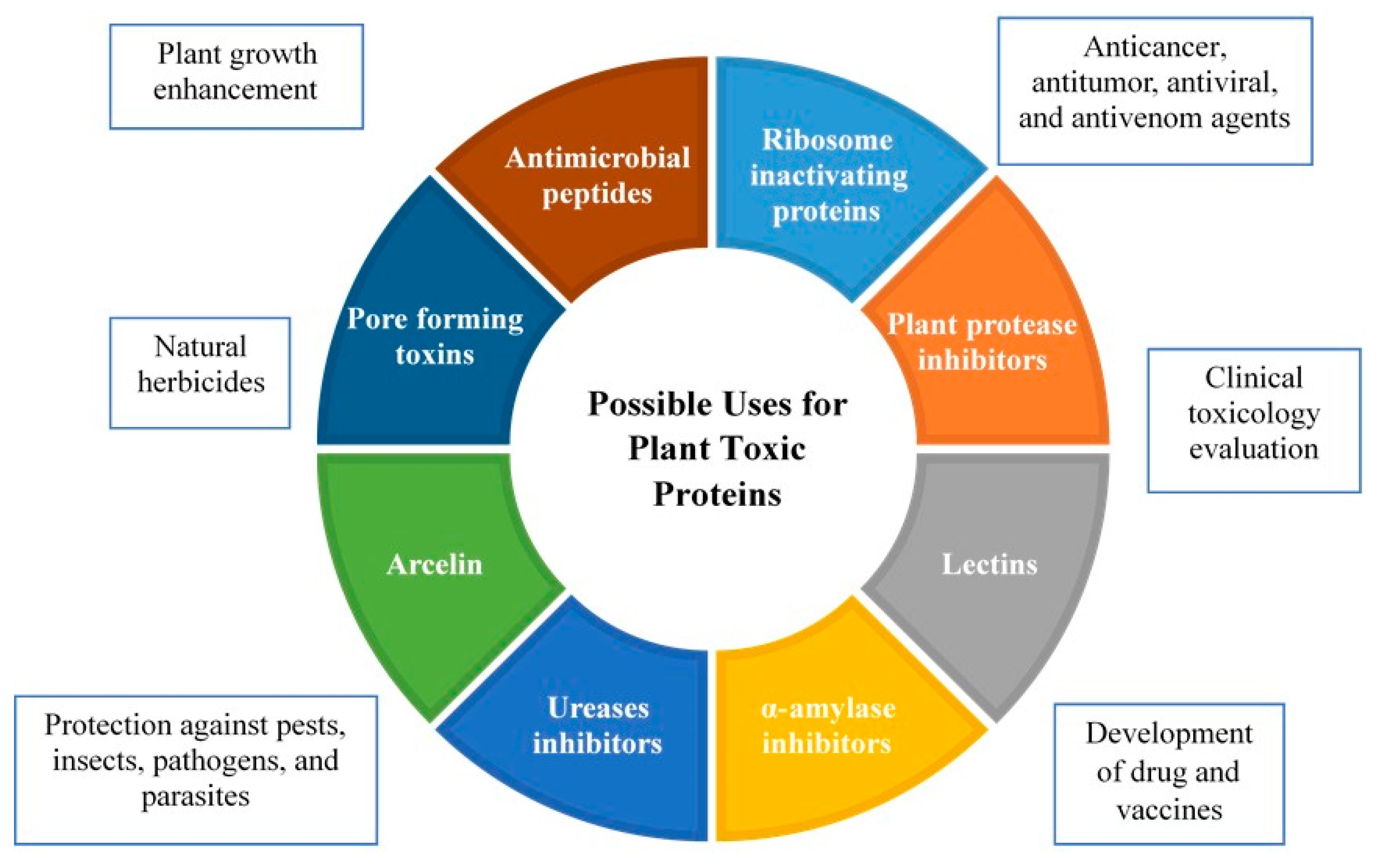
Plants evolve to synthesize various natural metabolites to protect themselves against threats, such as insects, predators, microorganisms, and environmental conditions (such as temperature, pH, humidity, salt, and drought). Plant-derived toxic proteins are often secondary metabolites generated by plants. These proteins, including ribosome-inactivating proteins, lectins, protease inhibitors, α-amylase inhibitors, canatoxin-like proteins and ureases, arcelins, antimicrobial peptides, and pore-forming toxins, are found in different plant parts, such as the roots, tubers, stems, fruits, buds, and foliage. Several investigations have been conducted to explore the potential applications of these plant proteins by analyzing their toxic effects and modes of action. In biomedical applications, such as crop protection, drug development, cancer therapy, and genetic engineering, toxic plant proteins have been utilized as potentially useful instruments due to their biological activities. However, these noxious metabolites can be detrimental to human health and cause problems when consumed in high amounts. This review focuses on different plant toxic proteins, their biological activities, and their mechanisms of action. Furthermore, possible usage and removal strategies for these proteins are discussed.
Keywords: plant protein; toxins; biological activity; possible usage; reduction strategies plant protein; toxins; biological activity; possible usage; reduction strategies