Article

Occurrence and Quantitative Risk Assessment of Twelve Mycotoxins in Eggs and Chicken Tissues in China

1
SIBS-UGENT-SJTU Joint Laboratory of Mycotoxin Research, CAS Key Laboratory of Nutrition, Metabolism and Food Safety, Shanghai Institute of Nutrition and Health, Shanghai Institutes for Biological Sciences, University of Chinese Academy of Sciences, Chinese Academy of Sciences, Shanghai 200000, China
2
Institute of Quality and Standard for Agro-Products, Zhejiang Academy of Agricultural Sciences, Hangzhou 310021, China
*
Authors to whom correspondence should be addressed.
Toxins 2018, 10(11), 477; https://doi.org/10.3390/toxins10110477

Submission received: 10 September 2018 / Revised: 6 November 2018 / Accepted: 13 November 2018 / Published: 16 November 2018
(This article belongs to the Special Issue Dietary Mycotoxin Exposure: Emerging Risks to Human Health)

Abstract

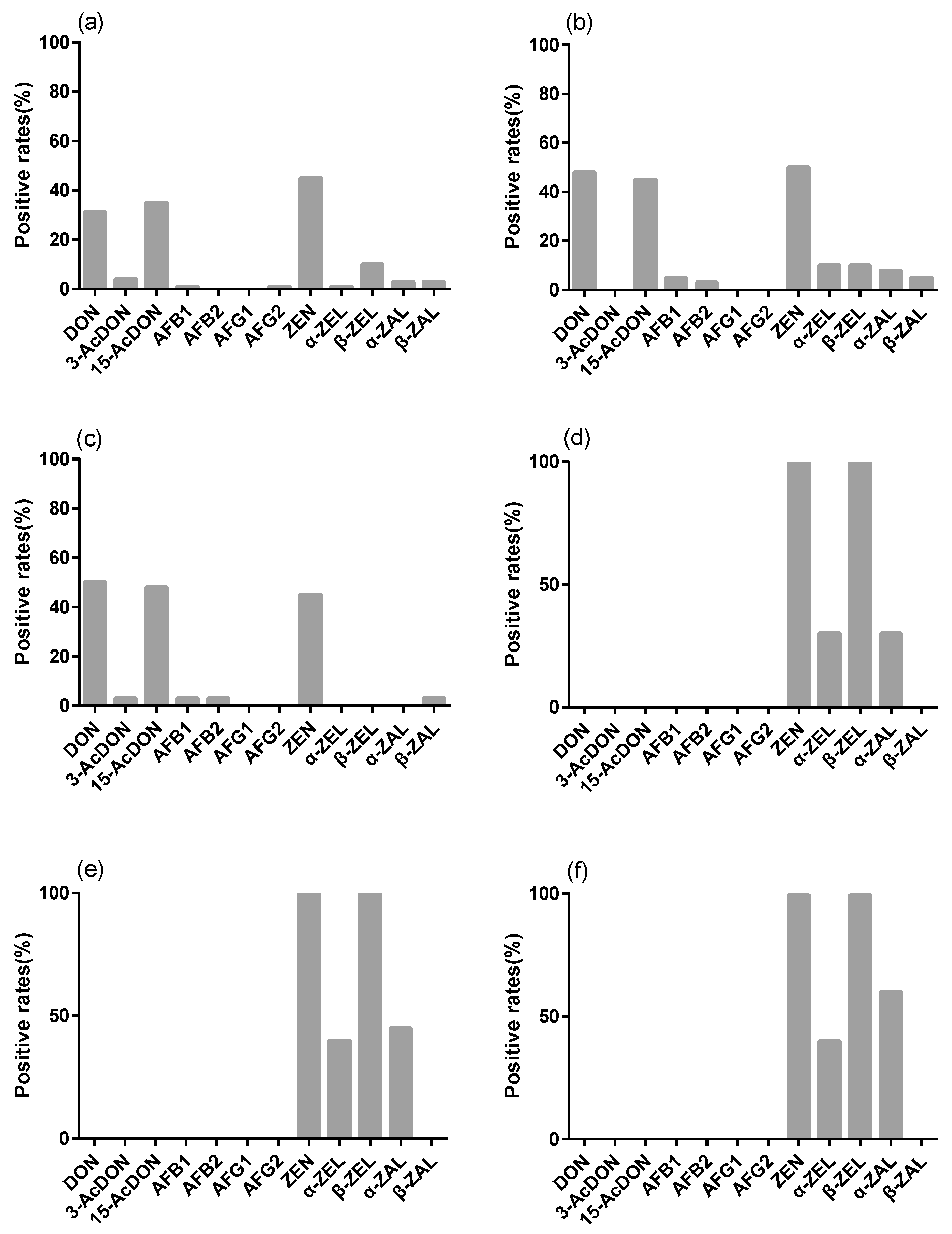
Aflatoxins (AFs), deoxynivalenols (DONs), and zearalenones (ZENs) are common mycotoxins that contaminate feedstuff, causing contamination of poultry products. In our study, these mycotoxins were quantified in 152 egg samples collected from markets in Jiangsu (JS), Zhejiang (ZJ), and Shanghai (SH) and in 70 chicken tissue samples (liver, heart, and gizzard) from ZJ in China. The main mycotoxins observed in egg samples were DON, 15-AcDON, and ZEN, although only ZEN family mycotoxins (ZEN, α-ZEL, β-ZEL, and α-ZAL) were detected in chicken tissues. Furthermore, for the first time, we assessed the health risks of exposure of three populations (children, adults, and elder adults) to DONs (DON, 3-AcDON, and 15-AcDON) and ZEN in eggs (from three different areas) and to ZEN in chicken tissues. We show that the mean dietary intake (DI) values and the 97.5th percentile DI values of DON and ZEN through egg ingestion were lower than the provisional maximum tolerable daily intake (PMTDI) (1 μg/kg body weight (BW)/day) for the three populations in the three geographical areas studied. However, eggs contaminated with high levels of DONs and ZEN contributed to a large proportion of the PMTDI of these mycotoxins, especially in children and elder adults. Although ZEN was highly detected in the chicken tissues, no significant health risk was observed.
Keywords: risk assessment; co-occurring mycotoxins; eggs; chicken tissues risk assessment; co-occurring mycotoxins; eggs; chicken tissues