


Associations Between Adherence to the EAT-Lancet Planetary Health Diet and Nutritional Adequacy, and Sociodemographic Factors Among Australian Adults



Abstract
1. Introduction
2. Materials and Methods
2.1. Study Design and Participants
2.2. Sociodemographic Data
2.3. Anthropometric Data
2.4. Dietary Data
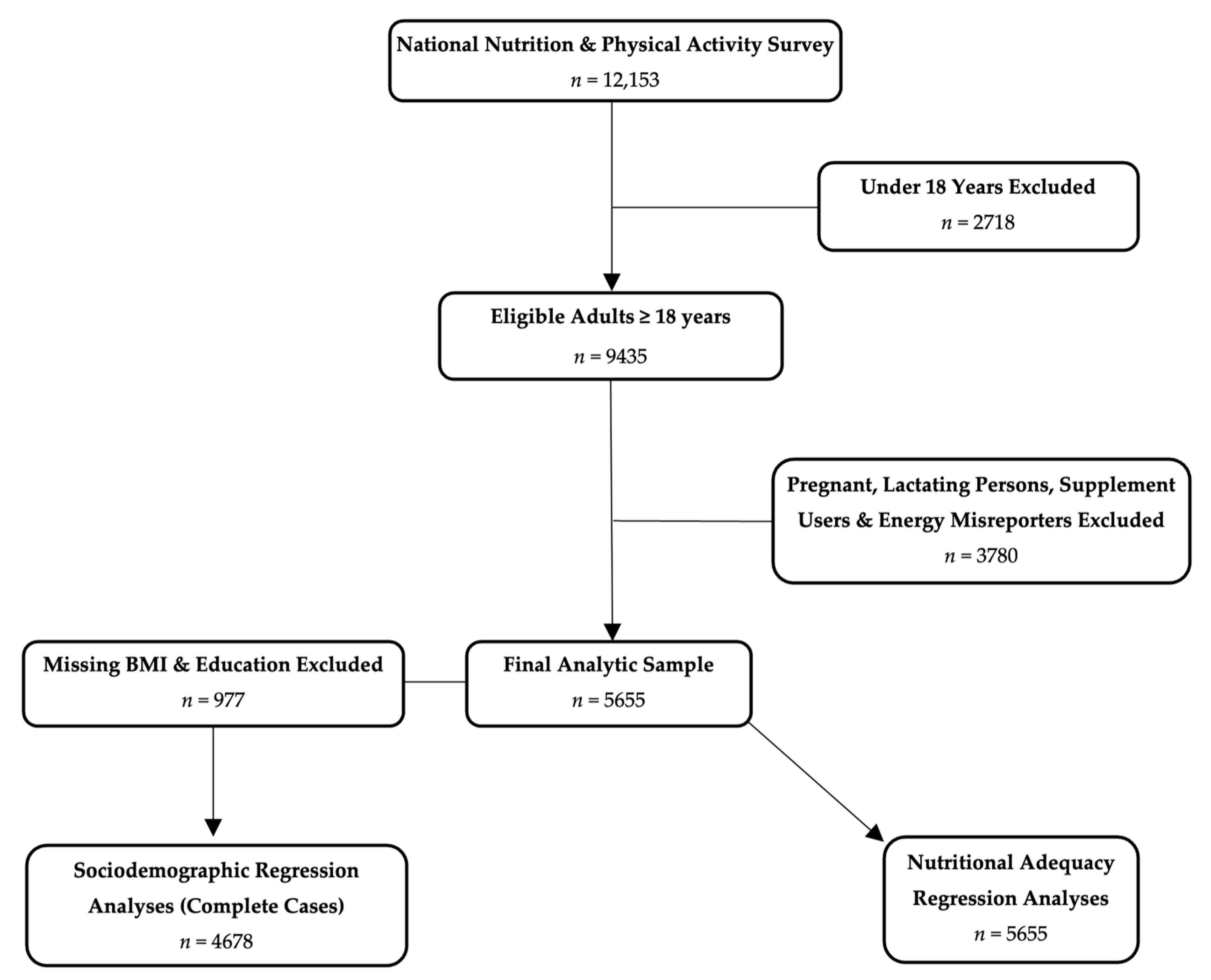
2.5. Analytic Sample
2.6. Usual Food and Nutrient Intakes
2.7. Estimation of Planetary Health Diet Adherence
2.8. Adequacy of Nutrient Intakes
2.9. Statistical Analysis
3. Results
3.1. Population Characteristics
3.2. Usual Dietary Intakes
3.3. Nutritional Adequacy
3.4. Sociodemographics
4. Discussion
4.1. Nutritional Adequacy
4.2. Demographic Factors
4.3. Intersecting Sociodemographic and Cultural Factors
4.4. Strengths and Limitations
5. Conclusions
Supplementary Materials
Author Contributions
Funding
Institutional Review Board Statement
Informed Consent Statement
Data Availability Statement
Conflicts of Interest
References
- Leonard, U.M.; Leydon, C.L.; Arranz, E.; Kiely, M.E. Impact of consuming an environmentally protective diet on micronutrients: A systematic literature review. Am. J. Clin. Nutr. 2024, 119, 927–948. [Google Scholar] [CrossRef] [Scilit] [PubMed]
- Beal, T.; Ortenzi, F.; Fanzo, J. Estimated micronutrient shortfalls of the EAT-Lancet planetary health diet. Lancet Planet. Health 2023, 7, e233–e237. [Google Scholar] [CrossRef] [Scilit] [PubMed]
- Willett, W.; Rockström, J.; Loken, B.; Springmann, M.; Lang, T.; Vermeulen, S.; Garnett, T.; Tilman, D.; Declerck, F.; Wood, A.; et al. Food in the Anthropocene: The EAT–Lancet Commission on healthy diets from sustainable food systems. Lancet 2019, 393, 447–492. [Google Scholar] [CrossRef] [Scilit] [PubMed]
- Rockström, J.; Thilsted, S.H.; Willett, W.C.; Gordon, L.J.; Herrero, M.; Hicks, C.C.; Mason-D’Croz, D.; Rao, N.; Springmann, M.; Wright, E.C.; et al. The EAT Lancet Commission on healthy, sustainable, and just food systems. Lancet 2025, 406, 1625–1700. [Google Scholar] [CrossRef] [Scilit]
- Godfray, H.C.J.; Aveyard, P.; Garnett, T.; Hall, J.W.; Key, T.J.; Lorimer, J.; Pierrehumbert, R.T.; Scarborough, P.; Springmann, M.; Jebb, S.A. Meat consumption, health, and the environment. Science 2018, 361, eaam5324. [Google Scholar] [CrossRef] [Scilit]
- Poore, J.; Nemecek, T. Reducing food’s environmental impacts through producers and consumers. Science 2018, 360, 987–992. [Google Scholar] [CrossRef] [Scilit]
- Klapp, A.-L.; Wyma, N.; Alessandrini, R.; Ndinda, C.; Perez-Cueto, A.; Risius, A. Recommendations to address the shortfalls of the EAT Lancet planetary health diet from a plant-forward perspective. Lancet Planet. Health 2025, 9, e23–e33. [Google Scholar] [CrossRef] [Scilit]
- Neufingerl, N.; Eilander, A. Nutrient Intake and Status in Adults Consuming Plant-Based Diets Compared to Meat-Eaters: A Systematic Review. Nutrients 2021, 14, 29. [Google Scholar] [CrossRef] [Scilit]
- Frank, S.M.; Jaacks, L.M.; Adair, L.S.; Avery, C.L.; Meyer, K.; Rose, D.; Taillie, L.S. Adherence to the Planetary Health Diet Index and correlation with nutrients of public health concern: An analysis of NHANES 2003–2018. Am. J. Clin. Nutr. 2024, 119, 384–392. [Google Scholar] [CrossRef] [Scilit]
- Young, H.A. Adherence to the EAT Lancet Diet: Unintended Consequences for the Brain? Nutrients 2022, 14, 4254. [Google Scholar] [CrossRef] [Scilit]
- Berthy, F.; Brunin, J.; Allès, B.; Reuzé, A.; Touvier, M.; Hercberg, S.; Lairon, D.; Pointereau, P.; Mariotti, F.; Baudry, J.; et al. Higher adherence to the EAT-Lancet reference diet is associated with higher nutrient adequacy in the NutriNet-Santé cohort: A cross-sectional study. Am. J. Clin. Nutr. 2023, 117, 1174–1185. [Google Scholar] [CrossRef] [Scilit] [PubMed]
- Montejano Vallejo, R.; Schulz, C.A.; van de Locht, K.; Oluwagbemigun, K.; Alexy, U.; Nöthlings, U. Associations of Adherence to a Dietary Index Based on the EAT-Lancet Reference Diet with Nutritional, Anthropometric, and Ecological Sustainability Parameters: Results from the German DONALD Cohort Study. J. Nutr. 2022, 152, 1763–1772. [Google Scholar] [CrossRef] [Scilit] [PubMed]
- Vargas-Quesada, R.; Monge-Rojas, R.; Romero-Zúñiga, J.J.; Arriola Aguirre, R.; Kovalskys, I.; Herrera-Cuenca, M.; Cortés, L.Y.; Yépez García, M.C.; Liria-Domínguez, R.; Rigotti, A.; et al. Adherence to the EAT-Lancet diet and its association with micronutrient intake in the urban population of eight Latin American countries. Nutr. Res. 2025, 139, 136–148. [Google Scholar] [CrossRef] [Scilit] [PubMed]
- Macit-Çelebi, M.S.; Bozkurt, O.; Kocaadam-Bozkurt, B.; Köksal, E. Evaluation of sustainable and healthy eating behaviors and adherence to the planetary health diet index in Turkish adults: A cross-sectional study. Front. Nutr. 2023, 10, 1180880. [Google Scholar] [CrossRef] [Scilit]
- Hendrie, G.A.; Rebuli, M.A.; James-Martin, G.; Baird, D.L.; Bogard, J.R.; Lawrence, A.S.; Ridoutt, B. Towards healthier and more sustainable diets in the Australian context: Comparison of current diets with the Australian Dietary Guidelines and the EAT-Lancet Planetary Health Diet. BMC Public Health 2022, 22, 1939. [Google Scholar] [CrossRef] [Scilit]
- Barbour, L.; Bicknell, E.; Brimblecombe, J.; Carino, S.; Fairweather, M.; Lawrence, M.; Slattery, J.; Woods, J.; World, E. Dietitians Australia position statement on healthy and sustainable diets. Nutr. Diet. 2022, 79, 6–27. [Google Scholar] [CrossRef] [Scilit]
- Victorian Food Security and Food Systems Working Group. Towards a Healthy, Regenerative, and Equitable Food System in Victoria: A Consensus Statement: VicHealth. 2022. Available online: https://ipan.deakin.edu.au/wp-content/uploads/sites/101/2022/06/20220324_FoodSystemsConsensusStatement_Web.pdf (accessed on 31 October 2025).
- Goessler, C.; Jarret, L.; Liu, M.; Mclure, E.; Sperling, F.; Thomas, L.; Wynn, K. CSIRO Futures: Reshaping Australian Food Systems; Commonwealth Scientific and Industrial Research Organisation: Canberra, ACT, Australia, 2023. [Google Scholar]
- Afshin, A.; Micha, R.; Khatibzadeh, S.; Schmidt, L.A.; Mozaffarian, D. Dietary Policies to Reduce Non-Communicable Diseases. In The Handbook of Global Health Policy; Brown, G.W., Yamey, G., Wamala, S., Eds.; John Wiley & Sons: West Sussex, UK, 2014; pp. 175–193. [Google Scholar]
- Australian Health Survey: Users Guide, 2011–2013. Australian Bureau of Statistics. 2013. Available online: https://www.abs.gov.au/ausstats/abs@.nsf/mf/4363.0.55.001 (accessed on 20 May 2025).
- Huang, T.T.-K.; Roberts, S.B.; Howarth, N.C.; McCrory, M.A. Effect of Screening Out Implausible Energy Intake Reports on Relationships between Diet and BMI. Obes. Res. 2005, 13, 1205–1217. [Google Scholar] [CrossRef] [Scilit]
- Institute of Medicine (US). Dietary Reference Intakes for Energy, Carbohydrate, Fiber, Fat, Fatty Acids, Cholesterol, Protein, and Amino Acids; The National Academies Press: Washington, DC, USA, 2005. [Google Scholar]
- Harttig, U.; Haubrock, J.; Knüppel, S.; Boeing, H. The MSM program: Web-based statistics package for estimating usual dietary intake using the Multiple Source Method. Eur. J. Clin. Nutr. 2011, 65, S87–S91. [Google Scholar] [CrossRef] [Scilit]
- National Health and Medical Research Council. Nutrient Reference Values; Australian Government Department of Health and Ageing: Canberra, ACT, Australia; New Zealand Ministry of Health: Wellington, New Zealand, 2006. Available online: https://www.eatforhealth.gov.au/nutrient-reference-values (accessed on 29 May 2025).
- Australian Institute of Health and Welfare. National Drug Strategy Household Survey Detailed Report 2013; Australian Institute of Health and Welfare: Canberra, ACT, Australia, 2014. Available online: https://www.aihw.gov.au/getmedia/c2e94ca2-7ce8-496f-a765-94c55c774d2b/16835_1.pdf?v=20230605183206&inline=true (accessed on 10 September 2025).
- Colizzi, C.; Harbers, M.C.; Vellinga, R.E.; Verschuren, W.M.M.; Boer, J.M.A.; Biesbroek, S.; Temme, E.H.M.; van der Schouw, Y.T. Adherence to the EAT-Lancet Healthy Reference Diet in Relation to Risk of Cardiovascular Events and Environmental Impact: Results From the EPIC-NL Cohort. J. Am. Heart Assoc. 2023, 12, e026318. [Google Scholar] [CrossRef] [Scilit]
- van Dooren, C.; Mensink, F.; Eversteijn, K.; Schrijnen, M. Development and Evaluation of the Eetmaatje Measuring Cup for Rice and Pasta as an Intervention to Reduce Food Waste. Front. Nutr. 2019, 6, 197. [Google Scholar] [CrossRef] [Scilit]
- Hu, F.L.; Liu, J.C.; Li, D.R.; Xu, Y.L.; Liu, B.Q.; Chen, X.; Zheng, W.R.; Wei, Y.F.; Liu, F.H.; Li, Y.Z.; et al. EAT-Lancet diet pattern, genetic risk, and risk of colorectal cancer: A prospective study from the UK Biobank. Am. J. Clin. Nutr. 2025, 121, 1017–1024. [Google Scholar] [CrossRef] [Scilit]
- Looman, M.; Feskens, E.J.M.; de Rijk, M.; Meijboom, S.; Biesbroek, S.; Temme, E.H.M.; de Vries, J.; Geelen, A. Development and evaluation of the Dutch Healthy Diet index 2015. Public Health Nutr. 2017, 20, 2289–2299. [Google Scholar] [CrossRef] [Scilit] [PubMed]
- Institute of Medicine (US). Subcommittee on Interpretation and Uses of Dietary Reference Intakes. In Applications in Dietary Planning; National Academies Press: Washington, DC, USA, 2003. [Google Scholar]
- Australian Government Department of Health and Aged Care. Standard Drinks Guide. 2024. Available online: https://www.health.gov.au/topics/alcohol/about-alcohol/standard-drinks-guide (accessed on 19 June 2025).
- Institute of Medicine (US). Panel on Micronutrients. In Dietary Reference Intakes for Vitamin A, Vitamin K, Arsenic, Boron, Chromium, Copper, Iodine, Iron, Manganese, Molybdenum, Nickel, Silicon, Vanadium, and Zinc; National Academies Press: Washington DC, USA, 2001. [Google Scholar]
- Australian Bureau of Statistics. Standard Australian Classification of Countries (SACC); ABS: Canberra, ACT, Australia, 2016. Available online: https://www.abs.gov.au/statistics/classifications/standard-australian-classification-countries-sacc/latest-release (accessed on 23 May 2025).
- Miranda, A.R.; Vieux, F.; Maillot, M.; Verger, E.O. How Do the Indices based on the EAT-Lancet Recommendations Measure Adherence to Healthy and Sustainable Diets? A Comparison of Measurement Performance in Adults from a French National Survey. Curr. Dev. Nutr. 2025, 9, 104565. [Google Scholar] [CrossRef] [Scilit] [PubMed]
- Gibson, R.S.; Raboy, V.; King, J.C. Implications of phytate in plant-based foods for iron and zinc bioavailability, setting dietary requirements, and formulating programs and policies. Nutr. Rev. 2018, 76, 793–804. [Google Scholar] [CrossRef] [Scilit] [PubMed]
- Gibson, R.S. Principles of Nutritional Assessment, 3rd ed.; University of Otago: Dunedin, New Zealand, 2024; Available online: https://nutritionalassessment.org (accessed on 15 July 2025).
- Weaver, C.; Heaney, R. Calcium in Human Health, 1st ed.; Humana Totowa: Totowa, NJ, USA, 2006. [Google Scholar]
- Atkins, L.A.; McNaughton, S.A.; Spence, A.C.; Evans, L.J.; Leech, R.M.; Szymlek-Gay, E.A. Bioavailability of Australian pre-schooler iron intakes at specific eating occasions is low. Eur. J. Nutr. 2024, 63, 2587–2598. [Google Scholar] [CrossRef] [Scilit]
- Ferreira, M.A.; Silva, A.M.; Marchioni, D.M.L.; Carli, E. Adherence to the EAT-Lancet diet and its relation with food insecurity and income in a Brazilian population-based sample. Cad. Saude Publica 2023, 39, e00247222. [Google Scholar] [CrossRef] [Scilit]
- Van Dyke, N.; Murphy, M.; Drinkwater, E.J. “We know what we should be eating, but we don’t always do that.” How and why people eat the way they do: A qualitative study with rural Australians. BMC Public Health 2024, 24, 1240. [Google Scholar] [CrossRef] [Scilit]
- Ronto, R.; Saberi, G.; Carins, J.; Papier, K.; Fox, E. Exploring young Australians’ understanding of sustainable and healthy diets: A qualitative study. Public Health Nutr. 2022, 25, 1–13. [Google Scholar] [CrossRef] [Scilit]
- Marchese, L.; Livingstone, K.M.; Woods, J.L.; Wingrove, K.; Machado, P. Ultra-processed food consumption, socio-demographics and diet quality in Australian adults. Public Health Nutr. 2022, 25, 94–104. [Google Scholar] [CrossRef] [Scilit]
- Lam, B.T.; Szymlek-Gay, E.A.; Larsson, C.; Margerison, C. Preferences, Perceptions, and Use of Online Nutrition Content Among Young Australian Adults: Qualitative Study. J. Med. Internet Res. 2025, 27, e67640. [Google Scholar] [CrossRef] [Scilit]
- Denniss, E.; Lindberg, R.; Marchese, L.E.; McNaughton, S.A. #Fail: The quality and accuracy of nutrition-related information by influential Australian Instagram accounts. Int. J. Behav. Nutr. Phys. Act. 2024, 21, 16. [Google Scholar] [CrossRef] [Scilit] [PubMed]
- Australian Communications and Media Authority. Communications and Media in Australia. In The Digital Lives of Younger Australians; Australian Government: Canberra, ACT, Australia, 2021. Available online: https://www.acma.gov.au/sites/default/files/2021-05/The%20digital%20lives%20of%20younger%20Australians.pdf (accessed on 23 September 2025).
- Drewnowski, A.; Shultz, J.M. Impact of aging on eating behaviors, food choices, nutrition, and health status. J. Nutr. Health Aging 2001, 5, 75–79. [Google Scholar] [PubMed]
- Dismore, L.; Sayer, A.; Robinson, S. Exploring the experience of appetite loss in older age: Insights from a qualitative study. BMC Geriatr. 2024, 24, 117. [Google Scholar] [CrossRef] [Scilit] [PubMed]
- Yannakoulia, M.; Mamalaki, E.; Anastasiou, C.A.; Mourtzi, N.; Lambrinoudaki, I.; Scarmeas, N. Eating habits and behaviors of older people: Where are we now and where should we go? Maturitas 2018, 114, 14–21. [Google Scholar] [CrossRef] [Scilit]
- Brownie, S.; Coutts, R. Older Australians’ perceptions and practices in relation to a healthy diet for old age: A qualitative study. J. Nutr. Health Aging 2013, 17, 125–129. [Google Scholar] [CrossRef] [Scilit]
- Walker-Clarke, A.; Walasek, L.; Meyer, C. Psychosocial factors influencing the eating behaviours of older adults: A systematic review. Ageing Res. Rev. 2022, 77, 101597. [Google Scholar] [CrossRef] [Scilit]
- Healy, J.D.; Dhaliwal, S.S.; Pollard, C.M.; Sharma, P.; Whitton, C.; Blekkenhorst, L.C.; Boushey, C.J.; Scott, J.A.; Kerr, D.A. Australian Consumers’ Attitudes towards Sustainable Diet Practices Regarding Food Waste, Food Processing, and the Health Aspects of Diet: A Cross Sectional Survey. Int. J. Environ. Res. Public Health 2023, 20, 2633. [Google Scholar] [CrossRef] [Scilit]
- Harray, A.J.; Meng, X.; Kerr, D.A.; Pollard, C.M. Healthy and sustainable diets: Community concern about the effect of the future food environments and support for government regulating sustainable food supplies in Western Australia. Appetite 2018, 125, 225–232. [Google Scholar] [CrossRef] [Scilit]
- Camilleri, L.; Kirkovski, M.; Scarfo, J.; Jago, A.; Gill, P.R. Understanding the Meat-Masculinity Link: Traditional and Non-Traditional Masculine Norms Predicting Men’s Meat Consumption. Ecol. Food Nutr. 2024, 63, 355–386. [Google Scholar] [CrossRef] [Scilit]
- Chard, E.; Bergstad, C.J.; Steentjes, K.; Poortinga, W.; Demski, C. Gender and cross-country differences in the determinants of sustainable diet intentions: A multigroup analysis of the UK, China, Sweden, and Brazil. Front. Psychol. 2024, 15, 1355969. [Google Scholar] [CrossRef] [Scilit]
- Australian Health Survey: Nutrition First Results-Foods and Nutrients. Australian Bureau of Statistics. 2014. Available online: https://www.abs.gov.au/statistics/health/food-and-nutrition/food-and-nutrients/2011-12 (accessed on 5 August 2025).
- Fayet-Moore, F.; McConnell, A.; Cassettari, T.; Tuck, K.; Petocz, P.; Kim, J. Discretionary intake among Australian adults: Prevalence of intake, top food groups, time of consumption and its association with sociodemographic, lifestyle and adiposity measures. Public Health Nutr. 2019, 22, 1576–1589. [Google Scholar] [CrossRef] [Scilit]
- Ferreira, A.F.; Abreu, S.; Liz Martins, M. Determinants of adherence to sustainable healthy diets among Portuguese adults. NFS J. 2024, 37, 100200. [Google Scholar] [CrossRef] [Scilit]
- Olstad, D.L.; McIntyre, L. Educational attainment as a super determinant of diet quality and dietary inequities. Adv. Nutr. 2025, 16, 100482. [Google Scholar] [CrossRef] [Scilit] [PubMed]
- Carrillo-Alvarez, E.; Rifà-Ros, R.; Salinas-Roca, B.; Costa-Tutusaus, L.; Lamas, M.; Rodriguez-Monforte, M. Diet-Related Health Inequalities in High-Income Countries: A Scoping Review of Observational Studies. Adv. Nutr. 2025, 16, 100439. [Google Scholar] [CrossRef] [Scilit] [PubMed]
- Goulding, T.; Lindberg, R.; Russell, C.G. The affordability of a healthy and sustainable diet: An Australian case study. Nutr. J. 2020, 19, 109. [Google Scholar] [CrossRef] [Scilit]
- Lewis, M.; McNaughton, S.A.; Rychetnik, L.; Lee, A.J. Cost and Affordability of Healthy, Equitable and Sustainable Diets in Low Socioeconomic Groups in Australia. Nutrients 2021, 13, 2900. [Google Scholar] [CrossRef] [Scilit]
- Livingstone, K.M.; McNaughton, S.A. Diet quality is associated with obesity and hypertension in Australian adults: A cross sectional study. BMC Public Health 2016, 16, 1037. [Google Scholar] [CrossRef] [Scilit]
- Australian Institute of Health and Welfare. Overweight and Obesity; Australian Institute of Health and Welfare, Australian Government: Canberra, ACT, Australia, 2024. Available online: https://www.aihw.gov.au/reports/overweight-obesity/overweight-and-obesity (accessed on 5 August 2025).
- Coyle, D.H.; Huang, L.; Shahid, M.; Gaines, A.; Di Tanna, G.L.; Louie, J.C.Y.; Pan, X.; Marklund, M.; Neal, B.; Wu, J.H.Y. Socio-economic difference in purchases of ultra-processed foods in Australia: An analysis of a nationally representative household grocery purchasing panel. Int. J. Behav. Nutr. Phys. Act. 2022, 19, 148. [Google Scholar] [CrossRef] [Scilit]
- Thornton, L.E.; Lamb, K.E.; Ball, K. Fast food restaurant locations according to socioeconomic disadvantage, urban–regional locality, and schools within Victoria, Australia. SSM Popul. Health 2016, 2, 1–9. [Google Scholar] [CrossRef] [Scilit]
- Kenny, T.A.; Woodside, J.V.; Perry, I.J.; Harrington, J.M. Consumer attitudes and behaviors toward more sustainable diets: A scoping review. Nutr. Rev. 2023, 81, 1665–1679. [Google Scholar] [CrossRef] [Scilit]
- Chae, W.; Ju, Y.J.; Shin, J.; Jang, S.-I.; Park, E.-C. Association between eating behaviour and diet quality: Eating alone vs. eating with others. Nutr. J. 2018, 17, 117. [Google Scholar] [CrossRef] [Scilit]
- Ghosh, S.; Meyer-Rochow, V.B.; Jung, C. Embracing Tradition: The Vital Role of Traditional Foods in Achieving Nutrition Security. Foods 2023, 12, 4220. [Google Scholar] [CrossRef] [Scilit]
- Biesbroek, S.; Kok, F.J.; Tufford, A.R.; Bloem, M.W.; Darmon, N.; Drewnowski, A.; Fan, S.; Fanzo, J.; Gordon, L.J.; Hu, F.B.; et al. Toward healthy and sustainable diets for the 21st century: Importance of sociocultural and economic considerations. Proc. Natl. Acad. Sci. USA 2023, 120, e2219272120. [Google Scholar] [CrossRef] [Scilit]
- Mozaffarian, D.; Angell, S.Y.; Lang, T.; Rivera, J.A. Role of government policy in nutrition—Barriers to and opportunities for healthier eating. BMJ 2018, 361, k2426. [Google Scholar] [CrossRef] [Scilit]
- Sievert, K.; Chen, V.; Voisin, R.; Johnson, H.; Parker, C.; Lawrence, M.; Baker, P. Meat production and consumption for a healthy and sustainable Australian food system: Policy options and political dimensions. Sustain. Prod. Consum. 2022, 33, 674–685. [Google Scholar] [CrossRef] [Scilit]
- Sievert, K.; Lawrence, M.; Parker, C.; Baker, P. How power in corporate-industrial meat supply chains enables negative externalities: Three case studies from Brazil, the US, and Australia. One Earth 2024, 7, 1424–1441. [Google Scholar] [CrossRef] [Scilit]
- Blanton, C.A.; Moshfegh, A.J.; Baer, D.J.; Kretsch, M.J. The USDA Automated Multiple-Pass Method Accurately Estimates Group Total Energy and Nutrient Intake. J. Nutr. 2006, 136, 2594–2599. [Google Scholar] [CrossRef] [Scilit] [PubMed]
- Moshfegh, A.J.; Rhodes, D.G.; Baer, D.J.; Murayi, T.; Clemens, J.C.; Rumpler, W.V.; Paul, D.R.; Sebastian, R.S.; Kuczynski, K.J.; Ingwersen, L.A.; et al. The US Department of Agriculture Automated Multiple-Pass Method reduces bias in the collection of energy intakes. Am. J. Clin. Nutr. 2008, 88, 324–332. [Google Scholar] [CrossRef] [Scilit] [PubMed]

| Dietary Components | PHD Intake Target | Proportional Score (0–10) | Max Points (10) | Inverse Score (10–0) |
|---|---|---|---|---|
| Adequacy Components | ||||
| Wholegrains | 420 g 2 | 0–420 g | ≥420 g | |
| Vegetables | 300 g | 0–300 g | ≥300 g | |
| Fruits | 200 g | 0–200 g | ≥200 g | |
| Legumes 3 | 75 g | 0–75 g | ≥75 g | |
| Optimum Components 4 | ||||
| Starchy Vegetables | 50 g | 0–50 g | 50–100 g | 100–150 g |
| Dairy | 250 g | 0–250 g | 250–500 g | 500–750 g |
| Eggs | 15 g | 0–15 g | 15–25 g | 25–40 g |
| Poultry | 30 g | 0–30 g | 30–60 g | 60–90 g |
| Fish and Seafood | 30 g | 0–30 g | 30–100 g | 100–130 g |
| Nuts and Seeds | 50 g | 0–50 g | 50–75 g | 75–125 g |
| Moderation Components | ||||
| Red Meats | 15 g | 0 g | 15–0 g | |
| Added Sugars | 30 g | 0 g | 30–0 g | |
| Ratio Component 5 | 15th Percentile | 85th Percentile | Proportional Score (0–10) | Max Points (10) |
| Unsaturated/Saturated Fats | 1.072 | 1.829 | 1.072–1.829 | ≥1.829 |
| Population Characteristic | Total Sample (n = 5655) | Q1 Lowest (6–41) 2 (n = 1499) | Q2 (42–50) 2 (n = 1381) | Q3 (51–59) 2 (n = 1365) | Q4 Highest (60–104) 2 (n = 1410) |
|---|---|---|---|---|---|
| Age | Median (25th, 75th percentile) 3 | ||||
| Years | 43 (29, 57) | 40 (26, 53) | 42 (28, 57) | 43 (30, 57) | 47 (33, 59) |
| 2025 PHD Adherence Score | Mean (SE) 3 | ||||
| Possible range 0–130 | 50 (0.3) | 33 (0.3) | 46 (0.1) | 55 (0.1) | 67 (0.2) |
| Sex | n (%) 3 | n (%) 3 | n (%) 3 | n (%) 3 | n (%) 3 |
| Female | 2715 (45%) | 604 (37%) | 660 (45%) | 660 (45%) | 791 (55%) |
| Male | 2940 (55%) | 895 (63%) | 721 (55%) | 705 (55%) | 619 (45%) |
| Body Mass Index (kg/m2) | |||||
| Underweight (<18.5) | 75 (2%) | 21 (2%) | 21 (2%) | 15 (2%) | 18 (2%) |
| Healthy Weight Range (18.5 to <25) | 1602 (35%) | 397 (34%) | 403 (37%) | 374 (34%) | 428 (37%) |
| Overweight (25 to <30) | 1703 (35%) | 432 (34%) | 380 (31%) | 432 (38%) | 459 (38%) |
| Obese (≥30) | 1362 (27%) | 373 (31%) | 359 (29%) | 337 (26%) | 293 (23%) |
| Missing | 913 | 276 | 218 | 207 | 212 |
| Education Status | |||||
| Did Not Complete Secondary School | 1631 (26%) | 504 (31%) | 439 (29%) | 368 (25%) | 320 (21%) |
| Completed Secondary School | 736 (15%) | 194 (16%) | 175 (15%) | 173 (15%) | 194 (15%) |
| Certificate, Trade or Diploma | 1922 (35%) | 559 (40%) | 488 (36%) | 436 (32%) | 439 (33%) |
| Bachelor’s Degree | 894 (16%) | 166 (11%) | 195 (15%) | 251 (19%) | 282 (20%) |
| Postgraduate Degree | 395 (7%) | 54 (3%) | 71 (5%) | 113 (8%) | 157 (11%) |
| Missing or Not Determined | 77 | 22 | 13 | 24 | 18 |
| Country of Birth | |||||
| Australia | 4110 (70%) | 1189 (76%) | 1023 (72%) | 990 (71%) | 908 (61%) |
| Major English-Speaking 4 | 673 (11%) | 171 (12%) | 167 (12%) | 158 (10%) | 177 (12%) |
| Other | 872 (19%) | 139 (12%) | 191 (16%) | 217 (19%) | 325 (28%) |
| Household Size | |||||
| 1 Person | 1470 (13%) | 420 (14%) | 351 (12%) | 358 (13%) | 341 (12%) |
| 2 Persons | 1832 (32%) | 428 (27%) | 443 (31%) | 441 (31%) | 520 (37%) |
| 3 Persons | 917 (20%) | 243 (19%) | 243 (21%) | 237 (21%) | 194 (17%) |
| ≥4 Persons | 1436 (36%) | 408 (39%) | 344 (36%) | 329 (34%) | 355 (34%) |
| IRSD 5 | |||||
| Lowest Quintile (Most Disadvantage) | 1155 (20%) | 371 (24%) | 307 (22%) | 242 (17%) | 235 (16%) |
| Second Quintile | 1220 (21%) | 326 (21%) | 332 (23%) | 284 (21%) | 278 (21%) |
| Third Quintile | 1093 (20%) | 275 (20%) | 276 (21%) | 261 (19%) | 281 (21%) |
| Fourth Quintile | 947 (18%) | 243 (17%) | 210 (16%) | 242 (20%) | 252 (18%) |
| Highest Quintile (Least Disadvantage) | 1240 (21%) | 284 (18%) | 256 (18%) | 336 (23%) | 364 (23%) |
| Labour Force Status | |||||
| Employed | 3732 (68%) | 984 (68%) | 888 (67%) | 900 (68%) | 960 (70%) |
| Unemployed | 147 (3%) | 56 (4%) | 42 (4%) | 25 (3%) | 24 (2%) |
| Not in the Labour Force | 1776 (28%) | 459 (28%) | 451 (29%) | 440 (30%) | 426 (28%) |
| Smoking Status | |||||
| Yes | 1295 (21%) | 496 (29%) | 336 (23%) | 260 (17%) | 203 (14%) |
| No | 4360 (79%) | 1003 (71%) | 1045 (77%) | 1105 (83%) | 1207 (86%) |
| Alcohol Consumption 6 | Median (25th, 75th percentile) 3 | ||||
| Usual Intake (g/day) | 3.7 (0.9, 19.9) | 3.7 (1.0, 20.7) | 3.4 (0.7, 18.1) | 3.7 (1.0, 20.4) | 3.6 (0.7, 20.4) |
| Dietary Components | Usual Population Intake | Q1 (Lowest) (6–41) 4 n = 1530 | Q2 (42–50) 4 n = 1302 | Q3 (51–59) 4 n = 1412 | Q4 (Highest) (60–104) 4 n = 1411 | Median Component Scores 5 (0–10) |
|---|---|---|---|---|---|---|
| Adequacy Components | Median (25th, 75th Percentile) | |||||
| Wholegrains | 14.8 (0.0, 48.2) | 11.3 (0.0, 36.9) | 13.4 (0.0, 41.8) | 16.9 (6.1, 52.7) | 28.1 (8.0, 60.6) | 0.4 (0.0, 1.4) |
| Vegetables | 157.1 (111.3, 210.9) | 129.6 (86.8, 175.1) | 151.1 (105.3, 203.0) | 166.1 (123.2, 222.4) | 183.7 (139.9, 233.9) | 6.4 (4.4, 8.6) |
| Fruits | 109.6 (44.9, 202.4) | 49.9 (25.6, 112.2) | 92.3 (41.6, 178.0) | 128.4 (59.4, 212.6) | 183.6 (109.4, 264.3) | 6.8 (2.7, 10.0) |
| Legumes | 3.6 (0.0, 11.6) | 0.0 (0.0, 6.6) | 2.8 (0.0, 9.2) | 4.3 (0.0, 12.6) | 7.6 (0.0, 29.6) | 0.6 (0.0, 2.0) |
| Optimum Components | ||||||
| Starchy Vegetables | 60.6 (32.5, 97.0) | 64.4 (20.7, 118.6) | 66.5 (33.5, 101.5) | 58.3 (34.8, 87.8) | 56.9 (36.9, 79.5) | 7.7 (1.3, 10.0) |
| Dairy | 308.2 (191.0, 454.1) | 365.7 (194.6, 552.0) | 321.9 (199.3, 464.8) | 292.5 (183.6, 428.8) | 273.4 (185.9, 383.7) | 8.9 (4.7, 10.0) |
| Eggs | 12.5 (5.4, 24.0) | 10.1 (0.0, 24.0) | 11.7 (5.3, 24.7) | 13.6 (6.9, 24.8) | 13.3 (8.5, 22.8) | 5.5 (0.0, 9.4) |
| Poultry | 46.4 (18.7, 73.0) | 47.2 (0.0, 82.4) | 47.7 (16.2, 76.8) | 46.9 (25.4, 70.5) | 43.0 (27.5, 64.9) | 1.3 (0.0, 9.8) |
| Fish and Seafood | 15.3 (0.0, 34.0) | 0.0 (0.0, 15.3) | 13.9 (0.0, 25.9) | 17.4 (4.9, 36.8) | 29.3 (14.0, 53.7) | 5.6 (0.0, 10.0) |
| Nuts and Seeds | 2.7 (0.0, 7.3) | 1.0 (0.0, 3.9) | 2.2 (0.0, 5.5) | 3.3 (0.0, 8.7) | 5.5 (0.8, 14.7) | 0.6 (0.0, 1.7) |
| Moderation Components | ||||||
| Red Meats | 82.0 (51.3, 115.2) | 89.2 (60.4, 120.1) | 83.8 (56.8, 117.5) | 85.4 (53.0, 118.4) | 69.3 (31.6, 103.4) | 0.0 (0.0, 0.0) |
| Added Sugars | 42.1 (24.8, 69.1) | 52.3 (29.1, 80.4) | 44.2 (26.8, 75.3) | 41.0 (24.4, 65.1) | 34.2 (20.3, 52.5) | 0.0 (0.0, 0.0) |
| Ratio Component 6 | ||||||
| Unsaturated Fats | 36.4 (28.5, 45.6) | 34.7 (26.8, 43.5) | 36.3 (27.7, 46.4) | 37.0 (29.2, 46.3) | 37.3 (30.0, 46.6) | 4.1 (1.3, 8.0) |
| Saturated Fats | 26.2 (19.7, 33.5) | 28.8 (22.0, 36.9) | 27.1 (20.7, 34.8) | 25.4 (19.3, 32.7) | 23.0 (18.0, 29.5) | |
| Usual Population Intake | Q1 (Lowest) (6–41) 4 n = 1530 | Q2 (42–50) 4 n = 1302 | Q3 (51–59) 4 n = 1412 | Q4 (Highest) (60–104) 4 n = 1411 | ||
|---|---|---|---|---|---|---|
| Nutrient | Units | Mean (SE) | ||||
| Energy | kcal/day | 2037.2 (8.5) | 2063.4 (20.6) | 2060.9 (20.2) | 2051.1 (19.4) | 1973.1 (17.9) |
| Fibre | g/day | 21.7 (0.1) | 18.9 (0.3) | 21.1 (0.2) | 22.6 (0.3) | 24.5 (0.3) |
| Vitamin B1 | mg/day | 1.5 (0.0) | 1.5 (0.0) | 1.5 (0.0) | 1.5 (0.0) | 1.5 (0.0) |
| Vitamin B2 | mg/day | 1.8 (0.0) | 1.9 (0.0) | 1.9 (0.0) | 1.8 (0.0) | 1.7 (0.0) |
| Vitamin B3 | mg/day | 41.3 (0.2) | 42.0 (0.4) | 41.9 (0.5) | 41.1 (0.4) | 40.1 (0.4) |
| Vitamin B6 | mg/day | 1.5 (0.0) | 1.4 (0.0) | 1.5 (0.0) | 1.5 (0.0) | 1.5 (0.0) |
| Vitamin B9 | µg/day | 606.2 (4.1) | 605.2 (10.3) | 605.6 (7.6) | 608.1 (8.1) | 606.2 (6.4) |
| Vitamin B12 | µg/day | 4.5 (0.0) | 4.7 (0.1) | 4.6 (0.1) | 4.4 (0.1) | 4.1 (0.1) |
| Vitamin A | µg/day | 790.5 (8.8) | 747.1 (12.7) | 797.8 (23.8) | 802.8 (16.0) | 817.2 (10.9) |
| Vitamin C | mg/day | 98.5 (1.1) | 83.3 (1.7) | 94.4 (2.4) | 104.2 (2.7) | 113.4 (2.3) |
| Vitamin E | mg/day | 9.8 (0.1) | 8.6 (0.1) | 9.6 (0.1) | 10.1 (0.1) | 11.0 (0.1) |
| Calcium | mg/day | 776.3 (5.3) | 816.6 (13.2) | 779.5 (11.3) | 766.7 (9.9) | 739.9 (8.0) |
| Iodine | µg/day | 170.4 (0.9) | 178.1 (2.2) | 173.4 (2.1) | 168.6 (2.1) | 161.1 (1.7) |
| Iron | mg/day | 10.7 (0.1) | 10.3 (0.1) | 10.7 (0.1) | 10.9 (0.1) | 11.1 (0.1) |
| Magnesium | mg/day | 321.0 (1.7) | 302.5 (3.6) | 313.2 (3.2) | 329.7 (3.2) | 340.0 (3.5) |
| Phosphorus | mg/day | 1430.4 (5.9) | 1448.8 (13.8) | 1441.1 (14.1) | 1437.1 (12.9) | 1393.9 (13.9) |
| Selenium | µg/day | 88.1 (0.4) | 84.9 (1.0) | 87.3 (1.0) | 90.1 (1.1) | 90.3 (1.2) |
| Zinc | mg/day | 10.7 (0.1) | 10.8 (0.1) | 10.8 (0.1) | 10.9 (0.1) | 10.4 (0.1) |
| Nutrient | Adequacy Category 2 | n (%) 3 | Odds Ratio | 95% CI | p-Value |
|---|---|---|---|---|---|
| Vitamin A | Adequate (reference) | 4204 (74%) | 1 | ||
| Inadequate | 1451 (26%) | 0.803 | 0.749, 0.861 | p < 0.001 | |
| Vitamin B1 | Adequate (reference) | 4803 (85%) | 1 | ||
| Inadequate | 852 (15%) | 0.909 | 0.837, 0.987 | 0.024 | |
| Vitamin B2 | Adequate (reference) | 5009 (89%) | 1 | ||
| Inadequate | 646 (11%) | 0.915 | 0.830, 1.010 | 0.076 | |
| Vitamin B6 | Adequate (reference) | 3423 (61%) | 1 | ||
| Inadequate | 2232 (39%) | 0.807 | 0.742, 0.878 | p < 0.001 | |
| Vitamin B9 | Adequate (reference) | 5281 (93%) | 1 | ||
| Inadequate | 374 (7%) | 0.870 | 0.776, 0.976 | 0.018 | |
| Vitamin B12 | Adequate (reference) | 5474 (97%) | 1 | ||
| Inadequate | 181 (3%) | 1.239 | 1.062, 1.446 | 0.007 | |
| Vitamin C | Adequate (reference) | 5307 (94%) | 1 | ||
| Inadequate | 348 (6%) | 0.526 | 0.464, 0.595 | p < 0.001 | |
| Vitamin E | Adequate (reference) | 3269 (58%) | 1 | ||
| Inadequate | 2386 (42%) | 0.605 | 0.560, 0.653 | p < 0.001 | |
| Calcium | Adequate (reference) | 1715 (30%) | 1 | ||
| Inadequate | 3940 (70%) | 1.088 | 1.009, 1.173 | 0.029 | |
| Iodine | Adequate (reference) | 5231 (93%) 4 | 1 | ||
| Inadequate | 424 (8%) 4 | 0.978 | 0.880, 1.088 | 0.680 | |
| Magnesium | Adequate (reference) | 2962 (52%) | 1 | ||
| Inadequate | 2693 (48%) | 0.676 | 0.626, 0.730 | p < 0.001 | |
| Selenium | Adequate (reference) | 5253 (93%) | 1 | ||
| Inadequate | 402 (7%) | 0.824 | 0.745, 0.912 | p < 0.001 | |
| Zinc | Adequate (reference) | 3722 (66%) | 1 | ||
| Inadequate | 1933 (34%) | 0.950 | 0.884, 1.020 | 0.151 | |
| Iron 5 | % of inadequate intakes | 14% | Coefficient | 95% CI | p-value |
| −0.017 | −0.022, −0.011 | p < 0.001 |
| Population Characteristic | Coefficient | 95% CI | p-Value 2 |
|---|---|---|---|
| Age | 0.090 | 0.059, 0.121 | p < 0.001 |
| Sex | p < 0.001 | ||
| Male | |||
| Female | 3.331 | 2.042, 4.621 | |
| BMI (kg/m2) | 0.005 | ||
| Normal (18.5 to <25) | |||
| Underweight (<18.5) | 0.738 | −4.770, 6.245 | |
| Overweight (25 to <30) | 0.560 | −0.713, 1.832 | |
| Obese (≥30) | −2.013 | −3.238, −0.787 | |
| Education | p < 0.001 | ||
| Did Not Complete Secondary School | |||
| Completed Secondary School | 1.784 | 0.148, 3.419 | |
| Certificate, Trade or Diploma | 0.278 | −1.016, 1.573 | |
| Bachelor’s Degree | 5.379 | 3.489, 7.268 | |
| Postgraduate Degree | 7.983 | 5.987, 9.980 | |
| Country of Birth | p < 0.001 | ||
| Australia | |||
| Major English-Speaking 3 | 0.818 | −1.132, 2.768 | |
| Other | 5.605 | 4.073, 7.137 | |
| Household Size | 0.008 | ||
| 1 person | |||
| 2 persons | 2.044 | 0.761, 3.326 | |
| 3 persons | 0.371 | −1.215, 1.958 | |
| ≥4 persons | 0.253 | −1.005, 1.511 | |
| IRSD | 0.002 | ||
| Lowest Quintile | |||
| Second Quintile | 1.665 | 0.261, 3.068 | |
| Third Quintile | 2.231 | 0.479, 3.982 | |
| Fourth Quintile | 2.473 | 0.798, 4.149 | |
| Fifth Quintile | 3.514 | 1.779, 5.249 | |
| Labour Force Status | 0.009 | ||
| Employed | |||
| Unemployed | −4.658 | −7.583, −1.733 | |
| Not in the labour force | 0.461 | −0.762, 1.685 | |
| Smoking Status | p < 0.001 | ||
| Yes | |||
| No | 4.798 | 3.436, 6.160 | |
| Alcohol Consumption 4 | p < 0.001 | ||
| Usual Intakes (g/day) |
| Population Characteristic | Coefficient | 95% CI | p-Value | Overall p-Value 2 |
|---|---|---|---|---|
| Age | 0.135 | 0.089, 0.180 | p < 0.001 | |
| Sex | ||||
| Male | ||||
| Female | 3.931 | 2.579, 5.284 | p < 0.001 | |
| BMI (kg/m2) | ||||
| Healthy Weight Range (18.5 to <25) | ||||
| Underweight (<18.5) | 2.342 | −2.693, 7.378 | 0.356 | 0.018 |
| Overweight (25 to <30) | 0.473 | −0.709, 1.655 | 0.427 | |
| Obese (≥30) | −1.620 | −2.828, −0.413 | 0.009 | |
| Education | ||||
| Did Not Complete Secondary School (<Year 12) | ||||
| Completed Secondary School (Year 12) | 3.060 | 1.397, 4.722 | 0.001 | p < 0.001 |
| Certificate, Trade or Diploma | 1.432 | 0.142, 2.723 | 0.030 | |
| Bachelor’s Degree | 4.936 | 2.935, 6.936 | p < 0.001 | |
| Postgraduate Degree | 6.465 | 4.521, 8.409 | p < 0.001 | |
| Country of Birth | ||||
| Australia | ||||
| Major English-Speaking 3 | −0.060 | −1.879, 1.758 | 0.947 | p < 0.001 |
| Other | 4.993 | 3.398, 6.587 | p < 0.001 | |
| Household Size | ||||
| 1 person | ||||
| 2 persons | 1.784 | 0.537, 3.032 | 0.006 | 0.029 |
| 3 persons | 0.801 | −0.720, 2.322 | 0.296 | |
| ≥4 persons | 0.397 | −0.907, 1.701 | 0.545 | |
| IRSD | ||||
| Lowest Quintile–Most Disadvantaged | ||||
| Second Quintile | 1.155 | 0.011, 2.298 | 0.048 | 0.219 |
| Third Quintile | 1.169 | −0.459, 2.798 | 0.156 | |
| Fourth Quintile | 1.223 | −0.309, 2.756 | 0.115 | |
| Fifth Quintile–Least Disadvantaged | 1.414 | −0.040, 2.868 | 0.056 | |
| Labour Force Status | ||||
| Employed | ||||
| Unemployed | −2.567 | −5.789, 0.654 | 0.116 | 0.178 |
| Not in the Labour Force | −0.721 | −2.278, 0.835 | 0.357 | |
| Smoking Status | ||||
| Yes | ||||
| No | 2.891 | 1.500, 4.283 | p < 0.001 | |
| Alcohol Consumption | ||||
| Usual Intakes (g/day) 4 | p < 0.001 |
Disclaimer/Publisher’s Note: The statements, opinions and data contained in all publications are solely those of the individual author(s) and contributor(s) and not of MDPI and/or the editor(s). MDPI and/or the editor(s) disclaim responsibility for any injury to people or property resulting from any ideas, methods, instructions or products referred to in the content. |
© 2026 by the authors. Licensee MDPI, Basel, Switzerland. This article is an open access article distributed under the terms and conditions of the Creative Commons Attribution (CC BY) license.
Share and Cite
Ordner, J.B.; Margerison, C.; Atkins, L.A.; Szymlek-Gay, E.A. Associations Between Adherence to the EAT-Lancet Planetary Health Diet and Nutritional Adequacy, and Sociodemographic Factors Among Australian Adults. Nutrients 2026, 18, 340. https://doi.org/10.3390/nu18020340
Ordner JB, Margerison C, Atkins LA, Szymlek-Gay EA. Associations Between Adherence to the EAT-Lancet Planetary Health Diet and Nutritional Adequacy, and Sociodemographic Factors Among Australian Adults. Nutrients. 2026; 18(2):340. https://doi.org/10.3390/nu18020340
Chicago/Turabian StyleOrdner, Jayden B., Claire Margerison, Linda A. Atkins, and Ewa A. Szymlek-Gay. 2026. "Associations Between Adherence to the EAT-Lancet Planetary Health Diet and Nutritional Adequacy, and Sociodemographic Factors Among Australian Adults" Nutrients 18, no. 2: 340. https://doi.org/10.3390/nu18020340
APA StyleOrdner, J. B., Margerison, C., Atkins, L. A., & Szymlek-Gay, E. A. (2026). Associations Between Adherence to the EAT-Lancet Planetary Health Diet and Nutritional Adequacy, and Sociodemographic Factors Among Australian Adults. Nutrients, 18(2), 340. https://doi.org/10.3390/nu18020340

