


Abstract
Background/Objectives: Unhealthy lifestyles lead to chronic low-grade inflammation, increasing the risk of colorectal cancer. Few studies in East Asia have examined the association between the dietary inflammation potential and colorectal cancer incidence. Therefore, we aimed to investigate this association further in the Japanese population. Methods: This study included 38,807 men aged 45–74 years who participated in the Japan Public Health Center-based prospective study (JPHC Study). The energy-adjusted dietary inflammatory index (E-DII) was derived from a food frequency questionnaire. Hazard ratios (HRs) and 95% confidence intervals (CIs) were estimated using Cox proportional hazards regression models. Differences in risk due to a combination of E-DII and lifestyle were examined using interaction term. Results: During 14 years of follow-up, 1415 colorectal cancer cases occurred. A tendency to increased colorectal cancer risk was observed with consumption of pro-inflammatory diets among Japanese men (adjusted HR [95% CI] for the highest quintile: 1.20 [0.99–1.46], p trend = 0.08), with a significantly increased risk of colon cancer (HR: 1.28 [1.01–1.63], p trend = 0.03). A possible interaction was observed with alcohol consumption (p = 0.07), which was statistically significant for proximal colon cancer (HR: 1.14 [1.05–1.25] in drinkers; p interaction = 0.01). No significant interactions with other lifestyle factors were found. Conclusions: Consumption of pro-inflammatory diets increases colorectal cancer risk among Japanese men; alcohol consumption further increases this risk for drinkers. These findings suggest that colorectal cancer may be prevented through dietary modification.
1. Introduction
Colorectal cancer is the third most common malignancy globally, with an estimated 1.9 million new cases and 930,000 deaths in 2020 [1]. Although genetic factors contribute to its development, most cases are considered sporadic and largely related to modifiable lifestyle factors characteristic of Western culture, including unhealthy diets, obesity, physical inactivity, alcohol consumption, and smoking [2].
Inflammation is a key mechanisms underlying the pathogenesis of colorectal cancer [2]. Diet is a strong mediator of inflammation, and the relationship between diet and inflammatory conditions is complex: some nutrients and foods increase inflammation, whereas others decrease it. For example, an animal-derived nutrient pattern—characterized by high intake of animal protein, cobalamin, cholesterol, and omega-6 fatty acids—was positively associated with C-reactive protein (CRP) levels, whereas a plant-derived nutrient pattern—characterized by high intake of beta-carotene, vitamin A, lutein, and zeaxanthin—was inversely associated with CRP levels [3]. A previous study reported that processed meat consumption was associated with higher CRP levels, whereas nut consumption was associated with lower CRP levels [4]. Additionally, a Japanese dietary pattern—characterized by high consumption of green tea, fish, and vegetables—has been reported to be negatively associated with CRP levels [5]. However, some studies have reported a positive association between fish consumption and inflammation [4]. This discrepancy may reflect the complex composition of the diet, highlighting the importance of assessing the inflammatory potential of the whole diet.
The dietary inflammatory index (DII) was developed to assess the inflammatory potential of diets [6,7]. Studies have shown that consumption of pro-inflammatory diets, as indicated by a high energy-adjusted-DII (E-DIITM) score, is a risk factor for the development of colorectal cancer [8]. Chronic inflammation levels are lower among Japanese people than among Western populations [9,10], possibly due to healthy eating habits. However, unhealthy lifestyles characterized by Westernization, including the consumption of pro-inflammatory diets, may increase the susceptibility of Japanese people to inflammatory responses. Although Japan has the longest life expectancy globally, the age-adjusted incidence rate of colorectal cancer is increasing over time [11].
The E-DII has been associated with a reduced risk of all-cause mortality in Japan, with no association observed for digestive cancer-related mortality [12]. Moreover, the E-DII may be linked to the development of colorectal cancer, as a high inflammatory status has been associated with early colorectal cancer incidence rather than invasive cancer [13]. Additionally, inflammation-inducing lifestyles such as alcohol consumption, smoking, physical inactivity, and obesity have been reported to increase colorectal cancer risk by 48–60% when combined with the consumption of pro-inflammatory diets [14]. Thus, a combination of unhealthy lifestyle habits can induce systemic inflammation, further increasing morbidity risk.
Although many studies examined the association between the E-DII and colorectal cancer, very few have been conducted in East Asia, and all were case–control studies. Therefore, this study aimed to (1) investigate the association between the E-DII score and colorectal cancer incidence in a prospective cohort study in Japan and (2) examine how different combinations of unhealthy lifestyle factors interact.
2. Materials and Methods
2.1. Study Participants
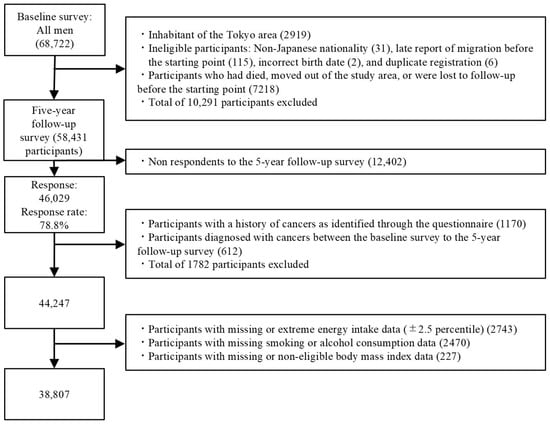
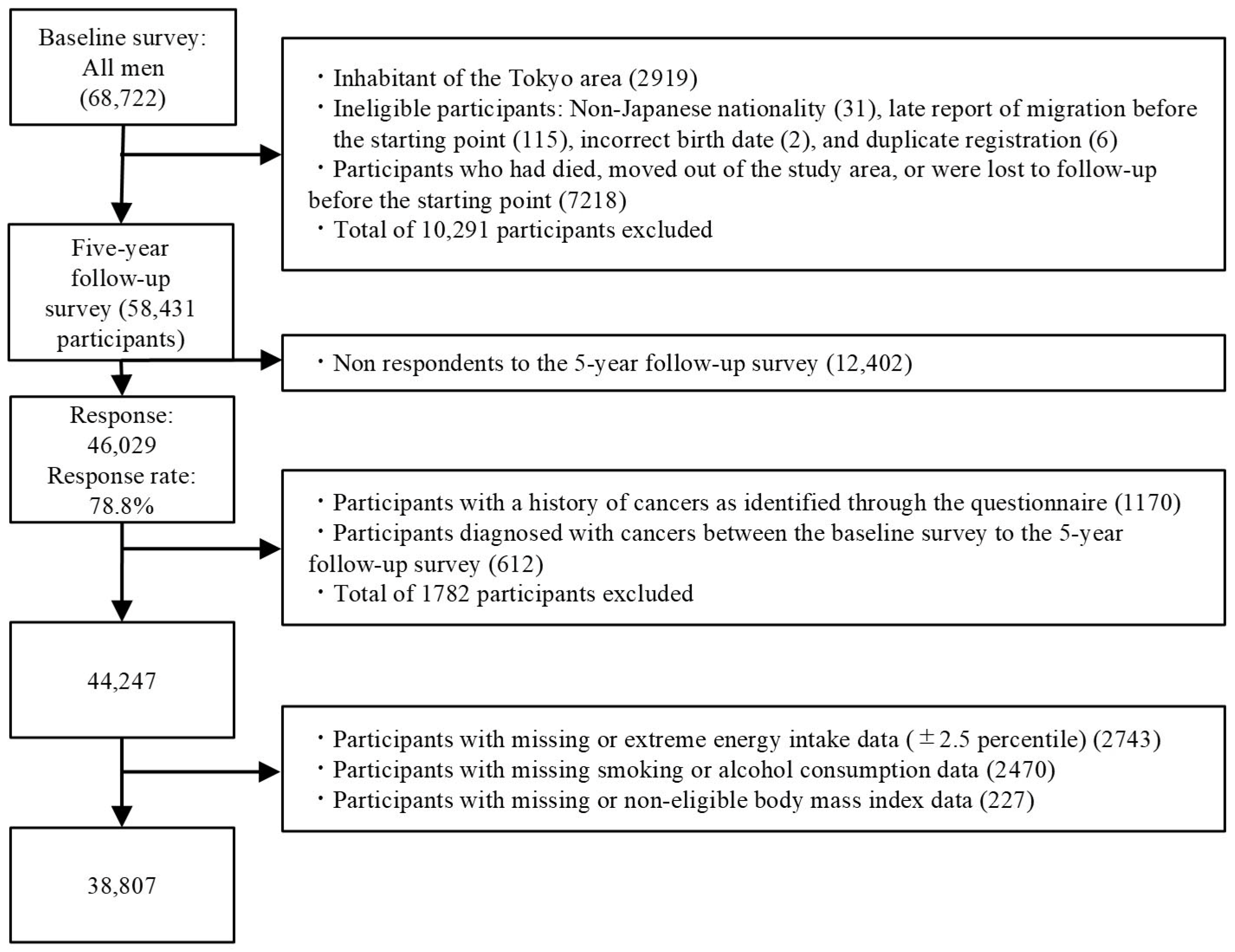
The Japan Public Health Center-based prospective study (JPHC Study) comprises two cohorts: Cohort I (1990) and Cohort II (1993). This study was conducted with the aim of gathering evidence to help maintain and improve health conditions, such as cancer. The JPHC Study, whose design has been described previously [15], included 68,722 male residents of 11 public health center areas across Japan who were aged 40–69 years at baseline. Follow-up surveys were conducted every 5 years. The 5-year follow-up surveys in 1995 for Cohort I and in 1998 for Cohort II were treated as the starting points of follow-up because the 5-year follow-up data included more comprehensive dietary information than the baseline survey. Participants were followed until 31 December 2013 (and until 31 December 2012 in the Osaka area only). The Tokyo area (n = 2919) was excluded because cancer incidence data were not available.
A total of 58,431 men were identified as eligible for follow-up after excluding participants who did not meet the inclusion criteria, died, moved out of the study area, or were lost to follow-up before the start of follow up (Figure 1). Of these, 46,029 men completed the 5-year follow-up (response rate, 78.8%). Participants were further excluded if they had a history of any cancer identified by the questionnaire (n = 1170) or were diagnosed between baseline and the 5-year follow-up (n = 612). Participants with missing or extreme energy intake data (upper and lower 2.5 percentiles) (n = 2743), missing smoking or alcohol consumption data (n = 2470), or missing or implausible body mass index (BMI) data (n = 227) were also excluded. Consequently, data from the remaining 38,807 men were included in the present study.
Figure 1.
Flow chart of the participants in the Japan Public Health Center-based Prospective Study.
2.2. Dietary Assessment
At the 5-year follow-up, habitual dietary intake was assessed using a food frequency questionnaire (FFQ) consisting of 138 food and beverage items. For each food item, respondents were asked about the frequency of consumption and portion size per serving. Frequency of consumption was assessed using nine graded categories ranging from “less than once a month” to “≥7 times/day,” and portion size was divided into three response options: “less than half,” “standard,” and “more than 1.5 times.” For beverages, respondents were asked only about the frequency of consumption, with nine categories ranging from “<1 cup/week” to “≥10 cups/day.” Energy and nutrient intakes were calculated by multiplying the frequency of food intake by portion size and nutrient content per 100 g. Nutrient content data were obtained from the Fifth Revised and Enlarged Edition of the Standard Tables of Food Composition in Japan [16].
E-DII scores were calculated using intake data for 30 nutrients and foods obtained from the FFQ [6,7]. Briefly, the E-DII was developed through an extensive review of the scientific literature that identified 45 nutrients and foods associated with inflammation as components of the index. This review included 1943 articles (cell culture, animal, and human studies). The articles were weighted according to study design and number to determine the pro- or anti-inflammatory effects of each E-DII component. Individual dietary intake data, standardized to the global daily mean intake, were then multiplied by their respective inflammatory effect scores and summed to calculate an participant’s total E-DII score. A positive score indicates a pro-inflammatory diet, whereas a negative score indicates an anti-inflammatory effect. In the present study, 30 of the 45 components were used because intake data could not be calculated for some components or because their intakes are very low in the Japanese population (details of the E-DII components are listed in Table S1). This approach is well established in E-DII research, and previous studies have shown that the association between the DII score and CRP levels remain robust even when the number of dietary components is reduced from 44 to 28 [7]. To compute the E-DII scores, intakes were standardized per 1000 kcal of energy intake, and z-scores were calculated based on the energy-adjusted global comparative database. These z-scores were then converted to proportions that were centered on 0 by doubling and subtracting 1. Individual food parameter scores were then summed to create the overall E-DII score.
A validation study of the DII conducted in a subset of the study participants [9] showed that the correlation (r) between the FFQ and dietary record, used as the reference method, were 0.35 in Cohort I and 0.48 in Cohort II. These correlation coefficients are considered acceptable in nutritional epidemiology for ranking individuals by habitual intake and are consistent with median values reported in Japanese (0.31–0.56) and international (0.37–0.56) FFQ validation reviews [17,18]. Furthermore, a positive trend was observed for interleukin (IL)-6, an inflammatory marker. The geometric means IL-6 concentrations in the lowest and highest E-DII quartiles were 1.14 and 1.33 pg/mL (p for trend = 0.05) among men in Cohort I, and 1.07 and 1.14 pg/mL (p for trend = 0.42) among men in Cohort II, respectively. Because no positive trends in inflammatory markers were observed among Japanese women, only men were included in this study.
2.3. Identification of Colorectal Cancers
Colorectal cancer incident cases were identified by population-based cancer registries and hospital records in the study areas. Death certificate files were also used as supplemental data. The International Classification of Diseases for Oncology, Third Revision was used to code colorectal cancer (C18–C20). In addition, colorectal cancer was divided into groups by site: proximal colon (C18.0–C18.5), distal colon (C18.6 and C18.7), and rectum (C19 and C20). Proximal, distal, overlapping sites (C18.8), and unspecified sites (C18.9) were combined and defined as colon cancer. The proportion of death certificate notifications was 3.7%, and that of death certificate only (DCO) was 2.5%. Additionally, 96% of cases were pathologically confirmed. In accordance with international standards for cancer registration quality (e.g., IARC/IACR guidelines), a DCO proportion below 10% is recognized as indicative of high completeness and accuracy [19].
2.4. Statistical Analysis
Means, standard deviations (SDs), and proportions were calculated according to quintiles of E-DII scores. To compare characteristics between quintiles, p-values were calculated using the Jonckheere–Terpstra test for continuous variables and the chi-squared test for categorical variables. Person-years of follow-up were calculated from the date of response to the 5-year follow-up survey to the date of colorectal cancer diagnosis, death, migration out of the study area, or end of follow-up, whichever occurred first. For participants lost to follow-up, the last confirmed date of presence in the study area was used as the censoring date.
Hazard ratio (HRs) and 95% confidence intervals (CIs) were calculated to assess colorectal cancer across DII score quintiles using Cox proportional hazards regression models, with the lowest category as the reference. By assigning ordinal values to E-DII score quintiles, trends in HRs were also assessed. HRs were adjusted for the following potential confounders: age (years), area (10 areas with public health center), smoking status (current, past, and never), BMI (kg/m2; <22.5, 22.5–24.9, 25–27.4, and ≥27.5), total physical activity (metabolic equivalent of tasks, hours per day, continuous), log-transformed total energy intake (continuous), energy-adjusted red and processed meat intake (continuous), energy-adjusted calcium intake (continuous), history of diabetes (yes or no), and family history of colorectal cancer (yes or no). These covariates were selected a priori based on established evidence from WCRF/AICR reports [20] and previous cohort studies, with careful consideration of causal pathways to distinguish confounders from intermediate variables, thereby avoiding overadjustment for components of the E-DII or closely related factors (such as vegetables and fruit). Additional analyses further adjusting for dietary supplement use indicated that the results were materially unchanged; therefore, dietary supplement use was not retained in the final multivariable models. Alcohol intake was not included as a potential confounder in the main multivariable models because it is also a component of the E-DII score. Instead, alcohol consumption was assessed as an effect modifier through stratified analyses. For sensitivity analyses, participants with cancer incidence during the first 3 years of follow-up were excluded.
Stratified analyses were performed to evaluate whether the association between the E-DII score and colorectal cancer risk was affected by modifiable potential lifestyle risk factors: BMI status (<25 and ≥25 kg/m2), smoking status (non-smoker and current/past-smoker), alcohol drinking status (non-drinker and drinker), and level of physical activity (median number of MET-hours, <31.85 and ≥31.85). To assess statistical interactions, an interaction term was created by multiplying E-DII score quintiles by each dichotomous lifestyle variables and added to the model. When a significant interaction was observed, additional adjustment for the stratifying factor within strata was conducted as a sensitivity analysis to assess potential residual confounding. Two-sided p-values < 0.05 were considered statistically significant, and all statistical analyses were performed using SAS (version 9.4; SAS Institute Inc., Cary, NC, USA).
3. Results
3.1. Characteristics of the Participants
As shown in Table 1, mean ± SD E-DII scores were −0.32 ± 1.87 overall, −3.1 ± 0.9 in the lowest group (Q1), and 2.1 ± 0.7 in the highest group (Q5). Participants in the highest E-DII quintile (Q5) were younger (mean age: 54.8 years in Q5 versus [vs.] 58.2 years in Q1), more likely to be current smokers (53.4% vs. 37.4%), and had lower levels of physical activity (32.0 MET h/day vs. 32.7 MET h/day), as well as a lower prevalence of diabetes (7.7% vs. 12.0%) than those in the lowest quintile (Q1). Regarding dietary factors, individuals in Q5 had lower energy intake (2031 kcal/day vs. 2265 kcal/day) and calcium intake (397 mg/day vs. 609 mg/day), and higher intakes of red and processed meat (52.1 g/day vs. 48.9 g/day) and alcohol (268 g/week vs. 139 g/week) than those in Q1. The distributions of E-DII components and food group intakes are presented in Tables S1 and S2.
Table 1.
Characteristics of the study participants by E-DII quintiles in the Japan Public Health Center-based prospective study.
3.2. Association Between the E-DII and Colorectal Cancers
As shown in Table 2, a total of 1415 cases of colorectal cancer were diagnosed during a mean follow-up of 14.1 years, yielding a crude incidence rate of 259.1 per 100,000 person-years. This rate is comparable with the national age-specific incidence reported for Japanese men in 2005 (the midpoint of the study period), with rates of 191.5, 266.7, and 350.5 per 100,000 among those aged 60–64, 65–69, and 70–74 years, respectively [21,22].
Table 2.
HRs and 95% CIs for colorectal cancer risk according to the E-DII quintiles in the Japan Public Health Center-based prospective study.
In a model adjusted for age and area, colorectal cancer risk significantly increased among participants who consumed pro-inflammatory diets (p for trend = 0.006; the HR [95% CI] at Q5 was 1.28 [1.08–1.53]). In the multivariable-adjusted model, consumption of pro-inflammatory diet was also associated with an increased risk of colorectal cancer, although the association was slightly weaker (p for trend = 0.08; the HR [95% CI] at Q5 was 1.20 [0.99–1.46]). In sensitivity analysis excluding individuals diagnosed within the first 3 years of follow-up, the positive association between the E-DII score and colorectal cancer incidence was stronger (p for trend = 0.04; the HR [95% CI] at Q5 was 1.28 [1.04–1.57]).
3.3. Stratified Analysis
Stratified analysis by colorectal cancer site revealed differences in the effect of the E-DII score on cancer incidence. Consumption of pro-inflammatory diet was significantly associated with an increased risk of colon cancer incidence in the multivariate-adjusted model (p for trend = 0.03; the HR [95% CI] at Q5 was 1.28 [1.01–1.63]). In contrast, there was no significant association between the E-DII score and the risk of rectal cancer (p for trend = 0.99; the HR [95% CI] at Q5 was 1.06 [0.75–1.48]). These associations remained consistent in a sensitivity analysis excluding cases within the first 3 years of follow-up.
Furthermore, when colon cancer was stratified into proximal and distal colon cancers, a significant association was observed between pro-inflammatory diet consumption and proximal colon cancer risk, whereas no significant association was found for the distal colon cancer risk (proximal colon cancer, p for trend = 0.045, HR at Q5 [95% CI]: 1.32 [0.92–1.90]; distal colon cancer, p for trend = 0.35, HR [95% CI] at Q5: 1.20 [0.87–1.67]). However, the point estimates of the HRs were comparable for proximal and distal colon cancers.
Table 3 shows the results of the analysis of interactions between inflammation-inducing lifestyle factors and a one-unit change in E-DII score quintiles. Among less physically active participants, colon and proximal colon cancer risks increased with the consumption of pro-inflammatory diets, but no significant interaction was observed. Similar findings were observed for BMI and smoking status. However, stratified analysis of drinking habits showed no significant association among non-drinkers, but there were positive associations between the E-DII and incidences of colorectal, colon, and proximal colon cancers among drinkers, with a significant interaction for proximal colon cancer (p for interaction = 0.01). After adjusting for alcohol intake, a significant positive association remained between the E-DII score and proximal colon cancer among drinkers (one-unit change HR [95% CI]: 1.13 [1.03–1.24]). The HRs for E-DII score quintiles according to lifestyle factors are outlined in Table S3.
Table 3.
HRs and 95% CIs for colorectal cancer risk per one-unit change in E-DII quintiles, stratified by inflammation-related lifestyle factors, with interaction analyses.
4. Discussion
The results of the present study indicate that consumption of a pro-inflammatory diet is associated with an increased risk of colorectal cancer, particularly colon cancer. However, when interactions with lifestyle habits related to chronic inflammation were examined, no significant interactions were observed for BMI, smoking, or physical activity. The only significant interaction identified was for drinking habits. Consumption of a pro-inflammatory diet increased the risk of proximal colon cancer among alcohol drinkers, compared with non-drinkers.
This is the first prospective study to examine the association between the consumption of a pro-inflammatory diet and colorectal cancer incidence among Japanese men. A meta-analysis of the association between the E-DII and colorectal cancer [23] showed that a high E-DII was associated with an increased risk of colorectal cancer among men (highest vs. lowest risk ratio [RR] [95% CI] = 1.51 [1.29–1.76]). However, when stratified by study design, the RR [95% CI] was 1.27 [1.16–1.38] for prospective studies, suggesting that the inclusion of case–control studies in the meta-analysis may have led to an overestimation of the risk. The HR in our study was comparable to that of the prospective studies in the meta-analysis. Additionally, all the prospective studies included in the meta-analysis were conducted in Western countries. Considering that this is the first demonstration of an association between the E-DII and colorectal cancer risk among Japanese men, the results suggest that consumption of a pro-inflammatory diet, as assessed by the E-DII, may increase colorectal cancer risk in a diverse population. As Japan is now regarded as a high-incidence country for colorectal cancer [24,25], the present findings may be informative for other high-risk populations internationally.
In the anatomic site-specific analysis of the present study, consumption of a pro-inflammatory diet was associated with a significantly increased risk of colon cancer. A meta-analysis of prospective studies examining the association between the E-DII and site-specific colorectal cancer [23] also revealed a significant positive association for colon cancer (RR [95% CI] = 1.20 [1.11–1.30]), whereas no association was observed for rectal cancer (RR [95% CI] = 1.07 [0.87–1.31). Similar site-specific disparities have been reported in previous studies focusing on blood levels of CRP [13,26]. These observations, together with our findings, suggest differing susceptibilities to inflammation between the colon and rectum. Among patients with ulcerative colitis, those whose inflammation is primarily affecting the colon have an increased risk of colon cancer, whereas those whose inflammation is limited to the rectum do not have an increased risk of rectal cancer [27]. Additionally, for some nutrients that comprise the E-DII, such as vitamin C [28], folic acid [29], and magnesium [30,31], low intakes have been associated with an increased risk of colon cancer but not rectal cancer. Thus, the results of the present study may represent a combined effect of several nutrients. Further studies are required to determine whether the inflammation-modifying effects of diet differentially influence site-specific cancer incidence.
No significant interactions were found between E-DII and BMI, smoking, or physical activity. In previous studies, stratified analysis revealed an increased risk of colorectal cancer, especially in groups with unhealthy lifestyles, but interaction results have been inconsistent [32,33]. In contrast, a significant interaction with drinking habits was observed in the present study, with an increased risk of proximal colon cancer observed among drinkers. Furthermore, association remained positive in drinkers, even after adjusting for alcohol intake. Alcohol is included as an anti-inflammatory component of the E-DII (inflammation coefficient = −0.278) [6], based on scientific literature available at the time of its development [34,35]. More recent evaluations, including those by the World Health Organization, emphasize that alcohol consumption, even at low levels, carries health risks [36]. In this context, the observed positive association between E-DII scores and alcohol intake in our study may reflect typical dietary habits among alcohol drinkers, such as lower vegetable intake and higher consumption of red and processed meats. Similar results have been reported previously [32], suggesting that consumption of a pro-inflammatory diet may be a characteristic dietary pattern among alcohol drinkers.
Alcohol is a well-established risk factor for colorectal cancer [37]; thus, a stratified analysis was performed in this study. Although many previous studies have eliminated the possibility of confounding by including alcohol in their models [33,38], few studies have been conducted to examine interactions with drinking habits, especially the risk of pro-inflammatory diets in drinkers. Only one study has examined the potential interaction [33]; however, no interaction was found. Nevertheless, similar to the present study, that study reported a positive association between the E-DII and colorectal cancer among heavy drinkers and a null association among non-drinkers. Alcohol disrupts the intestinal epithelial barrier, leading to mucosal immunity, intestinal inflammation, and even systemic inflammation [39]. Moreover, alcohol affects nutrient metabolism, and low intakes of micronutrients such as folic acid [29,40] and magnesium [30] have been reported to increase the risk of colorectal cancer among alcohol drinkers. Although the possibility of residual confounding by alcohol should be noted, the E-DII may have further increased the risk of colorectal cancer among drinkers. Further research is warranted to clarify the biological mechanisms linking alcohol consumption, diet-related inflammation, and colorectal cancer risk.
Although the relationship between the E-DII and colorectal cancer has been widely investigated, data from East Asia are scarce [41], and all available studies to date have employed case–control methodologies. The JPHC Study is a large prospective cohort study of lifestyle-related diseases in which exposure information was collected before the cancer was diagnosed, thereby minimizing recall bias. Participants were selected from the general population, and the response rate for the 5-year follow-up survey was approximately 80%. The loss to follow-up rate was quite low, with fewer than 10% of DCOs. Thus, the follow-up data and cancer registry information for this study population were of adequate quality. In a study of the association between the E-DII and risk of death among Japanese populations, no significant association was observed with digestive cancer [12]. The present findings, derived from a population with a low chronic inflammatory status, provide important evidence supporting the potential for disease prevention through dietary modification, a modifiable lifestyle habit, across diverse populations.
Despite its strengths, this study has some limitations. Some degree of selection bias cannot be ruled out. In this cohort, non-respondents to the 5-year follow-up survey were slightly younger than respondents (54.6 ± 7.5 years vs. 56.8 ± 7.9 years), and previous studies have reported higher mortality among non-respondents than among respondents [42,43]. If such differences also extend to dietary inflammatory potential, the exclusion of non-respondents may have resulted in an underestimation of the observed association between the E-DII and colorectal cancer risk in this study. The FFQ is a relative dietary assessment method, and misclassification may have attenuated the observed associations. Although, the validity of E-DII assessment by the FFQ has been previously investigated using dietary records and inflammatory biomarkers, particularly among Japanese men, some degree of measurement error is inevitable and may have led to an underestimation of the true association. Additionally, we were unable to account for dietary changes during the follow-up period. Colorectal cancer risk has been reported to increase among individuals whose E-DII shifts toward a more pro-inflammatory profile during follow-up, as well as among those consuming pro-inflammatory diets compared with those consuming anti-inflammatory diets [44]. Therefore, the lack of consideration for dietary changes may have further attenuated the observed association. Future studies incorporating repeated dietary assessments are needed to evaluate the impact of changes in dietary inflammatory potential on colorectal cancer risk. The possibility of residual confounding from unmeasured factors, including a history of inflammatory bowel disease, also cannot be ruled out in the present study. Lastly, we did not examine sex differences because the validity of the E-DII derived from the FFQ has not been established in Japanese women. In our previous validation study, the E-DII was positively associated with inflammatory biomarkers in men, whereas no such association was observed in women. Furthermore, preliminary analyses in the same cohort showed no positive association between the E-DII and colorectal cancer risk among women. As it remains unclear whether these null findings reflect exposure misclassification or a true absence of association, we excluded women from the present analysis to avoid potential misinterpretation.
5. Conclusions
These findings suggest the potential for colorectal cancer prevention through dietary modification. Site-specific analyses revealed differential associations between colon and rectal cancer, highlighting the need for further investigations into the mechanisms underlying site-specific susceptibility to diet-related inflammation. However, as the validity of the FFQ-derived E-DII has not been established in Japanese women, the findings of this study may not be generalizable to women.
Supplementary Materials
The following supporting information can be downloaded at https://www.mdpi.com/article/10.3390/nu18020338/s1. Table S1: Distributions of E-DII components by E-DII quintiles, JPHC Study, Japan; Table S2: Distributions of energy-adjusted food group intakes by E-DII quintiles, JPHC Study, Japan; Table S3: HRs and 95% CIs for colorectal cancer risk according to E-DII quintiles stratified by inflammation-related lifestyle factors.
Author Contributions
A.K., N.S. and M.I. (Motoki Iwasaki) designed the study; S.T., N.S., M.I. (Motoki Iwasaki), J.I. and M.I. (Manami Inoue) arranged the field survey; J.R.H. conducted the E-DII calculation and provided critical input to the manuscript; A.K. performed the statistical analysis, interpreted the results, and wrote the first version of the manuscript; K.K. and T.Y.: Writing—review & editing; all authors reviewed the manuscript and contributed to discussions. All authors have read and agreed to the published version of the manuscript.
Funding
This research was funded by the National Cancer Center Research and Development Fund since 2011 (grant numbers 23-A-31, 26-A-2, 29-A-4, 2020-J-4, and 2023-J-04); a Grant-in-Aid for Cancer Research from the Ministry of Health, Labour and Welfare of Japan (from 1989 to 2010); the Practical Research for Innovative Cancer Control from the Japan Agency for Medical Research and Development (AMED; grant numbers JP19ck0106266, JP22ck0106551, and 23ck0106803h); and JSPS KAKENHI (grant numbers 17K18389 and 20K15488). J.R.H. was supported by the United States (US) National Cancer Institute-funded REMEDY Study grant U01 CA272977-01, which is part of the MeDOC Consortium and P20GM155896 grant from the US National Institute for General Medical Sciences in support of the Center for Clinical & Translational Research at the University of South Carolina.
Institutional Review Board Statement
The study was conducted according to the guidelines of the Declaration of Helsinki and was approved by the Institutional Review Board of the National Cancer Center, Tokyo, Japan (approval number: 2001-021, date of approval: 28 June 2019, 2015–085, date of approval: 2 February 2022) and the Ethical Review Board of Azabu University, Kanagawa, Japan (protocol code: 113; date of approval: 25 March 2022).
Informed Consent Statement
Participants were informed of the study objectives, and completion of the survey questionnaire was considered consent to participate. This study was launched before the enactment of ethical guidelines in Japan; thus, written informed consent was not mandatory. Following the subsequent ethical guidelines, a research summary was published online, providing participants the opportunity to refuse participation: https://epi.ncc.go.jp/jphc/764/3701.html (accessed on 12 January 2026).
Data Availability Statement
Individual data cannot be publicly shared due to participant privacy, in accordance with ethical guidelines in Japan. The informed consent obtained does not include permission for public data sharing. Qualifying researchers may apply to access a minimal dataset if they comply with certain requirements. Instructions are available at https://epi.ncc.go.jp/en/jphc/805/8155.html (accessed on 12 January 2026).
Acknowledgments
We thank all the participants and staff members of the JPHC Study team. We are grateful to the Iwate, Akita, Nagano, Niigata, Ibaraki, Osaka, Kochi, Nagasaki, and Okinawa Cancer Registries for providing incidence data. Members of the JPHC study are listed at the following site (as of October 2024): https://epi.ncc.go.jp/jphc/22/index.html (accessed on 12 January 2026). We also sincere thank Nitin Shivappa for his assistance and expertise in calculating the DII.
Conflicts of Interest
J.R.H. owns controlling interest in Connecting Health Innovations LLC (CHI), a company planning to license his invention of the dietary inflammatory index from the University of South Carolina to develop computer and smart phone applications for patient counselling and dietary intervention in clinical settings. The subject matter of this paper has no direct bearing on CHI activities, and CHI-related activities did not influence this project. All other authors declare no conflicts of interest.
Abbreviations
The following abbreviations are used in this manuscript:
| CRP | C-reactive protein |
| DII | Dietary inflammatory index |
| E-DII | Energy-adjusted-dietary inflammatory index |
| JPHC Study | Japan Public Health Center-based prospective study |
| FFQ | food frequency questionnaire |
| IL | interleukin |
| DCO | death certificate only |
| SDs | standard deviations |
| HRs | hazard ratios |
| CIs | confidence intervals |
| Q1 | lowest group |
| Q5 | highest group |
| RR | relative risk |
References
- Morgan, E.; Arnold, M.; Gini, A.; Lorenzoni, V.; Cabasag, C.J.; Laversanne, M.; Vignat, J.; Ferlay, J.; Murphy, N.; Bray, F. Global burden of colorectal cancer in 2020 and 2040: Incidence and mortality estimates from GLOBOCAN. Gut 2023, 72, 338–344. [Google Scholar] [CrossRef] [Scilit]
- Keum, N.; Giovannucci, E. Global burden of colorectal cancer: Emerging trends, risk factors and prevention strategies. Nat. Rev. Gastroenterol. Hepatol. 2019, 16, 713–732. [Google Scholar] [CrossRef] [Scilit]
- Cao, Y.; Wittert, G.; Taylor, A.W.; Adams, R.; Appleton, S.; Shi, Z. Nutrient patterns and chronic inflammation in a cohort of community dwelling middle-aged men. Clin. Nutr. 2017, 36, 1040–1047. [Google Scholar] [CrossRef] [Scilit]
- Matsunaga, T.; Wakai, K.; Imaeda, N.; Goto, C.; Tamada, Y.; Kato, Y.; Kubo, Y.; Okada, R.; Nagayoshi, M.; Tamura, T.; et al. Food group intakes and high-sensitivity C-reactive protein among community-dwelling Japanese adults: A cross-sectional study. Public Health Nutr. 2024, 27, e212. [Google Scholar] [CrossRef] [Scilit]
- Coe, C.L.; Miyamoto, Y.; Love, G.D.; Karasawa, M.; Kawakami, N.; Kitayama, S.; Ryff, C.D. Cultural and life style practices associated with low inflammatory physiology in Japanese adults. Brain Behav. Immun. 2020, 90, 385–392. [Google Scholar] [CrossRef] [Scilit] [PubMed]
- Shivappa, N.; Steck, S.E.; Hurley, T.G.; Hussey, J.R.; Hébert, J.R. Designing and developing a literature-derived, population-based dietary inflammatory index. Public Health Nutr. 2014, 17, 1689–1696. [Google Scholar] [CrossRef] [Scilit] [PubMed]
- Shivappa, N.; Steck, S.E.; Hurley, T.G.; Hussey, J.R.; Ma, Y.; Ockene, I.S.; Tabung, F.; Hébert, J.R. A population-based dietary inflammatory index predicts levels of C-reactive protein in the seasonal variation of blood cholesterol study (SEASONS). Public Health Nutr. 2014, 17, 1825–1833. [Google Scholar] [CrossRef] [Scilit] [PubMed]
- Liu, F.-H.; Liu, C.; Gong, T.-T.; Gao, S.; Sun, H.; Jiang, Y.-T.; Zhang, J.-Y.; Zhang, M.; Gao, C.; Li, X.-Y.; et al. Dietary inflammatory index and health outcomes: An umbrella review of systematic review and meta-analyses of observational studies. Front. Nutr. 2021, 8, 647122. [Google Scholar] [CrossRef] [Scilit]
- Kotemori, A.; Sawada, N.; Iwasaki, M.; Yamaji, T.; Shivappa, N.; Hebert, J.R.; Ishihara, J.; Inoue, M.; Tsugane, S.; JPHC FFQ Validation Study Group. Validating the dietary inflammatory index using inflammatory biomarkers in a Japanese population: A cross-sectional study of the JPHC-FFQ validation study. Nutrition 2020, 69, 110569. [Google Scholar] [CrossRef] [Scilit]
- Tabung, F.K.; Steck, S.E.; Zhang, J.; Ma, Y.; Liese, A.D.; Agalliu, I.; Hingle, M.; Hou, L.; Hurley, T.G.; Jiao, L.; et al. Construct validation of the dietary inflammatory index among postmenopausal women. Ann. Epidemiol. 2015, 25, 398–405. [Google Scholar] [CrossRef] [Scilit]
- International Agency for Research on Cancer. Cancer over Time. Available online: https://gco.iarc.fr/overtime (accessed on 27 October 2024).
- Okada, E.; Shirakawa, T.; Shivappa, N.; Wakai, K.; Suzuki, K.; Date, C.; Iso, H.; Hébert, J.R.; Tamakoshi, A. Dietary inflammatory index is associated with risk of all-cause and cardiovascular disease mortality but not with cancer mortality in middle-aged and older Japanese adults. J. Nutr. 2019, 149, 1451–1459. [Google Scholar] [CrossRef] [Scilit]
- Otani, T.; Iwasaki, M.; Sasazuki, S.; Inoue, M.; Tsugane, S.; Japan Public Health Center-Based Prospective Study Group. Japan public health center-based prospective study group. Plasma C-reactive protein and risk of colorectal cancer in a nested case-control study: Japan public health center-based prospective study. Cancer Epidemiol. Biomark. Prev. 2006, 15, 690–695. [Google Scholar] [CrossRef] [Scilit]
- Gao, Y.; Byrd, D.A.; Prizment, A.; Lazovich, D.; Bostick, R.M. Associations of novel lifestyle- and Whole Foods-based inflammation scores with incident colorectal cancer among women. Nutr. Cancer 2022, 74, 1356–1369. [Google Scholar] [CrossRef] [Scilit]
- Tsugane, S.; Sawada, N. The JPHC study: Design and some findings on the typical Japanese diet. Jpn. J. Clin. Oncol. 2014, 44, 777–782. [Google Scholar] [CrossRef] [Scilit] [PubMed]
- Subdivision on Resources, Council for Science and Technology, Ministry of Education, Culture, Sports, Science, and Technology (MEXT). In Standard Tables of Food Composition in Japan, 5th ed.; National Printing Bureau: Tokyo, Japan, 2002.
- Wakai, K. A review of food frequency questionnaires developed and validated in Japan. J. Epidemiol. 2009, 19, 1–11. [Google Scholar] [CrossRef] [Scilit]
- Cade, J.E.; Burley, V.J.; Warm, D.L.; Thompson, R.L.; Margetts, B.M. Food-frequency questionnaires: A review of their design, validation and utilisation. Nutr. Res. Rev. 2004, 17, 5–22. [Google Scholar] [CrossRef] [Scilit] [PubMed]
- International Agency for Research on Cancer. Cancer incidence in five continents. IARC Sci. Publ. 2008, IX. Available online: https://publications.iarc.who.int/_publications/media/download/3672/CI5vol9.pdf (accessed on 12 January 2026).
- World Cancer Research Fund/American Institute for Cancer Research. Diet, Nutrition, Physical Activity and Col-Orectal Cancer: Continuous Update Project Expert Report 2018; World Cancer Research Fund/American Institute for Cancer Research: London, UK, 2018. [Google Scholar]
- Cancer Statistics. Cancer Information Service, National Cancer Center, Japan (Monitoring of Cancer Incidence in Japan (MCIJ)). Available online: https://ganjoho.jp/reg_stat/statistics/data/dl/index.html (accessed on 31 December 2025).
- Matsuda, T.; Marugame, T.; Kamo, K.-I.; Katanoda, K.; Ajiki, W.; Sobue, T.; Japan Cancer Surveillance Research Group. Cancer Incidence and Incidence Rates in Japan in 2005: Based on Data from 12 Population-Based Cancer Registries in the Monitoring of Cancer Incidence in Japan (MCIJ) Project. Jpn. J. Clin. Oncol. 2011, 41, 139–147. [Google Scholar] [CrossRef] [Scilit]
- Fan, Y.; Jin, X.; Man, C.; Gao, Z.; Wang, X. Meta-analysis of the association between the inflammatory potential of diet and colorectal cancer risk. Oncotarget 2017, 8, 59592–59600. [Google Scholar] [CrossRef] [Scilit] [PubMed]
- Bray, F.; Laversanne, M.; Sung, H.; Ferlay, J.; Siegel, R.L.; Soerjomataram, I.; Jemal, A. Global Cancer Statistics 2022: GLOBOCAN Estimates of Incidence and Mortality Worldwide for 36 Cancers in 185 Countries. CA Cancer J. Clin. 2024, 74, 229–263. [Google Scholar] [CrossRef] [Scilit]
- Matsuda, T.; Fujimoto, A.; Igarashi, Y. Colorectal Cancer: Epidemiology, Risk Factors, and Public Health Strategies. Digestion 2025, 106, 91–99. [Google Scholar] [CrossRef] [Scilit]
- Zhou, B.; Shu, B.; Yang, J.; Liu, J.; Xi, T.; Xing, Y. C-reactive protein, interleukin-6 and the risk of colorectal cancer: A meta-analysis. Cancer Causes Control 2014, 25, 1397–1405. [Google Scholar] [CrossRef] [Scilit] [PubMed]
- Itzkowitz, S.H.; Yio, X. Inflammation and cancer IV. Colorectal cancer in inflammatory bowel disease: The role of inflammation. Am. J. Physiol. Gastrointest. Liver Physiol. 2004, 287, G7–G17. [Google Scholar] [CrossRef] [Scilit]
- Zhong, J.; Li, P.; Zheng, F.; Li, Y.; Lu, W.; Chen, H.; Cai, J.; Xia, D.; Wu, Y. Association between dietary vitamin C intake/blood level and risk of digestive system cancer: A systematic review and meta-analysis of prospective studies. Food Funct. 2024, 15, 8217–8237. [Google Scholar] [CrossRef] [Scilit]
- Roswall, N.; Olsen, A.; Christensen, J.; Dragsted, L.O.; Overvad, K.; Tjønneland, A. Micronutrient intake and risk of colon and rectal cancer in a Danish cohort. Cancer Epidemiol. 2010, 34, 40–46. [Google Scholar] [CrossRef] [Scilit]
- Ma, E.; Sasazuki, S.; Inoue, M.; Iwasaki, M.; Sawada, N.; Takachi, R.; Tsugane, S.; Japan Public Health Center-based Prospective Study Group. High dietary intake of magnesium may decrease risk of colorectal cancer in Japanese men. J. Nutr. 2010, 140, 779–785. [Google Scholar] [CrossRef] [Scilit]
- Wark, P.A.; Lau, R.; Norat, T.; Kampman, E. Magnesium intake and colorectal tumor risk: A case-control study and meta-analysis. Am. J. Clin. Nutr. 2012, 96, 622–631. [Google Scholar] [CrossRef] [Scilit] [PubMed]
- Cho, Y.A.; Lee, J.; Oh, J.H.; Chang, H.J.; Sohn, D.K.; Shin, A.; Kim, J. Genetic risk score, combined lifestyle factors and risk of colorectal cancer. Cancer Res. Treat. 2019, 51, 1033–1040. [Google Scholar] [CrossRef] [Scilit]
- Jakszyn, P.; Cayssials, V.; Buckland, G.; Perez-Cornago, A.; Weiderpass, E.; Boeing, H.; Bergmann, M.M.; Vulcan, A.; Ohlsson, B.; Masala, G.; et al. Inflammatory potential of the diet and risk of colorectal cancer in the European prospective investigation into cancer and nutrition study. Int. J. Cancer 2020, 147, 1027–1039. [Google Scholar] [CrossRef] [Scilit] [PubMed]
- Giugliano, D.; Ceriello, A.; Esposito, K. The effects of diet on inflammation: Emphasis on the metabolic syndrome. J. Am. Coll. Cardiol. 2006, 48, 677–685. [Google Scholar] [CrossRef] [Scilit]
- Imhof, A.; Woodward, M.; Doering, A.; Helbecque, N.; Loewel, H.; Amouyel, P.; Lowe, G.D.O.; Koenig, W. Overall alcohol intake, beer, wine, and systemic markers of inflammation in Western Europe: Results from three Monica samples (Augsburg, Glasgow, Lille). Eur. Heart J. 2004, 25, 2092–2100. [Google Scholar] [CrossRef] [Scilit]
- World Health Organization (WHO). Alcohol. Available online: https://www.who.int/news-room/fact-sheets/detail/alcohol (accessed on 14 December 2025).
- Mizoue, T.; Inoue, M.; Wakai, K.; Nagata, C.; Shimazu, T.; Tsuji, I.; Otani, T.; Tanaka, K.; Matsuo, K.; Tamakoshi, A.; et al. Alcohol drinking and colorectal cancer in Japanese: A pooled analysis of results from five cohort studies. Am. J. Epidemiol. 2008, 167, 1397–1406. [Google Scholar] [CrossRef] [Scilit] [PubMed]
- Accardi, G.; Shivappa, N.; Di Maso, M.; Hébert, J.R.; Fratino, L.; Montella, M.; La Vecchia, C.; Caruso, C.; Serraino, D.; Libra, M.; et al. Dietary inflammatory index and cancer risk in the elderly: A pooled-analysis of Italian case-control studies. Nutrition 2019, 63–64, 205–210. [Google Scholar] [CrossRef] [Scilit] [PubMed]
- Bishehsari, F.; Magno, E.; Swanson, G.; Desai, V.; Voigt, R.M.; Forsyth, C.B.; Keshavarzian, A. Alcohol and gut-derived inflammation. Alcohol Res. 2017, 38, 163–171. [Google Scholar] [CrossRef] [Scilit]
- Gibson, T.M.; Weinstein, S.J.; Pfeiffer, R.M.; Hollenbeck, A.R.; Subar, A.F.; Schatzkin, A.; Mayne, S.T.; Stolzenberg-Solomon, R. Pre- and postfortification intake of folate and risk of colorectal cancer in a large prospective cohort study in the United States. Am. J. Clin. Nutr. 2011, 94, 1053–1062. [Google Scholar] [CrossRef] [Scilit]
- Cho, Y.A.; Lee, J.; Oh, J.H.; Shin, A.; Kim, J. Dietary inflammatory index and risk of colorectal cancer: A case-control study in Korea. Nutrients 2016, 8, 469. [Google Scholar] [CrossRef] [Scilit] [PubMed]
- Ferrie, J.E.; Kivimäki, M.; Singh-Manoux, A.; Shortt, A.; Martikainen, P.; Head, J.; Marmot, M.; Gimeno, D.; De Vogli, R.; Elovainio, M.; et al. Non-response to baseline, non-response to follow-up and mortality in the Whitehall II cohort. Int. J. Epidemiol. 2009, 38, 831–837. [Google Scholar] [CrossRef] [Scilit]
- Hara, M.; Sasaki, S.; Sobue, T.; Yamamoto, S.; Tsugane, S. Comparison of cause-specific mortality between respondents and nonrespondents in a population-based prospective study: Ten-year follow-up of JPHC study cohort I. Japan public health center. J. Clin. Epidemiol. 2002, 55, 150–156. [Google Scholar] [CrossRef] [Scilit]
- Tabung, F.K.; Steck, S.E.; Ma, Y.; Liese, A.D.; Zhang, J.; Lane, D.S.; Ho, G.Y.F.; Hou, L.; Snetselaar, L.; Ockene, J.K.; et al. Changes in the inflammatory potential of diet over time and risk of colorectal cancer in postmenopausal women. Am. J. Epidemiol. 2017, 186, 514–523. [Google Scholar] [CrossRef] [Scilit]

Disclaimer/Publisher’s Note: The statements, opinions and data contained in all publications are solely those of the individual author(s) and contributor(s) and not of MDPI and/or the editor(s). MDPI and/or the editor(s) disclaim responsibility for any injury to people or property resulting from any ideas, methods, instructions or products referred to in the content. |
© 2026 by the authors. Licensee MDPI, Basel, Switzerland. This article is an open access article distributed under the terms and conditions of the Creative Commons Attribution (CC BY) license.