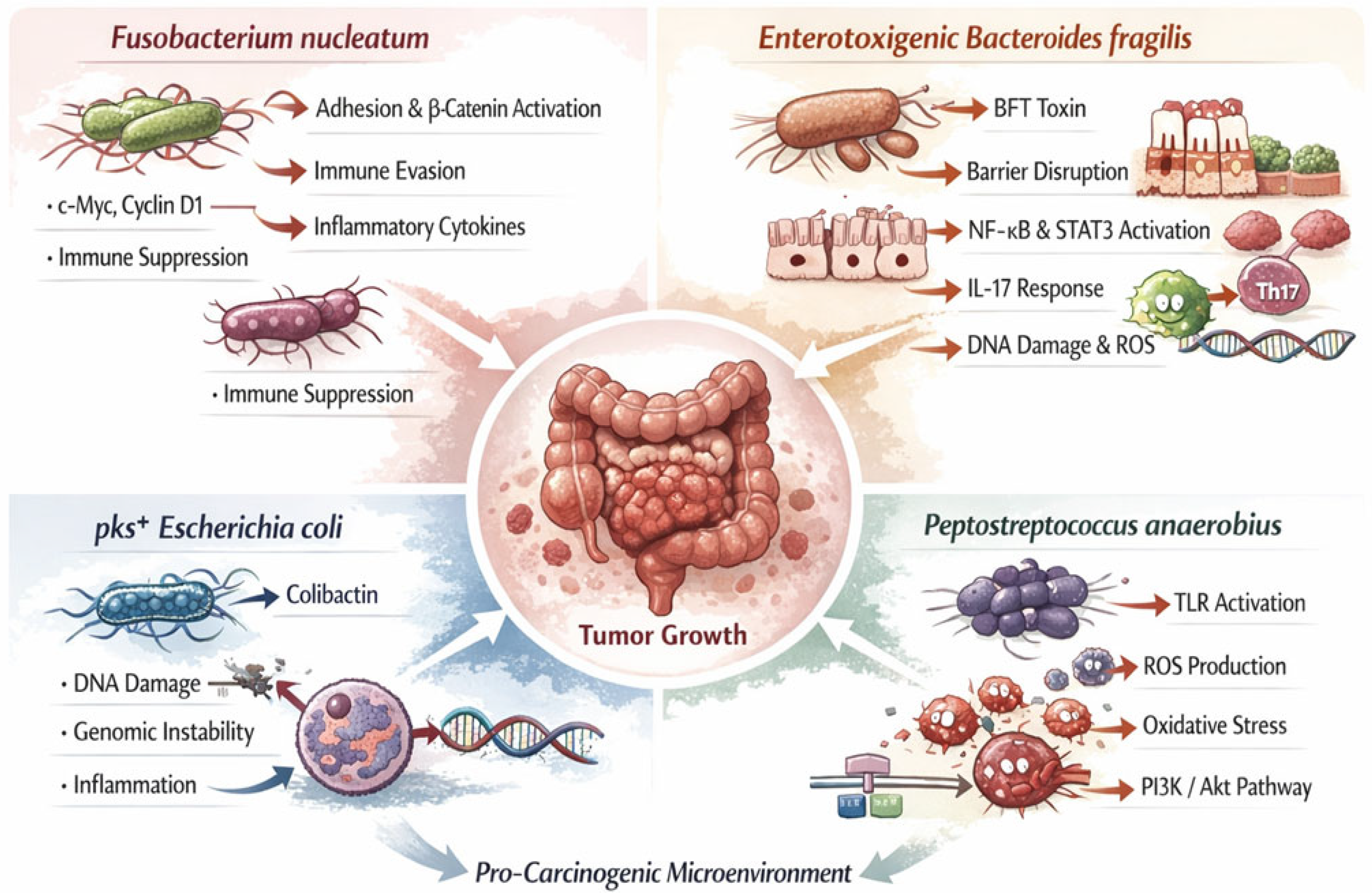
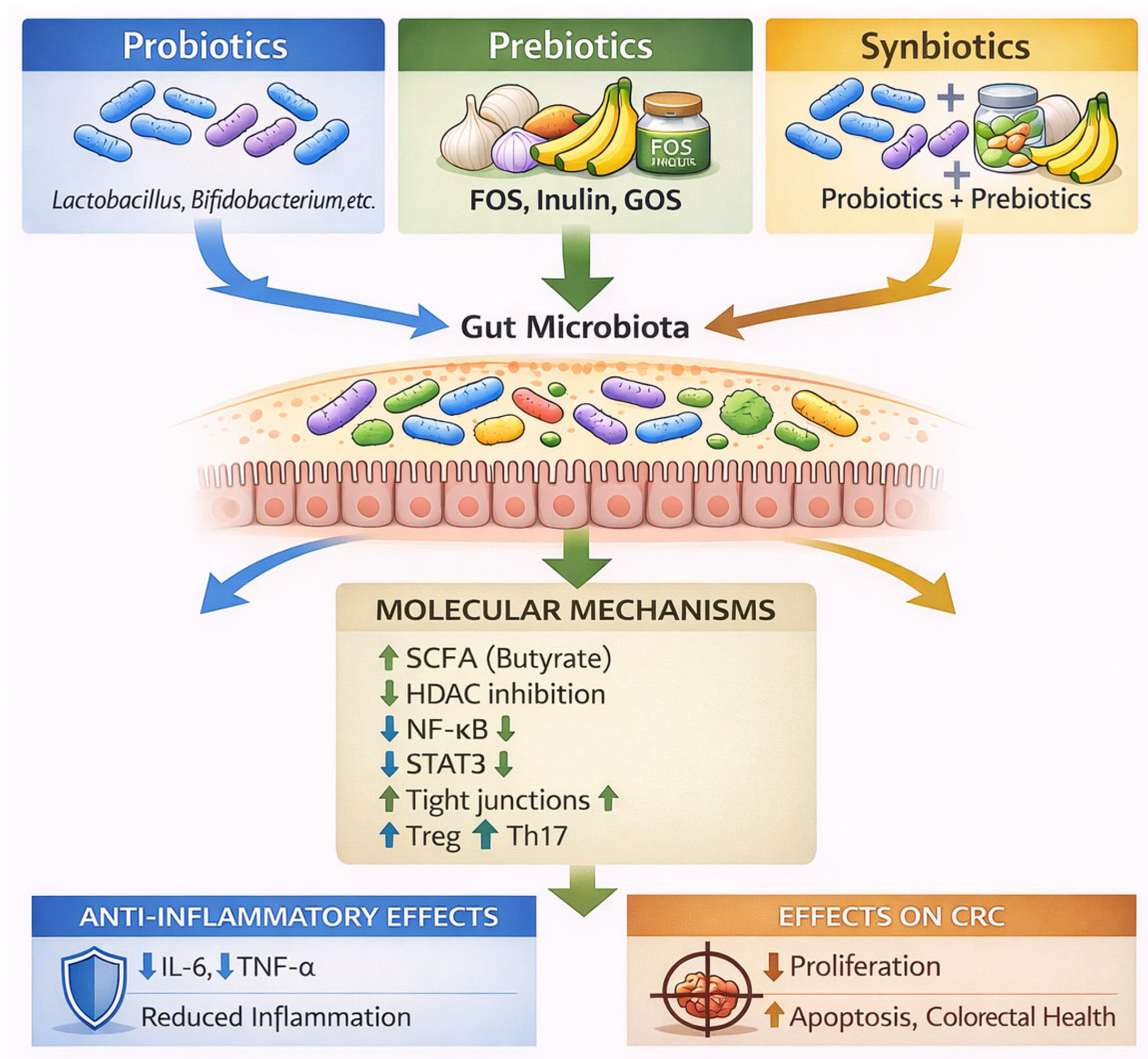
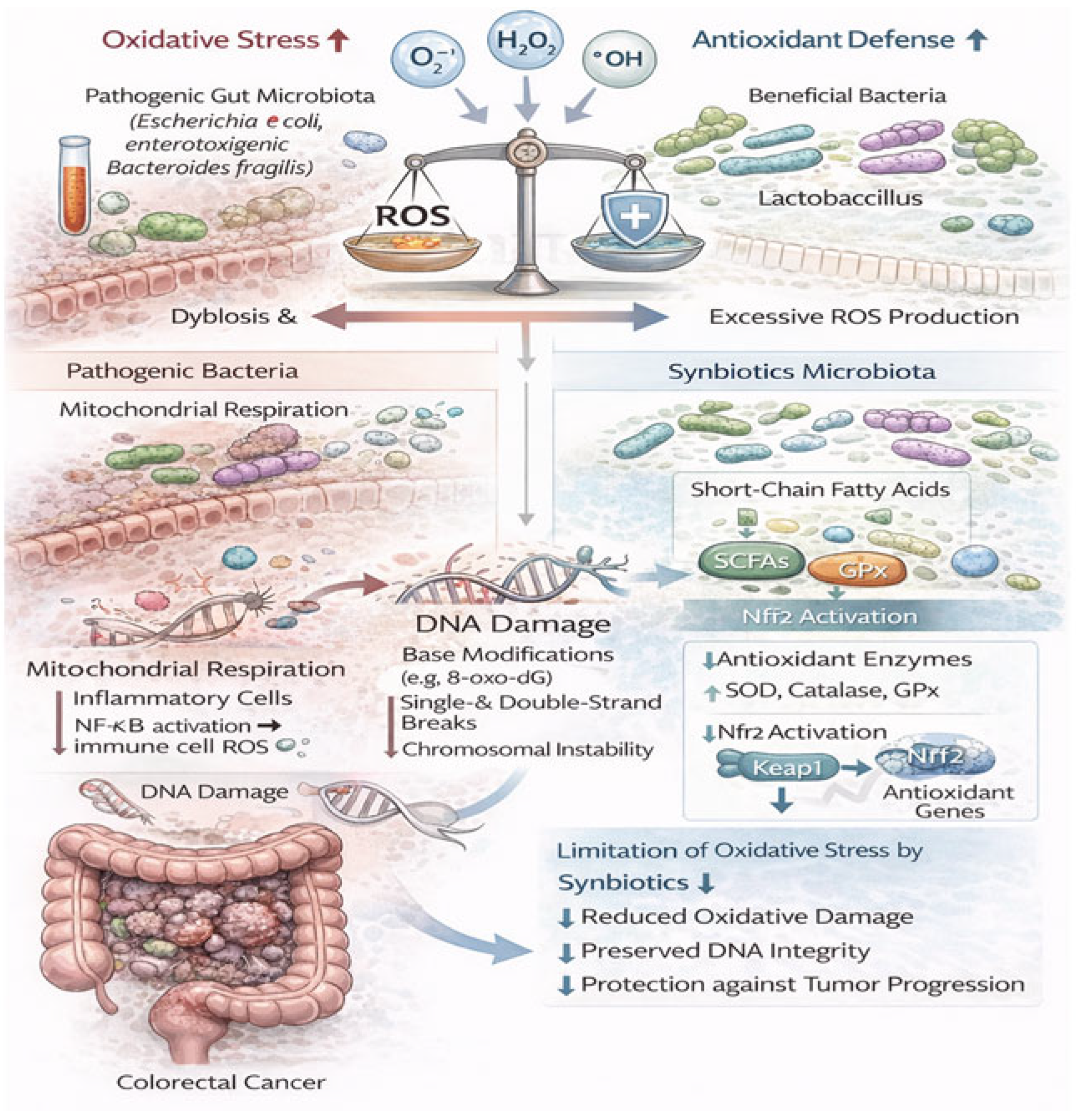
Synbiotics as a Microbiome-Based Strategy in Colorectal Cancer



.jpg)
Abstract
1. Introduction
2. The Gut Microbiota and Colorectal Cancer
2.1. Composition and Function of the Gut Microbiota
2.2. Dysbiosis in Colorectal Cancer
2.3. Key Microbial Players in Carcinogenesis
3. Mechanisms Linking Microbiota to Colorectal Cancer
3.1. Chronic Inflammation
3.2. Genotoxic Metabolites in Colorectal Carcinogenesis
3.3. Immune Modulation in Colorectal Carcinogenesis
4. Probiotics, Prebiotics and Synbiotics
Synbiotic Combinations
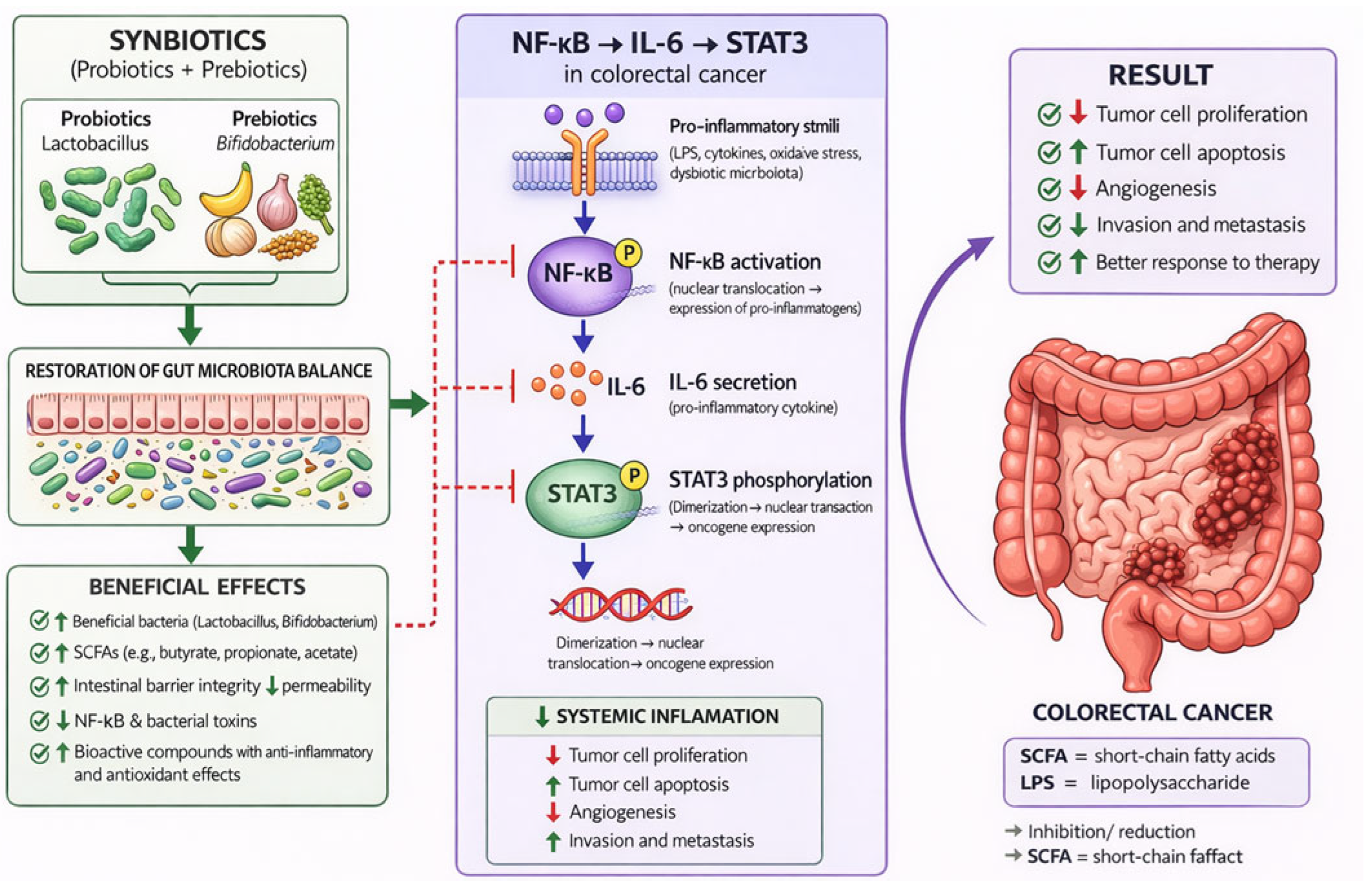
5. Mechanisms of Action of Synbiotics in Colorectal Cancer: Integration with Molecular Signaling Pathways
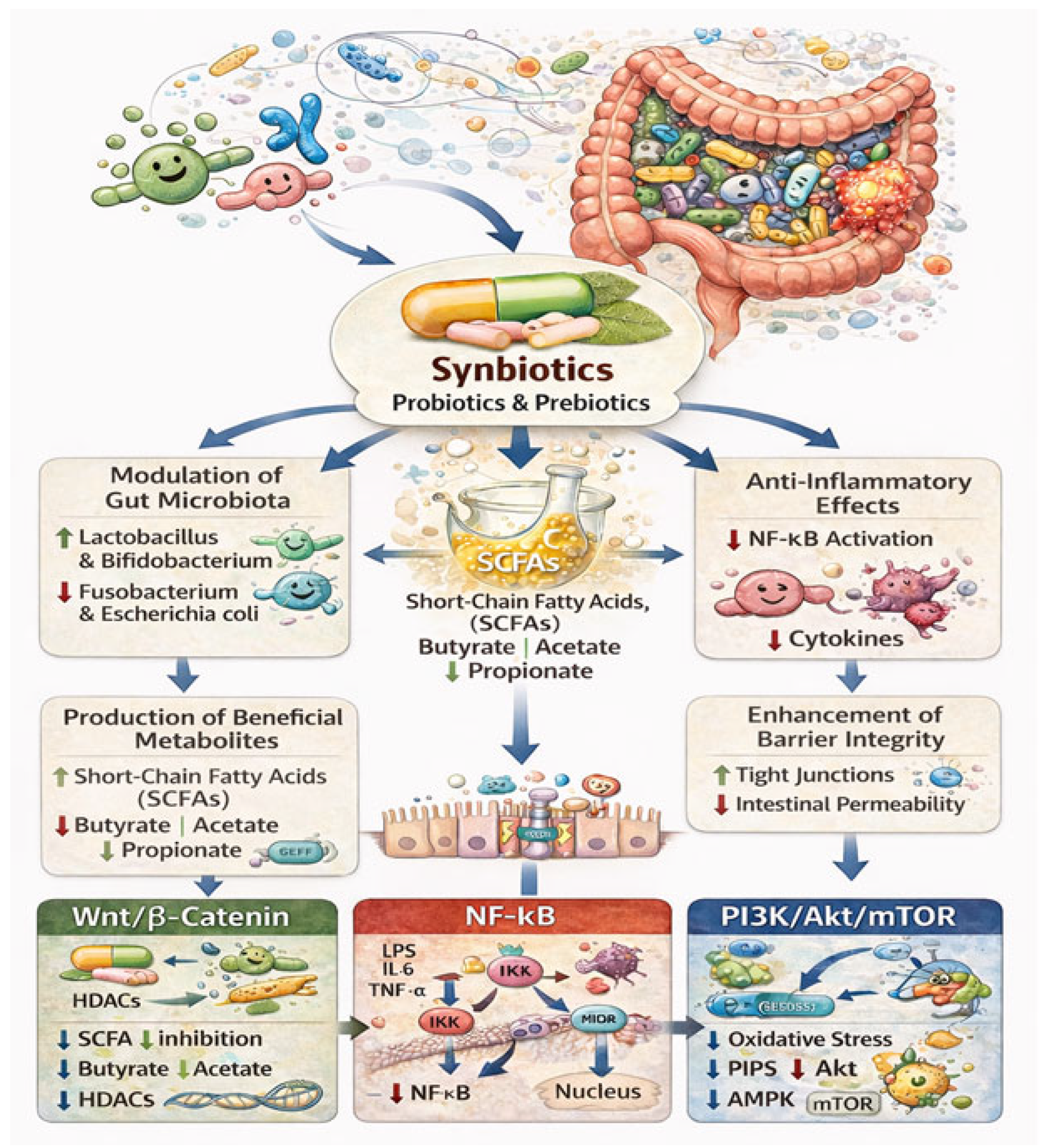
5.1. Functional Mechanisms of Synbiotics
5.1.1. Modulation of Gut Microbiota
5.1.2. Production of Beneficial Metabolites
5.1.3. Anti-Inflammatory Effects
5.1.4. Regulation of Apoptosis and Proliferation
5.1.5. Reduction in Oxidative Stress
5.2. Molecular Mechanisms
5.2.1. Wnt/β-Catenin Signaling Pathway
5.2.2. NF-κB Signaling Pathway
5.2.3. PI3K/Akt/mTOR Signaling Pathway
5.2.4. Crosstalk Between Pathways
5.2.5. Evidence from Preclinical and Clinical Studies
5.2.6. Synbiotics as Adjunct Therapy in CRC Management
6. Future Perspectives
7. Conclusions
Author Contributions
Funding
Institutional Review Board Statement
Informed Consent Statement
Data Availability Statement
Conflicts of Interest
Abbreviations
| •OH | hydroxyl radicals |
| AI | artificial intelligence |
| AMPK | AMP-activated protein kinase |
| AOM | azoxymethane |
| Bcl-2 | B-cell lymphoma 2 |
| Bcl-xL | B-cell lymphoma-extra large |
| BFT | Bacteroides fragilis toxin |
| CFU | Colony-Forming Unit |
| CK1 | casein kinase 1 |
| COX-2 | ciclooxigenase 2 |
| CRC | colorectal cancer |
| DCA | deoxycholic acid |
| dMMR | mismatch repair-deficient |
| DSS | dextran sodium sulfate |
| EMT | epithelial–mesenchymal transition |
| ETBF | Enterotoxigenic Bacteroides fragilis |
| FMT | fecal microbiota transplantation |
| FOS | fructooligosaccharides |
| GOS | galactooligosaccharides |
| GPR 41/43 | G protein-coupled receptor 41/43 |
| GSK-3β | glycogen synthase kinase-3β |
| H2O2 | hydrogen peroxide |
| H2S | hydrogen sulfide |
| HDACs | histone deacetylases |
| ICLs | interstrand crosslinks |
| ICLs | interstrand DNA crosslinks |
| IFN-γ | Interferon-γ |
| IkB | inhibitory kappa B proteins |
| IKK | IκB kinase |
| IL-17 | interleukin-17 |
| IL-6 | interleukin-6 |
| IL-1β | interleukin-1β |
| iNOS | inducible nitric oxide synthase |
| ISAPP | International Scientific Association for Probiotics and Prebiotics |
| JAKs | janus kinases |
| LCA | lithocholic acid |
| LEF | lymphoid enhancer factor |
| LGG | Lactobacillus rhamnosus GG |
| LPS | lipopolysaccharide |
| MAMPs | microbial-associated molecular patterns |
| MAPK | mitogen-activated protein kinase |
| MDA | malondialdehyde |
| MDSCs | myeloid-derived suppressor cells |
| MOMP | mitochondrial outer membrane permeability |
| MSI-H | microsatellite instability-high |
| MSS | microsatellite stable |
| mTOR | mammalian target of rapamycin |
| MyD88 | myeloid differentiation primary response gene 88 protein |
| NF-κB | nuclear factor kappa B |
| NK | natural killer |
| NLRs | NOD-like receptors |
| NOD | nucleotide-binding oligomerization domain |
| Nrf2 | nuclear factor erythroid 2-related factor 2 |
| O2− | superoxide anion |
| PD-L1 | programmed death-ligand 1 |
| PI3K | phosphoinositide 3-kinase |
| PIP3 | phosphatidylinositol-3,4,5-triphosphate |
| Pks | polyketide synthase |
| PRP | pattern recognition receptor |
| PTEN | phosphatase and TENsin homolog |
| RCTs | randomized controlled trials |
| RNS | nitrogen species |
| ROS | reactive oxygen species |
| SASP | senescence-associated secretory phenotype |
| SCFAs | short-chain fatty acids |
| SOD | superoxide dismutase |
| SREBP2 | sterol regulatory element-binding protein 2 |
| STAT3 | signal transducer and activator of transcription 3 |
| TCF | T-cell factor |
| TGF-β | transforming growth factor-β |
| TIGIT | T cell immunoreceptor with Ig and ITIM domains |
| TLR4 | Toll-like receptor 4 |
| TLRs | Toll-like receptors |
| TNF-α | tumor necrosis factor alfa |
| TRAIL | TNF-related apoptosis-inducing ligand |
| Tregs | regulatory T cells |
| TRIF | TIR-domain-containing adapter inducing interferon-β |
| VEGF | vascular endothelial growth factor |
References
- Bray, F.; Laversanne, M.; Sung, H.; Ferlay, J.; Siegel, R.L.; Soerjomataram, I.; Jemal, A. Global cancer statistics 2022: GLOBOCAN estimates of incidence and mortality worldwide for 36 cancers in 185 countries. CA Cancer J. Clin. 2024, 74, 229–263. [Google Scholar] [CrossRef] [PubMed]
- Sung, H.; Ferlay, J.; Siegel, R.L.; Laversanne, M.; Soerjomataram, I.; Jemal, A.; Bray, F. Global Cancer Statistics 2020: GLOBOCAN estimates of incidence and mortality worldwide for 36 cancers in 185 countries. CA Cancer J. Clin. 2021, 71, 209–249. [Google Scholar] [CrossRef]
- Arnold, M.; Sierra, M.S.; Laversanne, M.; Soerjomataram, I.; Jemal, A.; Bray, F. Global patterns and trends in colorectal cancer incidence and mortality. Gut 2017, 66, 683–691. [Google Scholar] [CrossRef]
- Dekker, E.; Tanis, P.J.; Vleugels, J.L.A.; Kasi, P.M.; Wallace, M.B. Colorectal cancer. Lancet 2019, 394, 1467–1480. [Google Scholar] [CrossRef] [PubMed]
- GBD 2019 Colorectal Cancer Collaborators. Global, regional, and national burden of colorectal cancer and its risk factors, 1990-2019: A systematic analysis for the Global Burden of Disease Study 2019. Lancet Gastroenterol. Hepatol. 2022, 7, 627–647. [Google Scholar] [CrossRef] [PubMed]
- Xi, Y.; Xu, P. Global colorectal cancer burden in 2020 and projections to 2040. Transl. Oncol. 2021, 14, 101174. [Google Scholar] [CrossRef] [PubMed]
- Siegel, R.L.; Miller, K.D.; Wagle, N.S.; Jemal, A. Cancer statistics, 2023. CA Cancer J. Clin. 2023, 73, 17–48. [Google Scholar] [CrossRef]
- Mao, J.X.; Gao, R.; Wang, Y.; Yan, X.B.; Wang, H.H. Surgical treatment of colorectal cancer: A multidimensional review. World J. Gastrointest. Surg. 2025, 17, 107785. [Google Scholar] [CrossRef]
- Kajiwara, Y.; Ueno, H. Essential updates 2022-2023: Surgical and adjuvant therapies for locally advanced colorectal cancer. Ann. Gastroenterol. Surg. 2024, 8, 977–986. [Google Scholar] [CrossRef]
- Oh, J.M.; Kim, S.; Tsung, C.; Kent, E.; Jain, A.; Ruff, S.M.; Zhang, H. Comprehensive review of the resistance mechanisms of colorectal cancer classified by therapy type. Front. Immunol. 2025, 16, 1571731. [Google Scholar] [CrossRef]
- Adeleke, A.; Adebayo, A.S.; Agbaje, K.; Olajubutu, O.; Adesina, S.K. Colorectal cancer: Therapeutic approaches and their complications. Biomedicines 2025, 13, 1646. [Google Scholar] [CrossRef] [PubMed]
- Colombo, A.; Gebbia, V.; Porretto, C.M. Immunotherapy in colorectal cancer: A review. Explor. Res. Hypothesis Med. 2024, 9, 32–38. [Google Scholar] [CrossRef]
- Keivany, M.R.; Shojae, E.; Besharatloo, M.; Latifi, H.; Barjasteh, A.H. Advances in immunotherapy for colorectal cancer: Overcoming resistance in mismatch repair-proficient tumors. Cancer Cell Int. 2026, 26, 151. [Google Scholar] [CrossRef]
- Ji, K.; Jia, H.; Liu, Z.; Yu, G.; Wen, R.; Zhang, T.; Peng, Z.; Man, W.; Tian, Y.; Wang, C.; et al. New insight in immunotherapy and combine therapy in colorectal cancer. Front. Cell Dev. Biol. 2025, 12, 1453630. [Google Scholar] [CrossRef]
- Fadlallah, H.; El Masri, J.; Fakhereddine, H.; Youssef, J.; Chemaly, C.; Doughan, S.; Abou-Kheir, W. Colorectal cancer: Recent advances in management and treatment. World J. Clin. Oncol. 2024, 15, 1136–1156. [Google Scholar] [CrossRef] [PubMed]
- Wong, S.H.; Yu, J. Gut microbiota in colorectal cancer: Mechanisms of action and clinical applications. Nat. Rev. Gastroenterol. Hepatol. 2019, 16, 690–704. [Google Scholar] [CrossRef]
- Kostic, A.D.; Chun, E.; Robertson, L.; Glickman, J.N.; Gallini, C.A.; Michaud, M.; Clancy, T.E.; Chung, D.C.; Lochhead, P.; Hold, G.L.; et al. Fusobacterium nucleatum potentiates intestinal tumorigenesis and modulates the tumor-immune microenvironment. Cell Host Microbe 2013, 14, 207–215. [Google Scholar] [CrossRef] [PubMed]
- Pleguezuelos-Manzano, C.; Puschhof, J.; Rosendahl Huber, A.; van Hoeck, A.; Wood, H.M.; Nomburg, J.; Gurjao, C.; Manders, F.; Dalmasso, G.; Stege, P.B.; et al. Mutational signature in colorectal cancer caused by genotoxic pks+ E. coli. Nature 2020, 580, 269–273. [Google Scholar] [CrossRef]
- Helmink, B.A.; Khan, M.A.W.; Hermann, A.; Gopalakrishnan, V.; Wargo, J.A. The microbiome, cancer, and cancer therapy. Nat. Med. 2019, 25, 377–388. [Google Scholar] [CrossRef]
- Alexander, J.L.; Wilson, I.D.; Teare, J.; Marchesi, J.R.; Nicholson, J.K.; Kinross, J.M. Gut microbiota modulation of chemotherapy efficacy and toxicity. Nat. Rev. Gastroenterol. Hepatol. 2017, 14, 356–365. [Google Scholar] [CrossRef]
- Swanson, K.S.; Gibson, G.R.; Hutkins, R.; Reimer, R.A.; Reid, G.; Verbeke, K.; Scott, K.P.; Holscher, H.D.; Azad, M.B.; Delzenne, N.M.; et al. The international scientific association for probiotics and prebiotics (ISAPP) consensus statement on the definition and scope of synbiotics. Nat. Rev. Gastroenterol. Hepatol. 2020, 17, 687–701. [Google Scholar] [CrossRef]
- Louis, P.; Hold, G.L.; Flint, H.J. The gut microbiota, bacterial metabolites and colorectal cancer. Nat. Rev. Microbiol. 2014, 12, 661–672. [Google Scholar] [CrossRef] [PubMed]
- Janney, A.; Powrie, F.; Mann, E.H. Host-microbiota maladaptation in colorectal cancer. Nature 2020, 585, 509–517. [Google Scholar] [CrossRef]
- Rafter, J.; Bennett, M.; Caderni, G.; Clune, Y.; Hughes, R.; Karlsson, P.C.; Klinder, A.; O’Riordan, M.; O’Sullivan, G.C.; Pool-Zobel, B.; et al. Dietary synbiotics reduce cancer risk factors in polypectomized and colon cancer patients. Am. J. Clin. Nutr. 2007, 85, 488–496. [Google Scholar] [CrossRef]
- Thursby, E.; Juge, N. Introduction to the human gut microbiota. Biochem. J. 2017, 474, 1823–1836. [Google Scholar] [CrossRef]
- Valdes, A.M.; Walter, J.; Segal, E.; Spector, T.D. Role of the gut microbiota in nutrition and health. BMJ 2018, 361, k2179. [Google Scholar] [CrossRef] [PubMed]
- Lloyd-Price, J.; Abu-Ali, G.; Huttenhower, C. The healthy human microbiome. Genome Med. 2016, 8, 51. [Google Scholar] [CrossRef]
- Zmora, N.; Suez, J.; Elinav, E. You are what you eat: Diet, health and the gut microbiota. Nat. Rev. Gastroenterol. Hepatol. 2019, 16, 35–56. [Google Scholar] [CrossRef]
- Rowland, I.; Gibson, G.; Heinken, A.; Scott, K.; Swann, J.; Thiele, I.; Tuohy, K. Gut microbiota functions: Metabolism of nutrients and other food components. Eur. J. Nutr. 2018, 57, 1–24. [Google Scholar] [CrossRef] [PubMed]
- Honda, K.; Littman, D.R. The microbiota in adaptive immune homeostasis. Nature 2016, 535, 75–84. [Google Scholar] [CrossRef]
- Derrien, M.; Belzer, C.; de Vos, W.M. Akkermansia muciniphila and its role in regulating host functions. Microb. Pathog. 2017, 106, 171–181. [Google Scholar] [CrossRef]
- Qin, J.; Li, R.; Raes, J.; Arumugam, M.; Burgdorf, K.S.; Manichanh, C.; Nielsen, T.; Pons, N.; Levenez, F.; Yamada, T.; et al. A human gut microbial gene catalogue established by metagenomic sequencing. Nature 2010, 464, 59–65. [Google Scholar] [CrossRef] [PubMed]
- Zoetendal, E.; Raes, J.; van den Bogert, B.; Arumugam, M.; Booijink, C.C.; Troost, F.J.; Bork, P.; Wels, M.; de Vos, W.M.; Kleerebezem, M. The human small intestinal microbiota is driven by rapid uptake and conversion of simple carbohydrates. ISME J. 2012, 6, 1415–1426. [Google Scholar] [CrossRef]
- Gaci, N.; Borrel, G.; Tottey, W.; O’Toole, P.W.; Brugère, J.F. Archaea and the human gut: New beginning of an old story. World J. Gastroenterol. 2014, 20, 16062–16078. [Google Scholar] [CrossRef] [PubMed]
- Shkoporov, A.N.; Hill, C. Bacteriophages of the human gut: The “known unknown” of the microbiome. Cell Host Microbe 2019, 25, 195–209. [Google Scholar] [CrossRef] [PubMed]
- Richard, M.L.; Sokol, H. The gut mycobiota: Insights into analysis, environmental interactions and role in gastrointestinal diseases. Nat. Rev. Gastroenterol. Hepatol. 2019, 16, 331–345. [Google Scholar] [CrossRef]
- Human Microbiome Project Consortium. Structure, function and diversity of the healthy human microbiome. Nature 2012, 486, 207–214. [Google Scholar] [CrossRef]
- Goodrich, J.K.; Waters, J.L.; Poole, A.C.; Sutter, J.L.; Koren, O.; Blekhman, R.; Beaumont, M.; Van Treuren, W.; Knight, R.; Bell, J.T.; et al. Human genetics shape the gut microbiome. Cell 2014, 159, 789–799. [Google Scholar] [CrossRef]
- Singh, G.; Chaudhry, Z.; Boyadzhyan, A.; Sasaninia, K.; Rai, V. Dysbiosis and colorectal cancer: Conducive factors, biological and molecular role, and therapeutic prospectives. Explor. Target. Anti-Tumor Ther. 2025, 6, 1002329. [Google Scholar] [CrossRef] [PubMed]
- Karam, F.; El Deghel, Y.; Iratni, R.; Dakroub, A.H.; Eid, A.H. The gut microbiome and colorectal cancer: An integrative review of the underlying mechanisms. Cell Biochem. Biophys. 2025, 83, 2637–2650. [Google Scholar] [CrossRef]
- Grellier, N.; Severino, A.; Archilei, S.; Kim, J.; Gasbarrini, A.; Cammarota, G.; Porcari, P.; Benech, N. Gut microbiota in inflammation and colorectal cancer: A potential toolbox for clinicians. Best Pract. Res. Clin. Gastroenterol. 2024, 72, 101942. [Google Scholar] [CrossRef]
- Zepeda-Rivera, M.; Minot, S.S.; Bouzek, H.; Wu, H.; Blanco-Míguez, A.; Manghi, P.; Jones, D.S.; LaCourse, K.D.; Wu, Y.; McMahon, E.F.; et al. A distinct Fusobacterium nucleatum clade dominates the colorectal cancer niche. Nature 2024, 628, 424–432. [Google Scholar] [CrossRef]
- Ruiz-Malagón, A.J.; Rodríguez-Sojo, M.J.; Redondo, E.; Rodríguez-Cabezas, M.E.; Gálvez, J.; Rodríguez-Nogales, A. Systematic review: The gut microbiota as a link between colorectal cancer and obesity. Obes. Rev. 2025, 26, e13872. [Google Scholar] [CrossRef] [PubMed]
- Rubinstein, M.R.; Wang, X.; Liu, W.; Hao, Y.; Cai, G.; Han, Y.W. Fusobacterium nucleatum promotes colorectal carcinogenesis by modulating E-cadherin/β-catenin signaling. Cell Host Microbe 2013, 14, 195–206. [Google Scholar] [CrossRef] [PubMed]
- Gur, C.; Ibrahim, Y.; Isaacson, B.; Yamin, R.; Abed, J.; Gamliel, M.; Enk, J.; Bar-On, Y.; Stanietsky-Kaynan, N.; Coppenhagen-Glazer, S.; et al. Binding of the Fap2 protein of Fusobacterium nucleatum to human inhibitory receptor TIGIT protects tumors from immune cell attack. Immunity 2015, 42, 344–355. [Google Scholar] [CrossRef]
- Wu, S.; Rhee, K.J.; Albesiano, E.; Rabizadeh, S.; Wu, X.; Yen, H.R.; Huso, D.L.; Brancati, F.L.; Wick, E.; McAllister, F.; et al. A human colonic commensal promotes colon tumorigenesis via activation of T helper type 17 T cell responses. Nat. Med. 2009, 15, 1016–1022. [Google Scholar] [CrossRef] [PubMed]
- Sears, C.L.; Garrett, W.S. Microbes, microbiota, and colon cancer. Cell Host Microbe 2014, 15, 317–328. [Google Scholar] [CrossRef]
- Chung, L.; Thiele Orberg, E.; Geis, A.L.; Chan, J.L.; Fu, K.; DeStefano Shields, C.E.; Dejea, C.M.; Fathi, P.; Chen, J.; Finard, B.B.; et al. Bacteroides fragilis toxin coordinates a pro-carcinogenic inflammatory cascade via targeting of colonic epithelial cells. Cell Host Microbe 2018, 23, 203–214.e5. [Google Scholar] [CrossRef]
- Xia, S.; Ma, L.; Li, H.; Li, Y.; Yu, L. Prevalence of enterotoxigenic Bacteroides fragilis in colorectal cancer: A systematic review and meta-analysis. Front. Cell. Infect. Microbiol. 2025, 15, 1525609. [Google Scholar] [CrossRef]
- Sadeghi, M.; Mestivier, D.; Sobhani, I. Contribution of pks+ Escherichia coli to colon carcinogenesis. Microorganisms 2024, 12, 1111. [Google Scholar] [CrossRef]
- de Souza, J.B.; de Almeida Campos, L.A.; Palácio, S.B.; Brelaz-de-Castro, M.C.A.; Cavalcanti, I.M.F. Prevalence and implications of pKs-positive Escherichia coli in colorectal cancer. Life Sci. 2024, 341, 122462. [Google Scholar] [CrossRef]
- Zhang, G.; Sun, D. The synthesis of the novel Escherichia coli toxin-colibactin and its mechanisms of tumorigenesis of colorectal cancer. Front. Microbiol. 2024, 15, 1501973. [Google Scholar] [CrossRef] [PubMed]
- Badero, O.J.; Ikedionwu, O.I.; Ajayi, V.; Jemiseye, A.V. A review of susceptibility factors for colibactin-associated colorectal cancer in african populations. Cureus 2025, 17, e96473. [Google Scholar] [CrossRef]
- Chen, B.; Ramazzotti, D.; Heide, T.; Spiteri, I.; Fernandez-Mateos, J.; James, C.; Magnani, L.; Graham, T.A.; Sottoriva, A. Contribution of pks+ E. coli mutations to colorectal carcinogenesis. Nat. Commun. 2023, 14, 7827. [Google Scholar] [CrossRef]
- Jans, M.; Vereecke, L. Physiological drivers of pks+ E. coli in colorectal cancer. Trends Microbiol. 2025, 33, 1003–1017. [Google Scholar] [CrossRef]
- Long, X.; Wong, C.C.; Tong, L.; Chu, E.S.H.; Ho Szeto, C.; Go, M.Y.Y.; Coker, O.O.; Chan, A.W.H.; Chan, F.K.L.; Sung, J.J.Y.; et al. Peptostreptococcus anaerobius promotes colorectal carcinogenesis and modulates tumour immunity. Nat. Microbiol. 2019, 4, 2319–2330. [Google Scholar] [CrossRef] [PubMed]
- Bai, B.; Ma, J.; Xu, W.; Chen, X.; Chen, X.; Lv, C.; Su, W.; Li, Y.; Sun, H.; Zhang, B.; et al. Gut microbiota and colorectal cancer: Mechanistic insights, diagnostic advances, and microbiome-based therapeutic strategies. Front. Microbiol. 2025, 16, 1699893. [Google Scholar] [CrossRef] [PubMed]
- Dong, X.; Yang, J.; He, L.; Fang, H.; Wang, L.; Zhu, J.; Xu, J.; Song, K.; Xuan, Z. The barrier–microbiota–inflammation axis in colorectal cancer: Mechanisms and emerging diagnostic & therapeutic strategies. Cancers 2026, 18, 576. [Google Scholar] [CrossRef]
- Bahrami, A.; Khalaji, A.; Bahri Najafi, M.; Sadati, S.; Raisi, A.; Abolhassani, A.; Eshraghi, R.; Khaksary Mahabady, M.; Rahimian, N.; Mirzaei, H. NF-κB pathway and angiogenesis: Insights into colorectal cancer development and therapeutic targets. Eur. J. Med. Res. 2024, 29, 610. [Google Scholar] [CrossRef]
- Sadati, S.; Khalaji, A.; Bonyad, A.; Khoshdooz, S.; Hosseini Kolbadi, K.S.; Bahrami, A.; Moeinfar, M.S.; Morshedi, M.; Ghamsaraian, A.; Eterafi, M.; et al. NF-κB and apoptosis: Colorectal cancer progression and novel strategies for treatment. Eur. J. Med. Res. 2025, 30, 616. [Google Scholar] [CrossRef]
- Kearns, R. Gut modulation to regulate NF-κB in colorectal and gastric cancer therapy and inflammation. Cancer Immunol. Immunother. 2025, 74, 264. [Google Scholar] [CrossRef]
- Wang, Z.; Chang, Y.; Sun, H.; Li, Y.; Tang, T. Advances in molecular mechanisms of inflammatory bowel disease-associated colorectal cancer (Review). Oncol. Lett. 2024, 27, 257. [Google Scholar] [CrossRef]
- Alhinai, E.A.; Walton, G.E.; Commane, D.M. The role of the gut microbiota in colorectal cancer causation. Int. J. Mol. Sci. 2019, 20, 5295. [Google Scholar] [CrossRef]
- Pastorelli, L.; De Salvo, C.; Mercado, J.R.; Vecchi, M.; Pizarro, T.T. Central role of the gut epithelial barrier in the pathogenesis of chronic intestinal inflammation: Lessons learned from animal models and human genetics. Front. Immunol. 2013, 4, 280. [Google Scholar] [CrossRef] [PubMed]
- Ridlon, J.M.; Kang, D.J.; Hylemon, P.B. Bile salt biotransformations by human intestinal bacteria. J. Lipid Res. 2006, 47, 241–259. [Google Scholar] [CrossRef]
- Grivennikov, S.I.; Wang, K.; Mucida, D.; Stewart, C.A.; Schnabl, B.; Jauch, D.; Taniguchi, K.; Yu, G.Y.; Osterreicher, C.H.; Hung, K.E.; et al. Adenoma-linked barrier defects and microbial products drive IL-23/IL-17-mediated tumour growth. Nature 2012, 491, 254–258. [Google Scholar] [CrossRef]
- Zitvogel, L.; Galluzzi, L.; Viaud, S.; Vétizou, M.; Daillère, R.; Merad, M.; Kroemer, G. Cancer and the gut microbiota: An unexpected link. Sci. Transl. Med. 2015, 7, 271ps1. [Google Scholar] [CrossRef]
- Grivennikov, S.I.; Greten, F.R.; Karin, M. Immunity, inflammation, and cancer. Cell 2010, 140, 883–899. [Google Scholar] [CrossRef]
- Hill, C.; Guarner, F.; Reid, G.; Gibson, G.R.; Merenstein, D.J.; Pot, B.; Morelli, L.; Canani, R.B.; Flint, H.J.; Salminen, S.; et al. Expert consensus document. The international scientific association for probiotics and prebiotics consensus statement on the scope and appropriate use of the term probiotic. Nat. Rev. Gastroenterol. Hepatol. 2014, 11, 506–514. [Google Scholar] [CrossRef] [PubMed]
- Markowiak, P.; Śliżewska, K. Effects of probiotics, prebiotics, and synbiotics on human health. Nutrients 2017, 9, 1021. [Google Scholar] [CrossRef] [PubMed]
- Smolinska, S.; Popescu, F.D.; Zemelka-Wiacek, M. A review of the influence of prebiotics, probiotics, synbiotics, and postbiotics on the human gut microbiome and intestinal integrity. J. Clin. Med. 2025, 14, 3673. [Google Scholar] [CrossRef]
- Roberfroid, M.; Gibson, G.R.; Hoyles, L.; McCartney, A.L.; Rastall, R.; Rowland, I.; Wolvers, D.; Watzl, B.; Szajewska, H.; Stahl, B.; et al. Prebiotic effects: Metabolic and health benefits. Br. J. Nutr. 2010, 104, S1–S63. [Google Scholar] [CrossRef]
- He, Y.; Peng, K.; Tan, J.; Hao, Y.; Zhang, S.; Gao, C.; Li, L. Short-chain fatty acids and colorectal cancer: A systematic review and integrative bayesian meta-analysis of microbiome–metabolome interactions and intervention efficacy. Nutrients 2025, 17, 3552. [Google Scholar] [CrossRef] [PubMed]
- Moreira, M.M.; Carriço, M.; Capelas, M.L.; Pimenta, N.; Santos, T.; Ganhão-Arranhado, S.; Mäkitie, A.; Ravasco, P. The impact of pre-, pro- and synbiotics supplementation in colorectal cancer treatment: A systematic review. Front. Oncol. 2024, 14, 1395966. [Google Scholar] [CrossRef]
- Kleerebezem, M.; Führen, J. Synergistic vs. complementary synbiotics: The complexity of discriminating synbiotic concepts using a Lactiplantibacillus plantarum exemplary study. Microbiome Res. Rep. 2024, 3, 46. [Google Scholar] [CrossRef]
- Al-Habsi, N.; Al-Khalili, M.; Haque, S.A.; Elias, M.; Olqi, N.A.; Al Uraimi, T. health benefits of prebiotics, probiotics, synbiotics, and postbiotics. Nutrients 2024, 16, 3955. [Google Scholar] [CrossRef]
- Cosier, D.J.; Lambert, K.; Neale, E.P.; Probst, Y.; Charlton, K. The effect of oral synbiotics on the gut microbiota and inflammatory biomarkers in healthy adults: A systematic review and meta-analysis. Nutr. Rev. 2025, 83, e4–e24. [Google Scholar] [CrossRef]
- Gao, Y.; Yao, Q.; Meng, L.; Wang, J.; Zheng, N. Double-side role of short chain fatty acids on host health via the gut-organ axes. Anim. Nutr. 2024, 18, 322–339. [Google Scholar] [CrossRef] [PubMed]
- Parada Venegas, D.; De la Fuente, M.K.; Landskron, G.; González, M.J.; Quera, R.; Dijkstra, G.; Harmsen, H.J.M.; Faber, K.N.; Hermoso, M.A. Short chain fatty acids (SCFAs)-mediated gut epithelial and immune regulation and its relevance for inflammatory bowel diseases. Front. Immunol. 2019, 10, 277. [Google Scholar] [CrossRef]
- Koh, A.; De Vadder, F.; Kovatcheva-Datchary, P.; Bäckhed, F. From dietary fiber to host physiology: Short-chain fatty acids as key bacterial metabolites. Cell 2016, 165, 1332–1345. [Google Scholar] [CrossRef] [PubMed]
- Fellows, R.; Denizot, J.; Stellato, C.; Cuomo, A.; Jain, P.; Stoyanova, E.; Balázsi, S.; Hajnády, Z.; Liebert, A.; Kazakevych, J.; et al. Microbiota derived short chain fatty acids promote histone crotonylation in the colon through histone deacetylases. Nat. Commun. 2018, 9, 105. [Google Scholar] [CrossRef]
- Canani, R.B.; Costanzo, M.D.; Leone, L.; Pedata, M.; Meli, R.; Calignano, A. Potential beneficial effects of butyrate in intestinal and extraintestinal diseases. World J. Gastroenterol. 2011, 17, 1519–1528. [Google Scholar] [CrossRef]
- Yu, L.C. Microbiota dysbiosis and barrier dysfunction in inflammatory bowel disease and colorectal cancers: Exploring a common ground hypothesis. J. Biomed. Sci. 2018, 25, 79. [Google Scholar] [CrossRef] [PubMed]
- Johnson, D.E.; O’Keefe, R.A.; Grandis, J.R. Targeting the IL-6/JAK/STAT3 signalling axis in cancer. Nat. Rev. Clin. Oncol. 2018, 15, 234–248. [Google Scholar] [CrossRef]
- Furusawa, Y.; Obata, Y.; Fukuda, S.; Endo, T.A.; Nakato, G.; Takahashi, D.; Nakanishi, Y.; Uetake, C.; Kato, K.; Kato, T.; et al. Commensal microbe-derived butyrate induces the differentiation of colonic regulatory T cells. Nature 2013, 504, 446–450. [Google Scholar] [CrossRef]
- Tanoue, T.; Atarashi, K.; Honda, K. Development and maintenance of intestinal regulatory T cells. Nat. Rev. Immunol. 2016, 16, 295–309. [Google Scholar] [CrossRef]
- Kezer, G.; Paramithiotis, S.; Khwaldia, K.; Harahap, I.A.; Čagalj, M.; Šimat, V.; Smaoui, S.; Elfalleh, W.; Ozogul, F.; Esatbeyoglu, T. A comprehensive overview of the effects of probiotics, prebiotics and synbiotics on the gut-brain axis. Front. Microbiol. 2025, 16, 1651965. [Google Scholar] [CrossRef]
- Kan, H.X.; Cao, Y.; Ma, Y.; Zhang, Y.L.; Wang, J.; Li, J.; Li, J.N. Efficacy and safety of probiotics, prebiotics, and synbiotics for the prevention of colorectal cancer and precancerous lesion in high-risk populations: A systematic review and meta-analysis of randomized controlled trials. J. Dig. Dis. 2024, 25, 14–26. [Google Scholar] [CrossRef] [PubMed]
- Tegegne, B.A.; Abebaw, D.; Teffera, Z.H.; Fenta, A.; Belew, H.; Belayneh, M.; Jemal, M.; Getinet, M.; Baylie, T.; Tamene, F.B.; et al. Microbial therapeutics in cancer: Translating probiotics, prebiotics, synbiotics, and postbiotics from mechanistic insights to clinical applications: A topical review. FASEB J. 2025, 39, e71146. [Google Scholar] [CrossRef] [PubMed]
- Yao, B.; Wei, W.; Zhang, H. Efficacy of probiotics or synbiotics supplementation on chemotherapy-induced complications and gut microbiota dysbiosis in gastrointestinal cancer: A systematic review and meta-analysis. Eur. J. Clin. Nutr. 2025, 79, 616–626. [Google Scholar] [CrossRef]
- Song, M.; Garrett, W.S.; Chan, A.T. Nutrients, foods, and colorectal cancer prevention. Gastroenterology 2015, 148, 1244–1260.e16. [Google Scholar] [CrossRef]
- Rinninella, E.; Raoul, P.; Cintoni, M.; Franceschi, F.; Miggiano, G.A.D.; Gasbarrini, A.; Mele, M.C. What is the healthy gut microbiota composition? A changing ecosystem across age, environment, diet, and diseases. Microorganisms 2019, 7, 14. [Google Scholar] [CrossRef]
- Paduraru, D.N.; Palcau, A.C.; Dinca, V.G.; Ciuc, D.M.; Constantinescu, A. The role of gut microbiota in colorectal cancer pathogenesis: A comprehensive literature review. Int. J. Mol. Sci. 2025, 26, 11870. [Google Scholar] [CrossRef]
- O’Keefe, S.J. Diet, microorganisms and their metabolites, and colon cancer. Nat. Rev. Gastroenterol. Hepatol. 2016, 13, 691–706. [Google Scholar] [CrossRef]
- Zitvogel, L.; Ma, Y.; Raoult, D.; Kroemer, G.; Gajewski, T.F. The microbiome in cancer immunotherapy: Diagnostic tools and therapeutic strategies. Science 2018, 359, 1366–1370. [Google Scholar] [CrossRef]
- Gao, S.; Liao, X.; He, Y.; Yang, J. Probiotics/synbiotics supplementation reduce the infection incidence in patients undergoing resection for colorectal cancer: An umbrella review. Front. Microbiol. 2025, 16, 1635409. [Google Scholar] [CrossRef]
- Makki, K.; Deehan, E.C.; Walter, J.; Bäckhed, F. the impact of dietary fiber on gut microbiota in host health and disease. Cell Host Microbe 2018, 23, 705–715. [Google Scholar] [CrossRef] [PubMed]
- Scott, K.P.; Gratz, S.W.; Sheridan, P.O.; Flint, H.J.; Duncan, S.H. The influence of diet on the gut microbiota. Pharmacol. Res. 2013, 69, 52–60. [Google Scholar] [CrossRef] [PubMed]
- Ríos-Covián, D.; Ruas-Madiedo, P.; Margolles, A.; Gueimonde, M.; de Los Reyes-Gavilán, C.G.; Salazar, N. Intestinal short chain fatty acids and their link with diet and human health. Front. Microbiol. 2016, 7, 185. [Google Scholar] [CrossRef]
- Roediger, W.E. Utilization of nutrients by isolated epithelial cells of the rat colon. Gastroenterology 1982, 83, 424–429. [Google Scholar] [CrossRef] [PubMed]
- Donohoe, D.R.; Collins, L.B.; Wali, A.; Bigler, R.; Sun, W.; Bultman, S.J. The Warburg effect dictates the mechanism of butyrate-mediated histone acetylation and cell proliferation. Mol. Cell 2012, 48, 612–626. [Google Scholar] [CrossRef]
- Waldecker, M.; Kautenburger, T.; Daumann, H.; Busch, C.; Schrenk, D. Inhibition of histone-deacetylase activity by short-chain fatty acids and some polyphenol metabolites formed in the colon. J. Nutr. Biochem. 2008, 19, 587–593. [Google Scholar] [CrossRef]
- Archer, S.Y.; Hodin, R.A. Histone acetylation and cancer. Curr. Opin. Genet. Dev. 1999, 9, 171–174. [Google Scholar] [CrossRef]
- Wilson, A.J.; Gibson, P.R. Short-chain fatty acids promote the migration of colonic epithelial cells in vitro. Gastroenterology 1997, 113, 487–496. [Google Scholar] [CrossRef]
- Marks, P.A.; Xu, W.S. Histone deacetylase inhibitors: Potential in cancer therapy. J. Cell. Biochem. 2009, 107, 600–608. [Google Scholar] [CrossRef]
- Smith, P.M.; Howitt, M.R.; Panikov, N.; Michaud, M.; Gallini, C.A.; Bohlooly-Y, M.; Glickman, J.N.; Garrett, W.S. The microbial metabolites, short-chain fatty acids, regulate colonic Treg cell homeostasis. Science 2013, 341, 569–573. [Google Scholar] [CrossRef]
- Peng, L.; Li, Z.R.; Green, R.S.; Holzman, I.R.; Lin, J. Butyrate enhances the intestinal barrier by facilitating tight junction assembly via activation of AMP-activated protein kinase in Caco-2 cell monolayers. J. Nutr. 2009, 139, 1619–1625. [Google Scholar] [CrossRef]
- Cani, P.D.; Amar, J.; Iglesias, M.A.; Poggi, M.; Knauf, C.; Bastelica, D.; Neyrinck, A.M.; Fava, F.; Tuohy, K.M.; Chabo, C.; et al. Metabolic endotoxemia initiates obesity and insulin resistance. Diabetes 2007, 56, 1761–1772. [Google Scholar] [CrossRef]
- Fukata, M.; Chen, A.; Vamadevan, A.S.; Cohen, J.; Breglio, K.; Krishnareddy, S.; Hsu, D.; Xu, R.; Harpaz, N.; Dannenberg, A.J.; et al. Toll-like receptor-4 promotes the development of colitis-associated colorectal tumors. Gastroenterology 2007, 133, 1869–1881. [Google Scholar] [CrossRef]
- Malki, A.; El Ruz, R.A.; Gupta, I.; Allouch, A.; Vranic, S.; Al Moustafa, A.E. Molecular mechanisms of colon cancer progression and metastasis: Recent insights and advancements. Int. J. Mol. Sci. 2020, 22, 130. [Google Scholar] [CrossRef]
- Hamer, H.M.; Jonkers, D.; Venema, K.; Vanhoutvin, S.; Troost, F.J.; Brummer, R.J. Review article: The role of butyrate on colonic function. Aliment. Pharmacol. Ther. 2008, 27, 104–119. [Google Scholar] [CrossRef]
- Donohoe, D.R.; Garge, N.; Zhang, X.; Sun, W.; O’Connell, T.M.; Bunger, M.K.; Bultman, S.J. The microbiome and butyrate regulate energy metabolism and autophagy in the mammalian colon. Cell Metab. 2011, 13, 517–526. [Google Scholar] [CrossRef]
- Tan, J.; McKenzie, C.; Potamitis, M.; Thorburn, A.N.; Mackay, C.R.; Macia, L. The role of short-chain fatty acids in health and disease. Adv. Immunol. 2014, 121, 91–119. [Google Scholar] [CrossRef]
- Greten, F.R.; Eckmann, L.; Greten, T.F.; Park, J.M.; Li, Z.W.; Egan, L.J.; Kagnoff, M.F.; Karin, M. IKKbeta links inflammation and tumorigenesis in a mouse model of colitis-associated cancer. Cell 2004, 118, 285–296. [Google Scholar] [CrossRef]
- Azad, M.A.K.; Sarker, M.; Wan, D. Immunomodulatory effects of probiotics on cytokine profiles. BioMed Res. Int. 2018, 2018, 8063647. [Google Scholar] [CrossRef]
- Plaza-Diaz, J.; Ruiz-Ojeda, F.J.; Gil-Campos, M.; Gil, A. Mechanisms of action of probiotics. Adv. Nutr. 2019, 10, S49–S66. [Google Scholar] [CrossRef]
- Akira, S.; Takeda, K. Toll-like receptor signalling. Nat. Rev. Immunol. 2004, 4, 499–511. [Google Scholar] [CrossRef]
- Kawai, T.; Akira, S. TLR signaling. Semin. Immunol. 2007, 19, 24–32. [Google Scholar] [CrossRef]
- Hayden, M.S.; Ghosh, S. Signaling to NF-kappaB. Genes. Dev. 2004, 18, 2195–2224. [Google Scholar] [CrossRef]
- Oeckinghaus, A.; Hayden, M.S.; Ghosh, S. Crosstalk in NF-κB signaling pathways. Nat. Immunol. 2011, 12, 695–708. [Google Scholar] [CrossRef]
- Segain, J.P.; Raingeard de la Blétière, D.; Bourreille, A.; Leray, V.; Gervois, N.; Rosales, C.; Ferrier, L.; Bonnet, C.; Blottière, H.M.; Galmiche, J.P. Butyrate inhibits inflammatory responses through NFkappaB inhibition: Implications for Crohn’s disease. Gut 2000, 47, 397–403. [Google Scholar] [CrossRef] [PubMed]
- Inan, M.S.; Rasoulpour, R.J.; Yin, L.; Hubbard, A.K.; Rosenberg, D.W.; Giardina, C. The luminal short-chain fatty acid butyrate modulates NF-kappaB activity in a human colonic epithelial cell line. Gastroenterology 2000, 118, 724–734. [Google Scholar] [CrossRef]
- Davie, J.R. Inhibition of histone deacetylase activity by butyrate. J. Nutr. 2003, 133, 2485S–2493S. [Google Scholar] [CrossRef]
- Usami, M.; Kishimoto, K.; Ohata, A.; Miyoshi, M.; Aoyama, M.; Fueda, Y.; Kotani, J. Butyrate and trichostatin A attenuate nuclear factor κB activation and tumor necrosis factor α secretion and increase prostaglandin E2 secretion in human epithelial cells. Nutr. Res. 2008, 28, 321–328. [Google Scholar] [CrossRef]
- Baud, V.; Karin, M. Is NF-kappaB a good target for cancer therapy? Hopes and pitfalls. Nat. Rev. Drug Discov. 2009, 8, 33–40. [Google Scholar] [CrossRef]
- DiDonato, J.A.; Mercurio, F.; Karin, M. NF-κB and the link between inflammation and cancer. Immunol. Rev. 2012, 246, 379–400. [Google Scholar] [CrossRef] [PubMed]
- Song, M.; Chan, A.T. Environmental factors, gut microbiota, and colorectal cancer prevention. Clin. Gastroenterol. Hepatol. 2019, 17, 275–289. [Google Scholar] [CrossRef]
- Louis, P.; Flint, H.J. Formation of propionate and butyrate by the human colonic microbiota. Environ. Microbiol. 2017, 19, 29–41. [Google Scholar] [CrossRef] [PubMed]
- Ruemmele, F.M.; Schwartz, S.; Seidman, E.G.; Dionne, S.; Levy, E.; Lentze, M.J. Butyrate induced Caco-2 cell apoptosis is mediated via the mitochondrial pathway. Gut 2003, 52, 94–100. [Google Scholar] [CrossRef]
- Chipuk, J.E.; Green, D.R. How do BCL-2 proteins induce mitochondrial outer membrane permeabilization? Trends Cell Biol. 2008, 18, 157–164. [Google Scholar] [CrossRef]
- Ciulei, G.; Orasan, O.H.; Coste, S.C.; Cozma, A.; Negrean, V.; Procopciuc, L.M. Vitamin D and the insulin-like growth factor system: Implications for colorectal neoplasia. Eur. J. Clin. Investig. 2020, 50, e13265. [Google Scholar] [CrossRef] [PubMed]
- Procopciuc, L.M.; Osian, G. Lys751Gln XPD and Arg399Gln XRCC1 in Romanians. Association with sporadic colorectal cancer risk and different stages of carcinomas. Chirurgia 2013, 108, 711–718. [Google Scholar] [PubMed]
- Osian, G.; Procopciuc, L.; Vlad, L. MTHFR polymorphisms as prognostic factors in sporadic colorectal cancer. J. Gastrointest. Liver Dis. 2007, 16, 251–256. [Google Scholar] [PubMed]
- Tilg, H.; Adolph, T.E.; Gerner, R.R.; Moschen, A.R. The intestinal microbiota in colorectal cancer. Cancer Cell 2018, 33, 954–964. [Google Scholar] [CrossRef]
- Klaunig, J.E. Oxidative stress and cancer. Curr. Pharm. Des. 2018, 24, 4771–4778. [Google Scholar] [CrossRef] [PubMed]
- Schwabe, R.F.; Jobin, C. The microbiome and cancer. Nat. Rev. Cancer 2013, 13, 800–812. [Google Scholar] [CrossRef] [PubMed]
- Bischoff, S.C.; Barbara, G.; Buurman, W.; Ockhuizen, T.; Schulzke, J.D.; Serino, M.; Tilg, H.; Watson, A.; Wells, J.M. Intestinal permeability—A new target for disease prevention and therapy. BMC Gastroenterol. 2014, 14, 189. [Google Scholar] [CrossRef]
- Zhan, T.; Rindtorff, N.; Boutros, M. Wnt signaling in cancer. Oncogene 2017, 36, 1461–1473. [Google Scholar] [CrossRef]
- Clevers, H. Wnt/beta-catenin signaling in development and disease. Cell 2006, 127, 469–480. [Google Scholar] [CrossRef]
- Klaus, A.; Birchmeier, W. Wnt signalling and its impact on development and cancer. Nat. Rev. Cancer 2008, 8, 387–398. [Google Scholar] [CrossRef]
- MacDonald, B.T.; Tamai, K.; He, X. Wnt/beta-catenin signaling: Components, mechanisms, and diseases. Dev. Cell 2009, 17, 9–26. [Google Scholar] [CrossRef] [PubMed]
- Grivennikov, S.I. Inflammation and colorectal cancer: Colitis-associated neoplasia. Semin. Immunopathol. 2013, 35, 229–244. [Google Scholar] [CrossRef] [PubMed]
- Li, Q.; Geng, S.; Luo, H.; Wang, W.; Mo, Y.Q.; Luo, Q.; Wang, L.; Song, G.B.; Sheng, J.P.; Xu, B. Signaling pathways involved in colorectal cancer: Pathogenesis and targeted therapy. Signal Transduct. Target. Ther. 2024, 9, 266. [Google Scholar] [CrossRef]
- Thulasinathan, B.; Suvilesh, K.N.; Maram, S.; Grossmann, E.; Ghouri, Y.; Teixeiro, E.P.; Chan, J.; Kaif, J.T.; Rachagani, S. The impact of gut microbial short-chain fatty acids on colorectal cancer development and prevention. Gut Microbes 2025, 17, 2483780. [Google Scholar] [CrossRef]
- Sun, J.; Chen, S.; Zang, D.; Sun, H.; Sun, Y.; Chen, J. Butyrate as a promising therapeutic target in cancer: From pathogenesis to clinic (Review). Int. J. Oncol. 2024, 64, 44. [Google Scholar] [CrossRef]
- Ben-Neriah, Y.; Karin, M. Inflammation meets cancer, with NF-κB as the matchmaker. Nat. Immunol. 2011, 12, 715–723. [Google Scholar] [CrossRef]
- Hoesel, B.; Schmid, J.A. The complexity of NF-κB signaling in inflammation and cancer. Mol. Cancer 2013, 12, 86. [Google Scholar] [CrossRef]
- Naugler, W.E.; Karin, M. NF-kappaB and cancer-identifying targets and mechanisms. Curr. Opin. Genet. Dev. 2008, 18, 19–26. [Google Scholar] [CrossRef]
- Shin, N.R.; Whon, T.W.; Bae, J.W. Proteobacteria: Microbial signature of dysbiosis in gut microbiota. Trends Biotechnol. 2015, 33, 496–503. [Google Scholar] [CrossRef]
- Chang, P.V.; Hao, L.; Offermanns, S.; Medzhitov, R. The microbial metabolite butyrate regulates intestinal macrophage function via histone deacetylase inhibition. Proc. Natl. Acad. Sci. USA 2014, 111, 2247–2252. [Google Scholar] [CrossRef] [PubMed]
- Vinolo, M.A.; Rodrigues, H.G.; Nachbar, R.T.; Curi, R. Regulation of inflammation by short chain fatty acids. Nutrients 2011, 3, 858–876. [Google Scholar] [CrossRef]
- Morgan, M.J.; Liu, Z.G. Crosstalk of reactive oxygen species and NF-κB signaling. Cell Res. 2011, 21, 103–115. [Google Scholar] [CrossRef]
- Reuter, S.; Gupta, S.C.; Chaturvedi, M.M.; Aggarwal, B.B. Oxidative stress, inflammation, and cancer: How are they linked? Free Radic. Biol. Med. 2010, 49, 1603–1616. [Google Scholar] [CrossRef]
- Zolfanelli, C.; Lauciello, V.; Di Ciancia, A.; Vagliasindi, A.; Varzakas, T.; D’Amore, T. Short-chain fatty acids as functional postbiotics in colorectal cancer management. Biol. Life Sci. Forum 2026, 56, 5. [Google Scholar] [CrossRef]
- Dong, Y.; Zhang, K.; Wei, J.; Ding, Y.; Wang, X.; Hou, H.; Wu, J.; Liu, T.; Wang, B.; Cao, H. Gut microbiota-derived short-chain fatty acids regulate gastrointestinal tumor immunity: A novel therapeutic strategy? Front. Immunol. 2023, 14, 1158200. [Google Scholar] [CrossRef]
- Porta, C.; Paglino, C.; Mosca, A. Targeting PI3K/Akt/mTOR signaling in cancer. Front. Oncol. 2014, 4, 64. [Google Scholar] [CrossRef]
- Hardie, D.G.; Ross, F.A.; Hawley, S.A. AMPK: A nutrient and energy sensor that maintains energy homeostasis. Nat. Rev. Mol. Cell Biol. 2012, 13, 251–262. [Google Scholar] [CrossRef]
- Schwitalla, S.; Ziegler, P.; Horst, D. Loss of p53 in enterocytes generates an inflammatory microenvironment enabling invasion and lymph node metastasis of carcinogen-induced colorectal tumors. Cancer Cell 2012, 23, 93–106. [Google Scholar] [CrossRef] [PubMed]
- Fang, D.; Hawke, D.; Zheng, Y.; Xia, Y.; Meisenhelder, J.; Nika, H.; Mills, G.B.; Kobayashi, R.; Hunter, T.; Lu, Z. Phosphorylation of beta-catenin by AKT promotes beta-catenin transcriptional activity. J. Biol. Chem. 2007, 282, 11221–11229. [Google Scholar] [CrossRef] [PubMed]
- Singh, N.; Gurav, A.; Sivaprakasam, S.; Brady, E.; Padia, R.; Shi, H.; Thangaraju, M.; Prasad, P.D.; Manicassamy, S.; Munn, D.H.; et al. Activation of Gpr109a, receptor for niacin and the commensal metabolite butyrate, suppresses colonic inflammation and carcinogenesis. Immunity 2014, 40, 128–139. [Google Scholar] [CrossRef] [PubMed]
- Fong, W.; Li, Q.; Yu, J. Gut microbiota modulation: A novel strategy for prevention and treatment of colorectal cancer. Oncogene 2020, 39, 4925–4943. [Google Scholar] [CrossRef]
- Le Leu, R.K.; Hu, Y.; Brown, I.L.; Woodman, R.J.; Young, G.P. Synbiotic intervention of Bifidobacterium lactis and resistant starch protects against colorectal cancer development in rats. Carcinogenesis 2010, 31, 246–251. [Google Scholar] [CrossRef]
- Uccello, M.; Malaguarnera, G.; Basile, F.; D’agata, V.; Malaguarnera, M.; Bertino, G.; Vacante, M.; Drago, F.; Biondi, A. Potential role of probiotics on colorectal cancer prevention. BMC Surg. 2012, 12, S35. [Google Scholar] [CrossRef]
- Thoda, C.; Touraki, M. Molecular mechanisms of probiotic action against gastrointestinal cancers. Int. J. Mol. Sci. 2025, 26, 7857. [Google Scholar] [CrossRef]
- Leung, H.K.M.; Lo, E.K.K.; Chen, C.; Zhang, F.; Felicianna; Ismaiah, M.J.; El-Nezami, H. Probiotic mixture attenuates colorectal tumorigenesis in murine AOM/DSS model by suppressing STAT3, inducing apoptotic p53 and modulating gut microbiota. Probiotics Antimicrob. Proteins 2025, 17, 2227–2243. [Google Scholar] [CrossRef]
- Shang, F.; Jiang, X.; Wang, H.; Guo, S.; Kang, S.; Xu, B.; Wang, X.; Chen, S.; Li, N.; Liu, B.; et al. Bifidobacterium longum suppresses colorectal cancer through the modulation of intestinal microbes and immune function. Front. Microbiol. 2024, 15, 1327464. [Google Scholar] [CrossRef] [PubMed]
- Zhang, J.; Zhang, P.; Li, S.; Yu, T.; Lai, X.; He, Y. Study on the effect and mechanism of Lacticaseibacillus rhamnosus AFY06 on inflammation-associated colorectal cancer induced by AOM/DSS in mice. Front. Microbiol. 2024, 15, 1382781. [Google Scholar] [CrossRef]
- Zhou, T.; Wu, J.; Khan, A.; Hu, T.; Wang, Y.; Salama, E.S.; Su, S.; Han, H.; Jin, W.; Li, X. A probiotic Limosilactobacillus fermentum GR-3 mitigates colitis-associated tumorigenesis in mice via modulating gut microbiome. npj Sci. Food 2024, 8, 61. [Google Scholar] [CrossRef] [PubMed]
- Zhu, J.; Zheng, X.; Song, X. Lactobacillus plantarum Zhang-LL alleviates colorectal cancer through the gut microbiome-arachidonic acid metabolism-intratumoral microbiota axis under antibiotic-driven intestinal dysbiosis. Food Biosci. 2026, 76, 108319. [Google Scholar] [CrossRef]
- Balkwill, F.R.; Mantovani, A. Cancer-related inflammation: Common themes and therapeutic opportunities. Semin. Cancer Biol. 2012, 22, 33–40. [Google Scholar] [CrossRef]
- Abdorrashidi, M.; Heiat, M.; Yeganeh, A.V.; Tohidinia, A.; Alizadeh, A.; Ramazani, A.; Gholizadeh, H.; Pouraskar, T.; Peypar, M.H. Lactobacillus casei’s antitumor potential in colorectal cancer: Exploring mechanisms—A systematic review. BioMed Res. Int. 2025, 2025, 4216722. [Google Scholar] [CrossRef]
- Niechcial, A.; Schwarzfischer, M.; Wawrzyniak, P.; Determann, M.; Pöhlmann, D.; Wawrzyniak, M.; Gueguen, E.; Walker, M.R.; Morsy, Y.; Atrott, K.; et al. Probiotic administration modulates gut microbiota and suppresses tumor growth in murine models of colorectal cancer. Int. J. Mol. Sci. 2025, 26, 4404. [Google Scholar] [CrossRef]
- Ma, F.; Sun, M.; Song, Y.; Wang, A.; Jiang, S.; Qian, F.; Mu, G.; Tuo, Y. Lactiplantibacillus plantarum-12 alleviates inflammation and colon cancer symptoms in AOM/DSS-treated mice through modulating the intestinal microbiome and metabolome. Nutrients 2022, 14, 1916. [Google Scholar] [CrossRef]
- Redman, M.G.; Ward, E.J.; Phillips, R.S. The efficacy and safety of probiotics in people with cancer: A systematic review. Ann. Oncol. 2014, 25, 1919–1929. [Google Scholar] [CrossRef]
- Chen, C.; Su, Q.; Zi, M.; Hua, X.; Zhang, Z. Harnessing gut microbiota for colorectal cancer therapy: From clinical insights to therapeutic innovations. npj Biofilms Microbiomes 2025, 11, 190. [Google Scholar] [CrossRef]
- Yang, Y.; Xia, Y.; Chen, H.; Hong, L.; Feng, J.; Yang, J.; Yang, Z.; Shi, C.; Wu, W.; Gao, R.; et al. The effect of perioperative probiotics treatment for colorectal cancer: Short-term outcomes of a randomized controlled trial. Oncotarget 2016, 7, 8432–8440. [Google Scholar] [CrossRef]
- Mego, M.; Holec, V.; Drgona, L.; Hainova, K.; Ciernikova, S.; Zajac, V. Probiotic bacteria in cancer patients undergoing chemotherapy and radiation therapy. Complement. Ther. Med. 2013, 21, 712–723. [Google Scholar] [CrossRef]
- Osterlund, P.; Ruotsalainen, T.; Korpela, R.; Saxelin, M.; Ollus, A.; Valta, P.; Kouri, M.; Elomaa, I.; Joensuu, H. Lactobacillus supplementation for diarrhoea related to chemotherapy of colorectal cancer: A randomised study. Br. J. Cancer 2007, 97, 1028–1034. [Google Scholar] [CrossRef]
- Ding, H.; Zhang, C.; Yu, L.; Tian, F.; Chen, W.; Zhai, Q. Probiotic or synbiotic interventions and chemotherapy-associated diarrhea in cancer patients: A meta-analysis of randomized trials. J. Future Foods, 2026; in press. [CrossRef]
- Meng, S.; Liu, C.; Zhang, K.; Li, J.; Wang, D.; Zhao, J.; Wang, Y.; Du, M.; Li, C.; Wang, Y.; et al. A prebiotic-supplemented formula improves gut microbiota and intestinal inflammatory microenvironment in patients with colorectal adenoma: A double-blind, placebo-controlled trial. J. Nutr. 2025, 155, 3924–3937. [Google Scholar] [CrossRef]
- Stene, C.; Xu, J.; Fallone de Andrade, S.; Palmquist, I.; Molin, G.; Ahrné, S.; Thorlacius, H.; Johnson, L.B.; Jeppsson, B. Synbiotics protected radiation-induced tissue damage in rectal cancer patients: A controlled trial. Clin. Nutr. 2025, 49, 33–41. [Google Scholar] [CrossRef]
- Zhang, J.W.; Du, P.; Gao, J.; Yang, B.R.; Fang, W.J.; Ying, C.M. Preoperative probiotics decrease postoperative infectious complications of colorectal cancer. Am. J. Med. Sci. 2012, 343, 199–205. [Google Scholar] [CrossRef]
- Kotzampassi, K.; Stavrou, G.; Damoraki, G.; Georgitsi, M.; Basdanis, G.; Tsaousi, G.; Giamarellos-Bourboulis, E.J. A four-probiotics regimen reduces postoperative complications after colorectal surgery: A randomized, double-blind, placebo-controlled study. World J. Surg. 2015, 39, 2776–2783. [Google Scholar] [CrossRef]
- Murovec, B.; Deutsch, L.; Stres, B. Predictive modeling of colorectal cancer using exhaustive analysis of microbiome information layers available from public metagenomic data. Front. Microbiol. 2024, 15, 1426407. [Google Scholar] [CrossRef]
- Negrut, R.L.; Cote, A.; Maghiar, A.M. Exploring the Potential of Oral Microbiome Biomarkers for Colorectal Cancer Diagnosis and Prognosis: A Systematic Review. Microorganisms 2023, 11, 1586. [Google Scholar] [CrossRef]
- Wang, N.; Fang, J.Y. Fusobacterium nucleatum, a key pathogenic factor and microbial biomarker for colorectal cancer. Trends Microbiol. 2023, 31, 159–172. [Google Scholar] [CrossRef]
- Li, Z.; Liu, J.; Li, J.; Zhou, Z.; Huang, X.; Gopinath, D.; Luo, P.; Wang, Q.; Shan, D. Fusobacterium in the microbiome: From health to disease across the oral–gut axis and beyond. npj Biofilms Microbiomes 2025, 11, 200. [Google Scholar] [CrossRef]
- Zhang, X.; Chen, Y.; Xia, Y.; Lin, S.; Zhou, X.; Pang, X.; Yu, J.; Sun, L. Oral microbiota in colorectal cancer: Unraveling mechanisms and application potential. Life Sci. 2025, 365, 123462. [Google Scholar] [CrossRef]
- Spanogiannopoulos, P.; Bess, E.N.; Carmody, R.N.; Turnbaugh, P.J. The microbial pharmacists within us: A metagenomic view of xenobiotic metabolism. Nat. Rev. Microbiol. 2016, 14, 273–287. [Google Scholar] [CrossRef]
- The Integrative HMP (iHMP) Research Network Consortium. The integrative human microbiome project. Nature 2019, 569, 641–648. [Google Scholar] [CrossRef]




| Category | Bacterium/Microbial State | Immune Mechanism | Molecular Pathway/Target | Effect on Tumor Development | References (Author, Year) |
|---|---|---|---|---|---|
| Individual species | Fusobacterium nucleatum | Suppression of anti-tumor immunity | Fap2–TIGIT interaction; ↓ NK cells; ↓ CD8+ T cells; ↓ IFN-γ | Immune evasion; tumor progression | Gur et al., 2015 [45]; Kostic et al., 2013 [17] |
| Individual species | Bacteroides fragilis (ETBF) | Pro-inflammatory (Th17 response) | ↑ IL-17; activation of NF-κB and STAT3 | Chronic inflammation; angiogenesis; tumor growth | Wu et al., 2009 [46]; Chung et al., 2018 [48] |
| Individual species | pks+ Escherichia coli | Immune + genotoxic effects | Colibactin; DNA damage; inflammatory signaling | Mutation accumulation; tumor initiation | Zhang et al., 2024 [52]; Chen et al., 2023 [54] |
| Individual species | Peptostreptococcus anaerobius | Innate immune activation | TLR signaling; PI3K/Akt; ROS production | Oxidative stress; tumor proliferation | Long et al., 2019 [56] |
| Microbial imbalance | Dysbiotic microbiota | Expansion of immunosuppressive cells | ↑ Tregs; ↑ MDSCs; ↑ IL-10; ↑ TGF-β | Suppressed anti-tumor immunity; immune escape | Karam et al., 2025 [40] |
| Microbial imbalance | Dysbiotic microbiota | Impaired antigen presentation | Dysfunction of dendritic cells; altered cytokine signaling | Reduced T cell activation; tumor tolerance | Karam et al., 2025 [40] Grellier et al., 2024 [41] |
| Synergistic effect | Multiple bacterial species (microbial consortium) | Combined immune dysregulation | NF-κB/STAT3 activation; IL-6, IL-17 signaling | Chronic inflammation; immune evasion; tumor progression | Grellier et al., 2024 [41]; Grivennikov et al., 2010 [68] |
| Synbiotic Combination | Components (Probiotic + Prebiotic) | Molecular Mechanisms | Biological Effects | Clinical Relevance | References |
|---|---|---|---|---|---|
| Bifidobacterium longum + FOS/inulin | Bifidobacterium spp. + fructooligosaccharides | ↑ SCFA (butyrate) production; HDAC inhibition; activation of GPR41/43 receptors | Improved epithelial barrier; anti-inflammatory effects | CRC prevention; reduced inflammation | Moreira, 2024 [74] He, 2025 [73] |
| Lactobacillus rhamnosus + GOS | Lactobacillus spp. + galactooligosaccharides | Modulation of NF-κB signaling; ↑ tight junction proteins; ↓ pro-inflammatory cytokines (TNF-α, IL-6) | Enhanced gut integrity; immune modulation | Reduced intestinal inflammation | Al-Habsi, 2024 [76] Smolinska, 2025 [71] |
| Multi-strain synbiotic | Lactobacillus + Bifidobacterium + S. thermophilus + inulin | Microbiota diversification; ↑ SCFAs; modulation of IL-6/STAT3 pathway | Restoration of microbial balance; reduced dysbiosis | Improved gut homeostasis | Kezer, 2025 [87] Gao, 2025 [96] |
| Bifidobacterium lactis + resistant starch | B. lactis + resistant starch | ↑ butyrate → apoptosis induction; cell cycle arrest; HDAC inhibition | Anti-tumor effects; reduced epithelial proliferation | CRC prevention potential | Moreira, 2024 [74] He, 2025 [73] |
| Synbiotics in CRC therapy | Mixed strains + dietary fibers | ↓ NF-κB activation; ↓ IL-6/STAT3 signaling; ↑ Treg differentiation; ↓ Th17 response | Reduced inflammation; immune balance restoration | Improved chemotherapy tolerance; reduced complications | Gao, 2025 [96] He, 2025 [73] Yao, 2025 [90] |
| Next-generation synbiotics | Targeted strains + precision prebiotics | Specific metabolic pathway targeting; modulation of microbiome gene expression; improved colonization | Targeted microbiota modulation; metabolic regulation | Personalized CRC therapy | Kezer, 2025 [87] Yao, 2025 [90] |
| Study | Model | Intervention | Key Findings |
|---|---|---|---|
| Leung HKM et al., 2024 [165] | AOM/DSS mice | Probiotic mixture | ↓ tumorigenesis, ↓ tumor burden, ↑ apoptosis (p53), restored microbiota, improved barrier function |
| Shang F et al., 2024 [166] | Mouse CRC model | Bifidobacterium longum | ↓ tumor development, ↑ immune response, microbiota restoration |
| Abdorrashidi M et al., 2025 [171] | AOM/DSS mice & in vitro | Lactobacillus casei | ↓ tumor size/number, ↑ apoptosis (caspases), ↓ cytokines |
| Zhang J et al., 2024 [167] | AOM/DSS mice | Lactobacillus rhamnosus | ↓ IL-6, TNF-α, NF-κB signaling, reduced inflammation |
| Zhou T et al., 2024 [168] | AOM/DSS mice | L. fermentum GR-3 | ↓ oxidative stress, improved barrier function, ↓ tumor burden |
| Zhu J et al., 2026 [169] | AOM/DSS mice | L. plantarum Zhang-LL | microbiota remodeling, metabolic reprogramming, ↓ CRC progression |
| Niechcial A et al., 2025 [172] | Murine CRC model | Probiotic formulation | ↓ tumor growth, microbiota modulation |
| Thoda C et al., 2025 [164] | Multiple models | Synbiotic formulations | ↓ tumor incidence, ↓ inflammation, ↑ apoptosis |
| Ma F et al., 2022 [173] | AOM/DSS mice | Lactiplantibacillus plantarum-12 | ↓ colon cancer burden, ↓ p65/p-p65, ↑ IκB-α, ↓ PCNA, ↑ Bax; reduced inflammation and promoted apoptosis |
| Study | Design | Population | Intervention | Synbiotic Formulation | Dosing | Treatment Duration | Chemotherapy-Related Adverse Events | Chemotherapy Effectiveness | Key Findings |
|---|---|---|---|---|---|---|---|---|---|
| Zhang JW, 2012 [182] | RCT | CRC surgery patients | Probiotics | Lactobacillus + Bifidobacterium spp. | ~109–1010 CFU/day | Perioperative (5–7 days pre/post-op) | Not applicable; perioperative study | Not assessed | ↓ postoperative infections |
| Yang Y, 2016 [176] | RCT | CRC patients | Probiotics (perioperative) | Multi-strain probiotics (Lactobacillus, Bifidobacterium) | ~109–1010 CFU/day | Perioperative | Not applicable; perioperative study | Not assessed | ↓ infections, ↑ immune response |
| Gao S, 2025 [96] | Meta-analysis | CRC surgery patients | Pro/synbiotics | Heterogeneous formulations across studies | Variable (107–1011 CFU/day) | Variable (days to weeks) | Not applicable; mainly surgical outcomes | Not assessed | ↓ infections (~40–50%), ↓ hospital stay |
| Yao B, 2025 [90] | Meta-analysis | GI cancer patients | Pro/synbiotics | Mixed probiotic strains ± prebiotics (FOS, inulin) | Variable | During chemotherapy cycles | ↓ chemotherapy-induced diarrhea and gastrointestinal toxicity | Direct anti-tumor efficacy not clearly established; possible improved treatment tolerance/adherence | ↓ chemotherapy-induced diarrhea |
| Meng S, 2025 [180] | Double-blind RCT | Adenoma patients | Prebiotics | FOS/dietary fiber | Not specified | Weeks–months | Not applicable; non-chemotherapy population | Not assessed | ↑ microbiota diversity, ↓ inflammation |
| Stene C, 2025 [181] | RCT | Rectal cancer patients undergoing radiotherapy | Synbiotics | Probiotics + prebiotics (inulin-based) | ~109 CFU/day | During radiotherapy | Not chemotherapy-specific; ↓ treatment-related gut injury | Effect on oncologic response not clearly established | ↓ gut injury, ↓ inflammation |
| Kotzampassi, 2015 [183] | RCT | GI cancer surgery patients | Synbiotics | Lactobacillus + Bifidobacterium + prebiotics | ~109–1010 CFU/day | Perioperative | Not applicable; perioperative study | Not assessed | ↓ postoperative infections, ↓ hospital stay, improved immune response |
| Chen C, 2025 [175] | Review/clinical data | CRC patients | Microbiota-targeted therapy | Not standardized | Not specified | Not specified | Potential reduction in treatment-related toxicity; evidence heterogeneous | Potential improvement in therapy response through immune and microbiota modulation; clinical evidence limited | Improved immune response, microbiota modulation |
| Osterlund P, 2007 [178] | RCT | CRC chemotherapy patients | Lactobacillus rhamnosus GG | Single strain (LGG) | ~1010 CFU/day | During chemotherapy | ↓ severe chemotherapy-induced diarrhea; improved gastrointestinal tolerance | No clear evidence of increased chemotherapy efficacy; may support treatment continuity | ↓ incidence of severe diarrhea, improved treatment tolerance |
Disclaimer/Publisher’s Note: The statements, opinions and data contained in all publications are solely those of the individual author(s) and contributor(s) and not of MDPI and/or the editor(s). MDPI and/or the editor(s) disclaim responsibility for any injury to people or property resulting from any ideas, methods, instructions or products referred to in the content. |
© 2026 by the authors. Licensee MDPI, Basel, Switzerland. This article is an open access article distributed under the terms and conditions of the Creative Commons Attribution (CC BY) license.
Share and Cite
Procopciuc, L.M.; Hangan, A.C.; Lucaciu, R.L. Synbiotics as a Microbiome-Based Strategy in Colorectal Cancer. Nutrients 2026, 18, 1591. https://doi.org/10.3390/nu18101591
Procopciuc LM, Hangan AC, Lucaciu RL. Synbiotics as a Microbiome-Based Strategy in Colorectal Cancer. Nutrients. 2026; 18(10):1591. https://doi.org/10.3390/nu18101591
Chicago/Turabian StyleProcopciuc, Lucia Maria, Adrina Corina Hangan, and Roxana Liana Lucaciu. 2026. "Synbiotics as a Microbiome-Based Strategy in Colorectal Cancer" Nutrients 18, no. 10: 1591. https://doi.org/10.3390/nu18101591
APA StyleProcopciuc, L. M., Hangan, A. C., & Lucaciu, R. L. (2026). Synbiotics as a Microbiome-Based Strategy in Colorectal Cancer. Nutrients, 18(10), 1591. https://doi.org/10.3390/nu18101591