



Exploring Sustainable Diet Drivers: An Extended TPB Approach to Alternative Protein Acceptance in Southern Italy


Abstract
1. Introduction
- (i)
- Insects, which are rich in protein, fibres, unsaturated fats and essential micronutrients such as iron, zinc, and B vitamins [11]. Furthermore, insect farming requires fewer resources such as land and water and has a lower global warming potential, despite its energy demands [11]. Nevertheless, consumers in industrialised countries, especially Europe and North America, are reluctant to incorporate insects into their diets [11,12,13,14,15].
- (ii)
- Cultured meat, which offers environmental and ethical benefits. It is produced using techniques such as stem cell isolation, cell culture and tissue engineering which allow for the growth of muscle fibres outside of animals [16]. Many studies have focused on the characteristics of cultured meat [17,18,19], while others highlight that many consumers are concerned about its price, sensory quality and safety of cultured meat [19,20]. More recently, some studies have compared cultured meat with other protein sources [21].
- (iii)
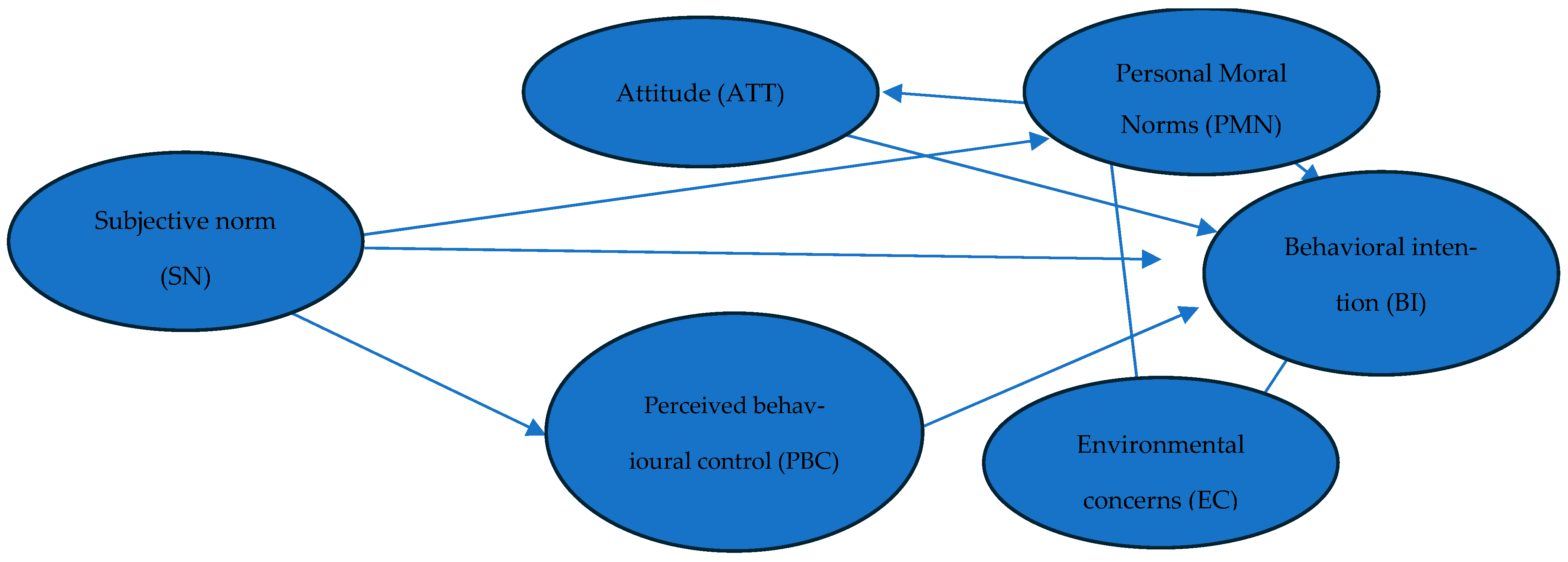
- Examine the psychological and social determinants (attitudes, subjective norms, perceived behavioural control, moral norms and environmental concerns) that influence consumers’ intention to adopt alternative proteins—edible insects, cultured meat, and plant-based proteins—using an extension of the Theory of Planned Behaviour.
- Explore the role of the Mediterranean cultural context with reference to the Campania region, on consumers’ openness to innovative and sustainable foods.
2. Theoretical Framework and Research Hypotheses
3. Materials and Methods
3.1. Methodology
3.2. Data
4. Results
4.1. Measurement Model Assessment
4.2. Structural Model
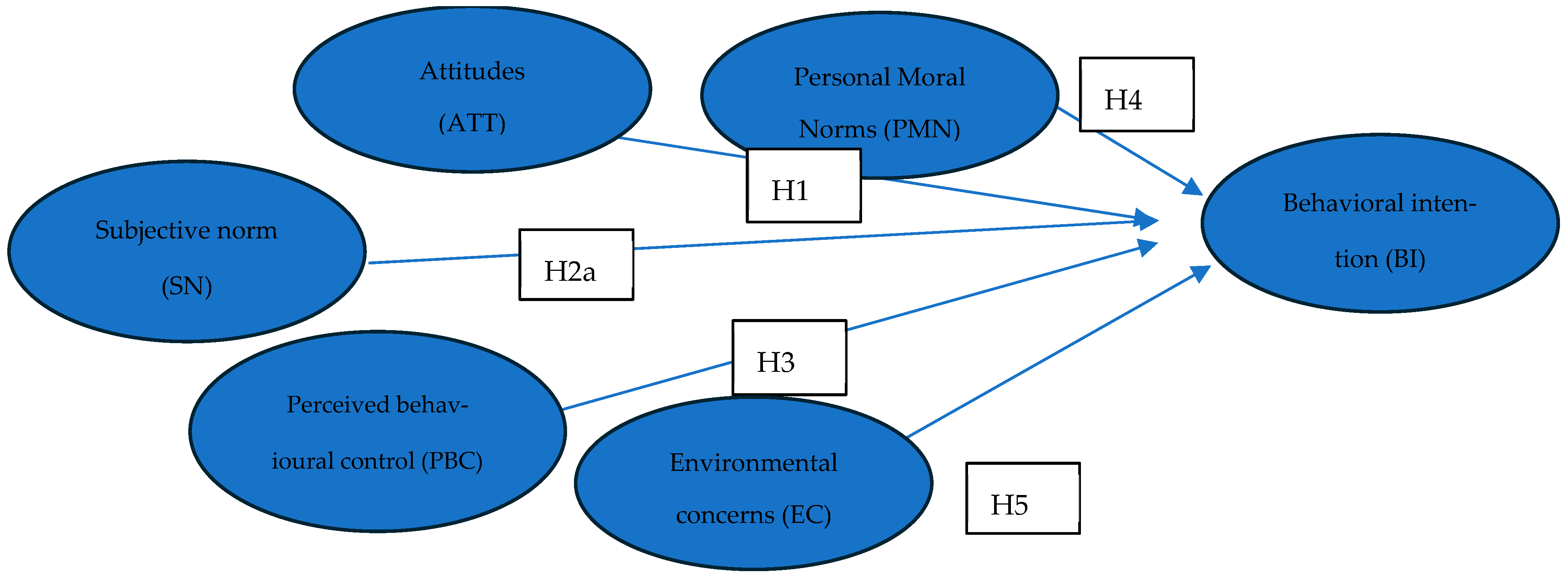
H1. Attitudes directly and positively affect consumer behavioural intention for alternative protein.
H2a. Subjective norms directly and positively influence consumer behavioural intention for alternative protein.
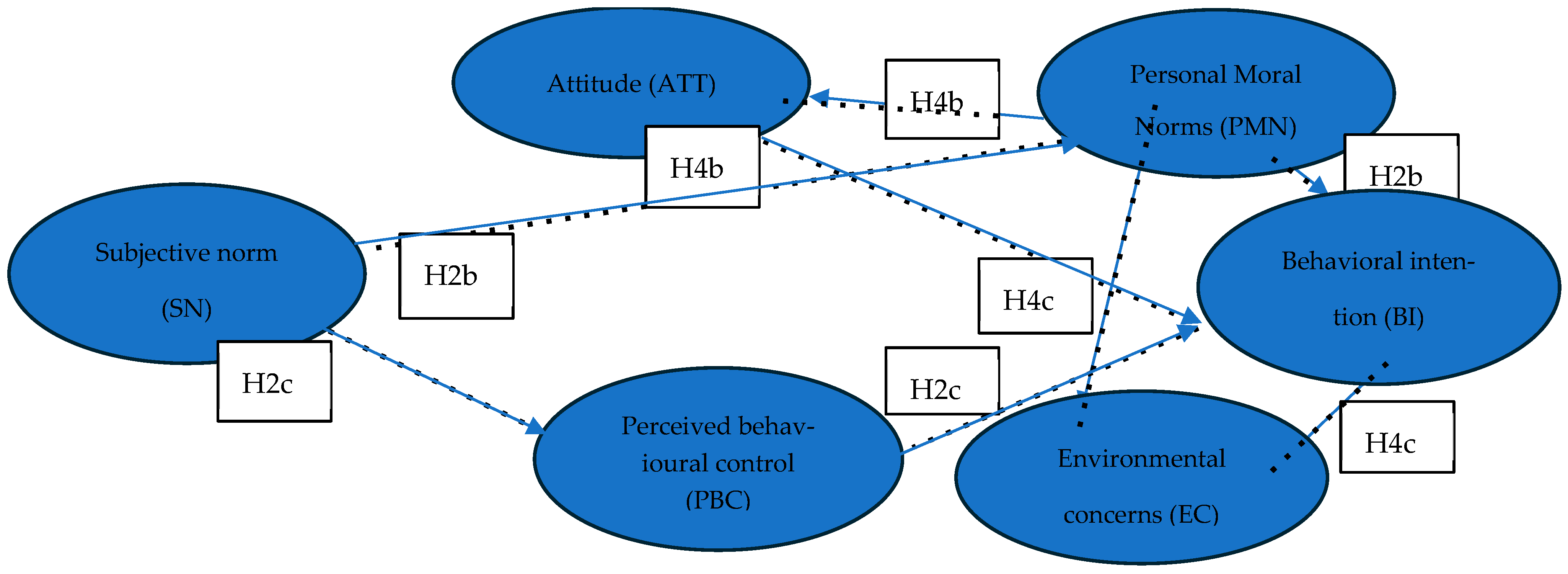
H2b. Subjective norms positively affect consumer behavioural intention for alternative protein via personal moral norms.
H2c. Subjective norms positively affect consumer behavioural intention for alternative protein via perceived behavioural control.
H3. Perceived behavioural control directly and positively affects consumer behavioural intention for alternative protein.
H4a. Personal moral norms directly and positively affect consumer behavioural intention for alternative protein.
H4b. Personal moral norms positively affect consumer behavioural intention for alternative protein via attitude.
H4c. Personal moral norms positively affect consumer behavioural intention for alternative protein via environmental concerns.
H5. High environmental concerns positively affect consumer behavioural intention for alternative protein.
5. Discussion
5.1. Cognitive Barriers and Intention–Behaviour Gaps in Innovative Food Choices
5.2. The Role of Social Influence and Internalisation Mechanisms
5.3. Personal Moral Norms and Intentions Towards Alternative Proteins
5.4. The Influence of Environmental Concerns on Innovative Food Choices
6. Conclusions and Policy Implications
Author Contributions
Funding
Institutional Review Board Statement
Informed Consent Statement
Data Availability Statement
Acknowledgments
Conflicts of Interest
References
- FAO. How to Feed the World in 2050; Food and Agriculture Organization: Rome, Italy, 2009; Available online: www.fao.org/3/a-ak542e/ak542e13.pdf (accessed on 1 June 2025).
- Echegaray, N.; Hassoun, A.; Jagtap, S.; Tetteh-Caesar, M.; Kumar, M.; Tomasevic, I.; Gulden, G.; Lorenzo, J.M. Meat 4.0: Principles and applications of industry 4.0 technologies in the meat industry. Appl. Sci. 2022, 12, 6986. [Google Scholar] [CrossRef]
- Barbut, S. Meat industry 4.0: A distant future? Anim. Front. 2020, 10, 38–47. [Google Scholar] [CrossRef] [PubMed]
- Aiking, H.; de Boer, J. The next protein transition. Trends Food Sci. Technol. 2020, 105, 515–522. [Google Scholar] [CrossRef] [PubMed]
- Machovina, B.; Feeley, K.J.; Ripple, W.J. Biodiversity Conservation: The Key Is Reducing Meat Consumption. Sci. Total Environ. 2015, 536, 419–431. [Google Scholar] [CrossRef]
- Hallström, E.; Röös, E.; Börjesson, P. Sustainable meat consumptiona quantitative analysis of nutritional intake, greenhouse gas emissions and land use from a Swedish perspective. Food Policy 2014, 47, 81–90. [Google Scholar] [CrossRef]
- Yadavalli, A.; Jones, K. Does media influence consumer demand? The case of lean finely textured beef in the United States. Food Policy 2014, 49, 219–227. [Google Scholar] [CrossRef]
- Apostolidis, C.; McLeay, F. Should we stop meating like this? Reducing meat consumption through substitution. Food Policy 2016, 65, 74–89. [Google Scholar] [CrossRef]
- IARC Working Group. Red Meat and Processed Meat: IARC Working Group on the Evaluation of Carcinogenic Risks to Humans; International Agency for Research on Cancer: Lyon, France, 2015. [Google Scholar]
- Aschemann-Witzel, J.; Gantriis, R.F.; Fraga, P.; Perez-Cueto, F.J. Plant-based food and protein trend from a business perspective: Markets, consumers, and the challenges and opportunities in the future. Crit. Rev. Food Sci. Nutr. 2021, 61, 3119–3128. [Google Scholar] [CrossRef]
- Van Huis, A. Potential of insects as food and feed in assuring food security. Annu. Rev. Entomol. 2013, 58, 563–583. [Google Scholar] [CrossRef]
- Mancini, S.; Moruzzo, R.; Riccioli, F.; Paci, G. European consumers’ readiness to adopt insects as food. A review. Food Res. Int. 2019, 122, 661–678. [Google Scholar] [CrossRef]
- Mishyna, M.; Fischer, A.R.; Steenbekkers, B.L.; Janssen, A.M.; Bos-Brouwers, H.E. Consumption and production of edible insects in an urban circularity context: Opinions and intentions of urban residents. Sustain. Prod. Consum. 2023, 42, 234–246. [Google Scholar] [CrossRef]
- Tan, H.S.G.; Verbaan, Y.T.; Stieger, M. How will better products improve the sensory-liking and willingness to buy insect-based foods? Food Res. Int. 2017, 92, 95–105. [Google Scholar] [CrossRef] [PubMed]
- Verbeke, W. Profiling consumers who are ready to adopt insects as a meat substitute in a Western society. Food Qual. Prefer. 2015, 39, 147–155. [Google Scholar] [CrossRef]
- Post, M.J. Cultured meat from stem cells: Challenges and prospects. Meat Sci. 2012, 92, 297–301. [Google Scholar] [CrossRef]
- Mancini, M.C.; Antonioli, F. Exploring consumers’ attitude towards cultured meat in Italy. Meat Sci. 2019, 150, 101–110. [Google Scholar] [CrossRef]
- Laestadius, L.I.; Caldwell, M.A. Is the future of meat palatable? Perceptions of in vitro meat as evidenced by online news comments. Public Health Nutr. 2015, 18, 2457–2467. [Google Scholar] [CrossRef] [PubMed]
- Verbeke, W.; Sans, P.; Van Loo, E.J. Challenges and prospects for consumer acceptance of cultured meat. J. Integr. Agric. 2015, 14, 285–294. [Google Scholar] [CrossRef]
- Wilks, M.; Phillips, C.J. Attitudes to in vitro meat: A survey of potential consumers in the United States. PLoS ONE 2017, 12, e0171904. [Google Scholar] [CrossRef]
- Heijnk, V.; Espey, A.; Schuenemann, F. A comparison of influencing factors on attitudes towards plant-based, insect-based and cultured meat alternatives in Germany. Food Qual. Prefer. 2023, 110, 104966. [Google Scholar] [CrossRef]
- Willett, W.; Rockström, J.; Loken, B.; Springmann, M.; Lang, T.; Vermeulen, S.; Murray, C.J. Food in the Anthropocene: The EAT–Lancet Commission on healthy diets from sustainable food systems. Lancet 2019, 393, 447–492. [Google Scholar] [CrossRef]
- Hallström, E.; Carlsson-Kanyama, A.; Börjesson, P. The environmental impact of dietary change: A systematic review. J. Clean. Prod. 2015, 91, 1–11. [Google Scholar] [CrossRef]
- Majcher, S. Consumers’ Perspective of Plant-Based Meat Alternatives—A Systematic Literature Review and Future Research Agenda. Int. J. Consum. Stud. 2025, 49, e70036. [Google Scholar] [CrossRef]
- van derWeele, C.; Feindt, P.; van der Goot, A.J.; van Mierlo, B.; van Boekel, M. Meat alternatives: An integrative comparison. Trends Food Sci. Technol. 2019, 88, 505–512. [Google Scholar] [CrossRef]
- Nolden, A.A.; Forde, C.G. The nutritional quality of plant-based foods. Sustainability 2023, 15, 3324. [Google Scholar] [CrossRef]
- Raubenheimer, D.; Rothman, J.M. Nutritional ecology of entomophagy in humans and other primates. Annu. Rev. Entomol. 2013, 58, 141–160. [Google Scholar] [CrossRef]
- Ajzen, I. The theory of planned behavior. Organ. Behav. Hum. Decis. Process. 1991, 50, 179–211. [Google Scholar] [CrossRef]
- DeSoucey, M. Gastronationalism: Food traditions and authenticity politics in the European Union. Am. Sociol. Rev. 2010, 75, 432–455. [Google Scholar] [CrossRef]
- Bessière, J. Local development and heritage: Traditional food and cuisine as tourist attractions in rural areas. Sociol. Rural. 1998, 38, 21–34. [Google Scholar] [CrossRef]
- Steg, L.; Dreijerink, L.; Abrahamse, W. Factors influencing the acceptability of energy policies: A test of VBN theory. J. Environ. Psychol. 2005, 25, 415–425. [Google Scholar] [CrossRef]
- Stern, P.C.; Dietz, T.; Abel, T.; Guagnano, G.A.; Kalof, L. A value-belief-norm theory of support for social movements: The case of environmentalism. Hum. Ecol. Rev. 1999, 6, 81–97. [Google Scholar]
- Hosta, M.; Zabkar, V. Antecedents of environmentally and socially responsible sustainable consumer behavior. J. Bus. Ethics 2021, 273–293. [Google Scholar]
- Thøgersen, J. Norms for environmentally responsible behaviour: An extended taxonomy. J. Environ. Psychol. 2006, 26, 247–261. [Google Scholar] [CrossRef]
- Gautam, V.; Bhalla, S. Why residents exhibit environmentally responsible behavior? J. Clean. Prod. 2023, 427, 139253. [Google Scholar] [CrossRef]
- Ajzen, I. Perceived behavioral control, self—Efficacy, locus of control, and the theory of planned behavior. J. Appl. Soc. Psychol. 2002, 32, 665–683. [Google Scholar] [CrossRef]
- Taylor, S.; Todd, P. Decomposition and crossover effects in the theory of planned behavior: A study of consumer adoption intentions. Int. J. Res. Mark. 1995, 12, 137–155. [Google Scholar] [CrossRef]
- Ajzen, I. The theory of planned behavior: Frequently asked questions. Hum. Behav. Emerg. Technol. 2020, 2, 314–324. [Google Scholar] [CrossRef]
- Hoek, A.C.; Luning, P.A.; Weijzen, P.; Engels, W.; Kok, F.J.; De Graaf, C. Replacement of meat by meat substitutes. A survey on person-and product-related factors in consumer acceptance. Appetite 2011, 56, 662–673. [Google Scholar] [CrossRef] [PubMed]
- Siegrist, M.; Hartmann, C. Consumer acceptance of novel food technologies. Nat. Food 2020, 1, 343–350. [Google Scholar] [CrossRef]
- Loiselle, A.; Pitre, K.; Desroches, S.; Guillaumie, L.; Bélanger-Gravel, A. Adults’ beliefs related to reducing red meat consumption: An exploratory study in the province of Quebec, Canada. Appetite 2024, 203, 107679. [Google Scholar] [CrossRef] [PubMed]
- Bamberg, S.; Möser, G. Twenty years after Hines, Hungerford, and Tomera: A new meta-analysis of psycho-social determinants of pro-environmental behaviour. J. Environ. Psychol. 2007, 27, 14–25. [Google Scholar] [CrossRef]
- Yadav, R.; Pathak, G.S. Intention to purchase organic food among young consumers: Evidences from a developing nation. Appetite 2016, 96, 122–128. [Google Scholar] [CrossRef]
- Vermeir, I.; Verbeke, W. Sustainable food consumption among young adults in Belgium: Theory of planned behaviour and the role of confidence and values. Ecol. Econ. 2008, 64, 542–553. [Google Scholar] [CrossRef]
- Arvola, A.; Lähteenmäki, L.; Dean, M.; Vassallo, M.; Winkelmann, M.; Claupein, E.; Saba, A. Predicting intentions to purchase organic food: The role of affective and moral attitudes in the theory of planned behaviour. Appetite 2008, 50, 443–454. [Google Scholar] [CrossRef]
- Klöckner, C.A. A comprehensive model of the psychology of environmental behaviour—A meta-analysis. Glob. Environ. Chang. 2013, 23, 1028–1038. [Google Scholar] [CrossRef]
- Onwezen, M.C.; Bartels, J.; Antonides, G. The self-regulatory function of anticipated pride and guilt in a sustainable and healthy consumption context. Eur. J. Soc. Psychol. 2014, 44, 53–68. [Google Scholar] [CrossRef]
- Siegrist, M.; Hartmann, C. Impact of sustainability perception on consumption of organic meat and meat substitutes. Appetite 2019, 132, 196–202. [Google Scholar] [CrossRef]
- De Backer, C.J.; Hudders, L. Meat morals: Relationship between meat consumption consumer attitudes towards human and animal welfare and moral behavior. Meat Sci. 2015, 99, 68–74. [Google Scholar] [CrossRef] [PubMed]
- Dowd, K.; Burke, K.J. The influence of ethical values and food choice motivations on intentions to purchase sustainably sourced foods. Appetite 2013, 69, 137–144. [Google Scholar] [CrossRef]
- Rana, S.S.; Solaiman, M. Moral identity, consumption values and green purchase behaviour. J. Islam. Mark. 2023, 14, 2550–2574. [Google Scholar] [CrossRef]
- Hoek, A.C.; Pearson, D.; James, S.W.; Lawrence, M.A.; Friel, S. Shrinking the food-print: A qualitative study into consumer perceptions, experiences and attitudes towards healthy and environmentally friendly food behaviours. Appetite 2017, 108, 117–131. [Google Scholar] [CrossRef] [PubMed]
- Hoek, A.C.; Luning, P.A.; Stafleu, A.; De Graaf, C. Food-related lifestyle and health attitudes of Dutch vegetarians, non-vegetarian consumers of meat substitutes, and meat consumers. Appetite 2004, 42, 265–272. [Google Scholar] [CrossRef]
- Sanchez-Sabate, R.; Sabaté, J. Consumer attitudes towards environmental concerns of meat consumption: A systematic review. Int. J. Environ. Res. Public Health 2019, 16, 1220. [Google Scholar] [CrossRef]
- Berndsen, M.; Van der Pligt, J. Ambivalence towards meat. Appetite 2004, 42, 71–78. [Google Scholar] [CrossRef]
- Onwezen, M.C.; Bouwman, E.P.; Reinders, M.J.; Dagevos, H. A systematic review on consumer acceptance of alternative proteins: Pulses, algae, insects, plant-based meat alternatives, and cultured meat. Appetite 2021, 159, 105058. [Google Scholar] [CrossRef] [PubMed]
- Graça, J.; Oliveira, A.; Calheiros, M.M. Meat, beyond the plate: Data-driven hypotheses for understanding consumer willingness to adopt a more plant-based diet. Appetite 2015, 90, 80–90. [Google Scholar] [CrossRef]
- Khine, M.S. Application of Structural Equation Modeling in Educational Research and Practice; Brill: Buckinghamshire, UK, 2013; Volume 7. [Google Scholar]
- Goldberger, A.S.; Goldberger, M. Structural equation modeling. In The New Palgrave Dictionary of Economics and the Law; Eatwell, J., Milgate, M., Newman, P., Eds.; Macmillan: New York, NY, USA, 1991; pp. 355–360. [Google Scholar]
- Hair, J.F.; Ringle, C.M.; Sarstedt, M. PLS-SEM: Indeed a Silver Bullet. J. Mark. Theory Pract. 2011, 19, 139–152. [Google Scholar] [CrossRef]
- Hair, J., Jr.; Page, M. The Essentials of Business Research Methods, 3rd ed.; Routledge: Oxfordshire, UK, 2015. [Google Scholar] [CrossRef]
- Hair, J.F.; Hult, G.T.M.; Ringle, C.M.; Sarstedt, M. Partial least Squares Structural Equation Modeling (PLS-SEM): Advanced Issues and Applications; Sage: Thousand Oaks, CA, USA, 2021. [Google Scholar]
- Darlington, R.B.; Hayes, A.F. Regression Analysis and Linear Models: Concepts, Applications, and Implementation; Guilford Publications: New York, NY, USA, 2016. [Google Scholar]
- Fan, Y.; Chen, J.; Shirkey, G.; John, R.; Wu, S.R.; Park, H.; Shao, C. Applications of structural equation modeling (SEM) in ecological studies: An updated review. Ecol. Process. 2016, 5, 1–12. [Google Scholar] [CrossRef]
- Schumacker, R.E.; Lomax, R.G. A Beginner’s Guide to Structural Equation Modeling; Routledge: Oxfordshire, UK, 2012. [Google Scholar]
- Diamantopoulos, A.; Winklhofer, H.M. Index construction with formative indicators: An alternative to scale development. J. Mark. Res. 2001, 38, 269–277. [Google Scholar] [CrossRef]
- Rossiter, J.R. The C-OAR-SE procedure for scale development in marketing. Int. J. Res. Mark. 2002, 19, 305–335. [Google Scholar] [CrossRef]
- Henseler, J.; Hubona, G.; Ray, P.A. Using PLS path modeling in new technology research: Updated guidelines. Ind. Manag. Data Syst. 2016, 116, 2–20. [Google Scholar] [CrossRef]
- Jarvis, C.B.; MacKenzie, S.B.; Podsakoff, P.M. A critical review of construct indicators and measurement model misspecification in marketing and consumer research. J. Consum. Res. 2003, 30, 199–218. [Google Scholar] [CrossRef]
- Henseler, J.; Ringle, C.M.; Sarstedt, M. Testing measurement invariance of composites using partial least squares. Int. Mark. Rev. 2016, 33, 405–431. [Google Scholar] [CrossRef]
- van Zyl, L.E.; ten Klooster, P.M. Exploratory Structural Equation Modeling: Practical Guidelines and Tutorial with a Convenient Online Tool for Mplus. Front. Psychiatry 2022, 12, 795672. [Google Scholar] [CrossRef] [PubMed]
- Nunnally, J.C.; Bernstein, I.H. Psychometric Theory, 3rd ed; Mcgraw-Hill: New York, NY, USA, 1994. [Google Scholar]
- Peterson, R.A.; Kim, Y. On the relationship between coefficient alpha and composite reliability. J. Appl. Psychol. 2013, 98, 194–198. [Google Scholar] [CrossRef]
- Bagozzi, R.P.; Yi, Y. On the evaluation of structural equation models. JAMS 1988, 16, 74–94. [Google Scholar] [CrossRef]
- Fornell, C.; Larcker, D.F. Evaluating structural equation models with unobservable variables and measurement error. J. Mark. Res. 1981, 18, 39–50. [Google Scholar] [CrossRef]
- Groves, R.M.; Fowler, F.J., Jr.; Couper, M.P.; Lepkowski, J.M.; Singer, E.; Tourangeau, R. Survey Methodology; John Wiley and Sons: Hoboken, NJ, USA, 2011. [Google Scholar]
- Green, S.B. How many subjects does it take to do a regression analysis? Multivar. Behav. Res. 1991, 26, 499–510. [Google Scholar] [CrossRef]
- Cohen, J. Statistical Power Analysis for the Behavioral Sciences, 2nd ed.; Lawrence Erlbaum Associates: Mahwah, NJ, USA, 1988. [Google Scholar]
- Davis, F.D. Perceived usefulness, perceived ease of use, and user acceptance of information technology. MIS Q. 1989, 13, 319–340. [Google Scholar] [CrossRef]
- de Castro Carvalho, G.; Carneiro, J.D.D.S.; Rocha, R.A.R.; Pereira, E. Plant-based trends: Consumer’s perception and factors that influence the purchase of plant-based products. Br. Food J. 2025, 127, 3396–3426. [Google Scholar] [CrossRef]
- Ru, X.; Wang, S.; Yan, S. Exploring the effects of normative factors and perceived behavioral control on individual’s energy-saving intention: An empirical study in eastern China. Resour. Conserv. Recycl. 2018, 134, 91–99. [Google Scholar] [CrossRef]
- De Leeuw, A.; Valois, P.; Ajzen, I.; Schmidt, P. Using the theory of planned behavior to identify key beliefs underlying pro-environmental behavior in high-school students. J. Environ. Psychol. 2015, 42, 128–138. [Google Scholar] [CrossRef]
- Kim, S.H.; Seock, Y.K. The roles of values and social norm on personal norms and pro-environmentally friendly apparel product purchasing behavior: The mediating role of personal norms. J. Retail. Consum. Serv. 2019, 51, 83–90. [Google Scholar] [CrossRef]
- Kácha, O.; van der Linden, S. The moderating role of moral norms and personal cost in compliance with pro-environmental social norms. Curr. Res. Ecol. Soc. Psychol. 2021, 2, 100020. [Google Scholar] [CrossRef]
- Fantechi, T.; Marinelli, N.; Casini, L.; Contini, C. Exploring alternative proteins: Psychological drivers behind consumer engagement. Br. Food J. 2025. [Google Scholar] [CrossRef]
- Cordano, M.; Welcomer, S.A.; Scherer, R.F.; Pradenas, L.; Parada, V. A cross-cultural assessment of three theories of pro-environmental behavior. Environ. Behav. 2003, 35, 731–758. [Google Scholar] [CrossRef]
- Cavite, H.J.M. Millennial consumers’ intention to purchase organic food: Do environmental concerns matter? Bus. Strategy Environ. 2025, 34, 3940–3956. [Google Scholar] [CrossRef]
- Cachero-Martínez, S. Consumer Behaviour Towards Organic Products: The Moderating Role of Environmental Concern. J. Risk Financ. Manag. 2020, 13, 330. [Google Scholar] [CrossRef]
- De Canio, F.; Martinelli, E.; Endrighi, E. Enhancing consumers’ pro-Environmental Purchase Intentions: The Moderating Role of Environmental Concern. Int. J. Retail. Distrib. Manag. 2021, 49, 1312–1329. [Google Scholar] [CrossRef]
- Chen, S.C.; Hung, C.W. Elucidating the factors influencing the acceptance of green products: An extension of theory of planned behavior. Technol. Forecast. Soc. Chang. 2016, 112, 155–163. [Google Scholar] [CrossRef]
- Fishbein, M.; Ajzen, I. Predicting and Changing Behavior: The Reasoned Action Approach, 2nd ed.; Routledge: Oxfordshire, UK, 2020. [Google Scholar]
- Onwezen, M.C.; Antonides, G.; Bartels, J. The Norm Activation Model: An exploration of the functions of anticipated pride and guilt in pro-environmental behaviour. J. Econ. Psychol. 2013, 39, 141–153. [Google Scholar] [CrossRef]
- White, K.; Habib, R.; Hardisty, D.J. How to shift consumer behaviors to be more sustainable: A literature review and guiding framework. J. Mark. 2019, 83, 22–49. [Google Scholar] [CrossRef]
- Rivis, A.; Sheeran, P.; Armitage, C.J. Expanding the affective and normative components of the theory of planned behavior: A meta--analysis of anticipated affect and moral norms. J. Appl. Soc. Psychol. 2009, 39, 2985–3019. [Google Scholar] [CrossRef]
- Siddiqui, S.A.; Alvi, T.; Sameen, A.; Khan, S.; Blinov, A.V.; Nagdalian, A.A.; Mehdizadeh, M.; Adli, D.N.; Onwezen, M. Consumer acceptance of alternative proteins: A systematic review of current alternative protein sources and interventions adapted to increase their acceptability. Sustainability 2022, 14, 15370. [Google Scholar] [CrossRef]
- Lentz, G.; Connelly, S.; Mirosa, M.; Jowett, T. Gauging attitudes and behaviours: Meat consumption and potential reduction. Appetite 2018, 127, 230–241. [Google Scholar] [CrossRef]
- Kaiser, F.G. A moral extension of the theory of planned behavior: Norms and anticipated feelings of regret in conservationism. Personal. Individ. Differ. 2006, 41, 71–81. [Google Scholar] [CrossRef]
- Kaiser, F.G.; Hübner, G.; Bogner, F.X. Contrasting the Theory of Planned Behavior with the value-belief-norm model in explaining conservation behavior. J. Appl. Soc. Psychol. 2005, 35, 2150–2170. [Google Scholar] [CrossRef]
- Carfora, V.; Caso, D.; Conner, M. Randomised controlled trial of a text messaging intervention for reducing processed meat consumption: The mediating roles of anticipated regret and intention. Appetite 2017, 117, 152–160. [Google Scholar] [CrossRef]
- Hartmann, C.; Siegrist, M. Consumer perception and behaviour regarding sustainable protein consumption: A systematic review. Trends Food Sci. Technol. 2017, 61, 11–25. [Google Scholar] [CrossRef]
- Vermeir, I.; Verbeke, W. Sustainable food consumption: Exploring the consumer “attitude–behavioral intention” gap. J. Agric. Environ. Ethics 2006, 19, 169–194. [Google Scholar] [CrossRef]
- Piazza, J.; Ruby, M.B.; Loughnan, S.; Luong, M.; Kulik, J.; Watkins, H.M.; Seigerman, M. Rationalizing meat consumption. Appetite 2015, 91, 114–128. [Google Scholar] [CrossRef]
- Michel, F.; Hartmann, C.; Siegrist, M. Consumers’ associations, perceptions and acceptance of meat and plant-based meat alternatives. Food Qual. Prefer. 2021, 87, 104063. [Google Scholar] [CrossRef]
- Onwezen, M.C.; Verain, M.C.; Dagevos, H. Social norms support the protein transition: The relevance of social norms to explain increased acceptance of alternative protein burgers over 5 years. Foods 2022, 11, 3413. [Google Scholar] [CrossRef]
- Menozzi, D.; Sogari, G.; Mora, C.; Gariglio, M.; Gasco, L.; Schiavone, A. Insects as feed for farmed poultry: Are Italian consumers ready to embrace this innovation? Insects 2021, 12, 435. [Google Scholar] [CrossRef]
- Nguyen, P.; Trieu, H.D.X.; Le, T.B.; Le, T.D.; Tran, K.T. The role of culture, religious belief; subjective norm on the environmental factors and life satisfaction. Int. J. Econ. Policy Emerg. Econ. 2024, 20, 287–295. [Google Scholar] [CrossRef]
- Vitell, S.J. A case for consumer social responsibility (CnSR): Including a selected review of consumer ethics/social responsibility research. J. Bus. Ethics 2015, 130, 767–774. [Google Scholar] [CrossRef]
- Shaw, D.; Shiu, E. The contribution of ethical obligation and selfidentity to the theory of planned behaviour: An exploration of ethical consumers-A reflective comment. Soc. Bus. 2013, 3, 47–65. [Google Scholar] [CrossRef]
- Fesenfeld, L.P.; Maier, M.; Brazzola, N.; Stolz, N.; Sun, Y.; Kachi, A. How information, social norms, and experience with novel meat substitutes can create positive political feedback and demand-side policy change. Food Policy 2023, 117, 102445. [Google Scholar] [CrossRef]
- Barbarossa, C.; De Pelsmacker, P. Positive and negative antecedents of purchasing eco-friendly products: A comparison between green and non-green consumers. J. Bus. Ethics 2016, 134, 229–247. [Google Scholar] [CrossRef]
- Human, S.J.; Capraro, V. The effect of nudging personal and injunctive norms on the trade-off between objective equality and efficiency. arXiv 2020, arXiv:2012.12081. [Google Scholar] [CrossRef]
- Helferich, M.; Thøgersen, J.; Bergquist, M. Direct and mediated impacts of social norms on pro-environmental behavior. Glob. Environ. Chang. 2023, 80, 102680. [Google Scholar] [CrossRef]
- Auger, P.; Devinney, T.M. Do what consumers say matter? A study of socially responsible consumer behaviour. J. Bus. Ethics 2007, 76, 361–377. [Google Scholar] [CrossRef]
- Fisher, R.J. Social desirability bias and the validity of indirect questioning. J. Consum. Res. 1993, 20, 303–315. [Google Scholar] [CrossRef]
- Carrington, M.J.; Neville, B.A.; Whitwell, G.J. Lost in translation: Exploring the ethical consumer intention–behaviour gap. J. Bus. Res. 2014, 67, 2759–2767. [Google Scholar] [CrossRef]
- Kollmuss, A.; Agyeman, J. Mind the gap: Why do people act environmentally and what are the barriers to pro-environmental behaviour? Environ. Educ. Res. 2002, 8, 239–260. [Google Scholar] [CrossRef]
- Carrington, M.J.; Neville, B.A.; Whitwell, G.J. Why ethical consumers don’t walk their talk: Towards a framework for understanding the gap between the ethical purchase intentions and actual buying behaviour. J. Bus. Ethics 2010, 97, 139–158. [Google Scholar] [CrossRef]
- Morwitz, V.G.; Schmittlein, D. Using segmentation to improve sales forecasts based on purchase intent: Which “intenders” actually buy? J. Mark. Res. 1992, 29, 391–405. [Google Scholar] [PubMed]

| Latent Construct | Item | Label | Mean | St. Dev (SD) |
|---|---|---|---|---|
| Attitude (ATT) [28,79] | It is important to consume protein products | att1 | 0.801 | 0.131 |
| Consuming protein products is important for our health | att2 | 0.791 | 0.165 | |
| Choosing protein products can affect greenhouse gas emissions | att3 | 0.828 | 0.130 | |
| Perceived Behavioural Control (PBC) [28,80] | I believe that I have the knowledge to choose between different protein products | pbc1 | 0.685 | 0.142 |
| Choosing which protein products to buy is entirely up to me | pbc2 | 0.698 | 0.096 | |
| I have the resources to be able to choose which protein products to buy | pbc3 | 0.731 | 0.112 | |
| I know the difference between different protein products | pbc4 | 0.731 | 0.112 | |
| Subjective Norms (SN) [28,81,82] | I am expected to buy sustainable protein products for the improvement of environmental quality | sn1 | 0.873 | 0.032 |
| People significant to me buy sustainable protein products | sn2 | 0.807 | 0.060 | |
| People significant to me would advise me to consume more sustainable protein products every day | sn3 | 0.840 | 0.038 | |
| If the local government provided subsidies, I would like to buy sustainable protein products | sn4 | 0.728 | 0.070 | |
| Personal Moral Norm (PMN) [83,84,85] | I believe I have a moral obligation to purchase sustainable alternative protein products | pmn1 | 0.914 | 0.020 |
| I would feel guilty if I did not purchase sustainable alternative protein products | pmn2 | 0.855 | 0.037 | |
| Purchasing sustainable alternative protein products is in line with my principles of environmental protection | pmn3 | 0.944 | 0.010 | |
| Environmental Concerns (EC) [86,87,88,89,90]. | Climate change reduces the chances of survival of humans and animal and plant species | ec1 | 0.814 | 0.076 |
| Environmental protection promotes my health | ec2 | 0.946 | 0.037 | |
| Environmental protection improves the quality of my life | ec3 | 0.926 | 0.039 | |
| Human-caused environmental damage today affects the well-being of future generations | ec4 | 0.892 | 0.059 | |
| Behavioural Intention (BI) [91] | For greater environmental sustainability how often weekly would you be willing to consume alternative proteins such as insects | bi1 | 0.711 | 0.128 |
| For greater environmental sustainability how often per week would you be willing to consume alternative proteins such as cultured (synthetic) meat | bi2 | 0.882 | 0.061 | |
| For greater environmental sustainability with what weekly frequency would you be willing to consume alternative proteins such as plant-based meat | bi3 | 0.809 | 0.086 |
| Latent Construct | Item | Factor Loadings | St. Dev | t-Statistic | p-Value |
|---|---|---|---|---|---|
| Attitude (ATT) | att1 | 0.828 | 0.131 | 6.340 | 0.000 |
| att2 | 0.826 | 0.165 | 5.008 | 0.000 | |
| att3 | 0.843 | 0.13 | 6.480 | 0.000 | |
| Perceived Behavioural Control (PBC) | pbc1 | 0.702 | 0.142 | 4.942 | 0.000 |
| pbc2 | 0.706 | 0.096 | 7.320 | 0.0000 | |
| pbc3 | 0.750 | 0.112 | 6.674 | 0.000 | |
| pbc4 | 0.740 | 0.112 | 6.634 | 0.000 | |
| Subjective Norm (SN) | sn1 | 0.876 | 0.032 | 27.719 | 0.000 |
| sn2 | 0.811 | 0.06 | 13.524 | 0.000 | |
| sn3 | 0.839 | 0.038 | 22.157 | 0.000 | |
| sn4 | 0.736 | 0.07 | 10.553 | 0.000 | |
| Personal Moral Norm (PMN) | pmn1 | 0.916 | 0.02 | 45.902 | 0.000 |
| pmn2 | 0.858 | 0.037 | 23.074 | 0.000 | |
| pmn3 | 0.944 | 0.01 | 97.276 | 0.000 | |
| Environmental Concern (EC) | ec1 | 0.823 | 0.076 | 10.801 | 0.000 |
| ec2 | 0.948 | 0.037 | 25.762 | 0.000 | |
| ec3 | 0.927 | 0.039 | 23.926 | 0.000 | |
| ec4 | 0.901 | 0.059 | 15.314 | 0.000 | |
| Behavioural Intention (BI) | b1 | 0.727 | 0.128 | 5.665 | 0.000 |
| b2 | 0.888 | 0.061 | 14.615 | 0.000 | |
| b3 | 0.820 | 0.086 | 9.550 | 0.000 |
| Construct | Cronbach’s Alpha | Composite Reliability (rho_a) | Composite Reliability (rho_c) | AVE | R2 | R2 Adjusted | f2 |
|---|---|---|---|---|---|---|---|
| Attitude (ATT) | 0.791 | 0.841 | 0.871 | 0.693 | 0.072 | 0.062 | 0.08 (small–medium) |
| Behavioural Intention (BI) | 0.747 | 0.775 | 0.854 | 0.663 | 0.166 | 0.158 | 0.06–0.08 (small–medium) |
| Environmental Concerns (EC) | 0.922 | 0.943 | 0.945 | 0.812 | 0.079 | 0.069 | 0.08–0.10 (medium) |
| Perceived Behavioural Control (PBC) | 0.707 | 0.710 | 0.816 | 0.525 | 0.173 | 0.165 | 0.15–0.20 (medium) |
| Personal Moral Norm (PMN) | 0.893 | 0.950 | 0.932 | 0.822 | 0.220 | 0.213 | 0.20–0.25 (medium–high) |
| Subjective Norms (SN) | 0.833 | 0.847 | 0.889 | 0.668 |
| Research Hypothesis | Path | Path Coefficients | Standard Error | t-Statistics | p-Value |
|---|---|---|---|---|---|
| Direct effects | |||||
| H1 | ATT -> BI | 0.037 | 0.141 | 0.263 | 0.793 |
| H2a | SN -> BI | 0.181 | 0.127 | 1.427 | 0.154 |
| H3 | PBC -> BI | 0.048 | 0.101 | 0.475 | 0.635 |
| H4a | PMN -> BI | 0.234 ** | 0.116 | 2.027 | 0.043 |
| H5 | EC -> BI | 0.041 | 0.114 | 0.359 | 0.720 |
| Indirect effects | |||||
| H2b | SN -> PMN -> BI | 0.469 *** | 0.082 | 5.710 | 0.000 |
| H2c | SN -> PBC -> BI | 0.416 *** | 0.080 | 5.199 | 0.000 |
| H4b | PMN -> ATT -> BI | 0.268 ** | 0.109 | 2.456 | 0.014 |
| H4c | PMN -> EC -> BI | 0.281 *** | 0.105 | 2.676 | 0.007 |
Disclaimer/Publisher’s Note: The statements, opinions and data contained in all publications are solely those of the individual author(s) and contributor(s) and not of MDPI and/or the editor(s). MDPI and/or the editor(s) disclaim responsibility for any injury to people or property resulting from any ideas, methods, instructions or products referred to in the content. |
© 2025 by the authors. Licensee MDPI, Basel, Switzerland. This article is an open access article distributed under the terms and conditions of the Creative Commons Attribution (CC BY) license (https://creativecommons.org/licenses/by/4.0/).
Share and Cite
Civero, G.; Punzo, G.; Scarpato, D. Exploring Sustainable Diet Drivers: An Extended TPB Approach to Alternative Protein Acceptance in Southern Italy. Nutrients 2025, 17, 3942. https://doi.org/10.3390/nu17243942
Civero G, Punzo G, Scarpato D. Exploring Sustainable Diet Drivers: An Extended TPB Approach to Alternative Protein Acceptance in Southern Italy. Nutrients. 2025; 17(24):3942. https://doi.org/10.3390/nu17243942
Chicago/Turabian StyleCivero, Gennaro, Gennaro Punzo, and Debora Scarpato. 2025. "Exploring Sustainable Diet Drivers: An Extended TPB Approach to Alternative Protein Acceptance in Southern Italy" Nutrients 17, no. 24: 3942. https://doi.org/10.3390/nu17243942
APA StyleCivero, G., Punzo, G., & Scarpato, D. (2025). Exploring Sustainable Diet Drivers: An Extended TPB Approach to Alternative Protein Acceptance in Southern Italy. Nutrients, 17(24), 3942. https://doi.org/10.3390/nu17243942

