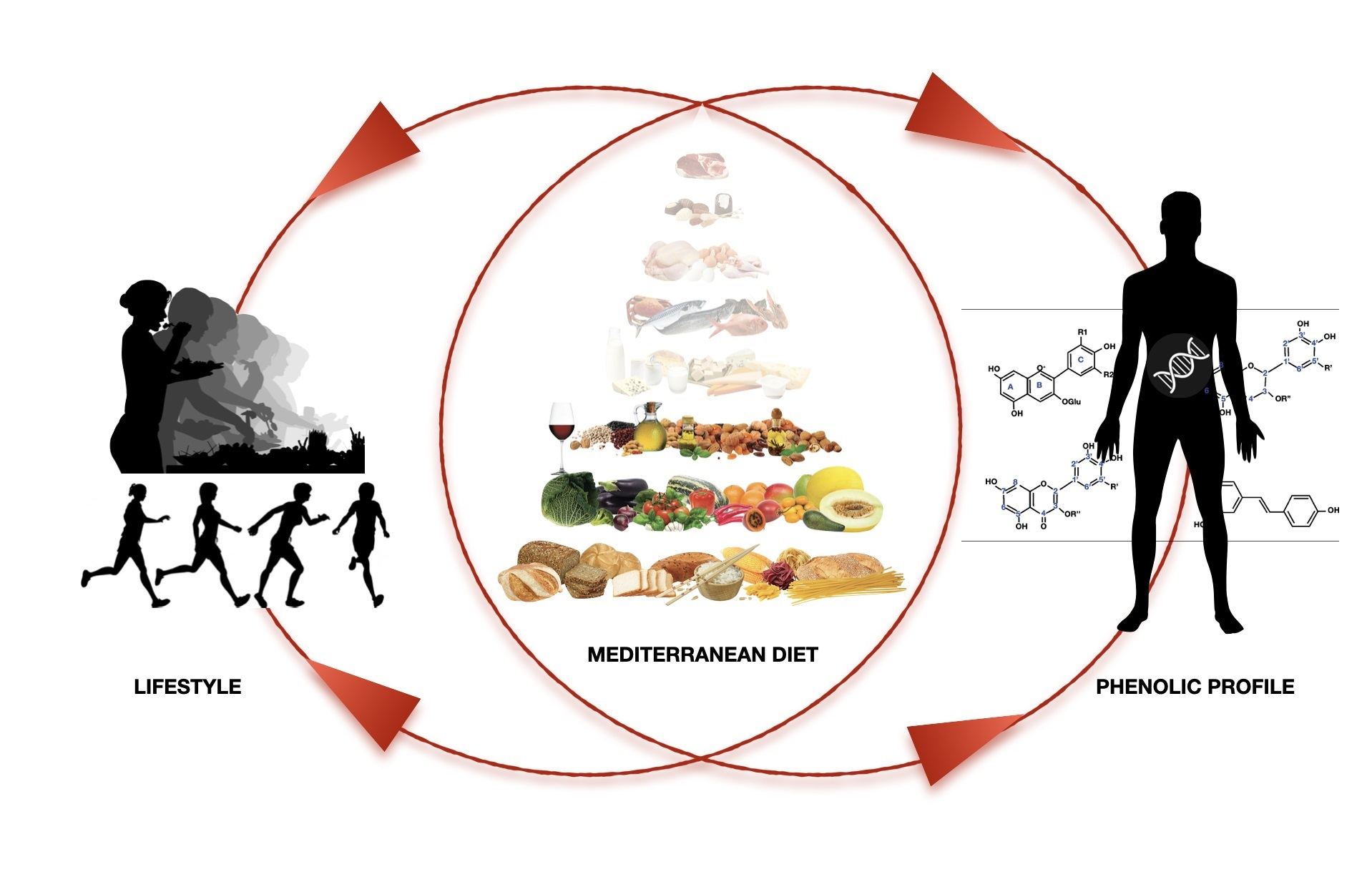
Phenol Biological Metabolites as Food Intake Biomarkers, a Pending Signature for a Complete Understanding of the Beneficial Effects of the Mediterranean Diet


Abstract
:
1. Introduction
1.1. Food Intake Biomarkers
1.2. Food Polyphenols
1.3. Polyphenol Metabolome
2. Phenol Metabolites as Biomarkers of Adherence to Mediterranean Diet: Is It Possible?
3. Potential Mediterranean Diet Biomarkers: Phenol Biological Metabolites from Recommended Foods on a Daily Basis
3.1. Vegetables
3.1.1. Artichokes
3.1.2. Lettuce
3.1.3. Onions
3.1.4. Spinach
3.1.5. Tomato
3.2. Cereals and Grain Based Products
Wheat
3.3. Virgin Olive Oil
3.4. Fresh Fruits
3.4.1. Apples
3.4.2. Pear
3.4.3. Oranges
3.4.4. Pomegranate
3.4.5. Grapes
3.5. Legumes
3.6. Aromatic Herbs
4. Phenol Biological Metabolites from Recommended Foods to Be Eaten in Moderate Amounts
4.1. Nuts: Walnuts, Hazelnuts, Almonds
4.2. Wine
5. Perspectives
Author Contributions
Funding
Conflicts of Interest
References
- Food and Drug Administration (FDA). Available online: https://www.fda.gov (accessed on 20 May 2020).
- Verhagen, H.; Coolen, S.; Duchateau, G.; Hamer, M.; Kyle, J.; Rechner, A. Assessment of the efficacy of functional food ingredients—introducing the concept “kinetics of biomarkers”. Mutat. Res. Mol. Mech. Mutagen. 2004, 551, 65–78. [Google Scholar] [CrossRef]
- Zamora-Ros, R.; Urpí-Sardà, M.; Lamuela-Raventós, R.M.; Estruch, R.; Vázquez-Agell, M.; Serrano-Martínez, M.; Jaeger, W.; Andres-Lacueva, C. Diagnostic Performance of Urinary Resveratrol Metabolites as a Biomarker of Moderate Wine Consumption. Clin. Chem. 2006, 52, 1373–1380. [Google Scholar] [CrossRef] [Green Version]
- Rubió, L.; Valls, R.-M.; Macià, A.; Pedret, A.; Giralt, M.; Romero, M.-P.; de la Torre, R.; Covas, M.-I.; Solà, R.; Motilva, M.-J. Impact of olive oil phenolic concentration on human plasmatic phenolic metabolites. Food Chem. 2012, 135, 2922–2929. [Google Scholar] [CrossRef]
- Pérez-Jiménez, J.; Neveu, V.; Vos, F.; Scalbert, A. Systematic Analysis of the Content of 502 Polyphenols in 452 Foods and Beverages: An Application of the Phenol-Explorer Database. J. Agric. Food Chem. 2010, 58, 4959–4969. [Google Scholar] [CrossRef]
- Castello, F.; Costabile, G.; Bresciani, L.; Tassotti, M.; Naviglio, D.; Luongo, D.; Ciciola, P.; Vitale, M.; Vetrani, C.; Galaverna, G.; et al. Bioavailability and pharmacokinetic profile of grape pomace phenolic compounds in humans. Arch. Biochem. Biophys. 2018, 646, 1–9. [Google Scholar] [CrossRef]
- Guasch-Ferré, M.; Bhupathiraju, S.N.; Hu, F.B. Use of Metabolomics in Improving Assessment of Dietary Intake. Clin. Chem. 2018, 64, 82–98. [Google Scholar] [CrossRef] [Green Version]
- González-Sarrías, A.; Giménez-Bastida, J.A.; García-Conesa, M.T.; Gómez-Sánchez, M.B.; García-Talavera, N.V.; Gil-Izquierdo, A.; Sánchez-Álvarez, C.; Fontana-Compiano, L.O.; Morga-Egea, J.P.; Pastor-Quirante, F.A.; et al. Occurrence of urolithins, gut microbiota ellagic acid metabolites and proliferation markers expression response in the human prostate gland upon consumption of walnuts and pomegranate juice. Mol. Nutr. Food Res. 2010, 54, 311–322. [Google Scholar] [CrossRef]
- Yuste, S.; Ludwig, I.A.; Rubió, L.; Romero, M.-P.; Pedret, A.; Valls, R.M.; Solà, R.; Motilva, M.J.; Macià, A. In vivo biotransformation of (poly)phenols and anthocyanins of red-fleshed apple and identification of intake biomarkers. J. Funct. Foods 2019, 55, 146–155. [Google Scholar] [CrossRef] [Green Version]
- Mosele, J.I.; Macià, A.; Romero-Fabregat, M.-P.; Motilva, M.J.; Rubió, L. Application of in vitro gastrointestinal digestion and colonic fermentation models to pomegranate products (juice, pulp and peel extract) to study the stability and catabolism of phenolic compounds. J. Funct. Foods 2015, 14, 529–540. [Google Scholar] [CrossRef]
- Lee, J.; Mitchell, A.E. Pharmacokinetics of Quercetin Absorption from Apples and Onions in Healthy Humans. J. Agric. Food Chem. 2012, 60, 3874–3881. [Google Scholar] [CrossRef]
- Martínez-Huélamo, M.; Vallverdu-Queralt, A.; Di Lecce, G.; Valderas-Martínez, P.; Tulipani, S.; Jáuregui, O.; Escribano-Ferrer, E.; Estruch, R.; Illan, M.; Lamuela-Raventós, R.M. Bioavailability of tomato polyphenols is enhanced by processing and fat addition: Evidence from a randomized feeding trial. Mol. Nutr. Food Res. 2016, 60, 1578–1589. [Google Scholar] [CrossRef]
- Nakamura, T.; Murota, K.; Kumamoto, S.; Misumi, K.; Bando, N.; Ikushiro, S.; Takahashi, N.; Sekido, K.; Kato, Y.; Terao, J. Plasma metabolites of dietary flavonoids after combination meal consumption with onion and tofu in humans. Mol. Nutr. Food Res. 2013, 58, 310–317. [Google Scholar] [CrossRef]
- Mosele, J.I.; Martín-Peláez, S.; Macià, A.; Farràs, M.; Valls, R.M.; Catalán, Ú.; Motilva, M.J. Faecal microbial metabolism of olive oil phenolic compounds: In vitro and in vivo approaches. Mol. Nutr. Food Res. 2014, 58, 1809–1819. [Google Scholar] [CrossRef]
- Caro, G.P.; Borges, G.; Ky, I.; Ribas, A.; Alan, C.; Del Rio, D.; Clifford, M.N.; Roberts, S.A.; Crozier, A. In vitro colonic catabolism of orange juice (poly)phenols. Mol. Nutr. Food Res. 2015, 59, 465–475. [Google Scholar] [CrossRef]
- Cornelis, M.C.; Hu, F.B. Systems Epidemiology: A New Direction in Nutrition and Metabolic Disease Research. Curr. Nutr. Rep. 2013, 2, 225–235. [Google Scholar] [CrossRef] [Green Version]
- Scalbert, A.; Brennan, L.; Manach, C.; Andres-Lacueva, C.; Dragsted, L.O.; Draper, J.; Rappaport, S.M.; van der Hooft, J.J.; Wishart, D.S. The food metabolome: A window over dietary exposure. Am. J. Clin. Nutr. 2014, 99, 1286–1308. [Google Scholar] [CrossRef] [Green Version]
- Martínez-Huélamo, M.; Tulipani, S.; Estruch, R.; Escribano, E.; Illán, M.; Corella, D.; Lamuela-Raventós, R.M. The tomato sauce making process affects the bioaccessibility and bioavailability of tomato phenolics: A pharmacokinetic study. Food Chem. 2015, 173, 864–872. [Google Scholar] [CrossRef]
- Available online: https://dietamediterranea.com/en/fundacion (accessed on 20 May 2020).
- Dernini, S.; Berry, E.M.; Serra-Majem, L.; La Vecchia, C.; Capone, R.; Medina, F.X.; Aranceta-Bartrina, J.; Belahsen, R.; Burlin-game, B.; Calabrese, G.; et al. On behalf of the Scientific Committee of the International Foundation of Mediterranean Diet. Public Health Nutr. 2016, 20, 1322–1330. [Google Scholar] [CrossRef]
- Ditano-Vázquez, P.; Torres-Peña, J.D.; Galeano-Valle, F.; Pérez-Caballero, A.I.; Demelo-Rodríguez, P.; Lopez-Miranda, J.; Katsiki, N.; Lista, F.J.D.; Alvarez-Sala-Walther, L.A. The Fluid Aspect of the Mediterranean Diet in the Prevention and Management of Cardiovascular Disease and Diabetes: The Role of Polyphenol Content in Moderate Consumption of Wine and Olive Oil. Nutrients 2019, 11, 2833. [Google Scholar] [CrossRef] [Green Version]
- O’Sullivan, A.; Gibney, M.J.; Brennan, L. Dietary intake patterns are reflected in metabolomic profiles: Potential role in dietary assessment studies. Am. J. Clin. Nutr. 2011, 93, 314–321. [Google Scholar] [CrossRef] [Green Version]
- Pallister, T.; Jennings, A.; Mohney, R.P.; Yarand, D.; Mangino, M.; Cassidy, A.; MacGregor, A.; Spector, T.D.; Menni, C. Characterizing Blood Metabolomics Profiles Associated with Self-Reported Food Intakes in Female Twins. PLoS ONE 2016, 11, e0158568. [Google Scholar] [CrossRef] [Green Version]
- Fardet, A.; Llorach, R.; Orsoni, A.; Martin, J.-F.; Pujos-Guillot, E.; Lapierre, C.; Scalbert, A. Metabolomics Provide New Insight on the Metabolism of Dietary Phytochemicals in Rats. J. Nutr. 2008, 138, 1282–1287. [Google Scholar] [CrossRef] [Green Version]
- Azzini, E.; Bugianesi, R.; Romano, F.; Di Venere, D.; Miccadei, S.; Durazzo, A.; Foddai, M.S.; Catasta, G.; Linsalata, V.; Maiani, G. Absorption and metabolism of bioactive molecules after oral consumption of cooked edible heads of Cynara scolymus L. (cultivar Violetto di Provenza) in human subjects: A pilot study. Br. J. Nutr. 2007, 97, 963–969. [Google Scholar] [CrossRef] [PubMed] [Green Version]
- Negro, D.; Montesano, V.; Grieco, S.; Crupi, P.; Sarli, G.; De Lisi, A.; Sonnante, G. Polyphenol Compounds in Artichoke Plant Tissues and Varieties. J. Food Sci. 2012, 77, C244–C252. [Google Scholar] [CrossRef]
- Rechner, A.R.; Pannala, A.S.; Rice-Evans, C.A. Caffeic acid derivatives in artichoke extract are metabolised to phenolic acidsin vivo. Free Radic. Res. 2001, 35, 195–202. [Google Scholar] [CrossRef] [PubMed]
- Pepe, G.; Sommella, E.; Manfra, M.; De Nisco, M.; Tenore, G.C.; Scopa, A.; Sofo, A.; Marzocco, S.; Adesso, S.; Novellino, T.; et al. Evaluation of anti-inflammatory activity and fast UHPLC–DAD–IT-TOF profiling of polyphenolic compounds extracted from green lettuce (Lactuca sativa L.; var. Maravilla de Verano). Food Chem. 2015, 167, 153–161. [Google Scholar] [CrossRef] [PubMed] [Green Version]
- Kim, D.-E.; Shang, X.; Assefa, A.D.; Keum, Y.-S.; Saini, R.K. Metabolite profiling of green, green/red, and red lettuce cultivars: Variation in health beneficial compounds and antioxidant potential. Food Res. Int. 2018, 105, 361–370. [Google Scholar] [CrossRef] [PubMed]
- Graefe, E.U.; Wittig, J.; Mueller, S.; Riethling, A.-K.; Uehleke, B.; Drewelow, B.; Pforte, H.; Jacobasch, G.; Derendorf, H.; Veit, M. Pharmacokinetics and Bioavailability of Quercetin Glycosides in Humans. J. Clin. Pharmacol. 2001, 41, 492–499. [Google Scholar] [CrossRef]
- Mullen, W.; Edwards, C.A.; Crozier, A. Absorption, excretion and metabolite profiling of methyl-, glucuronyl-, glucosyl- and sulpho-conjugates of quercetin in human plasma and urine after ingestion of onions. Br. J. Nutr. 2006, 96, 107–116. [Google Scholar] [CrossRef] [Green Version]
- Hong, Y.-J.; Mitchell, A.E. Metabolic Profiling of Flavonol Metabolites in Human Urine by Liquid Chromatography and Tandem Mass Spectrometry. J. Agric. Food Chem. 2004, 52, 6794–6801. [Google Scholar] [CrossRef]
- Passon, M.; Bühlmeier, J.; Zimmermann, B.F.; Stratmann, A.; Latz, S.; Stehle, P.; Galensa, R. Polyphenol Phase-II Metabolites are Detectable in Human Plasma after Ingestion of 13 C Labeled Spinach-a Pilot Intervention Trial in Young Healthy Adults. Mol. Nutr. Food Res. 2018, 62, e1701003. [Google Scholar] [CrossRef] [PubMed]
- Martínez-Huélamo, M.; Tulipani, S.; Jáuregui, O.; Valderas-Martinez, P.; Vallverdú-Queralt, A.; Estruch, R.; Torrado, X.; Lamuela-Raventós, R.M. Sensitive and Rapid UHPLC-MS/MS for the Analysis of Tomato Phenolics in Human Biological Samples. Molecules 2015, 20, 20409–20425. [Google Scholar] [CrossRef] [PubMed] [Green Version]
- Dinelli, G.; Carretero, A.S.; Di Silvestro, R.; Marotti, I.; Arraez-Roman, D.; Benedettelli, S.; Ghiselli, L.; Fernadez-Gutierrez, A. Profiles of phenolic compounds in modern and old common wheat varieties determined by liquid chromatography coupled with time-of-flight mass spectrometry. J. Chromatogr. A 2011, 1218, 7670–7681. [Google Scholar] [CrossRef] [PubMed]
- Zhu, Y.; Shurlknight, K.L.; Chen, X.; Sang, S. Identification and Pharmacokinetics of Novel Alkylresorcinol Metabolites in Human Urine, New Candidate Biomarkers for Whole-Grain Wheat and Rye Intake. J. Nutr. 2014, 144, 114–122. [Google Scholar] [CrossRef] [PubMed] [Green Version]
- Wierzbicka, R.; Zamaratskaia, G.; Kamal-Eldin, A.; Landberg, R. Novel urinary alkylresorcinol metabolites as biomarkers of whole grain intake in free-living Swedish adults. Mol. Nutr. Food Res. 2017, 61, 1700015. [Google Scholar] [CrossRef] [PubMed]
- Vitaglione, P.; Mennella, I.; Ferracane, R.; Rivellese, A.A.; Giacco, R.; Ercolini, D.; Gibbons, S.; La Storia, A.; Gilbert, J.A.; Jonnalagadda, S.; et al. Whole-grain wheat consumption reduces inflammation in a randomized controlled trial on overweight and obese subjects with unhealthy dietary and lifestyle behaviors: Role of polyphenols bound to cereal dietary fiber. Am. J. Clin. Nutr. 2015, 101, 251–261. [Google Scholar] [CrossRef] [Green Version]
- European Regulation EU 432/2012 establishing a list of permitted health claims made on foods, other than those referring to the reduction of disease risk and to children’s development and health. Off. J. Eur. Union 2012, 136, 1–40.
- Orsavova, J.; Misurcova, L.; Ambrozova, J.V.; Vicha, R.; Mlcek, J. Fatty Acids Composition of Vegetable Oils and Its Contribution to Dietary Energy Intake and Dependence of Cardiovascular Mortality on Dietary Intake of Fatty Acids. Int. J. Mol. Sci. 2015, 16, 12871–12890. [Google Scholar] [CrossRef]
- Malheiro, R.; Rodrigues, N.; Pereira, J.A. Olive Oil Phenolic Composition as Affected by Geographic Origin, Olive Cultivar, and Cultivation Systems. In Olive and Olive Oil Bioactive Constituents; Boskou, D., Ed.; AOCS Press: Urbana, IL, USA, 2015; ISBN 978-1-63067-041-2. [Google Scholar] [CrossRef]
- EFSA Panel on Dietetic Products, Nutrition and Allergies (NDA). Scientific opinion on the substantiation of a health claim related to polyphenols in olive and maintenance of normal blood HDL cholesterol concentrations (ID 1639, further assessment) pursuant to Article 13(1) of Regulation (EC) No 1924/2006. EFSA J. 2012, 10, 2848. [Google Scholar] [CrossRef] [Green Version]
- Garcia-Villalba, R.; Carrasco-Pancorbo, A.; Nevedomskaya, E.; Mayboroda, O.A.; Deelder, A.M.; Carretero, A.S.; Fernández-Gutiérrez, A. Exploratory analysis of human urine by LC–ESI-TOF MS after high intake of olive oil: Understanding the metabolism of polyphenols. Anal. Bioanal. Chem. 2010, 398, 463–475. [Google Scholar] [CrossRef] [PubMed]
- Rubió, L.; Farràs, M.; de La Torre, R.; Macià, A.; Romero-Fabregat, M.-P.; Valls, R.M.; Solà, R.; Farré, M.; Fitó, M.; Motilva, M.J. Metabolite profiling of olive oil and thyme phenols after a sustained intake of two phenol-enriched olive oils by humans: Identification of compliance markers. Food Res. Int. 2014, 65, 59–68. [Google Scholar] [CrossRef]
- Orozco-Solano, M.; Ferreiro-Vera, C.; Priego-Capote, F.; De Castro, M.D.L. Automated method for determination of olive oil phenols and metabolites in human plasma and application in intervention studies. J. Chromatogr. A 2012, 1258, 108–116. [Google Scholar] [CrossRef] [PubMed]
- Silva, S.; Garcia-Aloy, M.; Figueira, M.E.; Combet, E.; Mullen, W.; Bronze, M. High Resolution Mass Spectrometric Analysis of Secoiridoids and Metabolites as Biomarkers of Acute Olive Oil Intake-An Approach to Study Interindividual Variability in Humans. Mol. Nutr. Food Res. 2017, 62, 1700065. [Google Scholar] [CrossRef] [Green Version]
- de la Torre-Carbot, K.; Chávez-Servín, J.L.; Jaúregui, O.; Castellote, A.I.; Lamuela-Raventos, R.M.; Fitó, M.; Covas, M.-I.; Muñoz-Aguayo, D.; López-Sabater, M.C. Presence of virgin olive oil phenolic metabolites in human low density lipoprotein fraction: Determination by high-performance liquid chromatography–electrospray ionization tandem mass spectrometry. Anal. Chim. Acta 2007, 583, 402–410. [Google Scholar] [CrossRef]
- Fernández-Ávila, C.; Montes, R.; Castellote, A.I.; Chisaguano, A.M.; Fitó, M.; Covas, M.I.; Muñoz-Aguallo, D.; Nyyssönen, K.; Zunft, H.J.; López-Sabater, M.C. Fast determination of virgin olive oil phenolic metabolites in human high-density lipoproteins. Biomed. Chromatogr. 2014, 29, 1035–1041. [Google Scholar] [CrossRef]
- Zamora-Ros, R.; Andres-Lacueva, C.; Lamuela-Raventós, R.M.; Berenguer, T.; Jakszyn, P.; Barricarte, A.; Ardanaz, E.; Amiano, P.; Dorronsoro, M.; Larrañaga, N.; et al. Estimation of Dietary Sources and Flavonoid Intake in a Spanish Adult Population (EPIC-Spain). J. Am. Diet. Assoc. 2010, 110, 390–398. [Google Scholar] [CrossRef]
- Bars-Cortina, D.; Macià, A.; Iglesias, I.; Romero, M.P.; Motilva, M.J. Phytochemical Profiles of New Red-Fleshed Apple Varieties Compared with Traditional and New White-Fleshed Varieties. J. Agric. Food Chem. 2017, 65, 1684–1696. [Google Scholar] [CrossRef]
- Kahle, K.; Kempf, M.; Schreier, P.; Scheppach, W.; Schrenk, D.; Kautenburger, T.; Hecker, D.; Huemmer, W.; Ackermann, M.; Richling, E. Intestinal transit and systemic metabolism of apple polyphenols. Eur. J. Nutr. 2011, 50, 507–522. [Google Scholar] [CrossRef]
- Trošt, K.; Ulaszewska, M.M.; Stanstrup, J.; Albanese, D.; De Filippo, C.; Tuohy, K.M.; Natella, F.; Scaccini, C.; Mattivi, F. Host: Microbiome co-metabolic processing of dietary polyphenols—An acute, single blinded, cross-over study with different doses of apple polyphenols in healthy subjects. Food Res. Int. 2018, 112, 108–128. [Google Scholar] [CrossRef] [PubMed] [Green Version]
- Saenger, T.; Hübner, F.; Humpf, H.-U. Short-term biomarkers of apple consumption. Mol. Nutr. Food Res. 2016, 61, 1600629. [Google Scholar] [CrossRef] [PubMed] [Green Version]
- Yuste, S.; Macià, A.; Ludwig, I.A.; Romero, M.-P.; Fernández-Castillejo, S.; Catalán, Ú.; Motilva, M.-J.; Rubió, L. Validation of Dried Blood Spot Cards to Determine Apple Phenolic Metabolites in Human Blood and Plasma After an Acute Intake of Red-Fleshed Apple Snack. Mol. Nutr. Food Res. 2018, 62, 1800623. [Google Scholar] [CrossRef]
- Kolniak-Ostek, J.; Oszmiański, J. Characterization of phenolic compounds in different anatomical pear (Pyrus communis L.) parts by ultra-performance liquid chromatography photodiode detector-quadrupole/time of flight-mass spectrometry (UPLC-PDA-Q/TOF-MS). Int. J. Mass Spectrom. 2015, 392, 154–163. [Google Scholar] [CrossRef]
- Gu, C.; Howell, K.; Dunshea, F.R.; Suleria, H.A.R. LC-ESI-QTOF/MS Characterisation of Phenolic Acids and Flavonoids in Polyphenol-Rich Fruits and Vegetables and Their Potential Antioxidant Activities. Antioxidants 2019, 8, 405. [Google Scholar] [CrossRef] [PubMed] [Green Version]
- Nieman, D.C.; Gillitt, N.D.; Sha, W.; Meaney, M.P.; John, C.; Pappan, K.L.; Kinchen, J. Metabolomics-Based Analysis of Banana and Pear Ingestion on Exercise Performance and Recovery. J. Proteome Res. 2015, 14, 5367–5377. [Google Scholar] [CrossRef]
- Manach, C.; Morand, C.; Gil-Izquierdo, A.; Bouteloup-Demange, C.; Rémésy, C. Bioavailability in humans of the flavanones hesperidin and narirutin after the ingestion of two doses of orange juice. Eur. J. Clin. Nutr. 2003, 57, 235–242. [Google Scholar] [CrossRef] [PubMed] [Green Version]
- Pereira-Caro, G.; Borges, G.; Van Der Hooft, J.; Clifford, M.N.; Del Rio, D.; Lean, M.E.; Roberts, S.A.; Kellerhals, M.B.; Crozier, A. Orange juice (poly)phenols are highly bioavailable in humans. Am. J. Clin. Nutr. 2014, 100, 1378–1384. [Google Scholar] [CrossRef] [PubMed]
- Pereira-Caro, G.; Ludwig, I.A.; Polyviou, T.; Malkova, D.; García, A.; Moreno-Rojas, J.M.; Crozier, A. Identification of Plasma and Urinary Metabolites and Catabolites Derived from Orange Juice (Poly)phenols: Analysis by High-Performance Liquid Chromatography–High-Resolution Mass Spectrometry. J. Agric. Food Chem. 2016, 64, 5724–5735. [Google Scholar] [CrossRef] [PubMed] [Green Version]
- Mosele, J.I.; Gosalbes, M.-J.; Macià, A.; Rubió, L.; Castellanos, J.F.V.; Hernández, N.J.; Moya, A.; Latorre, A.; Motilva, M.-J. Effect of daily intake of pomegranate juice on fecal microbiota and feces metabolites from healthy volunteers. Mol. Nutr. Food Res. 2015, 59, 1942–1953. [Google Scholar] [CrossRef]
- Seeram, N.P.; Zhang, Y.; McKeever, R.; Henning, S.M.; Lee, R.-P.; Suchard, M.A.; Li, Z.; Chen, S.; Thames, G.; Zerlin, A.; et al. Pomegranate Juice and Extracts Provide Similar Levels of Plasma and Urinary Ellagitannin Metabolites in Human Subjects. J. Med. Food 2008, 11, 390–394. [Google Scholar] [CrossRef] [PubMed]
- Mertens-Talcott, S.U.; Jilma-Stohlawetz, P.; Rios, J.; Hingorani, L.; Derendorf, H. Absorption, Metabolism, and Antioxidant Effects of Pomegranate (Punica granatum L.) Polyphenols after Ingestion of a Standardized Extract in Healthy Human Volunteers. J. Agric. Food Chem. 2006, 54, 8956–8961. [Google Scholar] [CrossRef]
- Nuñez-Sánchez, M.A.; Villalba, R.G.; Monedero-Saiz, T.; García-Talavera, N.V.; Gómez-Sánchez, M.B.; Sánchez-Álvarez, C.; García-Albert, A.M.; Rodríguez-Gil, F.J.; Ruiz-Marín, M.; Pastor-Quirante, F.A.; et al. Targeted metabolic profiling of pomegranate polyphenols and urolithins in plasma, urine and colon tissues from colorectal cancer patients. Mol. Nutr. Food Res. 2014, 58, 1199–1211. [Google Scholar] [CrossRef] [PubMed]
- Bub, A.; Watzl, B.; Heeb, D.; Rechkemmer, G.; Briviba, K. Malvidin-3-glucoside bioavailability in humans after ingestion of red wine, dealcoholized red wine and red grape juice. Eur. J. Nutr. 2001, 40, 113–120. [Google Scholar] [CrossRef] [PubMed]
- Stalmach, A.; Edwards, C.; Wightman, J.; Crozier, A. Identification of (Poly)phenolic Compounds in Concord Grape Juice and Their Metabolites in Human Plasma and Urine after Juice Consumption. J. Agric. Food Chem. 2011, 59, 9512–9522. [Google Scholar] [CrossRef]
- Stalmach, A.; Edwards, C.; Wightman, J.; Crozier, A. Gastrointestinal stability and bioavailability of (poly)phenolic compounds following ingestion of Concord grape juice by humans. Mol. Nutr. Food Res. 2012, 56, 497–509. [Google Scholar] [CrossRef]
- Meng, X.; Maliakal, P.; Lu, H.; Lee, M.-J.; Yang, C.S. Urinary and Plasma Levels of Resveratrol and Quercetin in Humans, Mice, and Rats after Ingestion of Pure Compounds and Grape Juice. J. Agric. Food Chem. 2004, 52, 935–942. [Google Scholar] [CrossRef] [PubMed]
- PREDIMED Study Investigators. Alcohol consumption is associated with high concentrations of urinary hydroxytyrosol. Am. J. Clin. Nutr. 2009, 90, 1329–1335. [Google Scholar] [CrossRef] [PubMed] [Green Version]
- Giusti, F.; Caprioli, G.; Ricciutelli, M.; Vittori, S.; Sagratini, G. Determination of fourteen polyphenols in pulses by high performance liquid chromatography-diode array detection (HPLC-DAD) and correlation study with antioxidant activity and colour. Food Chem. 2017, 221, 689–697. [Google Scholar] [CrossRef] [PubMed]
- Magalhães, S.C.; Taveira, M.; Cabrita, A.R.; Fonseca, A.; Valentão, P.; Andrade, P.B. European marketable grain legume seeds: Further insight into phenolic compounds profiles. Food Chem. 2017, 215, 177–184. [Google Scholar] [CrossRef]
- Caprioli, G.; Nzekoue, A.F.K.; Giusti, F.; Vittori, S.; Sagratini, G. Optimization of an extraction method for the simultaneous quantification of sixteen polyphenols in thirty-one pulse samples by using HPLC-MS/MS dynamic-MRM triple quadrupole. Food Chem. 2018, 266, 490–497. [Google Scholar] [CrossRef]
- Nurmi, A.; Nurmi, T.; Mursu, J.; Hiltunen, R.; Voutilainen, S. Ingestion of Oregano Extract Increases Excretion of Urinary Phenolic Metabolites in Humans. J. Agric. Food Chem. 2006, 54, 6916–6923. [Google Scholar] [CrossRef]
- Slimestad, R.; Fossen, T.; Brede, C. Flavonoids and other phenolics in herbs commonly used in Norwegian commercial kitchens. Food Chem. 2020, 309, 125678. [Google Scholar] [CrossRef]
- Nielsen, S.E.; Young, J.F.; Daneshvar, B.; Lauridsen, S.T.; Knuthsen, P.; Sandström, B.; Dragsted, L.O. Effect of parsley (Petroselinum crispum) intake on urinary apigenin excretion, blood antioxidant enzymes and biomarkers for oxidative stress in human subjects. Br. J. Nutr. 1999, 81, 447–455. [Google Scholar] [CrossRef] [Green Version]
- Baba, S.; Osakabe, N.; Natsume, M.; Yasuda, A.; Muto, Y.; Hiyoshi, K.; Takano, H.; Yoshikawa, T.; Terao, J. Absorption, metabolism, degradation and urinary excretion of rosmarinic acid after intake of Perilla frutescens extract in humans. Eur. J. Nutr. 2005, 44, 1–9. [Google Scholar] [CrossRef]
- Cortés-Martín, A.; Selma, M.V.; Espín, J.C.; García-Villalba, R. The Human Metabolism of Nuts Proanthocyanidins does not Reveal Urinary Metabolites Consistent with Distinctive Gut Microbiota Metabotypes. Mol. Nutr. Food Res. 2019, 63, 1800819. [Google Scholar] [CrossRef] [PubMed]
- Tulipani, S.; Urpi-Sarda, M.; García-Villalba, R.; Rabassa, M.; López-Uriarte, P.; Bulló, M.; Jáuregui, O.; Tomás-Barberán, F.; Salas-Salvadó, J.; Espín, J.C.; et al. Urolithins Are the Main Urinary Microbial-Derived Phenolic Metabolites Discriminating a Moderate Consumption of Nuts in Free-Living Subjects with Diagnosed Metabolic Syndrome. J. Agric. Food Chem. 2012, 60, 8930–8940. [Google Scholar] [CrossRef] [PubMed]
- Mora-Cubillos, X.; Tulipani, S.; Garcia-Aloy, M.; Bulló, M.; Tinahones, F.J.; Andres-Lacueva, C. Plasma metabolomic biomarkers of mixed nuts exposure inversely correlate with severity of metabolic syndrome. Mol. Nutr. Food Res. 2015, 59, 2480–2490. [Google Scholar] [CrossRef] [PubMed] [Green Version]
- Motilva, M.-J.; Macià, A.; Romero, M.-P.; Rubió, L.; Mercader, M.; González-Ferrero, C. Human bioavailability and metabolism of phenolic compounds from red wine enriched with free or nano-encapsulated phenolic extract. J. Funct. Foods 2016, 25, 80–93. [Google Scholar] [CrossRef]
- Muñoz-González, I.; Jiménez-Girón, A.; Martín-Álvarez, P.J.; Bartolomé, B.; Moreno-Arribas, M.V. Profiling of Microbial-Derived Phenolic Metabolites in Human Feces after Moderate Red Wine Intake. J. Agric. Food Chem. 2013, 61, 9470–9479. [Google Scholar] [CrossRef]
- Caccetta, R.; Croft, K.D.; Beilin, L.J.; Puddey, I.B. Ingestion of red wine significantly increases plasma phenolic acid concentrations but does not acutely affect ex vivo lipoprotein oxidizability. Am. J. Clin. Nutr. 2000, 71, 67–74. [Google Scholar] [CrossRef] [PubMed] [Green Version]
- Urpi-Sarda, M.; Boto-Ordóñez, M.; Queipo-Ortuño, M.I.; Tulipani, S.; Corella, D.; Estruch, R.; Tinahones, F.J.; Andres-Lacueva, C. Phenolic and microbial-targeted metabolomics to discovering and evaluating wine intake biomarkers in human urine and plasma. Electrophoresis 2015, 36, 2259–2268. [Google Scholar] [CrossRef] [PubMed] [Green Version]
- Zamora-Ros, R.; Achaintre, D.; Rothwell, J.; Rinaldi, S.; Assi, N.; Ferrari, P.; Leitzmann, M.; Boutron-Ruault, M.-C.; Fagherazzi, G.; Auffret, A.; et al. Urinary excretions of 34 dietary polyphenols and their associations with lifestyle factors in the EPIC cohort study. Sci. Rep. 2016, 6, 26905. [Google Scholar] [CrossRef] [PubMed] [Green Version]
- Esteban-Fernández, A.; Ibañez, C.; Simo, C.; Bartolomé, B.; Moreno-Arribas, M.V. An Ultrahigh-Performance Liquid Chromatography–Time-of-Flight Mass Spectrometry Metabolomic Approach to Studying the Impact of Moderate Red-Wine Consumption on Urinary Metabolome. J. Proteome Res. 2018, 17, 1624–1635. [Google Scholar] [CrossRef] [PubMed]
- Rotches-Ribalta, M.; Urpi-Sarda, M.; Llorach, R.; Boto-Ordoñez, M.; Jauregui, O.; Chiva-Blanch, G.; Perez-Garcia, L.; Jaeger, W.; Guillen, M.; Corella, D.; et al. Gut and microbial resveratrol metabolite profiling after moderate long-term consumption of red wine versus dealcoholized red wine in humans by an optimized ultra-high-pressure liquid chromatography tandem mass spectrometry method. J. Chromatogr. A 2012, 1265, 105–113. [Google Scholar] [CrossRef] [PubMed]
- De La Torre, R. Bioavailability of olive oil phenolic compounds in humans. Inflammopharmacology 2008, 16, 245–247. [Google Scholar] [CrossRef]
- Bitsch, R.; Netzel, M.; Frank, T.; Strass, G.; Bitsch, I. Bioavailability and Biokinetics of Anthocyanins from Red Grape Juice and Red Wine. J. Biomed. Biotechnol. 2004, 2004, 293–298. [Google Scholar] [CrossRef] [Green Version]

| Food | Study Design (Type of Intake/Sampling) | Phenolic Metabolites | Location and Average Concentration (Tmax) | Ref. |
|---|---|---|---|---|
| Artichoke | Healthy subjects. Acute intake of 61.7 g steam cooked artichoke. | Ferulic acid (free + glucuronide) | P: 6.4 ng/mL (1–2 h); 8.4 ng/mL (>8 h) | [25] |
| Phenolic dose: 487 mg chlorogenic acid derivatives and 11 mg apigenin and luteolin glycosides. | Dihydroferulic acid (free + glucuronide) | P: 21.8 ng/mL (>8 h) | ||
| Sampling: Fractionated blood (0–8 h). | Chlorogenic acid (free + glucuronide) | P: 6.4 ng/mL (1–2 h) | ||
| Caffeic acid (free + glucuronide) | P: 19.5 ng/mL (1–2 h) | |||
| 3-(3′,4′-dihydoxyphenyl) propionic acid (free + glucuronide) | P: 12.1 ng/mL (>8 h) | |||
| Artichoke | Healthy subjects. Acute intake of 3 capsules cont aining artichoke extract at 0, 4 and 8 h. | Ferulic acid (free + glucuronide) | U: 0.48–3.11 mg/24 h | [27] |
| Phenolic dose (3 capsules): 124.2 mg caffeoylquinic acid derivatives and 19.8 mg luteolin glycosides. | Dihydroferulic acid (free + glucuronide) | U: 0.70–1.91 mg/24 h | ||
| Sampling: 24 h urine. | Isoferulic acid (free + glucuronide) | U: 0.17–0.63 mg/24 h | ||
| Vanillic acid (free + glucuronide) | U: 0.15–2.51 mg/24 h | |||
| Onion | Healthy subjects. Acute intake of 47.5 g onion powder-enriched apple sauce. | Quercetin glucuronide | P: 213 ng/mL (<2.5 h) | [11] |
| Phenolic dose: 180 μmol quercetin glycosides | Quercetin diglucuronide | P: 169 ng/mL (<2 h) | ||
| Sampling: Fractionated blood (0–24 h). | Methyl quercetin glucuronide | P: 90 ng/mL (<3 h) | ||
| Methyl quercetin diglucuronide | P: 65 ng/mL (<4 h) | |||
| Quercetin glucuronide sulphate | P: 43 ng/mL (<4 h) | |||
| Quercetin sulphate | P: 37 ng/mL (<2 h) | |||
| Onion | Healthy subjects. Acute intake of 160 g stewed onions. | Quercetin glucuronide (sum of five types) | P: 2.3 μg/mL (<1 h) | [30] |
| Phenolic dose: 331 μmol quercetin glucosides mainly, quercetin-3,4′-O-diglucoside and quercetin-4′-O-glucoside (equivalent to 100 mg quercetin). | ||||
| Sampling: Fractionated blood (0–48 h). | ||||
| Onion | Healthy subjects. Acute intake of 270 g fried onions. | Quercetin-3′-sulphate | P: 605 nmol/L (<1 h) | [31] |
| Phenolic dose: 275 μmol of total flavonoids from which 107 μmol were quercetin-3′,4′-diglucoside and 143 μmol to quercetin-4′-glucoside | Quercetin-3′-glucuronide | P: 351 nmol/L (<1 h); U: 1.8 μmol/24 h (0–8 h) | ||
| Sampling: Fractionated blood (0–24 h) and urine (0–24 h). | Quercetin glucuronide sulphate | P: 123 nmol/L (2.5 h); U: 2.7 μmol/24 h (0–8 h) | ||
| Methyl quercetin-3′-glucuronide | P: 112 nmol/L (<1 h); U: 1.8 μmol/24 h (0–8 h) | |||
| Quercetin diglucuronide | P: 62 nmol/L (<1 h); U: 2.2 μmol/24 h (0–8 h) | |||
| Onion | Healthy volunteers. Acute intake of 200 g onion. | glucuronide sulphate, methyl quercetin glucuronide, methyl quercetin, quercetin glucoside sulphate, kaempferol glucuronide | Identification but not quantification of met abolites was done | [32] |
| Phenolic dose: 53.8 mg quercetin. | ||||
| Sampling: Fractionated urine (0–4 h). | ||||
| Spinach | Healthy volunteers. Acute intake 5 g 13C intrinsic ally labeled powdered spinach. | TMM-glucuronide | P: 19.1–54.3 nmol/L (>7 h) | [33] |
| Phenolic dose: 160 μmol methoxyflavonols, form which 70 μmol TMM-4′-glucuronide. | TMM-sulphate | P: 38.7–125.5 nmol/L (>7 h) | ||
| Sampling: Fractionated blood (0–24 h). | Patuletin methyl glucuronide sulphate | P: nq | ||
| Spinacetin glucuronide sulphate | P: nq | |||
| Tomato | Healthy subjects. Acute intake of 500 g tomato (T) or tomato sauce (TS)/70 kg bw | Naringenin | P: 15 nmol/L (1.4 h T); 22 nmol/L (0.5 h TS) U: 0.8 μmol/24 h (T); 2.1 μmol/24 h (TS) | [12] |
| Phenolic dose: T 93537 ng/g homovanillic acid hexo side, 4788 ng/g naringenin, 2216 ng/g rutin, 1075 ng/g caffeoylquinic acid, 1572 ng/g caffeic acid hexo side, 3091 ng/g ferulic acid hexoside. Phenolic dose: TS: 138340 ng/g homovanillic acid hexoside, 7483 ng/g naringenin, 5389 ng/g rutin, 1075 ng/g caffeoylquinic acid, 1572 ng/g caffeic acid hexoside, 3091 ng/g ferulic acid hexoside. | Naringenin glucuronide | P: 53 nmol/L (2.1 h T); 131 nmol/L (0.8 h TS) U: 10.5 μmol/24 h (T); 59.5 μmol/24 h (TS) | ||
| Sampling: Fractionated blood (0–24 h) and urine (0–24 h). | Ferulic acid | P: nd; U: 7.9 μmol/24 h (T); 5.5 μmol/24 h (TS) | ||
| Isoferulic acid | P: 195 nmol/L (1 h T); 183 nmol/L (1 h TS) U: 100 μmol/24 h (T); 84 μmol/24 h (TS) | |||
| Ferulic acid glucuronide (sum of isomers) | P: 433 nmol/L (1–3 h T) 476 nmol/L (1.5–3 h TS) U: 121 μmol/24 h (T); 193 μmol/24 h (TS) | |||
| Ferulic acid sulphate (sum of isomers) | P: 156 nmol/L (1.4 h T) 279 nmol/L (1.5–2.3 h TS) U: 1437 μmol/24 h (T); 1295 μmol/24 h (TS) | |||
| Quercetin | P: 151 nmol/L (2 h T); 164 nmol/L (1.9 h TS) U: 0.6 μmol/24 h (T); 0.3 μmol/24 h (TS) | |||
| Quercetin glucuronide | P: nd U:0.4 μmol/24 h (T); 0.1 μmol/24 h (TS) | |||
| Quercetin sulphate | P: nd U:0.7 μmol/24 h (T); 0.2 μmol/24 h (TS) | |||
| Tomato | Healthy subjects. Acute intake of 250 mL tomato sauce/70 kg bw. | Caffeic acid; caffeic acid glucuronide; caffeic acid sulphate; | P: nd; 6.4; 183 ng/mL U: 206; 55; 1396 ng/mL | [18] |
| Phenolic dose: >1 μg/g homovanillic acid hexoside, 6.5 μg/g naringenin, 5.5 μg/g rutin, 2 μg/g caffeoylquinic acid, 2.3 ng/g caffeic acid hexoside, 3.5 μg/g ferulic acid hexoside. | 5-caffeoylquinic acid | P: 2.7 ng/mL U: 17 ng/mL | ||
| Sampling: Blood (0 and 1 h) and urine (0–6 h). | Ferulic acid, ferulic acid glucuronide | P: 8.1; 54 ng/mL U: 453; 2852 ng/mL | ||
| Isoferulic acid | P: 95 ng/mL U: 22,569 ng/mL | |||
| Naringenin; naringenin glucuronide | P: 11.7; 73.4 ng/mL U: 39.1; 854 ng/mL | |||
| Quercetin; quercetin glucuronide; quercetin sulphate | P: 99; 21; 3.8 ng/mL U: 71; 14.4; 32 ng/mL | |||
| Dihydroxyphenyl propionic acid; dihydroxyphenyl propionic acid glucuronide; dihydroxyphenyl propionic acid sulphate | P: nd U: 195.; 2127; 2775 ng/mL |
| Food | Study Design (Type of Intake/Sampling) | Phenolic Metabolites | Location and Average Concentration (Tmax) | Ref. |
|---|---|---|---|---|
| Whole grain wheat | Health subjects. Acute intake of 208 g of whole grain wheat bread. | 3.5-dihydroxybenzoic acid (including glucuronic and sulphate) | U: 0.99 μmol/h (>8 h) | [36] |
| Phenolic dose: 61 mg alkylresorcinols. | 3,5-dihydroxyphenyl propionic acid (including glucuronic and sulphate) | U: 2.50 μmol/h (>7 h) | ||
| Sampling: Fractionated urine (0–24 h). | 5-(3,5-dihydroxyphenyl)pentanoic acid (including glucuronic- and sulphate) | U: 0.20 μmol/h (>6 h) | ||
| 3,5-dihydroxyhippuric acid | U: 0.24 μmol/h (>9 h) | |||
| Whole rye, oat and wheat intake | Epidemiological study. 3-day food questionnaires recovery | Dihydroxybenzoic acid | U:18 μmol/24 h | [37] |
| Average consumption of whole grains in the two visits was 72 g/day. | Dihydroxyphenyl propionic acid | U: 25 μmol/24 h | ||
| Sampling: 24 h urine. β-glucuronidase and sulphatase treatment. | Dihydroxycinnamic acid | U: 7 μmol/24 h | ||
| 5-(3,5-dihydroxyphenyl)pentanoic acid | U: 0.9 μmol/24 h | |||
| Dihydroxycinnamic acid amide | U: 136 μmol/24 h | |||
| Dihydroxyhippuric acid | U: 4 μmol/24 h | |||
| Whole grain wheat | Healthy overweigh/obese subjects. Replacement refined wheat with whole grain wheat for 8 weeks. | Ferulic acid | U: approximately 10 nmol/g creatinine; F: approximately 3000 nmol/kg S: approximately 3 nmol/L: | [38] |
| Phenolic dose (daily): 96.7 mg ferulic acid, 26.5 mg sinapic acid, 9.4 mg coumaric acid. | Dihydroferulic acid | U: approximately 25 nmol/g creatinine; F: approximately 1500 nmol/kg | ||
| Sampling: Blood, urine, faeces. |
| Food | Study Design (Type of Intake/Sampling) | Phenolic Metabolites | Location and Average Concentration (Tmax) | Ref. |
|---|---|---|---|---|
| Phenol-enriched olive oil | Healthy subjects. Acute intake. | Hydroxytyrosol sulphate | P: 1.35 (1 h), 3.32 (1 h), and 4.09 µmol/L (1.5 h) after the intake of 250, 500 and 750 mg phenols/kg oil, respectively. | [4] |
| Phenolic dose: 30 mL of phenol-enriched VOO contained 250, 500 and 750 mg phenolic compounds/kg oil. | Hydroxytyrosol acetate sulphate | P: 0.46 (1 h), 1.89 (2 h), and 2.24 µmol/L (1 h) after the intake of 250, 500 and 750 mg phenols/kg oil, respectively. | ||
| Sampling: Fractionated blood (0–6 h) | Homovanillic acid | P: 0.17 (1.5 h), 0.63 (1 h), and 0.65 µmol/L (1 h) after the intake of 250, 500 and 750 mg phenols/kg oil, respectively. | ||
| Homovanillic acid sulphate | P: 0.12 (1.5 h), 0.27 (1 h), and 0.53 µmol/L (1 h) after the intake of 250, 500 and 750 mg phenols/kg oil, respectively. | |||
| Phenol-enriched olive oil | Hipercholesterolemic subjects. Sustained intake. | Phenylacetic acid | F: 39.46 µmol/L | [14] |
| Phenolic dose: phenol-enriched (25 mL/day; 3 weeks). | 2-(4-hydroxyphenyl)acetic acid, | F: 2.11 µmol/L | ||
| Sampling: Faeces | 2-(3-hydroxyphenyl)acetic acid | F: 4.35 µmol/L | ||
| 3-(4-hydroxyphenyl)propionic acid. | F: 1.99 µmol/L | |||
| Hydroxytyrosol | F: 2.21 µmol/L | |||
| Virgin olive oil | Healthy subjects. Acute intake. | Methyl hydroxytyrosol + OH, met hyl oleuropein aglycone + OH, methyl DOA + OH, methyl oleuropein aglycone + H2O, methyl DOA + H2O, DOA + H2, DOA-H2, methyl DOA + OH, DOA + H2O, methyl DOA + H2O and DOA + CH3 | U: 254 µg total Phase I and Phase II metabolites excreted (0–2 h) | [43] |
| Phenolic dose: VOO 50 mL. | ||||
| Sampling: Fractionated urine (0–6 h) | ||||
| Phenol-enriched olive oil | Hipercholesterolemic subjects. Sustained intake. | Hydroxytyrosol sulphate | P:1.35 μM (FVOO); 2.1 μM (FVOOT) U:14.6 μmol/24 h (FVOO); 9.4μmol/24 h (FVOOT) | [44] |
| Phenolic dose: 25 mL/day virgin olive oil enriched with olive oil (FVOO) and thyme (FVOOT) phenolic compounds for 3 weeks. Daily serving FVOO: 500 mg/kg phenolic compounds mainly hydroxytyrosol derivatives (8.47 mg/day). FVOOT 500 mg phenolic compounds/kg mainly hydroxytyrosol derivatives (8.47 mg/day) and flavonoids (3 mg/day). | Hydroxytyrosol acetate sulphate | P:2.8 μM (FVOO); 2.3 μM (FVOOT) U: 17 μmol/24 h (FVOO); 7.8 μmol/24 h (FVOOT) | ||
| Sampling: Blood and 24 h urine | Homovanillic acid | P: 3.2 μM (FVOO); 1.9 μM (FVOOT) U: 12.8 μmol/24 h (FVOO); 11.4 μmol/24 h (FVOOT) | ||
| Homovanillic acid sulphate | P: 0.9 μmol/24 h (FVOO); 0.8 μmol/24 h (FVOOT) U: 23.5 μmol/24 h (FVOO); 23 μmol/24 h (FVOOT | |||
| Virgin olive oil | Healthy subjects. Acute intake. | Hydroxytyrosol sulphate | P:5.2–6.7 ng/mL | [45] |
| Phenolic dose: 40 mL of VOO. Phenolic content 400 mg phenols/L. | Monoglucuronide derivatives | P: 5.9–8.8 ng/mL | ||
| Sampling: Blood | Hydroxytyrosol | P: 2.6–3.9 ng/mL | ||
| Virgin olive oil | Healthy adults. Acute intake. | 3,4-DHPEA-EA + H2 + glucuronide and methyl 3,4-DHPEA-EA + H2 + glucuronide | U: 113 µg total Phase I and Phase II metabolites excreted (0–4 h) | [46] |
| Phenolic dose: 50 mL VOO. Phenolic content 322 mg phenols/kg oil. | ||||
| Sampling: Blood 0–6 h and urine 0–24 h | ||||
| Virgin olive oil | Healthy subjects. Acute intake. | Hydroxytyrosol glucuronide | nq | [47] |
| Phenolic dose: 50 mL VOO. | Hydroxytyrosol sulphate | LDL cholesterol: 34.22 ng/mg ApoB | ||
| Sampling: Blood 0–1 h | Tyrosol glucuronide | LDL cholesterol: 0.96 ng/mg ApoB | ||
| Tyrosol sulphate | nq | |||
| Homovanillic acid sulphate | LDL cholesterol: 48.02 ng/mg ApoB | |||
| Virgin olive oil | Hipercholesterolemic subjects. Sustained intake. | Hydroxytyrosol sulphate | HDL cholesterol: 49.48 ng/mg ApoB | [48] |
| Phenolic dose: 25 mL/day VOO for 3 weeks (366 mg phenols/kg oil). | Homovanillic acid sulphate | HDL cholesterol: 18.30 ng/mg ApoB | ||
| Sampling: Blood | Homovanillic acid glucuronide | HDL cholesterol: 16.16 ng/mg ApoB |
| Food | Study Design (Type of Intake/Sampling) | Phenolic Metabolites | Location and Concentration (Tmax) | Ref. |
|---|---|---|---|---|
| Apple juice | Healthy adults. Acute intake 1 L apple juice. | 5-caffeoylquinic acid | P: 0.73 µmol/L (0.7 h); U:1.02 µmol/24 h | [50] |
| Sampling: Fractionated blood (1–8 h) and 24 h urine. β-glucuronidase and sulphatase treatment | Caffeic acid | P: 0.09 µmol/L (2 h) U:0.11 µmol/24 h | ||
| 4-p-coumaroylquinic acid | P: 0.09 µmol/L (1.3 h) U: 0.18 µmol/24 h | |||
| Phloretin | P: 0.17 µmol/L (2.1 h) U: 0.54 µmol/24 h | |||
| (−)-epicatechin | P: 0.05 µmol/L (0.9 h) U:0.29 µmol/24 h | |||
| Quercetin | P: 0.25 µmol/L (1.1 h) U: 0.10 µmol/24 h | |||
| Hippuric acid | U: 45.3 µmol/24 h | |||
| 3-hydroxyphenyl propionic acid | U: 23.1 µmol/24 h | |||
| Dihydroxyphenyl propionic acid | U: 17.5 µmol/24 h | |||
| 3- and 4-hydroxyhippuric acids | U: 17 and 13.6 µmol/24 h | |||
| 3,4-dihydroxybenzoic and 4-hydroxybenzoic acids | U: 9.56 and 9.44 µmol/ 24 h | |||
| 3-hydroxyphenyl acetic and 3,4-dihydroxyphenyl acetic acids | U: 6.17 and 7.07 µmol/24 h | |||
| Cloudy apple juice | Healthy adults. Acute intake 250 mL cloudy apple juice | Phloretin glucuronide, naringenin glucuronide, (epi)catechin-methyl sulphate, vanillic acid sulphate, ferulic acid sulphate and feruloylquinic acid isomers (Tmax 1 h) Dihydroxyphenyl-γ-valerolactone glucuronide, catechol, hippuric, propionic and acetic acids (Tmax 5 h) | The metabolites were no quantified. Only changes in the chromatographic peak abundance of the main metabolites were studied. | [51] |
| Sampling: Fractionated blood (0–5 h) and 24 h urine | ||||
| Apple fruit with peel | Healthy subjects. Acute intake apple quavers. 200 (low dose), 400 (medium dose) and 790 (high dose) g of apple quavers | Phloretin | U: 4 µg/mg creatinine (LD); 8 µg/mg creatinine (MD); 16 µg/mg creatinine (HD) | [52] |
| Epicatechin (highest concentration after 3 h of intake), | U: 7 µg/mg creatinine (LD); 8 µg/mg creatinine (MD); 13 µg/mg creatinine (HD) | |||
| Sampling: Fractionated urine (0–24 h) | Procyanidin B2 (highest concentration after 3–6 h of intake) | U: 80 µg/mg creatinine (LD); 70 µg/mg creatinine (MD); 170 µg/mg creatinine (HD) | ||
| Red-fleshed apple freeze-dried snack | Healthy subjects. Acute intake of 80 g of red-fleshed apple freeze-dried snack | Phloretin glucuronide | P: 61.0 nM; CB: 55 nM; U: 3.03 µmols/24 h (2–4 h) | [9,53] |
| Phenolic dose: 42.3 mg anthocyanins, 88.0 mg phenolic acids, 13.8 mg flavanols, 17.3 mg flavonols, 0.42 mg flavanones, 33.7 mg dihydrochalcones. | Cyanidin-3-O-galactoside | P: 10.3 nM (2 h); U: 8.83 nmols/24 h (2–4 h) | ||
| Sampling: Fractionated blood, capillary blood and 24 h urine | Peonidin-3-O-galactoside | U: 3.65 nmols/24 h) (2–4 h) | ||
| Epicatechin sulphate | U: 1.63 µmols/24 h (2–4 h) | |||
| Epicatechin glucuronide | U: 1.12 µmols/24 h (2–4 h) | |||
| Epicatechin methyl-glucuronide conjugates | U: 1.01 µmols/24 h (2–4 h) | |||
| Dihydroxyphenyl propionic acid sulphate | CB: 120 nM (4 h) | |||
| Hydroxyphenyl-γ-valerolactone glucuronide | CB: 1300 nM (4 h | |||
| Catechol sulphate | CB: 2000 nM (12 h) | |||
| Catechol glucuronide | CB: 50 nM (12 h) | |||
| Methyl catechol sulphate | CB: 1500 nM (12 h) | |||
| Pear | Male cyclists engaged in three 75 km cycling time trial. | Ferulic acid, dihydroferulic acid and 3-(4-hydroxyphenyl) propionic, hippuric acid and hydroxyhippuric acid | Metabolites were not quantified. Changes in the metabolic profile of plasma between pre and post-exercise were reporter. | [56] |
| Phenolic dose: 0.15 g/kg carbohydrate from pears every 15 min until completing the 75-km time trial. | ||||
| Sampling: Blood samples immediately and 1.5 h after 75 km time trial, and overnight fasted state at 21 h postexercise. | ||||
| Orange juice | Healthy men. Acute intake. Single dose of 1L or 0.5 L commercial orange juice. | Hesperetin (glucuronides and glucuronides-sulphates) | P: 1.25 μmol (>5 h, 1 L), 0.46 μmol (>5 h, 0.5 L) U: 15 μmol (>6 h, 0.5 L) | [57] |
| Phenolic dose: 444 mg/L hesperetin, 96 mg/L naringenin. | Naringenin | P: 0.2 (>4 h, 1L) and 0.06 μmol (>4 h, 0.5 L) U: 5.9 μmol (0.5 L) | ||
| Sampling: Fractionated blood (0–24 h) and urine (0–48 h). β-glucuronidase and sulphatase treatment | ||||
| Orange | Healthy volunteers. Acute intake of 250 mL pulp enriched orange juice or placebo drink. | Hesperetin-O-diglucuronide | U: 9.9 μmol/24 h (2–5 h) | [58,59] |
| Phenolic dose: 114 μmol Naringenin-7-O-rutinoside, 329 μmol hesperetin-7-O-rutinoside, 19 μmol 4′-O-methylnaringenin-7-O-rutinoside, 51 μmol naringenin-7-O-rutinoside-4′-O-glucoside, 19 μmol hesperetin-7-O-rutinoside-3′-O-glucoside, 5 μmol eriodictyol-7-O-rutinoside, 42 μmol apigenin-6,8-C-diglucoside and 5 μmol ferulic acid-4′-O-glucoside. | Hesperitin-O-sulphate-O-glucuronide and glucoside | U: 7.7 μmol/24 h (5–10 h) and 1.6 μmol/24 h (5–10 h) | ||
| Sampling: Fractionated urine (0–24 h). | Hesperitin-7 and 3-O-glucuronide | U: 4.7 μmol/24 h (2–5 h) and 19 μmol/24 h (5–10 h) | ||
| Hesperetin-3′-O-sulphate | U: 18.2 μmol/24 h (5–10 h) | |||
| Naringenin-O-diglucuronide | U: 2.5 μmol/24 h (5–10 h) | |||
| Naringenin-4′ and 7-O-glucuronide | U: 9.7 μmol/24 h (2–5 h) and 9.2 μmol/24 h (2–5 h) | |||
| Eriodictyol-O-sulphate | U: 0.26 μmol/24 h (2–5 h) | |||
| 3-(3′hydroxy-4′-methoxyphenyl)hydracrylic acid | U: 43 μmol/24 h (5–10 h) | |||
| 3-(3′hydroxyphenyl)hydracrylic acid | U: 17 μmol/24 h (10–24 h) | |||
| 3-(3′hydroxy-4′-methoxyphenyl)propionic acid | U: 2.1 μmol/24 h (5–10 h) | |||
| Dihydroferulic acid | U: 5.2 μmol/24 h (5–10 h) | |||
| 3′-methoxy-4′-hydroxyphenyl acetic acid | U: 3.9 μmol/24 h (10–24 h) | |||
| 4′-hydroxyphenyl acetic acid | U: 22 μmol/24 h (10–24 h) | |||
| Hippuric acid | U: 317 μmol/24 h (10–24 h) | |||
| 3-hydroxyhippuric acid | U: 0.5 μmol/24 h (5–10 h) | |||
| Pomegranate | Healthy volunteers. Sustained intake 200 mL pomegranate juice for 3 weeks. | Urolithin A | F: 35.9 mg/g | [60] |
| Phenolic dose 200 mL juice: 878.9 mg ellagic acid and ellagitannins, 41.5 phenolic acids, 38.0 anthocyanins, 3.39 flavonols, 1.19 flavan-3-ols. | Urolithin B | F: 9.47 mg/g | ||
| Sampling: faeces (lyophilized). | Urolithin C | F: 0.69 mg/g | ||
| Urolithin D | F: traces | |||
| Isourolithin A | F: 0.57 mg/g | |||
| Cyanidn-3-O-glucoside | F: 27.5 mg/g | |||
| Pomegranate | Healthy volunteers. Acute intake. Pomegranate juice (PJ) and pomegranate extract (PE). | Ellagic acid | P: 0.06 μmol/L (0.65 h PJ) and 0.02 μmol/L (2.58 h PE) | [61] |
| Phenolic dose: 857 mg gallic acid equivalent PJ and 776 mg gallic acid equivalents PE. | Urolithin A glucuronide | U: 1 μg/mL maximum concentration | ||
| Sampling: fractionated urine (0–24 h) and 24 h urine. | ||||
| Pomegranate | Healthy subjects. Acute intake. Pomegranate extract. | Urolithin A | Identified but not quantified metabolites | [62] |
| Phenolic dose: 800 mg pomegranate extract: 330.4 mg punicalagins and 21.6 mg of EA. | Urolithin A glucuronide | |||
| Sampling: fractionated blood (0–24 h). | Urolithin B | |||
| Ellagic acid, methyl ellagic acid, dimethyl ellagic acid glucuronide | P: 33.8 ng/mL (1 h) | |||
| Pomegranate | Patients with colon cancer diagnosis. Pomegranate extract (PE). | Urolithin A | P: 4.9 (PE-1); nd (PE-2) nM U: 2 (PE-1); 0.73 (PE-2) mg/g creatinine | [63] |
| Phenolic dose: PE-1 low punicalagin:ellagic acid ratio; PE-2 high punicalagin:ellagic acid ratio. | Urolithin A glucuronide | P: 564 (PE-1); 124 (PE-2) nM U: 42 (PE-1); 7 (PE-2) mg/g creatinine | ||
| Sampling: Blood and urine. | Urolithin A sulphate | P: 39.9 (PE-1); 7.9 (PE-2) nM U: 0.6 (PE-1); 0.3 (PE-2) mg/g creatinine | ||
| Isourolithin A glucuronide | P: 564 (PE-1); 124 (PE-2) nM U: 8.5 (PE-1); ND (PE-2) mg/g creatinine | |||
| Isourolithin A | P: nq (PE-1); nd (PE-2) nM U: 0.7 (PE-1); ND (PE-2) mg/g creatinine | |||
| Urolithin B | P: 2.6 (PE-1); 10 (PE-2) nM U: 0.9 (PE-1); ND (PE-2) mg/g creatinine | |||
| Urolithin B glucuronide | P: 288.7 (PE-1); ND (PE-2) nM U: 19.4 (PE-1); ND (PE-2) mg/g creatinine | |||
| Urolithin B sulphate | P: 16.5 (PE-1); ND (PE-2) nM U: 0.05 (PE-1); ND (PE-2) mg/g creatinine | |||
| Urolithin C | P: nd U: 0.10 (PE-1); 0.01 (PE-2) mg/g creatinine | |||
| Urolithin D | P: 41.9 (PE-1); 19.5 (PE-2) nM U: nd | |||
| Ellagic acid, methyl ellagic acid, gallic acid | nd | |||
| Red grape pomace drink | Healthy volunteers. Acute intake of 250 mL aqueous red grape pomace drink. | Benzoic acid-4-sulphate | P: 56.7 nM (3.0 h) U: 26 µmol/48 h | [6] |
| Phenolic doset: 625 mg/100 mL total phenolic content. | Methylpyrogallol-sulphate | P: 512.4 nM (5.9 h) U: 93.6 µmol /48 h | ||
| Sampling: Fractionated blood (0–8 h and 24 h) and urine (0–48 h). | Protocatechuic acid-3-sulphate | P: 408.5 nM (2.1 h) U: 13.7 µmol/48 h | ||
| Gallic acid | P: 124.3 nM (3.8 h) U: 0.93 µmol/48 h | |||
| Vanillic acid-4-sulphate | P: 117 nM (4.0 h) U: 42.1 µmol/48 h | |||
| Ferulic acid 4-glucuronide | P: 72.8 nM (7.0 h) U: 5.1 µmol/48 h | |||
| Feruloylglycine | P: 26 nM (9.3 h) U: 12.4 µmol/48 h | |||
| (Epi)catechin-glucuronide | P: 135.5 nM (1.7 h) U: 1.7 µmol/48 h | |||
| (Epi)catechin-sulphate isomer 1 | P: 87 nM (1.6 h) U: 2.6 µmol/48 h | |||
| (Epi)catechin-sulphate isomer 2 | P: 94.9 nM (2.5 h) U: 2.4 µmol/48 h | |||
| 5-(3′-Hydroxyphenyl)-γ-valerolactone-4′-glucuronide | P: 268.4 nM (5.3 h) U: 22.9 µmol/48 h | |||
| 5-(4′-Hydroxyphenyl)-γ-valerolactone-3′-glucuronide | P: 1171 nM (5.2 h) U: 99.5 µmol/48 h | |||
| 5-(Hydroxyphenyl)-γ-valerolactone-sulphate isomers | P: 893.7 nM (6.3 h) U: 205 µmol/48 h | |||
| 5-Phenyl-γ-valerolactone-3′-glucuronide | P: 88.4 nM (9.1 h) U: 14.3 µmol/48 h | |||
| 5-Phenyl-γ-valerolactone-3′-sulphate | P: 69.2 nM (11 h) U: 10.4 µmol/48 h | |||
| Red grape juice | Healthy volunteers. Acute intake of 500 mL red grape juice. | Malvidin-3- O-glucoside | P: 120 nM (3 h) U: 22.4 μg (0–3 h), 27 μg (0–6 h) | [64] |
| Phenolic dose (mg/mL): 233.6 malvidin-3-glucoside, 338.6 total anthocyanins, 64.3 flavan-3-ols, 3.7 resveratrol. | ||||
| Sampling: Fractionated blood (0–6 h) and urine (0–6 h) | ||||
| Red grape juice | Healthy volunteers. Acute intake of 350 mL red grape juice. | Identification but not quantification | [65] | |
| Phenolic dose (µmol/L): main compounds 164.8 delphinidin-3-O-glucoside, 71.5 cyanidin-3-O-glucoside, 61.6 petunidin-3-O-glucoside; 50.7 delphinidin-3-O-(6″-O-p-coumaroyl)-5-O-diglucoside, 23 malvidin-3-O-glucoside, 50.9 gallic acid, 61.8 epicatequin, 20.4 catequin, 1.5 resveratrol, >100 procyanidins. | O-methyl-(epi)catechin-O-glucuronide and O-sulphate; | U | ||
| Sampling: Fractionated blood (0–24 h) and urine (0–24 h) | O-methyl-(epi)gallocatechin-O-sulphate | U | ||
| (−)-epicatechin-O-glucuronide and O-sulphate | U | |||
| 3-O-glucosides of delphinidin and petunidin | U, P | |||
| 3-O-glucosides of cyanidin, peonidin and malvidin | U | |||
| O-glucuronides of cyanidin, delphinidin, peonidin, petunidin and malvidin | U, P | |||
| 3-(3′,4′-dihydroxyphenyl)propionic acid -3′-O-sulphate, caffeic acid-3′-O-sulphate, dihydrocoumaric acid, dihydroferulic acid-O-sulphate, ferulic acid-4′-O-sulphate, p-coumaric acid | U, P | |||
| 3-(3′,4′-dihydroxyphenyl)propionic acid, coumaric acid-O-sulphate, dihydroferulic acid, caffeic acid-4′-O-sulphate, isoferulic acid-3′-O-sulphate and 3′-O-glucuronide | U | |||
| Caffeic acid and ferulic acid | P | |||
| Red grape juice | Healthy volunteers. Acute intake of 350 mL red grape juice. | Delphinidin-3-O-glucoside | P: 1.4 nmol/L (1.4 h) U: 36 nmol/24 h | [66] |
| Phenolic dose (µmol/350 mL): main compounds 58 delphinidin-3-O-glucoside, 25 cyanidin-3-O-glucoside, 22 petunidin-3-O-glucoside, 18 delphinidin-3-O-(6″-O-p-coumaroyl)-5-O-diglucoside, 8.1 malvidin-3-O-glucoside, 18 gallic acid, 22 epicatechin, 7.1 catechin, 0.5 resveratrol | Delphinidin-3-O-glucuronide | P: 1.5 nmol/L (3.3 h) U: 32 nmol/24 h | ||
| Sampling: Fractionated blood (0–24 h) and urine (0–24 h) | Petunidin-3-O-glucoside | P: 1.0 nmol/L (1.3 h) U: 17 nmol/24 h | ||
| Petunidin-3-O-glucuronide | P: 2.0 nmol/L (2.6 h) U: 368 nmol/24 h | |||
| Cyanidin-3-O-glucoside and O-glucuronide | P: uq U: 15 nmol/24 h and 19 nmol/24 h | |||
| Peonidin-3-O-glucoside and O-glucuronide | P: uq U: 5.7 nmol/24 h and 63 nmol/24 h | |||
| Malvidin-3-O-glucoside and O-glucuronide | P: uq U: 9.3 nmol/24 h and 46 nmol/24 h | |||
| (Epi)catechin-O-sulphate and O-glucuronide | P: ud U: 2301 nmol/24 h and 236 nmol/24 h | |||
| O-Methyl-(epi)catechin-O-sulphate and O-glucuronide | P: ud U: 1757 nmol/24 h and 45 nmol/24 h | |||
| O-Methyl-(epi)gallocatechin-O-sulphate | P: ud U: 137 nmol/24 h | |||
| p-Coumaric acid | P: 64 nmol/L (0.7 h) U: 0.5 nmol/24 h | |||
| m-Dihydrocoumaric acid | P: 355 nmol/L (5.8 h) U: 3 nmol/24 h | |||
| Dihydrocoumaric acid-O-sulphate | P: 27 nmol/L (6 h) U: 5.9 nmol/24 h | |||
| Caffeic acid | P: 178 nmol/L (0.5 h) | |||
| Caffeic acid-3′-O-sulphate | P: 47 nmol/L (1.0 h) U: 4.3 nmol/24 h | |||
| Dihydroxyphenyl propionic acid-3′-O-sulphate | P: 161 nmol/L (3.9 h) U: 17.1 nmol/24 h | |||
| Dihydroxyphenyl propionic-4′-O-sulphate | P: 42 nmol/L (4.4 h) U: 0.9 nmol/24 h | |||
| Ferulic acid | P: 63 nmol/L (1.8 h) | |||
| Ferulic acid-4′-O-sulphate | P: 63 nmol/L (1.2 h) U: 15.8 nmol/24 h | |||
| Resveratrol and grape juice | Healthy volunteers. Acute intake of 0.03, 0.5 and 1 mg/kg resveratrol. 200, 400, 600 and 1200 mL red grape juice. | Resveratrol | U: 0.79 mg total excretion (dose 0.03 mg/kg) | [67] |
| Phenolic dose (µmol/L): 7 resveratrol in grape juice | Resveratrol | U: 13.6 mg total excretion (dose 0.5 mg/kg) | ||
| Sampling: fractionated blood (0–5 h) and fractionated urine | Resveratrol | P: 0.75 mg/L (1.5 h); U: 15.4 mg total excretion (dose 1 mg/kg) | ||
| Resveratrol | U: not detected (dose 200 and 400 mL) | |||
| Resveratrol | U: <1% of ingested dose of resveratrol (dose 600 and 1200 mL) | |||
| Red grape juice | Healthy volunteers. Acute intake of 400 mL red grape juice. | Cyanidin-3-O-glucoside | P: 0.42 ng/mL (0.5 h) U: 1.26 μg/h (0.5 h) | [69] |
| Phenolic dose:283.5 mg anthocyanins, 15.2 mg flavan-3-ols, 5.6 mg flavanols, 9.2 mg resveratrol and 16.8 mg phenolic acids per single dose. | Delphinidin-3-O-glucoside | P: 6.12 ng/mL (0.5 h) U: 39.6 μg/h (0.5 h) | ||
| Sampling: Fractionated blood (0–3 h) and urine (0–7 h) | Malvidin-3-O-glucoside | P: 48.8 ng/mL (0.5 h) U: 86.7 μg/h (0.5 h) | ||
| Peonidin-3-O-glucoside | P: 27.3 ng/mL (0.5 h) U: 86.0 μg/h (0.5 h | |||
| Petunidin-3-O-glucoside | P: 16.1 ng/mL (0.5 h) U: 20.2 μg/h (0.5 h) |
| Food | Study Design (Type of Intake/Sampling) | Phenol Metabolites | Location and Average Concentration | Ref. |
|---|---|---|---|---|
| Oregano | Healthy subjects. Acute intake of 3.75 g oregano extract. | Caffeic acid | U: 29 μmol/48 h | [72] |
| Phenolic dose: 47.7 mg rosmarinic acid, 0.56 gallic acid, 1.2 mg chlorogenic acid and 7.8 protocatechuic acid, 1.9 mg ferulic acid, 3.8 mg p-coumaric acid per serving. | Ferulic acid | U: 8 μmol/48 h | ||
| Sampling: 48 h urine. β-glucuronidase and sulphatase treatment | Syringic acid | U: 43 μmol/48 h | ||
| Vanillic acid | U: 95 μmol/48 h | |||
| p-hydroxybenzoic acid | U: 257 μmol/48 h | |||
| p-coumaric acid | U: 5 μmol/48 h | |||
| 3,4-dihydroxyphenyl acetic acid | U: 31 μmol/48 h | |||
| m-hydroxyphenylacetic acid | U: 98 μmol/48 h | |||
| Parsley | Healthy volunteers. Intake 20 g parsley for 7 days. | Apigenin | U: 20.7–5-27.3 μg/24 h | [74] |
| Phenolic dose: 45 mg apigenin | ||||
| Sampling: 24 h urine. β-glucuronidase and sulphatase treatment. | ||||
| Walnuts | Subjects diagnosed benignant prostate hyperp lasia or prostate cancer. Intake of 35 g peeled walnuts for 3 days. | Urolithin A glucuronide Dimethyl ellagic acid | P: 0.11 μM (high excreters); U: >5 μM (high excreters), <5 μM (low excreters), absence (very low excreters) PT: 0.5–2 ng/g tissue | [8] |
| Phenolic dose: 202 mg ellagitannins and 8 mg of free ellagic acid | Urolithin B | P: nq U: nq PT: nq | ||
| Sampling: Prostate tissue (PT), blood and urine. | Urolithin C | P: nq U: nq PT: nq | ||
| Urolithin C methyl ether glucuronide | P: nq U: nq | |||
| Mixed nuts | Healthy volunteers. 30 g nuts (15 g walnuts, 7.5 g hazelnuts and 7.5 g almonds) for 3 days. | 3,4-dihydroxyphenyl valerolactone (glucuronide, sulphate, and sulphoglucuronide) | U: 15,500 μg/g creatinine | [76] |
| Phenolic dose: 63 mg ellagic acid equivalents and 42 mg proanthocyanidins. | 3-hydroxyphenylpropio-2-ol | U: 200 μg/g creatinine | ||
| Sampling: Urine. | 4-hydroxyphenylacetic acid | U: 2300 μg/g creatinine | ||
| 4-hydroxybenzoic acid | U: 1700 μg/g creatinine | |||
| Mixed nuts | Subjects with metabolic syndrome. Intake of 30 g of mixed nuts (15 g walnuts, 7.5 g hazelnut and 7.5 g almonds) daily during 12 weeks. | Ellagic acid | U: 3 μmol/24 h increment | [77] |
| Phenolic dose: 37.9 mg ellagic acid equivalents and 62.4 mg proanthocyanidins per serving. | Urolithin A (mainly glucur onide) | U: 50 μmol/24 h increment | ||
| Sampling: 24 h urine. | Urolithin B (mainly glucuronide) | U: 23 μmol/24 h increment | ||
| 5-(dihydroxyphenyl)-γ-valerolactone | U: 133 μmol/24 h increment | |||
| Mono and di methylated ellagic acid, Urolithin C and D | U: nq |
| Food | Study Design (Type of Intake/Sampling) | Phenolic Metabolites | Location and Average Concentration (Tmax) | Ref. |
| Red wine | Healthy subjects. Sustained intake of 200 mL/day of RW 4 weeks. | trans-resveratrol-3-O-glucuronide | U: 500 nmol/g creatinine | [3] |
| Phenolic dose; Total resveratrol 2.56 mg/200 mL red wine and 20 g/day alcohol | cis-resveratrol-3-O-glucuronide | U: 175 nmol/g creatinine | ||
| Sampling: Blood and urine | ||||
| Dealcoholized red wine | Healthy subjects. Acute intake of 100 mL dealcoholized red wine. | Malvidin glucoside | P: 7.01 nM (Cmax) U: 0.06 µmol/24 h | [79] |
| Phenolic dose: (100 mL wine): anthocyanins (22.1 mg), phenolic acids (22.2 mg), procyanidins (6.60 mg), flavonols (20.5 mg), stilbenes (3.21 mg), phenyl alcohols (tyrosol and hydroxytyrosol, 2.23 mg). | Gallic acid sulphate | P: 76.8 nM (Cmax) U: 2.42 µmol/24 | ||
| Sampling: fractionated blood (0–6 h), fractionated urine (0–24 h). | Gallic acid glucuronide | U: 0.43 µmol/24 h | ||
| Syringic acid sulphate | P: 159 nM (Cmax) U: 3.10 µmol/24 h | |||
| Syringic acid glucuronide | P: 10.1nM (Cmax) U: 3.25 µmol/24 h | |||
| Caffeic acid sulphate | P: 60.3 nM (Cmax) | |||
| Ferulic acid sulphate | P: 23.2 nM (Cmax) | |||
| Ferulic acid glucuronide | U: 2.28 µmol/24 h | |||
| Protocatechuic acid sulphate | U: 3.31 µmol/24 h | |||
| Dihydroxyphenyl acetic acid | U: 21.1 µmol/24 h | |||
| Resveratrol sulphate | P: 410 nM (Cmax) U: 30.3 µmol/24 h | |||
| Resveratrol glucuronide | P: 3.09 nM (Cmax) U: 2.63 µmol/24 h | |||
| Catechin sulphate | P: 62.5 nM (Cmax) U: 10.9 µmol/24 h | |||
| Catechin glucuronide | U: 0.22 µmol/24 h | |||
| Epicatechin sulphate | P: 63.4 nM (Cmax) U: 1.65 µmol/24 h | |||
| Epicatechin glucuronide | P: 45.9 nM (Cmax) U: 1.23 µmol/24 h | |||
| Methyl catechin sulphate | P: 17.9 nM (Cmax) U: 1.46 µmol/24 h | |||
| Methyl epicatechin sulphate | P: 24.1 nM (Cmax) U: 2.55 µmol/24 h | |||
| Methyl catechin glucuronide | P: 16.7 nM (Cmax) U: 0.60 µmol/24 h | |||
| Methyl epicatechin glucuronide | P: 8.3 nM (Cmax) U: 0.79 µmol/24 h | |||
| Dihydroxyphenyl-γ-valerolactone | U: 31.5 µmol/24 h | |||
| Hydroxytyrosol | P: 45.9 nM (Cmax) U: 2.17 µmol/24 h | |||
| Hydroxytyrosol sulphate | P: 333 nM (Cmax) U: 7.48 µmol/24 h | |||
| Red wine | Healthy subjects. Sustained intake of 250 mL red wine for 4 weeks. | 3,5-dihydroxybenzoic acid | F: 0.35 μg/g | [80] |
| Phenolic dose: 1758 mg gallic acid Eq/L, 447 mg malvidin-3-O-glucoside/L and 1612 mg (+)-catechin/L. | Protocatechuic acid | F: 1.25 μg/g | ||
| Sampling: Faeces. | Vanillic acid | F: 1.12 μg/g | ||
| 3-hydroxyphenyl acetic acid | F: 18.60 μg/g | |||
| Syringic acid | F: 1.84 μg/g | |||
| 4-hydroxy-5-(3′,4′-dihydroxyphenyl)valeric acid | F: 1.65 μg/g | |||
| 4-hydroxy-5-phenylvaleric acid | F: 241 μg/g | |||
| 5-(3′-hydroxyphenyl)-γ-valerolactone | F: 24.3 μg/g | |||
| Red wine | Healthy subjects. Acute intake of 5 mL red wine/kg bw. | Caffeic acid | P: 84 nmol/L (2 h) | [81] |
| Phenolic dose: caffeic acid 11 mg/L, protocatechuic acid 1.58 mg/L and 9.5 mg/L gallic acid. | 4-O-methylgallic acid | P: 176 nmol/L (2 h) | ||
| Sampling: Fractionated blood (0–4 h). | ||||
| Red wine | Healthy volunteers. Sustained intake of 272 mL/day red wine for 4 weeks. | Gallic acid metabolites | P: 0.13 μmol/L U: 35 μmol/24 h | [82] |
| Sampling: Blood and 24 h urine | Dihydroxypheyl valerolactone | P: 1.07 μmol/L U: 1083 μmol/24 h | ||
| Methylgallate metabolites | P: 0.51 μmol/L U: 576 μmol/24 h | |||
| Epicatechin metabolites | P: 0.08 μmol/L U: 76 μmol/24 h | |||
| Resveratrol | U: 5352 μmol/24 h | |||
| Resveratrol microbial metabolites | U: 4208 μmol/24 h | |||
| Red wine (RW) Dealcoholized red wine (DRW) | Cardiovascular risk patients. Sustained intake of 272 mL of red wine and dealcoholized red wine during 4 weeks. | trans-resveratrol-4 and 3-glucuronide | U: 838 (DRW); 391 (RW) and 193 (DRW); 193 (RW) nmol/24 h | [85] |
| Sampling: 24 h urine | cis-resveratrol-4 and 3-glucuronide | U: 193 (DRW); 193 (RW) nmol/24 h | ||
| cis-resveratrol-3-glucuronide | U: 487 (DRW); 450 (RW) and 2410 (DRW); 2305 (RW) nmol/24 h | |||
| Transresveratrol-4 and 3-sulphate | U: 141 (DRW); 91 (RW) nmol/24 h | |||
| cis-resveratrol-4 and 3-sulphate | U: 489 (DRW); 592 (RW) and 1045 (DRW); 932 (RW) nmol/24 h | |||
| trans-resveratrol-3,4-disulphate | U: 891 (DRW); 753 (RW) and 414 (DRW); 419 (RW) nmol/24 h | |||
| Resveratrol sulphate glucuronide | U: 211 (DRW); 170 (RW) nmol/24 h | |||
| trans-piceid | U: 2.94 (DRW); 2.63 (RW)nmol/24 h | |||
| cis-piceid | U: 14.7 (DRW); 17.8 (RW) nmol/24 h | |||
| Piceid glucuronide | U: 29.6 (DRW); 31.8 (RW) nmol/24 h | |||
| Piceid sulphate | U: 95.3 (DRW); 94.1 (RW) nmol/24 h | |||
| Dihydroresveratrol | U: 18.1 (DRW); 20.3 (RW) nmol/24 h | |||
| Dihydroresveratrol glucuronide (sum of 2 isomers) | U: 593 (DRW); 529 (RW) nmol/24 h | |||
| Dihydroresveratrol sulphate (sum of 2 isomers) | U: 4125 (DRW); 3480 (RW) nmol/24 h | |||
| Dihydroresveratrol sulphate glucuronide | U: 333 (DRW); 300 (RW) nmol/24 h | |||
| Red wine | Healthy subjects. Acute intake of a single dose 400 mL red wine. | Cyanidin-3-O-glucoside | P: n.d U: 0.66 μg/h (2.5 h) | [69] |
| Phenolic dose:279.6 mg anthocyanins, 74.8 mg flavan-3-ols, 2.4 mg flavanols, 6.8 mg resveratrol and 23.2 mg pheolic acid in 400 mL. | Delphinidin-3-O-glucoside | P: n.d U: 14.9 μg/h (0.5 h) | ||
| Sampling: Fractionated blood (0–3 h) and urine. | Malvidin-3-O-glucoside | P: 18.5 ng/mL (1.5 h) U: 60.2 μg/h (1.5 h) | ||
| Peonidin-3-O-glucoside | P: 12.6 ng/mL (1.5 h) U: 44.1 μg/h (0.5 h) | |||
| Petunidin-3-O-glucoside | P: 12.6 ng/mL (1.5 h) U: 20.5 μg/h (1.5 h) |
| Phase II Metabolites of Native Phenols | F | G | S | M | GS | MG | MS | AS | Precursor | Food |
|---|---|---|---|---|---|---|---|---|---|---|
| Caffeoyl quinic acid | p,u | p | Caffeic acid and derivatives | Apple/artichoke/tomato | ||||||
| Catechin | u | u | p,u | p,u | Catechin and derivatives | Wine | ||||
| Cyanidin-3-O-galactoside | p,u | Cyanidin | Apple | |||||||
| Cyanidin-3-O-glucoside | p,u,f | p,u | Cyanidin | Pomegranate/Red grape/wine | ||||||
| Delphinidin-3-O-glucoside | p,u | p,u | Delphinidin | Red grape | ||||||
| Dihydroresveratrol | u | u | u | u | Resveratrol | Wine | ||||
| Epicatechin | p,u | p,u | p,u | p,u | Epicatechin/Procyanidins | Apple/red grapes/wine | ||||
| Eriodictyol | u | Eriodictiol/Naringenin | Orange | |||||||
| Hesperetin | p,u | p,u | Hesperetin | Orange | ||||||
| Hydroxytyrosol | p,u,f | p,u | u | p, u | Hydroxytyrosol, oleuropein derivatives | Virgin olive oil/wine | ||||
| Kaempferol | u | Kaempferol | Onion | |||||||
| Malvidin-3-O-glucoside | p,u | p,u | Malvidin | Red grape/wine | ||||||
| Methyl patuletin | p | Patulein | Spinach | |||||||
| Naringenin | p,u | p,u | Naringenin | Orange/tomato | ||||||
| Oleuropein derivatives | u | u | u | Oleuropein | Olive oil | |||||
| Peonidin-3-O-galactoside | p | Penonidin | Apple | |||||||
| Peonidin-3-O-glucoside | p,u | p,u | Peonidin | Red grape | ||||||
| Petunidin-3-O-glucoside | p,u | p,u | Petunidin | Red grape | ||||||
| Quercetin | p,u | p,u | p | u | p,u | p,u | Quercetin | Onion/tomato | ||
| Spinacetin | p | Spinacetin | Spinach | |||||||
| Phloretin | p,u | p,u | Phloretin | Apple | ||||||
| Piceid | u | u | u | Piceid | Wine | |||||
| Resveratrol | p,u | p,u | p,u | Resveratrol | Wine | |||||
| TMM | p | p | TMM | Spinach | ||||||
| Tyrosol | Tyrosol/Ligstroside derivatives | Virgin olive oil | ||||||||
| Di and Hydroxyphenyl acetic acid | p,u,f | Phenolic acids/flavan-3-ols/procyanidins/flavanones | Apple /nuts/orange/oregano/wine | |||||||
| Hydroxyphenyl acetic acid methoxy | u | Hesperetin/Naringenin | Orange | |||||||
| Hydroxyphenylpropionic acid | u,f | Phenolic acids/flavan-3-ols/procyanidins/flavanones | Apple/pear | |||||||
| Dihydroxyphenylpropionic acid | p,u | p | p,u | Caffeic and ferulic acids/epicatechin/procyanidins | Apple/artichoke/red grapes/olive oil/tomato/whole grains | |||||
| Dihyroxyphenyl propionic acid amide | Alkylresorcinols | Whole grains | ||||||||
| Dihydroxymethoxyphenyl propionic acid | u | Hesperitin/Naringenin | Orange | |||||||
| Dihydroxyphenoyl hydracrylic acid | u | Hesperitin/Naringenin | Orange | |||||||
| Dihydroxymethoxyphenyl hydracrylic acid | u | Hesperitin/Naringenin | Orange | |||||||
| Dihydroxy benzoic glycine | Alkylresorcinols | Whole grains | ||||||||
| Pyrogallol | p,u | Gallic acid | Red grapes | |||||||
| Hydroxyphenyl valeric acid | f | Epicatechin/Procyanidins | Wine | |||||||
| Dihydroxyphenyl valeric acid | f | Epicatechin/procyanidins | Wine | |||||||
| 5-(3,5-dihydroxyphenyl)pentanoic acid | u | u | u | Alkylresorcinols | Whole grains | |||||
| Phenyl-γ-valerolactone | p,u | p,u | Epicatechin/Procyanidins | Apple/pomegranate/red grapes/wine/nuts | ||||||
| Hydroxyphenyl-γ-valerolactone | f | p,u | p,u | Epicatechin/Procyanidins | Apple/pomegranate/red grapes/wine/nuts | |||||
| Dihydroxyphenyl-γ-valerolactone | p,u | p,u | u | Epicatechin/Procyanidins | Apple/pomegranate/red grapes/wine/nuts | |||||
| Urolithin A and B | p,u,f | p,u | p,u | Ellagitannins/ellagic acid | Nuts/pomegranate | |||||
| Urolithin C, urolithin D | p,f | Ellagitannins/ellagic acid | Nuts/pomegranate | |||||||
| Isourolithin A | p,u | p,u | Ellagitannins/ellagic acid | Pomegranate | ||||||
| Metabolites of Mixed Origin | F | G | S | M | GS | MG | MS | AS | Precursor | Food |
| Caffeic acid | p,u | p,u | p,u | Caffeic and ferulic acids and derivatives | Apple/artichoke/oregano/red grapes/tomato/wine | |||||
| Catechol | p,u | p | p | p | Catechol derivatives/microbial derivatives | Apple/Wine | ||||
| Coumaric acid | p,u | u | Coumaric acid derivatives | Oregano/red grapes | ||||||
| Dihydroxybenzoic acid | u,f | u | u | Benzoic acid derivatives/microbial derivatives | Apple/nuts/whole grains | |||||
| Dihydroferulic acid | p,u,f | p,u | p,u | Caffeic and ferulic acids and derivatives | Artichoke/pear | |||||
| Ellagic acid | p | p | p | Ellagic acid/ellagitannins | Nuts/pomegranate | |||||
| Ferulic acid | p,u,f | p,u | p,u | Caffeic and ferulic acids and derivatives | Apple/artichoke/nuts/oregano/pear/red grape/tomato/grains/wine | |||||
| Gallic acid | p,u | u | p,u | p | Gallic acid | Red grapes/wine | ||||
| Homovanillic acid | p,u | p,u | Vanillic acid derivatives/microbial derivatives | Virgin olive oil | ||||||
| Hydroxybenzoic acid | p,u | Benzoic acid derivatives/microbial derivatives | Apple/nuts/orange/oregano | |||||||
| Isoferulic acid | p,u | u | u | Caffeic and ferulic acids and derivatives | Artichoke/red grapes/tomato | |||||
| Protocatechuic acid | p,u | Cyanidin | Red grapes/wine | |||||||
| Syringic acid | u | u | Malvidin/phenolic acids | Oregano/wine | ||||||
| Vanillic acid | u,f | u | p,u | Vanillic acid derivatives/microbial derivatives | Apple/artichoke/oregano/pear/red grapes/wine |
Publisher’s Note: MDPI stays neutral with regard to jurisdictional claims in published maps and institutional affiliations. |
© 2021 by the authors. Licensee MDPI, Basel, Switzerland. This article is an open access article distributed under the terms and conditions of the Creative Commons Attribution (CC BY) license (https://creativecommons.org/licenses/by/4.0/).
Share and Cite
Mosele, J.I.; Motilva, M.-J. Phenol Biological Metabolites as Food Intake Biomarkers, a Pending Signature for a Complete Understanding of the Beneficial Effects of the Mediterranean Diet. Nutrients 2021, 13, 3051. https://doi.org/10.3390/nu13093051
Mosele JI, Motilva M-J. Phenol Biological Metabolites as Food Intake Biomarkers, a Pending Signature for a Complete Understanding of the Beneficial Effects of the Mediterranean Diet. Nutrients. 2021; 13(9):3051. https://doi.org/10.3390/nu13093051
Chicago/Turabian StyleMosele, Juana I., and Maria-Jose Motilva. 2021. "Phenol Biological Metabolites as Food Intake Biomarkers, a Pending Signature for a Complete Understanding of the Beneficial Effects of the Mediterranean Diet" Nutrients 13, no. 9: 3051. https://doi.org/10.3390/nu13093051
APA StyleMosele, J. I., & Motilva, M.-J. (2021). Phenol Biological Metabolites as Food Intake Biomarkers, a Pending Signature for a Complete Understanding of the Beneficial Effects of the Mediterranean Diet. Nutrients, 13(9), 3051. https://doi.org/10.3390/nu13093051