

Observation of Sediment Plume Dispersion Around Ieodo Ocean Research Station in the Middle of the Northern East China Sea Using Satellites and UAVs
 , ,
, ,  and
and
Highlights
- An integrated satellite and UAV remote sensing approach revealed the spatial and temporal characteristics of the suspended sediment plume phenomenon, known as the Ieodo plume.
- A physical generation mechanism for the Ieodo plume was demonstrated, based on the synthesis of the remote sensing results.
- The Ieodo plume is a physical oceanographic phenomenon initially governed by tidal-driven momentum and subsequently by buoyancy and inertia.
- A combined satellite–UAV observational framework can substantially improve the monitoring and quantification of rapidly evolving submesoscale turbidity events.
Abstract
1. Introduction
2. Materials and Methods
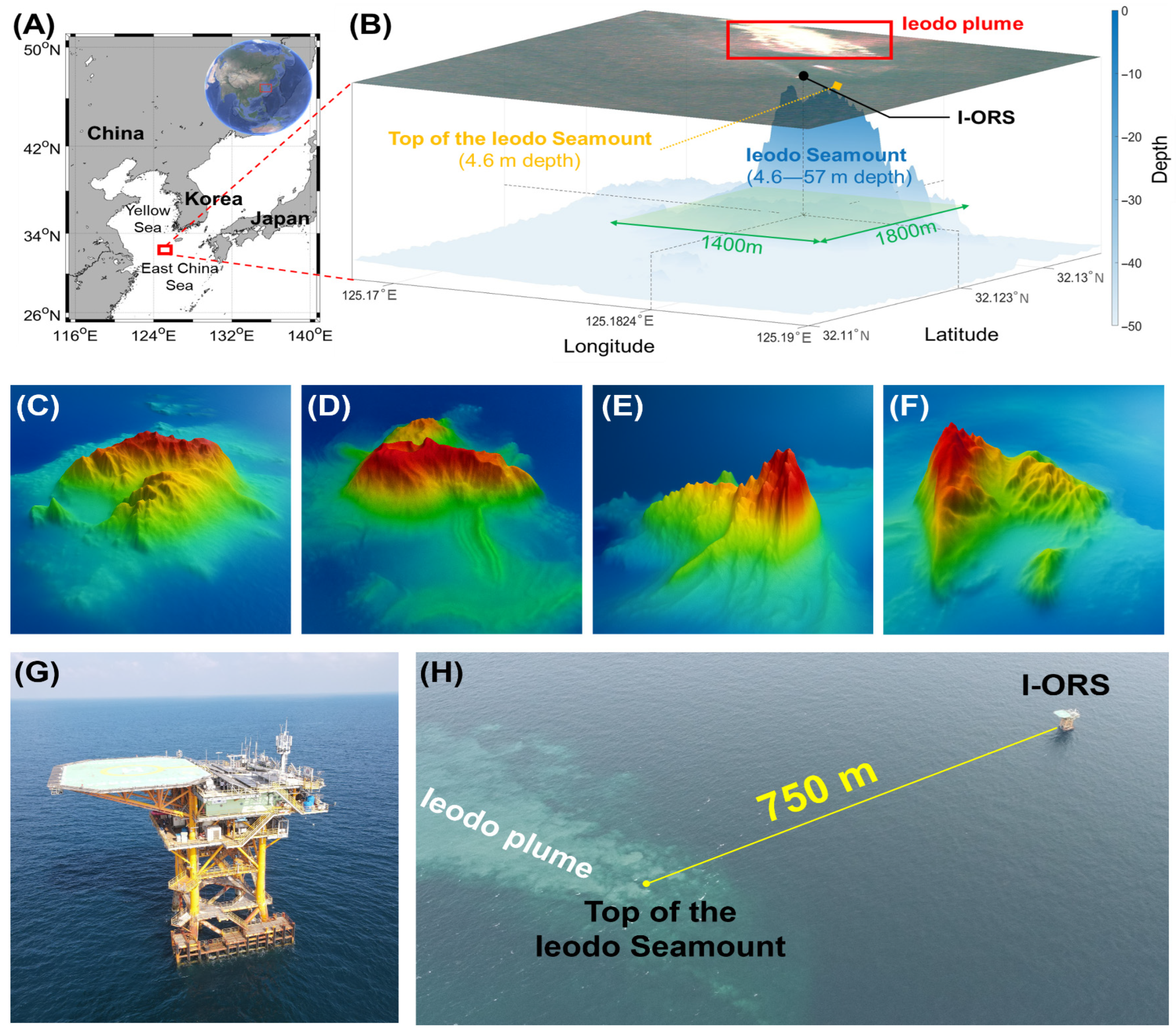
2.1. Study Area
2.2. Satellite Data and Reanalysis Products
2.3. Low-Altitude Remote Sensing
2.3.1. Field Observations
2.3.2. UAV-Based Water Sampling and SPM Analysis
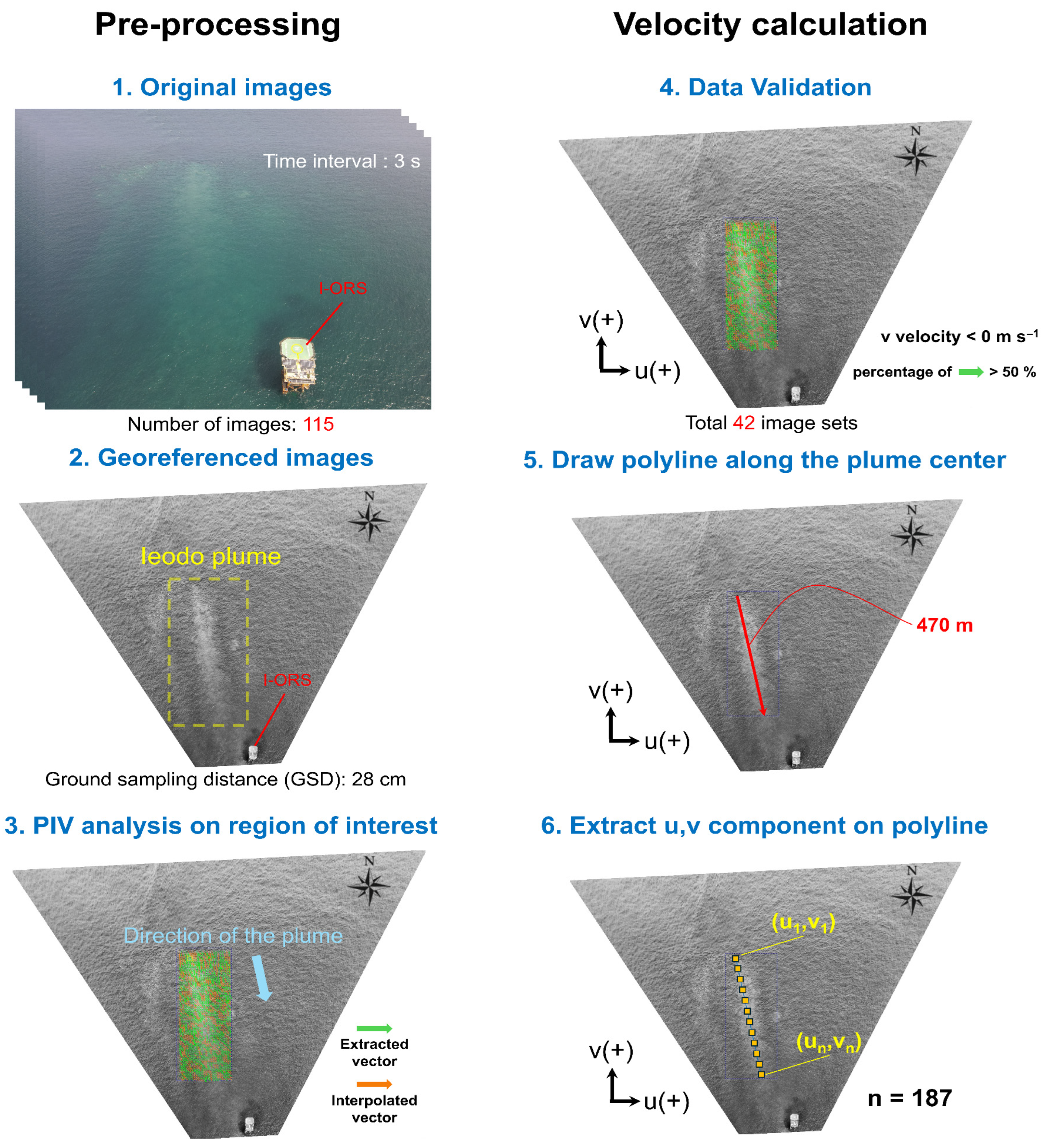
2.3.3. Processing of UAV Imagery: Geometric Correction and PIV-Based Velocity Estimation
2.4. In Situ Data
3. Results
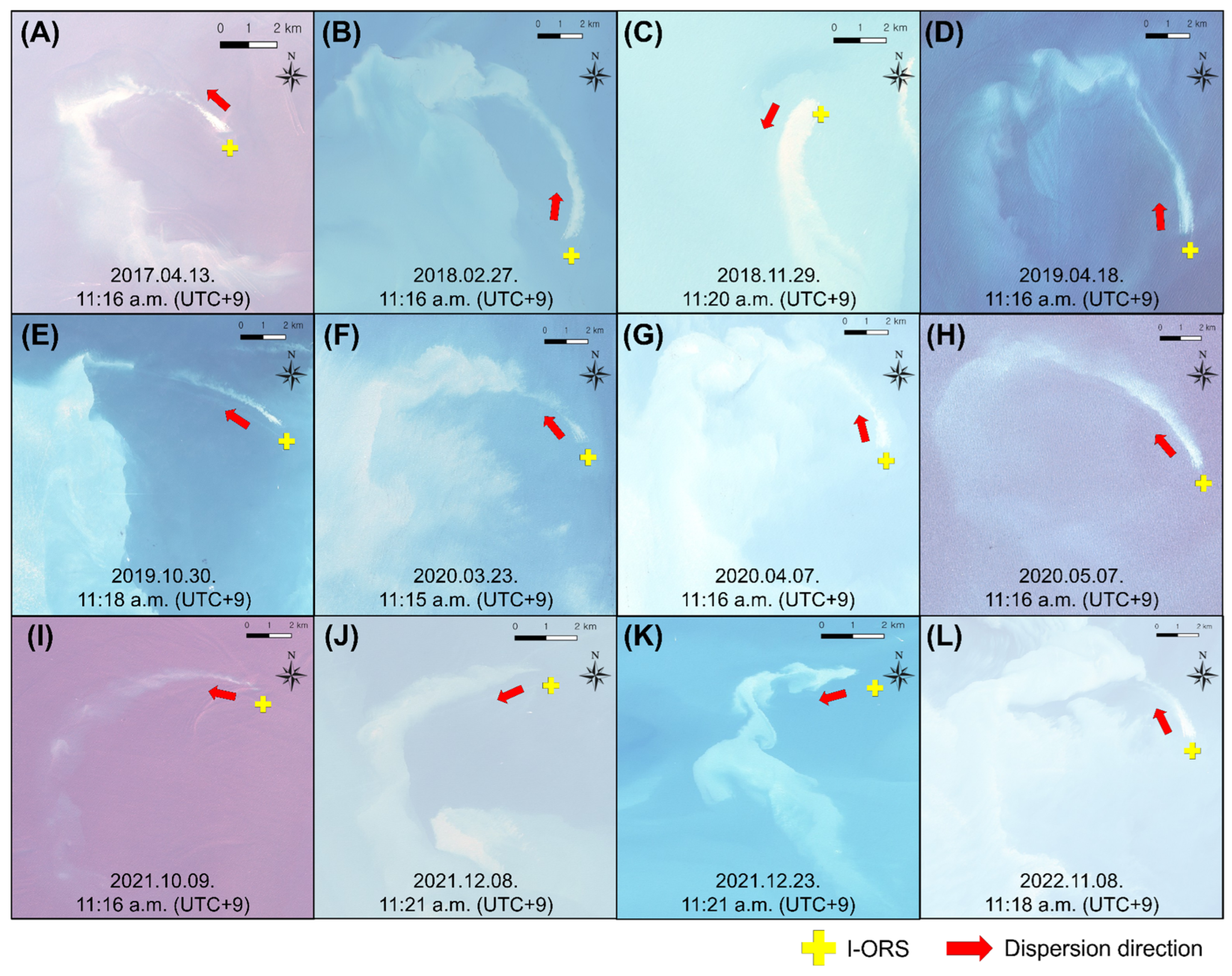
3.1. Full-Coverage Observation of the Ieodo Plume
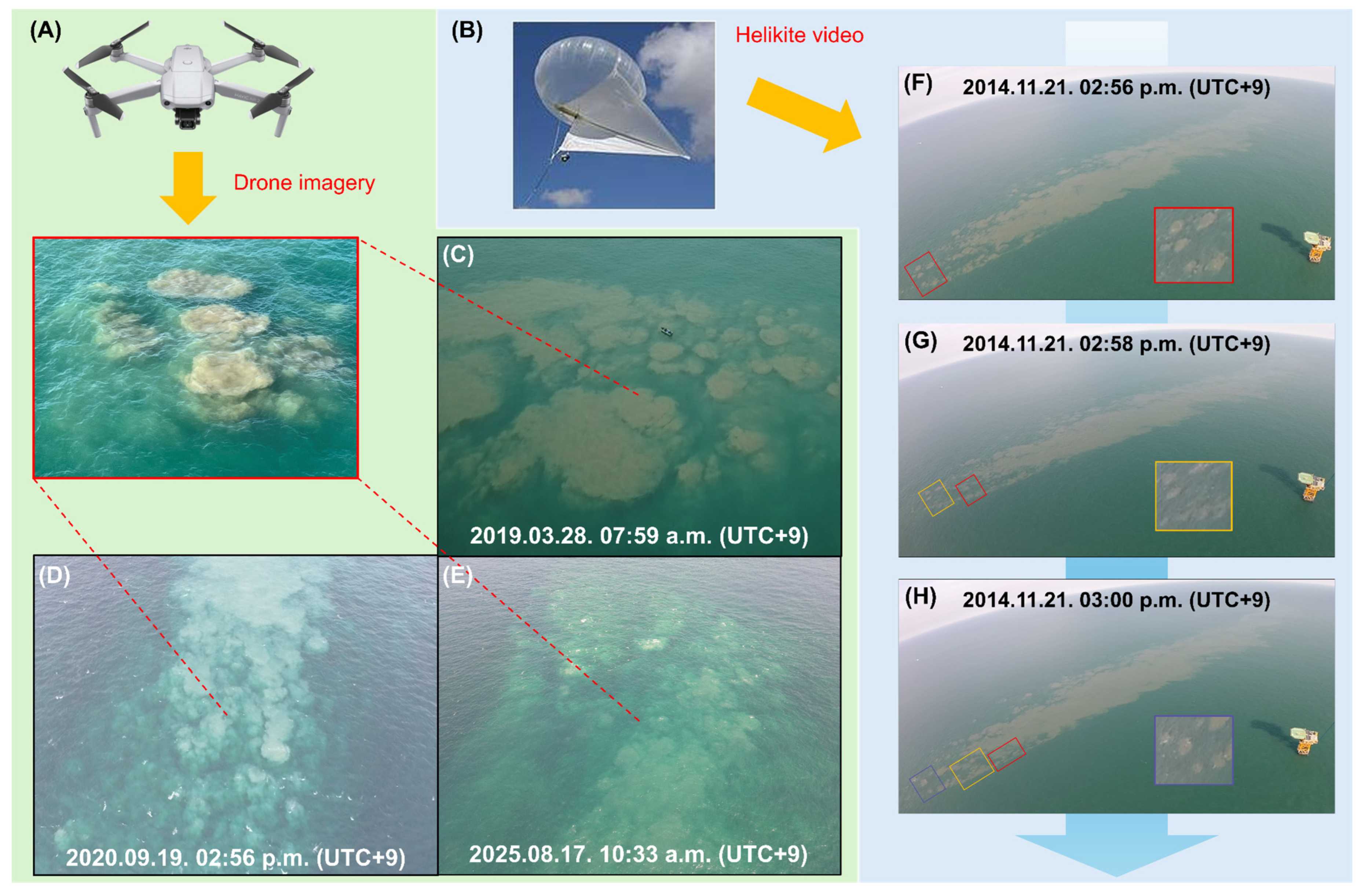
3.2. Low-Altitude Observations of the Ieodo Plume
3.3. Mechanism of the Ieodo Plume
4. Discussion
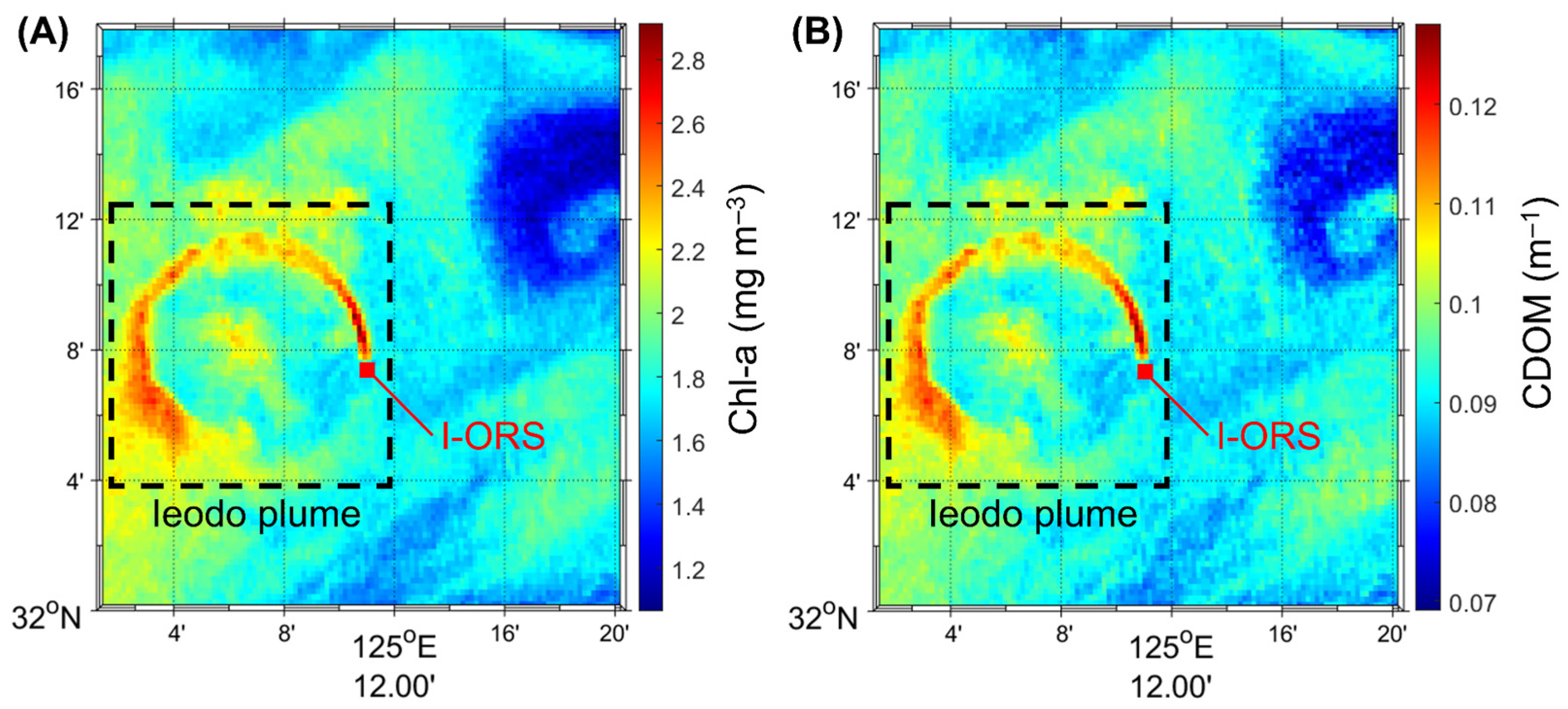
4.1. Detection of the Ieodo Plume in Satellite Imagery
4.2. Patchy Structure of the Ieodo Plume
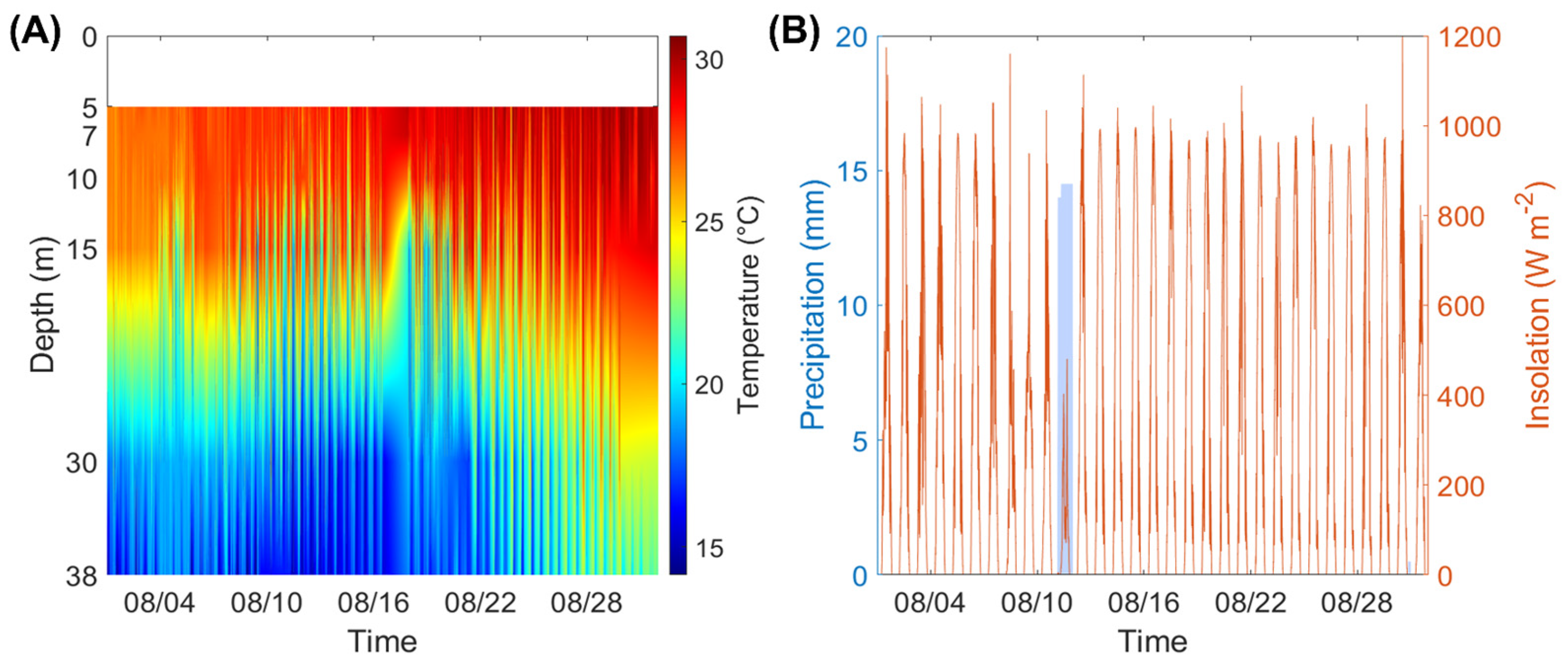
4.3. Summer Stratification in the Ieodo Region and Subsurface Dispersion of the Ieodo Plume
4.4. The LSPIV Algorithm and Direct Georeferencing
4.5. Jet–Plume Theory
5. Conclusions
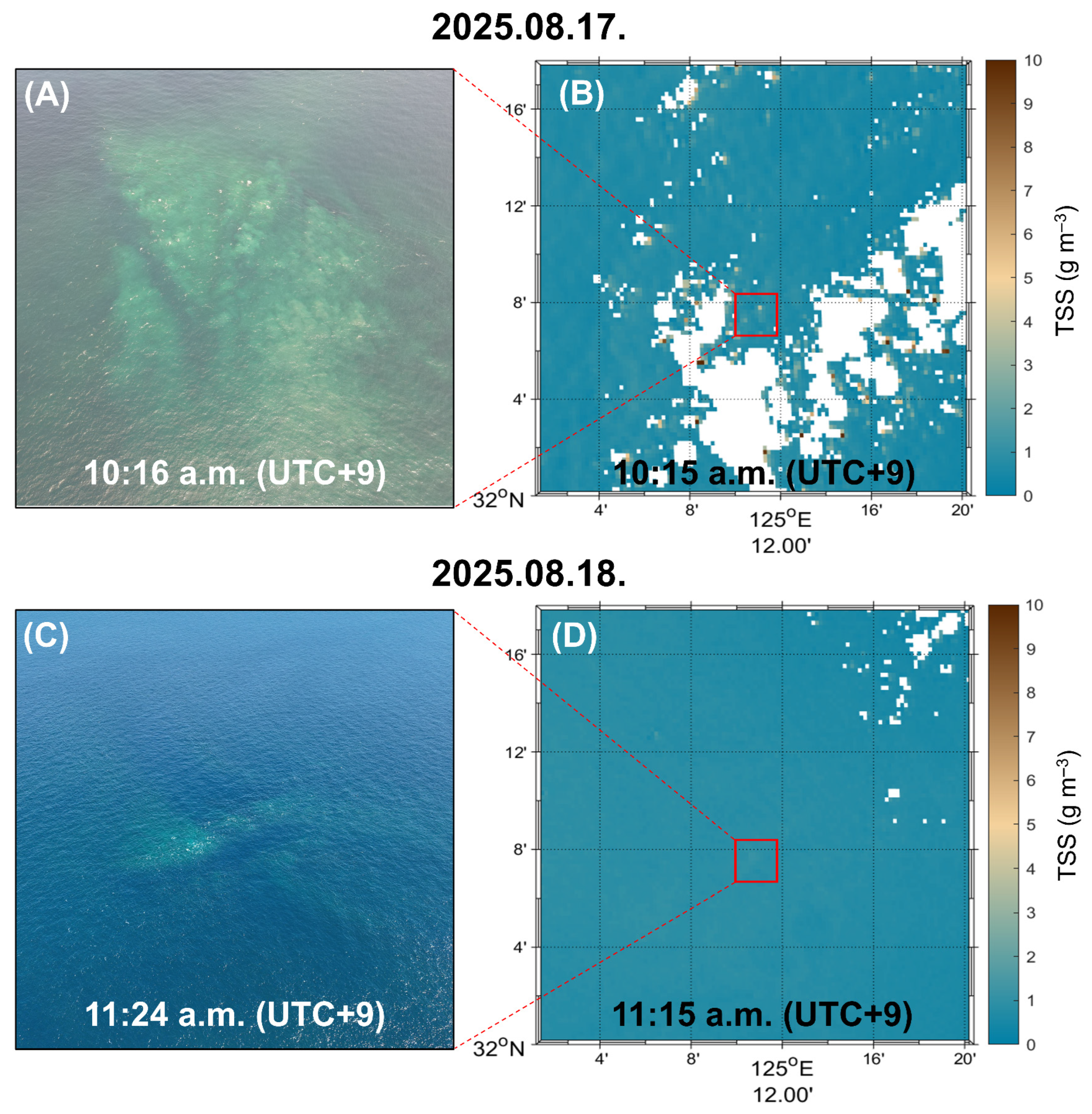
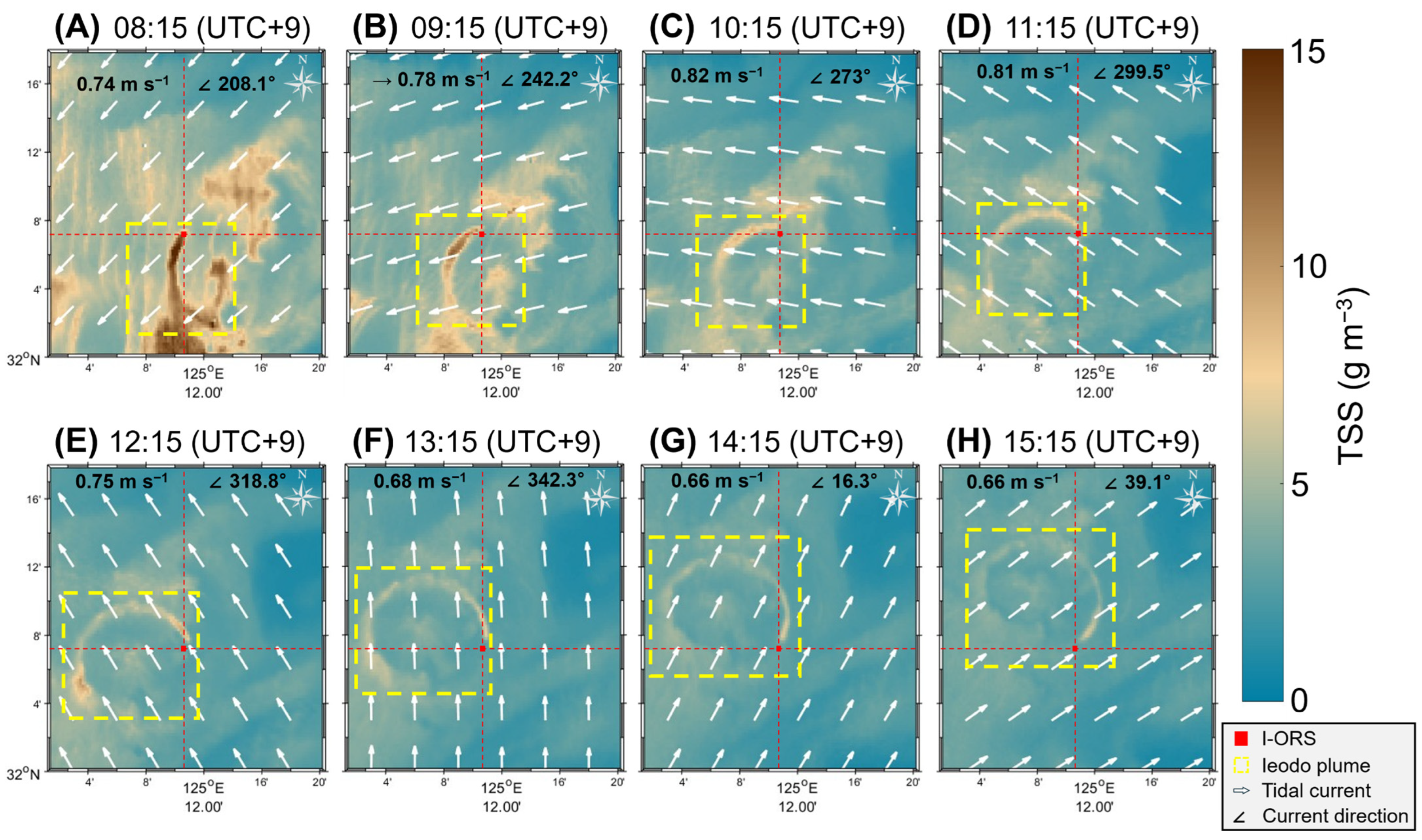
- Satellite observations indicated that the Ieodo plume repeatedly originates from a point on the summit of the Ieodo Seamount, located near the I-ORS. Exhibiting an initial width of approximately 0.5 km, it develops into a band-shaped structure that curves counterclockwise and disperses over a spatial extent of 11.4 ± 3.2 km in the east–west direction and 14.3 ± 4.1 km in the north–south direction. The initial development of the Ieodo plume was controlled by tidal currents, with the highest TSS occurring when the southward current component was strongest during the day. Following its formation, the band or ring structure of the plume underwent a counterclockwise curvature during its clockwise rotation along the tidal ellipse, and the TSS of the plume decreased with time.
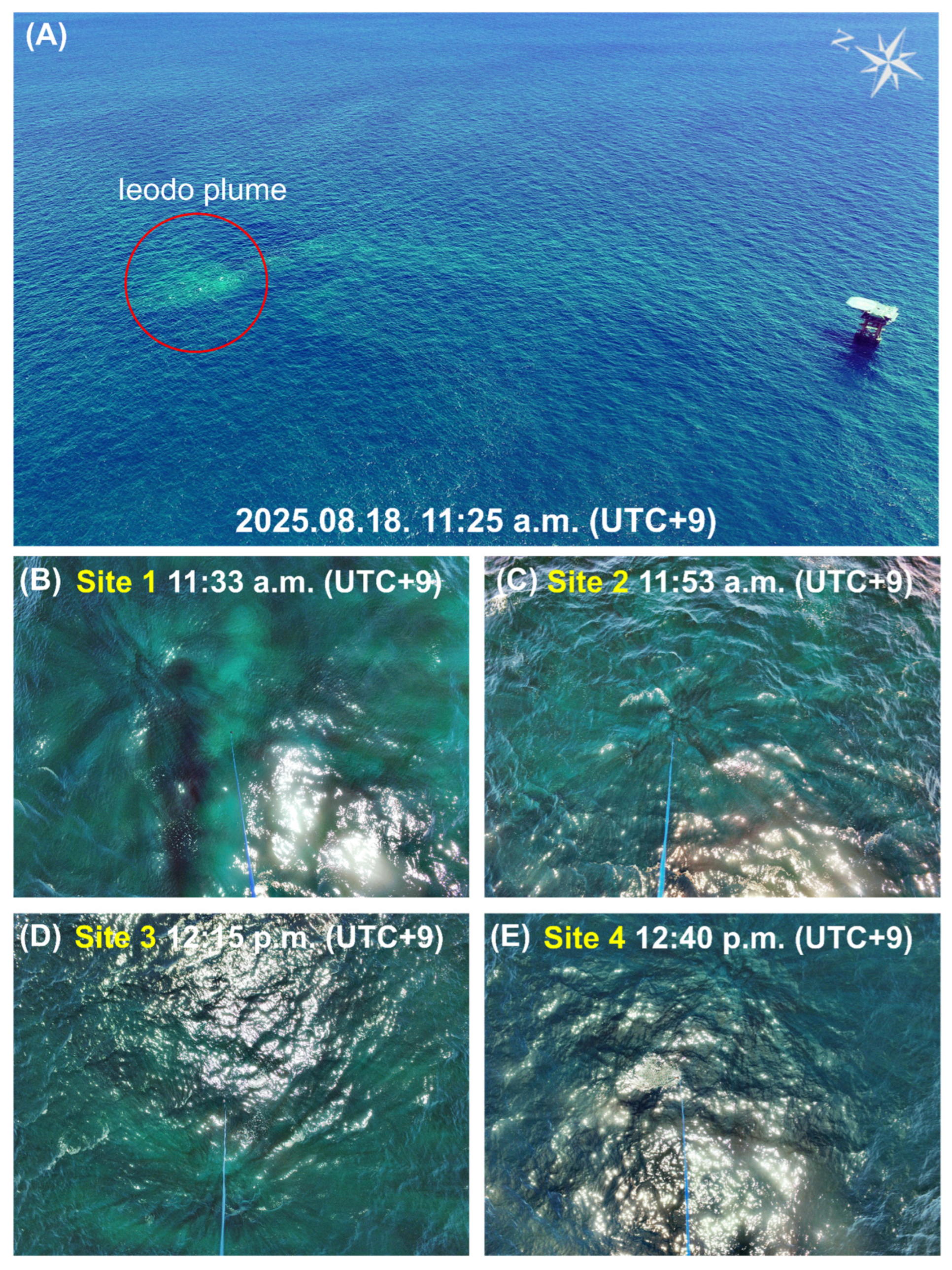
- The UAV observations revealed that the Ieodo plume was initially composed of circular sediment aggregates during its initial stage. After reaching the surface, these patches began to flow along the surface currents and merged with the previously formed sediment band structure observed in the satellite imagery. In addition, SPM analyses of surface seawater samples remotely collected by UAV at the time of plume occurrence indicate that during summer, when stratification is pronounced, the Ieodo plume does not fully rise to the sea surface; instead, it disperses below the surface, making it difficult to identify using satellite observations.
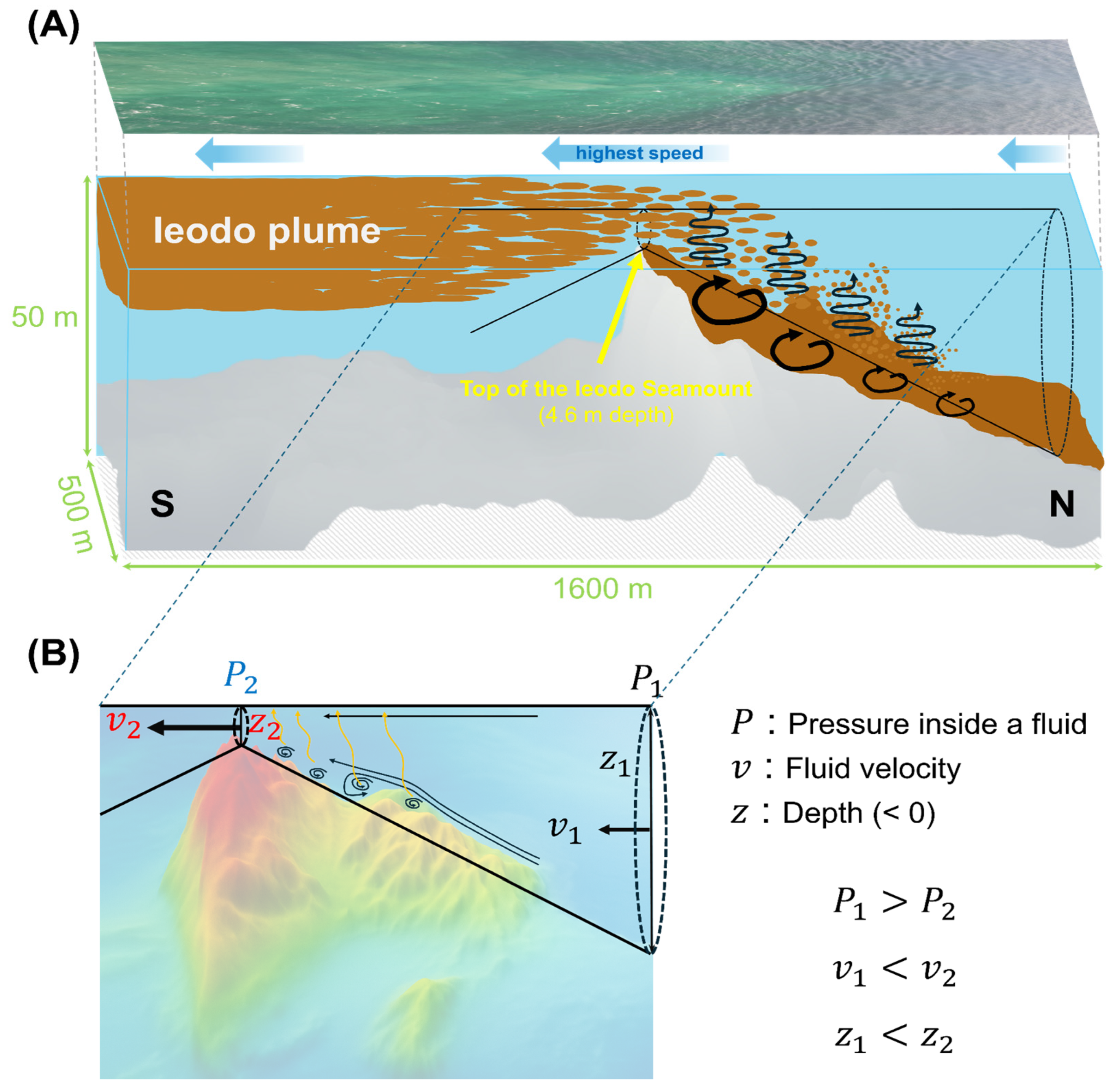
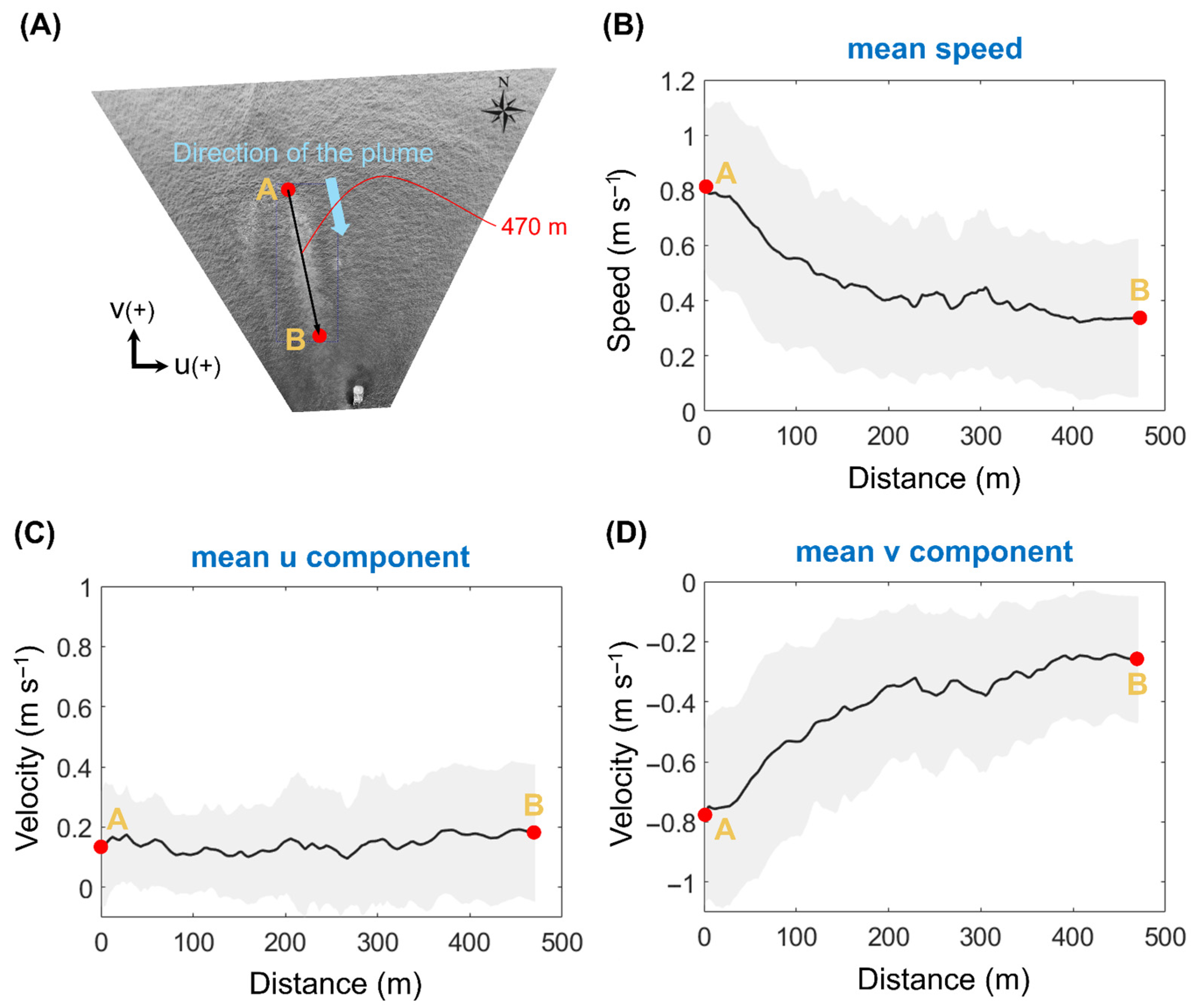
- Velocity estimation via LSPIV analysis of georeferenced sequential UAV imagery indicated that the plume speed was highest near the origin and gradually decreased as it dispersed horizontally. In accordance with the interactions between tidal forcing and the topography of the Ieodo Seamount, this behavior can be explained by the Bernoulli principle, which states that flow accelerates as the flow passage narrows. Similarly, the mechanism by which sediments composing the Ieodo plume are lofted toward the sea surface can be interpreted as arising from a reduction in internal fluid pressure, which is required to compensate for increases in flow speed under the conservation of total energy.
Author Contributions
Funding
Data Availability Statement
Acknowledgments
Conflicts of Interest
References
- Zhang, J. Heavy Metal Compositions of Suspended Sediments in the Changjiang (Yangtze River) Estuary: Significance of Riverine Transport to the Ocean. Cont. Shelf Res. 1999, 19, 1521–1543. [Google Scholar] [CrossRef]
- Turner, A.; Millward, G.E. Suspended Particles: Their Role in Estuarine Biogeochemical Cycles. Estuar. Coast. Shelf Sci. 2002, 55, 857–883. [Google Scholar] [CrossRef]
- Schoellhamer, D.H.; Mumley, T.E.; Leatherbarrow, J.E. Suspended Sediment and Sediment-Associated Contaminants in San Francisco Bay. Environ. Res. 2007, 105, 119–131. [Google Scholar] [CrossRef]
- Wilber, D.H.; Clarke, D.G. Biological Effects of Suspended Sediments: A Review of Suspended Sediment Impacts on Fish and Shellfish with Relation to Dredging Activities in Estuaries. N. Am. J. Fish. Manag. 2001, 21, 855–875. [Google Scholar] [CrossRef]
- Erftemeijer, P.L.A.; Riegl, B.; Hoeksema, B.W.; Todd, P.A. Environmental Impacts of Dredging and Other Sediment Disturbances on Corals: A Review. Mar. Pollut. Bull. 2012, 64, 1737–1765. [Google Scholar] [CrossRef] [PubMed]
- Zhang, H.; Zhao, L.; Sun, Y.; Wang, J.; Wei, H. Contribution of Sediment Oxygen Demand to Hypoxia Development off the Changjiang Estuary. Estuar. Coast. Shelf Sci. 2017, 192, 149–157. [Google Scholar] [CrossRef]
- Carreiro-Silva, M.; Martins, I.; Riou, V.; Raimundo, J.; Caetano, M.; Bettencourt, R.; Rakka, M.; Cerqueira, T.; Godinho, A.; Morato, T.; et al. Mechanical and Toxicological Effects of Deep-Sea Mining Sediment Plumes on a Habitat-Forming Cold-Water Octocoral. Front. Mar. Sci. 2022, 9, 915650. [Google Scholar] [CrossRef]
- Bai, M.; Dong, F.; Jia, Y.; Qi, B.; Yu, S.; Peng, S.; Liang, B.; Li, L.; Yu, L.; Zhang, X.; et al. Impact of Sediment Plume on Benthic Microbial Community in Deep-Sea Mining. Water 2025, 17, 3013. [Google Scholar] [CrossRef]
- Shields, A. Application of Similarity Principles and Turbulence Research to Bed-Load Movement; California Institute of Technology: Pasadena, CA, USA, 1936. [Google Scholar]
- Luo, Z.; Zhu, J.; Wu, H.; Li, X. Dynamics of the Sediment Plume over the Yangtze Bank in the Yellow and East China Seas. J. Geophys. Res. Oceans. 2017, 122, 10073–10090. [Google Scholar] [CrossRef]
- Yuan, Y.; Wei, H.; Zhao, L.; Cao, Y. Implications of Intermittent Turbulent Bursts for Sediment Resuspension in a Coastal Bottom Boundary Layer: A Field Study in the Western Yellow Sea, China. Mar. Geol. 2009, 263, 87–96. [Google Scholar] [CrossRef]
- Salim, S.; Pattiaratchi, C.; Tinoco, R.; Coco, G.; Hetzel, Y.; Wijeratne, S.; Jayaratne, R. The Influence of Turbulent Bursting on Sediment Resuspension under Unidirectional Currents. Earth Surf. Dynam. 2017, 5, 399–415. [Google Scholar] [CrossRef]
- Geyer, W.R.; Hill, P.S.; Kineke, G.C. The Transport, Transformation and Dispersal of Sediment by Buoyant Coastal Flows. Cont. Shelf Res. 2004, 24, 927–949. [Google Scholar] [CrossRef]
- Marques, W.C.; Fernandes, E.H.L.; Moraes, B.C.; Möller, O.O.; Malcherek, A. Dynamics of the Patos Lagoon Coastal Plume and Its Contribution to the Deposition Pattern of the Southern Brazilian Inner Shelf. J. Geophys. Res. Oceans. 2010, 115, C10045. [Google Scholar] [CrossRef]
- Brando, V.E.; Braga, F.; Zaggia, L.; Giardino, C.; Bresciani, M.; Matta, E.; Bellafiore, D.; Ferrarin, C.; Maicu, F.; Benetazzo, A.; et al. High-Resolution Satellite Turbidity and Sea Surface Temperature Observations of River Plume Interactions during a Significant Flood Event. Ocean Sci. 2015, 11, 909–920. [Google Scholar] [CrossRef]
- Devlin, M.J.; Petus, C.; Da Silva, E.; Tracey, D.; Wolff, N.H.; Waterhouse, J.; Brodie, J. Water Quality and River Plume Monitoring in the Great Barrier Reef: An Overview of Methods Based on Ocean Colour Satellite Data. Remote Sens. 2015, 7, 12909–12941. [Google Scholar] [CrossRef]
- Spearman, J. A Review of the Physical Impacts of Sediment Dispersion from Aggregate Dredging. Mar. Pollut. Bull. 2015, 94, 260–277. [Google Scholar] [CrossRef]
- Gillard, B.; Purkiani, K.; Chatzievangelou, D.; Vink, A.; Iversen, M.H.; Thomsen, L. Physical and Hydrodynamic Properties of Deep Sea Mining-Generated, Abyssal Sediment Plumes in the Clarion Clipperton Fracture Zone (Eastern-Central Pacific). Elem. Sci. Anth. 2019, 7, 5. [Google Scholar] [CrossRef]
- Morton, B.R.; Taylor, G.; Turner, J.S. Turbulent Gravitational Convection from Maintained and Instantaneous Sources. Proc. R. Soc. Lond. Ser. A 1956, 234, 1–23. [Google Scholar] [CrossRef]
- Fischer, H.; List, E.; Koh, R.; Imberger, J.; Brooks, N. Mixing in Inland and Coastal Waters; Academic Press: London, UK, 1979. [Google Scholar] [CrossRef]
- Woods, A.W. Turbulent Plumes in Nature. Annu. Rev. Fluid Mech. 2010, 42, 391–412. [Google Scholar] [CrossRef]
- Gerritsen, H.; Vos, R.J.; van der Kaaij, T.; Lane, A.; Boon, J.G. Suspended Sediment Modelling in a Shelf Sea (North Sea). Coast. Eng. 2000, 41, 317–352. [Google Scholar] [CrossRef]
- Bass, S.J.; Aldridge, J.N.; McCave, I.N.; Vincent, C.E. Phase Relationships between Fine Sediment Suspensions and Tidal Currents in Coastal Seas. J. Geophys. Res. Oceans. 2002, 107, 10-1–10-14. [Google Scholar] [CrossRef]
- Purkiani, K.; Gillard, B.; Paul, A.; Haeckel, M.; Haalboom, S.; Greinert, J.; de Stigter, H.; Hollstein, M.; Baeye, M.; Vink, A.; et al. Numerical Simulation of Deep-Sea Sediment Transport Induced by a Dredge Experiment in the Northeastern Pacific Ocean. Front. Mar. Sci. 2021, 8, 719463. [Google Scholar] [CrossRef]
- Nazirova, K.; Alferyeva, Y.; Lavrova, O.; Shur, Y.; Soloviev, D.; Bocharova, T.; Strochkov, A. Comparison of In Situ and Remote-Sensing Methods to Determine Turbidity and Concentration of Suspended Matter in the Estuary Zone of the Mzymta River, Black Sea. Remote Sens. 2021, 13, 143. [Google Scholar] [CrossRef]
- Uehara, K.; Saito, Y. Late Quaternary Evolution of the Yellow/East China Sea Tidal Regime and Its Impacts on Sediments Dispersal and Seafloor Morphology. Sediment. Geol. 2003, 162, 25–38. [Google Scholar] [CrossRef]
- Nechad, B.; Ruddick, K.G.; Park, Y. Calibration and Validation of a Generic Multisensor Algorithm for Mapping of Total Suspended Matter in Turbid Waters. Remote Sens. Environ. 2010, 114, 854–866. [Google Scholar] [CrossRef]
- Tavora, J.; Gonçalves, G.A.; Fernandes, E.H.; Salama, M.S.; van der Wal, D. Detecting Turbid Plumes from Satellite Remote Sensing: State-of-Art Thresholds and the Novel PLUMES Algorithm. Front. Mar. Sci. 2023, 10, 1215327. [Google Scholar] [CrossRef]
- Liu, Z.; Jiao, S.; Liu, X.; Lv, X. Two-Dimensional Numerical Simulation of Tide and Tidal Current of Eight Major Tidal Constituents in the Bohai, Yellow, and East China Seas. Remote Sens. 2023, 15, 3735. [Google Scholar] [CrossRef]
- Jeong, T.-B.; Kim, Y.S.; Cha, H.; Jeong, K.-Y.; Jeong, J.-Y.; Lee, J.-H. Application of Quality-Controlled Sea Level Height Observation at the Central East China Sea: Assessment of Sea Level Rise. Ocean Sci. 2025, 21, 2085–2099. [Google Scholar] [CrossRef]
- Van Lancker, V.; Baeye, M. Wave Glider Monitoring of Sediment Transport and Dredge Plumes in a Shallow Marine Sandbank Environment. PLoS ONE 2015, 10, e0128948. [Google Scholar] [CrossRef]
- Spearman, J.; Taylor, J.; Crossouard, N.; Cooper, A.; Turnbull, M.; Manning, A.; Lee, M.; Murton, B. Measurement and Modelling of Deep Sea Sediment Plumes and Implications for Deep Sea Mining. Sci. Rep. 2020, 10, 5075. [Google Scholar] [CrossRef]
- Haalboom, S.; Schoening, T.; Urban, P.; Gazis, I.-Z.; de Stigter, H.; Gillard, B.; Baeye, M.; Hollstein, M.; Purkiani, K.; Reichart, G.-J.; et al. Monitoring of Anthropogenic Sediment Plumes in the Clarion-Clipperton Zone, NE Equatorial Pacific Ocean. Front. Mar. Sci. 2022, 9, 882155. [Google Scholar] [CrossRef]
- Gazis, I.-Z.; de Stigter, H.; Mohrmann, J.; Heger, K.; Diaz, M.; Gillard, B.; Baeye, M.; Veloso-Alarcón, M.E.; Purkiani, K.; Haeckel, M.; et al. Monitoring Benthic Plumes, Sediment Redeposition and Seafloor Imprints Caused by Deep-Sea Polymetallic Nodule Mining. Nat. Commun. 2025, 16, 1229. [Google Scholar] [CrossRef] [PubMed]
- Chang, T.S.; Jeong, J.O.; Lee, E.; Byun, D.-S.; Lee, H.-Y.; Son, C.S. Distribution Patterns and Provenance of Surficial Sediments from Ieodo and Adjacent Sea. J. Korean Earth Sci. Soc. 2020, 41, 588–598. [Google Scholar] [CrossRef]
- Jo, Y.-H.; Sha, J.; Kwon, J.-I.; Jun, K.-C.; Park, J. Mapping Bathymetry Based on Waterlines Observed from Low Altitude Helikite Remote Sensing Platform. Acta Oceanol. Sin. 2015, 34, 110–116. [Google Scholar] [CrossRef]
- Jo, Y.-H.; Bi, H.; Lee, J.-S. Potential Applications of Low Altitude Remote Sensing for Monitoring Jellyfish. Korean J. Remote Sens. 2017, 33, 15–24. [Google Scholar] [CrossRef][Green Version]
- Mobley, C.D. Estimation of the Remote-Sensing Reflectance from above-Surface Measurements. Appl. Opt. 1999, 38, 7442–7455. [Google Scholar] [CrossRef]
- Nezlin, N.P.; Weisberg, S.B.; Diehl, D.W. Relative Availability of Satellite Imagery and Ship-Based Sampling for Assessment of Stormwater Runoff Plumes in Coastal Southern California. Estuar. Coast. Shelf Sci. 2007, 71, 250–258. [Google Scholar] [CrossRef]
- Fettweis, M.P.; Nechad, B. Evaluation of In Situ and Remote Sensing Sampling Methods for SPM Concentrations, Belgian Continental Shelf (Southern North Sea). Ocean Dyn. 2011, 61, 157–171. [Google Scholar] [CrossRef]
- Lee, J.-S.; Baek, J.-Y.; Shin, J.; Kim, J.-S.; Jo, Y.-H. Suspended Sediment Concentration Estimation along Turbid Water Outflow Using a Multispectral Camera on an Unmanned Aerial Vehicle. Remote Sens. 2023, 15, 5540. [Google Scholar] [CrossRef]
- Lally, H.T.; O’Connor, I.; Jensen, O.P.; Graham, C.T. Can Drones Be Used to Conduct Water Sampling in Aquatic Environments? A Review. Sci. Total Environ. 2019, 670, 569–575. [Google Scholar] [CrossRef]
- Adrian, R.J. Particle-Imaging Techniques for Experimental Fluid Mechanics. Annu. Rev. Fluid Mech. 1991, 23, 261–304. [Google Scholar] [CrossRef]
- Raffel, M.; Willert, C.E.; Scarano, F.; Kähler, C.J.; Wereley, S.T.; Kompenhans, J. Particle Image Velocimetry: A Practical Guide, 3rd ed.; Springer: Cham, Switzerland, 2018. [Google Scholar] [CrossRef]
- Muste, M.; Fujita, I.; Hauet, A. Large-Scale Particle Image Velocimetry for Measurements in Riverine Environments. Water Resour. Res. 2008, 44, W00D19. [Google Scholar] [CrossRef]
- Tauro, F.; Petroselli, A.; Grimaldi, S. Optical Sensing for Stream Flow Observations: A Review. J. Agric. Eng. 2018, 49, 199–206. [Google Scholar] [CrossRef]
- Perks, M.T.; Fortunato Dal Sasso, S.; Hauet, A.; Jamieson, E.; Le Coz, J.; Pearce, S.; Peña-Haro, S.; Pizarro, A.; Strelnikova, D.; Tauro, F.; et al. Towards Harmonisation of Image Velocimetry Techniques for River Surface Velocity Observations. Earth Syst. Sci. Data 2020, 12, 1545–1559. [Google Scholar] [CrossRef]
- Tauro, F.; Pagano, C.; Phamduy, P.; Grimaldi, S.; Porfiri, M. Large-Scale Particle Image Velocimetry from an Unmanned Aerial Vehicle. IEEE/ASME Trans. Mechatron. 2015, 20, 3269–3275. [Google Scholar] [CrossRef]
- Lewis, Q.W.; Lindroth, E.M.; Rhoads, B.L. Integrating Unmanned Aerial Systems and LSPIV for Rapid, Cost-Effective Stream Gauging. J. Hydrol. 2018, 560, 230–246. [Google Scholar] [CrossRef]
- Wang, J.; Ge, Y.; Heuvelink, G.B.M.; Zhou, C.; Brus, D. Effect of the Sampling Design of Ground Control Points on the Geometric Correction of Remotely Sensed Imagery. Int. J. Appl. Earth Obs. Geoinf. 2012, 18, 91–100. [Google Scholar] [CrossRef]
- Helgesen, H.H.; Leira, F.S.; Bryne, T.H.; Albrektsen, S.M.; Johansen, T.A. Real-Time Georeferencing of Thermal Images Using Small Fixed-Wing UAVs in Maritime Environments. ISPRS J. Photogramm. Remote Sens. 2019, 154, 84–97. [Google Scholar] [CrossRef]
- Zhang, K.; Okazawa, H.; Hayashi, K.; Hayashi, T.; Fiwa, L.; Maskey, S. Optimization of Ground Control Point Distribution for Unmanned Aerial Vehicle Photogrammetry for Inaccessible Fields. Sustainability 2022, 14, 9505. [Google Scholar] [CrossRef]
- Elaaraj, A.; Lhachmi, A.; Tabyaoui, H.; Alitane, A.; Varasano, A.; Hitouri, S.; El Yousfi, Y.; Mohajane, M.; Essahlaoui, N.; Gueddari, H.; et al. Remote Sensing Data for Geological Mapping in the Saka Region in Northeast Morocco: An Integrated Approach. Sustainability 2022, 14, 15349. [Google Scholar] [CrossRef]
- Özcihan, B.; Özlü, L.D.; Karakap, M.İ.; Sürmeli̇, H.; Alganci, U.; Sertel, E. A Comprehensive Analysis of Different Geometric Correction Methods for the Pleiades-1A and Spot-6 Satellite Images. Int. J. Eng. Geosci. 2023, 8, 146–153. [Google Scholar] [CrossRef]
- Román, A.; Heredia, S.; Windle, A.E.; Tovar-Sánchez, A.; Navarro, G. Enhancing Georeferencing and Mosaicking Techniques over Water Surfaces with High-Resolution Unmanned Aerial Vehicle (UAV) Imagery. Remote Sens. 2024, 16, 290. [Google Scholar] [CrossRef]
- Watts, J.; Holding, T.; Anderson, K.; Bell, T.G.; Chapron, B.; Donlon, C.; Collard, F.; Wood, N.; Walker, D.; DeBell, L.; et al. Georectifying Drone Image Data over Water Surfaces without Fixed Ground Control: Methodology, Uncertainty Assessment and Application over an Estuarine Environment. Estuar. Coast. Shelf Sci. 2024, 305, 108853. [Google Scholar] [CrossRef]
- Kim, S.-Y.; Lee, J.-S.; Jeong, Y.; Jo, Y.-H. Decomposition of Submesoscale Ocean Wave and Current Derived from UAV-Based Observation. Remote Sens. 2024, 16, 2275. [Google Scholar] [CrossRef]
- Saldías, G.S.; Sobarzo, M.; Largier, J.; Moffat, C.; Letelier, R. Seasonal Variability of Turbid River Plumes off Central Chile Based on High-Resolution MODIS Imagery. Remote Sens. Environ. 2012, 123, 220–233. [Google Scholar] [CrossRef]
- Petus, C.; Marieu, V.; Novoa, S.; Chust, G.; Bruneau, N.; Froidefond, J.-M. Monitoring Spatio-Temporal Variability of the Adour River Turbid Plume (Bay of Biscay, France) with MODIS 250-m Imagery. Cont. Shelf Res. 2014, 74, 35–49. [Google Scholar] [CrossRef]
- Mazzini, P.L.F.; Pianca, C.; Pareja-Roman, L.F.; Cole, K.L.; Walter, R.K.; Castelao, R.M.; Hunter, E.J.; Chant, R.J. Spatio-Temporal Variability of San Francisco Bay Plume from Space. Front. Mar. Sci. 2025, 12, 1588441. [Google Scholar] [CrossRef]
- Siswanto, E.; Tang, J.; Yamaguchi, H.; Ahn, Y.-H.; Ishizaka, J.; Yoo, S.; Kim, S.-W.; Kiyomoto, Y.; Yamada, K.; Chiang, C.; et al. Empirical Ocean-Color Algorithms to Retrieve Chlorophyll-a, Total Suspended Matter, and Colored Dissolved Organic Matter Absorption Coefficient in the Yellow and East China Seas. J. Oceanogr. 2011, 67, 627–650. [Google Scholar] [CrossRef]
- Zhou, Z.; Bian, C.; Chen, S.; Li, Z.; Jiang, W.; Wang, T.; Bi, R. Sediment Concentration Variations in the East China Seas over Multiple Timescales Indicated by Satellite Observations. J. Mar. Syst. 2020, 212, 103430. [Google Scholar] [CrossRef]
- Flores, F.; Hoogenboom, M.O.; Smith, L.D.; Cooper, T.F.; Abrego, D.; Negri, A.P. Chronic Exposure of Corals to Fine Sediments: Lethal and Sub-Lethal Impacts. PLoS ONE 2012, 7, e37795. [Google Scholar] [CrossRef]
- Tosic, M.; Martins, F.; Lonin, S.; Izquierdo, A.; Restrepo, J.D. A Practical Method for Setting Coastal Water Quality Targets: Harmonization of Land-Based Discharge Limits with Marine Ecosystem Thresholds. Mar. Policy 2019, 108, 103641. [Google Scholar] [CrossRef]
- Tuttle, L.J.; Donahue, M.J. Effects of Sediment Exposure on Corals: A Systematic Review of Experimental Studies. Environ. Evid. 2022, 11, 4. [Google Scholar] [CrossRef]
- Jones, R.; Pineda, M.-C.; Luter, H.M.; Fisher, R.; Francis, D.; Klonowski, W.; Slivkoff, M. Underwater Light Characteristics of Turbid Coral Reefs of the Inner Central Great Barrier Reef. Front. Mar. Sci. 2021, 8, 727206. [Google Scholar] [CrossRef]
- He, L.; Liu, Y.; Yang, G.; Shan, S.; Zhu, A.; Gao, J. The Distribution and Characteristics of Suspended Particulate Matter in the Palau-Caroline Seamount Area of the Western Tropical Pacific Ocean. J. Sea Res. 2025, 203, 102560. [Google Scholar] [CrossRef]
- Rood, K.M.; Hickin, E.J. Suspended-Sediment Concentration and Calibre in Relation to Surface-Flow Structure in Squamish River Estuary, Southwestern British Columbia. Can. J. Earth Sci. 1989, 26, 2172–2176. [Google Scholar] [CrossRef]
- Kostaschuk, R.A.; Church, M.A. Macroturbulence Generated by Dunes: Fraser River, Canada. Sediment. Geol. 1993, 85, 25–37. [Google Scholar] [CrossRef]
- Smith, W.A.M.; Nimmo, S.A.; Thorpe, S.A.; Graham, A. Surface Effects of Bottom-Generated Turbulence in a Shallow Tidal Sea. Nature 1999, 400, 251–254. [Google Scholar] [CrossRef]
- Thorpe, S.A.; Green, J.A.M.; Simpson, J.H.; Osborn, T.R.; Nimmo Smith, W.A.M. Boils and Turbulence in a Weakly Stratified Shallow Tidal Sea. J. Phys. Oceanogr. 2008, 38, 1711–1730. [Google Scholar] [CrossRef]
- Talke, S.A.; Horner-Devine, A.R.; Chickadel, C.C.; Jessup, A.T. Turbulent Kinetic Energy and Coherent Structures in a Tidal River. J. Geophys. Res. Oceans. 2013, 118, 6965–6981. [Google Scholar] [CrossRef]
- Kwoll, E.; Winter, C.; Becker, M. Intermittent suspension and transport of fine sediment over natural tidal bedforms. In Coherent Flow Structures at Earth’s Surface; Venditti, J.G., Best, J.L., Church, M., Hardy, R.J., Eds.; John Wiley & Sons, Ltd.: Chichester, UK, 2013. [Google Scholar] [CrossRef]
- Kim, S.-H.; Shin, J.; Kim, D.-W.; Jo, Y.-H. Estimation of Subsurface Salinity and Analysis of Changjiang Diluted Water Volume in the East China Sea. Front. Mar. Sci. 2023, 10, 1247462. [Google Scholar] [CrossRef]
- Shin, J.; Kim, D.-W.; Kim, S.-H.; Lee, G.S.; Khim, B.-K.; Jo, Y.-H. Gap-Filling Techniques Applied to the GOCI-Derived Daily Sea Surface Salinity Product for the Changjiang Diluted Water Front in the East China Sea. Earth Syst. Sci. Data 2024, 16, 3193–3211. [Google Scholar] [CrossRef]
- Park, T.; Jang, C.J.; Jungclaus, J.H.; Haak, H.; Park, W.; Oh, I.S. Effects of the Changjiang River Discharge on Sea Surface Warming in the Yellow and East China Seas in Summer. Cont. Shelf Res. 2011, 31, 15–22. [Google Scholar] [CrossRef]
- Lee, D.-K.; Kwon, J.-I.; Son, S. Horizontal Distribution of Changjiang Diluted Water in Summer Inferred from Total Suspended Sediment in the Yellow Sea and East China Sea. Acta Oceanol. Sin. 2015, 34, 44–50. [Google Scholar] [CrossRef]
- Son, Y.B.; Choi, J.-K. Mapping the Changjiang Diluted Water in the East China Sea during Summer over a 10-Year Period Using GOCI Satellite Sensor Data. Front. Mar. Sci. 2022, 9, 1024306. [Google Scholar] [CrossRef]
- Park, K.-A.; Cha, N.-Y.; Jeong, K.-Y.; Byun, D.-S.; Choi, B.-J.; Lee, J.-S. Long-Term Water Types and Satellite Chlorophyll a Variability in a River Discharge Environment around Ieodo Ocean Research Station. Sci. Rep. 2025, 15, 28240. [Google Scholar] [CrossRef]





| Source | Category | Product/Variables (Used in This Study) | Spatial Resolution | Temporal Resolution | Period/Notes |
|---|---|---|---|---|---|
| Sentinel-2A, 2B | Optical satellite | RGB (L1C, L2A) | 10 m × 10 m | 5 days | 2015–2024 |
| GOCI-II | Ocean color satellite | TSS (L2) | 250 m × 250 m | Hourly (08:15–17:30 UTC+9, daily) | 2023–2024 |
| TPXO8-atlas30 | Tidal reanalysis (altimetry-constrained) | Tidal current u (east–west), v (north–south) | 1/30° × 1/30° (≈3.15 km × 3.70 km at 32°N) | – | 13 tidal constituents including M2, S2, K1, O1 |
| Platform | Platform Type | Sensor/Camera | Sensor Format (CMOS) | Acquisition Period | Notes |
|---|---|---|---|---|---|
| Skyhook | Helikite | – | 1/2.3″ | Nov 2014 | Externally mounted optical sensor (GoPro HERO 3+ Black) |
| DJI Mavic Air 2 | UAV (optical) | Optical camera | 1/2″ | Mar–Apr 2019; Sep 2020; Apr 2021; Aug 2025 | Integrated sensor |
| DJI Inspire 1 | UAV (optical) | Optical camera | 1/2.3″ | Aug 2025 | Integrated sensor |
| Site | w1 (Original Weight, mg) | w2 (Average Weight After Filtering, mg) | V (Volume, L) | SPM Concentration (mg L−1) |
|---|---|---|---|---|
| Site 1 | 134.52 | 134.8 | 0.25 | 1.12 |
| 134.135 | 134.19 | 0.22 | ||
| Site 2 | 130.44 | 130.715 | 1.1 | |
| 135.6 | 135.995 | 1.58 | ||
| Site 3 | 133.59 | 133.705 | 0.46 | |
| 135.01 | 135.675 | 2.66 | ||
| Site 4 | 129.39 | 129.705 | 1.26 | |
| 128.14 | 128.195 | 0.22 | ||
| I-ORS | 135.29 | 135.33 | 0.16 | |
| 134.8 | 134.83 | 0.12 |
Disclaimer/Publisher’s Note: The statements, opinions and data contained in all publications are solely those of the individual author(s) and contributor(s) and not of MDPI and/or the editor(s). MDPI and/or the editor(s) disclaim responsibility for any injury to people or property resulting from any ideas, methods, instructions or products referred to in the content. |
© 2026 by the authors. Licensee MDPI, Basel, Switzerland. This article is an open access article distributed under the terms and conditions of the Creative Commons Attribution (CC BY) license.
Share and Cite
Hwang, S.; Kim, S.-Y.; Lee, J.-S.; Lee, S.-C.; Jeong, J.-Y.; Lu, W.; Jo, Y.-H. Observation of Sediment Plume Dispersion Around Ieodo Ocean Research Station in the Middle of the Northern East China Sea Using Satellites and UAVs. Remote Sens. 2026, 18, 795. https://doi.org/10.3390/rs18050795
Hwang S, Kim S-Y, Lee J-S, Lee S-C, Jeong J-Y, Lu W, Jo Y-H. Observation of Sediment Plume Dispersion Around Ieodo Ocean Research Station in the Middle of the Northern East China Sea Using Satellites and UAVs. Remote Sensing. 2026; 18(5):795. https://doi.org/10.3390/rs18050795
Chicago/Turabian StyleHwang, Seongbin, Sin-Young Kim, Jong-Seok Lee, Su-Chan Lee, Jin-Yong Jeong, Wenfang Lu, and Young-Heon Jo. 2026. "Observation of Sediment Plume Dispersion Around Ieodo Ocean Research Station in the Middle of the Northern East China Sea Using Satellites and UAVs" Remote Sensing 18, no. 5: 795. https://doi.org/10.3390/rs18050795
APA StyleHwang, S., Kim, S.-Y., Lee, J.-S., Lee, S.-C., Jeong, J.-Y., Lu, W., & Jo, Y.-H. (2026). Observation of Sediment Plume Dispersion Around Ieodo Ocean Research Station in the Middle of the Northern East China Sea Using Satellites and UAVs. Remote Sensing, 18(5), 795. https://doi.org/10.3390/rs18050795