


Highlights
What are the main findings?
- We developed a new dataset of NO2 tropospheric columns and AOD from MAX-DOAS, FRM4DOAS-compliant measurements at four different sites in Italy.
- The dataset can be used for satellite validation and scientific studies.
What is the implication of the main finding?
- A new dataset of NO2 tropospheric columns and AOD from four sites in Italy is available.
- It is available for TROPOMI and future satellite mission validation (e.g., Sentinel-4).
Abstract
The Italian peninsula is, as shown by satellite and ground-based measurements, a pollution hotspot. In recent years, ground-based MAX-DOAS commercial systems have been installed in the Po Valley and the area surrounding Rome to monitor NO2 tropospheric column densities and validate coincident satellite (e.g., TROPOMI) products. Three of the instruments are located in the Po Valley at San Pietro Capofiume (Bologna), Bologna city, and Mount Cimone (Modena), and one is located in Tor Vergata (Rome). The chosen system is the SkySpec-2D from Airyx. All the recorded spectra are saved in the FRM4DOAS format and processed with QDOAS software to obtain slant column densities (SCDs) of NO2, O4, and other trace gases. The MAX-DOAS SCD sequences are then analysed with the DEAP code to retrieve tropospheric profiles of NO2 and aerosol extinction, while zenith-sky SCDs are used to retrieve NO2 total columns. A dedicated campaign, involving the network instruments, has been conducted in the Po Valley to compare the performance of the individual instruments in the network with respect to the one that participated in the CINDI-3 campaign (Cabauw, The Netherlands). The results of the intercomparison campaign indicated that all instruments showed comparable performance. As an example of obtainable products, one year (from September 2024 to August 2025) of NO2 tropospheric columns, as well as their comparison with TROPOMI measurements, is presented, highlighting the potential of this network for both air quality studies and satellite validation. Due to Italy’s location in the highly complex Mediterranean hotspot region, these data represent an important contribution to satellite validation efforts, particularly in view of upcoming missions such as Copernicus Sentinel-4, Sentinel-5, and the Copernicus Anthropogenic Carbon Dioxide Monitoring (CO2M) constellation. We found a negative TROPOMI bias relative to SkySpec-2D for NO2 tropospheric columns ranging from −13% in San Pietro Capofiume, to −25% in Bologna and −44% in Rome Tor Vergata. The comparison between NO2 total columns from TROPOMI and SkySpec-2D at Mount Cimone shows generally good agreement, with TROPOMI being 15% higher.
1. Introduction
The Mediterranean region of Italy, especially Northern Italy’s Po Valley and the area surrounding Rome in central Italy, is recognised as a pronounced hotspot for nitrogen dioxide (NO2) pollution, frequently detected both by ground-based stations and via satellite remote sensing. The Po Valley, bounded by the Alps and the Apennines, suffers from industrial emissions, dense urban traffic, and frequent atmospheric stagnation that traps pollutants, making it among the most NO2-polluted areas in Europe. Satellite data from the Sentinel-5P TROPOspheric Monitoring Instrument (TROPOMI) confirm recurring tropospheric NO2 column densities exceeding about 5 × 10¹⁵ molecules/cm2 in winter over the Po Valley and major cities such as Milan and Turin [1,2,3,4,5,6].
Ground-based measurements within the Po Valley correlate strongly with satellite observations and have been used to track seasonal and pandemic-related changes from 2018 through 2021 [4]. For instance, a satellite-driven framework estimated a 22% decline in NOx emissions across the region during the 2020 COVID-19 lockdown, leveraging daily TROPOMI and Ozone Monitoring Instrument (OMI) data combined with reanalysis wind fields to derive emission rates and lifetimes [6]. In central Italy, observational studies in the Tiber Valley (around Rome) have also employed TROPOMI tropospheric column densities alongside local ground-based instrumentation to characterise spatial NO2 variability tied to traffic, rural emissions, and meteorological influences [1,5,7]. Additionally, urban measurements of NO2 vertical column density (VCD) and near-surface concentrations in Rome, collected between 2017 and 2022 via Pandora spectrometers and in-situ stations, show clear year-to-year declines aligned with ecological-transition policies, as well as pronounced seasonal cycles visible in both columnar and ground-level datasets [8].
Together, these studies illustrate how satellite remote sensing, particularly via Sentinel-5P TROPOMI, complements and corroborates ground-based observations to identify and monitor NO2 hotspots over the Po Valley and the Rome area, revealing temporal trends, emission sources, and policy-related improvements in air quality. To complement the Sentinel-5P TROPOMI mission, the Sentinel-4 mission, carried aboard the Meteosat Third Generation Sounder 1 (MTG-S1) satellite and part of the European Union’s Copernicus Programme, was launched on 1 July 2025 at 21:04 UTC from Cape Canaveral, Florida, USA. The mission is specifically designed for geostationary air quality monitoring over Europe, with a key focus on trace gases such as NO2. In this context, Sentinel-4 carries the UVN (ultraviolet–visible–near-Infrared) spectrometer aboard a Meteosat Third Generation Sounder (MTG-S) satellite, enabling high-temporal (hourly) and high-spatial-resolution observations of atmospheric composition. This capability allows the mission to capture diurnal variations in NO2 levels, thus complementing the low-Earth-orbit Sentinel-5 Precursor and the future Sentinel-5 missions [9].
Despite the key role of satellite measurements in observing and monitoring NO2, the role of ground-based remote sensing measurements is crucial. Their high spatiotemporal resolution allows for capturing small-scale events and vertically resolved structures (e.g., via multi-axis differential optical absorption spectroscopy (MAX-DOAS) measurements [10,11,12,13]). Moreover, they are essential for satellite validation. In this respect, over the last few decades, an effort has been put in place by the scientific community and space agencies to produce high-quality ground-based measurements that are accurate enough for satellite validation. These measurements are referred to as “Fiducial Reference Measurements”. In the frame of the DOAS community, the Fiducial Reference Measurements for Ground-Based DOAS (FRM4DOAS) project [14] aims at highlighting best practices for instrument operation and characterisation, harmonising retrieval algorithms, and delivering validation products.
As described in [15,16], in Italy, the first MAX-DOAS instrument (a SkySpec-2D system developed by Airyx GmbH, Germany (before EnviMes) (https://airyx.de/wp-content/uploads/2025/05/SkySpec-2D.pdf (accessed on 23 February 2026))), compliant with FRM4DOAS requirements, was located at the “Giorgio Fea” meteorological observatory at San Pietro Capofiume (herein SPC), Bologna, and is operated by the Consiglio Nazionale delle Ricerche-Istituto di Scienze dell’Atmosfera e del Clima (CNR-ISAC). The instrument is able to record spectra in the UV-VIS spectral range (from 300 to 550 nm) at different elevation and azimuth angles. The spectra recorded by this instrument are provided to the FRM4DOAS community for processing, and results are accessible via the Network for the Detection of Atmospheric Composition Change (NDACC) rapid delivery (https://www-air.larc.nasa.gov/missions/ndacc/data.html?RapidDelivery=rd-list (accessed on 28 July 2025)). An example of the use of those data for satellite validation can be found in [17]. The data are also processed with the code developed at CNR-ISAC and named the DOAS optimal estimation atmospheric profile (DEAP) retrieval [16]. An example of these data processing can be seen here: https://doas.isac.cnr.it/live-monitoring/ (accessed on 28 July 2025). The Italian peninsula has the distinct characteristic of experiencing very different atmospheric conditions over a few hundred kilometres. In this framework, CNR-ISAC operates at different observatories distributed throughout the country. In the last few years, three other observatories have been equipped with MAX-DOAS SkySpec-2D instruments, thus creating the first FRM4DOAS-compliant Italian network.
This paper focuses on the description of this network, the different characteristics of the observatories, the measurement set-up, and the processing of the data. We also describe the intercomparison campaign we performed to evaluate the performance of each instrument composing the network with respect to the one that participated in the Cabauw Intercomparison of DOAS-type Instruments (CINDI)-3 campaign (https://frm4doas.aeronomie.be/index.php/cindi-3 (accessed on 28 July 2025)). Finally, we report some examples of the network’s outputs: the profile-retrievals for one day from all observatories and one year (from September 2024 to the end of August 2025) of NO2 tropospheric VCDs, including the comparison against TROPOMI products.
The paper is structured as follows: Section 2 briefly describes the different sites where the instruments are located, together with their set-up and the way they are automatically processed. The results of the intercomparison campaign and the comparison of NO2 tropospheric VCDs from ground-based and satellite observations are given in Section 3. The discussion is reported in Section 4 and Conclusions in Section 5.
2. Materials and Methods
2.1. Location of the CNR-ISAC SkySpec-2D MAX-DOAS Instruments in Italy
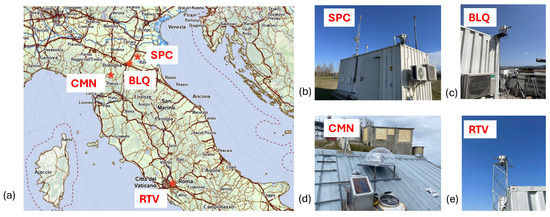
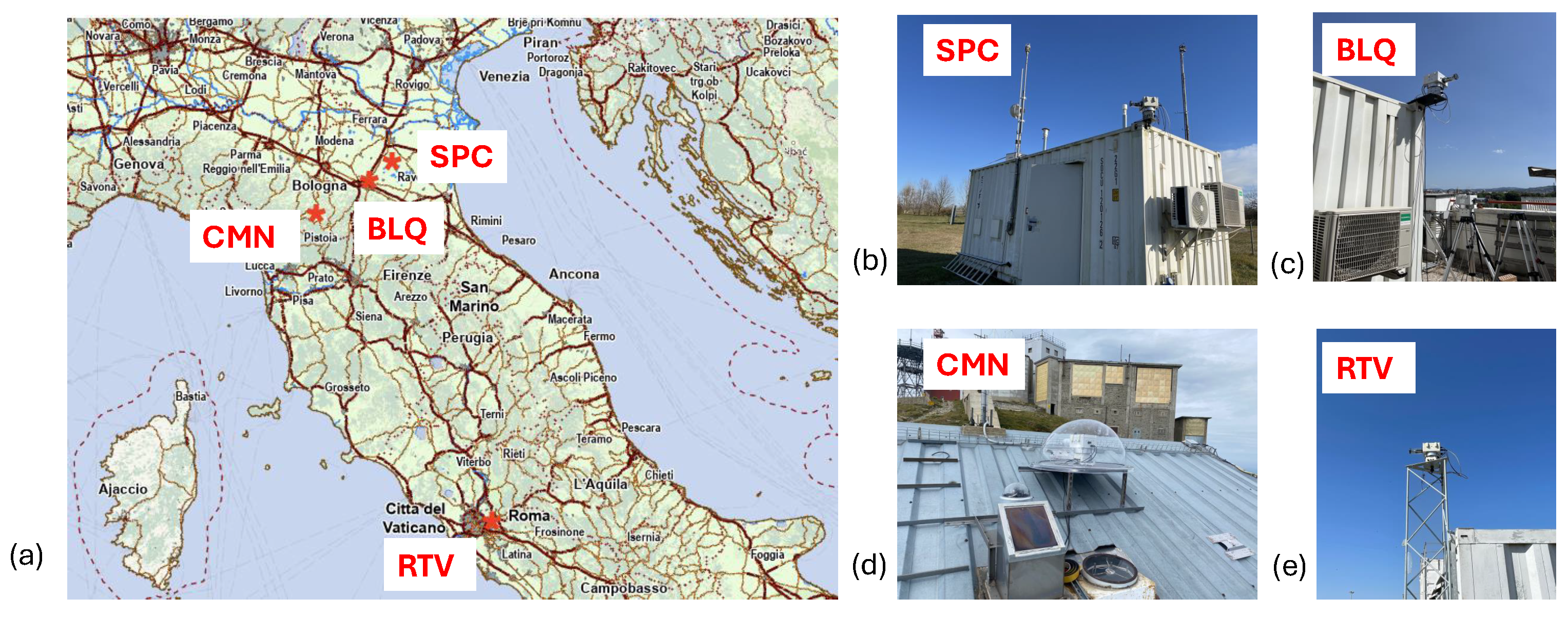
The CNR-ISAC institute can count on a measurement hub based on data from 7 observatories in Italy, covering almost the whole country from North to South. Three of them are located in Northern Italy in the Emilia-Romagna Region: the Atmospheric Composition Observatory at San Pietro Capofiume (SPC, Bologna), the OpenLab BO in Bologna (hereafter BLQ), and the Italian Climate Observatory “Ottavio Vittori”—Po Valley at Mount Cimone (hereafter CMN). In addition, CIRAS (CNR-ISAC Rome Atmospheric Observatory) is located in central Italy in Tor Vergata (Rome, hereafter RTV). Finally, in southern Italy, three observatories can be found: the Environmental Climate Observatory “Rita Atria”—Capo Granitola, the Environmental Climate Observatory—Lamezia Terme, and the Lecce Atmospheric Observatory. Four of these observatories, respectively, SPC, BLQ, CMN, and RTV, have now been equipped with a SkySpec-2D instrument. In Figure 1, we show the location of the four observatories in Italy (Figure 1a) and the mounting set-up of the four SkySpec-2D instruments in the different observatories (Figure 1b–e). At SPC, BLQ, and RTV, we mounted the SkySpec-2D telescope on one of the corners of the shelter, while the spectrometer box and the measuring PC are located inside. At Mount Cimone, due to extreme winter conditions, the SkySpec-2D telescope is mounted inside a poly(methyl methacrylate) (PMMA) dome (Figure 1d).
Figure 1.
(a) Locations of SPC, BLQ, CMN, and RTV observatories in Italy. (b) SkySpec-2D at SPC, (c) SkySpec-2D at BLQ, (d) SkySpec-2D at CMN, (e) SkySpec-2D at RTV.
More details on the four observatories and the SkySpec measuring set-up in terms of viewing azimuth and elevation angles are reported in the following sub-sections.
2.1.1. MAX-DOAS Measurements at San Pietro Capofiume (SPC)
The meteorological station “Giorgio Fea” is located at the rural site of San Pietro Capofiume (BO). SPC is located in the Po Valley, to the northeast of Bologna city. The site is owned by Agenzia Regionale per la Prevenzione, l’Ambiente e l’Energia Emilia Romagna (ARPAE). CNR has collaborated with ARPAE for more than thirty years, implementing continuous measurements and performing field experiments. The site is equipped for online monitoring of gases (sulfur dioxide, ammonia, nitrogen oxides, ozone), particulate matter sampling for atmospheric chemical speciation, continuous speciation of non-refractory chemical species, and measurements of number concentration. ARPAE also runs radar measurements, radio soundings, and operates a phenological station. Support structures for research activities are available at the field station: a chemistry laboratory, Wi-Fi covering the entire area, distribution of electric current through specific towers in different locations across the field, and a two-storey tower suitable for sampling up to 7 m. Because of these characteristics, the site is used for field campaigns in the framework of national and international projects. The site is part of the international network Aerosol, Clouds and Trace gases Research Infrastructure (ACTRIS), and is classified as rural background.
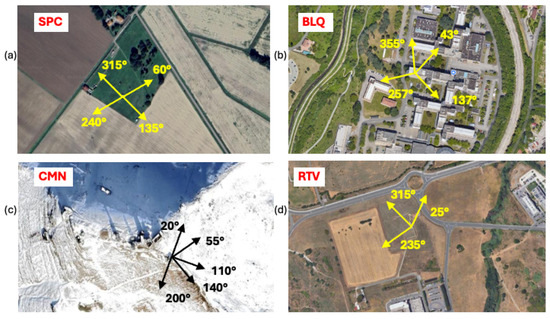
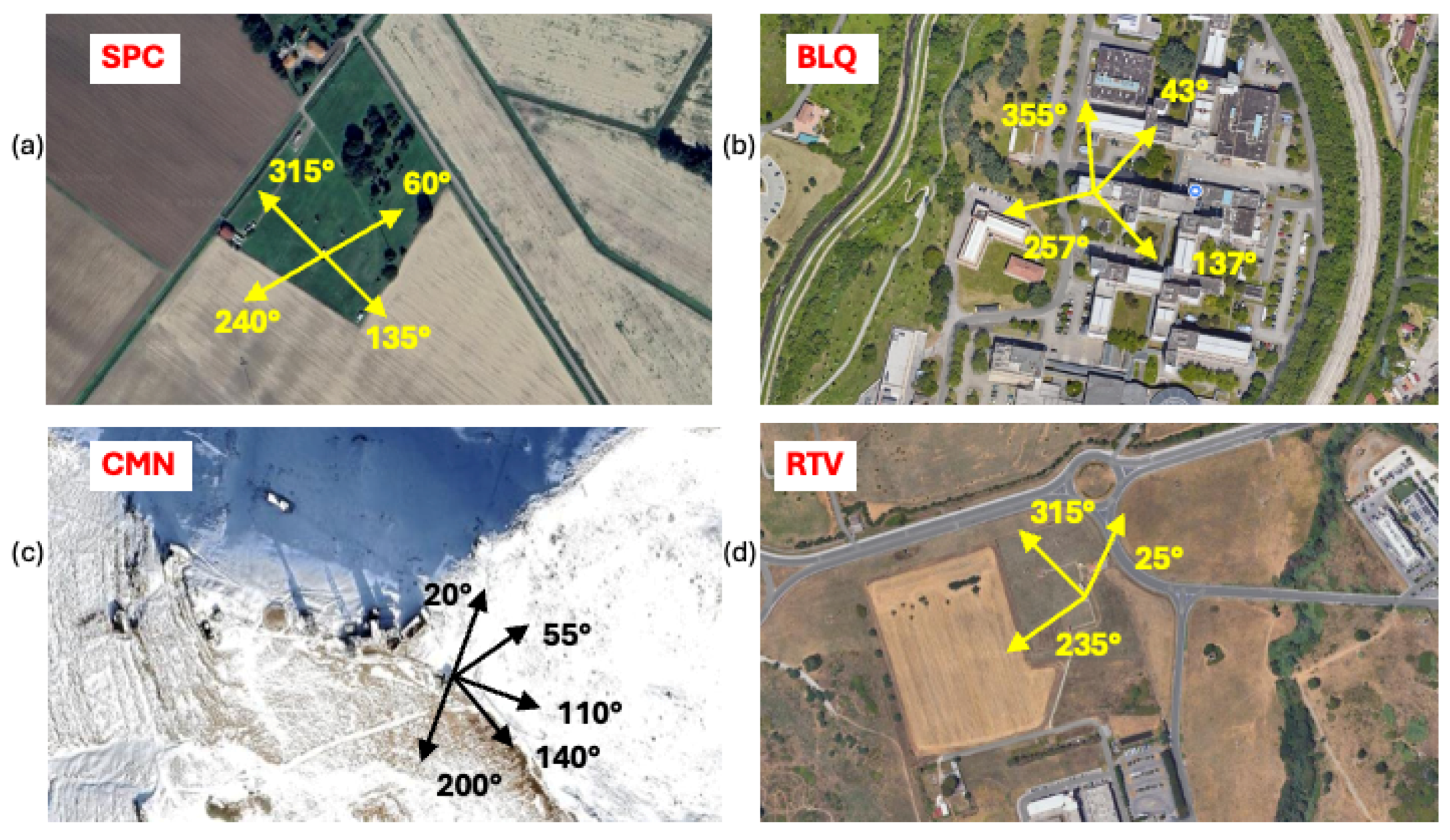
The set-up of the SPC SkySpec-2D system has been thoroughly described in [15,16]. In Figure 2 and Table 1, we report the measuring elevation and azimuth angles. The elevation angles are those indicated in the FRM4DOAS guidelines, while the azimuth directions point towards the internal Po Valley (315°), the Adriatic Sea (60° and 135°), and towards Bologna and the Apennines (240°). The first MAX-DOAS measurements at SPC were acquired in October 2021. However, before the final set-up at SPC, the instrument was used in two intercomparison campaigns: one at BLQ and the other at BAQUNIN at “La Sapienza” University in Rome, as reported in [15].
Figure 2.
(a) Azimuth viewing angles at SPC; (b) Azimuth viewing angles at BLQ; (c) Azimuth viewing angles at CMN, (d) SkySpec-2D at RTV.
Table 1.
Latitude, longitude, altitude, elevation, and azimuth angles, and start day for MAX-DOAS measurements at SPC, BLQ, CMN, and RTV. The measurement azimuth angles have been slightly (a few degrees) changed over time due to new obstacles along the line of sight. The values indicated in the table are the ones used at the time of writing.
2.1.2. MAX-DOAS Measurements in Bologna (BLQ)
The OpenLab BO in Bologna is located on the roof of the CNR-ISAC headquarters (HQ) within the CNR campus in the city’s suburbs. Bologna is located between the Apennine Mountains to the south and the Po Valley to the north. The measurement site is classified as urban background. The A14 motorway, Bologna international airport, and the city centre are located 0.8 km north, 2.6 km west, and 1.7 km south. The facility is part of the ACTRIS-Italy network, and it is hosted in an air-conditioned shelter (15 m2) located on the roof of the CNR-ISAC HQ, equipped with a fast internet connection that allows for real-time data delivery and remote control of instrumentation. Two sampling systems (ACTRIS-compliant) designed for trace gases and aerosol particles are available at the station. Multiple inlets to the sampling systems are available for external users. Three quartz windows (one on the roof, two on the walls) are available for vertical and horizontal remote sensing observations. Host instrumentation is represented by one ozone UV-absorption analyser, one chemiluminescence NOx analyser, and one meteorological station. Within the CNR campus, a measurement facility operated by ARPAE Emilia-Romagna (“Supersito”) is also present.
The BLQ SkySpec-2D was acquired in the frame of a project named Earth Moon Mars (EMM) in 2024. The setup of the SkySpec-2D system is similar to the one in SPC. In this case, the elevation angles are the ones prescribed by the FRM4DOAS community. The azimuth angles point towards the Po Valley (43° and 355°) and Bologna and the Apennines (137° and 257°), see Figure 2b and Table 1. Viewing directions at around 90° and 300° are not usable due to adjacent buildings. First SkySpec-2D measurements in Bologna were acquired in September 2024.
2.1.3. MAX-DOAS Measurements at Mount Cimone (CMN)
The “Ottavio Vittori” observatory at Mount Cimone is a research facility managed by the CNR in collaboration with the Italian Air Force (Centro Aeronautica Militare di Montagna, CAMM). The observatory is located on the top of Mount Cimone, which is the highest peak of the northern Apennines. The mountain lies in the province of Modena, between the Po Valley to the north and the Apennine range stretching through central Italy. It is the only high mountain station for atmospheric research south of the Alps and the Po basin; it represents a strategic platform to study the southern European and Mediterranean basin troposphere and the anthropogenic emissions from the Po basin. At this platform, co-located atmospheric Integrated Carbon Observation System (ICOS) and ACTRIS observations exist. Continuous measurement programmes for aerosol properties (physical/optical properties), trace gases (greenhouse gases and reactive gases), and meteorological parameters are carried out at Mount Cimone. Two sampling systems designed for trace gases and aerosol particles are available at the station. Multiple inlets to the sampling systems are available for external users. The terrace (about 40 m2) is equipped for hosting external experimental activity, and a small chemistry laboratory permits clean handling of collected samples.
Like the BLQ SkySpec-2D, the CMN SkySpec-2D system has been acquired in the frame of the EMM project in 2024. Due to the specific winter meteorological conditions at Mount Cimone (strong winds and ice), we decided to cover the telescope of the Mount Cimone SkySpec-2D system with a poly(methyl methacrylate) (PMMA) dome for the whole winter (October–April). The dome is removed in summer. The dome prevents UV radiation from reaching the instrument, and for this reason, UV measurements are available in summer only. The tests we made to evaluate the possible impact of the dome in the visible range are described in Section 3.2. The CMN SkySpec-2D has an additional elevation angle at 0° with respect to the standard FRM4DOAS set-up since the horizon line is lower than the observatory location. The chosen azimuth directions allow us to measure the radiation coming from Tuscany (140°, 200°) and the Po Valley (20°, 55°, 110°) as reported in Figure 2 panel c and in Table 1.
2.1.4. MAX-DOAS Measurements at Rome Tor Vergata (RTV)
The Rome Tor Vergata Atmospheric Supersite (CIRAS) is a long-term atmospheric observatory operated by CNR-ISAC with contributions from CNR-Istituto di Scienze Marine (ISMAR). It is strategically located in a semi-rural area on the southeastern outskirts of Rome (41.88°N, 12.68°E; 107 m a.s.l.), about 15 km from the city centre and 30 km from the Tyrrhenian Sea. The site is particularly suited to study the interactions between urban pollution, regional background, marine air masses, and long-range transported aerosols such as Saharan dust. CIRAS, together with the urban Boundary-layer Air Quality-analysis Using Network of Instruments (BAQUNIN) site, constitutes the Atmospheric Rome Joint Supersite (ARTE) National Facility within ACTRIS. Continuous measurements of aerosol optical and microphysical properties, trace gases, cloud and precipitation microphysics, boundary-layer dynamics, radiation, and meteorological parameters are performed. The observatory hosts a comprehensive suite of remote-sensing systems, including multi-wavelength lidars, ceilometers, Doppler wind lidar, sun/lunar photometers, broadband radiometers, SODAR, C- and K-band weather radars, and a Ka-band cloud radar. In situ instrumentation includes a scanning mobility particle sizer (SMPS), an aerodynamic particle sizer (APS), optical particle counters (OPCs), condensation particle counters, nephelometers, and aethalometers for detailed aerosol microphysical and chemical characterisation, as well as laser disdrometers and reference pluviometers for the microphysical characterisation of precipitation. CIRAS plays a key role in satellite product validation and contributes to international and national networks (ACTRIS, AERONET, SKYNET, E-PROFILE, the automated lidar-ceilometer (ALC) network (ALICEnet), Gruppo Italiano Disdrometria (GID)), providing a strategic platform for investigating atmospheric processes in the Mediterranean region.
The RTV SkySpec-2D system was acquired in the summer of 2021. The instrument measures at the standard FRM4DOAS elevation angles (Table 1) with observing azimuth angles towards Rome city (315°) and the motorway (235°) as in Figure 2d.
The RTV SkySpec-2D took part in two intercomparison campaigns in 2024. The first took place in March 2024 at the BAQUNIN premises at “La Sapienza” University in Rome. In this campaign, three UV–VIS instruments, the SkySpec-2D, a Pandora, and an NO2 camera, measured the same air masses with the aim of assessing the NO2 camera performance. The results of NO2 slant column densities (SCDs), reported in [18], highlight the good performance of the SkySpec-2D against both the NO2 camera and the Pandora. The second campaign, CINDI-3, was held in May–June 2024 in Cabauw, the Netherlands, aiming at the intercomparison of DOAS-type instruments [19]. This campaign was performed in the frame of FRM4DOAS activities; the possibility of participating in this exercise was of particular importance to assess the performance of our instrument with respect to the ones used in the FRM4DOAS network as a reference for satellite validation. In this case as well, the performance of the RTV SkySpec-2D was in line with the other instruments.
Due to the good performance of the RTV SkySpec-2D system in these campaigns, and, in particular, in CINDI-3, we decided to use this instrument as our “reference” and to evaluate the performance of all the other instruments composing the network against it in a dedicated intercomparison campaign. The results of this intercomparison are reported in Section 3.
2.2. MAX-DOAS Automatic Data Processing Chain
All the spectra acquired by the SkySpec-2D systems in all four observatories undergo the same automatic processing chain.
The main steps of this chain are described in this section. More details can be found in [20].
We start by describing the different types of measurements performed by the system every day: three different kinds of measurements are performed (calibration spectra, atmospheric spectra, and horizon scans) in accordance with FRM4DOAS requirements.
- The calibration spectra are automatically measured every night, starting when the sun is 10° below the horizon. These spectra are essential to correct the atmospheric spectra for instrument effects and consist of offset and dark current measurements (to be removed from the spectra) plus measurements of emission lines of an Hg lamp mounted inside the instrument (used to perform the spectra wavelength calibration).
- The atmospheric spectra start to be acquired every morning when the Solar Zenith Angle (SZA) becomes lower than 94°. At the beginning of the day, the SkySpec-2D acquires only zenith-sky spectra. Then, when the SZA becomes lower than 85°, it performs MAX-DOAS measurement scans. During the day, the acquisition system automatically avoids measuring when the instrument viewing direction is close to the sun position (less than 5°).
- Horizon scans allow us to assess the pointing stability of the SkySpec-2D, which is very important for reliable MAX-DOAS measurements. In each of the used azimuth directions, VIS and UV spectra are acquired within an elevation angle range of 3, with a step of 0.2. This measurement strategy is applied twice, the first from −3 to +3 (upwards) and the second from +3 to −3 (downwards), in order to assess whether there are systematic differences in the telescope movements. These measurements are used as a diagnostic.
The spectra recorded on the measurement PC inside the shelter are automatically downloaded every 5 min to the server at CNR premises for processing.
All the downloaded spectra are recorded in binary format and need to be converted into the FRM4DOAS NetCDF format. First, an automatic tool reads the binary format, applies the wavelength and intensity (counts) calibration (via subtraction of offset and dark current, and correction for sensor non-linearity), and then writes the spectra in NetCDF format. One NetCDF file per day is created for the UV and VIS channels separately. Although only the SPC spectra are provided to the FRM4DOAS network for centralised processing, all the spectra for all the observatories are converted into this format to ease possible future inclusion into the network.
The spectra are then analysed using the QDOAS version 3.4.6 (https://uv-vis.aeronomie.be/software/QDOAS/ (accessed on 12 March 2025)) software to retrieve gaseous dSCDs and their errors due to the fit. For the QDOAS analysis of the zenith-sky DOAS measurements, we use fixed reference spectra, one for each station. All the steps used to obtain total vertical column densities from zenith-sky DOAS spectra are reported in [15] and include the evaluation of the SCD contribution to the reference spectra via the Langley plot method and the air mass factor (AMF) calculation. For the QDOAS analysis of the MAX-DOAS spectra, we use the corresponding zenith-sky measurement as the reference spectrum for each scan. The QDOAS set-up used in the analysis is reported in [15]. Aerosol extinction and gaseous tropospheric profiles are retrieved from these O4 and gaseous dSCDs, used as inputs for the DEAP code. All the details on the DEAP analysis can be found in [16]. We recall here that DEAP is an Optimal Estimation (OE) algorithm [21] developed at CNR-ISAC that, by exploiting the SCIATRAN code [22] as a forward model, can retrieve tropospheric vertical profiles from MAX-DOAS measurements.
The outputs of the code are aerosol extinction and gaseous profiles obtained from each sequence of MAX-DOAS elevation angles for each day. Cloud and convergence quality flags are applied to the retrieved profiles as in [16]. The automatic post-processing tool calculates the tropospheric VCDs and aerosol optical depth (AOD) from these files. Plots are produced for each azimuth direction as in Section 3.3 or at https://doas.isac.cnr.it/live-monitoring/ (accessed on 28 July 2025).
The final format of the files is the Generic Earth Observation Metadata Standard (GEOMS), which is the HDF5 format implemented in the ESA Validation Data Centre (EVDC, https://evdc.esa.int (accessed on 28 October 2025)) data portal. This format has been adopted by EVDC because it is a clearly defined (meta) data format, making the information in the data comparable to other datasets, and because standard metadata helps operational centres collect relevant information directly from the database in a uniform way.
NO2 tropospheric VCDs and AOD obtained with the DEAP code using spectra from the four observatories can be downloaded from https://doi.org/10.82214/doas-8w35 (accessed on 3 December 2025).
2.3. Sentinel-5P TROPOMI NO2 VCDs
One of the main applications of DOAS and MAX-DOAS measurements is the validation of satellite products. As an example of the exploitation of the NO2 tropospheric VCDs retrieved from our ground-based instruments, we compare our products to the ones obtained by TROPOMI. TROPOMI has been flying onboard the Sentinel-5P satellite (ascending node 13:30) since October 2017. It measures from the UV to the short-wave infrared (SWIR) spectral region at a spatial resolution of 3.5 × 7 (5.5) km2, exploiting four separate spectrometers. The Sentinel-5P TROPOMI products are described in [9,23]. As in [15], we use the OFFL NO2 products [24,25], considering only data with a combined quality assurance value (qa_value) higher than 0.75 [25]. As coincidence criteria, we considered (averaging them) Sentinel-5P TROPOMI data within a radius of 5 km around the SPC, BLQ, and RTV sites and MAX-DOAS data within ±15 min of the Sentinel-5P TROPOMI overpass [16].
3. Results
In this section, we report the results of the network intercomparison campaign we performed in summer 2024, together with some examples of NO2 profile-retrievals for one day and a comparison with TROPOMI data for one year.
3.1. Network Intercomparisons with the “Reference” RTV SkySpec-2D Instrument
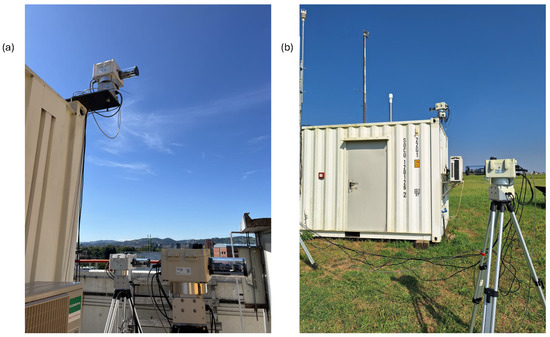
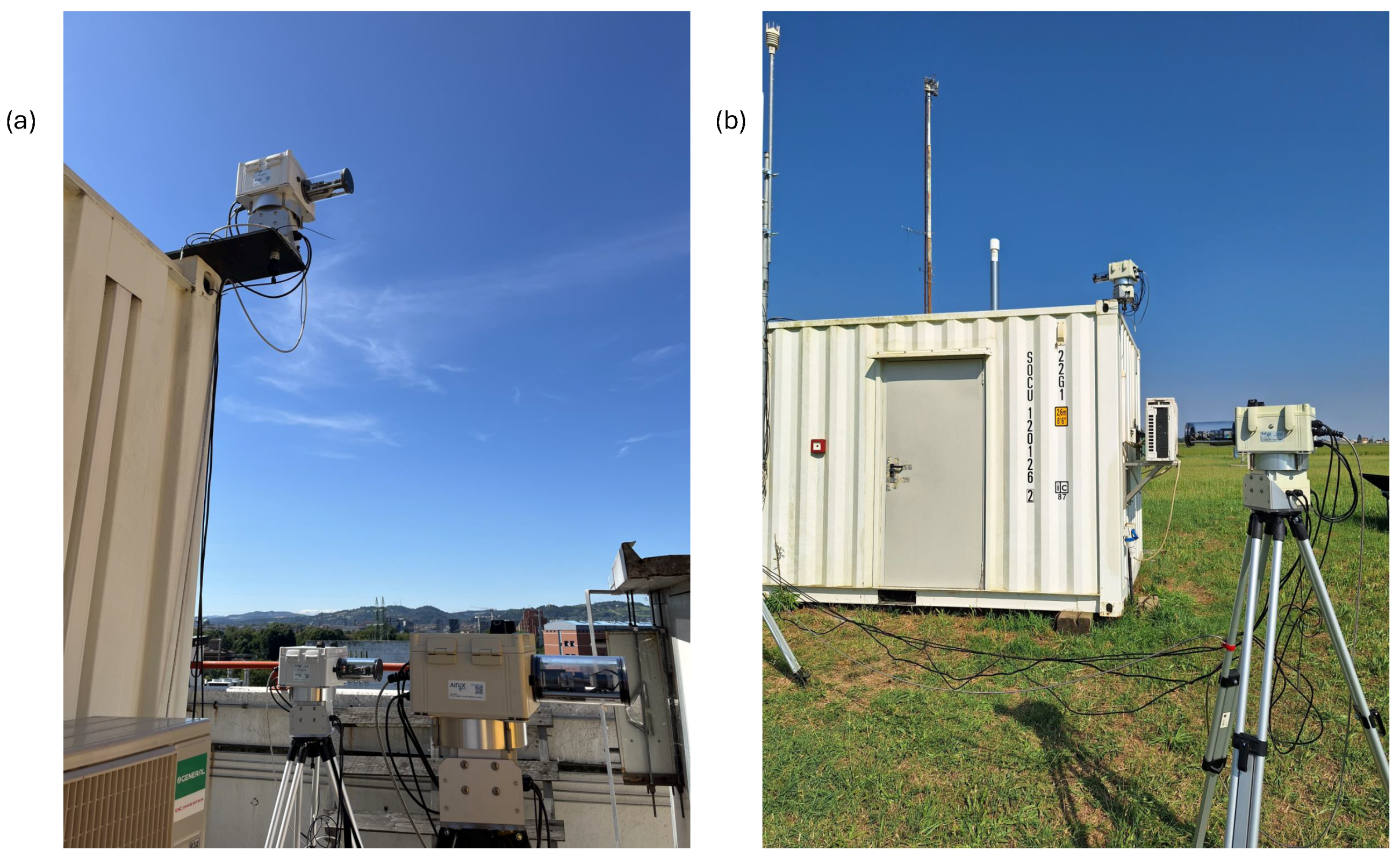
The RTV SkySpec-2D returned to Italy after the CINDI-3 campaign in June 2024. Before sending it back to RTV, we used it to perform an intercomparison campaign against the other instruments present in the network. This exercise aimed to highlight possible differences in the final products due to different instrument performances. The campaign was conducted in two phases: the first at BLQ, where the BLQ, CMN, and RTV SkySpec-2D SCDs were compared, and the second at SPC, where the same comparison was conducted between RTV and the SPC SkySpec-2D. As can be seen in Figure 3a, at BLQ, we had the possibility of using two SkySpec-2D systems on two tripods for better alignment between the two instruments. We measured in different configurations and then compared the obtained SCDs when the two telescopes were at the same altitude. At SPC, this was not possible (Figure 3b), since the SPC instrument provided the spectra to the FRM4DOAS network and we preferred not to vary its configuration (e.g., lowering the telescope).
Figure 3.
(a) BLQ, CMN, and RTV SkySpec-2D at BLQ during the intercomparison campaign; (b) RTV and SPC SkySpec-2D at SPC during the intercomparison campaign.
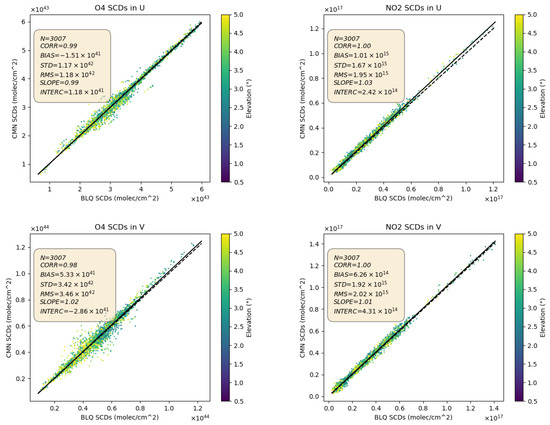
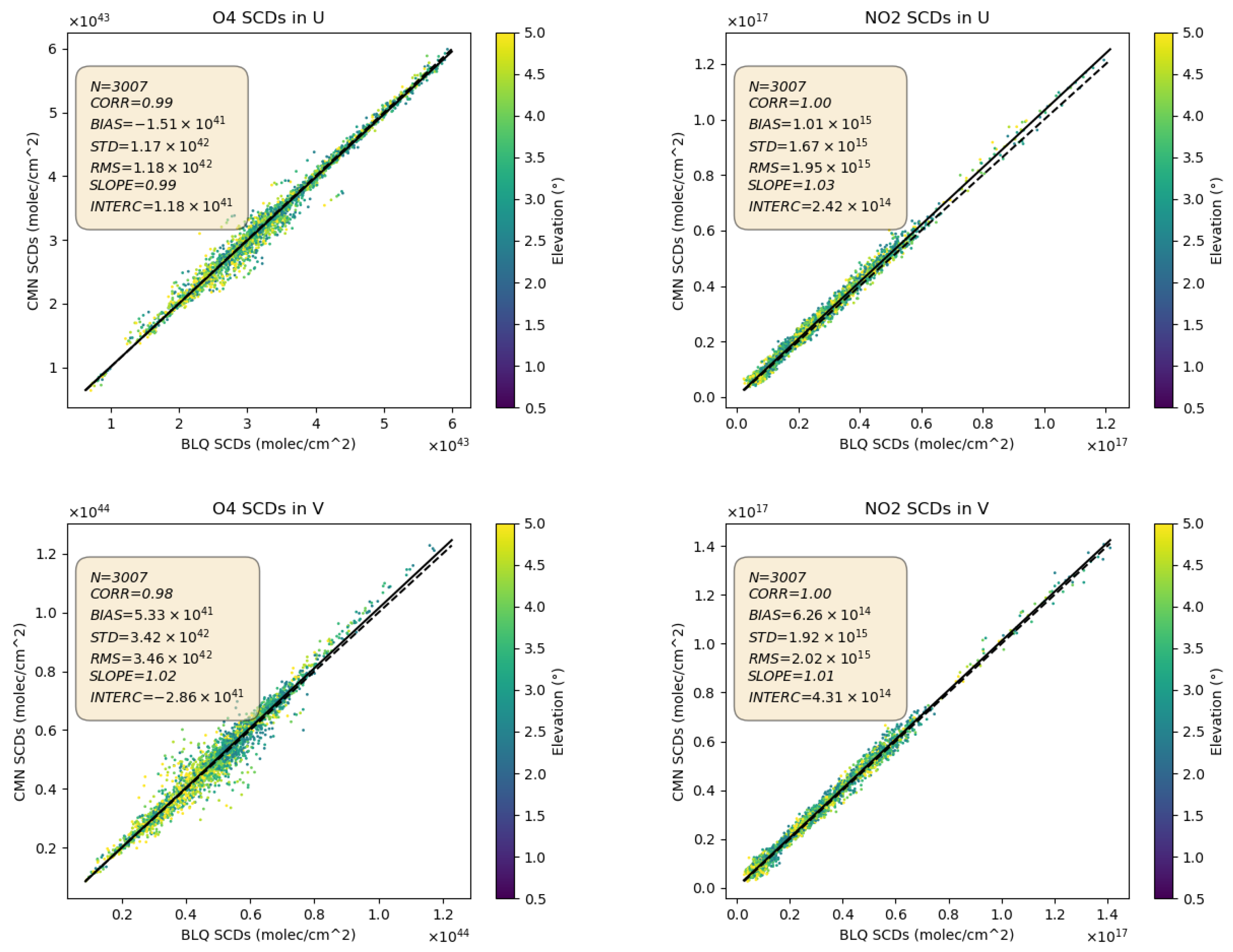
The first tests we performed were between the two newer systems, the BLQ and CMN SkySpec-2D. Since the main products are aerosol extinction and NO2 profiles in the troposphere, we decided to concentrate on the O4 and NO2 SCDs obtained from both the UV and VIS spectra in an elevation range that is usable for profile retrievals (e.g., above the horizon). To perform this test, we decided to use the same approach adopted in [18]: a part of the scene was scanned simultaneously with sampling steps of 0.5° in elevation (from 2.5° to 5° to avoid obstacles) and steps of 1° in azimuth between 160° and 200°. Coincident SCDs (same elevation and azimuth and within 1 min) from two SkySpec-2D systems were compared. This comparison is shown in Figure 4 for the time period from 3 to 17 June 2024. The colours represent the different elevation angles. We have a total of 3007 points, with very high correlations (between 0.98 and 1.00) and slopes near 1 (from 0.99 to 1.03). The biases for NO2 are very low (about 0.4%) and consistent with the standard deviation (STD). The same applies to O4 with much lower biases. The performance of the two newer SkySpec-2D systems is, thus, equivalent.
Figure 4.
O4 (left column) and NO2 (right column) scatter plots in the UV (top row) and VIS (bottom row) spectral ranges of the coincident BLQ and CMN SCDs from 2.5° to 5° elevation angles, for the period from 3 to 17 June 2024 and azimuth angles from 160° to 200°.
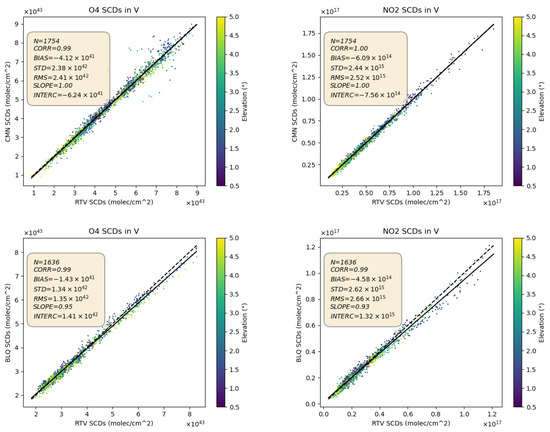
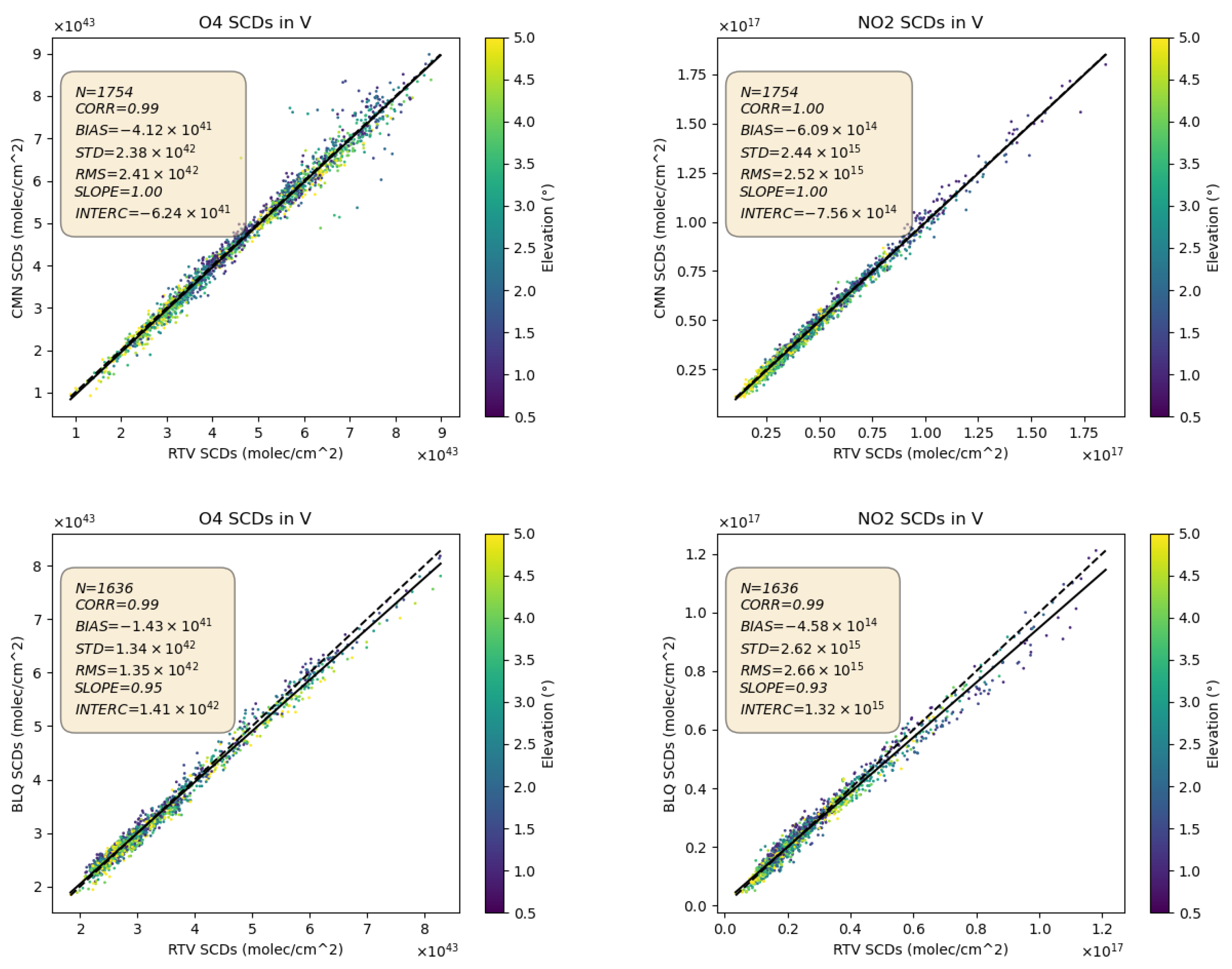
To assess their quality with respect to the reference instrument, we repeated the same exercise for RTV against CMN and RTV against BLQ SkySpec-2D. Similar results were obtained for both UV and VIS spectral ranges. From this point onwards, the comparisons were not performed in azimuth scenes as before; instead, we used fixed azimuth directions. This made the simultaneous measurements easier. As an example of these results, in Figure 5, we show the scatterplots of the coincident SCDs for O4 and NO2 in the VIS for CMN (top row) and BLQ (bottom row) at 12° azimuth and elevations from 1° to 5°, recorded between 30 June and 10 July 2024. Extremely high correlations (0.99–1.0) are obtained with a slope close to 1 (0.93–1.0) and small biases for both molecules. Similar results are obtained in the UV spectral range. These tests highlight the consistency of the BLQ, CMN, and RTV SkySpec-2D instruments for measuring SCDs.
Figure 5.
O4 (left column) and NO2 (right column) scatter plots in the VIS spectral ranges of the coincident RTV and CMN (top row) and BLQ (bottom row) SCDs from 1° to 5° elevation angles, for the period from 30 June to 4 July 2024 for CMN and from 7 to 10 July 2024 for BLQ, at an azimuth angle of 12°.
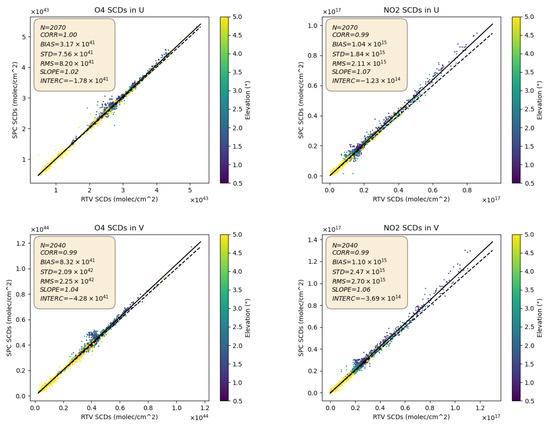
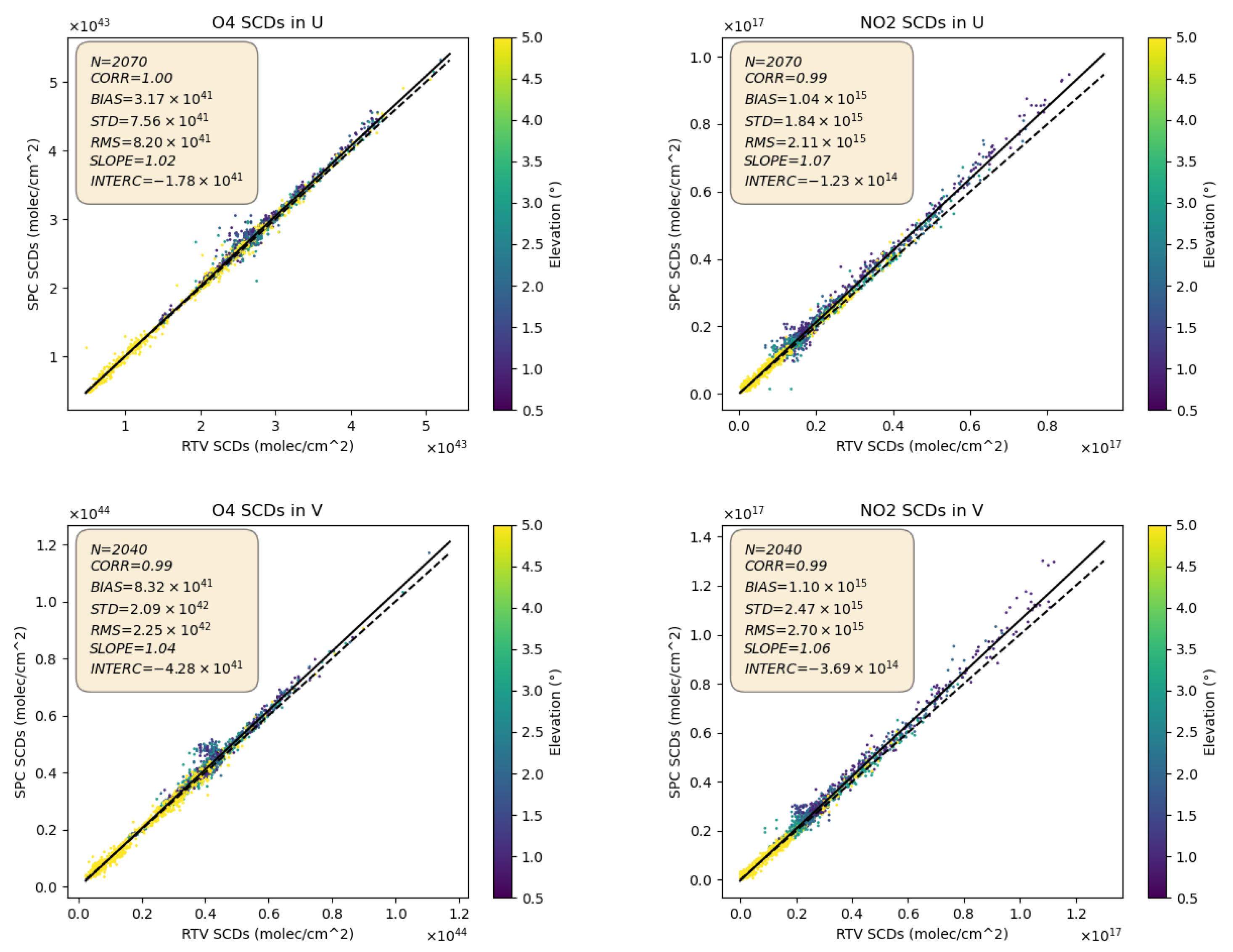
In the second phase of the campaign, we moved the RTV SkySpec-2D to SPC. As said, since the SPC SkySpec-2D provides the spectra to the FRM4DOAS network, and we did not have the possibility of mounting the RTV SkySpec-2D telescope on the roof of the SPC shelter, this comparison was performed with the telescope not aligned, as in Bologna, but with the SPC one on the top of the shelter and the RTV one on the tripod on the ground, resulting in a 2–3 m difference in altitude. The results of the comparison of the retrieved SCDs for coincident spectra recorded at 135° azimuth during the period from 12 to 16 July 2024 are shown in the scatterplots of Figure 6 in the UV and VIS spectral ranges. Also in this case, a high correlation (0.99–1.0) is obtained with a slope slightly higher than 1 (1.02–1.07).
Figure 6.
O4 (left column) and NO2 (right column) scatter plots in the UV (top row) and VIS (bottom row) spectral ranges of the coincident RTV and SPC SCDs from 1° to 5° elevation angles, for the period from 12 to 16 July 2024 at an azimuth angle of 135°.
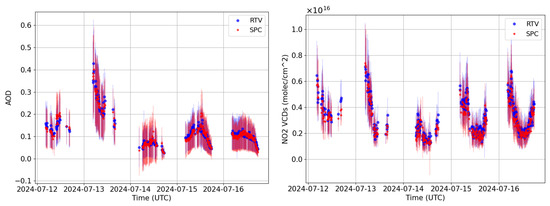
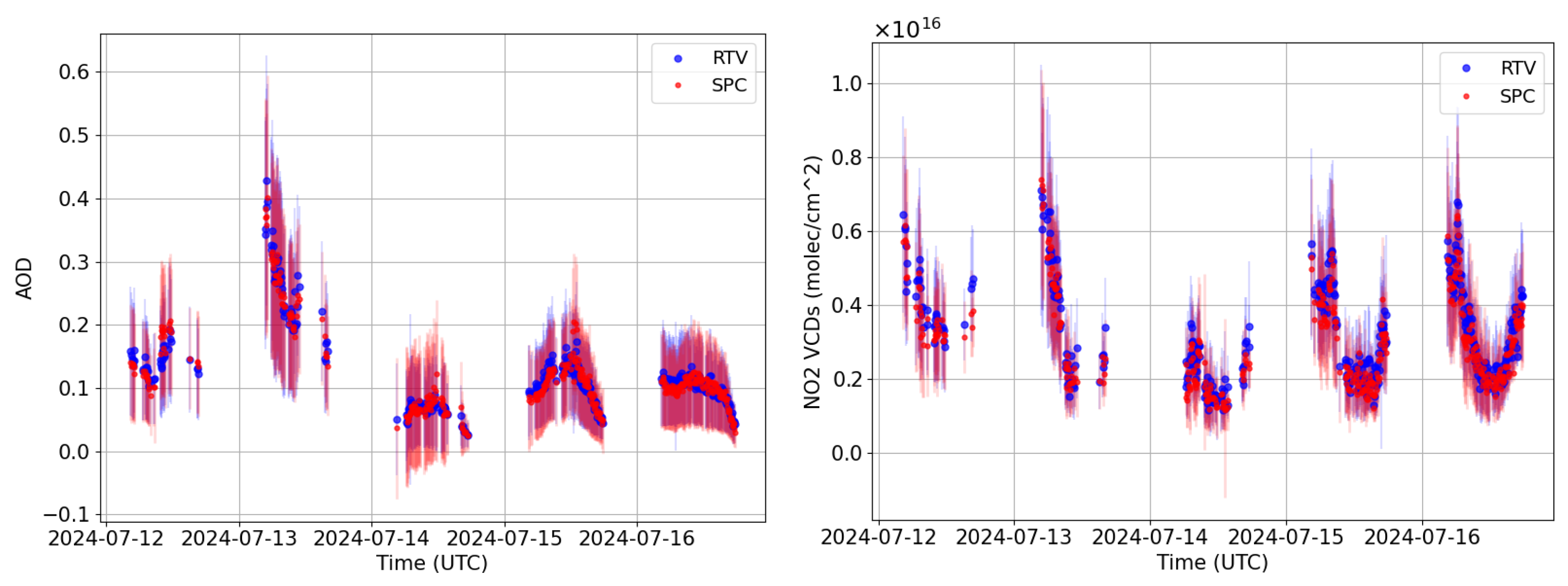
A further test was performed on these SCDs to investigate the possible impact of these small differences on the retrieved AOD and tropospheric NO2 VCDs, which are the final outputs of our chain. We retrieved the aerosol extinction and NO2 profiles for the five days of the campaign using the DEAP code, calculated the AOD and tropospheric VCDs, and then compared the results from the two instruments. The outcomes of this exercise are reported in Figure 7. As can be seen, all the high-resolution structures are reproduced in the same way by the two instruments, and the retrieved values are fully consistent within the error bars. In most cases, the points can hardly be distinguished. The correlations between the two instruments are 0.97 for AOD and 0.95 for NO2 VCDs.
Figure 7.
AOD and NO2 tropospheric VCDs from 12 to 16 July 2024 at SPC retrieved from SPC (red) and RTV (blue) SkySpec-2D measurements. Vertical shading represents retrieval errors.
The final outcome of the campaign is that all the CNR-ISAC network instruments have similar performance, and no effects due to the use of different instruments can be found in the retrieved products.
3.2. Investigating Possible Dome Effects on CMN Measurements
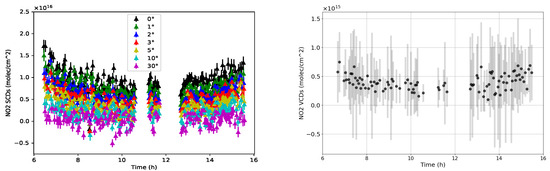
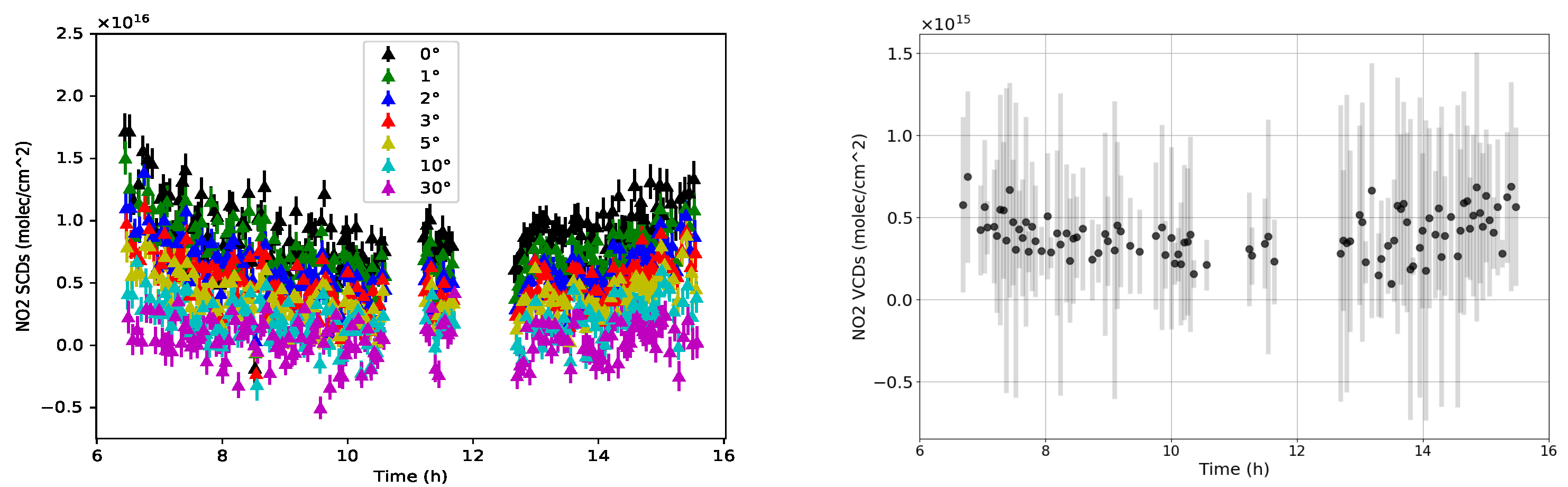
The ISAC network intercomparison campaign shows that all the instruments have similar performance. However, differences in the products may arise if the instruments are operated under different mounting conditions. In particular, as described in Section 2, at CMN, the winter conditions are very challenging for the SkySpec-2D telescope due to ice formation and strong winds. In order to avoid using the instrument only in the summer months, we decided to cover the telescope with a PMMA dome during the winter months. The PMMA prevents the UV radiation from reaching the instrument, producing an almost total loss of our UV spectra. On the other hand, the PMMA has high transparency in the VIS. To evaluate possible effects on the VIS spectra, on 30 October 2024, we performed some tests with and without the dome. In particular, two elevation scans in every used azimuth direction were measured without the dome around 11:30 UTC. The left panel of Figure 8 shows the resulting NO2 SCDs for the VIS channel at all elevation angles from 0° to 30°. The SCD scan in the middle of the day without the dome does not show any particular differences with respect to the other SCDs (with the dome). For this reason, we do not expect any impact on the retrieved VCDs. Moreover, NO2 tropospheric VCDs retrieved from those SCDs are reported in Figure 8 (right panel). No particular behaviour is highlighted when the dome is removed. Averaging all the VCDs retrieved from measurements without the dome (over a 20 min time frame), we get 3.38 × 10¹⁴ molec/cm2 ± 2.62 × 10¹⁴ molec/cm2. The same average performed in the 20 min before the dome removal produces an average VCD of 3.61 × 10¹⁴ molec/cm2 ± 2.51 × 10¹⁴ molec/cm2. In the 20 min after the dome is again replaced to protect the telescope, we get 4.7 × 10¹⁴ molec/cm2 ± 2.71 × 10¹⁴ molec/cm2. These averages and standard deviations are all consistent, evidencing no difference when using or not using the dome. Thus, we can conclude that using the dome in winter has no particular effect on the retrieved VCDs from the visible SkySpec-2D channel, while the UV channel becomes unusable. The dome was removed on 30 May 2025.
Figure 8.
NO2 SCDs from 0° to 30° elevation (left panel) and NO2 tropospheric VCDs obtained on 30 October 2024 from CMN with and without the protecting dome mounted on the SkySpec-2D telescope (right panel). Vertical shading represents retrieval errors. The measurements around 11:30 are the ones without the dome.
3.3. Examples of Retrieved NO2 Profiles and Tropospheric VCDs from the Network and Satellite Intercomparisons
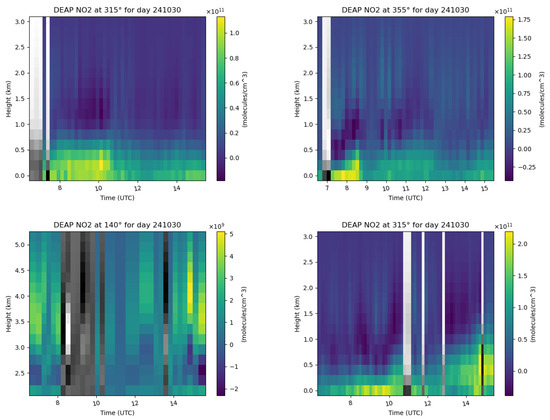
We have assessed that all the network instruments have the same performance. In this section, we will give some examples of the products and results that are obtainable from these instruments. An example of the retrieved NO2 profiles in the four observatories for 30 October 2024 is reported in the four panels of Figure 9. The grey colour scale is used for profiles filtered out a posteriori due to cloud effects or non-convergence of the retrieval (filtering criteria can be found in [16]). The cloud filtering is performed by exploiting the colour index approach, calculating the ratio between the average radiance computed in the wavelength interval 410–415 nm and the one in the interval 545–550 nm. The retrieved profiles are marked as cloudy if either the zenith measurement from the relative MAX-DOAS scan, used as a reference for the QDOAS analysis, is cloudy, or if clouds are detected along the off-axis lines of sight in the examined direction. The threshold between clear and cloudy has been calculated through the use of a radiative transfer model. As can be seen, SPC, BLQ, and RTV share a common retrieval grid, while, due to the mountain location of CMN, the CMN profiles extend from 2 to 5 km. Further information on the profile-retrieval grid can be found in [16].
Figure 9.
NO2 profiles on 30 October 2024 from SPC at 315° (top left panel), BLQ at 355° (top right panel), CMN at 140° (bottom left), and RTV at 315° (bottom right).
The colour scale (indicating the NO2 concentration) at SPC, BLQ, and RTV is similar, while the one at CMN is much lower. This is due to the fact that, since CMN is located at about 2 km altitude, most of the troposphere where higher NO2 concentrations are below the CMN SkySpec-2D horizon. On this day, SPC, BLQ, and RTV NO2 concentrations are higher near the ground in the first part of the morning. At RTV, higher concentrations are reached towards the end of the day.
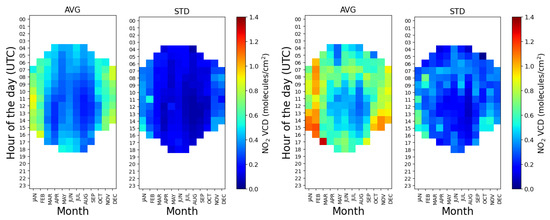
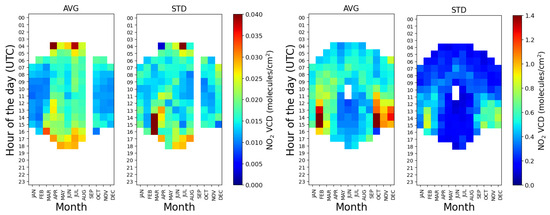
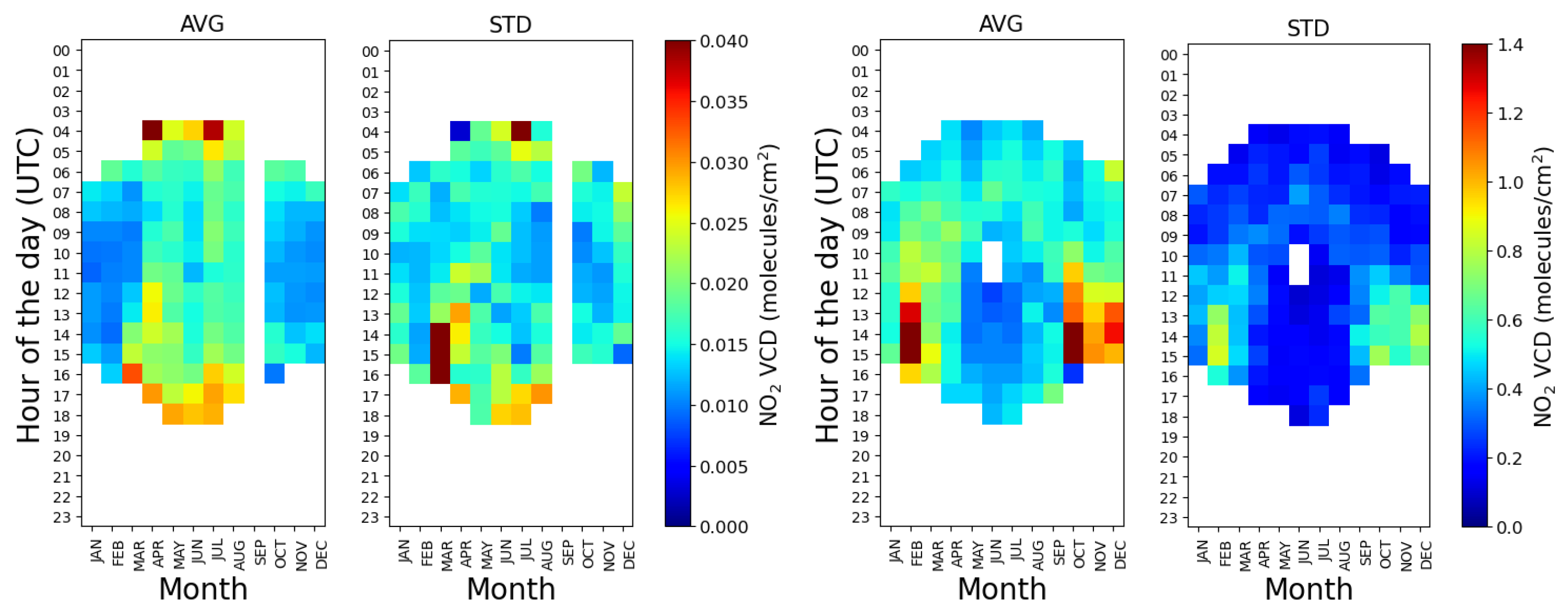
The DEAP retrieved profiles are then integrated in the vertical domain to obtain the tropospheric columns. In Figure 10 and Figure 11, we report the average NO2 tropospheric VCDs as a function of month and hours of the day, together with their standard deviations. Averages are calculated over one year of data covering the period from 1 September 2024 to 31 August 2025. These kinds of plots give us a complete overview of the datasets over the day and the months. As can be seen, the SPC dataset has the smoothest behaviour, with higher values in winter almost constantly through the day. The BLQ dataset shows a similar behaviour, although slightly higher values with respect to SPC are found, particularly in the afternoon. As at SPC, lower values are present in summer, although some enhancement is visible around 7–8 UTC in the morning compared with SPC. The same behaviour is observed in the RTV dataset, with slightly higher values in the evening. The CMN dataset, instead, shows a really different seasonality with respect to the other datasets. As can be seen in Figure 11, the VCDs and corresponding standard deviations are much smaller than those at the other observatories (note the different range of the colour scale); moreover, the values appear lower in winter and higher in spring and summer. This is due to the mountain location of this observatory, which prevents measurements in the lower part of the troposphere, where NO2 concentrations are higher, as already said. The observed behaviour is in line with the planetary boundary layer (PBL) height, which is higher in summer and lower in winter, thus enhancing NO2 concentration during the warmer months.
Figure 10.
Average NO2 tropospheric VCDs (×1016) retrieved from SkySpec-2D at SPC as a function of month and hour of the day, together with their standard deviations (×1016) on the left. The same is shown on the right for BLQ.
Figure 11.
Average NO2 tropospheric VCDs (×1016) retrieved from SkySpec-2D at CMN as a function of month and hour of the day (note that MAX-DOAS measurements at CMN started in October 2024), together with their standard deviations (×1016) on the left. The same is shown on the right for RTV.
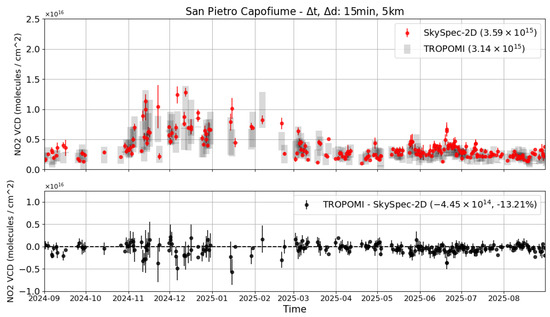
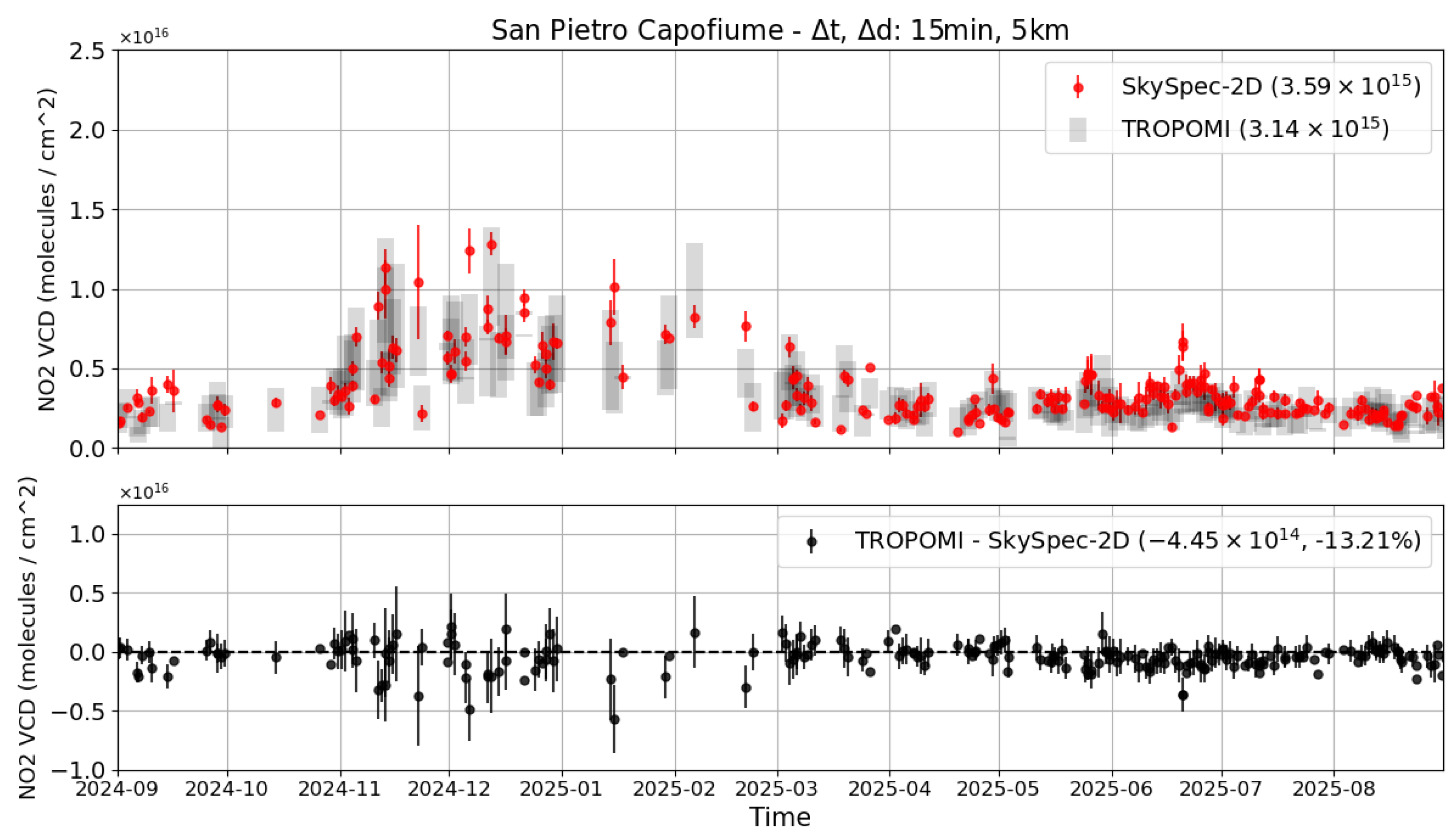
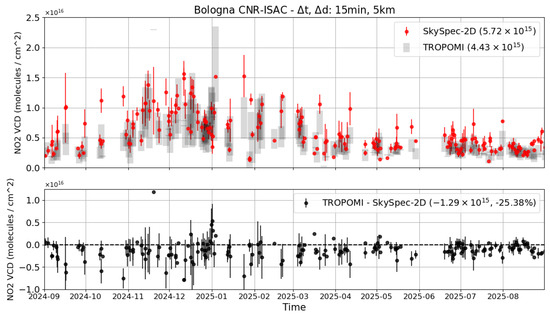
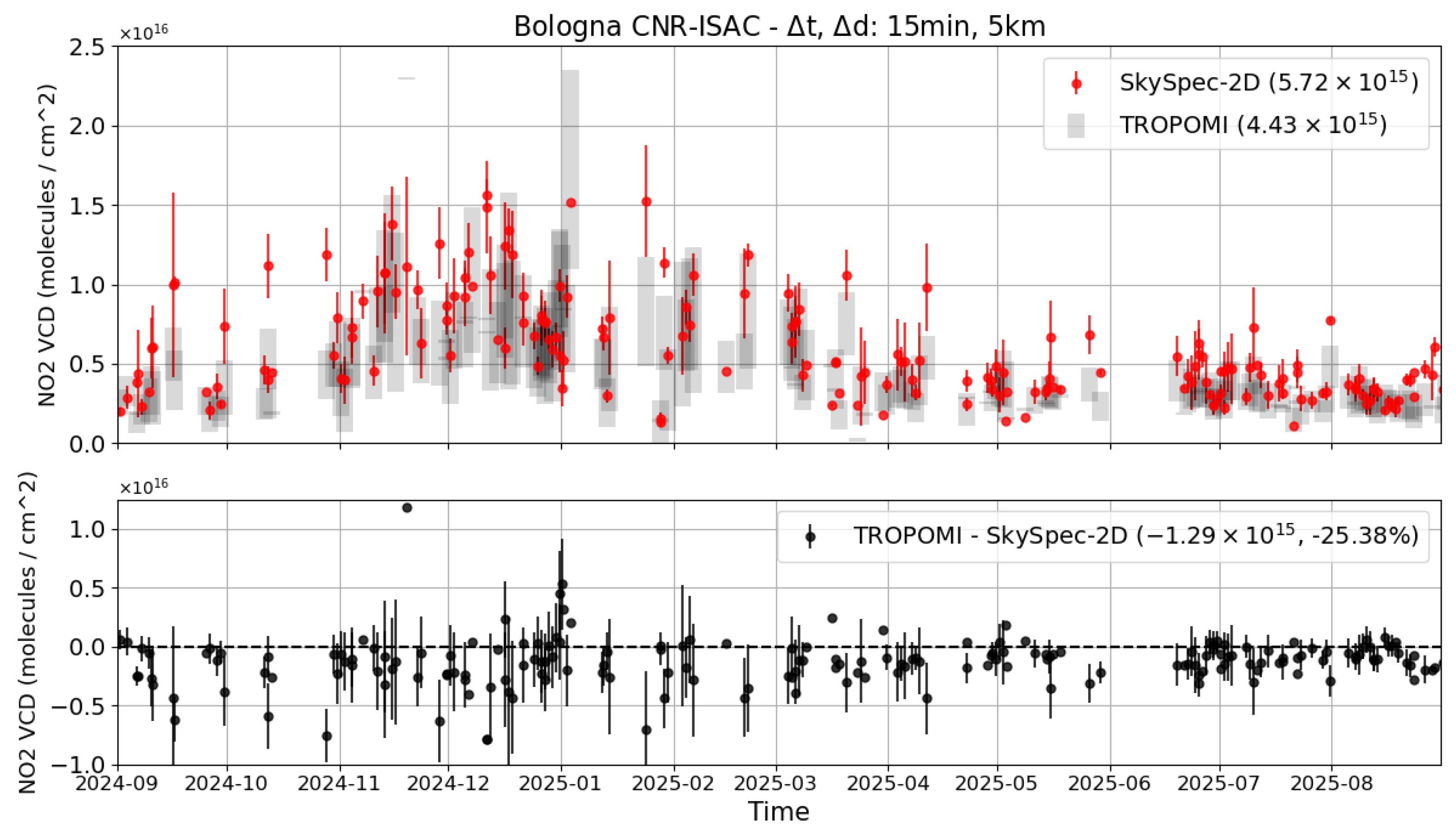
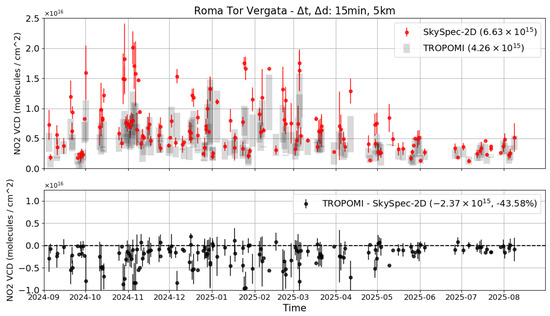
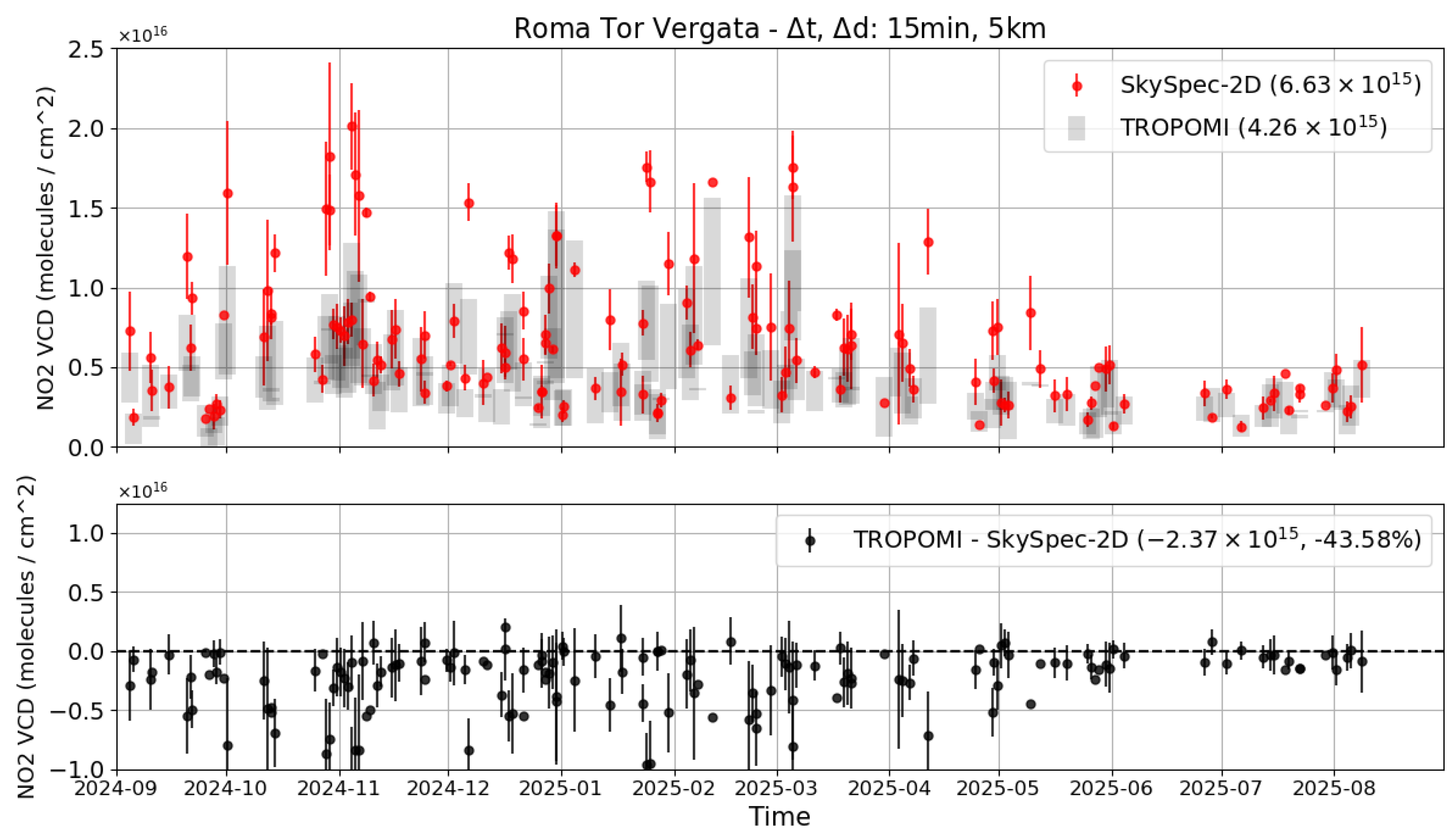
As demonstrated by the FRM4DOAS project, the tropospheric NO2 VCDs from MAX-DOAS measurements can be considered a fiducial reference dataset for the validation of tropospheric VCDs from satellites. Data gaps in the time series are due to either SkySpec-2D cloudy data or TROPOMI data that do not pass the quality check reported in Section 2.3. Figure 12, Figure 13 and Figure 14 show the results of the intercomparison between coincident (see the coincidence criteria in Section 2) SkySpec-2D and TROPOMI NO2 VCDs for SPC, BLQ, and RTV. For TROPOMI, we used v2.6 from 1 September 2024 to 7 September 2024, then v2.7 from 7 September 2024 to 16 November 2024, when v2.8 became available. The comparison highlights generally good results, with better agreement at SPC than at BLQ and RTV. This is due to the more uniform atmospheric scenario in the rural area of the Po Valley than that observed at BLQ, in the urban background, and at RTV, close to Rome city and main routes. This can be observed when performing the comparison with TROPOMI, separating the MAX-DOAS measurements by azimuth direction (Table 2). At RTV, the bias is −33% at 25° azimuth, −51% at 235° azimuth, and −46% at 315° azimuth. The same happens in BLQ, where the directions towards the Po Valley (43° and 355°) show a lower bias (around −18%) than the directions towards the Bologna city centre (137° and 257°), where the bias is respectively −27% and −32%. SPC, by contrast, shows a more uniform behaviour with small variations in the bias (from −10% to −13%).
Figure 12.
NO2 tropospheric VCDs at SPC from SkySpec-2D and TROPOMI. TROPOMI data are represented as grey shaded rectangles; the box extension represents the TROPOMI average values ± their standard deviations for each coincidence. SkySpec-2D error bars also represent the standard deviations of the data in coincidence with TROPOMI, while the dots represent the average values.
Figure 13.
NO2 tropospheric VCDs at BLQ from SkySpec-2D and TROPOMI. TROPOMI data are represented as grey shaded rectangles; the box extension represents the TROPOMI average values ± their standard deviations for each coincidence. SkySpec-2D error bars also represent the standard deviations of the data in coincidence with TROPOMI, while the dots represent the average values.
Figure 14.
NO2 tropospheric VCDs at RTV from SkySpec-2D and TROPOMI. TROPOMI data are represented as grey shaded rectangles; the box extension represents the TROPOMI average values ± their standard deviations for each coincidence. SkySpec-2D error bars also represent the standard deviations of the data in coincidence with TROPOMI, while the dots represent the average values.
Table 2.
Bias of TROPOMI against coincident SkySpec-2D NO2 tropospheric columns as a function of azimuth angle in SPC, BLQ, and RTV.
Despite this, SPC and BLQ present a very similar seasonality, with higher values in winter and lower values in spring/summer due to the high stability of winter conditions. BLQ values are higher than those at SPC due to the proximity of Bologna city and motorways.
RTV still shows higher values in winter, but with much higher day-to-day variability.
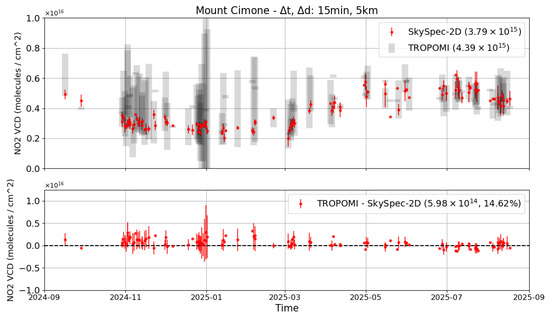
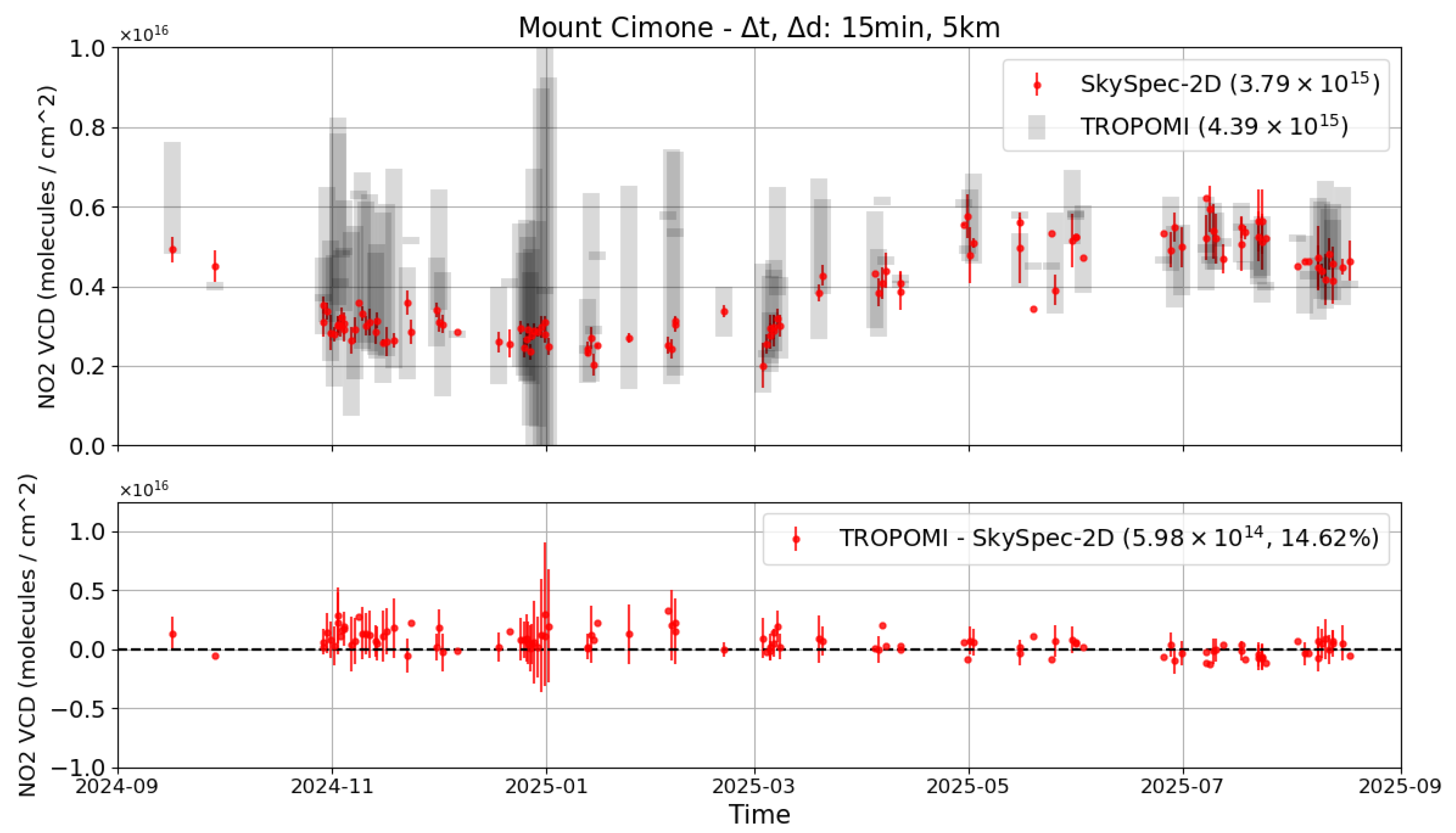
CMN tropospheric VCDs cannot be compared to those obtained by TROPOMI at CMN. This is due to the fact that the NO2 retrieved by TROPOMI in its pixel is not comparable to that obtained by the CMN SkySpec-2D on the top of the mountain. In fact, the TROPOMI pixel centred around CMN also includes scenarios with higher NO2 concentrations due to the lower elevation of regions surrounding the top of Mount Cimone, where CMN is located. However, the NO2 total columns obtained by zenith-sky CMN SkySpec-2D measurements can be used for comparison with those from TROPOMI. In Figure 15, we report the comparison between CMN SkySpec-2D NO2 total columns and those from TROPOMI. We find good agreement between the two columns, with TROPOMI slightly (15%) higher than SkySpec-2D. As can be seen, the seasonal behaviour shows higher values in spring and summer due to the stratospheric NO2 seasonality. The dome was removed on 30 May 2025; no impact is clearly visible in the SkySpec-2D time series, or in the difference relative to TROPOMI before and after this date, confirming the findings of Section 3.2.
Figure 15.
NO2 total VCDs at CMN from SkySpec-2D and TROPOMI. TROPOMI data are represented as grey shaded rectangles; the box extension represents the TROPOMI average values ± their standard deviations for each coincidence. SkySpec-2D error bars also represent the standard deviations of the data in coincidence with TROPOMI, while the dots represent the average values.
4. Discussion
The availability of CNR-ISAC observatories distributed along the Italian peninsula opens the possibility of measuring NO2 and other gaseous concentrations involved in air quality monitoring and research studies. The use of the same instruments and procedures in all the observatories is the first step to guarantee common performance across a network of instruments. However, instrument-to-instrument differences affecting performance are still possible.
In order to evaluate this impact, intercomparison campaigns are valuable tools. In the DOAS community, an example is the CINDI campaigns organised in the frame of the FRM4DOAS project to compare the performance of the instruments available for satellite validation. In the process of setting up a new network, the possibility of comparing the different instrument performance with respect to a “reference” instrument was exploited. We used the RTV SkySpec-2D, which joined the CINDI-3 campaign with good results, for this scope. For this task, we used coincident SCDs for the comparison, as was done in CINDI-3. In fact, the spectra are measured in arbitrary units (varying from one instrument to another), and since in the DOAS methodology there is no need for intensity calibration, the SCDs are a good choice for the comparison. The comparison of coincident SCDs revealed good agreement between the different instruments, with correlation values ranging from 0.98 to 1 and slopes from 0.93 to 1.06 when compared to the reference. These results were also confirmed by the agreement between SPC and RTV AOD and NO2 tropospheric VCDs retrieved from coincident SCDs measured between 12 and 16 July 2024 at SPC. Another aspect that may introduce differences in instrument performance is the mounting set-up. All the instruments of the network are mounted in the same way (telescope on a shelter), apart from the CMN one, which, during winter, has the telescope covered by a PMMA dome. The dome makes the UV channel unusable but has no evident effects on the visible channel. This can be seen not only from Figure 8 when we remove the dome for a couple of scans during one day, but also in Figure 11, where no differences in the NO2 tropospheric VCD distribution can be seen after the removal of the dome on 30 May 2025. The same can be seen in Figure 15, where, relative to TROPOMI, no evidence of a change in performance is visible after this date.
All these results confirm that all the products from the network have the same performance and that no instrumental/set-up bias is present.
The peculiar characteristic of each observatory can be evinced from the example results we reported in this work. For a single day (Figure 9), differences can be seen in the hourly and altitude distribution of NO2 at different sites. When looking at the one-year overview of the NO2 tropospheric VCD dataset (Figure 10 and Figure 11), slightly different behaviour can be observed. SPC shows very smooth hourly and seasonal behaviour (also confirmed by the STD). BLQ shows a similar behaviour but with greater scatter (as shown by the STD) and higher NO2 values. In addition, in the morning at around 7–8 UTC, depending on the season, a peak becomes visible, possibly suggesting anthropogenic production related to rush hours. A similar peak is also observed at the other urban background site of RTV. At CMN, the seasonal behaviour is opposite, with higher NO2 values in spring and summer and lower values in winter, highlighting the relevance of the contribution of Po Valley NO2 concentrations in the first two km of the PBL. Also, the comparison with TROPOMI data, in Figure 12, Figure 13 and Figure 14, emphasises the importance of using sites with different characteristics for satellite validation. If we observe the bias of TROPOMI against SkySpec-2D, we can see that the bias varies from −13% at SPC, where the average NO2 VCDs are 0.36 × 10¹⁶ molec/cm2, to −25% at BLQ where the average NO2 VCDs are 0.57 × 10¹⁶ molec/cm2, and to −44% at RTV, where the NO2 VCDs are 0.66 × 10¹⁶ molec/cm2. As already reported in other works [26], the negative bias is more evident in polluted regions and especially in cities than in rural sites. This is also confirmed by our network data, where BLQ and RTV are urban background stations, while SPC is a rural background.
In Italy, the importance of DOAS measurements for monitoring key air pollutants such as SO2 and NO2, has been highlighted in [27], where MAX-DOAS measurements were used to estimate ship plumes, and in [28], where DOAS measurements from Bologna were used to investigate the effects of the limitations introduced during the COVID-19 outbreaks on air quality. In both studies, the instrument used was the CNR-ISAC custom-made, research-grade tropospheric gas analyser spectrometer (TROPOGAS, [29]), which was also used in [15] for the comparison with the SPC SkySpec-2D at BLQ. The TROPOGAS was based in BLQ from 2016 to spring 2024, when it had a major and fatal failure. In this context, the BLQ SkySpec-2D was intended to continue the TROPOGAS work. The same consideration applies to the CMN SkySpec-2D. As reported in [30], the first DOAS system developed at CNR-ISAC and named Gas Analyser Spectrometer Correlating Optical Differences (GASCOD) was installed at CMN in August 1993 and measured for more than 20 years, up to 2015, providing valuable results. The CMN SkySpec-2D aims to continue its legacy.
5. Conclusions
This work presents a MAX-DOAS network compliant with FRM4DOAS requirements in Italy. We presented the set-up of the measurements in each of the four observatories that host the MAX-DOAS instrumentation, as well as the intercomparison campaign and the bias estimation we performed in order to account for differences coming from instruments and/or mounting set-up (e.g., the possible PMMA dome effects in winter at CMN). We concluded that none of these effects affect our measurements and thus all instruments perform in the same way. The intercomparison with respect to a “reference” instrument (part of the network) that took part in two independent campaigns, one against a Pandora and an NO2 camera and the other in the FRM4DOAS CINDI-3 campaign, assessing its good performance, demonstrates the quality of the network for both scientific studies and satellite validation.
We reported in this work some examples of the obtainable products, highlighting the potential of this network not only for air quality studies but also in the context of satellite validation. Due to the complexity of the Italian territory in the Mediterranean hotspot area, these data are a valuable contribution to satellite validation, also in light of forthcoming missions such as Copernicus Sentinel-4 and Sentinel-5 and the Copernicus Anthropogenic Carbon Dioxide Monitoring constellation (CO2M).
Author Contributions
Conceptualisation, E.C., E.P., P.P. and M.V.; formal analysis, A.A., P.P., E.C. and E.P.; data curation, E.C. and P.P.; writing—original draft preparation, E.C., P.P., M.V., A.B., F.P., L.D.L., F.C. and E.P.; writing—review and editing, A.A., P.P., E.C., E.P. and M.V.; visualisation, M.V., P.P., E.C. and E.P.; project administration, E.C. All authors have read and agreed to the published version of the manuscript.
Funding
The SPC SkySpec-2D system has been acquired under the project “Sviluppo delle Infrastrutture e Programma Biennale degli Interventi del Consiglio Nazionale delle Ricerche—Potenziamento Infrastrutturale: progetti di ricerca strategici per l’ente. Progetto 32—ASSE NORD Pianura Padana Mt. Cimone, Bologna, San Pietro Capofiume”. The RTV SkySpec-2D system was acquired under the project “Sviluppo delle Infrastrutture e Programma Biennale degli Interventi del Consiglio Nazionale delle Ricerche–Potenziamento Infrastrutturale: progetti di ricerca strategici per l’ente. Progetto 5—ASSE CENTRO”. The BLQ and CMN SkySpec-2D were acquired in the frame of the Earth-Moon-Mars (EMM) project, led by INAF in partnership with ASI and CNR, funded under the National Recovery and Resilience Plan (NRRP), Mission 4, Component 2, Investment 3.1: “Fund for the realisation of an integrated system of research and innovation infrastructures”—Action 3.1.1 funded by the European Union—NextGenerationEU. The DEAP code was developed under the project IDEAS-QA4EO WPs-2250-2251: “DOAS-BO: Towards a new FRM4DOAS-compliant site” SERCO-IDEAS-QA4EO-BO/SUB27 CCN 007-IDEAS-QA4EO—Quality Assurance For Earth Observation—QA4EO/SER/SUB/27 CCN7, Instrument Data quality Evaluation and Assessment Service—Quality Assurance for Earth Observation (IDEAS-QA4EO) contract funded by ESA-ESRIN (n. 4000128960/19/I-NS). Part of the research activities described in this paper was carried out with the contribution of the Next Generation EU funds within the National Recovery and Resilience Plan (PNRR), Mission 4—Education and Research, Component 2—From Research to Business (M4C2), Investment Line 3.1—Strengthening and creation of Research Infrastructures, Project IR0000038—“Earth Moon Mars (EMM)”. Paolo Pettinari, Alessandro Bracci, and Ferdinando Pasqualini were supported by the project IR0000032—ITINERIS, Italian Integrated Environmental Research Infrastructures System (D.D. no. 130/2022 CUP B53C22002150006) funded by the EU (Next Generation EU PNRR Mission 4 “Education and Research”, Component 2 “From research to business”, Investment 3.1—Fund for the realisation of an integrated system of research and innovation infrastructures.
Data Availability Statement
All the NO2 tropospheric VCDs used in this work acquired by SkySpec-2D and retrieved with DEAP can be downloaded from https://doi.org/10.82214/doas-8w35 (accessed on 3 December 2025). Single NO2 profiles are available upon request from the authors. TROPOMI data are available through https://dataspace.copernicus.eu (accessed on 12 March 2025).
Acknowledgments
The authors gratefully acknowledge Francescopiero Calzolari, Claudio Campenni, Spartaco Ciampichetti, and Fabrizio Roccato from CNR-ISAC for their technical support with SkySpec-2D. The authors acknowledge the DOAS UV–VIS team at BIRA-IASB, led by M. Van Roozendael, for QDOAS, and the SCIATRAN developers. SCIATRAN can be downloaded from https://www.iup.uni-bremen.de/sciatran/ (accessed on 12 March 2025).
Conflicts of Interest
Author Massimo Valeri is employed by Serco Italia S.p.A.The remaining authors declare that the research was conducted in the absence of any commercial or financial relationships that could be construed as a potential conflict of interest.
Abbreviations
The following abbreviations are used in this manuscript:
| ACTRIS | Aerosol, Clouds and Trace Gases Research Infrastructure |
| AERONET | Aerosol Robotic Network |
| ALICEnet | automated lidar-ceilometer (ALC) network |
| AOD | Aerosol Optical Depth |
| APS | Aerodynamic Particle Sizer |
| ARPAE | Agenzia Regionale per la Prevenzione, l’Ambiente e l’Energia Emilia Romagna |
| ARTE | Atmospheric Rome Joint Supersite |
| BAQUNIN | Boundary layer Air Quality-analysis Using Network |
| box-AMFs | box-air mass factors |
| BLQ | Bologna |
| CAMM | Centro Aeronautica Militare di Montagna |
| CMN | Mount Cimone |
| CNR-ISAC | Consiglio Nazionale delle Ricerche-Istituto di Scienze dell’Atmosfera e del Clima |
| DEAP | DOAS optimal estimation atmospheric profile |
| DOAS | differential optical absorption spectroscopy |
| ESA | European Space Agency |
| EVDC | ESA Validation Data Centre |
| FRM4DOAS | Fiducial Reference Measurements for Ground-Based DOAS |
| GASCOD | Gas Analyser Spectrometer Correlating Optical Differences |
| GEOMS | Generic Earth Observation Metadata Standard |
| GID | Gruppo Italiano Disdrometria |
| ICOS | Integrated Carbon Observation System |
| MAX-DOAS | multi-axis-DOAS |
| MTG-S | Meteosat Third Generation-Sounder |
| OE | optimal estimation |
| OPCs | optical particle counters |
| PBL | planet boundary layer |
| PMMA | poly(methyl methacrylate) |
| CIRAS | Rome Tor Vergata Atmospheric Supersite |
| RTV | Roma Tor Vergata |
| SCD | slant column density |
| SMPS | scanning mobility particle size |
| SPC | San Pietro Capofiume |
| STD | standard deviation |
| SZA | solar zenith angle |
| SWIR | short-wave infrared |
| TROPOGAS | tropospheric gas analyser spectrometer |
| TROPOMI | TROPOspheric Monitoring Instrument |
| UV | ultraviolet |
| UVN | ultraviolet–visible–near-infrared |
| VCDs | vertical column densities |
| VIS | visible |
References
- Liu, S.; Valks, P.; Pinardi, G.; Xu, J.; Chan, K.L.; Argyrouli, A.; Lutz, R.; Beirle, S.; Khorsandi, E.; Baier, F.; et al. An improved TROPOMI tropospheric NO2 research product over Europe. Atmos. Meas. Tech. 2021, 14, 7297–7327. [Google Scholar] [CrossRef] [Scilit]
- Vîrghileanu, M.; Savulescu, I.; Mihai, B.A.; Nistor, C.; Dobre, R. Nitrogen Dioxide (NO2) Pollution Monitoring with Sentinel-5P Satellite Imagery over Europe during the Coronavirus Pandemic Outbreak. Remote Sens. 2020, 12, 3575. [Google Scholar] [CrossRef] [Scilit]
- Timmermans, R.; Segers, A.; Curier, L.; Abida, R.; Attié, J.L.; El Amraoui, L.; Eskes, H.; de Haan, J.; Kujanpää, J.; Lahoz, W.; et al. Impact of synthetic space-borne NO2 observations from the Sentinel-4 and Sentinel-5P missions on tropospheric NO2 analyses. Atmos. Chem. Phys. 2019, 19, 12811–12833. [Google Scholar] [CrossRef] [Scilit]
- Serio, C.; Masiello, G.; Cersosimo, A.A. NO2 pollution over selected cities in the Po valley in 2018-2021 and its possible effects on boosting COVID-19 deaths. Heliyon 2022, 8, e09978. [Google Scholar] [CrossRef] [Scilit] [PubMed]
- Bassani, C.; Vichi, F.; Esposito, G.; Falasca, S.; Di Bernardino, A.; Battistelli, F.; Casadio, S.; Iannarelli, A.; Ianniello, A. Characterization of Nitrogen Dioxide Variability Using Ground-Based and Satellite Remote Sensing and In Situ Measurements in the Tiber Valley (Lazio, Italy). Remote Sens. 2023, 15, 3703. [Google Scholar] [CrossRef] [Scilit]
- Sun, K.; Li, L.; Jagini, S.; Li, D. A satellite-data-driven framework to rapidly quantify air-basin-scale NOx emissions and its application to the Po Valley during the COVID-19 pandemic. Atmos. Chem. Phys. 2021, 21, 13311–13332. [Google Scholar] [CrossRef] [Scilit]
- Tonion, F.; Pirotti, F. SENTINEL-5P NO2 Data: Cross-Validation and Comparison with Ground Measurements. Int. Arch. Photogramm. Remote Sens. Spatial Inf. Sci 2022, 43, 749–756. [Google Scholar] [CrossRef] [Scilit]
- Di Bernardino, A.; Mevi, G.; Iannarelli, A.; Falasca, S.; Cede, A.; Tiefengraber, M.; Casadio, S. Temporal Variation of NO2 and O3 in Rome (Italy) from Pandora and In Situ Measurements. Atmosphere 2023, 14, 594. [Google Scholar] [CrossRef] [Scilit]
- Veefkind, J.P.; Aben, I.; McMullan, K.; Forster, H.; de Vries, J.; Otter, G.; Claas, J.; Eskes, H.J.; de Haan, J.F.; Kleipool, Q.; et al. TROPOMI on the ESA Sentinel-5 Precursor: A GMES mission for global observations of the atmospheric composition for climate, air quality and ozone layer applications. Remote Sens. Environ. 2012, 120, 70–83. [Google Scholar] [CrossRef] [Scilit]
- Hendrick, F.; Müller, J.F.; Clémer, K.; Wang, P.; De Mazière, M.; Fayt, C.; Gielen, C.; Hermans, C.; Ma, J.; Pinardi, G.; et al. Four years of ground-based MAX-DOAS observations of HONO and NO2 in the Beijing area. Atmos. Chem. Phys. 2014, 14, 765–781. [Google Scholar] [CrossRef] [Scilit]
- Wagner, T.; Dix, B.v.; Friedeburg, C.v.; Frieß, U.; Sanghavi, S.; Sinreich, R.; Platt, U. MAX-DOAS O4 measurements: A new technique to derive information on atmospheric aerosols—Principles and information content. J. Geophys. Res. Atmos. 2004, 109, D22205. [Google Scholar] [CrossRef] [Scilit]
- Hönninger, G.; Von Friedeburg, C.; Platt, U. Multi axis differential optical absorption spectroscopy (MAX-DOAS). Atmos. Chem. Phys. 2004, 4, 231–254. [Google Scholar] [CrossRef] [Scilit]
- Wang, Y.; Lampel, J.; Xie, P.; Beirle, S.; Li, A.; Wu, D.; Wagner, T. Ground-based MAX-DOAS observations of tropospheric aerosols, NO 2, SO 2 and HCHO in Wuxi, China, from 2011 to 2014. Atmos. Chem. Phys. 2017, 17, 2189–2215. [Google Scholar] [CrossRef] [Scilit]
- Van Roozendael, M.; Hendrick, F.; Friedrich, M.; Fayt, C.; Bais, A.; Beirle, S.; Bösch, T.; Navarro Comas, M.; Friess, U.; Karagkiozidis, D.; et al. Fiducial Reference Measurements for Air Quality Monitoring Using Ground-Based MAX-DOAS Instruments (FRM4DOAS). Remote Sens. 2024, 16, 4523. [Google Scholar] [CrossRef] [Scilit]
- Pettinari, P.; Castelli, E.; Papandrea, E.; Busetto, M.; Valeri, M.; Dinelli, B.M. Towards a New MAX-DOAS Measurement Site in the Po Valley: NO2 Total VCDs. Remote Sens. 2022, 14, 3881. [Google Scholar] [CrossRef] [Scilit]
- Castelli, E.; Pettinari, P.; Papandrea, E.; Premuda, M.; Achilli, A.; Richter, A.; Bösch, T.; Hendrick, F.; Fayt, C.; Beirle, S.; et al. Towards a New MAX-DOAS Measurement Site in the Po Valley: Aerosol Optical Depth and NO2 Tropospheric VCDs. Remote Sens. 2025, 17, 1035. [Google Scholar] [CrossRef] [Scilit]
- Kuhn, L.; Beirle, S.; Osipov, S.; Pozzer, A.; Wagner, T. NitroNet: A machine learning model for the prediction of tropospheric NO2 profiles from TROPOMI observations. Atmos. Meas. Tech. 2024, 17, 6485–6516. [Google Scholar] [CrossRef] [Scilit]
- Gramme, P.; Busschots, C.; Dekemper, E.; Pieroux, D.; Baker, N.C.; Casadio, S.; lannarelli, A.M.; Ferrante, N.; Di Bernardino, A.; Pettinari, P.; et al. Urban pollution monitoring with the AOTF-based NO2 camera: Validation with other DOAS instruments. Atmos. Meas. Tech. 2025, 18, 6021–6037. [Google Scholar] [CrossRef] [Scilit]
- Van Roozendael, M.; Apituley, A.; Kreher, K.; Alves Gouveia, D.; Cede, A.; Friess, U.; Friedrich, M.M.; Spinei Lind, E.; Merlaud, A.; Piters, A.; et al. Overview of the Third Cabauw Intercomparison of UV-Vis DOAS instruments (CINDI-3). In Proceedings of the EGU General Assembly 2025, Vienna, Austria, 27 April–2 May 2025. [Google Scholar] [CrossRef] [Scilit]
- Pettinari, P.; Valeri, M.; Papandrea, E.; Castelli, E.; Di Liberto, L.; Marinoni, A.; Decesari, S. Report on the MAX-DOAS Analysis Chain. Technical Report. 2023. Available online: https://zenodo.org/records/10033174 (accessed on 23 February 2026).
- Rodgers, C.D. Inverse Methods for Atmospheric Sounding: Theory and Practice; World Scientific: Singapore, 2000; Volume 2. [Google Scholar]
- Rozanov, V.; Rozanov, A.; Kokhanovsky, A.A.; Burrows, J. Radiative transfer through terrestrial atmosphere and ocean: Software package SCIATRAN. J. Quant. Spectrosc. Radiat. Transf. 2014, 133, 13–71. [Google Scholar] [CrossRef] [Scilit]
- KNMI. Sentinel 5 precursor/TROPOMI KNMI and SRON level 2 Input Output Data Definition. Technical Report S5PKNMI-L2-0009-SD, Koninklijk Nederlands Meteorologisch Instituut (KNMI), 2024. Issue 20.0.0. Available online: https://sentiwiki.copernicus.eu/__attachments/1673595/S5P-KNMI-L2-0009-SD%20-%20Sentinel-5P%20Level%202%20Input%20Output%20Data%20Definition%202024%20-%2020.0.0.pdf?inst-v=4318c067-be91-4544-be2e-16af66246c9f (accessed on 23 February 2026).
- Loyola, D.; Lutz, R.; Argyrouli, A.; Spurr, R. S5P/TROPOMI ATBD Cloud Products. S5P-DLR-L2-ATBD-400I Issue 2.2. Technical Report. 2020. Available online: https://sentiwiki.copernicus.eu/__attachments/1673595/S5P-DLR-L2-ATBD-400I%20-%20Sentinel-5P%20TROPOMI%20ATBD%20Clouds%202021%20-%202.3.pdf?inst-v=eb3ebc83-2add-4c9e-b1a4-216e51171ba4 (accessed on 23 February 2026).
- Eskes, H.; van Geffen, J.; Folkert, B.; Kai-Uwe, E.; Arnoud, A.; Mattia, P.; Maarten, S.; Pepijn, V.J.; Loyola, D. Sentinel-5 precursor/TROPOMI Level 2 Product User Manual Nitrogendioxide. Technical report, 2021. S5P-KNMI-L2-0021-MA, Koninklijk Nederlands Meteorologisch Instituut (KNMI), CI-7570-PUM, Issue 4.0.2. Available online: https://sentinels.copernicus.eu/documents/247904/2474726/Sentinel-5P-Level-2-Product-User-Manual-Nitrogen-Dioxide.pdf/ad25ea4c-3a9a-3067-0d1c-aaa56eb1746b?t=1637071405160 (accessed on 5 April 2022).
- Verhoelst, T.; Compernolle, S.; Pinardi, G.; Lambert, J.C.; Eskes, H.J.; Eichmann, K.U.; Fjæraa, A.M.; Granville, J.; Niemeijer, S.; Cede, A.; et al. Ground-based validation of the Copernicus Sentinel-5P TROPOMI NO2 measurements with the NDACC ZSL-DOAS, MAX-DOAS and Pandonia global networks. Atmos. Meas. Tech. 2021, 14, 481–510. [Google Scholar] [CrossRef] [Scilit]
- Premuda, M.; Masieri, S.; Bortoli, D.; Kostadinov, I.; Petritoli, A.; Giovanelli, G. Evaluation of vessel emissions in a lagoon area with ground based Multi axis DOAS measurements. Atmos. Environ. 2011, 45, 5212–5219. [Google Scholar] [CrossRef] [Scilit]
- Campanelli, M.; Iannarelli, A.; Mevi, G.; Casadio, S.; Diémoz, H.; Finardi, S.; Dinoi, A.; Castelli, E.; di Sarra, A.; Di Bernardino, A.; et al. A wide-ranging investigation of the COVID-19 lockdown effects on the atmospheric composition in various Italian urban sites (AER – LOCUS). Urban Clim. 2021, 39, 100954. [Google Scholar] [CrossRef] [Scilit]
- Masieri, S.; Bortoli, D.; Petritoli, A.; Kostadinov, I.; Premuda, M.; Ravegnani, F.; Carnevale, C.; Pisoni, E.; Volta, M.; Giovanelli, G. Tropospheric profile of NO2 over the Po Valley measured with scan DOAS spectrometer. In Proceedings of the Remote Sensing for Environmental Monitoring, GIS Applications, and Geology IX; Michel, U., Civco, D.L., Eds.; International Society for Optics and Photonics, SPIE: Bellingham, WA, USA, 2009; Volume 7478, p. 74782I. [Google Scholar] [CrossRef] [Scilit]
- Petritoli, A.; Bonasoni, P.; Giovanelli, G.; Ravegnani, F.; Kostadinov, I.; Bortoli, D.; Weiss, A.; Schaub, D.; Richter, A.; Fortezza, F. First comparison between ground-based and satellite-borne measurements of tropospheric nitrogen dioxide in the Po basin. J. Geophys. Res. Atmos. 2004, 109, D15307. [Google Scholar] [CrossRef] [Scilit]

Disclaimer/Publisher’s Note: The statements, opinions and data contained in all publications are solely those of the individual author(s) and contributor(s) and not of MDPI and/or the editor(s). MDPI and/or the editor(s) disclaim responsibility for any injury to people or property resulting from any ideas, methods, instructions or products referred to in the content. |
© 2026 by the authors. Licensee MDPI, Basel, Switzerland. This article is an open access article distributed under the terms and conditions of the Creative Commons Attribution (CC BY) license.