Article

Hybrid Control on 3D Crustal Deformation Around the Qinghai Lake Basin–Range System: Insights from GPS Observations and Finite-Element Modeling


State Key Laboratory of Earthquake Dynamics, Institute of Geology, China Earthquake Administration, Beijing 100029, China
*
Author to whom correspondence should be addressed.
Remote Sens. 2026, 18(5), 712; https://doi.org/10.3390/rs18050712
Submission received: 14 January 2026 / Revised: 7 February 2026 / Accepted: 15 February 2026 / Published: 27 February 2026
(This article belongs to the Section Remote Sensing in Geology, Geomorphology and Hydrology)

Highlights

What are the main findings?
  • Models constrained solely by horizontal GPS velocity fields reproduce the first-order basin–range pattern but cannot fully explain the observed vertical deformation.
  • Lateral rheological heterogeneity in the mid–lower crust, acting under mantle-flow drag, better controls the 3D crustal deformation of the basin–range system.
What are the implications of the main findings?
  • The uplift and outward expansion of the NE Tibetan Plateau are controlled by a hybrid mechanism combining crustal shortening and mid–lower crustal flow.
  • Strong rheological contrasts can promote stress accumulation, highlighting key zones for targeted geodetic monitoring and seismic-hazard assessment.

Abstract

The mechanisms driving the uplift and outward expansion of the Tibetan Plateau remain debated. The Qinghai Lake region at the plateau front, characterized by pronounced basin–range differential uplift, provides a key natural laboratory. Here, we first predict vertical deformation induced by the horizontal GPS velocity field and then construct a three-dimensional (3D) viscoelastic finite-element model to evaluate how lithospheric rheology shapes present-day 3D deformation. Horizontal GPS velocities predict higher uplift in the Songpan–Ganzi Terrane and the Qilian Orogen and lower values in the intervening basins, capturing the first-order basin–range pattern; the predicted uplift in the Qilian Orogen is ~1.0 mm/yr and agrees with observations, indicating that its dominant mechanism is crustal shortening and thickening. However, horizontal constraints alone leave vertical-velocity residuals of ~0.8–1.5 mm/yr in several localized areas, including the West Qinling Orogen, the southern Elashan region, the Qinghai–Nanshan region, and areas south of the Lenglongling Fault. Lateral rheological heterogeneity in the mid–lower crust, acting under mantle-flow drag, can better account for these residuals and more accurately reproduce the present 3D velocity field in the basin–range system. We further propose northeastward mid–lower crustal flow along a weak channel; when the flow is impeded by rigid domains (e.g., the Gonghe Basin and the Qinghai Lake Basin), it promotes material accumulation and localized deformation. These results support a hybrid mechanism that combines crustal shortening and mid–lower crustal flow for the Qinghai Lake basin–range system.

1. Introduction

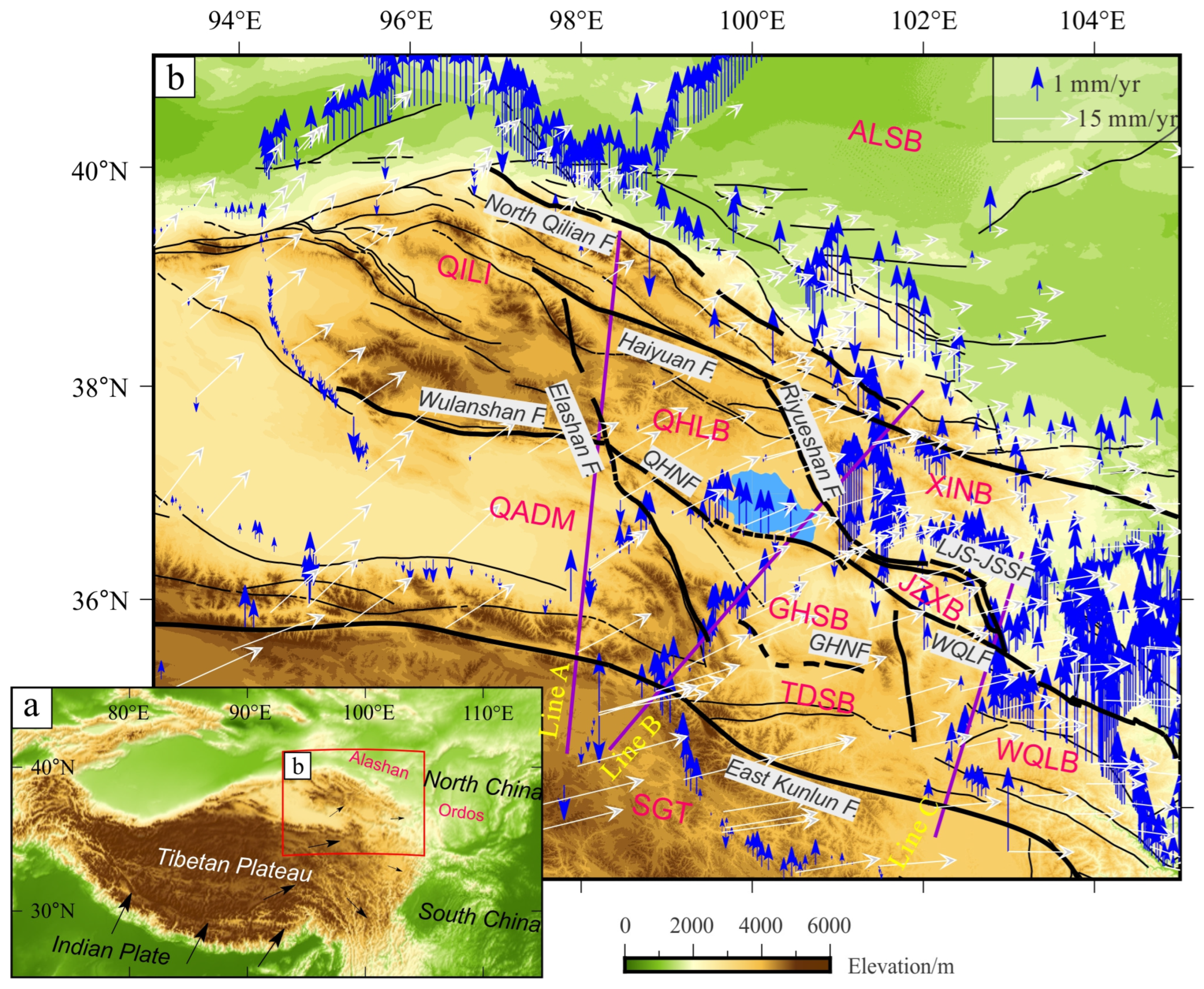
Since the collision between the Indian and Eurasian Plates at ~55 Ma, the Indian Plate has moved northward by ~1800–2500 km [1,2]. Although part of this convergence has been taken up by deformation of the northern margin of the Indian Plate, more than 1500 km of convergence still needs to be explained by additional mechanisms [3,4]. Two classical end-member models have been proposed. One is the thin viscous sheet model, which treats the crust as a continuous medium at large scales, and plateau deformation is primarily attributed to coherent crustal shortening and thickening [3]. The other is the mid–lower crustal flow model, which argues that viscous flow in the mid–lower crust, and the associated lateral transport and accumulation of material toward the plateau margins, drives crustal thickening and surface uplift [5,6]. The mechanism by which the Tibetan Plateau accommodates such enormous convergence and achieves its uplift and outward growth remains a central topic. As the frontal part of the Tibetan Plateau, the NE Tibetan Plateau both transmits the far-field effects of plate convergence and regulates internal tectonics, and thus exhibits intense and complex deformation [7,8]. Around Qinghai Lake, a series of alternating basins and orogenic belts show spatial variations in topography and uplift rates, with pronounced topographic contrasts reaching up to ~1500 m (Figure 1). Studying the crustal deformation mechanism of this basin–range system is therefore of great significance for understanding the uplift and expansion of the whole Tibetan Plateau.
Kinematic inversion methods based on GPS observations have been widely used to interpret continental crustal deformation; however, most studies adopt purely elastic models constrained by horizontal GPS data [9,10,11,12], which can reasonably explain present horizontal deformation and geological estimates of fault slip rates but cannot fully account for vertical deformation [13]. For example, for the Liupan Shan Tectonic Belt, a two-sided collision between the northeastern Tibetan Plateau and the Ordos Block tends to misplace the locations of the peak uplift and the steepest topographic gradient relative to observations [14,15]. Likewise, along the eastern Tibetan Plateau, horizontally constrained models predict only a weak uplift, which is insufficient to explain the ~3 mm/yr differential uplift rate between the Longmen Shan and the Sichuan Basin [16]. Wu et al. [17] showed that, in some parts of the Tibetan Plateau, vertical velocities induced by the horizontal GPS field reach less than 46.2% of observed values. An important reason for this discrepancy is that classic elastic models do not adequately incorporate the viscoelastic rheology of the deep crust [18,19,20]. In fact, previous studies have demonstrated that rheological heterogeneity plays an important role in crustal deformation and earthquake generation [21,22,23,24]. Some geophysical observations also suggest the presence of low-velocity and low-resistivity anomalies, as well as seismic-velocity azimuthal anisotropy, in the mid–lower crust of the NE Tibetan Plateau [25,26,27,28,29], highlighting heterogeneity in the rheological structure. Therefore, incorporating lithospheric rheology is essential for investigating the 3D crustal deformation of the basin–range system.
In this study, we use two approaches to investigate the mechanism of three-dimensional (3D) crustal deformation around the Qinghai Lake basin–range system. First, we derive vertical deformation from the horizontal GPS velocity field and compare it with the present-day high-precision vertical velocity field. On this basis, we then construct a 3D viscoelastic finite-element model to analyze the influence of lithospheric rheological structures on the 3D crustal velocity field, thereby exploring the mechanism controlling regional 3D deformation and providing new insights into the uplift and expansion of the NE Tibetan Plateau.
Figure 1. Tectonic map of the basin–range region around Qinghai Lake. (a) Map of the Tibetan Plateau; the red rectangle marks the study region. The black arrows indicate the motion direction of the Tibetan Plateau relative to the stable Eurasian Plate. (b) The light-blue area represents Qinghai Lake. Blue arrows represent the vertical velocity field (Wu et al. [17]). White arrows represent the horizontal velocity field relative to the stable Eurasian Plate (Wang and Shen [30]). Purple lines indicate the profiles in this study. ALSB: Alashan Block; QILI: Qilian Orogen; QADM: Qaidam Basin; QHLB: Qinghai Lake Basin; GHSB: Gonghe Sub-basin; TDSB: Tongde Sub-basin; SGT: Songpan–Ganzi Terrane; XINB: Xining Block; JZXB: Jianzha–Xunhua Basin; WQLB: West Qinling Block. QHNF: Qinghai–Nanshan Fault; GHNF: Gonghe–Nanshan Fault. LJS–JSSF: Lajishan–Jishishan Fault.
Remotesensing 18 00712 g001

2. Geological Setting

Qinghai Lake, the largest inland saline lake in China, is located in the NE Tibetan Plateau. Around Qinghai Lake, several strike-slip faults have developed, including the nearly E–W East Kunlun and Haiyuan Faults, and the NNW Elashan and Riyueshan Faults; a series of thrust faults, including the Qinghai–Nanshan, Gonghe–Nanshan, and Wulanshan Faults; and arcuate faults, including the Lajishan and Jishishan fault zones [31,32]. These faults divide the NE Tibetan Plateau into several tectonic units, including the Songpan–Ganzi Terrane, the Qinghai Lake Basin, the Gonghe Basin (including the Gonghe Sub-basin and Tongde Sub-basin), the Qilian Orogen, the Qaidam Basin, and the West Qinling Orogen [33,34]. As a result, the region exhibits an alternating pattern of basins and ranges, with pronounced topographic contrasts reaching up to ~1500 m, a distinctive characteristic that differs from the relatively uniform topography in the plateau interior (Figure 1).
The lithospheric structure of the NE Tibetan Plateau is complex. Seismic anisotropy data indicates the layered and lateral anisotropy within the crust, as well as widespread low velocities and azimuthal anisotropy in the mid–lower crust beneath the Songpan–Ganzi Terrane and Qilian Orogen [27,35,36], highlighting lateral heterogeneity of crustal materials. The strong positive radial anisotropy beneath the Songpan–Ganzi Terrane suggests mid–lower crustal flow [35]. Magnetotelluric imaging also shows a low-resistivity layer in the mid–lower crust beneath the Songpan–Ganzi Terrane, which traverses the East Kunlun Fault and extends northeastward to the Gonghe Basin [25]. To the east, these low-resistivity materials reach the West Qinling Orogen and the Jishishan Tectonic Belt [29,37,38], corresponding to low-velocity zones observed in seismic imaging [26,28]. Local low-resistivity anomalies are also observed beneath the Qinghai–Nanshan, south of the Lenglongling segment of the Haiyuan Fault, and within the Qilian Orogen [39,40,41,42]. These low-resistivity/low-velocity features suggest mechanically weak crustal materials and, given their heterogeneous distribution relative to adjacent stronger regions, may act as channels for viscous crustal flow [43,44,45].
Geodetic observations reveal crustal movement, tectonic deformation, and ongoing uplift. In the NE Tibetan Plateau, the horizontal GPS velocity field exhibits a northeastward decrease and a clockwise rotation toward the east [30,46,47]. Based on the elastic interpretation model, inversions constrained by the horizontal GPS velocity field explain the horizontal deformation and fault slip rates well, consistent with geological estimates [7,9,10,12,48]. Vertical GPS observations reveal pronounced differential uplift around Qinghai Lake, with subdued or even negative vertical rates in the intervening basins but more significant uplift along the surrounding ranges [49]. Over the past decade, the increased GPS and levelling observations, together with advances in data processing techniques, have markedly enhanced the precision and resolution of vertical deformation measurements [13,17,50,51], sharpening the image of differential uplift.

3. Vertical Deformation Induced by Horizontal Deformation

3.1. Transformation of Vertical and Horizontal GPS Velocity Fields

We use a simple isostatic model with an incompressible crust and upper mantle to predict the vertical velocities induced by horizontal tectonic movement [13]. We adopt the horizontal GPS velocity field relative to the stable Eurasian Plate compiled by Wang and Shen [30]. Their dataset integrates GPS observations from multiple networks collected over the past three decades, and coseismic and postseismic displacements of large earthquakes were carefully removed.
The specific processes are described in She and Fu [52]. First, we derive the strain tensors from the horizontal GPS velocity field using a “spline-in-tension” technique [46]. Then, we calculate the horizontal dilatation rate ε h and convert it to the vertical strain rate ε v using the formula ε v   =   ν ε h , where ν is Poisson’s ratio and is set to 0.5 to approximate long-term incompressible behavior [53,54]. Finally, the vertical velocity V t is obtained as V t   =   ε v   ×   D LAB , where D LAB is the depth of the lithosphere–asthenosphere boundary (LAB). The LAB separates the relatively rigid lithosphere from the weaker mantle and represents the mechanical and chemical differences of the Earth’s interior [55], D LAB data are from the LITHO1.0 model [56].

3.2. Vertical Deformation Results

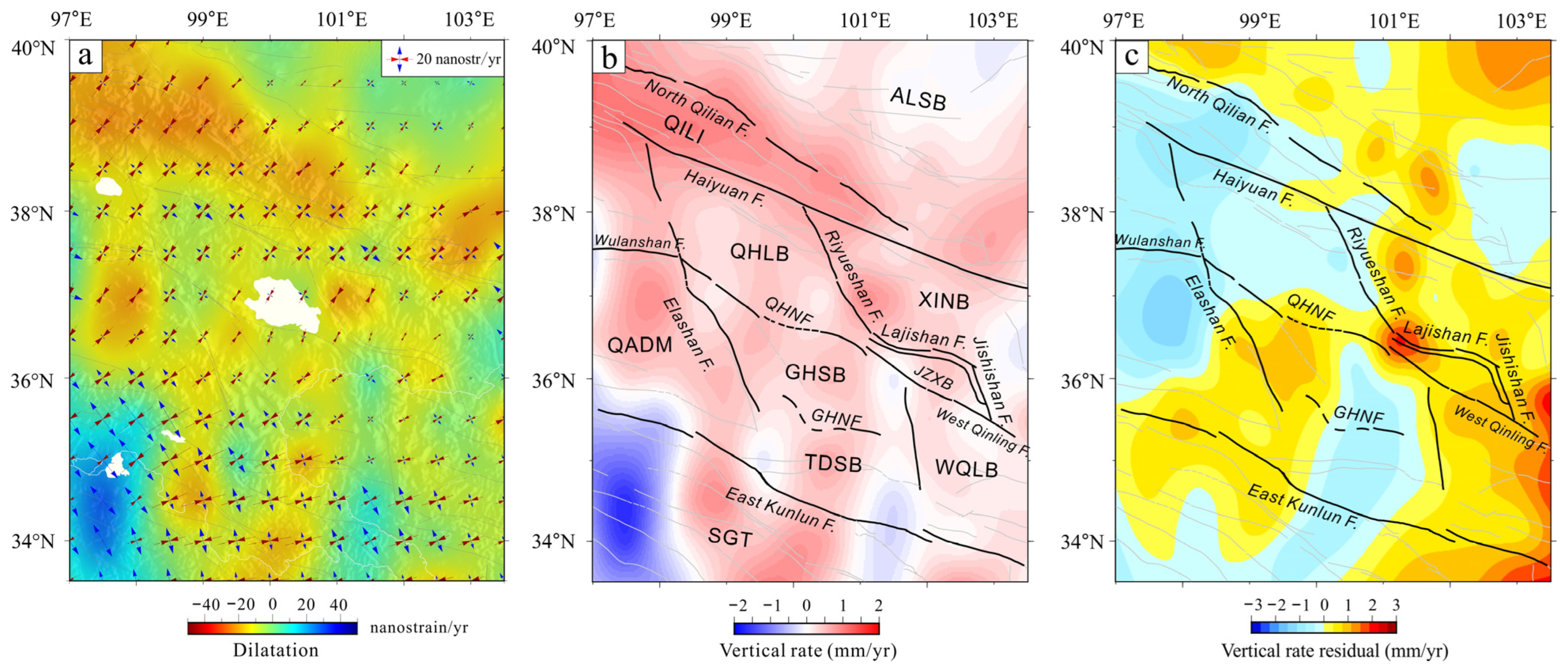
The corresponding strain rates and vertical velocity field calculated based on the above-mentioned approach are shown in Figure 2. The horizontal dilatation rate field generally reflects the characteristics of vertical deformation. High principal compressive strain rate and high contraction rate are localized in the Qilian Orogen and parts of the Songpan–Ganzi Terrane (Figure 2a), and these zones correspond to high vertical velocities (Figure 2b). The region shows a first-order pattern of alternating uplift, with the Songpan–Ganzi Terrane and Qilian Orogen exhibiting higher uplift rates, while the intervening domains show relatively weak uplift.
Compared with observed high-precision vertical velocities (Figure 1), the predicted vertical velocities generally show small residuals of <0.5 mm/yr (Figure 2c). Nonetheless, notable discrepancies are observed in some regions: residuals > 1 mm/yr are widespread in the WQLB and the QADM; localized residuals > 1 mm/yr occur in the ALSB; residuals of 0.8–1.5 mm/yr are observed in the southern Elashan region, the GHSB, the Qinghai–Nanshan region, and south of the Lenglongling segment of the Haiyuan Fault; and residuals are ~2 mm/yr near the intersection of the Lajishan Fault and Riyueshan Fault. These discrepancies suggest that horizontal motion alone cannot fully explain the crustal deformation. Therefore, we develop viscoelastic finite-element models to evaluate the influence of lithospheric rheological structures on 3D crustal deformation.

4. 3D Crustal Deformation Incorporating Lithospheric Rheology

4.1. Construction of the Viscoelastic Model

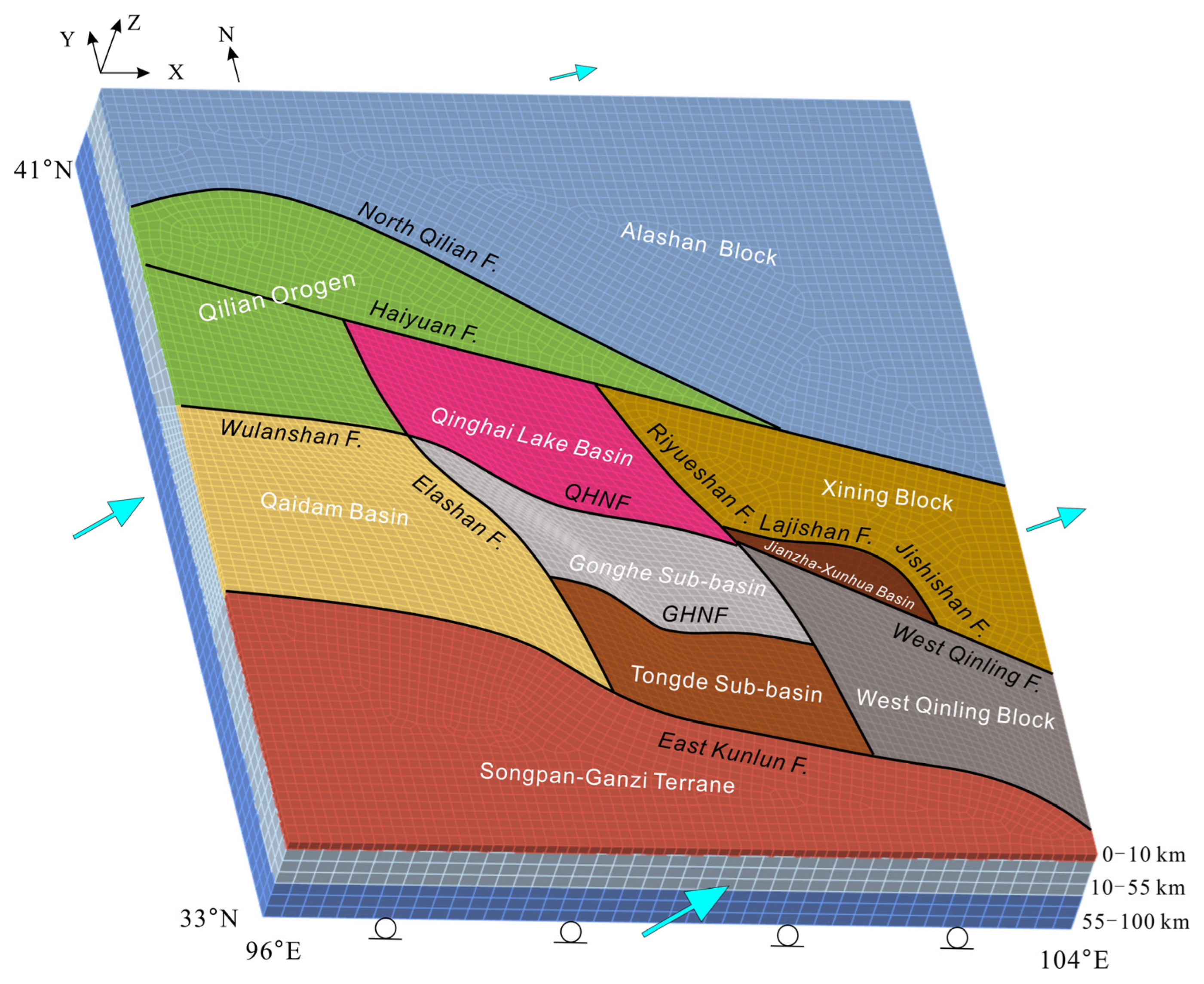
We define the model domain as 96–104°E, 33–41°N, with a thickness of 100 km (Figure 3). The model includes the upper crust (0–10 km), the mid–lower crust (10–55 km), and the upper mantle (55–100 km), with the thicknesses of these layers set using a first-order approximation based on the LITHO1.0 model [56]. Faults divide the model into multiple tectonic blocks, including the Songpan–Ganzi Terrane, Qaidam Basin, Qinghai Lake Basin, Gonghe Sub-basin, Tongde Sub-basin, Xining Block, Jianzha–Xunhua Basin, West Qinling Block, Qilian Orogen, and Alashan Block. The dip angles of the faults are taken from the geological and geophysical constraints summarized in Table 1. These faults are defined as the interfaces between adjacent blocks, extending into the lower crust, and are assumed to be locked in the upper crust.
In a Maxwell viscoelastic framework, the differential form of the viscoelastic governing equation to describe the relationship between stress and strain is as follows:
d ε Todal dt = d ε S dt + d ε D dt = 1 E d σ dt + σ η
where, ε Todal is the total strain, ε S is the elastic strain, ε D is the viscous strain, E is the elastic modulus, σ is the stress, and η is the viscosity.
Based on the lithosphere rheology of the Tibetan Plateau [66], the weaker mid–lower crust has viscosities of ~1019–1020 Pa·s, the relatively rigid mid–lower crust is ~1021–1022 Pa·s, cratonic regions outside the plateau (e.g., the Alashan Block) exceed 1022 Pa·s, and the upper mantle beneath the NE Tibetan Plateau is ~1021 Pa·s. We first set the parameters of the reference model (Case 1), with an elastic upper crust and viscoelastic mid–lower crust and upper mantle. The elastic modulus (E), density ( ρ ), and Poisson’s ratio (ν) are determined based on the LITHO1.0 model [56]. The material parameters of the reference model are shown in Table 2.
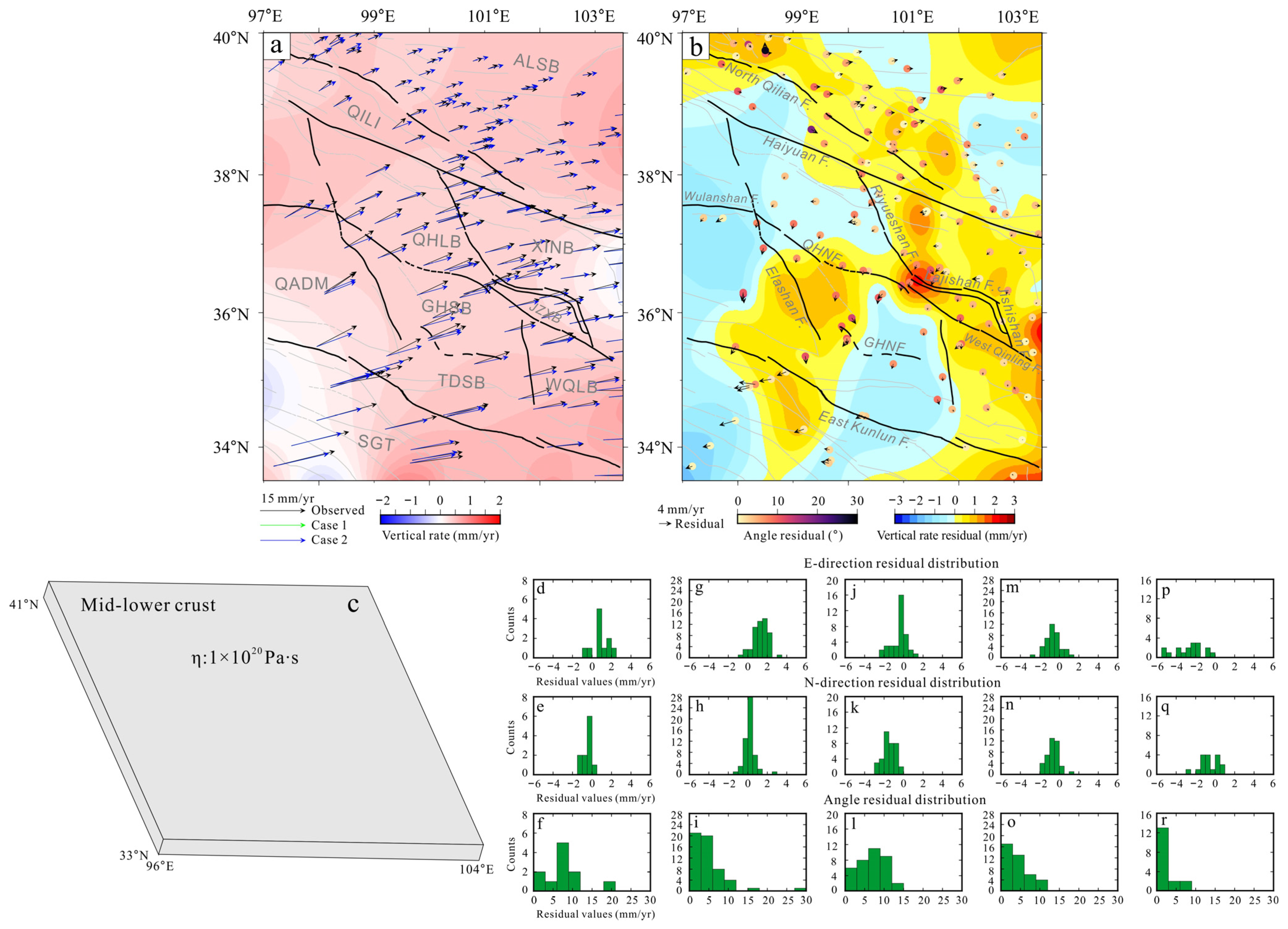
Following the reference model, we design Case 2, in which the viscosity of the mid–lower crust is reduced to 1 × 10²⁰ Pa·s. To analyze the influence of lateral rheological heterogeneity in the mid–lower crust, we design Case 3. Based on Case 3, we further design Case 4 to analyze the crustal deformation when the mantle flow velocity beneath the Songpan–Ganzi Terrane is set to 1.5 times that of the upper crust.
The bottom of the model is fixed in the vertical direction and free-slip along the horizontal direction, and the upper surface is free. At the lateral boundaries, GPS-interpolated velocities from the stable Eurasian reference frame are applied [30]. In Case 3, we set the movement velocity of the low-viscosity mid–lower crust beneath the Songpan–Ganzi Terrane to 1.5 times that of the upper crust, based on previous model studies [67,68]. To account for mantle drag, we set the mantle-flow velocity at the southeastern boundary (96–104°E, 33–35.6°N) to 1.5 times that of the upper crust, consistent with mantle velocities suggested in previous studies [15,69,70]. The total running time of the model is 30,000 years. The modeling is conducted using the ANSYS Workbench 18.2® finite-element software, which employs the Newton–Raphson approach to solve nonlinear problems. For our model, all elements had the capability of both linear elastic and time-dependent viscoelastic deformation.

4.2. Viscoelastic Modeling Results

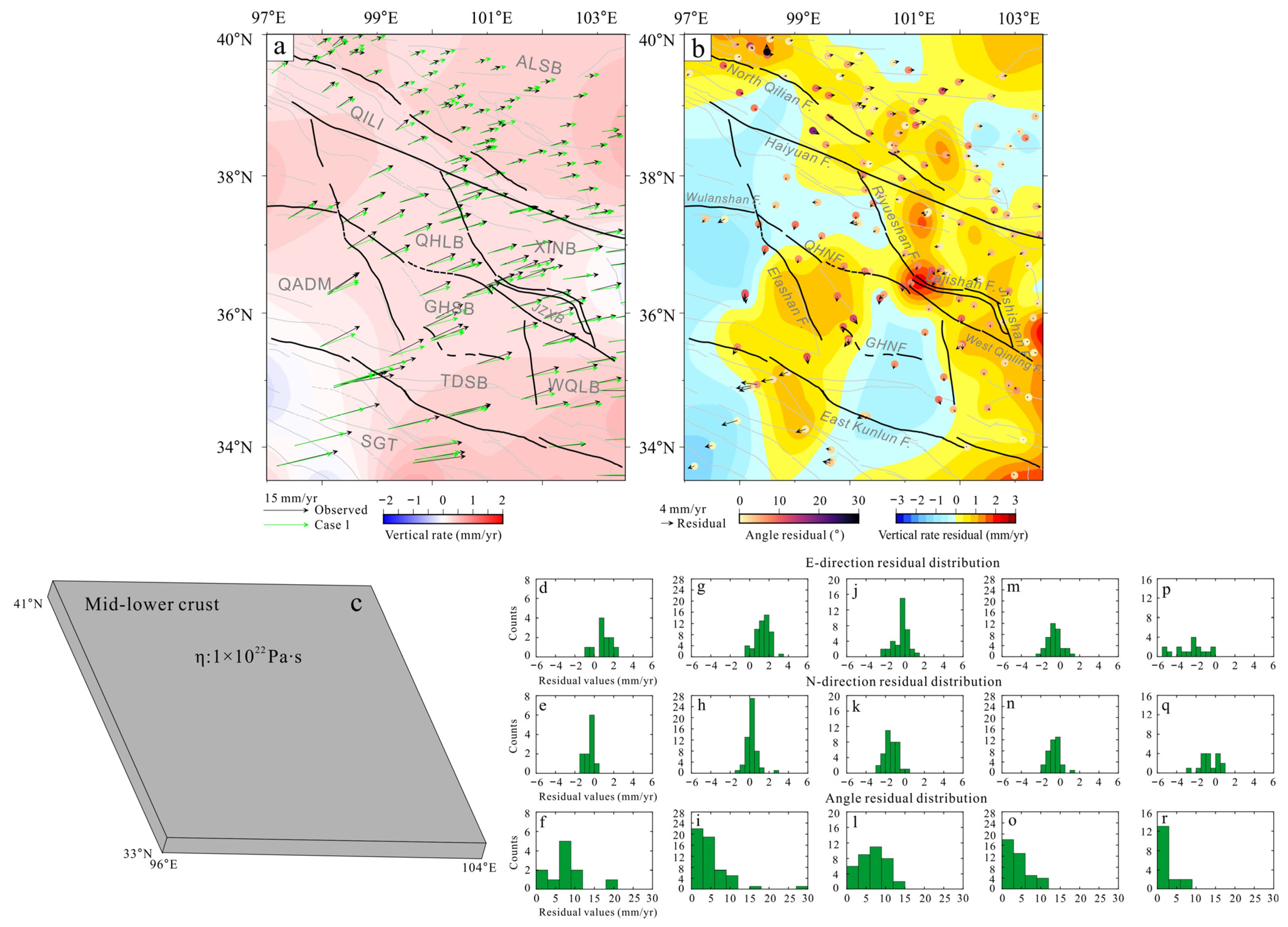
Based on the reference model (Case 1), the modeled surface horizontal velocities decrease northeastward and exhibit a clockwise rotational tendency, and the modeled vertical velocities over the regions are <1 mm/yr (Figure 4a). The model shows slight uplift or subsidence in the western SGT, with uplift increasing eastward toward the WQLB. QILI has relatively high uplift rates, whereas QADM, QHLB, GHSB, XINB, and JZXB have lower rates.
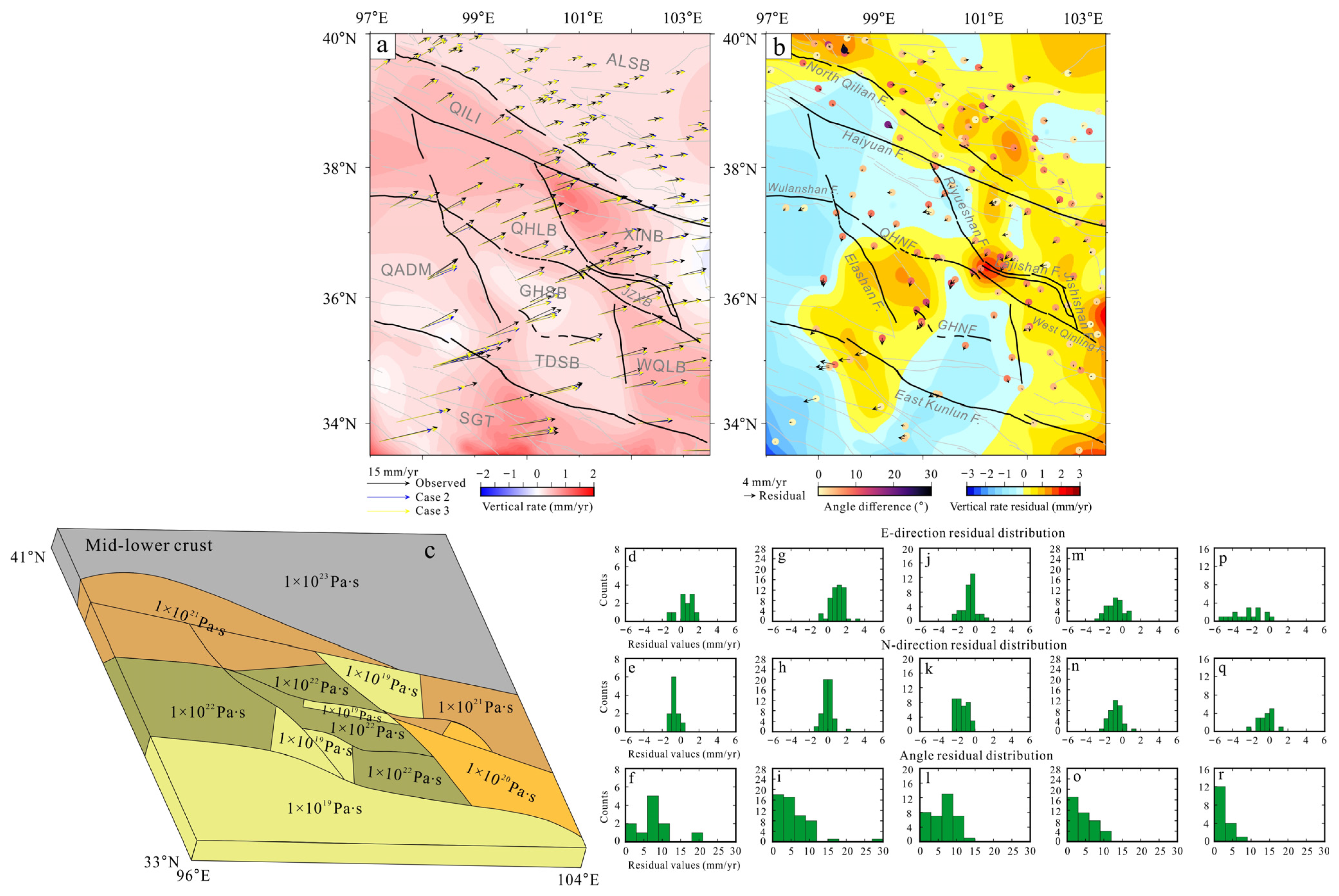
Compared with present-day horizontal observations, most residuals are <3 mm/yr, and most angle residuals are <15° (Figure 4b,d–r). The modeled horizontal velocities in the SGT are systematically lower than the observations, yielding larger residuals that can reach ~6 mm/yr (Figure 4a,p–r). In the QILI, QADM, GHSB, QHLB, and TDSB, more than half of the horizontal velocity vectors exhibit angle residuals > 5° (Figure 4f,l). The chi-square ( χ 2 ) is used to quantify the consistency between the modeled and observed velocities. For the reference model, χ 2 is 3.5829, using
χ 2 = 1 N i = 1 N X Mod i     X GPS i 2 + Y Mod i     Y GPS i 2 ( X GPS i ) 2 + ( Y GPS i ) 2
where X Mod i , Y Mod i and X GPS i , Y GPS i are two velocity components of the modeled and GPS data along latitude and longitude, respectively. X GPS i and Y GPS i are the errors of GPS data, for which we select their 2σ values.
Compared with present-day vertical observations, the modeled vertical residuals are generally <0.8 mm/yr (Figure 4b). In the southern Elashan region, the QHNF, and the GHSB, the modeled uplift is 0.8–1.2 mm/yr lower than observed. Localized residuals > 1 mm/yr occur within the ALSB; residuals approach 1.8 mm/yr in parts of the WQLB, JZXB, and XINB, and reach ~2 mm/yr near the intersection of the Lajishan and Riyueshan Faults.
The horizontal velocity field in Case 2 is similar to that in Case 1 and is insensitive to changes in the uniform mid–lower crustal viscosity (Figure 5a,c). However, the modeled vertical velocity field shows larger variations; the magnitudes of the vertical velocity are generally higher than in Case 1 (Figure 5a), and the differential uplift pattern is consistent with that of Case 1. Accordingly, when compared with present-day geodetic observations, the horizontal velocities still exhibit large residuals in some regions (Figure 5b,f,l,p), with an overall χ 2 of 3.6244. Although the vertical velocity residuals are reduced compared with those in Case 1 in regions such as XINB and WQLB, the modeled vertical velocities in some regions, including the southern Elashan region, still show notable discrepancies with the observations.
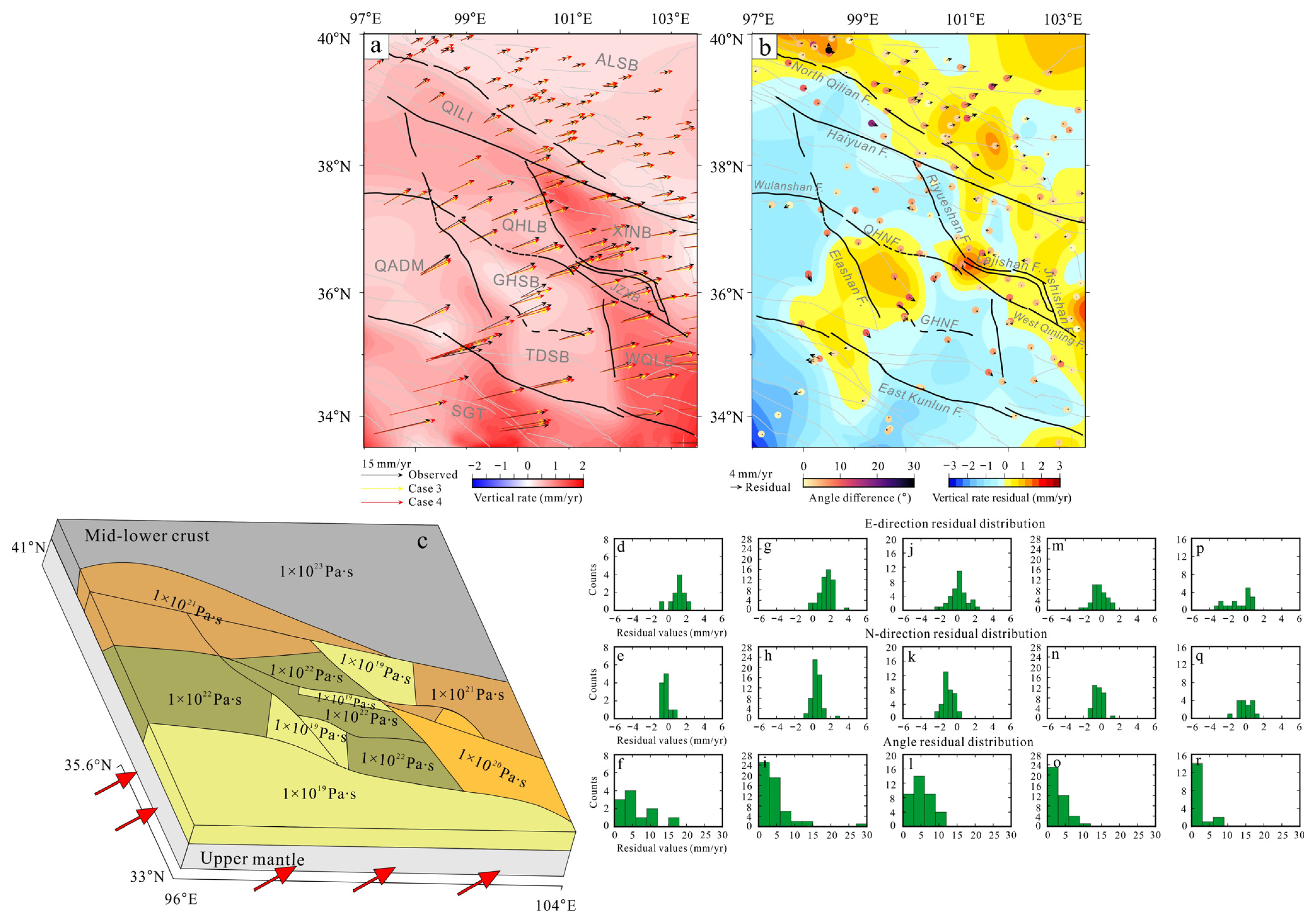
When considering the lateral rheological heterogeneity in the mid–lower crust (Case 3; Figure 6c), the modeled horizontal velocities increase significantly in the SGT and decrease markedly in the ALSB (Figure 6a). The χ 2 value is 3.4393, which is lower than that of Case 1 and Case 2, showing improved agreement between the modeled and observed velocities. The horizontal residuals in magnitude and direction angle are reduced, particularly in the SGT and ALSB regions (Figure 6g,p–r). The modeled vertical velocity field exhibits a more pronounced pattern of differential uplift, with markedly higher uplift rates in the SGT, WQLB, and western XINB, whereas the basins maintain relatively low vertical velocities (Figure 6a). Vertical residuals still exist but are significantly reduced compared with Cases 1 and 2 (Figure 6b). In particular, the modeled vertical rates near southern Elashan and within the WQLB and XINB increase significantly, narrowing the discrepancies with the observations.
When mantle flow beneath the SGT exerts drag on the overlying crust (Case 4, Figure 7c), the modeled surface horizontal velocities increase significantly (Figure 7a). The χ 2 value decreases to 2.7435, reflecting better overall agreement between the modeled and observed velocities. In particular, within the SGT, most horizontal residuals are reduced to <2 mm/yr (Figure 7b,p–r), and in the QILI, QADM, GHSB, QHLB, and TDSB regions, most residuals in the velocity direction are <5° (Figure 7f,l), showing a significant improvement in fit compared with the reference model (Case 1). The modeled vertical velocities increase significantly in the SGT, southern Elashan, WQLB, and western XINB compared with Case 3, producing a more pronounced pattern of differential uplift between the orogenic belts and the QADM, QHLB, GHSB, and TDSB (Figure 7a). Vertical velocity residuals are significantly reduced near southern Elashan, along the Qinghai–Nanshan, and within the WQLB and XINB (Figure 7b).

5. Discussion

5.1. Influence of Rheological Structure on 3D Crustal Deformation

The lithospheric structure of the NE Tibetan Plateau is complex. Layered anisotropy suggests that shear-wave fast directions in the upper crust are parallel to major strike-slip faults, such as the Qilian and East Kunlun Faults, whereas in the lower crust, they are perpendicular to the plateau margin, being nearly E–W in the Songpan–Ganzi Terrane and NE–SW in the Qilian Orogen, implying vertical and lateral rheological heterogeneity within the crust [27,36]. Previous studies support partial melting of the mid–lower crust beneath the Songpan–Ganzi Terrane [71,72], which is characterized by low shear-wave velocity [73], low resistivity [74,75], and a high Vp/Vs ratio [76], indicating a low-viscosity structure. Moreover, low-resistivity, low-velocity materials are also present within the interior of the Gonghe Basin, in the West Qinling region, and in the Jishishan Tectonic Belt [25,28,29,37,39], as well as south of the Lenglongling segment of the Haiyuan Fault [42]. These geophysical observations collectively demonstrate the complex and heterogeneous rheological structure of the mid–lower crust beneath the NE Tibetan Plateau. In addition, mantle flow can exert a drag force on the Eurasian Plate and plays an important role in controlling deformation within the Tibetan Plateau [70]. Wan et al. [69] constructed a two-dimensional model across the Longmenshan Fault at the eastern margin of the Tibetan Plateau and conducted a series of experiments. They suggested that the best agreement with multidisciplinary constraints is achieved when both a low-resistivity/low-velocity layer is included within the Songpan–Ganzi Terrane and the loading rate on the western boundary increases linearly with depth by a factor of 1.8. Under this condition, mid–lower crustal and upper-mantle materials are impeded by the Sichuan Basin, leading to intense uplift within the Songpan–Ganzi Terrane. Li et al. [15] also constructed a two-dimensional viscoelastic model for the northeastern margin of the Tibetan Plateau, and suggested that under the rheological control of the mid–lower crust, the upper-mantle velocity is ~1.5–2 times that of the upper crust, further indicating the tractions exerted on the Eurasian Plate due to mantle flow.
Based on the isostatic model, vertical deformation driven solely by the horizontal velocity field can explain the first-order features of differential uplift, characterized by higher uplift rates in the Qilian Orogen and the Songpan–Ganzi Terrane and lower uplift rates in the intervening basins (Figure 2b). However, significant inconsistencies with observations exist in more localized areas, especially in the southern Elashan region, the Gonghe Sub-basin, the Qinghai–Nanshan region, the West Qinling Orogen, the Lenglongling segment of the Haiyuan Fault, and the western Lajishan Fault (Figure 2c). We compared the strain-rate fields and the resulting vertical fields using two additional approaches, VISR and GPSGRIDDER (Figures S1 and S2). We find that, under the optimal parameter settings, the results from both methods are consistent with those obtained using the “spline-in-tension” technique, thereby indicating that, under the present distribution and density of horizontal GPS observations, the workflow of deriving strain rates from the horizontal velocity field and then inferring the vertical field from the strain-rate field is robust. Assuming a rheologically uniform mid–lower crust, its effect on 3D crustal deformation is slight (Figure 4 and Figure 5). A lower-viscosity mid–lower crust favors horizontal decoupling from the upper crust and promotes vertical uplift, but its impact is limited (Figure 4 and Figure 5). However, lateral rheological heterogeneity in the mid–lower crust significantly influences both the horizontal and vertical velocity fields of the upper crust (Figure 6). For instance, the weak mid–lower crust beneath the Songpan–Ganzi Terrane leads to higher horizontal velocities in the upper crust, whereas the rigid mid–lower crust beneath the Alashan Block reduces the horizontal velocities in its upper crust. The viscosity contrast between the Tibetan Plateau and the Alashan Block promotes uplift along the plateau margin (Figure 6a). In addition, mantle-flow drag beneath the Songpan–Ganzi Terrane enhances both horizontal and vertical crustal velocities, making it an important contributor to crustal deformation.
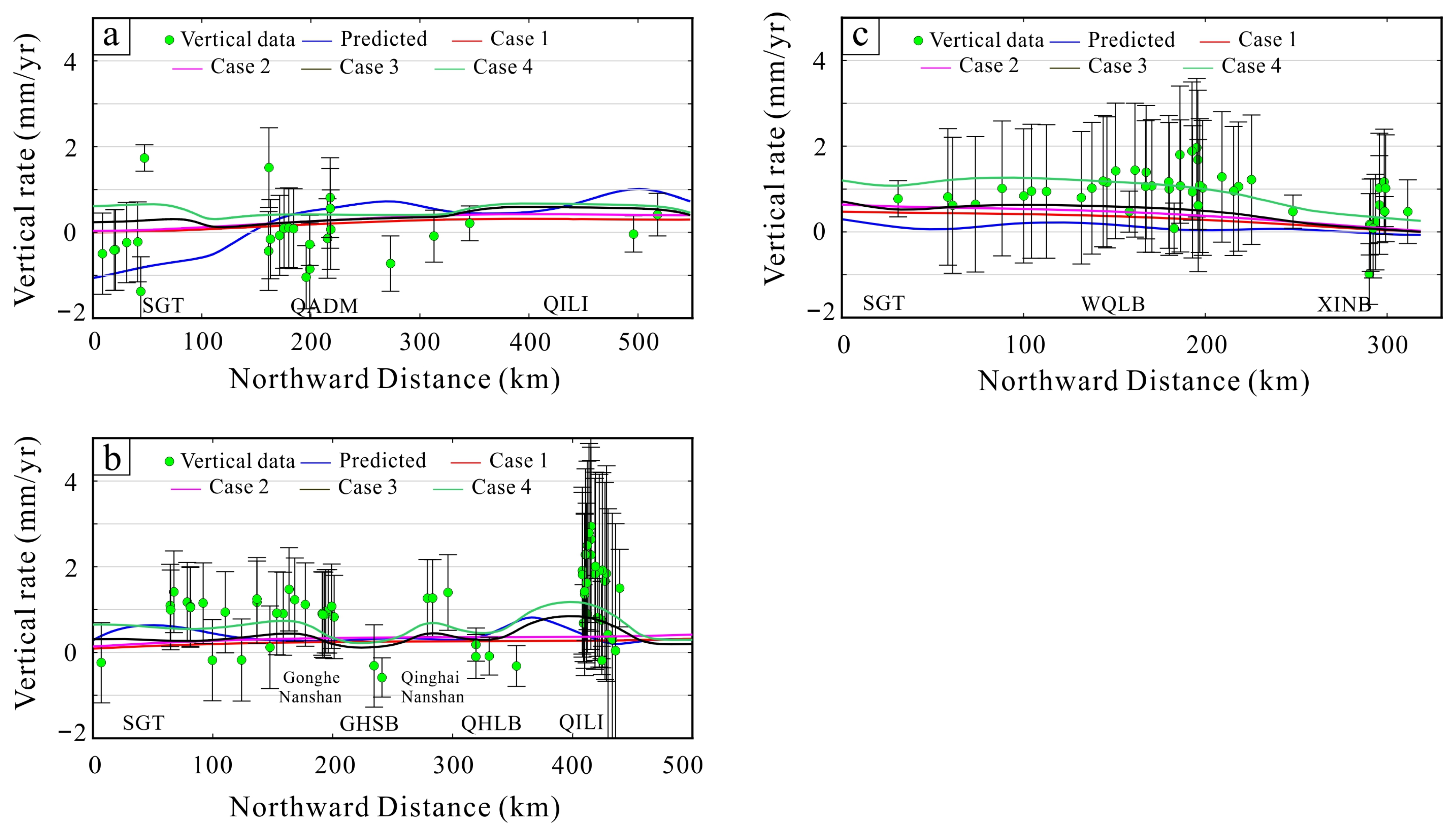
We selected three cross-regional profiles to enable a detailed analysis of the vertical velocity fit in localized areas. Along Line A (Figure 1b), vertical velocities predicted solely from the horizontal GPS velocity field show ~1.5 mm/yr subsidence in the western SGT, transition to ~0.5 mm/yr uplift in the QADM, exhibit a slight decrease in South Qilian, and show a subsequent increase to ~1 mm/yr in North Qilian (Figure 8a, blue line). Generally, the rates exhibit a low–moderately high–high pattern, which is inconsistent with the observed high–low–high pattern of the basin–range system. Along Line B (Figure 1b), the predicted rates indicate ~0.5 mm/yr uplift in the SGT, ~0.2 mm/yr uplift from Elashan to the QHLB, and an increase to ~0.8 mm/yr south of the Lenglongling segment of the Haiyuan Fault (Figure 8b, blue line). Generally, the predicted vertical rates along this line are lower than the observations, and the line crossing the GHSB, the Qinghai–Nanshan region, and the QHLB does not reproduce the observed low–high–low pattern in vertical rates. Along Line C (Figure 1b), the predicted rates across the WQLB vary only gradually, and the overall uplift rates are significantly lower than the observed values (Figure 8c, blue line). Across all three basin–range profiles, the predicted vertical rates show some degree of misfit relative to the observations and do not fully reproduce the differential uplift characteristics, demonstrating that localized vertical deformation cannot be explained by the horizontal velocity field alone.
Under a rheologically uniform mid–lower crust (Cases 1 and 2), the modeled vertical velocities along all three lines are generally low (Figure 8). A reduced mid–lower crustal viscosity (Case 2) slightly enhances surface uplift compared to Case 1, but this uniform rheology primarily results in broad, region-wide uplift, failing to reproduce the localized differential uplift or subsidence. Conversely, incorporating lateral rheological heterogeneity in the mid–lower crust (Case 3) produces a high–low–high rate across the SGT–QADM–QILI (Figure 8a, black line), and a low–high–low rate across the GHSB–Qinghai–Nanshan–QHLB (Figure 8b, black line). In addition, we tested viscosity contrasts within the basin–range system spanning ~2–4 orders of magnitude, and all cases reproduced the differential uplift pattern (Figures S3 and S4), indicating that lateral rheological heterogeneity in the mid–lower crust plays a dominant role in controlling the 3D deformation of the basin–range system. Furthermore, under mantle-flow drag (Case 4), weaker materials attain higher velocities but decelerate markedly upon encountering the surrounding rigid basins. This interaction enhances upper-crustal differential deformation, strengthening uplift–subsidence contrasts between basins and ranges (Figure 8, green line). In this case, the modeled 3D velocity field provides the best fit to the geodetic observations. These results suggest that lateral rheological heterogeneity in the mid–lower crust, acting under mantle-flow drag, is a primary factor controlling basin–range differential uplift.

5.2. Implications for 3D Crustal Deformation Mechanisms

The mechanism of the uplift and outward growth of the Tibetan Plateau has long been a central topic of debate in geoscience. Two classical end-member models have been proposed. One is the thin viscous sheet model, in which plateau deformation is primarily attributed to coherent crustal shortening and thickening [3]. The other is the mid–lower crustal flow model, which emphasizes that, under appropriate temperature–pressure conditions, mid–lower crustal materials can undergo rapid motion or flow from the interior toward the margin of the Tibetan Plateau [5,6]. Our study, combined with analyses of geodetic observations and finite-element modeling experiments, suggests that a single mechanism is insufficient to fully account for the complex 3D crustal deformation in the NE Tibetan Plateau.
Under the horizontal GPS velocity field, parts of the Songpan–Ganzi Terrane and the Qilian Orogen exhibit large compressive strain rates and high vertical uplift rates, indicating that horizontal crustal shortening leads to vertical thickening. Specifically, within the Qilian Orogen, the predicted vertical uplift rates of ~1.0 mm/yr derived from horizontal shortening are broadly consistent with geodetic observations (Figure 2b), suggesting that crustal shortening and thickening dominate its deformation. This finding is consistent with investigations utilizing InSAR and GPS measurements, which show that convergence rates across a series of thrust-fault systems that span the Qilian Orogen gradually decrease from 9.2 to 3.0 mm/yr, yielding ~6.2 mm/yr shortening across the orogen [77]. Seismic anisotropy studies further show zero or slightly negative radial anisotropy beneath the Qilian Orogen [35], also indicating crustal shortening and thickening in this region.
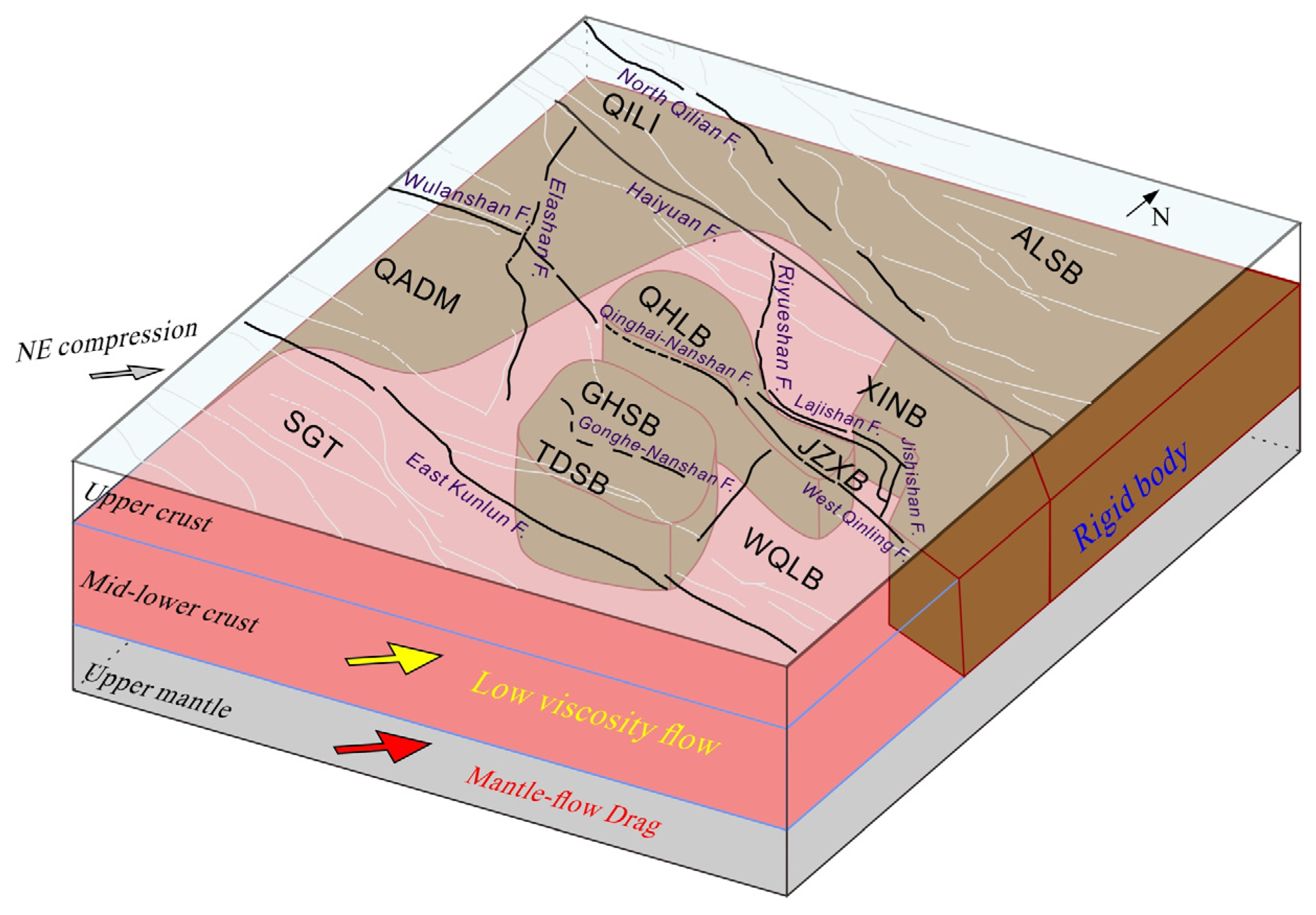
Based on multiple geophysical imaging results, we infer the existence of lateral rheological heterogeneity in the mid–lower crust beneath the Gonghe Basin, the Qinghai Lake Basin, the Xining Block, and the West Qinling Block. Low-viscosity material in these domains likely undergoes horizontal flow, consistent with the strong positive radial anisotropy observed in these regions [28,43]. This implies that, in addition to crustal shortening and thickening, mid–lower crustal flow expands northeastward along a weak channel, extending from the plateau interior toward the Qinghai–Nanshan, the Xining Block, the West Qinling Orogen, and the Lajishan–Jishishan tectonic belt, thereby forming a series of interconnected weak corridors within the mid–lower crust (Figure 9). As the flow propagates northeastward, it is impeded by relatively high-viscosity rigid blocks, such as the Gonghe Basin, the Qinghai Lake Basin, and the northeastern side of the Jishishan tectonic belt. This obstruction causes flow deceleration or deflection and promotes material accumulation, leading to localized crustal thickening. Notably, strong rheological contrasts are prone to causing rapid stress concentration and strain energy accumulation. These processes increase seismic potential, as seen in the 1976 Songpan–Pingwu earthquake swarm, the 2021 MW 7.4 Maduo earthquake, and the 2023 MS 6.2 Jishishan earthquake [45,68,78]. Accordingly, faults and adjacent zones characterized by pronounced rheological contrasts warrant sustained monitoring and heightened attention in seismic-hazard assessments.

5.3. Limitations

It should be noted that, although the preferred Case 4 reproduces the present-day 3D geodetic velocity field well across most of the study region, some misfits remain in local areas. For example, uplift rates are underestimated in the Hexi Corridor north of the Qilian Shan, in the western part of the Gonghe Sub-basin, and at the junction between the Lajishan and Riyueshan Faults. We infer that these discrepancies may be related to the presence of complex fault systems in these areas, where part of the crustal shortening is likely absorbed by fault slip and converted into uplift [34,79,80]. However, in our finite-element model, the segmentation and curvature of these faults are simplified, thereby limiting the achievable fit. The purpose of our modeled experiments is not to fit every detail of the observations, but to analyze the role of mid–lower crustal rheological heterogeneity in controlling deformation and to reveal the regional 3D crustal deformation mechanism. In the future, the model fit to the observed 3D crustal deformation may be improved by incorporating more complete and realistic fault representations in local areas and by implementing fault slip with appropriate frictional boundary conditions.

6. Conclusions

To reveal the 3D crustal deformation mechanisms of the basin–range system around Qinghai Lake, we predicted vertical deformation based on the horizontal GPS velocity field and analyzed the influence of lithospheric rheological structures on the 3D velocity field using viscoelastic finite-element modeling. The main conclusions are as follows:
  • Vertical deformation driven solely by the horizontal velocity field can explain the first-order features of differential uplift, characterized by higher uplift rates in the Qilian Orogen and the Songpan–Ganzi Terrane and lower uplift rates in the intervening domains. In the Qilian Orogen, the vertical velocities are broadly consistent with geodetic observations, indicating that crustal shortening and thickening dominate its deformation. However, compared with the present high-precision vertical velocity field, vertical velocity residuals > 1 mm/yr still exist in more localized areas, implying that crustal deformation cannot be fully explained by crustal shortening under the influence of the horizontal GPS velocity field.
  • Using a 3D viscoelastic finite-element model that incorporates lithospheric rheology, we show that a laterally homogeneous mid–lower crust exerts only a limited influence on upper-crustal deformation and produces large misfits relative to observations. However, introducing lateral rheological heterogeneity markedly alters the deformation pattern, resulting in localized uplift–subsidence contrasts between basins and ranges. When mantle-flow drag is further imposed, the model yields the best agreement with present-day geodetic data, indicating that lateral rheological heterogeneity in the mid–lower crust, acting under mantle-flow drag, is a primary factor controlling basin–range differential uplift.
  • Integrating multiple geophysical observations, we propose that mid–lower crustal flow expands northeastward along a weak channel from the plateau interior toward the Qinghai–Nanshan, the Xining Block, the West Qinling Orogen, and the Lajishan–Jishishan tectonic belt. During its propagation, the flow is impeded by relatively rigid blocks (e.g., the Gonghe Basin, the Qinghai Lake Basin, and the northeastern side of the Jishishan tectonic belt), promoting material accumulation and deformation. We therefore infer a hybrid crustal deformation mechanism that combines crustal shortening and mid–lower crustal flow for the basin–range system around Qinghai Lake. This study provides an important theoretical basis for understanding the outward expansion mechanism of the NE Tibetan Plateau.

Supplementary Materials

The following supporting information can be downloaded at https://www.mdpi.com/article/10.3390/rs18050712/s1, Figure S1: Strain rate field and vertical velocity field using VISR approach. (a) The arrows denote principal strain rates, and the background colors show dilatation strain rates (negative indicates contraction) (b) Vertical velocity field predicted by horizontal GPS velocity field (Wang and Shen [30]). (c) Comparison of predicted vertical velocities with observations (Wu et al., [17]), residual is defined as observation minus prediction. Figure S2: Strain rate field and vertical velocity field using GPSGRIDDER approach. (a–c) have the same captions as in Figure S1. Figure S3: Surface 3D velocity field and residuals for Case 5. (b–r) have the same captions as in Figure 4; in (a), green arrows denote the modeled horizontal velocity field for Case 5; in (c), different colors indicate different mid-lower crustal viscosities. Figure S4: Surface 3D velocity field and residuals for Case 6. (b–r) have the same captions as in Figure 4; in (a), green arrows denote the modeled horizontal velocity field for Case 6; in (c), different colors indicate different mid-lower crustal viscosities.

Author Contributions

Conceptualization, H.L. and S.L.; methodology, W.G. and S.L.; visualization, H.L. and S.L.; writing—original draft preparation, H.L.; writing—review and editing, H.L., S.L., K.Z. and L.Z.; Funding acquisition, W.G.; All authors have read and agreed to the published version of the manuscript.

Funding

This research was funded by the National Natural Science Foundation of China [Grant Number U2239202, 42202254].

Data Availability Statement

The horizontal GPS data used in this study are available from Wang and Shen [30], and the vertical geodetic data are available from Wu et al. [17].

Acknowledgments

We thank the three anonymous reviewers and the editors who contributed significantly to improving the quality of the original paper. We acknowledge and thank the Generic Mapping Tools (GMT) software [81].

Conflicts of Interest

The authors declare no conflicts of interest.

References

  1. McKenzie, D.; Sclater, J.G. The Evolution of the Indian Ocean since the Late Cretaceous. Geophys. J. Int. 1971, 24, 437–528. [Google Scholar] [CrossRef]
  2. Molnar, P.; Tapponnier, P. Cenozoic Tectonics of Asia: Effects of a Continental Collision. Science 1975, 189, 419–426. [Google Scholar] [CrossRef] [PubMed]
  3. England, P.; Houseman, G. Finite Strain Calculations of Continental Deformation: 2. Comparison with the India-Asia Collision Zone. J. Geophys. Res. 1986, 91, 3664–3676. [Google Scholar] [CrossRef]
  4. Lyon-Caen, H.; Molnar, P. Constraints on the Structure of the Himalaya from an Analysis of Gravity Anomalies and a Flexural Model of the Lithosphere. J. Geophys. Res. Solid Earth 1983, 88, 8171–8191. [Google Scholar] [CrossRef]
  5. Royden, L.H.; Burchfiel, B.C.; King, R.W.; Wang, E.; Chen, Z.; Shen, F.; Liu, Y. Surface Deformation and Lower Crustal Flow in Eastern Tibet. Science 1997, 276, 788–790. [Google Scholar] [CrossRef]
  6. Clark, M.K.; Bush, J.W.M.; Royden, L.H. Dynamic Topography Produced by Lower Crustal Flow against Rheological Strength Heterogeneities Bordering the Tibetan Plateau. Geophys. J. Int. 2005, 162, 575–590. [Google Scholar] [CrossRef]
  7. Ge, W.; Wang, M.; Shen, Z.; Yuan, D.; Zheng, W. Intersiesmic Kinematics and Deformation Patterns on the Upper Crust of Qaidam-Qilianshan Block. Chin. J. Geophys. 2013, 56, 2994–3010. [Google Scholar] [CrossRef]
  8. Zheng, W.; Zhang, P.; He, W.; Yuan, D.; Shao, Y.; Zheng, D.; Ge, W.; Min, W. Transformation of Displacement between Strike-Slip and Crustal Shortening in the Northern Margin of the Tibetan Plateau: Evidence from Decadal GPS Measurements and Late Quaternary Slip Rates on Faults. Tectonophysics 2013, 584, 267–280. [Google Scholar] [CrossRef]
  9. Li, X.; Pierce, I.K.D.; Bormann, J.M.; Hammond, W.C.; Zhang, Z.; Li, C.; Zheng, W.; Zhang, P. Tectonic Deformation of the Northeastern Tibetan Plateau and Its Surroundings Revealed With GPS Block Modeling. JGR Solid Earth 2021, 126, e2020JB020733. [Google Scholar] [CrossRef]
  10. Li, Y.; Liu, M.; Wang, Q.; Cui, D. Present-Day Crustal Deformation and Strain Transfer in Northeastern Tibetan Plateau. Earth Planet. Sci. Lett. 2018, 487, 179–189. [Google Scholar] [CrossRef]
  11. Wang, W.; Qiao, X.; Yang, S.; Wang, D. Present-Day Velocity Field and Block Kinematics of Tibetan Plateau from GPS Measurements. Geophys. J. Int. 2017, 208, 1088–1102. [Google Scholar] [CrossRef]
  12. Loveless, J.P.; Meade, B.J. Partitioning of Localized and Diffuse Deformation in the Tibetan Plateau from Joint Inversions of Geologic and Geodetic Observations. Earth Planet. Sci. Lett. 2011, 303, 11–24. [Google Scholar] [CrossRef]
  13. Zhao, Q.; Chen, Q.; van Dam, T.; She, Y.; Wu, W. The Vertical Velocity Field of the Tibetan Plateau and Its Surrounding Areas Derived from GPS and Surface Mass Loading Models. Earth Planet. Sci. Lett. 2023, 609, 118107. [Google Scholar] [CrossRef]
  14. Yang, C.; Li, Y.; Du, Y.; Li, Y.; Liu, L.; Chen, L. Mechanism of Vertical Crustal Deformation in the Liupan Shan Tectonic Belt, Northeastern Tibetan Plateau: A Numerical Study. Chin. J. Geophys. 2025, 68, 2515–2531. [Google Scholar] [CrossRef]
  15. Li, Z.; Cheng, F.; Li, Y.; Liu, L.; Zhu, L.; Wang, Y.; Hao, M.; Zhuang, W.; Xiong, R.; Gan, W. Lithospheric Rheology and Crustal Deformation Across the Northeastern Tibet and Their Implications for Plateau Growth. Geophys. Res. Lett. 2024, 51, e2023GL106666. [Google Scholar] [CrossRef]
  16. Pang, Y.; Cheng, H.; Zhang, H.; Shi, Y. Numerical Analysis of the Influence of Lithospheric Structure on Surface Vertical Movements in Eastern Tibet. Chin. J. Geophys. 2019, 62, 1256–1267. [Google Scholar] [CrossRef]
  17. Wu, Y.; Su, G.; Nie, J.; Chen, C.; Chen, Z.; Yu, H.; Yin, H.; Chang, L.; Tang, Z.; Pang, Y.; et al. High-Precision Vertical Deformation of the Chinese Mainland Constrained by Levelling and GNSS Data. Geophys. J. Int. 2024, 239, 971–981. [Google Scholar] [CrossRef]
  18. Li, Y.; Liu, M.; Li, Y.; Chen, L. Active Crustal Deformation in Southeastern Tibetan Plateau: The Kinematics and Dynamics. Earth Planet. Sci. Lett. 2019, 523, 115708. [Google Scholar] [CrossRef]
  19. Bischoff, S.H.; Flesch, L.M. Normal Faulting and Viscous Buckling in the Tibetan Plateau Induced by a Weak Lower Crust. Nat. Commun. 2018, 9, 4952. [Google Scholar] [CrossRef]
  20. Sun, Y.; Liu, M. Rheological Control of Lateral Growth of the Tibetan Plateau: Numerical Results. JGR Solid Earth 2018, 123, 10124–10141. [Google Scholar] [CrossRef]
  21. Li, Y.; Yang, C.; Hu, X.; Yuan, J.; Yao, R.; Li, H. Coulomb Stress Transfer from the 2025 Mw 7.7 Myanmar Earthquake to Active Faults in Southwestern Yunnan, China: Implications for Seismic Hazard. Earthq. Res. Adv. 2025, 6, 100397. [Google Scholar] [CrossRef]
  22. Li, Y.; Liu, H.; Yang, C. Revisiting the Seismic Hazards of Faults Surrounding the 2022 Ms6.8 Luding Earthquake, Sichuan, China. Geomat. Nat. Hazards Risk 2023, 14, 2272569. [Google Scholar] [CrossRef]
  23. Liu, L.; Li, Y.; Ji, L. Interaction Mechanism of Strong Earthquakes in the Tectonic Transition Zone: A Numerical Study of Four Ms > 6.0 Yutian Earthquakes from 2008 to 2020. Chin. J. Geophys. 2024, 67, 156–171. [Google Scholar] [CrossRef]
  24. Liu, H.; Li, Y.; Chen, L. Mechanisms of the Different Senses of Fault Slip in the North and South Segments of the Huya Fault Zone, Eastern Tibetan Plateau: Constraints from Numerical Modeling. Chin. J. Geophys. 2023, 66, 2757–2771. [Google Scholar] [CrossRef]
  25. Zhan, Y.; Liang, M.; Sun, X.; Huang, F.; Zhao, L.; Gong, Y.; Han, J.; Li, C.; Zhang, P.; Zhang, H. Deep Structure and Seismogenic Pattern of the 2021.5.22 Madoi (Qinghai) Ms 7.4 Earthquake. Chin. J. Geophys. 2021, 64, 2232–2252. [Google Scholar] [CrossRef]
  26. Zhou, H.; Liu, S.; Yang, W.; Yang, D.; Xu, X.; Li, M.; Wang, W.; Yang, S. Deformation of the NE Tibetan Plateau Revealed by Velocity and Azimuthal Anisotropy Structures. Tectonophysics 2023, 856, 229846. [Google Scholar] [CrossRef]
  27. Hao, S.; Huang, Z.; Han, C.; Wang, L.; Xu, M.; Mi, N.; Yu, D. Layered Crustal Azimuthal Anisotropy beneath the Northeastern Tibetan Plateau Revealed by Rayleigh-Wave Eikonal Tomography. Earth Planet. Sci. Lett. 2021, 563, 116891. [Google Scholar] [CrossRef]
  28. Dong, X.; Yang, D. Crustal Flow-Induced Earthquake Revealed by Full-Waveform Tomography and Implications for Prehistoric Civilization Destruction. JGR Solid Earth 2025, 130, e2024JB029745. [Google Scholar] [CrossRef]
  29. Sun, X.; Zhan, Y.; Zhao, L.; Chen, X.; Sun, J.; Li, C.; Cui, T.; Han, J. Electrical Structure of the Kunlun–Qinling Fault System, Northeastern Tibetan Plateau, Inferred from 3-D Inversion of Magnetotelluric Data. J. Asian Earth Sci. 2019, 181, 103910. [Google Scholar] [CrossRef]
  30. Wang, M.; Shen, Z. Present-Day Crustal Deformation of Continental China Derived From GPS and Its Tectonic Implications. JGR Solid Earth 2020, 125, e2019JB018774. [Google Scholar] [CrossRef]
  31. Yu, J.; Zheng, D.; Wang, W.; Pang, J.; Li, C.; Wang, Y.; Hao, Y.; Zhang, H.; Zhang, P. Cenozoic Tectonic Development in the Northeastern Tibetan Plateau: Evidence from Thermochronological and Sedimentological Records. Glob. Planet. Change 2023, 224, 104098. [Google Scholar] [CrossRef]
  32. Yuan, D.; Ge, W.; Chen, Z.; Li, C.; Wang, Z.; Zhang, H.; Zhang, P.; Zheng, D.; Zheng, W.; Craddock, W.H.; et al. The Growth of Northeastern Tibet and Its Relevance to Large-scale Continental Geodynamics: A Review of Recent Studies. Tectonics 2013, 32, 1358–1370. [Google Scholar] [CrossRef]
  33. Zhang, P.; Deng, Q.; Zhang, G.; Ma, J.; Gan, W.; Min, W.; Mao, F.; Wang, Q. Active Tectonic Blocks and Strong Earthquakes in the Continent of China. Sci. China Ser. D Earth Sci. 2003, 46, 13–24. [Google Scholar] [CrossRef]
  34. Craddock, W.H.; Kirby, E.; Zhang, H.; Clark, M.K.; Champagnac, J.-D.; Yuan, D. Rates and Style of Cenozoic Deformation around the Gonghe Basin, Northeastern Tibetan Plateau. Geosphere 2014, 10, 1255–1282. [Google Scholar] [CrossRef]
  35. Li, S.; Guo, Z.; Yu, Y.; Wu, X.; Chen, Y.J. Imaging the Northeastern Crustal Boundary of the Tibetan Plateau With Radial Anisotropy. Geophys. Res. Lett. 2022, 49, e2022GL100672. [Google Scholar] [CrossRef]
  36. Wu, X.; Guo, Z.; Li, S.; Yu, Y.; Bai, Q.; Chen, Y.J. Seismic Azimuthal Anisotropy of Northeastern Tibetan Plateau From Ambient Noise Double Beamforming Tomography: Implications for Crustal Deformation. JGR Solid Earth 2023, 128, e2022JB026109. [Google Scholar] [CrossRef]
  37. Zhao, L.; Zhan, Y.; Wang, Q.; Sun, X.; Hao, M.; Zhu, Y.; Han, J. 3D Electrical Structure and Crustal Deformation of the Lajishan Tectonic Belt, Northeastern Margin of the Tibetan Plateau. J. Asian Earth Sci. 2022, 224, 104953. [Google Scholar] [CrossRef]
  38. Zhao, L.; Zhan, Y.; Chen, X.; Yang, H.; Jiang, F. Deep Electrical Structure of the Central West Qinling Orogenic Belt and Blocks on Its Either Side. Chin. J. Geophys. 2015, 58, 2460–2472. [Google Scholar] [CrossRef]
  39. Gao, J.; Zhang, H.; Zhang, S.; Chen, X.; Cheng, Z.; Jia, X.; Li, S.; Fu, L.; Gao, L.; Xin, H. Three-Dimensional Magnetotelluric Imaging of the Geothermal System beneath the Gonghe Basin, Northeast Tibetan Plateau. Geothermics 2018, 76, 15–25. [Google Scholar] [CrossRef]
  40. Gao, J.; Zhang, H.; Zhang, H.; Zhang, S.; Cheng, Z. Three-Dimensional Magnetotelluric Imaging of the SE Gonghe Basin: Implication for the Orogenic Uplift in the Northeastern Margin of the Tibetan Plateau. Tectonophysics 2020, 789, 228525. [Google Scholar] [CrossRef]
  41. Xiao, Q.; Shao, G.; Yu, G.; Cai, J.; Wang, J. Electrical Resistivity Structures of the Kunlun–Qaidam–Qilian System at the Northern Tibet and Their Tectonic Implications. Phys. Earth Planet. Inter. 2016, 255, 1–17. [Google Scholar] [CrossRef]
  42. Zhao, L.; Zhan, Y.; Wang, Q.; Sun, X.; Hao, M.; Zhu, Y.; Han, J. The Deep Electrical Structure and Seismogenic Background of Lenglongling Uplift and Its Adjacent Areas in the Eastern End of Qilian Mountains. Chin. J. Geophys. 2020, 63, 1014–1025. [Google Scholar] [CrossRef]
  43. Clark, M.K.; Royden, L.H. Topographic Ooze: Building the Eastern Margin of Tibet by Lower Crustal Flow. Geology 2000, 28, 703–706. [Google Scholar] [CrossRef]
  44. Unsworth, M.J.; Jones, A.G.; Wei, W.; Marquis, G.; Gokarn, S.G.; Spratt, J.E. Crustal Rheology of the Himalaya and Southern Tibet Inferred from Magnetotelluric Data. Nature 2005, 438, 78–81. [Google Scholar] [CrossRef]
  45. Liu, H.; Gan, W.; Li, Y.; Li, Z.; Liu, L.; Zhang, L.; Liang, S.; Zhang, K.; Li, Y.; Dai, C. Mechanism of Crustal Deformation around the Lajishan-Jishishan Tectonic Belt, NE Tibet, and Implications for Occurrence of the 2023 Jishishan Ms 6.2 Earthquake. J. Asian Earth Sci. 2025, 279, 106449. [Google Scholar] [CrossRef]
  46. Gan, W.; Zhang, P.; Shen, Z.; Niu, Z.; Wang, M.; Wan, Y.; Zhou, D.; Cheng, J. Present-day Crustal Motion within the Tibetan Plateau Inferred from GPS Measurements. J. Geophys. Res. 2007, 112, 2005JB004120. [Google Scholar] [CrossRef]
  47. Zheng, G.; Wang, H.; Wright, T.J.; Lou, Y.; Zhang, R.; Zhang, W.; Shi, C.; Huang, J.; Wei, N. Crustal Deformation in the India-Eurasia Collision Zone From 25 Years of GPS Measurements. JGR Solid Earth 2017, 122, 9290–9312. [Google Scholar] [CrossRef]
  48. Meade, B.J. Present-Day Kinematics at the India-Asia Collision Zone. Geology 2007, 35, 81. [Google Scholar] [CrossRef]
  49. Liang, S.; Gan, W.; Shen, C.; Xiao, G.; Liu, J.; Chen, W.; Ding, X.; Zhou, D. Three-dimensional Velocity Field of Present-day Crustal Motion of the Tibetan Plateau Derived from GPS Measurements. JGR Solid Earth 2013, 118, 5722–5732. [Google Scholar] [CrossRef]
  50. Pan, Y.; Shen, W.-B.; Shum, C.K.; Chen, R. Spatially Varying Surface Seasonal Oscillations and 3-D Crustal Deformation of the Tibetan Plateau Derived from GPS and GRACE Data. Earth Planet. Sci. Lett. 2018, 502, 12–22. [Google Scholar] [CrossRef]
  51. Wu, Y.; Zheng, Z.; Nie, J.; Chang, L.; Su, G.; Yin, H.; Liang, H.; Pang, Y.; Chen, C.; Jiang, Z.; et al. High-Precision Vertical Movement and Three-Dimensional Deformation Pattern of the Tibetan Plateau. JGR Solid Earth 2022, 127, e2021JB023202. [Google Scholar] [CrossRef]
  52. She, Y.; Fu, G. Viscosities of the Crust and Upper Mantle Constrained by Three-Dimensional GPS Rates in the Sichuan–Yunnan Fragment of China. Earth Planets Space 2019, 71, 33. [Google Scholar] [CrossRef]
  53. Walcott, R.I. Flexural Rigidity, Thickness, and Viscosity of the Lithosphere. J. Geophys. Res. 1970, 75, 3941–3954. [Google Scholar] [CrossRef]
  54. Karner, G.D. Spectral Representation of Isostatic Models. BMR J. Aust. Geol. Geophys. 1982, 7, 55–62. [Google Scholar]
  55. Rychert, C.A.; Shearer, P.M. A Global View of the Lithosphere-Asthenosphere Boundary. Science 2009, 324, 495–498. [Google Scholar] [CrossRef] [PubMed]
  56. Pasyanos, M.E.; Masters, T.G.; Laske, G.; Ma, Z. LITHO1.0: An Updated Crust and Lithospheric Model of the Earth. J. Geophys. Res. Solid Earth 2014, 119, 2153–2173. [Google Scholar] [CrossRef]
  57. Chen, X.; Shao, Z.; Xiong, X.; Gao, R.; Liu, X.; Wang, C.; Li, B.; Wang, Z.; Zhang, Y. Fault System, Deep Structure and Tectonic Evolution of the Qilian Orogenic Belt, Northwest China. Geol. China 2019, 46, 995–1020. [Google Scholar] [CrossRef]
  58. Jiang, W.; Han, Z.; Guo, P.; Zhang, J.; Jiao, Q.; Kang, S.; Tian, Y. Slip Rate and Recurrence Intervals of the East Lenglongling Fault Constrained by Morphotectonics: Tectonic Implications for the Northeastern Tibetan Plateau. Lithosphere 2017, 9, 417–430. [Google Scholar] [CrossRef]
  59. Kirby, E.; Harkins, N.; Wang, E.; Shi, X.; Fan, C.; Burbank, D. Slip Rate Gradients along the Eastern Kunlun Fault. Tectonics 2007, 26, 2006TC002033. [Google Scholar] [CrossRef]
  60. Tang, X.; Liu, S.; Zhang, D.; Wang, G.; Luo, Y.; Hu, S.; Xu, Q. Geothermal Accumulation Constrained by the Tectonic Transformation in the Gonghe Basin, Northeastern Tibetan Plateau. Lithosphere 2022, 2021, 3936881. [Google Scholar] [CrossRef]
  61. Zhang, C.; Li, Z.; Ren, Z.; Liu, J.; Zhang, Z.; Wu, D. Characteristics of Late Quaternary Activity of the Southern Riyueshan Fault. Seismol. Geol. 2022, 44, 1–19. [Google Scholar] [CrossRef]
  62. Liu, J.; Ren, Z.; Nissen, E.; Zhang, C.; Li, Z.; Zhang, Z.; Wu, D. Spatially Variable, Multi-Mm/Yr Late Pleistocene-Holocene Slip Rates Along the South Riyueshan Fault Highlight Limitations to Block-Like Behavior in the NE Tibetan Plateau, China. Tectonics 2025, 44, e2024TC008562. [Google Scholar] [CrossRef]
  63. Tang, X.; Wang, G.; Ma, Y.; Zhang, D.; Liu, Z.; Zhao, X.; Cheng, T. Geological Model of Heat Source and Accumulation for Geothermal Anomalies in the Gonghe Basin, Northeastern Tibetan Plateau. Acta Geol. Sin. 2020, 94, 2052–2065. [Google Scholar]
  64. Zhang, H.; Liu, C.; Xiong, J.; Pang, J.; Yu, J.; Wang, Y. Late Cenozoic Deformation and Geomorphological Evolution in the Gonghe-Chaka Basin on the Northeastern Margin of the Tibetan Plateau. Quat. Sci. 2022, 42, 662–672. [Google Scholar]
  65. Craddock, W.; Kirby, E.; Zhang, H. Late Miocene–Pliocene Range Growth in the Interior of the Northeastern Tibetan Plateau. Lithosphere 2011, 3, 420–438. [Google Scholar] [CrossRef]
  66. Sun, Y.; Dong, S.; Liu, M.; Zhang, H.; Shi, Y. The Rheological Structure of East Asian Continental Lithosphere. Tectonophysics 2025, 895, 230575. [Google Scholar] [CrossRef]
  67. Li, Y.; Liu, S.; Chen, L.; Du, Y.; Li, H.; Liu, D. Mechanism of Crustal Deformation in the Sichuan-Yunnan Region, Southeastern Tibetan Plateau: Insights from Numerical Modeling. J. Asian Earth Sci. 2017, 146, 142–151. [Google Scholar] [CrossRef]
  68. Liu, H.; Li, Y.; Yang, C.; Chen, L. Stress Heterogeneity in the Eastern Tibetan Plateau and Implications for the Present-Day Plateau Expansion. Tectonophysics 2024, 890, 230513. [Google Scholar] [CrossRef]
  69. Wan, Y.; Liu, X.; Liu, R.; Zhang, Y.; Shen, X.; Zheng, Z. Numerical Simulation of the Present Deformation Pattern in the Crust and Top of the Upper Mantle in the Songpan-Garzê Block. Chin. J. Geophys. 2022, 65, 2484–2502. [Google Scholar] [CrossRef]
  70. Li, Z.; Kreemer, C. Eastward Mantle Flow Field underneath East Asia Quantified by Combining Shear-Wave Splitting Orientations and Absolute Plate Motion Observations. Earth Planet. Sci. Lett. 2021, 566, 116969. [Google Scholar] [CrossRef]
  71. Yin, A.; Harrison, T.M. Geologic Evolution of the Himalayan-Tibetan Orogen. Annu. Rev. Earth Planet. Sci. 2000, 28, 211–280. [Google Scholar] [CrossRef]
  72. Wei, W.; Unsworth, M.; Jones, A.; Booker, J.; Tan, H.; Nelson, D.; Chen, L.; Li, S.; Solon, K.; Bedrosian, P.; et al. Detection of Widespread Fluids in the Tibetan Crust by Magnetotelluric Studies. Science 2001, 292, 716–719. [Google Scholar] [CrossRef]
  73. Bao, X.; Song, X.; Xu, M.; Wang, L.; Sun, X.; Mi, N.; Yu, D.; Li, H. Crust and Upper Mantle Structure of the North China Craton and the NE Tibetan Plateau and Its Tectonic Implications. Earth Planet. Sci. Lett. 2013, 369–370, 129–137. [Google Scholar] [CrossRef]
  74. Bai, D.; Unsworth, M.J.; Meju, M.A.; Ma, X.; Teng, J.; Kong, X.; Sun, Y.; Sun, J.; Wang, L.; Jiang, C.; et al. Crustal Deformation of the Eastern Tibetan Plateau Revealed by Magnetotelluric Imaging. Nat. Geosci. 2010, 3, 358–362. [Google Scholar] [CrossRef]
  75. Wang, X.; Zhang, G.; Fang, H.; Luo, W.; Zhang, W.; Zhong, Q.; Cai, X.; Luo, H. Crust and Upper Mantle Resistivity Structure at Middle Section of Longmenshan, Eastern Tibetan Plateau. Tectonophysics 2014, 619–620, 143–148. [Google Scholar] [CrossRef]
  76. Xu, T.; Wu, Z.; Zhang, Z.; Tian, X.; Deng, Y.; Wu, C.; Teng, J. Crustal Structure across the Kunlun Fault from Passive Source Seismic Profiling in East Tibet. Tectonophysics 2014, 627, 98–107. [Google Scholar] [CrossRef]
  77. Hong, S.; Liu, M. Tectonic Transition in the Northeastern Tibetan Plateau: Constraints from InSAR and GNSS Measurements. Geophys. J. Int. 2025, 243, ggaf299. [Google Scholar] [CrossRef]
  78. Zhang, G.; Li, Y.; Hu, X. Nucleation Mechanism of the 2021 Mw 7.4 Maduo Earthquake, NE Tibetan Plateau: Insights from Seismic Tomography and Numerical Modeling. Tectonophysics 2022, 839, 229528. [Google Scholar] [CrossRef]
  79. Zhao, D.; Chen, P.; Li, R.; Wu, X.; Liu, X. Basin Response of Multi-Stage Tectonic Uplift of the Longshoushan Area since the Late Cenozoic in Northeastern Margin of the Qinghai-Tibet Plateau. Acta Petrol. Sin. 2023, 39, 3759–3774. [Google Scholar] [CrossRef]
  80. Liu, X.; Yuan, D.; Su, Q. Late Pleistocene Slip Rate of the Northern Qilian Shan Frontal Thrust, Western Hexi Corridor, China. Terra Nova 2017, 29, 238–244. [Google Scholar] [CrossRef]
  81. Wessel, P.; Smith, W.H.F.; Scharroo, R.; Luis, J.; Wobbe, F. Generic Mapping Tools: Improved Version Released. Eos Trans. AGU 2013, 94, 409–410. [Google Scholar] [CrossRef]
Figure 2. Strain-rate field and vertical velocity field. (a) Arrows denote principal strain rates, and background colors show dilatation strain rates (negative values indicate contraction). (b) Vertical velocity field predicted from the horizontal GPS velocity field (Wang and Shen [30]). (c) Comparison of predicted vertical velocities with observations (Wu et al., [17]); the residual is defined as observation minus prediction.
Remotesensing 18 00712 g002
Figure 3. The 3D viscoelastic finite-element model of the Qinghai Lake basin–range system. Blue arrows represent the lateral boundary conditions from GPS-interpolated velocities (Wang and Shen, [30]). A free-slip boundary condition is applied at the model bottom (no vertical/normal displacement; horizontal slip allowed). Different colors represent different tectonic units.
Remotesensing 18 00712 g003
Figure 4. Surface 3D velocity field and residuals for Case 1. (a) Arrows show the horizontal velocity field (black denotes observed values and green denotes Case 1); the background color shows the modeled vertical velocity field. (b) Velocity residuals between the modeled and observed values. Arrows indicate residuals in horizontal velocity magnitude; circles denote residuals in horizontal velocity azimuth (angle); the background color denotes vertical residuals (observed minus modeled). The observations are from Wang and Shen [30] and Wu et al. [17]. (c) Viscosity parameters of the mid–lower crust. (dr) Histograms of horizontal velocity residuals (E-direction, N-direction, and angle residuals) for the following tectonic regions: (df) QILI; (gi) ALSB; (jl) combined regions comprising QADM, QHLB, GHSB, and TDSB; (mo) combined regions comprising XINB, JZXB, and WQLB; (pr) SGT.
Remotesensing 18 00712 g004
Figure 5. Surface 3D velocity field and residuals for Case 2. (br) have the same captions as in Figure 4; in (a), blue arrows denote the modeled horizontal velocity field for Case 2.
Remotesensing 18 00712 g005
Figure 6. Surface 3D velocity field and residuals for Case 3. (br) have the same captions as in Figure 4; in (a), yellow arrows denote the modeled horizontal velocity field for Case 3; in (c), different colors indicate different mid–lower crustal viscosities.
Remotesensing 18 00712 g006
Figure 7. Surface 3D velocity field and residuals for Case 4. (br) have the same captions as in Figure 4; in (a), red arrows denote the modeled horizontal velocity field for Case 4; in (c), different colors indicate different mid–lower crustal viscosities, and red arrows represent mantle-flow drag beneath the Songpan–Ganzi Terrane.
Remotesensing 18 00712 g007
Figure 8. Comparison of modeled and observed surface vertical velocities along Lines A, B, and C (shown in Figure 1b). (a) Line A. (b) Line B. (c) Line C. Green circles represent the observed vertical velocities from Wu et al. [17]. Curves denote the modeled results for different models or cases.
Remotesensing 18 00712 g008
Figure 9. Schematic diagram of the 3D crustal deformation mechanism around the Qinghai Lake basin–range system. Yellow and red arrows indicate the directions of flow and mantle drag.
Remotesensing 18 00712 g009
Table 1. The fault dips of the model.
FaultDipReferences
North Qilian FaultS/70°Chen et al. [57]
Haiyuan FaultS/85°Chen et al. [57]; Jiang et al. [58]; Zhao et al. [42]
East Kunlun FaultS/85°Kirby et al. [59]; Zhan et al. [24]; Sun et al. [28]
Elashan Fault90°Tang et al. [60]
Riyueshan Fault90°Tang et al. [60]; Zhang et al. [61]; Liu et al. [62]
Wulanshan FaultN/50°Chen et al. [57]
Qinghai–Nanshan FaultN/50°Tang et al. [63]; Zhang et al. [64]
Gonghe–Nanshan FaultN/50°Craddock et al. [34,65]
Lajishan–Jishishan FaultSW/80°Zhao et al. [37]
West Qinling FaultS/80°Zhao et al. [42]
Table 2. Material parameters of the reference model (Case 1).
LayerBlockE (Pa) ρ (kg·m−3)ν η (Pa·s)
Upper crust (0–10 km)Alashan,8 × 101027000.25
Xining Block,
Jianzha–Xunhua Basin
Qilian Orogen,7 × 10102600
Qaidam Basin,
Songpan–Ganzi Terrane,
Qinghai Lake Basin,
Gonghe Sub-basin,
Tongde Sub-basin
West Qinling Block7.5 × 10102600
Mid–lower crust (10–55 km)Alashan,1 × 101129000.251 × 1022
Xining Block,
Jianzha–Xunhua Basin
Qilian Orogen,1 × 10112800
West Qinling Block
Qaidam Basin,1 × 10112700
Songpan–Ganzi Terrane,
Qinghai Lake Basin,
Gonghe Sub-basin,
Tongde Sub-basin
Upper mantle (55–100 km) 1.5 × 101133000.251 × 1021
Disclaimer/Publisher’s Note: The statements, opinions and data contained in all publications are solely those of the individual author(s) and contributor(s) and not of MDPI and/or the editor(s). MDPI and/or the editor(s) disclaim responsibility for any injury to people or property resulting from any ideas, methods, instructions or products referred to in the content.