


Highlights
What are the main findings?
- Future NDVI is projected to increase persistently in the central and eastern Tibetan plateau but decrease along northern and southeastern margins, with variability in trend projections among different models.
- The multi-model ensemble indicates an overall NDVI increase in the future, with higher values under SSP-245 before the 2060s and stronger increases under SSP-585 thereafter; humid basins exhibited more pronounced increases, while arid/semi-arid basins showed limited changes.
What are the implications of the main findings?
- This study provides a scientific basis for understanding alpine ecosystem responses to future climate change.
- The findings offer insights for regional ecological risk management and adaptation strategy development on the Tibetan Plateau.
Abstract
Under global climate change, the Tibetan Plateau, as a sensitive and ecologically vulnerable region, exhibits vegetation dynamics that significantly influence regional ecological security and hydrological cycles. This study aims to project the dynamic changes in vegetation on the Tibetan Plateau under climate change and assess the associated uncertainties in projections. Coupled Model Intercomparison Project Phase 6 (CMIP6) models were used to provide climate change outputs in the future under different greenhouse gas emission scenarios. The vegetation dynamics were described by the Global Inventory Modeling and Mapping Studies (GIMMS) Normalized Difference Vegetation Index (NDVI) data. By integrating a Random Forest model with the output climate data of CMIP6 models and training the model based on the historical observation data, NDVI changes under future emission scenarios were simulated and evaluated. The key findings of this study are as follows: (1) The multimodel ensemble (MME) performed best in simulating environmental variables, while certain individual models showed significant deviations in simulating specific variables; the Random Forest model demonstrated reliable capability in NDVI simulation and prediction. (2) The future NDVI was projected to increase persistently in the central and eastern plateau but decrease along the northern and southeastern margins, with variability in the trend projections between different models. (3) The MME model indicated an overall NDVI increase in the future, with higher values under SSP245 before the 2060s and stronger increases under SSP585 thereafter; humid basins exhibited more pronounced increases, while arid/semiarid basins showed limited changes. (4) The uncertainty in the NDVI projections showed a sustained increasing trend under both scenarios, with a stronger rise under the SSP585 scenario; spatially, the uncertainty remained low across most of the Tibetan Plateau but was relatively higher in the central–eastern region and major humid basins. These results provide a scientific basis for understanding alpine ecosystem responses to future climate change and for regional ecological risk management.
1. Introduction
In the context of intensifying global warming and the increasing frequency of extreme weather events, climate change is exerting a profound influence on both natural ecosystems and sustainable social development [1,2,3,4]. Terrestrial ecosystems are mainly regulated by hydrothermal conditions such as temperature and precipitation [5,6]. Climate change directly alters the growth and distribution patterns of vegetation by modifying regional hydrothermal regimes [7,8,9]. The Tibetan Plateau is a climate-sensitive zone and an ecologically vulnerable region; as such, the vegetation response characteristics in this area are not only crucial for understanding the adaptation mechanisms of alpine ecosystems but are also closely related to regional hydrological cycles, carbon balance, and ecological security [10,11,12]. In this context, scientifically predicting the impacts of climate change on plateau vegetation is of high significance for regional ecological conservation and sustainable development.
To systematically understand and predict future climate trends, the Coupled Model Intercomparison Project Phase 6 (CMIP6) integrates advanced climate models globally, providing standardized multiscenario and multivariable simulation data [13,14,15]. For example, Song et al. [16] utilized multiple CMIP6 models to project the trends and characteristics of meteorological drought in China under various future greenhouse gas emission scenarios. Similarly, Wang et al. [15] employed multiple CMIP6 models to predict the spatial patterns and temporal trends of precipitation on the Tibetan Plateau under different greenhouse gas emission scenarios. Moreover, Elsadek et al. [17] also applied CMIP6 models to simulate and forecast rice yields in the Nile River Basin under moderate and high greenhouse gas emission scenarios. For vegetation change monitoring, the Normalized Difference Vegetation Index (NDVI), a reliable remote-sensing indicator that reflects vegetation cover and growth status, has been extensively applied in studies of vegetation dynamics at both global and regional scales [18,19]. In particular, the long-term Global Inventory Modeling and Mapping Studies (GIMMS) NDVI dataset, which has been available since 1981, features global coverage, strong temporal continuity, and rigorous atmospheric correction. As a result, it has become a crucial data foundation for analyzing long-term vegetation dynamics and their responses to climate [20,21]. For example, Ye et al. [21] employed GIMMS NDVI data, leveraging its long-term monitoring capabilities to assess the global vegetation growth status and trends. Wu et al. [22] analyzed the lagged effects of global vegetation in response to climate change based on the long-term observations of vegetation dynamics and climate data. Additionally, De Vos et al. [18] utilized the highly accurate and reliable NDVI data to predict the impacts of agricultural drought.
Numerous previous studies have consistently shown that vegetation growth is regulated by multiple interacting environmental factors, including temperature, precipitation, radiation, soil moisture, and atmospheric CO2 concentration [5,23,24,25]. The temperature directly influences key physiological processes such as photosynthesis and respiration and controls the length of the growing season [26]. Precipitation, evapotranspiration, and soil moisture affect plant water availability, often becoming the primary limiting factors for vegetation growth in arid and semiarid regions [23]. Solar radiation serves as the energy source for photosynthesis, and increasing CO2 concentrations may have a fertilization effect on plant growth [25]. Under the context of global climate change, environmental factors are experiencing profound transformations. There are significant warming trends and a spatiotemporal redistribution of precipitation, the radiation balance is influenced by cloud cover and aerosols, and atmospheric CO2 levels are continuously rising [10,17]. Importantly, climate change frequently leads to coupled changes in hydrothermal conditions [8]. Hydrothermal coupling leads to nonlinear threshold-dependent responses in vegetation dynamics, particularly in climate-sensitive regions such as the Tibetan Plateau. Therefore, unraveling the mechanisms of vegetation dynamics under the interactive effects of multiple environmental factors remains a key scientific challenge for accurately assessing future ecosystem changes.
Research on vegetation responses to climate change has several limitations; in particular, existing studies have mainly focused on exploring historical vegetation dynamics, emphasizing evaluation of the past impacts of climate change and human activities on vegetation.
For instance, Zhou et al. [18] predicted future vegetation dynamics in China based solely on precipitation and evaporation data. Similarly, Gong et al. [27] developed a precipitation–evapotranspiration regression model to project future vegetation changes in northwestern China from a water balance perspective. However, they both ignored the crucial influences of temperature and radiation on vegetation growth, relying only on water input–output relationships. Wang et al. [28] incorporated water levels, temperature, and sunshine duration data with long short-term memory neural network models to predict wetland vegetation dynamics. Although considering a broader set of environmental variables for NDVI prediction, they did not extend these to long-term vegetation projections under future climate change scenarios. Furthermore, when analyzing the effects of environmental variables on vegetation, most studies tend to examine individual drivers (such as temperature or precipitation) in isolation, overlooking the synergistic coupling of multiple environmental factors under changing climatic conditions. For example, Feng et al. [29] investigated the time lag and accumulation responses of vegetation to precipitation. Liu et al. [30] analyzed the temperature-driven variability in vegetation green-up timing across alpine grasslands of the Tibetan Plateau. Such simplified approaches may fail to capture the nonlinear response mechanisms of vegetation to complex environmental stressors, especially in climate-sensitive and ecologically vulnerable regions such as the Tibetan Plateau. To address the above issues, this study uses multiple environmental variables under hydrothermal coupling conditions along with nonlinear prediction methods to forecast the long-term characteristics of vegetation responses to climate change across the Tibetan Plateau under different future emission scenarios.
This study aims to predict the future growth status of vegetation on the Tibetan Plateau under climate change and to assess the uncertainty of the projections. The primary objectives are to (1) evaluate the reliability and accuracy of CMIP6 model outputs and nonlinear predictive model simulations, (2) project future vegetation changes based on multiple greenhouse gas emission scenarios and multiple CMIP6 models in the Tibetan Plateau, and (3) assess the variability and uncertainty among different CMIP6 model predictions to evaluate the reliability of the projected vegetation dynamics. This research provides a scientific basis for understanding the response mechanisms of alpine ecosystems to climate change and offers critical support for the development of regional ecological risk management and adaptation strategies.
2. Materials and Methods
2.1. Study Area
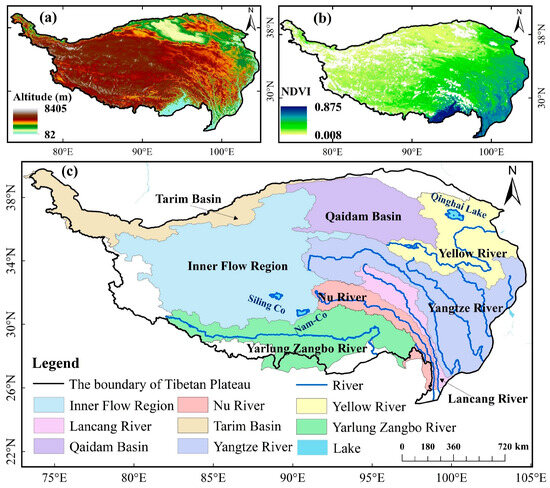
The Tibetan Plateau is situated in southwestern China and has an average elevation exceeding 4000 m [31,32], representing the highest and most topographically complex plateau on Earth. The study area encompasses the main body of the Tibetan Plateau, spanning approximately 25°59′37″N to 39°49′33″N and 73°29′56″E to 104°40′20″E, with a total area of approximately 2.5 million square kilometers, as shown in Figure 1a. This region serves as a vital ecological security barrier for Eurasia, harboring unique and fragile alpine ecosystems dominated by vegetation types such as alpine meadows, alpine steppes, alpine deserts, and mountain shrubs [11,33]. The Tibetan Plateau’s vegetation follows altitudinal zonation: alpine meadows prevail in the east/southeast, while alpine steppes dominate the west/north. Montane coniferous forests occur in southeastern valleys, with alpine deserts in northern margins and marsh meadows in riparian zones. The long-term average normalized difference vegetation index (NDVI) value shows the vegetation status across the Tibetan Plateau, as presented in Figure 1b. With its cold, arid, and high-radiation climate, the region is exceptionally sensitive to global change [34,35].
Figure 1.
Geography and topography of the Tibetan Plateau. The characteristics of (a) altitude and (b) NDVI spatial distribution on the Tibetan Plateau. (c) The main river basin regions in the Tibetan Plateau.
The region encompasses several crucial hydrological and topographical units, as shown in Figure 1c. The Qaidam Basin (QB) and the Inner Flow Region (IFR) are in the north; the upper reaches of the Yellow River (YER) and Yangtze River (YAR) are in the central and eastern parts. The southeastern margin of the plateau is the heart of the Asian Water Tower, featuring the headwaters of major international rivers such as the Lancang River (LR), Nu River (NR), and Yarlung Zangbo River (YZR) [36]. The northwest is adjacent to the vast Tarim Basin (TB). The area is also dotted with numerous lakes, including Qinghai Lake, Siling Co, and Nam-Co.
2.2. Data Sources
The High-Resolution Precipitation Dataset for the Chinese Mainland Version 2 (CHM_PRE V2) is a high-precision, long-term, and daily gridded precipitation dataset covering mainland China [37]. The CHM_PRE V2 dataset systematically integrates in situ observations from more than 2400 national meteorological stations. By employing an optimized thin-plate spline interpolation scheme coupled with a terrain-correction module based on a digital elevation model, the dataset provides daily precipitation estimates at a spatial resolution of 0.1°, with temporal coverage extending from 1961 onward and regularly updated. This version incorporates systematic improvements in data quality control, the representation of extreme precipitation, and the estimation accuracy over complex terrains, particularly enhancing reliability in regions with sparse station coverage, such as the Tibetan Plateau and southwestern mountainous areas. To standardize the spatiotemporal resolution of different datasets, this study resampled the CHM_PRE V2 dataset to 0.5° × 0.5° spatial resolution and 1-month temporal resolution using bilinear interpolation [38] and cumulative summation, respectively.
Historical daily meteorological data, including the maximum temperature, minimum temperature, mean temperature, relative humidity, surface wind speed, and sunshine duration, were obtained from the China Meteorological Administration (https://data.cma.cn/ (accessed on 12 October 2025)), covering the time series from 1980 to 2014. A total of 149 national-level surface meteorological stations distributed within the study area provided the observational data at a daily resolution. We used the Stefan–Boltzmann law [39] to compute the surface upwelling longwave radiation (SULR) and surface solar radiation downward (SSRD). The potential evapotranspiration was calculated based on the FAO Penman–Monteith model [39], which incorporates both energy balance and aerodynamic components to provide a physically based estimation of atmospheric water demand. Then, meteorological data were resampled [38] to 0.5° × 0.5° spatial resolution and 1-month temporal resolution. We used historical meteorological observation data to evaluate the CMIP6 models and train the RF model in this study.
The Coupled Model Intercomparison Project Phase 6 (CMIP6) is the flagship global climate modeling initiative coordinated by the World Climate Research Programme (WCRP), forming the scientific foundation of the IPCC Sixth Assessment Report [15]. The CMIP6 contains standardized historical simulations and future scenario experiments that cover key climate variables across the atmosphere, ocean, land, and cryosphere. Based on the selection frequency and reliability assessment of the CMIP6 models in relevant studies, 16 CMIP6 models were selected, as shown in Table 1. We averaged the outputs of the 16 CMIP6 models to construct a multimodel ensemble (MME) [40]. Furthermore, we applied the quantile mapping method [16] with historical observations to correct the output biases across the different CMIP6 models. Then, different CMIP6 models were resampled [6] to 0.5° × 0.5° spatial resolution and 1-month temporal resolution. In this study, Shared Socioeconomic Pathways (SSP) are selected as two representative future scenario pathways, including SSP245 and SSP585. SSP245 is a “middle-of-the-road” scenario that assumes that socioeconomic development follows historical trends, with radiative forcing stabilizing at approximately 4.5 W/m2 by 2100, and is often used to assess feasible climate mitigation pathways and their impacts [41]. SSP585 is a “fossil-fueled development” scenario, projecting continued heavy reliance on fossil fuels, with radiative forcing rising to approximately 8.5 W/m2 by 2100 [42]. SSP585 is a high-emissions scenario and is applied to explore extreme climate risks under ineffective emission reductions. The SSP585 scenario could provide scientific evidence for preparing for the most severe challenges [43]. By comparing the projection results under the SSP245 and SSP585 scenarios, we can assess the impacts of different future emission pathways on climate and vegetation changes.
Table 1.
Spatial coverage percentages of optimal copula function distributions for the different drought types.
The European Space Agency (ESA) Climate Change Initiative (CCI) Soil Moisture dataset is a global high-precision soil moisture product developed under the European Space Agency’s Climate Change Initiative [44]. The ESA CCI soil moisture dataset combines multiple passive and active microwave satellite observations to generate a long-term (1978–present) continuous record of near-surface soil water content, with a spatial resolution of approximately 0.25° and daily temporal resolution. Validated against global in situ networks, the dataset demonstrates high reliability and consistency in capturing spatiotemporal soil moisture dynamics [45]. To standardize the spatiotemporal resolution of different datasets, this study resampled the ESA CCI soil moisture dataset to 0.5° × 0.5° spatial resolution and 1-month temporal resolution using bilinear interpolation [38] and the mean algorithm, respectively.
The Global Inventory Modeling and Mapping Studies Normalized Difference Vegetation Index (GIMMS NDVI) is one of the longest temporal satellite-derived vegetation index datasets currently available globally [19,46]. The GIMMS NDVI’s primary strength lies in providing a continuous observational record spanning over 40 years (from 1981 to present), typically at monthly temporal resolution. Derived primarily from data acquired by the Advanced Very High-Resolution Radiometer sensors onboard the National Oceanic and Atmospheric Administration satellite series, the dataset incorporates advanced correction algorithms (e.g., removal of volcanic aerosol effects, calibration for orbital drift) to significantly improve the long-term consistency. Although the spatial resolution of the GIMMS NDVI is relatively coarse (approximately 8 km), the temporal coverage makes it indispensable for analyzing long-term vegetation dynamics [20]. To standardize the spatiotemporal resolution of different datasets, this study resampled the GIMMS NDVI dataset to 0.5° × 0.5° spatial resolution using bilinear interpolation [6].
2.3. Methods
2.3.1. Prediction Model
Random Forest (RF) is an ensemble learning method based on multiple decision trees [47,48]. RF improves the prediction accuracy and stability by constructing numerous independent trees and aggregating their outputs. Each tree is trained with two types of randomness: sample randomness (bootstrap sampling) and feature randomness, which reduces overfitting and effectively handles high-dimensional and nonlinear data. The algorithm can also assess feature importance, offering good interpretability. Due to its simple implementation and robustness to noise, RF is widely used in fields such as ecology and remote sensing [49]. Moreover, k-fold cross-validation was employed to verify the reliability of the RF model.
This study employed the RF model to develop a nonlinear regression model between environmental variables and the NDVI, using observational environmental variables and NDVI data from 1982 to 2005 as the training set. Subsequently, the observed environmental variables for the period 2006–2014 were input into the trained RF model to simulate the corresponding NDVI values. The simulated results were then used to evaluate the model simulation performance. We divided the future period of the CMIP6 model simulations into two phases: 2015–2060 and 2061–2100. This segmentation was based on key milestones of the Paris Agreement, with 2015 serving as the baseline for global climate action and 2060 representing a critical target year for mid-to-long-term carbon neutrality. The first phase (2015–2060) focused on near-to-mid-term policy-driven transition pathways, while the second phase (2061–2100) examined long-term climate system evolution under larger uncertainties. This approach aligns with the common practice in climate modeling of distinguishing between mid-century and end-century impacts and ensures statistically robust sample sizes in each period [50,51]. Using the multiyear average NDVI from the historical observation period (1982–2014) as the baseline, we assessed the changes in the future NDVI relative to this long-term historical observed value.
In this study, the environmental variables included the relative humidity, soil moisture, potential evapotranspiration, precipitation, SULR, SSRD, surface wind speed, maximum temperature, minimum temperature, and mean temperature.
2.3.2. Uncertainty Analysis and Model Evaluation Metrics
The Coefficient of Variation (CV) is a standardized statistical metric that quantifies the relative dispersion of a dataset, defined as the ratio of the standard deviation to the mean [52,53]. By removing the influence of measurement units and mean values, the CV enables the direct comparison of variability across datasets with different means. In climate change research, the CV is commonly used to assess the consistency among projections from multiple models within an ensemble, thereby quantifying the simulation uncertainty. A higher CV indicates larger intermodel differences and higher uncertainty.
This study employs the CV to quantitively analyze the uncertainty in the future NDVI projections simulated by different CMIP6 models [54]. Specifically, the CV is calculated for NDVI outcomes predicted using environmental variables derived from multiple CMIP6 models.
In this study, we used the Root Mean Square Error (RMSE) and Nash–Sutcliffe efficiency coefficient (NSE) [55] to evaluate the simulation performance of the RF model. Taylor diagrams [40] were used to evaluate the CMIP6 model simulation performance in environmental variables across the Tibetan Plateau. The RMSE, standard deviation, and correlation coefficient are important parameters for the Taylor diagram. To evaluate the model performance, we calculated the Taylor diagram parameters (RMSE, standard deviation, and correlation coefficient) for each grid cell. Regional averages of these parameters were then computed to construct the Taylor diagrams.
3. Results
3.1. Model Simulation Performance Evaluation
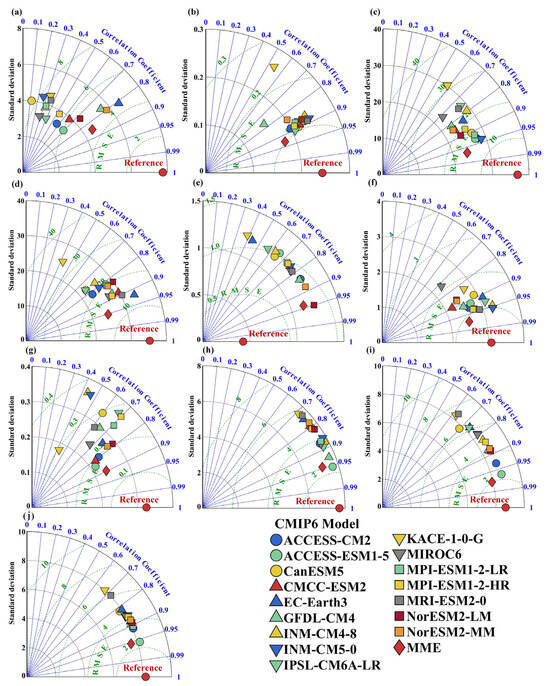
The environmental variables of the CMIP6 models were evaluated to assess their simulation performance in the study areas using a Taylor diagram, as shown in Figure 2. The MME model exhibited the closest proximity to the reference value (Figure 2a–g), demonstrating superior performance in simulating the relative humidity, soil moisture, potential evapotranspiration, precipitation, SULR, SSRD, and surface wind speed compared to the individual CMIP6 models. In contrast, as shown in Figure 2b–e,h–j, the KACE-1-0-G model showed the largest deviation from the reference, indicating its relatively poorer simulation accuracy of environmental variables among the evaluated models. As shown in Figure 2a,f,g, the CanESM5, MIROC6, and INN-CM4-8 models showed the largest deviation from the reference in different environmental variables, indicating their relatively poorer simulation accuracy of environmental variables among the evaluated models. In general, based on the Taylor diagram analysis, the MME model exhibited the best overall performance in simulating the suite of environmental variables. In contrast, individual models such as KACE-1-0-G, CanESM5, MIROC6, and INN-CM4-8 showed significant deviations in their simulations of certain variables.
Figure 2.
Evaluation of the environmental variables of the CMIP6 model simulation performance across the Tibetan Plateau. (a) Relative humidity, (b) Soil moisture, (c) Potential evapotranspiration, (d) Precipitation, (e) Surface upwelling longwave radiation, (f) Surface solar radiation downwards, (g) Surface wind speed, (h) Maximum temperature, (i) Minimum temperature, and (j) Mean temperature.
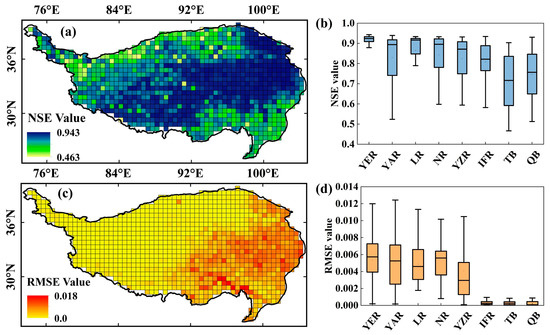
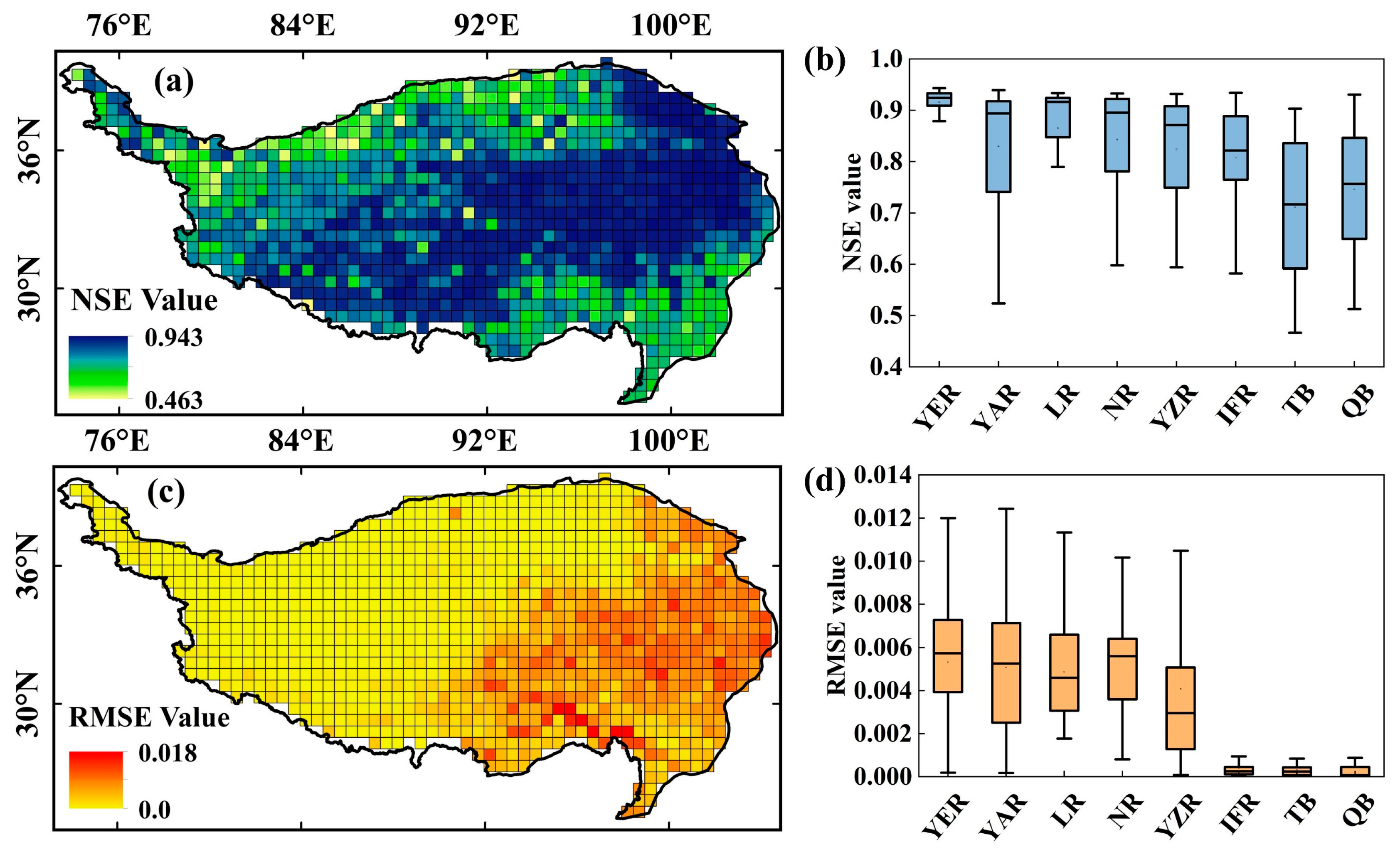
Figure 3 presents the performance evaluation of the RF model in simulating the NDVI.
Figure 3.
Performance evaluation of the NDVI simulation using RF over the Tibetan Plateau. (a) The spatial distribution map of NSE; (b) NSE box plots in different river basins; (c) The spatial distribution map of RMSE; (d) RMSE box plots in different river basins.
As shown in Figure 3a, the NSE values were generally high in the central Tibetan Plateau, mostly exceeding 0.85, indicating optimal simulation performance in this region. In contrast, lower NSE values (locally below 0.6) were found along the northern margins and in parts of the southeastern Tibetan Plateau. As shown in Figure 2b, the NSE of RF demonstrated high performance in both the YER and LR basins, with most values ranging from 0.90 to 0.93. The NSE exhibited low performance in the RF in the TB and QB, with the majority ranging between 0.59 and 0.85. As indicated in Figure 3c,d, the RMSE values were generally high in the eastern Tibetan Plateau, specifically within the YER, YAR, LR, NR, and YZR basins. Overall, the RF model exhibited reliable capability in simulating and predicting the NDVI across the entire Tibetan Plateau.
Table 2 presents the performance results of the RF model evaluated through eight-fold cross-validation. The accuracy across all folds ranged from 86.3% to 89.2%, with the highest accuracy observed in fold 4 (89.2%) and the lowest in fold 5 (86.3%). The relatively small variation in accuracy indicated that the RF model demonstrated consistent and robust generalization for simulating the NDVI.
Table 2.
Results of the random forest model with k-fold cross-validation.
3.2. Future Changes in Vegetation Dynamics
3.2.1. CMIP6 Models
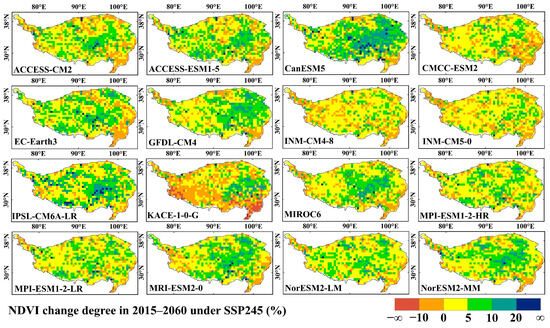
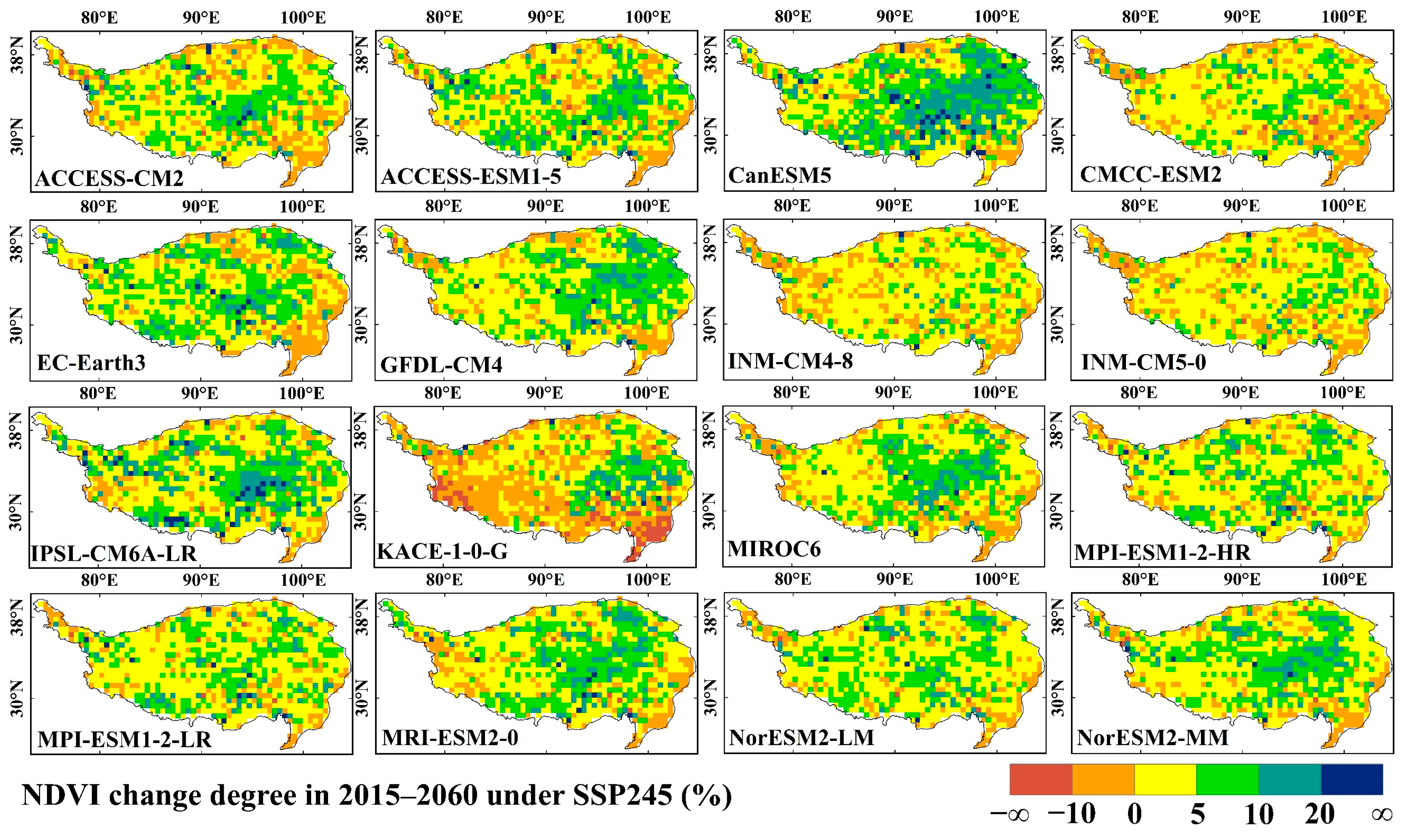
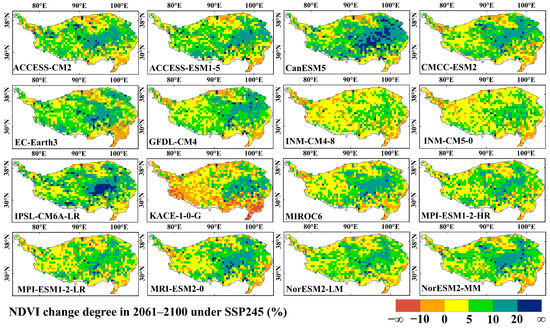
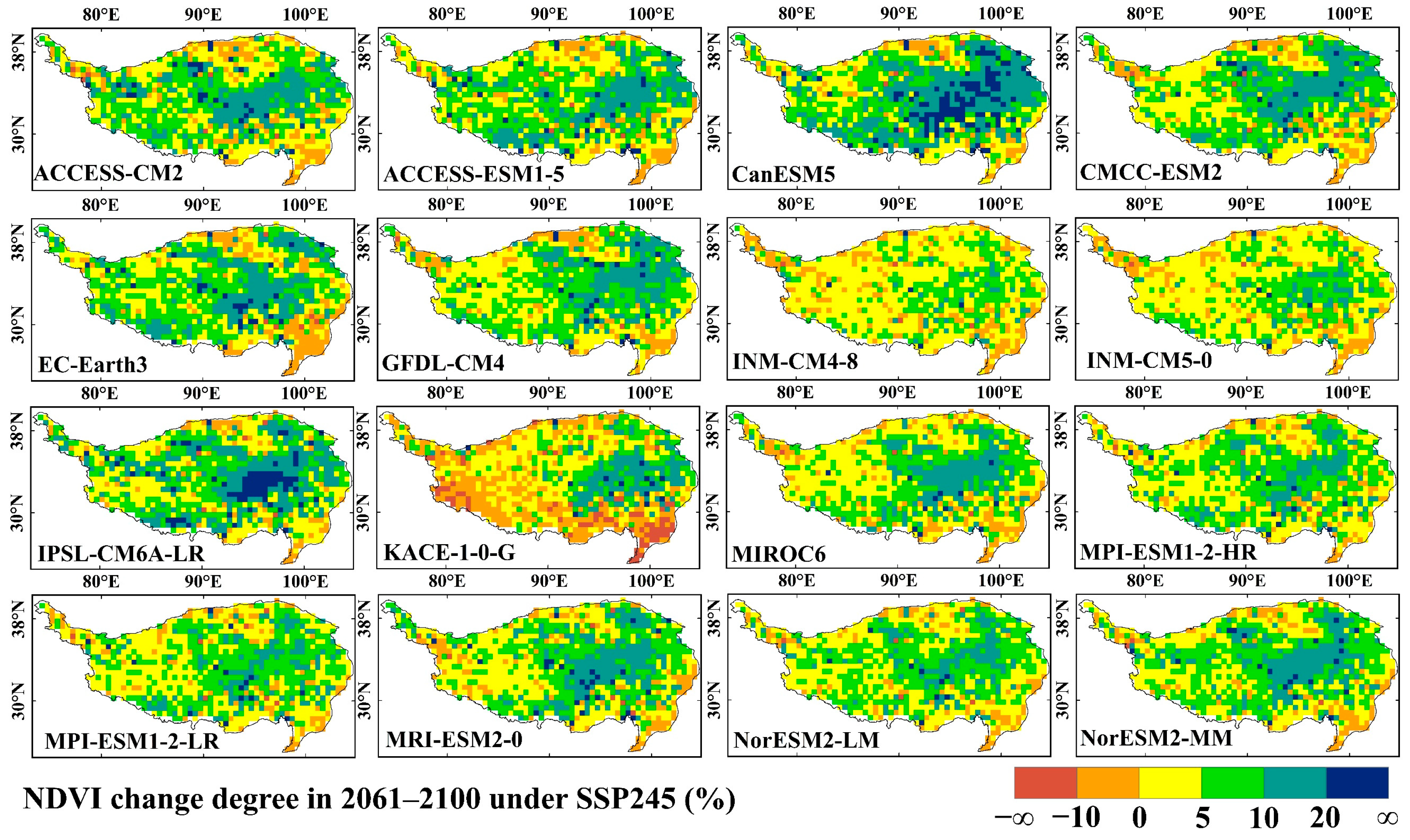
Figure 4 and Figure 5 present the NDVI change degrees based on different CMIP6 models under the SSP245 scenario. They reveal that the majority of the CMIP6 models projected increasing NDVI trends in the central and eastern Tibetan Plateau. In contrast, the majority of the CMIP6 models projected decreasing NDVI trends in the northern margins and in parts of the southeastern Tibetan Plateau. During 2015–2060, the CMCC-ESM2, INM-CM4-8, and INM-CM5-0 models predicted lower increasing NDVI trends across the Tibetan Plateau. The KACE-1-0-G model predicted more pronounced decreasing NDVI trends in the southwestern Tibetan Plateau. The spatial patterns of NDVI change during 2061–2100 exhibited similar characteristics to those during 2015–2060. During 2061–2100, the KACE-1-0-G model also predicted more pronounced decreasing NDVI trends in the southwestern Tibetan Plateau.
Figure 4.
Prediction results of the NDVI change degree based on different CMIP6 models during 2015–2060 under the SSP245 scenario.
Figure 5.
Prediction results of the NDVI change degree based on different CMIP6 models during 2061–2100 under the SSP245 scenario.
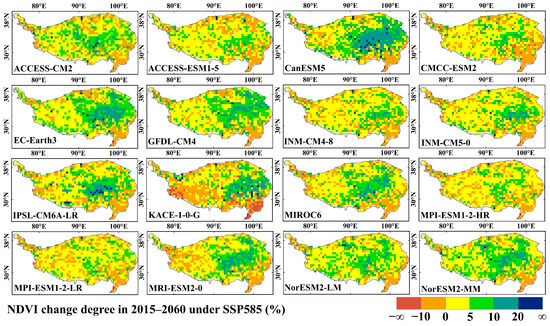
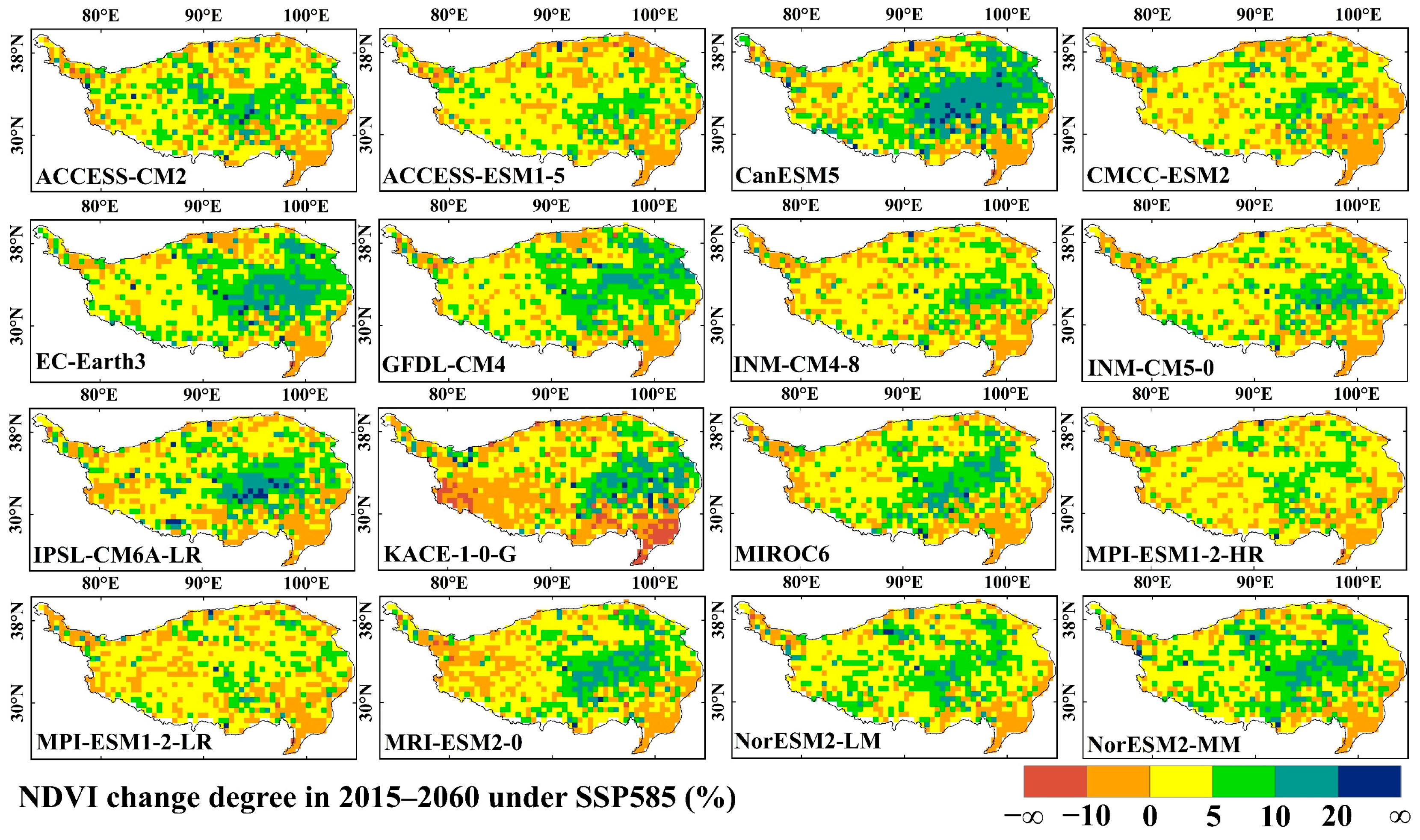
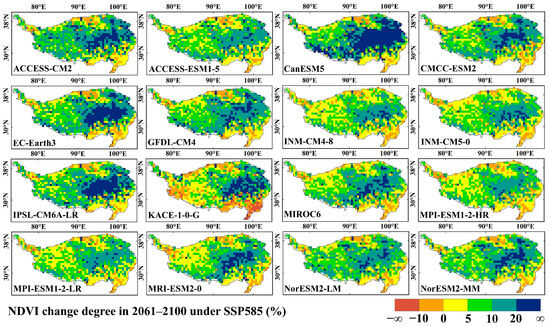
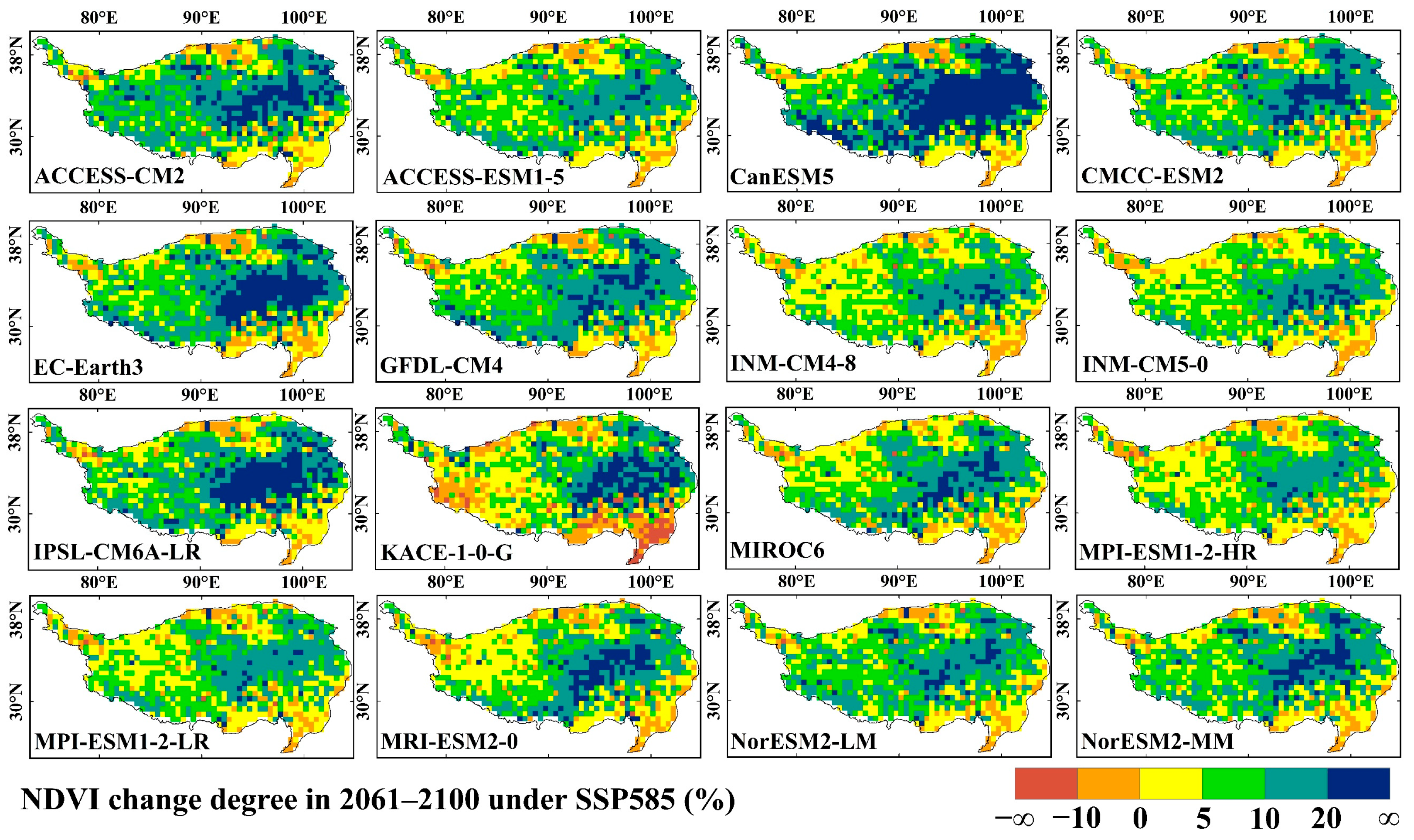
Figure 6 and Figure 7 illustrate the degrees of NDVI change derived from different CMIP6 models under the SSP585 scenario. First, an overall analysis of the projection trends showed that the majority of CMIP6 models projected distinct NDVI trends across different regions of the Tibetan Plateau. Specifically, in the central and eastern parts of the Tibetan Plateau, the majority of these models projected increasing NDVI trends. Conversely, in the northern margins and parts of the southeastern Tibetan Plateau, the majority of models projected decreasing NDVI trends. Next, considering different time periods, during 2015–2060, under the SSP585 scenario, models such as ACCESS-ESM1-5, CMCC-ESM2, INM-CM4-8, INM-CM5-0, MPI-ESMI-2-LR, and MPI-ESMI-2-HR predicted relatively lower increasing NDVI trends across the entire Tibetan Plateau. In the central and eastern Tibetan Plateau, most CMIP6 models projected stronger NDVI increasing trends during 2061–2100 than the 2015–2060 period. For the 2015–2100 period, under the SSP585 scenario, the KACE-1-0-G model predicted more pronounced decreasing NDVI trends in the southwestern Tibetan Plateau.
Figure 6.
Prediction results of the NDVI change degree based on different CMIP6 models during 2015–2060 under the SSP585 scenario.
Figure 7.
Prediction results of the NDVI change degree based on different CMIP6 models during 2061–2100 under the SSP585 scenario.
In general, an integrated analysis under the SSP245 and SSP585 scenarios indicated that most CMIP6 models projected a continuous increase in NDVI in the future in the central and eastern regions of the Tibetan Plateau. Conversely, most CMIP6 models projected a decrease in the northern margins and certain parts of the southeast. Among these models, the KACE-1-0-G model predicted the most significant decline in the southwest. When comparing the time periods, the spatial patterns of NDVI changes from 2061 to 2100 were similar to those from 2015 to 2060. However, under the SSP585 scenario, more substantial increases in NDVI are expected in the central–eastern plateau.
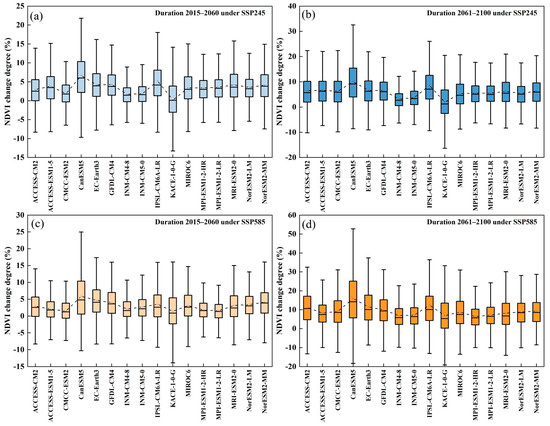
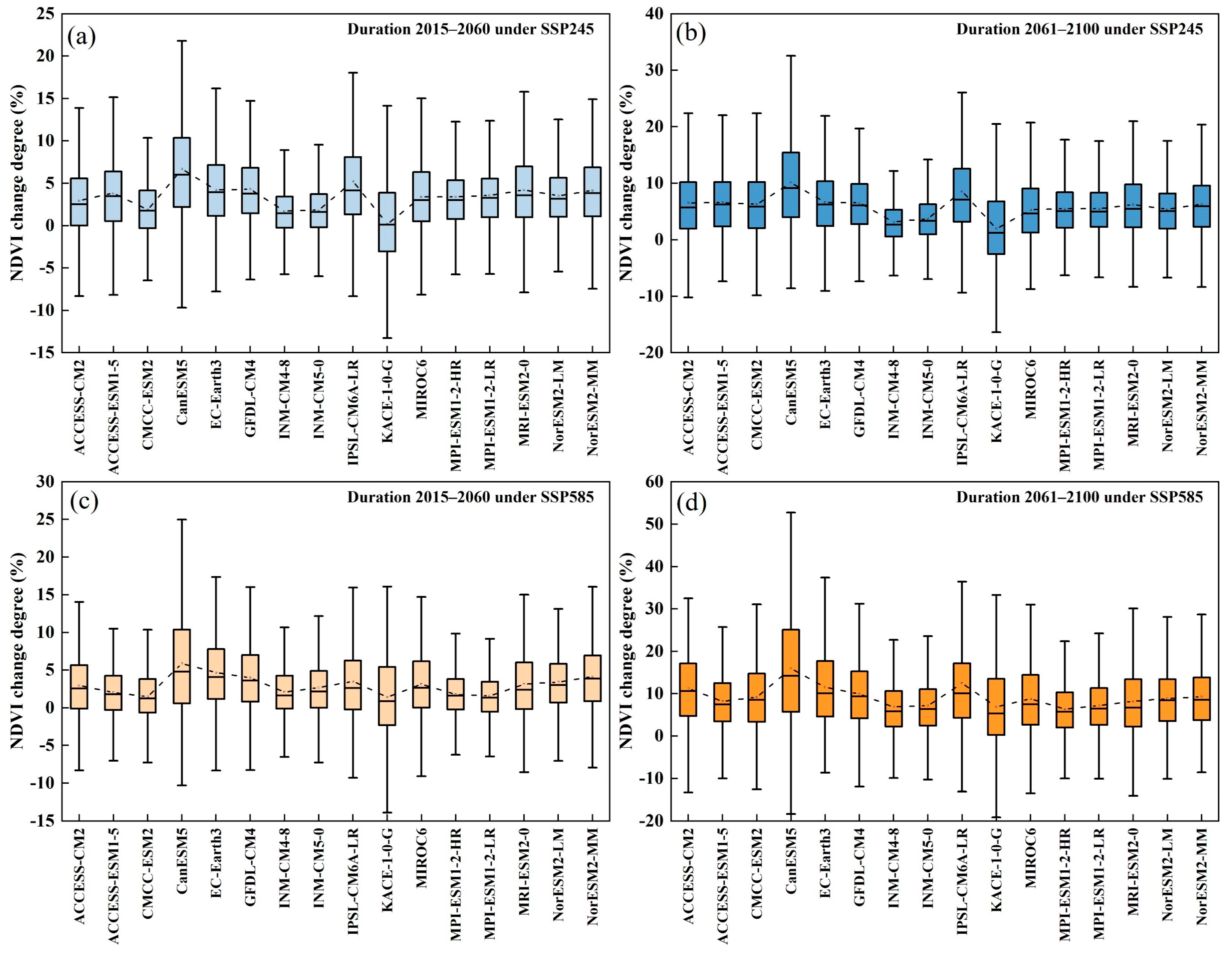
As shown in Figure 8, the CanESM5 and IPSL-CM6A-LR models predicted higher increasing NDVI trends under the SSP245 and SSP585 scenarios. The ACCESS-ESM1-5, CMCC-ESM2, INM-CM4-8, INM-CM5-0, MPI-ESMI-2-LR, and MPI-ESMI-2-HR models predicted lower increasing NDVI trends under different scenarios. Figure 8 indicates that the degree of NDVI increase in 2061–2100 is markedly higher than that in 2015–2060 under different scenarios; the degree of NDVI increase during 2061–2100 was more pronounced under the SSP5-8.5 scenario than under the SSP2-4.5 scenario.
Figure 8.
Boxplot of the NDVI change degree across different CMIP6 models. (a) Duration 2015–2060 under SSP245; (b) Duration 2061–2100 under SSP245; (c) Duration 2015–2060 under SSP585; (d) Duration 2061–2100 under SSP585.
3.2.2. MME Model
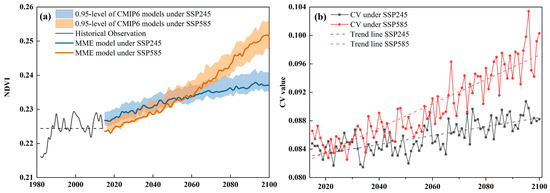
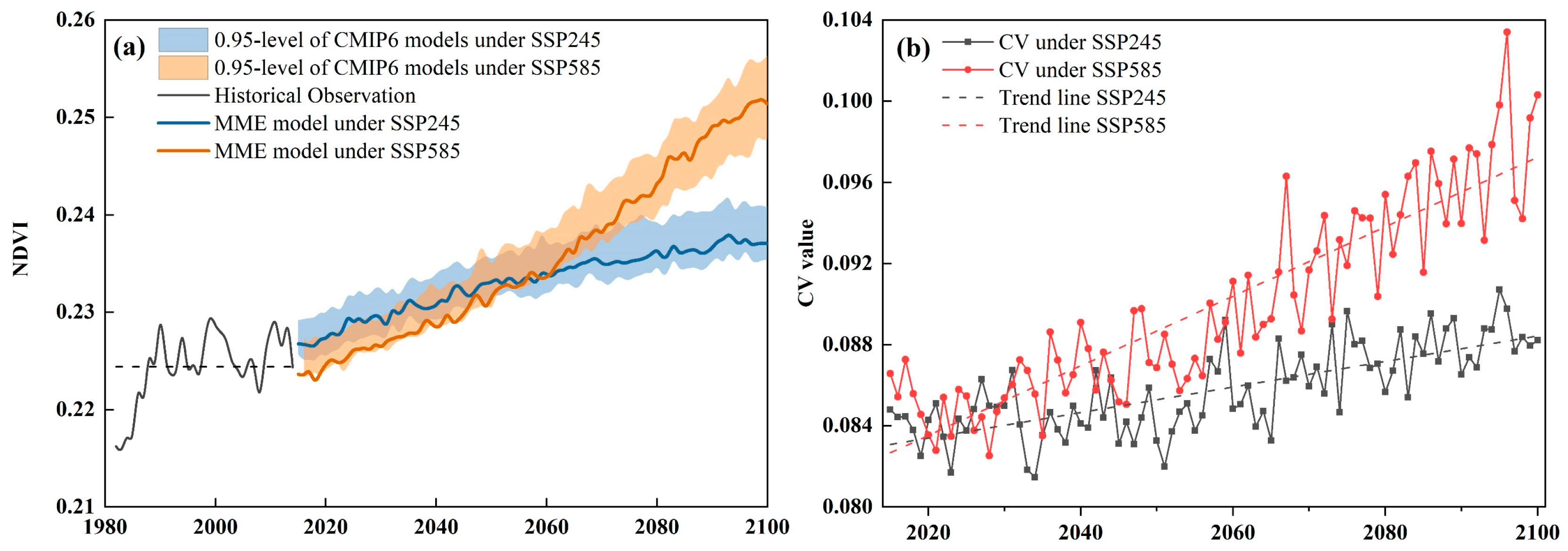
Figure 9a depicts the projected annual mean NDVI trends across the Tibetan Plateau from 1982 to 2100 under the SSP245 and SSP585 scenarios, as predicted by the MME model. From 1982 to 1990, the annual mean NDVI across the Tibetan Plateau exhibited a continuous upward trend. During the period from 1990 to 2014, the annual mean NDVI underwent fluctuating changes. In the future, under both the SSP245 and SSP585 scenarios, the annual mean NDVI over the Tibetan Plateau was expected to show an increasing trend. Specifically, during 2015–2060, the annual mean NDVI under the SSP245 scenario was higher than that under the SSP585 scenario. However, from 2061 to 2100, the situation reversed, with the annual mean NDVI under the SSP585 scenario exceeding that under the SSP245 scenario. Moreover, after the 2060s, there is a distinct divergence in the trends: the increase in NDVI under the SSP585 scenario accelerates significantly, while the increasing trend under the SSP245 scenario gradually decelerates.
Figure 9.
The change trend of the annual mean (a) NDVI and (b) CV across the Tibetan Plateau in the future under the SSP245 and SSP585 scenarios.
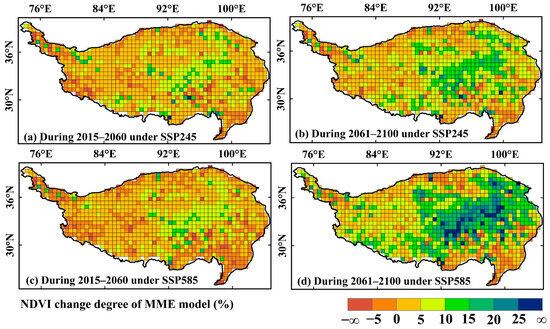
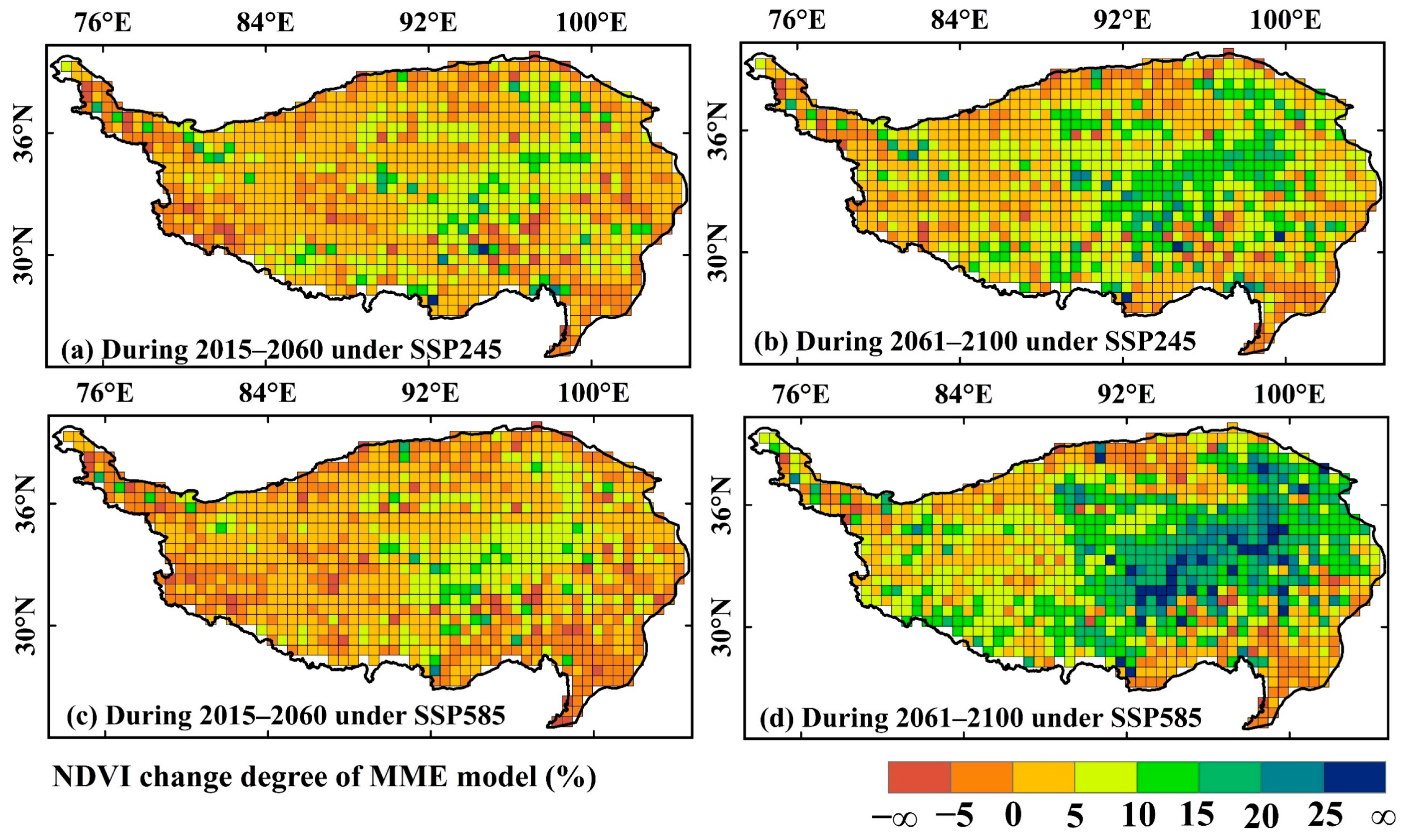
Figure 10 depicts the spatial pattern of the NDVI change degree across the Tibetan Plateau, which is based on the MME model prediction under different periods and scenarios. The MME model predicted that the NDVI would increase in the central and eastern parts of the Tibetan Plateau, while it would decrease in the northern margins and some areas of the southeast. In the period from 2015 to 2060, the spatial patterns of the NDVI change degree were similar in the SSP245 and SSP585 scenarios. In the period from 2061 to 2100, compared with the SSP245 scenario, the NDVI in the central and eastern Tibetan Plateau under the SSP585 scenario showed more significant increases.
Figure 10.
Based on the MME model prediction, the spatial pattern of the NDVI change degree under different periods and scenarios. (a) During 2015–2060 under the SSP245 scenario, (b) during 2060–2100 under the SSP245 scenario, (c) during 2015–2060 under the SSP585 scenario, and (d) during 2060–2100 under the SSP585 scenario.
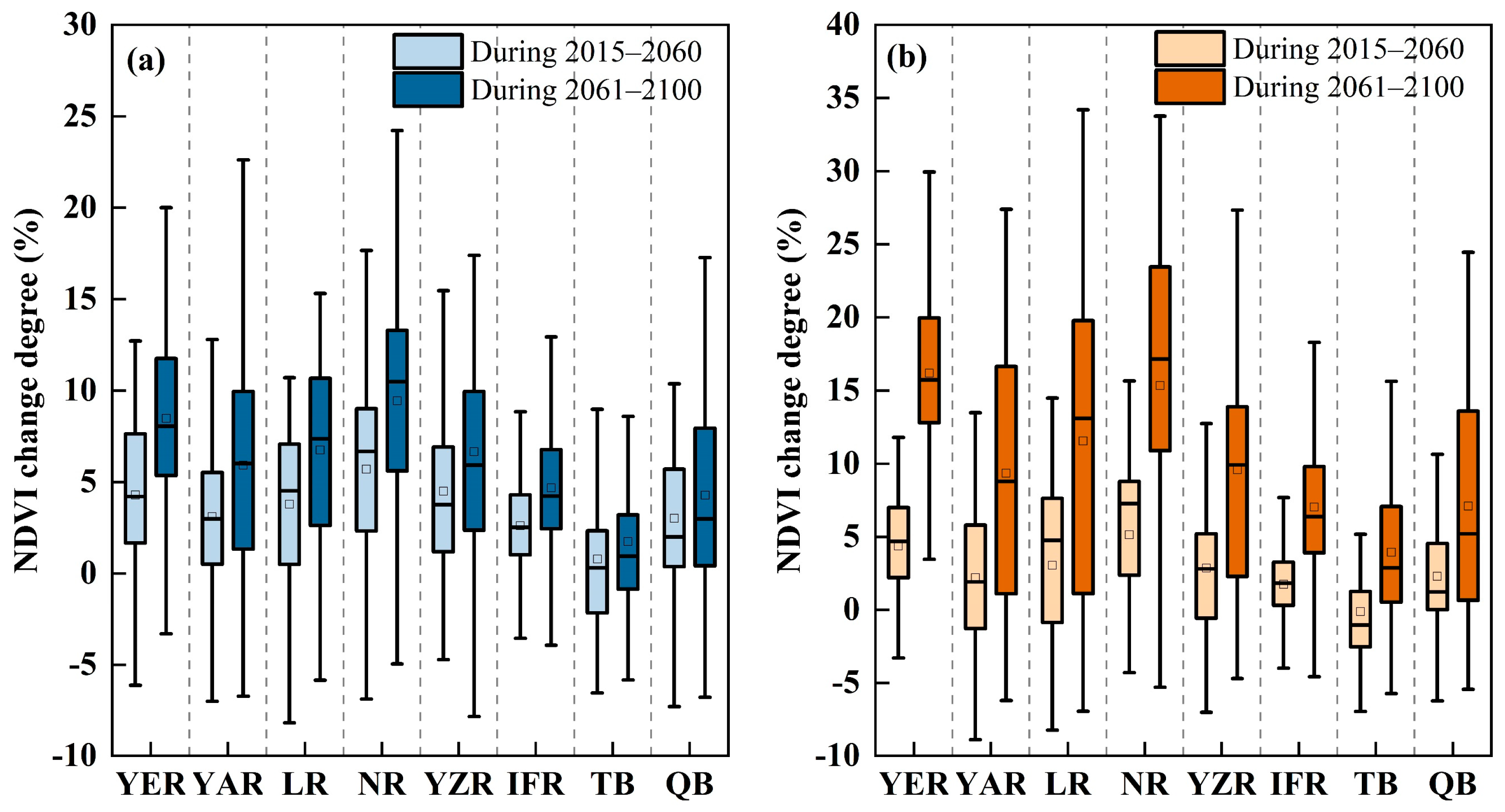
Figure 11 depicts the distribution of NDVI change across the major river basins of the Tibetan Plateau under the SSP245 and SSP585 scenarios, as predicted by the MME model. Under the SSP245 scenario, the NDVI changes in most basins were within the range of −4% to 13%. Specifically, in the YER, YAR, LR, and NR basins, the future NDVI showed a more significant increase compared to the historical period, with the main increase falling between 0% and 13%. In contrast, the TB had a relatively smaller future NDVI increase compared to its historical trend, mainly ranging from −4% to 2%. Under the SSP585 scenario, the NDVI changes in most basins ranged from −2% to 24%. In the YER and NR basins, the future NDVI also showed a more pronounced increase compared to the historical period. Moreover, the degree of NDVI change from 2061 to 2100 in these two basins was 10% higher than that from 2015 to 2060. In contrast, the TB and IFR basins showed relatively smaller increases. In these two basins, the degree of NDVI change from 2061 to 2100 was 5% less than that from 2015 to 2060.
Figure 11.
Based on the MME model prediction, the change degree of the NDVI in different river basins across the Tibetan Plateau under the (a) SSP245 and (b) SSP585 scenarios.
In general, the MME model prediction indicated that the NDVI will increase across the Tibetan Plateau from 1982 to 2100. Specifically, during the period from 2015 to 2060, higher NDVI values were projected under the SSP245 scenario. However, from 2061 to 2100, a more robust increasing trend was expected under the SSP585 scenario. Spatially, the central and eastern parts of the plateau will predominantly experience NDVI increases. Conversely, decreases were likely to occur along the northern margins and in some areas of the southeast. Moreover, humid basins were projected to exhibit more significant increases compared to arid basins, especially under the SSP585 scenario in the later part of the study period.
3.3. Uncertainty Analysis of NDVI Prediction
Figure 9b depicts the changing trend of the annual mean CV derived from the CMIP6 model’s NDVI predictions under the SSP245 and SSP585 scenarios. As shown in Figure 9b, under both the SSP245 and SSP585 scenarios, the CV results exhibited a continuous upward trend. Notably, the increasing trend of the CV was more pronounced under the SSP585 scenario compared to the SSP245 scenario. Moreover, under both scenarios, the CV values stayed below 0.1. This indicates that the NDVI predictions based on the CMIP6 models have low uncertainty.
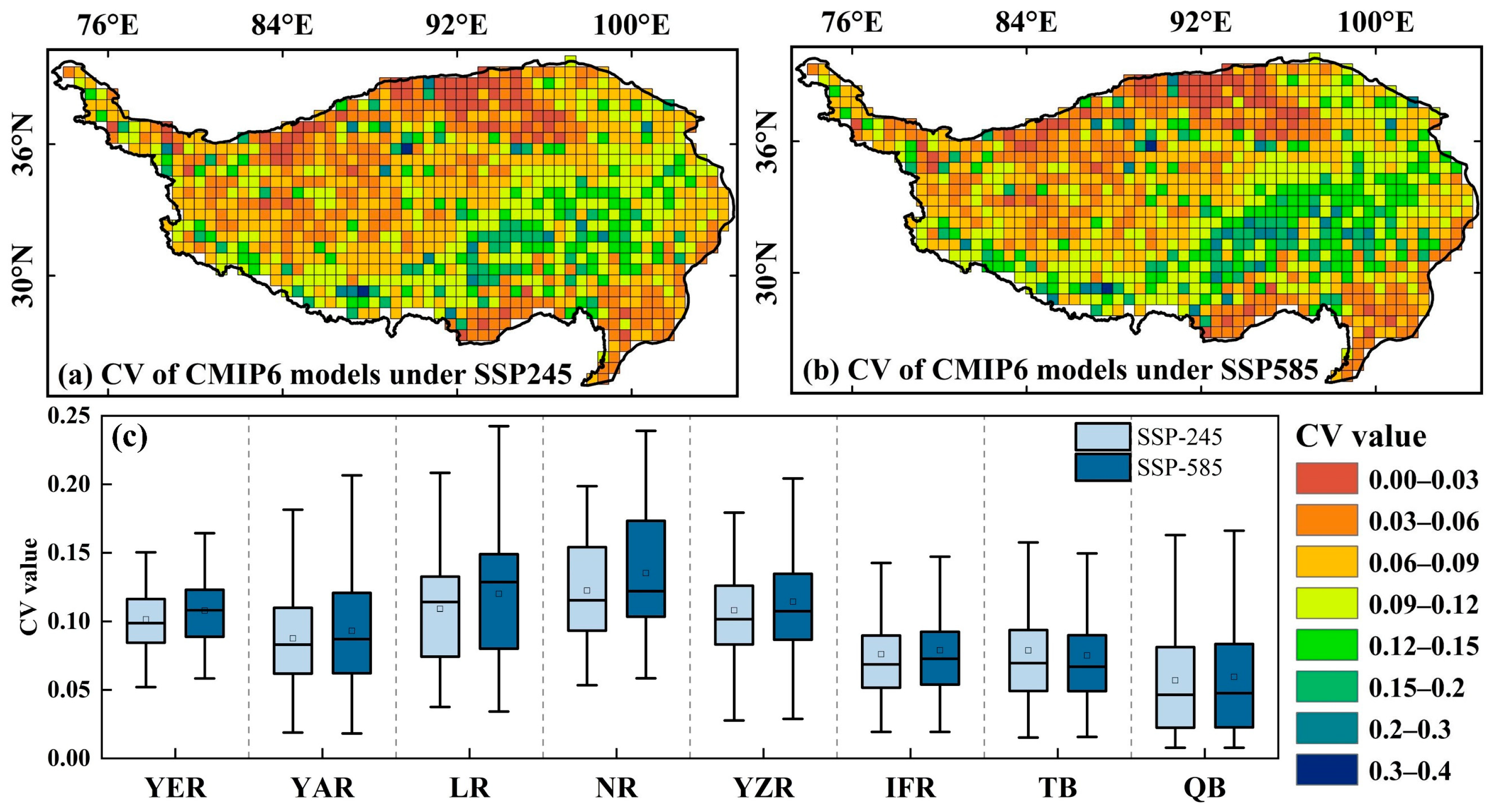
Figure 12 offers a comprehensive visualization of the spatial patterns and basin-scale statistical distributions of the CV for NDVI prediction from Coupled Model Intercomparison Project Phase 6 (CMIP6) models under the Shared Socioeconomic Pathway (SSP) 245 and SSP585 scenarios over the Tibetan Plateau. Figure 12a,b show that, over the Tibetan Plateau, the spatial pattern and numerical range of the CV value are similar in the SSP245 and SSP585 scenarios. Across most areas of the Tibetan Plateau, the CV values generally remain below 0.1. This phenomenon reflects a lower regional uncertainty in NDVI prediction from the CMIP6 models. Region-wise, the CV values are relatively high in the central and eastern parts of the Tibetan Plateau, while they are relatively low in the northern margins and parts of the southeastern Tibetan Plateau. Figure 12c reveals that in the YER, LR, and NR basins, the CV values are relatively high, with the majority ranging from 0.06 to 0.13. This implies a larger uncertainty in the NDVI projections from the CMIP6 models for these regions. In contrast, in the IFR, TB, and QB, the CV values are relatively low, with the majority ranging from 0.02 to 0.10.
Figure 12.
The spatial pattern of CV values for NDVI projections from CMIP6 models under the (a) SSP245 and (b) SSP585 scenarios, and (c) CV values of NDVI across major river basins of the Tibetan Plateau.
4. Discussion
4.1. Future Vegetation Changes and Driving Mechanisms
The results of this study (as detailed in Section 3.2) indicated that the projections based on different CMIP6 models show a significant overall increasing trend in vegetation cover over the Tibetan Plateau. Under both the SSP245 and SSP585 scenarios, the MME predicted a continuous vegetation greening trend in the central and eastern regions of the plateaus. In contrast, the MME projected vegetation degradation along the northern margins and in some parts of the southeast. Song et al. [16] determined that the drought frequency will increase notably in arid regions of the plateau. Moreover, the combination of rising temperatures and more frequent droughts may have a negative impact on vegetation productivity. The conclusions of Song et al. [16] were consistent with the slow growth or decrease in NDVI observed in the northwestern plateau in this study. Jiao et al. [56] highlighted that the vegetation growth on the plateau is sensitive to changes in hydrothermal conditions. Warming suppressed vegetation growth in some arid areas of the Tibetan Plateau, while precipitation was a key driver of NDVI variations across most regions of the Tibetan Plateau [56]. Wang et al. [20] demonstrated that the CMIP6 models predicted increasing future precipitation over the plateau, which would benefit vegetation growth in humid areas, which agreed with the conclusions of this study.
Notably, the increase in NDVI in the central–eastern Tibetan Plateau was significantly stronger under the SSP585 scenario than under SSP245, highlighting the amplified effect of high-emission pathways on the productivity of alpine ecosystems. This phenomenon can be attributed to the more pronounced warming under high-emission scenarios, which promoted vegetation growth (particularly in cold-limited high-altitude environments) by extending the growing season and enhancing photosynthetic efficiency, thereby boosting the vegetation productivity. Zhang et al. [57] indicated that the vegetation carbon sequestration capacity exhibited a more substantial increase, which may even surpass the changes in soil carbon pools, further validating the significant influence of high-emission scenarios on the carbon cycling of ecosystems.
However, this rapid vegetation growth driven by climate change is accompanied by several potential risks. First, intensified water competition may become a key limiting factor for sustained vegetation growth [58]. When the precipitation increases insignificantly, or evapotranspiration intensifies in a region, the vegetation expansion could lead to soil moisture depletion and subsequent drought stress. Second, the risk of exceeding ecological thresholds cannot be ignored [59]. The current positive response of vegetation to warming might reverse upon reaching specific climatic or hydrological thresholds. For instance, permafrost degradation can lead to soil destabilization and water loss [60]. Moreover, the short-term increase in vegetation carbon under high emission scenarios does not necessarily lead to an enhanced long term carbon sequestration capacity. A possible explanation for the observed phenomenon is that climate change may influence carbon cycling stability through alterations in species composition and disturbance regimes, such as wildfires, pests, and extreme heatwaves [61,62].
4.2. Vulnerability of Vegetation Ecology in River Basins
The vulnerability of vegetation ecology at the river basin scale exhibited significant spatial heterogeneity, closely related to the differences in hydrothermal conditions, topographic features, and human activity intensity across the basins. Zhang et al. [63] determined that warming drove very high suitability and low vulnerability zones to shift toward higher elevations in the eastern Tibetan Plateau. Similarly, this study revealed that the future NDVI in river basins of the eastern Tibetan Plateau (such as the YER, YAR, LR, and NR basins) showed a significant increasing trend, particularly under the SSP585 scenario. Xia et al. [64] indicated that the western Tibetan Plateau showed high ecological vulnerability, with an increasing trend. The findings of this study further illustrate that vegetation growth in the western river basins (such as the IFR, TB, and QB) will continue to be restricted. Moreover, future climate change may not be able to effectively mitigate their ecological vulnerability. Some studies have indicated that vegetation growth in humid basins such as the YER, LR, and NR shows notable increases under warming and wetting trends [13,42,65]. Meanwhile, the CV for the NDVI projections in the river basins of the eastern Tibetan Plateau was relatively high. This high CV value reflected the higher intermodel uncertainty of the CMIP6 in depicting the vegetation’s response to climate change. This high uncertainty implied that, while the short-term vegetation productivity in the river basins of the eastern Tibetan Plateau may improve, their long-term stability faces elevated risks, particularly under high-emission scenarios. Stronger warming could exacerbate soil moisture pressure and cause the vegetation dynamics to deviate from current projections. In contrast, arid and semiarid basins showed smaller vegetation changes and lower CV values, indicating higher consistency among models in projecting vegetation responses in these areas [66]. However, the smaller vegetation changes and lower CV values did not equate to lower ecological vulnerability [67]. The vegetation in arid zones already exists near the threshold of water stress, and minor shifts in the future precipitation patterns or increased evapotranspiration due to warming could exceed ecological thresholds, triggering vegetation degradation or even regime shifts [68]. Particularly noteworthy was that the vegetation degradation trends in the northern margins and parts of the southeastern plateau were accompanied by relatively low CV values, suggesting that multiple models of CMIP6 agreed on persistent ecological pressures in these regions, highlighting their pronounced vulnerability.
Therefore, future ecological risk management requires differentiated strategies. For high-uncertainty humid basins, we should focus on enhancing multimodel ensembles and downscaling studies to quantify nonlinear relationships between extreme climate events and ecological responses [69]. For arid and semiarid basins, we should monitor the water balance and vegetation physiological thresholds and establish ecological early warning systems based on water availability [70].
As shown in Figure 3, the NSE values were relatively low in parts of the northern edge and southeastern regions. In the northern edge of the Tibetan Plateau, the arid climate and sparse vegetation lead to a relatively direct surface runoff generation mechanism [71]. However, the scarcity of meteorological stations may amplify the uncertainty in the driving data, thereby affecting the simulation accuracy. In the southeastern region of the Tibetan Plateau, dense vegetation cover and complex topography enhance the precipitation interception and evapotranspiration processes [11]. In contrast, we also found that the RF model performed well in the IFB, TB, and QB, as shown in Figure 3. Located in the deep interior, they are characterized by an arid climate with scarce precipitation and high evaporation. As such, surface runoff generation mechanisms are relatively simple and are mainly driven by a few heavy precipitation events, the vegetation cover is sparse and uniform (dominated by grassland and bare soil), and human disturbance is relatively limited. Therefore, the hydrological and ecological processes that the model needs to capture are less complex, leading to lower simulation errors.
In this study, the RF model representation of vegetation–hydrology interactions remained relatively simplified, leading to deviations in simulating runoff generation and convergence processes in this area. Based on many studies, precipitation can be a key driving factor for vegetation growth [29,56,68]. In the future, precipitation on the Qinghai–Tibet Plateau is expected to increase significantly, with a higher increase under the SSP585 scenario than under the SSP245 scenario [15]. The increased spatiotemporal heterogeneity of precipitation under the SSP585 scenario is the primary reason for the rise in NDVI prediction uncertainty. Compared to the relatively consistent trends in temperature and CO2 concentration under this scenario, precipitation exhibited stronger uncertainty in its interannual distribution and interannual variability under future climate conditions [72]. This variability significantly affects the vegetation growth through water stress mechanisms, ultimately dominating the overall variability in NDVI predictions.
4.3. Limitations
In this study, a key limitation is the use of a uniform 0.5° × 0.5° spatial resolution. Over the topographically complex Tibetan Plateau, this relatively coarse resolution combined with bilinear interpolation may smooth local heterogeneity, particularly in arid/semiarid margins. This could inflate the multimodel ensemble agreement and underestimate the spatial uncertainty, limiting the direct applicability of the results for local adaptation strategies. Future studies should employ higher-resolution models and downscaling techniques to better resolve ecological gradients across the Tibetan Plateau.
The RF model primarily relied on climatic variables and did not explicitly incorporate non-climatic stressors (grazing, irrigation, farming, etc.), due to challenges in quantifying their future trajectories and their tight coupling with climate. While the CMIP6 scenarios indirectly reflect macroscale human influences, our results may overestimate climate contributions and underestimate human activity contributions. Consequently, the projections presented here should be interpreted as a baseline scenario of climate-dominated vegetation response, under the assumption that the current patterns of human pressure will not strongly change. The validation period for the RF model was relatively short (2006–2014, 9 years), which may increase the uncertainty in the model’s extrapolative performance over longer timescales. The reliability of the model under decadal climate variability and extreme events requires further verification with longer observational records in the future.
This study had limitations in simulating the future vegetation dynamics on the Tibetan Plateau using the CMIP6 models. The inherent differences among the CMIP6 models in their initial conditions, physical parameterizations, and computational frameworks directly led to divergent spatial patterns of key future climate variables (e.g., temperature and precipitation). These differences in the climatic drivers themselves, rather than random model errors, were the primary cause of the spatial disparities in NDVI projections presented in this study. Although the MME model approach integrated various projections, the current framework could not quantitatively attribute the NDVI differences to specific climatic factors. Future work should leverage CMIP6 diagnostic subprojects and factor sensitivity experiments to systematically unravel the role of different physical processes in causing model disparities while developing coupled climate–vegetation models to more accurately elucidate the drivers of future vegetation change.
Although this study has certain limitations, its long-term NDVI projections and macro-scale trend analyses of the Tibetan Plateau are still valuable. They can help to clarify the response mechanisms of alpine vegetation to climate change and provide useful information for regional ecological risk assessments.
5. Conclusions
This study seeks to project the future vegetation dynamics on the Tibetan Plateau in response to climate change and to evaluate the associated uncertainties in the results of the projections. The RF model and CMIP6 models were used to project the vegetation dynamics, and historical observation data were employed to train the RF model. The major findings are summarized as follows:
(1) The MME model exhibited the best overall performance in simulating multiple environmental variables, while the KACE-1-0-G, CanESM5, MIROC6, and INN-CM4-8 models showed significant deviations in simulating specific environmental variables. Moreover, the RF model demonstrated reliable capability in simulating and predicting the NDVI across the Tibetan Plateau.
(2) In terms of the future, most CMIP6 models projected persistent NDVI increases in the central and eastern Tibetan Plateau but decreases in the northern margins and parts of the southeast. The CanESM5 and IPSL-CM6A-LR models predicted higher increasing NDVI trends, while the ACCESS-ESM1-5, CMCC-ESM2, INM-CM4-8, INM-CM5-0, MPI-ESMI-2-LR, and MPI-ESMI-2-HR models predicted lower increasing NDVI trends.
(3) The MME model prediction revealed NDVI increases over the Tibetan Plateau during 1982–2100, with higher values under SSP245 before the 2060s and a stronger increasing trend under SSP585 after the 2060s. Under the SSP245 scenario, NDVI changes in most basins range from −4% to 13%, with pronounced increases in humid basins (such as the YER, YAR, LR, NR basins; 0–13%) and limited changes in the TB (−4–2%). Under the SSP585 scenario, most river basins exhibited a change range primarily between –2% and 24%. The YER and NR basins showed stronger growth (more than 10%) after the 2060s, while the TB and IFR exhibited weaker increases (less than 5%).
(4) The CV exhibited a sustained increasing trend under both scenarios, with a stronger rise under the high-emission scenario. Spatially, the CV values remained below 0.1 across most of the plateau and demonstrated lower uncertainty among CMIP6 model predictions of NDVI. The CV was relatively higher in the central–eastern Tibetan Plateau and was lower in the northern margins and western Tibetan Plateau.
Author Contributions
Conceptualization, H.L. and X.D.; data curation, H.L.; formal analysis, Y.S. and X.D.; investigation, H.L. and X.M.; methodology, H.L.; resources, X.M.; software, H.L.; validation, H.L., Y.S. and X.M.; writing—original draft, H.L. and X.M.; writing—review and editing, X.M., Y.S. and X.D. All authors have read and agreed to the published version of the manuscript.
Funding
This work was supported by grants from the National Natural Science Foundation of China, the National Key R&D Program of China, and the Inner Mongolia Autonomous Region “Leading the Charge with Open Competition” under the contract numbers 52179048, 2022YFD1900803, and 2023JBGS000801, respectively.
Institutional Review Board Statement
Not applicable.
Informed Consent Statement
Not applicable.
Data Availability Statement
The data presented in this study are available on request from the corresponding author.
Acknowledgments
We gratefully acknowledge the helpful and constructive comments on the manuscript provided by the editors and anonymous reviewers.
Conflicts of Interest
The authors declare that they have no known competing financial interests or personal relationships that could have appeared to influence the work reported in this paper.
References
- Rodell, M.; Li, B. Changing Intensity of Hydroclimatic Extreme Events Revealed by GRACE and GRACE-FO. Nat. Water 2023, 1, 241–248. [Google Scholar] [CrossRef] [Scilit]
- Gebrechorkos, S.H.; Sheffield, J.; Vicente-Serrano, S.M.; Funk, C.; Miralles, D.G.; Peng, J.; Dyer, E.; Talib, J.; Beck, H.E.; Singer, M.B.; et al. Warming Accelerates Global Drought Severity. Nature 2025, 642, 628–635. [Google Scholar] [CrossRef] [Scilit]
- Zhou, S.; Yu, B.; Lintner, B.R.; Findell, K.L.; Zhang, Y. Projected Increase in Global Runoff Dominated by Land Surface Changes. Nat. Clim. Change 2023, 13, 442–449. [Google Scholar] [CrossRef] [Scilit]
- Wu, H.; Su, X.; Huang, S.; Singh, V.P.; Zhou, S.; Tan, X.; Hu, X. Decreasing Dynamic Predictability of Global Agricultural Drought with Warming Climate. Nat. Clim. Change 2025, 15, 411–419. [Google Scholar] [CrossRef] [Scilit]
- Fang, Z.; Zhang, W.; Wang, L.; Schurgers, G.; Ciais, P.; Peñuelas, J.; Brandt, M.; Yang, H.; Huang, K.; Shen, Q.; et al. Global Increase in the Optimal Temperature for the Productivity of Terrestrial Ecosystems. Commun. Earth Environ. 2024, 5, 466. [Google Scholar] [CrossRef] [Scilit]
- Wang, D.; Ziegler, A.D.; Holden, J.; Spracklen, D.V.; Ciais, P.; Peng, L.; Zeng, Z. Vegetation Cover Change as a Growing Driver of Global Leaf Area Index Dynamics. Nat. Commun. 2025, 16, 9259. [Google Scholar] [CrossRef] [Scilit]
- Gao, S.; Jia, X.; Jiang, X.; Mu, Y.; Bourque, C.P.-A.; Liu, P.; Qin, S.; Tian, Y.; Chen, W.; Zha, T. Hydrothermal Drivers of Seasonal and Interannual Dynamics of Soil Respiration and Its Temperature Sensitivity in a Temperate Semiarid Shrubland. Agric. For. Meteorol. 2025, 368, 110564. [Google Scholar] [CrossRef] [Scilit]
- Xu, Z.; Liu, D.; Zhao, L. Hydrothermal Conditions Modulate the Impact of Climate Extremes on Vegetation Growth in the Northern Hemisphere. Glob. Ecol Biogeogr 2024, 33, e13898. [Google Scholar] [CrossRef] [Scilit]
- Zhang, X.; Zhang, Y.; Qi, J.; Marek, G.W.; Srinivasan, R.; Feng, P.; Hu, K.; Liu, D.L.; Chen, Y. Effects of Changes in Freeze-Thaw Cycles on Soil Hydrothermal Dynamics and Erosion Degradation Under Global Warming in the Black Soil Region. Water Resour. Res. 2025, 61, e2024WR038318. [Google Scholar] [CrossRef] [Scilit]
- Zhang, Q.; Shen, Z.; Pokhrel, Y.; Farinotti, D.; Singh, V.P.; Xu, C.-Y.; Wu, W.; Wang, G. Oceanic Climate Changes Threaten the Sustainability of Asia’s Water Tower. Nature 2023, 615, 87–93. [Google Scholar] [CrossRef] [Scilit] [PubMed]
- Anniwaer, N.; Li, X.; Wang, K.; Xu, H.; Hong, S. Shifts in the Trends of Vegetation Greenness and Photosynthesis in Different Parts of Tibetan Plateau over the Past Two Decades. Agric. For. Meteorol. 2024, 345, 109851. [Google Scholar] [CrossRef] [Scilit]
- Battin, T.J.; Lauerwald, R.; Bernhardt, E.S.; Bertuzzo, E.; Gener, L.G.; Hall, R.O.; Hotchkiss, E.R.; Maavara, T.; Pavelsky, T.M.; Ran, L.; et al. River Ecosystem Metabolism and Carbon Biogeochemistry in a Changing World. Nature 2023, 613, 449–459. [Google Scholar] [CrossRef] [Scilit]
- Liu, J.; Lu, Y. How Well Do CMIP6 Models Simulate the Greening of the Tibetan Plateau? Remote Sens. 2022, 14, 4633. [Google Scholar] [CrossRef] [Scilit]
- Song, X.; Wang, D.-Y.; Li, F.; Zeng, X.-D. Evaluating the Performance of CMIP6 Earth System Models in Simulating Global Vegetation Structure and Distribution. Adv. Clim. Change Res. 2021, 12, 584–595. [Google Scholar] [CrossRef] [Scilit]
- Wang, G.; He, Y.; Zhang, B.; Wang, X.; Cheng, S.; Xie, Y.; Wang, S.; Guan, X. Historical Evaluation and Projection of Precipitation Phase Changes in the Cold Season over the Tibetan Plateau Based on CMIP6 Multimodels. Atmos. Res. 2023, 281, 106494. [Google Scholar] [CrossRef] [Scilit]
- Song, Z.; Xia, J.; She, D.; Li, L.; Hu, C.; Hong, S. Assessment of Meteorological Drought Change in the 21st Century Based on CMIP6 Multi-Model Ensemble Projections over Mainland China. J. Hydrol. 2021, 601, 126643. [Google Scholar] [CrossRef] [Scilit]
- Elsadek, E.A.; Zhang, K.; Hamoud, Y.A.; Mousa, A.; Awad, A.; Abdallah, M.; Shaghaleh, H.; Hamad, A.A.A.; Jamil, M.T.; Elbeltagi, A. Impacts of Climate Change on Rice Yields in the Nile River Delta of Egypt: A Large-Scale Projection Analysis Based on CMIP6. Agric. Water Manag. 2024, 292, 108673. [Google Scholar] [CrossRef] [Scilit]
- De Vos, K.; Gebruers, S.; Degerickx, J.; Iordache, M.-D.; Keune, J.; Di Giuseppe, F.; Vilela Pereira, F.; Wouters, H.; Swinnen, E.; Van Rossum, K.; et al. Predicting Below-Average NDVI Anomalies for Agricultural Drought Impact Forecasting. Remote Sens. Environ. 2025, 330, 114980. [Google Scholar] [CrossRef] [Scilit]
- He, Y.; Lee, E.; Warner, T.A. A Time Series of Annual Land Use and Land Cover Maps of China from 1982 to 2013 Generated Using AVHRR GIMMS NDVI3g Data. Remote Sens. Environ. 2017, 199, 201–217. [Google Scholar] [CrossRef] [Scilit]
- Fensholt, R.; Proud, S.R. Evaluation of Earth Observation Based Global Long Term Vegetation Trends—Comparing GIMMS and MODIS Global NDVI Time Series. Remote Sens. Environ. 2012, 119, 131–147. [Google Scholar] [CrossRef] [Scilit]
- Ye, W.; Van Dijk, A.I.J.M.; Huete, A.; Yebra, M. Global Trends in Vegetation Seasonality in the GIMMS NDVI3g and Their Robustness. Int. J. Appl. Earth Obs. Geoinf. 2021, 94, 102238. [Google Scholar] [CrossRef] [Scilit]
- Wu, D.; Zhao, X.; Liang, S.; Zhou, T.; Huang, K.; Tang, B.; Zhao, W. Time-Lag Effects of Global Vegetation Responses to Climate Change. Glob. Change Biol. 2015, 21, 3520–3531. [Google Scholar] [CrossRef] [Scilit]
- Zhou, Z.; Ding, Y.; Shi, H.; Cai, H.; Fu, Q.; Liu, S.; Li, T. Analysis and Prediction of Vegetation Dynamic Changes in China: Past, Present and Future. Ecol. Indic. 2020, 117, 106642. [Google Scholar] [CrossRef] [Scilit]
- Joiner, J.; Yoshida, Y.; Anderson, M.; Holmes, T.; Hain, C.; Reichle, R.; Koster, R.; Middleton, E.; Zeng, F.W. Global Relationships among Traditional Reflectance Vegetation Indices (NDVI and NDII), Evapotranspiration (ET), and Soil Moisture Variability on Weekly Timescales. Remote Sens. Environ. 2018, 219, 339–352. [Google Scholar] [CrossRef] [Scilit] [PubMed]
- Higgins, S.I.; Scheiter, S. Atmospheric CO2 Forces Abrupt Vegetation Shifts Locally, but Not Globally. Nature 2012, 488, 209–212. [Google Scholar] [CrossRef] [Scilit]
- Lai, J.; Kooijmans, L.M.J.; Sun, W.; Lombardozzi, D.; Campbell, J.E.; Gu, L.; Luo, Y.; Kuai, L.; Sun, Y. Terrestrial Photosynthesis Inferred from Plant Carbonyl Sulfide Uptake. Nature 2024, 634, 855–861. [Google Scholar] [CrossRef] [Scilit]
- Gong, X.; Du, S.; Li, F.; Ding, Y. Study of Mesoscale NDVI Prediction Models in Arid and Semiarid Regions of China under Changing Environments. Ecol. Indic. 2021, 131, 108198. [Google Scholar] [CrossRef] [Scilit]
- Wang, W.; Hu, P.; Yang, Z.; Wang, J.; Zhao, J.; Zeng, Q.; Liu, H.; Yang, Q. Prediction of NDVI Dynamics under Different Ecological Water Supplementation Scenarios Based on a Long Short-Term Memory Network in the Zhalong Wetland, China. J. Hydrol. 2022, 608, 127626. [Google Scholar] [CrossRef] [Scilit]
- Feng, J.; Chen, G.; Duan, X.; Cai, F.; Zhao, H.; Zhang, Y.; Duan, Q. Time-Lag and Accumulation Responses of Vegetation to Precipitation in the Jinsha River Dry-Hot Valley at Multiple Spatial–Temporal Scales. J. Hydrol. 2025, 661, 133605. [Google Scholar] [CrossRef] [Scilit]
- Li, X.; Guo, W.; Chen, J.; Ni, X.; Wei, X. Responses of Vegetation Green-up Date to Temperature Variation in Alpine Grassland on the Tibetan Plateau. Ecol. Indic. 2019, 104, 390–397. [Google Scholar] [CrossRef] [Scilit]
- Liu, X.; Yue, F.-J.; Li, L.; Zhou, F.; Wen, H.; Yan, Z.; Wang, L.; Wong, W.W.; Liu, C.-Q.; Li, S.-L. Chronic Nitrogen Legacy in the Aquifers of China. Commun. Earth Environ. 2025, 6, 58. [Google Scholar] [CrossRef] [Scilit]
- Ding, Y.; Wang, F.; Lu, Z.; Sun, P.; Wei, R.; Zhou, L.; Ao, T. Assessments of Various Precipitation Product Performances and Disaster Monitoring Utilities over the Tibetan Plateau. Sci. Rep. 2024, 14, 19740. [Google Scholar] [CrossRef] [Scilit]
- Li, C.; de Jong, R.; Schmid, B.; Wulf, H.; Schaepman, M.E. Changes in Grassland Cover and in Its Spatial Heterogeneity Indicate Degradation on the Qinghai-Tibetan Plateau. Ecol. Indic. 2020, 119, 106641. [Google Scholar] [CrossRef] [Scilit]
- Wang, T.; Yang, D.; Yang, Y.; Zheng, G.; Jin, H.; Li, X.; Yao, T.; Cheng, G. Unsustainable Water Supply from Thawing Permafrost on the Tibetan Plateau in a Changing Climate. Sci. Bull. 2023, 68, 1105–1108. [Google Scholar] [CrossRef] [Scilit]
- Li, H.; Liu, F.; Zhang, S.; Zhang, C.; Zhang, C.; Ma, W.; Luo, J. Drying–Wetting Changes of Surface Soil Moisture and the Influencing Factors in Permafrost Regions of the Qinghai-Tibet Plateau, China. Remote Sens. 2022, 14, 2915. [Google Scholar] [CrossRef] [Scilit]
- Hou, S.; Wei, J.; Hou, M.; Xu, J.; Han, L. A Hydrological Knowledge-Informed LSTM Model for Monthly Streamflow Reconstruction Using Distributed Data: Application to Typical Rivers across the Tibetan Plateau. J. Hydrol. 2025, 649, 132409. [Google Scholar] [CrossRef] [Scilit]
- Hu, J.; Miao, C.; Su, J.; Zhang, Q.; Gou, J.; Sun, Q. An Upgraded High-Precision Gridded Precipitation Dataset for the Chinese Mainland Considering Spatial Autocorrelation and Covariates. Earth Syst. Sci. Data 2025, 17, 3987–4004. [Google Scholar] [CrossRef] [Scilit]
- Abebe, A.K.; Zhou, X.; Lv, T.; Tao, Z.; Bayissa, Y.; Zhang, H.; Elnashar, A. Advancing Basin-Scale Drought Monitoring: Development of a Regional Combined Drought Index Using Precipitation, Soil Moisture, and Vegetation Data. Agric. Water Manag. 2025, 318, 109734. [Google Scholar] [CrossRef] [Scilit]
- Zomer, R.J.; Xu, J.; Trabucco, A. Version 3 of the Global Aridity Index and Potential Evapotranspiration Database. Sci Data 2022, 9, 409. [Google Scholar] [CrossRef] [Scilit] [PubMed]
- Zhu, Y.-Y.; Yang, S. Evaluation of CMIP6 for Historical Temperature and Precipitation over the Tibetan Plateau and Its Comparison with CMIP5. Adv. Clim. Change Res. 2020, 11, 239–251. [Google Scholar] [CrossRef] [Scilit]
- Liu, K.; Harrison, M.T.; Yan, H.; Liu, L.; Meinke, H.; Hoogenboom, G.; Wang, B.; Peng, B.; Guan, K.; Jaegermeyr, J.; et al. Silver Lining to a Climate Crisis in Multiple Prospects for Alleviating Crop Waterlogging under Future Climates. Nat. Commun. 2023, 14, 765. [Google Scholar] [CrossRef] [Scilit]
- Liu, Y.; Chen, X.; Bai, Y.; Zeng, J. Evaluation of 22 CMIP6 Model-Derived Global Soil Moisture Products of Different Shared Socioeconomic Pathways. J. Hydrol. 2024, 636, 131241. [Google Scholar] [CrossRef] [Scilit]
- Döscher, R.; Acosta, M.; Alessandri, A.; Anthoni, P.; Arsouze, T.; Bergman, T.; Bernardello, R.; Boussetta, S.; Caron, L.-P.; Carver, G.; et al. The EC-Earth3 Earth System Model for the Coupled Model Intercomparison Project 6. Geosci. Model Dev. 2022, 15, 2973–3020. [Google Scholar] [CrossRef] [Scilit]
- Gruber, A.; Scanlon, T.; van der Schalie, R.; Wagner, W.; Dorigo, W. Evolution of the ESA CCI Soil Moisture Climate Data Records and Their Underlying Merging Methodology. Earth Syst. Sci. Data 2019, 11, 717–739. [Google Scholar] [CrossRef] [Scilit]
- Ciais, P.; Reichstein, M.; Viovy, N.; Granier, A.; Ogee, J.; Allard, V.; Aubinet, M.; Buchmann, N.; Bernhofer, C.; Carrara, A.; et al. Europe-Wide Reduction in Primary Productivity Caused by the Heat and Drought in 2003. Nature 2005, 437, 529–533. [Google Scholar] [CrossRef] [Scilit] [PubMed]
- Zeng, F.-W.; Collatz, G.; Pinzon, J.; Ivanoff, A. Evaluating and Quantifying the Climate-Driven Interannual Variability in Global Inventory Modeling and Mapping Studies (GIMMS) Normalized Difference Vegetation Index (NDVI3g) at Global Scales. Remote Sens. 2013, 5, 3918–3950. [Google Scholar] [CrossRef] [Scilit]
- Breiman, L. Random Forests. Mach. Learn. 2001, 45, 5–32. [Google Scholar] [CrossRef] [Scilit]
- Wang, Y.; Chen, X.; Gao, M.; Dong, J. The Use of Random Forest to Identify Climate and Human Interference on Vegetation Coverage Changes in Southwest China. Ecol. Indic. 2022, 144, 109463. [Google Scholar] [CrossRef] [Scilit]
- Xie, Y.; Nhu, A.N.; Song, X.-P.; Jia, X.; Skakun, S.; Li, H.; Wang, Z. Accounting for Spatial Variability with Geo-Aware Random Forest: A Case Study for US Major Crop Mapping. Remote Sens. Environ. 2025, 319, 114585. [Google Scholar] [CrossRef] [Scilit]
- Chen, F.; Wang, S.; Dong, Q.; Esper, J.; Büntgen, U.; Meko, D.; Linderholm, H.W.; Wang, T.; Yue, W.; Zhao, X.; et al. Role of Pacific Ocean Climate in Regulating Runoff in the Source Areas of Water Transfer Projects on the Pacific Rim. npj Clim. Atmos. Sci. 2024, 7, 153. [Google Scholar] [CrossRef] [Scilit]
- Essa, Y.H.; Hirschi, M.; Thiery, W.; El-Kenawy, A.M.; Yang, C. Drought Characteristics in Mediterranean under Future Climate Change. npj Clim. Atmos. Sci. 2023, 6, 133. [Google Scholar] [CrossRef] [Scilit]
- Ye, L.; Gu, X.; Wang, D.; Vogel, R.M. An Unbiased Estimator of Coefficient of Variation of Streamflow. J. Hydrol. 2021, 594, 125954. [Google Scholar] [CrossRef] [Scilit]
- Weng, J.; Yang, Y.; Li, D.; Sharma, A.; Yang, L. Spatially Coherent Changes in Chinese Annual Flood Peaks Revealed by a Consensus-Based Machine Learning Framework for Regionalization. J. Hydrol. 2026, 665, 134665. [Google Scholar] [CrossRef] [Scilit]
- Xiong, J.; Guo, S.; Yin, J.; Ning, Z.; Zeng, Z.; Wang, R. Projected Changes in Terrestrial Water Storage and Associated Flood Potential across the Yangtze River Basin. Sci. Total Environ. 2022, 817, 152998. [Google Scholar] [CrossRef] [Scilit]
- Wang, L.; Wu, B.; Elnashar, A.; Zeng, H.; Zhu, W.; Yan, N. Synthesizing a Regional Territorial Evapotranspiration Dataset for Northern China. Remote Sens. 2021, 13, 1076. [Google Scholar] [CrossRef] [Scilit]
- Jiao, K.; Gao, J.; Liu, Z. Precipitation Drives the NDVI Distribution on the Tibetan Plateau While High Warming Rates May Intensify Its Ecological Droughts. Remote Sens. 2021, 13, 1305. [Google Scholar] [CrossRef] [Scilit]
- Zhang, M.; He, H.; Zhang, L.; Ren, X.; Wu, X.; Qin, K.; Lv, Y.; Chang, Q.; Xu, Q.; Liu, W.; et al. Increased Forest Coverage Will Induce More Carbon Fixation in Vegetation than in Soil during 2015–2060 in China Based on CMIP6. Environ. Res. Lett. 2022, 17, 105002. [Google Scholar] [CrossRef] [Scilit]
- Liu, Y.; Wang, X.; Shan, F.; Yue, H.; Shi, J. The Bidirectional Dependency between Global Water Resources and Vegetation Productivity. J. Hydrol. 2024, 635, 131160. [Google Scholar] [CrossRef] [Scilit]
- Rohde, M.M.; Stella, J.C.; Singer, M.B.; Roberts, D.A.; Caylor, K.K.; Albano, C.M. Establishing Ecological Thresholds and Targets for Groundwater Management. Nat. Water 2024, 2, 312–323. [Google Scholar] [CrossRef] [Scilit]
- Schwinger, J.; Asaadi, A.; Steinert, N.J.; Lee, H. Emit Now, Mitigate Later? Earth System Reversibility under Overshoots of Different Magnitudes and Durations. Earth Syst. Dyn. 2022, 13, 1641–1665. [Google Scholar] [CrossRef] [Scilit]
- Lai, G.; Li, J.; Wang, J.; Wu, C.; Zhang, Y.; Zohner, C.M.; Peñuelas, J.; Ge, Q. Earlier Peak Photosynthesis Timing Potentially Escalates Global Wildfires. Natl. Sci. Rev. 2024, 11, nwae292. [Google Scholar] [CrossRef] [Scilit]
- Kornhuber, K.; Bartusek, S.; Seager, R.; Schellnhuber, H.J.; Ting, M. Global Emergence of Regional Heatwave Hotspots Outpaces Climate Model Simulations. Proc. Natl. Acad. Sci. USA 2024, 121, e2411258121. [Google Scholar] [CrossRef] [Scilit]
- Zhang, J.; Wang, H.; Kong, X.; Phewnil, O. The Spatial Differentiation of Alpine Wetlands on the Eastern Tibetan Plateau Using Multi-Source Remote Sensing Images. Front. Remote Sens. 2025, 6, 1577555. [Google Scholar] [CrossRef] [Scilit]
- Xia, M.; Jia, K.; Zhao, W.; Liu, S.; Wei, X.; Wang, B. Spatio-Temporal Changes of Ecological Vulnerability across the Qinghai-Tibetan Plateau. Ecol. Indic. 2021, 123, 107274. [Google Scholar] [CrossRef] [Scilit]
- Yu, X.; Zhang, L.; Zhou, T.; Zheng, J. Assessing the Performance of CMIP6 Models in Simulating Droughts across Global Drylands. Adv. Atmos. Sci. 2023, 41, 193–208. [Google Scholar] [CrossRef] [Scilit]
- Jiang, N.; Zhang, Q.; Zhang, S.; Zhao, X.; Cheng, H. Spatial and Temporal Evolutions of Vegetation Coverage in the Tarim River Basin and Their Responses to Phenology. CATENA 2022, 217, 106489. [Google Scholar] [CrossRef] [Scilit]
- Ding, Y.; Lu, Z.; Wu, L.; Zhou, L.; Ao, T.; Xu, J.; Wei, R. Evaluating the Spatiotemporal Dynamics of Driving Factors for Multiple Drought Types in Different Climate Regions of China. J. Hydrol. 2024, 640, 131710. [Google Scholar] [CrossRef] [Scilit]
- Ding, Y.; Wang, F.; Mu, Q.; Sun, Y.; Cai, H.; Zhou, Z.; Xu, J.; Shi, H. Estimating Land Use/Land Cover Change Impacts on Vegetation Response to Drought under ‘Grain for Green’ in the Loess Plateau. Land Degrad. Dev. 2021, 32, 5083–5098. [Google Scholar] [CrossRef] [Scilit]
- Liu, T.; Zhu, X.; Sun, H.; Tang, M. The Spatiotemporal Characteristics of Extreme Drought Events in China from 1961 to 2022 via a Copula Function. Weather Clim. Extrem. 2025, 50, 100815. [Google Scholar] [CrossRef] [Scilit]
- Seddon, A.W.; Macias-Fauria, M.; Long, P.R.; Benz, D.; Willis, K.J. Sensitivity of Global Terrestrial Ecosystems to Climate Variability. Nature 2016, 531, 229–232. [Google Scholar] [CrossRef] [Scilit]
- Li, G.; Zongxing, L.; Zhang, B.; Zongjie, L. Changes in Runoff from Major Alpine Watersheds on the Qinghai-Tibetan Plateau: A Review. J. Hydrol. Reg. Stud. 2024, 60, 102514. [Google Scholar] [CrossRef] [Scilit]
- Zhang, H.; Hu, Z.; Chen, X.; Li, J.; Zhang, Q.; Zheng, X. Global Greening Major Contributed by Climate Change With More Than Two Times Rate Against the History Period During the 21th Century. Glob. Change Biol. 2025, 31, e70126. [Google Scholar] [CrossRef] [Scilit] [PubMed]

Disclaimer/Publisher’s Note: The statements, opinions and data contained in all publications are solely those of the individual author(s) and contributor(s) and not of MDPI and/or the editor(s). MDPI and/or the editor(s) disclaim responsibility for any injury to people or property resulting from any ideas, methods, instructions or products referred to in the content. |
© 2026 by the authors. Licensee MDPI, Basel, Switzerland. This article is an open access article distributed under the terms and conditions of the Creative Commons Attribution (CC BY) license.