NCSS-Net: A Negatively Constrained Network with Self-Supervised Band Selection for Hyperspectral Image Underwater Target Detection


Highlights
- This study proposes a novel unsupervised framework for hyperspectral underwater target detection, integrating self-supervised band selection with a physically-constrained autoencoder to enhance discriminability between subtle target signals and complex nearshore backgrounds.
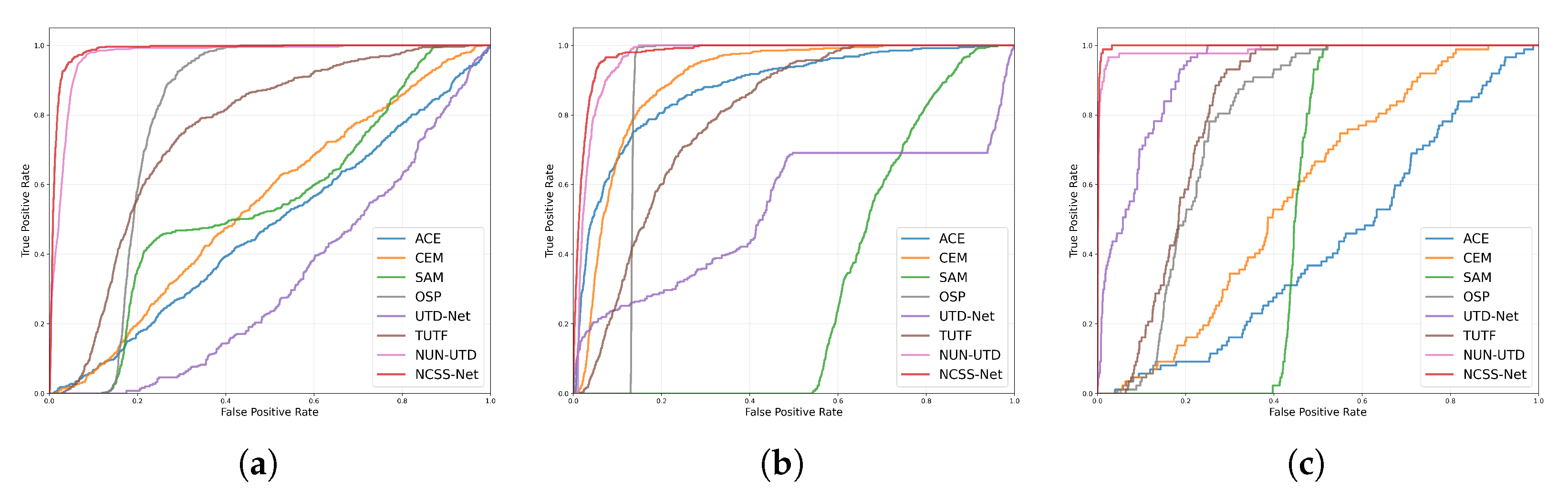
- The method achieves state-of-the-art detection performance across three challenging nearshore scenes, demonstrating superior robustness and accuracy compared to existing methods.
- NCSS-Net provides a practical, annotation-free solution for real-world nearshore monitoring applications, eliminating the need for manual labeling or accurate estimation of environmental parameters.
- The framework integrates spectral unmixing, band selection, and deep learning in a synergistic manner, offering a generalizable, adaptable framework for other hyperspectral detection tasks.
Abstract
1. Introduction
- 1.
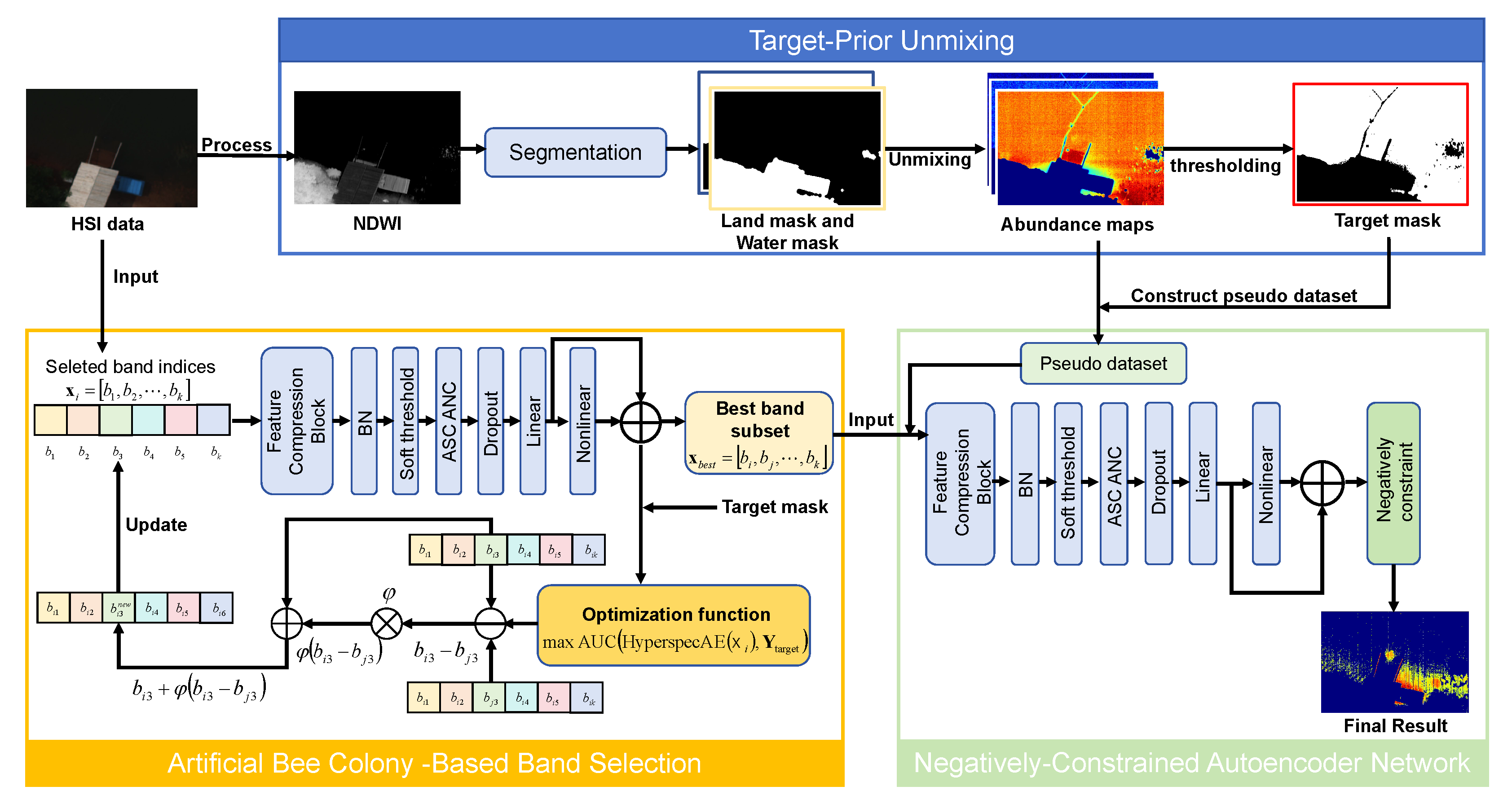
- We introduce a novel self-supervised band selection strategy that uses a target mask generated from NDWI-driven spectral unmixing to guide the ABC algorithm in selecting a maximally discriminative band subset.
- 2.
- We design a negatively-constrained autoencoder network that incorporates a physically meaningful negative correlation mechanism derived from unmixing results, enhancing discriminability between targets and complex backgrounds.
- 3.
- We construct the NCSS-Net framework, which synergistically integrates spectral unmixing, band selection, and pseudo-label augmentation. It achieves robust detection performance in nearshore scenes through iterative refinement of pseudo-labels and band subsets.
2. Related Work
2.1. Water Optical Model-Based Methods
2.2. Unmixing-Based Methods
3. Materials and Methods
3.1. Target-Prior Unmixing
3.2. Artificial Bee Colony-Based Band Selection
- 1.
- Employed Bees explore the vicinity of current solutions by randomly perturbing one dimension to generate new candidate solutions. For a solution , a new candidate is generated by the following:where j is a randomly chosen dimension, k is a randomly selected neighboring solution, and is a random number in . The resulting values are then rounded, constrained, de-duplicated, and sorted as described above to yield a feasible integer band subset. A greedy selection strategy is then used to decide whether to retain the improved solution.
- 2.
- Onlooker Bees evaluate the fitness values shared by the employed bees. To select promising solutions for further exploitation, we use a standard roulette-wheel selection based on linear normalization of AUC values. The selection probability for each solution is calculated as follows:
- 3.
- Scout Bees are triggered when a solution becomes stagnant in a local optimum, i.e., when its trial counter exceeds a limit L. They abandon and replace it with a randomly generated band combination, which is produced using the following equation:This mechanism enhances the ability of an algorithm to escape from local optimality.
3.3. Negatively-Constrained Autoencoder Network
| Algorithm 1 Proposed NCSS-Net framework |
Input: Hyperspectral Image: Output: Final detection map |
|
4. Result
4.1. Datasets
4.2. Experimental Settings
4.3. Experiment Results and Analysis
4.4. Ablation Study
- Fundamental Role of Target-Prior Unmixing: The target-prior unmixing module generates a target-prior abundance map, providing crucial initial information for subsequent processing. However, the model with only the target-prior unmixing module performs identically to the baseline model. This occurs because the module merely produces an initial target mask via NDWI-driven spectral unmixing. The mask is not used directly for detection but serves as pseudo-labels to guide subsequent band selection and autoencoder training. Its role as an enabling component is revealed in combination with other modules. Therefore, adding it alone yields identical results to the baseline. This clearly indicates that the utility of this module is contingent on the presence of subsequent processing stages. While it cannot enhance performance in isolation, it provides the essential initial information the other modules need to function effectively.
- Critical Dependence of Band Selection: The band selection module is designed to filter the most discriminative subset of bands and exhibits a critical dependence on the full network. When combined with the target-prior unmixing module but without the negative-constraint autoencoder, the results remain identical to those obtained with band selection alone. This is because the band selection process relies heavily on target masks to guide its search. Without the correcting mechanism provided by the negatively-constrained autoencoder, the band selection process may be misled by noise or errors in the pseudo-labels, especially in complex nearshore scenarios. The selected bands alone, without subsequent discriminative feature learning and physical constraint, cannot be effectively utilized, rendering the combination’s performance equivalent to that of band selection alone. When used without the negatively constrained autoencoder, it causes catastrophic failure on River Scene 3, suggesting that the selected bands alone are insufficient for discrimination. This failure persists even when band selection is combined with the autoencoder, but without the target-prior. This suggests the band selection process may discard crucial spectral target information and lead to model failure without strong discriminative network constraints.
- Contributions of Negatively-Constrained Autoencoder: The negative correlation constraint autoencoder enhances the discriminative ability between targets and water endmembers through a physics-driven loss function. Its standalone performance is unstable, but it is the only module that, when added to other combinations, prevents the model from failing completely on River Scene 3. This shows that the autoencoder provides the necessary nonlinear representation and physical constraint to exploit the information from both the target-prior and the selected bands, transforming them into a highly discriminative feature set. This highlights its role as the final feature enhancer and constraint enforcer.
- Synergistic Integration for Robust Performance: The ablation study results clearly show that the three components of NCSS-Net constitute an organic whole, and their synergistic effect is far greater than the independent contribution. This synergy stems from a cascaded dependency among the modules: the target-prior unmixing module does not directly improve detection performance; rather, it serves solely to provide pseudo-labels for subsequent processing. The band-selection module then filters discriminative spectral bands based on these pseudo-labels, yet its effectiveness heavily depends on both the quality of the pseudo-labels and the physical constraints imposed by the subsequent network. Finally, the negatively-constrained autoencoder leverages the selected bands and enforces a physics-driven constraint to learn discriminative features and produce the final detection map. In essence, the target-prior unmixing provides a physically-grounded starting point, the band selection reduces dimensionality and focuses on discriminative features, and the autoencoder delivers the final discriminative power. This multi-stage, physically-guided architecture achieves robust and accurate target detection in nearshore underwater environments of varying complexity.
4.5. Parameter Sensitivity
4.5.1. Sensitivity to Loss Function Coefficients
4.5.2. Sensitivity to Band Subset Size
4.5.3. Sensitivity to Ideal Ratio Values
5. Discussion
5.1. Interpretation of Superior Detection Performance
5.2. Parameter Sensitivity and Model Stability
5.3. Fault Tolerance Mechanisms
- 1.
- A negative-correlation term is added to the loss function, enforcing a physically meaningful anti-correlation between the target and water endmembers. Target regions are expected to exhibit a high target-to-water abundance ratio, while background water regions should show a low ratio. During training, deviations from this ideal ratio are penalized. Even when the initial pseudo-labels are noisy, this constraint steers the model toward more discriminative feature representations, thereby reducing over-reliance on the initial pseudo-labels.
- 2.
- The weight of the negative-correlation constraint is gradually increased via a warm-up strategy. This prevents the strong physical constraint from overwhelming the learning process in the early stages when pseudo-labels may be unreliable. The model is thus allowed to first capture the underlying spectral structures more freely, and the constraint is progressively strengthened as training stabilizes.
- 3.
- Gradient clipping is applied to prevent gradient explosion caused by noisy labels or outlier samples, ensuring numerical stability and reliable convergence throughout the training process.
5.4. Limitations and Future Research Directions
6. Conclusions
Author Contributions
Funding
Institutional Review Board Statement
Informed Consent Statement
Data Availability Statement
Acknowledgments
Conflicts of Interest
References
- Cheng, G.; Yang, C.; Yao, X.; Guo, L.; Han, J. When deep learning meets metric learning: Remote sensing image scene classification via learning discriminative CNNs. IEEE Trans. Geosci. Remote Sens. 2018, 56, 1421–1431. [Google Scholar] [CrossRef]
- Xu, X.; Li, J.; Li, S.; Plaza, A. Curvelet transform domain-based sparse nonnegative matrix factorization for hyperspectral unmixing. IEEE J. Sel. Topics Appl. Earth Observ. Remote Sens. 2020, 13, 4908–4924. [Google Scholar] [CrossRef]
- Mei, S.; Zhang, G.; Li, J.; Zhang, Y.; Du, Q. Improving spectral-based endmember finding by exploring spatial context for hyperspectral unmixing. IEEE J. Sel. Topics Appl. Earth Observ. Remote Sens. 2020, 13, 3336–3349. [Google Scholar] [CrossRef]
- Chen, L.; Liu, J.; Sun, S.; Chen, W.; Du, B.; Liu, R. An iterative GLRT for hyperspectral target detection based on spectral similarity and spatial connectivity characteristics. IEEE Trans. Geosci. Remote Sens. 2023, 61, 5505811. [Google Scholar] [CrossRef]
- Chang, C.-I. Hyperspectral target detection: Hypothesis testing, signal-to-noise ratio, and spectral angle theories. IEEE Trans. Geosci. Remote Sens. 2021, 60, 5505223. [Google Scholar] [CrossRef]
- Gillis, D.B. An underwater target detection framework for hyperspectral imagery. IEEE J. Sel. Topics Appl. Earth Observ. Remote Sens. 2020, 13, 1798–1810. [Google Scholar] [CrossRef]
- Clevers, J.G.P.W.; Kooistra, L. Using hyperspectral remote sensing data for retrieving canopy chlorophyll and nitrogen content. IEEE J. Sel. Topics Appl. Earth Observ. Remote Sens. 2012, 5, 574–583. [Google Scholar] [CrossRef]
- Jay, S.; Guillaume, M. Underwater target detection with hyperspectral remote-sensing imagery. In Proceedings of the IEEE International Geoscience and Remote Sensing Symposium (IGARSS), Honolulu, HI, USA, 25–30 July 2010; pp. 2820–2823. [Google Scholar]
- Jay, S.; Guillaume, M.; Blanc-Talon, J. Underwater target detection with hyperspectral data: Solutions for both known and unknown water quality. IEEE J. Sel. Topics Appl. Earth Observ. Remote Sens. 2012, 5, 1213–1221. [Google Scholar] [CrossRef]
- Qi, J.; Gong, Z.; Xue, W.; Liu, X.; Yao, A.; Zhong, P. A self-improving framework for joint depth estimation and underwater target detection from hyperspectral imagery. Remote Sens. 2021, 13, 1721. [Google Scholar] [CrossRef]
- Qi, J.; Gong, Z.; Xue, W.; Liu, X.; Yao, A.; Zhong, P. An unmixing based network for underwater target detection from hyperspectral imagery. IEEE J. Sel. Topics Appl. Earth Observ. Remote Sens. 2021, 14, 5470–5487. [Google Scholar] [CrossRef]
- Li, M.; Yang, B.; Wang, B. EMLM-net: An extended multilinear mixing model-inspired dual-stream network for unsupervised nonlinear hyperspectral unmixing. IEEE Trans. Geosci. Remote Sens. 2024, 62, 5509116. [Google Scholar] [CrossRef]
- Liu, J.; Qi, J.; Zhu, D.; Wen, H.; Jiang, H.; Zhong, P. Detecting nearshore underwater targets with hyperspectral nonlinear unmixing autoencoder. IEEE Trans. Geosci. Remote Sens. 2024, 62, 5529615. [Google Scholar] [CrossRef]
- Liu, Z.; Zhao, H.; Wang, X.; Wang, S.; Li, J.; Zhong, Y. PU-KBS: A robust positive and unlabeled learning framework with key band selection for one-class hyperspectral image classification. IEEE Trans. Geosci. Remote Sens. 2024, 62, 5517915. [Google Scholar] [CrossRef]
- Zhang, S.; Duan, P.; Kang, X.; Mo, Y.; Li, S. Feature-band-based unsupervised hyperspectral underwater target detection near the coastline. IEEE Trans. Geosci. Remote Sens. 2023, 61, 5510410. [Google Scholar] [CrossRef]
- Jay, S.; Guillaume, M. A novel maximum likelihood based method for mapping depth and water quality from hyperspectral remote-sensing data. Remote Sens. Environ. 2014, 147, 121–132. [Google Scholar] [CrossRef]
- Xia, Z.; Gu, Y. Parameter feature extraction for hyperspectral detection of the shallow underwater target. Sci. China Technol. Sci. 2021, 64, 1092–1100. [Google Scholar] [CrossRef]
- Fu, X.; Shang, X.; Sun, X.; Yu, H.; Song, M.; Chang, C.-I. Underwater hyperspectral target detection with band selection. Remote Sens. 2020, 12, 1056. [Google Scholar] [CrossRef]
- Qi, J.; Gong, Z.; Yao, A.; Liu, X.; Li, Y.; Zhang, Y.; Zhong, P. Bathymetric-based band selection method for hyperspectral underwater target detection. Remote Sens. 2021, 13, 3798. [Google Scholar] [CrossRef]
- Li, Z.; Chen, Y.; Wang, H.; Zhang, L.; Liu, J. A transfer-based framework for underwater target detection from hyperspectral imagery. Remote Sens. 2023, 15, 1023. [Google Scholar] [CrossRef]
- Li, Q.; Li, J.; Li, T.; Li, Z.; Zhang, P. Spectral–spatial depth-based framework for hyperspectral underwater target detection. IEEE Trans. Geosci. Remote Sens. 2023, 61, 4204615. [Google Scholar] [CrossRef]
- Liu, B.; Men, S.; Yu, Q.; Li, D.; Ding, Z.; Liu, Z. Internal scanning hyperspectral imaging system for deep sea target detection. Opt. Laser Eng. 2025, 185, 108722. [Google Scholar] [CrossRef]
- Li, Q.; Li, J.; Li, T.; Feng, Y. A joint framework for underwater hyperspectral image restoration and target detection with conditional diffusion model. IEEE J. Sel. Topics Appl. Earth Observ. Remote Sens. 2024, 17, 17263–17277. [Google Scholar] [CrossRef]
- Li, Q.; Gao, M.; Zhang, M.; Wang, J.; Chen, J.; Li, J. IOPE-IPD: Water Properties Estimation Network Integrating Physical Model and Deep Learning for Hyperspectral Imagery. Remote Sens. 2025, 17, 3546. [Google Scholar] [CrossRef]
- Wang, M.; Zhao, M.; Chen, J.; Rahardja, S. Nonlinear unmixing of hyperspectral data via deep autoencoder networks. IEEE Geosci. Remote Sens. Lett. 2019, 16, 1467–1471. [Google Scholar] [CrossRef]
- Zhao, M.; Wang, M.; Chen, J.; Rahardja, S. Hyperspectral unmixing for additive nonlinear models with a 3-D-CNN autoencoder network. IEEE Trans. Geosci. Remote Sens. 2021, 60, 5509415. [Google Scholar] [CrossRef]
- Shen, D.; Ma, X.; Kong, W.; Liu, J.; Wang, J.; Wang, H. Hyperspectral target detection based on interpretable representation network. IEEE Trans. Geosci. Remote Sens. 2023, 61, 5519416. [Google Scholar] [CrossRef]
- Liu, R.; Lei, C.; Xie, L.; Qin, X. A novel endmember bundle extraction framework for capturing endmember variability by dynamic optimization. IEEE Trans. Geosci. Remote Sens. 2024, 62, 5505217. [Google Scholar] [CrossRef]
- Guo, T.; He, L.; Luo, F.; Gong, X.; Zhang, L.; Gao, X. Learnable background endmember with subspace representation for hyperspectral anomaly detection. IEEE Trans. Geosci. Remote Sens. 2023, 62, 5501513. [Google Scholar] [CrossRef]
- Nascimento, J.M.P.; Bioucas-Dias, J.M. Vertex component analysis: A fast algorithm to unmix hyperspectral data. IEEE Trans. Geosci. Remote Sens. 2005, 43, 898–910. [Google Scholar] [CrossRef]
- Winter, M.E. N-FINDR: An algorithm for fast autonomous spectral end-member determination in hyperspectral data. Imaging Spectrom. V 1999, 3753, 266–275. [Google Scholar]
- Huang, H.; Sun, Z.; Liu, S.; Di, Y.; Xu, J.; Liu, C.; Wu, J. Underwater hyperspectral imaging for in situ underwater microplastic detection. Sci. Total Environ. 2021, 776, 145960. [Google Scholar] [CrossRef]
- Qi, J.; Zhou, C.; Liu, X.; Li, Y.; Zhang, M.; Zhong, P. Nearshore Underwater Target Detection Meets UAV-borne Hyperspectral Remote Sensing: A Novel Hybrid-level Contrastive Learning Framework and Benchmark Dataset. arXiv 2025, arXiv:2502.14495. [Google Scholar]
- Hensman, P.; Masko, D. The Impact of Imbalanced Training Data for Convolutional Neural Networks. Ph.D. Thesis, KTH Royal Institute of Technology, Stockholm, Sweden, 2015. [Google Scholar]
- Su, Y.; Xu, X.; Li, J.; Qi, H.; Gamba, P.; Plaza, A. Deep autoencoders with multitask learning for bilinear hyperspectral unmixing. IEEE Trans. Geosci. Remote Sens. 2021, 59, 8615–8629. [Google Scholar] [CrossRef]
- Li, M.; Yang, B.; Wang, B. A coarse-to-fine scheme for unsupervised nonlinear hyperspectral unmixing based on an extended multilinear mixing model. IEEE Trans. Geosci. Remote Sens. 2023, 61, 5521415. [Google Scholar] [CrossRef]
- Fang, T.; Zhu, F.; Chen, J. Hyperspectral unmixing based on multilinear mixing model using convolutional autoencoders. IEEE Trans. Geosci. Remote Sens. 2024, 62, 5507316. [Google Scholar] [CrossRef]
- Zhu, D.; Du, B.; Hu, M.; Dong, Y.; Zhang, L. Collaborative-guided spectral abundance learning with bilinear mixing model for hyperspectral subpixel target detection. Neural Netw. 2023, 163, 205–218. [Google Scholar] [CrossRef]
- Zhu, D.; Du, B.; Zhang, L. Learning single spectral abundance for hyperspectral subpixel target detection. IEEE Trans. Neural Netw. Learn. Syst. 2024, 35, 10134–10144. [Google Scholar] [CrossRef] [PubMed]
- Chen, L.; Huang, Y.; Dong, J.; Xu, Q.; Kwong, S.; Lu, H.; Li, C. Underwater Object Detection in the Era of Artificial Intelligence: Current, Challenge, and Future. arXiv 2024, arXiv:2410.05577. [Google Scholar] [CrossRef]
- Khan, A.; Fouda, M.M.; Do, D.-T.; Almaleh, A.; Aloahtan, A.M.; Rahman, A.U. Underwater Target Detection Using Deep Learning: Methodologies, Challenges, Applications, and Future Evolution. IEEE Access 2024, 12, 12618–12634. [Google Scholar] [CrossRef]
- Li, H.; Li, L.; Wang, H.; Zhang, W.; Ren, P. Underwater image captioning with AquaSketch-enhanced cross-scale information fusion. IEEE Trans. Geosci. Remote Sens. 2025, 63, 4208718. [Google Scholar] [CrossRef]
- Li, L.; Li, H.; Ren, P. Underwater image caption via attention mechanism based fusion of visual and textual information. Inf. Fusion 2024, 123, 103269. [Google Scholar] [CrossRef]
- McFeeters, S.K. The use of the normalized difference water index (NDWI) in the delineation of open water features. Int. J. Remote Sens. 1996, 17, 1425–1432. [Google Scholar] [CrossRef]
- Otsu, N. A threshold selection method from gray-level histograms. IEEE Trans. Syst. Man Cybern. 1979, SMC-9, 62–66. [Google Scholar] [CrossRef]
- Karaboga, D.; Akay, B. A comparative study of artificial bee colony algorithm. Appl. Math. Comput. 2009, 214, 108–132. [Google Scholar] [CrossRef]
- Kruse, F.A.; Lefkoff, A.B.; Boardman, J.W.; Heidebrecht, K.B.; Shapiro, A.T.; Barloon, P.J.; Goetz, A.F.H. The spectral image processing system (SIPS)-interactive visualization and analysis of imaging spectrometer data. Remote Sens. Environ. 1993, 44, 145–163. [Google Scholar] [CrossRef]
- Manolakis, D.; Shaw, G. Detection algorithms for hyperspectral imaging applications. IEEE Signal Process. Mag. 2002, 19, 29–43. [Google Scholar] [CrossRef]
- Harsanyi, J.C. Detection and Classification of Subpixel Spectral Signatures in Hyperspectral Image Sequences; University of Maryland, Baltimore County: Baltimore, MD, USA, 1993. [Google Scholar]
- Harsanyi, J.C.; Chang, C.-I. Hyperspectral image classification and dimensionality reduction: An orthogonal subspace projection approach. IEEE Trans. Geosci. Remote Sens. 1994, 32, 779–785. [Google Scholar] [CrossRef]





| Layer Type | Input | Output | Activation Function |
|---|---|---|---|
| Fully-connected Layer | (batch size, B) | (batch size, 18 × m) | LeakyReLU |
| Fully-connected Layer | (batch size, 18 × m) | (batch size, 9 × m) | LeakyReLU |
| Fully-connected Layer | (batch size, 9 × m) | (batch size, 6 × m) | LeakyReLU |
| Fully-connected Layer | (batch size, 6 × m) | (batch size, 3 × m) | LeakyReLU |
| Fully-connected Layer | (batch size, 3 × m) | (batch size, 18 × m) | LeakyReLU |
| Dataset | Learning Rate | Weight Decay | Batch Size | Epochs | Band Subset Size | ||
|---|---|---|---|---|---|---|---|
| River Scene 1 | 256 | 100 | 6 | ||||
| River Scene 2 | 256 | 100 | 6 | ||||
| River Scene 3 | 256 | 100 | 6 |
| Dataset | ACE [48] | CEM [49] | OSP [50] | SAM [47] | UTD-Net [11] | TUTDF [20] | NUN-UTD [13] | NCSS-Net |
|---|---|---|---|---|---|---|---|---|
| River Scene 1 | 0.4739 | 0.5832 | 0.7936 | 0.5469 | 0.4331 | 0.7492 | 0.9710 | 0.9848 |
| River Scene 2 | 0.8784 | 0.8978 | 0.8661 | 0.3109 | 0.5300 | 0.7934 | 0.9661 | 0.9775 |
| River Scene 3 | 0.4247 | 0.5754 | 0.7800 | 0.5470 | 0.7528 | 0.8126 | 0.9883 | 0.9993 |
| Dataset | ACE [48] | CEM [49] | OSP [50] | SAM [47] | UTD-Net [11] | TUTDF [20] | NUN-UTD [13] | NCSS-Net |
|---|---|---|---|---|---|---|---|---|
| River Scene 1 | 6.07 | 4.04 | 3.48 | 2.16 | 556.43 | 2999.57 | 1481.88 | 2857.11 |
| River Scene 2 | 5.16 | 2.89 | 3.58 | 2.10 | 430.06 | 1869.24 | 1142.48 | 2252.63 |
| River Scene 3 | 2.95 | 1.90 | 2.78 | 1.94 | 232.40 | 1108.80 | 489.25 | 1036.53 |
| Model | Target-Prior Unmixing | Band Selection | Negatively-Constrained Autoencoder | River Scene 1 | River Scene 2 | River Scene 3 |
|---|---|---|---|---|---|---|
| 1 | × | × | × | 0.8592 | 0.8753 | 0.5320 |
| 2 | × | ✓ | × | 0.7189 | 0.6871 | 0.0079 |
| 3 | × | × | ✓ | 0.5578 | 0.8633 | 0.4321 |
| 4 | ✓ | × | × | 0.8592 | 0.8753 | 0.5320 |
| 5 | ✓ | ✓ | × | 0.7189 | 0.6871 | 0.0079 |
| 6 | ✓ | × | ✓ | 0.6493 | 0.5228 | 0.5498 |
| 7 | × | ✓ | ✓ | 0.7133 | 0.8640 | 0.0128 |
| 8 | ✓ | ✓ | ✓ | 0.9848 | 0.9775 | 0.9993 |
Disclaimer/Publisher’s Note: The statements, opinions and data contained in all publications are solely those of the individual author(s) and contributor(s) and not of MDPI and/or the editor(s). MDPI and/or the editor(s) disclaim responsibility for any injury to people or property resulting from any ideas, methods, instructions or products referred to in the content. |
© 2026 by the authors. Licensee MDPI, Basel, Switzerland. This article is an open access article distributed under the terms and conditions of the Creative Commons Attribution (CC BY) license.
Share and Cite
Liu, M.; Zhong, S. NCSS-Net: A Negatively Constrained Network with Self-Supervised Band Selection for Hyperspectral Image Underwater Target Detection. Remote Sens. 2026, 18, 418. https://doi.org/10.3390/rs18030418
Liu M, Zhong S. NCSS-Net: A Negatively Constrained Network with Self-Supervised Band Selection for Hyperspectral Image Underwater Target Detection. Remote Sensing. 2026; 18(3):418. https://doi.org/10.3390/rs18030418
Chicago/Turabian StyleLiu, Mengxin, and Shengwei Zhong. 2026. "NCSS-Net: A Negatively Constrained Network with Self-Supervised Band Selection for Hyperspectral Image Underwater Target Detection" Remote Sensing 18, no. 3: 418. https://doi.org/10.3390/rs18030418
APA StyleLiu, M., & Zhong, S. (2026). NCSS-Net: A Negatively Constrained Network with Self-Supervised Band Selection for Hyperspectral Image Underwater Target Detection. Remote Sensing, 18(3), 418. https://doi.org/10.3390/rs18030418