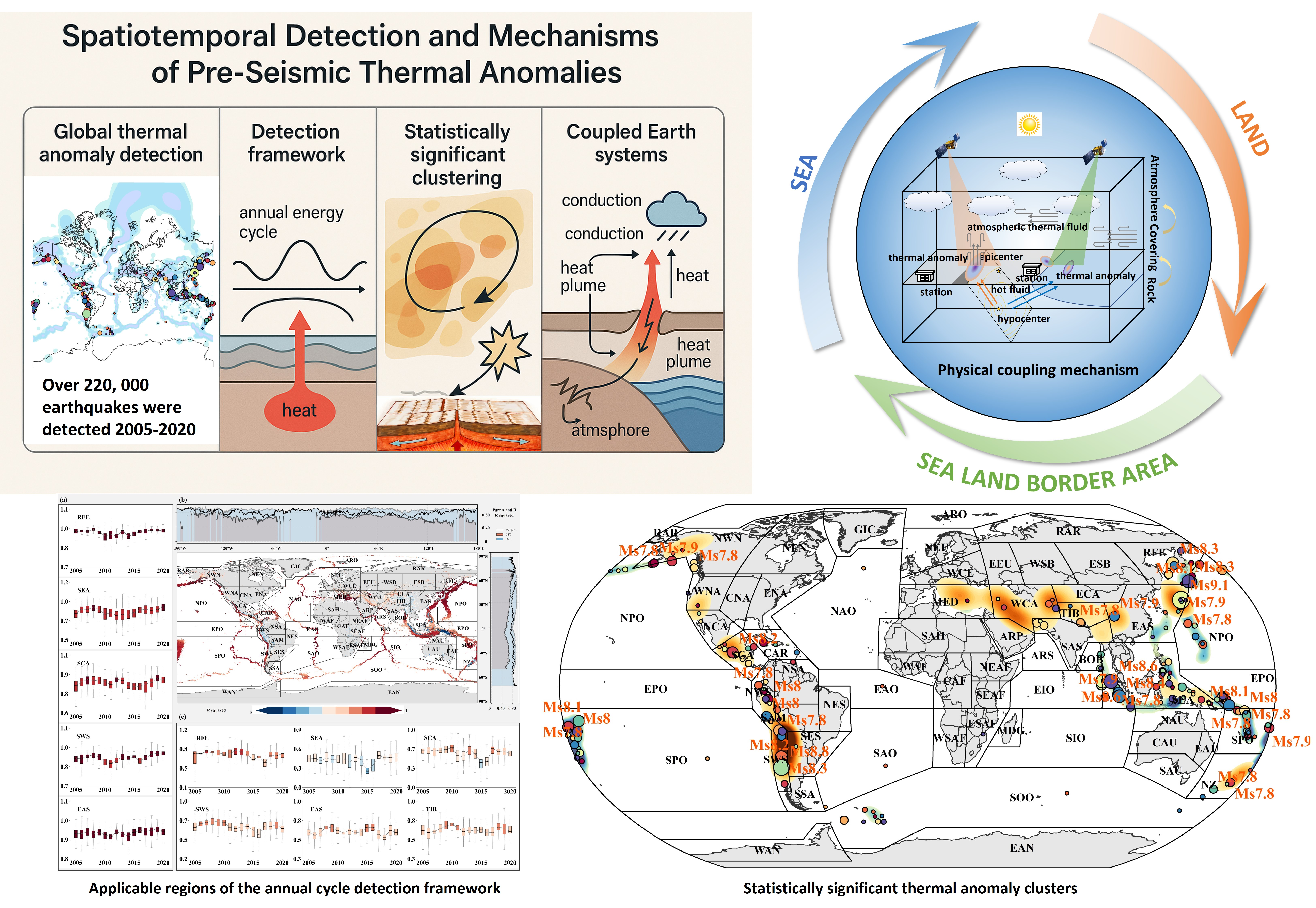


Revealing Spatiotemporal Characteristics of Global Seismic Thermal Anomalies: Framework Based on Annual Energy Balance and Geospatial Constraints

Highlights
- Developed a dynamic spatiotemporal adaptive framework that reveals the evolution of thermal anomalies from mixed to polarized states.
- Proposed the AEP to quantify spatiotemporal clustering, confirming its significant statistical linkage to seismic activity.
- Enables region-specific adaptive detection, advancing seismic thermal anomaly research toward spatiotemporal evolution.
- Identifies spatial heterogeneity as the key characteristic, linking anomaly persistence and co-seismic relevance, and focusing attention on AEP clustering regions.
Abstract
1. Introduction
2. Materials and Methods
2.1. Construction of Thermal Anomaly Response Parameters
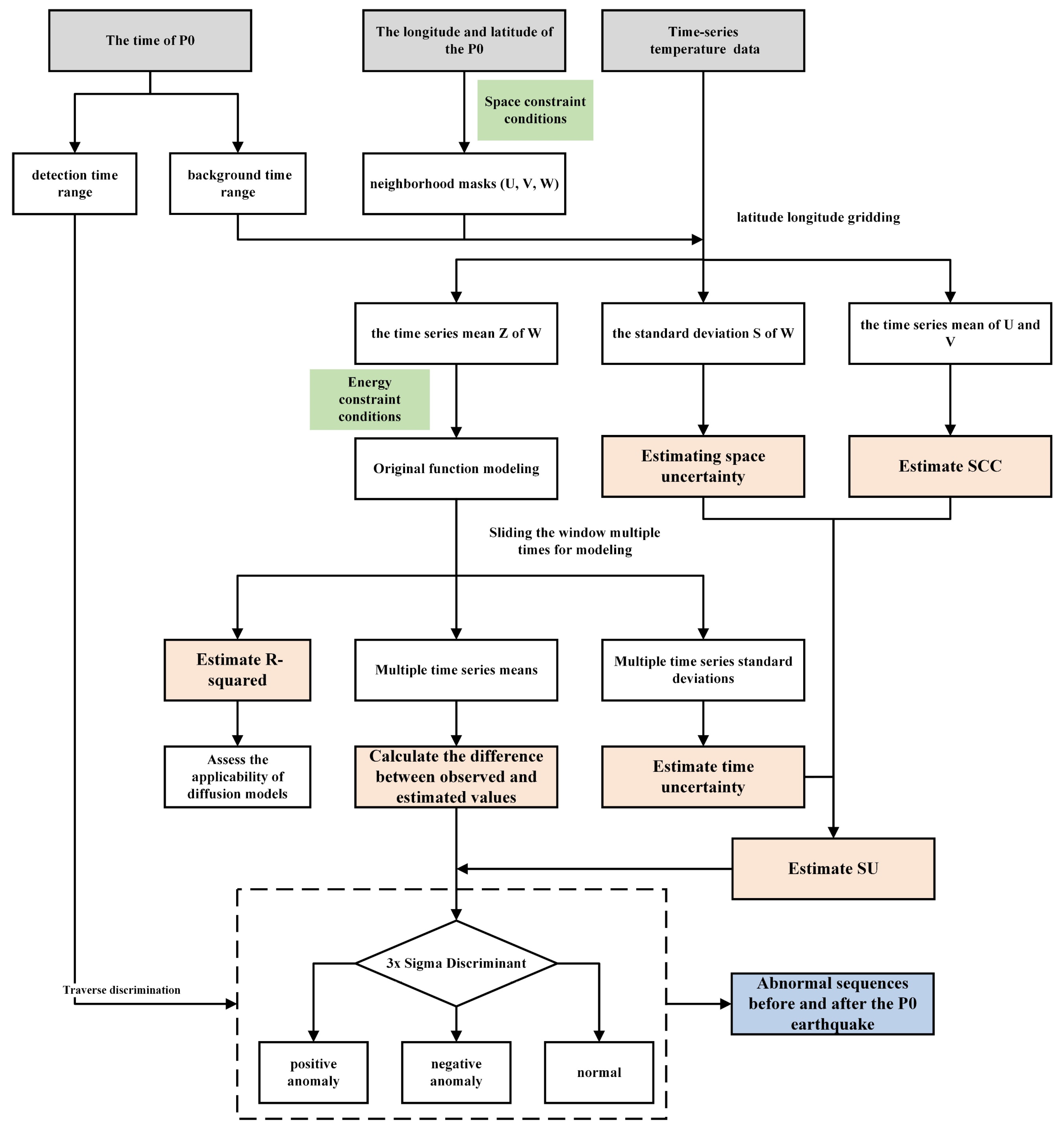
- Parameter estimation: Use background or historical data to compute , , and , then derive the threshold .
- Residual computation: Evaluate from real-time observations.
- Anomaly classification using the 3σ rule:
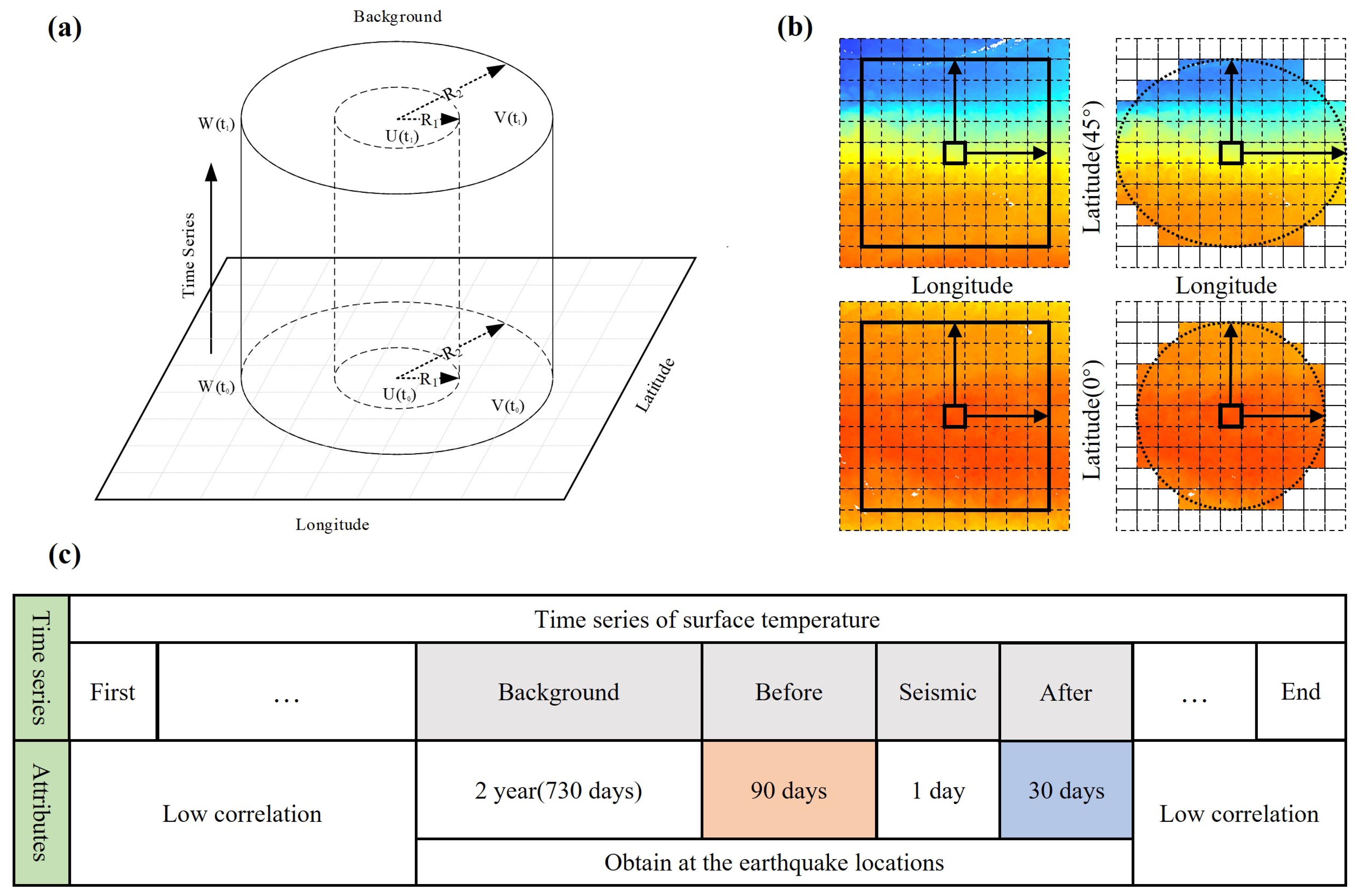
2.2. Annual Energy Balance and Geospatial Constraints Detection Framework
2.3. Anomaly Emphasis Proximity Score (AEP)
3. Results
3.1. Spatiotemporal Response Characteristics of Seismic Thermal Anomalies
3.2. Spatiotemporal Evolution of Positive, Negative, and Mixed Thermal Anomalies Before and After Earthquakes
3.3. Spatiotemporal Clustering Characteristics of the Thermal Anomalies Pre- and Post-Earthquake Events
3.4. Spatiotemporal Coupling Between Regional Aggregation of the AEP and Earthquake Epicenters
4. Discussion
4.1. Dynamic Spatiotemporal Signatures in Seismic Thermal Anomalies Detection and Evolution
4.2. Advantages and Limitations of the AEP Metric
4.3. Underlying Mechanisms Behind Regional Differentiation
4.3.1. Typical Multi-Sphere Coupling Mechanisms in Thermal Anomaly Evolution
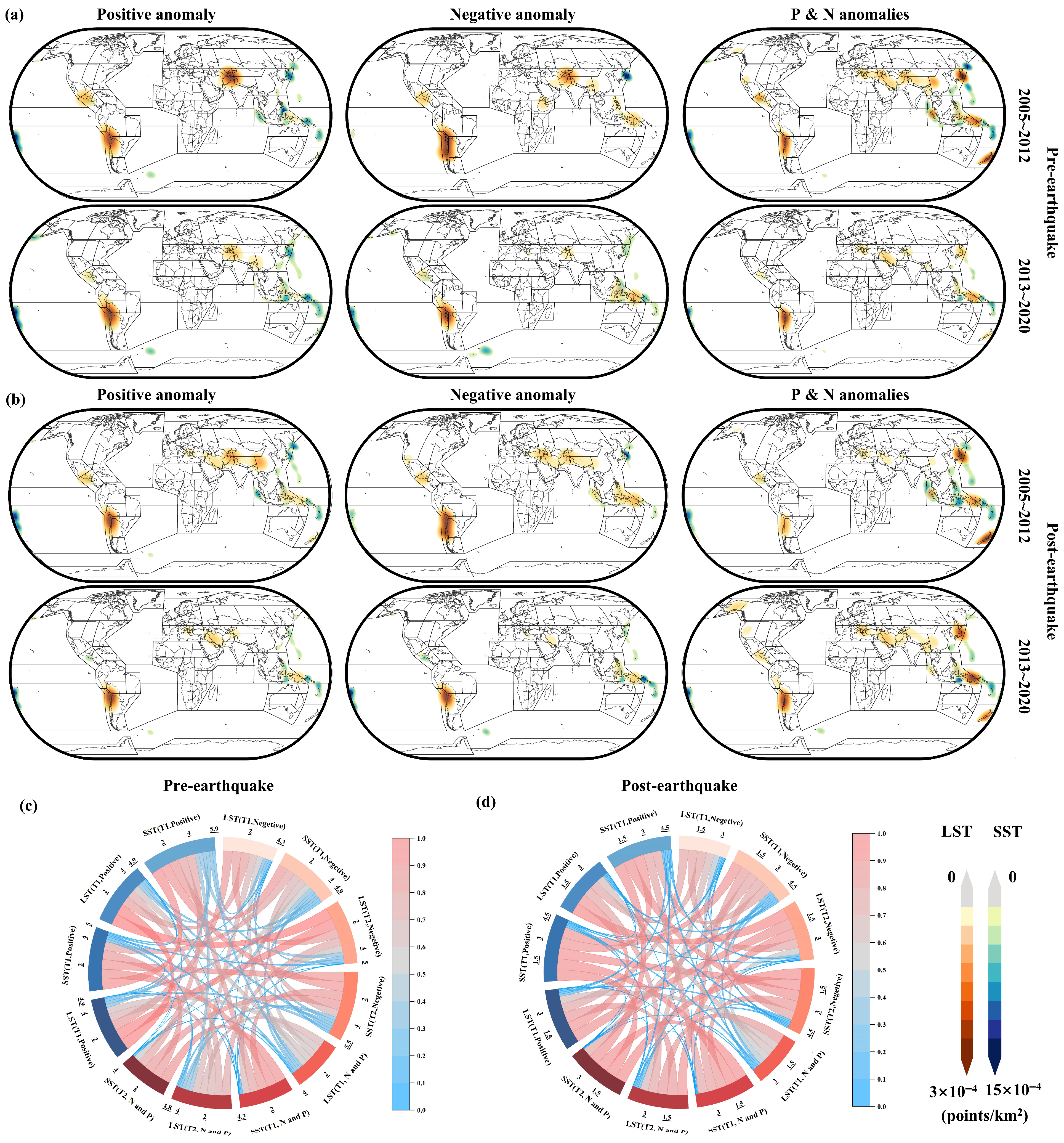
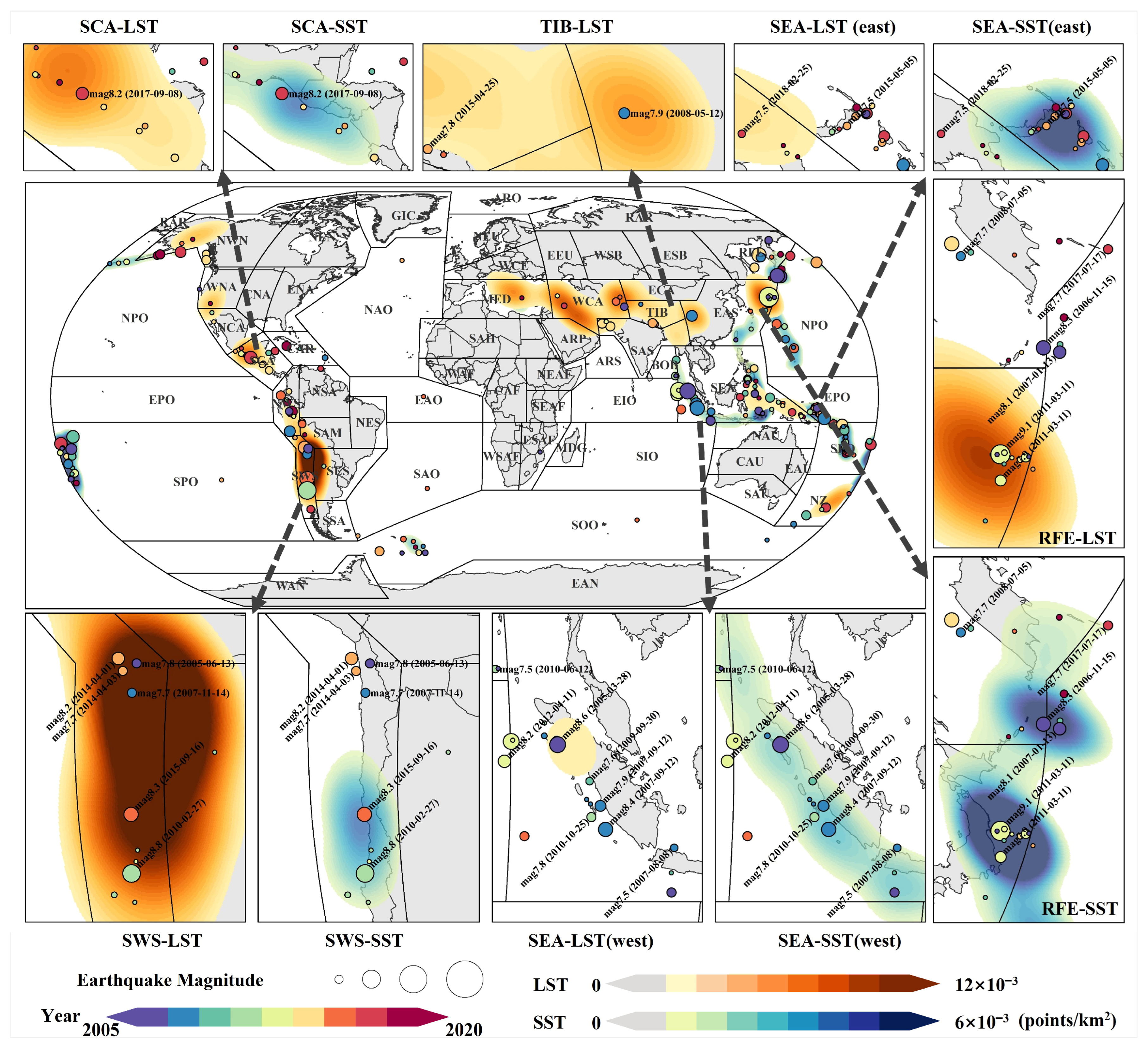
- Deep-Ocean Attenuation and Filter Effect (Mid-Atlantic Ridge). Observations indicate a distinct scarcity of significant AEP clusters despite frequent seismic activity in this region. This “muted” response is fundamentally governed by the thermodynamic inertia of the deep ocean. Unlike terrestrial environments, thermal energy generated by seabed stress—whether via fluid convection or degassing—must traverse a massive water column, undergoing significant attenuation due to the high specific heat capacity of seawater and vigorous circulation. Consequently, this mechanism functions as a “Dissipative Filter”. Only thermal anomalies of exceptional intensity and duration can breach this “inertial barrier” to reach the sea surface. This physical constraint elucidates the unique “High-Reliability, High-Miss Rate” pattern observed in deep-sea regions (and the chemically similar RFE zone): while the ocean suppresses weak signals leading to numerous missed detections, any anomaly that successfully breaches this suppression is highly likely to be of genuine tectonic origin. Therefore, the lack of physical uniformity between events in this region reflects sporadic breakthroughs under extreme energy thresholds, highlighting the physical coupling mechanism between the ocean and the atmosphere.
- Synergistic and Asymmetric Coupling at Land-Ocean Interfaces (Western Pacific and Southeast Pacific). The Western Pacific seismic belt exhibits the most intricate thermodynamic regime. Data reveal that during major seismic events, this transition zone is dominated by a “Superposition Effect,” where thermal anomalies are amplified by the convergence of direct terrestrial radiative heating and enhanced latent heat flux from the adjacent ocean. However, this high sensitivity serves as a double-edged sword. The low thermal inertia of the land side leads to rapid responses to atmospheric perturbations, while the ocean side introduces complex fluid dynamics. This interaction not only results in highly concentrated AEP clusters but also introduces non-tectonic background noise. The superposition of the land’s high-frequency response and the ocean’s dynamic variability renders the region prone to including non-seismic thermal anomalies in detection. This explains why, although the signal intensity is highest here, its spectral purity is lower than in inland regions. This phenomenon reflects intensified energy exchange prior to mainshocks, underscoring the physical coupling mechanisms among the lithosphere, shallow ocean, and atmosphere.Compared with the synergistic mode of the Western Pacific, the Andean tectonic belt along the coast of the Southeast Pacific presents an obvious ‘asymmetric interface coupling’ mode. Despite the Andes being located at a similar land–sea boundary, it shows a persistent high-density AEP accumulation center on the continental side, which forms a sharp contrast with the relatively weak thermal response of the neighboring ocean. This difference emphasizes that despite its location at the interface, the huge stress accumulation of the subduction zone leads to a coupled response, in which the land component clearly dominates the ocean component. However, this ground signal is obviously stronger than in pure inland areas (such as the Tibetan Plateau). This amplification means the ocean might have produced a thermodynamic contribution through moisture transport. Although the sea surface itself maintains thermal stability, the continuous transfer of water vapor to the high-altitude Andes helps to enhance latent heat release on land. While the synergy of subduction zone stress and oceanic latent heat significantly enhances the land thermal response, this amplification effect triggers severe signal aliasing and ‘multi-event fusion’ in earthquake-prone areas, obscuring the identification of clear pre-earthquake thermal anomaly patterns.
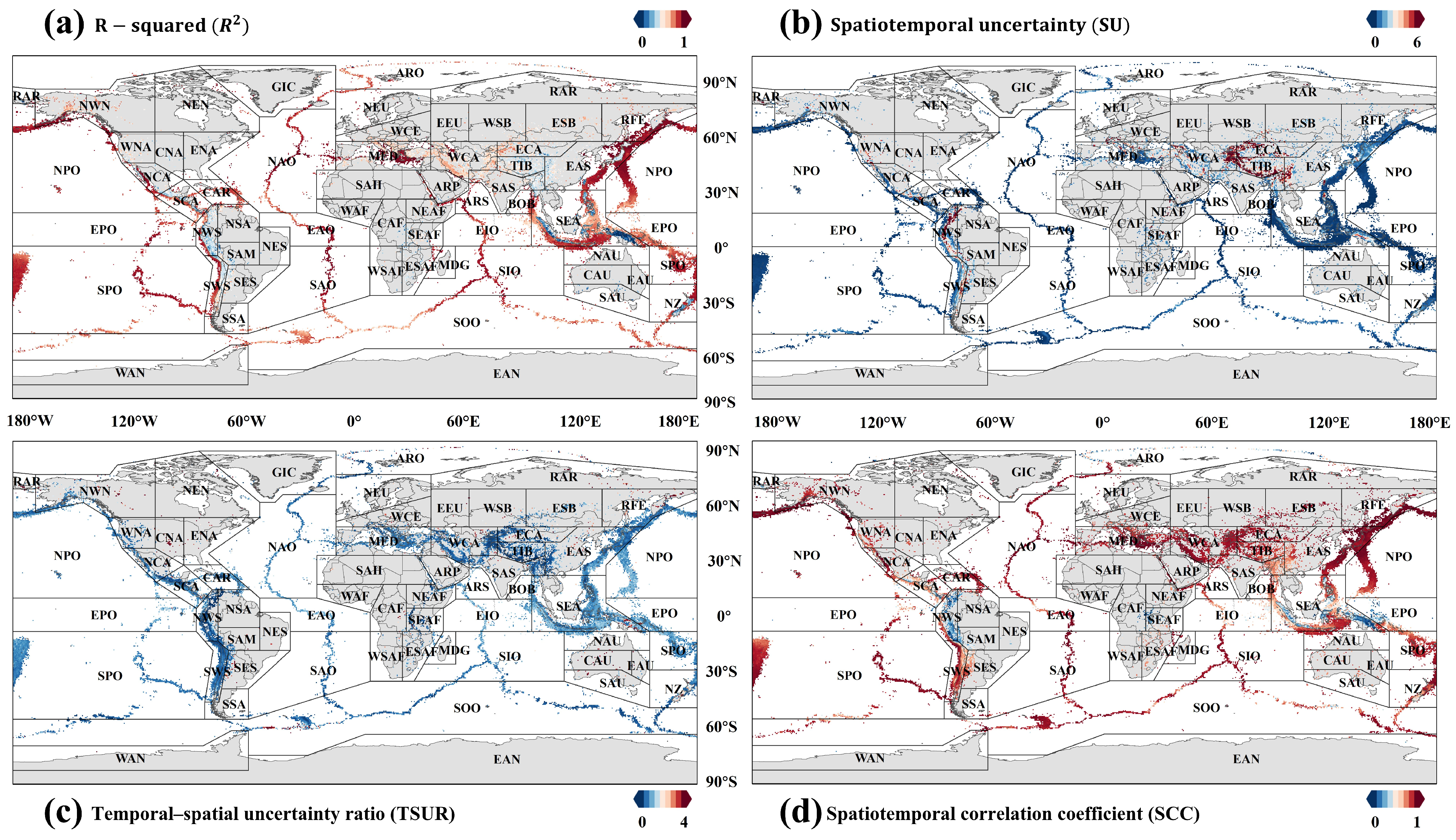
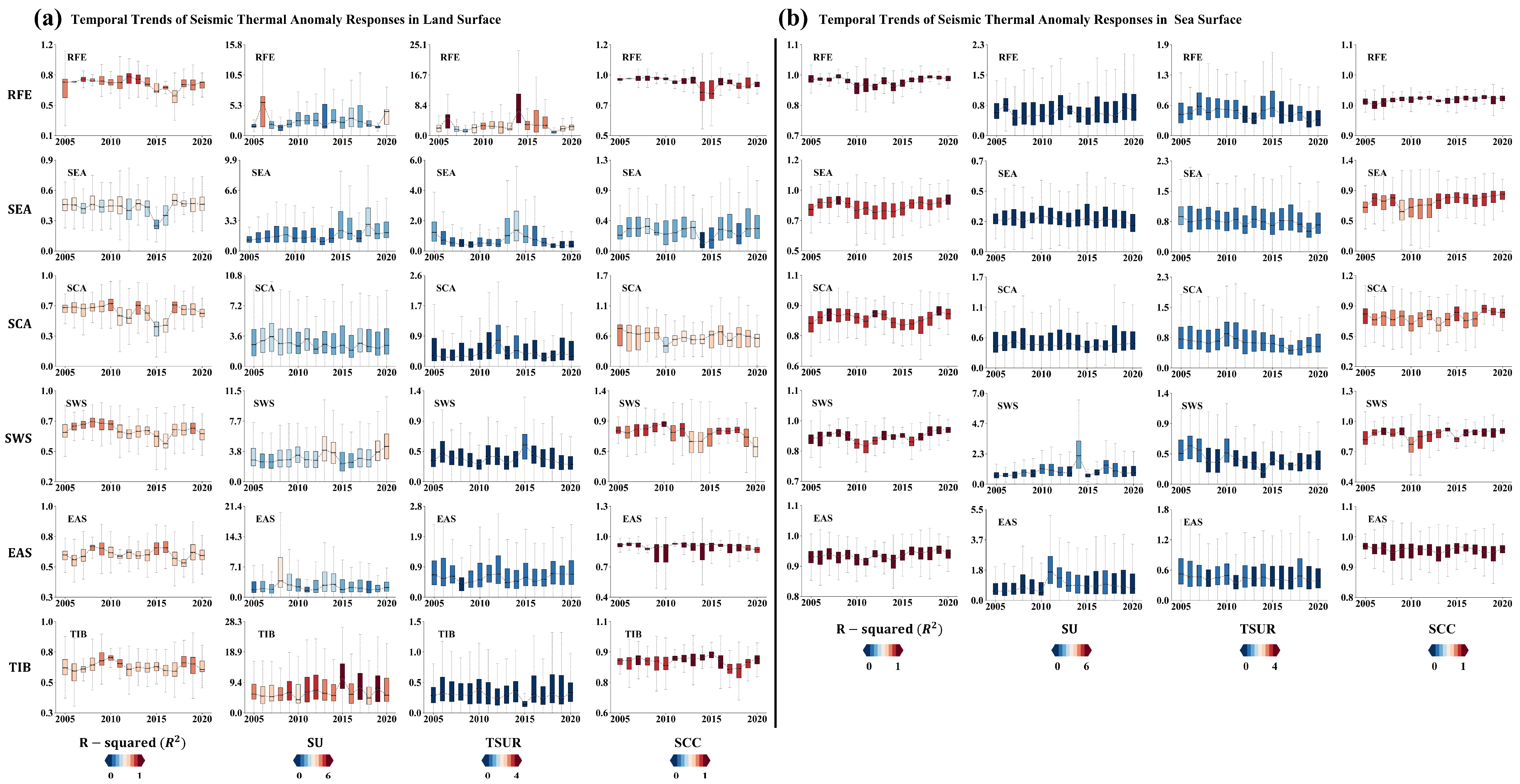
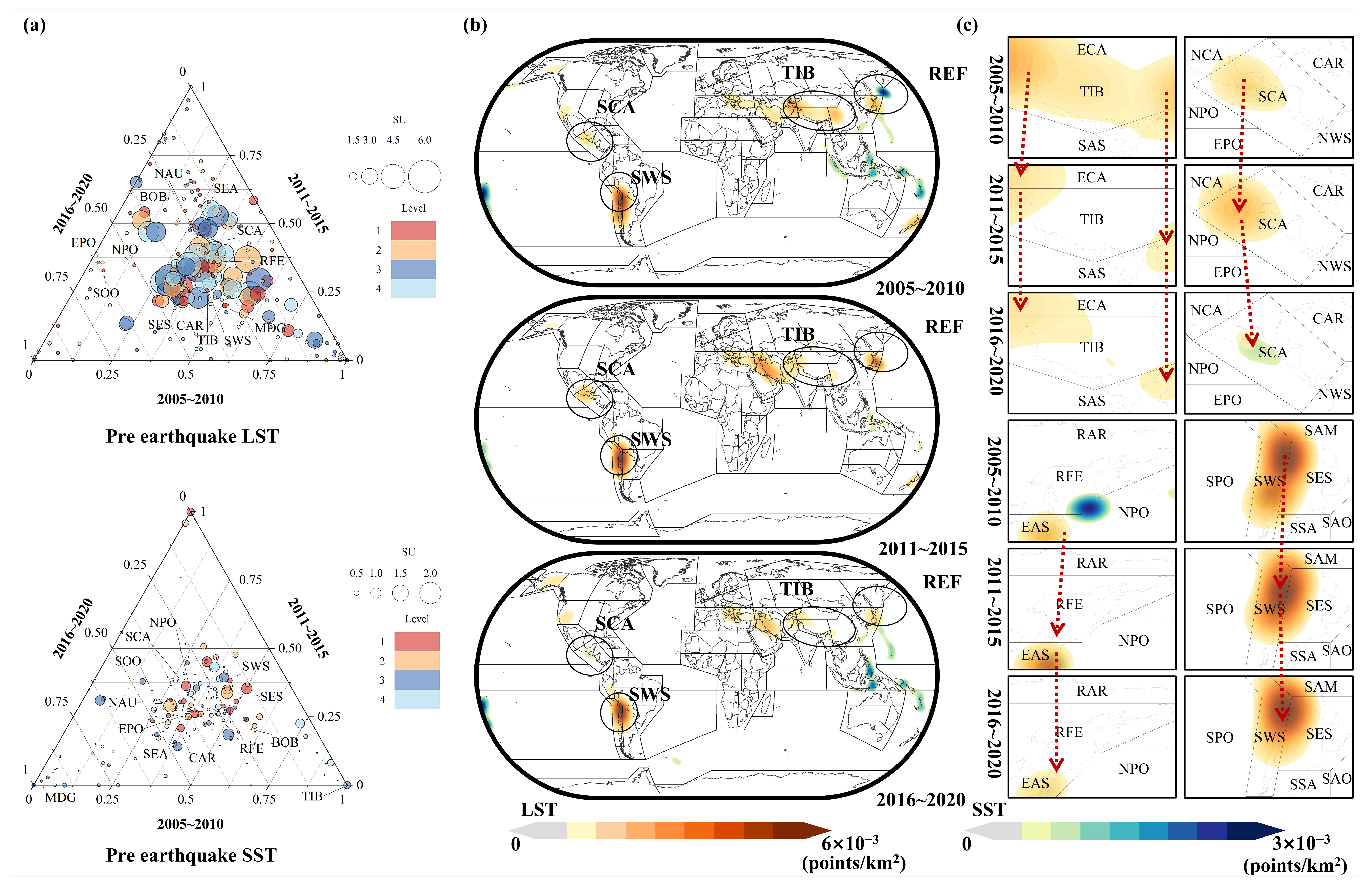
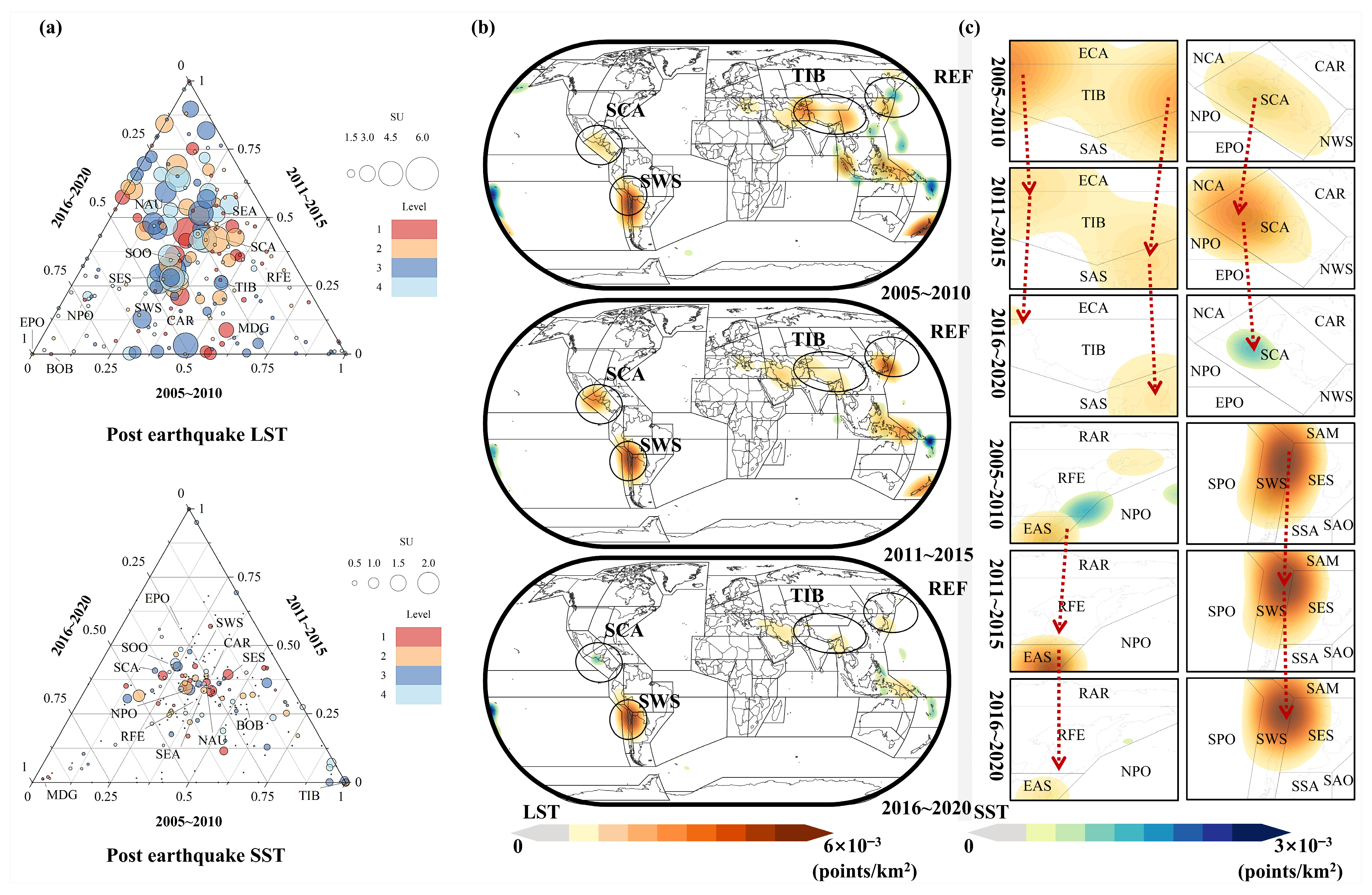
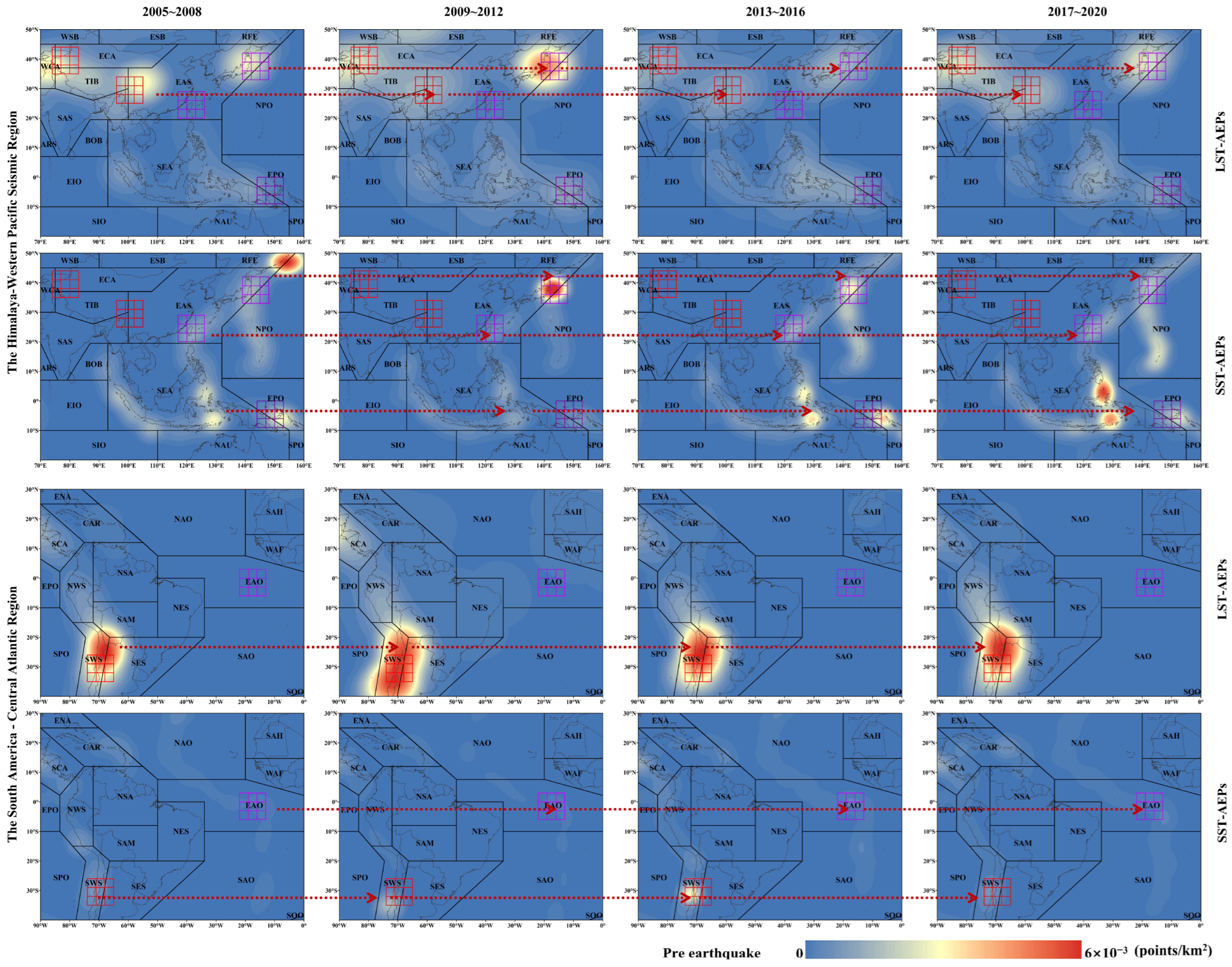
- High-Threshold Lithospheric Coupling and Background Noise (Himalayan Fault Zone). In the Himalayan region, the mechanism simplifies to a direct lithosphere-atmosphere interaction, unbuffered by oceanic factors but modulated by extreme topography and climate. Analysis indicates that the dynamic spatiotemporal uncertainty (SU) of anomaly detection here is significantly higher than in plains or marine regions. This is primarily attributed to the Tibetan Plateau’s nature as a compressional tectonic belt, where massive stress accumulation is requisite for rock fracture. Although the absence of industrial noise facilitates the observation of AEP migration, the low thermal inertia of the land surface renders it extremely sensitive to solar radiation and atmospheric disturbances. While this rapid responsiveness allows tectonic thermal signatures to manifest quickly, it inevitably introduces a high-frequency background noise floor. This thermophysical characteristic rationalizes the observed medium False Discovery Rate (FDR): the noisy thermal background generated by complex terrain tends to mask subtle precursor signals. However, during strong seismic events, as signal intensity far exceeds the background, the spatiotemporal migration trajectory of AEPs along fault lines remains clearly observable (Figure 10), validating the transmissibility of “P-hole” activation and gas leakage effects along the tectonic strike.
4.3.2. Statistical Dependency on Earthquake Types and Focal Depths
- Shallow-source dominance (stable regions): In the majority of regions, thermal anomalies are overwhelmingly associated with shallow earthquakes (<20 km). For instance, in Africa (Land) and the EUROPE (Sea), shallow body-wave magnitude (, mag 4–6) events account for 86.86% and 91.29% of the significant signals, respectively. Given that events constitute the bulk of the global catalog, this high detection rate in stable regions implies that the thermal precursor mechanism is strictly depth-constrained, suggesting that energy from deeper sources likely attenuates rapidly during ascent, failing to induce detectable surface temperature perturbations.
- Deep-source dominance (subduction zones): Conversely, in subduction-dominated regions such as South America and the Pacific (Land), this pattern is inverted. Despite the global prevalence of shallow seismicity, deeper earthquakes surprisingly account for the vast majority of detected anomalies—72.75% in South America and 85.21% in the Pacific. This significant deviation from the global baseline suggests that in convergent plate boundaries, unique geological architectures allow thermal or material signatures from greater depths to migrate vertically to the surface without total dissipation.

| Region (Land Portion) | mag 4–6 | mag 4–6 | mag ≥ 6 | mag ≥ 6 | mag 4–6 | mag 4–6 | mag 4–6 | mag 4–6 | Other |
|---|---|---|---|---|---|---|---|---|---|
| Low | High | Low | High | Low | High | Low | High | ||
| AFRICA | 6.73% | 1.28% | 0% | 0% | 86.86% | 1.92% | 2.88% | 0% | 0.32% |
| ASIA | 4.72% | 5.29% | 0.54% | 0.28% | 40.99% | 47.57% | 0.37% | 0% | 0.25% |
| CENTRAL-AMERICA | 5.87% | 4.95% | 0.50% | 0.67% | 15.18% | 34.90% | 4.70% | 0.17% | 33.05% |
| EUROPE | 8.51% | 7.45% | 0% | 0% | 29.79% | 28.72% | 17.02% | 2.13% | 6.38% |
| EUROPE-AFRICA | 13.64% | 2.37% | 0.71% | 0.24% | 58.24% | 9.25% | 9.49% | 1.19% | 4.86% |
| NORTH-AMERICA | 37.64% | 9.53% | 0.81% | 0.16% | 5.01% | 5.49% | 33.76% | 5.98% | 1.62% |
| OCEANIA | 5.95% | 3.69% | 0.36% | 0.36% | 15.71% | 17.86% | 24.40% | 11.79% | 19.88% |
| PACIFIC | 0% | 7.04% | 0.70% | 2.11% | 4.93% | 85.21% | 0% | 0% | 0% |
| SOUTH-AMERICA | 0.89% | 12.86% | 0.10% | 1.02% | 4.47% | 72.75% | 0.38% | 2.65% | 4.87% |
| Region (Sea Portion) | |||||||||
| AFRICA | 10.00% | 0% | 0.19% | 0% | 88.49% | 0.57% | 0.19% | 0.19% | 0.38% |
| ARCTIC | 6.64% | 0.41% | 0.41% | 0% | 91.29% | 1.24% | 0% | 0% | 0% |
| ASIA | 2.76% | 6.62% | 0.30% | 0.58% | 20.11% | 69.10% | 0.15% | 0.02% | 0.36% |
| CENTRAL-AMERICA | 4.75% | 3.64% | 0.76% | 0.31% | 27.98% | 40.61% | 0.90% | 0.28% | 20.78% |
| EUROPE | 18.37% | 0% | 2.04% | 0% | 73.47% | 2.04% | 4.08% | 0% | 0% |
| EUROPE-AFRICA | 7.61% | 2.68% | 0.49% | 0.24% | 51.52% | 25.27% | 7.43% | 2.13% | 2.62% |
| INDIAN | 9.60% | 0.88% | 0.40% | 0.13% | 75.26% | 13.73% | 0% | 0% | 0% |
| NORTH-AMERICA | 24.74% | 12.82% | 1.67% | 0.64% | 24.36% | 24.10% | 4.62% | 6.79% | 0.26% |
| OCEANIA | 4.32% | 2.31% | 0.43% | 0.30% | 26.81% | 33.07% | 12.64% | 8.94% | 11.19% |
| PACIFIC | 4.43% | 4.92% | 0.69% | 0.65% | 30.60% | 58.15% | 0.21% | 0.19% | 0.17% |
| POLAR | 15.58% | 0.36% | 0.36% | 0% | 82.61% | 0.36% | 0.36% | 0% | 0.36% |
| SOUTH-AMERICA | 12.35% | 9.41% | 0.65% | 0.69% | 22.35% | 46.04% | 1.78% | 4.29% | 2.43% |
| SOUTHERN | 9.91% | 2.94% | 1.45% | 0.07% | 59.85% | 25.77% | 0% | 0% | 0% |
| ATLANTIC | 17.16% | 0.27% | 1.12% | 0% | 77.18% | 1.02% | 0.27% | 0.05% | 2.94% |
4.3.3. Coupling of Seismic Characteristics with Physical Thermal Mechanisms
- Local frictional heating (shallow mechanism): In stable regions like Africa, the dominance of shallow events is strongly consistent with the local frictional heating model [84]. The limited transmission distance allows thermal energy generated by micro-fracturing and frictional slip within the shallow crust to diffuse effectively to the surface without total attenuation.
- Advective transport via fluid/gas migration (deep mechanism): Conversely, the high incidence of anomalies associated with deep-focus events (>20 km) in South America implies a transport mechanism significantly more efficient than pure thermal conduction. We attribute this phenomenon to advective heat transport driven by fluid and gas migration [85,86]. Subduction zones are inherently rich in volatiles. Enhanced stress at depth can drive the upwelling of fluids along high-permeability slab interfaces, acting as a carrier system that transports deep-seated thermal energy to the surface. This mechanism provides a robust explanation for the detectability of anomalies in these regions, even when originating from deep-seated sources.
4.4. Challenges and Future Perspectives
5. Conclusions
Supplementary Materials
Author Contributions
Funding
Data Availability Statement
Acknowledgments
Conflicts of Interest
Abbreviations
| AEP | Anomaly Emphasis Proximity |
| FDR | False Discovery Rate |
| FNR | False Negative Rate |
| STCW | Spatiotemporal Coverage Width |
| SU | Spatiotemporal Uncertainty |
| TSUR | Temporal-Spatial Uncertainty Ratio |
| SCC | Spatiotemporal Correlation Coefficient |
| R2 | R-squared |
| LST | Land Surface Temperature |
| SST | Sea Surface Temperature |
| RST | Robust Satellite Techniques |
| IPCC | Intergovernmental Panel on Climate Change |
| N and P | Negative and Positive anomalies |
| TIB | Tibetan-Plateau |
| SWS | S.W.South-America |
| SCA | S.Central-America |
| RFE | Russian-Far-East |
| CNA | C.North-America |
| ECA | E.C.Asia |
| SEA | S.E.Asia |
| EPO | Equatorial. Pacific-Ocean |
References
- Zhang, Y.; Guo, X.; Shen, W. Thermal infrared anomalies before major earthquakes. Recent Dev. World Seismol. 2008, 11, 54. [Google Scholar]
- Abdrakhmatov, K.; Arrowsmith, R.; Elliott, J.; Grutzner, C.; Mukambayev, A.; Rizza, M.; Shnizai, Z.; Walker, R.; Weldon, R.; Wilkinson, R. Urgent Need for Greater Earthquake Resilience in Continental Asia. Nat. Geosci. 2024, 17, 818–819. [Google Scholar] [CrossRef]
- Albarello, D.; Meletti, C. Earthquake Forecasting and Hazard Assessment: A Preface. Boll. Geofis. Teor. Appl. 2012, 53, 1–5. [Google Scholar] [CrossRef]
- Barkat, A.; Ali, A.; Rehman, K.; Awais, M.; Riaz, M.S.; Iqbal, T. Thermal IR Satellite Data Application for Earthquake Research in Pakistan. J. Geodyn. 2018, 116, 13–22. [Google Scholar] [CrossRef]
- Conti, L.; Picozza, P.; Sotgiu, A. A Critical Review of Ground Based Observations of Earthquake Precursors. Front. Earth Sci. 2021, 9, 676766. [Google Scholar] [CrossRef]
- Qin, K.; Wu, L.X.; Santis, A.D.; Cianchini, G. Preliminary Analysis of Surface Temperature Anomalies That Preceded the Two Major Emilia 2012 Earthquakes (Italy). Ann. Geophys. 2012, 55, 823–828. [Google Scholar] [CrossRef]
- Wang, Y.; Hu, S.; Nie, D.; Zhang, K.; Jiang, G.; Wang, Z. Is the tan-lu fault zone a thermal anomaly belt: Constraints from heat flow in its southern section. Chin. J. Geophys. 2019, 62, 3078–3094. [Google Scholar]
- Bhardwaj, A.; Singh, S.; Sam, L.; Joshi, P.K.; Bhardwaj, A.; Martín-Torres, F.J.; Kumar, R. A Review on Remotely Sensed Land Surface Temperature Anomaly as an Earthquake Precursor. Int. J. Appl. Earth Obs. Geoinf. 2017, 63, 158–166. [Google Scholar] [CrossRef]
- Freund, F. Earthquake Forewarning—A Multidisciplinary Challenge from the Ground up to Space. Acta Geophys. 2013, 61, 775–807. [Google Scholar] [CrossRef]
- Freund, F.; Ouillon, G.; Scoville, J.; Sornette, D. Earthquake Precursors in the Light of Peroxy Defects Theory: Critical Review of Systematic Observations. Eur. Phys. J. Spec. Top. 2021, 230, 7–46. [Google Scholar] [CrossRef]
- Ouzounov, D.; Liu, J.-Y.; Taylor, P.T.; Hattori, K. Editorial: Geospace Observation of Natural Hazards. Front. Earth Sci. 2022, 10, 836629. [Google Scholar] [CrossRef]
- Weiyu, M.; Xuedong, Z.; Liu, J.; Yao, Q.; Zhou, B.; Yue, C.; Kang, C.; Lu, X. Influences of Multiple Layers of Air Temperature Differences on Tidal Forces and Tectonic Stress before, during and after the Jiujiang Earthquake. Remote Sens. Environ. 2018, 210, 159–165. [Google Scholar] [CrossRef]
- Jiao, Z.-H.; Zhao, J.; Shan, X. Pre-Seismic Anomalies from Optical Satellite Observations: A Review. Nat. Hazards Earth Syst. Sci. 2018, 18, 1013–1036. [Google Scholar] [CrossRef]
- Pavlidou, E.; Van der Meijde, M.; Van der Werff, H.; Hecker, C. Time Series Analysis of Land Surface Temperatures in 20 Earthquake Cases Worldwide. Remote Sens. 2019, 11, 61. [Google Scholar] [CrossRef]
- Zhang, Y.; Meng, Q.; Wang, Z.; Lu, X.; Hu, D. Temperature Variations in Multiple Air Layers before the Mw 6.2 2014 Ludian Earthquake, Yunnan, China. Remote Sens. 2021, 13, 884. [Google Scholar] [CrossRef]
- Guo, X.; Zhang, Y.; Wei, C.; Zhong, M.; Zhang, X. Medium wave infrared brightness anomalies of Wenchuan 8.0 and zhongba 6.8 earthquakes. Acta Seismol. Sin. 2014, 35, 338–344. [Google Scholar]
- Yao, Q.; Qiang, Z.; Wang, Y. Co releasefrom thetibetan plateau before earthquakes and increasing temperature anomaly showing in thermalinfrared images of satellite. Adv. Earth Sci. 2005, 20, 505–510. [Google Scholar]
- Guo, X.; Zhang, Y.; Wei, C.; Zhong, M.; Zhang, X. OLR anomalies for the lushan MS7.0 earthquake. Acta Seismol. Sin. 2013, 35, 731–737+2. [Google Scholar]
- Zhang, L.; Wang, P.; Zhang, P.; Sun, X. Thermal infrared anomalies before milin MS6.9 earthquake in 2017. China Earthq. Eng. J. 2020, 42, 360–367. [Google Scholar]
- Zhong, M.; Zhang, Y.; Zhang, X. Thermal infrared anomalies prior to the MS ≥ 5 earthquakes in the qilianshan seismic zone. China Earthq. Eng. J. 2015, 37, 1073–1076. [Google Scholar]
- Shao, N.; Meng, Q.; Wei, M.; Lu, X. Analysis of temporal and spatial variation characteristics of seismic brightness temperature anomalies based on background fields before Ms7. 3 yutian earthquake on 2014. Sci. Technol. Eng. 2016, 16, 136–141. [Google Scholar]
- Zhang, X.; Zhang, Y.; Guo, X.; Wei, C.; Zhang, L. Analysis of thermal infrared anomaly in the Nepal MS8.1 earthquake. Earth Sci. Front. 2017, 24, 227–233. [Google Scholar] [CrossRef]
- Freund, F.T. Pre-Earthquake Signals—Part I: Deviatoric Stresses Turn Rocks into a Source of Electric Currents. Nat. Hazards Earth Syst. Sci. 2007, 7, 535–541. [Google Scholar] [CrossRef]
- Freund, F.T. Pre-Earthquake Signals—Part II: Flow of Battery Currents in the Crust. Nat. Hazards Earth Syst. Sci. 2007, 7, 543–548. [Google Scholar] [CrossRef]
- Zhang, Y.; Guo, X.; Wei, C.; Shen, W.; Hui, S. The characteristics of seismic thermal radiation of Japan Ms9.0 and Myanmar Ms7.2 earthquake. Chin. J. Geophys. 2011, 54, 2575–2580. [Google Scholar] [CrossRef]
- Kang, C.; Liu, D.; Jing, F.; Xiong, P.; Cao, Z. Study on the indication of infrared radiation prior to impending strong earthquakes. Prog. Geophys. 2011, 26, 1897–1905. [Google Scholar]
- Wei, C.; Zhang, Y.; Guo, X.; Qin, M.; Ning, Y.; Gao, J. Thermal infrared and long-wave radiation anomalies of yushu MS7.1 earthquake. Prog. Geophys. 2013, 28, 2444–2452. [Google Scholar]
- Pan, Y.; Zhang, X.; Zhang, Y. Analysis of thermal-infrared abnormity on Burma MS6.9 earthquake. J. Geod. Geodyn. 2017, 37, 1092–1095. [Google Scholar] [CrossRef]
- Zhang, A.; Ismaili, S. Thermal infrared anomalies prior to the Shaya M6.1 and Tajikistan M7.2 earthquakes in 2023. China Earthq. Eng. J. 2025, 47, 199–206+228. [Google Scholar] [CrossRef]
- Qiang, Z.; Lin, C.; Li, L.; Xu, M.; Ge, F.; Liu, T.; Zhao, Y.; Guo, M. Satellite thermal infrared image brightness temperature anomalies: Short-term precursors before earthquakes. Sci. China 1998, 6, 564–574. [Google Scholar]
- Guo, X.; Zou, R.; Zhang, X.; Wang, Y. Anomalies in outgoing long-wave radiation for several strong earthquakes in mainland China. China Earthq. Eng. J. 2019, 41, 1221–1227+1250. [Google Scholar]
- Zhong, M.; Zhang, Y.; Guo, X.; Zhang, X. Application of satellite thermal infrared and microwave remote sensing data to earthquake prediction. China Earthq. Eng. J. 2014, 36, 1059–1063. [Google Scholar]
- Bhardwaj, A.; Singh, S.; Sam, L.; Bhardwaj, A.; Martín-Torres, F.J.; Singh, A.; Kumar, R. MODIS-Based Estimates of Strong Snow Surface Temperature Anomaly Related to High Altitude Earthquakes of 2015. Remote Sens. Environ. 2017, 188, 1–8. [Google Scholar] [CrossRef]
- Yang, X.; Lin, W.; Ye, E.; Xu, H.; Xu, Z. Analysis on the mechanisms of coseismic temperature negative anomaly infault zones. Chin. J. Geophys. 2020, 63, 1422–1430. [Google Scholar]
- Ouzounov, D.; Freund, F. Mid-Infrared Emission Prior to Strong Earthquakes Analyzed by Remote Sensing Data. Adv. Space Res. 2004, 33, 268–273. [Google Scholar] [CrossRef]
- Zhang, L.; Jiang, M.; Jing, F. Sea Temperature Variation Associated with the 2021 Haiti Mw 7.2 Earthquake and Possible Mechanism. Geomat. Nat. Hazards Risk 2022, 13, 2840–2863. [Google Scholar] [CrossRef]
- Fulton, P.M.; Brodsky, E.E.; Kano, Y.; Mori, J.; Chester, F.; Ishikawa, T.; Harris, R.N.; Lin, W.; Eguchi, N.; Toczko, S.; et al. Low Coseismic Friction on the Tohoku-Oki Fault Determined from Temperature Measurements. Science 2013, 342, 1214–1217. [Google Scholar] [CrossRef]
- Blackett, M.; Wooster, M.J.; Malamud, B.D. Exploring Land Surface Temperature Earthquake Precursors: A Focus on the Gujarat (India) Earthquake of 2001. Geophys. Res. Lett. 2011, 38, L15303. [Google Scholar] [CrossRef]
- Jiao, Z.-H.; Shan, X. Statistical Framework for the Evaluation of Earthquake Forecasting: A Case Study Based on Satellite Surface Temperature Anomalies. J. Asian Earth Sci. 2021, 211, 104710. [Google Scholar] [CrossRef]
- Wu, W.; Shan, X.; Qu, C.; Li, X. Comparative study on thermal anomalies detection method before strong earthquake: Taking the 2014 MW6.9 yutian earthquake as an example. Seismol. Geol. 2022, 44, 1503–1520. [Google Scholar]
- Tramutoli, V.; Di Bello, G.; Pergola, N.; Piscitelli, S. Robust Satellite Techniques for Remote Sensing of Seismically Active Areas. Ann. Geofis. 2001, 44, 295–312. [Google Scholar] [CrossRef]
- Tramutoli, V. Robust Satellite Techniques (RST) for Natural and Environmental Hazards Monitoring and Mitigation: Theory and Applications. In Proceedings of the 2007 International Workshop on the Analysis of Multi-temporal Remote Sensing Images, Louvain, Belgium, 18–20 July 2007; pp. 139–144. [Google Scholar]
- Aliano, C.; Corrado, R.; Filizzola, C.; Genzano, N.; Pergola, N.; Tramutoli, V. Robust TIR Satellite Techniques for Monitoring Earthquake Active Regions: Limits, Main Achievements and Perspectives. Ann. Geophys. 2008, 51, 303–317. [Google Scholar] [CrossRef]
- Jiao, Z.; Shan, X. Pre-Seismic Temporal Integrated Anomalies from Multiparametric Remote Sensing Data. Remote Sens. 2022, 14, 2343. [Google Scholar] [CrossRef]
- Akhoondzadeh, M. A Comparison of Classical and Intelligent Methods to Detect Potential Thermal Anomalies before the 11 August 2012 Varzeghan, Iran, Earthquake (mw = 6.4). Nat. Hazards Earth Syst. Sci. 2013, 13, 1077–1083. [Google Scholar] [CrossRef]
- Xiong, P.; Shen, X.H.; Bi, Y.X.; Kang, C.L.; Chen, L.Z.; Jing, F.; Chen, Y. Study of Outgoing Longwave Radiation Anomalies Associated with Haiti Earthquake. Nat. Hazards Earth Syst. Sci. 2010, 10, 2169–2178. [Google Scholar] [CrossRef]
- Li, Q.; Zhang, Y.; Lv, J.; Ren, J.; Zhang, L.; Zhang, X. Thermal infrared anomaly occurring before the Jinggu, Yunnan MS6.6 earthquake on October 7, 2014. China Earthq. Eng. J. 2015, 37, 1007–1012. [Google Scholar]
- Zhan, X.; Lin, X.; Kong, X.; Xiong, P.; Chen, L.; Zheng, Z. Application of cusum in noaa satellite data anomaly analysis before earthquake. Comput. Appl. Softw. 2015, 32, 232–235. [Google Scholar]
- Jing, F.; Shen, X.; Wang, H.; Kang, C.; Xiong, P. Infrared characteristics analysis of the 2015 Nepal MS8.1 earthquake. Acta Seismol. Sin. 2016, 38, 429–437. [Google Scholar]
- Liu, W.; Meng, Q.; Zhang, J.; Zhang, Y.; Lu, X.; Meng, Y. Seismic thermal infrared anomaly extraction based on skewness. Seismol. Geol. 2020, 42, 1509–1524. [Google Scholar]
- Song, D.; Zhang, M.; Shan, X.; Cui, J.; Wang, B. Construction method of seismothermal infrared background field based on GPR-LSTM. Seismol. Geol. 2024, 46, 492–511. [Google Scholar]
- Gornyi, V.; Salman, A.; Tronin, A.; Shilin, B. The outgoing infrared radiation of the earth as an indicator of seismic activity. Dokl. Akad. Nauk. SSSR 1988, 301, 67–69. [Google Scholar]
- Lin, C.; Wang, X.; Qiang, Z. Satellite thermal infrared anomaly warming and precursors before the earthquake in Changshu. Chin. Sci. Bull. 1992, 9, 821–824. [Google Scholar]
- Ouzounov, D.; Liu, D.; Chunli, K.; Cervone, G.; Kafatos, M.; Taylor, P. Outgoing Long Wave Radiation Variability from IR Satellite Data Prior to Major Earthquakes. Tectonophysics 2007, 431, 211–220. [Google Scholar] [CrossRef]
- Tronin, A.A.; Hayakawa, M.; Molchanov, O.A. Thermal IR Satellite Data Application for Earthquake Research in Japan and China. J. Geodyn. 2002, 33, 519–534. [Google Scholar] [CrossRef]
- Mignan, A.; Ouillon, G.; Sornette, D.; Freund, F. Global Earthquake Forecasting System (GEFS): The Challenges Ahead. Eur. Phys. J. Spec. Top. 2021, 230, 473–490. [Google Scholar] [CrossRef]
- Picozza, P.; Conti, L.; Sotgiu, A. Looking for Earthquake Precursors from Space: A Critical Review. Front. Earth Sci. 2021, 9, 676775. [Google Scholar] [CrossRef]
- Meng, Y.; Meng, Q.; Zhou, S.; Zhang, Y. Extraction and analysis of seismic thermal anomalies in Xinjiang based on robust satellite techniques. Acta Seismol. Sin. 2020, 42, 205–215+245. [Google Scholar]
- Zhang, Y.; Liu, Q.; Guo, X. Progress in application and study of the technology of satellite infrared remote sensing on earthquake prediction. Northwest Seismol. J. 2004, 26, 357–361. [Google Scholar]
- Zhang, Y.; Meng, Q.; Ouillon, G.; Zhang, L.; Hu, D.; Ma, W.; Sornette, D. Long-Term Statistical Evidence Proving the Correspondence between Tir Anomalies and Earthquakes Is Still Absent. Eur. Phys. J. Spec. Top. 2021, 230, 133–150. [Google Scholar] [CrossRef]
- Freund, F. Pre-Earthquake Signals: Underlying Physical Processes. J. Asian Earth Sci. 2011, 41, 383–400. [Google Scholar] [CrossRef]
- Yang, X.; Lin, W.; Tadai, O.; Zeng, X.; Yu, C.; Yeh, E.-C.; Li, H.; Wang, H. Experimental and Numerical Investigation of the Temperature Response to Stress Changes of Rocks. J. Geophys. Res. Solid Earth 2017, 122, 5101–5117. [Google Scholar] [CrossRef]
- Chen, S.; Liu, P.; Feng, T.; Wang, D.; Jiao, Z.; Chen, L.; Xu, Z.; Zhang, G. Exploring Changes in Land Surface Temperature Possibly Associated with Earthquake: Case of the April 2015 Nepal Mw 7.9 Earthquake. Entropy 2020, 22, 377. [Google Scholar] [CrossRef] [PubMed]
- Ahmad, N.; Barkat, A.; Ali, A.; Sultan, M.; Rasul, K.; Iqbal, Z.; Iqbal, T. Investigation of Spatio-Temporal Satellite Thermal IR Anomalies Associated with the Awaran Earthquake (Sep 24, 2013; M 7.7), Pakistan. Pure Appl. Geophys. 2019, 176, 3533–3544. [Google Scholar] [CrossRef]
- Genzano, N.; Filizzola, C.; Hattori, K.; Pergola, N.; Tramutoli, V. Statistical Correlation Analysis between Thermal Infrared Anomalies Observed from MTSATs and Large Earthquakes Occurred in Japan (2005-2015). J. Geophys. Res.-Solid Earth 2021, 126, e2020JB020108. [Google Scholar] [CrossRef]
- Filizzola, C.; Corrado, A.; Genzano, N.; Lisi, M.; Pergola, N.; Colonna, R.; Tramutoli, V. RST Analysis of Anomalous TIR Sequences in Relation with Earthquakes Occurred in Turkey in the Period 2004–2015. Remote Sens. 2022, 14, 381. [Google Scholar] [CrossRef]
- Yao, Q.; Qiang, Z.; Li, M. Thermal infrared anomalies as a precursor of strong earthquakes in the distant future. Transl. World Seismol. 2020, 51, 224–235. [Google Scholar] [CrossRef]
- Qiang, Z.; Ma, A.; Zeng, Z.; Wang, J. A study of the method of satellite thermal infrared earthquake prediction in imminence. Earth Sci. Front. 2010, 17, 254–262. [Google Scholar]
- Cicerone, R.D.; Ebel, J.E.; Britton, J. A Systematic Compilation of Earthquake Precursors. Tectonophysics 2009, 476, 371–396. [Google Scholar] [CrossRef]
- Bonan, G.B. Forests and Climate Change: Forcings, Feedbacks, and the Climate Benefits of Forests. Science 2008, 320, 1444–1449. [Google Scholar] [CrossRef]
- Cattiaux, J.; Ribes, A.; Thompson, V. Searching for the Most Extreme Temperature Events in Recent History. Bull. Am. Meteorol. Soc. 2024, 105, E239–E256. [Google Scholar] [CrossRef]
- Magnan, A.K.; Pörtner, H.-O.; Duvat, V.K.E.; Garschagen, M.; Guinder, V.A.; Zommers, Z.; Hoegh-Guldberg, O.; Gattuso, J.-P. Estimating the Global Risk of Anthropogenic Climate Change. Nat. Clim. Change 2021, 11, 879–885. [Google Scholar] [CrossRef]
- Shi, J.-R.; Santer, B.D.; Kwon, Y.-O.; Wijffels, S.E. The Emerging Human Influence on the Seasonal Cycle of Sea Surface Temperature. Nat. Clim. Change 2024, 14, 364–372. [Google Scholar] [CrossRef]
- Zhang, Y.; Meng, Q.; Ouillon, G.; Sornette, D.; Ma, W.; Zhang, L.; Zhao, J.; Qi, Y.; Geng, F. Spatially Variable Model for Extracting TIR Anomalies before Earthquakes: Application to Chinese Mainland. Remote Sens. Environ. 2021, 267, 112720. [Google Scholar] [CrossRef]
- Eyring, V.; Bony, S.; Meehl, G.A.; Senior, C.A.; Stevens, B.; Stouffer, R.J.; Taylor, K.E. Overview of the Coupled Model Intercomparison Project Phase 6 (CMIP6) Experimental Design and Organization. Geosci. Model Dev. 2016, 9, 1937–1958. [Google Scholar] [CrossRef]
- Iturbide, M.; Gutiérrez, J.M.; Alves, L.M.; Bedia, J.; Cerezo-Mota, R.; Cimadevilla, E.; Cofiño, A.S.; Di Luca, A.; Faria, S.H.; Gorodetskaya, I.V.; et al. An Update of IPCC Climate Reference Regions for Subcontinental Analysis of Climate Model Data: Definition and Aggregated Datasets. Earth Syst. Sci. Data 2020, 12, 2959–2970. [Google Scholar] [CrossRef]
- Mansouri Daneshvar, M.R.; Freund, F.T.; Ebrahimi, M. Spatial and Temporal Analysis of Climatic Precursors before Major Earthquakes in Iran (2011–2021). Sustainability 2023, 15, 11023. [Google Scholar] [CrossRef]
- Zhang, T.; Zhou, Y.; Zhao, K.; Zhu, Z.; Chen, G.; Hu, J.; Wang, L. A Global Dataset of Daily Maximum and Minimum Near-Surface Air Temperature at 1 Km Resolution over Land (2003–2020). Earth Syst. Sci. Data 2022, 14, 5637–5649. [Google Scholar] [CrossRef]
- Harris, A.; Mittaz, J.; Sapper, J.; Wick, G.; Zhu, X.; Dash, P.; Koner, P. A New High-Resolution Sea Surface Temperature Blended Analysis. Bull. Am. Meteorol. Soc. 2017, 98, 1015–1026. [Google Scholar] [CrossRef]
- Song, D.; Zang, L.; Shan, X.; Yuan, Y.; Cui, J.; Shao, H.; Shen, C.; Shi, H. A study on the algorithm for extracting earthquake thermal infrared anomalies based on the yearly trend of lst. Seismol. Geol. 2016, 38, 680–695. [Google Scholar]
- Meng, Q.; Lu, X.; Li, X.; Shen, X.; Geng, F.; Wang, Y. Research progress in earthquake infrared background field and brightness temperature background field foundation of the demonstration areas. Acta Seismol. Sin. 2016, 38, 438–447+508. [Google Scholar]
- Ying, Z.; Sornette, D.; Meng, Q. A New 3-D Error Diagram for a More Balanced Assessment of Binary Alarms for Predicting Earthquakes: Application to TIR Anomalies in Sichuan Area, China. IEEE Trans. Geosci. Remote Sens. 2023, 61, 5003311. [Google Scholar] [CrossRef]
- Lockner, D.; Okubo, P. Measurements of Frictional Heating in Granite. J. Geophys. Res. 1983, 88, 4313–4320. [Google Scholar] [CrossRef]
- de Lorenzo, S.; Loddo, M. Effect of Frictional Heating and Thermal Advection on Pre-Seismic Sliding: A Numerical Simulation Using a Rate-, State- and Temperature-Dependent Friction Law. J. Geodyn. 2010, 49, 1–13. [Google Scholar] [CrossRef]
- Wu, L.; Qin, K.; Liu, S.; De Santis, A.; Cianchini, G. Importance of Lithosphere-Coversphere-Atmosphere Coupling to Earthquake Anomaly Recognition. In Proceedings of the 2012 IEEE International Geoscience and Remote Sensing Symposium, Munich, Germany, 22–27 July 2012; pp. 3532–3535. [Google Scholar]
- Xo, X.; Chen, S.; Zhang, S.; Dai, R. Analysis of Potential Precursory Pattern at Earth Surface and the Above Atmosphere and Ionosphere Preceding Two Mw ≥ 7 Earthquakes in Mexico in 2020–2021. Earth Space Sci. 2022, 9, e2022EA002267. [Google Scholar] [CrossRef]
- Liu, P.; Liu, L.; Chen, S.; Chen, G.; Ma, J. Heat penetrability index (hpi) method for distilling subsurface thermal information from satellite infrared images. Seismol. Geol. 2004, 26, 519–527. [Google Scholar]
- Zhang, T.; Yang, X.; Lu, Q.; Long, F. The characteristics of satellite thermal infrared background field in the eastern qinghai-tibet plateau and surrounding areas. Sci. Technol. Eng. 2021, 21, 9217–9223. [Google Scholar]


| LST | SST | |||||||
|---|---|---|---|---|---|---|---|---|
| Negetive | N and P | Positive | Negetive | N and P | Positive | |||
| Pre | TIB | T1 | 5.3% | 92.0% | 2.7% | |||
| T2 | 5.4% | 88.6% | 5.9% | |||||
| SCA | T1 | 18.7% | 64.6% | 16.8% | ||||
| T2 | 22.1% | 63.6% | 14.3% | |||||
| ECA | T1 | 18.5% | 64.8% | 16.7% | ||||
| T2 | 14.3% | 69.5% | 16.2% | |||||
| RFE | T1 | 18.8% | 61.6% | 19.6% | 13.9% | 71.1% | 15.0% | |
| T2 | 32.6% | 44.5% | 23.0% | 24.1% | 54.9% | 21.0% | ||
| CNA | T1 | 8.9% | 76.7% | 14.3% | 0.1% | 99.6% | 0.3% | |
| T2 | 1.6% | 96.3% | 2.0% | 0.0% | 99.0% | 1.0% | ||
| SWS | T1 | 30.6% | 52.3% | 17.2% | 47.2% | 35.0% | 17.9% | |
| T2 | 24.8% | 61.6% | 13.6% | 27.0% | 19.8% | 53.2% | ||
| Post | TIB | T1 | 22.8% | 49.4% | 27.7% | |||
| T2 | 20.1% | 56.4% | 23.4% | |||||
| SCA | T1 | 31.6% | 40.3% | 28.1% | ||||
| T2 | 32.7% | 40.1% | 27.2% | |||||
| ECA | T1 | 31.2% | 35.4% | 33.4% | ||||
| T2 | 23.5% | 50.7% | 25.8% | |||||
| RFE | T1 | 34.3% | 39.8% | 25.8% | 35.7% | 20.4% | 43.9% | |
| T2 | 26.0% | 44.2% | 29.8% | 32.4% | 22.1% | 45.6% | ||
| CNA | T1 | 13.2% | 67.6% | 19.2% | 0.0% | 1.3% | 98.7% | |
| T2 | 19.3% | 63.2% | 17.6% | 0.0% | 40.2% | 59.8% | ||
| SWS | T1 | 45.3% | 23.4% | 31.3% | 62.5% | 9.3% | 28.2% | |
| T2 | 42.1% | 26.0% | 31.9% | 36.0% | 6.1% | 57.9% | ||
| Significance Test | p1-Value | p2-Value | FDR | FNR | STCW | Loss |
|---|---|---|---|---|---|---|
| CNA-T1 | 4.8 × 10⁻¹⁰ | 2.2 × 10⁻¹² | 61.5% | 10.0% | 0.1% | 0.36 |
| CNA-T2 | 5.5 × 10⁻¹⁰ | 3.0 × 10⁻¹¹ | 33.1% | 0.0% | 0.5% | 0.19 |
| CNA-T3 | 48.1% | 0.0% | 0.4% | 0.28 | ||
| ECA-T1 | 7.9 × 10⁻¹⁰ | 2.5 × 10⁻⁸ | 53.3% | 15.7% | 1.6% | 0.32 |
| ECA-T2 | 2.8 × 10⁻¹⁰ | 4.5 × 10⁻⁸ | 51.1% | 13.5% | 1.9% | 0.31 |
| ECA-T3 | 49.6% | 19.8% | 1.7% | 0.31 | ||
| TIB-T1 | 5.5 × 10⁻⁶ | 2.9 × 10⁻⁹ | 48.8% | 21.9% | 2.2% | 0.31 |
| TIB-T2 | 1.2 × 10⁻⁵ | 3.7 × 10⁻⁸ | 50.9% | 40.0% | 2.2% | 0.37 |
| TIB-T3 | 46.0% | 28.8% | 2.2% | 0.31 | ||
| RFE-T1 | 4.1 × 10⁻⁸ | 3.3 × 10⁻⁸ | 28.2% | 36.7% | 1.3% | 0.27 |
| RFE-T2 | 2.4 × 10⁻⁸ | 8.2 × 10⁻⁶ | 30.2% | 63.1% | 1.1% | 0.40 |
| RFE-T3 | 23.1% | 60.7% | 1.1% | 0.37 | ||
| SCA-T1 | 1.1 × 10⁻⁹ | 2.2 × 10⁻⁹ | 13.2% | 12.9% | 4.6% | 0.11 |
| SCA-T2 | 2.3 × 10⁻⁹ | 1.4 × 10⁻⁸ | 10.5% | 12.4% | 4.5% | 0.10 |
| SCA-T3 | 14.5% | 17.8% | 3.7% | 0.13 | ||
| SWS-T1 | 4.3 × 10⁻⁴ | 1.8 × 10⁻⁸ | 18.5% | 4.0% | 11.8% | 0.13 |
| SWS-T2 | 6.7 × 10⁻⁶ | 4.7 × 10⁻⁸ | 12.8% | 9.7% | 11.8% | 0.12 |
| SWS-T3 | 12.5% | 6.4% | 12.6% | 0.11 |
Disclaimer/Publisher’s Note: The statements, opinions and data contained in all publications are solely those of the individual author(s) and contributor(s) and not of MDPI and/or the editor(s). MDPI and/or the editor(s) disclaim responsibility for any injury to people or property resulting from any ideas, methods, instructions or products referred to in the content. |
© 2026 by the authors. Licensee MDPI, Basel, Switzerland. This article is an open access article distributed under the terms and conditions of the Creative Commons Attribution (CC BY) license.
Share and Cite
Yang, P.; Liu, G.; Xing, C.; Zhong, L.; Xu, Y.; Yu, J. Revealing Spatiotemporal Characteristics of Global Seismic Thermal Anomalies: Framework Based on Annual Energy Balance and Geospatial Constraints. Remote Sens. 2026, 18, 290. https://doi.org/10.3390/rs18020290
Yang P, Liu G, Xing C, Zhong L, Xu Y, Yu J. Revealing Spatiotemporal Characteristics of Global Seismic Thermal Anomalies: Framework Based on Annual Energy Balance and Geospatial Constraints. Remote Sensing. 2026; 18(2):290. https://doi.org/10.3390/rs18020290
Chicago/Turabian StyleYang, Peng, Guanlan Liu, Cheng Xing, Liang Zhong, Yaming Xu, and Jian Yu. 2026. "Revealing Spatiotemporal Characteristics of Global Seismic Thermal Anomalies: Framework Based on Annual Energy Balance and Geospatial Constraints" Remote Sensing 18, no. 2: 290. https://doi.org/10.3390/rs18020290
APA StyleYang, P., Liu, G., Xing, C., Zhong, L., Xu, Y., & Yu, J. (2026). Revealing Spatiotemporal Characteristics of Global Seismic Thermal Anomalies: Framework Based on Annual Energy Balance and Geospatial Constraints. Remote Sensing, 18(2), 290. https://doi.org/10.3390/rs18020290