1. Introduction
In the context of the pressing environmental crisis, acquiring high-resolution bathymetric data in nearshore areas is crucial for understanding seafloor characteristics and conducting comprehensive mapping, thereby enabling a more informed and efficient use of marine territories. Recent progress in remote sensing technology has significantly improved our ability to map and monitor underwater environments. Numerous global and local bathymetric measurement campaigns have been conducted, yet information gaps persist. The Seabed 2030 project, an initiative led by The Nippon Foundation and General Bathymetric Chart of the Oceans (GEBCO), whose goal is to map the global sea floor by 2030 [
1], has increased the amount of seafloor mapped from just 6% in 2017 to nearly 25% by 2023, covering an additional 5.4 × 10⁶ km
2 of the ocean floor in just 6 years [
2]. The latest available GEBCO bathymetric dataset was released in August 2025 [
3].
To map seafloors, several techniques are employed, each with specific advantages and limitations [
4,
5,
6]. Up to now, there is a growing need to map nearshore areas, particularly the white ribbon zone [
7,
8], which refers to areas along the coast where there is a lack of data due to the difficulty of surveying these regions. These areas are typically too shallow for most bathymetric survey vessels to navigate safely. As a result, such areas are often uncharted on nautical maps, appearing as a blank white strip. Efforts to map these missing zones often involve using expensive technologies like airborne Light Detection and Ranging (LiDAR) or an Autonomous Underwater Vehicle (AUV) equipped with echosounders, which can fill in these gaps by providing accurate bathymetric data for shallow coastal areas [
9,
10].
Table 1 reports an overview of some remote sensing techniques for bathymetric estimation, ordered from lower to higher geometric resolution:
Synthetic Aperture Radar (SAR) bathymetry derives seafloor features by analyzing the interaction of radar signals with surface wave patterns. It is advantageous for its global coverage, independence from daylight, and weather conditions, though it has low spatial resolution and is less precise for greater depths [
11,
12].
Optical Satellite-Derived Bathymetry (hereinafter simply referred as, SDB) utilizes multispectral satellite imagery to estimate water depth, leveraging the relationship between reflectance and depth. This method is particularly suitable for shallow waters, up to approximately 30 m. It covers large areas at relatively low costs but can have low accuracy depending on water turbidity and bottom composition [
13,
14].
LiDAR bathymetry employs laser scanning to measure depths, providing highly detailed seabed information, especially in shallow waters. LiDAR enables the retrieval of information from greater depths than passive systems, due to the higher energy of the artificial signal, which penetrates more deeply than solar radiation (up to 40 m). The primary limitations are the high costs and reduced effectiveness in turbid waters [
15,
16].
A Multibeam Echosounder employs an array of sonar beams to generate 3D representations of the seafloor. It delivers precise, high-resolution data, making it particularly suitable for analyses of complex seafloor. However, the technique is expensive, limited to areas accessible by vessels, and less effective in highly turbid or very deep waters [
17,
18].
Underwater photogrammetry involves utilizing high-resolution images obtained through an AUV or Remote-Operated underwater Vehicle (ROV) to create detailed 3D models of the ocean floor. This technique is ideal for shallow, clear waters, but has a limited spatial coverage and relatively high cost [
19,
20].
The choice of bathymetric measurement technique depends on factors such as the scale of the area, water depth, spatial resolution, required precision, and available budget. Understanding these methods’ advantages and limitations is crucial for selecting the most appropriate for specific research and application needs. Moreover, the integration of data from different sources has opened new avenues to improve the accuracy and efficiency of sea bottom investigation, particularly in coastal areas where high-ground-resolution data are pivotal for resource management, coastal engineering, and biodiversity conservation [
21,
22]. Here, we test an optical–acoustic data integration framework employing both multibeam echosounder data and optical satellite images.
As previously mentioned, the white ribbon denotes the zone where high-resolution bathymetric data are absent due to intrinsic challenges in collecting depth measurements in shallow water environments. These constraints hinder the deployment of vessels and conventional seafloor mapping tools, leading to the exploration of alternative approaches, ranging from the use of AUV/ROV to airborne LiDAR. Unfortunately, these tools face additional limitations, primarily related to high costs.
In recent years, the ICESat-2 satellite, equipped with the ATLAS (Advanced Topographic Laser Altimeter System) LiDAR sensor, has become a widely used tool for collecting altimetric data, including measurements beneath the water surface. Many pivotal studies leverage ICESat-2 data for calibrating and validating bathymetric inversion models [
15,
23,
24], yet several limitations persist in white ribbon mapping [
25]. One major constraint is the sparse spatial coverage; indeed, ATLAS delivers only six narrow parallel tracks per overpass, grouped into three beam pairs spaced by ~3.3 km across-track and about 90 m within each pair. Over a full repeat cycle, the satellite overpasses 1387 reference ground tracks within a 91-day period. This configuration leads to a sparse sampling density and creates substantial gaps between data points, causing certain areas to remain unsampled [
26].
The Gulf of Sciacca constitutes a particularly challenging setting for optical-derived bathymetry because of the presence of a white ribbon zone marked by strongly variable water turbidity, driven by sediment resuspension, coastal hydrodynamics, and localized anthropogenic influences. Under these conditions, water optical properties display pronounced temporal variability that violates the assumptions underlying both single-date optical methods and episodic LiDAR surveys. Consequently, conventional bathymetric mapping techniques frequently produce unstable or biased depth estimates in this region. Furthermore, considering the spatial constraints of the study area, which limit the availability of ICESat-2 tracks and sample points, multibeam echosounder data were employed to overcome biases in calibration and validation, thus focusing on the image processing pipeline.
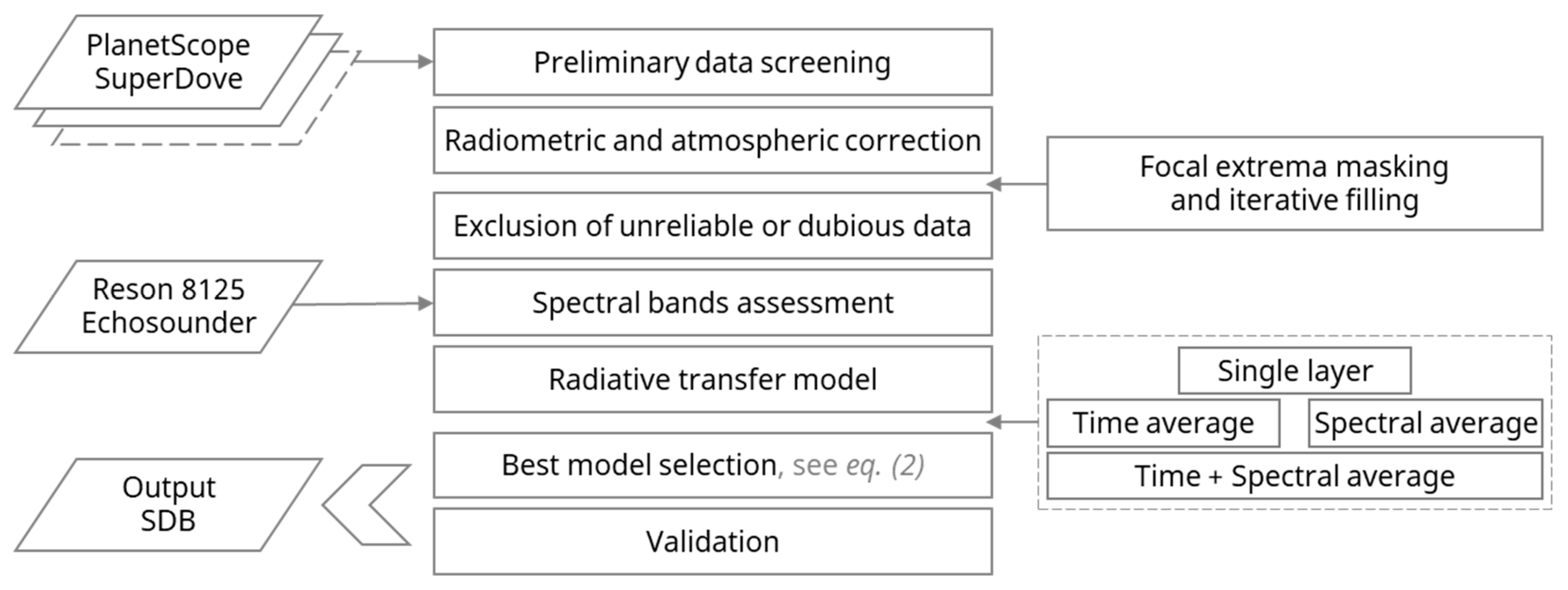
The proposed framework (
Figure 1) does not introduce a new bathymetric inversion model, but instead focuses on a robust integration strategy designed to stabilize SDB performance under optically complex and temporally variable coastal environments.
Indeed, this study aims to demonstrate how the combination of various spectral bands and acquisition times from high-spatial/temporal-resolution satellite optical imagery enables the accurate reconstruction of nearshore bathymetry. Leveraging the extensive spatial coverage of satellite observations alongside the accuracy of acoustic measurements, the method represents a robust approach for bathymetric mapping in environments where traditional methodologies may face limitations.
2. Materials and Methods
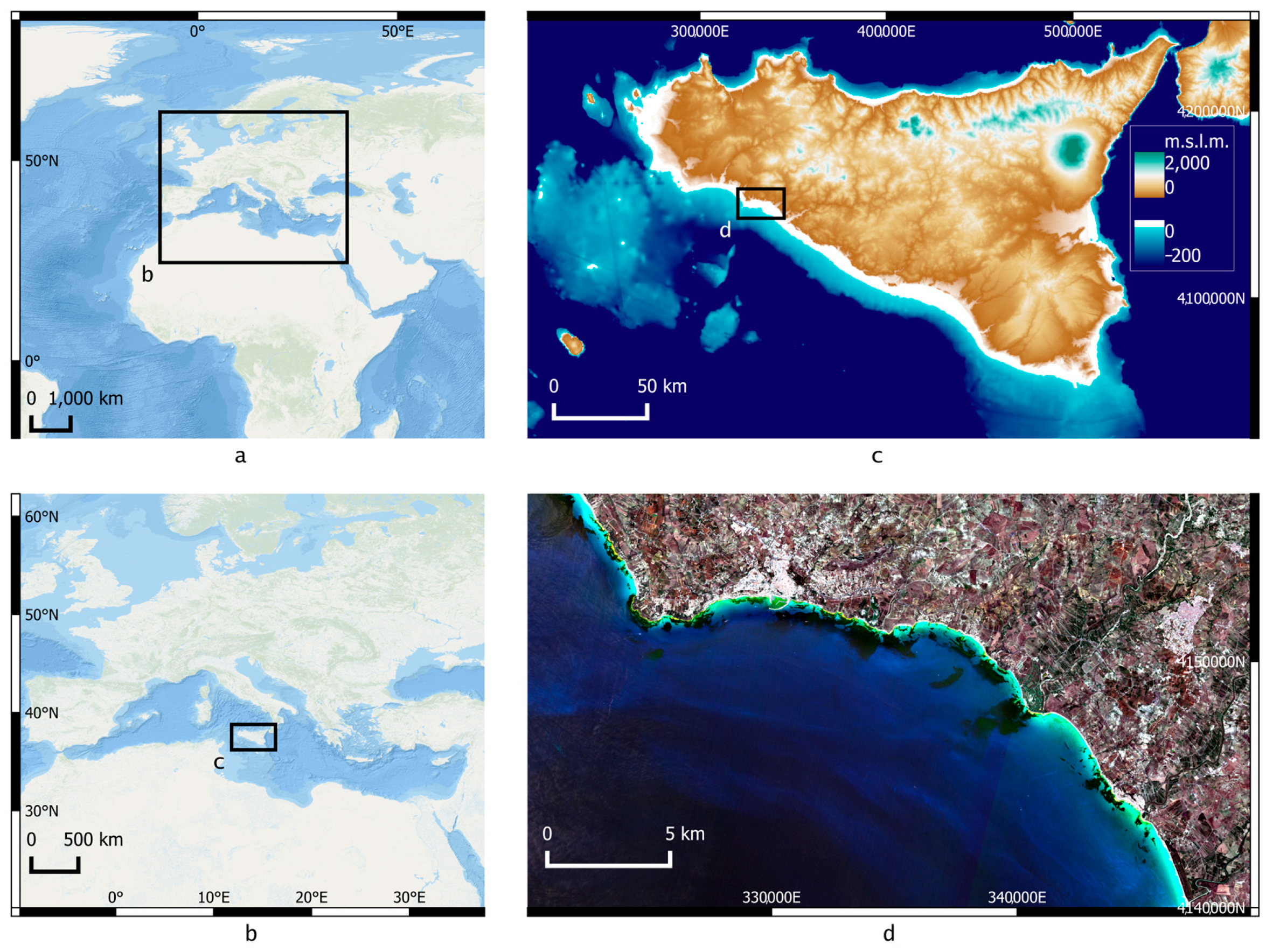
The area under investigation is the nearshore of the Gulf of Sciacca, spanning from Capo San Marco (37.49°N; 13.02°E) promontory, on the south of the Carboj River mouth, to Capo Bianco (37.39°N; 13.27°E) promontory, close to the Platani River mouth, both on the southern coast of Sicily Island, Italy (
Figure 2).
From a geological point of view, the Gela Thrust Front (GTF) represents a major structural boundary, following a north–south direction approximately in correspondence of Verdura River. This geological formation divides, to the west, the Sicilian–Maghrebian Chain, and to the east, the Gela Formation [
27,
28]. The Sciacca offshore area is characterized as a subsiding basin with a northwest-southeast orientation, covered by over 2000 m of terrigenous or carbonate deposits. It forms part of the Plio-Pleistocene foredeep, situated near the “Gela nappe”.
From a geomorphological perspective, the emerged territory is characterized by a hilly/mountainous landscape, with two large plateaus corresponding to the areas of Capo San Marco and Ribera. The lithological nature of the outcropping rocks and the presence of numerous rivers facilitate the availability of large quantities of sediments transported from the emerged sector towards the coast, forming elongated coastal plains. This continuous sedimentary process has shaped the marine sector throughout the Quaternary, resulting in a predominantly gentle morphology with minimal slope variations. Consequently, as shown in
Figure 2c, in the investigated area the white ribbon extends over a broader area compared to regions with steeper bathymetric gradients. The upper boundary of the study area is demarcated by the shoreline, representing the interface between terrestrial and marine environments.
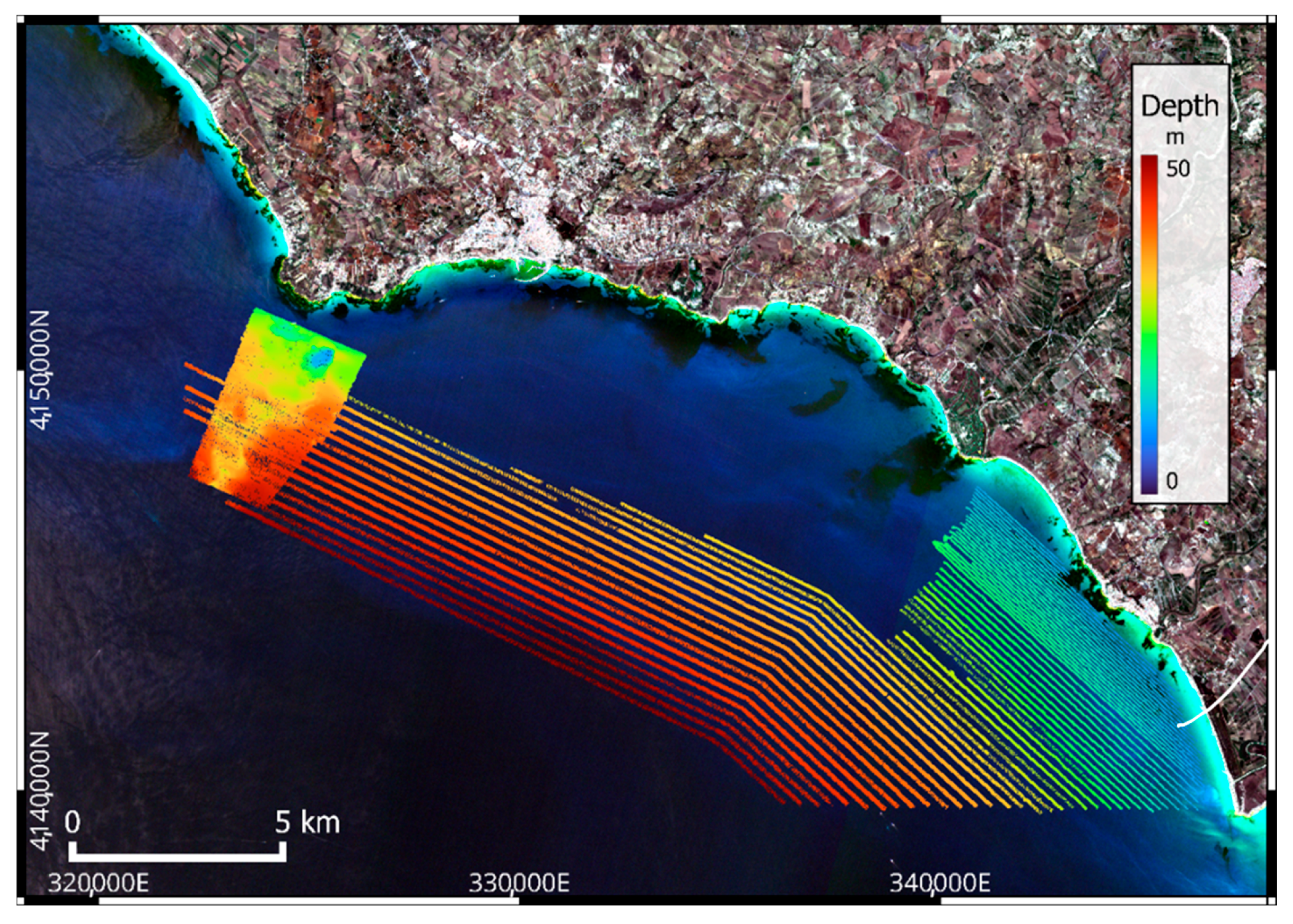
Multibeam bathymetric surveys were conducted over 16 acquisition days between 3 February and 25 May 2023, utilizing a Reson SeaBat 8125 multibeam echosounder (by Teledyne RESON Inc., Thousand Oaks, CA, USA), characterized by an along-track transmit beam width of 1.0°, an across-track receive beam width of 0.5° at nadir, a maximum ping rate of 40 Hz, a pulse length of 10 μs to 300 μs, and a depth resolution of 6 mm.
The absolute accuracy of the bathymetric data is further influenced by operational conditions, including positioning accuracy during navigation, motion corrections (roll, pitch, heave), sound-velocity profiles, and the processing of the raw data. The dataset was processed with PDS2000 software (version 4.4.11.5), undergoing error removal and spatial interpolation to ensure a seamless grid, with no gaps. Interpolation methods were used to achieve the final DTM at a 0.5 m footprint resolution (
Figure 3). Finally, the multibeam data were resampled from 0.5 m to 3 m using a spatial-average resampling method to serve as calibration for the satellite optical data, thereby mitigating potential misalignments between the multibeam and optical datasets.
The surveys revealed seafloor features of the Sciacca offshore region, focusing on the continental shelf down to −90 m. The structural high near Capo San Marco extends from the coast in an NNE-SSW direction to depths of over −40 m, with its shoals approaching −10 m depth about 1 mile from the coast; it is the result of significant tectonic features extending in a northeast-southwest direction. These features cause deformation and uplift of the substrate and the Quaternary cover. Here we observe rocky substrates, contouritic deposits, pockmark and mound structures and dense meadows of
Posidonia oceanica (L.) Delile extending beyond −30 m. Similarly, at the Verdura River mouth, another high with rocky substrates supported a dense seagrass meadow. The easternmost sector, extending to Capo Bianco, presented sedimentary structures (megaripples and dunes) and diverse rocky substrates supporting patches of
Cymodocea nodosa (Ucria) Asch. and
Posidonia oceanica. Just as in the emerging sector, the submerged sector is also affected by fluid seepage from the seabed. The intense anthropogenic activity taking place offshore of Sciacca has been observed in multibeam data, especially in the marine area of Seccagrande. Here, numerous groups of boulders of different dimensions can be seen, aligning for over 3 km perpendicularly to the coastline, along with the presence of pyramid-shaped structures intended to act as deterrents against bottom trawling. The multibeam bathymetric data were acquired on separate dates. In one case, a small area near a coastal promontory was surveyed continuously, while in another case, the acquisition consisted of multiple linear stripes covering a broader offshore sector [
29,
30].
Optical data (i.e., satellite images) were acquired leveraging PlanetScope SuperDove satellite constellation, consisting of approximately 200 units, designed to provide daily global terrestrial imagery. This new generation of PlanetScope satellites, launched in early 2020, began producing imagery by mid-March of the same year and, by August 2021 provided a collection potential of 200 million km
2 per day. The constellation is incrementally deployed through a series of “flocks” of satellites, each conforming to the CubeSat 3U specification (10 cm × 10 cm × 30 cm) [
31]. The newest generation of SuperDove is equipped with a PSBlue telescope (hereinafter, PSB.SD) (by Planet Labs PBC, San Francisco, CA, USA), with a 47-megapixel sensor, which provides high spatial (3 m) and spectral resolution (see
Table 2), acquiring images using a butcher block filter. From 29 April 2022, all new PlanetScope images feature 8-bands and originate from PSB.SD. On-orbit performance is continually augmented through rapid integration of technological upgrades, enhancing both functional capacity and satellite count [
32].
Traditional multispectral sensors typically acquire four spectral bands spanning the visible and NIR regions, while PSB.SD sensors capture eight distinct segments of electromagnetic radiation. These eight bands feature different wavelength ranges: Bands 1 and 5 have the narrowest nominal acquisition range of ~20 nm, Bands 3, 4, 6, 7, and 8 fall within an intermediate range of 30–40 nm, while Band 2 has the widest nominal acquisition range, reaching 50 nm. Each frame consists of eight stripes, and to generate the final 8-band image, the consecutive frames on either side of a given frame are stacked together [
33].
An important feature that proves advantageous for the technique developed in this study is that the spectral bands are not acquired simultaneously but sequentially, with a slight temporal offset between them. Given that the final scenes are reconstructed through a holographic processing of individual frames stitching up four frames ahead and four frames behind a reference frame [
34], and that this reconstruction is performed separately and independently for each spectral band, it may lead to band-specific spatial discrepancies. In particular, the location of the most reflective pixels may differ across spectral layers due to the independent alignment and temporal offset inherent in the band-wise processing workflow. For instance, Aati et al. (2022) [
34] report misalignment between the visible bands of the order of ~1 pixel.
According to Planet Labs [
35], PlanetScope imagery products provided as Ortho Scenes undergo geometric corrections in which spacecraft-related effects are compensated using attitude telemetry and the best available ephemeris data and further refined through ground control points. This processing yields a positional accuracy of less than 10 m RMSE at the 90th percentile. The Ground Sample Distance depends on satellite altitude and, for PSB.SD sensors range between 3.7 and 4.2 m. The imagery is resampled using a cubic-convolution kernel, resulting in an orthorectified pixel size of 3.0 m.
2.1. Preliminary Data Screening
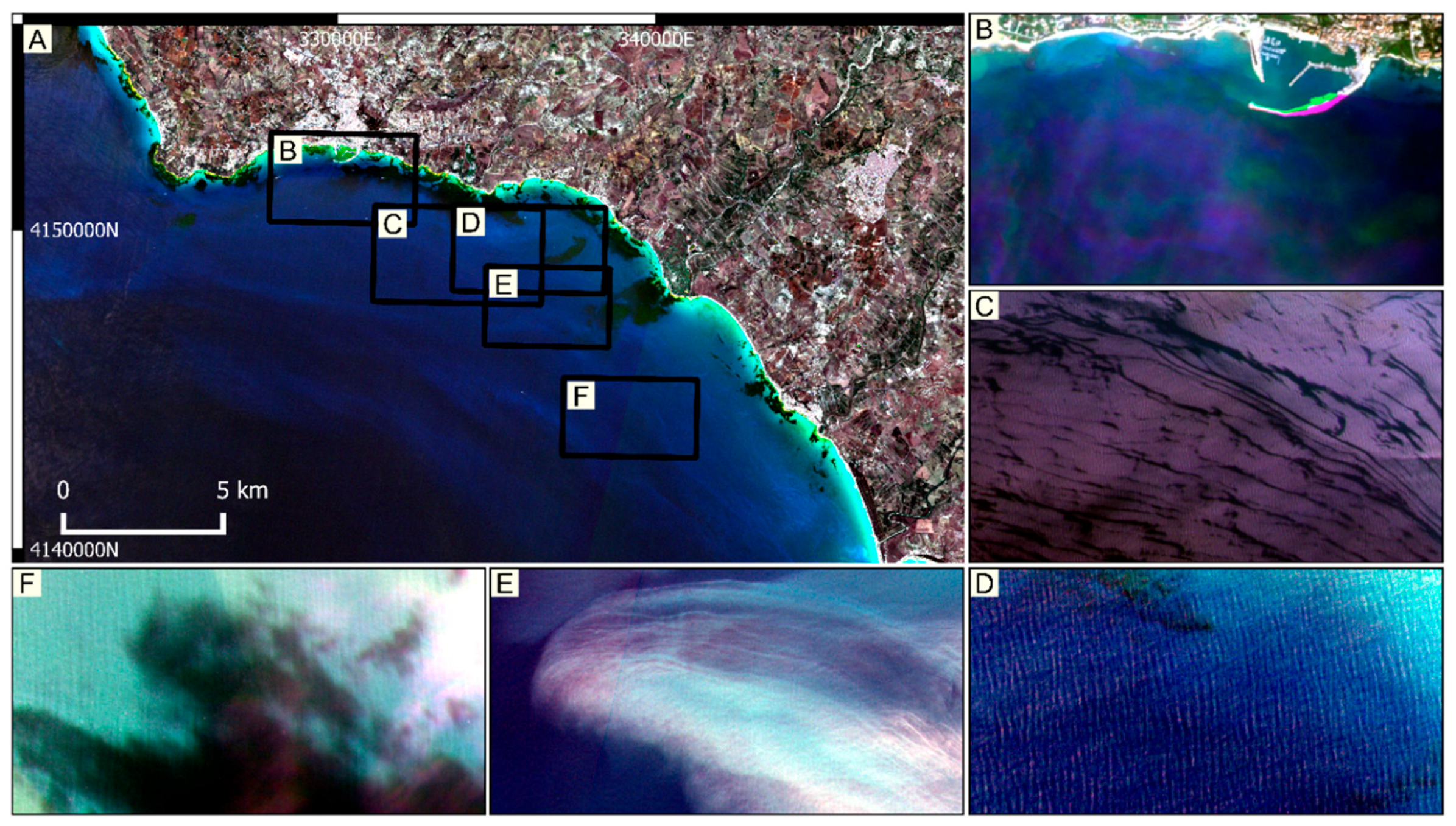
The selection of satellite imagery for this investigation was driven by a series of predefined requirements. Through the Planet Explorer resource portal, search filters were applied to identify all cloud-free (0%) images acquired in 2022–2023 (i.e., temporally close to the multibeam echosounder survey), fully encompassing the study area. Subsequently, all images that visually exhibited high water turbidity, significant surface roughness caused by ocean waves, wind effects, or cloud shadows (
Figure 4) were excluded. This filtering procedure was supported by quantitative metrics extracted directly from the imagery. Scenes characterized by unusually high mean reflectance in water-only pixels within the blue-green bands were identified as highly turbid, whereas images exhibiting pronounced fine-scale reflectance variability were interpreted as being affected by enhanced surface roughness induced by wind or wave activity. These metrics served as an objective validation of the visual screening. These conditions were essential in ensuring clear reflectance data, crucial for accurate bathymetric estimation.
2.2. Radiometric and Atmospheric Correction
Radiometric data were calibrated to obtain Top of Atmosphere reflectance (
). A relative scatter algorithm, originally introduced by Chavez [
36], was employed to perform atmospheric corrections. The refined Bottom of Atmosphere reflectance (
) was further adjusted with an empirical coefficient of 0.545 [
37] to enhance the accuracy of sub-surface reflectance estimates.
2.3. Shoreline Extraction
The shoreline was extracted according to the Isoradiometric method [
38,
39] by processing the selected satellite images. The approach was first proposed by the authors [
40] to detect shorelines by identifying abrupt radiometric transitions in remote sensing imagery. Here, it was applied as it provides an accurate and computationally efficient approach to derive the bathymetry upper boundary (depth equals 0 m) for calibrating the radiative transfer equation (see
Section 2, Equation (1)).
2.4. Exclusion of Unreliable or Dubious Data
To obtain a reflectance dataset suited for bathymetric model calibration, we restricted our analysis to a single class of sandy seabed. More specifically, vegetated and rocky substrates were eliminated, retaining only the sandy seafloor, which exhibits characteristically higher reflectance. This was accomplished using a k-means clustering algorithm to classify the seafloor, and only the sandy class was retained as the optical input for our dataset. This classification was based on the research team’s geological knowledge of the study area. However, the classes were finally assigned through visual interpretation and discrimination. The NIR band was employed to identify and exclude surface artifacts such as vessels, wake patterns, and other surface perturbations, ensuring a more refined dataset.
2.5. Spectral Bands Assessment
The diffuse attenuation coefficient (
Kd) in aquatic environments governs the extent to which light is absorbed and scattered as it travels through the water column. This attenuation varies notably across the electromagnetic spectrum due to the optical properties of water and its components, including phytoplankton, suspended sediments, and dissolved organic matter (DOM) [
41,
42,
43]. In the visible region of the spectrum, light attenuation in water is highly wavelength-dependent, with shorter wavelengths exhibiting higher penetrability compared to longer ones. This differential penetration is due to the relatively lower absorption and higher scattering of blue and green light due to the width of their characteristic wavelengths. In contrast, the red band and, even more, the NIR band suffer from rapid attenuation in water, limiting their use in subsurface observations. In particular, water strongly absorbs NIR radiation, meaning that NIR reflectance typically reports information about surface properties or the presence of floating materials. Based on these considerations, the
Kd was carefully evaluated for each band and were selected those that maximize penetrability and minimize attenuation.
2.6. Spectral Average
The effectiveness of using individual spectral bands versus the average of two or more bands was analyzed. As widely documented in the scientific literature, the most effective and commonly employed optical wavelengths for bathymetric detection in coastal waters are in the range 490–565 nm, corresponding, respectively, to blue-green light [
16]. Given the identification of the most penetrating wavelengths in the water column, we averaged the reflectance values of two or more informational layers corresponding to different spectral bands and carried out experimental analyses using these newly generated spectral mean layers. These preliminary outcomes are illustrated in
Section 3.
2.7. Time Average
After identifying the most suitable images for bathymetric retrieval, temporal averaging was investigated by comparing the bathymetry estimated from single image acquisition with that derived from the average of two or more images. This was implemented to enhance data stability and minimize the influence of single-scene perturbations. The effectiveness of this approach varies depending on acquisition conditions. Outcomes are reported in
Section 3.
2.8. Model Calibration
To ensure accurate calibration, the multibeam bathymetry (hereinafter MB) data layer was refined by removing all pixels associated with rocky or vegetated seabed. This more homogeneous dataset improved the consistency between reflectance values and bathymetry, thereby enhancing the accuracy of the correlation. Only pixels over sandy bottom have been used to calibrate the model. Subsequently, we applied a simplified version of the radiative transfer equation, originally proposed by Jain and Miller (1977) [
44] in terms of radiance and later rephrased by Moussa et al. (1989) [
45] in terms of reflectance, here linearized through a logarithmic transformation (1):
where
is the spectral reflectance just beneath the water’s surface,
denotes the spectral reflectance value for a water column of infinite depth,
is the spectral reflectance at the bottom,
(m
−1) is the spectral diffuse attenuation coefficient, usually assumed as spatially constant, and
(m) is the water depth. All parameters, except for depth, are wavelength-dependent [
46].
To incorporate both spectral or/and temporal averaging we define the spectral–temporal average of the quantity
as (2):
where
T is the number of temporal acquisitions and
L is the number of spectral bands considered in the averaging. Although
,
,
can be estimated directly from the ⟨
⟩ image, or via in situ radiometric measurements (e.g.,
) they may also be calibrated when appropriate in situ reference data are available.
The corresponding expression considering spectral (
λ) and temporal (
t) average is given by (3):
Equation (3) was calibrated using a natural logarithm function fitting reflectance vs. MB. After calculating the coefficients of the logarithmic model, we used them to estimate the bathymetry from reflectance, producing an SDB of the whole area.
2.9. Validation
To ensure the accuracy of each SDB, we analyzed the relationship among 100,000 randomly sampled pixels selected from the MB dataset, considering depths down to 25 m, only on sandy bottom. The validation density plots (see
Section 3) include a linear trendline along with two additional lines representing the 95th and 5th percentiles of SDB (
Zop) as a function of MB (
Zmb). Half the width of the confidence interval will be assumed as a metric for the dispersion relative to the trendline.
2.10. Reduction in Liquid-Facet-Dependent Noise
The radiative transfer process in marine environments is inherently complex and dynamic. Even when the direction of incident solar radiation and the satellite viewing geometry are fixed, the sea surface behaves as a continuously evolving system of liquid facets. These facets, due to their transient orientation, refract incoming radiation at varying angles. Once refracted into the water column, the radiation travels downward, interacts with the seabed, and then ascends toward the surface.
Assuming a static seabed, such as sandy substrates, which remain relatively stable over short time scales, the upward radiation undergoes diffuse attenuation. In contrast, vegetated substrates (e.g., Posidonia oceanica meadows) oscillate due to hydrodynamic eddies, introducing additional variability in the radiative signal.
Upon reaching the sea surface from below, the emergent radiation is again refracted through the dynamic interface of liquid facets. The orientation of these facets determines the exit direction of the refracted signal, which varies temporally and spatially. Simultaneously, a portion of the incident radiation is reflected at the air-water interface. This specular reflection is also facet-dependent and contributes to the total radiance received by the satellite sensor.
Thus, the radiance vector reaching the sensor comprises both refracted emergent components and reflected incident components, each modulated by the instantaneous geometry of the surface facets. Despite selecting only six high-quality PlanetScope images from a potential daily dataset, chosen to minimize specular reflection, residual artifacts persist in scattered pixels.
Rather than pursuing a purely theoretical treatment of these phenomena [
47], we propose a practical, image-based approach that leverages the high spatial resolution of PSB.SD imagery.
For given depth, optical water column characteristics and bottom reflectance, the reflectance variations (and indeed minima and maxima) are associated with the instantaneous orientation of water facets at the time of acquisition. These orientations, indeed, influence the emergent radiance through three main mechanisms: (i) refraction at the air–water interface of the incident radiation, (ii) refraction at the water–air interface of the emergent radiation, and (iii) reflection of the incident radiation by the liquid facets at the surface. These three main mechanisms modulate both emergent and reflected radiations. We aim to obtain emergent radiance from liquid facets oriented in a uniform position, also avoiding specular reflection phenomena, that is, facet orientations that generate maxima in reflectance, and also avoiding orientations that produce minima in reflectance. It needs to be highlighted that it is not necessary to determine the optimal orientation of the liquid facets, since the algorithm is calibrated against in situ reference data.
Considering that these maxima and minima depend not only on the geometric configuration—incident solar radiation direction, instantaneous facet orientation, and sensor viewing geometry—but also on the relative size of the liquid facets with respect to the geometric resolution of the imagery (which, moreover, is obtained through resampling). To identify and mitigate these, we applied a focal operator that evaluates the recurrence of local maxima and minima within a 3 × 3 moving window and thereby inferring the average orientation and exposure of liquid facets at the image resolution scale.
Two filtering strategies were tested, named FREO, an acronym for Focal Reflectance Extremes Operator:
In the FREO1 method, which represents the more conservative strategy, we replace only those pixels that consistently behave as local maxima or local minima across all observations (focal samples). In other words, intervention is limited to pixels marked with a mask value of 9, meaning they always exhibit an extreme value. In contrast, the FREO2 method adopts a less conservative approach: it replaces all pixels that behave as local maxima or minima at least once. Here, the criterion is broader, since all pixels with a mask value equal to or greater than 1 are included. This procedure was applied independently to each spectral band to account for the PlanetScope image generation process. Specifically, the PSB.SD telescope acquires bands sequentially using a push-frame mechanism. Frames are stacked to form band-specific images, and scenes are generated via a homographic transformation across multiple frames. Since this process is performed independently for each band, reflective pixel positions may differ across bands.
Therefore, the filtering and replacement of extreme reflectance pixels were conducted per band. Missing values were filled using a recursive mean filter (3 × 3 window) until all no-data pixels were interpolated. This approach is expected to narrow the error band in bathymetric estimation. In particular, it is expected that the more aggressive FREO2 strategy will yield a tighter confidence interval. It is essential to note that bathymetry is inferred from the attenuation of radiation along an optical path that is inclined rather than vertical. However, the estimated depth is assigned to the vertical projection.
2.11. Depth-Dependent Kd
An assumption in SDB is that the diffuse attenuation coefficient remains spatially constant throughout the study area. This leads to a linear alignment of pixels in the logarithmic domain of reflectance values. However, when Kd varies spatially, this assumption no longer holds, and nonlinear deviations may emerge in the reflectance-depth relationship. Several natural processes can contribute to such variability in water column attenuation, including sediment resuspension due to hydrodynamic forcing, among others. In this case, it is therefore reasonable to hypothesize that Kd may vary with depth itself.
Under this condition, the radiative transfer equation transforms into a second-order polynomial. While this approach can effectively compensate for nonlinear deviations and improve depth estimation accuracy, polynomial models are generally less suitable for extrapolation beyond the calibration domain, which represents a clear limitation of the method.
The hypothesis of a linearly variable
Kd with depth was tested according to the following relationship (4):
where
rules the
Kd variation with water depth, while
quantify its spatially constant component. Under this assumption, Equation (1) can be expressed as a second-order polynomial function (5):
where
denotes the reflectance layer,
Z corresponds to the multibeam reference data, and all remaining parameters are calibrated against these reference data.
The performance of the algorithm is assessed on the calibration dataset using the coefficient of determination,
R2 (–), and the root mean square error,
RMSE (m), computed between MB and SDB depths (
Zmb and
Zop, respectively). For the validation dataset, the summary table includes a more comprehensive set of statistics: the Slope (–), mean bias error,
MBE (m), mean absolute error,
MAE (m), concordance correlation coefficient,
CCC (–), median absolute distance,
MAD (m), and
Error (%). All statistical formulas are reported below (respectively, (6a–h)).
where
;
: The covariance between and ;
, : The variances;
, : The average values.
3. Results
From 1 January 2022, to 31 December 2023, despite the nominal daily revisit interval, applying a cloud cover filter set to 0% of the total area resulted in a total of 59 images. In this set, considering only images with low water turbidity, 21 images were identified. Ultimately, excluding images with elevated surface radiometric disturbance, suspended material in the water column, sun glint or other artifacts, resulted in a final set of 6 images, 2 from 2022 and 4 from 2023 (see
Table 3).
Figure 4 illustrates representative cases of images excluded from the final dataset due to various quality issues. These include atmospheric haze, surface disturbances caused by wind and marine currents, capillary waves, suspended dissolved materials, and cloud shadows. Incorporating these scenes would add noise to the up-coming signal, resulting in biased depth estimates, especially in shallow waters characterized by high optical complexity.
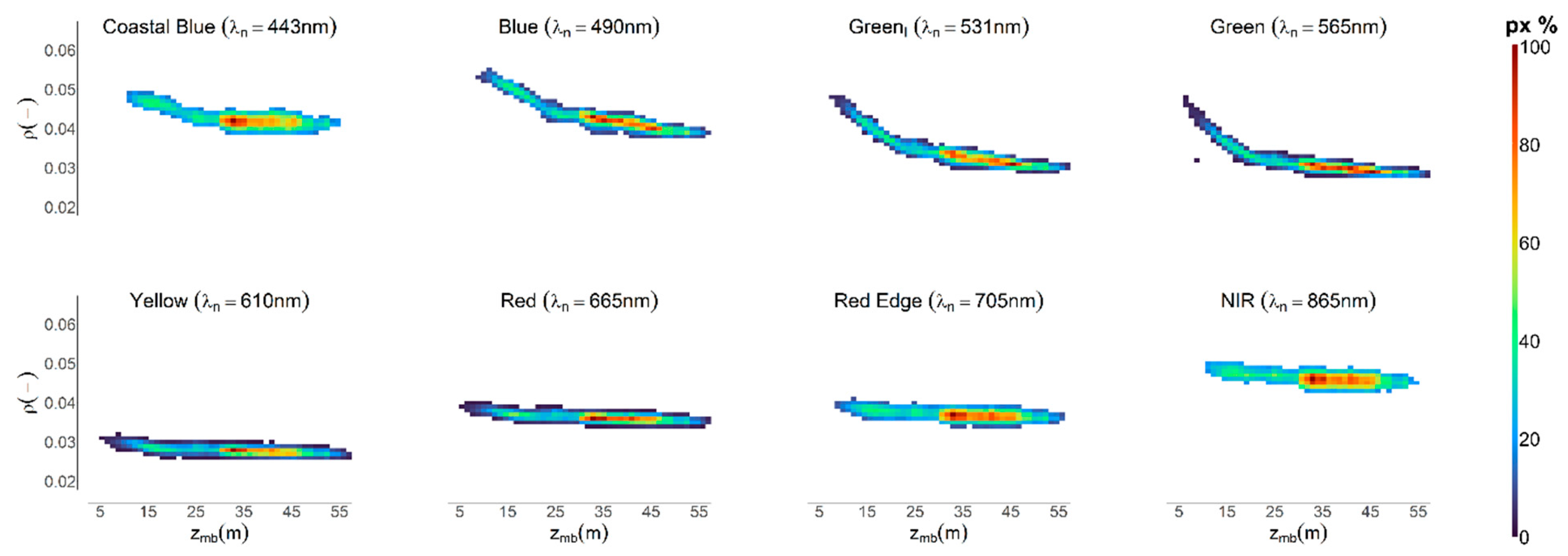
The applicability of the methodology presented in this study is limited to the maximum depth where reflectance reaches an almost constant value regardless of depth, representing the value of an infinitely deep water column (see Equation (1)). The findings of spectral bands penetrability assessment are presented in
Figure 5, indicating that the most effective bands for depth retrieval, among those provided by the PSB.SD sensors, are the second, third, and fourth bands, corresponding, respectively, to wavelengths of 490, 531, and 565 nm. These bands make it possible to retrieve depth information up to ~25 m.
Reflectances
,
, and
were visually identified as the most relevant for bathymetric retrieval, since they vary significantly with bathymetry, following an exponential decay (see Equation (1)). Thus, they were employed to study the bathymetry derivability from each of the six selected time points, according to
Section 2.1.
Table 4 reports acquisition time, sun azimuth, sun elevation, satellite azimuth, view angle, and Ground Sampling Distance (GSD) of the six selected acquisition dates.
MB and SDB have been compared for the selected acquisition times, considering just the three optimal spectral bands (
Table 5). The R
2 values obtained indicate that not all the images are suitable for estimating bathymetry. In particular, the most suitable images are the two acquired in July 2022 and the one in June 2023. Furthermore, in almost all cases,
spectral reflectance proves to be the most effective, reporting the highest R
2 values.
After the evaluation of the single data layers’ output, the effectiveness of applying spectral averaging or temporal averaging to improve bathymetric estimation was evaluated. Preliminary results (
Figure 5,
Table 5) guided the selection of a refined dataset, restricting it to the three most penetrating bands (
,
,
) and the three most consistent images (14 July 2022, 16 July 2022, 27 June 2023).
Spectral averaging effectiveness was tested by comparing results obtained using a single band with the average of two bands or the average of three bands. The corresponding R
2 values are reported in
Table 6.
Temporal averaging was then evaluated to determine its potential advantages over single-image bathymetric estimation. The outcomes are reported in
Table 7.
Finally, the two approaches were combined to evaluate whether the integration of temporal and spectral averaging enhances bathymetric accuracy, making it more consistent with multibeam measurements.
Table 8 presents the R
2 values for the optimal combinations—relative to the results previously obtained (see
Table 6 and
Table 7). The results specifically highlight that in the case study, the most accurate bathymetric estimation is achieved by averaging spectral reflectances
and
acquired on both 14 and 16 July 2022, achieving a peak R
2 value of 0.946. The addition of the 490 nm blue band does not systematically improve bathymetric performance and may, in some cases, slightly degrade accuracy. This behavior is likely driven by the increased susceptibility of shorter wavelengths to scattering processes and photosynthetic absorption within the water column in coastal waters. Therefore, the
reflectance reduces the overall signal to noise ratio of this spectral combination. Similarly, adding the acquisition from 27 June 2023, to the temporal combination does not result in improved accuracy and produces a slight degradation. This indicates that temporal averaging is most effective when applied to scenes acquired under comparable optical conditions.
These findings are consistent with Casal et al. (2019), who showed that in optically complex coastal waters the green spectral band around 550 nm conveys stronger and more stable depth-related information than the blue band [
50].
Based on the preliminary results obtained, the dataset was further reduced for more detailed analyses by retaining only the spectral bands 3 and 4 from 2022 images. The accuracy achieved with the best-performing single data layer (band 3, 14 July) was then evaluated in comparison to spectral and/or temporal combinations.
The relation between MB (Z
mb) and reflectance reported in
Figure 6, is best described using an exponential decay of the type
, where with respect to Equation (1):
represents
,
corresponds to 2
Kd and
is analogous to
.
From Equation (3), (reflectance) and Z (multibeam depths) are known, whereas all remaining parameters are calibrated based on these reference data.
The model exhibited the best performance when calibrated using the two-green spectral average (
and
) derived from the mean reflectance of 2022 images (
Table 8,
Figure 7). This approach significantly reduced error metrics, highlighting the advantages of integrating data across different spectral bands and time points to enhance the robustness and accuracy of depth estimation (
Table 9).
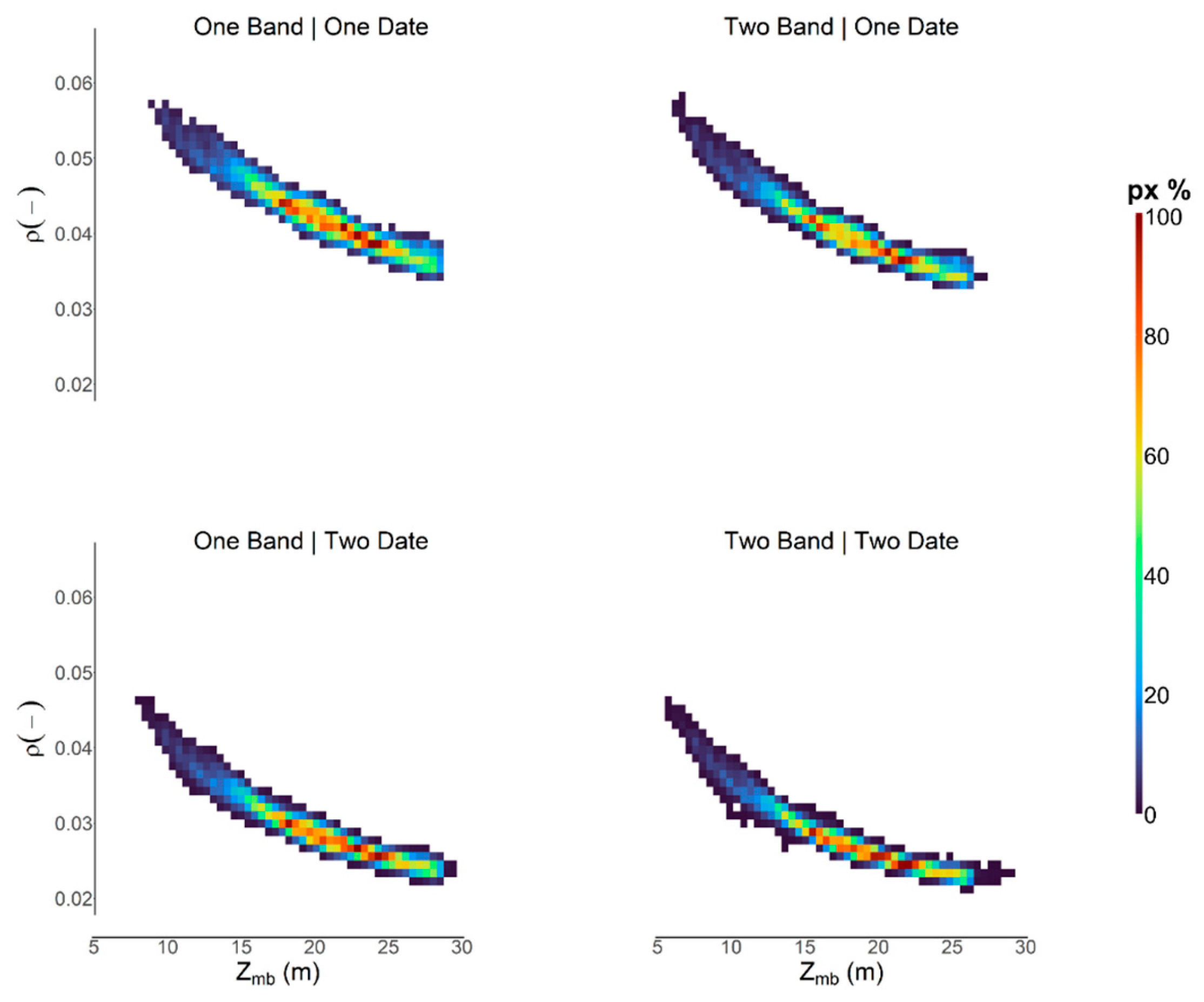
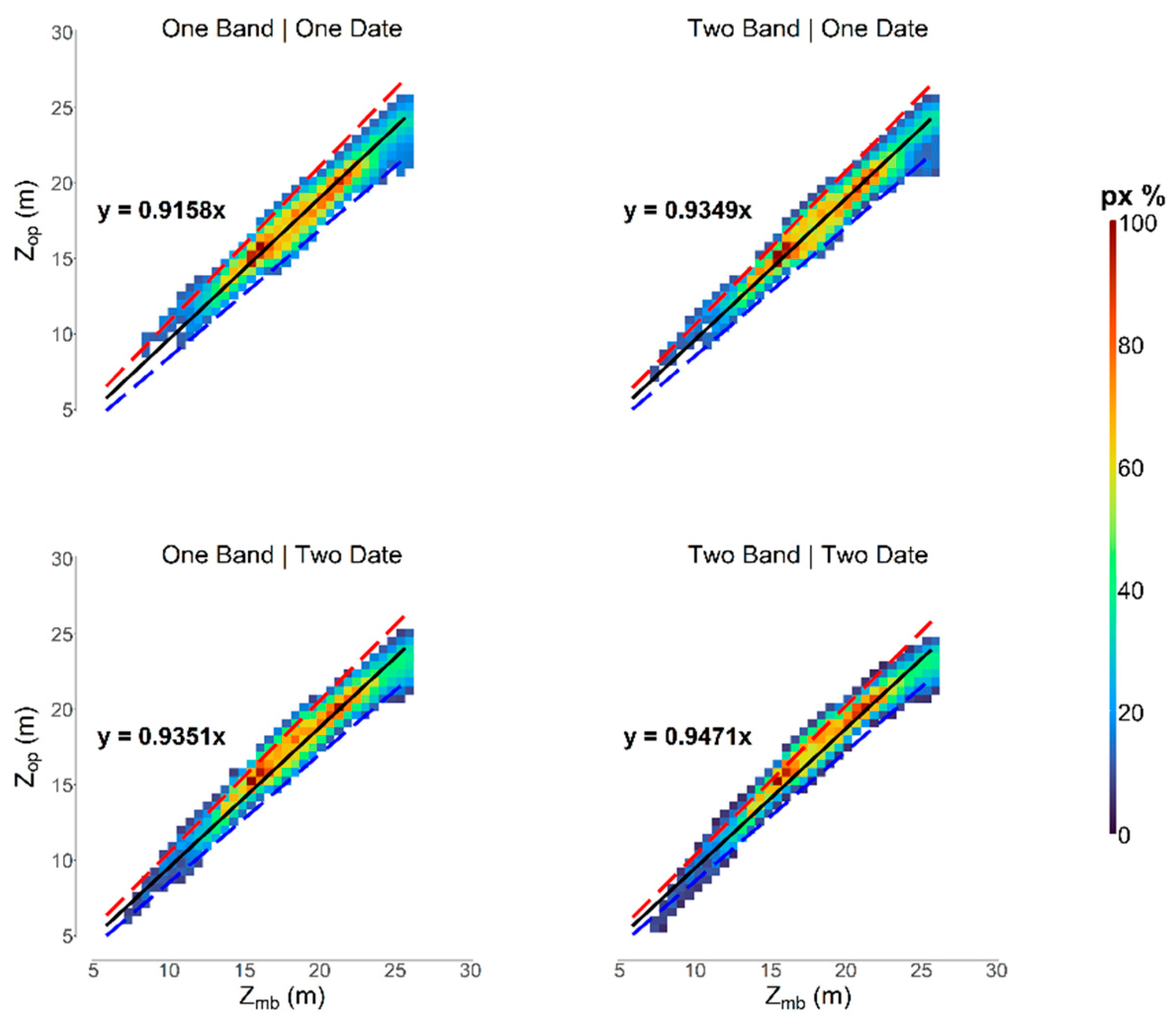
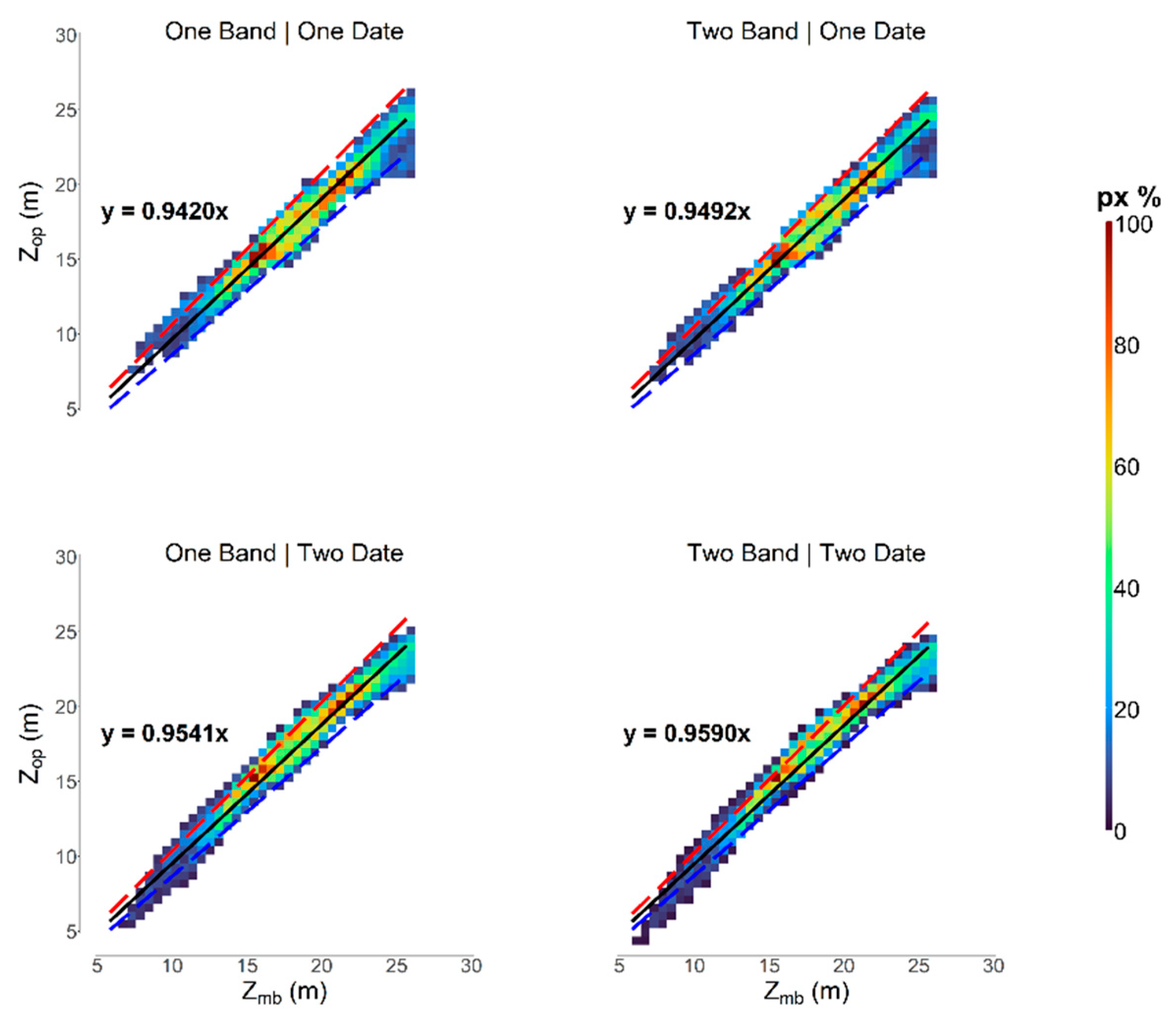
Validation scatterplots show a gradual increase in accuracy as more input layers are incorporated. In
Figure 7, the single data layer “One-Band|One-Date” (referring to
reflectance from 14 July 2022) exhibits the highest dispersion, with an error of ±10.1% respect to MB. From “Two-Band|One-Date” and “One-Band|Two-Date” dispersion decreases, with errors of ±8.6% and ±8.7%, respectively. The combination of spectral and temporal averaging results in the lowest observed error, equals to ±7.3% (
Table 10).
These findings indicate a strong correlation between SDB and multibeam data, which allowed us to accurately estimate bathymetry down to approximately 25 m. The intercept was constrained to zero to ensure that the trend line passes through the origin of the Cartesian axis. As a result, the estimated bathymetry on the shoreline is null.
Table 11 indicates that the “Two-Band|Two-Date” configuration allows obtaining the most accurate result.
As described at the end of
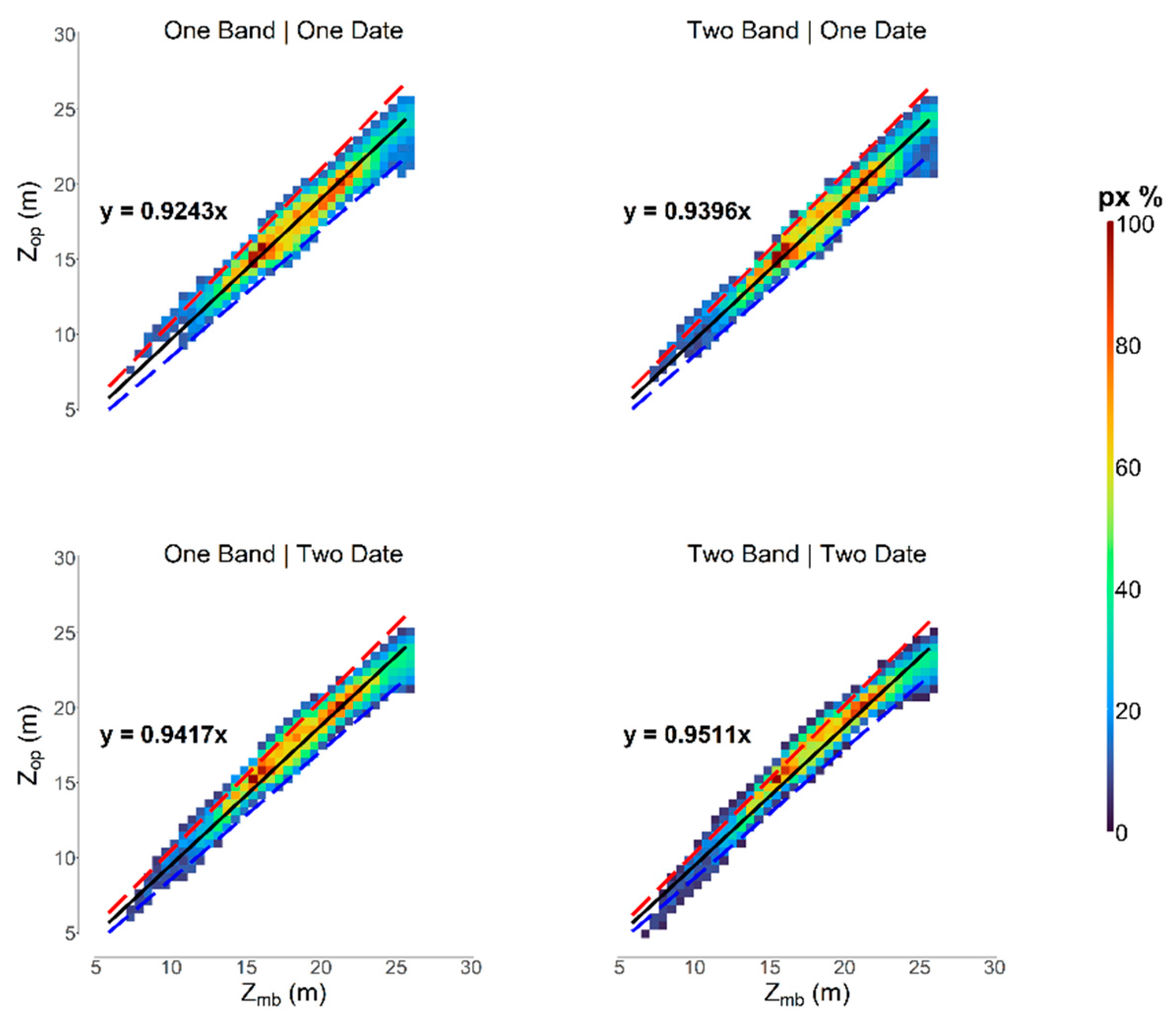
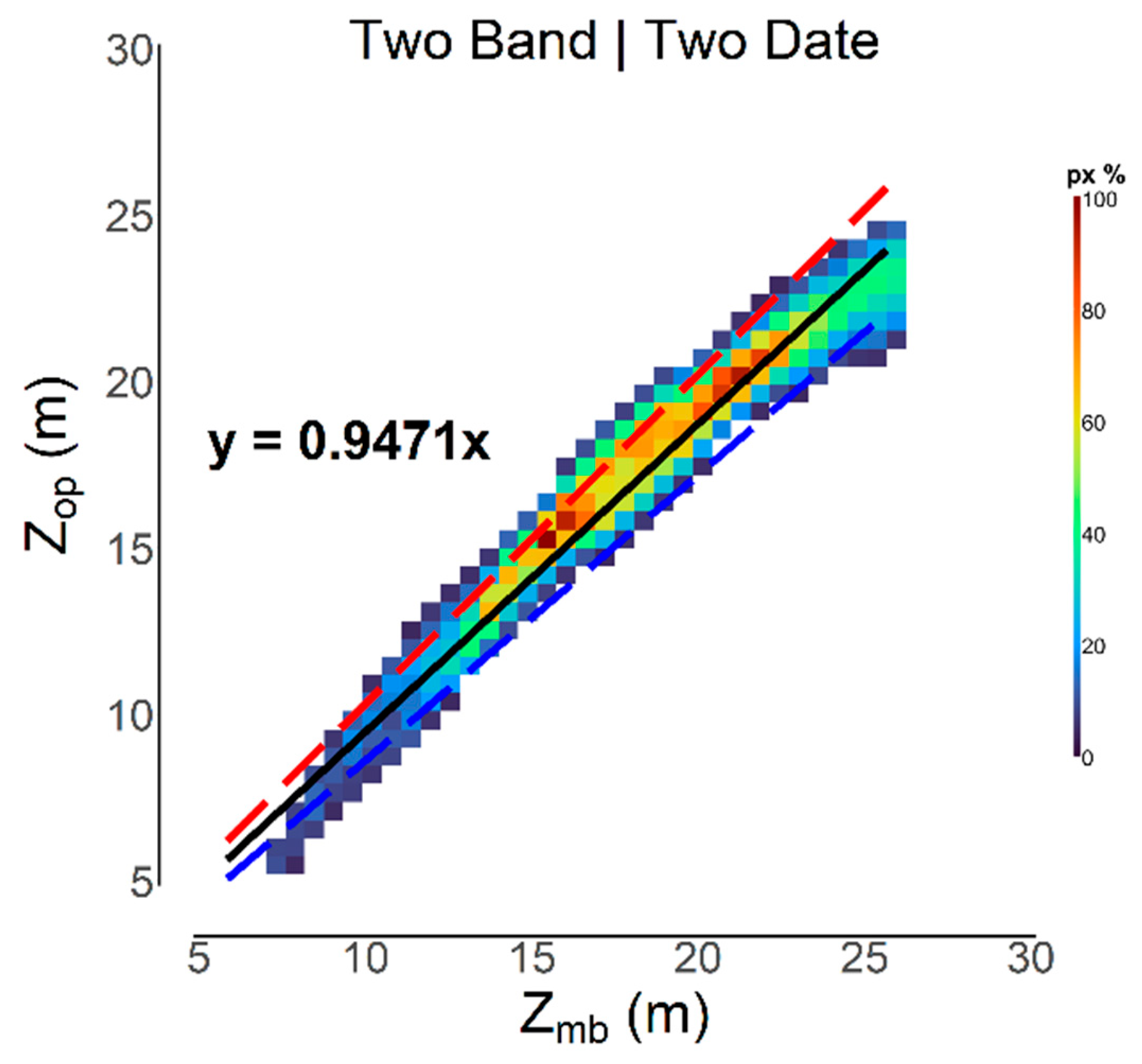
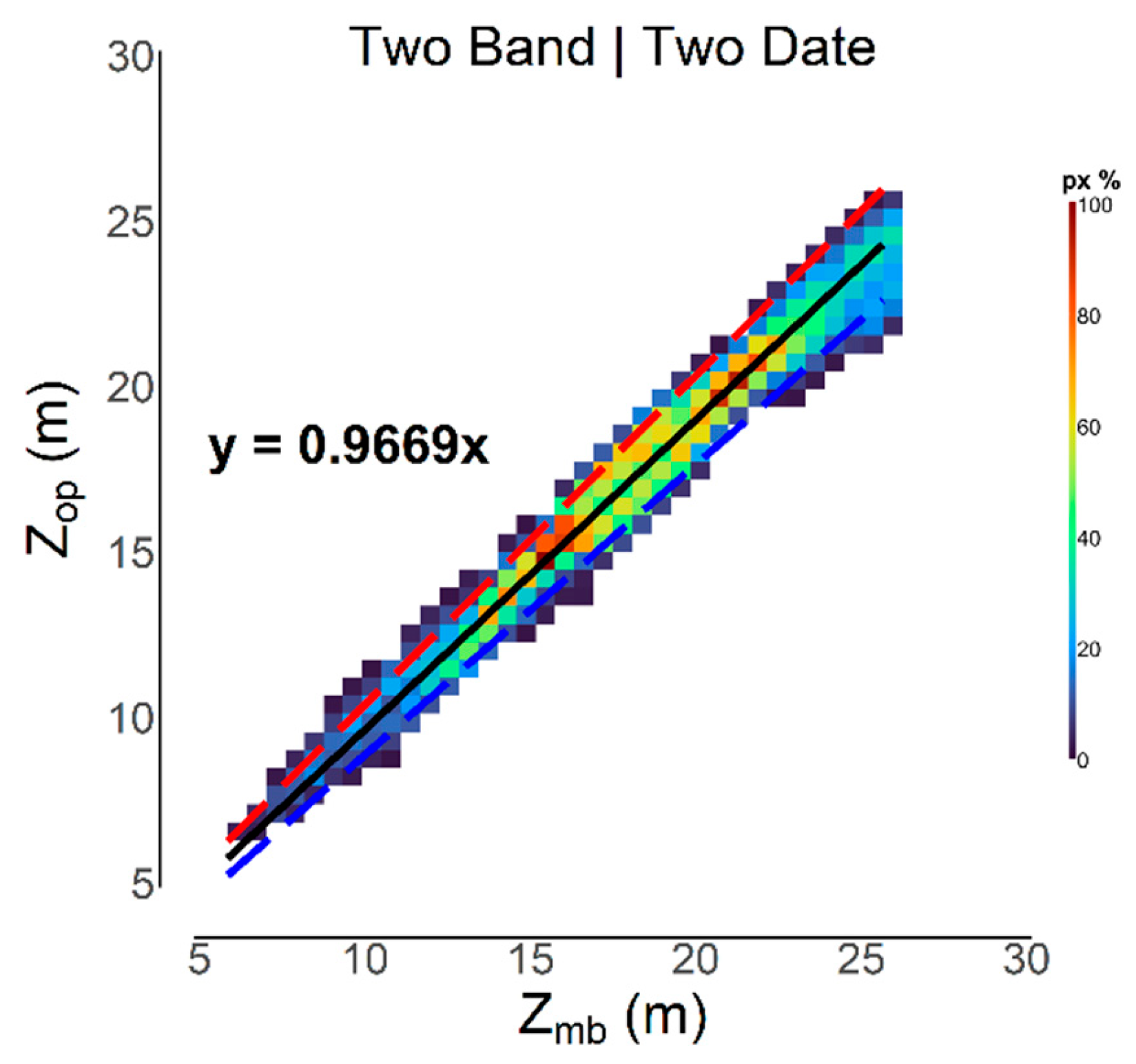
Section 2, we applied a noise-reduction technique starting from the reflectance layers. The following scatterplots (
Figure 8 and
Figure 9) illustrate the validation results after this correction, where a clear narrowing of the error can be observed, indicating an overall improvement in accuracy.
Noise reduction using the conservative approach (FREO1) slightly improved the overall accuracy across all four best combinations, yielding an optimal error of ±7.0%. Conversely, removing a larger portion of noise using the non-conservative mode (FREO2) resulted in a greater improvement, with an optimal error value of ±6.4%.
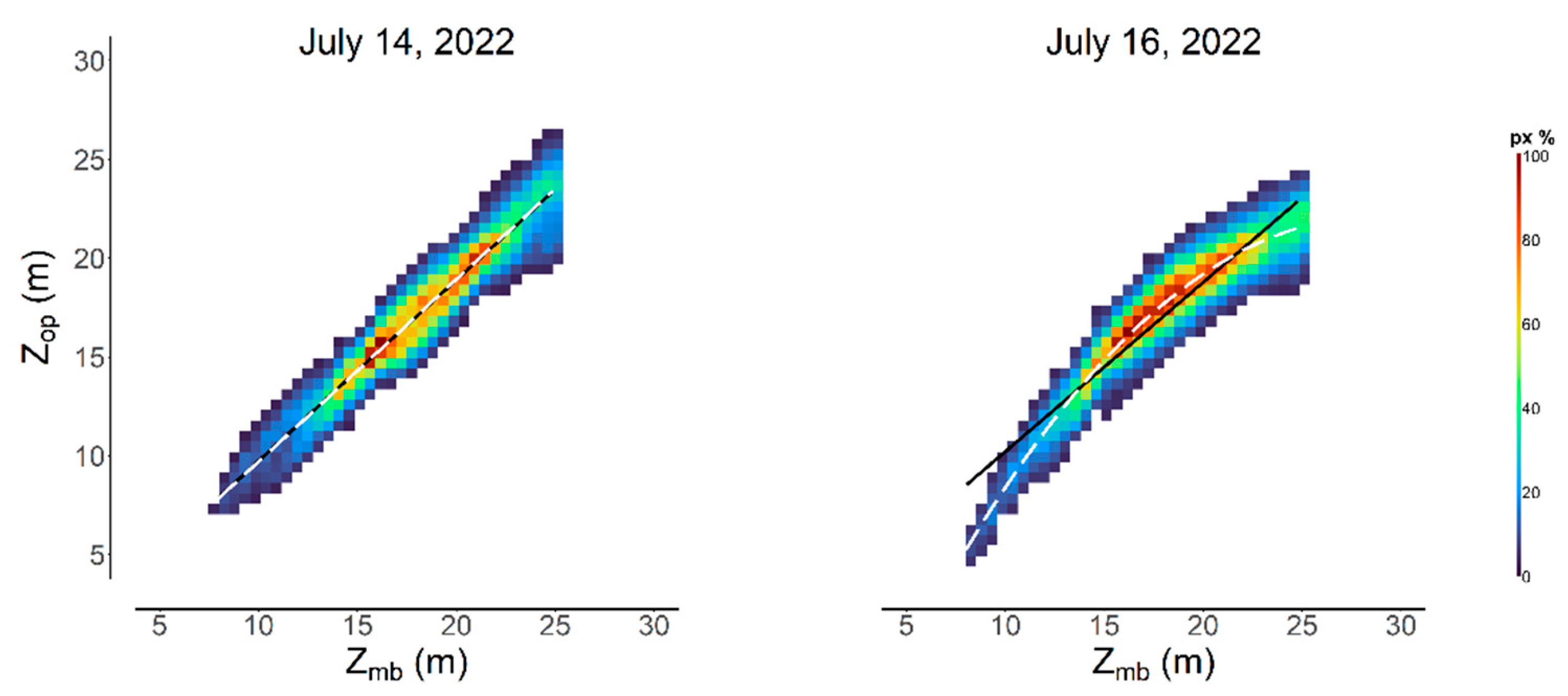
Regarding the “One-Band|One-Date” configuration, the data from the 16th of July 2022 is characterized by a nonlinear behavior: the SDB does not change linearly with MB. This can be explained by the recognized principle that
Kd is not uniform throughout the study domain, but rather shows a depth-dependent variability [
51,
52]. The scatterplots in
Figure 10 show a linear pattern for the data from 14 July, with low dispersion, whereas the data from 16 July, despite also having low dispersion, exhibits nonlinearity. A logarithmic fit appears to better represent the observed distribution.
The nonlinear behavior observed on 16 July is also evident in the combined dates layer (
Figure 11). Consequently, while time-averaging mitigates dispersion, it introduces a nonlinear pattern, which becomes particularly pronounced beyond a certain depth.
Considering this nonlinearity, caused by a depth-dependent variability of
Kd, which is particularly evident in the image acquired on 16 July, Equation (5) was applied. The resulting fit proved to be even more satisfactory, as illustrated in the scatterplot in
Figure 12, which finally displays a clear linearity even at shallow depth in the relationship between the SDB and MB, with an error value of ±5.9%.
A consistent improvement can be observed across all the analyzed combinations, confirming the effectiveness of the proposed noise-reduction strategy and variable
Kd hypothesis, as summarized by
Table 11.
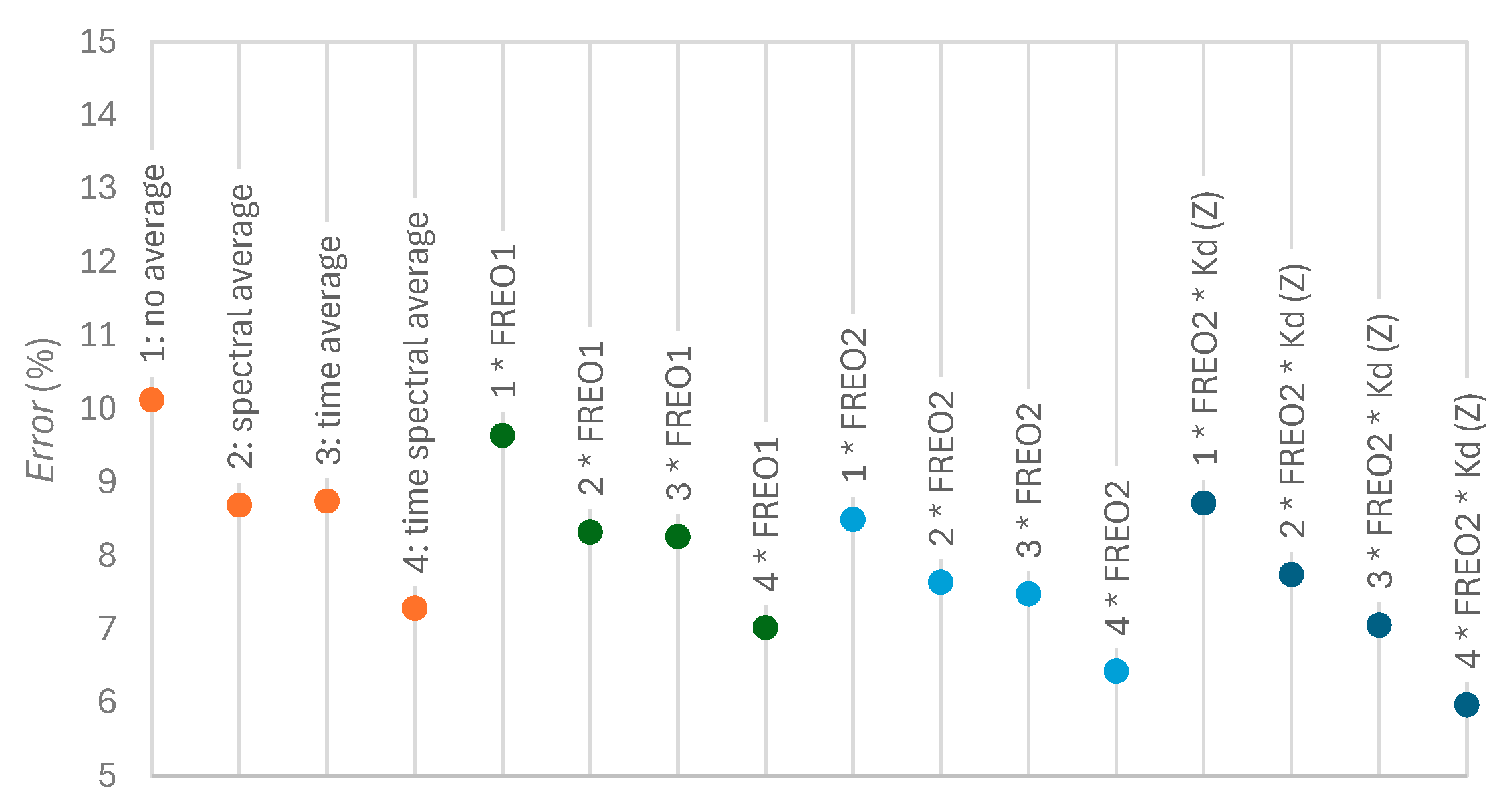
Figure 13 provides a visual representation of the progressive decrease in percentage error across the steps of the proposed methodological framework.
The final outcomes are presented in
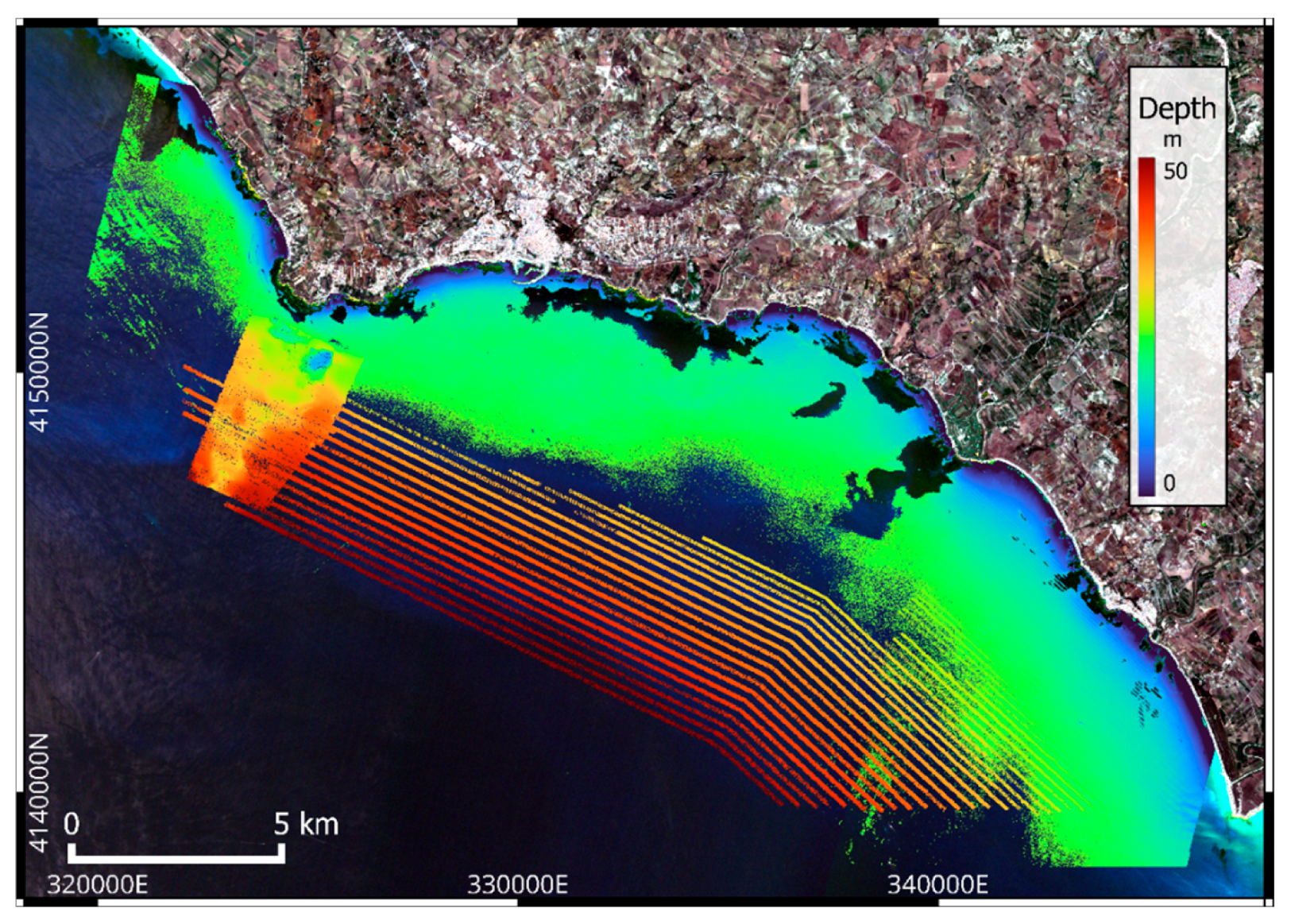
Figure 14, which depicts a bathymetric map combining the SDB, accurate down to approximately 25 m, with the MB extending to depths of about 50 m. Where depth data is missing, a possibility could be to consider performing a geospatial interpolation to achieve full spatial coverage of the study area; however, this extension lies beyond the scope of the present work.
4. Discussion
Our work described a novel approach to improve Satellite-Derived Bathymetry accuracy in nearshore areas. The combination of various spectral bands and acquisition times allowed us to accurately estimate the water depth in the white ribbon zone down to approximately 25 m, producing an accurate bathymetric map. Validating with respect to multibeam measurements, we obtained a dispersion of approximately ±6% with a 95% confidence interval.
In general, averaging reflectance values across multiple bands or time points produced more robust and consistent data, reducing errors associated with single-layer perturbations and mitigating surface artifacts. However, this averaging improved data quality only in specific cases, as detailed in
Section 3.
When the link between reflectance and multibeam measurements is not well described by a logarithmic relationship, the resulting bathymetric estimation error impacts the temporal averaging process embedded within the optimal configuration identified in this study: “Two-Band|Two-Date”. To overcome this bias, we re-estimated the bathymetry by accounting for a depth-dependent Kd (Equation (4)), resulting in an SDB that varies linearly with the validation measurements.
The presented methodological approach reveals some limitations: initial image selection is based on visual screening; surface effects can significantly influence the results; radiometric contributions from surface phenomena, such as sun glint and wave patterns, further complicate the analysis; heterogeneity in the water column introduces further bias.
Besides these, the temporal mismatch of satellite imagery could represent a significant driver of variability, given that all datasets are calibrated against a multibeam dataset acquired between February and May 2023, while the satellite images themselves have been acquired in the summer seasons of 2022 and 2023. This temporal discrepancy poses challenges in shallow water/nearshore areas that exhibit rapid seabed morphological changes—such as Sciacca offshore. Future work will aim to mitigate these effects through (i) multi-epoch image compositing to reduce scene-specific noise and transient surface conditions, (ii) tidal normalization and water-level corrections where ancillary information is available, and (iii) improved spatial co-registration between datasets to minimize apparent depth differences caused by geometric misalignment.
While the spectral averaging forces the theoretical framework of the radiative transfer equation, which posits that the Kd is inherently dependent on wavelength, it clearly reduces the spread around the regression line.
5. Conclusions
In general, aggregating reflectance values over several spectral bands and acquisition times minimized errors associated with a single data layer by mitigating surface radiometric perturbations of the dynamic sea water facets. However, the averaging process only enhanced data quality under specific circumstances, most notably when applied to the July 2022 dataset, which already exhibited sharper and more coherent spectral features.
The satellite optical approach presents the drawback that the reflectance variability, depending on the emerging radiance signal, reaches a penetrability limit, depending on the characteristics of the water column, around 25–30 m in the case study water. However, this approach supports cost-effective, high-resolution mapping of water depth across extensive coastal zones, achieving metric-level accuracy and offering a favorable cost–benefit balance.
This study primarily shows that an integrated use of spectral, temporal, and depth-related information can significantly strengthen the robustness of SDB, as opposed to approaches based on individual scene optimization or elaborate data-fusion methodologies. The proposed combination of spectral-averaging with time-averaging enabled the generation of much cleaner informational layers, substantially reducing error metrics.
Future developments of the liquid-facets-dependent noise-reduction approach may also include frequency-domain analyses, in which the data are transformed from the spatial to the frequency domain, filtered, and then converted back to the spatial domain. Such frequency-domain investigations could offer deeper insight into the spectral components that characterize the radiometric patterns induced by surface effects.
Future research should also investigate the influence of geometric-correction accuracy, potential inter-band spatial shifts, and spatial misalignment between optical satellite imagery and multibeam or other calibration data to provide deeper insight into the advantages and limitations of the current approach and to guide future improvements in data preprocessing.
Satellite altimeter-based calibration/validation deserves further study to broaden the applicability of the proposed methodology. Indeed, future research could benefit from comparative experiments involving alternative satellite platforms, which offer high-quality blue and green spectral bands and high revisit frequency. Moreover, integrating LIDAR satellite-based bathymetric data could provide an alternative layer of validation and calibration, especially in areas where acoustic measurements are unavailable or impractical. At first, altimeter-derived elevations may be employed as an independent validation dataset to evaluate SDB accuracy and spatial consistency beyond the extent of multibeam coverage. Secondly, selected altimetric measurements can serve as external depth constraints to stabilize the calibration process in regions characterized by sparse in situ data or pronounced optical variability. More advanced integration approaches constitute promising avenues for future research but are beyond the scope of the present study. These comparative analyses would help assess the scalability and adaptability of the proposed spectral–temporal averaging framework across different sensor architectures and observational strategies.