Impacts of Bogus Vortex Initialization Using Scatterometer-Derived 34 kt Wind Radii and Centers on Tropical Cyclone Forecasts



Highlights
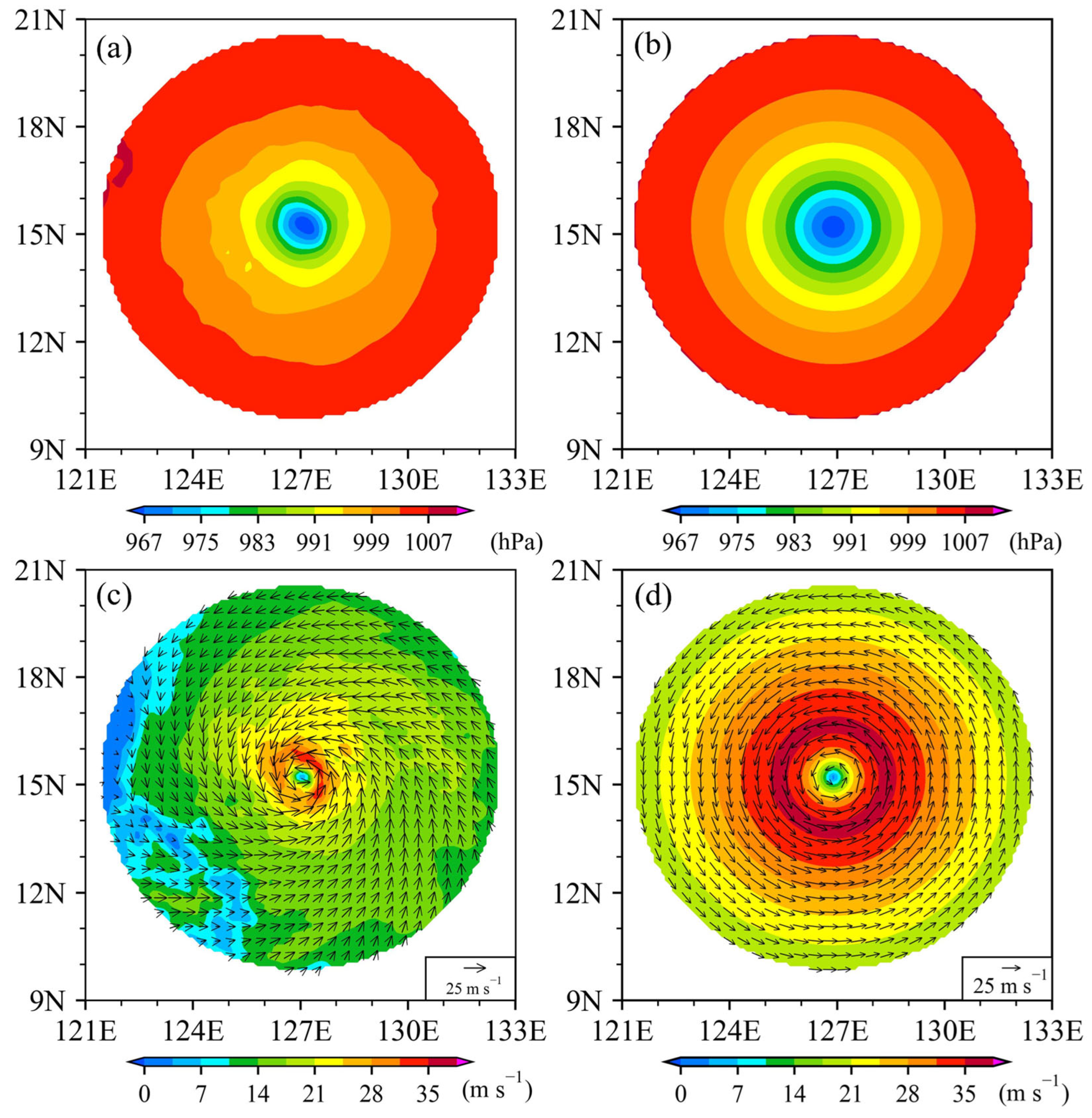
- Scatterometer wind-based bogus vortex initialization improves the initial structure, location, and intensity representation of Typhoon Doksuri (2023).
- This scheme enhances intensity forecasts and better reproduces storm features.
- Scatterometer wind observations are highly valuable for improving typhoon initialization in numerical models.
- Incorporating scatterometer data through bogus vortex initialization can enhance the accuracy of intensity predictions in regional NWP models.
Abstract
1. Introduction
2. Materials and Case Description
2.1. Sea Surface Wind and AHI Data
2.2. Best Track and Large-Scale Analysis Data
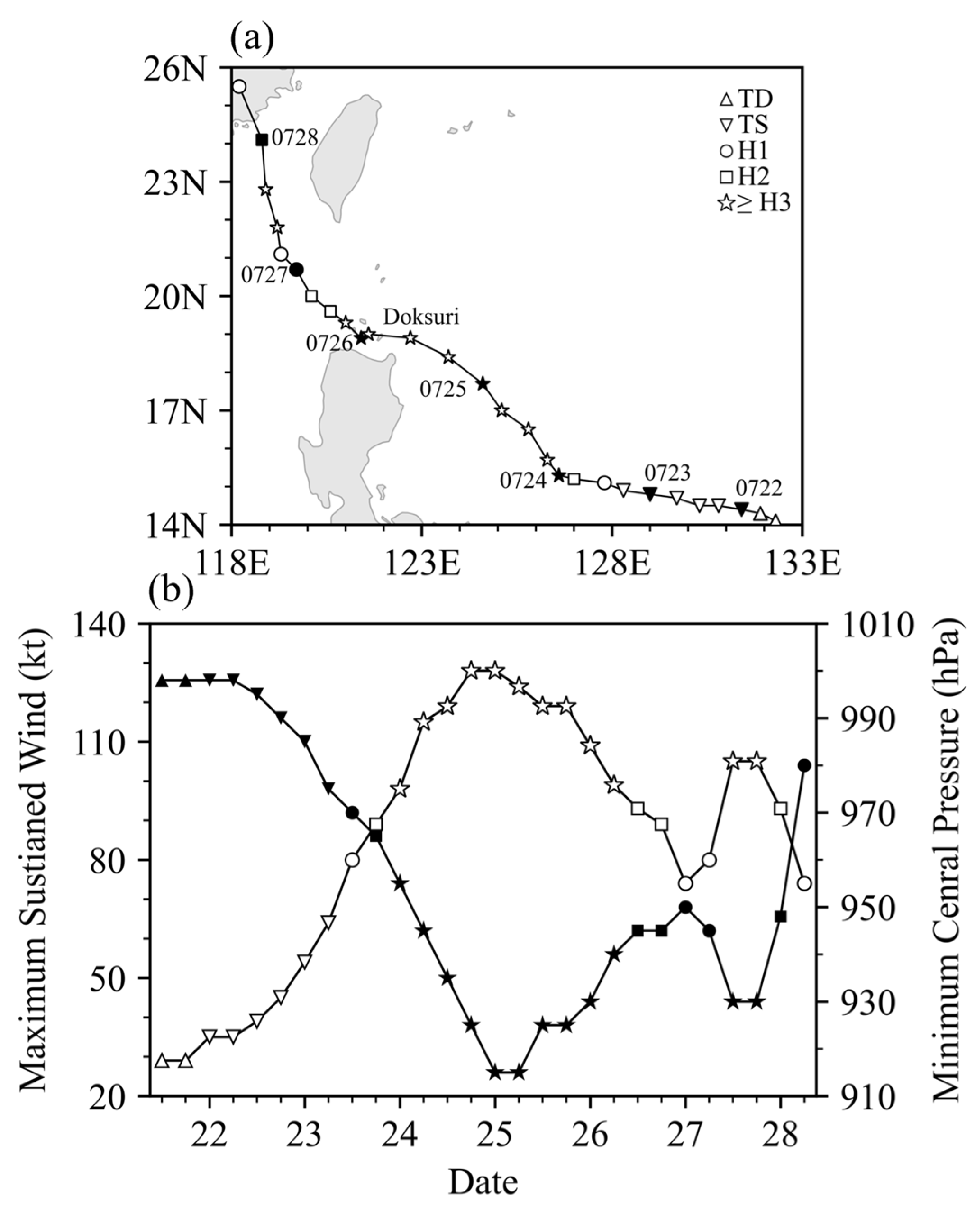
2.3. Typhoon Doksuri (2023)
3. Methodology of BVI
3.1. Bogus Vortex Construction
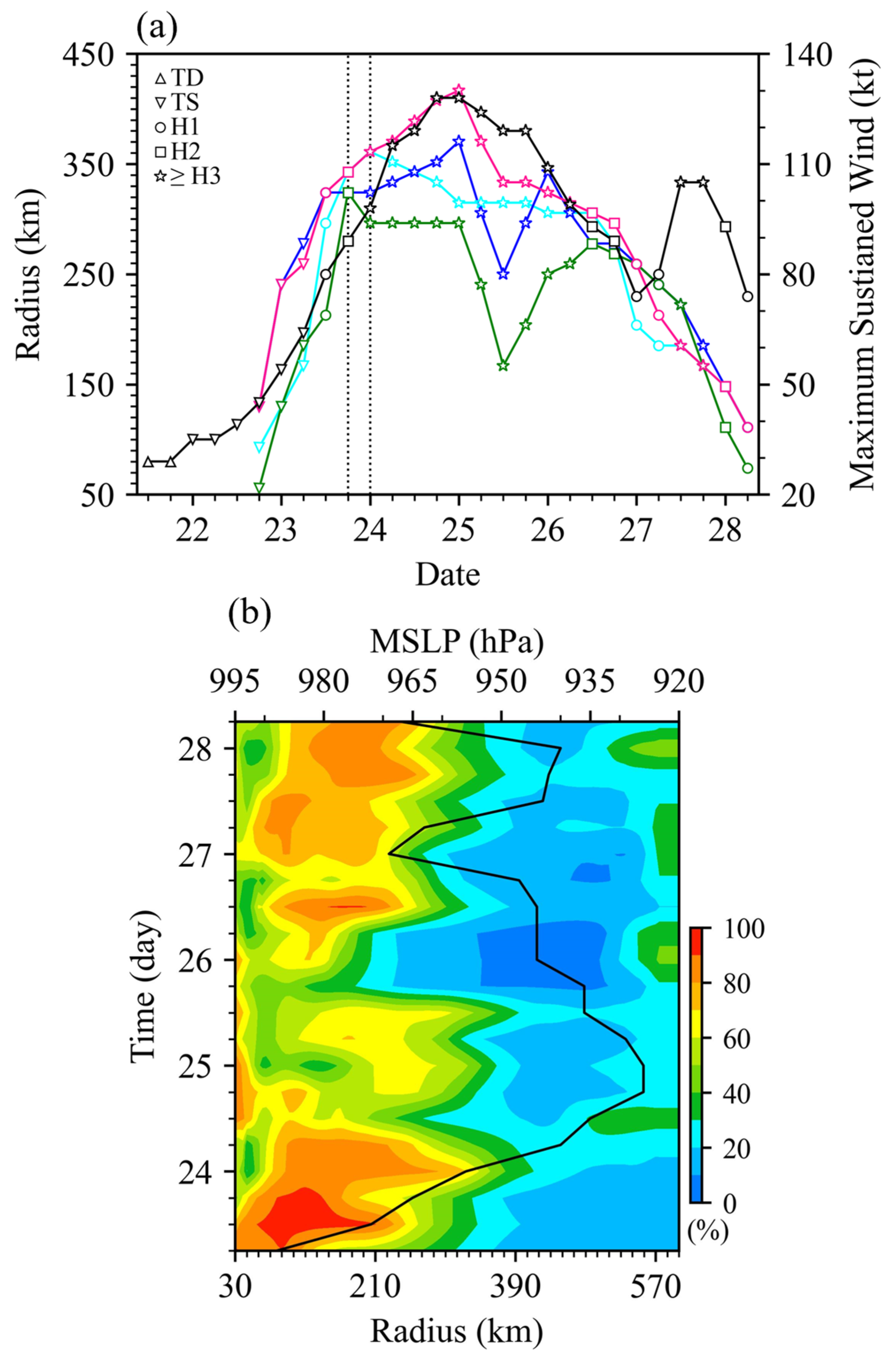
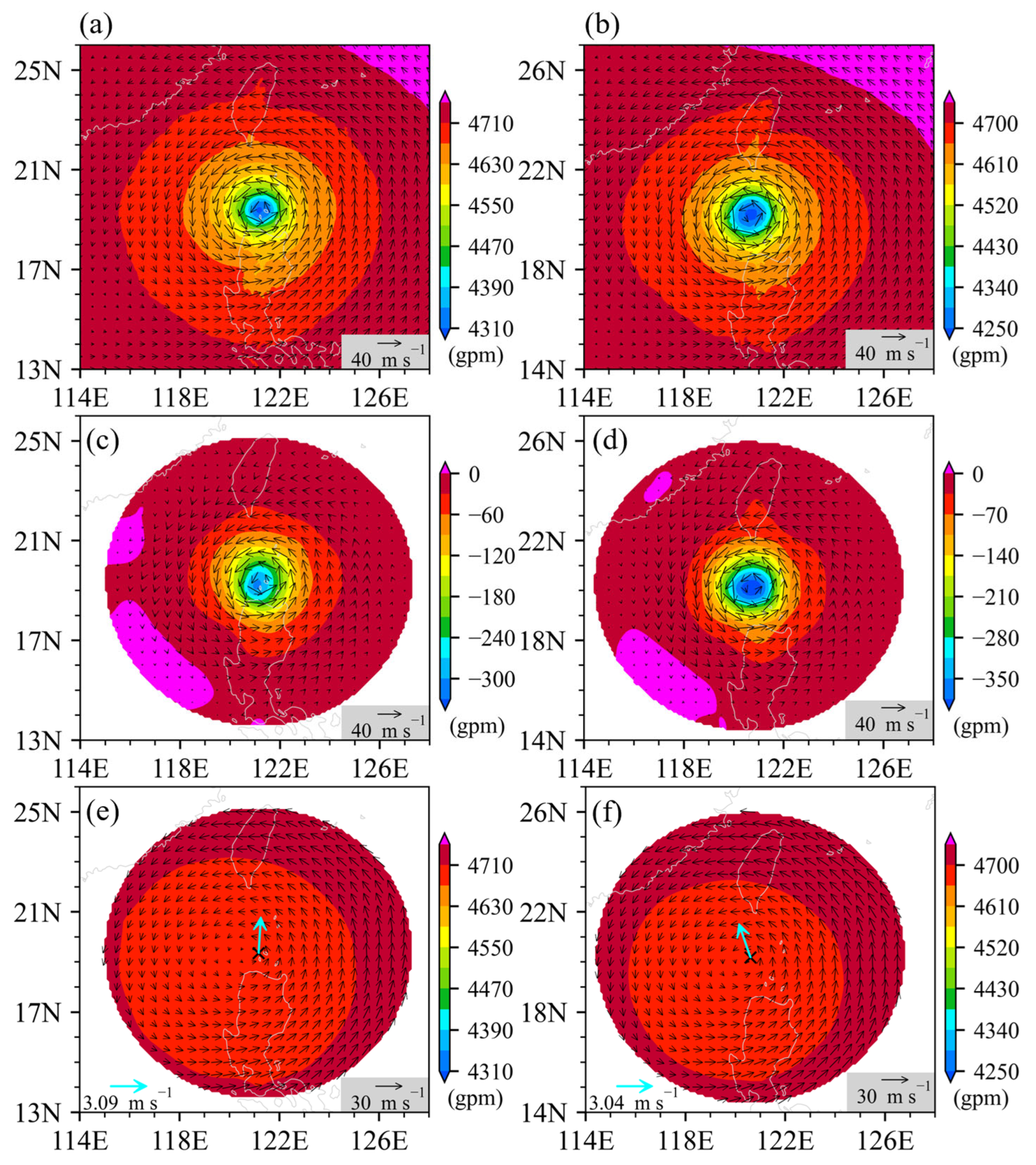
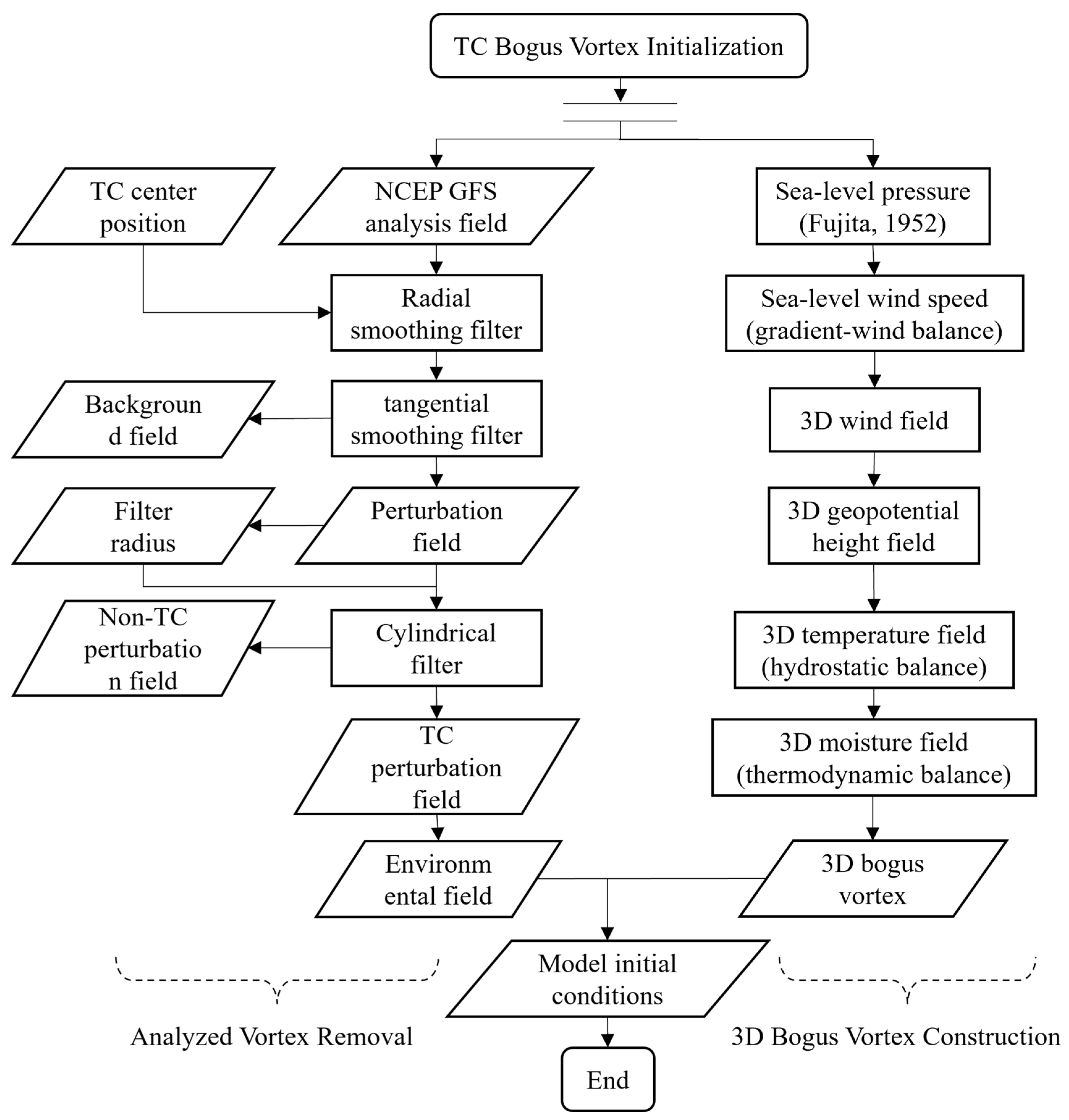
- Construct the radial profile of sea-level pressure (SLP) for Typhoon Doksuri using scatterometer-derived 34 kt wind radius together with other parameters from the best track;
- Derive the three-dimensional (3D) axisymmetric bogus vortex from the two-dimensional (2D) axisymmetric SLP using gradient wind balance and an empirical vertical distribution of wind;
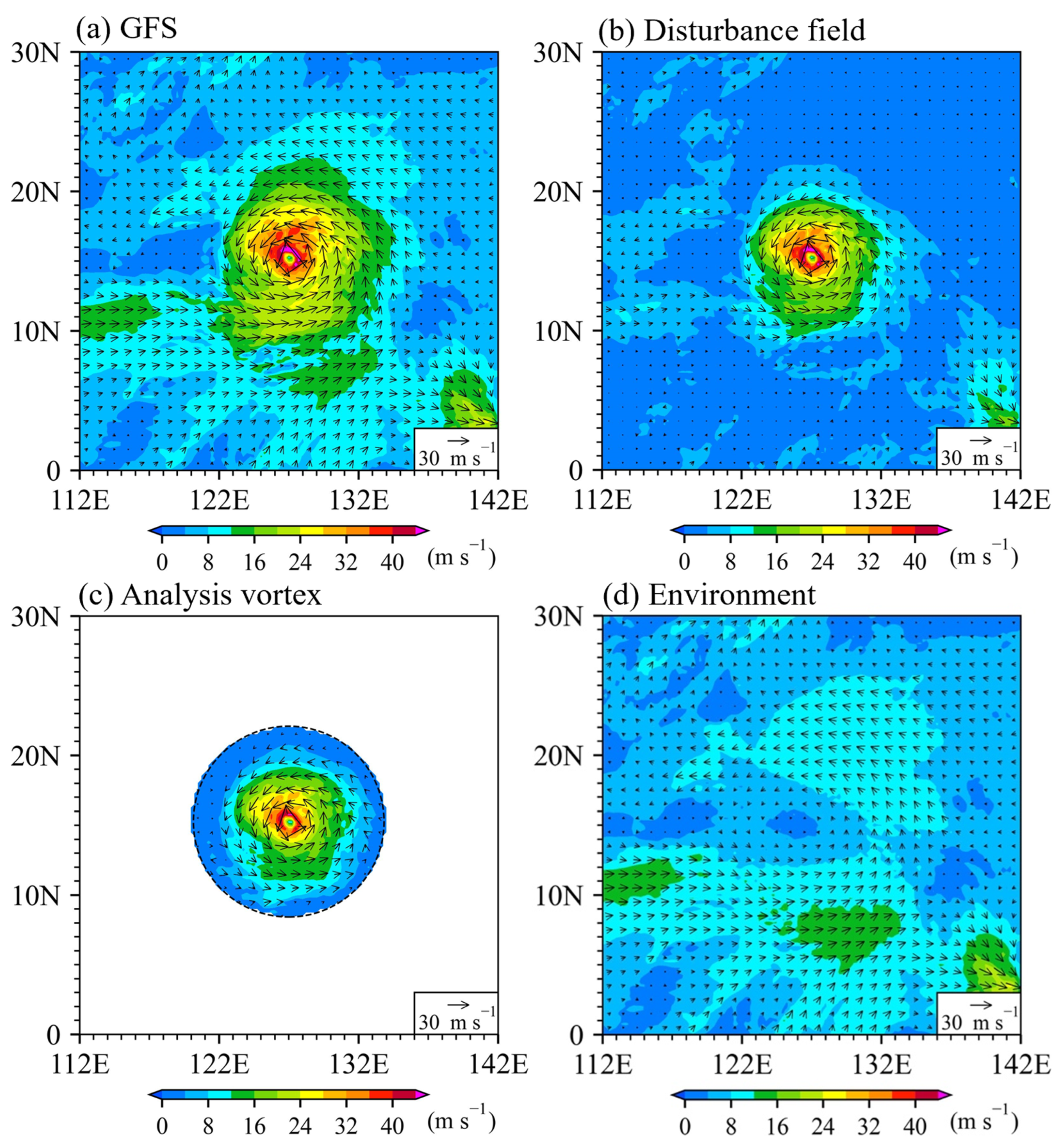
- Decompose the GFS analysis into the sum of the analysis vortex and the environmental background field;
- Remove the analysis vortex and merge the 3D axisymmetric bogus vortex with the environmental background field.
- Steps 2–4 follow the method of Kurihara [1].
3.2. Decomposing GFS Analysis
3.3. Steering Flow
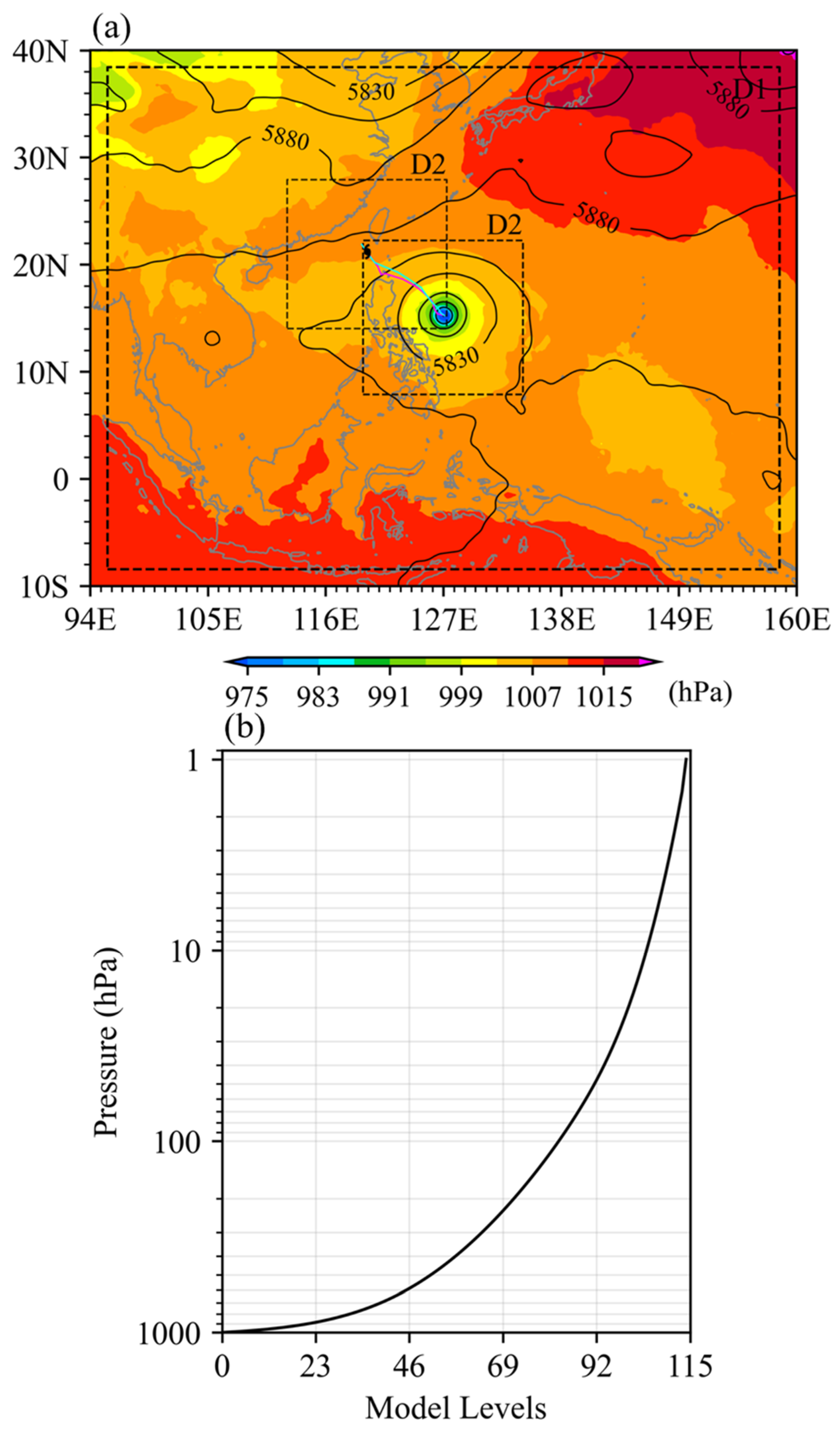
3.4. WRF Model Configuration
3.5. All-Sky Simulation
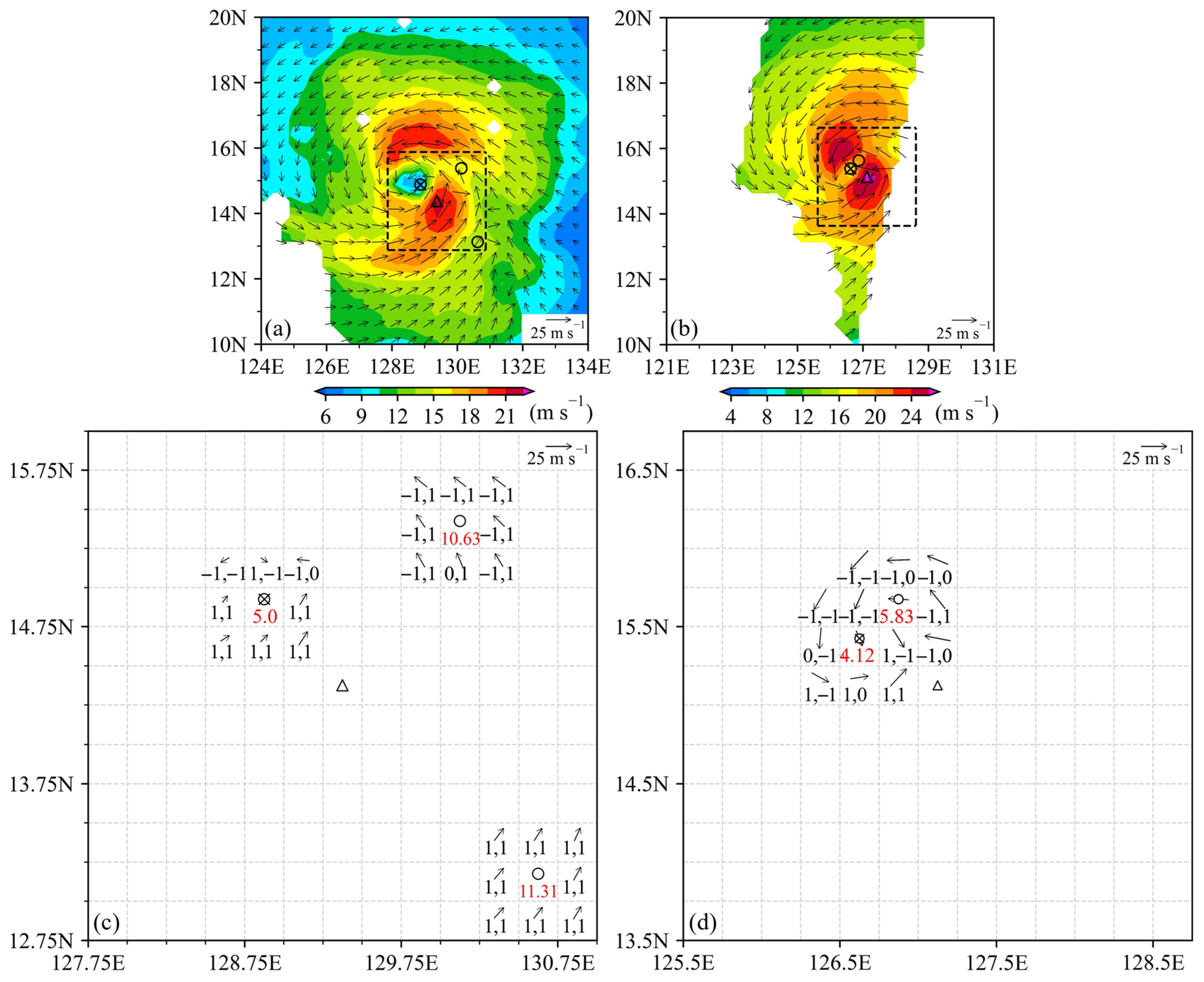
3.6. Scatterometer-Based TC Center Positioning Method
- Identify the maximum wind speed location (Cmax).
- Search for candidate centers: within a 3° × 3° domain centered on Cmax, extract all local minima of wind speed (Cmin).
- 3.
- Construct the direction vectors: for each candidate Cmin point, define eight two-component direction vectors at the surrounding grid points . Depending on the observed wind direction at each point—falling within one of the intervals 0° ± 22.5°, 45° ± 22.5°, 90° ± 22.5°, 135° ± 22.5°, 180° ± 22.5°, 225° ± 22.5°, 270° ± 22.5° or 315° ± 22.5°—assign the corresponding vectors as (1, 1), (1, 0), (1, −1), (0, −1), (−1, −1), (−1, 0), (−1, 1), and (0, 1), respectively.
- 4.
- Determine the cyclone center: take the absolute sum of the eight vectors to obtain for each candidate. The Cmin point with the smallest value is determined to be the TC center (CTC).
4. Results
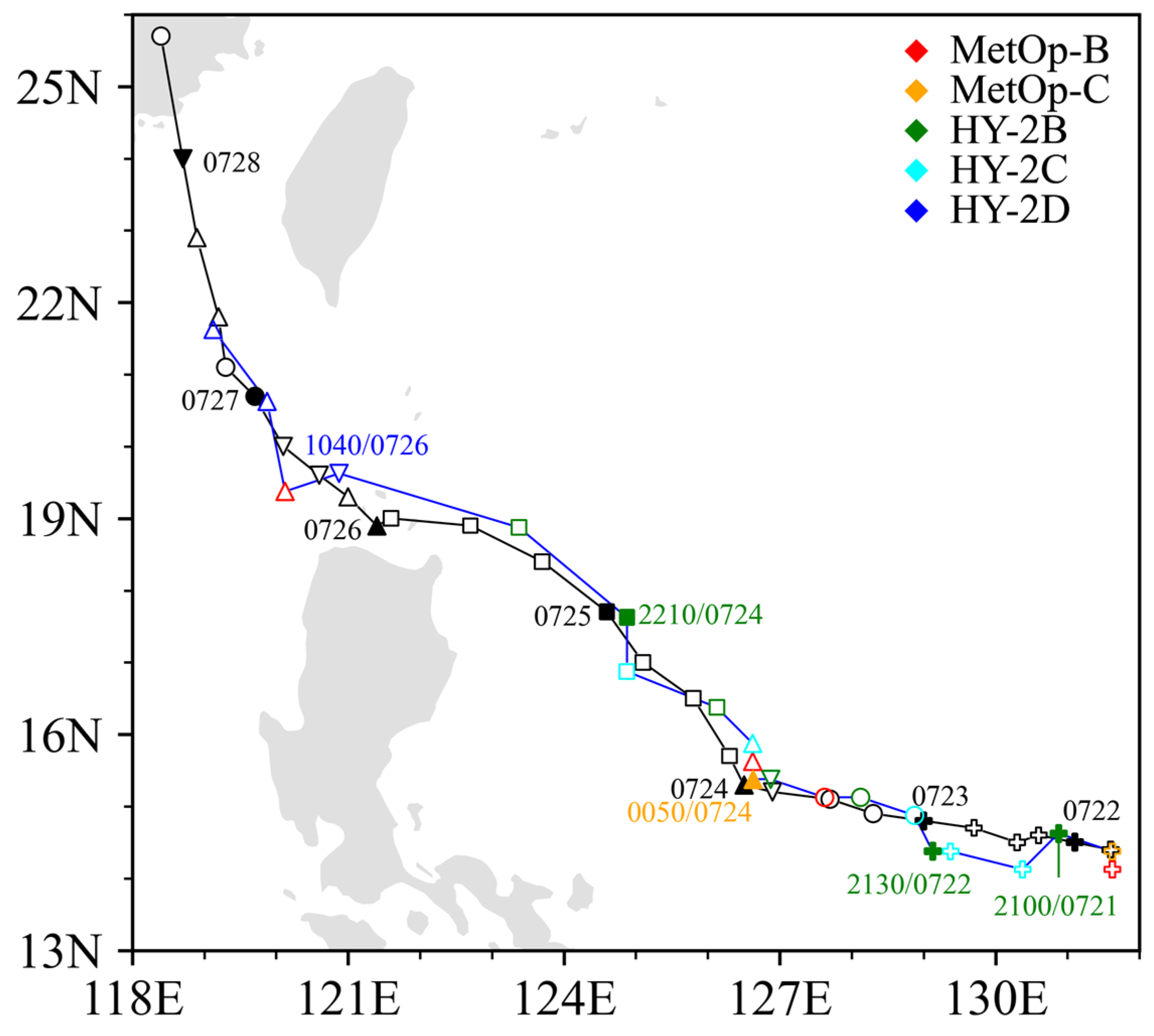
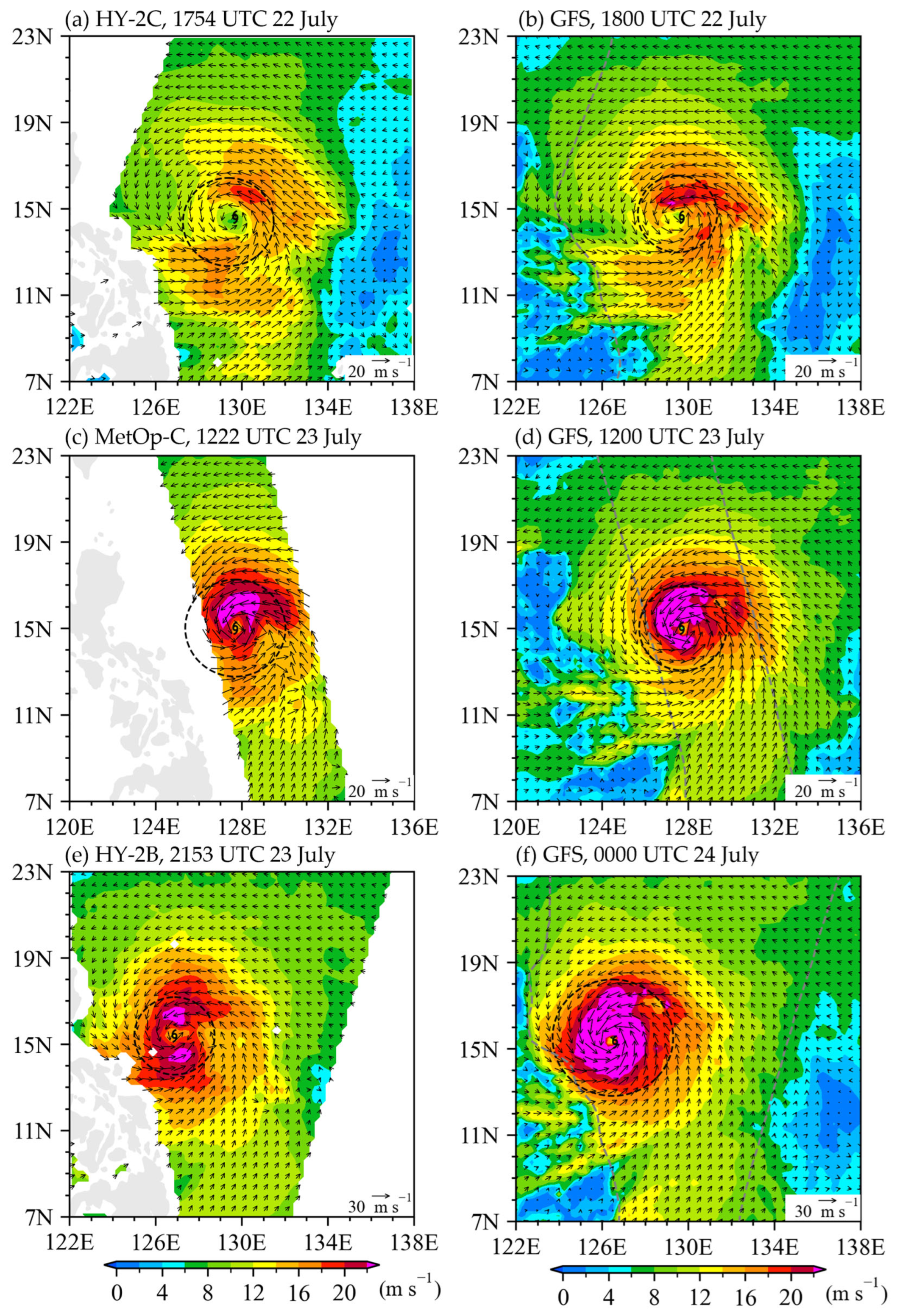
4.1. Scatterometer Data Availability for Typhoon Doksuri
4.2. Bogus Vortex Initialization Results
4.3. Forecast Results
4.3.1. BVI Results
4.3.2. Impact of BVI on Intensity and Track Forecasts of Typhoon Doksuri
4.3.3. Impact of BVI on Intensity and Track Forecasts of Typhoon Gaemi
5. Discussion
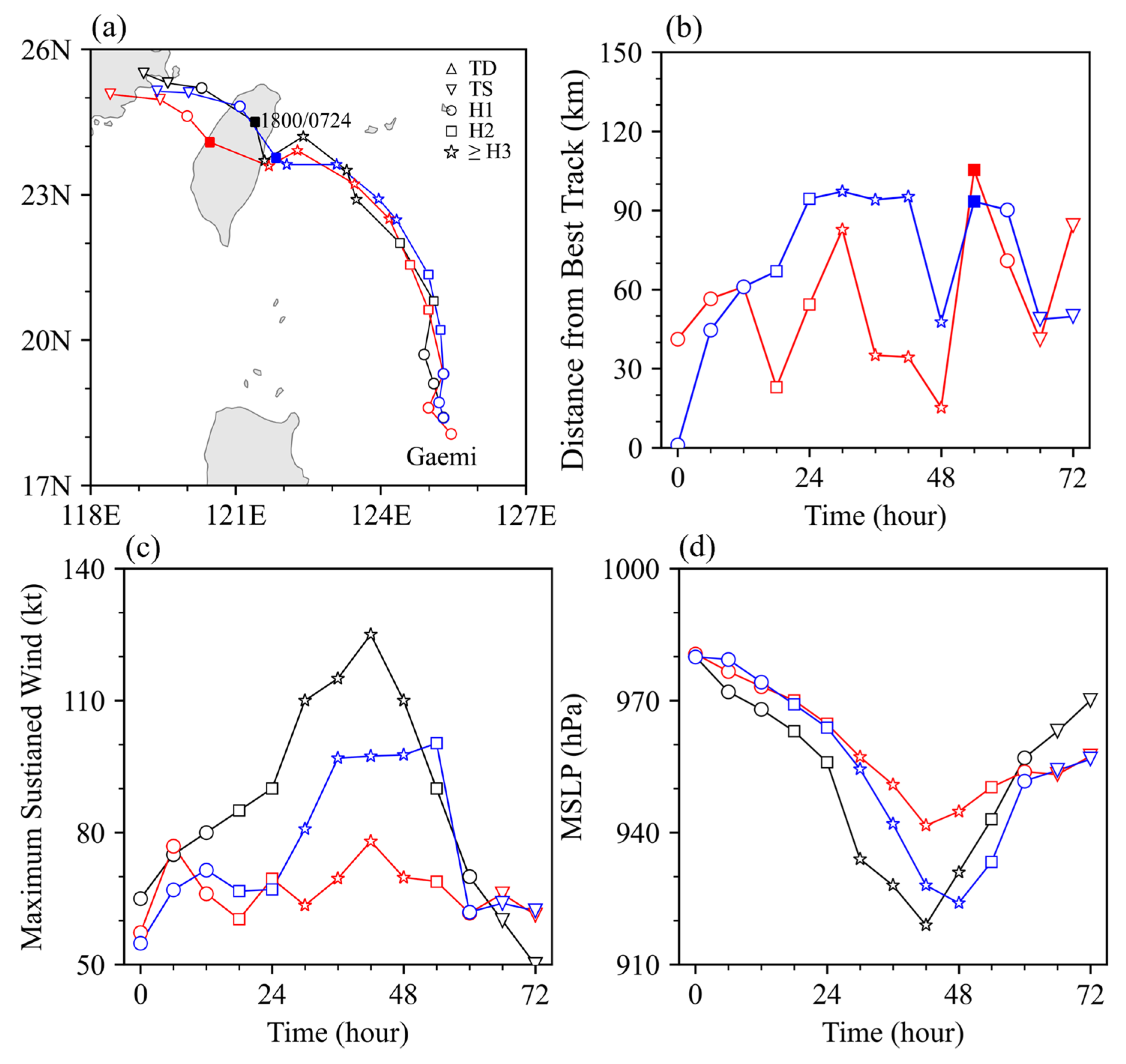
- Improved initial vortex representation. The method substantially enhances the accuracy of the initial vortex center position and minimum sea-level pressure, thereby providing a more reliable starting point for forecasts.
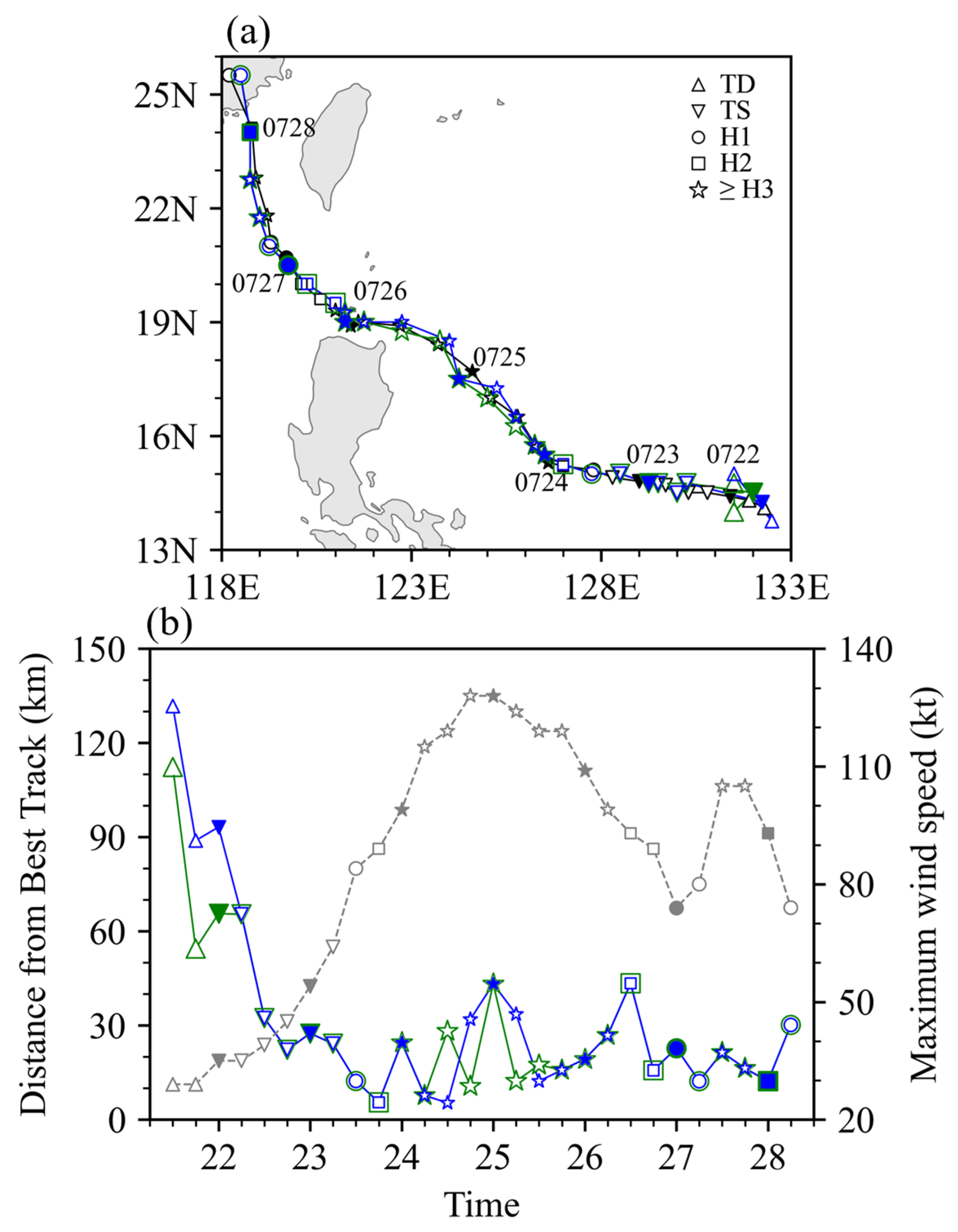
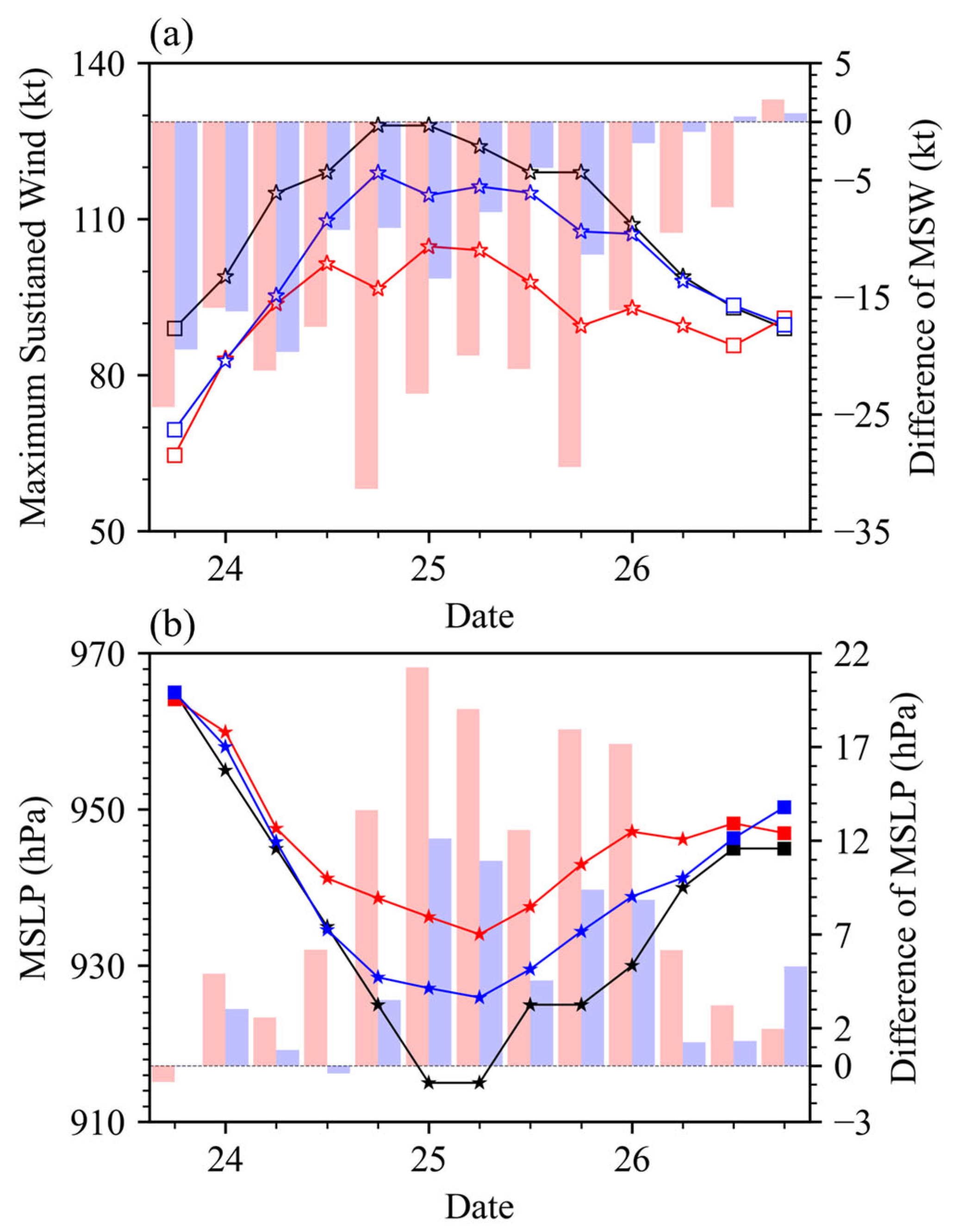
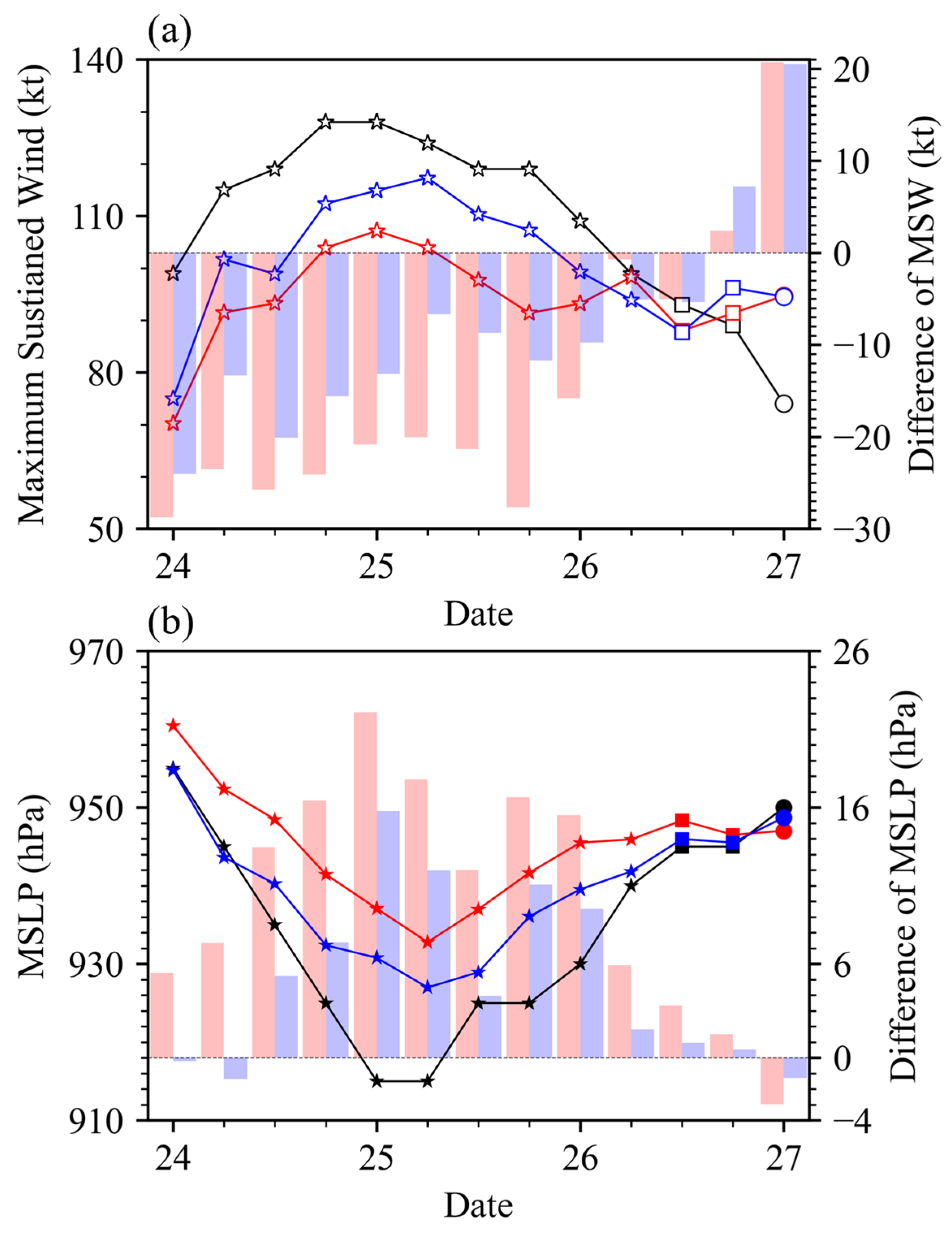
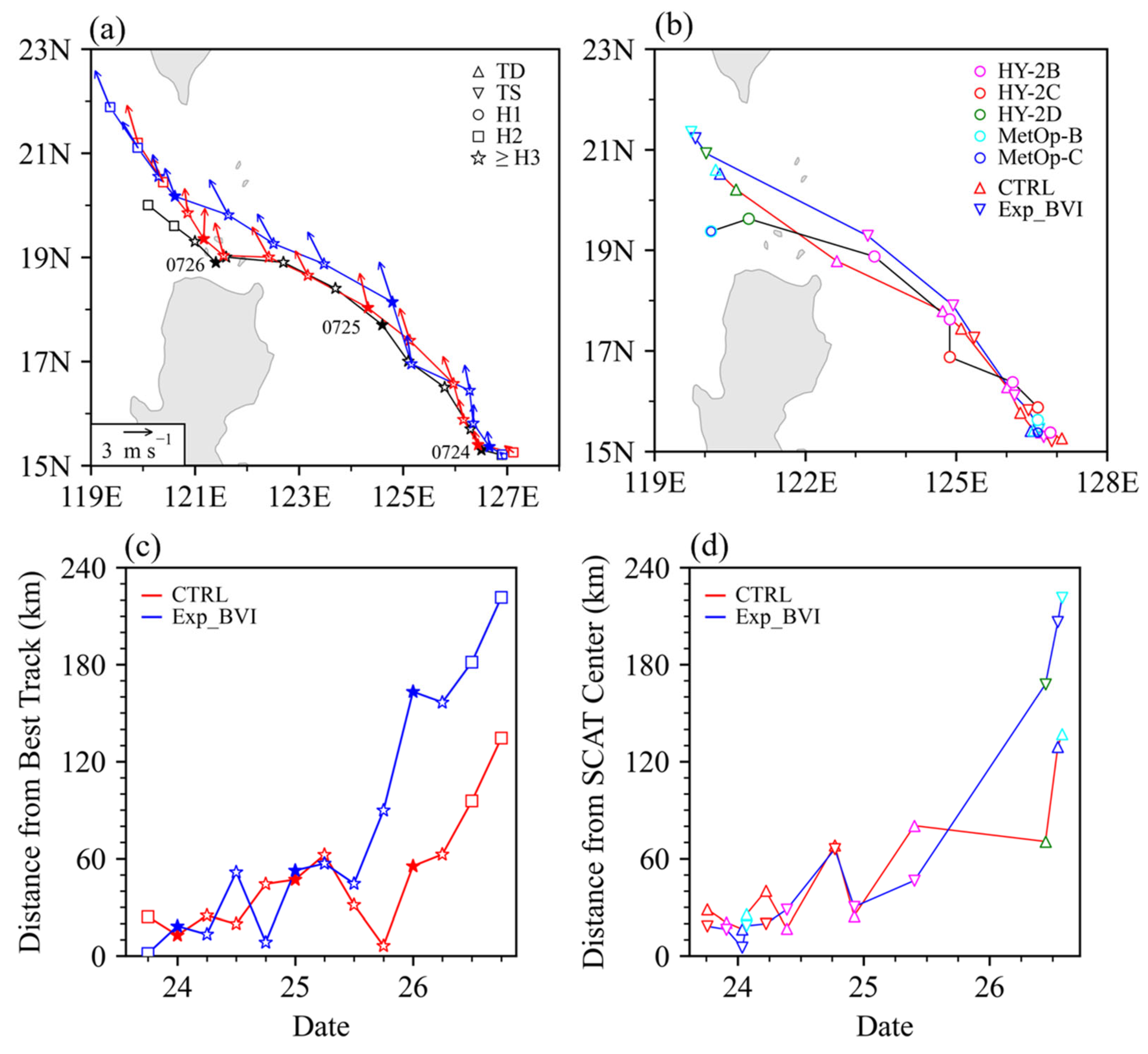
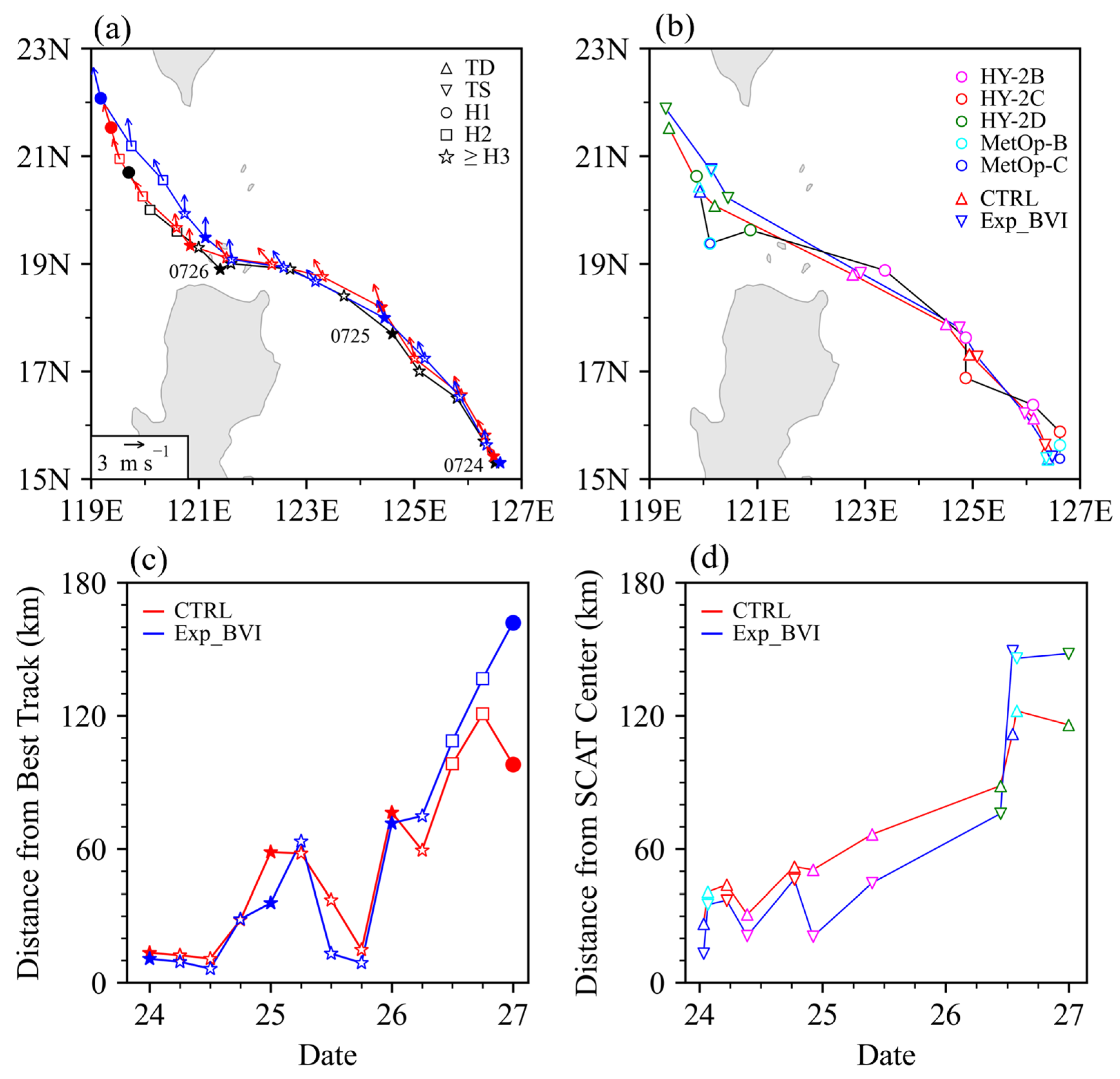
- Significant gains in intensity prediction. While track forecasts show limited improvement, intensity forecasts are greatly enhanced—particularly during rapid intensification (RI) and rapid weakening (RW). The BVI scheme reduces forecast biases in both maximum sustained winds and minimum sea-level pressure and reproduces peak intensity more faithfully than the CTRL experiment. These findings reinforce the view that realistic initialization of the inner-core vortex is crucial for skillful intensity forecasting.
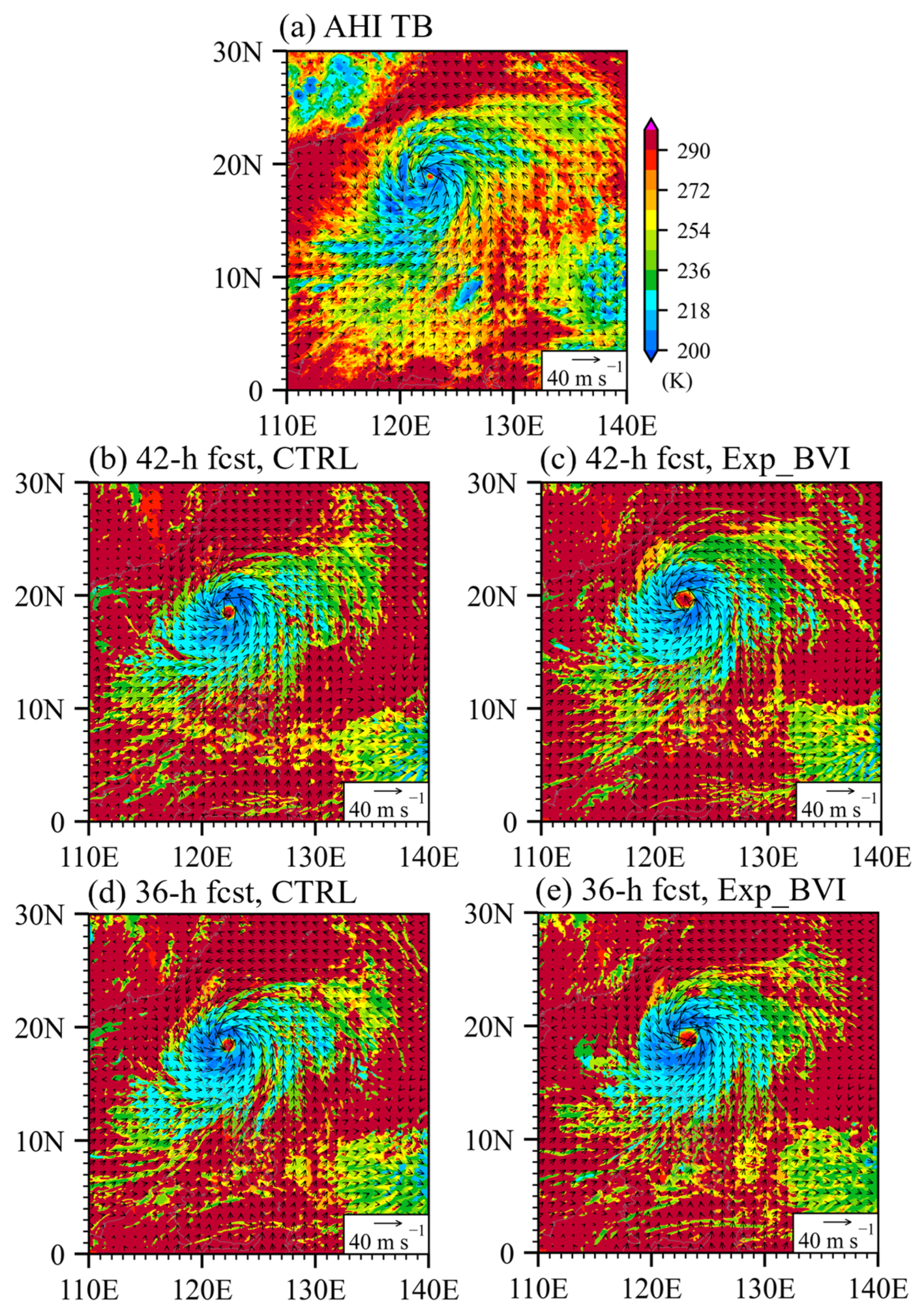
- Enhanced depiction of storm structure. Comparisons between simulated all-sky brightness temperatures (via RTTOV) and Himawari-9 AHI observations indicate that BVI produces more realistic inner-core structures, including a clear eye and a cloudy eyewall. The simulated dynamical and microphysical fields align quite closely with observations, suggesting that the WRF model configuration used in this study represents eyewall convection and cloud–rainband evolution reasonably well.
6. Conclusions
Author Contributions
Funding
Data Availability Statement
Acknowledgments
Conflicts of Interest
Abbreviations
| NWP | Numerical Weather Prediction |
| NCEP | National Centers for Environmental Prediction |
| WRF | Weather Research and Forecasting Model |
| AHI | Advanced Himawari Imager |
| BVI | Bogus Vortex Initialization |
| RMW | Radius of Maximum Winds |
| HWRF | Hurricane Weather Research and Forecasting Model |
| HMON | Hurricanes in a Multi-scale Ocean-coupled Non-hydrostatic model |
| ERS | European Space Agency |
| ECMWF | European Centre for Medium-Range Weather Forecasts |
| MM5 | Mesoscale Model System version V |
| HY | Hai Yang |
| ASCAT | Advanced scatterometer |
| OSCAT | OceanSat Scatterometer |
| HSCAT | HY Scatterometer |
| FY | Fengyun |
| WindRAD | Wind Radar |
| GHz | GigaHertz |
| IBTrACS | International Best Track Archive for Climate Stewardship |
| MSLP | Minimum Sea-Level Pressure |
| ROCI | Radius of the Outermost Closed Isobar |
| POCI | Pressure of the Outermost Closed Isobar |
| ICOADS | International Comprehensive Ocean–Atmosphere Dataset |
| GFS | Global Forecast System |
| TS | Tropical Storm |
| UTC | Universal Time Coordinated |
| RI | Rapid Intensification |
| RW | Rapid Weakening |
| SLP | Sea-Level Pressure |
| 3D | Three-Dimensional |
| 2D | Two-Dimensional |
| GFDL | Geophysical Fluid Dynamics Laboratory |
| Exp_BVI | Experiment with BVI |
| RRTM | Rapid Radiative Transfer Model |
| YSU | Yonsei University |
| CTRL | Control experiment |
| RTTOV | Radiative Transfer for TOVS |
| MAE | Mean Absolute Error |
| TB | Brightness Temperature |
| SAR | spaceborne synthetic aperture radar |
| GOES | Geostationary Operational Environmental Satellite |
References
- Kurihara, Y.; Bender, M.A.; Ross, R.J. An initialization scheme of hurricane models by vortex specification. Mon. Weather Rev. 1993, 121, 2030–2045. [Google Scholar] [CrossRef]
- Davis, C. Resolving tropical cyclone intensity in models. Geophys. Res. Lett. 2018, 45, 2082–2087. [Google Scholar] [CrossRef]
- Li, X.; Yang, J.; Wang, J.; Han, G. Evaluation and calibration of remotely sensed high winds from the HY-2B/C/D scatterometer in tropical cyclones. Remote Sens. 2022, 14, 4654. [Google Scholar] [CrossRef]
- Pan, W.; Zou, X.; Duan, Y. Developing an Objective Scheme to Construct Hurricane Bogus Vortices Based on Scatterometer Sea Surface Wind Data. Remote Sens. 2025, 17, 1528. [Google Scholar] [CrossRef]
- Kurihara, Y.; Tuleya, R.E. Structure of a tropical cyclone developed in a three-dimensional numerical simulation model. J. Atmos. Sci. 1974, 31, 893–919. [Google Scholar] [CrossRef]
- Bender, M.A.; Ross, R.J.; Tuleya, R.E.; Kurihara, Y. Improvements in tropical cyclone track and intensity forecasts using the GFDL initialization system. Mon. Weather Rev. 1993, 121, 2046–2061. [Google Scholar] [CrossRef]
- Fujita, T. Pressure distribution within typhoon. Geophys. Mag. 1952, 23, 437–451. [Google Scholar]
- Mathur, M.B. The National-Meteorological-Centers Quasi-Lagrangian Model for Hurricane Prediction. Mon. Weather Rev. 1991, 119, 1419–1447. [Google Scholar] [CrossRef]
- Park, K.; Zou, X. Toward developing an objective 4DVAR BDA scheme for hurricane initialization based on TPC observed parameters. Mon. Weather Rev. 2004, 132, 2054–2069. [Google Scholar] [CrossRef]
- Zou, X.L.; Xiao, Q.N. Studies on the initialization and simulation of a mature hurricane using a variational bogus data assimilation scheme. J. Atmos. Sci. 2000, 57, 836–860. [Google Scholar] [CrossRef]
- Zou, X.; Xiao, Q.; Lipton, A.E.; Modica, G.D. A numerical study of the effect of GOES sounder cloud-cleared brightness temperatures on the prediction of Hurricane Felix. J. Appl. Meteorol. 2001, 40, 34–55. [Google Scholar] [CrossRef]
- Liu, G.; Jiang, S.; Zheng, M.; Lin, S.; Kong, Y.; Zhan, P. A Global ERA5-based Tropical Cyclone Wind Field Dataset Enhanced by Integrated Parametric Correction Methods. Sci. Data 2025, 12, 1429. [Google Scholar] [CrossRef]
- Shin, J.; Zhang, Z.; Liu, B.; Weng, Y.; Liu, Q.; Mehra, A.; Tallapragada, V. The implementation of cloud and vertical velocity relocation/cycling system in the vortex initialization of the HAFS. Atmosphere 2024, 15, 1006. [Google Scholar] [CrossRef]
- Busireddy, N.; Nadimpalli, R.; Osuri, K.K.; Ankur, K.; Mohanty, U.; Niyogi, D. Impact of vortex size and Initialization on prediction of landfalling tropical cyclones over Bay of Bengal. Atmos. Res. 2019, 224, 18–29. [Google Scholar] [CrossRef]
- Leslie, L.M.; Holland, G. On the bogussing of tropical cyclones in numerical models: A comparison of vortex profiles. Meteorol. Atmos. Phys. 1995, 56, 101–110. [Google Scholar] [CrossRef]
- Davis, C.A.; Low-Nam, S. The NCAR-AFWA tropical cyclone bogussing scheme. Air Force Weather Agency (AFWA) Rep. 2001, 12, 1–13. [Google Scholar]
- Reed, K.A.; Jablonowski, C. An analytic vortex initialization technique for idealized tropical cyclone studies in AGCMs. Mon. Weather Rev. 2011, 139, 689–710. [Google Scholar] [CrossRef]
- Kwon, I.-H.; Cheong, H.-B. Tropical cyclone initialization with a spherical high-order filter and an idealized three-dimensional bogus vortex. Mon. Weather Rev. 2010, 138, 1344–1367. [Google Scholar] [CrossRef]
- Rappin, E.D.; Nolan, D.S.; Majumdar, S.J. A highly configurable vortex initialization method for tropical cyclones. Mon. Weather Rev. 2013, 141, 3556–3575. [Google Scholar] [CrossRef]
- Liu, Q.; Zhang, X.; Tong, M.; Zhang, Z.; Liu, B.; Wang, W.; Zhu, L.; Zhang, B.; Xu, X.; Trahan, S. Vortex initialization in the NCEP operational hurricane models. Atmosphere 2020, 11, 968. [Google Scholar] [CrossRef]
- Willoughby, H.; Rahn, M. Parametric representation of the primary hurricane vortex. Part I: Observations and evaluation of the Holland (1980) model. Mon. Weather Rev. 2004, 132, 3033–3048. [Google Scholar] [CrossRef]
- Holland, G.J. An analytic model of the wind and pressure profiles in hurricanes. Mon. Weather. Rev. 1980, 108, 1212–1218. [Google Scholar] [CrossRef]
- Hoffman, R.N.; Leidner, S.M. An introduction to the near–real–time QuikSCAT data. Weather Forecast. 2005, 20, 476–493. [Google Scholar] [CrossRef]
- Katsaros, K.B.; Forde, E.B.; Chang, P.; Liu, W.T. QuikSCAT’s sea winds facilitates early identification of tropical depressions in 1999 hurricane season. Geophys. Res. Lett. 2001, 28, 1043–1046. [Google Scholar] [CrossRef]
- Brennan, M.J.; Hennon, C.C.; Knabb, R.D. The operational use of QuikSCAT ocean surface vector winds at the National Hurricane Center. Weather Forecast. 2009, 24, 621–645. [Google Scholar] [CrossRef]
- Hu, T.; Wu, Y.; Zheng, G.; Zhang, D.; Zhang, Y.; Li, Y. Tropical cyclone center automatic determination model based on HY-2 and QuikSCAT wind vector products. IEEE Trans. Geosci. Remote Sens. 2018, 57, 709–721. [Google Scholar] [CrossRef]
- Wimmers, A.J.; Velden, C.S. Advancements in objective multisatellite tropical cyclone center fixing. J. Appl. Meteorol. Climatol. 2016, 55, 197–212. [Google Scholar] [CrossRef]
- Alsweiss, S.; Soisuvarn, S.; Jelenak, Z.; Chang, P.S.; Jackson, C.R. Estimating Tropical Cyclones Wind Radii Using NOAA ASCAT Ultra High-Resolution Measurements. In Proceedings of the IGARSS 2024—2024 IEEE International Geoscience and Remote Sensing Symposium, Athens, Greece, 7–12 July 2024; pp. 5807–5809. [Google Scholar]
- Chan, K.T.; Chan, J.C. Size and strength of tropical cyclones as inferred from QuikSCAT data. Mon. Weather Rev. 2012, 140, 811–824. [Google Scholar] [CrossRef]
- Chavas, D.R.; Emanuel, K.A. A QuikSCAT climatology of tropical cyclone size. Geophys. Res. Lett. 2010, 37, L18816. [Google Scholar] [CrossRef]
- Liu, S.; Lin, W.; Portabella, M.; Wang, Z. Characterization of tropical cyclone intensity using the HY-2B scatterometer wind data. Remote Sens. 2022, 14, 1035. [Google Scholar] [CrossRef]
- Said, F.; Long, D.G. Determining selected tropical cyclone characteristics using QuikSCAT’s ultra-high resolution images. IEEE J. Sel. Top. Appl. Earth Obs. Remote Sens. 2011, 4, 857–869. [Google Scholar] [CrossRef]
- Zhang, D.; Zhang, Y.; Hu, T.; Xie, B.; Xu, J. A comparison of HY-2 and QuikSCAT vector wind products for tropical cyclone track and intensity development monitoring. IEEE Geosci. Remote Sens. Lett. 2014, 11, 1365–1369. [Google Scholar] [CrossRef]
- De Chiara, G.; Bidlot, J.-R.; Janssen, P.; English, S. ASCAT Ocean Surface Wind Assessment; European Centre for Medium Range Weather Forecasts: Reading, UK, 2016. [Google Scholar]
- Isaksen, L.; Janssen, P.A. Impact of ERS scatterometer winds in ECMWF’s assimilation system. Q. J. R. Meteorol. Soc. J. Atmos. Sci. Appl. Meteorol. Phys. Oceanogr. 2004, 130, 1793–1814. [Google Scholar] [CrossRef]
- Isaksen, L.; Stoffelen, A. ERS scatterometer wind data impact on ECMWF’s tropical cyclone forecasts. IEEE Trans. Geosci. Remote Sens. 2002, 38, 1885–1892. [Google Scholar] [CrossRef]
- Yu, Y.; Zhang, W.; Wu, Z.; Yang, X.; Cao, X.; Zhu, M. Assimilation of HY-2A scatterometer sea surface wind data in a 3DVAR data assimilation system—A case study of Typhoon Bolaven. Front. Earth Sci. 2015, 9, 192–201. [Google Scholar] [CrossRef]
- Chen, S.-H. The impact of assimilating SSM/I and QuikSCAT satellite winds on Hurricane Isidore simulations. Mon. Weather Rev. 2007, 135, 549–566. [Google Scholar] [CrossRef][Green Version]
- Fernandez, D.E.; Carswell, J.; Frasier, S.; Chang, P.; Black, P.; Marks, F. Dual-polarized C-and Ku-band ocean backscatter response to hurricane-force winds. J. Geophys. Res. Ocean. 2006, 111, C08013. [Google Scholar] [CrossRef]
- Ni, W.; Stoffelen, A.; Ren, K.; Yang, X.; Vogelzang, J. SAR and ASCAT tropical cyclone wind speed reconciliation. Remote Sens. 2022, 14, 5535. [Google Scholar] [CrossRef]
- Polverari, F.; Portabella, M.; Lin, W.; Sapp, J.W.; Stoffelen, A.; Jelenak, Z.; Chang, P.S. On high and extreme wind calibration using ASCAT. IEEE Trans. Geosci. Remote Sens. 2021, 60, 1–10. [Google Scholar] [CrossRef]
- Chavas, D.R.; Knaff, J.A. A simple model for predicting the tropical cyclone radius of maximum wind from outer size. Weather Forecast. 2022, 37, 563–579. [Google Scholar] [CrossRef]
- Avenas, A.; Mouche, A.; Tandeo, P.; Piolle, J.-F.; Chavas, D.; Fablet, R.; Knaff, J.; Chapron, B. Reexamining the estimation of tropical cyclone radius of maximum wind from outer size with an extensive synthetic aperture radar dataset. Mon. Weather Rev. 2023, 151, 3169–3189. [Google Scholar] [CrossRef]
- Wang, Z.; Zou, J.; Stoffelen, A.; Lin, W.; Verhoef, A.; Li, X.; He, Y.; Zhang, Y.; Lin, M. Scatterometer sea surface wind product validation for HY-2C. IEEE J. Sel. Top. Appl. Earth Obs. Remote Sens. 2021, 14, 6156–6164. [Google Scholar] [CrossRef]
- Verspeek, J.; Verhoef, A.; Stoffelen, A. ASCAT-C Wind Product Calibration and Validation; Royal Netherlands Meteorological Institute: De Bilt, The Netherlands, 2019. [Google Scholar]
- Stoffelen, B.A.; Anderson, D. Ambiguity removal and assimilation of scatterometer data. Q. J. R. Meteorolog. Soc. 1997, 123, 491–518. [Google Scholar] [CrossRef]
- Bessho, K.; Date, K.; Hayashi, M.; Ikeda, A.; Imai, T.; Inoue, H.; Kumagai, Y.; Miyakawa, T.; Murata, H.; Ohno, T. An introduction to Himawari-8/9—Japan’s new-generation geostationary meteorological satellites. J. Meteorol. Soc. Japan. Ser. II 2016, 94, 151–183. [Google Scholar] [CrossRef]
- Knapp, K.R.; Kruk, M.C.; Levinson, D.H.; Diamond, H.J.; Neumann, C.J. The international best track archive for climate stewardship (IBTrACS) unifying tropical cyclone data. Bull. Am. Meteorol. Soc. 2010, 91, 363–376. [Google Scholar] [CrossRef]
- Freeman, E.; Woodruff, S.D.; Worley, S.J.; Lubker, S.J.; Kent, E.C.; Angel, W.E.; Berry, D.I.; Brohan, P.; Eastman, R.; Gates, L. ICOADS Release 3.0: A major update to the historical marine climate record. Int. J. Climatol. 2017, 37, 2211–2232. [Google Scholar] [CrossRef]
- NCEP GFS 0.25 Degree Global Forecast Grids Historical Archive. 2015, Volume 1. Available online: https://gdex.ucar.edu/datasets/d084001/ (accessed on 11 January 2026).
- Kaplan, J.; DeMaria, M. Large-scale characteristics of rapidly intensifying tropical cyclones in the North Atlantic basin. Weather Forecast. 2003, 18, 1093–1108. [Google Scholar] [CrossRef]
- Wang, Y.; Wu, C.C. Current understanding of tropical cyclone structure and intensity changes—A review. Meteorol. Atmos. Phys. 2004, 87, 257–278. [Google Scholar] [CrossRef]
- Xiao, Q.; Zou, X.; Wang, B. Initialization and Simulation of a Landfalling Hurricane Using a Variational Bogus Data Assimilation Scheme. Mon. Weather Rev. 2000, 128, 2252–2269. [Google Scholar] [CrossRef]
- Van Nguyen, H.; Chen, Y.-L. High-resolution initialization and simulations of Typhoon Morakot (2009). Mon. Weather Rev. 2011, 139, 1463–1491. [Google Scholar] [CrossRef]
- Chan, J.C. The physics of tropical cyclone motion. Annu. Rev. Fluid Mech. 2005, 37, 99–128. [Google Scholar] [CrossRef]
- Wu, Y.; Zou, X. Numerical test of a simple approach for using TOMS total ozone data in hurricane environment. Q. J. R. Meteorolog. Soc. 2008, 134, 1397–1408. [Google Scholar] [CrossRef]
- Skamarock, W.C.; Klemp, J.B.; Dudhia, J.; Gill, D.O.; Liu, Z.; Berner, J.; Wang, W.; Powers, J.G.; Duda, M.G.; Barker, D.M. A description of the advanced research WRF version 4. NCAR Tech. Note Ncar/Tn-556+ Str 2019, 145. [Google Scholar] [CrossRef]
- Morrison, H.; Thompson, G.; Tatarskii, V. Impact of cloud microphysics on the development of trailing stratiform precipitation in a simulated squall line: Comparison of one-and two-moment schemes. Mon. Weather Rev. 2009, 137, 991–1007. [Google Scholar] [CrossRef]
- Kain, J.S.; Fritsch, J.M. Convective parameterization for mesoscale models: The Kain-Fritsch scheme. In The Representation of Cumulus Convection in Numerical Models; Springer: Berlin/Heidelberg, Germany, 1993; pp. 165–170. [Google Scholar]
- Dudhia, J. Numerical study of convection observed during the winter monsoon experiment using a mesoscale two-dimensional model. J. Atmos. Sci. 1989, 46, 3077–3107. [Google Scholar] [CrossRef]
- Mlawer, E.J.; Taubman, S.J.; Brown, P.D.; Iacono, M.J.; Clough, S.A. Radiative transfer for inhomogeneous atmospheres: RRTM, a validated correlated-k model for the longwave. J. Geophys. Res. Atmos. 1997, 102, 16663–16682. [Google Scholar] [CrossRef]
- Chen, F.; Dudhia, J. Coupling an advanced land surface–hydrology model with the Penn State–NCAR MM5 modeling system. Part I: Model implementation and sensitivity. Mon. Weather Rev. 2001, 129, 569–585. [Google Scholar] [CrossRef]
- Hong, S.-Y.; Noh, Y.; Dudhia, J. A new vertical diffusion package with an explicit treatment of entrainment processes. Mon. Weather Rev. 2006, 134, 2318–2341. [Google Scholar] [CrossRef]
- Monin, A.S.; Obukhov, A.M. Basic laws of turbulent mixing in the surface layer of the atmosphere. Contrib. Geophys. Inst. Acad. Sci. USSR 1954, 151, e187. [Google Scholar]
- Saunders, R.; Hocking, J.; Turner, E.; Rayer, P.; Rundle, D.; Brunel, P.; Vidot, J.; Roquet, P.; Matricardi, M.; Geer, A. An update on the RTTOV fast radiative transfer model (currently at version 12). Geosci. Model Dev. 2018, 11, 2717–2737. [Google Scholar] [CrossRef]
- Chen, Y.-H.; Sha, S.-H.; Lin, C.-H.; Hsiao, L.-F.; Huang, C.-Y.; Kuo, H.-C. Performance Evaluation of TGFS Typhoon Track Forecasts over the Western North Pacific with Sensitivity Tests on Cumulus Parameterization. Atmosphere 2024, 15, 1075. [Google Scholar] [CrossRef]
- Gao, K.; Harris, L.; Tong, M.; Zhou, L.; Chen, J.-H.; Cheng, K.-Y. A flexible tropical cyclone vortex initialization technique for GFDL SHiELD. Front. Earth Sci. 2024, 12, 1396390. [Google Scholar] [CrossRef]
- Bender, M.A.; Tuleya, R.E.; Kurihara, Y. A numerical study of the effect of island terrain on tropical cyclones. Mon. Weather Rev. 1987, 115, 130–155. [Google Scholar] [CrossRef]
- Weng, F.; Zou, X.; Wang, X.; Yang, S.; Goldberg, M. Introduction to Suomi national polar-orbiting partnership advanced technology microwave sounder for numerical weather prediction and tropical cyclone applications. J. Geophys. Res. Atmos. 2012, 117, 1075. [Google Scholar] [CrossRef]
- Zou, X.; Tian, X. Hurricane warm-core retrievals from AMSU-A and remapped ATMS measurements with rain contamination eliminated. J. Geophys. Res. Atmos. 2018, 123, 10815–10829. [Google Scholar] [CrossRef]
- Zou, X.; Qin, Z.; Zheng, Y. Improved tropical storm forecasts with GOES-13/15 imager radiance assimilation and asymmetric vortex initialization in HWRF. Mon. Weather Rev. 2015, 143, 2485–2505. [Google Scholar] [CrossRef]









Disclaimer/Publisher’s Note: The statements, opinions and data contained in all publications are solely those of the individual author(s) and contributor(s) and not of MDPI and/or the editor(s). MDPI and/or the editor(s) disclaim responsibility for any injury to people or property resulting from any ideas, methods, instructions or products referred to in the content. |
© 2026 by the authors. Licensee MDPI, Basel, Switzerland. This article is an open access article distributed under the terms and conditions of the Creative Commons Attribution (CC BY) license.
Share and Cite
Pan, W.; Zou, X.; Duan, Y. Impacts of Bogus Vortex Initialization Using Scatterometer-Derived 34 kt Wind Radii and Centers on Tropical Cyclone Forecasts. Remote Sens. 2026, 18, 263. https://doi.org/10.3390/rs18020263
Pan W, Zou X, Duan Y. Impacts of Bogus Vortex Initialization Using Scatterometer-Derived 34 kt Wind Radii and Centers on Tropical Cyclone Forecasts. Remote Sensing. 2026; 18(2):263. https://doi.org/10.3390/rs18020263
Chicago/Turabian StylePan, Weixin, Xiaolei Zou, and Yihong Duan. 2026. "Impacts of Bogus Vortex Initialization Using Scatterometer-Derived 34 kt Wind Radii and Centers on Tropical Cyclone Forecasts" Remote Sensing 18, no. 2: 263. https://doi.org/10.3390/rs18020263
APA StylePan, W., Zou, X., & Duan, Y. (2026). Impacts of Bogus Vortex Initialization Using Scatterometer-Derived 34 kt Wind Radii and Centers on Tropical Cyclone Forecasts. Remote Sensing, 18(2), 263. https://doi.org/10.3390/rs18020263