

Article

Deep Learning-Based 3D Ocean Current Reconstruction Improved by Vertical Temperature and Salinity

1
State Key Laboratory of Tropical Oceanography, South China Sea Institute of Oceanology, Chinese Academy of Sciences, Guangzhou 510301, China
2
University of Chinese Academy of Sciences, Beijing 101408, China
3
Guangdong Provincial Key Laboratory of Remote Sensing and Big Data, Guangzhou 510301, China
*
Author to whom correspondence should be addressed.
Remote Sens. 2026, 18(1), 96; https://doi.org/10.3390/rs18010096 (registering DOI)
Submission received: 12 November 2025 / Revised: 19 December 2025 / Accepted: 23 December 2025 / Published: 26 December 2025

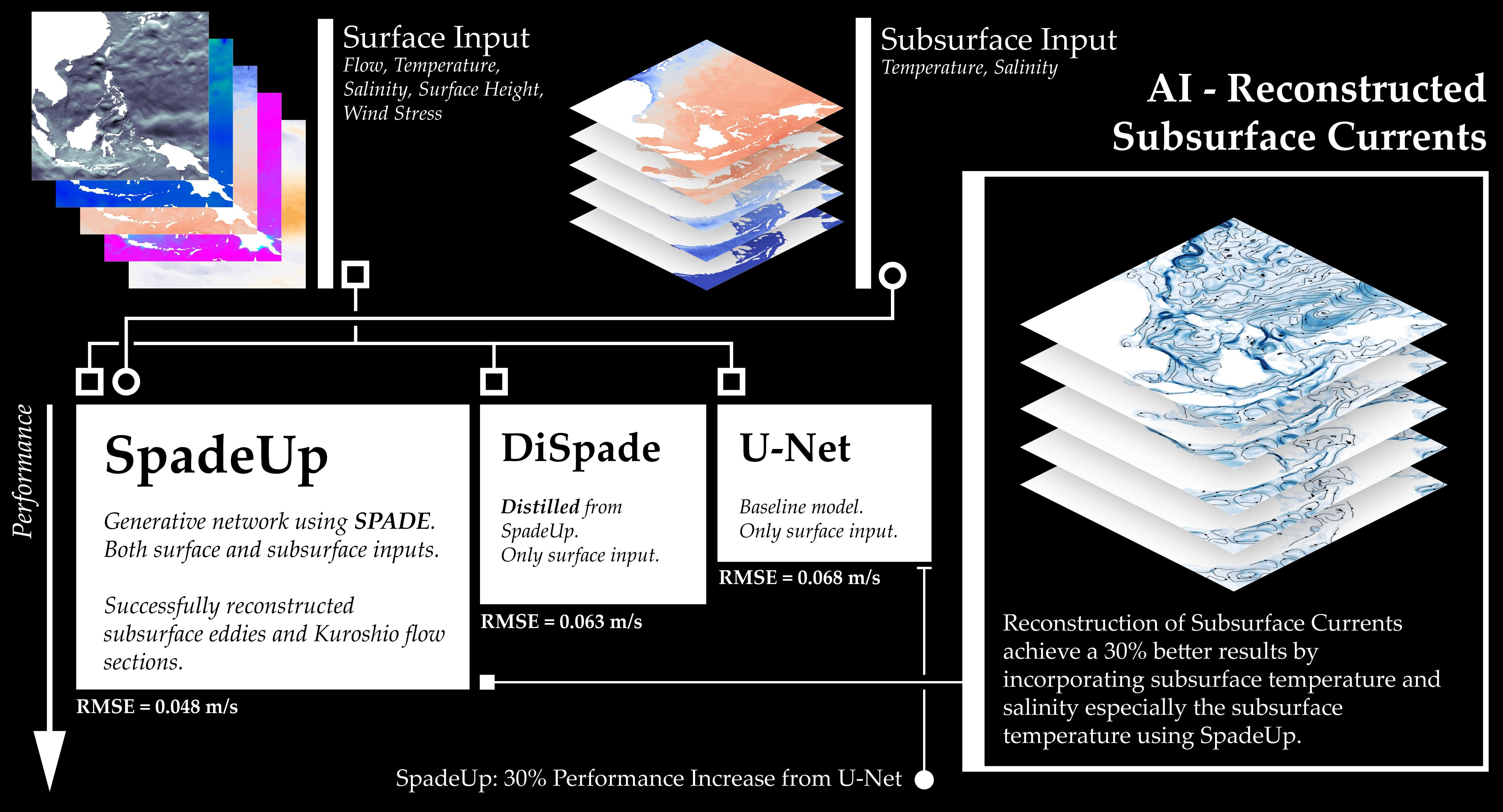
Highlights

What are the main findings?
  • We propose SpadeUp, a new subsurface current reconstruction model that jointly assimilates surface observations and subsurface thermohaline fields, and achieves substantially higher skill than surface-only AI models.
  • A perturbation-based sensitivity analysis reveals a robust hierarchy of input importance: among surface inputs, surface currents and sea surface height) dominate the reconstruction, while subsurface temperature provides a major additional accuracy gain across all depths.
What is the implication of the main finding?
  • The AI-based 3D current reconstructions obtained with SpadeUp offer a physically consistent tool for generating datasets that can underpin studies of subsurface circulation, mesoscale eddies and other key dynamical processes.
  • The identified ranking of variable importance can inform operational ocean forecasting and observing system design, which holds significant implications for the development of ocean observing and forecasting systems.

Abstract
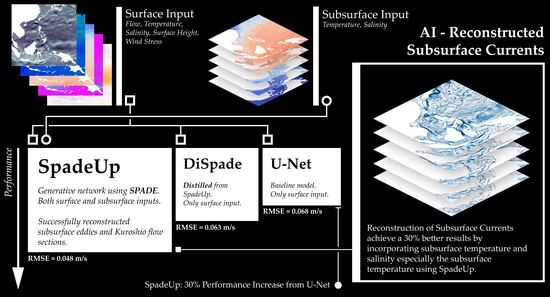
The ocean circulation in the Western Pacific is crucial for climate regulation and marine ecosystems, but reconstructing 3D subsurface currents remains challenging due to limited observations. This study presents SpadeUp, a novel deep learning model that fuses surface data (wind fields, sea surface height, and surface currents) with subsurface thermohaline data to achieve high-precision 3D ocean current reconstruction. We systematically compared SpadeUp against DiSpade (using only surface data through knowledge distillation) and U-Net (benchmark model). SpadeUp achieved superior performance with average root-mean-square error below 0.05 m/s, representing over 30% improvement compared to U-Net while using fewer parameters. The model successfully reproduced subsurface-intensified eddy in the South China Sea, and accurately captured complex vertical structures of the Kuroshio. Variable importance analysis confirmed that subsurface thermohaline information, especially temperature, is decisive for enhancing reconstruction accuracy, particularly below the thermocline.

1. Introduction

The global ocean circulation is a key regulator of the Earth’s climate system, acting as a planetary-scale conveyor of mass, heat, salt, and essential biogeochemical substances [1,2,3,4]. This intricate network of currents, spanning from the sunlit surface to the abyssal depths, governs the distribution of mass and heat across the globe [2], thereby modulating regional and global weather and climate patterns [5,6], influencing sea level rise [7,8], and shaping the productivity of marine ecosystems [9,10]. The dynamics of these currents are fundamental to a vast array of scientific and societal concerns, including the prediction of climate variability and change [11,12], the management of fisheries [13,14], the safety of maritime and underwater navigation [15,16], and the forecasting of extreme weather events such as typhoons and hurricanes [17].
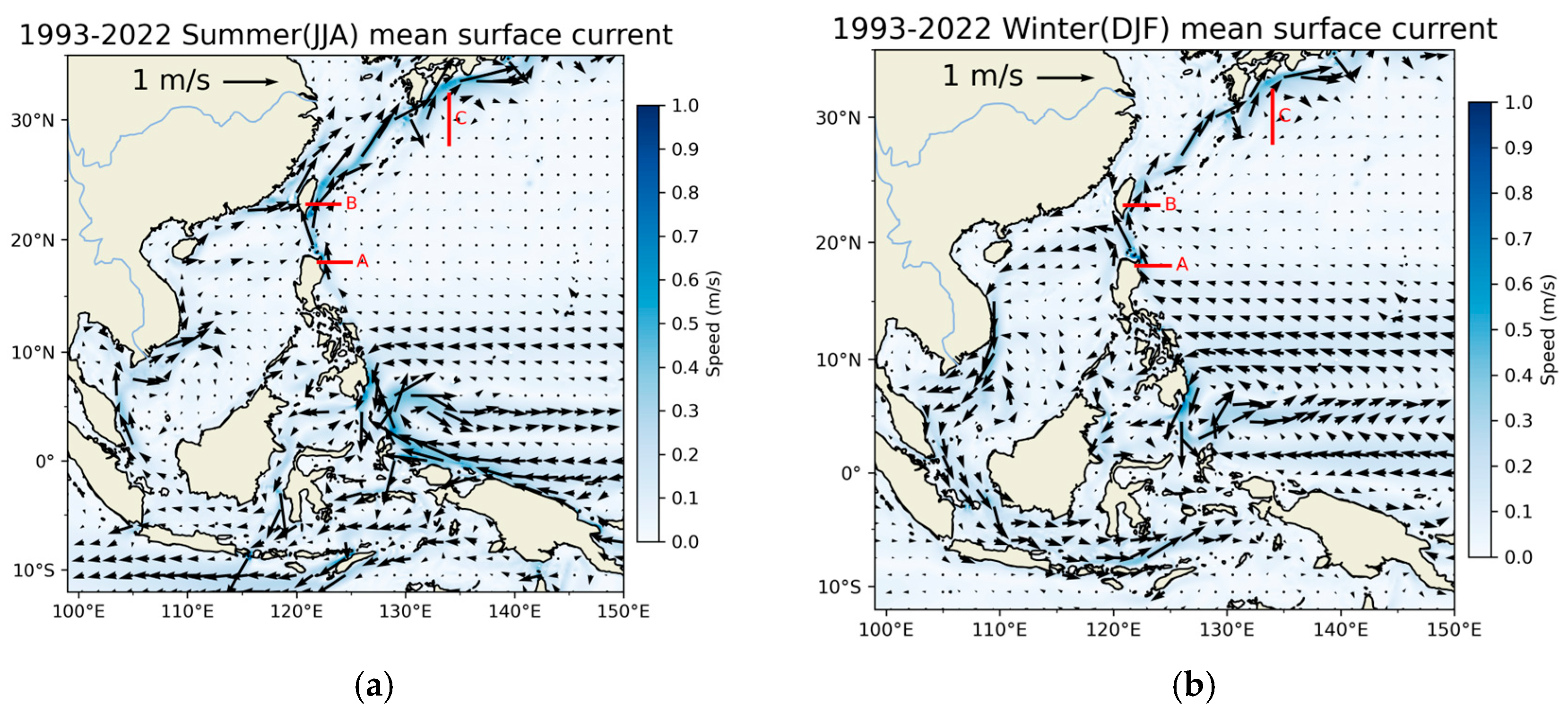
The Western Pacific Ocean hosts several vital and complex current systems (Figure 1), connecting tropical and subtropical Pacific gyres, as well as the interocean pathway, the Indonesian throughflow, making it a natural laboratory for studying regional ocean dynamics. The Kuroshio and its Extension Current [18,19,20], a strong western boundary current of the North Pacific Subtropical Gyre, transports large quantities of warm tropical water northward to the mid-latitudes [21]. With the tropical gyre, the North Equatorial Current flows westward and bifurcates as it encounters the Philippine coast [22,23,24], feeding the poleward-flowing Kuroshio Current and equatorward-flowing Mindanao Current. Subsequently, the Mindanao Current joins the North Equatorial Countercurrent, flowing eastward into the central Pacific or southward into the Southeast Indian Ocean via the Indonesian Throughflow. The Indonesian Throughflow provides the only low-latitude oceanic connection between the Pacific and Indian Oceans [25,26], playing a vital role in the global thermohaline circulation [27]. Below the thermocline, undercurrents flow opposite to the surface current, including the eastward-flowing North Equatorial Undercurrent and the westward-flowing Equatorial Undercurrent. The South China Sea (SCS), the largest semi-enclosed marginal sea within this domain, is characterized by complex multiscale dynamical processes, including seasonally reversed basin-scale circulation [28] and active mesoscale eddies [29,30]. Moreover, the SCS also exchanges water with surrounding oceans and seas by the SCS Throughflow, where the Pacific water enters the SCS through the Luzon Strait and flows out of the basin through the Taiwan, Mindoro, and Karimata Straits [31,32]. The confluence of these current systems makes the Pacific a critical hub for global mass and energy exchange, affecting the West Pacific Warm Pool, the East Asia monsoon, and the life cycle of El Niño-Southern Oscillation [33,34], yet its complexity presents a formidable challenge to observations and modeling efforts.
Despite its importance, accurately reconstructing the three-dimensional structure of ocean currents remains a grand challenge. Over the past few decades, satellite remote sensing has revolutionized physical oceanography, providing continuous, high-resolution global coverage of surface information. Specifically, surface ocean currents are estimated from these satellite-sensed surface winds (SW), sea surface height (SSH), and sea surface temperature (SST) through several methods, including physical diagnostic models [35]. While these technologies are invaluable for the surface or near-surface layer, the vast ocean interior remains critically undersampled. Although the Argo float program [36] has substantially improved the availability of subsurface temperature and salinity (T/S) profiles, direct velocity observations remain sparse in both space and time. Direct measurements of subsurface velocity rely on a sparse network of in situ platforms, including moorings, ship-based surveys (e.g., shipboard acoustic Doppler current profiler). This observational limitation hampers our ability to resolve the full spectrum of ocean variability, particularly the energetic mesoscale and submesoscale processes that dominate upper-ocean dynamics.
To bridge this observational gap, scientists have traditionally relied on two main approaches: numerical ocean models and geostrophic or quasi-geostrophic diagnosis. State-of-the-art ocean general circulation models, often coupled with data assimilation techniques to produce reanalysis products like Global Ocean Physics Reanalysis (GLORYS12V1) [37], solve the fundamental equations of fluid dynamics on a grid. While the numerical models follow closely to the physical process, they rely heavily on parameterization processes. Geostrophic and quasi-geostrophic diagnoses use multiple hypotheses, which have strict conditions of application and meet problems when encountering complex terrain. On the other hand, recent years have witnessed a surge in the application of deep learning to oceanographic problems [38,39,40]. Architectures like the U-Net have proven effective for various tasks, including reconstructing ocean fields from satellite data [41,42,43,44]. However, a limitation of many existing deep learning approaches is their exclusive reliance on surface data, failing to fully utilize internal T/S observations. This ‘surface-only’ paradigm is problematic because surface dynamics are often decoupled from the processes occurring under the ocean thermocline. For instance, subsurface-intensified eddies, which are prevalent in regions like the SCS [20], may have a very weak or non-existent signature at the surface [45], making them effectively invisible to models that do not incorporate subsurface information. Subsurface temperature and salinity information, however, are relatively more accessible compared to direct subsurface current observations, as they can be obtained from both Argo profiles and advanced automated observation instruments, e.g., gliders. To overcome this limitation, we introduce a novel deep learning model, named SpadeUp, which is specifically engineered to synergistically fuse two-dimensional surface data with gridded three-dimensional subsurface thermohaline data. Although direct integration of sparse observation data is not yet possible, the inclusion of subsurface thermohaline structure is deemed capable of effectively addressing the shortcomings of methods relying solely on surface data. To rigorously evaluate the contribution of both the subsurface data and the model architecture, we conduct a systematic comparison on the reanalysis dataset. We benchmark SpadeUp against U-Net, a widely used standard architecture in geophysical sciences, and DiSpade, a derivative model that uses the same advanced architecture as SpadeUp but is trained via knowledge distillation to operate using only surface data. This experimental design allows us to isolate and quantify the performance gains attributable to the input data versus the model structure. All models are trained and evaluated on the same dataset, with the same preprocessing and data segmentation.
This paper is structured as follows. First, we detail the reanalysis datasets used for training and evaluation and describe the architectural designs of the SpadeUp, DiSpade, and U-Net models. Second, we present a comprehensive performance evaluation and comparison of these three models’ outputs. Third, we perform a variable importance analysis to quantitatively dissect the contribution of each input parameter to the final reconstruction accuracy at different depths. Finally, the discussion and conclusion of our findings are provided.

2. Data & Methods

2.1. Study Area and Data

The study area focuses on the typical western Pacific warm pool and surrounding seas, including the SCS, East China Sea, Philippine Sea, and the Indonesian seas. The specific region 99°E–150°E, 12°S–35°N (Figure 1) is chosen as it encompasses the West Pacific warm pool and key oceanic gateways, where several major surface and subsurface currents converge. The SCS circulation features a cyclonic circulation in winter and an anticyclonic circulation in summer (Figure 1).
For the concept validation purpose of this study, and to maintain consistency between input and output data, this study employs two reanalysis datasets for training, testing, and validation. GLORYS12V1 [37] is a global eddy-resolving ocean reanalysis product produced by Mercator Ocean International as part of the Copernicus Marine Environment Monitoring Service (CMEMS). GLORYS12V1 is based on the Nucleus for European Modeling of the Ocean (NEMO) model with a horizontal resolution of 1/12° (~8 km at the equator) and 50 vertical levels. It assimilates satellite observations (sea level anomaly, sea surface temperature, sea ice concentration) and in situ measurements (temperature and salinity profiles, drifting buoys) through a multi-data assimilation scheme. This dataset provides both surface and subsurface ocean variables required for model training and validation. ECMWF Reanalysis v5 (ERA5) [46] is produced by the European Centre for Medium-Range Weather Forecasts. It combines model data with a wide range of observations into a globally complete and consistent dataset through 4D-Var data assimilation. It provides hourly estimates of atmospheric, land-surface, and ocean-wave parameters with a horizontal resolution of 0.25° (~31 km). In this study, ERA5 is used to obtain surface wind data, which is calculated into the wind stress through bulk formula and decomposed into its zonal (eastward, SWSU) and meridional (northward, SWSV) components. Surface inputs for the model include sea surface properties from GLORYS12V1—namely sea surface current (decomposed into zonal and meridional components), SST, SSS, and SSH—together with the ERA5-derived surface wind stress components. For a specifically designed model configuration, 3D sea temperature and salinity fields are also required. These are obtained from GLORYS12V1 at depths ranging from 2.6 m to 643.6 m. Because the vertical levels in GLORYS12V1 are not evenly spaced in depth—being denser near the surface—a depth-stratified extraction was applied to the obtained GLORYS depth layers, retaining every second depth level to balance the representation of surface and subsurface layers and reduce the overall data volume. The final processed dataset contains 22 vertical layers in total. This choice is aligned with other major ocean-circulation-related models like WenHai [47]. Target data, which are horizontal total current containing zonal and meridional components, are also obtained from GLORYS, with the same spatial and temporal resolution in place. All the acquired data are shown in Table 1, in which surface inputs are marked as X, subsurface inputs are marked as X3D, and target data as Y.
The obtained data is divided into a training dataset and a test dataset; the training dataset includes data from 1993 to 2020, while the remaining data goes to the test dataset. Only the training dataset is used when training three models, while the evaluation are performed on the test dataset. For these datasets, a time-related segment prevents information leaks and remains faithful to practical situations, in which future information is unharvestable.

2.2. Methods

To evaluate the contribution of vertical temperature and salinity input, and the effect of the model’s structure, we present three models representing different input types and design strategies. We first introduce SpadeUp, a novel deep learning model that fuses surface data (sea surface height, wind fields, and surface currents) with subsurface thermohaline structure (T/S) data to achieve high-precision reconstruction of the 3D subsurface ocean currents. To comprehensively evaluate the performance of SpadeUp, we conducted a systematic comparison of SpadeUp with DiSpade, a derivative model that uses only surface data obtained through knowledge distillation, and U-Net, a widely used benchmark model.

2.2.1. SpadeUp

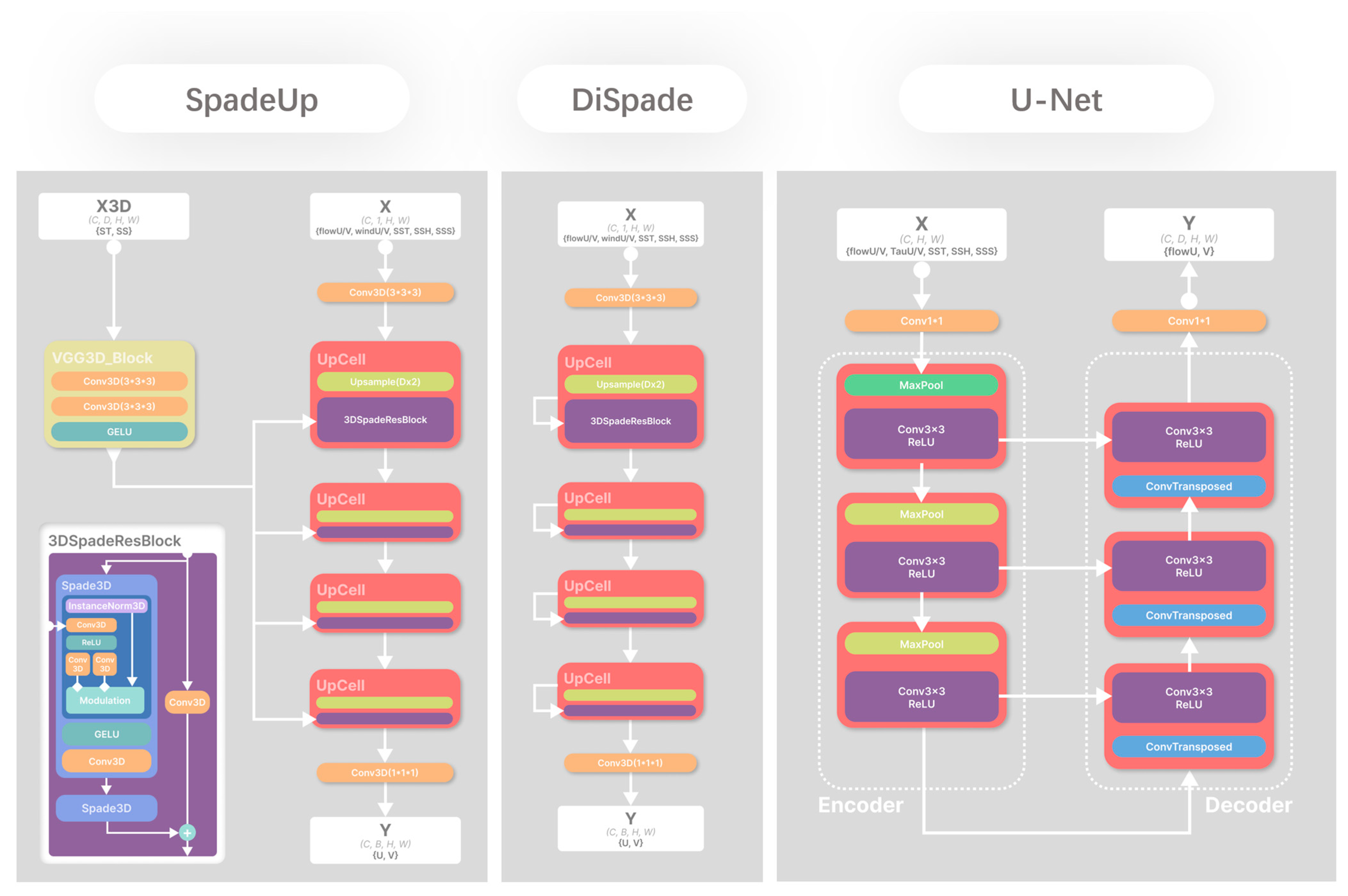
To utilize both volumetric temperature and salinity data and surface data, this study designs a model structure named SpadeUp (Figure 2). SpadeUp is a deep learning generative network whose key module is SPatially Adaptive (DE)normalization (SPADE), a normalization method proposed by Park et al. (2019) [48]. SPADE module is a conditional normalization method designed for image synthesis tasks, particularly in semantic image generation. In SPADE, the input feature maps are first normalized (in this case using instance normalization) to remove instance-specific statistics. Instead of applying fixed affine parameters after normalization, SPADE predicts the scale (γ) and bias (β) from an external spatial condition map, such as a segmentation mask. This is achieved by passing the condition map through a small convolutional network to generate spatially varying γ and β, which are then applied to the normalized features. This mechanism preserves spatial semantic information that standard normalization layers tend to wash out [48,49], enabling the generator to produce fine-grained, semantically consistent details across different spatial locations. By adjusting the distribution of input data, SPADE module fuse information from two separate inputs. In SpadeUp, Spade is utilized as its 3D counterpart and is packed into a 3D ResBlock [50]. Along with trilinear upscaling, this block is counted as an UpCell. By stacking the UpCell, surface inputs X are generatively upscaled to full-depth volumetric data. Furthermore, the architecture incorporates a 3D VGG [51] feature extractor for the volumetric condition inputs X3D, ensuring that the conditioning signal captures multi-scale structural cues before modulation. This facilitates a richer, context-aware fusion between surface and subsurface information, enhancing the model’s ability to generate physically consistent outputs in dynamically complex regions.
The SpadeUp model is implemented within a Generative Adversarial Network (GAN) [52] framework to generate three-dimensional ocean currents. GANs formulate the learning process as a game between two neural networks: a generator that produces synthetic samples and a discriminator that distinguishes between real and generated samples. This adversarial setting encourages the generator to model the full data distribution rather than minimizing pointwise reconstruction errors. We adopt the Wasserstein GAN with Gradient Penalty (WGAN-GP) [53] formulation for improved stability. WGAN-GP estimates the distance between real and generated distributions, providing a smoother optimization landscape. The gradient penalty enforces Lipschitz continuity on the discriminator, preventing overly confident predictions that can destabilize training [53]. The discriminator for GAN training uses a three-dimensional PatchGAN [54] architecture adapted for volumetric data, which produces local realism scores for sub volume of data, enabling the capture of fine details. The final loss functions used for optimizing the discriminator D and generator G are as below:
L D = E D ( y ) E D ( G ( x ,   m ) ) + λ g p L G P ,
L G = E D ( G ( x , m ) ) + λ r e c L 1 ,
in which y is the target subsurface current, x is the surface input X and m is the subsurface thermohaline input X3D in Table 1. Both λ g p and λ r e c are set to 10.0 during training. The term L G P in discriminator loss L D is the WGAN-GP with a weighting parameter λ g p , whose specific form being:
L G P = E y ^ ( y ^ D ( y ^ ) 2 1 ) 2 ,
in which y ^ is a random interpolation between target value y and predicted value G ( x ,   m ) . Generator loss function L G involves the pointwise L 1 loss:
L 1 = 1 N G x ,   m y ,
This adoption of a GAN-based training strategy with WGAN-GP stabilization and a 3D PatchGAN discriminator provides a flexible framework for 3D ocean flow reconstruction.

2.2.2. DiSpade

To evaluate the respective contributions of model architecture and input variables to the reconstruction performance, we developed a variant network, termed DiSpade (Figure 2), through knowledge distillation combined with minor structural modifications to the original SpadeUp model. DiSpade is distilled from a fully trained SpadeUp network, which serves as the teacher in a teacher–student learning framework. In this design, the SPADE module’s conditional input is replaced with the main backbone input, thereby eliminating dependence on the 3D subsurface temperature and salinity fields. By removing this volumetric conditioning pathway, DiSpade isolates the generative capability of the architecture when operating solely on surface-derived information. This setup allows for a controlled assessment of how much of the final reconstruction quality stems from architectural design versus the availability of comprehensive volumetric inputs.
The training of DiSpade employs a teacher–student distillation strategy [55], in which the teacher (SpadeUp) has access to both surface and subsurface variables, while the student relies exclusively on surface inputs. Specifically, this process is conducted via offline distillation, where high-performance teacher model (SpadeUp) is first pre-trained to convergence. Once the teacher’s parameters are frozen, it serves as a static expert to supervise the student model’s training. The goal is to transfer the teacher’s ability to reconstruct high-fidelity 3D ocean currents to the student, despite the reduced input complexity. This is achieved using two complementary supervision signals: soft output alignment loss and feature alignment loss. The soft output alignment loss encourages the student model S to match the teacher model T ’s volumetric predictions using simple L 1 loss as Equation (3), and feature alignment loss facilitates knowledge transfer by projecting the student’s intermediate feature maps f S , i into the teacher’s channel space via 3D convolution layers ϕ i and minimizing the Mean Squared Error between the spatially aligned representations, thereby forcing the student model to emulate the teacher’s hierarchical feature extraction logic. The final objective combines these two losses in a weighted sum:
L d i s t i l l = λ o u t · E S x T ( x , m ) 1 + λ f e a t · 1 M i = 1 M ϕ i f S , i f T , i 2 2 .
Early in training, a higher λ o u t of 1.0 is assigned to guide the student toward the teacher’s overall generative space. In contrast, the feature alignment plays a secondary role, weighting 0.1. As training progresses, the weight of the feature alignment λ f e a t is increased, refining the internal feature hierarchy and ensuring the preservation of spatial semantics and flow structures.

2.2.3. U-Net

As a baseline, the vanilla U-Net [56] (Figure 2) is employed to investigate how both input variables and network structure contribute to reconstruction performance. Originally proposed by Ronneberger et al. (2015) [56] for biomedical image segmentation, U-Net has since been widely adopted across diverse computer vision domains, including style transfer [57,58], super-resolution [59], medical image segmentation [60], and scientific data reconstruction. Its success lies in its elegant encoder–decoder architecture, which progressively reduces spatial resolution through the encoder to capture high-level, abstract features. Then it restores the spatial resolution in the decoder to generate the final output.
A defining characteristic of U-Net is its skip connections [61], which directly link feature maps from each encoder stage to the corresponding decoder stage at the exact resolution. These connections allow the decoder to access fine-grained spatial details that would otherwise be lost during downsampling. By merging encoder features rich in local spatial information with decoder features containing global contextual information, U-Net achieves multi-scale feature fusion, enabling the network to capture large-scale structures and small-scale details simultaneously. The result is a robust baseline model capable of balancing local accuracy and global coherence, making U-Net an ideal reference point against which more specialized architectures can be evaluated.
In this study’s practice, a vanilla U-Net is implemented, with three layers of downsample/upscale. Inputs have depth layers on channels, along with different variables. Max pooling is used for downscaling, and transposed convolution for upscaling. Training is done using the L 1 loss function as in Equation (3).

2.2.4. Experiment Design

In this study, three models—SpadeUp, DiSpade, and U-Net—are trained with different input configurations and learning strategies. SpadeUp receives surface and subsurface inputs, as summarized in Table 1. DiSpade and U-Net, by contrast, use only the surface input, enabling direct comparison of performance when subsurface information is omitted. All inputs are provided on a daily timescale, and trained using data from 1997 to 2020. The backbone architecture of SpadeUp and DiSpade remains identical, ensuring that differences in output can be attributed primarily to the presence or absence of volumetric subsurface data rather than architectural variation.
The surface and subsurface inputs differ in their structural form. The surface input is stored as a three-dimensional tensor with dimensions corresponding to variable channels, latitude, and longitude. The subsurface input is a four-dimensional tensor, incorporating an additional depth dimension alongside variable channels, latitude, and longitude. For computational efficiency and compatibility with the networks’ structural requirements, surface input of 565 × 613 and subsurface input of 22 × 565 × 613 first underwent pre-normalization, then resized to fixed shapes: 256 × 256 for the surface input and 16 × 256 × 256 for the volumetric subsurface input. Specifically, ERA5 Wind Stress components are first interpolated to 1/12° resolution, then normalized and resized to the same 256 × 256 size. This decision is made due to limited resources for training. Although the coarser input resolution introduces some smoothing for submesoscale processes, the spectra from both resolutions remain highly consistent across most resolvable dynamical scales, achieving a spectral energy retention of 97%. Therefore this resolution change barely affects the final reconstruction. Each model is trained separately with a strategy tailored to its design. SpadeUp is optimized under a GAN framework, continuing until its loss function converges and stabilizes. DiSpade is trained via a knowledge distillation process using the pre-trained SpadeUp as its teacher, and its training is also extended until convergence. U-Net follows a fully supervised training regime. To optimize computational efficiency, we leveraged the observed rapid convergence and high stability of the model. Performed preliminary tests indicated that performance metrics remained consistent post-convergence without significant overfitting. Consequently, we utilized the checkpoint from the final training epoch for our analysis, thereby bypassing the iterative validation-based selection process. All training sessions employ mixed-precision computation to reduce GPU memory usage and are conducted on two NVIDIA A100 GPUs in a distributed setup.
Additionally, to quantitatively assess the relative importance of input variables in the reconstruction process, this study employs a perturbation-based climatology replacement method. That is, the results of the original inputs for a particular variable are compared with the results of the long-term monthly climatological mean inputs for that single variable, while all other variables are kept unchanged as original inputs. This methodology is applied systematically to all input variables under consistent experimental conditions, ensuring direct comparability of importance scores.
In this study, Root Mean Square Error (RMSE) serves as the primary numerical metric to assess the spatio-temporal accuracy of model reconstruction of 3D ocean circulation. The assessment of the spatial structure and temporal evolution of the model-reconstructed 3D ocean circulation is evaluated based on correlation analysis. Eddy snapshots and Kuroshio sections are also compared to evaluate the performance of models on physical phenomena.

3. Results

3.1. Comparison of Three Models

3.1.1. General Performance

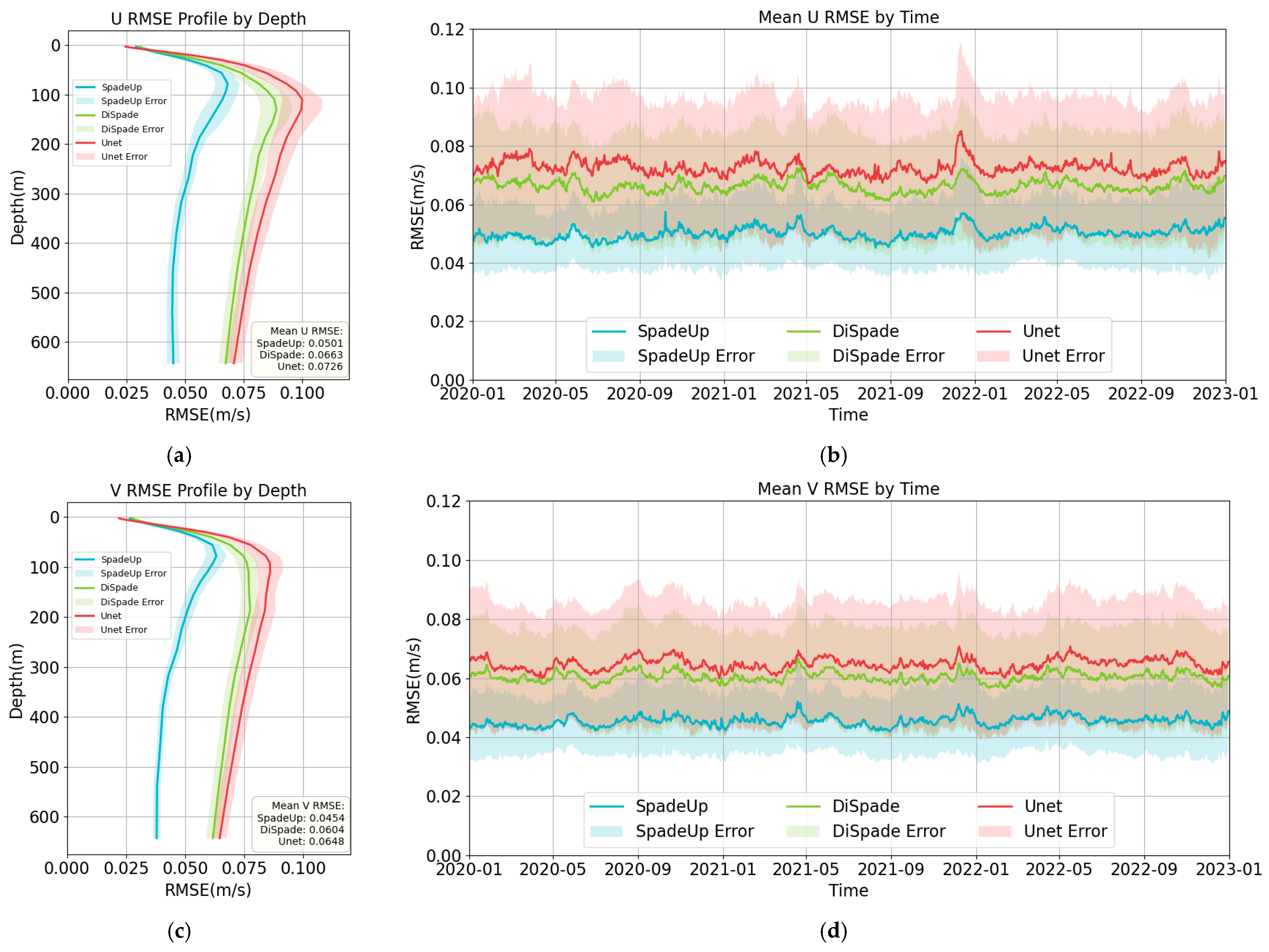
General performance evaluations of the three models are carried out using the RMSE metric, with the reconstructed ocean zonal flow U and meridional flow V fields compared against the GLORYS reanalysis data. Before evaluation, all model outputs are interpolated to a uniform spatial resolution of 1/12° and de-normalized following standardized procedures applied to the input dataset, ensuring methodological consistency across all assessment stages. RMSE values are computed as functions of both depth and temporal evolution, providing a comprehensive characterization of each model’s reconstruction accuracy throughout the vertical water column and over the entire evaluation period. The RMSE values for zonal flow U and meridional flow V in all three models increase with depth, reaching a maximum at approximately 100 m, and then decrease with depth (Figure 3a,c). SpadeUp consistently achieves superior performance relative to both DiSpade and U-Net, with particularly significant accuracy gains below the mixed layer, where fine-scale oceanographic structures present the most challenging reconstruction scenarios (Figure 3a,c). Quantitatively, SpadeUp delivers up to 30% reduction in RMSE compared to the U-Net baseline across both velocity components, with U component delivering an RMSE of 0.0501 m/s and V component 0.0454 m/s. Although DiSpade exhibits slightly degraded performance relative to its teacher network due to the absence of subsurface observational constraints, it nevertheless maintains substantial superiority over U-Net across most depth intervals with an average lead of 0.006 m/s for the U component and 0.004 m/s for V component, demonstrating that the enhanced architecture and knowledge distillation framework enable effective retention of SpadeUp’s performance benefits. Furthermore, temporal analysis of RMSE shows that SpadeUp exhibits consistently lower and more stable values throughout the time series compared to the other two models. The RMSE trajectory for SpadeUp remains relatively flat with minimal fluctuations, while the competing models display higher baseline values and greater temporal variability.
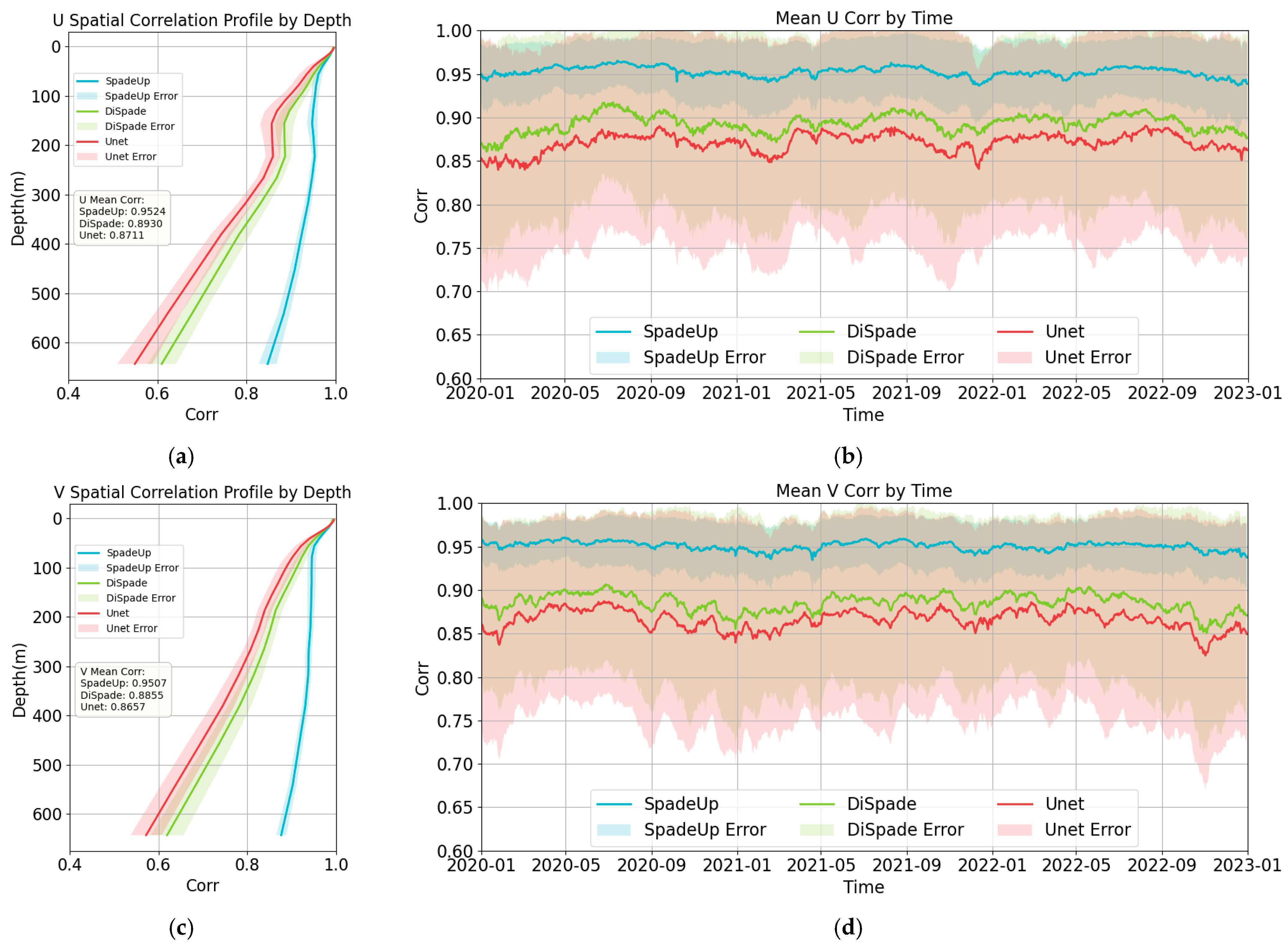
The comprehensive performance evaluation of the three models is also conducted using spatial correlation analysis. Spatial correlation coefficients are computed as functions of both depth and time, providing a thorough assessment of each model’s reconstruction accuracy throughout the vertical water column and across the evaluation period. The correlation coefficient values for zonal flow U and meridional flow V in all three models decrease with depth (Figure 4a,c). The comparative results demonstrate that SpadeUp consistently outperforms both DiSpade and U-Net, with particularly pronounced improvements in correlation precision below the mixed layer. At 200 m depth, SpadeUp achieves a U component correlation of 0.95, outperforming DiSpade (0.88) and U-Net (0.85). This performance gap widens at 500 m, where SpadeUp maintains a correlation of 0.90, while DiSpade decreases to 0.70 and U-Net to 0.65. The V component exhibits similar trends, as illustrated in Figure 4c. Overall, SpadeUp achieves correlation improvements of up to 15% relative to the U-Net baseline across both velocity components. While DiSpade exhibits marginally lower performance compared to its teacher network due to the absence of subsurface conditioning information, it nevertheless surpasses U-Net performance across all depth levels, indicating that architectural enhancements and distilled knowledge enable it to preserve substantial portions of SpadeUp’s performance advantages. The temporal analysis further reveals SpadeUp’s superior stability, maintaining consistently high correlation coefficients above 0.95 throughout the three-year evaluation period. In contrast, both DiSpade and U-Net demonstrate greater temporal variability and systematically reduced correlation values of less than 0.90 across the test timeline.

3.1.2. South China Sea Subsurface Eddy Snapshots

Subsurface eddies in the SCS have emerged as a critical research focus in recent oceanographic literature, representing complex three-dimensional phenomena that challenge conventional surface-based observation paradigms. A recent study [20] documented the prevalence of subsurface-intensified anticyclonic eddies in the northern SCS, typically manifesting between 20 and 200 m depths with maximum velocities occurring well below the surface mixed layer, which remain largely invisible to satellite altimetry. These findings underscore the inadequacy of surface-only reconstruction approaches for capturing subsurface-intensified circulation features, as noted by [45] in their investigation of mesoscale eddy impacts on subsurface chlorophyll maximum layers, where traditional methods failed to resolve the three-dimensional structure-function relationships essential for understanding ecosystem dynamics.
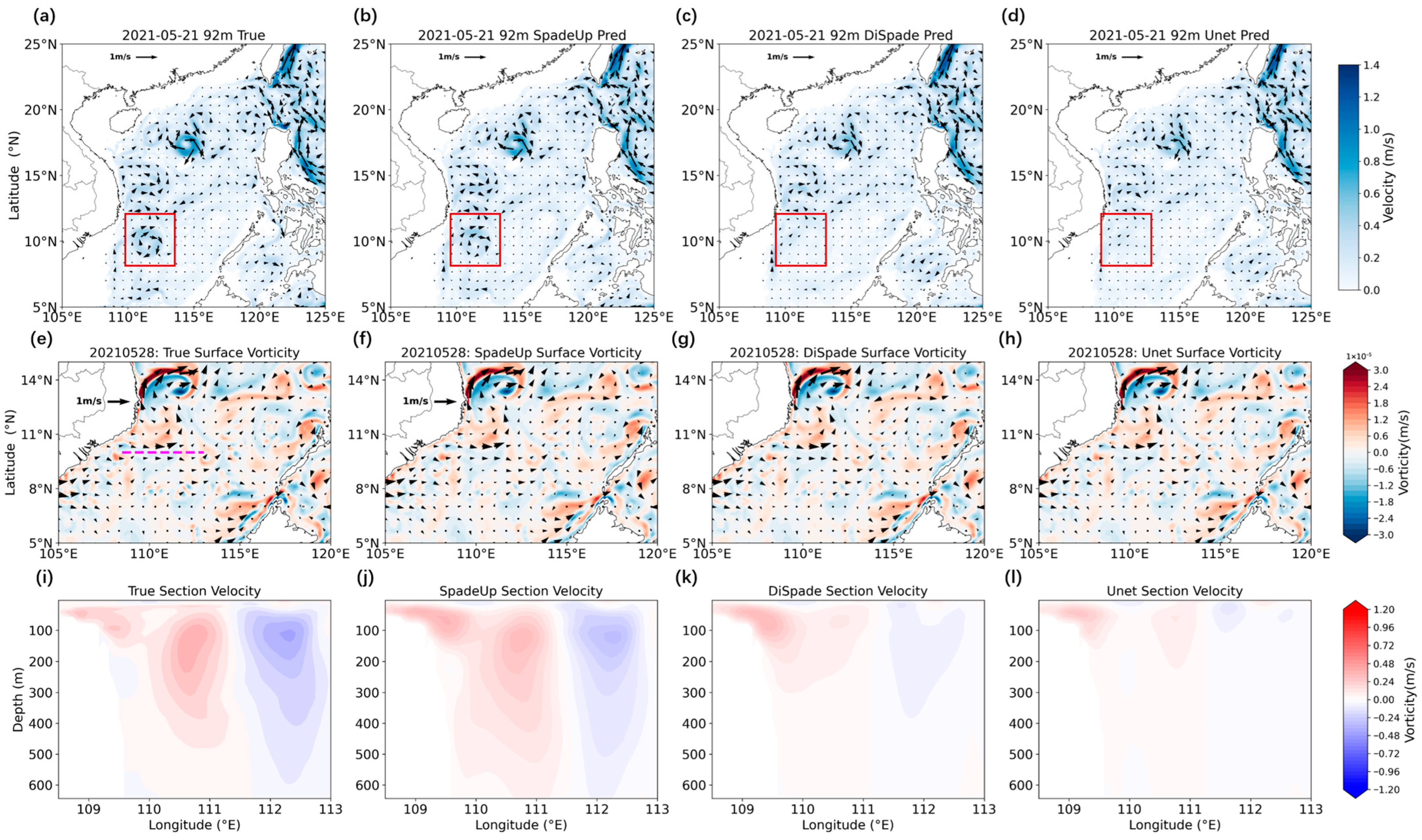
The reconstruction challenge illustrated in Figure 5 exemplifies these documented limitations through a specific subsurface eddy event on 21 May 2021, in the SCS. The comparative analysis reveals profound disparities between surface-constrained and subsurface-informed modeling approaches, directly addressing the observational gaps identified in previous literature. A well-defined anticyclonic structure is captured at the 92 m depth level (Figure 5a–d), while the sea surface signal is weak, manifesting as a subsurface-intensified eddy (Figure 5a). This subsurface-intensified eddy exhibits subsurface velocity intensification up to 0.5 m/s documented in studies (Figure 5i; [20]).
SpadeUp model successfully reproduces the subsurface eddy, including its spatial extent, intensity characteristics, and three-dimensional circulation structure. This demonstrates capabilities that align with the physical understanding developed through field observations and reanalysis studies. This accuracy extends to the meridional velocity cross-section analysis, where SpadeUp maintains the vertical coherence and subsurface intensification patterns documented in observational literature, capturing the characteristic velocity shear and subsurface maximum that define these phenomena. Therefore, SpadeUp’s reconstruction performance validates the necessity for subsurface-informed architectures in addressing the observational challenges highlighted by recent research.
In stark contrast, the surface-only models (DiSpade and U-Net) exhibit the systematic biases identified in previous critiques. These approaches fail to reconstruct the subsurface eddy structure, resulting in either severely weakened circulation patterns or the complete omission of three-dimensional features. The surface vorticity shows a minimal surface signature of the underlying subsurface circulation, which further illustrates the detection challenge. This surface-subsurface disconnect explains the persistent limitations of satellite-based reconstruction methods when applied to subsurface-intensified phenomena, validating the research community’s growing recognition that subsurface conditioning is essential for accurate three-dimensional ocean state estimation.
The meridional/northward velocity V cross-sections demonstrate the importance of incorporating subsurface information for accurate reconstruction. SpadeUp successfully reproduces the vertical velocity distribution and subsurface intensification patterns throughout the upper 600 m, capturing the complex three-dimensional structure documented in observational studies. DiSpade shows reasonable performance in the upper 200 m but with reduced intensity compared to SpadeUp and limited capability at greater depths. U-Net produces unrealistic vertical profiles that fail to represent the established subsurface eddy dynamics, highlighting the limitations of surface-only modeling approaches. These results confirm that subsurface information fundamentally transforms reconstruction capability, enabling the representation of deep ocean phenomena that have remained challenging for surface-based methods.

3.1.3. Kuroshio Cross Sections

The Kuroshio Current represents one of the world’s most significant western boundary currents, spanning a width of 100 km and extending down to depths of up to 1000 m, serving as a critical component of the North Pacific Subtropical Gyre [19]. It profoundly influences regional climate and weather, biogeochemical cycling, marine ecosystem, and global ocean circulation. The Kuroshio Current begins off the east coast of the Philippines, travels northward along the east coast of Taiwan toward the Okinawa Trough and the East China Sea, and eventually turns eastward through the Tokara Strait. After passing the south coast of Japan, it flows eastward as the Kuroshio Extension with strong eddy activities. Accurate three-dimensional reconstruction of the Kuroshio’s complex vertical structure is essential for understanding its role in regional ocean-atmosphere interactions and its impact on surrounding circulation patterns, particularly in the East China Sea and SCS.
To evaluate model performance in reconstructing the Kuroshio’s three-dimensional structure, this study selected three representative cross-sections based on the current’s distinct characteristics along its northward trajectory (Figure 1). Section A captures the meridional flow component at 18°N east of the Philippines, representing the Kuroshio’s initial strengthening phase as it enters the subtropical gyre circulation. Section B examines the meridional flow at 23°N east of Taiwan, where the current reaches maximum intensity and exhibits complex interactions with the continental shelf topography. Section C analyzes the zonal component at 134°E east of Kyushu Island, characterizing the Kuroshio region which is a fast, narrow, topographically constrained western boundary current that already carries near-mature transport, flows close to the coast. These cross-sections encompass typical Kuroshio dynamics, from its tropical origins through its separation from the Japanese coast, providing comprehensive coverage of the current’s evolving three-dimensional structure.
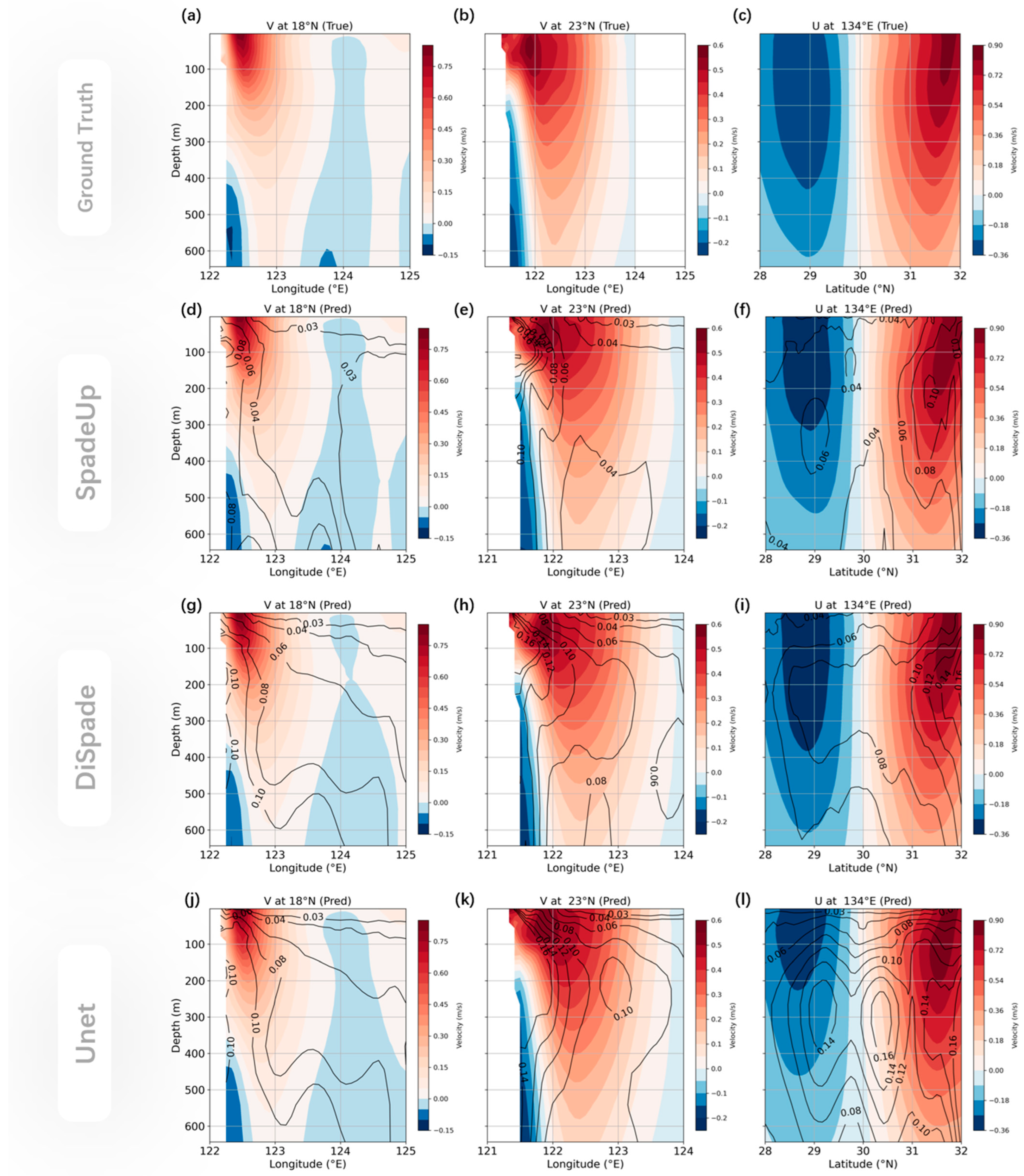
The comparative analysis of time-averaged vertical structures and RMSE across the three Kuroshio sections reveals substantial performance differences between the tested models (Figure 6). The ground truth GLORYS data demonstrates the vertical structure of the Kuroshio Current, with surface intensification and subsurface velocity cores that vary systematically along its path. At Section A, the velocity structure shows typical western boundary current characteristics with maximum speeds concentrated in the upper 200 m. Section B exhibits the most intense velocities, consistent with the Kuroshio’s peak transport region, while Section C displays a broader and deeper structure of the Kuroshio Extension with an anticyclonic eddy.
SpadeUp demonstrates exceptional performance in reconstructing these complex three-dimensional structures across all sections, with RMSE values below 0.05 m/s throughout most of the water column above 600 m depth. In contrast, DiSpade shows moderate performance with generally higher RMSE values of 0.066 m/s (U) and 0.060 m/s (V), particularly in the deeper portions of the current structure. U-Net displays the poorest performance across all sections, with substantially elevated RMSE values exceeding 0.1 m/s in many regions, particularly in the subsurface layers. Overall, SpadeUp accurately captures both the surface-intensified flow, the subsurface velocity cores, and the velocity shear patterns, particularly in the nearshore regions and deep layers, while DiSpade exhibits degraded accuracy and U-Net shows a significant decline in performance.

3.2. Contributions of Input Parameters for Each Model and the Key Role of Subsurface Temperature

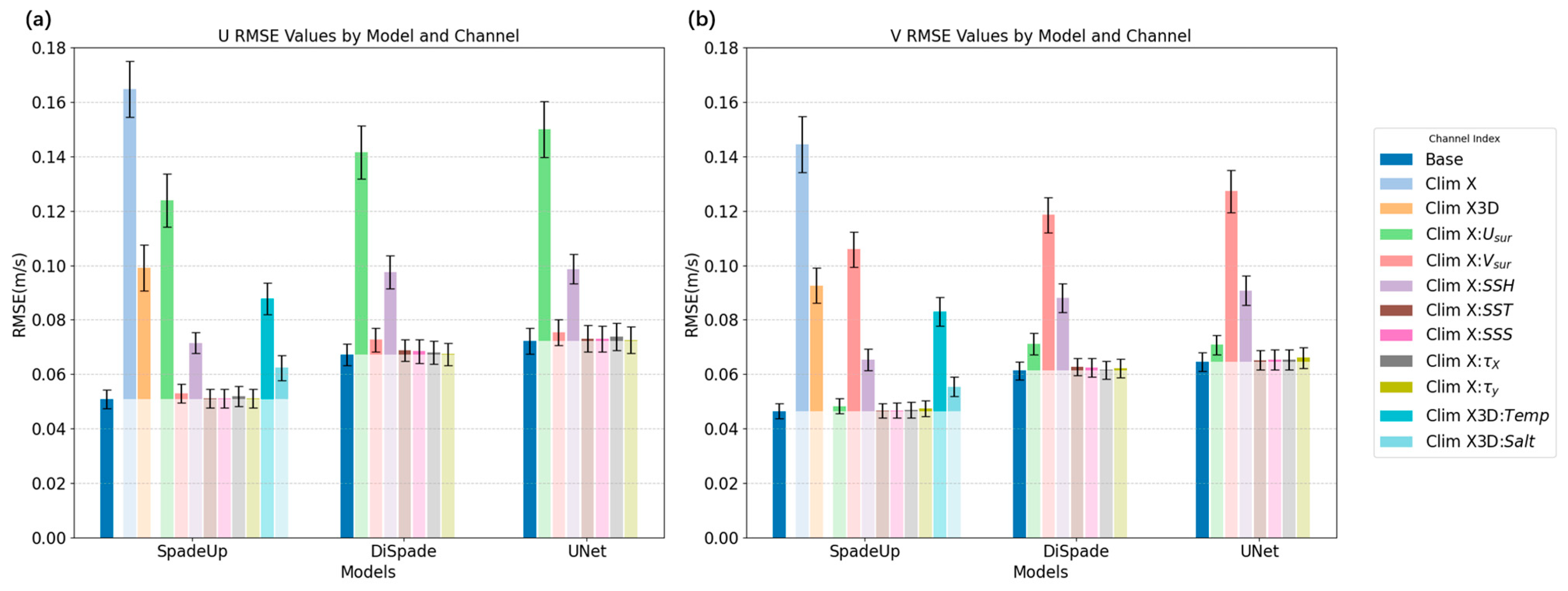
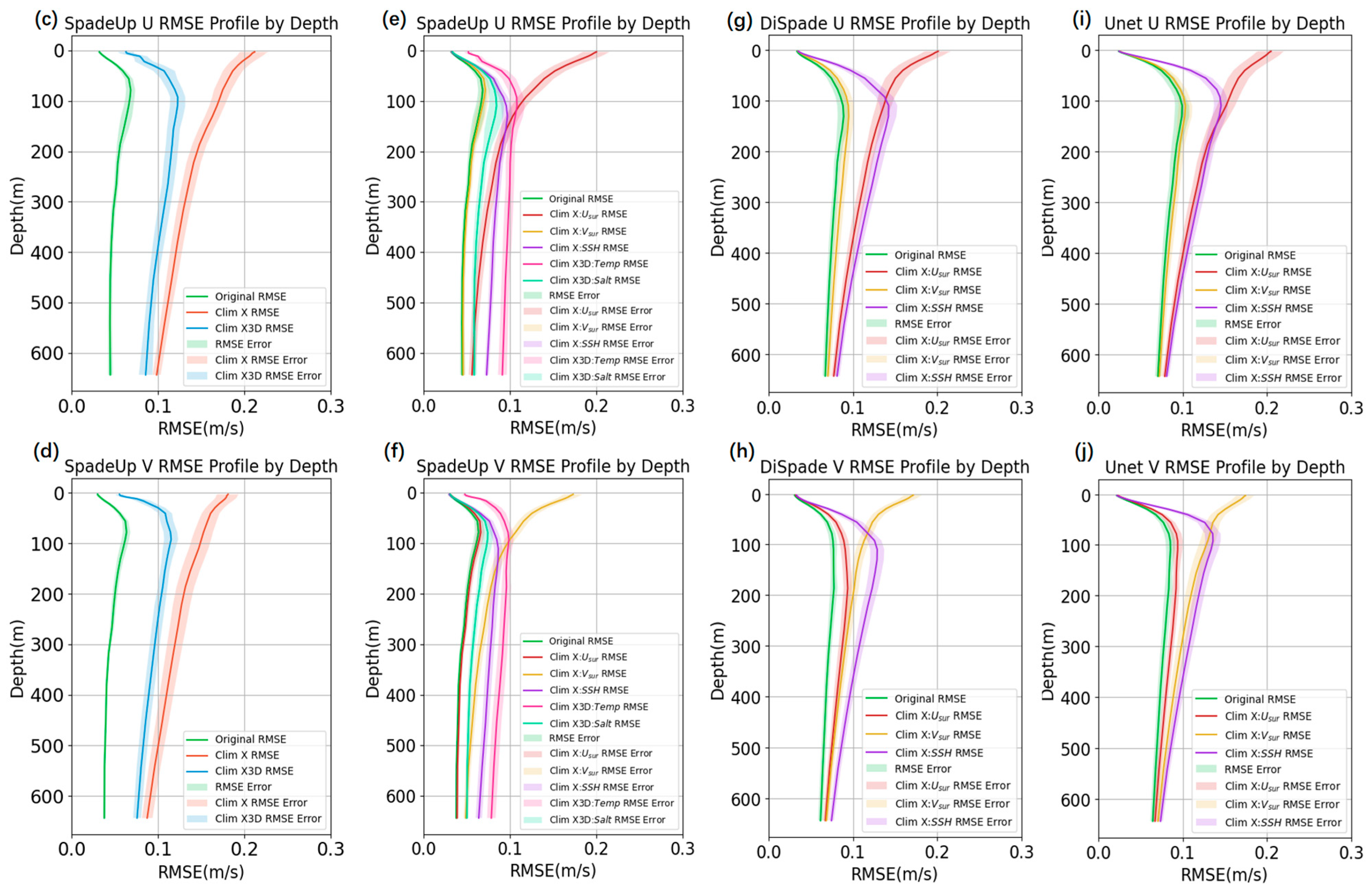
An investigation is also performed to estimate the importance of each variable in the results. To quantitatively evaluate the relative importance of each input variable in the reconstruction process, this study employs a perturbation-based climatology replacement method. Results of the variable importance analysis reveal a clear hierarchy of input parameter contributions to ocean current reconstruction accuracy across all three models (Figure 7). For the surface inputs of three models, surface current emerges as the most influential factor, exhibiting the highest RMSE of more than 2 times increase when replaced with climatological values. SSH ranks as the second most critical parameter for all models, while other surface variables demonstrate substantially lower importance scores. The consistency of this ranking across different model architectures suggests fundamental dependencies that transcend specific reconstruction methodologies.
SpadeUp’s evaluation of both surface (X) and subsurface (X3D) input components reveals distinct contribution patterns (Figure 7a,b). Surface inputs demonstrate greater overall importance compared to subsurface inputs when evaluated as complete parameter sets. However, the per-variable analysis shows that subsurface temperature achieves remarkable significance, ranking second only to surface current input for both zonal and meridional velocity components. Subsurface salinity also registers as an essential factor, though with lower importance than temperature. That indicates that subsurface inputs, especially temperature, play an important role in boosting the reconstruction accuracy. The depth-stratified analysis (Figure 7c–j) unveils vertical variations in parameter significance. Surface current input exhibits maximum importance in near-surface layers but rapidly diminishes in effectiveness below 200 m depth. SSH input demonstrates minimal impact within the mixed layer but becomes increasingly crucial in the thermocline and deeper waters. Subsurface temperature and salinity inputs provide consistent performance enhancement across all depth levels, with temperature showing greater importance than salinity throughout the water column. Temperature input demonstrates increasingly significant effects in deeper layers, establishing a depth-dependent importance gradient.
Comparative analysis across DiSpade and U-Net reveals similar variable importance hierarchies, with models showing comparable sensitivity patterns to surface current and SSH inputs despite architectural differences. The magnitude of RMSE increase varies between models, but the relative ranking of parameter importance remains consistent. This cross-model validation confirms the robustness of the identified variable importance patterns. These observed patterns align with fundamental oceanographic principles governing three-dimensional circulation dynamics. The surface currents primarily comprise wind-induced Ekman and geostrophic currents, while the subsurface currents are dominated by geostrophic currents. The geostrophic current is the result of a primary balance between the horizontal pressure gradient and the Coriolis force. Temperature and salinity, as key factors that affect seawater density, indirectly determine the geostrophic current by changing horizontal pressure gradients. Surface current importance in shallow layers reflects wind-driven current and direct momentum transfer processes. The importance of SSH increases in deeper waters, corresponding to its role in representing pressure gradients that drive geostrophic currents. The consistent importance of subsurface temperature across all depths reflects its control over density stratification and thermal wind relationships. Salinity’s secondary role relative to temperature reflects the typical dominance of thermal over haline contributions to seawater density variations in most oceanic regions.

4. Discussion

This research offers a new approach to 3D ocean state estimation by demonstrating the effectiveness of integrating both surface and subsurface information. The model’s capability to reconstruct complex phenomena with improved accuracy suggests it could serve as a valuable tool for ocean science research. The present study, however, still has several limitations. While the model demonstrated stable performance, we acknowledge the limitation of not employing a distinct validation and testing split. Although our preliminary tests suggest the model is robust, future studies could further strengthen generalization assessments by implementing a stricter temporal separation of the validation and testing phases. To isolate and validate the effectiveness of the model architecture, this study intentionally bypassed more complex schemes such as online distillation or simultaneous supervision with ground-truth labels during the distillation phase. Incorporating such methodologies could potentially unlock even higher performance ceilings. Additionally, while DiSpade is highly efficient, its performance is inherently bounded by the pre-trained quality of the teacher (teacher-bounded), and the current offline strategy precludes joint optimization between the two models. The SpadeUp/DiSpade models were trained and validated using a single reanalysis dataset (GLORYS), which, while ensuring internal data consistency for proof-of-concept testing, may limit the model’s generalization to real-world observations that contain higher noise levels, irregular sampling, and instrument biases. In addition, the current experimental design assumes the availability of subsurface thermohaline information, which remains sparse and unevenly distributed in many ocean regions. These limitations highlight the need for further validation and adaptation of the framework under more realistic observational conditions. Building on these results, future studies may aim to extend the SpadeUp/DiSpade framework toward practical, observation-driven applications by incorporating real-time satellite measurements and sparse in situ profiles. Specifically, the model could be adapted to use satellite-derived surface variables as dynamic inputs, while integrating Argo temperature/salinity profiles or other in situ observations through data assimilation or AI-based fusion methods [62]. This hybrid strategy could enable near-real-time reconstruction of subsurface ocean states, providing a practical pathway for operational monitoring, forecasting, and climate-related analyses.

5. Conclusions

In this study, we developed a three-dimensional ocean current reconstruction model, SpadeUp, based on an advanced deep learning architecture that integrates both surface and subsurface information. The network model addresses the limitations of surface-only approaches in processing three-dimensional oceanographic data and can effectively learn the complex spatiotemporal variations in subsurface current fields. We also implemented DiSpade and U-Net models, which require surface input only for a comprehensive comparison with SpadeUp. DiSpade is distilled from Spade to evaluate the effect of model structure and input data availability.
The evaluation of three models demonstrates that SpadeUp and DiSpade models achieve substantially better performance in three-dimensional ocean subsurface current reconstruction compared to the U-Net baseline across the Western Pacific domain. Both zonal and meridional current velocities reconstructed by SpadeUp achieve average RMSE values below 0.05 m/s, utilizing 80% fewer parameters than baseline approaches (Table 2), which represents a remarkable 30% improvement over U-Net baseline performance. DiSpade, operating through knowledge distillation with significantly lower parameter count than U-Net, consistently outperforms U-Net across all evaluation metrics by 7%, demonstrating both the inherent structural advantages of the architecture and the effectiveness of distilled subsurface thermohaline knowledge transferred from the teacher network. The performance hierarchy establishes that even partial incorporation of subsurface information through distillation mechanisms provides reconstruction benefits over surface-only approaches. SpadeUp’s subsurface information merging and architectural innovations also enable reproduction of multiscale ocean dynamical processes. In particular, the model can infer subsurface-intensified eddies that remain undetectable to surface-input-only reconstruction models. The model also exhibits superior accuracy in reproducing the circulation structure of Kuroshio Current cross-sections. While SpadeUp integrates both surface and subsurface information, the practical availability of subsurface thermohaline observations remains chronically sparse across most spatial and temporal scales. In contrast, DiSpade achieves superior performance compared to baseline models while relying exclusively on surface inputs. This reliance on surface-only data facilitates more realistic operational deployment, particularly in regions where only satellite-derived observations are accessible.
The systematic variable importance analysis reveals how surface inputs and subsurface inputs are both important in reconstruction, with surface velocity inputs and sea surface height in surface inputs and sea temperature, sea salinity in subsurface inputs being more important than other input variables. Surface velocity inputs (U/V) maintain primary importance for 3D ocean current reconstruction above the thermocline through momentum transfer processes. While the SSH input plays a more important role in 3D ocean current reconstruction within the thermocline, where geostrophic currents dominate, as SSH represents pressure gradients that drive geostrophic currents. The incorporation of subsurface temperature and salinity inputs provides comprehensive enhancement across all depth levels, due to their role in thermal wind relationship. Subsurface thermohaline conditioning effectively compensates for the limited effectiveness of SSH and other surface-derived parameters in deep ocean current reconstruction, enabling qualitative improvements in subsurface current representation.

Author Contributions

Conceptualization, X.L., Q.D., Y.Z. (Ying Zhang), Y.Z. (Yuhong Zhang) and Y.D.; methodology, X.L., Q.D., Y.Z. (Yuhong Zhang) and Y.D.; software, X.L. and Q.D.; validation, X.L. and Q.D.; formal analysis, X.L. and Q.D.; investigation, X.L., Q.D., Y.Z. (Yuhong Zhang) and Y.D.; resources, Y.Z. (Yuhong Zhang) and Y.D.; data curation, X.L. and Q.D.; writing—original draft preparation, X.L.; writing—review and editing, Y.Z. (Ying Zhang), Q.D., Y.Z. (Yuhong Zhang) and Y.D.; visualization, X.L.; supervision, Y.Z. (Ying Zhang), Y.Z. (Yuhong Zhang) and Y.D.; project administration, Y.Z. (Yuhong Zhang) and Y.D.; funding acquisition, Y.Z. (Ying Zhang), Y.Z. (Yuhong Zhang) and Y.D. All authors have read and agreed to the published version of the manuscript.

Funding

This study is supported by the National Natural Science Foundation of China (42430401 and 42149910), the Strategic Priority Research Program of the Chinese Academy of Sciences (XDA0370000), the Key Talent Project of Guangdong Province, China (2024TQ08A880), and Guangdong Natural Science Funds for Distinguished Young Scholar (2024B1515020037).

Data Availability Statement

We used publicly available data only. The GLORYS12V1 product used for sea currents, sea temperature, sea salinity was provided by Copernicus Marine Environment Monitoring Service (CMEMS) Global Ocean Reanalysis Products (https://doi.org/10.48670/moi-00021). The fifth-generation ECMWF reanalysis (ERA5) dataset provided hourly estimates of atmospheric, land, and ocean climate variables, making it usable in this study (https://cds.climate.copernicus.eu/cdsapp#!/dataset/reanalysis-era5-pressure-levels?tab=overview, https://cds.climate.copernicus.eu/cdsapp#!/dataset/reanalysis-era5-single-levels?tab=overview, https://cds.climate.copernicus.eu/datasets/reanalysis-era5-pressure-levels-monthly-means?tab=overview and https://cds.climate.copernicus.eu/datasets/reanalysis-era5-land?tab=overview, accessed on 21 December 2025). The daily ERA5 data were obtained from the Copernicus Climate Change Service (C3S) (https://cds.climate.copernicus.eu/datasets/derived-era5-single-levels-daily-statistics?tab=download, accessed on 21 December 2025).

Acknowledgments

During the preparation of this manuscript/study, the authors used Claude 4 for the purposes of grammar and language checking. The authors have reviewed and edited the output and take full responsibility for the content of this publication.

Conflicts of Interest

The authors declare that they have no conflicts of interest.

Abbreviations

The following abbreviations are used in this manuscript:
SSHSea Surface Height
SSTSea Surface Temperature
SSSSea Surface Salinity
SWSurface Winds
T/STemperature and Salinity
SCSSouth China Sea
GLORYSGlobal Ocean Physics Reanalysis
ERA5ECMWF Reanalysis v5
SPADESPatially Adaptive (DE)normalization
GANGenerative Adversarial Network
WGAN-GPWasserstein GAN with Gradient Penalty
RMSERoot Mean Square Error

References

  1. Grist, J.P.; Josey, S.A.; Marsh, R.; Good, S.A.; Coward, A.C.; De Cuevas, B.A.; Alderson, S.G.; New, A.L.; Madec, G. The Roles of Surface Heat Flux and Ocean Heat Transport Convergence in Determining Atlantic Ocean Temperature Variability. Ocean Dyn. 2010, 60, 771–790. [Google Scholar] [CrossRef]
  2. Stammer, D.; Wunsch, C.; Giering, R.; Eckert, C.; Heimbach, P.; Marotzke, J.; Adcroft, A.; Hill, C.N.; Marshall, J. Volume, Heat, and Freshwater Transports of the Global Ocean Circulation 1993–2000, Estimated from a General Circulation Model Constrained by World Ocean Circulation Experiment (WOCE) Data. J. Geophys. Res. Ocean. 2003, 108, 7-1–7-23. [Google Scholar] [CrossRef]
  3. Bronselaer, B.; Zanna, L. Heat and Carbon Coupling Reveals Ocean Warming Due to Circulation Changes. Nature 2020, 584, 227–233. [Google Scholar] [CrossRef] [PubMed]
  4. Zhang, Y.; Feng, M.; Du, Y.; Phillips, H.E.; Bindoff, N.L.; McPhaden, M.J. Strengthened Indonesian Throughflow Drives Decadal Warming in the Southern Indian Ocean. Geophys. Res. Lett. 2018, 45, 6167–6175. [Google Scholar] [CrossRef]
  5. Rasmusson, E.M. El Niño and Variations in Climate: Large-Scale Interactions between the Ocean and the Atmosphere over the Tropical Pacific Can Dramatically Affect Weather Patterns around the World. Am. Sci. 1985, 73, 168–177. [Google Scholar]
  6. Winton, M. On the Climatic Impact of Ocean Circulation. J. Clim. 2003, 16, 2875–2889. [Google Scholar] [CrossRef]
  7. Abraham, J.P.; Baringer, M.; Bindoff, N.L.; Boyer, T.; Cheng, L.J.; Church, J.A.; Conroy, J.L.; Domingues, C.M.; Fasullo, J.T.; Gilson, J. A Review of Global Ocean Temperature Observations: Implications for Ocean Heat Content Estimates and Climate Change. Rev. Geophys. 2013, 51, 450–483. [Google Scholar] [CrossRef]
  8. Levitus, S.; Antonov, J.I.; Boyer, T.P.; Baranova, O.K.; Garcia, H.E.; Locarnini, R.A.; Mishonov, A.V.; Reagan, J.R.; Seidov, D.; Yarosh, E.S. World Ocean Heat Content and Thermosteric Sea Level Change (0–2000 m), 1955–2010. Geophys. Res. Lett. 2012, 39, L10603. [Google Scholar] [CrossRef]
  9. Van Gennip, S.J.; Popova, E.E.; Yool, A.; Pecl, G.T.; Hobday, A.J.; Sorte, C.J. Going with the Flow: The Role of Ocean Circulation in Global Marine Ecosystems under a Changing Climate. Glob. Change Biol. 2017, 23, 2602–2617. [Google Scholar] [CrossRef] [PubMed]
  10. Nicol, S.; Pauly, T.; Bindoff, N.L.; Wright, S.; Thiele, D.; Hosie, G.W.; Strutton, P.G.; Woehler, E. Ocean Circulation off East Antarctica Affects Ecosystem Structure and Sea-Ice Extent. Nature 2000, 406, 504–507. [Google Scholar] [CrossRef]
  11. Dunstone, N.J.; Smith, D.M. Impact of Atmosphere and Sub-surface Ocean Data on Decadal Climate Prediction. Geophys. Res. Lett. 2010, 37, 2009GL041609. [Google Scholar] [CrossRef]
  12. Murphy, L.N.; Klavans, J.M.; Clement, A.C.; Cane, M.A. Investigating the Roles of External Forcing and Ocean Circulation on the Atlantic Multidecadal SST Variability in a Large Ensemble Climate Model Hierarchy. J. Clim. 2021, 34, 4835–4849. [Google Scholar] [CrossRef]
  13. Kamykowski, D. Twentieth Century Atlantic Meridional Overturning Circulation as an Indicator of Global Ocean Multidecadal Variability: Influences on Sea Level Anomalies and Small Pelagic Fishery Synchronies. ICES J. Mar. Sci. 2014, 71, 455–468. [Google Scholar] [CrossRef]
  14. Benavides, I.F.; Garcés-Vargas, J.; Selvaraj, J.J. Potential Negative Impacts of Climate Change Outweigh Opportunities for the Colombian Pacific Ocean Shrimp Fishery. Sci. Rep. 2024, 14, 21903. [Google Scholar] [CrossRef]
  15. Liu, J.; Wang, K.; Chang, S.; Pan, L. Mid-Water Ocean Current Field Estimation Using Radial Basis Functions Based on Multibeam Bathymetric Survey Data for AUV Navigation. J. Mar. Sci. Eng. 2025, 13, 841. [Google Scholar] [CrossRef]
  16. Zhang, R.; Gao, W.; Yang, S.; Wang, Y.; Lan, S.; Yang, X. Ocean Current-Aided Localization and Navigation for Underwater Gliders with Information Matching Algorithm. IEEE Sens. J. 2021, 21, 26104–26114. [Google Scholar] [CrossRef]
  17. Pianezze, J.; Beuvier, J.; Lebeaupin Brossier, C.; Samson, G.; Faure, G.; Garric, G. Development of a Forecast-Oriented Kilometre-Resolution Ocean–Atmosphere Coupled System for Western Europe and Sensitivity Study for a Severe Weather Situation. Nat. Hazards Earth Syst. Sci. 2022, 22, 1301–1324. [Google Scholar] [CrossRef]
  18. Yang, P.; Jing, Z.; Sun, B.; Wu, L.; Qiu, B.; Chang, P.; Ramachandran, S. On the Upper-Ocean Vertical Eddy Heat Transport in the Kuroshio Extension. Part I: Variability and Dynamics. J. Phys. Oceanogr. 2021, 51, 229–246. [Google Scholar] [CrossRef]
  19. Hu, D.; Wu, L.; Cai, W.; Gupta, A.S.; Ganachaud, A.; Qiu, B.; Gordon, A.L.; Lin, X.; Chen, Z.; Hu, S. Pacific Western Boundary Currents and Their Roles in Climate. Nature 2015, 522, 299–308. [Google Scholar] [CrossRef] [PubMed]
  20. Wang, X.; Du, Y.; Zhang, Y.; Wang, T.; Wang, M.; Jing, Z. Subsurface Anticyclonic Eddy Transited from Kuroshio Shedding Eddy in the Northern South China Sea. J. Phys. Oceanogr. 2023, 53, 841–861. [Google Scholar] [CrossRef]
  21. Johnson, G.C.; Sloyan, B.M.; Kessler, W.S.; McTaggart, K.E. Direct Measurements of Upper Ocean Currents and Water Properties across the Tropical Pacific during the 1990s. Prog. Oceanogr. 2002, 52, 31–61. [Google Scholar] [CrossRef]
  22. Liu, X.; Zhou, H. Seasonal Variations of the North Equatorial Current Across the Pacific Ocean. J. Geophys. Res. Ocean. 2020, 125, e2019JC015895. [Google Scholar] [CrossRef]
  23. Qu, T.; Lukas, R. The Bifurcation of the North Equatorial Current in the Pacific. J. Phys. Oceanogr. 2003, 33, 5–18. [Google Scholar] [CrossRef]
  24. Qiu, B.; Rudnick, D.L.; Cerovecki, I.; Cornuelle, B.D.; Chen, S.; Schönau, M.C.; McClean, J.L.; Gopalakrishnan, G. The Pacific North Equatorial Current: New Insights from the Origins of the Kuroshio and Mindanao Currents (OKMC) Project. Oceanography 2015, 28, 24–33. [Google Scholar] [CrossRef]
  25. Xu, D.; Malanotte-Rizzoli, P. The Seasonal Variation of the Upper Layers of the South China Sea (SCS) Circulation and the Indonesian through Flow (ITF): An Ocean Model Study. Dyn. Atmos. Ocean. 2013, 63, 103–130. [Google Scholar] [CrossRef]
  26. Du, Y.; Qu, T. Three Inflow Pathways of the Indonesian Throughflow as Seen from the Simple Ocean Data Assimilation. Dyn. Atmos. Ocean. 2010, 50, 233–256. [Google Scholar] [CrossRef]
  27. Du, Y.; Wang, F.; Wang, T.; Liu, W.; Liang, L.; Zhang, Y.; Chen, Y.; Liu, J.; Wu, W.; Yu, K. Multi-Scale Ocean Dynamical Processes in the Indo-Pacific Convergence Zone and Their Climatic and Ecological Effects. Earth-Sci. Rev. 2023, 237, 104313. [Google Scholar] [CrossRef]
  28. Qu, T. Upper-Layer Circulation in the South China Sea. J. Phys. Oceanogr. 2000, 30, 1450–1460. [Google Scholar] [CrossRef]
  29. Lin, J.; Wang, M.; Wu, W.; Wang, X.; Du, Y. Stagnation of Eddy Kinetic Energy After Summer Monsoon Onset in the South China Sea. J. Geophys. Res. Ocean. 2024, 129, e2023JC020836. [Google Scholar] [CrossRef]
  30. Yang, Q.; Nikurashin, M.; Sasaki, H.; Sun, H.; Tian, J. Dissipation of Mesoscale Eddies and Its Contribution to Mixing in the Northern South China Sea. Sci. Rep. 2019, 9, 556. [Google Scholar] [CrossRef]
  31. Qu, T.; Du, Y.; Sasaki, H. South China Sea Throughflow: A Heat and Freshwater Conveyor. Geophys. Res. Lett. 2006, 33, L23617. [Google Scholar] [CrossRef]
  32. Yu, Z.; Shen, S.; McCreary, J.P.; Yaremchuk, M.; Furue, R. South China Sea Throughflow as Evidenced by Satellite Images and Numerical Experiments. Geophys. Res. Lett. 2007, 34, 2006GL028103. [Google Scholar] [CrossRef]
  33. Wu, Y.; Hong, C.; Chen, C. Distinct Effects of the Two Strong El Niño Events in 2015–2016 and 1997–1998 on the Western North Pacific Monsoon and Tropical Cyclone Activity: Role of Subtropical Eastern North Pacific Warm SSTA. J. Geophys. Res. Ocean. 2018, 123, 3603–3618. [Google Scholar] [CrossRef]
  34. Goswami, B.B.; An, S.-I. An Assessment of the ENSO-Monsoon Teleconnection in a Warming Climate. Npj Clim. Atmos. Sci. 2023, 6, 82. [Google Scholar] [CrossRef]
  35. González-Haro, C.; Isern-Fontanet, J.; Tandeo, P.; Garello, R. Ocean Surface Currents Reconstruction: Spectral Characterization of the Transfer Function Between SST and SSH. J. Geophys. Res. Ocean. 2020, 125, e2019JC015958. [Google Scholar] [CrossRef]
  36. Wong, A.P.S.; Wijffels, S.E.; Riser, S.C.; Pouliquen, S.; Hosoda, S.; Roemmich, D.; Gilson, J.; Johnson, G.C.; Martini, K.; Murphy, D.J.; et al. Argo Data 1999–2019: Two Million Temperature-Salinity Profiles and Subsurface Velocity Observations From a Global Array of Profiling Floats. Front. Mar. Sci. 2020, 7, 700. [Google Scholar] [CrossRef]
  37. European Union-Copernicus Marine Service. Global Ocean Physics Reanalysis; European Union-Copernicus Marine Service: Reading, UK, 2018. [Google Scholar]
  38. Zhao, Q.; Peng, S.; Wang, J.; Li, S.; Hou, Z.; Zhong, G. Applications of Deep Learning in Physical Oceanography: A Comprehensive Review. Front. Mar. Sci. 2024, 11, 1396322. [Google Scholar] [CrossRef]
  39. Guo, M.; Xu, K.; Wang, W. Unveiling Summer Marine Heatwave Onset Mechanisms in the South China Sea Using an Explainable Deep Learning Method. Clim. Dyn. 2025, 63, 311. [Google Scholar] [CrossRef]
  40. Song, T.; Pang, C.; Hou, B.; Xu, G.; Xue, J.; Sun, H.; Meng, F. A Review of Artificial Intelligence in Marine Science. Front. Earth Sci. 2023, 11, 1090185. [Google Scholar] [CrossRef]
  41. Xie, H.; Xu, Q.; Cheng, Y.; Yin, X.; Jia, Y. Reconstruction of Subsurface Temperature Field in the South China Sea From Satellite Observations Based on an Attention U-Net Model. IEEE Trans. Geosci. Remote Sens. 2022, 60, 4209319. [Google Scholar] [CrossRef]
  42. Zhao, M.; Zheng, Y.; Lin, Z. Sea Surface Reconstruction from Marine Radar Images Using Deep Convolutional Neural Networks. J. Ocean Eng. Sci. 2023, 8, 647–661. [Google Scholar] [CrossRef]
  43. Wu, X.; Zhang, M.; Wang, Q.; Wang, X.; Chen, J.; Qin, Y. A Deep Learning Method for Inversing 3D Temperature Fields Using Sea Surface Data in Offshore China and the Northwest Pacific Ocean. J. Mar. Sci. Eng. 2024, 12, 2337. [Google Scholar] [CrossRef]
  44. Wang, Q.; Zhang, X.; Wu, X.; Zhang, D.; Qi, J.; Ning, P.; Qiao, X. Deep Learning–Based Eddy-Resolving Reconstruction of Subsurface Temperature and Salinity in the South China Sea. Adv. Atmos. Sci. 2025, 42, 1675–1692. [Google Scholar] [CrossRef]
  45. Xu, W.; Wang, G.; Cheng, X.; Xing, X.; Qin, J.; Zhou, G.; Jiang, L.; Chen, B. Mesoscale Eddy Modulation of Subsurface Chlorophyll Maximum Layers in the South China Sea. J. Geophys. Res. Biogeosci. 2023, 128, e2023JG007648. [Google Scholar] [CrossRef]
  46. C3S. ERA5 Hourly Data on Single Levels from 1940 to Present 2018; C3S: Bonn, Germany, 2018. [Google Scholar]
  47. Cui, Y.; Wu, R.; Zhang, X.; Zhu, Z.; Liu, B.; Shi, J.; Chen, J.; Liu, H.; Zhou, S.; Su, L. Forecasting the Eddying Ocean with a Deep Neural Network. Nat. Commun. 2025, 16, 2268. [Google Scholar] [CrossRef] [PubMed]
  48. Park, T.; Liu, M.-Y.; Wang, T.-C.; Zhu, J.-Y. Semantic Image Synthesis with Spatially-Adaptive Normalization. arXiv 2019. [Google Scholar] [CrossRef]
  49. Oza, M.; Vaghela, H.; Bagul, S. Semi-Supervised Image-to-Image Translation. In Proceedings of the 2019 International Conference of Artificial Intelligence and Information Technology (ICAIIT), Yogyakarta, Indonesia, 13–15 March 2019; pp. 16–20. [Google Scholar]
  50. Targ, S.; Almeida, D.; Lyman, K. Resnet in Resnet: Generalizing Residual Architectures. arXiv 2016, arXiv:1603.08029. [Google Scholar] [CrossRef]
  51. Sengupta, A.; Ye, Y.; Wang, R.; Liu, C.; Roy, K. Going Deeper in Spiking Neural Networks: VGG and Residual Architectures. Front. Neurosci. 2019, 13, 95. [Google Scholar] [CrossRef]
  52. Goodfellow, I.; Pouget-Abadie, J.; Mirza, M.; Xu, B.; Warde-Farley, D.; Ozair, S.; Courville, A.; Bengio, Y. Generative Adversarial Networks. Commun. ACM 2020, 63, 139–144. [Google Scholar] [CrossRef]
  53. Gulrajani, I.; Ahmed, F.; Arjovsky, M.; Dumoulin, V.; Courville, A. Improved Training of Wasserstein GANs. arXiv 2017, arXiv:1704.00028. [Google Scholar] [CrossRef]
  54. Isola, P.; Zhu, J.-Y.; Zhou, T.; Efros, A.A. Image-to-Image Translation with Conditional Adversarial Networks. In Proceedings of the 2017 IEEE Conference on Computer Vision and Pattern Recognition (CVPR), Honolulu, HI, USA, 21–26 July 2017; pp. 5967–5976. [Google Scholar]
  55. Wang, L.; Yoon, K.-J. Knowledge Distillation and Student-Teacher Learning for Visual Intelligence: A Review and New Outlooks. IEEE Trans. Pattern Anal. Mach. Intell. 2021, 44, 3048–3068. [Google Scholar] [CrossRef] [PubMed]
  56. Ronneberger, O.; Fischer, P.; Brox, T. U-Net: Convolutional Networks for Biomedical Image Segmentation. In Medical Image Computing and Computer-Assisted Intervention—MICCAI 2015; Lecture Notes in Computer Science; Navab, N., Hornegger, J., Wells, W.M., Frangi, A.F., Eds.; Springer International Publishing: Cham, Switzerland, 2015; Volume 9351, pp. 234–241. ISBN 978-3-319-24573-7. [Google Scholar]
  57. Ma, X. A Comparison of Art Style Transfer in Cycle-GAN Based on Different Generators. J. Phys. Conf. Ser. 2024, 2711, 012006. [Google Scholar] [CrossRef]
  58. Zhang, L.; Ji, Y.; Lin, X.; Liu, C. Style Transfer for Anime Sketches with Enhanced Residual U-Net and Auxiliary Classifier Gan. In Proceedings of the 2017 4th IAPR Asian Conference on Pattern Recognition (ACPR), Nanjing, China, 26–29 November 2017; pp. 506–511. [Google Scholar]
  59. Lu, Z.; Chen, Y. Single Image Super-Resolution Based on a Modified U-Net with Mixed Gradient Loss. Signal Image Video Process. 2022, 16, 1143–1151. [Google Scholar] [CrossRef]
  60. Siddique, N.; Sidike, P.; Elkin, C.; Devabhaktuni, V. U-Net and Its Variants for Medical Image Segmentation: Theory and Applications. arXiv 2020, arXiv:2011.01118. [Google Scholar] [CrossRef]
  61. Wang, H.; Cao, P.; Wang, J.; Zaiane, O.R. Uctransnet: Rethinking the Skip Connections in u-Net from a Channel-Wise Perspective with Transformer. In Proceedings of the AAAI Conference on Artificial Intelligence, Vancouver, BC, Canada, 2 February–1 March 2022; Volume 36, pp. 2441–2449. [Google Scholar]
  62. Luo, C.; Huang, M.; Guan, S.; Zhao, W.; Tian, F.; Yang, Y. Subsurface Temperature and Salinity Structures Inversion Using a Stacking-Based Fusion Model from Satellite Observations in the South China Sea. Adv. Atmos. Sci. 2025, 42, 204–220. [Google Scholar] [CrossRef]
Figure 1. Range of model domain with mean surface currents (vectors, m/s) and current speed (shading, m/s) in the western Pacific (99°E–150°E, 12°S–35°N). (a) Summer (June–July–August) mean surface currents and current speed. (b) Winter (December–January–February) mean surface currents and current speed. Red lines indicate three cross sections of Kuroshio: A (meridional flow of Kuroshio at 18°N east of the Philippines), B (the meridional flow of Kuroshio at 23°N east of Taiwan), and C (the zonal current of Kuroshio at 134°E east of Kyushu Island).
Remotesensing 18 00096 g001
Figure 2. Flow chart of the Deep Learning models used to reconstruct subsurface currents. SpadeUp (Left chart) takes surface input X and subsurface input X3D (as in Table 1), with dimensions being (Channel, Depth, Height/Latitude, Width/Longitude) and output target flow Y (as in Table 1). DiSpade (Middle chart) and U-Net (Right Chart) take surface input X only. SpadeUp is made of UpCells, which contains upscale and a 3D-SpadeResBlock, whose structure is a residual connected 3D SPADE module, as shown in the bottom left corner of the chart. DiSpade has roughly the same structure as SpadeUp, but reroutes the subsurface input X3D to the main branch, taking only the surface input X. U-Net uses the vanilla jump connection design and takes only the surface input.
Remotesensing 18 00096 g002
Figure 3. Performance comparison of three models in Root Mean Square Error (RMSE, m/s) on the test dataset. (a,b) regional mean profile and timeseries of RMSE of U current in the Western Pacific, respectively, (c,d) similar to (a,b), but for V current. SpadeUp (blue line), with 3D T/S input, outperforms the other two models on both U and V.
Remotesensing 18 00096 g003
Figure 4. Performance comparison of three models in spatial correlation profile and timeseries on the test dataset. (a,b) profiles and timeseries of spatial correlation of U current in the Western Pacific, respectively; (c,d) similar to (a,b) but for V current. SpadeUp (blue line), with 3D T/S input, outperforms the other two models on both U and V.
Remotesensing 18 00096 g004
Figure 5. Snapshots of subsurface eddies and their corresponding meridional velocity at cross sections in the SCS on 21 May 2021. (ad) the 92 m current fields (vector, m/s) of Ground truth and three models, with current (shading, m/s). Red boxes indicate this subsurface eddy that is invisible on the sea surface, (eh) surface current (vector, m/s) and vorticity (shading, m/s) snapshots of the same day. (il) meridional velocity of subsurface eddies at cross sections shown in (e). (a,e,i) are target GLORYS value. (b,f,j) are SpadeUp outputs. (c,g,k) are DiSpade outputs. (d,h,l) are U-Net outputs.
Remotesensing 18 00096 g005
Figure 6. Time mean vertical structures and RMSE of Kuroshio currents at cross sections for test data. The color field depicts the time-averaged velocity, with contour lines denoting root mean square error (RMSE) in m/s. Three specific cross sections are chosen, drawn as red dashed line in Figure 1. (ac) shows the time mean Kruoshio vertical structures of Ground truth, (df) are the time mean of SpadeUp Kruoshio vertical structures and RMSE at the sections A–C, respectively, (gi) are the results of DiSpade, and (jl) are the results of U-Net.
Remotesensing 18 00096 g006
Figure 7. Comparison of the relative importance of different variables to ocean current reconstruction by RMSE (m/s). (a) zonal current U RMSE for each model and input parameter. (b) same as (a), but for meridional currents V. Dark blue bars (every first bar on the left) are the average RMSE of the model with original input, bars with the same color indicate the same factors. Deeper-colored bars that are higher can be considered more critical. (c,d) SpadeUp U/V RMSE profile by depth, with both inputs (surface input X, subsurface input X3D) substituted as a whole. (e,f) SpadeUp U/V RMSE profile of each factor, factors are chosen according to the bar plot. (g,h) DiSpade U/V RMSE profile of each factor, factors are chosen according to the bar plot. (i,j) U-Net U/V RMSE profile of each factor, factors are chosen according to the bar plot.
Remotesensing 18 00096 g007aRemotesensing 18 00096 g007b
Table 1. Data used in this study.
I/OTypeDataSourceTime Coverage & ResolutionSpatial Resolution
Input
(X)
SurfaceSurface zonal current UGLORYS12V1January 1993–December 2022, daily1/12°
Surface meridional current V
Sea surface height (SSH)
Sea surface temperature (SST)
Sea surface salinity (SSS)
Zonal Wind Stress U (SWSU)ERA51/4°
Meridional Wind Stress V (SWSV)
Input
(X3D)
SubsurfaceTemperatureGLORYS12V1January 1993–December 2022, daily1/12°
Salinity
Target
(Y)
SubsurfaceZonal current UGLORYS12V1January 1993–December 2022, daily1/12°
Meridional current V
Table 2. Model parameters and mean RMSE performance of each model.
ModelsParametersU RMSE (m/s)V RMSE (m/s)
SpadeUp6.54 M0.0500.046
DiSpade7.35 M0.0660.060
U-Net31.03 M0.0720.064
Disclaimer/Publisher’s Note: The statements, opinions and data contained in all publications are solely those of the individual author(s) and contributor(s) and not of MDPI and/or the editor(s). MDPI and/or the editor(s) disclaim responsibility for any injury to people or property resulting from any ideas, methods, instructions or products referred to in the content.