
Article

Spatiotemporal Dynamics and Driving Factors of Vegetation Gross Primary Productivity in a Typical Coastal City: A Case Study of Zhanjiang, China

1
Beijing Key Laboratory of Precision Forestry, Beijing Forestry University, Beijing 100083, China
2
Ministry of Education of Engineering Research Center for Forest and Grassland Carbon Sequestration, Beijing Forestry University, Beijing 100083, China
*
Author to whom correspondence should be addressed.
These authors contributed equally to this work.
Remote Sens. 2026, 18(1), 89; https://doi.org/10.3390/rs18010089 (registering DOI)
Submission received: 26 November 2025 / Revised: 21 December 2025 / Accepted: 22 December 2025 / Published: 26 December 2025
(This article belongs to the Special Issue Application of Remote Sensing Technology in Wetland Ecology)

Highlights

What are the main findings?
  • Driver Shift with Natural Dominance: While natural factors generally remain dominant, the driving mechanism is shifting toward anthropogenic factors, with Nighttime Light (NTL) rapidly escalating to become the most significant individual driving factor.
  • “Pseudo-Growth Effect”: A counterintuitive GPP increase was observed in degraded wetlands, stemming from the remote sensing underestimation of sparse wetland vegetation and their subsequent conversion into land types with higher estimated GPP (e.g., cropland).
What are the implications of the main findings?
  • Policy Transition: Conservation strategies in coastal–urban complex ecosystems must transition from passive climate adaptation to the proactive regulation of human activities, strictly controlling the encroachment of urbanization and agriculture on coastal zones.
  • Assessment Caution: Relying solely on satellite-derived GPP is insufficient for assessing coastal wetland health due to sparse vegetation estimation errors; a holistic framework integrating high-resolution data and hydrological metrics is required to avoid misleading conclusions.

Abstract

Coastal wetlands, situated at the critical land–sea ecotone, play a vital role in sustaining ecological balance and supporting human activities. Currently, these ecosystems face dual stresses from climate change and intensified anthropogenic activities, making the quantitative assessment of ecosystem functions—represented by Gross Primary Productivity (GPP)—essential for their protection and management. However, a knowledge gap remains regarding coastal–urban complex ecosystems, and existing studies on coastal wetlands often overlook macro-environmental drivers beyond sea-level rise. This study leveraged the MOD17A2H V006 dataset to generate a 500 m GPP product for Zhanjiang City. We analyzed the spatiotemporal dynamics of GPP, utilized land use data to examine the evolution of coastal wetlands, and employed the Geodetector model to quantify the contributions of various factors to GPP in Zhanjiang and its coastal wetlands. The results indicate that: (1) GPP in Zhanjiang exhibited an overall steady upward trend, increasing at an average rate of 13.8   g   C · m 2 · yr 1 . However, it displayed strong spatial heterogeneity, characterized by higher values in the southwest and lower values in the northern and coastal regions. (2) The land use pattern in Zhanjiang underwent significant transformations over the past two decades. Cropland and impervious surfaces expanded markedly, increasing by 194.6 km2 and 290.42 km2, respectively, while coastal wetland areas showed a continuous decline, with degraded and newly formed areas of 101.5 km2 and 42 km2, respectively. (3) The Geodetector results revealed that the q-value of Nighttime Light (NTL) increased from negligible values to over 0.1, emerging as a dominant driving factor. Although the driving force of anthropogenic activity factors on Zhanjiang and its coastal wetlands has steadily increased, natural factors currently remain the dominant forces. These findings unravel the driving mechanisms of natural and anthropogenic factors on GPP in Zhanjiang, providing valuable scientific evidence for the sustainable development of coastal ecosystems.

1. Introduction

Coastal cities represent the most dynamic interfaces between land and ocean, serving as global hotspots for human habitation and economic development [1]. These regions function as complex social–ecological systems composed of diverse land cover types, including extensive croplands, expanding impervious surfaces, and critical natural ecosystems. However, under the backdrop of rapid urbanization, these distinct ecosystem components comprise a mosaic of varying vulnerability, facing differential pressures from anthropogenic activities.
Among these components, coastal wetlands are recognized as the most vulnerable “ecological kidneys,” playing indispensable roles in the water cycle [2], flood regulation [3], and the maintenance of ecological balance and biodiversity [4,5]. They provide multifaceted benefits to the natural environment and human society, encompassing socio-economic, aesthetic, and health values [6]. Yet, they currently face the most severe dual stresses from climate change and human encroachment, and the accelerated loss of coastal wetlands since the 20th century has made them one of the most threatened natural resources worldwide [7]. While numerous studies have utilized remote sensing to monitor areal changes [8], relying solely on areal extent is insufficient to reflect the true functional status of ecosystems [9]. Therefore, monitoring the ecosystem function—represented by Gross Primary Productivity (GPP)—of the entire coastal urban landscape, while specifically focusing on the driving mechanisms of the most vulnerable wetland components, is essential for providing a scientific basis for regional protection and sustainable management.
Gross Primary Productivity (GPP), defined as the total amount of carbon fixed by photosynthesis per unit of time and area [10], serves as a core indicator for evaluating ecosystem function [11]. Spatiotemporal variations in GPP reflect ecosystem responses to external changes as well as intrinsic trends. Therefore, investigating the spatiotemporal patterns and driving forces of GPP in coastal cities is crucial for understanding the developmental trends of coastal wetlands and providing a scientific basis for their protection and sustainable management.
Methodologies for estimating GPP have undergone a significant evolution from traditional ground-based observations to modern remote sensing monitoring. Traditional estimation relies on ground observation equipment, such as Eddy Covariance (EC) flux tower data [12,13]. In recent years, remote sensing has emerged as a dominant approach for GPP research and estimation. Key methods include remote sensing inversion using Light Use Efficiency (LUE) models combined with MODIS satellite data [14], machine learning approaches to simulate vegetation GPP time series [15], and measurements based on Solar-Induced Chlorophyll Fluorescence (SIF) [16]. These advancements provide robust technical support for large-scale GPP monitoring.
Parallel to the advancements in GPP estimation, methodologies for identifying the driving mechanisms underlying GPP dynamics have also evolved significantly. Understanding these mechanisms is critical for unraveling the complex non-linear relationships between ecosystem functions and environmental constraints. Early attribution studies predominantly relied on linear statistical approaches, such as correlation analysis [17] and the Residual Trend (RESTREND) method [18], to decouple climatic and anthropogenic impacts. While effective for linear processes, these methods often fail to capture the substantial spatial heterogeneity and non-linear interactions inherent in coastal–urban ecosystems. To address non-linearity, machine learning algorithms—such as Model Tree Ensembles (MTE) and Random Forests (RF)—have been widely adopted to quantify the dominant climatic drivers of GPP [19,20]. To overcome these limitations, the Geographical Detector (Geodetector) model was employed in this study [21]. Unlike conventional models, the Geodetector is specifically designed to quantify the contribution of factors based on spatial stratified heterogeneity (q-statistic) and, crucially, to identify whether the interaction between two factors (e.g., urbanization and climate) enhances or weakens their explanatory power for GPP [22].
Despite these advancements, current research on GPP spatiotemporal analysis has predominantly focused on single, homogeneous ecosystems such as forests and grasslands [23,24,25]. There remains a lack of sufficient research on regions with intense anthropogenic activity and highly interlaced ecosystems, specifically the coastal–urban complex ecosystem that is the focus of this study. More importantly, significant knowledge gaps exist regarding the driving mechanisms of GPP changes in these complex regions. First, although scholars have recognized the impact of human activities in urban ecosystems, there is still a limited understanding of the specific mechanisms affecting GPP in highly urbanized or heterogeneous landscapes [26,27]. Second, regarding coastal wetlands, previous studies have often disproportionately focused on sea-level rise as a single factor, overlooking other macro-environmental drivers such as precipitation and solar radiation, and lacking quantitative analyses of these factors [28,29].
Zhanjiang represents a typical coastal city characterized by rapid urban expansion [30,31], extensive wetland areas [32], and a landscape dominated by cropland [31]. It constitutes a complex ecosystem integrating urban, agricultural, and wetland components. These characteristics make Zhanjiang an ideal case study for exploring complex ecosystems under intense anthropogenic pressure at a city-wide scale, as well as for conducting a refined analysis of the unique GPP driving mechanisms in coastal wetlands. Consequently, this study selects Zhanjiang as the study area and utilizes the MODIS GPP dataset from 2001 to 2020. By employing Sen’s slope estimator and the Mann–Kendall test to analyze spatiotemporal patterns, and integrating multi-source data with the Geographical Detector model, this research aims to unravel the comprehensive impacts of natural and human activities on GPP. The specific objectives of this study are to: (1) characterize the spatiotemporal distribution patterns and changes in GPP in Zhanjiang from 2001 to 2020; (2) quantitatively assess the explanatory power of climatic factors (e.g., precipitation) and anthropogenic activity factors (e.g., population density) on GPP spatiotemporal differentiation using the Geographical Detector, and identify interactions among these factors; and (3) specifically focus on coastal wetlands to analyze their dynamic changes and reveal the driving mechanisms of human and natural factors influencing their GPP dynamics.

2. Materials and Methods

2.1. Study Area

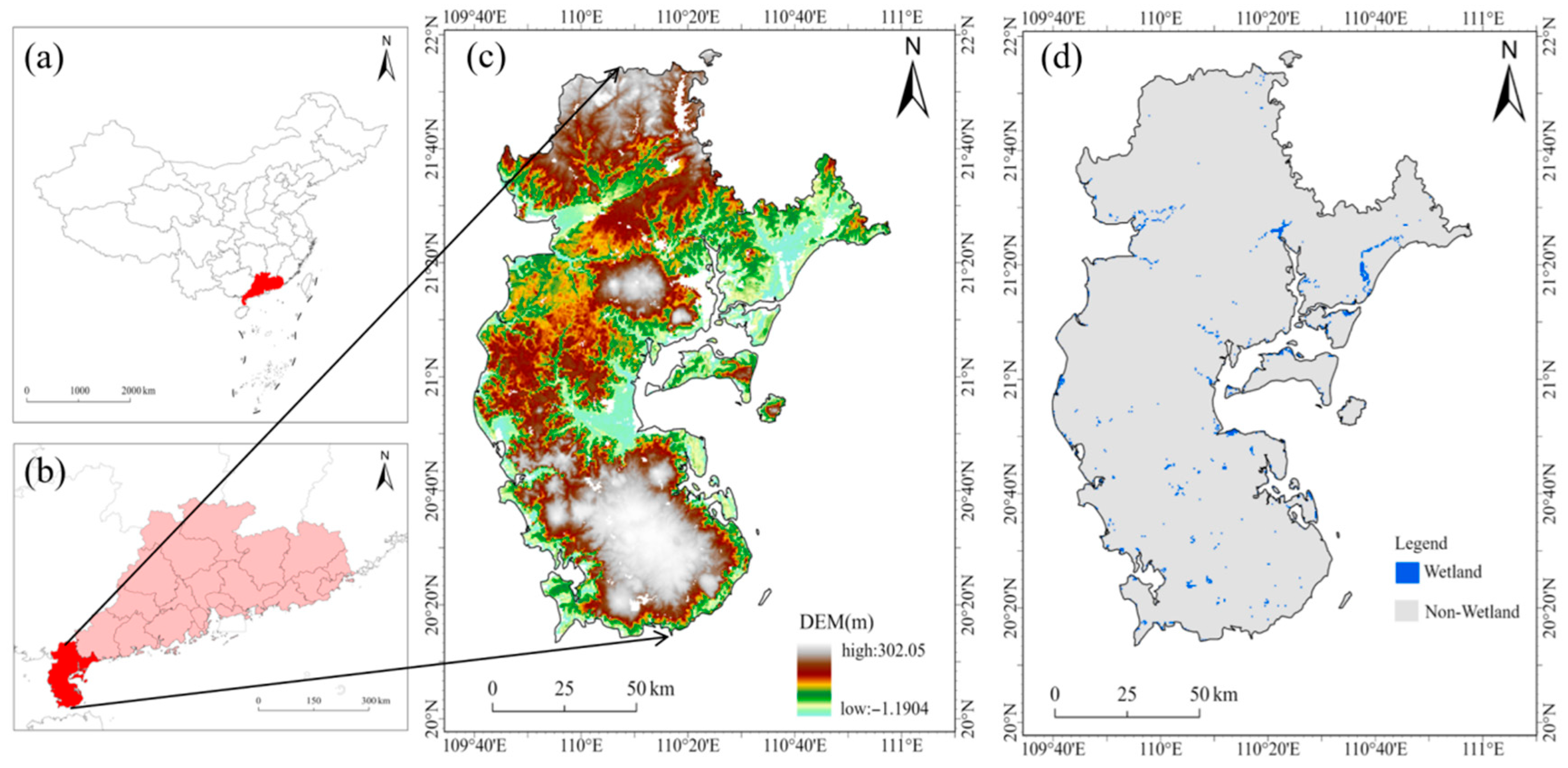
Zhanjiang, a pivotal prefecture-level city in southwestern Guangdong Province, is strategically situated at the southernmost tip of the Chinese mainland (20°12′–21°35′N, 109°31′–110°55′E; Figure 1). The city has a total administrative area of approximately 13,263.8 km2. However, due to the resampling of spatial data to a 500 m resolution and the exclusion of fragmented coastal edges during the rasterization process, the effective study area covered by the LULC and GPP datasets in this study is approximately 12,334.3 km2. Zhanjiang is characterized by generally low and gentle terrain, dominated primarily by plains. Climatically, Zhanjiang belongs to the monsoon climate of the northern tropical margin, featuring a mean annual temperature of approximately 23 °C, and a mean annual precipitation of roughly 1500 mm. Surrounded by the sea on three sides, the city boasts the longest continental coastline in Guangdong Province, stretching 1195.3 km.
This extensive coastline establishes Zhanjiang as a typical coastal city [32]. It has fostered the development of complex and diverse wetland ecosystems along the coastal zone, including tidal flats, estuarine deltas, and notably, the largest mangrove wetland in China [32,33,34]. These wetlands play indispensable roles in water conservation, regional climate regulation, and the maintenance of biodiversity.

2.2. Data

2.2.1. GPP Datasets

In this study, the GPP data were derived from the MODIS product suite. The algorithm underpinning this product relies on the original LUE logic proposed by Monteith to estimate GPP, which can be calculated using the following LUE model [35]:
GPP   =   ε   ×   ( IPAR   ×   FPAR )
where IPAR represents the incident photosynthetically active radiation ( MJ · m 2 ), FPARdenotes the fraction of photosynthetically active radiation absorbed by the vegetation canopy, and ε is the light use efficiency coefficient, which varies significantly across different vegetation types.
MODIS GPP data have been extensively utilized in fields such as global carbon cycle analysis, ecosystem status assessment, and environmental change monitoring [36,37,38]. Specifically, we selected the MOD17A2H V006 dataset, recognized as one of the four state-of-the-art global GPP products [39]. This dataset provides GPP estimates with a spatial resolution of 500 m and a temporal resolution of 8 days spanning from 2000 to the present. Its long temporal coverage renders it highly suitable for analyzing the spatiotemporal dynamics of GPP in Zhanjiang. To investigate the characteristics of spatiotemporal variations, we calculated both the multi-year mean and the 5-year moving average of GPP.

2.2.2. Other Datasets

The additional datasets utilized in this study are summarized in Table 1. Drawing upon previous research [40] and considering data availability, these driving factors are categorized into three groups: Climate Datasets, Anthropogenic Activity Datasets, and Topographic & LULC Datasets. To ensure spatial consistency with the dependent variable (GPP, 500 m), all driving factors were standardized to a unified resolution of 500 m. Specifically, high-resolution data (e.g., DEM, 30 m) were resampled to 500 m to represent the average grid status, effectively reducing local noise. Low-resolution climate data (e.g., 4 km) were also resampled to 500 m to match the grid system. Given the flat terrain of Zhanjiang [41], climatic factors exhibit strong spatial autocorrelation with smooth transitions; thus, the potential error introduced by resampling is considered minimal. Furthermore, since the Geodetector model requires the discretization of continuous variables into categories (strata) [22], the influence of pixel-level resampling uncertainties on the final q-value is significantly mitigated.
The Climate Datasets encompass annual average temperature (TAVG), precipitation (PRCP), and solar radiation (SRAD). These variables were derived from the TerraClimate dataset via the GEE platform. TerraClimate is a global monthly climate and climatic water balance dataset [42] that provides high-spatial-resolution data (originally 4 km) on maximum temperature, precipitation, and downward surface shortwave radiation. These data were employed to assess the impacts of climate variability on GPP dynamics.
The Anthropogenic Activity Datasets comprise population density (Pop) and nighttime light (NTL) data. The NTL data were sourced from the Global NPP-VIIRS-like nighttime light (2000–2023) dataset [43], which offers consistent long-term monitoring of anthropogenic activity intensity. The population density data, with a fine resolution of 100 m for Zhanjiang, were acquired from the WorldPop project (https://hub.worldpop.org (accessed on 10 November 2025)) via the GEE platform.
The Topographic & LULC Datasets consist of Land Use/Cover Change (LULC) data and three topographic variables: Elevation, Slope, and Aspect. The LULC data were derived from the GLC_FCS30D product (Global 30 m Land-Cover Dynamics monitoring product), which was generated using dense time-series Landsat imagery with a fine classification system. Considering the specific focus of this study and referring to previous classification schemes [44], the land use types were reclassified into six categories: Marsh, Forest, Shrubland & Grassland, Cropland, Impervious surfaces, and Water body. The topographic variables were extracted from the global Digital Elevation Model (DEM) acquired by the NASA Shuttle Radar Topography Mission (SRTM) [45]. With an original resolution of 30 m, these data were used to evaluate the influence of geographical terrain characteristics on the spatiotemporal distribution of GPP.
Table 1. Overview of data sources, spatial and temporal resolutions, and periods used in the study.
DatasetDataAbbreviationSpatial ResolutionTemporal ResolutionPeriodData Source
GPP DatasetsGross Primary ProductivityGPP500 m8-Day2001–2020GEE:MOD17A2H V006
Climate DatasetsAverage TemperatureTAVG4 kmMonthlyGEE:TerraClimate (IDAHO_EPSCOR/TERRACLIMATE)
PrecipitationPRCP
Solar RadiationSRAD
Anthropogenic Activity DatasetsPopulation DensityPop100 mAnnualGEE:WorldPop (https://hub.worldpop.org, accessed on 10 November 2025)
Nighttime LightNTL500 mMonthlyGlobal NPP-VIIRS-like nighttime light (2000–2023) Datasets [43]
Topographic &LULC DatasetsLand Use and Land CoverLULC500 mAnnualGLC_FCS30D
ElevationElevation30 mN\A2000NASA SRTM Digital Elevation 30 m [45]
SlopeSlope
AspectAspect

2.3. Methods

2.3.1. Sen’s Slope Estimation

To accurately quantify the interannual variation trends of GPP in Zhanjiang from 2001 to 2020 at the pixel scale, this study employed the Theil-Sen slope estimator [26,40], implemented via the PyCharm (version 2025.1.1.1) platform. As a robust non-parametric statistical technique, this method demonstrates high robustness against measurement errors and outliers, rendering it highly reliable for the analysis of long-term remote sensing time series data [46]. The calculation formula is expressed as follows:
  S gpp = Median ( GPP j GPP i j i ) ,   1   i     j     n
where GPP i and GPP j represent the GPP observational values in years j and i, respectively; and n denotes the length of the time series (in this study, n = 20).The calculated slope ( S gpp ) reflects the changing trend of GPP: a positive value( S gpp > 0) indicates an increasing trend over time, a negative value ( S gpp < 0) signifies a decreasing trend, and a zero value implies no significant trend during the study period.

2.3.2. Mann–Kendall Significance Test

Complementing the slope estimation, the Mann–Kendall (MK) statistical test was employed to determine the significance of the Sen’s slope estimation results. As a non-parametric time series trend test, the MK method is distinguished by its independence from data distribution assumptions (i.e., it does not require data to follow a normal distribution) and its robustness against missing values and outliers [47]. This test is pivotal for ascertaining whether the GPP trends exhibit monotonicity (i.e., a consistent increasing or decreasing trend) and serves to reinforce the validation of the Sen’s slope estimates. Consequently, the MK test has been extensively applied in disciplines such as hydrology, ecology, and meteorology [48,49].
Let the time series variables be denoted as x 1 ,   x 2 ,   x 3 ,   . . . ,   x n . The sign function sgn ( x j x i ) is calculated as follows:
sgn ( x j x i ) = 1 ,   x j x i > 0 0 ,   x j x i = 0 1 ,   x j x i < 0
The test statistic S is calculated as:
S   = i = 1 n 1 j = i + 1 n sgn ( x j x i )
The standardized test statistic Z, used for trend testing, is computed using the following formula (where Var(S) represents the variance of S):
Z = S Var ( S )   ( S > 0 ) 0 ( S = 0 ) S + 1 Var ( S )   ( S < 0 )
To comprehensively evaluate the spatiotemporal dynamics of GPP, this study conducted a spatial superposition analysis integrating Sen’s slope S gpp with the MK test results. Specifically, S gpp quantifies the magnitude and direction of the GPP time series changes, while the MK test assesses the statistical significance of these trends.
In this study, the p-value served as the core metric for determining significance, with two critical thresholds established: When p < 0.05 (|Z| > 1.96),the trend is considered statistically significant (passing the 95% confidence level). When p < 0.01 (|Z| > 2.58), the trend is considered highly significant. Drawing upon established paradigms for long-term vegetation remote sensing analysis [50], the GPP variation trends in Zhanjiang were categorized into five distinct classes based on the sign of S gpp (indicating increase or decrease) and the significance levels defined by the p-values. The detailed classification criteria are presented in Table 2.

2.3.3. Land Use Transfer Matrix

The Land Use Transfer Matrix serves as a robust quantitative analytical tool rooted in system analysis. By employing a two-dimensional matrix format, it effectively captures the detailed processes of areal gains, losses, and inter-category transitions within the study period. Specifically, the rows of the matrix represent the land use structure at the initial stage, while the columns denote the structure at the final stage [51,52]. This method quantifies the area of mutual transformation between land use categories, thereby revealing the primary trajectories of land use change. The calculation formula is as follows:
S ij = S 11 S 12 S 1 n S 21 S 22 S 2 n S n 1 S n 2 S nn
where S ij represents the area transferred from land use type i at the beginning of the study period to land use type j at the end; n denotes the total number of land use types (in this study, n = 6); and i and j represent the land use types at the initial and final stages, respectively.

2.3.4. Geodetector

The Geodetector is a novel statistical method designed to detect spatial heterogeneity and reveal the underlying driving factors [53]. It comprises four modules: the Factor Detector, Ecological Detector, Risk Detector, and Interaction Detector [54]. As this study primarily focuses on quantitatively assessing the explanatory power of natural and anthropogenic factors on the spatiotemporal dynamics of GPP, as well as the interactions among these drivers, we utilized the Factor Detector and Interaction Detector implemented via R Studio (version 4.5.1). Since the Geodetector requires independent variables to be categorical (discrete) [21], the continuous variables used in this study (e.g., TAVG, PRCP) were discretized into five classes using the Jenks Natural Breaks classification method [22].
The Factor Detector serves as the core component of the Geodetector, employed to quantify the explanatory power and relative importance of independent variables (driving factors) on the dependent variable (GPP) [55]. This detector uses the q-statistic to measure the influence of factors; a higher q-value indicates a stronger explanatory power of the factor regarding the spatial differentiation of GPP. This study utilized this detector to identify and rank the dominant drivers of GPP spatiotemporal changes. The q-value is calculated as follows:
q   =   1 SSW SST = 1 h = 1 L N h σ h 2 N σ 2
where h = 1, …, L represents the strata of the driving factors; N h and N denote the number of pixels in stratum h and the entire study area, respectively; σ h 2 and σ 2 represent the variance of GPP within stratum h and the whole region, respectively. SSW and SST denote the sum of squares within strata and the total sum of squares of the study area, respectively. The value of q ranges from [0, 1], where a larger value signifies a stronger capability of the driving factor to explain the spatial heterogeneity of GPP.
While the Factor Detector reveals the individual contribution of a specific driver, it fails to account for the interactions between factors [56]. The Interaction Detector is designed to identify the interactive effects between two factors (S1 and S2) on the dependent variable. Specifically, it assesses whether the combined action of S1 and S2 enhances or attenuates the explanatory power for GPP, or if their effects are independent [54]. This analysis helps to uncover the intrinsic relationships among factors driving the variations in GPP.

3. Results

3.1. Spatiotemporal Distribution and Evolution Characteristics of GPP

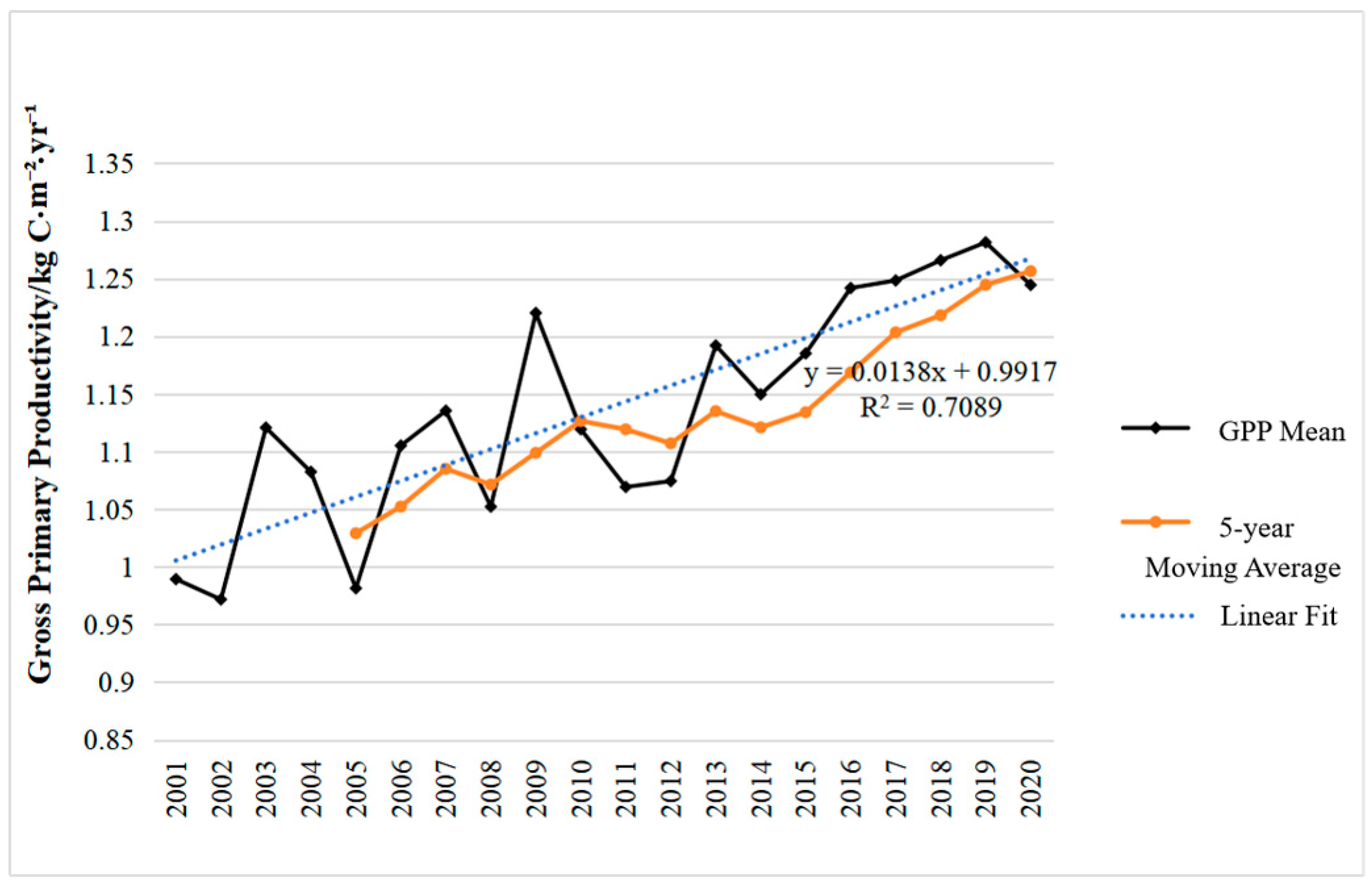
To elucidate the variation characteristics of GPP in Zhanjiang from 2001 to 2020, a linear regression analysis was conducted. The results indicate that the annual GPP in Zhanjiang exhibited an overall upward trend, increasing at an average rate of approximately 13.8   g   C · m 2 · yr 1 (Figure 2), with an R2 of 0.7089. Simultaneously, the 5-year moving average showed a steady increase, generally consistent with the growth trend of the linear fit. During the study period, the maximum GPP value was observed in 2019, while the minimum occurred in 2002. Specifically, the GPP trajectory from 2001 to 2010 was characterized by a fluctuating upward trend (oscillating rise), whereas the growth from 2011 to 2020 was relatively stable.
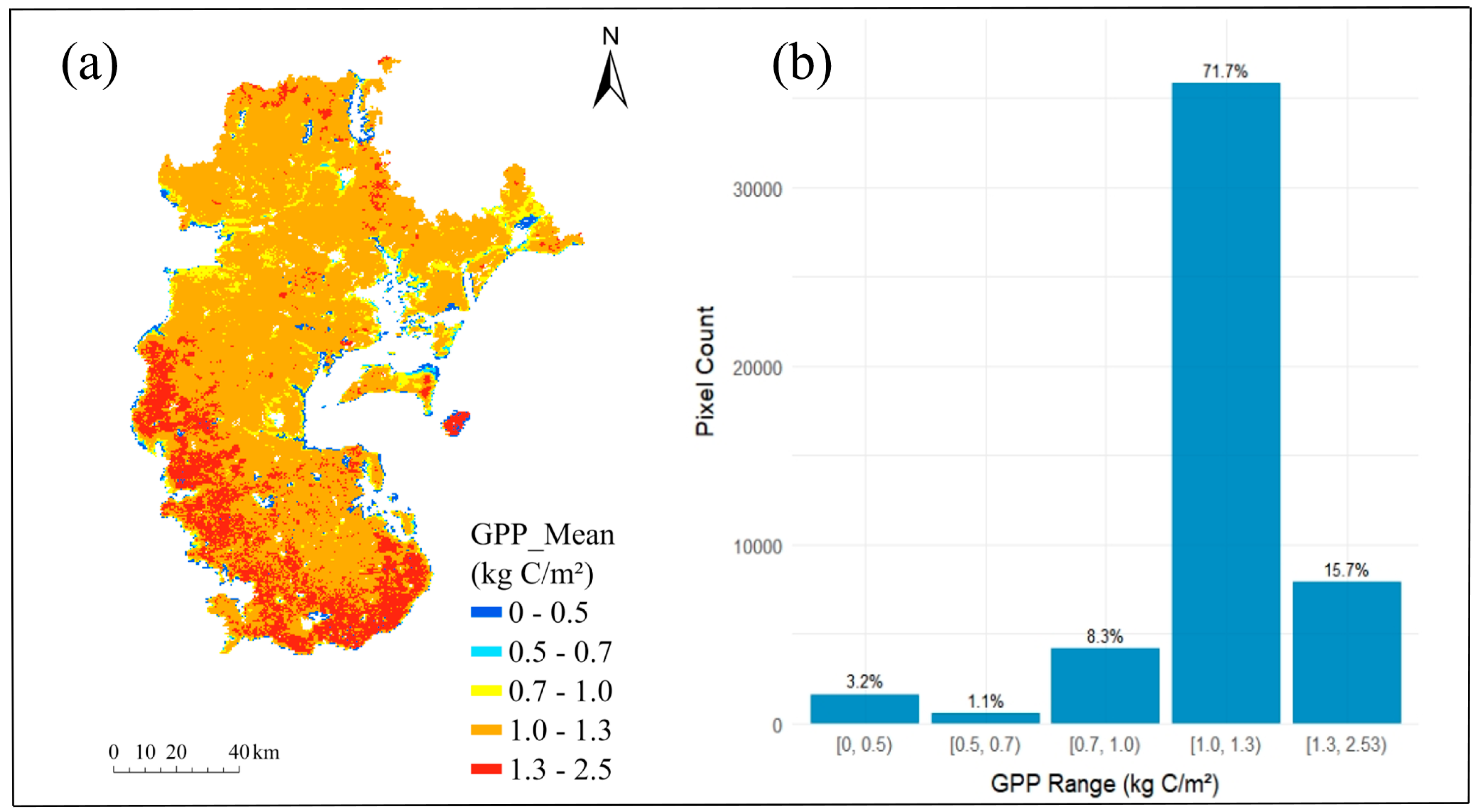
The spatial distribution of the multi-year average GPP in Zhanjiang (2001–2020) is illustrated in Figure 3a. The results reveal significant spatial heterogeneity in GPP distribution: high values are predominantly concentrated in the majority of the southwestern region and parts of the southeastern region, while low values are mainly distributed in the coastal zones. As shown in the statistical data (Figure 3b), 71.7% of the average GPP values fall within the range of 1.0–1.3 kg   C · m 2 , indicating a highly concentrated distribution of mean GPP across most areas of Zhanjiang.
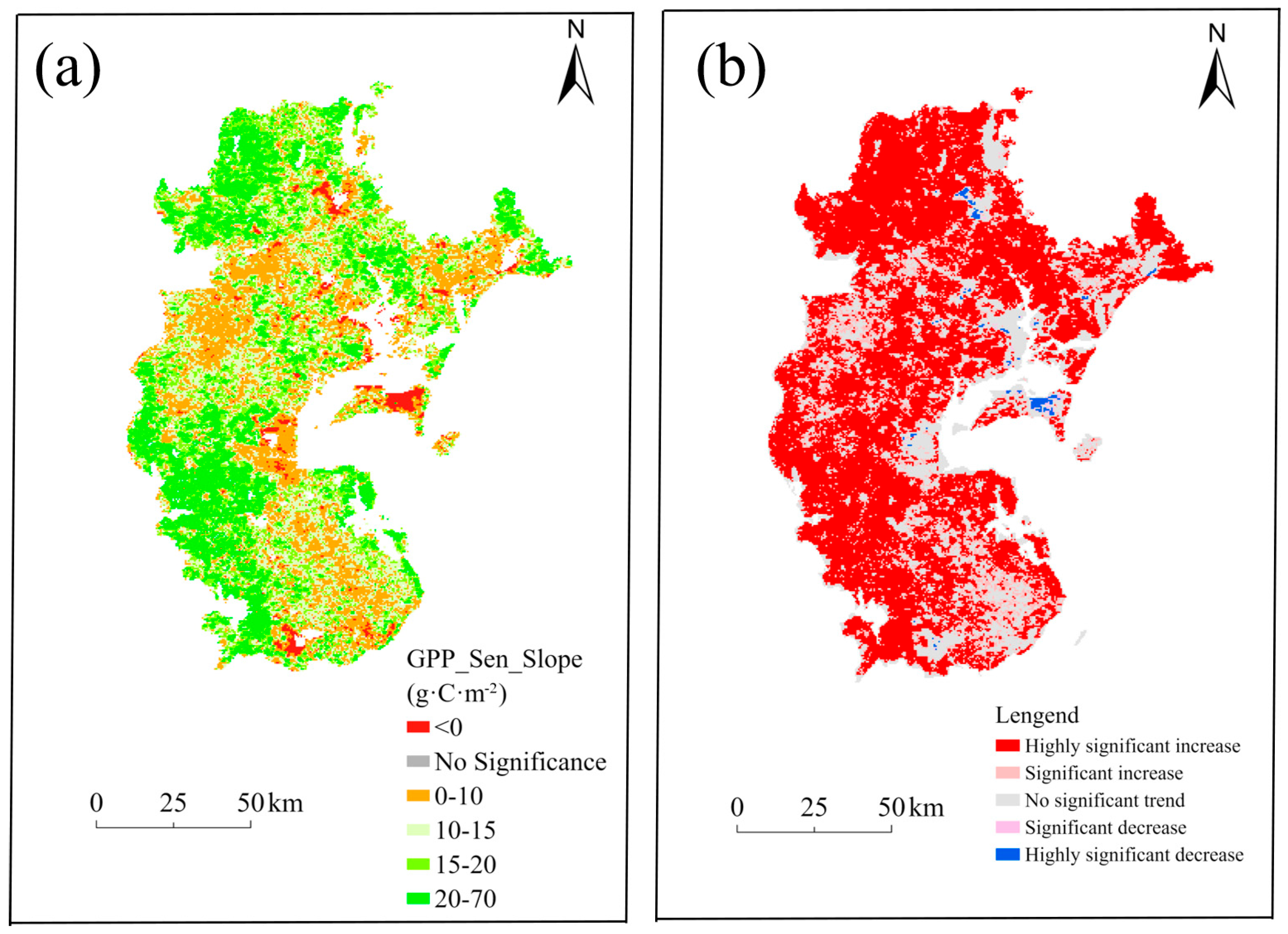
Figure 4a depicts the spatial distribution of GPP growth rates derived from Sen’s slope analysis. It is evident that the GPP growth rate in most parts of Zhanjiang remained above 10 g   C · m 2 , and in regions with high total GPP, the growth rate largely exceeded 20 g   C · m 2 . Figure 4b illustrates the significance levels of GPP changes from 2001 to 2020 based on the Mann–Kendall test. The results show that 58.8% of the area exhibited a highly significant increase, and 11% showed a significant increase. Areas with no significant change accounted for 29.54%, while those with significant and highly significant decreases accounted for only 0.24% and 0.41%, respectively. The regions with decreasing trends were sporadically distributed, mainly in the central part of Donghai Island in the east and small patches in the north. These findings demonstrate that vegetation productivity in the vast majority of Zhanjiang experienced a significant enhancement during the study period.

3.2. Land Use Dynamics and Coastal Wetland Evolution

3.2.1. Land Use Transitions

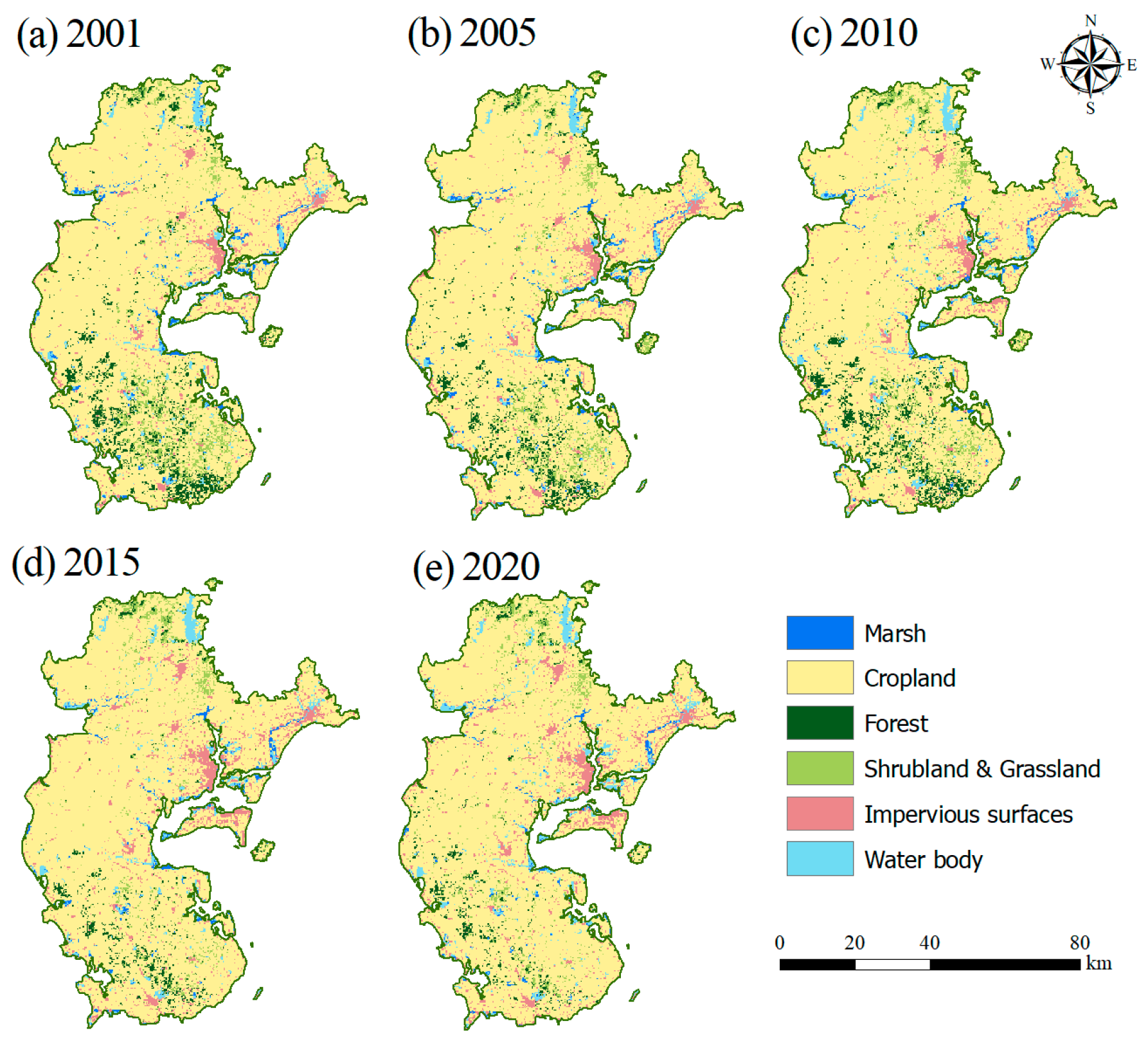
This study utilized the land use transfer matrix to analyze the spatial distribution, dynamic changes, and inter-category transitions of land use types in Zhanjiang. As illustrated in Figure 5, the landscape of Zhanjiang is predominantly composed of Cropland, which accounted for 82.46% of the total area in 2020, establishing it as the absolutely dominant category. Spatially, across all time periods, Cropland and Forest were characterized by contiguous and concentrated distributions, while Impervious surfaces exhibited clustered, point-like patterns located in proximity to the coastline. Marsh was primarily distributed along coastal tidal flats. According to the areal statistics derived in this study (Appendix A Table A1), the areas of Impervious surfaces, Cropland, and Marsh shifted from 553.6 km2, 9976.7 km2, and 296.9 km2 in 2001 to 844.0 km2, 10,171.3 km2, and 211.6 km2 in 2020, respectively.
To more clearly assess the net change trends of various land use types during the study period, the gains and losses for each category were calculated. Table 3 details the land use transfer matrix for the study area from 2001 to 2020. The results indicate that Impervious surfaces and Cropland were the two most significantly expanding categories over the two decades. Specifically, the area of Impervious surfaces grew from 553.58 km2 to 844.00 km2, representing a net growth of 290.42 km2,which signifies that Zhanjiang is undergoing a phase of rapid urbanization. Concurrently, the three natural ecosystems—Forest, Shrubland & Grassland, and Marsh—all exhibited a net decreasing trend. Among them, Forest experienced the most severe area loss, with its total area plummeting from 608.38 km2 to 259.14 km2, resulting in a net loss as high as 349.24 km2.
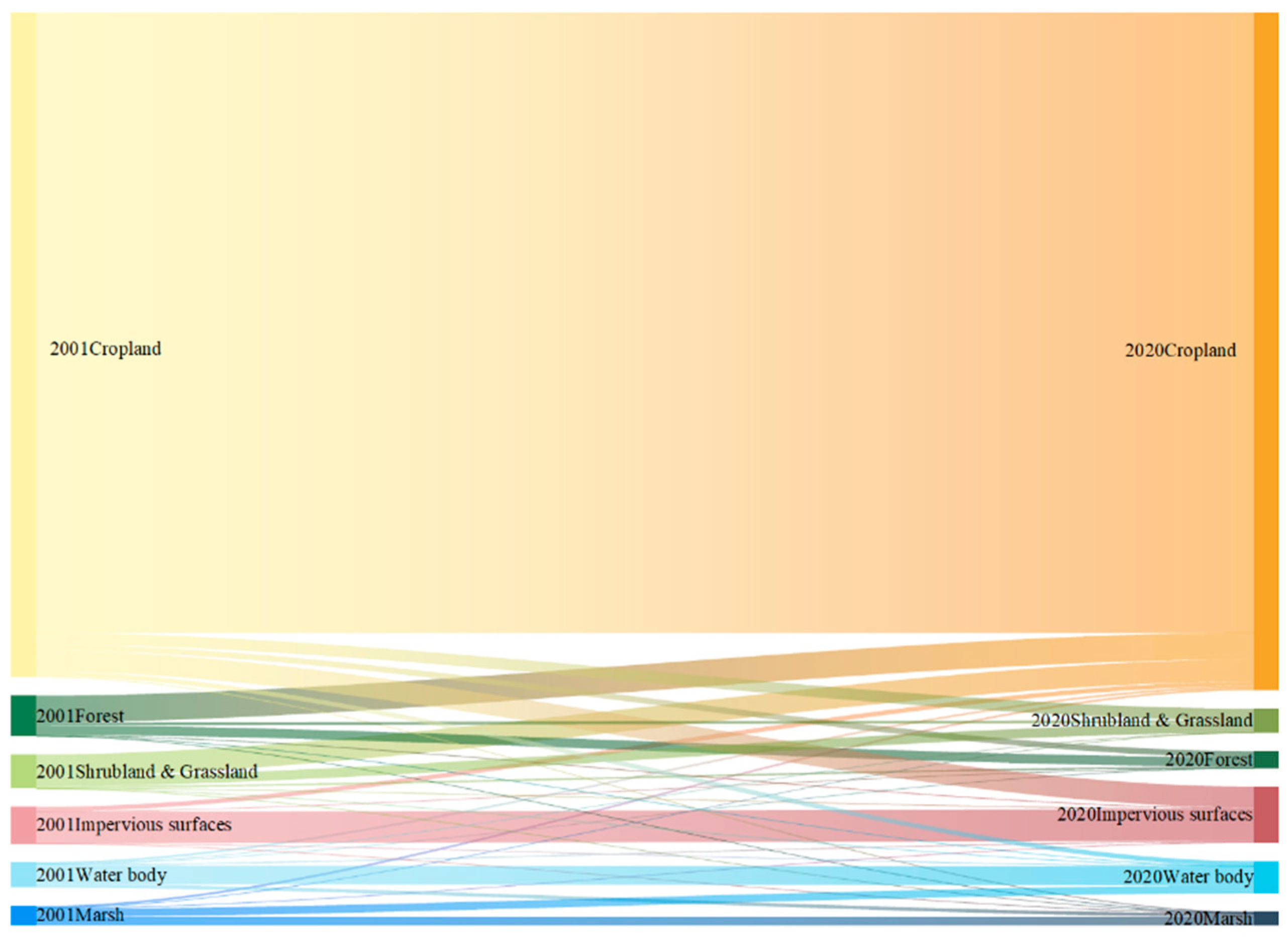
To visually reveal the complex spatiotemporal transition paths and fluxes between land use types, a Sankey diagram of land use transfer from 2001 to 2020 was plotted (Figure 6). Together, the Sankey diagram and the transfer matrix demonstrate that the primary characteristic of land use transition was the large-scale encroachment of urban construction and agricultural lands upon ecological lands. The most significant transition paths included the reclamation of forest and grassland, as well as urban expansion.
As the ecological focal point of this study, Marsh dynamics also presented complex transition patterns. During the study period, Marsh exhibited an overall net decrease of 85.26 km2. Its primary outflow path was the conversion to Water bodies, amounting to 120.38 km2. However, this loss was partially offset by inflows from other sources. The significant bidirectional conversion between Marsh and Water bodies, combined with the massive unidirectional transfer from Forest and Shrubland to Cropland, collectively reveals the expansion trends of agricultural and urban lands and the immense recessionary pressure faced by natural ecosystems in Zhanjiang under the backdrop of rapid development over the past 20 years.
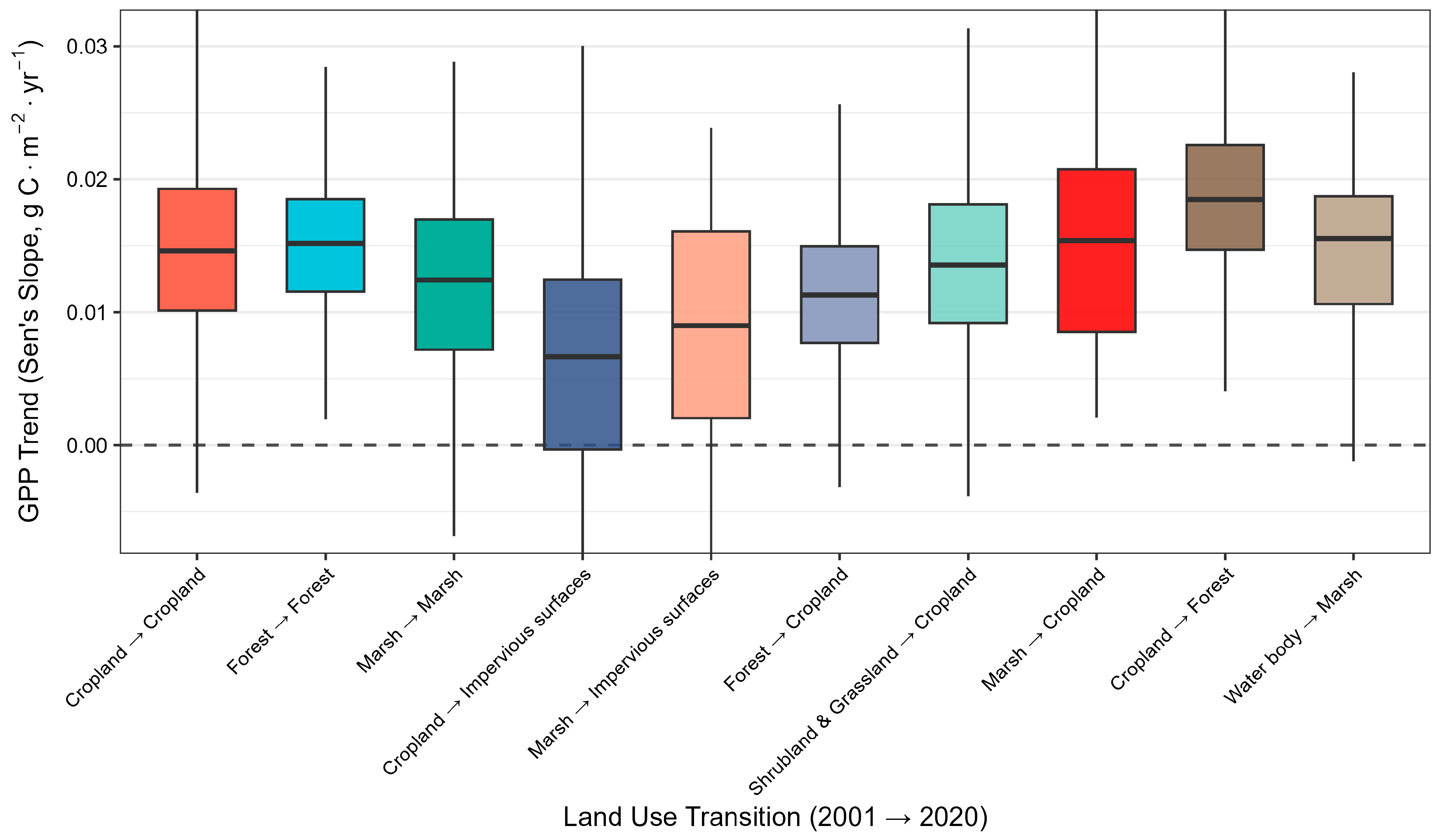
To further elucidate the impact of land use dynamics on ecosystem function, we analyzed the GPP trends associated with ten major land use transition types (Appendix A Figure A2). The results revealed significant heterogeneity in GPP responses driven by different transition trajectories. Specifically, urbanization exerted a suppressive effect on GPP growth; the transition from Cropland to Impervious Surfaces exhibited the lowest median growth rate (~0.007 g C∙m−2∙yr−1) among the changing categories, significantly lower than that of stable Cropland (~0.015 g C∙m−2∙yr−1). In contrast, agricultural expansion demonstrated a strong positive driving force. Notably, the conversion of Marsh to Cropland showed a high GPP growth rate (median ~0.015 g C∙m−2∙yr−1), surpassing even stable wetlands. This quantitative evidence validates the “pseudo-growth” effect discussed later.

3.2.2. Evolution of Coastal Wetlands

Drawing on prior research in the coastal zone domain [57], this study defined coastal wetlands as pixels with an elevation below 10 m (based on DEM data) and classified as wetland land use types.
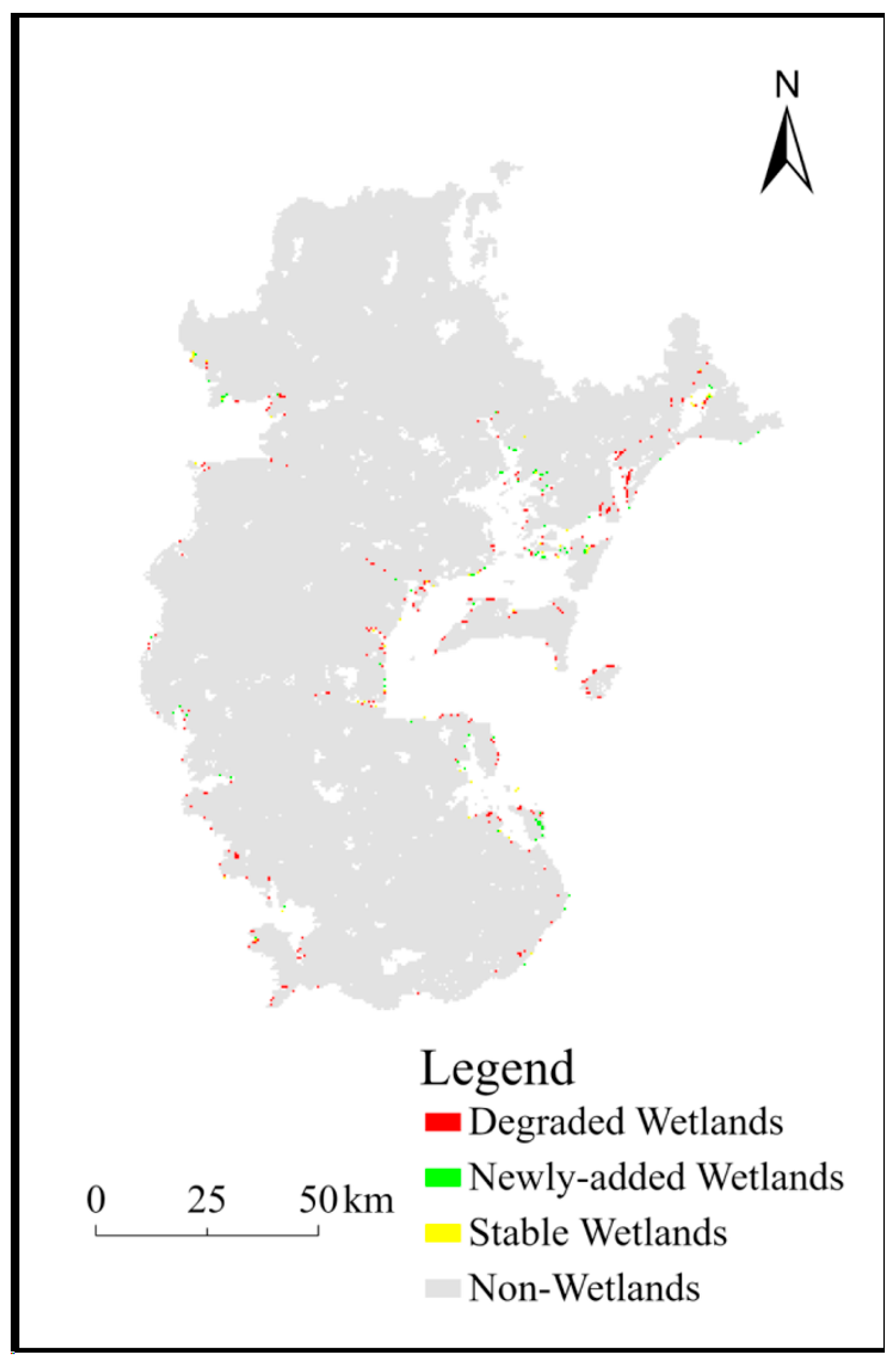
To investigate the specific impacts of coastal wetland evolution on ecosystem function (GPP) in Zhanjiang, a spatial distribution map of “coastal wetland evolution types” was first constructed based on LULC data from 2001 and 2020 (Figure 7). Pixels within the study scope were categorized into four evolutionary types based on a Start-End Comparison strategy between the initial (2001) and final (2020) states. Specifically, the classification rules are defined as follows: (1) ‘Stable wetland’ refers to pixels classified as wetland in both 2001 and 2020; (2) ‘Degraded wetland’ refers to pixels that were wetland in 2001 but converted to non-wetland by 2020; (3) ‘Newly formed wetland’ denotes pixels that converted from non-wetland in 2001 to wetland in 2020; and (4) ‘Non-wetland’ includes pixels that remained non-wetland throughout the start and end points. This approach captures the cumulative net change in wetland distribution over the two decades. The results show that coastal wetlands are mainly distributed in the western and eastern coastal regions. The areas of degraded, newly formed, and stable coastal wetlands were approximately 101.5 km2, 42 km2, and 94.25 km2, respectively. Notably, degraded wetlands accounted for 70.73% of the changed wetlands, indicating an overall trend of severe degradation in coastal wetlands.
Subsequently, a cross-tabulation analysis was conducted by spatially overlaying the wetland evolution layer with the GPP trend significance layer (from Section 3.1, Figure 4b) to quantitatively statistically analyze the proportions of GPP trend types within each wetland evolution category. As shown in the results (Table 4), 36.31% of the Degraded wetland area exhibited a highly significant increase in GPP, and 4.76% showed a significant increase, while the remaining 58.93% showed no significant change. This suggests that wetland degradation does not necessarily lead to a decline in GPP; conversely, GPP increased in certain degraded areas. In Newly formed wetlands, 54.68% of pixels showed an increase, indicating that nascent wetland ecosystems can rapidly develop their primary productivity. Meanwhile, 44.33% of Newly formed wetlands showed no significant change in GPP, with only 4 pixels exhibiting a decreasing trend. In Stable wetlands, 89.39% of the area showed no significant change in GPP, while the proportion of areas with a highly significant increase was 9.02%, indicating that the core wetlands preserved in Zhanjiang are in a stable and improving state.
Moreover, to reveal the drivers of the ‘pseudo-growth’ effect, we analyzed the land use transitions in degraded wetlands with increasing GPP. The results (Appendix A Table A2) show that 85.41% of these areas converted from marsh to shrubland/grassland, while 14.59% converted to croplands.

3.3. Analysis of Driving Factors for Spatiotemporal Differentiation of GPP

3.3.1. Geodetector Analysis of GPP Spatial Distribution

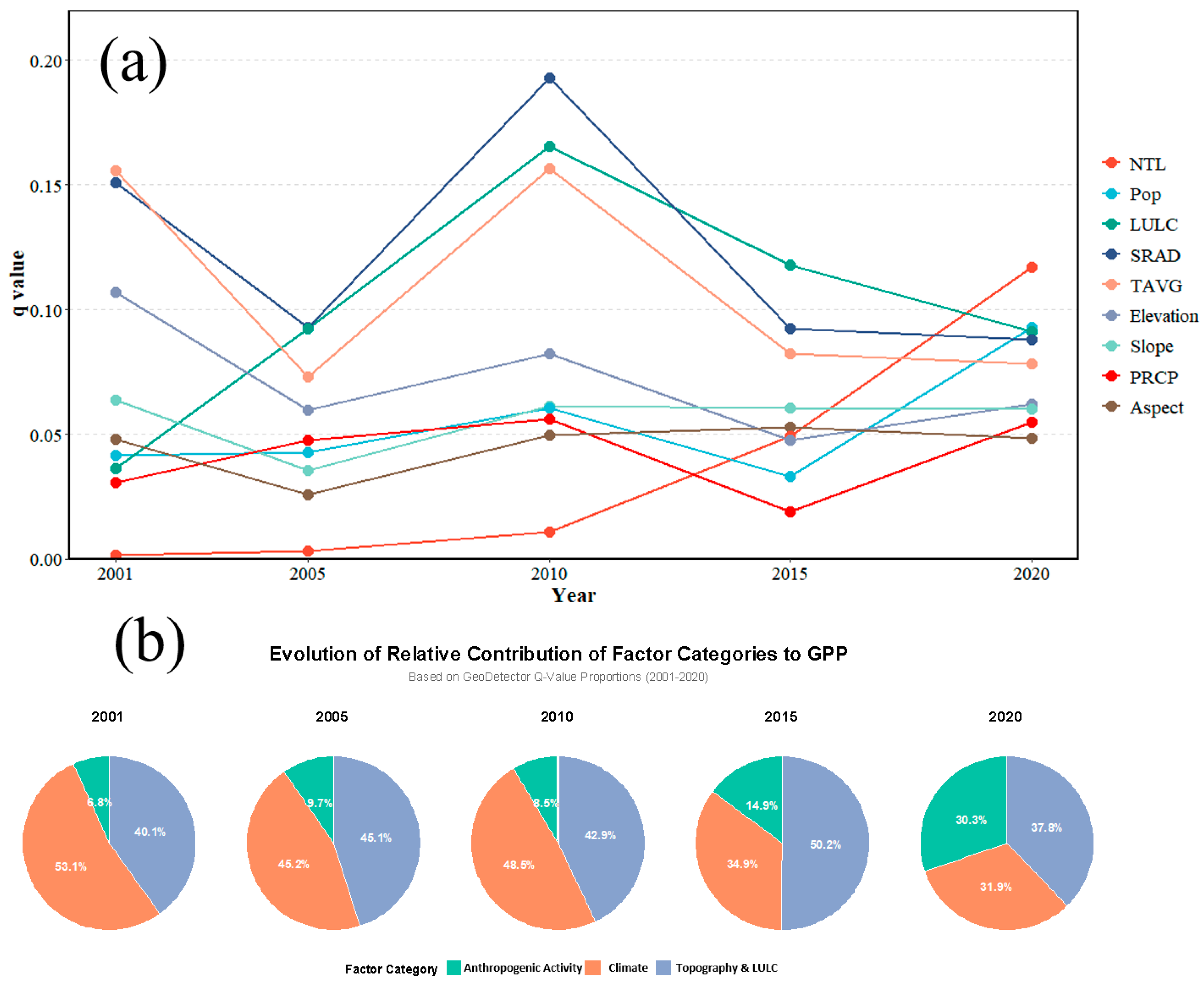
The results of the Factor Detector (Figure 8a) reveal the temporal evolution of the explanatory power (q-values) of different driving factors. Taking the results of 2020 as an example, the ranking of the explanatory power of each factor on GPP was: NTL (q = 0.117) > Pop (q = 0.093) > LULC (q = 0.091) > SRAD (q = 0.117) > TAVG (q = 0.078) > DEM (q = 0.062) > Slope (q = 0.060) > PRCP (q = 0.055) > Aspect (q = 0.049). The q-values for most factors were concentrated between 0.05 and 0.10. From the perspective of long-term changes (2001–2020), the influence of Anthropogenic Activity factors exhibited a sharp, accelerated growth. Notably, the q-value of the NTL surged from near 0 in 2001 to over 0.1 in 2020, emerging as the most influential independent variable, while Pop also showed moderate growth. Conversely, the influence of the three Climate factors experienced significant fluctuations over the two decades and showed an overall decline compared to 2001. Meanwhile, Topographic factors maintained a moderate influence intensity on vegetation productivity throughout the period.
An analysis of the long-term proportional influence of the three major categories—Anthropogenic Activity, Climate, and Topographic & LULC—is presented in Figure 8b. The results indicate that Anthropogenic Activity factors grew rapidly after 2010, accounting for nearly one-third of the total influence in 2020, which is more than four times that of 2001. Influenced by the rise in anthropogenic activity factors, the proportional influence of Climate factors gradually declined. Topographic factors showed a steady increase before 2015 but experienced a significant decline thereafter. Consequently, the overall pattern evolved from a structure dominated by Topographic & LULC factors and Climate (which was driven by the high individual rankings of temperature and precipitation rather than variable count, see Figure 8a) in 2001 to a new configuration where the influence of the three categories is relatively balanced.
To investigate whether the spatial differentiation of GPP is driven by multi-factor synergy, the Interaction Detector was further utilized. The results demonstrate that the interactions between all factor pairs manifested as either bivariate enhancement or nonlinear enhancement; no factors acted independently or weakened each other. This indicates that the spatial pattern of GPP in Zhanjiang is the result of complex coupling among multiple factors, rather than a simple linear superposition of single factors.
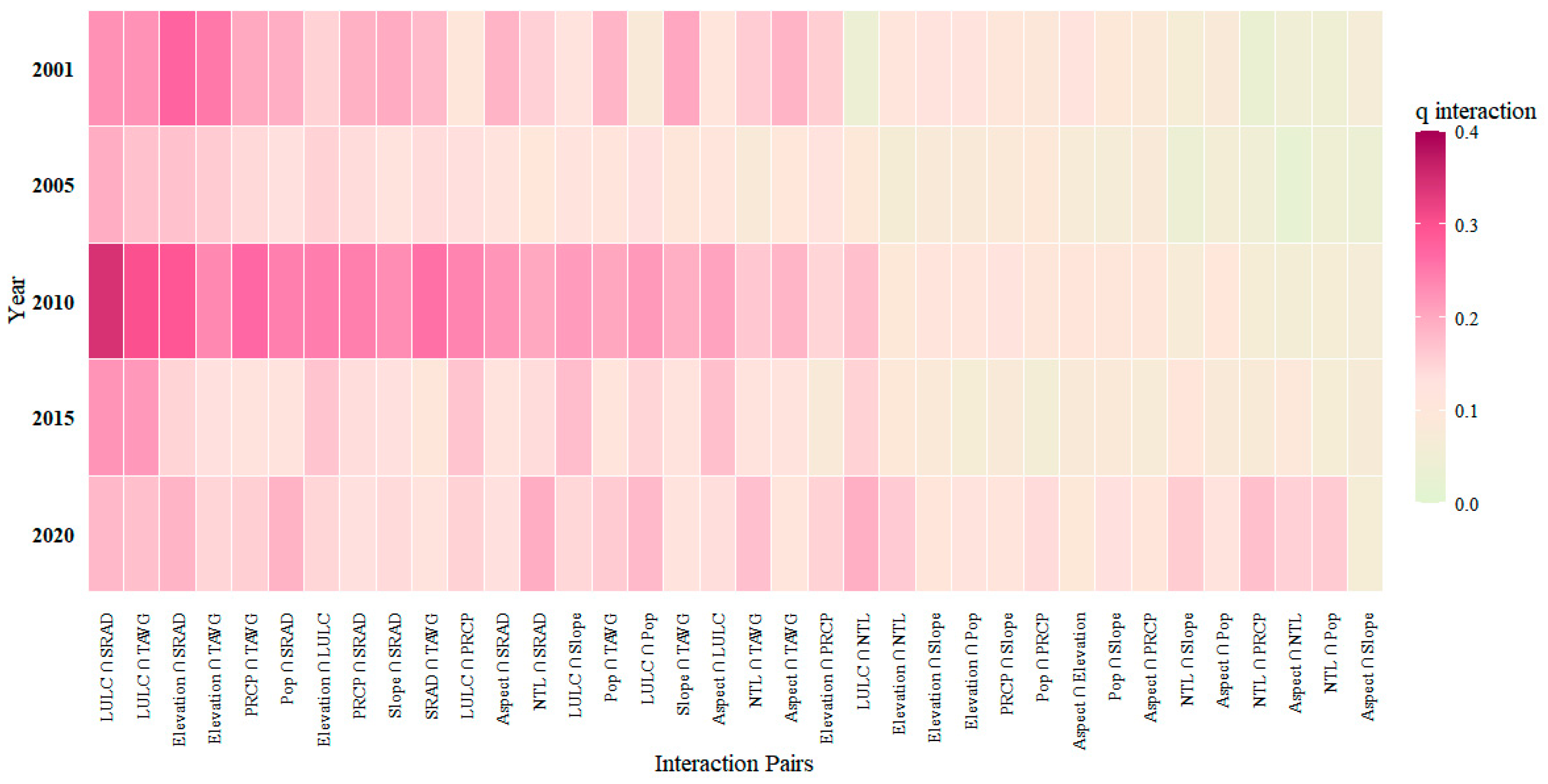
Furthermore, the evolution of the interaction influence pattern mirrored the results of the factor detection (Figure 9). In 2001, the strongest interactions were SRAD∩DEM (q = 0.274) and TAVG∩DEM (q = 0.252), dominated primarily by natural factors (Climate and Topography & LULC). This phenomenon persisted through 2005 and 2010, peaking in 2010 with SRAD∩LULC (q = 0.344). During this phase, the q-values for interaction terms involving human activities were relatively low. However, starting from 2015, the interactive effects of Anthropogenic Activity factors gradually developed, with NTL∩LULC (q = 0.151) appearing among the strong interactions. By 2020, the previous dominance of natural factors was fundamentally disrupted, with two of the top three interactions involving human activities: NTL∩SRAD(q = 0.195) and Pop∩SRAD(q = 0.189).

3.3.2. Analysis of Driving Factors for Coastal Wetland GPP Changes

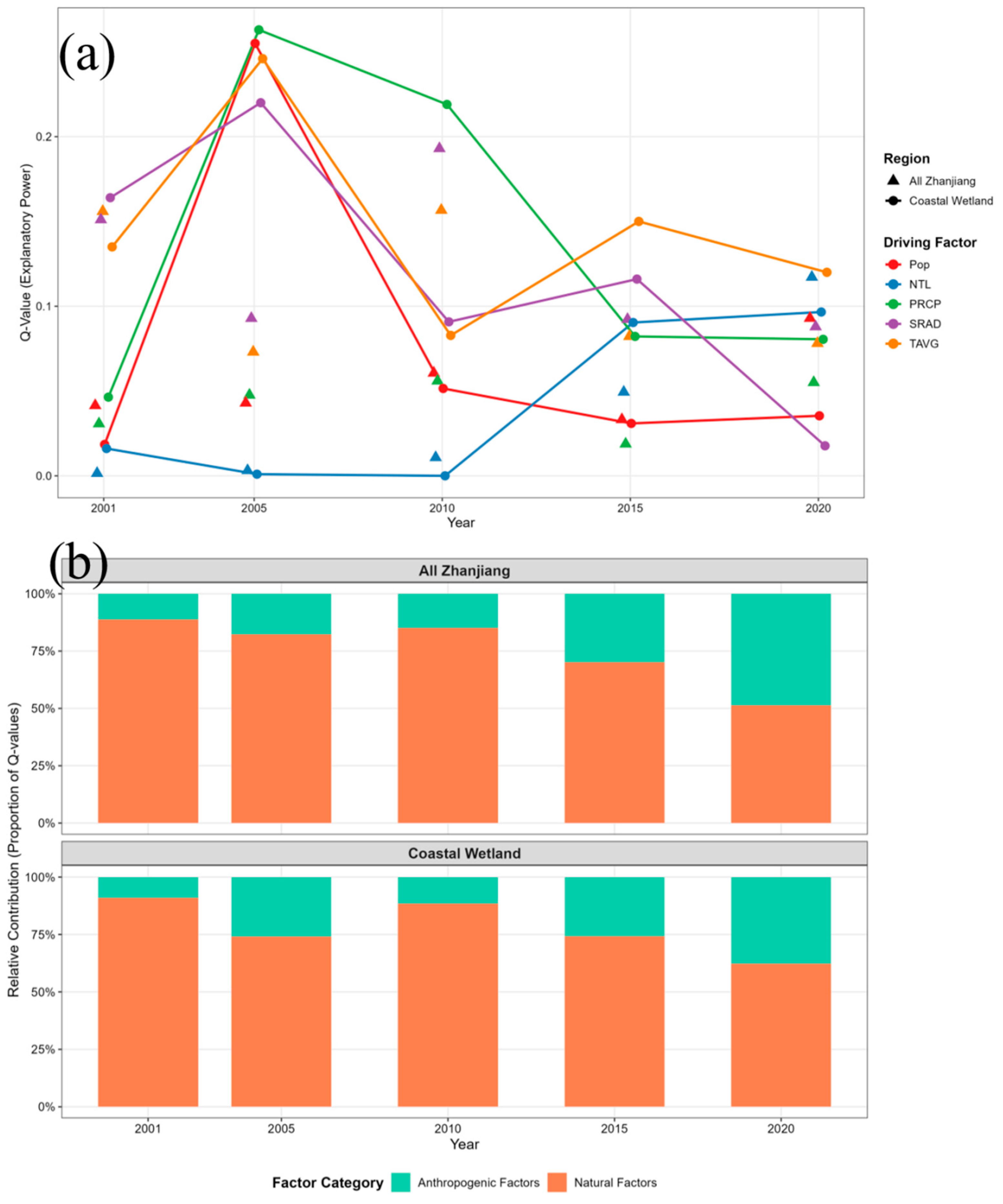
To unravel the mechanisms by which natural and anthropogenic factors co-drive GPP changes in coastal wetlands, this study utilized the coastal wetland data filtered from the wetland ecosystem. After excluding coastal wetlands (such as tidal flats) with zero GPP, the remaining wetland pixels were analyzed for driving factors in the years 2001, 2005, 2010, 2015, and 2020 using the Factor Detector and Interaction Detector (Appendix A Figure A1). Taking 2020 as an example, the ranking of driving forces (q-values) for the three natural factors and two socioeconomic factors on coastal wetland GPP changes was: TAVG (q = 0.120) > NTL (q = 0.0966) > PRCP (q = 0.0805) > Pop (q = 0.0354) > SRAD (q = 0.0177).
Comparing the q-value variations between the entire Zhanjiang city and its coastal wetlands reveals that the q-values for wetlands exhibited more pronounced fluctuations. In 2005, the q-values for all drivers of coastal wetlands, except NTL, showed a substantial increase, whereas the values for the whole city were lower in the same year. This suggests that in 2005, coastal wetlands were more sensitive in their response to human activities and natural disturbances. Unlike the characteristic continuous enhancement of socioeconomic factors in the whole city, coastal wetland GPP showed intense volatility in response to human interference. Population density (Pop) remained stable after a sharp rise in 2005, while NTL, similar to the city-wide trend, grew steadily after 2010. Among climate factors, TAVG consistently remained one of the primary drivers of GPP changes in coastal wetlands, while the driving forces of PRCP and SRAD gradually declined after 2005.
Additionally, the ratio of q-values between natural factors (PRCP, SRAD, TAVG) and socioeconomic factors (Pop, NTL) reveals both similarities and differences in the driving patterns between the whole city and coastal wetlands. The difference lies in the fact that, for the same year, the proportion of anthropogenic activity influence in the entire city was higher than that in the coastal wetlands, indicating that wetlands are less impacted by human activities compared to the city as a whole under similar conditions. The similarity is that both experienced significant fluctuations from 2001 to 2010; however, after 2010, the proportion of socioeconomic factors steadily increased. This indicates that while the driving force of human activities on coastal wetland GPP is continuously intensifying and the influence of climate is gradually diminishing, natural factors currently remain dominant.

4. Discussion

4.1. Spatiotemporal Evolution and Driving Mechanisms of GPP in Zhanjiang

This study revealed that GPP in Zhanjiang exhibited an overall upward trend from 2001 to 2020. This finding aligns with the increasing trends observed in the Enhanced Vegetation Index (EVI) and vegetation coverage in the Guangdong-Hong Kong-Macao Greater Bay Area over the past two decades [58], as well as similar patterns in other urban agglomerations, such as the Yangtze River Basin, where GPP significantly increased from 2000 to 2018 despite intense human activity [59]. However, this growth in GPP was spatially heterogeneous. While most regions showed an increasing trend—with higher growth rates in areas with higher mean GPP—regions with intense human activity, such as the northern urban area and parts of Donghai Island, experienced significant declines. This indicates that intense anthropogenic disturbances have counteracted the natural growth trend in certain areas, creating “productivity depressions.” This is consistent with findings from other scholars, who identified the expansion of impervious surfaces as a direct driver of net GPP loss [27].
Additionally, It is worth noting that while natural ecosystems in Zhanjiang exhibited a decreasing trend, the mean GPP continued to rise. This divergence is primarily attributed to the ‘Masking Effect’ of cropland dominance and agricultural intensification. With cropland accounting for over 82% of the study area, its expansion (+194.6 km2) and the enhancement of unit productivity through intensive management (e.g., fertilization and irrigation) have become the primary engines of GPP growth [60,61]. This anthropogenic driving force, as evidenced by the dominant explanatory power of the NTL factor in our Geodetector analysis, has effectively compensated for the biomass loss resulting from the degradation of natural ecosystems.
Regarding driving forces, a more critical discovery of this study is the shift in the dominant drivers of GPP spatial differentiation from natural factors to anthropogenic factors. Notably, the NTL factor leaped from being the weakest influence to the most dominant one. Taking 2020 as an example, the two factors with the strongest driving force on GPP were NTL and LULC Type. similar phenomena have been reported in other regions with high-intensity human activity. For instance, Guo et al. [54] found that in the Beijing-Tianjin-Hebei region (2000–2020), land use type and NTL data were the dominant drivers of GPP spatial differentiation.
This shift in driving mechanisms can be attributed to multiple layers of causes. First, the Geodetector model utilized in this study is essentially designed to explore the extent to which independent variables explain the spatial heterogeneity of dependent variables [21]. In this context, GPP exhibits high spatial heterogeneity. It is important to interpret the results within the context of spatial scale. Climatic factors, which are relatively homogeneous across the study area, act as a uniform ‘background condition’ that determines the potential capacity of vegetation growth. In contrast, anthropogenic and LULC factors are characterized by high spatial fragmentation and heterogeneity. Consequently, in terms of explaining the ‘spatial variance’ of GPP distribution within the city, these heterogeneous local factors demonstrate statistically stronger explanatory power than the broad-scale climatic gradients. Consequently, the Geodetector identified NTL and LULC as the primary drivers in 2020. Second, the land use transfer analysis indicates that Zhanjiang is undergoing rapid urbanization and agricultural expansion [30], which has intensified the heterogeneity of anthropogenic activity and LULC factors [62]. This enhanced heterogeneity allows these factors to exert a more profound influence on the spatial differentiation of GPP. As a result, the proportional contribution of anthropogenic drivers in Zhanjiang has shown a steady increasing trend.

4.2. Mechanisms of Coastal Wetland GPP Changes: The “Pseudo-Growth Effect” Induced by Remote Sensing Estimation Errors

By utilizing land use data to extract coastal wetlands and analyzing their evolutionary patterns, one of the most striking findings is that GPP in degraded wetlands did not show a significant decline. Contrarily, over one-third of the degraded wetland area exhibited a highly significant increase in GPP (Table 4), a result that appears counterintuitive. The mechanisms underlying this ‘pseudo-growth’ phenomenon are likely twofold, involving both remote sensing uncertainties and mixed-pixel effects.
First, the GPP of specific wetland subtypes, particularly tidal flats and sparse salt marshes, is often underestimated. While Zhanjiang possesses extensive mangroves, significant areas also consist of sparsely vegetated tidal flats. As noted by Mishra et al. [63] and Sims et al. [64], in these sparse ecosystems, the background water body absorbs near-infrared radiation, leading to lower EVI values and a subsequent underestimation of GPP by LUE-based models. This creates an artificially low baseline for these wetland areas.
Second, and crucially, the ‘overestimation’ caused by mixed pixels significantly contributes to the observed increase. Due to the 500 m resolution of MODIS, wetland pixels in the coastal ecotone are often mixed with adjacent high-productivity land cover types, such as mangroves or encroaching croplands. Since the photosynthetic capacity of these terrestrial or woody vegetation types is significantly higher than that of sparse salt marshes, their inclusion—even in small fractions—can artificially inflate the aggregate GPP of the pixel. Our pixel-based overlay analysis (Appendix A Table A2) provides quantitative evidence for this mechanism: 84.93% of these degradation areas underwent terrestrialization (marsh to shrubland/grassland), where the loss of water background enhances spectral signals [65], while 13.24% were converted to croplands, introducing high-biomass crops that artificially inflate GPP [66].
To quantitatively verify this mechanism and clarify the degradation sources, we conducted a supplementary attribution analysis by distinguishing degraded wetlands into “Mangrove Source” and “Non-Mangrove Source” (Appendix A Table A3). The results demonstrate that the degradation signal is overwhelmingly dominated by Non-Mangrove wetlands (Type B, e.g., tidal flats and salt marshes), which account for 93.4% of the total degraded area. Furthermore, the land use transition tracking (Appendix A Table A4) reveals a distinct pattern of “vegetation succession”: 85.04% of these non-mangrove wetlands were converted into Shrub/Grass, and 12.99% into Cropland. This confirms that the observed GPP surge is primarily driven by the “Terrestrialization” process, where sparse, frequently inundated tidal flats are replaced by dense terrestrial vegetation (e.g., invasive Spartina alterniflora or terrestrial weeds) with significantly higher photosynthetic capacity.
Consequently, the rising GPP trend in degraded zones does not necessarily indicate ecological recovery. Instead, it likely reflects a structural shift: the replacement of ‘underestimated’ sparse wetlands by (or their mixing with) ‘high-value’ components like mangroves or croplands, creating a statistical illusion of growth.

4.3. Implications, Limitations, and Future Perspectives

Based on the analysis of coastal wetland evolution and driving forces, the findings of this study carry strong cautionary implications for wetland management in Zhanjiang: (1) From 2001 to 2020, the area of coastal wetlands showed a continuous declining trend, making their protection and management imminent. (2) Assessments of wetland ecosystem health cannot rely solely on remote sensing-based GPP products. Managers must remain vigilant against the “pseudo-growth effect” of GPP caused by remote sensing errors and land use transitions (e.g., tidal flats converting to cropland). A comprehensive health assessment framework incorporating remote sensing indices [9,67], hydrological models [9], and ecosystem function indicators is required. (3) Conservation and management strategies must focus on driving forces. The results indicate that in typical coastal cities like Zhanjiang, the dominant driver of GPP has shifted from natural factors to anthropogenic factors. Therefore, management strategies must transition from passively adapting to climate change to proactively regulating land use and human activities. Strict controls should be imposed on urbanization [68], aquaculture expansion [8], and tourism development [69] to mitigate their destructive impacts on coastal wetlands.
However, this study has limitations. First, the 500 m resolution of the MOD17A2H V006 dataset is relatively coarse. As noted by Giri et al. [70] in mangrove monitoring, mixed pixels in fragmented coastal zones (blending wetland internals or wetland-water interfaces) make it difficult to precisely distinguish between tidal flats, mangroves, and salt marshes. Future research should incorporate higher-resolution remote sensing data to capture finer structural details. Therefore, it is crucial to acknowledge the combined uncertainty in the quantitative GPP estimation, where underestimation and overestimation may coexist. On one hand, as detailed in Section 4.2, the water background in tidal flats leads to an underestimation of GPP. On the other hand, due to the coarse resolution of MODIS (500 m), wetland pixels (especially along edges) are often mixed with adjacent high-productivity land covers. These include anthropogenic types (e.g., croplands) and high-biomass wetland types (e.g., mangroves). Since the photosynthetic capacity of these dense vegetation types is significantly higher than that of sparse tidal flats, their inclusion in a mixed pixel can artificially inflate the aggregate signal. Consequently, the GPP value of a pixel labeled as ‘wetland’ might be an overestimation relative to the sparse tidal flat it is meant to represent, masking the actual degradation signals. Second, the LUE model used in MODIS GPP estimation has uncertainties in sparse vegetation areas (e.g., tidal flats), leading to zero GPP values for some wetland pixels in this study, which interferes with the results. Although we standardized the spatial resolution of all variables to 500 m through resampling and utilized the discretization feature of the Geodetector to mitigate scale mismatch errors, the coarse resolution of climate data (4 km) may still fail to capture micro-climatic variations in specific local niches. Additionally, this study did not quantify specific wetland stress factors such as sea-level rise (which is spatially homogeneous at the city scale [71]), saltwater intrusion [41], tourism [69], and transportation infrastructure [72]. Future work should refine the driving factor system to include these variables for a more comprehensive assessment. Finally, while this paper provides scientific recommendations, GPP alone cannot fully reflect the true state of wetlands. Future research needs to construct a holistic assessment system to quantitatively study the functions and health status of coastal wetlands.

5. Conclusions

Taking Zhanjiang, a typical coastal city, as the study area, this paper analyzed the spatiotemporal variation characteristics of GPP and investigated the evolutionary trends of coastal wetlands during the study period. Furthermore, nine indicators selected from climate, anthropogenic, and topographic & LULC categories were utilized. The Geodetector model was employed to quantitatively analyze the explanatory power of these factors on the spatial differentiation of GPP and to explore the driving mechanisms of climate and anthropogenic factors on coastal wetland evolution. The main conclusions are as follows:
(1)
From 2001 to 2020, the GPP in Zhanjiang exhibited an oscillating upward trend characterized by strong spatial heterogeneity. The distribution pattern generally featured higher values in the southwestern and southern regions, and lower values in the northern and coastal areas. Vegetation productivity in the vast majority of the region maintained a growth trend, with a mere 0.65% of pixels showing significant or highly significant declining trends.
(2)
Coastal wetlands are primarily distributed in the western and eastern coastal zones of Zhanjiang and exhibited a continuous degradation trend. However, the overall coastal wetland landscape developed towards increasing GPP. This phenomenon is attributed to the conversion of degraded, low-GPP wetlands (e.g., tidal flats) into higher-GPP ecosystems, such as grasslands, during the transition process.
(3)
During the study period, Precipitation (PRCP), Temperature (TAVG), and LULC Type consistently served as the primary driving factors for the spatial differentiation of GPP in Zhanjiang. Notably, the Nighttime Light Index (NTL) developed rapidly over the two decades, surging to become a dominant factor. The explanatory power of anthropogenic factors (NTL, Population) showed a steady increase among all factors, indicating that under the backdrop of urbanization, human activities have gradually emerged as critical drivers of GPP spatial differentiation. Furthermore, the interaction detection results revealed that all interactions manifested as bivariate enhancement or nonlinear enhancement, demonstrating that the spatial differentiation of GPP is the result of multi-factor coupling. The driving mechanism evolved from an early “Climate–Topography” binary synergistic drive to a complex “Climate–Soil–Human” ternary composite pattern in the later period.
(4)
Regarding the driving forces of GPP spatial differentiation in coastal wetlands, NTL and LULC Type were identified as the strongest drivers, while TAVG remained the principal climatic factor. Overall, with the progression of global climate change and urbanization, the driving status of anthropogenic factors on coastal wetland GPP is gradually ascending; however, natural factors currently remain dominant.

Author Contributions

Conceptualization, methodology, software, formal analysis, data curation, visualization, writing—original draft preparation, Y.H.; conceptualization, methodology, validation, formal analysis, investigation, writing—original draft preparation, W.J.; resources, data curation, funding acquisition, writing—review and editing, J.W.; investigation, validation, funding acquisition, writing—review and editing, L.W.; conceptualization, resources, supervision, project administration, writing—review and editing, Y.L. All authors have read and agreed to the published version of the manuscript.

Funding

The research was supported by the Key program of National Natural Science Foundation of China (Grant No. 42330507, J. Wang).

Data Availability Statement

All data supporting the results reported in this article are available within the Section 2. The data used in this study are all available from public resources that have been appropriately cited within the manuscript.

Acknowledgments

The authors would like to express their gratitude to all those who helped with this work.

Conflicts of Interest

The authors declare no conflicts of interest.

Abbreviations

The following abbreviations are used in this manuscript:
GPPGross Primary Productivity
TAVGAverage Temperature
PRCPPrecipitation
SRADSolar Radiation
PopPopulation Density
NTLNighttime Light
LULCLand Use and Land Cover

Appendix A

Figure A1. Comparative analysis of GPP driving factors (Geodetector q-value) between the ‘All Zhanjiang’ region and the ‘Coastal Wetland’ ecosystem (2001–2020): (a) temporal evolution of the explanatory power for individual driving factors (Pop, NTL, PRCP, SRAD, TAVG); and (b) evolving relative contributions (proportion) of anthropogenic versus natural factor categories.
Remotesensing 18 00089 g0a1
Table A1. Changes in the area of each LULC type in Zhanjiang City from 2001 to 2020 (Unit: km2).
Unit: km2
Land Use Type20012005201020152020
Cropland9976.710,188.99980.210,204.610,171.3
Forest608.4438.3547.6277.9259.1
Impervious surfaces553.6630.7662.4822.9844.0
Marsh296.9297.0230.9236.3211.6
Shrubland & Grassland514.0432.6448.7341.3363.7
Water body384.8346.8464.4451.3484.5
Area12,334.312,334.312,334.312,334.312,334.3
Table A2. Matrix of dominant land use transition pathways for pixels exhibiting simultaneous wetland degradation and significant GPP increase (2001–2020).
2001 LULC_Type2020 LULC TypePixel CountPercentage (%)
MarshShrubland & Grassland23184.93
MarshCroplands3613.24
MarshImpervious surfaces31.10
MarshN/A20.70
Figure A2. Boxplots illustrating the response of GPP trends (Sen’s slope) to major land use transition types in Zhanjiang from 2001 to 2020. The center line represents the median, box limits indicate the upper and lower quartiles, and whiskers extend to 1.5 times the interquartile range. The dashed line at y = 0 indicates no trend.
Remotesensing 18 00089 g0a2
Table A3. Statistics of GPP trends in different types of degraded wetland pixels.
Degraded Wetland Source Type Total Pixels Pixels with Sig. Increase GPP Percentage (%)
Type A (Mangrove Source)181372.22
Type A (Non-Mangrove Source)25419074.80
Table A4. Land use transition directions (2020) for different types of degraded wetland pixels.
Source TypeDestination (LULC 2020)Percentage (%)
Type A (Mangrove Source)Shrublands & Grasslands83.33
Croplands16.67
Type A (Non-Mangrove Source)Shrublands & Grasslands85.04
Croplands12.99
Impervious Surface1.18
N/A0.79

References

  1. Barragán, J.M.; De Andrés, M. Analysis and trends of the world’s coastal cities and agglomerations. Ocean. Coast. Manag. 2015, 114, 11–20. [Google Scholar] [CrossRef]
  2. Bullock, A.; Acreman, M. The role of wetlands in the hydrological cycle. Hydrol. Earth Syst. Sci. 2003, 7, 358–389. [Google Scholar] [CrossRef]
  3. Acreman, M.; Joseph, H. How wetlands affect floods. Wetlands 2013, 33, 773–786. [Google Scholar] [CrossRef]
  4. Ji, P.; Su, R.; Wu, G.; Xue, L.; Zhang, Z.; Fang, H.; Gao, R.; Zhang, W.; Zhang, D. Projecting Future Wetland Dynamics Under Climate Change and Land Use Pressure: A Machine Learning Approach Using Remote Sensing and Markov Chain Modeling. Remote Sens. 2025, 17, 1089. [Google Scholar] [CrossRef]
  5. Hu, S.; Niu, Z.; Chen, Y.; Li, L.; Zhang, H. Global wetlands: Potential distribution, wetland loss, and status. Sci. Total Environ. 2017, 586, 319–327. [Google Scholar] [CrossRef]
  6. Barbier, E.B. Chapter 27—The Value of Coastal Wetland Ecosystem Services. In Coastal Wetlands, 2nd ed.; Gerardo, M.E., Perillo, E.W., Donald, R., Cahoon, C.S., Eds.; Hopkinson, Coastal Wetlands; Elsevier: Amsterdam, The Netherlands, 2019; pp. 947–964. ISBN 9780444638939. [Google Scholar] [CrossRef]
  7. Li, X.; Bellerby, R.; Craft, C.; Widney, S.E. Coastal wetland loss, consequences, and challenges for restoration. Anthr. Coasts. 2018, 1, 1–15. [Google Scholar] [CrossRef]
  8. Richards, D.R.; Friess, D.A. Rates and drivers of mangrove deforestation in Southeast Asia, 2000–2012. Proc. Natl. Acad. Sci. USA 2016, 113, 344–349. [Google Scholar] [CrossRef] [PubMed]
  9. He, K.; Zhang, Y.; Li, W.; Sun, G.; McNulty, S. Detecting coastal wetland degradation by combining remote sensing and hydrologic modeling. Forests 2022, 13, 411. [Google Scholar] [CrossRef]
  10. Chapin, F.S., III; Matson, P.A.; Mooney, H.A. Principles of Terrestrial Ecosystem Ecology; Springer: New York, NY, USA, 2002. [Google Scholar]
  11. Field, C.B.; Behrenfeld, M.J.; Randerson, J.T.; Falkowski, P. Primary production of the biosphere: Integrating terrestrial and oceanic components. Science 1998, 281, 237–240. [Google Scholar] [CrossRef]
  12. Baldocchi, D.; Falge, E.; Gu, L.; Olson, R.; Hollinger, D.; Running, S.; Anthoni, P.; Bernhpfer, C.; Davis, K.; Evans, R.; et al. FLUXNET: A new tool to study the temporal and spatial variability of ecosystem-scale carbon dioxide, water vapor, and energy flux densities. Bull. Am. Meteorol. Soc. 2001, 82, 2415–2434. [Google Scholar] [CrossRef]
  13. Reichstein, M.; Falge, E.; Baldocchi, D.; Papale, D.; Aubinet, M.; Berbigier, P.; Bernhofer, C.; Buchmann, N.; Gilmanov, T.; Granier, A.; et al. On the separation of net ecosystem exchange into assimilation and ecosystem respiration: Review and improved algorithm. Glob. Change Biol. 2005, 11, 1424–1439. [Google Scholar] [CrossRef]
  14. Running, S.W.; Nemani, R.R.; Heinsch, F.A.; Zhao, M.; Reeves, M.; Hashimoto, H. A continuous satellite-derived measure of global terrestrial primary production. Bioscience 2004, 54, 547–560. [Google Scholar] [CrossRef]
  15. Liao, Z.; Zhou, B.; Zhu, J.; Jia, H.; Fei, X. A critical review of methods, principles and progress for estimating the gross primary productivity of terrestrial ecosystems. Front. Environ. Sci. 2023, 11, 1093095. [Google Scholar] [CrossRef]
  16. Hu, J.; Liu, L.; Guo, J.; Du, S.; Liu, X. Upscaling solar-induced chlorophyll fluorescence from an instantaneous to daily scale gives an improved estimation of the gross primary productivity. Remote Sens. 2018, 10, 1663. [Google Scholar] [CrossRef]
  17. Nemani, R.R.; Keeling, C.D.; Hashimoto, H.; Jolly, W.M.; Piper, S.C.; Tucker, C.J.; Running, S.W. Climate-driven increases in global terrestrial net primary production from 1982 to 1999. Science 2003, 300, 1560–1563. [Google Scholar] [CrossRef] [PubMed]
  18. Evans, J.; Geerken, R. Discrimination between climate and human-induced dryland degradation. J. Arid Environ. 2004, 57, 535–554. [Google Scholar] [CrossRef]
  19. Beer, C.; Reichstein, M.; Tomelleri, E.; Ciais, P.; Jung, M.; Carvalhais, N.; Papale, D. Terrestrial gross carbon dioxide uptake: Global distribution and covariation with climate. Science 2010, 329, 834–838. [Google Scholar] [CrossRef]
  20. Reichstein, M.; Camps-Valls, G.; Stevens, B.; Jung, M.; Denzler, J.; Carvalhais, N.; Prabhat, F. Deep learning and process understanding for data-driven Earth system science. Nature 2019, 566, 195–204. [Google Scholar] [CrossRef]
  21. Wang, J.F.; Li, X.H.; Christakos, G.; Liao, Y.L.; Zhang, T.; Gu, X.; Zheng, X.Y. Geographical detectors-based health risk assessment and its application in the neural tube defects study of the Heshun Region, China. Int. J. Geogr. Inf. Sci. 2010, 24, 107–127. [Google Scholar] [CrossRef]
  22. Song, Y.; Wang, J.; Ge, Y.; Xu, C. An optimal parameters-based geographical detector model enhances geographic characteristics of explanatory variables for spatial heterogeneity analysis: Cases with different types of spatial data. GISci. Remote Sens. 2020, 57, 593–610. [Google Scholar] [CrossRef]
  23. Yin, S.; Du, H.; Mao, F.; Li, X.; Zhou, G.; Xu, C.; Sun, J. Spatiotemporal patterns of net primary productivity of subtropical forests in China and its response to drought. Sci. Total Environ. 2024, 913, 169439. [Google Scholar] [CrossRef]
  24. He, C.; Wang, Y.; Yan, F.; Lu, Q. Spatiotemporal characteristics and influencing factors of vegetation water use efficiency on the Tibetan Plateau in 2001–2020. J. Geogr. Sci. 2025, 35, 39–64. [Google Scholar] [CrossRef]
  25. Wang, B.; Kong, X.; Bian, S.; Quan, Y.; Wu, Z.; Liu, J.; Li, M. Evaluating the spatiotemporal patterns of GPP and tree growth for their response to CO2 fertilization effects in mid-latitude forests of China. Geo-Spat. Inf. Sci. 2025, 28, 2449–2461. [Google Scholar] [CrossRef]
  26. Chen, L.; Yu, S.; Shen, S.; Wan, Y.; Song, C. Spatial and Temporal Variation of GPP and Its Response to Urban Environmental Changes in Beijing. ISPRS Int. J. Geo-Inf. 2024, 13, 396. [Google Scholar] [CrossRef]
  27. Yang, M.; Xue, L.; Liu, Y.; Liu, S.; Han, Q.; Yang, L.; Chi, Y. Asymmetric response of vegetation GPP to impervious surface expansion: Case studies in the Yellow and Yangtze River Basins. Environ. Res. 2024, 243, 117813. [Google Scholar] [CrossRef]
  28. Osland, M.J.; Enwright, N.M.; Day, R.H.; Gabler, C.A.; Stagg, C.L.; Grace, J.B. Beyond just sea-level rise: Considering macroclimatic drivers within coastal wetland vulnerability assessments to climate change. Glob. Change Biol. 2016, 22, 1–11. [Google Scholar] [CrossRef] [PubMed]
  29. Wu, W.; Zhi, C.; Gao, Y.; Chen, C.; Chen, Z.; Su, H.; Lu, W.; Tian, B. Increasing fragmentation and squeezing of coastal wetlands: Status, drivers, and sustainable protection from the perspective of remote sensing. Sci. Total Environ. 2022, 811, 152339. [Google Scholar] [CrossRef] [PubMed]
  30. Zhao, J.Y.; Cui, L.; Wang, J.; Chen, S. Multi-scenario simulation of urban green space development and construction Timeline based on PLUS model analysis: A case study of the central Zhanjiang City. Acta Ecol. Sin. 2023, 43, 6307–6320. [Google Scholar]
  31. Cheng, X.L.; Cubino, J.P.; Balfour, K.; Zhu, Z.X.; Wang, H.F. Drivers of spontaneous and cultivated species diversity in the tropical city of Zhanjiang, China. Urban For. Urba. Green. 2022, 67, 127428. [Google Scholar] [CrossRef]
  32. Wang, J.; Wang, J.; Xu, J.Q. Exploring ecological environment quality of typical coastal cities based on an improved remote sensing ecological index: A case study of Zhanjiang City. Remote Sens. Nat. Resour. 2023, 35, 43–52. [Google Scholar]
  33. Huang, Z.; Wang, Y.; Guo, F.; Ouyang, X.; Zhu, Z.; Zhang, Y. Mangrove soil carbon stocks varied significantly across community compositions and environmental gradients in the largest mangrove wetland reserve, China. Reg. Environ. Change 2024, 24, 140. [Google Scholar] [CrossRef]
  34. Han, Z.Y.; Xie, H.L.; Li, H.Y.; Xie, L. Evolution of the ebb-tidal delta in Zhanjiang Bay tidal inlet. Mar. Geol. Front. 2021, 37, 45–50. [Google Scholar] [CrossRef]
  35. Running, S.W.; Nemani, R.; Glassy, J.M.; Thornton, P.E. MODIS daily photosynthesis (PSN) and annual net primary production (NPP) product (MOD17) Algorithm Theoretical Basis Document. Univ. Mont. SCF Launch Algorithm ATBD Doc. 1999, 490, 13. [Google Scholar]
  36. Frazier, A.E.; Renschler, C.S.; Miles, S.B. Evaluating post-disaster ecosystem resilience using MODIS GPP data. Int. J. Appl. Earth Obs. Geoinf. 2013, 21, 43–52. [Google Scholar] [CrossRef]
  37. Zhao, M.; Running, S.W. Remote Sensing of Terrestrial Primary Production and Carbon Cycle//Advances in Land Remote Sensing: System, Modeling, Inversion and Application; Springer: Dordrecht, The Netherlands, 2008; pp. 423–444. [Google Scholar]
  38. Zhao, M.; Heinsch, F.A.; Nemani, R.R.; Running, S.W. Improvements of the MODIS terrestrial gross and net primary production global data set. Remote Sens. Environ. 2005, 95, 164–176. [Google Scholar] [CrossRef]
  39. Pei, Y.Y.; Dong, J.W.; Zhang, Y.; Yang, J.L.; Zhang, Y.Q.; Jiang, C.Y.; Xiao, X.M. Performance of four state-of-the-art GPP products (VPM, MOD17, BESS and PML) for grasslands in drought years. Ecol. Inform. 2020, 56, 101052. [Google Scholar] [CrossRef]
  40. Dong, D.; Zhang, R.; Guo, W.; Gong, D.; Zhao, Z.; Zhou, Y.; Xu, Y.; Fujioka, Y. Assessing Spatiotemporal Dynamics of Net Primary Productivity in Shandong Province, China (2001–2020) Using the CASA Model and Google Earth Engine: Trends, Patterns, and Driving Factors. Remote Sens. 2025, 17, 488. [Google Scholar] [CrossRef]
  41. Ge, Z.M.; Cao, H.B.; Cui, L.F.; Zhao, B.; Zhang, L.Q. Future vegetation patterns and primary production in the coastal wetlands of East China under sea level rise, sediment reduction, and saltwater intrusion. J. Geophys. Res. Biogeosci. 2015, 120, 1923–1940. [Google Scholar] [CrossRef]
  42. Abatzoglou, J.T.; Dobrowski, S.Z.; Parks, S.A.; Hegewisch, K.C. TerraClimate, a high-resolution global dataset of monthly climate and climatic water balance from 1958–2015. Sci. Data 2018, 5, 170191. [Google Scholar] [CrossRef]
  43. Chen, Z.; Yu, B.; Yang, C.; Zhou, Y.; Yao, S.; Qian, X.; Wang, C.; Wu, B.; Wu, J. An extended time series (2000–2018) of global NPP-VIIRS-like nighttime light data from a cross-sensor calibration. Earth Syst. Sci. Data 2021, 13, 889–906. [Google Scholar] [CrossRef]
  44. Wang, Y.; Zhang, Z.; Chen, X. Quantifying influences of natural and anthropogenic factors on vegetation changes based on geodetector: A case study in the Poyang Lake Basin, China. Remote Sens. 2021, 13, 5081. [Google Scholar] [CrossRef]
  45. Farr, T.G.; Rosen, P.A.; Caro, E.; Crippen, R.; Duren, R.; Hensley, S.; Alsdorf, D. The shuttle radar topography mission. Rev. Geophys. 2007, 45, 2. [Google Scholar] [CrossRef]
  46. Huang, Y.; Fu, X.; Sha, J.; Shifaw, E. Application of a Modified Ecological Quality Monitoring Method in the Southeastern Hilly Region of China. Remote Sens. 2024, 16, 4731. [Google Scholar] [CrossRef]
  47. Zeng, Y.; Xiang, K.; Wang, G.; Zhang, L.; Li, J.; Deng, Y.; Xu, J. The spatiotemporal change of NPP and its influencing factors in Guangdong Province from 2000 to 2021. Ecol. Sci. 2025, 44, 74–83. [Google Scholar]
  48. Fensholt, R.; Langanke, T.; Rasmussen, K.; Reenberg, A.; Prince, S.D.; Tucker, C.; Scholes, R.J.; Le, Q.B.; Bondeau, A.; Eastman, R.; et al. Greenness in semi-arid areas across the globe 1981–2007—An Earth Observing Satellite based analysis of trends and drivers. Remote Sens. Environ. 2012, 121, 144–158. [Google Scholar] [CrossRef]
  49. Xie, H.; Tong, X.J.; Li, J.; Zhang, J.R.; Liu, P.R.; Yu, P.Y. Changes of NDVI and EVI and their responses to climatic variables in the Yellow River Basin during the growing season of 2000–2018. Acta Ecol. Sin. 2022, 42, 4536–4549. [Google Scholar]
  50. Li, D.; Wang, Z. The characteristics of NPP of terrestrial vegetation in China based on MOD17A3 data. Ecol. Environ. Sci. 2018, 27, 397–405. [Google Scholar]
  51. Xu, Z.; Ke, F.; Yu, J.; Zhang, H. Spatio-Temporal Evolution and Driving Factors of Eco-Environmental Response to Land Use Transformation in China’s Southern Hilly Area During 2000–2020. Land 2025, 14, 1766. [Google Scholar] [CrossRef]
  52. Zhang, M.; Ning, L.; Li, J.; Wang, Y. Study on Spatial Pattern Changes and Driving Factors of Land Use/Cover in Coastal Areas of Eastern China from 2000 to 2022: A Case Study of Jiangsu Province. Land 2025, 14, 2031. [Google Scholar] [CrossRef]
  53. Chen, Y.; Xu, Y.; Chen, T.; Zhang, F.; Zhu, S. Exploring the Spatiotemporal Dynamics and Driving Factors of Net Ecosystem Productivity in China from 1982 to 2020. Remote Sens. 2024, 16, 60. [Google Scholar] [CrossRef]
  54. Guo, H.; Cao, C.; Xu, M.; Yang, X.; Chen, Y.; Wang, K.; Duerler, R.S.; Li, J.; Gao, X. Spatiotemporal Distribution Pattern and Driving Factors Analysis of GPP in Beijing-Tianjin-Hebei Region by Long-Term MODIS Data. Remote Sens. 2023, 15, 622. [Google Scholar] [CrossRef]
  55. Zhang, M.; Kafy, A.-A.; Ren, B.; Zhang, Y.; Tan, S.; Li, J. Application of the Optimal Parameter Geographic Detector Model in the Identification of Influencing Factors of Ecological Quality in Guangzhou, China. Land. 2022, 11, 1303. [Google Scholar] [CrossRef]
  56. Huo, H.; Sun, C. Spatiotemporal variation and influencing factors of vegetation dynamics based on Geodetector: A case study of the northwestern Yunnan Plateau, China. Ecol. Indic. 2021, 130, 108005. [Google Scholar] [CrossRef]
  57. McGranahan, G.; Balk, D.; Anderson, B. The rising tide: Assessing the risks of climate change and human settlements in low elevation coastal zones. Environ. Urban. 2007, 19, 17–37. [Google Scholar] [CrossRef]
  58. Feng, X.; Zeng, Z.; He, M. A 20-year vegetation cover change and its response to climate factors in the Guangdong-Hong Kong-Macao Greater Bay Area under the background of climate change. Front. Ecol. Evol. 2023, 10, 1080734. [Google Scholar] [CrossRef]
  59. Nie, C.; Chen, X.; Xu, R.; Zhu, Y.; Deng, C.; Yang, Q. The spatio-temporal variations of GPP and its climatic driving factors in the Yangtze River Basin during 2000–2018. Forests 2023, 14, 1898. [Google Scholar] [CrossRef]
  60. Piao, S.; Wang, X.; Park, T.; Chen, C.; Lian, X.U.; He, Y.; Myneni, R.B. Characteristics, drivers and feedbacks of global greening. Nat. Rev. Earth Environ. 2020, 1, 14–27. [Google Scholar] [CrossRef]
  61. Chen, C.; Park, T.; Wang, X.; Piao, S.; Xu, B.; Chaturvedi, R.K.; Myneni, R.B. China and India lead in greening of the world through land-use management. Nat. Sustain. 2019, 2, 122–129. [Google Scholar] [CrossRef]
  62. Wu, J. Urban ecology and sustainability: The state-of-the-science and future directions. Landsc. Urban Plan. 2014, 125, 209–221. [Google Scholar] [CrossRef]
  63. Tao, J.; Mishra, D.R.; Cotten, D.L.; O’Connell, J.; Leclerc, M.; Nahrawi, H.B.; Zhang, G.; Pahari, R. A Comparison between the MODIS Product (MOD17A2) and a Tide-Robust Empirical GPP Model Evaluated in a Georgia Wetland. Remote Sens. 2018, 10, 1831. [Google Scholar] [CrossRef]
  64. Sims, D.A.; Rahman, A.F.; Cordova, V.D.; El-Masri, B.Z.; Baldocchi, D.D.; Flanagan, L.B.; Xu, L. On the use of MODIS EVI to assess gross primary productivity of North American ecosystems. J. Geophys. Res. Biogeosci. 2006, 111, G4. [Google Scholar] [CrossRef]
  65. Ozesmi, S.L.; Bauer, M.E. Satellite remote sensing of wetlands. Wetl. Ecol. Manag. 2002, 10, 381–402. [Google Scholar] [CrossRef]
  66. Tan, L.; Ge, Z.; Zhou, X.; Li, S.; Li, X.; Tang, J. Conversion of coastal wetlands, riparian wetlands, and peatlands increases greenhouse gas emissions: A global meta-analysis. Glob. Change Biol. 2020, 26, 1638–1653. [Google Scholar] [CrossRef]
  67. Jiang, W.; Li, J.; Wang, W.; Xie, Z.; Mai, S. Assessment of wetland ecosystem health based on RS and GIS in Liaohe River Delta. In Proceedings of the 2005 IEEE International Geoscience and Remote Sensing Symposium, Seoul, Republic of Korea, 25–29 July 2005; IGARSS’IEEE: Washington, DC, USA, 2005; Volume 4, pp. 2384–2386. [Google Scholar]
  68. Zheng, Z.; Wu, Z.; Chen, Y.; Yang, Z.; Marinello, F. Exploration of eco-environment and urbanization changes in coastal zones: A case study in China over the past 20 years. Ecol. Indic. 2020, 119, 106847. [Google Scholar] [CrossRef]
  69. Davenport, J.; Davenport, J.L. The impact of tourism and personal leisure transport on coastal environments: A review. Estuar. Coast. Shelf Sci. 2006, 67, 280–292. [Google Scholar] [CrossRef]
  70. Giri, C.; Pengra, B.; Zhu, Z.; Singh, A.; Tieszen, L.L. Monitoring mangrove forest dynamics of the Sundarbans in Bangladesh and India using multi-temporal satellite data from 1973 to 2000. Estuar. Coast. Shelf Sci. 2007, 73, 91–100. [Google Scholar] [CrossRef]
  71. Xiong, L.; Jiao, Y.; Wang, F.; Zhou, S. Spatial–temporal variations in regional sea level change in the south China sea over the altimeter era. J. Mar. Sci. Eng. 2023, 11, 2360. [Google Scholar] [CrossRef]
  72. Li, Y.; Yu, J.; Ning, K.; Du, S.; Han, G.; Qu, F.; Wang, G.; Fu, Y.; Zhan, C. Ecological effects of roads on the plant diversity of coastal wetland in the Yellow River Delta. Sci. World J. 2014, 2014, 952051. [Google Scholar] [CrossRef] [PubMed]
Figure 1. Study area. (a) Location of Guangdong Province in China. (b) Location of Zhanjiang City in Guangdong Province. (c) DEM of Zhanjiang City and (d) Spatial distribution of wetlands in Zhanjiang City in 2020.
Remotesensing 18 00089 g001
Figure 2. Interannual variation and trend analysis of Gross Primary Productivity (GPP) in Zhanjiang City from 2001 to 2020.
Remotesensing 18 00089 g002
Figure 3. Spatial pattern of the 20-year mean Gross Primary Productivity (GPP) in Zhanjiang City (2001–2020): (a) spatial distribution map and (b) frequency distribution histogram.
Remotesensing 18 00089 g003
Figure 4. Results of the pixel-wise trend analysis for GPP in Zhanjiang City (2001–2020): (a) Sen’s slope (trend rate) and (b) trend significance map.
Remotesensing 18 00089 g004
Figure 5. Spatial distribution of Land Use/Land Cover (LULC) types in Zhanjiang City for (a) 2001, (b) 2005, (c) 2010, (d) 2015, and (e) 2020.
Remotesensing 18 00089 g005
Figure 6. Sankey diagram illustrating the Land Use/Land Cover (LULC) transitions in Zhanjiang City between 2001 and 2020. The width of the flows is proportional to the area of change, and the colors represent the different LULC types.
Remotesensing 18 00089 g006
Figure 7. Spatial pattern of coastal wetland evolution in Zhanjiang City from 2001 to 2020, categorized as Degraded, Newly added, Stable, and Non-Wetland areas.
Remotesensing 18 00089 g007
Figure 8. Results of the Geodetector factor detector analysis showing the temporal evolution of driving factor contributions to GPP spatial differentiation in Zhanjiang City (2001–2020): (a) temporal evolution of the explanatory power (q-value) for individual driving factors and (b) evolution of the relative contribution (percentage) of aggregated factor categories (Anthropogenic Activity, Climate, and Topography & LULC).
Remotesensing 18 00089 g008
Figure 9. Spatiotemporal evolution of factor interactions for GPP, based on the Geodetector Interaction Detector results (2001–2020). The heatmap displays the interaction q-value for each factor pair, all of which were identified as either bivariate enhancement or nonlinear enhancement.
Remotesensing 18 00089 g009
Table 2. Classification system for GPP trends based on the Sen’s slope (Sgpp) and Mann–Kendall (MK) test.
Category of ChangeCriteria for Determination
Highly significant increaseSgpp > 0, |Z| > 2.58
Significant increaseSgpp > 0, |Z| > 1.96
No significant trend|Z| ≤ 1.96
Significant decreaseSgpp < 0, |Z| > 1.96
Highly significant decreaseSgpp < 0, |Z| > 2.58
Table 3. Land Use/Land Cover (LULC) transition matrix for Zhanjiang City from 2001 to 2020 (Unit: km2).
Unit: km2
To (2020) Land Use Type
From (2001)
Land Use Type
CroplandForestImpervious SurfacesMarshShrubland & GrasslandWater BodyTotal (2001)
Cropland9305.9689.61316.5617.64174.1672.749976.67
Forest401.30141.8815.601.3944.034.18608.38
Impervious surfaces69.820.47475.174.4103.71553.58
Marsh31.30010.91133.860.46120.38296.91
Shrubland & Grassland331.2726.959.290.70144.860.93514.00
Water body31.590.2316.4653.650.23282.60384.78
Total (2020)10,171.25259.14844.00211.65363.73484.5412,334.31
Table 4. Crosstabulation analysis of GPP trend significance and coastal wetland evolution types in Zhanjiang City (2001–2020).
Wetland TypeGPP TrendPercentage (%)Pixel Count
Degraded WetlandsNo Significant Trend58.9399
Significant Increase4.768
Highly Significant Increase36.3161
Newly added WetlandsHighly Significant Decrease0.743
Significant Decrease0.251
No Significant Trend44.33180
Significant Increase5.1721
Highly Significant Increase49.51201
Stable WetlandsNo Significant Trend89.39337
Significant Increase1.596
Highly Significant Increase9.0234
Disclaimer/Publisher’s Note: The statements, opinions and data contained in all publications are solely those of the individual author(s) and contributor(s) and not of MDPI and/or the editor(s). MDPI and/or the editor(s) disclaim responsibility for any injury to people or property resulting from any ideas, methods, instructions or products referred to in the content.