Exploring the Roles of Ancient Trees in Disturbance and Recovery Processes Using Monthly Landsat Time Series Analysis

Highlights
- Natural ancient tree patches in natural forests showed more stable NDVI change signatures than nearby neighborhoods.
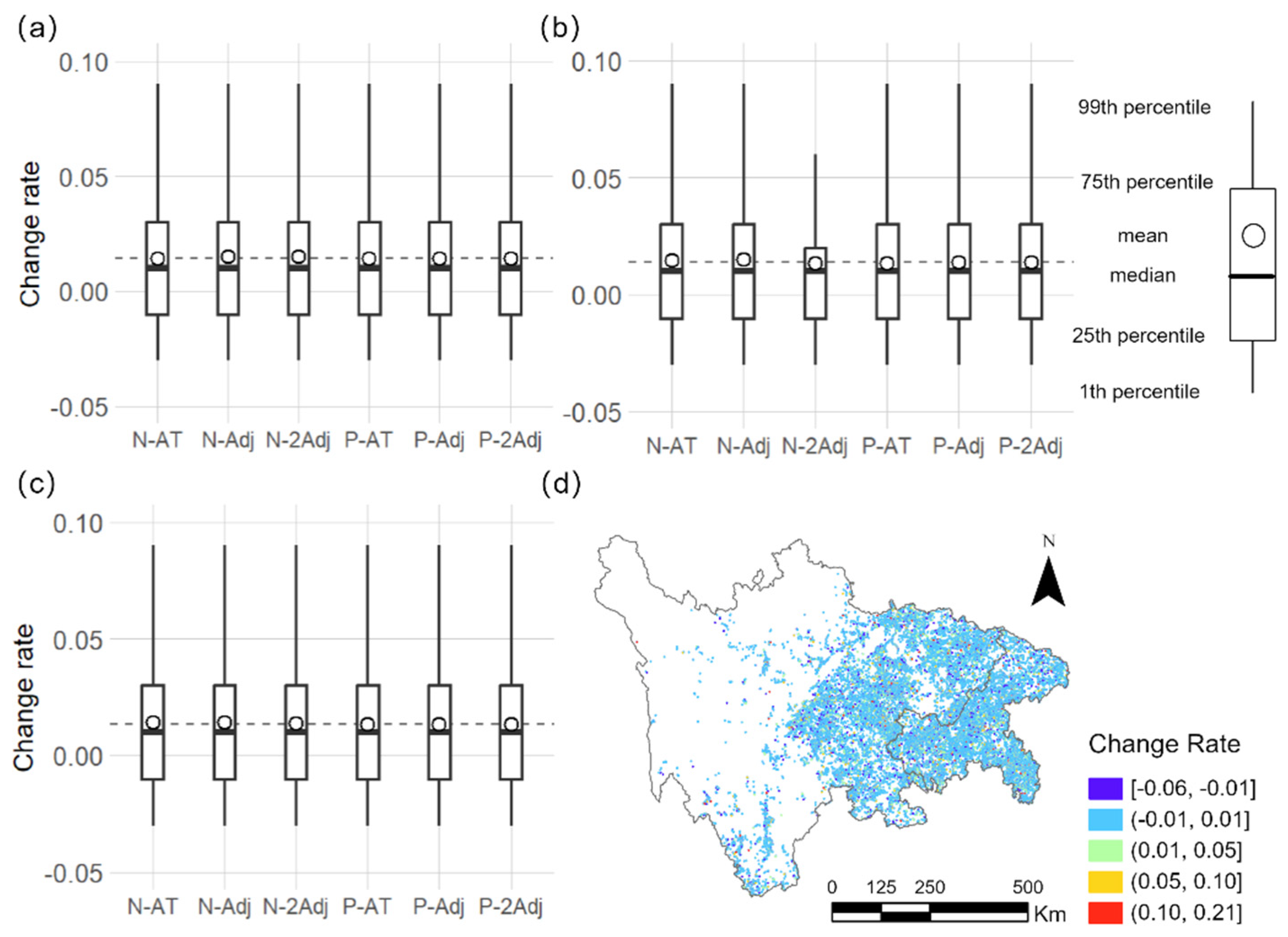
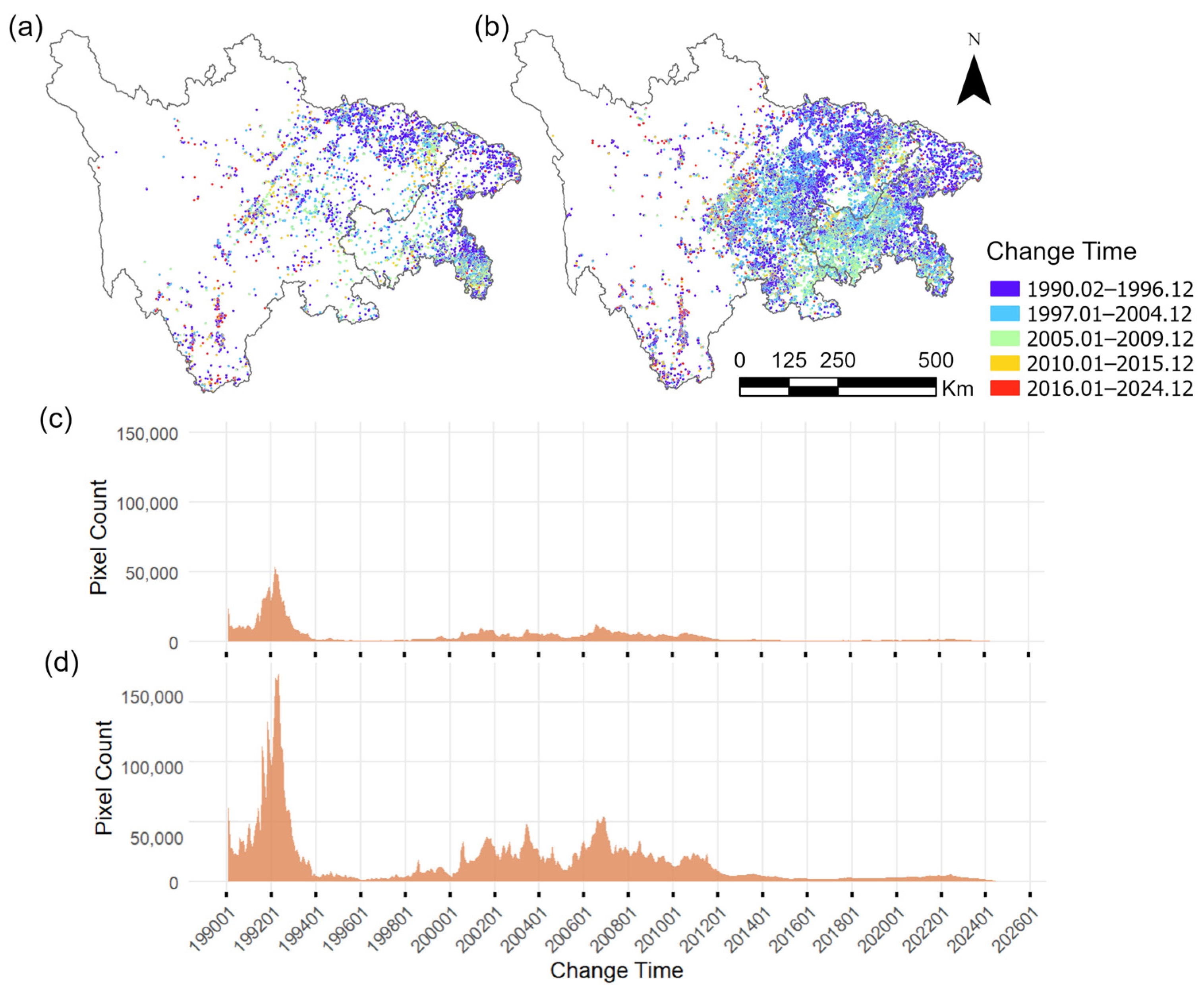
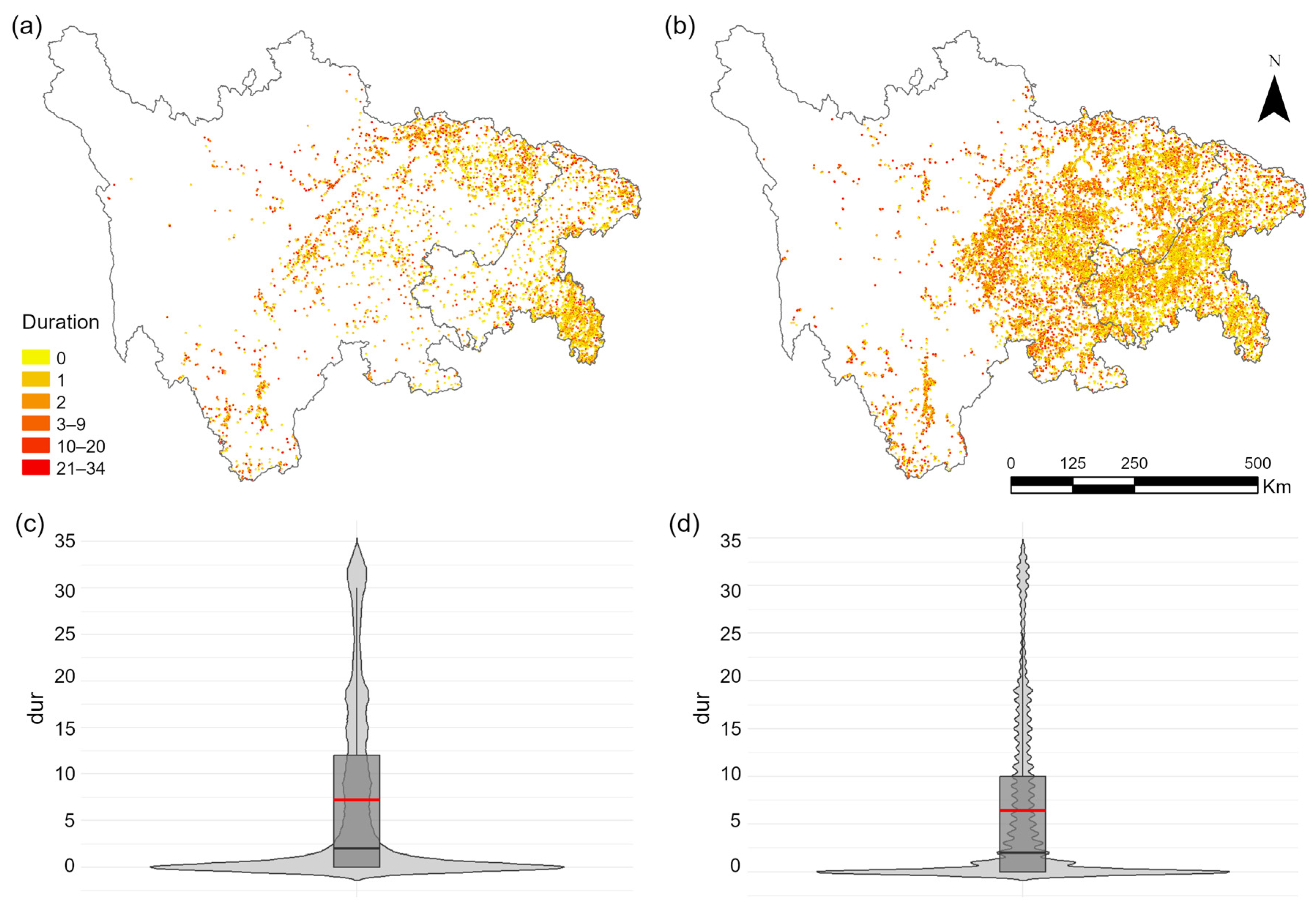
- Planted ancient tree patches in planted forests showed stronger recovery-related NDVI change signatures than nearby neighborhoods. A total of 86% of changes occurred before 2010, and 60% were short-lived (≤5 years).
- Ancient trees’ locations provide spatial cues for targeted monitoring; patterns likely reflect habitat context and stewardship as well as tree presence.
Abstract
1. Introduction
2. Materials and Method
2.1. Study Area
2.2. Data Source
2.2.1. Landsat Time Series
2.2.2. Ancient Tree Data
2.2.3. Land Use Types
2.2.4. Natural and Planted Forests Map
2.3. Method
2.3.1. Extracting the Ancient Tree, Adjacent, and Second-Order Adjacent Patches
2.3.2. Classifying Patch Land Use Types
2.3.3. Quantifying Patch Change Dynamics Based on the Monthly LandTrendr Algorithm
2.3.4. Examining the Effects of Ancient Trees on Patch Dynamics
3. Results
3.1. Recovery and Disturbance Proportions in Patches
3.2. Magnitude and Rate of Patch Changes
3.3. Timing and Persistence of Patch Changes
4. Discussion
5. Conclusions
Author Contributions
Funding
Data Availability Statement
Acknowledgments
Conflicts of Interest
References
- Piovesan, G.; Cannon, C.H.; Liu, J.J. Ancient trees: Irreplaceable conservation resource for ecosystem restoration. Trends Ecol. Evol. 2022, 37, 1025–1028. [Google Scholar] [CrossRef] [Scilit]
- Sanhedrai, H.; Gao, J.X.; Bashan, A. Reviving a failed network through microscopic interventions. Nat. Phys. 2022, 18, 338–349. [Google Scholar] [CrossRef] [Scilit]
- Gilhen-Baker, M.; Roviello, V.; Beresford-Kroeger, D. Old growth forests and large old trees as critical organisms connecting ecosystems and human health—A review. Environ. Chem. Lett. 2022, 20, 1529–1538. [Google Scholar] [CrossRef] [Scilit]
- Tian, P.P.; Liu, Y.F.; Lyu, W. Exploring influential factors on biomass and diversity of ancient trees in human-dominated regions: A case study in Guangdong Province, China. J. Clean. Prod. 2024, 480, 143965. [Google Scholar] [CrossRef] [Scilit]
- Lindenmayer, D.B.; Laurance, W.F. The ecology, distribution, conservation and management of large old trees. Biol. Rev. 2016, 92, 1434–1458. [Google Scholar] [CrossRef] [Scilit] [PubMed]
- Manning, A.D.; Fischer, J.; Felton, A. Landscape fluidity—A unifying perspective for understanding and adapting to global change. J. Biogeogr. 2009, 36, 193–199. [Google Scholar] [CrossRef] [Scilit]
- Chen, H.Y.H.; Luo, Y. Net aboveground biomass declines of four major forest types with forest ageing and climate change in western Canada’s boreal forests. Glob. Change Biol. 2015, 21, 3675–3684. [Google Scholar] [CrossRef] [Scilit]
- Slik, J.W.F.; Paoli, G.; McGuire, K. Large trees drive forest aboveground biomass variation in moist lowland forests across the tropics. Glob. Ecol. Biogeogr. 2013, 22, 1261–1271. [Google Scholar] [CrossRef] [Scilit]
- Blicharska, M.; Mikusiński, G. Incorporating social and cultural significance of large old trees in conservation policy. Conserv. Biol. J. Soc. Conserv. Biol. 2014, 28, 1558–1567. [Google Scholar] [CrossRef] [Scilit] [PubMed]
- Cámara-Leret, R.; Faurby, S.; Macía, M.J. Fundamental species traits explain provisioning services of tropical American palms. Nat. Plants 2017, 3, 16220. [Google Scholar] [CrossRef] [Scilit]
- Huang, L.; Jin, C.; Pan, Y.J. Human activities and species biological traits drive the long-term persistence of old trees in human-dominated landscapes. Nat. Plants 2023, 9, 898–907. [Google Scholar] [CrossRef] [Scilit]
- Song, H.; Meng, Q.W.; Wang, C.Y. Spatial Distribution Characteristics and the Evolution of Buddhist Monasteries in Xi’an City Area. Religions 2023, 14, 1084. [Google Scholar] [CrossRef] [Scilit]
- Yuan, J.W.; Liu, J.L. Fengshui forest management by the Buyi ethnic minority in China. For. Ecol. Manag. 2009, 257, 2002–2009. [Google Scholar] [CrossRef] [Scilit]
- Huang, L.; Tian, L.J.; Huang, L.L. Religious temples are long-term refuges for old trees in human-dominated landscapes in China. Curr. Biol. 2025, 35, 2994–3000.e2993. [Google Scholar] [CrossRef] [Scilit]
- Huang, L.; Tian, L.J.; Zhou, L.H. Local cultural beliefs and practices promote conservation of large old trees in an ethnic minority region in southwestern China. Urban For. Urban Green. 2020, 49, 126584. [Google Scholar] [CrossRef] [Scilit]
- Liu, J.; Lindenmayer, D.B.; Yang, W. Diversity and density patterns of large old trees in China. Sci. Total Environ. 2019, 655, 255–262. [Google Scholar] [CrossRef] [Scilit] [PubMed]
- Cannon, C.H.; Piovesan, G.; Munné-Bosch, S. Old and ancient trees are life history lottery winners and vital evolutionary resources for long-term adaptive capacity. Nat. Plants 2022, 8, 136–145. [Google Scholar] [CrossRef] [Scilit]
- Jin, C.; Zheng, M.M.; Huang, L. Co-existence between humans and nature: Heritage trees in China’s yangtze River region. Urban For. Urban Green. 2020, 54, 126748. [Google Scholar] [CrossRef] [Scilit]
- Pasquarella, V.J.; Arévalo, P.; Bratley, K.H. Demystifying LandTrendr and CCDC temporal segmentation. Int. J. Appl. Earth Obs. Geoinf. 2022, 110, 102806. [Google Scholar] [CrossRef] [Scilit]
- Kennedy, R.E.; Yang, Z.Q.; Cohen, W.B. Detecting trends in forest disturbance and recovery using yearly Landsat time series: 1. LandTrendr—Temporal segmentation algorithms. Remote Sens. Environ. 2010, 114, 2897–2910. [Google Scholar] [CrossRef] [Scilit]
- Fu, Y.C.; Zhu, Z.; Liu, L.Y. Remote Sensing Time Series Analysis: A Review of Data and Applications. J. Remote Sens. 2024, 4, 0285. [Google Scholar] [CrossRef] [Scilit]
- Kennedy, R.E.; Andréfouët, S.; Cohen, W.B. Bringing an ecological view of change to Landsat-based remote sensing. Front. Ecol. Environ. 2014, 12, 339–346. [Google Scholar] [CrossRef] [Scilit]
- Wulder, M.A.; Masek, J.G.; Cohen, W.B. Opening the archive: How free data has enabled the science and monitoring promise of Landsat. Remote Sens. Environ. 2012, 122, 2–10. [Google Scholar] [CrossRef] [Scilit]
- Gorelick, N.; Hancher, M.; Dixon, M. Google Earth Engine: Planetary-scale geospatial analysis for everyone. Remote Sens. Environ. 2017, 202, 18–27. [Google Scholar] [CrossRef] [Scilit]
- Tamiminia, H.; Salehi, B.; Mahdianpari, M. Google Earth Engine for geo-big data applications: A meta-analysis and systematic review. ISPRS J. Photogramm. Remote Sens. 2020, 164, 152–170. [Google Scholar] [CrossRef] [Scilit]
- Kennedy, R.E.; Yang, Z.Q.; Gorelick, N. Implementation of the LandTrendr Algorithm on Google Earth Engine. Remote Sens. 2018, 10, 691. [Google Scholar] [CrossRef] [Scilit]
- Mugiraneza, T.; Nascetti, A.; Ban, Y.F. Continuous Monitoring of Urban Land Cover Change Trajectories with Landsat Time Series and LandTrendr-Google Earth Engine Cloud Computing. Remote Sens. 2020, 12, 2883. [Google Scholar] [CrossRef] [Scilit]
- Hu, T.Y.; Zhang, M.; Li, X.C. Extraction of Building Construction Time Using the LandTrendr Model with Monthly Landsat Time Series Data. IEEE J. Sel. Top. Appl. Earth Obs. Remote Sens. 2024, 17, 18335–18350. [Google Scholar] [CrossRef] [Scilit]
- Peng, Q.Y.; Yang, R.; Cao, Y. One-third of lands face high conflict risk between biodiversity conservation and human activities in China. J. Environ. Manag. 2021, 299, 113449. [Google Scholar] [CrossRef] [Scilit]
- Xiao, Y.L.; Wang, Q.M.; Zhang, H.K. Global Natural and Planted Forests Mapping at Fine Spatial Resolution of 30 m. J. Remote Sens. 2024, 4, 0204. [Google Scholar] [CrossRef] [Scilit]
- Yang, J.; Huang, X. The 30 m annual land cover dataset and its dynamics in China from 1990 to 2019. Earth Syst. Sci. Data 2021, 13, 3907–3925. [Google Scholar] [CrossRef] [Scilit]
- Wulder, M.A.; Loveland, T.R.; Roy, D.P. Current status of Landsat program, science, and applications. Remote Sens. Environ. 2019, 225, 127–147. [Google Scholar] [CrossRef] [Scilit]
- Chen, J.; Jönsson, P.; Tamura, M. A simple method for reconstructing a high-quality NDVI time-series data set based on the Savitzky–Golay filter. Remote Sens. Environ. 2004, 91, 332–344. [Google Scholar] [CrossRef] [Scilit]
- Huang, L.; Jin, C.; Zhen, M.M. Biogeographic and anthropogenic factors shaping the distribution and species assemblage of heritage trees in China. Urban For. Urban Green. 2020, 50, 126652. [Google Scholar] [CrossRef] [Scilit]
- Brockerhoff, E.G.; Barbaro, L.; Castagneyrol, B. Forest biodiversity, ecosystem functioning and the provision of ecosystem services. Biodivers. Conserv. 2017, 26, 3005–3035. [Google Scholar] [CrossRef] [Scilit]
- Ehbrecht, M.; Seidel, D.; Annighöfer, P. Global patterns and climatic controls of forest structural complexity. Nat. Commun. 2021, 12, 519. [Google Scholar] [CrossRef] [Scilit]
- Hua, F.Y.; Bruijnzeel, L.A.; Meli, P. The biodiversity and ecosystem service contributions and trade-offs of forest restoration approaches. Science 2022, 376, 839–844. [Google Scholar] [CrossRef] [Scilit]
- Taki, H.; Yamaura, Y.; Okabe, K. Plantation vs. natural forest: Matrix quality determines pollinator abundance in crop fields. Sci. Rep. 2011, 1, 132. [Google Scholar] [CrossRef] [Scilit] [PubMed]
- Liu, J.J.; Yang, B.; Lindenmayer, D.B. The oldest trees in China and where to find them. Front. Ecol. Environ. 2019, 17, 319–321. [Google Scholar] [CrossRef] [Scilit]
- Lindenmayer, D.B.; Laurance, W.F.; Franklin, J.F. Global Decline in Large Old Trees. Science 2012, 338, 1305–1306. [Google Scholar] [CrossRef] [Scilit]
- Lindenmayer, D.B.; Laurance, W.F.; Franklin, J.F. New Policies for Old Trees: Averting a Global Crisis in a Keystone Ecological Structure. Conserv. Lett. 2014, 7, 61–69. [Google Scholar] [CrossRef] [Scilit]
- Mu, H.W.; Guo, S.C.; Zhang, X.A. Moving in the landscape: Omnidirectional connectivity dynamics in China from 1985 to 2020. Environ. Impact Assess. Rev. 2025, 110, 107721. [Google Scholar] [CrossRef] [Scilit]
- Cheng, K.; Yang, H.T.; Guan, H.C. Unveiling China’s natural and planted forest spatial–temporal dynamics from 1990 to 2020. ISPRS J. Photogramm. Remote Sens. 2024, 209, 37–50. [Google Scholar] [CrossRef] [Scilit]
- Fulford, R.S.; Russell, M.; Myers, M. Models help set ecosystem service baselines for restoration assessment. J. Environ. Manag. 2022, 317, 115411. [Google Scholar] [CrossRef] [Scilit]
- Hasan, S.S.; Zhen, L.; Miah, M.G. Impact of land use change on ecosystem services: A review. Environ. Dev. 2020, 34, 100527. [Google Scholar] [CrossRef] [Scilit]



| Patch Group | Land Use Type | Proportion (%) | ||
|---|---|---|---|---|
| Unchanged | Recovery | Disturbance | ||
| Patches surrounding natural ancient trees | Natural forest | 21.66% | 16.74% | 3.85% |
| Planted forest | 5.98% | 4.14% | 1.12% | |
| Cropland | 20.79% | 20.71% | 5.01% | |
| Total | 48.43% | 41.59% | 9.98% | |
| Patches surrounding planted ancient trees | Natural forest | 12.17% | 13.00% | 2.79% |
| Planted forest | 2.93% | 2.84% | 0.61% | |
| Cropland | 25.28% | 33.06% | 7.33% | |
| Total | 40.38% | 48.89% | 10.73% | |
Disclaimer/Publisher’s Note: The statements, opinions and data contained in all publications are solely those of the individual author(s) and contributor(s) and not of MDPI and/or the editor(s). MDPI and/or the editor(s) disclaim responsibility for any injury to people or property resulting from any ideas, methods, instructions or products referred to in the content. |
© 2026 by the authors. Licensee MDPI, Basel, Switzerland. This article is an open access article distributed under the terms and conditions of the Creative Commons Attribution (CC BY) license.
Share and Cite
Wei, Y.; Sun, L.; Jia, J.; Meng, Y.; Zhang, J.; Zhou, X.; Xie, J.; Yang, J.; Huang, L. Exploring the Roles of Ancient Trees in Disturbance and Recovery Processes Using Monthly Landsat Time Series Analysis. Remote Sens. 2026, 18, 170. https://doi.org/10.3390/rs18010170
Wei Y, Sun L, Jia J, Meng Y, Zhang J, Zhou X, Xie J, Yang J, Huang L. Exploring the Roles of Ancient Trees in Disturbance and Recovery Processes Using Monthly Landsat Time Series Analysis. Remote Sensing. 2026; 18(1):170. https://doi.org/10.3390/rs18010170
Chicago/Turabian StyleWei, Yutong, Lin Sun, Jingyi Jia, Yuanyuan Meng, Junwei Zhang, Xin Zhou, Jiaxuan Xie, Jun Yang, and Li Huang. 2026. "Exploring the Roles of Ancient Trees in Disturbance and Recovery Processes Using Monthly Landsat Time Series Analysis" Remote Sensing 18, no. 1: 170. https://doi.org/10.3390/rs18010170
APA StyleWei, Y., Sun, L., Jia, J., Meng, Y., Zhang, J., Zhou, X., Xie, J., Yang, J., & Huang, L. (2026). Exploring the Roles of Ancient Trees in Disturbance and Recovery Processes Using Monthly Landsat Time Series Analysis. Remote Sensing, 18(1), 170. https://doi.org/10.3390/rs18010170