Article

Optimal Ice Particle Models of Different Cloud Types for Radiative Transfer Simulation at 183 GHz Frequency Band

1
Chinese Academy of Meteorological Sciences, Beijing 100081, China
2
National Satellite Meteorological Center (National Center for Space Weather), Beijing 100081, China
3
Innovation Center for FengYun Meteorological Satellite (FYSIC), Beijing 100081, China
4
Key Laboratory of Radiometric Calibration and Validation for Environmental Satellites, China Meteorological Administration (CMA), Beijing 100081, China
5
Meteorological Observation Centre, China Meteorological Administration, Beijing 100081, China
*
Author to whom correspondence should be addressed.
Remote Sens. 2026, 18(1), 168; https://doi.org/10.3390/rs18010168
Submission received: 13 November 2025 / Revised: 23 December 2025 / Accepted: 28 December 2025 / Published: 4 January 2026

Highlights

What are the main findings?
  • We employed the high-precision Atmospheric Radiative Transfer Simulator (ARTS) to simulate 183 GHz brightness temperatures and recommend the optimal ice particle models for seven classical cloud types. These results offer valuable references for accurate radiative transfer simulations on 183 GHz frequency.
What is the implication of the main finding?
  • For altocumulus (Ac), stratocumulus (Sc), and cumulus (Cu) clouds, the different choices of ice particle model have little impacts on the simulated brightness temperatures (<1 K), with RMSEs below 3 K across multiple models, indicating that various models can be applied directly for such simulations.
  • For some mixed-phase clouds, including altostratus (As), nimbostratus (Ns), and deep convective (Dc) clouds, the Small Block Aggregate (SBA) and Small Plate Aggregate (SPA) models demonstrate good performance for As clouds, with RMSEs below 2.5 K, while the SBA, SPA, and Large Column Aggregate (LCA) models exhibit similarly good performance for Ns clouds, also achieving RMSEs below 2.5 K. For Dc clouds, although the SBA model yields RMSEs of approximately 10 K, it still provides a substantial improvement over the spherical model, whereas for cirrus (Ci) clouds, any non-spherical ice particle models are applicable, with RMSEs below 2 K.

Abstract

The Fengyun-4 microwave satellite provides high-temporal-frequency observations at the 183 GHz band, providing unprecedented data for all-weather, three-dimensional measurements of atmospheric parameters. It is of importance to establish a simulated brightness temperature (BT) dataset for this band prior to launch, which can support the relevant quantitative applications significantly. Compared with clear-sky conditions, the accuracy of BT simulations under cloudy ones is considerably lower, primarily due to the influence of the adopted ice particle models. Up until now, few studies have systematically investigated ice particle model selection for different cloud types at the 183 GHz frequency band. In this paper, multi-sensor observations from Cloud Profiling Radar (CPR), Cloud-Aerosol Lidar with Orthogonal Polarization (CALIOP), and Visible Infrared Imaging Radiometer Suite (VIIRS) were used as realistic atmospheric profiles. Using the high-precision radiative transfer model Atmospheric Radiative Transfer Simulator (ARTS), BT simulations at 183 GHz were performed to explore the optimal ice particle models for seven classical cloud types. The main conclusions are given as follows: (1) The sensitivity of simulated cloud radiances to ice particle habits differs with respect to different cloud phases. For altocumulus (Ac), stratocumulus (Sc), and cumulus (Cu) clouds, the different choices of ice particle model have little impacts on the simulated brightness temperatures (<1 K), with RMSEs below 3 K across multiple models, indicating that various models can be applied directly for such simulations. (2) For some mixed-phase clouds, including altostratus (As), nimbostratus (Ns), and deep convective (Dc) clouds, the Small Block Aggregate (SBA) and Small Plate Aggregate (SPA) models demonstrate good performance for As clouds, with RMSEs below 2.5 K, while the SBA, SPA, and Large Column Aggregate (LCA) models exhibit similarly good performance for Ns clouds, also achieving RMSEs below 2.5 K. For Dc clouds, although the SBA model yields RMSEs of approximately 10 K, it still provides a substantial improvement over the spherical model, whereas for cirrus (Ci) clouds, any non-spherical ice particle models are applicable, with RMSEs below 2 K. (3) Within the 183 GHz frequency band, channels with the higher weighting-function peaks are less sensitive to variable adoptions of ice particle models. These results offer valuable references for accurate radiative transfer simulations on 183 GHz frequency.

1. Introduction

The Fengyun-4M (FY-4M) satellite, scheduled for launch in 2026, will be the world’s first geostationary one with passive-microwave observation capability. Its successful utilization will enable high-temporal-frequency vertical sounding of clouds and precipitation, marking a significant advance in measuring atmospheric profiles from geostationary platform. Particularly, the 183 GHz frequency band is considered as one of key channels for atmospheric water vapor sounding. However, high-temporal-frequency observations on this band are unavailable. Therefore, to support certain typical quantitative applications such as temperature, humidity, and wind retrievals, as well as data assimilation, some simulated BT datasets for 183 GHz band are in need.
The accuracy of BT simulations has more effects on the development of quantitative retrieval products, and influenced by multiple factors, including the radiative transfer model and its parameter configurations, as well as atmospheric profile characteristics. Here, more details are provided as follows.
Firstly, a number of radiative transfer models are available for simulating brightness temperatures on different microwave frequencies, which can generally be classified into two main categories: fast radiative transfer models and line-by-line ones. Models, such as the Community Radiative Transfer Model (CRTM), the Radiative Transfer for TIROS Operational Vertical Sounder (RTTOV), and the ARTS, are capable of reproducing observed brightness temperatures within approximately 1 K over the 183 GHz frequency band under clear-sky conditions [1]. However, for BT simulations under cloudy-sky conditions, line-by-line models achieve higher accuracy and are, therefore, often used as benchmarks for evaluating the performance of fast radiative transfer models [2]. Thus, the selection of radiative transfer models is typically determined by the specific objectives of the study. Fast radiative transfer models are generally employed when large volumes of simulations are required, whereas line-by-line models are preferred when higher accuracy in the simulated brightness temperatures is prioritized.
Secondly, regarding the choice of atmospheric profiles, most studies typically relied on data generated by numerical weather prediction (NWP) models or observational products obtained from spaceborne payloads. Atmospheric data from NWP models are characterized by continuous temporal and broad spatial coverages. However, when simulating brightness temperatures under cloudy-sky conditions, the error budget of model–observation comparisons is largely dominated by the limited predictability of clouds and precipitation at small spatial scales in NWP models, which leads to root-mean-square (RMS) differences of 20–40 K in brightness temperatures due to the imperfect representation of cloud and precipitation structure, including their shape, size, and intensity [3]. Therefore, for high-accuracy BT simulations in cloudy-sky conditions, it is preferable to use spatially collocated observational data from satellite instruments as input, which offer better spatial representativeness compared with those from NWP models.
Furthermore, in high-accuracy BT simulations of cloudy scenes, the selection of ice particle models and its particle size distributions (PSDs) is often challenging. Under varying ice amount conditions, the ice particle model is most dominant factor contributor to the discrepancies between simulated and observed brightness temperatures [4]. Different ice habits exhibit significantly distinct microwave scattering properties, yet there is currently no reliable method to directly infer ice habit from microwave observations [5]. Therefore, this study primarily focuses on the selection of optimal ice particle models to ensure the accuracy of cloudy-sky BT simulations at the 183 GHz frequency band.
Many studies have investigated the selection of ice particle models and proposed some helpful references for subsequent research. Previous studies have demonstrated that non-spherical ice particle models generally produce more accurate simulation results than spherical models [6]. Moreover, some studies have evaluated and recommended specific ice particle models. The sector snowflake model [7] was recommended for BT simulations across the 10–183 GHz frequency range [3]. The block hexagonal column model [7] was suggested for 183 GHz simulations over tropical regions [8]. The dendrite model [7] was proposed for BT simulations at the 183 ± 3.0 GHz and 183 ± 7.0 GHz channels [9]. However, the above-mentioned studies did not distinguish among different cloud types, which is theoretically insufficient for achieving high-accuracy BT simulations in cloudy-sky conditions. In addition, Geer [10] classified cloudy scenes and recommended specific ice particle models for cloud ice, large-scale snow, and convective snow, the conclusions were derived using atmospheric profiles from NWP models as input. Particularly, Wu, et al. [4] employed CloudSat observations to recommend ice particle models for clouds with different ice water path (IWP) values. However, their ice particle models for each cloud type were based on weighted results from four channels (166 H, 166 V, 183.31 ± 7 V, and 183.31 ± 3 V, all in GHz), lacking detailed analysis of more 183 GHz channels with different weighting-function peak altitudes.
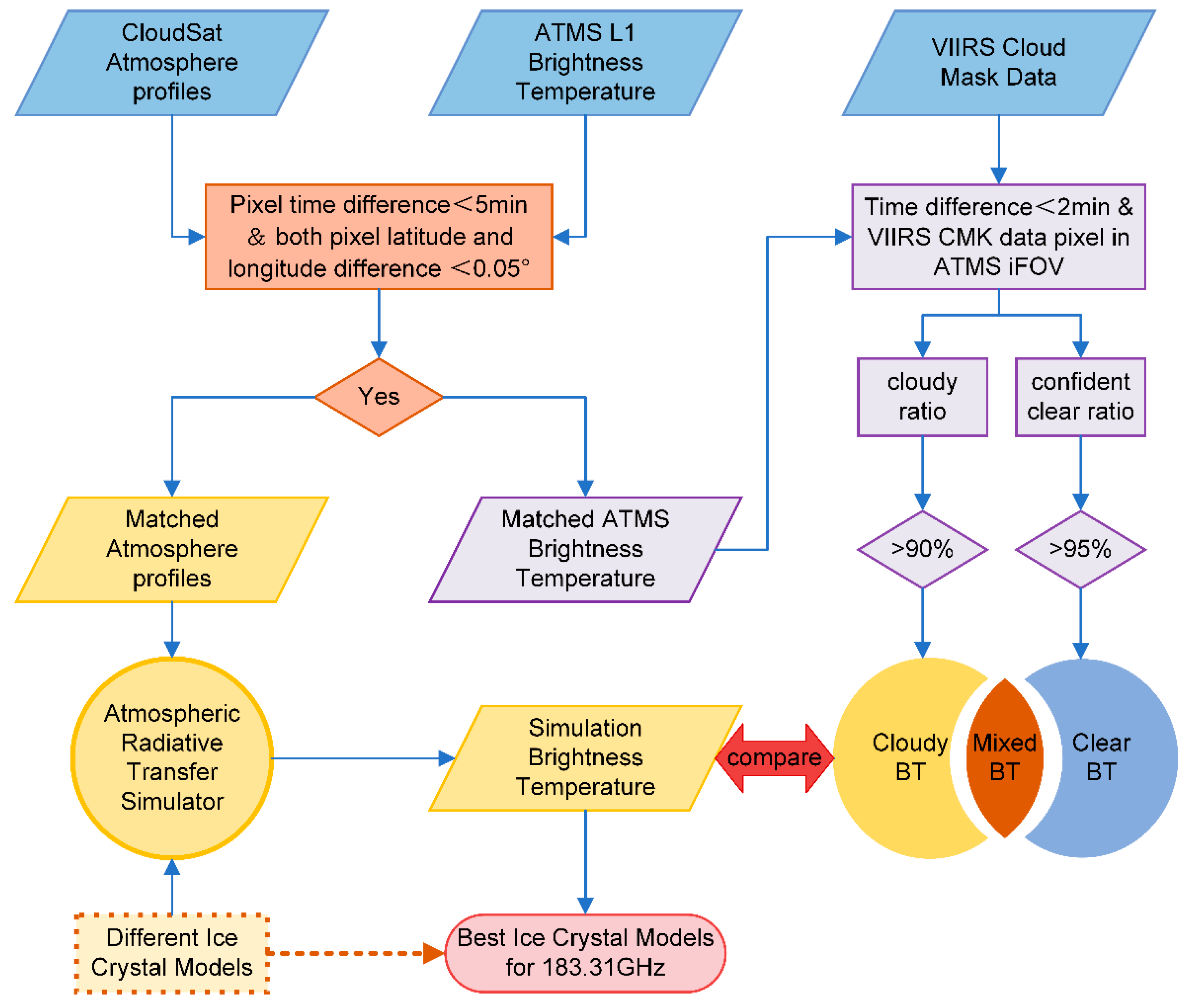
Therefore, to better meet the requirements of simulating 183 GHz satellite observations under cloudy-sky conditions, and to more robustly identify the most suitable ice particle models for different cloud types, more refined radiative transfer simulations are required. To achieve this objective, measurements from the active CPR onboard CloudSat satellite are selected to represent realistic atmospheric profiles under cloudy-sky conditions. The high-precision radiative transfer simulation model ARTS is adopted to simulate brightness temperatures at 183 GHz for the rigorously collocated Advanced Technology Microwave Sounder (ATMS) samples. By comparing simulated and observed brightness temperatures, the optimal ice particle model for the seven types of clouds individually is evaluated and further identified. Considering that the brightness temperatures observed by ATMS are strongly related to both the distribution and the extent of cloud coverage within their instantaneous field of views (iFOV), while the footprint of CloudSat merely represents a small portion those of ATMS, an absolutely identified approach for clouds is proposed to ensure the representativeness of the acquired profiles from CloudSat. Moreover, ATMS samples corresponding to those with as spatially uniform as possible for cloud coverage are selected for comparison between simulated and observed brightness temperatures. The overall technical workflow of this study is illustrated in Figure 1.

2. Materials and Methods

2.1. ATMS Brightness Temperature

BT data from channels 18–22 of the Level 1B product of the ATMS onboard the Suomi National Polar-orbiting Partnership (S-NPP) satellite are selected for comparison with the simulated brightness temperatures. ATMS is a cross-track scanning microwave radiometer operating in a sun-synchronous orbit at an altitude of approximately 824 km. The center frequencies of channels 18–22 are located near 183 GHz water vapor absorption line, and the nadir spatial resolution of these channels is approximately 16 km [11].
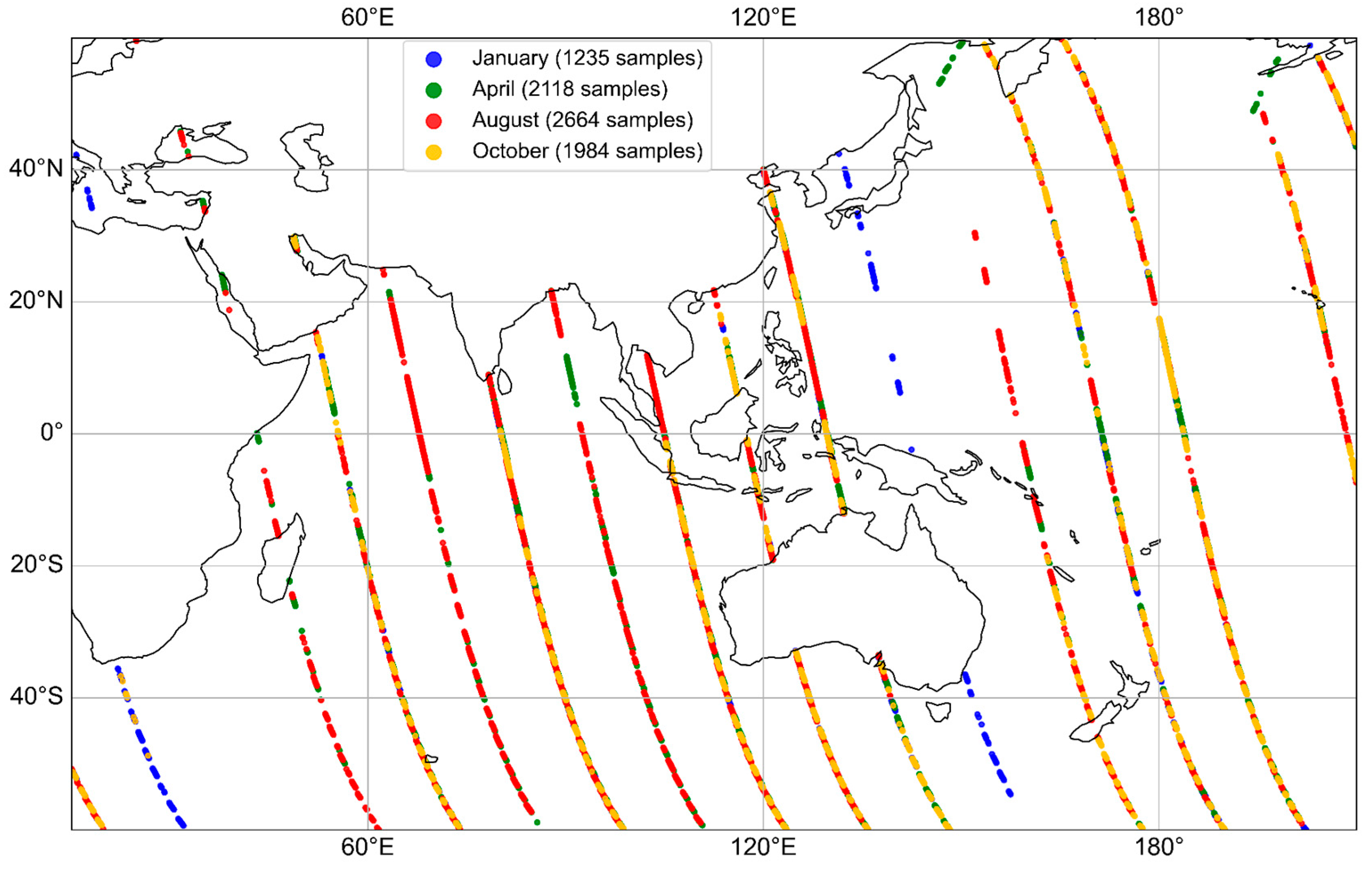
The spatiotemporal collocation between the ATMS BT data and the CloudSat observations was performed within ±5 min and ±0.05° in both latitude and longitude. The above-mentioned collocation procedure yielded 9327 matched ATMS BT samples collected in January, April, August, and October 2016. These collocated samples span all four seasons across both hemispheres, with longitudes ranging from 15.02° E to 150° W and latitudes from 60° S to 60° N, largely covering the mid- to low-latitude oceanic regions of the Eastern Hemisphere. The geographical distribution of the collocated samples is shown in Figure 2. Due to the difference in footprint sizes (16 km and 1.4 km, respectively), several CPR footprints typically fall within a single ATMS footprint. The corresponding collocation statistics are summarized in Table 1.

2.2. Radiative Transfer Simulations

2.2.1. Atmospheric Profiles

The atmospheric profile data used in this study were obtained from the CloudSat mission datasets, including the 2B-CWC-RO product [12] and the auxiliary ECMWF-AUX product [13]. The ECMWF-AUX product takes ECMWF analysis data and interpolates the variables onto the CloudSat data grid, providing temperature, pressure, specific humidity, ozone mixing ratio, sea surface temperature, and 10 m wind speed profile data. The 2B-CWC-RO product provides liquid water content (LWC) and ice water content (IWC), retrieved from CloudSat CPR radar observations, with auxiliary temperature information from the ECMWF-AUX product used to support the retrievals. Each CPR profile consists of 125 vertical layers with a vertical resolution of approximately 240 m [14]. In this study, atmospheric data from layers 1 to 104 of the CPR profiles were selected as input to the radiative transfer simulations, corresponding to altitudes ranging from the ocean surface to approximately 25 km in the atmosphere. ECMWF Reanalysis 5 (ERA5) data are also used to represent the LWC profiles for deep convective (Dc) clouds [15].
In addition, this work employed the 2B-CLDCLASS-LIDAR product [16] to determine the cloud types associated with each collocated sample. This product classifies clouds into eight categories, including cirrus (Ci), altostratus (As), altocumulus (Ac), stratus (St), stratocumulus (Sc), cumulus (Cu), nimbostratus (Ns), and Dc, and it provides daytime observations only. The 2B-CLDCLASS-LIDAR product combines measurements from the CPR onboard CloudSat and the CALIOP onboard Cloud-Aerosol Lidar and Infrared Pathfinder Satellite Observations (CALIPSO), both of which are part of the A-Train satellite constellation, enhancing its capability to detect thin cirrus clouds [17]. However, it has difficulty separating stratus from stratocumulus clouds, thereby leading to fewer stratus samples in this dataset. The atmospheric profile data employed by each product are summarized in Table 2, as shown therein.

2.2.2. Radiative Transfer Model

The ARTS, which provides capabilities for polarized radiative transfer calculations in 1D–3D atmospheres covering the microwave, submillimeter, and infrared spectral regions, was employed in this study to perform BT simulations [18,19]. It computes the attenuation caused by gaseous absorption using a line-by-line integration method. Under cloudy-sky conditions, ARTS implements the Discrete Ordinate Iterative (DOIT) algorithm to perform particle scattering calculations [20]. In addition, the TESSEM2 model integrated within ARTS [21] was employed to estimate ocean surface emissivity.
The ARTS Single Scattering Properties Database (ARTS SSDB) contains 34 ice particle models, ranging from pristine ice crystals to large aggregates, graupel, and hail. It provides hydrometeor single scattering data at 34 frequencies between 1 and 886 GHz and at three temperatures of 190 K, 230 K, and 270 K [22], which is recognized as a state-of-the-art database [23]. To reduce computational cost, a set of representative single crystals and aggregates was selected for brightness temperature simulations for each cloud type. For non-precipitating clouds (Ci, Sc, and Ac), more single-crystal models were included in the evaluation. In contrast, for precipitating clouds (Cu, Ns, and Dc), more aggregate models were considered. In addition, for As clouds, whose IWP distributions are similar to those of Cu clouds [4], aggregate models were also preferentially selected. Furthermore, several additional ice particle models were included for Ci, As, and Dc clouds, as these models have been specifically reported to be suitable for these cloud types in previous studies [4,10]. The detailed model selections are listed in Table 3. The detailed parameters of these selected models are summarized in Table 4. For aggregate models whose particle size does not extend below 100 μm, geometrically similar single crystal models were used to fill this gap and thereby mitigate errors in bulk scattering properties.
For liquid hydrometeors, this work employed the Liquid Sphere model in combination with the Modified Gamma Distribution (MGD) for the particle size distribution [24]. For ice hydrometeors, the Field, et al. [25] PSD parameterization, which has been widely used and demonstrated good performance in previous studies (e.g., Wu, et al. [4]), was adopted for ice particles. Specifically, the F07T (tropical) and F07M (midlatitude) variants were applied to represent tropical and midlatitude cloud regimes, respectively.

2.3. ATMS Footprint Collocation and Identification of Absolute Cloudy Scenes

2.3.1. Cloud Mask Data

The cloud mask data used in this study were obtained from the CLDMSK_L2_VIIRS_SNPP daytime product, which was generated using the MODIS–VIIRS Cloud Mask (MVCM) algorithm [26]. This product provides cloud mask data with a spatial resolution of 750 m. As both the Visible Infrared Imaging Radiometer Suite (VIIRS) and ATMS instruments are aboard the Suomi National Polar-orbiting Partnership (S-NPP) satellite, the CLDMSK_L2_VIIRS_SNPP product offers a large number of spatiotemporally collocated samples for the ATMS footprints.

2.3.2. ATMS Footprint Collocation

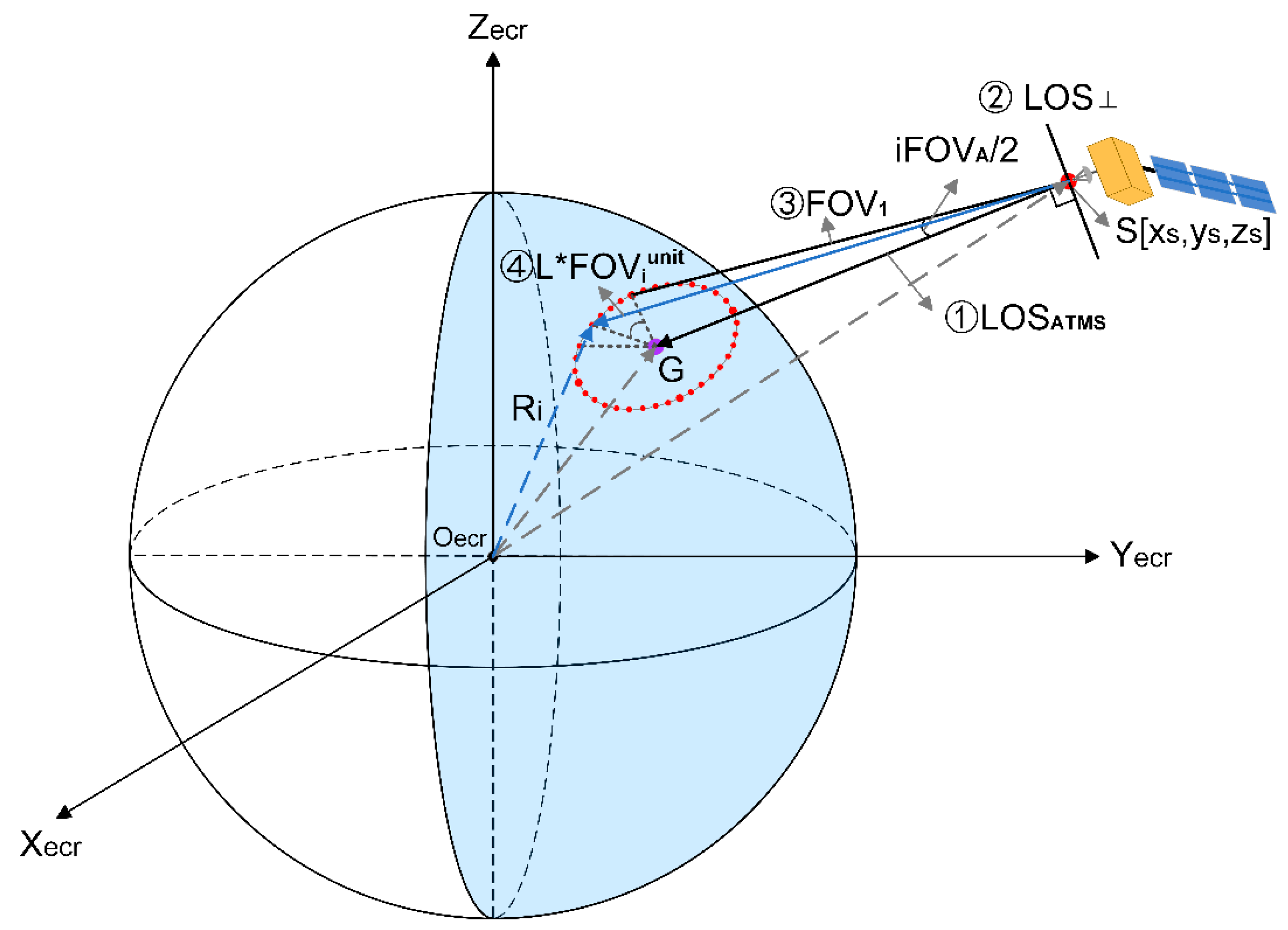
Since the spatial distribution of cloud within the iFOV can significantly influence the observed brightness temperatures, while the CloudSat data represent only a small portion of the atmospheric profiles within an ATMS iFOV, it is essential to select ATMS footprints with as uniform cloud coverage as possible to ensure that the simulated brightness temperatures are representative of the observations. Guo, et al. [27] provided a detailed analysis of the geometric distortions in satellite footprints caused by variations in viewing zenith angle. Therefore, a precise geometric characterization of the ATMS iFOV is crucial, and this work determined the ATMS iFOV using the method proposed by Wang, et al. [28], which is based on Rodrigues’ rotation formula, to perform a precise geometric computation of the ATMS footprint. The overall calculation procedure is illustrated in Figure 3. G and S denote the ATMS iFOV footprint center and the satellite position vector in the Earth-Centered Rotating (ECR) coordinate system, respectively. The ATMS line-of-sight vector, LOSATMS, is computed from S to G. A unit vector LOS, orthogonal to LOSATMS, is defined to construct the iFOV cone. The ATMS iFOV half-angle is given by iFOVA/2 = 0.55°. The boundary vectors FOVi (i = 1, …, 36) are generated by rotating LOSATMS by 0.55° using Rodrigues’ rotation formula with uniformly distributed azimuth angles. Each FOVi intersects the Earth ellipsoid at a surface point, forming vector Ri from the Earth center Oecr. The distance L represents the range from the satellite S to the Earth intersection point.

2.3.3. Identification of Absolute Cloudy ATMS iFOVs

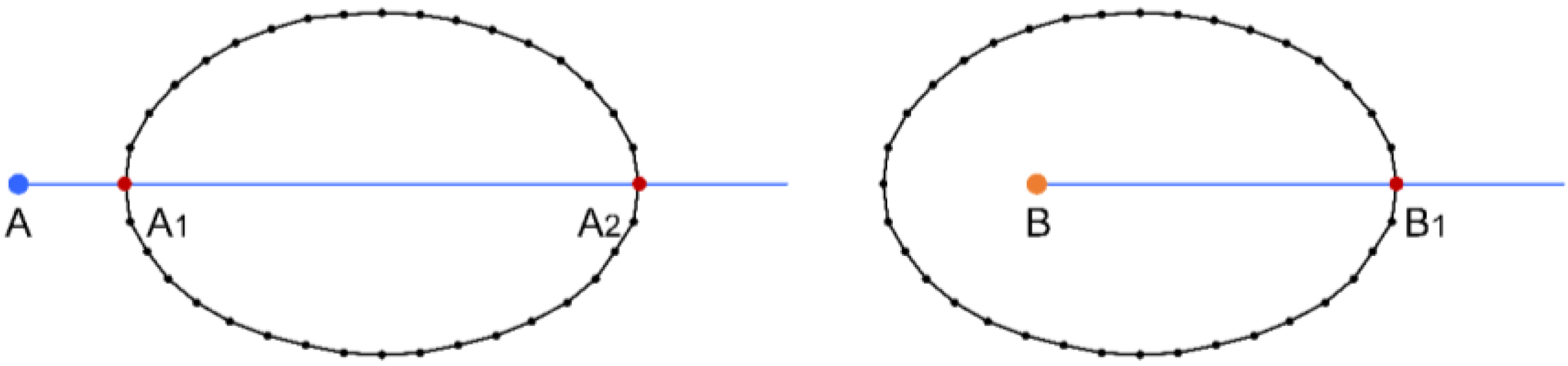
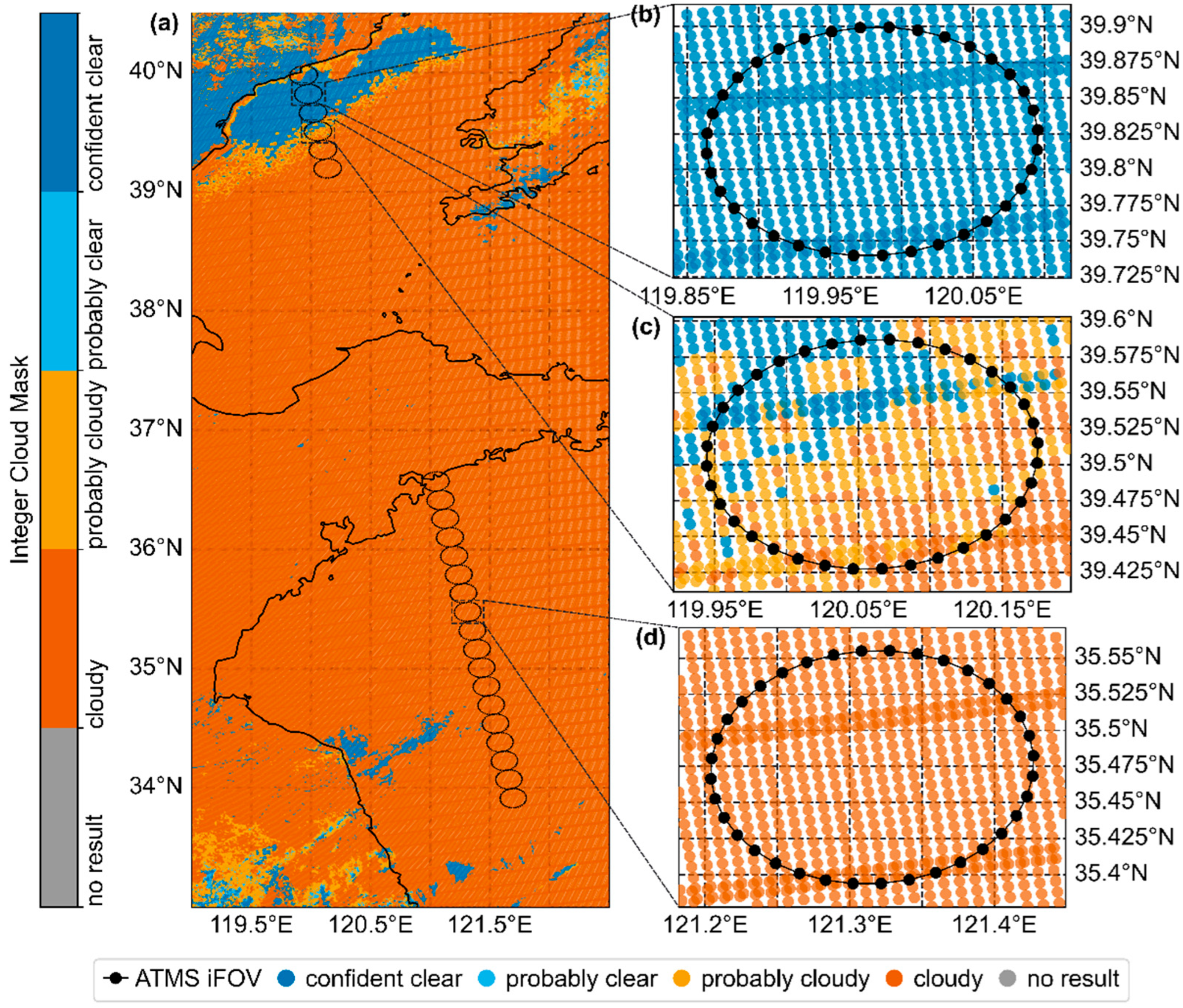
The collocation between ATMS and VIIRS pixels was established based on two criteria: a time difference of less than 2 min and the requirement that the center of the VIIRS pixel fall within the ATMS iFOV. The nadir spatial resolution of ATMS channels 18–22 is approximately 16 km, while the CLDMSK_L2_VIIRS_SNPP product has a pixel spacing of about 750 m. Because of this large disparity in spatial sampling scales between the two instruments, the VIIRS Cloud Mask pixels could be reasonably approximated as points when performing spatial matching with the ATMS footprints. As illustrated in Figure 4, the inclusion of a VIIRS pixel within an ATMS iFOV was determined using the Ray-Crossing Algorithm, a commonly used point-in-polygon method in computational geometry. In this algorithm, a ray is projected from the test point, and the number of intersections between the ray and the polygon edges is counted. If the number of intersections is odd, the VIIRS pixel lies inside the ATMS iFOV; if it is even, the pixel lies outside.
As illustrated in Figure 5, the classification of ATMS footprints was determined according to the proportions of the Cloud Mask categories within each ATMS iFOV. Footprints in which more than 95% of the VIIRS Cloud Mask pixels were labeled as confident clear are shown in Figure 5b and were defined as clear-sky samples, whereas those with more than 90% of pixels labeled as cloudy are shown in Figure 5d and were defined as fully cloudy samples. The remaining footprints, illustrated in Figure 5c, were classified as mixed samples. Only the clear-sky and fully cloudy atmospheric profiles were used for the BT simulations, whereas the mixed cases were excluded from the model–observation closure analysis. After collocation, a total of 1146 clear-sky samples and 8181 cloudy samples were obtained for the four analyzed months in 2016, as summarized in Table 5.

3. Results

3.1. Comparison of Simulated Brightness Temperatures Between ARTS and RTTOV in January

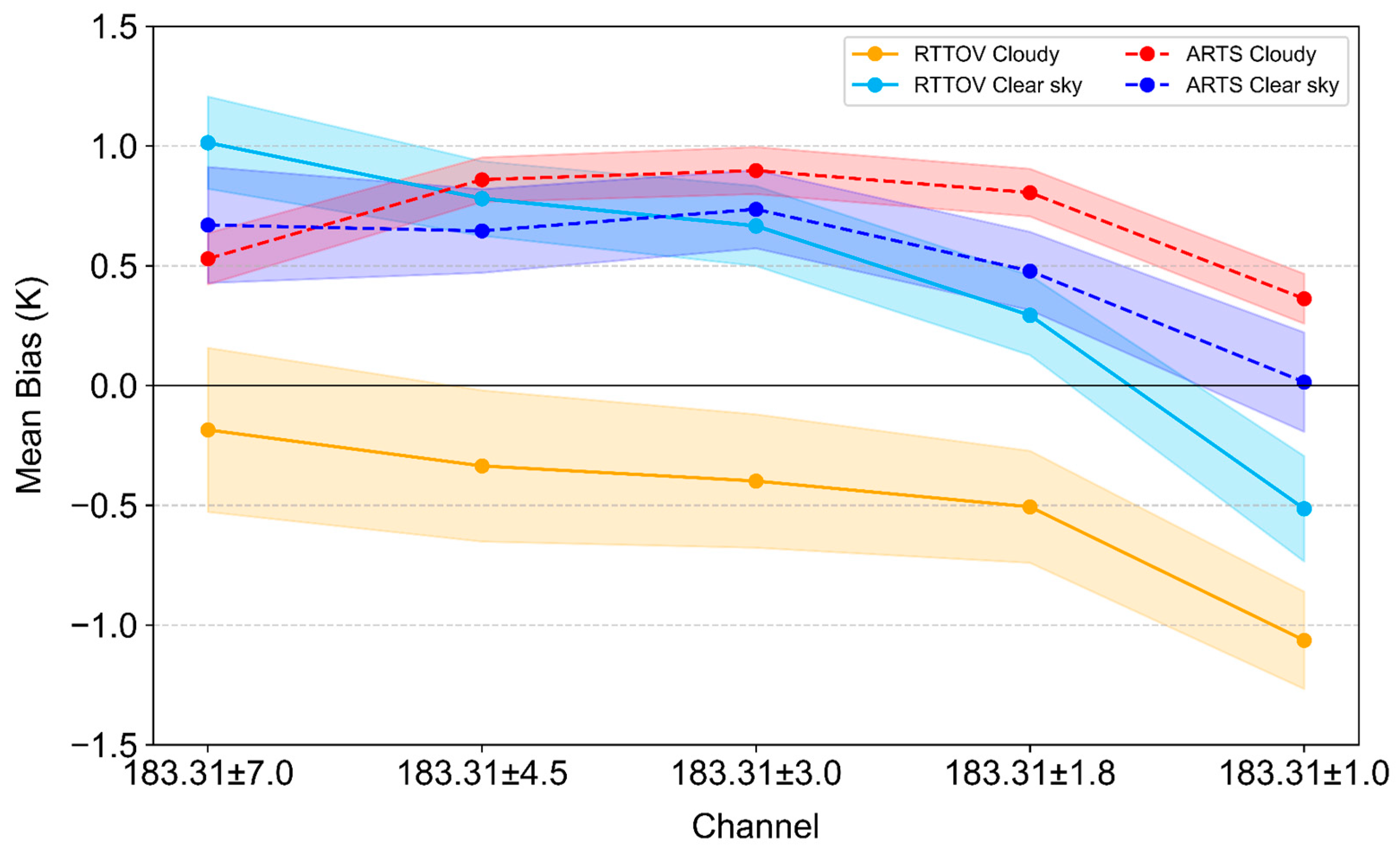
As a line-by-line radiative transfer model, the reliability of ARTS has been validated in numerous intercomparison studies [1,29,30]. Moreover, Barlakas, et al. [2] used ARTS as a reference model for cross-validation against RTTOV-SCATT. This work also performed a comparison between ARTS and the fast radiative transfer model RTTOV for BT simulations at the 183 GHz channels, using the sample data from January 2016. Both models used the same configuration of atmospheric profiles, ice particle models, and particle size distributions: the 6BR model with the F07 PSD for ice and the Liquid Sphere model with the MGD for liquid water. The ocean surface emissivity in both models was computed using TESSEM2 [21]. Since the main aim of this comparison was to evaluate the computational accuracy differences between a line-by-line and a fast radiative transfer model, no further comparisons between different ice particle models were performed.
As shown in Figure 6, under clear-sky conditions, both ARTS and RTTOV exhibit small mean bias errors (MBEs) between the simulated and observed brightness temperatures at the 183.31 ± 7.0, 183.31 ± 4.5, 183.31 ± 3.0, 183.31 ± 1.8, and 183.31 ± 1.0 GHz channels. Except for a slightly larger bias exceeding 1 K in the 183.31 ± 7.0 GHz channel for RTTOV, the MBEs of both models remain below 1 K for all other channels. Moreover, the narrow confidence intervals of these biases indicate that both the fast radiative transfer model and the line-by-line model achieve comparable accuracy and reliability in simulating brightness temperatures under clear-sky conditions.
Under cloudy-sky conditions, the ARTS simulations also show high accuracy, with MBEs between simulated and observed brightness temperatures remaining below 1 K across all five 183.31 GHz channels. The corresponding confidence intervals are likewise narrow, indicating stable and consistent performance. In comparison, the RTTOV simulations exhibit wider confidence intervals at all five channels and significantly. Therefore, the use of the line-by-line radiative transfer model ARTS for the selection of ice particle models is reasonable and reliable.

3.2. Comparison of Simulated Brightness Temperatures Between Clear-Sky and Cloudy-Sky Conditions

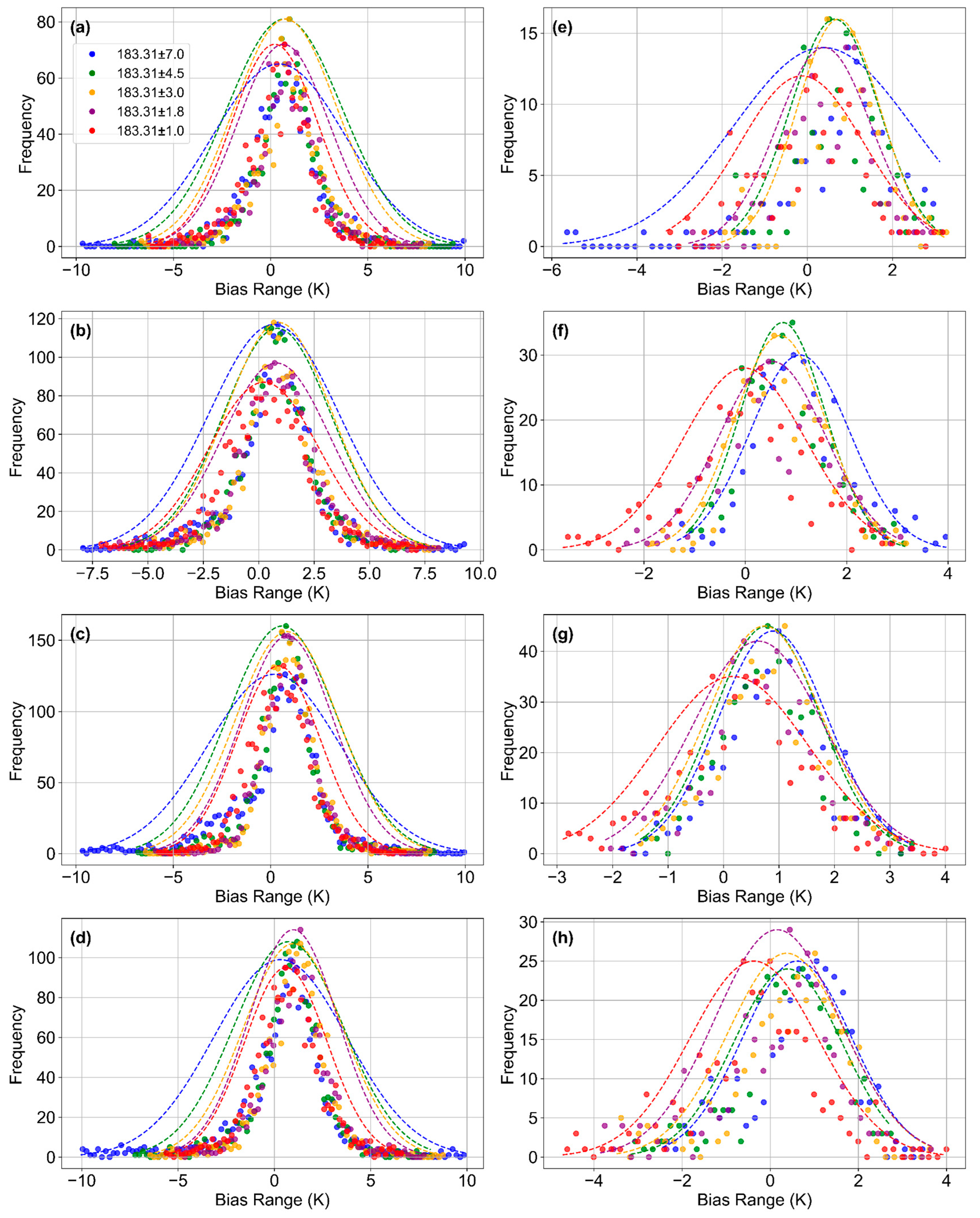
As shown in Figure 7, the bias distributions between the simulated and observed brightness temperatures exhibit distinct characteristics under clear-sky and cloudy-sky conditions across the four analyzed months of 2016. The clear-sky bias distributions are generally narrow and approximately symmetric, whereas the cloudy-sky biases display broader spreads and more complex distributional characteristics, reflecting the increased uncertainties associated with cloud microphysical properties and their representation in the simulations.
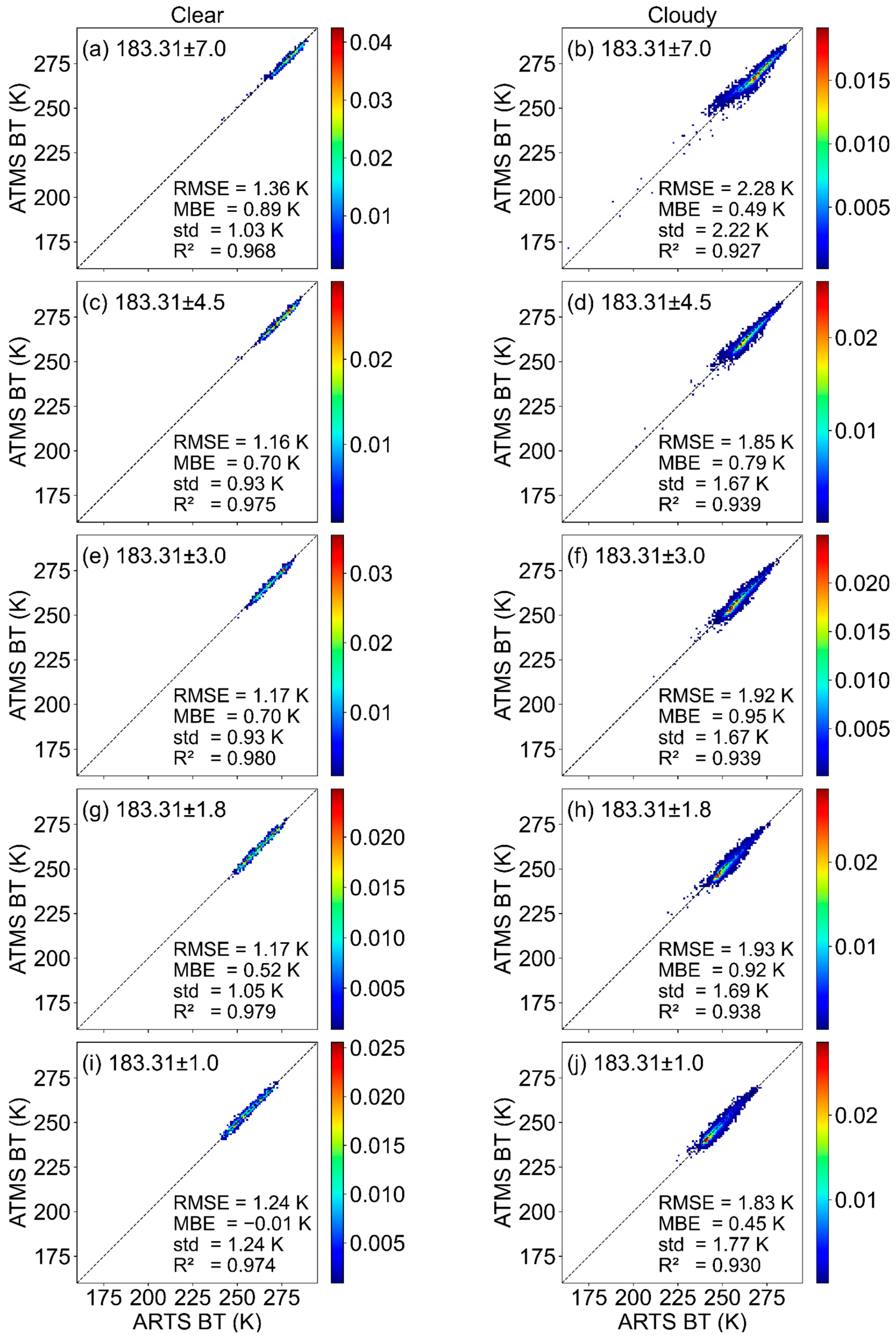
As illustrated in Figure 8, for all four analyzed months in 2016, the root mean square errors (RMSEs) of the simulated brightness temperatures under clear-sky conditions are smaller than those under cloudy-sky conditions at all five 183.31 GHz channels. The correlation between the simulated and observed brightness temperatures is likewise stronger for the clear-sky samples than for the cloudy ones. The relatively larger uncertainties in the cloudy-sky simulations can primarily be attributed to uncertainties in the representation of LWC, IWC, PSDs, and hydrometeor models within the atmospheric profiles. In addition, the mean absolute errors (MAEs) of the clear-sky simulations remain below 1 K, and the corresponding coefficients of determination (R2) exceed 0.95 for all four months, indicating that the clear-sky simulations overall perform very well. These results suggest that the biases in cloudy-sky simulations are largely independent of those in clear-sky simulations and are instead primarily controlled by parameters such as the ice particle model, thereby providing a physically robust basis for further analysis of cloud microphysical properties in the atmosphere.

3.3. Selection of Optimal Ice Particle Models for Different Cloud Types

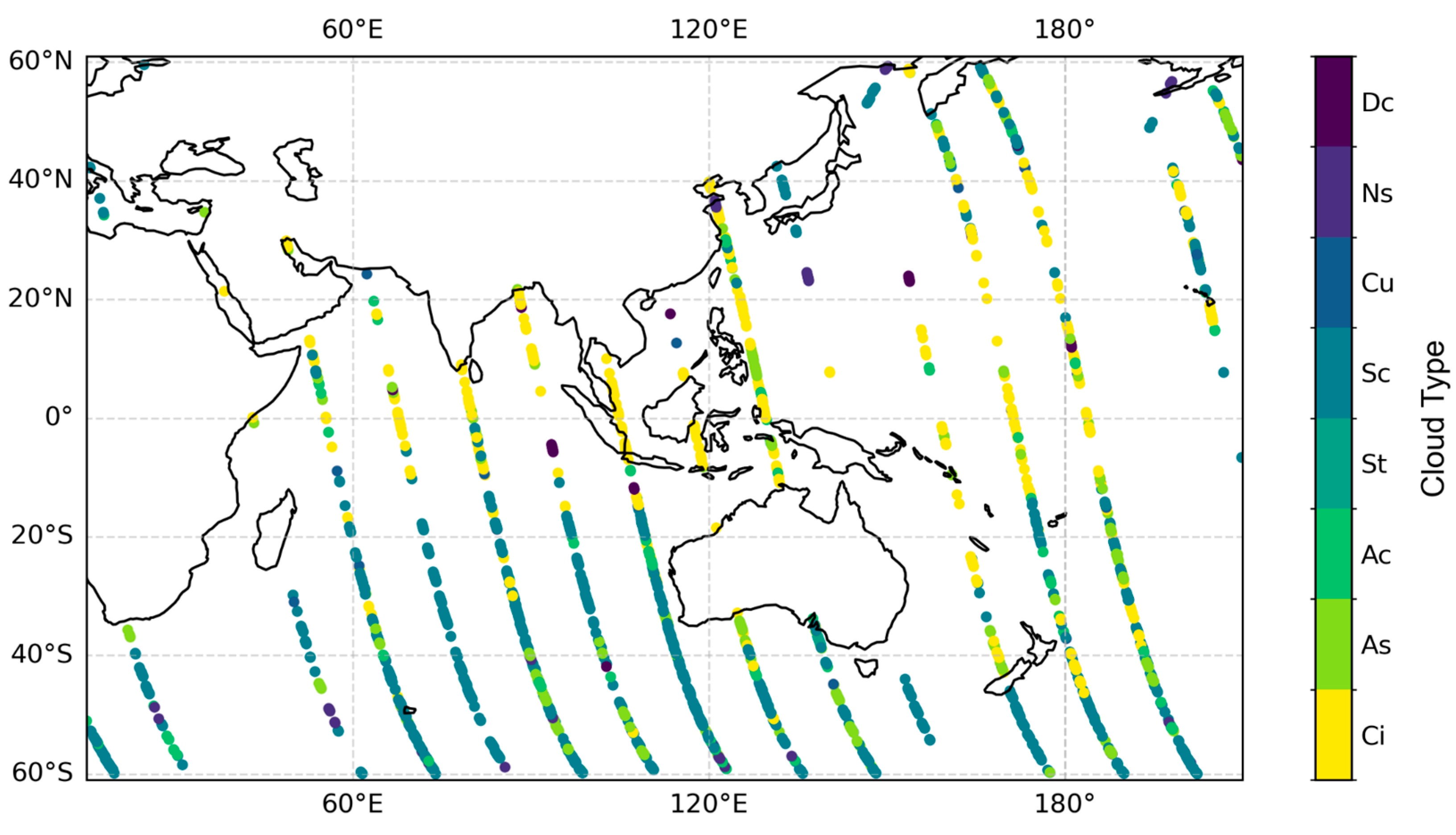
In total, 65,815 CloudSat atmospheric profiles were collocated with 8181 fully cloudy ATMS samples from the four analyzed months in 2016, corresponding to an average of approximately eight CloudSat profiles within each ATMS iFOV. When all coincident CloudSat profiles within an ATMS iFOV contained a single cloud layer of the same cloud type, the corresponding ATMS footprint was classified as representing that specific cloud type. After applying this selection criterion, 2938 fully cloudy ATMS samples met the requirements and were used to identify the optimal ice particle models. The sample size for each cloud type is listed in Table 6. The spatial distribution of these cloud samples is shown in Figure 9. Stratus clouds were excluded from the statistical analysis because of their limited number, as they are often difficult to distinguish from stratocumulus in the 2B-CLDCLASS-LIDAR product.
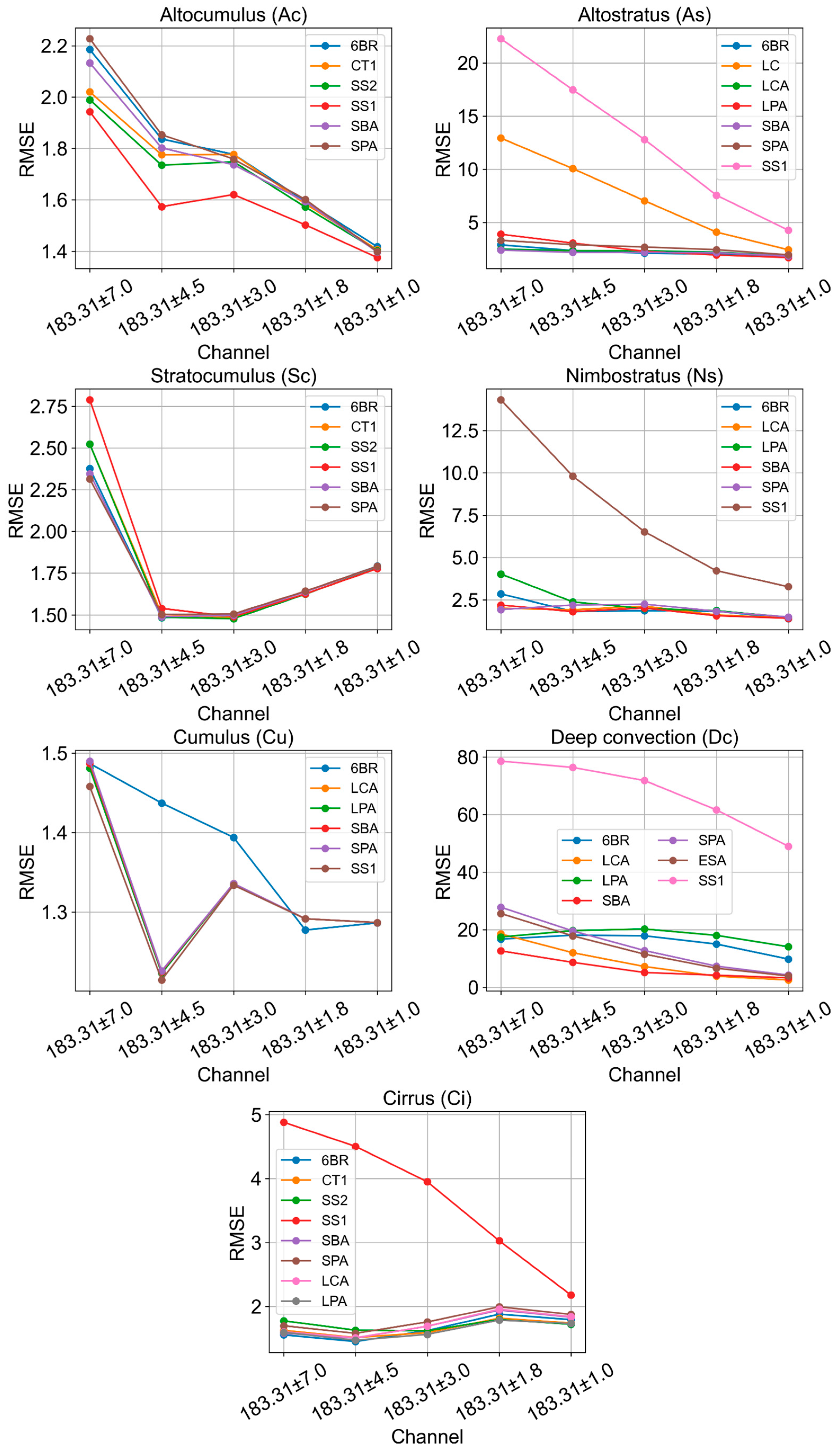
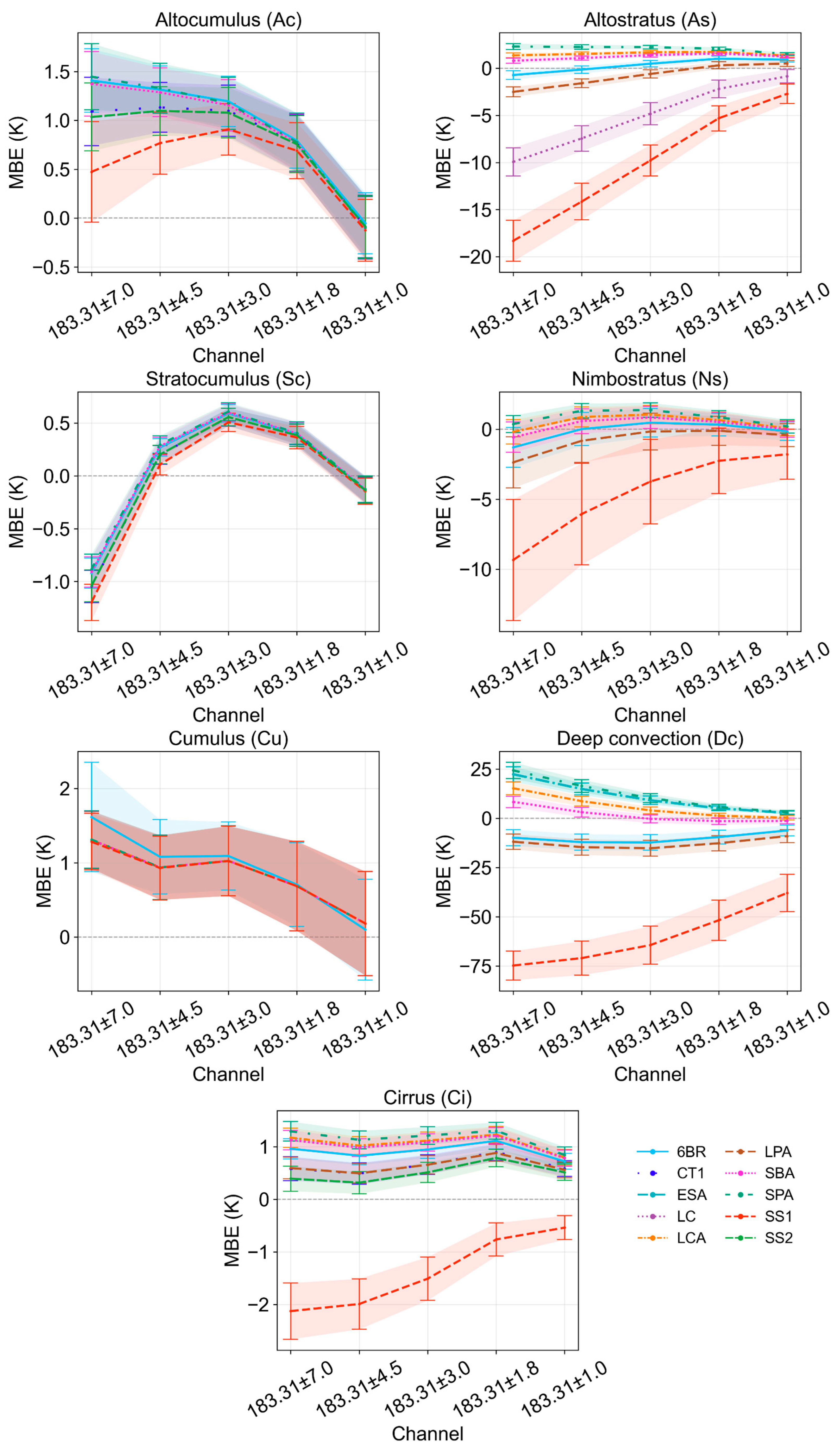
For cirrus (Ci) clouds, which are located at high altitudes and are optically thin, ice-phase, and non-precipitating in nature, the hydrometeors are primarily composed of ice crystals. As shown in Figure 10 and Figure 11, when the spherical ice particle model SS1 is used, the root mean square error (RMSE) between the simulated and observed brightness temperatures reaches 4.88 K at the channel corresponding to the lowest peak of the weighting function. In contrast, using seven representative non-spherical ice particle models, including 6BR, CT1, SS2, SBA, SPA, LCA, and LPA, reduces the RMSE at the same channel to around 1.8 K, representing an improvement of approximately 3 K relative to the spherical case. These non-spherical models also produce smaller errors across the remaining four 183 GHz channels. Therefore, for Ci clouds composed entirely of ice crystals, adopting non-spherical ice particle models provides more accurate BT simulations than assuming sphericity. Moreover, as shown in Figure 11, the differences in MBE among the various nonspherical ice particle models are less than 1 K, and the confidence intervals exhibit approximately identical widths across all channels. The differences among these non-spherical models are comparatively minor for thin Ci, probably because the influence of particle shape on total extinction becomes less pronounced when the ice water path (IWP) is low. Consequently, any of these non-spherical models can be reasonably applied for simulating the brightness temperatures of Ci clouds.
Altostratus (As) is a midlevel mixed-phase cloud whose hydrometeors typically contain both ice crystals and liquid droplets. As shown in Figure 10 and Figure 11, the spherical ice particle model (SS1) performs substantially worse than the non-spherical models. At the 183.31 ± 7.0 GHz channel, the RMSE of the spherical model reaches 22.28 K, whereas the smallest RMSE among the non-spherical models is only 2.41 K. Even at the 183.31 ± 1.0 GHz channel, the minimum RMSE of the non-spherical models remains about 3 K lower than that of SS1. In contrast to the results for Ci, the differences among the non-spherical models for As are more evident. This can be attributed to the generally higher IWP of As clouds, since a larger IWP amplifies the cumulative differences in bulk optical properties across different particle habits. For As, the SBA and LCA models yield smaller RMSEs, all below 2.5 K at the 183.31 ± 7.0 GHz channel. The corresponding MBEs for SBA and LCA are also small, and their confidence intervals are correspondingly narrower. Therefore, the SBA and LCA models are recommended for BT simulations of As clouds.
Altocumulus (Ac), Stratocumulus (Sc), and Cumulus (Cu) clouds are predominantly liquid phase clouds, although ice crystals may occasionally be present. As illustrated in Figure 10 and Figure 11, the RMSEs of the simulated brightness temperatures obtained using different ice particle models are all below 3 K, and the differences between the spherical and non-spherical models are generally minor. Moreover, for the Ac, Sc, and Cu cloud types, the MBEs of all ice particle models remain below 2 K, and the confidence intervals exhibit comparable widths. This can be attributed to the relatively low IWP in these clouds, as the bulk extinction is primarily governed by LWC. Therefore, a variety of ice particle models can be appropriately applied to simulate the observed brightness temperatures of liquid phase clouds such as Ac, Sc, and Cu.
Nimbostratus (Ns) is a thick, precipitating midlevel cloud composed of both ice crystals and liquid droplets, typically with a high IWP. For Ns, the non-spherical ice particle models yield more accurate BT simulations than the spherical model. At the 183.31 ± 7.0 GHz channel, the RMSE of the spherical model (SS1) reaches 14.31 K, whereas that of the SBA, SPA, and LCA models are below 2.5 K, corresponding to a difference of approximately 12 K. The absolute MBEs of the SBA, SPA, and LCA models are all less than 1 K, and their confidence intervals are of comparable width and narrower than those of the other models. Therefore, the SBA, SPA, and LCA models are recommended for BT simulations of Ns clouds across all five 183 GHz channels.
Deep convective (Dc) clouds are vertically developed convective systems composed of both ice crystals and liquid droplets, typically associated with large IWP. For such clouds, the non-spherical ice particle models yield significantly more accurate BT simulations than the spherical model. At the 183.31 ± 7.0 GHz channel, the SBA model reduces the RMSE by approximately 65 K compared with the spherical model, and even at the 183.31 ± 1.0 GHz channel, the RMSEs are still reduced by about 40 K. Because of the high IWP of Dc clouds, the differences among the various non-spherical models are also more pronounced. Across all channels, the SBA model exhibits the lowest RMSE values and the smallest absolute MBEs, and it also features the narrowest confidence intervals. Based on these comparison results, the SBA model is recommended for BT simulations of Dc clouds.
The recommended optimal ice particle models for different cloud types at the representative 183 GHz channels are summarized in Table 7.

4. Discussion

This study evaluated and identified the optimal ice particle models for simulating observed brightness temperatures with respect to different cloud types at the 183 GHz frequency band. The comparison in Section 3.3 indicates that, when applying the ice particle models recommended in Table 5, the simulated brightness temperatures in the 183 GHz band achieve RMSE lower than 3 K for Ci, Ac, Sc, As, Cu, and Ns clouds. For Dc clouds, although the RMSE remains around 10 K, the adoption of the SBA model significantly reduces the simulation errors against those with the spherical model, while RMSE decreased by approximately 50 K. The BT simulations for Dc clouds still require further improvement in the future
The IWC data used in this study were obtained from the 2B-CWC-RO product, which classifies all hydrometeors at temperatures below −20 °C as ice-phase particles. This assumption neglects the presence of supercooled raindrops, which usually exists within deep convective systems [31]. Moreover, the IWC in the 2B-CWC-RO product is generated with assumption of equivalent-mass homogeneous spherical ice particles, which is inconsistent with the actual shapes of ice crystals in the atmosphere. The aforementioned uncertainties may introduce larger discrepancies in the simulated brightness temperatures of Dc clouds. Consequently, a refined reconstruction of the IWC is planned as part of future research efforts.
In addition, this study does not include detailed comparisons among different PSDs, which will also be investigated future. Moreover, applying PSD that more accurately represent large ice particles in precipitating clouds [32] and accounting for the orientation of hydrometeor particles in radiative transfer simulations [33] will be important directions for future researches.
Subsequent research will utilize fast radiative transfer models to generate high-temporal-frequency simulations of brightness temperatures at 183 GHz, based on the ice particle models recommended in Table 7.

5. Conclusions

The choice of ice particle models is a key factor influencing the accuracy of cloudy-sky BT simulations at 183 GHz. This study conducted a statistical evaluation of cloudy-sky BT simulations over the mid- to low-latitude oceans of the Eastern Hemisphere for four representative months.
Based on the comparative analysis of seven cloud types, they are classified into three primary categories according to their microphysical phases: ice clouds, mixed-phase clouds, and liquid-phase clouds. The main conclusions are summarized as follows.
(1) The sensitivity of simulated radiances in cloudy-sky conditions to ice particle habits varies across different cloud phases. For Ac, Sc, and Cu, which are mainly liquid-phase clouds, the influence of changing ice particle models on simulated brightness temperatures is relatively minor, with BT differences smaller than 1 K.
(2) For mixed-phase and ice clouds, which generally contain the higher fraction of ice particles compared with liquid-phase ones, the adoption of non-spherical ice particle models can significantly improve the accuracy of BT simulations at the 183 GHz frequency band against the conventional spherical assumption. For Ci clouds, any of the non-spherical models, including 6BR, SS2, CT1, SBA, SPA, LCA, and LPA, yields simulated brightness temperatures with RMSEs less than 2 K. The SBA and SPA models demonstrate good performance for As clouds, with RMSEs below 2.5 K, while the SBA, SPA, and LCA models exhibit similarly good performance for Ns clouds, also achieving RMSEs below 2.5 K. For Dc clouds, although the SBA model yields RMSEs of around 10 K, it still implements a substantial improvement over the spherical model.
(3) For the typical channels within the 183 GHz frequency band, the sensitivity of simulated brightness temperatures to ice particle models decreases as the weighting-function peak altitude increases. This may be attributed to the fact that channels with higher weighting-function peaks are less affected by surface-emitted radiation, resulting in smaller extinction differences among different ice particle models.
When performing cloudy-sky BT simulations at the 183 GHz frequency band, the findings of this study provide valuable references for selecting appropriate ice particle models for different cloud types and offer helpful supports for fast radiative transfer simulations of brightness temperatures for the Fengyun-4M microwave mission.


Author Contributions

Conceptualization, Z.L., Q.G., and F.D.; methodology, Z.L. and Y.C.; software, Z.L. and F.D.; validation, Z.L. and Q.G.; formal analysis, Z.L., Q.G., and X.W.; investigation, Z.L. and W.H.; resources, Z.L. and X.W.; data curation, Z.L. and Y.C.; writing—original draft preparation, Z.L. and W.H.; writing—review and editing, Z.L. and Q.G.; visualization, Z.L. and X.W.; supervision, Q.G.; project administration, Q.G. All authors have read and agreed to the published version of the manuscript.

Funding

This research was funded by the National Natural Science Foundation of China under grant Nos. 42330110, U2542205 and 42205138.

Data Availability Statement

Data available on request from the authors.

Acknowledgments

We thank for the technical support of the National Large Scientific and Technological Infrastructure “Earth System Numerical Simulation Facility” (https://cstr.cn/31134.02.EL; accessed on 30 December 2025).

Conflicts of Interest

The authors declare no conflict of interest.

References

  1. Moradi, I.; Goldberg, M.; Brath, M.; Ferraro, R.; Buehler, S.A.; Saunders, R.; Sun, N. Performance of radiative transfer models in the microwave region. J. Geophys. Res. Atmos. 2020, 125, e2019JD031831. [Google Scholar] [CrossRef]
  2. Barlakas, V.; Galligani, V.S.; Geer, A.J.; Eriksson, P. On the accuracy of RTTOV-SCATT for radiative transfer at all-sky microwave and submillimeter frequencies. J. Quant. Spectrosc. Radiat. Transf. 2022, 283, 108137. [Google Scholar] [CrossRef]
  3. Geer, A.; Baordo, F. Improved scattering radiative transfer for frozen hydrometeors at microwave frequencies. Atmos. Meas. Tech. 2014, 7, 1839–1860. [Google Scholar] [CrossRef]
  4. Wu, B.; Wang, Y.; Fan, X.; Liu, S.; Fu, Y. A mixing scheme of ice particle models for global ice cloud measurements. Remote Sens. Environ. 2024, 313, 114356. [Google Scholar] [CrossRef]
  5. Kulie, M.S.; Hiley, M.J.; Bennartz, R.; Kneifel, S.; Tanelli, S. Triple-frequency radar reflectivity signatures of snow: Observations and comparisons with theoretical ice particle scattering models. J. Appl. Meteorol. Climatol. 2014, 53, 1080–1098. [Google Scholar] [CrossRef]
  6. Kulie, M.S.; Bennartz, R.; Greenwald, T.J.; Chen, Y.; Weng, F. Uncertainties in microwave properties of frozen precipitation: Implications for remote sensing and data assimilation. J. Atmos. Sci. 2010, 67, 3471–3487. [Google Scholar] [CrossRef]
  7. Liu, G. A database of microwave single-scattering properties for nonspherical ice particles. Bull. Amer. Meteorol. Soc. 2008, 89, 1563–1570. [Google Scholar] [CrossRef]
  8. Guerbette, J.; Mahfouf, J.-F.; Plu, M. Towards the assimilation of all-sky microwave radiances from the SAPHIR humidity sounder in a limited area NWP model over tropical regions. Tellus A Dyn. Meteorol. Oceanogr. 2016, 68, 28620. [Google Scholar] [CrossRef]
  9. Yin, M.; Liu, G. Assessment of GPM high-frequency microwave measurements with radiative transfer simulation under snowfall conditions. Q. J. R. Meteorol. Soc. 2019, 145, 1603–1616. [Google Scholar] [CrossRef]
  10. Geer, A.J. Physical characteristics of frozen hydrometeors inferred with parameter estimation. Atmos. Meas. Tech. 2021, 14, 5369–5395. [Google Scholar] [CrossRef]
  11. Weng, F.; Zou, X.; Wang, X.; Yang, S.; Goldberg, M. Introduction to Suomi national polar-orbiting partnership advanced technology microwave sounder for numerical weather prediction and tropical cyclone applications. J. Geophys. Res. Atmos. 2012, 117, D19112. [Google Scholar] [CrossRef]
  12. Austin, R.T.; Heymsfield, A.J.; Stephens, G.L. Retrieval of Ice Cloud Microphysical Parameters Using the Cloudsat Millimeter-Wave Radar and Temperature. J. Geophys. Res. Atmos. 2009, 114, 19. [Google Scholar] [CrossRef]
  13. Cronk, H.; Partain, P. CloudSat ECMWF-AUX Auxillary Data Product Process Description and Interface Control Document. 2017, 16p. Available online: https://www.cloudsat.cira.colostate.edu/data-products/ecmwf-aux (accessed on 23 December 2025).
  14. Stephens, G.L.; Vane, D.G.; Tanelli, S.; Im, E.; Durden, S.; Rokey, M.; Reinke, D.; Partain, P.; Mace, G.G.; Austin, R. CloudSat mission: Performance and early science after the first year of operation. J. Geophys. Res. Atmos. 2008, 113, D00A18. [Google Scholar] [CrossRef]
  15. Hersbach, H.; Bell, B.; Berrisford, P.; Hirahara, S.; Horányi, A.; Muñoz-Sabater, J.; Nicolas, J.; Peubey, C.; Radu, R.; Schepers, D. The ERA5 global reanalysis. Q. J. R. Meteorol. Soc. 2020, 146, 1999–2049. [Google Scholar] [CrossRef]
  16. Sassen, K.; Wang, Z.; Liu, D. Global distribution of cirrus clouds from CloudSat/Cloud-Aerosol lidar and infrared pathfinder satellite observations (CALIPSO) measurements. J. Geophys. Res. Atmos. 2008, 113, D00A12. [Google Scholar] [CrossRef]
  17. Wang, Z. CloudSat 2B-CLDCLASS-LIDAR Product Process Description and Interface Control Document. 2019, 59p. Available online: https://www.cloudsat.cira.colostate.edu/data-products/2b-cldclass-lidar (accessed on 23 December 2025).
  18. Buehler, S.A.; Mendrok, J.; Eriksson, P.; Perrin, A.; Larsson, R.; Lemke, O. ARTS, the atmospheric radiative transfer simulator–version 2.2. Geosci. Model Dev. 2018, 11, 1537–1556. [Google Scholar] [CrossRef]
  19. Buehler, S.A.; Larsson, R.; Lemke, O.; Pfreundschuh, S.; Brath, M.; Adams, I.; Fox, S.; Roemer, F.E.; Czarnecki, P.; Eriksson, P. The atmospheric radiative transfer simulator ARTS, version 2.6—Deep python integration. J. Quant. Spectrosc. Radiat. Transf. 2025, 341, 109443. [Google Scholar] [CrossRef]
  20. Emde, C.; Buehler, S.; Davis, C.; Eriksson, P.; Sreerekha, T.; Teichmann, C. A polarized discrete ordinate scattering model for simulations of limb and nadir long-wave measurements in 1-D/3-D spherical atmospheres. J. Geophys. Res. Atmos. 2004, 109, D24207. [Google Scholar] [CrossRef]
  21. Prigent, C.; Aires, F.; Wang, D.; Fox, S.; Harlow, C. Sea-surface emissivity parametrization from microwaves to millimetre waves. Q. J. R. Meteorol. Soc. 2017, 143, 596–605. [Google Scholar] [CrossRef]
  22. Eriksson, P.; Ekelund, R.; Mendrok, J.; Brath, M.; Lemke, O.; Buehler, S.A. A general database of hydrometeor single scattering properties at microwave and sub-millimetre wavelengths. Earth Syst. Sci. Data 2018, 10, 1301–1326. [Google Scholar] [CrossRef]
  23. Fox, S.; Mendrok, J.; Eriksson, P.; Ekelund, R.; O’Shea, S.J.; Bower, K.N.; Baran, A.J.; Harlow, R.C.; Pickering, J.C. Airborne validation of radiative transfer modelling of ice clouds at millimetre and sub-millimetre wavelengths. Atmos. Meas. Tech. 2019, 12, 1599–1617. [Google Scholar] [CrossRef]
  24. Petty, G.W.; Huang, W. The modified gamma size distribution applied to inhomogeneous and nonspherical particles: Key relationships and conversions. J. Atmos. Sci. 2011, 68, 1460–1473. [Google Scholar] [CrossRef]
  25. Field, P.R.; Heymsfield, A.J.; Bansemer, A. Snow size distribution parameterization for midlatitude and tropical ice clouds. J. Atmos. Sci. 2007, 64, 4346–4365. [Google Scholar] [CrossRef]
  26. Frey, R.A.; Ackerman, S.A.; Holz, R.E.; Dutcher, S.; Griffith, Z. The continuity MODIS-VIIRS cloud mask. Remote Sens. 2020, 12, 3334. [Google Scholar] [CrossRef]
  27. Guo, Q.; Feng, X.; Yang, C.; Chen, B. Improved spatial collocation and parallax correction approaches for calibration accuracy validation of thermal emissive band on geostationary platform. IEEE Trans. Geosci. Remote Sens. 2018, 56, 2647–2663. [Google Scholar] [CrossRef]
  28. Wang, L.; Tremblay, D.A.; Han, Y.; Esplin, M.; Hagan, D.E.; Predina, J.; Suwinski, L.; Jin, X.; Chen, Y. Geolocation assessment for CrIS sensor data records. J. Geophys. Res. Atmos. 2013, 118, 12690–12704. [Google Scholar] [CrossRef]
  29. Buehler, S.; Courcoux, N.; John, V.O. Radiative transfer calculations for a passive microwave satellite sensor: Comparing a fast model and a line-by-line model. J. Geophys. Res. Atmos. 2006, 111, D20304. [Google Scholar] [CrossRef]
  30. Schreier, F.; Milz, M.; Buehler, S.A.; von Clarmann, T. Intercomparison of three microwave/infrared high resolution line-by-line radiative transfer codes. J. Quant. Spectrosc. Radiat. Transf. 2018, 211, 64–77. [Google Scholar] [CrossRef]
  31. Kumjian, M.R.; Ganson, S.M.; Ryzhkov, A.V. Freezing of raindrops in deep convective updrafts: A microphysical and polarimetric model. J. Atmos. Sci. 2012, 69, 3471–3490. [Google Scholar] [CrossRef]
  32. Field, P.R.; Heymsfield, A.J.; Detwiler, A.G.; Wilkinson, J.M. Normalized hail particle size distributions from the T-28 storm-penetrating aircraft. J. Appl. Meteorol. Climatol. 2019, 58, 231–245. [Google Scholar] [CrossRef]
  33. Brath, M.; Ekelund, R.; Eriksson, P.; Lemke, O.; Buehler, S.A. Microwave and submillimeter wave scattering of oriented ice particles. Atmos. Meas. Tech. 2020, 13, 2309–2333. [Google Scholar] [CrossRef]
Figure 1. Technical roadmap.
Remotesensing 18 00168 g001
Figure 2. Spatial distribution of the collocated ATMS BT samples.
Remotesensing 18 00168 g002
Figure 3. Geometric computation of the ATMS iFOV footprint.
Remotesensing 18 00168 g003
Figure 4. Illustration of the basic principle of the Ray-Crossing Algorithm. Points A and B denote VIIRS Cloud Mask pixels located outside and inside the ATMS iFOV, respectively. Points A1, A2, and B1 represent the intersection points between the ray and the ATMS iFOV boundary.
Remotesensing 18 00168 g004
Figure 5. Identification of clear-sky and cloudy-sky of ATMS iFOVs coincident with VIIRS Cloud Mask pixels; (a) VIIRS Cloud Mask data acquired on 17 January 2016 from 05:13 to 05:21 UTC. Colored circles denote VIIRS Cloud Mask pixels, with different colors representing cloud classifications (confident clear, probably clear, probably cloudy, cloudy, and no result). The black ellipse outlines the ATMS iFOV, whose boundary is indicated by black dots. (bd) show enlarged views of representative ATMS iFOVs corresponding to clear-sky, mixed, and cloudy-sky conditions, respectively. Dashed lines indicate the locations of the enlarged regions selected from (a).
Remotesensing 18 00168 g005
Figure 6. Comparison of BT bias between ARTS/RTTOV simulations and ATMS observations (January 2016).
Remotesensing 18 00168 g006
Figure 7. Frequency distributions of BT bias in clear-sky and cloudy-sky conditions for four months in 2016 (ice particle model: 6-Bullet Rosette): (ad) cloudy scenes; (eh) clear-sky scenes, for January, April, August, and October, respectively. The legend in (a) applies to all panels.
Remotesensing 18 00168 g007
Figure 8. Scatterplots of ATMS BTs versus ARTS-simulated BTs in clear-sky and cloudy-sky iFOVs for January, April, August, and October 2016 (ice particle model: 6-Bullet Rosette). Color shows the occurrence frequency in 1 K × 1 K bins. (a,c,e,g,i) show clear-sky cases and (b,d,f,h,j) show cloudy-sky cases for the ATMS channels at 183.31 ± 7.0, ±4.5, ±3.0, ±1.8, and ±1.0 GHz, respectively.
Remotesensing 18 00168 g008
Figure 9. Spatial distribution of sample points for eight cloud types.
Remotesensing 18 00168 g009
Figure 10. RMSEs of different ice particle models for 7 cloud types.
Remotesensing 18 00168 g010
Figure 11. Lines show MBEs of different ice particle models for seven cloud types (MBE is defined as the mean of simulated BT minus ATMS BT). The error bars and shaded bands show the 95% confidence interval of the mean bias.
Remotesensing 18 00168 g011
Table 1. Summary of ATMS–CloudSat pixel collocation statistics.
JanuaryAprilAugustOctober
Coincident ATMS pixels1235211826641984
Coincident CloudSat profiles890116,31520,31614,738
Table 2. Summary of product data for profiles.
ProductProfiles Data
ECMWF-AUXtemperature, pressure, specific humidity, ozone mixing ratio, sea surface temperature, 10 m wind speed
2B-CWC-ROLWC, IWC
2B-CLDCLASS-LIDARcloud types
Table 3. Selected ice particle models of different cloud types for evaluation.
Cloud PhaseCloud TypeParticle Model
MainSpecific
Single CrystalsAggregates
Ice cloudCiSS1, 6BR, CT1, SS2SBA, SPALCA, LPA
Mixed-phase cloudAsSS1, 6BRSBA, SPA, LCA, LPALC
NsSS1, 6BRSBA, SPA, LCA, LPA
DcSS1, 6BRSBA, SPA, LCA, LPAESA
Liquid cloudCuSS1, 6BRSBA, SPA, LCA, LPA
ScSS1, 6BR, CT1, SS2SBA, SPA
AcSS1, 6BR, CT1, SS2SBA, SPA
Table 4. Single scattering properties.
IDParticle ModelDmax (μm)αβAbbreviation
25Liquid sphere1–50,0004803.00LS
24Ice sphere1–50,0004803.00SS1
3Sector snowflake20–12,0000.000811.44SS2
66-bullet rosette16–10,0000.482.426BR
7Column type 114–10,0000.0372.05CT1
14Long column24–4835343.00LC
1Evans snow aggregate32–11,7550.202.39ESA
18&14Large column aggregate368–19,9810.252.43LCA
Long column24–400343.00
21&12Small block aggregate100–73280.212.33SBA
Block column12–4002103.00
19&15Small plate aggregate99–70540.0772.25SPA
Thick plate16–1001103.00
20&15Large plate aggregate349–22,8600.212.26LPA
Thick plate16–4001103.00
Table 5. Summary of clear-sky and fully cloudy ATMS iFOV samples.
JanuaryAprilAugustOctober
Clear-sky samples139300408299
Cloudy-sky samples1096181822561685
Table 6. Sample sizes for different cloud types.
CiAsAcScCuNsDc
samples5863161281284176645
Table 7. Optimal ice particle models selection scheme for 183 GHz channel.
Cloud PhaseCloud Type183.31 ± 7.0183.31 ± 4.5183.31 ± 3.0183.31 ± 1.8183.31 ± 1.0
Ice cloudCi6BR, SS2, CT1, SBA, SPA, LCA, and LPA are all applicable.
Mixed-phase cloudAsSBA and LCA are applicable.
DcSBA
NsSBA, SPA, LCA are all applicable.
Liquid cloudAc6BR, CT1, SS2, SS1, SBA, SPA, LCA, and LPA are all applicable.
Sc
Cu
Disclaimer/Publisher’s Note: The statements, opinions and data contained in all publications are solely those of the individual author(s) and contributor(s) and not of MDPI and/or the editor(s). MDPI and/or the editor(s) disclaim responsibility for any injury to people or property resulting from any ideas, methods, instructions or products referred to in the content.