
Next Article in Journal
Polarimetric SAR Salt Crust Classification via Autoencoded and Attention-Enhanced Feature Representation
Previous Article in Journal
Text-Injected Discriminative Model for Remote Sensing Visual Grounding
error_outline You can access the new MDPI.com website here. Explore and share your feedback with us.
 
 
Article

Thermal Deformation Correction for the FY-4A LMI

1
State Key Laboratory of Atmospheric Environment and Extreme Meteorology, Institute of Atmospheric Physics, Chinese Academy of Sciences, Beijing 100029, China
2
College of Earth and Planetary Sciences, University of Chinese Academy of Sciences, Beijing 100049, China
3
National Satellite Meteorological Center, Chinese Meteorological Administration, Beijing 100081, China
*
Author to whom correspondence should be addressed.
Remote Sens. 2026, 18(1), 163; https://doi.org/10.3390/rs18010163
Submission received: 12 November 2025 / Revised: 25 December 2025 / Accepted: 30 December 2025 / Published: 4 January 2026
(This article belongs to the Special Issue Application of Satellite Data for Lightning Mapping)

Highlights

  • This study identifies thermal-deformation-induced deviations in the current FY-4A LMI product. By applying corrections using ground-based lightning data as references, the lightning positioning accuracy of the LMI products has been significantly improved.
What are the main findings?
  • The study reveals that the displacement of the lightning detection payload caused by thermal deformation exhibits periodic characteristics and a correction method was developed.
What are the implications of the main findings?
  • The complex Gaussian model effectively captures the variation trend of thermal deformation and the proposed correction method can effectively rectify the thermal deformation errors.

Abstract

Affected by solar radiation in space, the FY-4A Lightning Mapping Imager (LMI) detection array exhibits daily periodic thermal expansion and contraction, leading to deviations in lightning positioning accuracy. While LMI’s detection efficiency is higher at night, the dual edge matching algorithm, which relies on surface features for correction, does not perform well during nighttime (around 3 pixels). Analysis shows that most of the lightning data corrected by this method exhibit significant deviations from the actual lightning locations in practical applications. Therefore, this paper proposes a new correction method based on high precision ground-based lightning location data from the 2019 summer World Wide Lightning Location Network (WWLLN) and the Beijing Broadband Lightning Network (BLNET). Using these datasets as reference standards, the periodic deviation of LMI is determined, and a correction curve is derived using a weighted Gaussian fitting approach. This method further improves the nighttime lightning location accuracy of LMI on the basis of the current operational algorithm. The results demonstrate that the corrected LMI data significantly reduces the positioning errors, with an accuracy within ±1 pixel in the Beijing area, as an example.

1. Introduction

Lightning is a hazardous and destructive atmospheric discharge phenomenon associated with severe convective weather. It contributes significantly to casualties caused by meteorological disasters [1,2]. Therefore, accurate lightning detection is of paramount importance. With the advancement of space-based lightning imaging technology, largescale lightning observation systems have been rapidly evolving. Currently, six lightning imagers are operational on geostationary orbit satellites. The Geostationary Lightning Mapper (GLM) aboard the Geostationary Operational Environmental Satellite R-series (GOES-16, 17, 18 and 19) was launched in 2017, 2018, 2023 and 2024 [3,4,5,6]. Meanwhile, China’s next generation geostationary meteorological satellite, Fengyun-4A (FY-4A), carrying the Lightning Mapping Imager (LMI), was launched on 11 December 2016. During summer, it primarily observes lightning activity over China and surrounding regions in the Northern Hemisphere, while in winter, it focuses on the eastern Indian Ocean and western Australia in the Southern Hemisphere [7,8]. Recently, the Lightning Imager (LI) aboard the Meteosat Third Generation satellite (MTG) was launched on 13 December 2022 [9].
In the case of the GLM, Carr et al. [10] in 2020 improved the lightning event positioning accuracy by identifying and registering coastlines. They also employed temperature sensors installed at various locations on the GLM to enhance compensation algorithms, correcting thermal deformation errors, which enabled GLM’s lightning location accuracy to reach 4 km at the nadir. Building on this, Peterson et al. [6,11,12,13] conducted a systematic evaluation of GLM’s lightning detection performance, including the light source and range and height of lightning occurrences, GLM’s detection threshold, clustering algorithms, etc. Similarly, for the parallax deviation caused by cloud top height (CTH), GLM also applied a CTH parallax correction model [14]. However, the CTH parameter was calculated by comparing ground-based lightning location networks with satellite data, and the correction accuracy was influenced by the latitude of lightning occurrences. Overall, GLM is a stable performing payload with accurate lightning location capability.
As an experimental payload, the FY-4A LMI continues to undergo a great deal of verification work. In 2020, Hui et al. [15,16] studied the preliminary observational data and radiation characteristics of LMI, comparing the lightning radiation signals detected by LMI with those of other lightning observation systems like Lightning Imaging Sensor (LIS) and World Wide Lightning Location Network (WWLLN). They found similarities, which initially proved the reliability of LMI data. Similarly to the navigation registration algorithm on GLM, Wang et al. [17,18] proposed a double-edge algorithm in 2021, using the coastline as a reference to register images during the daytime, while at night, deviation values were derived from thermal plate measurements to estimate payload displacement caused by rocket launch acceleration. This algorithm improved the deviation caused by thermal deformation of LMI to some extent, allowing the detection accuracy to reach 1 pixel during the day and within 3 pixels at night. However, Cao et al. [19] compared the LMI and LIS lightning data from 2018 to 2020 and found that the nighttime detection efficiency of LMI was significantly higher than that during the day, indicating that most of the LMI lightning data were recorded at night. Combined with the fact that the current operational algorithm still shows limited positioning accuracy at night, there remains considerable room for further improvement in LMI’s location accuracy, especially under nighttime conditions. Furthermore, Chen et al. [20] compared LMI with high precision ground-based Beijing Broadband Lightning Network (BLNET) data and found that LMI tends to detect lightning in shallow clouds, while lightning in deep convective clouds is more difficult to detect. This further highlighted the uneven detection efficiency of LMI. In 2023, Zhang et al. [21] proposed an ellipsoidal cloud height correction model that utilizes post processing CTH data, which to some extent eliminated the parallax deviation issue in LMI lightning location due to CTH, further improving LMI’s detection accuracy.
Currently, the operational LMI lightning product still contains certain errors that limit its positioning accuracy, such as thermal deformation, payload jitter, and other random errors. Among these, thermal deformation is the most significant contributing factor. Satellites in outer space are subject to various radiative influences, primarily direct solar radiation, causing thermal deformation of their payloads, which leads to daily periodic deviations in lightning positioning [20,21]. Even after a series of corrections to LMI lightning data, comparisons with high precision ground-based data still reveal residual deviations, with thermal deformation induced periodic bias being the most significant issue. For remote sensing satellites, such as visible light imaging satellites, the displacement can be calculated during the day by identifying surface features. At night, optical payloads can be turned off to reduce thermal deformation effects due to the operational nature of these satellites [22,23]. For lightning space observations, particularly LMI, nighttime is when detection efficiency is the highest [19], but it is also when thermal deformation effects are most pronounced. Considering that the dual matching algorithm has already performed preliminary correction for LMI’s thermal deformation [17,18], constructing an independent thermal deformation correction model could lead to redundant corrections. Additionally, due to the complexity of the space thermal environment and issues such as the angular displacement of the LMI payload, accurately simulating the thermal environment becomes even more challenging. Therefore, to further improve the accuracy of LMI’s observational data and address the thermal deformation problem, this study proposes a new correction method based on ground-based lightning location network data. This approach aims to overcome the incomplete thermal deformation correction currently applied to nighttime data in operational algorithms and further enhance LMI’s detection accuracy from a numerical perspective, providing a reference for subsequent data applications.

2. Thermal Deformation and Correction Method

2.1. Deviations Caused by Thermal Deformation

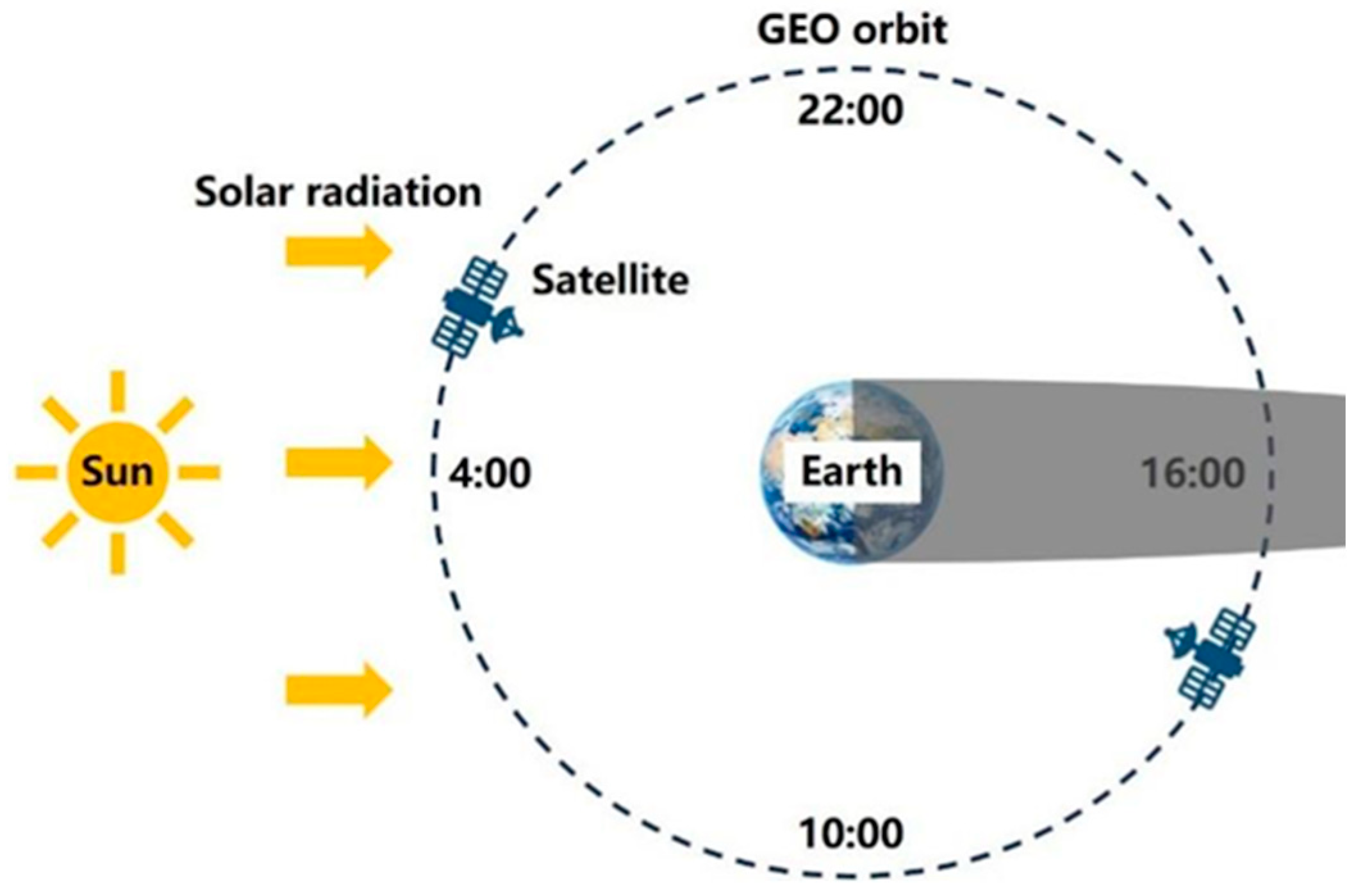
Due to direct solar radiation, the payload on the satellite undergoes thermal deformation, resulting in periodic deviations in lightning positioning. Figure 1 illustrates the thermal deformation effect caused by solar radiation on the LMI. The Earth’s radius is 6378 km, and the FY-4A geostationary satellite orbits 35,800 km above the Earth’s surface. At the Earth’s surface, taking the Beijing area as an example, daytime lasts approximately from UTC 22:00 to the next day at 10:00, while nighttime spans from 10:00 to 22:00 the following day. During summer, daylight hours are slightly longer. However, in geostationary orbit, as shown in the diagram, the satellite is exposed to solar radiation for extended periods, with the time spent in Earth’s shadow being less than 2 h. Starting from 10:00, the thermal deformation effect is most pronounced. During this time, solar radiation strikes the payload from the side, gradually transitioning to direct radiation. As the satellite moves into the Earth’s shadow, the thermal deformation effect weakens, and by 22:00, when the satellite exits the shadow, the radiation shifts from direct to side illumination. At the same time, the Earth is in nighttime, which corresponds to the period of highest lightning detection efficiency. Therefore, the payload’s thermal deformation does have a certain impact on lightning positioning. Of course, due to factors such as seasonal changes and variations in the satellite’s orbital angle relative to the Earth’s orbit, the solar incident angle and duration of direct radiation will vary. However, the overall duration of satellite exposure to solar radiation remains largely constant.
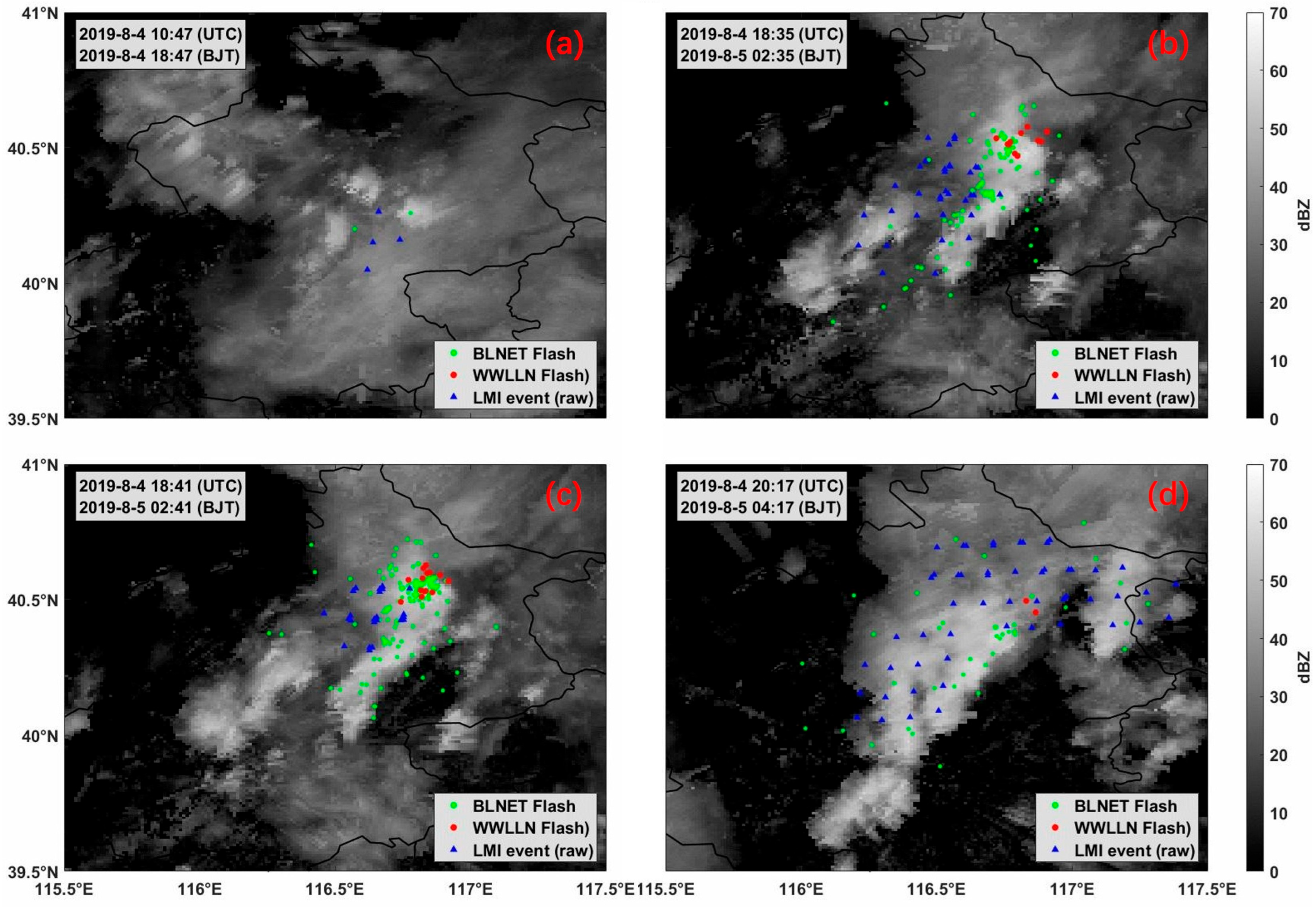
Additionally, we also analyzed the thermal deformation related lightning positioning deviations of the LMI by comparing it with two independent sets of ground-based lightning observations. The technical specifications of the space-based LMI and the two ground-based lightning location networks will be introduced in detail in the following subsection. As shown in Figure 2, green dots represent flash locations detected by the BLNET, red dots correspond to flash locations from WWLLN, and blue dots indicate LMI events locations before thermal deformation correction—hereafter referred to as “LMI event (raw)”, and the radar composite reflectivity is used as the background reference for identifying regions characterized by strong lightning activity. It is evident from the thermal variation trend discussed in Figure 1 that the LMI data are strongly affected by solar radiation intensity. Taking a strong convective weather system over Beijing on 4 August 2019, as an example, we examined lightning data from three representative time points. At 10:00 UTC and 20:00 UTC—periods with relatively low solar radiation—the lightning locations from LMI and BLNET are largely consistent. Due to the relatively low detection efficiency of WWLLN, fewer events were recorded, but those available show similar spatial agreement. In contrast, at 18:00 UTC—a period with more intense solar radiation—we selected two representative examples, both showing that LMI lightning locations are noticeably shifted southwest compared to the positions reported by both BLNET and WWLLN. This systematic southwestward deviation aligns with the expected thermal deformation trend, given that Beijing lies in the north-eastern portion of LMI’s right field of view. The above examples and analyses reveal the periodic deviations in LMI lightning location, which we consider to be the main evidence that these errors originate from thermal deformation.

2.2. Satellite and Ground-Based Lightning Data

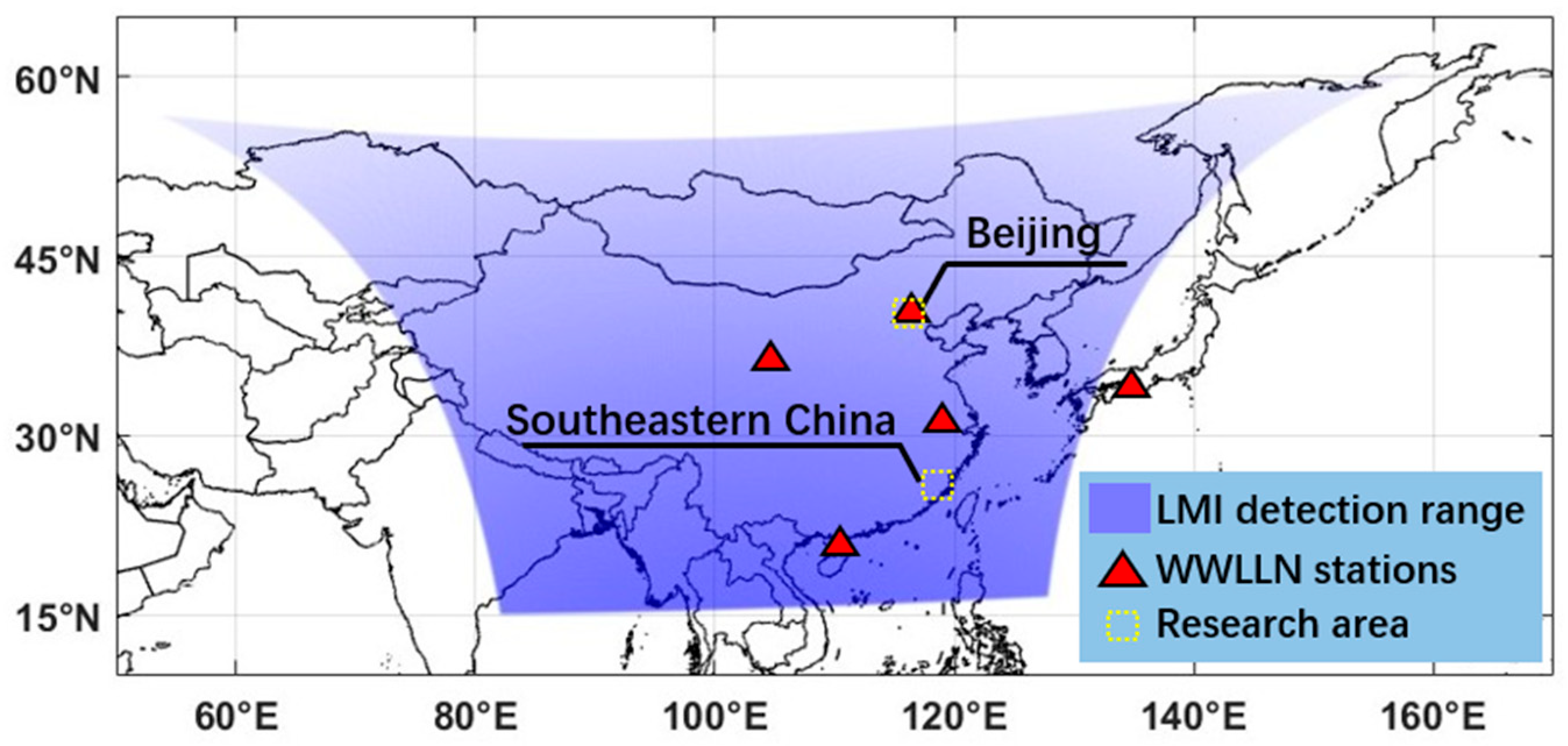
We used ground-based lightning observation data from the WWLLN as reference locations to investigate whether systematic deviations related to thermal deformation are present when comparing LMI and WWLLN lightning location data. This serves as a basis to explore the potential for correcting LMI thermal deformation deviations over the full observation range using WWLLN data in future work. WWLLN detects global lightning activity in real time by capturing electromagnetic radiation signals in the Very Low Frequency (VLF) range (3–30 kHz) and determining the precise arrival time of lightning pulses at each station using GPS. The network comprises over 70 stations globally, with five stations located within or near the LMI observation region over East Asia (The red triangle in Figure 3). WWLLN primarily detects lightning events with high current intensities (including both intra-cloud and cloud-to-ground lightning), and its detection efficiency increases with stronger return stroke currents [24,25]. A study by Fan et al. [26], which compared WWLLN data with ground-based lightning detection from the State Grid Corporation of China, found that during 2013–2015, 72% of the WWLLN detected lightning events in the central and southern Tibetan Plateau were cloud-to-ground lightning. The total detection efficiency was approximately 2.58%, with a cloud-to-ground lightning detection efficiency of about 9.37%, and an average location accuracy of around 10 km. The WWLLN data used in this study cover the summer of 2019. The WWLLN dataset consists of flash level data, in which flashes are defined as clusters of lightning discharges occurring within 0.5 s and within 30 km of each other [26].
The LMI on FY-4A is China’s first space-based lightning detector capable of detecting both cloud-to-ground and intra-cloud lightning. It utilizes a 400 × 300 × 2 CCD array plane, operating at a wavelength of 777.4 nm, with a frame rate of 2 ms [7,19]. The field of view of LMI covers China and its adjacent sea areas (The blue part in Figure 4), with a spatial resolution of 7.8 km at the nadir. Through the utilization of a Real-time Event Processor (RTEP), LMI dynamically calculates the average optical brightness of the background. This calculated value serves as the threshold for background identification. Consequently, pixels in each frame that surpass the background threshold are extracted and defined as “event” data. Meanwhile, concurrently adjacent event data within the same frame are grouped together to form “group” data. These group data are then subjected to a clustering analysis algorithm, specifically designed to classify and cluster the data into the category of “flash” data. This study utilized the LMI Level 2 event products provided by the National Satellite Meteorological Center of the China Meteorological Administration.
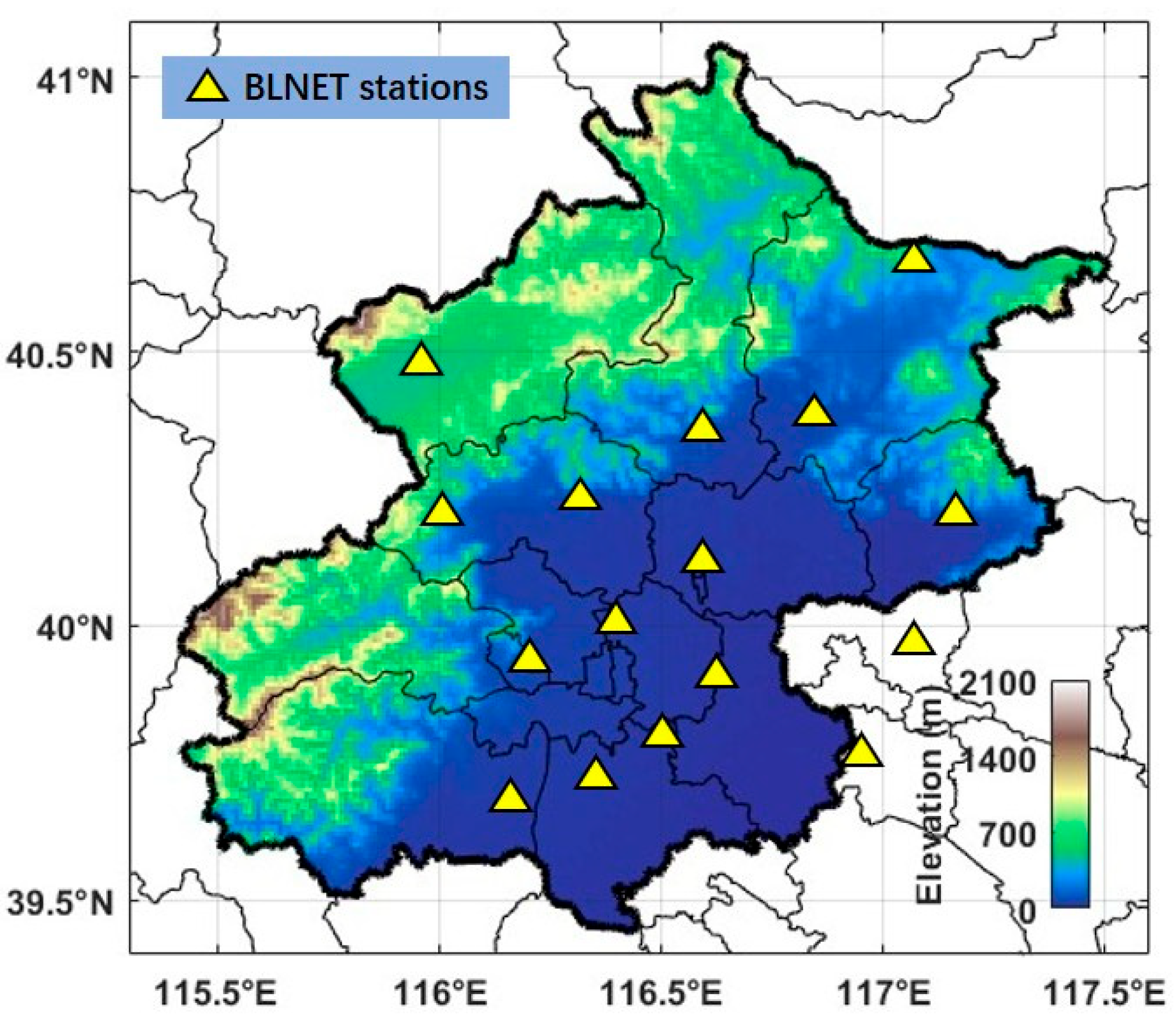
To comprehensively characterize the thermal deformation patterns across different regions within the LMI detection range and to validate the performance of the correction method when applied with various ground-based lightning location networks as references, we conducted an additional comparative experiment in the Beijing area. This experiment utilized BLNET data, which offers higher accuracy and detection efficiency than WWLLN, to correct the LMI observations. In this study, we rely on data from the BLNET as reference to refine LMI data. The BLNET encompasses a network of 16 stations strategically positioned throughout the Beijing area. These stations are equipped with both fast and slow electric field change measurement instruments, commonly known as fast and slow antennas. Additionally, they are equipped with Very-High-Frequency (VHF) radiometers designed for detecting lightning radiation [27,28,29]. This comprehensive instrumentation enables the observation of lightning at multiple frequencies. The inherent horizontal positioning deviation within the detection network is minimal, measuring less than 200 m. Even at a distance of 100 km from the network, the horizontal positioning deviation remains below 3 km. The BLNET dataset thus provides a robust and reliable foundation for enhancing the accuracy of LMI data in this study. Within the framework of the BLNET, instances of detected radiation events originating from nearby sources, spaced up to 15 km apart in space and occurring within 400 milliseconds of each other, are classified as components of a single lightning discharge event (BLNET flash). This categorization methodology has been supported by previous works. In this study, the clustered location of each BLNET flash is defined as the position of the strongest event within the specified threshold.

2.3. Data Matching Method

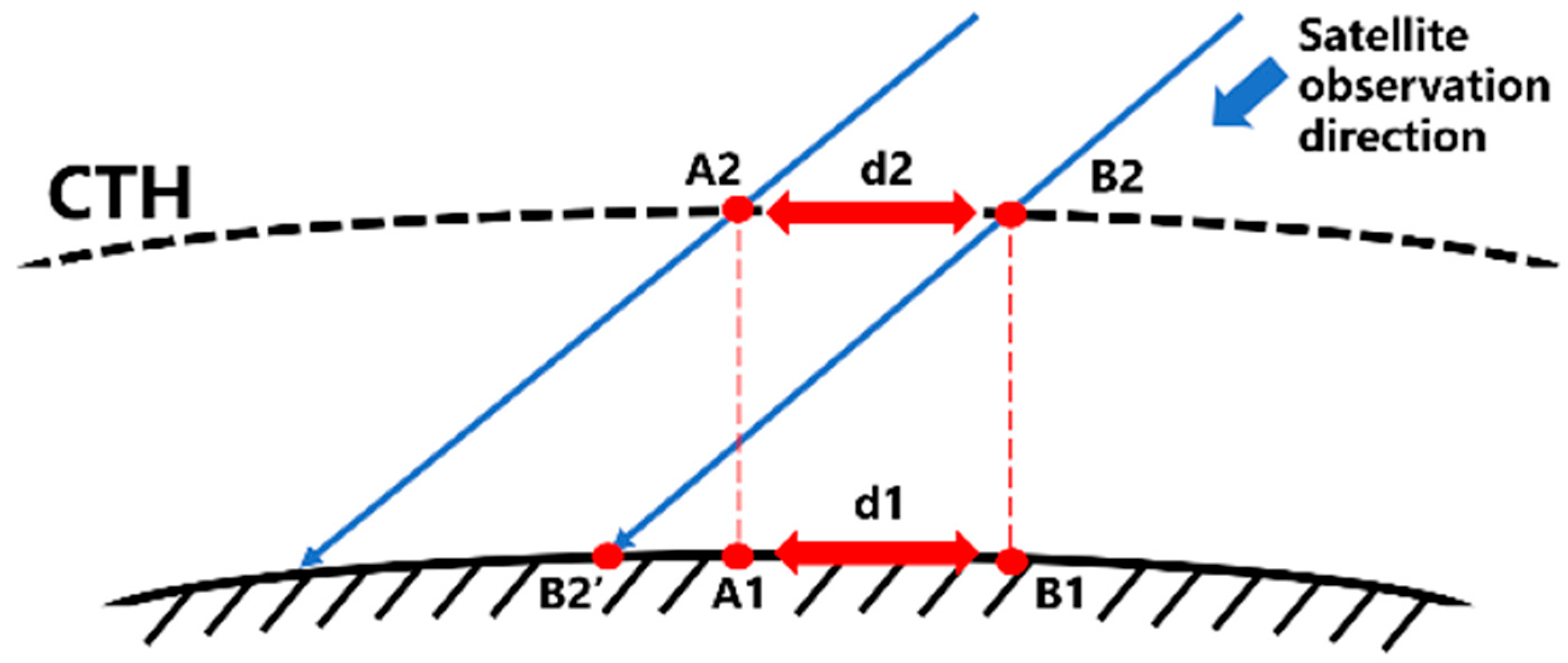
Assuming the same lightning event is detected by both the ground-based lightning location network and the LMI, the two datasets can be matched using spatiotemporal thresholds. As shown in Figure 5, Assume A1 represents the two-dimensional position of the lightning event on the Earth’s surface as detected by the ground-based network, A2 is the position of the event projected to the cloud top level, B2 is the actual location of the event at the cloud top level as observed by the LMI, and B1 is the position of the event projected back to the Earth’s surface (this process is called CTH parallax correction). B2’ represents the two-dimensional location of the LMI events without applying CTH parallax correction.
Due to the differing principles of detection, ground-based systems determine the position of the lightning event at the Earth’s surface, while space-based systems observe the lightning at the cloud top level. These two locations lie on different planes and cannot be directly compared. Moreover, the uncorrected space-based lightning location (B2′) inherently includes an error due to the CTH, making a direct comparison between A1 and B2′ unreasonable. Therefore, the most ideal approach would be to project the ground-based location (A1) to the cloud top level and compare it with the space-based result (d2). However, in our experiment, we found that due to data acquisition difficulties and coverage limitations, CTH parallax corrections for space-based lightning data typically use CTH products from the same satellite platform. For example, the GLM uses Advanced Baseline Imager (ABI) CTH product [11] and the LMI uses the Advanced Geosynchronous Radiation Imager (AGRI) CTH product. The satellite cloud-top height product is also subject to thermal deformation effects. Since products from the same satellite platform exhibit similar deviations due to thermal deformation, ground-based lightning data may not achieve accurate results when spatially matched with corresponding cloud-top height data. In contrast, the cloud-top height data matched with the LMI demonstrates higher accuracy. In addition, since the CTH product has an error on the kilometer scale, projecting the ground-based location (A1) to the cloud top (A2) introduces an error from the CTH product. It is important to note that the final application of space-based lightning data requires projecting the results back to the Earth’s surface, which will introduce CTH related errors again, significantly lowering the precision of the final lightning location. Therefore, to reduce additional errors introduced during the experiment, we simplified the process by directly projecting the space-based lightning locations to the Earth’s surface and comparing them with the ground-based results (d1). This approach uses CTH corrected data and compares it with ground-based data, reducing the introduction of errors while achieving the same experimental effect. Although this approach is similar to projecting the ground-based lightning location to the cloud top level, it is methodologically distinct.
Considering the curvature of the Earth, calculations show that assuming no error in the CTH product, the difference between comparing data at a typical cloud height of 12 km and comparing at the Earth’s surface is approximately 20 m. This difference is much smaller than the error introduced by the CTH product during CTH parallax correction, and can be considered negligible in our experiment where the correction is at the ~10 km scale. Therefore, the LMI events data used in this experiment comes from Zhang et al. [21], where the data has been corrected using the ellipsoidal CTH correction model. That is to say, the LMI data compared in the previous Figure 2 will be uniformly referred to as “LMI event (raw)” in subsequent figures, while in the text, they will be simply called “LMI events”.

2.4. Weighted Gaussian Curve Fitting Method

As mentioned in the introduction, since the operational data has already undergone a series of corrections, further adjustments from the perspective of thermal environment simulation may lead to redundant corrections. Therefore, the experiments in this study attempt to address the bias caused by the thermal environment from a numerical perspective, based on the final LMI operational product. As indicated by the thermal deformation trend derived in Figure 1, the resulting deviations are likely to exhibit a diurnal normal distribution pattern. In the experiments, we employed the Gaussian curve fitting method, which has been recognized in several studies on satellite payload thermal deformation [18,23]. Furthermore, subsequent experimental results also demonstrate the effectiveness of this method.
Due to the complexity of data variation, using a single Gaussian peak for fitting often fails to accurately model the data changes. To better fit the experimental data, we employ a composite model with multiple Gaussian functions stacked. By setting thresholds and trigger conditions, the number of composite functions used in the correction model is adjusted to make the fitting curve more closely align with the trend of coordinate deviations caused by thermal deformation, as shown below:
f x = A 1 e x p x μ 1 2 2 σ 1 2 + A 2 e x p x μ 2 2 2 σ 2 2
where A 1 and A 2 represent the amplitudes of the multiple Gaussian functions, μ 1 and μ 2 are the means, and σ 1 and σ 2 are the standard deviations. In practical applications, the number of functions stacked is adjusted according to the data distribution.
When applying Gaussian fitting, we typically start with a single-peak Gaussian model. After the initial fitting, the overall residuals are evaluated. If structural peaks are still present in the residuals, an additional Gaussian component is introduced and the fitting is repeated. The triggering criteria for adding a new component include: (1) the extreme amplitude of the residuals exceeding a certain proportion of the main peak, (2) the standard deviation of the residuals remaining relatively large, and (3) the residual distribution deviating from white noise. It should be noted that increasing the number of Gaussian components does not necessarily improve the model performance. An excessive number of components may lead to overfitting and a loss of physical interpretability. Based on the above criteria, double- and triple-Gaussian models were adopted in this study.
During the Gaussian fitting process, the LMI observed data varies in quantity and quality across different time periods. Furthermore, more intense and frequent fluctuations in deviations will also affect the weight or contribution of data from the corresponding time periods. we used a weighted least squares method to account for the varying importance of each time segment. Specifically, we minimized the weighted sum of squared residuals, expressed by the following function:
O b j e c t i v e = i = 1 n ω i y i f ( x i ) 2
where ω i represents the weight for each time segment, y i is the mean value for that segment, and f ( x i ) is the predicted value of the fitting model at position x i .
The introduction of weights allows data with higher reliability to have a greater influence on the fitting results, while data with lower weights contribute less to the fit. This approach enables the fitting process to better adapt to variations in data distribution and enhances the accuracy of the fit, particularly in cases where data dots density is uneven or certain data dots have a significant impact on the results. This also distinguishes our approach from other visible-band remote sensing methods for thermal deformation correction, as it requires temporal weighting of data across different time segments.
The temporal step size used for lightning location error statistics was determined based on both statistical reliability and temporal resolution. A minimum sample size threshold was imposed to ensure stable estimation within each time window. When the number of lightning events within a fixed step was insufficient, adjacent time windows were adaptively merged. Furthermore, a sensitivity analysis was performed using multiple step sizes (6, 10, and 20 min). The step size corresponding to stable mean and standard deviation of location errors was selected as the optimal temporal resolution. This approach balances statistical robustness and temporal representativeness.

3. Results

In this study, we matched LMI events with WWLLN flashes across different regions, with an additional control experiment conducted in the Beijing area using high-precision ground-based BLNET flash data. The thermal deformation displacement characteristics of LMI are analyzed through coordinate difference analysis. The distribution of coordinate differences is then weighted to derive a fitting curve, which serves as the correction value and is reapplied to the original data. The corrected data are subsequently compared with the ground-based data to evaluate the effectiveness of the correction.

3.1. Thermal Deformation Bias Statistics

LMI data from 4 July to 14 August 2019, during the summer season when lightning activity is relatively frequent, were selected for statistical analysis. As shown in Table 1, the number of lightning events detected by LMI and BLNET in the Beijing area during the daytime (approximately 22:00 to 10:00 UTC) was significantly lower than during the nighttime (10:00 to 22:00 UTC). In contrast, the detection by WWLLN remained relatively consistent between day and night. This is because LMI applies a higher background threshold during the daytime to reduce false alarms, resulting in more detections at night. Additionally, several strong convective weather systems occurred at night in the Beijing area during the summer of 2019, leading to a greater number of nighttime detections in BLNET data [20,21]. WWLLN, limited by its detection principle, mainly captures stronger lightning discharges and has a generally lower detection efficiency, so the difference between its daytime and nighttime detection counts is less pronounced. In addition to the Beijing region, we also compiled lightning detection statistics for southeastern China (117.5°E-119.5°E, 23.5°N-26°N). The results show a significantly higher lightning frequency in southeastern China compared to Beijing. Furthermore, LMI events revealed comparable detection rates between daytime and nighttime periods. This pattern is largely attributable to Super Typhoon Lekima during the statistical period, which triggered extensive and prolonged convective activity. These findings highlight the substantial regional and seasonal variations in lightning occurrence [1,2].
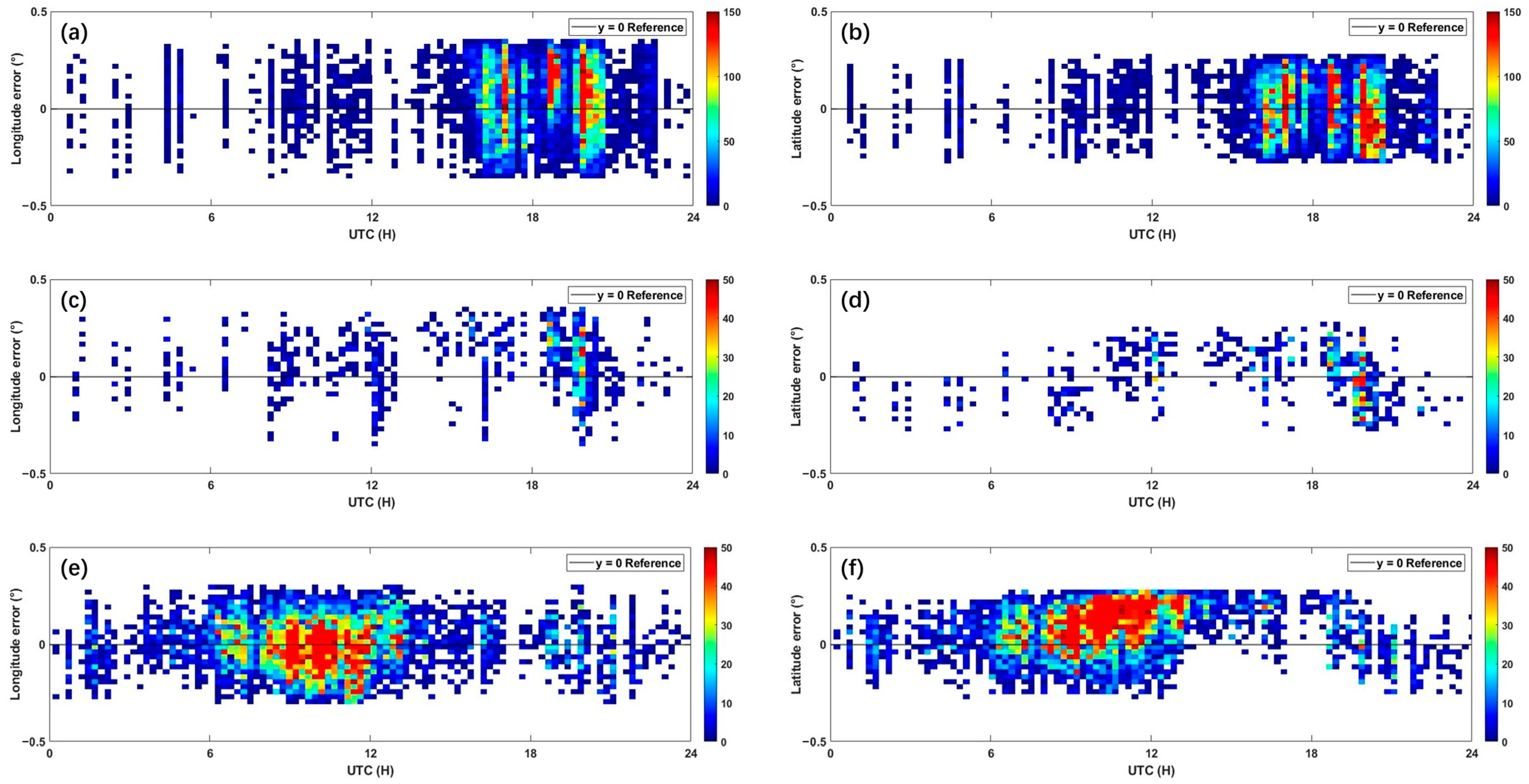
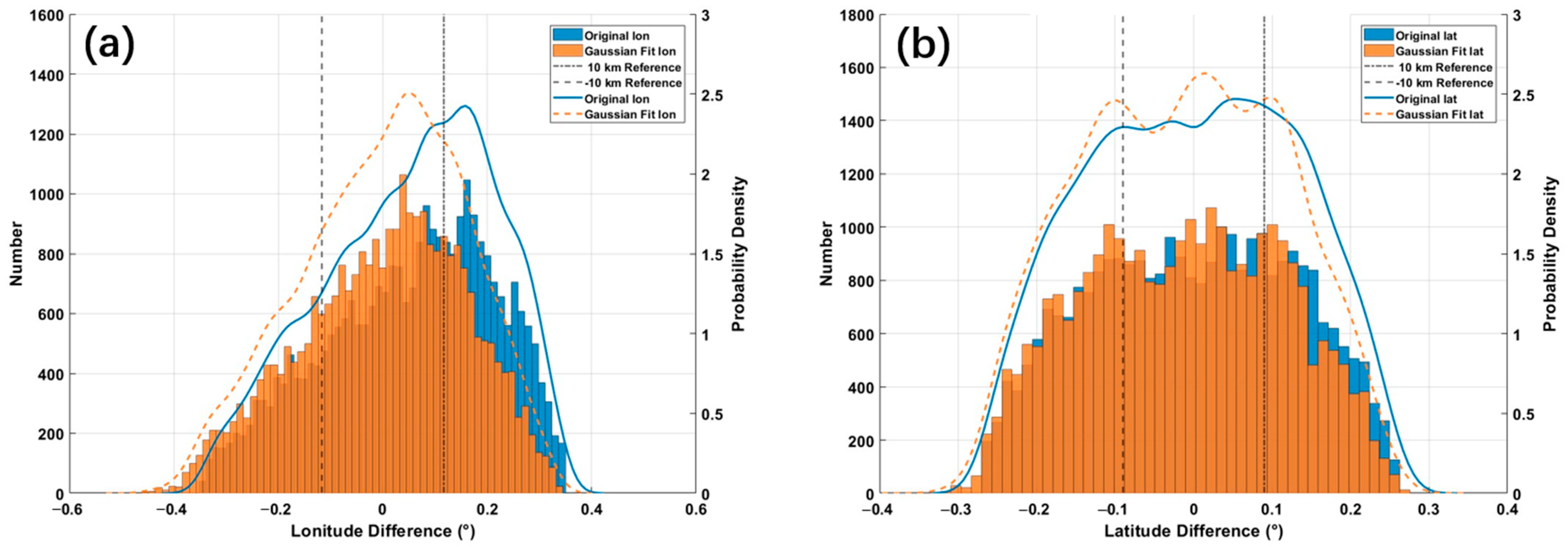
Considering the overall low detection efficiency of LMI and the deviation present in the raw data, we prefer to match LMI events to lightning-dense regions rather than to specific identical flashes detected by ground-based networks. We conducted sensitivity tests and established a relatively stable spatial threshold and a wider temporal threshold for matching: the spatial threshold was set to 30 km (as the maximum deviation in the raw data was about ±3 pixels, which was reduced after applying CTH correction), and the temporal threshold was set to 10 s (to ensure that the satellite and ground-based detectors captured the same lightning event and to increase the probability of accurate matching). In Figure 6, to more intuitively visualize the deviation changes caused by thermal deformation, we statistically analyzed the coordinate differences obtained from matching using their longitudinal and latitudinal components. This threshold ensures that the light blue region is preserved while minimizing noise from the dark blue region. Within this threshold, all WWLLN and BLNET flash data falling within the spatiotemporal window centered on each LMI events were matched. The deviations were calculated by subtracting the LMI coordinates from the corresponding latitude and longitude values of the ground-based flashes. The spatial distribution of these deviations was then visualized using data density (Figure 6). It is worth noting that, the spatiotemporal thresholds used in our experiment are not universally applicable; rather, they were determined through sensitivity tests conducted within the study. These thresholds are specifically suited for correcting LMI data using 2019 WWLLN and BLNET data in the Beijing and southeastern China regions as defined in our research. If other datasets or study areas are to be used, corresponding sensitivity tests would need to be performed with the relevant data.
For a clearer comparison, we present the coordinate differences between LMI and the ground-based lightning networks separately by their longitudinal and latitudinal components. The comparative results with the ground-based BLNET for the Beijing region are shown in Figure 6a,b. As shown in Figure 6a, which compares LMI events to BLNET flashes, a longitudinal displacement began to emerge around 17:00 UTC, became more pronounced between 18:00 and 19:00 UTC, and gradually diminished around 20:00 UTC. Figure 6b shows the latitude results, which exhibit a similar distribution to the longitudinal deviations but with smaller overall deviations, remaining within 0.2 degrees. Overall, LMI demonstrated higher detection efficiency at night, consistent with the findings of Cao et al. [19]. The deviation distributions also suggest that nighttime is the period during which thermal deformation effects are most significant. Due to the relatively limited data volume during daytime, no clear thermal deformation trend was observed in that period. Figure 6c,d show the comparison between LMI events and WWLLN flashes. Compared to the BLNET-based results, although the number of nighttime events is lower, the overall spatial distribution appears more uniform. In particular, Figure 6d reveals a clear trend in latitude deviations, with increasing deviations starting around 10:00 UTC and a gradual reduction observed near 20:00 UTC. Compared with the results from the Beijing area, lightning activity in southeastern China peaks at different times compared with Beijing (Figure 6e,f), mainly due to strong convection caused by Typhoon Lekima. Most lightning occurred between UTC 6–12. Longitude deviations are not obvious, while latitude deviations start around UTC 8 and weaken after UTC 20. Overall, the time-dependent deviation pattern is consistent with the thermal deformation characteristics described in Figure 1.

3.2. Fitting Analysis

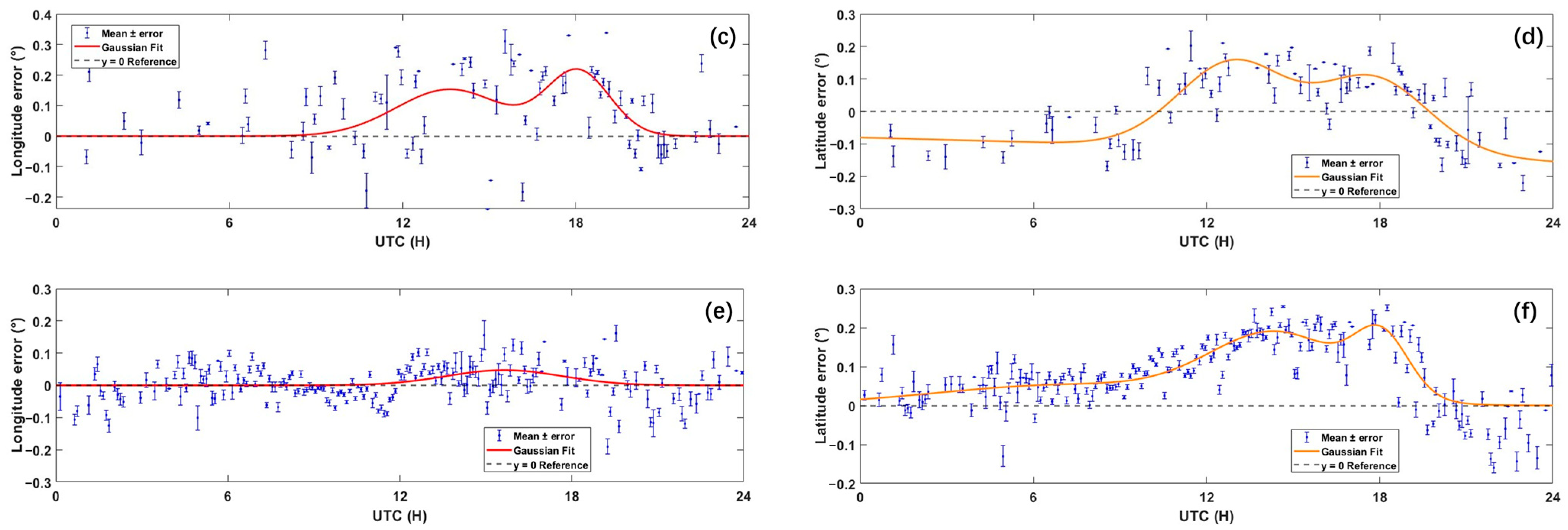
Following the method outlined in Section 2.4, the time step for the correction model was determined through sensitivity analysis. A 6 min interval (i.e., 10 steps per hour) was selected, and the average deviation and standard deviation were calculated for all data within each corresponding time step. Overall, whether comparing LMI events with BLNET flashes or WWLLN flashes, the deviations during the daytime were smaller than those at night. Additionally, the nighttime deviations exhibited smaller standard deviations, indicating a higher data contribution during nighttime and greater influence on the curve fitting. Due to the uneven distribution and varying quality of the data across time periods, both the number of data dots and the standard deviation within each interval were used as weights in the curve fitting process. This approach ensured the robustness of the fitting curve and reduced the impact of noise. As shown in the four sets of fitted curves, the nighttime deviations all display a distinct bimodal pattern. Based on Figure 1, the primary reason appears to be that starting from UTC 10:00 (local time 18:00), the LMI gradually comes under direct solar radiation. Around 16:00 UTC, the Earth temporarily blocks sunlight, after which the LMI is once again exposed to direct solar radiation until approximately 20:00 UTC, when the exposure ends. Moreover, we observed a noticeable lag in the deviation trend, consistent with the findings of Wang et al. [18]. Additionally, referring to Figure 4, which shows the LMI observation coverage, it is evident that due to the 5.1° northward viewing angle of the FY-4A geostationary satellite, the projected rectangular 600 × 400 pixel detection range forms a trapezoidal area on the Earth’s surface, wider in the north and narrower in the south. This projection effect causes greater distortion in the east–west direction than in the north–south direction. Therefore, we conclude that the uniform thermal deformation of the CCD array manifests as progressively increasing longitude deviations toward northern latitudes when projected onto the Earth’s surface. This is clearly reflected in our statistical Figure 7c,e, where the longitude deviation in southeastern China is significantly smaller overall than that in the Beijing Region.
It is worth noting that in Figure 7a,b, the fitted curves deviate from the statistical data during certain periods, particularly between 12:00 and 13:00 UTC. This discrepancy is mainly due to the discontinuity and unevenness of the data. For example, BLNET recorded a high volume of lightning between 16:00 and 18:00 UTC, which diluted the weight of other time periods during the curve fitting, causing the fitting algorithm to focus more heavily on that time frame. Furthermore, due to the limited amount of daytime data, the lack of pronounced deviations, and the relatively large standard deviations, the fitting weights during daytime intervals were lower, leading to smaller or even zero values in the fitted curve. Interestingly, the results from the comparison with WWLLN, despite its lower detection count and reduced location accuracy relative to BLNET, yielded fitting curves that more clearly reflect the thermal deformation trend analyzed in Figure 1. Specifically, the WWLLN-based deviations show a gradual increase starting around 10:00 UTC, peaking between 16:00 and 18:00 UTC, and diminishing around 20:00 UTC, forming a distinct bimodal pattern. However, this does not necessarily indicate that WWLLN data are more reliable than BLNET. For example, around 16:00 UTC, when the LMI enters the Earth’s shadow and thermal deformation effects are minimal, WWLLN’s sparse data limit its ability to capture short term deviations. Therefore, WWLLN provides better fitting results during periods with slow deviation changes, whereas BLNET captures more accurately the rapid changes in deviation over shorter time intervals. Another interesting point is that the latitude deviations from the LMI–WWLLN comparison are slightly more northward than those from the LMI–BLNET comparison (Figure 7b,d). Upon examining the lightning location data, we found that several strong convective weather systems in the summer of 2019 moved from the southwest to the northeast. Since WWLLN primarily detects stronger lightning, the detected lightning locations tend to be biased toward the movement direction of the weather system (slightly more northward), while BLNET, with its higher sensitivity, captures more complete lightning activity throughout the system. And in the Southeast of China (Figure 7e,f), the longitude deviation is slightly more evident at night but remains small overall, as this region lies in the southern part of the LMI field of view where east–west projection deformation is weaker. The latitude deviation shows a pattern similar to that in Beijing: a slight decrease around UTC 16, then an increase, and finally weakening near UTC 20.

3.3. Deviation Correction Results

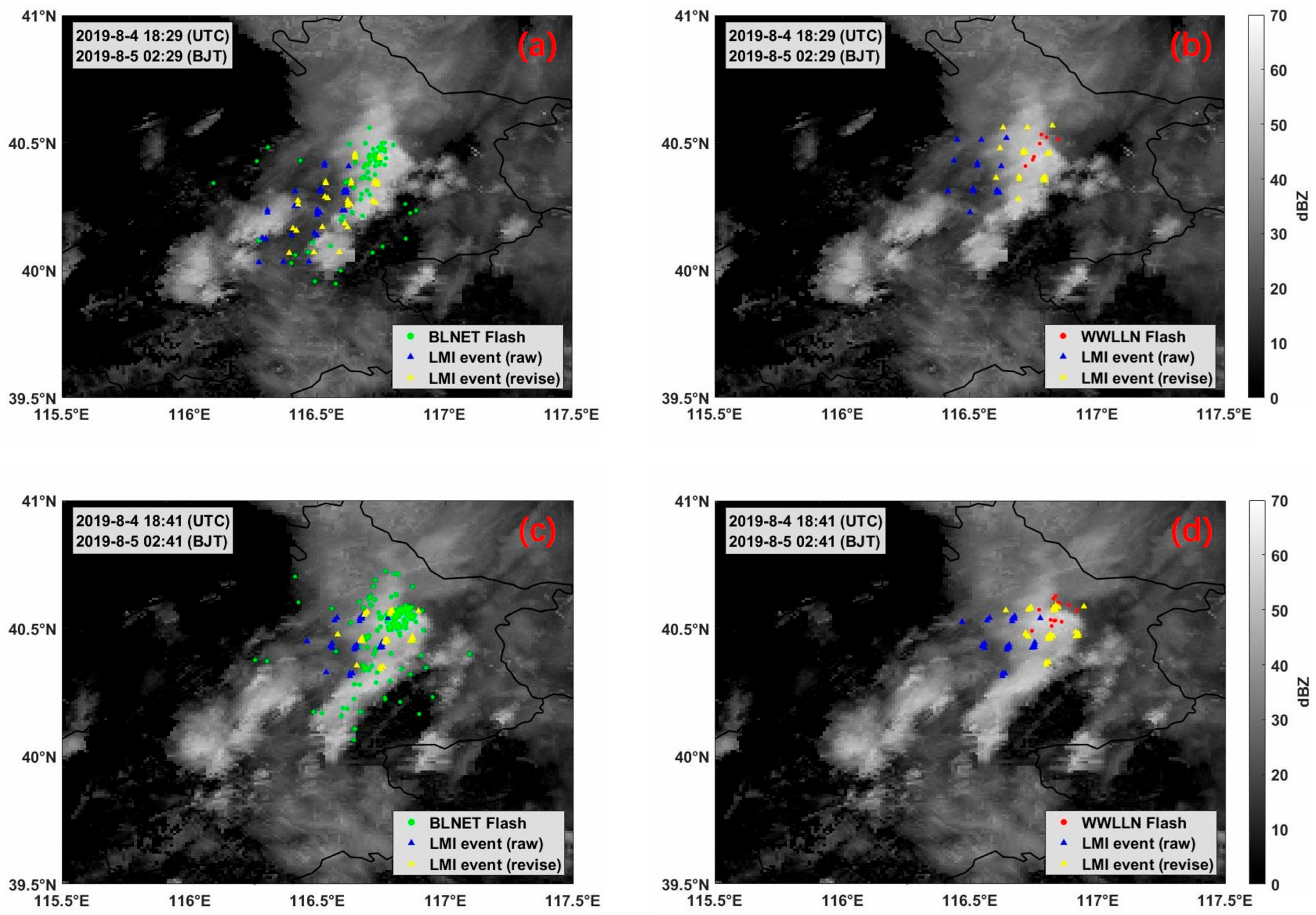
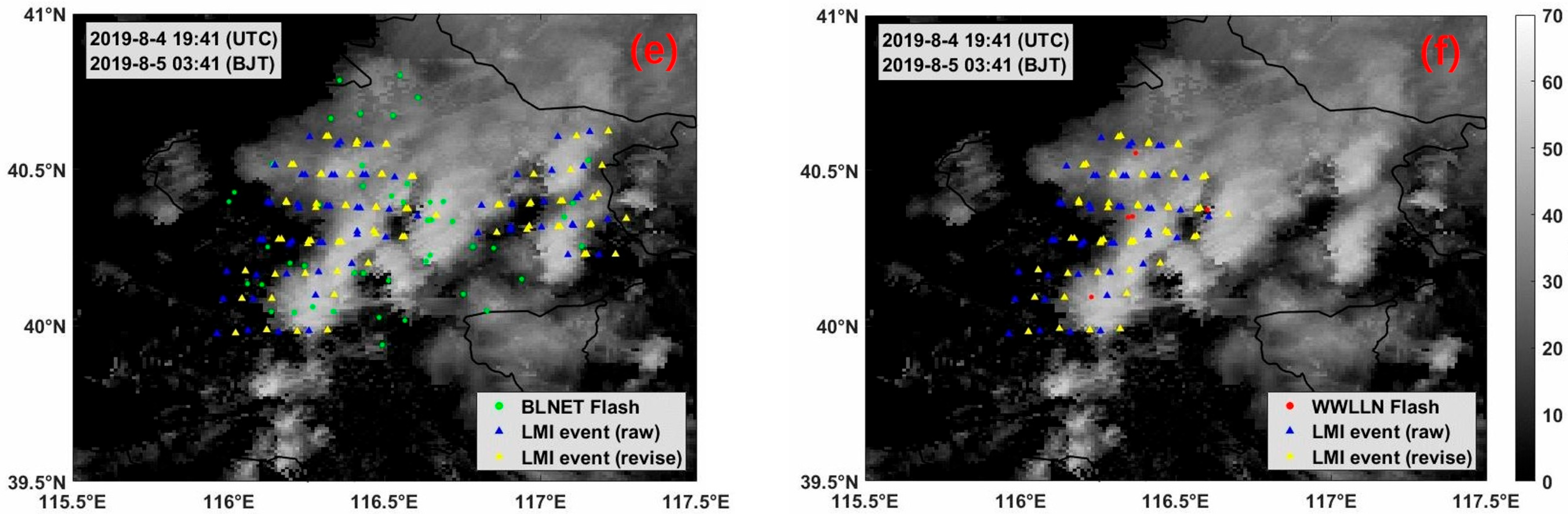
To visually evaluate the effectiveness of the thermal deformation correction, a comparative analysis was conducted on a case study of a severe convective weather system over Beijing that occurred from 4 to 5 August 2019. Figure 8 shows the comparison between the LMI events locations before and after correction and the locations of BLNET flashes and WWLLN flashes. The time period from 18:00 to 20:00 UTC was selected, during which the impact of thermal deformation was most significant. It is evident that, after correction, the LMI events align more closely with the areas of stronger radar reflectivity and show better agreement with both BLNET and WWLLN flash locations, indicating a notable improvement in correction performance. It should be noted that due to differences in detection principles, the detection efficiencies of LMI and WWLLN are relatively low. As a result, the number of LMI events and WWLLN flashes shown in the figure is significantly lower than that of BLNET flashes.
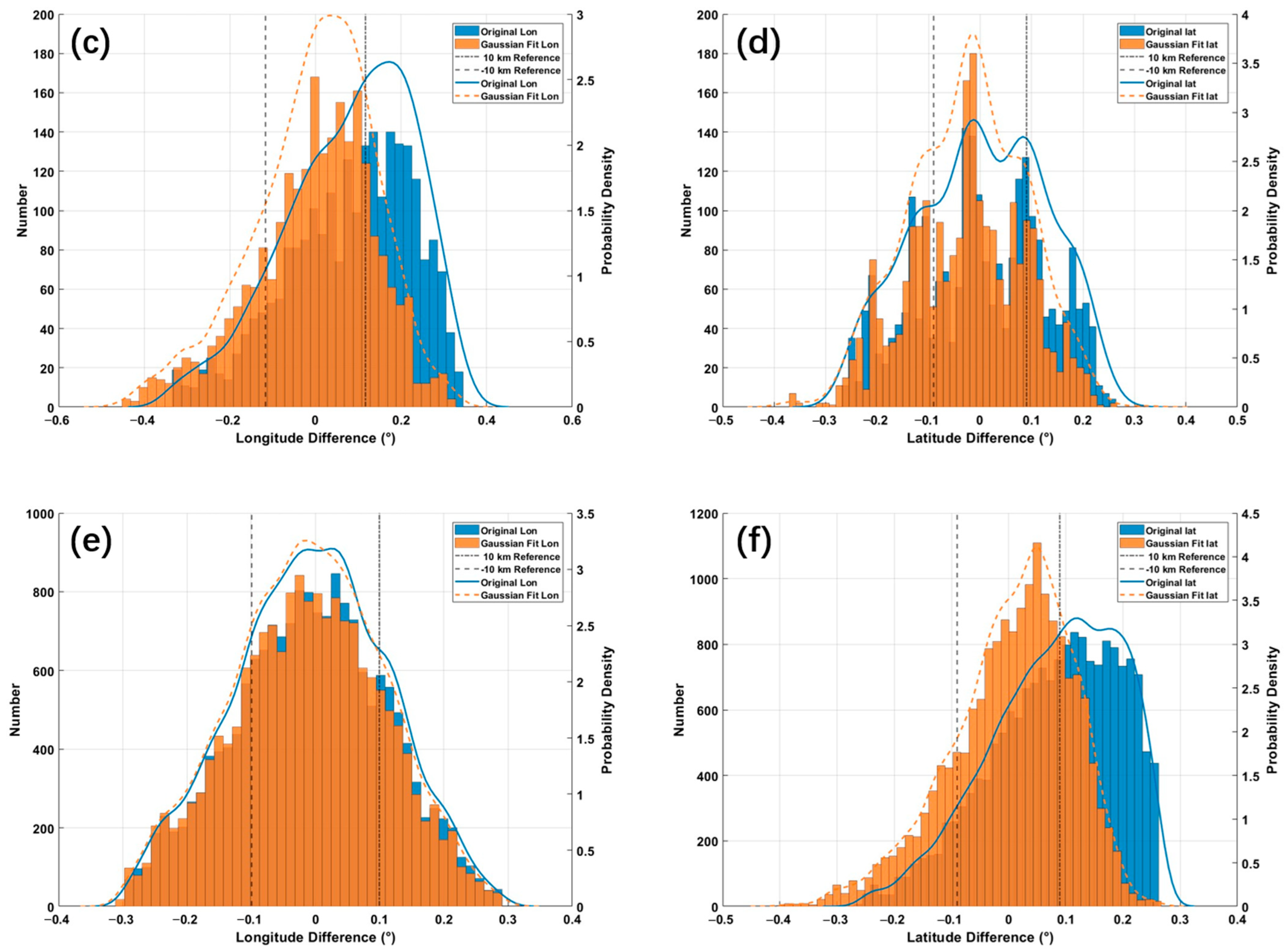
Figure 9 shows the probability distribution of coordinate differences between LMI events and ground-based lightning locations before and after thermal deformation correction. Prior to correction, both the comparisons with BLNET (Figure 9a,b) and WWLLN (Figure 9c–f) indicate that LMI events exhibited a consistent westward bias, with most errors concentrated around 0.18°. After correction, the errors are centered around 0° and exhibit an approximately normal distribution, with most deviations within 10 km (approximately 1 pixel), demonstrating the effectiveness of the correction. It is worth noting that the matching threshold used in this experiment was relatively broad, which may have led to mismatches between different lightning events. As a result, a small number of larger deviations still exist in the distribution due to noise. Furthermore, since the correction method proposed in this study specifically targets the trend-systematic deviations caused by thermal deformation in lightning products, the corrected data still contain random errors from other sources, such as incidental payload jitter. While these residual errors represent a potential avenue for future improvement, the final correction results nevertheless demonstrate significant enhancement.

4. Conclusions

Space-based lightning detection is inevitably subject to direct solar radiation, causing thermal deformation of the lightning detector and daily periodic deviations in lightning positioning data. Nighttime is significantly impacted by thermal deformation, while the detection efficiency of the lightning detector is the highest. To address this issue on the FY-4A LMI, this study presents a new correction method based on a composite Gaussian model. By using ground-based high precision lightning location data as the reference truth, the positional deviation between the satellite lightning detection and the reference data is calculated. The composite Gaussian model is then applied to fit the deviation into a correction curve, which is used to correct the thermal deformation in the satellite lightning detection data. The method was tested using satellite and ground-based lightning data from the summer of 2019, and the results confirm that the proposed approach effectively improves the detection accuracy of nighttime data. Whether using the high precision BLNET network or the wide area VHF-based WWLLN, the correction effect in the Beijing region was found to be significant. Based on our experiments, since the amount of WWLLN data is smaller compared to regional high precision lightning location networks such as BLNET, its ability to capture short term rapid variations in coordinate differences is less evident. Therefore, choosing a high precision lightning location network as the reference may provide a more robust correction. In addition, as demonstrated in our comparative experiments, using different lightning detection networks as references for LMI correction leads to different results. our analysis reveals that even when utilizing a full year (2019) of WWLLN and BLNET lightning data distributed across the diurnal cycle, significant temporal gaps persist in the observational record. This data sparsity stems from two primary factors: the intrinsic probability of lightning occurrence within the study region and the inherent detection efficiency of the monitoring network. Both factors directly influence the robustness of the derived fitting function and, consequently, the spatiotemporal generalizability of the proposed correction methodology, these factors also critically affect the sensitivity experiments conducted to select appropriate matching thresholds and step lengths, thereby further influencing the experimental outcomes. Furthermore, ground-based lightning location networks with high detection efficiency typically offer limited spatial coverage, and network performance exhibits considerable regional variability. These practical constraints must be carefully weighed. Thus, the integration of heterogeneous observational data remains a pivotal challenge for future advancements. We plan to further conduct optimization experiments in the future, using high precision lightning detection networks from different regions to verify the feasibility of applying WWLLN-based correction across the full detection range of LMI. Our ongoing work aims to acquire more extensive datasets to enable comprehensive thermal deformation correction across the entire LMI observational domain.

Author Contributions

Conceptualization, Y.Z. and X.Q.; methodology, Y.Z., X.Q., D.C., J.Y. and R.J.; funding acquisition, X.Q. and D.L.; investigation, Y.Z. and X.Q.; data curation, Y.Z., D.C., S.Y., D.W. and K.Z.; writing—original draft preparation, Y.Z., X.Q., D.C., S.Y., D.W., H.Z., D.L., Z.S., M.L., R.J. and J.Y.; writing—review and editing, Y.Z., X.Q., D.C., H.Z., S.Y., D.W., R.J. and J.Y.; translation, Y.Z. and X.Q. All authors have read and agreed to the published version of the manuscript.

Funding

This research was funded by the National Natural Science Foundation of China (Nos. 42230609, 42027803) and the Strategic Priority Research Program of the Chinese Academy of Sciences (XDB0760300).

Data Availability Statement

FY-4A LMI datasets were analyzed in this study. This data can be found here: “http://satellite.nsmc.org.cn/PortalSite/Data/Satellite.aspx (accessed on 30 December 2019)”. For the cloud-top height parallax correction, please refer to: “https://doi.org/10.3390/rs15194856”. WWLLN data can be found here: “http://wwlln.net (accessed on 30 December 2019)”. BLNET and Radar data are available on request from the corresponding author due to restrictions on data sharing imposed by meteorological departments.

Acknowledgments

The authors thank the National Satellite Meteorological Center for providing the FY-4A LMI data, and Beijing Meteorological Bureau for providing radar data, and the WWLLN “http://wwlln.net (accessed on 30 December 2019)”, a collaboration among over 40 universities and institutions, for providing the WWLLN data used in this paper.

Conflicts of Interest

The authors declare no conflicts of interest.

Abbreviations

The following abbreviations are used in this manuscript:
FY-4AFengyun-4A
LMILightning Mapping Imager
WWLLNWorld Wide Lightning Location Network
GOES-RGeostationary Operational Environmental Satellite R-series
GLMGeostationary Lightning Mapper
MTGMeteosat Third Generation satellite
LILightning Imager
LISLightning Imaging Sensor
BLNETBeijing Broadband Lightning Network
ABIAdvanced Baseline Imager
AGRIAdvanced Geosynchronous Radiation Imager
CTHCloud Top Height

References

  1. Qie, X.; Zhang, Y.; Zhang, D.; Yin, Y.; Yu, Y.; Lu, G.; Jiang, R. Principles and Forecast of Thunderbolt Weather System; Science Press: Beijing, China, 2023. [Google Scholar]
  2. Qie, X.; Yuan, S.; Chen, Z.; Wang, D.; Liu, D.; Sun, M.; Sun, Z.; Srivastava, A.; Zhang, H.; Lu, J.; et al. Understanding the dynamical-microphysical-electrical processes associated with severe thunderstorms over the Beijing metropolitan region. Sci. China Earth Sci. 2021, 64, 10–26. [Google Scholar] [CrossRef]
  3. Rudlosky, S.D.; Goodman, S.J.; Virts, K.S.; Bruning, E.C. Initial Geostationary Lightning Mapper Observations. Geophys. Res. Lett. 2019, 46, 1097–1104. [Google Scholar] [CrossRef]
  4. Loto’aniu, P.T.M.; Davis, A.; Jarvis, A.; Grotenhuis, M.; Rich, F.J.; Califf, S.; Inceoglu, F.; Pacini, A.; Singer, H.J. Initial on-Orbit Results from the GOES-18 Spacecraft Science Magnetometer. Space Sci. Rev. 2023, 219, 84. [Google Scholar] [CrossRef]
  5. Goodman, S.J.; Blakeslee, R.J.; Koshak, W.J.; Mach, D.; Bailey, J.; Buechler, D.; Carey, L.; Schultz, C.; Bateman, M.; McCaul, E.; et al. The GOES-R Geostationary Lightning Mapper (GLM). Atmos. Res. 2013, 125–126, 34–49. [Google Scholar] [CrossRef]
  6. Peterson, M.; Light, T.E.L.; Mach, D. The Illumination of Thunderclouds by Lightning: 1. The Extent and Altitude of Optical Lightning Sources. J. Geophys. Res. Atmos. 2022, 127, e2021JD035515. [Google Scholar] [CrossRef]
  7. Yang, J.; Zhang, Z.; Wei, C.; Lu, F.; Guo, Q. Introducing the New Generation of Chinese Geostationary Weather Satellites, Fengyun-4. Bull. Am. Meteorol. Soc. 2017, 98, 1637–1658. [Google Scholar] [CrossRef]
  8. Cao, D. The Development of Product Algorithm of the Fengyun-4 Geostationary Lightning Mapping Imager. Adv. Meteorol. Sci. Technol. 2016, 6, 94–98. [Google Scholar]
  9. Holmlund, K.; Grandell, J.; Schmetz, J.; Stuhlmann, R.; Bojkov, B.; Munro, R.; Lekouara, M.; Coppens, D.; Viticchie, B.; August, T.; et al. Meteosat Third Generation (MTG): Continuation and Innovation of Observations from Geostationary Orbit. Bull. Am. Meteorol. Soc. 2021, 102, E990–E1026. [Google Scholar] [CrossRef]
  10. Carr, J.L.; Tillier, C.E.; Shu, Y. Validation of image navigation and registration for the Geostationary Lightning Mapper. J. Appl. Remote Sens. 2020, 14, 032410. [Google Scholar] [CrossRef]
  11. Peterson, M.; Light, T.E.L.; Mach, D. The Illumination of Thunderclouds by Lightning: 2. The Effect of GLM Instrument Threshold on Detection and Clustering. Earth Space Sci. 2022, 9, e2021EA001928. [Google Scholar] [CrossRef]
  12. Peterson, M.; Light, T.E.L.; Mach, D. The Illumination of Thunderclouds by Lightning: 3. Retrieving Optical Source Altitude. Earth Space Sci. 2022, 9, e2021EA001929. [Google Scholar] [CrossRef]
  13. Peterson, M.; Mach, D. The Illumination of Thunderclouds by Lightning: 4. Volumetric Thunderstorm Imagery. Earth Space Sci. 2022, 9, e2022EA002360. [Google Scholar] [CrossRef]
  14. Buechler, D.; Varghese, T.; Armstrong, P.; Bremer, J.; Lamb, R.; Fulbright, J.; Goodman, S.; Butler, J.J.; Xiong, X.J.; Gu, X. On-orbit validation of the geolocation accuracy of GOES-16 Geostationary Lightning Mapper (GLM) flashes using ground-based laser beacons. In Proceedings of the Earth Observing Systems XXIII, San Diego, CA, USA, 19–23 August 2018; Volume 10764, p. 107640J. [Google Scholar]
  15. Hui, W.; Huang, F.; Liu, R. Characteristics of lightning signals over the Tibetan Plateau and the capability of FY-4A LMI lightning detection in the Plateau. Int. J. Remote Sens. 2020, 41, 4605–4625. [Google Scholar] [CrossRef]
  16. Hui, W.; Zhang, W.; Lyu, W.; Li, P. Preliminary Observations from the China Fengyun-4A Lightning Mapping Imager and Its Optical Radiation Characteristics. Remote Sens. 2020, 12, 2622. [Google Scholar] [CrossRef]
  17. Cheng, K.; Tong, X.; Liu, S.; Yan, X.; Li, H. An On-orbit Geometric Calibration Approach Based on Double Tubes Edge-binding Feng Yun-4A Lightning Mapping Imager. J. Geomat. Sci. Technol. 2021, 38, 477–484. [Google Scholar]
  18. Wang, J.; Tong, X.; Yang, L.; Shang, J.; Liu, C.; Bao, S.; Zhang, Z.; Yang, J. Image Navigation for FY-4A Lightning Mapping Imager. IEEE J. Sel. Top. Appl. Earth Obs. Remote Sens. 2021, 14, 11450–11465. [Google Scholar] [CrossRef]
  19. Cao, D.; Lu, F.; Zhang, X.; Yang, J. Lightning Activity Observed by the FengYun-4A Lightning Mapping Imager. Remote Sens. 2021, 13, 3013. [Google Scholar] [CrossRef]
  20. Chen, Z.; Qie, X.; Sun, J.; Xiao, X.; Zhang, Y.; Cao, D.; Yang, J. Evaluation of Fengyun-4A Lightning Mapping Imager (LMI) Performance during Multiple Convective Episodes over Beijing. Remote Sens. 2021, 13, 1746. [Google Scholar] [CrossRef]
  21. Zhang, Y.; Cao, D.; Yang, J.; Lu, F.; Wang, D.; Liu, R.; Zhang, H.; Liu, D.; Chen, Z.; Lyu, H.; et al. A Parallax Shift Effect Correction Based on Cloud Top Height for FY-4A Lightning Mapping Imager (LMI). Remote Sens. 2023, 15, 4856. [Google Scholar] [CrossRef]
  22. Li, X.; Yang, L.; Su, X.; Hu, Z.; Chen, F. A Correction Method for Thermal Deformation Positioning Error of Geostationary Optical Payloads. IEEE Trans. Geosci. Remote Sens. 2019, 57, 7986–7994. [Google Scholar] [CrossRef]
  23. Zhang, H.; Zhao, X.; Mei, Q.; Wang, Y.; Song, S.; Yu, F. On-orbit thermal deformation prediction for a high-resolution satellite camera. Appl. Therm. Eng. 2021, 195, 117152. [Google Scholar] [CrossRef]
  24. Abarca, S.F.; Corbosiero, K.L.; Galarneau, T.J. An evaluation of the Worldwide Lightning Location Network (WWLLN) using the National Lightning Detection Network (NLDN) as ground truth. J. Geophys. Res. Atmos. 2010, 115, JD013411. [Google Scholar] [CrossRef]
  25. Rodger, C.J.; Werner, S.; Brundell, J.B.; Lay, E.H.; Thomson, N.R.; Holzworth, R.H.; Dowden, R.L. Detection efficiency of the VLF World-Wide Lightning Location Network (WWLLN): Initial case study. Ann. Geophys. 2006, 24, 3197–3214. [Google Scholar] [CrossRef]
  26. Fan, P.; Zheng, D.; Zhang, Y.; Gu, S.; Zhang, W.; Yao, W.; Yan, B.; Xu, Y. A Performance Evaluation of the World Wide Lightning Location Network (WWLLN) over the Tibetan Plateau. J. Atmos. Ocean. Technol. 2018, 35, 927–939. [Google Scholar] [CrossRef]
  27. Wang, D.; Sun, Z.; Yuan, S.; Lu, J.; Qie, X.; Liu, M.; Xu, Y.; Lu, G.; Tian, Y. Beijing Broadband Lightning NETwork and the Spatiotemporal Evolution of Lightning Flashes during a Thunderstorm. Chin. J. Atmos. Sci. 2020, 44, 851–864. [Google Scholar]
  28. Wang, Y.; Qie, X.; Wang, D.; Liu, M.; Su, D.; Shen, Y.; Wu, Z.; Liu, D.; Sun, Z. Beijing Lightning NETwork (BLNET): Configuration and Preliminary Results of Lightning Location. Chin. J. Atmos. Sci. 2015, 39, 571–582. [Google Scholar]
  29. Xiao, X.; Qie, X.; Chen, Z.; Lu, J.; Ji, L.; Wang, D.; Zhang, L.; Chen, M.; Chen, M. Evaluating the Performance of Lightning Data Assimilation from BLNET Observations in a 4DVAR-Based Weather Nowcasting Model for a High-Impact Weather over Beijing. Remote Sens. 2021, 13, 2084. [Google Scholar] [CrossRef]
Figure 1. The schematic diagram illustrating the impact of solar radiation on FY-4A LMI thermal deformation. The time is in UTC.
Remotesensing 18 00163 g001
Figure 2. Deviation caused by thermal deformation. (a) Lightning Location Distribution at UTC 10:47; (b) Lightning Location Distribution at UTC 18:35; (c) Lightning Location Distribution at UTC 18:41; (d) Lightning Location Distribution at UTC 20:17. The green dots represent BLNET flash, the red dots denote WWLLN flash, and the blue dots indicate LMI event, plotted over a background of composite radar reflectivity.
Remotesensing 18 00163 g002
Figure 3. Detection range of LMI in the Northern Hemisphere and the distribution of WWLLN stations.
Remotesensing 18 00163 g003
Figure 4. Topographic Map of the Beijing Area and Distribution of BLNET Stations.
Remotesensing 18 00163 g004
Figure 5. Principle of Matching and Comparing Ground-Based and Space-Based Lightning Location Data.
Remotesensing 18 00163 g005
Figure 6. Deviation density distribution of LMI relative to ground-based lightning data. (a) Longitude deviation with BLNET flashes in Beijing (positive = westward). (b) Latitude deviation with BLNET flashes in Beijing (positive = southward). (c) Longitude deviation with WWLLN flashes in Beijing. (d) Latitude deviation with WWLLN flashes in Beijing, (e) Longitude deviation with WWLLN flashes in the Southeast of China. (f) Latitude deviation with WWLLN flashes in the Southeast of China.
Remotesensing 18 00163 g006
Figure 7. Fitting curves of LMI deviations relative to ground-based lightning locations. Blue bars show mean ± std; the red line is the weighted Gaussian fit. (a) Longitude deviations with BLNET flashes in Beijing (positive = westward). (b) Latitude deviations with BLNET flashes in Beijing (positive = southward). (c) Longitude deviations with WWLLN flashes in Beijing. (d) Latitude deviations with WWLLN flashes in Beijing. (e) Longitude deviations with WWLLN flashes in Beijing in the Southeast of China. (f) Latitude deviations with WWLLN flashes in Beijing in the Southeast of China.
Remotesensing 18 00163 g007aRemotesensing 18 00163 g007b
Figure 8. Comparison of LMI thermal deformation correction results before and after with BLNET and WWLLN flash. (a,c,e) Results of LMI events correction using BLNET flashes as reference. (b,d,f) Results of LMI events correction using WWLLN flashes as reference. The red dots represent the matched WWLLN flash data, the green dots indicate the matched BLNET flash data, the yellow dots show the LMI events data after correction, and the blue dots show the LMI events data before correction. The background indicates radar composite reflectivity.
Remotesensing 18 00163 g008aRemotesensing 18 00163 g008b
Figure 9. Statistical analysis of LMI events deviations before and after thermal deformation correction. (a,b) Longitude and Latitude correction with BLNET flash in Beijing. (c,d) Longitude and Latitude correction with WWLLN flash in Beijing. (e,f) Longitude and Latitude correction with BLNET in the southeast of China. The orange histogram represents deviations after correction, the blue histogram represents deviations before correction, and the colored curve shows the probability distribution.
Remotesensing 18 00163 g009aRemotesensing 18 00163 g009b
Table 1. Statistics on the number of lightning detections in the summer of 2019.
Data and RegionDaytime
(UTC 22–10)
Nighttime
(UTC 10–22)
Total
LMI event (Beijing)154010,92112,461
LMI event (Southeast of China)19,48577,96997,454
WWLLN flash (Beijing)102111922213
WWLLN flash (Southeast of China)6156391310,069
BLNET flash (Beijing)12,50271,16183,663
LMI matching WWLLN (Beijing)26921552424
LMI matching WWLLN (Southeast)7996941717,413
LMI matching BLNET (Beijing)138827,38328,771
Disclaimer/Publisher’s Note: The statements, opinions and data contained in all publications are solely those of the individual author(s) and contributor(s) and not of MDPI and/or the editor(s). MDPI and/or the editor(s) disclaim responsibility for any injury to people or property resulting from any ideas, methods, instructions or products referred to in the content.