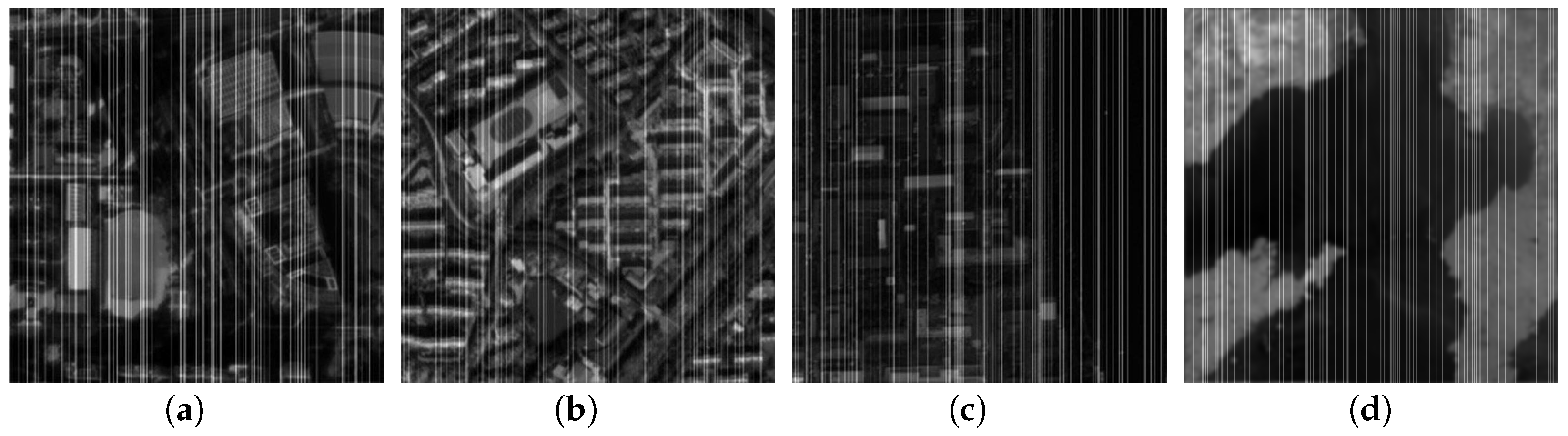
Joint Deblurring and Destriping for Infrared Remote Sensing Images with Edge Preservation and Ringing Suppression


Highlights
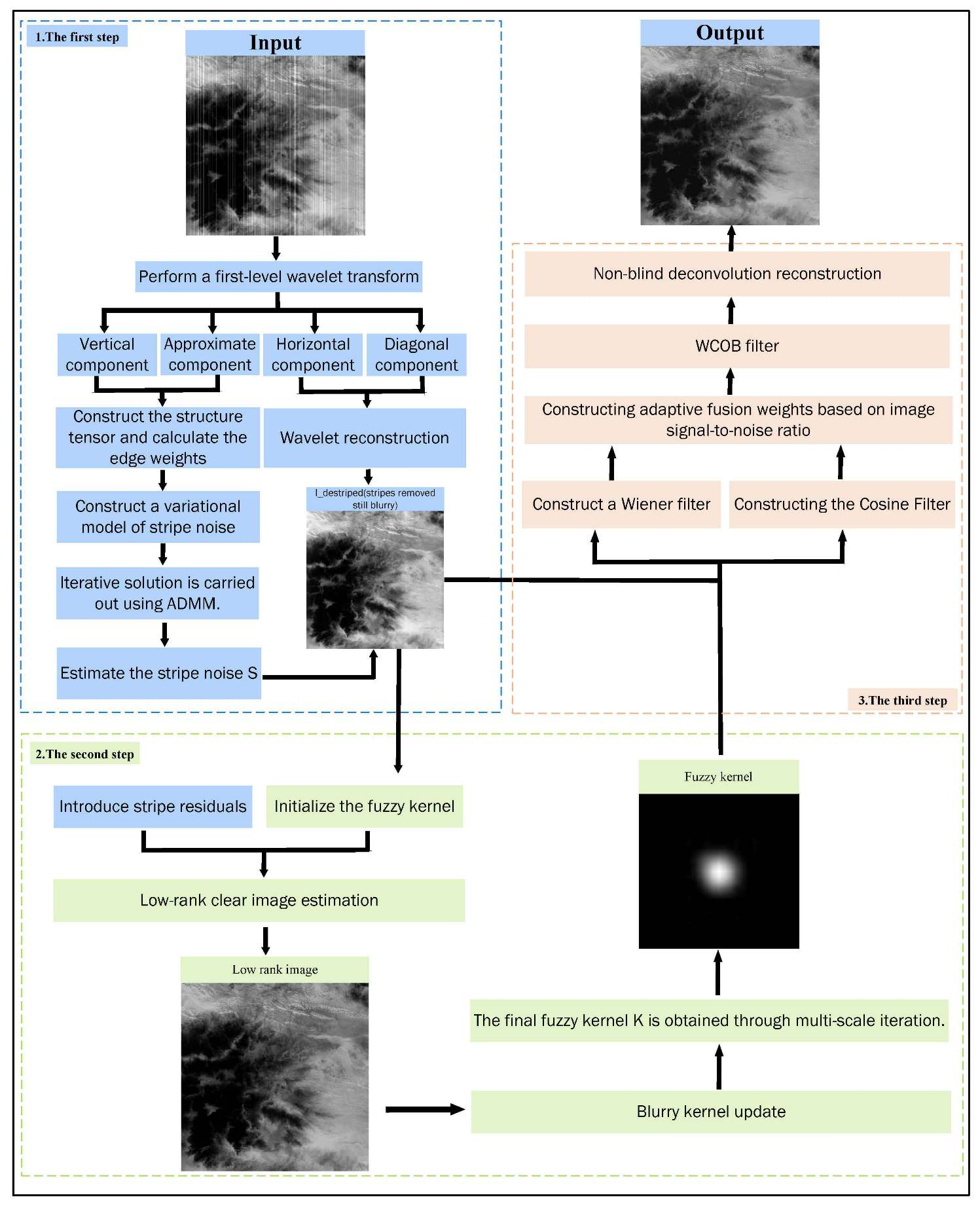
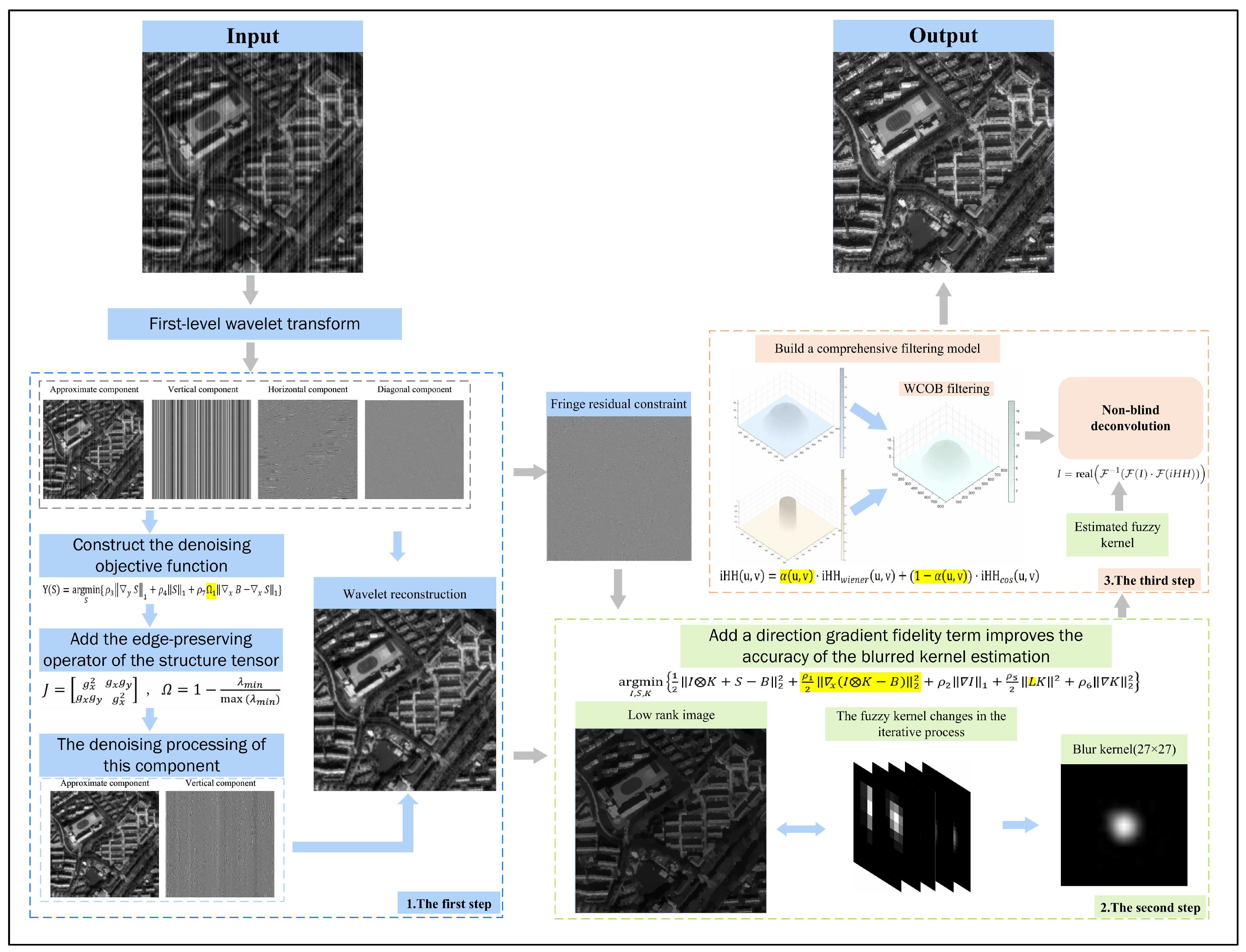
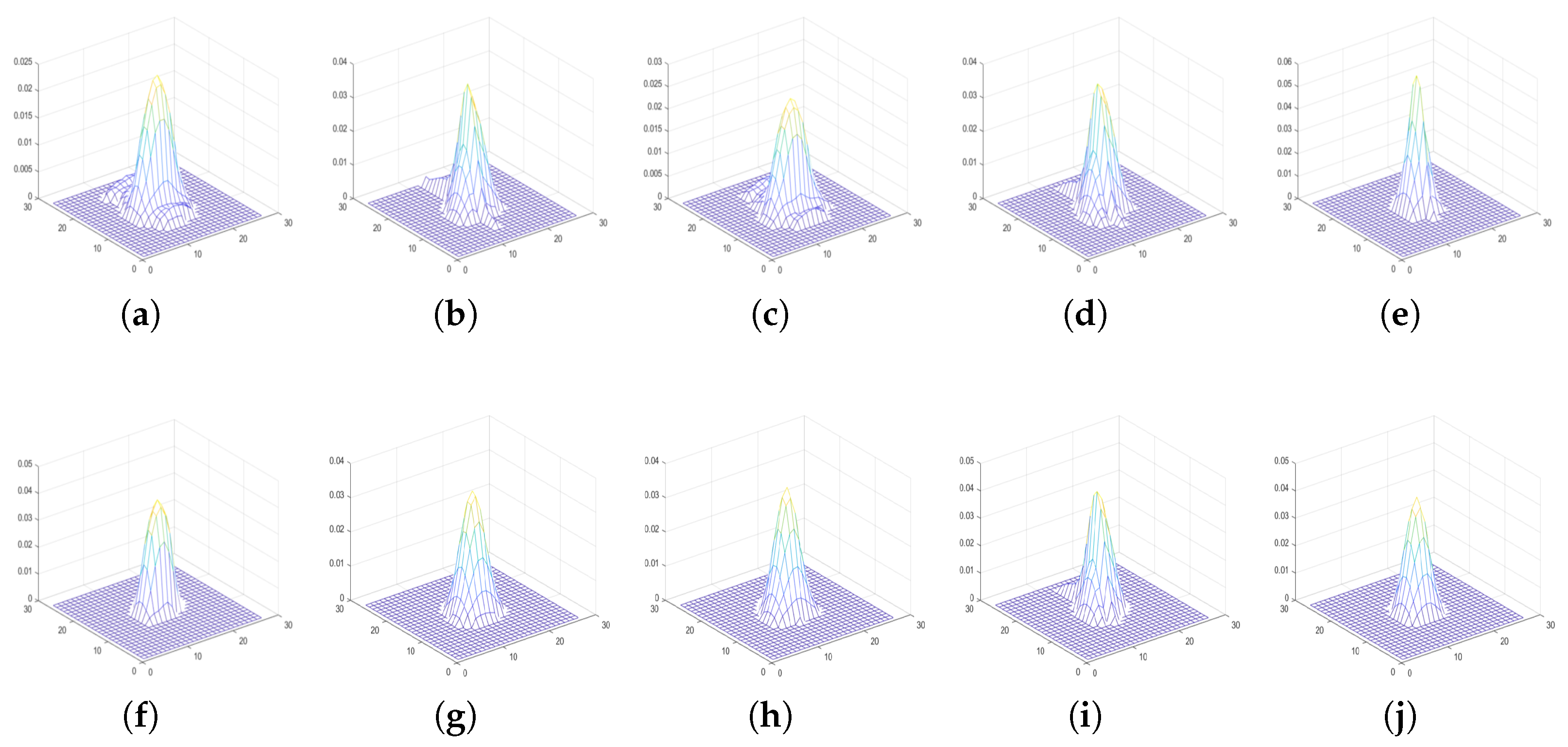
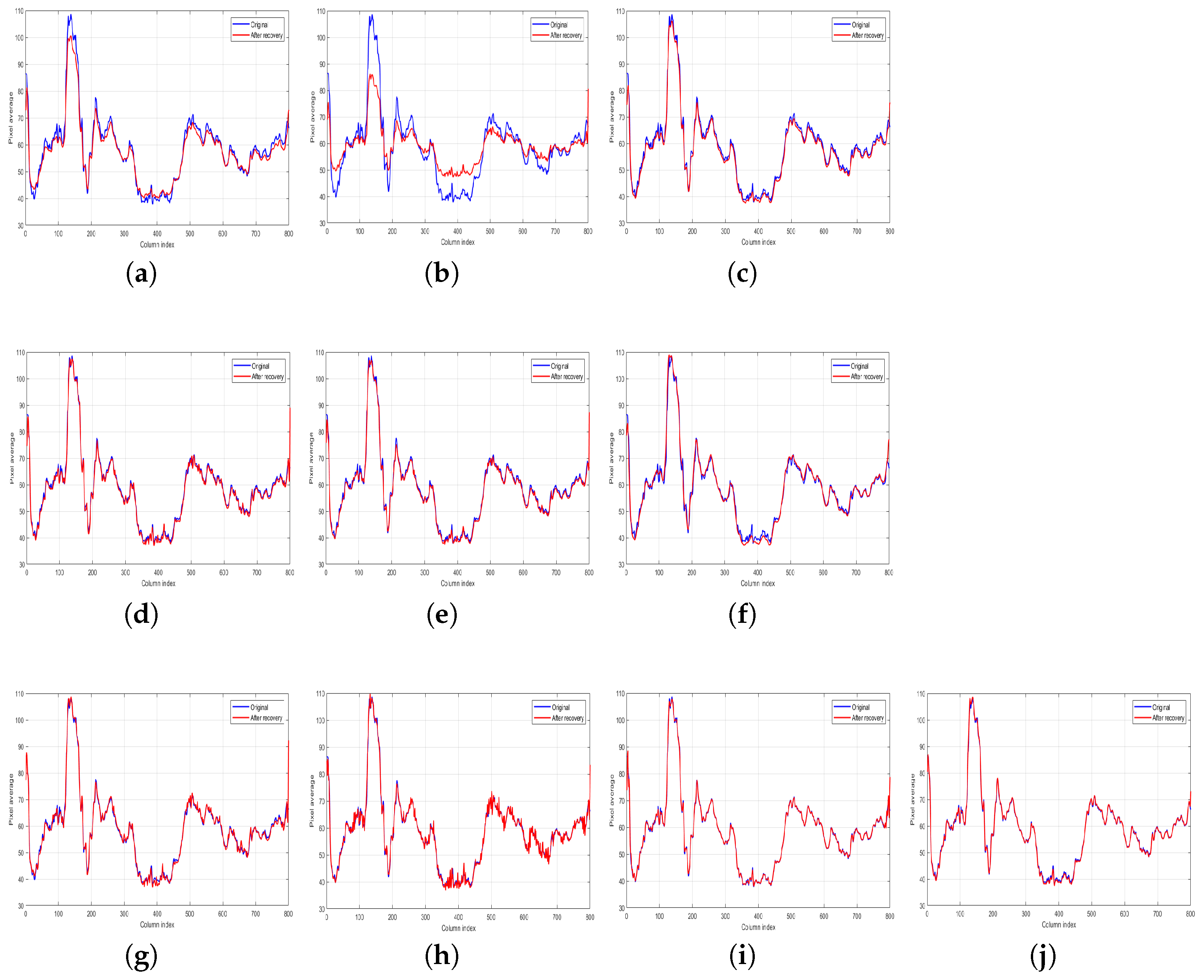
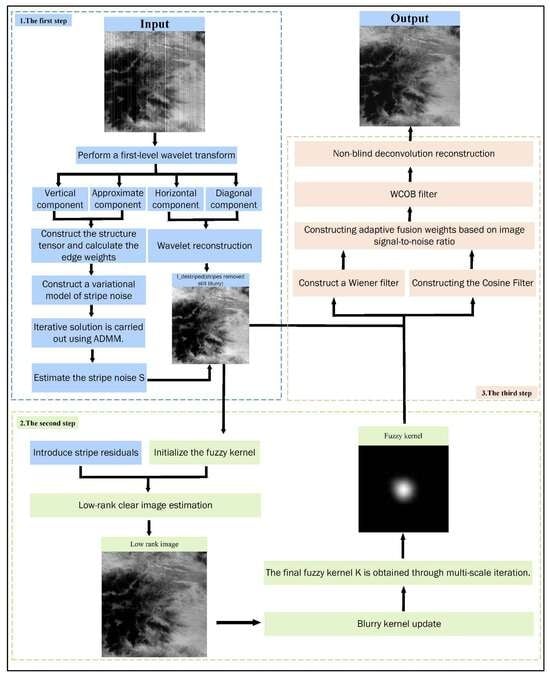
- A unified three-stage variational framework is proposed for joint destriping and deblurring of infrared remote sensing images, integrating structure-tensor-based adaptive edge preservation, stripe-oriented fidelity constraints, and a new WCOB ringing-suppression model.
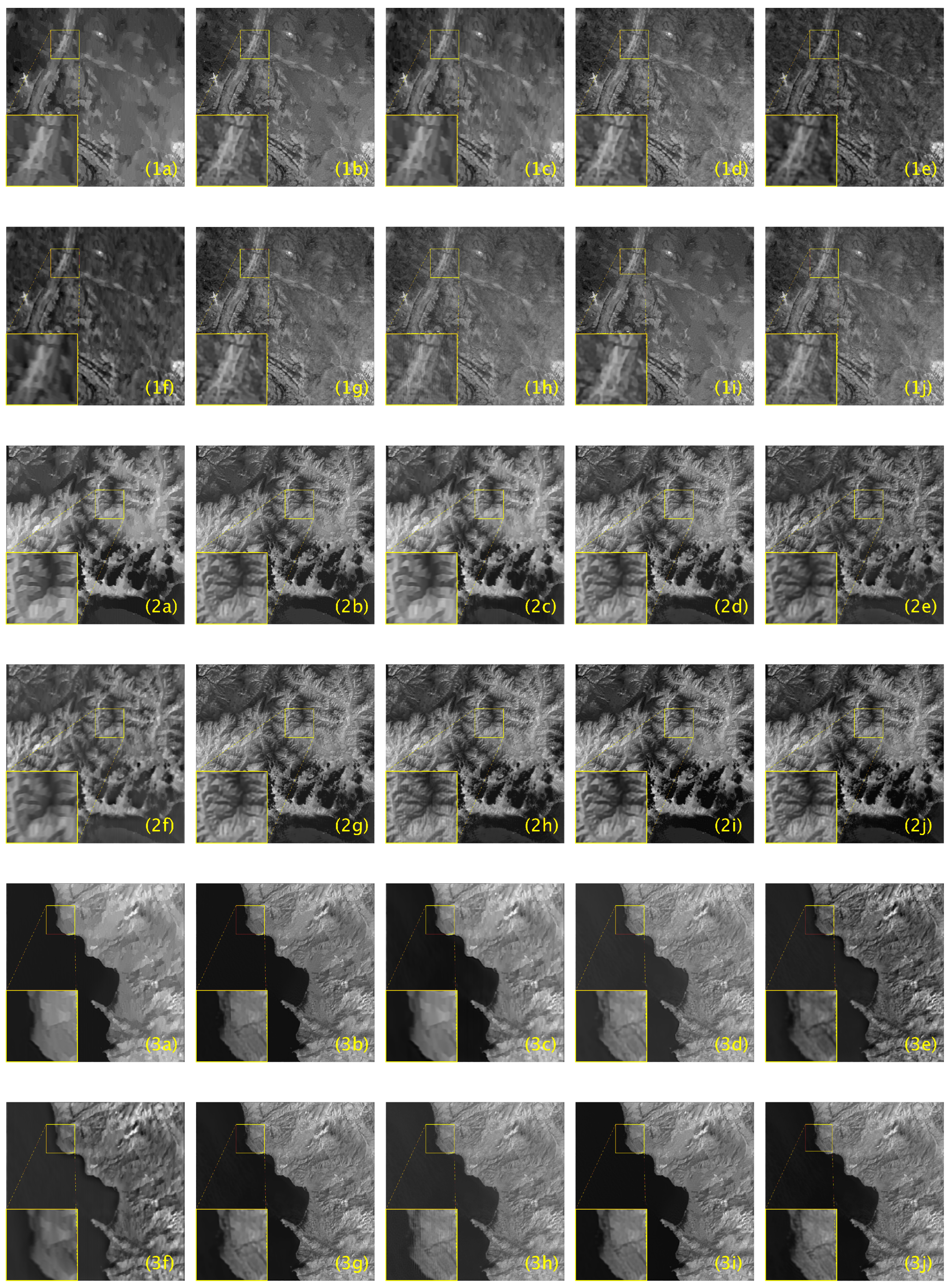
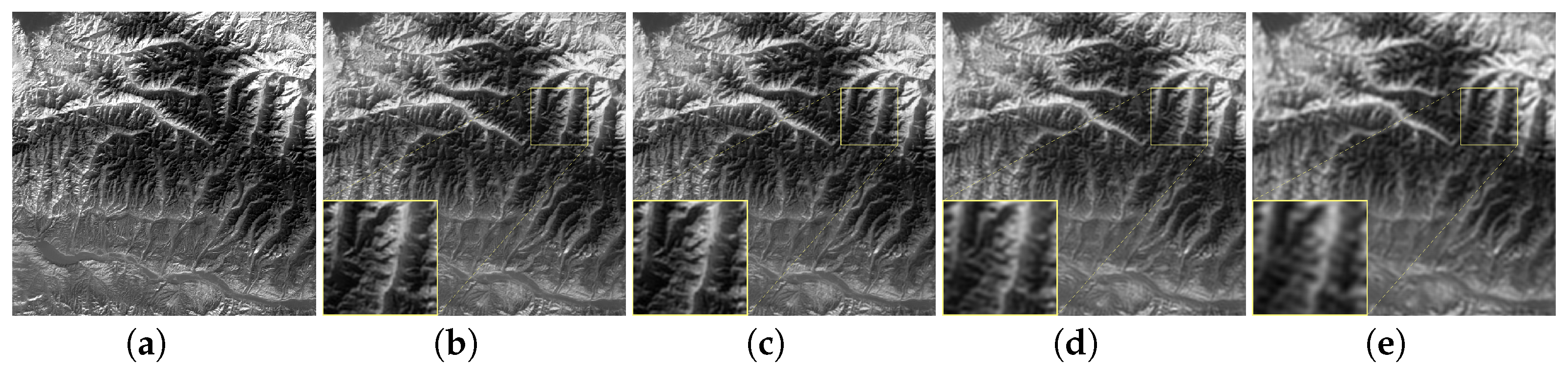
- The method achieves superior kernel estimation accuracy, better detail preservation, and stronger robustness compared with state-of-the-art destriping and deblurring techniques, consistently improving SSIM, PSNR, and NIQE across both simulated and real satellite datasets.
- By effectively removing stripe noise before kernel estimation and suppressing ringing artifacts during non-blind restoration, the proposed framework significantly enhances the clarity and reliability of infrared remote sensing imagery, benefiting downstream tasks such as target detection and environmental monitoring.
- The strong generalization capability demonstrated on Jilin-1 and SDGSAT-1 real data suggests that the proposed method has high practical applicability for operational remote-sensing imaging systems, providing a foundation for future integration with lightweight or deep-learning-based onboard processing.
Abstract
1. Introduction
2. Materials and Methods
2.1. Estimation of Stripe Noise S
2.1.1. Recover the Stripe Noise S
2.1.2. About , ,
2.2. Estimation of the Blur Kernel K
2.2.1. Estimation of the Low-Rank Image I
2.2.2. Estimation of the Blur Kernel K
2.3. Estimation of the Clear Image I
| Algorithm 1: Proposed destriping and deblurring algorithm. |
| Input: Blurred image with stripes B, parameters , , , L, maximum iterations |
| Output: Estimated blur kernel K, restored image I |
| 1. Estimate stripe component S based on Equation (15). |
| 2. For to do. |
| 3. Compute the edge-preserving operator using Equation (9). |
| 4. Initialize . |
| 5. While do. |
| 6. Update using Equation (18). |
| 7. Initialize . |
| 8. While do. |
| 9. Update using Equation (19). |
| 10. Initialize . |
| 11. While do. |
| 12. Update using Equation (20) and the edge-preserving operator. |
| 13. . |
| 14. End While. |
| 15. . |
| 16. End While. |
| 17. . |
| 18. End While. |
| 19. End For. |
| 20. Update blur kernel K under stripe constraint using Equation (30). |
| 21. Update using Equation (28) in Equation (26). |
| 22. Update clear image I based on Equation (36). |
3. Experiment and Analysis
3.1. Experimental Setup
3.1.1. Environment and Parameter Selection
3.1.2. Evaluation Indexes
- (1)
- Paired t-Test
- (2)
- Paired t-Test
3.2. Reference-Based Image Data Experiments
3.3. No-Reference Image Data Experiments
3.4. Ablation Experiment
4. Discussion
5. Conclusions
Author Contributions
Funding
Data Availability Statement
Acknowledgments
Conflicts of Interest
References
- Pan, J.J.; Chang, C.I. Destriping of Landsat MSS images by filtering techniques. Photogramm. Eng. Remote Sens. 1992, 58, 1417–1423. [Google Scholar]
- Zhao, B.; He, B.; Cong, Y. Destriping method using lifting wavelet transform of remote sensing image. In Proceedings of the 2010 International Conference on Computer, Mechatronics, Control and Electronic Engineering, Changchun, China, 24–26 August 2010; Volume 6, pp. 110–113. [Google Scholar]
- Sun, L.; Neville, R.; Staenz, K.; White, H.P. Automatic destriping of Hyperion imagery based on spectral moment matching. Can. J. Remote Sens. 2008, 34, S68–S81. [Google Scholar] [CrossRef]
- Gao, H.; Wang, H.; Jin, T.; Dong, X.; Wang, S. Non-uniformity correction for sequence-image based on local histogram specification. In Proceedings of the International Symposium on Optoelectronic Technology and Application 2014: Image Processing and Pattern Recognition, Beijing, China, 13–15 May 2014; Volume 9301, pp. 740–746. [Google Scholar]
- Gadallah, F.L.; Csillag, F.; Smith, E.J.M. Destriping multisensor imagery with moment matching. Int. J. Remote Sens. 2000, 21, 2505–2511. [Google Scholar] [CrossRef]
- Yuan, Q.; Zhang, L.; Shen, H. Hyperspectral image denoising employing a spectral–spatial adaptive total variation model. IEEE Trans. Geosci. Remote Sens. 2012, 50, 3660–3677. [Google Scholar] [CrossRef]
- Bouali, M.; Ladjal, S. Toward optimal destriping of MODIS data using a unidirectional variational model. IEEE Trans. Geosci. Remote Sens. 2011, 49, 2924–2935. [Google Scholar] [CrossRef]
- Shen, H.; Zhang, L. A MAP-based algorithm for destriping and inpainting of remotely sensed images. IEEE Trans. Geosci. Remote Sens. 2008, 47, 1492–1502. [Google Scholar] [CrossRef]
- Wang, C.; Xu, M.; Jiang, Y.; Zhang, G.; Cui, H.; Deng, G.; Lu, Z. Toward real hyperspectral image stripe removal via direction constraint hierarchical feature cascade networks. Remote Sens. 2022, 14, 467. [Google Scholar] [CrossRef]
- Kim, N.; Han, S.S.; Jeong, C.S. ADOM: ADMM-based optimization model for stripe noise removal in remote sensing image. IEEE Access 2023, 11, 106587–106606. [Google Scholar] [CrossRef]
- Cao, W.; Wang, K.; Han, G.; Yao, J.; Cichocki, A. A robust PCA approach with noise structure learning and spatial–spectral low-rank modeling for hyperspectral image restoration. IEEE J. Sel. Top. Appl. Earth Obs. Remote Sens. 2018, 11, 3863–3879. [Google Scholar] [CrossRef]
- Xu, Y.; Wu, Z.; Wei, Z. Spectral–spatial classification of hyperspectral image based on low-rank decomposition. IEEE J. Sel. Top. Appl. Earth Obs. Remote Sens. 2015, 8, 2370–2380. [Google Scholar] [CrossRef]
- Chang, Y.; Yan, L.; Chen, B.; Zhong, S.; Tian, Y. Hyperspectral image restoration: Where does the low-rank property exist. IEEE Trans. Geosci. Remote Sens. 2020, 59, 6869–6884. [Google Scholar] [CrossRef]
- Kuang, X.; Sui, X.; Liu, Y.; Chen, Q.; Gu, G. Single infrared image optical noise removal using a deep convolutional neural network. IEEE Photonics J. 2017, 10, 6900304. [Google Scholar] [CrossRef]
- Xiao, P.; Guo, Y.; Zhuang, P. Removing stripe noise from infrared cloud images via deep convolutional networks. IEEE Photonics J. 2018, 10, 6802514. [Google Scholar] [CrossRef]
- Yuan, Q.; Zhang, Q.; Li, J.; Shen, H.; Zhang, L. Hyperspectral image denoising employing a spatial–spectral deep residual convolutional neural network. IEEE Trans. Geosci. Remote Sens. 2018, 57, 1205–1218. [Google Scholar] [CrossRef]
- Wang, C.; Xu, M.; Jiang, Y.; Zhang, G.; Cui, H.; Li, L.; Li, D. Translution-SNet: A semisupervised hyperspectral image stripe noise removal based on transformer and CNN. IEEE Trans. Geosci. Remote Sens. 2022, 60, 5631114. [Google Scholar] [CrossRef]
- Yang, S.; Qin, H.; Yuan, S.; Yan, X.; Rahmani, H. DestripeCycleGAN: Stripe simulation CycleGAN for unsupervised infrared image destriping. IEEE Trans. Instrum. Meas. 2024, 73, 1001712. [Google Scholar] [CrossRef]
- Liu, J.; Tan, J.; Zhang, L.; Ge, X.; Hu, D. Blind deblurring with patch-wise second-order gradient prior. Signal Process. Image Commun. 2022, 107, 116781. [Google Scholar] [CrossRef]
- Zamir, S.W.; Arora, A.; Khan, S.; Hayat, M.; Khan, F.S.; Yang, M.H.; Shao, L. Multi-stage progressive image restoration. In Proceedings of the IEEE/CVF Conference on Computer Vision and Pattern Recognition, Nashville, TN, USA, 20–25 June 2021; pp. 14821–14831. [Google Scholar]
- Varberg, D.E. On Gaussian measures equivalent to Wiener measure. Trans. Am. Math. Soc. 1964, 113, 262–273. [Google Scholar] [CrossRef][Green Version]
- Holmes, T.J.; Liu, Y.H. Richardson-Lucy/maximum likelihood image restoration algorithm for fluorescence microscopy: Further testing. Appl. Opt. 1989, 28, 4930–4938. [Google Scholar] [CrossRef]
- Levin, B.; Leu, C.S. A comparison of two procedures to select the best binomial population with sequential elimination of inferior populations. J. Stat. Plan. Inference 2007, 137, 245–263. [Google Scholar] [CrossRef]
- Ben-Ezra, M. A digital gigapixel large-format tile-scan camera. IEEE Comput. Graph. Appl. 2010, 31, 49–61. [Google Scholar] [CrossRef] [PubMed]
- Krishnan, R.; Natarajan, B.; Warren, S. Two-stage approach for detection and reduction of motion artifacts in photoplethysmographic data. IEEE Trans. Biomed. Eng. 2010, 57, 1867–1876. [Google Scholar] [CrossRef] [PubMed]
- Cao, S.; Chang, Y.; Xu, S.; Fang, H.; Yan, L. Nonlinear deblurring for low-light saturated image. Sensors 2023, 23, 3784. [Google Scholar] [CrossRef] [PubMed]
- Lim, H.; Yu, S.; Park, K.; Seo, D.; Paik, J. Texture-aware deblurring for remote sensing images using l0-based deblurring and l2-based fusion. IEEE J. Sel. Top. Appl. Earth Obs. Remote Sens. 2020, 13, 3094–3108. [Google Scholar] [CrossRef]
- Liang, J.; Li, Y. A fast blind deblurring algorithm using local gradient product prior. In Proceedings of the ICASSP 2024–2024 IEEE International Conference on Acoustics, Speech and Signal Processing, Seoul, Republic of Korea, 14–19 April 2024; pp. 2480–2484. [Google Scholar]
- Ghosh, S.; Shet, R.; Amon, P.; Hutter, A.; Kaup, A. Robustness of deep convolutional neural networks for image degradations. In Proceedings of the 2018 IEEE International Conference on Acoustics, Speech and Signal Processing, Calgary, AB, Canada, 15–20 April 2018; pp. 2916–2920. [Google Scholar]
- Gong, W.; Chen, H.; Zhang, Z.; Zhang, M.; Wang, R.; Guan, C.; Wang, Q. A novel deep learning method for intelligent fault diagnosis of rotating machinery based on improved CNN-SVM and multichannel data fusion. Sensors 2019, 19, 1693. [Google Scholar] [CrossRef]
- Fu, Y.; Hong, Y.; Zou, Y.; Liu, Q.; Zhang, Y.; Liu, N.; Yan, C. Raw image based over-exposure correction using channel-guidance strategy. IEEE Trans. Circuits Syst. Video Technol. 2023, 34, 2749–2762. [Google Scholar] [CrossRef]
- Qi, Y.; Zhu, L.; Zhang, Y.; Li, J. E2nerf: Event enhanced neural radiance fields from blurry images. In Proceedings of the IEEE/CVF International Conference on Computer Vision, Paris, France, 2–6 October 2023; pp. 13254–13264. [Google Scholar]
- Cannici, M.; Scaramuzza, D. Mitigating motion blur in neural radiance fields with events and frames. In Proceedings of the IEEE/CVF Conference on Computer Vision and Pattern Recognition, Seattle, WA, USA, 16–22 June 2024; pp. 9286–9296. [Google Scholar]
- Chen, K.; Yu, L. Motion deblur by learning residual from events. IEEE Trans. Multimed. 2024, 26, 6632–6647. [Google Scholar] [CrossRef]
- Chang, Y.; Yan, L.; Chen, M.; Fang, H.; Zhong, S. Two-stage convolutional neural network for medical noise removal via image decomposition. IEEE Trans. Instrum. Meas. 2019, 69, 2707–2721. [Google Scholar] [CrossRef]
- Cao, S.; Fang, H.; Chen, L.; Zhang, W.; Chang, Y.; Yan, L. Robust blind deblurring under stripe noise for remote sensing images. IEEE Trans. Geosci. Remote Sens. 2022, 60, 5645817. [Google Scholar] [CrossRef]
- Zhang, J.; Zhou, X.; Li, L.; Hu, T.; Chen, F. A combined stripe noise removal and deblurring recovering method for thermal infrared remote sensing images. IEEE Trans. Geosci. Remote Sens. 2022, 60, 5643814. [Google Scholar] [CrossRef]
- Li, J.; Zhong, L.; Hu, Z.; Chen, F. An improved frequency domain guided thermal imager strips removal algorithm based on LRSID. Sensors 2022, 22, 7348. [Google Scholar] [CrossRef] [PubMed]
- Pan, E.; Ma, Y.; Mei, X.; Huang, J.; Chen, Q.; Ma, J. Hyperspectral image destriping and denoising from a task decomposition view. Pattern Recognit. 2023, 144, 109832. [Google Scholar] [CrossRef]
- Chen, Y.; Huang, T.Z.; Zhao, X.L.; Deng, L.J.; Huang, J. Stripe noise removal of remote sensing images by total variation regularization and group sparsity constraint. Remote Sens. 2017, 9, 559. [Google Scholar] [CrossRef]
- Wang, J.L.; Huang, T.Z.; Zhao, X.L.; Huang, J.; Ma, T.H.; Zheng, Y.B. Reweighted block sparsity regularization for remote sensing images destriping. IEEE J. Sel. Top. Appl. Earth Obs. Remote Sens. 2019, 12, 4951–4963. [Google Scholar] [CrossRef]
- Huang, Z.; Zhang, Y.; Li, Q.; Li, X.; Zhang, T.; Sang, N.; Hong, H. Joint analysis and weighted synthesis sparsity priors for simultaneous denoising and destriping optical remote sensing images. IEEE Trans. Geosci. Remote Sens. 2020, 58, 6958–6982. [Google Scholar] [CrossRef]
- Chen, J.; Shao, Y.; Guo, H.; Wang, W.; Zhu, B. Destriping CMODIS data by power filtering. IEEE Trans. Geosci. Remote Sens. 2003, 41, 2119–2124. [Google Scholar] [CrossRef]
- Chen, Y.; Huang, T.Z.; Zhao, X.L. Destriping of multispectral remote sensing image using low-rank tensor decomposition. IEEE J. Sel. Top. Appl. Earth Obs. Remote Sens. 2018, 11, 4950–4967. [Google Scholar] [CrossRef]
- Yao, B.; Huang, B.; Li, X.; Qi, J.; Li, Y.; Shao, Y.; Qu, J.; Gu, Y.; Li, J. Depixelation and image restoration with meta-learning in fiber-bundle-based endomicroscopy. Opt. Express 2022, 30, 5038–5050. [Google Scholar] [CrossRef]
- Mittal, A.; Soundararajan, R.; Bovik, A.C. Making a “completely blind” image quality analyzer. IEEE Signal Process. Lett. 2012, 20, 209–212. [Google Scholar] [CrossRef]
- Rahman, Z.; Aamir, M.; Bhutto, J.A.; Ullah, F.; Hu, Z.; Guan, Y. Attention-driven multi-local residual network for advanced image deblurring. Signal Image Video Process. 2025, 19, 677. [Google Scholar] [CrossRef]
- Li, S.; Gao, Y.; Wu, J.; Cao, L. Blind deblurring of astronomical images using a SCGTV-based single-frame method. Opt. Express 2024, 32, 35579–35593. [Google Scholar] [CrossRef]
- Qu, C.; Chen, Z.; Zhang, J.; Chen, X.; Han, J. Self-BSR: Self-Supervised Image Denoising and Destriping Based on Blind-Spot Regularization. IEEE Trans. Circuits Syst. Video Technol. 2025, 35, 8666–8678. [Google Scholar] [CrossRef]
- Zhang, J.; Yue, Z.; Wang, H.; Zhao, Q.; Meng, D. Blind Image Deconvolution by Generative-Based Kernel Prior and Initializer via Latent Encoding. In Proceedings of the European Conference on Computer Vision (ECCV), Milan, Italy, 29 September–4 October 2024. [Google Scholar]
- Fang, Z.; Wu, F.; Huang, T.; Dong, L.; Dong, W.; Li, X.; Shi, G. Parameterized blur kernel prior learning for local motion deblurring. In Proceedings of the IEEE/CVF Conference on Computer Vision and Pattern Recognition, Vancouver, BC, Canada, 17–21 June 2025; pp. 23006–23015. [Google Scholar]








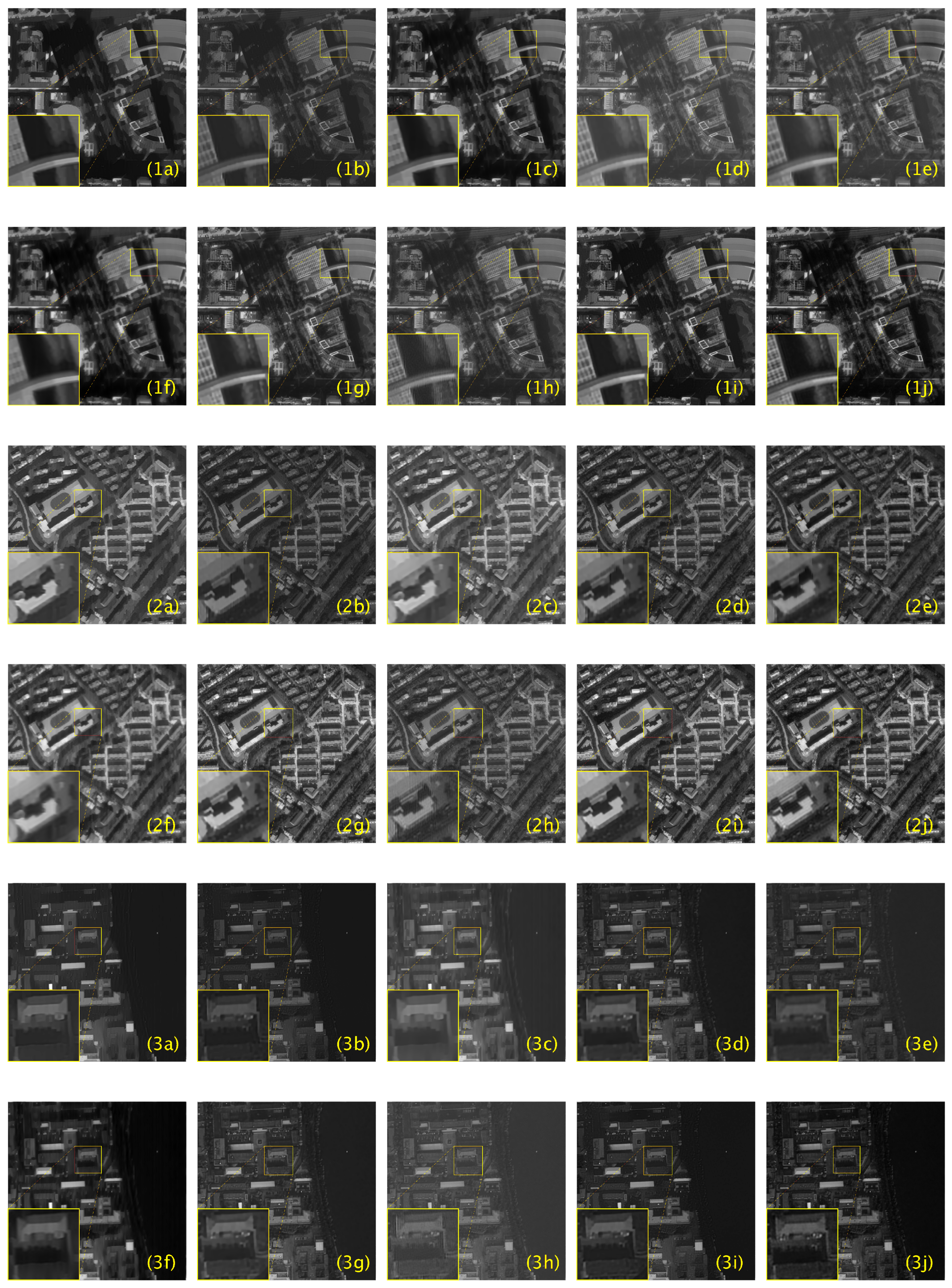
| Method | SSIM | PSNR | NIQE/dB |
|---|---|---|---|
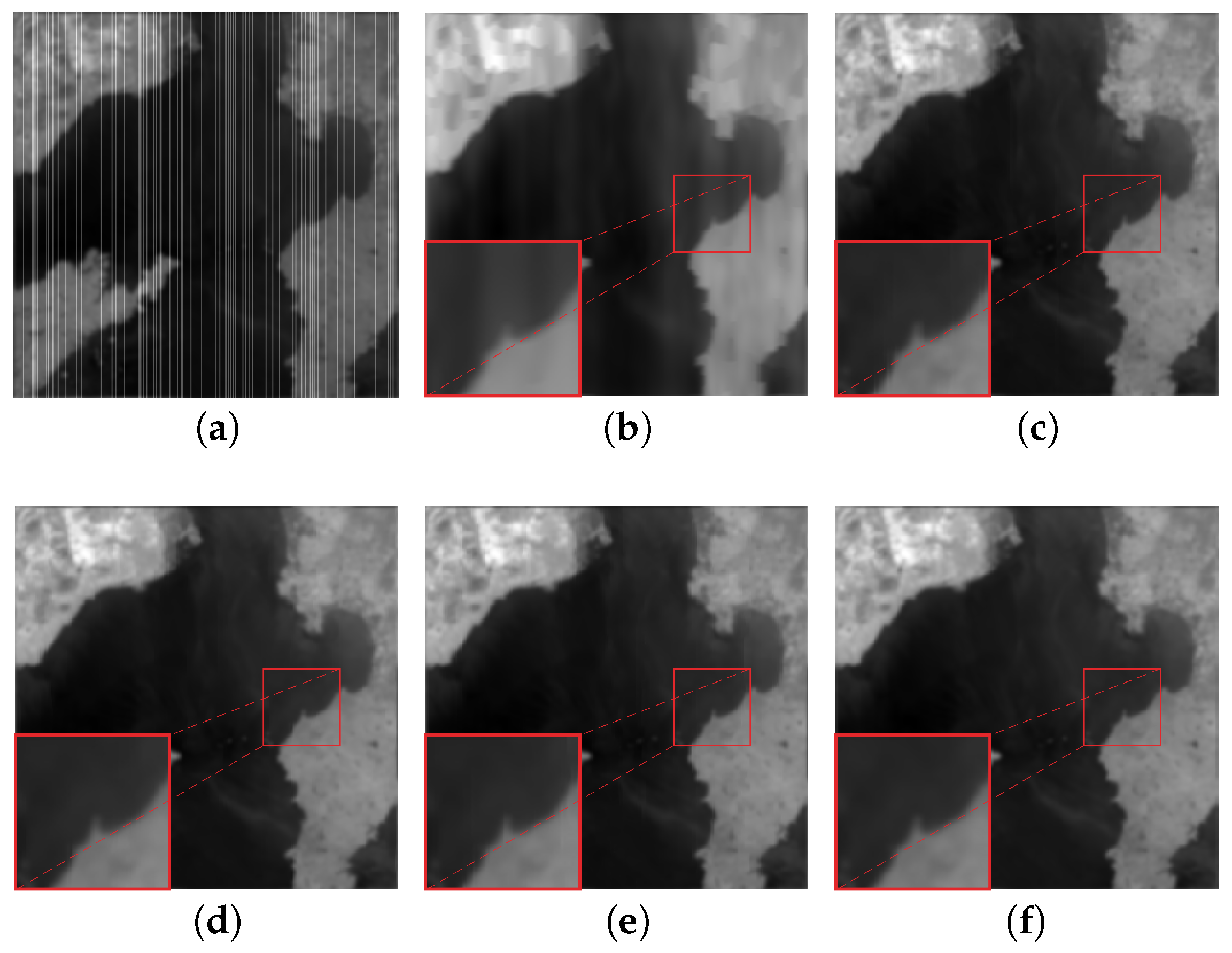
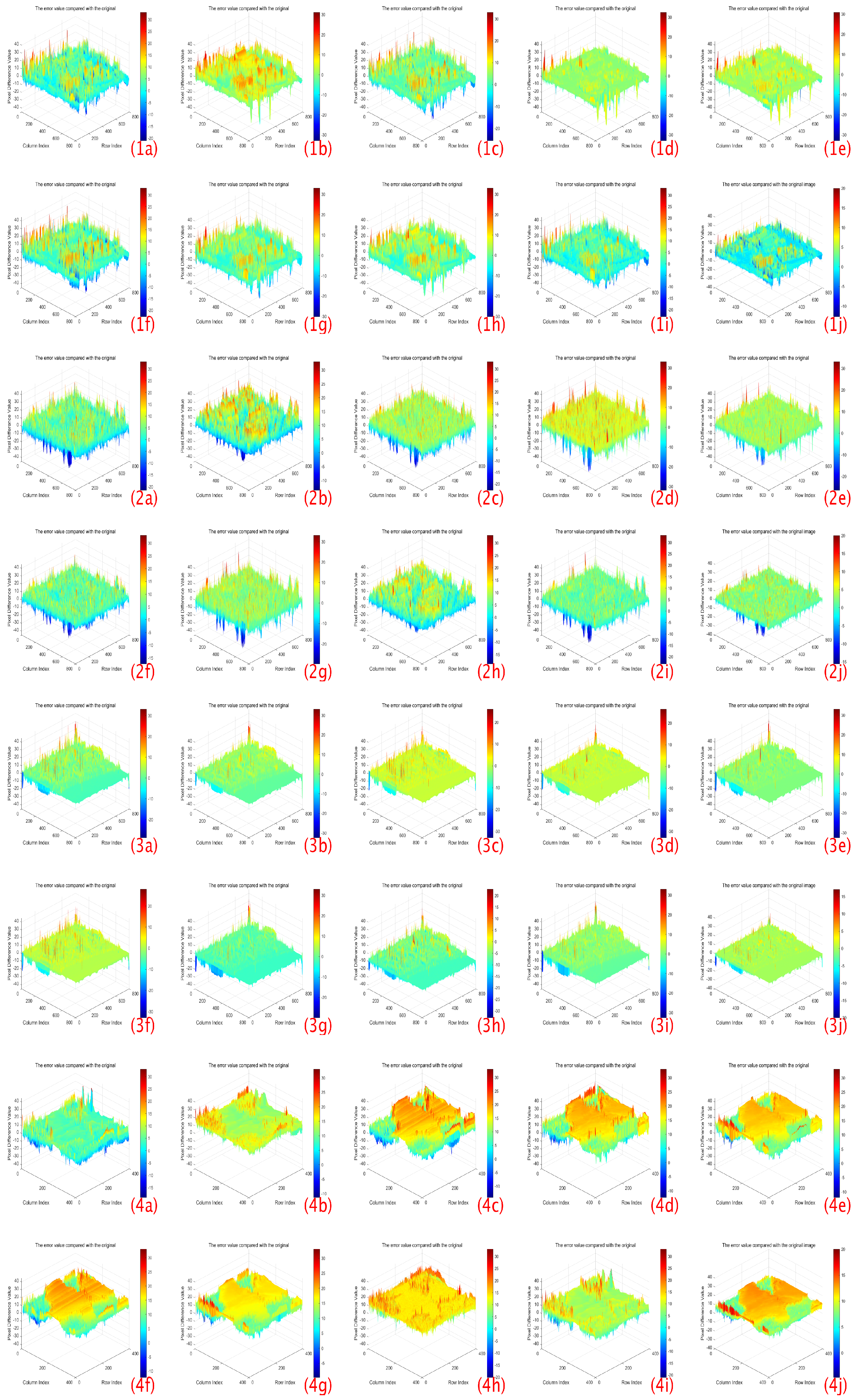
| LRSID+AMRN | 0.7876 | 24.91 | 5.429 |
| ADOM+AMRN | 0.8922 | 26.68 | 5.032 |
| LRSID+LGP | 0.8295 | 25.65 | 5.724 |
| ADOM+LGP | 0.9280 | 27.37 | 5.606 |
| ADOM+SCGTV | 0.8883 | 25.96 | 5.299 |
| BSR_GLKM | 0.9102 | 28.68 | 4.382 |
| RBDS | 0.9292 | 27.43 | 6.732 |
| De_GANv2 | 0.7297 | 20.82 | 5.700 |
| SLDR_eNeRf | 0.8885 | 29.68 | 6.622 |
| Ours | 0.9565 | 30.36 | 4.372 |
| Method | SSIM | PSNR | NIQE/dB |
|---|---|---|---|
| LRSID+AMRN | 0.6439 | 22.61 | 6.263 |
| ADOM+AMRN | 0.7777 | 24.06 | 6.750 |
| LRSID+LGP | 0.6260 | 22.27 | 6.732 |
| ADOM+LGP | 0.7764 | 24.16 | 6.495 |
| ADOM+SCGTV | 0.7632 | 24.14 | 5.904 |
| BSR_GLKM | 0.8497 | 24.38 | 5.648 |
| RBDS | 0.7816 | 24.11 | 7.972 |
| De_GANv2 | 0.7395 | 22.45 | 7.021 |
| SLDR_eNeRf | 0.8056 | 28.34 | 8.371 |
| Ours | 0.8665 | 28.79 | 5.498 |
| Method | SSIM | PSNR | NIQE | |||
|---|---|---|---|---|---|---|
| p-Value | Significance | p-Value | Significance | p-Value | Significance | |
| LRSID+AMRN | 0.0022 | ✓ | 0.0036 | ✓ | 0.0025 | ✓ |
| ADOM+AMRN | 0.0445 | ✓ | 0.0017 | ✓ | 0.0125 | ✓ |
| LRSID+LGP | 0.0088 | ✓ | 0.0019 | ✓ | 0.0016 | ✓ |
| ADOM+LGP | 0.1213 | × | 0.0058 | ✓ | 0.0535 | × |
| ADOM+SCGTV | 0.0465 | ✓ | 0.0009 | ✓ | 0.0149 | ✓ |
| BSR_GLKM | 0.0015 | ✓ | 0.0013 | ✓ | 0.0097 | ✓ |
| RBDS | 0.1086 | × | 0.0080 | ✓ | 0.0374 | ✓ |
| De_GANv2 | 0.0421 | ✓ | 0.1373 | × | 0.0290 | ✓ |
| SLDR eNeRf | 0.0056 | ✓ | 0.0503 | × | 0.0084 | ✓ |
| Method | SSIM | PSNR | NIQE | |||
|---|---|---|---|---|---|---|
| p-Value | Significance | p-Value | Significance | p-Value | Significance | |
| LRSID+AMRN | 0.0059 | ✓ | 0.0030 | ✓ | 0.0047 | ✓ |
| ADOM+AMRN | 0.0394 | ✓ | 0.0035 | ✓ | 0.0193 | ✓ |
| LRSID+LGP | 0.0114 | ✓ | 0.0044 | ✓ | 0.0031 | ✓ |
| ADOM+LGP | 0.0560 | × | 0.0090 | ✓ | 0.0369 | ✓ |
| ADOM+SCGTV | 0.0392 | ✓ | 0.0031 | ✓ | 0.0229 | ✓ |
| BSR_GLKM | 0.0034 | ✓ | 0.0030 | ✓ | 0.0169 | ✓ |
| RBDS | 0.0491 | ✓ | 0.0103 | ✓ | 0.0305 | ✓ |
| De_GANv2 | 0.0352 | ✓ | 0.1422 | × | 0.0369 | ✓ |
| SLDR eNeRf | 0.0078 | ✓ | 0.0460 | ✓ | 0.0130 | ✓ |
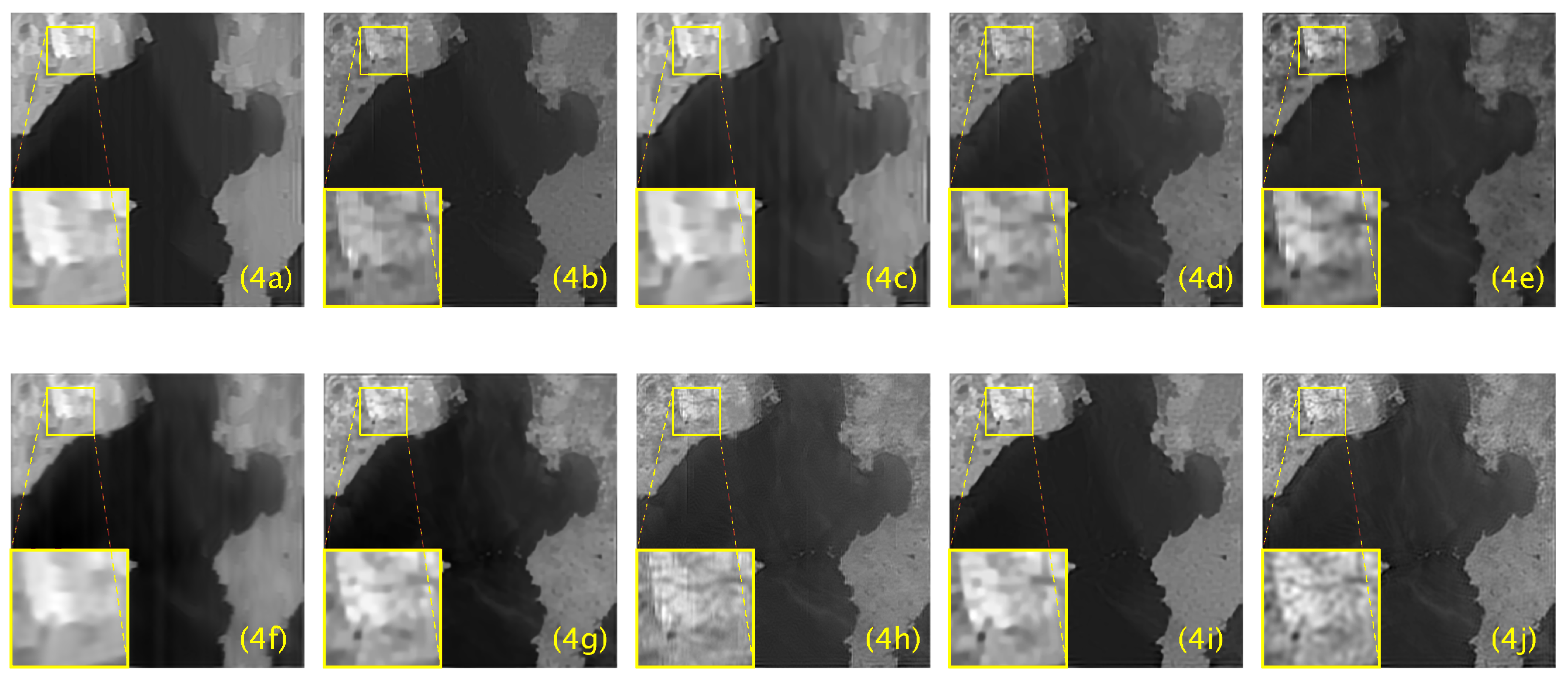
| Method | NIQE/dB | ICV | MRD |
|---|---|---|---|
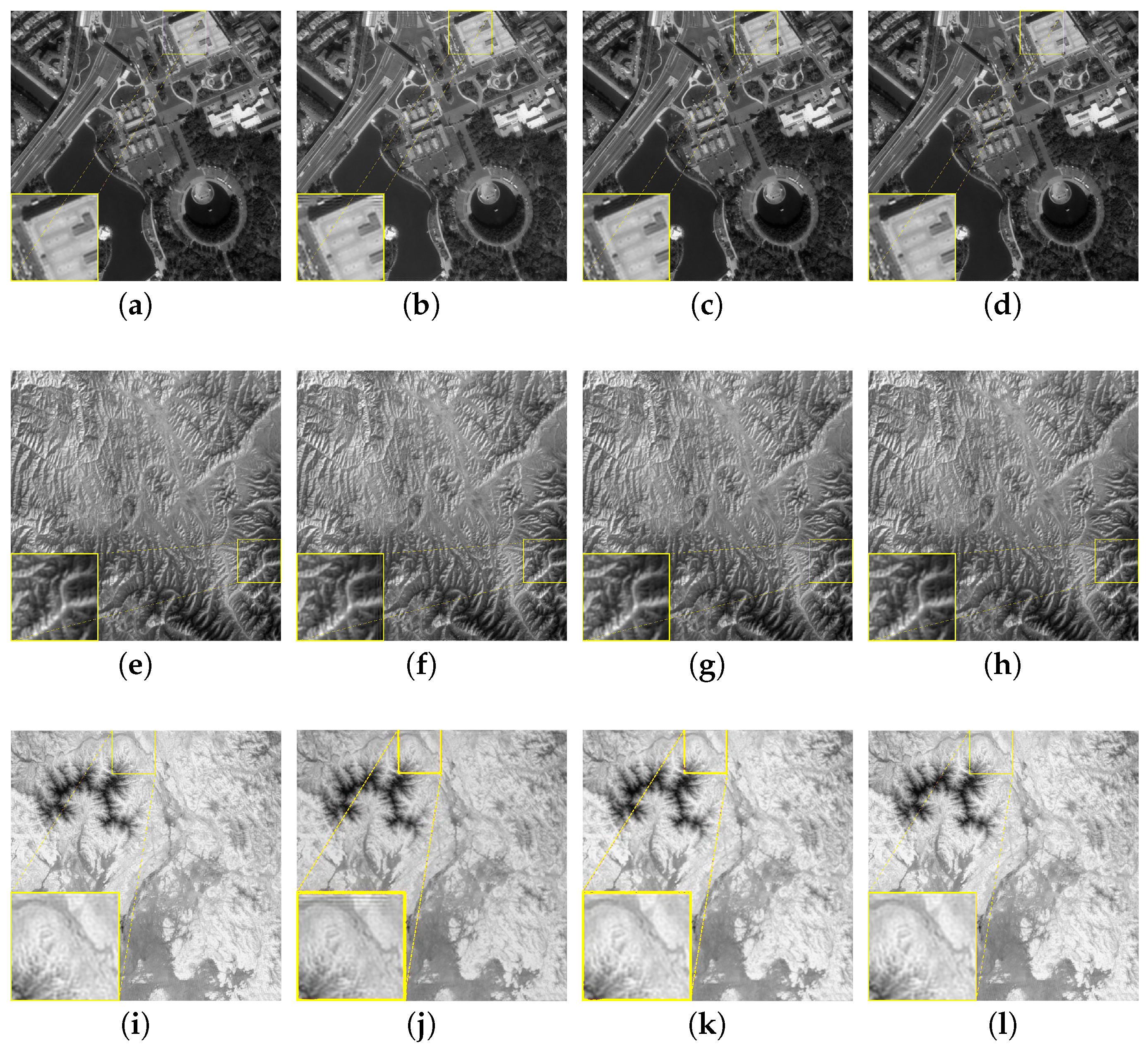
| LRSID+AMRN | 6.3070 | 3.5237 | 0.0170 |
| ADOM+AMRN | 10.2284 | 3.3305 | 0.0128 |
| LRSID+LGP | 6.6622 | 3.6891 | 0.0189 |
| ADOM+LGP | 10.8664 | 3.4594 | 0.0145 |
| ADOM+SCGTV | 6.6598 | 3.3333 | 0.0143 |
| BSR_GLKM | 6.0957 | 3.4956 | 0.0124 |
| RBDS | 11.2188 | 3.4822 | 0.0147 |
| De_GANv2 | 10.5114 | 3.4140 | 0.0778 |
| SLDR_eNeRf | 11.7117 | 3.3548 | 0.0139 |
| Ours | 6.0415 | 3.5124 | 0.0113 |
| Method | NIQE/dB | ICV | MRD |
|---|---|---|---|
| LRSID+AMRN | 5.5713 | 46.3902 | 0.0722 |
| ADOM+AMRN | 6.8225 | 52.0792 | 0.0413 |
| LRSID+LGP | 6.1223 | 45.2617 | 0.0803 |
| ADOM+LGP | 7.5639 | 52.9108 | 0.0366 |
| ADOM+SCGTV | 6.5307 | 51.1732 | 0.0435 |
| BSR_GLKM | 5.8576 | 55.9826 | 0.0371 |
| RBDS | 8.6402 | 53.5716 | 0.0348 |
| De_GANv2 | 8.4083 | 56.1115 | 0.0263 |
| SLDR_eNeRf | 8.8935 | 51.2671 | 0.0441 |
| Ours | 5.0817 | 59.4637 | 0.0173 |
| Method | NIQE | ICV | MRD | |||
|---|---|---|---|---|---|---|
| p-Value | Significance | p-Value | Significance | p-Value | Significance | |
| LRSID+AMRN | 0.0070 | ✓ | 0.0049 | ✓ | 0.0068 | ✓ |
| ADOM+AMRN | 0.0375 | ✓ | 0.0054 | ✓ | 0.0179 | ✓ |
| LRSID+LGP | 0.0145 | ✓ | 0.0559 | × | 0.0050 | ✓ |
| ADOM+LGP | 0.0552 | × | 0.0111 | ✓ | 0.0360 | ✓ |
| ADOM+SCGTV | 0.0383 | ✓ | 0.0050 | ✓ | 0.0222 | ✓ |
| BSR_GLKM | 0.0055 | ✓ | 0.0048 | ✓ | 0.0193 | ✓ |
| RBDS | 0.0482 | ✓ | 0.1125 | × | 0.0289 | ✓ |
| De_GANv2 | 0.0331 | ✓ | 0.0447 | ✓ | 0.0558 | × |
| SLDR eNeRf | 0.0085 | ✓ | 0.0461 | ✓ | 0.0152 | ✓ |
| Method | NIQE | ICV | MRD | |||
|---|---|---|---|---|---|---|
| p-Value | Significance | p-Value | Significance | p-Value | Significance | |
| LRSID+AMRN | 0.0083 | ✓ | 0.0038 | ✓ | 0.0110 | ✓ |
| ADOM+AMRN | 0.0241 | ✓ | 0.0094 | ✓ | 0.0242 | ✓ |
| LRSID+LGP | 0.0202 | ✓ | 0.0431 | ✓ | 0.0099 | ✓ |
| ADOM+LGP | 0.0383 | ✓ | 0.0161 | ✓ | 0.0556 | × |
| ADOM+SCGTV | 0.0483 | ✓ | 0.0089 | ✓ | 0.0293 | ✓ |
| BSR_GLKM | 0.0115 | ✓ | 0.0087 | ✓ | 0.0258 | ✓ |
| RBDS | 0.0600 | × | 0.0361 | ✓ | 0.0372 | ✓ |
| De_GANv2 | 0.0362 | ✓ | 0.0399 | ✓ | 0.0490 | ✓ |
| SLDR eNeRf | 0.0031 | ✓ | 0.0575 | × | 0.0210 | ✓ |
| Method | 800 × 800 (s) | 2000 × 2000 (s) | 3000 × 3000 (s) |
|---|---|---|---|
| LRSID+AMRN | 55.7932 | 62.6545 | 69.3894 |
| ADOM+AMRN | 60.8223 | 68.2977 | 76.5368 |
| LRSID+LGP | 50.1841 | 59.6472 | 66.3824 |
| ADOM+LGP | 64.5053 | 75.9931 | 87.3647 |
| ADOM+SCGTV | 136.3371 | 141.4861 | 148.3385 |
| BSR_GLKM | 3.38 | 3.64 | 3.97 |
| RBDS | 12.5620 | 14.6875 | 15.8611 |
| De_GANv2 | 2.13 | 2.52 | 3.04 |
| SLDR_eNeRf | 2.42 | 2.85 | 3.26 |
| Ours | 32.1888 | 35.7643 | 39.3865 |
| Edge Preserving | Stripe Orthogonal Fidelity | Ringing Suppression | SSIM | PSNR (dB) | NIQE | |
|---|---|---|---|---|---|---|
| A | ✓ | ✓ | ✓ | 0.9065 | 34.0333 | 5.9771 |
| B | ✓ | ✓ | × | 0.8586 | 29.1583 | 6.7023 |
| C | ✓ | × | ✓ | 0.8887 | 33.4699 | 6.1419 |
| D | × | ✓ | ✓ | 0.8882 | 33.1115 | 6.1821 |
| Metric | Variance 2 Noise [−40, 40] | Variance 4 Noise [−60, 60] | Variance 6 Noise [−60, 60] | Variance 9 Noise [−80, 80] |
|---|---|---|---|---|
| SSIM | 0.9491 | 0.8623 | 0.7314 | 0.6003 |
| PSNR (dB) | 32.1084 | 28.0056 | 25.2211 | 20.7588 |
Disclaimer/Publisher’s Note: The statements, opinions and data contained in all publications are solely those of the individual author(s) and contributor(s) and not of MDPI and/or the editor(s). MDPI and/or the editor(s) disclaim responsibility for any injury to people or property resulting from any ideas, methods, instructions or products referred to in the content. |
© 2026 by the authors. Licensee MDPI, Basel, Switzerland. This article is an open access article distributed under the terms and conditions of the Creative Commons Attribution (CC BY) license.
Share and Cite
Wang, N.; Huang, L.; Li, M.; Zhou, B.; Nie, T. Joint Deblurring and Destriping for Infrared Remote Sensing Images with Edge Preservation and Ringing Suppression. Remote Sens. 2026, 18, 150. https://doi.org/10.3390/rs18010150
Wang N, Huang L, Li M, Zhou B, Nie T. Joint Deblurring and Destriping for Infrared Remote Sensing Images with Edge Preservation and Ringing Suppression. Remote Sensing. 2026; 18(1):150. https://doi.org/10.3390/rs18010150
Chicago/Turabian StyleWang, Ningfeng, Liang Huang, Mingxuan Li, Bin Zhou, and Ting Nie. 2026. "Joint Deblurring and Destriping for Infrared Remote Sensing Images with Edge Preservation and Ringing Suppression" Remote Sensing 18, no. 1: 150. https://doi.org/10.3390/rs18010150
APA StyleWang, N., Huang, L., Li, M., Zhou, B., & Nie, T. (2026). Joint Deblurring and Destriping for Infrared Remote Sensing Images with Edge Preservation and Ringing Suppression. Remote Sensing, 18(1), 150. https://doi.org/10.3390/rs18010150