
Nonlinear Water–Heat Thresholds, Human Amplification, and Adaptive Governance of Grassland Degradation Under Climate Change

Highlights
- 30 m structure–function assessment links LUCC transitions with NPP, NEP, soil conservation (SC), and grassland supply (GS), revealing a polarized 2003–2023 trajectory in the ELB.
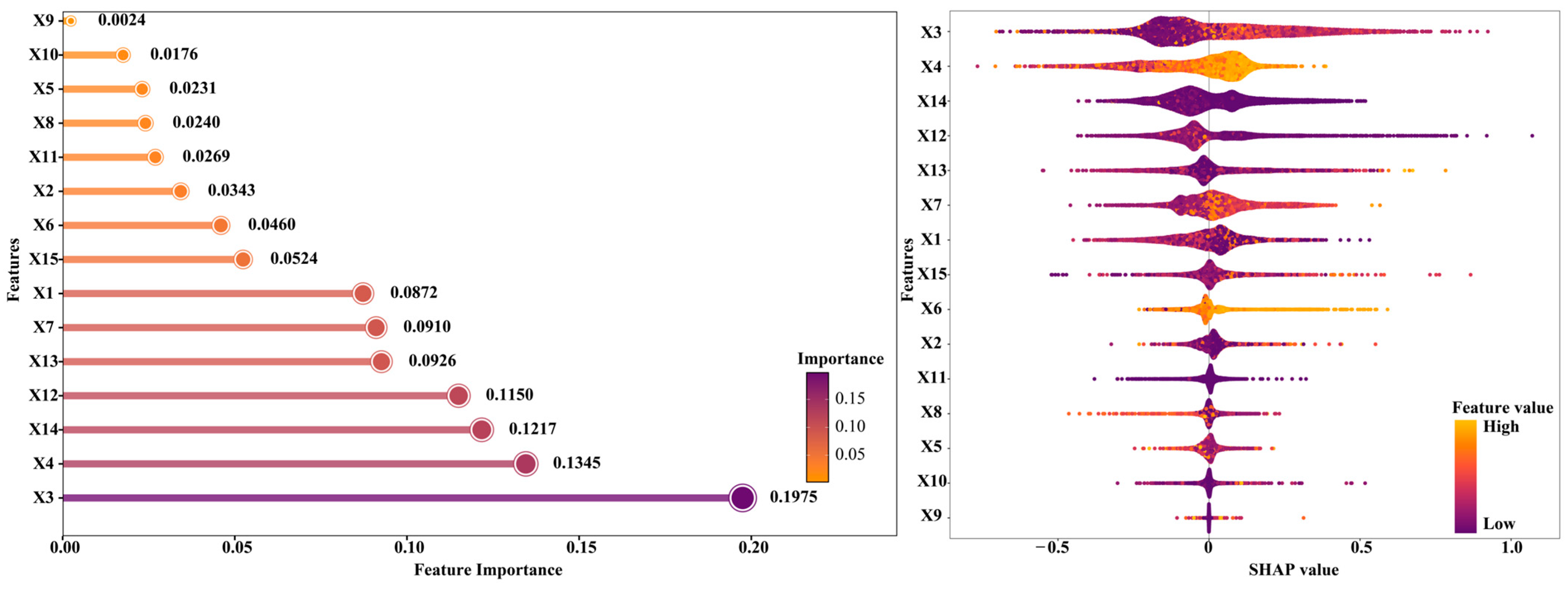
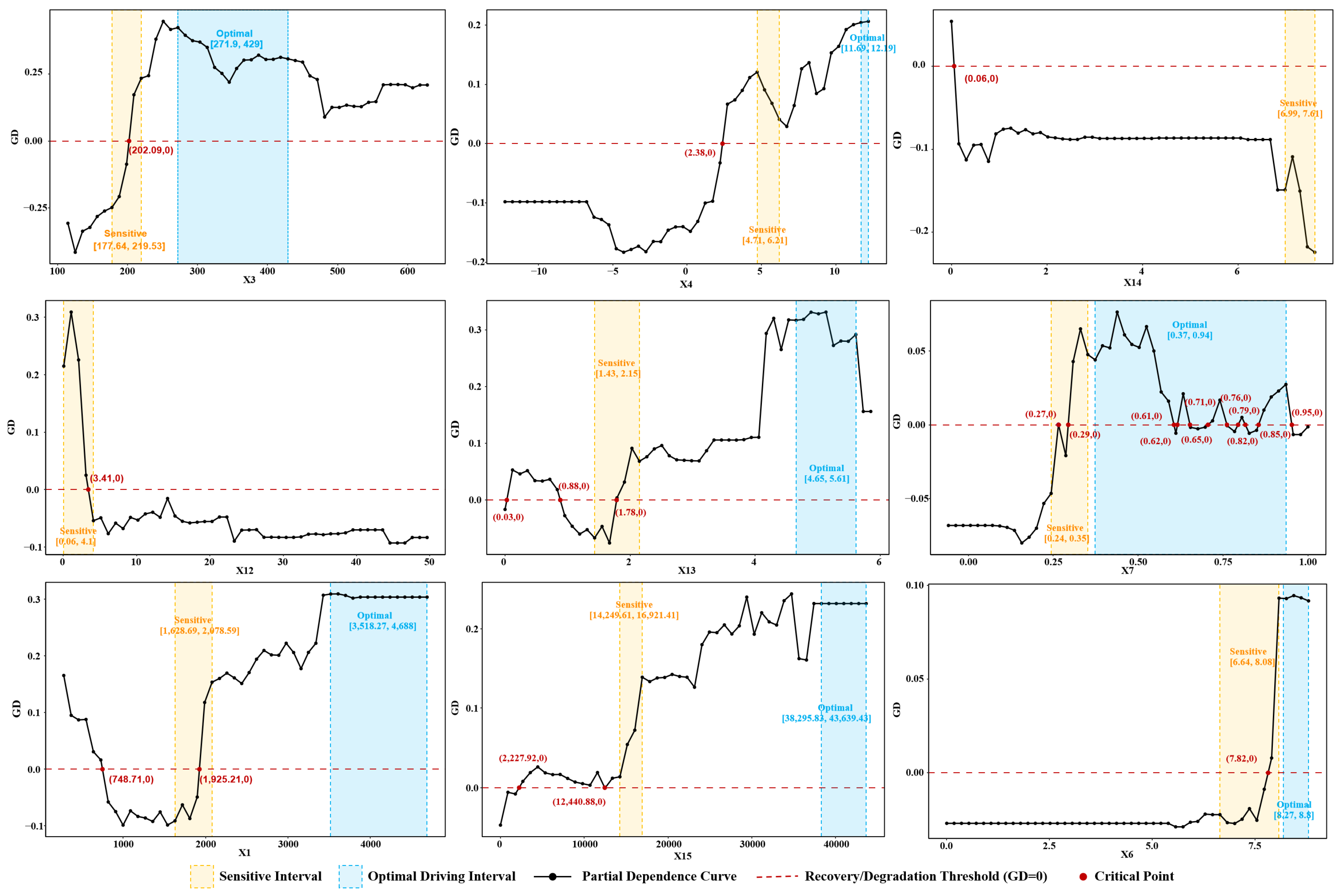
- Explainable XGBoost–SHAP identifies climate dominance with accessibility amplification and quantifies operational thresholds (e.g., ~200 mm rainfall gate; road density ~0.06 km km−2; grazing windows 2.2–4.2 and 4.65–5.61 SU km−2).
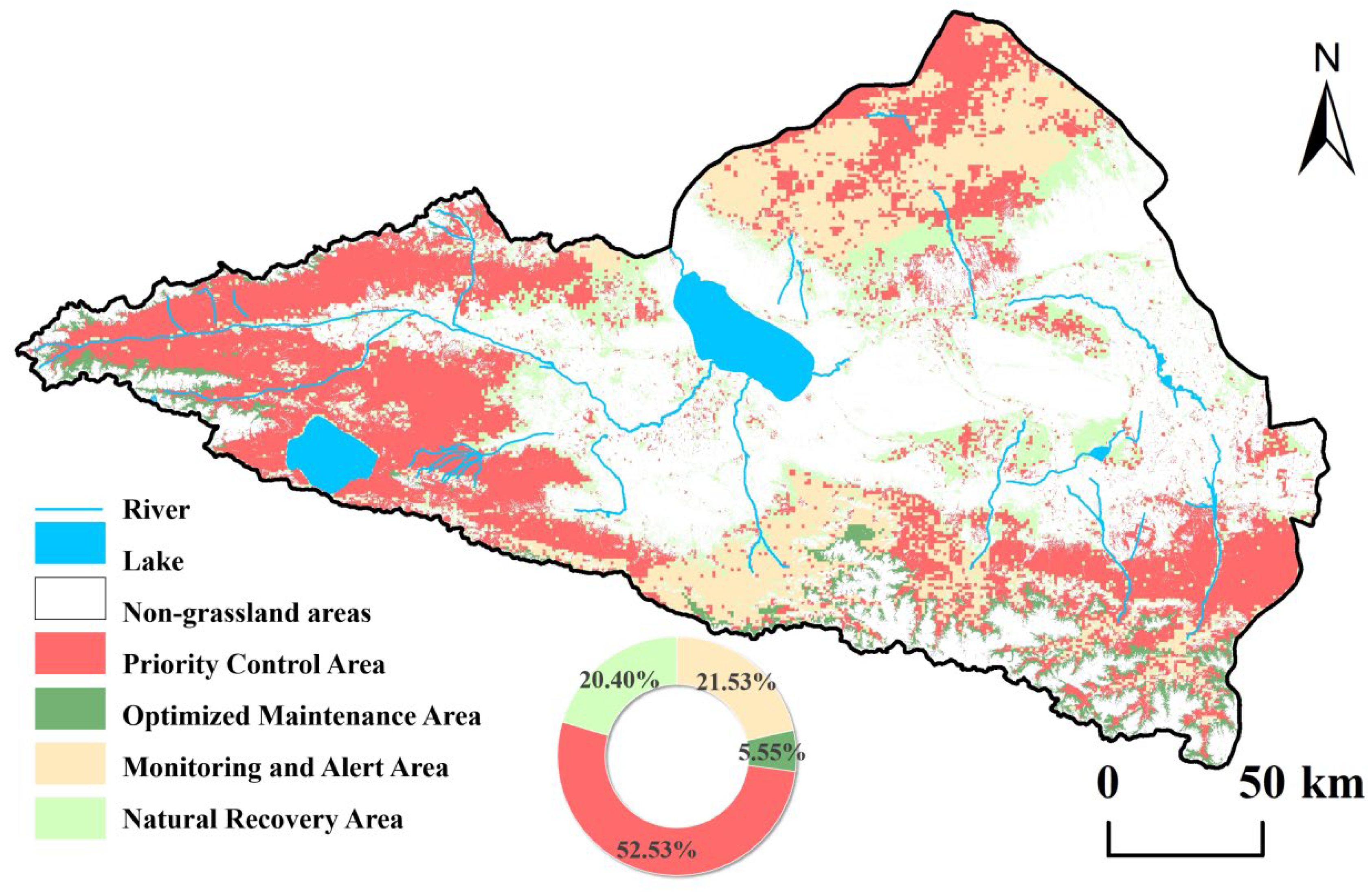
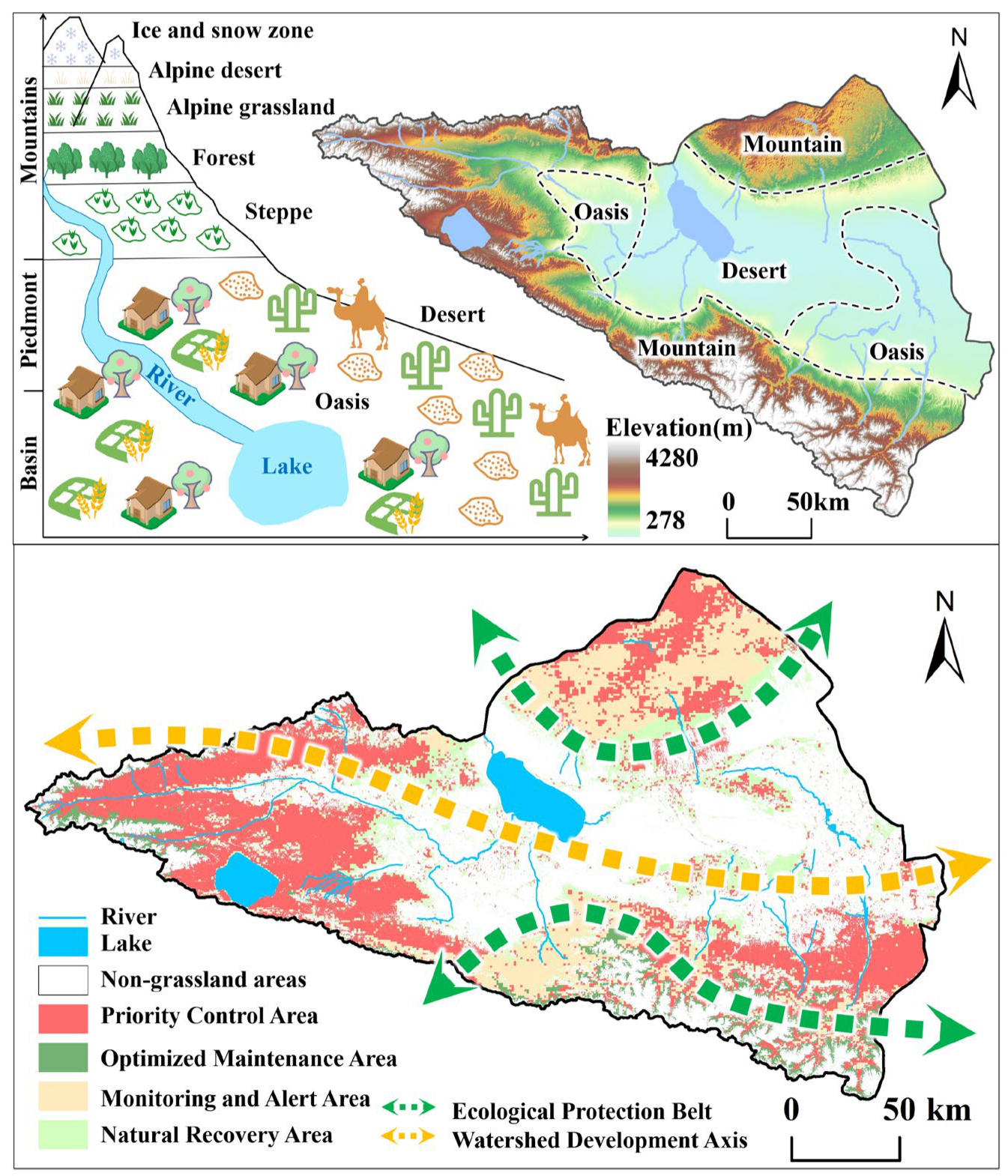
- Thresholds translate directly into adaptive zoning (“two belts–four zones–one axis”), enabling season-/year-specific controls on grazing, roads, and water allocation.
- The workflow is transferable to mountain–oasis–desert basins, supporting climate-risk reduction and stabilization of carbon/soil functions in drylands.
Abstract
1. Introduction
2. Materials and Methods
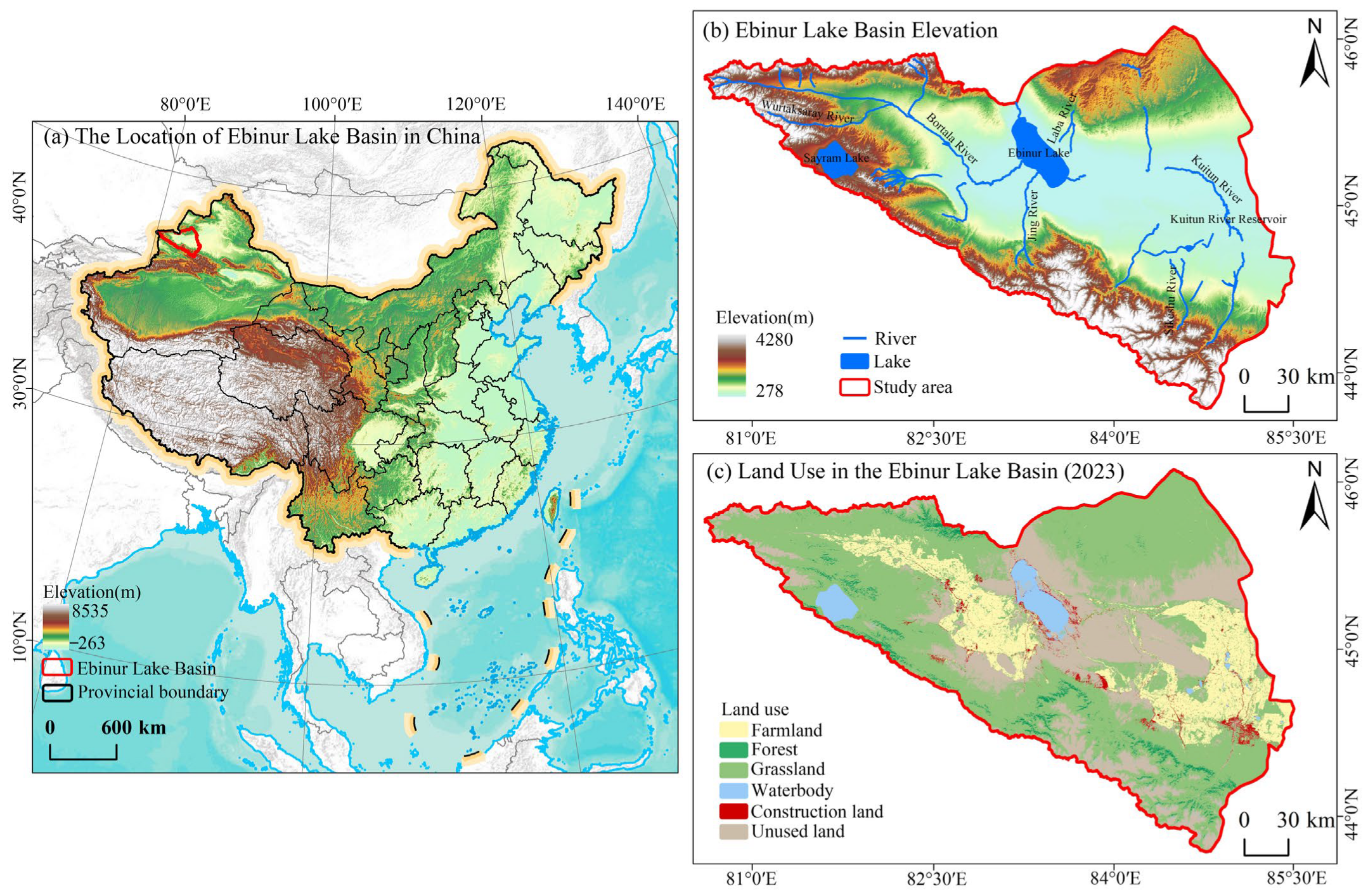
2.1. Study Area
2.2. Data Sources

| Indicator | Formula | Notes |
|---|---|---|
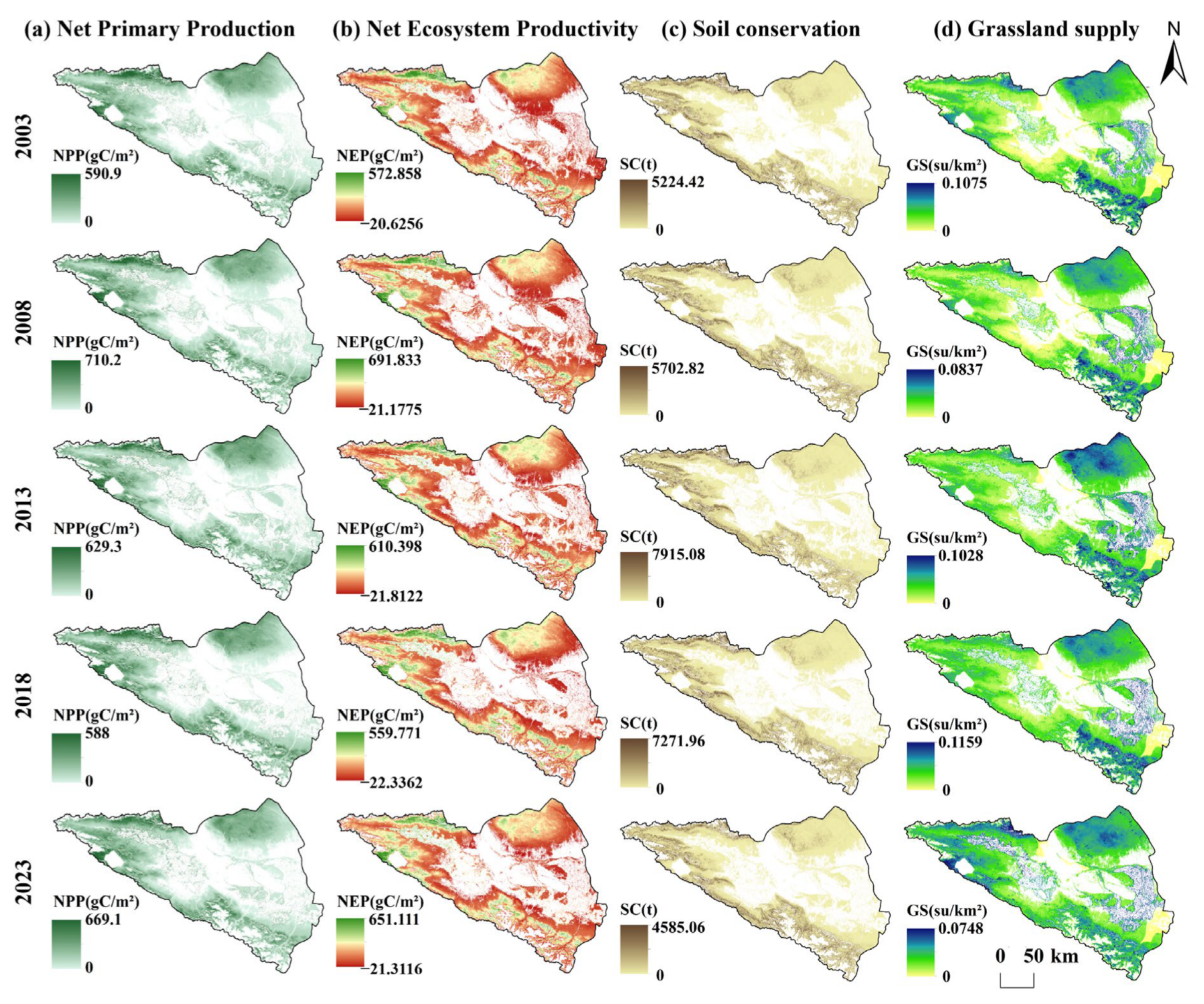
| NPP | Pixel-scale monthly NPP is computed using a light-use efficiency framework. APARx,t is absorbed photosynthetically active radiation, estimated from total shortwave radiation (SOL) and fraction of absorbed PAR (FPAR, derived from NDVI). εx,t is realized light-use efficiency, constrained by εmax (maximum biome-specific efficiency), temperature scalars Tε1, Tε2, and a moisture scalar Wε. Monthly NPP (2003–2023) is aggregated to annual values and mosaicked to a 30 m grid. | |
| NEP | NEP is represented as the balance between production and heterotrophic respiration. Rh(x,t) is soil heterotrophic respiration, parameterized as a function of mean annual temperature T (°C) and annual precipitation P (mm), with empirical coefficients α,β,γ. NEP>0 indicates a net carbon sink; NEP<0 indicates a net carbon source. | |
| SC | Soil conservation is quantified as the avoided erosion, i.e., the difference between potential erosion AR(x) and actual erosion AC(x). The Revised Universal Soil Loss Equation (RUSLE)-type factors include rainfall erosivity R, soil erodibility K, slope length–steepness factor LS (derived from the DEM), cover factor C (derived from NDVI), and support practice factor P (set to 1 for natural grassland or assigned according to conservation measures). | |
| GS | GIx,tis the annual forage supply index for pixel x (in standardized sheep units, SU·km−2·yr−1). κ is a biomass conversion coefficient; GAx/Ax is the grassland area fraction within the pixel; SUu,t is the standardized livestock load (sheep units, SU) for the corresponding administrative unit u at time t. |
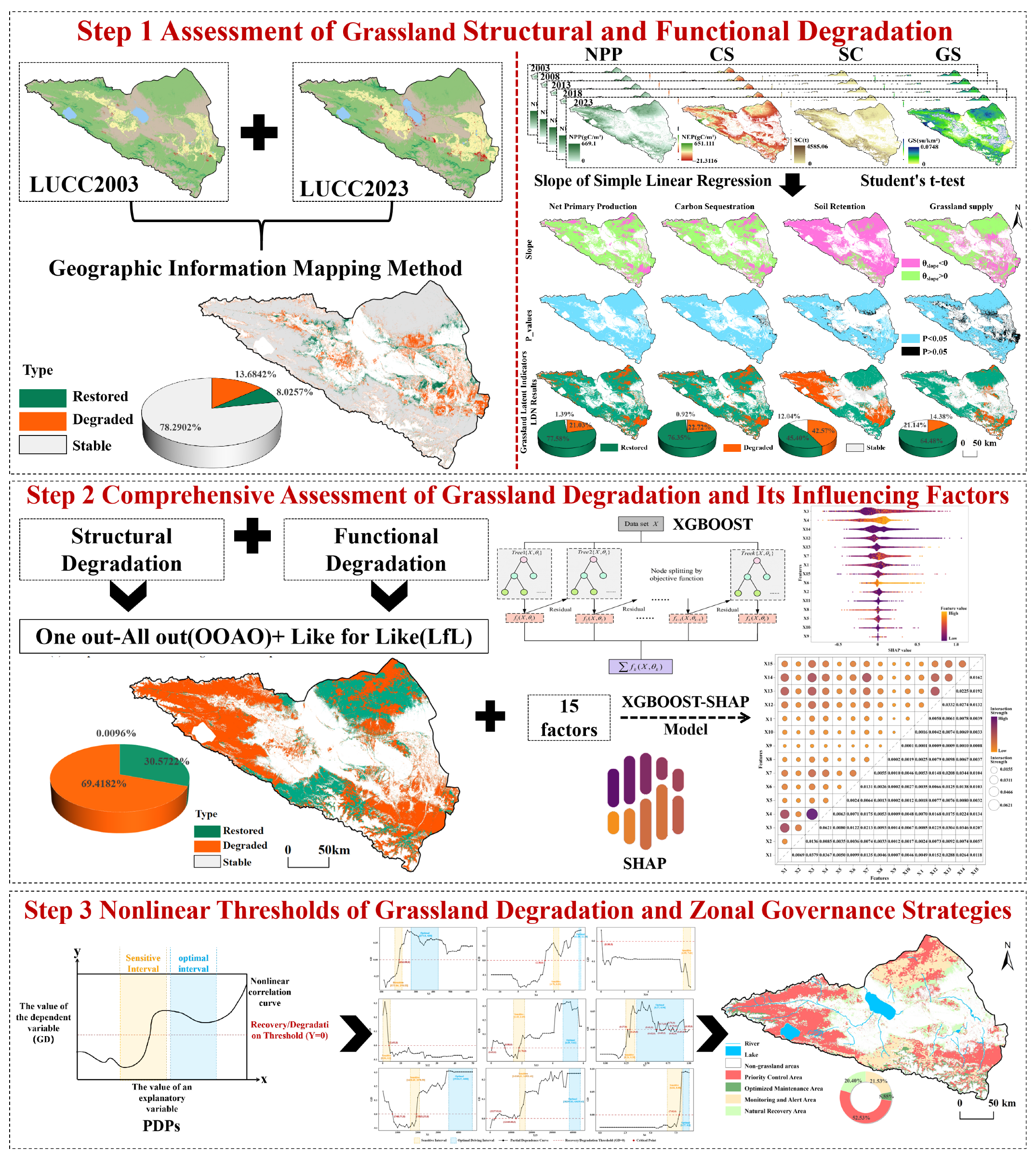
2.3. Research Framework
- (1)
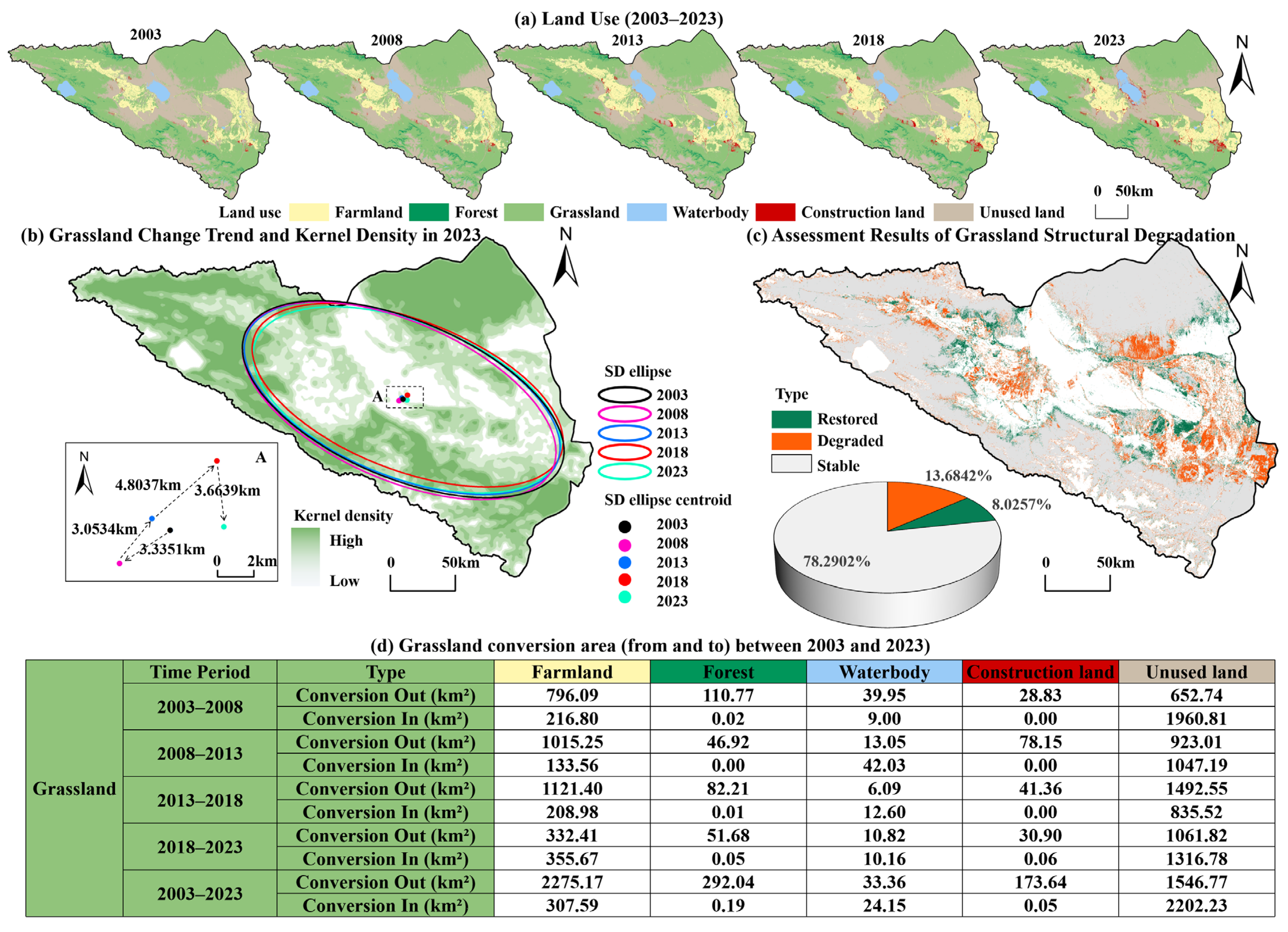
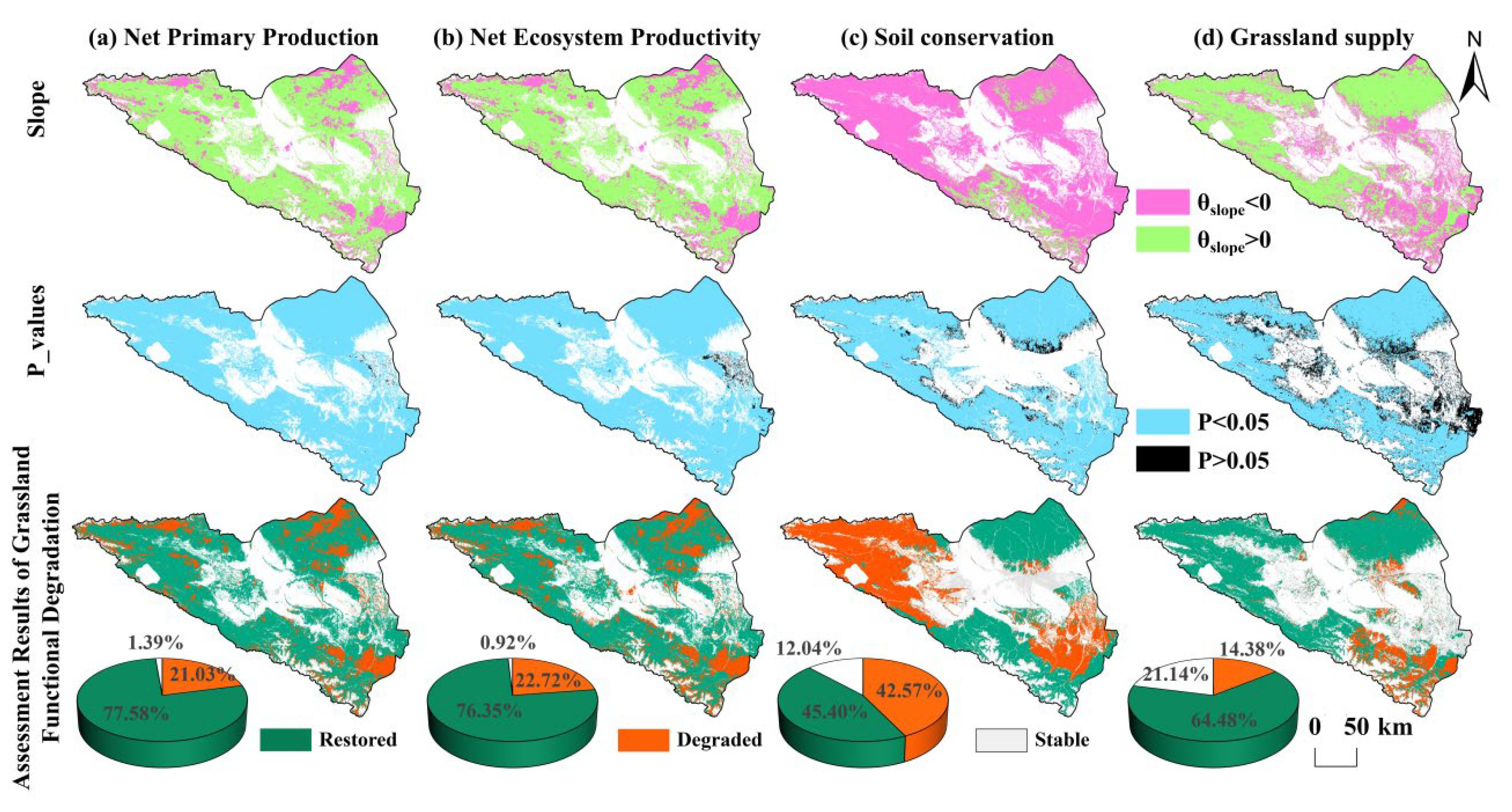
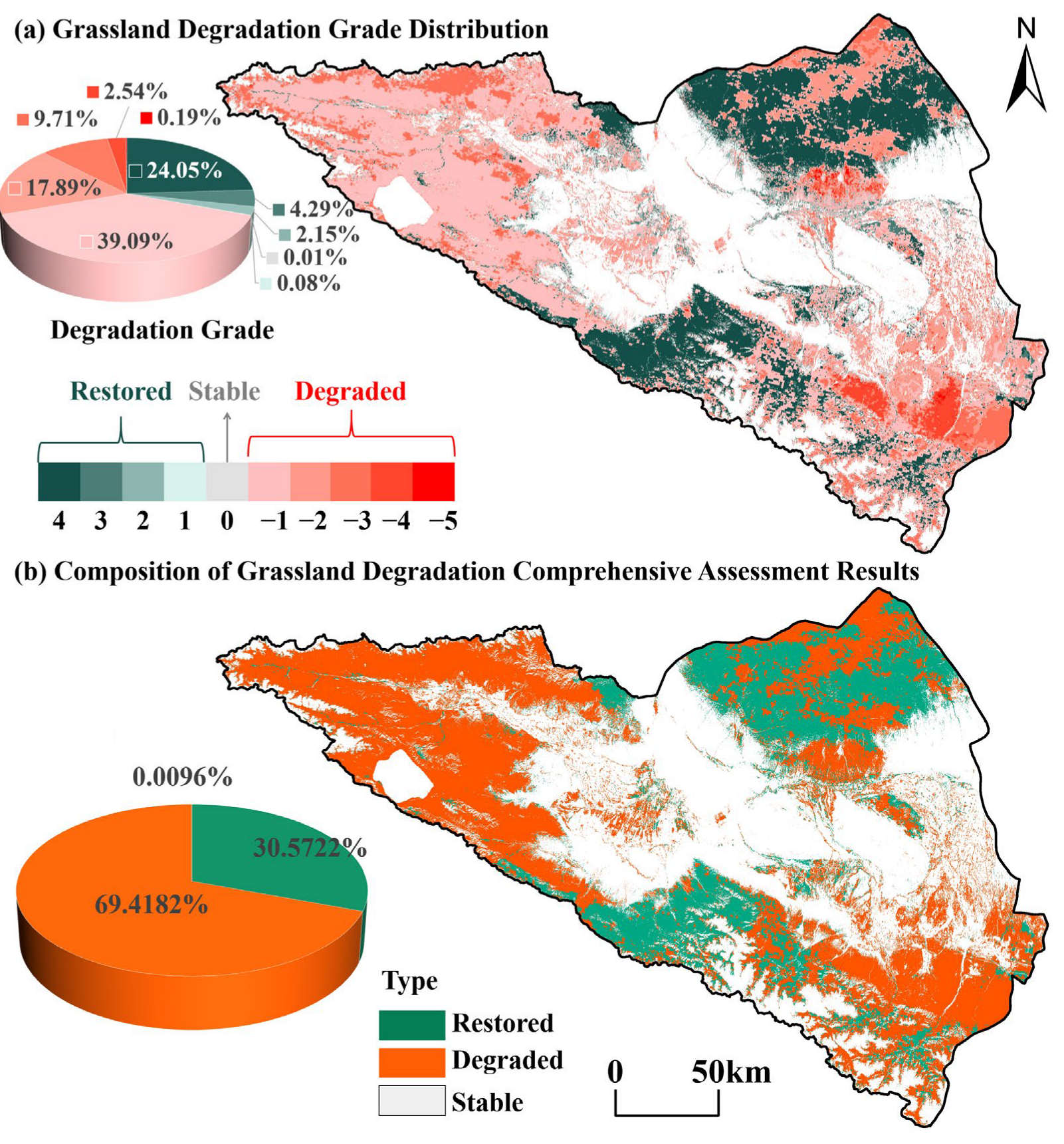
- Assessment. We jointly evaluate structural change and functional change in grasslands at 30 m resolution. Structural change was characterized from the CLCD land-use/land-cover maps using five benchmark years (2003, 2008, 2013, 2018, and 2023), reporting both the net 2003–2023 transition and the stage-wise transitions across the four adjacent intervals. Functional change was derived from annual time series (2003–2023), and the integrated structure–function status was synthesized under an OOAO/LfL decision rule to support subsequent mechanism diagnosis and governance zoning.
- (2)
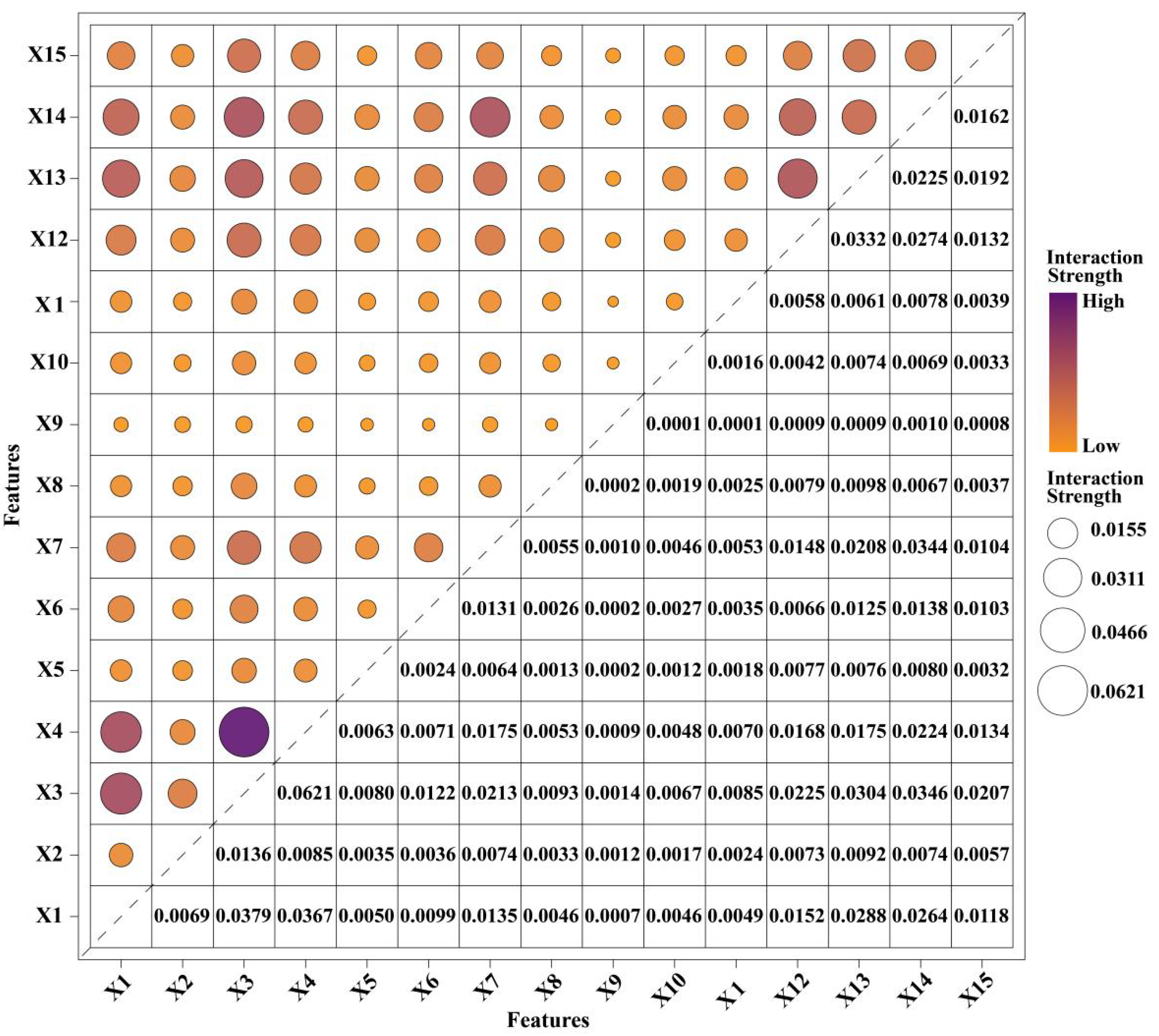
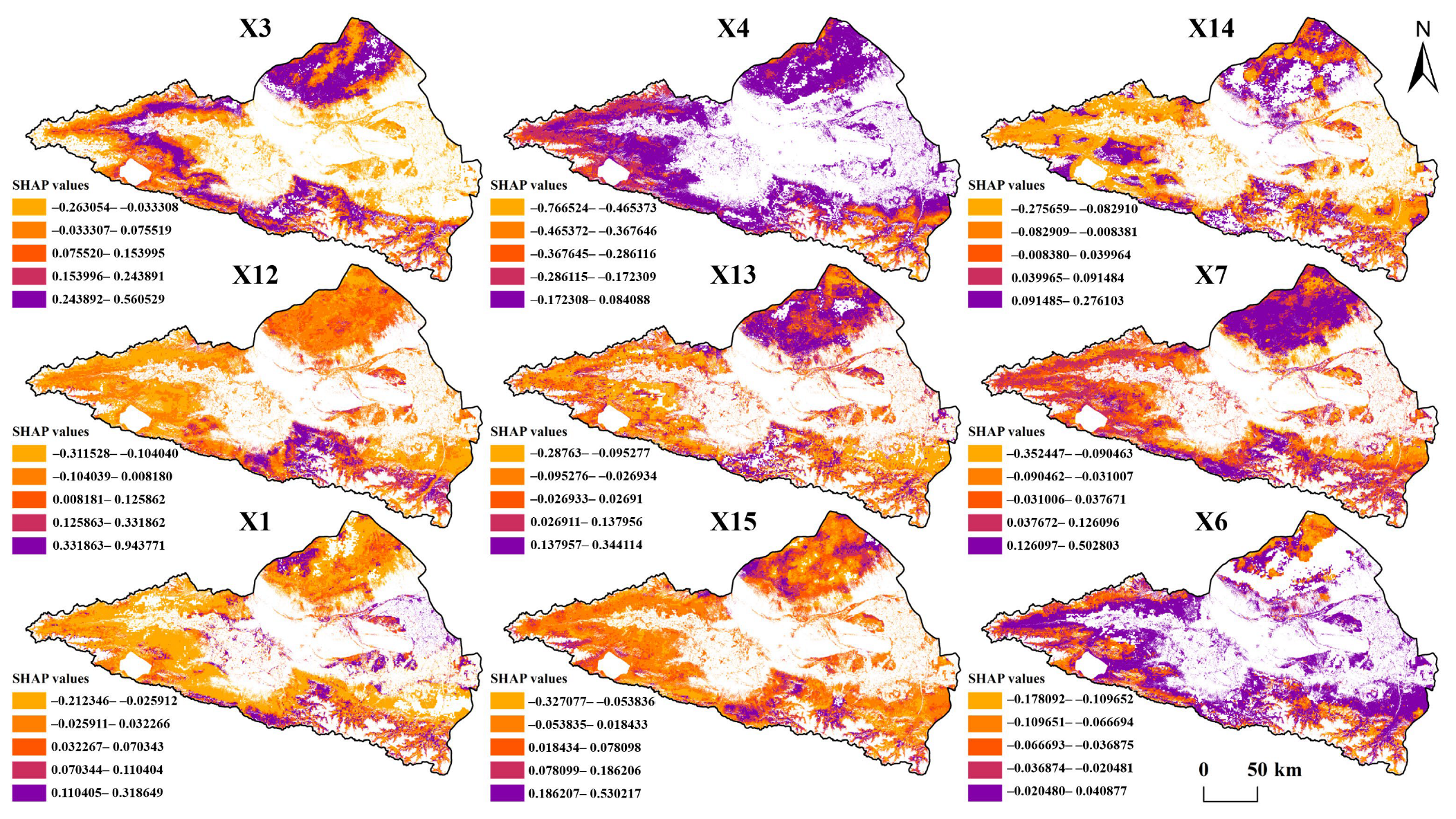
- Diagnosis. We then use an interpretable machine-learning approach. A gradient-boosted decision tree model (XGBoost) predicts the pixel-wise ordinal degradation–restoration response (Y) from terrain, hydroclimate, soil, vegetation, and human-use drivers. SHAP and partial dependence analysis are used to (i) quantify the relative importance of drivers, (ii) reveal nonlinear responses and pairwise interactions, and (iii) identify ecological thresholds and sensitive ranges.
- (3)
- Governance. Finally, we translate the identified thresholds—for example, water availability windows and disturbance limits—into management zoning. Pixels are assigned to differentiated management units (e.g., priority control, monitoring and alert, natural recovery, optimized maintenance), which together form a basin-scale spatial strategy. In this way, ecological thresholds become operational guidance for adaptive grassland management under a drying–warming climate.
2.4. Integrated Assessment of Grassland Degradation
2.4.1. Structural Degradation
2.4.2. Functional Degradation
2.4.3. Integrated Assessment
- R1 (Degradation priority): if ∃j such that Ij(x) = −1, classify pixel x as degraded.
- R2 (All-stable is stable): if ∀j, Ij(x) = 0, classify pixel x as stable (zero-net-change state).
- R3 (No degradation and at least one improvement): if ∀j, Ij(x) ≠ −1 and ∃j with Ij(x) = +1, classify pixel x as restored.
2.5. Mechanisms and Threshold Analysis of Grassland Degradation
2.5.1. Predictor Selection
2.5.2. Machine Learning Model
- (1)
- Target variable definition
- (2)
- Model training and validation
2.5.3. Interpretable Driver Analysis and Ecological Threshold Identification
- (1)
- Model interpretability
- (2)
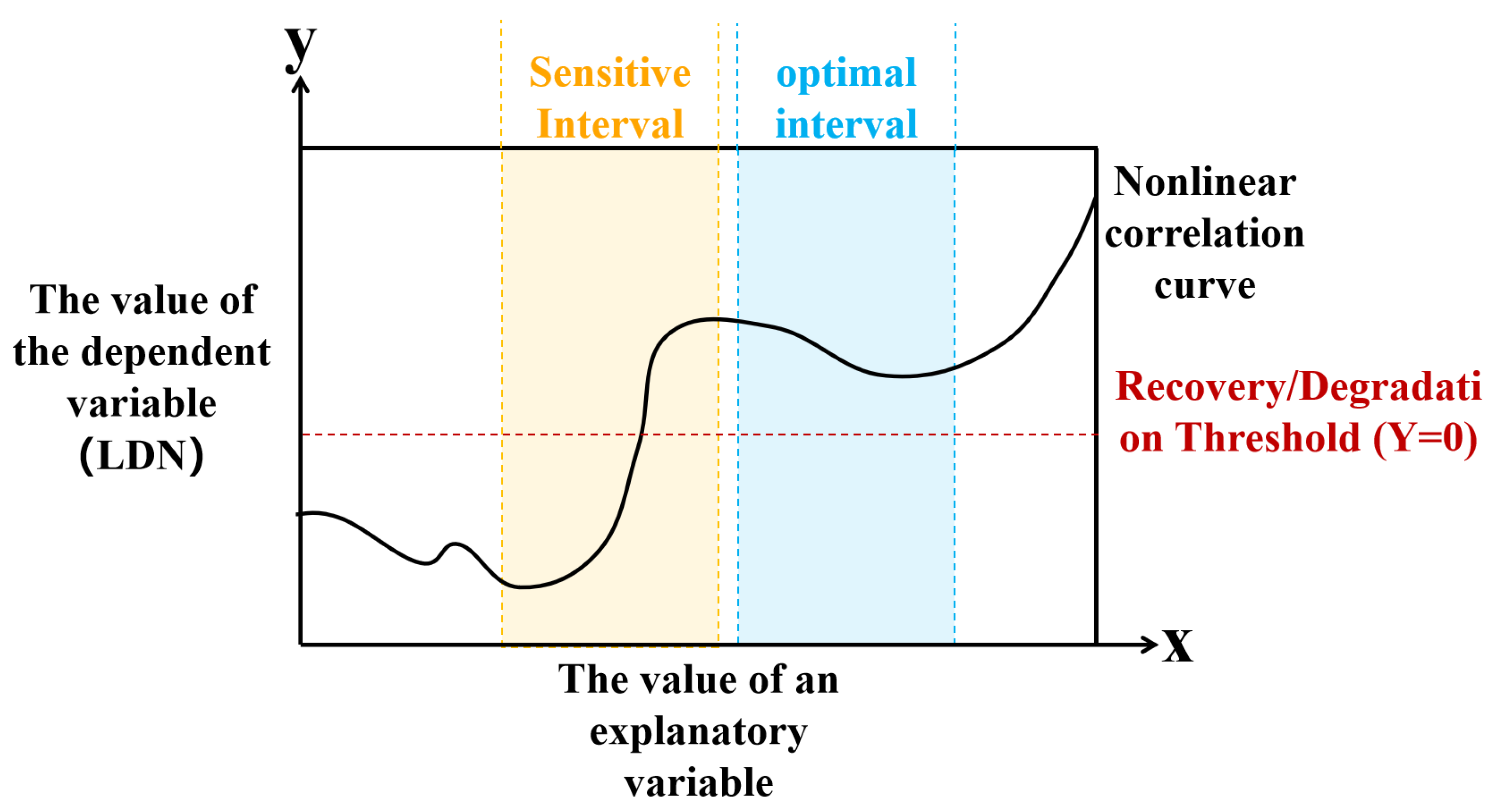
- Ecological threshold identification
- (a)
- Critical thresholds. Using linear interpolation at PDj (xj) = 0, we located restoration (Y: <0 → >0) and degradation (Y: >0 → <0) crossings.
- (b)
- Optimal management window. Candidate windows were the contiguous ranges in the top 25% of PDj values, cross-validated by “platform” segments where the first difference magnitude fell below 30% of the series’ SD—indicating high benefit with a stable response.
- (c)
- Sensitive interval. High-sensitivity bands were contiguous ranges where ∣dPDj/dxj∣ ranked in the top 30%. PDPs were evaluated on the 2nd–98th percentiles of each feature domain and LOESS-smoothed to stabilize derivatives.

3. Results and Analysis
3.1. Spatiotemporal Patterns of Grassland Degradation
3.1.1. Structural Dynamics
3.1.2. Spatiotemporal Dynamics of Functional Degradation
3.1.3. Integrated Structural–Functional Assessment of Grassland Degradation
3.2. Drivers of Grassland Degradation
3.2.1. Identification of Key Drivers
3.2.2. Interaction Effects Among Drivers
3.2.3. Spatial Heterogeneity of Degradation Drivers
3.3. Grassland Degradation: Nonlinear Responses and Ecological Thresholds
3.3.1. Univariate Nonlinear Responses (PDPs)
3.3.2. Zoning for Graded Management Based on Thresholds
4. Discussion
4.1. Applicability and Challenges of an Integrated Structural–Functional Assessment Under Climate Change
4.2. Mechanisms by Which Climate Change Drives Grassland Degradation
4.3. Threshold-Led Zoning and Climate-Adaptation Strategies
- (1)
- (2)
- Integrated water–grazing–road decisions. Overlay water-allocation caps, stocking coefficients, and road-density thresholds on the same map—functionally aligning the ecological redline with grass–livestock balance at pixel scale [50].
- (3)
- Annual/scenario recalibration. Given warming with indications of heightened hydrothermal stresses in parts of northern Xinjiang [14], treat key thresholds as calibrated annually and by scenario to decide whether to trigger temporary intensified limits on stocking/disturbance or prioritize water allocation [9]. In short, management must be adjustable, not locked at a single intensity.
4.4. Limitations and Future Directions
5. Conclusions
- (1)
- Integrated status shows dominant degradation with pronounced spatial heterogeneity.
- (2)
- A quantified mechanism chain—climate leadership, human amplification, topographic modulation.
- (3)
- Key ecological thresholds and functional platforms are well defined; risk escalates near threshold neighborhoods.
- (4)
- Thresholds translated into adaptive governance: integrated zoning, grading, and spatial backbone.
Author Contributions
Funding
Data Availability Statement
Conflicts of Interest
Appendix A
Appendix A.1. Data Sources and Preprocessing
| Data Layer | Primary Dataset/Citation | Native Spatial & Temporal Coverage | Key Preprocessing & Use in This Study (2003–2023) |
|---|---|---|---|
| Land–use/land–cover (LULC) | 30 m annual land cover datasets in China, 1985–2023 [Data set] [51]. | 30 m; annual 1985–2023 | Extract five benchmark years (2003, 2008, 2013, 2018, 2023); reproject to 30 m Albers equal–area; aggregate to six classes; co–register (<0.5 pixel); encode pixel–wise transition codes (A × 10 + B) for grassland transitions. |
| Net Primary Productivity (NPP) | China regional 250 m annual max–NDVI, 2000–2024 [Data set] + CMFD v2.0 (meteorology) [30,52]. | NDVI: 250 m; annual 2000–2024. CMFD: 0.1°; daily 1951–2024 | Quality control NDVI and derive annual maximum; resample NDVI and CMFD to 30 m grid; drive a CASA–type light–use–efficiency model (monthly APAR × ε) to estimate annual NPP for 2003–2023; extract benchmark–year values for mapping and use full annual series for trend tests. |
| Net Ecosystem Productivity (NEP) | Net ecosystem productivity (NEP) of China (2001–2023) [Data set] [31]. | ~1 km; annual 2001–2023 | Extract 2003–2023; bilinear resample to 30 m; use as functional indicator for pixel–wise trend tests and benchmark–year mapping. |
| Soil conservation (SC) | Chinese soil conservation/water–erosion control dataset (1992–2019) + CHIRPS/CMFD precipitation + HWSD v2.0 soils [53,54]. | SC product: ~1 km; annual 1992–2019. Precip.: 0.05°–0.1°; daily 2000–2024. Soils: ~1 km; quasi–static | Use annual SC layers for 2003–2019; extend to 2020–2023 by carrying forward the 2017–2019 mean (conservative extension); resample to 30 m; use as functional indicator. |
| Grassland supply (GS) | Annual 30 m global grassland extent (2000–2022) [Data set] + LHGI (1980–2022) [Data set] + NDVI–based biomass [36,52,55]. | Grassland extent: 30 m; annual 2000–2022. Grazing intensity: 300 m; annual 1980–2022 | Construct a forage–supply index (SU km−2 yr−1) by combining NDVI–based biomass, mapped grassland fraction, and standardized livestock load; resample inputs to 30 m; extend 2023 using 2022 grassland extent and 2020–2022 mean grazing intensity; interpret GS mainly in terms of spatial gradients and relative change. |
| Climate drivers (P, T, VPD, radiation, wind) | China Meteorological Forcing Dataset v2.0 (CMFD v2.0) [Data set] [30]. | 0.1°; daily 1951–2024 | Aggregate daily fields to annual totals/means for 2003–2023; bilinear resample to 30 m; derive driver layers (e.g., annual P and mean T) for XGBoost. |
| Topography | GEBCO 2024 Grid [Data set] [56]. | ~15 arc–sec (~500 m); 2024 release | Extract elevation; derive slope; resample to 30 m; treat as quasi–static terrain constraints over 2003–2023. |
| Soil properties | Harmonized World Soil Database v2.0 (HWSD v2.0) [Data set] [54]. | ~30 arc–sec (~1 km); quasi–static | Extract SOC and pH (0–30 cm); bilinear resample to 30 m; treat as quasi–static drivers. |
| Vegetation greenness (NDVI) | China regional 250 m annual max–NDVI (2000–2024) [Data set] [52]. | 250 m; annual 2000–2024 | Quality control and annual compositing; resample to 30 m; use both as a driver (X7) and as input to NPP/GS calculations. |
| Desertification degree | National desertification raster (10 m), snapshots 2010 & 2020 [Data set] [57]. | ~10 m; snapshots 2010, 2020 | Re–index classes to an ordinal severity score; linearly interpolate 2010→2020 to obtain annual series; extend endpoints to 2003–2009 and 2021–2023 by nearest available snapshot; resample to 30 m. |
| Soil–erosion severity | Chinese soil conservation dataset preventing soil water erosion (1992–2019) [53]. | ~1 km; annual 1992–2019 | Extract annual erosion/severity layer for 2003–2019; extend to 2020–2023 by carrying forward 2017–2019 mean; resample to 30 m; use as driver X9. |
| River density | China River Extent Maps (CRED), 2016–2023 [Data set] [58]. | ~10–30 m; annual 2016–2023 | Compute river–length density (km km−2) on 30 m grid; use 2016–2023 multi–year mean as quasi–static drainage constraint for 2003–2023. |
| Population density | LandScan Silver Edition 2022: Global population distribution [Data set] [59]. | ~1 km; reference year 2022 | Resample to 30 m; treat as quasi–static socio–economic pressure proxy in the driver set. |
| Human–activity intensity (HAI) | Annual Human Footprint (2000–2018) [Data set] + High–quality Daily Nighttime Light (HDNTL) (2012–2024) [Data set] [60,61]. | Human Footprint: 1 km; annual 2000–2018. HDNTL: ~500 m; daily 2012–2024 | Normalize both indices and fuse to a 0–10 HAI scale using overlap years for calibration; build annual HAI for 2003–2023 (use Human Footprint where available; use HDNTL–calibrated continuation for 2019–2023); resample to 30 m. |
| Grazing intensity | Long–term High–resolution Grazing Intensity (LHGI) for China (1980–2022) [Data set] [36]. | 0.1° (~10 km) for 1980–2000; 0.0025° (~250 m) for 2001–2022; annual | Extract 2003–2022; resample to 30 m; extend to 2023 using 2020–2022 mean; use as driver X13 and for GS construction. |
| Road density & distance to settlements | Road network + National Geoinformation Public Service Platform (Tianditu), GS(2024)0650 settlements [62,63]. | Vector infrastructure layers; ~2024 snapshot | Rasterize roads to 30 m; compute road density (km km−2) within each pixel (or moving window, as specified in Methods); compute Euclidean distance to nearest settlement (km); treat as quasi–static accessibility proxies (X14–X15). |
Appendix A.2. Functional Indicator Computation
Appendix A.2.1. Net Primary Productivity (NPP)
Appendix A.2.2. Net Ecosystem Productivity (NEP)
Appendix A.2.3. Soil Conservation (SC)
Appendix A.2.4. Grassland Supply (GS)
Appendix A.3. XGBoost Model Configuration and Validation
Appendix A.3.1. Ordinal Response Construction
- the sign of Y encodes the direction of change. (Y < 0: net degradation; Y = 0: stable; Y > 0: net restoration);
- the absolute value ∣Y∣ reflects the intensity of change. (larger ∣Y∣ = more indicators degraded or restored simultaneously).
Appendix A.3.2. Predictor Preprocessing and Hyperparameter Tuning
| Parameter | Symbol | Value |
|---|---|---|
| Maximum tree depth | max_depth | 8 |
| Number of trees | n_estimators | 832 |
| Learning rate | learning_rate | 0.172 |
| L1 regularisation | reg_alpha | 0.087 |
| Minimum child weight | min_child_weight | 1.302 |
| Row subsampling ratio | subsample | 0.937 |
| Column subsampling per node | colsample_bynode | 0.799 |
| Objective function | — | squared−error regression |
| Train:test split | — | 70%: 30% (stratified by class) |
Appendix A.3.3. Independent Test Performance and Class-Wise Accuracy
| Observed/Predicted | −5 | −4 | −3 | −2 | −1 | 0 | 1 | 2 | 3 | 4 | Total | User Accuracy |
|---|---|---|---|---|---|---|---|---|---|---|---|---|
| −5 | 45,200 | 8100 | 2500 | 300 | 100 | 20 | 10 | 5 | 5 | 2 | 56,242 | 80.40% |
| −4 | 6500 | 620,000 | 130,000 | 12,000 | 3000 | 500 | 100 | 30 | 15 | 7 | 772,152 | 80.30% |
| −3 | 2000 | 110,000 | 2450,000 | 280,000 | 45,000 | 7000 | 1000 | 500 | 150 | 50 | 2951,172 | 83.00% |
| −2 | 500 | 20,000 | 320,000 | 4550,000 | 480,000 | 60,000 | 8000 | 3000 | 1000 | 500 | 5436,578 | 83.70% |
| −1 | 150 | 5000 | 70,000 | 550,000 | 9850,000 | 950,000 | 120,000 | 40,000 | 20,000 | 10,000 | 11,877,918 | 82.90% |
| 0 | 10 | 200 | 4000 | 45,000 | 800,000 | 6100,000 | 820,000 | 200,000 | 60,000 | 30,000 | 7304,420 | 83.50% |
| 1 | 5 | 50 | 1000 | 8000 | 110,000 | 750,000 | 1000,000 | 180,000 | 40,000 | 15,000 | 1304,719 | 76.60% |
| 2 | 2 | 20 | 300 | 4000 | 35,000 | 180,000 | 320,000 | 500,000 | 80,000 | 20,000 | 652,567 | 76.60% |
| 3 | 1 | 10 | 100 | 1500 | 12,000 | 45,000 | 70,000 | 75,000 | 200,000 | 8000 | 242,235 | 82.50% |
| 4 | 0 | 5 | 50 | 200 | 2000 | 7000 | 12,000 | 15,000 | 10,000 | 23,000 | 29,921 | 76.90% |
| Total | 54,368 | 763,385 | 2977,950 | 5451,000 | 11,341,100 | 8099,520 | 2351,110 | 1013,535 | 411,165 | 106,559 | 30,386,924 | |
| Mapping Accuracy | 83.10% | 81.20% | 82.30% | 83.50% | 86.80% | 75.30% | 42.50% | 49.30% | 48.60% | 21.60% | − | Overall accuracy 83.5% |
Appendix A.3.4. Summary of Performance and Robustness Metrics
| Evaluation Dimension | Metric | Value | Interpretation |
|---|---|---|---|
| Data set | Total number of samples | 30,386,924 pixels | All grassland pixels in the Ebinur Lake Basin were included in the modelling. |
| Train:test split | 70%: 30% (stratified) | Stratified random sampling preserves the class distribution in both subsets. | |
| Regression performance | Mean squared error (MSE) | 0.602 | Small continuous–level error for the ordinal response (Y). |
| Mean absolute error (MAE) | 0.514 ordinal units | Average prediction bias is about half a degradation/restoration level. | |
| Coefficient of determination ((R2)) | 0.911 | The model explains 91.1% of the variance in (Y). | |
| Classification performance | Overall accuracy | 83.50% | Proportion of correctly classified pixels across the ten ordinal classes. |
| Macro–averaged F1 score | 0.81 | Balanced predictive performance across all classes, including minority classes. | |
| Matthews correlation coefficient (MCC) | 0.79 | Robust summary of classification quality under class imbalance. | |
| Robustness checks | Residual spatial autocorrelation | Moran’s I = −0.02 (p = 0.65) | Residuals are spatially random; no strong spatial bias in model errors. |
| 5–fold cross–validation (MSE, mean ± SD) | 0.84 ± 0.07 | Cross–validated errors are of similar magnitude to the test–set MSE, indicating good generalisation with limited variance. |
References
- Intergovernmental Panel on Climate Change. Climate Change 2022: Impacts, Adaptation and Vulnerability; Cambridge University Press: Cambridge, UK, 2022. [Google Scholar]
- Intergovernmental Panel on Climate Change. Climate Change 2023: Synthesis Report of the IPCC Sixth Assessment Report; IPCC: Geneva, Switzerland, 2023. [Google Scholar]
- Berdugo, M.; Delgado-Baquerizo, M.; Soliveres, S.; Hernández-Clemente, R.; Zhao, Y.; Gaitán, J.J.; Maestre, F.T. Global Ecosystem Thresholds Driven by Aridity. Science 2020, 367, 787–790. [Google Scholar] [CrossRef] [PubMed]
- Piao, S.; Wang, X.; Park, T.; Chen, C.; Lian, X.U.; He, Y.; Bjerke, J.W.; Chen, A.; Ciais, P.; Tømmervik, H.; et al. Characteristics, Drivers and Implications of Global Greening. Nat. Rev. Earth Environ. 2020, 1, 14–27. [Google Scholar] [CrossRef]
- Zhu, Z.; Piao, S.; Myneni, R.B.; Huang, M.; Zeng, Z.; Canadell, J.G.; Ciais, P.; Sitch, S.; Friedlingstein, P.; Arneth, A.; et al. Greening of the Earth and Its Drivers. Nat. Clim. Change 2016, 6, 791–795. [Google Scholar] [CrossRef]
- Liu, L.; Gudmundsson, L.; Hauser, M.; Qin, D.; Li, S.; Seneviratne, S.I. Soil Moisture Dominates Ecosystem Production’s Sensitivity to Dryness Stress. Nat. Commun. 2020, 11, 4892. [Google Scholar] [CrossRef]
- Yuan, W.; Zheng, Y.; Piao, S.; Ciais, P.; Lombardozzi, D.; Wang, Y.; Myneni, R.B. Increased Atmospheric Vapor Pressure Deficit Reduces Global Vegetation Growth. Sci. Adv. 2019, 5, eaax1396. [Google Scholar] [CrossRef]
- Novick, K.A.; Ficklin, D.L.; Stoy, P.C.; Williams, C.A.; Bohrer, G.; Oishi, A.C.; Medvigy, D. The Increasing Importance of Atmospheric Demand for Ecosystem Water and Carbon Fluxes. Nat. Clim. Change 2016, 6, 1023–1027. [Google Scholar] [CrossRef]
- Seddon, A.W.R.; Macias-Fauria, M.; Long, P.R.; Benz, D.; Willis, K.J. Sensitivity of Global Terrestrial Ecosystems to Climate Variability. Nature 2016, 531, 229–232. [Google Scholar] [CrossRef]
- Ibisch, P.L.; Hoffmann, M.T.; Kreft, S.; Pe’er, G.; Kati, V.; Biber-Freudenberger, L.; Selva, N. A Global Map of Roadless Areas and Their Conservation Status. Science 2016, 354, 1423–1427. [Google Scholar] [CrossRef]
- Kennedy, C.M.; Oakleaf, J.R.; Theobald, D.M.; Baruch-Mordo, S.; Kiesecker, J. Managing the Middle: A Shift in Conservation Priorities Based on the Global Human Modification Gradient. Science 2019, 365, 865–870. [Google Scholar] [CrossRef]
- Eldridge, D.J.; Poore, A.G.B.; Ruiz-Colmenero, M.; Letnic, M.; Soliveres, S. Ecosystem Structure, Function, and Composition in Rangelands Are Negatively Affected by Livestock Grazing: A Global Meta-Analysis. J. Appl. Ecol. 2016, 53, 669–678. [Google Scholar]
- Laurance, W.F.; Clements, G.R.; Sloan, S.; O’Connell, C.S.; Mueller, N.D.; Goosem, M.; Arrea, I.B. A Global Strategy for Road Building. Nature 2014, 513, 229–232. [Google Scholar] [CrossRef]
- Jin, C.; Wang, B.; Cheng, T.-F.; Dai, L.; Wang, T. How Much We Know about Precipitation Climatology over Tianshan Mountains—The Central Asian Water Tower. npj Clim. Atmos. Sci. 2024, 7, 167. [Google Scholar] [CrossRef]
- Zhang, Z.; Zhang, F.; Zhou, Y.; Chen, Y.; Li, J. Increasing Multiscale Variability in Extreme Precipitation under Global Warming in the Tianshan Mountains, Central Asia. J. Hydrol. 2023, 624, 129037. [Google Scholar] [CrossRef]
- Chen, Y.; Li, W.; Deng, H.; Fang, G.; Li, Z. Changes in Central Asia’s Water Tower: Past, Present, and Future. Sci. Rep. 2016, 6, 35458. [Google Scholar] [CrossRef] [PubMed]
- Zscheischler, J.; Martius, O.; Westra, S.; Bevacqua, E.; Raymond, C.; Horton, R.M.; Seneviratne, S.I. A Typology of Compound Weather and Climate Events. Nat. Rev. Earth Environ. 2020, 1, 333–347. [Google Scholar] [CrossRef]
- AghaKouchak, A.; Chiang, F.; Huning, L.S.; Love, C.A.; Kong, L.; Smyth, P.; Sadegh, M. Climate Extremes and Compound Events in a Warming World. Annu. Rev. Earth Planet. Sci. 2021, 49, 85–110. [Google Scholar]
- Poulter, B.; Frank, D.; Ciais, P.; Myneni, R.B.; Andela, N.; Bi, J.; Zhu, Z. Contribution of Semi-Arid Ecosystems to Interannual Variability of the Global Carbon Cycle. Nature 2014, 509, 600–603. [Google Scholar] [CrossRef]
- Akhtar-Schuster, M.; Stringer, L.C.; Erlewein, A.; Metternicht, G.; Minelli, S.; Safriel, U.; Sommer, S. Unpacking the Concept of Land Degradation Neutrality and Addressing Its Operation through the Theory of Change. Environ. Sci. Policy 2017, 79, 148–155. [Google Scholar]
- Chen, T.; Guestrin, C. XGBoost: A Scalable Tree Boosting System. In Proceedings of the 22nd ACM SIGKDD International Conference on Knowledge Discovery and Data Mining, San Francisco, CA, USA, 13–17 August 2016; ACM: New York, NY, USA, 2016; pp. 785–794. [Google Scholar]
- Lundberg, S.M.; Lee, S.-I. A Unified Approach to Interpreting Model Predictions. In Advances in Neural Information Processing Systems; Curran Associates: Red Hook, NY, USA, 2017; Volume 30, pp. 4765–4774. [Google Scholar]
- Lundberg, S.M.; Erion, G.; Chen, H.; DeGrave, A.; Prutkin, J.; Nair, B.; Lee, S.-I. From Local Explanations to Global Understanding with Explainable AI for Trees. Nat. Mach. Intell. 2020, 2, 252–259. [Google Scholar] [CrossRef]
- Apley, D.W.; Zhu, J. Visualizing the Effects of Predictor Variables in Black Box Supervised Learning Models. J. R. Stat. Soc. Ser. B Stat. Methodol. 2020, 82, 1059–1086. [Google Scholar] [CrossRef]
- Greenwell, B.M. pdp: An R Package for Constructing Partial Dependence Plots. R J. 2017, 9, 421–436. [Google Scholar] [CrossRef]
- Zhang, J.; Ding, J.; Wu, P.; Tan, J.; Huang, S.; Teng, D.; Cao, X.; Wang, J.; Chen, W. Assessing Drought Impacts on Watershed Area and Vegetation across the Ebinur Lake Basin. Sci. Rep. 2020, 10, 1354. [Google Scholar] [CrossRef] [PubMed]
- Wang, L.; Simayi, Z.; Yang, S.T.; Mamitimin, Y. Research on economic bearing capacity of farmers to agricultural irrigation water prices in the ebinur lake basin. Sustainability 2019, 11, 2155. [Google Scholar] [CrossRef]
- Wei, Q.; Halike, A.; Yao, K.; Chen, L.; Balati, M. Construction and optimization of ecological security pattern in Ebinur Lake Basin based on MSPA-MCR models. Ecol. Indic. 2022, 138, 108857. [Google Scholar] [CrossRef]
- Dong, Y. Runoff Response to Climate and Land-Use/Cover Change in the Ebinur Lake Basin. Master’s Thesis, Xinjiang University, Urumqi, China, 2016. [Google Scholar]
- He, J.; Yang, K.; Li, X.; Tang, W.; Shao, C.; Jiang, Y.; Ding, B. China Meteorological Forcing Dataset v2.0 (1951–2024); National Tibetan Plateau/Third Pole Environment Data Center: Beijing, China, 2024. [Google Scholar]
- Shi, H.; Wu, Y. Net Ecosystem Productivity (NEP) of China (2001–2023); National Earth System Science Data Center, National Science & Technology Infrastructure of China: Beijing, China, 2025. [Google Scholar]
- Reynolds, J.F.; Smith, D.M.S.; Lambin, E.F.; Turner, B.L.; Mortimore, M.; Batterbury, S.P.J.; Walker, B. Global Desertification: Building a Science for Dryland Development. Science 2007, 316, 847–851. [Google Scholar] [CrossRef]
- Maestre, F.T.; Quero, J.L.; Gotelli, N.J.; Escudero, A.; Ochoa, V.; Delgado-Baquerizo, M.; Zaady, E. Plant Species Richness and Ecosystem Multifunctionality in Global Drylands. Science 2012, 335, 214–218. [Google Scholar] [CrossRef]
- Hu, Y.; Nacun, B. An analysis of land-use change and grassland degradation from a policy perspective in Inner Mongolia, China, 1990–2015. Sustainability 2018, 10, 4048. [Google Scholar] [CrossRef]
- Shi, X.; Liu, Y.; Yang, W. Land Degradation Dynamics and Ecological Restoration Pathways in the Ebinur Lake Basin, Northwest China. J. Arid Land 2024, 16, 345–362. [Google Scholar]
- Wang, D.; Peng, Q.; Li, X.; Zhang, W.; Xia, X.; Qin, Z.; Ren, P.; Liang, S.; Yuan, W. A long-term high-resolution dataset of grasslands grazing intensity in China. Sci. Data 2024, 11, 1194. [Google Scholar] [CrossRef]
- Qadir, M.; Quillérou, E.; Nangia, V.; Murtaza, G.; Singh, M.; Thomas, R.J.; Drechsel, P.; Noble, A.D. Economics of Salt-Induced Land Degradation and Restoration. Nat. Resour. Forum 2014, 38, 282–295. [Google Scholar] [CrossRef]
- Scheffer, M.; Bascompte, J.; Brock, W.A.; Brovkin, V.; Carpenter, S.R.; Dakos, V.; Sugihara, G. Early-Warning Signals for Critical Transitions. Nature 2009, 461, 53–59. [Google Scholar] [CrossRef]
- Ratajczak, Z.; Carpenter, S.R.; Ives, A.R.; Kucharik, C.J.; Ramiadantsoa, T.; Stegner, M.A.; Turner, M.G. Abrupt Change in Ecological Systems: Inference and Diagnosis. Proc. Natl. Acad. Sci. USA 2017, 114, 844–851. [Google Scholar] [CrossRef] [PubMed]
- Huang, J.; Yu, H.; Guan, X.; Wang, G.; Guo, R. Accelerated Dryland Expansion under Climate Change. Nat. Clim. Change 2016, 6, 166–171. [Google Scholar] [CrossRef]
- Molnar, C. Interpretable Machine Learning, 2nd ed.; Leanpub: Victoria, BC, Canada, 2022. [Google Scholar]
- Valavi, R.; Elith, J.; Lahoz-Monfort, J.J.; Guillera-Arroita, G. Modelling Species Presence-Only Data with Random Forests: Effects of Pseudo-Absence Generation Strategies. Methods Ecol. Evol. 2021, 12, 1102–1114. [Google Scholar]
- Ahlström, A.; Raupach, M.R.; Schurgers, G.; Smith, B.; Arneth, A.; Jung, M.; Reichstein, M.; Canadell, J.G.; Friedlingstein, P.; Jain, A.K.; et al. The Dominant Role of Semi-Arid Ecosystems in Interannual Variability of the Global Carbon Cycle. Science 2015, 348, 895–899. [Google Scholar] [CrossRef]
- Venter, O.; Sanderson, E.W.; Magrach, A.; Allan, J.R.; Beher, J.; Jones, K.R.; Watson, J.E.M. Sixteen Years of Change in the Global Terrestrial Human Footprint and Implications for Biodiversity Conservation. Nat. Commun. 2016, 7, 12558. [Google Scholar] [CrossRef]
- Teague, W.R.; Provenza, F.; Norton, B.; Steffens, T.; Barnes, M.; Kothmann, M. Multipaddock Grazing on Rangelands. J. Environ. Manag. 2013, 128, 699–717. [Google Scholar] [CrossRef]
- Teague, R.; Provenza, F.; Norton, B.; Steffens, T.; Barnes, M.; Kothmann, M.; Roath, R. Benefits of multi-paddock grazing management on rangelands: Limitations of experimental grazing research and knowledge gaps. In Grasslands: Ecology, Management and Restoration; Nova Science Publishers, Inc.: Hauppauge, NY, USA, 2008; pp. 41–80. [Google Scholar]
- Briske, D.D.; Ash, A.J.; Derner, J.D.; Huntsinger, L. Complexity, Ecology, and Management of Rangelands. Rangel. Ecol. Manag. 2015, 68, 433–435. [Google Scholar]
- Briske, D.D.; Ash, A.J.; Derner, J.D.; Huntsinger, L. Commentary: The Lands We Manage: Implications of Rangeland Ecosystem Processes for Grazing Management. Rangel. Ecol. Manag. 2015, 68, 374–379. [Google Scholar]
- Xinjiang Forestry and Grassland Administration. Implementation Plan for Grass–Livestock Balance and Grazing Prohibition/Rotational Resting in Xinjiang; Xinjiang Forestry and Grassland Administration: Urumqi, China, 2020. [Google Scholar]
- Ministry of Ecology and Environment of the People’s Republic of China. Technical Guidelines for Delineating Ecological Redlines; Ministry of Ecology and Environment of the People’s Republic of China: Beijing, China, 2017. [Google Scholar]
- Yang, J.; Huang, X. The 30 m annual land cover datasets and its dynamics in China from 1985 to 2023. Earth Syst. Sci. Data 2024, 13, 3907–3925. [Google Scholar] [CrossRef]
- Gao, J.; Shi, Y.; Zhang, H.; Chen, X.; Zhang, W.; Shen, W.; Xiao, T.; Zhang, Y. China Regional 250 m Normalized Difference Vegetation Index (NDVI) Data Set (2000–2024). Natl. Tibet. Plateau/Third Pole Environ. Data Cent. 2023. [Google Scholar] [CrossRef]
- Li, J.; He, H.; Zeng, Q.; Chen, L.; Sun, R. A Chinese Soil Conservation Dataset Preventing Soil Water Erosion from 1992 to 2019. Sci. Data 2023, 10, 319. [Google Scholar] [CrossRef]
- FAO; IIASA. Harmonized World Soil Database Version 2.0. [Data Set]. 2023. Available online: https://www.fao.org/soils-portal/data-hub/soil-maps-and-databases/harmonized-world-soil-database-v20/en/ (accessed on 5 November 2025).
- Parente, L.; Sloat, L.; Mesquita, V.; Consoli, D.; Stanimirova, R.; Hengl, T.; Bonannella, C.; Teles, N.; Wheeler, I.; Hunter, M.; et al. Annual 30–m Maps of Global Grassland Class and Extent (2000–2022) Based on Spatiotemporal Machine Learning. Sci. Data 2024, 11, 1303. [Google Scholar] [CrossRef]
- GEBCO Compilation Group. GEBCO 2024 Grid. 2024. Available online: https://doi.org/10.5285/1c44ce99-0a0d-5f4f-e063-7086abc0ea0f (accessed on 5 November 2025).
- Research Center for Eco-Environmental Sciences; Chinese Academy of Sciences. 2015 China Ecological Problem Data (Soil Erosion, Desertification, and Rocky Desertification) [Data Set]. 2020. Available online: https://data.casearth.cn/dataset/653f5358819aec161b3b4660 (accessed on 5 November 2025).
- Peng, K.; Si, B.; Jiang, W.; Ma, M.; Wang, X. The China river extent maps (CRED) from 2016 to 2023. Zenodo 2024, preprint. [Google Scholar] [CrossRef]
- Oak Ridge National Laboratory. LandScan Silver Edition 2022: Global Population Distribution; Oak Ridge National Laboratory: Oak Ridge, TN, USA, 2022. [Google Scholar] [CrossRef]
- Mu, H.; Li, X.; Wen, Y.; Huang, J.; Du, P.; Su, W.; Miao, S.; Geng, M. A Global Record of Annual Terrestrial Human Footprint Dataset (2000–2018). Sci. Data 2022, 9, 176. [Google Scholar] [CrossRef]
- Peng, Z.; Zhu, X.; He, Y.; Chen, J.; Tan, X. A high-quality daily nighttime light (HDNTL) dataset for global 600+ cities (2012–2024). Earth Syst. Sci. Data 2025, 17, 5675–5691. [Google Scholar] [CrossRef]
- OpenStreetMap Contributors. OpenStreetMap Geospatial Database (Road Network Extract, 2024). 2024. Available online: https://www.openstreetmap.org (accessed on 5 November 2025).
- National Geoinformation Public Service Platform. Administrative Boundaries (GS[2024]0650) and Settlement Locations, China. Tianditu/National Geoinformation Public Service Platform, 2024. Available online: https://www.tianditu.gov.cn/ (accessed on 5 November 2025).


| System | Category | Indicator | Variable ID | Unit |
|---|---|---|---|---|
| Natural environment system | Topographic conditions | Elevation | X1 | m |
| Slope | X2 | ° | ||
| Climatic factors | Precipitation | X3 | mm yr−1 | |
| Air temperature | X4 | °C | ||
| Soil properties | Soil organic carbon (SOC) | X5 | g kg−1 | |
| Soil pH | X6 | — | ||
| Ecosystem state | NDVI (Normalized Difference Vegetation Index) | X7 | — | |
| Land desertification level | X8 | % (dimensionless index) | ||
| Soil erosion risk/severity | X9 | % (dimensionless index) | ||
| River (drainage) density | X10 | km km−2 | ||
| Human activity system | Socioeconomic pressure | Population density | X11 | persons km−2 |
| Human Activity Intensity (HAI) | X12 | — | ||
| Direct resource extraction | Grazing intensity | X13 | livestock units km−2 | |
| Infrastructure disturbance | Road density | X14 | km km−2 | |
| Distance to settlements | X15 | km |
Disclaimer/Publisher’s Note: The statements, opinions and data contained in all publications are solely those of the individual author(s) and contributor(s) and not of MDPI and/or the editor(s). MDPI and/or the editor(s) disclaim responsibility for any injury to people or property resulting from any ideas, methods, instructions or products referred to in the content. |
© 2026 by the authors. Licensee MDPI, Basel, Switzerland. This article is an open access article distributed under the terms and conditions of the Creative Commons Attribution (CC BY) license.
Share and Cite
Xu, D.; Li, J.; Xu, C.; Fan, T.; Wang, Y.; Xu, Z. Nonlinear Water–Heat Thresholds, Human Amplification, and Adaptive Governance of Grassland Degradation Under Climate Change. Remote Sens. 2026, 18, 148. https://doi.org/10.3390/rs18010148
Xu D, Li J, Xu C, Fan T, Wang Y, Xu Z. Nonlinear Water–Heat Thresholds, Human Amplification, and Adaptive Governance of Grassland Degradation Under Climate Change. Remote Sensing. 2026; 18(1):148. https://doi.org/10.3390/rs18010148
Chicago/Turabian StyleXu, Denghui, Jiani Li, Caifang Xu, Tongsheng Fan, Yao Wang, and Zhonglin Xu. 2026. "Nonlinear Water–Heat Thresholds, Human Amplification, and Adaptive Governance of Grassland Degradation Under Climate Change" Remote Sensing 18, no. 1: 148. https://doi.org/10.3390/rs18010148
APA StyleXu, D., Li, J., Xu, C., Fan, T., Wang, Y., & Xu, Z. (2026). Nonlinear Water–Heat Thresholds, Human Amplification, and Adaptive Governance of Grassland Degradation Under Climate Change. Remote Sensing, 18(1), 148. https://doi.org/10.3390/rs18010148