


Highlights
What are the main findings?
- A shadow-based geometric method accurately retrieves cloud and plume heights from single-view satellite imagery.
- The approach successfully captures both boundary-layer cloud base height and the vertical structure of the 2022 Hunga Tonga–Hunga Ha’apai eruption.
What are the implication of the main findings?
- The method enables rapid, physically based height retrieval in regions lacking active or stereo sensors.
- It provides a scalable tool for atmospheric monitoring, volcanic hazard assessment, and planetary applications.
Abstract
Low clouds significantly impact weather, climate, and multiple environmental and economic sectors such as agriculture, fire risk management, aviation, and renewable energy. Accurate knowledge of cloud base height (CBH) is critical for optimizing crop yields, improving fire danger forecasts, enhancing flight safety, and increasing solar energy efficiency. This study evaluates a shadow-based CBH retrieval method using Moderate Resolution Imaging Spectroradiometer (MODIS) satellite visible imagery and compares the results against collocated lidar measurements from the Micro-Pulse Lidar Network (MPLNET) ground stations. The shadow method leverages sun–sensor geometry to estimate CBH from the displacement of cloud shadows on the surface, offering a practical and high-resolution passive remote sensing technique, especially useful where active sensors are unavailable. The validation results show strong agreement, with a correlation coefficient (R) = 0.96 between shadow-based and lidar-derived CBH estimates, confirming the robustness of the approach for shallow, isolated cumulus clouds. The method’s advantages include direct physical height estimation without reliance on cloud top heights or stereo imaging, applicability across archived datasets, and suitability for diurnal studies. This work highlights the potential of shadow-based retrievals as a reliable, cost-effective tool for global low cloud monitoring, with important implications for atmospheric research and operational forecasting.
1. Introduction
Low-level clouds exert a strong influence on the Earth’s weather, climate, and surface energy balance, shaping temperature, humidity, and radiative fluxes at the land–atmosphere interface [1,2,3,4]. Their cloud-base height (CBH) is an especially important parameter for operational and environmental applications, influencing agriculture (irrigation scheduling, spraying windows, frost protection), wildfire danger, aviation decision-making, and renewable-energy forecasting [5,6,7,8,9]. Accurate, spatially resolved CBH information therefore provides benefits across multiple socioeconomic sectors.
Shadow-based height estimation has also demonstrated value beyond Earth, as geometric retrieval techniques have enabled the derivation of dust-storm heights on Mars and the three-dimensional structure of convective towers on Jupiter from JunoCam imagery [10,11,12,13,14]. These applications highlight the fundamental utility of shadow geometry for inferring atmospheric vertical structure in both terrestrial and planetary environments.
On Earth, CBH not only informs operational decisions but also governs near-surface environmental conditions. Low clouds regulate light, temperature, and humidity, thereby shaping plant growth, soil moisture, and microclimates [15]. Farmers and agribusinesses use CBH data to schedule irrigation, spraying, and frost protection measures, thus optimizing yields and reducing losses. Through their influence on temperature, humidity, and atmospheric stability, low clouds also affect wildfire risk, with long-term declines contributing to reduced fuel moisture and increased fire danger [8]. In aviation, operational CBH thresholds vary with airport capabilities: regional airports require higher ceilings for visual operations, whereas large international airports can operate under lower ceilings using advanced instrument-landing systems [16,17,18]. Routine CBH monitoring thus supports both environmental management and human operations.
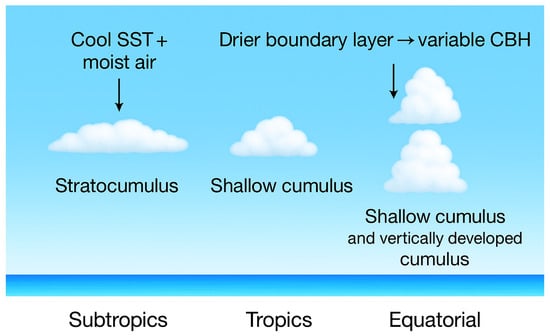
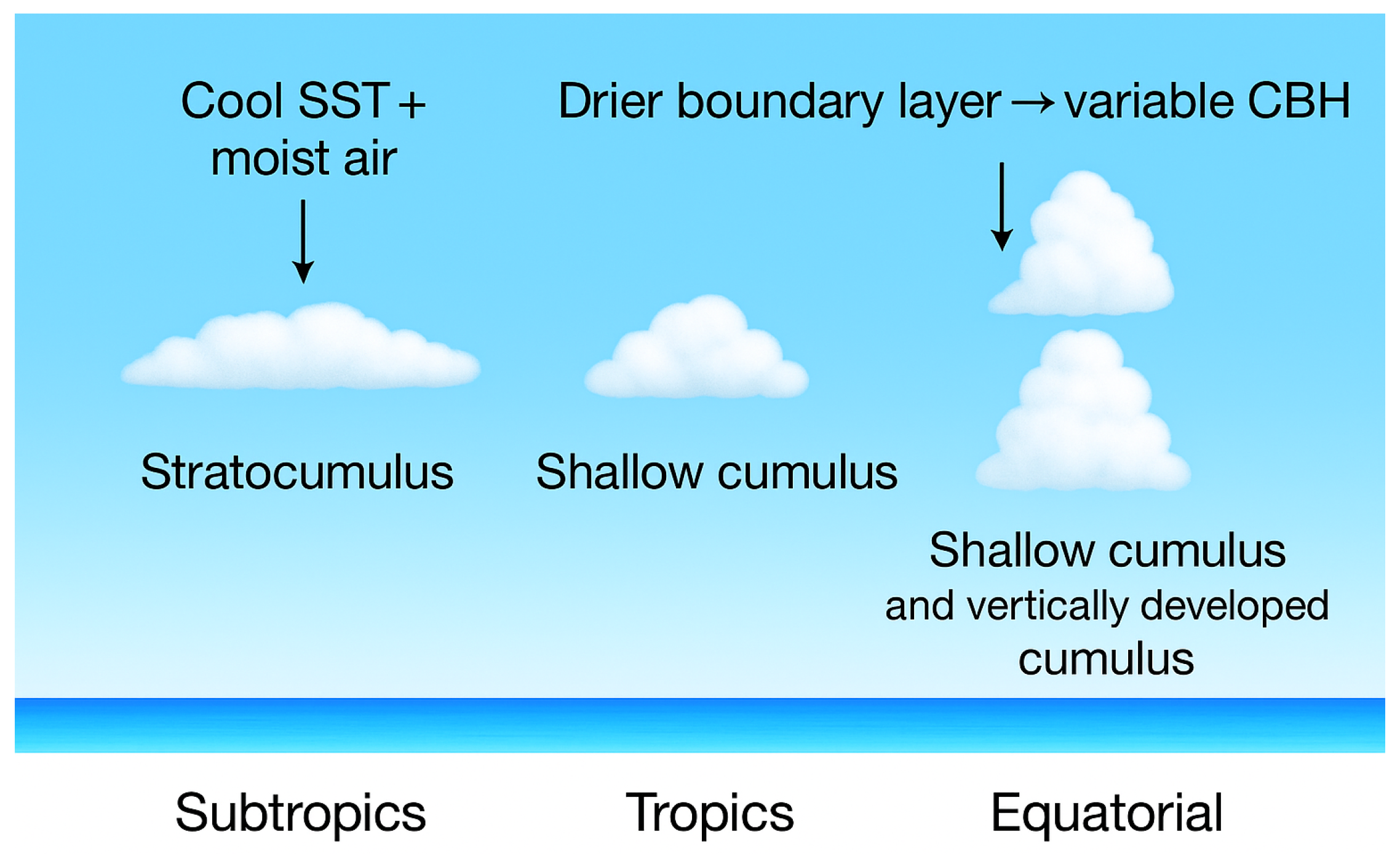
Low clouds typically form within the planetary boundary layer (PBL), the lowest part of the atmosphere directly influenced by surface heating, cooling, and turbulence. This layer is critical to day-to-day weather patterns and land–atmosphere interactions. Over oceanic subtropical regions, stratocumulus decks maintain low, stable bases. Toward the tropics, warmer sea-surface temperatures and a drier boundary layer favor shallow cumulus with less constrained bases, driven in part by boundary-layer decoupling under increased sea-surface temperature and latent heat fluxes. Near the equator, cumulus clouds dominate, producing higher and more variable CBH. These characteristics across subtropical, tropical, and equatorial regions are well documented in prior studies [19,20,21]. This progression is consistent with the conceptual framework illustrated in Figure 1, linking sea-surface temperature and boundary-layer humidity to CBH variability across oceanic regimes.
Figure 1.
Illustration of cloud base height variability across subtropical, tropical, and equatorial regions.
Boundary-layer clouds contribute substantially to total cloud cover and strongly influence the Earth’s radiation budget. Over the oceans, marine boundary-layer stratocumulus clouds make large fraction of cloud cover and exert significant radiative effects [1,2,4,22,23]. Over land, a substantial fraction of clouds have cloud-base heights below approximately 3 km, indicating that low-level clouds also dominate terrestrial cloud populations [24]. They exert a net cooling influence through daytime solar reflection and nighttime longwave trapping [25]. They also shape precipitation pathways: shallow cumulus often precede deeper convection and contribute to tropical moisture transport [3]. Improved representation of boundary-layer clouds enhances short-term forecasts of temperature, fog, and convective initiation.
Cloud-base height (CBH) can be measured using ground-based ceilometers, lidars, and radars, and can be inferred from satellite instruments employing passive visible and infrared sensing under favorable conditions [26,27,28]. Ground-based active sensors provide accurate vertical profiles and are widely used for validation, but their spatial coverage is sparse and largely limited to land [26]. Spaceborne cloud radars extend coverage globally but are constrained by coarse horizontal resolution, limiting their ability to resolve fine-scale boundary-layer cloud variability [29]. Spaceborne and airborne active lidars provide vertically resolved cloud structure along a narrow ground track, but retrievals are often limited by signal attenuation, particularly in optically thick clouds [30]. In contrast, passive optical imagery offers broad spatial coverage and frequent sampling, motivating alternative approaches that infer cloud height from observable cloud–scene relationships rather than direct vertical profiling.
Because retrieval relies on geometric relationships between clouds, their shadows, and solar illumination, the shadow-based framework is inherently sensor-agnostic and applicable to optical satellite imagery across a range of spatial resolutions. In contrast to stereo imaging and active sensing techniques, shadow-based retrieval provides a direct geometric estimate of cloud height from a single optical image by exploiting cloud–shadow displacement and known solar geometry [10,11,12]. This approach avoids the need for multiple viewing angles, active instrumentation, or assumptions about atmospheric temperature profiles required by thermal infrared methods. Because satellite observations are acquired with stable orbital geometry and near-nadir viewing, shadow-based methods are particularly well suited for spaceborne applications and remote regions lacking ground-based measurements while also reducing viewing-angle sensitivities and platform-attitude corrections (e.g., pitch, yaw, and tilt) that can complicate aircraft-based observations. When applied to high-resolution visible imagery under favorable illumination, this geometric framework enables physically interpretable height retrievals that are largely independent of cloud optical thickness and capable of resolving fine-scale atmospheric structure, including shallow convective elements and sharp ash-plume boundaries.
Accurate cloud–shadow association is critical for geometric analysis of optical satellite imagery, yet most existing methods focus on cloud and shadow masking rather than explicit pairing [15,31,32]. Vision-based cloud and shadow detection methods, including machine learning and object-based approaches, provide strong automated segmentation capabilities and are valuable for preprocessing and quality control in geometric height-retrieval workflows [31,33]. Recent approaches for Sentinel-2 data combine supervised classification with geometry-based filtering or forward shadow projection using assumed or iteratively tested cloud heights, often refined with probabilistic constraints [15,31,32]. While effective at reducing shadow commission errors, these methods do not explicitly resolve cloud–shadow correspondences or retrieve cloud height as a primary product. Collectively, these studies demonstrate robust cloud and shadow detection capabilities but leave cloud–shadow pairing and direct cloud-height retrieval largely unresolved. In this study, cloud–shadow association is handled using an automated nearest-neighbor approach, whose full implementation is described in the Methods section, and which enables direct cloud-height retrieval from observed displacements without prescribed heights.
Cloud aspect ratio is a key consideration. For shallow cumulus and stratocumulus, shadows correspond closely to CBH because cloud vertical extent is small relative to the horizontal scale. For deep convection, shadows primarily reflect total cloud depth rather than base height. Radiosonde profiles help distinguish these regimes. Accordingly, this study adopts the shallow-cloud assumption under which shadow-based methods perform most reliably.
Shadow-based height retrieval provides a geometric estimate from a single visible image [10,11,12], avoiding the calibration requirements of stereo methods and the temperature-profile assumptions inherent in thermal infrared retrievals. Shadow-based techniques have also been applied in other contexts, such as mapping emperor penguin colonies from satellite imagery, illustrating the broader applicability of geometric retrieval from shadows [34]. These examples highlight the versatility of shadow-based detection while maintaining focus on the cloud-base height problem.
The method performs best for shallow, isolated cumulus clouds under favorable illumination, particularly away from solar noon when shadows are well defined, and is less reliable in scenes with diffuse or overlapping shadows. Under these shallow-cloud conditions, cloud–shadow displacement provides a geometric estimate of cloud-base height (CBH) that is largely independent of cloud thickness. Building on this principle, the present study applies a shadow-based retrieval to MODIS visible imagery using an automated nearest-neighbor cloud–shadow matching algorithm and evaluates the results against independent lidar and radiosonde observations across diverse environments. These analyses serve as a proof-of-concept, establishing a foundation for broader statistical validation and methodological refinement in future work.
This paper is organized as follows: Section 2 describes the methodology and data used; Section 3 presents the results; Section 4 provides their analysis; Section 5 summarizes the conclusions of this study; Appendix A presents surface-layer meteorological conditions at Sde Boker from the Modern-Era Retrospective analysis for Research and Applications, Version 2 (MERRA-2) data, which support the interpretation of the case studies discussed in the main text; and Appendix B provides additional details on the analytical methods used for geometric height retrieval based on cloud and plume shadow displacement.
2. Method and Data
2.1. Cloud Base Height Estimation
This study presents a method for estimating CBH using a single grayscale satellite or aerial image by analyzing the displacement between clouds and their corresponding shadows. The approach involves converting the image to grayscale and generating binary masks through intensity thresholding to identify bright clouds and dark shadows. Several key assumptions underlie the method: (1) sufficient contrast must exist between clouds, shadows, and the surface to allow for reliable detection; (2) the terrain is assumed to be flat, simplifying geometric calculations by removing the influence of topographic variation; (3) the cloud field must be broken rather than overcast, ensuring that individual clouds and their shadows can be clearly paired; and (4) the solar zenith angle (SZA) must be greater than a certain threshold—i.e., the sun should not be directly overhead—to produce detectable shadow displacement. These assumptions enable a geometrically simplified yet effective means of estimating CBH from a single image.
To compute CBH, the Sun’s position is calculated based on the image’s acquisition time and geographic coordinates. From the solar azimuth and altitude, the solar zenith angle is derived, which governs the direction and length of shadows. The spatial separation between cloud and shadow pixels is quantified using a k-dimensional tree (KD-tree) nearest-neighbor search, which efficiently identifies the closest shadow pixel in a purely geometric sense for each detected cloud pixel [35]. Unlike classical cloud–shadow association techniques such as template matching, pattern correlation, or Hough transforms [36,37], the KD-tree approach does not require explicit object-level cloud–shadow matching or shape correspondence. Instead, it operates at the pixel level and estimates cloud–shadow displacement from the collective geometry of the cloud–shadow field, enabling rapid computation suitable for large satellite scenes.
In this framework, the pixel coordinates of shadow-labeled regions are used to construct the KD-tree, allowing for efficient nearest-neighbor queries for each cloud pixel. The KD-tree query is performed with k = 1, such that each cloud pixel is associated with its single closest shadow pixel, consistent with the expected geometric projection of a cloud element along the solar illumination direction. Larger values of k would introduce spatial smoothing and bias in scenes with elongated or overlapping shadows, whereas k = 1 preserves the local geometric correspondence while remaining robust when distances are aggregated across the cloud field. While this establishes a unique correspondence at the pixel level, no explicit one-to-one constraint is imposed at the cloud-object level. Cloud–shadow separation is therefore characterized by aggregating the resulting nearest-neighbor distances across all cloud pixels to obtain a representative displacement between cloud and shadow formations. This statistical aggregation reduces sensitivity to small-scale segmentation noise, shadow width, and local texture variability. In scenes where multiple clouds project onto shared or elongated shadow regions, the approach may introduce modest bias in the estimated displacement; however, under conditions of discrete cloud structures and sufficiently resolved shadows, the KD-tree method provides a practical and physically interpretable alternative to more complex cloud–shadow association algorithms reported in the literature.
To formalize the KD-tree-based cloud–shadow association, the geometric displacement between paired pixels can be expressed as follows:
Let
- denote the set of coordinates of detected cloud pixels;
- denote the set of coordinates of detected shadow pixels.
A KD-tree data structure is constructed using the shadow pixel coordinates S to enable efficient nearest-neighbor queries [35]. For each cloud pixel , the nearest shadow pixel is found by minimizing the Euclidean distance:
where represents the Euclidean norm. The average displacement across all n cloud pixels is calculated as follows:
The quantity corresponds to the mean shadow displacement measured in pixels. To convert the average pixel displacement into a physical CBH H (in meters), the image resolution (ground sampling distance) r in meters per pixel and the solar zenith angle (in degrees) are incorporated. The CBH is estimated by projecting the displacement onto the vertical using the tangent of the solar elevation angle [38]:
where is the solar elevation angle at the time of observation. It is the complement of solar zenith angle (Appendix B). This approach assumes that the solar zenith angle provides the angle between the sun’s rays and the vertical, thereby linking shadow displacement to the height of the cloud base. The formulation is based on several simplifying assumptions: the underlying terrain is flat with no significant elevation variation; cloud and shadow regions are distinct and non-overlapping; and the solar zenith angle is sufficiently large to produce visible horizontal shadows. Within this framework, the KD-tree method provides a computationally efficient and scalable solution for estimating CBH from a single satellite or airborne image, particularly in cases of fair-weather cumulus clouds with well-defined shadows.
The resulting nearest-neighbor distances are averaged and converted into physical distances using an assumed ground resolution of 250 m per pixel, which are then combined with trigonometric projection to estimate the vertical height from which the shadow originated—interpreted as the CBH.
Validation of this approach was performed by comparing the results against LiDAR-derived CBHs, showing strong agreement when shadows were clearly defined. The method was applied to different environments, including over-ocean scenes, where poor contrast made shadow detection difficult, and over the Sde Boker in the Negev Desert at two distinct local times to observe the effects of changing solar geometry. However, due to limited image availability, a full diurnal analysis could not be conducted. Despite this limitation, the method offers a practical and efficient way to estimate CBH from single-pass imagery, particularly in remote or data-scarce regions where multi-angle or multi-temporal datasets are unavailable.
Another CBH estimation method, using MERRA-2 reanalysis data, is described in Appendix B, with the corresponding results presented in Section 3.
2.2. Data
The Moderate Resolution Imaging Spectroradiometer (MODIS), developed and operated by the National Aeronautics and Space Administration (NASA), Goddard Space Flight Center, Greenbelt, MD, USA, is a key instrument aboard NASA’s Terra (launched in 1999) and Aqua (launched in 2002) satellites. MODIS/Terra- and MODIS/Aqua Level-1B-calibrated radiances (MOD02QKM and MYD02QKM) were obtained from the NASA Level-1 and Atmosphere Archive and Distribution System (LAADS) Distributed Active Archive Center (DAAC) at https://ladsweb.modaps.eosdis.nasa.gov (accessed on 7 November 2024). These products contain calibrated radiance data from the 250 m resolution bands (Bands 1 and 2), primarily in the red and near-infrared wavelengths. These products offer 5 min granules of Level-1B radiance data, ideal for high-resolution analysis of cloud optical and geometric properties, including shadow-based CBH estimation. Terra (MODIS) crosses the equator at approximately 10:30 a.m. local time (descending node), while Aqua (MODIS) crosses at around 1:30 p.m. (ascending node), enabling synergistic morning and afternoon observations. Cloud height information was compared against collocated MPLNET (Micro-Pulse Lidar Network) measurements [39]. Version 3 MPLNET lidar data were used here to provide information on atmospheric vertical structure and aerosol height and backscatter properties [40]. The MPLNET data are available online at https://mplnet.gsfc.nasa.gov, accessed on 7 November 2024. Radiosonde profiles were used to provide independent atmospheric validation and to confirm that the shadow length corresponds to CBH rather than cloud top height. Sounding data were obtained from the University of Wyoming’s Upper Air Archive, which offers a global, long-term dataset of radiosonde observations. These include vertical profiles of temperature, pressure, humidity, and wind, typically launched twice daily at 00 and 12 UTC. For this study, radiosonde measurements from the Bet Dagan station in Israel (WMO ID: 40179) launched at 12 UTC were used to closely coincide with the MODIS Aqua overpass time, allowing for evaluation of the thermodynamic consistency of MODIS-derived CBHs and estimation of the lifting condensation level (LCL) under clear-sky conditions. The sounding data are publicly available at https://weather.uwyo.edu/upperair/sounding.shtml (accessed on 7 November 2024).
3. Results
To illustrate the effectiveness of the cloud–shadow technique, we selected three geographically diverse locations: Bet Dagan, Sde Boker, and Fairbanks, as detailed in Table 1. These sites represent a range of terrains, from the Mediterranean coastal plain of Bet Dagan, to the arid highlands of Sde Boker in the Negev Desert, and the subarctic landscape of Fairbanks, Alaska. Despite their differing climates and surface characteristics, all three locations share a common feature: relatively low elevation. This characteristic is particularly advantageous for applying the cloud–shadow method, as it minimizes uncertainties related to terrain-induced parallax or elevation corrections, thereby enhancing the accuracy of CBH estimations from satellite imagery.
Table 1.
Selected locations under study and their approximate elevations.
3.1. Base Height and Shadow Length
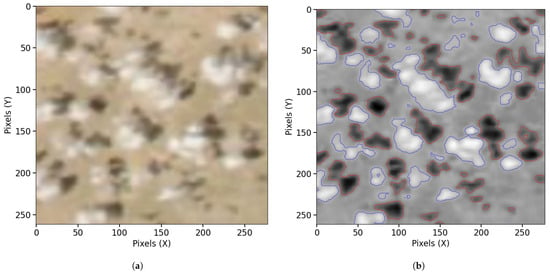
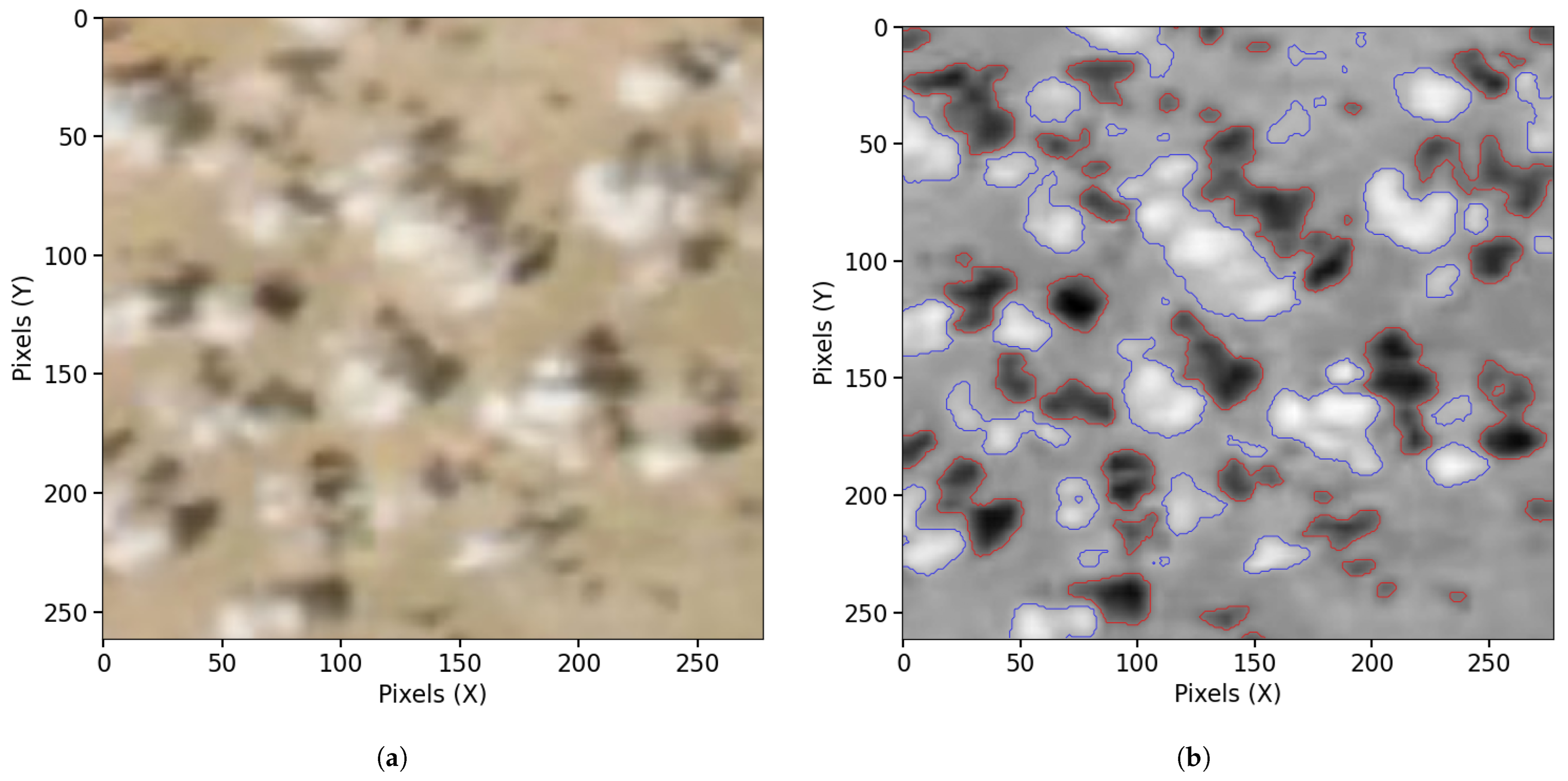
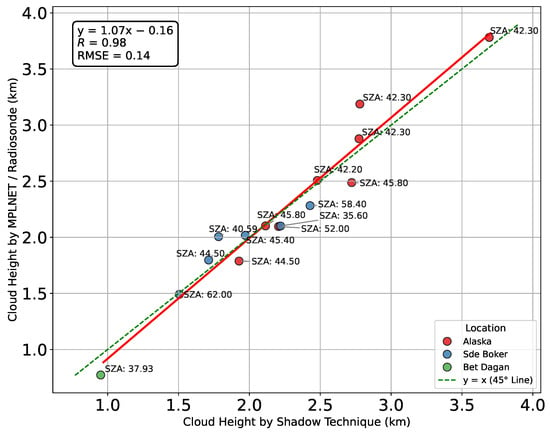
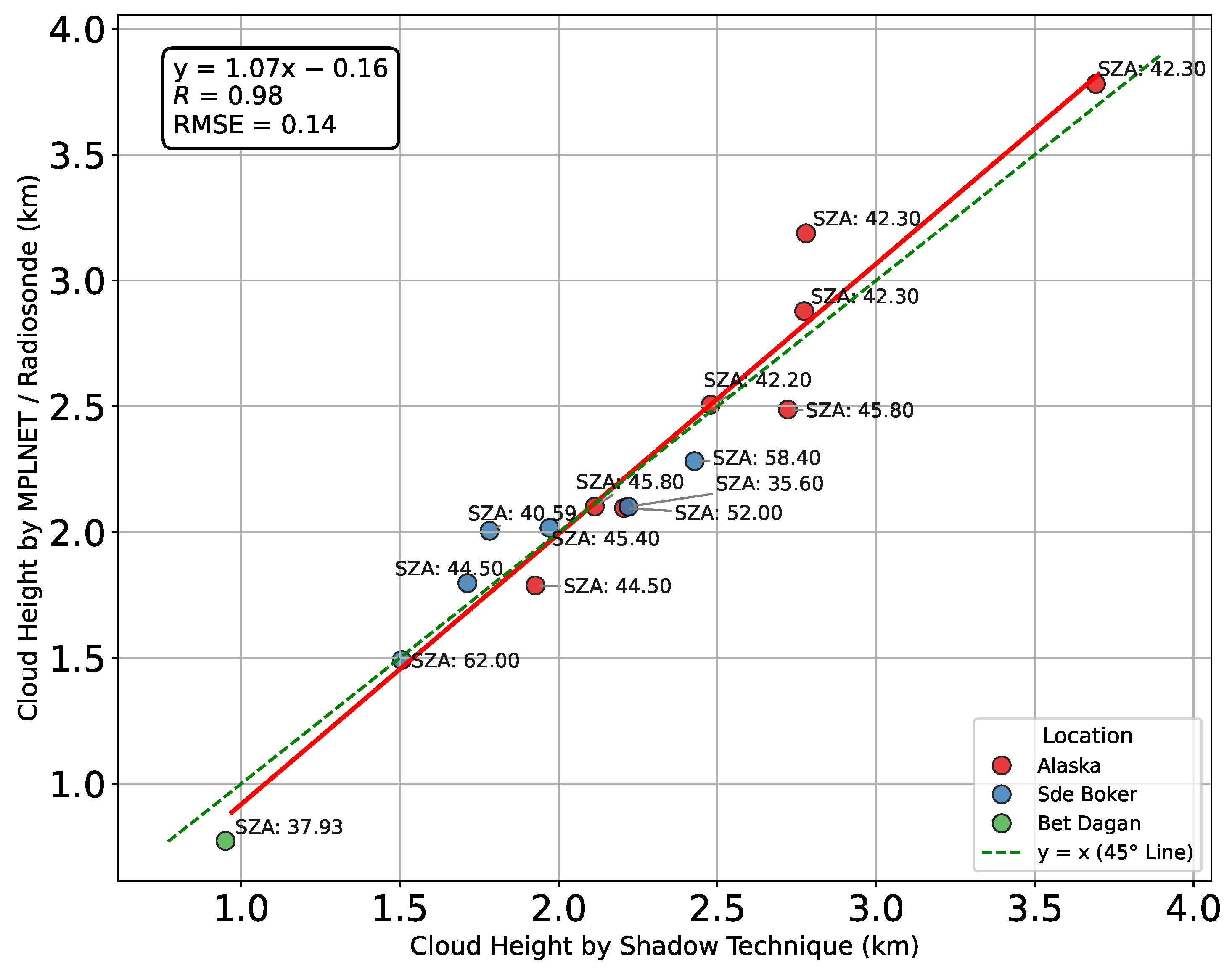
As illustrated in Figure 2, Figure 3 and Figure 4, and as summarized in Table 1, the cloud–shadow geometry for the Sde Boker, Bet Dagan, and Fairbanks case studies forms the basis of the CBH retrieval used in this work. A strong agreement is observed between CBHs derived using the shadow-based technique and those measured by MPLNET and radiosonde, as shown in Figure 5. The tight clustering of points around the 1:1 reference line highlights the high accuracy of the shadow method. The high correlation coefficient (R = 0.96) and low root mean square error (RMSE = 0.14 km or 140 m) further confirm the reliability of the approach across different sites and solar geometries, as indicated by the varying solar zenith angles labeled beside each point. This small deviation lies within the expected geometric uncertainty given the spatial resolution of MODIS and variations in solar zenith angle. The radiosonde observation from Bet Dagan (26 April 2025) also supports the interpretation that the shadow-based method retrieves CBH rather than cloud top. This agreement provides crucial validation, confirming that the shadow technique aligns with vertically resolved in-situ atmospheric profiling. Overall, these findings demonstrate that the shadow-based method is a cost-effective and reliable alternative for estimating CBH in regions lacking active remote-sensing instruments. As this work is intended as a proof-of-concept demonstration, a broader statistical evaluation across seasons and climate regimes will be conducted in future work to assess retrieval robustness and stability. Importantly, MPLNET and radiosonde observations are used solely for independent validation and play no role in the satellite-based cloud–shadow retrieval.
Figure 2.
MODIS Aqua imagery over Fairbanks, Alaska, on 26 July 2021. (a) shows shallow, fair-weather cumulus humilis clouds observed at 21:34 Coordinated Universal Time (UTC), used to demonstrate a shadow-based cloud base height retrieval technique under clear-sky conditions. (b) builds on this example and illustrates the KD-tree-based cloud–shadow matching approach, with cloud masks outlined in blue and shadow masks in red.
Figure 3.
MODIS Aqua imagery over Sde Boker, Israel, on 4 September 2024. (a) shows shallow, fair-weather cumulus humilis clouds observed at 11:32 UTC, used to demonstrate a shadow-based cloud base height retrieval technique under clear-sky conditions. (b) builds on this example and illustrates the KD-tree-based cloud–shadow matching approach, with cloud masks outlined in blue and shadow masks in red.
Figure 4.
MODIS Aqua imagery over Bet Dagan, Israel, on 26 April 2025. (a) shows shallow, fair-weather cumulus humilis clouds observed at 12:04 UTC, used to demonstrate a shadow-based cloud base height retrieval technique under clear-sky conditions. (b) builds on this example and illustrates the KD-tree-based cloud–shadow matching approach, with cloud masks outlined in blue and shadow masks in red.
Figure 5.
Scatter plot showing the relationship between cloud base height estimated using the shadow-based technique and collocated lidar-derived or radiosonde-measured cloud base heights. The solid line represents the linear regression fit, while the dashed line indicates the 1:1 reference. Correlation coefficient (R), root mean square error (RMSE), and regression quantify the performance of the shadow-based method relative to lidar and radiosonde observations.
3.2. Applications
- Diurnal study over land:
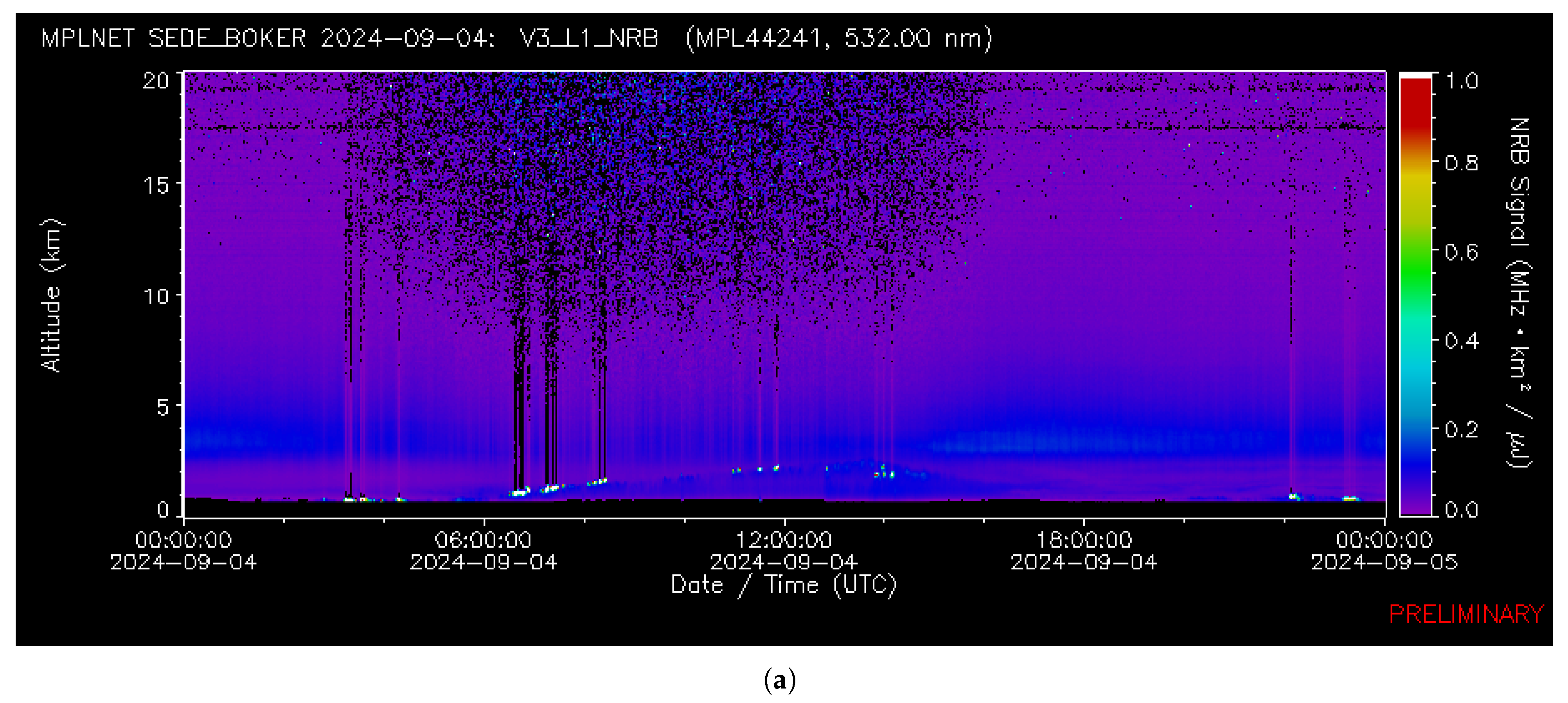
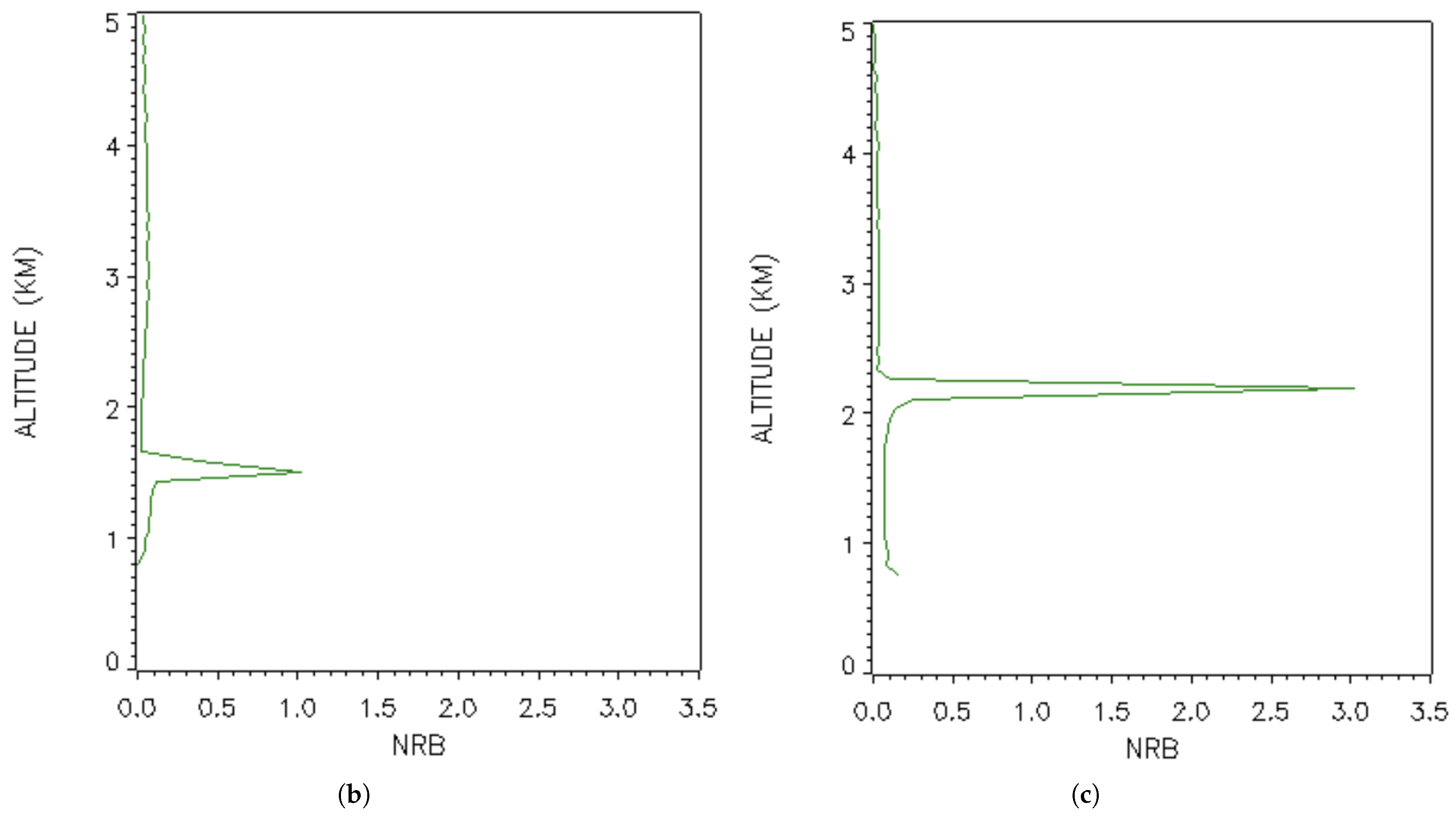
- The diurnal study uses the Sde Boker location instead of Fairbanks, Alaska, primarily due to differences in latitude. Being at a higher latitude, Fairbanks has MODIS images from Aqua and Terra satellites captured within 1 to 1.5 h of each other, whereas at Sde Boker, the time difference between images is about 3.5 h. This larger temporal gap allows for a clearer comparison of cloud formation between morning and afternoon. Table 2 illustrates the diurnal evolution of CBHs over Sde Boker on 4–21 September 2024. On both days, early morning (around 08:00 UTC) cloud bases were measured at approximately 1.5 km by MPLNET, followed by a noticeable increase during late morning (around 11:30 UTC) to 2.1 km on 4 September and 2.0 km on 21 September. These observations reflect the typical rise in CBH due to daytime boundary layer development. The consistent pattern across both days highlights the influence of surface-driven vertical mixing on cloud formation processes in arid environments under clear-sky conditions.
Table 2.
Cloud base heights retrieved from the shadow technique and MPLNET for two diurnal cases at Sde Boker.
- Under convective conditions, where cloud formation typically occurs near the top of the mixed layer, CBH estimates from the cloud–shadow technique may also serve as a proxy for PBL height, as evident from Figure 6. This makes it a potentially valuable tool for studying boundary layer processes in data-sparse regions or when direct vertical profiling is unavailable.
Figure 6.
MPLNET SEDE BOKER data from 4 September 2024. (a) shows the full-day normalized relative backscatter signal. (b) shows the aerosol backscatter profile at 08:03 UTC. (c) shows the aerosol backscatter profile at 11:32 UTC.
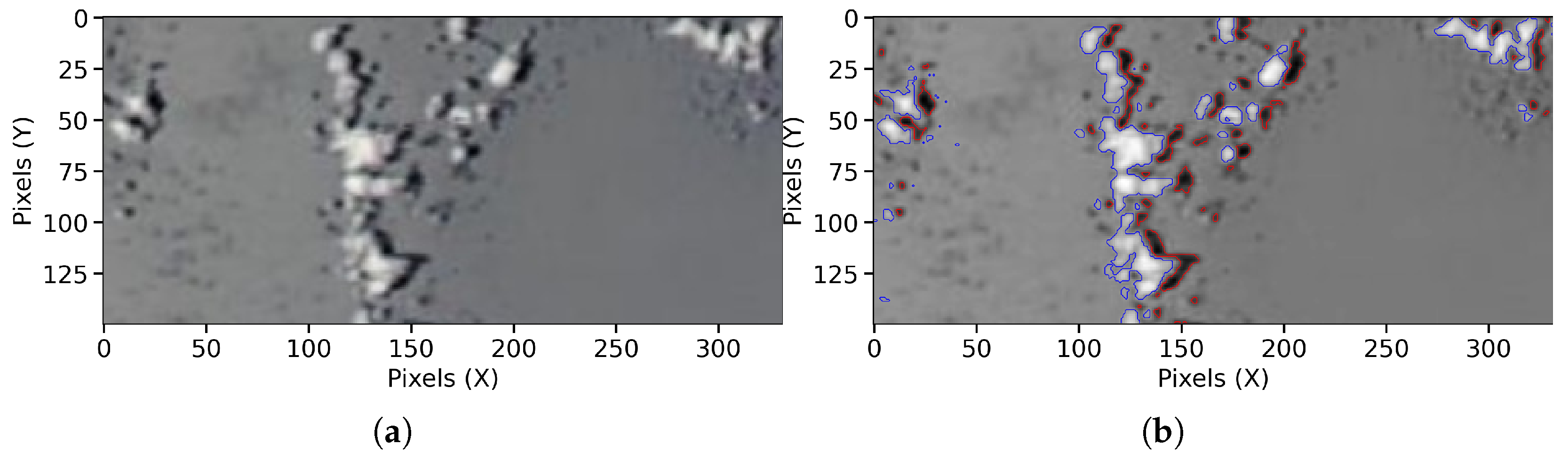
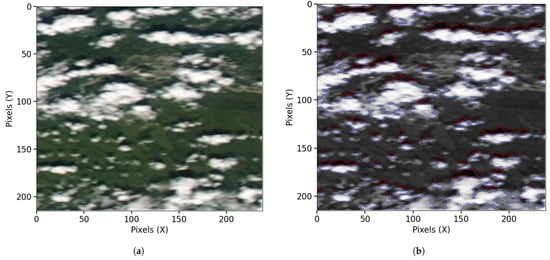
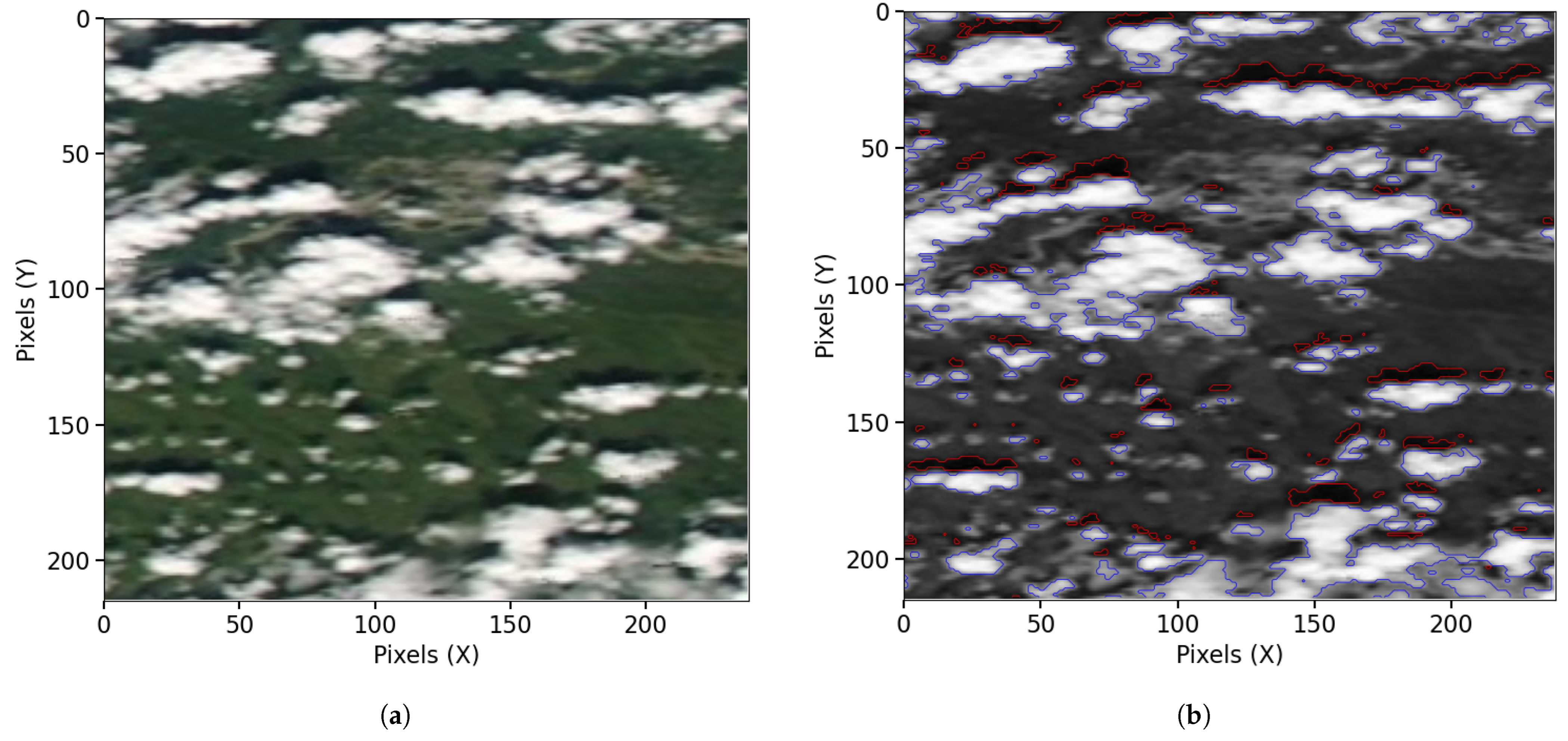
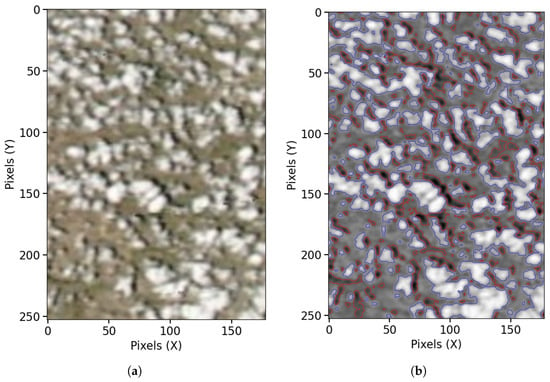
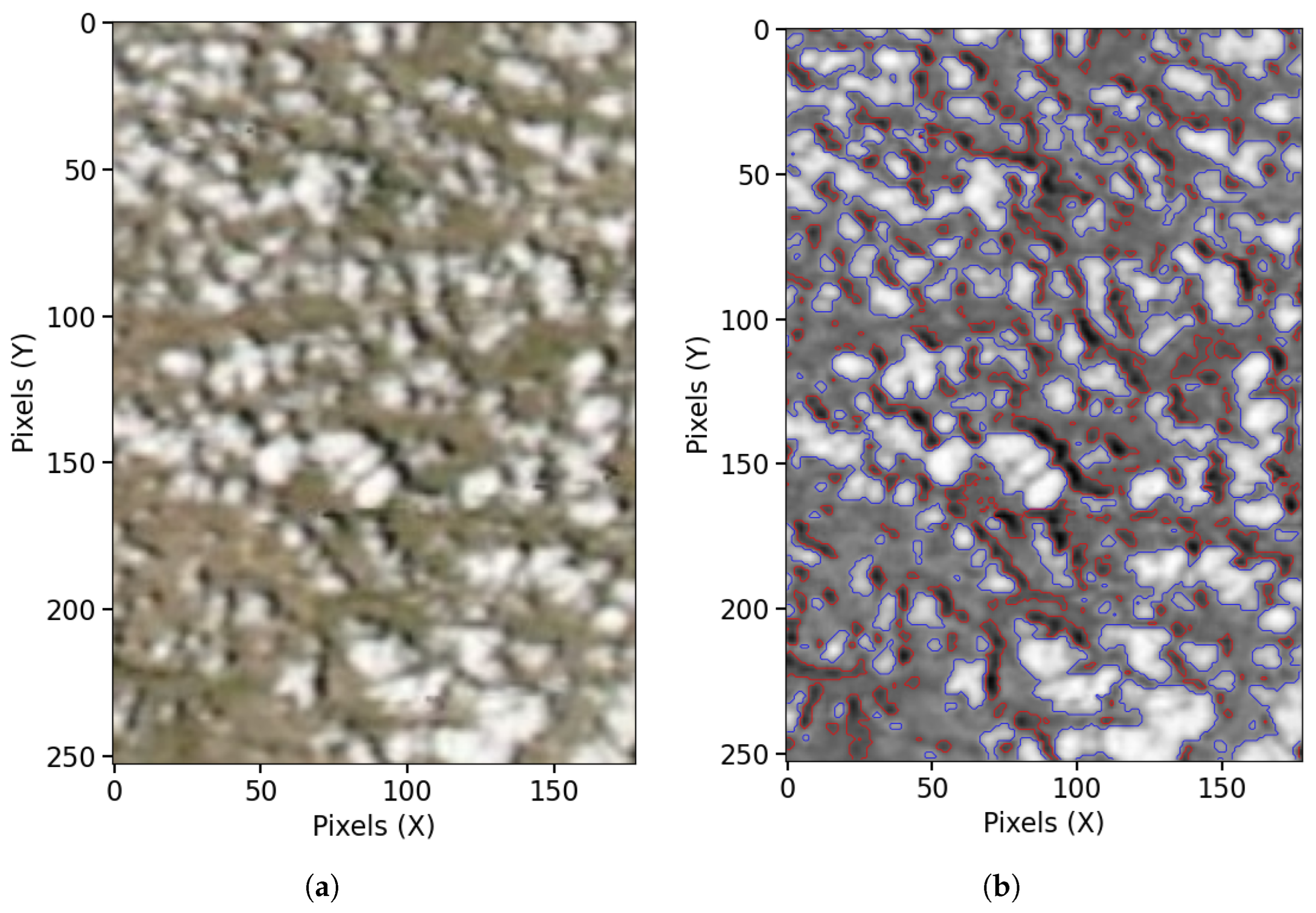
- Study Over Water: Over the open ocean, the generally dark and homogeneous background can make cloud–shadow detection challenging, as the radiance contrast between shadowed and non-shadowed water is often weak. However, in regions affected by sun glint, the specular reflection from the ocean surface enhances the brightness of the background. This creates a sharper contrast between shadowed and illuminated areas, allowing the shadow technique to more reliably identify and track cloud shadows. Consequently, sun-glint regions are particularly well suited for the KD-tree-based cloud–shadow matching approach to retrieve CBHs, as shown in Figure 7.
Figure 7.
MODIS Aqua imagery acquired over the ocean on 3 January 2024 at 21:03 UTC near latitude and longitude . (a) shows the original MODIS Aqua image over the ocean, illustrating cloud formations. (b) shows the corresponding cloud and shadow masks with cloud boundaries outlined in blue and shadow regions in red, illustrating the KD-tree-based cloud–shadow matching approach used to quantify their spatial displacement over water and retrieve cloud base height.
- Table 3 presents CBH estimated using the shadow projection method applied to MODIS imagery, in conjunction with sea-surface temperature (SST), relative humidity (RH), and wind speed from MERRA-2. The shadow technique infers CBH by exploiting the geometry between cloud shadows and the solar position. Across the three oceanic sites, SST increases and RH decreases toward the equator. The highest CBH (0.84 km) occurs at the subtropical site (), coinciding with moderate SST and the lowest wind speed (3.5 m s−1), conditions that may favor deeper cloud development. At the tropical site (), two CBH values (0.52 and 0.71 km) are retrieved, reflecting spatial variability and suggesting a mixture of shallow and deeper cumulus clouds. These results highlight the sensitivity of CBH to local thermodynamic conditions and underscore the utility of spatially resolved estimates over coarse grid averages.Table 3. Cloud base height estimates from the shadow technique, with sea-surface temperature (SST), relative humidity (RH), and wind speed from MERRA-2.
4. Discussion
4.1. Diurnal Variations
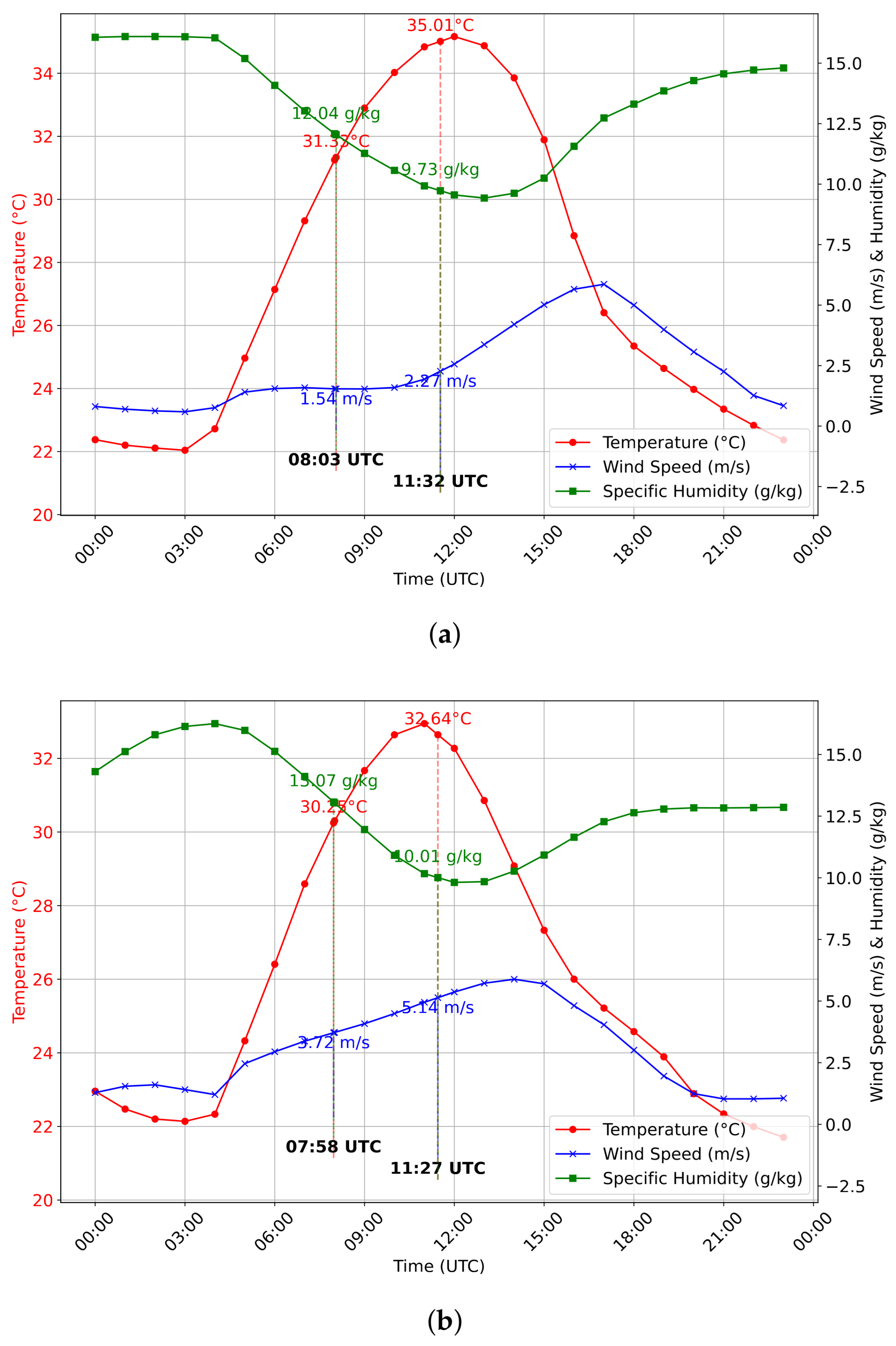
To further investigate the diurnal influence on CBH, MERRA-2 reanalysis data for two representative dates, 4 September 2024, and 21 September 2024, were analyzed (Figure A1). These dates correspond to clear-sky days observed over the hyper-arid region of Sde Boker, Israel. Meteorological variables such as 2 m air temperature (), specific humidity (), surface pressure (), and wind speed () were extracted from hourly MERRA-2 files at the closest grid point. Temporal interpolation was applied to estimate conditions at selected morning and early afternoon times.
The surface meteorological conditions over Sde Boker on 4 September 2024 exhibit clear diurnal evolution between early morning (08:03 UTC) and late morning (11:32 UTC). Air temperature rises significantly from 31.33 °C to 35.01 °C, consistent with daytime surface heating. Concurrently, specific humidity decreases from 12.04 g/kg to 9.73 g/kg, indicating a drying of the lower atmosphere, likely due to increased entrainment of drier air and vertical mixing. Surface pressure also shows a slight decline from 980.84 hPa to 978.46 hPa, a typical daytime pattern associated with warming and boundary layer deepening. Wind speed increases modestly from 1.54 m/s to 2.27 m/s, enhancing turbulent mixing in the boundary layer. The dew point drops from 16.58 °C to 13.25 °C, further reflecting the transition toward a drier and more well-mixed lower troposphere by midday. A similar pattern is also observed on 21 September 2024. These trends collectively illustrate the expected progression of surface-layer thermodynamics under clear-sky conditions during the late morning hours in a desert environment.
CBH estimates derived from the lifted condensation level (LCL) (Equations (A1)–(A4)), MPLNET lidar observations, and the cloud–shadow technique are summarized in Table 4. As expected, LCL-based estimates provide a first-order theoretical approximation of CBH but tend to diverge from observed cloud bases during late morning, when entrainment, residual-layer influences, and non-adiabatic processes become increasingly important. In contrast, MPLNET measurements capture the actual vertical cloud structure and serve as an observational benchmark for evaluating satellite-based retrievals.
Table 4.
CBH predictions from LCL, MPLNET, and cloud–shadow techniques.
The shadow-based CBH estimates closely track MPLNET observations at both morning and late-morning times, capturing the observed rise in cloud base associated with boundary-layer growth. This agreement demonstrates that the cloud–shadow technique retrieves physically meaningful cloud-base height rather than cloud-top height and responds consistently to evolving boundary-layer thermodynamics. In contrast, while the LCL method provides a useful and accessible first-order estimate of CBH, it relies on idealized surface-based assumptions and does not fully capture the effects of vertical mixing, atmospheric stability, or inversion layers. The stronger correspondence between the shadow-based retrieval and MPLNET highlights the advantage of the geometric approach in representing real atmospheric structure beyond surface thermodynamics alone.
Collectively, these results demonstrate that shadow-based retrieval is sensitive to diurnal boundary-layer evolution and provides CBH estimates consistent with independent lidar observations under shallow cumulus conditions. This directly supports the central claim of this study: that cloud–shadow geometry can be used to reliably infer CBH from single-view optical imagery in data-sparse regions, particularly during convective daytime conditions when boundary-layer growth dominates cloud formation.
4.2. Application to Hunga Tonga–Hunga Ha’apai
The geometric shadow projection framework developed in this study extends naturally beyond boundary-layer clouds to other atmospheric and planetary phenomena characterized by limited observational coverage. In particular, the cloud–shadow technique is well suited for analyzing rare, transient events captured in only a small number of snapshot images, such as the 2022 Hunga Tonga–Hunga Ha’apai (HTHH) eruption or brief planetary flybys, where active sensors or multi-angle imaging are unavailable. In these scenarios, the presence of a clearly defined shadow provides a direct geometric constraint on vertical extent, enabling rapid and physically based height estimation from single-pass optical observations. Similar shadow-based interpretations have been demonstrated using JunoCam imagery of Jupiter, where bright convective “pop-up” clouds cast discernible shadows on underlying cloud decks, revealing a three-dimensional convective structure [13,14]. Together, these examples highlight the broader applicability of shadow geometry as a unifying framework for inferring vertical structure from optical imagery across both terrestrial and extraterrestrial environments.
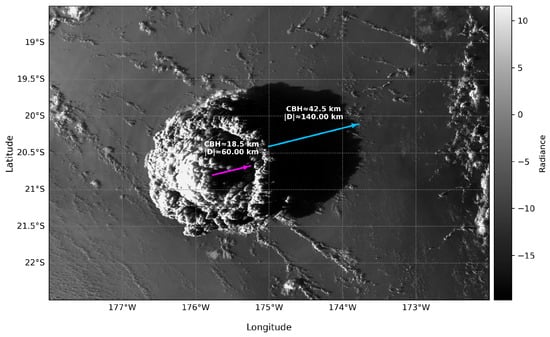
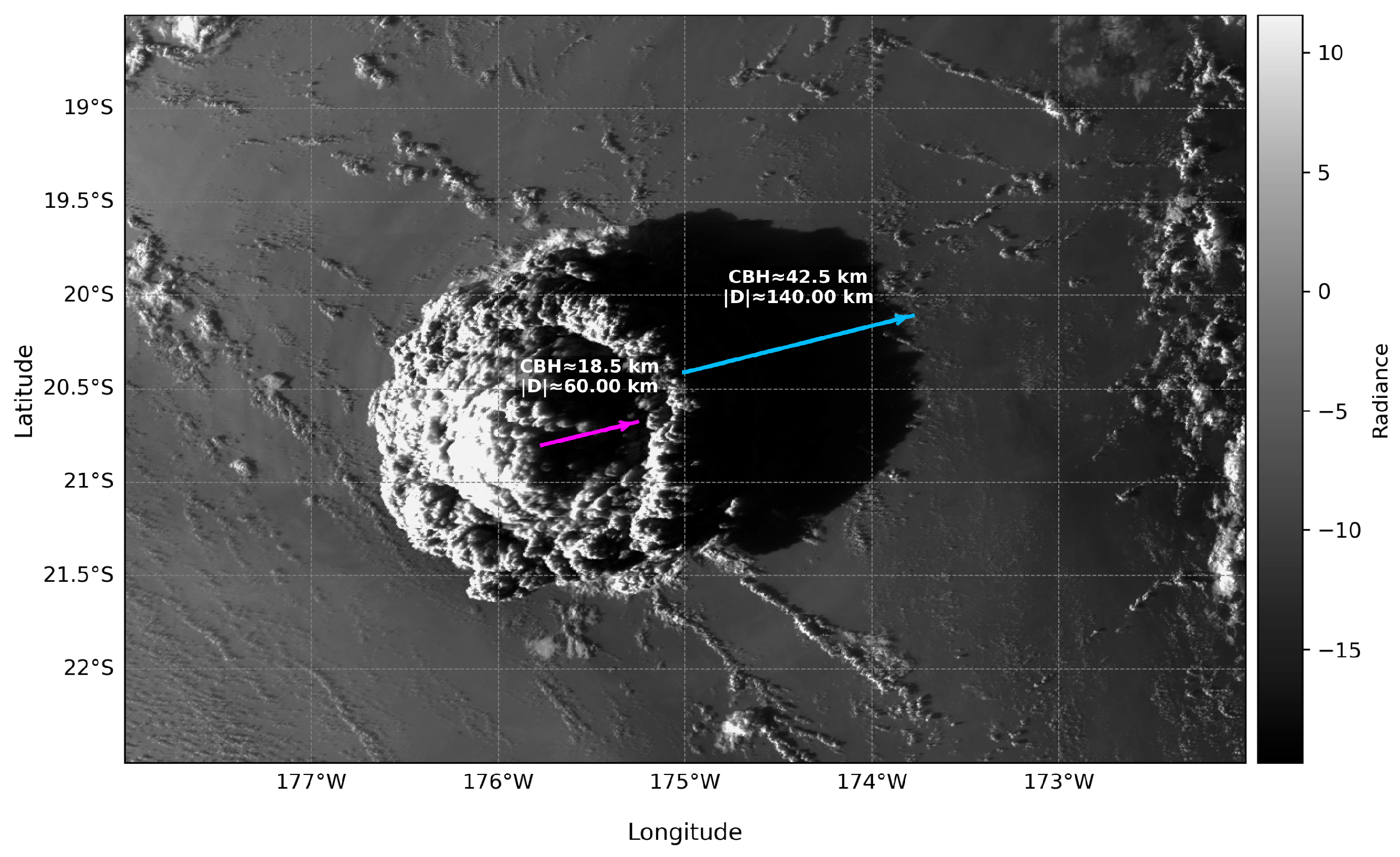
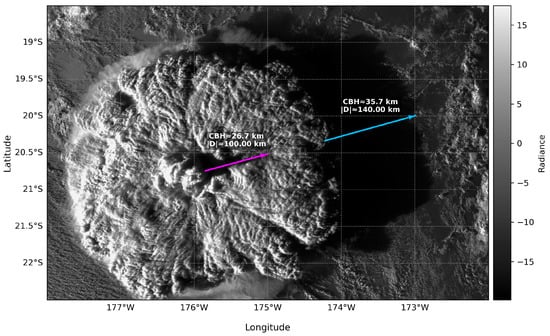
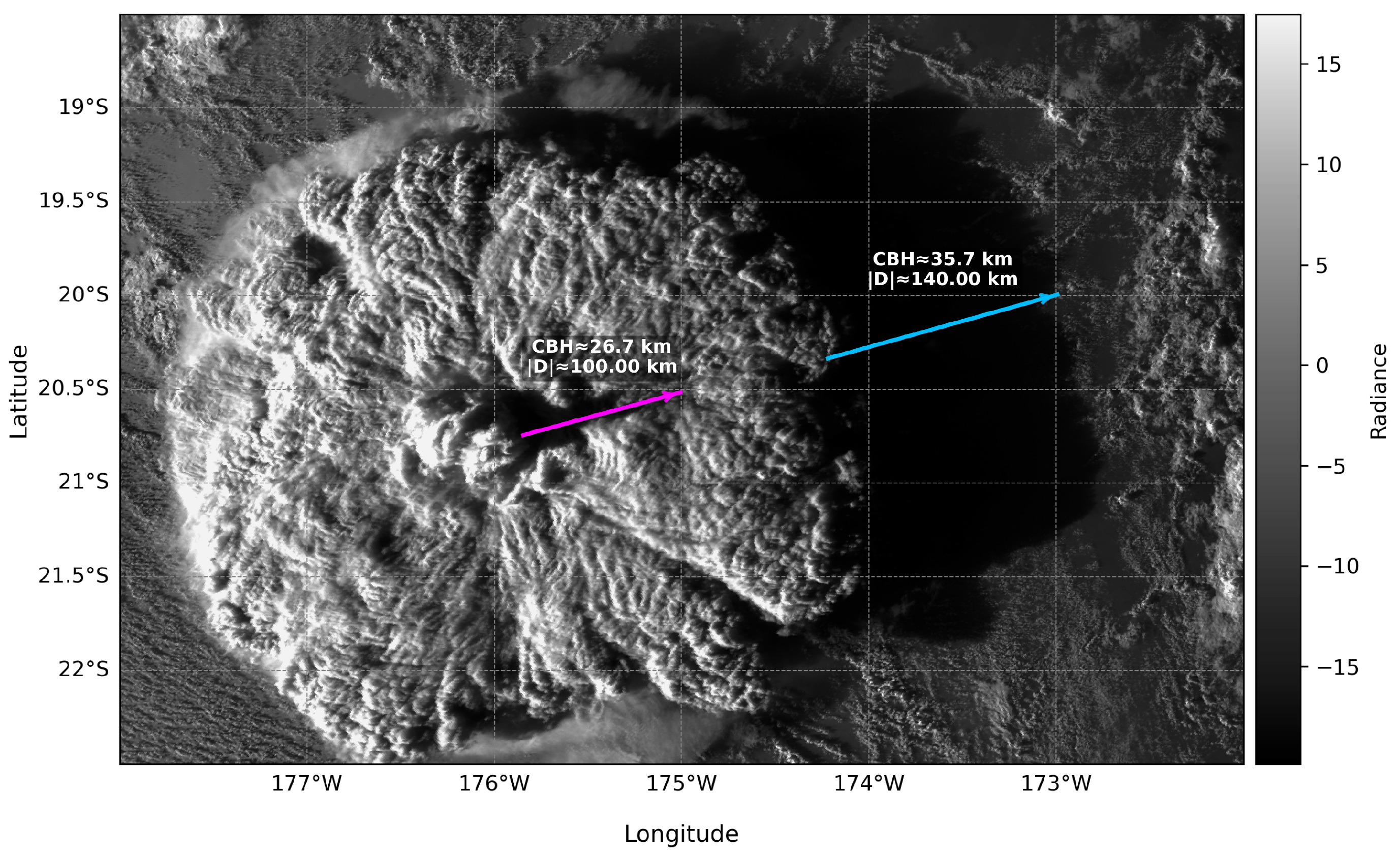
An immediate and illustrative application of this geometric framework is volcanic plume height retrieval. As shown in Figure 8 and Figure 9, the HTHH eruption exhibited sharply defined shadows across the ocean surface in consecutive GOES–17 images at 04:30 and 04:50 UTC. At 04:30 UTC, the plume displayed a prominent trident-shaped overshooting top with two distinct levels—approximately 18.4 km near the vent and 42.3 km along the distal edge—derived using the shadow-displacement geometry described in Section 2 with the explicit height-retrieval formulas provided in Appendix B. These values closely align with the dual-deck structure reported by Carr et al. [41] from GOES–Himawari stereo analysis for the same interval. By 04:50 UTC, the retrieved heights had decreased to about 26.5 km and 35.2 km, consistent with the lower-deck height of roughly 30 km noted in the work [41], although their study did not capture the transient trident morphology evident in the GOES–17 projection. This temporal evolution reflects the gradual collapse and spreading of the upper overshooting top into a more stratified structure as the eruption weakened.
Figure 8.
GOES-17 visible imagery of the Hunga Tonga–Hunga Ha’apai eruption on 15 January 2022 at 04:30 UTC. The plume’s shadow projected on the ocean surface enables direct geometric estimation of its vertical extent using the shadow-based technique, where D denotes the haversine distance between the cloud and shadow latitude–longitude coordinates. The inner and outer arrows indicate retrieved plume heights of approximately 18.5 km and 42.5 km, respectively.
Figure 9.
Same as Figure 8, but for 15 January 2022 at 04:50 UTC. The inner and outer arrows indicate approximately 26.7 km and 35.7 km, respectively, reflecting the gradual collapse and settling of the eruption column over time.
It is important to recall that earlier in this study, the concept of the cloud aspect ratio was introduced, which describes the relationship between the vertical and horizontal dimensions of a cloud. The shadow-based method performs reliably for shallow boundary layer clouds that have small aspect ratios, but the HTHH plume represents an extreme case with a very large aspect ratio. The towering trident-shaped feature of the eruption column requires additional geometric caution because the apparent shadow displacement is influenced not only by the true vertical extent but also by the satellite viewing angle. For such tall plumes, this geometric distortion, known as satellite parallax, can lead to underestimation of the true height, particularly at oblique viewing angles where the shadow and sub-satellite projections differ. To address this, the present study applies a parallax-corrected haversine formulation (Appendix B) that accounts for the Earth’s curvature and the satellite view geometry. Incorporating this correction ensures physically consistent and temporally coherent plume height estimates from geostationary imagery. When applied to time-sequenced satellite observations, this approach provides rapid, physics-based estimates of plume ascent, umbrella formation, and dispersal altitude, offering valuable insights for volcanic monitoring and atmospheric hazard assessment.
Building on this application, the KD-tree-based matching framework used here remains inherently two-dimensional. When augmented with three-dimensional information such as digital elevation models or lidar-derived canopy height models, however, it could extend beyond simple shadow–object matching. This would allow not only for more accurate cloud–shadow association over complex terrain, but also for structural assessments of terrestrial targets. In ecological studies, for example, such an approach could support tree detection together with biomass and carbon stock estimation, as demonstrated in high-resolution mapping of African dryland trees [42]. More broadly, the same strategy could be applied to planetary surfaces, where shadows cast by dust plumes, volcanic eruptions, or ice features could be paired with surface topography to retrieve height and volume information, extending the method’s utility from Earth system science to planetary exploration.
4.3. High-Resolution Images
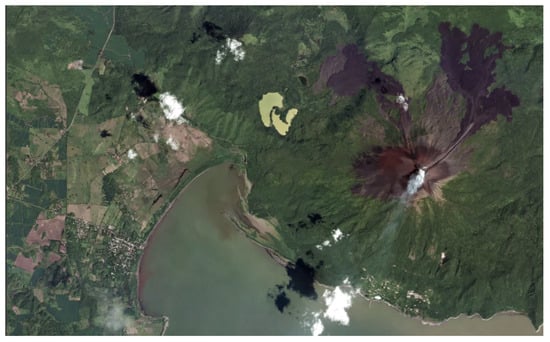
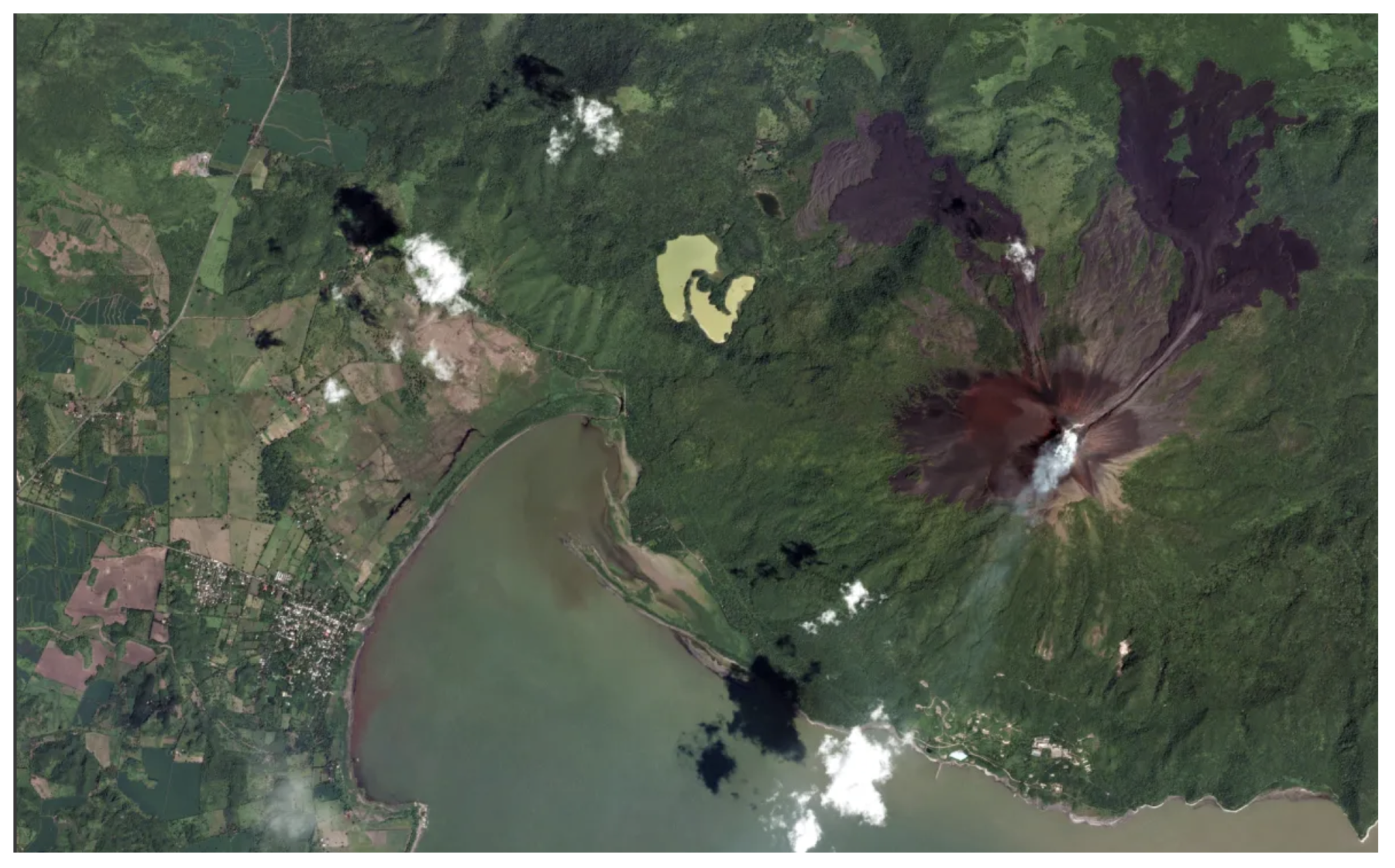
The proposed shadow-based CBH retrieval method is generalizable to other optical satellite datasets that provide visible imagery and well-constrained solar geometry, including Landsat and higher-resolution sources such as Planet Labs, Maxar, and Google. In this study, CBH is estimated using MODIS observations to demonstrate the methodology and assess its performance for a global, moderate-resolution sensor. The improved spatial resolution allows for more accurate detection and measurement of cloud shadows, reducing uncertainties associated with lower-resolution data. This advancement enables finer-scale analysis and more reliable CBH estimates, as illustrated in the satellite images referenced in Figure 10. Together, analyses spanning diurnal boundary-layer evolution, stratospheric plumes, and high-resolution imaging demonstrate the adaptability of the shadow-based framework across spatial scales and atmospheric regimes.
Figure 10.
PlanetScope satellite image of Momotombo volcano, Nicaragua, acquired on 28 October 2016. The image shows an active eruption, with a volcanic plume rising from the summit crater and dark lava flows extending down the flanks. Source: PlanetScope.
5. Conclusions
This study presents a geometric, shadow-based remote sensing method for estimating PBL CBH using MODIS visible imagery. By combining cloud–shadow displacement with solar geometry, the approach retrieves CBH directly from geometric principles without requiring cloud-top information, stereo imaging, or active sensors. A KD-tree nearest-neighbor formulation is used to formalize the cloud–shadow association and provide a reproducible retrieval framework. Validation against collocated MPLNET lidar and radiosonde measurements demonstrates strong agreement (, RMSE km or 140 m), confirming that the method retrieves physical CBH under conditions of flat terrain and distinct shadow contrast.
Application across contrasting environments demonstrates that the technique reliably captures key atmospheric behavior. Over land, the retrieval reproduces diurnal boundary-layer deepening and agrees with LCL-based thermodynamic estimates.
The results over the ocean show that the method is able to resolve spatial variability in CBH under different surface and atmospheric conditions (Table 3). Higher humidity and cooler sea-surface temperatures are associated with shallower cloud bases, while drier conditions and weaker winds correspond to deeper boundary layers and higher CBH. The tropical case revealed mixed shallow and moderately developed cumuli, highlighting its sensitivity to local thermodynamic regimes. These results indicate that the method can complement coarse-resolution reanalysis by supplying spatially resolved CBH structure over marine environments.
The same geometric principle extends naturally to high-altitude volcanic plumes, as demonstrated for the Hunga Tonga–Hunga Ha’apai eruption. By computing the great-circle (haversine) distance between plume and shadow coordinates and applying parallax correction for oblique viewing geometry, the method retrieved physically consistent multi-level plume heights from GOES-17 imagery. The retrieved heights agree with published stereo analyses and capture the transition from an overshooting top to a layered plume structure, illustrating scalability from shallow PBL clouds to stratospheric plumes.
Although the method is limited by solar geometry, terrain complexity, and shadow ambiguity, performance depends on shadow detectability and the assumptions of flat terrain and sufficient solar illumination. These limitations can be mitigated using higher-resolution sensors, digital elevation models, and automated cloud–shadow segmentation. Future work will expand validation across additional climates and seasons and integrate machine learning to improve retrieval robustness under suboptimal imaging conditions.
This study demonstrates the shadow-based CBH retrieval framework using MODIS visible imagery, while the underlying geometric approach is inherently sensor-agnostic and applicable to a broad range of optical satellite datasets, including Landsat and higher-resolution imagery from Planet Labs, Maxar, and Google. Variations in spatial resolution primarily influence shadow detectability and measurement precision rather than the physical basis of the retrieval. Overall, the shadow-based technique offers a computationally efficient and physically interpretable means of estimating CBH from widely available passive satellite data. By bridging the gap between sparse active sensors and coarse reanalysis products, the method provides a scalable tool for atmospheric research, operational forecasting, renewable energy applications, and planetary observations. Future extensions integrating AI-based segmentation and higher-resolution imagery may further enhance retrieval accuracy across diverse environments.
Author Contributions
Conceptualization, L.M. and D.L.W.; methodology, L.M. and D.L.W.; software, L.M.; validation, L.M.; formal analysis, L.M. and D.L.W.; investigation, L.M. and D.L.W.; resources, L.M. and D.L.W.; writing—original draft preparation, L.M.; writing—review and editing, L.M. and D.L.W.; visualization, L.M.; supervision, D.L.W.; project administration, D.L.W.; funding acquisition, D.L.W. All authors have read and agreed to the published version of the manuscript.
Funding
This research was funded by Total and Spectral Solar Irradiance Sensor (TSIS) and Sun-Climate Research Supports to Goddard Space Flight Center (GSFC).
Data Availability Statement
The data used in this study are publicly available. MODIS Terra and Aqua Level-1B calibrated radiance products (MOD02QKM and MYD02QKM) were obtained from the NASA Level-1 and Atmosphere Archive and Distribution System (LAADS) Distributed Active Archive Center (DAAC) at https://ladsweb.modaps.eosdis.nasa.gov. Micro-Pulse Lidar Network (MPLNET) Version 3 lidar data are available from the MPLNET data portal at https://mplnet.gsfc.nasa.gov. Radiosonde data were obtained from the University of Wyoming Upper Air Archive at https://weather.uwyo.edu/upperair/sounding.shtml. All datasets were accessed on 7 November 2024.
Acknowledgments
The MODIS MYD02QKM data used in this study were obtained from the NASA Level-1 and Atmosphere Archive and Distribution System (LAADS) Distributed Active Archive Center (DAAC), maintained by the NASA Goddard Space Flight Center. The MERRA-2 reanalysis data were provided by the Global Modeling and Assimilation Office (GMAO) at NASA Goddard Space Flight Center through the NASA Goddard Earth Sciences Data and Information Services Center (GES DISC). MPLNET lidar data were provided by the Micro-Pulse Lidar Network, managed by the NASA Goddard Space Flight Center. The authors also gratefully acknowledge the University of Wyoming Department of Atmospheric Science for providing the radiosonde data used in this study. PlanetScope imagery was used for demonstration purposes and provided by Planet Labs PBC under their research data access program.
Conflicts of Interest
The authors declare no conflicts of interest.
Appendix A. Estimation of Cloud Base Height (CBH) from Surface Meteorological Variables
The CBH is an important atmospheric parameter that can be estimated using surface temperature, humidity, and pressure data. This section details the method used to compute CBH based on meteorological variables extracted from NetCDF data.
The calculation begins by converting the specific humidity q (kg/kg) to the mixing ratio w, defined as the mass of water vapor per mass of dry air, using the following relation [43]:
Next, the vapor pressure e (in hPa) is calculated from the mixing ratio w and the surface pressure P (hPa) by [43]:
The dew point temperature (°C) is then computed from the vapor pressure e using the Magnus formula [44]:
Finally, the CBH in meters is estimated by relating the temperature difference between the surface air temperature T and the dew point temperature as follows [45,46]:
Here, the temperature values T and are given in degrees Celsius.
Meteorological data including 2 m air temperature , specific humidity , surface pressure , and wind components at 2 m and , are extracted from the MERRA-2 NetCDF files at the closest grid point to the target location. The temperature and specific humidity are converted from Kelvin to Celsius and from kg/kg to g/kg, respectively, and pressure from Pascal to hectopascal.
To align the data with specific target times (e.g., 08:03 UTC and 11:32 UTC), linear interpolation is applied to all variables, allowing for precise temporal estimates of the meteorological conditions.
Using the interpolated temperature, humidity, and pressure data, the dew point temperature is calculated via Equation (A3), followed by the CBH estimation using Equation (A4). Wind speed at 2 m is also computed as follows:
The resulting CBH values provide insight into the vertical structure of the atmosphere and can be used in conjunction with other observational data to analyze cloud formation processes.
Figure A1.
Surface-layer meteorological variables at Sde Boker from MERRA-2 data. (a) shows data for 4 September 2024, with highlighted times at 08:03 UTC and 11:32 UTC. (b) shows data for 21 September 2024, with highlighted times at 07:58 UTC and 11:27 UTC. In each case, temperature, specific humidity, and wind speed at 2 m are shown, with key profiles marked by dashed lines and annotated values.
Appendix B. Shadow–Plume Height Retrieval Formulation
The height retrieval formulation used in this study follows the geometric framework described as Method 3 in [47], with a key modification in how the horizontal distance between the plume edge (P) and its corresponding shadow edge (S) is computed. Instead of relying on planar angular separation, the present approach uses the haversine distance between latitude–longitude pairs, which inherently accounts for the Earth’s curvature.
Appendix B.1. Height Retrieval Under Nadir and Oblique Views
For near-nadir satellite viewing geometry, the vertical height H of the plume top above the surface can be estimated from the following simple tangent relation:
where is the solar elevation angle at the time of observation. It is the complement of solar zenith angle (SZA = 90° − ).
For non-nadir or off-center viewing geometries (i.e., when the satellite view zenith angle is non-zero), parallax displacement must be considered. The corresponding expression becomes:
where is the satellite view zenith angle at the plume location.
In this formulation, D represents the haversine distance between the shadow and the cloud coordinates, as described below, whereas in [47] it was expressed through angular displacements derived from image-plane geometry. By directly computing D from latitude–longitude navigation data, the present method avoids projection biases and ensures consistency across both nadir and oblique satellite views.
Appendix B.2. Haversine Distance Between Plume and Shadow
The great-circle distance D between the plume edge (P) at and the shadow edge (S) at is expressed as follows:
where is the Earth’s mean radius (6371 km), and and denote latitude and longitude (in radians), respectively. The computed D replaces the angular separation term used in [47], providing a more accurate measure of the true surface separation between the cloud and its shadow under varying geometries.
Appendix B.3. Comparison with Previous Methods
Earlier shadow-based height estimation approaches often assumed planar geometry, which neglects the Earth’s curvature and can introduce systematic errors at large solar or viewing zenith angles. In this work, we employ the haversine formulation to represent the surface distance between the plume and its shadow, thereby explicitly incorporating the curvature of the Earth into the retrieval geometry. This refinement, combined with the view-dependent correction, enables accurate height estimation even under oblique observation conditions, as demonstrated in the GOES-17 analysis of the Hunga Tonga–Hunga Ha’apai eruption.
References
- Bony, S.; Colman, R.; Kattsov, V.M.; Allan, R.P.; Bretherton, C.S.; Dufresne, J.L.; Hall, A.; Hallegatte, S.; Holland, M.M.; Ingram, W.; et al. How well do we understand and evaluate climate change feedback processes? J. Clim. 2006, 19, 3445–3482. [Google Scholar] [CrossRef] [Scilit]
- Wood, R. Stratocumulus clouds. Mon. Wea. Rev. 2012, 140, 2373–2423. [Google Scholar] [CrossRef] [Scilit]
- Henkes, A.; Fisch, G.; Machado, L.A.T.; Chaboureau, J. Morning boundary layer conditions for shallow to deep convective cloud evolution during the dry season in the central Amazon. Atmos. Chem. Phys. 2021, 21, 13207–13225. [Google Scholar] [CrossRef] [Scilit]
- Ho, S.P.; Peng, L.; Anthes, R.A.; Kuo, Y.H.; Lin, H.C. Marine Boundary Layer Heights and Their Longitudinal, Diurnal, and Interseasonal Variability in the Southeastern Pacific Using COSMIC, CALIOP, and Radiosonde Data. J. Clim. 2015, 28, 2856–2872. [Google Scholar] [CrossRef] [Scilit]
- Leyton, S.; Fritsch, J. The impact of high-frequency surface weather observations on short-term probabilistic forecasts of ceiling and visibility. J. Appl. Meteorol. 2004, 43, 145–156. [Google Scholar] [CrossRef] [Scilit]
- Inoue, M.; Fraser, A.; Phillips, H. An assessment of numerical weather prediction–derived low-cloud-base height forecasts. Weather Forecast. 2015, 30, 486–497. [Google Scholar] [CrossRef] [Scilit]
- Food and Agriculture Organization of the United Nations. Frost Protection: Fundamentals, Practice and Economics. Volume 1; FAO Environment and Natural Resources Service Series, No. 10; FAO: Roma, Italy, 2005. [Google Scholar]
- Williams, A.P.; Gentine, P.; Moritz, M.A.; Roberts, D.A.; Abatzoglou, J.T. Effect of reduced summer cloud shading on evaporative demand and wildfire in coastal Southern California. Geophys. Res. Lett. 2018, 45, 5653–5662. [Google Scholar] [CrossRef] [Scilit]
- He, Z.; Libois, Q.; Villefranque, N.; Deneke, H.; Witthuhn, J.; Couvreux, F. Combining observations and simulations to investigate the small-scale variability of surface solar irradiance under continental cumulus clouds. Atmos. Chem. Phys. 2024, 24, 11391–11417. [Google Scholar] [CrossRef] [Scilit]
- Mishra, M.K.; Kalita, J.; Chauhan, P.; Kumar, R.; Sarkar, S.; Singh, R.; Guha, A. MCC’s First-Ever Observation of a High-Altitude Plume Cloud on Mars: Linkages with Space Weather? J. Indian Soc. Remote Sens. 2025, 53, 345–360. [Google Scholar] [CrossRef] [Scilit]
- Shaheen, F.; Scariah, N.V.; Lala, M.G.N.; Krishna, A.; Jeganathan, C.; Hoekzema, N. Shadow method retrievals of the atmospheric optical depth above Gale crater on Mars using HRSC images. ICARUS 2022, 388, 115229. [Google Scholar] [CrossRef] [Scilit]
- Giacamán, C.A.R. High-Precision Measurement of Height Differences from Shadows in Non-Stereo Imagery: New Methodology and Accuracy Assessment. Remote Sens. 2022, 14, 1702. [Google Scholar] [CrossRef] [Scilit]
- Hansen, C.J.; Caplinger, M.A.; Ingersoll, A.P.; Ravine, M.A.; Jensen, E.; Bolton, S.J.; Orton, G.; Reuter, D.; Simon, A.A.; Tabataba-Vakili, F.; et al. JunoCam: Juno’s Outreach Camera. Space Sci. Rev. 2017, 213, 475–506. [Google Scholar] [CrossRef] [Scilit]
- team, M. Jupiter’s Swirling Cloudscape. 2018. Available online: https://www.missionjuno.swri.edu/news/jupiters-swirling-cloudscape (accessed on 4 November 2025).
- Layton, J.C.; Wecker, L.; Runions, A.; Samavati, F.F. Cloud Shadow Detection via Ray Casting with Probability Analysis Refinement Using Sentinel-2 Satellite Data. Remote Sens. 2023, 15, 3955. [Google Scholar] [CrossRef] [Scilit]
- Federal Aviation Administration. Aeronautical Information Manual, Chapter 3: Airspace, Section 2: Controlled Airspace; Federal Aviation Administration: Washington, DC, USA, 2023.
- UK Civil Aviation Authority. Weather Minima for Visual Flight Rules (VFR); UK Civil Aviation Authority: London, UK, 2023. [Google Scholar]
- Wikipedia Contributors. Visual Meteorological Conditions, 2024. Available online: https://en.wikipedia.org/wiki/Visual_meteorological_conditions (accessed on 7 November 2024).
- Klein, S.A.; Hartmann, D.L. The Seasonal Cycle of Low Stratiform Clouds. J. Clim. 1993, 6, 1587–1606. [Google Scholar] [CrossRef] [Scilit]
- Serpetzoglou, E.; Albrecht, B.A.; Kollias, P.; Fairall, C.W. Boundary Layer, Cloud, and Drizzle Variability in the Southeast Pacific Stratocumulus Regime. J. Clim. 2008, 21, 6191–6214. [Google Scholar] [CrossRef] [Scilit]
- de Szoeke, S.P.; Verlinden, K.L.; Yuter, S.E. The Time Scales of Variability of Marine Low Clouds. J. Clim. 2016, 29, 6463–6481. [Google Scholar] [CrossRef] [Scilit]
- Norris, J.R. Low cloud type over the ocean from surface observations. Part I: Relationship to surface meteorology and the vertical distribution of temperature and moisture. J. Clim. 1998, 11, 369–382. [Google Scholar] [CrossRef] [Scilit]
- Hahn, C.J.; Warren, S.G. A Gridded Climatology of Clouds over Land (1971–1996) and Ocean (1954–2008) from Surface Observations Worldwide. 2007. Available online: https://data.ess-dive.lbl.gov/view/doi:10.3334/CDIAC/CLI.NDP026E (accessed on 7 November 2024).
- Tan, Z.; Zhao, X.; Hu, S.; Ma, S.; Wang, L.; Wang, X.; Ai, W. Climatology of Cloud Base Height Retrieved from Long-Term Geostationary Satellite Observations. Remote Sens. 2023, 15, 3424. [Google Scholar] [CrossRef] [Scilit]
- Observatory, N.E. Clouds and Radiation. 1999. Available online: https://science.nasa.gov/earth/earth-observatory/clouds-and-radiation/ (accessed on 7 November 2024).
- Illingworth, A.J.; Hogan, R.J.; O’Connor, E.J.; Bouniol, D.; Brooks, M.E.; Delanoë, J.; Donovan, D.P.; Eastment, J.D.; Gaussiat, N.; Goddard, J.W.F.; et al. Cloudnet: Continuous evaluation of cloud profiles in seven operational models using ground-based observations. Bull. Am. Meteorol. Soc. 2007, 88, 883–898. [Google Scholar] [CrossRef] [Scilit]
- Martucci, G.; Matthey, R.; Mitev, V.; Richner, H. Evaluation of a modified Vaisala ceilometer algorithm for cloud base height detection. Atmos. Meas. Tech. 2010, 3, 1611–1626. [Google Scholar]
- Platnick, S.; Meyer, K.G.; King, M.D.; Wind, G.; Amarasinghe, N.; Marchant, B.; Arnold, G.T.; Zhang, Z.; Hubanks, P.A.; Ridgway, W.L.; et al. The MODIS cloud optical and microphysical products: Collection 6 updates and examples from Terra and Aqua. Atmos. Meas. Tech. 2017, 10, 4537–4573. [Google Scholar] [CrossRef] [Scilit] [PubMed]
- Stephens, G.L.; Vane, D.G.; Boain, R.J.; Mace, G.G.; Sassen, K.; Wang, Z.; Illingworth, A.J.; O’Connor, E.J.; Rossow, W.B.; Durden, S.L.; et al. The CloudSat mission and the A-Train: A new dimension of space-based observations of clouds and precipitation. Bull. Am. Meteorol. Soc. 2002, 83, 1771–1790. [Google Scholar] [CrossRef] [Scilit]
- Winker, D.M.; Vaughan, M.A.; Hunt, W.H.; Knight, R.; Young, S.A.; Weimer, C.; Matjka, T.; Hostetler, C.; Beyerle, G.; Platt, C. Overview of the CALIPSO mission and CALIOP data processing algorithms. J. Atmos. Ocean. Technol. 2009, 26, 2310–2323. [Google Scholar] [CrossRef] [Scilit]
- Ibrahim, E.; Jiang, J.; Lema, L.; Barnabé, P.; Giuliani, G.; Lacroix, P.; Pirard, E. Cloud and Cloud-Shadow Detection for Applications in Mapping Small-Scale Mining in Colombia Using Sentinel-2 Imagery. Remote Sens. 2021, 13, 736. [Google Scholar] [CrossRef] [Scilit]
- Zekoll, V.; de los Reyes, R.; Richter, R. A Newly Developed Algorithm for Cloud Shadow Detection—TIP Method. Remote Sens. 2022, 14, 2922. [Google Scholar] [CrossRef] [Scilit]
- Zhu, Z.; Woodcock, C.E. Object-based cloud and cloud shadow detection in Landsat imagery. Remote Sens. Environ. 2012, 118, 83–94. [Google Scholar] [CrossRef] [Scilit]
- Fretwell, P.T.; LaRue, M.A.; Morin, P.; Kooyman, G.L.; Wienecke, B.; Ratcliffe, N.; Fox, A.J.; Fleming, A.H.; Porter, C.; Trathan, P.N. An Emperor Penguin Population Estimate: The First Global, Synoptic Survey of a Species from Space. PLoS ONE 2012, 7, e33751. [Google Scholar] [CrossRef] [Scilit]
- Bentley, J.L. Multidimensional binary search trees used for associative searching. Commun. ACM 1975, 18, 509–517. [Google Scholar] [CrossRef] [Scilit]
- Sengupta, S.K.; Berendes, T.; Welch, R.M.; Navar, M.; Wielicki, B.A. Automated cloud base height determination from high resolution Landsat data—A Hough transform approach. In Proceedings of the Conference on Atmospheric Radiation, San Francisco, CA, USA, 23–27 July 1990. [Google Scholar]
- Berendes, T.; Sengupta, S.K.; Welch, R.M.; Wielicki, B.A.; Navar, M. Cumulus cloud base height estimation from high spatial resolution Landsat data: A Hough transform approach. IEEE Trans. Geosci. Remote Sens. 1992, 30, 430–443. [Google Scholar] [CrossRef] [Scilit]
- Wu, D.L.; Jennings, D.E.; Choi, K.K.; Jhabvala, M.D.; Limbacher, J.A.; Flatley, T.; Kim, K.M.; La, A.T.; Salawitch, R.J.; Oman, L.D.; et al. Compact Thermal Imager (CTI) for Atmospheric Remote Sensing. Remote Sens. 2021, 13, 4578. [Google Scholar] [CrossRef] [Scilit]
- Welton, E.J.; Campbell, J.R.; Spinhirne, J.D.; Scott, V.S., III. Global monitoring of clouds and aerosols using a network of micropulse lidar systems. In Lidar Remote Sensing for Industry and Environment Monitoring; SPIE: Bellingham, WA, USA, 2001; Volume 4153, pp. 151–158. [Google Scholar]
- Welton, E.J.; Stewart, S.A.; Lewis, J.R.; Belcher, L.R.; Campbell, J.R.; Lolli, S. Status of the NASA Micro Pulse Lidar Network (MPLNET): Overview of the network and future plans, new version 3 data products, and the polarized MPL. EPJ Web Conf. 2018, 176, 09003. [Google Scholar] [CrossRef] [Scilit]
- Carr, J.L.; Horváth, Á.; Wu, D.L.; Friberg, M.D. Stereo Plume Height and Motion Retrievals for the Record-Setting Hunga Tonga–Hunga Ha’apai Eruption of 15 January 2022. Geophys. Res. Lett. 2022, 49, e2022GL098131. [Google Scholar] [CrossRef] [Scilit]
- Tucker, C.; Brandt, M.; Hiernaux, P.; Kariryaa, A.; Rasmussen, K.; Small, J.; Igel, C.; Reiner, F.; Melocik, K.; Meyer, J.; et al. Sub-continental-scale carbon stocks of individual trees in African drylands. Nature 2023, 615, 80–86. [Google Scholar] [CrossRef] [Scilit]
- Wallace, J.M.; Hobbs, P.V. Atmospheric Science: An Introductory Survey, 2nd ed.; Elsevier: Amsterdam, The Netherlands; Academic Press: Boston, MA, USA, 2006. [Google Scholar]
- Wikipedia Contributors. Dew Point. 2025. Available online: https://en.wikipedia.org/wiki/Dew_point (accessed on 7 August 2025).
- Stull, R.B. An Introduction to Boundary Layer Meteorology; Springer: Dordrecht, The Netherlands, 1988; p. 666. [Google Scholar] [CrossRef] [Scilit]
- Johnson, R.H.; Ciesielski, P.E. Potential Vorticity Generation by West African Squall Lines. Mon. Weather. Rev. 2020, 148, 1691–1715. [Google Scholar] [CrossRef] [Scilit]
- Horváth, Á.; Carr, J.L.; Girina, O.A.; Wu, D.L.; Bril, A.A.; Mazurov, A.A.; Melnikov, D.V.; Hoshyaripour, G.A.; Buehler, S.A. Geometric estimation of volcanic eruption column height from GOES-R near-limb imagery—Part 1: Methodology. Atmos. Chem. Phys. 2021, 21, 12189–12206. [Google Scholar] [CrossRef] [Scilit]

Disclaimer/Publisher’s Note: The statements, opinions and data contained in all publications are solely those of the individual author(s) and contributor(s) and not of MDPI and/or the editor(s). MDPI and/or the editor(s) disclaim responsibility for any injury to people or property resulting from any ideas, methods, instructions or products referred to in the content. |
© 2026 by the authors. Licensee MDPI, Basel, Switzerland. This article is an open access article distributed under the terms and conditions of the Creative Commons Attribution (CC BY) license.