Modeling Moso Bamboo Tree Density and Aboveground Biomass Using Multi-Site UAV-LiDAR Data



Highlights
- The proposed layered texture metrics from UAV-LiDAR data are valuable for modeling tree density and aboveground biomass.
- The tree density and aboveground biomass estimation models can be effectively developed through integrated sample plots and UAV-LiDAR data from multiple regions.
- The selection of proper modeling methods that can effectively incorporate the features from multiple sites is needed for tree density and biomass estimation modeling.
- The selection of variables and modeling methods should take the unique characteristics of Moso bamboo into account.
Abstract
1. Introduction
2. Materials and Methods
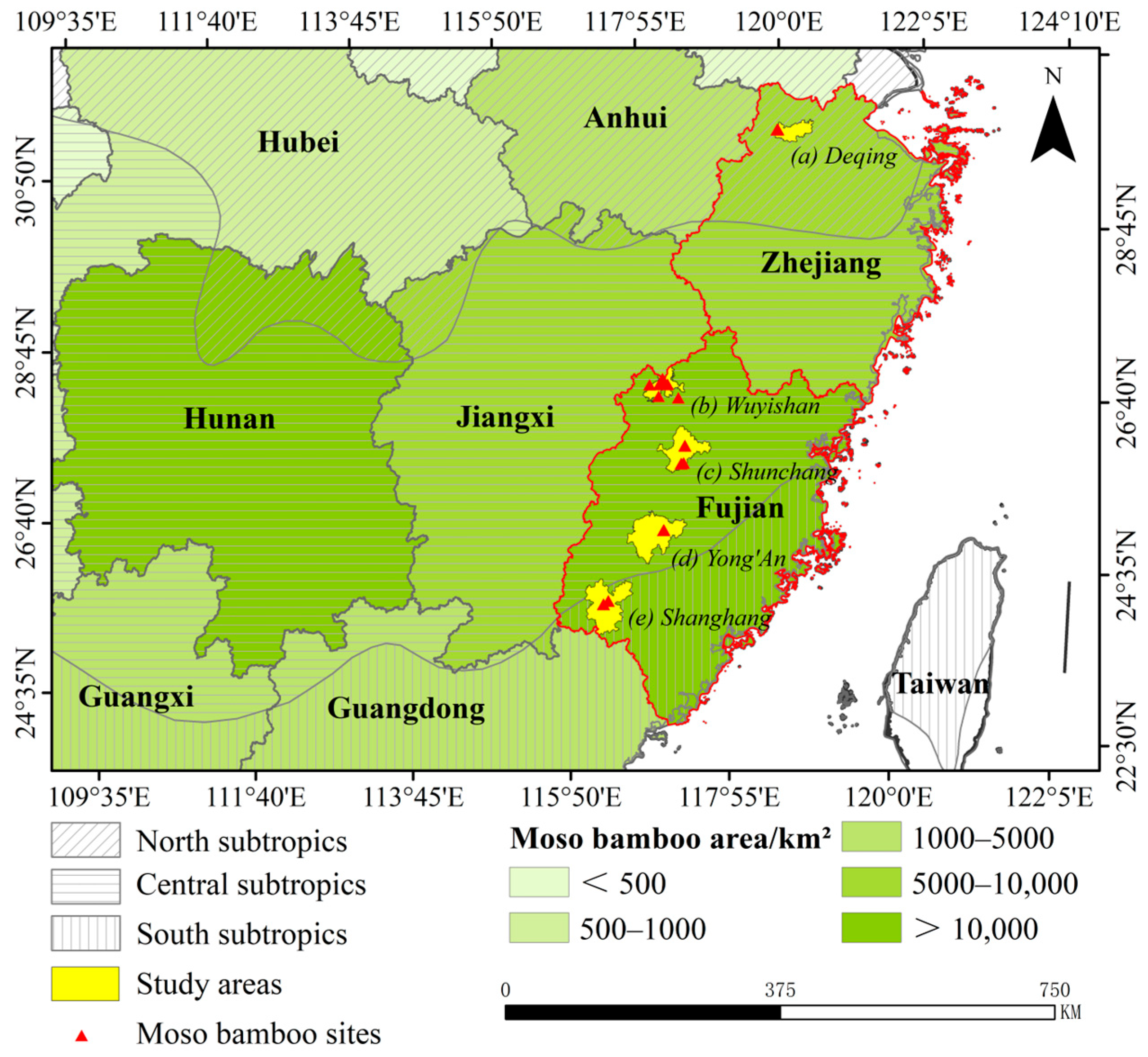
2.1. Study Area
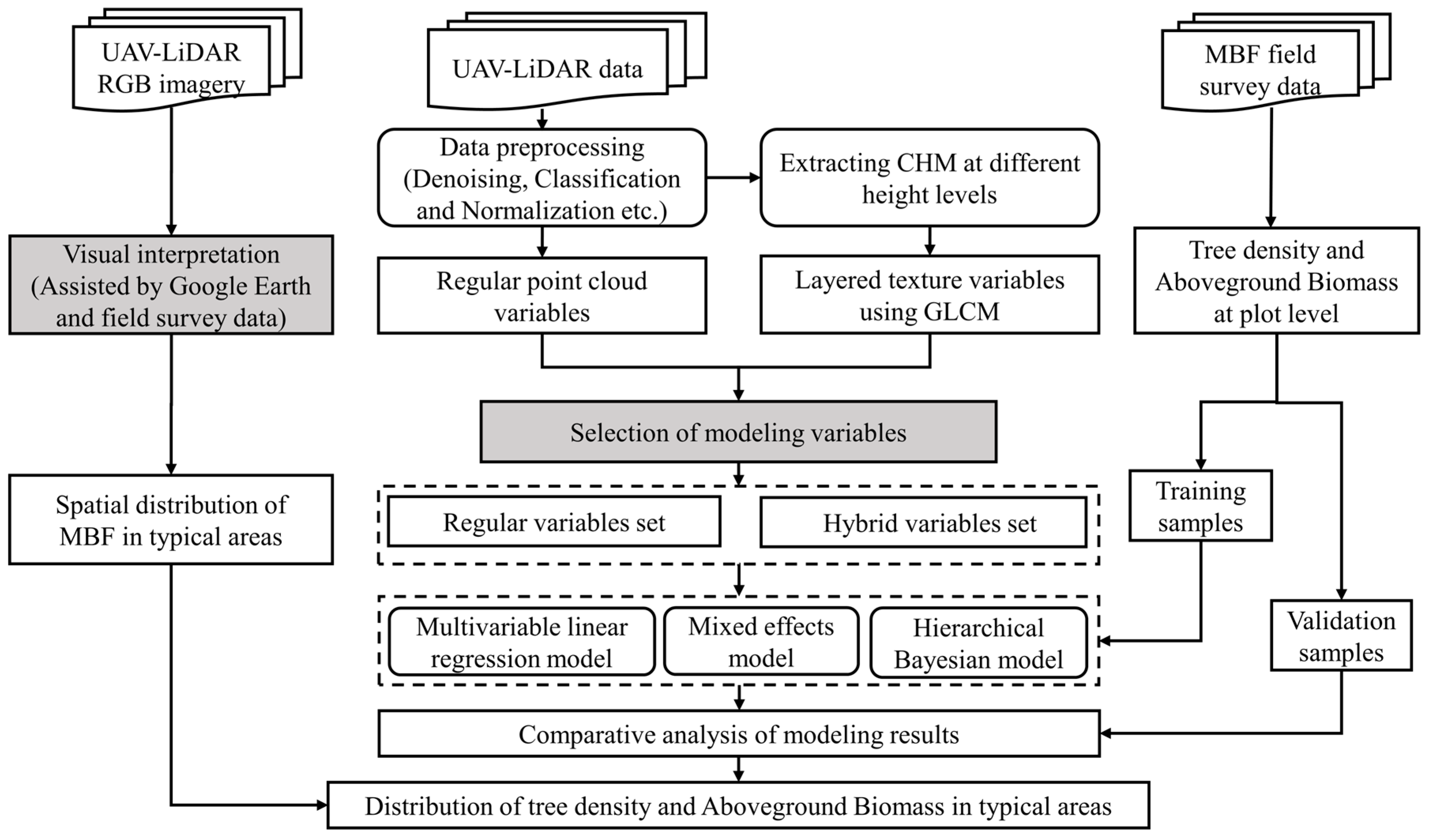
2.2. Framework
2.3. Data Collection and Preprocessing
2.4. Moso Bamboo Forest Distributions in Typical Sites
2.5. Extraction and Selection of Variables from UAV-LiDAR Point Clouds
- (1)
- LiDAR points with heights below 2 m were excluded to reduce the influence of the understory on the extraction of variables [43]. The remaining points were stratified into 10-layer bins based on height percentiles (10th, 20th, …, 100th), representing vertical segments from the forest floor to the canopy top. These strata were labeled from 0 to 9.
- (2)
- For each sample plot, a fishnet grid with a resolution of 1 m × 1 m was created. LiDAR points within each height bin were projected onto the grid to form CHM layers. For each grid cell, the maximum height value among all points falling within the cell was retained; if no points were present, the cell was assigned a NoData value. This process yielded 10 CHM layers corresponding to distinct vertical strata.
- (3)
- For each CHM layer, the gray-level co-occurrence matrix (GLCM) based textural metrics were computed at the plot scale. A total of 90 texture features were extracted, including contrast, energy, correlation, mean, variance, standard deviation, entropy, dissimilarity, and homogeneity.
2.6. Development of Bamboo Tree Density and AGB Estimation Models
2.6.1. Multiple Linear Regression Model (MLR)
2.6.2. Mixed-Effects Model (MEM)
2.6.3. Hierarchical Bayesian Model (HBM)
2.7. Evaluation of Model Performances and Prediction of Tree Density and AGB in Typical Sites
3. Results
3.1. Analysis of Selected Modeling Variables
3.2. Comparative Analysis of Modeling Results
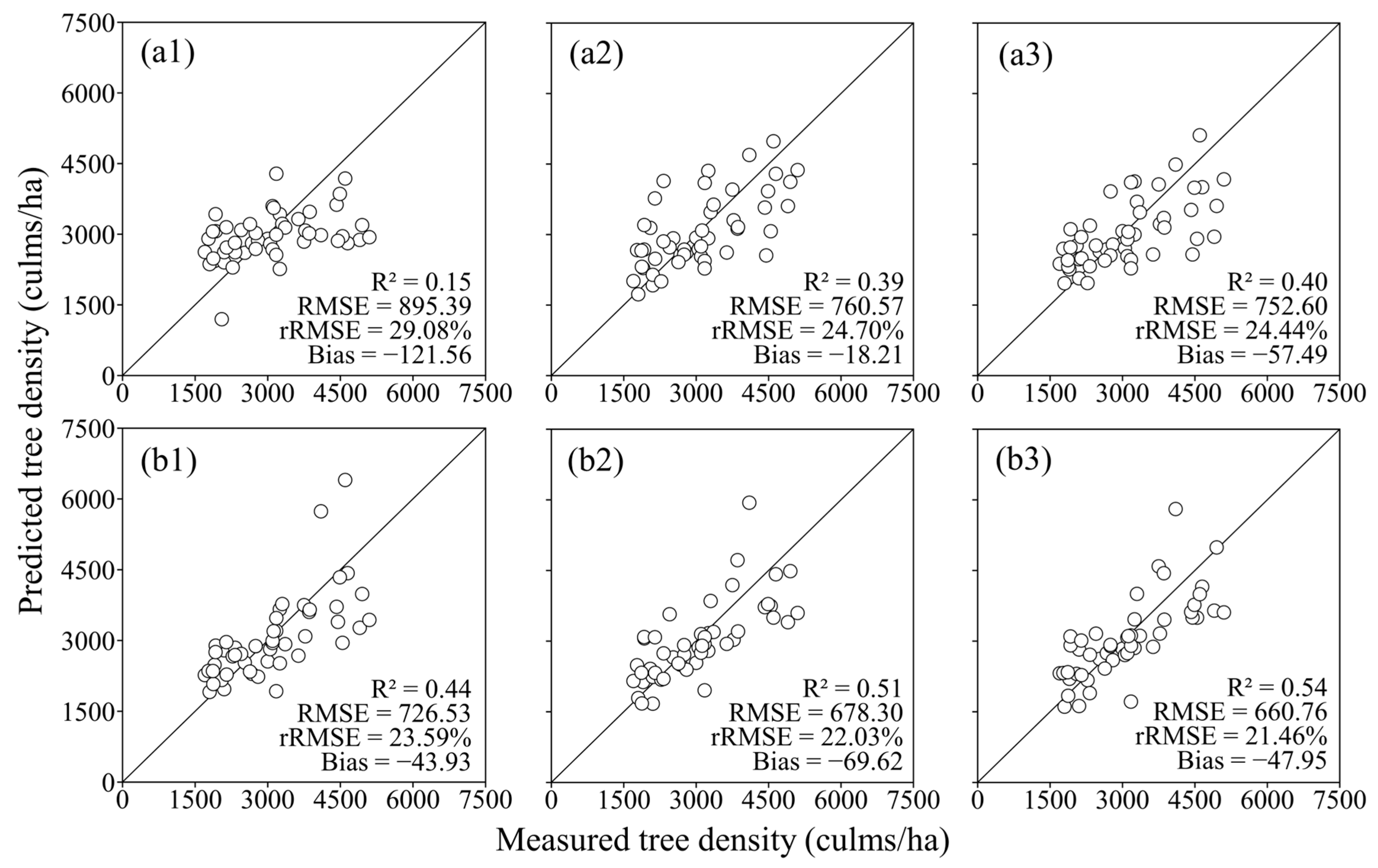
3.2.1. Tree Density Modeling Results
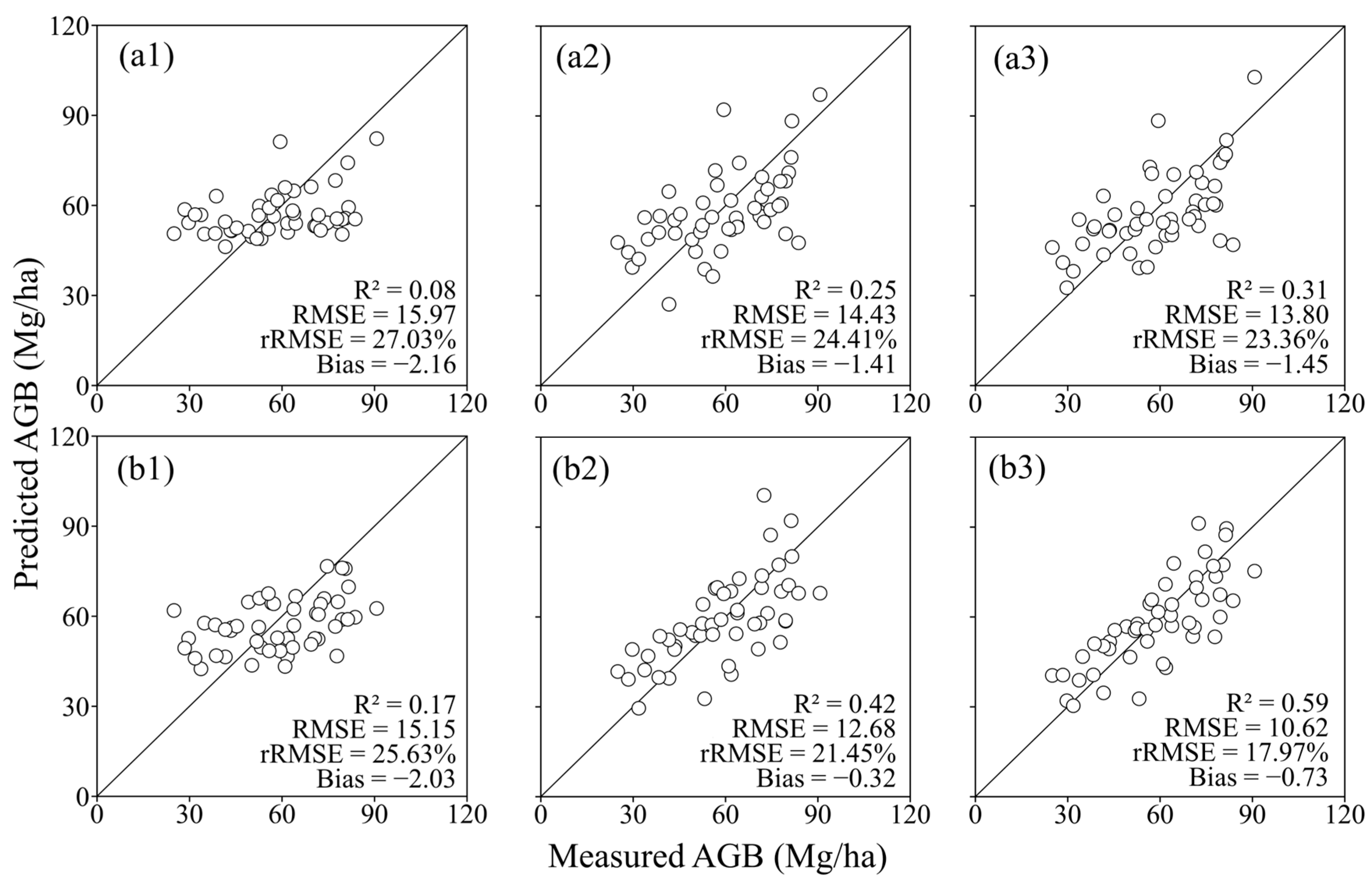
3.2.2. AGB Modeling Results
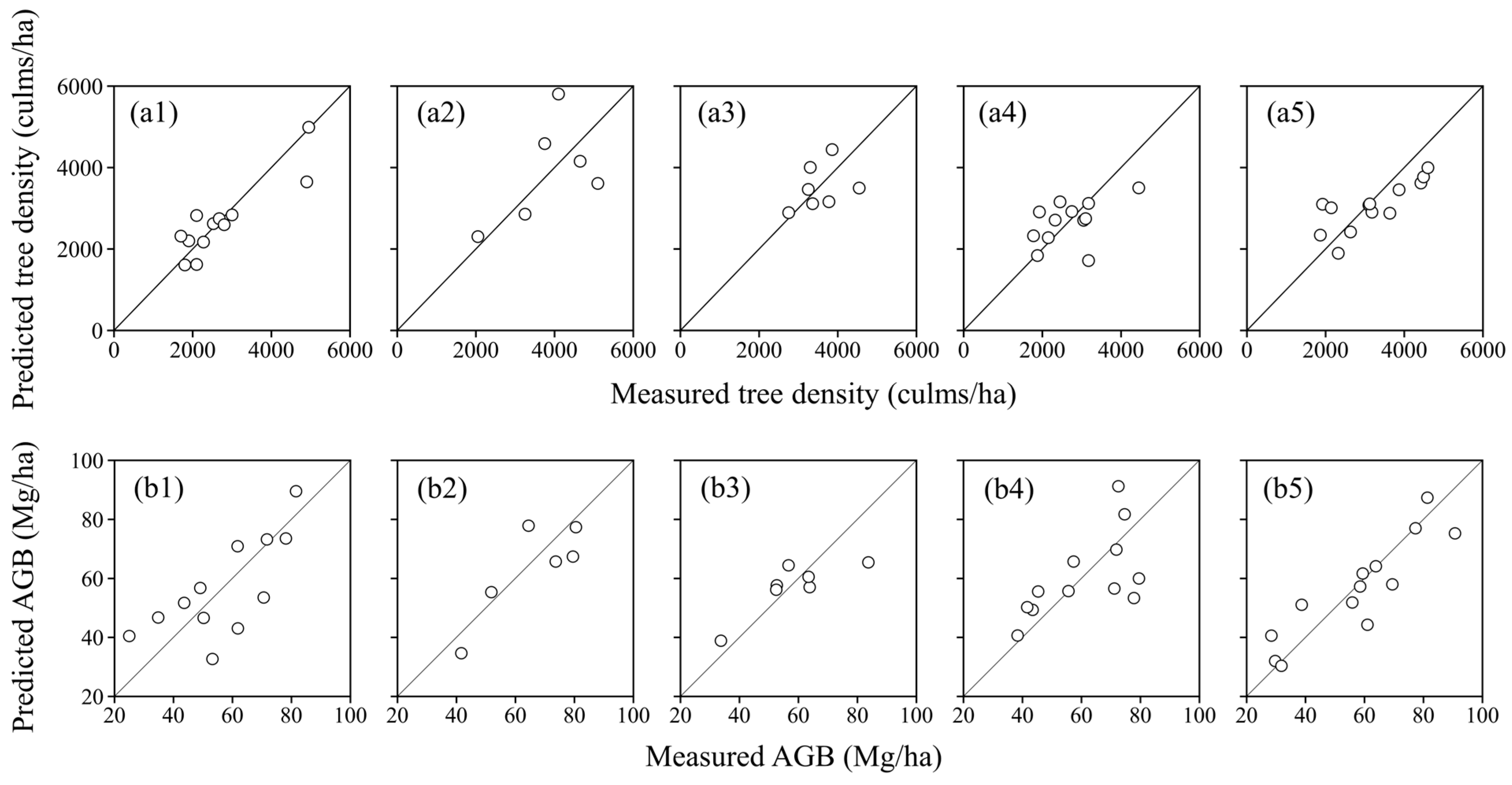
3.2.3. The Performances of Tree Density and AGB Estimation Models in Individual Sites
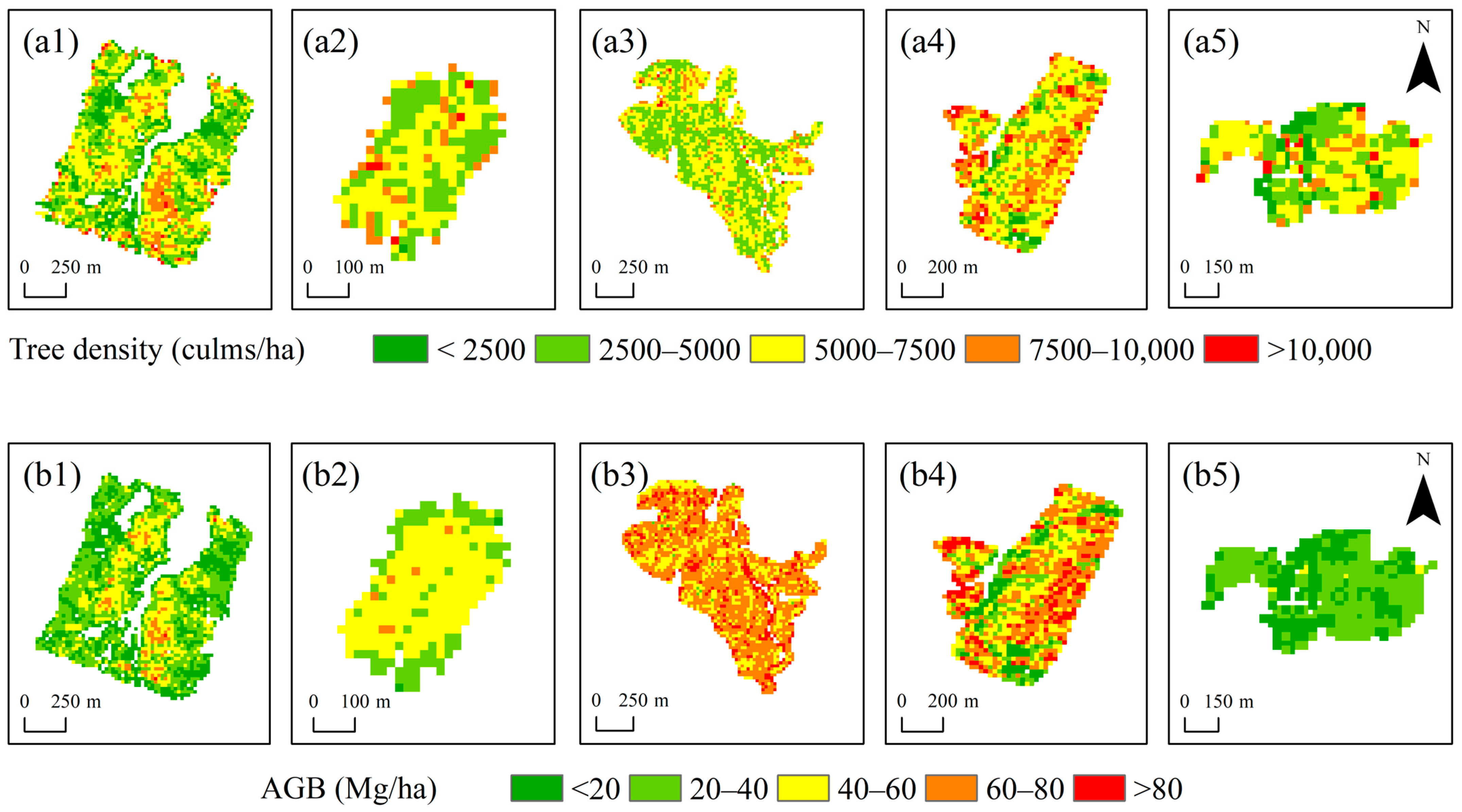
3.3. Spatial Patterns of Tree Density and AGB of Moso Bamboo Forests in Typical Sites
4. Discussion
4.1. The Need to Identify Key Variables Representing Bamboo Forest Stand Structure Characteristics
4.2. The Importance of Selecting an Appropriate Modeling Approach
4.3. The Need to Combine Multi-Site UAV-LiDAR and Sample Plots
5. Conclusions
Author Contributions
Funding
Data Availability Statement
Conflicts of Interest
References
- National Forestry and Grassland Administration. Forest and Grass Ecology Monitoring Report in China, 2021; China Forestry Publishing House: Beijing, China, 2023. [Google Scholar]
- Feng, P.; Li, Y. China’s Bamboo Resources in 2021. World Bamboo Ratt. 2023, 21, 100–103. (In Chinese) [Google Scholar]
- Khalil, H.A.; Bhat, I.U.H.; Jawaid, M.; Zaidon, A.; Hermawan, D.; Hadi, Y.S. Bamboo Fibre Reinforced Biocomposites: A Review. Mater. Des. 2012, 42, 353–368. [Google Scholar] [CrossRef] [Scilit]
- Li, X.; Du, H.; Zhou, G.; Mao, F.; Zhang, M.; Han, N.; Fan, W.; Liu, H.; Huang, Z.; He, S. Phenology Estimation of Subtropical Bamboo Forests Based on Assimilated MODIS LAI Time Series Data. ISPRS J. Photogramm. Remote Sens. 2021, 173, 262–277. [Google Scholar] [CrossRef] [Scilit]
- Fang, W.; Gui, R.; Ma, L.; Jin, A.; Lin, X.; Yu, X.; Qian, J. Chinese Economic Bamboo, 1st ed.; Science Press: Beijing, China, 2015; ISBN 978-7-03-045460-7. (In Chinese) [Google Scholar]
- Chen, Y.; Li, L.; Lu, D.; Li, D. Exploring Bamboo Forest Aboveground Biomass Estimation Using Sentinel-2 Data. Remote Sens. 2018, 11, 7. [Google Scholar] [CrossRef] [Scilit]
- Chen, M.; Guo, L.; Ramakrishnan, M.; Fei, Z.; Vinod, K.K.; Ding, Y.; Jiao, C.; Gao, Z.; Zha, R.; Wang, C. Rapid Growth of Moso Bamboo (Phyllostachys edulis): Cellular Roadmaps, Transcriptome Dynamics, and Environmental Factors. Plant Cell 2022, 34, 3577–3610. [Google Scholar] [CrossRef] [Scilit]
- Zhou, X.; Zhang, X.; Sharma, R.P.; Guan, F. Developing Mixed-Effects Aboveground Biomass Model Using Biotic and Abiotic Variables for Moso Bamboo in China. J. Environ. Manag. 2025, 384, 125544. [Google Scholar] [CrossRef] [Scilit]
- Atanda, J. Environmental Impacts of Bamboo as a Substitute Constructional Material in Nigeria. Case Stud. Constr. Mater. 2015, 3, 33–39. [Google Scholar] [CrossRef] [Scilit]
- Liu, G.; Shi, P.; Xu, Q.; Dong, X.; Wang, F.; Wang, G.G.; Hui, C. Does the Size–Density Relationship Developed for Bamboo Species Conform to the Self-Thinning Rule? For. Ecol. Manag. 2016, 361, 339–345. [Google Scholar] [CrossRef] [Scilit]
- Nath, A.J.; Lal, R.; Das, A.K. Managing Woody Bamboos for Carbon Farming and Carbon Trading. Glob. Ecol. Conserv. 2015, 3, 654–663. [Google Scholar] [CrossRef] [Scilit]
- Yue, J.; Yuan, N.; Gu, X.; Wu, X.; Yuan, J. Studies on the Abortion of Bamboo Shoots. J. Bamboo Res. 2018, 37, 25–31. (In Chinese) [Google Scholar]
- Zhang, R.; Zhou, X.; Ouyang, Z.; Avitabile, V.; Qi, J.; Chen, J.; Giannico, V. Estimating Aboveground Biomass in Subtropical Forests of China by Integrating Multisource Remote Sensing and Ground Data. Remote Sens. Environ. 2019, 232, 111341. [Google Scholar] [CrossRef] [Scilit]
- Velumani, K.; Lopez-Lozano, R.; Madec, S.; Guo, W.; Gillet, J.; Comar, A.; Baret, F. Estimates of Maize Plant Density from UAV RGB Images Using Faster-RCNN Detection Model: Impact of the Spatial Resolution. Plant Phenomics 2021, 2021, 9824843. [Google Scholar] [CrossRef] [Scilit]
- Jin, X.; Liu, S.; Baret, F.; Hemerlé, M.; Comar, A. Estimates of Plant Density of Wheat Crops at Emergence from Very Low Altitude UAV Imagery. Remote Sens. Environ. 2017, 198, 105–114. [Google Scholar] [CrossRef] [Scilit]
- Liu, S.; Baret, F.; Andrieu, B.; Burger, P.; Hemmerlé, M. Estimation of Wheat Plant Density at Early Stages Using High Resolution Imagery. Front. Plant Sci. 2017, 8, 739. [Google Scholar] [CrossRef] [Scilit]
- Xu, X.; Zhou, Z.; Tang, Y.; Qu, Y. Individual Tree Crown Detection from High Spatial Resolution Imagery Using a Revised Local Maximum Filtering. Remote Sens. Environ. 2021, 258, 112397. [Google Scholar] [CrossRef] [Scilit]
- Demirel, D.; Sakici, O.E. Estimating Some Stand Parameters Using Sentinel-1 and Sentinel-2 Satellite Images in Pure Black and Scots Pine Stands: A Case Study from Türkiye. J. Sustain. For. 2025, 44, 729–751. [Google Scholar] [CrossRef] [Scilit]
- Humagain, K.; Portillo-Quintero, C.; Cox, R.D.; Cain, J.W., III. Mapping Tree Density in Forests of the Southwestern USA Using Landsat 8 Data. Forests 2017, 8, 287. [Google Scholar] [CrossRef] [Scilit]
- Amirkolaee, H.A.; Shi, M.; Mulligan, M. TreeFormer: A Semi-Supervised Transformer-Based Framework for Tree Counting from a Single High-Resolution Image. IEEE Trans. Geosci. Remote Sens. 2023, 61, 4406215. [Google Scholar] [CrossRef] [Scilit]
- Yao, L.; Liu, T.; Qin, J.; Lu, N.; Zhou, C. Tree Counting with High Spatial-Resolution Satellite Imagery Based on Deep Neural Networks. Ecol. Indic. 2021, 125, 107591. [Google Scholar] [CrossRef] [Scilit]
- Xiang, B.; Wielgosz, M.; Kontogianni, T.; Peters, T.; Puliti, S.; Astrup, R.; Schindler, K. Automated Forest Inventory: Analysis of High-Density Airborne LiDAR Point Clouds with 3D Deep Learning. Remote Sens. Environ. 2024, 305, 114078. [Google Scholar] [CrossRef] [Scilit]
- Zhang, C.; Zhou, J.; Wang, H.; Tan, T.; Cui, M.; Huang, Z.; Wang, P.; Zhang, L. Multi-Species Individual Tree Segmentation and Identification Based on Improved Mask R-CNN and UAV Imagery in Mixed Forests. Remote Sens. 2022, 14, 874. [Google Scholar] [CrossRef] [Scilit]
- Lu, D.; Chen, Q.; Wang, G.; Liu, L.; Li, G.; Moran, E. A Survey of Remote Sensing-Based Aboveground Biomass Estimation Methods in Forest Ecosystems. Int. J. Digit. Earth 2016, 9, 63–105. [Google Scholar] [CrossRef] [Scilit]
- García, J.C.C.; Arango, A.M.A.; Trinh, L. The Potential of Bamboo Forests as a Carbon Sink and Allometric Equations for Estimating Their Aboveground Biomass. Environ. Dev. Sustain. 2024, 26, 20159–20187. [Google Scholar] [CrossRef] [Scilit]
- Dong, L.; Du, H.; Han, N.; Li, X.; Zhu, D.; Mao, F.; Zhang, M.; Zheng, J.; Liu, H.; Huang, Z.; et al. Application of Convolutional Neural Network on Lei Bamboo Above-Ground-Biomass (AGB) Estimation Using Worldview-2. Remote Sens. 2020, 12, 958. [Google Scholar] [CrossRef] [Scilit]
- Zhou, X.; Zheng, Y.; Guan, F.; Xiao, X.; Zhang, X.; Li, C. Compatible Biomass Model of Moso Bamboo with Measurement Error. Forests 2022, 13, 774. [Google Scholar] [CrossRef] [Scilit]
- Chen, L.; He, A.; Xu, Z.; Li, B.; Zhang, H.; Li, G.; Guo, X.; Li, Z. Mapping Aboveground Biomass of Moso Bamboo (Phyllostachys pubescens) Forests under Pantana Phyllostachysae Chao-Induced Stress Using Sentinel-2 Imagery. Ecol. Indic. 2024, 158, 111564. [Google Scholar] [CrossRef] [Scilit]
- Li, X.; Du, H.; Mao, F.; Xu, Y.; Huang, Z.; Xuan, J.; Zhou, Y.; Hu, M. Estimation Aboveground Biomass in Subtropical Bamboo Forests Based on an Interpretable Machine Learning Framework. Environ. Model. Softw. 2024, 178, 106071. [Google Scholar] [CrossRef] [Scilit]
- Wang, J.; Li, X.; Du, H.; Zhou, G.; Mao, F.; Li, M.; Liu, E.; Fan, W.; Han, N.; Xu, Y. A New Geographically Weighted Stacked Regression Method for Forest Aboveground Carbon Storage Estimation: A Case Study of Bamboo Forest. Ecol. Indic. 2025, 178, 114055. [Google Scholar] [CrossRef] [Scilit]
- Zhao, P.; Lu, D.; Wang, G.; Wu, C.; Huang, Y.; Yu, S. Examining Spectral Reflectance Saturation in Landsat Imagery and Corresponding Solutions to Improve Forest Aboveground Biomass Estimation. Remote Sens. 2016, 8, 469. [Google Scholar] [CrossRef] [Scilit]
- Fischer, F.J.; Jackson, T.; Vincent, G.; Jucker, T. Robust Characterisation of Forest Structure from Airborne Laser Scanning—A Systematic Assessment and Sample Workflow for Ecologists. Methods Ecol. Evol. 2024, 15, 1873–1888. [Google Scholar] [CrossRef] [Scilit]
- Brede, B.; Calders, K.; Lau, A.; Raumonen, P.; Bartholomeus, H.M.; Herold, M.; Kooistra, L. Non-Destructive Tree Volume Estimation through Quantitative Structure Modelling: Comparing UAV Laser Scanning with Terrestrial LIDAR. Remote Sens. Environ. 2019, 233, 111355. [Google Scholar] [CrossRef] [Scilit]
- Oehmcke, S.; Li, L.; Trepekli, K.; Revenga, J.C.; Nord-Larsen, T.; Gieseke, F.; Igel, C. Deep Point Cloud Regression for Above-Ground Forest Biomass Estimation from Airborne LiDAR. Remote Sens. Environ. 2024, 302, 113968. [Google Scholar] [CrossRef] [Scilit]
- Rodda, S.R.; Fararoda, R.; Gopalakrishnan, R.; Jha, N.; Réjou-Méchain, M.; Couteron, P.; Barbier, N.; Alfonso, A.; Bako, O.; Bassama, P. LiDAR-Based Reference Aboveground Biomass Maps for Tropical Forests of South Asia and Central Africa. Sci. Data 2024, 11, 334. [Google Scholar] [CrossRef] [Scilit] [PubMed]
- Ye, N.; Mason, E.; Xu, C.; Morgenroth, J. Estimating Individual Tree DBH and Biomass of Durable Eucalyptus Using UAV LiDAR. Ecol. Inform. 2025, 89, 103169. [Google Scholar] [CrossRef] [Scilit]
- Cao, L.; Coops, N.C.; Sun, Y.; Ruan, H.; Wang, G.; Dai, J.; She, G. Estimating Canopy Structure and Biomass in Bamboo Forests Using Airborne LiDAR Data. ISPRS J. Photogramm. Remote Sens. 2019, 148, 114–129. [Google Scholar] [CrossRef] [Scilit]
- Badouard, V.; Verley, P.; Bai, Y.; Sellan, G.; Françoise, L.; Marcon, E.; Derroire, G.; Vincent, G. Using High Penetration Airborne LiDAR and Dense UAV Scanning to Produce Accurate 3D Maps of Light Availability in Dense Tropical Forest. Agric. For. Meteorol. 2025, 373, 110713. [Google Scholar] [CrossRef] [Scilit]
- Campbell, M.J.; Eastburn, J.F.; Dennison, P.E.; Vogeler, J.C.; Stovall, A.E. Evaluating the Performance of Airborne and Spaceborne Lidar for Mapping Biomass in the United States’ Largest Dry Woodland Ecosystem. Remote Sens. Environ. 2024, 308, 114196. [Google Scholar] [CrossRef] [Scilit]
- Wang, Y.; Jia, X.; Chai, G.; Lei, L.; Zhang, X. Improved Estimation of Aboveground Biomass of Regional Coniferous Forests Integrating UAV-LiDAR Strip Data, Sentinel-1 and Sentinel-2 Imageries. Plant Methods 2023, 19, 65. [Google Scholar] [CrossRef] [Scilit] [PubMed]
- Lan, Z.; Jiang, X.; Li, G.; Lu, Y.; Yao, H.; Lu, D. Modeling Pine Forest Growing Stock Volume in Subtropical Regions of China Using Airborne Lidar Data. GISci. Remote Sens. 2025, 62, 2477869. [Google Scholar] [CrossRef] [Scilit]
- Chen, H.; Hong, W.; Lan, B.; Zheng, Y.; He, D. Study on the Biomass and Productivity of Moso Bamboo in Northern Fujian. Sci. Silvae Sin. 1998, 34, 60–64. (In Chinese) [Google Scholar]
- Wulder, M.A.; White, J.C.; Nelson, R.F.; Næsset, E.; Ørka, H.O.; Coops, N.C.; Hilker, T.; Bater, C.W.; Gobakken, T. Lidar Sampling for Large-Area Forest Characterization: A Review. Remote Sens. Environ. 2012, 121, 196–209. [Google Scholar] [CrossRef] [Scilit]
- Næsset, E.; Gobakken, T. Estimation of Above-and below-Ground Biomass across Regions of the Boreal Forest Zone Using Airborne Laser. Remote Sens. Environ. 2008, 112, 3079–3090. [Google Scholar] [CrossRef] [Scilit]
- Næsset, E.; Økland, T. Estimating Tree Height and Tree Crown Properties Using Airborne Scanning Laser in a Boreal Nature Reserve. Remote Sens. Environ. 2002, 79, 105–115. [Google Scholar] [CrossRef] [Scilit]
- Bolker, B.M.; Brooks, M.E.; Clark, C.J.; Geange, S.W.; Poulsen, J.R.; Stevens, M.H.H.; White, J.-S.S. Generalized Linear Mixed Models: A Practical Guide for Ecology and Evolution. Trends Ecol. Evol. 2009, 24, 127–135. [Google Scholar] [CrossRef] [Scilit]
- Schad, D.J.; Vasishth, S.; Hohenstein, S.; Kliegl, R. How to Capitalize on a Priori Contrasts in Linear (Mixed) Models: A Tutorial. J. Mem. Lang. 2020, 110, 104038. [Google Scholar] [CrossRef] [Scilit]
- Spiegelhalter, D.J.; Best, N.G.; Carlin, B.P.; Van Der Linde, A. Bayesian Measures of Model Complexity and Fit. J. R. Stat. Soc. Ser. B (Stat. Methodol.) 2002, 64, 583–639. [Google Scholar] [CrossRef] [Scilit]
- Berger, J.O.; Berry, D.A. Statistical Analysis and the Illusion of Objectivity. Am. Sci. 1988, 76, 159–165. [Google Scholar]
- Zhang, L.; Zhao, Y.; Chen, C.; Li, X.; Mao, F.; Lv, L.; Yu, J.; Song, M.; Huang, L.; Chen, J.; et al. UAV-LiDAR Integration with Sentinel-2 Enhances Precision in AGB Estimation for Bamboo Forests. Remote Sens. 2024, 16, 705. [Google Scholar] [CrossRef] [Scilit]
- Wang, M.; Liu, Q.; Fu, L.; Wang, G.; Zhang, X. Airborne LIDAR-Derived Aboveground Biomass Estimates Using a Hierarchical Bayesian Approach. Remote Sens. 2019, 11, 1050. [Google Scholar] [CrossRef] [Scilit]
- Gelman, A. Parameterization and Bayesian Modeling. J. Am. Stat. Assoc. 2004, 99, 537–545. [Google Scholar] [CrossRef] [Scilit]
- Stone, M. Cross-validatory Choice and Assessment of Statistical Predictions. J. R. Stat. Soc. Ser. B (Methodol.) 1974, 36, 111–133. [Google Scholar] [CrossRef] [Scilit]
- da Costa, M.B.T.; Silva, C.A.; Broadbent, E.N.; Leite, R.V.; Mohan, M.; Liesenberg, V.; Stoddart, J.; do Amaral, C.H.; de Almeida, D.R.A.; da Silva, A.L. Beyond Trees: Mapping Total Aboveground Biomass Density in the Brazilian Savanna Using High-Density UAV-Lidar Data. For. Ecol. Manag. 2021, 491, 119155. [Google Scholar] [CrossRef] [Scilit]
- Liu, Z.; Zhang, X.; Wu, Y.; Xu, Y.; Cao, Z.; Yu, Z.; Feng, Z.; Luo, H.; Lu, C.; Wang, W. LiDAR-Based Individual Tree AGB Modeling of Pinus Kesiya Var. Langbianensis by Incorporating Spatial Structure. Ecol. Indic. 2024, 169, 112973. [Google Scholar] [CrossRef] [Scilit]
- Lu, J.; Wang, H.; Qin, S.; Cao, L.; Pu, R.; Li, G.; Sun, J. Estimation of Aboveground Biomass of Robinia Pseudoacacia Forest in the Yellow River Delta Based on UAV and Backpack LiDAR Point Clouds. Int. J. Appl. Earth Obs. Geoinf. 2020, 86, 102014. [Google Scholar] [CrossRef] [Scilit]
- Zhao, K.; Suarez, J.C.; Garcia, M.; Hu, T.; Wang, C.; Londo, A. Utility of Multitemporal Lidar for Forest and Carbon Monitoring: Tree Growth, Biomass Dynamics, and Carbon Flux. Remote Sens. Environ. 2018, 204, 883–897. [Google Scholar] [CrossRef] [Scilit]
- Fatoyinbo, T.; Feliciano, E.A.; Lagomasino, D.; Lee, S.K.; Trettin, C. Estimating Mangrove Aboveground Biomass from Airborne LiDAR Data: A Case Study from the Zambezi River Delta. Environ. Res. Lett. 2018, 13, 025012. [Google Scholar] [CrossRef] [Scilit]
- García, M.; Riaño, D.; Chuvieco, E.; Danson, F.M. Estimating Biomass Carbon Stocks for a Mediterranean Forest in Central Spain Using LiDAR Height and Intensity Data. Remote Sens. Environ. 2010, 114, 816–830. [Google Scholar] [CrossRef] [Scilit]
- Nie, S.; Wang, C.; Zeng, H.; Xi, X.; Li, G. Above-Ground Biomass Estimation Using Airborne Discrete-Return and Full-Waveform LiDAR Data in a Coniferous Forest. Ecol. Indic. 2017, 78, 221–228. [Google Scholar] [CrossRef] [Scilit]
- Qin, S.; Nie, S.; Guan, Y.; Zhang, D.; Wang, C.; Zhang, X. Forest Emissions Reduction Assessment Using Airborne LiDAR for Biomass Estimation. Resour. Conserv. Recycl. 2022, 181, 106224. [Google Scholar] [CrossRef] [Scilit]
- Silva, C.A.; Duncanson, L.; Hancock, S.; Neuenschwander, A.; Thomas, N.; Hofton, M.; Fatoyinbo, L.; Simard, M.; Marshak, C.Z.; Armston, J. Fusing Simulated GEDI, ICESat-2 and NISAR Data for Regional Aboveground Biomass Mapping. Remote Sens. Environ. 2021, 253, 112234. [Google Scholar] [CrossRef] [Scilit]
- Scurlock, J.M.; Dayton, D.C.; Hames, B. Bamboo: An Overlooked Biomass Resource? Biomass Bioenergy 2000, 19, 229–244. [Google Scholar] [CrossRef] [Scilit]
- Liao, Z.; He, B.; Quan, X. Potential of Texture from SAR Tomographic Images for Forest Aboveground Biomass Estimation. Int. J. Appl. Earth Obs. Geoinf 2020, 88, 102049. [Google Scholar] [CrossRef] [Scilit]
- Jiang, R.; Lin, J.; Zhang, X.; Kang, M. Investigating Changes of Forest Aboveground Biomass Induced by Moso Bamboo Expansion with Terrestrial Laser Scanner. Ecol. Inform. 2024, 83, 102812. [Google Scholar] [CrossRef] [Scilit]
- Dong, L.; Liu, Z.; Bettinger, P. Nonlinear Mixed-Effects Branch Diameter and Length Models for Natural Dahurian Larch (Larix gmelini) Forest in Northeast China. Trees 2016, 30, 1191–1206. [Google Scholar] [CrossRef] [Scilit]
- Wang, M.; Im, J.; Zhao, Y.; Zhen, Z. Multi-Platform LiDAR for Non-Destructive Individual Aboveground Biomass Estimation for Changbai Larch (Larix olgensis Henry) Using a Hierarchical Bayesian Approach. Remote Sens. 2022, 14, 4361. [Google Scholar] [CrossRef] [Scilit]
- Wu, W.; Bethel, M.; Mishra, D.R.; Hardy, T. Model Selection in Bayesian Framework to Identify the Best WorldView-2 Based Vegetation Index in Predicting Green Biomass of Salt Marshes in the Northern Gulf of Mexico. GISci. Remote Sens. 2018, 55, 880–904. [Google Scholar] [CrossRef] [Scilit]
- Zapata-Cuartas, M.; Sierra, C.A.; Alleman, L. Probability Distribution of Allometric Coefficients and Bayesian Estimation of Aboveground Tree Biomass. For. Ecol. Manag. 2012, 277, 173–179. [Google Scholar] [CrossRef] [Scilit]
- Ver Planck, N.R.; Finley, A.O.; Kershaw, J.A., Jr.; Weiskittel, A.R.; Kress, M.C. Hierarchical Bayesian Models for Small Area Estimation of Forest Variables Using LiDAR. Remote Sens. Environ. 2018, 204, 287–295. [Google Scholar] [CrossRef] [Scilit]
- Pearse, G.D.; Dash, J.P.; Persson, H.J.; Watt, M.S. Comparison of High-Density LiDAR and Satellite Photogrammetry for Forest Inventory. ISPRS J. Photogramm. Remote Sens. 2018, 142, 257–267. [Google Scholar] [CrossRef] [Scilit]
- Lv, Y.; Han, N.; Du, H. Estimation of Bamboo Forest Aboveground Carbon Using the RGLM Model Based on Object-Based Multiscale Segmentation of SPOT-6 Imagery. Remote Sens. 2023, 15, 2566. [Google Scholar] [CrossRef] [Scilit]



| Study Areas | Locations | Terrains |
|---|---|---|
| Deqing County | Northwest of Zhejiang Province | The terrain slants from west to east, transitioning from mountains to plains |
| Wuyishan National Park | Junction of Fujian and Jiangxi Provinces | Undulating terrain with elevation ranging from 350 to 2158 m |
| Shunchang County | Northwest Fujian Province | Dominated by mountains and hills, with an average elevation of 800 m |
| Yong’an County | Central Fujian Province | Dominated by mountains and hills, with an elevation difference as high as 1500 m |
| Shanghang County | Southwest Fujian Province, a transitional zone from the central to the south subtropical region | Dominated by medium and low mountains |
| Study Areas | No. of Sample Plots | Plot Collection Dates | Tree Density (Culms/ha) | Aboveground Biomass (Mg/ha) | UAV-LiDAR Data | |||
|---|---|---|---|---|---|---|---|---|
| Mean | Standard Deviation | Mean | Standard Deviation | Acquisition Dates | Point Density (ps/m2) | |||
| Deqing | 6 | 2024.05 | 3816.7 | 1083.4 | 65.26 | 15.83 | 2024.05 | 890 |
| Wuyishan | 12 | 2023.01 | 2683.3 | 765.0 | 60.74 | 15.53 | 2022.12 | 170 |
| Shunchang | 12 | 2024.08 | 2727.1 | 1102.7 | 56.79 | 17.36 | 2024.08 | 166 |
| Yong’an | 13 | 2024.08 | 3176.9 | 973.5 | 57.38 | 20.20 | 2024.08 | 1076 |
| Shanghang | 7 | 2022.09 | 3548.1 | 1083.3 | 65.26 | 15.78 | 2022.10 | 98 |
| Variable Types | No. | Variables | Description |
|---|---|---|---|
| Regular variables | 26 | GF (gap fraction) | The ratio of the number of points with a z value lower than 2 m to the total number of points within a plot. |
| CC (canopy cover) | The ratio of the number of first return points from vegetation to the total first return points within a plot. | ||
| H1, H5, H10, H20, H25, H30, H40, H50, H60, H70, H75, H80, H90, H95 | Ranking all points from the low to the high, x% is the height position where x% points are located with a plot. | ||
| D0, D1, D2, D3, D4, D5, D6, D7, D8, D9 | Dividing point clouds within a plot into 10-layer bins with an equal height, the ratio of the number of points in a particular bin to the total number of points | ||
| Layered textural variables | 90 | Coni, Enei, Cori, Meani, Vari, Stdi, Enti, Dissi, Homi | Dividing point clouds within a plot into 10-layer bins based on height percentiles, creating corresponding layered CHMs, from which textural features—contrast, energy, correlation, mean, variance, standard deviation, entropy, dissimilarity, and homogeneity—were calculated. |
| Data | Models | Tree Density | AGB |
|---|---|---|---|
| Regular variable set | MLR | GF, H90 | GF |
| MEM, HBM | Fixed effect: GF, H90 Random effect: CC, D1, H50 | Fixed effect: GF Random effect: CC, D2, D5 | |
| Hybrid variable set | MLR | Diss5, H90 | Diss5, Std0 |
| MEM, HBM | Fixed effect: Diss5, H90 Random effect: Con3, CC, Cor8 | Fixed effect: Diss5, Std0 Random effect: CC, Mean6, Hom0 |
| Study Areas | Shunchang | Deqing | Shanghang | Wuyishan | Yong’an | |||||
|---|---|---|---|---|---|---|---|---|---|---|
| TD (Culms/ha) | AGB (Mg/ha) | TD (Culms/ha) | AGB (Mg/ha) | TD (Culms/ha) | AGB (Mg/ha) | TD (Culms/ha) | AGB (Mg/ha) | TD (Culms/ha) | AGB (Mg/ha) | |
| R2 | 0.79 | 0.53 | 0.30 | 0.69 | 0.12 | 0.69 | 0.23 | 0.38 | 0.62 | 0.80 |
| RMSE | 493.33 | 12.10 | 1024.34 | 8.76 | 589.86 | 8.58 | 661.31 | 12.55 | 615.84 | 8.84 |
| rRMSE (%) | 18.09 | 21.30 | 26.84 | 13.43 | 16.62 | 14.77 | 24.64 | 20.66 | 19.38 | 15.41 |
| Bias | −45.57 | −0.24 | 69.31 | −2.20 | −38.12 | −0.91 | −22.76 | 0.07 | −132.82 | −1.16 |
Disclaimer/Publisher’s Note: The statements, opinions and data contained in all publications are solely those of the individual author(s) and contributor(s) and not of MDPI and/or the editor(s). MDPI and/or the editor(s) disclaim responsibility for any injury to people or property resulting from any ideas, methods, instructions or products referred to in the content. |
© 2025 by the authors. Licensee MDPI, Basel, Switzerland. This article is an open access article distributed under the terms and conditions of the Creative Commons Attribution (CC BY) license.
Share and Cite
Liu, X.; Li, G.; Li, L.; Lu, D. Modeling Moso Bamboo Tree Density and Aboveground Biomass Using Multi-Site UAV-LiDAR Data. Remote Sens. 2026, 18, 115. https://doi.org/10.3390/rs18010115
Liu X, Li G, Li L, Lu D. Modeling Moso Bamboo Tree Density and Aboveground Biomass Using Multi-Site UAV-LiDAR Data. Remote Sensing. 2026; 18(1):115. https://doi.org/10.3390/rs18010115
Chicago/Turabian StyleLiu, Xinyao, Guiying Li, Longwei Li, and Dengsheng Lu. 2026. "Modeling Moso Bamboo Tree Density and Aboveground Biomass Using Multi-Site UAV-LiDAR Data" Remote Sensing 18, no. 1: 115. https://doi.org/10.3390/rs18010115
APA StyleLiu, X., Li, G., Li, L., & Lu, D. (2026). Modeling Moso Bamboo Tree Density and Aboveground Biomass Using Multi-Site UAV-LiDAR Data. Remote Sensing, 18(1), 115. https://doi.org/10.3390/rs18010115