A Multi-Source Remote Sensing Identification Framework for Coconut Palm Mapping



Highlights
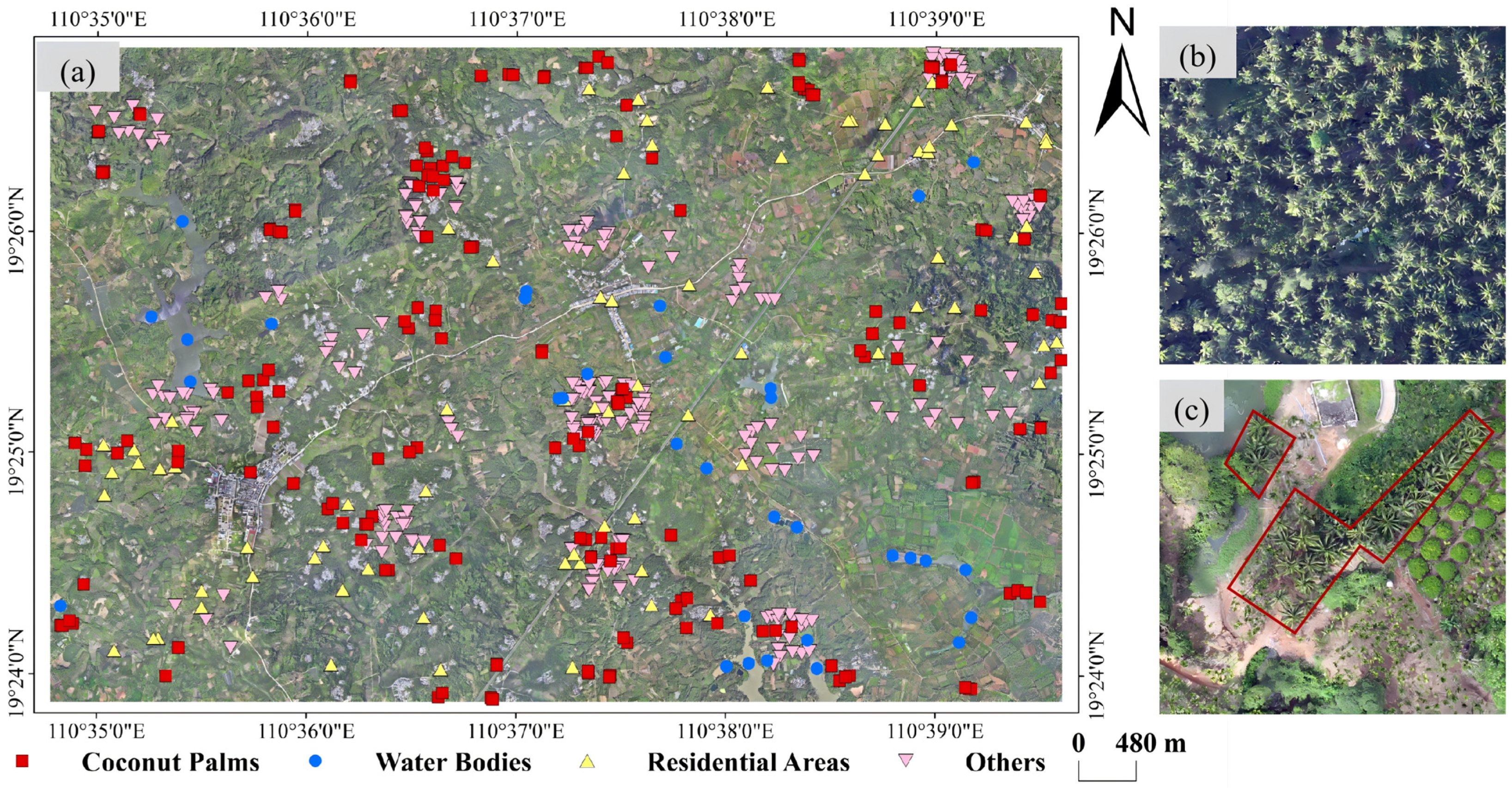
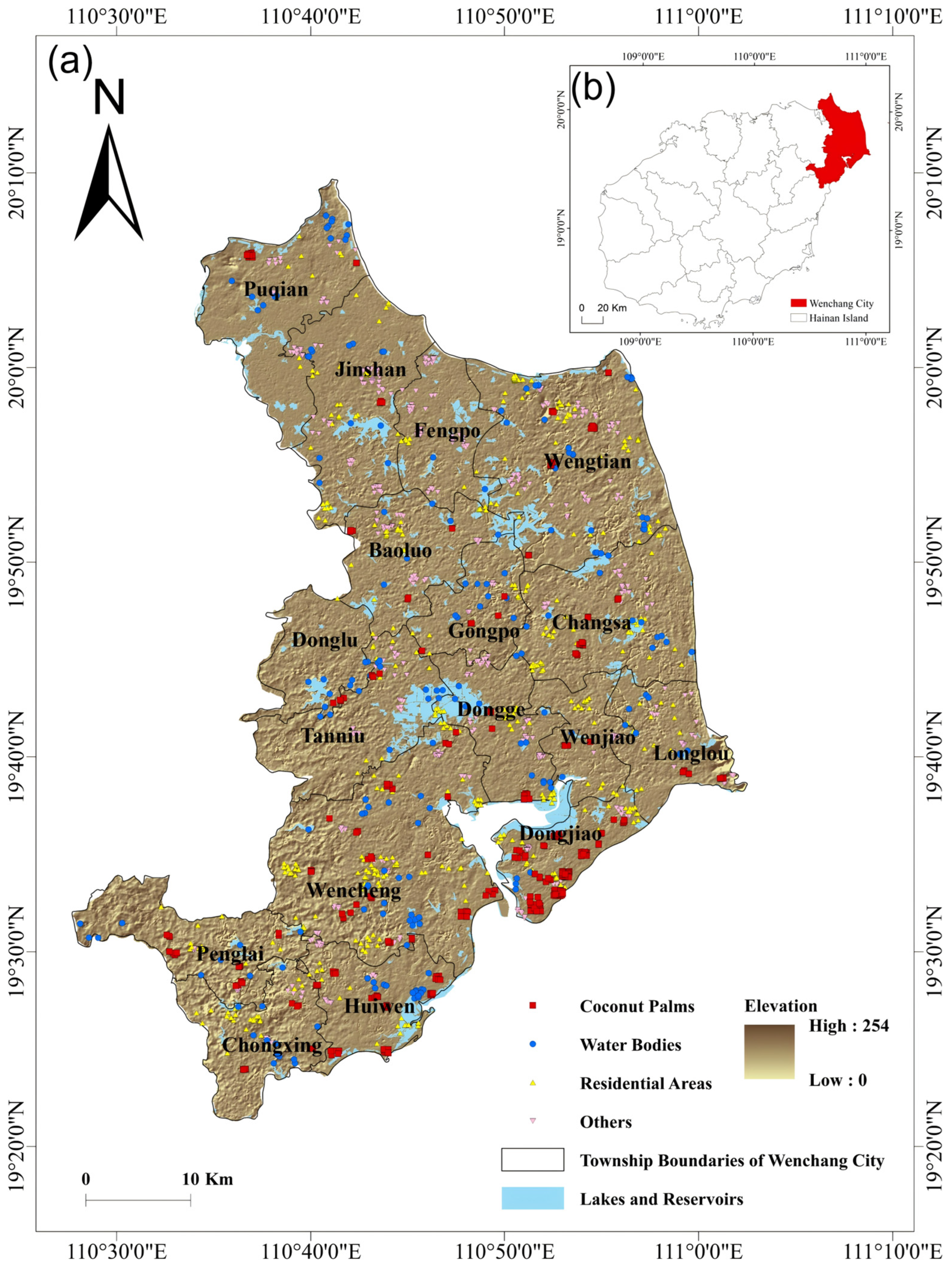
- A GEE-based multi-source remote sensing framework integrating Sentinel-1 SAR, Sentinel-2 MSI, and SRTM topographic data was developed, achieving an overall accuracy (OA) of 92.51% for coconut palm mapping in tropical monsoon regions.
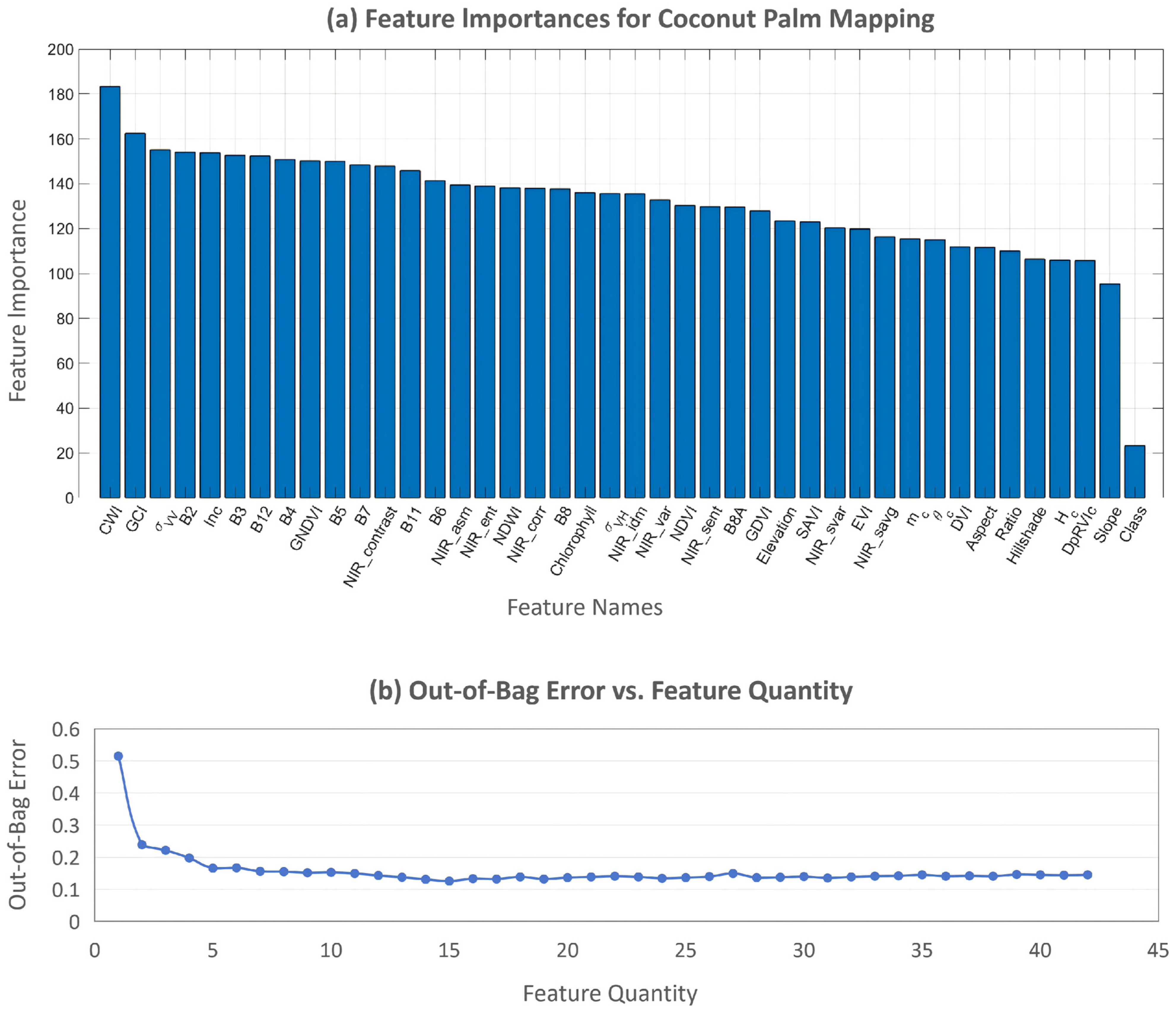
- RF-OOB feature selection identified an optimal 15-dimensional subset (64% reduction in dimensionality) that maintained high accuracy (OA = 92.83%), with the Canopy Water Index (CWI), Green Chlorophyll Index (GCI), and VV-polarized backscattering coefficient (σVV) emerging as the most informative features.
- The framework addresses key challenges (cloud cover, spectral similarity, feature redundancy) in tropical vegetation mapping, enabling efficient large-scale monitoring of coconut palms for agricultural planning and pest management.
- The framework, validated by internal tests and independent UAV-based verification, provides a reliable technical reference for mapping other tropical economic forests, supporting precision agriculture and ecological resource management.
Abstract
1. Introduction
2. Materials and Methods
2.1. Study Area and Data
2.1.1. Study Area
2.1.2. Data Sources and Preprocessing
2.2. Research Methods
2.2.1. Overall Technical Workflow
2.2.2. Feature Extraction
2.2.3. Design of Feature Combination Schemes
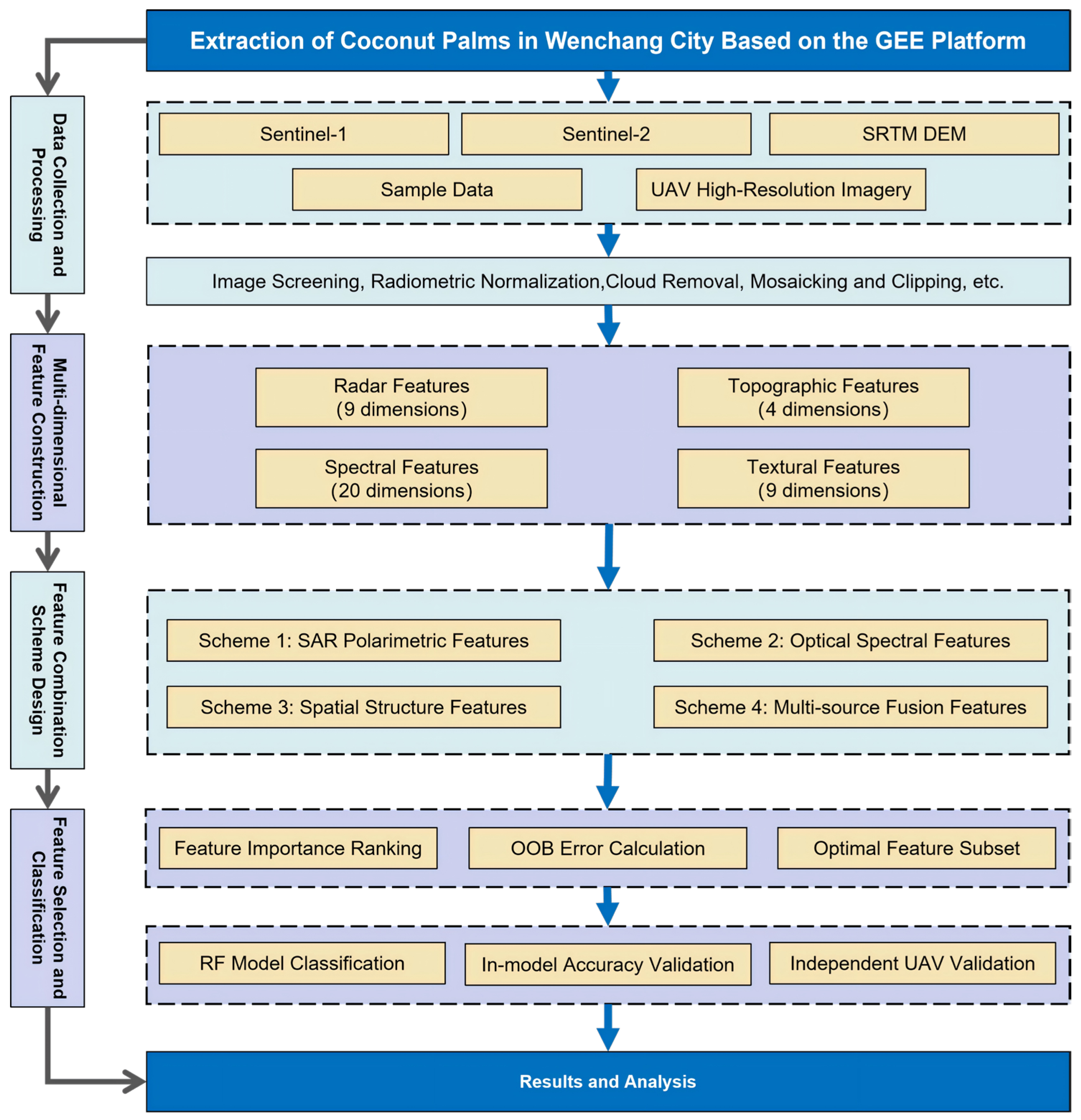
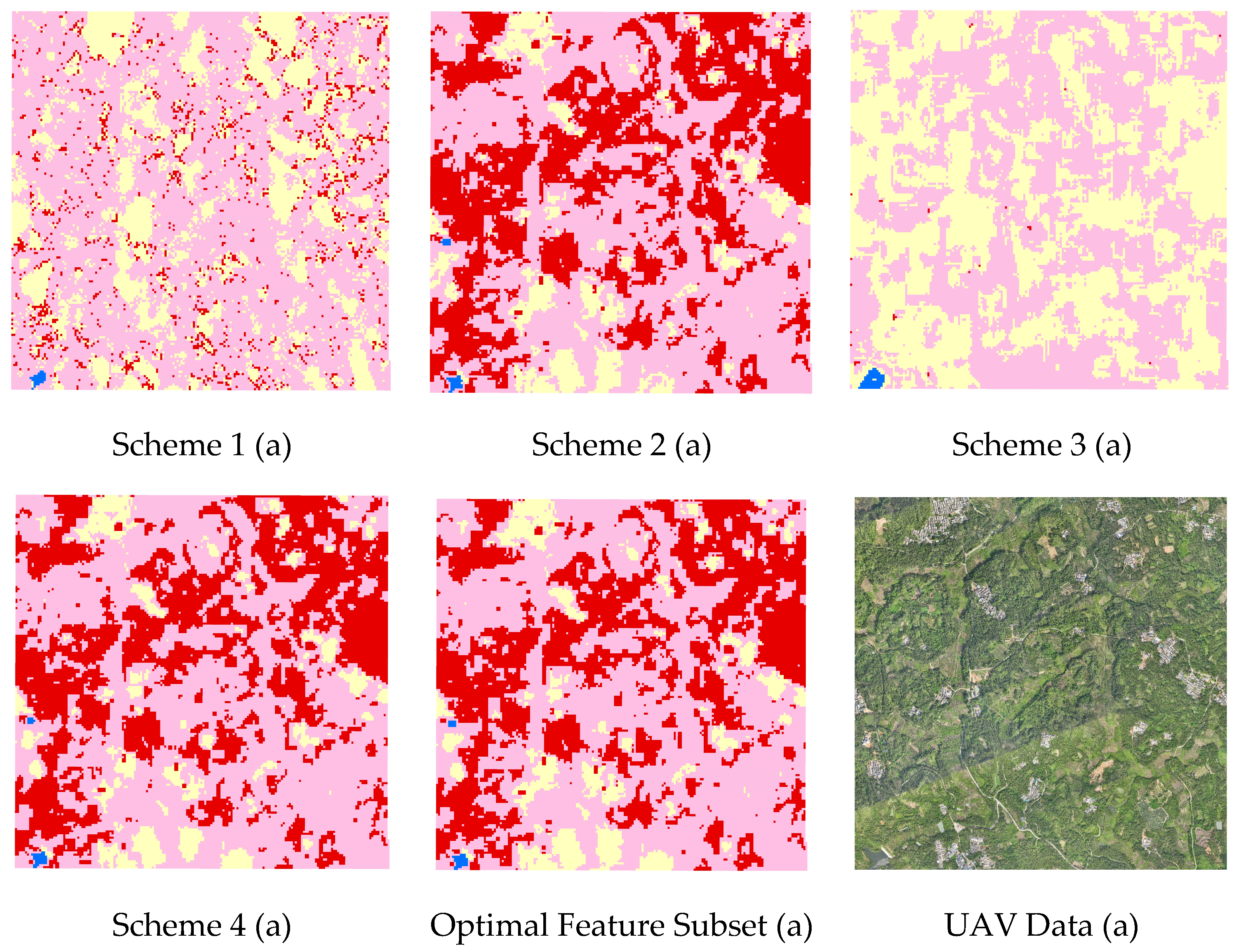
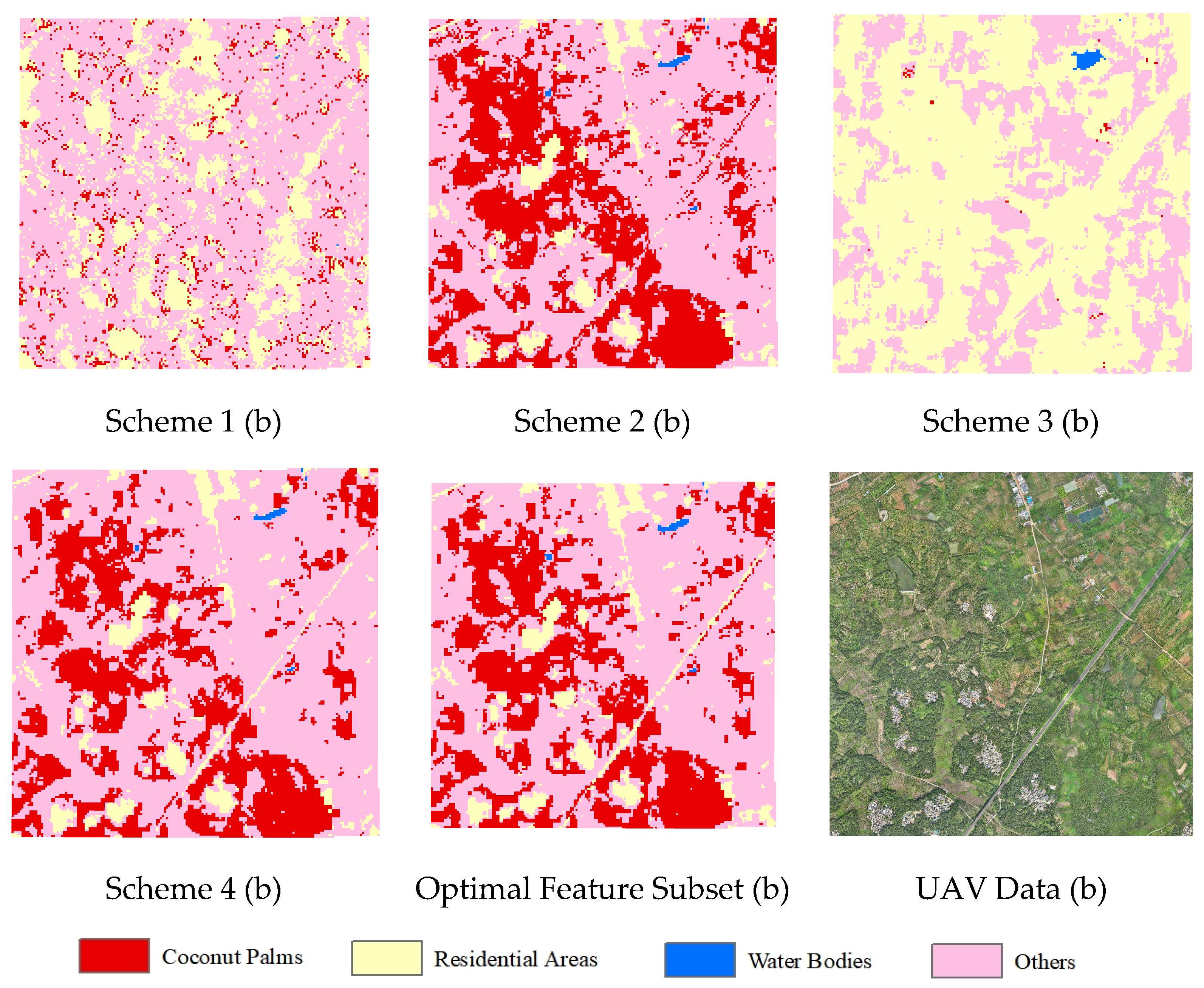
- Scheme 1 (SAR Polarimetric Features): Comprises only the 9-dimensional polarimetric features derived from Sentinel-1, including , , incidence angle, and polarimetric parameters (e.g., Hc, mC). This scheme evaluates microwave remote sensing’s capability to identify coconut palm structural characteristics.
- Scheme 2 (Optical Spectral Features): Includes 20-dimensional spectral features from Sentinel-2, encompassing original spectral bands and vegetation indices. It assesses the spectral discriminative power of optical remote sensing.
- Scheme 3 (Texture and Topographic Features): Integrates 13-dimensional textural and topographic features, consisting of 9-dimensional GLCM textural parameters and 4-dimensional topographic metrics. While Wenchang is predominantly flat, topographic variables were included alongside texture to represent the complete set of spatial and environmental constraints, independent of spectral reflectance. This scheme aims to evaluate how spatial context and environmental context collectively supplement pure spectral information.
- Scheme 4 (Multi-Source Fusion Features): Incorporates all 42-dimensional features of multi-source data, aiming to evaluate the classification performance of multi-dimensional feature synergy.
2.2.4. Feature Selection and Classification
2.2.5. Accuracy Evaluation
3. Results
3.1. Results and Analysis of Feature Selection
3.2. Comparison of Classification Accuracy Among Different Feature Combination Schemes
3.3. Coconut Palm Distribution Extraction Results and Multi-Scale Validation
4. Discussion
4.1. Physical and Biological Interpretations of Feature Mechanisms
4.2. Synergy of Multi-Source Fusion and Comparative Analysis
4.3. Model Robustness and Future Perspectives
5. Conclusions
Author Contributions
Funding
Data Availability Statement
Conflicts of Interest
References
- Yang, Y.; Iqbal, A.; Qadri, R. Breeding of coconut (Cocos nucifera L.): The tree of life. In Advances in Plant Breeding Strategies: Fruits; Springer: Berlin/Heidelberg, Germany, 2018; Volume 3, pp. 673–725. [Google Scholar]
- Xie, Y.; Sha, Z.; Yu, M. Remote sensing imagery in vegetation mapping: A review. J. Plant Ecol. 2008, 1, 9–23. [Google Scholar] [CrossRef]
- Thenkabail, P.S.; Lyon, J.G.; Huete, A. Advances in hyperspectral remote sensing of vegetation and agricultural crops. In Fundamentals, Sensor Systems, Spectral Libraries, and Data Mining for Vegetation; CRC Press: Boca Raton, FL, USA, 2018; pp. 3–37. [Google Scholar]
- Shen, H.; Li, X.; Cheng, Q.; Zeng, C.; Yang, G.; Li, H.; Zhang, L. Missing information reconstruction of remote sensing data: A technical review. IEEE Geosci. Remote Sens. Mag. 2015, 3, 61–85. [Google Scholar] [CrossRef]
- Monsalve-Tellez, J.M.; Torres-León, J.L.; Garcés-Gómez, Y.A. Evaluation of SAR and optical image fusion methods in oil palm crop cover classification using the random forest algorithm. Agriculture 2022, 12, 955. [Google Scholar] [CrossRef]
- Sarzynski, T.; Giam, X.; Carrasco, L.; Lee, J.S.H. Combining radar and optical imagery to map oil palm plantations in Sumatra, Indonesia, using the Google Earth Engine. Remote Sens. 2020, 12, 1220. [Google Scholar]
- Orynbaikyzy, A.; Gessner, U.; Conrad, C. Crop type classification using a combination of optical and radar remote sensing data: A review. Int. J. Remote Sens. 2019, 40, 6553–6595. [Google Scholar]
- McNairn, H.; Champagne, C.; Shang, J.; Holmstrom, D.; Reichert, G. Integration of optical and Synthetic Aperture Radar (SAR) imagery for delivering operational annual crop inventories. ISPRS J. Photogramm. Remote Sens. 2009, 64, 434–449. [Google Scholar] [CrossRef]
- Yang, J.; Xin, Z.; Huang, Y.; Liang, X. Multi-source remote sensing data shows a significant increase in vegetation on the Tibetan Plateau since 2000. Prog. Phys. Geogr. Earth Environ. 2023, 47, 597–624. [Google Scholar] [CrossRef]
- Van Tricht, K.; Gobin, A.; Gilliams, S.; Piccard, I. Synergistic use of radar Sentinel-1 and optical Sentinel-2 imagery for crop mapping: A case study for Belgium. Remote Sens. 2018, 10, 1642. [Google Scholar] [CrossRef]
- Reji, J.; Nidamanuri, R.R. Deep Learning-Based Multi-Sensor Approach for Precision Agricultural Crop Classification Based on Nitrogen Levels. IEEE Geosci. Remote Sens. Lett. 2025, 22, 2502405. [Google Scholar] [CrossRef]
- Liu, N.; Zhao, Q.; Williams, R.; Barrett, B. Enhanced crop classification through integrated optical and SAR data: A deep learning approach for multi-source image fusion. Int. J. Remote Sens. 2024, 45, 7605–7633. [Google Scholar] [CrossRef]
- Belgiu, M.; Drăguţ, L. Random forest in remote sensing: A review of applications and future directions. ISPRS J. Photogramm. Remote Sens. 2016, 114, 24–31. [Google Scholar] [CrossRef]
- Rodriguez-Galiano, V.F.; Ghimire, B.; Rogan, J.; Chica-Olmo, M.; Rigol-Sanchez, J.P. An assessment of the effectiveness of a random forest classifier for land-cover classification. ISPRS J. Photogramm. Remote Sens. 2012, 67, 93–104. [Google Scholar]
- Stromann, O.; Nascetti, A.; Yousif, O.; Ban, Y. Dimensionality reduction and feature selection for object-based land cover classification based on Sentinel-1 and Sentinel-2 time series using Google Earth Engine. Remote Sens. 2019, 12, 76. [Google Scholar] [CrossRef]
- Yang, G.; Wang, J.; Qi, Z. Maize Classification in Arid Regions via Spatiotemporal Feature Optimization and Multi-Source Remote Sensing Integration. Agronomy 2025, 15, 1667. [Google Scholar] [CrossRef]
- Descals, A.; Wich, S.; Szantoi, Z.; Struebig, M.J.; Dennis, R.; Hatton, Z.; Ariffin, T.; Unus, N.; Gaveau, D.L.; Meijaard, E. High-resolution global map of closed-canopy coconut palm. Earth Syst. Sci. Data 2023, 15, 3991–4010. [Google Scholar] [CrossRef]
- Worachairungreung, M.; Kulpanich, N.; Sae-ngow, P.; Thanakunwutthirot, K.; Anurak, K.; Hemwan, P. Classification of Coconut Trees Within Plantations from UAV Images Using Deep Learning with Faster R-CNN and Mask R-CNN. J. Hum. Earth Future 2024, 5, 560–573. [Google Scholar]
- Prabowo, Y.; Nasahara, K.N. Detecting and Counting Coconut Trees in Pleiades Satellite Imagery using Histogram of Oriented Gradients and Support Vector Machine. Int. J. Remote Sens. Earth Sci. 2019, 16, 87–98. [Google Scholar]
- Varghese, A.O.; Suryavanshi, A.; Joshi, A.K. Analysis of different polarimetric target decomposition methods in forest density classification using C band SAR data. Int. J. Remote Sens. 2016, 37, 694–709. [Google Scholar]
- Caiza-Morales, L.; Gómez, C.; Torres, R.; Nicolau, A.P.; Olano, J.M. MANGLEE: A tool for mapping and monitoring MANgrove ecosystem on Google Earth engine—A case study in Ecuador. J. Geovis. Spat. Anal. 2024, 8, 17. [Google Scholar] [CrossRef]
- Wang, Z.; Liu, D.; Wang, M. Mapping main grain crops and change analysis in the West Liaohe River Basin with limited samples based on Google Earth engine. Remote Sens. 2023, 15, 5515. [Google Scholar] [CrossRef]
- Numbisi, F.N.; Van Coillie, F.M.; De Wulf, R. Delineation of cocoa agroforests using multiseason sentinel-1 SAR images: A low grey level range reduces uncertainties in GLCM texture-based mapping. ISPRS Int. J. Geo-Inf 2019, 8, 179. [Google Scholar]
- Valero, S.; Arnaud, L.; Planells, M.; Ceschia, E. Synergy of Sentinel-1 and Sentinel-2 imagery for early seasonal agricultural crop mapping. Remote Sens. 2021, 13, 4891. [Google Scholar]
- Ma, C.; Li, X.; McCabe, M.F. Retrieval of high-resolution soil moisture through combination of Sentinel-1 and Sentinel-2 data. Remote Sens. 2020, 12, 2303. [Google Scholar]
- Guo, F.; Feng, Q.; Yang, S.; Yang, W. Estimation of potato canopy leaf water content in various growth stages using UAV hyperspectral remote sensing and machine learning. Front. Plant Sci. 2024, 15, 1458589. [Google Scholar] [CrossRef]
- Zhang, H.; Li, J.; Gu, C.; Guan, L.; Wang, X.; Mumtaz, F.; Dong, Y.; Zhao, J.; Liu, Q.; Lin, S. The 10m-resolution global leaf chlorophyll content product using Sentinel-2 based on chlorophyll sensitive index CSI. Earth Syst. Sci. Data Discuss. 2025, 2025, 1–23. [Google Scholar] [CrossRef]
- Gan, Y.; Wang, Q.; Matsuzawa, T.; Song, G.; Iio, A. Multivariate regressions coupling colorimetric and textural features derived from UAV-based RGB images can trace spatiotemporal variations of LAI well in a deciduous forest. Int. J. Remote Sens. 2023, 44, 4559–4577. [Google Scholar]
- Fu, Y.; Yang, G.; Song, X.; Li, Z.; Xu, X.; Feng, H.; Zhao, C. Improved estimation of winter wheat aboveground biomass using multiscale textures extracted from UAV-based digital images and hyperspectral feature analysis. Remote Sens. 2021, 13, 581. [Google Scholar] [CrossRef]
- Harfenmeister, K.; Itzerott, S.; Weltzien, C.; Spengler, D. Agricultural monitoring using polarimetric decomposition parameters of sentinel-1 data. Remote Sens. 2021, 13, 575. [Google Scholar] [CrossRef]
- Mandal, D.; Kumar, V.; Ratha, D.; Dey, S.; Bhattacharya, A.; Lopez-Sanchez, J.M.; McNairn, H.; Rao, Y.S. Dual polarimetric radar vegetation index for crop growth monitoring using sentinel-1 SAR data. Remote Sens. Environ. 2020, 247, 111954. [Google Scholar] [CrossRef]
- Mandal, D.; Ratha, D.; Bhattacharya, A.; Kumar, V.; McNairn, H.; Rao, Y.S.; Frery, A.C. A radar vegetation index for crop monitoring using compact polarimetric SAR data. IEEE Trans. Geosci. Remote Sens. 2020, 58, 6321–6335. [Google Scholar] [CrossRef]
- Rau, M.I.; Julzarika, A.; Yoshikawa, N.; Nagano, T.; Kimura, M.; Setiawan, B.I.; Ha, L.T. Application of topographic elevation data generated by remote sensing approaches to flood inundation analysis model. Paddy Water Environ. 2024, 22, 285–299. [Google Scholar] [CrossRef]
- McNairn, H.; Brisco, B. The application of C-band polarimetric SAR for agriculture: A review. Can. J. Remote Sens. 2004, 30, 525–542. [Google Scholar] [CrossRef]
- Freeman, A.; Durden, S.L. A three-component scattering model for polarimetric SAR data. IEEE Trans. Geosci. Remote Sens. 1998, 36, 963–973. [Google Scholar] [CrossRef]
- Ceccato, P.; Flasse, S.; Tarantola, S.; Jacquemoud, S.; Grégoire, J.M. Detecting vegetation leaf water content using reflectance in the optical domain. Remote Sens. Environ. 2001, 77, 22–33. [Google Scholar] [CrossRef]
- Gitelson, A.A.; Viña, A.; Ciganda, V.S.; Rundquist, D.C.; Arkebauer, T.J. Remote estimation of canopy chlorophyll content in crops. Geophys. Res. Lett. 2005, 32, L08403. [Google Scholar] [CrossRef]
- Haralick, R.M.; Shanmugam, K.; Dinstein, I. Textural features for image classification. IEEE Trans. Syst. Man Cybern. 1973, SMC-3, 610–621. [Google Scholar] [CrossRef]



| Feature Category | Feature Factors | Formula Expression |
|---|---|---|
| Spectral Features | Band Features: B2, B3, B4, B5, B6, B7, B8, B8A, B11, B12. Vegetation index features: NDVI (Normalized Difference Vegetation Index), NDWI (Normalized Difference Water Index), EVI (Enhanced Vegetation Index), GNDVI (Green Normalized Difference Vegetation Index), SAVI (Soil-Adjusted Vegetation Index), GCI (Green Chlorophyll Index), DVI (Difference Vegetation Index), GDVI (Green Difference Vegetation Index), Chlorophyll (chlorophyll content), CWI(Canopy Water Index) [24,25,26,27]. | |
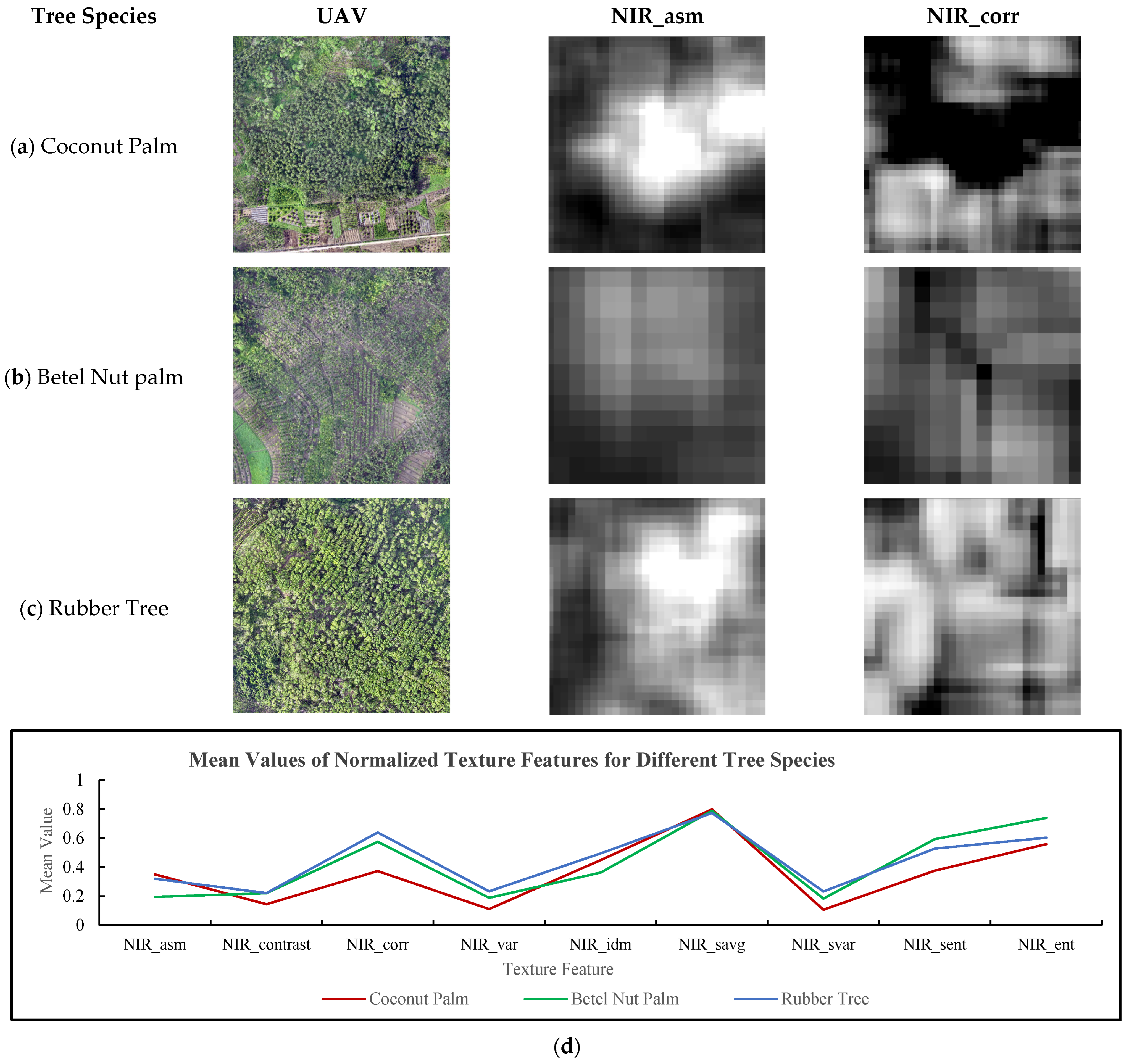
| Textural Features | NIR_asm (Angular Second Moment), NIR_contrast (Contrast), NIR_corr (Correlation), NIR_var (Variance), NIR_idm (Inverse Difference Moment), NIR_savg (Sum Average), NIR_svar (Sum Variance), NIR_sent (Sum Entropy), NIR_ent (Entropy) [28,29]. | |
| Radar Features | Backscattering features: (VV-polarized backscattering coefficient), (VH-polarized backscattering coefficient) [30]. Polarimetric decomposition features: θC (the pseudo scattering-type parameter), HC (the pseudo scattering entropy parameter), mC (the co-pol purity parameter), DpRVIc (Dual-polarimetric radar vegetation index), Class (scattering classification class), Ratio (polarization ratio), Inc (Incidence angle) [31,32]. | |
| Topographic Features | Elevation, Slope, Aspect, Hillshade [33]. |
| Rank | Feature Name | Feature Importance | Rank | Feature Name | Feature Importance | Rank | Feature Name | Feature Importance |
|---|---|---|---|---|---|---|---|---|
| 1 | CWI | 183.292 | 6 | B3 | 152.699 | 11 | B7 | 148.375 |
| 2 | GCI | 162.476 | 7 | B12 | 152.389 | 12 | NIR_contrast | 147.841 |
| 3 | 155.104 | 8 | B4 | 150.823 | 13 | B11 | 145.831 | |
| 4 | B2 | 154.035 | 9 | GNDVI | 150.166 | 14 | B6 | 141.353 |
| 5 | Inc | 153.743 | 10 | B5 | 149.983 | 15 | NIR_asm | 139.392 |
| Scheme Type | Feature Dimension | OA (%) | Kappa Coefficient | PA (%) [Coconut Palms/Residential Areas/Water Bodies/Others] | UA (%) [Coconut Palms/Residential Areas/Water Bodies/Others] |
|---|---|---|---|---|---|
| Scheme 1 (SAR Polarimetric Features) | 9 | 87.09 | 0.8143 | 69.70/83.45/94.37/93.24 | 85.98/87.88/95.04/84.15 |
| Scheme 2 (Optical Spectral Features) | 20 | 91.86 | 0.8834 | 83.33/90.29/96.45/94.32 | 90.91/94.72/97.84/88.13 |
| Scheme 3 (Texture and Topographic Features) | 13 | 84.82 | 0.7816 | 66.67/83.09/93.66/89.19 | 88.89/81.34/93.66/83.12 |
| Scheme 4 (Multi-Source Fusion) | 42 | 92.51 | 0.8928 | 87.12/89.93/95.74/95.14 | 92.00/95.79/97.83/88.66 |
| Optimal Feature Subset (RF-OOB Selected) | 15 | 92.83 | 0.8975 | 87.12/91.01/95.74/95.14 | 92.74/94.76/97.83/89.80 |
| Reference (UAV)/Classification Result | Coconut Palms | Residential Areas | Water Bodies | Others | Total |
|---|---|---|---|---|---|
| Coconut Palms | 131 | 1 | 1 | 14 | 147 |
| Residential Areas | 0 | 84 | 1 | 5 | 90 |
| Water Bodies | 0 | 0 | 68 | 0 | 68 |
| Others | 4 | 16 | 9 | 185 | 214 |
| Total | 135 | 101 | 79 | 204 | 519 |
Disclaimer/Publisher’s Note: The statements, opinions and data contained in all publications are solely those of the individual author(s) and contributor(s) and not of MDPI and/or the editor(s). MDPI and/or the editor(s) disclaim responsibility for any injury to people or property resulting from any ideas, methods, instructions or products referred to in the content. |
© 2025 by the authors. Licensee MDPI, Basel, Switzerland. This article is an open access article distributed under the terms and conditions of the Creative Commons Attribution (CC BY) license.
Share and Cite
Wen, T.; Wang, N.; Yao, X.; Li, C.; Bi, W.; Li, X.-M. A Multi-Source Remote Sensing Identification Framework for Coconut Palm Mapping. Remote Sens. 2026, 18, 102. https://doi.org/10.3390/rs18010102
Wen T, Wang N, Yao X, Li C, Bi W, Li X-M. A Multi-Source Remote Sensing Identification Framework for Coconut Palm Mapping. Remote Sensing. 2026; 18(1):102. https://doi.org/10.3390/rs18010102
Chicago/Turabian StyleWen, Tingting, Ning Wang, Xiaoning Yao, Chunbo Li, Wenkai Bi, and Xiao-Ming Li. 2026. "A Multi-Source Remote Sensing Identification Framework for Coconut Palm Mapping" Remote Sensing 18, no. 1: 102. https://doi.org/10.3390/rs18010102
APA StyleWen, T., Wang, N., Yao, X., Li, C., Bi, W., & Li, X.-M. (2026). A Multi-Source Remote Sensing Identification Framework for Coconut Palm Mapping. Remote Sensing, 18(1), 102. https://doi.org/10.3390/rs18010102