Article

High-Accuracy Identification of Cropping Structure in Irrigation Districts Using Data Fusion and Machine Learning

1
College of Water Sciences, Beijing Normal University, Beijing 100875, China
2
College of Energy and Environment, Inner Mongolia University of Science and Technology, Baotou 014010, China
*
Author to whom correspondence should be addressed.
Remote Sens. 2026, 18(1), 101; https://doi.org/10.3390/rs18010101 (registering DOI)
Submission received: 4 November 2025 / Revised: 17 December 2025 / Accepted: 25 December 2025 / Published: 27 December 2025

Highlights

What are the main findings?
  • Tri-source spatiotemporal fusion reduces cloud-related data gaps and sharpens field boundaries.
  • Anchor-date NDVI is the dominant predictor for crop separation.
What are the implications of the main findings?
  • Enables reliable field-scale crop mapping in heterogeneous farmland.
  • Phenology-encoded features improve accuracy and show potential for cross-regional transferability.

Abstract

Persistent cloud cover during the growing season and mosaic cropping patterns introduce temporal gaps and mixed pixels, undermining the reliability of large-scale crop identification and acreage statistics. To address these issues, we develop a high spatiotemporal-resolution remote-sensing approach tailored to heterogeneous farmlands. First, an improved Spatiotemporal Adaptive Reflectance Fusion Model (STARFM) is used to fuse Landsat, Sentinel-2, and MODIS observations, reconstructing a continuous Normalized Difference Vegetation Index (NDVI) time series at 30 m spatial and 8-day temporal resolution. Second, at the field scale, we derive phenological descriptors from the reconstructed series—key phenophase timing, amplitude, temporal trend, and growth rate—and use a Random Forest (RF) classifier for detailed crop discrimination. We further integrate SHapley Additive exPlanations (SHAP) to quantify each feature’s class-discriminative contribution and signed effect, thereby guiding feature-set optimization and threshold refinement. Finally, we generate a 2024 crop distribution map and conduct comparative evaluations. Relative to baselines without fusion or without phenological variables, the fused series mitigates single-sensor limitations under frequent cloud/rain and irregular acquisitions, enhances NDVI continuity and robustness, and reveals inter-crop temporal phase shifts that, when jointly exploited, reduce early-season confusion and improve identification accuracy. Independent validation yields an overall accuracy (OA) of 90.78% and a Cohen’s kappa(κ) coefficient of 0.882. Coupling dense NDVI reconstruction with phenology-aware constraints and SHAP-based interpretability demonstrably improves the accuracy and reliability of cropping-structure extraction in complex agricultural regions and provides a reusable pathway for regional-scale precision agricultural monitoring.

1. Introduction

Agriculture underpins human livelihoods and social stability. The crop planting structure directly affects food security, agricultural profitability, and environmental carrying capacity, making it a critical lever for high-quality agricultural development [1,2,3].
Accurately characterizing the spatial patterns and temporal evolution of crops within irrigation districts is essential for farmland protection, water allocation, and pest and disease control [4,5]. However, conventional statistical yearbooks and field campaigns are constrained by limited timeliness and spatial coverage. With growing attention to agricultural system resilience and climate adaptation, there is a pressing need for a crop-identification framework that combines spatiotemporal continuity with fine-scale detail to support operational monitoring and refined management [6].
Satellite remote sensing offers a low-cost, high-accuracy means of near-real-time monitoring and has become a key approach for crop identification from irrigation-district to field scales [7,8,9]. Spatiotemporal data fusion methods integrate complementary spectral, spatial, and temporal information from multi-source satellites to jointly achieve high spatial and temporal resolution. Among them, the Spatial and Temporal Adaptive Reflectance Fusion Model (STARFM) is one of the most widely used weighting-function-based fusion models [10]. Although STARFM has been widely applied to crop mapping, it can yield over-smoothed signals and blocky artifacts in heterogeneous farmlands or during rapid phenological transitions.
To address these limitations, Zhu et al. proposed the Enhanced STARFM (ESTARFM) method, which produces more stable fusion results and better preserves spatial detail in areas undergoing rapid or abrupt changes, although it requires higher-quality and more frequent high-resolution observations [11]. Subsequent approaches—such as Flexible Spatiotemporal Data Fusion (FSDAF) and the Spatial-Temporal Non-Local Filter-Based Fusion Model (STNLFFM)—further enhance robustness to field-scale heterogeneity and mixed pixels, yet they often incur higher computational cost, parameter sensitivity, and residual smoothing [12,13]. Consequently, constructing a high-spatiotemporal-resolution series that preserves within-field consistency while retaining key phenological windows is considered crucial for reliable feature engineering and classification [14].
Beyond algorithm choice, the fusion strategy also matters. In band-before-index (BI) workflows, surface reflectance is fused and indices are computed afterward; in index-before-fusion (IB) workflows, indices are computed on each sensor first and then fused. Studies have compared these strategies for various indices: Jarihani et al. found IB superior for vegetation indices using STARFM and ESTARFM [15]; Chen et al. analyzed error propagation in Normalized Difference Vegetation Index (NDVI) fusion and showed that the computation order alters how errors are amplified [16]. Conversely, Li et al. demonstrated that BI can effectively preserve fine-grained spatial detail within field boundaries [17]. Guided by this evidence, we prioritize the IB strategy in our multi-source data processing
For the classifier, we adopt Random Forest (RF) as a robust and interpretable baseline. Compared with more complex models requiring extensive hyperparameter tuning, RF handles nonlinear relationships and feature collinearity, tolerates missing data and outliers, and performs well with limited samples. It also offers inherent interpretability via out-of-bag (OOB) error estimates and feature-importance scores, facilitating integration with prior knowledge such as phenological windows and object-based constraints, which establishes it as a stable and widely applicable baseline method in remote sensing [18,19,20].
In summary, crop identification and regional crop distribution mapping remain challenging under complex planting mosaics and frequent observation gaps. To ad-dress these gaps, particularly during cloudy seasons and in heterogeneous irrigated farmlands, this study improves upon current methods in three aspects. First, we con-struct and quality-control a continuous 30 m, 8-day NDVI series via tri-source fusion of Landsat, Sentinel-2, and MODIS, and quantitatively demonstrate gains over native MODIS and single-date Landsat/Sentinel-2 products in boundary sharpness, temporal continuity, and peak fidelity. Second, we develop a phenology-based feature set that combines anchor-date NDVI with curve-shape operators and benchmark its discriminative advantage against generic time-series features. Third, we employ SHapley Ad-ditive exPlanations (SHAP) to quantify the contributions and interactions of temporal and morphological features and to diagnose interclass temporal misalignment [21]. Collectively, these contributions address important gaps and enable reliable regional crop monitoring.

2. Materials and Methods

2.1. Study Area

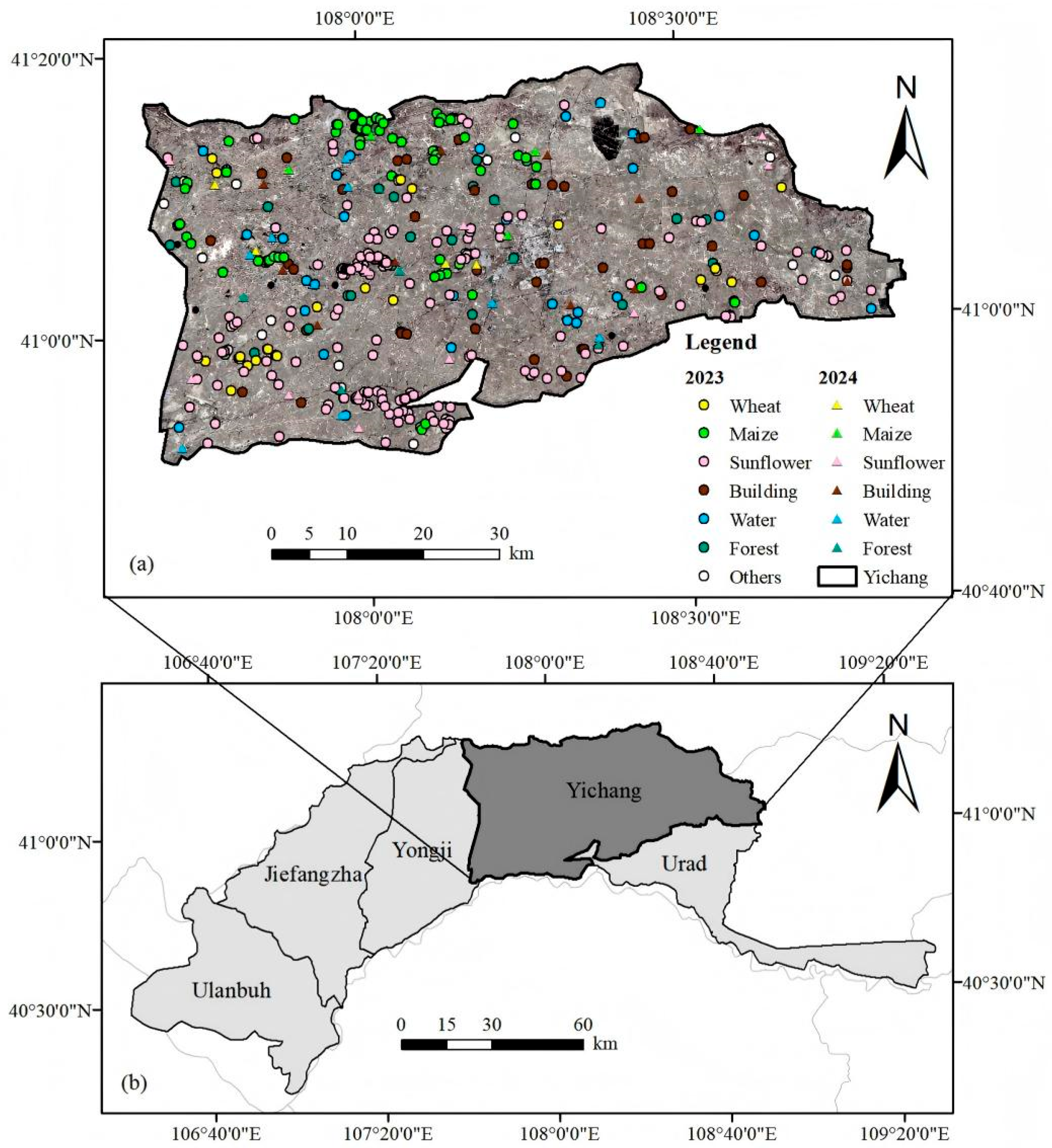
The Yichang Irrigation District (YCID; Figure 1b) is situated in the central Hetao Plain of the middle Yellow River region and represents the largest sub-district within the Inner Mongolia Hetao Irrigation Area. It is bordered by the Yongji Irrigation District to the west, the northern shore of Lake Wuliangsuhai to the east, the Yellow River to the south, and the Yinshan Mountains to the north, covering approximately 3352.5 km2. The region experiences a mid-temperate continental climate characterized by aridity, low precipitation, high evaporation rates, and rainfall primarily concentrated from July to September. Dominant crops include sunflower, maize, and wheat [22]. To evaluate the climatic comparability of the two study years, we extracted April–October 2 m air temperature and total precipitation from ERA5, together with MODIS NDVI, over the YCID. The seasonal mean air temperature was very similar between 2023 and 2024 (19.09 °C vs. 18.84 °C), and the seasonal mean MODIS NDVI was also comparable (0.326 vs. 0.346), with consistent timing of green-up, peak greenness, and senescence. Although cumulative precipitation was higher in 2024 than in 2023 (483 mm vs. 151 mm), this difference did not lead to a marked shift in vegetation dynamics, likely because irrigation attenuates the direct impact of rainfall variability on crop growth in this large irrigation district. Overall, the two growing seasons exhibit similar phenological conditions, which supports the use of 2023–2024 cross-year validation in the classification experiment.
Within YCID, cropland types are diverse and field sizes vary considerably, forming a typical heterogeneous farmland landscape. A dense irrigation canal network, together with the interlacing of small fragmented plots and larger contiguous fields and the coexistence of multiple cropping patterns, leads to pronounced spatial heterogeneity in surface characteristics, crop phenology, and spectral time series. Owing to this typical farmland heterogeneity, the rich combination of crop types, and the well-developed canal system, YCID provides an ideal testbed for assessing the stability of multi-source fusion and the accuracy of crop growth information retrieval in this study. The spatial distribution of reference samples within YCID is shown in Figure 1a.

2.2. Data Sources

2.2.1. Satellite Data

All satellite datasets were accessed and processed in the Google Earth Engine (GEE) cloud platform. Inputs included MODIS daily surface reflectance MOD09GA (Collection 6.1), Landsat surface reflectance (Collection 2, Level-2: Landsat-5 TM, Landsat-7 ETM+, Landsat-8/9 OLI), and Sentinel-2 MSI Level-2A data. Although Landsat-5 and Landsat-7 are no longer fully operational, their multi-decadal archives are essential for maintaining long-term, multi-year temporal continuity and for reducing gaps in the Landsat–Sentinel-2 NDVI time series required by the phenology-oriented fusion framework. All datasets covering the 2023 and 2024 growing seasons (April–October) were processed for subsequent analyses.
To mitigate cloud and snow contamination, we applied sensor-specific masks using the quality-assurance (QA) bands in GEE (0-based bit indexing). For MODIS, the state_1km QA band was used to remove observations with cloud state = 1 (bits 0–1) and with cirrus confidence ≥ 2 (bits 8–9). For Landsat, the QA_PIXEL band was used to mask clouds (bit 3 = 1), cirrus (bit 2 = 1), cloud shadows (bit 4 = 1), and snow (bit 5 = 1). For Sentinel-2, cloud screening combined QA60 and the Scene Classification Layer (SCL); pixels flagged as cloud (QA60 bit 10 = 1) or cirrus (QA60 bit 11 = 1) and those classified as SCL = 9 (high-probability cloud), SCL = 10 (thin cirrus), or SCL = 11 (snow/ice) were excluded. All masks were applied prior to compositing, resampling to 30 m, and fusion, and the bit tests were implemented with GEE bitwise operators to ensure reproducibility.
For all sensors, NDVI was computed from red and near-infrared reflectance: Landsat-5/7 (B3, 0.63–0.69 µm; B4, 0.76–0.90 µm), Landsat-8/9 (B4, 0.64–0.67 µm; B5, 0.85–0.88 µm), Sentinel-2 (B4, 0.64–0.67 µm; B8, 0.78–0.90 µm), and MODIS (band 1, 0.62–0.67 µm; band 2, 0.84–0.88 µm). The resulting NDVI time series served as the basic inputs for fusion and classification.

2.2.2. Sampling Data

Field sample points were collected in situ using the Ovitalmap mobile mapping application (v10.4.0) with an integrated dual-system Global Navigation Satellite System (GNSS) receiver (GPS and BeiDou). For each point, latitude–longitude coordinates and the land use/land-cover (LULC) class were recorded, following a seven-class scheme comprising wheat, maize, sunflower, building, water, forest, and other land. To improve positional reliability, operators paused briefly at each location to allow GNSS convergence, and all points subsequently underwent quality control against high-resolution imagery and parcel boundaries; samples with evident positional or labeling uncertainty were removed.
To address class imbalance and local spatial autocorrelation within the training data, we applied a spatial augmentation strategy. This procedure generated additional samples by randomly resampling within small buffer zones around the original field locations, while strictly preserving the original land-cover labels. Crucially, this augmentation was performed separately for each year’s dataset. After quality control, the 2023 and 2024 datasets were augmented independently, resulting in 2508 samples for model training and 312 samples for independent validation, respectively. This year-specific approach ensures that no spatial proximity or autocorrelation is introduced between the training and validation sets.
The 2023 dataset comprised 174 wheat, 636 maize, 1044 sunflower, 174 building, 264 water, 132 forest, and 84 other-land points, whereas the 2024 dataset included 24 wheat, 36 maize, 66 sunflower, 78 building, 66 water, and 42 forest points. These labeled samples provided the basis for the subsequent fusion-based classification and accuracy assessment.

2.3. Methods

2.3.1. Multisource Remote-Sensing Data Fusion

STARFM assumes that changes in homogeneous pixels are consistent over short periods and can be approximated by a linear model. STARFM uses a Landsat–MODIS image pair acquired before or after the prediction date, together with a MODIS image on the prediction date, to derive weights and transformation coefficients based on spectral similarity, spatial proximity, and temporal difference. It then simulates Landsat-like surface reflectance on the target date, enabling reconstruction of a 30 m NDVI time series at 16-day resolution.
Building on this model, we enhance the classical STARFM framework by integrating the Landsat series (Landsat-5 TM, Landsat-7 ETM+, and Landsat-8/9 OLI) and Sentinel-2 MSI as high-resolution (HR) inputs, with MODIS MOD09GA as the low-resolution (LR) driver. In this multi-HR setting, Landsat and Sentinel-2 are treated as interchangeable HR anchors on the same 30 m grid after harmonized preprocessing, so that whichever sensor provides valid observations within the window can contribute to the anchor scene. The objective was to reconstruct a 30 m, 8-day phenology-level NDVI time series that preserves biologically meaningful temporal dynamics across key crop growth stages, including the onset of green-up, the peak canopy greenness, and the senescence transition. A sequence of target dates was generated at 8-day intervals throughout the study period. For each target date t , a ±8-day temporal window was defined. When HR observations were available within this window, the median of the HR NDVI values was computed as the reference scene. Concurrently, the median MODIS NDVI was calculated for both the reference and target windows. The difference between MODIS medians in the reference versus target windows is then used as the temporal change signal that captures the dominant short-term NDVI evolution and is transferred onto the HR anchor to generate the 30 m prediction at date t. To ensure precise spatial alignment, MODIS NDVI was bilinearly resampled and reprojected to a 30 m grid, whereas categorical QA layers used nearest-neighbor to avoid label mixing. STARFM relies on Landsat/Sentinel-2 anchors for spatial detail, so LR sampling does not synthesize high-frequency textures.
The NDVI change between the target and reference windows in the MODIS data, which reflects consistent regional phenological change, was transferred to the HR reference image to generate the fused 30 m estimate for date t . The fusion process is formulated as follows:
L r e f t = M e d [ t W 2     , t + W 2 ] L
M r e f t = U ( M e d t W 2     , t + W 2 M )
M t a r t = U ( M e d t     , t + Δ M )
where L r e f is HR reference NDVI, M r e f is LR reference NDVI, t is target date, M e d · is window median, W is HR reference-window width, U { · } is resample MODIS to the target grid, L t a r is HR NDVI on the target date t , M t a r is LR NDVI on the target date t .
In cases where no HR observations were available within the window, linear interpolation of MODIS NDVI from adjacent dates was applied to maintain temporal continuity. To further suppress pixel-level noise in the MODIS data, we implemented superpixel-level smoothing. Specifically, the Simple Non-Iterative Clustering (SNIC) algorithm was used to segment the median Sentinel-2 NDVI composite from June to August. Median smoothing was then performed within each connected superpixel region, effectively reducing sawtooth fluctuations and speckle noise caused by thin clouds or calibration residuals, thereby achieving robust smoothing within homogeneous image objects.
The final fused NDVI at the target date was calculated as:
D t = S c [ M t a r t M r e f t ]
L t a r t = L r e f t + D ( t )
where S c { · } represents the superpixel-level smoothing operator, and D t is the transferred NDVI difference derived from MODIS.

2.3.2. NDVI Time-Series Construction

We reconstructed a season-long NDVI record for the principal crops across the full growing season, ensuring adequate temporal density and consistency for downstream feature engineering and classification. We adopted an index-based (IB) strategy in which NDVI, precomputed from each sensor’s red and near-infrared reflectance bands (see Section 2.2.1), served as the sole input variable to STARFM. Using NDVI rather than reflectance bands ensures cross-sensor consistency and allows STARFM to perform spatiotemporal weighting and difference transfer directly on a phenology-sensitive index. A three-point moving average filter was applied to each NDVI time series to mitigate noise and its potential impact on classification accuracy. Finally, the reconstructed NDVI images for each date were stacked chronologically into a multi-band time-series data cube, which served as the consistent input basis for subsequent feature extraction and classification modeling.

2.3.3. Random Forest Classification

For the supervised classification, we employed an RF classifier. RF, introduced by Breiman [23], is an ensemble learning method that bases its predictions on multiple decision trees, combining bootstrap aggregation (bagging) with the random subspace method. Our classifier was configured with 500 trees to ensure model stability. The model was trained using 11 phenological features derived from the 30 m/8-day NDVI time-series data cube (see Section 3.2) to discriminate among seven major LULC classes: wheat, maize, sunflower, water, building, forest, and other land.
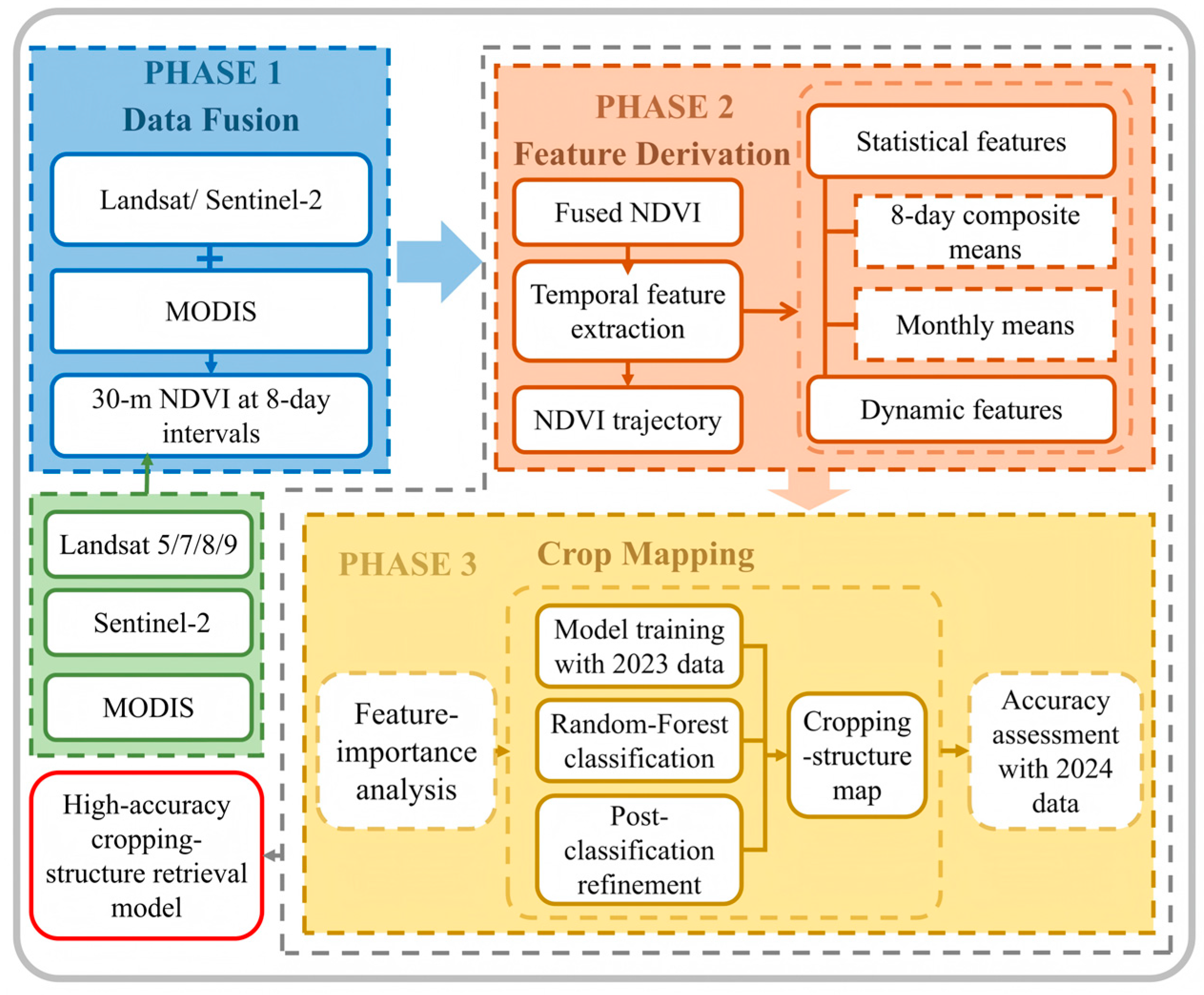
Model performance was preliminarily diagnosed using the OOB error and a confusion matrix. Final validation was conducted using an independently collected sample set from a different year (2024), reporting overall accuracy (OA) and kappa. Furthermore, we utilized SHAP analysis in Python (v3.13) with the shap package (v0.48.0) to quantify the marginal contribution and effect direction (positive/negative) of each input feature at both global and local levels. This interpretability analysis guided an iterative process of feature selection and refinement. The final, robust RF model was subsequently applied to generate the 2024 crop distribution map for the study area. The general workflow of the study is shown in Figure 2.

3. Results

3.1. NDVI Time-Series Characteristics of Crops

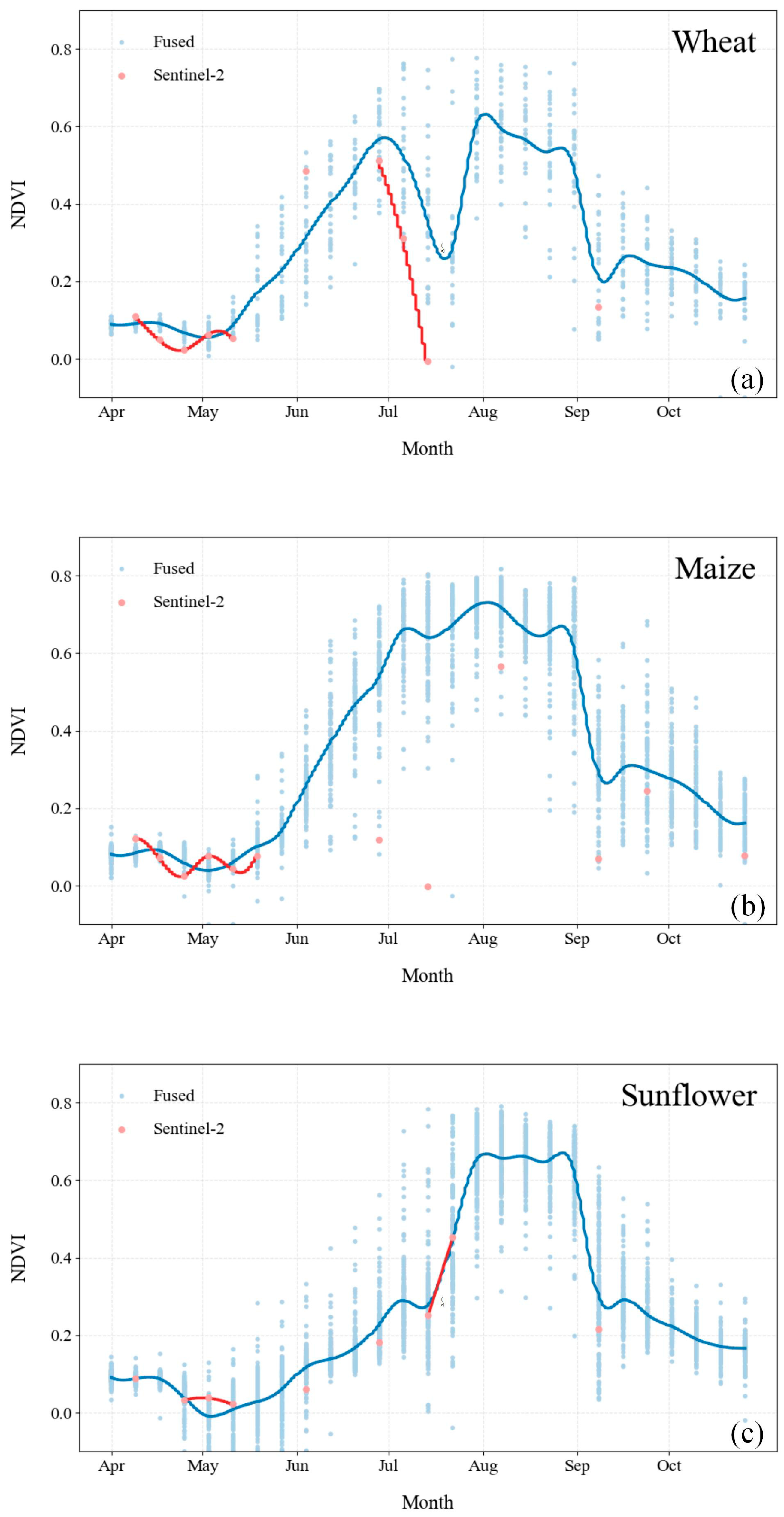
Using the 2023 field-labeled samples, we assembled crop-specific NDVI trajectories. Leveraging the 30 m/8-day series reconstructed via Landsat–Sentinel-2–MODIS fusion, these trajectories exhibit enhanced temporal continuity relative to Sentinel-2 alone, with fewer cloud-induced gaps and reduced spurious fluctuations while preserving peak magnitude and timing (Figure 3a–c).
Wheat enters its vigorous growth phase earliest among the three crops. NDVI rises rapidly beginning in May and reaches its annual peak in late June during heading. Following maturation and harvest in mid-to-late July, NDVI declines sharply due to soil exposure. In some fields, subsequent replanting leads to a secondary increase in NDVI during August. Maize emerges in May and enters a rapid growth phase in June, with NDVI increasing steadily and reaching high values by July. A sustained high-value plateau is maintained through July–August before gradually declining. This prolonged plateau is a key phenological signature that distinguishes maize from the other crops. Sunflower exhibits a comparatively delayed development pattern. NDVI remains low in June, increases sharply after bud formation in mid-July, and reaches its peak in August, followed by a shorter plateau phase.
Across the critical June–August window, the three crops display distinct NDVI temporal trajectories: wheat is characterized by an early and short-lived peak followed by a rapid decline; maize shows a later rise with an extended high-value plateau and a gradual decrease; and sunflower presents the latest onset of vigorous growth, a steeper ascent, and a shorter plateau. These contrasting phenological signatures provide clear separability among crop types and enable reliable identification of crop growth stages for mapping planting structure and reconstructing spatiotemporal crop distributions.
Wheat enters its rapid growth stage earliest: the NDVI value rises rapidly from May, reaches its annual peak in late June during the heading stage, and then drops sharply in mid- to late July following maturity and harvest, as bare soil is exposed. To improve agricultural land use efficiency, some fields are replanted with other crops after harvest, leading to a secondary NDVI rebound in August. Maize emerges in May, enters a period of rapid growth in June, and attains high NDVI levels in July; a sustained high-value plateau throughout July–August is a key characteristic distinguishing it from other crops. Sunflower starts its growth cycle later than the other two crops, maintaining relatively low NDVI values in June. The curve slope increases significantly from mid-July after budding, and peaks in August.
In summary, the NDVI time-series curves of the three crops show distinct patterns during the critical June–August window: wheat is characterized by an early peak, short duration, and abrupt decline; maize exhibits a later onset, long plateau, and gradual retreat; and sunflower demonstrates the latest onset, steepest slope, and shorter plateau. These distinctive phenological signatures allow for accurate discrimination of different crops and their growth stages, thereby providing robust support for mapping planting structures.
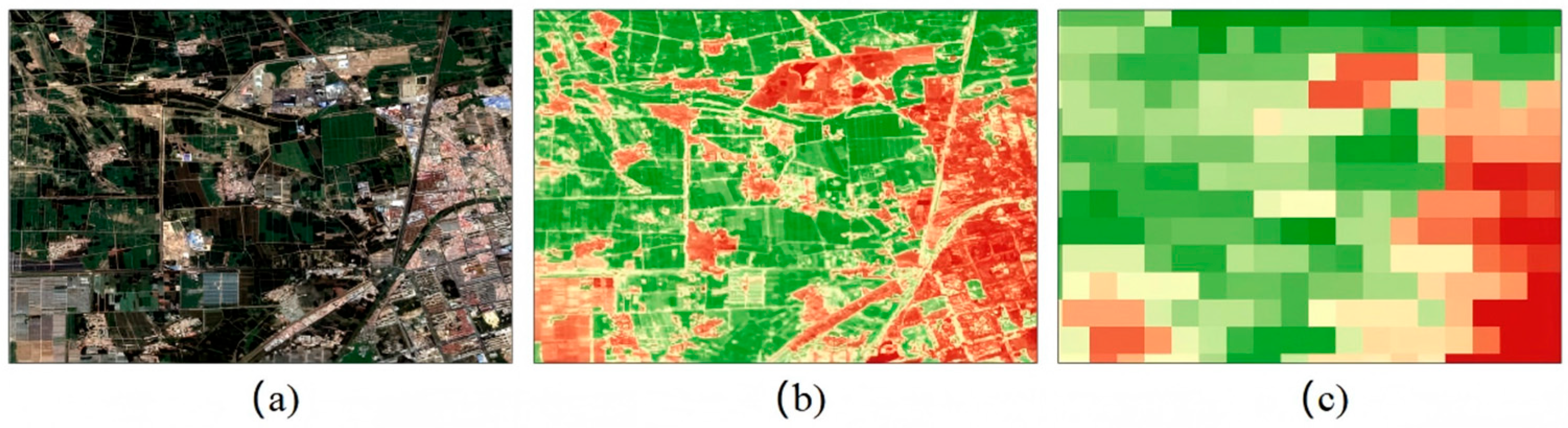
Figure 4 illustrates the spatial performance of the fused NDVI product relative to both the HR reference and the LR MODIS baseline. Compared with the Sentinel-2 true-color image (Figure 4a), the fused NDVI (Figure 4b) effectively delineates field parcels, roads, and settlements, and the urban–farmland transition closely follows the actual landscape boundary. Relative to the 500 m MODIS NDVI (Figure 4c), the fused product sharpens parcel boundaries and within-field heterogeneity while preserving the large-scale vegetation patterns and regional gradients present in MODIS. It also ensures smooth variation in NDVI values across irrigation blocks and field clusters, which effectively minimizes artifacts and maintains spatial continuity along parcel boundaries or within homogeneous cropland. Overall, the STARFM-based fusion transfers high-frequency spatial detail from the HR sensors while maintaining the radiometric and temporal consistency of the MODIS time series, thereby providing reliable inputs for field-scale crop mapping and change detection.

3.2. SHAP-Based Analysis of Feature Importance

This study used a Random Forest classifier for crop-type mapping, trained with 11 NDVI-derived features that describe both curve morphology and phenological anchor points: NDVI_std, NDVI_slope, NDVI_m06, NDVI_0527, NDVI_0612, NDVI_0620, NDVI_0628, NDVI_0706, NDVI_0714, NDVI_0730, and NDVI_0807.
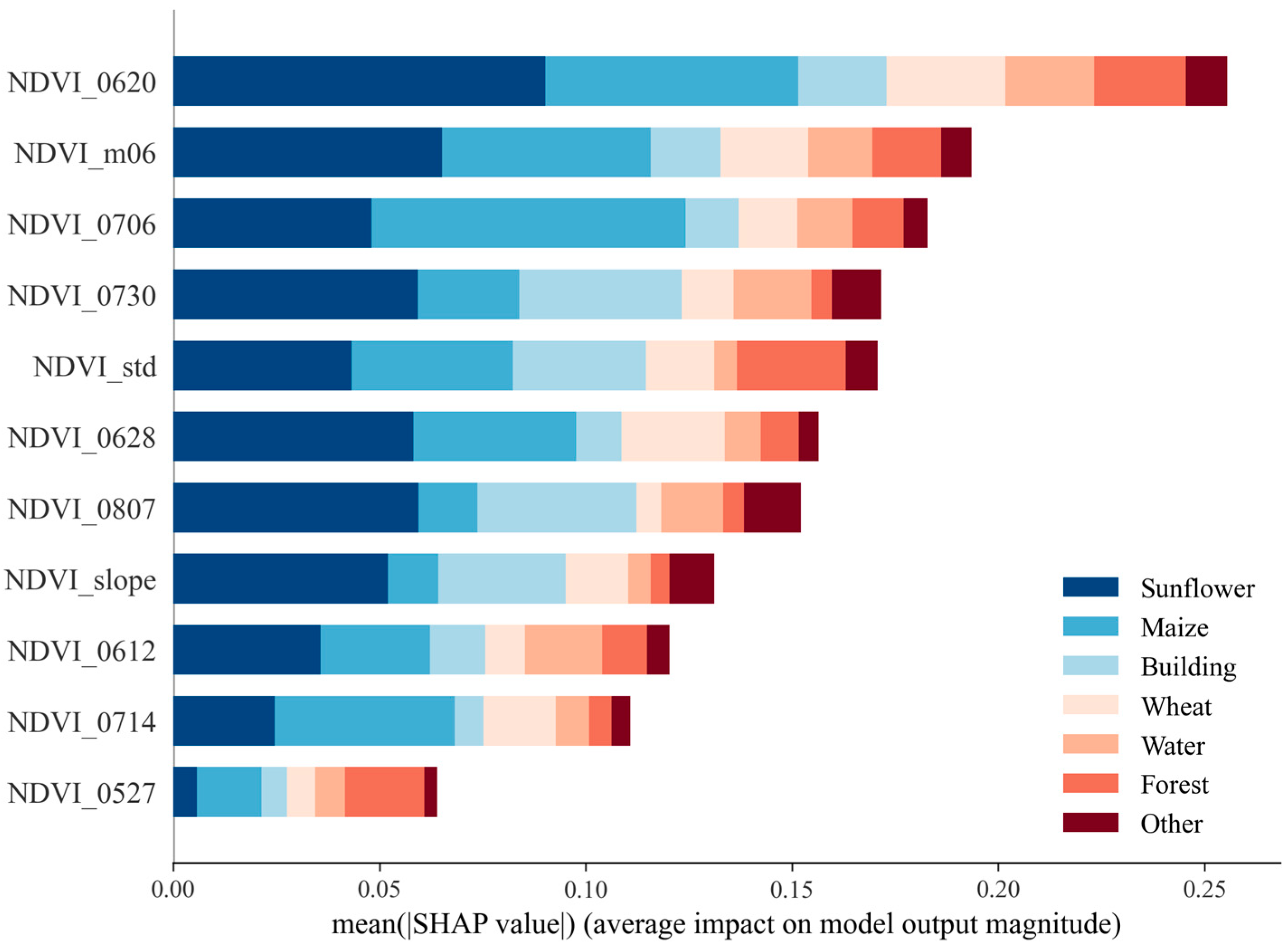
As shown in Figure 5, the stacked mean SHAP values indicate that NDVI_0620, NDVI_0628, NDVI_0706, and NDVI_m06 are the dominant contributors to class separability, highlighting the importance of late-June to early-July conditions and the June mean. NDVI_std shows relatively uniform contributions across crop types, acting as a general indicator of temporal variability rather than a class-specific feature. Non-agricultural classes exhibit distinct patterns: building and other land show higher contributions from NDVI_0730 and NDVI_0807, while forest and water are more strongly influenced by early-season anchors such as NDVI_0612 and NDVI_0620. NDVI_0714 further supports the separation between maize and wheat, whereas NDVI_slope provides moderate additional information by capturing overall green-up rates. By contrast, NDVI_0527 has the lowest importance and contributes mainly to non-agricultural classes, indicating limited utility for early-season crop discrimination.
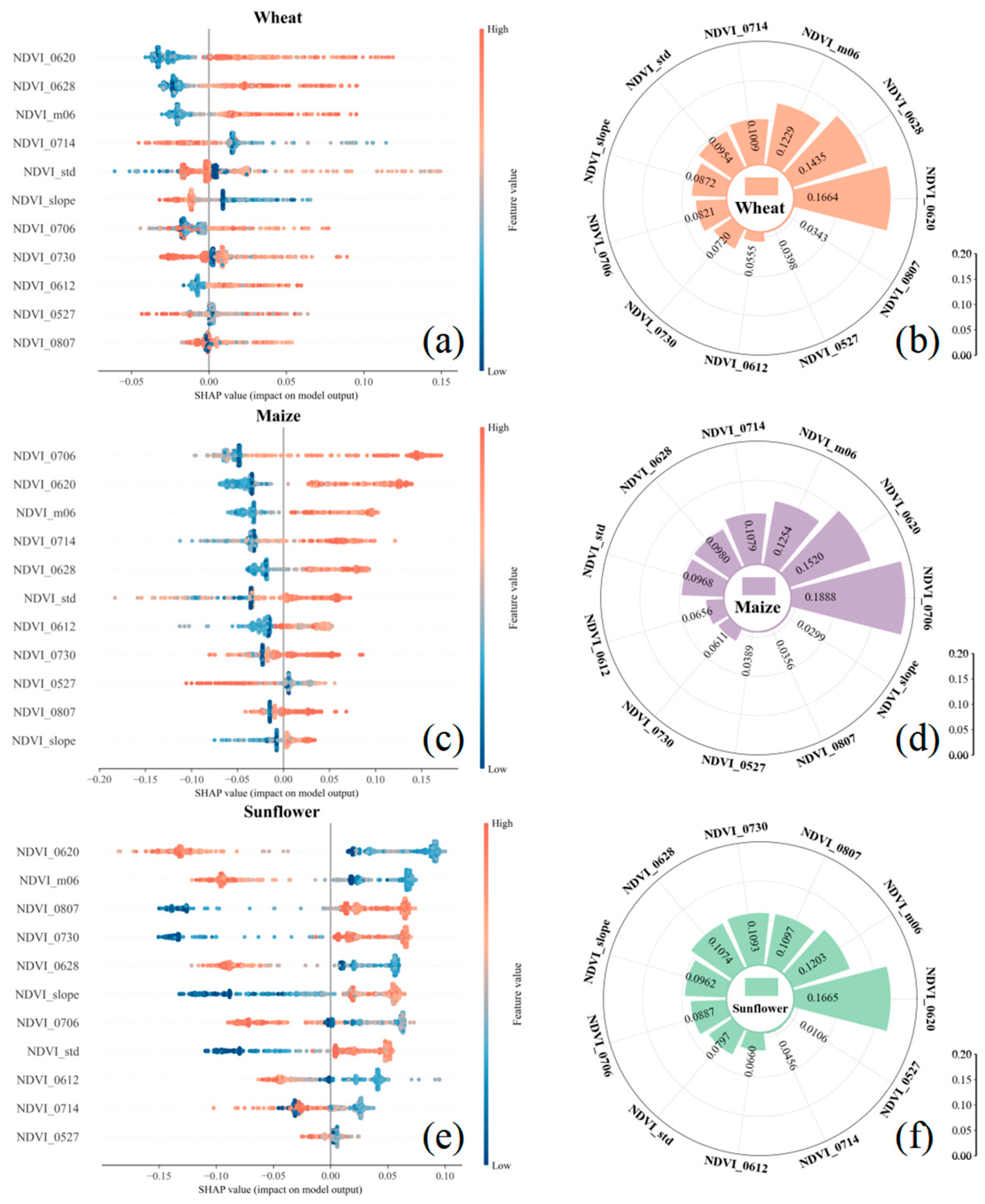
The SHAP summary plot provides an overall ranking of feature importance for the Random Forest classifier, while the radial bar charts illustrate class-specific contributions (Figure 6). Across all crop types, NDVI features from late June to mid-July—particularly NDVI_0620, NDVI_0628, and NDVI_0706—consistently appear among the highest-ranking variables, indicating that this period offers the strongest separability. Curve-shape descriptors such as NDVI_slope and NDVI_std exhibit stable but secondary contributions relative to the phenological anchor points.
For wheat, NDVI_0620, NDVI_0628, and NDVI_m06 show right-shifted SHAP distributions with strong positive contributions at higher NDVI values, identifying them as the dominant discriminative features. Early-season (NDVI_0527) and late-season (NDVI_0807) NDVI values provide comparatively limited separation. The overall pattern reflects a rapid increase in NDVI during mid-May, sustained high values in June, and a sharp decline in early July.
Maize is primarily characterized by high contributions from NDVI_0706, followed by NDVI_0620, NDVI_m06, and NDVI_0714. Elevated NDVI during late June–mid July produces the strongest positive effects, whereas higher values in late May (NDVI_0527) and early June (NDVI_0612) yield negative contributions, consistent with maize being in a pre-vigorous growth stage at that time. NDVI_0730 and NDVI_0807 contribute steadily as maize maintains a high NDVI plateau into late July and August.
Sunflower shows negative contributions for elevated NDVI in June but strong positive contributions for higher NDVI in late July and early August. Key features include NDVI_0620, NDVI_m06, NDVI_0730, NDVI_0807, and NDVI_slope, while NDVI_std also provides consistent support across samples. These patterns correspond to the crop’s progressive greening from July and the short high-NDVI plateau observed in August.
Overall, the SHAP results indicate that late-June to early-August NDVI dynamics provide the most effective separation among wheat, maize, and sunflower. Wheat declines rapidly in early July, maize maintains a stable high plateau through July–August, and sunflower increases sharply after mid-July. NDVI_std further differentiates maize—which shows relatively stable seasonal trajectories—from wheat and sunflower, which exhibit greater intra-seasonal variability. These feature-level distinctions enable accurate discrimination among crops and support reliable reconstruction of spatial–temporal planting patterns.

3.3. Accuracy Assessment

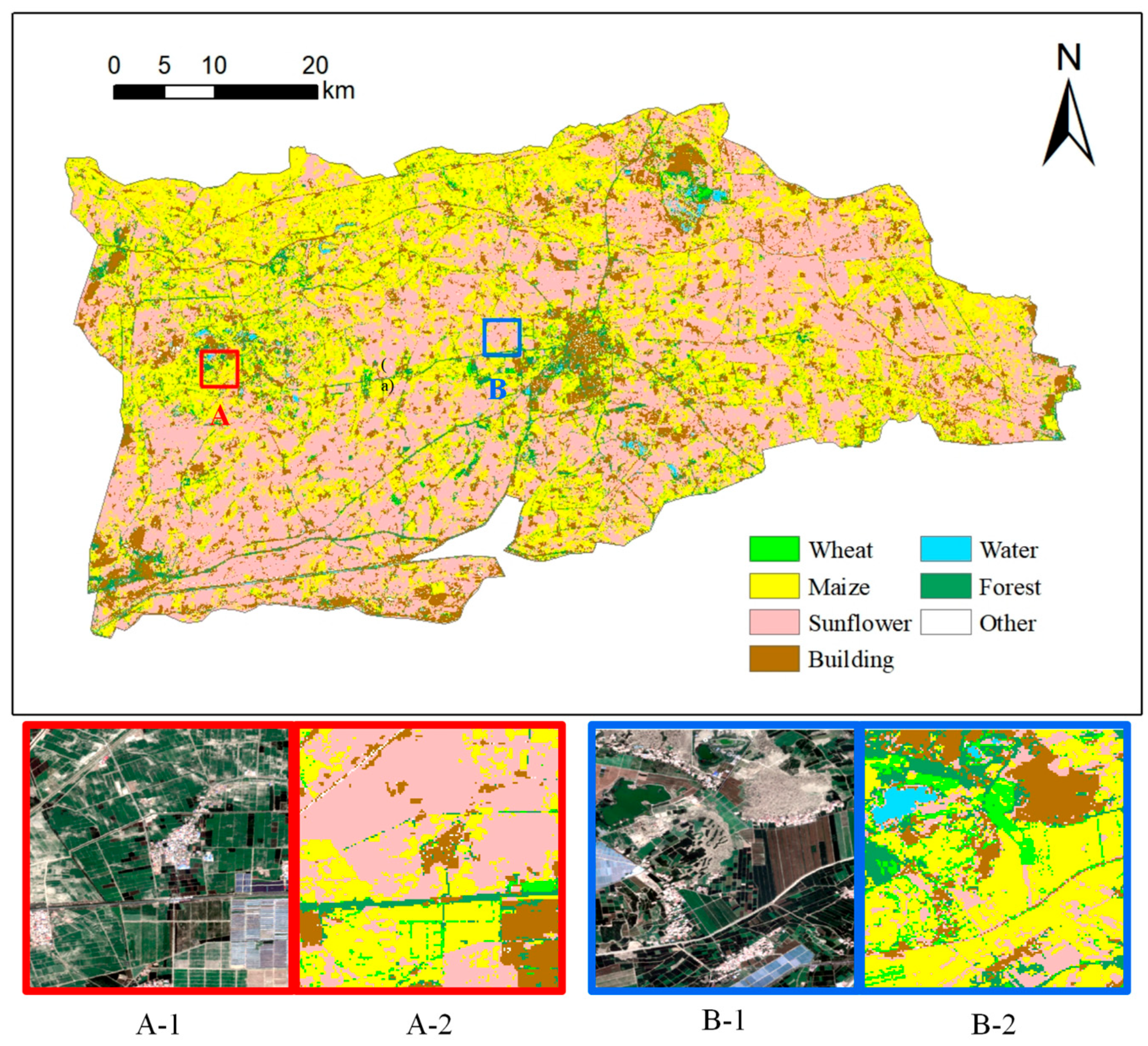
This study trained an RF classifier using phenological features derived from the 2023 NDVI time series and applied the model to extract the 2024 cropping pattern in the Yichang Irrigation District (Figure 7). The resulting map exhibits a typical irrigated farmland mosaic, with cropland types forming block or strip like patterns at the field scale. Sunflower occupies the largest area and appears as extensive, contiguous patches in the central eastern and eastern parts of the district, indicating its spatial dominance and continuity. Maize is distributed in linear belts along main and branch canals, interwoven with sunflower fields. Wheat is characterized by narrow strips and fragmented parcels, consistent with its distribution under a mixed cropping structure and fragmented land tenure. Built up areas, roads and other construction land form aggregated clusters, while water bodies and forest land have clearly defined boundaries. The classification preserves the regular rectangular field shapes and the geometry of canals and field boundaries, and the spatial configuration of crop types is aligned with the canal network, reflecting the control of irrigation infrastructure on planting patterns and field operations.
Two typical sub-regions (A and B) were selected to illustrate the classification performance. Sub-region A represents a peri-urban mixed landscape. The classification shows high consistency with the high-resolution imagery (A-1) in terms of field geometry and canal bank alignment. Crops are clearly distinguished from built-up areas, and wheat–maize intercropping is accurately captured. Sub-region B, located in a canal–field transition zone, retains fine linear features such as narrow water bodies, with crop boundaries well aligned with field edges, demonstrating high fidelity at the parcel-level. Using visually interpreted reference data and independent field sample points for accuracy assessment, the classification achieves an overall accuracy of 90.78% and a kappa coefficient of 0.882, indicating high reliability.
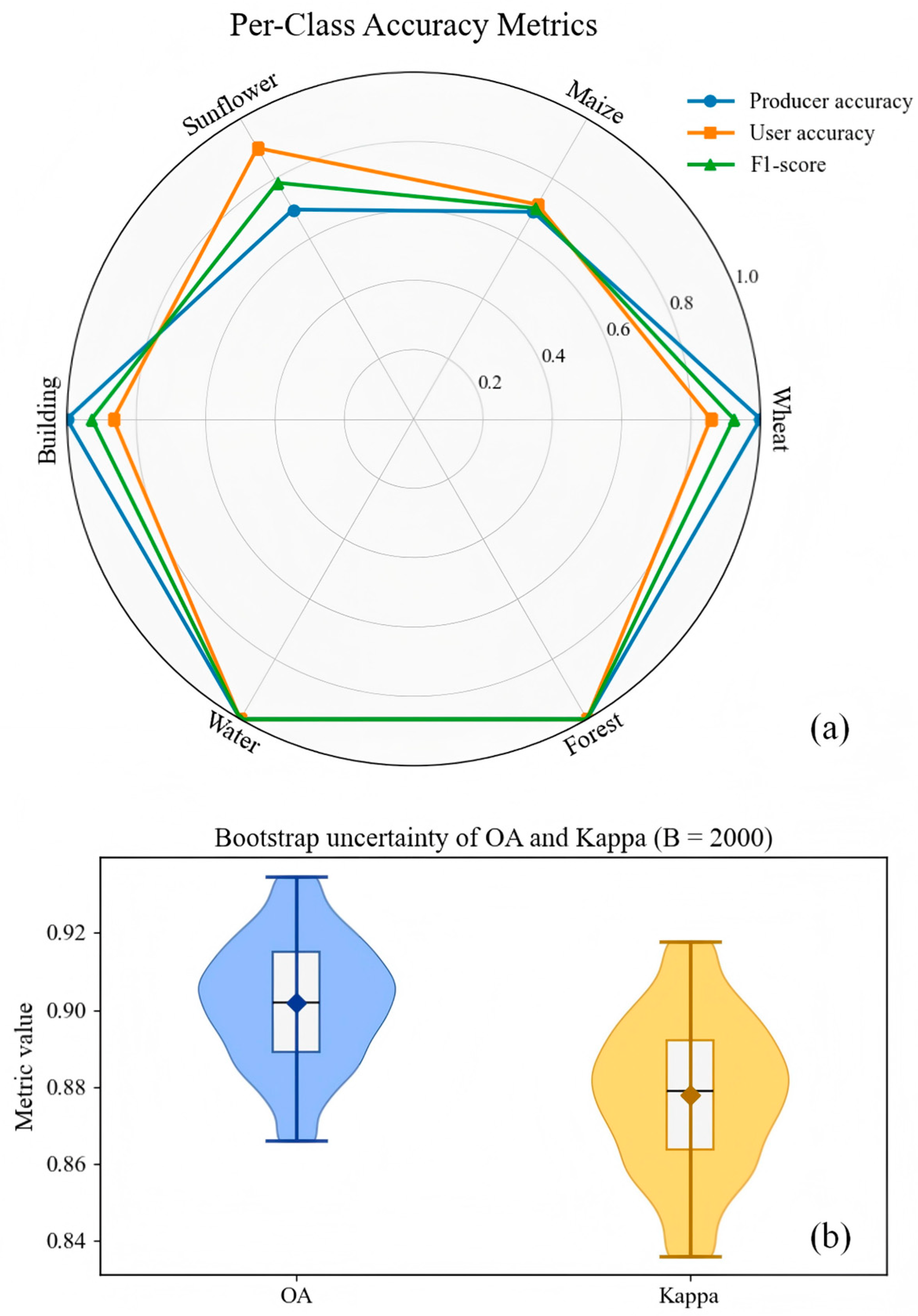
The class-wise accuracy metrics derived from the independent 2024 validation set are summarized in Figure 8a. Maize and sunflower exhibit producer accuracies of approximately 0.80 and 0.70, respectively, with user accuracies slightly higher for sunflower, indicating that most misclassifications occur between these two summer crops rather than between crops and non-crop classes. In contrast, the building, water, and forest classes show very high and consistent producer and user accuracies, with F1-scores close to 1.0, reflecting their distinctive spectral–phenological signatures and limited confusion with cropland. The robustness of the overall map accuracy is further evaluated by a bootstrap analysis with 2000 resamples (Figure 8b). Both overall accuracy and the kappa coefficient show narrow violin-shaped distributions centered around ≈0.90 and ≈0.88, respectively, with tight 95% confidence intervals, indicating that the classification performance is stable with respect to sampling uncertainty.
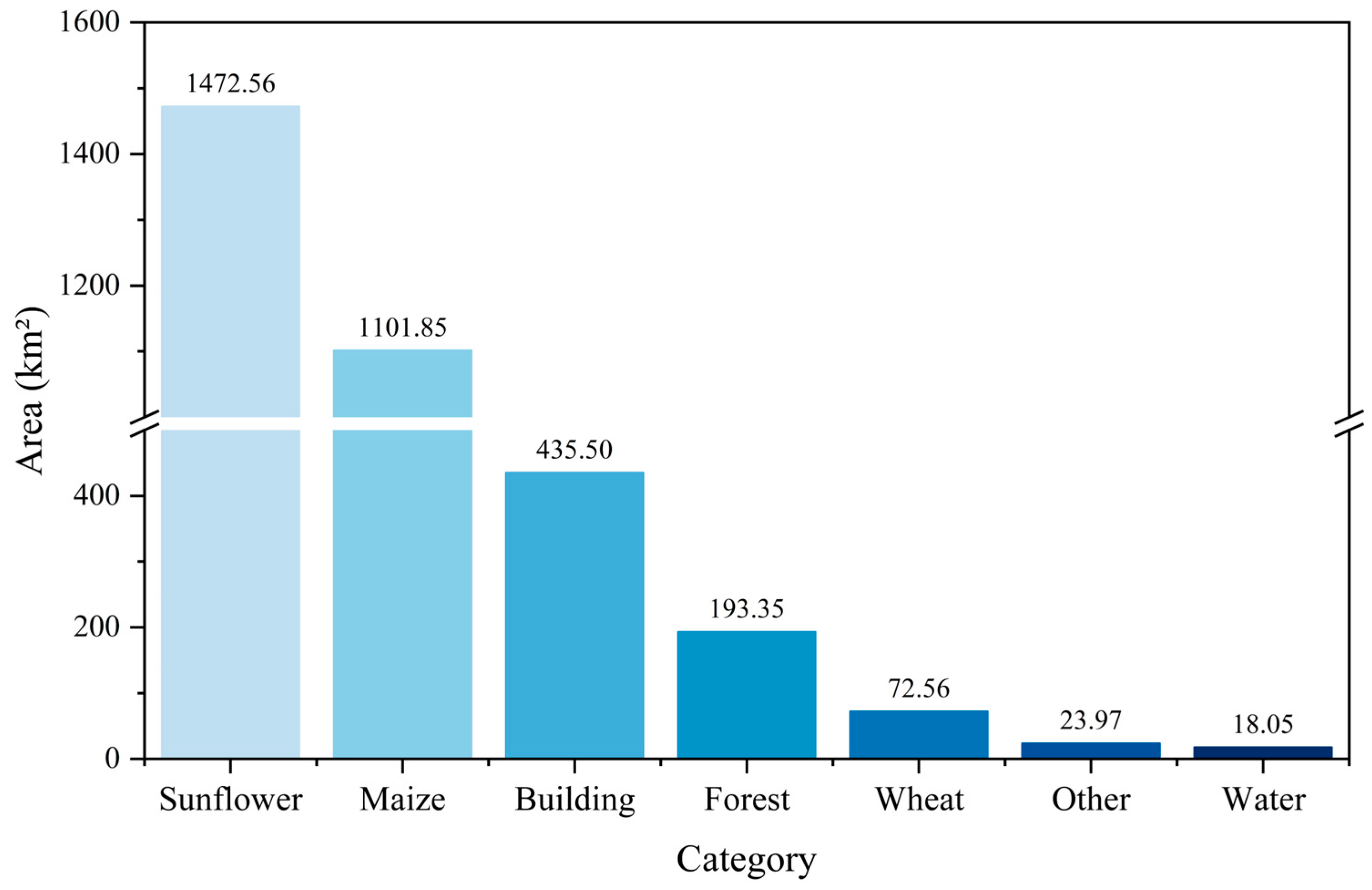
Area statistics further quantify the spatial patterns described above (Figure 9). Sunflower and maize account for 44.4% and 33.2% of the study area, respectively, together covering 77.6%, confirming the dominance of summer crops in the regional cropping system. Wheat occupies only 2.2% and mostly occurs as intercropped or strip-planted patches within other crops. Among non-crop categories, building constitutes 13.1% and forest 5.8%, with the remaining categories accounting for minor proportions.

4. Discussion

This study demonstrates that the multi-source spatiotemporal fusion of the 30 m/8-day NDVI effectively suppresses mixed-pixel effects and delineates field boundaries in heterogeneous cropland. When combined with phenology-constrained features, the classifier enhances the discriminative ability in the June–August window, while curve-shape descriptors provide fine-grained separation at similar NDVI levels. Compared with single-sensor or sparsely sampled approaches, the fused series preserves temporal continuity and peak fidelity under frequent cloud cover and rapid phenological change, contributing to more robust classification performance. SHAP analysis corroborates these findings, revealing systematic differences among crops in peak timing, plateau length, and trajectory variability.

4.1. Tri-Source Fusion for Stable Phenology-Level NDVI Reconstruction

A quantitative comparison with the original satellite inputs indicates that the re-ported improvements are supported by measurable gains in spatiotemporal resolution. The proposed fusion reconstructs a 30 m NDVI time series at an 8-day interval, com-pared with the native 500 m daily MODIS product and the 30 m, 16-day Landsat observations, while effectively reducing cloud-induced temporal gaps present in sin-gle-sensor data. Consequently, the fused NDVI provides approximately a twofold improvement in temporal sampling relative to Landsat and an substantial improvement in spatial resolution relative to MODIS, while preserving large-scale regional gradients.
The performance of STARFM-based fusion is strongly conditioned by the availability and quality of HR reference images. Single-source optical time series, such as those relying solely on Sentinel-2, often exhibit temporal discontinuities caused by cloud contamination and sparse HR anchor dates, which in turn exacerbate between-class confusion in heterogeneous irrigated landscapes characterized by fragmented fields and rapid crop transitions [24,25,26,27]. These limitations have contributed to the moderate classification accuracies reported in previous optical or SAR-based studies. To mitigate such constraints, dual-source fusion schemes have been widely employed. Landsat–MODIS models have been used to generate 30 m NDVI products for cotton mapping in Xinjiang [28], while the Harmonized Landsat–Sentinel (HLS) dataset provides near-daily 30 m reflectance through consistent atmospheric correction, BRDF normalization, and geometric co-registration [29]. Nonetheless, dual-source systems face structural drawbacks: Sentinel-2A only reached stable operational capacity after 2015, and the 5-day revisit cycle was realized only with the commissioning of Sentinel-2B in 2017. Furthermore, optical sensors remain vulnerable to persistent cloud cover, limiting the temporal reliability of HR anchors required for reconstructing phenology-sensitive trajectories.
The tri-source Landsat–Sentinel-2–MODIS framework developed in this study addresses key limitations of single- or dual-source approaches by combining long-term historical continuity (Landsat), dense high-resolution temporal sampling in recent years (Sentinel-2), and stable seasonal coverage (MODIS). This configuration increases the likelihood of obtaining at least one valid anchor within the ±8-day fusion window, thereby stabilizing phenology-level NDVI reconstruction and improving sensitivity to rapid crop transitions. Under these combined constraints of tri-source fusion and phenology-based feature engineering, the proposed method achieves an OA of 90.78% and a kappa of 0.882, representing improvements of approximately 2.6–5.8% over single-source time series and 0.8–2.8% over multi-source approaches lacking phenological constraints.
Even with these gains, residual confusion remains in phenologically overlapping periods among summer crops, during which maize and sunflower exhibit similar canopy vigor and NDVI trajectories. The limited spatial resolution of medium-resolution inputs can further increase mixed-pixel occurrences along narrow field boundaries and fragmented parcels, contributing to errors in heterogeneous farmland mosaics.
Recent reviews similarly note that multi-sensor fusion can mitigate errors associated with sparse anchors, cloud-induced gaps, and landscape heterogeneity [30,31]. Consistent with these findings, the fused NDVI series produced here preserves field-level detail across small and irregular parcels, while phenology-based metrics enhance class separability within key growth windows. Collectively, these results demonstrate the robustness of the tri-source framework and highlight its suitability for operational crop mapping in complex irrigated environments.

4.2. Phenology-Based Feature Extraction

The fused NDVI trajectories indicate that crop types in the YCID are primarily distinguished by their phenology-level dynamics within the April–October growing season rather than by single-date differences. Wheat is characterized by an early and narrow greenness peak: NDVI rises rapidly in late spring, reaches its maximum in June, and then declines sharply after harvest. In practice, many wheat fields are replanted with cash crops shortly after harvest, so a secondary NDVI increase in August over former wheat parcels reflects the growth of succeeding crops rather than wheat regrowth. In our framework, wheat phenology is therefore defined by the timing and shape of the pre-harvest peak from May to July, while the August rebound is treated as a separate cropping signal. The despiking procedure is designed to remove isolated non-physical anomalies but to preserve sustained post-harvest increases, ensuring that the early, narrow peak remains the dominant descriptor of the wheat class and preventing the emergence of an artificial second wheat peak.
Maize and sunflower are summer crops whose discrimination mainly depends on the duration and stability of their high-NDVI phase. Maize exhibits a long, stable high-NDVI plateau from tasseling through grain filling, which yields high NDVI in late June and August combined with low intra-window variance. Sunflower, by contrast, green-ups later, develops a shorter plateau around flowering in August, and declines earlier in autumn. Even when maize and sunflower reach similar NDVI levels in early August, plateau width, temporal position of the maximum, and the volatility of NDVI within the key windows provide complementary information that separates the two classes and distinguishes both from wheat, which peaks earlier and shows a rapid post-maturity recession. These patterns highlight that curve-shape descriptors and anchor dates are not only convenient features but also compact representations of agronomic practice, such as sowing dates, crop calendars, and double-cropping regimes. While the selected anchor windows (late June–July) proved robust for the study years, their timing can be adjusted in response to pronounced inter-annual climatic anomalies or regional phenological shifts. In such cases, the complementary use of curve-shape metrics from the fused time series would help maintain classification reliability. The SHAP analysis reinforces this phenological interpretation by showing that the same anchor-date NDVI can have opposite contributions across classes. High NDVI in late June increases the probability of wheat and maize but is neutral or unfavorable for sunflower, whereas high NDVI in early August reduces the probability of wheat and increases that of maize and sunflower, consistent with the replacement of harvested wheat by summer crops. Thus, SHAP provides an interpretable link between the time-series features and regional agronomy and confirms that the classifier relies on phenology-level contrasts rather than spurious noise. More broadly, our findings support the view that phenology-oriented NDVI features are transferable across regions with comparable crop calendars. Previous time-series studies have shown that Sentinel-2 NDVI organized into monthly or 10-day windows can robustly distinguish major crop types in different climate zones, which is consistent with our feature design and suggests that similar phenological descriptors could be adopted in other irrigation districts with analogous cropping structures [32].

4.3. Transferability and Scalability of the Proposed Fusion–Classification Framework

The proposed tri-source fusion and phenology-based classification framework demonstrates strong transferability to multi-season cropping systems. By using Landsat and Sentinel-2 as HR temporal anchors and MODIS as a continuous seasonal reference, the fused time series maintains coherent crop growth trajectories under varying sowing dates and management regimes. Prior studies have shown that multi-sensor fusion improves temporal completeness and stabilizes phenological signals in multi-season systems, thereby enhancing cross-year generalization. Likewise, phenology-oriented metrics have been shown to yield more reliable class separation than single-date spectral features in heterogeneous agricultural landscapes, particularly where planting schedules are staggered or intercropping is common [33]. The phenological anchor features extracted from our fused NDVI series align with these findings and support the framework’s potential applicability to landscapes characterized by multi-season rotations.
In terms of computational scalability, the workflow is implemented on GEE, which supports parallel processing of multi-year Landsat, Sentinel-2, and MODIS archives at sub-regional to regional scales. GEE has been widely adopted for large-area agricultural monitoring due to its cloud-native architecture and distributed computational model. Nevertheless, recent assessments indicate that national- or continental-scale applications require tiling strategies, task batching, and resource-aware workflow design to comply with GEE’s task and memory quotas [34]. Within irrigation-district to basin-scale domains, the proposed framework operates efficiently and can be extended to larger regions through modular, tile-based execution, acknowledging that truly national-scale deployment would necessitate additional partitioning and scheduling strategies.

4.4. Limitations

Despite the improved temporal continuity and spatial detail achieved through fusion, cross-year comparability remains affected by residual radiometric inconsistencies among Landsat, Sentinel-2, and MODIS, which may introduce temporal bias and limit the direct transfer of class decision thresholds between years. The use of bilinear resampling to upscale MODIS from 500 m to 30 m may introduce local smoothing and residual mixed-pixel leakage along field margins; although STARFM leverages high-resolution anchors to preserve spatial detail, small-scale artifacts can persist in highly heterogeneous mosaics.
Future work will focus on refining pre-fusion processing by implementing unified cloud masking, stricter cross-sensor geometric co-registration, and enhanced radiometric harmonization to improve robustness across years and regions. In addition, the fusion framework will be extended by incorporating complementary satellite observations, such as additional optical constellations or radar data, to further mitigate the impact of persistent cloud cover and enhance applicability in cloud-prone environments.

5. Conclusions

Applied to the YCID, the proposed data fusion and phenology-based pipeline produced the 2024 crop distribution map with an overall accuracy (OA) of 90.78% and kappa = 0.882. The analysis provides interpretable, window-specific evidence for class separation, yielding a practical and transferable framework for regional crop classification applications.
(1)
Using MODIS MOD09GA (500 m, daily), Landsat (30 m, 16-day), and Sentinel-2 MSI (10 m, 5-day) as fusion inputs, the fused series—relative to any single sensor—markedly reduces temporal gaps, mitigates cloud/shadow noise, and better preserves parcel boundaries and key-window phenological information.
(2)
From the reconstructed series, we extract anchor-date and curve-shape phenological indicators and input them to the RF classifier; SHAP quantifies feature contributions at global and sample levels. The June–August window provides the strongest class separability, and the synergy between shape descriptors and anchor-date NDVI substantially improves fine-grained discrimination compared with baseline designs lacking fusion or explicit phenology.
(3)
Regional validation demonstrates robust accuracy and stability: OA = 90.78% and kappa = 0.882, indicating effective discrimination among crop types and good adaptability in complex agricultural mosaics.

Author Contributions

Conceptualization, X.H. and W.Y.; methodology, X.H.; software, K.W.; validation, X.H., C.C. and Z.Z.; formal analysis, X.H.; investigation, X.H., M.C., L.S. and Z.Z.; resources, W.Y.; data curation, L.S.; writing—original draft preparation, X.H.; writing—review and editing, C.C.; visualization, Z.Z.; supervision, C.C.; project administration, W.Y.; funding acquisition, W.Y. All authors have read and agreed to the published version of the manuscript.

Funding

This research was funded by the National Natural Science Foundation of China (Grant No. 52179032&U24A20179).

Data Availability Statement

The original contributions presented in this study are included in the article. Further inquiries can be directed to the corresponding author.

Conflicts of Interest

The authors declare no conflicts of interest.

Abbreviations

The following abbreviations are used in this manuscript:
STARFMSpatiotemporal Adaptive Reflectance Fusion Model
NDVINormalized Difference Vegetation Index
RFRandom Forest
SHAPSHapley Additive exPlanations
OAOverall Accuracy
BIBand-before-Index
IBIndex-before-Fusion
OOBOut-of-Bag
YCIDYichang Irrigation District
GEEGoogle Earth Engine
LULCLand Use/Land Cover
HRHigh-Resolution
LRLow-Resolution
SNICSimple Non-Iterative Clustering

References

  1. Yao, R.; Ma, Z.; Wu, H.; Xie, Y. Mechanism and Measurement of the Effects of Industrial Agglomeration on Agricultural Economic Resilience. Agriculture 2024, 14, 337. [Google Scholar] [CrossRef]
  2. Xie, W.; Zhu, A.; Ali, T.; Zhang, Z.; Chen, X.; Wu, F.; Huang, J.; Davis, K.F. Crop Switching Can Enhance Environmental Sustainability and Farmer Incomes in China. Nature 2023, 616, 300–305. [Google Scholar] [CrossRef] [PubMed]
  3. Hu, X.; Dong, C.; Zhang, Y. Impacts of Cropland Utilization Patterns on the Sustainable Use Efficiency of Cropland Based on the Human–Land Perspective. Land 2024, 13, 863. [Google Scholar] [CrossRef]
  4. Shi, X.; Zhu, W. Spatio-Temporal Patterns and Drivers of Irrigation Water Requirement in Mainland China. Agric. Water Manag. 2025, 308, 109283. [Google Scholar] [CrossRef]
  5. Li, S.; Pu, J.; Deng, X. Agricultural Land Use Transition under Multidimensional Topographical Gradients and Its Impact on Ecosystem Service Interactions. J. Integr. Agric. 2025, 24, 3222–3241. [Google Scholar] [CrossRef]
  6. Barrile, V.; Maesano, C.; Genovese, E. Optimization of Crop Yield in Precision Agriculture Using WSNs, Remote Sensing, and Atmospheric Simulation Models for Real-Time Environmental Monitoring. J. Sens. Actuator Netw. 2025, 14, 14. [Google Scholar] [CrossRef]
  7. Hu, G.; Ren, Z.; Chen, J.; Ren, N.; Mao, X. Using the MSFNet Model to Explore the Temporal and Spatial Evolution of Crop Planting Area and Increase Its Contribution to the Application of UAV Remote Sensing. Drones 2024, 8, 432. [Google Scholar] [CrossRef]
  8. Tang, Z.; Wang, X.; Jiang, Q.; Pan, H.; Deng, G.; Chen, H.; You, Y.; Li, S.; Hou, H. Parcel-Scale Crop Planting Structure Extraction Combining Time-Series of Sentinel-1 and Sentinel-2 Data Based on a Semantic Edge-Aware Multi-Task Neural Network. Int. J. Digit. Earth 2025, 18, 2497487. [Google Scholar] [CrossRef]
  9. Shen, Q.; He, D.; Liu, X.; Shi, Q. Integrating Phenology Knowledge Graph into Parcel-Scale Crop Classification Using Multi-Period Deep Time Series Modelling. Int. J. Appl. Earth Obs. Geoinf. 2025, 143, 104809. [Google Scholar] [CrossRef]
  10. Gao, F.; Masek, J.; Schwaller, M.; Hall, F. On the Blending of the Landsat and MODIS Surface Reflectance: Predicting Daily Landsat Surface Reflectance. IEEE Trans. Geosci. Remote Sens. 2006, 44, 2207–2218. [Google Scholar] [CrossRef]
  11. Zhu, X.; Chen, J.; Gao, F.; Chen, X.; Masek, J.G. An Enhanced Spatial and Temporal Adaptive Reflectance Fusion Model for Complex Heterogeneous Regions. Remote Sens. Environ. 2010, 114, 2610–2623. [Google Scholar] [CrossRef]
  12. Zhu, X.; Helmer, E.H.; Gao, F.; Liu, D.; Chen, J.; Lefsky, M.A. A Flexible Spatiotemporal Method for Fusing Satellite Images with Different Resolutions. Remote Sens. Environ. 2016, 172, 165–177. [Google Scholar] [CrossRef]
  13. Cheng, Q.; Liu, H.; Shen, H.; Wu, P.; Zhang, L. A Spatial and Temporal Nonlocal Filter-Based Data Fusion Method. IEEE Trans. Geosci. Remote Sens. 2017, 55, 4476–4488. [Google Scholar] [CrossRef]
  14. Hu, Y.; Wang, H.; Niu, X.; Shao, W.; Yang, Y. Comparative Analysis and Comprehensive Trade-Off of Four Spatiotemporal Fusion Models for NDVI Generation. Remote Sens. 2022, 14, 5996. [Google Scholar] [CrossRef]
  15. Jarihani, A.A.; McVicar, T.R.; Van Niel, T.G.; Emelyanova, I.V.; Callow, J.N.; Johansen, K. Blending Landsat and MODIS Data to Generate Multispectral Indices: A Comparison of “Index-then-Blend” and “Blend-then-Index” Approaches. Remote Sens. 2014, 6, 9213–9238. [Google Scholar] [CrossRef]
  16. Chen, X.; Liu, M.; Zhu, X.; Chen, J.; Zhong, Y.; Cao, X. “Blend-then-Index” or “Index-then-Blend”: A Theoretical Analysis for Generating High-Resolution NDVI Time Series by STARFM. Photogramm. Eng. Remote Sens. 2018, 84, 66–74. [Google Scholar] [CrossRef]
  17. Li, M.; Wang, P.; Tansey, K.; Sun, Y.; Guo, F.; Zhou, J. Improved Field-Scale Drought Monitoring Using MODIS and Sentinel-2 Data for Vegetation Temperature Condition Index Generation through a Fusion Framework. Comput. Electron. Agric. 2025, 234, 110256. [Google Scholar] [CrossRef]
  18. Zaka, M.M.; Samat, A. Advances in Remote Sensing and Machine Learning Methods for Invasive Plants Study: A Comprehensive Review. Remote Sens. 2024, 16, 3781. [Google Scholar] [CrossRef]
  19. Morais, T.G.; Jongen, M.; Tufik, C.; Rodrigues, N.R.; Gama, I.; Fangueiro, D.; Serrano, J.; Vieira, S.; Domingos, T.; Teixeira, R.F.M. Characterization of Portuguese Sown Rainfed Grasslands Using Remote Sensing and Machine Learning. Precis. Agric. 2023, 24, 161–186. [Google Scholar] [CrossRef]
  20. Yu, L.; Tao, H.; Li, Q.; Xie, H.; Xu, Y.; Mahemujiang, A.; Jiang, Y. Research on Machine Learning-Based Extraction and Classification of Crop Planting Information in Arid Irrigated Areas Using Sentinel-1 and Sentinel-2 Time-Series Data. Agriculture 2025, 15, 1196. [Google Scholar] [CrossRef]
  21. Lundberg, S.M.; Lee, S.I. A Unified Approach to Interpreting Model Predictions. In Advances in Neural Information Processing Systems 30; Guyon, I., Luxburg, U.V., Bengio, S., Wallach, H.M., Fergus, R., Vishwanathan, S., Garnett, R., Eds.; Curran Associates Inc.: Red Hook, NY, USA, 2017; pp. 4766–4775. [Google Scholar]
  22. Huang, F.; Chunyu, X.; Zhang, D.; Chen, X.; Ochoa, C.G. A Framework to Assess the Impact of Ecological Water Conveyance on Groundwater-Dependent Terrestrial Ecosystems in Arid Inland River Basins. Sci. Total Environ. 2020, 709, 136155. [Google Scholar] [CrossRef]
  23. Breiman, L. Random Forests. Mach. Learn. 2001, 45, 5–32. [Google Scholar] [CrossRef]
  24. Yang, G.; Wang, J.; Qi, Z. Maize Classification in Arid Regions via Spatiotemporal Feature Optimization and Multi-Source Remote Sensing Integration. Agronomy 2025, 15, 1667. [Google Scholar] [CrossRef]
  25. Dubrovin, K.; Verkhoturov, A.; Stepanov, A.; Aseeva, T. Multi-Year Cropland Mapping Based on Remote Sensing Data: A Case Study for the Khabarovsk Territory, Russia. Remote Sens. 2024, 16, 1633. [Google Scholar] [CrossRef]
  26. Zhang, P.; Hu, S. Fine Crop Classification by Remote Sensing in Complex Planting Areas Based on Field Parcel. Trans. Chin. Soc. Agric. Eng. 2019, 35, 125–134. [Google Scholar]
  27. Niu, Q.; Liu, L.; Huang, G.; Cheng, Q.; Cheng, Y. Extraction of Complex Crop Structure in the Hetao Irrigation District of Inner Mongolia Using GEE and Machine Learning. Trans. Chin. Soc. Agric. Eng. 2022, 38, 165–174. [Google Scholar]
  28. Tan, Z.; Tan, Z.; Luo, J.; Duan, H. Mapping 30-m Cotton Areas Based on an Automatic Sample Selection and Machine Learning Method Using Landsat and MODIS Images. Geo-Spat. Inf. Sci. 2023, 27, 1767–1784. [Google Scholar] [CrossRef]
  29. Claverie, M.; Ju, J.; Masek, J.G.; Dungan, J.L.; Vermote, E.F.; Roger, J.-C.; Skakun, S.V.; Justice, C. The Harmonized Landsat and Sentinel-2 Surface Reflectance Data Set. Remote Sens. Environ. 2018, 219, 145–161. [Google Scholar] [CrossRef]
  30. Chen, G.; Hay, G.J.; Carvalho, L.M.T.; Wulder, M.A. Spatiotemporal Fusion for Spectral Remote Sensing: A Statistical Analysis and Review. J. King Saud Univ. Comput. Inf. Sci. 2023, 35, 259–273. [Google Scholar] [CrossRef]
  31. Xiao, J.; Aggarwal, A.K.; Duc, N.H.; Arya, A.; Rage, U.K.; Avtar, R. A Review of Remote Sensing Image Spatiotemporal Fusion: Challenges, Applications and Recent Trends. Remote Sens. Appl. Soc. Environ. 2023, 32, 101005. [Google Scholar] [CrossRef]
  32. Li, G.; Cui, J.; Han, W.; Zhang, H.; Huang, S.; Chen, H.; Ao, J. Crop Type Mapping Using Time-Series Sentinel-2 Imagery and U-Net in Early Growth Periods in the Hetao Irrigation District in China. Comput. Electron. Agric. 2022, 203, 107478. [Google Scholar] [CrossRef]
  33. Yan, L.; Roy, D.P. Conterminous United States Crop Field Size Quantification from Multi-Temporal Landsat Data. Remote Sens. Environ. 2016, 172, 67–86. [Google Scholar] [CrossRef]
  34. Tamiminia, H.; Salehi, B.; Mahdianpari, M.; Quackenbush, L.; Adeli, S.; Brisco, B. Google Earth Engine for Geo-Big Data Applications: A Meta-Analysis and Systematic Review. ISPRS J. Photogramm. Remote Sens. 2020, 164, 152–170. [Google Scholar] [CrossRef]
Figure 1. Overview of the study area. (a) Spatial distribution of ground-truth crop samples collected in 2023 and 2024 within the Yichang Irrigation District, including wheat, maize, sunflower, and non-crop classes. Sampling points represent field-level observations used for model training (2023) and independent validation (2024). (b) Geographic location of the Yichang Irrigation District (dark gray) within the broader Hetao Irrigation District, together with adjacent sub-regions (Yongji, Urad, Jiefangzha, and Ulanbuh). The inset outlines the Yichang subarea corresponding to panel (a).
Remotesensing 18 00101 g001
Figure 2. Overview of the proposed workflow for regional crop mapping. The workflow comprises three phases: (1) Data fusion: Landsat-5/7/8/9 and Sentinel-2 are fused with MODIS to generate a 30 m, 8-day NDVI time series. (2) Feature derivation: Statistical features (8-day composites, monthly means) and dynamic trajectory features are extracted from the fused NDVI. (3) Crop mapping: This includes model training with 2023 data, RF classification with post-classification refinement, feature-importance analysis (SHAP), and accuracy assessment using 2024 data.
Remotesensing 18 00101 g002
Figure 3. Class-specific NDVI trajectories derived from 2023 field-labeled samples using the fused Landsat–Sentinel-2–MODIS time series (30 m, 8-day; blue) compared with Sentinel-2 observations (red; 10 m, irregular). (a) Wheat; (b) Maize; (c) Sunflower. The fusion product reduces cloud-induced gaps and high-frequency noise while retaining peak magnitude and timing. Axes: Month (x-axis) and NDVI (unitless, y-axis).
Remotesensing 18 00101 g003
Figure 4. Spatial detail and radiometric consistency of the fused NDVI product (30 m, 8-day) compared with MODIS (500 m). (a) Reference true-color image; (b) Fused NDVI (Landsat–Sentinel-2–MODIS, STARFM); (c) MODIS NDVI. The fusion sharpens parcel boundaries, resolves field roads and settlements, and preserves regional gradients without block-type artifacts, yielding more reliable inputs for field-scale crop mapping and change detection.
Remotesensing 18 00101 g004
Figure 5. Class-decomposed global feature importance (SHAP) for the RF classifier.
Remotesensing 18 00101 g005
Figure 6. SHAP-based interpretation of crop classification using STARFM-fused NDVI. Caption. Panels (a,c,e) show SHAP summary plots for the RF classifier trained on 30 m STARFM-fused NDVI, for wheat, maize and sunflower, respectively. The x-axis is the SHAP value (impact on model output); point color encodes the feature value (red = high, blue = low). Panels (b,d,f) present radial bar charts of the mean absolute SHAP values for the top contributing features in each class. Results are computed from 1000 randomly sampled pixels within the study area.
Remotesensing 18 00101 g006
Figure 7. Spatial distribution of cropping structure in the YiChang Irrigation Subdistrict (Hetao Irrigation District, China), 2024. The red box (Area A) highlights a representative cropland-dominated subarea with relatively homogeneous and regular field patterns, whereas the blue box (Area B) highlights a representative heterogeneous subarea with mixed cropland and non-crop features (e.g., building and water). (A-1,B-1) Sentinel-2 true-color composites. (A-2,B-2) Corresponding classification results (30 m).
Remotesensing 18 00101 g007
Figure 8. (a) Per-class accuracy metrics of five land-cover categories (Maize, Sunflower, Building, Water, and Forest), showing the Producer’s accuracy, User’s accuracy, and F1-score derived from the independent 2024 validation samples. (b) Bootstrap-based uncertainty assessment of OA and kappa coefficient using 2000 bootstrap resamples, where the violin shapes represent the distribution, and the enclosed markers denote the median and the 95% confidence interval.
Remotesensing 18 00101 g008
Figure 9. Areal extent of land-cover categories in the Yichang Irrigation District (unit: km2). Bars are labeled with area values; an axis break is used to improve readability of the larger classes.
Remotesensing 18 00101 g009
Disclaimer/Publisher’s Note: The statements, opinions and data contained in all publications are solely those of the individual author(s) and contributor(s) and not of MDPI and/or the editor(s). MDPI and/or the editor(s) disclaim responsibility for any injury to people or property resulting from any ideas, methods, instructions or products referred to in the content.