A Framework for the Construction of a Heritage Corridor System: A Case Study of the Shu Road in China
Abstract
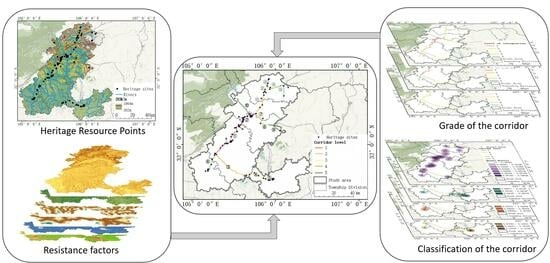
1. Introduction
2. Materials and Methods
2.1. Study Area
2.2. Data Sources
2.3. Data Processing
2.4. Research Methods
2.4.1. Heritage Corridor Generation
2.4.2. Heritage Corridor Grading
2.4.3. Heritage Corridor Classification
3. Results
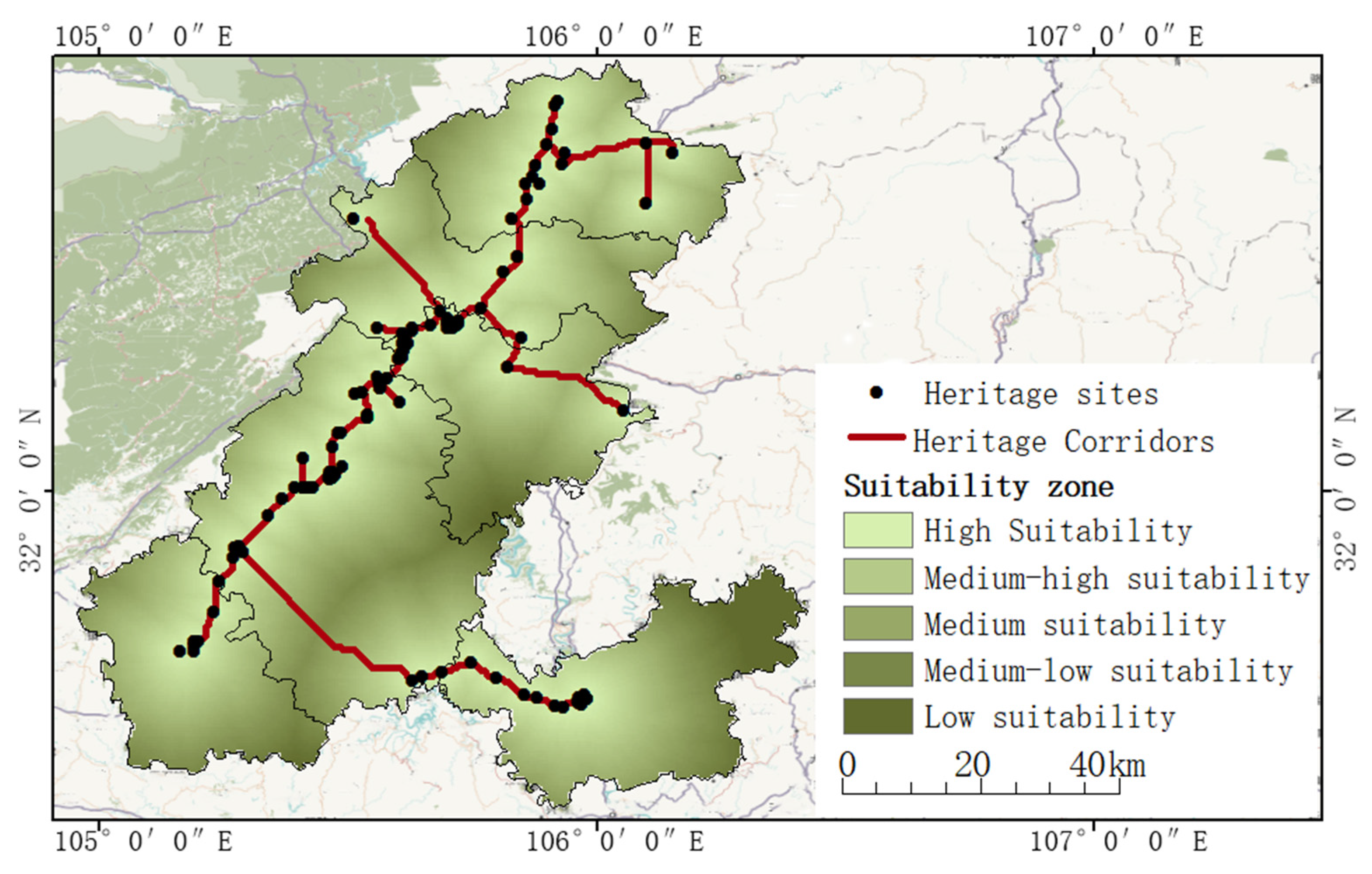
3.1. Heritage Corridor Generation
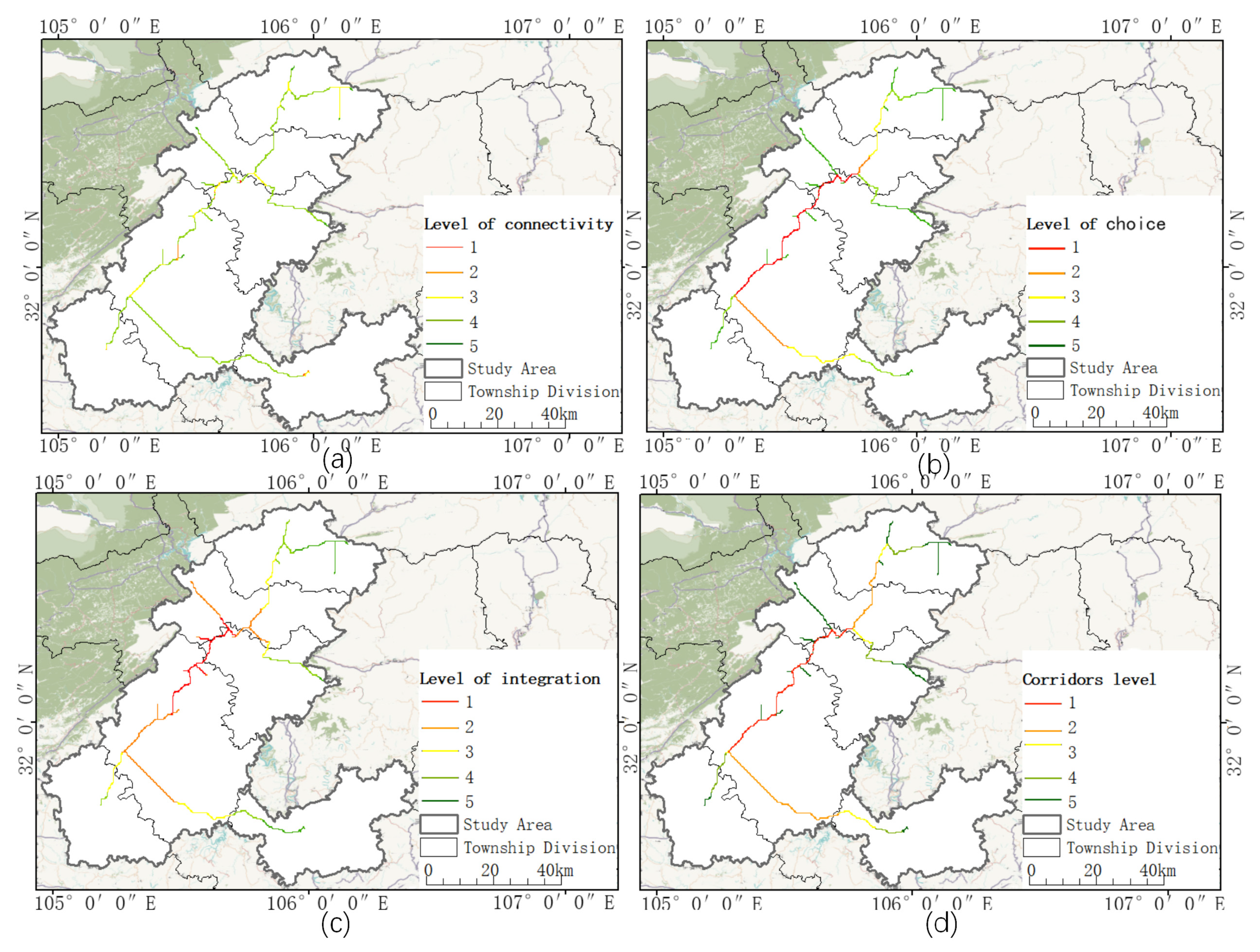
3.2. Heritage Corridor Grading
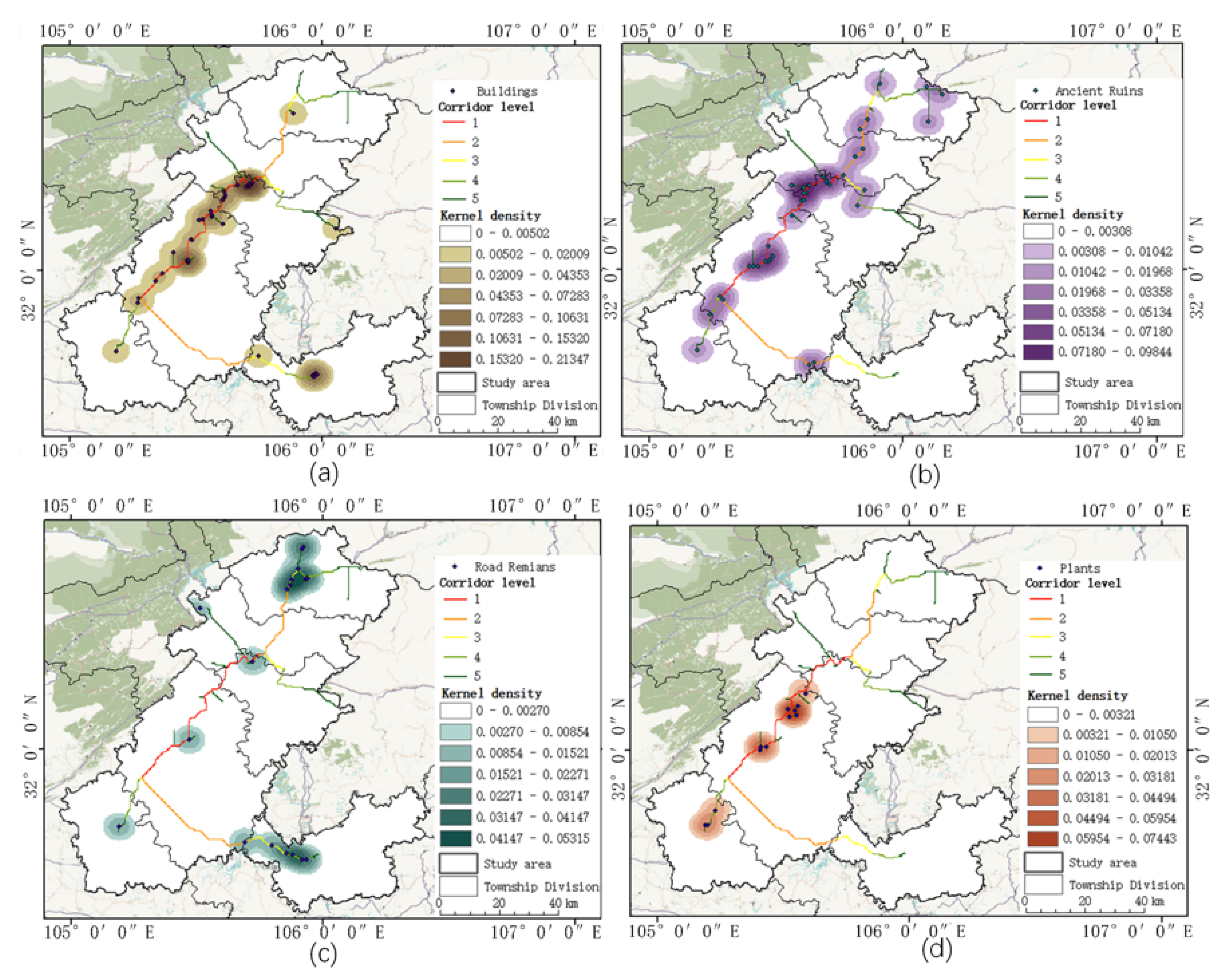
3.3. Heritage Corridor Classification
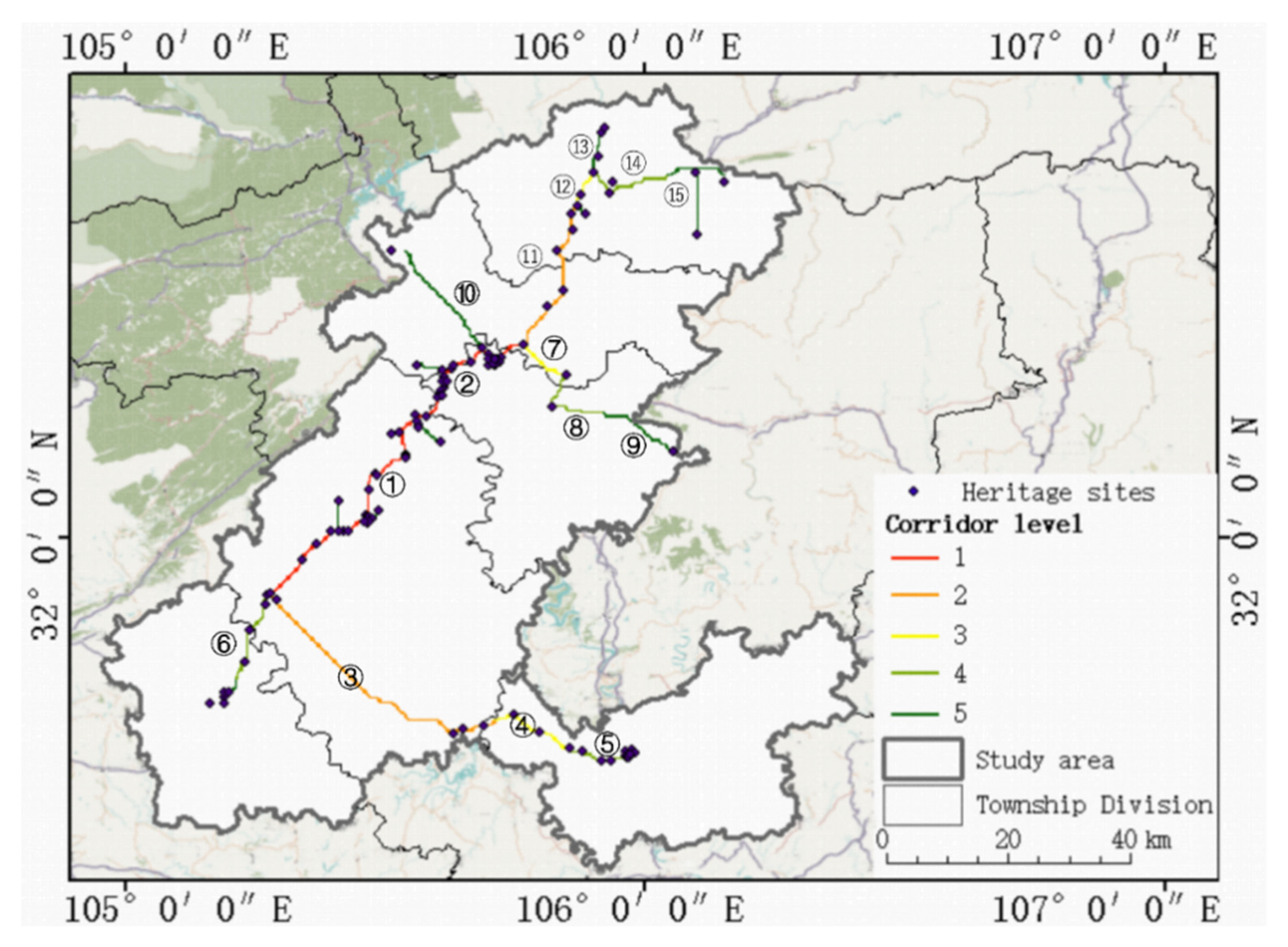
3.4. Heritage Corridor Construction
4. Discussion
4.1. Discussion on Research Methodology
4.2. Strategies for the Protection and Development of the Shu Road Heritage Corridor
5. Conclusions
Author Contributions
Funding
Data Availability Statement
Acknowledgments
Conflicts of Interest
References
- Chen, Y.; Dang, A.; Peng, X. Building a cultural heritage corridors based on geodesign theory and methodology. J. Urban Manag. 2014, 3, 97–112. [Google Scholar] [CrossRef] [Scilit]
- Ji, X.; Shao, L. The Application of Landscape Infrastructure Approaches in the Planning of Heritage Corridors Supporting System. Procedia Eng. 2017, 198, 1123–1127. [Google Scholar] [CrossRef] [Scilit]
- Searns, R.M. The evolution of greenways as an adaptive urban landscape form. Landsc. Urban Plan. 1995, 33, 65–80. [Google Scholar] [CrossRef] [Scilit]
- Ahern, J. Greenways as a planning strategy. Landsc. Urban Plan. 1995, 33, 131–155. [Google Scholar] [CrossRef] [Scilit]
- Zou, T.; Hao, Y.; Jiang, L.; Xue, B. Identifying Brand Genes in Tourism Branding Strategy: A Case Study of “Chang’an-Tianshan” Heritage Corridors. In Proceedings of the International Conference Proceedings: Heritage Tourism & Hospitality 2015, Amsterdam, The Netherlands, 26–27 November 2015; pp. 211–222. [Google Scholar]
- Li, H.; Jing, J.; Fan, H.; Li, Y.; Liu, Y.; Ren, J. Identifying cultural heritage corridors for preservation through multidimensional network connectivity analysis—A case study of the ancient Tea-Horse Road in Simao, China. Landsc. Res. 2021, 46, 96–115. [Google Scholar] [CrossRef] [Scilit]
- Zhang, S.; Liu, J.; Pei, T.; Chan, C.-S.; Wang, M.; Meng, B. Tourism value assessment of linear cultural heritage: The case of the Beijing–Hangzhou Grand Canal in China. Curr. Issues Tour. 2023, 26, 47–69. [Google Scholar] [CrossRef] [Scilit]
- Shishmanova, M.V. Cultural tourism in cultural corridors, itineraries, areas and cores networked. Procedia-Soc. Behav. Sci. 2015, 188, 246–254. [Google Scholar] [CrossRef] [Scilit]
- Zhang, D.Q.; Shao, W.W.; Feng, T.Q. Discussion on Construction of the Weihe River System Heritage Corridors in Xi’an Metropolitan Area. Appl. Mech. Mater. 2014, 641, 531–536. [Google Scholar] [CrossRef] [Scilit]
- Kashid, M.; Ghosh, S.; Narkhede, P. A Conceptual Model for Heritage Tourism Corridors in the Marathwada Region. In Proceedings of the National Online Conference on Planning, Design and Management, Pune, India, 6–7 May 2022. [Google Scholar]
- Hui, C.; Dong, C.; Yuan, Z.; Sicheng, M. Construction of corridors of architectural heritage along the line of ZiJiang River in Hunan Province in the background of the Tea Road Ceremony. In IOP Conference Series: Materials Science and Engineering; IOP Publishing: Bristol, UK, 2019; Volume 471, p. 082024. [Google Scholar]
- Li, H.; Duan, Q.; Zeng, Z.; Tan, X.; Li, G. Value Evaluation and Analysis of Space Characteristics on Linear Cultural Heritage Corridors Ancient Puer Tea Horse Road. In Proceedings of the Geo-Informatics in Resource Management and Sustainable Ecosystem: Third International Conference, GRMSE 2015, Wuhan, China, 16–18 October 2015; Revised Selected Papers 3. Springer: Berlin/Heidelberg, Germany, 2016; pp. 733–740. [Google Scholar]
- Morandi, D.T.; de Jesus França, L.C.; Menezes, E.S.; Machado, E.L.M.; da Silva, M.D.; Mucida, D.P. Delimitation of ecological corridors between conservation units in the Brazilian Cerrado using a GIS and AHP approach. Ecol. Indic. 2020, 115, 106440. [Google Scholar] [CrossRef] [Scilit]
- Lin, F.; Zhang, X.; Ma, Z.; Zhang, Y. Spatial Structure and Corridors Construction of Intangible Cultural Heritage: A Case Study of the Ming Great Wall. Land 2022, 11, 1478. [Google Scholar] [CrossRef] [Scilit]
- Li, Y.; Wang, X.; Dong, X. Delineating an integrated ecological and cultural corridors network: A case study in Beijing, China. Sustainability 2021, 13, 412. [Google Scholar] [CrossRef] [Scilit]
- Zhang, L.; Peng, J.; Liu, Y.; Wu, J. Coupling ecosystem services supply and human ecological demand to identify landscape ecological security pattern: A case study in Beijing–Tianjin–Hebei region, China. Urban Ecosyst. 2017, 20, 701–714. [Google Scholar] [CrossRef] [Scilit]
- Ye, H.; Yang, Z.; Xu, X. Ecological corridors analysis based on MSPA and MCR model—A case study of the Tomur World Natural Heritage Region. Sustainability 2020, 12, 959. [Google Scholar] [CrossRef] [Scilit]
- Li, F.; Ye, Y.; Song, B.; Wang, R. Evaluation of urban suitable ecological land based on the minimum cumulative resistance model: A case study from Changzhou, China. Ecol. Model. 2015, 318, 194–203. [Google Scholar] [CrossRef] [Scilit]
- Jiang, W.; Cai, Y.; Tian, J. The application of minimum cumulative resistance model in the evaluation of urban ecological land use efficiency. Arab. J. Geosci. 2019, 12, 714. [Google Scholar] [CrossRef] [Scilit]
- Huang, L.; Wang, D.; He, C. Ecological security assessment and ecological pattern optimization for Lhasa city (Tibet) based on the minimum cumulative resistance model. Environ. Sci. Pollut. Res. 2022, 29, 83437–83451. [Google Scholar] [CrossRef] [Scilit]
- Tang, F.; Zhang, P.T.; Zhang, G.J.; Zhao, L.; Zheng, Y.; Wei, M.H.; Jian, Q. Construction of ecological corridors in Changli County based on ecological sensitivity and ecosystem service values. J. Appl. Ecol. 2018, 29, 2675–2684. [Google Scholar]
- Li, P.; Cao, H.; Sun, W.; Chen, X. Quantitative evaluation of the rebuilding costs of ecological corridors in a highly urbanized city: The perspective of land use adjustment. Ecol. Indic. 2022, 141, 109130. [Google Scholar] [CrossRef] [Scilit]
- Wei, Z.; Xu, Z.; Dong, B.; Xu, H.; Lu, Z.; Liu, X. Habitat suitability evaluation and ecological corridors construction of wintering cranes in Poyang Lake. Ecol. Eng. 2023, 189, 106894. [Google Scholar] [CrossRef] [Scilit]
- Peng, J.; Zhao, H.; Liu, Y. Urban ecological corridors construction: A review. Acta Ecol. Sin. 2017, 37, 23–30. [Google Scholar] [CrossRef] [Scilit]
- Rodríguez-Espinosa, V.M.; Aguilera-Benavente, F.; Gómez-Delgado, M. Green infrastructure design using GIS and spatial analysis: A proposal for the Henares Corridors (Madrid-Guadalajara, Spain). Landsc. Res. 2020, 45, 26–43. [Google Scholar] [CrossRef] [Scilit]
- Pascual-Hortal, L.; Saura, S. Comparison and development of new graph-based landscape connectivity indices: Towards the priorization of habitat patches and corridors for conservation. Landsc. Ecol. 2006, 21, 959–967. [Google Scholar] [CrossRef] [Scilit]
- Guo, X.; Zhang, X.; Du, S.; Li, C.; Siu, Y.L.; Rong, Y.; Yang, H. The impact of onshore wind power projects on ecological corridors and landscape connectivity in Shanxi, China. J. Clean. Prod. 2020, 254, 120075. [Google Scholar] [CrossRef] [Scilit]
- Xiao, S.; Wu, W.; Guo, J.; Ou, M.; Pueppke, S.G.; Ou, W.; Tao, Y. An evaluation framework for designing ecological security patterns and prioritizing ecological corridors: Application in Jiangsu Province, China. Landsc. Ecol. 2020, 35, 2517–2534. [Google Scholar] [CrossRef] [Scilit]
- Xiao, Y.; Xiao, Y. Space Syntax Methodology Review. In Urban Morphology and Housing Market; Springer: Berlin/Heidelberg, Germany, 2017; pp. 41–61. [Google Scholar]
- Jiang, B.; Claramunt, C.; Klarqvist, B. Integration of space syntax into GIS for modelling urban spaces. Int. J. Appl. Earth Obs. Geoinf. 2000, 2, 161–171. [Google Scholar] [CrossRef] [Scilit]
- Alkamali, N.; Alhadhrami, N.; Alalouch, C. Muscat City expansion and Accessibility to the historical core: Space syntax analysis. Energy Procedia 2017, 115, 480–486. [Google Scholar] [CrossRef] [Scilit]
- Karimi, K. A configurational approach to analytical urban design: ‘Space syntax’ methodology. Urban Des. Int. 2012, 17, 297–318. [Google Scholar] [CrossRef] [Scilit]
- Atakara, C.; Allahmoradi, M. Investigating the urban spatial growth by using space syntax and GIS—A case study of Famagusta city. ISPRS Int. J. Geo-Inf. 2021, 10, 638. [Google Scholar] [CrossRef] [Scilit]
- Dursun, P. Space syntax in architectural design. In Proceedings of the 6th International Space Syntax Symposium, Istanbul, Turkey, 12–15 June 2007; pp. 1–56. [Google Scholar]
- Alitajer, S.; Nojoumi, G.M. Privacy at home: Analysis of behavioral patterns in the spatial configuration of traditional and modern houses in the city of Hamedan based on the notion of space syntax. Front. Archit. Res. 2016, 5, 341–352. [Google Scholar] [CrossRef] [Scilit]
- Li, W.; Chen, M.; Yao, N.; Luo, Z.; Jiao, Y. Spatial-temporal evolution of roadway layout system from a space syntax perspective. Tunn. Undergr. Space Technol. 2023, 135, 105038. [Google Scholar] [CrossRef] [Scilit]
- Law, S.; Chiaradia, A.; Schwander, C. Towards a multimodal space syntax analysis: A case study of the London street and underground network. In Proceedings of the 8th International Space Syntax Symposium, Santiago de Chile, Chile, 3–6 January 2012; p. 36. [Google Scholar]
- Yu, W.; Ai, T.; Shao, S. The analysis and delimitation of Central Business District using network kernel density estimation. J. Transp. Geogr. 2015, 45, 32–47. [Google Scholar] [CrossRef] [Scilit]
- Zhang, J.; Cenci, J.; Becue, V.; Koutra, S. Analysis of spatial structure and influencing factors of the distribution of national industrial heritage sites in China based on mathematical calculations. Environ. Sci. Pollut. Res. 2022, 29, 27124–27139. [Google Scholar] [CrossRef] [Scilit] [PubMed]
- Qiu, S.; Fang, M.; Yu, Q.; Niu, T.; Liu, H.; Wang, F.; Xu, C.; Ai, M.; Zhang, J. Study of spatialtemporal changes in Chinese forest eco-space and optimization strategies for enhancing carbon sequestration capacity through ecological spatial network theory. Sci. Total Environ. 2023, 859, 160035. (In Chinese) [Google Scholar] [CrossRef] [Scilit] [PubMed]
- Yu, K.; Li, W.; Li, D. Suitability analysis of heritage corridor in rapidly urbanizing region: A case study of Taizhou city. Geogr. Res. 2005, 24, 69–76+162. (In Chinese) [Google Scholar]
- Dong, Y.; Jiang, Y.; Quan, D.; Zhu, H. Study on the heritage corridors construction of the western han dynasty mausoleums region. Curr. Urban Stud. 2022, 10, 55–72. (In Chinese) [Google Scholar] [CrossRef]
- Hillier, B.; Leaman, A.; Stansall, P.; Bedford, M. Space syntax. Environ. Plan. B Plan. Des. 1976, 3, 147–185. [Google Scholar] [CrossRef] [Scilit]
- Bafna, S. Space syntax: A brief introduction to its logic and analytical techniques. Environ. Behav. 2003, 35, 17–29. [Google Scholar] [CrossRef] [Scilit]
- Li, Y.; Xiao, L.; Ye, Y.; Xu, W.; Law, A. Understanding tourist space at a historic site through space syntax analysis: The case of Gulangyu, China. Tour. Manag. 2016, 52, 30–43. (In Chinese) [Google Scholar] [CrossRef] [Scilit]
- Hillier, B. Network effects and psychological effects: A theory of urban movement. In Proceedings of the 5th International Space Syntax Symposium, Delft, The Netherlands, 13–17 June 2005. [Google Scholar]
- Wang, Y.; Zeng, G. Research on the construction of the Silk Road Cultural Heritage Corridor form the spatial perspective-A case of Gansu section. World Reg. Stud. 2022, 31, 862–871. (In Chinese) [Google Scholar]
- Yang, X.; Chen, J. Construction of linear intangible cultural heritage corridor along the Chinese section of the “Silk Road Economic Belt”. J. Arid Land Resour. Environ. 2021, 35, 202–208. (In Chinese) [Google Scholar]
- Li, H.; Wang, Z. Study on the Anti-Japanese Heritage Corridor System based on GIS Spatial Analysis: A case of Main Urban Area in Chongqing. Urban Dev. Stud. 2017, 24, 86–93. (In Chinese) [Google Scholar]
- Ten, Y. Xiaohe Ancient Road Heritage Corridor Construction Based on Minimum Cumulative Resistance Model. Planners 2020, 36, 66–70. (In Chinese) [Google Scholar]
- Yuan, Y.; Xu, J.; Zhang, X. Construction of Heritage Corridor Network Based on Suitability Analysis: A case Study of the Ancient Capital of Luoyang. Remote Sens. Inf. 2014, 29, 117–124. (In Chinese) [Google Scholar]
- Wang, S.; Li, T.; Dong, Y. Spatial structure heritages and establishment of heritage corridor network in Beijing. J. Arid Land Resour. Environ. 2010, 24, 51–56. (In Chinese) [Google Scholar]



| Types | Historic Sites |
|---|---|
| Road remains | Qingfeng Gorge, Mingyue Gorge1, Mingyue Gorge (Pre Qin Dynasty); Datan Section1, Datan Section2, Jiange Section (The Spring and Autumn Period and the Warring States Period); SantanGou, Longdongbei1, Longdongbei2, Jie Cypress Crossing, Temple of Qiqu mountain Section, Xiaoshikou Section, Houzi Station Section, Songlintang Section1, Songlintang Section2, Mulintang Section, Xiangjiatang Section1, Xiangjiatang Section2 (data deficiencies) |
| Plants | Huang Cypress, Jiange Cypress, King of Cypress (Qin Dynasty); Hanzhuan Cypress, Adou Cypress, Zhuangyuan Cypress, Tangchang Cypress, Huaitai Cypress, Guest-Greeting Pine, Fuqi Cypress, Zhuxiang Cypress, Jin Cypress (Three Kingdoms) |
| Buildings | Qiaogouli Bridge, Xiaohe Bridge, Shidonggou Beacon Tower, Shiban Street, Wuhou Bridge, Guangji Bridge (data deficiencies); Jiameng Pass (Qin and Han Dynasties); Xiaojian City Ruins, Jianhua Beacon Tower (Han Dynasty); Yingpan Ruins, Wugong Bridge (Three Kingdoms); Temple of Qiqu Mountain (Jin Dynasty); Jueyuan Temple, Huaguang Tower, Huangze Temple (Tang Dynasty); Kuzhu Village Ruins (Song Dynasty); Tianxiong Pass, Chaotian Pass (Yuan Dynasty); Xinmin Station Bridge, Jianzhou Confucius Temple, Shitaya Bridge, Jianmen Pass, Well of Eight Diagrams, South Gate and Arrow Tower, Bell Tower and Drum Tower, Ancient City Wall, Zhangheng Ancestral Temple, Dazhao Station (Ming Dynasty); Shuanglong Bridge, Tieshuanzi Bridge, Guafu Bridge, Songning Bridge, Jianxi Bridge, Qingliang Bridge, Shuigouwan Bridge, Zhahua Ancient Town Gate, Longmen Academy, Yihetang, Yixin Garden, Zhaohua Kaopeng, Jia Courtyard, Gu Courtyard, Zhang Courtyard, Jianshan Academy, Erxian Ancestral temple, Langzhong Confucius Temple, Baba Temple, Examination Hall, Guanyin Temple, Mosque, Jianzhou White Tower (Qing Dynasty); Zhaohua Yue Tower (the Republic of China) |
| Ancient ruins | Choubi Stage, Chaoshou Station, Shangting Station, Yanwu Station, Horse blocking wall, Ganchangya, Xin Station, Qipan Pass, Tangfangwan, Zhuyazi, Jiaxiandian, Houzi Station, Guaner Station, Zhaohua Pavilion Ruins, Wulian Stage, Tandu Pass, Baiyang Plank path, Horsepond (data deficiencies); Baiyanba Western Zhou City Ruins (Shang Dynasty); Shangxin Station, Gaomiao Station (Qin and Han Dynasties); Baosanniang Tomb, Jiangwei Tomb, Feiyi Tomb, Jiangewei (Three Kingdoms); Qianfo Ya (Thousand Buddha Cliff) (Wei Dynasty); Guanyin Rock, Heming Mountain Taoism Stone Carving, Baiwei Mountain, Wangyun Stage (Tang Dynasty); Liangshan Station, Shangxin Station, Chuiquan Station (Song Dynasty); Jiaochangba Ancient Architectural Complex, Songxian Pavilion, Jianzhou Pavilion Ruins, Jingu Stage (Qing Dynasty) |
| Land Use Type | Number of Pixels | Producer’s Accuracy/% | ||||||
|---|---|---|---|---|---|---|---|---|
| Grassland | Forest Land | Cultivated Land | Construction Land | Bare Land | Other Land | Total | ||
| Grassland | 7 | 2 | 3 | 0 | 0 | 0 | 12 | 70.00 |
| Forest land | 1 | 30 | 0 | 0 | 0 | 0 | 31 | 93.75 |
| Cultivated land | 1 | 0 | 22 | 3 | 1 | 0 | 27 | 81.48 |
| Construction land | 0 | 0 | 0 | 22 | 3 | 0 | 25 | 78.57 |
| Bare land | 1 | 0 | 1 | 3 | 14 | 0 | 19 | 77.78 |
| Other land | 0 | 0 | 1 | 0 | 0 | 26 | 27 | 100 |
| Total | 10 | 32 | 27 | 28 | 18 | 26 | 140 | |
| Producer’s accuracy/% | 58.33 | 96.77 | 81.48 | 88.00 | 73.68 | 96.30 | ||
| Resistance Factor | Resistance Factor Selection Basis | Access Time |
|---|---|---|
| Elevation and Slope | Elevation and slope are the basic geomorphological indicators, and the mountains and valleys are the natural skeleton of the heritage corridor. At the same time, the undulating changes of the land surface make the construction of the heritage corridor, the linking of the heritage resource sites, and the accessibility of the corridor more difficult. In the study area, the topography varies greatly, so the elevation and slope have an important influence on the suitability of the construction of heritage corridors. | Calculated from a digital elevation model (DEM) with a spatial resolution of 30 m. |
| Land use type | The land use type in part affects the orientation and ease of construction of heritage corridors. Areas that are more accessible to human activities such as construction land are more suitable for heritage corridors, while types of land such as cultivated land, forested land, and bare land can be more resistant to the construction of heritage corridors. | Land use data from 2022 Sentinel-2 imagery from the Google Earth Engine (GEE) platform with a product level of L2A. |
| Rivers | The most important role of rivers in the construction of heritage corridors is to serve as natural environmental elements linking heritage resource sites, enhancing the excellent landscape value of the heritage corridors, and improving the accessibility of the heritage corridors. The study area has rivers such as the Jialing River, and the ancient Shu Road built the Mingyue Gorge trestle as well as the Orange Cypress Ferry and so on based on the rivers during the construction period. Therefore, this paper selected the distance from the river as an indicator factor to measure whether the river system has a significant connecting effect on the heritage corridor. | River data derived from the National Geographic Information Resources Catalog Service System 2021 1:1 million basic geographic information data. |
| Railroads and Highways | Roads are an important part of the settlement, an important skeleton connecting heritage resource sites and affecting the distribution of heritage resource sites, while road traffic also reflects the accessibility of heritage corridors. Thus, in this paper, railroads, highways, and first, second, and third class national roads were selected as indicators to reflect the influence of road transportation networks on the construction of heritage corridors. | Road data derived from the National Geographic Information Resources Catalog Service System 2021 1:1 million basic geographic information data. |
| Dining spots, Hotels and Scenic spots | The degree of infrastructure will affect the tourism value of the heritage corridor and its attractiveness to tourists, so this paper screened three indicators: restaurants, hotels, and scenic areas. Dining spots and hotels provide convenience for tourists to visit, eat, and stay in the area, and the number of scenic spots reflects to some extent the level of tourism development in the study area. | Dining spot, hotels scenic spot data obtained from Baidu Maps Platform in 2022. |
| Resistance Factor | Weight | Resistance Value | ||||
|---|---|---|---|---|---|---|
| 1 | 2 | 3 | 4 | 5 | ||
| Elevation/m | 0.1 | 0~500 | 500~700 | 700~900 | 900~1200 | >1200 |
| Slope/° | 0.15 | 5 | 5~10 | 10~15 | 15~25 | >25 |
| Land use type | 0.23 | Construction land | Grassland | Forest land | Cultivated land | Bare land |
| Distance from the river/km | 0.15 | 0~0.5 | 0.5~1 | 1~2 | 2~3 | >3 |
| Distance from the railroad/km | 0.08 | 0~0.5 | 0.5~1 | 1~3 | 3~5 | >5 |
| Distance from the highway/km | 0.07 | 0~0.5 | 0.5~1 | 1~3 | 3~5 | >5 |
| Distance from the primary road/km | 0.05 | 0~0.5 | 0.5~1 | 1 ~3 | 3~5 | >5 |
| Distance from the secondary road/km | 0.03 | 0~0.5 | 0.5~1 | 1~3 | 3~5 | >5 |
| Distance from the tertiary road/km | 0.01 | 0~0.5 | 0.5~1 | 1~3 | 3~5 | >5 |
| Dining locations | 0.05 | 30 | 10~30 | 3~10 | 0.1~3 | 0~0.1 |
| Hotels | 0.05 | 10 | 5~10 | 2~5 | 0.1~2 | 0~0.1 |
| Scenic spots | 0.03 | 8 | 5~8 | 2~5 | 0.1~2 | 0~0.1 |
| No. | Name of Corridors | Level | Type |
|---|---|---|---|
| 1 | Wulian Stage—Jiameng Pass | 1 | Plants—Buildings—Ruins |
| 2 | Gaomiao Station—Jie Cypress | 1 | Roads—Buildings—Ruins |
| 3 | Jueyuan Temple—Houzi Station | 2 | Roads—Ruins |
| 4 | Xiaohe Bridge—Songlintang Section | 3 | Roads—Buildings |
| 5 | Songlintang—Guanyin Temple | 4 | Roads—Buildings |
| 6 | Wugong Bridge—Temple of Qiqu Mountain | 4 | Plants—Ruins |
| 7 | Guanyin Rock—Jingu Stage | 3 | Ruins |
| 8 | Jingu Stage—Meiling Pass | 4 | Ruins |
| 9 | Meiling Pass—Shuanglong Bridge | 5 | Buildings |
| 10 | Baosanniang Tomb—Xiaoshikou | 5 | Roads |
| 11 | Guanyin Rock—Mingyue Gorge | 2 | Roads—Ruins |
| 12 | Mingyue Gorge—Qingfeng Gorge | 3 | Roads |
| 13 | Qingfeng Gorge—Datan | 5 | Roads |
| 14 | Qingfeng Gorge—Longdongbei | 4 | Roads |
| 15 | Qipan Pass—Baiyang Plank path | 5 | Ruins |
Disclaimer/Publisher’s Note: The statements, opinions and data contained in all publications are solely those of the individual author(s) and contributor(s) and not of MDPI and/or the editor(s). MDPI and/or the editor(s) disclaim responsibility for any injury to people or property resulting from any ideas, methods, instructions or products referred to in the content. |
© 2023 by the authors. Licensee MDPI, Basel, Switzerland. This article is an open access article distributed under the terms and conditions of the Creative Commons Attribution (CC BY) license (https://creativecommons.org/licenses/by/4.0/).
Share and Cite
Yue, F.; Li, X.; Huang, Q.; Li, D. A Framework for the Construction of a Heritage Corridor System: A Case Study of the Shu Road in China. Remote Sens. 2023, 15, 4650. https://doi.org/10.3390/rs15194650
Yue F, Li X, Huang Q, Li D. A Framework for the Construction of a Heritage Corridor System: A Case Study of the Shu Road in China. Remote Sensing. 2023; 15(19):4650. https://doi.org/10.3390/rs15194650
Chicago/Turabian StyleYue, Fengting, Xiaoqin Li, Qian Huang, and Dan Li. 2023. "A Framework for the Construction of a Heritage Corridor System: A Case Study of the Shu Road in China" Remote Sensing 15, no. 19: 4650. https://doi.org/10.3390/rs15194650
APA StyleYue, F., Li, X., Huang, Q., & Li, D. (2023). A Framework for the Construction of a Heritage Corridor System: A Case Study of the Shu Road in China. Remote Sensing, 15(19), 4650. https://doi.org/10.3390/rs15194650