A Novel Combined Model Based on an Artificial Intelligence Algorithm—A Case Study on Wind Speed Forecasting in Penglai, China
Abstract
:1. Introduction
- (1)
- A model based on the SSA de-noising technique is utilized to decompose wind speed time series and discard the noise. This procedure, by reducing the irregularity and instability of wind speed sequences, can improve model forecasting precision effectively.
- (2)
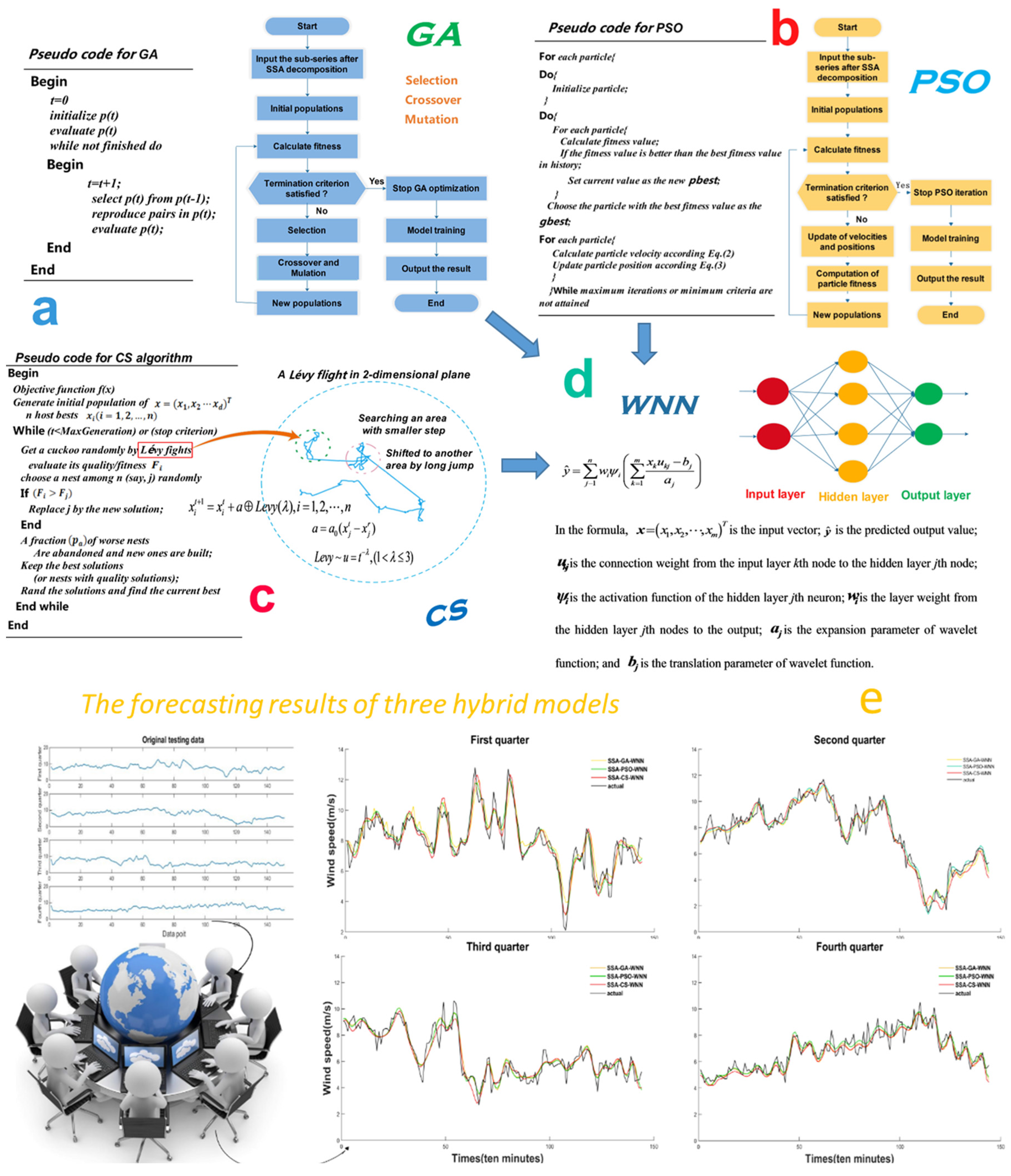
- Each algorithm has its own advantages. On the basis of an analysis of the structure and parameters of a WNN, the CS (Cuckoo Search), PSO (Particle Swarm Optimization) and GA (Genetic Algorithm) algorithms can be employed to determine the number of wavelet nodes and related parameters such as initial values. These procedures give the optimized artificial neural network higher stability, convergence speed and prediction accuracy.
- (3)
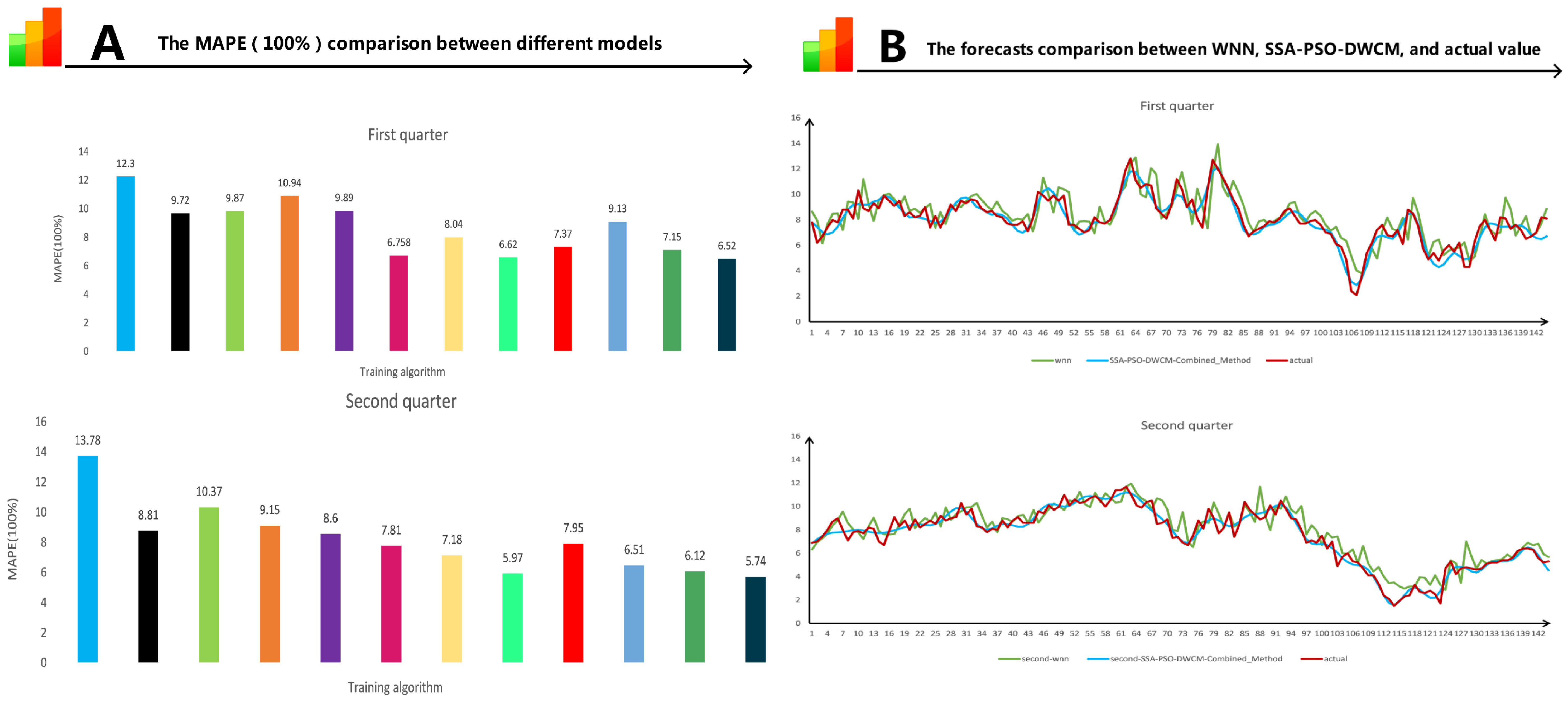
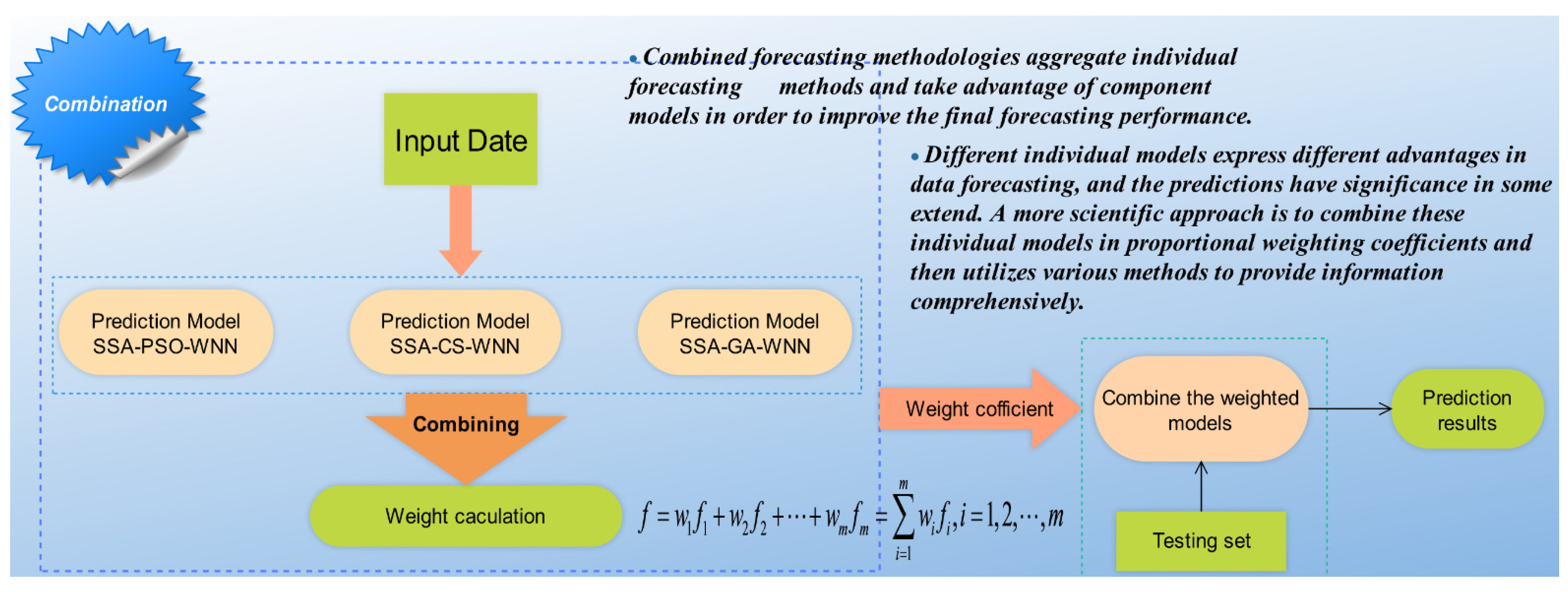
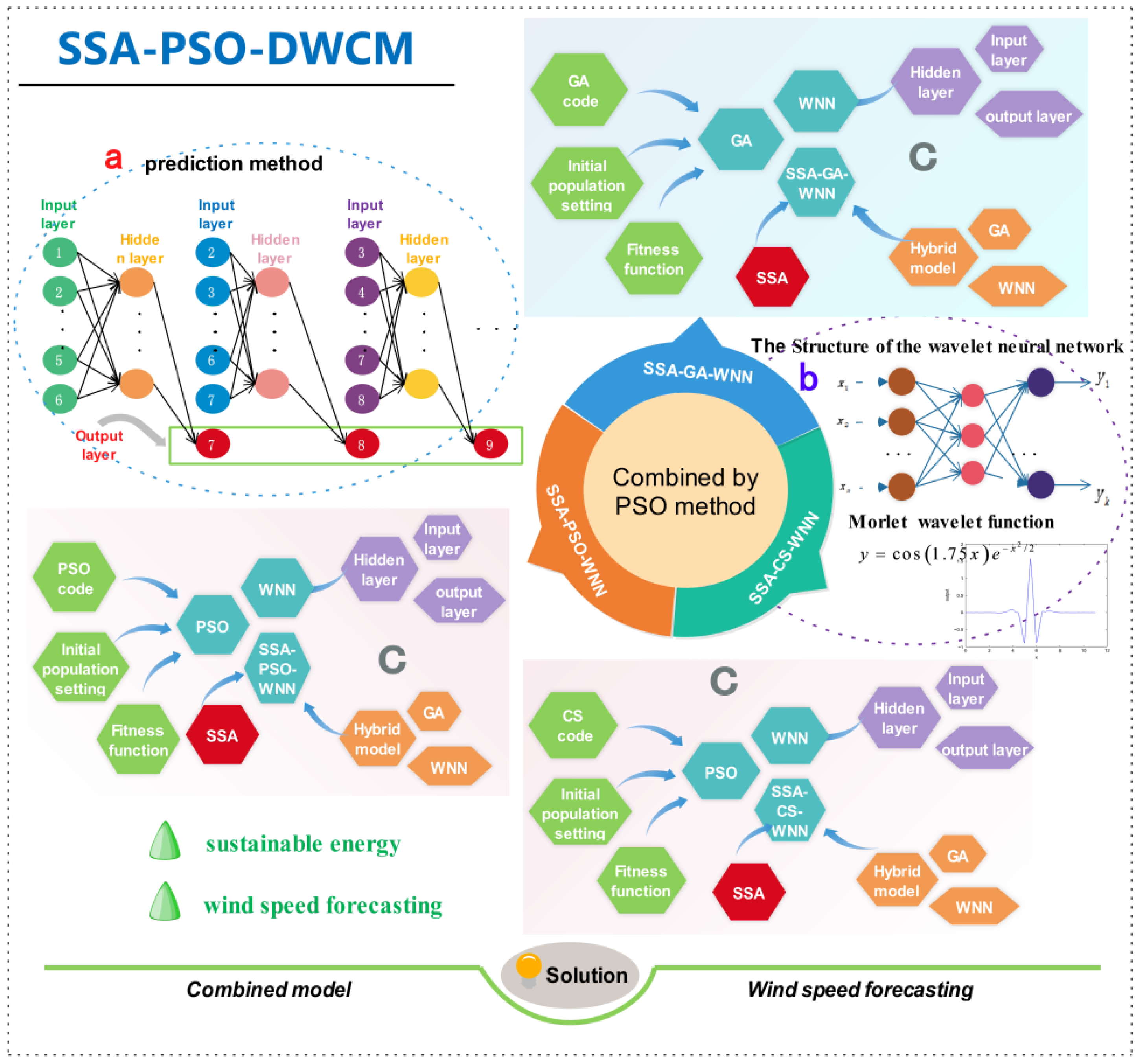
- A novel combined model, the SSA-PSO-DWCM, is developed for the wind-speed forecasting field that, for the first time, combines three hybrid models using an intelligent technique method. The combined model integrates the advantages of its component models and breaks through the limitations of traditional non-negative theory.
- (4)
- Considering the randomness of the optimization method and the nonlinearity of the wind series, every experiment was performed 10 times to ensure the reliability of the conclusions.
2. Forecasting Theory
2.1. Cuckoo Search (CS) Algorithm
2.2. Genetic Algorithm (GA)
- Step 1:
- Generate the initial population in a random way.
- Step 2:
- Compute and save each individual’s fitness.
- Step 3:
- Based on different fitness values, the selection procedure chooses an individual for a new group. The probability of being chosen is proportional to the individual fitness value.
- Step 4:
- A crossover operation is carried out by selecting two matching parents in which two random places are selected on each chromosome string and the string segments between these two places are exchanged between the mates.
- Step 5:
- Mutation randomly modifies elements in the chromosomes and is employed with low probability, typically from 0.001 to 0.01.
- Step 6:
- If the above steps have not found optimal solutions, i.e., the minimum objective function value has not been obtained, the procedure goes back to Step 2.
2.3. Particle Swarm Optimization (PSO) Algorithm
2.4. Wavelet Neural Network (WNN)
2.5. Singular Spectrum Analysis (SSA)
- (1)
- Embedding. Arrange a lag and choose a favorable “window” . Build the trajectory matrix as below:
- (2)
- Calculate the covariance matrix C of the trajectory matrix, with diagonals corresponding to equal lags:Calculate the eigenvalue of the eigenvector , where is called the time series’ singular spectrum and is called the temporal empirical orthogonal function (T-EOF).
- (3)
- Divide the matrices into applicable groups and calculate the sum of each group after the decomposition procedure. The projection of lagged series Y on :is called the time principle component (TPC).
- (4)
- The most important procedure of SSA is the component reconstruction. Two parameters, L (“window” length) and Y (the pattern of grouping the matrices), which are based on the attributes of the primitive sequences and the final analysis’ objective, are vital for the final decomposition result.
2.6. The Hybrid Models SSA-CS-WNN, SSA-GA-WNN, and SSA-PSO-WNN
3. Combined Model
3.1. Traditional Combination Forecasting Theory (Weighting-Based Combined Approaches)
3.2. Artificial Intelligence Algorithms
4. Experimental Design, Results and Discussion
4.1. Data Set
- (1)
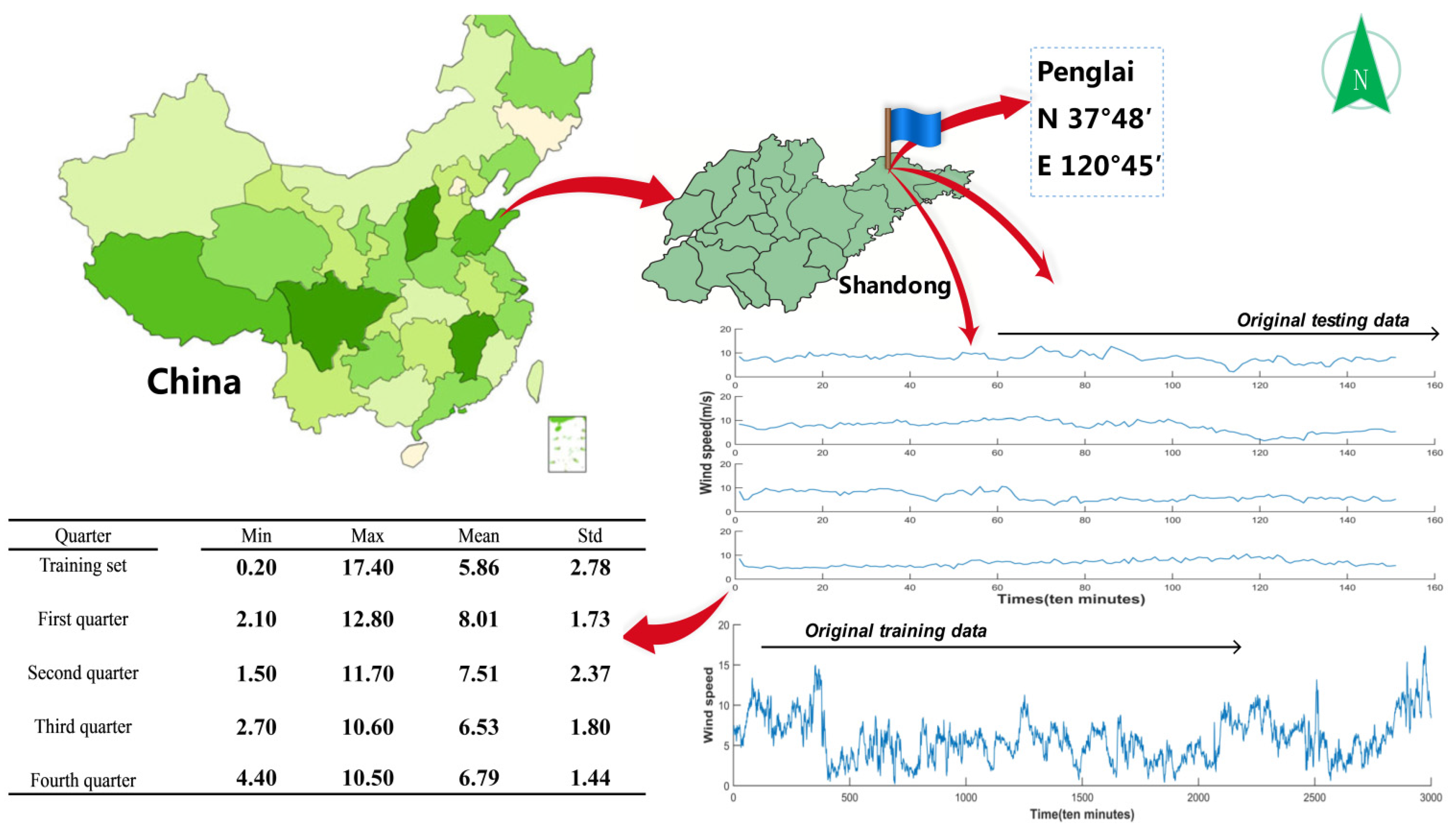
- Due to the highly random nature of wind speed processes, the experimental data have been randomly selected from four quarters, and the experimental results are regarded as general results.
- (2)
- For ease of plotting, T (the period of the time series) is 144.
4.2. Evaluation Indices for Forecasting Performance
4.3. Forecasting Procedure
- Step 1:
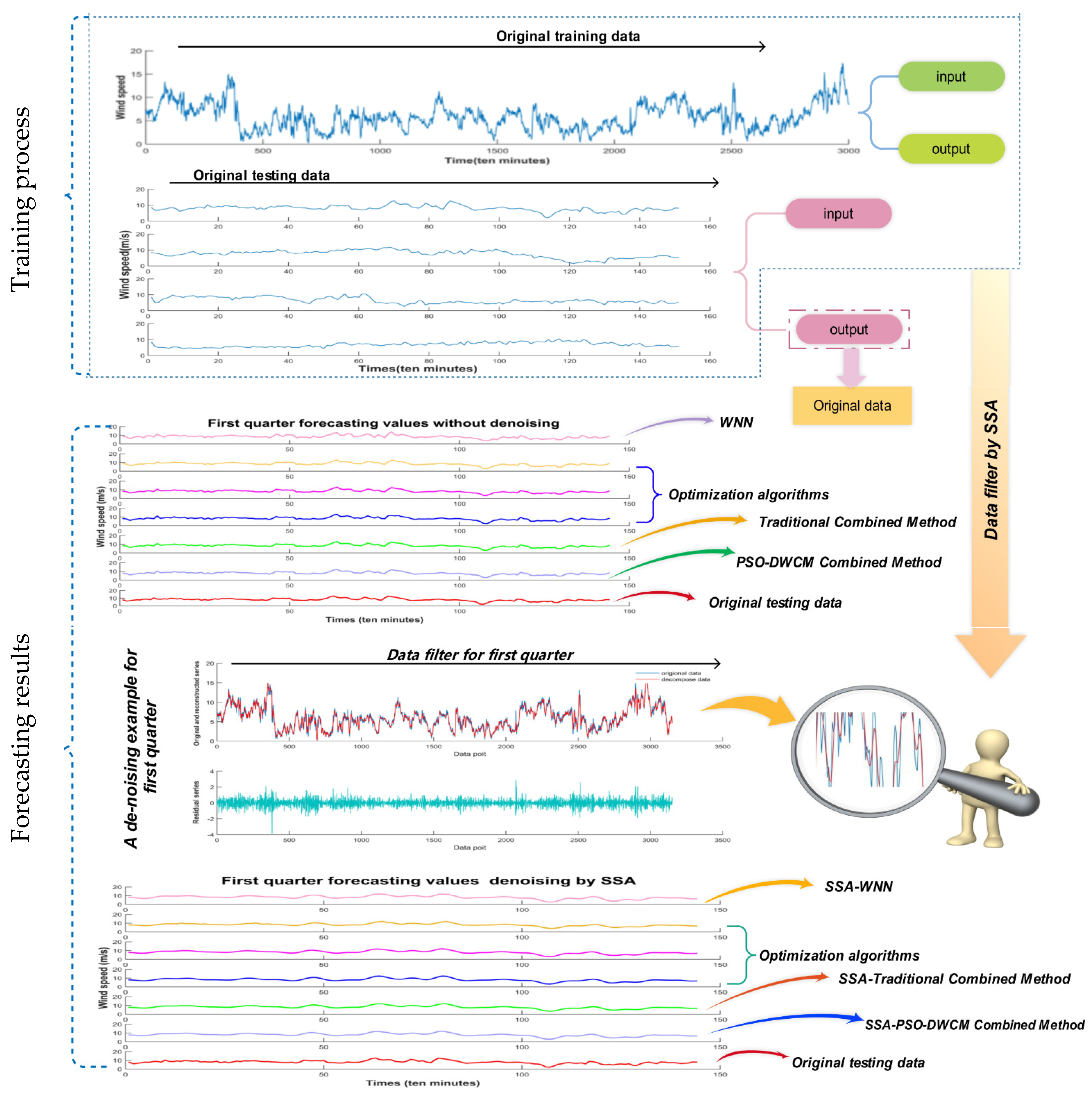
- Execute Wavelet Neural Network (WNN) method forecasts and collect the results (for four quarters of wind turbine 5).
- Step 2:
- Run three hybrid models PSO-WNN, CS-WNN and GA-WNN to forecast wind speed.
- Step 3:
- Combine the three hybrid forecast models by using the traditional combination method.
- Step 4:
- Combine the three hybrid forecast models based on the PSO-determined weighting coefficient method.
- Step 5:
- Use SSA to filter the raw wind speed data to decrease its non-stationarity. Then, use the de-noised data to rerun the models following the above Steps 1–4. The flowchart of the combined method SSA-PSO-DWCM is shown in Figure 4.
4.4. Analysis of Forecast Results and Comparisons of Different Models
4.4.1. Forecast Results without De-Noising Procedure
4.4.2. Forecast Results with SSA De-Noising Procedure
4.4.3. Analysis of Different Weighting Coefficients
5. Conclusions
Acknowledgments
Author Contributions
Conflicts of Interest
References
- China’s Wind Power Industry and Market Development Situation Analysis. Available online: http://www.51report.com/2015/hot-research_0108/3057577.html (accessed on 3 February 2016). (In Chinese)
- Zhao, J.; Guo, Z.H.; Su, Z.Y.; Zhao, Z.Y.; Xiao, X.; Liu, F. An improved multi-step forecasting model based on WRF ensembles and creative fuzzy systems for wind speed. Appl. Energy 2015, 162, 808–826. [Google Scholar] [CrossRef]
- Wang, J.J.; Zhang, W.Y.; Li, Y.N.; Wang, J.Z.; Dang, Z.L. Forecasting wind speed using empirical mode decomposition and Elman neural network. Appl. Soft Comput. 2014, 23, 452–459. [Google Scholar] [CrossRef]
- Jaramillo-Lopez, F.; Kenne, G.; Lamnabhi-Lagarrigue, F. A novel online training neural network-based algorithm for wind speed estimation and adaptive control of PMSG wind turbine system for maximum power extraction. Renew. Energy 2016, 86, 38–48. [Google Scholar] [CrossRef]
- Andreini, P.; Bonechi, S.; Bianchini, M.; Garzelli, A.; Mecocci, A. Automatic Image Classification for the Urinoculture Screening. Comput. Biol. Med. 2016, 39, 1–15. [Google Scholar] [CrossRef] [PubMed]
- Traorea, S.; Luoa, Y.F.; Fippsa, G. Deployment of artificial neural network for short-term forecasting of evapotranspiration using public weather forecast restricted messages. Agric. Water Manag. 2016, 163, 363–379. [Google Scholar] [CrossRef]
- OlivaTeles, L.; Fernandes, M.; Amorim, J.; Vasconcelos, V. Video-tracking of zebra fish (Daniorerio) as a biological early warning system using two distinct artificial neural networks: Probabilistic neural network (PNN) and self-organizing map (SOM). Aquat. Toxicol. 2015, 165, 241–248. [Google Scholar] [CrossRef] [PubMed]
- Saraiva, F.O.; Bernardes, W.M.S.; Asada, E.N. A framework for classification of non-linear loads in smart grids using Artificial Neural Networks and Multi-Agent Systems. Neurocomputing 2015, 170, 328–338. [Google Scholar] [CrossRef]
- ErdemGünay, M. Forecasting annual gross electricity demand by artificial neural networks using predicted values of socio-economic indicators and climatic conditions: Case of Turkey. Energy Policy 2016, 90, 92–101. [Google Scholar]
- Lu, Y.; Zeng, N.Y.; Liu, Y.R.; Zhang, N. A hybrid Wavelet Neural Network and Switching Particle Swarm Optimization algorithm for face direction recognition. Neurocomputing 2015, 155, 219–224. [Google Scholar] [CrossRef]
- Wang, J.Z.; Qin, S.S.; Zhou, Q.P.; Jiang, H.Y. Medium-term wind speeds forecasting utilizing hybrid models for three different sites in Xinjiang, China. Renew. Energy 2015, 76, 91–101. [Google Scholar] [CrossRef]
- Chau, K.W.; Wu, C.L. A Hybrid Model Coupled with Singular Spectrum Analysis for Daily Rainfall Prediction. J. Hydroinform. 2010, 12, 458–473. [Google Scholar] [CrossRef]
- Guo, Z.H.; Zhao, W.G.; Lu, H.Y.; Wang, J.Z. Multi-step forecasting for wind speed using a modified EMD-based artificial neural network model. Renew. Energy 2012, 37, 241–249. [Google Scholar] [CrossRef]
- Hu, J.M.; Wang, J.Z.; Zeng, G.W. A hybrid forecasting approach applied to wind speed time series. Renew. Energy 2013, 60, 185–194. [Google Scholar] [CrossRef]
- Golyandina, N.; Nekrutkin, V.; Zhigljavsky, A. Analysis of Time Series Structure: SSA and Related Techniques; Chapman & Hall/CRC: New York, NY, USA; London, UK, 2001. [Google Scholar]
- Claudio, M.; Rocco, S. Singular spectrum analysis and forecasting of failure time series. Reliab. Eng. Syst. Saf. 2013, 114, 126–136. [Google Scholar]
- Wu, C.L.; Chau, K.W.; Li, Y.S. Methods to improve neural network performance in daily flows prediction. J. Hydrol. 2009, 372, 80–93. [Google Scholar] [CrossRef]
- Chen, X.Y.; Chau, K.W.; Busari, A.O. A comparative study of population-based optimization algorithms for downstream river flow forecasting by a hybrid neural network model. Eng. Appl. Artif. Intell. 2015, 46, 258–268. [Google Scholar] [CrossRef]
- Wang, J.Z.; Hu, J.M.; Ma, K.L.; Zhang, Y.X. A self-adaptive hybrid approach for wind speed forecasting. Renew. Energy 2015, 78, 374–385. [Google Scholar] [CrossRef]
- Xiao, L.Y.; Wang, J.Z.; Hou, R.; Wu, J. A combined model based on data pre-analysis and weight coefficients optimization for electrical load forecasting. Energy 2015, 82, 524–549. [Google Scholar] [CrossRef]
- Qin, S.S.; Liu, F.; Wang, J.Z.; Song, Y.L. Interval forecasts of a novelty hybrid model for wind speeds. Energy Rep. 2015, 1, 8–16. [Google Scholar] [CrossRef]
- Guo, Z.; Wu, J.; Lu, H.; Wang, J. A case study on a hybrid wind speed forecasting method using BP neural network. Knowl. Based Syst. 2011, 24, 1048–1056. [Google Scholar] [CrossRef]
- Chen, H. The Validity of the Theory and Its Application of Combination Forecast Methods; Science Press: Beijing, China, 2008. (In Chinese) [Google Scholar]
- Wang, J.Z.; Xiao, L.; Shi, J. The Combination Forecasting of Electricity Price Based on Price Spikes Processing: A Case Study in South Australia. Abstr. Appl. Anal. 2014, 2014, 172306. [Google Scholar] [CrossRef]
- Wang, J.-Z.; Wang, Y.; Jiang, P. The study and application of a novel hybrid forecasting model—A case study of wind speed forecasting in China. Appl. Energy 2015, 143, 472–488. [Google Scholar] [CrossRef]
- Hu, J.M.; Wang, J.Z.; Zeng, G.W. A hybrid forecasting approach applied to wind speed time series. Renew. Energy 2013, 60, 185–194. [Google Scholar] [CrossRef]
- Guo, Z.; Zhao, W.; Lu, H.; Wang, J. Multi-step forecasting for wind speed using a modified EMD-based artificial neural network model. Renew. Energy 2012, 37, 241–249. [Google Scholar] [CrossRef]
- Dong, Y.; Wang, J.Z.; Jiang, H.; Shi, X.M. Intelligent optimized wind resource assessment and wind tubines selection in Huitengxile of Inner Monglia, China. Appl. Energy 2013, 109, 239–253. [Google Scholar] [CrossRef]
- Goldberg, D.E. Genetic Algorithms in Search, Optimization and Machine Learning; Addison Wesley Publishing Company: Boston, MA, USA, 1989. [Google Scholar]
- Zhang, J.; Chau, K.W. Multilayer Ensemble Pruning via Novel Multi-sub-swarm Particle Swarm Optimization. Comput. Inform. Sci. 2009, 1, 1362–1381. [Google Scholar]
- Taormina, R.; Chau, K.W. Neural Network River Forecasting with Multi-objective Fully Informed Particle Swarm Optimization. J. Hydroinform. 2014, 17, 99–113. [Google Scholar] [CrossRef]
- Huang, H.-X.; Li, J.-C.; Xiao, C.-L. A proposed iteration optimization approach integrating back propagation neural network with genetic algorithm. Expert Syst. Appl. 2015, 42, 146–155. [Google Scholar] [CrossRef]
- Abiyev, R.H.; Kaynak, O.; Kayacan, E. A type-2 fuzzy wavelet neural network for system identification and control. J. Frankl. Inst. 2013, 350, 1658–1685. [Google Scholar] [CrossRef]
- Xiao, L.; Wang, J.Z.; Dong, Y.; Wu, J. Combined forecasting models for wind energy forecasting: A case study in China. Renew. Sustain. Energy Rev. 2015, 44, 271–288. [Google Scholar] [CrossRef]
- Zhang, W.; Deng, Y.-C. Short-Term Wind Speed Prediction Based on Combination Model. Power Syst. Clean Energy 2013, 29, 83–87, 91. (In Chinese) [Google Scholar]
- Wang, J.J.; Wang, J.Z.; Li, Y.N.; Zhu, S.L.; Zhao, J. Techniques of applying wavelet de-noising into a combined model for short-term load forecasting. Electr. Power Energy Syst. 2014, 62, 816–824. [Google Scholar] [CrossRef]


| Experimental Parameters | Default Value |
|---|---|
| CS the scale of bird’s nest | 20 |
| CS the probability of host cuckoo discover outside egg | 0.25 |
| CS the accuracy of the iteration termination | 1.0e-5 |
| Experimental Parameters | Default Value |
|---|---|
| GA population scale | 200 |
| GA population scale | 50 |
| GA cross rate | 0.8 |
| GA mutation rate | 0.05 |
| Experimental Parameters | Default Value |
|---|---|
| PSO population scale | 20 |
| PSO maximum number of iteration times | 20 |
| PSO speed upper bound | 1 |
| PSO speed lower bound | −1 |
| Experimental Parameters | Default Value |
|---|---|
| the number of the input nodes | 6 |
| the number of the hidden nodes | 6 |
| the number of the output nodes | 1 |
| the learning velocity 1 | 0.01 |
| the learning velocity 2 | 0.001 |
| iteration time | 20 |
| First Quarter | Second Quarter | ||||||||
|---|---|---|---|---|---|---|---|---|---|
| Indexes | WNN | SSA-WNN | Indexes | WNN | SSA-WNN | ||||
| Max | Min | Max | Min | Max | Min | Max | Min | ||
| MAE (m/s) | 1.09 | 0.79 | 0.70 | 0.53 | MAE (m/s) | 0.91 | 0.66 | 0.58 | 0.42 |
| MAPE (%) | 15.52 | 10.80 | 9.74 | 7.75 | MAPE (%) | 16.47 | 10.55 | 10.26 | 6.74 |
| MSE | 2.06 | 0.99 | 0.73 | 0.50 | MSE | 1.14 | 0.68 | 0.52 | 0.29 |
| PSO-WNN | SSA-PSO-WNN | PSO-WNN | SSA-PSO-WNN | ||||||
| Max | Min | Max | Min | Max | Min | Max | Min | ||
| MAE (m/s) | 0.73 | 0.69 | 0.48 | 0.47 | MAE (m/s) | 0.56 | 0.55 | 0.39 | 0.39 |
| MAPE (%) | 10.13 | 9.72 | 6.79 | 6.62 | MAPE (%) | 8.87 | 8.81 | 5.97 | 5.82 |
| MSE | 0.87 | 0.84 | 0.39 | 0.36 | MSE | 0.55 | 0.52 | 0.25 | 0.25 |
| CS-WNN | SSA-CS-WNN | CS-WNN | SSA-CS-WNN | ||||||
| Max | Min | Max | Min | Max | Min | Max | Min | ||
| MAE (m/s) | 0.77 | 0.72 | 0.55 | 0.54 | MAE (m/s) | 0.67 | 0.63 | 0.46 | 0.44 |
| MAPE (%) | 10.81 | 9.87 | 7.75 | 7.37 | MAPE (%) | 11.42 | 10.37 | 7.95 | 7.50 |
| MSE | 0.97 | 0.88 | 0.51 | 0.44 | MSE | 0.71 | 0.61 | 0.34 | 0.31 |
| GA-WNN | SSA-GA-WNN | GA-WNN | SSA-GA-WNN | ||||||
| Max | Min | Max | Min | Max | Min | Max | Min | ||
| MAE (m/s) | 0.79 | 0.77 | 0.68 | 0.50 | MAE (m/s) | 0.81 | 0.64 | 0.46 | 0.41 |
| MAPE (%) | 11.60 | 10.81 | 10.46 | 7.09 | MAPE (%) | 16.49 | 9.15 | 9.15 | 6.51 |
| MSE | 1.04 | 0.97 | 0.76 | 0.4 | MSE | 0.99 | 0.35 | 0.35 | 0.28 |
| Third Quarter | Fourth Quarter | ||||||||
|---|---|---|---|---|---|---|---|---|---|
| Indexes | WNN | SSA-WNN | Indexes | WNN | SSA-WNN | ||||
| Max | Min | Max | Min | Max | Min | Max | Min | ||
| MAE (m/s) | 0.97 | 0.65 | 0.5920 | 0.4837 | MAE (m/s) | 0.94 | 0.74 | 0.63 | 0.43 |
| MAPE (%) | 16.46 | 11.10 | 10.19 | 7.97 | MAPE (%) | 13.37 | 10.65 | 10.08 | 6.27 |
| MSE | 1.56 | 0.71 | 0.56 | 0.37 | MSE | 1.45 | 0.83 | 0.57 | 0.30 |
| PSO-WNN | SSA-PSO-WNN | PSO-WNN | SSA-PSO-WNN | ||||||
| Max | Min | Max | Min | Max | Min | Max | Min | ||
| MAE (m/s) | 0.64 | 0.62 | 0.46 | 0.46 | MAE (m/s) | 0.59 | 0.57 | 0.42 | 0.41 |
| MAPE (%) | 10.96 | 10.61 | 7.83 | 7.73 | MAPE (%) | 8.75 | 8.47 | 6.12 | 5.93 |
| MSE | 0.71 | 0.68 | 0.35 | 0.35 | MSE | 0.56 | 0.52 | 0.27 | 0.27 |
| CS-WNN | SSA-CS-WNN | CS-WNN | SSA-CS-WNN | ||||||
| Max | Min | Max | Min | Max | Min | Max | Min | ||
| MAE (m/s) | 0.81 | 0.67 | 0.50 | 0.48 | MAE (m/s) | 0.60 | 0.56 | 0.43 | 0.42 |
| MAPE (%) | 14.24 | 11.43 | 8.37 | 8.13 | MAPE (%) | 8.54 | 8.10 | 6.31 | 6.14 |
| MSE | 1.03 | 0.74 | 0.39 | 0.38 | MSE | 0.60 | 0.53 | 0.30 | 0.28 |
| GA-WNN | SSA-GA-WNN | GA-WNN | SSA-GA-WNN | ||||||
| Max | Min | Max | Min | Max | Min | Max | Min | ||
| MAE (m/s) | 0.77 | 0.70 | 0.47 | 0.47 | MAE (m/s) | 0.98 | 0.69 | 0.44 | 0.42 |
| MAPE (%) | 12.97 | 11.93 | 8.09 | 8.02 | MAPE (%) | 15.78 | 10.30 | 6.64 | 6.01 |
| MSE | 0.94 | 0.81 | 0.38 | 0.37 | MSE | 1.31 | 0.74 | 0.29 | 0.28 |
| Training Algorithm | Estimation Indexes | Predict Value | Actual Value | ||||
|---|---|---|---|---|---|---|---|
| MSE | MAE (m/s) | MAPE (%) | Min | Max | Min | Max | |
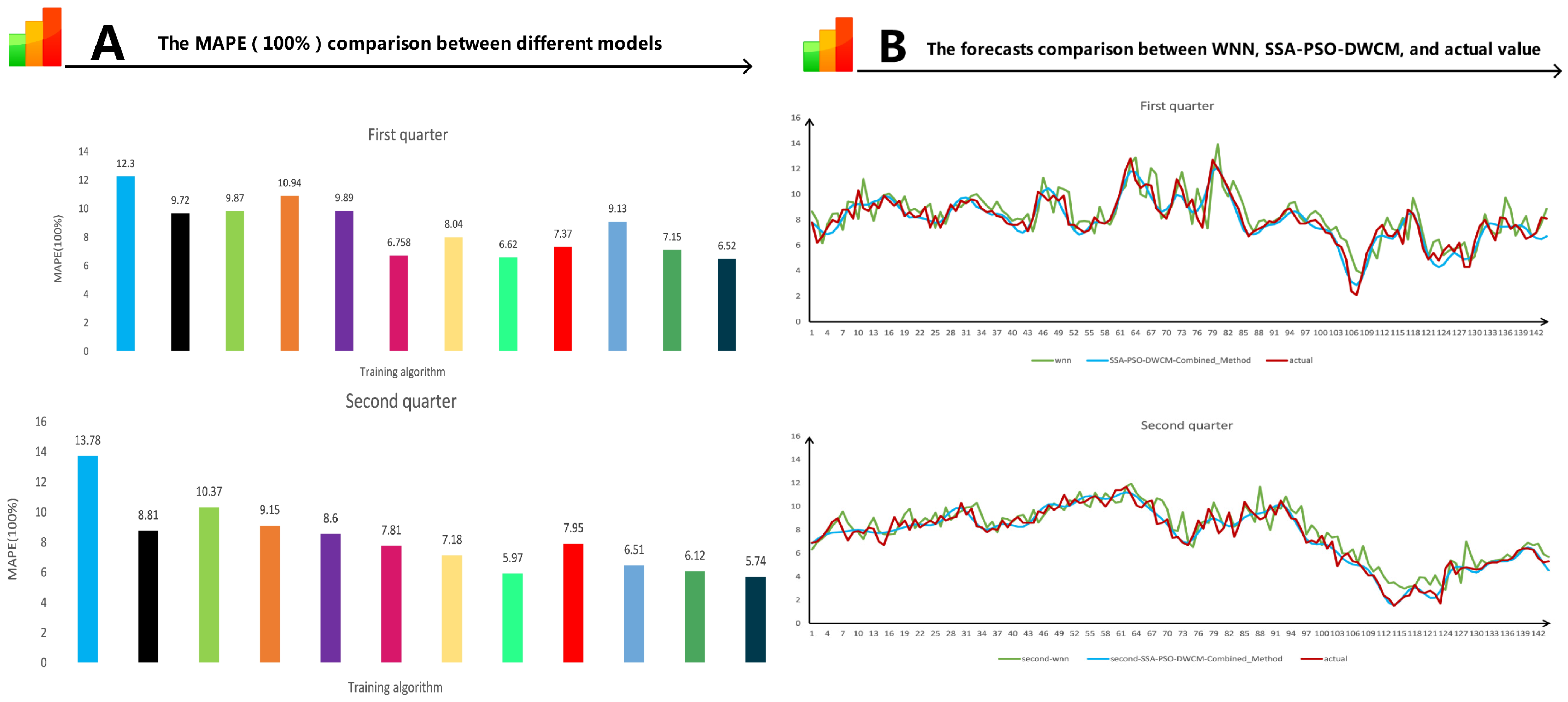
| WNN | 1.22 | 0.88 | 12.30 | 3.82 | 13.91 | 2.10 | 12.80 |
| PSO-WNN | 0.84 | 0.69 | 9.72 | 3.37 | 12.82 | 2.10 | 12.80 |
| CS-WNN | 0.88 | 0.72 | 9.87 | 2.15 | 12.91 | 2.10 | 12.80 |
| GA-WNN | 0.98 | 0.78 | 10.94 | 2.93 | 12.81 | 2.10 | 12.80 |
| Traditional Combined Method | 0.85 | 0.71 | 9.89 | 2.81 | 12.85 | 2.10 | 12.80 |
| PSO-DWCM Combined Method | 0.83 | 0.68 | 9.30 | 2.87 | 12.42 | 2.10 | 12.80 |
| SSA-WNN | 0.52 | 0.58 | 8.04 | 2.63 | 12.01 | 2.10 | 12.80 |
| SSA-PSO-WNN | 0.36 | 0.47 | 6.62 | 3.09 | 12.08 | 2.10 | 12.80 |
| SSA-CS-WNN | 0.44 | 0.54 | 7.37 | 3.11 | 12.36 | 2.10 | 12.80 |
| SSA-GA-WNN | 0.62 | 0.63 | 9.13 | 3.96 | 11.98 | 2.10 | 12.80 |
| SSA-Traditional Combined Method | 0.41 | 0.51 | 7.15 | 3.34 | 12.02 | 2.10 | 12.80 |
| SSA-PSO-DWCM Combined Method | 0.37 | 0.47 | 6.52 | 2.88 | 12.10 | 2.10 | 12.80 |
| Training Algorithm | Estimation Indexes | Predict Value | Actual Value | ||||
|---|---|---|---|---|---|---|---|
| MSE | MAE (m/s) | MAPE (%) | Min | Max | Min | Max | |
| WNN | 0.97 | 0.76 | 13.78 | 2.85 | 11.94 | 1.50 | 11.70 |
| PSO-WNN | 0.55 | 0.56 | 8.810 | 1.73 | 10.67 | 1.50 | 11.70 |
| CS-WNN | 0.61 | 0.63 | 10.37 | 2.05 | 11.65 | 1.50 | 11.70 |
| GA-WNN | 0.35 | 0.46 | 9.15 | 2.87 | 11.21 | 1.50 | 11.70 |
| Traditional Combined Method | 0.40 | 0.50 | 8.60 | 2.29 | 11.13 | 1.50 | 11.70 |
| PSO-DWCM Combined Method | 0.35 | 0.46 | 7.81 | 2.48 | 10.69 | 1.50 | 11.70 |
| SSA-WNN | 0.32 | 0.44 | 7.18 | 1.25 | 11.59 | 1.50 | 11.70 |
| SSA-PSO-WNN | 0.25 | 0.39 | 5.97 | 1.37 | 11.27 | 1.50 | 11.70 |
| SSA-CS-WNN | 0.34 | 0.46 | 7.95 | 1.73 | 11.40 | 1.50 | 11.70 |
| SSA-GA-WNN | 0.28 | 0.41 | 6.51 | 2.30 | 11.14 | 1.50 | 11.70 |
| SSA-Traditional Combined Method | 0.25 | 0.39 | 6.12 | 1.93 | 11.24 | 1.50 | 11.70 |
| SSA-PSO-DWCM Combined Method | 0.24 | 0.38 | 5.74 | 1.54 | 11.21 | 1.50 | 11.70 |
| Training Algorithm | Estimation Indexes | Predict Value | Actual Value | ||||
|---|---|---|---|---|---|---|---|
| MSE | MAE (m/s) | MAPE (%) | Min | Max | Min | Max | |
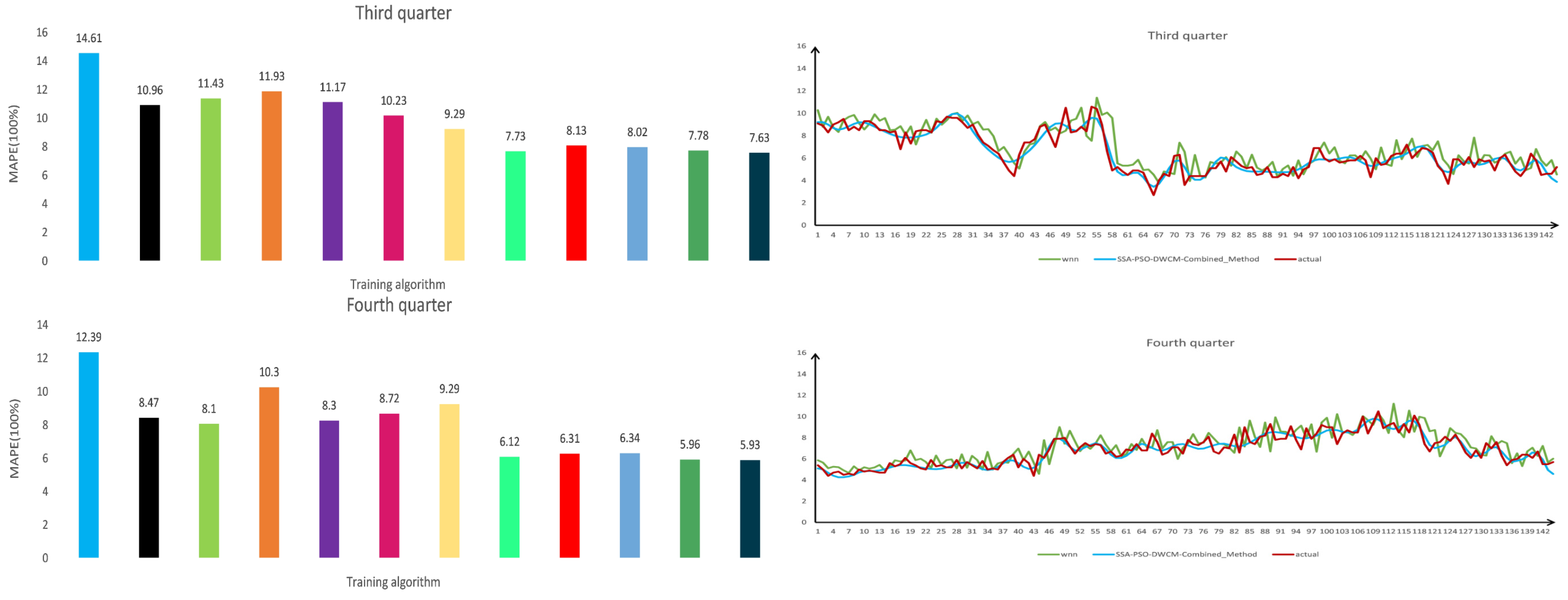
| WNN | 1.24 | 0.84 | 14.61 | 3.7 | 11.40 | 2.70 | 10.60 |
| PSO-WNN | 0.71 | 0.64 | 10.96 | 3.05 | 10.24 | 2.70 | 10.60 |
| CS-WNN | 0.74 | 0.67 | 11.43 | 2.97 | 9.70 | 2.70 | 10.60 |
| GA-WNN | 0.81 | 0.70 | 11.93 | 3.46 | 10.95 | 2.70 | 10.60 |
| Traditional Combined Method | 0.72 | 0.65 | 11.17 | 3.16 | 10.08 | 2.70 | 10.60 |
| PSO-DWCM Combined Method | 0.70 | 0.62 | 10.23 | 3.27 | 10.52 | 2.70 | 10.60 |
| SSA-WNN | 0.50 | 0.54 | 9.29 | 3.29 | 10.27 | 2.70 | 10.60 |
| SSA-PSO-WNN | 0.34 | 0.46 | 7.73 | 3.54 | 10.03 | 2.70 | 10.60 |
| SSA-CS-WNN | 0.38 | 0.48 | 8.13 | 2.86 | 9.84 | 2.70 | 10.60 |
| SSA-GA-WNN | 0.47 | 0.37 | 8.02 | 3.50 | 10.06 | 2.70 | 10.60 |
| SSA-Traditional Combined Method | 0.35 | 0.46 | 7.78 | 3.34 | 9.98 | 2.70 | 10.60 |
| SSA-PSO-DWCM Combined Method | 0.34 | 0.46 | 7.63 | 3.44 | 9.98 | 2.70 | 10.60 |
| Training Algorithm | Estimation Indexes | Predict Value | Actual Value | ||||
|---|---|---|---|---|---|---|---|
| MSE | MAE (m/s) | MAPE (%) | Min | Max | Min | Max | |
| WNN | 1.07 | 0.83 | 12.39 | 4.58 | 11.22 | 4.40 | 10.50 |
| PSO-WNN | 0.53 | 0.57 | 8.47 | 4.45 | 9.12 | 4.40 | 10.50 |
| CS-WNN | 0.53 | 0.56 | 8.10 | 4.27 | 9.53 | 4.40 | 10.50 |
| GA-WNN | 0.74 | 0.69 | 10.30 | 4.85 | 10.84 | 4.40 | 10.50 |
| Traditional Combined Method | 0.51 | 0.56 | 8.30 | 4.56 | 9.66 | 4.40 | 10.50 |
| PSO-DWCM Combined Method | 0.50 | 0.54 | 8.72 | 4.27 | 9.35 | 4.40 | 10.50 |
| SSA-WNN | 0.55 | 0.58 | 9.29 | 4.06 | 9.99 | 4.40 | 10.50 |
| SSA-PSO-WNN | 0.27 | 0.42 | 6.12 | 4.21 | 9.77 | 4.40 | 10.50 |
| SSA-CS-WNN | 0.30 | 0.43 | 6.31 | 4.18 | 9.63 | 4.40 | 10.50 |
| SSA-GA-WNN | 0.28 | 0.42 | 6.34 | 4.22 | 9.69 | 4.40 | 10.50 |
| SSA-Traditional Combined Method | 0.27 | 0.41 | 5.96 | 4.21 | 9.70 | 4.40 | 10.50 |
| SSA-PSO-DWCM Combined Method | 0.27 | 0.41 | 5.93 | 4.27 | 9.79 | 4.40 | 10.50 |
| Quarter | Data Set | Correlate Index | |||
|---|---|---|---|---|---|
| Original | De-Noising | R | RE (100%) | RMSE (100%) | |
| First quarter | 3150 | 3150 | 0.9849 | 0.58% | 0.42% |
| Second quarter | 3150 | 3150 | 0.9846 | 0.60% | 0.42% |
| Third quarter | 3150 | 3150 | 0.9841 | 0.61% | 0.41% |
| Fourth quarter | 3150 | 3150 | 0.9844 | 0.59% | 0.42% |
| Quarter | Weighting Coefficients Determined Method | Hybrid Models’ Weighting Coefficients | ||
|---|---|---|---|---|
| First quarter | PS0-WNN | CS-WNN | GA-WNN | |
| Traditional Combined Method | 0.3481 | 0.3427 | 0.3092 | |
| PSO-DWCM Combined Method | 0.5327 | 0.2548 | 0.1796 | |
| SSA-PS0-WNN | SSA-CS-WNN | SSA-GA-WNN | ||
| SSA-Traditional Combined Method | 0.3812 | 0.3424 | 0.2764 | |
| SSA-PSO-DWCM Combined Method | 1.0000 | 0.1867 | −0.1985 | |
| Second quarter | PS0-WNN | CS-WNN | GA-WNN | |
| Traditional Combined Method | 0.3556 | 0.3021 | 0.3424 | |
| PSO-DWCM Combined Method | 0.4913 | −0.1081 | 0.5998 | |
| SSA-PS0-WNN | SSA-CS-WNN | SSA-GA-WNN | ||
| SSA-Traditional Combined Method | 0.3748 | 0.2815 | 0.3437 | |
| SSA-PSO-DWCM Combined Method | 0.8560 | 0.1669 | −0.0296 | |
| Third quarter | PS0-WNN | CS-WNN | GA-WNN | |
| Traditional Combined Method | 0.3475 | 0.3332 | 0.3193 | |
| PSO-DWCM Combined Method | 0.1480 | −0.2000 | 0.9863 | |
| SSA-PS0-WNN | SSA-CS-WNN | SSA-GA-WNN | ||
| SSA-Traditional Combined Method | 0.3431 | 0.3262 | 0.3307 | |
| SSA-PSO-DWCM Combined Method | 1.0000 | −0.1953 | 0.1916 | |
| Fourth quarter | PS0-WNN | CS-WNN | GA-WNN | |
| Traditional Combined Method | 0.3487 | 0.3646 | 0.2867 | |
| PSO-DWCM Combined Method | 0.2596 | −0.1325 | 0.8730 | |
| SSA-PS0-WNN | SSA-CS-WNN | SSA-GA-WNN | ||
| SSA-Traditional Combined Method | 0.3407 | 0.3304 | 0.3289 | |
| SSA-PSO-DWCM Combined Method | −0.0906 | 0.5851 | 0.5199 | |
© 2016 by the authors; licensee MDPI, Basel, Switzerland. This article is an open access article distributed under the terms and conditions of the Creative Commons Attribution (CC-BY) license (http://creativecommons.org/licenses/by/4.0/).
Share and Cite
Zhang, F.; Dong, Y.; Zhang, K. A Novel Combined Model Based on an Artificial Intelligence Algorithm—A Case Study on Wind Speed Forecasting in Penglai, China. Sustainability 2016, 8, 555. https://doi.org/10.3390/su8060555
Zhang F, Dong Y, Zhang K. A Novel Combined Model Based on an Artificial Intelligence Algorithm—A Case Study on Wind Speed Forecasting in Penglai, China. Sustainability. 2016; 8(6):555. https://doi.org/10.3390/su8060555
Chicago/Turabian StyleZhang, Feiyu, Yuqi Dong, and Kequan Zhang. 2016. "A Novel Combined Model Based on an Artificial Intelligence Algorithm—A Case Study on Wind Speed Forecasting in Penglai, China" Sustainability 8, no. 6: 555. https://doi.org/10.3390/su8060555
APA StyleZhang, F., Dong, Y., & Zhang, K. (2016). A Novel Combined Model Based on an Artificial Intelligence Algorithm—A Case Study on Wind Speed Forecasting in Penglai, China. Sustainability, 8(6), 555. https://doi.org/10.3390/su8060555