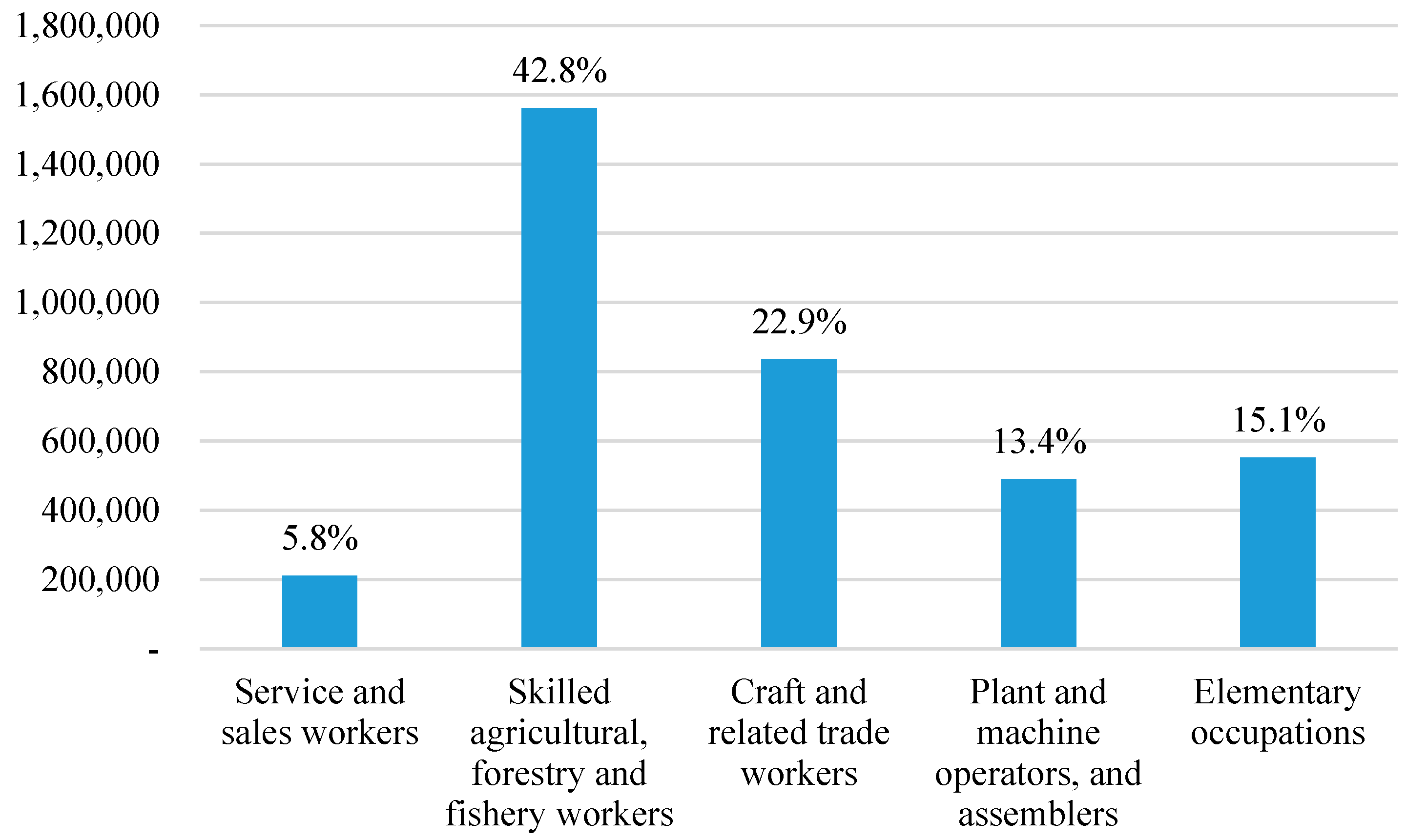

Exploring the Spatial Distribution of Occupations Vulnerable to Climate Change in Korea

Abstract
:1. Introduction
2. Conceptual Framework for Identifying Occupations Vulnerable to Climate Change
2.1. Assessing Vulnerability to Climate Change
2.2. Strategies for Identifying Occupations Vulnerable to Climate Change
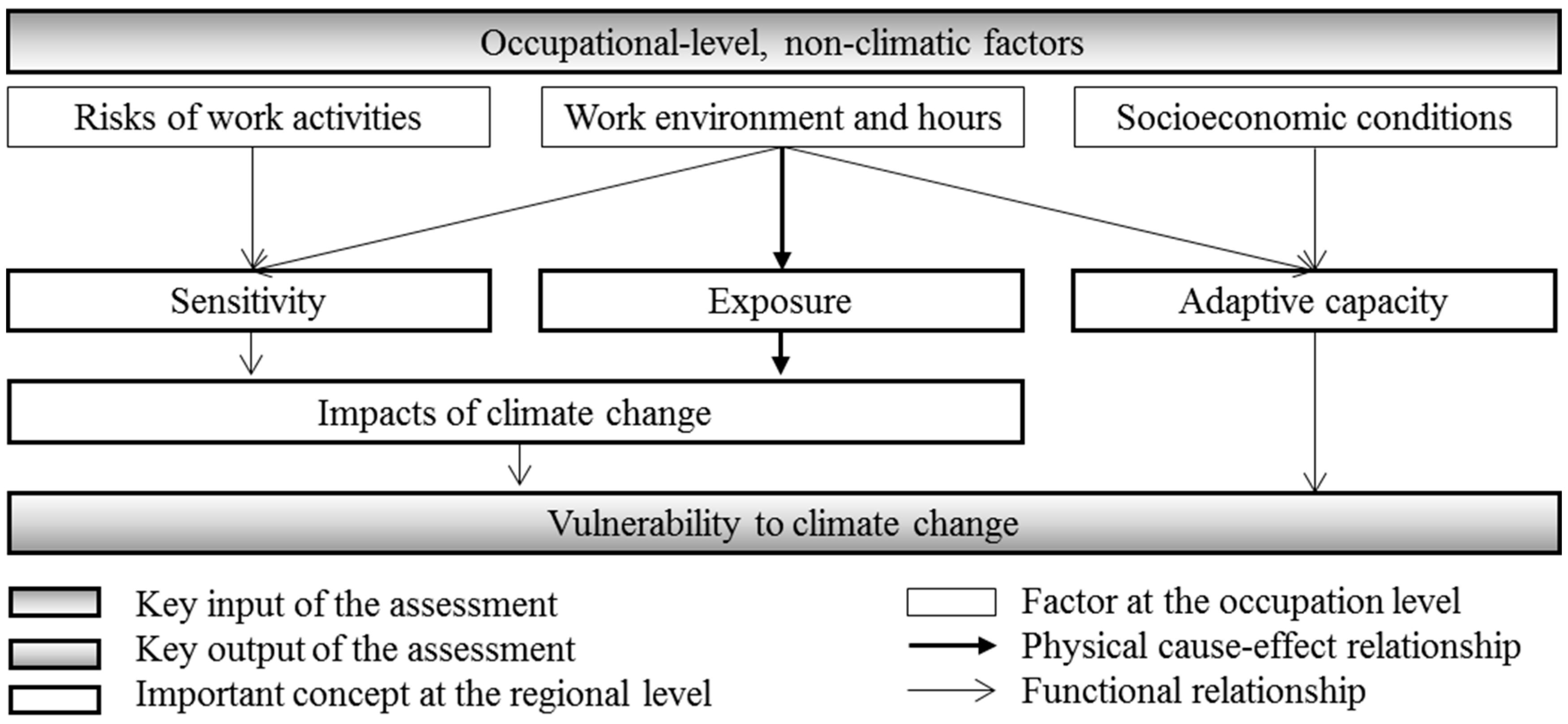
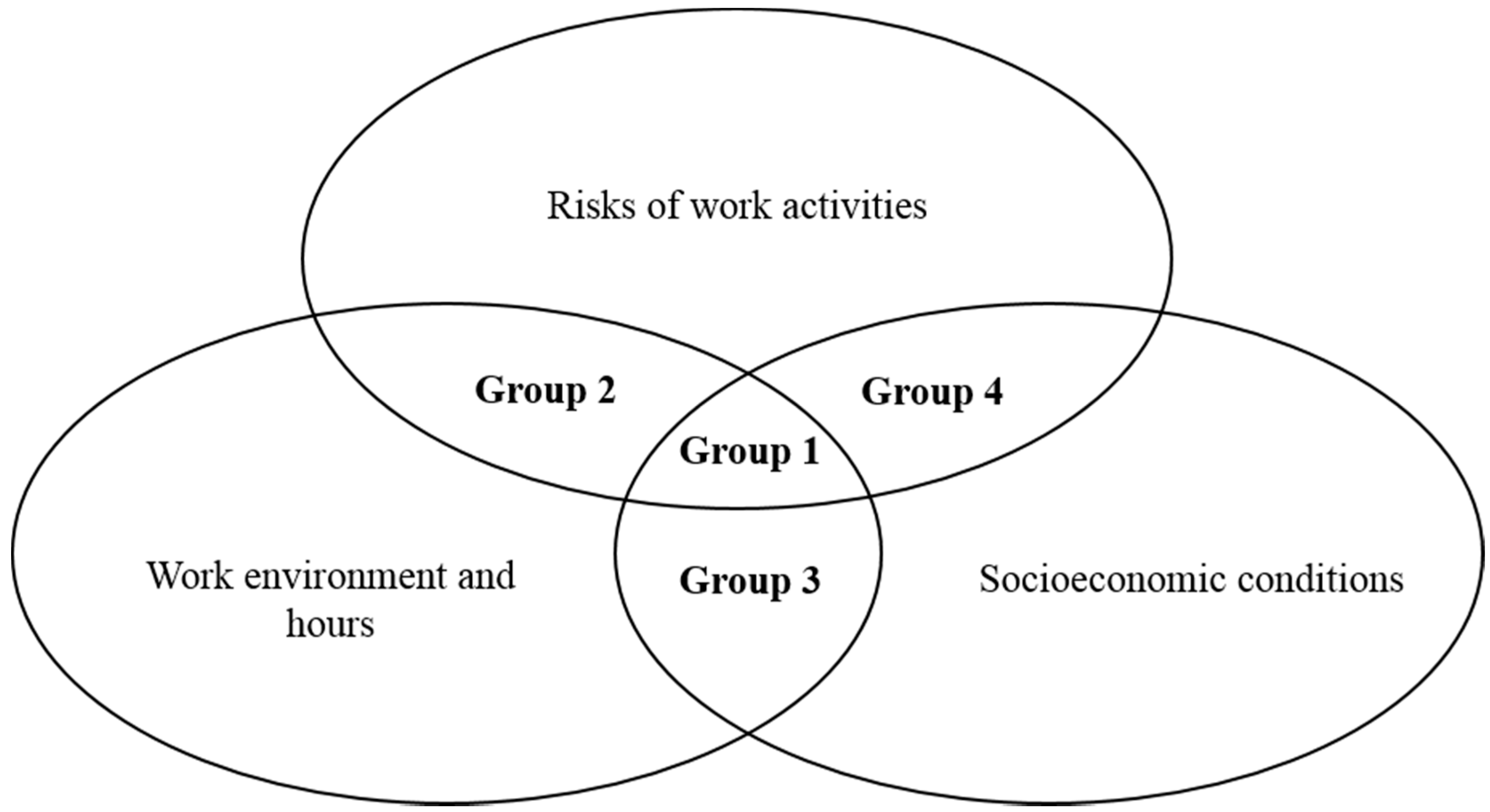
3. Data and Methods

| Categories | Variables | Operational Definitions |
|---|---|---|
| Work environment and hours | (1) Instability in the workplace | Percentage of workers who travel for work or engage in outdoor work |
| (2) Irregularity of daily tasks | Percentage of workers who have irregular hours or unfixed times to start and end work every week | |
| (3) Excessive working hours | Percentage of workers who work more than 52 h per week | |
| Risks of work activities | (4) Musculoskeletal risk factors | Standardized value of principal component analysis to percentage of workers who spend more than 25% of their working hours in each of the risks as vibrations, tiring position, lifting people, carrying heavy loads, standing, and repetitive movement |
| (5) Biochemical risk factors | Standardized value of principal component analysis to percentage of workers who spend more than 25% of their working hours in each of the risks as dust, vapors, chemicals, and infectious materials | |
| (6) Exposure to high temperatures | Percentage of workers who spend more than 25% of their working hours in high temperatures | |
| Socioeconomic conditions | (7) Pay levels for different jobs | Average pay level for types of occupations (monthly, USD) |
| (8) Employment stability | Percentage of full-time regular employees in each occupation type | |
| (9) Levels of knowledge and skills | Average number of years of education for each occupation type |
4. Findings
4.1. Occupations Vulnerable to the Effects of Climate Change

| Occupations | Work Environment and Hours | Risks of Work Activities | Socioeconomic Conditions | Group | |||||||||
|---|---|---|---|---|---|---|---|---|---|---|---|---|---|
| (1) | (2) | (3) | PR | (4) | (5) | (6) | PR | (7) | (8) | (9) | PR | ||
| Crop growers | 0.96 | 0.96 | 0.28 | 0.68 | 1.15 | −0.05 | 0.52 | 16.33 | 692 | 0.01 | 8.46 | 6.80 | 1 |
| Horticultural and landscape workers | 0.64 | 0.55 | 0.24 | 12.24 | 1.07 | −0.11 | 0.48 | 19.73 | 1384 | 0.25 | 11.93 | 12.24 | 1 |
| Construction/structure-related workers | 0.45 | 0.45 | 0.33 | 20.41 | 1.54 | 1.06 | 0.58 | 6.80 | 1730 | 0.25 | 12.2 | 19.73 | 1 |
| Construction-related technical workers | 0.68 | 0.63 | 0.38 | 3.40 | 1.67 | 1.01 | 0.54 | 8.16 | 1730 | 0.50 | 11.56 | 6.12 | 1 |
| Building/finishing-related technical workers | 0.66 | 0.62 | 0.42 | 2.72 | 1.22 | 1.76 | 0.40 | 12.24 | 1730 | 0.30 | 11.91 | 13.61 | 1 |
| Construction and mining-related unskilled laborers | 0.76 | 0.65 | 0.22 | 6.12 | 1.53 | 0.74 | 0.54 | 10.88 | 1211 | 0.86 | 10.78 | 0.68 | 1 |
| Livestock industry and stockbreeding-related workers | 0.86 | 0.82 | 0.56 | 0 | 1.16 | −0.23 | 0.46 | 20.41 | 1730 | 0.03 | 11.21 | 29.93 | 2 |
| Wood and furniture, musical instrument and signboard-related trade workers | 0.36 | 0.39 | 0.48 | 18.37 | 1.47 | 1.55 | 0.39 | 11.56 | 1903 | 0.10 | 12.87 | 43.54 | 2 |
| Machinery equipment fitters and mechanics | 0.37 | 0.45 | 0.39 | 21.77 | 0.92 | 0.81 | 0.35 | 18.37 | 1989 | 0.05 | 12.90 | 51.02 | 2 |
| Plumbers | 0.58 | 0.55 | 0.49 | 4.08 | 1.41 | 1.21 | 0.48 | 10.20 | 1903 | 0.20 | 12.40 | 26.53 | 2 |
| Laundry-related machine operators | 0.10 | 0.43 | 0.88 | 8.84 | 0.93 | 1.06 | 0.27 | 21.77 | 1470 | 0.02 | 11.63 | 29.25 | 2 |
| Construction and mining machine operators | 0.84 | 0.62 | 0.30 | 2.04 | 0.75 | 0.53 | 0.46 | 17.69 | 2378 | 0.17 | 12.64 | 42.86 | 2 |
| Ship deck workers and related workers | 0.50 | 0.50 | 0.25 | 17.69 | 1.02 | 0.68 | 0.75 | 5.44 | 2811 | 0.25 | 11.13 | 28.57 | 2 |
| Hairdressing, wedding and medical assistance service workers | 0.37 | 0.82 | 0.31 | 6.80 | −1.52 | −0.86 | 0.03 | 95.24 | 865 | 0.03 | 10.36 | 11.56 | 3 |
| Leisure services and sports-related workers | 0.06 | 0.44 | 0.61 | 24.49 | −0.51 | −0.58 | 0.13 | 63.95 | 1470 | 0.22 | 12.98 | 22.45 | 3 |
| Forestry-related workers | 0.86 | 0.45 | 0.05 | 16.33 | 1.19 | −0.50 | 0.45 | 25.85 | 1427 | 0.32 | 11.27 | 9.52 | 3 |
| Fishery-related workers | 0.83 | 0.96 | 0.38 | 1.36 | 1.43 | −0.50 | 0.33 | 32.65 | 1038 | 0.12 | 9.15 | 7.48 | 3 |
| Garment-related workers | 0.04 | 0.55 | 0.59 | 17.01 | 0.39 | −0.19 | 0.12 | 46.94 | 1038 | 0.02 | 10.96 | 18.37 | 3 |
| Delivery workers | 0.63 | 0.37 | 0.55 | 8.16 | 0.32 | −0.38 | 0.24 | 42.18 | 1297 | 0.28 | 12.63 | 12.93 | 3 |
| Agriculture, forestry and fishing-related unskilled workers | 0.77 | 0.68 | 0.19 | 4.76 | 0.87 | −0.47 | 0.43 | 31.97 | 631 | 0.87 | 7.88 | 0 | 3 |
| Food processing-related machine operators | 0.05 | 0.42 | 0.59 | 28.57 | 1.46 | −0.03 | 0.33 | 24.49 | 1297 | 0.07 | 11.17 | 20.41 | 4 |
| Beverage processing machine operators | 0.10 | 0.40 | 0.40 | 44.22 | 1.15 | 2.44 | 0.50 | 3.40 | 1513 | 0.30 | 13.10 | 17.01 | 4 |
| Textile manufacturing and processing machine operators | 0.04 | 0.34 | 0.60 | 38.78 | 1.30 | 1.44 | 0.47 | 9.52 | 1730 | 0.23 | 11.93 | 19.05 | 4 |
| Textile and shoe-related machine operators and assemblers | 0.06 | 0.25 | 0.54 | 46.26 | 1.39 | 2.02 | 0.40 | 8.84 | 1557 | 0.29 | 12.51 | 14.97 | 4 |
| Chemical, rubber and plastic production machine operators | 0.06 | 0.27 | 0.43 | 61.22 | 1.28 | 2.21 | 0.47 | 4.08 | 1643 | 0.22 | 12.67 | 23.13 | 4 |
| Wood and paper-related operators | 0.05 | 0.28 | 0.50 | 51.70 | 1.59 | 2.53 | 0.56 | 0.68 | 1557 | 0.22 | 12.86 | 23.81 | 4 |
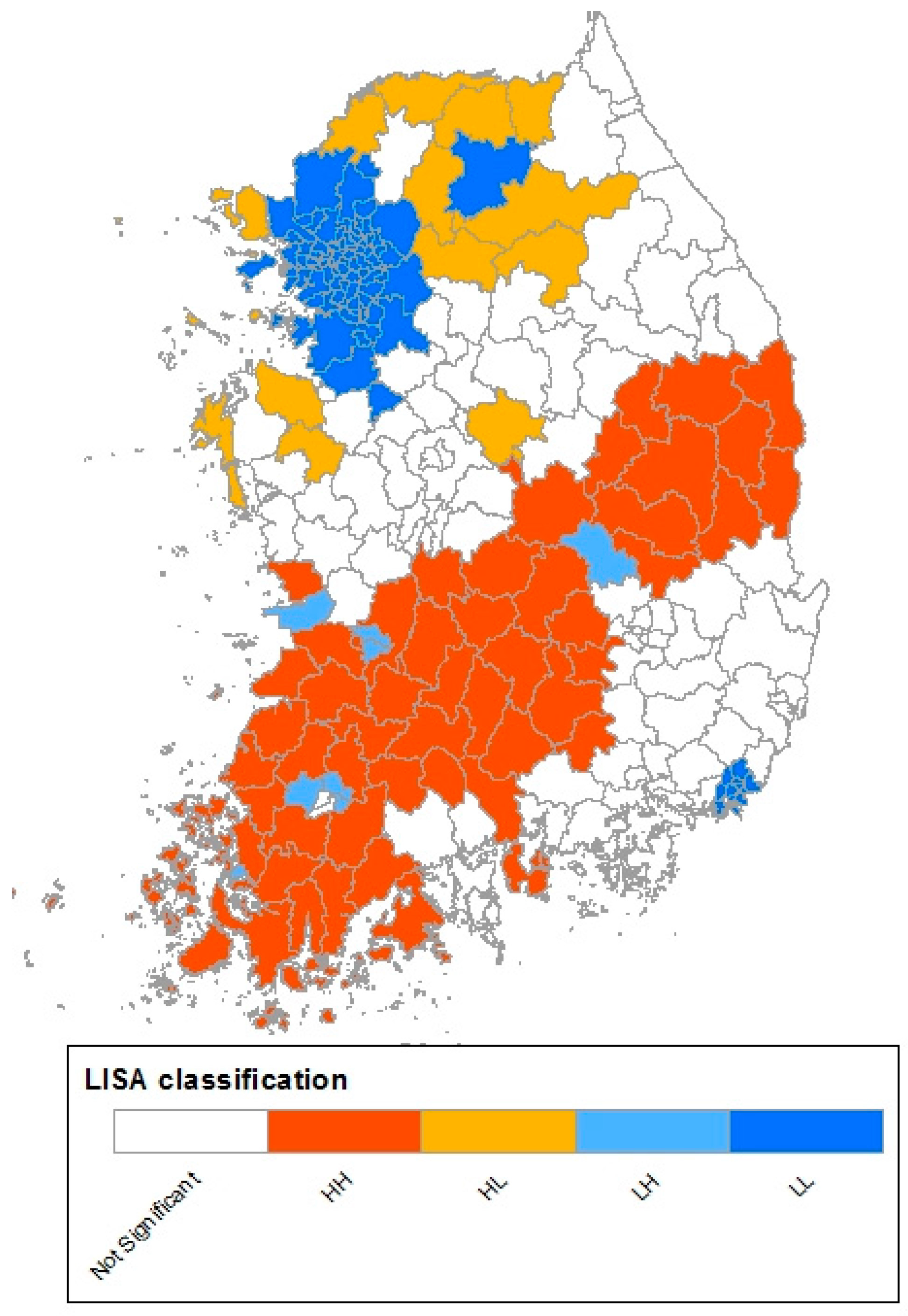
4.2. The Spatial Distribution of Vulnerable Occupations
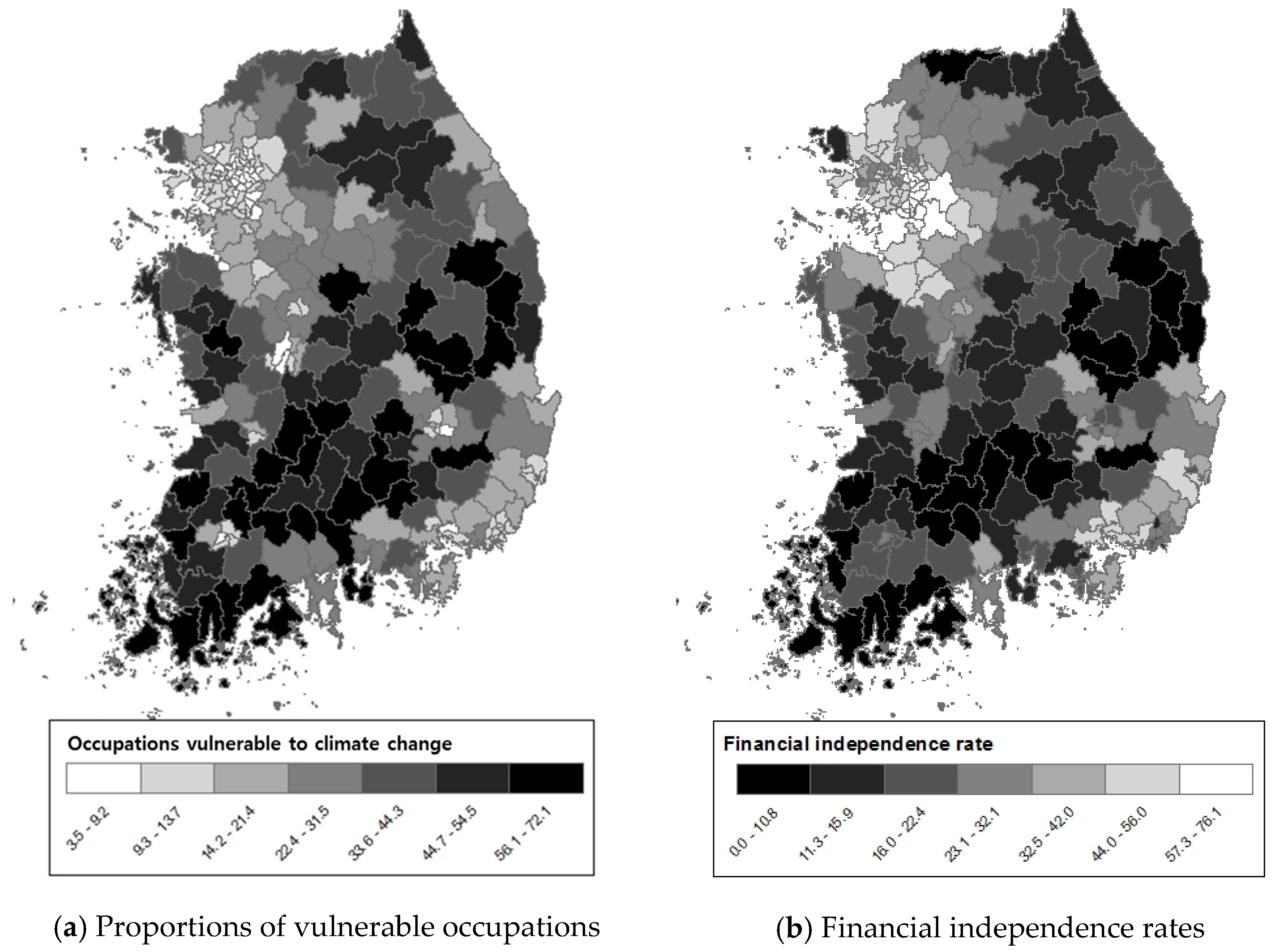
5. Discussion
6. Conclusions
Acknowledgments
Author Contributions
Conflicts of Interest
References
- Nilsson, M.; Kjellstrom, T. Climate change impacts on working people: How to develop prevention policies. Glob. Health Action 2010. [Google Scholar] [CrossRef] [PubMed]
- Adam-Poupart, A.; Labreche, F.; Smargiassi, A.; Duguay, P.; Busque, M.A.; Gagne, C.; Rintamaki, H.; Kjellstrom, T.; Zayed, J. Climate change and occupational health and safety in a temperate climate: Potential impacts and research priorities in Quebec, Canada. Ind. Health 2013, 51, 68–78. [Google Scholar] [CrossRef] [PubMed]
- Schulte, P.A.; Chun, H. Climate change and occupational safety and health: Establishing a preliminary framework. J. Occup. Environ. Hyg. 2009, 6, 542–554. [Google Scholar] [CrossRef] [PubMed]
- Smith, K.R.; Woodward, A.; Campbell-Lendrum, D.; Chadee, D.D.; Honda, Y.; Liu, Q.; Olwoch, J.M.; Revich, B.; Sauerborn, R. Human health: Impacts, adaptation, and co-benefits. In Climate Change 2014: Impacts, Adaptation, and Vulnerability. Part A: Global and Sectoral Aspects; Field, C.B., Barros, V.R., Dokken, D.J., Mach, K.J., Mastrandrea, M.D., Bilir, T.E., Chatterjee, M., Ebi, K.L., Estrada, Y.O., Genova, R.C., et al., Eds.; Cambridge University Press: Cambridge, UK, 2014. [Google Scholar]
- Dulal, H.; Shah, K.; Ahmad, N. Social equity considerations in the implementation of Caribbean climate change adaptation policies. Sustainability 2009, 1, 363–383. [Google Scholar] [CrossRef]
- Deonandan, R.; Campbell, K.; Ostbye, T.; Tummon, I.; Robertson, J. A comparison of methods for measuring socio-economic status by occupation or postal area. Chronic Dis. Can. 2000, 21, 114–118. [Google Scholar] [PubMed]
- Intergovernmental Panel on Climate Change. Climate Change 2013: The Physical Science Basis. Contribution of Working Group I to the Fifth Assessment Report of the Intergovernmental Panel on Climate Change; Stocker, T.F., Qin, D., Plattner, G.-K., Tignor, M.M.B., Allen, S.K., Boschung, J., Nauels, A., Xia, Y., Bex, V., Midgley, P.M., et al., Eds.; Cambridge University Press: Cambridge, UK, 2013. [Google Scholar]
- United Nations. United Nations Framework Convention on Climate Change; United Nations: Bonn, Germany, 1992; Available online: https://unfccc.int/resource/docs/convkp/conveng.pdf (accessed on 23 June 2015).
- Intergovernmental Panel on Climate Change. Climate Change 2014: Impacts, Adaptation, and Vulnerability. Part A: Global and Sectoral Aspects. Contribution of Working Group II to the Fifth Assessment Report of the Intergovernmental Panel on Climate Change; Cambridge University Press: Cambridge, UK, 2014. [Google Scholar]
- Korea Meteorological Administration. Climate Change Report on the Korea Peninsula; Korea Meteorological Administration: Seoul, Korea, 2012; Available online: http://www.climate.go.kr/home/cc_data/2013/ korea_climate /13-0311_korea_climate.pdf (accessed on 23 June 2015).
- Kjellstrom, T.; Kovats, R.S.; Lloyd, S.J.; Holt, T.; Tol, R.S.J. The direct impact of climate change on regional labor productivity. Arch. Environ. Occup. Health 2009, 64, 217–227. [Google Scholar] [CrossRef] [PubMed]
- Liberatos, P.; Link, B.G.; Kelsey, J.L. The measurement of social class in epidemiology. Epidemiol. Rev. 1988, 10, 87–121. [Google Scholar] [PubMed]
- Eurofound. Fifth European Working Conditions Survey: Overview Report; Publications Office of the European Union: Luxembourg, 2012. [Google Scholar]
- Füssel, H.M.; Klein, R.T. Climate change vulnerability assessments: An evolution of conceptual thinking. Clim. Chang. 2006, 75, 301–329. [Google Scholar] [CrossRef]
- Intergovernmental Panel on Climate Change. Climate Change 2001: Synthesis Report. A Contribution of Working Groups I, II and III to the Third Assessment Report of the Intergovernmental Panel on Climate Change; Cambridge University Press: Cambridge, UK, 2001. [Google Scholar]
- McCarthy, J.J. Climate Change 2001: Impacts, Adaptation, and Vulnerability: Contribution of Working Group II to the Third Assessment Report of the Intergovernmental Panel on Climate Change; Cambridge University Press: Cambridge, UK, 2001. [Google Scholar]
- Ribot, J. Vulnerability does not fall from the sky: Toward multiscale, pro-poor climate policy. In Social Dimensions of Climate Change: Equity and Vulnerability in a Warming World; World Bank: Washington, DC, USA, 2010; pp. 47–74. [Google Scholar]
- Adger, W.N. Vulnerability. Glob. Environ. Chang. 2006, 16, 268–281. [Google Scholar] [CrossRef]
- Brooks, N. Vulnerability, risk and adaptation: A conceptual framework. In Tyndall Centre for Climate Change Research; University of East Anglia: Norwich, UK, 2003. [Google Scholar]
- Spurgeon, A.; Harrington, J.M.; Cooper, C.L. Health and safety problems associated with long working hours: A review of the current position. Occup. Environ. Med. 1997, 54, 367–375. [Google Scholar] [CrossRef] [PubMed]
- Perch, L. Mitigation of What and by What? Adaptation by Whom and for Whom? Dilemmas in Delivering for the Poor and the Vulnerable in International Climate Policy; Working Paper 79; International Policy Centre for Inclusive Growth, United Nations Development Programme: Brasilia, Brazil, 2011. [Google Scholar]
- Anselin, L. Local indicators of spatial association–LISA. Geogr. Anal. 1995, 27, 93–115. [Google Scholar] [CrossRef]
- Wong, D.W.S.; Lee, J. Statistical Analysis of Geographic Information with ArcView GIS and ArcGIS; John Wiley & Sons: Hoboken, NJ, USA, 2005. [Google Scholar]
- Duranton, G.; Puga, D. From sectoral to functional urban specialisation. J. Urban Econ. 2005, 57, 343–370. [Google Scholar] [CrossRef]
- Scott, A.J. Human capital resources and requirements across the metropolitan hierarchy of the USA. J. Econ. Geogr. 2009, 9, 207–226. [Google Scholar] [CrossRef]
- Martinez-Fernandez, C.; Hinojosa, C.; Miranda, G. Green Jobs and Skills: The Local Labour Market Implications of Addressing Climate Change; Working Paper; Local Economic and Employment Development Programme, Organisation for Economic Co-operation and Development: Paris, France, 2010. [Google Scholar]
- Torres, R. The social impact of policies to address climate change: A review of the issues. Int. Labour Rev. 2008, 147, 275–279. [Google Scholar] [CrossRef]
- Olsen, L. The Employment Effects of Climate Change and Climate Change Responses: A Role of International Labour Standards? Discussion Paper 12; Global Union Research Network, International Labour Office: Geneve, Switzerland, 2009. [Google Scholar]
- Harsdorff, M.; Lieuw-Kie-Song, M.; Tsukamoto, M. Towards an ILO Approach to Climate Change Adaptation; Employment Working Paper 104; International Labour Organisation: Geneve, Switzerland, 2011. [Google Scholar]
© 2015 by the authors; licensee MDPI, Basel, Switzerland. This article is an open access article distributed under the terms and conditions of the Creative Commons Attribution license (http://creativecommons.org/licenses/by/4.0/).
Share and Cite
Kim, D.; Lee, H.; Lim, U. Exploring the Spatial Distribution of Occupations Vulnerable to Climate Change in Korea. Sustainability 2016, 8, 34. https://doi.org/10.3390/su8010034
Kim D, Lee H, Lim U. Exploring the Spatial Distribution of Occupations Vulnerable to Climate Change in Korea. Sustainability. 2016; 8(1):34. https://doi.org/10.3390/su8010034
Chicago/Turabian StyleKim, Donghyun, Heonyeong Lee, and Up Lim. 2016. "Exploring the Spatial Distribution of Occupations Vulnerable to Climate Change in Korea" Sustainability 8, no. 1: 34. https://doi.org/10.3390/su8010034
APA StyleKim, D., Lee, H., & Lim, U. (2016). Exploring the Spatial Distribution of Occupations Vulnerable to Climate Change in Korea. Sustainability, 8(1), 34. https://doi.org/10.3390/su8010034