A Point Source of a Different Color: Identifying a Gap in United States Regulatory Policy for “Green” CSO Treatment Using Constructed Wetlands


Abstract
1. Introduction
2. Methods
3. Results and Discussion
3.1. Current U.S. Regulatory Framework
3.1.1. “Grey” vs. “Green” Wastewater Treatment Policy

| Parameter | Secondary Treatment Standards (“grey”) | Equivalent to Secondary Treatment Standards (“green”) | ||
|---|---|---|---|---|
| 30-day average | 7-day average | 30-day average | 7-day average | |
| BOD5 | 30 mg/L (or 25 mg/L CBOD5) | 45 mg/L (or 40 mg/L CBOD5) | not to exceed 45 mg/L (or not to exceed 25 mg/L CBOD5) | not to exceed 65 mg/L (or not to exceed 60 mg/L CBOD5) |
| TSS | 30 mg/L | 45 mg/L | not to exceed 45 mg/L | not to exceed 65 mg/L |
| BOD5 and TSS removal (concentration) | not less than 85% | - | not less than 85% | - |
| pH | within the limits of 6.0–9.0 | within the limits of 6.0–9.0 | ||
3.1.2. CSO Control Policy
- (1)
- Proper operation and regular maintenance programs for the sewer system and the CSOs;
- (2)
- Maximum use of the collection system for storage;
- (3)
- Review and modification of pretreatment requirements to assure CSO impacts are minimized;
- (4)
- Maximization of flow to the publicly owned treatment works for treatment;
- (5)
- Prohibition of CSOs during dry weather;
- (6)
- Control of solid and floatable materials in CSOs;
- (7)
- Pollution prevention;
- (8)
- Public notification to ensure that the public receives adequate notification of CSO occurrences and CSO impacts; and
- (9)
- Monitoring to effectively characterize CSO impacts and the efficacy of CSO controls.
3.1.3. Green Infrastructure Policy
3.2. CSO Treatment Wetlands in the United States
3.2.1. History and Specifications
| CSO Community | Construction Completed | Treatment System Area (Acres) | Maximum Capacity (MG) | Peak Design Flow (MGD) | Grit and Floatables Removal | Treatment Wetland Components | Receiving Water |
|---|---|---|---|---|---|---|---|
| Elkhart, IN | 1999 | 0.5 | NA | NA | Bar screen and sedimentation basin | Free-water surface (shallow and deep zones) wetland, vertical down-flow wetland | Elkhart River |
| Akron, IN | 2001 | 6 | 0.5 | NA | Swirl concentrator | Two free-water surface wetlands (“serpentine earthen channels”) | Town Lake |
| Washington, IN | 2012 | 27 | 25 | 307.7 | Nutrient baffle and forebay pond | Free-water surface wetland, UV disinfection system | Hawkins Creek |
| Syracuse, NY | 2013 | 2 | 0.7 | 28.4 | Swirl concentrator | Floating wetland islands, vertical down-flow wetland, free-water surface wetland | Harbor Brook |
3.2.2. Regulatory Standards and Practices
| CSO Community | NPDES/SPDES Permit | Compliance Monitoring (effluent, unless otherwise specified) | Effluent Limits | Basis for Effluent Limitations |
|---|---|---|---|---|
| Elkhart, IN | None | None | None | None |
| Akron, IN | General NPDES | Flow i (MGD) | Report (Daily Maximum and Monthly Average) | Water Quality-Based, Indiana Administrative Code limits for lake dischargers (327 IAC 2-1-6) [48] |
| CBOD5 (mg/L) | Monthly Average: 10, Weekly Average: 15 | |||
| TSS (mg/L) | Monthly Average: 12, Weekly Average: 18 | |||
| Ammonia-nitrogen (mg/L)—Summer | Monthly Average: 1.1, Weekly Average: 1.6 | |||
| Ammonia-nitrogen (mg/L)—Winter | Monthly Average: 1.6, Weekly Average: 2.4 | |||
| Phosphorous (mg/L) | Monthly Average: 1.0 | |||
| pH (standard units) | Daily Minimum: 6, Daily Maximum: 9 | |||
| Dissolved Oxygen (mg/L) | Daily Minimum 6 | |||
| Escherichia coli (E. coli) (colonies/100 mL) | Monthly Average: 125, Daily Maximum: 235 | |||
| Washington, IN | General NPDES | Effluent Flow (MGD), CBOD5 (mg/L), TSS (mg/L), Ammonia-nitrogen (mg/L), pH (s.u.), Dissolved Oxygen (mg/L) | Report | Technology-Based, primary treatment and disinfection [52,54] |
| Escherichia coli (E. coli) (colonies/100 mL) | Monthly Average: 125, Daily Maximum: 235 | |||
| Syracuse, NY | Draft General SPDES | Event Flow i (MG), BOD5i (mg/L), TSS i (mg/L), Settleable Solids i (mL/L), Oil & Grease (mg/L), Floatable Material (visual obs.), Screenings (Monthly Total—influent only), Ammonia i (mg/L), TKN (mg/L), Total Phosphorous i (mg/L), Dissolved Oxygen (mg/L) | Report | Draft for pilot purposes; Technology-Based, primary treatment and disinfection [51,56] |
| Fecal Coliform i (colonies/100 mL) | Overflow Event: 200 | |||
| Total Residual Chlorine (mg/L) | Overflow Event: 0.2 |
3.3. European CSO Treatment Wetland Policy
3.4. Sustainability Criteria for CSO Treatment Wetlands
3.4.1. Construction and Avoided Infrastructure Costs
3.4.2. Long-Term Operations and Maintenance
3.4.3. Ecosystem Services
3.5. Critical Analysis and Recommendations
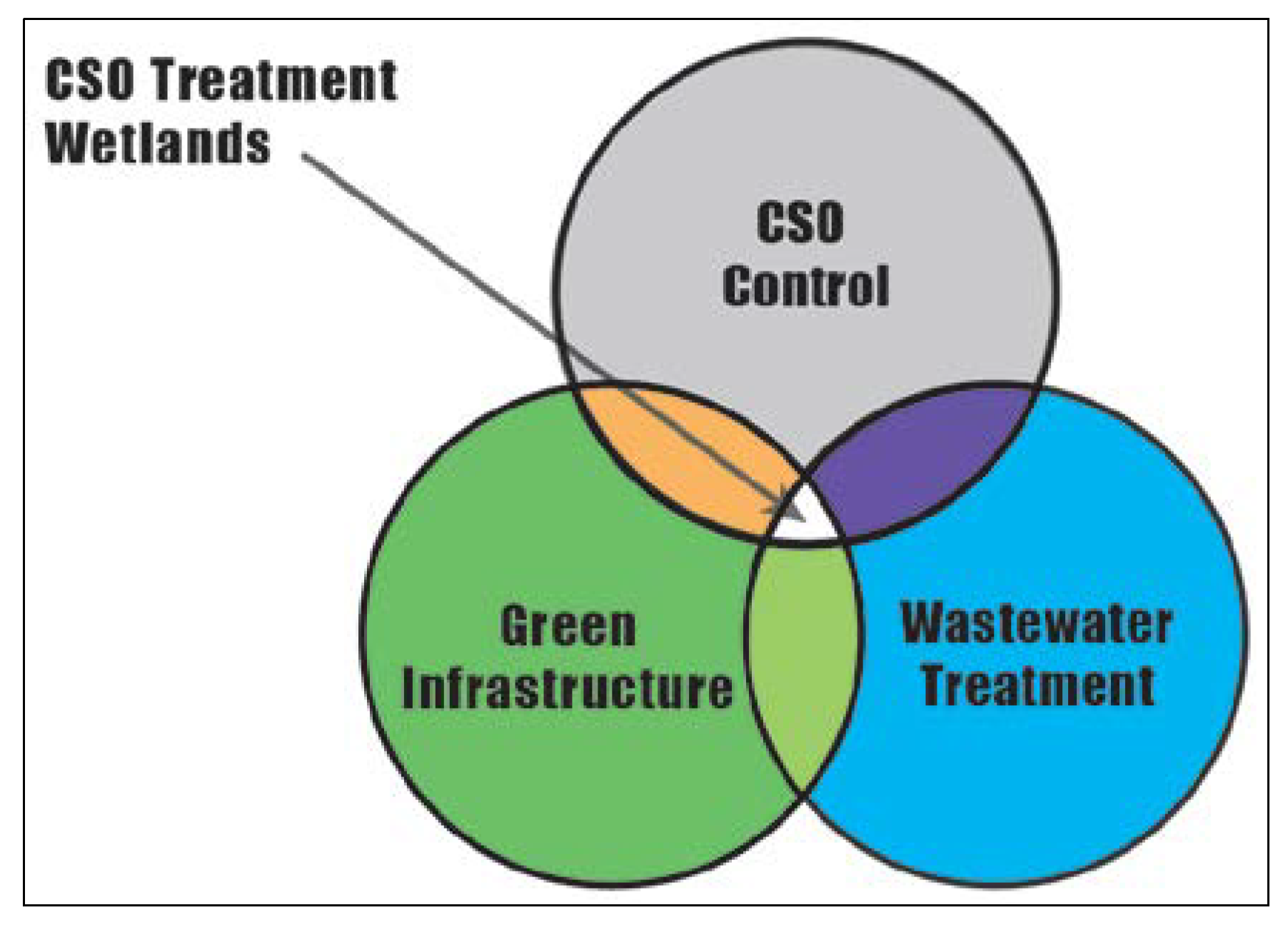
- There is a precedent for different technology/performance-based standards between “grey” and “green” wastewater treatment systems;
- Federal CSO control policy favors technology-based treatment alternatives; and
- Federal guidelines support the integration of sustainable GI alternatives into LTCP’s and NPDES permits.
- (1)
- Benefits of “grey” and “green” CSO treatment systems are assessed using sustainability analyses that include construction and avoided infrastructure costs, long-term operations and maintenance, ecosystem services;
- (2)
- Effluent limits and compliance monitoring requirements take into account fundamental technical differences between “grey” and “green” CSO treatment systems; and
- (3)
- Design recommendations facilitate meeting LTCP goals by versatile application of different treatment wetland technologies (e.g., vertical down-flow, free-water surface).
4. Conclusions
Acknowledgments
Author Contributions
Conflicts of Interest
References and Notes
- USEPA (U.S. Environmental Protection Agency). Report to Congress: Implementation and Enforcement of the Combined Sewer Overflow Policy. Office of Water: Washington, DC, USA, 2004. [Google Scholar]
- NRC (National Research Council). Urban Stormwater Management in the United States; National Academies Press: Washington, DC, USA; Volume 2009.
- USEPA (U.S. Environmental Protection Agency). Combined Sewer Overflow (CSO) Control Policy; Office of Water: Washington, DC, USA; 1994.
- USEPA (U.S. Environmental Protection Agency). Combined Sewer Overflow: Guidance for Nine Minimum Controls; Office of Water: Washington, DC, USA, 1995.
- Jaffe, M. Reflections on green infrastructure economics. Environ. Pract. 2011, 12, 357–365. [Google Scholar] [CrossRef]
- Barnhill, K.; Smardon, R.C. Gaining ground: Green infrastructure attitudes and perceptions from Stakeholders. Environ. Pract. 2012, 14, 6–16. [Google Scholar] [CrossRef]
- USEPA (U.S. Environmental Protection Agency). Greening EPA Glossary. Available online: http://www.epa.gov/oaintrnt/glossary.htm (accessed on 27 January 2014).
- Perreault, T.; Wraight, S.; Perreault, M. Environmental injustice in the Onondaga Lake waterscape, New York State, USA. Water Altern. 2012, 5, 485–506. [Google Scholar]
- Sun, N.; Hall, M. Coupling human preferences with biophysical processes: Modeling the effect of citizen attitudes on potential urban stormwater runoff. Urban Ecosyst. 2013. [Google Scholar] [CrossRef]
- Moshiri, G.A. Construction Wetlands for Water Quality Improvement; Lewis Publishers: Boca Raton, FL, USA, 1993.
- Vymazal, J. Constructed wetlands for wastewater treatment. Water 2010, 2, 530–549. [Google Scholar] [CrossRef]
- Kadlec, R.H.; Wallace, C. Treatment Wetlands, 2nd ed.Lewis Publishers: Boca Raton, FL, USA, 2009.
- Vymazal, J. Constructed Wetlands for Wastewater Treatment: Five Decades of Experience. Environ. Sci. Technol. 2011, 45, 61–69. [Google Scholar] [CrossRef]
- ITRC (Interstate Technology & Regulatory Council). Technical and Regulatory Guidance Document for Constructed Treatment Wetlands. Available online: http://www.itrcweb.org/Documents/WTLND-1.pdf (accessed on 6 April 2014).
- Wong, T.H.F.; Fletcher, T.D.; Duncan, H.P.; Jenkins, G.A. Modeling urban stormwater treatment—A unified approach. Ecol. Eng. 2006, 27, 58–70. [Google Scholar] [CrossRef]
- USEPA (U.S. Environmental Protection Agency). Constructed Wetlands Treatment of Municipal Wastewaters Manual; Office of Research and Development: Cincinnati, OH, USA, 2000.
- Scholz, M. Wetlands Systems to Control Urban Runnoff; Elsevier: London, UK, 2006.
- USEPA (U.S. Environmental Protection Agency). Menu of BMPs: Stormwater Wetland. Available online: http://cfpub.epa.gov/npdes/stormwater/menuofbmps/index.cfm?action=factsheet_results&view=specific&bmp=74 (accessed on 27 January 2014).
- Meyer, D.; Molle, P.; Esser, D.; Troesch, S.; Masi, F.; Dittmer, U. Constructed wetlands for combined sewer overflow treatment—Comparison of German, French and Italian approaches. Water 2013, 5, 1–12. [Google Scholar]
- Save the Rain. Onondaga County, New York Save the Rain Program 2010–2018 Green Infrastructure Plan. Available online: http://savetherain.us/wp-content/uploads/2011/10/2010-2018-Green-Infrastructure-Plan.pdf (accessed on 27 January 2014).
- Renew Evansville. Volume 1 Final Integrated Overflow Control Plan. Available online: http://www.evansvillegov.org/modules/showdocument.aspx?documentid=13319 (accessed on 27 January 2014).
- Harrison, K. Ideas and environmental standard setting: A comparative study of regulation of the pulp and paper industry. Governance 2000, 15, 65–96. [Google Scholar]
- Keleman, R.D. Regulatory Federalism: EU environmental regulation in comparative perspective. J. Public Policy 2000, 20, 133–167. [Google Scholar] [CrossRef]
- Knill, C.; Lehmkuhl, D. The national impact of European Union regulatory policy: Three European mechanisms. Eur. J. Polit. Res. 2002, 41, 255–280. [Google Scholar] [CrossRef]
- Navrud, S.; Pruckner, G.J. Environmental valuation—To use of not to use? Environ. Resour. Econ. 1997, 10, 1–26. [Google Scholar] [CrossRef]
- Pargal, S.; Hettige, H.; Singh, M.; Wheeler, D. Formal and informal; regulation of industrial pollution: Comparative evidence from Indonesia and the Unites States. World Bank Econ. Rev. 1997, 11, 433–50. [Google Scholar] [CrossRef]
- Cole, D.K.; Grossman, P.Z. When is command and control efficient? Institutions, technology, and the comparative efficiency of alternative regulatory regimes for environmental protection. Available online: http://www.repository.law.indiana.edu/facpub/590 (accessed on 8 February 2014).
- Hahn, R.W.; Stavins, R.N. Incentive-based environmental regulation: A new era for an Old idea? Ecol. Law Q. 1991, 18, 1–42. [Google Scholar]
- Hornstein, D.T. Reclaiming environmental Law: A normative critique of comparative risk analysis. Columbia Law Rev. 1992, 92, 562–633. [Google Scholar] [CrossRef]
- Hazilla, M.; Kopp, R.J. Social cost of environmental quality regulations: A general equilibrium analysis. J. Polit. Econ. 1990, 98, 853–873. [Google Scholar]
- Karr, J.R. Defining and assessing ecological integrity: Beyond water quality. Environ. Toxicol. Chem. 1993, 12, 1521–1531. [Google Scholar] [CrossRef]
- Ringold, P.L.; Boyd, J.; Landers, D.; Weber, M. What data should we collect? A Framework for identifying indicators of ecosystem contributions to human well-being. Front. Ecol. Environ. 2013. [Google Scholar] [CrossRef]
- Jaffe, M.; Zellner, M.; Minor, E.; Gonzalez-Meler, M.; Cather, L.; Minor, D.; Ahmed, H.; Elberts, M.; Sprague, H.; Wise, S.; et al. Using Green Infrastructure to Manage Urban Stormwater Quality: A Review of Selected Practices and State Programs; Illinois Environmental Protection Agency: Springfield, IL, USA, 2010.
- USEPA (U.S. Environmental Protection Agency). NPDES Permit Writers’ Manual; Office of Water: Washington, DC, USA, 2010.
- USEPA (U.S. Environmental Protection Agency). Memorandum, Achieving Water Quality through Integrated Municipal Stormwater and Wastewater Plans. Available online: http://water.epa.gov/infrastructure/greeninfrastructure/upload/memointegratedmunicipalplans.pdf (accessed on 27 January 2014).
- USEPA (U.S. Environmental Protection Agency). Memorandum, Protecting Water Quality with Green Infrastructure in EPA Water Permitting and Enforcement Programs. Available online: http://water.epa.gov/infrastructure/greeninfrastructure/upload/gi_memo_protectingwaterquality.pdf (accessed on 27 January 2014).
- USEPA (U.S. Environmental Protection Agency). Memorandum, Use of Green Infrastructure in NPDES Permits and Enforcement. Available online: http://water.epa.gov/infrastructure/greeninfrastructure/upload/gi_memo_enforce.pdf (accessed on 27 January 2014).
- USEPA (U.S. Environmental Protection Agency). Memorandum, Using Green Infrastructure to Protect Water Quality in Stormwater, CSO, Nonpoint Source and Other Water Programs. Available online: http://water.epa.gov/infrastructure/greeninfrastructure/upload/greeninfrastructure_h2oprograms_07.pdf (accessed on 27 January 2014).
- USEPA (U.S. Environmental Protection Agency). Factsheet 1: General Accountability Considerations for Green Infrastructure. Available online: http://water.epa.gov/infrastructure/greeninfrastructure/gi_regulatory.cfm (accessed on 27 January 2014).
- USEPA (U.S. Environmental Protection Agency). Factsheet 2: Combined Sewer Overflows. Available online: http://water.epa.gov/infrastructure/greeninfrastructure/upload/EPA-Green-Infrastructure-Factsheet-2-061212-PJ.pdf (accessed on 27 January 2014).
- USEPA (U.S. Environmental Protection Agency). Factsheet 3: Sanitary Sewer Overflows. Available online: http://water.epa.gov/infrastructure/greeninfrastructure/upload/EPA-Green-Infrastructure-Factsheet-3-080612.pdf (accessed on 27 January 2014).
- USEPA (U.S. Environmental Protection Agency). Factsheet 4: Stormwater. Available online: http://water.epa.gov/infrastructure/greeninfrastructure/upload/EPA-Green-Infrastructure-Factsheet-4-061212-PJ.pdf (accessed on 27 January 2014).
- USEPA (U.S. Environmental Protection Agency). Factsheet 5: Total Maximum Daily Loads. Available online: http://water.epa.gov/infrastructure/greeninfrastructure/upload/EPA-Green-Infrastructure-Factsheet-5-061212-PJ.pdf (accessed on 27 January 2014).
- USEPA (U.S. Environmental Protection Agency). Factsheet 6: Water Quality Standards. Available online: http://water.epa.gov/infrastructure/greeninfrastructure/upload/EPA-Green-Infrastructure-Factsheet-6-110112-508.pdf (accessed on 27 January 2014).
- Umble, A.K.; Machlan, M.; Horvath, E.C.; Newvine, L.A. Constructed wetlands for treating combined sewer overflows: An alternative solution for implementing the CSO strategy. In Proceedings of the Water Environment Federation Watershed 2000 Management Conference, Vancouver, Columbia, July 2000; Water Environment Federation: Alexandria, VA, USA, 2000; Volume 2000, No. 6. pp. 2571–2588. [Google Scholar]
- Machlan, M. Personal communication. City of Elkhart Wastewater Utility: Elkhart, IN, USA, 7 January 2014. [Google Scholar]
- Cluxton, P. Personal communication. Indiana Department of Environmental Management: Indianapolis, IN, USA, 9 January 2014. [Google Scholar]
- IDEM (Indiana Department of Environmental Management). Final NPDES Permit No. IN0025232, Town of Akron Wastewater Treatment Plant, Fulton County. Available online: http://vfc.idem.in.gov/Pages/Member/View.aspx?DocId=59116233 (accessed on 27 January 2014).
- Water & Wastes Digest. 2011 Top Water and Wastewater Projects. Available online: http://www.wwdmag.com/sites/default/files/23_RG_TopProjects.pdf (accessed on 27 January 2014).
- Mosley, E.; Legnetto, P.J.; Pries, J.; Fordiani, R. Constructed Wetlands for CSO Treatment: A Full-scale Pilot in Onondaga County, NY. In Proceedings of the Water Environment Federation Technical Exhibition and Conference, New Orleans, LA, USA, 27 September–1 October 2012.
- NYSDEC (New York State Department of Environmental Conservation). Long Term Control Plan (LTCP) Requirements. Available online: http://www.dec.ny.gov/chemical/48985.html (accessed on 27 January 2014).
- IDEM (Indiana Department of Environmental Management). Agency Nonrule Policy Document: CSO Treatment Facilities (Water-016). Available online: http://www.in.gov/idem/files/wpcb_2008_mar_npd-016.pdf (accessed on 27 January 2014).
- IDEM (Indiana Department of Environmental Management). Final NPDES Permit No. IN0025674, City of Elkhart Wastewater Treatment Plant, Elkhart County . Available online: http://vfc.idem.in.gov/Pages/Member/View.aspx?DocId=65956939 (accessed on 27 January 2014).
- IDEM (Indiana Department of Environmental Management). Final NPDES Permit No. IN0025658, City of Washington Wastewater Treatment Plant, Daviess County. Available online: http://vfc.idem.in.gov/Pages/Member/View.aspx?DocId=69041904 (accessed on 27 January 2014).
- IDEM (Indiana Department of Environmental Management). Inspection Summary/Violation Letter, Akron Municipal Waste Water Treatment Plant, NPDES Permit No. IN0025232; IDEM: Akron, IN, USA, 31 December 2013.
- NYSDEC (New York State Department of Environmental Conservation). State Pollution Discharge Elimination System (SPDES) Discharge Permit Number NY 002 7081 (Draft). Received from NYSDEC on 17 January 2014.
- Save the Rain. Quality Assurance Project Plan: Harbor Brook CSO 018 Constructed Wetlands Pilot Treatment System. Available online: http://savetherain.us/wp-content/uploads/2011/06/Monitoring-Plan.pdf (accessed on 27 January 2014).
- Stephenson, V. Personal communication. New York State Department of Environmental Conservation (NYSDEC): Syracuse, NY, USA, 6 January 2014. [Google Scholar]
- Van Dien, F. Personal communication. ECOFYT: Oirschot, The Netherlands, 1 April 2014. [Google Scholar]
- Arias, C. Personal communication. Aarhus University Department of Bioscience: Aarhus, Denmark, 26 March 2014. [Google Scholar]
- Rousseau, D. Personal communication. Gent University, Department of Industrial Biological Sciences: Gent, Belgium, 1 April 2014. [Google Scholar]
- Hawes, P. Personal communication. ARM Ltd.: Staffordshire, UK, 26 March 2014. [Google Scholar]
- EC (European Commission). Water Framework Directive 2000/60/EC of the European Parliament and of the Council of 23 October 2000 establishing a framework for Community action in the field of water policy. Off. J. Eur. Community. 2000, pp. 1–73. Available online: http://eur-lex.europa.eu/legal-content/EN/TXT/?uri=CELEX:32000L0060 (Accessed on 18 April 2014).
- DWA Deutsche Vereinigung für. DWA Empfehlungen für Planung, Konstruktion und Betrieb von Retentionsbodenfilteranlagen zur weitergehenden Regenwasserbehandlung im Misch- und Trennverfahren (Design, construction and operation guideline for retention soil filters for enhanced combined sewer overflow treatment); DWA-Regelwerk, Merkblatt M 178: Hennef, Germany. 2005. Available online: http://www.dwa.de/dwa/shop/produkte.nsf/663C11FEBE91CE72C125753C00345630/$file/vorschau_DWA_M_178.PDF (accessed on 18 April 2014). (In Germany)
- Uhl, M.; Dittmer, U. Constructed wetlands for CSO treatment—An overview of practice and research in Germany. Water Sci. Technol. 2005, 51, 23–30. [Google Scholar]
- Meyer, D.; Dittmer, U. Design supportive modelling of constructed wetlands for combined sewer overflow treatment in Germany. Ecol. Eng. 2014, in press. [Google Scholar]
- Wise, S.; Braden, J.; Ghalayini, D.; Grant, J.; Kloss, C.; MacMullan, E.; Morse, S.; Montalto, F.; Nees, D.; Nowak, D.; et al. Integrating Valuation Methods to recognize Green Infrastructure Multiple Benefits; Center for Neighborhoods and Technology: Chicago, IL, USA, 2010.
- Spatari, S.; Yu, Z.; Montalto, F. Life cycle implications of urban green infrastructure. Environ. Pollut. 2011, 159, 2174–2179. [Google Scholar] [CrossRef]
- Campbell, C.S.; Ogden, M. Constructed Wetlands in the Sustainable Landscape; John Wiley & Sons Inc.: New York, NY, USA, 1999.
- Droguett, R.B. Sustainability Assessment of Green Infrastructure Practices for Infrastructure Practices for Stormwater Management: A Comparative Energy Analysis. Master Thesis, SUNY College of Environmental Science and Forestry, Syracuse, NY, USA, 2011. [Google Scholar]
- Geiger, W.F. Combined sewer overflow treatment—Knowledge or speculation. Water Sci. Technol. 1998, 38, 1–8. [Google Scholar] [CrossRef]
- Millennium Ecosystem Assessment. Ecosystems and Human Well-Being: Wetlands & Water Synthesis; World Resources Institute: Washington, DC, USA, 2005.
- Smardon, R.C. Human perception of utilization of wetlands for waste assimilation, or how to make a silk purse out of a sow’s ear. In Constructed Wetlands for Wastewater Treatment: Municipal, Industrial and Agricultural; Hammer, D.A., Ed.; Lewis Publishers: Chelsea, MI, USA, 1989; pp. 287–295. [Google Scholar]
- Mander, Ü.; Tournebize, J.; Kasak, K.; Mitsch, W.J. Climate regulation by free water surface constructed wetlands for wastewater treatment and created riverine wetlands. Ecol. Eng. 2013. [Google Scholar]
- Mitsch, W.J.; Bernal, B.; Nahlik, A.M.; Mander, Ü.; Zhang, L.; Anderson, L.; Jørgensen, S.E.; Brix, H. Wetlands, carbon, and climate change. Landsc. Ecol. 2013, 28, 583–597. [Google Scholar] [CrossRef]
- Harrison, M. Personal communication. Bernardin, Lochmueller & Associates: Indianapolis, IN, USA, 6 December 2013. [Google Scholar]
- Gibson, J.P., Jr.; Bell, S. The Banklick Constructed Wetland. Water Environ. Technol. 2013, 25, 34–39. [Google Scholar]
© 2014 by the authors; licensee MDPI, Basel, Switzerland. This article is an open access article distributed under the terms and conditions of the Creative Commons Attribution license (http://creativecommons.org/licenses/by/3.0/).
Share and Cite
Levy, Z.F.; Smardon, R.C.; Bays, J.S.; Meyer, D. A Point Source of a Different Color: Identifying a Gap in United States Regulatory Policy for “Green” CSO Treatment Using Constructed Wetlands. Sustainability 2014, 6, 2392-2412. https://doi.org/10.3390/su6052392
Levy ZF, Smardon RC, Bays JS, Meyer D. A Point Source of a Different Color: Identifying a Gap in United States Regulatory Policy for “Green” CSO Treatment Using Constructed Wetlands. Sustainability. 2014; 6(5):2392-2412. https://doi.org/10.3390/su6052392
Chicago/Turabian StyleLevy, Zeno F., Richard C. Smardon, James S. Bays, and Daniel Meyer. 2014. "A Point Source of a Different Color: Identifying a Gap in United States Regulatory Policy for “Green” CSO Treatment Using Constructed Wetlands" Sustainability 6, no. 5: 2392-2412. https://doi.org/10.3390/su6052392
APA StyleLevy, Z. F., Smardon, R. C., Bays, J. S., & Meyer, D. (2014). A Point Source of a Different Color: Identifying a Gap in United States Regulatory Policy for “Green” CSO Treatment Using Constructed Wetlands. Sustainability, 6(5), 2392-2412. https://doi.org/10.3390/su6052392