Article

Display Slot Competition and Multi-Homing in Ride-Hailing Aggregator Platforms: A Game-Theoretic Analysis of Profit and Welfare Implications

School of Economics and Management, Shanghai Maritime University, Shanghai 201306, China
*
Author to whom correspondence should be addressed.
Sustainability 2026, 18(7), 3625; https://doi.org/10.3390/su18073625
Submission received: 28 February 2026 / Revised: 31 March 2026 / Accepted: 4 April 2026 / Published: 7 April 2026
(This article belongs to the Section Economic and Business Aspects of Sustainability)

Abstract

The rise in aggregation platforms has reshaped the competitive ride-hailing market. Display slots (i.e., platform-determined ranking priority) have become a key tool for influencing order allocation. Their interaction with drivers’ multi-homing behavior poses new challenges for platform sustainability. This paper constructs a two-stage Stackelberg game model with one aggregator and two underlying ride-hailing platforms. Display slots enhance supply-side lock-in, while a waiting time function links passenger utility to demand allocation. Building on theoretical analysis of two-sided market competition and multi-homing effects, we propose two hypotheses: (H1) under specific conditions, competition for display slots may lead to a Prisoner’s Dilemma equilibrium, and (H2) the proportion of multi-homing drivers positively moderates this dilemma, thereby expanding its occurrence range. Numerical simulation results under baseline parameter settings reveal that display slots generate a supply-side amplification effect by locking in multi-homing drivers. In symmetric markets, a prisoner’s dilemma range exists where mutual purchase erodes collective profits; this range expands with the share of multi-homing drivers. Higher driver profit sensitivity raises the threshold required for display slots to be profitable. In asymmetric markets, dominant platforms (strong brands, low costs) gain more from display slots, potentially leading to unilateral purchasing. Social welfare effects of display slot competition depend on a critical threshold of waiting-time sensitivity: social welfare improves above the threshold and declines below it. This study clarifies the boundaries of display slots as supply-side non-price competitive tools, offering quantitative insights for aggregator platform design and regulatory policy. The findings carry managerial implications for platform strategy and policy aimed at sustainable development.

1. Introduction

Against the backdrop of the digital economy reshaping industrial structures, the platform economy has emerged as a key driver of global economic growth. As a representative form of shared mobility, ride-hailing services play an increasingly important role in optimizing urban transportation systems, which raises important questions about the sustainability of platforms and the broader market ecosystem. The ride-hailing market has evolved from single-platform dominance to a multi-tiered structure centered on aggregator platforms, fundamentally altering the logic of industry competition. Ride-hailing aggregation platforms do not directly own vehicles or employ drivers; instead, they integrate the capacity of multiple underlying ride-hailing platforms to provide passengers with one-stop price comparison and booking services. For example, Amap Taxi and Meituan Taxi in China have enhanced market transparency and expanded user choice. However, they have also fostered multi-platform usage among passengers and drivers, thereby intensifying multi-homing behavior. This transformation raises a critical question regarding the sustainability of the platform economy: how can platforms sustain profitability while maximizing social welfare in an environment characterized by high price transparency and low switching costs? In the study, sustainability is defined along two dimensions: economic sustainability, referring to a platform’s ability to maintain long-term profitability and avoid a race to the bottom, and social sustainability, referring to the market’s capacity to improve overall welfare through more efficient matching [1]. This framework also provides a basis for evaluating sustainability at the ecosystem level, particularly whether competitive mechanisms lead to stable and efficient market structures. This perspective is especially relevant in aggregation settings, where multiple platforms interact through shared demand and supply—a central focus of this study.
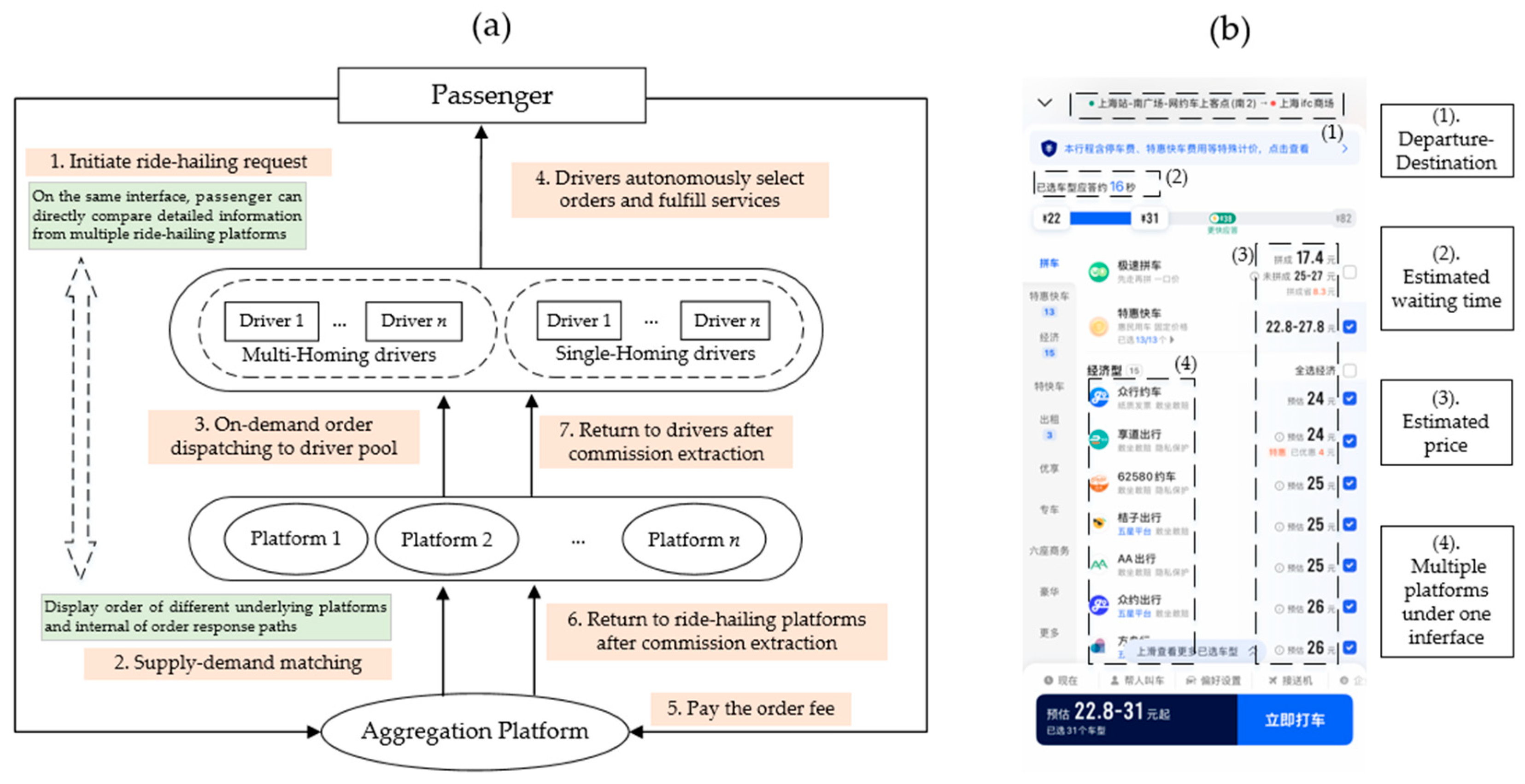
The rise in ride-hailing aggregation has fundamentally altered the traditional scarcity-based profit model. Conventional platforms rely on dynamic pricing and supply restrictions enabled by information asymmetry and algorithmic control to generate excess profits. Aggregation disrupts this mechanism: passengers can instantly compare prices, while drivers can flexibly select orders across platforms. As a result, traditional price-based competitive strategies become less effective, and profit margins are compressed. Consequently, competition shifts toward non-price dimensions, such as display slots and ranking mechanisms. By controlling front-end display sequences and dispatch priorities, aggregator platforms exercise significant influence over order allocation and supply distribution. This display mechanism, analogous to bidding for online display slots, has become both a revenue source and a regulatory tool. As shown in Figure 1a, after a passenger submits a ride request, the aggregation platform integrates and displays information from multiple platforms, matches supply and demand, and dispatches orders to available drivers. Drivers—including both single-homing and multi-homing drivers—independently decide whether to accept orders. Upon completion, the passenger pays the fare, and the platform deducts its commission before distributing revenues to the underlying platforms and drivers. This mechanism enables efficient cross-platform resource allocation and closed-loop transaction management. Figure 1b presents a typical aggregator interface (e.g., Amap Taxi), where passengers compare prices, estimated waiting times, and service ranking in real time. Platform visibility depends on ranking positions, which directly affect order exposure and matching probability. For multi-homing drivers, higher visibility translates into a higher likelihood of receiving orders, thereby influencing their platform participation decisions. This institutional environment motivates the modeling framework of this study, in which passenger demand depends on price and waiting time, while platforms compete for driver resources through both pricing strategies and display slot acquisition.
However, the economic implications of display slot competition remain unclear. On the one hand, such competition may incentivize platforms to improve service efficiency by reducing waiting times, thereby enhancing market performance. On the other hand, in the presence of multi-homing drivers, competition may escalate into a contest for limited mobile supply, intensifying price competition and eroding profits. In extreme cases, this may give rise to a Prisoner’s Dilemma, where a rational individual facing a dilemma often tends to choose options that are relatively self-serving but detrimental to the collective interest. When profits are excessively compressed, platforms may be unable to sustain long-term investments in service quality and driver incentives, posing a direct threat to economic sustainability and potentially undermining system-wide efficiency and stability. These effects also propagate to driver income and passenger welfare, ultimately affecting the sustainability of the broader mobility ecosystem.
Although extensive research has examined platform pricing, two-sided market competition, and multi-homing behavior, important gaps remain in the context of aggregation platforms. First, existing studies primarily focus on price and commission rates, overlooking how display and ranking mechanisms, as ex ante allocation tools, reshape competitive structures. Second, display slots are typically analyzed from the demand-side perspective (influencing passenger choice), with limited attention to their supply-side implications. Third, prior research rarely integrates display slot competition, multi-homing behavior, and social welfare into a unified analytical framework, lacking quantitative assessments of their joint effects.
To address these gaps, this study develops a game-theoretic model incorporating an aggregator platform and underlying ride-hailing platforms, endogenizing decisions on display slot purchases, pricing strategies, and driver multi-homing behavior. We aim to address the following research questions: (1) How does display slot competition affect pricing strategies, market shares, and profits in a multi-homing environment? (2) Under what conditions does display slot competition lead to a Prisoner’s Dilemma, thereby harming collective outcomes? (3) From a social welfare perspective, does such competition enhance market efficiency or lead to resource misallocation? Based on the theoretical framework, we propose two core hypotheses. (H1): In a symmetric market, there exists a range of display slot costs under which both platforms choose to purchase display slots in equilibrium, yet their joint profits are lower than in the no-purchase scenario. (H2): The multi-homing rate of drivers exerts a positive amplifying effect on this dilemma, expanding the parameter region in which the Prisoner’s Dilemma arises. The subsequent analysis focuses on testing these hypotheses.

2. Literature Review

2.1. Multi-Homing Behavior in the Platform Economy

The platform economy is defined as a set of economic activities organized around digital platforms that create value by facilitating interactions between two or more user groups. For instance, ride-hailing platforms coordinate interactions between passengers and drivers. In such markets, when multiple ride-hailing platforms coexist within the same local area, drivers may simultaneously participate in multiple platforms and allocate their services in response to proximate passenger demand. This phenomenon is referred to as drivers’ multi-homing behavior [2]. Ride-hailing platforms facilitate real-time transactions through algorithmic matching mechanisms and constitute a typical example of two-sided markets. Such markets are generally characterized by three key features: the presence of a multi-sided platform structure, cross-network externalities among user groups, and a non-neutral pricing structure [3]. Two-sided market theory provides a framework for understanding how platforms coordinate interactions between user groups and highlights the role of cross-network externalities, whereby the utility of one group increases with the size of the other group [4]. Multi-homing behavior intensifies competition among platforms and reduces the effectiveness of pricing strategies. Existing research has extensively examined its determinants, consequences, and platform responses, leading to several important strands of debate in the literature.
Regarding the determinants of multi-homing, Kwon et al. [5] found that single-homing users exhibit greater homogeneity than multi-homing users based on panel data analysis, which suggested that multi-homing is closely associated with user heterogeneity. In ride-hailing scenarios, Yu et al. [6] conducted an empirical study using multi-platform data from Hangzhou and found that driver multi-homing is associated with order density, commission rates, and pickup and drop-off times, whereas passenger multi-homing is related to price comparison convenience and waiting times. In subsequent work, Yu et al. [7] developed a hidden Markov model to analyze the dynamic decision-making behavior of multi-platform drivers, revealing heterogeneous responses to income and working hours across different states. Zhuang et al. [8] further found that multi-homing serves as a temporal strategy for drivers to cope with platform algorithmic constraints (e.g., working-hour caps) and institutional uncertainty. While these studies provide important empirical evidence on the micro-foundations of multi-homing behavior, they do not explicitly examine how multi-homing interacts with non-price competition mechanisms following the emergence of aggregation platforms.
Regarding the effects of multi-homing, the literature presents mixed findings. Bryan and Gans [9] analyzed bilateral multi-homing by drivers and passengers in a duopoly model and found that restricting driver multi-homing may reduce total welfare by increasing equilibrium prices and waiting times; when both drivers and passengers engage in multi-homing, platform profits tend to approach zero. Similarly, Loginova et al. [10] showed that driver multi-homing may reduce the surplus of single-homing drivers, while passenger multi-homing benefits both single-homing and multi-homing passengers. Belleflamme et al. [11] and Jeitschko et al. [12] extended the two-sided market framework and showed that platforms, sellers, and buyers may all benefit from multi-homing. Bernstein et al. [13] developed a competitive model demonstrating that multi-homing and congestion jointly determine pricing and welfare distribution; while multi-homing benefits individual drivers, it may be detrimental to overall welfare, thereby requiring corrective incentives. However, Liu et al. [14] found that within a certain range, an increase in the multi-homing rate can enhance overall welfare. This debate primarily arises because the welfare effects of multi-homing depend critically on market structure, the nature of competition, and assumptions about user behavior.
Despite these contributions, existing research largely focuses on price structures and has not systematically examined how the effects of multi-homing change when platforms influence demand allocation through information structures and display mechanisms rather than pricing. This gap constitutes a natural extension of two-sided market theory from price structure non-neutrality to information structure non-neutrality.

2.2. Non-Price Competition Mechanisms in Digital Platforms

Platform competition extends beyond price-based competition, with information architecture and display mechanisms constituting critical dimensions of strategic interaction. Existing research highlights the importance of non-price mechanisms from the perspectives of information design, search guidance, and algorithmic ranking.
From the perspective of information design, Amaldoss et al. [15] showed that platforms can influence user choices and demand allocation by controlling display order and visibility without direct price adjustments. Korula et al. [16] analyzed display slot allocation and revenue maximization, demonstrating that different allocation mechanisms affect both platform revenue and resource allocation efficiency. Balseiro et al. [17] further showed that when display opportunities are capacity-constrained, slots become scarce resources allocated through shadow pricing mechanisms and thus possess endogenous value. These studies suggest that intermediary platforms can generate value by regulating information presentation, rather than relying solely on transaction commissions. Relatedly, from a search-oriented perspective, Andrei and Bruno [18] highlighted that intermediary platforms have incentives for “search diversion,” whereby they guide consumers away from natural matching paths by adjusting the ordering of search results to maximize revenue. Subsequent studies analyze platform competition in terms of the intensity of such search diversion, showing that platforms influence consumer exposure paths by adjusting the degree of search guidance, thereby altering equilibrium revenue structures [19]. This line of research highlights the role of display ranking as a mechanism for demand reallocation. From an algorithmic perspective, Morteza et al. [20] analyzed product ranking on online platforms and showed that different sorting rules shape consumers’ consideration sets and final choices, thereby altering market share distribution and platform objectives. The optimal ranking scheme depends on the platform’s objective function (e.g., profit maximization or consumer welfare maximization). Ghose and Yang [21] found that ranking biases create trade-offs between platform revenue and search quality. Eliaz and Spiegler [22] developed a search engine pricing model that highlighted the interaction between ranking mechanisms and pricing strategies. Oh et al. [23] showed that linking display slots to incentives can intensify supply-side competition but may also lead to inefficiencies due to misalignment between rankings and underlying performance.
While these studies have primarily focused on the demand side—examining how display positions influence consumer attention and choice—relatively little attention has been paid to their supply-side implications. In the context of ride-hailing aggregation, this study argues that the primary role of display slots lies on the supply side. This perspective is consistent with two-sided market theory, in which platforms coordinate interdependent user groups. When the scope for price-based adjustment is limited, platforms tend to rely on non-price mechanisms to rebalance the interests of both sides. As an institutional feature embedded in algorithmic rules, display slots facilitate supply-side reallocation by regulating the flow of information.

2.3. Ride-Hailing Platform Competition and Aggregation Models

Research on pricing and competition in ride-hailing platforms has been extensively studied, and the emergence of aggregation models is reshaping the research agenda in this domain.
Regarding pricing and matching efficiency, Banerjee et al. [24] explored pricing strategies under stochastic demand and supply conditions, emphasizing that pricing decisions must balance waiting time and matching efficiency. Sun et al. [25] examined the impact of dispatch mechanisms on pricing and found that the “nearest-driver dispatch” strategy improves matching efficiency but weakens platform pricing power. Zha et al. [26] analyzed the incentive effects of peak-hour surcharges from a labor supply perspective, showing that such mechanisms can effectively incentivize drivers to increase their online hours. Liu et al. [27], using platform-level data, found that dynamic pricing during peak periods benefits all parties—customers, drivers, and platforms—whereas all parties are adversely affected during off-peak periods. Feng and Lin [28] further showed that both price and waiting time significantly influence user fulfillment rates.
Regarding competition and cooperation, Cohen and Zhang [29] demonstrated that price competition may result in a Prisoner’s Dilemma within a duopoly framework,. Liu and Guo [30] explored markets with multiple competing platforms (e.g., Didi, Meituan, and Shouyue) and found that cooperation may yield higher joint payoffs than competition. Zhou et al. [31] introduced a third-party integration platform and compared equilibrium outcomes with and without integration, showing that integration reduces waiting times and increases platform profits; however, it also depresses driver wages and may reduce welfare for highly loyal users.
Regarding the effects of aggregation models, Zhou et al. [32] showed that the entry of aggregation platforms increases the prevalence of multi-homing among drivers, particularly across smaller platforms, leading to a “race to the bottom” in commission rates. Cao et al. [33] analyzed equilibrium pricing between aggregated and non-aggregated platforms under varying network externalities. Zhang and Fang [34] used an evolutionary game framework to show that while multi-homing increases income elasticity for drivers, it also exacerbates regulatory and compliance challenges. Small- and medium-sized platforms that rely on aggregation for demand acquisition may face difficulties in sustaining the associated costs, potentially triggering a vicious cycle of competition. Bao et al. [35] developed a mathematical model of platform dispatch under third-party integration, providing a micro-foundation for the specification of waiting time functions.
In summary, existing research exhibits two main limitations. On the one hand, it has often treated aggregators primarily as access channels, focusing on their impact on pricing and matching while overlooking their role as information intermediaries in allocating display slots. On the one hand, it lacks a systematic analysis of how aggregation platforms reshape the supply-side structure through display rules, particularly in terms of influencing the mobility and allocation of multi-homing drivers. From the perspective of digital intermediation, aggregation platforms have evolved from passive matchmakers into active traffic allocators, whose governance design and pricing mechanisms exert structural effects on market outcomes. By integrating display slot allocation with multi-homing locking mechanisms, this paper extends the analysis of aggregation platform competition from traditional pricing games to competition at the level of institutional rule design, thereby shedding light on its implications for platform sustainability, particularly at the ecosystem level. To address this gap, Section 3 develops a game-theoretic model to examine the interaction between display slot competition and multi-homing behavior, as well as their implications for market equilibrium and social welfare.

3. Method

3.1. Model Setup

3.1.1. Game Theory Model

This paper constructs a two-stage Stackelberg game model involving an aggregation platform, two underlying ride-hailing platforms j { 1 , 2 } , passengers, and drivers. The game sequence is as follows. In the first stage, the aggregator sets the display slot price. In the second stage, the underlying platforms simultaneously decide whether to purchase display slots and set their respective passenger fares. Price competition takes the form of a Bertrand game, in which platforms set their prices independently before observing their competitors’ prices. Passengers choose platforms based on price and waiting time, guided by the principle of utility maximization, while drivers allocate their time across different platforms based on their affiliation status and the attractiveness of each platform.

3.1.2. Assumptions and Notions

The following assumptions are made:
Assumption 1 (Passengers Behavior).
We assume that passengers are located on a Hotelling linear city [0, 1], uniformly distributed with Platform 1 at 0 and Platform 2 at 1. When choosing between platform, passengers consider not only price but also estimated waiting time and mismatch costs arising from platform differentiation.
Assumption 2 (Driver Behavior and Multi-homing).
Drivers are categorized into two types: single-homing drivers (who participate in only one platform) and multi-homing drivers (who participate in multiple platforms). Empirical evidence suggests that multi-homing behavior is influenced by multiple factors and remains relatively stable in the short run [6,8]. Yu et al. [7] show that drivers’ switching behavior across platforms reflects rational responses to income incentives and working-hour constraints, supporting the assumption that drivers allocate their working time according to platform attractiveness. Multi-homing can thus be interpreted as a time-allocation strategy that allows drivers to cope with algorithmic constraints (e.g., working-hour limits) and institutional uncertainty. Accordingly, we treat the proportion of multi-homing drivers, denoted by m, as an exogenously parameter. This assumption allows us to focus on the core mechanisms of display slot competition while avoiding additional complexity arising from endogenous participation and multiple equilibria.
Assumption 3 (Platform Pricing Strategies).
In aggregation platforms, passengers can compare prices across multiple platforms in real time through a unified interface (see Figure 1b). Due to the real-time nature of price comparison, platforms set prices simultaneously without observing competitors’ decisions in advance. This corresponds to a simultaneous-move game. This assumption is consistent with the technical characteristics of aggregation platforms and aligns with the standard modeling framework in the two-sided market literature, where platforms simultaneously determine pricing strategies for both sides of the market [2,3,4].
To maintain tractability, we impose the following additional assumptions. (1) Driver entry and exit decisions are not modeled; the total number of drivers, N, is exogenously given. (2) Platform–driver revenue-sharing mechanisms are abstracted away, and all platform costs are captured by a marginal cost c and a driver retention cost δ. (3) Cross-network externalities are incorporated into the waiting time function, such that an increase in effective supply reduces waiting time and indirectly attracts more passengers. (4) Display slot fees are treated as fixed costs paid to the aggregator and are assumed not to affect social welfare comparisons [36]. Definitions of all notations are provided in Table 1.

3.2. Display Slots and Supply Mechanism

3.2.1. Display Slot Attraction

This paper jointly considers supply-side and waiting time mechanisms. When a platform purchases display slots, the aggregator prioritizes dispatching orders from that platform upon receiving a passenger request. This mechanism grants the platform prioritized access to multi-homing drivers who are simultaneously active across multiple platforms. As a result, the platform benefits from increased order visibility and a higher probability of being selected by drivers, even if drivers ultimately allocate their service across competing platforms. This priority access mechanism is as the platform’s supply lock-in capability over multi-homing drivers. In addition, since drivers respond strongly to income incentives, pricing advantages further enhance a platform’s attractiveness to drivers and reinforce this lock-in effect. Therefore, the comprehensive attractiveness α j of platform j to multi-homing drivers is defined as:
α j = α 0 + α v v j + β s p j c
where α 0 represents baseline lock-in capability (related to brand, service quality, etc.); v j { 0 , 1 } indicates whether platform j purchases display slots; α v denotes the direct effect of display slots on attractiveness; βs > 0 reflects driver sensitivity to platform pricing; c is the marginal cost per unit order; p j represents the price the platform charges passengers per order, and p j c represents the profit the platform earns for each completed order. In the ride-hailing industry, platform profits are positively associated with driver income. Specifically, higher platform profit margins provide greater capacity to enhance drivers’ earnings through mechanisms such as subsidies, incentive payments, or reduced commission rates. In addition, higher profitability strengthens platforms’ incentives to expand driver capacity, thereby creating more stable demand conditions for drivers. Accordingly, p j c is used in this model as a proxy for the platform’s ability to generate and share surplus with drivers. Drivers exhibit strong sensitivity to income incentives, a finding consistent with empirical evidence [8]. Furthermore, the purchase of display slots directly enhances a platform’s order accessibility by increasing order visibility and dispatch priority. Together with pricing incentives, these factors jointly determine the platform’s overall attractiveness to drivers.

3.2.2. Driver Supply

The concept of “supply-side lock-in” discussed in this paper does not imply that drivers are contractually restricted to using a single platform; rather, it reflects the fact that multi-homing drivers tend to concentrate their working hours on platforms with higher visibility. When a platform purchases display slots, its service information becomes more prominent on the aggregator interface, generating additional order opportunities. This increases drivers’ expected earnings, which in turn induces them to concentrate more of their service time on the higher-visibility platform. Consequently, while drivers remain free to serve multiple platforms, the endogenous distribution of driver supply shifts toward platforms with greater visibility, producing a lock-in effect in terms of effective service capacity. A proportion m of drivers participates on two underlying platforms simultaneously and flexibly allocates their orders based on each platform’s relative attractiveness. Single-homing drivers across the two underlying platforms, θ, is exogenously given. The effective driver supply for platform j comprises both single-homing and multi-homing drivers, defined as:
n j e f f = 1 m θ j N + m α j α 1 + α 2 N
where N is the total number of drivers in the market, and α 1 , α 2 represent the comprehensive attractiveness of Platform 1 and 2.

3.2.3. Waiting Time Function

Passenger waiting time—from order placement to acceptance—constitutes a critical factor influencing platform choice. Based on an empirical analysis of 102.5 million order records from Chinese ride-hailing platforms, Bao et al. [35] show that the distribution of waiting times is well approximated by a Weibull distribution. Under specific spatial assumptions, where idle vehicles follow a spatially homogeneous Poisson process and passengers are uniformly distributed, the waiting time distribution can be further simplified to a negative exponential form, with the average waiting time inversely proportional to the platform’s effective supply. Therefore, the average waiting time for platform j as a function of effective driver supply:
E [ W j ] = L n j e f f
where L > 0 is a market scale parameter related to factors such as market size and road network structure. Let n j e f f denote the effective supply of drivers for platform j , In this functional form, W j / n j e f f < 0 and 2 W j / ( n j e f f ) 2 > 0 , satisfying the conditions of monotonically decreasing and diminishing marginal returns. That is, as the effective supply increases, the average waiting time decreases, while the incremental improvement from additional supply gradually diminishes, consistent with the basic conclusions of queueing theory. It should be noted that Equation (3) provides a simplified approximation of the average waiting time rather than a full characterization of its distribution. This simplification captures the essential economic logic: in a one-dimensional road network, the more drivers available, the shorter the passenger waiting time.

3.2.4. Passenger Utility Function

Passenger utility is defined as:
U j ( x ) = V p j t x x j γ E [ W j ]
where V represents base utility and γ denotes passenger sensitivity to waiting time. The demand function is derived from the indifference point, where Q denotes total market demand, t denotes the degree of horizontal differentiation among platforms (e.g., brand preference, app usage habits, etc.) and x denotes the passenger’s location. From the indifference point U 1 x * = U 2 x * , we obtain the demand function D j :
D 1 = Q x * = Q   [ 1 2 + p 2 p 1 + γ E [ W 2 ] E [ W 1 ] 2 t ] D 2 = Q 1 x * = Q   [ 1 2 p 2 p 1 + γ E [ W 2 ] E [ W 1 ] 2 t ]

3.3. Platform Profit and Game Solution

3.3.1. Platform Profit Function

Platform profit function is defined as:
π j = ( p j c ) D j v j F δ n j e f f
where p j c represents the platform’s operational cost per completed order, and δ n j e f f denotes the driver maintenance cost per unit of effective supply.

3.3.2. Solution via Reverse Induction

In the second-stage price competition, we first solve for the equilibrium under a given v using the first-order condition.
π j p j = D j + ( p j c ) D j p j δ n j e f f p j = 0
Substitute the second-stage equilibrium profit π j ( v ) into this condition, then compare net profits under different v configurations to determine the Nash equilibrium for the first-stage display position purchase decision. Taking Platform 1 as an example, the first-order condition is: D 1 + p 1 c Q 2 t   [ 1 + γ L n 2 e f f 2 n 2 e f f p 1 + L n 1 e f f 2 n 1 e f f p 1 δ n 1 e f f p 1 = 0 . Platform two’s conditions are fully symmetric. Denote K = m N β s α 1 + α 2 2 , the two first-order conditions as the system of simultaneous price competition equations:
D 1 Q p 1 c 2 t   [ 1 + γ L K α 2 1 n 2 e f f 2 + 1 n 1 e f f 2 ] δ K α 2 = 0 D 2 Q p 2 c 2 t   [ 1 γ L K α 1 1 n 2 e f f 2 + 1 n 1 e f f 2 ] δ K α 1 = 0
Due to the model’s nonlinearity, analytical solutions are difficult to obtain, and will be solved numerically in the simulation section. When platforms are symmetric ( v 1 = v 2 , θ 1 = θ 2 = 0.5 ), the system simplifies. Under a symmetric equilibrium:
p * = c + Q 2 δ m N β s 4 α * Q 2 t 1 + 8 γ L m β s N α *
the equilibrium equation simplifies to p * = f ( p * ) , which can be solved through numerical iteration.

3.4. Theoretical Analysis and Hypotheses

Based on the model specifications in Section 3.1, Section 3.2 and Section 3.3, we propose several key hypotheses regarding competition for display slots, the proportion of multi-homing drivers, and driver sensitivity through comparative static analysis and economic intuition.

3.4.1. Display Slot Competition

Given the model structure, when a platform purchases a display slot, it enhances its own attractiveness, thereby attracting more multi-homing drivers, increasing effective supply, reducing wait times, and ultimately expanding demand. When one party purchases a display slot unilaterally, it is likely to gain a competitive advantage, increasing its profits while reducing its rival’s profits. However, when both parties purchase simultaneously, relative attractiveness remains unchanged, but the overall level of attractiveness rises. This intensifies competition for multi-homing drivers, reinforces the strategic substitution effect of price competition, and ultimately leads to a decline in the equilibrium price. Therefore, there is a possibility that while unilateral purchasing is profitable, bilateral purchasing may actually result in lower profits for both parties compared to the no-purchase scenario. Whether this outcome occurs depends on the level of the display slot fee F: if F is too low, the cost effects of both parties purchasing are negligible, but the competitive effects remain; if F is too high, the benefits of unilateral purchasing may not cover the costs. From this, we can preliminarily conclude:
Hypothesis 1 (Existence of a Prisoner’s Dilemma).
In a symmetric market, there exists a range of F F l o w , F h i g h such that both purchasing display slots constitutes a Nash equilibrium, but their total profit is lower than in the no-purchase scenario.

3.4.2. Effect of Multi-Homing Rate

As shown in Equation (2), the m characterizes the scale of tradable capacity in the market. The larger m is, the greater the ability of the slot to reallocate effective supply by locking in multi-homing drivers. When m is small, multi-homing drivers are scarce, and the marginal value of display slots may be limited; when m is large, display slots can influence a larger proportion of drivers, and their marginal value increases. Therefore, an increase in m amplifies the benefits derived from display slots and also raises the maximum cost F h i g h that the platform is willing to pay. Given the observation of a Prisoner’s Dilemma, the cost range within which the dilemma occurs will also expand accordingly. Hence, we conclude:
Hypothesis 2 (Modulating Effect of Multi-Homing Rate).
An increase in m expands the range of the Prisoner’s Dilemma and raises the break-even point for display slot purchases.

3.4.3. Critical Conditions

Building on the qualitative reasoning in Section 3.4.2, as m increases, the marginal revenue of display slots rise, eventually exceeding costs at a certain critical point m*. According to economic intuition, drivers’ sensitivity to platform profits, βs, further influences this critical point: the larger βs is, the more drivers tend to migrate to platforms with higher profits, which intensifies price competition and weakens the relative advantage of display slots. Therefore, a higher m is required for display slots to generate positive returns. We conclude:
Hypothesis 3 (Conditions for Display slot Failure).
There exists a critical rate m*. When m < m*, the display slot fails (i.e., it is unprofitable for the platform to purchase unilaterally); when m > m*, purchasing a display slot increases profits. This threshold rises as βs increases.
These expectations will be tested in subsequent numerical simulations.

4. Numerical Simulation Results

4.1. Equilibrium Results in Symmetric Cases

To ensure the feasibility of the model solution and the practical relevance of the results, we set baseline parameter values based on existing literature and the actual operational conditions of ride-hailing aggregation models.

4.1.1. Baseline Parameters and Specifications

Considering the symmetric baseline scenario, the two platforms exhibit symmetry in cost structures, base attractiveness, and the distribution of single-homing drivers, i.e., θ = 0.5, c 1 = c 2 = c , α 01 = α 02 = α 0 . The specific details shown in Table 2 are as follows:
(1)
F is set at approximately 1.3% of the platform’s daily profit, in line with industry operating practices. Under the symmetric setting, the base attraction is 0.5; to highlight the impact of the display slot’s attraction, it is set at 70% of the base attraction.
(2)
Drivers are highly sensitive to income incentives. Referring Yu et al. [6], βs with moderate elasticity is set at 2. Referring to Jiang et al. [37], approximately 25% of drivers in Chicago and 26% of drivers in Hangzhou used multiple platforms in 2021. Among drivers already registered on the Didi, approximately 70% chose to switch to the Shouyue; among drivers registered on the Shouyue, about 80% chose to switch to Didi. This indicates that the m is influenced by market conditions, regulatory policies, and other factors. There is no single “standard value.” In the work, m reflects the “mobile” portion of effective supply affected by display slots; we set m = 0.6 to examine market equilibrium characteristics under moderately high multi-homing levels.
(3)
Referring to the studies by Wang et al. [38] based on Didi order data and Menno et al. [39] based on Uber data, γ, representing passengers’ high sensitivity to waiting time, is set to 2. Set t = 2 to maintain a reasonable rate with the price level ( p 7 ), ensuring that the market coverage condition in the Hotelling model holds. V is standardized: the base utility is set to 10 to ensure that passenger utility is positive at the equilibrium price. Combining data on Didi’s commission rate (approximately 20%) from a 2025 Tsinghua University survey, this paper defines c = 4 to include driver commissions, insurance, customer service, and other operational costs. When c = 4, the corresponding cost ratio is approximately 44%. To maintain proportional relationships, the number of drivers per unit of effective supply is set to account for approximately 1–3% of platform profits, with setting δ = 0.1.
(4)
According to data from Guangzhou city, China, in September 2025, the average order number per vehicle per was 12.67; data from Datong City indicates an average of 13.72 orders per vehicle per day. To align with empirical data, this study adopts Q = 1000 and N = 10 to consider daily orders in a small region, as a standardized simplification, maintaining a supply-to-demand ratio of 1:10. L is set to 50 to ensure that waiting times remain non-negative and monotonically decreasing within a reasonable parameter range.
Some parameters (such as Q, N, V, and L) are set using standardized, simplified values, and their absolute values do not affect the directional conclusions of the comparative static analysis; key parameters (such as m, βs, and γ) are systematically tested in sensitivity analyses to verify the robustness of the conclusions.

4.1.2. Equilibrium Results

Based on numerical simulations, the equilibrium results for the four display slots configurations are shown in Table 3.
In the absence of competition for display slots (0, 0), both platforms set symmetrical prices, securing equal market share and profits. When Platform 1 unilaterally purchases display slots (1, 0), its attractiveness increases, effective supply rises, and waiting time decreases. Meanwhile, without purchasing, Platform 2 sees its effective supply decline and its waiting time increase. Despite lowering its price, it still loses market share, with profits falling. When both purchase (1, 1), attractiveness rises synchronously but remains relatively unchanged. Although effective supply and waiting time revert to symmetry, intensified price competition lowers the equilibrium price, leaving both platforms with profits below those in the (0, 0) case.
Considering F = 20, the net profit rankings across configurations reveal: for unilateral outcomes, π 1 , 0 > π 0 , 0 > π 1 , 1 > π 0 , 1 ; for collective outcomes, the sum of π 0 , 0 > the sum of π 1 , 1 > the sum of asymmetric configurations. This indicates a unilateral purchasing advantage: when the opponent does not purchase, buying the display slot increases profit (0.38%); when the opponent purchases, not purchasing results in a profit loss (3.47%); and when both purchase, total profit decreases (3.14%) compared to the no-purchase scenario.
The Prisoner’s Dilemma requires both individual rationality and collective irrationality to be simultaneously satisfied. Given that Platform 2 purchases, π 1 1 , 1 > π 1 0 , 1 ⇒ Platform 1’s optimal response is to purchase. Given that Platform 1 purchases, π 2 1 , 1 > π 2 1 , 0 ⇒ Platform 2’s optimal response is to purchase. Therefore, (1, 1) is a pure strategy Nash equilibrium. The total profit when both purchase is π 1 1 , 1 + π 2 1 , 1 = 3001.42, while the total profit when in the no-purchase scenario is π 1 0 , 0 + π 2 0 , 0 = 3098.72. This results in an efficiency loss of 97.30 yuan (3.14%). Table 4 visually illustrates the Prisoner’s Dilemma.
Matrix analysis reveals the existence of a strictly dominant strategy: purchasing display slots is always the optimal response regardless of the opponent’s choice. The (1, 1) equilibrium is Pareto-dominated by the (0, 0) configuration, indicating a Pareto-dominated equilibrium: individual rationality conflicts with collective rationality, where the optimal individual choice leads to a loss in collective welfare.

4.2. Verification of Hypothesis 1

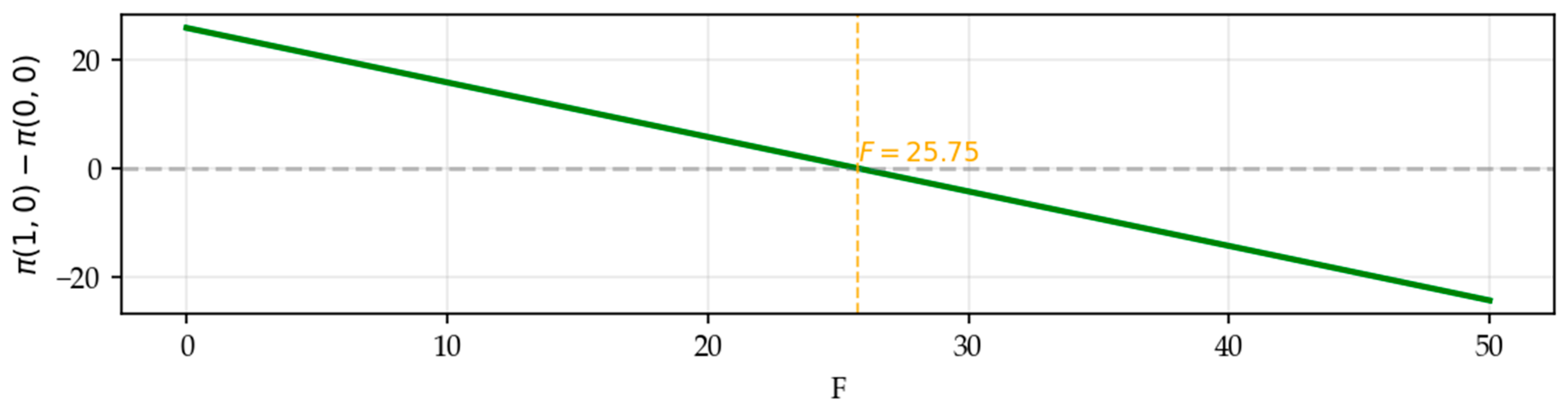
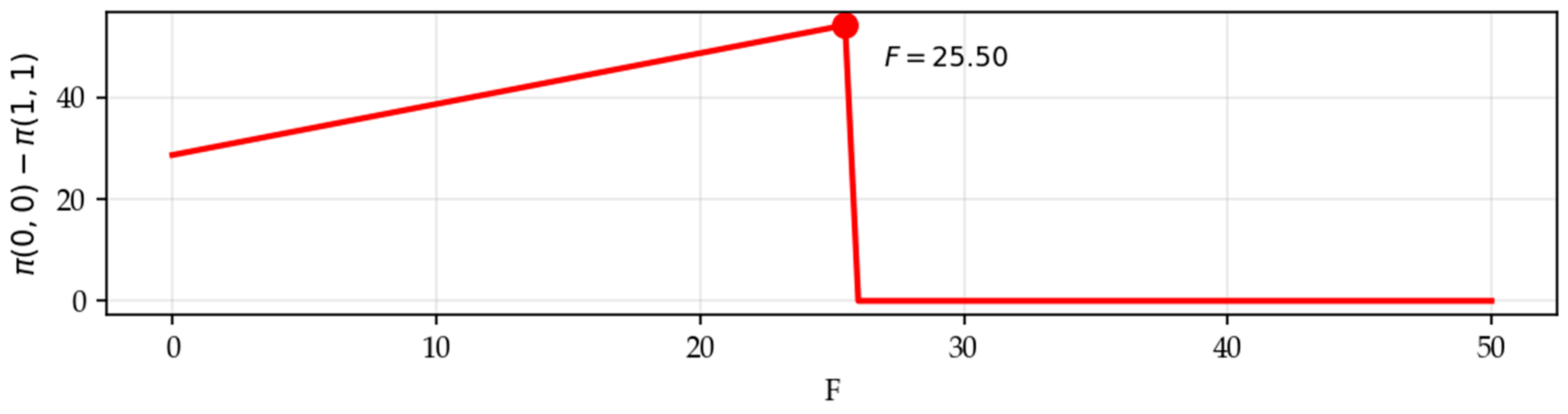
The numerical results in Section 4.1 indicate that a Prisoner’s Dilemma already exists in symmetric markets. In this section, we conduct a numerical simulation of Hypothesis 1 from Section 3.4.1. Define the marginal profit increment Δ π = π 1 , 0 π 0 , 0 for unilateral display slot purchases. Figure 2 illustrates how Δπ and the Prisoner’s Dilemma interval vary with F. The results show that the marginal value shifts from positive to negative as F increases, with the Prisoner’s Dilemma interval occurring for F 0 ,   25.8 . The intersection of the marginal value curve with the horizontal axis corresponds to the upper critical point F h i g h = 25.8 .
Figure 3 illustrates the efficiency loss π 0 , 0 π 1 , 1 caused by the Prisoner’s Dilemma as a function of F. At the benchmark F = 25.50, π 1 , 1 < π 0 , 0 , with an efficiency loss of approximately 3.14%. When F > 25.8, unilateral purchase becomes unprofitable ( Δ π < 0 ), eliminating the Prisoner’s Dilemma. This result indicates that even when display slots are free (F = 0), platforms may still fall into low-profit equilibria due to intensified competition. Placement fees are not the sole source of the Prisoner’s Dilemma. The results of the numerical simulation support Hypothesis 1.

4.3. Verification of Hypothesis 2

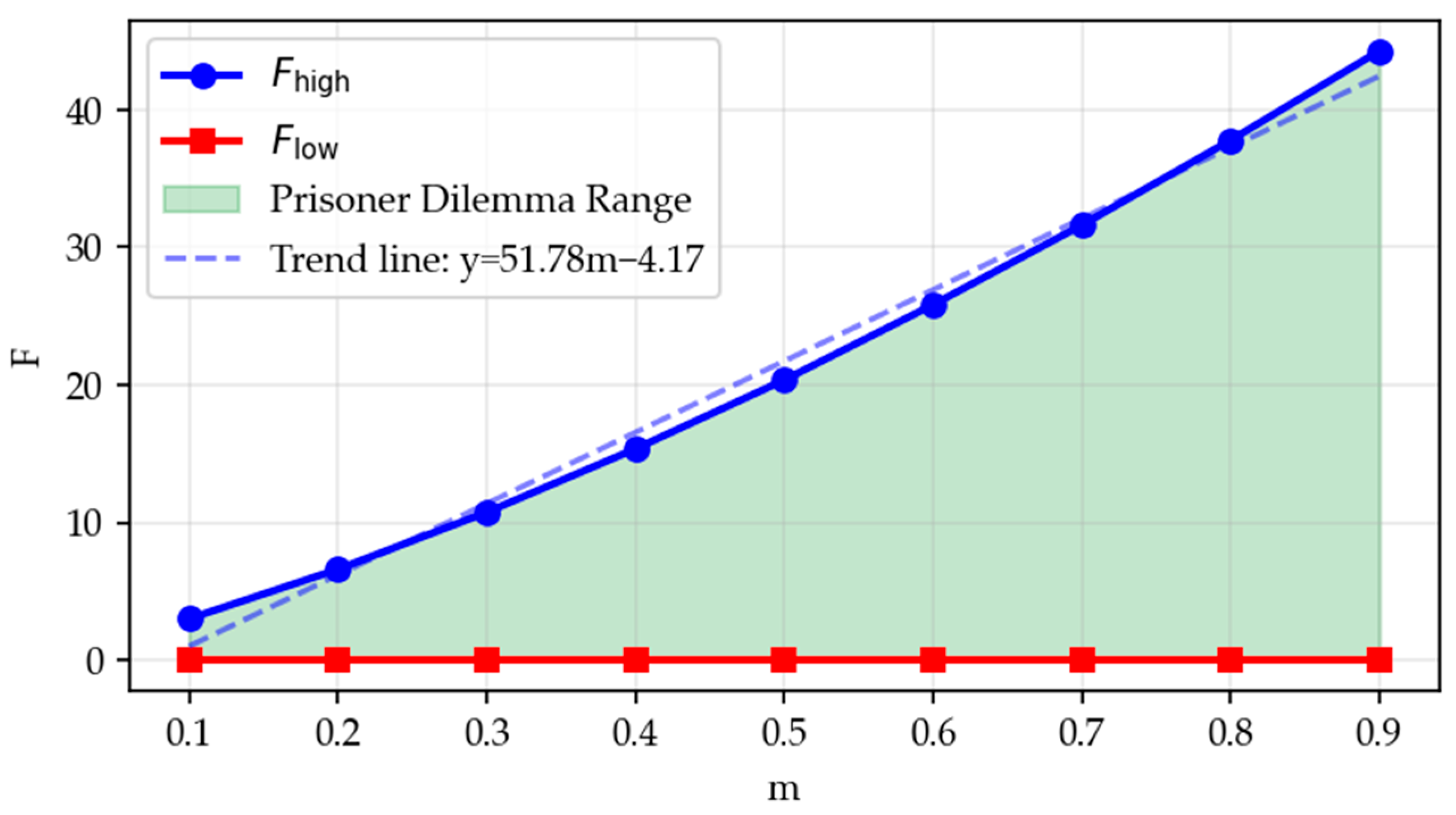
While keeping other benchmark parameters constant, we analyzed the impact of m on the upper threshold of the Prisoner’s Dilemma interval and its effect on the interval’s length. Numerical simulation results are shown in Figure 4. The numerical results show that within the range m 0.1 , 0.9 , the lower critical point F l o w of the Prisoner’s Dilemma remains constant at 0. This implies that even when display slots are free, the platform’s purchasing behavior may still lead to a Prisoner’s Dilemma. As shown, the upper critical point Fhigh of the Prisoner’s Dilemma increases monotonically with m.
When m = 0.1, F h i g h 3.0 ; when m = 0.9, F h i g h 44.3 . Each 0.1 increase in the multi-homing rate raises the platform’s maximum tolerable display slot cost by approximately 5.18. Higher multi-homing ratios strengthen display slots’ capacity to regulate effective supply, increasing platform willingness to pay. However, this also heightens susceptibility to excessive competition across broader cost ranges. In high-m environments, platforms exhibit greater willingness to pay for display slots because these slots can capture a larger proportion of multi-homing driver resources. The difference Δ F = F h i g h F l o w illustrates how the length of the Prisoner’s Dilemma interval varies with m. A high multi-homing environment makes the Prisoner’s Dilemma more likely to occur across a broader range of fee levels. The expansion of the interval exceeds the increase in m itself, indicating that the role of the multi-homing rate has an amplifying mechanism, synergistically influencing the probability of the Prisoner’s Dilemma through multiple channels. The results of the numerical simulation support Hypothesis 2.

4.4. Verification of Hypothesis 3

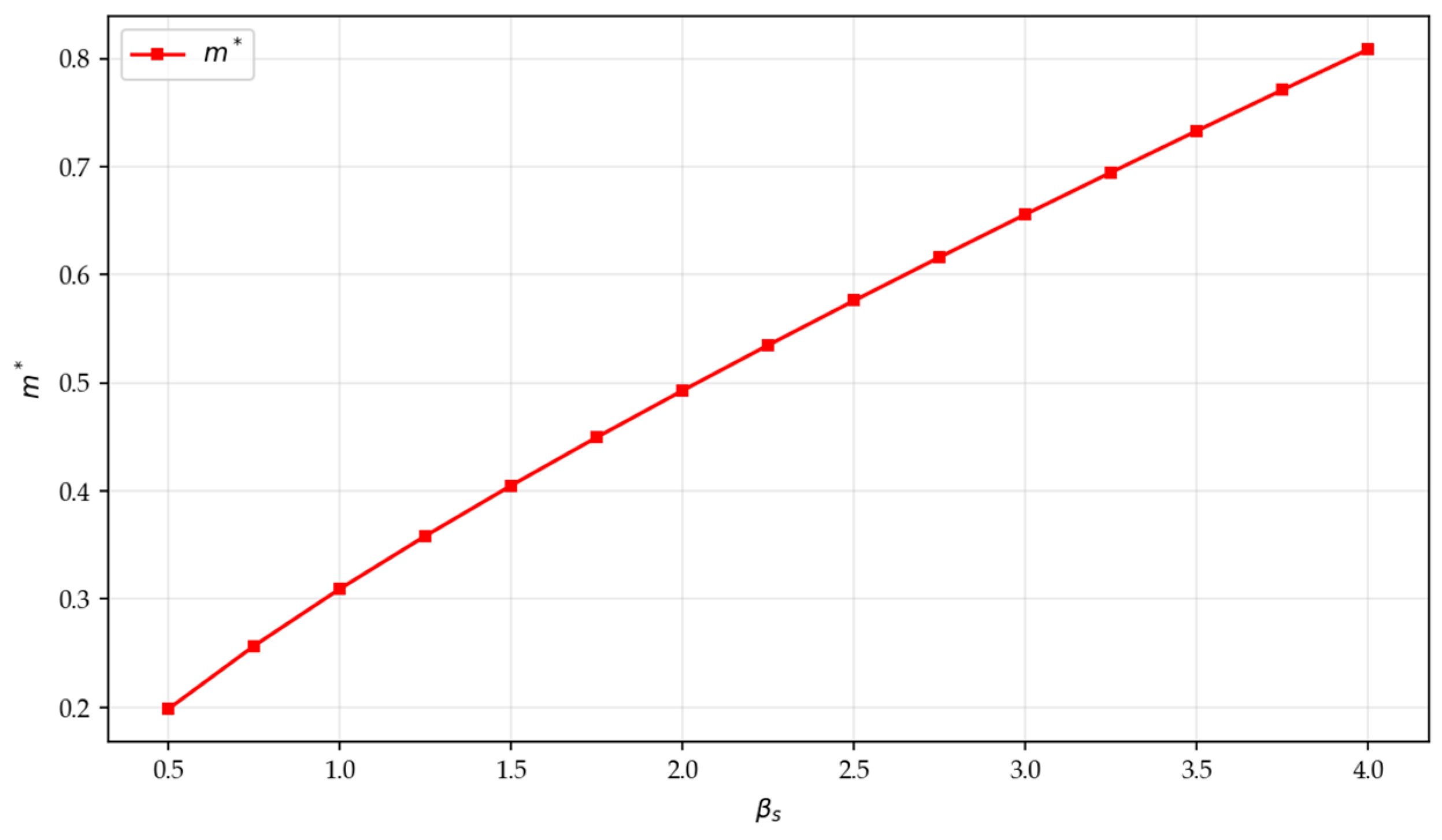
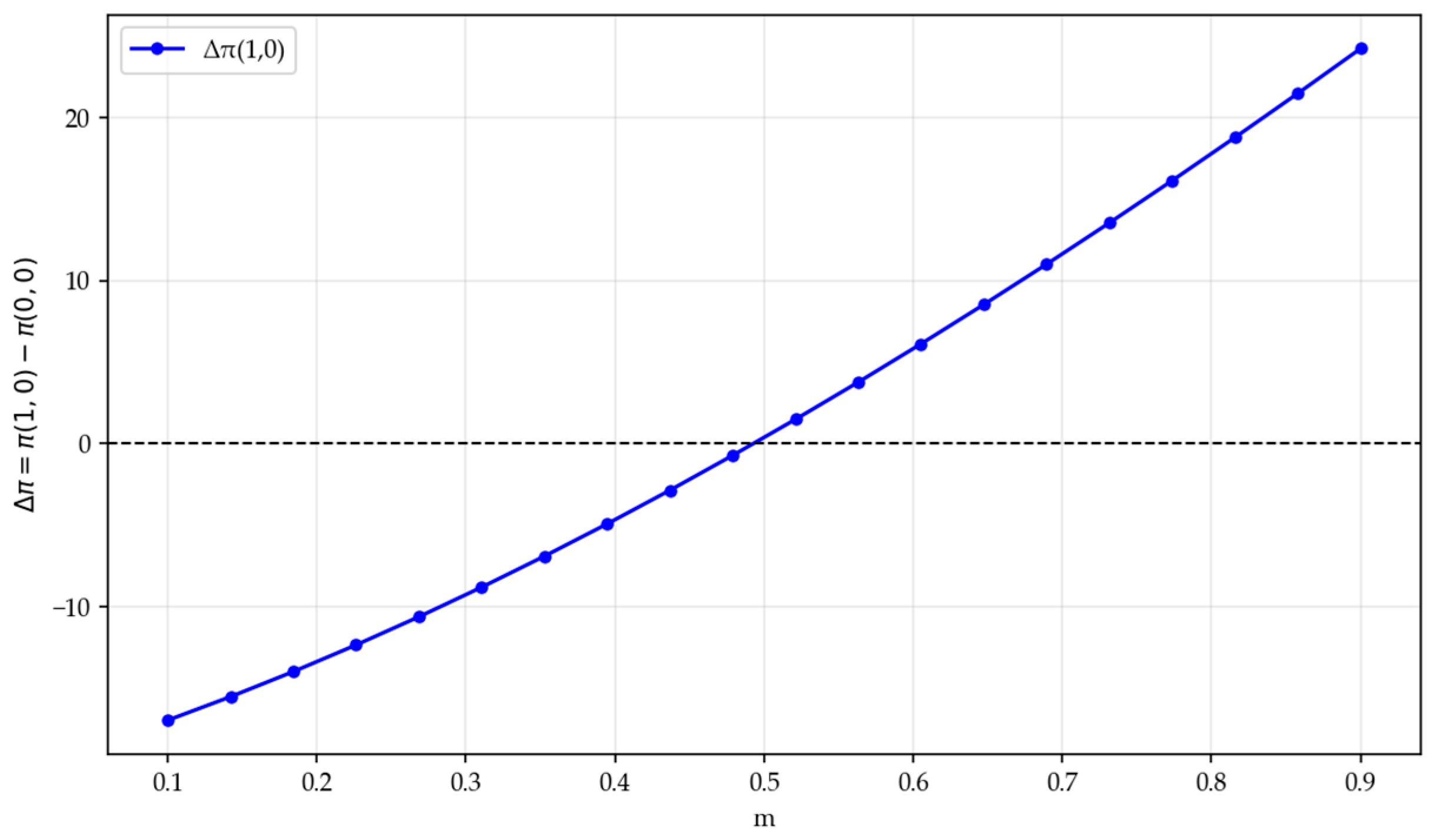
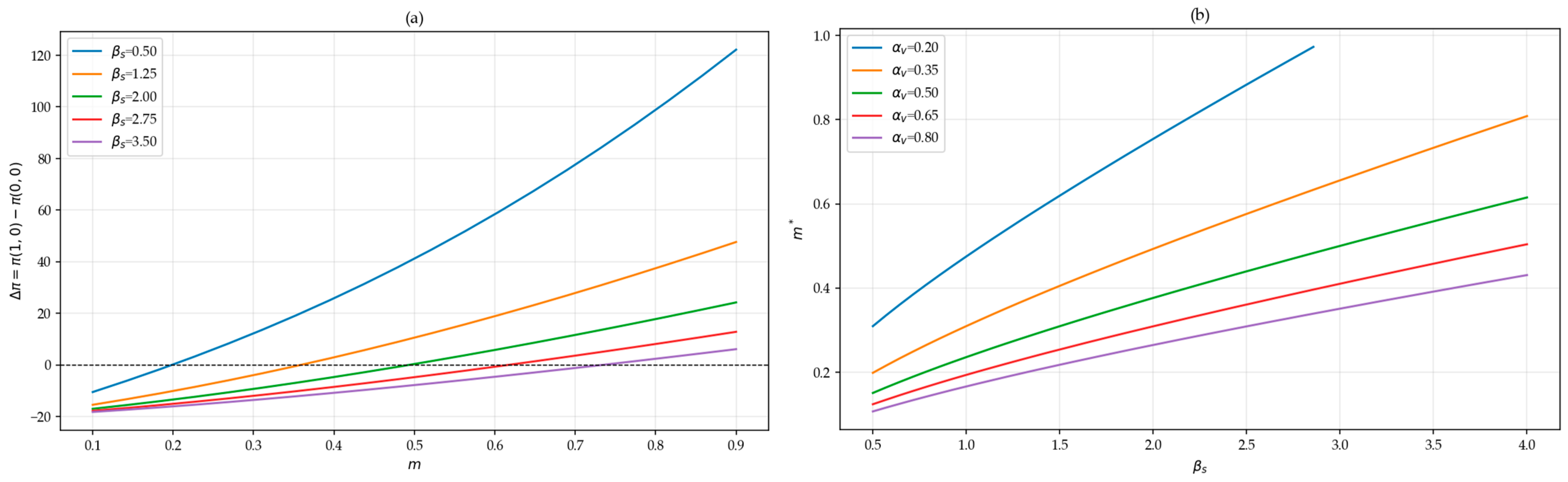
Under conditions of continuous price competition equilibrium, the marginal profit of a display slot is Δ π = π 1 , 0   π 0 , 0 . Numerical methods were employed to solve for the critical m* at different βs values. With other baseline parameters fixed (see Table 2), for each βs, Δπ(m) was calculated within the range m 0.01 ,   0.99 . The simulation results are shown in Figure 5.
The results indicate that the critical multi-homing rate m* monotonically increases as βs rises. When βs = 0.5, m* = 0.1984, indicating that purchasing display slots becomes profitable when approximately 20% of drivers in the market engage in multi-homing. Conversely, when βs = 4.0, m* rises to 0.8086, requiring over 80% of multi-affiliated drivers to offset display slot costs and generate positive returns. This monotonically increasing relationship indicates that a higher βs intensifies price competition among platforms, thereby diminishing the marginal benefit of display slots from locking in multi-homing supply. Consequently, a higher proportion of multi-homing drivers is required to amplify the effectiveness of display slots and make their purchase profitable.
Furthermore, across the entire range of βs values, Δπ(m) consistently exhibits strict monotonicity with respect to m and possesses a unique zero point (see Figure 6). This result indicates that in markets where drivers are highly sensitive to profit incentives, display slots require a higher proportion of multi-homing drivers to effectively lock in supply. This is because price competition diminishes the relative advantage of display slots. The results of the numerical simulation support Hypothesis 3. Due to the nonlinearity of the fixed-point equation, it is hard to show an analytical proof; however, simulation results have validated Hypotheses 1–3, showing consistency with theoretical hypotheses within a certain range of parameter values. The next section will further explore sensitivity analysis.

4.5. Sensitivity Analysis

To examine the robustness of model conclusions to key parameters, this section conducts sensitivity analysis on four categories of parameters: section cost parameters; supply sensitivity parameters; display slot intensity parameters; demand-side parameters. By systematically altering parameter values, we observe changes in m*, the Prisoner’s Dilemma interval, and display slot marginal profit.

4.5.1. Cost Parameter Sensitivity

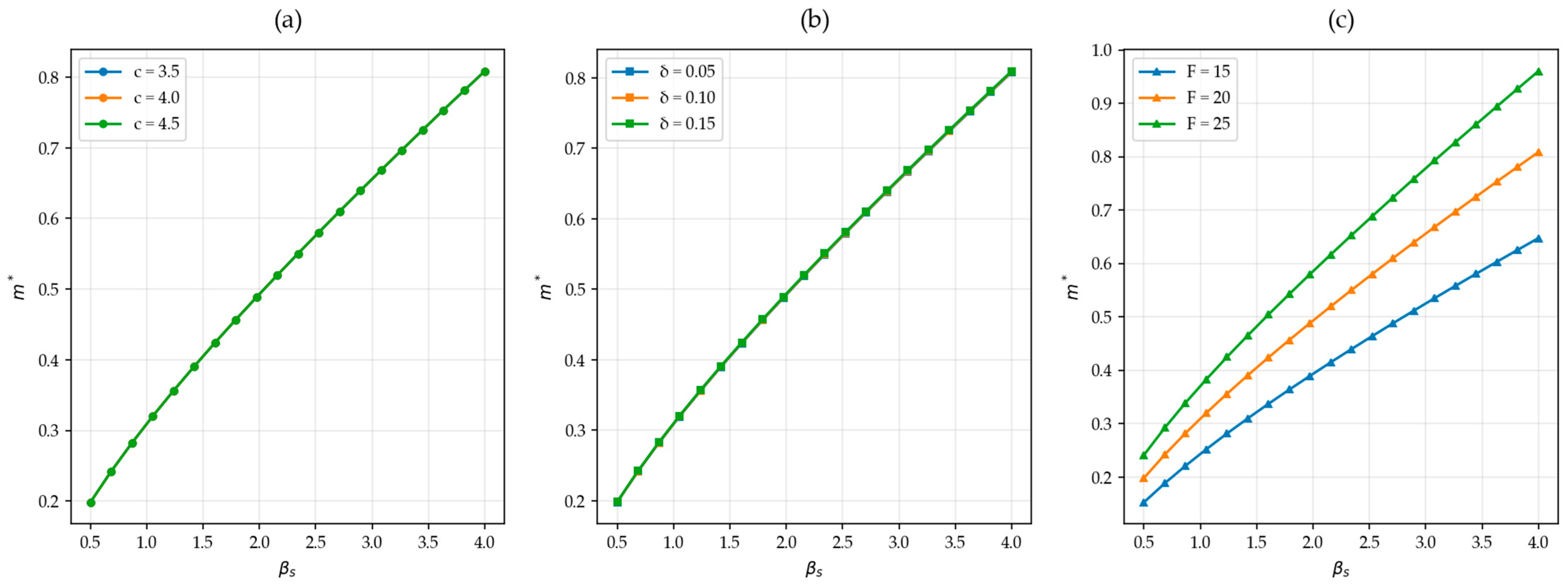
As shown in Figure 7, when marginal cost c varies within the range [3.5, 4.5], m* remains nearly constant, with the three curves highly overlapping. This indicates extremely low elasticity of Δπ with respect to c, confirming that marginal cost is not a key factor in non-display slot decisions. When driver retention cost δ increases from 0.05 to 0.15, m* rises only slightly (from 0.5190 to 0.5204 at βs = 2.0), reflecting a mild impact as δ partially offsets supply expansion gains. When F increases from 15 to 25, m* rises significantly (from 0.4150 to 0.6168 at βs = 2.0), indicating F is the core variable driving purchase decisions. Platforms must dynamically price based on m to balance incentives and competition.

4.5.2. Supply-Side Parameter Sensitivity

This section examines sensitivity across two dimensions: ① βs’ impact on equilibrium price and profit levels. ② βs’ influence on the shape of the Δπ(m) curve.
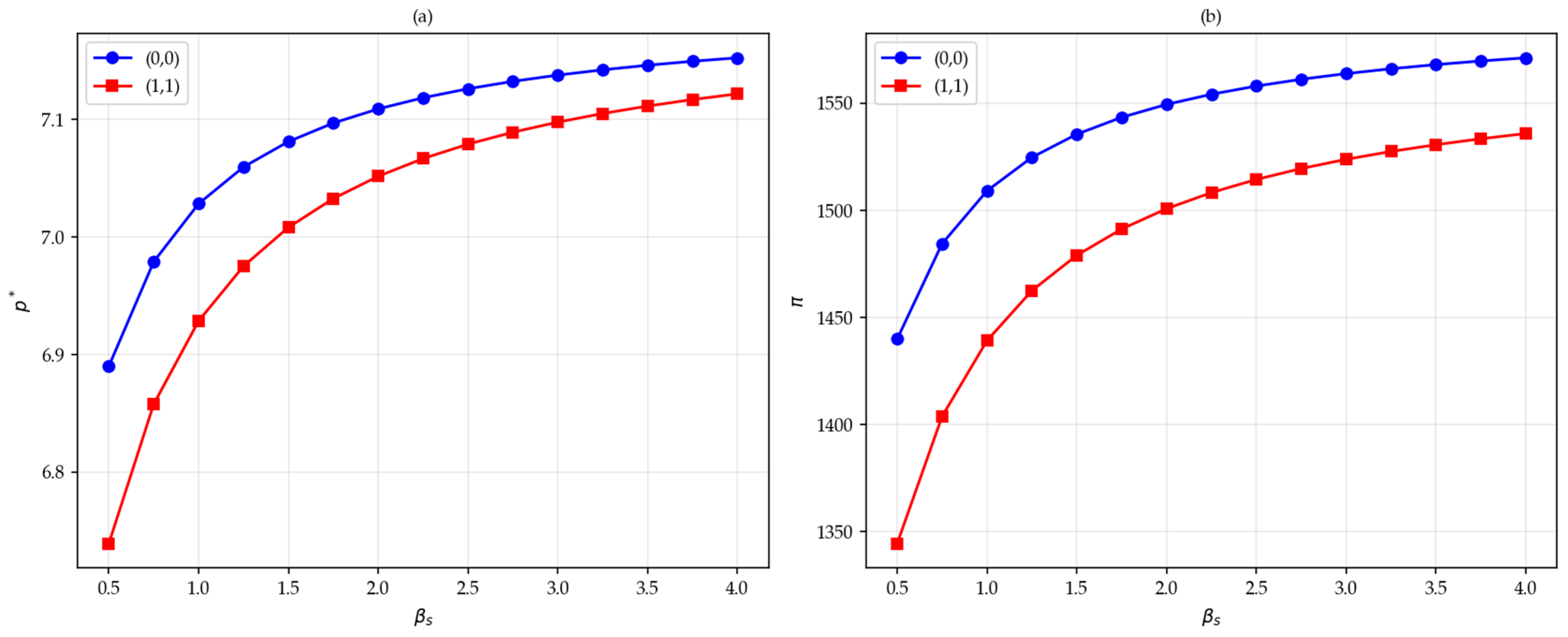
Figure 8 illustrates equilibrium price and net profit changes for (0, 0) and (1, 1) configurations at m = 0.6 under varying βs. The left panel indicates that as βs increases, equilibrium prices for both trending upward, with the (1, 1) consistently maintaining a lower price than the (0, 0). This phenomenon arises because higher βs strengthen the platform’s incentive to attract drivers through pricing. Although higher prices may result in some passenger loss, they can indirectly boost demand by attracting more drivers, thereby reducing wait times. In the two-sided market model, the platform’s incentives to drivers (via price differentials) amplify cross-network effects, potentially driving equilibrium prices upward. This positive feedback loop persists when both sides purchase display slots. However, due to competition, the (1, 1) price remains lower than the (0, 0). Moreover, the rate of price increase gradually slows as βs rises, with the curve flattening to reflect diminishing marginal returns. The right panel shows that net profits under both configurations also increase with βs, with (1, 1) profits consistently lower than (0, 0). The primary driver of profit growth is price increases. Despite intensified competition, overall profit levels rise due to strengthened market power.
Figure 9a reveals that for all βs values, Δπ(m) strictly monotonically increases with m. As the proportion of multi-homing drivers rises, the marginal benefit of display slots from locking in multi-homing supply continues to grow. As βs increases, the overall position of the Δπ(m) curve shifts downward: for a given value of m, the larger βs is, the smaller the value of Δπ becomes. The intersection point of the curve with the horizontal axis shifts significantly to the right as βs increases. This indicates that in markets where drivers are highly price-sensitive, platforms require an extremely high m to profit from display slot investments, as price competition erodes the relative advantage of display slots. This result further reveals βs’s amplifying effect on the marginal profit elasticity of display slots.
In summary, βs is a critical parameter shaping display slot competition. It enhances the marginal revenue of display slots while elevating overall price levels through amplified positive price feedback effects. However, it simultaneously magnifies efficiency losses incurred by both parties during purchasing.

4.5.3. Sensitivity of Display Slot Strength

Analyzing the variation in m* with βs at different α v values, Figure 9b shows that as α v increases, the m* curve shifts downward overall. This indicates that higher display slot strength enables the platform to profit from display slot investments at lower m, as enhanced attractiveness directly amplifies the lock-in effect on multi-assigned drivers. Simultaneously, a higher α v yields a steeper curve slope, meaning enhanced display slot strength makes m* more sensitive to βs variations.
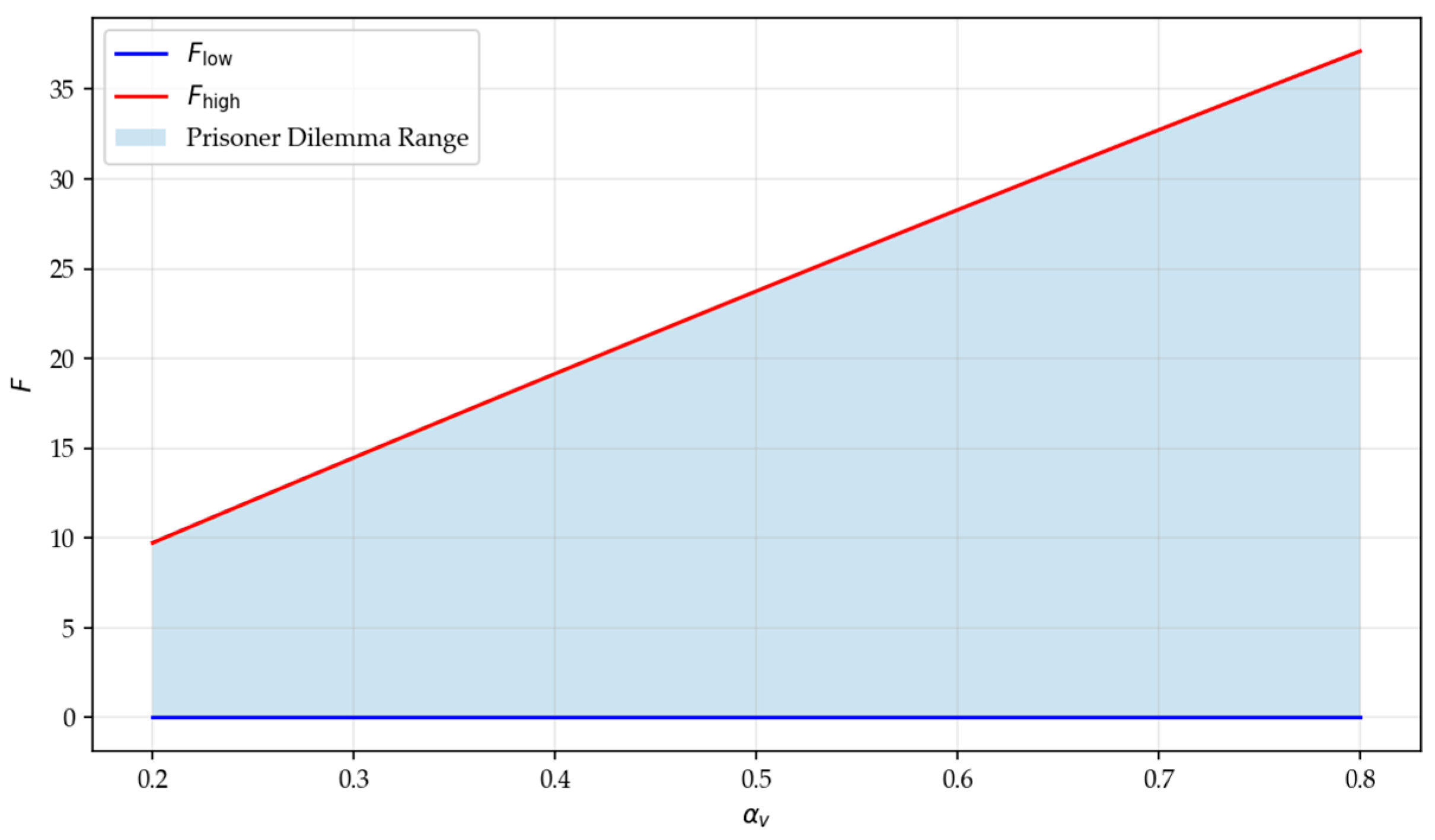
Figure 10 illustrates the range of F where the Prisoner’s Dilemma persists as α v varies. As α v increases, this range gradually expands. This indicates that more attractive display slots readily widen the Prisoner’s Dilemma interval. To compete for a limited pool of multi-homing drivers, platforms are willing to purchase display slots even at higher costs. However, when both parties purchase simultaneously, the profit loss becomes greater, causing the Prisoner’s Dilemma to persist across a broader cost range.

4.5.4. Demand-Side Parameter Sensitivity

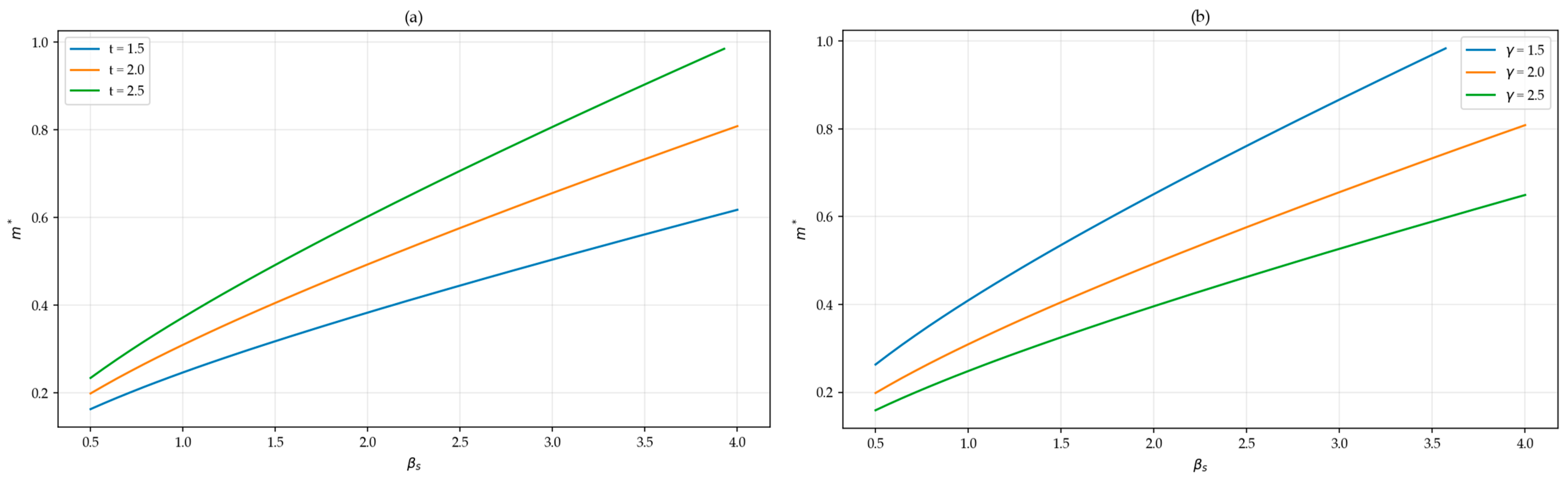
Demand-side parameters influence platform competition by affecting passenger utility functions. This section examines two key demand-side parameters: t and γ. Figure 11a illustrates how m* varies with βs for different t values. The results indicate that as t increases, the m* curve shifts upward overall. This indicates that greater horizontal differentiation lowers the threshold multi-homing rate required for display slots to become profitable, as reduced competition between platforms makes it easier to convert the marginal revenue from display slots into profit. The slope of the curve decreases slightly with increasing t, suggesting that in a less competitive environment, the sensitivity of m* to βs diminishes.
Figure 11b illustrates how m* varies with βs for different γ values. Results reveal that as γ increases, the m* curve shifts downward more markedly. This reflects heightened passenger sensitivity to waiting times, where display slots deliver greater utility gains by reducing wait times. Consequently, the marginal benefit of display slot rises, enabling the platform to profit at lower multi-homing rates. Contrary to t, increasing γ reduces the elasticity of m* with respect to βs.
The conclusion of Section 4.5 is as follows: (1) Cost Parameters: Marginal cost c has a negligible impact on the critical rate m*; δ exerts a mild influence; F is the core driver, with m* increasing significantly as F rises. (2) Supply Sensitivity βs: Enhances the elasticity of marginal revenue for display slots while intensifying competition, causing profits for both parties to remain below non-purchase scenarios when purchasing. (3) Display slot intensity α v : Increasing α v significantly lowers m* but expands the Prisoner’s Dilemma range and intensifies competitive effects. (4) Demand-side parameters: Increasing differentiation t lowers m*; increasing waiting sensitivity γ significantly reduces m* and strengthens demand transmission through display slots.
The sensitivity analysis above indicates that the existence of the Prisoner’s Dilemma, the moderating effect of the multi-homing rate, and the critical conditions for display position failure remain robust across a wide range of parameters. However, the model results depend on all parameters. In particular, specifications such as the form of the waiting time function, the decision-making mechanism underlying drivers’ multi-homing behavior, and the competitive structure among platforms (symmetric vs. asymmetric) may all affect the precise numerical values of the quantitative results. Therefore, the thresholds in this paper should be regarded as illustrative values based on specific parameter settings, intended to reveal the qualitative relationships and economic mechanisms among variables, rather than as policy thresholds that can be directly applied to real-world markets.

5. Platform Heterogeneity and Social Welfare Analysis

5.1. Analysis of Platform Heterogeneity

5.1.1. Asymmetric Condition

Under asymmetric settings, the existence and uniqueness of the second-stage price competition equilibrium remain guaranteed by standard concave game theory, because the demand function D j ( p 1 , p 2 ) is strictly decreasing and concave with respect to its own price, and the waiting time function is continuously differentiable. Consequently, each platform’s profit function is strictly concave given the opponent’s price, leading to a unique pure strategy Nash equilibrium (provided the reaction function is continuous and satisfies the strictly concave-by-diagonal condition). The mathematical proof can be found in Appendix A.1.
From the first-order condition, it follows that the equilibrium price is directly influenced by cost c j and attractiveness α j . Since α 1 > α 2 , Platform 1 attracts more multi-homing drivers, enabling shorter waiting times at equivalent pricing. This allows it to set higher prices without significant passenger loss. Simultaneously, the lower cost c1 grants it greater marginal room for price increases. The implicit function theorem proves that p 1 > p 2 (see Appendix A.2 for proof), leading to the proposition:
Proposition 1.
If c 1 < c 2 and α 01 > α 02 , then the price equilibrium under the same display slot configuration ( v 1 , v 2 ) satisfies p 1 > p 2 .
For platforms with stronger baseline attractiveness or lower costs, this enhancement effect is amplified. Their existing driver base is larger, attracting a higher proportion of multi-homing drivers, leading to more significant wait time improvements and greater demand elasticity. Thus, display slots hold higher marginal value for dominant players (see Appendix A.3 for proof), yielding the proposition:
Proposition 2.
Define the incremental profit from unilateral purchase as Δ π j = π j 1 , v j π j 0 , v j , If α 01 > α 02 , then Δ π 1 > Δ π 2 , meaning dominant players derive greater marginal benefits from display slots.
Corollary 1.
In heterogeneous environments, display slot equilibrium is more likely to exhibit a unilateral purchase structure.

5.1.2. Numerical Verification of Propositions 1 and 2

To validate propositions, while maintaining the benchmark parameters from Section 4 ( Q = 1000 , N = 100 , m = 0.6 , α v = 0.35 , β s = 2 , γ = 2 , t = 2 , δ = 0.1 , L = 50 ), we set asymmetric parameters θ = 0.7 , α 01 = 0.6 , α 02 = 0.4 , c 1 = 3.8 , c 2 = 4.2 . Numerical simulations calculated the equilibrium outcomes for four display slot configurations, as shown in Table 5.
In the absence of display slot competition (0, 0), Platform 1’s equilibrium price exceeds that of Platform 2. This validates Proposition 1. When Platform 1 possesses higher fundamental attractiveness and lower marginal costs, it can set higher prices without losing excessive passengers. Similar price rankings hold across the remaining configurations, indicating that platform heterogeneity robustly shapes pricing power. Defining the incremental profit from unilateral purchase when the rival does not buy, for Platform 1, Δ π j = π j 1 , 0 π j 0 , 0 , and for Platform 2, Δ π j = π j 0 , 1 π j 0 , 0 . Calculating from the table yields Δ π 1 = 25.47 > 0 and Δ π 2 = 0.41 < 0 . Platform 1 gains significantly from unilateral purchase, while Platform 2 incurs a minor loss. This confirms that the dominant player (Platform 1) derives far greater marginal benefits from display slots than the weaker player. Stronger brand and cost advantages amplify the supply improvement effect of display slots by capturing multi-homing drivers. This confirms Proposition 2 numerically.
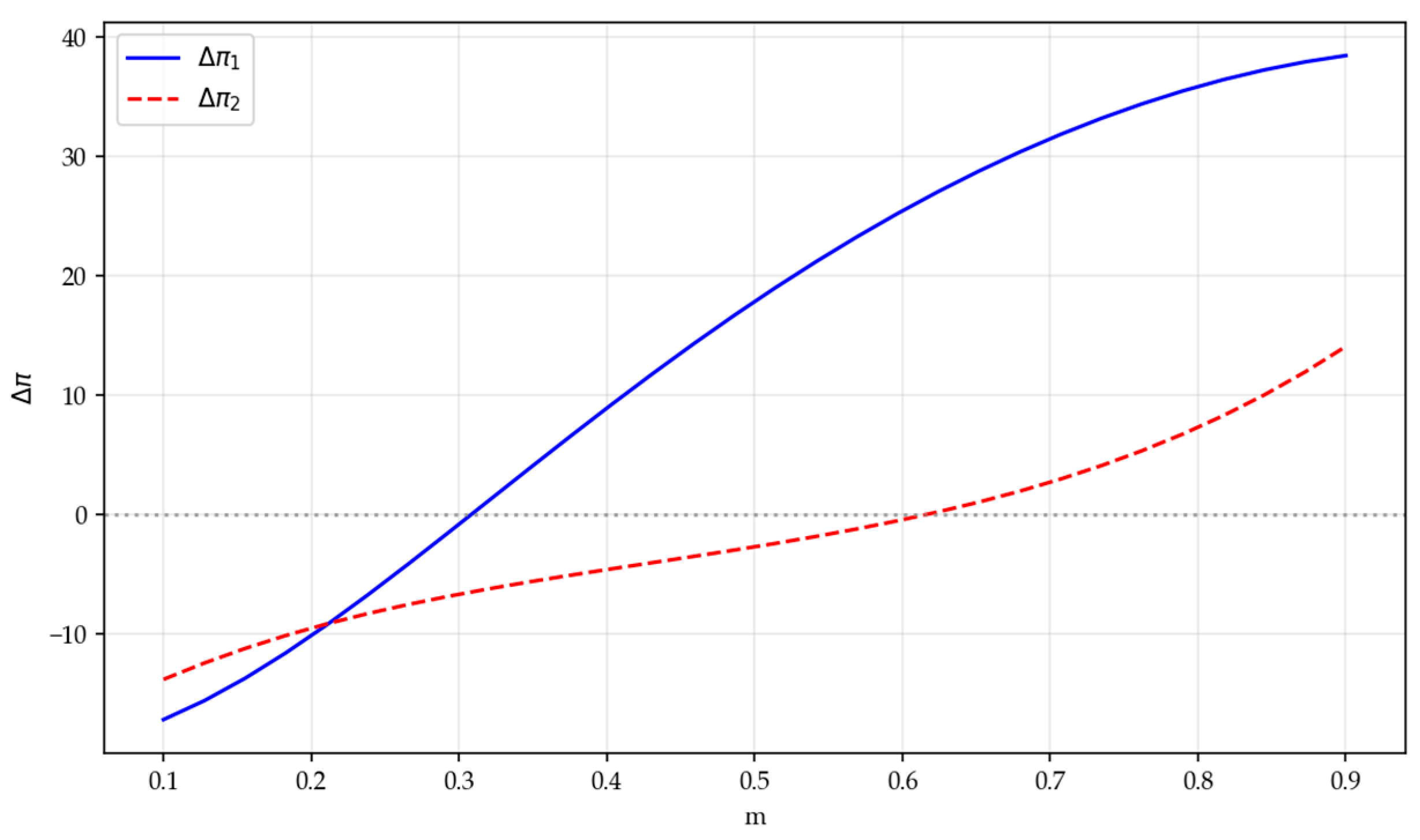
To explore how this amplification effect evolves with market conditions, Figure 12 illustrates Δπ’s variation with m. The data indicates that when m is low, both platforms experience negative incremental profits from unilateral purchases, suggesting that insufficient multi-homing among drivers prevents display slot costs from being offset by supply improvements. As m increases, Δπ1 rises rapidly, turning positive around m ≈ 0.3. While Δπ2 also climbs gradually, it remains below Δπ1 until barely approaching zero after m = 0.6. Beyond m ≈ 0.7, Δπ1 continues to rise, highlighting the dominant player’s increasingly pronounced incentive advantage. This outcome reveals that higher m not only enhance the overall value of display slots but also significantly amplify incentive disparities between platforms, reinforcing the “stronger get stronger” dynamic.
The above analysis demonstrates that platform heterogeneity fundamentally reshapes the competitive landscape for display slots. Strong players leverage their inherent advantages to utilize placements more effectively, while weaker players may be squeezed out of the placement market. This asymmetric competition may widen profit gaps between platforms but could also avert the Prisoner’s Dilemma observed in symmetric scenarios, allowing the market to converge toward a suboptimal equilibrium of unilateral purchasing. However, whether unilateral purchasing benefits social welfare depends on the net effects of price, waiting time, and demand distribution. For instance, under the (1, 0) configuration, Platform 1 experiences increased demand (from 623.2 to 633.8) and reduced waiting time (from 0.800 to 0.790), while Platform 2 sees decreased demand and longer waiting times. Changes in consumer surplus require a comprehensive evaluation. Additionally, while Platform 1’s profits increase and Platform 2’s decrease, overall welfare may either rise or fall. The next section formally introduces the social welfare function to systematically evaluate the social efficiency of display slot competition.

5.2. Social Welfare Analysis

5.2.1. Components of Social Welfare

Display slot competition not only impacts platform profits but also affects consumer surplus through pricing and waiting times, thereby influencing social welfare. This section introduces a social welfare function under asymmetric platform settings to evaluate the impact of display slot competition on overall social efficiency. First, consumer surplus is calculated to derive total social welfare, followed by a comparison of welfare outcomes under different display slot configurations. Building on this, we further examine the critical effects of m and γ on the welfare difference Δ S W = S W 1 , 1 S W 0 , 0 , revealing the conditions under which display slot competition improves efficiency.
At the equilibrium price and waiting time, consumer surplus C S v is defined as:
C S ( v ) = 0 x ^ U 1 ( x ) d x + x ^ 1 U 2 ( x ) d x
Substituting the expression for U j x and integrating yields:
C S ( v ) = V Q p 1 D 1 p 2 D 2 t Q ( x ^ 2 2 + ( 1 x ^ ) 2 2 ) γ ( W 1 D 1 + W 2 D 2 )
This expression can be directly computed from the equilibrium price, waiting time, and demand. In this model, display slots do not directly enter the passenger utility function but indirectly affect consumer surplus by influencing n j e f f and W j . Display slots impact demand through their effect on waiting time via supply.
Social welfare is defined as the sum of consumer surplus and the profits of the two ride-hailing platforms. Define total social welfare as:
S W = C S + π 1 + π 2
Since display slot fees represent transfer payments from the platform to the aggregator platform, functioning only as internal transfers in the social welfare context. Thus, the social welfare function S W is:
S W = C S + j = 1 2 [ ( p j c ) D j δ n j e f f ]
It should be noted that F is the fee paid by the underlying platform to the aggregation platform. F has not yet been included in the aggregation platform’s profits, primarily for the following reasons: First, this paper focuses on the resource allocation efficiency between the underlying ride-hailing platform and passengers under the aggregation model. As the rule-maker, the aggregation platform derives its profits from expenditures by the underlying platform; this constitutes an internal market transfer payment that does not affect the production and consumption efficiency of the underlying market. Second, if included in total welfare, the total welfare would be S W t o t a l =   C S   + π 1 + π 2 + π A , where π A = v 1 + v 2 F . Substituting the expressions for π j yields:
S W t o t a l = C S + j = 1 2 [ ( p j c ) D j δ n j e f f v j F ] + ( v 1 + v 2 ) F   = C S + j = 1 2 [ ( p j c ) D j δ n j e f f ]
F offsets itself in the summation; SWtotal differs from the SW by only a constant term v j F , and this constant term does not affect the direction of welfare comparisons.
Since display slots alter effective supply by enhancing attractiveness, thereby affecting waiting time and demand, their welfare effects are complex and may yield outcomes in different directions. Considering continuity, examine two extreme scenarios. If waiting time sensitivity γ is extremely high, a slight improvement in waiting time will significantly increase consumer surplus, potentially exceeding the loss in platform profits, resulting in Δ S W = S W 1 , 1   S W 0 , 0 > 0 . If γ is minimal, passengers exhibit negligible concern for waiting time. Display slots merely intensify price competition, reducing profits, while the consumer surplus gain from reduced waiting time is negligible, yielding ΔSW < 0. By the Intermediate Value Theorem, a critical γ* exists where ΔSW = 0. We can preliminarily conclude that:
Hypothesis 4 (Dual Effect on Welfare).
There exists a parameter range such that, while the profits of the platform where both purchase display slots decrease, social welfare increases. There also exists a parameter range such that, while the profits of the platform where both parties purchase display slots decrease, social welfare decreases. There exists a waiting-time sensitivity threshold γ*; when γ < γ*, both purchasing display slots leads to welfare losses; when γ > γ*, the consumer surplus gains from reduced waiting times exceed profit losses, resulting in increased social welfare.

5.2.2. Numerical Simulation of Social Welfare

Under the baseline asymmetric parameters (as in Section 5.1), we calculate the social welfare for the four configurations. The results are shown in Table 6.
When only Platform 1 ( α 01 > α 02 , c 1 < c 2 ) purchases, social welfare reaches its maximum value, exceeding the baseline without a display slot. Although consumer surplus declines slightly due to rising prices, the increase in Platform 1’s net profit after deducting ad costs is insufficient to offset Platform 2’s profit loss. When only Platform 2 purchases display slot unilaterally, social welfare declines and falls below the baseline. Thanks to Platform 2’s price reduction, consumer surplus rises significantly at this point, but Platform 1’s profits plummet, resulting in a loss of total welfare. This indicates that Platform 2’s purchase of display slot intensifies price competition and fails to effectively improve matching efficiency. When both platforms purchase, social welfare is slightly below the baseline. While consumer surplus is higher in this scenario, the profits of both platforms decline, resulting in total welfare remaining largely unchanged. This indicates that in an asymmetric market, bilateral purchasing does not lead to significant efficiency losses as in a symmetric scenario, but it also fails to improve.
The above results show that the social effects of display slot competition are dependent on the purchaser. In the context of Propositions 1 and 2, the stronger party (with larger α 01 and smaller c 1 ), leveraging its brand and cost advantages, can more effectively convert display slots into improved matching efficiency (shorter waiting times), thereby increasing overall welfare when profit gains exceed the loss in consumer surplus, whereas purchases by the weaker one may trigger excessive competition and harm welfare. This finding offers insights for aggregation platforms in formulating display slot rules: they should encourage stronger firms to participate in display slot competition while preventing weaker ones from falling into a Prisoner’s Dilemma.
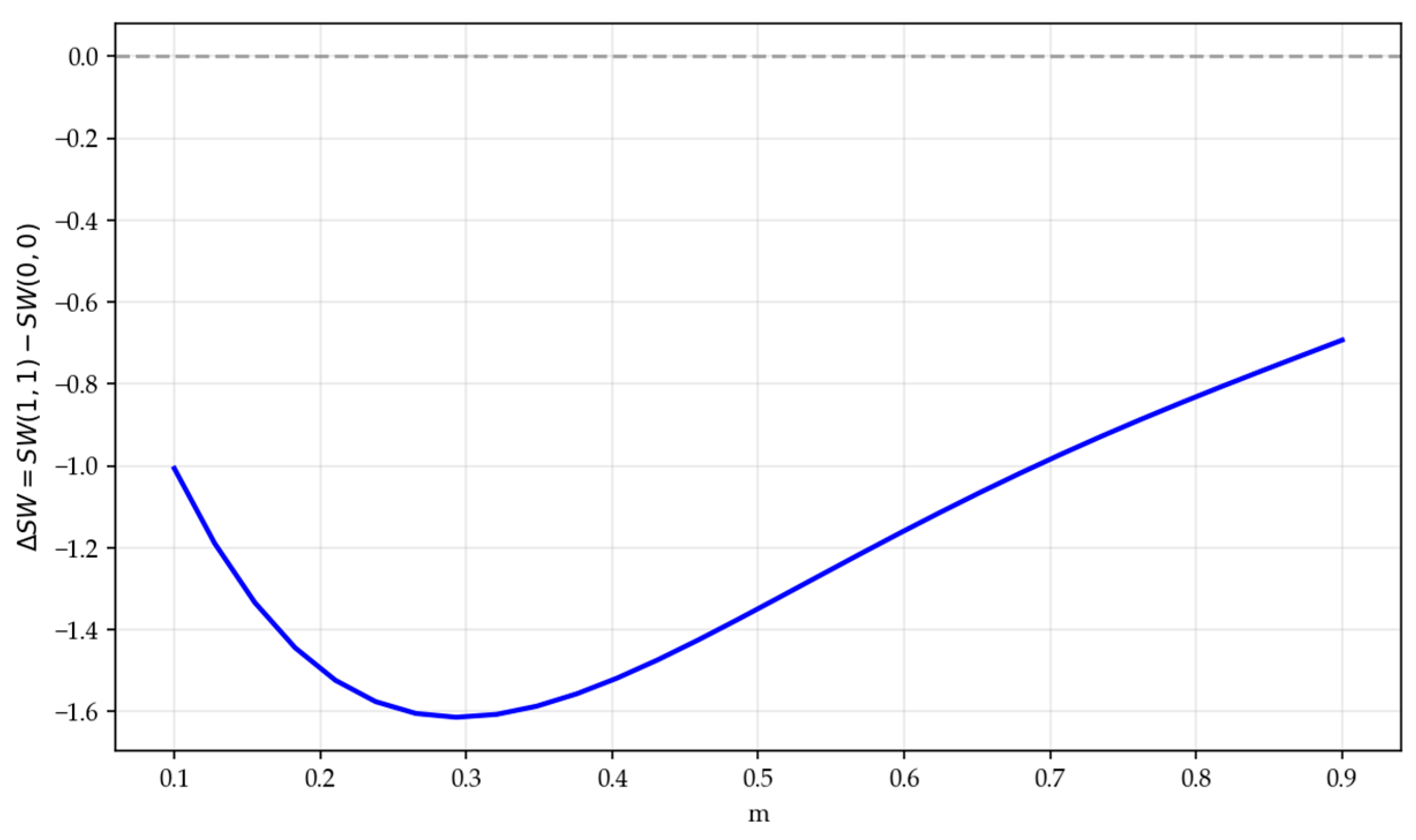
Figure 13 illustrates ΔSW’s variation with m. The curve forms a U-shape, declining initially then rising, with ΔSW remaining negative for all m values. This indicates that purchasing display slots consistently yield lower social welfare than neither party purchasing. This pattern can be explained as follows: When m is very small, the proportion of multi-homing drivers is extremely low. Locking supply through display slots barely improves matching efficiency. Purchasing display slots primarily intensify price competition, reducing platform profits while only marginally increasing consumer surplus. Thus, ΔSW is negative with a small absolute value. As m increases, multi-homing drivers begin to exert some influence. However, competitive effects remain dominant at this stage. When m continues to rise (>0.5), the proportion of multi-homing drivers becomes sufficiently high. The reduction in waiting time brought by display slots then significantly enhances consumer surplus, partially offsetting profit losses, and ΔSW gradually rebounds. Under the parameter settings in this paper, the positive effects never fully offset the negative effects, so ΔSW remains negative throughout. This result implies that in asymmetric markets, even with a high m, simultaneous purchase of display slots by both parties may still lead to a loss of social welfare, though the magnitude of the loss decreases as m increases. The threshold for welfare improvement may appear at higher m or other parameter combinations.
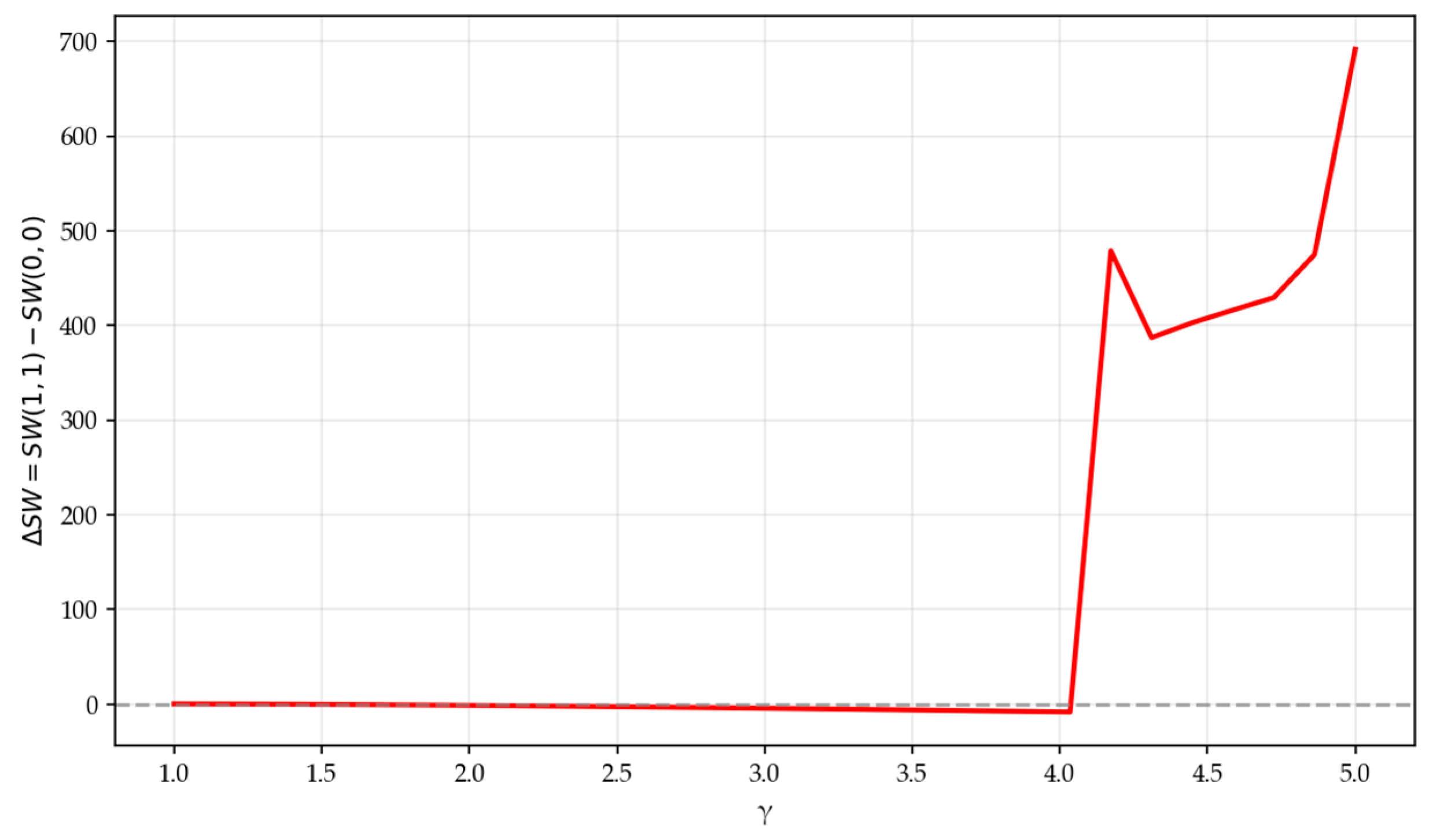
Figure 14 illustrates how the social welfare gap ΔSW varies with waiting time sensitivity γ. The curve remains flat when γ < 4, then rises sharply thereafter. At low γ values, passengers exhibit low sensitivity to waiting time, resulting in minimal consumer surplus gains from display slots reducing wait times. As γ increases, price competition effects slightly strengthen, causing ΔSW to decrease marginally further. Once γ exceeds the critical threshold γ* ≈ 4, the consumer surplus gains from reduced waiting time outweigh the profit losses from price competition. ΔSW shifts from negative to positive and accelerates its rise with increasing γ. At this point, display slot competition transforms from an “efficiency loss” to an “efficiency gain,” with the magnitude of improvement sharply amplifying as sensitivity increases. This confirms Hypothesis 4 numerically.
This finding indicates that in markets where passengers are highly sensitive to waiting time (e.g., peak hours, business district travel), encouraging display slot competition can significantly enhance social welfare. Conversely, in low-sensitivity markets (e.g., off-peak hours, short-distance travel), caution is warranted regarding potential welfare losses from such competition. Aggregation platforms can dynamically adjust display slot fees or rules based on γ characteristics across different time periods to guide market efficiency. This provides insights for optimizing display slot rules across various scenarios.

5.2.3. Display Slot and Its Impact on Social Welfare

As a transfer payment from the platform to the aggregator, display slots are not directly included in social welfare. However, they indirectly alter market equilibrium by influencing the purchasing decisions of the underlying platform, thereby affecting consumer surplus and platform profits. Therefore, the impact of F on social welfare depends entirely on how it guides the platform toward different configurations of listing positions.
Based on the Prisoner’s Dilemma analysis in Section 3.4.1, two key thresholds exist. Here, we set the maximum fee at which unilateral purchase is profitable as Y0, and the maximum fee at which mutual purchase constitutes a Nash equilibrium as Y1 (typically Y1 < Y0). When F < Y1, bilateral purchases are a dominant strategy, the equilibrium is (1, 1). As shown in Table 6, SW(1, 1) is lower than SW(0, 0); at this point, the platform is trapped in a Prisoner’s Dilemma, and social welfare is compromised. When Y1 < F < Y0, a non-symmetric equilibrium emerges: the stronger party (Platform 1) makes a unilateral purchase, while the weaker party (Platform 2) does not. The social welfare under this configuration exceeds the baseline value because the consumer surplus gains resulting from the stronger party’s use of display slots to improve matching efficiency outweigh the profit losses caused by price competition. In this scenario, neither party has an incentive to purchase, and the equilibrium returns to (0, 0), with social welfare reverting to the baseline level.
Therefore, the impact of display slot fees on social welfare is not monotonic but exhibits a phased pattern of “initial loss, followed by gain, and then stabilization” as F increases. A reasonable fee design should guide the market toward a configuration where the stronger party makes a unilateral purchase, thereby maximizing social welfare.

6. Conclusions

6.1. Research Findings

This study constructs a two-stage Stackelberg game model in an aggregation scenario, treating display slots as endogenous supply-side locking tools, and analyzes their interaction mechanism with drivers’ multi-homing behavior. The study answers the three research questions posed in the Introduction through theoretical analysis and numerical simulations.
For Research Question 1, the results indicate that display slots reshape the competitive landscape through supply-side mechanisms. When one platform purchases a display slot, its attractiveness increases, enabling it to lock in more multi-homing drivers. This raises effective supply, reduces waiting times, and expands demand. Unilateral purchasing thus yields a competitive advantage. However, when both platforms purchase display slots, relative attractiveness remains unchanged. At the same time, the overall increase in attractiveness intensifies competition for multi-homing drivers, exacerbates price competition, and leads to lower equilibrium prices. As a result, both platforms earn lower profits than in the no-purchase scenario. This finding reveals a two-sided effect of display slot competition: unilateral purchasing is profitable, whereas bilateral purchasing leads to profit dissipation.
For Research Question 2, the numerical results support Hypothesis H1. In a symmetric market, there exists a range of display slot fees under which bilateral purchasing constitutes a Nash equilibrium, while total profits are lower than in the no-purchase scenario—i.e., a Prisoner’s Dilemma. Even when display slots are costless, purchasing behavior intensifies price competition and generates efficiency losses, reflecting the first aspect of economic sustainability. Further analysis shows that the multi-homing rate significantly affects the scope of this dilemma. As m increases, the upper threshold rises monotonically, and the parameter interval expands, supporting Hypothesis H2. In high-m environments, platforms exhibit a greater willingness to pay for display slots but are also more likely to engage in excessive competition. In addition, greater sensitivity of driver earnings intensifies price competition, requiring a higher m for display slots to yield positive returns. Thess results provide quantitative conditions under which display slots become ineffective.
For Research Question 3, the welfare effects of display slot competition are condition-dependent. In symmetric markets, bilateral purchasing typically leads to welfare losses, although the magnitude of these losses decreases as m increases. In asymmetric markets, welfare outcomes depend on passengers’ sensitivity to waiting time, characterized by a threshold γ*. When γ < γ*, bilateral purchases reduces welfare; when γ > γ*, the increase in consumer surplus from reduced waiting time outweighs the profit loss, resulting in net welfare gains that grow with γ. The welfare effect also depends on which platform purchases the display slot. Unilateral purchase by a dominant platform (with strong brand appeal and lower costs) can increase social welfare, whereas purchase by a weaker platform tends to reduce welfare whether unilateral or bilateral. These findings indicate that display slot competition is not unambiguously efficiency-enhancing; its effects depend critically on market structure and parameter conditions and should be understood within a broader sustainability framework that encompasses not only firm-level profitability and social welfare but also the stability and efficiency of the overall ecosystem.

6.2. Managerial Implications

The above findings, derived from the theoretical model, yield several implications for platform operators, ride-hailing aggregators, and regulatory authorities. These implications should be interpreted as model-based insights and require contextual adaptation before being applied in real-world settings.
For underlying platforms, the model results indicate that in markets with a low multi-homing rate or low sensitivity to waiting time, the marginal returns from purchasing display slots are limited. In such environments, platforms should avoid indiscriminate participation in display slot auctions. In markets where drivers are highly sensitive to profits, platforms should carefully evaluate the expected return on investment and avoid engaging in symmetric competitive strategies when marginal gains are insufficient to offset costs.
For aggregator platforms, the model highlights the importance of display slot pricing design. Numerical results show that excessively high display slot fees may crowd out small- and medium-sized platforms, thereby increasing market concentration. Conversely, excessively low fees may induce excessive competition and lead to a Prisoner’s Dilemma, undermining long-term sustainability. These findings indicate that display slot pricing should account for the equilibrium outcomes associated with different fee levels. In practice, dynamic pricing strategies—such as adjusting fees across peak and off-peak periods—may help mitigate inefficient competition.
For regulators, the analysis suggests that regulatory focus should expand beyond price and commission rates to include algorithmic ranking and traffic allocation mechanisms. Display slots affect market share and welfare distribution through supply-side locking effects that are not fully reflected in prices. This highlights the need for enhanced regulatory scrutiny of ranking fairness, allocation mechanisms for display positions, and the potential existence of exclusionary practices [40]. In markets with high multi-homing rates, regulators should monitor the emergence of Prisoner’s Dilemma outcomes and associated efficiency losses, in order to guide the market toward sustainable development.
From a sustainability perspective, three main insights emerge. First, a platform’s long-term profitability depends on the rational use of competitive tools such as display slots; excessive reliance on non-price competition may lead to profit dissipation. Second, improvements in social welfare are condition-dependent and hinge on key parameters such as the multi-homing rate and sensitivity to waiting time. Third, as rule-makers, aggregation platforms play a critical institutional role in maintaining ecosystem sustainability, as their pricing mechanisms directly shape market equilibrium outcomes.
Finally, these results are derived from a theoretical analysis. The numerical thresholds reported in this study (e.g., F 0 ,   25.8 , γ 4 ) are illustrative examples based on specific parameter settings and do not constitute directly applicable policy thresholds. The primary contribution of this study lies in identifying the underlying economic mechanisms and qualitative relationships among key variables, thereby providing theoretical guidance for the governance of platform sustainability.

6.3. Research Limitations and Future Directions

This study has several limitations that suggest directions for future research.
First, this paper treats the multi-homing rate m as an exogenous parameter in order to isolate its moderating effect. In practice, however, multi-homing behavior evolves dynamically in response to factors such as income volatility, platform incentives, and regulatory policies. Future research could endogenize the multi-homing rate and develop a dynamic game-theoretic model incorporating driver participation decisions.
Second, this study focuses on symmetric competition between two platforms, as well as stylized asymmetric settings. In real-world aggregation markets, multiple platforms often coexist, including dominant incumbents and smaller fringe competitors. Extending the model to incorporate multi-platform competition and platform-specific scale heterogeneity would yield richer equilibrium outcomes.
Third, this study primarily relies on theoretical analysis and numerical simulation, and the external validity of its conclusions remains to be empirically validated. Future research could employ structural models using order-level or city-level panel data to provide stronger empirical validation, particularly in estimating the impact of display ranking on waiting times, market shares, and platform profits.
Finally, this study has limitations in its measurement of social welfare. The analysis focuses on consumer surplus and platform profits, without explicitly incorporating driver welfare. Under the assumption that driver supply is exogenous and per-order revenue is fixed, driver welfare does not affect the strategic equilibrium. However, in practice, display slot competition may influence driver participation and labor supply through income effects. Future research could endogenize driver welfare to enable a more comprehensive assessment of the distributional effects of display slot competition.

Author Contributions

Conceptualization, X.G. and G.X.; Methodology, X.G. and G.X.; Formal analysis, X.G. and G.X.; Data curation, G.X.; Writing—original draft, X.G.; Writing—review and editing, G.X.; Visualization, X.G.; Funding acquisition, G.X. All authors have read and agreed to the published version of the manuscript.

Funding

This research received no external funding.

Institutional Review Board Statement

Not applicable.

Informed Consent Statement

Not applicable.

Data Availability Statement

Data will be made available upon reasonable request to the corresponding author.

Conflicts of Interest

The authors declare no conflicts of interest.

Appendix A

Appendix A.1. Existence and Uniqueness of Nash Equilibrium

Proof. 
Given the display slot allocation ( v 1 , v 2 ) , let the profit function of platform j be π j ( p j , p j ) = ( p j c ) D j ( p j , p j ) δ n j e f f ( p j , p j ) v j F . Taking the second-order derivative with respect to p j , we obtain 2 π j p j 2 = 2 D j p j + ( p j c ) 2 D j p j 2 δ 2 n j e f f p j 2 . Substituting D j p j = 1 2 t , α j p j = β s and 2 n j e f f p j 2 = 2 m N α j ( α 1 + α 2 ) 3 β s 3 , it can be shown that 2 π j p j 2 = 1 t + 2 δ m N α j ( α 1 + α 2 ) 3 β s 3 < 0 . Under standard parameter conditions, this implies that the profit function is strictly concave in its own price. Since the strategy space is a compact and convex set [ c , p m a x ] and the payoff functions are continuous and strictly concave, the existence of a Nash equilibrium is guaranteed [41]. Furthermore, let G ( p ) denote the Jacobian matrix of second-order partial derivatives. If G + G T is negative definite, the game satisfies the diagonal strict concavity (DSC) condition, which ensures uniqueness. This condition is satisfied in the present model; therefore, the Nash equilibrium is unique. □

Appendix A.2. Proof of Proposition 1

Proof. 
The first-order condition for platform j can be expressed as an implicit function: F j ( p 1 , p 2 , c j , α j ) = 0 . By the implicit function theorem, the derivative of the equilibrium price with respect to marginal cost is given by:  p j c j = F j / c j F j / p j . Using Equations (1) and (2), we derive the expression n j e f f p j = m N α j ( α 1 + α 2 ) 2 β s . Taking the partial derivative with respect to c j , and noting that α j depends on β s p j c , while p j is itself an implicit function of c j , we focus on the direct effect of c j , under the implicit function framework. It follows that F j c j = D j p j + δ 2 n j e f f p j c j = 1 2 t + m N α j ( α 1 + α 2 ) 2 β s 2 p j c j , F j p j = 1 t + δ 2 n j e f f p j 2 < 0 , p j c j = 1 / ( 2 t ) F j / p j δ m N α j ( α 1 + α 2 ) 2 β s 2 > 0 , implying that the equilibrium price increases with marginal cost. Since c 1 < c 2 , we obtain  p 1 > p 2 . Moreover, since platform attractiveness responds positively to lower costs: p j α j = F j / α j F j / p j > 0 . Given that α 01 > α 02 , platform 1 has stronger baseline attractiveness, which further reinforces the result p 1 > p 2 . □

Appendix A.3. Proof of Proposition 2

Proof. 
Let Δ π j denote the unilateral profit gain of platform j when its rival does not purchase a display slot. By the envelope theorem, at the equilibrium price, the total derivative of profit with respect to the display slot decision reduces to its partial derivative. Therefore, Δ π j captures the direct effect of display slot adoption. Purchasing a display slot increases platform attractiveness α j , which raises effective supply n j e f f , reduces waiting time, and expands demand D j while also increasing driver-related costs and incurring a fixed cost F. Among these effects, the demand expansion effect dominates. The increase in effective supply, Δ n j e f f = m N α j ( α 1 + α 2 ) 2 α v , is monotonically increasing in α j , implying that platforms with higher baseline attractiveness experience larger supply expansion effects. When α 01 > α 02 , platform 1 achieves a larger demand increase than platform 2, Δ n 1 e f f > Δ n 2 e f f . Moreover, from the first-order condition, π j D j = p j c > 0 , marginal profit at equilibrium depends on price. Since platform 1 charges a higher equilibrium price (as established in Proposition 1), it derives greater marginal returns from additional demand. Therefore, Δ π 1 > Δ π 2 . □

Appendix A.4. Numerical Solution Algorithm

Given the nonlinearity of the model, closed-form solutions are intractable. Therefore, the second-stage price equilibrium is computed using a fixed-point iteration based on best-response functions. For a given display slot configuration ( v 1 , v 2 ) and model parameters, initial prices are set symmetrically. Iterative updates are then performed such that each platform sequentially solves its single-variable profit maximization problem given the rival’s current price. This is implemented using a one-dimensional optimization method (e.g., golden-section search). The iteration continues until the price updates satisfy a predefined convergence tolerance. The resulting fixed point yields the equilibrium prices, which are then substituted into the model to obtain equilibrium demand, effective supply, waiting time, and profits. Convergence is ensured under standard regularity conditions: the profit functions are strictly concave, and the best-response mapping constitutes a contraction. Therefore, the algorithm converges to a unique equilibrium.

References

  1. Zhan, Y.; Kumar, A.; Hosany, S.; Xia, Y.; Schoenherr, T.; Xia, L. Market competition in the platform economy: New insights, integrative framework and research agenda. J. Bus. Res. 2025, 200, 115648. [Google Scholar] [CrossRef]
  2. Wang, H.; Yang, H. Ridesourcing systems: A framework and review. Transp. Res. Part B Methodol. 2019, 129, 122–155. [Google Scholar] [CrossRef]
  3. Rochet, J.C.; Tirole, J. Two-sided markets: A progress report. RAND J. Econ. 2006, 37, 645–667. [Google Scholar] [CrossRef]
  4. Armstrong, M. Competition in two-sided markets. RAND J. Econ. 2006, 37, 668–691. Available online: https://www.jstor.org/stable/25046266 (accessed on 3 April 2026). [CrossRef]
  5. Kwon, H.E.; Oh, W.; Kim, T. Platform structures, homing preferences, and homophilous propensities in online social networks. J. Manag. Inf. Syst. 2017, 34, 768–802. [Google Scholar] [CrossRef]
  6. Yu, J.; Mo, D.; Xie, N.; Hu, S.; Chen, X. Exploring multi-homing behavior of ride-sourcing drivers via real-world multiple platforms data. Transp. Res. Part F Traffic Psychol. Behav. 2021, 80, 61–78. [Google Scholar] [CrossRef]
  7. Yu, J.; Mo, D.; Zhu, Z.; Chen, X. A high-order hidden Markov model for dynamic decision analysis of multi-homing ride-sourcing drivers. Transp. Res. Part C Emerg. Technol. 2023, 148, 104031. [Google Scholar] [CrossRef]
  8. Zhuang, C.; Gu, T.; Kim, I.; Chung, H.; Zhang, K. Platform-induced time-space trade-offs in ride-hailing: Multi-homing as a response to operational constraints. J. Transp. Geogr. 2026, 131, 104533. [Google Scholar] [CrossRef]
  9. Bryan, K.A.; Gans, J.S. A theory of multihoming in rideshare competition. J. Econ. Manag. Strategy 2018, 28, 89–96. [Google Scholar] [CrossRef]
  10. Loginova, O.; Wang, X.H.; Liu, Q.H. The impact of multi-homing in a ride-sharing market. Ann. Reg. Sci. 2022, 69, 239–254. [Google Scholar] [CrossRef]
  11. Belleflamme, P.; Peitz, M. Platform competition: Who benefits from multihoming? Int. J. Ind. Organ. 2019, 64, 1–26. [Google Scholar] [CrossRef]
  12. Jeitschko, T.D.; Tremblay, M.J. Platform competiton with endogenous homing. Int. Econ. Rev. 2020, 61, 1281–1305. [Google Scholar] [CrossRef]
  13. Bernstein, F.; DeCroix, G.A.; Keskin, N.B. Competition between two-sided platforms under demand and supply congestion effects. Manuf. Serv. Oper. Manag. 2021, 23, 1043–1061. [Google Scholar] [CrossRef]
  14. Liu, B.; Zhao, X.; Gu, Q. Pricing strategy and platform competition with partial multi-homing agents: When the aggregation platform exists in ride-sharing market. Transp. Res. Part E Logist. Transp. Rev. 2024, 184, 103483. [Google Scholar] [CrossRef]
  15. Amaldoss, W.; Desai, P.S.; Shin, W. Keyword search advertising and first-page bid estimates: A strategic analysis. Manag. Sci. 2015, 61, 507–519. [Google Scholar] [CrossRef]
  16. Korula, N.; Mirrokni, V.; Nazerzadeh, H. Optimizing display advertising markets challenges and directions. IEEE Internet Comput. 2016, 20, 28–35. [Google Scholar] [CrossRef]
  17. Balseiro, S.R.; Feldman, J.; Mirrokni, V.; Muthukrishnan, S. Yield optimization of display advertising with ad exchange. Manag. Sci. 2014, 60, 2886–2907. [Google Scholar] [CrossRef]
  18. Andrei, H.; Bruno, J. Why do intermediaries divert search? RAND J. Econ. 2011, 42, 337–362. [Google Scholar] [CrossRef]
  19. Andrei, H.; Bruno, J. Search diversion and platform competition. Int. J. Ind. Organ. 2014, 33, 48–60. [Google Scholar] [CrossRef]
  20. Mahsa, D.; Negin, G.; Vahideh, M.; Vahab, M. Product ranking on online platforms. Manag. Sci. 2022, 68, 4024–4041. [Google Scholar] [CrossRef]
  21. Ghose, A.; Yang, S. An empirical analysis of search engine advertising: Sponsored search in electronic markets. Manag. Sci. 2009, 55, 1605–1622. [Google Scholar] [CrossRef]
  22. Eliaz, K.; Spiegler, R. A simple model of search engine pricing. Econ. J. 2011, 121, F329–F339. [Google Scholar] [CrossRef]
  23. Oh, J.; Glaeser, C.; Su, X. Food ordering and delivery: How platforms and restaurants should split the pie. SSRN J. 2023, 72, 1748–1768. [Google Scholar] [CrossRef]
  24. Banerjee, S.; Riquelme, C.; Johari, R. Pricing in ride-share platforms: A queueing-theoretic approach. SSRN J. 2015, 639, 1–54. [Google Scholar] [CrossRef]
  25. Sun, L.; Teunter, R.H.; Babai, M.Z.; Hua, G. Optimal pricing for ride-sourcing platforms. Eur. J. Oper. Res. 2019, 278, 783–795. [Google Scholar] [CrossRef]
  26. Zha, L.T.; Yin, Y.F.; Du, Y.C. Surge pricing and labor supply in the ride-sourcing market. Transp. Res. Part B-Methodol. 2018, 117, 708–722. [Google Scholar] [CrossRef]
  27. Ming, L.; Tunca, T.; Xu, Y.; Zhu, W.M. Market formation, pricing, and value generation in ride-hailing services. Manuf. Serv. Oper. Manag. 2025, 27, 1551–1570. [Google Scholar] [CrossRef]
  28. Feng, S.W.; Lin, C. Algorithmic personalized pricing, passergers’ order compliance rates and regulatory countermeasures for online taxi-hailing platforms. J. South China Univ. Technol. (Nat. Sci. Ed.) 2024, 52, 104–112. (In Chinese) [Google Scholar]
  29. Cohen, M.C.; Zhang, R.Y. Competition and coopetition for two-sided platforms. Prod. Oper. Manag. 2022, 31, 1997–2014. [Google Scholar] [CrossRef]
  30. Liu, H.; Guo, J.L. Research on co-opetition relationship of ride-hailing platform based on Stackelberg Game. Intell. Comput. Appl. 2020, 10, 171–173+177. (In Chinese) [Google Scholar]
  31. Zhou, Y.; Ke, J.; Yang, H.; Guo, P. Platform integration in ride-sourcing markets with heterogeneous passengers. Transp. Res. Part B Methodol. 2024, 188, 103041. [Google Scholar] [CrossRef]
  32. Zhou, Y.; Yang, H.; Ke, J.; Wang, H.; Li, X. Competition and third-party platform-integration in ride-sourcing markets. Transp. Res. Part B Methodol. 2022, 159, 76–103. [Google Scholar] [CrossRef]
  33. Cao, Y.; Li, X.; Li, Q.S. The Integration strategy selection of ride-hailing platform under the two-sided market. Chin. J. Manag. Sci. 2022, 33, 142–153. [Google Scholar] [CrossRef]
  34. Zhang, K.Y.; Fang, S.N. Evolution game analysis of online car-hailing regulation with multi-agent participation under aggregation mode. Econ. Probl. 2023, 74–83. [Google Scholar] [CrossRef]
  35. Bao, Y.; Zang, G.; Yang, H.; Gao, Z.; Long, J. Mathematical modeling of the platform assignment problem in a ride-sourcing market with a third-party integrator. Transp. Res. Part B Methodol. 2023, 178, 102833. [Google Scholar] [CrossRef]
  36. Hou, L.; Geng, S.; Kong, W. Competition and cooperation in ride-sharing platforms: A game theoretic analysis of C2C and B2C aggregation strategies. Sustainability 2025, 17, 398. [Google Scholar] [CrossRef]
  37. Jiang, X.; Tian, L.; Yang, H.; Liu, P. Modeling and regulating a competitive ride-sourcing market with multihoming drivers. Transp. Res. Part C Emerg. Technol. 2026, 182, 105392. [Google Scholar] [CrossRef]
  38. Wang, G.; Singh, V.K.; Zhang, D. A mixed-methods study of wait time perception and discrepancy in technology-mediated mobility systems. Proc. ACM Hum.-Comput. Interact. 2025, 9, CSCW023. [Google Scholar] [CrossRef]
  39. Yap, M.; Cats, O. Ride-hailing vs. public transport: Comparing travel time perceptions using revealed preference data from Washington DC. Travel Behav. Soc. 2025, 41, 101069. [Google Scholar] [CrossRef]
  40. Xiao, Y.; Xiao, G.; Li, J. Photovoltaic-energy storage systems empowered: Low-carbon and economic scheduling for electric buses. Transp. Res. Part D Transp. Environ. 2026, 150, 105082. [Google Scholar] [CrossRef]
  41. Rosen, J.B. Existence and uniqueness of equilibrium points for concave N-person Games. Econometrica 1965, 33, 520–534. [Google Scholar] [CrossRef]
Figure 1. (a) The operation process of the ride-hailing aggregation platform; (b) Amap Taxi interface.
Sustainability 18 03625 g001
Figure 2. Marginal value of display slots as a function of F.
Sustainability 18 03625 g002
Figure 3. Efficiency loss varies with F.
Sustainability 18 03625 g003
Figure 4. Effect of multi-homing rate on critical points of the Prisoner’s Dilemma.
Sustainability 18 03625 g004
Figure 5. Critical multi-homing rate m* with βs.
Sustainability 18 03625 g005
Figure 6. Marginal profit of display slots as a function of m.
Sustainability 18 03625 g006
Figure 7. Cost parameter sensitivity analysis. (a) Sensitivity analysis of m*; (b) Sensitivity analysis of δ; (c) Sensitivity analysis of F.
Sustainability 18 03625 g007
Figure 8. (a) Equilibrium price for (0, 0) and (1, 1) with βs; (b) Equilibrium net profit for (0, 0) and (1, 1) with βs.
Sustainability 18 03625 g008
Figure 9. (a) Marginal profit variation with multi-homing rate at different βs; (b) m* variation with βs at different αv.
Sustainability 18 03625 g009
Figure 10. Impact of display slot strength on the Prisoner’s Dilemma range.
Sustainability 18 03625 g010
Figure 11. (a) The variation in m* with βs with t; (b) The variation in m* with βs with γ.
Sustainability 18 03625 g011
Figure 12. Impact of m on unilateral purchase profit increment under asymmetric conditions.
Sustainability 18 03625 g012
Figure 13. Impact of multi-homing rate on social welfare.
Sustainability 18 03625 g013
Figure 14. Impact of waiting time sensitivity on social welfare.
Sustainability 18 03625 g014
Table 1. Summary of the model’s notations.
NotationsDescriptionNotationsDescription
cMarginal cost per order for platform U j Passenger utility for platform j
D j Demand for Platform j v j Display slot purchase decision; v j = 1 indicates purchase of the display slot, v j = 0
FFixed cost of display slot W j Waiting time for passengers on platform j
j Index of the underlying platform, j { 1 ,   2 } α 0 Baseline attractiveness
LMarket scale parameter α v Incremental attractiveness of display slot
mProportion of multi-homing drivers, m [ 0 ,   1 ] α j Comprehensive attractiveness of platform j to multi-homing drivers
n j e f f Dispatchable drivers supply on platform j βsDriver sensitivity to platform pricing
NTotal number of drivers in the marketγWaiting time sensitivity coefficient
p j Price the platform j charges passengersδDriver maintenance cost per unit
QDaily order volume for the platformθProportion of single-homing drivers to Platform 1, θ ( 0 ,   1 )
tHotelling differentiation parameter π j Profit for Platform j
Table 2. Default parameter settings.
Parameter CategoryParameter SymbolDefault ValueBasis for Setting
(1) Display slotF20Approximately 1–3% of the platform’s daily profit
α 0 0.5Evenly distributed; symmetric baseline scenario
α v 0.35Approximately 70% of the baseline attractiveness
(2) Driver Behaviorβs2Moderate sensitive
m0.6Intermediate to advanced level
θ0.5Evenly distributed; symmetric baseline scenario
(3) Passenger BehaviorV10Standardized treatment
t2Moderate differences
γ2Highly sensitive
(4) Cost Structurec4Average ride-hailing operating cost
δ0.1Maintenance cost ratio settings
(5) Market CharacteristicsQ1000Scale of travel demand in a given region
N100Active drivers in the region; supply-to-demand ratio is 1:10
L50Standardized treatment
Table 3. Equilibrium results for different display slot configurations.
( v 1 , v 2 ) p1*p2*D1D2W1W2 n 1 e f f n 2 e f f
(0, 0)7.117.11500.00500.001.001.0050.0050.00
(1, 0)7.107.07510.52489.480.981.0250.9049.10
(0, 1)7.077.10489.48510.521.020.9849.1050.90
(1, 1)7.057.05500.00500.001.001.0050.0050.00
Table 4. Equilibrium strategy matrix.
( v 1 , v 2 ) v 2 = 1 v 2 = 0
v 1 = 1 (1500.71, 1500.71)(1555.18, 1495.62)
v 1 = 0 (1495.62, 1555.18)(1549.36, 1549.36)
Table 5. Equilibrium outcomes for four configurations under asymmetry.
( v 1 , v 2 ) p1p2π1π2D1D2
(0, 0)7.617.032365.831062.64623.20376.80
(1, 0)7.617.012391.301024.62633.76366.24
(0, 1)7.536.992267.951062.23610.06389.94
(1, 1)7.546.962291.341024.43620.44379.56
Table 6. Social welfare for four configurations under asymmetry.
( v 1 , v 2 ) CSπ1π2SW
(0, 0)78.262365.831062.643506.74
(1, 0)73.012411.301024.623508.92
(0, 1)153.582267.951082.233503.75
(1, 1)149.812311.341044.433505.58
Disclaimer/Publisher’s Note: The statements, opinions and data contained in all publications are solely those of the individual author(s) and contributor(s) and not of MDPI and/or the editor(s). MDPI and/or the editor(s) disclaim responsibility for any injury to people or property resulting from any ideas, methods, instructions or products referred to in the content.