1. Introduction
The rapid growth of electromobility, together with the widespread use of portable electronic devices such as phones, tablets, and power tools, has led to an exponential increase in demand for lithium batteries. Batteries with capacities between 3000 mAh and 10,000 mAh accounted for almost 40% of the global lithium-ion battery market in 2024, while the remaining percentage mainly corresponded to electric vehicles [
1]. Strategic metals such as lithium, copper, nickel, cobalt, iron, manganese, titanium, and aluminum, among others, are used in the manufacture of these batteries [
2], some of which are commonly known as critical raw materials (CRMs) [
3]. The technological relevance of these materials and the pressure on their supply have driven interest in recovering them from disused batteries and other discarded products. A lithium battery is an electrochemical unit typically composed of a cathode (31% of the weight) made of lithium metal oxides (LMOs), notably LCO (LiCoO
2), NMC (LiNi
x Mn
y Co
z O
2) or NCA (LiNiCoAlO
2), and an anode (22% of the weight) composed mainly of graphite [
4]. In particular, the metals contained in the cathodes are the most studied, as they have a higher commercial value of around USD 60/kg [
5].
On the other hand, the disposal of these batteries poses a growing environmental risk because some of these elements are considered hazardous in certain environmental matrices [
2,
4]. Their improper disposal in uncontrolled landfills leads to the leaching of hazardous substances into the soil and groundwater [
5,
6]. The industrial processing of these cells creates a so-called “black mass” (BM), which consists of a highly heterogeneous fine residue that does not correspond directly to either the type of battery or the type of electronic device. This requires the development of recycling processes capable of managing complex mixtures of transition metals and copper and aluminum impurities [
2].
In order to use resources more efficiently and move towards greater sustainability, it is necessary to optimize the methods used to recover elements of interest present in lithium batteries. Traditionally, lithium batteries have been recycled using thermal (pyrometallurgical) and hydrometallurgical processes [
7]. However, these processes have disadvantages that are difficult to overcome: thermal methods generate hazardous emissions of dioxins and fluorine gases [
8], while acid leaching (hydrometallurgical process) to recover high-purity metal salts involves high costs associated with the reagents used, in addition to the generation of toxic wastewater [
8,
9].
Reverse flotation is a technique that has been used to recover these metals in several studies [
9,
10]; it is a physicochemical concentration method that takes advantage of the surface tension of bubbles and the differential hydrophobicity of particles in a sample to separate it into a concentrate and tailings. This method has emerged as a viable technique for separating electrode materials and is recognized as a lower-cost technique that exploits the natural hydrophobicity of graphite to separate it from hydrophilic metal oxides [
7].
From a mechanistic perspective, flotation performance depends on both particle–bubble attachments, called “true flotation”, and non-selective transport mechanisms such as “mechanical entrainment”. The latter becomes particularly relevant for fine particles, which exhibit low collision efficiency but can be transported to the froth by water flux, reducing separation selectivity [
3]. Therefore, understanding the balance between these mechanisms is critical for optimizing flotation performance in complex battery-derived materials.
Flotation is water-intensive, but proper engineering design allows for successive recirculation. Thus, the water is progressively and selectively enriched with lithium in each concentration cycle, until an artificial brine of battery grade is achieved [
9]. Despite the high ionic load achieved, separation efficiency is not significantly affected, validating the sustainability of the water cycle closure.
Put simply, flotation separates materials based on differences in surface wettability, where hydrophobic particles adhere to air bubbles and float, while hydrophilic particles sink [
5,
8,
10]. The level of metal recovery can vary in quantity and composition and depends on various parameters such as material particle size, agitation speed, aeration flow rate, temperature, pH, use and dosage of reagents, conditioning time, flotation time, and type of water. In this context, the influence of these operational parameters is described in following paragraphs.
Reagent: Collectors are used to increase the hydrophobicity of the particles, allowing them to rise with the bubbles, since the graphite in batteries contains impurities that weaken its hydrophobic capacity compared to natural graphite. Among the most commonly used collectors in lithium batteries are low-cost nonpolar hydrocarbons, such as kerosene, diesel, and other oils [
7,
10], although they must be added in appropriate amounts since collectors can also adhere to some cathode powders, reducing their selectivity [
7,
8,
11]. Foaming agents have also been used to reduce surface tension and stabilize bubbles, so that the foam that forms is persistent and can carry particles to the surface. Among those most commonly used in lithium batteries are MIBC (methyl isobutyl carbinol) and octanol, widely used in the mining industry [
4,
5]. A third alternative is to use depressants or inhibitors, which seek to make the surface of certain components more hydrophilic, depressing their flotation and ensuring that graphite is the only thing that floats. Some of those used are saponified starch, sodium silicate, and sodium hexametaphosphate [
7].
pH: At the same time, adjusting the pH by adding bases such as NaOH indirectly acts as a depressant mechanism for metal oxides, since a high-pH environment reduces the degree of hydrolysis of lithium metal oxides [
4], stabilizes their negative surface charge, and hinders their interaction with bubbles, keeping them in the sunken fraction [
7,
8]. Since the isoelectric point (IEP) of these materials lies in the acidic range, operating at an alkaline pH ensures strong electrostatic repulsion between particles, minimizing aggregation and reducing particle–bubble attachment of metal oxides, thereby enhancing selectivity.
Particle size: Particle size has also been analyzed in some experiments and is seen as a primary factor determining separation efficiency, as fine and ultrafine particles are highly exposed to entrainment, causing non-selective mechanical separation of materials from the froth to the pulp [
4,
11,
12]. A recent study indicates that optimal flotation is achieved with relatively large particles [
7].
Agitation level: The agitation level is also a critical parameter as it fulfills two key functions: (a) it liberates components by reducing graphite–oxide interaction and exposing the surface and active sites, and (b) it increases the probability of collision between particles and bubbles. However, too much agitation can affect the stability of the foam or break already selective aggregates. Previous studies have indicated that the optimal flotation speed is close to 1600 rpm [
8], although higher levels have been used in pretreatment processes (before flotation) to remove coatings [
11].
Aeration level: This is directly related to the number of bubbles generated and, as in the previous case, determines the probability of particle–bubble collision. In small flotation cells (0.5 to 1 L), values between 2 and 3 L/min are typically used [
3,
4,
13], while in larger cells, higher values between 4 and 5 L/min have been used [
9,
11]. As with agitation, too much air can also cause non-selective entrainment. Increasing the level of aeration causes the material to reach the surface more quickly.
Temperature: This is more of an important factor in pretreatment than in the flotation process itself. The effectiveness of flotation is hampered by the organic binder in batteries that coats the particles, equalizing their wettability. Thus, battery pretreatment methods have been devised to eliminate these interferences, notably pyrolysis at temperatures of 400–500 °C, allowing for improved oxide recovery at values ranging from 60 to 80% [
8]. In general, pretreatment at 400 °C has been documented for NCM batteries and 550 °C for LFP batteries [
7,
8].
Although flotation of lithium batteries has been widely studied, most works rely on fixed operational conditions and synthetic materials. In contrast, real black mass presents significant compositional and physical heterogeneity, which directly affects flotation behavior and limits the generalization of optimized conditions across different battery chemistries.
In this context, the novelty of this work lies in the rigorous and systematic application of statistical methodology to evaluate the effect of key operational parameters on the flotation of heterogeneous, real-world lithium battery electrode materials. Previous studies have often relied on synthetic materials to avoid the complexity associated with organic binders [
3,
4]. In contrast, the present study applies froth flotation directly to mixed waste battery powders, introducing a methodological simplification by avoiding thermal pretreatment steps commonly reported in the literature. This simplification is further reinforced by the implementation of a reagent-free procedure, whereas industrial flotation systems typically rely on collectors and depressants. The absence of collectors may reduce undesired interactions with NMC cathode materials [
3]. On the other hand, reverse flotation has been applied primarily for graphite recovery. However, in this work, the same approach is extended to evaluate the recovery behavior of key metals such as Co, Mn, and Ni, positioning flotation as a pre-selective concentration step prior to downstream hydrometallurgical processing. This strategy aligns with economic optimization and circular recycling objectives. Finally, the parametric statistical evaluation represents an advancement over traditional empirical approaches. Most literature reports optimized conditions based on one-factor-at-a-time experimentation, whereas the interaction between operational variables such as agitation, aeration, and flotation time can be critical. Therefore, this study systematically investigates the flotation performance of worn lithium battery components by quantifying both the main and interaction effects of these operational parameters at laboratory scale.
3. Results and Discussion
3.1. Initial Characterization of the Material
Previous studies have indicated that the presence of Co, Mn and Ni in cathode materials varies significantly depending on the chemistry of the battery analyzed. In NMC cathodes, 28% Ni, 17% Mn, and 12% Co have been found [
2], while in the case of lithium and cobalt oxide cathodes, the chemistry has been found to be dominated by Co with values above 58%, while Mn is largely absent and nickel is either absent or very low [
2]. Mixed cathodes have shown intermediate compositions that are highly dependent on the proportion of each phase [
5,
8].
When analyzing the flotation feed samples using X-ray fluorescence, it was observed that the cathodes contained the three elements of interest with the following average values, cobalt 38.44%, manganese 4%, and nickel 3.34%, corresponding to the treated fines. Based on the literature results, it can be stated that the obtained compositions are complex and position the study material between pure cathode and mixed industrial materials. The Co content is substantially higher than typical NMC cathodes and lower than LCO materials. Mn levels of 4% are more in line with industrial black masses [
2]; however, high levels of Co suggest that these residues are closer to LCO materials than NMC. Overall, the cathode material used in this study was recovered from a mixed stream which is primarily based on LCO chemistry and mildly enriched with a minor fraction of other NMC cathodes.
A key aspect in the characterization of comminuted cathode materials is the mass fraction that does not correspond to Ni, Mn, or Co. In this study, the combined contributions of Co, Mn, and Ni account for approximately 45% of the total mass, implying that the remaining 55% corresponds to the fraction commonly classified in the literature as “others” (graphite, organic binders, lithium, aluminum and oxygen associated with metal oxides). This value is in good agreement with reported data for industrial black mass, where the “others” category represents about 55.4% of the total weight. The strong correspondence between these values indicates that the comminution process applied in this study produces a material with a degree of physical liberation and compositional distribution comparable to those achieved under large-scale industrial processing conditions.
3.2. Recoveries Obtained
Table 3 summarizes the results of all the experimental runs, where the recovery levels of each metal for each experiment run are presented. The mixed cathodes exhibited intermediate compositions, strongly dependent on the relative proportion of the constituent phases. The flotation experiments enabled the calculation of the element-specific recoveries for each experimental run. In addition, the table includes the central point experiments (runs 9–12), which were done to estimate the experimental variability. The recovery levels found in this study are similar to those reported by [
3,
6].
The highest metal recoveries were obtained under less aggressive flotation conditions. Experiment 1 exhibited the maximum recoveries for all three target metals, with cobalt, manganese, and nickel recoveries of approximately 81%, 89%, and 87%, respectively. In contrast, Experiment 8 yielded the lowest recoveries, suggesting that unfavorable operational conditions negatively affected the flotation performance. A consistent recovery behavior was observed among cobalt, manganese, and nickel across all experimental runs, indicating their joint response during the flotation process.
The observed flotation results indicate that metal recovery is governed by the interplay between hydrodynamic conditions, particle mineralogy, and surface chemistry. The superior recoveries achieved under mild operational conditions (Experiment 1) suggest that excessive agitation and aeration primarily promote mechanical entrainment rather than true flotation selectivity. Under aggressive conditions, fine cathode particles (naturally hydrophilic) are increasingly transported to the froth by water carryover, leading to losses of Co, Mn, and Ni from the sink fraction [
5]. The nearly identical recovery trends exhibited by these three metals across all experiments further confirm their coexistence within the same crystal structure, implying that flotation parameters act on the particle as a whole rather than on individual metals [
2]. Additionally, the sensitivity of the system to unfavorable conditions may be exacerbated by residual binders, which can partially homogenize the surface properties of cathode and graphite particles; only under controlled hydrodynamic regimes does the intrinsic hydrophilicity of the cathode dominate, enabling its effective depression and maximizing metal recovery [
11]. It should be noted that the present experimental design does not explicitly address the effect of particle size distribution; however, granulometry was controlled using a reference value of 65 Tyler mesh, equivalent to a maximum particle size of 212 µm. This threshold makes the sample susceptible to flotation mechanisms driven by mechanical entrainment. This interpretation is supported by the experimental results, as increasing agitation intensity (rpm), air flow, and flotation time led to a consistent decrease in recovery levels.
The central point experiments (runs 9–12) showed intermediate and closely grouped recovery values, with cobalt recoveries ranging from approximately 65% to 73%, manganese from 64% to 72%, and nickel from 68% to 76%. This narrow dispersion demonstrates good experimental repeatability and controlled variability, providing a robust basis for subsequent statistical analysis of factor effects.
3.3. Effect and Statistically Significant Level of Factors
The standard deviation of recovery was calculated using the four central points of each element. As summarized in
Table 4, the standard deviations for cobalt, manganese, and nickel were 3.32%, 3.46%, and 3.45%, respectively. These low and comparable values indicate good experimental reproducibility and consistent recovery behavior under central operating conditions.
The variability obtained from the central points was further used to estimate the uncertainty associated with factor effects (Sef), which enables the statistical evaluation of their statistical significance.
Table 5 summarizes the estimated effects for the full factorial design, where A, B, and C correspond to agitation speed (RPM), air flow rate, and flotation time, respectively. In this context, the effect represents the change in recovery associated with a variation in a factor from its low level to its high level. The term S
ef corresponds to the standard error of the effect, derived from experimental variability, and is used to assess statistical significance at a 95% confidence level. An effect is considered statistically significant when its absolute value exceeds the corresponding S
ef, as indicated in the “Significance” column. The terms AB, AC, and BC represent the two-factor interaction effects, which describe whether the influence of one factor on recovery depends on the level of another factor. The term ABC corresponds to the three-factor interaction, reflecting the combined effect of simultaneously varying agitation, aeration, and flotation time from their low to high levels.
The results presented in
Table 5 show that the main effects of agitation (A), air flow (B) and time (C) are negative and statistically significant for all three elements. This indicates that increasing any of these factors from their low to high levels leads to a decrease in metal recovery. These effect values now show a quantitative response of experiments presented previously in
Table 3 (
Section 3.2), where the highest recoveries for all elements were obtained in Experiment 1, where all factors were at their lowest levels, whereas the lowest recoveries corresponded to Experiment 9, where all factors were at their highest levels.
Since this is reverse flotation, it makes sense that experimental factors at low levels favor (reverse) recovery. Thus, as the operational parameters become more disruptive (i.e., higher levels of agitation, aeration, and flotation time), the recoveries of Co, Mn, and Ni decrease systematically from values of 80–90% to significantly lower ranges of 42–52%. At high levels of agitation, selective graphite–oxide aggregates are broken up, local turbulence increases, and bubble–particle detachment is favored, reducing the probability of effective oxide entrainment into the concentrate. At the same time, increased aeration promotes non-selective entrainment of particles into froth. Thus, the flotation of cathode components does not benefit from highly energetic conditions [
4,
11,
12]. Conversely, there is an optimal operating window, outside of which increased agitation, aeration, and time reduce the effective recovery of Co, Mn, and Ni, even when the initial kinetics may appear favorable [
8,
12].
Hence, the calculated effects in
Table 5 correspond to a quantitative measure of the incidence of these factors in the reverse flotation process, with the combined effect of the three main factors having the greatest impact. These results can be compared with those reported by [
4], who reported high graphite recoveries in the froth in the range of 96.6–99.6% using 8 min of flotation, while only 9–17% recoveries of cathodic oxides were carried over, finding that the low carryover was mainly attributed to hydraulic mechanisms.
3.4. Coded and Uncoded Models
For each element, a coded model with its significant effects is established, which allows us to determine the level at which recovery for each element is maximized. For this, multiple linear regression is used, where the weighted effect of each factor can be determined, and the decoded model is established. Below are the models constructed for each element. Coded models can be used to interpret relative effects, where the intercept represents the central experimental results with recovery values around 63–67%, providing a base line for comparison. As was indicated previously, agitation speed, air flow rate and flotation exhibit negative coefficients, demonstrating that increasing their intensity leads to a reduction in metal recovery. Manganese shows a strong sensitivity to flotation time, while cobalt and nickel display a more balanced response to all three factors. However, the most significant feature across all models is the negative three-factor interaction (ABC), particularly pronounced in the case of nickel. This indicates that the simultaneous increase in agitation, air flow, and time produces a compounded detrimental effect on recovery, highlighting the non-linear nature of the system.
The uncoded models provide a practical framework for predicting metal recovery under real operating conditions, as the variables are expressed in their original units (agitation speed, air flow rate, and flotation time). This makes them particularly useful for process implementation, allowing for direct estimation of system performance without the need for variable transformation. However, due to the different scales of the independent variables, these models are not suitable for directly comparing the relative influence of each factor. In this context, coded models remain more appropriate for interpreting factor significance and interaction effects. Nonetheless, uncoded formulations are essential for practical applications, including process optimization, simulation, and operational decision-making.
Coded model for Manganese:
Uncoded model for Cobalt:
Uncoded model for Manganese:
Uncoded model for Nickel:
Goodness of Fit
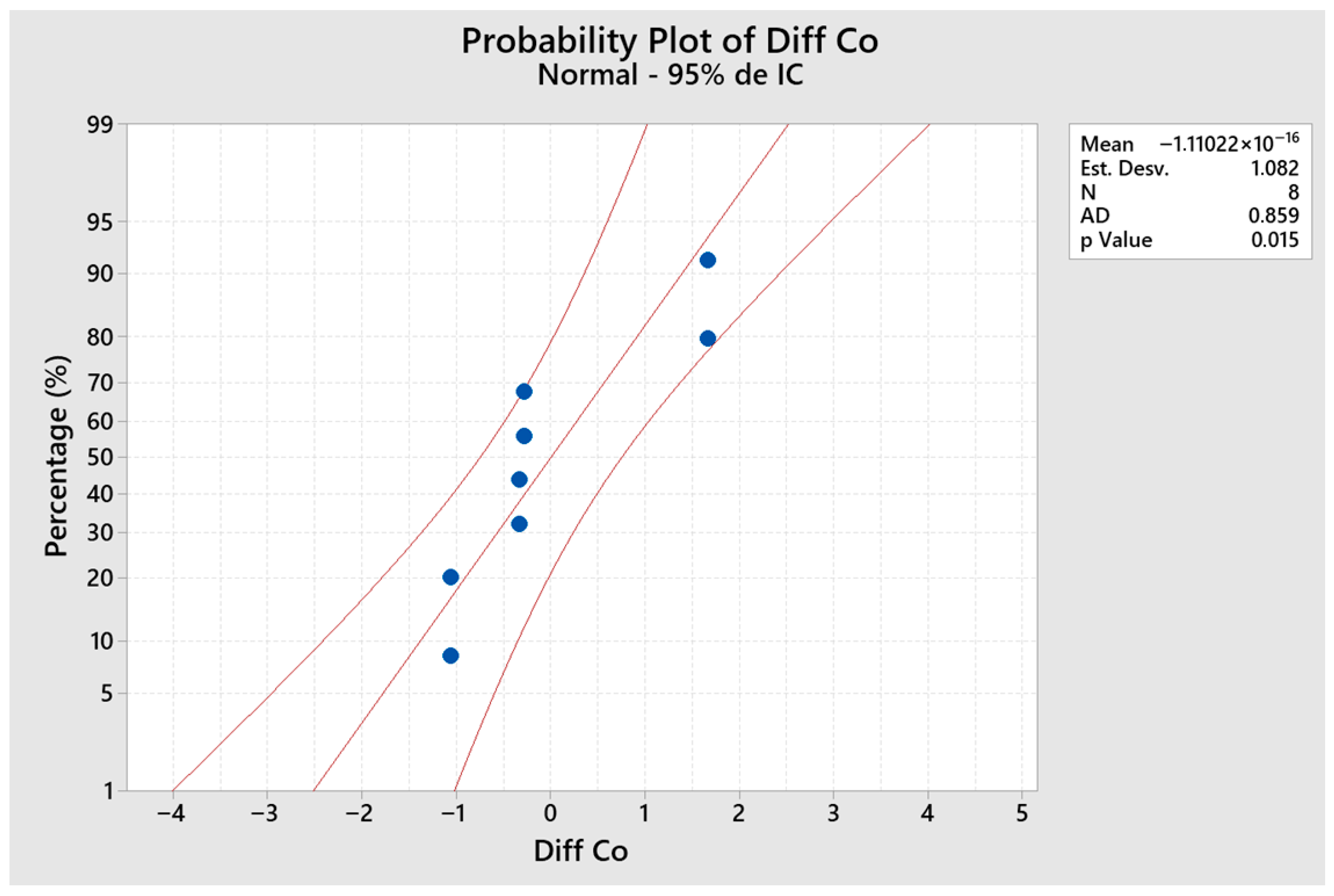
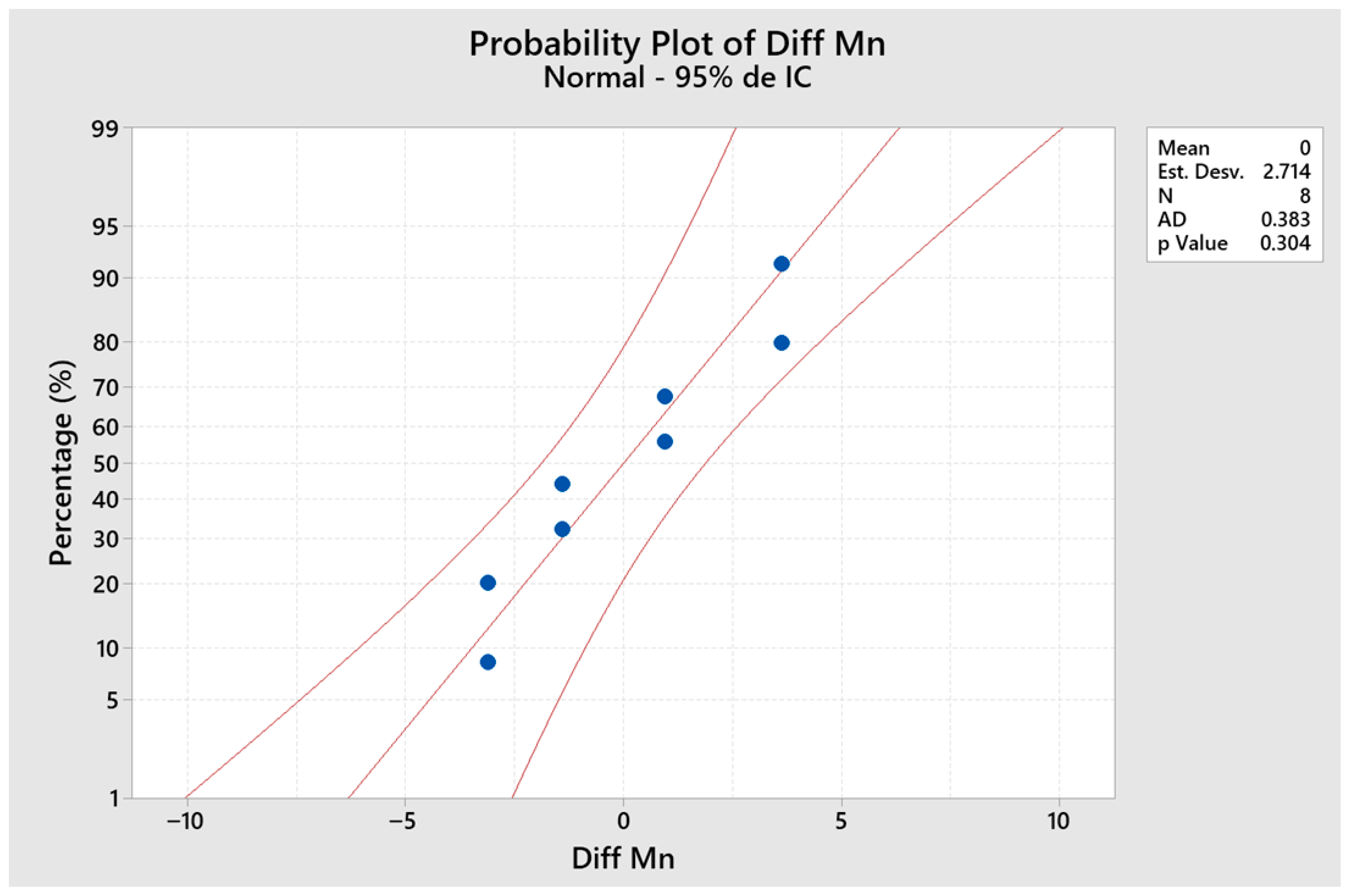
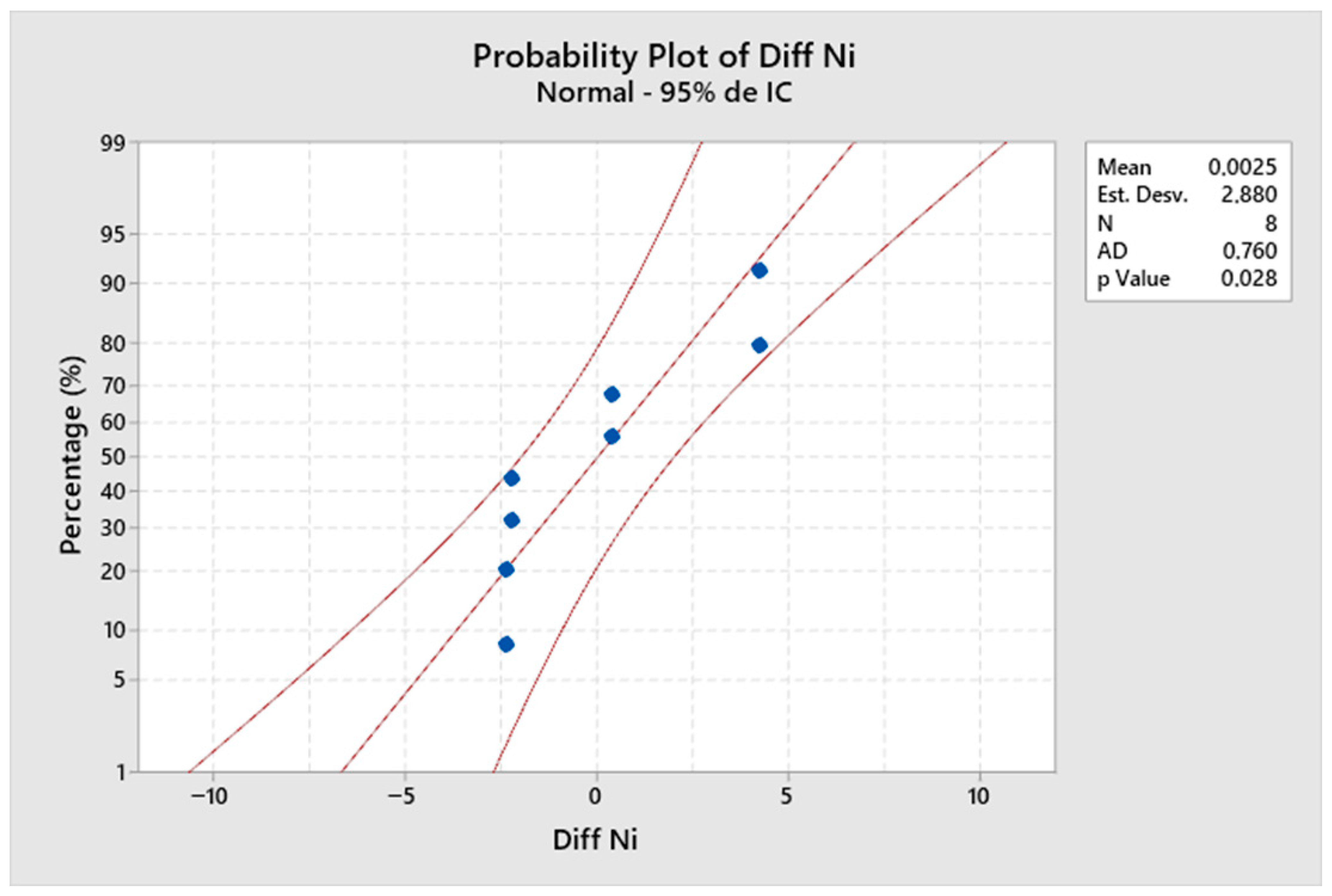
Each decoded model is tested for each combination used in the eight experimental runs, calculating the error between the experimental model and the theoretical model created to observe the goodness of fit of each model in a normal probability graph. The detailed comparison for cobalt, manganese and nickel, including experimental and theoretical recoveries and the associated errors, is presented in
Table 6,
Table 7 and
Table 8, respectively, while the corresponding normal probability plots are shown in
Figure 4,
Figure 5 and
Figure 6.
For each element, it can be seen that the models have a good fit; each model has an error of no more than ±10%, which is an acceptable value for this type of model. Furthermore, the graphs show how the values remain within the trend with 95% confidence, validating the models for each element.
Measurement values from experiments associated with the center points were used to identify the relative error of the decoded model. The results indicate an average relative error of approximately 15%, with the model demonstrating higher precision for Co and its lowest performance for Ni.
Table 9 shows the modeled and real values of recoveries using the central point levels.
At the laboratory level, the model has very small errors, and the working methodology is appropriate. However, in a possible industrial-scale expansion to contribute to urban mining, the main difficulty lies in the dismantling and processing of the material before flotation, due to the risk of fire and the complexity of automating the process because of the different models of lithium batteries and the variation in their condition at the time of dismantling.
It is important to note that the results were obtained using predominantly LCO-type batteries; therefore, the scope of the models presented herein primarily reflects this specific chemistry. Further experiments should be conducted to extend these findings to other battery types.
4. Conclusions
The study made it possible to recover elements of interest from discarded lithium batteries with an initial cathode composition of 38% cobalt, 4% manganese, and 3.3% nickel.
Using a two-level factorial experimental design, it was possible to determine the effects of the factors agitation, aeration, and time, identifying that, in a concentration process using reverse flotation, the contribution of these factors to recovery was negative as they went from low to high levels.
The concordance between reverse flotation as the type of flotation used and the negative effect of the significant factors shows the relevance of the factors selected for the study. Agitation, aeration, and time at low levels allow recoveries of over 80% to be obtained for all elements, as observed in Experiment 1.
In a study of the significance of effects through central point experimentation, the contribution of each of these factors to the metals of interest was calculated quantitatively, with the main effects being agitation, aeration, and time, together with the combined effect of these three factors, which were indicated as significant in the study. In turn, it was observed that the combined synergistic effect of the three factors had the greatest impact.
Based on the effects, equations were modeled to estimate the % recovery for the concentrated metals from the cathode of mainly waste LCO lithium batteries, with each model having an error of no more than ±10%.
The results corroborate the feasibility of concentrating Co, Mn, and Ni from waste lithium batteries using a functional and replicable methodology at the laboratory level. It is important to note that the feed material used in this study was predominantly composed of LCO, with minor contributions from NMC. Therefore, the developed models and optimized conditions are primarily applicable to LCO-based cathode systems. Future research should evaluate the applicability of this approach to other cathode chemistries. The challenge for implementing this recovery on an industrial scale remains the problem of battery dismantling.




 ,
,