1. Introduction
Climate change is a systemic crisis that demands rapid, deep, and socially sustainable decarbonisation [
1]. Major international mitigation assessments indicate that a substantial share of the reduction potential lies on the demand side, that is, in everyday consumption and practices: if domestic energy use, mobility, food practices, and goods consumption are appropriately designed and calibrated to specific contexts, they can contribute materially to emission reductions [
2,
3,
4]. From this perspective, the user cannot be treated as a passive recipient of campaigns or incentives, but must be understood as a decisive actor in demand-side mitigation, a third pillar of decarbonisation alongside industrial transformation and public action; however, engagement depends on how innovations and measures translate into feasible and desirable practices in real contexts of use [
5,
6].
Available evidence is often heterogeneous, hard to compare, and poorly transferable because it rarely traces the passage from enabling factors to design choices and verified outcomes. A key bottleneck is that the relationship between knowledge and action is not linear. Concern about climate change, attribution of responsibility, and stated intentions can be high without yielding consistent choices, as social norms, perceived efficacy, decision effort (time, attention, and complexity), and emotions mediate—or block—the move to action [
7,
8,
9] (engagement versus disengagement and selective exposure), with consequences for literacy quality and the ability to sustain climate mitigation [
10].
In parts of the debate, this gap is still interpreted as a motivational or individual “willpower” problem; a more design-relevant reading instead links it to choice architectures and access conditions that make some options practicable and others effectively unavailable. These contrasting outcomes become decisive when the goal is to shift high-impact behaviours. The demand-side mitigation literature shows that a substantial share of achievable reductions is concentrated in a small set of domains and in infrequent decisions tied to transitions in routines, and conditioned by infrastructural, market, and distribution-logistics factors [
11].
In parallel, field evidence indicates that, on the one hand, the average effects of behavioural interventions are often moderate and variable, and, on the other, tend to be more robust when interventions combine multiple levers and are sustained over time and in context; conversely, single-lever interventions or those lacking “follow-up” risk remaining confined to low-threshold practices or losing effectiveness [
12]. A first implication follows: building literacy and prompting action does not mean “adding information” but designing choice architectures and access conditions consistent with “behavioural determinants” (enablers), understood as material, social, and institutional conditions that structure practices and shape their costs, benefits, and feasibility, while avoiding approaches that offload the burden of change onto individuals [
13,
14].
A further critical issue concerns the distribution of impacts and opportunities for action. Household consumption-related emissions are not homogeneous: a substantial share is associated with specific consumption profiles and groups with higher spending power, while other groups face structural constraints (access to services, housing quality, and availability of alternatives) that limit their ability to adopt low-carbon options [
11].
If mitigation is framed as a decontextualised individual duty, it can generate frustration, resistance, or hardened positions; if, instead, it is designed as an expansion of opportunities and access conditions for low-carbon alternatives, it can integrate climate effectiveness and equity. International research [
15,
16] shows that willingness to support institutionally promoted collective measures and services is often widespread, yet it does not guarantee operational knowledge of the most effective choices or confidence in their practicality. This is particularly relevant when levers based on continuous data and feedback are introduced: without attention to digital inclusion, data governance, and accountability mechanisms (and in the absence of transparency), tools intended to enable action can produce unintended effects, such as invasive monitoring, exclusion, or increased use complexity [
17].
It is at this junction—between intentions and situated practices, and between messages and conditions for action—that design can make an original contribution. Research on Design for Behaviour Change shows that artefacts, interfaces, and service systems are not neutral; they embed configurations of use that (i) steer choices and introduce barriers (time, attention, and skills), (ii) make some options more accessible than others, (iii) redistribute capacities for action (agency), and (iv) allocate responsibility across users, organisations, and institutions [
18,
19,
20]. The goal, therefore, is to shift attention from message persuasion alone to the design of use infrastructures—material and immaterial—within which information becomes decision, and decision can stabilise into routine, based on explicit criteria of evaluation and legitimacy [
21,
22,
23].
Operationally, this requires treating determinants as design-enabling conditions, a combination of resources and constraints, norms, and trust that can be translated into configuration choices. Agency is thus understood as a “situated” outcome of opportunity architectures, not as an individual prerequisite. Accordingly, the object of design is defined as a “use infrastructure”, that is, an integration of communication, product-technology, service, interaction, and governance that embeds evidence, feedback, and metrics within practicable conditions of use. Within this framing, effectiveness and legitimacy are addressed jointly as validity conditions for the link between diagnosis, configuration, and verification.
Against this background, the paper advances a thesis: literacy, information, and action activation can contribute to mitigation only if conceived as use infrastructures, that is, as combinations of communication, product-technology, service, interaction, and governance levers that, in specific contexts, activate relevant enabling conditions (motivations, skills, norms, opportunities, and trust) and make outcomes verifiable in terms of carbon impact, adoption, action continuity, and equity. Operationally, the paper pursues three objectives: (i) to make explicit and comparable the link between determinants, requirements, and outcomes in high-carbon domains; (ii) to derive and consolidate the DEL grid through a design-led comparative reading of international case studies; and (iii) to produce operational criteria for ex ante and ex post verification, including validity conditions, trade-offs, and equity. To this end, we propose the Design Evidence Link (DEL) grid, not as an a priori scheme but as a device derived and consolidated through critical comparative analysis of case studies in high-carbon domains. It formalises a traceable analytical–operational link between determinants, design requirements, and evaluation metrics, while keeping evidence quality and contextual limitations explicit.
Accordingly, the study addresses two research questions: How can determinants be translated into design requirements within use infrastructures for demand-side mitigation? How can potential impacts ex ante and realised impacts ex post be linked through a traceable and comparable evidence framework across high-carbon sectors? Operationally, DEL is structured around four linked fields—Outcomes, Enablers, Design Configuration/Use Infrastructures, Risks and Validity—and is innovative in treating the design object as a use infrastructure, making the evidence level explicit, and connecting ex ante configuration with ex post audit within the same traceability protocol. Rather than replacing behaviour-change or theory-of-change models, DEL translates them into a design-led comparative protocol centred on observable configurations, evidence grading, and boundary conditions.
Consistent with these objectives, the paper is structured as follows. The State of the Art section reconstructs the debate since 2015 and identifies the evidence gaps that motivate DEL; Impact Domains delineates high-impact domains and introduces the Avoid/Shift/Improve frame; Materials and Methods describes the selection criteria, sampling, and the design-led comparative coding protocol; Results reports patterns emerging from DEL coding; Discussion interprets the implications, barriers, and trade-offs through a design-led lens; Scaling Use Infrastructures articulates transferability and boundary conditions; Operational Implications translates findings into criteria for ex ante and ex post verification, including synergies and trade-offs with the SDGs; Limitations distinguishes issues of attribution, evidence quality, and generalisability; and finally, Research Agenda and Conclusions outlines future developments and “decision-grade” implications for urban policy and design.
The expected impact is twofold: for the design research community, to shift the focus from “convincing” to designing evaluable and just conditions for action; for the interdisciplinary mitigation community, to make the transition from determinants to solutions more transparent and methodologically inspectable by treating effectiveness and legitimacy as constitutive variables of that transition. In terms of originality, DEL differs from behavioural models such as COM-B/Behaviour Change Wheel and from theory-of-change/logic-model approaches in three respects: (i) it treats the design object as an observable, operational use infrastructure (rather than a single intervention lever), making orchestration a first-order analytical variable; (ii) it requires decision-grade traceability between determinants, design requirements, and measurable outcomes, including explicit uncertainty and evidence level rather than implicit plausibility; and (iii) it operationalises transferability as conditional validity (invariants versus adaptable parameters), supporting ex ante configuration and ex post audit within a single protocol.
Its added value lies less in modelling motivation per se than in tracing how enabling conditions are converted into configured conditions of use; its limit is that it does not, by itself, establish causal attribution beyond the evidence reported in each case. In this paper, validity conditions are treated as the boundary conditions under which transferability may or may not hold.
2. State of the Art: Evidence Gaps in Designing User-Centred Demand-Side Mitigation
The State of the Art section critically reviews the literature on users in climate change mitigation, focusing on high-carbon sectors—household energy, ground mobility, food systems, and circular economy/materials. As a starting point, we take the IPCC AR6 WGIII mitigation report [
2], and, in particular, Chapter 5 on the behavioural and social aspects of mitigation. It provides a reference frame and argues that the reduction potential depends on enabling conditions that make choices practicable in the contexts of use. Therefore, the analysis aims (i) to clarify how the literature is redrawing boundaries between individual agency and opportunity architectures and (ii) to identify the most robust empirical base and the points where evidence remains fragile. From this perspective, we adopt “contextual validity” as an evaluation criterion, considering for which users, under which enabling conditions, with which outcome metrics, and with which transferability risks.
On this basis, the review relates mitigation potential to enabling conditions and then highlights where the literature struggles to translate determinants and constraints into design configuration choices and into comparable verification criteria.
Chapter 5 of IPCC AR6 WGIII [
2] quantifies a 40–70% reduction potential for direct and indirect emissions in household energy, ground transport, and food systems by 2050 through demand-side strategies within the Avoid/Shift/Improve (ASI) framework, which distinguishes between reducing unnecessary demand (Avoid), shifting towards lower-emission-intensity alternatives (Shift), and improving the efficiency of existing solutions (Improve). This potential, however, materialises only when the factors that condition individual action—norms, infrastructures, and choice architectures—are activated and operationalised through targeted policies and design projects that translate behavioural theories into artefacts, interfaces, and services that make choices feasible in contexts of use.
Complementary literature shows that socio-behavioural, technological, and infrastructural solutions can reduce emissions without compromising well-being, provided that individual capacity for action is not separated from conditions of opportunity [
3,
4].
A recurring finding is the gap between mitigation potential and the coverage of empirical studies. The meta-review conducted by Ivanova et al. [
11], based on 53 studies selected from an extensive scan of the available evidence, shows that potential reductions are concentrated in a limited set of consumption domains and high-impact choices, and are strongly dependent on infrastructural and territorial context and socio-demographic characteristics. For design, this implies that multiplying “easy” micro-actions is insufficient, because climate effectiveness is concentrated and often associated with access and use barriers (costs, skills, access to alternatives, and infrastructural constraints). This partly reflects the fact that high-potential behaviours require attention to access barriers, distributive effects, and compatibility with heterogeneous everyday routines, aspects that are harder to address in rapid, decontextualised experimental projects [
24].
Evidence on consumption and embedded emissions in everyday practices [
25] converges in indicating that decarbonisation in advanced economies depends crucially on changes in the four highest-impact consumption domains—household energy, mobility, food systems, and circular economy/materials—alongside cross-cutting choices related to product lifetimes and demand for services (including digital services). MRIO analyses and reviews converge in attributing a large share of global emissions (around 66%) to household consumption patterns, reinforcing the priority of high-impact demand-side domains [
26]. Within this frame, Ivanova et al. [
11] show that small shifts in high-impact options can deliver larger reductions than large shifts in low-impact practices, requiring design not to neglect lever selection and access as inseparable dimensions.
Turning to determinants that enable adoption, Niamir’s econometric analysis [
27] of 1790 households in Overijssel (The Netherlands) and Navarra (Spain) confirms that the likelihood of investing in insulation, photovoltaics, or green tariffs is explained almost equally by monetary factors, personal moral obligation, and perceived social norms, while education level and building structural characteristics modulate both propensity and investment size. It follows that fiscal incentives, if not accompanied by instruments that support understanding and decision-making, produce socially selective and short-lived uptake. From the research side, Lembregts and Cadario [
28] document a systematic bias in consumption and marketing research towards low-impact behaviours (recycling and eco-friendly purchases) and propose replacing classic “construct-to-construct mapping” with “phenomenon-to-construct mapping”, that is, starting from high-emissions-relevance phenomena and only then building explanatory and change-oriented constructs and methods.
A second finding concerns the robustness and transferability of the empirical base for interventions. Bergquist et al. [
12], drawing on ten meta-analyses and 430 primary field studies, report that mitigation interventions yield positive but modest average effects. They also note that effect sizes shrink when publication bias towards positive results is accounted for and when large-scale interventions are considered, and that some lever families (social comparison and economic incentives) outperform information and feedback when deployed in isolation.
A third implication, now explicit in the literature, is that solution selection should start with the determinants that govern behaviour in use contexts, rather than with policy preferences or design trends. Van Valkengoed, Abrahamse, and Steg [
29] propose a simple criterion: an intervention is effective when it is coherent with the determinants governing the target behaviour in the given context; if the determinant and intervention are misaligned, the effect becomes null, temporary, or even regressive. Similar logic appears in barrier-based frameworks that link barrier diagnoses to sets of multi-actor measures, reducing the risk of illusory transferability of best practices [
30].
A fourth critical point concerns the informational bases for building interventions and guidelines. In an editorial in
Nature Human Behaviour on large-scale behavioural data, Jenny and Betsch [
17] argue that without permanent infrastructures for data collection and integration, research and guidance for public interventions remain dependent on self-reports and isolated experiments, with limited capacity to monitor adoption, action continuity, and differences across social segments. At the same time, they invite readers to treat data as an infrastructure for systemic change rather than as a tool for individual blame. In urban contexts, this need also translates into designing “information content” to guide public decisions and coordinate actors, as shown in work on positive energy districts, which treats information as an enabling infrastructure for transition [
31].
Findings from psychological and socio-cultural research help explain why translation from information to action is often discontinuous. Whitmarsh et al.’s review [
8] notes that climate action comprises heterogeneous behaviours (consumption, citizenship, and participation) and that drivers and barriers operate at multiple levels (individual, social, and infrastructural). Many practices are governed by habits and contexts rather than by deliberative decisions, making it essential to intervene on opportunities and choice architectures. Brick et al.’s review on motivation [
9] adds that many climate-relevant choices are driven by motives related to security, belonging, well-being, and identity, and that this misalignment often makes communications based solely on environmental themes or guilt ineffective.
Beyond the scientific literature, reports and guidelines clarify how mitigation research is redefining its operational lexicon. The report “Climate Change Needs Behaviour Change” [
13] argues that behavioural and social solutions are indispensable because decisions and habits are deeply context-bound; it also states that responsibility should not be offloaded onto individuals but shared across systems, institutions, and choice opportunities, namely, the services, rules, and conditions that make some options available, accessible, and practicable. In parallel, the report “Eight Principles for Effective and Inviting Climate Communication” [
14] emphasises convergent criteria aimed at making action feasible (strengthening perceived efficacy), collective (activating shared identities and norms), socially legitimate (working through social norms), concrete and contextualised (anchored to tangible benefits), and inclusive (reducing polarisation and blame).
Here, the design scholarship offers a distinctive angle. Wever [
21] highlights that products and services can shape behaviour and that sustainability research entails a modulated design responsibility, ranging from enabling to constraining, with major ethical and social implications. Converging with this, Niedderer et al. [
18,
19,
32], framing Design for Behaviour Change as a driver of sustainable innovation, highlight a gap between theoretical knowledge and implementation. Among the critical issues, they identify the absence of shared languages, comparable evaluative methods, and organisational arrangements that make the adoption of Design for Behaviour Change practicable in the public and private sectors; in this context, cross-sector collaboration is framed as a strategic condition for turning isolated cases into a transferable capability.
In Design for Sustainable Behaviour, taxonomies and processes seek to make the passage from determinants to product and service strategies more reproducible. Yet, although many tools have been developed, the field still lacks shared comparative criteria, which limits cumulative knowledge [
33]. Lilley and Wilson [
34] stress that Design for Sustainable Behaviour concerns use and post-use, not only purchase, and therefore acts on practices over time rather than on isolated decisions. Research on persuasive technologies and energy use shows that feedback and social comparison can affect consumption, but only when embedded in routines and supported by adequate user experience, not by information alone [
35]. The main limitation remains methodological: many cases do not cover the full research–design–test cycle and do not generate comparable data, which weakens the robustness of inference and transferability [
36]. This necessitates explicitly stating causal assumptions and outcome metrics, including adoption, continuity of action, and emissions impact.
In the food system, systematic reviews of interventions to reduce food waste identify multiple determinants and suggest that the most promising interventions are integrated and multi-actor, as they transform the supporting ecosystem rather than offloading solutions onto consumers [
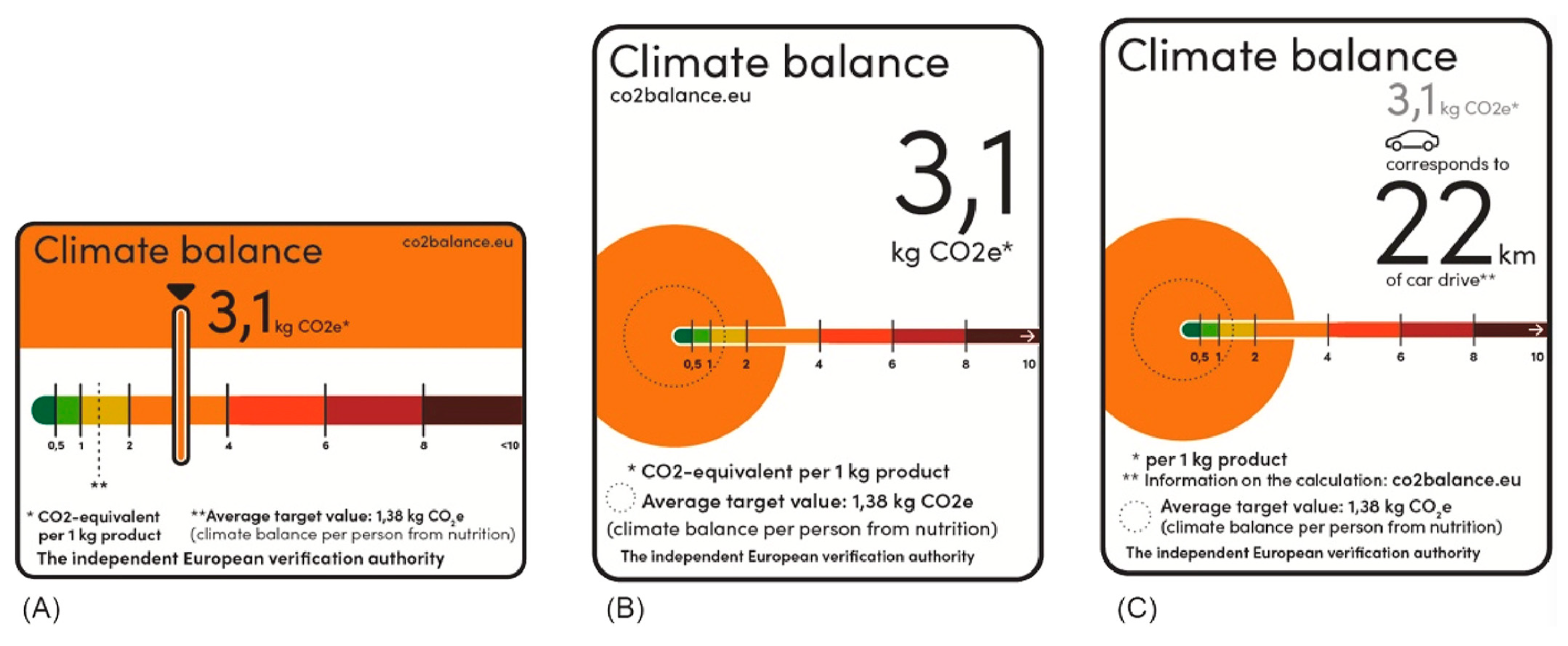
37]. Fresacher and Johnson’s recent study on climate labels [
38] shows that labels can steer “greener choices”, but effectiveness depends on label design (form, legibility, and interpretability), that is, on the ability to turn a datum into a practicable decision criterion. Yokokawa et al.’s framework [
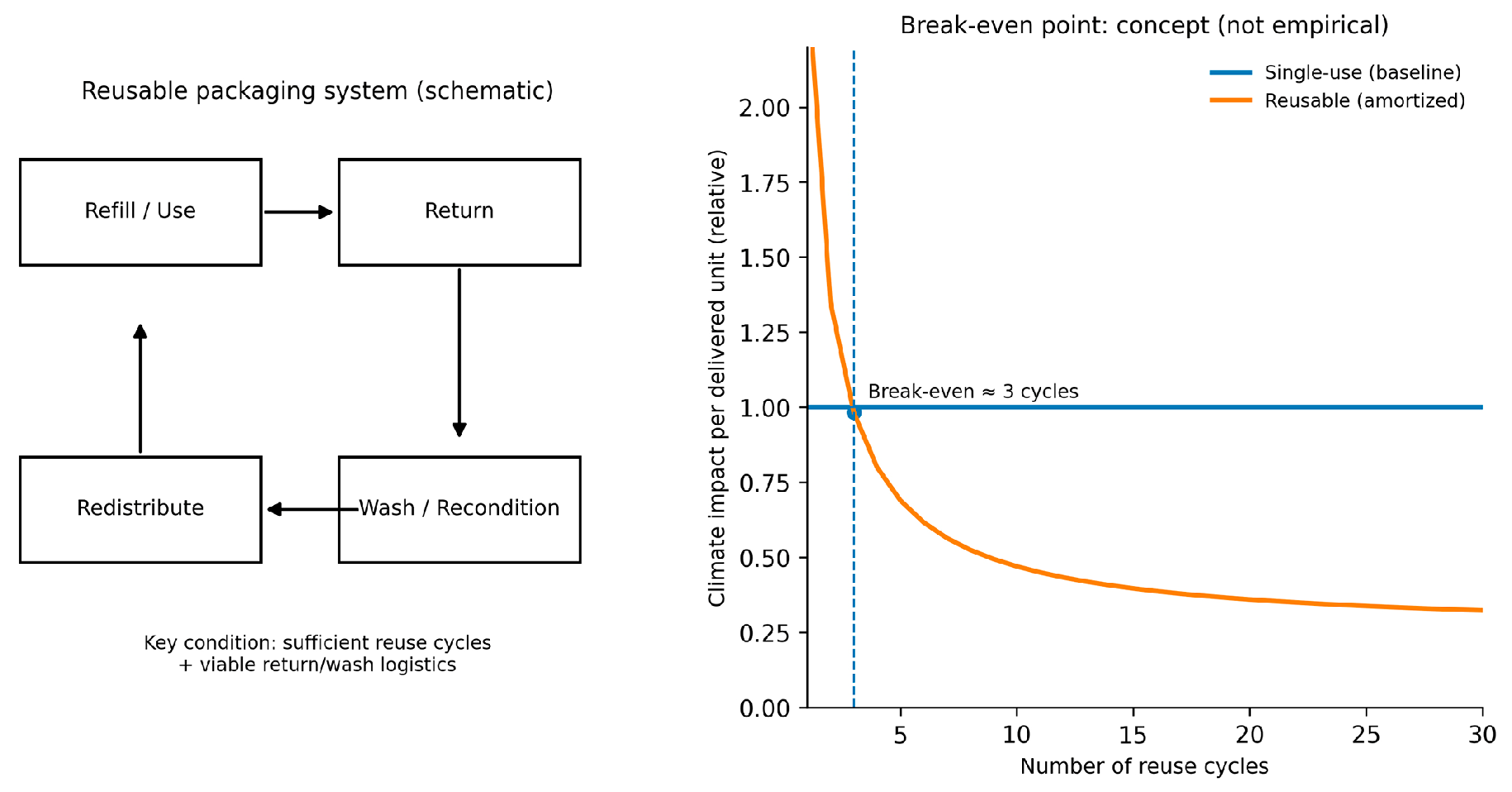
39], finally, shows that packaging environmental impact cannot be assessed without considering use scenarios, because a “more impactful” packaging option may be preferable if it significantly reduces food waste; here, information and object are inseparable.
In the circular economy domain, Vidal-Ayuso et al.’s review [
40] notes that consumer behaviour is often treated as secondary in circular economy studies, even though it is central to post-purchase practices related to use, repair, reuse, and recycling. These practices, moreover, depend on infrastructures, logistics, warranties, and trust, as well as on attitudes and knowledge. This diagnosis aligns with Kaplan Sarısaltık et al.’s visual scoping review [
41] of plastics in everyday life, which shows that scientific attention often narrows to a small set of single-use items and that the distribution of responsibility across consumers, industry, and policy is frequently treated implicitly, producing asymmetric burdens and the risk of shifting action primarily onto consumers.
In household energy, several studies clarify the role of contextual constraints: decisions about domestic energy consumption take shape within housing arrangements, rules, and market offerings that make some options realistic and others effectively impracticable. Deo and Prasad’s recent survey [
42] on factors influencing renewable energy adoption confirms that, beyond knowledge and attitudes, perceived value and perceived quality are particularly salient, and that users act within choice architectures shaped by policies and market offerings. In this direction, approaches that aim to connect user experience and environmental performance suggest that “nudging” becomes more effective when sustainability is embedded within services that reduce barriers and make impacts legible [
43].
Planet-oriented design challenges human-centred design, which reduces to optimising individual experience, and invites longer time horizons and externalities into problem definitions; for our analysis, this means treating agency, responsibility, and relations with ecological and non-human systems as design variables, not as implicit context [
23]. Responsible innovation perspectives likewise insist on the link between effectiveness and care: a solution is not “good” if it works for some but increases inequalities or shifts costs onto vulnerable groups; responsible innovation requires making trade-offs visible and designing empowerment, not only compliance [
22,
44].
The term “behavioural lever” now appears in influential papers. Editorials on “Behaviour as Leverage” [
5] and on “Climate Change and Human Behaviour” [
6] reiterate that behaviour is a crucial intervention point but warn against reductionist readings that drift towards individualising narratives or “one-size-fits-all” solutions.
Three cross-cutting requirements follow, useful as both design and verification criteria: duration, net impact, and transferability. Accordingly, parts of the literature propose treating continuity over time as a design objective, requiring longitudinal metrics and support strategies that accompany transitions and critical moments in routines [
20]. Rebound and lock-in should be treated as validity risks: even interventions aligned with determinants can reduce net impact or consolidate carbon-intensive routines; evaluation must therefore make side effects explicit and distinguish between transient shifts and structural transformations [
8,
29].
Methodological “robustness” also concerns sample diversity and context specificity. Much of the evidence is drawn from high-income settings and relies on volunteer samples, raising concerns about transferability. A useful parallel is work on operational catalogues (with metadata and comparability criteria) in Nature-based Solutions, where transferability depends explicitly on the quality of the taxonomy and descriptive attributes [
45]. Combining contextual analysis with a portfolio of case studies and comparable evaluation criteria is therefore a strategy to reduce the gap between knowledge and implementation, which Niedderer et al. [
19,
32] identify as a major limitation of the field.
3. Impact Domains (Avoid/Shift/Improve): Household Energy, Ground Mobility, Food Systems, and Circular Economy/Materials
This section narrows the field to the four domains with the highest demand-side mitigation relevance and extracts, for each, the validity conditions most useful for theoretical sampling. Accordingly, the section uses these domains to inform theoretical sampling rather than to reopen the review. A comparative synthesis linking the four high-impact domains to demand-side levers within the Avoid/Shift/Improve frame and to the main design implications and validity conditions is provided in
Table 1.
In household energy, the main lever is Improve (retrofit/efficiency), complemented, where relevant, by “sufficiency” choices [
46]. However, a significant share of emissions is embodied in materials and construction processes, requiring a Shift towards lower-impact construction solutions and strategies of reuse and life extension [
47]. From a design-led perspective, the minimum requirement is to configure decision-support packages and tools that make such choices operational and measurable.
In this view, the design object is not a single component, but the orchestration of touchpoints, services, and guarantees that reduce barriers: “turnkey” packages, standardisation, performance guarantees, assistance, and contractual models that turn an investment into a choice perceived as safe and legitimate. Deep energy retrofit experiences show that scalability clashes with structural constraints (up-front costs, labour shortages, and lock-in in rental markets), highlighting that without a governance and finance architecture, solutions remain limited to sporadic interventions [
48]. Even where design relies on digital feedback and smart metering, evidence cautions against the illusion that “data” alone triggers change: some devices produce initial consumption reductions, but effects tend to decay unless sustained by incentives, assistance, and social components that make action continuous over time and stable within routines [
49].
Eco-feedback and energy visualisation solutions are considered here only as components of use infrastructures. The literature reports fragmented solutions and short horizons, suggesting that transferability requires comparable protocols and longitudinal studies. It also notes that decision-support simulation tools make explicit assumptions about comfort and mitigation, while co-design processes surface requirements for trust, privacy, and data legitimacy [
50,
51,
52,
53]. It follows that trust (in data, institutions, and providers) is not an external factor but an enabling design condition.
For ground mobility, ASI should be treated as a system design problem: Avoid includes telework and compact, proximity-based urban forms; Shift requires safe infrastructure for cyclists and pedestrians and competitive public transport; Improve concerns electrification and energy decarbonisation, as well as logistics optimisation and the reduction in unnecessary trips [
54,
55]. Two critical issues emerge as validity conditions for any design strategy. The first is rebound: reducing the marginal cost of travel can increase kilometres travelled and normalise new demand; technological solutions therefore need to be accompanied by pricing measures and collective alternatives that reduce car dependence [
54]. The second is inequity: urban studies show that sophisticated policy mixes can reduce carbon intensity, yet also provoke protest if costs fall disproportionately on vulnerable groups or if restrictions are perceived as punitive. In such scenarios, climate effectiveness and access justice are inseparable and must be designed together [
56,
57].
An underestimated aspect of mobility is acceptability and trust: even when measures are technically optimal, adoption depends on perceptions of fairness, co-benefits (for example, health and air quality), and how change is made “practicable” in everyday life; in other words, legitimacy is part of performance [
58]. System simulations further suggest that electrification alone neither solves congestion nor reduces land take: scenarios that strongly shift towards collective transport and micromobility can reduce emissions and social costs more substantially but require multi-level coordination and the design of integrated services [
59].
In food systems, emissions reduction relies primarily on a “dietary transition” towards predominantly plant-based patterns and on drastic reductions in food waste. The wide variability of food footprints makes clear why the most powerful levers operate through substitution rather than micro-optimisation [
60]. Yet design cannot be limited to “informing”: it must configure choice contexts. Environmental labels can steer decisions, but their effectiveness depends on graphic-semantic standards, comparability, and consistency with price and availability; without these conditions, labels risk becoming weak or ambiguous tools [
38].
Choice-architecture interventions show that making a sustainable option the default, with opt-out options, can increase adoption but may also trigger backlash narratives and cultural resistance: service design becomes part of environmental impact because it shapes acceptability and action continuity [
61]. A design-relevant example of rigour is the LCA “break-even threshold” for packaging: redesign is beneficial only if food waste reduction exceeds a minimum threshold, making success conditions measurable and requiring trade-offs to be discussed openly [
39].
At a broader level, trade-off discussions benefit from integrated frameworks that combine LCA with risk/benefit assessment tools across different scales, so that evaluation is not reduced to carbon alone and co-impacts and co-benefits become traceable [
62]. More generally, for greater effectiveness, food interventions must work through social norms and identity: environmental psychology suggests that status and meaning strongly influence adoption. Design should therefore “normalise” lower-footprint options in canteens, retail, and service platforms [
63].
The fourth domain—circular economy/materials—foregrounds embodied emissions in goods and, consequently, duration: repairability, reuse, life extension, and product-service models reduce primary material demand and upstream supply-chain emissions. Here, circularity moves beyond labelling to become a system condition: without traceability standards and infrastructure for collection and repair, sustainability demands risk being met through offsets and accounting adjustments rather than real innovation. In this view, policies and international standards become an extension of design [
64]. In service design terms, supply-chain effectiveness also depends on how touchpoints (centres, platforms, and interfaces) and relational infrastructures that sustain access, trust, and practice continuity in reuse and repair are configured [
65].
In materials supply chains, the literature also notes that many strategies (such as recycling, modularity, reverse logistics, and so on) are vulnerable to supply-chain pressures and transport-cost volatility. These vulnerabilities are especially evident in high-variety, highly customised industries (for example, upholstered furniture), where a circular transition requires platforms and product-service architectures that align technical requirements, logistics, and industrial constraints [
66]. This reinforces the need to design resilient supply chains, interoperable standards, and maintenance-with-take-back services that reduce downcycling risk and rebound towards linear solutions [
58,
67,
68]. Eco-service design approaches applied to sharing and micromobility suggest that integrating LCA metrics and user experience surfaces reveal barriers and solutions, but also new trade-offs linked to electronic components and maintenance-related material footprints [
43].
A methodological risk is to measure intentions or satisfaction alone, whereas the literature emphasises the need to assess avoided emissions and action continuity over time; the difference is crucial because small percentage shifts in high-impact behaviours can outweigh, in CO
2, large shifts in low-impact practices [
11]. The cited research also indicates that, on average, (i) high-impact defaults can produce more robust effects than isolated feedback and (ii) combinations of real-time feedback, social comparison, and economic incentives yield more consistent results than purely informational or educational interventions, but transferability requires attention to rebound and to socio-cultural differences [
69].
A final critical issue concerns the socio-territorial distribution of potential: in middle-income contexts, high-impact measures can conflict with development goals and with inadequate infrastructures. Demand-side mitigation, therefore, requires just transition policies, adaptive service models, and social marketing strategies that avoid imposing greater burdens on lower-income households [
24].
Household energy, mobility, food systems, and circular economy/materials call for intervention architectures that, on the one hand, connect informational touchpoints, enabling services, and economic instruments and, on the other, embed evaluation requirements from the outset, including avoided emissions, adoption, action continuity, and distributive effects [
70].
4. Materials and Methods: Design-Led Protocol for Case Sampling, Extraction, and Comparison
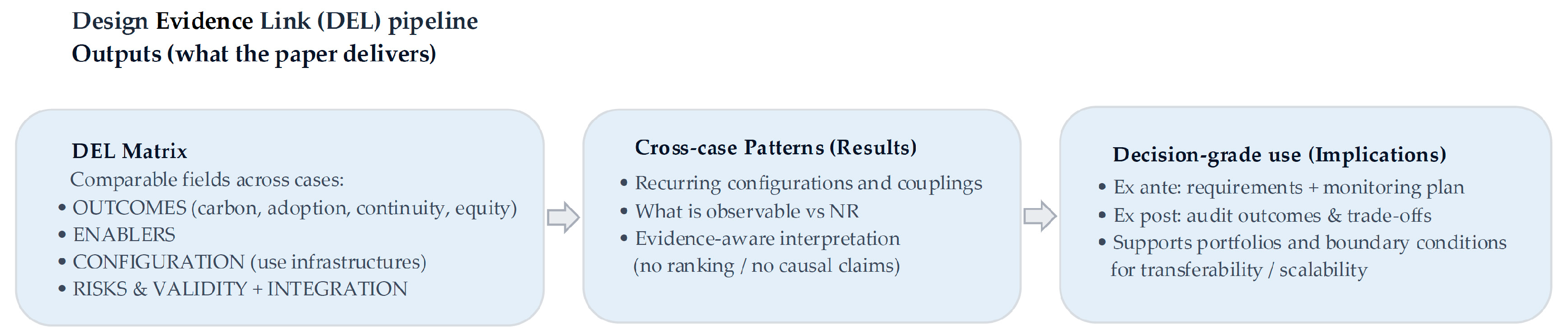
The Materials and Methods section describes the protocol for a design-led comparative analysis of secondary sources (peer-reviewed literature and reports), using a shared extraction framework to derive and test the Design Evidence Link (DEL) grid for ex ante and ex post assessments. Operationally, the protocol translates heterogeneous cases into a common coding sequence, so that determinants, design choices, outcomes, and validity conditions can be compared using the same traceability logic. The research design and coding pipeline are summarised in
Figure 1 and
Figure 2. The unit of analysis is not a single lever but the “use infrastructure”, defined as an observable combination of communication, product-technology, service, interaction, and governance that makes action practicable in a specific context and enables tracing the link between determinants, configuration, and outcomes (including uncertainty and Evidence Level). To make the design contribution arguable, configuration is also read through three operational articulations (communication, service, and product-technology) as a hypothesis about the coverage of enabling conditions.
For each case, sources were identified through structured searches across (i) Scopus, Web of Science, and Google Scholar (peer-reviewed literature), (ii) institutional and NGO reports, and (iii) official documentation relating to projects and services. Search strings, combining terms such as “communication design”, “product design”, “service design”, “eco-feedback”, “smart meter”, “food waste”, “opt-out”, “carbon label”, “reusable packaging”, “bike/scooter sharing”, and “Kyoto Protocol” were iteratively refined until no further documents relevant to outcomes emerged (pragmatic saturation). For each case, we retained a minimum set of documents covering context and target population, intervention or service configuration, governance, data practices, and at least two outcome families.
The final sample comprises nine cases selected via purposeful sampling, aiming to maximise the variety of use infrastructures within high-carbon domains while retaining analytical comparability and sufficient documentation for traceable and consistent coding. Selection follows an evidence-driven approach: cases constitute the empirical corpus to which a fixed coding frame is applied, and through comparison, the dimensions of the Design Evidence Link (DEL) grid are operationally consolidated. This evidence-driven strategy favours analytically rich cases but also narrows the corpus to those with sufficiently explicit reporting and design visibility.
Cases were included if they (i) fall within at least one high-impact demand-side domain and aim to modify relevant practices or decisions, (ii) can be described as use infrastructures, including at least two components among communication, service, product-technology, and governance, and (iii) provide sufficient documentation to code, in a traceable way, conditions, configuration, limitations, and outcomes (at least two among carbon impact, adoption, continuity, and equity). For design-oriented reading, we further prioritised cases that make the combinations of communication, service, product-technology, and governance identifiable (even descriptively) and that support adoption and maintenance over time, with implications for transparency, accountability, and inclusion.
The sample was balanced to cover (i) the high-impact domains addressed in the paper and (ii) three disciplinary configuration families (communication-led, service-led, and product-technology-enabled). To discuss transferability and context dependence, cases also include targeted geographical and institutional variation (predominantly EU/OECD settings and some extra-European or middle-income contexts), without claims of statistical representativeness. Selection prioritised recent cases (2015–2025), with motivated exceptions where a case is exemplary for the clarity of the design-to-outcome chain and implementation conditions. For each case, coding reconstructs traceably (i) determinants (operationalised as enabling conditions), (ii) the design configuration of the use infrastructure, and (iii) outcomes and evidence quality/limits.
Comparison keeps DEL categories constant and makes assumptions explicit, enabling identification of recurrences, divergences, and validity conditions relevant to transferability, scalability, and institutional and market dependencies. This strategy entails three main sources of bias: documentation bias (better-described cases are more likely to be included), context bias (predominance of EU/OECD settings), and design-visibility bias (configurations with clearer operational articulation are easier to code than less explicit but potentially relevant cases).
Excluded were (i) cases consisting solely of informational campaigns without associated practicable options (absence of service or access infrastructure), (ii) cases reporting intentions or satisfaction only, with no outcomes or traceable assumptions, and (iii) cases whose description did not allow the enabling conditions and contextual constraints to be identified, making transferability non-evaluable. Potentially relevant but incomplete cases may be referenced in the Discussion as argumentative support, but they are not included in the comparative DEL table.
For each case, data extraction follows a recurring analytical template that prefigures the DEL structure. Operationally, the coding process proceeds through four sequential field families—Outcomes, Enablers, Design Configuration/Use Infrastructures, and Risks and Validity—supplemented by an audit trail for assumptions and a synthetic Evidence Level for each case. This compact sequence clarifies how cases are made comparable before the detailed field-by-field description provided below. The template is organised into four field families, which are completed systematically as follows:
- (1)
Outcomes—records, where available, (i) emissions impact (measured, estimated, or reported), specifying units, period, and assumptions; (ii) adoption as entry and uptake (rate or scale, profiles, and dropout signals, where reported); (iii) action continuity as observed duration or indications of decay or maintenance; and (iv) equity as access conditions, burdens, and the distribution of benefits and risks, including possible regressive effects or barriers for specific groups;
- (2)
Enablers—codes whether and how the case activates motivations (values, co-benefits, moral obligation, and identity), capabilities (required and supported literacy and skills), norms (social and institutional, including legitimisation or enforcement mechanisms), material opportunities (infrastructures, costs, time, accessibility, and constraints), and trust in institutions, technologies, operators, and data (including transparency and accountability);
- (3)
Design Configuration/Use Infrastructures—describes the communicative component (framing, timing, transparency, and action-oriented calls to action), the product and/or service component (offer, pricing/incentives, defaults, assistance, maintenance, and friction reduction), and the interaction and governance component (feedback, monitoring, privacy, digital inclusion, responsibility, and controls), with the aim of making orchestration between components explicit rather than their isolated presence. In parallel, to make disciplinary contributions comparable, configuration is also mapped onto three “operational articulations”: communication design (decision-grade information), service design (access, support, guarantees, and follow-up), and product-technology design (interfaces, automation, affordances, and friction reduction). This mapping provides a lens for discussing whether, and how, joint coverage across the three articulations increases adoption and continuity and reduces regressive effects;
- (4)
Risks and Validity—records (i) plausible rebound and lock-in, and whether the case considers them, (ii) selection biases or contextual limitations, (iii) the quality and completeness of available evidence, (iv) required contextual conditions (infrastructural, institutional, or market prerequisites), and (v) indications regarding scalability and dependencies.
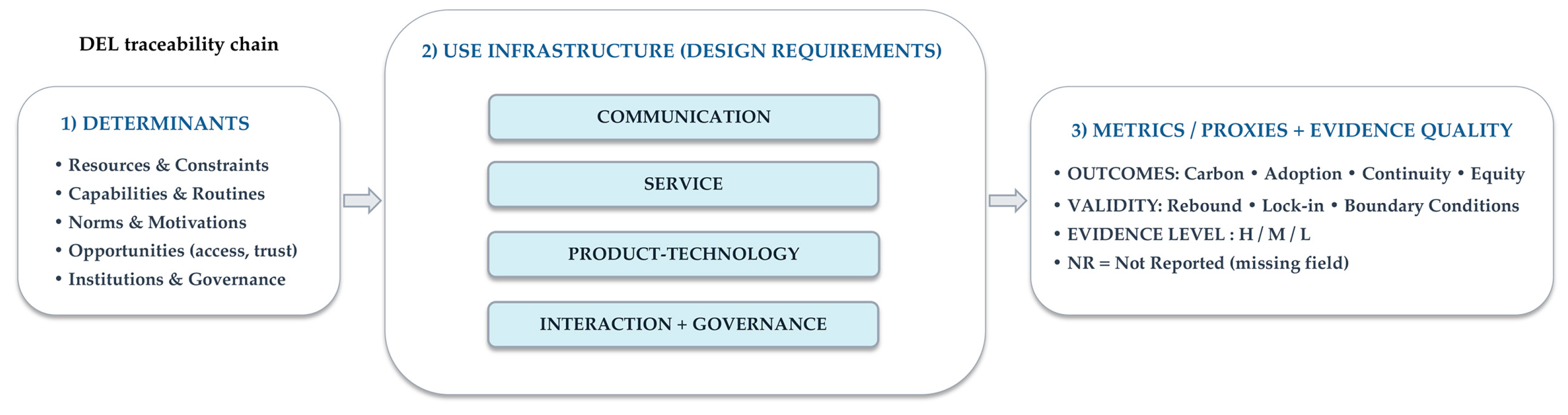
Coding adopts a “fixed coding frame” aligned with DEL fields to ensure comparability. Operationally, an “enabler” is coded only if it (i) can be described as an observable resource or constraint (material, socio-normative, institutional, market-related, or trust-related) and (ii) can be linked to a configuration choice (communication, service, product-technology, interaction, or governance) or to a stated outcome or proxy. In the absence of such a link, the factor is recorded as context rather than as an enabling condition activated by the case. Similarly, an “articulation” is assigned only when design decisions and observable use mechanisms can be identified, avoiding inferences based on stated intentions. Where documentation lacks quantitative data, structured descriptions and explicit proxies are used to avoid non-traceable inference. Each coded field is traced to its source and accompanied by a note on assumptions and limitations (an audit trail), enabling verification and protocol reuse. The DEL traceability chain is summarised in
Figure 3.
To control subjective judgement, coding was rule-based rather than impressionistic: the same fixed fields were applied to all cases, ambiguous elements were conservatively coded as context or NR, and interpretive notes were retained in the audit trail so that coding decisions remained reviewable. To support comparison, each case is assigned a synthetic Evidence Level that reflects the strength of the chain between configuration and outcomes. It is high when measures and context are available (metric, period, unit of analysis, and observation conditions), medium when outcomes are estimated or partial but with declared assumptions, and low when claims or non-verifiable evidence prevail. This grading does not replace evaluation but prevents heterogeneous evidence from being treated as equivalent.
In DEL, an Evidence Level is assigned to each case according to this rule; the label NR (Not Reported) indicates only individual fields for which the source provides no information and does not represent an Evidence Level. Carbon impact is treated as a graded traceability metric (measured/estimated with assumptions/declared) rather than as a fully comparable value across cases. Comparison prioritises chain coherence and assumption transparency over numerical precision. For design-led discussion, interpretation considers jointly (i) Evidence Level (High/Medium/Low) and (ii) the degree of integration across articulations (communication, service, and product-technology) within the same use infrastructure, as an explanatory hypothesis for differences in adoption, continuity, and equity. Evidence Level is thus an ordinal comparative qualifier, not a domain-independent metric of causal strength.
Comparison is conducted by keeping categories (Outcomes, Enablers, Design Configuration, and Risks and Validity) constant and contrasting cases for convergences and divergences, with two goals: to identify recurring use-infrastructure patterns associated with better-documented outcomes (adoption and continuity, with carbon impact at least traceable in assumptions) and to make explicit the validity conditions that limit transferability and scalability (prerequisites, equity trade-offs, and rebound/lock-in risks). The synthesis, therefore, yields a consolidated DEL not as a descriptive taxonomy but as a structured coding bridge: from determinants to design requirements, and from requirements to minimum evidence expectations, within declared contextual conditions. Its reuse is reproducible only if the source reporting makes the same decision chain transparent.
5. Case Studies: A Design-Led Comparative Reading of “Use Infrastructures”
This section reads the cases as a controlled comparative base for DEL rather than as a repertoire of best practices. This approach also avoids a recurring distortion in applied literature, namely, attributing performance to single elements (a message, an interface, an incentive) without making visible the opportunity architecture that renders them effective or ineffective. Instead, the comparison here assumes that effectiveness is inseparable from legitimacy: a solution may “work” on average yet entail exclusions, monitoring burdens, or institutional dependencies that reduce its duration and replicability. For this reason, each case is discussed as an explicit chain linking enablers, configuration, and results, with the quality of the available evidence clearly qualified. The final comparative synthesis does not claim validity beyond the analysed case perimeter; rather, it identifies integration patterns and validity conditions useful for formalising DEL as an ex ante and ex post evaluation tool.
Reading is explicitly “design-oriented”: for each case, we highlight whether and how communication design, service design, and product-technology design co-act, and how operational integration between components produces effects or, conversely, introduces criticalities and barriers.
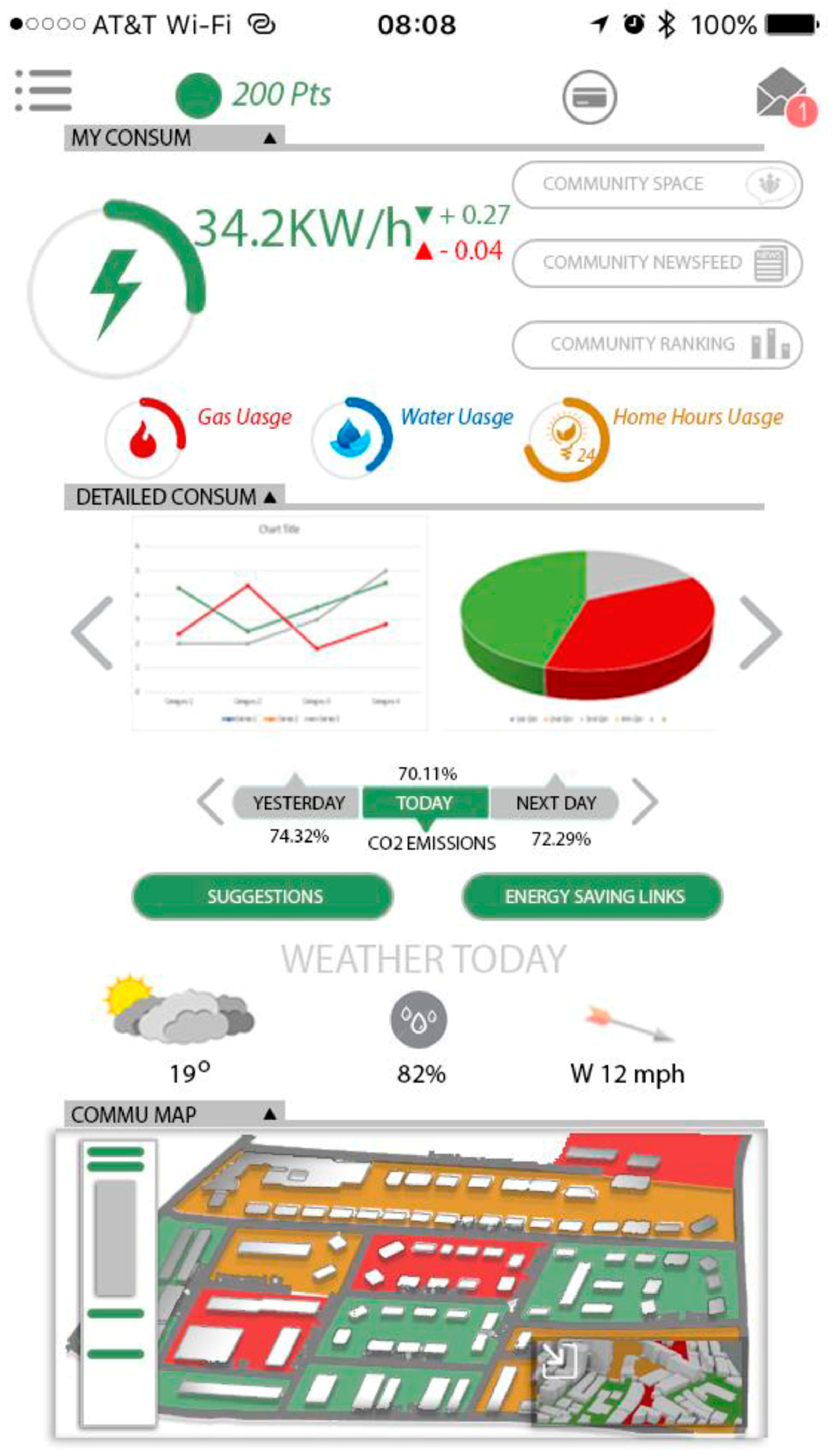
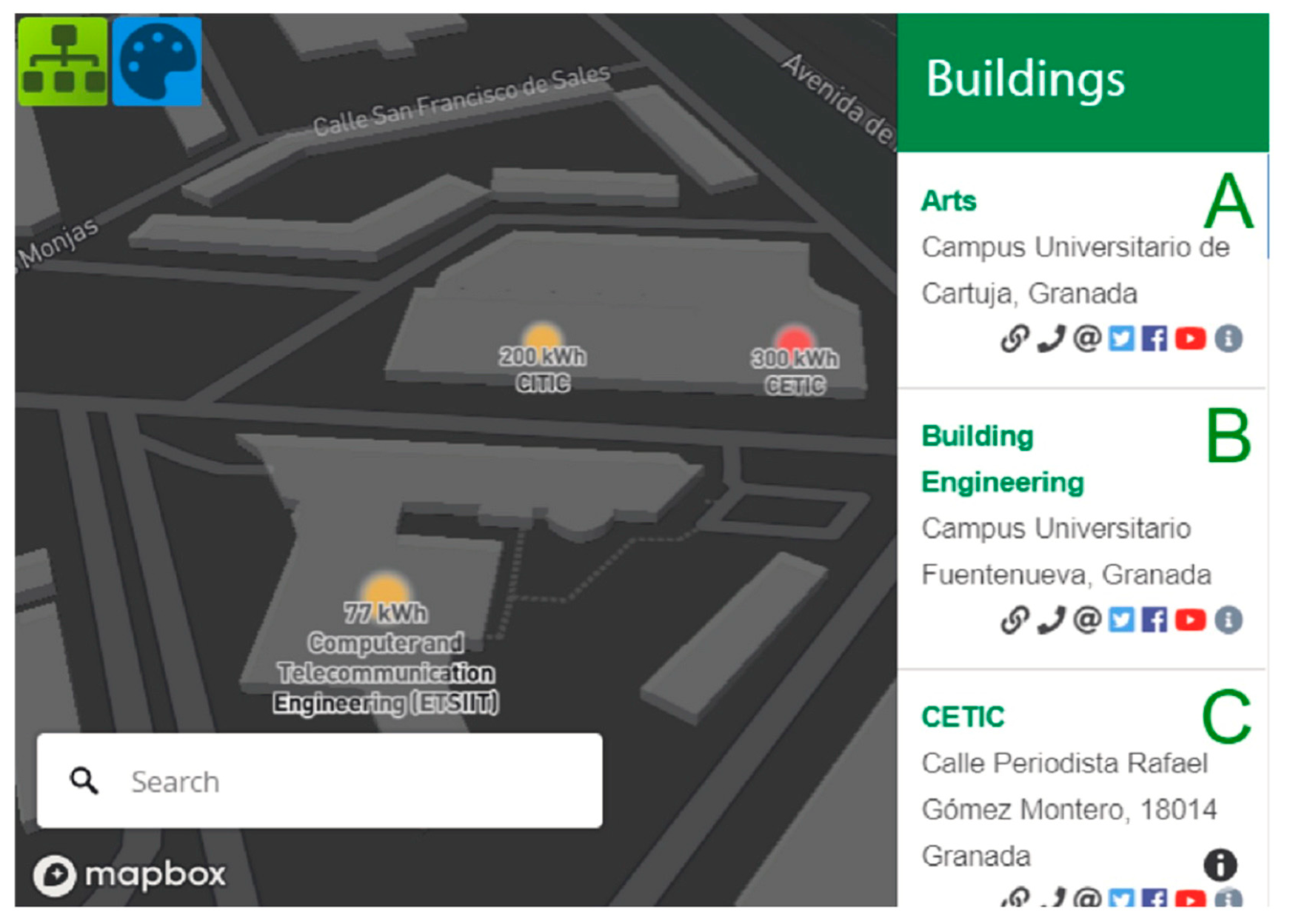
In household energy, eco-feedback and its visual forms emerge as a privileged terrain for observing integration between decision-oriented information, interfaces, and engagement mechanisms. A first case concerns the development of an eco-feedback interface for smart meters in Nottingham (United Kingdom), built through a questionnaire with 151 participants and a co-design process with 20 people [
50]. The output is not presented as an isolated “artefact”, but as a configuration combining multiple information panels and a “community space”, with the declared aim of making interaction more understandable and socially supported (
Figure 4).
The case’s strength for DEL is the traceability of the chain between enablers and configuration choices (particularly regarding comprehension, trust, and use frictions), whereas the limitation is that available evidence is predominantly design-oriented and qualitative (low Evidence Level for Outcomes): the study does not report a direct measure of the energy savings generated by the interface, so caution is needed in attributing effects and, especially, in claims about continuity. In terms of transferability, dependence on smart meters, digital capabilities, and the social acceptability of measurement remain central validity conditions.
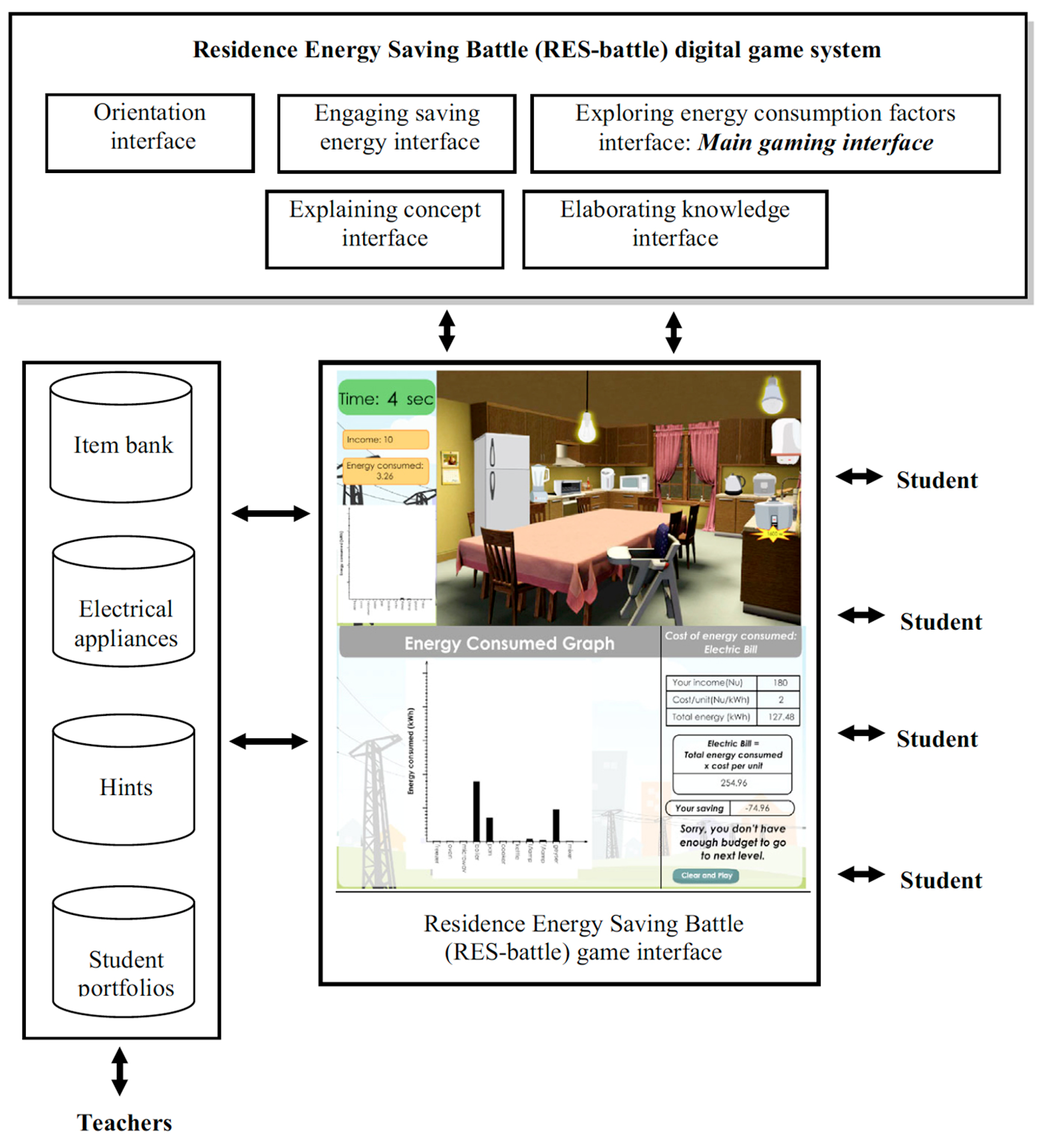
Within household energy, the same study also enables inclusion of reported cases at reduced granularity to stress-test the link between integration and continuity. This applies to interventions based on competitive leaderboards and social comparison in student accommodation contexts [
50]: reported consumption reductions are around 20% and 32%, and up to 55% during a competition period; however, the study notes that savings tend to diminish once the competition programme ends. Here, configuration is clearly integrated (comparative communication, competitive engagement mechanism, and measurement and feedback infrastructure), and adoption and action outcomes are more “measurable” than in the prior co-design case. The main criticality, however, is the fragility of continuity, which emerges as a structural risk when infrastructure relies on extrinsic motivators without service supports or a follow-up design. From an equity standpoint, reliance on homogeneous, institutionally controlled contexts (such as student accommodation) limits transferability (
Figure 5).
A third energy case concerns integrating eco-feedback with social media: linking saving messages and tips to a Twitter account is associated with a 26% reduction in consumption [
50,
51]. For DEL, the key point is that the effect is not attributed to a single message but to an interaction architecture that relocates feedback into a socio-digital environment already frequented by users. At the same time, the review reports barriers and risks that directly affect transferability and equity, such as privacy and data misuse concerns, low ICT competence, and distrust of smart meters; these can exclude population segments and turn an effective solution into a regressive one, especially when not accompanied by governance safeguards, alternative access pathways, and accountability mechanisms for data handling (
Figure 6).
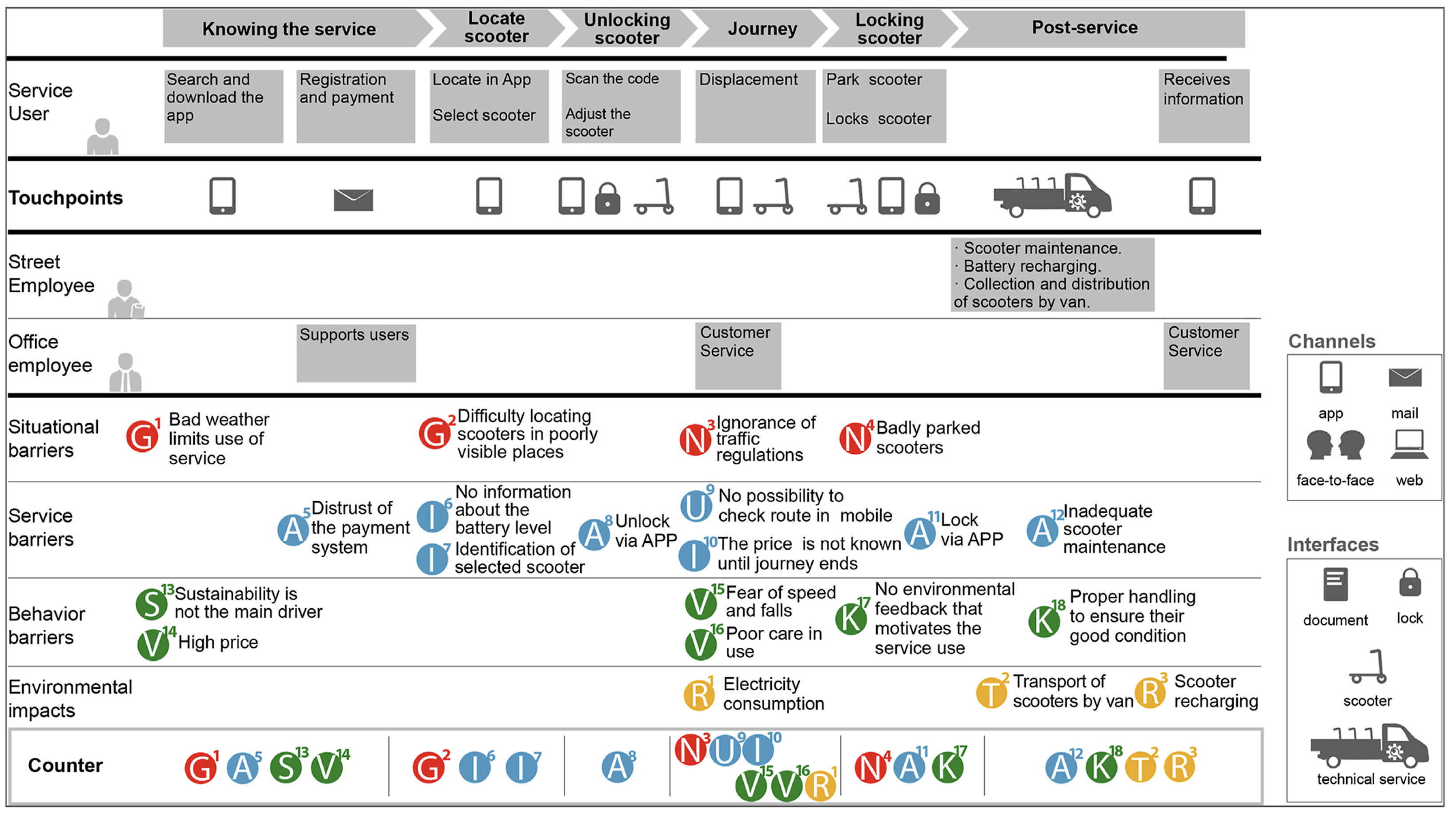
In ground mobility, two cases analysed by Sierra-Pérez et al. [
43] using an “ecological service design” method allow observation of use infrastructures in which product-technology and service are intrinsically co-dependent, and where governance (use rules and control) becomes part of the configuration. The first case is an e-scooter sharing service in Zaragoza (Spain) with a fleet of 850 vehicles. The customer journey integrates app-based access, unlocking, and operational accountability (e.g., parking confirmation), making governance part of the configuration (
Figure 7).
The case’s strength for a design-oriented reading lies in the explicit operational integration of the communicative component (in-app instructions and prescriptions), the service component (access, payment, and use sequence), and the product-technology component (unlocking, traceability, and photographic proof), with accountability embedded in the flow. Criticalities emerge as socio-normative and contextual barriers: reported issues include a lack of rule knowledge, illegal use, uncivil behaviour, vandalism, and accident rates, aspects that configuration must “address” by building norms and trust, not merely by providing access. In outcome terms, the available evidence is more robust for configuration and barrier describability than for comparable measures of carbon impact or long-term continuity (medium-to-low Evidence Level on Outcomes).
The second mobility case concerns a bike-sharing service in the same city, with around 2500 daily users. Here, a points system incentivises appropriate behaviour and penalises inappropriate behaviour (for example, out-of-station parking). Compared with scooter sharing, the case makes clearer the role of governance “embedded” in the service: incentives, supported by persuasive communication, become operational rules within the system, aimed at sustaining continuity and reducing externalities (disorder, misuse, and frictions in reuse). Transferability, however, is conditioned by the presence of physical infrastructure (stations), enforcement capacity, and the acceptability of the incentive-and-penalty regime (
Figure 8).
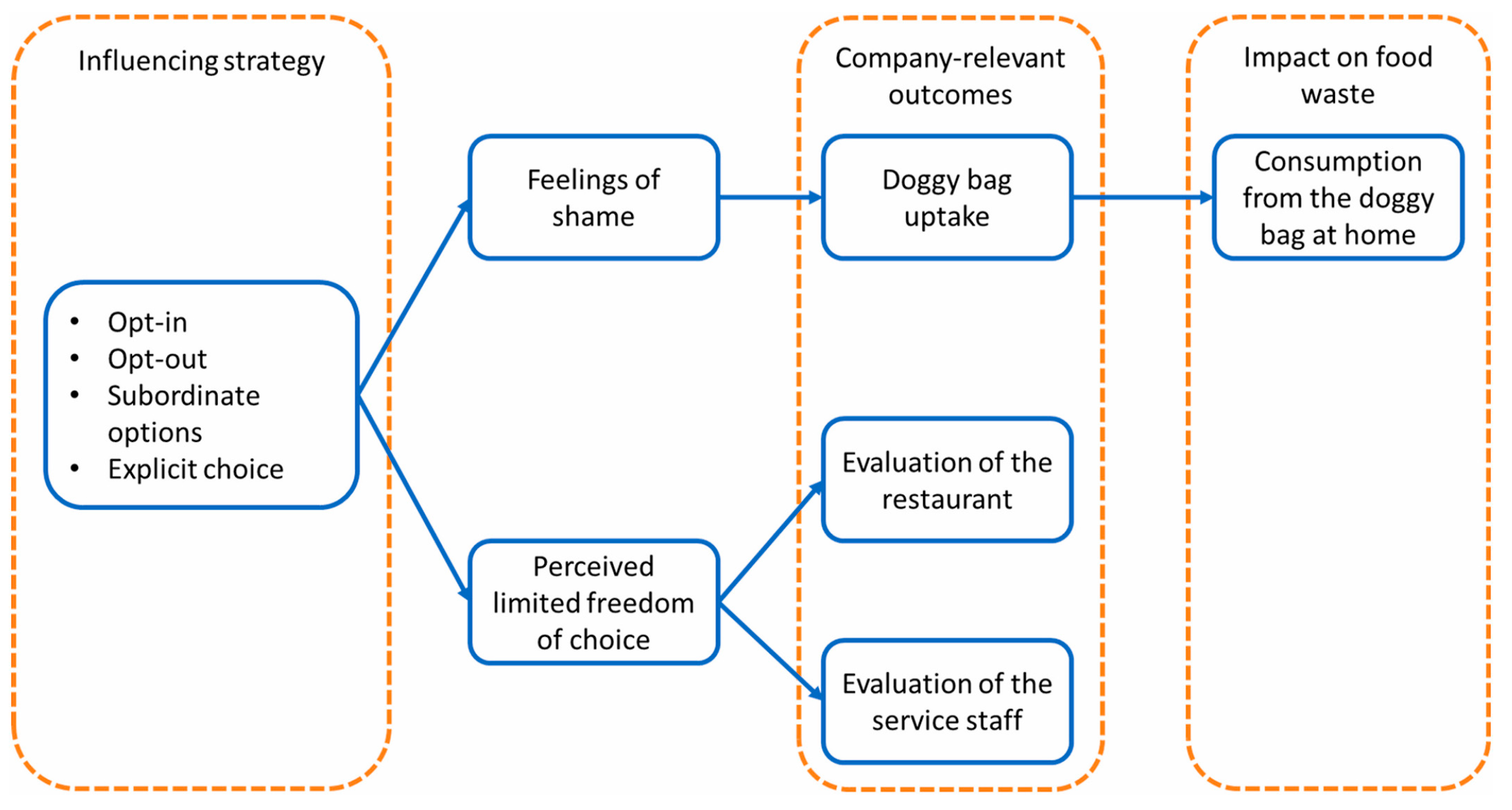
In food systems, the analysed cases allow comparison between configurations that act on the decision-making act (purchase choice) and those that intervene at the “socially sensitive” moment of out-of-home consumption, where norms, embarrassment, and perceived freedom of choice can determine adoption and continuity. A particularly informative case, also in terms of empirical robustness, concerns offering doggy bags in restaurants [
61]: five experiments with a total of 1166 participants show that framing the offer as a default option with opt-out yields a 74% acceptance rate, compared with 27% for an on-request offer and 49% for an explicit choice (
Figure 9).
The case’s strength lies not only in its immediate adoption effect but also in making explicit an intrinsic criticality: a default option, where opting out is perceived as a reduction in freedom of choice, can worsen restaurant evaluations. A more integrated operational configuration (subordinate default and/or transparency) can maintain default effectiveness while avoiding side effects, and increased acceptance can increase consumption of leftovers at home without increasing domestic food waste. In DEL terms, the case is exemplary because it shows that integration between communication design (offer framing), service design (script and interaction timing), and product design (container) must be read together: the behavioural mechanism is inseparable from the form of social interaction and its effects on trust and legitimacy.
A second food-domain case concerns climate labelling to steer “green” choices [
38]. In an online experiment with 249 Austrian residents, participants completed repeated choice sets. Introducing climate labels (present in half of the sets) shifted decisions towards lower-impact options. The contribution to DEL is twofold: on the one hand, the case offers an observable short-term outcome regarding choice; on the other, it highlights a structural limitation of many communication-led solutions—the absence of service and governance components that sustain continuity, manage frictions, and protect against regressive effects. Accordingly, in critical reading, the climate label should be treated as a component of a broader infrastructure (standardisation, data reliability, controls, and informational inclusion), not as a “self-sufficient intervention” (
Figure 10).
In the circular economy/materials domain, the analysed cases relate configuration and outcomes through declared scenarios and assumptions, thereby prioritising traceability over numerical comparability. A particularly useful case, because it makes validity conditions and behaviour dependencies explicit, proposes a framework for determining the break-even point between reusable and single-use packaging, also considering the effect of the replaced product. Yokokawa et al. [
39] discuss the case of ham products and show that reuse sustainability is not an intrinsic material property, but a function of return and reuse rates, logistics, and use scenario (
Figure 11).
From a DEL perspective, configuration is product-technology-enabled, but the decisive point is that the use infrastructure necessarily includes a service component (collection, cleaning, handling, and friction reduction) and a communication component (instructions and trustworthiness); otherwise, break-even cannot be reached. The limitation is that outcomes are modelled and scenario-based (medium Evidence Level for results, but high traceability of assumptions). Transferability is therefore conditioned by the replicability of the reuse system, not only by the container’s design choice.
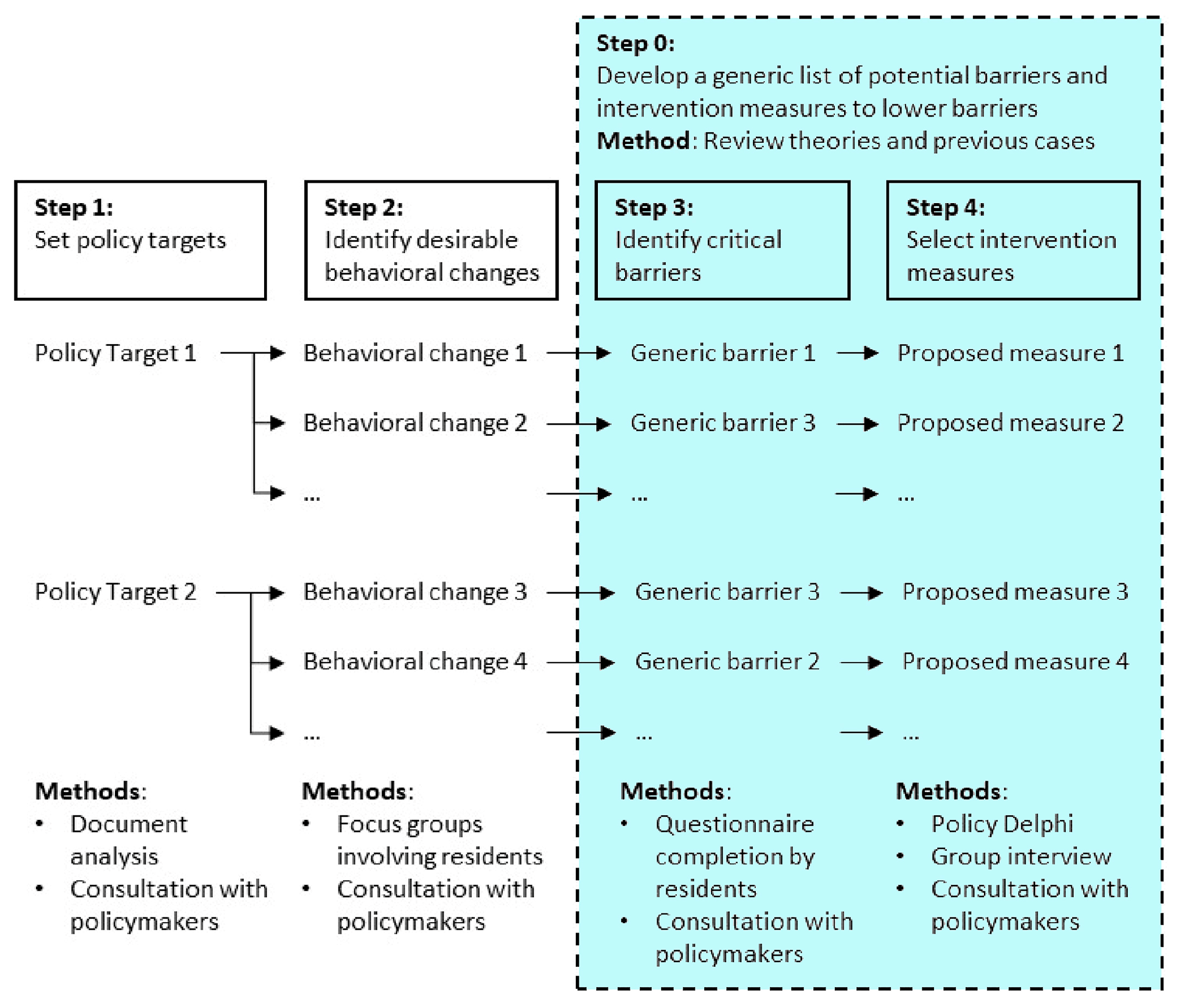
A second circular economy/materials case, with a more institutional focus, applies a Behavioural Barrier-Based Framework (BBBF) in Kyoto City (Japan) to reduce plastic use and improve waste management [
30]. The application involves 1000 residents, two focus groups, 14 companies, and three municipal officials; it identifies 15 intervention measures and 16 desirable behavioural changes for four policy targets, aiming to assess feasibility across stakeholders (
Figure 12).
Although it does not provide ex post measures of carbon impact or continuity (low Evidence Level on Outcomes), the case is relevant to DEL because it provides a traceable mapping of barriers to interventions. Critical barriers include uncertainty about “how to act”, habits, and uncertainty about individual contribution, and are addressed through measures such as simplification, information framing, and changes in default policies. In design-oriented terms, a BBBF makes legible the operational integration between communication (reducing uncertainty and framing), service (devices and channels that make behaviour practicable), and governance (policy, defaults, and enforcement), showing that integration can be designed “upstream”, not only evaluated “downstream”.
Based on the case study analysis, the next section formalises the Design Evidence Link (DEL) grid and presents a comparative table that keeps DEL categories constant and makes convergences, divergences, and information gaps (NR—Not Reported) comparable.
6. Design Evidence Link (DEL) Framework: Comparative Grid, Coding Scheme, and Levels of Evidence
For comparison purposes, DEL treats the intervention as a use infrastructure and examines communication, service, product-technology, interaction, and governance through their effective orchestration. Operationally, the matrix keeps field families unchanged and introduces a dedicated field for integration/orchestration, enabling case-by-case comparison without assuming metric equivalence.
To prevent improper equivalence between heterogeneous evidence, each case is assigned a synthetic Evidence Level that qualifies the solidity of the chain between configuration and outcomes. The level is considered (i) high when measures and context are present (units, period, observation conditions, and limitations), (ii) medium when outcomes are estimated or partial but with declared assumptions, and (iii) low when claims or non-verifiable evidence prevail. Carbon impact is therefore recorded as measured, estimated with assumptions, declared, or scenario-based, consistent with the idea that comparison should prioritise traceability and causal-chain coherence over numerical precision. Built on these criteria, the comparative DEL table synthesises “under which conditions”, “with which prerequisites”, and “with what evidence quality” an action works.
7. Results: Patterns and Recurrences from DEL Coding
DEL coding of the nine cases enables, within consistent fields, comparison of (i) use-infrastructure configurations and their degree of operational integration across communication, service, product-technology, and interaction and governance; (ii) documented outcomes (adoption/uptake, continuity, equity, and carbon impact for traceability); and (iii) validity conditions affecting transferability and scalability. Case-level details are reported in
Table S1 (Supplementary Materials); this section discusses only cross-cutting patterns. A synthesis of results by integration family and the availability of outcome and evidence fields in DEL is provided in
Table 2. Here, “recurrence” denotes the presence of the same mechanism or configuration in at least two cases; counts describe the structure of the use infrastructure (presence/absence and couplings), not the magnitude of the climate effect.
The first observable result from DEL is that integration is uneven: most cases include both a communicative and a product-technology component, whereas service and governance are less systematic. Rather than listing case-by-case combinations, DEL identifies four families: (i) full co-presence of the four components, (ii) three-component configurations, (iii) two-component configurations, and (iv) single-component cases (communication-led or modelling-led), which serve as boundary cases for discussing fragility in continuity and equity.
A second result concerns recurring coupling mechanisms between components, as captured in the “Integration/Orchestration” field. In household energy cases (E01–E03), orchestration centres on feedback cycles linking measurement and visualisation (product-technology) with action-oriented information (communication), with socio-digital extensions (community space, social media) or social-comparison and competition dynamics. In ground mobility cases (M01 and M02), integration is structured as a prescriptive customer journey: access and payment (service) are inseparable from interfaces and enabling constraints (product-technology), while governance is embedded in accountability mechanisms and operational regulation (parking-confirmation photos, points systems with incentives, and penalties).
In food-system cases (F01 and F02), coupling is, respectively, service-based and communication-based: in the doggy bag case (F01), the default option and its variants are inseparable from the service script and communicative framing, whereas climate labelling (F02) operates primarily as additional information within a choice set, without documentation enabling the coding of comparable service and governance components. In circular economy/materials cases (C01 and C02), orchestration takes two different forms: in the reusable-packaging break-even framework (C01), the product-technology-enabled configuration, through explicit assumptions, depends on logistics and return and reuse rates; in Kyoto’s BBBF (C02), the configuration is policy–service–governance, with a declared coupling between uncertainty reduction (communication), devices and channels that make action practicable (service), and default and enforcement changes (governance).
A third result observable from DEL concerns the availability and documentation of Outcomes. Action continuity is the field most often marked NR and is codable only when the source reports decay or maintenance over time, or secondary outcomes after adoption. Adoption/uptake is documented heterogeneously (percentage measures, use scales, proxies). To avoid improper comparisons, outcomes are treated as heterogeneous evidence and as a basis for identifying validity conditions, not as effect sizes comparable across cases. When a dimension is NR or reconstructable only through proxies, the result is treated as a traceable design hypothesis (to be verified), not as conclusive evidence of effectiveness; this informational asymmetry is part of the contribution and motivates the Minimum Reporting Set proposed in the closing section.
Carbon impact, consistent with the methodological framing, primarily appears as graded information for traceability (reported or scenario-based) rather than as a comparable metric: in household energy cases, it is associated with reported consumption-reduction percentages; in circular economy/materials cases, it is scenario-based (break-even and use conditions); and in other cases, it is NR. Equity is the least measured dimension and is most often treated as a risk or barrier: in household energy cases, DEL codes explicitly exclude risks linked to ICT capabilities, distrust of smart meters, and privacy concerns; in the doggy bag case (F01), equity/legitimacy is captured through the risk of perceived reduction in freedom of choice and the consequent worsening of restaurant evaluations; in other cases, documentation enables only partial or NR coding.
A fourth DEL result concerns Enablers. Where sources support traceable reconstruction, enabling conditions vary across domains and configurations. In household energy, beyond motivation (savings or co-benefits), capabilities, literacy, and trust (particularly in data and measurement infrastructures), recurring themes include explicit barriers such as privacy and the acceptability of monitoring. In ground mobility, the normative and enforcement dimensions (use rules, legitimisation, and responsibility) are more relevant than motivational dimensions; material opportunities (infrastructure, vehicle or station availability) and institutional capacity to manage externalities delimit validity. In food systems, social norms and situational friction in interaction (embarrassment, opportunity to ask or accept) become integral to configuration, whereas in labelling, the main codable lever remains the capacity to translate information into a decision. In circular economy/materials, system opportunities and prerequisites (reuse logistics, capacity to implement measures and modify defaults) dominate, with a weaker connection to ex post measures on continuity and equity.
In cross-case comparison, the nine cases converge on a central point for DEL: when the configuration is effectively a use infrastructure (not a single artefact), more solid or promising outcomes tend to emerge when the communicative component is coupled with access, service, and technological or material support, and when governance elements render action legitimate, verifiable, and less fragile over time. Domain-specific examples and implications are discussed in the next section, where patterns are interpreted through a design-led lens.
8. Discussion: Design-Led Interpretation of Patterns, Barriers, and Trade-Offs
Comparative analysis indicates that observable results depend less on individual levers and more on the quality of orchestration between components within a use infrastructure. The most robust interpretive finding is that, especially for adoption and (where reconstructable) continuity, performance depends on how levers are coupled within the use infrastructure. In design-led terms, this shifts attention from the “what” (message, incentive, interface) to the “how” (the architecture of opportunities and constraints), namely, the operational form of orchestration between communication, service, product-technology, and governance, and the points in the journey where it intervenes.
This reading clarifies why the three design articulations (communication, service, and product-technology) can reinforce one another but also “neutralise” one another. They reinforce one another when they coherently cover different enablers: communication makes the act legible and legitimate (decision-grade information and timing); service makes action practicable and repeatable (access, support, friction reduction, and follow-up); product-technology stabilises execution (affordances, automation, and feedback); and governance prevents effectiveness from being achieved at the cost of opacity, exclusion, or externalities. They neutralise one another when one component imposes implicit demands that another does not support: a label or feedback that presupposes literacy, trust, or time without service support; a digital service that enables access but does not manage responsibility and control; a default that increases adoption but erodes perceptions of autonomy or provider trust; and a technology that amplifies traceability and datafication without credible privacy and accountability safeguards.
From this perspective, action continuity emerges as a systemic property rather than as the simple “persistence over time” of an initial effect. Cases involving competitive engagement or social comparison clearly show a structural risk: when persistence depends predominantly on extrinsic motivators, performance is vulnerable to programme end or novelty decay. The point is not that such devices are “wrong”, but that absent a service design and governance that make action socially and institutionally sustainable, the infrastructure tends to produce performance peaks followed by declines. Conversely, the idea of a “community space” or of leveraging social environments already frequented by users indicates a direction: continuity is supported when action is integrated into ordinary practices and use contexts, reducing the cognitive and relational costs of maintenance rather than merely “pushing” initial adoption.
Equity, accordingly, cannot be treated as an ancillary variable to be discussed only downstream. In digital cases (eco-feedback and micromobility), the infrastructure implicitly selects who can participate: device availability, ICT capabilities, measurement acceptability, capacity to manage settings and consents, and trust in data. Without alternatives or safeguards, a regressive effect is not an anomaly but a predictable consequence of the chosen orchestration. Micromobility makes this particularly evident: app-based access and accountability mechanisms (for example, photographic proof, parking rules, penalties, or points systems) are functional for managing externalities but also shift compliance and control burdens onto users. In this case, “good” integration is not that which maximises adoption in the abstract, but that which legitimises regulation, manages frictions and sanctions proportionately and intelligibly, and limits the exclusion of those with less capacity to meet digital or procedural requirements. In other words, governance is not a simple add-on; it must be part of service design and therefore falls within design’s field of action.
Food-domain cases highlight another critical dimension: integration must be sensitive to the socio-interactional context. The doggy bag offer, when viewed as a use infrastructure, becomes a micro-choreography of service in a setting where social norms, embarrassment, and perceived freedom directly affect adoption and acceptability. This criticality is not a minor detail: a configuration may increase uptake while, at the same time, imposing a reputational cost on the restaurant, thereby weakening replicability conditions. Here, the design-led interpretation is clear: continuity does not depend solely on the user, but on the sustainability of the infrastructure for the operator delivering it; if the operator perceives negative-evaluation risks, it will tend to deactivate or weaken the device. It follows that DEL should make explicit the balance between behavioural effectiveness and perceived legitimacy, including, as part of the configuration, the “social costs” and the transparency strategies that mitigate them.
Conversely, climate labelling is useful precisely because it highlights a typical limitation of communication-led solutions: they can steer short-term decisions but remain fragile in terms of continuity and equity unless embedded in an infrastructure that guarantees data reliability, comparability, controls, and information accessibility for users with differing literacy and priorities. This does not mean that climate labelling is useless per se; rather, it does not work when deployed as a stand-alone intervention. In DEL logic, climate labelling is a component that can activate motivations and norms (including implicit ones), but it requires credible governance (standards and verification) and often a service design to avoid regressive effects or informational exclusion.
In circular economy/materials, finally, a design-led reading shifts the discussion from the “right material” to the “working reuse system”. The reusable-packaging break-even framework makes clear that environmental performance depends on return rates, logistics, and washing/handling practices, in turn on a service infrastructure that must be designed, made convenient, and communicated reliably. Here, continuity takes the form of “system continuity” before individual behaviour continuity: if the operational chain fails (collection, cleaning, redistribution, costs), the user cannot maintain action, regardless of motivation. The BBBF case applied to Kyoto, despite lacking consolidated ex post outcomes, is methodologically relevant because it makes explicit the “upstream design of orchestration”: identifying barriers and linking them to measures renders the chain between determinants and configuration discussable and verifiable and turns governance into a design object rather than an external constraint.
A final implication concerns the relationship between interpretation and evidence quality. Some cases allow “stronger” inference about the immediate effects of specific choices (typically in experimental settings), whereas others are more informative about operational conditions, barriers, and contextual dependencies (typically in reviews, method studies, or frameworks). Design-led discussion should keep these planes distinct without conflating them: DEL is not intended to identify which device “works” in absolute terms, but to make traceable the conditions under which a configuration can plausibly sustain adoption, continuity, and equity, and where information gaps prevent causal attribution. In this sense, integration/orchestration is also a criterion of interpretive prudence, because it distinguishes effects tied to highly controlled contexts from effects sustainable under more ordinary and socially heterogeneous conditions.
9. Scaling Use Infrastructures: Transferability and Boundary Conditions
As set out in the Materials and Methods section, comparative analysis treats transferability and scalability as conditional properties because they depend on alignment among (i) the use-infrastructure configuration, (ii) the enablers effectively mobilised, and (iii) contextual constraints that render that configuration practicable, legitimate, and sustainable over time. In this perspective, discussing transferability means clarifying “what” is transferred (the communicative component alone, the service with its access and support mechanisms, the technology and data system, or the governance and enforcement) and, above all, “under which conditions” the chain between determinants, configuration, and outcomes remains plausible outside the original context. Similarly, scalability does not coincide with simply increasing users or geographical coverage, but with the ability to maintain orchestration quality and a non-regressive distribution of burdens and benefits as use intensity, social heterogeneity, institutional constraints, and actor operational capacities vary.
Recurring validity conditions cluster into four families: (i) infrastructural prerequisites, data, inclusion, and trust; (ii) governance and enforcement; (iii) operational sustainability for operators; and (iv) systemic and logistical requirements. In the Risks and Validity field, DEL explicitly states, for each case, which conditions are declared and which remain gaps (NR).
In cross-case reading, rebound and lock-in risks are factors that, if unmanaged, can cause an intervention to fail and become inequitable and illegitimate: an intervention may be technically transferable yet fail because it produces side effects that erode legitimacy or displace impact elsewhere. In digital cases, a typical risk is institutional and technological lock-in, which limits replicability and public control; another risk is behavioural rebound, which turns scalability into a short-term exercise unless follow-up is designed. In cases with constraints and incentives, a recurring risk is erosion of trust or perception of autonomy, which can reduce adherence in the medium term and generate social opposition. These risks must be adequately considered because they directly delimit the conditions under which a configuration remains valid and therefore transferable.
Evidence quality (Evidence Level) determines what is transferable as evidence and what remains transferable as a hypothesis. Consequently, scalability should proceed by thresholds, that is, as a progressive extension conditional on the verification of prerequisites and the reduction in information gaps, rather than as indiscriminate multiplication of a solution.
10. Operational Implications: DEL as an Ex Ante and Ex Post Tool
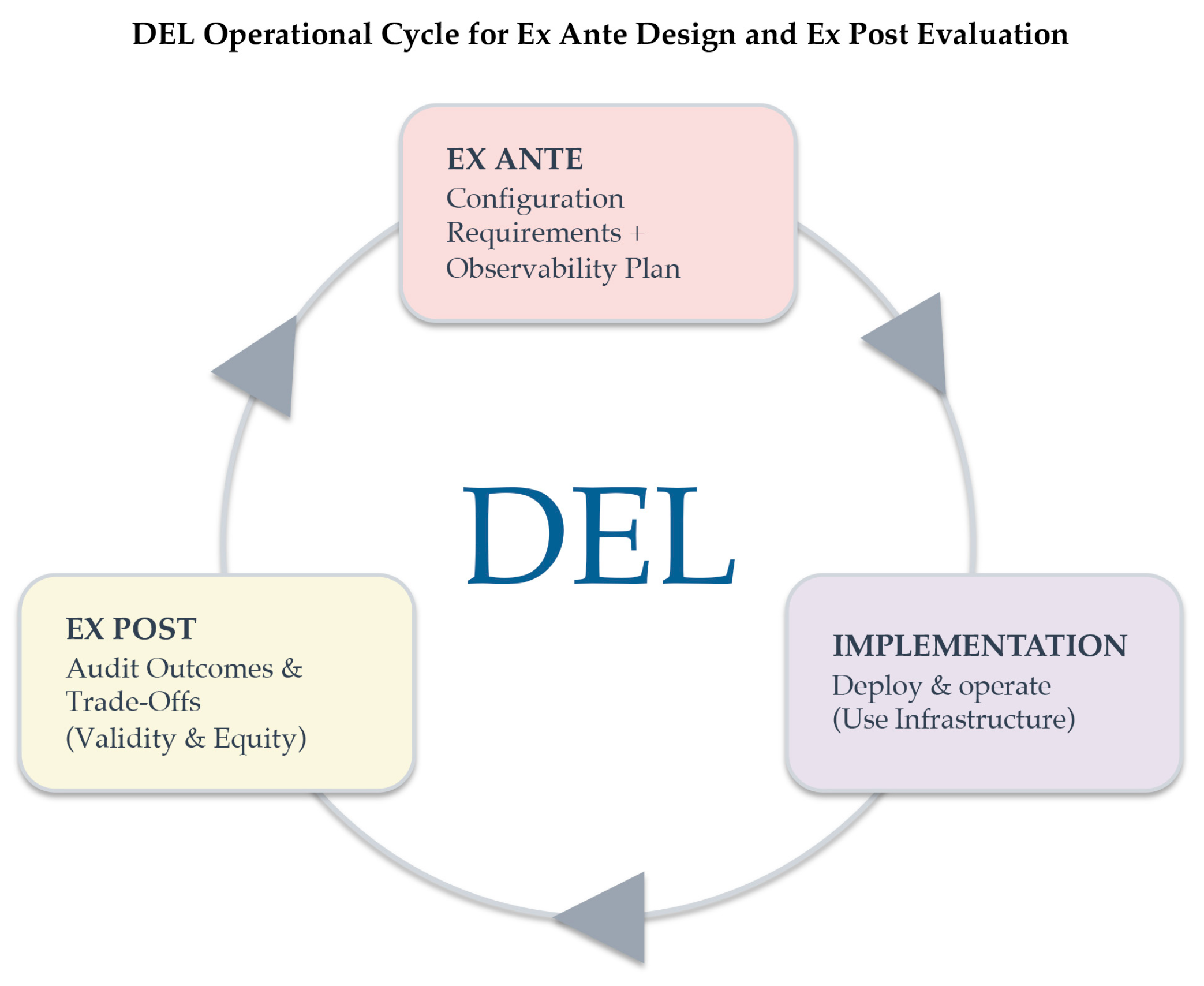
DEL is used here as an operational device linking configuration choices to minimum evidence requirements for ex ante design and ex post evaluation (
Figure 13).
Ex ante, DEL can be applied to translate demand-side mitigation objectives into configuration requirements and testable hypotheses. The first step is to define precisely the unit of change: not an abstract behaviour, but a situated practice of use (who decides, when, under which material and regulatory constraints, and with which attention and coordination costs). On this basis, enablers are made explicit as observable resources and constraints (motivations, capabilities, norms, material opportunities, and trust), avoiding the generic attribution of cultural deficits to the target. DEL then imposes an operational shift: for each relevant enabler, the configuration must show which design component covers it and through which mechanisms.
Ex ante, the “Integration/Orchestration” field specifies the form of operational integration: what is co-present, how it is connected, and at which point in the decision journey it intervenes. Here, DEL becomes a coherence-control tool: “decision-grade” communication is valuable if it is linked to practicable access (service), reduces friction (product-technology), and operates within intelligible and legitimate rules (governance). Likewise, a digital service cannot be considered “ready” unless it clarifies where responsibilities, controls, and compliance burdens fall and which privacy and accountability safeguards apply. Ex ante, therefore, DEL does not select the best solution in the abstract but the one that, under specific contextual conditions, presents a plausible design chain to sustain continuity and equity, with a declared risk and dependency profile.
A second ex ante use concerns evidence design. The Evidence Level criterion, integrated into DEL, allows, from the outset, the definition of which results will be measurable, which will be estimated, and which can only be reconstructed through declared proxies. This step is decisive for avoiding “over-promising”: if carbon impact is not measurable in a comparable way, DEL can still set minimum expectations for adoption and continuity and treat CO2 as a graded traceability metric. Ex ante, therefore, DEL requires that every intervention be accompanied by a “coherent observability plan”: which data, in which units, over which period, with which assumptions and limitations.
Ex post, DEL supports interpreting results as the performance of a use infrastructure, assessed across four families (Outcomes, Enablers, Design Configuration, and Risks and Validity) and according to the degree of integration achieved. Ex post coding requires clearly distinguishing what was implemented from what was planned: deviations in configuration (for example, service supports not activated, incomplete governance, or missing alternative channels) often explain gaps between expected and observed effectiveness, especially in continuity. In this sense, DEL supports structured failure diagnosis and makes visible where the chain broke (enabler not covered, friction not removed, trust eroded, insufficient enforcement, or regressive burdens not mitigated).
Ex post, analytical prioritisation of continuity and equity helps avoid a frequent bias, namely, treating “success” as an average increase in adoption when the distribution of costs, risks, or compliance burdens entails exclusions or selective dropouts. DEL makes these trade-offs comparable by requiring the recording of access, burdens, and possible regressive effects as integral parts of Outcomes and Validity, linking them to configuration rather than to users’ intrinsic characteristics. Moreover, managing information gaps is part of evaluation: missing evidence is not replaced with inference but is annotated as a limitation that reduces interpretive strength and guides reporting improvement.
A concrete application helps to illustrate this operational value. Consider a catering business that is planning a reusable packaging scheme for takeaway food, with the aim of reducing single-use waste and associated emissions in public school catering services. Up front, the DEL would be used to identify the relevant enabling conditions (convenience of return, confidence in hygiene, staff workload, economic and physical accessibility), then to configure the use infrastructure through communication, service, product-technology, and governance components (instructions, deposit/refund logic, return points, cleaning logistics, access via digital or non-digital platforms, liability rules). At the same time, the DEL would require a minimum monitoring plan covering the return rate, reuse cycles, drop-off points, cost distribution, and packaging avoided. Ex post, the same framework would make it possible to verify whether the conditions for adoption, continuity, and equity have actually been met and where the chain has failed if the expected impacts have not materialised.
For public decision-makers, designers, and providers, DEL serves as a structured brief-and-audit tool that connects integration requirements, evidence planning, risks, and equity conditions. DEL also helps align climate mitigation performance with broader sustainability criteria, especially inclusion, accountability, and responsible service provision, without requiring a separate SDG-by-SDG reading at this stage.
A full DEL application may require an interdisciplinary team combining design, service operations, policy, data governance, and evaluation capabilities, especially when both carbon traceability and equity auditing are expected. In resource-constrained settings, a lighter DEL application can focus on a minimum core: definition of the target practice, enabler mapping, configuration coverage, a basic observability plan, and an explicit equity-and-risk screen, postponing more demanding quantification steps to later phases.
11. Limitations: Attribution, Evidence Quality, and Generalisability
This section distinguishes the limitations of DEL as an analytical–operational tool from those of the study in comparing cases. DEL is not a predictive model; it is a traceability device that makes the chain between determinants, use infrastructures, and outcomes verifiable, and that makes explicit the validity conditions, trade-offs, and Evidence Level. The case corpus is deliberately purposive and traceable, intended to stress-test the protocol (fields, NR, validity conditions), not to estimate frequencies or average performance; any inference about effectiveness remains conditional on Evidence Level and context. It is hypothesis-forming and audit-oriented rather than predictive or statistically validating.
DEL’s first limitation stems from its ambition: it aims to compare causal chains and intervention architectures, not to produce numerically comparable estimates across domains and contexts. For this reason, carbon impact is treated as a graded traceability metric; DEL is therefore strong at making assumptions, prerequisites, and design links explicit, but it does not replace emission inventories or harmonised LCA/LCI assessments when quantification is required. A second limitation concerns DEL’s dependence on reporting quality. DEL is most effective when sources describe in detail configuration, governance, frictions, service supports, and outcome indicators. When these are not reported, DEL cannot “fill” the gap without introducing non-traceable inference; methodologically, the consequence is the “NR” label—an interpretive prudence that preserves rigour but reduces operational usability in some fields. A third limitation is that DEL operates on a complex unit of analysis (the use infrastructure) and can therefore describe integration and orchestration between components precisely, but cannot always isolate the marginal effect of a single lever. In other words, DEL privileges systemic analysis and the conditions under which systems function; it may be less suitable when research questions require granular attribution to specific messages, incentives, or interfaces.
Regarding study limitations in comparative case analysis, the first concerns sampling. Purposeful sampling—aimed at maximising configuration variety within high-carbon domains and ensuring sufficient documentation for coding—does not yield statistical representativeness; identified patterns should therefore be interpreted as comparative results and traceable design hypotheses rather than as probabilistic generalisations. The second limitation is heterogeneity of evidence and methodological settings across studies. Cases come from contributions with different aims (experiments, method studies, frameworks, and reviews) and non-harmonised indicators; this limits direct comparability of outcomes and the possibility of sustaining “strong” causal inference, especially regarding action continuity and equity, which are often observable only through proxies or qualitative descriptions. The sampling strategy may therefore privilege better-documented, institutionally mature, and more visible interventions over less formalised but potentially relevant practices.
The third limitation concerns temporal and distributive dimensions: continuity requires longitudinal observation, and equity evaluation requires evidence on access, burdens, and possible regressive effects for subgroups. Such information is not systematically available across sources. Consequently, although coding makes risks and barriers visible in some cases, it does not fully verify the persistence of effects or the distribution of benefits and risks. A fourth limitation is context: some cases are situated in controlled or institutionally specific settings; this makes validity-condition reconstruction valuable but constrains automatic transferability and requires caution when moving from situated evidence to broader recommendations.
In summary, DEL supports traceable and comparatively consistent readings across heterogeneous cases, and the case studies test the usefulness of its fields and boundary conditions rather than validate the framework in a strong empirical sense or warrant generalisation beyond the analysed corpus.
12. Research Agenda and Conclusions: Toward Evidence-Driven, User-Centred Urban Mitigation
This paper proposes DEL as a design-led device to verify the passage from determinants to design requirements and, from these, to minimum evidence expectations, treating integration across communication, service, product-technology, and governance as a primary explanatory variable for action continuity and equity. In this perspective, the aim is to make different configurations comparable in terms of validity conditions, trade-offs, and evidence quality, avoiding reductive attribution to single levers and supporting traceable ex ante and ex post decisions. Its contribution lies in making design claims more inspectable, not in proving universal causal effects across contexts.
To consolidate and improve DEL transferability, we propose a research agenda organised into eight operational lines. The first concerns systematically raising the Evidence Level through a shared Minimum Reporting Set that makes heterogeneous studies comparable and reduces information gaps that currently prevent robust inference on continuity and equity. Beyond adoption outcomes, the minimum set should require the following at least: (i) observation duration, decay/dropout indicators, and their distribution by user profile; (ii) user compliance burdens (time, capabilities, and operational frictions); (iii) infrastructural and institutional prerequisites; and (iv) an operational description of governance safeguards (privacy, accountability, and auditability) and of “functionally equivalent” alternatives for those unable to access digital channels or service standards. In parallel, it is strategic to standardise the description of integration/orchestration (which components are truly co-present and through which mechanisms), to prevent “nominal presence” being mistaken for effective integration.
The second line concerns action continuity as a temporal-design problem, not merely the persistence of an initial effect. To consolidate DEL as an ex ante hypothesis-forming and comparative tool, longitudinal studies and realist evaluations (from context to mechanism to outcome) are required, observing use infrastructures over time horizons aligned with service cycles, seasonality, and user learning. In particular, it becomes relevant to design and measure routines, follow-up, interpretive feedback, and moments of normative-institutional re-anchoring, distinguishing “launch” effects from stabilisation in ordinary contexts of use.
The third line concerns the measurability of integration as an observable property. Beyond qualitative coding, it is advisable to develop synthetic indicators (including discrete-grain indices) that describe orchestration structure through (i) the density and sequence of touchpoints, (ii) dependencies between components, (iii) the presence of responsibility mechanisms and exception handling, (iv) the degree of friction reduction (cognitive, economic, and procedural), and, above all, (v) coherence between what communication presupposes and what service and product-technology actually make possible. This step would reduce interpretive ambiguity and increase transferability across domains.
The fourth line focuses on governance and legitimacy as design variables, clarifying which accountability architectures are proportionate and socially acceptable across contexts, how to design transparency and control without generating regressive effects, and how to manage the tension between datafication (traceability and monitoring) and trust (privacy, data use, and perceptions of surveillance). In DEL terms, this implies consolidating design protocols that render the configuration-to-outcome chain “auditable” and make explicit, ex ante, “non-validity conditions”, namely, cases where the absence of safeguards or alternatives makes exclusion, dropout, or resistance predictable.
The fifth line concerns equity as a constitutive dimension of performance, to be measured and designed with the same priority as adoption. While metrics and procedures are needed to make visible access barriers, compliance costs, benefit distribution, and risks of informational exclusion, comparative experiments on “equivalent modalities” are equally necessary to identify combinations that do not systematically shift burdens onto more vulnerable groups. Along this trajectory, DEL can serve as a bridge between design research and policy evaluation, making explicit the points at which a solution works on average but fails for specific segments.
The sixth line concerns transferability and scalability as conditional properties: replication protocols are needed that, on the one hand, distinguish what must remain invariant (key orchestration mechanisms) from what must be adapted (rules, infrastructures, actors, regulations, and literacy), and on the other, provide evaluation frames that are comparable and applicable across contexts. In this case, DEL can be used to build verifiable “implementation scenarios” that make explicit the prerequisites, trade-offs, fragility points, and plausible failure conditions.
The seventh line concerns competencies and roles: designing integrated use infrastructures requires distributed capabilities across public administrations, service operators, and designers, as well as shared languages and clear responsibilities. Research can translate DEL into competence profiles and training devices for reading data and limits (Evidence Level), designing governance and inclusive alternatives, and integrating decision-oriented communication with services that reduce frictions and with product-technologies that stabilise execution. This also strengthens the disciplinary legitimation of design as a hinge between policy, implementation, and use.
Finally, the last research line is cross-cutting and concerns the controlled expansion of case studies and domains without turning DEL into an encyclopaedic taxonomy. The aim is to select cases with comparable reporting and operational descriptions of orchestration, including, on the one hand, non-OECD contexts or contexts with different institutional capacity to stress-test validity conditions, and on the other, emerging domains (digital consumption platforms, repair and reuse systems, and community energy services) where integration between design articulations may take different forms.
In conclusion, DEL contributes (i) theoretically, by treating demand-side mitigation as the performance of integrated use infrastructures; (ii) methodologically, by making the chain between determinants, configurations, and evidence quality traceable; and (iii) operationally, by supporting ex ante and ex post use without producing rankings or indiscriminate generalisations. Its value lies in clarifying “under which conditions” a configuration can sustain adoption, continuity, and equity and “with which Evidence Level” such a claim is justifiable. The framework should therefore be understood as a disciplined protocol for comparison and design reasoning, whose validity depends on explicit assumptions, reporting quality, and contextual fit.