
Article

Air Pollution Exposures of Bangladeshi Women from Rural and Peri-Urban Areas: Baseline Assessment for Behavior Change Communication Intervention as a Sustainable Approach

1
Nutrition Research Division, icddr,b, Dhaka 1000, Bangladesh
2
Department of Public Health Sciences, University of Chicago, Chicago, IL 60637, USA
3
Bangladesh Atomic Energy Commission, Dhaka 1000, Bangladesh
4
U-Chicago Research Bangladesh, Dhaka 1230, Bangladesh
5
Mailman School of Public Health, Columbia University, New York, NY 10027, USA
*
Author to whom correspondence should be addressed.
Sustainability 2026, 18(7), 3507; https://doi.org/10.3390/su18073507
Submission received: 18 February 2026 / Revised: 16 March 2026 / Accepted: 18 March 2026 / Published: 3 April 2026
(This article belongs to the Section Air, Climate Change and Sustainability)

Abstract

Building on prior evidence that biomass cooking drives personal air pollution in rural and peri-urban Bangladesh, we measured kitchen pollution alongside personal exposure and examined the influence of outdoor industrial and traffic emissions on personal and indoor air quality. In an mHealth based-behavior change communication (BCC) intervention study (NCT05570552), 400 women were enrolled from rural Matlab and peri-urban Araihazar in Bangladesh. We measured 24 h personal exposure to fine particulate matter 2.5 (PM2.5) and black carbon (BC) using personal monitors (UPAS V2), and 72–120 h PM2.5 in 200 kitchens and outdoors of households using air quality sensors (PurpleAir Flex). Compared to clean fuel users, biomass users showed greater personal and kitchen exposure to PM2.5, showing good correlation between personal and indoor PM2.5 measurements (R2 = 0.722). Daily average personal PM2.5 and kitchen PM2.5 during both cooking and non-cooking periods were higher in rural than peri-urban areas. Geographic information system mapping revealed that personal PM2.5 was inversely related to the distance of factories from households when below <300 m in both rural and urban areas. Only in Araihazar, personal BC was higher in households located near factories or roads (<200–300 m) compared to those situated further away. Higher personal BC exposure was found in peri-urban women than rural women (p < 0.001). Higher levels of PM2.5 and increased BC were found in rural and peri-urban households, respectively, which were located in close proximities to formal/informal factories and main roads. These findings highlight the need for sustainable household energy transitions and improved air quality management to reduce air pollution exposure in Bangladesh.

1. Introduction

Air pollution is a global public health problem that affects both developed and developing countries, although it disproportionately affects low- and middle-income countries (LMICs) due to rapid industrialization, urbanization, and use of polluting energy sources [1]. The most important air pollutants relevant to health are particulate matter (PM), black carbon (BC), sulfur oxides, carbon monoxide, ozone and nitrogen oxides [2]. According to the annual Air Quality Life Index (AQLI) report of 2024, the annual average particulate pollution level of Bangladesh exceeds both the World Health Organization (WHO) guideline of 5 µg/m3 and its own national standard of 35 µg/m3, where about 97 percent of the country’s population reside [3].
Annually, about 3.2 million people die prematurely from illnesses attributable to household air pollution due to biomass fuel use, while ambient air pollution contributes to an additional 4.2 million deaths worldwide [2]. Several studies have provided compelling evidence showing an association between household air pollution and various adverse health outcomes, including increased respiratory diseases, elevated blood pressure, cardiovascular diseases, dementia, adverse pregnancy and birth outcomes and premature death [4,5,6,7]. Similarly, outdoor or ambient air pollution has significant negative impacts on human health [8,9,10].
Globally, traffic emissions, road dust, construction activities, power plants, and industrial facilities are major emission sources in urban areas, while in rural areas, studies generally describe the use of biomass fuel for domestic cooking as a major source of air pollution in households [1,11]. In Bangladesh, air quality management remains fragmented, with limited enforcement of existing environmental regulations and weak emission controls for industries and transport, despite the growing burden of air pollution-related health impacts. Little attention is given to air pollution emissions from mills and factories in rural settings, which are often situated close to clusters of households, such as rice mills, brick kilns, sawmills and similar factories, which may also have a substantial contribution to air pollution. Low-income households, particularly in rural settings, use solid fuels (70–74%) for domestic cooking, such as dry leaves, agricultural waste and dry dung, because these are freely available or cheap and traditional mud stoves are also low-cost [12,13,14]. Clean fuels are not easily accessible through national supply of natural gas and are generally expensive when acquired through private suppliers of liquid petroleum gas (LPG). Even in urban impoverished settings, biomass fuel is commonly used (93% rural vs. 50.7% urban) [15].
In our earlier study (GEOHealth, cycle 1), we showed that the use of biomass fuel for cooking was strongly associated with personal PM2.5 and BC exposure, measured with personal air quality monitors [16]. Intervention with a free supply of clean fuel LPG (with stove) for 2 years resulted in a significant reduction in exposure to personal air pollution, but the reduction did not decline below a certain level (PM2.5: 86 µg/m3), which was still higher (>5 times) than the WHO cut-off value (15 µg/m3 for 24 h). As kitchen and outdoor air pollution were not measured, their contribution to personal exposure levels could not be ascertained. In densely clustered Bangladeshi households, outdoor air pollution can substantially influence indoor environments, while emissions from one household kitchen may diffuse into the outdoor environment and affect air quality in neighboring households, underscoring the need for integrated personal, indoor, and outdoor exposure assessment.
We carried out an mHealth-based behavior change communication (BCC) intervention study (NCT05570552) under the Bangladesh Global Environmental and Occupational Health (GEOHealth) study in 400 Bangladeshi women cooks. In this paper, we aimed to identify factors that influenced and augmented personal exposure to PM2.5 and BC, including fuel types and kitchen types, while comparing between rural and peri-urban sub-districts. We further aimed to evaluate the influence of factories and main roads located near households on outdoor air pollution by using GIS mapping to determine the minimum distance at which these sources can impact the outdoor air quality of households.

2. Materials and Methods

2.1. Study Design, Sites and Participants

The current study is a follow-up study of a clean fuel intervention trial of GEOHealth in rural Bangladesh (NCT02824237), where households using biomass fuel for cooking were provided clean fuel LPG free of cost for two years. Details of this intervention trial have been described previously [16,17,18]. In brief, 200 women were randomly assigned to receive a clean fuel intervention (LPG stove and cylinder) for more than two years, while the remaining 200 served as controls [17]. Intervention with clean fuel LPG for two years substantially reduced personal air pollution exposure to PM2.5, BC and carbon monoxide. Since free supply of clean fuel is not a practical solution in real life situations, the current study was designed to provide an mHealth-based BCC intervention to promote clean fuel use by families in a household-level randomized, open-label intervention trial (NCT05570552). The BCC intervention mainly targets delivering messages regarding the use of clean fuel (LPG, electric and induction stoves) for cooking and various health hazards of long-term biomass fuel use to increase the awareness of the participants. Additional messages include the use of open space for cooking when using biomass fuel, and cooking near open windows for increased ventilation in closed kitchens. The current monitoring study (Cycle 2 of the GEOHealth study) was initiated in 2023, approximately two years after the completion of Cycle 1 (2017–2021). During the interval between the two cycles, several households changed their cooking fuel use patterns. Some households originally assigned to the control group independently adopted LPG and reported mixed use of LPG and biomass fuels. Likewise, some households from the LPG intervention group in Cycle 1 transitioned to mixed fuel use after the cessation of free supply of LPG at the end of the two-year intervention period.
The two previously selected field sites in the GEOHealth study represented distinct environmental and industrial characteristics of Bangladesh. Matlab, located in the Chandpur district, a riverine area, is predominantly characterized by rural agricultural activity, fishing and the presence of small-scale informal industries such as brick factories, rice mills, sawmills, traditional bakeries, etc. Araihazar, situated in the Narayanganj district, is a peri-urban area undergoing rapid urbanization and industrial expansion. The area hosts a mix of rural and urban features with numerous power looms, spinning mills, and other small- to medium-scale industries.
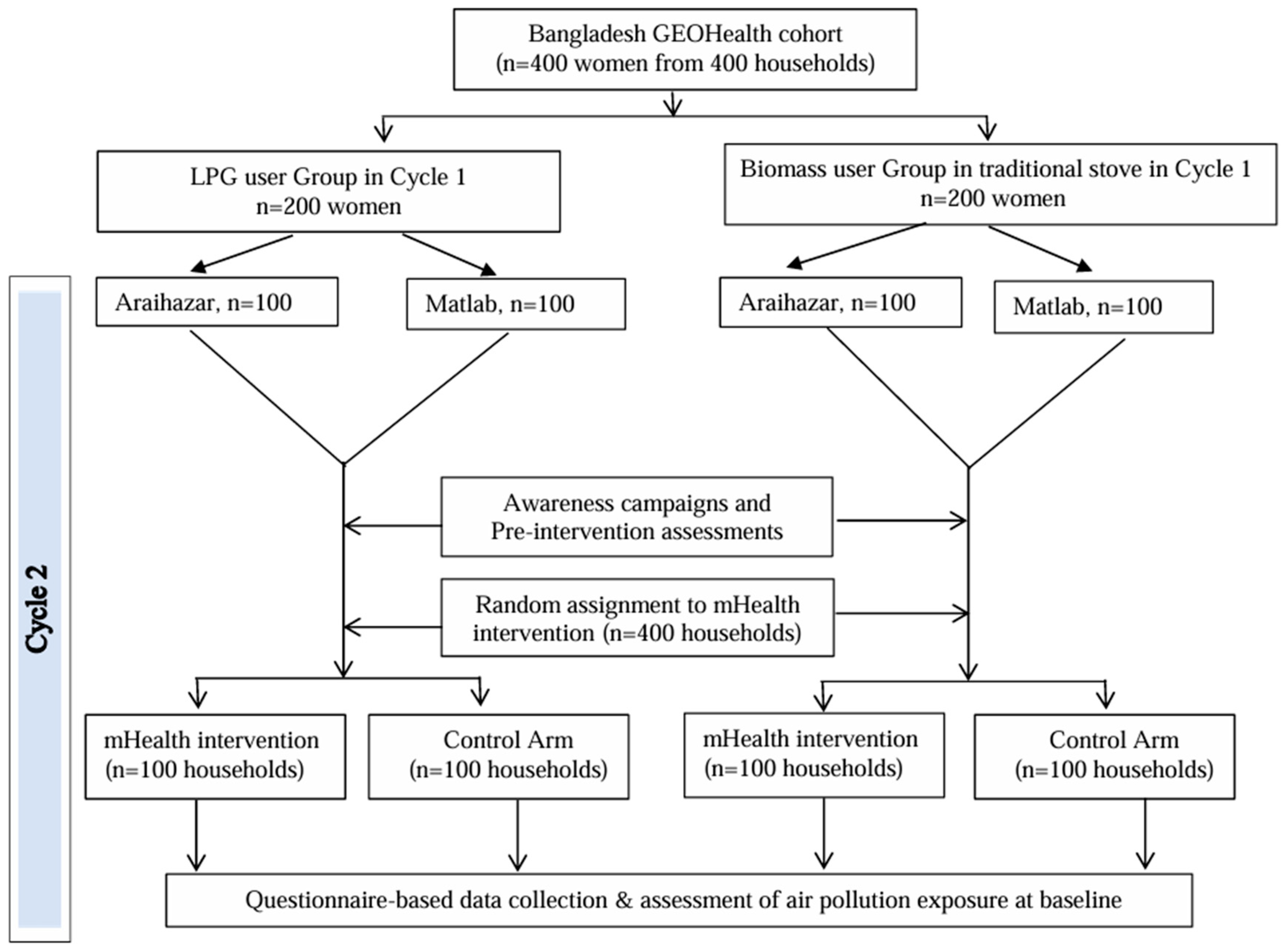
A total of 400 women from 400 households were enrolled in 2023; 200 from Matlab and 200 from Araihazar (Figure 1). All participants were non-smoking married women aged 25–65 years, serving as the primary cooks of their households with at least 10 years of cooking experience. Participants were enrolled from 13 villages in Matlab and 32 villages in Araihazar.

2.2. Questionnaire-Based Data Collection

Trained field staff identified eligible participants, obtained informed consent, and collected detailed information from all enrolled women using a tablet-based structured questionnaire. Data collection was conducted through KoboToolbox (Kobo Inc. Cambridge, MA, USA), an open-source digital data collection platform, to ensure accuracy and minimize entry errors. The questionnaire captured information on demographic characteristics, socioeconomic status, and household environments. Detailed data were collected on kitchen and cooking characteristics, including fuel types and usage patterns, cooking times and duration, the number and type of kitchens being used in the household, and the construction materials of kitchen walls and roofs. Additional information obtained included potential sources of air pollution exposure, such as the smoking behavior of participants, and the proximity of households to main roads or highways and formal and informal factories.
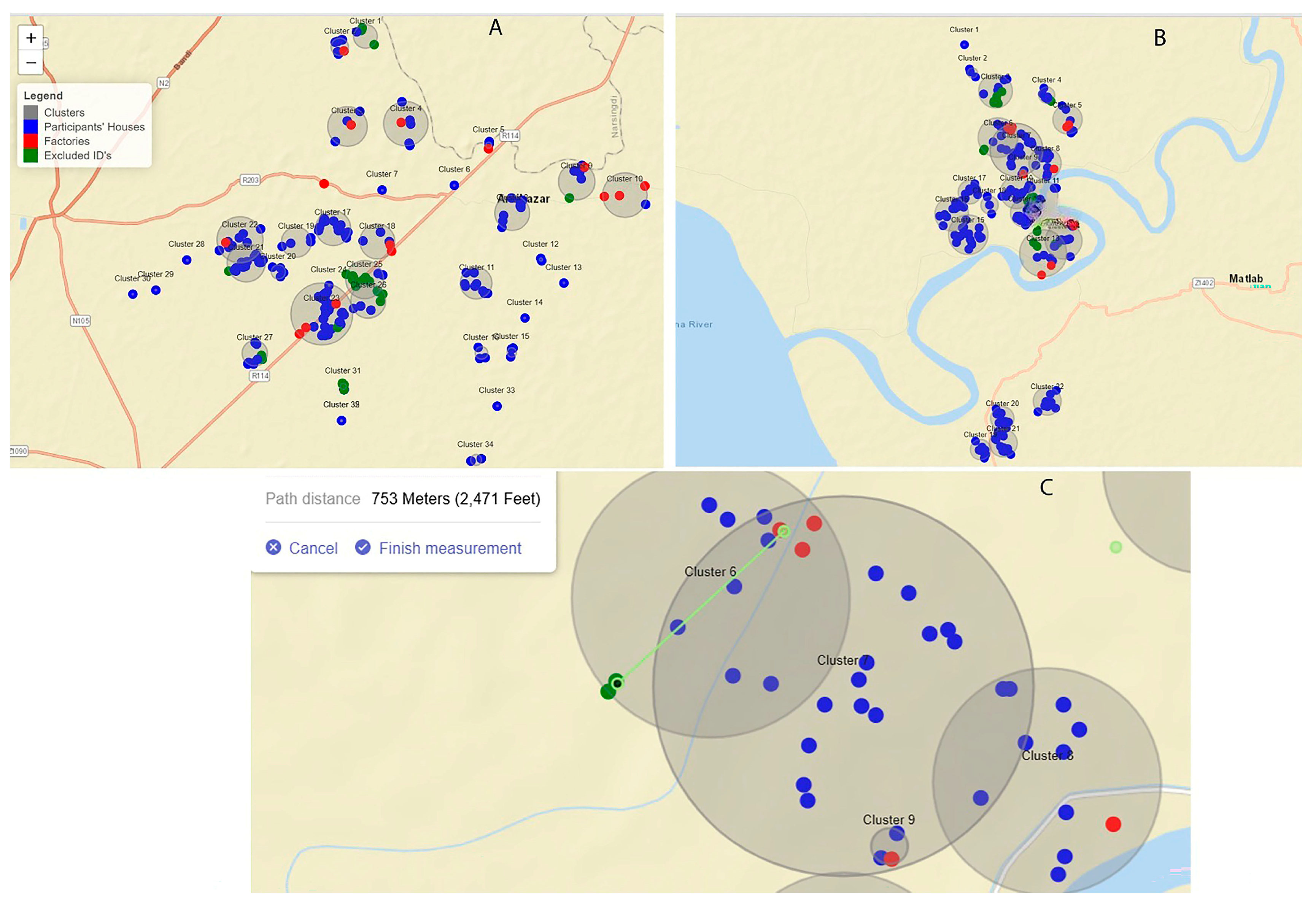
In the enrolled households, cooking practices varied: some relied exclusively on biomass fuels, others used only clean fuels (e.g., LPG, or electric stoves), while many used both types of fuel consecutively in a day (fuel stacking). Kitchens were categorized as closed, semi-open, or open based on their structural characteristics and construction materials (Supplementary Figure S1). The closed kitchens are enclosed by 4 walls and a roof, generally constructed with bricks, concrete or tin. Semi-open kitchens are very common in rural areas, with one or two open sides, and a roof, where the walls and roof are made of materials such as tin, wood, or bamboo, allowing smoke from the kitchen to disperse more easily. Another type of rural kitchen consists of one or two walls, with a roof, typically made of straw or wood, with gaps between the structures that enhance ventilation; these are categorized as open kitchens. Households were also categorized into two groups based on their proximity to major pollution sources such as brick factories with kilns, textile or spinning mills, power-loom factories, and other local industries (e.g., traditional bakeries, rice mills, sawmills, and printing workshops) (Figure 2).
Households located within 500 m of any such facility were classified as having “factories nearby,” while those situated beyond this distance were labeled as having an “absence of factories.” Similarly, households within 500 m of a main road were classified as “near main road,” and those located farther away were categorized as “far from main road”.

2.3. Collection of GPS Data

Geographic information system (GIS) data were collected using the open-source KoboToolbox application on tablet devices to record geospatial information, including GPS coordinates of household locations and nearby potential pollution sources (within 1 km), such as main roads, mills, and factories, during field visits by trained data collectors. The collected GPS data were processed and analyzed in R using the geosphere and leaflet libraries. Mapping with the leaflet package enabled visualization of household clusters based on spatial proximity and attribute data. Clustering algorithms were used to determine distances between households and nearby factories or roads. For outdoor air pollution assessment, households located within a 500 m radius were grouped into distance-based clusters (Figure 2). The final map displayed these clusters and pollution sources using color-coded symbols: gray circles for household clusters, blue dots for households within or outside cluster rings, red dots for mills or factories, green dots for households excluded from analysis, and light orange lines for main roads or highways.

2.4. Measurement of Air Pollution

We assessed personal, kitchen (indoor), and outdoor air pollution exposures at the household level over a whole year period (from September 2023 to August 2024) including both the dry and wet seasons. Personal PM2.5 and BC levels for 24 H were monitored for all participants (n = 400) using a filter-based Ultrasonic Personal Aerosol Sampler (UPAS version 2; Access Sensor Technologies, Fort Collins, CO). Kitchen PM2.5 concentrations were measured over 72 h in 50% of randomly selected households (n = 200; 100 from Matlab and 100 from Araihazar). Outdoor air pollution for continuous 5-day periods was assessed for all enrolled households, organized into GPS-based location clusters (described above). To measure PM2.5 in both the kitchen and outdoor locations of a household, we used the PurpleAir Flex (PurpleAir Inc., Draper, UT, USA), an air quality monitor that deploys the light-scattering method to measure PM2.5 concentrations.

2.5. Personal Air Pollution Assessment

Personal exposure to fine particulate matter (PM2.5; particles ≤ 2.5 µm in diameter) was measured using a filter-based UPAS Version 2 personal air monitor. The UPAS device measures particulate matter gravimetrically and includes integrated sensors to record airflow, temperature, pressure, humidity, and acceleration. A mass flow controller maintains a constant sampling rate, while the acceleration sensor tracks participant movement to ensure accurate assessment of personal exposure [19].
For device deployment, field staff scheduled appointments with participants at their houses (n = 400; 200 from Matlab and 200 from Araihazar). On the monitoring day, UPAS units were pre-programmed for 24 h of operation, memory cards were inserted, and each device was labeled with the ID of the participant and placed in a custom-made pouch worn near the participant’s breathing zone.
Air samples were collected by the UPAS pump through 37 mm polytetrafluoroethylene filters (pore size: 2.0 µm; Measurement Technologies Laboratories, Minneapolis, MN, USA) at a constant flow rate of 1 L/min, with a separate filter used for each participant. Filters were weighed before and after sampling using a fully automated microbalance (METTLER Model MT5, Mettler Toledo, Greifensee, Switzerland) and were maintained in a temperature- and humidity-controlled laboratory at the Atomic Energy Centre, Dhaka, Bangladesh. Field blank filters were kept in the local field offices within the study communities throughout the sampling period and were later packaged together with the sampled filters for shipment to the laboratory at the Atomic Energy Commission, Dhaka. Details of the gravimetric analysis for PM2.5 and BC have been described previously [16,17,18]. All environmental and operational data were logged on the device and could be downloaded either wirelessly via Bluetooth or directly from the memory card for analysis.
For quality control of UPAS devices, all devices were pre-calibrated at the AST warehouse prior to deployment. Field staff ensured proper operation by checking battery levels (voltage, charge and 100% of duty cycle), if the device was GPS enabled, flow rates and memory card functionality, etc., before each deployment. Inter-device variation was assessed by having a single participant wear two devices on separate days under identical daily activities; this procedure was conducted for eight participants. Any anomalies in airflow or environmental sensor readings were flagged for review. The UPAS device contains a built-in motion sensor that allows checking of individual participant’s movement within the household premises and whether the device was worn or kept aside for personal reasons (bathing and sleeping).

2.6. Kitchen Air Pollution Assessment

Air pollution was monitored in the kitchens of 50% of the households selected through computer-based randomization. Of these, half were from Matlab and half from Araihazar. Within each site, households were further divided equally into intervention and control groups. For participants using more than one kitchen, the most frequently used kitchen was designated as the primary kitchen for air quality assessment. Sixty-two percent (n = 249) of the participants had two kitchens in their households. PurpleAir Flex sensors were installed in these primary kitchens to record air quality. Devices were typically installed in the morning and operated throughout the 72 h period, where date and time were recorded by field staff. Before installation, the field team contacted the participant to confirm availability. Each sensor was positioned approximately 4–5 feet away from the cooking stove and mounted on a bamboo, wooden, or concrete pillar of the roof or wall of the kitchen. To ensure uninterrupted operation, portable power banks were used to supply continuous power. All data were stored on an external microSD card (memory card) within the device. For safety and security, both the PurpleAir Flex sensor and the power bank were kept inside locked cages. Repeat measurements of air pollution in kitchens were performed for about 10% of households, with a coefficient of variance of 13.9%. The PurpleAir Flex detects PM2.5 within 0–500 µg/m3, extendable up to ~1000 µg/m3.

2.7. Outdoor Air Pollution Measurement

Outdoor air pollution was measured for 120 h using PurpleAir Flex devices, covering a 0.5 km (≈0.3 mile) radius to assess PM2.5 levels. Here, instead of measuring PM2.5 outside each household, we selected clusters of households (1 to 31 households) located in close proximities. Within each cluster, a central point was identified using household geographic coordinates to guide monitoring placement. A PurpleAir Flex device was placed in the yard of a household at a central point of the cluster to represent outdoor air quality for the surrounding households within 500 m. A total of 22 clusters were established in Matlab and 36 clusters in Araihazar, covering all enrolled households (n = 400). Each PurpleAir Flex device was deployed for a continuous 5-day measurement period to capture diurnal and day-to-day variations in PM2.5 concentrations. The 5-day average PM2.5 concentration from each cluster was calculated and outdoor exposure values were then assigned to all households and participants within the respective cluster, ensuring consistent representation of exposure among spatially close households. In total, outdoor PM2.5 exposure estimates were distributed to 400 participants based on this cluster-based allocation method. This approach allowed for efficient and representative estimation of outdoor air pollution exposure in areas with limited monitoring resources. Repeat outdoor air pollution measurements were conducted in approximately 30% of clusters across the same and different seasons, yielding a coefficient of variation of 16.5%. The inter-device variation was assessed through co-location testing, where multiple monitoring devices were operated simultaneously in the same location for a defined period prior to field deployment. When two PurpleAir Flex Air Quality Monitoring devices were placed in the same environment and their 24 h PM2.5 measurements were compared, regression analysis demonstrated near-perfect agreement. The regression slope (1.086) was very close to unity, the intercept (−0.7315) was close to zero, and the coefficient of determination (R2 = 0.999) indicated that almost all variability in measurements from one device was explained by the other. This result suggests that the devices provided highly consistent and reliable PM2.5 measurements under identical environmental conditions.
A detailed description of PM2.5 measurement in kitchen and outdoor settings using the PurpleAir Flex device, along with device data management and quality control procedures, is provided in the Supplementary File. Personal-to-kitchen (P/K), kitchen-to-outdoor (K/O), and personal-to-outdoor (P/O) PM2.5 ratios were determined to investigate the influence of household cooking activities and indoor emissions on overall personal exposure levels.

2.8. Statistical Analysis

Normal probability plots were used to assess the distribution of PM2.5 concentrations, but the data did not follow a normal distribution. However, we intentionally avoided applying any statistical transformations since these would alter the natural scale and interpretation of PM2.5 concentrations, which are meaningful in their untransformed form for both public health assessment and policy implications [20]. Instead, the data were stratified by cooking and non-cooking periods. This approach reduced part of the variability (noise) in the data by distinguishing between periods of high and low exposure, although it did not eliminate variability. We performed a linear regression analysis to evaluate the association between personal PM2.5 concentrations measured by the UPAS gravimetric method and kitchen PM2.5 concentrations obtained using the PurpleAir Flex light-scattering method. A multivariate regression model was used to explore the differences in exposures (personal PM2.5, personal BC, kitchen PM2.5 and outdoor PM2.5) between Araihazar and Matlab. We also used the multivariate regression model to determine the effects of kitchen types and fuel types on personal PM2.5 separately for Araihazar and Matlab. The regression models were adjusted by temperature, humidity and time (collection month of exposure). We further used a linear mixed-effect model to identify variables that contributed to personal and kitchen exposures, where locality was used as a random factor and kitchen and fuel types as fixed factors. Outdoor PM2.5 concentrations were derived from cluster-level measurements. The 5-day average PM2.5 concentration from each cluster was assigned to all participating households within that cluster to ensure consistent representation of outdoor exposure among spatially close households. To assess whether household proximity to factories or main roads influenced personal air pollution exposure, we conducted linear regression, scatterplot, and binned scatterplot analyses, followed by spline regression to identify the exact threshold distance. For outdoor air pollution, the analysis considered distances between households and polluting sources, ranging from 50 to 500 m. After reviewing the spatial distribution map of the study area, 58 households were identified to be located at a distance of ≥500 to ≤800 m from the nearest factory. However, as these households were situated in areas surrounded by two or more factories, they were excluded from the final analysis to maintain consistency in exposure classification. Stata (version 15) and Python 8.0 were used for data analysis and GraphPad Prism 8.3.2 (GraphPad Software, San Diego, CA, USA) was used to generate the figures.

3. Results

3.1. Participant Characteristics and Kitchen Types

Out of 400 women enrolled in the study, two passed away before start of data collection. The mean age of the study participants (n = 398) was 43 years. The majority of the women were housewives, with 6–10 years of formal education, who had been cooking for the family for an average of 24 years (Table 1).
On a typical day, they spent around 3 to 5 h (4.20 ± 0.9 h) in the kitchen cooking the main meal of the day, while in the evenings, they generally spent a shorter duration in the kitchen. The monthly household expenditure of about 89% of the participants was in the range of 82 to 165 USD.
There were three main types of kitchens: closed, semi-open, and open (Table 1, Supplementary Figure S1). The majority of households had closed kitchens (68.1%), while about 26% used semi-open kitchens and only 7% cooked in open spaces. Many households (59%) reported having both closed and semi-open kitchens. About one-tenth of households used clean fuel stoves (LPG or electric) exclusively, 20% relied solely on biomass fuel, and over two-thirds (68%) practiced fuel stacking. Among households using both types of fuel, biomass fuel was predominantly used to prepare the main meal (lunch and dinner together) during the day, while clean fuels were used less frequently, mainly for reheating pre-cooked food at night. Though a higher number of households in Matlab (86%) had access to clean fuel (i.e., LPG), fewer households in this area used clean fuel exclusively (~6%) compared to those in Araihazar (~18%), as fuel stacking was more prominent in Matlab (81%) than in Araihazar (56%). Major reasons for using biomass fuel were the high cost of clean fuel (68%), and the free/cheap availability of biomass fuel (65%) both in rural and peri-urban areas. Few participants mentioned cooking preference by household head (1.25%), a lack of a smooth supply of clean fuel due to distance from the marketplace (2.5%) and being afraid to use an LPG cylinder (0.07%). A substantial proportion of households were located near a main road (35%) or in close proximity to informal factories (62%) (Table 1).

3.2. Personal Air Pollution Exposure

The personal air pollution exposure data include concentrations of both PM2.5 and BC, as assessed by the UPAS. The average temperature and humidity data during the 24 h monitoring periods from UPAS devices were checked. The sensor performance of the devices was found to be optimal, as the temperature range was confined to 25 to 37 °C, which was within the permitted range of the UPAS (0–40 °C). Similarly, the humidity data were limited to 35% to 52.5%, also within the allowable range of 0–90% (Supplementary Figure S2). The overall 24 h mean levels of PM2.5 were 244.6 ± 115.2 µg/m3 and BC was 3.93 ± 1.94 µg/m3 (Table 2). Participants from rural Matlab exhibited higher levels of PM2.5 in personal air in comparison to Araihazar women (p < 0.001); however, the scenario was the opposite for BC, as it was higher in Araihazar women (p < 0.001). Consequently, the proportion of BC concentration in total PM2.5 was also higher in Araihazar (2.42%) compared to Matlab (1.36%).
Multivariate regression analysis showed that women exclusively using biomass fuel for cooking had 68.4 and 0.81 µg/m3 higher PM2.5 (95% CI = 6.69, 130.2) and BC (95% CI = 0.04, 1.58) levels, respectively, in personal air compared to exclusive clean fuel users (Table 3). Women using both types of fuel (mixed use) in a day showed 52 and 0.79 µg/m3 higher PM2.5 (95% CI = 16.2, 87) and BC (95% CI = 0.03, 1.55, in Araihazar only) levels, respectively, compared to exclusive clean fuel users.
Women cooking in open kitchens using either biomass fuel or used mixed fuels were exposed to 51.8 µg/m3 (95% CI −99.1, −4.46; p = 0.032) lower levels of PM2.5 compared to those who cooked in closed kitchens (Table 3). Women using clean fuel exclusively were excluded from this analysis. However, no such change was obtained for personal BC levels between the open and closed kitchens. We further found that personal PM2.5 levels were strongly associated with overall PM2.5 levels in the kitchen (R2 = 0.722) (Supplementary Figure S3), reflecting that kitchen air pollution had a significant influence on women’s personal exposure and was the major source of PM2.5 exposure.

3.3. Kitchen Air Pollution

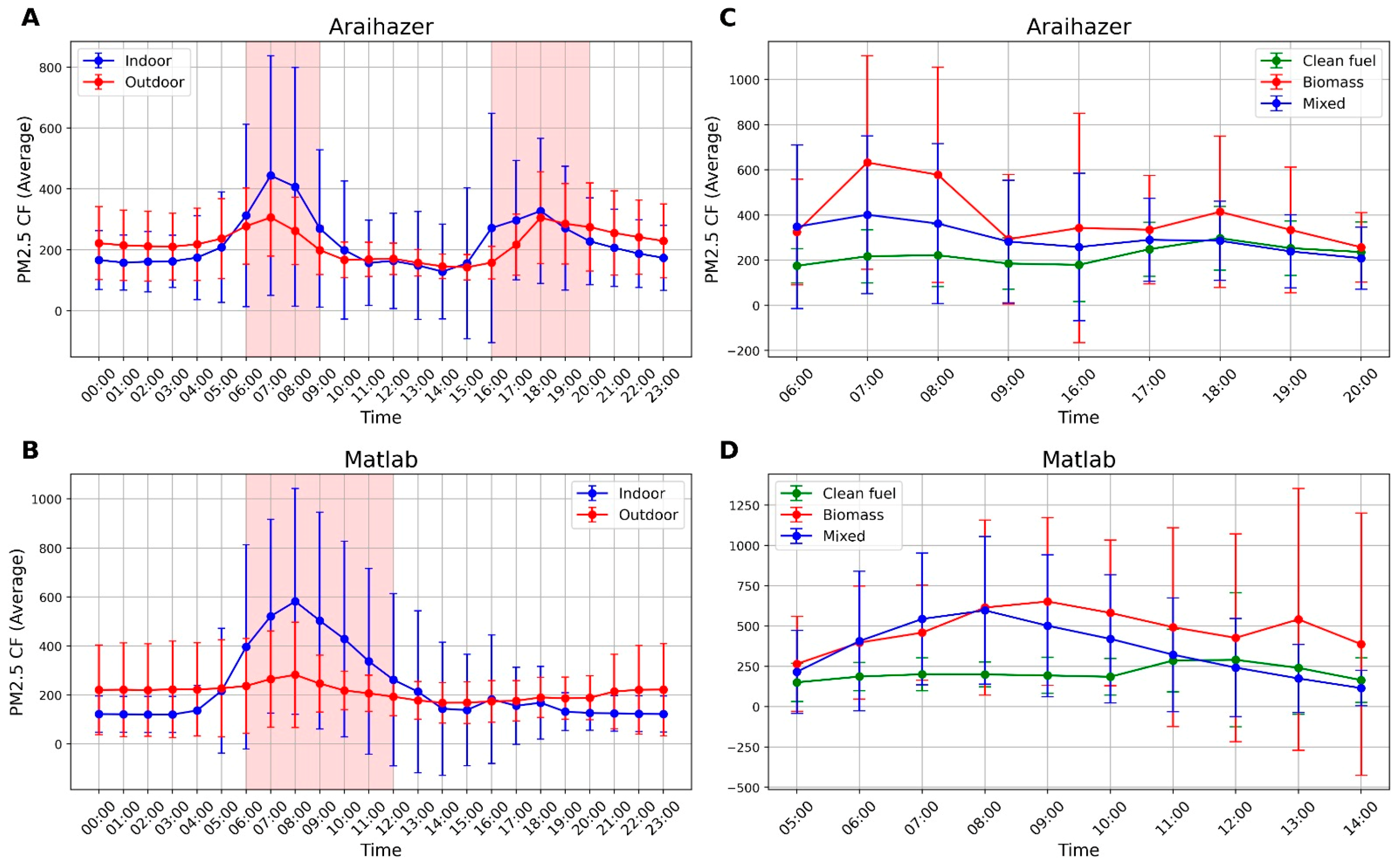
Continuous monitoring of PM2.5 levels in the kitchen for 48 to 72 h for three consecutive days using a light-scattering method allowed for the determination of air pollution levels in the kitchens, and temporal comparisons between days and nights, cooking and non-cooking time and between rural and peri-urban kitchens. The daily overall mean PM2.5 levels in the kitchen were 275.2 ± 218.5 µg/m3; peak levels were noted during the main meal cooking time (427 ± 397.1 µg/m3) (Table 2). The pattern of PM2.5 peaks varied by locality (rural vs. peri-urban) (Figure 3).
In rural Matlab, one distinct PM2.5 peak (~600 µg/m3) was observed during the cooking period, starting around 0600 and lasting until about 1200 noon, during which breakfast, lunch, and dinner were prepared together. This indicates that women in Matlab typically cooked all meals once a day (Figure 3A). In peri-urban Araihazar, two distinct PM2.5 peaks were observed: the first began around 0600 (~450 µg/m3) and lasted until about 0900, while the second peak was noted between 1600 and 1900 (~300 µg/m3) (Figure 3B). This pattern suggests that women in Araihazar typically prepare breakfast and lunch together during the morning peak and cook dinner separately in the evening. Peak kitchen average PM2.5 values (considering biomass, clean fuel and fuel stacking together) during main meal cooking hours in Matlab (300–600 µg/m3) were higher than Araihazar kitchens (250–450 µg/m3). Peaks of PM2.5 levels were observed in households that used biomass fuel exclusively or practiced fuel stacking for cooking, whereas no distinct peaks were evident in households using clean fuel only (Figure 3C,D).
Kitchens with biomass stoves exhibited 250 µg/m3 higher PM2.5 levels (95% CI = 113.9, 386.5) compared to those with clean fuel stoves; the scenario was the same for individual sites as well as when combined together (Table 3). Semi-open and open kitchens showed significantly lower air pollution compared to closed kitchens by 35.5 µg/m3 and 92.8 µg/m3, respectively (Table 3). We found that the daily mean PM2.5 levels in rural kitchens (308.2 ± 284.8 µg/m3) were significantly higher compared to peri-urban kitchens (242.5 ± 113.6 µg/m3) (Table 2). Furthermore, rural Matlab kitchens had significantly higher PM2.5 levels, both during the cooking and non-cooking periods in comparison to Araihazar kitchens (Figure 3).
The personal-to-kitchen (P/K) PM2.5 ratio during cooking time was lower than 1.0 (0.83 ± 0.97), while during the non-cooking time the ratio was higher than 1.0 (Table 2). This reflected that kitchen pollution was higher than personal exposure during cooking time, which declined after the cooking period ended. The overall ratio being more than 1.0 suggested that throughout the day, including both cooking and non-cooking periods, personal PM2.5 exposure levels remained elevated compared to kitchen PM2.5 levels.

3.4. Outdoor Air Pollution and Its Influence on Personal Exposure

The outdoor air of the household can be influenced by smoke escaping from the kitchen, polluted air released from factories located in the vicinity, or dust from main roads with moderately heavy traffic. In Araihazar, 53% of the households were situated close to the main road, with a moderate level of traffic movement. Among the total 31 brick factories identified, the majority (81%) were located in Matlab, where ~13% of households were situated near these factories. In contrast, only 3% of households in Araihazar were located in proximity to brick kilns (Table 1). Due to the peri-urban nature of the area, the presence of factories such as power-loom factories and spinning mills in close proximity to households was confined exclusively to Araihazar. Smoke-producing traditional bakeries were located in Matlab only. Evaluation of outdoor PM2.5 levels showed similar concentrations of PM2.5 in both sites during non-cooking time periods (Table 2, Figure 3). A higher outdoor concentration of PM2.5 was observed for the households that were situated in the vicinity of factories than those without any factories nearby (β = 17.8, 95% CI = 0.42, 35.3; p = 0.045). Regression analysis revealed that presence of brick factories and rice mills in close neighborhoods was positively associated with outdoor PM2.5 levels in both rural Matlab and peri-urban Araihazar, while the existence of traditional bakeries in Matlab and spinning mills/power looms in Araihazar positively influenced outdoor PM2.5 levels (Table 4).
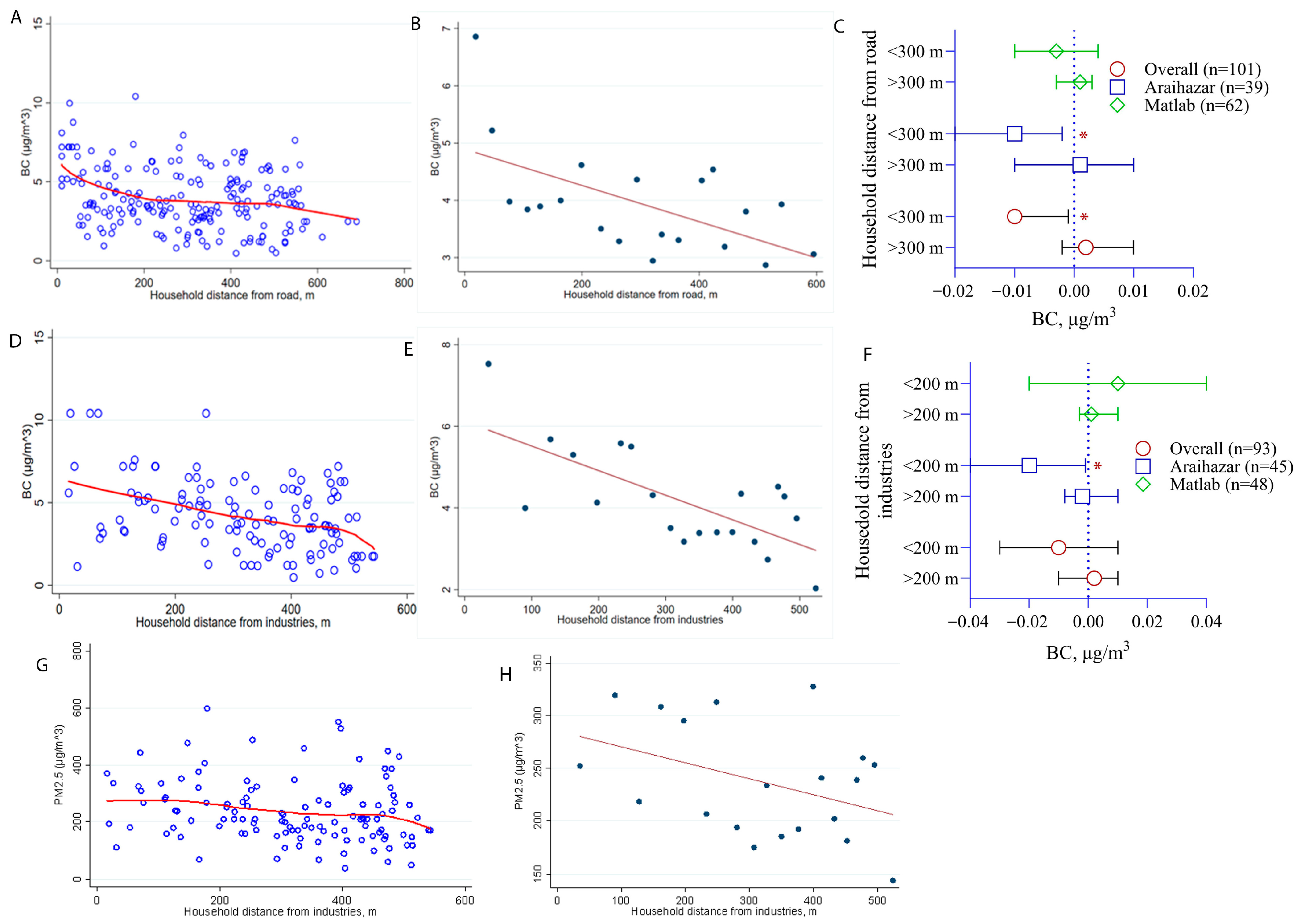
In order to identify the potential threshold distance of households to factories or main roads, which may have an impact on personal air pollution exposure, we carried out linear regression, scatter plot and binned scatterplot analyses. The impact on BC exposure was found in Araihazar only (Figure 4).
With every 1 m decrease in distance from the roads, personal BC levels increased by 0.01 units on average, indicating that participants from the households that were situated closer to main roads (<300 m) were exposed to higher levels of BC, compared to those residing further away (>300 m). Similarly, personal BC exposure was higher in households located near factories (<200 m) in comparison to those situated further away (>200 m). The findings thus explained the presence of higher BC exposure in Araihazar women compared to Matlab women (Table 2). Multivariate regression analysis showed that personal PM2.5 levels were inversely related to the distance of factories from households when the distance was below <300 m (Figure 4) across all participants (β = −0.15, 95% CI = −0.29, −0.01; p = 0.033) (Figure 4H), and particularly in rural Matlab (β = −0.24, 95% CI = −0.49, −0.003; p = 0.049). In Matlab, outdoor PM2.5 levels remained consistently high throughout the day (Figure 3B), likely reflecting the 24 h operation of rice mills, brick kilns, and biscuit factories.
The overall kitchen-to-outdoor (K/O) ratio, as well as the personal-to-outdoor (P/O) ratio, of PM2.5 was more than double-fold in Matlab, which was significantly higher than Araihazar (p < 0.04). Although the average outdoor PM2.5 levels were similar between the two study sites (Table 2), greater use of biomass fuel (either exclusively or fuel stacking) in Matlab (Table 1) resulted in elevated personal and kitchen air pollution during cooking, which also affected the corresponding exposure ratios (Table 2).

4. Discussion

Our findings showed temporal variations in PM2.5 levels with higher PM2.5 in rural kitchens compared to peri-urban kitchens. Clean fuel users displayed lower personal PM2.5 and BC exposures and lower kitchen PM2.5 compared to biomass fuel users. Closed kitchens displayed higher PM2.5 levels than open or semi-open kitchens. Peri-urban households located in the vicinities of informal factories and main roads experienced increased exposure to both BC and PM2.5, whereas in rural areas, elevated PM2.5 was more prominent.
A large body of evidence has shown that burning solid fuel generates substantial air pollution in kitchens and indoors, which was determined by air pollution measuring devices or using proxy indicators [1,21,22]. In recent years, data on personal air pollution measurements have gradually accumulated [23,24,25,26]; however, comparison between simultaneously measured air pollution exposure at personal and indoor levels is scarce [25,27]. Moreover, air pollution measurements have largely been limited to PM2.5 only; BC evaluation has been done in a handful of studies [16,18,25,28]. Consistent with the previous findings, our results ascertained that the burning of biomass fuel contributed significantly to kitchen air pollution as well as to women’s personal exposure to PM2.5 and BC, and that closed kitchens using solid fuel retained higher PM2.5 concentrations compared to open or semi-open kitchens [25]. Adding to the existing literature, we provided further insight into the temporal changes in PM2.5 levels in the kitchen, portraying both the peak and the lowest values in a day. Moreover, we found that air pollution existed differentially in indoor and outdoor environments in rural and peri-urban areas. The locality-specific 24 h average PM2.5 concentrations in both kitchen and outdoor environments were several-folds higher (13 to 21 fold) than the WHO recommended limit of ≤15 µg/m3 [29], reflecting a high burden on health.
Using the same device (UPAS; gravimetric method) for personal and kitchen PM2.5 measurements, Shupler et al. showed moderate correlation between the two measurements (r = 0.69) [25]. Similarly, using the same device (Particle and Temperature Sensor (PATS) and the nephelometric method), Chan et al. found moderate correlation between personal and kitchen PM2.5 (r = 0.52–0.59) [27]. Devices designed for personal use have specific features that are more suitable for personal air pollution measurement than for stationary indoor monitors and vice versa. In the present study, we employed two different devices—one for monitoring personal PM2.5 exposure (gravimetric method) and one for kitchen PM2.5 (light-scattering method)—and observed good agreement of the measurements (R2 = 0.722) between the two monitors (Supplementary Figure S3).
Women cooks of households spend a large fraction of their day in the kitchen (3 to 5 h). The indoor/outdoor ratio of PM2.5 reflects the indoor emission rate and the extent of ventilation through open windows or large open spaces, such as in the case of semi-open kitchens [30]. Both the kitchen-to-outdoor ratio and the personal-to-outdoor ratio of PM2.5 were higher in Matlab than Araihazar, reflecting higher personal exposure among rural women. A growing number of studies have demonstrated that fuel stacking, or the mixed use of both clean and solid fuels, is a common practice, particularly in rural areas [23,25,27,31]. It is possible that since more households in Araihazar exclusively used clean fuel for cooking and, despite that the majority of Matlab households owned clean fuel stoves (80%), there was an increased tendency to use biomass frequently, which is freely available in Matlab, supporting the findings of increased PM2.5 pollution in rural kitchens. Typically, rural areas are presumed to have cleaner air than cities; however, the presence of informal factories contaminate the rural environment to a great extent, as observed in our study. The distance of households from the source of polluting factories or roads was a major driving factor in our study. Even though different types of factories or mills were located in both rural and peri-urban areas, a clear inverse association between personal PM2.5 exposure and factories located within 500 m of households was found in rural areas only. In both rural and peri-urban areas, most mills and factories operate year-round and across day and night, with the exception of brick kilns, which typically function during the dry season. As a result, outdoor PM2.5 concentrations remained elevated throughout both daytime and nighttime at both study sites (Figure 3A,B). Again, the impact on personal BC exposure was predominantly restricted to Araihazar, where the influence was limited to households situated at a distance between <200 to <300 m from informal factories and main roads (Figure 2 and Figure 4). Transport vehicles such as trucks, buses, and light-duty pickups in Bangladesh predominantly use diesel; incomplete combustion of this fuel generates BC [32,33,34]. Small- to medium-scale factories typically use natural gas, oil, and coal for energy production; all these might contribute to BC release in the atmosphere and higher exposure in peri-urban women. Sources of BC pollution differ considerably from region to region. In Asian and African regions, contribution to BC emission ranges from 60 to 80%, originating from the burning of biomass fuels. However, in Europe and North America, about 70% of emissions come from diesel engines such as heavy-duty commercial trucks and large vehicles [33,35]. Supporting recent studies [36,37,38], we have also shown that residential solid fuel burning is a source of black carbon. The locality-specific 24 h average PM2.5 concentrations in both kitchen and outdoor environments were several-folds higher (13- to 21-fold) than the WHO recommended limit of ≤15 µg/m3 [29]. The persistently elevated outdoor PM2.5 levels reflected a substantial contribution from ambient air pollution, which significantly increases the overall health burden in the Bangladeshi population.
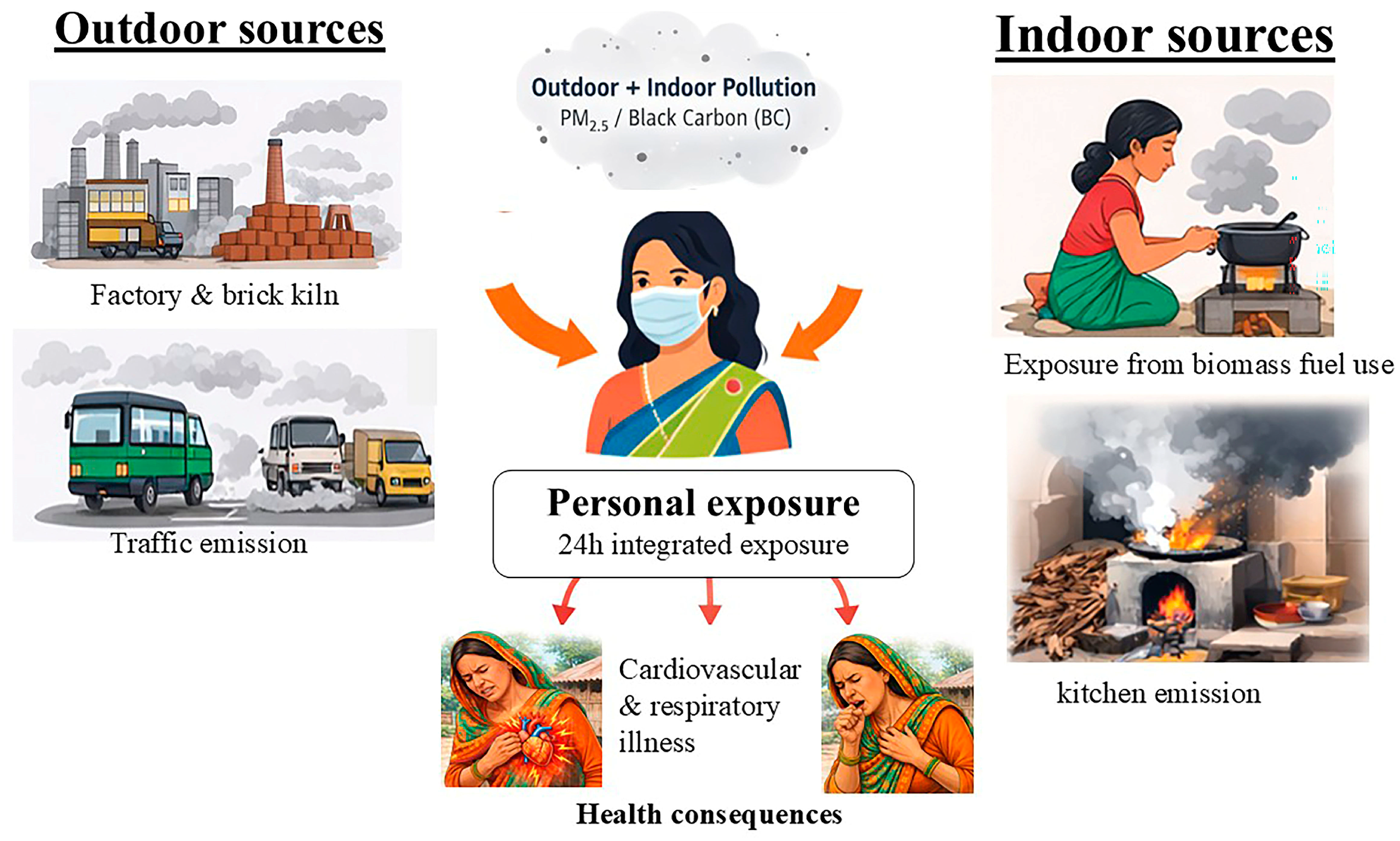
The elevated outdoor PM2.5 levels observed in our study may partly reflect transboundary air pollution, a well-recognized phenomenon in South Asia. Seasonal transport of pollutants from neighboring countries, including coal combustion from power plants, agricultural waste burning, industrial emissions and fireworks during religious festivals, often contribute to increased ambient pollution in Bangladesh. Figure 5 illustrates the integrated air pollution exposure pathway, where personal exposure is influenced by both indoor sources (e.g., biomass cooking and kitchen emissions) and outdoor sources (e.g., road traffic, factories, and brick kilns).
This study has several strengths and novelties. All PurpleAir Flex devices were factory-calibrated and underwent laboratory validation before field deployment to ensure measurement reliability. Only sensors demonstrating proportional and instantaneous changes in PM2.5 across both internal channels were approved for field use and hence, marginal errors in measurement were minimal; moreover, sensor cleaning and hardware inspections were routinely conducted by the bioengineering unit. Even with the common challenges of light-scattering method-based devices, in our study, we found a strong correlation between light-scattering and gravimetric methods. A large number of studies described self-reported average cooking time [25,39,40,41], while we collected real-time data of cooking through the use of light-scattering sensors. We have shown temporal changes in air pollution levels inside kitchens and the outdoors using data collected over a period of 72 to 120 h. Additionally, both the personal and kitchen PM2.5 data were collected concurrently and we found a strong association between the two measurements, indicating the robustness of our procedures. Earlier studies have reported elevated outdoor or ambient air pollution in either rural or urban areas [42,43]; however, unlike our study, comparative data between the two regions have rarely been presented [27]. Another novelty in our study was the application of the GIS for location mapping of households, main roads and factories, which enabled us to measure the distance between the two locations critical for the influence on personal exposure. For the characterization of exposure from outdoor/ambient air pollution, nearly all studies rely on fixed site monitoring data from a public air quality database that encompass a huge area (5 to 10 km) and spatio-temporal models; however, the influence of outdoor air pollution on personal exposure is often not determined. We used sensors that reflect the outdoor PM2.5 status within a 500 m range affecting the household residents.

5. Limitations of the Study

Our study had a number of limitations. Repeated time-resolved assessment (in different seasons) of personal, kitchen and outdoor air pollution of the same household was not carried out for 100% of the participants, to track fluctuations and identify events over different time periods due to logistic constraints [27]. However, for seasonal effects, we performed repeat measurements of outdoor and kitchen air pollution in 30% and 10% households, respectively. Additionally, the data were adjusted by temperature, humidity and month of exposure assessment. In Bangladesh, brick factories operate in dry seasons and are more common in Matlab. It is possible that seasonal brick building may have influenced Matlab’s outdoor air pollution, which was not controlled in our study. Another limitation was that we did not measure PM2.5 in the outdoors of every household; instead, we selected clusters of households located within a range of 500 m to measure outdoor PM2.5, which were not representative of all individual households (Figure 2).

6. Conclusions

This study demonstrated the importance of collecting simultaneous air pollution exposure data at personal, kitchen and outdoor levels to capture the dynamics and complexity of air pollution exposure in rural and urban settings. It is apparent that high levels of outdoor air pollution via road traffic and formal and informal factory emissions also influence the air quality inside households, thereby reducing the benefits of clean fuel use. The steady levels of outdoor PM2.5 at about several-fold higher than the WHO limit in Bangladesh clearly show that air pollution is a public health emergency that warrants urgent action. The findings of our study have important policy implications for Bangladesh. Strengthening the enforcement of emission regulations for industries, including brick kilns, and improving control of traffic-related emissions are essential to reduce ambient air pollution. Our results also underscore the need for policies promoting cleaner household energy use to mitigate indoor exposure. Establishing zoning regulations for informal industries in rural/peri-urban areas requires adequate separation between residential areas, industries and major roads. Maintaining minimum setback distances and developing green buffer zones with vegetation around factories may help reduce community-level exposure in peri-urban settings. Finally, coordinated expansion of air quality monitoring and regulatory oversight across both rural and peri-urban areas is critical to address the combined influence of household and ambient pollution sources.

Supplementary Materials

The following supporting information can be downloaded at: https://www.mdpi.com/article/10.3390/su18073507/s1, Table S1. Abbreviations with full form; Table S2. Relationship between Personal, kitchen, and outdoor PM2.5 levels in peri-urban Araihazar and rural Matlab sites; Figure S1. Types of kitchens. Plot A shows open kitchen, B represents semi-open kitchen and C displays closed type of kitchen; Figure S2. Average temperature and humidity data during the 24-hour monitoring periods from UPAS devices; Figure S3. Correlation of PM2.5 concentrations measured by light scattering method using PurpleAir-Flex monitor with the gravimetric method using a personal air monitoring device (UPAS); Figure S4: The regression slope presenting inter-device variation between the two PurpleAir Flex Air Quality Monitor devices. References [44,45,46] are cited in Supplementary Materials.

Author Contributions

Conceptualization, H.A., M.Y. and R.R.; methodology, E.A., S.H., M.S., S.T., B.A.B., M.E., G.S. and F.P.; software, M.A.H. and S.H.; validation, E.A., M.A.H. and B.A.B.; formal analysis, M.A.H.; investigation, E.A., M.S., S.T., B.A.B., M.E. and G.S.; resources, R.R.; data curation, M.A.H.; writing—original draft preparation, E.A. and R.R.; writing—review and editing, E.A., M.A.H., S.H., M.S., S.T., B.A.B., M.E., G.S., F.P., H.A., M.Y. and R.R.; visualization, M.A.H. and S.H.; supervision, E.A., M.S., M.E., M.Y. and R.R.; project administration, R.R., E.A. and M.E.; funding acquisition, R.R. and H.A. All authors have read and agreed to the published version of the manuscript.

Funding

Research reported in this publication was supported by the Fogarty International Center of the National Institutes of Health (NIH) under Award Number 2U01TW010120-06. icddr,b acknowledges with gratitude the commitment of NIH to its research efforts. icddr,b is also grateful to the Governments of Bangladesh and Canada for providing core/unrestricted support.

Institutional Review Board Statement

The study was conducted in accordance with the Declaration of Helsinki, and the protocol was approved by the Ethical Review Committee (ERC) at icddr,b (Project identification code: PR# 22057) on 26 June 2022 (ERC approval date) and 9 September 2023 (Addendum approval date) in Bangladesh.

Informed Consent Statement

Written informed consent was obtained from adult participants.

Data Availability Statement

The original contributions presented in this study are included in the article. Further inquiries can be directed to the corresponding author.

Conflicts of Interest

The authors declared no potential conflicts of interest with respect to the research, authorship, and/or publication of this article.

References

  1. WHO. WHO Indoor Air Quality Guidelines: Household Fuel Combustion. 2014. Available online: https://sdgs.un.org/sites/default/files/publications/1969Indoor%20Air%20Quality.pdf (accessed on 17 February 2026).
  2. WHO. Air Quality, Energy and Health. Available online: https://www.who.int/teams/environment-climate-change-and-health/air-quality-energy-and-health/health-impacts# (accessed on 17 February 2026).
  3. Air Quality Life Index. Bangladesh Fact Sheet. 2025. Available online: https://aqli.epic.uchicago.edu/files/Bangladesh%20FactSheet_2025.pdf (accessed on 17 February 2026).
  4. Hoffmann, B.; Boogaard, H.; de Nazelle, A.; Andersen, Z.J.; Abramson, M.; Brauer, M.; Brunekreef, B.; Forastiere, F.; Huang, W.; Kan, H.; et al. WHO Air Quality Guidelines 2021-Aiming for Healthier Air for all: A Joint Statement by Medical, Public Health, Scientific Societies and Patient Representative Organisations. Int. J. Public Health 2021, 66, 1604465. [Google Scholar] [CrossRef]
  5. Lai, P.S.; Lam, N.L.; Gallery, B.; Lee, A.G.; Adair-Rohani, H.; Alexander, D.; Balakrishnan, K.; Bisaga, I.; Chafe, Z.A.; Clasen, T.; et al. Household Air Pollution Interventions to Improve Health in Low- and Middle-Income Countries: An Official American Thoracic Society Research Statement. Am. J. Respir. Crit. Care Med. 2024, 209, 909–927. [Google Scholar] [CrossRef]
  6. Romanello, M.; Walawender, M.; Hsu, S.C.; Moskeland, A.; Palmeiro-Silva, Y.; Scamman, D.; Smallcombe, J.W.; Abdullah, S.; Ades, M.; Al-Maruf, A.; et al. The 2025 report of the Lancet Countdown on health and climate change. Lancet 2025, 406, 2804–2857. [Google Scholar] [CrossRef]
  7. State of Global Air. Health Impacts of Air Pollution. 2025. Available online: https://www.stateofglobalair.org/hap# (accessed on 17 February 2026).
  8. Lake, E.A.; Karras, J.; Marks, G.B.; Cowie, C.T. The effect of air pollution on morbidity and mortality among children aged under five in sub-Saharan Africa: Systematic review and meta-analysis. PLoS ONE 2025, 20, e0320048. [Google Scholar] [CrossRef] [PubMed]
  9. Taj, T.; Chen, J.; Rodopoulou, S.; Strak, M.; de Hoogh, K.; Poulsen, A.H.; Andersen, Z.J.; Bellander, T.; Brandt, J.; Zitt, E.; et al. Long-term exposure to ambient air pollution and risk of leukemia and lymphoma in a pooled European cohort. Environ. Pollut. 2024, 343, 123097. [Google Scholar] [CrossRef]
  10. Varghese, D.; Ferris, K.; Lee, B.; Grigg, J.; Pinnock, H.; Cunningham, S. Outdoor air pollution and near-fatal/fatal asthma attacks in children: A systematic review. Pediatr. Pulmonol. 2024, 59, 1196–1206. [Google Scholar] [CrossRef] [PubMed]
  11. Li, Q.; Guo, Y.; Yang, J.; Liang, C. Review on main sources and impacts of urban ultrafine particles: Traffic emissions, nucleation, and climate modulation. Atmos. Environ. X 2023, 19, 100221. [Google Scholar] [CrossRef]
  12. Population and Housing Census. Report on Socio-Economic and Demographic Survey. BRAC University-BBS. 2024. Available online: https://library.bracu.ac.bd/vufind/Record/47143/Versions?utm_source (accessed on 17 February 2026).
  13. Modern Energy Cooking Services. Bangladesh eCooking Market Assessment. 2022. Available online: https://mecs.org.uk/wp-content/uploads/2022/02/MECS-EnDev-Bangladesh-eCooking-Market-Assessment-presentation.pdf (accessed on 17 February 2026).
  14. SREDA. National Action Plan for Clean Cooking in Bangladesh 2020–2030, Sustainable and Renewable Energy Development Authority, Ministry of Power, Energy and Mineral Resources, Government of the People’s Republic of Bangladesh. 2019. Available online: https://climate-laws.org/document/national-action-plan-for-clean-cooking-2020-2030_309d (accessed on 17 February 2026).
  15. Bangladesh Bureau of Statistics. Bangladesh Sample Vital Statistics 2018. 2018. Available online: https://sdg.gov.bd/uploads/resources/attachment_f20d57af73f96e68800b571d41d72807.pdf (accessed on 17 February 2026).
  16. Raqib, R.; Akhtar, E.; Sultana, T.; Ahmed, S.; Chowdhury, M.A.H.; Shahriar, M.H.; Kader, S.B.; Eunus, M.; Haq, M.A.; Sarwar, G.; et al. Association of household air pollution with cellular and humoral immune responses among women in rural Bangladesh. Environ. Pollut. 2022, 299, 118892. [Google Scholar] [CrossRef]
  17. Ahmed, S.; Chowdhury, M.A.H.; Kader, S.B.; Shahriar, M.H.; Begum, B.A.; Eunus, M.; Sarwar, G.; Islam, T.; Alam, D.S.; Parvez, F.; et al. Personal exposure to household air pollution and lung function in rural Bangladesh: A population-based cross-sectional study. Int. J. Environ. Health Res. 2024, 34, 385–397. [Google Scholar] [CrossRef]
  18. Raqib, R.; Akhtar, E.; Ahsanul Haq, M.; Ahmed, S.; Haque, F.; Chowdhury, M.A.H.; Shahriar, M.H.; Begum, B.A.; Eunus, M.; Sarwar, G.; et al. Reduction of household air pollution through clean fuel intervention and recovery of cellular immune balance. Environ. Int. 2023, 179, 108137. [Google Scholar] [CrossRef]
  19. Leith, D.; L’Orange, C.; Mehaffy, J.; Volckens, J. Design and performance of UPAS inlets for respirable and thoracic mass sampling. J. Occup. Environ. Hyg. 2020, 17, 274–282. [Google Scholar] [CrossRef]
  20. WHO. Household Air Pollution. 2024. Available online: https://www.who.int/news-room/fact-sheets/detail/household-air-pollution-and-health (accessed on 17 February 2026).
  21. Balmes, J.R. Household air pollution from domestic combustion of solid fuels and health. J. Allergy Clin. Immunol. 2019, 143, 1979–1987. [Google Scholar] [CrossRef]
  22. Clark, M.L.; Peel, J.L.; Balakrishnan, K.; Breysse, P.N.; Chillrud, S.N.; Naeher, L.P.; Rodes, C.E.; Vette, A.F.; Balbus, J.M. Health and household air pollution from solid fuel use: The need for improved exposure assessment. Environ. Health Perspect. 2013, 121, 1120–1128. [Google Scholar] [CrossRef] [PubMed]
  23. Ni, K.; Carter, E.; Schauer, J.J.; Ezzati, M.; Zhang, Y.; Niu, H.; Lai, A.M.; Shan, M.; Wang, Y.; Yang, X.; et al. Seasonal variation in outdoor, indoor, and personal air pollution exposures of women using wood stoves in the Tibetan Plateau: Baseline assessment for an energy intervention study. Environ. Int. 2016, 94, 449–457. [Google Scholar] [CrossRef]
  24. Shahriar, M.H.; Chowdhury, M.A.H.; Ahmed, S.; Eunus, M.; Kader, S.B.; Begum, B.A.; Islam, T.; Sarwar, G.; Al Shams, R.; Raqib, R.; et al. Exposure to household air pollutants and endothelial dysfunction in rural Bangladesh: A cross-sectional study. Environ. Epidemiol. 2021, 5, e132. [Google Scholar] [CrossRef]
  25. Shupler, M.; Hystad, P.; Birch, A.; Miller-Lionberg, D.; Jeronimo, M.; Arku, R.E.; Chu, Y.L.; Mushtaha, M.; Heenan, L.; Rangarajan, S.; et al. Household and personal air pollution exposure measurements from 120 communities in eight countries: Results from the PURE-AIR study. Lancet Planet. Health 2020, 4, e451–e462. [Google Scholar] [CrossRef]
  26. Ye, W.; Saikawa, E.; Avramov, A.; Cho, S.H.; Chartier, R. Household air pollution and personal exposure from burning firewood and yak dung in summer in the eastern Tibetan Plateau. Environ. Pollut. 2020, 263, 114531. [Google Scholar] [CrossRef] [PubMed]
  27. Chan, K.H.; Xia, X.; Liu, C.; Kan, H.; Doherty, A.; Yim, S.H.L.; Wright, N.; Kartsonaki, C.; Yang, X.; Stevens, R.; et al. Characterising personal, household, and community PM(2.5) exposure in one urban and two rural communities in China. Sci. Total Environ. 2023, 904, 166647. [Google Scholar] [CrossRef] [PubMed]
  28. Wang, Y.; Shupler, M.; Birch, A.; Chu, Y.L.; Jeronimo, M.; Rangarajan, S.; Mustaha, M.; Heenan, L.; Seron, P.; Lanas, F.; et al. Measuring and predicting personal and household Black Carbon levels from 88 communities in eight countries. Sci. Total Environ. 2022, 818, 151849. [Google Scholar] [CrossRef]
  29. IQAir. New WHO Air Quality Guidelines Will Save Lives. 2021. Available online: https://www.iqair.com/newsroom/2021-who-air-quality-guidelines (accessed on 17 February 2026).
  30. Huang, Y.; Wang, J.; Chen, Y.; Chen, L.; Chen, Y.; Du, W.; Liu, M. Household PM(2.5) pollution in rural Chinese homes: Levels, dynamic characteristics and seasonal variations. Sci. Total Environ. 2022, 817, 153085. [Google Scholar] [CrossRef]
  31. Snider, G.; Carter, E.; Clark, S.; Tseng, J.T.W.; Yang, X.; Ezzati, M.; Schauer, J.J.; Wiedinmyer, C.; Baumgartner, J. Impacts of stove use patterns and outdoor air quality on household air pollution and cardiovascular mortality in southwestern China. Environ. Int. 2018, 117, 116–124. [Google Scholar] [CrossRef]
  32. EEA. EMEP/EEA Air Pollutant Emission Inventory Guidebook 2013 Technical Guidance to Prepare National Emission Inventories. 2013. Available online: https://www.eea.europa.eu/en/analysis/publications/emep-eea-guidebook-2013 (accessed on 17 February 2026).
  33. UNDRR. Black Carbon. Available online: https://www.undrr.org/understanding-disaster-risk/terminology/hips/en0104?utm_source (accessed on 17 February 2026).
  34. United Nation Environment Program. Air pollution in Asia and the Pacific: Science-Based Solutions. 2019. Available online: https://www.ccacoalition.org/sites/default/files/resources/FULL_REPORT_2019_air-pollution-asia-pacific_v0226.pdf (accessed on 17 February 2026).
  35. Bond, T.C.; Doherty, S.J.; Fahey, D.W.; Forster, P.M.; Berntsen, T.; DeAngelo, B.J.; Flanner, M.G.; Ghan, S.; Kärcher, B.; Koch, D.; et al. Bounding the role of black carbon in the climate system: A scientific assessment. J. Geophys. Res. Atmos. 2013, 118, 5380–5552. [Google Scholar] [CrossRef]
  36. Campbell, D.A.; Johnson, M.; Piedrahita, R.; Pillarisetti, A.; Waller, L.A.; Kearns, K.A.; Kremer, J.; Mollinedo, E.; Sarnat, J.A.; Clark, M.L.; et al. Factors Determining Black Carbon Exposures among Pregnant Women Enrolled in the HAPIN Trial. Environ. Sci. Technol. 2024, 58, 10162–10174. [Google Scholar] [CrossRef]
  37. Chakraborty, T.K.; Rahman, M.S.; Nice, M.S.; Netema, B.N.; Islam, K.R.; Debnath, P.C.; Chowdhury, P.; Halder, M.; Zaman, S.; Ghosh, G.C.; et al. Application of machine learning and multivariate approaches for assessing microplastic pollution and its associated risks in the urban outdoor environment of Bangladesh. J. Hazard. Mater. 2024, 472, 134359. [Google Scholar] [CrossRef] [PubMed]
  38. Ramadan, B.S.; Rosmalina, R.T.; Syafrudin; Munawir; Khair, H.; Rachman, I.; Matsumoto, T. Potential Risks of Open Waste Burning at the Household Level: A Case Study of Semarang, Indonesia. Aerosol Air Qual. Res. 2023, 23, 220412. [Google Scholar] [CrossRef]
  39. Campbell, C.A.; Bartington, S.E.; Woolley, K.E.; Pope, F.D.; Thomas, G.N.; Singh, A.; Avis, W.R.; Tumwizere, P.R.; Uwanyirigira, C.; Abimana, P.; et al. Investigating Cooking Activity Patterns and Perceptions of Air Quality Interventions among Women in Urban Rwanda. Int. J. Environ. Res. Public Health 2021, 18, 5984. [Google Scholar] [CrossRef]
  40. Enyew, H.D.; Hailu, A.B.; Mereta, S.T. Kitchen fine particulate matter (PM(2.5)) concentrations from biomass fuel use in rural households of Northwest Ethiopia. Front. Public Health 2023, 11, 1241977. [Google Scholar] [CrossRef]
  41. Esong, M.B.; Goura, A.P.; Mbatchou, B.H.N.; Walage, B.; Simo, H.S.Y.; Medjou, R.M.; Sonkoue, M.P.; Djouda, C.D.; Ngnewa, R.S.F.; Guiagain, M.S.T.; et al. Distribution of sources of household air pollution: A cross-sectional study in Cameroon. BMC Public Health 2021, 21, 318. [Google Scholar] [CrossRef]
  42. Kilpatrick, D.J.; Hung, P.; Crouch, E.; Self, S.; Cothran, J.; Porter, D.E.; Eberth, J.M. Geographic Variations in Urban-Rural Particulate Matter (PM(2.5)) Concentrations in the United States, 2010–2019. Geohealth 2024, 8, e2023GH000920. [Google Scholar] [CrossRef] [PubMed]
  43. Mohajeri, N.; Hsu, S.C.; Milner, J.; Taylor, J.; Kiesewetter, G.; Gudmundsson, A.; Kennard, H.; Hamilton, I.; Davies, M. Urban-rural disparity in global estimation of PM(2.5) household air pollution and its attributable health burden. Lancet Planet. Health 2023, 7, e660–e672. [Google Scholar] [CrossRef]
  44. Ardon-Dryer, K.; Dryer, Y.; Williams, J.N.; Moghimi, N. Measurements of PM2.5 with PurpleAir under atmospheric conditions. Atmos. Meas. Tech. 2020, 13, 5441–5458. [Google Scholar] [CrossRef]
  45. PurpleAir. What Are Channel A and Channel B? 2023. Available online: https://community.purpleair.com/t/what-are-channel-a-and-channel-b/3643 (accessed on 17 February 2025).
  46. PurpleAir. What Do PurpleAir Sensors Measure and How Do They Work? 2023. Available online: https://community.purpleair.com/t/what-do-purpleair-sensors-measure-and-how-do-they-work/3499 (accessed on 17 February 2025).
Figure 1. Flow diagram depicting the process of participant selection and allocation to the intervention group.
Sustainability 18 03507 g001
Figure 2. Spatial distribution of study households and outdoor PM2.5 monitoring sites in Araihazar (A) and Matlab (B); (C) depicts distance between factory and households. The GIS maps show the selected households (blue dots) from the two study localities. Red dots represent factory locations. Gray circles indicate clusters of households located within a 500 m radius, where a single PurpleAir Flex device was used to capture outdoor exposure data. Green dots represent households excluded from outdoor exposure analysis.
Sustainability 18 03507 g002
Figure 3. PM2.5 distribution of hourly averages between indoor and outdoor environments in (A) Araihazar and (B) Matlab, and across different fuel types in (C) Araihazar and (D) Matlab. For comparability, the 72 h data were consolidated and converted into 24 h average values for each participant. Standard deviation bars are indicated by vertical lines.
Sustainability 18 03507 g003
Figure 4. Relationship between household proximity to roads and industries with personal black carbon (B,C) and particulate matter 2.5 (PM2.5) exposure. Panels (AC) show the association between household distance from the main road and BC concentration: (A) scatter plot, (B) binned scatter plot, and (C) spline regression illustrating the threshold distance. Panels (DF) present similar analyses for household distance from nearby industries and BC concentration. Linear and spline regression models were applied to identify potential distance thresholds influencing personal exposure levels. Panels (G,H) show the linear associations between household distance from industries and personal PM2.5 concentrations using (G) scatter plot and (H) binned scatter plot considering both sites. * Significant (p < 0.05).
Sustainability 18 03507 g004
Figure 5. Integrated exposure pathway of air pollution and personal exposure. The diagram shows that exposure to air pollutants (PM2.5 and BC) from indoor/kitchen as well as fumes and pollutants from informal factories and road traffic can lead to various health consequence, particularly cardiovascular and respiratory diseases.
Sustainability 18 03507 g005
Table 1. Baseline characteristics of the study participants.
Overall (n = 398)Araihazar (n = 200)Matlab (n = 198)
Age, years43.0 ± 8.1542.6 ± 7.1143.5 ± 9.07
Education, years
No education61 (15.3%)27 (13.5%)34 (17.2%)
1–5 years134 (33.7%)89 (44.5%)45 (22.7%)
6–10 years183 (46.0%)81 (40.5%)102 (51.5%)
>11 years20 (5.0%)3 (1.50%)17 (8.60%)
Occupation
Housewife389 (97.5%)192 (96.0%)197 (99.5%)
Others8 (2.01%)8 (4.00%)1 (0.51%)
Household expenditure
BDT 10,000–20,000354 (88.9%)184 (92.0%)1970 (85.7%)
BDT 21,000–30,00037 (9.30%)13 (6.50%)24 (12.1%)
BDT 31,000–40,0007 (1.76%)3 (1.50%)4 (2.02%)
Involved with cooking, years23.9 ± 7.9424.6 ± 6.6323.2 ± 9.03
Daily cooking time, hours4.20 ± 0.903.60 ± 1.204.80 ± 1.30
Frequently used kitchen
Closed kitchen271 (68.1%)129 (64.5%)142 (71.7%)
§ Semi-open kitchen102 (25.6%)55 (27.5%)47 (23.7%)
Open kitchen25 (6.30%)16 (8.00%)9 (4.50%)
LPG ownership316 (79.4%)146 (73.0%)170 (85.9%)
Types of fuel used
Exclusive use of clean fuel46 (11.6%)35 (17.5%)11 (5.56%)
Exclusive use of biomass80 (20.1%)53 (26.5%)27 (13.6%)
Mixed use of both fuel types272 (68.3%)112 (56.0%)160 (80.0%)
Frequency of clean fuel used
Exclusively45 (11.3%)33 (16.5%)12 (6.06%)
Most of the time47 (11.8%)38 (19.0%)9 (4.55%)
Sometimes225 (56.5%)75 (37.5%)150 (75.8%)
Never81 (20.4%)54 (27.0%)27 (13.6%)
No. of HH located near the main road140 (35.2%)106 (53.0%)34 (17.2%)
No. of HH located near informal factories
Absence of factories in the neighborhood ⸷220 (61.6%)101 (61.6%)119 (67.6%)
Brick kilns31 (7.80%)6 (3.0%)25 (12.6%)
Rice mills49 (12.3%)25 (2.50%)24 (12.1%)
Power loom/spinning mills27 (7.79%)27 (16.5%)0
Traditional bakeries8 (2.0%)08 (4.0%)
Printing factory5 (1.3%)5 (2.50%)0
Data are presented as mean ± standard deviation with percentages in parentheses. HH, household. LPG, liquefied petroleum gas. † Closed kitchen rooms were enclosed by 4 walls with a door and a window. § Open or semi-open kitchens had one or two walls, mostly made of bamboo or tin with or without open space between the kitchen roof and the walls. ⸷ Neighborhood means within 500 m distance.
Table 2. Personal and kitchen air pollution in peri-urban Araihazar and rural Matlab sites.
OverallAraihazarMatlabp-Value
Personal, 24 h
PM2.5, µg/m3244.6 ± 115.2220.2 ± 86.2269.3 ± 134.2<0.001
BC, µg/m33.93 ± 1.944.74 ± 1.993.10 ± 1.48<0.001
Percentage of BC in PM2.5 mass1.89 ± 1.252.42 ± 1.391.36 ± 0.76<0.001
Kitchen, 48 h
Daily average PM2.5275.2 ± 218.5242.5 ± 113.6308.2 ± 284.80.034
PM2.5 during cooking period427.0 ± 397.1314.3 ± 171.2463.8 ± 658.00.029
PM2.5 during non-cooking period202.5 ± 430.4170.6 ± 82.2234.6 ± 204.20.047
Outdoor, 120 h (non-cooking time)
Daily average PM2.5201.5 ± 102.3196.9 ± 83.2206.2 ± 118.50.375
Note. Particulate matter 2.5 (PM2.5); black carbon (BC). A multivariate regression model was used to estimate the p-value, and the model has been adjusted by temperature, humidity and the month of the data collection.
Table 3. Association between kitchen and stove types with kitchen PM2.5 during cooking time, and 24 h personal PM2.5 and BC.
Overall aAraihazar bMatlab b
β-Coff (95% CI)p-Valueβ-Coff (95% CI)p-Valueβ-Coff (95% CI)p-Value
Types of fuel
Personal PM2.5 (n = 398)
Clean fuel Ref. Ref. Ref.
Biomass fuel68.4 (6.69, 130.2)0.03038.2 (−15.1, 91.6)0.15812.7 (−162.0, 187.5)0.885
Mixed fuel51.6 (16.2, 87.0)0.00433.8 (2.12, 65.6)0.03753.7 (−26.6, 134.1)0.189
Personal BC (n = 398)
Clean fuelRef. Ref. Ref.
Biomass fuel0.81 (0.04, 1.58)0.0400.61 (−0.70, 1.92)0.358−0.61 (−2.19, 0.96)0.442
Mixed fuel−0.05 (−0.65, 0.55)0.8810.79 (0.03, 1.55)0.043−0.13 (−1.03, 0.78)0.786
Kitchen PM2.5 (n = 198)
Clean fuelRef. Ref. Ref.
Biomass fuel250.2 (113.9, 386.5)<0.001259.5 (148.5, 370.6)<0.001238.5 (61.9, 538.9)<0.001
Kitchen types and location
Personal PM2.5 (n = 398)
Closed kitchenRef. Ref. Ref.
Semi-open kitchen−9.95 (−36.4, 16.5)0.462−11.0 (−40.7, 18.7)0.467−0.39 (−43.7, 42.9)0.986
Open kitchen−51.8 (−99.1, −4.46)0.032−20.6 (−67.7, 26.6)0.390−73.8 (−160.9, 13.3)0.096
Personal BC (n = 398)
Closed kitchenRef. Ref. Ref.
Semi-open kitchen0.25 (−0.10, 0.64)0.1610.24 (−0.35, 0.83)0.4310.28 (−0.22, 0.77)0.272
Open kitchen0.26 (−0.40, 0.93)0.4420.27 (−0.67, 1.21)0.5740.25 (−0.75, 1.25)0.619
Kitchen PM2.5 (n = 198)
Closed kitchenRef. Ref. Ref.
Semi-open kitchen−35.5 (−68.4, −2.54)0.0351.05 (−52.5. 54.6)0.969−68.5 (−114.7, −22.3)0.004
Open kitchen−92.8 (−143.6, −41.9)0.001−62.4 (−133.3, −8.46)0.044−111.5 (−193.6, −29.4)0.008
a Linear mixed-effects model was used to estimate the p-value, where locality (Matlab and Araihazar) was used as a random effect and types of kitchen and types of fuel were used as fixed factors. b A multivariate regression model was used to estimate the p-value, and the model has been adjusted by temperature, humidity and the month of data collection. For personal PM2.5 and BC, the model was additionally adjusted with types of fuel. Note. Closed kitchen and semi-open kitchen. Kitchen PM2.5 levels were measured using PurpleAir devices, while personal PM2.5 and BC exposure were assessed with U-PAS devices.
Table 4. Association between outdoor air pollution (PM2.5) of households and presence of nearby industries.
OverallAraihazarMatlab
β-Coff (95% CI)p-Valueβ-Coff (95% CI)p-Valueβ-Coff (95% CI)p-Value
Proximity of factories
Absence of factories (n = 220)Ref. Ref. Ref.
Factories nearby (n = 120)17.8 (0.42, 35.3)0.04524.4 (3.12, 51.9)0.08210.1 (11.4, 31.4)0.358
† Types of nearby factories
Absence of factories Ref. Ref. Ref.
Brick kilns 7.45 (20.7, 35.6)0.60332.7 (5.92, 59.7)0.017139.8 (81.9, 197.8)<0.001
Rice mills 109.4 (86.3, 132.5)<0.001133.1 (102.2, 164.1)<0.001112.0 (79.5, 144.5)<0.001
Power loom/spinning mills 26.3 (−3.17, 55.8)0.08045.3 (15.2, 75.3)0.003-
Traditional bakeries 18.7 (−36.7, 74.0)0.507- 34.9 (−11.6, 81.4)0.007
Printing factories −27.5 (−92.6, 37.7)0.408−46.4 (−109.6, 16.8)0.149-
A multivariate regression model was used to estimate the p-value and the model was adjusted by temperature, humidity and the month of data collection. † 58 households were excluded from the effect estimation analysis.
Disclaimer/Publisher’s Note: The statements, opinions and data contained in all publications are solely those of the individual author(s) and contributor(s) and not of MDPI and/or the editor(s). MDPI and/or the editor(s) disclaim responsibility for any injury to people or property resulting from any ideas, methods, instructions or products referred to in the content.