Article

Radiological Characterization of Wood Ash and Sheep Wool: Relevance to Applications in Circular Economy


1
Institute for Medical Research and Occupational Health, Ksaverska Cesta 2, HR-10000 Zagreb, Croatia
2
Faculty of Dental Medicine and Health, Josip Juraj Strossmayer University of Osijek, Crkvena 21, HR-31000 Osijek, Croatia
3
Faculty of Agriculture, University of Zagreb, Svetošimunska 25, HR-10000 Zagreb, Croatia
*
Author to whom correspondence should be addressed.
Sustainability 2026, 18(7), 3443; https://doi.org/10.3390/su18073443
Submission received: 27 February 2026 / Revised: 29 March 2026 / Accepted: 30 March 2026 / Published: 1 April 2026
(This article belongs to the Section Bioeconomy of Sustainability)

Abstract

Wood ash from biomass power plants and coarse, low-grade sheep wool from farming are underutilized biowastes that are often landfilled. Their valorization could reduce waste and emissions, decrease reliance on virgin materials, and support the circular economy and European Green Deal targets. However, both materials may contain naturally occurring radionuclides, primarily 40K, as well as trace uranium and thorium isotopes, with higher concentrations typically found in wood ash due to combustion processes. Assessing their activity concentrations and bioavailability is therefore essential to ensure regulatory compliance and protect public health. This study quantified radionuclide levels in wood ash and sheep wool samples collected in Croatia and evaluated their suitability for agricultural applications. Natural radionuclides (40K, 232Th, 238U, 214Pb, 214Bi, 226Ra, 210Pb, 210Po) and 137Cs were determined using high-resolution gamma-ray and alpha spectrometry. The influence of different factors on radionuclide content was discussed, and transfer factors within the soil–hay–wool pathway were calculated to assess bioavailability. Measured activity concentrations were consistently low, and transfer factors indicated minimal radionuclide mobility. The results support the safe agricultural reuse of these materials and provide baseline data for radiological safety assessments in sustainable waste management practices.

1. Introduction

The rapid global expansion of biomass power plants, driven by circular economy policies, has significantly increased biomass ash generation, intensifying attention to both the environmental challenges it presents and its potential valorization as a secondary biomaterial [1]. Wood fly ash, a fine particulate byproduct produced during the combustion of lignocellulosic biomass, comprises concentrated inorganic constituents initially present in the feedstock, such as calcium, potassium, magnesium, phosphorus, and trace elements [2,3]. In various forms, wood ash is produced by the combustion of diverse wood-based fuels, including forest residues, sawdust, bark, wood chips, and pellets. During combustion, the organic constituents of wood are oxidized, while the inorganic mineral components, such as calcium, potassium, magnesium, phosphorus, and various trace elements, remain in the form of ash [4]. The term “fly ash” refers specifically to the finest ash fraction that becomes entrained in flue gases and is subsequently captured by air pollution control devices such as cyclones, electrostatic precipitators, and fabric filters. The chemical composition of wood fly ash is governed by several factors, including tree species, soil characteristics at the site, combustion temperature, and furnace type [5,6].
In Croatia, a single biomass plant consumes an average of 37,900 tons of wood biomass per year; respectively, the combustion of 1 t of wood biomass produces 3.1% of wood ash, with only 20% used in agriculture and 10% in other applications [7,8].
Various factors, including the type of biomass, soil properties, and combustion parameters influence the composition of wood ash. Due to its alkaline characteristics and nutrient content, wood ash has been increasingly utilized as a soil amendment, particularly to neutralize acidic soils and replenish nutrients depleted by biomass harvesting [9,10]. Within forestry systems, its application facilitates the partial recycling of nutrients by returning essential mineral elements to the soil, thereby enhancing long-term soil fertility and productivity [6,11]. Additionally, emerging research highlights its role in nutrient recovery, particularly as a secondary source of phosphorus and potassium, reducing dependence on conventional mineral fertilizers [12,13,14]. When supported by appropriate treatment methods and rigorous quality assurance, wood fly ash can contribute significantly to circular economy strategies by converting a former waste product into a valuable resource.
Sheep wool is an abundant yet underutilized organic byproduct, generated in substantial quantities globally, particularly in regions with extensive sheep farming such as Australia, New Zealand, and parts of Europe [15,16,17]. Although high-quality wool retains significant value within the textile industry, a considerable portion, predominantly coarse or low-grade wool derived from meat- and milk-focused sheep production, is presently classified as waste. This issue has been further intensified by the widespread adoption of synthetic fibers, which has reduced market demand for natural wool. Recent research has highlighted wool’s advantageous properties for agricultural applications, including its high porosity, water retention capacity, and the gradual release of nutrients during biodegradation. These attributes position wool as a promising material for soil conditioning and as an integral component of sustainable cultivation systems. Nevertheless, its wider application remains limited, and its environmental and radiological impacts have not yet been thoroughly investigated.
Sheep wool is another challenge in biowaste management and is often overlooked compared to more obvious waste streams, such as food or plastics. Innovations in wool recycling, composting, and sustainable textile design are key to mitigating this issue [18,19,20]. Owing to its intrinsic properties, such as high porosity, excellent water retention capacity, and relatively slow biodegradation in soil, during which nutrients (particularly carbon, nitrogen, and potassium) are gradually released, wool is increasingly being recognized as a valuable biomaterial in agriculture. It shows strong potential for developing low-cost growing substrates for use in hydroponic systems and other sustainable cultivation technologies [21,22,23,24]. Croatia produces approximately 1000 tons of sheep wool annually [25], the majority of which remain unutilized, presenting an opportunity for the development and implementation of novel applications.
An often overlooked yet critical aspect of the reuse of both wood ash and sheep wool is their inherent content of naturally occurring radionuclides. Biomass-derived materials commonly contain radionuclides such as potassium-40 (40K), alongside isotopes from the uranium (238U) and thorium (232Th) decay series. Combustion processes can concentrate these radionuclides in ash, resulting in activity levels exceeding those in the original biomass [26,27,28]. In the case of sheep wool, the presence of radionuclides may originate from environmental deposition (e.g., soil particulates, atmospheric fallout) as well as biological mechanisms related to plant–animal transfer pathways. Although reported activity concentrations are typically low, the prolonged use of these materials in agricultural contexts may contribute to incremental accumulation of radioactivity in soils and the food chain, thereby raising concerns regarding chronic exposure.
Recent investigations have primarily focused on the chemical and agronomic characteristics of wood ash, with comparatively less attention given to the reuse potential of sheep wool. While studies on radionuclide content in biomass ash are relatively well established, research that integrates multiple biowaste streams within a cohesive framework remains scarce. Notably, the radiological characterization of sheep wool and its involvement in soil–plant–animal transfer systems are insufficiently documented. Moreover, there is a paucity of region-specific studies that account for local environmental conditions, agricultural practices, and waste management strategies, particularly in countries such as Croatia. Croatia’s national regulations on agricultural land protection designate radioactive elements as priority contaminants due to their propensity to accumulate in soils, enter the food chain, and pose long-term health risks; however, the legislature has not set specific threshold limits [29].
Consequently, a significant research gap exists in the comprehensive evaluation of radiological properties and transfer mechanisms associated with the reuse of wood ash and sheep wool within the framework of a circular economy. Addressing this gap is imperative for ensuring the safe and sustainable application of these materials in agricultural systems.
Accordingly, the present study aims to (i) quantify the activity concentrations of selected radionuclides in wood ash, soil, hay, and sheep wool samples obtained from various regions of Croatia, (ii) assess the transfer of radionuclides within the soil–plant–animal continuum through the calculation of transfer factors, and (iii) evaluate the radiological implications of utilizing these materials as agricultural inputs. By providing region-specific data and conducting a comparative analysis of two distinct biowaste streams, this study contributes to a more comprehensive understanding of radiological safety in the context of circular resource utilization.
The remainder of this paper is organized as follows: Section 2 describes in detail the materials and methods, including the sampling strategy and analytical procedures, as well as the limitations of this study; Section 3 presents and discusses the results; and Section 4 summarizes the principal findings and outlines implications for future research and practical applications.

2. Materials and Methods

2.1. Sampling, Sample Preparation, and Laboratory Analysis

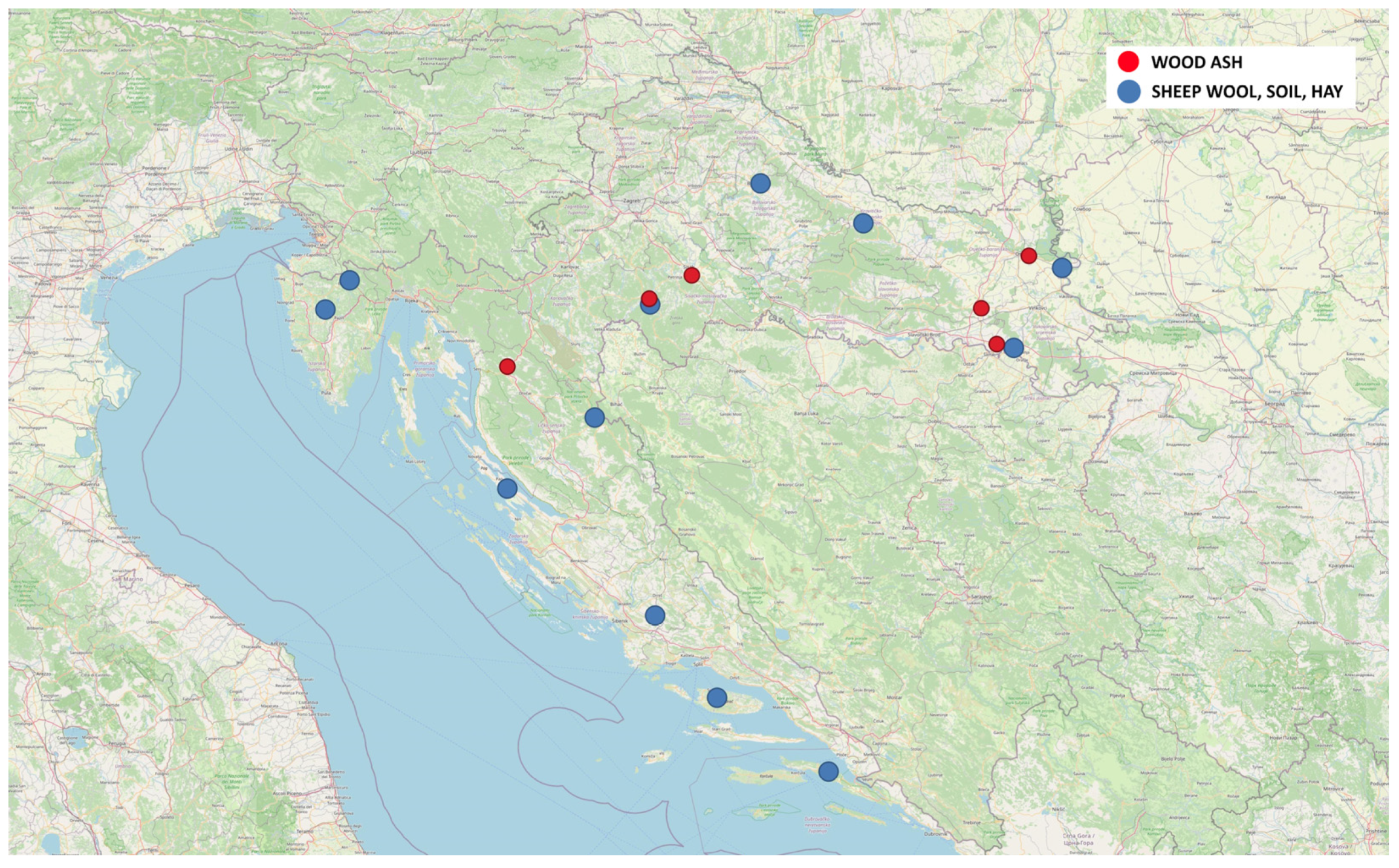
The sampling locations were established to cover most of Croatia and are shown in Figure 1. The wood fly and bottom ash were sampled from piles at 7 wood-processing plants. The samples of wool, hay, and soil were collected from 12 family farms. The sampling sites for soil, hay, and sheep wool were strategically selected to cover most of Croatia. In contrast, the locations for wood ash sampling were determined based on availability and participants’ willingness to participate.
The wool was freshly trimmed from two to three sheep from the same herd at the family farm. The sample size, depending on the sampling location, was 3−5 kg. The wool was packed, without pre-preparation, into Marinelli beakers (1 L geometry) for gamma-ray spectrometry.
For the soil sampling, standardized protocols for assessing environmental pollutants were used [30]. Topsoil from the 0−20 cm layer was collected at either three or five points (using a triangular sampling design or a cross-sampling pattern, respectively), with each point spaced 10 m apart according to the specified sampling sites. The final composite sample, derived from the subsamples, was processed further. In the laboratory, the samples were sieved (grain size < 2 mm) and dried at 105 °C for 3 days. The dried samples were placed in sealed cylindrical containers (100 mL and 200 mL) or Marinelli beakers (1 L).
Hay samples (3−5 kg) were sampled at the same locations as the soil samples. The samples were dried at 105 °C, milled, and packed in cylindrical containers (100 and 200 mL). All samples for gamma-ray spectrometry were sealed and left for at least 30 days before measurement to reach equilibrium between 226Ra and its decay products.
Activity concentrations of gamma-ray emitting radionuclides, including 40K, 232Th, 238U, 214Pb, 214Bi, 226Ra, 210Pb, and 137Cs, were determined using gamma-ray spectrometry. The detection systems used were high-purity germanium coaxial photon detectors: the Ortec GMX (ORTEC/AMETEK, Oak Ridge, TN, USA) with a relative efficiency of 74.2% and a full width at half maximum of 2.24 keV at 1.33 MeV of 60Co, and the Ortec HPGe (ORTEC/AMETEK, Oak Ridge, TN, USA) with a relative efficiency of 21% and a full width at half maximum of 1.75 keV at 1.33 MeV of 60Co. Energy and efficiency calibrations were performed with certified calibration sources of the appropriate geometry (CBSS2 MIX and MBSS2 MIX, produced by the Eurostandard CZ, Prague, Czech Republic). The measurement time was at least 80,000 s, and the spectra were analyzed using the ORTEC Gamma Vision software (Gamma Vision 32, ORTEC/AMETEK, Oak Ridge, TN, USA). Typical detection limits for 40K, 232Th, 238U, 214Pb, 214Bi, 226Ra, 210Pb, and 137Cs were 0.4 Bq/kg, 2 Bq/kg, 6 Bq/kg, 2 Bq/kg, 40 Bq/kg, 2 Bq/kg, 2 Bq/kg, and 0.2 Bq/kg, respectively. Validation of the gamma-ray spectrometry systems involved evaluating trueness, detection limits, precision/repeatability, matrix effects, and measurement uncertainties [28]. The uncertainty analysis accounted for factors such as emission probabilities, coincidence corrections, self-attenuation corrections, detector efficiencies, counting rates, and sample mass, with background radiation subtracted. The laboratory is accredited in accordance with ISO/IEC 17025 [31].
Alpha spectrometry was used to determine the activity concentration of 210Po in wool samples. The samples consisted of 1 g of unwashed wool with a known quantity of the 209Po tracer solution (~0.03 Bq). Samples were digested in 20 mL concentrated nitric acid overnight and evaporated to near dryness at 90 °C. Volume of 6 mL of concentrated nitric acid and 1 mL of 30% hydrogen peroxide were added to the residue, which was then evaporated to near dryness at 90 °C. Addition and evaporation of nitric acid and hydrogen peroxide were repeated 3 times. To the residue, 3 additions of 2 mL concentrated hydrochloric acid and evaporations to near dryness at 80 °C were performed. The residue was dissolved in 100 mL of 0.1 M hydrochloric acid, filtered through black ribbon filter paper, and 0.5 g of ascorbic acid was added to the filtrate. Polonium was deposited onto a polished silver disk by immersing the disk in the solution overnight at room temperature. The detection system used was the Canberra Alpha-analyst (Mirion Technologies, Atlanta, GA, USA) with a Si-detector (partially depleted PIPS detector; active area 450 mm2; alpha resolution for 241Am at 19 keV). Energy and efficiency calibrations were performed using certified calibration sources (stainless steel discs with the same geometry as silver discs, on which a known quantity of 238U, 234U, 239Pu, and 241Am was deposited). The measurements were performed once, and the measurement time was at least 86,400 s. The spectra were analyzed using Alpha-Apex software (Mirion Technologies, Atlanta, GA, USA, Apex-Alphy Desktop, ver. 1.4.0.71). The reported polonium activity concentrations were corrected to the activities on the measurement reference date. All obtained values of polonium activity concentrations were above the Curie limit of detection [32]. The measurement uncertainty was determined according to IAEA [33].

2.2. Transfer Factors

The transfer factor (TF) is a key concept in radioecology, especially for evaluating the transfer of radionuclides from soil to plants and from plants to animals. The TFsoil→hay is defined as the ratio of activity concentrations of a particular radionuclide in the edible parts of dry hay to its concentration in the dry soil sample, acting as an indicator of potential bioaccumulation in agricultural systems [34,35]; the TFhay→wool is defined as the ratio of activity concentrations of a particular radionuclide in wool sample to its concentration in the hay sample; and the TFsoil→wool is defined as the ratio of activity concentrations of a particular radionuclide in wool sample to its concentration in the dry soil sample. The transfer factors are calculated using the following equations:
T F s o i l h a y = A i h a y A i ( s o i l )
T F h a y w o o l = A i w o o l A i ( h a y )
T F s o i l w o o l = A i w o o l A i ( s o i l )
where
Ai is the activity concentration of a radionuclide i in a hay, wool, and/or soil sample of interest in Bq/kg.

2.3. The Limitations of the Study

Several limitations of this study exist. Although sampling spanned multiple Croatian regions, the number of sites (industrial plants and rural properties) remains limited, so the dataset may not fully reflect spatial variability in environmental factors like soil types, geology, agriculture, or local human influence. The transfer factors were also calculated within the soil–hay–wool system using a small number of samples and do not fully account for variables such as seasonal changes, animal-specific factors (age, metabolism), or variations in feeding behavior; controlled experiments are needed to clarify these mechanisms. Despite these limitations, the study establishes an important baseline for understanding the radiological aspects of the reuse of wood ash and sheep wool and lays the groundwork for more comprehensive future research.

3. Results and Discussion

3.1. Radioactivity of Wood Ash

Radiological characterization of wood ash is shown in Table 1. Existing literature on the radioactivity of wood fly and bottom ash is limited [27,36]. Mladenović Nikolić et al. [36] analyzed wood ash samples from Serbia, and the activity concentrations of natural radionuclides reported in both studies were similar. Similarly, Radulović et al. [27] analyzed wood pellets, fly ash, and bottom ash, yielding values consistent with those obtained in the current study.
Due to the scarcity of data on wood ash, this study’s findings were also compared with activity concentrations reported for coal ash, another residue utilized across various industries (building, agriculture, etc.). The activity concentrations of 232Th in wood ash were found to be comparable to those reported for coal fly and bottom ash [37,38,39,40]. However, the 40K activity concentrations were notably higher than values documented in the literature. Specifically, the mean 40K activity concentration in wood ash (2429 Bq/kg) exceeds the worldwide range of 70–800 Bq/kg reported by Kovacs et al. [40] by more than a factor of 10. This elevated 40K activity in wood ash relative to coal ash is attributable to the biological uptake of potassium by living plants. As an essential macronutrient, potassium is actively absorbed during the growth phase of plants. During combustion, the organic matter is volatilized, whereas the mineral components, including potassium, become concentrated in the resultant ash [41,42]. In contrast, potassium in coal is primarily present within aluminosilicate minerals and is typically diluted by other inorganic components, resulting in comparatively lower 40K activity concentrations. Additionally, the highest 40K activity concentration (8290 Bq/kg) was recorded in fly ash derived from biomass containing 70% hardwood, whereas the other samples predominantly consisted of beech (lat. Fagus) and oak (lat. Quercus). The concentration of 210Pb in all wood ash samples ranges from 39 to 2070 Bq/kg. The highest concentration, 2070 Bq kg−1, was observed in a fly ash sample. This elevated 210Pb level may pose a risk if the ash is utilized as a fertilizer [43]. The slightly elevated 226Ra concentration relative to reported values for coal ash [37,39] indicates that this material requires careful monitoring.
In the absence of established regulatory thresholds for radionuclide concentrations in agricultural soil [29], the measured activity concentrations of naturally occurring radionuclides are used to calculate the absorbed dose rates and annual effective dose according to the UNSCEAR guidelines [44]. The absorbed dose rate (nGy/h) attributable to gamma radiation in air at a height of 1 m above the ground, assuming a uniform distribution of 226Ra, 232Th, and 40K was determined using the following equation:
D ˙ = 0.462 A R a 226 + 0.621 A T h 232 + 0.0417 A K 40
Additionally, the annual effective dose E (mSv) is calculated as follows:
E = D   n G y h × 8760   h y e a r × 0.2 × 0.7 ( S v G y ) × 10 6
where 0.7 Sv/Gy represents the conversion coefficient from absorbed dose in air to the effective dose received by adults, and 0.2 denotes the outdoor occupancy factor, reflecting the assumption that adults spend 20% of their time outdoors.
The annual effective dose calculated from activity concentrations of radionuclides in soil (Supplement 1; Table S4) averaged 0.18 mSv (range: 0.06–0.6 mSv). Since wood ash is generally applied as a soil amendment at low rates (e.g., less than 10 t/ha), resulting in an incremental increase in total soil radioactivity that remains well within established safety thresholds. Consequently, the radiation dose to the population stays below the 1 mSv/year regulatory limit. To substantiate this, a radiological impact assessment specific to agricultural soil amendment has been conducted. Assuming a maximum application rate of 10 t/ha and a soil mixing depth of 20 cm (corresponding to approximately 3000 t/ha of soil), the dilution factor is 1:300. Even for the wood ash sample exhibiting the highest radionuclide activity, the resultant contribution to the soil activity concentration would be minimal, thereby ensuring compliance with safety standards.
In the case of wood ash being used in applications other than agriculture, like the building and construction sectors, it would be imperative to evaluate the associated radiological hazards. One of the assessment tools is the activity concentration index (I), which is used to determine whether gamma radiation levels in a building surpass the reference threshold of an annual effective dose of 1 mSv [45]. The activity concentration index is calculated from the activity concentrations (Ai) of the key radionuclides (226Ra, 232Th, and 40K) according to Equation (4). If the index value (I) is less than 1, the material is generally considered safe for use and complies with the recommended dose limit of 1 mSv/year. When assessed individually, the index ranged from 0.56 to 3.48 (Supplement 1; Table S5), with most wood ash samples exceeding the index threshold of 1. However, because wood ash is used in small quantities in the construction industry, it is necessary to evaluate the final products to ensure compliance with safety standards.
I = A R a 226 300 + A T h 232 200 + A K 40 3000
where A is the activity concentration in Bq/kg.

3.2. Radioactivity of Sheep Wool

Most measurable radioactivity in sheep wool arises from soil and dust deposition rather than biological accumulation (sheep diet) [46,47]. Overall contamination levels depend on local geology, grazing conditions, airborne dust levels, and proximity to areas with high background radiation. Natural radioactivity in sheep wool has been studied to a limited extent [48]. Hence, the radiological characterization of sheep wool would enable the background values that can serve as a reference point for future scientific research. Table 2 shows the predominance of 40K in sheep wool, which is expected, given that potassium has an essential role in metabolic and cellular functions. Its elevated concentration and considerable variability reflect physiological regulation and variations in dietary potassium intake. The comparatively low activity concentrations of 214Pb, 214Bi, and 226Ra indicate limited incorporation of these radionuclides into wool, with their presence primarily attributable to dietary intake and, to a lesser extent, environmental exposure. The low levels of 137Cs reflect minimal anthropogenic contamination, originating from historical fallout. Its relatively minor but variable presence suggests differential soil-to-hay transfer and feeding practices across sampling sites. Sheep wool serves as an indicator of both natural radionuclide incorporation, most notably 40K, and low-level environmental contamination. It can be concluded that sheep wool, with respect to radioactivity, is safe for use in various applications.

3.3. Radioactivity of Soil and Hay, and Transfer Factors to Wool

Activity concentrations of radionuclides in soil samples (Table 3) are in good accordance with previous investigations of soils in Croatia [49,50]. Hay samples also showed expected ranges in radionuclide activity concentrations, except for the sample from one sampling site, where a high 210Pb level (500 Bq/kg) was measured, possibly due to a higher contribution from both air absorption and via root uptake [51].
The mean and range values of the transfer factors (TFs) are shown in Table 4. The TFs were determined for six radionuclides (40K, 238U, 214Bi, 226Ra, 210Pb, and 137Cs) along the pathways: Soil → Hay, Hay → Wool, and Soil → Wool. Other analysed radionuclides were excluded from the TF calculations because their results exceeded the detection limit in certain matrices. The relatively low TFSoil→Hay (generally less than 1 for most radionuclides) reflects limited root uptake and plant accumulation, notably for 226Ra, 214Bi, and 137Cs. Conversely, elevated TFHay→Wool demonstrates that once radionuclides are ingested, biological mechanisms facilitate their assimilation into wool. The notably high transfer observed for 40K aligns with expectations, given potassium’s role as an essential macronutrient that is actively regulated and incorporated into biological tissues. These results are consistent with those of other studies [52,53]. 210Pb exhibited both elevated and highly variable transfer rates, which may be attributable to a combination of root uptake and potential atmospheric deposition onto plant surfaces, thereby enhancing its bioavailability in feed. 238U showed moderate Soil → Hay transfer but comparatively high Hay → Wool transfer, implying that metabolic or physicochemical factors promote its incorporation into wool following ingestion. 226Ra and 214Bi consistently demonstrated the lowest transfer factors across all examined pathways, indicating limited mobility within soil–plant systems and restricted biological assimilation. The generally lower TFSoil→Wool relative to TFPlant→Wool further corroborates that soil’s influence on wool contamination is indirect and probably mediated via the dietary pathway. The pronounced variability observed (wide minimum-to-maximum ranges) suggests that environmental conditions, soil properties, feeding behaviors, and radionuclide-specific chemical characteristics significantly affect transfer efficiency.

3.4. Life Cycle Analysis

A simple economic evaluation was conducted to compare the costs associated with conventional mineral fertilization versus the application of wood ash and sheep wool. Conventional fertilization expenses typically range from €310 to €540 per hectare [54], contingent upon the type of fertilizer and application rates employed. Conversely, wood ash, frequently available as a low-cost or no-cost by-product, incurs substantially lower total costs, estimated between €80 and €175 per hectare [55,56], inclusive of transportation and application. This represents a cost reduction of approximately 50–75%.
When sheep wool is utilized as an organic soil amendment, total expenditures rise to approximately €300 to €470 per hectare [15,16,17], aligning closely with the costs of conventional fertilization. Nonetheless, this approach offers additional agronomic advantages, such as slow nutrient release, enhanced soil structure, and increased soil organic matter content [21,24]. These benefits may diminish the necessity for recurrent fertilizer applications over time, indicating potential long-term economic gains.
It is important to acknowledge that these cost estimates are derived from typical price ranges and may vary based on local availability, transportation distances, and processing requirements.

4. Conclusions

This study aimed to investigate the radiological properties of wood ash and sheep wool and to evaluate their potential for use within circular economy frameworks, especially in agricultural settings. The findings show that the activity concentrations of the radionuclides examined in both materials are generally low and fall within ranges that do not pose significant radiological risks under normal usage conditions. Therefore, the research question—whether these materials can be safely reused without radiological concerns—can be answered affirmatively, with recommendations for ongoing monitoring.
The results confirm that sheep wool consistently exhibits low radioactivity levels, supporting its safe use as a biomaterial in agricultural applications, such as soil amendments and alternative growing media. For wood fly ash, elevated 40K levels were detected, which aligns with potassium’s biological importance in plants and its concentration during combustion. Despite this enrichment, the overall radiological profile remains suitable for controlled use, underscoring its value as a nutrient-rich secondary resource for agriculture.
Transfer factors within the soil–hay–wool system reveal generally low values, indicating limited mobility and bioavailability of most radionuclides across environmental compartments. These outcomes enhance understanding of radionuclide behavior in integrated soil–plant–animal systems and provide evidence that incorporating these materials into agricultural cycles is unlikely to cause significant radiological buildup.
Scientifically, the primary contribution of this research lies in the combined evaluation of two distinct yet complementary biowaste streams within a unified radiological framework. Notably, including sheep wool, an underrepresented material in radiological research, offers fresh insights into radionuclide transfer pathways beyond the usual soil–plant focus. Additionally, generating region-specific data for Croatia enriches the existing knowledge base and aids more informed decision-making in local waste management and agricultural practices.
From a practical perspective, the findings support the safe reuse of wood ash and sheep wool as secondary materials, promoting resource efficiency and waste reduction in line with circular economy principles. However, their application should be accompanied by appropriate quality assurance protocols and regular monitoring to maintain long-term environmental safety.
This study has certain limitations. Although the sample size and spatial coverage are representative, they may not fully reflect all environmental variations, such as differences in soil types, biomass sources, or combustion conditions.
Future research should broaden its geographic range and incorporate a wider variety of environmental and operational scenarios. Further exploration of radionuclide transfer mechanisms in controlled agricultural systems, such as hydroponics, is planned. Additionally, the reuse of wood ash as a soil amendment or fertilizer substitute has been linked to reduced landfill disposal expenses and diminished dependence on mineral fertilizers, thereby decreasing both financial costs and environmental impacts associated with raw material extraction and processing. Likewise, the application of low-grade sheep wool in agricultural contexts, such as soil conditioning or growth substrates, contributes to waste minimization and resource efficiency while offering a cost-effective alternative to synthetic materials. Combining radiological evaluations with life-cycle and economic analyses would provide a more comprehensive assessment of the sustainability and practicality of using these materials in real-world applications.

Supplementary Materials

The following supporting information can be downloaded at: https://www.mdpi.com/article/10.3390/su18073443/s1, Table S1: Activity concentrations (Bq/kg) of radionuclides in wood fly and bottom ash; Table S2: Activity concentrations (Bq/kg) of radionuclides in wool samples; Table S3: Activity concentrations (Bq/kg) of radionuclides in hay samples; Table S4: Activity concentrations (Bq/kg) of radionuclides in soil samples; Table S5: Activity concentration index of wood fly and bottom ash samples.

Author Contributions

Conceptualization, T.B. and S.S.; methodology, M.S., D.H., A.K., K.S., J.H.I. and B.A.; formal analysis, T.B. and D.H.; data curation, M.S., D.H., A.K., K.S., J.H.I. and B.A.; writing—original draft preparation, T.B., S.S. and B.P.; writing—review and editing, B.P., D.B. and G.O.; funding acquisition, G.O. All authors have read and agreed to the published version of the manuscript.

Funding

This research was funded by the European Union—NextGenerationEU under the project “Transforming bio-waste to innovative hydroponic solutions—Was2Grow” No. NPOO.C3.2.R3-I1.04.0143. The views and opinions expressed are solely those of the authors and do not necessarily reflect the official position of the European Union or the European Commission. Neither the European Union nor the European Commission can be held responsible for them.

Institutional Review Board Statement

Not applicable.

Informed Consent Statement

Not applicable.

Data Availability Statement

The data of this study are available from the corresponding author upon reasonable request.

Acknowledgments

The authors would like to thank Tea Čvorišćec and Petra Tagliaretti from the Institute for Medical Research and Occupational Health, Croatia, for sampling and sample preparation.

Conflicts of Interest

The authors declare no conflicts of interest.

References

  1. Girón, R.P.; Ruiz, B.; Fuente, E.; Gil, R.R.; Suárez-Ruiz, I. Properties of Fly Ash from Forest Biomass Combustion. Fuel 2013, 114, 71–77. [Google Scholar] [CrossRef]
  2. Odzijewicz, J.I.; Wołejko, E.; Wydro, U.; Wasil, M.; Jabłońska-Trypuć, A. Utilization of Ashes from Biomass Combustion. Energies 2022, 15, 9653. [Google Scholar] [CrossRef]
  3. Uliasz-Bocheńczyk, A.; Mazurkiewicz, M.; Mokrzycki, E. Popioły z Energetyki—Odpad, Produkt Uboczny, Surowiec. Gospod. Surowcami Miner. Miner. Resour. Manag. 2015, 31, 139–150. [Google Scholar] [CrossRef]
  4. Boström, D.; Skoglund, N.; Alejandro, G.; Boman, C.; Öhman, M.; Bronstrom, M.; Backman, R. Ash Transformation Chemistry during Combustion of Biomass. Energy Fuels 2011, 26, 85–93. [Google Scholar] [CrossRef]
  5. Smołka-Danielowska, D.; Jabłońska, M. Chemical and Mineral Composition of Ashes from Wood Biomass Combustion in Domestic Wood-Fired Furnaces. Int. J. Environ. Sci. Technol. 2022, 19, 5359–5372. [Google Scholar] [CrossRef]
  6. Olatoyan, O.J.; Kareem, M.A.; Adebanjo, A.U.; Olawale, S.O.A.; Alao, K.T. Potential Use of Biomass Ash as a Sustainable Alternative for Fly Ash in Concrete Production: A Review. Hybrid Adv. 2023, 4, 100076. [Google Scholar] [CrossRef]
  7. Carević, I.; Serdar, M.; Štirmer, N.; Ukrainczyk, N. Preliminary Screening of Wood Biomass Ashes for Partial Resources Replacements in Cementitious Materials. J. Clean. Prod. 2019, 229, 1045–1064. [Google Scholar] [CrossRef]
  8. Milovanović, B.; Štirmer, N.; Carević, I.; Baričević, A. Wood Biomass Ash as a Raw Material in Concrete Industry. Gradjevinar 2019, 71, 505–514. [Google Scholar] [CrossRef]
  9. Pugliese, S.; Jones, T.; Preston, M.D.; Hazlett, P.; Tran, H.; Basiliko, N. Wood Ash as a Forest Soil Amendment: The Role of Boiler and Soil Type on Soil Property Response. Can. J. Soil Sci. 2014, 94, 621–634. [Google Scholar] [CrossRef]
  10. Zimmermann, S.; Frey, B. Soil Respiration and Microbial Properties in an Acid Forest Soil: Effects of Wood Ash. Soil Biol. Biochem. 2002, 34, 1727–1737. [Google Scholar] [CrossRef]
  11. Teker Ercan, E.E.; Andreas, L.; Cwirzen, A.; Habermehl-Cwirzen, K. Wood Ash as Sustainable Alternative Raw Material for the Production of Concrete—A Review. Materials 2023, 16, 2557. [Google Scholar] [CrossRef]
  12. Mayer, E.; Eichermüller, J.; Endriss, F.; Baumgarten, B.; Kirchhof, R.; Tejada, J.; Kappler, A.; Thorwarth, H. Utilization and Recycling of Wood Ashes from Industrial Heat and Power Plants Regarding Fertilizer Use. Waste Manag. 2022, 141, 92–103. [Google Scholar] [CrossRef]
  13. Moure Abelenda, A.; Semple, K.T.; Lag-Brotons, A.J.; Herbert, B.M.J.; Aggidis, G.; Aiouache, F. Effects of Wood Ash-Based Alkaline Treatment on Nitrogen, Carbon, and Phosphorus Availability in Food Waste and Agro-Industrial Waste Digestates. Waste Biomass Valorization 2021, 12, 3355–3370. [Google Scholar] [CrossRef]
  14. Sakthivel, S.R.; Tilley, E.; Udert, K.M. Wood Ash as a Magnesium Source for Phosphorus Recovery from Source-Separated Urine. Sci. Total Environ. 2012, 419, 68–75. [Google Scholar] [CrossRef]
  15. Camilli, F.; Focacci, M.; Dal Prà, A.; Bortolu, S.; Ugolini, F.; Vagnoni, E.; Duce, P. Turning Waste Wool into a Circular Resource: A Review of Eco-Innovative Applications in Agriculture. Agronomy 2025, 15, 446. [Google Scholar] [CrossRef]
  16. Broda, J.; Gawlowski, A.; Rom, M.; Kobiela-Mendrek, K. Utilisation of Waste Wool from Mountain Sheep as Fertiliser in Winter Wheat Cultivation. J. Nat. Fibers 2023, 20, 2200047. [Google Scholar] [CrossRef]
  17. Szczecina, J.; Szczepanik, E.; Barwinek, J.; Szatkowski, P.; Niemiec, M.; Zhakypbekovich, A.I.; Molik, E. Sheep Wool as Biomass: Identifying the Material and Its Reclassification from Waste to Resource. Energies 2025, 18, 5185. [Google Scholar] [CrossRef]
  18. Huculak-Mączka, M.; Nieweś, D.; Marecka, K.; Braun-Giwerska, M. Valorization of Waste Mineral Wool and Low-Rank Peat in the Fertilizer Industry in the Context of a Resource-Efficient Circular Economy. Sustainability 2025, 17, 7083. [Google Scholar] [CrossRef]
  19. Midolo, G.; Porto, S.M.C.; Cascone, G.; Valenti, F. Sheep Wool Waste Availability for Potential Sustainable Re-Use and Valorization: A GIS-Based Model. Agriculture 2024, 14, 872. [Google Scholar] [CrossRef]
  20. Parlato, M.C.M.; Valenti, F.; Midolo, G.; Porto, S.M.C. Livestock Wastes Sustainable Use and Management: Assessment of Raw Sheep Wool Reuse and Valorization. Energies 2022, 15, 3008. [Google Scholar] [CrossRef]
  21. Komorowska, M.; Niemiec, M.; Sikora, J.; Gródek-Szostak, Z.; Gurgulu, H.; Chowaniak, M.; Atilgan, A.; Neuberger, P. Evaluation of Sheep Wool as a Substrate for Hydroponic Cucumber Cultivation. Agriculture 2023, 13, 554. [Google Scholar] [CrossRef]
  22. Komorowska, M.; Niemiec, M.; Sikora, J.; Szeląg-Sikora, A.; Gródek-Szostak, Z.; Findura, P.; Gurgulu, H.; Stuglik, J.; Chowaniak, M.; Atılgan, A. Closed-Loop Agricultural Production and Its Environmental Efficiency: A Case Study of Sheep Wool Production in Northwestern Kyrgyzstan. Energies 2022, 15, 6358. [Google Scholar] [CrossRef]
  23. Gillespie, G.D.; Dada, O.; McDonnell, K.P. The Potential for Hydrolysed Sheep Wool as a Sustainable Source of Fertiliser for Irish Agriculture. Sustainability 2022, 14, 365. [Google Scholar] [CrossRef]
  24. Abdallah, A.; Ugolini, F.; Baronti, S.; Maienza, A.; Camilli, F.; Bonora, L.; Martelli, F.; Primicerio, J.; Ungaro, F. The Potential of Recycling Wool Residues as an Amendment for Enhancing the Physical and Hydraulic Properties of a Sandy Loam Soil. Int. J. Recycl. Org. Waste Agric. 2019, 8, 131–143. [Google Scholar] [CrossRef]
  25. Croatian Bureau of Statistics Croatian Bureau of Statistics—Livestock Production, 2024–2025. Available online: https://podaci.dzs.hr/2025/en/97394?utm_source=chatgpt.com (accessed on 28 March 2026).
  26. Ravila, A.; Holm, E. Assessment of the Radiation Field from Radioactive Elements in a Wood-Ash-Treated Coniferous Forest in Southwest Sweden. J. Environ. Radioact. 1996, 32, 135–156. [Google Scholar] [CrossRef]
  27. Radulovic, S.; Pepin, S. Natural Radionuclides and Cs-137 in Biomass Combustion Residues: How to Solve the Puzzle? In Proceedings of the 10th International Symposium on Naturally Occurring Radioactive Material, Utrecht, The Netherlands, 9–13 May 2022. [Google Scholar]
  28. Pepin, S.; Radulovic, S.; Wiegers, R.; Mrdakovic Popic, J.; Kallio, A.; Huss, M.; Grandia, F.; Valls, A.; Bruno, A. The Issue of Cs-137 in Firewood and Biomass Combustion: A Review. Radiat. Prot. Dosim. 2023, 199, 759–766. [Google Scholar] [CrossRef] [PubMed]
  29. Official Gazette Ordinance on the Protection of Agricultural Land from Pollution, Official Gazette 71/2019; 2019. (In Croatian). Available online: https://narodne-novine.nn.hr/clanci/sluzbeni/2019_07_71_1507.html (accessed on 28 March 2026).
  30. IAEA—International Atomic Energy Agency. Soil Sampling for Environmental Contaminants; IAEA: Vienna, Austria, 2004; ISBN 92-0-111504-0. [Google Scholar]
  31. EN ISO/IEC 17025:2017; General Requirements for the Competence of Testing and Calibration Laboratories. International Organization for Standardization: Geneva, Switzerland, 2017.
  32. Currie, L.A. Limits for Qualitative Detection and Quantitative Determination. Application to Radiochemistry. Anal. Chem. 1968, 40, 586–593. [Google Scholar] [CrossRef]
  33. IAEA—International Atomic Energy Agency. Quantifying Uncertainty in Nuclear Analytical Measurements; IAEA-TECDOC-1401; IAEA: Vienna, Austria, 2004; ISBN 92-0-108404-8. [Google Scholar]
  34. Vera Tome, F.; Blanco Rodríguez, M.P.; Lozano, J.C. Soil-to-Plant Transfer Factors for Natural Radionuclides and Stable Elements in a Mediterranean Area. J. Environ. Radioact. 2003, 65, 161–175. [Google Scholar] [CrossRef] [PubMed]
  35. IAEA—International Atomic Energy Agency. Handbook of Parameter Values for the Prediction of Radionuclide Transfer in Terrestrial and Freshwater Environments; IAEA-TRS-472; IAEA: Vienna, Austria, 2010. [Google Scholar]
  36. Mladenović Nikolić, N.; Kandić, A.; Trivunac, K.; Mirković, M.; Vukanac, I.; Nenadović, S.; Kljajević, L. Radiological and Structural Characterization of Raw and Alkali-Activated Wood Ash and Metakaolin Blends. Sustainability 2022, 14, 12960. [Google Scholar] [CrossRef]
  37. Kovacs, T.; Bator, G.; Schroeyers, W.; Labrincha, J.; Puertas, F.; Hegedus, M.; Nicolaides, D.; Sanjuan, M.; Krivenko, P.; Grubeša, I.; et al. From Raw Materials to NORM By-Products. In Naturally Occurring Radioactive Materials in Construction Integrating Radiation Protection in Reuse (COST Action Tu1301 NORM4BUILDING); Schroeyers, W., Ed.; Elsevier: Duxford, UK, 2017; pp. 145–149. ISBN 978-0-08-102009-8. [Google Scholar]
  38. Papastefanou, C. Escaping Radioactivity from Coal-Fired Power Plants (CPPs) Due to Coal Burning and the Associated Hazards: A Review. J. Environ. Radioact. 2010, 101, 191–200. [Google Scholar] [CrossRef]
  39. Loan, T.T.H.; Ba, V.N.; Thien, B.N. Natural Radioactivity Level in Fly Ash Samples and Radiological Hazard at the Landfill Area of the Coal-Fired Power Plant Complex, Vietnam. Nucl. Eng. Technol. 2022, 54, 1431–1438. [Google Scholar] [CrossRef]
  40. Sahu, S.K.; Bhangare, R.C.; Ajmal, P.Y.; Pandit, G.G. Evaluation of the Radiation Dose Due to the Use of Fly Ash from Thermal Power Plants as a Building Material. Radioprotection 2016, 51, 135–140. [Google Scholar] [CrossRef]
  41. Zhang, F.; Hou, X.; Xue, X.; Ren, J.; Dong, L.; Wei, X.; Jian, L.; Deng, L. Release Characteristics of Potassium during Biomass Combustion. Energies 2023, 16, 4107. [Google Scholar] [CrossRef]
  42. Naciri, R.; Rajib, W.; Chtouki, M.; Zeroual, Y.; Oukarroum, A. Potassium and Phosphorus Content Ratio in Hydroponic Culture Affects Tomato Plant Growth and Nutrient Uptake. Physiol. Mol. Biol. Plants 2022, 28, 763–774. [Google Scholar] [CrossRef]
  43. Strumińska-Parulska, D.; Olszewski, G. Is Ecological Food Also Radioecological?—210Po and 210Pb Studies. Chemosphere 2018, 191, 190–195. [Google Scholar] [CrossRef] [PubMed]
  44. UNSCEAR. UNSCEAR 2008 Report, Sources and Effects of Ionizing Radiation. In Annex B—Exposures of the Public and Workers from Various Sources of Radiation; United Nations: New York, NY, USA, 2010. [Google Scholar]
  45. European Union Council Directive 2013/59/Euratom of 5 December 2013 Laying Down Basic Safety Standards for Protection Against the Dangers Arising from Exposure to Ionising Radiation; 2013; pp. 1–73. Available online: https://eur-lex.europa.eu/legal-content/EN/TXT/HTML/?uri=CELEX:32013L0059 (accessed on 23 March 2026).
  46. Smith, F.B. The Deposition of Chernobyl Caesium-137 in Heavy Rain and Its Persistent Uptake by Grazing Sheep. Agric. For. Meteorol. 1989, 47, 163–177. [Google Scholar] [CrossRef]
  47. Cooke, A.I.; Green, N.; Rimmer, D.L.; Weekes, T.E.C.; Wilkins, B.T.; Beresford, N.A.; Fenwick, J.D. Absorption of Radiocaesium by Sheep after Ingestion of Contaminated Soils. Sci. Total Environ. 1996, 192, 21–29. [Google Scholar] [CrossRef]
  48. Brar, S.S.; Gustafson, P.F.; Kerrigan, M.A.; Breidenstein, B.C.; Garrigus, U.S.; Usborne, W.R. Radioactivity in Wool. Nature 1961, 192, 1094–1095. [Google Scholar] [CrossRef]
  49. Šoštarić, M.; Petrinec, B.; Avdić, M.; Petroci, L.; Kovačić, M.; Zgorelec, Ž.; Skoko, B.; Bituh, T.; Senčar, J.; Branica, G.; et al. Radioactivity of Soil in Croatia I: Naturally Occurring Decay Chains. Arh. Hig. Rada Toksikol. 2021, 72, 6–14. [Google Scholar] [CrossRef]
  50. Šoštarić, M.; Petrinec, B.; Avdić, M.; Petroci, L.; Kovačić, M.; Zgorelec, Ž.; Skoko, B.; Bituh, T.; Senčar, J.; Branica, G.; et al. Radioactivity of Soil in Croatia II: 137Cs, 40K, and Absorbed Dose Rate. Arh. Hig. Rada Toksikol. 2021, 72, 15–22. [Google Scholar] [CrossRef]
  51. Zgorelec, Ž.; Šoštarić, M.; Babić, D.; Šestak, I.; Mesić, M.; Perčin, A.; Petrinec, B. Effects of Fertilisation on Radionuclide Uptake by Maize from an Acidic Soil in Northwestern Croatia. Soil Tillage Res. 2021, 212, 105030. [Google Scholar] [CrossRef]
  52. Waegeneers, N.; Sauras-Yera, T.; Thiry, Y.; Vallejo, V.R.; Smolders, E.; Madoz-Escande, C.; Bréchignac, F. Plant Uptake of Radiocaesium from Artificially Contaminated Soil Monoliths Covering Major European Soil Types. J. Environ. Radioact. 2009, 100, 439–444. [Google Scholar] [CrossRef]
  53. Ilievski, T.; Skoko, B.; Karanović, G.; Grahek, Ž.; Magdić Košiček, K.; Coha, I.; Pavičić-Hamer, D.; Tucaković, I. Radioactivity in Food Crops from the Family Farms in Croatia with Ingestion Dose Assessment. Food Control 2025, 167, 110805. [Google Scholar] [CrossRef]
  54. European Commission—Fertilizer Prices; Directorate-General for Agriculture and Rural Development. Available online: https://agridata.ec.europa.eu/extensions/DashboardFertiliser/FertiliserPrices.html (accessed on 28 March 2026).
  55. S2Biom-Tools for Biomas Chains. Biomas Chain Data. Available online: https://s2biom.wenr.wur.nl/biomass-cost#_48_INSTANCE_bNEOGMUfuY37_%3D (accessed on 28 March 2026).
  56. da Costa, T.P.; Quinteiro, P.; Tarelho, L.A.C.; Arrojy, L.; Dias, A.C. Life cycle assessment of woody biomass ash for soil amelioration Tamíris. Waste Manag. 2020, 101, 126–140. [Google Scholar] [CrossRef] [PubMed]
Figure 1. Sampling locations across Croatia (Europe) (QGIS v.3.44.4, Boston, MA, USA).
Sustainability 18 03443 g001
Table 1. Activity concentrations (Bq/kg) of radionuclides in wood ash (fly ash and bottom ash) samples.
Sample TypeNo. of Samples Activity Concentration (Bq/kg)
40K232Th238U214Pb214Bi226Ra210Pb137Cs
Fly Ash7Mean32273520879011752172
S.D.2325111260607571583
Max829050411741782412070207
Min145317828283910010
Bottom Ash7Mean1631402277791096627
S.D.37516215253603325
Max2037586714715017912062
Min10681410202132391
All samples14Mean24293821828511333251
S.D.1801141754556557866
Table 2. Activity concentrations (Bq/kg) of radionuclides in sheep wool samples.
Sample Type Activity Concentration (Bq/kg)
40K214Pb214Bi226Ra210Po137Cs
Sheep woolMean1248223212
S.D.531112142
Min3550.030.8280.2
Max2010355556
Table 3. Activity concentrations (Bq/kg) of radionuclides in soil and hay samples.
Sample Type Activity Concentration (Bq/kg)
40K232Th238U214Pb214Bi226Ra210Pb137Cs
SoilMean45550471221242008122
S.D.10316232092092505420
Min2952212192551284
Max607817877577996222470
HayMean4413123551542
S.D.256282331944
Min222140.712590.4
Max11205307.2111050013
Table 4. Transfer factors (mean, SD, and range) for the selected radionuclides, indicating their bioavailability in soil and their potential for plant/animal uptake.
Soil → HayHay → WoolSoil → Wool
MeanS.D.RangeMeanS.D.RangeMeanS.D.Range
40K1.00.70.4–33.31.80.9–62.71.10.9–4
238U0.30.30.06–0.82.72.10.6–70.50.40.2–2
226Ra0.040.040.01–0.10.90.60.3–10.020.010.02–0.03
214Bi0.080.060.002–0.20.60.60.1–20.030.030.001–0.08
210Pb1.21.60.03–52.33.20.05–100.60.40.2–1
137Cs0.10.10.01–0.31.30.90.1–30.10.20.02–0.6
Disclaimer/Publisher’s Note: The statements, opinions and data contained in all publications are solely those of the individual author(s) and contributor(s) and not of MDPI and/or the editor(s). MDPI and/or the editor(s) disclaim responsibility for any injury to people or property resulting from any ideas, methods, instructions or products referred to in the content.