1. Introduction
Because cavitation inception and development are strongly governed by local pressure gradients, wall proximity, and downstream pressure recovery, geometry is a primary design variable in Venturi-based cavitation devices. Hydrodynamic cavitation is triggered by a local pressure drop in a moving liquid, leading to the formation of vapor cavities and their subsequent collapse. This collapse concentrates energy over very small spatial and temporal scales and may generate microjets, shock waves, and high shear stresses [
1,
2]. These effects have motivated increasing interest in hydrodynamic cavitation as a non-thermal intensification route in continuous-flow process applications, including water-treatment contexts [
3,
4,
5,
6,
7]. In Venturi devices, the velocity distribution and wall interaction—especially in the throat region and during downstream pressure recovery—are therefore highly sensitive to geometry [
8,
9,
10,
11].
Despite the widespread use of Venturi devices, their design is still often based on incremental modifications of circular cross sections or on empirical weakly formalized criteria. Modified throats and related design variants may alter the local acceleration and wall interaction, but they are frequently reported as isolated configurations rather than through transferable parametric descriptions [
12,
13]. In addition, comparisons across studies are often carried out under different implicit constraints, such as equal area, equal hydraulic diameter, or similar overall size. This makes the geometric basis of comparison less transparent and limits reproducibility within parametric design workflows. More generally, compact and operational definitions of constraints, generative parameters, and design-oriented metrics for systematically comparing Venturi families remain limited.
The existing studies therefore provide valuable case-specific insights, but they often address different design questions because the basis of comparison is not uniform across geometries. In contrast, the present framework adopts equal-width explicitly as a transverse-envelope criterion, so that cross-sectional shape effects can be discussed under a stated and reproducible geometric constraint rather than under heterogeneous implicit conditions.
In the present work, geometry is treated explicitly as a parametric design variable. We introduce a family of Venturi throats based on a constant-width Reuleaux-triangle cross section (VRA) and a controlled axial-twist variant (VRAt) [
14,
15]. The comparison is formalized under an equal-width constraint, used here as a prescribed transverse envelope condition for all cross sections. In this manuscript, equal width is not intended as a surrogate for equal area or equal hydraulic diameter; rather, it is adopted as a specific geometric comparison criterion for configurations sharing the same characteristic lateral extent. Within this framework, VRAt introduces an imposed twist over a defined axial segment, thereby treating twist as an explicit geometric design variable.
A reproducible geometric comparison is then established through parametric definitions and a minimal set of geometry-based design-oriented indicators. These indicators are defined in terms of throat flow area, wetted perimeter, hydraulic diameter, and geometric near-wall coverage within a prescribed thickness. For VRAt, an additional dimensionless kinematic indicator is introduced to quantify the path-length increase associated with the imposed twist. These quantities are intended as geometric comparison tools only. In particular, geometric near-wall coverage denotes the fraction of cross-sectional area lying within a prescribed wall-normal thickness and should not be interpreted directly as residence time, shear level, transport intensity, or treatment performance. Likewise, imposed twist is treated here as a geometric condition that may affect flow kinematics, but it does not by itself imply vortex formation, secondary-flow intensity, or enhanced cavitation behavior [
16,
17,
18].
The quantitative assessment of hydraulic performance and cavitation response requires dedicated measurements or numerical modeling supported by verification and validation (V&V) [
19,
20]. Head losses and multiphase behavior also depend on minor losses, turbulence, inlet conditions, and model-form assumptions that cannot be inferred from geometric metrics alone [
21,
22,
23]. In addition, quantitative cavitation predictions in Venturi-type devices are known to be sensitive to cavitation and turbulence models, as well as to related numerical assumptions and settings [
24,
25,
26,
27]. Accordingly, the scope of this work is deliberately limited to a reproducible geometric and kinematic comparison supported by design-oriented metrics, while quantitative hydraulic, cavitation, and treatment performance assessment is left to subsequent studies. The main contributions are as follows: (i) the formalization of an equal-width geometric constraint as an explicit comparison criterion; (ii) the parametrization of a constant-width Reuleaux throat (VRA); (iii) the parametrization of a controlled axial-twist variant (VRAt) together with a dimensionless kinematic indicator; and (iv) a worked numerical example intended to ensure full reproducibility.
2. Geometric Design Framework and Constraints for VRA and VRAt
The proposed framework treats the Venturi device as a parametric design component defined by explicit geometric parameters and constraints. In what follows, and denote the throat flow area and wetted perimeter, respectively. More generally, these quantities may vary along the device axis and can be written as and . In the present work, however, the comparison is carried out at the throat section, where the equal-width constraint is imposed and the cross-sectional metrics are evaluated.
Three throat-section configurations are considered: a circular reference section, a Reuleaux-based section denoted as VRA, and a twisted Reuleaux-based variant denoted as VRAt. These configurations are introduced as geometric design schemes intended for reproducible comparison at the pre-design stage. They are not, by themselves, representations of validated hydraulic or cavitation performance.
The comparison is performed under equal-width conditions by prescribing the same characteristic width
for all cross sections considered. Here,
is defined as the distance between two parallel supporting lines tangent to the profile [
28]. This condition is used as a prescribed transverse envelope constraint, which is relevant when the device must comply with a given lateral clearance imposed by a housing, casing, or mechanical interface.
For non-circular sections, does not necessarily coincide with the diameter of the minimum enclosing circle. Accordingly, equal-width conditions do not imply that the section fits within a circular pipe of diameter . In this work, equal-width is adopted strictly as a geometric comparison criterion under a common transverse envelope. Alternative criteria, such as equal area or equal hydraulic diameter, are also possible, but they are not adopted here because they impose constraints directly on the flow area or on the quantities derived from it. The present aim is instead to isolate the effect of cross-sectional shape under a prescribed envelope condition.
For the circular section,
coincides with the diameter. For the Reuleaux section,
is constant for any in-plane orientation.
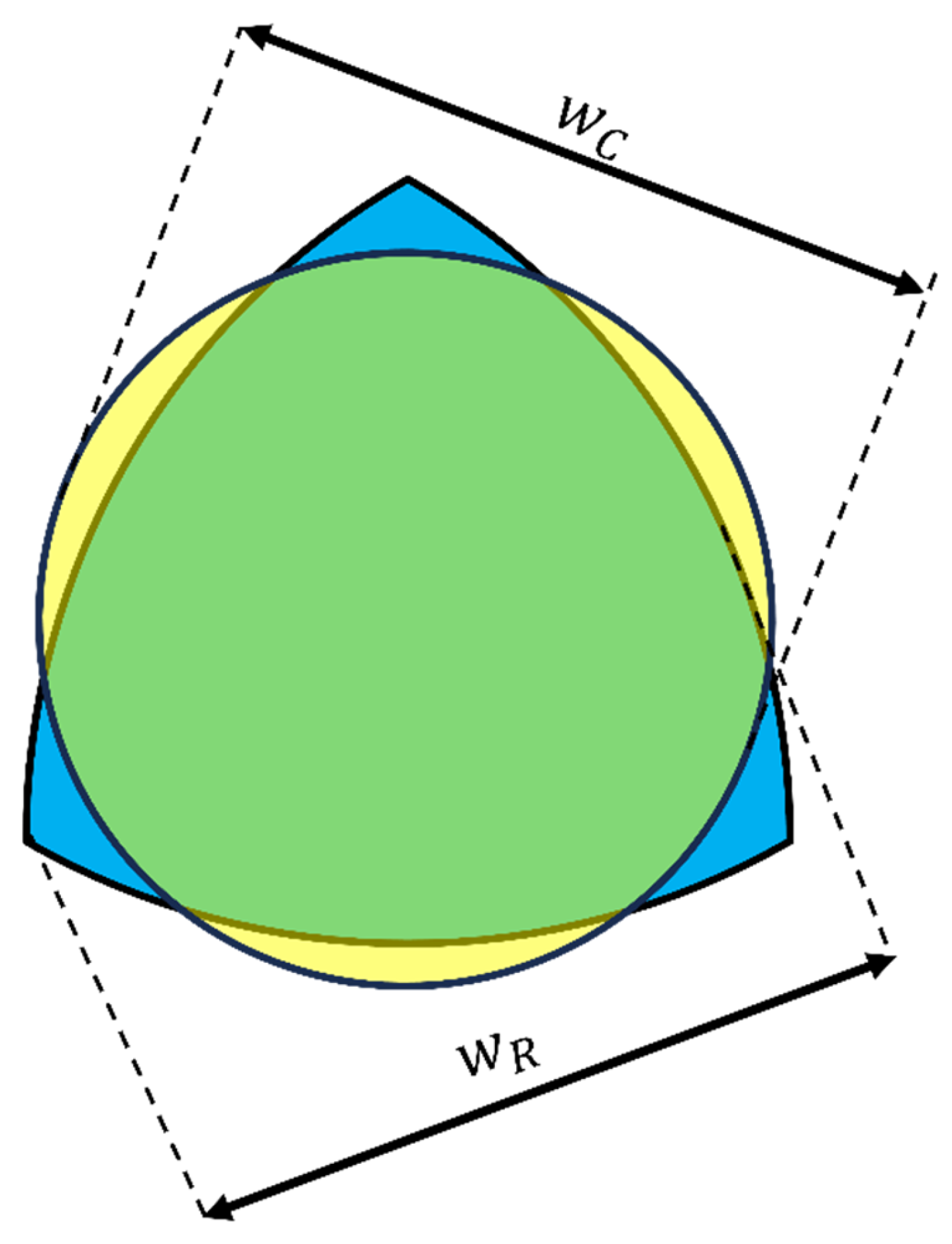
Figure 1 illustrates the equal-width comparison adopted in this work.
In constructive terms, the Reuleaux section used for VRA is generated from an equilateral triangle of side . The profile is formed by three circular arcs of radius , each centered at one vertex of the triangle and connecting the other two vertices. In CAD or scripting implementations, the section may therefore be defined unambiguously by (i) the side length , (ii) the vertex coordinates of the generating equilateral triangle in a fixed Cartesian reference frame, and (iii) the ordered stitching of the three arcs into a closed planar profile. This definition is used here as the reference cross section for both VRA and VRAt.
Taking
as the characteristic parameter, the circular cross section has radius
, with throat flow area and wetted perimeter given by
where
is the throat flow area of the circular section, and
is the corresponding wetted perimeter.
For the Reuleaux section of width
, the wetted perimeter is
where
is the wetted perimeter of the Reuleaux section, and the flow area is
where
is the flow area of the Reuleaux section of width
. Therefore, for the same
, the circular and Reuleaux sections have the same wetted perimeter, whereas the Reuleaux section has a smaller flow area. This difference is reflected in indicators based on the ratio
and on the hydraulic diameter, defined as
where
is the hydraulic diameter,
is the flow area, and
is the wetted perimeter of the section considered.
In the present framework, these quantities are used only as geometric design indicators for transparent comparison under explicit constraints. They are not treated as exhaustive predictors of the total pressure loss, cavitation inception, vortex formation, or cavitating-flow performance.
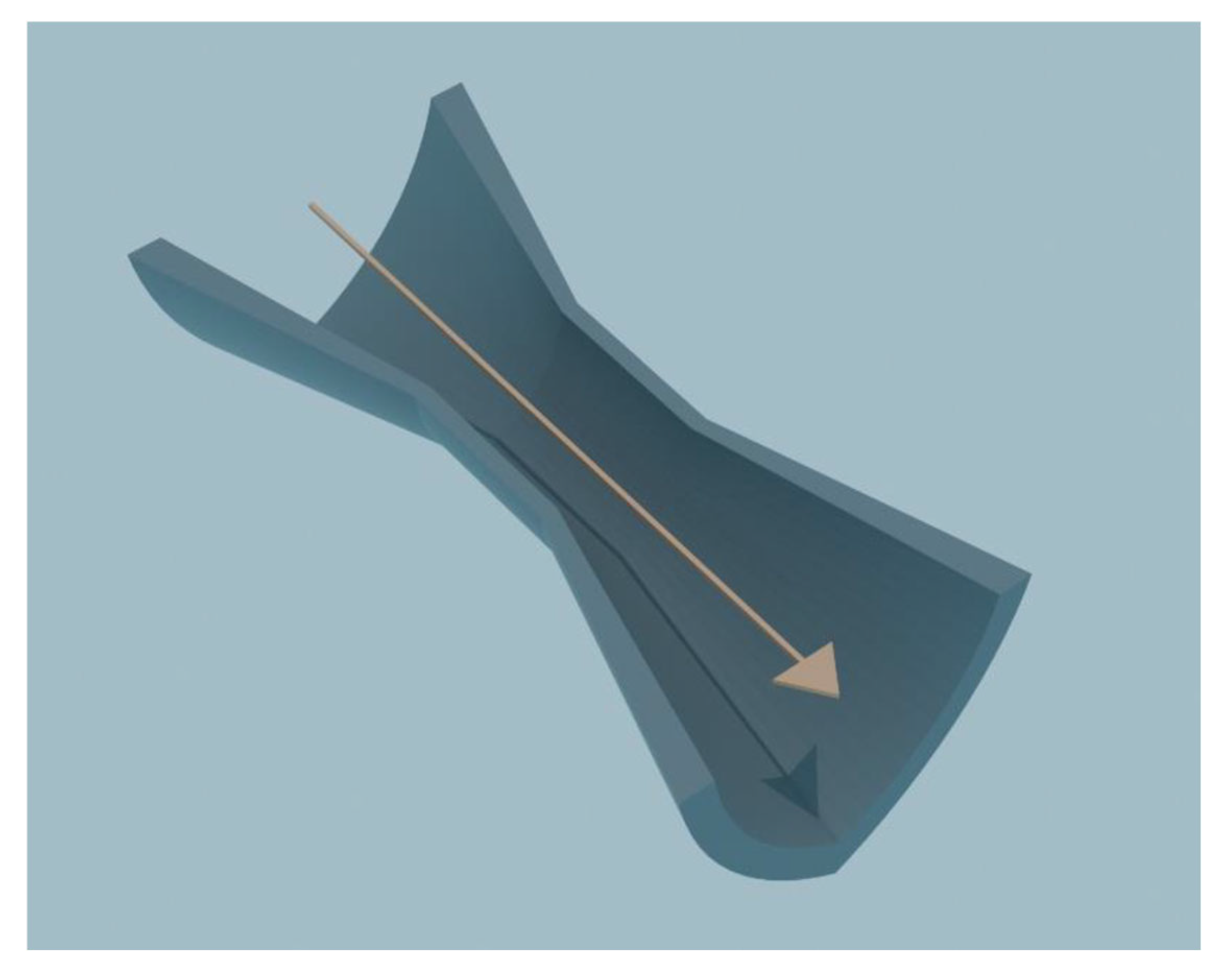
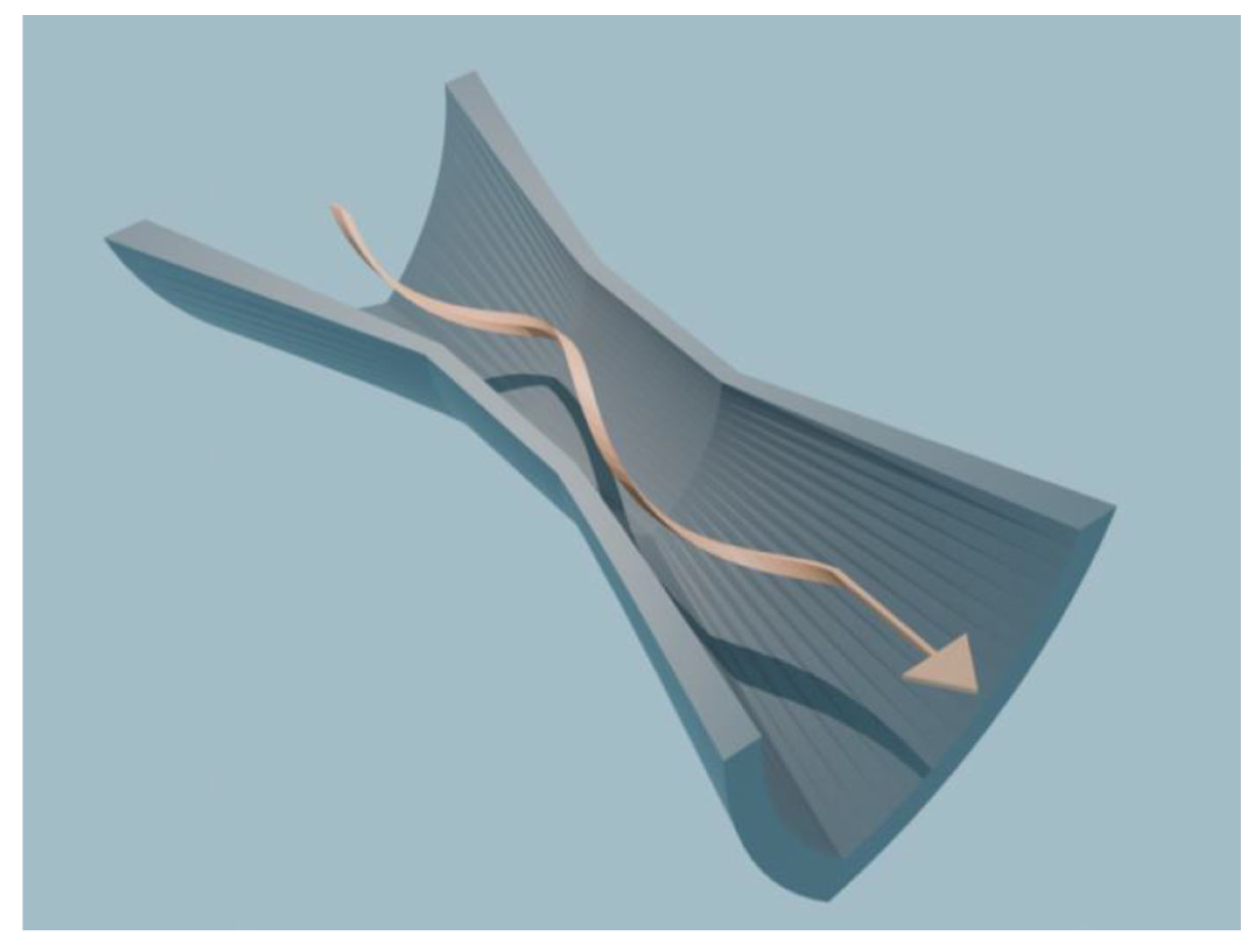
In the VRA configuration, the throat region adopts the constant-width Reuleaux cross section just defined. In the VRAt configuration, the same cross section is progressively rotated about the device longitudinal axis over a prescribed axial segment, while preserving the same transverse section and equal-width condition.
The VRA and VRAt configurations are schematically illustrated in
Figure 2 and
Figure 3, respectively.
The twist in the VRAt configuration is defined as a rotation of the cross section about the device longitudinal axis. Let
denote the axial coordinate along the twisted segment, where
is the axial length over which the twist is applied. A reproducible choice is to prescribe the section orientation through a linear rotation law,
where
is the local rotation angle, and
is the constant twist rate. The total imposed rotation is then
where
is the total twist angle between the beginning and the end of the twisted segment.
In geometric terms, the VRAt may be generated by sweeping the VRA section along the device centerline while prescribing the local section orientation through . Under this construction, the transverse section remains unchanged and only its angular orientation varies along the axial coordinate. In the present work, this operation is introduced as a controlled geometric modification for design comparison. It is not assumed, by itself, to imply a specific vortex structure, secondary-flow intensity, or cavitation response.
If implemented in CAD, the transition between untwisted and twisted segments should be enforced with a geometrically continuous section orientation. Higher-order continuity of the full solid depends on the specific lofting or sweep strategy adopted in the modeling environment and is therefore treated here as an implementation requirement rather than as a result established by the present framework.
3. Geometric Metrics for Comparison and Design Guidance
Geometric metrics are introduced to compare the circular reference section with VRA and VRAt under equal-width conditions at the same characteristic width . The proposed quantities are design-oriented geometric/kinematic descriptors intended for transparent comparison under explicit constraints. They are not, by themselves, predictors of hydraulic losses, cavitation inception, vortex intensity, or water-treatment performance.
3.1. Wall-Accessibility Proxy Under Equal-Width Conditions
Let
denote the wetted perimeter. In a purely geometric sense, a larger perimeter provides a larger boundary length per unit axial length. If a linear density
is introduced as a surface-condition parameter for a given wall finish, a perimeter-scaled proxy can be written as
where
is an indicative count per unit axial length. This definition is introduced only as a design proxy to separate a surface-condition factor (
) from a geometric factor (
); it is not a prediction of active nuclei or cavitation dynamics [
29,
30].
To compare sections with different flow area
, a normalized proxy is defined as
For the same surface condition (constant
), the relevant geometric factor is
. Under equal-width conditions, a relative geometric factor is therefore defined as
Since
while
, it follows that
. Using Equations (1)–(3), one obtains
and the equal-width area ratio
Equation (11) emphasizes that, at fixed envelope , VRA reduces the throat flow area; any practical design must therefore account for hydraulic sizing consistent with the prescribed flow rate and operating point.
3.2. Geometric Near-Wall Coverage
To quantify how much of the cross section lies near the wall, a geometric near-wall coverage fraction is defined as
where
is the cross-sectional area contained within a wall-normal distance
from the boundary. This quantity is purely geometric and must not be interpreted as the residence time, shear, heat-transfer, or cavitation intensity.
For sufficiently smooth boundaries and for
small compared with the minimum local geometric scale (in particular, the minimum radius of curvature and the inradius), the first-order approximation is
Equation (13) is the linear term of the standard parallel-curve (offset) area expansion. For completeness, the second-order expression for the near-wall layer area is
hence,
Equations (13a) and (13b) clarify that Equation (13) is a first-order approximation rather than an exact product of perimeter and thickness. As ε increases, the correction term πε2 becomes more relevant, and the linearized estimate in Equation (13) becomes progressively less accurate. More generally, if , the second-order correction term is equal to times the linear term at the throat, because for both the circular and Reuleaux sections under equal-width conditions. Thus, for thin near-wall layers , Equation (13) remains a practical first-order estimate, whereas its accuracy decreases progressively as increases.
For the VRA profile, an additional geometric qualification is required. The ideal Reuleaux construction contains non-smooth arc junctions. Therefore, in practical CAD and manufacturing implementations, these junctions are assumed to be regularized by finite-radius fillets. Accordingly, the present analysis is restricted to admissible values of ε that remain smaller than the minimum fillet radius adopted at the arc junctions. This admissibility condition is made explicit wherever χ(ε) values are reported.
Under equal-width conditions,
is larger for VRA than for the circular section. Therefore, for the same admissible
,
is correspondingly larger for VRA within the validity range of Equations (13)–(13b).
Figure 4 is included only to visualize the geometric definition of
and
; it does not represent simulated or measured fields.
3.3. Effect of Axial Twist in VRAt
In the VRAt configuration, the transverse cross section coincides with that of the VRA. Accordingly, the metrics based on and do not vary with twist, because and remain unchanged by construction. Twist is introduced only as an additional geometric design variable.
To provide a reproducible descriptor of the imposed twist, an idealized helical trajectory is considered as a kinematic construction. On this basis, an effective path length is defined as
where
is the effective path length,
is the axial length of the twisted segment, and
is the helix angle with respect to the axis. A corresponding dimensionless path-length elongation indicator is then defined as
Assuming a reference radius
and a rotation law
along the axial coordinate
, with
, the differential path element is
Integrating over
gives
Therefore, the elongation indicator is
The helix angle follows as
For a linear twist, , and therefore, . In this work, is adopted as the reference radius for evaluating .
Within the present framework, is used only as a geometric-kinematic descriptor associated with the imposed twist. It is not, by itself, a prediction of swirl, coherent vortices, cavitation enhancement, or hydraulic performance, all of which depend on additional factors such as the inlet conditions, Reynolds number, viscosity, confinement, and upstream flow development.
Figure 5 is included only as a conceptual schematic to illustrate the imposed twist and its relation to the near-wall band definition. It is not a representation of a simulated or measured flow field.
3.4. Kinematic Scenarios and Limitations
Under equal-width conditions, the imposed twist in VRAt does not modify the throat cross section itself. In particular, and remain unchanged, and therefore, the transverse indicators based on , , and coincide with those of the VRA configuration. The twist is parameterized as , with , and is treated here as a geometric design variable.
To define reproducible kinematic scenarios, the twist is described through the dimensionless quantity and through the associated elongation indicator . These quantities are useful for comparing prescribed twist intensities within the proposed framework. However, they do not imply that a real flow will necessarily develop swirl or secondary-flow structures.
Under equal-width conditions, the VRA section increases relative to the circular reference and therefore increases the geometric proxies and for the same surface condition and admissible . This occurs together with a reduced flow area , which should be taken into account in hydraulic sizing and operating-point selection. The VRAt configuration preserves the same transverse geometric indicators as VRA and adds a separate kinematic descriptor through .
The quantities , , and are therefore intended only as design indicators for preliminary comparison. Quantification of hydraulic losses, pressure fields, cavitation behavior, and multiphase dynamics requires dedicated experiments or numerical modeling supported by verification and validation.
4. Worked Numerical Example of Equal-Width Indicators and VRAt Kinematic Scenarios
This section provides a reproducible numerical instantiation of the proposed definitions. All reported values follow directly from the geometric and kinematic relations and are included to make the indicator calculations transparent and reusable for preliminary design comparison. They do not constitute experimental evidence, numerical validation, or a prediction of hydraulic, cavitation, or water-treatment performance.
4.1. Inputs, Prerequisites, and Indicator Definitions
The equal-width characteristic parameter is set to
The near-wall thickness is parameterized through the dimensionless ratio
,
For mm, these values correspond to mm, respectively. They are introduced only as illustrative thicknesses for the geometric near-wall band definition.
Because the ideal Reuleaux construction contains non-smooth arc junctions, the section is assumed to be regularized in CAD and manufacturing implementations by finite-radius fillets. In the worked example, a conservative minimum fillet radius of is adopted, and the near-wall thickness is restricted to . With the values selected in Equation (21), this condition is satisfied in all reported cases.
The transverse indicators considered at the throat are the flow area
, wetted perimeter
, the ratio
, and the hydraulic diameter
The geometric near-wall coverage fraction is estimated using the first-order relation
As discussed in
Section 3, Equation (23) is a first-order approximation and is used here only as a geometric indicator within the corresponding validity assumptions.
Under the equal-width constraint, the axial twist in VRAt does not modify the throat cross section. Therefore, at the throat, the transverse indicators , , , , and coincide for VRA and VRAt by construction.
4.2. Numerical Values for Transverse Indicators and Near-Wall Coverage
Table 1 reports a worked numerical example at the throat for the circular reference section and the equal-width Reuleaux section.
Table 1 shows that, for the same equal-width parameter
, the Reuleaux section preserves the wetted perimeter of the circular reference while having a smaller throat flow area. Consequently,
is higher, and the hydraulic diameter is lower for VRA than for the circular section under equal-width conditions. Because Equation (23) depends on
for a given admissible
, the estimated geometric near-wall coverage
is also higher for VRA at the same
. These outcomes are direct consequences of the chosen constraint and indicator definitions; they are not evidence of cavitation behavior or hydraulic-loss performance.
4.3. Illustrative VRAt Scenarios Based on the Kinematic Indicator
For VRAt, a kinematic descriptor associated with the imposed twist is reported using the reference radius
For a linear twist, the twist rate is
The dimensionless twist intensity
is defined as
and the path-length elongation indicator
is
Table 2 reports three illustrative scenarios. The values
are used as simple reference rotations, while
is varied to provide distinct normalized twist lengths for reproducible comparison under the same equal-width parameter
. The purpose of these cases is to instantiate the kinematic descriptor with explicit inputs; they are not intended to identify an optimal design.
Table 2 shows that
varies with the prescribed combination of
and
, providing a compact dimensionless descriptor for comparing twist prescriptions, while the transverse throat metrics remain unchanged under equal-width conditions. Any relationship between imposed twist and actual flow structures is not established here and requires dedicated experiments or V&V-supported numerical modeling.
Accordingly, may be used to rank prescribed twist intensities at fixed equal-width geometry before any performance-oriented testing, while any correspondence between similar values and similar downstream flow organization must be established separately.
The worked numerical values reported in this section provide a transparent instantiation of the proposed indicators. Under equal-width conditions, VRA yields a higher ratio and a higher geometric near-wall coverage estimate than the circular reference, together with a smaller throat area and hydraulic diameter. VRAt shares the same transverse throat indicators as VRA by construction and introduces a separate kinematic descriptor through to compare prescribed twist scenarios. The present worked example is limited to geometric and kinematic indicator evaluation and does not assess hydraulic losses, cavitation response, or treatment performance.
5. Discussion
This work introduces a reproducible geometry-driven framework for early-stage comparison of hydrodynamic-cavitation Venturi throats under an explicit equal-width transverse-envelope constraint. The contribution is methodological: it formalizes an explicit equal-width (transverse envelope) constraint and provides parametric definitions for a constant-width Reuleaux cross section (VRA) and a controlled axial-twist variant (VRAt), building on related prior work, while focusing here on reproducible geometric comparison rather than on hydraulic or cavitation performance assessment.
Relative to much of the existing Venturi literature, the present work adopts a different comparison logic [
31,
32]. Instead of comparing case-specific geometries under heterogeneous or only implicitly stated constraints, it fixes a common transverse envelope and uses that condition as the explicit basis for comparison [
33,
34]. This also distinguishes the framework from comparisons based on equal area, hydraulic diameter, or loosely matched overall size, which address different design questions [
35]. Within this basis, the circular section serves as the reference, VRA isolates the effect of a constant-width non-circular throat on the geometric balance between wetted boundary and flow area, and VRAt retains the same transverse throat geometry while introducing a separately controlled axial twist. The outcome is therefore not a ranking of hydraulic or cavitation performance but a reproducible pre-design framework that makes the comparison criterion, geometric assumptions, and scope limits explicit.
For clarity,
Table 3 summarizes the comparison criterion adopted in the present work relative to other common criteria used in Venturi design.
The results are geometric and kinematic by construction and should be interpreted as the outcome of a comparison performed at fixed characteristic width . In many practical contexts, is an immediate integration constraint dictated by housings and interfaces. Under equal-width conditions, VRA preserves the wetted perimeter of the circular reference while reducing the throat flow area (Equations (1)–(3)). Consequently, increases, and decreases (Equation (4)). In the present framework, these variations are used only as geometric indicators describing wall availability relative to flow area. Within this restricted meaning, the proxies and increase with , providing a compact quantitative language to document geometry-driven design choices while keeping geometric comparison and performance demonstration separate.
The definition of geometric near-wall coverage, , also implies a practical prerequisite. The near-wall approximation requires to remain small relative to local geometric scales, including the minimum radius of curvature. Because ideal Reuleaux constructions contain non-smooth arc junctions, practical implementations must be regularized by finite-radius fillets; therefore, the present framework treats fillet regularization as a manufacturability and surface-continuity requirement and restricts to admissible values consistent with the adopted minimum fillet radius. Under this interpretation, is a geometric near-wall coverage indicator only; it should not be interpreted as residence time, shear level, or treatment performance.
VRAt preserves the same transverse throat metrics as VRA and adds a separate geometric-kinematic descriptor through , which summarizes a prescribed twist intensity via an idealized path-length elongation. Within the present scope, is used only to define reproducible twist scenarios for comparison and documentation. It does not establish a relationship between imposed twist and actual vortex or cavitation structures, which depend on operating conditions and device-specific features. In particular, imposed twist is neither a necessary nor a sufficient condition for swirl or coherent vortices. For example, at low Reynolds number and/or high viscosity, secondary-flow development may remain weak even under prescribed twist; likewise, abrupt inlet conditions or insufficient upstream development may dominate the downstream flow organization independently of the twist prescription. Conversely, in practical devices the generation of strong rotational structures may also require additional flow-conditioning elements, such as guide vanes or vortex generators, beyond the geometric twist itself.
The present work does not report prototypes, experiments, or V&V-supported simulations; therefore, it does not quantify hydraulic losses, pressure fields, cavitation inception, cavitation dynamics, or treatment performance. In addition, cavitation development depends on physical mechanisms that are not determined by geometry alone, including the role of surface-related nuclei and reactor-scale flow organization. Quantitative cavitation prediction is also known to be sensitive to turbulence, cavitation-model closures, and numerical choices. This point is especially relevant when extending the analysis to three-dimensional non-axisymmetric configurations such as VRAt and when attempting to infer pressure dynamics or cavitation behavior directly from geometry. Accordingly, any performance-oriented conclusions require dedicated measurements and/or V&V-supported numerical studies anchored to experimental data.
Within these explicit limits, the framework is intended as a reproducible pre-design tool for transparent early-stage comparison under equal-width constraints, prior to performance-focused testing and scale-up.
6. Conclusions
This work formalizes a reproducible geometric design framework for Venturi devices based on a constant-width Reuleaux cross section (VRA) and its controlled axial-twist variant (VRAt) under equal-width conditions, that is, under the same transverse envelope constraint. Parameterized geometries and a minimal set of geometric and kinematic indicators are defined for preliminary comparison, including , , , and . These quantities are introduced as design-oriented descriptors only and do not constitute a validated hydraulic, cavitation, or application-performance assessment. A worked numerical example is provided to instantiate the indicator definitions and to make the calculation procedure transparent and reproducible. Within the broader context of hydrodynamic-cavitation device design, the proposed framework is intended as a reproducible pre-design tool for transparent early-stage comparison under equal-width constraints, to be followed by controlled experiments and/or V&V-supported numerical studies for device evaluation, selection, and scale-up.