Review

Hybrid Renewable Energy Systems for Islands: A Configurations-Based Review

by
Pandu Kristian Prayoga Simamora
1,2 and
Gregorio Iglesias
1,2,3,*
1
School of Engineering and Architecture, Marine Energy Ireland, University College Cork, T12 K8AF Cork, Ireland
2
Sustainability Institute, Marine Energy Ireland, University College Cork, T12 K8AF Cork, Ireland
3
School of Engineering, Computing and Mathematics, University of Plymouth, Drake Circus, Plymouth PL4 8AA, UK
*
Author to whom correspondence should be addressed.
Sustainability 2026, 18(7), 3372; https://doi.org/10.3390/su18073372
Submission received: 20 February 2026 / Revised: 24 March 2026 / Accepted: 25 March 2026 / Published: 31 March 2026

Abstract

Small- and medium-sized islands struggle to secure reliable, affordable, low-carbon electricity due to their isolation, scarce land, and reliance on imported fossil fuels. Hybrid renewable energy systems (HRESs) offer a way forward, but research has focused overwhelmingly on solar–wind configuration. This review critically examines HRES configurations for islands (solar–wind, solar–marine current, and wind–wave), assessing how they match local resources, system needs, and constraints. The dominance of solar–wind hybrids is attributed to their mature technology and low costs, but marine-inclusive options can provide advantages such as better predictability, efficient land use, and multifunctionality in certain island settings. A cross-configuration analysis is conducted to compare the technology readiness, suitability, and deployment contexts of different hybrid configurations. The review also examines island-specific hurdles, including economic pressures, geographic remoteness, land limitation, environmental factors, and social issues, as well as the role of energy storage and diesel backup during the energy transition. Findings stress context-driven choices over technology biases, fostering resilient and locally tailored pathways for island energy transitions.

1. Introduction

Islands are among the regions most vulnerable to the impacts of climate change, despite their relatively minor contribution to global greenhouse gas emissions [1]. Climate-related risks such as sea level rise, extreme weather events, rising air and sea surface temperatures, and changing rainfall patterns pose increasing threats to island habitability, infrastructure, and livelihoods [2,3]. These challenges are often compounded by inherent environmental constraints, including limited land availability, fragile freshwater resources, and exposure to coastal inundation and salinization [4]. While Small Island Developing States (SIDSs)—such as those in the Caribbean and Pacific—have been widely studied due to their shared vulnerabilities, similar climate-related challenges are also faced by non-SIDS island territories worldwide [5]. These non-SIDS islands include dependent islands that are part of continental or larger island states (e.g., Isles of Scilly, UK; Lofoten and Hammerfest, Norway; Alabat Island and Rapu-Rapu Island, Philippines) as well as Sub-national Island Jurisdictions (SNIJs), which are non-sovereign island territories that possess some degree of autonomous governance (e.g., Reunion Island, France; Torres Strait Islands, Australia). Although various adaptation strategies have been proposed, their effective implementation remains constrained by governance capacity, economic limitations, and social and institutional factors [6].
In addition to climate vulnerability, geographic isolation represents a fundamental structural challenge for many islands. Located far from mainland energy systems and characterized by limited transport and communication infrastructure, islands often rely on localized solutions to meet essential needs, including electricity supply [7]. In the absence of feasible submarine grid interconnections, electricity generation on many islands is dominated by fossil fuel-based power plants, primarily fueled by imported diesel. This dependence exposes island economies to volatile global fuel markets, leading to high electricity costs, and in some cases, energy expenditures accounting for a substantial share of gross domestic product [8,9]. Fuel import reliance also increases exposure to supply disruptions caused by extreme weather events or logistical constraints.
Against this backdrop, the adoption of renewable energy technologies has emerged as a promising pathway to enhance energy security, reduce electricity costs, and support climate mitigation efforts in island contexts [9,10]. Many islands possess abundant solar and wind resources, which, combined with their declining costs and high technological maturity, have driven the early and widespread development of solar- and wind-based renewable energy systems [11]. As a result, solar–wind hybrid configurations are frequently treated in the literature as the default solution for island applications. This emphasis, however, has contributed to a narrow concentration of configuration choices, with comparatively limited attention given to alternative hybrid configurations that may be better aligned with specific island characteristics.
In particular, hybrid configurations incorporating marine renewable energy sources, such as marine current and wave energy, remain relatively unexplored and are rarely evaluated in comparison with more established solar–wind hybrids. This is notable given that many islands are surrounded by marine environments offering relatively predictable energy resources, which could contribute to improved system reliability [12,13]. The prevailing focus on a limited set of configurations reflects an implicit assumption that the most technologically mature and economically competitive options are universally suitable. However, island energy systems are highly context-dependent, and configuration suitability is influenced by not only resource availability but also by island-specific demand characteristics, reliability requirements, infrastructure constraints, and logistical considerations. Consequently, not all islands are equally well suited to solar–wind dominated hybrid systems, underscoring the need for configuration choices that are connected to local conditions and system needs.
This review addresses these gaps by providing a critical, configuration-focused synthesis of hybrid renewable energy systems (HRESs) for islands. The literature is organized and analyzed across both dominant and underrepresented hybrid configurations, including solar–wind, solar–marine current, and wind–wave systems. The examination considers not only technological maturity or cost, but also how different hybrid technology mixes align with island-specific characteristics that shape performance and feasibility. In addition, the review considers the transitional role of energy storage and diesel generation as integral structural components of island hybrid systems. By integrating cross-configuration comparisons with realistic deployment considerations, the paper aims to provide system-level insights that support more informed and context-sensitive design of HRESs for islands.
The rest of the paper proceeds as follows. Section 2 details the critical review methodology employed. Section 3 examines hybrid renewable energy system configurations relevant to island energy systems, with particular focus on solar–wind, solar–marine current, and wind–wave combinations. Section 4 presents a cross-configuration analysis, providing a comparative assessment of the reviewed hybrid configurations in island contexts, as well as their potential and challenges for integration with island-specific applications. Finally, Section 5 concludes the paper with a summary of key insights and their implications for future research.

2. Methodology

2.1. Literature Search Strategy

This study adopts a critical review approach to examine HRES configurations for island energy systems [14]. The objective of the review is to synthesize configuration-level insights across hybrid configurations relevant to island contexts. The literature search was primarily conducted using Google Scholar and Scopus databases, with emphasis on peer-reviewed journal articles and conference proceedings. The search process began by identifying the most frequently studied hybrid configurations in the context of island energy systems. Initial search strings included “hybrid renewable energy” and “island”, which directly target studies addressing HRES applications for island communities. This preliminary search allowed the identification of several commonly studied hybrid configurations, including solar–wind, solar–marine current, and wind–wave hybrid systems.
To capture a broader set of relevant studies for each configuration, the search strategy was subsequently expanded using targeted keyword combinations. For solar–wind configurations, keyword combinations such as “hybrid”, “solar”, “wind”, and “island” were used. For solar–marine current, search terms including “hybrid”, “solar”, “marine current”, “tidal”, and “island” were applied. Meanwhile, combinations of “hybrid”, “wind”, “wave”, and “island” were used to identify studies on wind–wave hybrid configurations. This extended search also revealed several multi-renewable energy systems, defined as energy systems integrating more than two renewable energy sources, which typically incorporate the previous two-resources hybrid configurations.
No explicit temporal restriction was imposed on the literature search in order to capture a comprehensive range of studies and to observe how research on hybrid configurations has evolved over time. Furthermore, the review is not restricted to fully renewable or off-grid systems. Studies incorporating diesel generators or grid-connected components were also included, reflecting the current operational realities of many remote islands. Given the continued reliance on diesel-based generation in island contexts, such inclusion enables examination of more realistic and transitional hybrid systems rather than immediately idealized fully renewable systems [15].

2.2. Bibliometric Overview

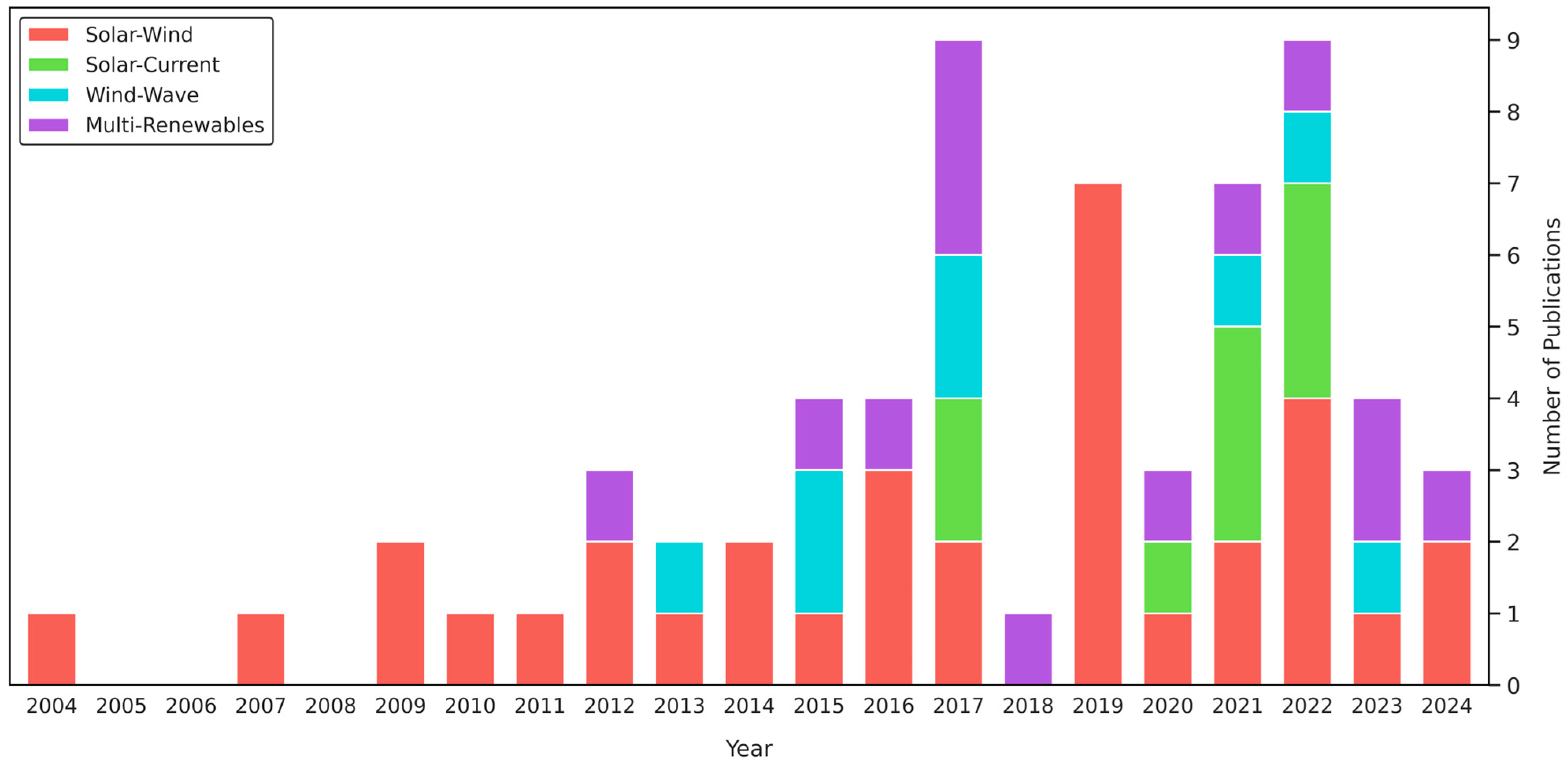
From the literature search, a total of 64 publications related to HRESs for islands were identified. Figure 1 shows the distribution of studies across different hybrid configurations. Among these, the solar–wind configuration is the most extensively investigated, accounting for more than half of the collected publications (n = 34). This dominance is likely due to technological maturity and commercial availability of solar PVs and wind energy technologies. Other configurations have received comparatively less attention. A total of 9 publications examine solar–marine current systems, while 8 publications focus on wind–wave systems. Although the number of studies on these configurations is relatively limited, their presence in the literature indicates a growing research interest in integrating marine energy resources into hybrid renewable energy systems, particularly in island regions. In addition, 13 publications investigate multi-renewable energy systems. Within this category, the most common configuration is solar–wind–biogas (n = 6), followed by solar–wind–marine current (n = 4), solar–wind–wave (n = 2), and wind–wave–marine current (n = 1). These configurations reflect increasing efforts to diversify renewable energy mixes into hybrid systems to improve system reliability.
Figure 2 presents the temporal evolution of publications on HRESs for islands. Research in this field began to emerge in 2004 but remained relatively limited until around 2011. During this early period, the studies primarily focused on solar–wind hybrid systems, reflecting the technological maturity of their technologies compared to other renewables at that time. Research on solar–wind configurations remained consistently present in subsequent years, suggesting sustained interest in this hybrid concept and contributing to its dominance in the literature. From 2012 onwards, a gradual increase in research activity can be observed. This period marks the beginning of broader exploration of hybrid configurations integrating marine energy resources, including wind–wave systems (since 2013) and solar–marine current systems (since 2017), as well as the emergence of multi-renewable systems (since 2012). Furthermore, a noticeable increase in the number of publications for each configuration type is evident after 2019. The growing research interest is likely associated with the increasing recognition of resource complementarity among renewable sources to enhance the reliability of HRESs.
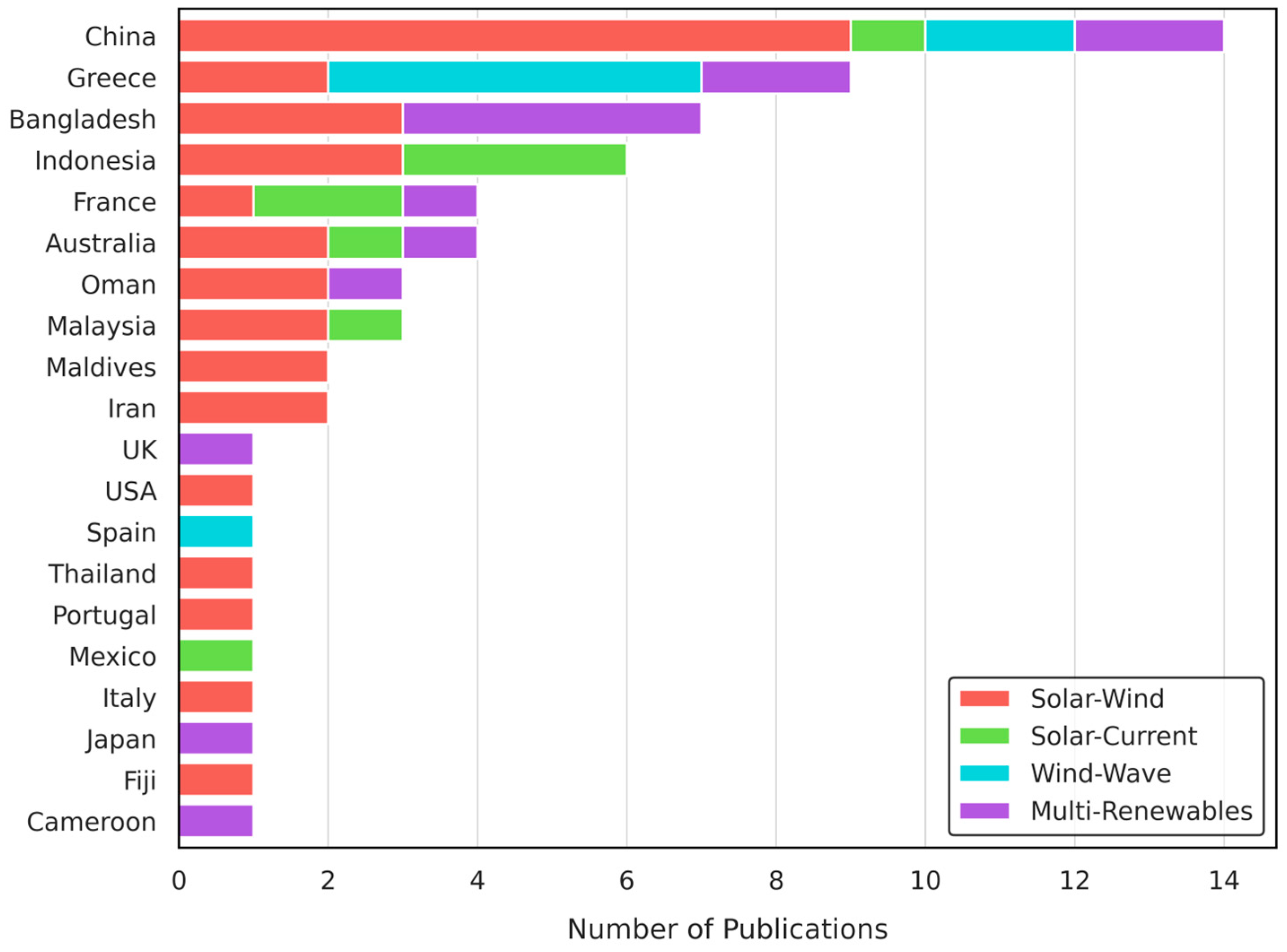
The geographical distribution of case study locations is presented in Figure 3. China emerges as the most frequently studied country, followed by Greece, Bangladesh, and Indonesia. The prominence of these regions can be attributed to their extensive island territories, significant renewable energy potential, and increasing demand for sustainable energy solution for islands communities. The observed distribution also suggests that solar–wind configuration remains the most widely investigated hybrid systems in most countries. However, emerging configurations incorporating marine energy resources, such as wave and marine current energy, are increasingly being explored in regions where these resources are abundant. This indicates a gradual shift toward more diversified hybrid renewable energy systems tailored to the specific demand characteristics and energy conditions of each island region.

3. Hybrid Renewables Configuration Options

Advances in renewable energy technologies have expanded the range of renewable energy combinations considered for island energy systems. Based on the existing literature, three hybrid renewable configurations frequently appear in island energy studies: solar–wind, solar–marine current, and wind–wave, alongside a growing set of multi-renewable systems. These configurations follow distinct design principles, shaped by resource characteristics, spatial constraints, infrastructure requirements, and technology maturity.
Solar photovoltaics (PVs) and wind turbines remain the most widely deployed options due to their high technological readiness level (TRL) and comparatively low levelized cost of electricity (LCOE) [16]. Despite these advantages, both solar and wind power exhibit inherent intermittency, which poses challenges for supply–demand balance in isolated island systems [17]. This limitation has motivated the exploration of hybrid configurations that integrate additional renewable energy sources with different temporal characteristics. Marine-based resources, particularly tidal currents, offer comparatively high predictability and require minimal land occupation, making them attractive complements for space-constrained islands [18]. Wave energy represents another option, especially for islands exposed to the ocean or large open seas with high wave energy potential. Examples include the Canary Islands in the North Atlantic Ocean [19] and the Balearic Islands in the Mediterranean Sea [20], which exhibit relatively strong wave resources within their respective regions.
The following subsections examine these configurations in detail, focusing on their potential synergies and limitations in island energy systems.

3.1. Hybrid Solar PVs and Wind Energy

Hybrid solar PVs–wind energy systems dominate the literature on island hybrid renewable energy systems and are widely treated as the reference configuration. This dominance is primarily driven by the high technological maturity, declining costs, and extensive deployment experience of both solar PVs and wind technologies [21]. Solar PVs and onshore wind consistently exhibit the lowest LCOE, while offshore wind has also experienced substantial cost reduction over the past decade [16,22]. These trends have encouraged researchers to focus on solar–wind hybrids as the most readily deployable pathway toward increased renewable penetration in island power systems.
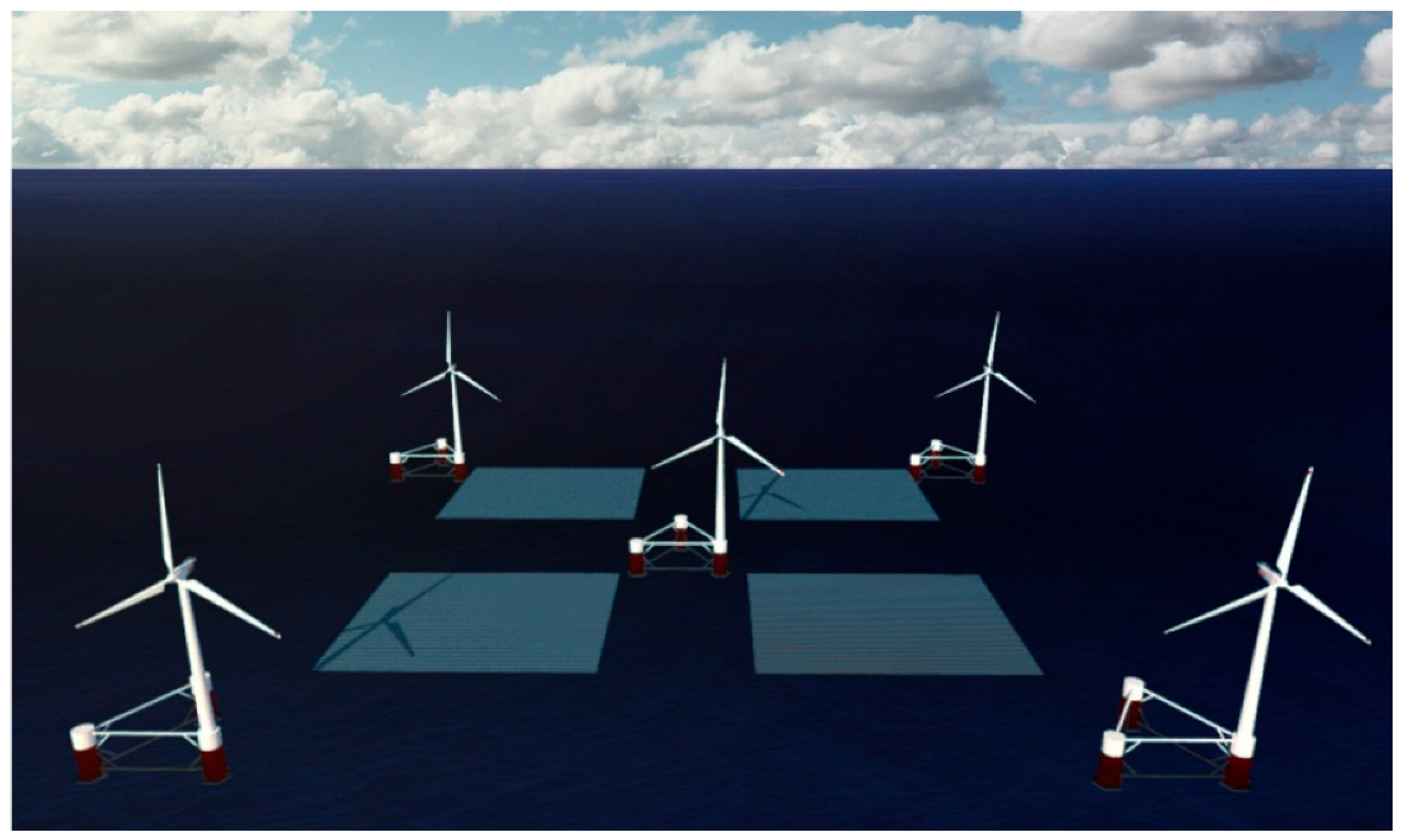
From a configuration perspective, solar–wind hybrids offer structural simplicity and flexibility. Most studies model these systems using either common AC or DC bus architectures, supplemented by battery storage and/or backup generators to ensure supply continuity [23,24]. In addition to conventional land-based deployments, hybrid configurations may also be implemented in offshore environments, through the integration of floating solar PVs with offshore wind turbines as shown in Figure 4 [25]. Their modularity allows incremental capacity expansion, which is particularly attractive for islands with limited infrastructure and evolving demand. As a result, solar–wind hybrids have become the most frequently examined configuration in techno-economic assessments, optimization studies, and planning analysis for island contexts [26,27].
A central argument supporting solar–wind hybridization is the potential temporal complementarity between solar irradiation and wind resources. Numerous studies report that seasonal and diurnal differences in resource availability can reduce aggregate power variability and improve system reliability compared to single-source systems [28,29,30,31]. Seasonal complementarity can reduce prolonged energy deficits, while daily complementarity can lower storage requirements by mitigating short-term intermittency. In addition, the partial anti-correlation between solar and wind production has been shown to improve utilization of shared infrastructure, such as cable pooling or co-located installations, thereby contributing to cost reductions at the system level [32].
The literature, however, also highlights that the degree of complementarity is highly site-dependent, and its benefits diminish in regions where solar and wind resources exhibit a strong temporal correlation [33]. Case studies across different islands demonstrate that the relative contribution of solar and wind within the hybrid configuration varies widely depending on local resource conditions. For example, wind energy accounts for up to 40% of total production in windy regions of Corsica Island, France, but drops to around 20% in calmer areas [34]. In Jiuduansha Island, China, wind dominates the hybrid system, contributing approximately 86% of total generation [29]. Conversely, solar-dominated systems have been identified in regions where solar availability aligns closely with the demand patterns of the summer month peaks, as observed in an island near Hong Kong, where solar PVs contributed up to 83% of total energy output [35]. In contrast, in locations with low wind speeds, such as Teupah Island, Indonesia, excluding wind turbines altogether yields the lowest energy cost [36]. These findings indicate that while solar–wind hybrids are widely applicable, their internal configurations remain highly sensitive to local resource conditions.
Despite their prevalence, solar–wind hybrid systems exhibit structural limitations that constrain their suitability in certain island contexts. Both solar and wind resources are inherently intermittent and weather-dependent, often requiring substantial storage capacity or dispatchable backup to maintain grid stability [37]. As a result, many studies incorporate diesel generators as part of transitional solar–wind combinations, particularly for islands with existing diesel-based systems [38]. Economic analyses further show that integrating solar and wind generation into diesel-based systems substantially reduces energy costs relative to diesel-only configurations. For instance, studies on Rottnest Island [39] and Mornington Island [40] in Australia report LCOE reductions of approximately 50% and 54%, corresponding to renewable penetration levels of around 75% and 95%, respectively. Even a modest renewable share of around 25% can contribute to economic feasibility under high fuel price scenarios, as demonstrated for Al Hallaniyat Island, Oman [41].
At the same time, sensitivity analyses reveal that the economic performance of solar–wind–diesel configurations remains strongly influenced by local fuel prices and capital costs [42]. In some cases, low diesel prices sustain high diesel shares in least-cost solutions, as observed on Kish Island, Iran [43]. Meanwhile, in other cases, such as on Ur Island in Indonesia [44] and Fiji Islands [45], renewable-dominant configurations remain economically attractive despite fuel price variability. These results highlight that economic optimization alone does not guarantee deep renewable penetration and reinforces the need to interpret solar–wind configurations within broader contexts.
Beyond resource and cost considerations, the dominance of solar–wind hybrids is also reinforced by the extensive use of established sizing optimization tools. Most island-focused studies rely on software such as HOMER to evaluate feasible system configurations [46,47,48,49]. Solar–wind hybrid systems have also been investigated to supply electricity in rural communities and villages using the same software [50,51]. It indicates that this hybrid configuration is commonly considered for remote areas, including islands, using a similar energy system modeling approach. More advanced optimization techniques, including Genetic Algorithm [31,52,53] and Gravitational Search Algorithm [54], as well as a self-developed algorithm [55], have demonstrated potential improvements in solution quality. However, their application remains comparatively limited in island-focused studies. As a result, the reported performance of solar–wind hybrid systems reflects not only their technical characteristics but also the modeling approaches most commonly applied. This indicates that the strong presence of solar–wind configurations in the literature may be influenced not only by their technical suitability but also by the convenience of commonly used modeling tools.

3.2. Hybrid Solar PVs and Marine Current Energy

Hybrid configurations combining solar PVs and marine current energy represent a structurally distinct alternative to the dominant solar–wind configuration, particularly for islands located near powerful tidal straits [56]. Among ocean-based renewable resources, marine currents—most commonly exploited through tidal current technologies—offer a relatively predictable source of kinetic energy. Tidal currents are particularly attractive for energy extraction due to their periodic nature and the availability of well-established resource assessment models [57,58].
Solar–marine current hybrids differ fundamentally from solar–wind systems in terms of resource availability and system operation. Tidal currents exhibit high temporal predictability governed by astronomical cycles, resulting in more stable and forecastable power output compared to solar or wind resources. Numerous assessments have identified high tidal energy potential in narrow straits, channels, and headlands, which are commonly found in island environments [59,60]. This spatial coincidence makes marine current energy a relevant option for certain island regions, despite its lower technological maturity.
The technological basis of marine current energy extraction is primarily hydrokinetic turbines, which share operational principles with wind turbines but operate in a denser fluid environment. Designs include horizontal-axis, vertical-axis, and crossflow turbines, as well as alternative concepts such as oscillating hydrofoils and tidal kites [61,62]. Despite ongoing innovation, marine current technologies generally exhibit a lower TRL and higher capital costs than solar and wind systems [63,64]. These limitations have constrained large-scale deployment and may explain why solar–marine current hybrids remain underrepresented in island energy studies relative to solar–wind systems.
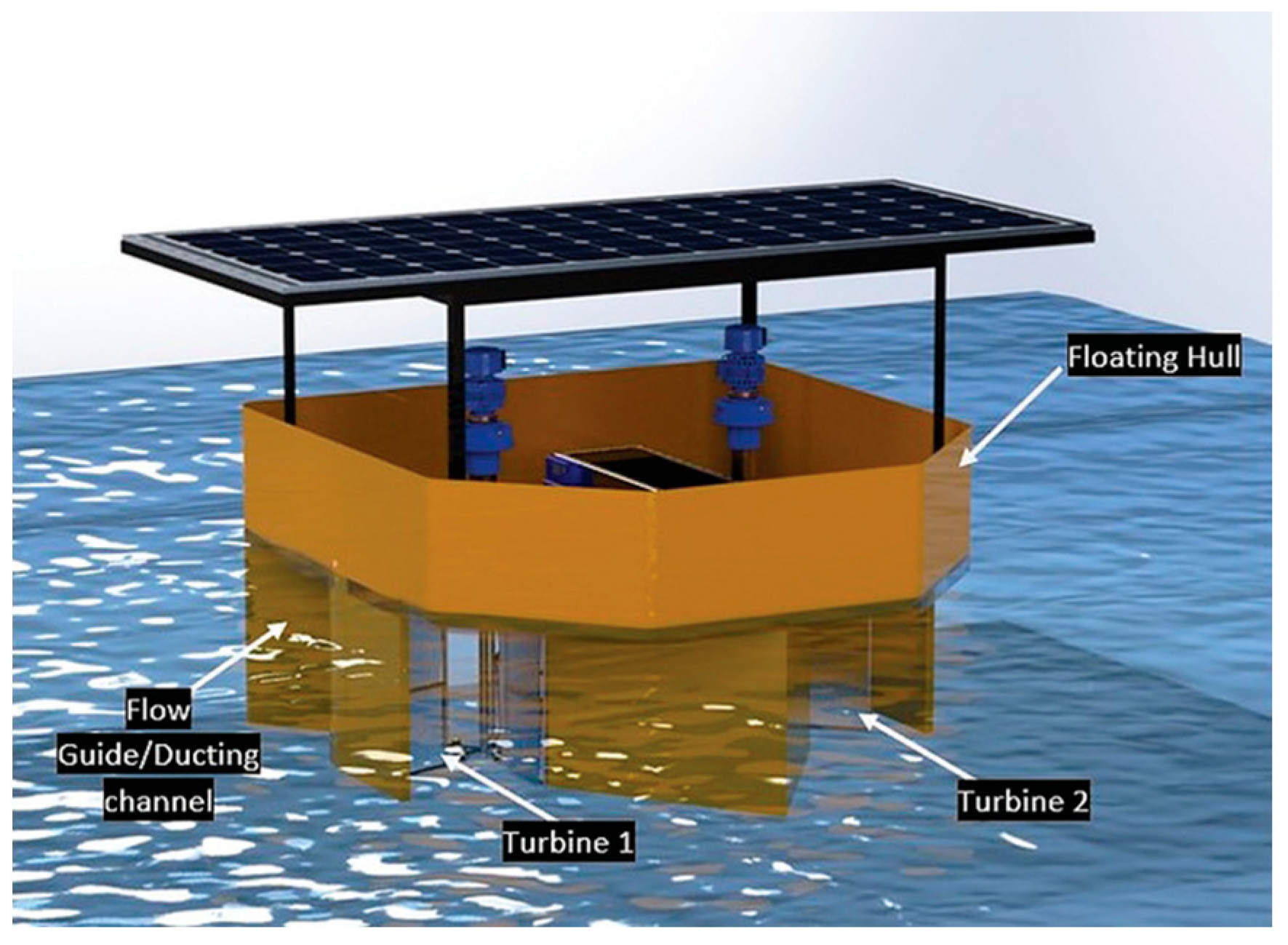
Several studies propose hybridization with solar PVs as a strategy to offset the limitations of marine current technologies [65,66,67]. Solar PVs provide modular capacity expansion and cost-effective daytime generation, while marine current contributes a predictable baseline component that can reduce reliance on large battery systems. Integration strategies include a prototype-scale demonstration tested in the Imo River, Nigeria, which combines a vertical-axis underwater turbine with solar panels mounted on the roof as illustrated in Figure 5 [68]. Further conceptual designs propose integrated floating structures that combine three components: underwater turbines for marine current energy, battery storage systems housed within the platform, and solar panels at the top [69]. This configuration enables shared infrastructure and compact system layouts, making it particularly suitable for spatially constrained islands.
A consistent finding across the literature is the high predictability of solar–marine current hybrid systems. Forecasting models for both tidal currents and solar irradiance are well developed, enabling improved operational planning and system reliability compared to configurations dominated by highly stochastic resources [70,71,72]. This predictability is particularly advantageous for islands near the equator and located adjacent to strong tidal channels, where solar availability and tidal velocities are high [73]. In these contexts, solar–marine current hybrid systems can reduce variability at the configuration level rather than relying solely on storage-based smoothing.
As with solar–wind systems, many solar–marine current hybrid configurations incorporate diesel generators and battery storage as energy system components. Several island-focused studies, such as the ones conducted in Indonesia [74] and Malaysia [75], demonstrate that integrating tidal energy into diesel-based systems can significantly reduce fuel consumption and emissions while maintaining reliability. These studies recognize the role of marine current energy as a complementary component in transitional hybrid renewable energy systems rather than as a standalone solution. However, the existing literature also reveals certain limitation. The feasibility of solar–marine current hybrids is highly site-specific, constrained by the availability of sufficiently strong tidal currents, suitable bathymetry, and installation and maintenance logistics [76]. Capital costs remain high, particularly when advanced storage options such as hydrogen systems are incorporated to address seasonal variability [77,78]. Even so, the hydrogen storage ultimately represents only a minor share of system capacity, reinforcing the continued importance of batteries and diesel generators in practical designs.
Research focusing on sizing optimization for solar–marine current systems remains limited. Existing studies primarily employ metaheuristic algorithms such as Particle Swarm Optimization and Genetic Algorithms [78], as well as the Improved Multi-Objective Grey Wolf Optimizer [79]. Commercial tools such as HOMER have also been applied, particularly in studies aimed at reducing diesel consumption [75]. While these studies demonstrate technical feasibility and potential performance benefits, the limited methodological diversity may also contribute to the relatively small number of studies examining this configuration.

3.3. Hybrid Offshore Wind and Wave Energy

Hybrid offshore wind–wave energy systems represent one of the most conceptually integrated marine hybrid renewable energy configurations. Wave energy, which is ultimately generated by wind-driven ocean processes, exhibits strong physical coupling with offshore wind resources. This intrinsic relationship has motivated extensive research into wave energy converters (WECs) and their potential integration with offshore wind systems, which leads to both structural and hydrodynamic integration [80,81]. The strong spatial overlap between wind and wave resources has been documented across many regions, supporting the justification for co-located or integrated system designs. However, site-specific assessments remain essential, as local bathymetry, wave climate, and infrastructure availability can significantly influence feasibility [82].
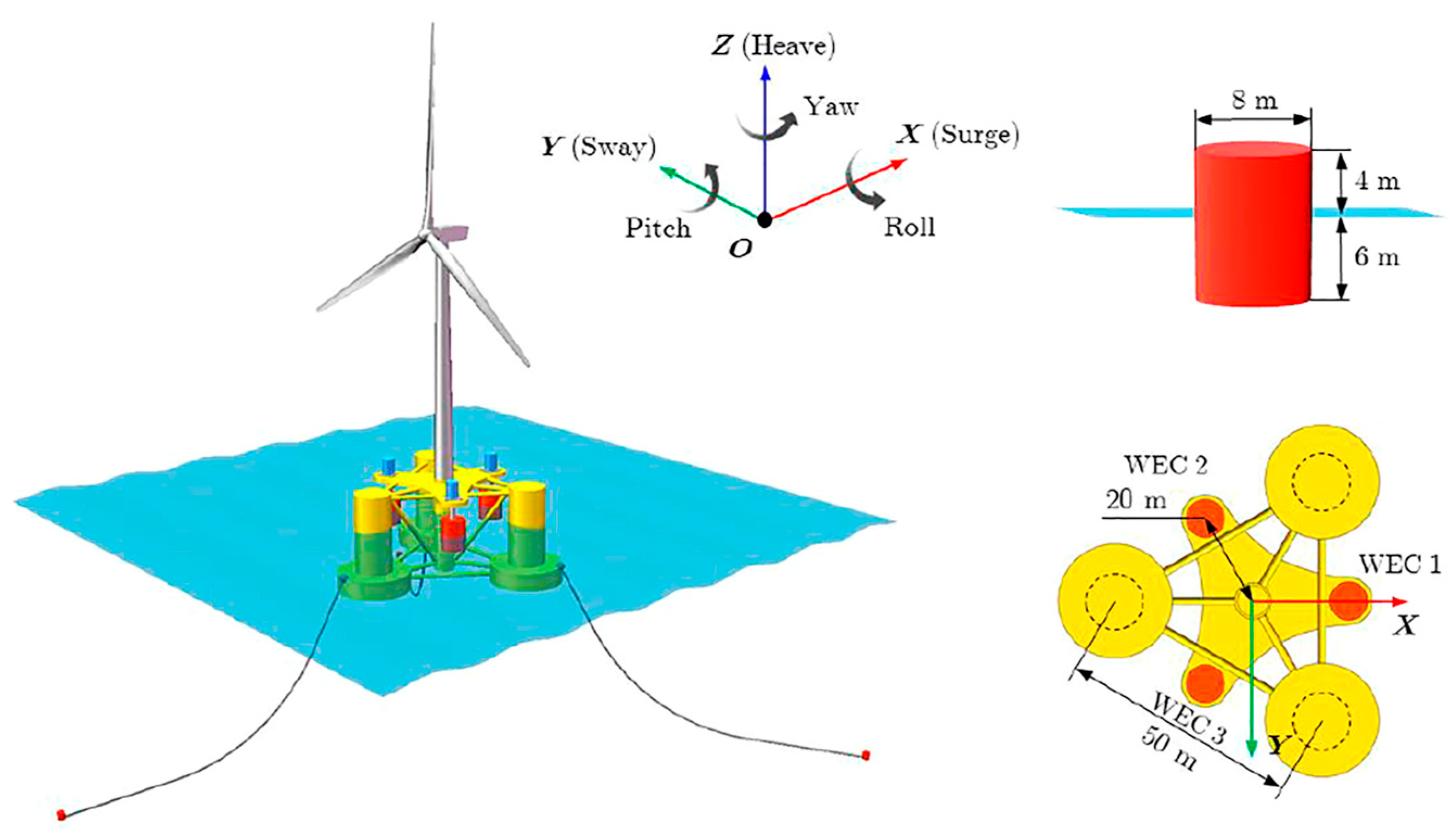
Furthermore, hybrid wind–wave systems are generally categorized into two design approaches. The first is co-located configuration, in which wind turbines and WECs are deployed within the same marine area but operate independently. The second one is the integrated configuration, where both technologies share a common support structure. As illustrated in Figure 6 [83], WECs are typically installed around the floating platform supporting the wind turbine. The integrated concept, in particular, has attracted increasing research interest due to its potential for infrastructure sharing. However, it also introduces additional hydrodynamic and control complexity [83,84]. Research on both co-located and integrated configurations demonstrates the design flexibility of wind–wave hybrids, while also highlighting engineering challenges associated with combined loading, mooring design, and control coordination.
Moreover, a recurring finding in the literature is that wind–wave hybridization can increase the effective energy density of offshore installations and improve power output stability relative to single-source systems [85]. Along with increased generation, certain configurations enable functional interactions between components. For example, WECs positioned upstream of wind turbines can attenuate incoming wave energy, reducing hydrodynamic loading on turbine foundations [86]. This interaction has been shown to increase the wind turbine efficiency and may offer additional benefits such as reduced wave impact on nearby coastlines [87]. Cost-related advantages are also frequently reported, primarily associated with shared infrastructure and reduced storage requirements due to partial temporal complementarity between wind and wave energy production [88,89]. Yet, these benefits are highly dependent on the arrangement and location.
In the context of remote islands, interest in wind–wave hybrid systems has increased in recent years, driven by assessments of local wind and wave resources [90,91]. These studies identify island locations where high capacity factors and complementary production profiles could support hybrid deployments. Techno-economic analyses further suggest that hybridization can reduce power variability and improve reliability compared to standalone wind or wave energy systems, as reported by studies on Amorgos Island, Greece [92], and an island in Hong Kong [93]. Seasonal alignment between renewable resource availability and island demand has also been observed in certain cases, such as Astypalaia Island, Greece, where summer wind and wave conditions coincide with peak electricity demand [94].
Nevertheless, the literature consistently reports that wind–wave hybrid systems face significant barriers to large-scale deployment [95]. High capital costs remain a dominant constraint, particularly due to the low TRLs of many WEC designs and the mechanical complexity of integrated platforms as documented by studies conducted in El Hierro Island [96] and Shengsan Island [97]. Even when substantial reductions in fuel consumption or emissions are achieved through hybridization, the initial investment required often results in overall energy costs that remain higher than those of other renewable configurations. As a result, wind–wave hybrids are typically evaluated as prospective future solutions rather than near-term options for widespread island deployment [96].
Furthermore, optimization and sizing studies for wind–wave hybrid systems also remain relatively scarce, especially for island applications. Existing work usually relies on conventional optimization frameworks [98], and the use of commercial software, such as HOMER, typically applies a very simplified approach in taking WECs into account [99]. Some studies have applied metaheuristic approaches, including Genetic Algorithm [100] and Ant Colony Optimization [96]. Comparative analyses indicate that optimal configurations are sensitive to the selected performance criteria, including cost, reliability, and environmental impact [101]. The limited diversity of optimization methodologies reflects the early stage of wind–wave hybrid research and further contributes to its limited representation in island-focused hybrid energy studies.

3.4. Multi-Renewable Hybrid Energy Systems

In addition to two-source hybrid configurations, the literature has also explored island energy systems integrating three or more renewable technologies. These multi-renewable systems are generally motivated by the intention to combine low-cost and mature technologies, such as solar PVs and wind, with additional resources that can enhance temporal complementarity or system reliability. One proposed configuration is the solar PVs–wind–marine current system where solar and wind provide the bulk of electricity generation, while marine currents contribute more predictable output [102]. Similarly, solar PVs–wind–wave systems have been proposed for islands with strong wave resources, where the higher cost and lower maturity of WECs is partially offset by the lower costs of solar and wind technologies [99,103].
Other studies have examined configurations that integrate renewable electricity generation with bioenergy sources, such as solar PVs–wind–biogas systems [104]. In these systems, biogas is mainly used as a cleaner and more sustainable substitute for diesel generators [105]. As a dispatchable energy source, biogas can play an important role in mitigating the variability of intermittent renewable sources. This is particularly relevant for solar PVs–wind–biogas hybrid systems, where solar generation is only available during the day, while the wind generation alone may be insufficient to meet evening electricity demand. In such a case, biogas generation can supply the remaining nighttime demand, resulting in increased biogas utilization during the night, as observed in a study conducted on Manoka Island, Cameroon [106]. Despite this capability, some studies still deploy diesel generators and energy storage systems to ensure reliability through a more diversified energy mix [107,108]. Moreover, the solar–wind–biogas system can also be used to support a desalination system, as discussed in a study conducted on Agathonisi Island, Greece [109]. This approach addresses both energy and freshwater issues commonly faced by the island communities.
Furthermore, existing work on multi-renewable hybrid systems, including studies beyond island-based cases, has focused predominantly on system sizing optimization. A range of metaheuristic algorithms have been applied, including Genetic Algorithm for wind–wave–tidal [110], solar PVs–wind–wave [111], and solar PVs–wind–tidal configurations [112]; Grey Wolf Optimization for solar PVs–wind–tidal configuration [113]; as well as a Bat Algorithm-based scheduling approach for hybrid microgrids consisting of solar PVs–wind–tidal systems [114]. Other optimization techniques, such as Crow Search Algorithm [115] and Whale Optimization Algorithm [116], have also been used to minimize system costs while maintaining reliability in solar PVs–wind–tidal systems. Despite this methodological diversity, the HOMER software remains widely used for techno-economic assessment of multi-renewable systems [99,106,107,108,109,117], with alternative approaches such as linear programming applied in another studies [118].

4. Cross-Configuration Analysis

This section compares the suitability of different hybrid configurations for island applications and examines how they align with specific energy roles and transition pathways. The main differences between these configurations are summarized in Table 1.
The literature reveals a clear dominance of solar–wind hybrid systems, largely due to their high technological maturity, declining costs, and extensive methodological development for sizing and optimization [23]. Numerous island-based case studies demonstrate that solar–wind systems can achieve substantial cost and emission reductions relative to a diesel-only baseline, especially when supported by battery storage or diesel backup [29,39,40]. However, these systems remain strongly dependent on short-term storage and are sensitive to local resource variability and land availability for land-based deployment, which may limit their applicability across diverse island contexts.
In contrast, solar–marine current systems, though far less represented in the literature, exhibit distinct strengths associated with the high predictability of tidal resources and minimal land-use requirements [13]. Studies consistently report that integrating marine current energy can improve system stability and reduce reliance on battery storage compared with solar-only systems, particularly for islands located near straits with strong tidal flows [59,60,67]. Nevertheless, these benefits are counterbalanced by a lower TRL, limited deployment experience, and higher capital costs relative to mature solar–wind systems, which continue to constrain wider adoption.
Hybrid wind–wave systems represent an alternative configuration that leverages the strong physical coupling between wind and wave resources and the potential for infrastructure sharing in offshore environments [80,81]. Several island-based studies demonstrate that wind–wave hybridization can improve power smoothing and reduce variability relative to single-source systems, while also increasing the energy density of a given offshore area [85,92,93]. However, the high initial investment cost of WECs, combined with their offshore engineering complexity and relatively low TRL, remains a significant barrier, particularly for small and remote islands.
In addition to the aforementioned technological and economic challenges, practical deployment may also be constrained by certain operational factors, particularly for solar–marine current and wind–wave configurations. Remote islands usually lack technical expertise required to maintain marine energy devices, which often operate in harsh ocean environments and require regular inspection [95]. Infrastructure limitations may further complicate deployment, as supporting facilities such as specialized vessels and ports are often unavailable. In addition, the geographical remoteness of many islands introduces significant logistical challenges, as transporting large components and technical personnel to the island can be expensive and time consuming [95]. These operational constraints may therefore restrict the practical scalability of ocean energy technologies even in locations where the resource potential is favorable.

4.1. Purpose-Based Hybrid Systems

Hybrid renewable energy systems are increasingly valued not only for their ability to reduce fuel consumption and emissions, but also for their potential to support specific energy purposes shaped by island economic structures, demand characteristics, and resource availability. The literature reviewed in this study shows that different hybrid configurations provide distinct operational characteristics that make them more suitable for certain island functions. These purposes emerge not from the application sector alone, but from how each configuration interacts with island-specific energy issues. Table 2 summarizes the various applications of hybrid systems and the corresponding configurations proposed to support them.

4.1.1. Tourism and Desalination

Islands whose economies rely heavily on tourism well illustrate the relationship between energy demand and system configuration. Such islands typically experience pronounced seasonal variations in electricity demand, with peaks during summer months and lower demand during the rest of the year [132,133]. Designing energy systems solely to meet peak demand is economically inefficient, as it results in underutilized capacity during off-peak periods. Consequently, many islands often continue to rely on imported fossil fuels to satisfy their energy needs [134]. Although some renewable sources, such as solar and wave energy, exhibit higher potential during the summer, their contribution alone is typically insufficient to fully meet demand. Integrating multiple renewable sources, however, can enhance energy production and reduce diesel consumption on an annual average basis [92].
A more advanced strategy involves directing excess renewable energy to desalination units, treating freshwater production as an indirect form of energy storage. During off-peak periods, surplus electricity can be used to produce and store freshwater, which can later be utilized during the high-demand summer season when energy resources are prioritized for electricity generation. In this scenario, desalination effectively functions as a form of energy storage, allowing energy and water demands—which both rise during peak tourist seasons—to be jointly managed [135]. Hybrid configurations involving desalination have been proposed include solar–wind systems, as well as wind–wave and multi-renewable systems in coastal areas.
Multiple studies have demonstrated the suitability of solar–wind configurations particularly for powering desalination plants, either dedicated solely to desalination or combined with electricity generation [46,124]. Redirecting surplus generation to desalination has been shown to significantly lower freshwater production costs, as demonstrated in a case study in the Yellow Sea region of China [125]. Other studies have examined the inclusion of wave energy in regions with strong wave resources [127]. Beyond power generation, wave energy technologies can provide additional benefits such as coastal protection [126].

4.1.2. Agricultural Sector

Agricultural energy demands present a different form of configuration–purpose alignment. In regions where access to reliable electricity is limited, renewable energy systems can also be applied to power irrigation. Among various options, solar energy is particularly favorable [136]. In addition to its low cost, its generation pattern aligns naturally with irrigation needs. Solar energy availability is highest during the dry season when irrigation demand peaks, while during the rainy season, both solar irradiance and water demand are lower [128,137]. Hybrid configurations that combine solar with other renewable sources, such as hydrokinetic or small hydropower systems, further enhance reliability by providing complementary generation during periods of low solar output [129,130]. These configurations are particularly suited to islands and rural regions with flowing water resources or steep terrain, where hydrokinetic energy can be harvested with minimal infrastructure. The increasing adoption of microgrids further facilitates the integration of these renewable sources into rural and island communities. Nevertheless, substantial initial investment remains a key barrier, entailing strong support from the government and private sectors to promote widespread deployment [138].

4.1.3. Synthetic Fuel Production

Solar–wind configurations have been proposed for synthetic fuel production. One notable example is the concept of an artificial methanol island in the Mediterranean Sea, where solar and wind energy are used to produce hydrogen and capture atmospheric CO2 indirectly through the ocean and combine it with hydrogen to produce synthetic fuel [131]. Solar–marine current hybrids have also been applied to liquid electro-fuel production. In Clarence Strait, Australia, the inclusion of tidal current turbines reduced total capital expenditure by lowering the battery capacity requirement compared to the solar-only system [67]. These studies show how solar–wind and solar–marine current hybrids can support emerging energy carriers and contribute to long-term decarbonization strategies beyond the power sector.

4.1.4. Green Data Center and Coastal Building

Hybrid solar–marine current systems, though less widely studied, exhibit distinctive advantages for applications requiring stable and predictable energy supply. Several studies have explored their deployment to power high-demand and energy-intensive facilities. For instance, one study proposed a hybrid system combining marine current turbines and solar PVs to power a green data center on a remote island near Alderney Race strait, incorporating both battery and hydrogen storage to ensure reliable operation [65]. Given the continuous and substantial energy demand of data centers, such configurations offer a pathway to significantly reduce operational emissions. Similarly, HRESs have also been proposed for coastal buildings, where the decarbonization needs of building energy systems coincide with the availability of marine energy resources. Hybrid solar–marine current systems [66] and hybrid wind–wave systems [93] have been assessed for supplying energy to coastal buildings in Hong Kong, including meeting cooling load demands. In the study investigating solar–marine current hybrids, the result indicate that such systems can be technically and economically feasible even without batteries [66]. Batteries can be added to improve the energy matching capability but result in a higher system cost.

4.1.5. Coastal Defense

Wind–wave hybrid systems are primarily associated with offshore and nearshore applications where exposure to marine energy resources is high. Their suitability extends beyond electricity generation to multifunctional infrastructure concepts. A study focusing on atoll islands in the Maldives proposed a multi-use wind–wave hybrid system capable of simultaneously supporting power generation, freshwater desalination, and coastal defense [126]. In this configuration, the presence of a wave farm can attenuate incoming wave energy and reduce wave heights towards the shore, as observed in a nearshore study conducted in Portugal [87]. Consequently, WECs not only contribute to electricity supply but also offer protective benefits to downstream wind turbines, vulnerable shorelines, and coastal activities such as fishing and scuba diving. Wind–wave hybrid systems are therefore particularly well suited for islands facing both energy security challenges and coastal vulnerability, where the multifunctionality of offshore renewable infrastructure can provide added system value.

4.1.6. Aquaculture

Located offshore, aquaculture facilities often face challenges in meeting their energy demand due to their remote locations and limited access to reliable electricity infrastructure. As a result, concepts combining aquaculture systems with renewable energy farms, such as wind turbines, have been proposed. However, relying on a single renewable energy source can make it difficult to ensure a continuous electricity supply. To address this challenge, a multi-purpose platform integrating aquaculture with hybrid solar–wind–wave energy systems has been proposed to provide a more reliable energy supply while supporting sustainable aquaculture practices [103]. This approach is particularly relevant to island regions, where local populations often rely on fishing activities. Such developments can therefore contribute to the advancements of the blue economy [139]. Although, research on integrating HRESs into aquaculture infrastructure is still in its early stages, this concept shows potential to improve the productivity of local fishery industries [103].

4.1.7. Prospects

The potential purposes of hybrid systems extend well beyond the applications currently explored in the literature. Technologies that have traditionally been studied as single-source systems can be reconsidered within hybrid configurations to better exploit shared infrastructure and complementary resource availability. One example is the tidal bridge concept, which has been proposed for both inter-island connectivity and power generation through tidal turbines [140,141]. This concept can be further expanded into a hybrid configuration by incorporating solar PVs installations on the upper structure, such as bridge decks or roof structures, thereby maximizing the use of available space while enhancing overall energy output. Besides infrastructure-oriented applications, hybrid systems also show promise for supporting energy-intensive industrial activities on isolated islands. Aluminum smelters, for instance, typically rely on hydropower from reservoirs and are often supplemented by fossil fuels to meet their substantial energy demands [142]. In such contexts, hybridization with additional renewable energy sources, such as geothermal energy where available, could reduce reliance on fossil fuels and offset operational emissions, while improving supply reliability [143].
Another promising direction involves the integration of waste-to-energy technologies within island hybrid energy systems, such as municipal solid waste (MSW) incineration and biomass gasification [144]. These applications are particularly relevant for islands with large populations, which produce sufficient volumes of MSW and therefore improve the economic viability of waste-to-energy facilities. After waste classification, MSW generated from island communities can be converted into electricity via incineration, providing a dispatchable energy source while simultaneously addressing local waste management challenges. In addition, the biomass and organic waste fractions can be converted into synthetic fuels through thermochemical gasification processes. Emerging concepts have further proposed the use of concentrated solar thermal energy to provide the high-temperature heat required for the gasification process, enabling solar-assisted thermochemical fuel production [145]. These approaches demonstrate the potential for future island energy systems to integrate renewable power generation, waste management, and clean fuel production within a single hybrid system.

4.2. Island-Specific Constraints for Hybrid Configurations

Despite the diverse purposes that hybrid renewable energy systems can serve, their feasibility and performance on islands are strongly shaped by a set of common island-specific constraints. Among these constraints are economic conditions, limited land availability, geographical factors, environmental concerns, and social issues.

4.2.1. Economic Constraints

Economic considerations remain one of the most decisive constraints in the design and deployment of hybrid renewable energy systems for islands. High upfront capital costs continue to pose a significant barrier, particularly for systems incorporating marine energy technologies and advanced storage. Limited access to financing, small market sizes, and high perceived investment risk further restrict the ability of island communities to adopt complex hybrid systems [146]. In addition to the capital constraints, operational and maintenance costs can also be substantial, especially for technologies deployed in offshore or remote environments where specialized vessels, equipment, and technical expertise may be required [95]. The logistical challenges associated with transporting components or skilled personnel to remote islands can further increase long-term operational expenses. As a result, system designs often prioritize technologies with proven commercial maturity such as solar PVs or wind turbines, hence, most studies in this review include at least one of them in their hybrid configurations.
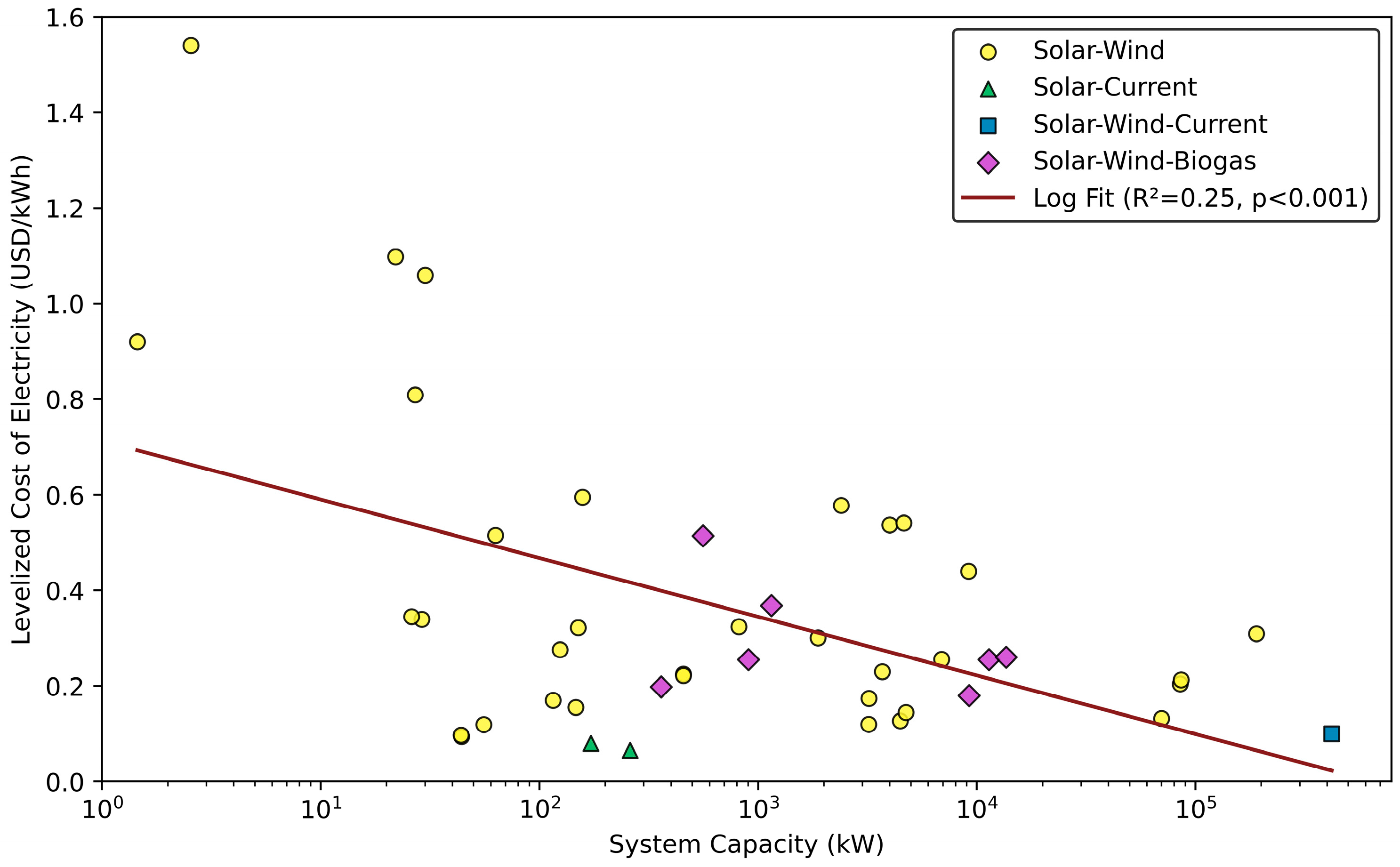
Despite these economic challenges, system costs are anticipated to decrease as system capacity increases due to economies of scale [147]. To illustrate this relationship, 44 LCOE data points were compiled from 26 techno-economic studies [29,34,35,39,41,43,44,45,46,47,48,49,52,54,75,102,104,105,106,107,108,109,148,149,150,151] among the 64 publications reviewed in this work. These data are presented in Figure 7, covering four system configurations: solar–wind, solar–marine current, solar–wind–marine current, and solar–wind–biogas hybrid systems. The LCOE data were extracted directly from the reported values of each study and presented in USD/kWh. For publications reporting LCOE in other currencies, the values were converted to USD using the average exchange rate corresponding to the year of publication. No additional inflation adjustment was applied; therefore, the reported values reflect the economic assumptions and technology costs at the time of each study.
The results reveal a general decreasing trend in LCOE with increasing system capacity, suggesting the presence of economies of scale in island-based HRESs. A logarithmic regression fitted to the dataset indicates a statistically significant negative relationship between system capacity and LCOE (p < 0.001). However, the coefficient of determination is relatively low (R2 = 0.25), indicating that system LCOE is not solely determined by system capacity. Other factors—such as local resource availability, island population size, energy demand, system configuration, component costs at the time of the study, and financing assumptions—also influence the economic performance of the HRES. These factors are typically specific to the island case examined in each study and contribute to the variability observed in the dataset. Nevertheless, the general relationship remains evident, suggesting that larger systems may contribute to lower energy costs. Such cost reductions can be achieved, for instance, by aggregating energy demand from multiple industries or by promoting energy sharing among different sectors [152].

4.2.2. Land Availability Constraints

Land scarcity restricts the scalability of land-intensive technologies such as ground-mounted solar PVs [18]. One practical solution is the adoption of offshore renewable energy systems, which can alleviate land-use limitations by utilizing marine space for energy generation. By relocating renewable energy infrastructure offshore, islands can expand their energy capacity without competing for land required for other socio-economic activities such as housing, agriculture, or tourism [153]. This approach is particularly relevant for small island systems where available land is limited, and land-use conflicts can significantly constrain the deployment of large renewable energy installations.
Offshore renewable energy technologies include ocean-based systems such as wave energy converters and tidal turbines, as well as floating types of mature land-based technologies such as floating wind turbines and floating photovoltaic systems. These technologies can be integrated within hybrid offshore energy systems in locations where multiple renewable sources are co-located in the same marine area [32]. Therefore, such systems can reduce land requirements while potentially improving overall energy production through a shared use of marine space and supporting infrastructure such as moorings and cables.
Although several works have already examined the potential economic feasibility of hybrid offshore renewable energy systems [88,96], their application in island energy systems remains relatively underexplored due to several challenges. Compared to land-based systems, offshore installations generally involve higher expenses, and many offshore energy technologies still have relatively limited operational experience. The limited attention given to hybrid offshore renewable systems for islands has therefore restricted our understanding of their true potential. Initiating more research in this area could help determine whether such systems are technically and economically viable, thereby clarifying what renewable energy options are truly feasible for island regions in the future.

4.2.3. Geographical Constraints

Geographical aspects further shape hybrid system design and cost-effectiveness. One key factor is the distance of an island from the mainland, which introduces logistical challenges that affect system deployment and operation. Remote islands often face higher transportation costs for equipment and construction, as well as limited access to specialized technical personnel [95]. These issues can increase both installation and maintenance costs, particularly for large or offshore renewable energy systems. Consequently, geographical factors strongly influence the practical feasibility of deploying certain energy technologies.
The remoteness of an island also affects the feasibility and cost of grid interconnection. For islands located relatively close to the mainland, grid-connected hybrid systems may offer lower overall costs. This was observed on Koh Samui Island in Thailand, where grid-connected hybrid solar–wind configurations were found to be more economical, although off-grid systems remain competitive [150]. Conversely, for more remote islands such as Dongsha Island, which is located far from the mainland, off-grid hybrid systems proved to be the more cost-effective option [154]. These contrasting outcomes emphasize that geographical isolation can fundamentally alter the cost structure and preferred configurations of island energy systems.

4.2.4. Environmental Constraints

Environmental considerations are also increasingly incorporated into hybrid system design, most commonly through emission reduction targets [98]. Including such constraints typically increases the LCOE, as demonstrated in a study on Tangier Island, USA [155]. These higher costs are often accompanied by substantial environmental benefits since the renewable energy share increases, reducing reliance on fossil fuels as observed in studies conducted on Masirah Island and Mornington Island [40,156]. Such trade-offs highlight the importance of balancing economic and environmental objectives when designing hybrid renewable energy systems.
Renewable energy systems may also introduce certain environmental impacts that should be considered in system planning. Offshore and nearshore technologies can interact with marine ecosystems—including fish, marine birds, and benthic communities—through flow changes caused by energy structures, noise generated by turbines, and habitat modifications around support structures [157,158]. Proper environmental assessment is therefore necessary, integrating environmental protection aspects in the marine spatial planning to ensure that the decarbonization efforts are not achieved at the expense of marine ecosystems [159].
Additionally, environmental exposure can also act as a practical constraint in hybrid configuration selection. Offshore systems must operate under harsh marine conditions, including high wave loads, corrosive environments, and extreme weather events, which increase the challenges during installation, operation, and decommissioning activities [160]. These factors are particularly relevant for marine current-based hybrids or floating energy systems, where environmental robustness becomes one of the key determinants of feasibility.

4.2.5. Social Constraints

One of the primary social challenges associated with HRES deployment is community acceptance and participation within island communities. The development of energy projects on islands may affect local socio-economic conditions and, if not carefully planned, can lead to community resistance [161]. Renewable energy projects should therefore incorporate local involvement strategies during the planning and implementation phases to foster a sense of ownership and responsibility among local residents, as observed in a successful story such as in Samsø Island [162]. Effective communication and collaboration with the local community are therefore essential. Project developers should consider local social identity, involving local social norms, and trust-building mechanisms to gain community support [163]. When these social aspects are properly addressed, renewable energy projects can generate socio-economic benefits, including job creation and improved energy affordability.
Furthermore, institutional and governance limitations also influence the implementation of HRES projects. Island regions often lack the regulatory frameworks and technical capacity necessary to support renewable energy integration. Consequently, coordinated cooperation among multiple actors, including educational institution, local or regional authorities, national governments, and private stakeholders, is necessary to ensure successful implementation [164]. Such collaboration is particularly important during key stages of project development, including knowledge exchange, funding acquisition, and long-term management.

4.3. The Role of Energy Storage and Diesel in Energy Transition

Island energy systems also face challenges related to grid stability and power availability, largely due to their small and isolated grids and seasonal electricity demand [146]. Increasing penetration of renewable energy can introduce power fluctuations, which may adversely affect frequency and voltage stability [165]. In this context, energy storage systems and diesel generators have repeatedly been identified as integral components of HRESs for islands. Although energy storage and diesel generators are not always required, they are often essential for managing intermittency, maintaining grid stability, and ensuring a continuous power supply. This, in turn, enables realistic transition pathways from conventional diesel-only systems toward renewable-dominated and eventually fully renewable energy systems.

4.3.1. Energy Storage

Energy storage plays a central role in balancing supply and demand within island hybrid energy systems. Battery energy storage systems are the most widely adopted option [149]. Surplus electricity generated from renewable hybrid systems can be stored in batteries and later used when renewable generation is insufficient to meet demand. In solar–wind hybrid systems, batteries are typically required to mitigate short-term variability and reduce power shortages [46]. Studies on solar–marine current systems indicate that the predictable nature of tidal energy can reduce reliance on battery storage [79]. In wind–wave hybrid systems, a partial smoothing effect has been observed due to delayed response of waves to wind events, which can further reduce short-term storage requirements [111]. Nevertheless, energy storage systems remain necessary to accommodate demand variability and maintain system reliability, particularly in fully off-grid island cases.
In addition to batteries, hydrogen storage has been proposed as a long-term storage solution in hybrid solar–wind [166] and a short-term option for solar–marine current systems [77]. In such systems, excess renewable electricity can be converted into hydrogen through electrolysis. The hydrogen can be stored for later use via fuel cells to support electricity demand or utilized as a clean fuel for maritime transport, ultimately contributing to the decarbonization of island energy systems [167]. Such power-to-hydrogen systems enable the storage of surplus renewable generation in island energy systems while mitigating the variability issues associated with renewable sources [168]. However, the economic viability of hydrogen-based storage remains constrained by high costs and conversion losses, requiring further technological development and cost reductions.
Furthermore, other promising energy storage options have also been explored in the literature. These include mechanical storage systems such as pumped storage hydropower (PSH), which has been studied for solar–wind [35] and wind–wave systems [94], as well as the ocean renewable energy storage (ORES) concept proposed for solar–wind hybrid systems [54]. PSH systems operate by using surplus electricity to pump water to a higher reservoir, while the ORES concept utilizes hydrostatic pressure in deep waters to store energy [169]. A related technology is compressed air energy storage (CAES), which has been proposed to support solar–wind and solar–geothermal hybrid systems [170]. CAES can be combined with battery storage to reduce both short- and long-term energy deficiencies [171] and can also be integrated with thermal energy storage to improve system performance and efficiency [170]. Flywheel energy storage is another mechanical storage technology suitable for short-term applications. It has been deployed to support the solar–hydropower system on Flores Island, Portugal [172], and has also been proposed to support solar–wind–marine current hybrid systems [148]. These technologies illustrate the growing diversity of storage options that could support higher renewable energy penetration.

4.3.2. Diesel Generators

Although diesel-based energy systems are highly sensitive to fuel price fluctuations and contribute significantly to greenhouse gas emissions, diesel generators continue to play a crucial transitional role in island hybrid energy systems. Given the widespread reliance on diesel generation on many remote islands and the intermittency of renewable resources, many island-based studies incorporate diesel generators as a backup or supplementary source to improve reliability [38]. In the case where fuel prices remain relatively low, the integration of diesel generation may also contribute to lower overall system costs, although this typically results in lower renewable penetration [43]. The inclusion of diesel generators in hybrid configurations allows the energy system to maintain a power supply during periods of low renewable generation. This is particularly important in cases where energy storage capacity remains limited or too expensive [49]. Such an approach enables islands to gradually reduce diesel dependence while maintaining a reliable electricity supply.
In addition to diesel generators, other distributed generation technologies have also been explored. These include microturbines [114] and biodiesel generators [117], which represent mature technologies that can be integrated with hybrid renewable systems to improve system reliability while increasing renewable penetration. These technologies can also be incorporated into combined cooling, heating, and power (CCHP) systems to enhance energy utilization. For instance, a study conducted on Pulau Ubin, Singapore, proposed a CCHP system incorporating a microturbine and a biomass plant alongside a solar–wind system to satisfy the island’s energy demand [173]. Such integrated systems can increase primary energy savings while reducing carbon emissions.
Despite the exploration of these alternatives, diesel generation is likely to remain an essential component of island energy systems [174]. As renewable technologies become more cost-competitive and energy storage technologies continue to mature, the reliance on diesel generation is expected to decline over time [40]. Improvements in battery performance, cost reductions, and advancements in energy management strategies will further enhance the feasibility of fully renewable energy systems [175]. Therefore, diesel generators currently serve as a bridging technology in island energy transitions, enabling the progressive integration of renewable resources. In the long-term, however, their role is expected to diminish as renewable generation and storage technologies become increasingly capable of meeting island energy demand independently.

5. Conclusions

Renewable energy technologies offer islands a clear route to improve energy security, but relying on a single renewable resource rarely delivers genuine energy autonomy. Hybrid renewable energy systems address this limitation by combining resources to provide more reliable and cost-effective clean power. This configuration-focused review shows that solar–wind systems currently dominate the literature, reflecting their high technological maturity, falling costs, and extensive availability optimization work. However, their performance can be constrained by short-term variability and limited land availability for land-based deployment.
Other hybrid configurations bring distinct advantages that remain comparatively understudied. Solar–marine current systems exploit the high predictability of tidal currents and require less land, making them attractive for islands close to strong tidal channels. Wind–wave hybrids benefit from the natural coupling between wind and waves and from shared infrastructure, and they can also deliver co-benefits such as coastal protection. However, both marine-based hybrid options face barriers related to lower technology readiness, higher capital and operational costs, as well as engineering complexity, which currently limit their deployment.
The cross-configuration analysis suggests that no single hybrid configuration is universally optimal. Suitability instead hinges on island-specific factors such as resource availability, island-specific demand characteristics, geographical conditions, and environmental exposure. In many settings, diesel generation still plays a supporting role in keeping systems technically robust and economically viable. Diesel generation serves as a transitional solution that enables higher renewable penetration without sacrificing reliability. However, its reliance is expected to diminish as energy storage becomes more cost-competitive to achieve affordable, fully renewable energy systems.
Future work should broaden comparative analyses across configurations, encourage further studies on marine-based hybrid systems, and develop system designs that explicitly account for island-specific constraints. Such efforts are important for advancing resilient, affordable, and context-sensitive energy transitions for island communities.

Author Contributions

Conceptualization, P.K.P.S. and G.I.; methodology, P.K.P.S.; formal analysis, P.K.P.S.; investigation, P.K.P.S.; data curation, P.K.P.S.; writing—original draft preparation, P.K.P.S.; writing—review and editing, G.I.; supervision, G.I.; project administration, G.I. All authors have read and agreed to the published version of the manuscript.

Funding

This research received no external funding.

Institutional Review Board Statement

Not applicable.

Informed Consent Statement

Not applicable.

Data Availability Statement

No new data were created or analyzed in this study. Data sharing is not applicable to this article.

Conflicts of Interest

The authors declare no conflicts of interest.

References

  1. Betzold, C. Adapting to Climate Change in Small Island Developing States. Clim. Change 2015, 133, 481–489. [Google Scholar] [CrossRef]
  2. Pernetta, J.C. Impacts of Climate Change and Sea-Level Rise on Small Island States: National and International Responses. Glob. Environ. Change 1992, 2, 19–31. [Google Scholar] [CrossRef]
  3. Mycoo, M.; Wairiu, M.; Campbell, D.; Duvat, V.; Golbuu, Y.; Maharaj, S.; Nalau, J.; Nunn, P.; Pinnegar, J.; Warrick, O. Small Islands. In Climate Change 2022: Impacts, Adaptation and Vulnerability. Contribution of Working Group II to the Sixth Assessment Report of the Intergovernmental Panel on Climate Change; Pörtner, H.-O., Roberts, D.C., Tignor, M.M.B., Poloczanska, E.S., Mintenbeck, K., Alegría, A., Craig, M., Langsdorf, S., Löschke, S., Möller, V., et al., Eds.; Cambridge University Press: Cambridge, UK, 2022. [Google Scholar]
  4. Granger, O.E. Geography of Small Tropical Islands. In Small Islands Marine Science and Sustainable Development; American Geophysical Union (AGU): Washington, DC, USA, 1996; pp. 157–187. [Google Scholar]
  5. Petzold, J.; Magnan, A.K. Climate Change: Thinking Small Islands beyond Small Island Developing States (SIDS). Clim. Change 2019, 152, 145–165. [Google Scholar] [CrossRef]
  6. Petzold, J.; Ratter, B.M.W. Climate Change Adaptation under a Social Capital Approach—An Analytical Framework for Small Islands. Ocean Coast. Manag. 2015, 112, 36–43. [Google Scholar] [CrossRef]
  7. IRENA. SIDS Lighthouses Initiative: Progress and Way Forward; International Renewable Energy Agency: Abu Dhabi, United Arab Emirates, 2025. [Google Scholar]
  8. Niles, K.; Lloyd, B. Small Island Developing States (SIDS) & Energy Aid: Impacts on the Energy Sector in the Caribbean and Pacific. Energy Sustain. Dev. 2013, 17, 521–530. [Google Scholar] [CrossRef]
  9. Blechinger, P.; Cader, C.; Bertheau, P.; Huyskens, H.; Seguin, R.; Breyer, C. Global Analysis of the Techno-Economic Potential of Renewable Energy Hybrid Systems on Small Islands. Energy Policy 2016, 98, 674–687. [Google Scholar] [CrossRef]
  10. Leal Filho, W.; Krishnapillai, M.; Sidsaph, H.; Nagy, G.J.; Luetz, J.M.; Dyer, J.; Otoara Ha’apio, M.; Havea, P.H.; Raj, K.; Singh, P.; et al. Climate Change Adaptation on Small Island States: An Assessment of Limits and Constraints. J. Mar. Sci. Eng. 2021, 9, 602. [Google Scholar] [CrossRef]
  11. Kuang, Y.; Zhang, Y.; Zhou, B.; Li, C.; Cao, Y.; Li, L.; Zeng, L. A Review of Renewable Energy Utilization in Islands. Renew. Sustain. Energy Rev. 2016, 59, 504–513. [Google Scholar] [CrossRef]
  12. Ioannidis, A.; Chalvatzis, K.J.; Li, X.; Notton, G.; Stephanides, P. The Case for Islands’ Energy Vulnerability: Electricity Supply Diversity in 44 Global Islands. Renew. Energy 2019, 143, 440–452. [Google Scholar] [CrossRef]
  13. Roy, A.; Auger, F.; Dupriez-Robin, F.; Bourguet, S.; Tran, Q.T. Electrical Power Supply of Remote Maritime Areas: A Review of Hybrid Systems Based on Marine Renewable Energies. Energies 2018, 11, 1904. [Google Scholar] [CrossRef]
  14. Erdiwansyah; Mahidin; Husin, H.; Nasaruddin; Zaki, M.; Muhibbuddin. A Critical Review of the Integration of Renewable Energy Sources with Various Technologies. Prot. Control Mod. Power Syst. 2021, 6, 3. [Google Scholar] [CrossRef]
  15. Castro, M.T.; Delina, L.L.; Ocon, J.D. Transition Pathways to 100% Renewable Energy in 208 Island Mini-Grids in the Philippines. Energy Strategy Rev. 2024, 52, 101315. [Google Scholar] [CrossRef]
  16. IRENA. Renewable Power Generation Costs in 2023; International Renewable Energy Agency: Abu Dhabi, United Arab Emirates, 2023. [Google Scholar]
  17. Samrat, N.H.; Ahmad, N.; Choudhury, I.A.; Taha, Z. Technical Study of a Standalone Photovoltaic–Wind Energy Based Hybrid Power Supply Systems for Island Electrification in Malaysia. PLoS ONE 2015, 10, e0130678. [Google Scholar] [CrossRef] [PubMed]
  18. Poggi, F.; Firmino, A.; Amado, M. Planning Renewable Energy in Rural Areas: Impacts on Occupation and Land Use. Energy 2018, 155, 630–640. [Google Scholar] [CrossRef]
  19. Gonçalves, M.; Martinho, P.; Guedes Soares, C. Assessment of Wave Energy in the Canary Islands. Renew. Energy 2014, 68, 774–784. [Google Scholar] [CrossRef]
  20. Orejarena-Rondón, A.F.; Panfilova, M.; de León, S.P.; Restano, M.; Sabia, R.; Benveniste, J. High-Resolution Mapping of Wave Energy Resources in the Mediterranean Sea Using Satellite Altimetry. Energy Rep. 2026, 15, 109133. [Google Scholar] [CrossRef]
  21. Tiismus, H.; Maask, V.; Astapov, V.; Korõtko, T.; Rosin, A. State-of-the-Art Review of Emerging Trends in Renewable Energy Generation Technologies. IEEE Access 2025, 13, 10820–10843. [Google Scholar] [CrossRef]
  22. IEA. Renewables 2024; IEA: Paris, France, 2024. [Google Scholar]
  23. Khare, V.; Nema, S.; Baredar, P. Solar–Wind Hybrid Renewable Energy System: A Review. Renew. Sustain. Energy Rev. 2016, 58, 23–33. [Google Scholar] [CrossRef]
  24. Kaldellis, J.; Kavadias, K.; Zafirakis, D. Integrated Electrification Solution for Remote Islands Based on Wind-PV Hybrid System. In Proceedings of the European Wind Energy Conference and Exhibition 2009, EWEC 2009, Marseille, France, 16–19 March 2009; Volume 7. [Google Scholar]
  25. López, M.; Rodríguez, N.; Iglesias, G. Combined Floating Offshore Wind and Solar PV. J. Mar. Sci. Eng. 2020, 8, 576. [Google Scholar] [CrossRef]
  26. Babaremu, K.; Olumba, N.; Chris-Okoro, I.; Chuckwuma, K.; Jen, T.-C.; Oladijo, O.; Akinlabi, E. Overview of Solar–Wind Hybrid Products: Prominent Challenges and Possible Solutions. Energies 2022, 15, 6014. [Google Scholar] [CrossRef]
  27. Badwawi, R.A.; Abusara, M.; Mallick, T. A Review of Hybrid Solar PV and Wind Energy System. Smart Sci. 2015, 3, 127–138. [Google Scholar] [CrossRef]
  28. Weschenfelder, F.; de Novaes Pires Leite, G.; Araújo da Costa, A.C.; de Castro Vilela, O.; Ribeiro, C.M.; Villa Ochoa, A.A.; Araújo, A.M. A Review on the Complementarity between Grid-Connected Solar and Wind Power Systems. J. Clean. Prod. 2020, 257, 120617. [Google Scholar] [CrossRef]
  29. Ma, T.; Javed, M.S. Integrated Sizing of Hybrid PV-Wind-Battery System for Remote Island Considering the Saturation of Each Renewable Energy Resource. Energy Convers. Manag. 2019, 182, 178–190. [Google Scholar] [CrossRef]
  30. Ma, T.; Yang, H.; Lu, L. A Feasibility Study of a Stand-Alone Hybrid Solar–Wind–Battery System for a Remote Island. Appl. Energy 2014, 121, 149–158. [Google Scholar] [CrossRef]
  31. Zhang, D.; Liu, J.; Jiao, S.; Tian, H.; Lou, C.; Zhou, Z.; Zhang, J.; Wang, C.; Zuo, J. Research on the Configuration and Operation Effect of the Hybrid Solar-Wind-Battery Power Generation System Based on NSGA-II. Energy 2019, 189, 116121. [Google Scholar] [CrossRef]
  32. Golroodbari, S.Z.M.; Vaartjes, D.F.; Meit, J.B.L.; van Hoeken, A.P.; Eberveld, M.; Jonker, H.; van Sark, W.G.J.H.M. Pooling the Cable: A Techno-Economic Feasibility Study of Integrating Offshore Floating Photovoltaic Solar Technology within an Offshore Wind Park. Sol. Energy 2021, 219, 65–74. [Google Scholar] [CrossRef]
  33. Martinez, A.; Iglesias, G. Hybrid Wind-Solar Energy Resources Mapping in the European Atlantic. Sci. Total Environ. 2024, 928, 172501. [Google Scholar] [CrossRef] [PubMed]
  34. Notton, G.; Diaf, S.; Stoyanov, L. Hybrid Photovoltaic/Wind Energy Systems for Remote Locations. Energy Procedia 2011, 6, 666–677. [Google Scholar] [CrossRef]
  35. Ma, T.; Yang, H.; Lu, L.; Peng, J. Technical Feasibility Study on a Standalone Hybrid Solar-Wind System with Pumped Hydro Storage for a Remote Island in Hong Kong. Renew. Energy 2014, 69, 7–15. [Google Scholar] [CrossRef]
  36. Riayatsyah, T.M.I.; Geumpana, T.A.; Fattah, I.M.R.; Mahlia, T.M.I. Techno-Economic Analysis of Hybrid Diesel Generators and Renewable Energy for a Remote Island in the Indian Ocean Using HOMER Pro. Sustainability 2022, 14, 9846. [Google Scholar] [CrossRef]
  37. Darus, Z.; Hashim, N.A.; Manan, S.N.; Rahman, M.A.; Maulud, K.; A Karim, O. The Development of Hybrid Integrated Renewable Energy System (Wind and Solar) for Sustainable Living at Perhentian Island, Malaysia. Eur. J. Soc. Sci. 2009, 11, 198–204. [Google Scholar]
  38. Yakub, A.O.; Same, N.N.; Owolabi, A.B.; Nsafon, B.E.K.; Suh, D.; Huh, J.-S. Optimizing the Performance of Hybrid Renewable Energy Systems to Accelerate a Sustainable Energy Transition in Nigeria: A Case Study of a Rural Healthcare Centre in Kano. Energy Strategy Rev. 2022, 43, 100906. [Google Scholar] [CrossRef]
  39. Shahnia, F.; Moghbel, M.; Arefi, A.; Shafiullah, G.M.; Anda, M.; Vahidnia, A. Levelized Cost of Energy and Cash Flow for a Hybrid Solar-Wind-Diesel Microgrid on Rottnest Island. In Proceedings of the 2017 Australasian Universities Power Engineering Conference (AUPEC), Melbourne, Australia, 19–22 November 2017; pp. 1–6. [Google Scholar]
  40. Wang, J.; Song, C.; Huang, Z.; Campbell, A.; Konarova, M. Remote Island Renewable Transition Potential: Affordable, Reliable and Sustainable Generation Optimisation for Mornington Island. Renew. Sustain. Energy Transit. 2024, 5, 100084. [Google Scholar] [CrossRef]
  41. Al-Badi, A.H. Hybrid (Solar and Wind) Energy System for Al Hallaniyat Island Electrification. Int. J. Sustain. Energy 2011, 30, 212–222. [Google Scholar] [CrossRef]
  42. Pelupessy, D.; Manuhutu, F. Hybrid Solar-Wind-Diesel Power Plant for Small Islands in Maluku Province. IOP Conf. Ser. Earth Environ. Sci. 2019, 339, 012046. [Google Scholar] [CrossRef]
  43. Ebrahimi, S.; Jahangiri, M.; Raiesi, H.A.; Ariae, A.R. Optimal Planning of On-Grid Hybrid Microgrid for Remote Island Using HOMER Software, Kish in Iran. Int. J. Energetica 2019, 3, 13–21. [Google Scholar] [CrossRef]
  44. Aditya, I.A.; Aisyah, S.; Simaremare, A.A. Optimal Sizing and Sensitivity Analysis of Hybrid Renewable Energy Systems: A Case of Ur Island in Indonesia. IOP Conf. Ser. Mater. Sci. Eng. 2021, 1098, 042049. [Google Scholar] [CrossRef]
  45. Reddy, V.; Raturi, A. Optimization and Sensitivity Analysis of a PV/Wind/Diesel Hybrid System for a Rural Community in the Pacific. Appl. Sol. Energy 2010, 46, 152–156. [Google Scholar] [CrossRef]
  46. Ye, B.; Jiang, J.; Cang, Y. Technical and Economic Feasibility Analysis of an Energy and Fresh Water Coupling Model for an Isolated Island. Energy Procedia 2019, 158, 6373–6377. [Google Scholar] [CrossRef]
  47. Nayar, C.; Tang, M.; Suponthana, W. A Case Study of a PV/Wind/Diesel Hybrid Energy System for Remote Islands in the Republic of Maldives. In Proceedings of the 2007 Australasian Universities Power Engineering Conference, Perth, Australia, 9–12 December 2007; pp. 1–7. [Google Scholar]
  48. Ullah, M.H. An Efficient Solar-Wind-Diesel-Battery Hybrid Power System for St. Martin Island of Bangladesh. Int. J. Renew. Energy Res. 2013, 3, 659–665. [Google Scholar]
  49. Cozzolino, R.; Tribioli, L.; Bella, G. Power Management of a Hybrid Renewable System for Artificial Islands: A Case Study. Energy 2016, 106, 774–789. [Google Scholar] [CrossRef]
  50. Eswaran, S.; Khan, A.A. Modeling and Optimization of a Hybrid Solar–Wind Energy System Using HOMER: A Case Study of L’Anse Au Loup. Energies 2025, 18, 5794. [Google Scholar] [CrossRef]
  51. Kiros, S.; Khan, B.; Padmanaban, S.; Alhelou, H.H.; Leonowicz, Z.; Mahela, O.P.; Holm-Nielsen, J.B. Development of Stand-Alone Green Hybrid System for Rural Areas. Sustainability 2020, 12, 3808. [Google Scholar] [CrossRef]
  52. Javed, M.S.; Song, A.; Ma, T. Techno-Economic Assessment of a Stand-Alone Hybrid Solar-Wind-Battery System for a Remote Island Using Genetic Algorithm. Energy 2019, 176, 704–717. [Google Scholar] [CrossRef]
  53. Javed, M.S.; Ma, T. Techno-Economic Assessment of a Hybrid Solar-Wind-Battery System with Genetic Algorithm. Energy Procedia 2019, 158, 6384–6392. [Google Scholar] [CrossRef]
  54. Shahinzadeh, H.; Gheiratmand, A.; Fathi, S.H.; Moradi, J. Optimal Design and Management of Isolated Hybrid Renewable Energy System (WT/PV/ORES). In Proceedings of the 2016 21st Conference on Electrical Power Distribution Networks Conference (EPDC), Karaj, Iran, 26–27 April 2016; pp. 208–215. [Google Scholar]
  55. Kaldellis, J.K.; Zafirakis, D. Optimum Sizing of Stand-Alone Wind-Photovoltaic Hybrid Systems for Representative Wind and Solar Potential Cases of the Greek Territory. J. Wind Eng. Ind. Aerodyn. 2012, 107–108, 169–178. [Google Scholar] [CrossRef]
  56. Li, D.; Wang, S.; Yuan, P. An Overview of Development of Tidal Current in China: Energy Resource, Conversion Technology and Opportunities. Renew. Sustain. Energy Rev. 2010, 14, 2896–2905. [Google Scholar] [CrossRef]
  57. Yang, X.; Haas, K.A.; Fritz, H.M. Theoretical Assessment of Ocean Current Energy Potential for the Gulf Stream System. Mar. Technol. Soc. J. 2013, 47, 101–112. [Google Scholar] [CrossRef]
  58. Morales, R.; Segura, E. Tidal and Ocean Current Energy. J. Mar. Sci. Eng. 2023, 11, 683. [Google Scholar] [CrossRef]
  59. Campbell, R.; Martinez, A.; Letetrel, C.; Rio, A. Methodology for Estimating the French Tidal Current Energy Resource. Int. J. Mar. Energy 2017, 19, 256–271. [Google Scholar] [CrossRef]
  60. Liu, X.; Chen, Z.; Si, Y.; Qian, P.; Wu, H.; Cui, L.; Zhang, D. A Review of Tidal Current Energy Resource Assessment in China. Renew. Sustain. Energy Rev. 2021, 145, 111012. [Google Scholar] [CrossRef]
  61. Li, G.; Zhu, W. Tidal Current Energy Harvesting Technologies: A Review of Current Status and Life Cycle Assessment. Renew. Sustain. Energy Rev. 2023, 179, 113269. [Google Scholar] [CrossRef]
  62. Zainol, M.; Ismail, N.; Zainol, I. A review on the status of tidal energy technology worldwide. Sci. Int. 2017, 29, 659–667. [Google Scholar]
  63. Li, M.; Cao, S.; Zhu, X.; Xu, Y. Techno-Economic Analysis of the Transition towards the Large-Scale Hybrid Wind-Tidal Supported Coastal Zero-Energy Communities. Appl. Energy 2022, 316, 119118. [Google Scholar] [CrossRef]
  64. Sadeghi, Z.; Ranjbar, M.; Iranmanesh, M. The Comparison of Tidal Power Plants with Solar and Combined Cycle Power Plants in the Southern Coast of Iran. Environ. Prog. Sustain. Energy 2021, 40, e13670. [Google Scholar] [CrossRef]
  65. Lazaar, N.; Barakat, M.; Hafiane, M.; Sabor, J.; Gualous, H. Modeling and Control of a Hydrogen-Based Green Data Center. Electr. Power Syst. Res. 2021, 199, 107374. [Google Scholar] [CrossRef]
  66. Zhou, S.; Cao, S.; Wang, S. Realisation of a Coastal Zero-Emission Office Building with the Support of Hybrid Ocean Thermal, Floating Photovoltaics, and Tidal Stream Generators. Energy Convers. Manag. 2022, 253, 115135. [Google Scholar] [CrossRef]
  67. Osman, P.; Hayward, J.A.; Penesis, I.; Marsh, P.; Hemer, M.A.; Griffin, D.; Sayeef, S.; Nader, J.-R.; Cossu, R.; Grinham, A.; et al. Dispatchability, Energy Security, and Reduced Capital Cost in Tidal-Wind and Tidal-Solar Energy Farms. Energies 2021, 14, 8504. [Google Scholar] [CrossRef]
  68. Agbakwuru, J.A.; Arome, S.N. Hybridized Vertical-Axis Underwater Current Power Turbine System Suitable for Low Underwater Current Velocities: A Report of Its Application and Potential in Imo River, Nigeria. Mar. Technol. Soc. J. 2023, 57, 98–104. [Google Scholar] [CrossRef]
  69. Faanzir; Soedibyo; Ashari, M. Optimum Sizing of Marine Current/PV/Battery Hybrid Power System for Isolated Island Minigrid. In Proceedings of the 2017 International Seminar on Application for Technology of Information and Communication (iSemantic), Semarang, Indonesia, 7–8 October 2017; pp. 233–237. [Google Scholar]
  70. Monahan, T.; Tang, T.; Adcock, T.A.A. A Hybrid Model for Online Short-Term Tidal Energy Forecasting. Appl. Ocean Res. 2023, 137, 103596. [Google Scholar] [CrossRef]
  71. Qazi, A.; Fayaz, H.; Wadi, A.; Raj, R.G.; Rahim, N.A.; Khan, W.A. The Artificial Neural Network for Solar Radiation Prediction and Designing Solar Systems: A Systematic Literature Review. J. Clean. Prod. 2015, 104, 1–12. [Google Scholar] [CrossRef]
  72. Garcia-Novo, P.; Coles, D.; Kyozuka, Y.; Yamada, R.; Moriguchi, H.; Sakaguchi, D. Optimization of a Tidal–Wind–Solar System to Enhance Supply–Demand Balancing and Security: A Case Study of the Goto Islands, Japan. Sustainability 2023, 15, 9147. [Google Scholar] [CrossRef]
  73. Faanzir; Ashari, M.; Soedibyo; Suwito; Umar. The Design of DC Micro Grid with a Load-Based Battery Discharge Method for Remote Island Electrification Utilizes Marine Currents and Solar Photovoltaic. Kinet. Game Technol. Inf. Syst. Comput. Netw. Comput. Electron. Control 2022, 7, 1576. [Google Scholar] [CrossRef]
  74. Faanzir; Soedibyo; Ashari, M. Emission Abatement Cost Analysis of Hybrid Marine Current/Photovoltaic/Diesel System Operation. In Proceedings of the 2017 International Seminar on Application for Technology of Information and Communication (iSemantic), Semarang, Indonesia, 7–8 October 2017; pp. 248–252. [Google Scholar]
  75. Abdullah, C.; Mad Kaidi, H.; Sarip, S.; Shafie, N. Small Scale Standalone Solar and Tidal Hybrid Power System in Isolated Area. Renew. Energy Focus 2021, 39, 59–71. [Google Scholar] [CrossRef]
  76. Jordan, C.; Angeloudis, A. Effects of Bathymetric Constraints in Tidal Stream Array Layout Design. J. Hydraul. Res. 2025, 63, 622–639. [Google Scholar] [CrossRef]
  77. Olmedo-González, J.; Ramos-Sánchez, G.; Garduño-Ruiz, E.P.; González-Huerta, R.d.G. Analysis of Stand-Alone Photovoltaic—Marine Current Hybrid System and the Influence on Daily and Seasonal Energy Storage. Energies 2022, 15, 468. [Google Scholar] [CrossRef]
  78. Lazaar, N.; Fakhri, E.; Barakat, M.; Gualous, H.; Sabor, J. Optimal Sizing of Marine Current Energy Based Hybrid Microgrid. Renew. Energy Power Qual. J. 2020, 18, 515–521. [Google Scholar] [CrossRef]
  79. Zhu, W.; Guo, J.; Zhao, G.; Zeng, B. Optimal Sizing of an Island Hybrid Microgrid Based on Improved Multi-Objective Grey Wolf Optimizer. Processes 2020, 8, 1581. [Google Scholar] [CrossRef]
  80. Dong, X.; Li, Y.; Li, D.; Cao, F.; Jiang, X.; Shi, H. A State-of-the-Art Review of the Hybrid Wind-Wave Energy Converter. Prog. Energy 2022, 4, 042004. [Google Scholar] [CrossRef]
  81. Pérez-Collazo, C.; Greaves, D.; Iglesias, G. A Review of Combined Wave and Offshore Wind Energy. Renew. Sustain. Energy Rev. 2015, 42, 141–153. [Google Scholar] [CrossRef]
  82. Hosseinzadeh, S.; Etemad-Shahidi, A.; Stewart, R.A. Site Selection of Combined Offshore Wind and Wave Energy Farms: A Systematic Review. Energies 2023, 16, 2074. [Google Scholar] [CrossRef]
  83. Chen, Z.; Yu, J.; Sun, J.; Tan, M.; Yang, S.; Ying, Y.; Qian, P.; Zhang, D.; Si, Y. Load Reduction of Semi-Submersible Floating Wind Turbines by Integrating Heaving-Type Wave Energy Converters with Bang-Bang Control. Front. Energy Res. 2022, 10, 929307. [Google Scholar] [CrossRef]
  84. Gao, Z.; Moan, T.; Wan, L.; Michailides, C. Comparative Numerical and Experimental Study of Two Combined Wind and Wave Energy Concepts. J. Ocean Eng. Sci. 2016, 1, 36–51. [Google Scholar] [CrossRef]
  85. Ribeiro, A.; Costoya, X.; de Castro, M.; Carvalho, D.; Dias, J.M.; Rocha, A.; Gomez-Gesteira, M. Assessment of Hybrid Wind-Wave Energy Resource for the NW Coast of Iberian Peninsula in a Climate Change Context. Appl. Sci. 2020, 10, 7395. [Google Scholar] [CrossRef]
  86. Astariz, S.; Perez-Collazo, C.; Abanades, J.; Iglesias, G. Hybrid Wave and Offshore Wind Farms: A Comparative Case Study of Co-Located Layouts. Int. J. Mar. Energy 2016, 15, 2–16. [Google Scholar] [CrossRef]
  87. Onea, F.; Rusu, E. The Expected Efficiency and Coastal Impact of a Hybrid Energy Farm Operating in the Portuguese Nearshore. Energy 2016, 97, 411–423. [Google Scholar] [CrossRef]
  88. Gao, Q.; Bechlenberg, A.; Jayawardhana, B.; Ertugrul, N.; Vakis, A.I.; Ding, B. Techno-Economic Assessment of Offshore Wind and Hybrid Wind–Wave Farms with Energy Storage Systems. Renew. Sustain. Energy Rev. 2024, 192, 114263. [Google Scholar] [CrossRef]
  89. Kluger, J.M.; Haji, M.N.; Slocum, A.H. The Power Balancing Benefits of Wave Energy Converters in Offshore Wind-Wave Farms with Energy Storage. Appl. Energy 2023, 331, 120389. [Google Scholar] [CrossRef]
  90. Rusu, E.; Onea, F. An Assessment of the Wind and Wave Power Potential in the Island Environment. Energy 2019, 175, 830–846. [Google Scholar] [CrossRef]
  91. Veigas, M.; Iglesias, G. A Hybrid Wave-Wind Offshore Farm for an Island. Int. J. Green Energy 2015, 12, 570–576. [Google Scholar] [CrossRef]
  92. Nomikos, G.; Zafirakis, D.; Früh, W.-G.; Kaldellis, J. Combined Wave & Wind Energy Exploitation for Remote Islands. In Proceedings of the International Conference on Energy, Environment and Economics, Scotland, UK, 11–13 December 2017. [Google Scholar]
  93. Luo, H.; Cao, S.; Lu, V.L. The Techno-Economic Feasibility of a Coastal Zero-Energy Hotel Building Supported by the Hybrid Wind–Wave Energy System. Sustain. Energy Grids Netw. 2022, 30, 100650. [Google Scholar] [CrossRef]
  94. Moschos, E.; Manou, G.; Dimitriadis, P.; Afentoulis, V.; Koutsoyiannis, D.; Tsoukala, V.K. Harnessing Wind and Wave Resources for a Hybrid Renewable Energy System in Remote Islands: A Combined Stochastic and Deterministic Approach. Energy Procedia 2017, 125, 415–424. [Google Scholar] [CrossRef]
  95. Hecke, J.; Salgado, A.; Ocenic, E.; Abunofal, M.; Velzen, N. Innovation Outlook: Ocean Energy Technologies; IRENA: Abu Dhabi, United Arab Emirates, 2020. [Google Scholar]
  96. Simamora, P.K.P.; Iglesias, G. Optimal Sizing of Hybrid Offshore Wind-Wave Energy Systems Using Neighborhood-Reinforced Ant Colony Optimization. Energy AI 2026, 24, 100714. [Google Scholar] [CrossRef]
  97. Chen, Y.C.; Wang, Z.X. The Design of an Independent Power Supply Applied to the Isolated Island. Adv. Mater. Res. 2013, 614–615, 1759–1765. [Google Scholar] [CrossRef]
  98. Trikalitis, S.; Lavidas, G.; Kaldellis, J.K. Energy Analysis of a Hybrid Wind-Wave Solution for Remote Islands. Renew. Energy Environ. Sustain. 2021, 6, 34. [Google Scholar] [CrossRef]
  99. Al-Badi, A.; Wahaibi, A.A.; Al-Badi, H. Feasibility Study of Using Wave-PV-Wind Hybrid System for AL Hallaniyat Island. E3S Web Conf. 2024, 514, 03001. [Google Scholar] [CrossRef]
  100. Friedrich, D.; Lavidas, G. Combining Offshore and Onshore Renewables with Energy Storage and Diesel Generators in a Stand-Alone Hybrid Energy System. In Offshore Energy & Storage 2015; IOP Publishing: Bari, Italy, 2015. [Google Scholar]
  101. Mariasole, C.; Evangelia, D.; Bozzoli, L.; Casson, M.V.; Theocharis, T.; Cozzani, V. Optimized Renewable Energy Mixes: Facing Energy Scarcity in Remote Islands. Chem. Eng. Trans. 2023, 99, 235–240. [Google Scholar] [CrossRef]
  102. Coles, D.; Wray, B.; Stevens, R.; Crawford, S.; Pennock, S.; Miles, J. Impacts of Tidal Stream Power on Energy System Security: An Isle of Wight Case Study. Appl. Energy 2023, 334, 120686. [Google Scholar] [CrossRef]
  103. Abhinav, K.A.; Collu, M.; Benjamins, S.; Cai, H.; Hughes, A.; Jiang, B.; Jude, S.; Leithead, W.; Lin, C.; Liu, H.; et al. Offshore Multi-Purpose Platforms for a Blue Growth: A Technological, Environmental and Socio-Economic Review. Sci. Total Environ. 2020, 734, 138256. [Google Scholar] [CrossRef]
  104. Shufian, A.; Hoque, M.J.-A.-M.; Kabir, S.; Mohammad, N. Modeling & Economical Analysis of Hybrid Solar-Wind-Biomass-H2-Based Optimal Islanding Microgrid in Bangladesh. In Proceedings of the 2022 IEEE 10th Region 10 Humanitarian Technology Conference (R10-HTC), Hyderabad, India, 16–18 September 2022; pp. 61–66. [Google Scholar]
  105. Avi, A.; Fayaz, T.; Saha, B.; Ghosh, S. Optimization of Solar, Wind and Biomass-Based Hybrid Renewable Energy System in St. Martin’s Island, Bangladesh. Proc. Int. Exch. Innov. Conf. Eng. Sci. IEICES 2021, 7, 122–128. [Google Scholar] [CrossRef]
  106. Molu, R. Techno-Economic Feasibility and Optimal Design of an Off-Grid Solar Panel/Wind Turbine/Battery/Fuel Cell/Biogas Generator/Electrolyzer Hybrid Renewable Energy System: Manoka Island Case Study. Preprint 2023. [Google Scholar] [CrossRef]
  107. Hossain, M.M.; Barua, S.; Matin, M.A. A Pre-Feasibility Study for Electrification in Nijhum Dwip Using Hybrid Renewable Technology. In Proceedings of the 2015 International Conference on Electrical & Electronic Engineering (ICEEE), Rajshahi, Bangladesh, 4–6 November 2015; pp. 225–228. [Google Scholar]
  108. Arefin, M.; Raihan, M.; Alvee, H.; Reja, M.I. A study on feasibility of renewable hybrid power generation plant in manpura island. In Proceedings of the International Conference on Mechanical Engineering and Renewable Energy (ICMERE 2017), Chittagong, Bangladesh, 18 December 2017. [Google Scholar]
  109. Kaldellis, J.K.; Gkikaki, A.; Kaldelli, E.; Kapsali, M. Investigating the Energy Autonomy of Very Small Non-Interconnected Islands: A Case Study: Agathonisi, Greece. Energy Sustain. Dev. 2012, 16, 476–485. [Google Scholar] [CrossRef]
  110. Shi, H.; Li, L.; Zhao, C. Optimization of Wind-Marine Hybrid Power System Configuration Based on Genetic Algorithm. J. Ocean Univ. China 2017, 16, 709–715. [Google Scholar] [CrossRef]
  111. Friedrich, D.; Lavidas, G. Evaluation of the Effect of Flexible Demand and Wave Energy Converters on the Design of Hybrid Energy Systems. IET Renew. Power Gener. 2017, 11, 1113–1119. [Google Scholar] [CrossRef]
  112. Hazem Mohammed, O.; Amirat, Y.; Benbouzid, M. Economical Evaluation and Optimal Energy Management of a Stand-Alone Hybrid Energy System Handling in Genetic Algorithm Strategies. Electronics 2018, 7, 233. [Google Scholar] [CrossRef]
  113. El-Bidairi, K.S.; Duc Nguyen, H.; Jayasinghe, S.D.G.; Mahmoud, T.S.; Penesis, I. A Hybrid Energy Management and Battery Size Optimization for Standalone Microgrids: A Case Study for Flinders Island, Australia. Energy Convers. Manag. 2018, 175, 192–212. [Google Scholar] [CrossRef]
  114. Esapour, K.; Abbasian, M.; Saghafi, H. Intelligent Energy Management in Hybrid Microgrids Considering Tidal, Wind, Solar and Battery. Int. J. Electr. Power Energy Syst. 2021, 127, 106615. [Google Scholar] [CrossRef]
  115. Askarzadeh, A. Electrical Power Generation by an Optimised Autonomous PV/Wind/Tidal/Battery System. IET Renew. Power Gener. 2017, 11, 152–164. [Google Scholar] [CrossRef]
  116. Naderipour, A.; Abdul-Malek, Z.; Nowdeh, S.A.; Kamyab, H.; Ramtin, A.R.; Shahrokhi, S.; Klemeš, J.J. Comparative Evaluation of Hybrid Photovoltaic, Wind, Tidal and Fuel Cell Clean System Design for Different Regions with Remote Application Considering Cost. J. Clean. Prod. 2021, 283, 124207. [Google Scholar] [CrossRef]
  117. Fischer, A.; Silva, J.S.; Beluco, A.; Almeida, L.E.B. Simulating Ocean and Tidal Current Power Plants with Homer. Comput. Water Energy Environ. Eng. 2015, 4, 38–55. [Google Scholar] [CrossRef]
  118. Mohammed, O.H.; Amirat, Y.; Benbouzid, M.; Haddad, S.; Feld, G. Optimal Sizing and Energy Management of Hybrid Wind/Tidal/PV Power Generation System for Remote Areas: Application to the Ouessant French Island. In Proceedings of the IECON 2016—42nd Annual Conference of the IEEE Industrial Electronics Society, Florence, Italy, 23–26 October 2016; pp. 4205–4210. [Google Scholar]
  119. Verdone, A.; Panella, M.; De Santis, E.; Rizzi, A. A Review of Solar and Wind Energy Forecasting: From Single-Site to Multi-Site Paradigm. Appl. Energy 2025, 392, 126016. [Google Scholar] [CrossRef]
  120. Malali, P.; Ding, Z.; Villavicencio, M.A. Technology Readiness Level Assessment of Hydrokinetic Energy Converters. Energy Rep. 2025, 14, 1240–1250. [Google Scholar] [CrossRef]
  121. Sasaki, W. Predictability of Global Offshore Wind and Wave Power. Int. J. Mar. Energy 2017, 17, 98–109. [Google Scholar] [CrossRef]
  122. Sergiienko, N.Y.; Xue, L.; da Silva, L.S.P.; Ding, B.; Cazzolato, B.S. Statistical Analysis of Floating Hybrid Wind–Wave Energy Systems. Appl. Energy 2025, 401, 126669. [Google Scholar] [CrossRef]
  123. Kougias, I.; Szabó, S.; Nikitas, A.; Theodossiou, N. Sustainable Energy Modelling of Non-Interconnected Mediterranean Islands. Renew. Energy 2019, 133, 930–940. [Google Scholar] [CrossRef]
  124. Padrón, I.; Avila, D.; Marichal, G.N.; Rodríguez, J.A. Assessment of Hybrid Renewable Energy Systems to Supplied Energy to Autonomous Desalination Systems in Two Islands of the Canary Archipelago. Renew. Sustain. Energy Rev. 2019, 101, 221–230. [Google Scholar] [CrossRef]
  125. Wang, K.; Li, F.; Chen, H.; Wu, Z.; Fu, S. Solar and Wind Energy Complementary Seawater Desalination and Water-Supplying System Utilization in an Offshore Island of Eastern China. Desalination Water Treat. 2022, 249, 135–146. [Google Scholar] [CrossRef]
  126. Contestabile, P.; Lauro, E.D.; Galli, P.; Corselli, C.; Vicinanza, D. Offshore Wind and Wave Energy Assessment around Malè and Magoodhoo Island (Maldives). Sustainability 2017, 9, 613. [Google Scholar] [CrossRef]
  127. Trapanese, M.; Frazitta, V. Desalination in Small Islands: The Case Study of Lampedusa (Italy). In Proceedings of the OCEANS 2018 MTS/IEEE Charleston, Charleston, SC, USA, 22–25 October 2018; pp. 1–7. [Google Scholar]
  128. Elkadeem, M.R.; Wang, S.; Sharshir, S.W.; Atia, E.G. Feasibility Analysis and Techno-Economic Design of Grid-Isolated Hybrid Renewable Energy System for Electrification of Agriculture and Irrigation Area: A Case Study in Dongola, Sudan. Energy Convers. Manag. 2019, 196, 1453–1478. [Google Scholar] [CrossRef]
  129. Tarife, R.; Nakanishi, Y.; Chen, Y.; Zhou, Y.; Estoperez, N.; Tahud, A. Optimization of Hybrid Renewable Energy Microgrid for Rural Agricultural Area in Southern Philippines. Energies 2022, 15, 2251. [Google Scholar] [CrossRef]
  130. Maican, E.; Vlădut, V.; Vîlcu, C.; Sorică, C.; Dorian, M.; Mirea, D.; Bogăţeanu, R. Hybrid Renewable Energy Systems for Isolated Farms. A Review. INMATEH-Agric. Eng. 2019, 58, 77–92. [Google Scholar] [CrossRef]
  131. Keller, D.; Somanna, V.; Drobinski, P.; Tard, C. Offshore CO2 Capture and Utilization Using Floating Wind/PV Systems: Site Assessment and Efficiency Analysis in the Mediterranean. Energies 2022, 15, 8873. [Google Scholar] [CrossRef]
  132. Lassalle, J.M.; Martínez, D.F.; Fernández, L.V. Optimisation of Hybrid Renewable Energy Systems on Islands: A Review. Isl. Stud. J. 2022, 17, 221–242. [Google Scholar] [CrossRef]
  133. Papadaki, A.; Savvakis, N.; Sifakis, N.; Arampatzis, G. Analysis of Hybrid Renewable Energy Systems for European Islands: Market Dynamics, Opportunities and Challenges. Sustain. Futures 2025, 9, 100601. [Google Scholar] [CrossRef]
  134. Groppi, D.; Astiaso Garcia, D.; Lo Basso, G.; De Santoli, L. Synergy between Smart Energy Systems Simulation Tools for Greening Small Mediterranean Islands. Renew. Energy 2019, 135, 515–524. [Google Scholar] [CrossRef]
  135. Corsini, A.; Delibra, G.; Pizzuti, I.; Tajalli-Ardekani, E. Challenges of Renewable Energy Communities on Small Mediterranean Islands: A Case Study on Ponza Island. Renew. Energy 2023, 215, 118986. [Google Scholar] [CrossRef]
  136. Gadhiya, G.A.; Chakraborty, S. Agrivoltaics in the Andaman and Nicobar Islands: Assessing the Geo-Spatial Potential for Sustainable Development. Energy Sustain. Dev. 2025, 88, 101807. [Google Scholar] [CrossRef]
  137. Shoeb, M.A.; Shafiullah, G.M. Renewable Energy Integrated Islanded Microgrid for Sustainable Irrigation—A Bangladesh Perspective. Energies 2018, 11, 1283. [Google Scholar] [CrossRef]
  138. Erdiwansyah, M. A Review of Renewable Energy Mini-Grid Systems in the Non-Interconnected Rural Areas: A Case Study. J. Hunan Univ. Nat. Sci. 2021, 48, 134–151. [Google Scholar]
  139. Si Mohammed, K.; Nassani, A.A.; Sarkodie, S.A. Assessing the Effect of the Aquaculture Industry, Renewable Energy, Blue R&D, and Maritime Transport on GHG Emissions in Ireland and Norway. Aquaculture 2024, 586, 740769. [Google Scholar] [CrossRef]
  140. Kim, S.-J.; Singh, P.M.; Hyun, B.-S.; Lee, Y.-H.; Choi, Y.-D. A Study on the Floating Bridge Type Horizontal Axis Tidal Current Turbine for Energy Independent Islands in Korea. Renew. Energy 2017, 112, 35–43. [Google Scholar] [CrossRef]
  141. Suryaprawira, M.; Firdaus, A.M.; Kurniawan, A. Resource Assessment and Performance Analysis of the Tidal Bridge in Larantuka Strait, Indonesia. IOP Conf. Ser. Earth Environ. Sci. 2025, 1464, 012025. [Google Scholar] [CrossRef]
  142. Sgouridis, S.; Ali, M.; Sleptchenko, A.; Bouabid, A.; Ospina, G. Aluminum Smelters in the Energy Transition: Optimal Configuration and Operation for Renewable Energy Integration in High Insolation Regions. Renew. Energy 2021, 180, 937–953. [Google Scholar] [CrossRef]
  143. Krater, J.; Rose, M. Development of Iceland’s Geothermal Energy Potential for Aluminium Production—A Critical Analysis. Management 2009, 11, 9–19. [Google Scholar]
  144. Traven, L. Sustainable Energy Generation from Municipal Solid Waste: A Brief Overview of Existing Technologies. Case Stud. Chem. Environ. Eng. 2023, 8, 100491. [Google Scholar] [CrossRef]
  145. Bai, Z.; Hu, W.; Zhu, X.; Wang, S.; Gu, Y. Solar-Driven Biomass Steam Gasification by New Concept of Solar Particles Heat Carrier with CPFD Simulation. Energy Convers. Manag. 2023, 293, 117500. [Google Scholar] [CrossRef]
  146. Handique, A.J.; Peer, R.A.M.; Haas, J. Understanding the Challenges for Modelling Islands’ Energy Systems and How to Solve Them. Curr. Sustain. Energy Rep. 2024, 11, 95–104. [Google Scholar] [CrossRef]
  147. Binderbauer, P.J.; Woegerbauer, M.; Nagovnak, P.; Kienberger, T. The Effect of “Energy of Scale” on the Energy Consumption in Different Industrial Sectors. Sustain. Prod. Consum. 2023, 41, 75–87. [Google Scholar] [CrossRef]
  148. Mohammad-Alikhani, A.; Mahmoudi, A.; Khezri, R.; Kahourzade, S. Multiobjective Optimization of System Configuration and Component Capacity in an AC Minigrid Hybrid Power System. IEEE Trans. Ind. Appl. 2022, 58, 4158–4170. [Google Scholar] [CrossRef]
  149. He, W.; Tao, L.; Han, L.; Sun, Y.; Campana, P.E.; Yan, J. Optimal Analysis of a Hybrid Renewable Power System for a Remote Island. Renew. Energy 2021, 179, 96–104. [Google Scholar] [CrossRef]
  150. Chaichan, W.; Waewsak, J.; Nikhom, R.; Kongruang, C.; Chiwamongkhonkarn, S.; Gagnon, Y. Optimization of Stand-Alone and Grid-Connected Hybrid Solar/Wind/Fuel Cell Power Generation for Green Islands: Application to Koh Samui, Southern Thailand. Energy Rep. 2022, 8, 480–493. [Google Scholar] [CrossRef]
  151. Islam, A.K.M.S.; Rahman, M.; Mondal, M.A.H.; Alam, F. Hybrid Energy System for St. Martin Island, Bangladesh: An Optimized Model. Procedia Eng. 2012, 49, 179–188. [Google Scholar] [CrossRef]
  152. Casalicchio, V.; Barchi, G.; Calabria, F.; Manzolini, G.; Prina, M.G.; Moser, D. Advancing Renewable Energy Community Planning through Integrated Sector-Coupling and Economies of Scale. Appl. Energy 2025, 395, 125942. [Google Scholar] [CrossRef]
  153. Spiropoulou, I.; Karamanis, D.; Kehayias, G. Offshore Wind Farms Development in Relation to Environmental Protected Areas. Sustain. Cities Soc. 2015, 14, 305–312. [Google Scholar] [CrossRef]
  154. Wang, Z.; Lin, X.; Tong, N.; Li, Z.; Sun, S.; Liu, C. Optimal Planning of a 100% Renewable Energy Island Supply System Based on the Integration of a Concentrating Solar Power Plant and Desalination Units. Int. J. Electr. Power Energy Syst. 2020, 117, 105707. [Google Scholar] [CrossRef]
  155. Sandherr, R.; Miles, J.J. Modeling Analysis for Solar/Wind-Powered Microgrid on Tangier Island. In Proceedings of the 7th Offshore Energy & Storage Symposium (OSES 2023), St. Julian’s, Malta, 12–14 July 2023; Volume 2023, pp. 333–340. [Google Scholar]
  156. Kazem, H.A.; Al-Badi, H.A.S.; Al Busaidi, A.S.; Chaichan, M.T. Optimum Design and Evaluation of Hybrid Solar/Wind/Diesel Power System for Masirah Island. Environ. Dev. Sustain. 2017, 19, 1761–1778. [Google Scholar] [CrossRef]
  157. Cui, Y.; Zhao, H. Marine Renewable Energy Project: The Environmental Implication and Sustainable Technology. Ocean Coast. Manag. 2023, 232, 106415. [Google Scholar] [CrossRef]
  158. Taormina, B.; Laurans, M.; Marzloff, M.P.; Dufournaud, N.; Lejart, M.; Desroy, N.; Leroy, D.; Martin, S.; Carlier, A. Renewable Energy Homes for Marine Life: Habitat Potential of a Tidal Energy Project for Benthic Megafauna. Mar. Environ. Res. 2020, 161, 105131. [Google Scholar] [CrossRef]
  159. van Hees, S. Increased Integration between Innovative Ocean Energy and the EU Habitats, Species and Water Protection Rules through Maritime Spatial Planning. Mar. Policy 2019, 100, 27–42. [Google Scholar] [CrossRef]
  160. Göteman, M.; Panteli, M.; Rutgersson, A.; Hayez, L.; Virtanen, M.J.; Anvari, M.; Johansson, J. Resilience of Offshore Renewable Energy Systems to Extreme Metocean Conditions: A Review. Renew. Sustain. Energy Rev. 2025, 216, 115649. [Google Scholar] [CrossRef]
  161. Sanchez Nieminen, G.; Laitinen, E. Understanding Local Opposition to Renewable Energy Projects in the Nordic Countries: A Systematic Literature Review. Energy Res. Soc. Sci. 2025, 122, 103995. [Google Scholar] [CrossRef]
  162. Sperling, K. How Does a Pioneer Community Energy Project Succeed in Practice? The Case of the Samsø Renewable Energy Island. Renew. Sustain. Energy Rev. 2017, 71, 884–897. [Google Scholar] [CrossRef]
  163. Klingert, S.; Niederkofler, M.; Meer, H.; Bielig, M.; Gagin, S.; Kacperski, C.; Strobbe, M. The Best of Both Worlds: Social and Technical Challenges of Creating Energy Islands. In Proceedings of the 12th International Conference on Smart Cities and Green ICT Systems, Prague, Czech Republic, 26–28 April 2023; p. 136. [Google Scholar]
  164. Tsagkari, M. Local Energy Projects on Islands: Assessing the Creation and Upscaling of Social Niches. Sustainability 2020, 12, 431. [Google Scholar] [CrossRef]
  165. Mangunkusumo, K.G.H.; Rizqiawan, A.; Sriyono, S.; Munir, B.S.; Pramana, P.A.; Ridwan, M. Enhancing Grid Stability in Renewable Energy Systems Through Synchronous Condensers: A Case Study on Dedieselization and Assessment Criteria Development. Energies 2025, 18, 1410. [Google Scholar] [CrossRef]
  166. Duić, N.; da Graça Carvalho, M. Increasing Renewable Energy Sources in Island Energy Supply: Case Study Porto Santo. Renew. Sustain. Energy Rev. 2004, 8, 383–399. [Google Scholar] [CrossRef]
  167. Kostidi, E.; Kotrikla, A.M.; Maglara, A.; Lilas, T. Sustainable Fuel Supply for Very Small Island Transportation: The Potential of Hybrid Renewable Energy and Green Hydrogen. J. Mar. Sci. Eng. 2025, 13, 579. [Google Scholar] [CrossRef]
  168. Yu, B.; Fan, G.; Sun, K.; Chen, J.; Sun, B.; Tian, P. Adaptive Energy Optimization Strategy of Island Renewable Power-to-Hydrogen System with Hybrid Electrolyzers Structure. Energy 2024, 301, 131508. [Google Scholar] [CrossRef]
  169. Slocum, A.H.; Fennell, G.E.; Dundar, G.; Hodder, B.G.; Meredith, J.D.C.; Sager, M.A. Ocean Renewable Energy Storage (ORES) System: Analysis of an Undersea Energy Storage Concept. Proc. IEEE 2013, 101, 906–924. [Google Scholar] [CrossRef]
  170. Bassam, A.M.; Elminshawy, N.A.S.; Oterkus, E.; Amin, I. Hybrid Compressed Air Energy Storage System and Control Strategy for a Partially Floating Photovoltaic Plant. Energy 2024, 313, 133706. [Google Scholar] [CrossRef]
  171. Micallef, A.; Apap, M.; Licari, J.; Spiteri Staines, C.; Xiao, Z. Renewable Energy Systems in Offshore Platforms for Sustainable Maritime Operations. Ocean Eng. 2025, 319, 120209. [Google Scholar] [CrossRef]
  172. Mahmoud, M.; Adhari, O.H.K.; Sayed, E.T.; Abdelkareem, M.A.; Olabi, A.G. Advances in Hybrid Renewable Energy Systems Coupled with Mechanical Energy Storage: Progress and Challenges. Results Eng. 2026, 29, 108994. [Google Scholar] [CrossRef]
  173. Chua, K.J.; Yang, W.M.; Er, S.S.; Ho, C.A. Sustainable Energy Systems for a Remote Island Community. Appl. Energy 2014, 113, 1752–1763. [Google Scholar] [CrossRef]
  174. Mustayen, A.G.M.B.; Rasul, M.G.; Wang, X.; Negnevitsky, M.; Hamilton, J.M. Remote Areas and Islands Power Generation: A Review on Diesel Engine Performance and Emission Improvement Techniques. Energy Convers. Manag. 2022, 260, 115614. [Google Scholar] [CrossRef]
  175. Asif, A.A.; Singh, R. Further Cost Reduction of Battery Manufacturing. Batteries 2017, 3, 17. [Google Scholar] [CrossRef]
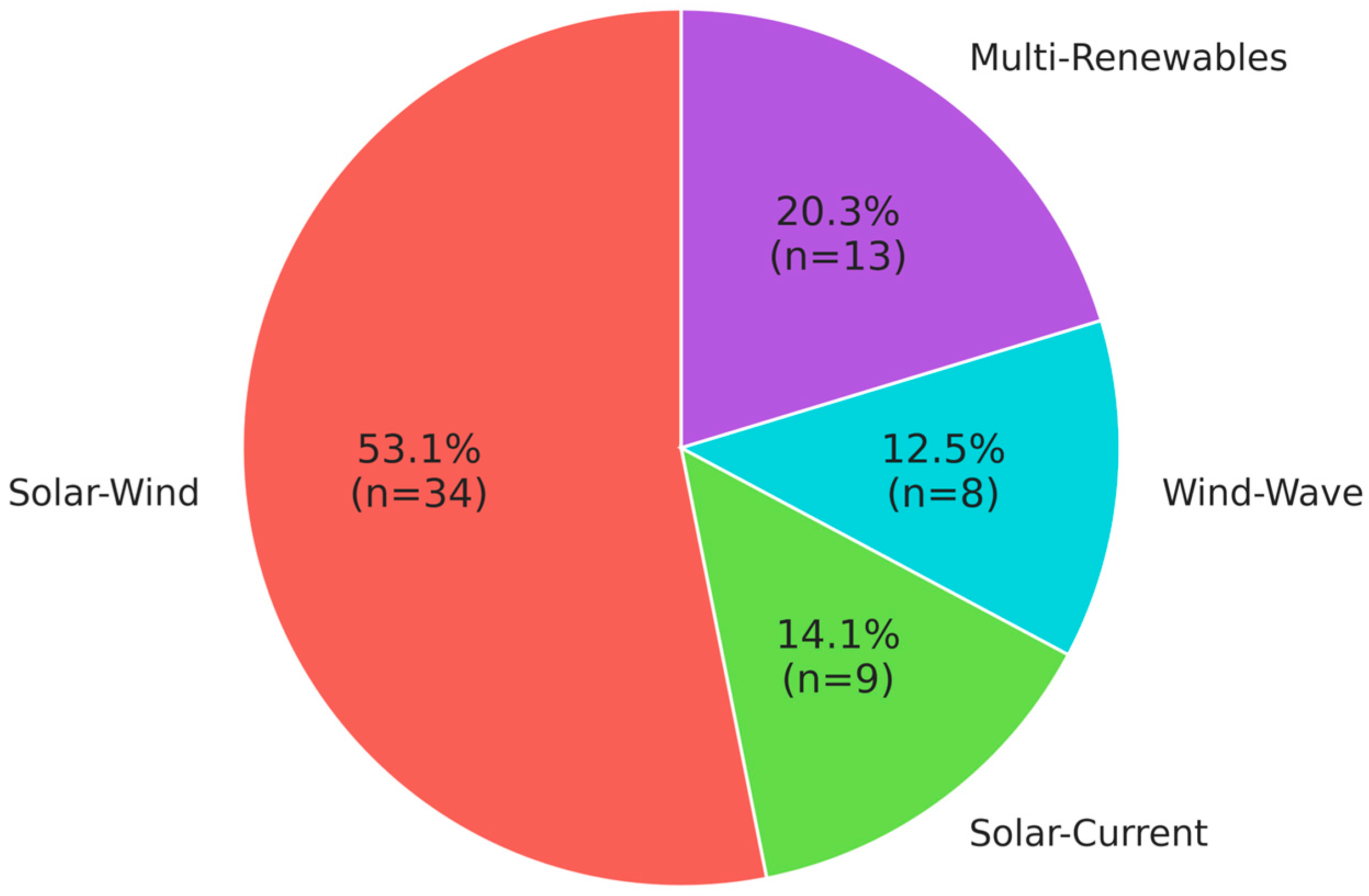
Figure 1. Hybrid configuration distribution.
Sustainability 18 03372 g001
Figure 2. Publication trend of hybrid renewable energy studies.
Sustainability 18 03372 g002
Figure 3. Country distribution of hybrid renewable energy case studies.
Sustainability 18 03372 g003
Figure 4. Concept of a hybrid solar PVs–wind turbine system. Reproduced from Ref. [25], licensed under CC BY 4.0.
Sustainability 18 03372 g004
Figure 5. Concept of a hybrid solar PVs–underwater turbine system. Reproduced from Ref. [68], licensed under CC BY-ND 4.0.
Sustainability 18 03372 g005
Figure 6. Concepts of hybrid wind turbine–WEC systems. Reproduced from Ref. [83], licensed under CC BY 4.0.
Sustainability 18 03372 g006
Figure 7. LCOE vs capacity of hybrid renewable energy systems on islands.
Sustainability 18 03372 g007
Table 1. Comparative overview of hybrid configurations for islands.
ConfigurationResource
Predictability
Qualitative TRLTypical Island ContextStrengthsLimitations
Solar–WindMedium [119]High [21]Islands with available land and viable wind resourcesLow LCOE, mature technologies, extensive optimization literature [23]High energy storage dependence, land-use constraints [18,37]
Solar–Marine CurrentHigh [72]Medium [120]Islands near straits or strong tidal channelsPredictable output, reduced storage reliance, minimal land use [13]High capital and operational cost, limited deployment and maintenance experience [95]
Wind–WaveMedium [121]Low [122]Offshore-exposed islands with strong wave resourcesInfrastructure sharing potential, reduced power variability [80,92]High capital and operational cost, offshore maintenance complexity [95]
Table 2. Applications of hybrid renewable energy systems.
ApplicationConfigurationReference
Freshwater DesalinationSolar–Wind[46,123,124,125]
Wind–Wave[126]
Solar–Wind–Wave[127]
Agriculture/IrrigationSolar–Wind[128]
Solar–Hydropower [129]
Solar–Wind–Hydrokinetic[130]
Synthetic Fuel ProductionSolar–Marine Current[67]
Solar–Wind[131]
Green Data CenterSolar–Marine Current[65]
Coastal BuildingWind–Wave [93]
Solar–Marine Current[66]
Coastal DefenseWind–Wave[87,126]
AquacultureSolar–Wind–Wave [103]
Disclaimer/Publisher’s Note: The statements, opinions and data contained in all publications are solely those of the individual author(s) and contributor(s) and not of MDPI and/or the editor(s). MDPI and/or the editor(s) disclaim responsibility for any injury to people or property resulting from any ideas, methods, instructions or products referred to in the content.