Understanding Digital Sense of Place in Living Heritage Streets Through Multimodal Social Media Analysis: A Case Study of Songyang’s Ming–Qing Old Street


Abstract
1. Introduction
- (1)
- constructing a multimodal methodological framework integrating textual and visual analytics;
- (2)
- revealing how textual narratives and visual representations jointly construct the digital sense of place of a small-scale living heritage street often overlooked in existing research;
- (3)
- offering practical implications for community-based conservation and sustainable cultural tourism.
2. Study Area, Data Sources, and Methods
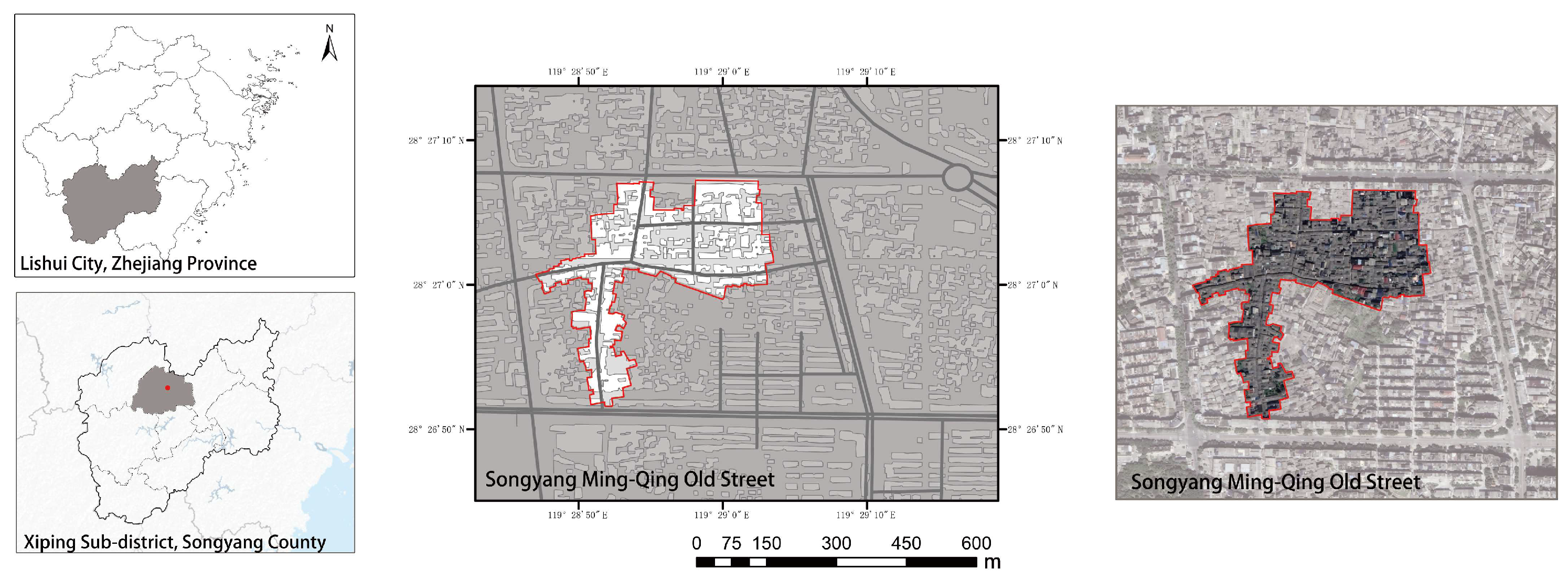
2.1. Study Area
2.2. Data Sources and Pre-Processing
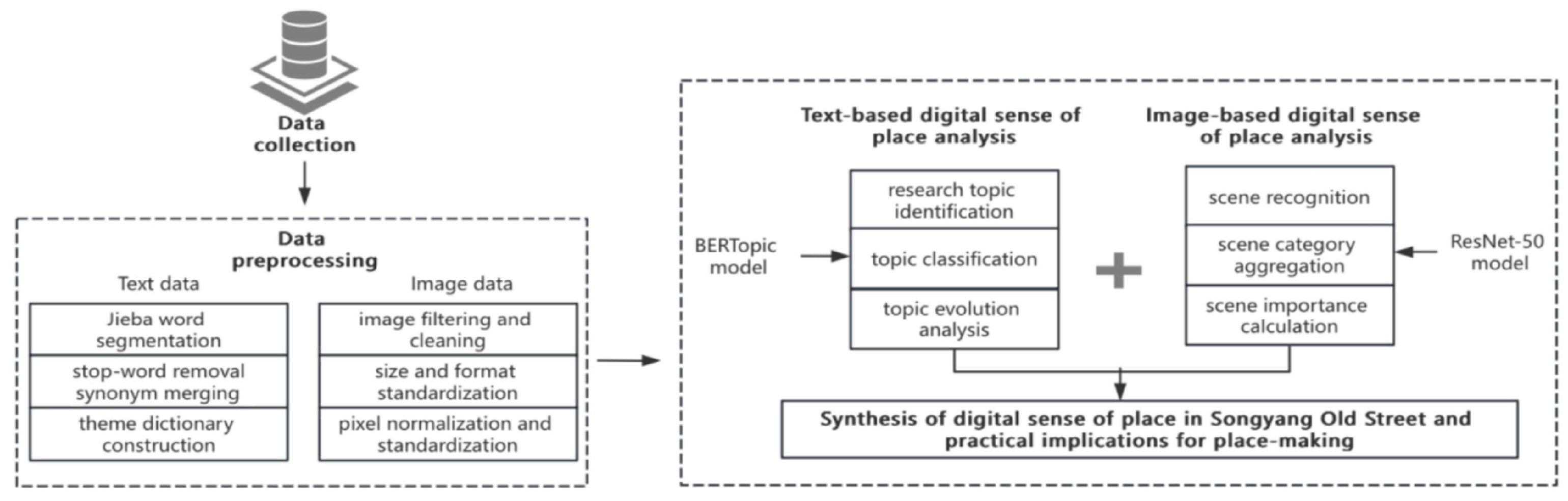
2.3. Research Methods and Analytical Framework
- Generating sentence-level semantic embeddings by inputting textual comments into a pre-trained Transformer model;
- Applying UMAP for non-linear dimensionality reduction to preserve key semantic structures;
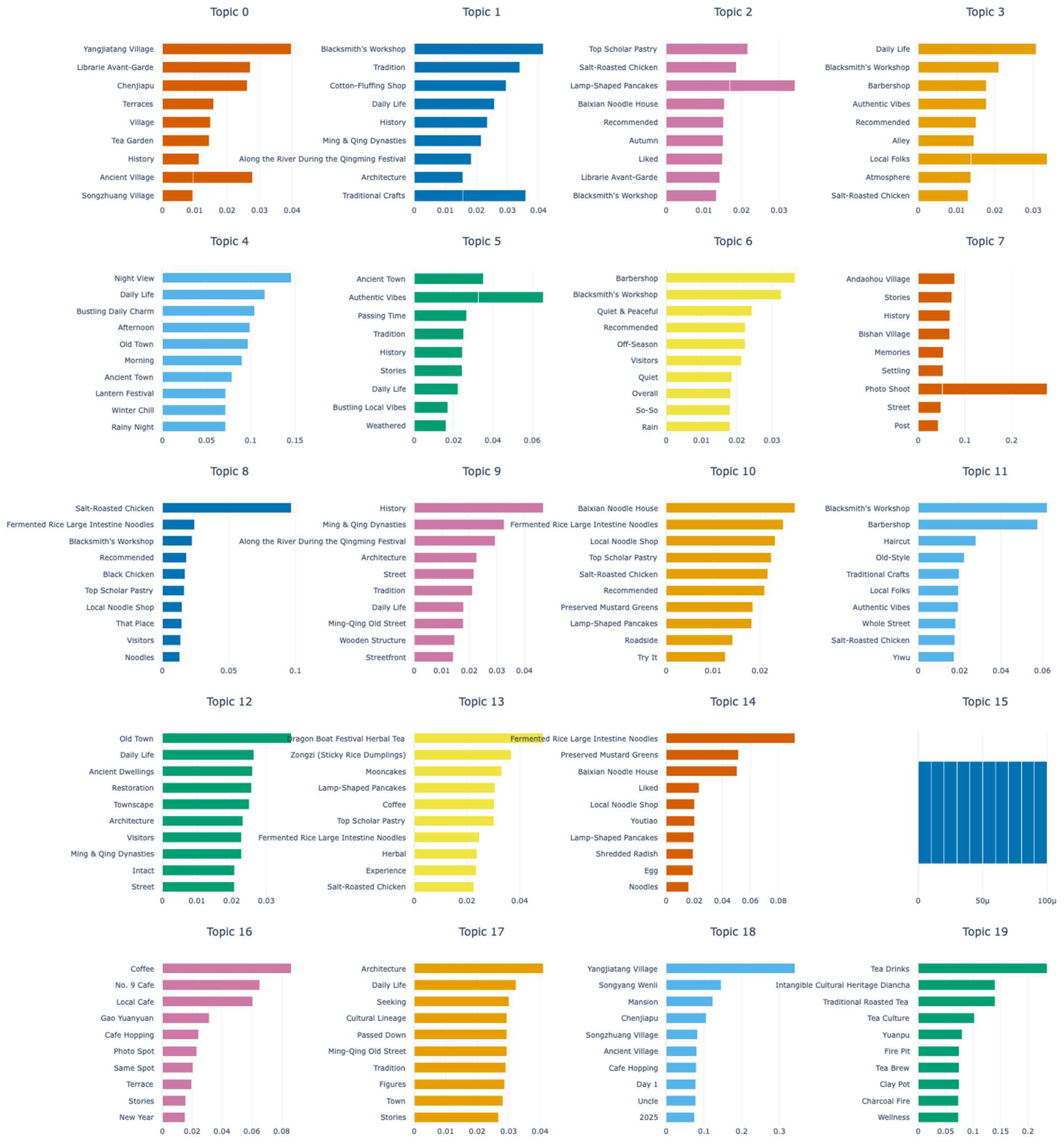
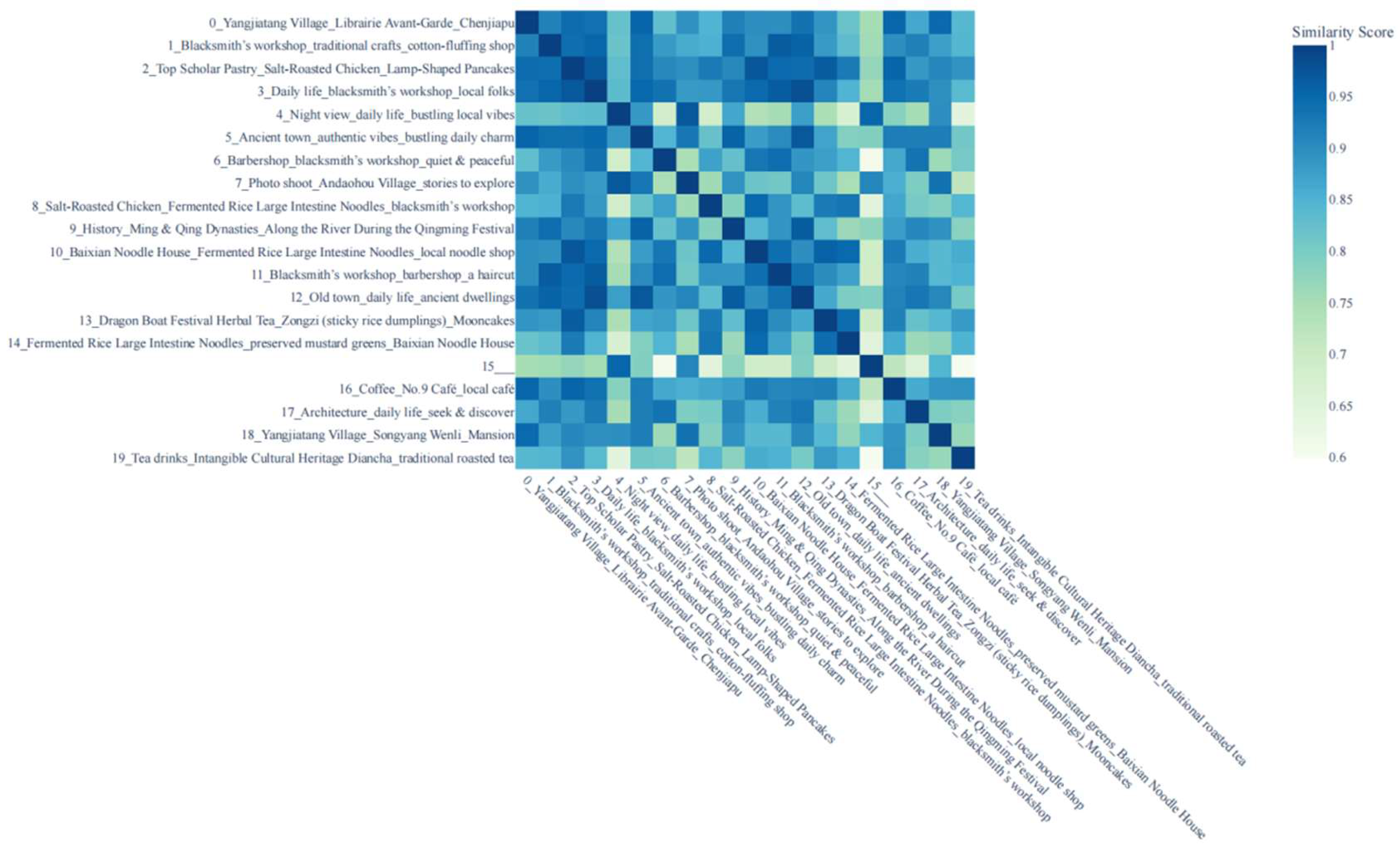
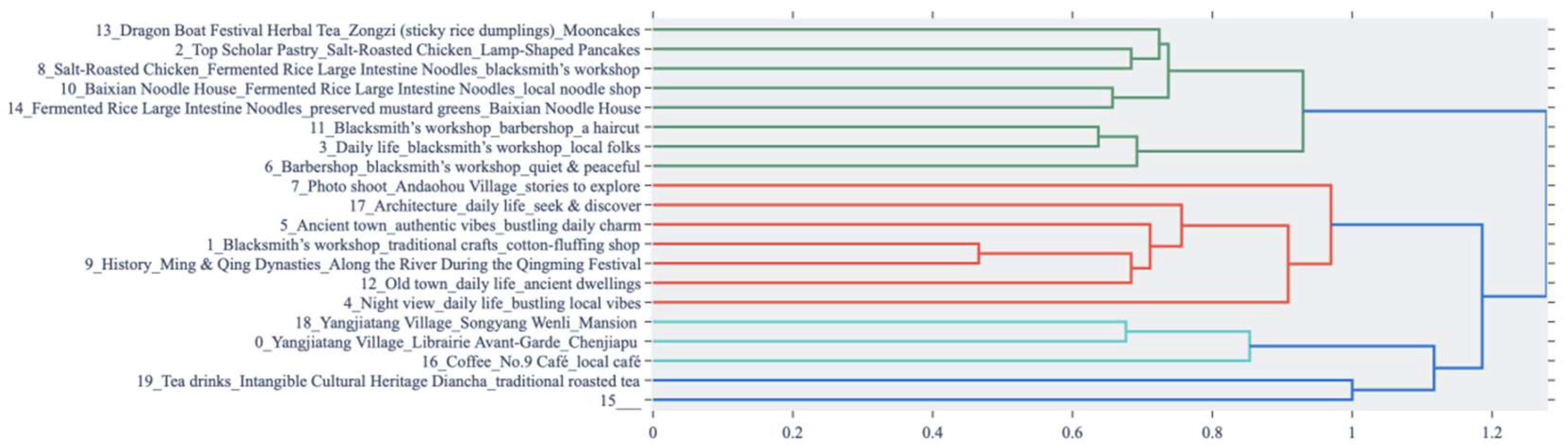
- Applying K-means clustering to generate 20 fine-grained “micro-topics,” thereby enhancing thematic resolution and supporting subsequent thematic consolidation;
- Conducting qualitative interpretation and thematic consolidation to merge related micro-topics into four coherent and conceptually meaningful core themes.
- An input layer receiving 224 × 224 RGB images with standardised normalisation to ensure data consistency;
- An initial convolutional layer (7 × 7 kernel, stride 2) for low-level feature extraction, followed by stacked residual blocks (1 × 1, 3 × 3, and 1 × 1 convolutions) that balance feature compression and expansion while capturing complex visual elements;
- A 3 × 3 max-pooling layer for down-sampling and enhanced translational invariance, followed by global average pooling to aggregate features into 2048-dimensional vectors and reduce overfitting risk;
- A fully connected layer mapping features to 365 scene categories, with Softmax used to output classification probabilities;
- Parameter optimisation through gradient-based learning supported by the residual network structure to improve recognition accuracy.
3. Text-Based Analysis of Digital Sense of Place
3.1. High-Frequency Word Characteristics of Digital Sense of Place in the Historic Street
3.2. Core Themes of Digital Sense of Place and Their Meanings
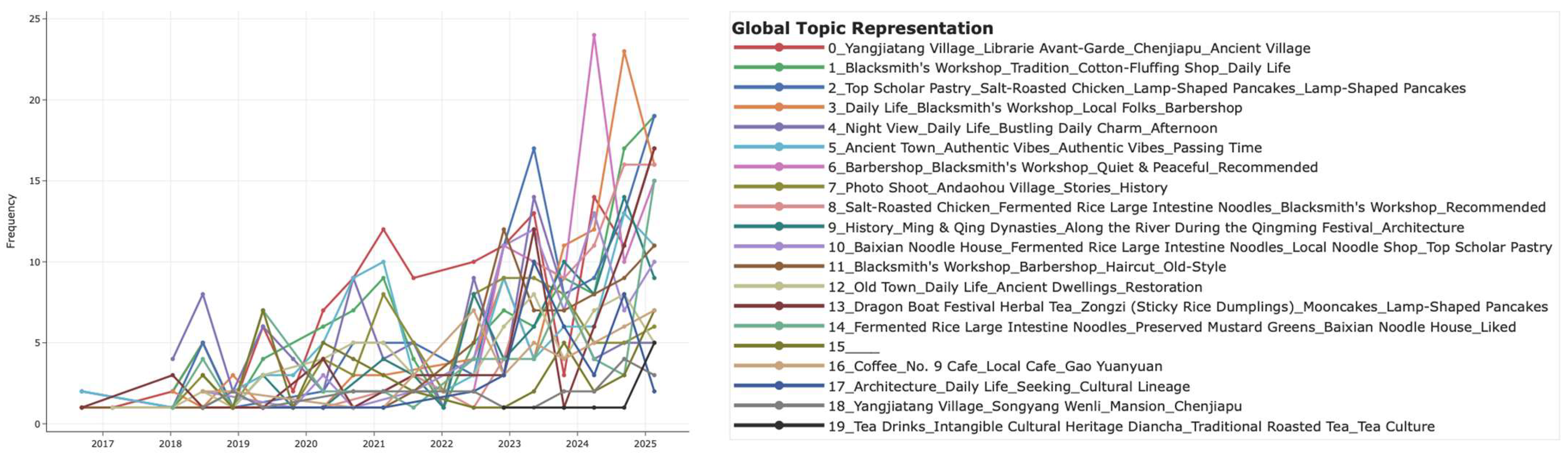
3.3. Temporal Dynamics of Core Themes
4. Image-Based Analysis of Digital Sense of Place
4.1. Classification of Visual Scenes
4.2. Visual Expression of Digital Sense of Place
5. Conclusions
5.1. Digital Sense of Place as an Integrated Experiential Process
5.2. Practical Implications: Key Considerations for Historic District Renewal in the Digital Media Context
- (1)
- Historic district renewal should prioritise the perceptibility of everyday continuity rather than focus solely on visual image enhancement. The results indicate that visitors’ attention in digital media is directed less toward individual landmarks and more toward overall spatial rhythm, daily activities, and lived atmosphere. Renewal practices should therefore respect street scale, patterns of use, and everyday behaviour. Small-scale and incremental interventions are more effective in maintaining the perception of historic districts as lived spaces, rather than transforming them into display-oriented settings designed primarily for photography and check-ins.
- (2)
- Local food should be treated as a key medium in the construction of sense of place, rather than as a secondary tourism product. In Songyang Old Street, food-related elements appear prominently in both text and images, suggesting that culinary experience is a major entry point through which visitors understand and remember the place. In practice, supporting locally operated food businesses, strengthening the everyday and historical narratives behind local dishes, and guiding their cultural expression on digital platforms can help position food as a connector between daily life, local memory, and tourism experience.
- (3)
- The protection of living crafts and traditional service businesses should avoid excessive display or performance-based transformation. Visitors’ interest in blacksmith shops and barbershops stems from their continued integration into real production and everyday life. The value of these practices lies not in being watched but in their ongoing operation as ordinary activities. Renewal strategies should therefore focus on institutional support, spatial accommodation, and business environment improvement to sustain their normal functions, allowing “life in progress” to remain a core source of sense of place.
- (4)
- Historic district renewal should not be approached as an isolated spatial intervention but as part of a broader, networked experience system. Digital narratives indicate that the sense of place of Songyang Old Street is not generated in isolation. It is shaped through connections with surrounding villages and emerging new businesses. In practice, walking systems, thematic routes, and digital guidance tools can be used to link historic streets with nearby spaces. Such integration helps strengthen the continuity and coherence of sense of place at the regional scale.
5.3. Limitations and Directions for Future Research
Author Contributions
Funding
Institutional Review Board Statement
Informed Consent Statement
Data Availability Statement
Acknowledgments
Conflicts of Interest
Abbreviations
| UGC | User-Generated Content |
| BERTopic | Bidirectional Encoder Representations Topic Modelling |
| CNN | Convolutional Neural Network |
| GIS | Geographic Information System |
References
- Xu, H.; Cheung, L.T.; Lovett, J.; Duan, X.; Pei, Q.; Liang, D. Understanding the influence of user-generated content on tourist loyalty behavior in a cultural World Heritage Site. Tour. Recreat. Res. 2023, 48, 173–187. [Google Scholar] [CrossRef]
- Sánchez-Franco, M.J.; Rey-Tienda, S. The role of user-generated content in tourism decision-making: An exemplary study of Andalusia, Spain. Manag. Decis. 2024, 62, 2292–2328. [Google Scholar] [CrossRef]
- Kusumowidagdo, A.; Ujang, N.; Rahadiyanti, M.; Ramli, N.A. Exploring the sense of place of traditional shopping streets through Instagram’s visual images and narratives. Open House Int. 2023, 48, 2–22. [Google Scholar] [CrossRef]
- Guo, Y.; Cui, X.; Zhao, Y. Handwritten typeface effect of souvenirs: Authenticity, product types, and goals. J. Hosp. Tour. Manag. 2024, 58, 345–353. [Google Scholar] [CrossRef]
- Huang, Z.J.; Lin, M.S.; Chen, J. Tourism experiences co-created on social media. Tour. Manag. 2024, 105, 104940. [Google Scholar] [CrossRef]
- Galiano-Coronil, A.; Blanco-Moreno, S.; Tobar-Pesantez, L.B.; Gutiérrez-Montoya, G.A. Social media impact of tourism managers. J. Manag. Dev. 2023, 42, 436–457. [Google Scholar] [CrossRef]
- Kasemsarn, K.; Nickpour, F. Digital Storytelling in Cultural and Heritage Tourism. Heritage 2025, 8, 200. [Google Scholar] [CrossRef]
- Dai, J.; Liu, F. Embracing the digital landscape: Enriching the concept of sense of place in the digital age. Humanit. Soc. Sci. Commun. 2024, 11, 724. [Google Scholar] [CrossRef]
- Wei, H.; Zhang, W.; Sang, X.; Zhou, M.; Kang, S. Disjunction Between Official Narrative and Digital Gaze. Sustainability 2025, 17, 9191. [Google Scholar] [CrossRef]
- Tan, J.; Cheng, M.; Chen, J.; Zhu, J.; Yu, Q.; Chen, S. Multimodal destination image and user engagement. Tour. Manag. 2025, 111, 105209. [Google Scholar] [CrossRef]
- Zang, Z.; Fu, H.; Cheng, J.; Raza, H.; Fang, D. Digital threads of architectural heritage. J. Asian Archit. Build. Eng. 2025, 24, 4452–4469. [Google Scholar] [CrossRef]
- Yu, X.; Cheng, M. Multimodality in tourism and hospitality: Narrative review. Tour. Manag. 2025, 111, 105245. [Google Scholar] [CrossRef]
- Tang, W.; Tosun, C.; Mohamed, A.E.; Uslu, S. Social media usage and travel intention. Behav. Sci. 2024, 14, 694. [Google Scholar] [CrossRef]
- Calderón-Fajardo, V.; Rodríguez-Rodríguez, I.; Puig-Cabrera, M. Multimodal framework for emotion-driven tourism analytics. Inf. Technol. Tour. 2025, 27, 939–979. [Google Scholar] [CrossRef]
- Du, S.; Cheong, C.Y.M. Beyond the scenic view: A multimodal discourse analysis of sustainable tourism imaginaries on TikTok in Anhui, China. Humanit. Soc. Sci. Commun. 2025, 12, 690. [Google Scholar] [CrossRef]
- Cheng, Y.; Yang, F.; Guo, J. Topic mining of government data openness. Res. Libr. Sci. 2025, 5, 26–37. (In Chinese) [Google Scholar]
- Gao, C.; Wu, X. User online reviews: Hongshan cultural content mining. Libr. Inf. Serv. 2025, 69, 62–73. (In Chinese) [Google Scholar]
- Guerrero-Rodríguez, R.; Álvarez-Carmona, M.; Aranda, R.; Díaz-Pacheco, Á. Destination image via deep learning news analytics. Inf. Technol. Tour. 2024, 26, 147–182. [Google Scholar] [CrossRef]
- Chen, Y.; Lin, Z.; Filieri, R.; Liu, R. Subjective well-being and mobile social media. Asia Pac. J. Tour. Res. 2021, 26, 1070–1080. [Google Scholar] [CrossRef]
- Wang, J.; Zhou, Z.; Lei, T.; Sun, J.; Zhang, H.; Qian, L. Tourists’ sense of place in memorials. J. Destin. Mark. Manag. 2024, 32, 100875. [Google Scholar]
- Liu, N.; Zhang, B.; Xie, Y.; He, Y. Media representation effects of tourism livestreaming. Asia Pac. J. Tour. Res. 2025, 30, 211–228. [Google Scholar] [CrossRef]
- Li, X.; Yang, T.; Meng, B.; Chen, S.; Zhang, S. Tourist behavior patterns in Beijing. Appl. Spat. Anal. Policy 2025, 18, 108. [Google Scholar] [CrossRef]
- Pan, S.; Lee, J.; Tsai, H. Travel photos and affective qualities. Tour. Manag. 2014, 40, 59–69. [Google Scholar] [CrossRef]
- Wang, Y.; Sparks, B.A. Eye-tracking study of tourism stimuli. J. Travel Res. 2016, 55, 588–602. [Google Scholar] [CrossRef]
- Blanco-Moreno, S.; González-Fernández, A.M.; Munoz-Gallego, P.A.; Casaló, L.V. Engagement with Instagram posts. J. Destin. Mark. Manag. 2024, 34, 100948. [Google Scholar] [CrossRef]
- Malpas, J. New media, cultural heritage and sense of place. Int. J. Herit. Stud. 2008, 14, 197–209. [Google Scholar] [CrossRef]
- Petrovski, A.; Djukic, A.; Maric, J.; Kazak, J. Digital tools for placemaking. Int. J. Archit. Res. 2025, 19, 543–561. [Google Scholar]
- Xia, H.; Muskat, B.; Karl, M.; Li, G.; Law, R. Destination competitiveness via topic modelling. J. Travel Tour. Mark. 2024, 41, 726–742. [Google Scholar] [CrossRef]
- Dobre, F.; Sandu, A.; Tătaru, G.C.; Cotfas, L.A. Smart cities and urban planning through big data. Systems 2025, 13, 780. [Google Scholar] [CrossRef]
- Hu, T.; Chen, H. Identifying coastal cities via Identity-Structure-Meaning. Sustainability 2023, 15, 15365. [Google Scholar] [CrossRef]
- Li, L.; Xu, X.; Xiao, S.; Wang, L. Emotional polarization to conflict governance: Need feature and satisfaction for aging-adapted retrofitting in historic urban communities—An IPA-BERTopic framework using social media data. Open House Int. 2025, 1–17. [Google Scholar] [CrossRef]
- Zhu, H.; Chang, J.; An, X.; Li, S. Historical spatial perception using LLMs. Cities 2025, 165, 106183. [Google Scholar] [CrossRef]
- Wang, J.; Li, Y.; Wu, B.; Wang, Y. Tourism destination image based on tourism user generated content on internet. Tour. Rev. 2021, 76, 125–137. [Google Scholar] [CrossRef]
- Csurgó, B.; Smith, M.K. Cultural heritage, sense of place and tourism: An analysis of cultural ecosystem services in rural Hungary. Sustainability 2022, 14, 7305. [Google Scholar] [CrossRef]
- Gao, S.; Liang, Y.; Sun, M. The characteristics of OGC and TGC images and their applications in the construction and online dissemination of tourist destination image: A case study of the Tanhualin Historical and Cultural District. J. Cent. China Norm. Univ. (Nat. Sci.) 2025, 60, 136–149. (In Chinese) [Google Scholar]
- Sheng, F.; Zhang, Y.; Shi, C.; Qiu, M.; Yao, S. Xi’an tourism destination image analysis via deep learning. J. Ambient Intell. Humaniz. Comput. 2022, 13, 5093–5102. [Google Scholar] [CrossRef]



| Rank | Word | Frequency |
|---|---|---|
| 1 | History | 278 |
| 2 | Life | 264 |
| 3 | Ming–Qing | 208 |
| 4 | Tradition | 199 |
| 5 | Buy | 160 |
| 6 | Architecture | 145 |
| 7 | Recommend | 133 |
| 8 | Baixian Noodle Shop | 128 |
| 9 | Ancient town | 120 |
| 10 | Blacksmith shop | 117 |
| 11 | Braised salt chicken | 114 |
| 12 | Zhuangyuan pastry | 110 |
| 13 | Street | 110 |
| 14 | Atmosphere | 104 |
| 15 | Tourist | 104 |
| 16 | Barbershop | 104 |
| 17 | Along the River During the Qingming Festival | 103 |
| 18 | Blacksmithing | 97 |
| 19 | Like | 91 |
| 20 | Dengzhan pastry | 90 |
| Final Theme | Topics | Number of Comments | Proportion (%) |
|---|---|---|---|
| Historic architecture and atmospheric experience | 1, 4, 5, 9, 12, 17 | 473 | 34.00 |
| Local food culture | 2, 8, 10, 13, 14 | 450 | 32.35 |
| Living crafts and visitor feedback | 3, 6, 7, 11 | 255 | 18.33 |
| Surrounding villages and emerging businesses | 0, 16, 18, 19 | 213 | 15.31 |
| Rank | Scene Category | Percentage (%) |
|---|---|---|
| 1 | Bazaar/Outdoor | 7.81 |
| 2 | Alley | 7.39 |
| 3 | Medina (Historic Street Scene) | 5.60 |
| 4 | Delicatessen (Food Scene) | 4.10 |
| 5 | Repair Shop | 3.48 |
| 6 | Bakery/Shop | 3.13 |
| 7 | Slum/Traditional Housing | 2.65 |
| 8 | Shopfront | 2.59 |
| 9 | Coffee Shop | 2.54 |
| 10 | Bazaar/Indoor | 2.30 |
| 11 | Doorway/Outdoor | 1.80 |
| 12 | Barn Door/Traditional Gate | 1.68 |
| 13 | Restaurant Kitchen | 1.67 |
| 14 | Diner/Outdoor | 1.53 |
| 15 | Temple/Asia | 1.39 |
| 16 | Art Studio | 1.29 |
| 17 | General Store/Outdoor | 1.14 |
| 18 | Ice Cream Parlour | 1.13 |
| 19 | Jewellery Shop | 1.10 |
| 20 | Hardware Store | 1.08 |
| Scene Category | Included Content | Description |
|---|---|---|
| Street and market spaces | Alleys, streets, shopfronts | Pedestrian movement and everyday street life |
| Dining and food scenes | Snack stalls, local dishes, beverages | Local cuisine and dining experiences |
| Traditional handicrafts and retail | Hardware shops, repair stores, grocery and fabric shops | Living crafts and small local businesses |
| Cultural and religious buildings | Museums, galleries, studios | Heritage buildings and cultural spaces |
| Residential and living spaces | Bedrooms, kitchens, lofts, guesthouses | Daily life and accommodation |
| Transportation and infrastructure | Parking areas, roads, signs, passages | Mobility and basic support facilities |
| Others | Warehouses, special or unclassified buildings | Special functions or unclassified spaces |
| Scene Category | Frequency | Percentage (%) |
|---|---|---|
| Street and market spaces | 2268 | 36.13 |
| Dining and food scenes | 1505 | 23.98 |
| Traditional handicrafts and retail | 1037 | 16.52 |
| Functional and interior spaces | 503 | 8.01 |
| Cultural and religious buildings | 420 | 6.69 |
| Residential and living spaces | 284 | 4.52 |
| Others | 159 | 2.53 |
| Natural and landscape spaces | 67 | 1.07 |
| Transportation and infrastructure | 34 | 0.54 |
Disclaimer/Publisher’s Note: The statements, opinions and data contained in all publications are solely those of the individual author(s) and contributor(s) and not of MDPI and/or the editor(s). MDPI and/or the editor(s) disclaim responsibility for any injury to people or property resulting from any ideas, methods, instructions or products referred to in the content. |
© 2026 by the authors. Licensee MDPI, Basel, Switzerland. This article is an open access article distributed under the terms and conditions of the Creative Commons Attribution (CC BY) license.
Share and Cite
Ding, L.; Zheng, G. Understanding Digital Sense of Place in Living Heritage Streets Through Multimodal Social Media Analysis: A Case Study of Songyang’s Ming–Qing Old Street. Sustainability 2026, 18, 3250. https://doi.org/10.3390/su18073250
Ding L, Zheng G. Understanding Digital Sense of Place in Living Heritage Streets Through Multimodal Social Media Analysis: A Case Study of Songyang’s Ming–Qing Old Street. Sustainability. 2026; 18(7):3250. https://doi.org/10.3390/su18073250
Chicago/Turabian StyleDing, Lingli, and Guoquan Zheng. 2026. "Understanding Digital Sense of Place in Living Heritage Streets Through Multimodal Social Media Analysis: A Case Study of Songyang’s Ming–Qing Old Street" Sustainability 18, no. 7: 3250. https://doi.org/10.3390/su18073250
APA StyleDing, L., & Zheng, G. (2026). Understanding Digital Sense of Place in Living Heritage Streets Through Multimodal Social Media Analysis: A Case Study of Songyang’s Ming–Qing Old Street. Sustainability, 18(7), 3250. https://doi.org/10.3390/su18073250