

Operationalizing the “Social” in Mountain Social–Ecological Systems: A Proposed Framework and Indicator Set


Abstract
1. Introduction
- What social sustainability themes, issues, and challenges are most commonly addressed, or overlooked, in research on mountain regions?
- Which frameworks and indicator-based tools are most suitable for assessing social sustainability in mountainous areas, and how do they reflect the complexities of MtSES?
- Which categories and specific social indicators best capture the unique characteristics and dynamics of social sustainability in mountain contexts?
2. Materials and Methods
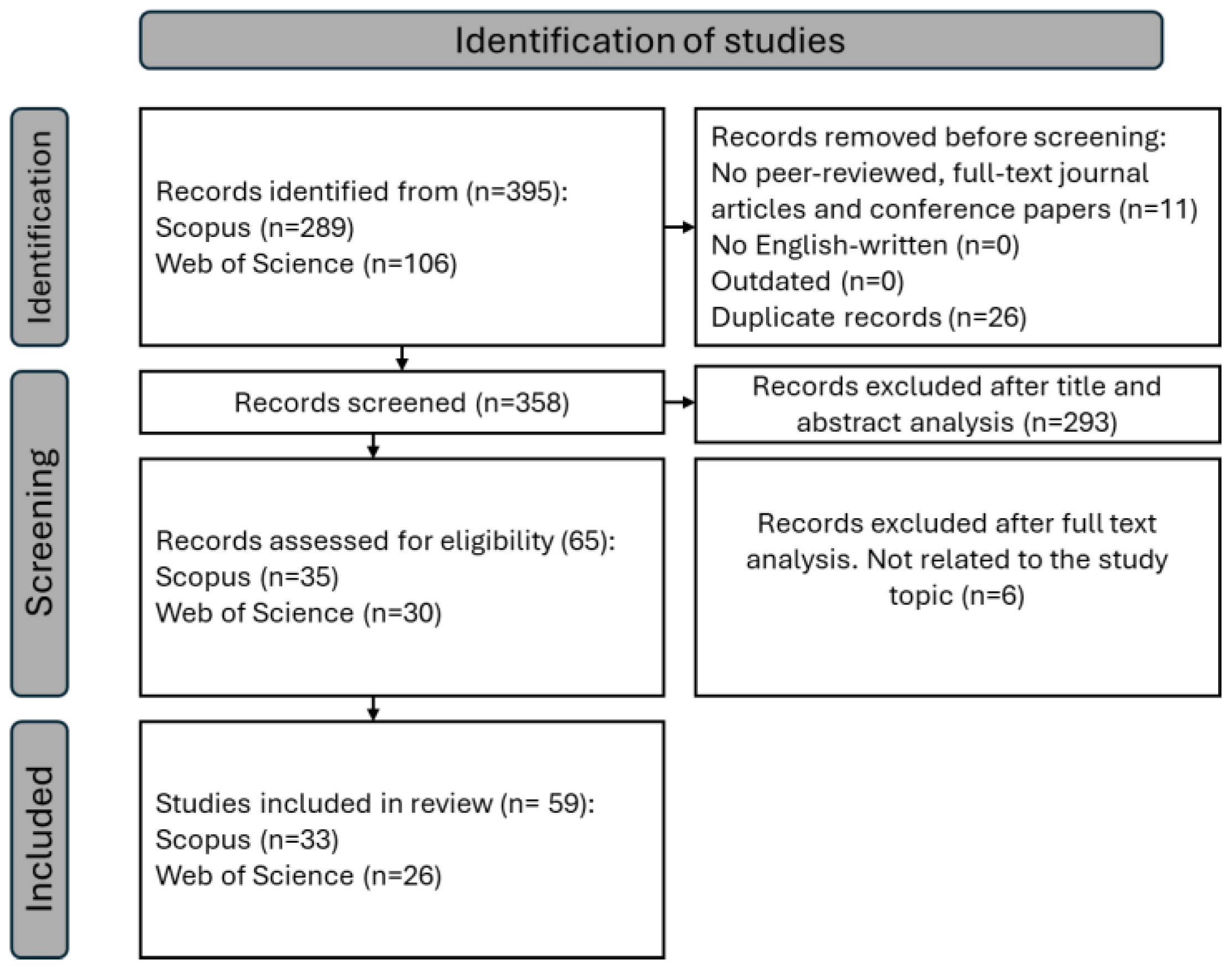
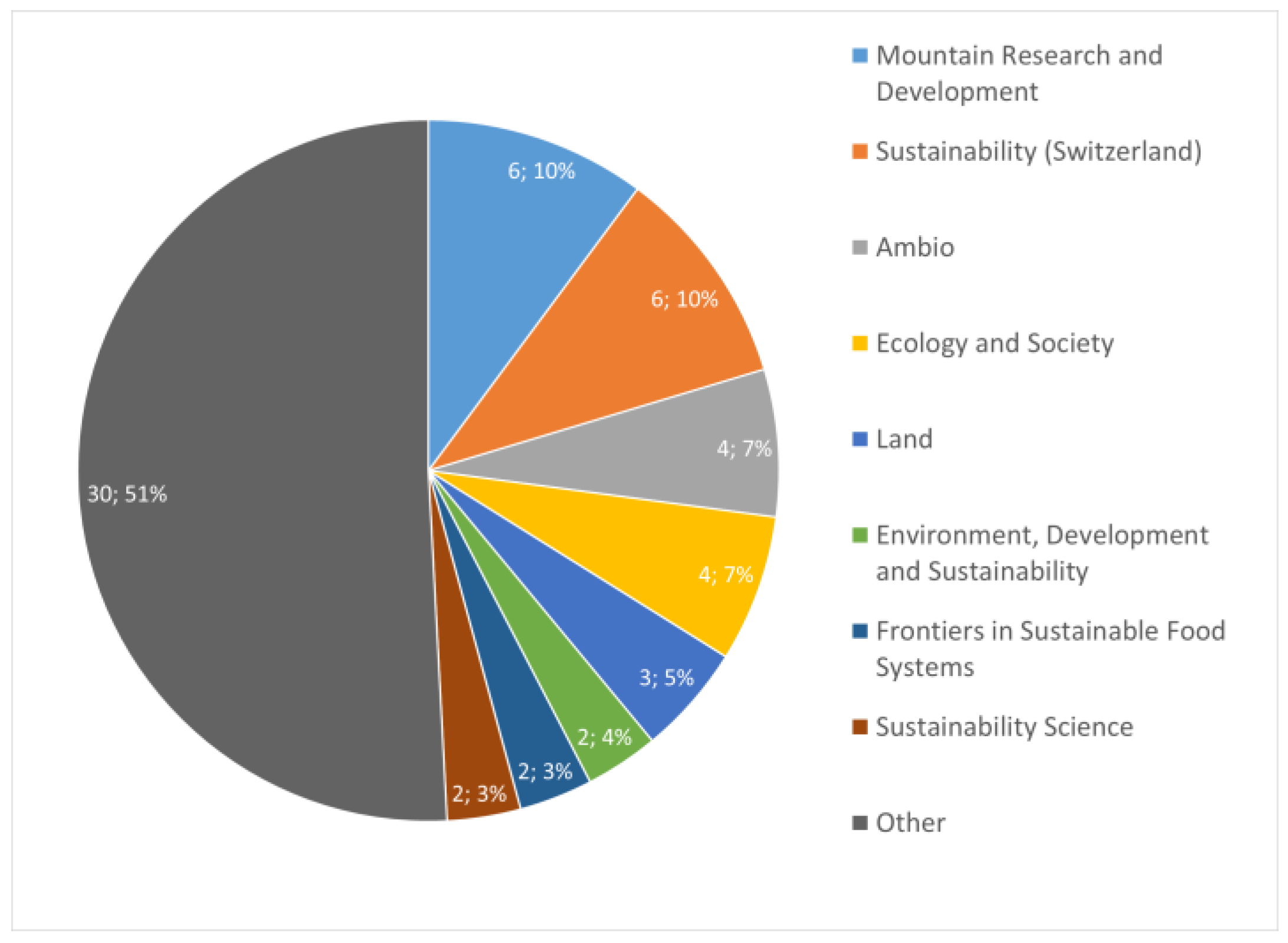
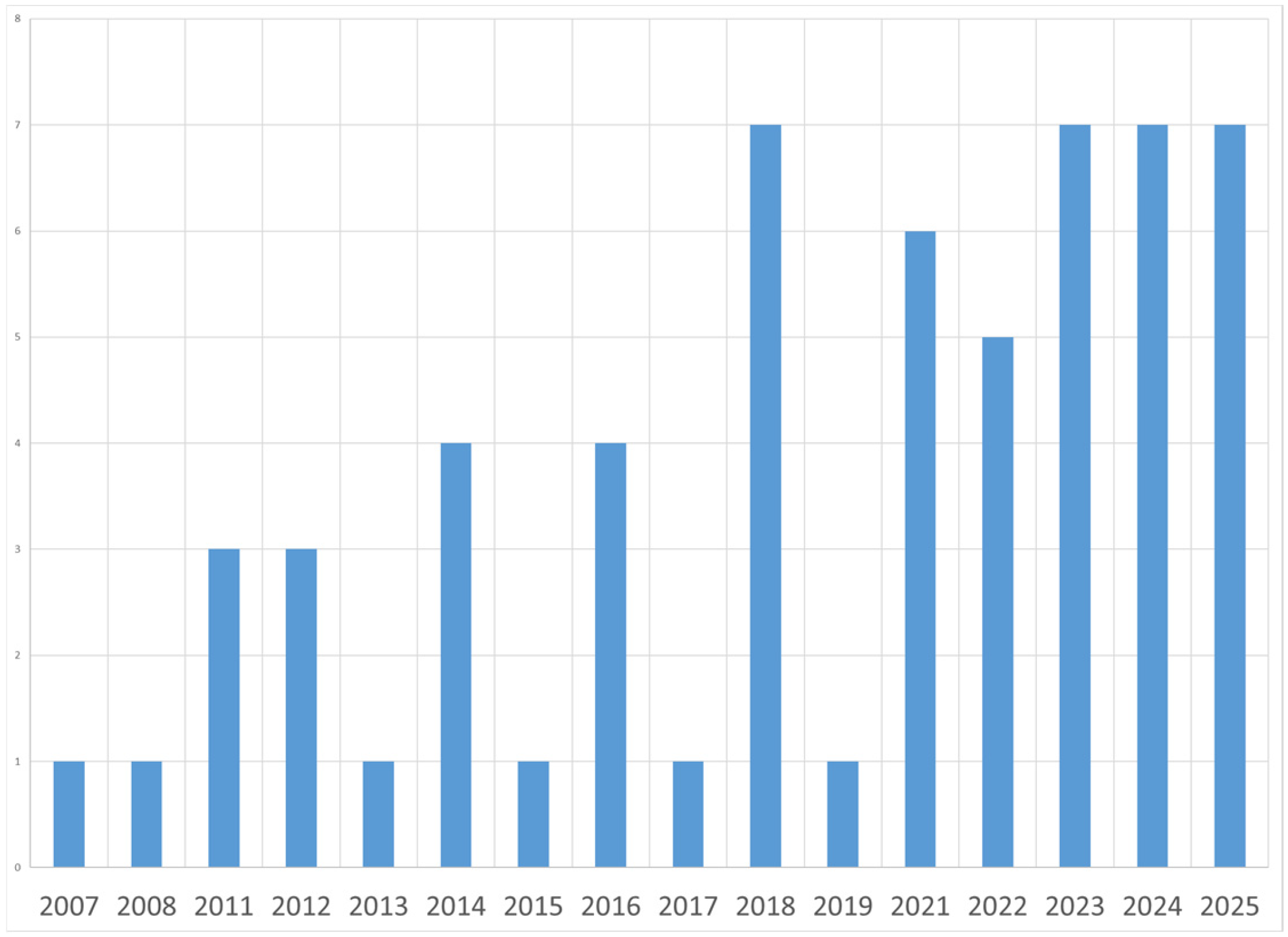
2.1. Literature Review
2.2. Comparative Analysis of Assessment Tools
2.3. Validity and Reliability
3. Results and Discussion
3.1. Identified Social Issues for Mountainous Areas
3.1.1. Territorial and Economic Governance
3.1.2. Demographic Dynamics
3.1.3. Human Well-Being and Safety
3.1.4. Social Capital
3.1.5. Cultural Capital
3.2. Comparative Analysis of Sustainability Assessment Tools
3.2.1. Actor-Centered Tools
3.2.2. Value-Chain Focused Tools
3.2.3. Holistic Tools
3.2.4. Integrative Analysis

| Tool | Ostrom’s SES Framework | Social Themes | ||||||
|---|---|---|---|---|---|---|---|---|
| Primary SES Alignment | Scope of Analysis | Depth in Social Dimension | Human Well-Being & Safety | Demographic Dynamics | Territorial & Economic Governance | Social Capital | Cultural Capital | |
| SAFA | GS, RS, RU, A (Holistic Alignment) | Farm to Supply Chain [30] | Highest Depth: Covers labor rights, health/safety, equity, and cultural diversity within a multi-stakeholder logic [34,38,41,76] | High: Covers health, safety, and equity. | Moderate: Broad supply chain scope. | High: Robust labor rights and governance standards. | High: Multi-stakeholder logic. | High: Explicitly assesses cultural diversity. |
| SMART | GS, RS, RU, A (Balanced) | Farm to Food Sector | High Depth: Operationalizes SAFA with balanced sociocultural/economic integration [30,34,37]. | High | Moderate | High (Balanced integration) | High | High (SAFA-based) |
| S-LCA | A, GS (Social Impact) | Supply Chain to System [30] | High Depth: Specifically designed for social impacts, including human rights and community engagement across the product lifecycle [30] | High (Health/Safety) | Moderate | Moderate (Value chains) | Moderate | High (Community engagement) |
| RISE | RS, A (Management Focus) | Farm Level [34] | Moderate Depth: Strong on production management; social indicators (workload, wages) are present but less developed than environmental ones [34,76] | Moderate: Includes workload and wages. | Low: Primarily farm-centric. | High: Focuses on production and financial management. | Moderate: Farm-level social metrics. | Low: Environmentally heavy focus. |
| IDEA | A, RS (Socio-territorial) | Farm Level [34] | Moderate Depth: Focuses on ethics, social integration, and human development [34,42,76] | High: Strong focus on human development. | Moderate: Evaluates “transmissibility” and generational renewal. | Moderate: Focuses on socio-territorial ethics. | High: Emphasizes social integration. | Moderate: Addresses territorial ethics. |
| RBESAS | A, RS (Human-Centric) | Village/Built Environment [41,42] | High Depth (Actors): Uses Maslow’s hierarchy of needs to assess physiological, safety, and psychological needs of high-altitude villagers [30,41] | Highest: Uses Maslow’s hierarchy for physiological/safety needs. | Low: Village-level built environment focus. | Low: Limited to local built environment. | Moderate: Focuses on high-altitude community needs. | Low: Technical/structural focus. |
| PG Tool | RS, A (Ecosystem Services) | Farm Level [34] | Moderate Depth: Evaluates social capital, landscape heritage, and farm business resilience through a “public goods” lens [30]. | Moderate: Focuses on business resilience. | Low: Focused on public good provision. | Moderate: Evaluates non-market values and resilience. | High: Specifically evaluates social capital. | High: Strong focus on landscape heritage. |
3.3. Proposed Social Indicators for Mountainous Areas
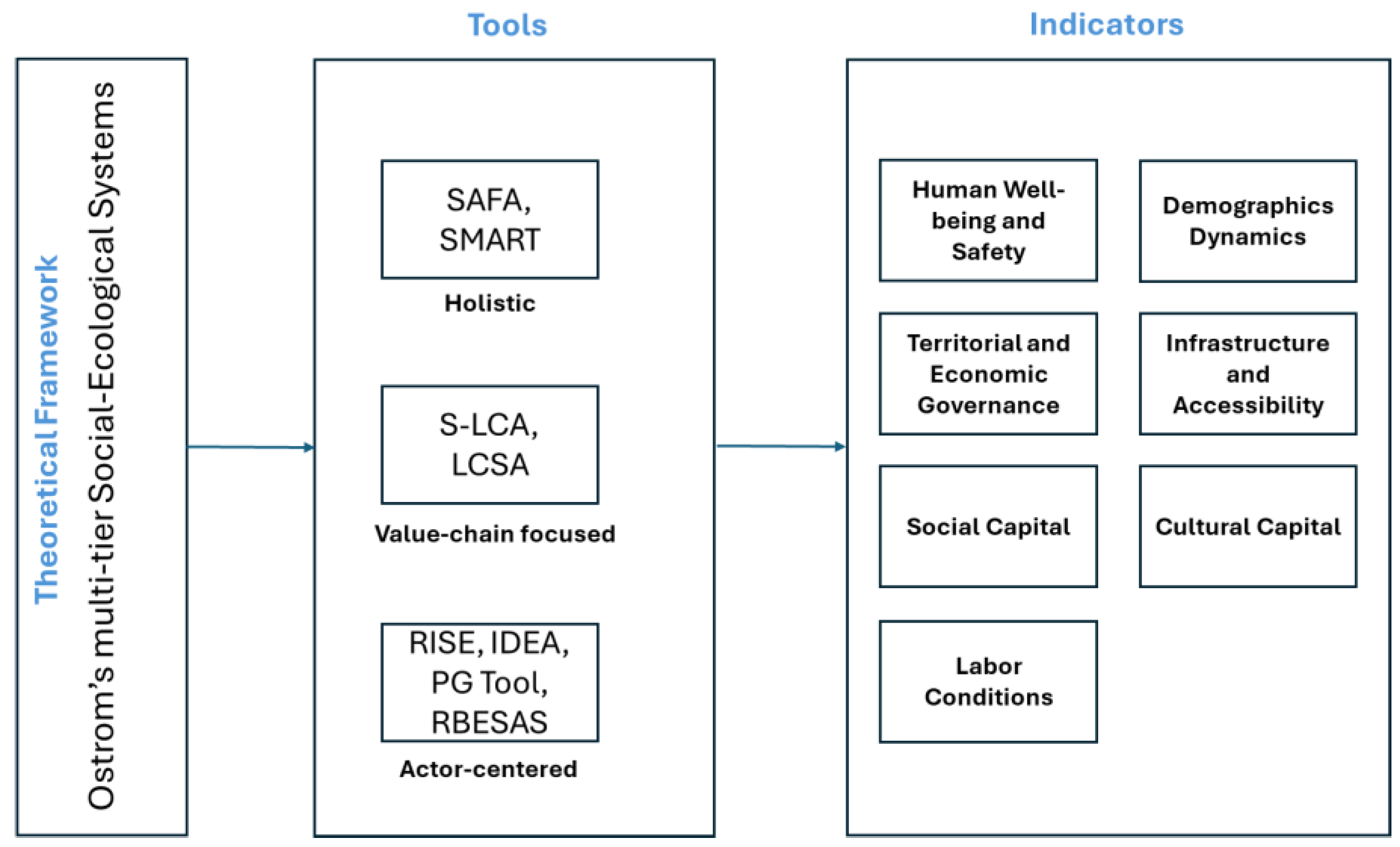
3.4. Integrative Discussion and a Model for Assessing Social Sustainability in Mountains
3.5. Actionable Insights and Future Directions
4. Conclusions
Funding
Data Availability Statement
Conflicts of Interest
Correction Statement
References
- Alessa, L.; Kliskey, A.; Gosz, J.; Griffith, D.; Ziegler, A. MtnSEON and social–ecological systems science in complex mountain landscapes. Front. Ecol. Environ. 2018, 16, S4–S10. [Google Scholar] [CrossRef] [Scilit]
- Viviroli, D.; Dürr, H.H.; Messerli, B.; Meybeck, M.; Weingartner, R. Mountains of the world, water towers for humanity: Typology, mapping, and global significance. Water Resour. Res. 2007, 43, W07447. [Google Scholar] [CrossRef] [Scilit]
- Immerzeel, W.W.; Lutz, A.F.; Andrade, M.; Bahl, A.; Biemans, H.; Bolch, T.; Hyde, S.; Brumby, S.; Davies, B.J.; Elmore, A.C.; et al. Importance and vulnerability of the world ’s water towers. Nature 2020, 577, 364–369. [Google Scholar] [CrossRef] [Scilit] [PubMed]
- FAO. Mapping the Vulnerability of Mountain Peoples to Food Insecurity; FAO: Rome, Italy, 2015. [Google Scholar]
- Palau, A.Z.; Claramunt-López, B. Mountain research for sustainability: Where are we and where to go? Sustain. Sci. 2024, 19, 1693–1707. [Google Scholar] [CrossRef] [Scilit]
- Ficko, A.; Sarkki, S.; Gultekin, Y.S.; Egli, A.; Hiedanpää, J. Reflective thinking meets artificial intelligence: Synthesizing sustainability transition knowledge in left-behind mountain regions. Geogr. Sustain. 2025, 6, 100257. [Google Scholar] [CrossRef] [Scilit]
- Hunt, T.L.; Kliskey, A.; Alessa, L. Applying social–ecological systems science to complex mountain landscapes. Front. Ecol. Environ. 2018, 16, S3. [Google Scholar] [CrossRef] [Scilit]
- Vogt, J.M.; Epstein, G.B.; Mincey, S.K.; Fischer, B.C.; McCord, P. Putting the “E” in SES: Unpacking the ecology in the ostrom socialecological system framework. Ecol. Soc. 2015, 20, 55. [Google Scholar] [CrossRef] [Scilit]
- Ehrlich, D.; Melchiorri, M. Population Trends and Urbanisation in Mountain Ranges of the World. Land 2021, 10, 255. [Google Scholar] [CrossRef] [Scilit]
- Flint, C.G. Framing the Human Dimensions of Mountain Systems: Integrating Social Science Paradigms for a Global Network of Mountain Observatories. Mt. Res. Dev. 2016, 36, 528–536. [Google Scholar] [CrossRef] [Scilit]
- Ostrom, E. A General Framework for Analyzing Sustainability of Social-Ecological Systems. Science 2009, 325, 419–422. [Google Scholar] [CrossRef] [Scilit]
- Partelow, S. A review of the social-ecological systems framework: Applications, methods, modifications, and challenges. Ecol. Soc. 2018, 23, 36. [Google Scholar] [CrossRef] [Scilit]
- Folke, C. Resilience: The emergence of a perspective for social–ecological systems analyses. Glob. Environ. Change 2006, 16, 253–267. [Google Scholar] [CrossRef] [Scilit]
- Stotten, R.; Ambrosi, L.; Tasser, E.; Leitinger, G. Social-ecological resilience in remote mountain communities: Toward a novel framework for an interdisciplinary investigation. Ecol. Soc. 2021, 26, 29. [Google Scholar] [CrossRef] [Scilit]
- Patricia, N.; Danny, M. Adapting to climate change: Women’s livelihood strategies in uMkhanyakude District Municipality. Environ. Dev. 2025, 55, 101185. [Google Scholar] [CrossRef] [Scilit]
- Res, C.; Kyriazopoulos, A.P.; Skre, O.; Sarkki, S.; Wielgolaski, F.E.; Abraham, E.M.; Ficko, A. Human–environment dynamics in European treeline ecosystems: A synthesis based on the DPSIR framework. Clim. Res. 2017, 73, 17–29. [Google Scholar]
- Ma, R.; Liu, L.; Xu, J.; Xu, G.; Huo, X.; Ding, W.; Yang, H.; Ma, Y. What drives the coordination of mountain socio-economic-ecological systems? Evidence from the three parallel rivers region of China. Environ. Sustain. Indic. 2025, 27, 100826. [Google Scholar] [CrossRef] [Scilit]
- Ramachandran, S.; Rani, L.; Venkat, P. Exploring environmental inequality definitions and themes through literature review. Discov. Sustain. 2026, 7, 11. [Google Scholar] [CrossRef] [Scilit]
- Laruffa, F. Developing the global North: Social–ecological justice, post-capitalist aspirations, and the politics of capabilities. Rev. Soc. Econ. 2026, 1–30. [Google Scholar] [CrossRef] [Scilit]
- Llopis, J.C.; Diebold, C.L.; Schneider, F.; Harimalala, P.C. Capabilities Under Telecoupling: Human Well-Being Between Cash Crops and Protected Areas in north-eastern Madagascar. Front. Sustain. Food Syst. 2020, 3, 126. [Google Scholar] [CrossRef] [Scilit]
- Banat, M. Assessment of the Impact of Population Reduction on Grasslands with a New “Tool”: A Case Study on the “Mountainous Banat” Area of Romania. Land 2024, 13, 134. [Google Scholar] [CrossRef] [Scilit]
- Scolozzi, R.; Villa, M.; Giagnorio, M. Integrating Social–Ecological Systems and Megatrends: A Participatory Foresight Framework for Sustainability Governance in European Cold Lands. Sustainability 2025, 17, 9644. [Google Scholar] [CrossRef] [Scilit]
- Janker, J.; Mann, S. Understanding the social dimension of sustainability in agriculture: A critical review of sustainability assessment tools. Environ. Dev. Sustain. 2020, 22, 1671–1691. [Google Scholar] [CrossRef] [Scilit]
- González-Moreno, P.; Schmitt, E.; Moreno-Ortiz, J.; Pinto-Correia, T.; Guiomar, N.; Delgado-Serrano, M.d.M. Assessing the vulnerability of mountain value chains to environmental and social drivers in Europe: A land-use and stakeholder-based approach. Ambio 2025, 54, 1386–1403. [Google Scholar] [CrossRef] [Scilit] [PubMed]
- Vallance, S.; Perkins, H.C.; Dixon, J.E. What is social sustainability? A clarification of concepts. Geoforum 2011, 42, 342–348. [Google Scholar] [CrossRef] [Scilit]
- Pilane, P.M.; Jordaan, H.; Bahta, Y.T. A Systematic Review of Social Sustainability Indicators for Water Use along the Agricultural Value Chain. Hydrology 2024, 11, 72. [Google Scholar] [CrossRef] [Scilit]
- Grumbine, R.E.; Xu, J. Mountain futures: Pursuing innovative adaptations in coupled social–ecological systems. Front. Ecol. Environ. 2021, 19, 342–348. [Google Scholar] [CrossRef] [Scilit]
- Boström, M. A missing pillar? Challenges in theorizing and practicing social sustainability: Introduction to the special issue. Sustain. Sci. Pract. Policy 2012, 8, 3–14. [Google Scholar] [CrossRef] [Scilit]
- D’Adamo, I. Sustainable communities: We are the world. Sci. Rep. 2025, 15, 8068. [Google Scholar] [CrossRef] [Scilit]
- Packer, G.; Zanasi, C. Comparing social sustainability assessment indicators and tools for bio-districts: Building an analytical framework. Front. Sustain. Food Syst. 2023, 7, 1229505. [Google Scholar] [CrossRef] [Scilit]
- Bhattacherjee, A. Social Science Research: Principles, Methods, and Practices; University of South Florida: Tampa, FL, USA, 2012. [Google Scholar]
- Moher, D.; Liberati, A.; Tetzlaff, J.; Altman, D.G.; Antes, G.; Atkins, D.; Barbour, V.; Barrowman, N.; Berlin, J.A.; Clark, J.; et al. Preferred reporting items for systematic reviews and meta-analyses: The PRISMA statement. PLoS Med. 2009, 6, e1000097. [Google Scholar] [CrossRef] [Scilit]
- Herrero-Jáuregui, C.; Arnaiz-Schmitz, C.; Reyes, M.F.; Telesnicki, M.; Agramonte, I.; Easdale, M.H.; Schmitz, M.F.; Aguiar, M.; Gómez-Sal, A.; Montes, C. What do we talk about when we talk about social-ecological systems? A literature review. Sustainability 2018, 10, 2950. [Google Scholar] [CrossRef] [Scilit]
- De Olde, E.M.; Oudshoorn, F.W.; Sørensen, C.A.G.; Bokkers, E.A.M.; De Boer, I.J.M. Assessing sustainability at farm-level: Lessons learned from a comparison of tools in practice. Ecol. Indic. 2016, 66, 391–404. [Google Scholar] [CrossRef] [Scilit]
- Marchand, F.; Debruyne, L.; Triste, L.; Gerrard, C.; Padel, S.; Lauwers, L. Key characteristics for tool choice in indicator-based sustainability assessment at farm level. Ecol. Soc. 2014, 19, 46. [Google Scholar] [CrossRef] [Scilit]
- Thorn, J.P.R.; Klein, J.A.; Steger, C.; Hopping, K.A.; Capitani, C.; Tucker, C.M.; Nolin, A.W.; Reid, R.S.; Seidl, R.; Chitale, V.S.; et al. A systematic review of participatory scenario planning to envision mountain social-ecological systems futures. Ecol. Soc. 2020, 25, 6. [Google Scholar] [CrossRef] [Scilit]
- FAO. Sustainability Assessment of Food and Agricultural System: Guidelines; FAO: Rome, Italy, 2014. [Google Scholar]
- Leknoi, U.; Rosset, P.; Likitlersuang, S. Multi-criteria social sustainability assessment of highland maize monoculture in Northern Thailand using the SAFA tool. Resour. Environ. Sustain. 2023, 13, 100115. [Google Scholar] [CrossRef] [Scilit]
- Tonini, M.; Araújo, D.; Cesar, N.; Gravina, C. Geotech social impacts: Development, application, and comparative analysis. Environ. Impact Assess. Rev. 2024, 108, 107577. [Google Scholar] [CrossRef] [Scilit]
- Sacco, P.; Don, D.; Mandler, A.; Mazzetto, F. Integrating LCA and Multi-Criteria Tools for Eco-Design Approaches: A Case Study of Mountain Farming Systems. Sustainability 2025, 17, 6240. [Google Scholar] [CrossRef] [Scilit]
- Acharya, C.N.; Chaiyakot, P.; Yuangyai, N. A Systematic literature review using PRISMA framework: An assessment on the community based tourism businesses and sustainable livelihood. J. Tour. Anal. 2025, 32, 98–137. [Google Scholar] [CrossRef] [Scilit]
- Wan, L.; Ng, E. Assessing the sustainability of the built environment in mountainous rural villages in Southwest China. Mt. Res. Dev. 2016, 36, 4–14. [Google Scholar] [CrossRef] [Scilit]
- Zahm, F.; Viaux, P.; Vilain, L.; Girardin, P.; Mouchet, C. Assessing Farm Sustainability with the IDEA Method–from the Concept of Agriculture Sustainability to Case Studies on Farms. Sustain. Dev. 2008, 281, 271–281. [Google Scholar] [CrossRef] [Scilit]
- Baur, I.; Nax, H.H. Adapting Governance Incentives to Avoid Common Pool Resource Underuse: The Case of Swiss Summer Pastures. Sustainability 2018, 10, 3988. [Google Scholar] [CrossRef] [Scilit]
- Mayring, P. Qualitative Content Analysis: Theoretical Foundation, Basic Procedures and Software Solution; SSOAR: Mannheim, Germany, 2014; pp. 1–143. Available online: https://www.ssoar.info/ssoar/bitstream/handle/document/39517/ssoar-2014-mayring-Qualitative_content_analysis_theoretical_foundation.pdf (accessed on 24 January 2025).
- Schirpke, U.; Scolozzi, R.; Kiessling, A.; Tappeiner, U. Recreational ecosystem services of mountain lakes in the European Alps: Preferences, visitor groups and management implications. J. Outdoor Recreat. Tour. 2021, 35, 100421. [Google Scholar] [CrossRef] [Scilit]
- Payne, D.; Snethlage, M.; Geschke, J.; Spehn, E.M.; Fischer, M. Nature and People in the Andes, East African Mountains, European Alps, and Hindu Kush Himalaya: Current Research and Future Directions. Mt. Res. Dev. 2020, 40, R1–R14. [Google Scholar] [CrossRef] [Scilit]
- Postigo, J.C. Perception and Resilience of Andean Populations Facing Climate Change. J. Ethnobiol. 2014, 34, 383–400. [Google Scholar] [CrossRef] [Scilit]
- Sarkki, S.; Lynn, T.; Hiedanpää, J.; Vizzarri, M.; Christoforidi, I.; Brnkalakova, S.; Crisan, V.; Egli, A.; Gültekin, P.; Selman Gültekin, Y.; et al. Polytraps in European rural mountainous regions: An expert view. Eur. Plan. Stud. 2025, 33, 757–777. [Google Scholar] [CrossRef] [Scilit]
- Kizos, T.; Detsis, V.; Iosifides, T.; Metaxakis, M. Social capital and social-ecological resilience in the Asteroussia Mountains, Southern Crete, Greece. Ecol. Soc. 2014, 19, 40. [Google Scholar] [CrossRef] [Scilit]
- Prieto, M.; Ruiz-mallén, I.; Corbera, E. A systematic review of co-managed small-scale fi sheries: Social diversity and adaptive management improve outcomes. Glob. Environ. Change 2018, 52, 212–225. [Google Scholar] [CrossRef] [Scilit]
- Klein, J.A.; Tucker, C.M.; Nolin, A.W.; Hopping, K.A.; Reid, R.S.; Steger, C.; Grêt-Regamey, A.; Lavorel, S.; Müller, B.; Yeh, E.T.; et al. Catalyzing Transformations to Sustainability in the World’s Mountains. Earth’s Future 2019, 7, 547–557. [Google Scholar] [CrossRef] [Scilit]
- Torre, C.D.; Stemberger, S.; Bottura, J.; Corrent, M.; Zanoni, S.; Fusari, D.; Gatto, P. Revitalizing Collective Resources in Mountain Areas Through Community Engagement and Knowledge Cocreation. Mt. Res. Dev. 2022, 42, D1–D13. [Google Scholar] [CrossRef] [Scilit]
- Schirpke, U.; Scolozzi, R.; Dean, G.; Haller, A.; Hieronymus, J.; Sarmiento, F.O.; Sattler, B.; Schleyer, C.; Kister, J.; Kov, B. Cultural ecosystem services in mountain regions: Conceptualising conflicts among users and limitations of use. Ecosyst. Serv. 2020, 46, 101210. [Google Scholar] [CrossRef] [Scilit]
- Haile, B.T.; Dougill, A.J.; Ramoelo, A.; Kidane, T.T. Assessing farm-level sustainability: A comparative analysis of horticultural production systems in Eritrea. Front. Sustain. Food Syst. 2025, 9, 1532356. [Google Scholar] [CrossRef] [Scilit]
- Steinicke, E.; Čede, P.; Löffler, R. In-migration as a new process in demographic problem areas of the Alps. Ghost towns vs. Amenity settlements in the Alpine border area between Italy and Slovenia. Erdkunde 2012, 66, 329–344. [Google Scholar] [CrossRef] [Scilit]
- Thornton, J.M.; Snethlage, M.A.; Sayre, R.; Urbach, D.R.; Viviroli, D.; Ehrlich, D.; Muccione, V.; Wester, P.; Insarov, G.; Adler, C. Human populations in the world’s mountains: Spatio-temporal patterns and potential controls. PLoS ONE 2022, 17, e0271466. [Google Scholar] [CrossRef] [Scilit] [PubMed]
- Sunge, R.; Mudzingiri, C. A Systematic Literature Review on Migration and Remittances in Mountainous Regions: Key Takeaways for Phuthaditjhaba, Free State, South Africa. Sustainability 2023, 15, 14621. [Google Scholar] [CrossRef] [Scilit]
- Bolívar-santamaría, S.; Cort, A.; Rodríguez, T. Land Use Policy A framework for participatory scenario planning to guide transitions towards sustainability in mountain social-ecological systems: A case study from the Colombian Andes. Land Use Policy 2023, 132, 106817. [Google Scholar] [CrossRef] [Scilit]
- Katsoulakos, A. Combating Energy Poverty in Mountainous Areas Through Energy-saving Interventions. Mt. Res. Dev. 2011, 31, 284–292. [Google Scholar] [CrossRef] [Scilit]
- Tian, N.; Lan, H. The indispensable role of resilience in rational landslide risk management for social sustainability. Geogr. Sustain. 2023, 4, 70–83. [Google Scholar] [CrossRef] [Scilit]
- Mann, S.; Richter, S.; Ehlers, M.H.; Roesch, A.; Douziech, M. Towards a non-speciesist social life cycle assessment. Int. J. Life Cycle Assess. 2025, 30, 2248–2257. [Google Scholar] [CrossRef] [Scilit]
- Ambayoen, M.A.; Hidayat, K.; Yuliati, Y.; Cahyono, E.D. The Roots of Resilience: Strengthening Agricultural Sustainability in Tengger, Indonesia Through Social Capital. Sustainability 2025, 17, 192. [Google Scholar] [CrossRef] [Scilit]
- Orchard, S.; Glover, D.; Thapa Karki, S.; Ayele, S.; Sen, D.; Rathod, R.; Rowhani, P. Exploring synergies and trade-offs among the sustainable development goals: Collective action and adaptive capacity in marginal mountainous areas of India. Sustain. Sci. 2020, 15, 1665–1681. [Google Scholar] [CrossRef] [Scilit]
- Rani, B.; Jyoti, M.; Deka, N.; Bhattacharya, P. Forest Policy and Economics Assessing homestead agroforestry-based livelihoods in Sivasagar District of Assam, India, using livelihood significance index (LSI). For. Policy Econ. 2025, 170, 103388. [Google Scholar] [CrossRef] [Scilit]
- Moretti, M.; Belliggiano, A.; Grando, S.; Felici, F.; Scotti, I.; Ievoli, C.; Blackstock, K.; Delgado-Serrano, M.M.; Brunori, G. Characterizing value chains’ contribution to resilient and sustainable development in European mountain areas. J. Rural Stud. 2023, 100, 103022. [Google Scholar] [CrossRef] [Scilit]
- Liu, W.; Zhang, J.; Qian, L. Measuring Community Resilience and Its Determinants: Relocated Vulnerable Community in Western China. Int. J. Environ. Res. Public Health 2023, 20, 694. [Google Scholar] [CrossRef] [Scilit] [PubMed]
- Kadigi, R.M.J. Income Inequality in Mountain Areas: The Case of Agroforestry Farming Systems in Uluguru Mountains, Tanzania. Open J. For. 2021, 11, 254–291. [Google Scholar] [CrossRef]
- Mazzocchi, C.; Orsi, L.; Bergamelli, C.; Sturla, A. Bio-districts and the territory: Evidence from a regression approach. Aestimum 2021, 79, 5–23. [Google Scholar] [CrossRef] [Scilit]
- Menikpura, S.N.M.; Gheewala, S.H.; Bonnet, S. Framework for life cycle sustainability assessment of municipal solid waste management systems with an application to a case study in Thailand. Waste Manag. Res. 2012, 300, 708–719. [Google Scholar] [CrossRef] [Scilit]
- Gupta, H.; Nishi, M.; Gasparatos, A. Community-based responses for tackling environmental and socio-economic change and impacts in mountain social–ecological systems. Ambio 2022, 51, 1123–1142. [Google Scholar] [CrossRef] [Scilit]
- Zahm, F.; Ugaglia, A.A.; Barbier, J.; Carayon, D.; Del, B.; Gafsi, M.; Gasselin, P.; Gestin, C.; Girard, S.; Guichard, L.; et al. Assessing farm sustainability: The IDEA4 method, a conceptual framework combining dimensions and properties of sustainability. Cah. Agric. 2024, 33, 10. [Google Scholar] [CrossRef] [Scilit]
- Gasparatos, A. Embedded value systems in sustainability assessment tools and their implications. J. Environ. Manag. 2010, 91, 1613–1622. [Google Scholar] [CrossRef] [Scilit]
- Alaoui, A.; Ferreira, C.S.S.; Hessel, R. An Overview of Sustainability Assessment Frameworks in Agriculture. Land 2022, 11, 537. [Google Scholar] [CrossRef] [Scilit]
- Häni, F.; Braga, F.; Stämpfli, A.; Keller, T.; Fischer, M.; Porsche, H. RISE, a tool for holistic sustainability assessment at the farm level. Int. Food Agribus. Manag. Rev. 2003, 6, 78–90. [Google Scholar]
- Cayambe, J.; Heredia-R, M.; Torres, E.; Puhl, L.; Torres, B.; Barreto, D.; Heredia, B.N.; Vaca-Lucero, A.; Diaz-Ambrona, C.G.H. Evaluation of sustainability in strawberry crops production under greenhouse and open-field systems in the Andes. Int. J. Agric. Sustain. 2023, 21, 2255449. [Google Scholar] [CrossRef] [Scilit]
- Zaccaria, G.; Di, C. Social sustainability in Italy: A model-based hierarchical composite indicator. Ann. Oper. Res. 2025, 1–26. [Google Scholar] [CrossRef] [Scilit]
- Graymore, M.L.M.; Sipe, N.G.; Rickson, R.E. Regional sustainability: How useful are current tools of sustainability assessment at the regional scale? Ecol. Econ. 2008, 67, 362–372. [Google Scholar] [CrossRef] [Scilit]
- Graymore, M.L.M.; Sipe, N.G.; Rickson, R.E. Sustaining Human Carrying Capacity: A tool for regional sustainability assessment. Ecol. Econ. 2010, 69, 459–468. [Google Scholar] [CrossRef] [Scilit]
- Liu, Z.; Ding, R. Dynamic Evaluation of Project Governance in Collaborative Innovation Projects: A Case of Industry Technology Research Institute. Sustainability 2023, 15, 12493. [Google Scholar] [CrossRef] [Scilit]
- Altaweel, M.; Virapongse, A.; Griffith, D.; Alessa, L.; Kliskey, A. A typology for complex social-ecological systems in mountain communities. Sustain. Sci. Pract. Policy 2015, 11, 1–13. [Google Scholar] [CrossRef] [Scilit]
- Tucker, C.M.; Alcántara-Ayala, I.; Gunya, A.; Jimenez, E.; Klein, J.A.; Xu, J.; Bigler, S.L. Challenges for Governing Mountains Sustainably: Insights from a Global Survey. Mt. Res. Dev. 2021, 41, R10–R20. [Google Scholar] [CrossRef] [Scilit]
- Eizenberg, E.; Jabareen, Y. Social sustainability: A new conceptual framework. Sustainability 2017, 9, 68. [Google Scholar] [CrossRef] [Scilit]
- Axelsson, R.; Angelstam, P.; Degerman, E.; Teitelbaum, S.; Andersson, K.; Elbakidze, M.; Drotz, M.K. Social and Cultural Sustainability: Criteria, Indicators, Verifier Variables for Measurement and Maps for Visualization to Support Planning. Ambio 2013, 42, 215–228. [Google Scholar] [CrossRef] [Scilit]
- Weingaertner, C.; Moberg, Å. Exploring social sustainability: Learning from perspectives on urban development and companies and products. Sustain. Dev. 2014, 22, 122–133. [Google Scholar] [CrossRef] [Scilit]
- Sherrouse, B.C.; Semmens, D.J. Validating a method for transferring social values of ecosystem services between public lands in the Rocky Mountain region. Ecosyst. Serv. 2014, 8, 166–177. [Google Scholar] [CrossRef] [Scilit]
- Umstätter, C.; Mann, S.; Werner, J. A simple measure for workload as a social sustainability indicator for family farms. Environ. Sustain. Indic. 2022, 14, 100180. [Google Scholar] [CrossRef] [Scilit]
- Yáñez, D.M.; Tomnyuk, V.; Varavallo, G.; Membretti, A. Big Data Insights into Mobility and Demographic Change in Alpine Municipalities: The Case of the Metropolitan City of Turin. In Proceedings of the 2nd Workshop “New frontiers in Big Data and Artificial Intelligence” (BDAI 2025), Aosta, Italy, 29–30 May 2025; Volume 4031, pp. 73–90. [Google Scholar]
- Graus, S.; Ferreira, T.M.; Vasconcelos, G.; Ortega, J.; Sarmento, J. A novel methodology for assessing social vulnerability in depopulating rural communities: Application to Montesinho Natural Park, Portugal. Int. J. Disaster Risk Reduct. 2025, 130, 105815. [Google Scholar] [CrossRef] [Scilit]
- Ssebunya, B.R.; Schmid, E.; van Asten, P.; Schader, C.; Altenbuchner, C.; Stolze, M. Stakeholder engagement in prioritizing sustainability assessment themes for smallholder coffee production in Uganda. Renew. Agric. Food Syst. 2017, 32, 428–445. [Google Scholar] [CrossRef] [Scilit]
- Nikinmaa, L.; Lindner, M.; Cantarello, E.; Gardiner, B.; Bredahl, J.; Jump, A.S.; Parra, C.; Plieninger, T.; Schuck, A.; Seidl, R.; et al. A balancing act: Principles, criteria and indicator framework to operationalize social-ecological resilience of forests. J. Environ. Manag. 2023, 331, 117039. [Google Scholar] [CrossRef] [Scilit]
- Demirović, D.; Radovanović, M.; Petrović, M.D.; Cimbaljević, M.; Vuksanović, N.; Vuković, D.B. Environmental and community stability of a mountain destination: An analysis of residents’ perception. Sustainability 2018, 10, 70. [Google Scholar] [CrossRef] [Scilit]
- Orou, R.; Kirschke, S.; Günther, E. Integrating the social perspective into the sustainability assessment of agri-food systems: A review of indicators. Sustain. Prod. Consum. 2023, 39, 175–190. [Google Scholar] [CrossRef] [Scilit]
- Achieng, C.; Mulwa, R.; Kibugi, R.; Thorn, J.P.R.; Oguge, N. Current Research in Environmental Sustainability Prospects of scenario planning for Kenya’s protected ecosystems: An example of Mount Marsabit. Curr. Res. Environ. Sustain. 2020, 1, 7–15. [Google Scholar] [CrossRef] [Scilit]


| Social Theme | Frequency (%) | Example Quotation | Primary SDG Alignment |
|---|---|---|---|
| Territorial and Economic Governance | 26 | “Actors in mountainous areas are often perceived as having a relatively weak voice in decision-making and limited opportunities to participate in decisions affecting their lives.” [49] | SDG 16 (Peace, Justice, and Strong Institutions) |
| Demographic Dynamics | 21 | “The key issue is demographic decline, primarily depopulation… This is driven by a lack of services, employment, and education opportunities… Disconnected regions were perceived to be politically marginalized, often regarded as non-priority areas.” [49] | SDG 10 (Reduced Inequalities), SDG 11 (Sustainable Communities) |
| Human Well-being and Safety | 19 | “Meeting people’s basic needs everywhere, is a crucial part of wider developmental goals… Development sustainability includes a concern for a broad spectrum of issues ranging from quite tangible, very basic requirements—like potable water and healthy food, medication, housing—to less tangible needs concerning education, employment.” [25] | SDG 1 (No Poverty), SDG 2 (Zero Hunger), SDG 3 (Good Health & Well-being) |
| Social Capital | 18 | “Social capital concerns the characteristics, properties, and quality of social networks… Its main features are social trust, social norms, cultural perceptions and values… [and] the character of social networks.” [50] | SDG 5 (Gender Equality), SDG 17 (Partnerships) |
| Cultural Capital | 16 | “Maintenance sustainability [refers] to the preservation—or what can be sustained—of socio-cultural characteristics in the face of change… The traditions, practices, preferences and places people would like to see maintained.” [25] | SDG 4 (Quality Education), SDG 11 (Sustainable Communities). |
| SES Component | Associated Social Themes | Example Specific Indicators/Variables | Strategic Relevance in Mountainous Areas |
|---|---|---|---|
| Actors (A) | Human Well-being and Safety | Nutritional anthropometry [58]; ‘New highlander’ integration [22]. | Tracks individual conditions from vulnerability to well-being [1]. |
| Demographic Dynamics | Net migration rates [58]; Population density/growth [58]. | Identifies polytraps of depopulation and rural shrinkage [49,58]. | |
| Governance Systems (GS) | Territorial and Economic Governance | Level of social security implementation [67]; Community organization [63]. | Evaluates transition from top-down management to bottom-up, participatory governance [49]; Manages conflict over common-pool assets such as alpine pastures [10]. |
| Resource Systems (RS) | Territorial and Economic Governance | Landscape maintenance/heritage [63]; Collective private property regimes [22]. | Evaluates the co-evolution of human actions (stewardship vs. degradation) with the environment [1]. |
| Human Well-being and Safety | Access to clean water [67]; Biomass energy systems [41]. | Addresses ‘commodities’ poverty and the unique constraints of high-altitude settlements [41,42]. | |
| Resource Units (RU) | Territorial and Economic Governance | Remittance share of GDP [58]; Crop diversification [68]. | Measures dependency on external income streams and the preservation of biocultural diversity [30,55,58]. |
| Interactions (I)/Action Situations (AS) | Social Capital | Involvement in local voluntary groups, producer associations, or collaborative projects; Involvement in non-governmental organizations [69]. | Represents the ‘social spaces’ where individuals interact [30]. |
| Cultural Capital | Frequency of cultural knowledge exchange; Sense of community belonging [30]. | Represents the knowledge and cultural interactions context [30]. | |
| Outcomes (O) | Human Well-being and Safety | Job satisfaction; Perceived safety [10,70] | Social performance measures, which explicitly includes efficiency, equity, accountability, and sustainability [12,22]. |
| Social, Economic, and Political Settings (S) | Demographic Dynamics | Households involved in out-migration; Physical absence of working-age individuals per household [58]. | In mountain SES specifically, demographic changes such as out-migration and amenity migration are identified as key ‘paradoxes’ or drivers of change that alter the system’s vulnerability [52,71] |
| Tool | Full Name | Key References |
|---|---|---|
| SAFA | Sustainability Assessment of Food and Agriculture systems | [37,38] |
| SMART | Sustainability Monitoring and Assessment RouTine | [30,34,37] |
| S-LCA | Social Life Cycle Assessment | [39,40] |
| RISE | Response-Inducing Sustainability Evaluation | [5,34] |
| IDEA | Indicateurs de Durabilité des Exploitations Agricoles | [34,43] |
| RBESAS | Rural Built Environment Sustainability Assessment System | [41,42] |
| PG Tool | Public Goods Tool | [44] |
| Indicator | Definition/Metric |
|---|---|
| Human Well-being and Safety | |
| Nutritional Anthropometry | Average weight-for-height ratio [58]. |
| Access to Basic Services (clean water, sanitation) | Percentage of population with access to clean water, sanitation [26,41]. |
| Access to Basic Services (thermal energy) | Percentage of population with access to adequate thermal energy [26,41]. |
| Energy Poverty | (High) thermal needs vs. (low) income [26,41]. |
| Educational Level | Average years of education [67]. |
| Job Satisfaction | Job satisfaction (Likert scale) [10,70]. |
| Perceived Safety | Perceived safety (Likert scale) |
| Life Satisfaction | Overall life satisfaction/happiness (Likert scale) [10,70]. |
| Life Expectancy at Birth | Life expectancy at birth (years) [10,26]. |
| Access to a Family Doctor | Access to a family doctor (yes/no) [10,26]. |
| Prevalence of Waterborne or Occupational Diseases | Percentage of population with waterborne or occupational diseases [10,26]. |
| Livelihood Options | Diversity of livelihood options (Likert scale) [64,80]. |
| Emergency Preparedness Programs | Availability of emergency preparedness programs (Likert scale) [64,80,81]. |
| Resource Insecurity | Potential for displacement due to over-tourism or natural disasters (Likert scale) [60]. |
| Demographics Dynamics | |
| Net Migration Rate | Percentage of households involved in out-migration [58]. |
| Absent Household Members Share | Percentage of physical absence of working-age individuals per household [58]. |
| Demographic Ageing | Percentage of elderly persons (>65 years old per 100 inhabitants) [21,80]. |
| Population Renewal | Percentage of population renewal (<5 years old per 100 inhabitants) [21,80]. |
| Population Density and Growth | Population density (nr./km2) and evolution in the last 20 years [9,80]. |
| Territorial and Economic Governance | |
| Social Security Implementation Level | Percentage of population with access to social security [80]. |
| Stakeholder Engagement Levels | Percentage of local actors’ participation in community decisions [26]. |
| Transparency and Accountability | Number of products labelled/traceable as of ‘mountain’ origin [74]. |
| Gender Equity and Empowerment | Proportion of women in leadership positions [26,41,55]. |
| Rights to Resources | Perception of security of land and water tenure (Likert scale) [38,67]. |
| Redistribution | Income gap between the wealthy and the poor [25,82,83] |
| Inclusion | Inclusion of marginalized groups (e.g., ethnic minorities or the disabled) in decision-making [25,82,83] |
| Remittance Share of GDP | Percentage of household income from external sources [34,58]. |
| Social Capital | |
| Participation Rates | Percentage of residents involved in local voluntary groups, producer associations, or collaborative projects [41,58,67]. |
| Democracy | Percentage of participation in local elections [83,84]. |
| Engagement | Percentage of involvement in non-governmental organizations [83,84]. |
| Volunteering Dynamics | Number of voluntary groups per 1000 Inhabitants [80,84]. |
| Social Help and Relationships | Number of households/friends a family can turn to during crises [80]. |
| Cultural Capital | |
| Intergenerational Transmission of Traditional and Local Knowledge | Intergenerational transfer of cultural and ecological knowledge (Likert scale) [71]. |
| Community Preservation and Transmission of Traditional and Local Knowledge | Percentage of local events focused on traditional culture [71]. |
| Heritage | Protection of historical and cultural heritage (Likert scale) [20,85]. |
| Identity | Sense of community belonging (Likert scale) [63]. |
| Cultural amenities | Availability of cultural amenities (Likert scale) [20,85]. |
| Visitor Perception | Visitor perception of the impact of tourism on local cultural heritage and identity (Likert scale) [53,84,86]. |
| Resident Satisfaction | Resident satisfaction with impact of tourism on local cultural heritage and identity (Likert scale) [53,84,86]. |
| Landscape and Aesthetic Value | Appreciation for natural beauty (Likert scale) [53,84,86]. |
| Landscape and Aesthetic Identity | Appreciation for “sense of place” (Likert scale) [53,84,86]. |
| Historical Value | Appreciation for the preservation of historical remains (Likert scale) [53,84,86]. |
| Labor Conditions | |
| Gender Pay Gap | Ratio of male to female wages [68]. |
| Occupational Health and Safety Standards | Prevalence of injuries/illnesses related to steep-terrain farming and forest operations [26,74]. |
| Workload/Working Hours | “Overwork” hours per day [87]. |
| Employment diversity | Number of different professional activities in the last 20 years [23,55] |
| Child/Forced Labour | Non-existence of child labour or forced labour [23,55]. |
| Minimum Wage | Presence of a minimum legal wage [23,55]. |
| Infrastructure and Accessibility | |
| Road Density | Road density (km/km2) [88,89]. |
| Travel Time | Adequacy of travel time to urban centres (Likert scale) [88,89]. |
| Public Transportation | Availability of public transport (Likert scale) [88,89]. |
| Healthcare Centres | Access to healthcare centres (Likert scale) [88]. |
| Secondary Education | Access to secondary education (Likert scale) [88]. |
| Banking | Access to banking (Likert scale) [88]. |
| Pharmaceutical services | Access to pharmaceutical services (Likert scale) [88]. |
| Broadband Internet | Access to broadband internet (Likert scale) [6,81,89] |
| Computer Ownership | Percentage of population with computer ownership [6,81,89]. |
| Mobile phone ownership | Percentage of population with mobile phones [6,81,89]. |
| Built environments resilience | Resilience of built environments to natural hazards (Likert scale) [42,90]. |
Disclaimer/Publisher’s Note: The statements, opinions and data contained in all publications are solely those of the individual author(s) and contributor(s) and not of MDPI and/or the editor(s). MDPI and/or the editor(s) disclaim responsibility for any injury to people or property resulting from any ideas, methods, instructions or products referred to in the content. |
© 2026 by the author. Licensee MDPI, Basel, Switzerland. This article is an open access article distributed under the terms and conditions of the Creative Commons Attribution (CC BY) license.
Share and Cite
Santos, J.M.R.C.A. Operationalizing the “Social” in Mountain Social–Ecological Systems: A Proposed Framework and Indicator Set. Sustainability 2026, 18, 3248. https://doi.org/10.3390/su18073248
Santos JMRCA. Operationalizing the “Social” in Mountain Social–Ecological Systems: A Proposed Framework and Indicator Set. Sustainability. 2026; 18(7):3248. https://doi.org/10.3390/su18073248
Chicago/Turabian StyleSantos, José M. R. C. A. 2026. "Operationalizing the “Social” in Mountain Social–Ecological Systems: A Proposed Framework and Indicator Set" Sustainability 18, no. 7: 3248. https://doi.org/10.3390/su18073248
APA StyleSantos, J. M. R. C. A. (2026). Operationalizing the “Social” in Mountain Social–Ecological Systems: A Proposed Framework and Indicator Set. Sustainability, 18(7), 3248. https://doi.org/10.3390/su18073248