1. Introduction
With the deepening of China’s “dual carbon” strategic goals, the proportion of new energy power generation continues to increase. The large-scale integration of new energy sources exacerbates the randomness and volatility of local power grids [
1,
2], often resulting in a weak grid integration environment [
3]. In recent years, GFM converters have been widely adopted in new energy stations, operating in parallel with traditional GFL converters to form hybrid GFM/GFL converter systems [
4,
5]. When facing voltage sags caused by grid faults, the coordinated LVRT capability of GFM and GFL converters within such hybrid systems is crucial for ensuring stable system operation. However, the coordination control mechanisms between them remain underexplored, representing a core area of current research.
Extensive research has been conducted on LVRT strategies for single converter units, establishing a rich foundation of knowledge. For GFL converters, which are the more established technology, studies have progressed from basic current-limiting methods to sophisticated system-level controls. Early work focused on internal converter management, such as adaptive DC-link voltage control for photovoltaic inverters [
6] and active current-limiting techniques for back-to-back converters [
7]. A significant body of research has also addressed the challenges posed by weak grids, particularly the instability of the phase-locked loop (PLL). For instance, ref. [
8] revealed that PLL loss of synchronism during LVRT stems from transient interaction with weak terminal voltage, leading to the development of enhanced PLL structures like the nonlinear complex filter PLL [
9] and low-pass notch PLL [
10] to ensure fast and smooth transient responses. At the system level, decentralized [
11] and hierarchical [
12] control schemes have been proposed to enable multiple distributed generation units to achieve asymmetric LVRT and provide effective grid support [
13,
14,
15].
Parallel to this, significant progress has been made in developing LVRT capabilities for GFM converters. A primary challenge for GFM units is reconciling their voltage source behavior with the need for overcurrent limitation during faults. To address this, researchers have proposed strategies ranging from modifying control parameters, such as using the power factor angle to comply with grid codes [
16], to implementing smooth switching mechanisms that transition the converter from voltage source mode to current source mode during faults [
17]. Another prevalent approach is the use of virtual impedance control, which has been adaptively combined with power angle analysis to enhance transient stability and suppress overcurrents [
18,
19]. For more severe fault conditions, hardware solutions like installing fault current limiters at the point of common coupling have also been explored [
20]. Beyond individual converter control, studies have begun to address coordination in heterogeneous GFM systems, employing schemes to enforce coherency and prevent loss of synchronism among multiple GFM units during faults [
21,
22,
23]. Further research has refined these techniques, focusing on asymmetrical fault handling [
24] and advanced control methods like reactive power synchronization [
25] and linear active disturbance rejection control [
26] to ensure robust fault ride-through.
While the literature summarized above provides deep insights and effective solutions for LVRT in systems composed exclusively of either GFL or GFM converters, this focus on homogeneous systems leaves a critical gap in understanding their coordinated behavior within hybrid GFM/GFL systems. The coexistence of these two fundamentally different control philosophies—one acting as a current source synchronized to the grid via PLL, the other as a voltage source forming its own internal voltage—introduces complex dynamic interactions during grid faults that are not present in single-unit or homogeneous multi-unit scenarios. The strategies optimized for one converter type may not be optimal, or could even be detrimental, when operating in parallel with the other. For instance, a GFL converter’s PLL-based synchronization could be disturbed by the voltage dynamics of a co-located GFM converter during a fault, or a GFM converter’s current-limiting scheme might inadvertently affect the fault current contribution expected by a GFL unit’s control system. Despite the practical proliferation of such hybrid systems [
4,
5], the coordination mechanisms between GFM and GFL converters during LVRT remain largely unexplored.
To address this gap, this paper takes the hybrid GFM/GFL converter system as the research object and proposes a coordinated adaptive LVRT strategy tailored to different voltage sag depths. This strategy first enhances the LVRT capabilities of both GFM and GFL converters individually, ensuring stable operation while maximizing active power transmission during faults. Furthermore, it investigates combinations of different LVRT modes, discusses the advantages and disadvantages of various control strategies under diverse grid requirements, and designs a coordinated LVRT approach adaptable to varying voltage sag depths. By bridging the gap between single-unit LVRT studies and the practical needs of hybrid systems, this work contributes to more resilient and efficient new energy integration.
2. Topology and Control of GFM/GFL Hybrid Systems
2.1. The Main Circuit Structure of the System
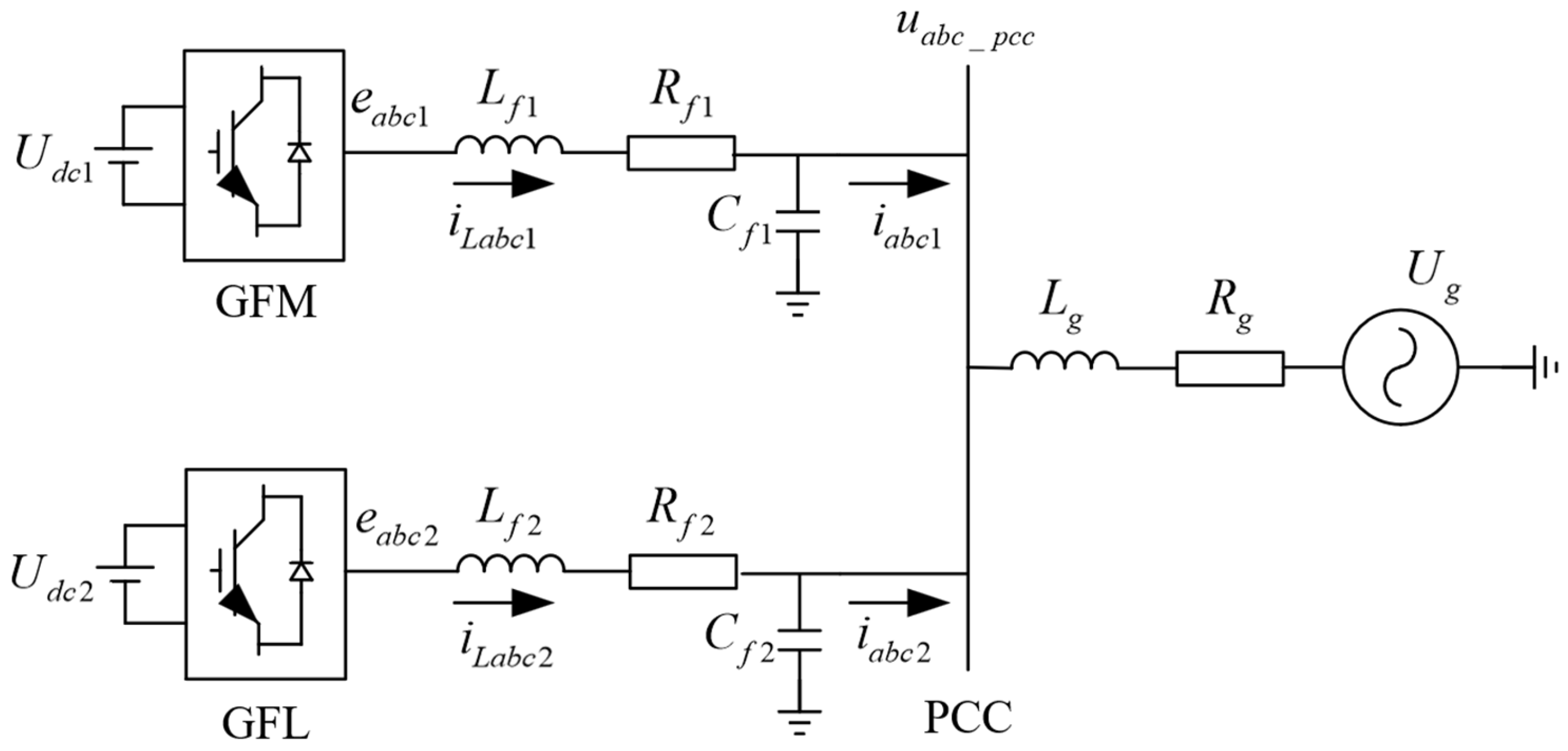
The topology of the GFL/GFM converters hybrid system studied in this paper is shown in
Figure 1. The system consists of two converters with the same capacity, which are first connected in parallel at the point of common coupling (PCC) after LC filtering, and then connected to the grid. In the figure,
Udc1,2 represent the DC side voltages of VSC1,2;
Lf1,2,
Rf1,2 are the filter inductors and parasitic resistances of VSC1,2 respectively;
Cf1,2 is the filter capacitor of VSC1,2;
eabc1,2,
uabc_pcc are the three-phase voltages at the AC side, output side of the converter and the PCC respectively;
iLabc1,2,
iabc1,2 are the currents of the filter inductors and the output side of the converter respectively;
Lg,
Rg are the equivalent inductance and resistance of the power grid;
Ug is the voltage of the power grid.
2.2. GFM Converter
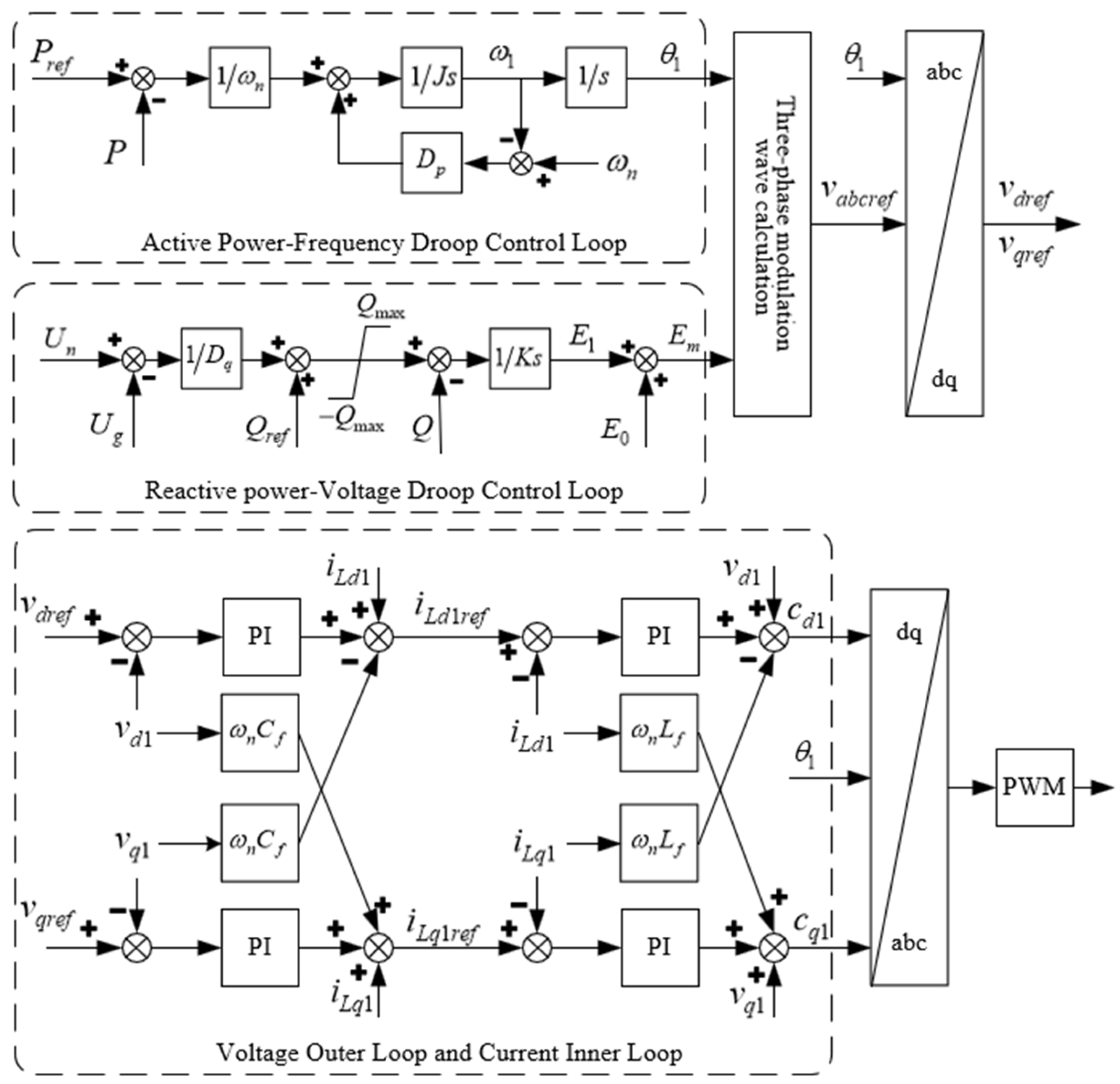
The GFM converter adopts VSG control. Its control structure consists of the active power–frequency droop control section (hereafter called P-f loop), the reactive power–voltage droop control section (hereafter called Q-v loop), and the dual-loop of voltage and current control [
27]. The control block diagram is shown in
Figure 2.
According to the control block diagram of the GFM converter, its mathematical model is established as shown in Equation (1):
In the formula, ω1, ωn represent the actual and rated values of the output angular frequency of the P-f loop; θ1 represents the actual value of the output angular of the P-f loop; Un represents the rated value of the grid voltage; J, Dp are the inertia coefficients and droop coefficients of the P-f loop; Pref, Qref and P, Q represent the reference values and feedback values of the active and reactive power output of the GFM converter; K, Dq are the inertia coefficients and droop coefficients of the Q-v loop; E0, Em are the reference values of the output voltage amplitude of the GFM converter and the output voltage amplitude; vabcref is the reference values of the three-phase voltage of the GFM converter; vd1ref, vq1ref, vd1, vq1 are the reference and feedback values of the output voltage on the dq axis of the GFM converter; iLd1ref, iLq1ref, iLd1, iLq1 are the reference and feedback values of the filter inductor current on the dq axis of the GFM converter; cd1, cq1 are modulated wave on the dq axis of the GFM converter; kpv1, kiv1, kpi1, kii1 are the control parameters of the PI controller on the voltage and current control loops.
The GFM converter behaves externally as a voltage source, with the amplitude and phase of its output voltage determined by the controller’s internal electromotive force. When the grid voltage drops, the difference between the converter’s output voltage and the grid voltage increases. This significant voltage difference immediately generates a large inrush current on the line. Without additional current-limiting strategies, the converter would trip due to overcurrent protection at the moment of LVRT, failing to achieve “ride-through.”
2.3. GFL Converter
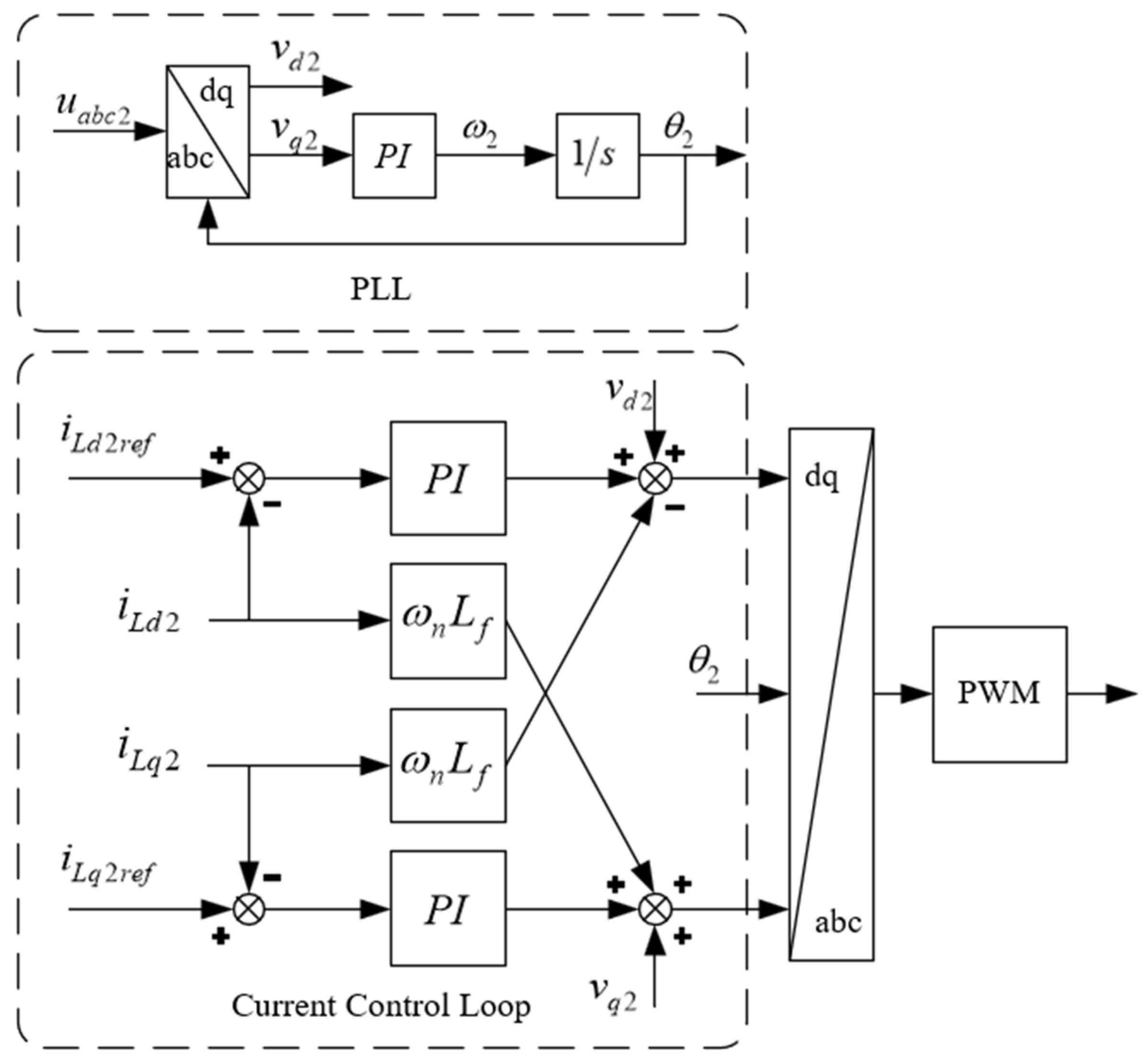
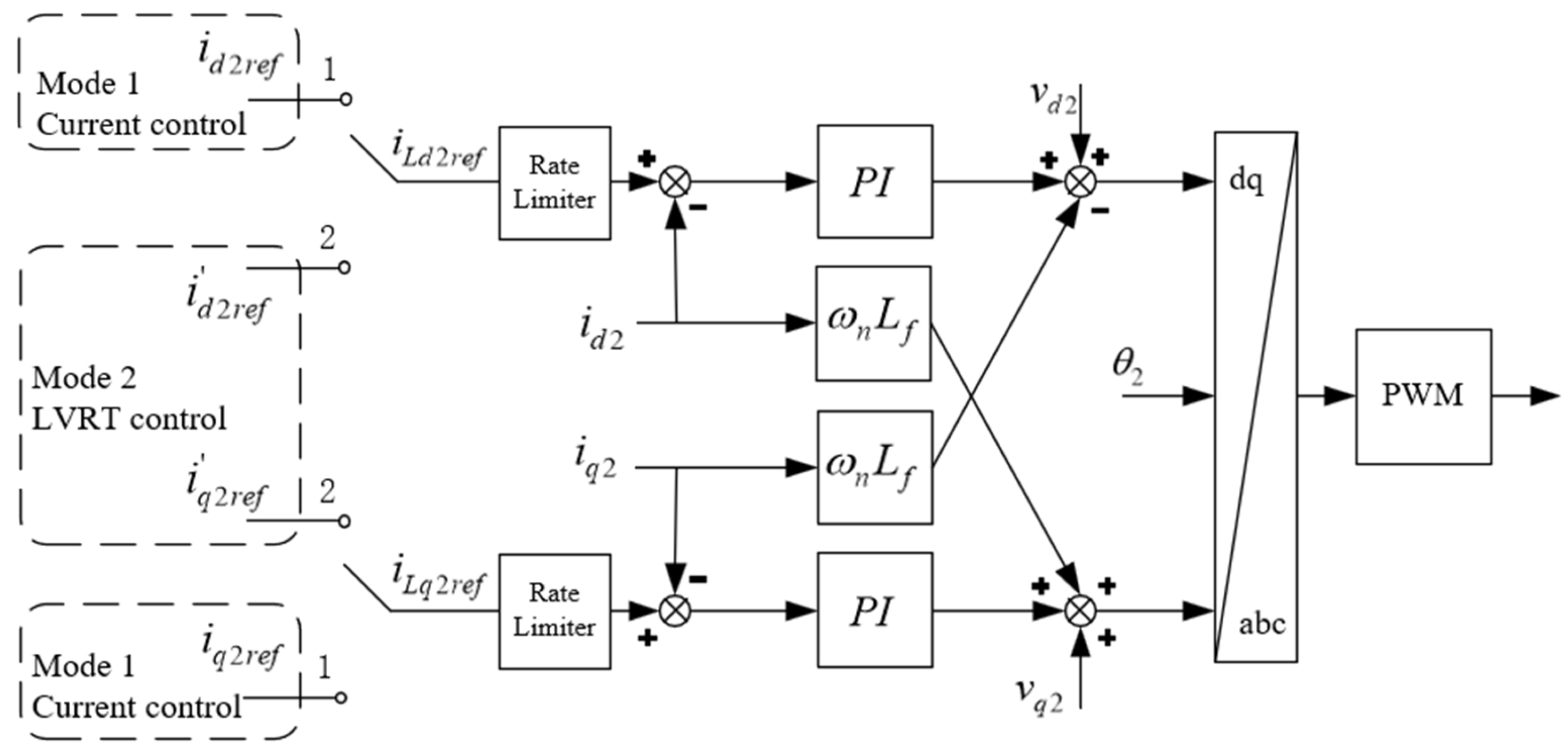
The control of the GFL converter includes phase-locked loop (PLL) and current control loop [
28]. The control block diagram is shown in
Figure 3.
Based on the control block diagram of the GFL converter, the mathematical model of it is established as shown in Equation (2):
In the formula, ω2, θ2 represent the actual values of the angular frequency and angle output by the phase-locked loop of the GFL converter; vd2, vq2 are the feedback values of the output voltage of the GFL converter on the dq axis; iLd2ref, iLq2ref, iLd2, iLq2 are the reference and feedback values of the filtered inductor current of the GFL converter on the dq axis; cd2, cq2 are modulated wave on the dq axis of the GFL converter; kppll, kipll, kpi2, kii2 are the control parameters of the PI controllers in the phase-locked loop and the current control loop.
The core limitation of traditional GFL converters during LVRT lies in the contradiction between their strong dependence on the grid and the weak support from the grid under fault conditions. Since GFL converters rely on phase-locked loops for synchronization, when the grid voltage suddenly drops, the phase-locked loop is prone to oscillation or even loss of lock due to phase jumps, leading to the converter losing synchronization. Additionally, their current-source characteristic makes them susceptible to severe transient impacts caused by step changes in power commands during the recovery process after fault clearance, which may result in overcurrent and disconnection, ultimately preventing the successful completion of LVRT.
2.4. Stability Analysis of GFM/GFL Hybrid Systems
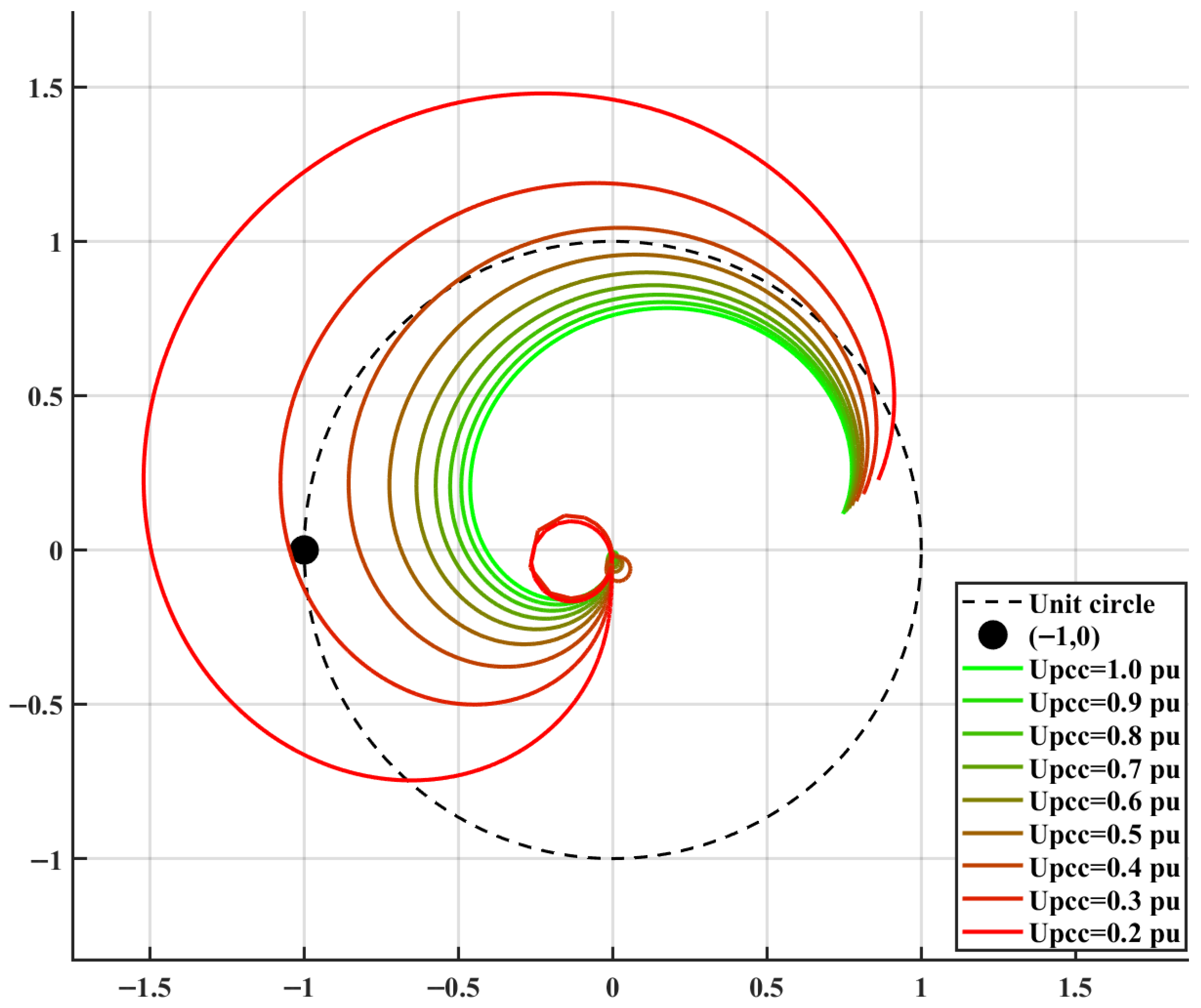
Based on the small-signal model proposed in references [
27,
28], the generalized Nyquist plot of the GFM/GFL Hybrid Systems is drawn, and the results are shown in
Figure 4. It can be observed from the figure that as the PCC voltage drops from 1 pu to 0.2 pu, the range of the Nyquist curve on the imaginary axis gradually expands and approaches the imaginary axis. When the PCC voltage drops to 0.3 pu, the curve encircles the point (−1, j0), at which point the system is prone to oscillation or even instability. This indicates that if a grid fault causes the PCC voltage to drop, it is necessary to adopt an appropriate LVRT strategy.
3. Low-Voltage Ride-Through Control
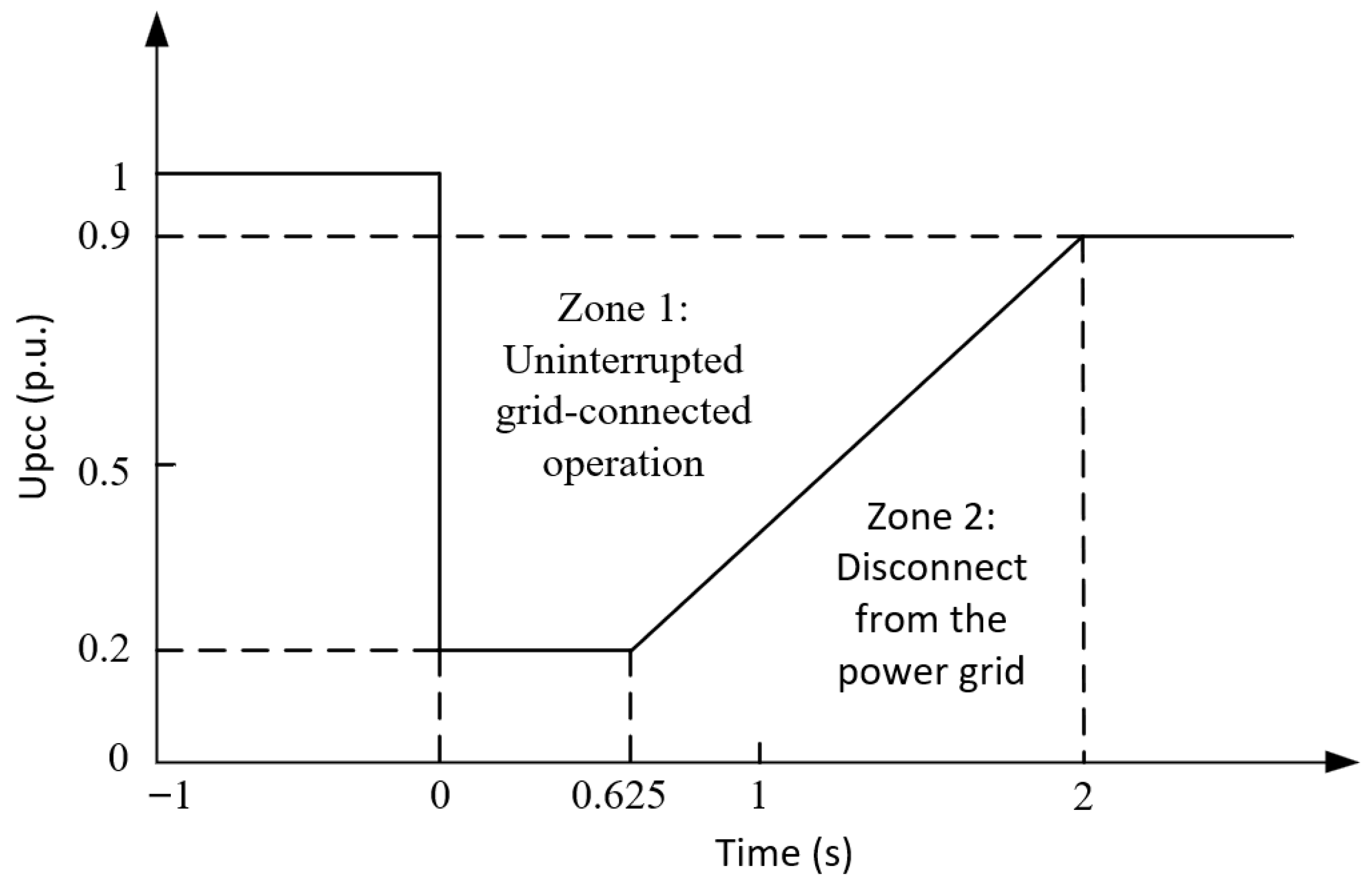
IEEE Std 1547-2018 [
29] stipulates the standards for LVRT, as shown in
Figure 5. During power system faults, to ensure LVRT without disconnecting renewable energy units, it is necessary to limit the fault current and ensure that the renewable energy units have the capability to provide dynamic reactive current for voltage support based on actual conditions.
3.1. LVRT Control Mode of GFM Converter
When a grid voltage sag fault occurs, GFM-LVRT requires that the reactive power setpoint of the GFM increases as the grid voltage drops. However, if not restricted, the fault current of the GFM will quickly exceed the maximum limit, causing it to overload.
Therefore, to ensure the normal operation of the GFM during LVRT, it is necessary to limit its power output. The dynamic reactive power limit is shown in Equation (3):
In the formula,
SF represents the apparent power when the GFM fails.
In the formula,
Smax represents the maximum value of the apparent power of the GFM. According to the requirements of IEEE std 1547-2018 [
29], during fault ride-through or short-term power support periods, the converter is typically required to provide reactive power support equivalent to 1.2 times the rated current, that is
Smax = 1.2
Sn, where
Sn is the rated apparent power of the GFM during normal operation.
When the GFM during LVRT, in order to ensure that sufficient voltage support is provided to the PCC while simultaneously maximizing the active power output to the grid, the rated reactive power value of the GFM is as shown in Equation (5):
In the formula,
Kgfm represents the ratio of the dynamic reactive current of the GFL converter,
Kgfm ≥ 1.5 [
29], This paper, through a preliminary experiment, concludes that when
Kgfm = 2, the GFM converter exhibits better LVRT performance.
Meanwhile, the rated active power of the GFM converter is shown in Equation (6):
In the formula, Pset represents the set value of active power for the GFM converter when it is operating normally.
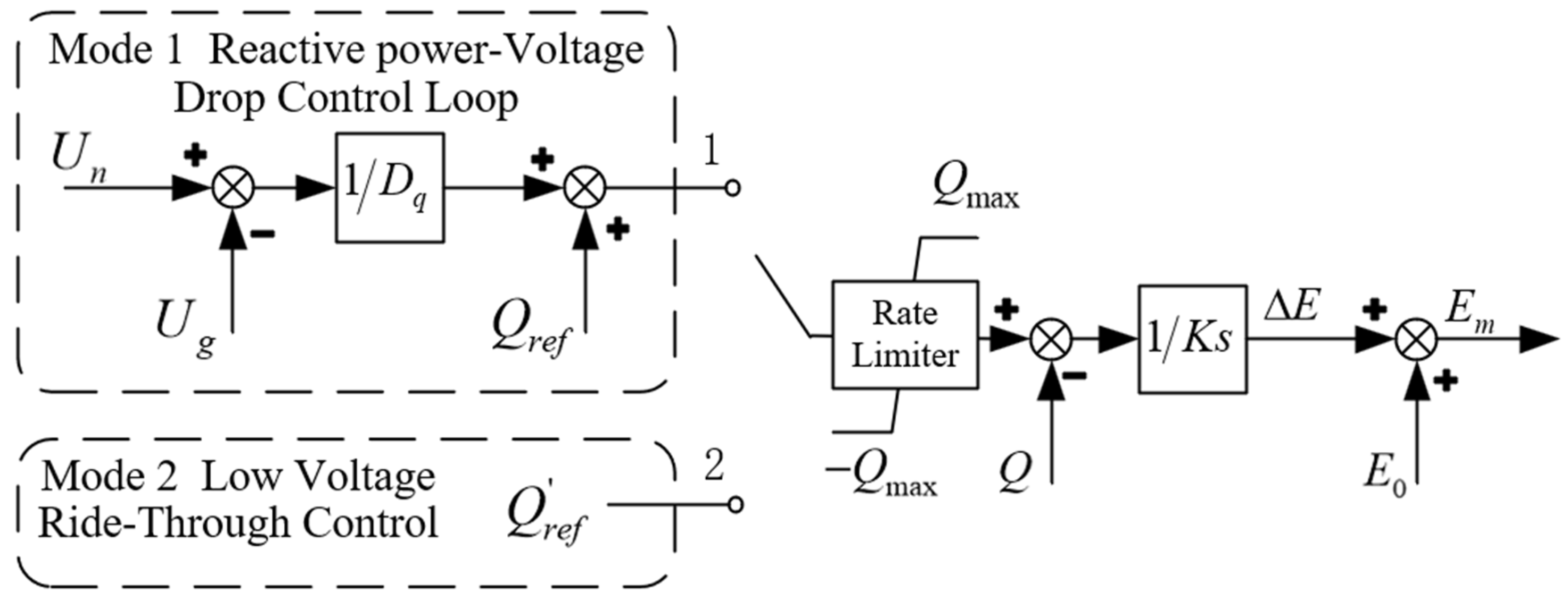
In conclusion, the control block diagram of the GFM converter for LVRT is shown in
Figure 6. Firstly, by detecting the relationship between the actual value and the rated value of the grid voltage, the situation of grid voltage drop is determined. If the amplitude of the voltage at the PCC is lower than 0.9 times the rated value, the rated values of active and reactive power are re-calibrated according to Equations (5) and (6); if the amplitude of the voltage at the PCC is lower than 0.2 times the rated value, at this point, the system is difficult to maintain stable operation under small signals, and the converter should be disconnected from the grid. After the grid voltage stabilizes, it should be reconnected. Compared with the traditional GFM control, the improved LVRT mode can effectively prevent overcurrent problems under adverse conditions. At the same time, under the premise of providing a certain reactive power support, it can deliver the maximum active power to the grid within the limit to avoid the waste of DC-side generation power.
3.2. LVRT Control Mode of GFL Converter
When a voltage drop fault occurs on the power grid side, GFL_LVRT control mode is adopted. The GFL converter takes the lead in injecting reactive current into the grid to support the PCC voltage. At this time, the rated value of the q-axis current of the GFL converter,
iq2ref (a negative value indicates injecting capacitive reactive power into the grid), should be:
In the formula,
IB and
Imax represent the rated current and the maximum current of the GFL converter when it is operating normally, similar to the previous section,
Imax = 1.2
IB.
Kgfl represents the ratio of the dynamic reactive current of the GFL converter,
Kgfl ≥ 1.5 [
29], This paper, through a preliminary experiment, concludes that when
Kgfl = 4.3, the GFL converter exhibits better LVRT performance.
Meanwhile, the rated value of the d-axis current for the GFL converter is
id2ref:
In the formula, id2set represents the d-axis current set value during the normal operation of the GFL converter.
In conclusion, the control block diagram of the GFL converter for LVRT is shown in
Figure 7. Firstly, when the hybrid system adopts the GFL_LVRT control mode, if the voltage amplitude at the PCC is detected to be lower than 0.9 times the rated value, then the given values of active and reactive power should be re-adjusted according to Equations (7) and (8); if the voltage amplitude at the PCC is detected to be lower than 0.2 times the rated value, at this time, the converter should be disconnected from the grid, and then re-connected to the grid after the voltage stability of the grid is restored.
4. Low-Voltage Ride-Through Strategy of Hybrid System
4.1. Analysis of Single GFM or GFL LVRT Control Modes
To study the variation patterns of the power output characteristics of GFL and GFM converters during LVRT with respect to the depth of voltage sags, this section first conducts a theoretical analysis of the power characteristics of the two types of converters under single-machine operation. For GFM converters, the instantaneous power theory can be used to determine their output active power
P2 and reactive power
Q2. The specific calculation formulas are as follows:
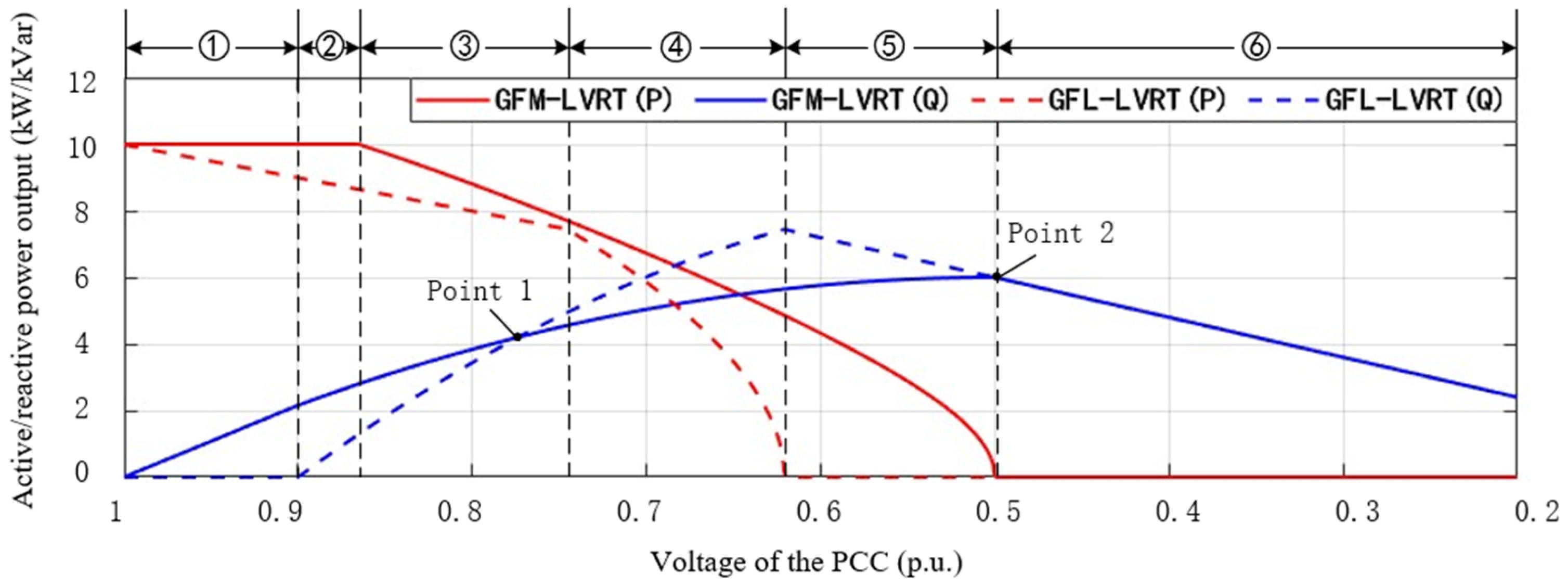
Taking each 10 kVA converter as an example, based on Equations (3)–(9), the output power comparison of the two types of converters under normal mode and LVRT mode is shown in
Figure 8. Based on the above expressions for converter output power, when
in Equation (6), the calculated
UPCC is approximately 0.86 pu, which serves as the boundary between region ② and region ③; when
in Equation (8), the calculated
UPCC is approximately 0.75 pu, serving as the boundary between region ③ and region ④; when
in Equation (7), the calculated
UPCC is approximately 0.62 pu, serving as the boundary between region ④ and region ⑤; and when
in Equation (5), the calculated
UPCC is approximately 0.5 pu, serving as the boundary between region ⑤ and region ⑥. The specific analysis results are summarized in
Table 1. The above-mentioned boundary values are calculated based on the maximum allowable current (1.2 pu), and the boundary values for other operating conditions can be obtained by following this method and scaling proportionally according to Equations (4)–(8).
As shown in
Figure 8, when the voltage sag occurs before operating point 1, the GFM converter outperforms the GFL converter in terms of both active power output efficiency and reactive power support capability. Therefore, the introduction of the GFM converter in a multi-converter parallel grid-connected system helps to enhance the system’s anti-interference performance under voltage sag conditions. Between operating point 1 and operating point 2, the active power output of the GFL converter rapidly turns into reactive power output, and at this time, its reactive power support effect on the system is more significant. After operating point 2, due to the current limitation requirements of the converters, the power output capabilities of the two types of converters tend to be consistent.
4.2. Comparison and Analysis of Different LVRT Combination Control Modes
After the grid voltage drops, the LVRT control strategy injects a certain amount of reactive power into the PCC by controlling the converter to provide voltage support and achieve voltage boosting. Let the reference values of the total active power and reactive power injected by the converter be
P and
Q, respectively. Due to the small phase angle difference between the PCC voltage
UPCC and the grid voltage
Ug, the voltage boosting capability of the injected power on
UPCC can be approximately expressed as:
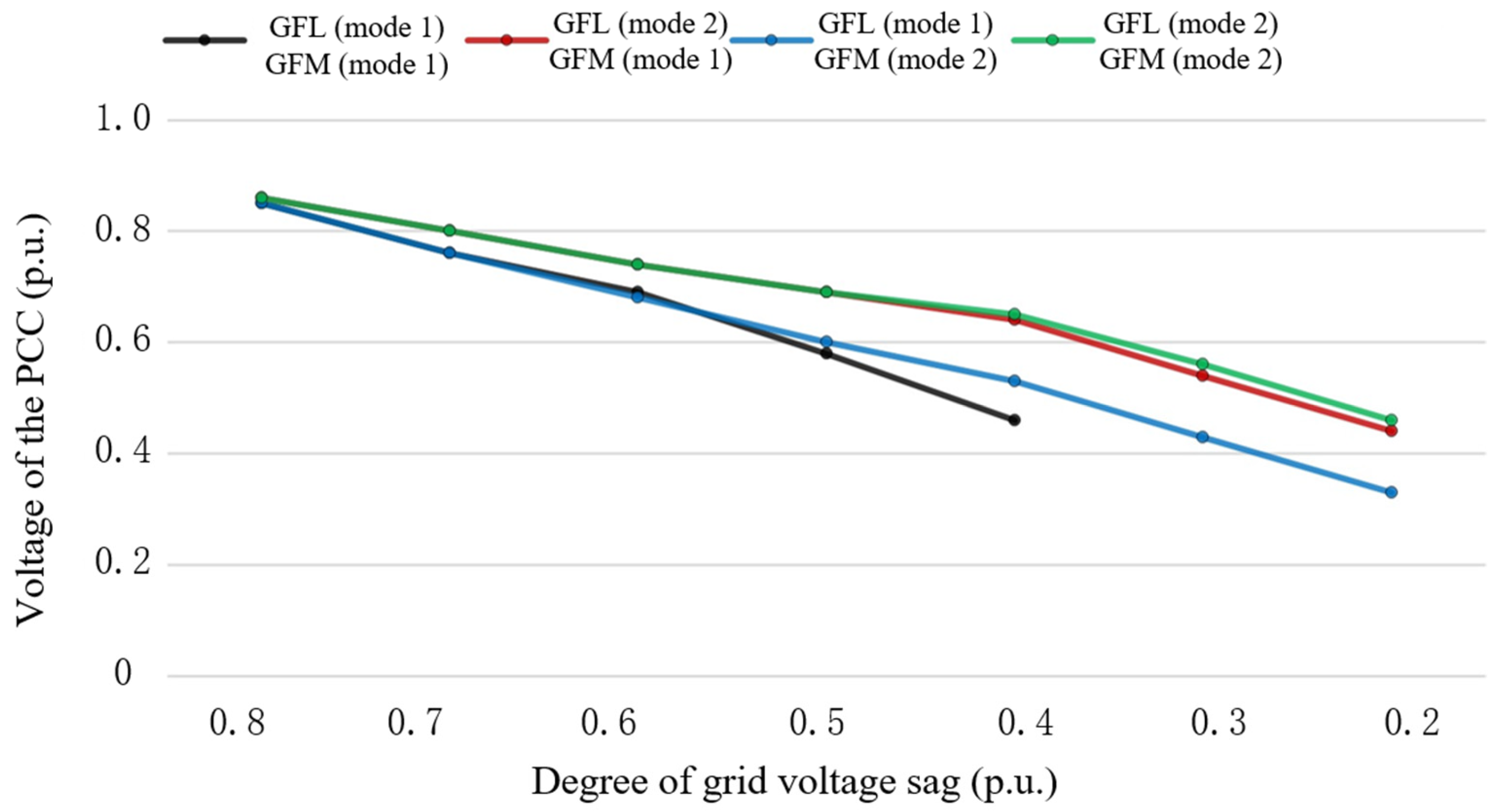
From the above formula, it can be concluded that the power injected by the converter into the grid and the line impedance characteristics have a significant impact on the amplitude of the voltage at the PCC point. When the reactance
X is much greater than the resistance
R, that is, the line is inductive, the reactive power output by the converter has a relatively obvious effect on voltage support; when the reactance
X is much smaller than the resistance
R, that is, the line is resistive, the active power injected by the converter has a significant contribution to voltage rise; if the line impedance is resistive-inductive, that is, the values of the resistance and reactance are comparable, then the voltage at the PCC point is affected by both. The relationship between
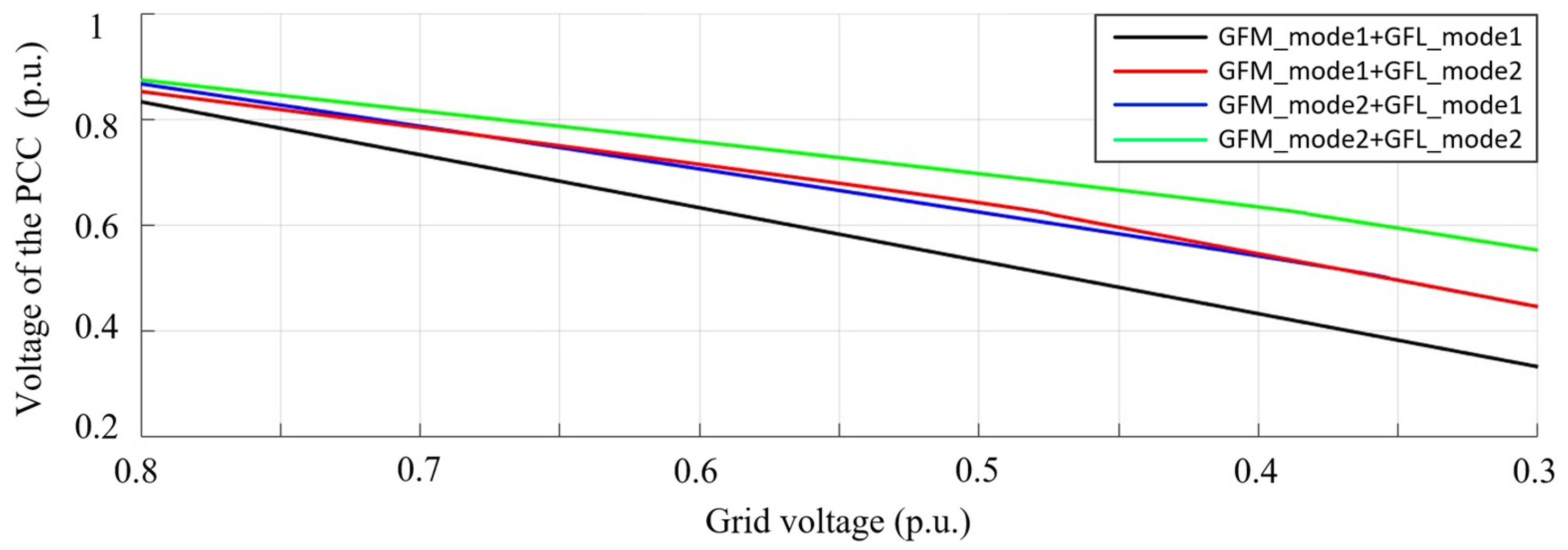
UPCC and
Ug in the hybrid system under different LVRT combination control modes is shown in
Figure 9.
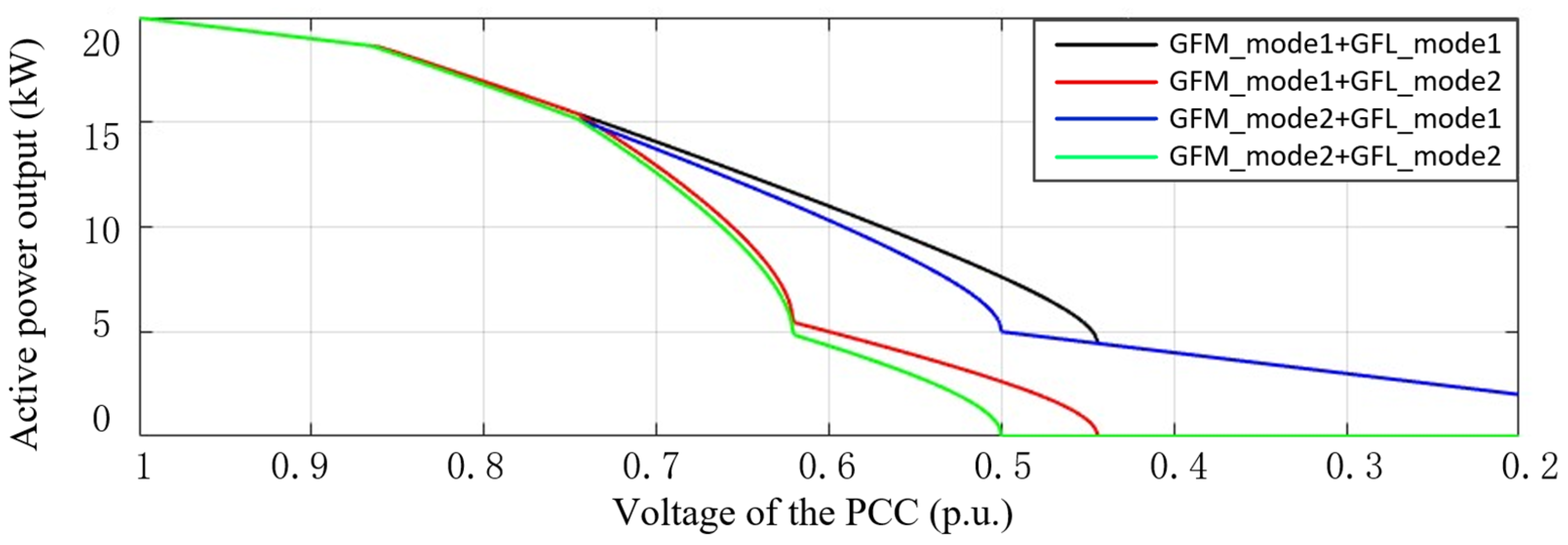
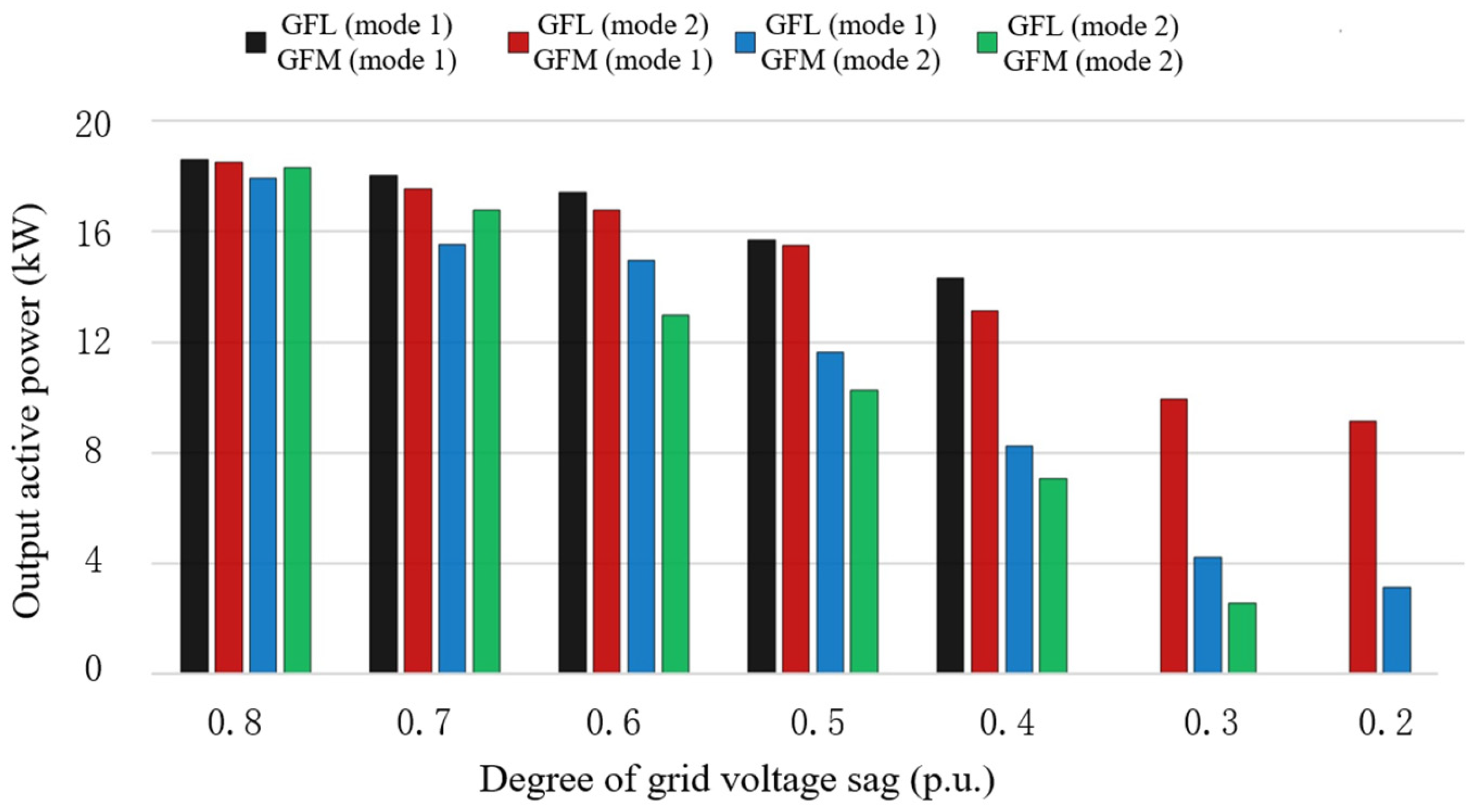
Based on the previous analysis of the GFM-LVRT and GFL-LVRT control modes, a further comparative analysis can be conducted on the power output characteristics of different combination control modes adopted in the hybrid system. The total output power of each control combination of the hybrid system under different voltage drop degrees is shown in
Figure 10.
For GFM converters, whether to adopt LVRT control has little impact on their final power output. The reason is that GFM converters inherently have a Q-v droop control mechanism, which can automatically provide certain reactive power support based on voltage deviations. Moreover, the LVRT control mode proposed in this paper, in order to maintain its original voltage source characteristics and meet the current limitation requirements, collectively leads to this phenomenon. However, in the case of deep voltage drop, if GFM converters still use the traditional control mode, it may result in a significant gap between the reference value and the measured value, which is unfavorable for the accurate regulation of the control system and is highly likely to cause the system stability to collapse. Nevertheless, the proposed GFM-LVRT control in this paper can modify the reference value of output power according to different voltage drop degrees, effectively solving the above problems. For GFL converters, LVRT control has a more obvious effect on improving their reactive power support capability, but it also accelerates the decline of their active power output capability.
4.3. GFM and GFL Coordinated LVRT Strategy
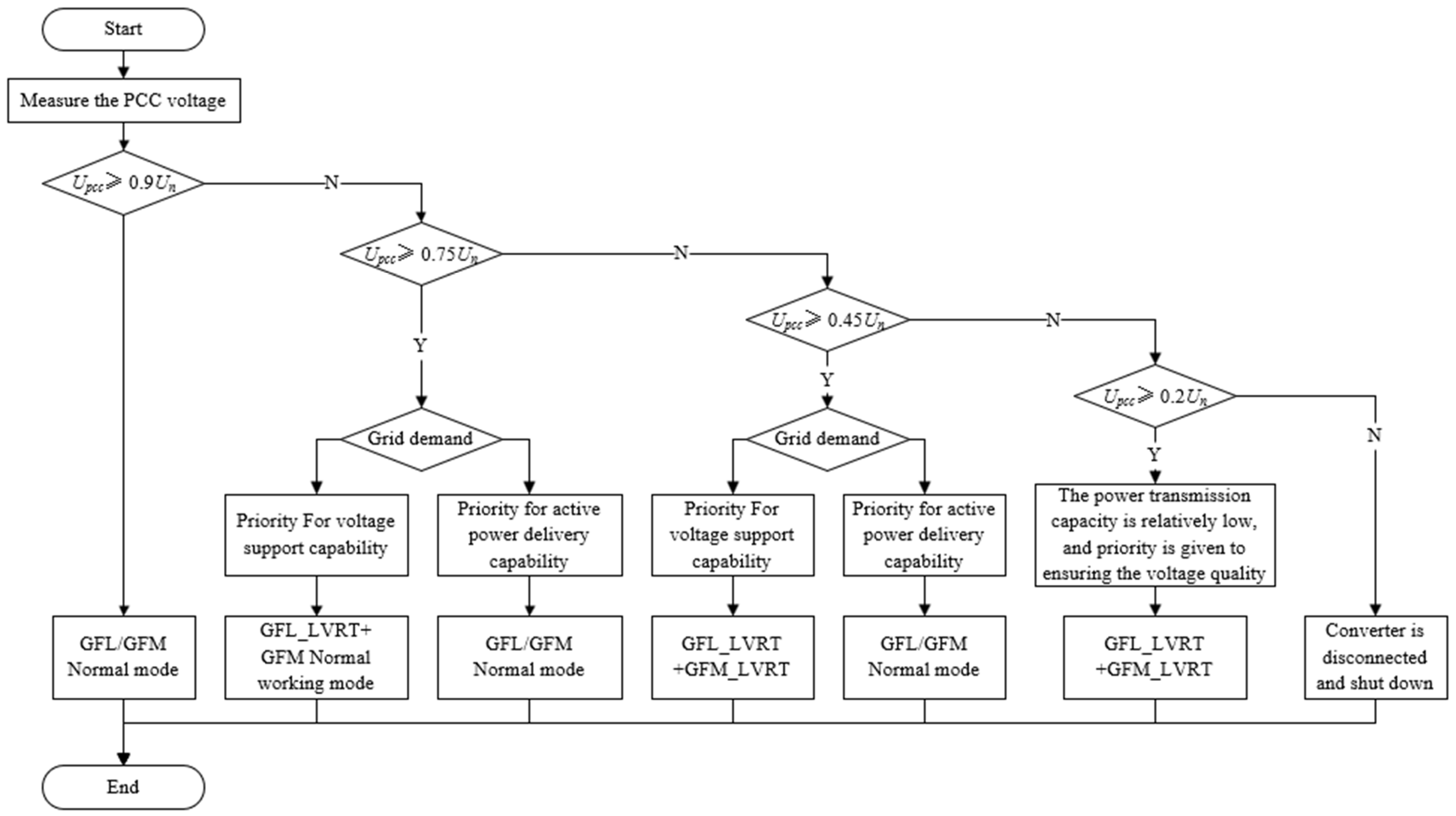
For different degrees of grid voltage drop, if the GFL and GFM converters do not change their own GFL/GFM characteristics without any alteration, there are significant differences in the active and reactive power output capabilities of GFM and GFL converters under different control modes. Therefore, this paper designs a GFM and GFL cooperative LVRT strategy that is adaptable to different voltage drop depths. The mode switching process is shown in
Figure 11.
According to Equations (5)–(8), it can be known that before the voltage drops to 0.9 Un, the converters are all operating in the normal working mode. When the voltage drop is relatively mild (0.9 Un > UPCC ≥ 0.75 Un), the differences in active power output among the four control modes are small. Therefore, when the voltage quality requirements are relatively low, in order to reduce the switching of control modes, both converters do not adopt the LVRT mode; if the grid requires a higher voltage support capability, under the condition that the reactive power output capabilities of the GFL_LVRT and GFL_LVRT + GFM_LVRT control modes are not much different, in order to reduce the switching of control modes, the GFL_LVRT + GFM normal operation control mode should be adopted. When the grid experiences a moderate voltage drop (0.75 Un > UPCC ≥ 0.5 Un), the power characteristics of different control modes show significant differences. At this time, based on the actual system requirements, when the goal is to maximize voltage support, the GFL_LVRT + GFM_LVRT control mode should still not be adopted; when prioritizing the transmission of active power, the GFL_LVRT + GFM_LVRT control mode should be selected. In the case of a very deep voltage drop (0.5 Un > UPCC ≥ 0.2 Un), the active power that the converters can output is already very limited. At this time, the reactive power output should be maximized to maintain the stability of the PCC voltage and ensure the system achieves stable fault ride-through. When the grid voltage drop is extremely severe (UPCC < 0.2 Un), for the protection of the converters, they should be quickly separated and shut down.
6. Case Study
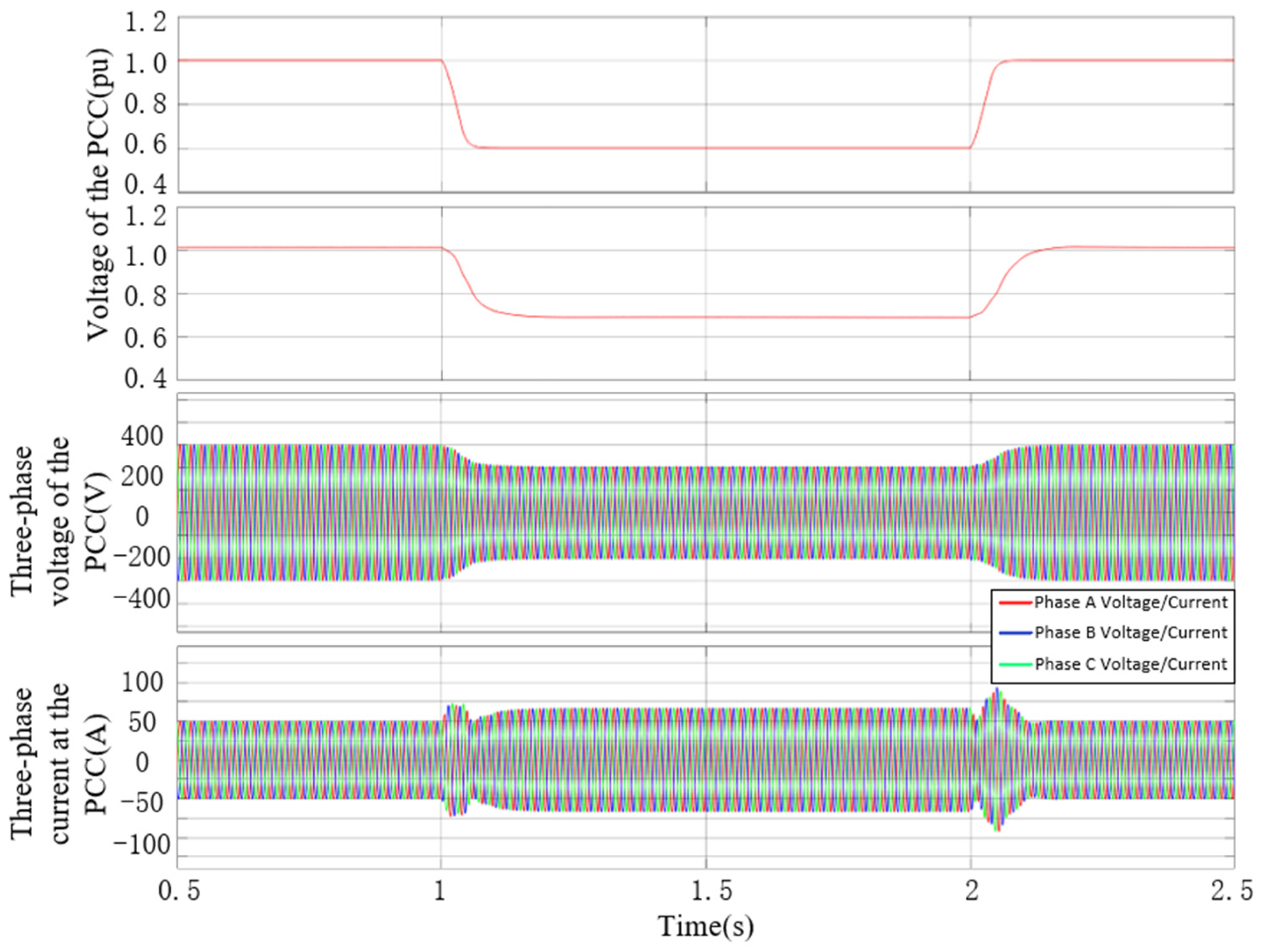
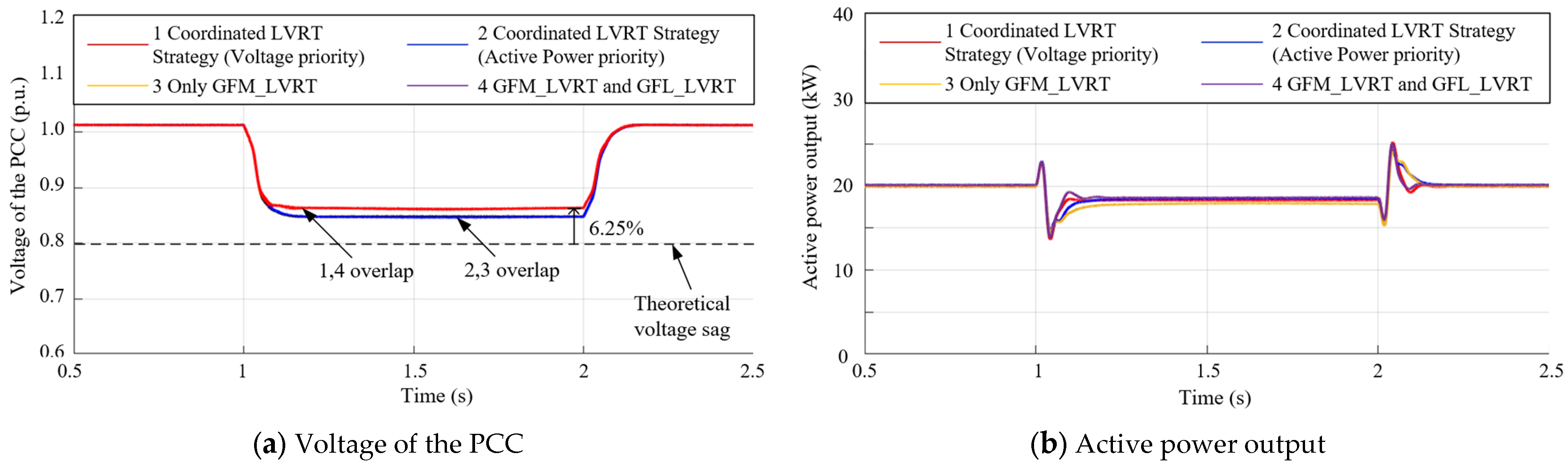
Case 1: The grid voltage dropped to 0.8 pu. At this point, the voltage drop was relatively mild, and the requirement for the converter to provide voltage support was low. It was allowed to transmit as much active power as possible to the grid side. According to
Figure 11, the strategy proposed in this paper adopts the GFL_LVRT + GFM normal operation mode when voltage support is prioritized. In the case of active power priority, both GFL and GFM converters operate in normal mode without employing LVRT. As shown in
Figure 16, the simulation results show that when the grid voltage drops to 0.8 pu, under the condition of voltage support being prioritized, the strategy proposed in this paper can approximately lift the voltage by 6.25% compared to the theoretical voltage drop; at the same time, the gap in the transmission of active power among the control modes is not significant, and the strategy proposed in this paper meets the requirement of reducing control mode switching when active power transmission is prioritized.
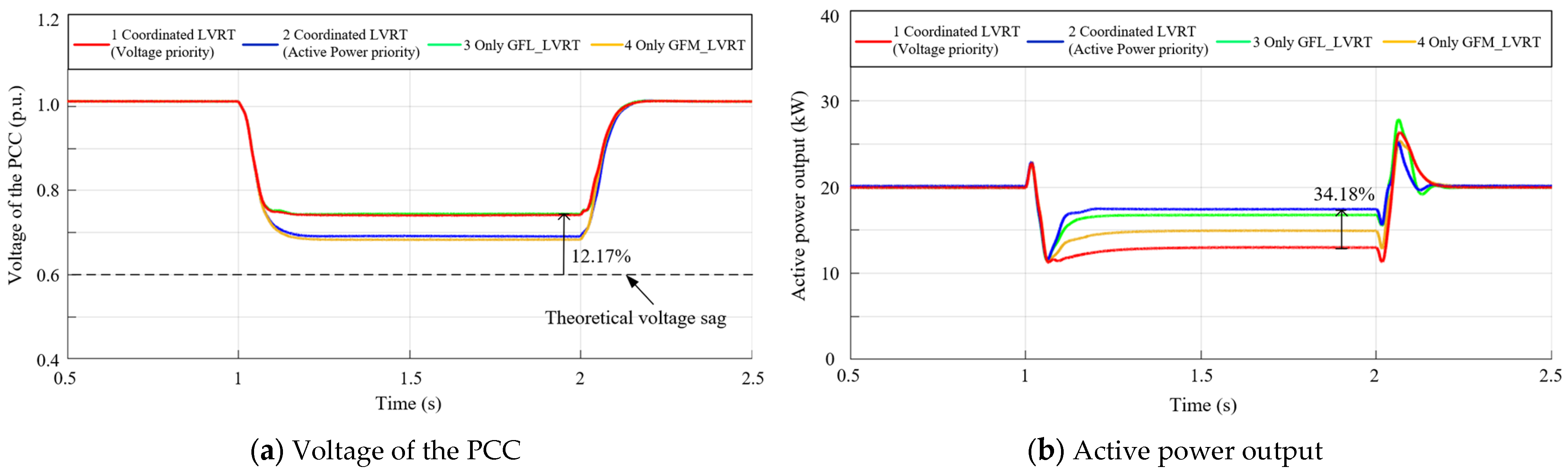
Case 2: The grid voltage dropped to 0.6 pu. At this point, there was a significant difference in voltage support and active power transmission capacity among various control modes. Therefore, the control mode should be adjusted according to the grid demand. According to
Figure 11, the strategy proposed in this paper adopts the GFL_LVRT + GFM_LVRT control mode when voltage support is prioritized. In the case of active power priority, both GFL and GFM converters operate in normal mode without employing LVRT. As shown in
Figure 17, the simulation results show that when the grid voltage dropped to 0.6 pu, under the condition of priority for voltage support, the strategy proposed in this paper can lift the voltage by approximately 12.17% compared to the theoretical voltage drop; when the priority is for active power, it can output approximately 34.18% more active power than when the voltage support is prioritized.
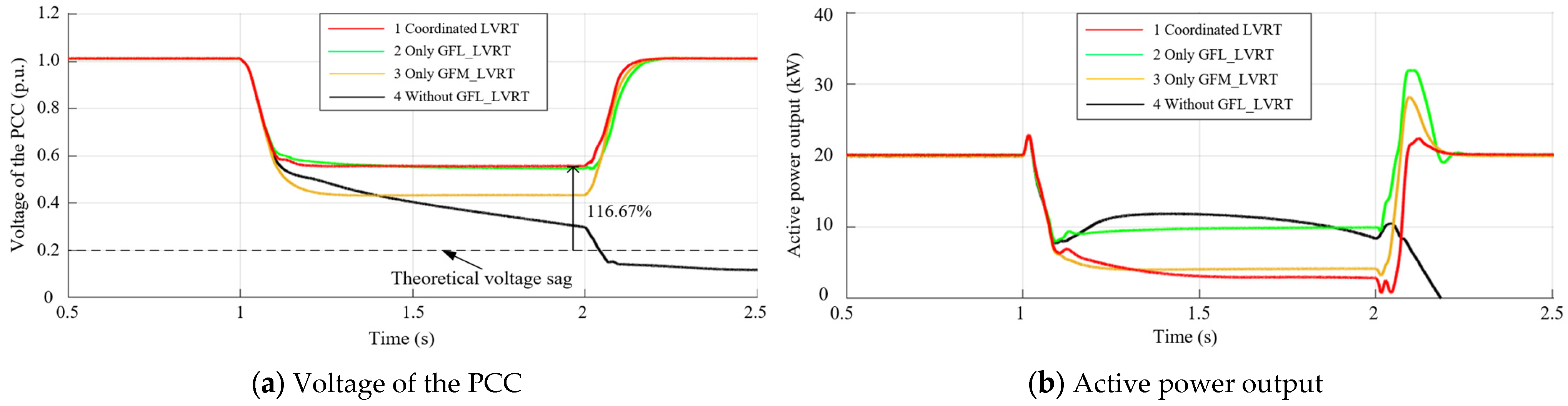
Case 3: The grid voltage dropped to 0.3 pu. At this point, the maximum apparent power of the converter was already very limited. It was necessary to prioritize the output of reactive power to support the PCC voltage and ensure the stability of the system as it crossed the fault zone. According to
Figure 11, the strategy proposed in this paper was that both the GFM and GFL converters adopted the LVRT mode of operation. As shown in
Figure 18, compared with the theoretical voltage drop, the strategy proposed in this paper enabled the PCC voltage to rise by up to 116.67%; compared with the hybrid system that did not adopt the LVRT strategy, this strategy could ensure the voltage stability during the LVRT period and facilitate the subsequent voltage recovery; compared with the traditional single-machine converter in the LVRT mode, it could recover to a stable operation more quickly after the fault was resolved.
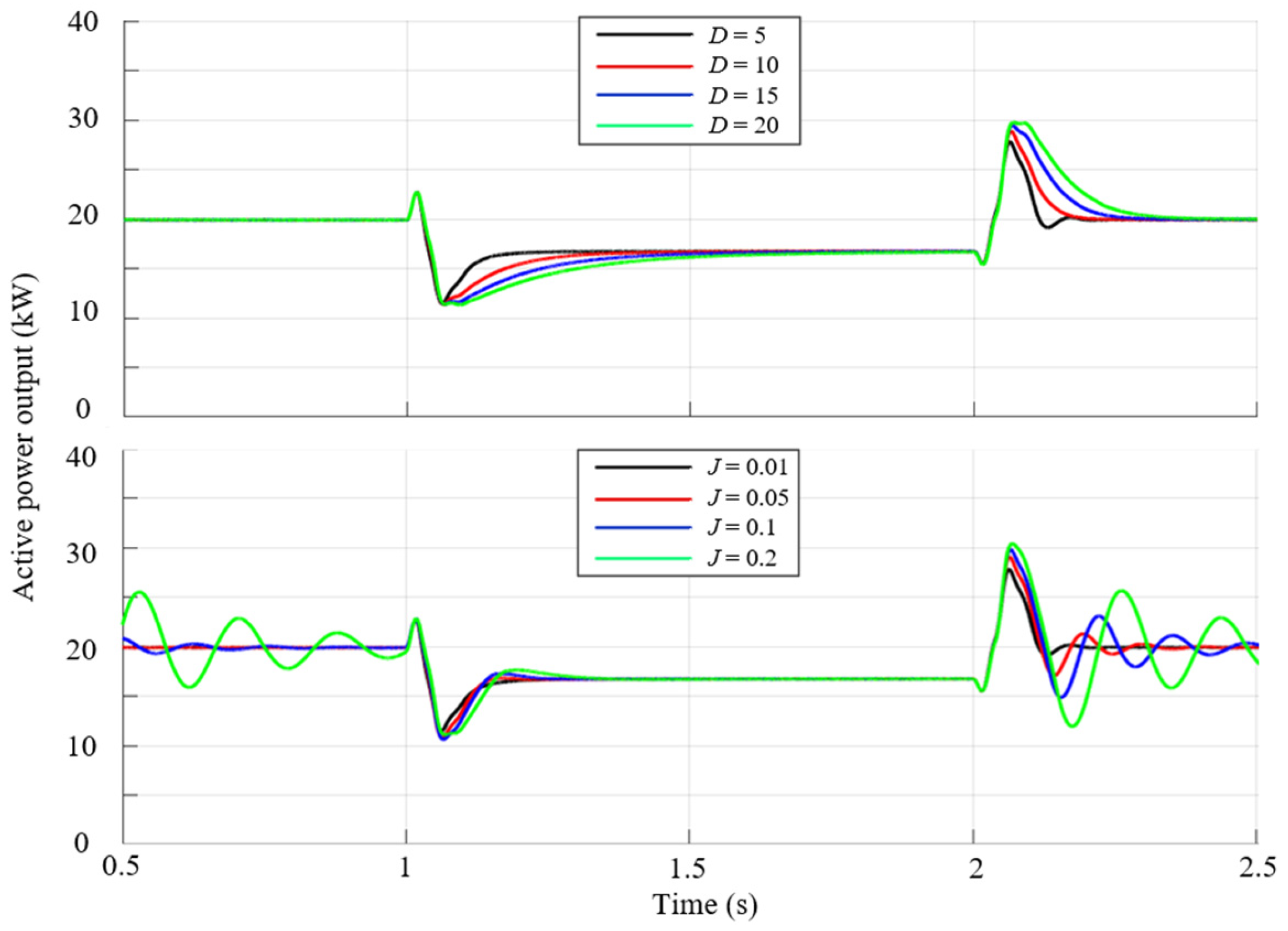
During LVRT, the active power of GFM converters briefly becomes negative. This occurs because, in the transient moment of the fault, the sudden change in the amplitude and phase of the grid voltage creates a significant power angle deviation relative to the converter’s internal potential, which has not yet been adjusted in time. As a result, energy temporarily flows back into the converter. This phenomenon reflects the electromagnetic transient process and the adjustment process of the synchronization mechanism of GFM equipment when responding to severe grid disturbances. It is an inevitable adjustment process as the controller transitions from the “pre-fault state” to the “fault state.”
7. Conclusions
With the widespread application of GFM/GFL hybrid systems in new energy power stations, this paper addresses the issue of coordinating different control modes for LVRT. A strategy for GFM and GFL converters to achieve coordinated low-voltage ride-through, adaptable to different voltage drop levels, is proposed. Through MATLAB R2022b/Simulink simulation verification and comparative analysis, the effectiveness of the proposed strategy is verified, and the following conclusions are drawn:
(1) This paper improves the control mode of GFM converters during LVRT, ensuring that the current does not exceed the limit. The system can actively adjust its output power according to different voltage drop levels, sacrificing some active power output to provide certain reactive power compensation, ensuring the stability of the system during LVRT.
(2) This paper investigates the impact of different control modes on the PCC voltage and active power transmission capacity in GFM and GFL hybrid systems under various voltage drop levels. A coordinated LVRT strategy for GFM and GFL converters is proposed, tailored to different degrees of voltage sag. Under mild voltage drops, control mode switching is minimized to maintain system stability. In moderate voltage drop scenarios, control modes are flexibly adjusted based on grid requirements—for example, when the grid voltage drops to 0.6 pu, the voltage-priority strategy increases the PCC voltage by 12.17%, while the active power-priority strategy enhances active power output by an additional 34.18%. During severe voltage drops, priority is given to voltage support to ensure the system can successfully ride through the fault. Specifically, when the grid voltage drops to 0.3 pu, the proposed strategy boosts the PCC voltage by 116.67%, thereby improving fault ride-through capability.
It should be noted that the fault scenarios discussed in this paper are limited to three-phase symmetrical faults. Under such faults, although the grid voltage amplitude drops, it still maintains three-phase balance and does not generate negative sequence components. The phase-locked loop can still accurately lock onto the phase of the positive sequence voltage. For asymmetric fault conditions, subsequent research needs to introduce positive and negative sequence separation algorithms to enhance the fault tolerance of the system. Additionally, the verification in this paper is mainly based on detailed offline simulations. Although various non-ideal factors are fully considered in the simulation, they still cannot completely replicate the effect of the hardware-in-the-loop test. Therefore, conducting further verification of the dynamic response and reliability of the proposed strategy in the real-time operating environment through hardware-in-the-loop tests will be the core work of the next research.