Article

Digital Twin for Architectural Heritage: A Comprehensive Conceptual Framework Integrating Structural Health, Microclimate, and Energy Performance

1
School of Architecture and Art, Central South University, Changsha 410083, China
2
Hunan Provincial Key Laboratory of Low Carbon and Healthy Buildings, Changsha 410083, China
*
Author to whom correspondence should be addressed.
Sustainability 2026, 18(6), 3080; https://doi.org/10.3390/su18063080
Submission received: 5 February 2026 / Revised: 11 March 2026 / Accepted: 18 March 2026 / Published: 20 March 2026
(This article belongs to the Topic Digital Twin of Building Energy Systems)

Abstract

This paper presents a design research study that develops a comprehensive conceptual framework for an integrated digital twin system for architectural heritage. The framework aims to explore mechanisms for real-time monitoring and the coupled regulation of structural health, microclimatic conditions, and energy performance. In the context of the ongoing global warming emergency, this framework supports climate adaptation strategies for heritage sites. It enables a fully coordinated operational process encompassing real-time sensing, predictive analysis, coupled control, and decision support. In the structural dimension, the framework is designed to utilise sensors to monitor and warn against cracks, settlement, and deformation, whilst integrating models to analyse stress conditions. In the microclimate dimension, the study envisages predicting and adjusting HVAC and lighting systems based on environmental parameters and footfall monitoring data via algorithms, with the aim of balancing occupant comfort with humidity control and mould prevention. Regarding energy, the framework optimises equipment operation through smart metering and algorithms and we propose a modelling tool for the quantitative assessment of energy-saving retrofit effects. Furthermore, the framework incorporates the establishment of an open-access dataset covering structural, microclimate, and energy use data, providing data standards and a foundation for subsequent empirical research.

1. Introduction

The sustainable conservation of architectural heritage is crucial to the continuity of cultural heritage [1]. However, in the context of the global warming emergency, these buildings often face multiple challenges, including structural ageing, inadequate occupant comfort, and excessive energy use [2,3]. The Intergovernmental Panel on Climate Change (IPCC) 2023 Synthesis Report [4] emphasises that climate change is already resulting in widespread adverse impacts and related losses across both human systems and ecosystems. The UNESCO guidelines further stress that heritage properties are highly vulnerable to these escalating environmental factors, necessitating the integration of climate resilience and risk preparedness into management and conservation strategies to mitigate potential damage [5]. Against this background, digital twin technology has emerged as a promising approach for addressing these challenges in a systematic manner [6,7]. A digital twin can be understood as a continuously updated virtual replica of a physical asset [8,9]. When applied to architectural heritage, digital twin technology enables real-time diagnosis, prediction, and optimisation of structural performance, indoor environmental quality, and energy use, thereby supporting both conservation and operation [6,7,10,11].
The existing research on digital twin applications for architectural heritage can be broadly organised into several conceptual clusters, including digital twin modelling and data integration, structural health monitoring and damage detection, indoor environmental monitoring and prediction, and energy performance optimisation. These research streams collectively demonstrate the potential of digital twin technology for heritage conservation. Matteo Mazzetto conducted a bibliometric analysis of the literature from the past three decades, further confirming this trend of interdisciplinary integration and indicating that preventive conservation is gradually becoming a consensus within the field [12].
The first research cluster focuses on digital twin modelling and data integration. Accurate geometric representation is a fundamental requirement for heritage digital twins. Laser scanning has been widely adopted due to its high accuracy and efficiency, although point cloud processing remains challenging. Several scholars have focused on virtual modelling methods for digital twin. Štroner et al. proposed a progressive thinning algorithm that optimises data density while preserving geometric detail [13], while Moyano et al. reported that semantic segmentation algorithms such as CANUPO perform poorly when dealing with small scale historic details [14]. For the modelling of complex damaged components, Moyano et al. further demonstrated that parametric modelling outperforms simple Boolean operations [15].
Beyond geometric representation, a robust digital twin architecture must address challenges related to data flow, semantic integration, and computational efficiency. To overcome the disconnection between BIM (Building Information Modelling) and IoT (Internet of Things) data, Eneyew et al. developed a multilayer BIM IoT data integration architecture that employs ifcOWL and BOT knowledge graphs to achieve semantic interoperability [16]. Serbouti et al. proposed a technical workflow that converts IFCs (Industry Foundation Classes) to CityGML and supports web-based visualisation on the Cesium Ion platform [17]. To enable efficient simulation and visualisation, Qian et al. developed a lightweight WebGL2 framework with separated databases [18] and Andriamamonjy et al. achieved direct conversion from IFC4 to Modelica [19]. Borodinecs et al. proposed a comprehensive modelling framework using the OpenStudio platform to construct building digital twins through simplified geometric representation and automated data integration; their approach was facilitated by gbXML interoperability and Python-based scripting libraries such as Eppy and GeomEppy [20]. In addition, Yoon showed that simplifying simulation models through the use of a digital twin database can significantly reduce computational demand while maintaining optimisation capability [21]. At the same time, some studies have begun to explore more integrated digital twin platforms. For example, the BIM2TWIN project proposed a comprehensive Digital Building Twin platform, specifically designed for construction management [22].
The second research cluster concerns structural health monitoring and damage detection in heritage buildings. In recent years, research has gradually shifted from passive observation towards predictive analysis and simulation-based validation. Ni et al. established a preventive conservation framework [6]; in 2025, they developed a web platform for a Swedish castle that incorporated groundwater level monitoring [7]. Sivori et al. adopted an equivalent frame model to enable physically enhanced monitoring [23]. Angjeliu et al. and Talebi et al. highlighted the necessity of calibrating finite element models using measured data [24,25], while Duman et al. further combined ANSYS and Blender to simulate the collapse mechanism of a historic minaret under seismic action [26]. In terms of detection techniques, Yiğit et al. and Xu et al. validated the effectiveness of artificial-intelligence-based visual methods for crack detection [27,28]. Kong and Hucks proposed a photogrammetry based geometric difference analysis method for the precise monitoring of physical deterioration such as loose stone blocks and settlement [29]. Pawłowicz et al. revealed microcracks that are invisible to conventional approaches by analysing the intensity data of laser scanning [30].
A third research cluster focuses on indoor environmental monitoring and prediction within digital twin systems. Maintaining appropriate indoor environmental conditions is essential for both heritage conservation and occupant comfort. Jouan et al. proposed that real time monitoring of microclimate variables such as temperature, humidity, and air quality through IoT sensor networks can enable preventive conservation of architectural heritage structures [31]. To achieve reliable environmental monitoring and early warning, several studies have examined the reliability of sensor data and the development of predictive models for environmental parameters. Pereira et al. found that low-cost sensors, particularly those based on CO2 estimation, exhibit substantial bias [32]. Considering the cost of sensors and limitations in deployment density, Yoon introduced virtual sensing techniques to estimate unmeasured variables [33], while Zhang et al. combined CFD (combined computational fluid dynamics) with a GRU (gated recurrent unit network) to predict spatial distributions of environmental parameters [34]. With respect to energy use prediction and control, Borodinecs et al. developed a building digital twin using OpenStudio and achieved energy savings by adjusting operational strategies such as air handling unit schedules [20]. Ni et al. demonstrated the strong predictive performance of a temporal fusion transformer model when future operational plans are incorporated [35].
With regard to interactions between occupants and the environment, López González et al. presented a pedestrian counting system that integrates HBIM (Historical Building Information Modelling) GIS with YOLOv3 [36]. Wang et al. achieved high-accuracy indoor positioning using Bluetooth low energy beacons and an SAE CNN algorithm to enable intelligent device control [37]. Clausen et al. applied model predictive control strategies [38], while Cai et al. further extended the scope towards healthy indoor environments by integrating physiological indicators such as heart rate to develop more human-centred digital twin [39].
In addition, energy retrofitting has gradually become an important topic in heritage building research. Several digital tools have been developed to support retrofit decision making. For example, the HiBERtool developed by Eurac Research in Europe, which established a knowledge base for retrofit solutions based on historic building characteristics [40]. Additionally, some studies have utilised HBIM and Autodesk Insight to quantify energy-saving retrofits for architectural heritage [41]. To synthesise the key research directions, representative technologies, and major challenges identified in the literature, a comparative summary of the reviewed studies is presented in Table 1.
Although the studies above have advanced the field, existing digital twin research often remains confined to a single dimension or isolated technical component and lacks an integrated system that brings together structural health, microclimate and energy dimensions; this limitation is particularly evident in the context of architectural heritage. As a result, a significant gap remains in supporting long-term interventions for such buildings. In daily operation, there is no real-time control mechanism grounded in the coupled relationships between structure, microclimate and energy. In addition, when longer-term energy retrofit interventions are considered, current tools are largely static databases focused on individual retrofit measures or discrete single case simulations, without the capacity to undertake the quantitative evaluation of multiple scenarios automatically at the building scale.
To address the aforementioned research gaps, this study aims to develop an integrated conceptual digital twin framework for architectural heritage that incorporates structural health monitoring, microclimate analysis, and energy performance management within a unified system architecture. This study is positioned as a conceptual framework and design research study, rather than an empirical validation study. The proposed framework is intended to support both real-time operational management and long-term energy retrofit decision making. To further investigate this core issue, the study formulates the following three research questions (RQs):
RQ1: How can virtual models for architectural heritage be constructed to support multidomain semantic mapping?
RQ2: How can cross-platform multisource data be integrated into digital twin systems for architectural heritage?
RQ3: How can structural health monitoring, microclimate analysis, and energy performance evaluation be integrated within a unified digital twin framework for heritage buildings?
By addressing these research questions, this study provides a systematic technical pathway for advancing the paradigm shift in architectural heritage management from passive monitoring towards predictive conservation. The main contributions of this study are as follows:
  • During the operational stage, the framework proposes an intelligent regulation mechanism grounded in the coupled relationships between structural health, microclimate conditions, and energy use. Through timely adjustment of the HVAC system and related measures, the system is expected to reduce material deterioration risks and enhance occupant comfort.
  • The framework proposes an extension tool for energy retrofit in architectural heritage. Drawing on automated energy simulation and parametric modelling techniques, and supported by data from the digital twin, the tool is designed to conduct systematic quantitative evaluation of combinations of retrofit measures across three dimensions: energy use performance, carbon emissions and economic cost.
  • The framework proposes the establishment of an open access multidimensional dataset that includes data on structural health, occupant behaviour, microclimate and energy use, together with retrofit related information. The dataset will comprise real-time monitoring data, predictive outputs and simulation results to support decision making and future research.
In sum, this study develops a conceptual digital twin framework that integrates structural health, microclimate conditions and energy performance to provide systematic support for architectural heritage in both operation and retrofit. During operation, the framework is designed to enable proactive management of structural risk, environmental comfort and energy use, helping to reduce material deterioration, maintain occupant comfort, limit energy waste and operational costs. thereby supporting the sustainable conservation of architectural heritage. During retrofit, the extension tool provides a scientific and comparable basis for decision making. In addition, the open access dataset established by the study lays a foundation for future work in algorithm development, model calibration and methodological expansion.

2. Methodology

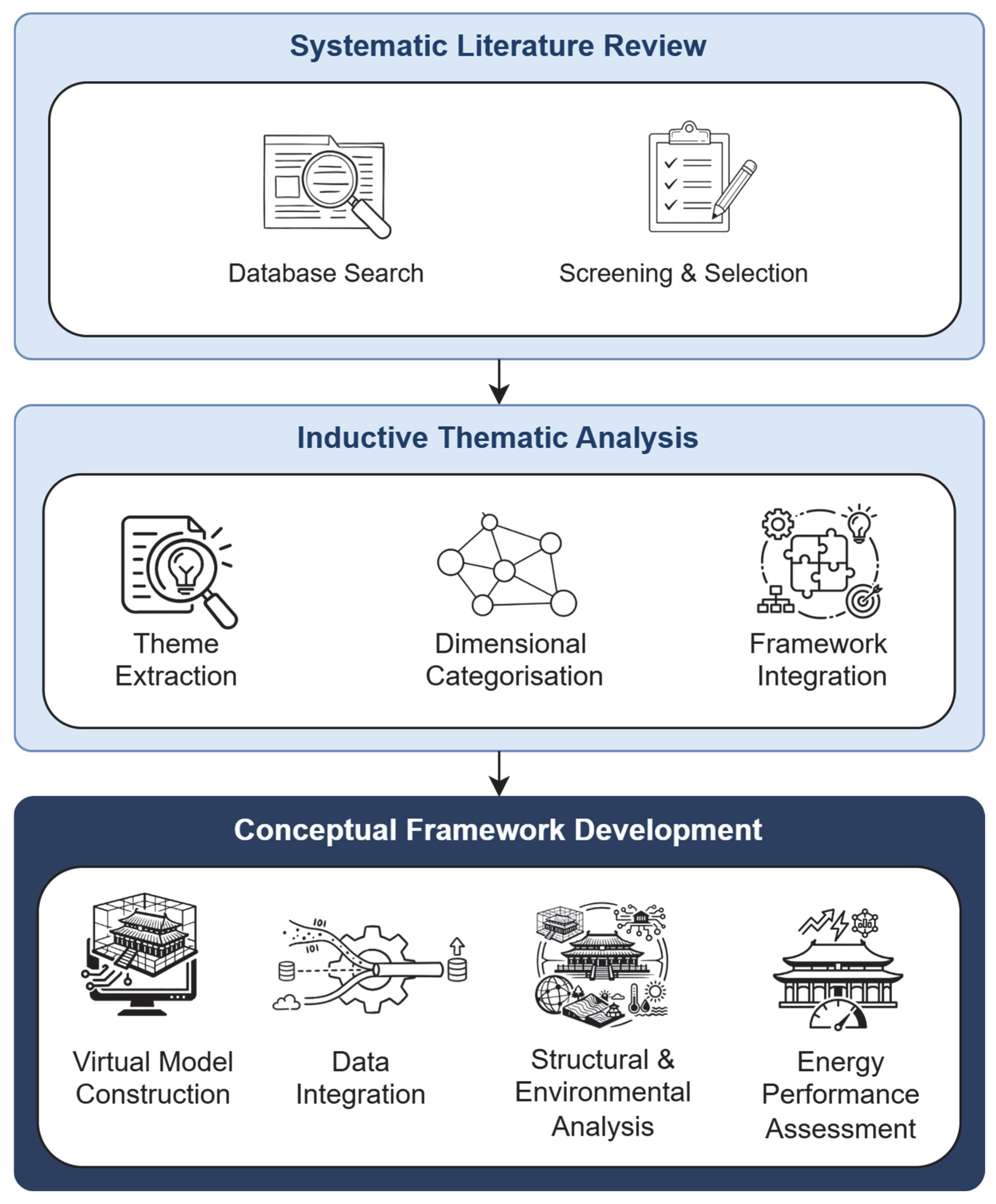
This study adopts a combined methodology of a systematic literature review and inductive thematic analysis to develop a comprehensive digital twin (DT) conceptual framework for architectural heritage, integrating three core dimensions: structural health, microclimatic environment, and energy performance. The systematic literature review consists of clearly defined objectives, research questions, methodologies, and inclusion and exclusion criteria, and is designed to derive qualitative conclusions in relation to specific research questions [42]. The overall methodological workflow adopted in this research is illustrated in Figure 1.

2.1. Research Design

This research follows a conceptually driven framework-development approach. Building upon a systematic literature review and complemented by qualitative thematic analysis, it synthesises and structures existing studies on the application of digital twin in the field of architectural heritage. This approach has been widely applied in research on digital twin, building performance assessment, and cultural heritage conservation to integrate fragmented findings, identify research gaps, and propose future research directions [43,44,45].
The overall research process comprises five main stages: systematic literature search, literature screening and inclusion, inductive thematic analysis, cross-dimensional synthesis and relationship mapping, and the construction of a digital twin conceptual framework for architectural heritage [46,47].

2.2. Literature Search and Screening

This study conducted a systematic literature review. Literature searches were primarily undertaken using the Scopus and Web of Science databases, including peer-reviewed journal articles and high-quality conference papers. The search covered publications from 2002 to 2026.
Search keywords and Boolean combinations were developed around the following themes: digital twin, architectural heritage, cultural heritage conservation, structural health monitoring, indoor microclimate, and energy performance. These terms were applied to the title, abstract, and keyword fields.
Multiple rounds of screening were conducted based on titles, abstracts, and full-text content. Exclusion criteria included the following:
  • Studies not related to the built environment or civil engineering, and whose research objects were not buildings or entities associated with the built environment;
  • Studies in which the application of digital twin showed insufficient relevance to architectural heritage or cultural heritage conservation, focusing instead on industrial or infrastructure operation contexts;
  • Studies that did not address building performance dimensions, including structural, environmental, or energy-related aspects.

2.3. Inductive Thematic Analysis

To systematically extract and integrate key concepts and research patterns from the selected literature, this study employs an inductive thematic analysis approach. The analytical process follows the six-phase framework proposed by Braun and Clarke, combined with established practices in architectural and digital twin research. The process includes data familiarisation, initial code generation, theme identification, theme review, theme definition and naming, and the synthesis and reporting of results [48]. This approach is particularly suited to the present research context, which is characterised by high complexity, fragmented research pathways, and the absence of a unified theoretical paradigm.
Ultimately, the thematic analysis focuses on four interrelated research dimensions: digital twin virtual model construction and optimisation of geometric representation; digital twin system architecture and cross-platform data integration; digital twin applications for structural health monitoring and predictive analysis; digital twin applications for energy performance and indoor environmental control.

2.4. Integrated Analysis and Conceptual Framework Development

Based on the results of the inductive thematic analysis, this study conducts a cross-dimensional synthesis of the four identified research dimensions, with particular emphasis on data flows, functional coupling relationships, and feedback mechanisms between different systems. During the analysis, special attention is given to the potential synergies among real-time monitoring, predictive models, and algorithmic decision-making processes as discussed in disparate strands of the literature.
Finally, the integrated findings are translated into a comprehensive digital twin conceptual framework for architectural heritage. The framework explicitly defines the core layers and components of the digital twin system; the interaction mechanisms between the physical building, sensing systems, analytical models, and control strategies; and an open-ended perspective on database content to support future research.

3. Conceptual Framework

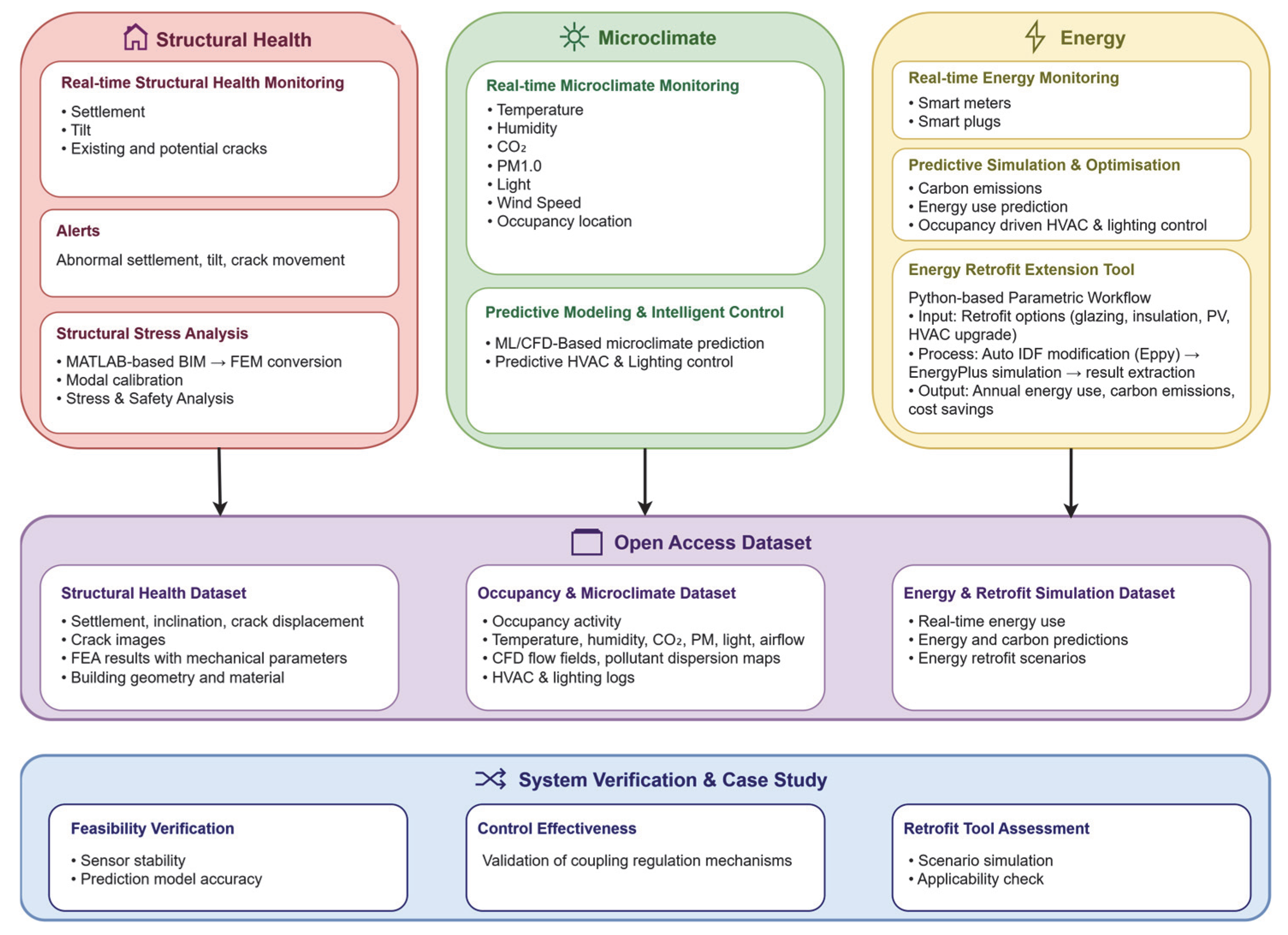
Figure 2 provides an integrated overview of the multidomain digital twin system developed in this study, outlining the structural health, microclimate, and energy workflows, the open access dataset, and the case study verification pathway.

3.1. Structural Health Monitoring and Analysis

Architectural heritage is subject to the combined effects of material ageing, environmental erosion, and service loads during long-term use [49], making structural safety a core risk factor. Moreover, traditional manual inspections struggle to identify the progressive degradation of structural performance and fail to provide deep insights into internal stress variations [50]. Therefore, this section proposes constructing a structural health management system integrating real-time monitoring, early warning, and prediction, thereby achieving scientific, timely, and proactive protection of historic building structures.

3.1.1. Real-Time Structural Health Monitoring and Early Warning

Settlement, inclination, and cracking are common structural issues in buildings [51,52]. Therefore, this study intends to conduct real-time monitoring focusing on these three indicators. For settlement monitoring, hydrostatic levellers will be employed, with sensors deployed on key load-bearing masonry columns [53]. Inclination monitoring will utilise tilt sensors, which should ideally be installed at the building’s corners [54]. For existing cracks, vibrating wire single-point displacement meters are proposed to monitor deep structural displacement, with sensors installed on both sides of the cracks or joints [55]; for potential cracks, photogrammetric monitoring combined with AI algorithms will be used for identification and tracking [27,28].
When the monitoring system detects abnormal variations in parameters related to settlement, inclination, or cracks, an early-warning mechanism will be automatically triggered to alert managers to conduct timely inspections or take intervention measures.

3.1.2. Structural Stress Analysis

Based on the Digital Twin BIM model, this study will discretise the building into a finite element model (FEM) according to its structural characteristics, aiming to balance computational accuracy with analysis efficiency [23,24,25]. It is planned to use MATLAB (R2023a)-based algorithms to process data from BIM to generate the FEM and employ algorithms for automatic correction based on actual conditions. This enables the calculation of modal frequencies and mode shapes, serving as a basis for the automatic adjustment of the model using monitoring data [23]. Modal analysis can calibrate material properties and model accuracy by comparing the model-predicted natural frequencies with on-site measurements; meanwhile, the predicted mode shapes (modal displacements) can provide a basis for the placement of monitoring equipment. Furthermore, stress analysis is used to evaluate structural safety and force distribution, further interpreting and predicting potential damage, as well as simulating the effects of intervention measures [24].

3.2. Microclimate Monitoring and Optimisation

Indoor air quality (IAQ) and a suitable hygrothermal environment are of great significance for architectural heritage. On the one hand, reasonable temperature, humidity, and fresh air supply are fundamental conditions for guaranteeing occupant health and comfort [56,57,58]. On the other hand, maintaining a stable and suitable hygrothermal environment can effectively inhibit mould growth [7], slow down material degradation, and preserve structural safety [59,60]. To this end, this study proposes constructing a microclimate optimisation system encompassing real-time monitoring, occupancy activity identification, and predictive control, ensuring that the microclimate in all spaces of the historic building is continuously maintained within an appropriate range.

3.2.1. Real-Time Microclimate Monitoring

This study intends to deploy sensors for temperature, relative humidity, CO2 concentration, PM1.0 (particulate matter with a diameter less than or equal to 1 μm), light intensity [7], and wind speed [18] in key spaces of the building to achieve real-time monitoring of the microclimate environment.

3.2.2. Indoor Occupancy Activity and Pattern Identification

Occupancy activity significantly impacts the indoor microclimate [61,62]; therefore, real-time awareness of occupant location is crucial. The system adopts an indoor positioning method based on Bluetooth Low-Energy (BLE) beacons. By deploying a beacon network inside the building and utilising signals received by smart devices carried by occupants, continuous monitoring of occupancy status across different spaces is achieved. The system analyses the Received Signal Strength Indicator (RSSI) data and employs machine learning models to identify feature fingerprints of each area, thereby obtaining the real-time occupancy distribution within the building [18,37].

3.2.3. Microclimate Prediction Models and Intelligent Control

Due to the structural and heritage protection constraints of architectural heritage, sensors often cannot be installed in positions that best reflect the true indoor environment. Furthermore, the distribution of indoor heat, moisture, and air pollutants exhibits significant non-uniformity, making it difficult for data obtained from real-time sensors to fully represent the overall microclimate condition. Additionally, traditional HVAC systems display obvious lag during the regulation process, making it difficult to meet the requirements of architectural heritage for a stable thermal–humid environment.
To overcome these limitations, this study proposes using gated recurrent unit (GRU) models to perform time series forecasting of future indoor air quality and temperature, based on available real sensor data. Offline CFD simulations using Ansys Fluent are utilised to systematically analyse the indoor flow field, temperature and humidity distribution, and pollutant diffusion patterns, thereby identifying risk points in sensor monitoring blind spots. Ultimately, this enables the calculation of the maximum risk value for the entire room using single-point future prediction data [34]. A training set is constructed using real sensor data and multiple CFD simulations, and a fast prediction model is established using Radial Basis Functions (RBFs) and neural networks. Upon inputting time series data from sensors such as temperature, humidity, illuminance, and wind speed, this model can directly infer the future temperature and illuminance distribution of each space [37].
Based on the prediction results of the GRU and RBF models and the highest-risk areas identified by CFD simulation, assuming the building HVAC system possesses intelligent control capabilities, the VAV (variable air volume) fresh air volume can be adjusted in advance according to predicted air quality trends [63]; this ensures that IAQ remains consistently within the standard range. For architectural heritage buildings that have not yet been equipped with HVAC systems, the proposed framework prioritises the adoption of variable refrigerant flow (VRF) systems. Compared with VAV systems, which require extensive ductwork and are more likely to compromise the historic fabric and architectural character, VRF systems rely on compact refrigerant piping and offer flexible indoor unit configurations, thereby minimising physical intervention to the heritage structure. In terms of energy performance, simulation results reported in the referenced studies indicate that VRF systems can achieve energy savings of approximately 25% to 55% compared with conventional VAV systems across 16 different climate zones. These savings are primarily attributed to the precise part-load control enabled by inverter-driven compressors, as well as the avoidance of the electric reheat energy use commonly associated with VAV systems, which is often required to prevent overcooling [64]. With regard to temperature and humidity regulation, cooling or dehumidification loads can be proactively adjusted based on algorithmically identified indoor worst-case locations, such as high humidity zones, in order to reduce the risk of local environmental exceedance. At the same time, the system should actively regulate lighting intensity so that it remains within an appropriate range in occupied areas [37]. Through the aforementioned prediction-driven regulation strategies, the microclimate in all building spaces can be continuously maintained within an optimal range.

3.3. Energy Performance Monitoring and Optimisation

Energy use directly determines carbon emissions and has a significant impact on climate change [65,66]. Reducing energy use and carbon emissions in the building sector is therefore critical to advancing sustainable development. Accordingly, this section proposes an integrated framework encompassing energy monitoring, intelligent optimisation, and prediction of post-retrofit energy performance, aimed at supporting energy management and decision making for architectural heritage.

3.3.1. Energy Use Monitoring

Where conditions permit, smart meters will be deployed to obtain real-time electricity consumption data at the building level. For specific standalone equipment, where smart meter installation is not feasible due to ageing wiring or spatial constraints, plug-in power meters will be used as an alternative to monitor the electricity consumption of major equipment and systems.

3.3.2. Energy and Carbon Emission Prediction and Intelligent Optimisation

Carbon emissions will be estimated using IPCC (Intergovernmental Panel on Climate Change) emission factors [18]. Based on previously collected environmental monitoring data, EnergyPlus will be employed to conduct energy simulations in order to predict future building energy use. Using the real-time occupancy activity data obtained as described in Section 3.2.2, control strategies will be implemented for HVAC and lighting systems. The system will automatically reduce or shut down equipment loads in unoccupied areas according to the spatial and temporal distribution of occupants.

3.3.3. Energy Retrofit Performance Prediction Tool

This research also proposes the development of an extended tool for evaluating energy retrofitting strategies for architectural heritage, with the objective of quantifying energy use, carbon emissions, and economic costs under different retrofit scenarios. The retrofit measures considered include the replacement of windows with improved airtightness using double or triple glazing, the addition of organic, petrochemical, or mineral insulation layers to roofs, walls, and floors [67], the installation of photovoltaic panels, and the replacement of existing systems with high efficiency heat pumps and advanced HVAC systems.
The tool is developed in Python and implements a fully automated workflow designed to enable efficient building energy simulation using the EnergyPlus engine. It integrates previously collected real-time data such as occupancy activity and HVAC system information together with geometric model data. By invoking Python libraries such as Eppy, the tool enables execution from parametric modification of IDF model files to local simulation runs [68,69]. At the operational level, users only need to select the retrofit option and input the local electricity tariff via a terminal interface. The system then automatically executes the simulation and saves the annual energy use prediction results to a specified directory. Built-in algorithms subsequently calculate annual carbon emissions and economic cost savings based on IPCC emission factors.
Due to technical limitations, as well as the complexity and parameter sensitivity inherent in building energy simulation, this tool is primarily intended for users with professional expertise in EnergyPlus, in order to ensure the accuracy and reliability of the simulation results.

3.4. Multidimensional Datasets

Data from real-time monitoring, prediction, and simulation data from the structural, microclimatic, and energy dimensions will be unified into datasets and made openly available to support decision making and future research.
The structural health dataset includes time series data from structural monitoring such as settlement, inclination, and crack displacement, crack imagery, and finite element analysis results together with corresponding mechanical parameters. Beyond current safety assessment, this dataset will support future research on automated identification of structural deterioration patterns, seismic response analysis of architectural heritage, and the simulation and validation of structural strengthening schemes.
The occupancy activity and microclimate dataset integrates multisource information: high-resolution occupancy behaviour data such as Bluetooth fingerprinting and spatiotemporal distributions; indoor and outdoor environmental monitoring data covering temperature, humidity, IAQ, illuminance, and wind speed; flow fields and pollutant dispersion patterns derived from CFD simulations. Occupancy behaviour is highly stochastic and constitutes a decisive factor in energy use variation and indoor environmental fluctuations. Its inherent unpredictability has long constrained the accuracy of building environmental simulations [70,71]. The occupancy activity dataset constructed in this study provides essential baseline data for addressing the long-standing challenge of modelling user behaviour and supports the optimisation of indoor-microclimate-prediction models.
The energy dataset integrates real-time energy use monitoring data with future energy simulation outputs. These data provide a quantitative basis for establishing long-term energy performance benchmarks, managing carbon emissions, and optimising energy use in architectural heritage.
Through cross-dimensional data integration and open access, this database provides robust long-term support for analysing complex internal coupling mechanisms, optimising machine learning model training, implementing predictive maintenance, and ensuring the continuous evolution of the digital twin system.

3.5. Overall System Architecture

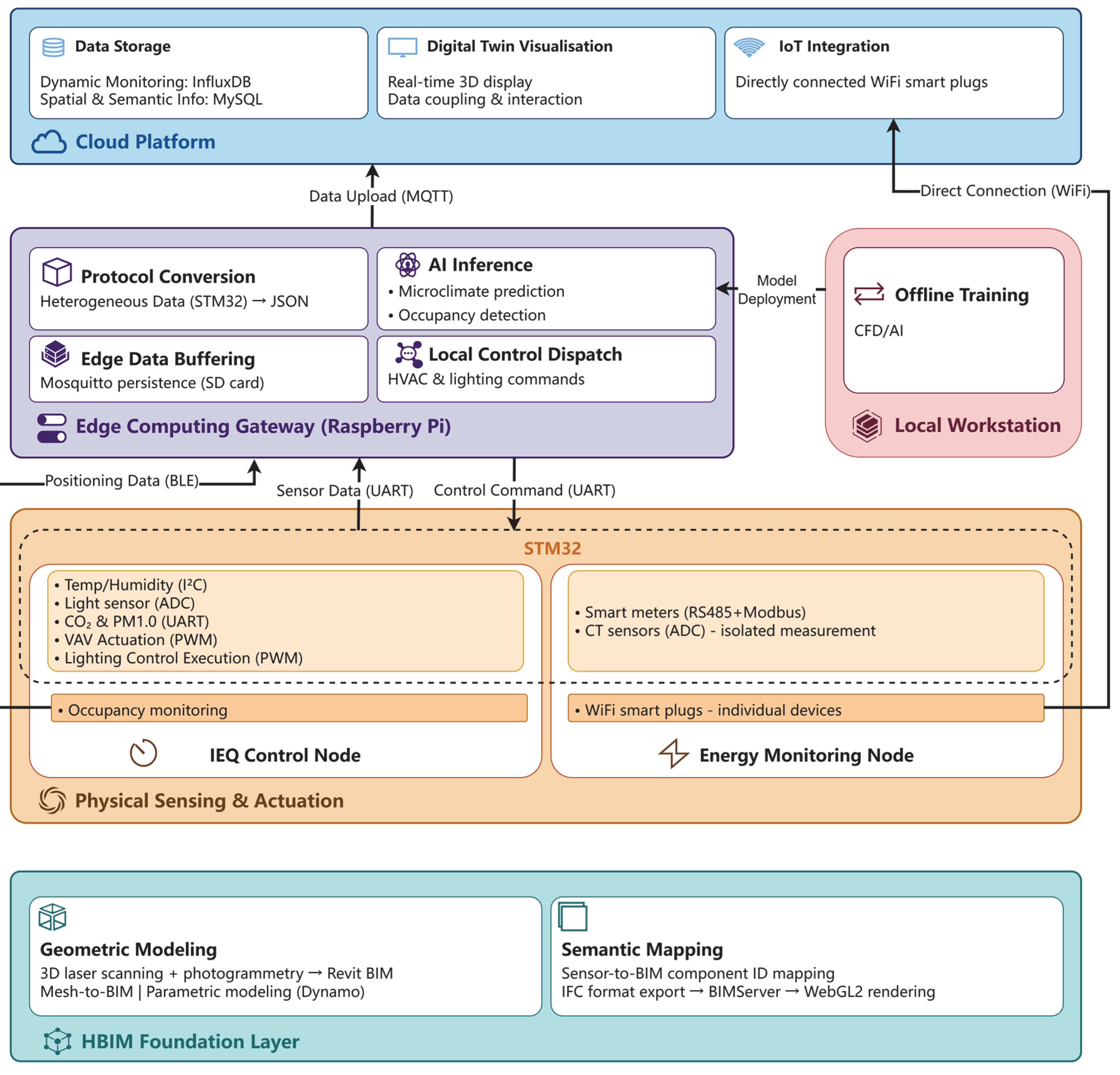
To address computational complexity and real-time control requirements in historic building monitoring scenarios, this study establishes a hierarchical control architecture based on the coordinated operation of cloud services, edge devices and front-end sensor nodes. Table 2 delineates the specific data exchange pathways across the structural, microclimatic, and energy domains.
At the hardware level, although the Raspberry Pi offers stronger computational and communication capabilities, its stability and real-time performance are inferior to those of STM32 microcontrollers [72,73]. Accordingly, within the proposed architecture, the Raspberry Pi is deployed as an edge computing gateway, responsible for lightweight computation, data aggregation and data transmission. By contrast, the STM32, characterised by high reliability and low latency [72,73], is assigned to the lower layer to handle sensor data acquisition and fine-grained control of HVAC equipment. Together, these two platforms effectively balance between computational performance and system stability [73].
With regard to computational task allocation, tasks with exceptionally high computational demands, including CFD simulations and deep learning model training, are executed on a local high-performance workstation [23,34]. Upon completion, the resulting mathematical models and trained neural networks are encapsulated and directly integrated into the inference engine of the edge platform (Raspberry Pi) [74]. During operation, the Raspberry Pi aggregates real-time sensor data from the underlying STM32 devices via a high-bandwidth local area network and utilises local computational resources to perform ultra-low-latency IEQ (indoor environmental quality) prediction and occupant localisation [74,75]. The resulting intelligent control commands are issued directly to the edge control layer. This local closed-loop architecture effectively ensures system stability and responsiveness under conditions of network fluctuation. The cloud-based management platform integrates the processed results uploaded by the edge gateways together with monitoring data from distributed IoT devices, such as smart sockets connected directly to the cloud, and is responsible for remote status monitoring and historical data visualisation.
To provide a clear overview of the proposed system, Figure 3 illustrates the overall architecture of the digital twin framework, including the HBIM foundation layer, physical sensing layer, edge gateway and cloud services.

3.5.1. Geometric Modelling and Semantic Mapping

This study proposes the use of a combined approach based on three-dimensional laser scanning and photogrammetry for the digital documentation of architectural heritage. The initial plan is to employ a TRIMBLE X7 or other terrestrial laser scanners to acquire high-precision point cloud data, which will serve as the basis for model reconstruction within the Revit. During the modelling process, the Mesh-to-BIM and progressive dilution methods are first applied to improve the efficiency of converting point cloud data into a Building Information Model and to reduce the extent of manual reconstruction work [13,14]. For historic components that have been partially damaged due to weathering or long-term wear, parametric modelling based on the combined use of Revit and Dynamo is prioritised, rather than relying on conventional practices that normalise components into an idealised standard state. This approach aims to preserve authenticity [15]. Oblique photogrammetry is introduced as a supplementary source of geometric information and is used to document material textures, façade characteristics and other architectural features. On this basis, a Historical Building Information Model semantic library is constructed, encompassing the geometric, material and historical attributes of the building.

3.5.2. Physical Sensing and Actuation System

This layer constitutes the lowest level of the system and is responsible for acquiring multidimensional data from the physical building and executing control commands. Given the dispersed distribution of monitoring points and the diversity of monitoring requirements in architectural heritage, which result in complex signal types, this study develops a distributed low-level node system centred on STM32 microcontrollers. Apart from the BLE modules used for occupancy activity detection and the WiFi-enabled smart sockets for equipment-level energy monitoring, all other sensors and actuators are interfaced through STM32. This layer is functionally divided into three independent subsystem nodes, enabling the integration of heterogeneous devices through a wide range of hardware interfaces.
  • Structural health monitoring nodes: Static levelling sensors are connected via RS485 interfaces to monitor settlement [76]. Tilt sensors are interfaced through analogue input channels to measure building inclination [77]. Vibrating-wire displacement gauges are connected through ADC channels to acquire attenuated oscillation signals, from which resonance frequencies are derived using FFT algorithms to track crack development [78]. High-resolution USB or CSI cameras are connected to Raspberry Pi units to observe and identify potential cracks [79,80].
  • Microclimate monitoring and control node: This node integrates temperature and humidity sensors based on the I2C bus [81,82,83], illuminance sensors with analogue voltage output connected via analogue-to-digital converter (ADC) interfaces [84], and CO2 and PM1.0 sensors communicating through UART interfaces [85,86]. In addition to multidimensional environmental sensing, this node executes commands issued by the upper-level Raspberry Pi gateway to control HVAC and lighting systems. Pulse-width modulation (PWM) is used to regulate variable air volume (VAV) dampers [87,88]. When a VRF system is adopted, its inverter-driven compressor speed and indoor unit fan speed can be directly regulated via bus communication protocols such as RS485 and Modbus through control commands [89], while lighting brightness is adjusted accordingly [90].
  • Energy monitoring node: This node interfaces with smart electricity meters via an RS485 interface using the Modbus protocol [91]. In scenarios where smart meters cannot be installed or retrofitted, current transformers (CT) are employed in combination with signal conditioning circuits and ADC interfaces to perform isolated circuit-level measurements [92,93]. For certain standalone devices, smart metering sockets with real-time measurement capabilities are deployed, transmitting data via Wi-Fi [94,95].
All physical sensors are semantically mapped during deployment to corresponding component identifiers within the BIM model, ensuring that each data stream can be precisely associated with a specific geometric location in the virtual model [18].

3.5.3. Edge Computing Gateway

This layer serves as the intermediate tier between the sensing layer and the cloud platform. Since uploading large volumes of raw data would lead to network congestion and high latency, this study introduces Raspberry Pi devices, specifically Raspberry Pi 4B or 5, as edge computing gateways [7,96,97]. The gateway is responsible for collecting and forwarding sensor data [96,97] and performs the following core functions.
(1)
Multi-protocol conversion and data integration: As an edge gateway, the Raspberry Pi communicates with STM32 via UART interfaces [98,99], receiving data from lower-level STM32 nodes [81,82,83,84,85,86,87,88]. These data are uniformly encapsulated into standardised JSON formats [88,100], thereby resolving interoperability issues among heterogeneous devices.
(2)
Edge computing and control: Lightweight artificial intelligence models and Docker containers are deployed locally on the gateway [75]. For tasks with stringent real-time requirements, such as occupancy-triggered lighting responses and HVAC regulation, the gateway directly issues control commands, thereby reducing system latency [74,75].
(3)
Edge data buffering: A Mosquitto service is deployed on the Raspberry Pi gateway with local persistence enabled, allowing data to be written in real time to the SD card to establish local backups and prevent data loss under unstable network conditions [101].

3.5.4. Communication Network Layer

Within the data acquisition pathway from physical sensor nodes to the edge gateway, different communication methods are selected according to the characteristics of specific monitoring tasks. For energy monitoring nodes that are spatially distributed and require long-distance transmission, communication details between monitoring nodes and STM32 controllers are described in Section 3.5.2. Communication between STM32 controllers and Raspberry Pi gateways is implemented via UART interfaces [98,99]. For beacon devices used to monitor occupant indoor positioning, BLE technology is adopted. These devices require no wiring and offer flexible deployment, making them suitable for occupancy monitoring without disturbing the building structure [37]. In cases where standalone WiFi-enabled smart sockets are used, the devices connect directly to the building local area network and transmit energy use data to the cloud in real time using the MQTT protocol [94,95].
The edge gateway accesses the internet through Wi-Fi or Ethernet infrastructure and is responsible for uploading collected data to the cloud platform [102]. Data transmission is implemented using the MQTT protocol. As a lightweight communication protocol designed specifically for IoT applications, MQTT requires lower bandwidth and transmission overhead than traditional HTTP, enabling efficient real-time publication of high-frequency sensor data and ensuring timely reception and processing by the cloud platform [103,104].

3.5.5. Data Service Architecture

The cloud-based management platform is responsible for data aggregation and real-time interaction. It receives data from edge gateways based on Raspberry Pi devices and from smart sockets through an MQTT broker and stores them in a time series database [105,106]. To accommodate the coexistence of dynamic monitoring data and static semantic information, a hybrid database architecture is adopted. Dynamic environmental monitoring data in the form of time series are stored in InfluxDB using a NoSQL approach, while static information such as sensor identifiers and spatial attributes is stored in MySQL using a relational database structure [18].

3.5.6. Digital Twin Visualisation Interface

This study proposes the development of a web-based digital twin platform that leverages HTML5 and WebGL2 technologies to provide an installation-free and cross-device-accessible visualisation interface [18,37].
(1)
Model processing layer: The Revit-based BIM model is exported in IFC format and uploaded to BIMServer. The built-in IfcOpenShell plugin is used to parse and simplify the IFC data, converting it into triangulated mesh models suitable for efficient WebGL2 rendering [18].
(2)
Application and interaction layer: Based on the lightweight BIM model, the application programming interfaces are employed to couple cleaned time series data with the model data, enabling online dynamic visualisation and interactive display on the web platform based on WebGL2 technology [18,37,107].

3.6. Case Study

This study applies the previously proposed conceptual framework to the Dacheng Hall of Xiangyin Confucian Temple, located in Xiangyin County, Hunan Province, China, in order to demonstrate how a digital twin system can realise a full-process management pathway in real-world architectural heritage, from real-time monitoring to predictive conservation and further to long-term energy-efficient intervention. The purpose of this case study is to provide a scenario-based application that conceptually validates the proposed framework.

3.6.1. Background of the Case

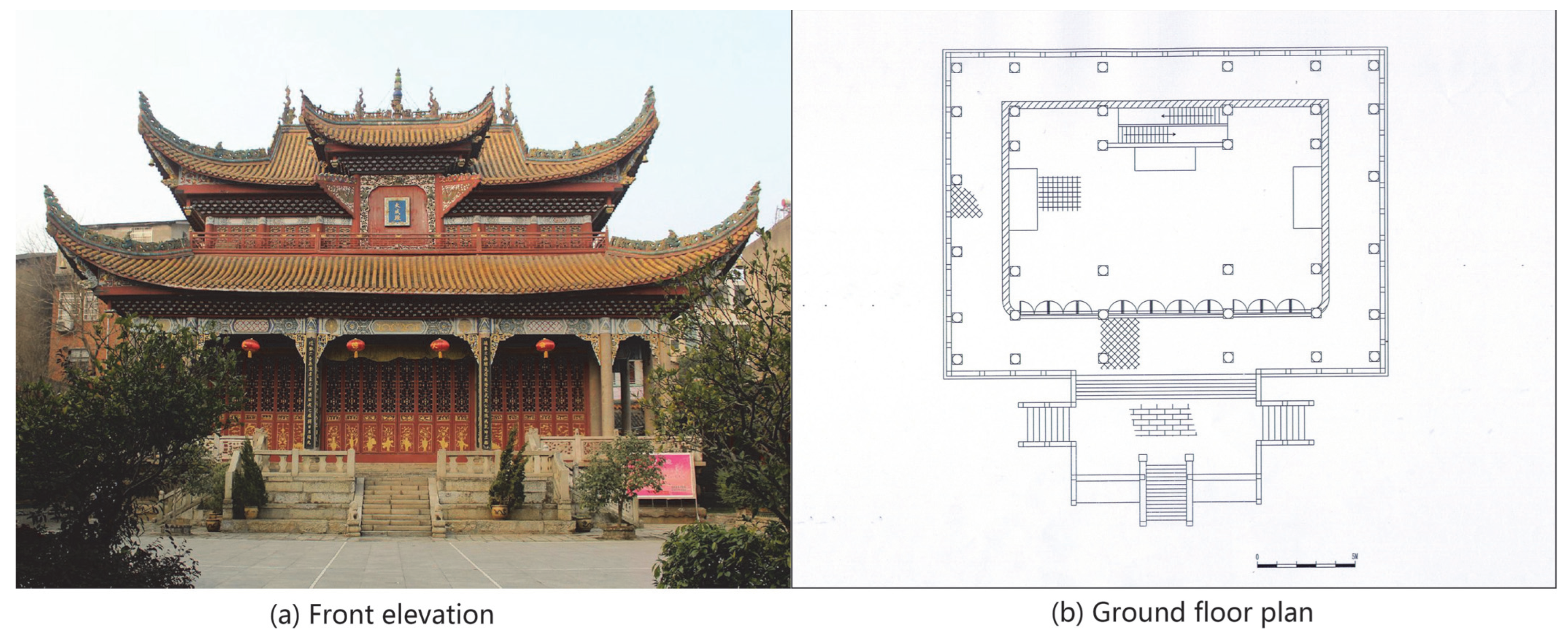
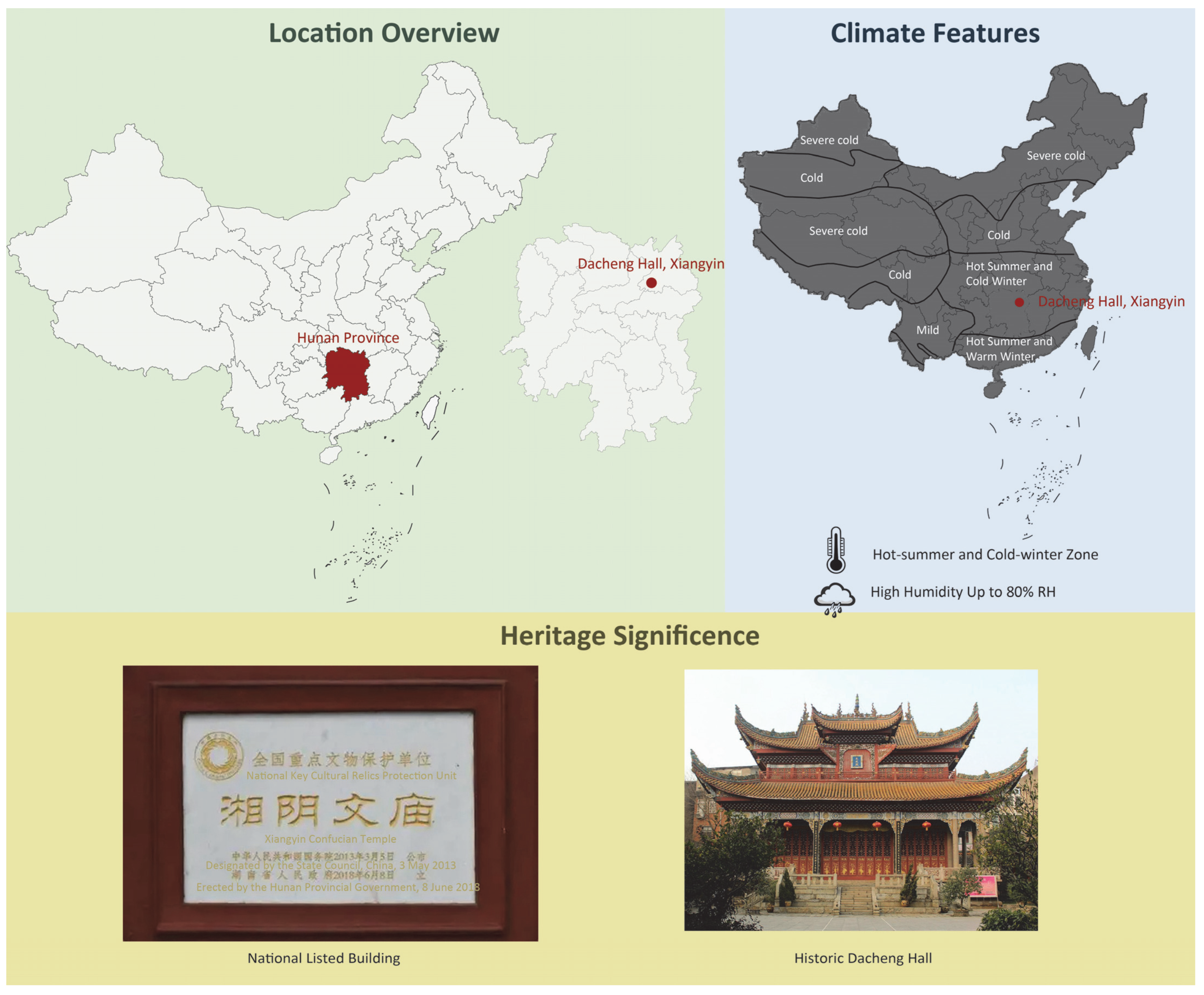
The Dacheng Hall of Xiangyin Confucian Temple is a representative brick–timber–stone hybrid structure from the Qing Dynasty. Originally constructed in 1744 and reconstructed in 1880, the building has a rectangular plan with five bays along the east–west façade and four bays in depth from north to south, covering a total floor area of approximately 420 m2. It is currently designated as a National Key Cultural Relic Protection Unit. The building appearance and plan are shown in Figure 4. The geographic location, climatic characteristics, and heritage status of the case study building are illustrated in Figure 5.
On-site investigations indicate that the Dacheng Hall exhibits a range of issues across structural integrity, indoor environmental conditions, and energy operation. As a typical Qing Dynasty hybrid structure, its structural system is inherently complex and has been subjected to long-term material ageing and potential differential settlement. Multiple cracks and local component losses have already been identified, providing a realistic and representative context for the application and validation of the structural health monitoring module.
Meanwhile, the building is located in a subtropical humid climate zone, where indoor humidity remains high throughout the year, reaching relative humidity levels of up to 80% during the rainy season. Insufficient ventilation has led to localised mould growth, posing persistent threats to the durability of timber components. As the building remains open to the public, higher requirements are imposed on indoor environmental quality, making fine-grained monitoring and control of the indoor microclimate particularly urgent.
In addition, the building currently lacks a systematic air-conditioning and dehumidification system, resulting in limited capacity to regulate indoor thermal and hygric conditions. This limitation makes it difficult to cope with the combined challenges of high humidity in summer and low temperatures in winter, characteristic of the local “cold winter–hot summer” climate. Under the premise of continued public access, achieving visitor thermal comfort while avoiding excessive energy use represents a critical challenge. Based on these considerations, the Dacheng Hall of Xiangyin Confucian Temple was selected as the case study for this research.
To address the insufficient environmental control capacity, this study proposes the installation of an appropriate HVAC system for the Dacheng Hall. Common HVAC solutions in architectural heritage contexts primarily include heat pump systems and, in remote areas with limited energy supply, oil-fired hot-air generators [108,109,110]. Given that the Dacheng Hall is located in an urban area with stable energy access, a heat pump system was identified as the preferred technical pathway.
Among heat pump options, ground-source heat pumps can minimise visual impact on historic façades by burying pipelines beneath outdoor courtyards [111]. However, such systems require extensive construction work, high initial investment, and are generally more suitable for large-scale public buildings [112,113]. Considering the relatively small scale of the Dacheng Hall, this study ultimately selected a distributed variable refrigerant flow (VRF) system as the HVAC solution. VRF systems are essentially inverter-driven heat pump systems with high operational flexibility and economic efficiency [64,114]. A single outdoor unit can serve multiple indoor units, reducing both the number and size of outdoor installations, thereby minimising visual intrusion into the historic fabric and surrounding environment [89]. Moreover, the system integrates temperature and humidity control as well as fresh air functions, providing essential hardware support for microclimate monitoring and intelligent regulation within the digital twin framework [115].
The system layout was designed in strict accordance with heritage conservation principles. Outdoor units are not directly attached to the historic structure but instead concealed within fenced areas behind vegetation on the rear side of the site, using landscaping to eliminate visual disturbance. Indoor terminals adopted the hidden installation strategy: ultra-slim fan coil units are concealed beneath altar bases and within custom-designed, heritage-style furniture along the walls. Air outlets are integrated into bespoke carved grilles that harmonise with traditional decorative motifs, enabling visually unobtrusive air delivery through timber lattice patterns. Pipelines are routed through existing vertical gaps and shadowed corners within the timber framework to the minimise impact on the historic appearance.

3.6.2. Technical Pathway for Framework Application

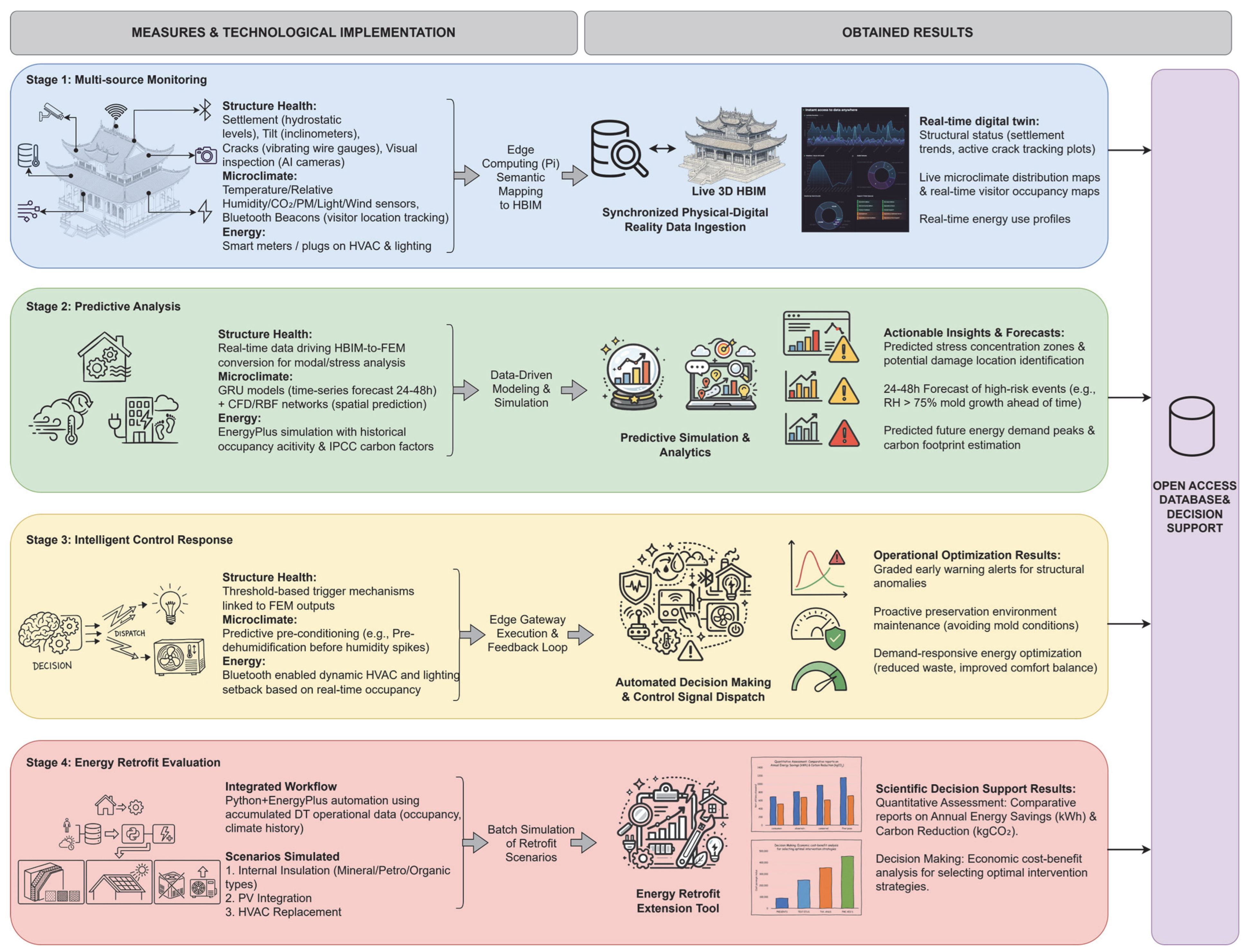
Figure 6 illustrates the application pathway of the proposed digital twin framework in the Dacheng Hall, clearly presenting the logical relationships and data flows among the four core stages: multisource monitoring, predictive analysis, intelligent control, and retrofit evaluation.
Stage 1: Multisource Monitoring
Following the monitoring system described in Section 3.1, Section 3.2 and Section 3.3, a three-dimensional sensor network is deployed in the Dacheng Hall to enable comprehensive multisource data acquisition. At the structural level, static levelling sensors are installed on major load-bearing masonry columns to monitor differential settlement, while tilt sensors are placed at the four corners of the building to capture global inclination trends. Existing cracks are instrumented with vibrating-wire displacement gauges to track crack propagation, and a Raspberry Pi-based camera system is deployed on key structural components to support AI-assisted crack identification. In parallel, the microclimate monitoring system incorporated sensors for temperature, relative humidity, CO2 concentration, PM1.0, illuminance, and air velocity across key interior spaces, with particular emphasis on high-humidity risk zones that are characteristic of subtropical climates. To capture occupant-related disturbances, a low-energy Bluetooth beacon network is additionally deployed to record real-time visitor spatiotemporal distribution and occupancy activity. At the energy level, smart meters and plug-in power meters are used to monitor the real-time electricity use of the HVAC system and other major equipment.
All sensors are integrated in accordance with the physical sensing architecture described in Section 3.5.2. Monitoring data are collected through STM32 nodes and transmitted to an edge gateway based on Raspberry Pi, where semantic mapping to HBIM component identifiers enabled real-time synchronisation between the physical building and its digital representation. The resulting multisource heterogeneous dataset constituted the fundamental data basis for subsequent predictive analyses.
Stage 2: Predictive Analysis and Risk Identification
Building upon the real-time monitoring data acquired in Stage 1, predictive analyses are conducted across structural safety, microclimate performance, and energy use and carbon emissions. At the structural level, following the methodology described in Section 3.1.2, the HBIM model is transformed into a finite element model, into which real-time settlement and inclination data are incorporated. Modal analysis and stress calculations are then performed to predict stress concentration zones and potential damage locations within the brick–timber hybrid structure. For instance, when uneven settlement of load-bearing columns is detected, the system is able to estimate the probability and spatial distribution of secondary cracking, thereby providing scientific support for structural intervention decisions.
For the indoor environmental dimension, the high-humidity conditions and stochastic visitor occupancy patterns characteristic of Xiangyin were explicitly considered. A GRU-based time series model, as described in Section 3.2.3, is applied to predict indoor temperature, relative humidity, and CO2 concentration over a 24–48 h horizon. In addition, offline CFD simulations are conducted to identify high-humidity risk zones located in sensor blind spots, such as poorly ventilated corners. On this basis, an RBF neural network is trained to establish a rapid inference model that links single-point sensor readings to whole-space environmental distributions. Through this approach, the system can, for example, predict that relative humidity in specific zones will exceed the 75 percent mould risk threshold up to 48 h before the onset of the rainy season [116,117].
Energy use and carbon emission prediction is carried out by integrating occupancy activity data with environmental parameters. EnergyPlus simulations, following the workflow described in Section 3.3.2, are used to estimate future energy demand under the local cold winter–hot summer climate, while carbon emissions are calculated using IPCC emission factors. The results reveal distinct seasonal patterns, with peak cooling demand in summer and differentiated heating load distributions in winter.
These predictive analyses are not isolated but mutually reinforcing. Structural monitoring data inform stress prediction, microclimate forecasts provide a basis for HVAC regulation, and occupancy information enhances the accuracy of both environmental and energy simulations. All predictive outputs are processed locally at the edge gateway in accordance with the edge computing strategy described in Section 3.5.3.
Stage 3: Intelligent Control Response
On the basis of the predictive outputs generated in Stage 2, the system implements a set of prediction-driven intelligent control strategies. When settlement rates, tilt angles, or crack displacements exceed predefined thresholds, graded structural health warnings are automatically triggered, as described in Section 3.1.1. These warning signals are synchronised with finite element analysis results, enabling building managers to rapidly identify risk sources and prioritise intervention measures.
Predictive microclimate regulation represents a key innovation of the proposed framework. Rather than relying on conventional monitor–react mechanisms, the system proactively intervenes based on GRU and RBF prediction results. For example, when relative humidity is predicted to exceed the 75 percent threshold within 48 h, dehumidification is initiated 24 h in advance, and air supply strategies are optimised with reference to CFD-identified critical zones [116,117]. Similarly, when occupancy prediction indicates an imminent increase in visitor numbers, fresh air rates are proactively adjusted to mitigate anticipated CO2 accumulation. Control commands are issued directly from the edge gateway to STM32 nodes, enabling low-latency responses as described in Section 3.5.3. Lighting intensity is also dynamically regulated according to real-time occupancy, ensuring sufficient illumination in occupied areas while reducing loads in unoccupied zones.
Occupancy-based energy optimisation is further achieved through real-time data from the Bluetooth positioning system described in Section 3.2.2. HVAC and lighting loads are reduced or switched off in spaces without detected activity. For instance, if no occupancy is recorded in the eastern exhibition hall for 30 min, the system automatically increases the cooling setpoint by 2 °C in summer or decreases it by 2 °C in winter, while simultaneously dimming or turning off lighting.
Overall, this stage reflects a systematic transition from passive response to proactive intervention. In structural management, the focus shifts from post-damage repair to pre-emptive prevention. In microclimate control, regulation moves from post-threshold adjustment to pre-threshold intervention. In energy management, scheduled operation is replaced by demand-responsive control. All control strategies are coordinated through a unified edge–cloud architecture.
Stage 4: Energy Retrofit Scenario Evaluation
Building on the geometric data and continuous monitoring outputs from the previous stages, the digital twin framework is extended to support quantitative evaluation and decision making for long-term energy retrofitting and conservation interventions. This retrofit extension tool leverages accumulated operational data and predictive models to systematically simulate and compare the potential impacts of different intervention pathways.
Using the retrofit prediction tool described in Section 3.3.3, multiple retrofit scenarios are simulated under the local “cold winter–hot summer” climate. These included adding insulation layers to roofs, external walls, and floors, and comparing three commonly used insulation material categories—mineral-based, petrochemical-based, and organic-based—each with low, medium, and high insulation levels to reflect different retrofit depths. In line with conservation requirements, internal insulation solutions are prioritised [67]. Additional measures included installing photovoltaic panels in visually non-sensitive areas to enable partial energy self-sufficiency and replacing inefficient air-conditioning units with high-efficiency inverter heat pump systems.
These measures are combined into multiple retrofit scenarios and batch-simulated using a Python–EnergyPlus automated workflow. The workflow integrates continuous occupancy activity data, HVAC operational parameters, and HBIM geometry from the digital twin system, while incorporating local electricity pricing structures and grid emission factors. This enables automated prediction of annual energy use, carbon emissions, and economic savings for each scenario.

3.6.3. Open Database and Decision Support

Based on the proposed framework, all data are systematically managed and released as open datasets following the structure described in Section 3.4, including structural health datasets, occupancy behaviour and microclimate datasets, and energy and retrofit simulation datasets. These datasets not only support the current monitoring–prediction–control closed loop but also provide a foundation for the continuous evolution of the digital twin model.
In the structural domain, long-term monitoring data and corresponding finite element analysis results can be used to train degradation pattern recognition models, improving the accuracy of remaining service life prediction. In the environmental and behavioural domain, high-resolution occupancy activity datasets contribute to optimising behaviour prediction algorithms, thereby enhancing the reliability of microclimate prediction models under varying occupancy scenarios. In the energy domain, continuous comparison between measured energy use and simulation outputs enables ongoing calibration of EnergyPlus model parameters, increasing the credibility of retrofit evaluation results.
Through the hybrid database architecture (InfluxDB + MySQL) described in Section 3.5.5 and the web-based visualisation interface in Section 3.5.6, managers can access real-time information on structural safety status, indoor environmental distributions, energy use trends, and comparative retrofit performance, enabling data-driven decision making.
The resulting monitoring data and predictive analysis outputs across structural, environmental, and energy dimensions jointly support multi-level decision-making needs, including daily operation management, risk prevention, intervention prioritisation, and medium–long-term conservation strategy development. At the environmental management level, microclimate data inform multiscale decisions, such as evaluating the effectiveness of ventilation, dehumidification, and fresh air strategies under different seasonal and occupancy conditions and identifying zones with persistent humidity or air quality risks. At the structural safety level, structural health data support decisions on component risk grading, inspection and maintenance prioritisation, and pre-evaluation of potential secondary stresses or degradation risks induced by intervention measures, thereby avoiding adverse impacts on long-term structural stability. At the operational and public access level, occupancy behaviour and energy data provide quantitative evidence for visitor flow management and operational strategy adjustment, enabling managers to balance visitor capacity, indoor environmental quality, and energy use during peak occupancy periods.

4. Discussion

This study proposes a comprehensive conceptual digital twin framework for architectural heritage, systematically integrating three key dimensions: structural health, microclimatic environment, and energy performance.

4.1. Significance of the Conceptual Framework for Architectural Heritage Conservation

Existing studies on digital twin for architectural heritage predominantly focus on single dimensions, such as structural health monitoring, environmental monitoring, or energy analysis, and often lack an integrated framework capable of supporting both day-to-day operational management and long-term renewal and retrofit decision making. This approach is not merely suboptimal, but fundamentally insufficient. Architectural heritage possesses distinctive characteristics that make cross-dimensional coupling not an optional improvement but a functional requirement.
Architectural heritage has three key characteristics that distinguish it from contemporary buildings. These characteristics make single dimensional monitoring structurally incapable of fully representing its actual condition.
The first characteristic is material heterogeneity. Historical construction materials, such as fired brick, rammed earth, and timber, exhibit hygrothermal behaviour that simultaneously carries structural and environmental implications. For example, the moisture content in masonry directly affects its compressive strength and elastic modulus [118]. Consequently, an HVAC control decision that allows indoor humidity to rise for the purpose of energy saving also constitutes a structural risk decision. A single dimensional framework is unable to capture such dependencies.
The second characteristic concerns constraints on conservation interventions. Unlike contemporary buildings, architectural heritage typically permits only minimal physical modification. This constraint implies that sensor placement, system installation, and control actuators must be designed in coordination across structural, environmental, and energy objectives. For instance, if a sensor network is optimised solely for structural monitoring, it may occupy the limited installation locations that are also required for microclimate sensors. The integrated framework proposed in this study establishes a shared physical sensing layer across the three dimensions, thereby making these coordination constraints an explicit design principle.
The third characteristic is the irreversibility of deterioration processes. In heritage contexts, material degradation such as crack propagation, mould growth, or damage caused by repeated hygrothermal cycles is often difficult to fully reverse. As a result, the cost difference between preventive action and post damage restoration is substantially greater than in ordinary buildings. Cross-dimensional predictive risk analysis therefore becomes particularly important. For example, a humidity exceedance that might only affect indoor comfort in a conventional building could become a trigger for biological infestation in a timber heritage structure, thereby accelerating structural deterioration.
Taken together, these three characteristics demonstrate that integrating structural, microclimatic, and energy dimensions in heritage contexts is not a simple aggregation, but a constitutive requirement.

4.2. Analysis of Coupling Mechanisms

One core theoretical contribution of the proposed framework lies in identifying the coupling relationships among structural behaviour, microclimatic conditions, and energy processes. Three key coupling pathways deserve particular attention.
The coupling between structure and microclimate is bidirectional, but exhibits operational asymmetry. On the one hand, indoor hygrothermal conditions, including temperature and relative humidity, directly influence the material behaviour of load bearing components. On the other hand, structural changes such as crack formation, differential settlement, and reductions in airtightness at connection points can alter the hygrothermal performance of the building envelope. These changes may create uncontrolled air infiltration paths and thermal bridges, thereby reshaping the indoor microclimate distribution.
This relationship is asymmetric primarily in terms of time scale. Microclimatic fluctuations may affect structural materials over periods of weeks or months, whereas structural changes can influence indoor environmental conditions within hours or days. This asymmetry has direct implications for the control architecture of the framework. Short term microclimate regulation requires near real time prediction, while structural risk assessment can operate on longer update cycles. The proposed use of GRU based humidity prediction over a 24 to 48 h horizon, together with structural condition assessment over longer periods, reflects this inherent asymmetry.
The relationship between microclimate and energy performance is more direct. However, this coupling primarily involves managing energy use while maintaining functional requirements rather than treating energy efficiency as a simple trade off against building performance. In heritage contexts, both conservation requirements and occupant comfort impose relatively strict stability ranges for indoor hygrothermal conditions.
Traditional occupancy-based HVAC control strategies may therefore introduce risks for heritage buildings. Reducing system operation during unoccupied periods can allow humidity and temperature to drift outside acceptable ranges, potentially triggering cumulative material degradation or discomfort when the space is reoccupied. The framework proposed in this study addresses this challenge through a prediction based preconditioning strategy. By forecasting humidity peaks 24 to 48 h in advance, the system can initiate dehumidification during periods of lower energy cost and gradually adjust indoor conditions before occupants arrive.
This approach represents not only an engineering optimisation but also a reconfiguration of control priorities. Within this framework, heritage conservation and occupant comfort are treated as primary constraints, while energy efficiency is optimised within these boundaries. Future empirical studies will need to evaluate whether the prediction accuracy achieved in real deployments is sufficient to support such control strategies.
The coupling between structure and energy is the most indirect of the three relationships, yet it is important for long term decision making. Energy retrofit measures such as the installation of insulation layers, window replacement, and HVAC system upgrades may alter the thermal capacity, vapour permeability, and structural loading of the building.

4.3. Rationale for Prediction-Driven and Layered Architecture

At the methodological level, this study introduces predictive models and edge computing into the digital twin system for architectural heritage in order to address practical challenges such as constraints on sensor deployment, spatially non-uniform environmental distributions, and delayed responses of control systems. This design is primarily motivated by practical constraints encountered in heritage monitoring. Conventional monitoring approaches often assume that sensors can be installed at the most informative locations, such as areas with the greatest environmental variation or the highest structural risk. In heritage conservation contexts, however, sensor installation locations are often strictly limited in order to avoid damage to historic fabric. As a result, sensors cannot always be placed at the optimal positions for structural or environmental monitoring.
Under such conditions, monitoring systems may exhibit systematic observability gaps, meaning that certain areas of the building cannot be directly measured and must instead be inferred indirectly. To address this challenge, CFD simulations can be used to identify environmental blind zones that cannot be covered by sensor deployment. Spatial interpolation methods such as RBF models can then map point measurements to spatial distributions, thereby compensating for the information gaps caused by limited sensor placement. From this perspective, future empirical evaluations of predictive components should not focus solely on prediction accuracy at sensor locations, but should place greater emphasis on the reliability of predictions in areas where direct measurement is not possible.
It should be noted that the performance of the proposed predictive models has not yet been quantitatively evaluated using long-term empirical data. However, the underlying algorithms and computational workflows are grounded in well-established methods reported in the existing literature.
At the system architecture level, the proposed layered architecture conceptually balances computational efficiency and system robustness by functionally separating high computational load tasks from real time control tasks between the cloud and the edge. This approach is particularly suitable for architectural heritage contexts, where high requirements for real-time responsiveness and reliability coexist with limited opportunities for infrastructure upgrades. As such, the architecture provides a clear technical pathway for subsequent empirical studies and practical system deployment.

4.4. Framework-Level Contribution of the Energy Retrofit Extension Tool

The energy retrofit extension tool proposed in this study establishes an effective linkage between operational data, parametric modelling, and automated performance simulation. It further integrates digital twin data continuously accumulated during the operational phase of architectural heritage into a multi-scenario quantitative evaluation process for energy retrofit options. Compared with existing approaches that typically rely on static knowledge base assumptions or single-scenario case simulations, this tool enables systematic and comparable quantitative assessment of the costs, energy use, and carbon emissions associated with different retrofit strategies.
The incorporation of real operational data distinguishes this tool from conventional simulation approaches based on standardised template assumptions, such as empirically defined or hypothetical inputs for parameters like occupancy activity. By directly using actual building operation data as simulation inputs, the proposed method more accurately captures the behavioural characteristics of architectural heritage under specific use scenarios. This enables customised, building-specific evaluations and significantly enhances the accuracy and credibility of simulation outcomes for energy retrofit decision making.

4.5. Research Limitations and Directions for Future Validation

As a conceptual study, the primary limitation of this research lies in the absence of systematic validation based on long-term empirical data. The proposed predictive models, intelligent control strategies, and energy retrofit evaluation workflows remain to be verified through continuous monitoring and comparative experiments in real architectural heritage settings. In addition, substantial variations exist among different heritage buildings in terms of structural typologies, climatic conditions, usage patterns, and conservation constraints. Consequently, the proposed framework requires context-specific adaptation when applied across different case studies.
Future research may proceed in several directions: first, deploying the complete system in individual heritage buildings to quantitatively evaluate prediction accuracy and control effectiveness; second, comparing the applicability and performance of the framework across different climate zones and building types; and third, extending the framework from single buildings to larger scales, such as building complexes or historic districts.

5. Conclusions

This study proposes a comprehensive conceptual digital twin framework for architectural heritage, systematically integrating structural health, microclimatic environment, and energy performance to provide methodological support for sustainable decision making in both operational management and long-term energy-efficient retrofitting. Through a systematic architectural design, the study clarifies the logical relationships and technical pathways among multisource real-time monitoring, predictive analysis, coupled control, and decision support within a digital twin system for architectural heritage.
At a conceptual level, the framework demonstrates how digital twin can support a full-process management approach, ranging from real-time monitoring to predictive conservation and further to long-term energy-efficient intervention. Although the proposed system has not yet been implemented or empirically validated, the framework offers a clear and scalable research blueprint for subsequent empirical studies. Future work will focus on long-term data acquisition and model calibration in real-world cases, with the aim of further evaluating the effectiveness and applicability of the framework across diverse architectural heritage contexts. In addition, greater attention should be given to historical climate changes at the building’s location and their potential impacts on structural integrity and material performance, as such baseline data are essential for contextualising monitoring results and projecting conservation risks under future climate scenarios [119]. Furthermore, subsequent studies should consider co-creating thermal comfort indicators with building managers, conservation professionals, and visitors, drawing on participatory methodologies that have demonstrated success in climate-sensitive leisure and tourism contexts [120]. Such co-created indices would bridge the gap between technical monitoring data and the lived experience of heritage visitors, ultimately supporting more human-centred and adaptive conservation management strategies.

Author Contributions

Y.N.: conceptualization, methodology, validation, formal analysis, investigation, data curation, and writing—original draft preparation. Z.W.: investigation and visualization. Z.X.: investigation. M.L.: resources, supervision, project administration, funding acquisition, and writing—review and editing. All authors have read and agreed to the published version of the manuscript.

Funding

This research was supported by the Hunan Provincial Social Science Fund, Digital Protection and Presentation of Confucian Temple and Academy Architecture in Hunan Province (Grant No. 23YBA027), and by the National Social Science Fund of China, Research on the Origins, Evolution, Historical Contributions, and Modern Implications of Ancient Chinese Academy Culture (Grant No. 24VWBN011).

Institutional Review Board Statement

Not applicable.

Informed Consent Statement

Not applicable.

Data Availability Statement

No new data were created or analysed in this study. Data sharing is not applicable.

Acknowledgments

During the preparation of this work the author(s) used ChatGPT-5.3 (OpenAI) and Gemini (Google) in order to improve the readability and language of the manuscript. After using this tool, the author(s) reviewed and edited the content as needed and take(s) full responsibility for the content of the published article.

Conflicts of Interest

The authors declare that they have no known competing financial interests or personal relationships that could have appeared to influence the work reported in this paper.

Abbreviations

The following abbreviations are used in this manuscript:
ADCanalogue-to-digital converter
BIMBuilding Information Modelling
BLEBluetooth Low-Energy
CFDcomputational fluid dynamics
CNNconvolutional neural network
CTcurrent transformer
DTdigital twin
FEMfinite element model
GISGeographic Information System
GRUgated recurrent unit
HBIMHistorical Building Information Modelling
HVACheating, ventilation, and air conditioning
IAQindoor air quality
IEQindoor environmental quality
IFCsIndustry Foundation Classes
LoTInternet of Things
IPCCIntergovernmental Panel on Climate Change
JSONJavaScript Object Notation
MQTTMessage Queuing Telemetry Transport
PRISMAPreferred Reporting Items for Systematic Reviews and Meta-Analyses
PWMpulse-width modulation
RBFsradial basis functions
RSSIreceived signal strength indicator
UARTUniversal Asynchronous Receiver–Transmitter
VAVvariable air volume
VRFvariable refrigerant flow
WebGLWeb Graphics Library

References

  1. Redden, R.; Crawford, R.H. Valuing the environmental performance of historic buildings. Australas. J. Environ. Manag. 2021, 28, 59–71. [Google Scholar] [CrossRef]
  2. Webb, A.L. Energy retrofits in historic and traditional buildings: A review of problems and methods. Renew. Sustain. Energy Rev. 2017, 77, 748–759. [Google Scholar] [CrossRef]
  3. Martínez-Molina, A.; Tort-Ausina, I.; Cho, S.; Vivancos, J.-L. Energy efficiency and thermal comfort in historic buildings: A review. Renew. Sustain. Energy Rev. 2016, 61, 70–85. [Google Scholar] [CrossRef]
  4. Lee, H.; Calvin, K.; Dasgupta, D.; Krinner, G.; Mukherji, A.; Thorne, P.; Trisos, C.; Romero, J.; Aldunce, P.; Barret, K.; et al. Contribution of Working Groups I, II and III to the Sixth Assessment Report of the Intergovernmental Panel on Climate Change. In IPCC, 2023: Climate Change 2023: Synthesis Report, Summary for Policymakers; Core Writing Team, Lee, H., Romero, J., Eds.; Intergovernmental Panel on Climate Change (IPCC): Geneva, Switzerland, 2023; pp. 1–34. [Google Scholar] [CrossRef]
  5. Unesco World Heritage Centre; Intergovernmental Committee for the Protection of the World Cultural and Natural Heritage. Operational Guidelines for the Implementation of the World Heritage Convention; United Nations Educational, Scientific and Cultural Organization: Paris, France, 2025; Available online: https://whc.unesco.org/en/guidelines.
  6. Ni, Z.; Liu, Y.; Karlsson, M.; Gong, S. Enabling preventive conservation of historic buildings through cloud-based digital twins: A case study in the city theatre, Norrköping. IEEE Access 2022, 10, 90924–90939. [Google Scholar] [CrossRef]
  7. Ni, Z.; Hupkes, J.; Eriksson, P.; Leijonhufvud, G.; Karlsson, M.; Gong, S. Parametric Digital Twins for Preserving Historic Buildings: A Case Study at Löfstad Castle in Östergötland, Sweden. IEEE Access 2025, 13, 3371–3389. [Google Scholar] [CrossRef]
  8. Weingram, A.; Cui, C.; Lin, S.; Munoz, S.; Jacob, T.; Viers, J.; Lu, X. A definition and taxonomy of digital twins: Case studies with machine learning and scientific applications. Front. High Perform. Comput. 2025, 3, 1536501. [Google Scholar] [CrossRef]
  9. Wikipedia. Digital Twin. Available online: https://en.wikipedia.org/wiki/Digital_twin (accessed on 29 October 2025).
  10. Lucchi, E. Digital twins for the automation of the heritage construction sector. Automat. Constr. 2023, 156, 105073. [Google Scholar] [CrossRef]
  11. Hou, C.; Remøy, H.; Wu, H. Digital Twins to Enable Smart Heritage Facilities Management: A Systematic Literature Review. In Proceedings of the 2021 Pacific Rim Real Estate Society, Online, 4 February 2021; Available online: https://ideas.repec.org/p/arz/wpaper/eres2021_21.html (accessed on 29 October 2025).
  12. Mazzetto, S. Integrating Emerging Technologies with Digital Twins for Heritage Building Conservation: An Interdisciplinary Approach with Expert Insights and Bibliometric Analysis. Heritage 2024, 7, 6432–6479. [Google Scholar] [CrossRef]
  13. Štroner, M.; Křemen, T.; Urban, R. Progressive Dilution of Point Clouds Considering the Local Relief for Creation and Storage of Digital Twins of Cultural Heritage. Appl. Sci. 2022, 12, 11540. [Google Scholar] [CrossRef]
  14. Moyano, J.; León, J.; Nieto-Julián, J.E.; Bruno, S. Semantic interpretation of architectural and archaeological geometries: Point cloud segmentation for HBIM parameterisation. Automat. Constr. 2021, 130, 103856. [Google Scholar] [CrossRef]
  15. Moyano, J.; Carreño, E.; Nieto-Julián, J.E.; Gil-Arizón, I.; Bruno, S. Systematic approach to generate Historical Building Information Modelling (HBIM) in architectural restoration project. Automat. Constr. 2022, 143, 104551. [Google Scholar] [CrossRef]
  16. Eneyew, D.D.; Capretz, M.A.M.; Bitsuamlak, G.T. Toward Smart-Building Digital Twins: BIM and IoT Data Integration. IEEE Access 2022, 10, 130487–130506. [Google Scholar] [CrossRef]
  17. Serbouti, I.; Chenal, J.; Tazi, S.A.; Baik, A.; Hakdaoui, M. Digital Transformation in African Heritage Preservation: A Digital Twin Framework for a Sustainable Bab Al-Mansour in Meknes City, Morocco. Smart Cities 2025, 8, 29. [Google Scholar] [CrossRef]
  18. Qian, Y.; Leng, J.; Wang, H.; Liu, K. Evaluating carbon emissions from the operation of historic dwellings in cities based on an intelligent management platform. Sustain. Cities Soc. 2024, 100, 105025. [Google Scholar] [CrossRef]
  19. Andriamamonjy, A.; Saelens, D.; Klein, R. An automated IFC-based workflow for building energy performance simulation with Modelica. Automat. Constr. 2018, 91, 166–181. [Google Scholar] [CrossRef]
  20. Borodinecs, A.; Palcikovskis, A.; Krumins, A.; Lebedeva, K. Optimizing office building operations: A framework for continuous dynamic energy simulations in decision-making for efficiency. Front. Built. Environ. 2024, 10, 3389. [Google Scholar] [CrossRef]
  21. Yoon, S. Building digital twinning: Data, information, and models. J. Build. Eng. 2023, 76, 107021. [Google Scholar] [CrossRef]
  22. BIM2TWIN. 2024. Consortium, B.T. Home. Available online: https://bim2twin.eu/ (accessed on 9 March 2026).
  23. Sivori, D.; Ierimonti, L.; Venanzi, I.; Ubertini, F.; Cattari, S. An Equivalent Frame Digital Twin for the Seismic Monitoring of Historic Structures: A Case Study on the Consoli Palace in Gubbio, Italy. Buildings 2023, 13, 1840. [Google Scholar] [CrossRef]
  24. Angjeliu, G.; Coronelli, D.; Cardani, G. Development of the simulation model for Digital Twin applications in historical masonry buildings: The integration between numerical and experimental reality. Comput. Struct. 2020, 238, 106282. [Google Scholar] [CrossRef]
  25. Talebi, A.; Potenza, F.; Gattulli, V. Interoperability between BIM and FEM for vibration-based model updating of a pedestrian bridge. Structures 2023, 53, 1092–1107. [Google Scholar] [CrossRef]
  26. Duman, C.; Aslan, T.; Hacıefendioǧlu, K.; Gültop, T. Evaluating aftershock-induced collapse mechanisms of the Fatih Büyük Mosque’s historic masonry minaret using digital twin simulation. Earthq. Eng. Eng. Vib. 2025, 24, 1015–1034. [Google Scholar] [CrossRef]
  27. Yiğit, A.Y.; Uysal, M. Detection of Cracks in Cultural Heritage Buildings Using UAV Photogrammetry-Based Digital Twin. J. Comput. Cult. Herit. 2025, 18, 13. [Google Scholar] [CrossRef]
  28. Xu, S.; Chen, H. Deep learning and digital twin integration for structural damage detection in ancient pagodas. Sci. Rep. 2025, 15, 28408. [Google Scholar] [CrossRef]
  29. Kong, X.X.; Hucks, R.G. Preserving our heritage: A photogrammetry-based digital twin framework for monitoring deteriorations of historic structures. Automat. Constr. 2023, 152, 104928. [Google Scholar] [CrossRef]
  30. Pawłowicz, J.A.; Knyziak, P.; Krentowski, J.R.; Mackiewicz, M.; Skotnicka-Siepsiak, A.; Serrat, C. Reverse engineering as a non-invasive examining method of the water tower brick structure condition. Eng. Fail. Anal. 2024, 161, 108280. [Google Scholar] [CrossRef]
  31. Jouan, P.; Hallot, P. Digital Twin: Research Framework to Support Preventive Conservation Policies. ISPRS Int. J. Geo-Inf. 2020, 9, 228. [Google Scholar] [CrossRef]
  32. Pereira, P.F.; Ramos, N.M.M. Low-cost Arduino-based temperature, relative humidity and CO2 sensors—An assessment of their suitability for indoor built environments. J. Build. Eng. 2022, 60, 105151. [Google Scholar] [CrossRef]
  33. Yoon, S. Virtual sensing in intelligent buildings and digitalization. Automat. Constr. 2022, 143, 104578. [Google Scholar] [CrossRef]
  34. Zhang, J.; Poon, K.H.; Kwok, H.H.L.; Hou, F.; Cheng, J.C.P. Predictive control of HVAC by multiple output GRU—CFD integration approach to manage multiple IAQ for commercial heritage building preservation. Build Env. 2023, 245, 110802. [Google Scholar] [CrossRef]
  35. Ni, Z.; Zhang, C.; Karlsson, M.; Gong, S. A study of deep learning-based multi-horizon building energy forecasting. Energy Build. 2024, 303, 113810. [Google Scholar] [CrossRef]
  36. López-González, C.; García-Valldecabres, J. The Integration of HBIM-SIG in the Development of a Virtual Itinerary in a Historical Centre. Sustainability 2023, 15, 13931. [Google Scholar] [CrossRef]
  37. Wang, H.; Qian, Y.; Kuang, Y.; Leng, J.; Yang, Y.; Zhang, H. How occupant positioning systems can be applied to help historic residences manage energy consumption: A case study in China. Build Env. 2024, 249, 111110. [Google Scholar] [CrossRef]
  38. Clausen, A.; Arendt, K.; Johansen, A.; Sangogboye, F.C.; Kjærgaard, M.B.; Veje, C.T.; Jørgensen, B.N. A digital twin framework for improving energy efficiency and occupant comfort in public and commercial buildings. Energy Inform. 2021, 4, 40. [Google Scholar] [CrossRef]
  39. Cai, J.N.; Chen, J.L.; Hu, Y.Q.; Li, S.; He, Q. Digital twin for healthy indoor environment: A vision for the post-pandemic era. Front. Eng. Manag. 2023, 10, 300–318. [Google Scholar] [CrossRef]
  40. Troi, A.; Herrera Gutierrez-Avellanosa, D. HIBERtool—Historic Building Energy Retrofit Tool. Available online: https://www.eurac.edu/en/institutes-centers/institute-for-renewable-energy/tools-services/software-tools/hibertool-historic-building-energy-retrofit-tool (accessed on 14 November 2025).
  41. Kakouei, M.; Sutrisna, M.; Rasheed, E.; Feng, Z. Enhancing the Energy Performance of Historic Buildings Using Heritage Building Information Modelling: A Case Study. Sustainability 2025, 17, 6655. [Google Scholar] [CrossRef]
  42. Giannakos, M.N.; Mikalef, P.; Pappas, I.O. Systematic Literature Review of E-Learning Capabilities to Enhance Organizational Learning. Inf. Syst. Front. 2022, 24, 619–635. [Google Scholar] [CrossRef]
  43. Jones, D.; Snider, C.; Nassehi, A.; Yon, J.; Hicks, B. Characterising the Digital Twin: A systematic literature review. CIRP J. Manuf. Sci. Technol. 2020, 29, 36–52. [Google Scholar] [CrossRef]
  44. Cruz, R.J.M.d.; Tonin, L.A. Systematic review of the literature on Digital Twin: A discussion of contributions and a framework proposal. Gestão Produção 2022, 29, e9621. [Google Scholar] [CrossRef]
  45. Dagnaw, G.; Capuano, R.; Muccini, H. Digital Twins for Cultural Heritage: A Systematic Analysis of the State of the Art. ACM Comput. Surv. 2026, 58, 237. [Google Scholar] [CrossRef]
  46. Hakimi, O.; Liu, H.; Abudayyeh, O.; Houshyar, A.; Almatared, M.; Alhawiti, A. Data Fusion for Smart Civil Infrastructure Management: A Conceptual Digital Twin Framework. Buildings 2023, 13, 2725. [Google Scholar] [CrossRef]
  47. Khan, K.S.; Kunz, R.; Kleijnen, J.; Antes, G. Five steps to conducting a systematic review. J. R. Soc. Med. 2003, 96, 118–121. [Google Scholar] [CrossRef] [PubMed]
  48. Braun, V.; Clarke, V. Using thematic analysis in psychology. Qual. Res. Psychol. 2006, 3, 77–101. [Google Scholar] [CrossRef]
  49. Hamdi, N.F.F.; Salleh, N.H. A Systematic Review: Understanding Environmental Driving Factors of Heritage Building Degradation. J. Surv. Constr. Prop. 2025, 16, 95–117. [Google Scholar] [CrossRef]
  50. Malekloo, A.; Ozer, E.; AlHamaydeh, M.; Girolami, M. Machine learning and structural health monitoring overview with emerging technology and high-dimensional data source highlights. Struct. Health Monit. 2022, 21, 1906–1955. [Google Scholar] [CrossRef]
  51. Pathan, M.A.; Maira, M.; Khaskheli, A.; Jamshed, A. Geotechnical Perspective of the Causes of Cracks in Building of University Campus (Sindh University Jamshoro Sindh Pakistan). J. Build. Mater. Sci. 2021, 3, 51–57. [Google Scholar] [CrossRef]
  52. Kog, Y.C. Excavation-Induced Settlement and Tilt of a 3-Story Building. J. Perform. Constr. Facil. 2017, 31, 04016080. [Google Scholar] [CrossRef]
  53. Roy, T.; Timoshenko, A.; Eiblmeier, D. An Overview of Structural Health Monitoring of the Centre Block in Ottawa During Ongoing Structural Rehabilitation. In Proceedings of the 15th Canadian Masonry Symposium, Ottawa, ON, Canada, 2–5 June 2025. [Google Scholar]
  54. Sánchez-Fernández, L.P.; Sánchez-Pérez, L.A.; Carbajal-Hernández, J.J.; Hernández-Guerrero, M.A.; Pérez-Echazabal, L. Buildings’ Biaxial Tilt Assessment Using Inertial Wireless Sensors and a Parallel Training Model. Sensors 2023, 23, 5352. [Google Scholar] [CrossRef]
  55. Soil Instruments. Vibrating Wire Crackmeter. 2025. Available online: https://www.soilinstruments.com/products/joints-crackmeters/vibrating-wire-crackmeter/ (accessed on 14 November 2025).
  56. Piscitelli, P.; Miani, A.; Mecca, S.; Hodgton, R. Optimizing the Indoor Air Quality in Historical Buildings: Strategies for Environmental Improvement and Public Health Enhancement. Int. J. Environ. Res. Public Health 2024, 21, 341. [Google Scholar] [CrossRef]
  57. Strengers, Y.; Pink, S.; Dahlgren, K.; Korsmeyer, H. Healthy, safe and comfortable: Emerging indoor air practices in Australian households. Energy Res. Soc. Sci. 2024, 118, 103760. [Google Scholar] [CrossRef]
  58. Emmanuella, M.; Alibaba, H.Z. The assessment of indoor thermal comfort in a building: A case study of lemar, salamis road, famagusta, cyprus. Int. J. Civ. Struct. Eng. Res. 2018, 6, 109–127. [Google Scholar]
  59. Zhang, X.; Dai, P.; Zhao, Z. Reflections on the Indoor Environmental Monitoring System of the Heritage Buildings in the Palace Museum–A Case Study of the Meridian Gate Exhibition Hall. Int. Arch. Photogramm. Remote Sens. Spat. Inf. Sci. 2021, 46, 951–955. [Google Scholar] [CrossRef]
  60. Faubel, C.; Arvanitidis, A.I.; Iskandar, L.; Martinez-Molina, A.; Alamaniotis, M. Comparative analysis of artificial intelligence models for real-time and future forecasting of environmental conditions: A wood-frame historic building case study. J. Build. Eng. 2024, 98, 111474. [Google Scholar] [CrossRef]
  61. Ibrahim, F.; Samsudin, E.Z.; Ishak, A.R.; Sathasivam, J. The relationship between occupant behaviour and indoor air quality in Malaysian hospital outpatient departments: A multistage cross-sectional study. Heliyon 2024, 10, e34454. [Google Scholar] [CrossRef]
  62. Awada, M.; Becerik-Gerber, B.; Hoque, S.; O’Neill, Z.; Pedrielli, G.; Wen, J.; Wu, T. Ten questions concerning occupant health in buildings during normal operations and extreme events including the COVID-19 pandemic. Build. Environ. 2021, 188, 107480. [Google Scholar] [CrossRef]
  63. Carli, R.; Cavone, G.; Ben Othman, S.; Dotoli, M. IoT Based Architecture for Model Predictive Control of HVAC Systems in Smart Buildings. Sensors 2020, 20, 781. [Google Scholar] [CrossRef] [PubMed]
  64. Kim, D.; Cox, S.; Cho, H.; Im, P. Evaluation of Energy Saving Potential of Variable Refrigerant Flow (VRF) Systems Compared with Variable Air Volume (VAV) Systems in the U.S. climate locations. Energy Rep. 2017, 3, 85–93. [Google Scholar] [CrossRef]
  65. Olabi, A.G.; Obaideen, K.; Elsaid, K.; Wilberforce, T.; Sayed, E.T.; Maghrabie, H.M.; Abdelkareem, M.A. Assessment of the pre-combustion carbon capture contribution into sustainable development goals SDGs using novel indicators. Renew. Sust. Energy Rev. 2022, 153, 111710. [Google Scholar] [CrossRef]
  66. Coelho, G.B.A.; Henriques, F.M.A. Performance of passive retrofit measures for historic buildings that house artefacts viable for future conditions. Sustain. Cities Soc. 2021, 71, 102982. [Google Scholar] [CrossRef]
  67. Pelsmakers, S. The Environmental Design Pocketbook; RIBA Publishing: London, UK, 2019; In English. [Google Scholar]
  68. Read the Docs Eppy Documentation. 2025. Available online: https://eppy.readthedocs.io/en/master/ (accessed on 14 November 2025).
  69. Glazer, J. Using python and Eppy for a large national simulation study. In Proceedings of the ASHRAE & IBPSA-USA SimBuild Conference 2016, Salt Lake City, UT, USA, 10–12 August 2016; pp. 230–237. [Google Scholar]
  70. Ahmed, O.; Sezer, N.; Ouf, M.; Wang, L.; Hassan, I.G. State-of-the-art review of occupant behavior modeling and implementation in building performance simulation. Renew. Sustain. Energy Rev. 2023, 185, 113558. [Google Scholar] [CrossRef]
  71. Yu, C.; Du, J.; Pan, W. Improving accuracy in building energy simulation via evaluating occupant behaviors: A case study in Hong Kong. Energy Build. 2019, 202, 109373. [Google Scholar] [CrossRef]
  72. van Herpt, J. Full Join. RPi or STM32. 2024. Available online: https://fulljoin.tech/blog/rpi-or-stm (accessed on 14 November 2025).
  73. Arshon, T. Arshon Inc. Blog. STM 32 Microcontrollers: Everything You Need to Know for Modern Embedded Systems. Available online: https://arshon.com/blog/stm-32-microcontrollers-everything-you-need-to-know-for-modern-embedded-systems/ (accessed on 14 November 2025).
  74. Li, E.; Zeng, L.; Zhou, Z.; Chen, X. Edge AI: On-demand accelerating deep neural network inference via edge computing. IEEE Trans. Wirel. Commun. 2019, 19, 447–457. [Google Scholar] [CrossRef]
  75. Gupta, R.; Nahrstedt, K. Performance Characterization of Containers in Edge Computing. arXiv 2025, arXiv:2505.02082. [Google Scholar] [CrossRef]
  76. Chao, T.; Liang, H.; Ge, Y.; Hou, K.; Dong, X.; Peng, T. An IoT-Based Early Warning System for Settlement Monitoring Using Differential Pressure Static Level. In Proceedings of the 2024 26th International Conference on Advanced Communications Technology (ICACT), Pyeongchang, Republic of Korea, 4–7 February 2024; pp. 1–5. [Google Scholar]
  77. Level Developments. LCH-A-S-XX-C Single Axis Inclinometer Datasheet. 2025. Available online: https://www.leveldevelopments.com/wp/wp-content/uploads/documents/LCH-A-S-XX-C_Low_Cost_Single_Axis_Sensor_4-20mA_Output.pdf (accessed on 10 December 2025).
  78. Cao, V.-L.; Le, D.-V.; Le, D.-C. Development and Evaluation of DUT Vibro: A High-Precision Vibrating Wire Sensor Readout. J. Sci. Transp. Technol. 2025, 5, 25–43. [Google Scholar] [CrossRef]
  79. Bruno, S.; Loprencipe, G.; Di Mascio, P.; Cantisani, G.; Fiore, N.; Polidori, C.; D’Andrea, A.; Moretti, L. A Robotized Raspberry-Based System for Pothole 3D Reconstruction and Mapping. Sensors 2023, 23, 5860. [Google Scholar] [CrossRef]
  80. Kao, S.P.; Wang, F.L.; Lin, J.S.; Tsai, J.; Chu, Y.D.; Hung, P.S. Bridge Crack Inspection Efficiency of an Unmanned Aerial Vehicle System with a Laser Ranging Module. Sensors 2022, 22, 4469. [Google Scholar] [CrossRef] [PubMed]
  81. ControllersTech. Interface SHT21 Temperature and Humidity Sensor with STM32 Using I2C. 2025. Available online: https://controllerstech.com/sht21-stm32-i2c-interface/ (accessed on 12 December 2025).
  82. Waveshare Wiki. TSL25911 Light Sensor. 2025. Available online: https://www.waveshare.com/wiki/TSL25911_Light_Sensor?srsltid=AfmBOopybinAnidA3AnPDNvbq1RtLYq4-kflKHojQ9Xtc5PH09mBnCua (accessed on 15 December 2025).
  83. Github. TSL2561_STM32_Library. 2025. Available online: https://github.com/emrdr23/TSL2561_STM32_Library (accessed on 15 December 2025).
  84. OMRON Components. D6F series MEMS Flow Sensor. 2025. Available online: https://components.omron.com/eu-en/products/sensors/D6F (accessed on 15 December 2025).
  85. Core Electronics. Gravity: UART Infrared CO2 Sensor (0-50000ppm). 2025. Available online: https://core-electronics.com.au/gravity-uart-infrared-co2-sensor-0-50000ppm.html (accessed on 15 December 2025).
  86. Seeed Studio Solution. NDIR CO2 Sensor with UART, I2C, and PTFE Filter (S-CO2-01A). 2025. Available online: https://solution.seeedstudio.com/product/ndir-co2-sensor-with-uart-i2c-ptfe-filter-s-co2-01a/ (accessed on 15 December 2025).
  87. Gama, F.O.S.; da Costa Martins, J.K.E.; de Miranda, T.F.; de Tomé, W.M.; Silva, S.N.; Fernandes, M.A.C. Control of airflow in ventilation systems using embedded systems on microcontrollers. Microsyst. Technol. 2019, 25, 4067–4076. [Google Scholar] [CrossRef]
  88. STMicroelectronics. STM32 for Motor Control Applications. 2007. Available online: https://www.st.com/content/st_com/en/ecosystems/stm32-motor-control-ecosystem.html (accessed on 16 December 2025).
  89. Kamal, M.A.; Khan, S.A. Variable Refrigerant Flow in Air Conditioning of Buildings: System Configuration and Energy Efficiency. Am. J. Civ. Eng. Archit. 2021, 9, 42–51. [Google Scholar] [CrossRef]
  90. TeachMeMicro. Fading an LED Using STM32’s PWM. 2025. Available online: https://www.teachmemicro.com/fading-an-led-using-stm32s-pwm/ (accessed on 16 December 2025).
  91. Wicaksono, R.; Rif’an, M.; Anugerah, R. IoT Based Smart Energy Meter Using Modbus Protocol as Electricity Saving Effort. In Proceedings of the Conference on Broad Exposure to Science and Technology 2021 (BEST 2021); Atlantis Press: Dordrecht, The Netherlands, 2021; pp. 184–188. [Google Scholar]
  92. GitHub. OpenEnergyMonitor STM32. Available online: https://github.com/openenergymonitor (accessed on 16 December 2025).
  93. Nardello, M.; Brunelli, D. Energy harvesting with current sensors to sustain embedded IoT platforms. In Proceedings of the International Conference on Applications in Electronics Pervading Industry, Environment and Society, Pisa, Italy, 26–27 September 2018; pp. 399–405. [Google Scholar]
  94. Albraheem, L.; Alajlan, H.; Alkhair, L.A.; Gwead, S.B. An IoT-based smart plug energy monitoring system. Int. J. Adv. Comput. Sci. Appl. 2023, 14. [Google Scholar] [CrossRef]
  95. Bhagwatkar, N.D.; Maskar, S.G.; Lewarkar, P.S. Energy Monitoring and Conservation using Smart Plug. Int. J. Res. Eng. Sci. 2022, 10, 66–71. [Google Scholar]
  96. Beniwal, G.; Singhrova, A. “A systematic literature review on IoT gateways”. J. King Saud Univ. Comput. Inf. Sci. 2022, 34, 9541–9563. [Google Scholar] [CrossRef]
  97. Hassan, A.; Nahar, H.; Shah, W.M.; Abd-Aziz, A.; Sahiran, S.A.; Bahaman, N.; Ahmad, M.R.; Hamid, I.R.A.; Sidik, M.A.B. Performance evaluation of raspberry pi as an iot edge signal processing device for a real-time flash flood forecasting system. Int. J. Adv. Comput. Sci. Appl. 2022, 13. [Google Scholar] [CrossRef]
  98. suhfi. STMicroelectronics Community. Communication Between stm32 and Raspberry pi4 Through spi or i2c. Available online: https://community.st.com/t5/stm32-mcus-products/communication-between-stm32-and-raspberry-pi4-through-spi-or-i2c/td-p/740869 (accessed on 17 December 2025).
  99. Evans, C. Medium. UART Serial Communication Experiment Based on Raspberry Pi 4B and STM32. Available online: https://medium.com/@pqshedy33/uart-serial-communication-experiment-based-on-raspberry-pi-4b-and-stm32-5abe5fe8f152 (accessed on 17 December 2025).
  100. Castellanos, W.; Macias, J.; Pinilla, H.; Alvarado, J.D. Internet of things: A multiprotocol gateway as solution of the interoperability problem. arXiv 2021, arXiv:2108.00098. [Google Scholar] [CrossRef]
  101. Adame, T. Creating an IoT Edge Gateway with Open-Source Tools. COGNIFOG Project, Grant Agreement 101092968. i2CAT Foundation, June 2024. Available online: https://cognifog.eu/wp-content/uploads/2024/06/Creating-an-IoT-Edge-Gateway-with-Open-Source-Tools.pdf (accessed on 17 December 2025).
  102. Leniston, D.; Ryan, D.; Malik, A.; Jackman, J.; O’Donnell, T. Cloud-Based Interoperability in Residential Energy Systems. arXiv 2025, arXiv:2506.05076. [Google Scholar] [CrossRef]
  103. Shahrokhi, A.; Ahmadi, M. Power Evaluation of IOT Application Layer Protocols. In Proceedings of the 2023 7th International Conference on Internet of Things and Applications (IoT), Isfahan, Iran, 25–26 October 2023; pp. 1–7. [Google Scholar]
  104. EMQ. MQTT vs HTTP: Ultimate IoT Protocol Comparison Guide. 2025. Available online: https://www.emqx.com/en/blog/mqtt-vs-http (accessed on 18 December 2025).
  105. El Mokhtari, K.; Panushev, I.; McArthur, J.J. Development of a Cognitive Digital Twin for Building Management and Operations. Front. Built. Environ. 2022, 8, 856873. [Google Scholar] [CrossRef]
  106. Alhazmi, T.; Azzedin, F.; Hammoudeh, M. MQTT Based Data Distribution Framework for Digital Twin Networks. In Proceedings of the 8th International Conference on Future Networks & Distributed Systems, Marakech, Morocco, 11–12 December 2024. [Google Scholar] [CrossRef]
  107. Qian, Y.; Leng, J. CIM-based modeling and simulating technology roadmap for maintaining and managing Chinese rural traditional residential dwellings. J. Build. Eng. 2021, 44, 103248. [Google Scholar] [CrossRef]
  108. Martínez Garrido, M.I.; Fort, R.; Varas Muriel, M.J. Sensor-based monitoring of heating system effectiveness and efficiency in Spanish churches. Indoor Built Environ. 2017, 26, 1102–1122. [Google Scholar] [CrossRef]
  109. Schibuola, L.; Scarpa, M.; Tambani, C. Innovative technologies for energy retrofit of historic buildings: An experimental validation. J. Cult. Herit. 2018, 30, 147–154. [Google Scholar] [CrossRef]
  110. Cabeza, L.F.; de Gracia, A.; Pisello, A.L. Integration of renewable technologies in historical and heritage buildings: A review. Energy Build. 2018, 177, 96–111. [Google Scholar] [CrossRef]
  111. Cavagnoli, S.; Bonanno, A.; Fabiani, C.; Palomba, V.; Frazzica, A.; Carminati, M.; Herrmann, R.; Pisello, A.L. Holistic investigation for historical heritage revitalization through an innovative geothermal system. Appl. Energy 2024, 372, 123761. [Google Scholar] [CrossRef]
  112. Wilson, E.J.H.; Munankarmi, P.; Less, B.D.; Reyna, J.L.; Rothgeb, S. Heat pumps for all? Distributions of the costs and benefits of residential air-source heat pumps in the United States. Joule 2024, 8, 1000–1035. [Google Scholar] [CrossRef]
  113. Hoffmeister, A.; Elliott, R.N. Large Heat Pumps for Commercial Buildings: Untapped Savings, Potential and Overcoming Barriers. In Proceedings of the 2024 ACEEE Summer Study on Energy Efficiency in Buildings, Pacific Grove, CA, USA, 12–17 August 2024; American Council for an Energy-Efficient Economy: Washington, DC, USA, 2024; Available online: https://www.aceee.org/sites/default/files/proceedings/ssb24/pdfs/20240722163117609_2816fba1-a426-4e5a-8e9e-464d1f9a2422.pdf (accessed on 18 December 2025).
  114. Li, Y.M.; Wu, J.Y. Energy simulation and analysis of the heat recovery variable refrigerant flow system in winter. Energy Build. 2010, 42, 1093–1099. [Google Scholar] [CrossRef]
  115. Tu, Q.; Mao, S.; Feng, Y.; Guo, D. Heating control strategy in fresh air processor matched with variable refrigerant flow air conditioning system. Energy Convers. Manag. 2011, 52, 2542–2554. [Google Scholar] [CrossRef]
  116. Boesgaard, C.; Hansen, B.V.; Kejser, U.B.; Mollerup, S.H.; Ryhl-Svendsen, M.; Torp-Smith, N. Prediction of the indoor climate in cultural heritage buildings through machine learning: First results from two field tests. Herit. Sci. 2022, 10, 176. [Google Scholar] [CrossRef]
  117. Qiu, H.; Zhang, J.; Mao, J.; Feng, X. Impact of climate change on cultural heritage buildings in hot-humid regions: Case study of Zhongde Palace, China. Build. Environ. 2025, 284, 113528. [Google Scholar] [CrossRef]
  118. Matysek, P.; Witkowski, M. Moisture impact on compressive strength and deformability of brick masonry. Sci. Rep. 2026, 16, 5147. [Google Scholar] [CrossRef]
  119. Giglio, F.; Frontera, P.; Malara, A.; Armocida, F. Materials and Climate Change: A Set of Indices as the Benchmark for Climate Vulnerability and Risk Assessment for Tangible Cultural Heritage in Europe. Sustainability 2024, 16, 2067. [Google Scholar] [CrossRef]
  120. Boqué-Ciurana, A.; Cisneros, M.; Olano Pozo, J.X.; Cimolai, C.; Yañez, R.V.; Aguilar, E. Co-created climatologies for sea leisure activities and adaptation strategies in the central-western Mediterranean: Advancing sustainability and enhancing recreational experiences. Ocean. Coast. Manag. 2026, 273, 108035. [Google Scholar] [CrossRef]
Figure 1. Research methodology.
Sustainability 18 03080 g001
Figure 2. The framework of the digital twin system.
Sustainability 18 03080 g002
Figure 3. Technical implementation of the digital twin system.
Sustainability 18 03080 g003
Figure 4. The Elevation and Ground Floor of Dacheng Hall. Source: https://baike.so.com/gallery/list?ghid=first&pic_idx=1&eid=4886933&sid=5104999 (accessed on 10 December 2025) and Internal File.
Sustainability 18 03080 g004
Figure 5. Case context of Dacheng Hall.
Sustainability 18 03080 g005
Figure 6. Application pathway of the digital twin framework for the Dacheng Hall.
Sustainability 18 03080 g006
Table 1. Comparative summary of research clusters, technologies, and challenges in digital twin studies for architectural heritage.
Research ClusterKey ObjectivesRepresentative TechnologiesPrimary ChallengesRepresentative Studies
Modelling and Data IntegrationHigh-fidelity representation and semantic interoperabilityLaser scanning; parametric modelling; BIM–IoTDI architecture; ifcOWL; WebGL2Point cloud processing; semantic classification of small details; data silosŠtroner et al. [13]; Moyano et al. [14]; Eneyew et al. [16]; Serbouti et al. [17]; Qian et al. [18]; Andriamamonjy et al. [19]; Borodinecs et al. [20]; Yoon [21]; BIM2TWIN [22]
Structural Health and DamagePredictive maintenance and automated deterioration detectionFEM calibration; AI-based visual detection; photogrammetry; laser intensity analysisModel accuracy; detection of invisible micro-cracks; earthquake simulationNi et al. [6,7]; Sivori et al. [23]; Angjeliu et al. [24]; Talebi et al. [25]; Duman et al. [26]; Yiğit and Uysal [27]; Xu and Chen [28]; Kong and Hucks [29]; Pawłowicz et al. [30]
Energy, Environment and HumansOperational optimisation; occupant comfort; energy retrofittingCFD–GRU networks; virtual sensing; MPC; YOLOv3;
LoT
Sensor bias;
limited sensor deployment; human behaviour integration; quantifying retrofit impacts
Pereira and Ramos [32]; Yoon [33]; Zhang et al. [34]; Borodinecs et al. [20]; Ni et al. [35]; López-González and García-Valldecabres [36]; Wang et al. [37]; Clausen et al. [38]; Cai et al. [39]; Troi and Herrera Gutierrez-Avellanosa [40]; Kakouei et al. [41]; Jouan et al. [31]; HiBERtool [40]
Table 2. Cross-domain data exchange in the Multidomain digital twin system.
Source DomainParameterTarget DomainPurpose
Structural HealthFEM stress and modal analysis results; building material properties (stiffness, density)EnergyInforms energy retrofit performance prediction by constraining permissible structural interventions (e.g., insulation addition, window replacement)
Structural HealthCrack location and displacement; settlement and inclination anomaly alertsMicroclimateCrack and joint data inform CFD simulation boundary conditions (air infiltration paths); alerts trigger inspection that may affect ventilation decisions
MicroclimateReal-time temperature, humidity, CO2, PM1.0, illuminance, wind speed sensor dataEnergyEnvironmental monitoring data fed into EnergyPlus as boundary conditions for energy simulation and carbon emission prediction
Microclimate (Occupancy)Real-time occupancy spatiotemporal distribution (BLE fingerprinting data)EnergyDrives demand-based HVAC and lighting control; unoccupied zones automatically reduce or shut down equipment loads to save energy
MicroclimateTemperature and humidity distribution; hygrothermal environment indicesStructural HealthHygrothermal data used to assess moisture-induced material degradation risk and support structural durability analysis
EnergyHVAC operational status; VAV/VRF control commands; lighting dimming levelsMicroclimateHVAC and lighting actuation signals adjust indoor airflow, temperature and illuminance based on GRU/RBF predictions and CFD worst-case zones
EnergyRetrofit scenario parameters (window U-value, insulation thickness, PV, heat pump specs)Structural HealthRetrofit options feed back into structural assessment to verify that proposed upgrades do not compromise heritage fabric or structural integrity
BIM/Geometric Model3D geometry, material properties, sensor-component semantic mapping (IFC format)All DomainsShared spatial foundation: FEM discretisation (Structural), CFD mesh geometry (Microclimate), EnergyPlus IDF model (Energy); ensures sensor data streams are geolocated to specific building elements
All Domains → Open DatasetStructural time series, crack images, FEA results; occupancy BLE traces, IAQ logs, CFD outputs; real-time energy use, retrofit simulation resultsCross-domain ResearchUnified open-access dataset supports cross-domain coupling analysis, ML model training, predictive maintenance, and continuous digital twin evolution
Disclaimer/Publisher’s Note: The statements, opinions and data contained in all publications are solely those of the individual author(s) and contributor(s) and not of MDPI and/or the editor(s). MDPI and/or the editor(s) disclaim responsibility for any injury to people or property resulting from any ideas, methods, instructions or products referred to in the content.