1. Introduction
Digital Twins (DTs) have emerged as a transformative technology at the intersection of digital innovation, Industry 4.0, and organizational strategy. Originally conceived as high-fidelity virtual representations of physical assets, processes, or systems, DTs have evolved beyond simulation tools into cyber–physical decision-support systems that enable organizations to anticipate system behaviour, optimize operations, and support real-time decision-making [
1,
2,
3]. Their adoption is accelerating across advanced manufacturing, aerospace, energy, healthcare, and software-intensive sectors [
4,
5,
6]. Unlike conventional computational models, DTs dynamically integrate real-time data from their physical counterparts, continuously refining predictive accuracy and enabling proactive intervention [
6,
7]. This capability allows organizations to experiment with alternative designs, operational strategies, and business models within low-risk virtual environments.
While the DT literature has predominantly focused on industrial efficiency and operational optimization, its strategic implications for early-stage, research-driven ventures remain underexplored. Academic spin-offs—firms established to commercialize university-generated knowledge—typically operate under conditions of high technological uncertainty, limited financial resources, and constrained access to markets, validation infrastructures, and strategic partners [
8,
9,
10]. In such contexts, the commercialization process is fragile and resource-intensive, often hindered by the absence of testbeds and early adopters. Yet the potential of Digital Twins to mitigate these structural constraints has not been systematically theorized.
The relevance of DTs becomes particularly pronounced in peripheral or less-developed innovation ecosystems, where spin-offs operate outside major innovation hubs and face limited funding opportunities, reduced industrial engagement, and weaker knowledge spillovers [
11]. In these environments, Digital Twins may serve not merely as technical artefacts but as strategic infrastructures that compensate for geographical and institutional disadvantages. By enabling virtual experimentation, stakeholder engagement, and evidence-based validation, DTs can reduce dependence on costly physical prototyping and facilitate earlier demonstration of technological feasibility to investors and partners.
Recent literature suggests that Digital Twins may influence multiple dimensions of spin-off development by supporting experimentation, technological validation, and learning processes during early venture formation [
4,
6]. However, existing research has largely examined these effects in isolation and has not yet provided an integrated conceptual explanation of how Digital Twins may simultaneously shape technological uncertainty, market validation, and organizational learning in early-stage ventures.
Despite these emerging insights, existing research has not systematically conceptualized how these mechanisms jointly influence spin-off survival, particularly in peripheral innovation ecosystems where physical infrastructure and early adopters are limited. This conceptual gap motivates the present study.
From a theoretical perspective, Digital Twins possess characteristics that extend beyond technical simulation. Beyond industrial domains, DTs increasingly integrate AI-driven analytics, cloud infrastructures, IoT-based sensing, and advanced modelling techniques—often complemented by emerging technologies such as blockchain—to enable high-performance reconstruction, predictive maintenance, secure data exchange, and complex system interaction [
12,
13]. These capabilities position DTs as potential enablers of organizational learning and adaptive strategy formation. However, existing research has not sufficiently integrated DT scholarship with literature on academic entrepreneurship, uncertainty reduction, and sustainable technology commercialization.
This paper argues that Digital Twins should be conceptualized not merely as optional technological enhancements but as strategic capabilities integral to the survival and sustainable growth of academic spin-offs, particularly within peripheral and resource-constrained ecosystems. By embedding DTs in early-stage venture development, spin-offs can reduce technological uncertainty, accelerate market validation, and strengthen organizational adaptability. In doing so, DTs support forms of sustainability that extend beyond environmental performance to encompass organizational resilience, resource efficiency, and long-term commercialization capacity.
This study advances understanding in three key ways:
Conceptual: It develops a structured framework explaining how Digital Twin technologies influence academic spin-off viability by integrating technological validation, market formation, and organizational learning into a unified model.
Contextual: It situates this framework within peripheral innovation ecosystems, demonstrating how resource constraints amplify the strategic importance of Digital Twin adoption as a survival capability.
Theoretical: It extends sustainability-oriented entrepreneurship research by repositioning Digital Twins as entrepreneurial infrastructure linking research outputs to market readiness under conditions of uncertainty.
The remainder of the paper is structured as follows.
Section 2 reviews the literature on Digital Twin technologies, academic entrepreneurship, and peripheral innovation ecosystems, highlighting key applications and mechanisms related to technological uncertainty, market validation, and organizational learning.
Section 3 develops the conceptual framework, presenting Digital Twins as a strategic survival capability for academic spin-offs and detailing the three interrelated mechanisms that drive performance under resource constraints.
Section 4 operationalizes the framework by proposing a staged adoption roadmap aligned with Technology Readiness Levels and sustainability objectives.
Section 5 discusses theoretical and managerial implications.
Section 6 elaborates on the study’s theoretical contributions to Digital Twin theory, deep-tech commercialization, and dynamic capability development.
Section 7 focuses on policy and ecosystem considerations, including university support, regulatory adaptation, funding instruments, and innovation vouchers. Finally,
Section 8 concludes the paper by summarizing the main contributions and outlining directions for future research.
2. Literature Review and Theoretical Foundations
The literature review in this study follows a conceptual and narrative approach rather than a formal systematic review protocol. The objective is not to provide an exhaustive bibliometric mapping of Digital Twin research, but rather to synthesize key insights from three complementary research streams: Digital Twin technologies, academic entrepreneurship and spin-off commercialization, and regional innovation ecosystems. By examining the intersections across these literatures, the review identifies an emerging but still limited body of work addressing the strategic role of Digital Twins in early-stage ventures and spin-off contexts. This conceptual synthesis provides the foundation for the framework developed in the subsequent sections.
2.1. Digital Twin Technologies: From Operational Tool to Strategic Capability
Digital Twins (DTs) have evolved from engineering-centric simulation tools into strategic digital infrastructures that increasingly shape innovation trajectories across sectors. At their core, DTs are dynamic digital representations of physical assets, processes, or systems that continuously ingest and synchronize data from their real-world counterparts [
6]. This bidirectional integration enables predictive analytics, scenario simulation, and adaptive optimization, thereby enhancing both operational control and strategic foresight.
The twin transition perspective further situates Digital Twins within broader sustainability transformations, emphasizing their role in integrating environmental, economic, and social objectives across innovation ecosystems and organizational capabilities [
14]. Beyond sector-specific applications, structured DT adoption pathways have been proposed to support sustainable industrial transitions and circular economy principles [
15]. These perspectives highlight that DTs are not merely efficiency-enhancing tools but potentially transformative infrastructures that support long-term systemic change.
However, Digital Twin adoption is not equally beneficial across all organizational contexts. The economic value of DT technologies tends to be highest in capital-intensive industries where complex physical assets, long equipment lifecycles, and high failure costs justify investments in advanced simulation and monitoring infrastructures [
16]. Sectors such as aerospace, energy systems, manufacturing, and large-scale infrastructure management therefore represent the primary environments in which Digital Twins have demonstrated substantial value [
17]. By contrast, smaller firms or organizations operating in less asset-intensive sectors may face higher relative implementation costs and may not realize comparable returns on investment. As a result, the adoption of Digital Twins is often shaped by industry characteristics and organizational digital capabilities [
18], which condition the effective deployment of DT infrastructures [
4].
Despite their potential advantages, Digital Twin technologies also face several practical and organizational limitations. Implementation often requires substantial investments in data integration, sensor infrastructure, and computational resources, as well as specialized technical expertise [
4,
17]. Furthermore, the development of accurate Digital Twin models depends on the availability of high-quality operational data, which may not always be accessible for early-stage ventures [
19]. Interoperability challenges between legacy systems and emerging digital platforms further complicate integration processes and increase implementation complexity [
20,
21]. As a result, DT deployment is neither universally feasible nor uniformly beneficial, and adoption trajectories may vary significantly across industries and organizational contexts [
4].
Initially applied in aerospace and manufacturing for predictive maintenance and operational optimization, DTs were predominantly framed as tools for enhancing reliability and system performance [
1,
2,
4]. Their technical characteristics—continuous data synchronization, simulation-based experimentation, and predictive modelling—have been shown to support downtime reduction and performance forecasting across sectors [
5].
However, more recent scholarship suggests that Digital Twins may extend beyond operational contexts and function as digitally enabled strategic capabilities that support learning under uncertainty and iterative development processes [
22,
23,
24]. From this perspective, DTs align with digital innovation research that conceptualizes advanced digital systems as generative infrastructures capable of reshaping organizational routines and strategic trajectories.
While Digital Twins offer significant potential benefits, their implementation also involves substantial upfront investment and organizational complexity. Developing Digital Twin infrastructures typically requires expenditures related to sensor integration, data pipelines, cloud computing infrastructure, simulation platforms, and specialized analytical capabilities [
16,
19]. Economic analyses of Digital Twin adoption suggest that organizations must evaluate these costs carefully against expected gains in operational efficiency, reduced downtime, and improved decision-making. For capital-intensive sectors such as aerospace, energy, and advanced manufacturing, Digital Twins are often justified because they enable organizations to test operational scenarios, optimize maintenance strategies, and avoid costly physical failures before they occur. Studies examining the economics of Digital Twins therefore emphasize that adoption decisions involve strategic trade-offs between initial digital infrastructure investments and long-term operational benefits [
17].
To reduce conceptual ambiguity, this study adopts a minimum set of diagnostic criteria distinguishing Digital Twins from conventional simulation or modelling tools. First, a Digital Twin requires the existence of a corresponding physical system or asset whose behaviour can be represented digitally [
1]. Second, the digital representation must maintain a bidirectional data relationship with the physical counterpart, allowing data flows from the physical system to update the model and analytical outputs from the model to inform decision-making [
19]. Third, the representation should be periodically or continuously synchronized with operational data rather than relying solely on static assumptions [
2]. Fourth, the model should achieve sufficient fidelity to replicate relevant system behaviour for experimentation, analysis, or prediction [
16]. Finally, Digital Twin implementations typically involve governance mechanisms that manage data access, system interoperability, and lifecycle management. These characteristics differentiate Digital Twins from standalone simulations, digital prototypes, or analytical dashboards that do not maintain dynamic connections to physical systems [
17].
2.1.1. Industrial Applications of Digital Twins
Digital Twins have demonstrated versatility across multiple industries, illustrating their capacity to generate both technical and strategic value. Their applications are summarized in
Table 1.
Concrete industrial applications further illustrate these capabilities. In aerospace, energy systems, and advanced manufacturing sectors, Digital Twin systems are employed to simulate operational performance, optimize maintenance strategies, and support lifecycle monitoring of complex assets [
4,
25]. Virtual commissioning environments allow organizations to test production line configurations and evaluate alternative operational scenarios prior to physical implementation, thereby reducing risk exposure and improving capital allocation decisions. Such applications demonstrate how Digital Twins enable experimentation in controlled digital environments while enhancing reliability and supporting more informed strategic decisions.
Beyond industrial domains, DTs increasingly integrate AI-driven analytics, cloud infrastructures, IoT-based sensing, and advanced mathematical modelling to enable high-performance reconstruction, predictive maintenance, secure data exchange, and complex system interaction [
12,
13]. This technological convergence reinforces their potential as systemic innovation infrastructures rather than isolated digital artefacts.
2.1.2. Digital Twins in Early-Stage Ventures: Learning, Validation, and Uncertainty Reduction
Despite widespread industrial adoption, the strategic role of DTs in early-stage ventures remains comparatively underexplored. Academic spin-offs—ventures established to commercialize university-generated knowledge—operate under high technological uncertainty, limited funding, and constrained access to markets and validation or pilot infrastructures [
9,
10].
Within such contexts, DTs may function as mechanisms for uncertainty mitigation. By enabling high-fidelity simulation and real-time performance monitoring prior to physical prototyping, DTs reduce experimentation costs and de-risk technological development [
1,
4]. Simultaneously, DT-enabled modelling facilitates market validation through scenario testing, performance stress-testing, and simulated interaction environments [
6]. Empirical evidence suggests that such digital experimentation can significantly accelerate development cycles in technology-intensive ventures, thereby enhancing investor confidence and commercialization viability [
3].
Beyond technological and market-related effects, DTs also enhance organizational learning and strategic adaptability. By embedding continuous feedback loops into product and process development, spin-offs can develop dynamic capabilities that enable rapid iteration and strategic pivoting [
26]. This adaptive learning process is particularly critical in peripheral ecosystems, where each strategic misstep may have disproportionate consequences.
Recent research further highlights the emergence of DT-enabled spin-offs that integrate heterogeneous data streams from physical sensors (IoT, remote sensing, open data) and “social sensors” derived from digital content analysis using Natural Language Processing (NLP) and Social Media Analytics (SMA). Through AI-driven models, such digital twins offer descriptive, predictive, and prescriptive capabilities, supporting proactive decision-making in complex socio-technical systems. These developments suggest that DTs increasingly serve as multi-layered infrastructures linking technical, organizational, and socio-economic dimensions.
2.2. Academic Spin-Offs and Technology Commercialization Challenges
Academic spin-offs represent a critical mechanism through which universities contribute to innovation and regional development [
9,
27,
28]. However, technology-intensive ventures, particularly academic spin-offs, often face prolonged development cycles, high capital intensity, and substantial technological uncertainty [
10,
29]. The commercialization of complex technologies requires iterative validation and extensive demonstration processes [
30,
31], challenges that are further exacerbated in resource-constrained entrepreneurial ecosystems [
4].
2.3. Strategic Capabilities and Learning Under Uncertainty
Entrepreneurial ventures operate under multidimensional uncertainty encompassing technological feasibility, market demand, and regulatory conditions. Research on dynamic capabilities underscores the importance of experimentation, feedback loops, and iterative refinement as mechanisms of adaptation [
26]. Digital infrastructures such as Digital Twins may strengthen these mechanisms by enabling scalable data collection and predictive analytics [
1], while supporting system-level learning through digitally enabled innovation infrastructures [
24].
2.4. Peripheral Innovation Ecosystems and Resource Constraints
Innovation ecosystems differ significantly in institutional density, financial resources, and industrial engagement [
32,
33,
34,
35]. Peripheral regions often face structural disadvantages, including limited venture capital access, weak knowledge spillovers, and fewer pilot customers [
28,
36]. Digital infrastructures such as Digital Twins may partially compensate for these constraints by enabling virtual experimentation and remote validation capabilities [
25], while facilitating distributed collaboration across geographically dispersed actors.
In this study, the concept of peripheral innovation ecosystems refers to regions characterized by limited access to innovation resources relative to major technological hubs, a condition often associated with organizational thinness, weaker institutional support structures, and reduced network connectivity [
37,
38]. Peripherality can be operationalized through measurable indicators frequently employed in regional innovation research, including lower venture capital density, restricted access to industrial testbeds or pilot infrastructures, fewer intermediary organizations facilitating technology transfer, and weaker relational proximity to dominant knowledge centers [
39]. These structural characteristics shape how new ventures conduct experimentation and validation activities. Under such conditions, digital infrastructures may function as partial substitutes for missing physical experimentation facilities by enabling remote testing, digital demonstrations, and distributed collaboration [
40,
41]. Consequently, the value of DT-enabled experimentation may be amplified in peripheral ecosystems because digital infrastructures can compensate for structural resource limitations and facilitate integration into broader innovation networks [
4].
2.5. Synthesis and Research Gap
Although prior research provides valuable insights into DT technologies, academic entrepreneurship, and uncertainty-driven learning, these streams remain fragmented. DTs are frequently treated as operational tools rather than as strategic survival mechanisms in early-stage ventures. There remains a lack of integrated conceptual frameworks explaining how DT adoption influences technological validation, market formation, and organizational learning simultaneously, particularly within peripheral innovation ecosystems.
Addressing this gap requires reconceptualizing Digital Twins as entrepreneurial infrastructures embedded within the commercialization process, linking technological experimentation, market validation, and ecosystem adaptation into a unified strategic capability.
Taken together, these research streams suggest that Digital Twin technologies may play a strategic role in connecting technological experimentation, market validation, and organizational learning within early-stage ventures [
29]. Digital Twin infrastructures enable experimentation and validation processes that are particularly valuable for academic spin-offs operating under conditions of high technological and market uncertainty [
9]. At the same time, the literature on regional innovation systems highlights how structural resource constraints in peripheral contexts intensify the need for alternative experimentation mechanisms [
37,
38]. By integrating these perspectives, the present study develops a conceptual model positioning Digital Twins as entrepreneurial infrastructures that link technological development, market formation, and organizational capability building in academic spin-offs [
41].
3. Conceptual Framework: Digital Twins as a Strategic Survival Capability for Academic Spin-Offs
This section develops a conceptual framework explaining how Digital Twin (DT) technologies influence the survival, commercialization performance, and long-term sustainability of academic spin-offs. Building on the literature reviewed in
Section 2, the framework integrates insights from digital innovation theory, dynamic capabilities, and regional innovation systems to explain how DT adoption shapes venture-level outcomes under conditions of uncertainty and resource scarcity.
Rather than viewing Digital Twins as isolated technological artefacts, the framework conceptualizes them as entrepreneurial infrastructures embedded within the commercialization process. From this perspective, DTs facilitate the transition from scientific discovery to market formation by enabling structured experimentation, accelerated validation, and iterative organizational learning.
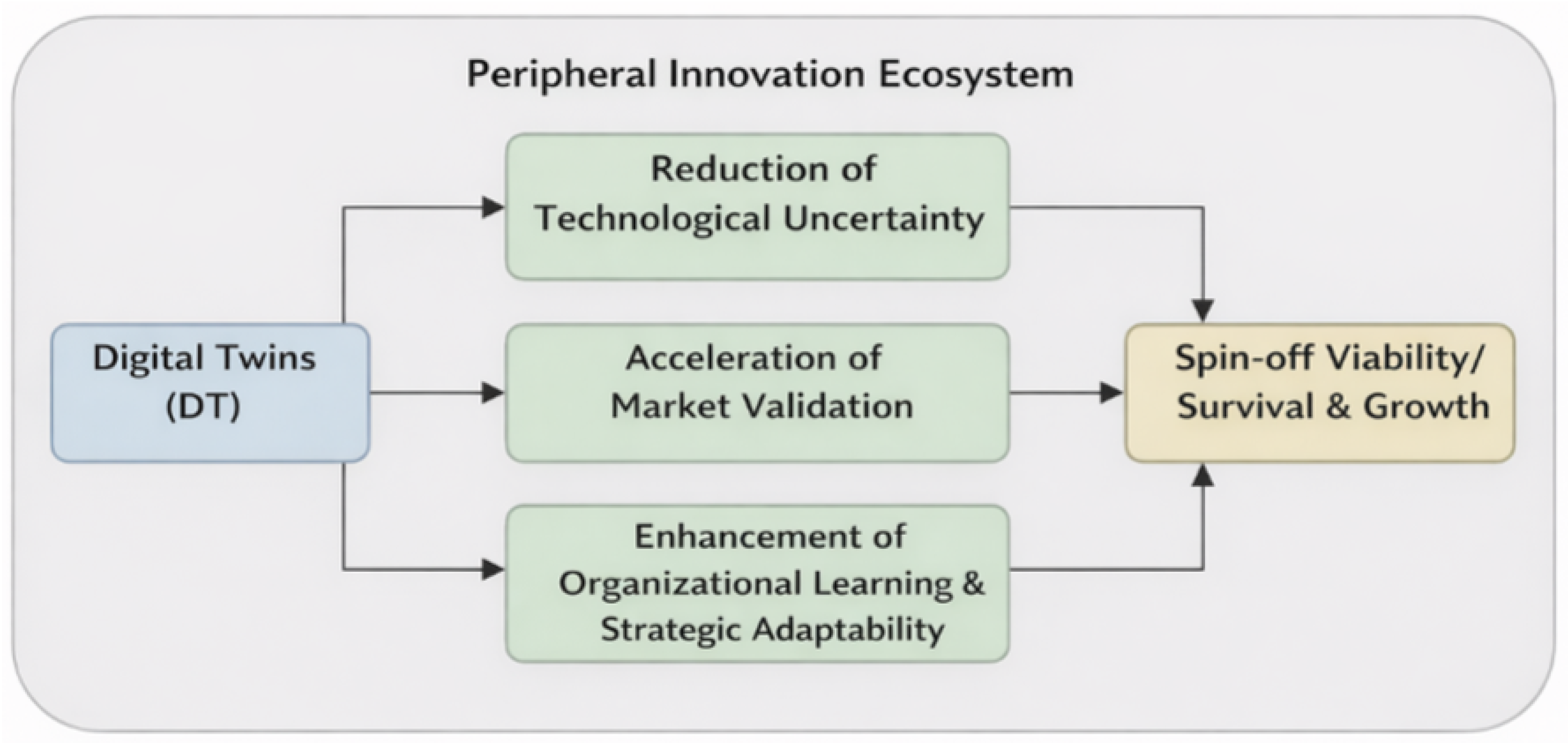
Figure 1 illustrates the core logic of the model. In the proposed framework, Digital Twins operate as a central enabling capability that activates three interrelated mechanisms: the reduction in technological uncertainty, the acceleration of market validation, and the enhancement of organizational learning and strategic adaptability. These mechanisms function as mediating processes linking Digital Twin adoption to venture-level outcomes such as spin-off viability, survival, and commercialization performance. The strength of these relationships may be moderated by contextual factors including ecosystem resource constraints, access to experimentation infrastructure, and policy support mechanisms. The framework also emphasizes that these effects unfold within peripheral innovation ecosystems, where limited access to capital, infrastructure, and early adopters increases the relative importance of DT-enabled experimentation and validation.
3.1. Mechanism 1: Reduction in Technological Uncertainty
Technological uncertainty represents a major barrier to deep-tech commercialization, particularly for academic spin-offs operating at early Technology Readiness Levels (TRLs). Complex technological interdependencies, extended development cycles, and costly prototyping increase failure risk and delay market entry.
Digital Twins can mitigate technological uncertainty by enabling high-fidelity virtual experimentation prior to physical deployment. Through real-time data synchronization, simulation-based testing, and predictive modelling, DTs facilitate the early identification of performance bottlenecks, scalability constraints, and design flaws [
1,
23]. This capability accelerates technological maturation and enhances stakeholder confidence by providing evidence-based validation of system robustness.
Beyond technical debugging, this mechanism also reduces epistemic uncertainty by shortening feedback loops between scientific research and application contexts. By supporting iterative refinement within controlled digital environments, DTs can accelerate progression along TRLs while strengthening external legitimacy in investor and industry evaluations [
42].
Proposition 1 (P1). Higher Digital Twin adoption intensity—reflected in the completeness of DT modules, bidirectional data integration, and model fidelity—is associated with reduced technological uncertainty in academic spin-offs, observable through faster progression across Technology Readiness Levels (TRLs) and increased stakeholder confidence.
3.2. Mechanism 2: Acceleration of Market Validation and Stakeholder Engagement
Beyond technical feasibility, the survival of academic spin-offs also depends on demonstrating market relevance. This process is particularly challenging in peripheral innovation ecosystems, where pilot customers and demonstration infrastructures are often scarce.
Digital Twins enable scenario-based modelling of product usage, operational environments, and system performance under varying conditions. Through interactive digital prototypes and virtual demonstrations, spin-offs can engage potential customers, co-create value propositions, and test product–market alignment before committing to costly physical deployment [
22,
25].
By facilitating early stakeholder interaction, DTs can reduce time to market, enhance proof-of-concept credibility, and increase investor confidence. Empirical and conceptual studies suggest that DT-enabled digital experimentation can accelerate development cycles in technology-intensive ventures, thereby supporting commercialization readiness and investment evaluation [
3].
In practice, market validation through Digital Twins may involve simulating operational environments in which potential customers or industrial partners interact with a virtual representation of the technology prior to physical deployment. Industrial virtual commissioning environments—such as those developed within advanced manufacturing and automation platforms—enable clients to test production workflows, system integration, and operational performance digitally before committing to new infrastructure investments [
4,
43]. Through such simulated demonstrations, stakeholders can evaluate system compatibility, anticipated performance outcomes, and implementation risks, thereby reducing uncertainty during early commercialization stages and strengthening confidence in technology adoption decisions.
Proposition 2 (P2). Greater use of Digital Twin-enabled experimentation—such as virtual demonstrations, scenario modelling, and interactive simulations—is associated with accelerated market validation, observable through shorter time-to-first pilot deployment and faster stakeholder feedback cycles.
3.3. Mechanism 3: Organizational Learning and Strategic Adaptability
Academic spin-offs operate in dynamic environments characterized by evolving technologies, shifting market conditions, and regulatory uncertainty [
28,
36]. Sustainable performance therefore depends on the development of dynamic capabilities that enable organizations to sense opportunities, seize them, and reconfigure resources accordingly [
42].
Digital Twins can strengthen organizational learning by embedding continuous experimentation and data-driven decision-making into venture operations. As digital representations evolve, founders can simulate alternative design choices and explore innovation pathways without incurring prohibitive physical costs [
29].
Over time, accumulated knowledge from digital experimentation contributes to firm-specific capabilities that are path-dependent and difficult to replicate. This process enhances strategic adaptability and strengthens venture resilience.
Proposition 3 (P3). Digital Twin-supported experimentation and data-driven decision processes contribute to organizational learning and dynamic capability development in academic spin-offs, observable through increased strategic adaptability and improved responsiveness to technological and market changes.
3.4. Ecosystem Moderation: The Amplifying Role of Peripheral Innovation Contexts
The strategic impact of Digital Twins is shaped by ecosystem characteristics. In peripheral innovation systems characterized by limited venture capital, weak industrial linkages, and restricted access to pilot infrastructures [
34], DTs can partially substitute for missing physical and institutional resources.
This substitution effect increases the relative importance of DT adoption. In core innovation hubs, Digital Twins may primarily function as efficiency-enhancing tools. In contrast, in peripheral ecosystems characterized by structural resource constraints [
38], DTs may act as survival infrastructures by enabling experimentation, validation, and legitimacy-building under conditions of scarcity.
Proposition 4 (P4). The positive relationship between Digital Twin adoption and spin-off viability is stronger in peripheral innovation ecosystems characterized by limited access to physical experimentation infrastructure, industrial partners, and venture capital.
3.5. Integrated Model and Propositional Summary
Table 2 summarizes the mechanisms, outcomes, and propositional structure of the framework.
To facilitate empirical validation of the proposed framework, the propositions can be operationalized through measurable constructs reflecting Digital Twin adoption intensity and venture-level outcomes. Drawing on research on digital capability and infrastructure maturity [
18,
44], DT adoption intensity may be assessed using indicators such as the completeness of DT modules, the degree of bidirectional data integration, model fidelity, and synchronization frequency [
4]. Observable outcomes may include the speed of Technology Readiness Level (TRL) progression [
45], reductions in experimentation costs [
29], shorter time-to-first paid pilot deployment [
9], and faster customer feedback cycles. The mechanisms proposed in the framework—technological uncertainty reduction, market validation acceleration, and organizational learning—can be conceptualized as mediating processes linking DT adoption to venture performance outcomes [
42]. Furthermore, the strength of these relationships may be moderated by contextual boundary conditions such as ecosystem resource constraints and industry capital intensity [
17,
38]. These operationalization pathways provide a foundation for future empirical studies aimed at testing and refining the proposed propositions across diverse technological and regional contexts.
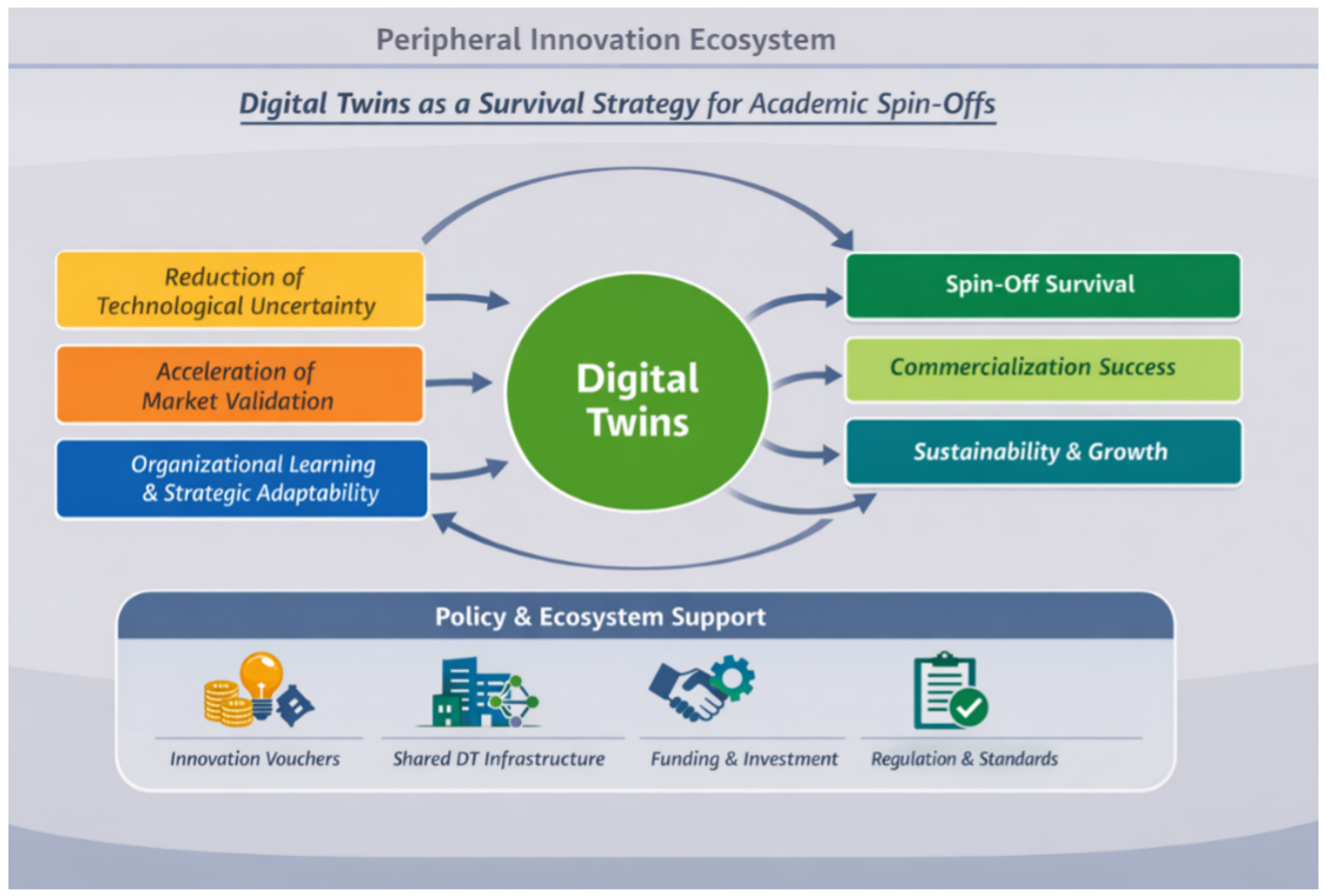
Figure 2 provides a holistic visualization of the framework. Digital Twin technologies operate as a central strategic hub connecting the three core mechanisms to spin-off survival, commercialization success, and long-term sustainability. Policy instruments and ecosystem support mechanisms—such as innovation vouchers, shared DT infrastructure, funding programs, and adaptive regulatory frameworks—can further reinforce these effects by lowering adoption barriers and facilitating ecosystem-level diffusion.
Together, the mechanisms articulated in this framework reconceptualize Digital Twins as entrepreneurial infrastructures embedded within the commercialization process. Rather than serving solely as operational tools, DTs function as strategic capabilities that integrate technological validation, market formation, and organizational learning into a coherent pathway toward sustainable venture growth.
4. Operationalizing Digital Twin Adoption: A Roadmap for Academic Spin-Offs
While the conceptual framework clarifies the mechanisms through which Digital Twins (DTs) enhance spin-off viability, translating these mechanisms into structured implementation pathways is essential for academic entrepreneurs, Technology Transfer Offices (TTOs), and policymakers. This section therefore proposes an evolutionary roadmap that aligns DT capability development with venture maturity, technology readiness progression, and sustainability objectives.
Rather than assuming uniform DT deployment, adoption is conceptualized as a staged process that co-evolves with venture development and ecosystem integration.
Importantly, the terminology used across the roadmap reflects different levels of Digital Twin maturity. Building on established distinctions between Digital Models, Digital Shadows, and fully operational Digital Twins [
16], ventures at the earliest stages (TRL1–2) typically develop conceptual models or “twin-inspired” simulation environments rather than fully integrated Digital Twin systems. As technologies mature and data infrastructures evolve, these representations progressively acquire defining DT characteristics, including bidirectional data exchange, higher model fidelity, and operational integration with physical assets [
2]. When aligned with Technology Readiness Level progression [
45], the roadmap therefore describes an evolutionary trajectory from early digital modelling toward fully operational Digital Twin infrastructures.
Conceptually, the proposed roadmap represents a design-oriented extension of the theoretical framework, translating dynamic capability mechanisms and Digital Twin functionalities into actionable developmental stages for academic spin-offs.
To enhance the practical applicability of the roadmap, each stage may be interpreted as a decision point at which ventures evaluate whether sufficient technical and organizational capabilities exist to progress toward more advanced Digital Twin implementations. Consistent with staged investment and real-options reasoning under uncertainty [
22], early-stage ventures (TRL1–2) typically develop minimum viable digital configurations consisting of conceptual models or “twin-inspired” simulations supported by limited data infrastructures. As ventures progress to intermediate stages (TRL3–5), DT capability packages expand to include structured data pipelines, higher-fidelity models, and iterative experimentation environments requiring increased computational resources and specialized analytical skills [
4,
20]. During later commercialization stages (TRL6–9), operational Digital Twin infrastructures require real-time data integration, scalable computing environments, and organizational processes capable of supporting continuous monitoring and system optimization [
2,
17]. At each stage, ventures may evaluate milestones such as prototype validation, pilot deployment readiness, or partner engagement outcomes in order to determine whether to scale Digital Twin capabilities further or pivot technological strategies, consistent with staged entrepreneurial development models in academic spin-offs [
9].
4.1. Stage 1: Research Translation and Concept Validation (TRL 1–2)
During early research translation, Digital Twins function primarily as exploratory modelling tools that support feasibility assessment and early system architecture design.
At this stage, DT capabilities typically include conceptual simulations, preliminary system modelling, and scenario-based feasibility testing. These tools allow academic teams to identify technical bottlenecks, test assumptions in virtual environments, and allocate research resources more efficiently before engaging in costly physical prototyping.
From a sustainability perspective, early digital experimentation can reduce premature material consumption and support more responsible commercialization pathways.
4.2. Stage 2: Prototype Development and Technical Validation (TRL 3–5)
As ventures progress toward prototype development, Digital Twins transition into validation infrastructures. High-fidelity simulation, predictive modelling, and iterative performance testing enable spin-offs to refine system configurations and detect design limitations before physical deployment.
This capability accelerates progression along Technology Readiness Levels (TRLs), strengthens technological credibility, and reduces dependence on scarce physical test facilities—an especially critical function in peripheral innovation ecosystems.
Virtual experimentation at this stage decouples technological learning from material resource intensity, thereby supporting capital-efficient and sustainable venture development.
4.3. Stage 3: Market Validation and Stakeholder Engagement (TRL 6–7)
In early commercialization phases, Digital Twins facilitate interactive stakeholder engagement. Through virtual demonstrations, scenario modelling, and performance simulations under varied operating conditions, spin-offs can test product–market alignment and co-create value propositions with potential customers and partners.
These capabilities reduce time to market, enhance proof-of-concept credibility, and increase investor confidence. In peripheral ecosystems, DT-enabled virtual demonstrations may partially substitute for limited access to industrial pilot infrastructures and early adopters.
4.4. Stage 4: Scaling, Ecosystem Integration, and Sustainability Optimization (TRL 8–9)
At advanced commercialization stages, Digital Twins evolve into integrated digital infrastructures that support scaling and long-term sustainability optimization.
Continuous monitoring, predictive analytics, and system-level modelling enable ventures to optimize supply chains, improve operational efficiency, and assess environmental performance. At this level, DTs function not only as commercialization enablers but also as systemic infrastructures supporting sustainable growth and ecosystem integration.
To further enhance the practical applicability of the roadmap, each stage may be interpreted as the development of a Minimum Viable Digital Twin (MVDT) capability package aligned with venture maturity and staged investment logic [
9]. At early stages (TRL1–2), MVDT capabilities typically involve conceptual modelling environments supported by limited data inputs and modest computational resources, enabling feasibility exploration with minimal material and financial commitment [
16]. During intermediate stages (TRL3–5), ventures expand these capabilities through structured data pipelines, higher-fidelity simulation models, and increased analytical expertise, enabling systematic technical validation and iterative experimentation [
2,
4]. In later stages (TRL6–9), operational Digital Twin infrastructures require real-time data integration, scalable computing environments, and organizational processes supporting continuous monitoring and optimization [
2,
17]. Each stage therefore involves milestone-based evaluation points that guide decisions to scale DT capabilities further or pivot technological strategies, consistent with staged entrepreneurial development models [
22]. Importantly, these staged capability packages also align with sustainability objectives by encouraging resource-efficient experimentation, reduced reliance on physical prototyping, and more informed capital allocation decisions throughout commercialization [
17,
29].
4.5. Alignment with Sustainable Development Objectives
Beyond venture-level benefits, Digital Twin adoption also aligns with broader sustainability objectives.
Table 3 summarizes the relationship between key DT mechanisms and the Sustainable Development Goals (SDGs).
4.6. Digital Twin Readiness Assessment
To support practical implementation,
Table 4 provides a structured readiness assessment tool for academic spin-offs and university support mechanisms.
This roadmap operationalizes the conceptual framework by translating theoretical mechanisms into a staged model of capability development and sustainable commercialization. In doing so, it reinforces the interpretation of Digital Twins as entrepreneurial infrastructures that evolve alongside venture maturity and sustainability objectives.
Illustrative industry cases in aviation and energy systems demonstrate staged Digital Twin adoption pathways that resemble the proposed roadmap [
1,
4]. In these contexts, DT implementations often evolve from early modelling and simulation environments toward integrated operational infrastructures as systems progress from design and testing phases to full deployment and lifecycle management [
2]. Such staged implementations illustrate how Digital Twin capabilities can co-evolve with technological maturity and organizational learning processes, supporting experimentation, system validation, and operational optimization throughout the innovation lifecycle. Although the present framework remains conceptual, existing industrial trajectories demonstrate the practical plausibility of staged DT adoption in technology-intensive environments.
To enhance practical usability, the readiness assessment dimensions presented in
Table 4 may be operationalized through simple scoring rules. Each dimension can be evaluated using staged maturity assessment approaches commonly employed in digital capability and IT management research [
46,
47]. Evaluation may rely on qualitative scales (e.g., low, medium, high) or numerical scoring systems reflecting the maturity of data infrastructure, modelling capabilities, stakeholder engagement mechanisms, institutional support, and sustainability integration [
18,
44]. Threshold values, conceptually aligned with staged readiness models such as Technology Readiness Levels [
45], can indicate when ventures are positioned to progress toward more advanced Digital Twin implementations. For example, ventures demonstrating stable data pipelines, validated simulation models, and structured stakeholder interaction mechanisms may exhibit higher DT readiness, whereas limited data availability or the absence of modelling infrastructure would indicate lower maturity levels. Such scoring approaches may support technology transfer offices and spin-off support structures in systematically assessing Digital Twin capability maturity and identifying priority areas for development [
48].
5. Implications and Future Research
5.1. Theoretical Implications
This study advances the literature on digital innovation, academic entrepreneurship, and sustainability-oriented innovation by reframing Digital Twin (DT) technologies as strategic capabilities rather than merely operational efficiency tools. While prior DT research has largely emphasized performance optimization in established industrial settings, entrepreneurship scholarship has paid limited attention to how specific digital infrastructures actively shape commercialization trajectories in early-stage ventures. By integrating these domains, the present framework contributes to a more granular understanding of how digital infrastructures influence learning dynamics, uncertainty reduction, and capability formation in academic spin-offs.
First, the study extends digital innovation theory by conceptualizing DTs as generative entrepreneurial infrastructures that embed experimentation, simulation, and validation directly into venture development processes. Rather than supporting isolated decision-making episodes, DTs restructure the logic of experimentation itself, enabling parallel scenario modelling, predictive simulation, and iterative refinement under resource constraints. This repositioning aligns DT scholarship with dynamic capabilities theory, highlighting their role in sensing, seizing, and reconfiguring opportunities in uncertain environments.
Second, the framework contributes to academic entrepreneurship research by introducing a technology-centred lens to commercialization studies. Traditional institutional perspectives emphasize intellectual property regimes, university policies, and ecosystem support structures. While valuable, these approaches often treat technology as a static input. In contrast, this study conceptualizes Digital Twins as active mechanisms that shape venture-level strategic agency, technological maturation, and market legitimacy. By foregrounding digital experimentation as a core entrepreneurial process, the framework bridges the gap between institutional theory and capability-based explanations of spin-off performance.
Third, the study advances research on peripheral innovation ecosystems. Existing regional innovation literature focuses primarily on structural disadvantages such as limited capital access and weak knowledge spillovers. The present framework demonstrates that advanced digital infrastructures can partially compensate for such deficiencies. By enabling virtual experimentation, remote stakeholder engagement, and distributed validation, DTs reshape the relationship between ventures and their surrounding ecosystems. This perspective enriches ongoing debates on how digitalization transforms spatial constraints and reshapes innovation geographies.
Collectively, these contributions reposition Digital Twins within entrepreneurship theory as foundational infrastructures that influence both micro-level capability development and macro-level ecosystem dynamics.
5.2. Managerial Implications for Academic Spin-Offs and Technology Transfer Offices
The managerial implications presented in this section derive from the conceptual framework developed in this study and should therefore be interpreted as theoretically grounded guidance rather than empirically validated prescriptions. For founders of academic spin-offs, early integration of strategic capabilities has been shown to influence venture trajectories and growth potential [
9,
48]. In this context, embedding Digital Twin infrastructures into product development, business model experimentation, and investor engagement processes may contribute to technological uncertainty reduction [
42], accelerated validation cycles through iterative experimentation [
29], and enhanced legitimacy in the eyes of external stakeholders and investors [
49,
50].
By leveraging DT-enabled simulations and interactive prototypes, spin-offs can strengthen communication with heterogeneous stakeholders, including investors, industrial partners, and regulatory actors. This communicative function is particularly valuable for deep-tech ventures whose technological complexity may otherwise create cognitive barriers during early negotiations.
Technology Transfer Offices (TTOs) play a critical intermediary role in this process. Universities can enhance commercialization outcomes by recognizing Digital Twin infrastructures as strategic commercialization assets. This may involve integrating DT development into proof-of-concept funding schemes, facilitating shared access to computational resources, and establishing centralized digital experimentation platforms. By institutionalizing DT support, universities can increase spin-off market readiness while reducing early-stage failure risks.
5.3. Policy Implications
From a policy perspective, the framework underscores the strategic importance of investing in accessible Digital Twin infrastructures within entrepreneurial universities and regional innovation systems. In peripheral economies where physical test facilities and industrial pilot environments are scarce, digital experimentation platforms may generate disproportionately high returns by lowering barriers to technological validation.
Beyond commercialization efficiency, Digital Twins can also contribute to broader sustainability objectives. When integrated with complementary technologies such as blockchain and advanced analytics, DTs can support low-carbon supply chain optimization, traceability [
51], and circular economy practices [
52]. These capabilities align DT infrastructures with Sustainable Development Goals (SDGs) and environmentally responsible production systems.
Targeted policy instruments—including innovation vouchers, digital infrastructure grants, and shared experimentation platforms—can facilitate early-stage DT adoption. For example, Austria’s Innovation Voucher programme enables SMEs to access up to €10,000 in research services from universities, strengthening collaborative innovation capacity. Similar initiatives operate in Cyprus (INNOVOUCHERS), Finland (Business Finland Innovation Voucher), and Ireland, lowering barriers to R&D infrastructure access. In Greece, although voucher schemes are less formalized, programmes under the Operational Programme “Competitiveness, Entrepreneurship and Innovation” (EPAnEK 2014–2020) have supported university–industry collaboration and spin-off development. At the European level, coordinated voucher initiatives further promote cross-border research cooperation and digital infrastructure diffusion.
These examples illustrate that policy design can move beyond sectoral subsidies toward enabling digital experimentation ecosystems. By prioritizing DT accessibility, training, and shared platforms, policymakers can foster resilient, inclusive, and sustainability-oriented commercialization pathways.
5.4. Reconceptualizing Digital Twins as Entrepreneurial Infrastructure
A central implication of this study lies in reinterpreting Digital Twins as entrepreneurial infrastructure rather than purely engineering artefacts. Unlike traditional simulation tools, DTs establish continuous feedback loops between physical systems, digital representations, and organizational decision-making processes [
5,
6]. This infrastructural role becomes particularly important in research-driven ventures, where uncertainty is systemic rather than episodic, emerging from continuous technological experimentation, evolving market validation requirements, and iterative commercialization processes [
28,
42].
From an entrepreneurship perspective, Digital Twins enable anticipatory innovation practices by supporting forward-looking experimentation prior to major resource commitments [
22]. Through advanced modelling and simulation, spin-offs can explore future technological and operational states before committing to irreversible investments [
53]. This fundamentally transforms experimentation logic: rather than relying on sequential trial-and-error processes, ventures can conduct parallel scenario testing, thereby accelerating learning while conserving scarce resources.
Moreover, DTs operate as boundary-spanning artefacts. By translating complex scientific knowledge into interactive visualizations and simulations, they reduce cognitive distance between founders, investors, industrial partners, and regulators [
54,
55]. This communicative capacity facilitates alignment around technological trajectories and commercialization strategies.
Over time, sustained interaction with DT infrastructures shapes organizational routines and strengthens dynamic capabilities. Data-driven experimentation, systematic reflection, and adaptive strategy formulation become embedded within venture processes, reinforcing resilience and long-term competitiveness.
At the same time, the deployment of Digital Twin infrastructures may encounter several failure modes and governance challenges that warrant careful consideration. Limitations related to data quality, incomplete sensor coverage, and fragmented data pipelines may reduce the reliability of digital representations and compromise predictive performance [
4,
20]. Over time, predictive models embedded within DT systems may suffer from concept drift, whereby models gradually diverge from real-world system behaviour if not systematically recalibrated [
56]. In addition, excessive reliance on simulation outputs may generate epistemic overconfidence or “false certainty” in complex socio-technical environments [
57]. These risks underscore the importance of governance mechanisms supporting Digital Twin infrastructures, including robust data quality assurance, systematic model validation protocols, interoperable data standards, and clearly defined accountability structures [
17]. Addressing these governance requirements is essential to ensure that DT implementations remain reliable, transparent, and aligned with principles of responsible innovation [
58].
5.5. Sustainability Implications for Academic Spin-Offs
It is important to acknowledge that the sustainability implications of Digital Twins are not universally positive and remain the subject of ongoing debate. While Digital Twin technologies can enhance resource efficiency and reduce material waste through improved lifecycle optimization [
2,
16], their implementation relies on digital infrastructures that require computational resources, data storage capacity, and cloud-based processing. The environmental footprint of digital infrastructures—including the energy consumption of data centers and the production of hardware—has been widely documented in ICT sustainability research [
59]. Consequently, recent scholarship emphasizes that the overall sustainability impact of digital technologies depends on the balance between operational efficiency gains and the additional environmental burden generated by supporting digital infrastructures [
60]. Assessing the sustainability contribution of Digital Twins therefore requires a holistic perspective that integrates both system-level optimization benefits and the broader environmental implications of digitalization, consistent with emerging sustainability paradigms [
61].
In addition to environmental considerations, broader societal implications of advanced digital infrastructures have attracted increasing scholarly attention. Research on data-driven organizational technologies has raised concerns regarding data governance, algorithmic management, and workplace monitoring practices [
62,
63]. In industrial contexts where Digital Twins are used to monitor equipment performance or operational processes, these systems may also generate granular behavioural and operational data, potentially reshaping organizational transparency and control dynamics. Such developments have been discussed within wider debates on digital surveillance, data capitalism, and the governance of digital infrastructures [
64,
65,
66], underscoring the need for transparent governance structures, ethical data management protocols, and regulatory safeguards. Addressing these concerns is therefore essential to ensure that Digital Twin deployment aligns with responsible innovation principles and sustainable development objectives [
58].
Sustainability in the context of academic spin-offs extends beyond environmental metrics to encompass organizational endurance, economic viability, and innovation system resilience. In peripheral ecosystems, sustainability is closely linked to the capacity of ventures to overcome structural constraints and maintain adaptive momentum over time.
To avoid conceptual ambiguity, sustainability in this study is interpreted through three complementary dimensions widely discussed in sustainability-oriented innovation research [
61]. Environmental sustainability refers to reductions in material waste, energy use, and environmental impact during technological experimentation and product development processes. Digital Twin technologies may contribute to this dimension through virtual experimentation that reduces reliance on physical prototyping and material inputs [
2,
29]. Economic sustainability relates to the long-term viability of ventures, including efficient resource allocation, capital efficiency, and sustained innovation capability development [
9,
42]. Social sustainability concerns broader societal and ecosystem-level impacts, including inclusive access to innovation infrastructures, responsible data governance, and the strengthening of regional innovation networks [
38,
58]. Through digitally enabled collaboration and distributed experimentation infrastructures, Digital Twins may influence social sustainability by facilitating broader participation in advanced technological development processes [
41].
Digital Twins contribute to sustainability by decoupling experimentation from physical resource intensity. Virtual testing reduces material waste, lowers prototyping costs, and shortens development cycles, enabling capital-efficient growth strategies. This is particularly critical during early-stage development when financial fragility is highest.
Additionally, DT-enabled learning strengthens long-term adaptability. Continuous simulation and feedback loops facilitate strategic pivots, resource reconfiguration, and dynamic business model adjustment. These processes align with dynamic capabilities theory and enhance both venture-level and ecosystem-level resilience.
At the regional level, Digital Twins mitigate spatial disadvantages by substituting physical experimentation with digital infrastructure. This reduces dependence on geographically concentrated innovation assets and allows spin-offs in smaller economies to participate more effectively in global innovation networks.
Taken collectively, these findings reposition Digital Twins within sustainability-oriented innovation discourse. Rather than functioning solely as efficiency-enhancing technologies in mature industries, DTs operate as foundational infrastructures supporting resilient, inclusive, and sustainable entrepreneurial ecosystems. This reconceptualization provides a foundation for future empirical testing and cross-regional comparative analysis.
6. Theoretical Contributions
To clarify the novelty of the proposed framework, it is important to distinguish Digital Twin technologies from adjacent digital tools such as conventional simulation models, digital prototyping environments, or standalone data analytics platforms. Established classifications differentiate Digital Twins from digital models and digital shadows based on the presence of bidirectional data exchange between physical and digital systems [
16]. While conventional simulation tools typically rely on static or one-directional data flows, Digital Twins integrate real-time synchronization, predictive modelling, and continuous feedback loops across the technology lifecycle [
2,
4]. This bidirectional coupling enables dynamic monitoring, iterative validation, and adaptive system optimization beyond episodic experimentation. As such, Digital Twins function not merely as analytical tools but as persistent digital infrastructures embedded within socio-technical systems [
1], linking technological development, stakeholder interaction, and organizational learning processes in real time.
This distinction becomes particularly important in peripheral and resource-constrained innovation ecosystems characterized by limited institutional thickness and reduced access to experimentation infrastructures [
37,
38]. In such contexts, academic spin-offs frequently face constraints in accessing pilot customers, complementary assets, and advanced testing facilities [
9,
48]. Digital infrastructures have been shown to partially mitigate spatial and resource constraints by enabling distributed collaboration and remote experimentation [
40,
41]. Within these environments, Digital Twins may function as experimentation infrastructures that substitute for missing physical facilities, enabling virtual validation and iterative development across geographically dispersed networks [
2]. Under these boundary conditions, DT-enabled experimentation may not merely improve efficiency but may alter the feasibility conditions of technology commercialization. This perspective aligns with dynamic capability arguments emphasizing the role of organizational mechanisms that enable sensing, validation, and adaptation under uncertainty [
42], thereby framing Digital Twins as potential survival-enabling infrastructures in structurally constrained innovation environments.
This study advances theory at the intersection of digital innovation, academic entrepreneurship, and sustainability-oriented commercialization by reconceptualizing Digital Twin (DT) technologies as strategic entrepreneurial infrastructures. Rather than viewing commercialization as a predominantly stage-based process progressing from laboratory discovery to prototype development and market entry [
9], the proposed framework positions DTs as integrative mechanisms that collapse temporal and structural boundaries between research, validation, and strategic adaptation [
67].
By embedding simulation, predictive modelling, and iterative experimentation into the entrepreneurial process, Digital Twins transform commercialization from a sequential pipeline into a recursive and data-driven learning system. This perspective extends existing research by highlighting how Digital Twin infrastructures may shape commercialization processes in early-stage ventures, complementing insights from dynamic capabilities and digital innovation literature.
6.1. Extending Digital Twin Theory into Entrepreneurship
First, the study extends Digital Twin theory beyond industrial efficiency contexts into entrepreneurial settings. Existing DT scholarship has largely focused on operational optimization within established firms. By contrast, the present framework conceptualizes DTs as entrepreneurial infrastructures that mediate interaction between scientific knowledge, market actors, and organizational decision-making processes.
DTs function as boundary-spanning artefacts that reduce cognitive distance among heterogeneous stakeholders—including researchers, engineers, investors, and industrial partners—by translating complex technical information into interactive simulations and visual representations [
54,
55]. This interpretive and communicative capacity strengthens legitimacy formation and helps align technological trajectories with stakeholder expectations [
49].
Theoretically, this reframing integrates Digital Twin scholarship with dynamic capabilities research, demonstrating that digital infrastructures embedded within entrepreneurial decision-making processes can accelerate sensing, seizing, and reconfiguring activities [
26,
42]. In doing so, the study positions DTs not merely as technical systems but as capability-generating architectures within entrepreneurial ecosystems.
6.2. Reframing Deep-Tech Commercialization Logics
Second, the study contributes to commercialization theory by reshaping how deep-tech ventures are conceptualized. Traditional commercialization models assume a temporal separation between research and market validation, typically characterized by costly prototyping phases and sequential experimentation.
DT-enabled ventures, however, engage in continuous technical and market validation, effectively compressing the temporal distance between R&D activities and market readiness [
53,
68]. Through scenario modelling, virtual piloting, and predictive simulation, spin-offs can test assumptions regarding scalability, regulatory compliance, and customer adoption before committing to large-scale investment decisions.
This reconceptualization advances commercialization theory by demonstrating that digital infrastructure fundamentally alters experimentation logic. Instead of relying on linear trial-and-error processes, ventures engage in parallel, simulation-based experimentation. This introduces a model of iterative, evidence-based commercialization grounded in digital infrastructure, thereby expanding theoretical understandings of technology-driven entrepreneurship.
6.3. Digital Infrastructure as a Driver of Dynamic Capability Formation
Third, the study advances dynamic capabilities theory by illustrating how Digital Twins contribute to the development of organizational capabilities. Continuous interaction with DT systems embeds data-driven monitoring, systematic experimentation, and reflective learning into venture routines. These practices foster path-dependent capability accumulation, enabling ventures to reconfigure resources and pivot strategically under conditions of uncertainty [
26,
69,
70].
Importantly, this contribution shifts the focus from digital tools as performance enhancers to digital infrastructures as capability architects. DTs do not merely optimize existing processes; they reshape organizational cognition, experimentation norms, and strategic adaptation pathways. This insight expands the theoretical boundaries of digital entrepreneurship by demonstrating that infrastructure-level technologies influence both strategic behaviour and organizational evolution.
6.4. Integrating Knowledge, Market, and Organizational Domains
Finally, the framework contributes by integrating knowledge creation, market formation, and organizational learning into a unified theoretical architecture. Rather than treating these domains as analytically separate, the model demonstrates their interdependence within DT-enabled ventures.
Digital Twins simultaneously function as technological artefacts (supporting knowledge validation), strategic tools (enabling market engagement), and organizational enablers (fostering learning and adaptation) [
54,
55]. By linking these domains, the study synthesizes insights from innovation management, entrepreneurship theory, and digital transformation research.
This integrative perspective encourages future research to examine Digital Twins not as isolated technological implementations, but as systemic infrastructures shaping entrepreneurial capability development, legitimacy formation, and commercialization trajectories in tandem. In doing so, the study advances a multi-level theoretical understanding of how digital infrastructures reshape academic entrepreneurship, particularly within resource-constrained and peripheral innovation ecosystems.
7. Policy and Ecosystem Implications
To align the policy discussion with the theoretical framework, Digital Twin–related policy instruments can be categorized according to established innovation policy typologies [
71,
72]. Infrastructure-oriented policies that provide shared digital experimentation facilities and interoperable data platforms strengthen uncertainty-reduction mechanisms by addressing structural resource constraints [
38]. Demand-side instruments such as innovation vouchers, pilot procurement, and proof-of-concept funding facilitate early-stage validation and stakeholder engagement, reinforcing market formation processes [
71,
73]. Capability-building policies—including training programs, research collaborations, and university-based competence centers—support organizational learning and entrepreneurial competence development [
48]. Finally, regulatory and governance-oriented instruments—such as data interoperability standards and cybersecurity frameworks—create institutional conditions that enable the systemic diffusion and responsible adoption of Digital Twin infrastructures [
74].
7.1. Universities and Research Institutions as Digital Infrastructure Anchors
Universities and research institutions function as central actors in shaping the commercialization trajectories of academic spin-offs. Beyond their traditional roles in intellectual property management and proof-of-concept funding, universities can also act as digital infrastructure anchors by providing access to shared Digital Twin (DT) platforms, high-performance simulation environments, and interoperable data ecosystems.
Access to institutional DT infrastructure lowers entry barriers for early-stage ventures, accelerates technology validation, and enhances market readiness—particularly during pre-revenue phases characterized by financial fragility [
5,
28]. By embedding Digital Twin capabilities within university incubation programs and Technology Transfer Office (TTO) support mechanisms, institutions can reduce experimentation costs while strengthening spin-off credibility in interactions with investors, industrial partners, and public stakeholders.
Importantly, this infrastructural role reframes universities from passive technology transfer intermediaries into active co-creators of digital experimentation ecosystems.
7.2. Digital Twins as Ecosystem Coordination Infrastructure
At the ecosystem level, Digital Twins operate as coordination infrastructures that reduce information asymmetries and facilitate cross-organizational collaboration [
75]. By providing transparent, data-driven representations of technological performance and development trajectories, DTs can enhance trust among industry partners, investors, regulators, and research institutions [
54].
In peripheral innovation ecosystems, where relational density and industrial embeddedness may be limited, such digital transparency mechanisms are particularly valuable. The establishment of regional Digital Twin centres, shared simulation hubs, and high-technology incubators can strengthen collective learning and international competitiveness. For economies such as Greece, investment in interoperable DT platforms may partially offset geographic peripherality and increase participation in global innovation networks.
7.3. Regulatory Adaptation and Standardization Frameworks
As Digital Twin adoption expands across sectors, regulatory systems may need to evolve to accommodate virtual testing, simulation-based certification, and cross-domain experimentation. In highly regulated sectors such as healthcare and energy, the increasing reliance on DT-driven optimization requires clear frameworks governing data integrity, cybersecurity, intellectual property protection, and ethical compliance [
68].
Standardization of DT architectures, data formats, and interoperability protocols further enhances scalability and cross-sector diffusion. Harmonized standards reduce fragmentation, facilitate technology transfer, and support the development of transnational innovation ecosystems. Policymakers should therefore view DT standardization not merely as a technical issue but as a strategic enabler of sustainable commercialization.
7.4. Strategic Funding and Evidence-Based Investment Allocation
Digital Twin-enabled experimentation provides investors and funding agencies with richer evidence regarding technological feasibility, scalability potential, and regulatory readiness. By reducing epistemic uncertainty, DT infrastructures improve evidence-based risk assessment and contribute to more efficient capital allocation.
Funding programs may further amplify these benefits by incentivizing collaborative DT projects involving universities, industry partners, and start-ups. Embedding DT infrastructure within publicly funded R&D initiatives can reduce duplication of effort while aligning resource allocation with sustainability objectives [
54,
55]. Such funding architectures are likely to support long-term value creation rather than short-term experimentation cycles [
76].
7.5. Innovation Vouchers as Enablers of Digital Experimentation
Innovation vouchers represent a targeted policy instrument designed to reduce barriers to innovation by facilitating access to research infrastructure and specialized expertise (OECD, 2020). For academic spin-offs operating in resource-constrained ecosystems, vouchers can enable early-stage experimentation, validation, and market-oriented learning.
Digital Twin infrastructures align closely with voucher objectives, as they can reduce reliance on capital-intensive physical prototyping through the use of virtual simulation and predictive modelling [
54,
77]. By designating DT access as an eligible voucher expenditure, policymakers reposition digital experimentation as shared public innovation infrastructure rather than as a discretionary firm-level investment.
For deep-tech spin-offs characterized by long development cycles and limited testbed access [
9,
10], voucher-supported DT utilization may contribute to accelerating commercialization readiness while generating behavioural additionality—encouraging systematic experimentation and data-driven decision-making [
78].
While programmes such as Greece’s Operational Programme “Competitiveness, Entrepreneurship and Innovation” (EPAnEK, NSRF 2014–2020) provide broader enterprise support, voucher-based mechanisms offer targeted access to simulation platforms and specialized mentorship. Combining structural funding programmes with DT-enabled vouchers promotes efficient resource allocation and strengthens ecosystem-level sustainability.
At the same time, policy interventions promoting Digital Twin adoption may generate unintended consequences if not carefully designed. Innovation subsidies have been shown to create risks of moral hazard and resource misallocation when technological capabilities are insufficiently mature [
79,
80]. Excessive reliance on specific digital platforms may also generate technological lock-in and path dependency effects that reduce interoperability across ecosystems [
81]. Furthermore, expanded data collection and system monitoring associated with Digital Twin infrastructures raise important concerns regarding cybersecurity, data governance, and algorithmic accountability [
17,
63]. Policymakers therefore face the challenge of designing balanced policy mixes that support digital experimentation while safeguarding technological quality, interoperability, and responsible data governance within emerging innovation ecosystems [
71,
72].
More broadly, integrating Digital Twins into voucher-based and mission-oriented innovation policies can align with sustainability-driven development strategies emphasizing resource efficiency, reduced environmental impact, and accelerated learning through digitalization [
76].
8. Conclusions and Future Work
This paper conceptualizes Digital Twin (DT) technologies as strategic infrastructures that may support the survival and sustainable commercialization of academic spin-offs operating within peripheral and resource-constrained innovation ecosystems. While existing DT scholarship has predominantly focused on operational optimization and industrial efficiency applications [
4,
16], its strategic relevance for early-stage, research-driven ventures has received limited theoretical attention. At the same time, the academic spin-off literature highlights persistent challenges in bridging scientific discovery and market readiness, particularly under conditions of resource scarcity and institutional thinness [
9,
48]. Addressing this intersection, the present study develops a conceptual framework that positions Digital Twins as enabling mechanisms linking scientific experimentation, market validation, and organizational capability development, thereby contributing to more sustainable commercialization pathways.
The framework demonstrates that Digital Twins may enhance spin-off performance through three interrelated mechanisms. First, they reduce technological uncertainty by enabling high-fidelity simulation, virtual testing, and iterative refinement without relying exclusively on costly physical prototyping. Second, they accelerate market validation by facilitating early stakeholder engagement, scenario-based modelling, and evidence-driven decision-making. Third, they strengthen organizational learning and strategic adaptability by embedding dynamic capability development within venture routines and enabling flexible responses to evolving technological and market conditions. Collectively, these mechanisms reposition Digital Twins as entrepreneurial infrastructures shaping capability formation, legitimacy building, and commercialization trajectories.
The analysis further highlights the amplifying role of policy instruments. Innovation vouchers, when structured to provide access to Digital Twin infrastructure, mentorship, and simulation platforms, can significantly enhance commercialization readiness—particularly in ecosystems characterized by financial and infrastructural constraints. While national and EU-funded programmes such as the Operational Programme “Competitiveness, Entrepreneurship and Innovation” (EPAnEK, NSRF 2014–2020) have provided broad enterprise support in Greece, voucher-based mechanisms operate as complementary tools that grant targeted access to digital experimentation infrastructure. By lowering barriers to virtual prototyping and validation, such instruments promote resource-efficient innovation and strengthen sustainable development pathways within peripheral ecosystems.
Future research should empirically examine the propositions developed in this study across diverse technological domains and regional contexts. Longitudinal case studies could investigate how DT-enabled experimentation reshapes commercialization pathways over time, while quantitative analyses may assess the relationship between DT adoption intensity and measurable performance outcomes such as time to market, funding acquisition, and venture survival rates. Comparative studies between core and peripheral innovation ecosystems would further clarify the moderating role of spatial and institutional conditions. Additionally, future research may explore complementarities between Digital Twins and emerging technologies—including artificial intelligence, advanced analytics, and blockchain—to better understand how integrated digital infrastructures influence sustainability-oriented commercialization.
By positioning Digital Twins as strategic, capability-generating, and policy-enabled infrastructures, this study contributes to a deeper understanding of how digitalization restructures academic entrepreneurship. Rather than functioning solely as efficiency-enhancing tools within mature industries, Digital Twins may function as enabling digital infrastructures that support more resilient and sustainability-oriented spin-off ecosystems.