Digital Finance, Innovation Value Chains, and the Formation of New Productivity: Evidence from Technology-Based SMEs

Abstract
1. Introduction
2. Literature Review
2.1. Digital Finance and SME Innovation: Mechanisms and Empirical Evidence
2.2. Theoretical Foundations of New-Quality Productive Forces: Evolution and Debates
2.3. Synergistic Mechanisms: Digital Finance as a Catalyst for NQPF
2.4. Research Gaps and This Study’s Contribution
3. Theoretical Basis and Hypothesis Analysis
3.1. The Impact of Digital Finance on Technological Innovation in Technology-Based SMEs
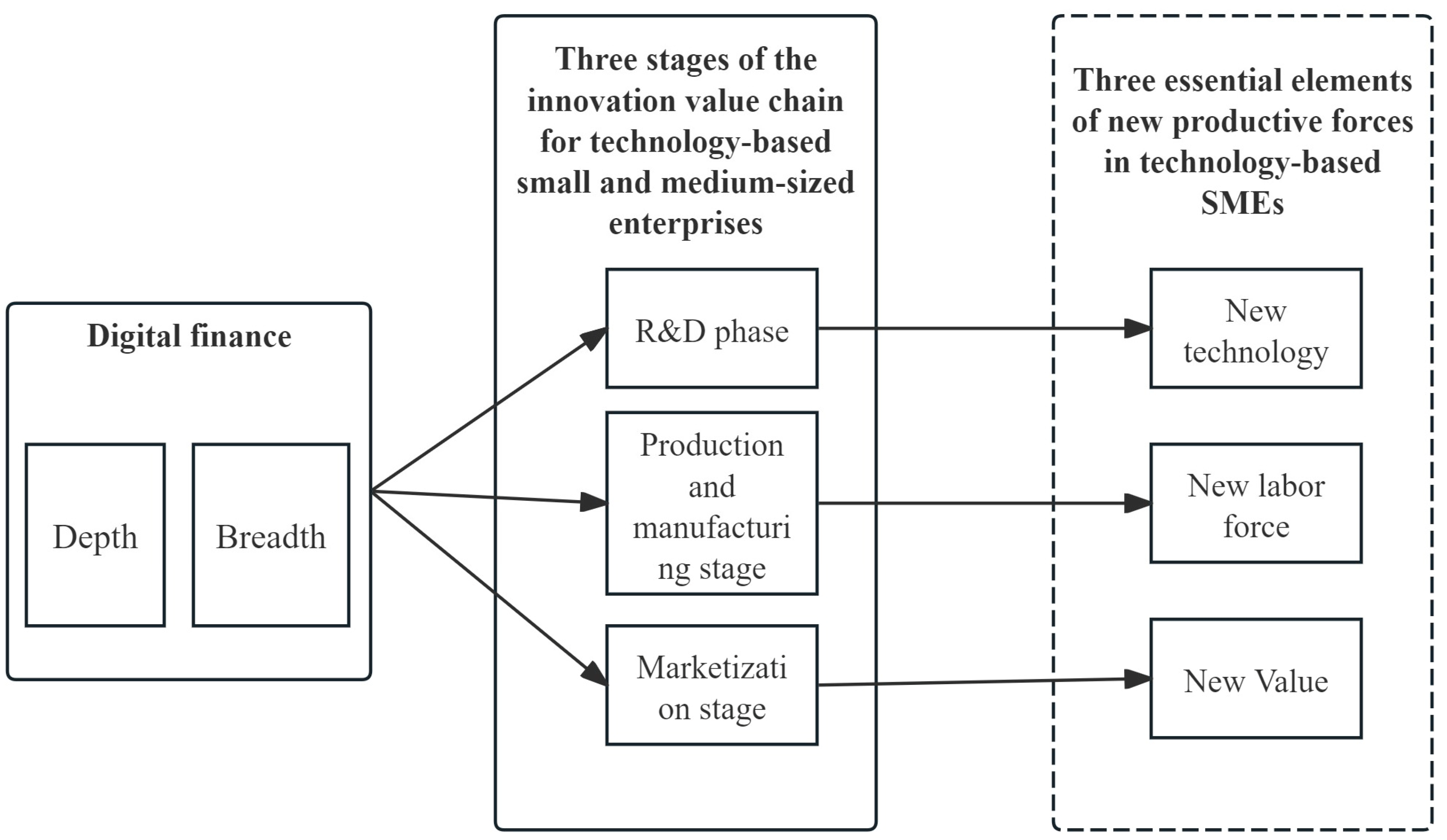
3.2. Analysis of the Impact Mechanism of Digital Finance on the Three Stages of Technological Innovation and Its Intrinsic Connection with New Quality Productivity from the Perspective of New Quality Productivity
- (1)
- Coupling Mechanism Between Technological Innovation and Enterprise New Quality Productive Forces
- (2)
- The Influence of Digital Finance on “New Technology” Formation in the R&D Stage
- (3)
- The Influence of Digital Finance on “New Labor” Formation in the Production and Manufacturing Stage
- (4)
- Digital Finance’s Role in Creating New Value through Market-Oriented Technological Innovation
4. Research Design
4.1. Sample Selection and Data Sources
4.2. Variable Selection
- (1)
- Dependent Variables
- (2)
- Independent Variable
- (3)
- Mediating Variables
- (4)
- Control Variables
4.3. Model Construction
5. Empirical Results
5.1. Regression Analysis of the Impact of Digital Finance on Technological Innovation Capability
5.2. Coverage Breadth and Usage Depth of Digital Finance
5.3. Robustness Tests
6. Mechanism Analysis
6.1. Research Design
- (1)
- Testing the Mediating Effect of R&D Investment
- (2)
- Testing the Mediating Effect of Production Levels
- (3)
- Testing the Mediating Effect of Market Share
6.2. Empirical Results
7. Conclusions, Implications, and Outlook
7.1. Research Conclusions
7.2. Research Implications
7.3. Study Limitations and Future Research Directions
7.3.1. Limitations
7.3.2. Future Directions
Author Contributions
Funding
Institutional Review Board Statement
Informed Consent Statement
Data Availability Statement
Conflicts of Interest
References
- Pierri, N.; Timmer, Y. The importance of technology in banking during a crisis. J. Monet. Econ. 2022, 128, 88–104. [Google Scholar] [CrossRef]
- Lin, L.; Gu, T.; Shi, Y. The influence of new quality productive forces on high-quality agricultural development in China: Mechanisms and empirical testing. Agriculture 2024, 14, 1022. [Google Scholar] [CrossRef]
- Lee, I.; Kim, J.; Ryoo, H. The impact of AI and digital technology on productivity. Technol. Forecast. Soc. Change 2021, 167, 120793. [Google Scholar]
- Audretsch, D.B.; Belitski, M. The role of R&D and knowledge spillovers in innovation and productivity. Small Bus. Econ. 2020, 54, 47–63. [Google Scholar]
- Ferrando, A.; Popov, A.; Udell, G.F. Do SMEs benefit from bank relationships? Evidence from European credit markets. J. Bank. Financ. 2022, 138, 106450. [Google Scholar]
- Brown, R.; Rocha, A.; Cowling, M. Financing entrepreneurship in times of crisis: Exploring the impact of COVID-19 on the market for entrepreneurial finance. Entrep. Theory Pract. 2021, 45, 1141–1159. [Google Scholar] [CrossRef]
- European Commission. Digital Finance Strategy for the EU; Publications Office of the European Union: Brussels, Belgium, 2020. [Google Scholar]
- SEC (U.S. Securities and Exchange Commission). Framework for Digital Asset Regulation; SEC (U.S. Securities and Exchange Commission): Washington, DC, USA, 2023. [Google Scholar]
- Didenko, A.; Buckley, R. The evolution of fintech regulation: Global trends and perspectives. Int. Rev. Law Econ. 2022, 72, 106102. [Google Scholar]
- Ozili, P.K. Digital finance, financial inclusion and development: A global review. J. Financ. Regul. Compliance 2023, 31, 45–62. [Google Scholar]
- Chen, Z.; Wu, J. Digital finance and regional innovation: Evidence from China. Technol. Forecast. Soc. Change 2022, 178, 121596. [Google Scholar]
- Zhao, Y.; Guo, F.; Li, X. Digital finance and productivity: Micro-level evidence from enterprises. J. Econ. Behav. Organ. 2023, 205, 119–136. [Google Scholar]
- Nguyen, T.; Le, Q.; Park, S. Digital finance and SMEs’ innovation capability. Small Bus. Econ. 2021, 57, 1627–1645. [Google Scholar]
- Peng, T.; Tao, R. Digital transformation and firm-level innovation: Empirical evidence from emerging markets. J. Bus. Res. 2022, 148, 325–337. [Google Scholar]
- Zhang, H.; Zhou, S. Digital infrastructure, technological upgrading, and productivity. Technovation 2024, 130, 102734. [Google Scholar]
- Wang, J.; Yao, Y.; Ge, H.; Wang, J. The impact of digital inclusive finance on SME innovation. Sustainability 2025, 17, 3633. [Google Scholar] [CrossRef]
- Wang, X.; Chen, X. An empirical study on financing constraints of digital inclusive finance development on small and medium-sized technology-based enterprise. Kybernetes 2023, 52, 585–600. [Google Scholar] [CrossRef]
- Adewuyi, A.; Ajuwon, A.; Oladuji, T.J.; Akintobi, A.O. Advances in Financial Inclusion Models: Expanding access to credit through AI and data analytics. Int. J. Adv. Multidiscip. Res. Stud. 2023, 3, 1827–1842. [Google Scholar] [CrossRef]
- Ashta, A. Artificial Intelligence in Microfinance and Financial Inclusion: Applications, Issues, and Future Directions. Issues, and Future Directions, 12 November 2025. Available online: https://lnkd.in/ejCzpGeh (accessed on 12 January 2026).
- Allen, F.; Gu, X.; Jagtiani, J. Fintech, cryptocurrencies, and CBDC: Financial structural transformation in China. J. Int. Money Financ. 2022, 124, 102625. [Google Scholar] [CrossRef]
- Fan, W.; Wu, H.; Liu, Y. Does digital finance induce improved financing for green technological innovation in China? Discret. Dyn. Nat. Soc. 2022, 2022, 6138422. [Google Scholar] [CrossRef]
- Gomber, P.; Kauffman, R.J.; Parker, C.; Weber, B.W. On the fintech revolution: Interdisciplinary perspectives. J. Manag. Inf. Syst. 2021, 38, 852–879. [Google Scholar]
- Zhou, N. Coping with the storm: The role of fintech in SME survival. J. Bus. Ventur. Insights 2024, 21, e00312. [Google Scholar] [CrossRef]
- Gao, X. The impact of digital finance on SMEs’ financialization. Humanit. Soc. Sci. Commun. 2023, 10, 123. [Google Scholar]
- World Economic Forum. The Future of Jobs and Digital Transformation Report; WEF: Geneva, Switzerland, 2021. [Google Scholar]
- Romer, P. New technologies and long-run growth. J. Econ. Perspect. 2019, 33, 3–28. [Google Scholar]
- Li, Y.; Zhang, T. How Does the Digital Ecosystem Foster New Quality Productive Forces? A Dynamic QCA of Sustainable Development Pathways in China. Sustainability 2025, 17, 4935. [Google Scholar] [CrossRef]
- Wong, W.; Chu, M. Digital governance as institutional adaptation and development. China Rev. 2020, 20, 43–70. [Google Scholar]
- Porter, M.E.; Heppelmann, J.E. How smart, connected products are transforming competition. Res.-Technol. Manag. 2023, 66, 14–27. [Google Scholar]
- Teng, L.; Luo, Y.; Wei, S. From Carbon to Capability: How Corporate Green and Low-Carbon Transitions Foster New Quality Productive Forces in China. Sustainability 2025, 17, 6657. [Google Scholar] [CrossRef]
- Melnikov, I.; Lebedeva, I.; Petrov, A.; Yanovich, Y. DeFi risk assessment: MakerDAO loan portfolio case. Financ. Res. Lett. 2024, 46, 102730. [Google Scholar] [CrossRef]
- Gartner. Cloud Ecosystems and SME Innovation: Market Overview; Gartner Research: Stamford, CT, USA, 2023. [Google Scholar]
- Deloitte. Tokenization and Value Co-Creation in Innovation Ecosystems; Deloitte Insights: London, UK, 2024. [Google Scholar]
- Park, Y.; Shin, H. Fintech and firm innovation: Evidence from patenting activity. Res. Policy 2020, 49, 104–116. [Google Scholar]
- IMF. Digital Finance and Financial Inclusion: Policy Considerations; IMF Policy Papers; IMF: Washington, DC, USA, 2023. [Google Scholar]
- Bu, Y.; Du, X.; Wang, Y.; Liu, S.; Tang, M.; Li, H. Digital inclusive finance: A lever for SME financing? Int. Rev. Financ. Anal. 2024, 93, 103115. [Google Scholar] [CrossRef]
- Zetzsche, D.A.; Buckley, R.P.; Barberis, J.N.; Arner, D.W. Regulating a revolution: From regulatory sandboxes to smart regulation. Fordham J. Corp. Financ. Law 2017, 23, 31. [Google Scholar] [CrossRef]
- Salamzadeh, A.; Hadizadeh, M.; Rastgoo, N.; Rahman, M.M.; Radfard, S. Sustainability-oriented innovation foresight in international new technology based firms. Sustainability 2022, 14, 13501. [Google Scholar] [CrossRef]
- Huang, Z.; Ouyang, W. Study on financing constraints of small and medium-sized enterprises eased by financial technology. Highlights Bus. Econ. Manag. 2023, 16, 477. [Google Scholar] [CrossRef]
- Jiménez-Rico, A.; Gómez-López, C.S.; Zamilpa, J. Determinants of access to bank financing in SMEs in Mexico. J. Risk Financ. Manag. 2023, 16, 477. [Google Scholar] [CrossRef]
- Bui, H.T.; Mitra, J. Can Environmental, Social and Governance Issues Be of Relevance to SMEs? Bus. Econ. Manag. 2025; preprint. [Google Scholar]
- Edunjobi, T.E.; Odejide, O.A. Theoretical frameworks in AI for credit risk assessment: Towards banking efficiency and accuracy. Int. J. Sci. Res. Updates 2024, 7, 92–102. [Google Scholar] [CrossRef]
- Wang, X.; He, Z.; Yang, X. How supply chain finance helps SME financing under blockchain technology: A multi-case comparative study based on manufacturing industry. Front. Bus. Econ. Manag. 2024, 13, 34–40. [Google Scholar] [CrossRef]
- Kowsar, M.M.; Mintoo, A.A. Blockchain in banking: A review of distributed ledger applications in loan processing, credit history, and compliance. Am. J. Sch. Res. Innov. 2025, 4, 101–138. [Google Scholar] [CrossRef]
- Chen, H. Blockchain Technology and Small and Medium Enterprises Access to Finance. Adv. Econ. Manag. Political Sci. 2023, 8, 138–144. [Google Scholar] [CrossRef]
- Hu, Y.; Jia, X. Empowering the intelligent transformation of the manufacturing sector through new quality productive forces: Value implications, theoretical analysis, and empirical examination. Sustainability 2025, 17, 7006. [Google Scholar] [CrossRef]
- Chen, D.; Wang, J.; Li, B.; Luo, H.; Hou, G. The Impact of Digital–Green Synergy on Total Factor Productivity: Evidence from Chinese Listed Companies. Sustainability 2025, 17, 2200. [Google Scholar] [CrossRef]
- Roper, S.; Love, J.H. Innovation, productivity and business performance: A review of the evidence. Res. Policy 2022, 51, 104–117. [Google Scholar]
- Teece, D.J. Fundamentally dynamic capabilities and the microfoundations of enterprise performance. Strateg. Manag. J. 2020, 41, 2317–2343. [Google Scholar]
- Paik, Y.; Woo, H. The effects of corporate venture capital, founder incumbency, and their interaction on entrepreneurial firms’ R&D investment strategies. Organ. Sci. 2017, 28, 670–689. [Google Scholar] [CrossRef]
- Price, W.N.; Rai, A.K.; Minssen, T. Knowledge transfer for large-scale vaccine manufacturing. Science 2020, 369, 912–914. [Google Scholar] [CrossRef]
- OECD. The Productivity Shift: Emerging Technologies and Industrial Transformation; OECD Publishing: Paris, France, 2023. [Google Scholar]
- Ye, Z. The Incentive Effect of Digital Finance on Innovation of Small- and Medium-Sized Enterprises Considering Heterogeneity: An Empirical Study Based on Chinese-Listed Firms. Sustainability 2024, 16, 8533. [Google Scholar]
- Li, C.; Lin, Y. Digital Finance, Enterprise Innovation and Equity Financing Constraints of Small and Medium-sized Enterprises. Acad. J. Bus. Manag. 2023, 5, 153–163. [Google Scholar] [CrossRef]
- Jia, X.; Wang, X. The impact of digital finance development on vertical specialization: Evidence from A-share listed companies in China. Kybernetes 2024, 53, 384–409. [Google Scholar] [CrossRef]
- Wang, P. The impact of fintech on innovation in manufacturing firms: Evidence from Chinese SMEs. In Proceedings of the 2025 3rd International Conference on Digital Economy and Management Science (CDEMS 2025), Wuhan, China, 18–20 April 2025. [Google Scholar]
- Tariq, M.U. Innovative strategies for enhancing SME competitiveness in emerging economies. In Models, Strategies, and Tools for Competitive SMEs; IGI Global: Hershey, PA, USA, 2025; pp. 151–172. [Google Scholar]
- Silva, F.; Gil, M. Digital technologies enhance competitiveness in manufacturing SMEs. J. Innov. Entrep. 2025, 14, 103. [Google Scholar] [CrossRef]
- Dai, D.; Zheng, Y. The New Quality Productive Force, Science and Technology Innovation, and Optimization of Industrial Structure. Sustainability 2025, 17, 4439. [Google Scholar] [CrossRef]
- Yoo, H.S.; Jung, Y.L. The effect of the commercialization failure of SMEs’ R&D on survival. IEEE Trans. Eng. Manag. 2024, 71, 6078–6089. [Google Scholar] [CrossRef]
- Sok, P.; O’cass, A.; Miles, M.P. The performance advantages for SMEs of product innovation and marketing resource–capability complementarity in emerging economies. J. Small Bus. Manag. 2016, 54, 805–826. [Google Scholar] [CrossRef]
- Wang, Z.; Yu, L.; Zhou, L. Navigating the blockchain-driven transformation in industry 4.0: Opportunities and challenges for economic and management innovations. J. Knowl. Econ. 2025, 16, 3507–3549. [Google Scholar] [CrossRef]
- Chen, Y.; Tan, C.; Yu, L. Research on the Evaluation Indicator System of Technological Innovation Capability of Small and Medium-sized Enterprises. Sci. Technol. Prog. Countermeas. 2012, 29, 110–112. [Google Scholar]
- Guo, F.; Wang, J.; Wang, F.; Kong, T.; Cheng, Z.Y. Measuring the Development of Digital Inclusive Finance in China: Index Compilation and Spatial Characteristics. Economics 2020, 19, 1401–1418. [Google Scholar]
- Xu, J.; Zhai, J. Research on the evaluation of green innovation capability of manufacturing enterprises in innovation network. Sustainability 2020, 12, 807. [Google Scholar] [CrossRef]
- Moser, P.; Voena, A. Compulsory licensing: Evidence from the trading with the enemy act. Am. Econ. Rev. 2012, 102, 396–427. [Google Scholar] [CrossRef]
- Salehi, M.; Rostami, V.; Hesari, H. The Role of Information Asymmetry in Financing Methods. Manag. Glob. Transit. 2014, 12, 43–54. [Google Scholar]
- Yang, J.; Jiang, Y.; Chen, H.; Gan, S. Digital finance and Chinese corporate labor investment efficiency: The perspective of financing constraints and human capital structure. Front. Psychol. 2022, 13, 962806. [Google Scholar] [CrossRef]
- Tay, S.I.; Alipal, J.; Lee, T.C. Industry 4.0: Current practice and challenges in Malaysian manufacturing firms. Technol. Soc. 2021, 67, 101749. [Google Scholar] [CrossRef]
- Jiang, J.; Su, P.; Ge, Z. The high-and new-technology enterprise identification, marketization process and the total factor productivity of enterprise. Kybernetes 2021, 50, 528–549. [Google Scholar] [CrossRef]


| Variable Category | Variable Name | Symbol | Measuring Method | Data Sources |
|---|---|---|---|---|
| Dependent Variables | Number of invention patent applications | Inp | The number of invention patents applied by enterprises in the current year is used to measure the output of “new technology” in the R&D stage. | CNRDS/CRDC |
| Input–output ratio of production and manufacturing | Roi | The ratio of business income to total cost is used to measure the process efficiency and “new labor” efficiency in the production and manufacturing stage. | CNRDS/CRDC | |
| New product sales revenue | Som | The sales revenue of enterprises from new products is used to measure the “new value creation” in the marketization stage. | CNRDS/CRDC | |
| Independent Variable | Development level of digital Finance | DIF | The digital inclusive finance index of Peking University is adopted, which is comprehensively measured from three dimensions: coverage, depth of use and degree of digitization. | Digital finance research center of Peking University |
| Mediating Variables | R&D investment intensity | Rd | The proportion of enterprise R&D expenditure in total assets, which measures the resource investment in R&D activities. | CNRDS/CRDC |
| Proportion of high-tech personnel | Ptp | The proportion of the number of enterprise technical personnel in the total number of employees, which measures the composition of the “new labor force”. | CNRDS/CRDC | |
| Market share | Mei | The proportion of the main business income of an enterprise in the total income of its industry (four digit code industry), which measures the market competitiveness. | CNRDS/CRDC | |
| Control Variables | Enterprise age | Age | Add 1 to the number of years calculated from the year of establishment of the enterprise, and take the natural logarithm. | CNRDS/CRDC |
| Change rate of government subsidies | Gsr | (current government subsidy-previous government subsidy)/previous government subsidy. | CNRDS/CRDC | |
| Asset liability ratio | Alr | The ratio of total liabilities to total assets of the enterprise. | CNRDS/CRDC | |
| Shareholding ratio of the largest shareholder | Cr | The proportion of shares held by the company’s largest shareholder in the total share capital. | CNRDS/CRDC |
| Variable | Research and Development Phase | Production and Manufacturing Stage | Marketization Phase |
|---|---|---|---|
| L.lnDIF | 0.356 *** | 0.233 * | 0.036 * |
| lnage | 1.052 *** | 0.063 | 0.013 |
| gsr | 0.407 | 5.845 *** | 0.213 |
| alr | −0.132 | 0.642 *** | 0.103 *** |
| cr | 0.098 | 0.288 *** | −0.151 *** |
| _cons | −3.098 ** | −1.108 | 0.437 ** |
| Variable | Research and Development Phase | Production and Manufacturing Stage | Marketization Phase |
|---|---|---|---|
| L.lnDIFgd | 0.351 * | 0.037 * | 0.178 * |
| lnage | 1.016 *** | 0.004 | 0.063 |
| gsr | 0.441 | 0.216 | 5.856 *** |
| alr | −0.134 | 0.103 *** | 0.642 *** |
| cr | 0.101 | −0.149 *** | 0.288 *** |
| _cons | −2.944 *** | 0.450 *** | −0.793 |
| Variable | Research and Development Phase | Production and Manufacturing Stage | Marketization Phase |
|---|---|---|---|
| L.lnDIFsd | 0.361 *** | 0.015 *** | 0.152 *** |
| lnage | 0.854 *** | 0.038 | −0.105 |
| gsr | 0.564 | 0.219 | 6.295 *** |
| alr | −0.164 | 0.103 | 0.501 *** |
| cr | 0.062 | −0.154 *** | 0.071 |
| _cons | −2.547 *** | 0.485 *** | −0.067 |
| Variable | Research and Development Phase | Production and Manufacturing Stage | Marketization Phase |
|---|---|---|---|
| L.lnfi | 0.355 *** | 0.035 * | 0.266 *** |
| lnage | 1.052 *** | 0.012 | 0.067 *** |
| gsr | 0.407 | 0.213 | 4.522 *** |
| alr | −0.132 | 0.103 *** | 0.877 *** |
| cr | 0.098 | −0.150 *** | 0.431 *** |
| _cons | −3.09 *** | 0.437 *** | −1.445 *** |
| Variable | Research and Development Phase | Production and Manufacturing Stage | Marketization Phase |
|---|---|---|---|
| L.lnfi | 0.597 *** | 0.234 * | 0.262 * |
| lnage | 0.004 | 0.014 | 0.064 |
| gsr | 3.562 ** | −0.182 | 5.729 *** |
| alr | 0.509 | 0.062 *** | 0.678 *** |
| cr | 0.038 *** | −0.032 | 0.299 *** |
| _cons | −1.892 *** | −0.689 | −1.279 * |
| Variables | Coefficient | Std. Err. | P > t | Coefficient | Std. Err. | P > t |
|---|---|---|---|---|---|---|
| L.lnDIF | 0.021 *** | 0.008 | 0.009 | 0.342 ** | 0.196 | 0.080 |
| Rd | 1.147 *** | 0.389 | 0.003 | |||
| lnage | −0.011 | 0.014 | 0.405 | 1.026 *** | 0.333 | 0.002 |
| gsr | 0.825 *** | 0.064 | 0.000 | −0.302 | 1.614 | 0.852 |
| alr | 0.0142 *** | 0.0053 | 0.008 | −0.125 | 0.1345 | 0.351 |
| cr | −0.011 | 0.0125 | 0.382 | 0.153 | 0.306 | 0.623 |
| _cons | −0.029 | 0.018 | 0.107 | −3.036 | 0.446 | 0.000 |
| Variables | Coefficient | Std. Err. | P > t | Coefficient | Std. Err. | P > t |
|---|---|---|---|---|---|---|
| L.lnDIF | 0.144 *** | 0.037 | 0.000 | 0.009 | 0.015 | 0.529 |
| ptp | 0.006 * | 0.004 | 0.098 | |||
| lnage | −0.029 | 0.056 | 0.608 | 0.045 * | 0.026 | 0.078 |
| gsr | 1.538 *** | 0.463 | 0.001 | 0.259 ** | 0.115 | 0.025 |
| alr | −0.131 *** | 0.039 | 0.001 | 0.134 *** | 0.010 | 0.000 |
| cr | −0.162 ** | 0.081 | 0.045 | −0.113 *** | 0.023 | 0.000 |
| _cons | −2.189 *** | 0.133 | 0.000 | 0.479 *** | 0.035 | 0.000 |
| Variables | Coefficient | Std. Err. | P > t | Coefficient | Std. Err. | P > t |
|---|---|---|---|---|---|---|
| L.lnDIF | 0.188 * | 0.1055 | 0.074 | 0.104 * | 0.060 | 0.087 |
| mei | 0.148 * | 0.088 | 0.092 | |||
| lnage | −1.250 *** | 0.180 | 0.000 | −0.007 | 0.105 | 0.940 |
| gsr | 2.205 *** | 0.841 | 0.009 | 3.508 *** | 0.724 | 0.000 |
| alr | 0.1465 ** | 0.070 | 0.038 | 0.385 *** | 0.067 | 0.000 |
| cr | −0.199 | 0.165 | 0.229 | 0.103 | 0.119 | 0.384 |
| _cons | −0.476 ** | 0.240 | 0.047 | −0.0342 | 0.158 | 0.829 |
Disclaimer/Publisher’s Note: The statements, opinions and data contained in all publications are solely those of the individual author(s) and contributor(s) and not of MDPI and/or the editor(s). MDPI and/or the editor(s) disclaim responsibility for any injury to people or property resulting from any ideas, methods, instructions or products referred to in the content. |
© 2026 by the authors. Licensee MDPI, Basel, Switzerland. This article is an open access article distributed under the terms and conditions of the Creative Commons Attribution (CC BY) license.
Share and Cite
Qiu, T.; Gao, L. Digital Finance, Innovation Value Chains, and the Formation of New Productivity: Evidence from Technology-Based SMEs. Sustainability 2026, 18, 2934. https://doi.org/10.3390/su18062934
Qiu T, Gao L. Digital Finance, Innovation Value Chains, and the Formation of New Productivity: Evidence from Technology-Based SMEs. Sustainability. 2026; 18(6):2934. https://doi.org/10.3390/su18062934
Chicago/Turabian StyleQiu, Tian, and Liangmou Gao. 2026. "Digital Finance, Innovation Value Chains, and the Formation of New Productivity: Evidence from Technology-Based SMEs" Sustainability 18, no. 6: 2934. https://doi.org/10.3390/su18062934
APA StyleQiu, T., & Gao, L. (2026). Digital Finance, Innovation Value Chains, and the Formation of New Productivity: Evidence from Technology-Based SMEs. Sustainability, 18(6), 2934. https://doi.org/10.3390/su18062934