Efficiency, Cost and Sustainability: Electrocatalysts for State-of-the-Art and Emerging Electrolysis Technologies



Abstract
1. Introduction
- Raw material demand: Mining and processing impacts for catalysts, membranes, steel, and other materials (e.g., platinum group metals, rare earths, and carbon fiber).
- Water consumption: Quantity and quality of water required for electrolysis or other H2 production methods, and potential competition with local water needs.
- Global warming potential (GWP): Full life cycle greenhouse gas emissions from production, transport, storage, and utilization.
- Energy source for production: Share of renewable vs. fossil electricity; renewable integration reduces GWP.
- Land use: Footprint of renewable energy installations, production plants, and transport infrastructure.
- Air, soil, and water pollution: Potential leaks, by-products, or chemical use in synthesis.
- Economic performance.
- Levelized cost of hydrogen (LCOH): Production, conversion, transport, and storage costs.
- Capital and operating expenditures: Affordability and investment recovery time.
- Domestic value chains: Local manufacturing, service industries, and technology export potential.
- Long-term market stability: Demand certainty in mobility, industry, and power sectors.
- Job creation: Number and quality of jobs across the value chain (manufacturing, installation, operation, and maintenance).
- Public acceptance: Safety perceptions, transparency, and engagement with local communities.
- Equitable access: Ensuring benefits (energy access and jobs) are shared and do not exacerbate inequalities.
- Safety and health: Risk management for hydrogen handling, transport, and use.
- Supply chain ethics: Responsible sourcing of critical minerals, avoiding human rights violations.
2. Materials in Electrolysis Technologies
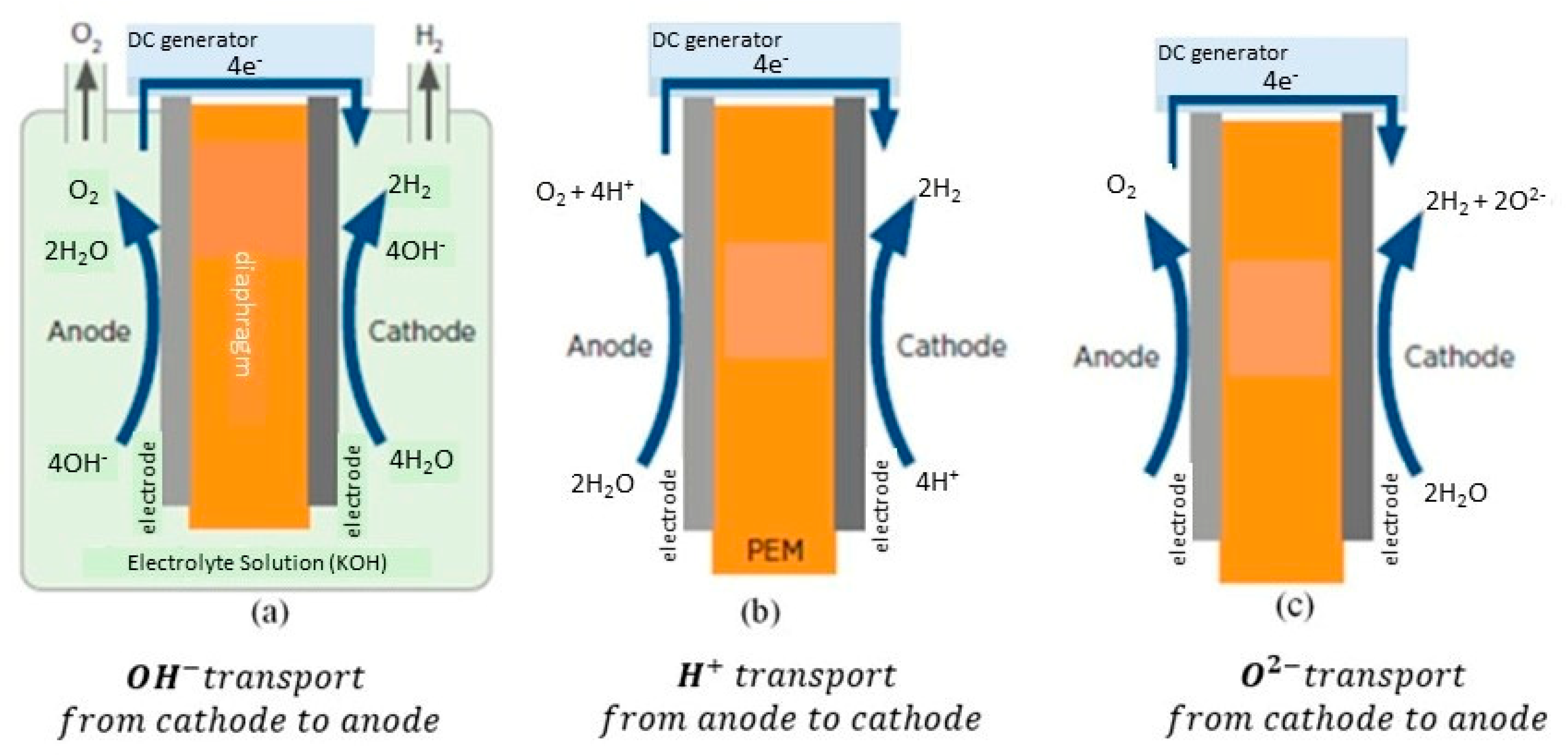
2.1. Types of Electrolyzers
2.1.1. Alkaline Electrolyzer (AEL)
2.1.2. Proton Exchange Membrane (PEM)
2.1.3. Solid Oxide Electrolysis (SOEC)
2.2. Functional Materials for Each Architecture
2.2.1. Electrocatalysts
2.2.2. Membranes: Polymer and Ceramic Types
3. Electrocatalyst Performance and System Efficiency
4. Stability, Durability, and Degradation Pathways
4.1. Degradation in PEM Electrolyzers
4.2. Degradation in Alkaline Electrolyzers
4.3. Degradation in SOEC

| Component | PEM | Alkaline (AWE) | SOEC |
|---|---|---|---|
| OER/HER catalysts | Ir dissolution/redeposition; oxide restructuring; poisoning (impurities) [90,91] | Ni/Fe/Co oxidation–reduction cycling, dissolution, film delamination; poisoning (carbonates) [101,109,110] | Ni agglomeration/oxidation; cathode delamination [105] |
| Electrolyte/separator | PFSA chemical thinning/cracking via radical attack; H2/O2 crossover [84] | PPS-based diaphragm aging (permeability/ASR); thermal softening (≈100–130 °C) [111] | YSZ cracking/strain; oxygen-ion accumulation effects; seal degradation [105] |
| Supports/interconnects | Ti PTL/BPP oxidation on anode side; stainless steel corrosion if used [94] | Nickel foam corrosion; current collector passivation [112] | Chromium evaporation/poisoning from interconnects; thermal mismatch [105,107] |
| Operational stressors | Intermittent load, high Δp, an increase in temperature accelerate Ir loss and crossover | Load cycling and air exposure accelerate Ni degradation; pressure/temperature excursions stress diaphragm | Thermal/redox cycling and pressure/steam transients drive delamination [105] |
5. Material Sustainability and Resource Risk
- Goal and Scope Definition—Clarify the research question, system boundaries (e.g., cradle-to-gate for material extraction vs. cradle-to-grave including use and disposal), and the functional unit (e.g., 1 kg H2 produced).
- Life Cycle Inventory (LCI)—Collect quantitative data on energy and material inputs, emissions, and waste flows for each process stage.
- Life Cycle Impact Assessment (LCIA)—Translate inventory data into impact categories such as global warming potential (GWP, kg CO2e), eutrophication, acidification, human/ecotoxicity, and abiotic resource depletion.
- Interpretation—Analyze results, identify hotspots, and discuss uncertainties and limitations.
- Material-level LCA: Evaluates the upstream mining, refining, and processing of catalysts, membranes, and balance-of-plant components.
- System-level LCA: Considers the electricity source, electrolyzer efficiency, hydrogen compression/storage, and end-of-life treatment.
5.1. Electrocatalyst Materials: Reserves and Supply Security
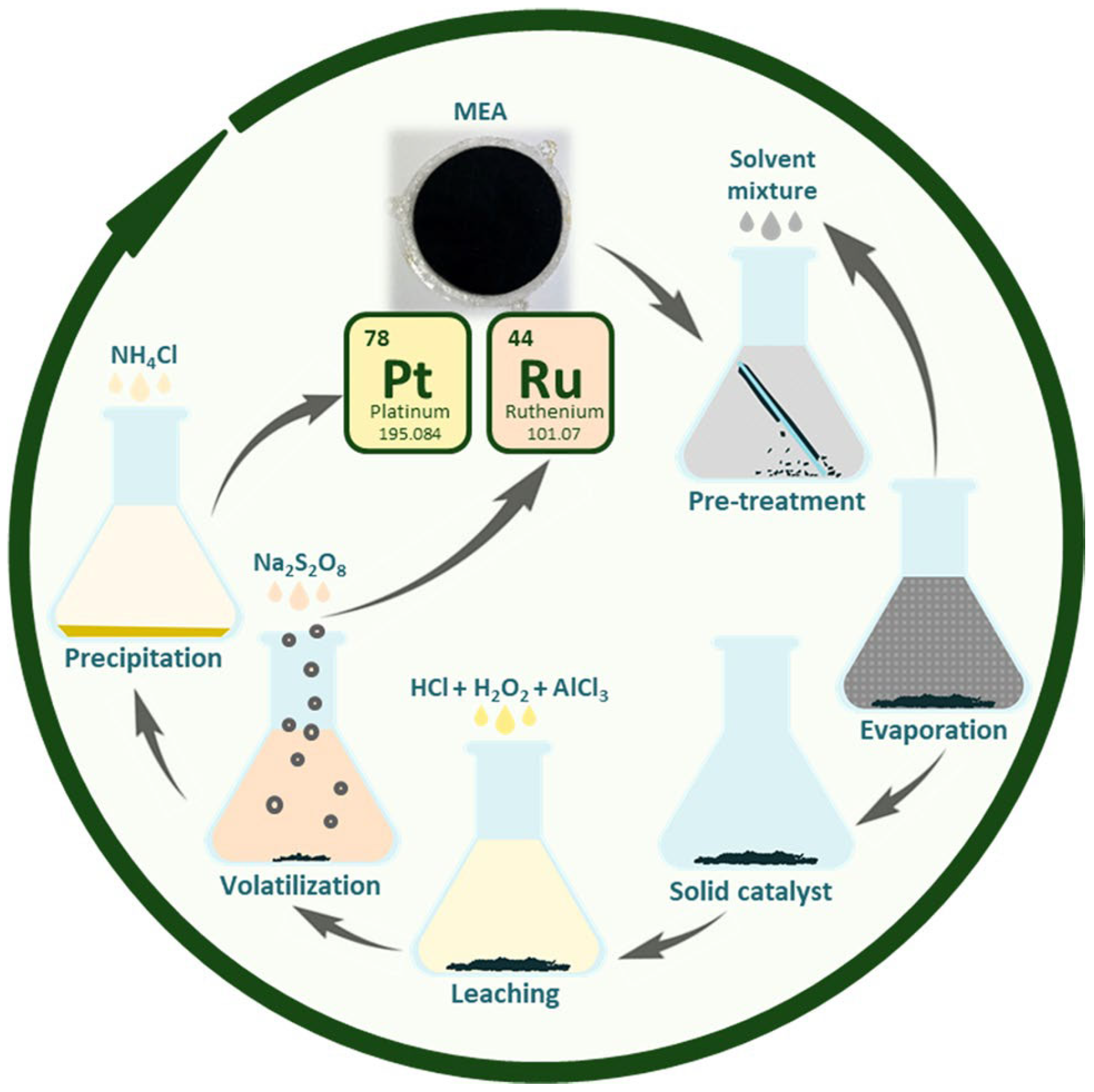
5.2. Electrocatalyst Recycling
5.3. Energy Demand and Mining Impacts of Key Materials
5.3.1. PEM Electrolyzers—Platinum Group Metals
5.3.2. AELs—Nickel, Iron and Cobalt
5.3.3. SOEC Electrolyzers—Rare Earths, Zirconium, and Manganese
6. Emerging Catalyst and Materials Innovations
6.1. Next-Generation Catalyst Concepts
6.1.1. Single-Atom Catalysts (Pt, Ir, Ru)
6.1.2. High-Entropy Materials
6.1.3. Other Noble-Metal-Free Electrocatalysts
7. Integrated Material–Technology–System Development
7.1. Multi-Criteria Evaluation of Sustainable Electrolysis
7.2. Strategies for Techno-Economic Optimization via Materials Innovation
7.3. Role of Data-Driven Discovery and AI-Guided Optimization
7.4. Policy Instruments for Sustainable Material Development
8. Summary and Outlook
Author Contributions
Funding
Institutional Review Board Statement
Informed Consent Statement
Data Availability Statement
Conflicts of Interest
References
- World Energy Outlook 2024—Analysis. Available online: https://www.iea.org/reports/world-energy-outlook-2024 (accessed on 18 September 2025).
- Global Hydrogen Review 2024—Analysis. Available online: https://www.iea.org/reports/global-hydrogen-review-2024 (accessed on 18 September 2025).
- Center on Global Energy Policy (CGEP). Hydrogen Fact Sheet: Production of Low-Carbon Hydrogen; Center on Global Energy Policy at Columbia University SIPA (CGEP): New York, NY, USA, 2021. [Google Scholar]
- Clarke, L.; Wei, Y.-M.; De la Vega Navarro, A.; Garg, A.; Hahmann, A.N.; Khennas, S.; Azevedo, I.M.L.; Löschel, A.; Singh, A.K.; Steg, L.; et al. Energy Systems. In Climate Change 2022: Mitigation of Climate Change. Working Group III Contribution to the IPCC Sixth Assessment Report; Cambridge University Press: Cambridge, UK, 2022; pp. 613–746. [Google Scholar] [CrossRef]
- Our Common Future: Report of the World Commission on Environment and Development. 1987. Available online: http://www.un-documents.net/our-common-future.pdf (accessed on 21 December 2025).
- Palmer, G.; Roberts, A.; Hoadley, A.; Dargaville, R.; Honnery, D. Life-Cycle Greenhouse Gas Emissions and Net Energy Assessment of Large-Scale Hydrogen Production via Electrolysis and Solar PV. Energy Environ. Sci. 2021, 14, 5113–5131. [Google Scholar] [CrossRef]
- de Kleijne, K.; Huijbregts, M.A.J.; Knobloch, F.; van Zelm, R.; Hilbers, J.P.; de Coninck, H.; Hanssen, S.V. Worldwide Greenhouse Gas Emissions of Green Hydrogen Production and Transport. Nat. Energy 2024, 9, 1139–1152. [Google Scholar] [CrossRef]
- Davies, A.J.; Hastings, A. Lifetime Greenhouse Gas Emissions from Offshore Hydrogen Production. Energy Rep. 2023, 10, 1538–1554. [Google Scholar] [CrossRef]
- Henriksen, M.S.; Matthews, H.S.; White, J.; Walsh, L.; Grol, E.; Jamieson, M.; Skone, T.J. Tradeoffs in Life Cycle Water Use and Greenhouse Gas Emissions of Hydrogen Production Pathways. Int. J. Hydrogen Energy 2024, 49, 1221–1234. [Google Scholar] [CrossRef]
- Wilkinson, J.; Mays, T.; McManus, M. Review and Meta-Analysis of Recent Life Cycle Assessments of Hydrogen Production. Clean. Environ. Syst. 2023, 9, 100116. [Google Scholar] [CrossRef]
- Iyer, R.K.; Prosser, J.H.; Kelly, J.C.; James, B.D.; Elgowainy, A. Life-Cycle Analysis of Hydrogen Production from Water Electrolyzers. Int. J. Hydrogen Energy 2024, 81, 1467–1478. [Google Scholar] [CrossRef]
- Wei, X.; Sharma, S.; Waeber, A.; Wen, D.; Sampathkumar, S.N.; Margni, M.; Maréchal, F.; Van Herle, J. Comparative Life Cycle Analysis of Electrolyzer Technologies for Hydrogen Production: Manufacturing and Operations. Joule 2024, 8, 3347–3372. [Google Scholar] [CrossRef]
- Wulf, C.; Reuß, M.; Grube, T.; Zapp, P.; Robinius, M.; Hake, J.-F.; Stolten, D. Life Cycle Assessment of Hydrogen Transport and Distribution Options. J. Clean. Prod. 2018, 199, 431–443. [Google Scholar] [CrossRef]
- Arrigoni, A.; Dolci, F.; Ortiz, C.R.; Weidner, E.; D’agostini, T.; Eynard, U.; Santucci, V.; Mathieux, F. Environmental Life Cycle Assessment (LCA) Comparison of Hydrogen Delivery Options within Europe. Available online: https://publications.jrc.ec.europa.eu/repository/handle/JRC137953 (accessed on 18 September 2025).
- Zhao, F.; Wang, Z.; Dong, B.; Li, M.; Ji, Y.; Han, F. Comprehensive Life Cycle Cost Analysis of Ammonia-Based Hydrogen Transportation Scenarios for Offshore Wind Energy Utilization. J. Clean. Prod. 2023, 429, 139616. [Google Scholar] [CrossRef]
- Kolb, S.; Müller, J.; Luna-Jaspe, N.; Karl, J. Renewable Hydrogen Imports for the German Energy Transition—A Comparative Life Cycle Assessment. J. Clean. Prod. 2022, 373, 133289. [Google Scholar] [CrossRef]
- Kanz, O.; Brüggemann, F.; Ding, K.; Bittkau, K.; Rau, U.; Reinders, A. Life-Cycle Global Warming Impact of Hydrogen Transport through Pipelines from Africa to Germany. Sustain. Energy Fuels 2023, 7, 3014–3024. [Google Scholar] [CrossRef]
- Alves, E.S.; Costamagna, M.; von Colbe, J.B.; Barale, J.; Dematteis, E.M.; Stühff, H.; Stühff, T.; Ante, M.; Bellahcene, R.; Nouvelot, Q.; et al. Life Cycle Assessment for the Determination of the Environmental Impacts of an Advanced Large-Scale Hydrogen Storage System from HyCARE EU Project. J. Clean. Prod. 2025, 515, 145836. [Google Scholar] [CrossRef]
- Osman, A.I.; Nasr, M.; Mohamed, A.R.; Abdelhaleem, A.; Ayati, A.; Farghali, M.; Al-Muhtaseb, A.H.; Al-Fatesh, A.S.; Rooney, D.W. Life Cycle Assessment of Hydrogen Production, Storage, and Utilization toward Sustainability. WIREs Energy Environ. 2024, 13, e526. [Google Scholar] [CrossRef]
- Agostini, A.; Belmonte, N.; Masala, A.; Hu, J.; Rizzi, P.; Fichtner, M.; Moretto, P.; Luetto, C.; Sgroi, M.; Baricco, M. Role of Hydrogen Tanks in the Life Cycle Assessment of Fuel Cell-Based Auxiliary Power Units. Appl. Energy 2018, 215, 1–12. [Google Scholar] [CrossRef]
- Lee, G.N.; Kim, J.M.; Jung, K.H.; Park, H. Comparative Life Cycle Assessment of Various Hydrogen Supply Methods from Australia to the Republic of Korea in Environmental and Economic Aspects. Sci. Total Environ. 2024, 947, 174669. [Google Scholar] [CrossRef] [PubMed]
- Rinawati, D.I.; Keeley, A.R.; Takeda, S.; Managi, S. Life-Cycle Assessment of Hydrogen Utilization in Power Generation: A Systematic Review of Technological and Methodological Choices. Front. Sustain. 2022, 3, 920876. [Google Scholar] [CrossRef]
- Rinawati, D.I.; Keeley, A.R.; Takeda, S.; Managi, S. A Systematic Review of Life Cycle Assessment of Hydrogen for Road Transport Use. Prog. Energy 2021, 4, 012001. [Google Scholar] [CrossRef]
- Suer, J.; Traverso, M.; Jäger, N. Review of Life Cycle Assessments for Steel and Environmental Analysis of Future Steel Production Scenarios. Sustainability 2022, 14, 14131. [Google Scholar] [CrossRef]
- Zang, G.; Sun, P.; Elgowainy, A.; Wang, M. Technoeconomic and Life Cycle Analysis of Synthetic Methanol Production from Hydrogen and Industrial Byproduct CO2. Environ. Sci. Technol. 2021, 55, 5248–5257. [Google Scholar] [CrossRef]
- Kadam, R.S.; Yadav, G.D. Life Cycle Analysis of Ammonia and Methane Production Using Green Hydrogen and Carbon Dioxide. J. Clean. Prod. 2024, 449, 141620. [Google Scholar] [CrossRef]
- Proniewicz, M.; Petela, K.; Szlęk, A.; Adamczyk, W. Life Cycle Assessment of Selected Ammonia Production Technologies From the Perspective of Ammonia as a Fuel for Heavy-Duty Vehicle. J. Energy Resour. Technol. 2024, 146, 030905. [Google Scholar] [CrossRef]
- Chisalita, D.-A.; Petrescu, L.; Cormos, C.-C. Environmental Evaluation of European Ammonia Production Considering Various Hydrogen Supply Chains. Renew. Sustain. Energy Rev. 2020, 130, 109964. [Google Scholar] [CrossRef]
- Li, Y.; Tang, D.; Yuan, C.; Diaz-Londono, C.; Agundis-Tinajero, G.D.; Guerrero, J.M. The Roles of Hydrogen Energy in Ports: Comparative Life-Cycle Analysis Based on Hydrogen Utilization Strategies. Int. J. Hydrogen Energy 2025, 106, 1356–1372. [Google Scholar] [CrossRef]
- Shih, A.J.; Monteiro, M.C.O.; Dattila, F.; Pavesi, D.; Philips, M.; da Silva, A.H.M.; Vos, R.E.; Ojha, K.; Park, S.; van der Heijden, O.; et al. Water Electrolysis. Nat. Rev. Methods Primers 2022, 2, 84. [Google Scholar] [CrossRef]
- Benalcazar, P.; Komorowska, A. Techno-Economic Analysis and Uncertainty Assessment of Green Hydrogen Production in Future Exporting Countries. Renew. Sustain. Energy Rev. 2024, 199, 114512. [Google Scholar] [CrossRef]
- Curcio, E. Techno-Economic Analysis of Hydrogen Production: Costs, Policies, and Scalability in the Transition to Net-Zero. Int. J. Hydrogen Energy 2025, 128, 473–487. [Google Scholar] [CrossRef]
- Arcos, J.M.M.; Santos, D.M.F. The Hydrogen Color Spectrum: Techno-Economic Analysis of the Available Technologies for Hydrogen Production. Gases 2023, 3, 25–46. [Google Scholar] [CrossRef]
- María Villarreal Vives, A.; Wang, R.; Roy, S.; Smallbone, A. Techno-Economic Analysis of Large-Scale Green Hydrogen Production and Storage. Appl. Energy 2023, 346, 121333. [Google Scholar] [CrossRef]
- Li, H.; Lin, Y.; Duan, J.; Wen, Q.; Liu, Y.; Zhai, T. Stability of Electrocatalytic OER: From Principle to Application. Chem. Soc. Rev. 2024, 53, 10709–10740. [Google Scholar] [CrossRef] [PubMed]
- Chen, F.-Y.; Wu, Z.-Y.; Adler, Z.; Wang, H. Stability Challenges of Electrocatalytic Oxygen Evolution Reaction: From Mechanistic Understanding to Reactor Design. Joule 2021, 5, 1704–1731. [Google Scholar] [CrossRef]
- Do, V.-H.; Lee, J.-M. Surface Engineering for Stable Electrocatalysis. Chem. Soc. Rev. 2024, 53, 2693–2737. [Google Scholar] [CrossRef]
- Chen, Y.; Liu, C.; Xu, J.; Xia, C.; Wang, P.; Xia, B.Y.; Yan, Y.; Wang, X. Key Components and Design Strategy for a Proton Exchange Membrane Water Electrolyzer. Small Struct. 2023, 4, 2200130. [Google Scholar] [CrossRef]
- Yodwong, B.; Guilbert, D.; Phattanasak, M.; Kaewmanee, W.; Hinaje, M.; Vitale, G. Proton Exchange Membrane Electrolyzer Modeling for Power Electronics Control: A Short Review. C 2020, 6, 29. [Google Scholar] [CrossRef]
- Chen, P.; Hu, X. High-Efficiency Anion Exchange Membrane Water Electrolysis Employing Non-Noble Metal Catalysts. Adv. Energy Mater. 2020, 10, 2002285. [Google Scholar] [CrossRef]
- Wei, X.; Sharma, S.; Marechal, F.; Van Herle, J. Design and Optimization of a Shared Heat Exchanger Network for an Integrated rSOC System. In Computer Aided Chemical Engineering; Kokossis, A.C., Georgiadis, M.C., Pistikopoulos, E., Eds.; 33 European Symposium on Computer Aided Process Engineering; Elsevier: Amsterdam, The Netherlands, 2023; Volume 52, pp. 1065–1070. [Google Scholar]
- Gandía, L.M.; Oroz, R.; Ursúa, A.; Sanchis, P.; Diéguez, P.M. Renewable Hydrogen Production: Performance of an Alkaline Water Electrolyzer Working under Emulated Wind Conditions. Energy Fuels 2007, 21, 1699–1706. [Google Scholar] [CrossRef]
- Wang, J.; Wen, J.; Wang, J.; Yang, B.; Jiang, L. Water Electrolyzer Operation Scheduling for Green Hydrogen Production: A Review. Renew. Sustain. Energy Rev. 2024, 203, 114779. [Google Scholar] [CrossRef]
- Şahin, M.E. An Overview of Different Water Electrolyzer Types for Hydrogen Production. Energies 2024, 17, 4944. [Google Scholar] [CrossRef]
- Carmo, M.; Fritz, D.L.; Mergel, J.; Stolten, D. A Comprehensive Review on PEM Water Electrolysis. Int. J. Hydrogen Energy 2013, 38, 4901–4934. [Google Scholar] [CrossRef]
- Buttler, A.; Spliethoff, H. Current Status of Water Electrolysis for Energy Storage, Grid Balancing and Sector Coupling via Power-to-Gas and Power-to-Liquids: A Review. Renew. Sustain. Energy Rev. 2018, 82, 2440–2454. [Google Scholar] [CrossRef]
- Almpantis, D.; Davidsson, H.; Andersson, M. Assessing the Performance of a Proton Exchange Membrane Green Hydrogen Generation System through Stack and Balance of Plant Modeling. ECS Trans. 2024, 114, 681. [Google Scholar] [CrossRef]
- Wang, Y.; Pang, Y.; Xu, H.; Martinez, A.; Chen, K.S. PEM Fuel Cell and Electrolysis Cell Technologies and Hydrogen Infrastructure Development—A Review. Energy Environ. Sci. 2022, 15, 2288–2328. [Google Scholar] [CrossRef]
- Zhou, H.; Chen, W.; Meng, K.; Deng, Q.; Zhang, N.; Chen, B. A Review on Proton Exchange Membrane Water Electrolyzer: Advances in Heat and Mass Transport. Renew. Sustain. Energy Rev. 2025, 223, 116015. [Google Scholar] [CrossRef]
- Kamal, M.; Jaafar, J.; Khan, A.A.; Khan, Z.; Ismail, A.F.; Othman, M.H.D.; Rahman, M.A.; Aziz, F.; Rehman, G.U. A Critical Review of the Advancement Approach and Strategy in SPEEK-Based Polymer Electrolyte Membrane for Hydrogen Fuel Cell Application. Energy Fuels 2024, 38, 12337–12386. [Google Scholar] [CrossRef]
- Nechache, A.; Hody, S. Alternative and Innovative Solid Oxide Electrolysis Cell Materials: A Short Review. Renew. Sustain. Energy Rev. 2021, 149, 111322. [Google Scholar] [CrossRef]
- Zainal, B.S.; Ker, P.J.; Mohamed, H.; Ong, H.C.; Fattah, I.M.R.; Rahman, S.M.A.; Nghiem, L.D.; Mahlia, T.M.I. Recent Advancement and Assessment of Green Hydrogen Production Technologies. Renew. Sustain. Energy Rev. 2024, 189, 113941. [Google Scholar] [CrossRef]
- Xu, Y.; Cai, S.; Chi, B.; Tu, Z. Technological Limitations and Recent Developments in a Solid Oxide Electrolyzer Cell: A Review. Int. J. Hydrogen Energy 2024, 50, 548–591. [Google Scholar] [CrossRef]
- Hitachi Energy Supplies Electrical System for the World’s First Green Hydrogen Plant for Heating Steel Before Rolling. Available online: https://www.hitachienergy.com/es/es/news-and-events/features/2023/09/hitachi-energy-supplies-electrical-system-for-the-world-s-first-green-hydrogen-plant-for-heating-steel-before-rolling (accessed on 18 September 2025).
- Cepsa Selects Thyssenkrupp Nucera as Preferred Supplier of a 300-MW Electrolyzer for Green Hydrogen Plant in Spain. Available online: https://www.thyssenkrupp.com/en/newsroom/press-releases/pressdetailpage/cepsa-selects-thyssenkrupp-nucera-as-preferred-supplier-of-a-300-mw-electrolyzer-for-green-hydrogen-plant-in-spain-256577 (accessed on 18 September 2025).
- Stegra’s Green Hydrogen Plant Takes Shape in Boden—Stegra. Available online: https://stegra.com/news-and-stories/green-hydrogen-plant-takes-shape (accessed on 18 September 2025).
- Air Liquide. Air Liquide Inaugurates the World’s Largest Low-Carbon Hydrogen Membrane-Based Production Unit in Canada. Available online: https://www.airliquide.com/group/press-releases-news/2021-01-26/air-liquide-inaugurates-worlds-largest-low-carbon-hydrogen-membrane-based-production-unit-canada (accessed on 18 September 2025).
- Kaul, I. REFHYNE Project Successfully Concludes with Final Event, Developing and Operating a 10MW PEM Electrolyser. Available online: https://www.refhyne.eu/refhyne-project-successfully-concludes-with-final-event-developing-and-operating-a-10mw-pem-electrolyser/ (accessed on 18 September 2025).
- Corporativa, I. Iberdrola Builds the Largest Green Hydrogen Plant for Industrial Use in Europe. Available online: https://www.iberdrola.com/about-us/what-we-do/green-hydrogen/puertollano-green-hydrogen-plant (accessed on 18 September 2025).
- GrInHy2.0: Sunfire Delivers the World’s Largest High-Temperature Electrolyser to Salzgitter Flachstahl—Fuelcellsworks. Available online: https://fuelcellsworks.com/news/grinhy2-0-sunfire-delivers-the-worlds-largest-high-temperature-electrolyser-to-salzgitter-flachstahl (accessed on 18 September 2025).
- Renewable Hydrogen Project “MultiPLHY”|Sunfire. Available online: https://sunfire.de/en/news/renewable-hydrogen-project-multiplhy-worlds-largest-high-temperature-electrolyzer/ (accessed on 18 September 2025).
- Guo, X.; Zhang, H.; Shen, Z.; Liu, X.; Xia, W.; Ma, M.; Cao, D. Construction and Prospect of Noble Metal-Based Catalysts for Proton Exchange Membrane Water Electrolyzers. Small Struct. 2023, 4, 2300081. [Google Scholar] [CrossRef]
- Clapp, M.; Zalitis, C.M.; Ryan, M. Perspectives on Current and Future Iridium Demand and Iridium Oxide Catalysts for PEM Water Electrolysis. Catal. Today 2023, 420, 114140. [Google Scholar] [CrossRef]
- Wang, C.; Lee, K.; Liu, C.P.; Kulkarni, D.; Atanassov, P.; Peng, X.; Zenyuk, I.V. Design of PEM Water Electrolysers with Low Iridium Loading. Int. Mater. Rev. 2024, 69, 3–18. [Google Scholar] [CrossRef]
- Peng, L.; Liao, M.; Zheng, X.; Nie, Y.; Zhang, L.; Wang, M.; Xiang, R.; Wang, J.; Li, L.; Wei, Z. Accelerated Alkaline Hydrogen Evolution on M(OH)x/M-MoPOx (M = Ni, Co, Fe, Mn) Electrocatalysts by Coupling Water Dissociation and Hydrogen Ad-Desorption Steps. Chem. Sci. 2020, 11, 2487–2493. [Google Scholar] [CrossRef]
- Zhao, J.; Zhang, Y.; Ye, Y.; Xu, Q.; Luo, S.; Meng, F.; Zhu, S.; Li, X.; Lin, X.; Yu, A.; et al. Remote Iron Dynamics of NiFe (Oxy)Hydroxides toward Robust Active Sites in Water Oxidation. Nat. Commun. 2025, 16, 5601. [Google Scholar] [CrossRef]
- Kim, D.; Oh, L.S.; Park, J.H.; Kim, H.J.; Lee, S.; Lim, E. Perovskite-Based Electrocatalysts for Oxygen Evolution Reaction in Alkaline Media: A Mini Review. Front. Chem. 2022, 10, 1024865. [Google Scholar] [CrossRef]
- Hanif, M.B.; Rauf, S.; Khan, M.Z.; Babar, Z.U.D.; Gohar, O.; Saleem, M.; Zheng, K.; Hussain, I.; Lin, B.; Medvedev, D.; et al. Innovative Advances and Challenges in Solid Oxide Electrolysis Cells: Exploring Surface Segregation Dynamics in Perovskite Electrodes. Mater. Sci. Eng. R Rep. 2024, 161, 100864. [Google Scholar] [CrossRef]
- Kusoglu, A.; Weber, A.Z. New Insights into Perfluorinated Sulfonic-Acid Ionomers. Chem. Rev. 2017, 117, 987–1104. [Google Scholar] [CrossRef] [PubMed]
- Ito, H.; Maeda, T.; Nakano, A.; Takenaka, H. Properties of Nafion Membranes under PEM Water Electrolysis Conditions. Int. J. Hydrogen Energy 2011, 36, 10527–10540. [Google Scholar] [CrossRef]
- Parimuha, M.R.; Young, J.L.; Lee, J.K.; Yilmaz, A.; Diaz-Abad, S.; Gawas, R.; Schuler, T.; Komini Babu, S.; Bender, G. Proton Exchange Membrane Electrolysis Benchmarking: Identifying and Removing Sources of Variation in Test Stations, Hardware, and Membrane Electrode Assembly Fabrication. Int. J. Hydrogen Energy 2025, 114, 486–496. [Google Scholar] [CrossRef]
- Segale, M.; Seadira, T.; Sigwadi, R.; Mokrani, T.; Summers, G. A New Frontier towards the Development of Efficient SPEEK Polymer Membranes for PEM Fuel Cell Applications: A Review. Mater. Adv. 2024, 5, 7979–8006. [Google Scholar] [CrossRef]
- Raja Rafidah, R.S.; Rashmi, W.; Khalid, M.; Wong, W.Y.; Priyanka, J. Recent Progress in the Development of Aromatic Polymer-Based Proton Exchange Membranes for Fuel Cell Applications. Polymers 2020, 12, 1061. [Google Scholar] [CrossRef]
- Mustain, W.E.; Chatenet, M.; Page, M.; Kim, Y.S. Durability Challenges of Anion Exchange Membrane Fuel Cells. Energy Environ. Sci. 2020, 13, 2805–2838. [Google Scholar] [CrossRef]
- Mustapha, F.; Guilbert, D.; Gross, B. Advancements in Anion Exchange Membrane Electrolysers: From Catalysts to Life Cycle Assessment. Int. J. Sustain. Energy 2025, 44, 2520812. [Google Scholar] [CrossRef]
- Ng, W.K.; Wong, W.Y.; Rosli, N.A.H.; Loh, K.S. Commercial Anion Exchange Membranes (AEMs) for Fuel Cell and Water Electrolyzer Applications: Performance, Durability, and Materials Advancement. Separations 2023, 10, 424. [Google Scholar] [CrossRef]
- Rowberg, A.J.E.; Slomski, H.S.; Kim, N.; Strange, N.A.; Gorman, B.P.; Shulda, S.; Ginley, D.S.; Kweon, K.E.; Wood, B.C. Impact of Sr-Containing Secondary Phases on Oxide Conductivity in Solid-Oxide Electrolyzer Cells. Chem. Mater. 2024, 36, 6464–6474. [Google Scholar] [CrossRef]
- Liu, H.; Yu, M.; Tong, X.; Wang, Q.; Chen, M. High Temperature Solid Oxide Electrolysis for Green Hydrogen Production. Chem. Rev. 2024, 124, 10509–10576. [Google Scholar] [CrossRef]
- Cheng, S.; Li, X.; Huang, X.; Ling, Y.; Liu, S.; Li, T. Hydrogen Separation via Proton Conducting Ceramic Membranes: A Review. Int. J. Hydrogen Energy 2024, 70, 654–665. [Google Scholar] [CrossRef]
- Cao, J.; Ji, Y.; Shao, Z. Perovskites for Protonic Ceramic Fuel Cells: A Review. Energy Environ. Sci. 2022, 15, 2200–2232. [Google Scholar] [CrossRef]
- Su, H.; Hu, Y.H. Degradation Issues and Stabilization Strategies of Protonic Ceramic Electrolysis Cells for Steam Electrolysis. Energy Sci. Eng. 2022, 10, 1706–1725. [Google Scholar] [CrossRef]
- Arratibel Plazaola, A.; Cruellas Labella, A.; Liu, Y.; Badiola Porras, N.; Pacheco Tanaka, D.A.; Sint Annaland, M.V.; Gallucci, F. Mixed Ionic-Electronic Conducting Membranes (MIEC) for Their Application in Membrane Reactors: A Review. Processes 2019, 7, 128. [Google Scholar] [CrossRef]
- Li, W.; Zhu, X.; Cao, Z.; Wang, W.; Yang, W. Mixed Ionic-Electronic Conducting (MIEC) Membranes for Hydrogen Production from Water Splitting. Int. J. Hydrogen Energy 2015, 40, 3452–3461. [Google Scholar] [CrossRef]
- Kuhnert, E.; Heidinger, M.; Sandu, D.; Hacker, V.; Bodner, M. Analysis of PEM Water Electrolyzer Failure Due to Induced Hydrogen Crossover in Catalyst-Coated PFSA Membranes. Membranes 2023, 13, 348. [Google Scholar] [CrossRef]
- Sayed-Ahmed, H.; Toldy, Á.I.; Santasalo-Aarnio, A. Dynamic Operation of Proton Exchange Membrane Electrolyzers—Critical Review. Renew. Sustain. Energy Rev. 2024, 189, 113883. [Google Scholar] [CrossRef]
- Dang, J.; Zhang, J.; Deng, X.; Yang, S.; Liu, B.; Zhu, X.; Li, Y.; Yang, F.; Ouyang, M. Hydrogen Crossover Measurement and Durability Assessment of High-Pressure Proton Exchange Membrane Electrolyzer. J. Power Sources 2023, 563, 232776. [Google Scholar] [CrossRef]
- Holst, M.; Aschbrenner, S.; Smolinka, T.; Voglstätter, C.; Grimm, G. Cost Forecast for Low Temperature Electrolysis—Technology Driven Bottom-Up Prognosis for PEM and Alkaline Water Electrolysis Systems; Fraunhofer Institute for Solar Energy Systems ISE: Freiburg, Germany, 2021. [Google Scholar] [CrossRef]
- Miller, H.A.; Bouzek, K.; Hnat, J.; Loos, S.; Bernäcker, C.I.; Weißgärber, T.; Röntzsch, L.; Meier-Haack, J. Green Hydrogen from Anion Exchange Membrane Water Electrolysis: A Review of Recent Developments in Critical Materials and Operating Conditions. Sustain. Energy Fuels 2020, 4, 2114–2133. [Google Scholar] [CrossRef]
- Yodwong, B.; Guilbert, D.; Phattanasak, M.; Kaewmanee, W.; Hinaje, M.; Vitale, G. Faraday’s Efficiency Modeling of a Proton Exchange Membrane Electrolyzer Based on Experimental Data. Energies 2020, 13, 4792. [Google Scholar] [CrossRef]
- Röttcher, N.C.; Zhou, J.; Löttert, L.; Mayrhofer, K.J.J.; Dworschak, D. Tracing Iridium Dissolution Pathways in Proton Exchange Membrane Water Electrolyzers at Relevant Current Densities in Real Time. ChemElectroChem 2025, 12, e202500098. [Google Scholar] [CrossRef]
- Geuß, M.; Löttert, L.; Böhm, T.; Hutzler, A.; Mayrhofer, K.J.J.; Thiele, S.; Cherevko, S. Quantification of Iridium Dissolution at Water Electrolysis Relevant Conditions Using a Gas Diffusion Electrode Half-Cell Setup. ACS Catal. 2024, 14, 11819–11831. [Google Scholar] [CrossRef]
- Rui, Z.; Hua, K.; Dou, Z.; Tan, A.; Zhang, C.; Shi, X.; Ding, R.; Li, X.; Duan, X.; Wu, Y.; et al. A New Insight into the Chemical Degradation of Proton Exchange Membranes in Water Electrolyzers. J. Mater. Chem. A 2024, 12, 9563–9573. [Google Scholar] [CrossRef]
- Milosevic, M.; Böhm, T.; Körner, A.; Bierling, M.; Winkelmann, L.; Ehelebe, K.; Hutzler, A.; Suermann, M.; Thiele, S.; Cherevko, S. In Search of Lost Iridium: Quantification of Anode Catalyst Layer Dissolution in Proton Exchange Membrane Water Electrolyzers. ACS Energy Lett. 2023, 8, 2682–2688. [Google Scholar] [CrossRef]
- Kozlova, M.V.; Pushkareva, I.V.; Butrim, S.I.; Solovyev, M.A.; Simkin, D.A.; Grigoriev, S.A.; Pushkarev, A.S. Investigation of the Degradation of the Membrane Electrode Assembly for a Proton Exchange Membrane Water Electrolyzer by Accelerated Stress Tests. Nanobiotechnol. Rep. 2023, 18, S375–S388. [Google Scholar] [CrossRef]
- Kimmel, B.; Morawietz, T.; Biswas, I.; Sata, N.; Gazdzicki, P.; Gago, A.S.; Friedrich, K.A. Investigation of the Degradation Phenomena of a Proton Exchange Membrane Electrolyzer Stack by Successive Replacement of Aged Components in Single Cells. ACS Sustain. Chem. Eng. 2025, 13, 4330–4340. [Google Scholar] [CrossRef]
- Choi, S.; Shin, S.-H.; Lee, D.-H.; Doo, G.; Lee, D.W.; Hyun, J.; Lee, J.Y.; Kim, H.-T. Enhancing the Durability of Hydrocarbon-Membrane-Based Polymer Electrolyte Water Electrolysis Using a Radical Scavenger-Embedded Interlocking Interfacial Layer. J. Mater. Chem. A 2022, 10, 789–798. [Google Scholar] [CrossRef]
- Siracusano, S.; Giacobello, F.; Tonella, S.; Oldani, C.; Aricò, A.S. Ce-Radical Scavenger-Based Perfluorosulfonic Acid Aquivion® Membrane for Pressurised PEM Electrolysers. Polymers 2023, 15, 3906. [Google Scholar] [CrossRef]
- Hartig-Weiss, A.; Miller, M.; Beyer, H.; Schmitt, A.; Siebel, A.; Freiberg, A.T.S.; Gasteiger, H.A.; El-Sayed, H.A. Iridium Oxide Catalyst Supported on Antimony-Doped Tin Oxide for High Oxygen Evolution Reaction Activity in Acidic Media. ACS Appl. Nano Mater. 2020, 3, 2185–2196. [Google Scholar] [CrossRef]
- Naughton, M.S.; Brushett, F.R.; Kenis, P.J.A. Carbonate Resilience of Flowing Electrolyte-Based Alkaline Fuel Cells. J. Power Sources 2011, 196, 1762–1768. [Google Scholar] [CrossRef]
- Xia, Y.; Cheng, H.; He, H.; Wei, W. Efficiency and Consistency Enhancement for Alkaline Electrolyzers Driven by Renewable Energy Sources. Commun. Eng. 2023, 2, 22. [Google Scholar] [CrossRef]
- Marquez, R.A.; Bender, J.T.; Aleman, A.M.; Kalokowski, E.; Le, T.V.; Williamson, C.L.; Frederiksen, M.L.; Kawashima, K.; Chukwuneke, C.E.; Dolocan, A.; et al. Insights into Catalyst Degradation during Alkaline Water Electrolysis under Variable Operation. Energy Environ. Sci. 2025, 18, 7170–7187. [Google Scholar] [CrossRef]
- Güttler, J.; Müller, F.; Peters, R.; Lohmann-Richters, F. In-Situ Diaphragm Integrity Testing of Alkaline Electrolyzers as a Tool to Measure Diaphragm Degradation. In Proceedings of the European Electrolyzer & Fuel Cell Forum, Luzern, Switzerland, 1–4 July 2025. [Google Scholar]
- Pape, S.; Keller, R.; Seidler, F.; Müller, M.; Mechler, A.; Lohmann-Richters, F. Degradation Assessment for Dynamic Operation of Alkaline Electrolysis Powered by Renewable Energy. In Proceedings of the European Electrolyser and Fuel Cell Forum 2023, Luzern, Switzerland, 1–4 July 2023. [Google Scholar]
- Choi, H.; Shin, J.; Yeon, C.; Park, S.-Y.; Bae, S.-T.; Kim, J.W.; Lee, J.-H.; Park, J.-W.; Lee, C.-W.; Yoon, K.J.; et al. Unveiling the High-Temperature Degradation Mechanism of Solid Oxide Electrolysis Cells through Direct Imaging of Nanoscale Interfacial Phenomena. Energy Environ. Sci. 2024, 17, 5410–5420. [Google Scholar] [CrossRef]
- Kim-Lohsoontorn, P.; Prasopchokkul, P.; Wongmaek, A.; Temluxame, P.; Visvanichkul, R.; Bairak, S.; Nuengjumnong, N. Durability and Degradation Issues in Solid Oxide Electrolysis Cells. In High Temperature Electrolysis; Laguna-Bercero, M.A., Ed.; Springer International Publishing: Cham, Switzerland, 2023; pp. 277–312. ISBN 978-3-031-22508-6. [Google Scholar]
- Hauch, A.; Brodersen, K.; Chen, M.; Mogensen, M.B. Ni/YSZ Electrodes Structures Optimized for Increased Electrolysis Performance and Durability. Solid State Ion. 2016, 293, 27–36. [Google Scholar] [CrossRef]
- Lang, M.; Raab, S.; Lemcke, M.S.; Bohn, C.; Pysik, M. Long-Term Behavior of a Solid Oxide Electrolyzer (SOEC) Stack. Fuel Cells 2020, 20, 690–700. [Google Scholar] [CrossRef]
- You, P.F.; Zhang, X.; Yang, X.G.; Zhang, H.L.; Yang, L.X.; Zeng, C.L. Preparation and Performances of Ni-Fe/CrNx Dual Layer Coatings for Ferritic Stainless Steel Interconnects. Results Phys. 2019, 12, 1598–1605. [Google Scholar] [CrossRef]
- Todoroki, N.; Nagasawa, K.; Enjoji, H.; Mitsushima, S. Suppression of Catalyst Layer Detachment by Interfacial Microstructural Modulation of the NiCo2O4/Ni Oxygen Evolution Electrode for Renewable Energy-Powered Alkaline Water Electrolysis. ACS Appl. Mater. Interfaces 2023, 15, 24399–24407. [Google Scholar] [CrossRef]
- Becker, H.; Murawski, J.; Shinde, D.V.; Stephens, I.E.L.; Hinds, G.; Smith, G. Impact of Impurities on Water Electrolysis: A Review. Sustain. Energy Fuels 2023, 7, 1565–1603. [Google Scholar] [CrossRef]
- Skadell, K.; Scholl, J.; Bekisch, A.; Jacob, T.; Kusnezoff, M. Electrodes and Diaphragms for Alkaline Water Electrolysis above 130 °C. In Proceedings of the European Electrolyzer & Fuel Cell Forum, Luzern, Switzerland, 1–4 July 2025. [Google Scholar]
- Huang, Q.; Zhang, X.; Lin, S.; Liu, Y.; Zou, X.; Chen, H. Corrosion Engineering for Electrode Fabrication toward Alkaline Water Electrolysis. Chem. Synth. 2025, 5, 57. [Google Scholar] [CrossRef]
- ISO14040:2006; Environmental Management—Life Cycle Assessment—Principles and Framework. ISO: Geneva, Switzerland, 2006. Available online: https://www.iso.org/obp/ui/en/#iso:std:iso:14040:ed-2:v1:en (accessed on 21 October 2025).
- Bhandari, R.; Trudewind, C.A.; Zapp, P. Life Cycle Assessment of Hydrogen Production via Electrolysis—A Review. J. Clean. Prod. 2014, 85, 151–163. [Google Scholar] [CrossRef]
- Zientek, M.L.; Loferski, P.J.; Parks, H.L.; Schulte, R.F.; Seal, R.R. Platinum-Group Elements; U.S. Geological Survey: Reston, VA, USA, 2017. [Google Scholar]
- Critical Raw Materials—Internal Market, Industry, Entrepreneurship and SMEs. Available online: https://single-market-economy.ec.europa.eu/sectors/raw-materials/areas-specific-interest/critical-raw-materials_en (accessed on 21 October 2025).
- U.S. Geological Survey. Mineral Commodity Summaries Nickel. Available online: https://pubs.usgs.gov/periodicals/mcs2025/mcs2025-nickel.pdf (accessed on 23 December 2025).
- U.S. Geological Survey. Mineral Commodity Summaries Iron Ore. Available online: https://pubs.usgs.gov/periodicals/mcs2024/mcs2024-iron-ore.pdf (accessed on 20 December 2025).
- U.S. Geological Survey. Mineral Commodity Summaries Molybdenum. Available online: https://pubs.usgs.gov/periodicals/mcs2025/mcs2025-molybdenum.pdf (accessed on 20 December 2025).
- U.S. Geological Survey. Mineral Commodity Summaries Cobalt. Available online: https://pubs.usgs.gov/periodicals/mcs2025/mcs2025-cobalt.pdf (accessed on 20 December 2025).
- U.S. Geological Survey. Mineral Commodity Summaries Rare Earths. Available online: https://pubs.usgs.gov/periodicals/mcs2024/mcs2024-rare-earths.pdf (accessed on 20 December 2025).
- U.S. Geological Survey. Mineral Commodity Summaries Zirconium and Hafnium. Available online: https://pubs.usgs.gov/periodicals/mcs2024/mcs2024-zirconium-hafnium.pdf (accessed on 20 December 2025).
- U.S. Geological Survey. Mineral Commodity Summaries Manganese. Available online: https://pubs.usgs.gov/periodicals/mcs2025/mcs2025-manganese.pdf (accessed on 20 December 2025).
- U.S. Geological Survey. Mineral Commodity Summaries Strontium. Available online: https://pubs.usgs.gov/periodicals/mcs2024/mcs2024-strontium.pdf (accessed on 20 December 2025).
- Zhao, G.; Kraglund, M.R.; Frandsen, H.L.; Wulff, A.C.; Jensen, S.H.; Chen, M.; Graves, C.R. Life Cycle Assessment of H2O Electrolysis Technologies. Int. J. Hydrogen Energy 2020, 45, 23765–23781. [Google Scholar] [CrossRef]
- Lotrič, A.; Sekavčnik, M.; Kuštrin, I.; Mori, M. Life-Cycle Assessment of Hydrogen Technologies with the Focus on EU Critical Raw Materials and End-of-Life Strategies. Int. J. Hydrogen Energy 2021, 46, 10143–10160. [Google Scholar] [CrossRef]
- Hoppe, A.C.; Minke, C. Reducing Environmental Impacts of Water Electrolysis Systems by Reuse and Recycling: Life Cycle Assessment of a 5 MW Alkaline Water Electrolysis Plant. Energies 2025, 18, 796. [Google Scholar] [CrossRef]
- Biswas, S.; Dhawale, D.S.; Hosseini, T.; Kaur, G.; Giddey, S.; Haque, N. A Review on Critical Metals Used in Solid Oxide Cells for Power ↔ X Applications and Materials Recyclability. ACS Sustain. Chem. Eng. 2024, 12, 6037–6058. [Google Scholar] [CrossRef]
- Sarner, S.; Schreiber, A.; Menzler, N.H.; Guillon, O. Recycling Strategies for Solid Oxide Cells. Adv. Energy Mater. 2022, 12, 2201805. [Google Scholar] [CrossRef]
- Moschovi, A.M.; Zagoraiou, E.; Polyzou, E.; Yakoumis, I. Recycling of Critical Raw Materials from Hydrogen Chemical Storage Stacks (PEMWE), Membrane Electrode Assemblies (MEA) and Electrocatalysts. IOP Conf. Ser. Mater. Sci. Eng. 2021, 1024, 012008. [Google Scholar] [CrossRef]
- Carmo, M.; Keeley, G.P.; Holtz, D.; Grube, T.; Robinius, M.; Müller, M.; Stolten, D. PEM Water Electrolysis: Innovative Approaches towards Catalyst Separation, Recovery and Recycling. Int. J. Hydrogen Energy 2019, 44, 3450–3455. [Google Scholar] [CrossRef]
- Sandig-Predzymirska, L.; Barreiros, T.V.; Weigelt, A.; Pitscheider, S.; Pedersen, C.M.; Kallesøe, C.; Thiere, A.; Stelter, M.; Charitos, A. Recovery of Platinum and Ruthenium from PEM Electrodes via Hydrometallurgical Approach. J. Sustain. Metall. 2025, 11, 145–159. [Google Scholar] [CrossRef]
- Khalili, M.; Harameen, H.M.A.; Choi, B.; Bae, M.; Lee, H.; Kim, S.-K.; Lee, C. Sustainable PGM Recovery Processes for Fuel Cell and Electrolyzer Applications. ACS Appl. Energy Mater. 2025, 8, 8641–8655. [Google Scholar] [CrossRef]
- Granados-Fernández, R.; Montiel, M.A.; Díaz-Abad, S.; Rodrigo, M.A.; Lobato, J. Platinum Recovery Techniques for a Circular Economy. Catalysts 2021, 11, 937. [Google Scholar] [CrossRef]
- Duclos, L.; Svecova, L.; Laforest, V.; Mandil, G.; Thivel, P.-X. Process Development and Optimization for Platinum Recovery from PEM Fuel Cell Catalyst. Hydrometallurgy 2016, 160, 79–89. [Google Scholar] [CrossRef]
- Staudacher, M.; Goes, D.; Ahn, S.; Vrucak, D.; Gießmann, T.; Bauer-Siebenlist, B.; Leißner, T.; Rudolph, M.; Fleischer, J.; Friedrich, B.; et al. Conceptual Recycling Chain for Proton Exchange Membrane Water Electrolyzers—Case Study Involving Review-Derived Model Stack. Recycling 2025, 10, 121. [Google Scholar] [CrossRef]
- Zagoraiou, E.; Thoda, O.; Polyzou, E.; Moschovi, A.M.; Yakoumis, I. Direct Reuse of Recycled/Impure Pt Precursor for the Production of New Electrocatalysts: Implementing a Sustainable and Industrially Viable Circular Hydrogen Economy Model. Compounds 2025, 5, 32. [Google Scholar] [CrossRef]
- Ahn, S.; Rudolph, M. Development of Fine Particle Mechanical Separation Processes with Representative Catalyst Materials for Recycling PEM Water Electrolyzers Exploiting Their Wetting Characteristics. ChemCatChem 2024, 16, e202300931. [Google Scholar] [CrossRef]
- Widijatmoko, S.D.; Yan, Y.; Huang, Q.; Du, S.; Li, Y.; Leeke, G.A. Have Proton Exchange Membrane Fuel Cells Been Designed for Recycling? Waste Manag. Res. 2025, 43, 1467–1475. [Google Scholar] [CrossRef]
- Fraunhofer IWKS Starts Project “BReCycle” on Efficient Recycling of Fuel Cells. Available online: https://www.iwks.fraunhofer.de/en/press-and-media/pressreleases/press-and-media-releases-2020/new-research-project-brecycle.html (accessed on 21 October 2025).
- SustainaBlE SoluTions FOR Recycling of End of Life Hydrogen Technologies|BEST4Hy|Project|Fact Sheet|H2020|CORDIS|European Commission. Available online: https://cordis.europa.eu/project/id/101007216 (accessed on 21 October 2025).
- LYDIA—Recycling Critical Metals from Fuel Cells. Available online: https://lydiaproject.eu/ (accessed on 21 October 2025).
- ST2P—Disassembly and Recycling Concepts for PEM Fuel Cell Stacks. Available online: https://www.ist.fraunhofer.de/en/reference-projects/st2p.html (accessed on 21 October 2025).
- New Sustainable and Recyclable Catalytic Materials for Proton Exchange Membrane Electrolysers|RECYCALYSE|Project|Fact Sheet|H2020|CORDIS|European Commission. Available online: https://cordis.europa.eu/project/id/861960 (accessed on 21 October 2025).
- Hydrogen Fuel Cell and Electrolyser Recycling. Available online: https://matthey.com/products-and-markets/pgms-and-circularity/pgm-refining-and-recycling/hydrogen-fuel-cell-recycling-and-refining (accessed on 21 October 2025).
- Heraeus Precious Metals: Innovative Products, Trading & Recycling. Available online: https://www.heraeus-precious-metals.com/en/ (accessed on 21 October 2025).
- Fuel Cells—Hensel Recycling. Available online: https://hensel-recycling.com/en/material/fuelcells/ (accessed on 22 December 2025).
- PM/PGM Refineries. Available online: https://www.umicore.com/en/markets-products/recycling-solutions/precious-metals/pm-pgm-refineries/ (accessed on 22 December 2025).
- Nuss, P.; Eckelman, M.J. Life Cycle Assessment of Metals: A Scientific Synthesis. PLoS ONE 2014, 9, e101298. [Google Scholar] [CrossRef]
- Martínez-Hernando, M.-P.; García-Franco, E.; Bolonio, D.; Ortega, M.F.; García-Martínez, M.-J. Life Cycle Sustainability Assessment of the Platinum Supply Chain in the European Union. Sustain. Prod. Consum. 2024, 46, 679–689. [Google Scholar] [CrossRef]
- Thomas, R.; Davidson, P. Water in Granite and Pegmatite-Forming Melts. Ore Geol. Rev. 2012, 46, 32–46. [Google Scholar] [CrossRef]
- Norgate, T.; Jahanshahi, S. Reducing the Greenhouse Gas Footprint of Primary Metal Production: Where Should the Focus Be? Miner. Eng. 2011, 24, 1563–1570. [Google Scholar] [CrossRef]
- Norgate, T.; Haque, N. Energy and Greenhouse Gas Impacts of Mining and Mineral Processing Operations. J. Clean. Prod. 2010, 18, 266–274. [Google Scholar] [CrossRef]
- Cavaliere, P. Clean Ironmaking and Steelmaking Processes: Efficient Technologies for Greenhouse Emissions Abatement. In Clean Ironmaking and Steelmaking Processes: Efficient Technologies for Greenhouse Emissions Abatement; Cavaliere, P., Ed.; Springer International Publishing: Cham, Switzerland, 2019; pp. 1–37. ISBN 978-3-030-21209-4. [Google Scholar]
- Kanadasan, J.; Abdul Razak, H. Engineering and Sustainability Performance of Self-Compacting Palm Oil Mill Incinerated Waste Concrete. J. Clean. Prod. 2015, 89, 78–86. [Google Scholar] [CrossRef]
- Junge, N.H.; Fernandes, D.L.A.; Sá, J. Phototriggering Lignin Peroxidase with Nanocatalysts to Convert Veratryl Alcohol to High-Value Chemical Veratryl Aldehyde. Mater. Today Sustain. 2018, 1, 28–31. [Google Scholar] [CrossRef]
- Critical Metals in Strategic Energy Technologies—Publications Office of the EU. Available online: https://op.europa.eu/en/publication-detail/-/publication/2239d6b7-cda8-4570-a9f0-13ad60ce3f11/language-en (accessed on 21 October 2025).
- U.S. Environmental Protection Agency. Rare Earth Elements: A Review of Production, Processing, Recycling, and Associated Environmental Issues. Available online: https://nepis.epa.gov/Exe/ZyPDF.cgi/P100EUBC.PDF?Dockey=P100EUBC.PDF (accessed on 16 December 2025).
- Binnemans, K.; Jones, P.T.; Blanpain, B.; Van Gerven, T.; Yang, Y.; Walton, A.; Buchert, M. Recycling of Rare Earths: A Critical Review. J. Clean. Prod. 2013, 51, 1–22. [Google Scholar] [CrossRef]
- Dunn, J.; Kendall, A.; Slattery, M. Electric Vehicle Lithium-Ion Battery Recycled Content Standards for the US—Targets, Costs, and Environmental Impacts. Resour. Conserv. Recycl. 2022, 185, 106488. [Google Scholar] [CrossRef]
- Mohr, M.; Peters, J.F.; Baumann, M.; Weil, M. Toward a Cell-Chemistry Specific Life Cycle Assessment of Lithium-Ion Battery Recycling Processes. J. Ind. Ecol. 2020, 24, 1310–1322. [Google Scholar] [CrossRef]
- Richa, K.; Babbitt, C.W.; Gaustad, G. Eco-Efficiency Analysis of a Lithium-Ion Battery Waste Hierarchy Inspired by Circular Economy. J. Ind. Ecol. 2017, 21, 715–730. [Google Scholar] [CrossRef]
- International Platinum Group Metals Association (IPA). The Life Cycle Assessment of Platinum Group Metals. Reference Year 2022. Available online: https://ipa-news.de/assets/contentimg/sustainability/ipa-lca-3-fact-sheet-final-april-2025.pdf (accessed on 23 December 2025).
- GHG Emissions Intensity for Class 1 Nickel by Resource Type and Processing Route—Charts—Data & Statistics. Available online: https://www.iea.org/data-and-statistics/charts/ghg-emissions-intensity-for-class-1-nickel-by-resource-type-and-processing-route (accessed on 21 October 2025).
- Wei, W.; Samuelsson, P.B.; Tilliander, A.; Gyllenram, R.; Jönsson, P.G. Energy Consumption and Greenhouse Gas Emissions of Nickel Products. Energies 2020, 13, 5664. [Google Scholar] [CrossRef]
- Golroudbary, S.R.; Kraslawski, A.; Wilson, B.P.; Lundström, M. Assessment of Environmental Sustainability of Nickel Required for Mobility Transition. Front. Chem. Eng. 2023, 4, 978842. [Google Scholar] [CrossRef]
- Northey, S.A.; Haque, N.; Lovel, R.; Cooksey, M.A. Evaluating the Application of Water Footprint Methods to Primary Metal Production Systems. Miner. Eng. 2014, 69, 65–80. [Google Scholar] [CrossRef]
- International Molybdenum Association (IMOA). Life Cycle Inventory of Molybdenum Products for Metallurgical Applications. Summary Report 2024. Available online: https://www.imoa.info/download_files/HSE/LCI/IMOA_LCI_SUMMARY_Report_2024-MoMetallurgicalProducts-_FINAL-19Nov24.pdf?m=1733996946& (accessed on 20 December 2025).
- Cobalt LCA—Cobalt Institute. Available online: https://www.cobaltinstitute.org/responsible-sustainable-cobalt/life-cycle-assessment/cobalt-lca/ (accessed on 23 December 2025).
- Rahimpour Golroudbary, S.; Farfan, J.; Lohrmann, A.; Kraslawski, A. Environmental Benefits of Circular Economy Approach to Use of Cobalt. Glob. Environ. Change 2022, 76, 102568. [Google Scholar] [CrossRef]
- The Role of Critical Minerals in Clean Energy Transitions—Analysis. Available online: https://www.iea.org/reports/the-role-of-critical-minerals-in-clean-energy-transitions (accessed on 21 October 2025).
- Zircon Industry Association. Life Cycle Assessment. Available online: https://www.zircon-association.org/life-cycle.html (accessed on 23 December 2025).
- Sultan, S.; Tiwari, J.N.; Singh, A.N.; Zhumagali, S.; Ha, M.; Myung, C.W.; Thangavel, P.; Kim, K.S. Single Atoms and Clusters Based Nanomaterials for Hydrogen Evolution, Oxygen Evolution Reactions, and Full Water Splitting. Adv. Energy Mater. 2019, 9, 1900624. [Google Scholar] [CrossRef]
- Zhu, C.; Shi, Q.; Feng, S.; Du, D.; Lin, Y. Single-Atom Catalysts for Electrochemical Water Splitting. ACS Energy Lett. 2018, 3, 1713–1721. [Google Scholar] [CrossRef]
- Zaman, B.; Su, Q.; Jiao, D.; Gong, M.; Wang, M.; Faizan, M.; Cui, X. High Loading of Iridium Single Atoms in NiCo2O4 for Enhanced Acidic Oxygen Evolution Reaction. Inorg. Chem. Front. 2025, 12, 6792–6802. [Google Scholar] [CrossRef]
- Li, D.; Xu, D.; Pei, Y.; Zhang, Q.; Lu, Y.; Zhang, B. Isolated Octahedral Pt-Induced Electron Transfer to Ultralow-Content Ruthenium-Doped Spinel Co3O4 for Enhanced Acidic Overall Water Splitting. J. Am. Chem. Soc. 2024, 146, 28728–28738. [Google Scholar] [CrossRef]
- Zhang, Z.; Zhang, Z.; Chen, C.; Wang, R.; Xie, M.; Wan, S.; Zhang, R.; Cong, L.; Lu, H.; Han, Y.; et al. Single-Atom Platinum with Asymmetric Coordination Environment on Fully Conjugated Covalent Organic Framework for Efficient Electrocatalysis. Nat. Commun. 2024, 15, 2556. [Google Scholar] [CrossRef]
- Yasin, G.; Tabish, M.; Ajmal, S.; Zhuo, Q.; Mushtaq, M.A.; Saad, A.; Alam, M.M.; Song, H. Single Atom Horizons for Shaping the Future of Catalysis and Sustainability: The next Frontiers in Energy Conversion and Storage. Prog. Mater. Sci. 2026, 155, 101525. [Google Scholar] [CrossRef]
- Yeh, J.-W.; Chen, S.-K.; Lin, S.-J.; Gan, J.-Y.; Chin, T.-S.; Shun, T.-T.; Tsau, C.-H.; Chang, S.-Y. Nanostructured High-Entropy Alloys with Multiple Principal Elements: Novel Alloy Design Concepts and Outcomes. Adv. Eng. Mater. 2004, 6, 299–303. [Google Scholar] [CrossRef]
- Cantor, B.; Chang, I.T.H.; Knight, P.; Vincent, A.J.B. Microstructural Development in Equiatomic Multicomponent Alloys. Mater. Sci. Eng. A 2004, 375, 213–218. [Google Scholar] [CrossRef]
- Hu, Q.; Wang, H.; Dai, C.; Lei, X.; Wang, B.; Liu, X. Research Advances in High-Entropy Alloy Catalysts for Water Electrolysis under Acidic Conditions. J. Electroanal. Chem. 2024, 964, 118313. [Google Scholar] [CrossRef]
- Yan, X.; Zhou, Y.; Wang, S. Nano-High Entropy Materials in Electrocatalysis. Adv. Funct. Mater. 2025, 35, 2413115. [Google Scholar] [CrossRef]
- Fu, X.; Zhang, J.; Zhan, S.; Xia, F.; Wang, C.; Ma, D.; Yue, Q.; Wu, J.; Kang, Y. High-Entropy Alloy Nanosheets for Fine-Tuning Hydrogen Evolution. ACS Catal. 2022, 12, 11955–11959. [Google Scholar] [CrossRef]
- Jo, S.; Kim, M.-C.; Lee, K.B.; Choi, H.; Zhang, L.; Sohn, J.I. Nonprecious High-Entropy Chalcogenide Glasses-Based Electrocatalysts for Efficient and Stable Acidic Oxygen Evolution Reaction in Proton Exchange Membrane Water Electrolysis. Adv. Energy Mater. 2023, 13, 2301420. [Google Scholar] [CrossRef]
- Chen, J.; Ma, J.; Huang, T.; Liu, Q.; Liu, X.; Luo, R.; Xu, J.; Wang, X.; Jiang, T.; Liu, H.; et al. Iridium-Free High-Entropy Alloy for Acidic Water Oxidation at High Current Densities. Angew. Chem. Int. Ed. 2025, 64, e202503330. [Google Scholar] [CrossRef]
- Yang, H.; Zhang, Z.; Wang, Z.; Zhang, F.; Liu, S.; Zhang, L.; Shi, C.; Hou, P.-X.; Cheng, H.-M.; Wang, X.; et al. Integrated High-Entropy Alloy Nanowire/Carbon Nanotube Membrane Electrode for Efficient Hydrogen Evolution in Acid Solution. Adv. Funct. Mater. 2025, 35, 2425156. [Google Scholar] [CrossRef]
- Chen, Z.W.; Li, J.; Ou, P.; Huang, J.E.; Wen, Z.; Chen, L.; Yao, X.; Cai, G.; Yang, C.C.; Singh, C.V.; et al. Unusual Sabatier Principle on High Entropy Alloy Catalysts for Hydrogen Evolution Reactions. Nat. Commun. 2024, 15, 359. [Google Scholar] [CrossRef]
- Cao, J.; Zhang, D.; Ren, B.; Song, P.; Xu, W. Tungsten Single Atoms Incorporated in Cobalt Spinel Oxide for Highly Efficient Electrocatalytic Oxygen Evolution in Acid. Energy Environ. Sci. 2024, 17, 5911–5921. [Google Scholar] [CrossRef]
- Feidenhans’l, A.A.; Regmi, Y.N.; Wei, C.; Xia, D.; Kibsgaard, J.; King, L.A. Precious Metal Free Hydrogen Evolution Catalyst Design and Application. Chem. Rev. 2024, 124, 5617–5667. [Google Scholar] [CrossRef]
- Dong, Z.; Li, B.; Zhu, Y. Noble-Metal-Free Metal Oxides for Catalyzing Acidic Oxygen and Hydrogen Evolution Reactions: Recent Developments and Future Perspectives. Energy Fuels 2024, 38, 12387–12408. [Google Scholar] [CrossRef]
- Paul, R.; Zhu, L.; Chen, H.; Qu, J.; Dai, L. Recent Advances in Carbon-Based Metal-Free Electrocatalysts. Adv. Mater. 2019, 31, 1806403. [Google Scholar] [CrossRef]
- Minke, C.; Suermann, M.; Bensmann, B.; Hanke-Rauschenbach, R. Is Iridium Demand a Potential Bottleneck in the Realization of Large-Scale PEM Water Electrolysis? Int. J. Hydrogen Energy 2021, 46, 23581–23590. [Google Scholar] [CrossRef]
- Badgett, A.; Brauch, J.; Thatte, A.; Rubin, R.; Skangos, C.; Wang, X.; Ahluwalia, R.; Pivovar, B.; Ruth, M. Updated Manufactured Cost Analysis for Proton Exchange Membrane Water Electrolyzers; National Renewable Energy Laboratory (NREL): Golden, CO, USA, 2024. [Google Scholar]
- Technical Targets for Proton Exchange Membrane Electrolysis. Available online: https://www.energy.gov/eere/fuelcells/technical-targets-proton-exchange-membrane-electrolysis (accessed on 21 October 2025).
- Wang, C.; Feng, L. Recent Advances and Perspectives of Ir-Based Anode Catalysts in PEM Water Electrolysis. Energy Adv. 2024, 3, 14–29. [Google Scholar] [CrossRef]
- Steinmann, S.N.; Wang, Q.; Seh, Z.W. How Machine Learning Can Accelerate Electrocatalysis Discovery and Optimization. Mater. Horiz. 2023, 10, 393–406. [Google Scholar] [CrossRef]
- Jia, X.; Wang, T.; Zhang, D.; Wang, X.; Liu, H.; Zhang, L.; Li, H. Advancing Electrocatalyst Discovery through the Lens of Data Science: State of the Art and Perspectives. J. Catal. 2025, 447, 116162. [Google Scholar] [CrossRef]
- Jin, Z.; Gu, D.; Li, P.; Ye, G.; Zhu, H.; Wei, K.; Li, C.; Zhong, W.; Du, W.; Zhu, Q. Artificial Intelligence-Driven Catalyst Design for Electrocatalytic Hydrogen Production: Paradigm Innovation and Challenges in Material Discovery. Sustain. Chem. Energy Mater. 2025, 2, 100010. [Google Scholar] [CrossRef]
- Regulation—EU–2024/1252–EN—EUR-Lex. Available online: https://eur-lex.europa.eu/eli/reg/2024/1252/oj/eng (accessed on 21 October 2025).
- RMIS—More on Critical Raw Materials. Available online: https://rmis.jrc.ec.europa.eu/eu-critical-raw-materials (accessed on 23 December 2025).
- Hool, A.; Helbig, C.; Wierink, G. Challenges and Opportunities of the European Critical Raw Materials Act. Min. Econ. 2024, 37, 661–668. [Google Scholar] [CrossRef]


| Tech | Company/Project | Location | Capacity | H2 Prod. (t/yr) | Pressure | COD | Electricity Source | End-Use | Reference |
|---|---|---|---|---|---|---|---|---|---|
| AEL | Ovako—Hitachi Energy | Hofors, Sweden | 2.5 MW | 500–600 t/yr | 30 bar (w/compressor) | 2023 | Solar + wind | Steel plant heating + trials | [54] |
| AEL | Cepsa + Thyssenkrupp Nucera (Andalusian Green H2 Valley) | Huelva, Spain | 300 MW | 48,000 t/yr | 30 bar | 2026 (planned) | Solar + wind | Refining, chemicals, shipping fuels | [55] |
| AEL | H2 Green Steel (Stegra) | Boden, Sweden | 740 MW | >100,000 t/yr | 30 bar | 2026–2027 (under construction) | Hydro + wind | Direct reduction of iron (DRI) | [56] |
| PEM | Air Liquide—Bécancour (Cummins) | Quebec, Canada | 20 MW | 3000 t/yr | 30 bar | 2021 | Hydropower | Industrial gases + mobility | [57] |
| PEM | Shell—REFHYNE (ITM Power) | Rheinland, Germany | 10 MW | 1300 t/yr | 30 bar | 2021 | Renewable electricity | Refinery desulfurization | [58] |
| PEM | Iberdrola + Fertiberia | Puertollano, Spain | 20 MW | 3000 t/yr | 30 bar | 2022 | Solar PV | Green ammonia (fertilizers) | [59] |
| SOEC | Sunfire + Salzgitter—GrInHy2.0 | Salzgitter, Germany | 720 kW | 200 t/yr | Ambient (SOEC stack, downstream compression) | 2022 | Waste heat + grid electricity | Steel production (DRI, H2 blending) | [60] |
| SOEC | Sunfire + Neste—MULTIPLHY | Rotterdam, Netherlands | 2.6 MW | 400–450 t/yr | Ambient | 2023–2024 | Renewable electricity | Refinery hydrotreating | [61] |
| Catalyst Classification | Role in Electrolyzer(s) | Relevant Trends |
|---|---|---|
| Noble metals (Pt, Ir, Ru) | PEM electrolyzers, Pt and IrO2 or Ir–RuO2 are used as cathode and anode materials, respectively, due to their chemical stability and resistance to corrosion. | -Reduction in Ir loading [63,64]. |
| Non-noble transition metals (Ni, Fe, Co) and their alloys/oxides | AELs -HER (cathode): Ni and Ni–Mo, Ni–Fe, Ni–Co. -OER (anode): NiFe (oxy)hydroxide, Co oxides and perovskites. | -Improvement of long-term stability of Ni-based alloys [65]. -Enhancement of abundance and stability of active Fe sites [66]. |
| Perovskites & spinels (mixed-metal oxides) | AEL electrolyzers -OER (anode): Co3O4 (spinel), NiFe2O4, and perovskites (LaNiO3/LaCoO3). SOEC electrolyzer -Oxygen electrode: Perovskites with rare earths (La1−xSrxMnO3 and La1−xSrxCo1−γFeγO3) are extensively used due to high-temperature stability and ionic/electronic transport. | -Alternatives to degradation issues of rare-earth perovskites during long-term operation [51,67]. |
| Rare-earth & ceramic oxides (YSZ/ScSZ, LSM/LSCF, GDC) | SOEC electrolyzer -YSZ (yttria-stabilized zirconia) and ScSZ (scandia-stabilized zirconia) provide oxygen ion conduction and thermal robustness. -Oxygen electrode (anode): Lanthanum strontium manganite (LSM) and lanthanum strontium cobaltite ferrite (LSCF), often combined with gadolinium-doped ceria (GDC) infiltration to improve surface exchange. | -Improvement of long-term durability of SOECs required for large-scale industry adoption [53]. -Further studies on microstructural instability due to strontium (Sr) segregation, chemical degradation, and limited performance at lower temperatures [68]. |
| Metric | PEM | Alkaline (AWE) | SOEC |
|---|---|---|---|
| Aggregate overpotential at representative load | ~0.6–0.8 V at 2–4 A·cm−2 [87] | ~0.35–0.45 V at 0.2–0.6 A·cm−2 [88] | ~0.1–0.2 V near 1.3–1.5 V at 700–850 °C |
| Stack FE (typical) | ≈96–99% (pressure/temperature-dependent, reduced at high Δp due to H2 crossover) [89] | ≈75–98% (diaphragm crossover- and shunt current-dependent) | ≈90–98% (steam utilization/sealing-dependent) |
| Electrolyzer | Typical Catalyst | Key Metal(s) | Main Producing/Reserve Locations | Known Reserves (World) | Geopolitical/Supply Notes | Sources |
|---|---|---|---|---|---|---|
| PEM—HER (cathode) | Pt/C | Platinum (Pt) | Reserves concentrated in South Africa (SA) with ~75% of global reserves; also, Russia, Zimbabwe | 0.081 Mt PGMs globally; SA ~0.063 Mt of PGM reserves (group) | High risk: Supply concentrated in South Africa (labor unrest, electricity shortages) and Russia (sanctions risk). Recycling critical (>95% possible). Classified as EU critical and strategic material. | [115,116] |
| PEM—OER (anode) | IrO2 | Iridium (Ir) | Same PGM districts (SA Bushveld; Russia) | As above, within PGM group | Extreme scarcity: Ir < 0.001% of PGM ores; scaling PEM deployment severely constrained. Strategic vulnerability due to co-production. Classified as EU critical and strategic material. | [115,116] |
| AEL—OER | NiFe oxyhydroxide | Nickel (Ni) | Indonesia, Australia, Russia, Canada | >130 Mt Ni globally (Indonesia ~55 Mt; Australia ~24 Mt) | Moderate risk: Indonesia dominates extraction. Russia exposed to sanctions. Australia stable supplier. Classified as EU strategic material. | [116,117] |
| AEL—OER | NiFe oxyhydroxide | Iron (Fe) | Australia, Russia, China | 87,000 Mt globally (Australia 27,000 Mt, Russia 14,000 Mt, China 7000 Mt) | Low risk: Iron is abundant (resources ~280,000 Mt). Risks mainly environmental (large-scale mining). | [118] |
| AEL—HER | NiMo | Molybdenum (Mo) (Ni see above) | China, USA, Chile, Peru | ~15 Mt Mo globally | Moderate risk: Mo is a by-product of copper mining (supply tied to copper demand). China and Chile dominate. | [119] |
| AEM—OER | NiFe/Co spinels | Cobalt (Co) (Ni see above) | Democratic Republic of Congo (DRC), Indonesia, Russia, Australia | 11 Mt Co globally (DRC ~6 Mt) | Very high risk: >50% of supply from DRC (political instability, child labor concerns). Indonesia emerging, but also high ESG risk. Classified as EU critical and strategic material. | [116,120] |
| SOEC—fuel electrode | Ni–YSZ cermet | Rare earths: Yttrium (Y), Lanthanum (La) | Australia, China, Brazil, Canada and India | Estimated 110 Mt (ca. 44 Mt in China) | High risk: >60% REE refining capacity in China. Western countries expanding REE projects (Australia, Canada). Recycling limited. Classified as EU critical and strategic material. | [116,121] |
| SOEC—fuel electrode | Ni–YSZ cermet | Zirconium (Zr) | Mostly Australia (ca. ⅔ of resources), SA, Senegal | 55 Mt | Low–moderate risk: Abundant, but processing dominated by few countries. Supply generally stable. | [122] |
| SOEC—oxygen electrode | LSM (La1−xSrxMnO3) | Manganese (Mn) | South Africa, Australia, Gabon | ~1700 Mt Mn (70% of resources in SA) | Moderate risk: Concentrated in South Africa (political/economic volatility). Abundant overall, so low scarcity. Classified as EU critical and strategic material. | [116,123] |
| SOEC—oxygen electrode | LSM (La1−xSrxMnO3) | Strontium (Sr) | China, Iran, other countries | >1000 Mt (estimated) | Medium risk: Data uncertain; China dominates production, potential export restrictions possible. Classified as EU critical and strategic material. | [116,124] |
| Approach/Method | Process Principle | Recovery Yield | Purity of Recovered Metal | Environmental/Energy Footprint | Advantages | Limitations | References |
|---|---|---|---|---|---|---|---|
| Pyrometallurgical recovery | High-T smelting of catalyst layers to concentrate PGMs | ~95% Pt, >90% Ir | High (>99%) | High energy demand; large CO2 footprint | Industrially proven; robust | Energy-intensive; less selective; loss of volatile elements | [130,131,132,133] |
| Hydrometallurgical leaching | Acid/chloride leaching + solvent extraction/precipitation | >90% for Pt and Ir achievable | High (>99%) | Lower energy than pyro; chemical waste issues | High selectivity; scalable | Requires hazardous reagents; effluent management | [130,131,132,135,136,137] |
| Mechanical/physical separation (e.g., wettability-based ultrafine particle recovery) | Separation based on hydrophilic/hydrophobic contrast (IrOx vs. Pt/C) | ~97% separation efficiency (TiO2 proxy for IrOx), ~99% carbon black (Pt carrier) | Dependent on feedstock purity | Very-low energy demand; avoids chemicals | Environmentally friendly; simple | Limited to separation; metals still need refining | [138] |
| Direct catalyst regeneration | Rejuvenation of nanoparticle activity without full recovery | Activity restoration > 80% reported | N/A (material reused directly) | Very-low energy compared to primary extraction | Preserves nanostructure; low energy | Technology readiness low; incomplete recovery | [139] |
| Name | Type | Scope | Focus (Metals/Components) | Key Methods | Reported Results | Reference |
|---|---|---|---|---|---|---|
| BReCycle | Research project | PEMFC (fuel cells) | Pt, Ru; stacks/MEAs; design for recycling | Closed-loop concept; separation of coatings; handling PFSA (Nafion) issues; pre-treatment & hybrid (pyro + hydro) routes | Project developing tailored process; industrial-scale process not yet available (as of kickoff) | [140] |
| BEST4Hy (H2020) | Research project | PEMFC (fuel cells) | Pt; ionomer/membrane; MEA/GDL | Hydrometallurgy; alcohol dissolution; electro-leaching + electrodeposition | ≈80% Pt (hydromet); ≈90% Pt + ≈80% ionomer (alcohol); up to ≈95% Pt (electro-leach) | [141] |
| LYDIA—Recycling Critical Metals from Fuel Cells | Research/innovation (EIT RawMaterials) | Fuel cells & electrolyzers (MEAs) | PGMs (Pt, Ru, Ir); PFSA membranes | Recovery from EoL MEAs; catalyst re-manufacture; membrane recovery | Targets: ~200 kg PGM catalysts & ~36,000 m2 Nafion from ~3M MEAs (project plan) | [142] |
| ST2P (Stack-to-Piece) | Research project | PEMFC (fuel cells) | Stack dismantling; component reuse | Automated, scalable disassembly; flexibly configurable recycling line; LCA evaluation | Processes & chains under development for component-specific processing | [143] |
| RECYCALYSE (H2020) | Research project | PEM electrolyzers (PEMWE) | Ir (OER), Pt (HER); catalysts, electrodes, CCM; recycling scheme | New sustainable OER catalysts (Ir thrifting) + recycling scheme for PEMWE system parts | Aims to reduce use of critical PGMs, esp. Ir; establish recycling routes (project outputs) | [144] |
| Conceptual Recycling Chain for PEM Water Electrolyzers | Peer-reviewed review | PEM electrolyzers | Ir, Pt; CCM, membranes; stack model | Hydrometallurgy, pyrometallurgy, selective electrochemical dissolution; model stack approach | Framework & pathways summarized; recent literature review | [136] |
| Johnson Matthey—PGM refining for FC/PEMWE | Company (refining & recycling) | PEMFC & PEMWE | PGMs from MEAs, stacks; Ir, Pt, Ru | Complex sampling; refining to 99.95% purity; full-stack homogenization | Commercial refining & recycling services; global operations | [145] |
| Heraeus Precious Metals—Hydrogen Systems Recycling | Company (recycling & catalysts) | PEMFC & PEMWE | Ir, Pt, Ru from MEA, CCM, bipolar plates | EoL recovery; integrated catalyst & CCM know-how; logistics & metal management | Commercial services; partnerships with OEMs (e.g., Freudenberg) | [146] |
| Hensel Recycling + Mastermelt (collaboration) | Companies (collection/refining) | PEMFC & PEMWE | PGMs from fuel cells & electrolyzers | Collection/dismantling & mechanical processing (Hensel) + complex refining (Mastermelt) | European collaboration to advance FC/PEMWE recycling | [147] |
| Umicore—PGM recycling capabilities | Company (refining & materials) | PGM recycling (incl. fuel cell components) | Platinum group metals; FC components (historic technical notes) | Special fuel-cell pre-treatment + hydromet; integration with existing refining | Process concept for fluorine-containing FC components (historic presentation) | [148] |
| Metal | Extraction Scenario | GHG (t CO2e/kg Metal) | Primary Energy Demand (MJ/kg Metal) | Water Use (m3/kg Metal) | Notes | Sources |
|---|---|---|---|---|---|---|
| Pt | Primary extraction in South Africa (coal-intensive grid) | 63,000 | 494,563 | 0.3 | International Platinum Group Metals Association (IPA) global average (mass/economic allocation mix). | [163] |
| Primary extraction in Canada | 2300 | - | - | Illustrates grid/location sensitivity. | [150] | |
| Secondary production using recycled Pt | 477 | 10,564 | 0.002 | IPA secondary production average values. | [163] | |
| Ir | PGM mines (global, primary) | 42,100 | 566,069 | 40.8 | Ir co-produced with PGMs; very high energy intensity. | [163] |
| Recycled | - | - | - | Data scarce. Likely similar benefits as Pt. | - | |
| Ni | From Ni sulfide ore | 8–16 | 150–200 | 1–2 | GHG varies widely by route (sulfide vs. laterite). | [164] |
| From Ni laterite | 30–45 | 100–150 | 0.1–0.2 | - | [164,165] | |
| Recycled Ni | One order of magnitude lower than primary extraction GHG emissions | 20–50 | Ca. 0.01 | - | [152,166,167] | |
| Fe | Primary (hematite ore → steel) | 1.5–2 | 20–30 | 0.1–0.3 | Converted from ore basis to refined Fe metal. | [153,154] |
| Recycling (scrap steel) | 0.4–0.6 | 5–10 | 0.01–0.05 | Emissions depend on electric arc furnace power mix. | [153,154] | |
| Mo | Primary | 7–9 | 100–150 | 0.002–0.005 | As by-product of Cu extraction, values vary with allocation. | [149,168] |
| Co | Primary | 28 | 560 | 1.0 | By-product of Cu/Ni; water impacts high. | [169] |
| Recycled (from used battery) | 3–6 | 30–60 | 0.02–0.05 | 70–90% lower impacts; closed-loop potential. | [170] | |
| Rare Earths | Primary (monazite/bastnäsite route) | 65 | 900 | 0.05–0.2 | Separation is very water- and chemical-intensive. | [159] |
| Recycling (magnets/EoL products) | 10–20 | 150–250 | 0.01–0.03 | Reduces water + energy by 70–80%. | [159] | |
| Mn | Primary (FeMn alloy) | 1.8–2.0 | 20–25 | 0.2–0.4 | Data from ferroalloy LCAs. | [149,171] |
| Zr | Primary (zircon sand → ZrO2) | 0.32 | 4–5 | 0.005–0.01 | - | [156,172] |
Disclaimer/Publisher’s Note: The statements, opinions and data contained in all publications are solely those of the individual author(s) and contributor(s) and not of MDPI and/or the editor(s). MDPI and/or the editor(s) disclaim responsibility for any injury to people or property resulting from any ideas, methods, instructions or products referred to in the content. |
© 2026 by the authors. Licensee MDPI, Basel, Switzerland. This article is an open access article distributed under the terms and conditions of the Creative Commons Attribution (CC BY) license.
Share and Cite
Hurtado, L.; Leonide, A.; Ulmer, U. Efficiency, Cost and Sustainability: Electrocatalysts for State-of-the-Art and Emerging Electrolysis Technologies. Sustainability 2026, 18, 2866. https://doi.org/10.3390/su18062866
Hurtado L, Leonide A, Ulmer U. Efficiency, Cost and Sustainability: Electrocatalysts for State-of-the-Art and Emerging Electrolysis Technologies. Sustainability. 2026; 18(6):2866. https://doi.org/10.3390/su18062866
Chicago/Turabian StyleHurtado, Lourdes, André Leonide, and Ulrich Ulmer. 2026. "Efficiency, Cost and Sustainability: Electrocatalysts for State-of-the-Art and Emerging Electrolysis Technologies" Sustainability 18, no. 6: 2866. https://doi.org/10.3390/su18062866
APA StyleHurtado, L., Leonide, A., & Ulmer, U. (2026). Efficiency, Cost and Sustainability: Electrocatalysts for State-of-the-Art and Emerging Electrolysis Technologies. Sustainability, 18(6), 2866. https://doi.org/10.3390/su18062866