Article

The Impact of Digital Skills on Economic Growth in the European Union: A Bayesian Model Averaging Approach


by
Nicoleta Sîrghi
1,*,
Elena-Alexandra Sinoi
1 and
Maria Magdalena Doroiman
2
1
Department of Marketing, International Business and Economics, Faculty of Economics and Business Administration, East-European Center for Research in Economics and Business (ECREB), West University of Timisoara, 300223 Timisoara, Romania
2
Doctoral School of Economics and Business Administration, Faculty of Economics and Business Administration, West University of Timisoara, 300223 Timisoara, Romania
*
Author to whom correspondence should be addressed.
Sustainability 2026, 18(6), 2829; https://doi.org/10.3390/su18062829
Submission received: 9 February 2026 / Revised: 5 March 2026 / Accepted: 10 March 2026 / Published: 13 March 2026

Abstract

The accelerated growth of the digitalization process is making digital skills increasingly important in the global economy. The purpose of this research is to empirically assess the impact of digital skills on economic growth in the 27 European Union (EU) member states over the period 2017–2023. In this respect, to measure the concept of digital skills, we employed the following four indicators of the Digital Economy and Society Index (DESI): internet usage, enterprises offering information and communication technologies (ICT) training to their employees, ICT specialists, and ICT graduates, while economic growth was proxied by gross domestic product (GDP) per capita. In addition, to obtain a more nuanced analysis, we included a set of control variables likely to influence growth. In the first stage of the research, we apprised the effect and importance of each explanatory variable on the GDP per capita using the Bayesian model averaging (BMA), while in the second stage, we ran a two-step system generalized method of moments (GMM). Based on the results obtained from applying the BMA, ICT graduates, trade, the new EU countries, and the employed population are the main determinants of economic growth. In addition, the new EU countries and inflation have a negative impact on GDP per capita, and the post-COVID dummy exerts a predominantly negative effect and all remaining regressors boost the GDP per capita. Furthermore, the GMM estimations confirmed the outcomes obtained through BMA, which denotes that the research findings are robust to changes in the methodological framework and, hence, are reliable and valid. The results of this research indicate that ICT graduates and digital skills play a decisive role in driving economic growth in the EU member states, with ICT skills having a significant positive impact on GDP.

1. Introduction

Digitalization has emerged as a key enabler for sustainable development by reshaping production, governance, and consumption. Considered a cornerstone of the EU’s ‘twin transition’, digital transformation increases resource efficiency, promotes green innovation, and strengthens institutional capacity. The European Union is increasingly adopting digital practices, and as member countries develop, they optimize digital technologies for everyday tasks and integrate them into the economy. The COVID-19 pandemic exponentially increased the rate of digitalization across the world, and [1] stated that digitalization became an integral part of society [2,3].
The last several years have witnessed digital changes transforming the economic landscape and how nations create and maintain economic growth. The increased use of digital and technological communication (ICT), artificial intelligence (AI), and data analytics has created a more productive and efficient economic structure [4]. At the EU level, digital transformation is used to reduce economic disparities, thereby promoting innovation and inclusive growth [5,6,7]. There are currently differences in the adoption of digital skills and use of technology by EU member states because of investments made to improve digital infrastructure [3,8].
Digital skills are recognized as a part of human capital, which is vital for converting technology adoption into measurable economic results at the national level [1]. In this context, the Digital Economy and Society Index (DESI) serve as a comprehensive gauge of digital performance across countries to systematically measure this variety. The four components of the DESI—human capital (digital skills), connectivity, digital technology integration in business, and digital public services—enable consistent comparisons and tracking progress over time [2,9].
The effectiveness of DESI in assessing national digital economies has been demonstrated by numerous studies that have used it to assess digital development in EU nations, especially in Central and Eastern Europe [10,11,12]. In addition, a more detailed assessment of regional patterns and disparities is possible through the preliminary use of hierarchical cluster analysis (HCA), which divides the EU member states into groups with comparable digitalization profiles or economic characteristics. However, most of these studies only address the digital aspect and almost never make a direct link between it and economic growth indicators, such as the GDP per capita. Digital skills are a driver of economic growth and a mediator of sustainable development. Their role in increasing productivity, innovation, inclusion, and governance underlines their strategic importance within the EU’s agenda.
The core aim of this research was to empirically examine the impact of digital skills on economic growth in the EU-27 countries, spanning 2017–2023.
This research uses Bayesian model averaging (BMA) and the two-step generalized method of moments (GMM), concluding that ICT graduates, trade, the new EU countries dummy, and the employed population are the main determinants of economic growth. Authors such as [13] show that economic data can present hidden states and structural variations and that simple static models can miss key mechanisms. In this context, it was considered necessary to address model uncertainty (through BMA) and to use a dynamic, robust estimation strategy (GMM system).
This research demonstrates the following:
  • There is a direct relationship between the digital economy and GDP, which in turn leads to increased economic activity and less restrictive investment parameters that will contribute to sustainable economic growth.
  • Both the theoretical and empirical literature align in asserting that digital skills, as quantified by DESI indicators, serve as a fundamental component of the digital economy.
This research aims to achieve the following:
  • To contribute to increasing the effectiveness of digitalization strategies, supporting sustained GDP growth, and long-term sustainable economic growth at the EU level.
  • To provide policymakers with new insights into understanding the complex relationships between digitalization and economic performance in EU countries, which can serve to economically substantiate decisions regarding long-term sustainable growth at the EU level.
The research’s following sections are arranged as follows. The literature review is covered in Section 2. The research methodology is highlighted in Section 3, along with information on the variables and techniques used. The empirical results are presented and discussed in Section 4. The conclusion and some policy recommendations are presented in Section 5.

2. Literature Review

2.1. Economic Growth, Digitalization, and Sustainable Development

The contemporary economic literature treats digitalization as a fundamental mechanism through which the level and dynamics of gross domestic product (GDP) influence productivity and long-term economic performance. In neoclassical growth models, GDP growth is explained by factor accumulation and exogenous technological progress, where digitalization is implicitly represented as a technological shock shifting the production function and enabling higher aggregate output for a given combination of capital and labor inputs [14,15]. However, this framework does not sufficiently account for persistent differences across economies in the pace and depth of adoption of digital technology.
Digitalization influences economic competitiveness both directly, by increasing productivity, stimulating innovation, and strengthening the capacity to adapt, and indirectly, through economic growth. However, the effects on GDP per capita tend to be slower and more heterogeneous, while the impact on competitiveness is more pronounced and persistent, reflecting the structural nature of the digital transformation.
Digitalization mainly contributes to strengthening long-term competitive advantages, while the dynamic effects on economic growth are conditioned by the absorptive capacity and the institutional context. In this context, the distinction between the structural effects of digitalization, observable in the differences in performance between member states, and the dynamic effects, manifested in the short term within each economy, becomes relevant.
A more robust analytical framework for understanding the link between GDP and digitalization is provided by endogenous growth theories. Higher levels of GDP allow for investment in digital infrastructure, research and development, and human capital—factors that, in turn, promote long-term economic growth—according to these models, which view technological progress as the result of intentional investment [16,17]. In these models, without relying solely on exogenous technical shocks, digitalization produces economies of scale and positive knowledge externalities that boost total factor productivity and support GDP growth [5].
The nexus between economic growth and digitalization highlights a reinforcing dynamic: digitalization enhances the quality of growth by making it more knowledge intensive and resource efficient, while economic expansion provides the financial and institutional resources necessary for further digital and environmental investment. Also, in the EU, economies with higher digital maturity tend to exhibit stronger innovation capacity, better environmental performance, and more resilient growth trajectories, underscoring the structural role of digital technologies in sustainable development.
Digitalization and GDP growth are strongly and statistically significantly correlated, according to empirical data; when physical and human capital are considered, research indicates that ICT measures, such as broadband connectivity and the digital activities of companies, contribute to GDP growth per capita [18].
Although this relationship may vary depending on the stage of economic development, research using composite digitalization indices, such as the Digital Economy and Society Index (DESI), indicates that EU member states with higher levels of digital performance tend to show stronger correlations between digitalization and GDP per capita [4]. Recently, the adoption of digital technology has been associated with structural economic modernization and productivity gains, for example, with improved value chain integration of digital platforms, e-commerce, and digital services [7,19].
The importance of the relationship between digitalization and economic development at the macroeconomic level is highlighted by [20]. The correlation between GDP and digitalization is affected by institutional quality. Weak institutional economies can block economic transformation, whereas economies with inclusive institutions and regulatory frameworks that promote innovation and market competition may translate digital investments into measurable GDP gains [21,22]. At the international level, established international value chains, the accessibility of technology, and trade liberalization, combined with foreign direct investment and global interconnectedness, enhance the benefits of digitalization for GDP [23]. There is an observable negative correlation between the digital economy and GDP, caused by the difficulty of accounting for new digital activities and intangible assets in GDP [24]. In developed economies, digitalized services represent a high percentage of the economy; hence, the impact of digitalization on GDP and the growth of digital services is significant [24].

2.2. Digital Skills and the Digital Economy and Society Index (DESI)

In EU countries, digital skills are increasingly recognized as a critical dimension of sustainable development. Digital competence encompasses ICT knowledge, data literacy, and the ability to adopt technological innovation, functioning as an essential component of human capital that enhances labor productivity, innovation, and competitiveness.
Digital skills facilitate the connection between digitalization and productivity in economic development, increasing workforces’ potential to embrace and utilize technology [5,16]. Digital skills are an important component of human capital, needed to optimally harness the opportunities offered by technology in an economy. Digital skills span a continuum from basic ICT knowledge to advanced data analysis and digital innovation [8]. Digital transformation and its success are often hindered by the lack of equitable distribution of digital skills among countries in the EU.
At the EU level, digital skills are integrated into key policy frameworks, notably the Digital Agenda Policy Agenda and the European Skills Agenda, reflecting their centrality to both economic and environmental objectives. Empirical evidence from the Digital Economy and Society Index (DESI) indicates that the member states with higher levels of digital skills demonstrate stronger GDP growth, greater value added in ICT-intensive sectors, and sustainable, dynamic ecosystems. The concept of ‘twin transition’ explicitly links the development of digital skills to the objectives of climate neutrality, reinforcing the argument that sustainable development in the EU requires economic growth and the adoption of advanced technologies.
The European Commission established the Digital Economy and Society Index (DESI) to standardize, evaluate, and compare digital performance. It integrates human capital indicators such as ICT specialists in the workforce, digital skills, and lifelong learning participation in digital skills [9]. According to [6], economies with higher DESI scores achieve higher and faster levels of digital adoption, productivity, and GDP growth.
Given the complexity of the DESI structure and the large number of variables available for the analysis of digitalization, our research proposes a sequential approach, by successively testing the dimensions of digitalization. This approach allows for the differentiated assessment of the contribution of each dimension to GDP growth and strengthening competitiveness, avoiding excessive aggregation that could dilute the significance of individual effects.
Investments in research and development (R&D), as well as investments in digital infrastructure, rely on digital skills and reinforce the effect that digitalization has on total factor productivity (TFP). The “digital productivity paradox” states that the adoption of certain technologies can lead to poor economic returns due to the lack of digital skills [4]. However, a digitally skilled workforce enables the adoption of new technologies, improves data-driven decisions, and fosters growth (innovation) and productivity, thus affirming the strong correlation between economic growth and digitalization [7].
The impact of digitalization on economic competitiveness is often broader and more diverse than that reflected by economic growth indicators. Thus, traditional indicators of economic performance, such as GDP per capita, may capture the value created by digitalization, with the exception of intangible capital, organizational flexibility, and economic resilience. For this reason, digitalization, mediated by human capital, institutional quality, and global economic integration, contributes to sustained GDP growth, highlighting long-term sustainable economic growth within the EU.
Prioritizing the development of digital skills enhances a nation’s competitiveness in the face of global technology shocks and inclusive economic growth [1,21]. The development of digital skills, in addition to being a contributor to productivity, is a determining of national potential to harness digitalization and maintain an upward trajectory in its GDP growth. This explains the DESI recommendations for national-level programs aimed at promoting education and improving digital skills.

3. Research Methodology

3.1. Selected Variables and Data

The relationship between digitalization, economic growth, and competitiveness must be analyzed in systemic logic. Digitalization stimulates economic growth through productivity and innovation, and the accumulation of economic performance strengthens the competitive positioning of economies. At the same time, structural competitiveness can precede and facilitate growth by attracting investment and developing innovative ecosystems.
The process of economic growth is extremely complex, which is why it can also be influenced by demographic changes at the level of a country. Thus, a decreasing population can cause the GDP per capita to increase if the total output remains stable. This can make a country appear to be performing better simply because its population has grown more slowly. An essential starting point for obtaining a comprehensive analysis is the use of appropriate proxy variables for the concepts being assessed. That is why, in our research, we considered an indicator widely used in the assessment of a country’s economic growth, namely the gross domestic product (GDP) per capita. Therefore, we utilized the real GDP per capita (GDP_pc) as the response variable from the World Bank database [25]. To measure the broad concept of digital skills (the variable of interest), we initially intended to use all six indicators that constitute the digital skills dimension of the Digital Economy and Society Index (DESI) from the European Commission’s report on the state of the Digital Decade [9]. Nevertheless, because between the first release of this index (i.e., 2018 DESI, covering data from 2017) and the latest (i.e., 2025 DESI, covering data from 2024) some of the six indicators were omitted in certain editions, it was necessary to narrow down our data set. Accordingly, we made a trade-off between the available indicators and DESI periods and decided to measure the notion of digital skills through four indicators that appear in DESI editions from 2018 (covering 2017 data) to 2024 (covering 2023 data).
DESI captures four fundamental dimensions of digitalization considered essential for an economy’s ability to capitalize on new technologies and become globally competitive. The four indicators are listed below: (1) people between 16 and 74 years old who use the internet at least once a week (Internet_usage) (2) enterprises that provide training to their personnel in the field of information and communication technologies (ICT) (ICT_training), (3) employed ICT specialists (ICT_specialists), and (4) people with an ICT degree (ICT_graduates).
These four indicators provide a complete picture of a country’s digital skills, by also reflecting its human capital. The inclusion of these components is justified by the fact that they show that the mere adoption of digital technologies is not enough to generate sustainable economic effects in the absence of adequate investments in innovation, organizational know-how, and advanced skills. Thus, resources for innovation are a key factor in transforming digitalization from a predominantly technological process into a driver of economic growth and strengthening long-term competitiveness in relation to other factors, such as sectoral specialization.
To obtain a more nuanced analysis, we took into consideration a set of control variables that are highly likely to influence economic growth and are also utilized by other scholars (see, for example, [6,26,27,28]). Hence, we included the following variables of control extracted from the World Bank database [25]: the employment-to-population ratio (Employment_population), international trade (Trade), the gross fixed capital formation (GFKF), the gross domestic research and development (R&D) spending (R&D_expenditure), domestic credit to the private sector (Credit_private_sector), inflation, GDP deflator (Inflation), institution quality proxied by political stability (Political_stability), a binary variable that highlights whether a country is part of the “new” or “old” EU member states, taking value zero for countries that are part of the “old” EU member states group and one for countries that are part of the “new” EU member states group (New_EU_countries), and a binary variable that differentiates the years before the COVID-19 pandemic from those after it, taking value zero for years prior to the COVID-19 pandemic and value one for years subsequent to the outbreak of the pandemic (Post-COVID_dummy). The detailed description (name, notation, definition, measure, and source) of the set of variables included in the econometric analysis is provided in Table A1 in the Appendix A.
In terms of the analyzed sample and period, our study focuses on all 27 European Union (EU) member states spanning 2017–2023 (therefore, our data are a panel data type, being strongly balanced). The reason for narrowing the analysis period to seven years is, as already mentioned, that the four variables of interest are available only for that timespan. Importantly, all statistical methods were performed in Stata 19 statistical software.
The first salient aspect in empirical research is ensuring data comparability across all variables. Hence, we standardized the values of each variable by calculating z scores (standardization across the entire dataset), which are defined as
z i = x i μ σ
where z i stands for the standardized value of observation i, x i stands for the raw value of observation i, μ stands for the population mean, and σ stands for the population standard deviation. The standardized variables share the common characteristic of having a zero mean and a unitary standard deviation. The only variables excluded from standardization were political stability (according to the World Bank methodology, the values of this variable are already standardized; for more information, consult [29]) and the two binary variables.
For a concise overview of the data characteristics, Table 1 presents descriptive statistics, including the mean (central tendency measure), standard deviation (dispersion measure), minimum and maximum values (range), skewness and kurtosis (distribution parameters), and the number of observations. All the definitions of variables and their measurements are presented in Table A1 (Appendix A).
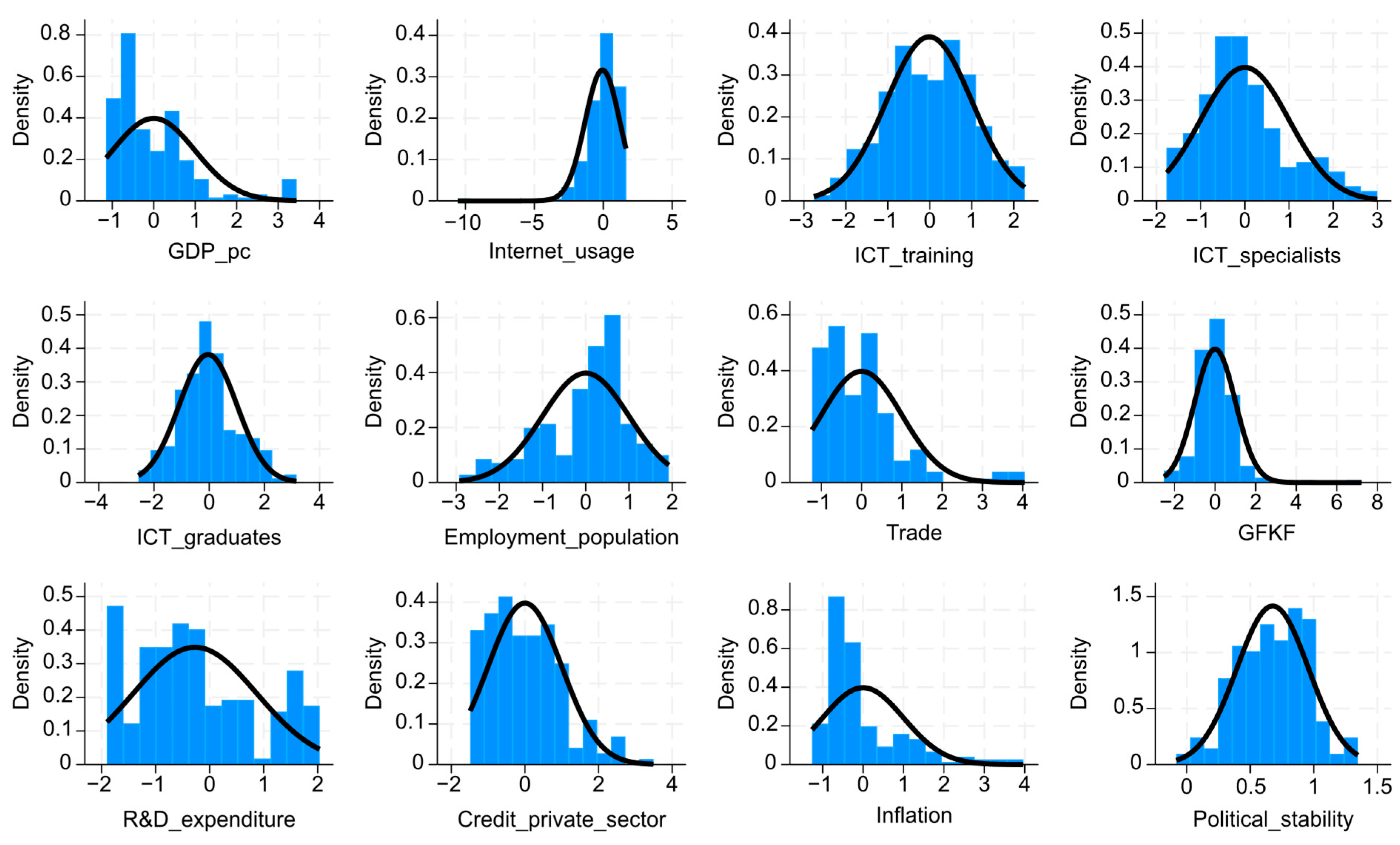
An essential aspect of summary statistics is how the data is distributed, which can be analyzed through the skewness parameter (a measure of asymmetry, taking the value zero for a normal distribution) and the kurtosis parameter (a measure of peak sharpness, taking the value three for a normal distribution). As we can see in Table 1, overall, the variables do not have a normal distribution. More specifically, in terms of asymmetry, with the exception of the variables Internet_usage, ICT_training, Employment_population, and Political_stability, which exhibit left-tailed distributions (i.e., negative asymmetry), the other variables exhibit right-tailed distributions (i.e., positive asymmetry). Regarding the sharpness of the peak, except for the variables ICT_training, R&D_expenditure, Political_stability, New_EU_countries, and Post-COVID_dummy, which have a platykurtic distribution, the rest reveal a leptokurtic distribution. Additionally, in Figure A1 of Appendix A, we graphically represent the distributions of all variables, except for the two dummy variables, using histograms with normal distribution curves superimposed.
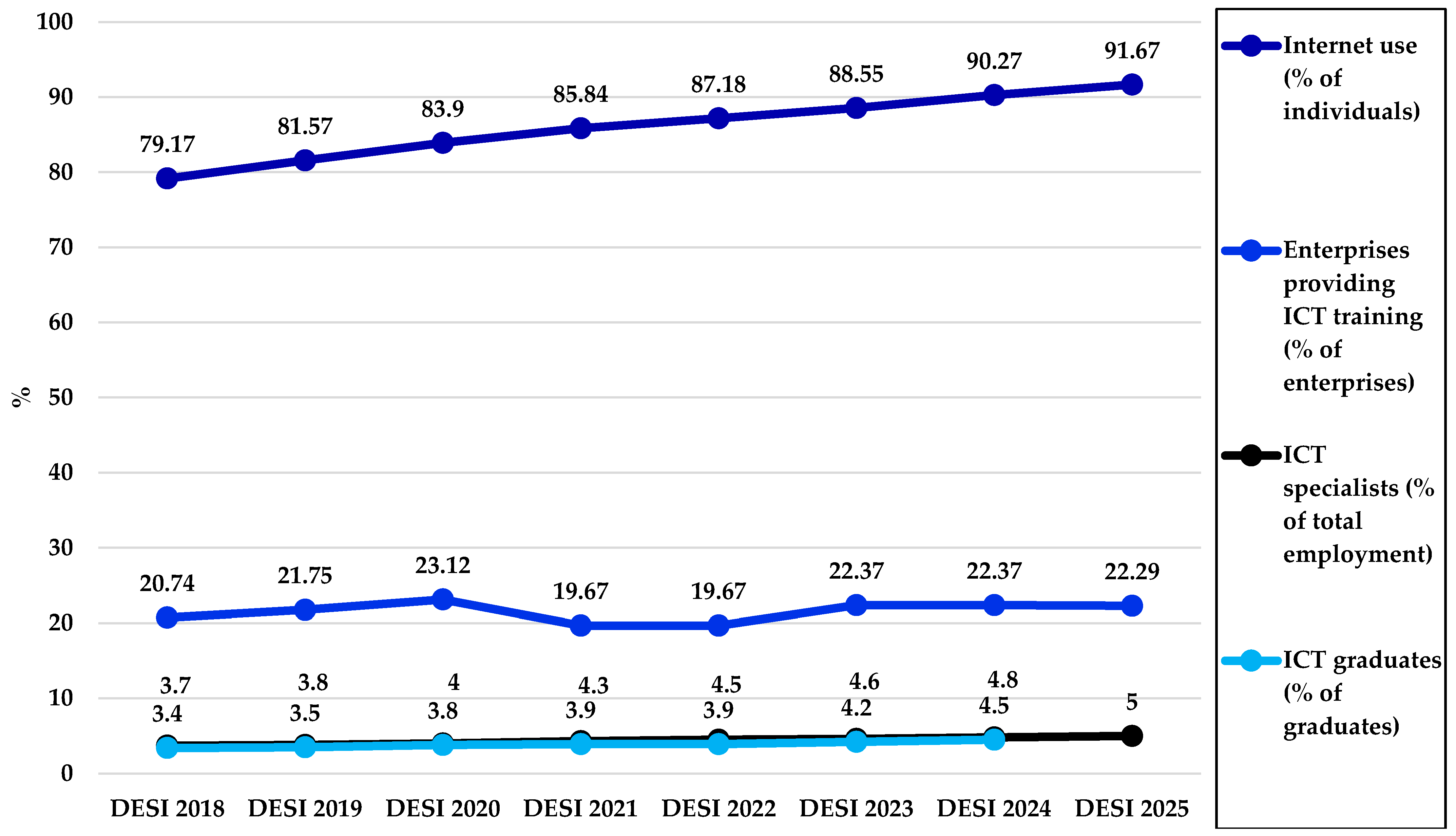
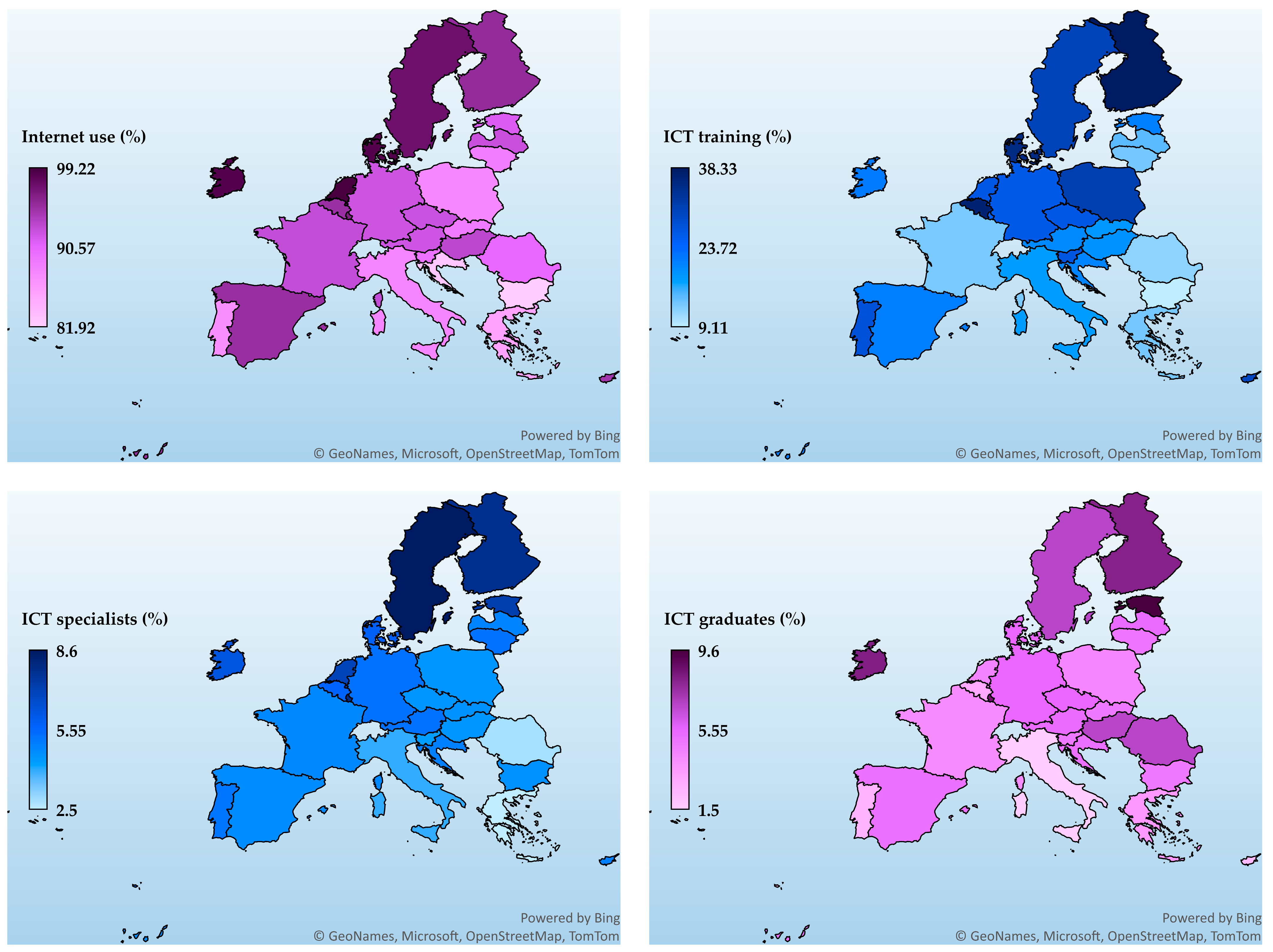
In what follows, we illustrate the disparities in digital skills, gauged through our four variables of interest, across EU member states for the last available period, namely, 2025 DESI data (which refer to 2024) for Internet usage, ICT training, and ICT specialists, and 2024 DESI data (which refer to 2023) for ICT graduates (see Figure 1). Overall, the Nordic countries and the Netherlands, Luxembourg, and Estonia perform best across most indicators, while Eastern and Southern European countries show mixed or less efficiency. The situation seems optimal in terms of internet usage, as a large share of individuals in each EU country (between 80 and 99% of the population) are online. In addition, for an overview of the situation at the EU level, Figure A2 from Appendix A provides the evolution of all four DESI digital skills dimensions from 2017 (DESI period: 2018) to 2024 (DESI period: 2025). Over the years, due to EU investments in digitalization, an upward trend has been observed in digital skills dimensions. In ensemble, both figures shed light on the fact that while the digitalization process is developing continuously across the EU, its pace varies from one economy to another (i.e., it is not homogeneous).
Before running any model, it is paramount to accurately detect potential issues of severe multicollinearity. In this respect, we apply the variance inflation factor (VIF) test, the results of which are shown in Table 2. As the VIF values for all variables are under the threshold value of five, we conclude that the explanatory variables are not collinear and are therefore suitable to be included together in a model.

3.2. Bayesian Model Averaging (BMA)

Let us assume a first-degree function, where Y stands for the explained variable, α stands for the intercept, X stands for a set of k potential regressors, β stands for the explanatory variables’ estimated slopes, and ε stands for the error term (which has zero mean and finite variance). In this case, the structure of the multiple linear regression would look as follows:
Y = α + β × X + ε
One of the most plausible issues that might emerge is that the researcher neither knows which variables from the initial set ought to be included in the model (i.e., uncertainty about which regressors are robust determinants of Y ) nor the degree of importance of each variable [30]. Although one could include all independent variables in a single linear model, this approach is far from optimal, and even infeasible, when the number of observations is limited [30]. Some risks of not knowing which variables truly matter in explaining the dependent variable include inflating the true significance of the regression coefficients or omitting relevant regressors [31].
Accordingly, the only viable solution to conducting unbiased research is to apply a model that can address these types of problems. In this respect, Bayesian model averaging (BMA) is a popular statistical technique designed for cases with dozens of regressors, able to tackle the model uncertainty issue within linear regression [30]. More specifically, BMA estimates models for all possible combinations of the initial set of candidate regressors and then constructs a weighted average over all those models. Therefore, BMA estimates 2k variable combinations from the set of X , hence examining 2k models (i.e., model space is composed of M1, …, M2k regression models) [30]. The model weights for this averaging arise from posterior model probabilities (PMPs) that come from the well-known Bayes’ theorem:
p M i Y , X = p Y M i , X p M i p Y X = p Y M i , X p M i Σ j = 1 2 k p Y M j , X p M j
where model M i is part of the 2k examined models. The numerator ( M i model marginal likelihood, denoted as p Y M i , X , and multiplied by the prior model probability, denoted as p M i ) indicates how likely the researcher considers M i model to be prior to examining the data. The denominator, denoted as p(Y|X), stands for the integrated likelihood (i.e., a multiplicative term constant over all models).
By renormalizing the above product from Equation (3), one can extrapolate the PMPs and hence the weighted posterior distribution of the model for any statistic ψ (including parameters β i ):
p ψ Y , X = i = 1 2 k p ψ M i , Y , X p M i X , Y p M i Σ j = 1 2 k p M j Y , X p M j
In any BMA, the researcher must elicit the model prior, which highlights the prior beliefs about preferring some models over others. In this respect, there are plenty of prior model distributions from which the researcher might choose. Yet, according to [30], it is recommended to assume a uniform prior probability for each model when the researcher lacks prior knowledge. This type of prior has the advantage of assigning equal prior probability to all models in the model space [31].
Furthermore, another salient aspect of the BMA specification is the choice of prior distributions for the model parameters, i.e., the regression coefficients β i , the constant, and the error variance. The former is assumed to have a Zellner’s g-prior, while the latter two are assumed to have a noninformative prior [32]. The noninformative prior has minimal influence on inference and is used when the researcher has little information about the parameters [33].
In the context of β i , one frequently employed prior is Zellner’s prior with a fixed g parameter, which ensures the precise computation of marginal likelihoods, though it may sometimes fail to deliver the best predictive performance [32]. An alternative to fixed g parameters is random g parameters, which offer greater flexibility in BMA analysis but complicate model specification and simulation [32]. Overall, the selection of the most appropriate type of g parameter is left to the researcher, considering that each type has both advantages and drawbacks.
Whether fixed or random, the parameter g has the property of controlling the shrinkage of coefficients towards zero. The shrinkage (labeled as δ ) is obtained using the following formula: δ = g / ( 1 + g ) . If δ is equal to one, it denotes that there is no shrinkage; if δ is equal to zero, it denotes entire shrinkage (i.e., the coefficient is constrained to be zero) [32]. While there are many g parameters in a Zellner’s g-prior to choose from (see, for instance, [32]), an interesting one, which is frequently considered in the literature, is the local empirical Bayes (EBL). EBL does not use an a priori value for g; instead, it estimates g from the data and does so separately for each model (put differently, EBL uses a different fixed g i for each M i model) [32].
Two central concepts in a BMA analysis are posterior model probability (PMP) and posterior inclusion probability (PIP), the latter being computed based on the former. PMP represents a model’s probability, considering the observed data and the model’s prior. With the help of PMP, influential models are identified: the higher the PMP of a model, the more relevant it is [32]. Even though BMA does not select a model, it identifies those that are truly influential and contributes more to the averaged results. Concerning PIP, it represents the probability of an explanatory variable being encompassed in a model computed across the space of models, considering the observed data and the model’s prior [32]. PIP values fall within the interval [0, 1]. Specifically, variables with higher PIP values, usually above the threshold of 0.5, are regarded as salient predictors of the dependent variable; therefore, PIP is used for describing and comparing predictors’ importance [32].

3.3. Generalized Method of Moments (GMM)

Scholars widely acknowledge that several issues can arise in empirical economic growth research, rendering econometric results spurious [34]. Among the most well-known difficulties, one could mention the following: explanatory variables may be correlated with the regression error term, making them endogenous—an instance in which several estimation methods, such as ordinary least squares, yield inconsistent estimates; dependent or independent variables may be measured with error; relevant regressors may be omitted from the model—an instance that causes the overestimation or underestimation of the effect of the included variables on the dependent variable; and the current realization of the response variable may be a consequence of its own previous levels—an instance in which dynamic panel estimation methods are preferred to static ones [34]. Given these types of problems, inappropriate estimation methods produce unrealistic results, so it is essential to identify and apply more rigorous methods that have the potential to minimize bias and inconsistency [34].
In this respect, the generalized method of moments (GMM) estimator for dynamic panel data models is regarded as one of the most effective available methods for addressing endogeneity, measurement error, and omitted variables [34]. The pioneer GMM applied to dynamic panel data models was the first-differenced GMM estimator, which was originally advanced by [35,36]. This type of estimate transforms the regressors through differencing, eliminating “unobserved time-invariant country-specific effects, and instruments the regressors in the first-differenced equations using lagged levels of the series two or more periods” [34] (p. 2). Later, refs. [37,38] proposed a refined version of the differenced GMM, namely the system GMM, which augments the former estimator by presuming that the “first differences in the instrument variables are uncorrelated with the fixed effects” [39] (p. 86). Hence, more instruments are introduced, significantly improving efficiency. As its name suggests, the system GMM constructs a two-equation system, i.e., the original and the transformed equation [39].
As [39] depicts, both types of GMM estimators are highly popular, being utilized in the following cases: (a) in longitudinal data with short periods (“small T”) and many cross-sectional units (“large N”); (b) when between the dependent variable and the independent variables exists a linear relationship; (c) when the dependent variable is dynamic and, hence, it hinges on its own realizations from previous periods; (d) when the regressors are not strictly exogenous, but correlated with past and possibly current error realizations; (e) in fixed cross-sectional unit effects; and (f) when there is heteroscedasticity and autocorrelation within cross-sectional units but not across them. Therefore, given the GMM model’s ability to effectively handle the situations listed above, we consider it appropriate to use the system GMM estimator to examine how digital skills and other factors influence economic growth.
The GMM equation could be written as below:
Y i , t = α + β × Y i , t 1 + γ × X i , t + ε i , t
where i = cross-sectional units; t = period; Y i , t = the response variable for cross-sectional unit i at time t; α = the estimated intercept; Y i , t 1 = the one-period lagged dependent variable; β and γ = the estimated slope coefficients; X i , t = the set of regressors, which, according to [39], can be endogenous (standard treatment is to utilize lags 2 and longer), predetermined (standard treatment is to utilize lags 1 and longer), or strictly exogenous (standard treatment is not to use lagged values); and ε = the disturbance term, which is a compound of the fixed effects and idiosyncratic shocks.

4. Results and Discussions

4.1. Results

Our model construction includes two main steps, as follows: (i) we start by applying a BMA model across a broad pool of variables that are susceptible to impact the GDP per capita with the aim of identifying the most relevant regressors, and (ii) we subsequently run a GMM only with the variables of interest (i.e., digital skill indicators) along with the regressors selected by BMA. Thus, we tackle a “BMA → GMM design”. In what follows, we explicitly describe the two stages undertaken in our paper.
In the first stage of this research, we appraise the effect and importance of each independent variable on the GDP per inhabitant by applying the BMA model with a uniform model prior, noninformative priors for intercept and error variance, Zellner’s g-prior for regression coefficients, and an empirical Bayes local g-prior. This approach enables us to address model uncertainty in our linear regression of economic growth and identify the most relevant predictors in explaining GDP per capita.
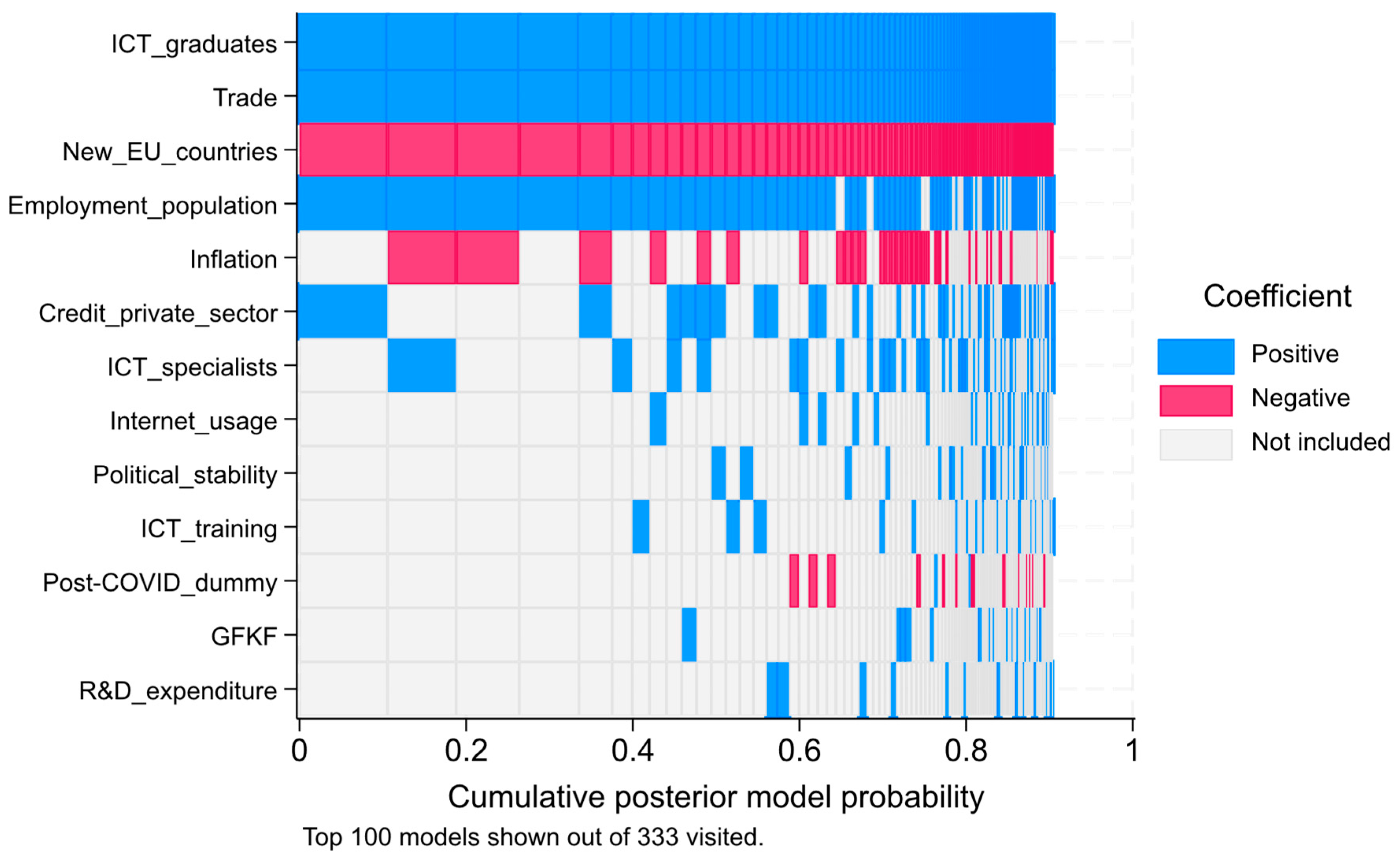
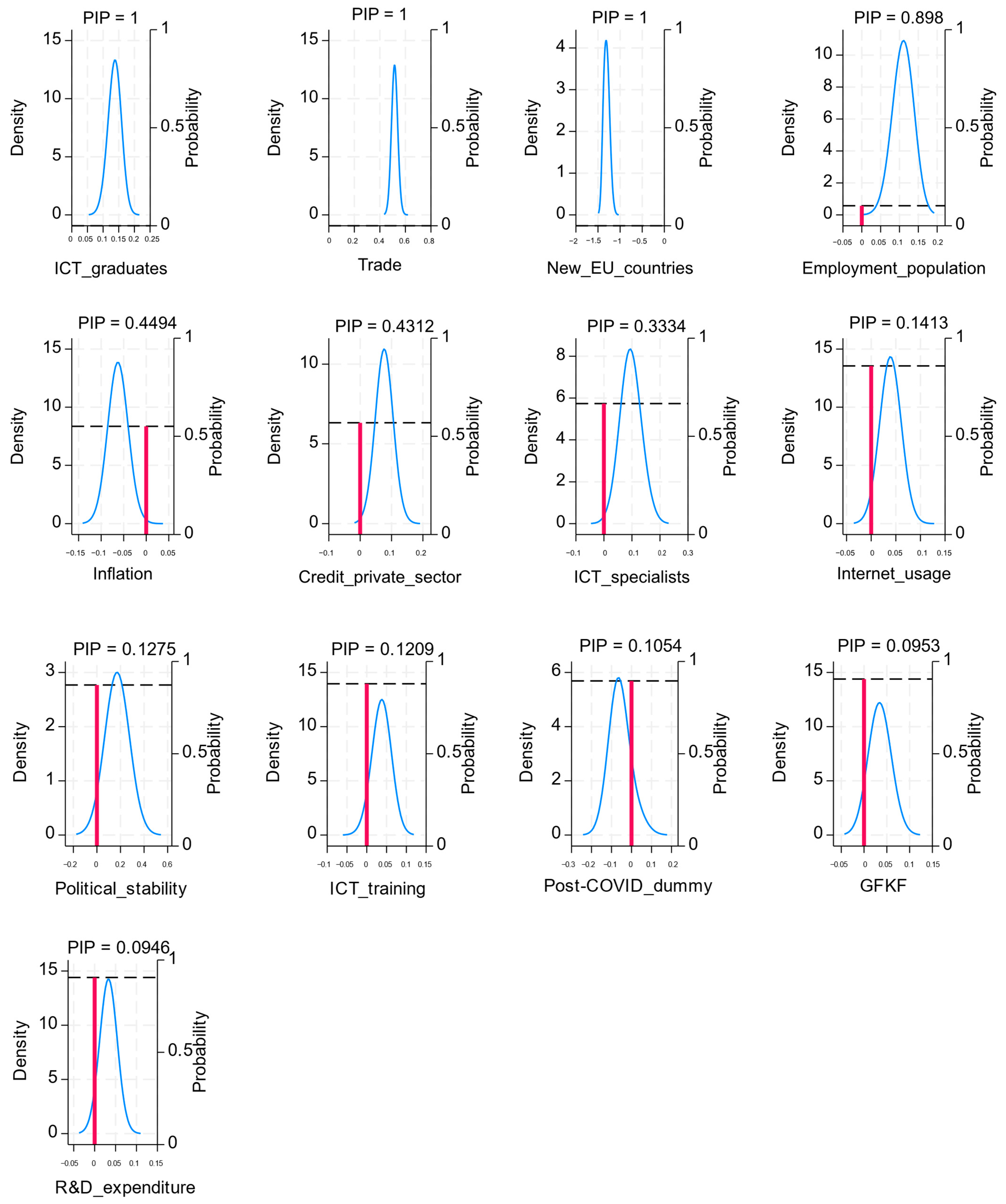
In this regard, Table 3 presents the results of the BMA estimation, with the regressors ranked by their posterior inclusion probability (PIP). Additionally, to visualize the BMA outcomes, Figure 2 illustrates the variable inclusion map for the first 100 models with the highest PMP values among the 333 models visited. Furthermore, Figure A3 of Appendix A depicts the analytical posterior density of the coefficients for all independent variables employed in the BMA, highlighting the continuous density conditional on inclusion in a model, as well as the probability of non-inclusion (calculated as 1 − PIP).
Based on the BMA outcomes, we could draw the following main remarks. In terms of the variables’ signs, (i) in all visited models, New_EU_countries and Inflation negatively impact GDP_pc, (ii) Post-COVID_dummy exerts a predominantly negative effect, with positive effects only in a few models, and (iii) all remaining predictors spur GDP_pc. In terms of the variables’ importance, ICT_graduates, Trade, New_EU_countries, and Employment_population are the principal determinants of economic growth. This claim is based on the fact that these four variables have high estimated PIP values (around or above 0.9), indicating that they are very likely to influence the GDP per inhabitant (i.e., they are true predictors of GDP_pc). According to [32] (p. 5), “predictors with high PIP values, commonly above 0.5, are considered important predictors”. All the remaining variables register PIP values below the 0.5 threshold. Regarding the other three variables of interest, since they have much lower PIP values compared to those of ICT graduates, they play a smaller role in the current realization of GDP per capita. In terms of the models’ importance, as assessed by PMP value, the first model depicted in Figure 2 seems to be the most influential, contributing the most to the averaged results (containing ICT_graduates, Trade, New_EU_countries, Employment_population, and Credit_private_sector), followed closely by the next three models. The remaining models have much lower PMP values and, hence, are less influential.
In the second stage of this research, we ran four two-step system GMM models (the results are shown in Table 4). More specifically, each GMM model includes the dependent variable with a one-year lag, one of the variables of interest (i.e., digital skill indicators), and the three control variables that registered the highest PIP values in the BMA model, namely, Trade, New_EU_countries, and Employment_population. Therefore, we are capable of estimating the dynamic relationships that exist between independent variables and dependent variables.
In our research, it is observed that in the BMA model, ICT_specialists (0.33), Internet_usage (0.14), and ICT_training (0.12) registered low PIP values. The justification for including them in the GMM model derives from the fact that these variables are proxies for digital skills and, hence, we are interested in assessing their effects on the GDP per capita. The overall rationale of this approach is that, on the one hand, we are able to gauge the impact of digital skill indicators separately along with that of the control variables that should be included in the economic growth regression model (as it was emphasized by the BMA), and, on the other hand, the GMM model might be regarded as a methodological robustness check for BMA results.
Based on the GMM results, we could make the following remarks. All regressors are statistically significant, either at the 1% or 5% level. Regarding the variables’ signs, as expected, except for New_EU_countries, all the others positively influence the per capita GDP. In respect of the variables’ magnitudes, the lagged GDP per capita (coefficients of roughly 0.8) is by far the main driver of the current GDP per capita. Concerning the impact of the four digital skill variables, their coefficients are quite close, with ICT_graduates having the largest effect on GDP per capita. Considering the abovementioned, we might assert that the GMM estimation confirms the outcomes obtained through BMA, which denotes that the research findings are robust to changes in the methodological framework and, hence, are reliable and valid.
In conclusion, the consistency of the GMM results is validated by the two popular GMM post-estimation tests, namely (i) the Arellano–Bond (AB) test for AR (2) in first differences and (ii) the Hansen test of overidentifying restrictions. In all GMM models, for both tests, H0 is accepted (p-value > 0.1), which implies that (i) model specification is adequate and (ii) instruments’ validity (in other words, the model assumptions) used in estimation cannot be questioned. The reason for not focusing on the AB test for AR (1) in first differences is that, according to [40] (p. 7), “an appropriate model will have first-order autocorrelation in the differenced error term, but not second-order”; hence, it is salient not to reject H0 for AR (2). Additionally, we did not display the Sargan test since it is ineffective when heteroscedasticity is present in the regression analysis, unlike the Hansen test, which is valid for both homoscedasticity and heteroscedasticity cases [40].

4.2. Discussions

Based on the BMA results, which corroborated those of the GMM, among the four proxy variables for digital skills, ICT graduates emerge as the most significant predictor of GDP per capita. The next relevant factors, listed in order of their impact magnitude, are ICT specialists, internet usage, and businesses offering ICT training to their employees. Accordingly, both BMA and GMM estimates highlight the importance of the EU’s population’s digital skills in spurring economic growth. In other words, our findings reinforce and validate the key role played by human capital in achieving economic growth and development (as outlined in [16]’s endogenous growth theory).
As expected, ICT graduates (coefficient of 0.0921) make a significant contribution to economic growth at the EU level. Indeed, the demand for ICT graduates is very high. They are employed in areas such as the design, development, and implementation of software applications that contribute to GDP growth, as technology is essential to increasing productivity and innovation, which in turn are important sources of economic growth and development.
Likewise, several current empirical studies have stressed the momentousness of digital literacy among populations of all ages, in formal education in the field of ICT, and in the ICT sector in terms of supporting economic expansion. For example, the case of the 27 EU member states [41] showcases the absolutely necessary role of education in fostering digital competencies, which, in turn, contribute to economic vitality. Indeed, there is an urgent worldwide need to increase digital literacy as well as to furnish “essential knowledge and skills for the use of technological tools and media” [41] (p. 11). As humanity moves to an increasingly digital world, the significance of high-quality, inclusive, and accessible digital education becomes vital. In the same vein, by noting a positive correlation between ICT graduates and the per capita GDP for the case of Romania, ref. [42] argues that governments should allocate greater funds to boost ICT education and continuous training, as these investments translate into long-term economic prosperity. Furthermore, the report of [1] also highlights the importance of developing high digital skills among individuals, as this constitutes an essential component of human capital that drives digital transformation.
With respect to ICT specialists (coefficient of 0.0795), which include ICT professionals, ICT service managers, ICT installers and servicers, ICT technicians, etc., they have both a direct and indirect contribution to the economy of a country through the development of software and applications, which leads to an increase in labor productivity, contributes to the digitalization of public services, creates connections between global markets through digitalization and innovation, etc.
Furthermore, ICT training (coefficient of 0.0716) is highly relevant for stimulating a country’s economy, but has a lower effect than ICT graduates, who are better prepared in the field of Information and Communications Technology.
Likewise, internet usage (coefficient of 0.0187) has a positive effect on the per capita GDP, but the magnitude of this effect varies across areas/countries and the periods under consideration.
As for the control variables, according to the BMA results, trade, the new EU countries, and the employed population appear to exert the largest impact on economic growth. In terms of trade, the EU is one of the largest traders of goods and services worldwide. Indeed, trade stimulates the economies of EU member states through access to foreign markets, through the transfer of technology and knowledge, by increasing competitiveness between companies, and attracting foreign investment and finance, all of which eventually positively influence the GDP per inhabitant. With respect to international trade, several scholars, especially neoclassical economists, regard it as a salient engine of economic growth in the long run [43]. Among the advantages a country can gain from greater trade openness, ref. [43] mentions the opportunity to sell to and purchase from international markets more easily, hence increasing business activity within the country in question and, implicitly, employment. In addition, countries that benefit from intense international trade (i.e., exporting and importing different types of products to various foreign countries) are more incentivized to specialize in producing goods they can produce most efficiently and to buy from abroad those that are not financially worthwhile to be produced domestically. Thus, countries can allocate their resources more optimally, gain more from trade flows, and benefit economically.
Regarding the New_EU_countries dummy variable, its negative impact on GDP per capita underscores that the economic performance of countries that are part of the “new” EU member states group (i.e., EU-13 group) is weaker than that of countries that are part of the “old” EU member states group (i.e., EU-14 group). In other words, this finding sheds light on the economic differences that persist across the two groups of countries. Whilst in recent decades the EU has focused on developing various policies (especially cohesion policies) aimed at narrowing disparities in regional development within the EU, asymmetries still continue to be significant [44]. The “old” EU member states group is mostly composed of highly developed economies, characterized by good living conditions, solid governance frameworks, and a strong emphasis on education and technological progress [44]. For the group of “new” EU member states, the situation is different. Although their economic performance improved after accession to the EU, these countries have not yet caught up with the more developed EU states.
Concerning the employed population, it is essential for the growth of any economy. This contributes to an increase in domestic consumption by boosting productivity and, indirectly, income, which has a positive and direct effect on the GDP per capita. States in which the employment rate is higher have a lower social burden and higher fiscal efficiency. Its positive impact on economic growth is both theoretically and empirically confirmed by various researchers [45]. The explanation is straightforward: when individuals have a stable workplace, they implicitly have a stable income and hence can afford to (i) spend money not only on basic needs but also on developmental needs, (ii) save the financial resources, or (iii) make investments. All of these lead to the increased general well-being of the population and to socio-economic development.
All in all, we might highlight that the EU member states are not homogeneous in terms of digital skills. A low level of digital skills or slow progress in some countries slows digitalization and creates a gap between countries. This prevents the EU from achieving the “digital decade objective on digital skills”. It is therefore necessary for EU member states to take certain measures so that the level of digital skills keeps pace with the progress of the digital age. As digitalization expands, it is imperative that every employee keep up with the development of digital skills, and that companies and public institutions also continuously invest in their training so they can face new challenges. Rapid adaptation by employees and companies to changes in the digital labor market is key to maintaining competitiveness, and, indeed, the changes driven by digitalization can be an opportunity for economic growth and development.
To conclude, we may argue that our core findings about the effects of the four DESI indicators on per capita GDP are consistent with the existing literature on digitalization and economic growth, which highlights that countries with advanced digital skill endowments tend to exhibit higher economic performance [6,26,41,42].

5. Conclusions

In the current, increasingly technology-driven era, it is of the utmost importance for all countries to continuously develop their human capital, and especially the digital skills of their population, as digitalization has the potential to enhance productivity, drive technological innovation, and promote inclusive growth [26].
Our research examines the impact of digital skills on economic growth in the 27 European Union (EU) member states over the period 2017–2023. In this respect, to measure the concept of digital skills, we employed the following four indicators of the DESI: internet usage, companies providing ICT training to their staff, ICT specialists, and ICT graduates, while the economic growth was proxied by GDP per capita. In addition, to provide a more nuanced analysis, we included nine control variables likely to exert significant effects on growth. Accordingly, in the first stage of the research, we assessed the effect and importance of each explanatory variable on the GDP per capita using the BMA, while in the second stage, we ran a two-step system GMM. With respect to the BMA results, the following remarks were drawn: (1) in terms of the variables’ importance, ICT graduates, trade, new EU countries, and employed population are the principal factors impacting GDP per inhabitant; (2) in terms of the variables’ signs, (i) new EU countries and inflation produce negative effects on GDP per capita, (ii) except for a few models, the post-COVID dummy predominantly diminishes the per capita GDP, and (iii) all remaining predictors foster economic growth; (3) in terms of the models’ salience, the most influential one is that encompassing the regressors ICT graduates, trade, new EU countries, employed population, and credit to the private sector. Finally, the GMM estimations confirmed the BMA results. In consequence, we argue that our research findings are reliable, unbiased, and robust to methodological changes. To conclude, our results support the theory that greater digitalization leads to higher economic growth.
Based on the empirical results from this research, we make the following recommendations to policymakers. To fully benefit from the advantages of digitalization, decision makers must adopt a balanced approach that ensures access to digital education and infrastructure while addressing the challenges that could limit progress in digitalization. More specifically, to stimulate a country’s economic growth, governments should place greater emphasis on education and allocate a more consistent budget to digital skills acquisition among young people with an affinity for the field. Digital skills are essential to make their work more efficient and to develop new ideas that increase labor productivity. Currently, digitalization and technological development play an essential role in shaping society and driving economic growth. Therefore, policymakers ought to keep up with scientific progress in this field, which has gained momentum worldwide in recent years, and which deeply shapes the way people live. Moreover, internet usage is indispensable in the digital age we live in and, therefore, policymakers must take this into account when drawing up a state budget. Therefore, it is necessary to ensure an infrastructure commensurate with the current stage of digitalization, which requires investments in the ICT sector. We recommend that policymakers implement strategies that account for labor market restructuring by creating and implementing professional conversion programs. There must also be a correlation between the school curriculum and the economic needs at the state level, as well as collaboration between universities and the private and public sectors.
The abovementioned recommendations have positive effects on increasing labor productivity and innovation, with a long-term effect on sustainable economic growth that will lead to an improvement in the quality of life and sustainable economic development within the EU.
Concerning the limitations of our study, these are derived from the following two aspects. First, although we initially intended to include all six indicators that constitute the digital skills dimension of the DESI, we had to exclude two of them that did not appear in all editions. Second, the study covers a relatively medium period, i.e., 7 years (between 2017 and 2023), due to the unavailability of DESI editions for earlier periods.
As future research directions, we intend to extend the analysis by comparing the EU-27 member states with a broader set of countries worldwide and by considering a longer time horizon for empirical investigation. This would allow for a more comprehensive assessment of the statistical relationship between digitalization and economic growth and would strengthen the robustness of the results. Also, a possible future research direction would be to extend this analysis by including additional proxy variables (or even interaction terms) related to digital performance in the green economy. This would assess how all indicators across all DESI dimensions influence economic growth and the green economy, through the BAM technique designed to handle numerous explanatory variables.

Author Contributions

Conceptualization, N.S., E.-A.S. and M.M.D.; methodology N.S., E.-A.S. and M.M.D.; validation, N.S. and E.-A.S.; formal analysis, N.S., E.-A.S. and M.M.D.; writing—original draft preparation, N.S., E.-A.S. and M.M.D.; and writing—review and editing, N.S. and E.-A.S. All authors have read and agreed to the published version of the manuscript.

Funding

This research was supported by the Doctoral School of Economics and Business Administration (SDEEA), West University of Timisoara (WUT). The APC was funded by the West University of Timișoara.

Institutional Review Board Statement

Not applicable.

Informed Consent Statement

Not applicable.

Data Availability Statement

The raw data used in this article are retrieved from publicly available databases, as shown in Table A1 in Appendix A.

Conflicts of Interest

The authors declare no conflicts of interest.

Appendix A

Table A1. Variables’ description.
Variable (Abbreviation)Definition and MeasurementSource
GDP per capita
(GDP_pc)
It is the total income earned through the production of goods and services in an economic territory during an accounting period, divided by the general population to obtain a per capita estimate. Unit of measure: constant 2015 US$.[25]
Internet usage
(Internet_usage)
All individuals aged 16–74 who use the internet at least once a week. Unit of measure: % of individuals.[9]
Enterprises providing ICT training
(ICT_training)
All public or private enterprises, without the financial sector (with ten or more persons employed), that provide training in ICT to their personnel. Unit of measure: % of enterprises.
ICT specialists
(ICT_specialists)
Employed ICT specialists, including jobs like ICT service managers, ICT professionals, ICT technicians, ICT installers, and servicers. Unit of measure: % of total employment.
ICT graduates
(ICT_graduates)
People with a degree in ICT. Unit of measure: % of graduates.
Employment-to-population ratio
(Employment_population)
The proportion of a country’s population that is employed. Unit of measure: % of total population over 15 years of age.[25]
Trade
(Trade)
The sum of exports and imports of goods and services. Unit of measure: % of GDP.
Gross fixed capital formation
(GFKF)
Includes acquisitions less disposals of fixed assets during the accounting period, including certain specified expenditures on services that add to the value of non-produced assets. Unit of measure: % of GDP.
Gross domestic expenditures on research and development
(R&D_expenditure)
Include both capital and current expenditures in the four main sectors: business enterprise, government, higher education, and private non-profit. R&D covers basic research, applied research, and experimental development. Unit of measure: % of GDP.
Domestic credit to the private sector
(Credit_private_sector)
Refers to financial resources provided to the private sector by financial corporations, such as through loans, purchases of non-equity securities, trade credits, and other accounts receivable, that establish a claim for repayment. Unit of measure: % of GDP.
Inflation, GDP deflator
(Inflation)
Inflation, measured by the annual growth rate of the GDP implicit deflator, shows the rate of price change in the economy as a whole. The GDP implicit deflator is the ratio of GDP in current local currency to GDP in constant local currency. Unit of measure: annual %.
Political stability
(Political_stability)
Captures perceptions of the extent to which political power and governance are secure from destabilization, and of the likelihood that authority will be challenged or altered through violent, coercive, or unconstitutional means. Unit of measure: standard statistical units, ranging from around −2.5 to 2.5, where values tending towards 2.5 indicate higher political stability, while values tending towards −2.5 indicate lower political stability.
Binary variable that highlights whether a country is part of the “new” or “old” EU member states
(New_EU_countries)
Unit of measure: value zero for countries that are part of the “old” EU member states group (i.e., those which joined the EU between 1957 and 1995, inclusive—EU-14 group), and the value one for countries that are part of the “new” EU member states group (i.e., those which joined the EU after 2004, inclusive—EU-13 group).[46]
Binary variable that differentiates the years before the COVID-19 pandemic from those after it
(Post-COVID_dummy)
Unit of measure: value zero for years prior to the COVID-19 pandemic (i.e., 2017–2020) and value one for years subsequent to the pandemic (i.e., 2021–2023).
Source: Publicly available databases.
Figure A1. Variables’ histogram with normal distribution curves superimposed. Source: Authors’ computation in Stata 19.
Sustainability 18 02829 g0a1
Figure A2. DESI digital skills dimensions evolution at the EU level, between 2017 (DESI period: 2018) and 2024 (DESI period: 2025). Notes: The values of ICT specialists exceed those of ICT graduates; thus, they are displayed above. Source: Authors’ computation in Excel based on [9].
Sustainability 18 02829 g0a2
Figure A3. Coefficients’ analytical posterior density for the variables employed in the BMA. Notes: The blue line shows the density conditional on inclusion, while the pink vertical one shows the probability of non-inclusion (calculated as 1 − PIP). Source: Authors’ computation in Stata 19.
Sustainability 18 02829 g0a3

References

  1. European Investment Bank. Digitalisation in Europe 2021–2022: Evidence from the EIB Investment Survey; European Investment Bank: Luxembourg, 2022. [Google Scholar] [CrossRef]
  2. OECD. Economic Outlook, Volume 2022 Issue 2: Confronting the Crisis; OECD Publishing: Paris, France, 2022. [Google Scholar] [CrossRef]
  3. European Commission. Approaches to Inclusive Gender Equality in Research and Innovation (R&I); Publications Office of the European Union: Luxembourg, 2022. [Google Scholar] [CrossRef]
  4. Brynjolfsson, E.; Hitt, L.M. Beyond computation: Information technology, organizational transformation and business performance. J. Econ. Perspect. 2000, 14, 23–48. [Google Scholar] [CrossRef]
  5. Aghion, P.; Howitt, P.W. The Economics of Growth; MIT Press: Cambridge, MA, USA; London, UK, 2009. [Google Scholar]
  6. Mura, P.O.; Donath, L.E. Digitalisation and economic growth in the European Union. Electronics 2023, 12, 1718. [Google Scholar] [CrossRef]
  7. Calderon-Monge, E.; Ribeiro-Soriano, D. The role of digitalization in business and management: A systematic literature review. Rev. Manag. Sci. 2024, 18, 449–491. [Google Scholar] [CrossRef]
  8. OECD. Skills Outlook 2019: Thriving in a Digital World; OECD Publishing: Paris, France, 2019. [Google Scholar] [CrossRef]
  9. European Commission. Digital Economy and Society Index (DESI). Available online: https://digital-decade-desi.digital-strategy.ec.europa.eu/datasets/desi/charts/desi-indicators (accessed on 5 January 2026).
  10. Bocean, C.G.; Vărzaru, A.A. EU countries’ digital transformation, economic performance, and sustainability analysis. Humanit. Soc. Sci. Commun. 2023, 10, 875. [Google Scholar] [CrossRef]
  11. Vărzaru, A.A.; Bocean, C.G. Digital transformation and innovation: The influence of digital technologies on turnover from innovation activities and types of innovation. Systems 2024, 12, 359. [Google Scholar] [CrossRef]
  12. Vărzaru, A.A.; Bocean, C.G. Systemic interactions among digital transformation, sustainable orientation, and economic outcomes in EU countries. Systems 2025, 13, 914. [Google Scholar] [CrossRef]
  13. Li, Z.; Chen, Z.; Huang, Z. Modelling the data-generating mechanism of China’s commodity market by identifying hidden information flow regimes. Financ. Innov. 2026, 12, 28. [Google Scholar] [CrossRef]
  14. Solow, R.M. (Ed.) Economists; Yale University Press: New Haven, CT, USA, 2019. [Google Scholar]
  15. Foley, D.K.; Michl, T.R.; Tavani, D. Growth and Distribution, 2nd ed.; Harvard University Press: Cambridge, MA, USA, 2019. [Google Scholar]
  16. Romer, P.M. Endogenous technological change. J. Polit. Econ. 1990, 98, S71–S102. [Google Scholar] [CrossRef]
  17. Diebolt, C.; Hippe, R. The long-run impact of human capital on innovation and economic growth in the regions of Europe. In Human Capital and Regional Development in Europe: A Long-Run Comparative View; Diebolt, C., Hippe, R., Eds.; Springer: Cham, Switzerland, 2022; pp. 85–115. [Google Scholar] [CrossRef]
  18. Raeskyesa, D.G.S.; Lukas, E.N. Does digitalization increase economic growth? Evidence from ASEAN8 countries. J. Ekon. Indones. 2019, 8, 267–278. [Google Scholar] [CrossRef]
  19. Ren, L.; Dong, J.; Zhang, L.; Laili, Y.; Wang, X.; Qi, Y.; Li, B.H.; Wang, L.; Yang, L.T.; Deen, M.J. Industrial metaverse for smart manufacturing: Model, architecture, and applications. IEEE Trans. Cybern. 2024, 54, 2683–2695. [Google Scholar] [CrossRef]
  20. Nsavyimana, O.; Li, C. Impact analysis of the mobile telephone and the internet on economic development in the East African Community. Data Sci. Finance Econ. 2025, 5, 156. [Google Scholar] [CrossRef]
  21. Acemoglu, D.; Robinson, J.A. Why Nations Fail: The Origins of Power, Prosperity, and Poverty; Crown Currency: New York, NY, USA, 2013. [Google Scholar] [CrossRef]
  22. Karpenko, D.; Deshko, V.; Eutukhova, T.; Novoseltsev, O.; Teslenko, O. Analysis of the market aspects in the reform of district heating systems under wartime and post-war recovery conditions. In Systems, Decision and Control in Energy VII: Volume II: Power Engineering and Environmental Safety; Babak, V., Zaporozhets, A., Eds.; Springer Nature: Cham, Switzerland, 2025; pp. 229–274. [Google Scholar] [CrossRef]
  23. Ezzat, A.; Emira, M. Do institutions matter in the fiscal reaction function? The case of Egypt. Humanit. Soc. Sci. Commun. 2025, 12, 1464. [Google Scholar] [CrossRef]
  24. Ahmad, N.; Schreyer, P. Measuring GDP in a Digitalised Economy; OECD Statistics Working Papers No. 2016/07; OECD Publishing: Paris, France, 2016. [Google Scholar] [CrossRef]
  25. World Bank Open Data. World Development Indicators. Available online: https://databank.worldbank.org/reports.aspx?series=ER.LND.PTLD.ZS&source=2 (accessed on 5 January 2026).
  26. Xholo, N.; Ncanywa, T.; Garidzirai, R.; Asaleye, A.J. Promoting economic development through digitalisation: Impacts on human development, economic complexity, and gross national income. Adm. Sci. 2025, 15, 50. [Google Scholar] [CrossRef]
  27. Saeed, A.M.M. The role of the digital economy in enhancing economic growth and reducing unemployment in developing countries. J. Cult. Anal. Soc. Change 2025, 10, 4633–4643. [Google Scholar] [CrossRef]
  28. Doroiman, M.M.; Sîrghi, N. The impact of digitalization on EU competitiveness and economic growth: An econometric perspective. Timis. J. Econ. Bus. 2025, 18, 113–126. [Google Scholar] [CrossRef]
  29. Kaufmann, D.; Kraay, A.; Mastruzzi, M. The Worldwide Governance Indicators: Methodology and Analytical Issues; World Bank Policy Research Working Paper No. 5430; World Bank: Washington, DC, USA, 2010; Available online: http://documents.worldbank.org/curated/en/630421468336563314 (accessed on 5 January 2026).
  30. Zeugner, S.; Feldkircher, M. Bayesian model averaging employing fixed and flexible priors: The BMS package for R. J. Stat. Softw. 2015, 68, 1–37. [Google Scholar] [CrossRef]
  31. Horváth, R. Does trust promote growth? J. Comp. Econ. 2013, 41, 777–788. [Google Scholar] [CrossRef]
  32. StataCorp. Stata 19 Bayesian Model Averaging Reference Manual; Stata Press: College Station, TX, USA, 2025; Available online: https://www.stata.com/manuals/bma.pdf (accessed on 5 January 2026).
  33. Syversveen, A.R. Noninformative Bayesian Priors: Interpretation and Problems with Construction and Applications; Preprint Statistics No. 3; Norwegian University of Science and Technology: Trondheim, Norway, 1998; pp. 1–11. Available online: http://www.yaroslavvb.com/papers/syversveen-noninformative.pdf (accessed on 5 January 2026).
  34. Bond, S.R.; Hoeffler, A.; Temple, J.R. GMM Estimation of Empirical Growth Models; Discussion Paper No. 3048; Centre for Economic Policy Research: London, UK, 2021; pp. 1–30. Available online: https://ssrn.com/abstract=290522 (accessed on 5 January 2026).
  35. Holtz-Eakin, D.; Newey, W.; Rosen, H.S. Estimating vector autoregressions with panel data. Econometrica 1988, 56, 1371–1395. [Google Scholar] [CrossRef]
  36. Arellano, M.; Bond, S. Some tests of specification for panel data: Monte Carlo evidence and an application to employment equations. Rev. Econ. Stud. 1991, 58, 277–297. [Google Scholar] [CrossRef]
  37. Arellano, M.; Bover, O. Another look at the instrumental variable estimation of error-components models. J. Econom. 1995, 68, 29–51. [Google Scholar] [CrossRef]
  38. Blundell, R.; Bond, S. Initial conditions and moment restrictions in dynamic panel data models. J. Econom. 1998, 87, 115–143. [Google Scholar] [CrossRef]
  39. Roodman, D. How to do xtabond2: An introduction to difference and system GMM in Stata. Stata J. 2009, 9, 86–136. [Google Scholar] [CrossRef]
  40. Piper, A. A Note on Modelling Dynamics in Happiness Estimations; MPRA Paper No. 49709; Munich Personal RePEc Archive: Munich, Germany, 2013; Available online: https://mpra.ub.uni-muenchen.de/49709/ (accessed on 5 January 2026).
  41. Magoutas, A.I.; Chaideftou, M.; Skandali, D.; Chountalas, P.T. Digital progression and economic growth: Analyzing the impact of ICT advancements on the GDP of European Union countries. Economies 2024, 12, 63. [Google Scholar] [CrossRef]
  42. Plăcintă, D.D.; Toma, A.; Bătăgan, L.; Mirea, C.M.; Pantelimon, F.V. The impact of ICT education on GDP evolution at local level. A Romanian case study. Bus. Manag. Econ. Eng. 2024, 22, 156–173. [Google Scholar] [CrossRef]
  43. Raghutla, C. The effect of trade openness on economic growth: Some empirical evidence from emerging market economies. J. Public Aff. 2020, 20, e2081. [Google Scholar] [CrossRef]
  44. European Commission. Regional Trends for Growth and Convergence in the European Union. Available online: https://ec.europa.eu/regional_policy/information-sources/publications/reports/2023/regional-trends-for-growth-and-convergence-in-the-european-union_en (accessed on 15 January 2026).
  45. Haider, A.; Jabeen, S.; Rankaduwa, W.; Shaheen, F. The nexus between employment and economic growth: A cross-country analysis. Sustainability 2023, 15, 11955. [Google Scholar] [CrossRef]
  46. Council of the European Union. Timeline of Accession of EU Member States. Available online: https://www.consilium.europa.eu/en/policies/how-enlargement-works/timeline-accession-eu-member-states (accessed on 5 January 2026).
Figure 1. Disparities in digital skills among EU member states for the most recent period: internet usage (top left), ICT training (top right), ICT specialists (bottom left), and ICT graduates (bottom right). Source: Authors’ computation in Excel based on [9].
Sustainability 18 02829 g001
Figure 2. Variable inclusion map: Bayesian model averaging. Notes: This map was generated by applying the “bmagraph varmap” command. Source: Authors’ computation in Stata 19.
Sustainability 18 02829 g002
Table 1. Descriptive statistics.
VariableMeanStd. Dev.MinMaxSkewnessKurtosisNo. Obs.
GDP_pc01−1.153.441.645.71189
Internet_usage01−10.551.66−3.3526.86189
ICT_training01−2.762.26−0.072.46189
ICT_specialists01−1.773.000.713.20189
ICT_graduates01−2.573.160.363.35189
Employment_population01−2.921.92−0.743.09189
Trade01−1.234.051.827.32189
GFKF01−2.527.222.2718.01189
R&D_expenditure01−1.902.030.412.21189
Credit_private_sector01−1.493.490.763.28189
Inflation01−1.263.961.776.01189
Political_stability0.680.28−0.081.35−0.152.66189
New_EU_countries0.480.50010.071.01189
Post-COVID_dummy0.430.50010.291.08189
Source: Authors’ computation in Stata 19.
Table 2. Variance inflation factor (VIF).
VariableVIF1/VIF
ICT_specialists3.880.26
New_EU_countries2.510.40
Employment_population2.420.41
Post-COVID_dummy2.380.42
Credit_private_sector2.330.43
Political_stability2.220.45
Inflation2.200.45
Internet_usage1.980.50
ICT_training1.970.51
Trade1.870.53
R&D_expenditure1.840.54
ICT_graduates1.670.60
GFKF1.510.66
VIF mean2.21
Source: Authors’ computation in Stata 19.
Table 3. Factors influencing GDP per capita: Bayesian model averaging.
VariableInfluence (Sign)MeanStandard DeviationPosterior Inclusion Probability (PIP)
ICT_graduates+0.14100.03011
Trade+0.54680.03121
New_EU_countries−1.40610.09101
Employment_population+0.10390.04910.8980
Inflation−0.02940.03790.4494
Credit_private_sector+0.03480.04670.4312
ICT_specialists+0.03150.05250.3334
Internet_usage+0.00530.01670.1413
Political_stability+0.02140.07340.1275
ICT_training+0.00490.01730.1209
Post-COVID_dummy−/+−0.00660.03060.1054
GFKF+0.00310.01390.0953
R&D_expenditure+0.00280.01220.0946
Shrinkage: g/(1 + g) = 0.9960
Notes: The BMA estimator was performed by applying the “bmaregress” estimation command. Coefficient posterior means and standard deviation are estimated from 333 models. PIP values range from zero to one (the higher the PIP value of an explanatory variable, the more likely it is to matter in explaining the dependent variable). The influence can be positive (+), negative (−) or both (+/−) Source: Authors’ computation in Stata 19.
Table 4. Factors influencing GDP per capita: two-step system generalized method of moments.
VariableModel 1Model 2Model 3Model 4
Lagged GDP_pc0.894 ***
(0.0147)
0.754 ***
(0.0267)
0.783 ***
(0.0431)
0.759 ***
(0.0120)
Internet_usage0.0187 ***
(0.00267)
ICT_training 0.0716 ***
(0.0170)
ICT_specialists 0.0795 **
(0.0351)
ICT_graduates 0.0921 ***
(0.0135)
Trade0.0188 **
(0.00684)
0.172 ***
(0.0287)
0.136 ***
(0.0359)
0.127 ***
(0.0122)
New_EU_countries−0.153 ***
(0.0259)
−0.164 **
(0.0653)
−0.113 ***
(0.0323)
−0.211 ***
(0.0219)
Employment_population0.0658 ***
(0.0133)
0.254 ***
(0.0510)
0.102 **
(0.0481)
0.236 ***
(0.0261)
AB test for AR (2) in first differences(H0: There is no second-order serial correlation in the error terms)z = −0.92
p-value = 0.359
z = −0.89
p-value = 0.371
z = −0.38
p-value = 0.705
z = −1.10
p-value = 0.270
Hansen test of overidentifying restrictions
(H0: The overidentifying restrictions are valid)
χ2(20) = 24.85
p-value = 0.207
χ2(16) = 19.76
p-value = 0.231
χ2(12) = 17.64
p-value = 0.127
χ2(20) = 22.81
p-value = 0.298
No. of instruments26211725
No. of groups27272727
No. of observations162162162162
Notes: The GMM dynamic estimator was performed using the “xtabond2” estimation command with the “collapse” option, which has the advantage of limiting the proliferation of instruments (for more details, see [39]). Hence, in all models, the number of instruments does not exceed the number of groups (a very essential condition for model adequacy). The New_EU_countries variable is strictly exogenous, while all the others are endogenous. *** denotes that p-value ∈ [0, 0.01]; ** denotes that p-value ∈ (0.01, 0.05]. The round brackets contain the standard errors. H0 denotes the null hypothesis. AB test stands for the Arellano–Bond test. Source: Authors’ computation in Stata 19.
Disclaimer/Publisher’s Note: The statements, opinions and data contained in all publications are solely those of the individual author(s) and contributor(s) and not of MDPI and/or the editor(s). MDPI and/or the editor(s) disclaim responsibility for any injury to people or property resulting from any ideas, methods, instructions or products referred to in the content.