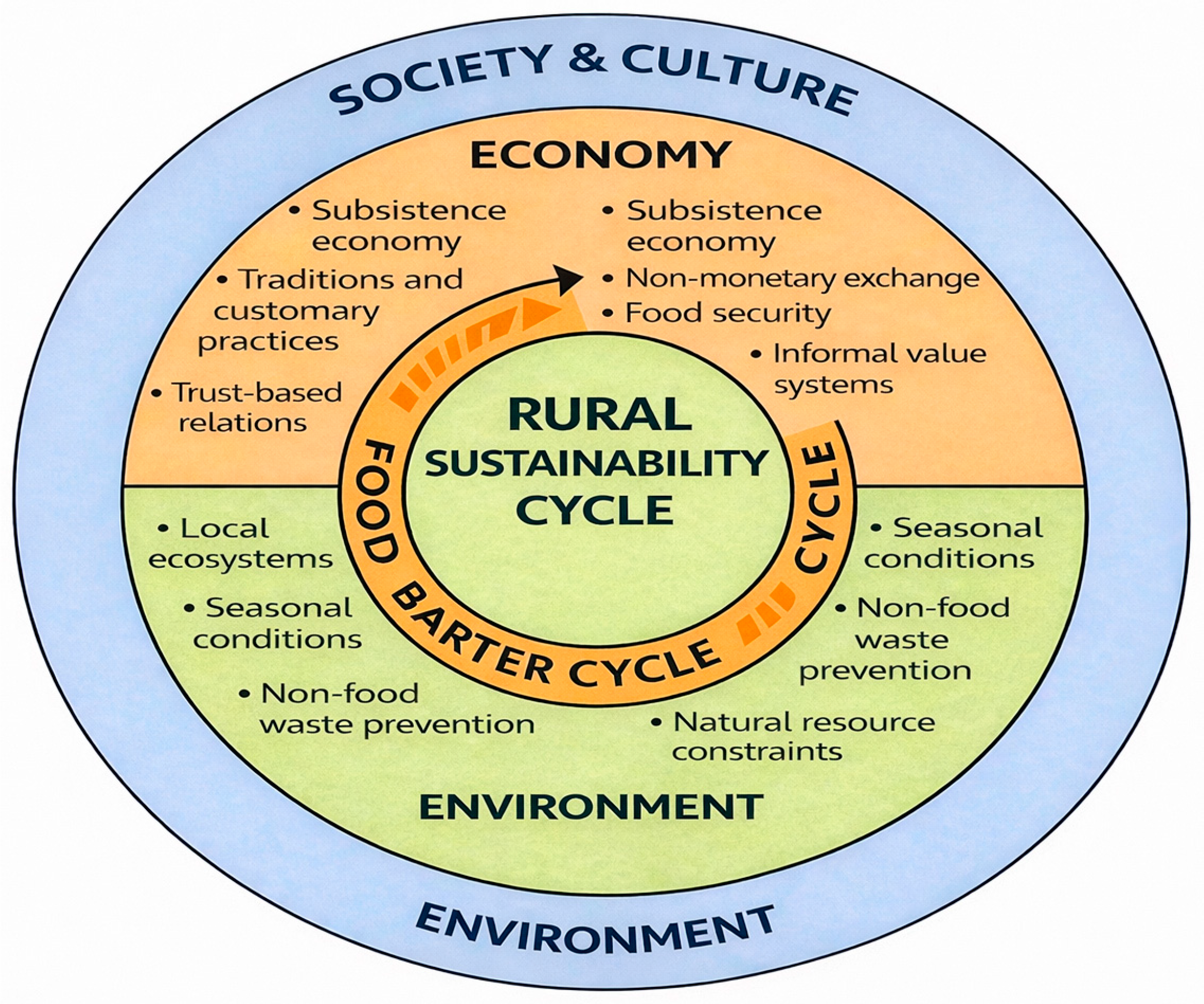
1. Introduction
In recent years, with the emergence of concepts such as sustainability, local economy, and community-based entrepreneurship, alternative forms of trade have become a topic of renewed discussion in the management and organizational literature. Approaches such as community-based economy, circular trade, and solidarity economy have sparked renewed academic interest in traditional exchange systems [
1,
2]. In this context, bartering is approached not only as an economic practice but also as a cultural and organizational one; it is evaluated in conjunction with interpersonal trust, social networks, and local knowledge systems.
The barter system, which operates without the use of money, has been one of the most fundamental forms of economic exchange throughout human history. Such systems have developed within trust-based relationships, particularly in rural communities, and have contributed not only to the economy but also to the strengthening of social bonds [
3,
4]. Although money-based systems have become dominant with modernization and the spread of market economies, barter systems are still encountered, especially during economic crises or in rural areas [
5,
6].
The fact that bartering practices persist in a sustainable manner without any formal structure, institution, or organization, relying instead on local knowledge, past experiences, and trust-based relationships, brings the discussions of informal coordination and unorganized organization to the fore [
7,
8]. Such practices also align with network theories, which show that economic action occurs embedded in social relationships and local networks rather than formal institutions [
9,
10]. In this respect, bartering can be considered not only a cultural heritage but also an invisible form of organization that supports local resilience and sustainable living strategies [
1,
7,
11,
12,
13].
Although barter and informal exchange have been discussed in anthropology and rural studies, there is a striking lack of empirical research that documents how such systems operate today as organized, sustainability-oriented livelihood strategies in geographically isolated rural regions. Existing studies tend to treat barter either as a historical residue or as a marginal practice linked to poverty and informality. Very few studies examine barter as a coordinated, routinized and socially regulated system embedded in contemporary rural sustainability and community resilience.
In the Turkish context, barter and exchange practices have been addressed primarily from folkloric, historical, and cultural heritage perspectives; these practices have mostly been examined as elements of past ways of life [
8,
14]. Although there are studies on informal economic relations and local solidarity networks, the administrative functioning of this tradition as a system, its coordination mechanisms, and its relationship with sustainable rural economies have been discussed only to a limited extent [
7,
11]. Barter practices, which emerged as a natural need in rural areas and became traditional, have not been sufficiently addressed and documented in terms of the management and sustainability literature [
15]. This system, based on the bilateral exchange of organic products, also offers new insights in the context of modern supply chain theories, organizational behavior, and rural logistics management.
The aim of this study is to scientifically analyze the traditional, organic production-based, and sustainable barter system practiced in the villages of the Aşağıırmaklar basin in the Ardanuç district of Artvin in terms of its socioeconomic, managerial, and cultural aspects. In this system, fruits grown in the Ardanuç region but not found in Ardahan (apples, pears, plums, etc.) and products made from them [molasses, etc.) are taken by villagers to villages on the Georgian border of Ardahan and bartered without money for products specific to that region, such as wheat, barley, and geese.
This barter process is a rare example that can be studied in the field of management and organization in terms of production, logistics, and mutual valuation.
The objectives of this study can be summarized as follows:
To discover the structural and operational characteristics of the traditional barter practice in the villages of Artvin, Ardanuç, and Aşağıırmaklar.
To understand the historical development, cultural origins, and effects of this barter practice on rural sustainability.
To reveal the social network that sustains this barter system and how trust is established within these networks.
2. Theoretical Framework
In recent years, there has been growing academic interest in community-based and solidarity-oriented economic practices that move beyond conventional market-centered models. Within this context, the diverse economies approach conceptualizes non-market forms of exchange, such as barter, sharing, and collective production, not merely as marginal alternatives but as foundational and sustainable social strategies embedded in everyday life [
1].
Alternative economic practices often operate independently of formal institutional structures and become integral to local livelihood strategies. In such systems, decision-making processes tend to be decentralized, while leadership and coordination take collective and flexible forms rather than hierarchical ones [
16]. Non-market exchanges, including bartering, have also been interpreted as practices that challenge or coexist with dominant neoliberal economic logics by prioritizing social relations, reciprocity, and community well-being over profit maximization [
1,
17]. Accordingly, alternative economic organizations function not only as means of subsistence but also as carriers of local knowledge, cultural memory, and social cohesion.
Recent research on rural sustainability increasingly emphasizes the role of locally embedded, trust-based, and non-market food systems in sustaining rural livelihoods under conditions of climate uncertainty, market volatility, and demographic change [
18,
19]. Within this literature, Alternative Food Networks (AFNs) are widely discussed as systems characterized by spatial proximity, social embeddedness, and sustainability-oriented production and exchange [
20]. The barter system examined in this study shares these core features, particularly its reliance on reciprocity, community trust, and local ecological complementarity. However, unlike many contemporary AFNs that remain partially integrated into monetary markets, this barter practice operates entirely outside money-based exchange, representing a distinct and deeply embedded form of alternative food provisioning grounded in rural necessity and inter-community solidarity [
18,
21].
In rural contexts, sustaining life depends not solely on access to economic resources but also on solidarity, production diversity, and communities’ capacity to transform available resources into usable forms. Households primarily engaged in small-scale agriculture and livestock farming often rely on livelihood models that are not fully integrated into formal markets. Empirical studies from rural Turkey indicate that practices such as seasonal migration, product exchange, and communal production constitute key survival strategies [
12]. These practices enable rural populations to reduce dependence on urban centers while enhancing resilience against economic uncertainty.
Practices such as barter, joint production, and mutual aid therefore represent not only economic activities but also relational networks grounded in social solidarity and reciprocity [
22]. Ethnographic research conducted in Turkey, particularly in the Black Sea and Eastern Anatolia regions, that demonstrates that the exchange of goods and services has historically functioned as a form of social contract, sustained through trust, familiarity, and shared norms [
13]. Such relationships are shaped not merely by material need but also by strong senses of local belonging and mutual trust [
1].
While classical management theories emphasize formal structures, clearly defined roles, and hierarchical authority, more recent scholarship highlights that informal arrangements are equally critical for sustainability and resilience [
23]. Barter practices operating without centralized organization are often described as “unorganized but functioning systems,” in which leadership, hierarchy, and written rules are replaced by experience-based authority, historical habits, and oral norms [
24]. From a diverse economies perspective, these informal arrangements illustrate how non-capitalist forms of production and exchange can constitute strategic and durable organizational structures [
1,
25].
4. Findings
The findings are presented within a descriptive and analytical framework based on qualitative data obtained from participant narratives and field observations.
The scope of the barter practice was determined based on the narratives and is presented in
Table 1. The comparison of the findings with the literature is discussed in the Discussion and Conclusion sections.
4.1. Barter as a Strategy for Life and Livelihood
The research findings show that the traditional practice of food barter in the specified geography is considered not as an economic activity in the classical sense, but as a livelihood strategy aimed at sustaining life. The barter process is carried out not as a commercial activity prioritizing profit, but rather to utilize seasonal production surpluses, ensure basic food security during the winter months, and preserve the continuity of rural life.
Participants state that it is not possible to consume all the fruits that ripen, especially in the autumn months, and therefore the products are processed by methods such as drying, making molasses and jam, and prepared for exchange. This practice prevents food waste while also enabling the exchange of these products for basic foods such as wheat, barley, cheese, and butter. K1 describes the situation as follows:
“This activity does not contribute significantly to my family’s income, but we are making use of fruits that would otherwise go to waste. In winter, we have our flour and bread; we don’t need to buy them from the market.”
Similarly, K2 and K3 emphasize that wheat obtained through barter is ground into flour and used to meet basic food needs throughout the winter. For participants, bartering stands out as an activity to prepare for the winter season, especially considering the closure of roads and the distance of settlements from cities during the winter months. K2’s statement clearly illustrates this situation:
“There is no market in the village, the nearest town is two hours away. The roads close in winter. But this way, we can get through the winter without using any money.”
The participants’ narratives describe bartering as a “laborious but necessary” and “tiring but meaningful” endeavor, indicating that this practice is sustained on the basis of vital necessity and habit.
However, participants also express concerns about the future of this livelihood strategy. The reluctance of the younger population to stay in the village, limited job opportunities, and difficult living conditions make it challenging to pass on the practice of bartering between generations. This situation indicates that although bartering remains a functional livelihood strategy today, its long-term sustainability is uncertain.
4.2. The Impact of Seasonal and Geographical Conditions on the Barter Process
Research findings indicate that the barter system is largely dependent on seasonal cycles and geographical/topographical conditions. The exchange process is made possible not only by the readiness of the products, but also by the convergence of environmental factors such as weather conditions, terrain, slope and passability in terms of road safety, timing, and transportation options. In this respect, exchange emerges as a mobility practice that is directly dependent on nature and fragile.
According to participant narratives, barter activities take place every year in the autumn months, usually between the end of August and mid-November. This time frame corresponds to a period when both the fruits are ripe and the mountainous routes are relatively passable. K1 expresses this seasonal necessity as follows:
“These journeys begin in the eighth month and end around the middle of the eleventh month. If the rain or snow comes early, we cannot go.”
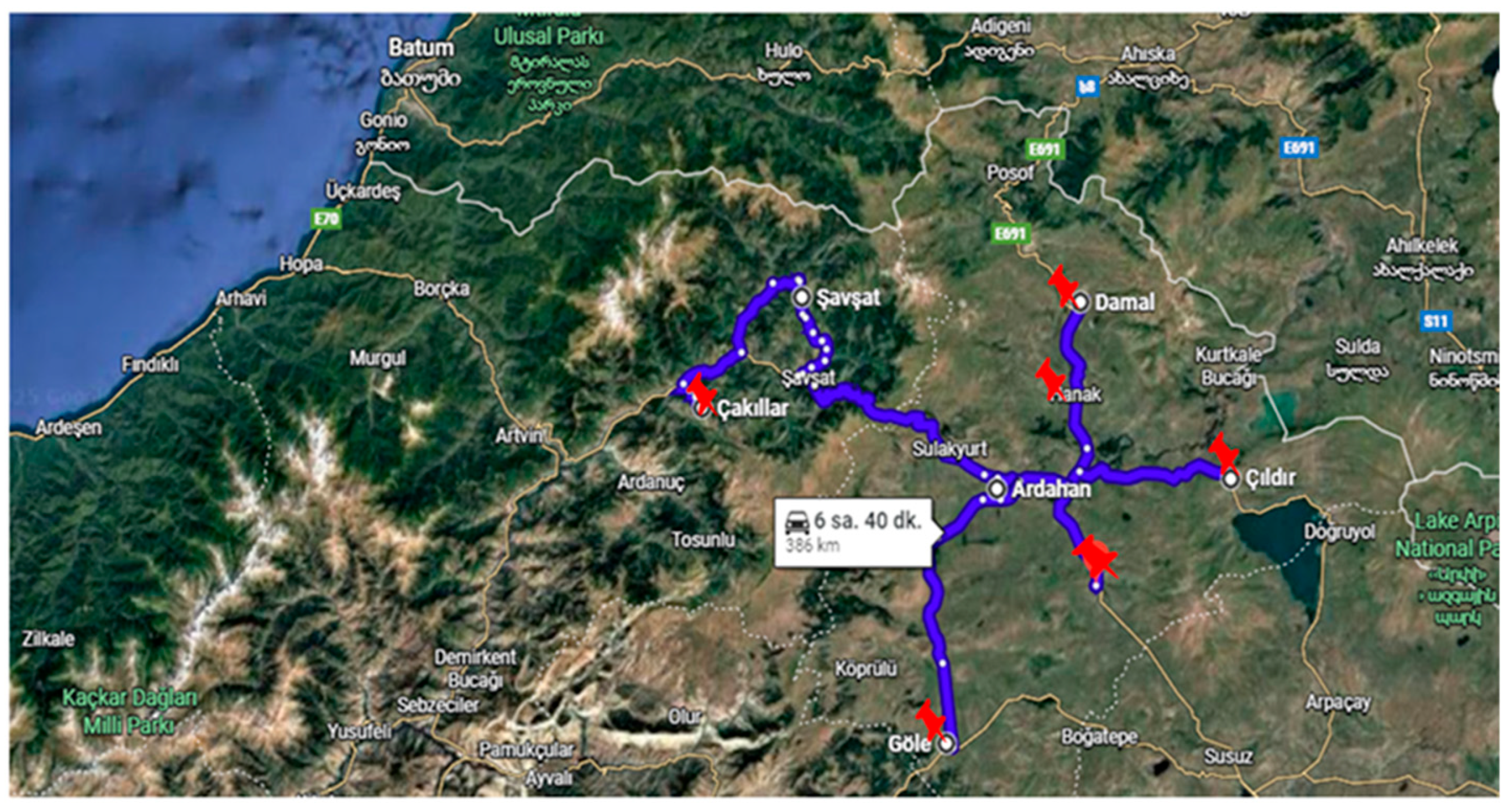
The barter routes traverse a geographically challenging and high-risk terrain. The locations most frequently mentioned by participants include Damal, Çıldır, Göle, and Hasköy. Participants emphasize that the roads are narrow and steep, and that during the autumn months they become particularly hazardous due to weather conditions. This context reveals that barter is not merely an economic exchange but an activity requiring substantial physical labor, risk-taking, and careful time management. K2’s statement clearly reflects this reality:
“The roads are steep and dangerous. If winter arrives early, it becomes impossible to travel. That is why timing is crucial.”
Spatial conditions emerge as a key factor not only shaping transportation but also explaining why the barter system exists in the first place. Participant narratives consistently indicate that while fruit production is abundant in the Ardanuç region, arable land suitable for wheat cultivation is highly limited. Conversely, in Ardahan and its surrounding villages, climatic conditions significantly restrict fruit production. Participants further note that basic agricultural tools made from wood, such as axe and pitchfork handles, are also transported and exchanged, as the near absence of forest resources in Ardahan creates demand for these items. This ecological contrast demonstrates that the barter system is structured around geographical complementarity, whereby distinct environmental constraints and production capacities mutually sustain exchange relations. K1 summarizes this situation as follows:
“Fruit does not grow there; the climate is not suitable. We cannot grow wheat here either. And without wheat, there is no bread. You can hardly find proper trees there, which is why even an axe handle is valuable for them.”
This spatial complementarity has transformed barter from a sporadic exchange into an established route and a recurring practice. Participants report following similar routes each year and visiting specific villages sequentially, reinforcing the routinized and predictable nature of the exchange system.
Another key dimension shaped by seasonal and geographical conditions concerns transportation costs and physical labor. Participants report traveling long distances, consuming vehicle fuel, and undertaking journeys that often last an entire day. Despite these costs, the continuation of barter indicates that the practice is driven less by monetary gain than by the necessity of sustaining everyday life. K1’s remark “I burn a full tank of fuel” illustrates that the activity is maintained out of necessity and habit rather than economic profitability.
Finally, seasonal and spatial constraints also reveal the fragility of the barter practice. Snowfall, early winter conditions, and risks related to road safety may prevent the exchange from taking place altogether. This indicates that the barter system relies directly on environmental conditions rather than modern infrastructure, making its future sustainability highly vulnerable to climatic and spatial uncertainties.
Figure 2 illustrates the recurring seasonal barter route between the Çakıllar Village and the Ardahan region, highlighting inter-village exchange connections.
4.3. Reciprocity, Trust, and Unwritten Rules
The findings indicate that the examined barter practice operates within a framework of reciprocity and trust, governed by unwritten yet well-established rules. The exchange process is organized around shared norms that are widely known and have remained stable over many years. The quantities of wheat, cheese, or butter received in exchange for fruit, molasses, or dried products are not documented in any written form; nevertheless, they are accepted without dispute by all parties involved. K1’s statement clearly illustrates this situation:
“The exchange ratios are well known. I remember them this way even from my grandfather. The villagers in Ardahan also know these ratios.”
Similarly, K2 emphasizes that although it is unclear who originally determined these ratios, they have become institutionalized over time as a natural value system. This indicates that the exchange logic is based on mutual acceptance rather than formal calculation or negotiation.
Another key aspect of these unwritten rules concerns trust-based relationships. Participants report long-standing acquaintances, friendships, and mutual support practices in the villages where barter takes place. Practices such as hosting visitors, sharing meals, and providing assistance in difficult situations demonstrate that barter extends beyond material exchange and is embedded within a broader network of social reciprocity. K1’s account is illustrative in this respect:
“I have friends in the villages I visit. Sometimes I stay at their houses. When I have problems on the road, I have even turned back and stayed with them as guests.”
These reciprocal relations are not limited to exchanges occurring within a single year; rather, they are sustained through long-term and repeated interactions. Participants note that visiting the same villages and encountering the same individuals each year reinforces trust and contributes to the continuity of unwritten rules.
In sum, the barter practice examined here constitutes an informal exchange system that functions without written contracts yet remains stable due to strong reciprocal relations. This structure demonstrates that barter is not merely a material exchange but also a practice that produces trust, stability, and social continuity.
4.4. Informal Organization and Silent Coordination
The findings indicate that the barter practice remains functional and continuous despite the absence of any formal organization, leadership structure, or formal decision-making mechanisms. The exchange process operates through experience, trust, and the tacit acceptance of roles that are collectively recognized within the community.
Participant narratives reveal that the barter process does not consist of random individual initiatives. Rather, it follows an implicit yet stable order that has developed over time, determining who undertakes the journey, when it takes place, and under what conditions. In earlier periods, barter journeys were often organized through ‘’imece’’ (collective labor), whereby a small number of individuals whose time and physical capacity allowed would travel, while other families entrusted them with their products. K1 describes this structure as follows:
“In the past, it was done through collective labor. One or two people whose time allowed would set out on the journey, and the other families would give them their goods, loaded onto horses.”
This account illustrates that, in the absence of formal authorization, responsibility for the journey emerges spontaneously within the community. Such role allocation is typically based on experience, knowledge of routes, trustworthiness, and physical capacity. Participants emphasize that this distribution of roles is not subject to debate but is widely perceived as natural and legitimate. Referring to experienced individuals through shared knowledge and narratives reflects a form of silent coordination, which does not involve explicit leadership claims but relies on the informal authority derived from experience and competence.
This form of informal organization also enhances the flexibility of the system. In response to unexpected conditions such as adverse weather, road safety concerns, or variations in product availability, the barter process can be adapted without rigid rules. Participants note that routes may be shortened, certain villages may be skipped in a given year, or the exchange may be concluded earlier than planned. Such adaptability indicates the presence of a leaderless yet responsive coordination structure.
In sum, the barter practice examined here represents an example of informal organization sustained through experience-based roles, unwritten responsibilities, and mutual trust, rather than centralized leadership or formal institutional arrangements. This structure demonstrates that complex cooperative processes in rural communities can be effectively coordinated without reliance on formal organizational frameworks.
The ratios and values related to the exchanged products are given in
Table 2.
5. Discussion
The findings show that rural product barter is not merely an economic exchange but a holistic sustainability practice that supports rural continuity, utilizes seasonal surpluses, and enables everyday subsistence. This aligns with the literature that conceptualizes sustainability beyond formal market mechanisms and incorporates informal economic practices [
33,
34]. Informal and non-market economic relations are widely recognized as mechanisms that enhance community resilience and optimize resource use [
25].
The examined barter case operates without formal organization or institutional structures, relying instead on local knowledge and experience. This demonstrates that sustainability can be produced not only through institutional interventions but also through community-based practices. Accordingly, the findings resonate with management and organization scholarship on informal organization, self-organization, and “organization without organizations” [
1,
23,
35]. Such structures, sustained through repeated practices, trust relations, and experience-based roles, are noted for their adaptability and resilience [
36,
37,
38].
The form of “silent coordination” identified in this study departs from classical management assumptions centered on hierarchical control, formal authority, and rational planning. Instead, it reflects an alternative organizational logic grounded in experience-based authority, mutual trust, and community legitimacy [
39,
40]. This finding underscores that organization and sustainability can be effectively generated through practices and social relations, rather than formal structures alone [
41].
Similarly, the literature emphasizes that informal governance and organizational practices are particularly functional in rural and community-based settings in terms of continuity, resilience, and social cohesion [
25,
42]. In this context, the barter system represents an alternative form of organization operating outside conventional market-based models, yet producing a stable, predictable, and recurring order through its internal norms.
The findings further indicate that participants perceive barter not as profit-oriented trade but as a natural and necessary means of sustaining everyday life. This perception aligns with the rural livelihoods literature, which highlights households’ reliance on alternative and diversified livelihood strategies to cope with economic uncertainty [
43,
44,
45]. It is well established that rural households combine practices such as seasonal production, food processing, reciprocity, and barter to reduce risk and enhance food security without full dependence on market economies [
46,
47]. In this sense, barter functions not merely as an economic exchange but as a strategic practice enabling the continuity of rural life. Beyond confirming existing insights on informal and non-market exchanges, this study contributes to the literature by demonstrating how barter operates as an active coordination mechanism rather than a residual or symbolic practice. Unlike many studies that frame barter as a marginal or declining tradition, the findings show that it functions as a routinized, predictable, and socially regulated system embedded in everyday rural life. This highlights that sustainability in rural contexts can be generated through practice-based coordination and social relations, even in the absence of formal institutions or market mechanisms. Consistent with this perspective, the examined barter practice plays a critical role in meeting households’ basic food needs, particularly under conditions of limited market access during winter months.
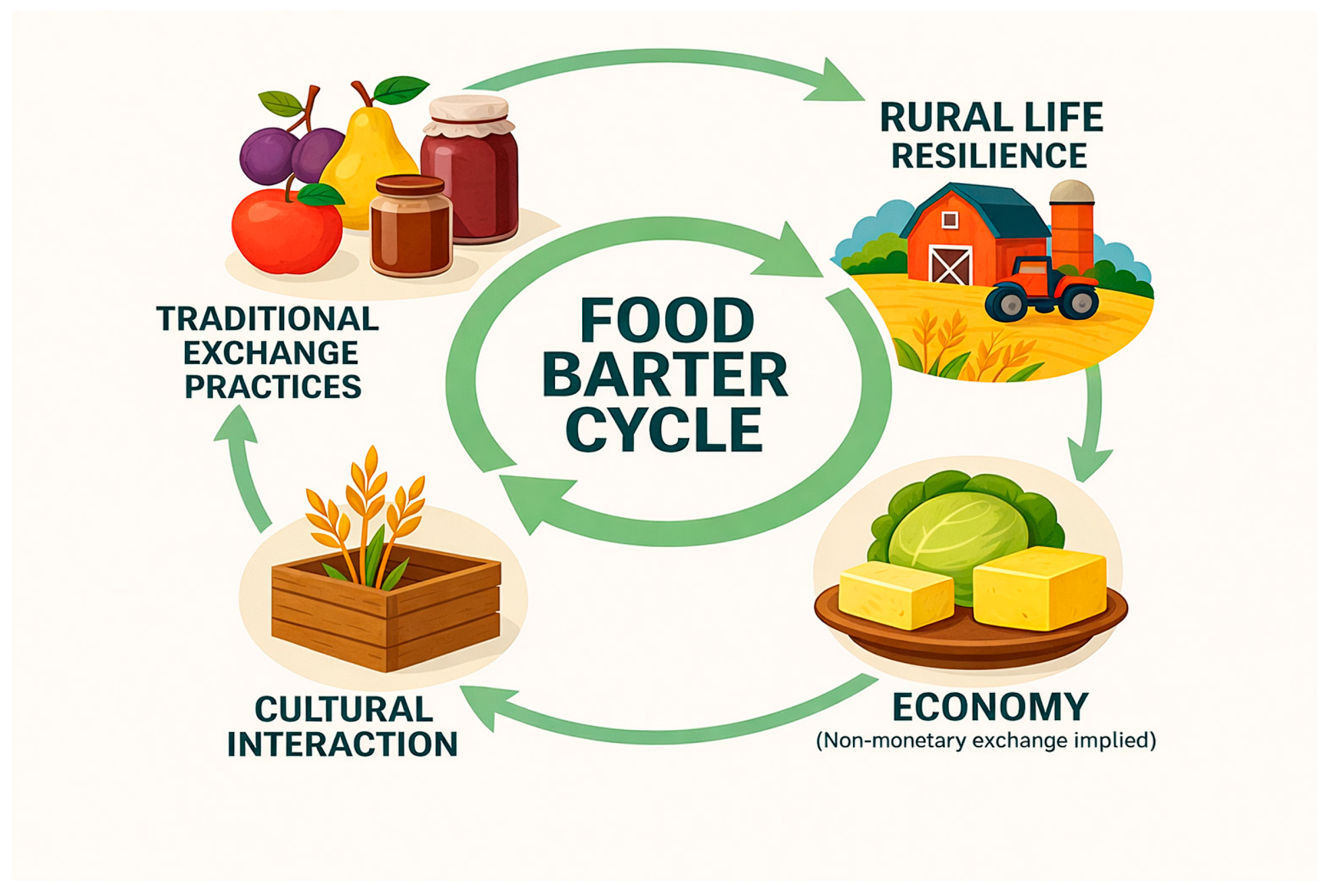
Figure 3 shows a conceptual representation of the products exchanged within the examined barter practice. The figure illustrates how traditional exchange practices are embedded in cultural ties and contribute to rural resilience through non-monetary economic exchange. Arrows indicate the cyclical and mutually reinforcing relationships between tradition, culture, economic exchange, and rural sustainability.
The findings also make visible key areas of fragility regarding the future of the practice. Participant narratives frequently emphasize young people’s unwillingness to remain in rural areas and the weakening of intergenerational transmission, both of which pose significant risks to the long-term sustainability of the barter cycle. Consistent with the rural sustainability literature, demographic change and youth outmigration are identified as major threats to the continuity of traditional production and solidarity-based practices [
47,
48].
Rural Sustainability and the Future: Continuity of the Barter Cycle
Overall, the findings confirm that the examined barter practice functions not merely as an economic exchange but as a sustainability mechanism that supports rural continuity and utilizes seasonal production surpluses. At the same time, participant accounts point to multiple sources of vulnerability affecting its future. In particular, declining intergenerational transfer and limited engagement of younger cohorts undermine the long-term continuity of the practice. Structural constraints, such as the seasonal limitation of barter to autumn months, road safety risks, and climatic uncertainty, further shape its sustainability.
The development of modern transportation infrastructure exerts a dual effect on the future of the barter system. On the one hand, improved logistics reduce immediate risks and facilitate short-term continuation; on the other, enhanced market access increases the attractiveness of monetary exchange for rural households. This duality aligns with broader debates in the literature on whether traditional rural practices persist through adaptation or gradually lose their function under conditions of modernization [
46,
49].
6. Conclusions
This study contributes not only to academic debates but also offers practical insights for rural development, local governance, and alternative exchange systems. The examined barter practice, emerging organically and operating through unwritten yet functional rules demonstrates how locally embedded systems can serve as viable models for sustainable rural economies [
49,
50]. The food barter conducted along the Ardanuç–Ardahan corridor represents a distinctive livelihood strategy that integrates the economic, social, and cultural dimensions of rural sustainability. Through the exchange of organically produced goods based on reciprocity and shared norms [
51,
52], this practice reduces food waste, limits dependence on monetary markets, and strengthens trust-based community relations.
From a policy and practice perspective, such informal and traditional exchange systems provide ready-made and locally legitimate models for rural development initiatives. Rather than formalizing these practices, local governments and development agencies may enhance their continuity through indirect support mechanisms, such as improving transportation safety, protecting local products, and fostering intergenerational knowledge transfer. In the context of agricultural and food policies, food barter offers a concrete example of low-carbon, local, and solidarity-based food systems [
53].
With regard to future research, comparative studies examining similar barter and non-market exchange practices across different geographical [
54] and cultural contexts would further enrich the rural sustainability literature [
55]. In addition, research focusing on the effects of climatic uncertainty and demographic change on traditional exchange cycles would provide valuable insights into the long-term viability of such systems.
Overall, this case study demonstrates that sustainability is not produced solely through formal markets and institutional structures, but can also emerge through community-based, informal, and locally grounded practices [
15]. However, participant narratives pointing to youth outmigration, often expressed as “there are no young people left in the village; no one will continue after me”, highlight a critical strategic challenge. The future of this barter system therefore raises broader questions that require coordinated attention from policymakers, researchers, and strategic planners concerned with rural continuity and sustainable development.
Limitations and Future Research
Despite its contributions, this study has several limitations. First, the number of participants is limited, reflecting the small and closed nature of the barter network. While this allows for in-depth understanding, it restricts the generalizability of the findings. Second, the study focuses on a single geographical and cultural context, and the results may not be directly transferable to other rural regions. Third, the analysis relies primarily on retrospective narratives, which may be influenced by memory and interpretation. Future research could address these limitations through comparative studies across different regions, larger samples, and longitudinal designs that capture changes in barter practices over time.