Article

Urban Villages as Hotspots of Road-Deposited Sediment: Implications for Sustainable Urban Management

1
College of Water Resource and Hydropower, Sichuan University, Chengdu 610065, China
2
Center for Eco-Environmental Research, Nanjing Hydraulic Research Institute, Nanjing 210029, China
*
Author to whom correspondence should be addressed.
Sustainability 2026, 18(3), 1543; https://doi.org/10.3390/su18031543
Submission received: 12 January 2026 / Revised: 30 January 2026 / Accepted: 30 January 2026 / Published: 3 February 2026

Abstract

Rapid urbanization has fostered the proliferation of urban villages (UVs), high-density informal settlements that pose unique challenges for environmental management. Despite their prevalence, the dynamics of pollutant accumulation in these transitional neighborhoods remain underexplored. This study investigated nitrogen and phosphorus accumulation in road-deposited sediment (RDS) within Shenzhen, a representative megacity in southern China, utilizing field sampling and statistical analysis to identify dominant drivers. The results indicate that UVs function as significant pollution hotspots, with RDS accumulation rates approximately 3.7 times higher than in formal built-up areas. Analysis revealed that pollution intensity is primarily driven by natural factors such as slope, whereas pollution load is controlled by anthropogenic supply factors. This creates a critical input–output imbalance where high pollutant inputs exceed the natural removal capacity. Consequently, effective mitigation of urban non-point source pollution requires shifting from traditional engineering solutions to spatially sensitive planning strategies, offering practical guidance for enhancing urban sustainability in rapidly urbanizing regions.

1. Introduction

Rapid urbanization has drastically altered urban hydrological cycles and pollutant transport mechanisms, making urban non-point source (NPS) pollution a critical bottleneck in global water quality management [1,2]. As a primary reservoir for pollutants in these high-density environments, road-deposited sediment (RDS) plays a pivotal role. Its accumulation characteristics and absorbed pollutants, ranging from nutrients (N, P) and heavy metals to emerging contaminants like microplastics, directly dictate the pollution intensity of rainfall runoff [3,4,5]. Therefore, characterizing the spatiotemporal dynamics of RDS under intense anthropogenic pressure is essential for accurately identifying pollution sources [6] and designing effective mitigation strategies [7,8].
Existing studies have conducted in-depth research on pollutant forms [9], particle size characteristics [10,11], and regional features of road-deposited sediment (RDS), and have gradually turned their attention to urban RDS management and control [12,13]. In RDS, phosphorus (P) primarily exists in the form of detrital apatite phosphorus (De-P), the accumulation load of De-P is significantly influenced by road materials and land use types. Additionally, the sources of P in RDS can be clearly identified as road sources, domestic waste, and untreated sewage discharge, posing a significant threat to receiving water bodies [14,15]. In contrast, nitrogen (N) in RDS exists in the form of particulate organic nitrogen. Urban villages (UVs) and residential areas are hotspot areas for the accumulation of total nitrogen (TN) in RDS, and the annual TN flux from RDS in these areas account for 19% of the total urban domestic discharge [16]. Regarding particle size distribution characteristics, the proportion of fine particles (<32 μm) in road RDS is as high as 49%, and fine particles (<125 μm) collectively account for more than 75% of the total RDS mass [17]. These previous research efforts have not only made important contributions to understanding RDS pollution, but also effectively guided China’s water environment improvement over the past decade, driving the continuous refinement and strengthening of relevant control measures, which has consequently led to significant improvements in the water environment of China’s rivers and lakes [18,19,20].
Despite the progress in urban non-point source (NPS) pollution control, current management strategies still face a persistent “remediation–rebound” challenge, where mitigation effectiveness is often short-lived and followed by pollution surge during heavy rainfall events [21]. This instability is exacerbated by the increasing frequency of extreme weather, which amplifies the dynamic diffusion risks of accumulated pollutants [22]. A critical oversight in current practice is the concentration of control measures in planned urban built-up areas [23], while transitional neighborhoods like “urban villages” remain largely neglected. Emerging during rapid urban expansion as a distinctive form of high-density informal settlement, urban villages are predominantly inhabited by migrant populations and characterized by densely packed “hand-shaking buildings” with inadequate sanitation infrastructure and fragmented land ownership [24,25]. These unique morphological and demographic features suggest that urban villages may act as chronic reservoirs of pollutants that undermine urban sustainability and impede the achievement of Sustainable Development Goals (SDG 6: Clean Water and Sanitation; SDG 11: Sustainable Cities and Communities) [26,27]. Although shaped by China’s unique institutional context, UVs share key morphological similarities with informal settlements in the Global South, such as favelas in Brazil, slums in India, and kampungs in Indonesia [28]. Consequently, understanding the pollutant accumulation mechanisms in these terrain-constrained spaces is essential not only for addressing local management “blind spots” but also for providing insights into sustainability challenges in transitional urban neighborhoods globally.
To address the above research gap, this study integrated multi-dimensional environmental data to systematically compare RDS characteristics across urban villages and typical built-up areas (encompassing industrial, commercial, educational, and residential zones). Specifically, this study aims to (1) compare RDS accumulation characteristics between urban built-up areas and urban villages; (2) analyze the spatiotemporal distribution of nitrogen and phosphorus loads in RDS across different functional areas; (3) identify the multi-factor driving mechanisms of nitrogen and phosphorus pollution in RDS to offer targeted guidance for differentiated NPS control. By distinguishing these drivers, this study expects to offer critical insights into the spatial dynamics of urban pollution, contributing to a deeper understanding of human–environment interactions and providing practical guidance for urban planning in rapidly urbanizing regions.

2. Materials and Methods

2.1. Study Area

This study was conducted in Longgang District, Shenzhen, China. As a core hub city of the Guangdong–Hong Kong–Macao Greater Bay area and a typical immigrant city, Shenzhen has continuously generated robust labor demand driven by rapid industrial upgrading and economic growth [29]. Urban villages, with their low-cost housing and dense networks of daily services, have served as the initial foothold for migrants integrating into Shenzhen, persisting and expanding in scale amid urban development [25,30]. Longgang District, located in the central–eastern part of Shenzhen, has the largest number of urban villages (499 in total, nearly a quarter of Shenzhen’s urban villages) and administers 11 streets (see Table S1 for details).
Urban villages in Longgang District occupy only 23.07% of the total construction land but accommodate 59.34% of permanent residents, with a population density of 81,900 people/km2 (five times that of urban built-up areas). Generally, the building spacing of these urban villages is less than 3 m, forming the typical “hand-shaking buildings” landscape (extremely close-set buildings with narrow alleys, see Figure 1). This form significantly restricts urban NPS pollution control: dense buildings lead to poor ventilation, worsening local accumulation of RDS pollutants; narrow spaces hinder the implementation of sanitation measures, impeding garbage collection and sewage disposal, and further increasing the difficulty in managing NPS pollution.

2.2. Data Collection and Processing

2.2.1. RDS Sampling and Grouping

  • Sampling design: Referring to Peking University’s Dataset of Major Urban Landscapes in China (http://geodata.pku.edu.cn, accessed on 2 January 2025), the study area was divided into 5 major functional zones: urban villages (UVs), commercial zone (CZ), educational zone (EZ), residential zone (RZ), and industrial zone (IZ) (Figure 1). On this basis, 17 sampling sites were set up in Longgang District, covering all functional zones. These involved sites were located at least 100 m away from garbage dumps or sewage outfalls to minimize anomalous pollution inputs, and sanitation frequencies of different functional zones are shown in Table S2.
  • Sampling method: The sampling campaign was conducted in April 2025, a critical transition period representing the late dry season in Shenzhen. This timing is highly representative as it follows a prolonged antecedent dry period, allowing pollutants to undergo long-term accumulation and potentially reach a state of dynamic equilibrium or peak load before the onset of the wet season. In addition, RDS sampling was mainly conducted within 1 m of the roadside, and prior to RDS sampling, communication was carried out with the sanitation department to demarcate a sampling area free from artificial cleaning interference for each site (as indicated by the red markings in Figure S1). To preserve the particle size characteristics of accumulated RDS as accurately as possible, this study used a vacuum cleaner (Shark IF202CN) to collect RDS. Sampling lasted approximately two weeks (daily collection in the first week and once every two days thereafter), and RDS accumulation was determined to reach equilibrium when its increment was less than 5% for three consecutive days.
  • Sample processing: Samples were dried, weighed after removing impurities through a 2 mm sieve, and their particle size distribution (0.02–2000 μm) was determined using a laser particle size analyzer (Master2000, Malvern, Worcestershire, UK). Subsequently, RDS was evenly sieved into 5 particle size groups based on particle size distribution characteristics (0~d20, d20~d40, d40~d60, d60~d80, >d80), with the purpose of ensuring each fraction had equal mass. Incorporating the actual particle size detection results, the specific particle size ranges for the final grouping were confirmed as <18 μm, 18~52 μm, 52~120 μm, 120~275 μm, and >275 μm. For each RDS group, the total nitrogen (TN) and total phosphorus (TP) contents were measured using alkaline potassium persulfate digestion followed by spectrophotometry [31]. All chemical analyses were performed at the Water Environment Laboratory, Dangtu Scientific Experiment Base, Nanjing Hydraulic Research Institute (Ma’anshan, China). To ensure data reliability, strict quality assurance and quality control procedures were implemented. Replicate samples (n = 3) were analyzed for the total samples, yielding relative standard deviations (RSD) of less than 5% for both TN and TP. Procedural blanks indicated no detectable interference. Analytical accuracy was verified using standard reference materials (GSS series) and spiked samples, with recovery rates ranging from 90% to 110%. The method detection limits (MDL) were 10 mg/kg for TN and 5 mg/kg for TP.

2.2.2. Environmental Data Collection

This study collected socio-economic, geo-environmental, precipitation, and dry deposition data to analyze the multi-factor driving mechanisms of nitrogen and phosphorus pollution in RDS. The selected variables from these multi-source data were collected and processed at the street scale (Table 1), among which the dry deposition flux (DDF, kg·day−1) was calculated by Equation (1), and the preprocessing results of these variables are shown in Table S3.
D D F = C P M 2.5 V d A
where C P M 2.5 represents daily average PM2.5 concentration (μg·m−3); Vd represents the dry deposition velocity, and it was set to 0.0005 m·s−1 for PM2.5, a median value for fine particles (<2.5 μm) from atmospheric deposition models [32]; A represents street area (m2).

2.3. Calculation of Pollution Intensity

Considering differences in pollutant content across particle size groups, the cumulative pollution intensity in each functional zone was calculated by Equation (2), combined with the accumulated number of dry days. It is important to clarify that, in the absence of unified regulatory standards specifically targeting nutrient concentrations in urban road-deposited sediments, the term “pollution” in this study refers to the relative enrichment, accumulation intensity, and hotspot characteristics of nitrogen and phosphorus, rather than the direct exceedance of statutory threshold values. Consequently, pollution levels were evaluated comparatively across functional zones, with particular emphasis on their potential contribution to runoff-driven non-point source pollution. Finally, the spatial distribution of pollution intensity was interpolated and visualized in GIS using the Kriging method [33].
L ( x ) = i = 1 n C i   y ( x )   S i
where Ci is pollution content of the ith particle size group, mg·g−1; Si is mass ratio of the ith particle size group to total RDS mass; n is number of particle size groups; x is the accumulated number of dry days, day; y(x) is cumulative RDS amount per unit area on the xth dry days, g·m−2; L(x) is cumulative pollution intensity per unit area on the xth dry days, g·m−2.

2.4. Evaluation Metrics

Based on the continuous, high-resolution particle size distribution curve obtained via a laser particle size analyzer (Master2000), the moment method integrated in GRADISTAT software (Version 1.0) was applied to systematically quantify the granularity parameters of road-deposited sediment (RDS), with specific calculation procedures detailed in Blott and Pye [34]. The evaluation significance and classification criteria of three key metrics are as follows:
  • Mean particle size (Mz): Represents the central tendency of the RDS particle size distribution, reflecting the overall “coarseness or fineness” of the dust—for example, smaller Mz values indicate that RDS is dominated by fine particles, which are more likely to adsorb pollutants and have stronger mobility.
  • Sorting coefficient (Sd): Characterizes the uniformity of particle size distribution; Sd < 1 indicates well-sorted dust (particle sizes are relatively concentrated), while Sd > 2 means poorly sorted dust (particle sizes vary widely), which is often associated with multiple sediment sources.
  • Kurtosis (Ku): Describes the “sharpness” of the particle size distribution curve; Ku > 1.1 indicates a leptokurtic distribution (the curve has a sharp peak, meaning a high proportion of particles in the dominant size range), while Ku < 0.9 indicates a platykurtic distribution (the curve is flat, meaning particles are more evenly distributed across multiple size ranges).
Besides the aforementioned Mz, Sd, and Ku used to characterize the basic particle size of RDS, the volume fractal dimension (D) was further introduced [35] to characterize the irregularity and complexity of RDS. Specifically, higher D values (closer to 3) indicate a more complex particle size composition (e.g., a mixed distribution of coarse, medium, and fine particles), while lower D values indicate a simpler composition (e.g., dominated by a single particle size range). The original volume fractal equation (Equation (3)) is used to describe the relationship between cumulative particle volume and particle size. By taking the logarithm of both sides of Equation (3), Equation (4) can be obtained, and D is then obtained by calculating the slope of the fitting line for Equation (4).
V ( d < d i ) / V T = ( d i / d m a x ) 3 D
lg ( V ( d < d i ) / V T ) = ( 3 D ) lg ( d i / d m a x )
where di is the median diameter of the ith particle size group in the particle size distribution curve, μm; dmax is the maximum particle size in the RDS sample, μm; VT is the total volume of the RDS sample, m3; V ( d < d i ) / V T represents the cumulative percentage of particle volume in RDS with particle size smaller than di.

3. Results

3.1. Accumulation Characteristics of RDS in Different Functional Zones

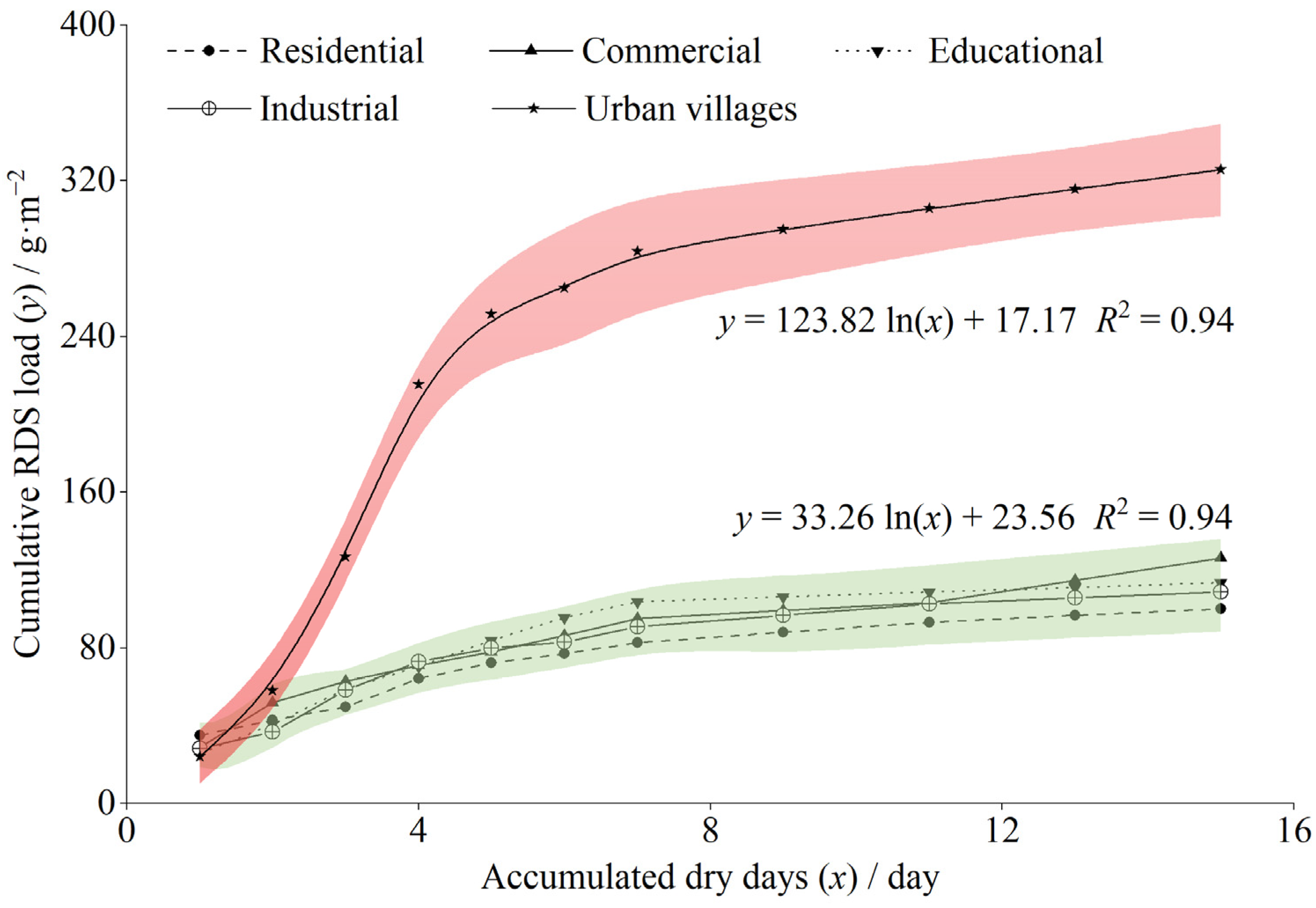
Figure 2 shows the accumulation process of road-deposited sediment (RDS) in different functional zones. During dry periods, the accumulation of RDS usually increases gradually over time until it reaches saturation, approaching a maximum value decided by the number of dry days. Due to differences in the accumulation processes of RDS across various regions, scholars have proposed many accumulation functions, such as exponent function, and power function [36]. In terms of the form of the fitting function, the temporal accumulation process of RDS in Shenzhen follows a logarithmic distribution, and the accumulation rate of RDS gradually decreases until it reaches a saturated state.
The accumulation process of RDS in urban built-up areas (residential, commercial, education, and industrial zones) is generally similar but differs significantly from that in urban villages. The RDS accumulation rate in urban village areas (123.82 g·m−2·day−1) is 3.7 times that in urban built-up areas (33.26 g·m−2·day−1); moreover, after reaching saturation, the accumulated RDS intensity in urban villages (330.25 g·m−2) is 3.1 times that in urban built-up areas (107.05 g·m−2). This is attributed to the lower rents and living costs in Shenzhen’s urban villages, which attract a large migrant population and lead to relatively high population density. Generally, the provision of public services (including environmental sanitation and regular cleaning) remains inadequate, resulting in suboptimal sanitation and management in these areas. In contrast, Shenzhen’s central built-up areas have more favorable conditions: higher housing and commodity prices, lower natural population density, stricter environmental governance and regulatory measures compared to urban villages.

3.2. Particle Size Characteristics of RDS in Different Functional Zones

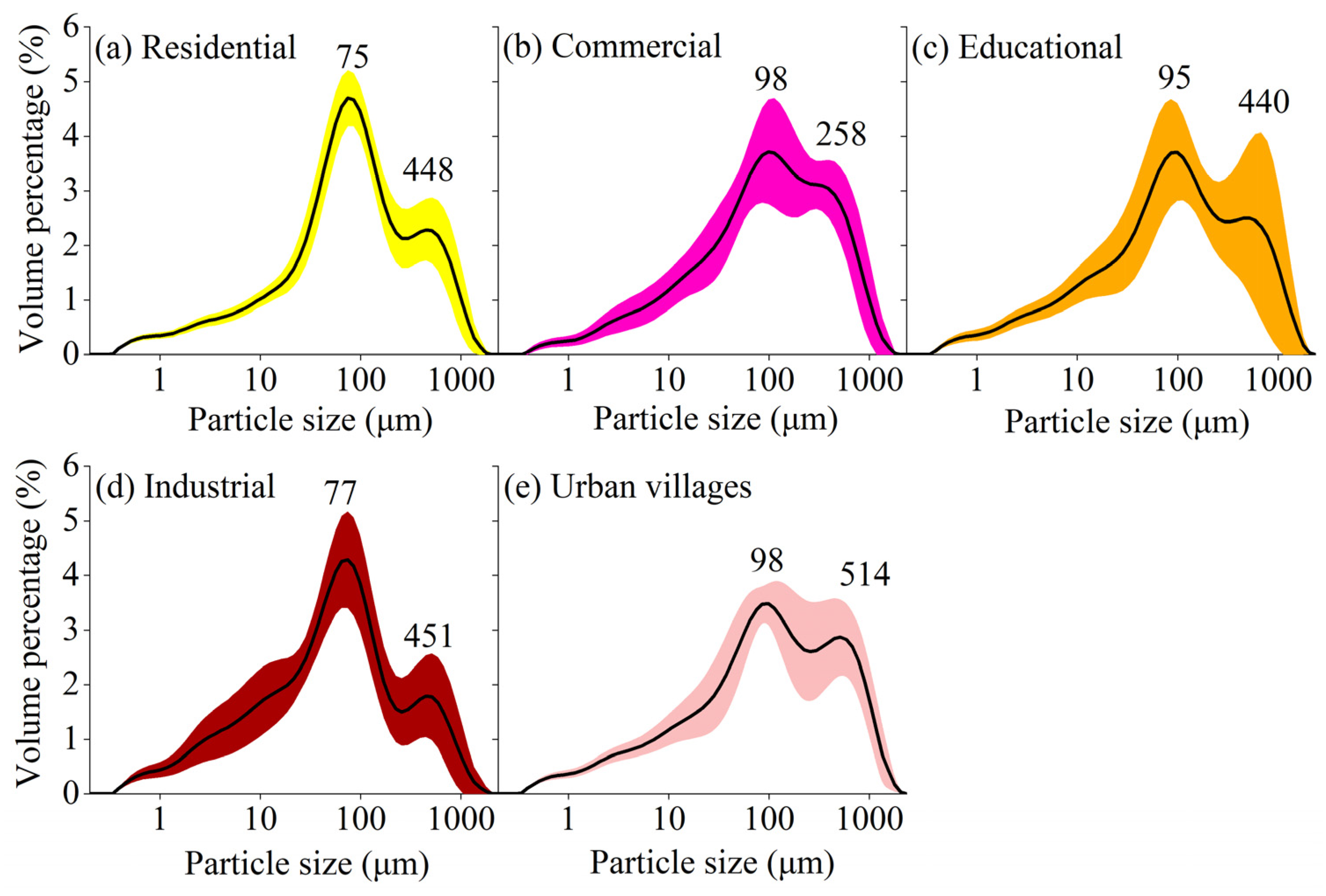
Figure 3 presents the particle size distribution of RDS in different functional zones (with the horizontal axis being a logarithmic coordinate axis). The particle size of RDS in all functional zones approximately follows a logarithmic-normal distribution, but there are significant differences in peak shapes. RDS in urban built-up areas (residential areas, commercial areas, science and education areas, and industrial areas) presents a bimodal distribution, the particle size of the first peak is concentrated in the range of 75~98 μm, and that of the second peak is distributed in the range of 258–451 μm. Among these zones, the industrial area has the largest difference in particle size frequency between the two peaks, and the variation range of data for small-particle-size RDS (around 10 μm) is significantly wider. This is related to the large amount of fine particle pollutants generated by production activities in the industrial area and the crushing and refinement of large-particle-size particles caused by the rolling of heavy freight vehicles. In contrast, the urban villages present a unimodal distribution, and the variation range of its particle size gradation data is narrower than that of other functional areas, showing that the particle size composition of its RDS is more stable. This is due to the weak intensity of environmental modification in urban villages, thus resulting in less variation in particle size composition.
Table 2 quantifies the particle size distribution (by percentage) of RDS across five specific particle size ranges and four key granularity parameters for each functional zone. The particle size ranges are clearly associated with their respective particle types: ≤4 μm corresponds to clay, 4~63 μm corresponds to silt, 63~125 μm corresponds to fine sand, and ≤100 μm corresponds to suspensible particles. Among these, suspensible particles cover clay, silt and part of fine sand, which is specifically used to reflect the proportion of RDS that can be suspended in the air. RDS in all functional zones is dominated by suspensible particles (particle size ≤ 100 μm), accounting for 49.94–71.26%, this feature directly reflects that road RDS in Shenzhen is mainly composed of fine particles. The industrial area exhibits the highest proportions of clay (11.48%) and silt (46.41%), which directly leads to its suspensible particles accounting for 71.26% (the highest among all functional zones); followed by the education zone (suspensible particles: 60.01%), residential zone (57.53%) and urban villages (55.07%), while the commercial zone has the lowest proportion of suspensible particles at 49.94%.
The granularity parameters further reveal the sedimentary environment of RDS and differences in environmental modification across functional zones: The mean particle size (Mz) ranges from 85.51 μm to 157.71 μm, and the industrial area has the smallest Mz (85.51 μm) due to its highest proportions of silt (46.41%) and clay (11.48%). The sorting coefficient (Sd) of all functional zones is less than 0.35, showing excellent sorting property. Combined with the proportion of suspensible particles, it can be inferred that the sedimentary dynamics of RDS are dominated by wind, more than 50% of the suspensible particles can be suspended in the atmosphere under the action of wind. Kurtosis (Ku, ranging from 1.33 to 2.25) and volumetric fractal dimension (D, ranging from 2.29 to 2.36) have the same order: industrial zone > education zone > residential zone > commercial zone > urban villages. This indicates that the conversion of large particles to fine particles in the industrial area is more significant after environmental modification, resulting in a more complex particle size composition and flatter peak shape of RDS. In contrast, urban villages exhibit the weakest intensity of environmental modification, leading to a more concentrated particle size distribution of RDS.

3.3. Spatial and Temporal Characteristics of N and P Pollution Intensity

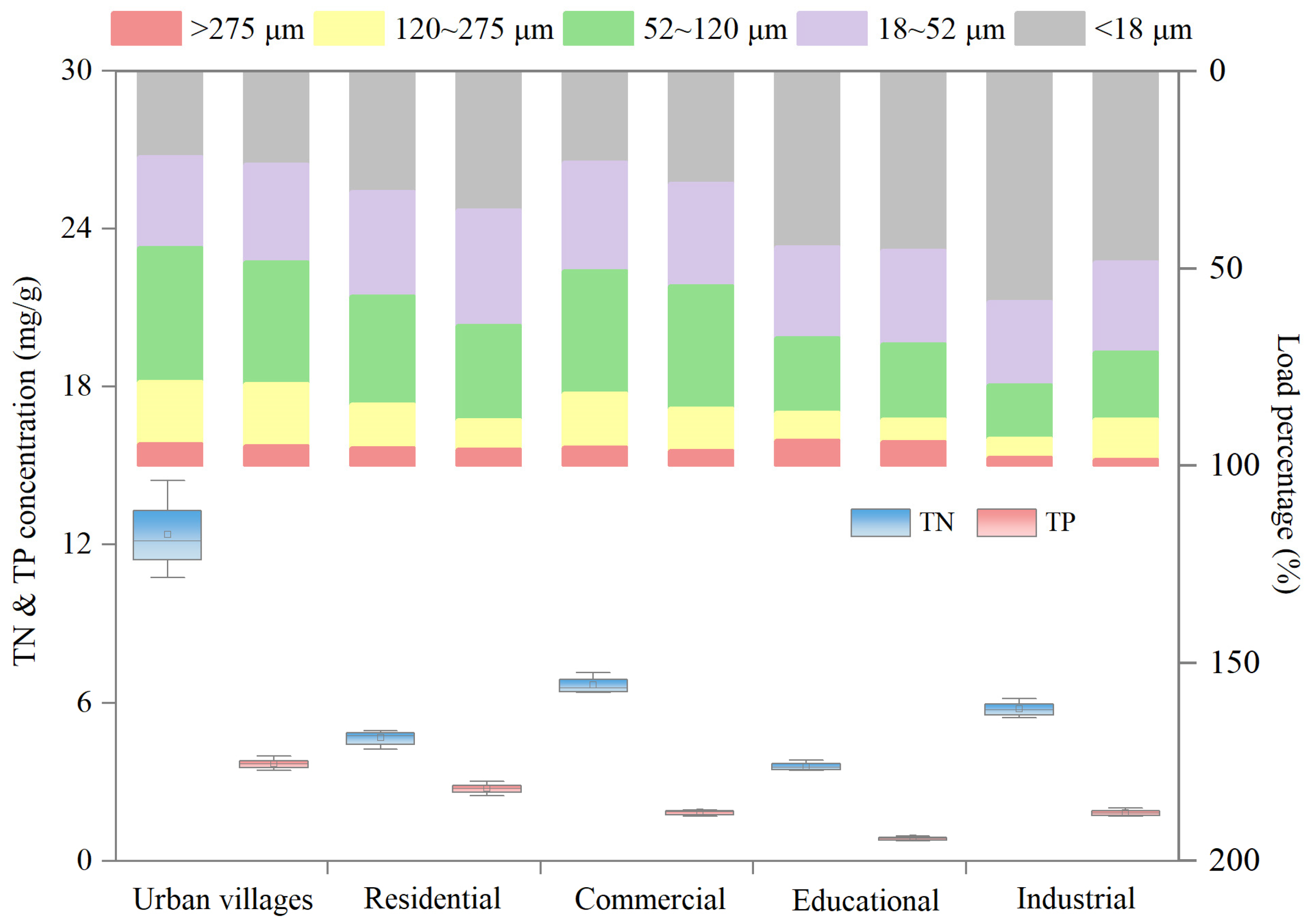
Figure 4 presents the total nitrogen (TN) and total phosphorus (TP) concentrations of road-deposited sediment (RDS) across different functional zones, along with the load contribution of each particle size group. It directly reveals the variations in TN/TP pollution levels among functional zones and shows the key particle size ranges that dominate nutrient pollution loads. The results show that the average TN and TP concentrations in RDS from urban built-up areas (including residential, commercial, educational, and industrial zones) are 5.11 mg·g−1 and 1.76 mg·g−1, respectively, but these concentrations are significantly lower than those in urban villages, where TN and TP concentrations reach 12.17 mg·g−1 and 3.43 mg·g−1. This contrast indicates gaps in pollution control within urban villages relative to urban built-up areas, future urban non-point source pollution control should prioritize runoff interception and pollution treatment for road surfaces in urban villages.
As further illustrated in Figure 4, TN and TP are mainly adsorbed on RDS particles smaller than 120 μm, with their load contribution ratios ranging from 78.65% to 93.05%. The two fine particle size groups (<18 μm and 18–52 μm) each contribute over 20% to the total load, meaning the pollutants they adsorb exceed their own mass proportion in the total RDS. Notably, in industrial zones, the <18 μm fine particle group has the highest contribution to TN and TP loads, accounting for 48.35% to 58.35% of the total TN/TP load. The combined load contribution of these two fine particle size groups, i.e., the TN and TP loads of RDS in the 0–52 μm range, exceeds 40% across all functional zones, and reaches 67.55% to 79.53% specifically in educational and industrial zones.
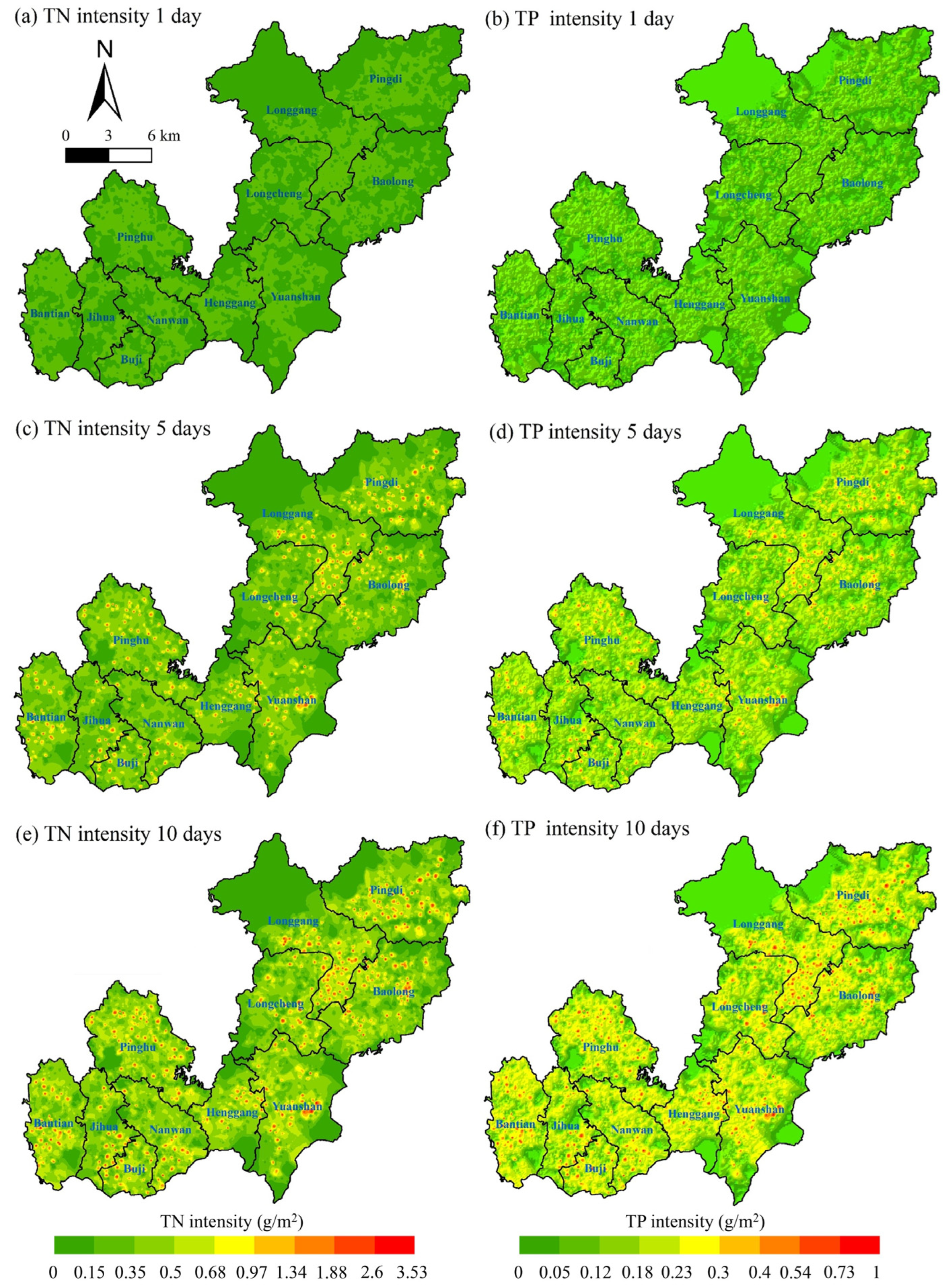
Figure 5 illustrates the spatial distribution of nitrogen and phosphorus pollution intensity under different antecedent dry days. The spatial patterns of TN and TP pollution intensity are basically consistent, showing a decreasing trend from urban built-up areas to mountainous and hilly regions. As the number of antecedent dry days increases, the level of TN and TP pollution also rises. On the 1st dry day, the TN and TP pollution intensities are relatively low, with TN ranging from 0.14 to 0.35 g·m−2 and TP ranging from 0.05 to 0.12 g·m−2. Around the 5th dry day, the accumulation of RDS in urban villages reaches equilibrium first; meanwhile, urban villages have the highest RDS accumulation amount and pollution concentration. Therefore, as can be seen from Figure 1 and Figure 5e,f, the areas with relatively high TN and TP intensities on the 5th day are mainly urban villages. When the accumulation of RDS reaches approximately 10 days, the RDS accumulation in all functional zones is basically saturated. As a result, more high-value areas of TN and TP intensities distributed in other functional zones can be observed in the spatial distribution on the 10th day, with the TN and TP pollution intensities in these high-value areas ranging from 2.61 to 3.53 g·m−2 and 0.74 to 1.00 g·m−2, respectively.

3.4. Correlation Between RDS Pollution and Multiple Driving Factors

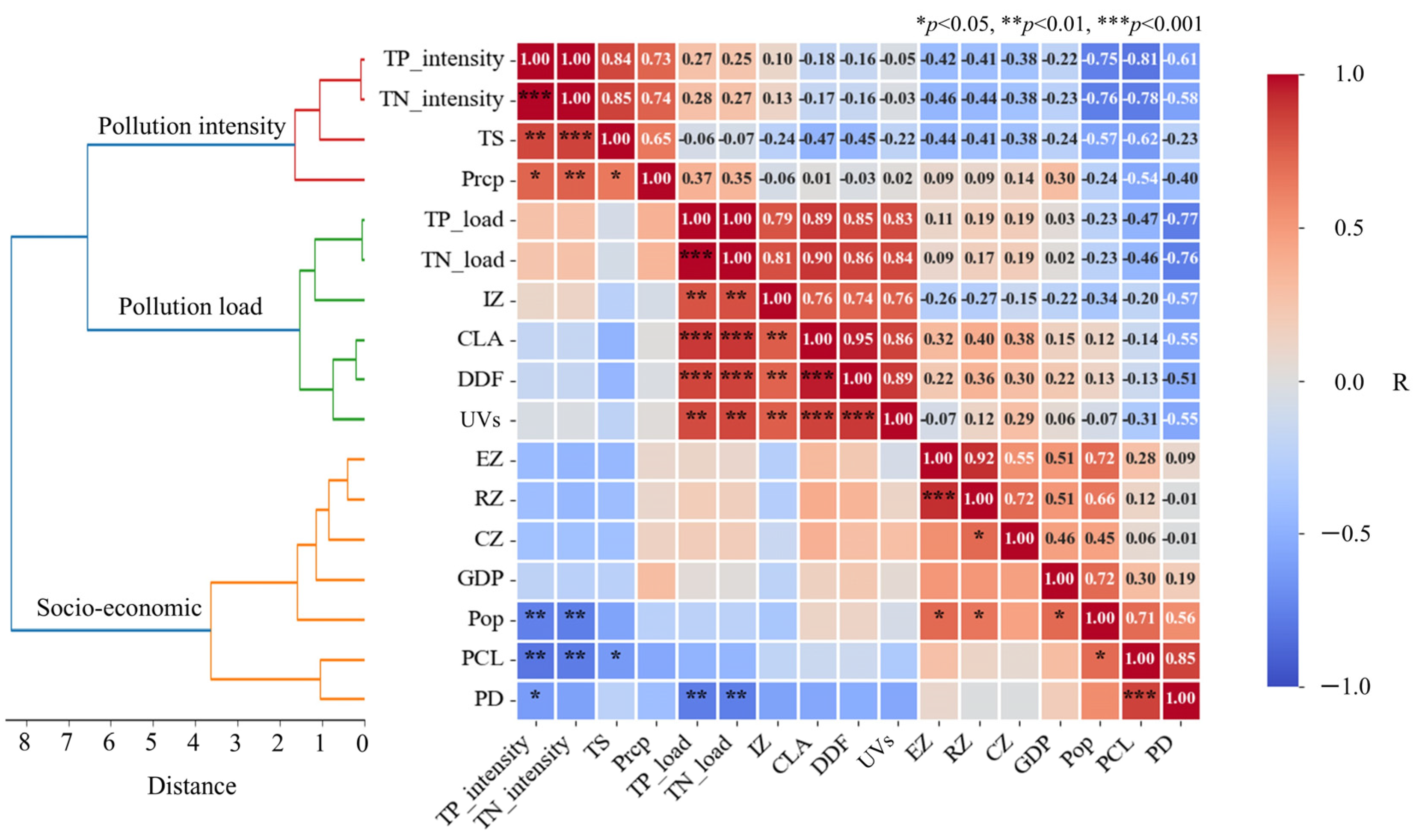
Figure 6 presents a correlation heatmap illustrating the relationships between total nitrogen (TN) and total phosphorus (TP) pollution in road-deposited sediment (RDS) and multiple driving factors. Hierarchical clustering categorizes the variables into three major groups: pollution intensity, pollution load, and socio-economic factors, revealing distinct patterns of association. Both TP_intensity and TN_intensity are significantly positively correlated with terrain slope (TS, r ≥ 0.84, p < 0.001) and precipitation (Prcp, r ≥ 0.73, p < 0.05). In contrast, TP_load and TN_load show strong positive correlations with industrial zone (IZ, r ≥ 0.79, p < 0.001), construction land area (CLA, r ≥ 0.89, p < 0.001), dry deposition flux (DDF, r ≥ 0.85, p < 0.001), and urban villages (UVs, r ≥ 0.83, p < 0.001). This indicates that dry deposition serves as a critical source of N/P pollution load in RDS, while construction land’s impervious surfaces enhance the retention of mobile pollutants (e.g., industrial dust, sewage leakage) by virtue of their low infiltration capacity. Additionally, due to high population density and insufficient governance, UVs contribute internal nutrient inputs from domestic waste and disordered discharge, which collectively drive up the total TN/TP load in RDS. While socio-economic variables, including education zones (EZ), residential zones (RZ), commercial zones (CZ), GDP, and population (Pop), exhibit no strong direct correlations with either pollution intensity or pollution load. Most of these factors show weak negative correlations with TN/TP intensity and load (|r| < 0.3, p < 0.05), suggesting a limited regulatory influence rather than a dominant driving role. Moreover, GDP shows a weak correlation with total pollution load (r = 0.3, p > 0.05), this result aligns with GDP’s dual role: while intensifying domestic pollution due to population inflow, it also drives industrial upgrading to achieve emission reduction.
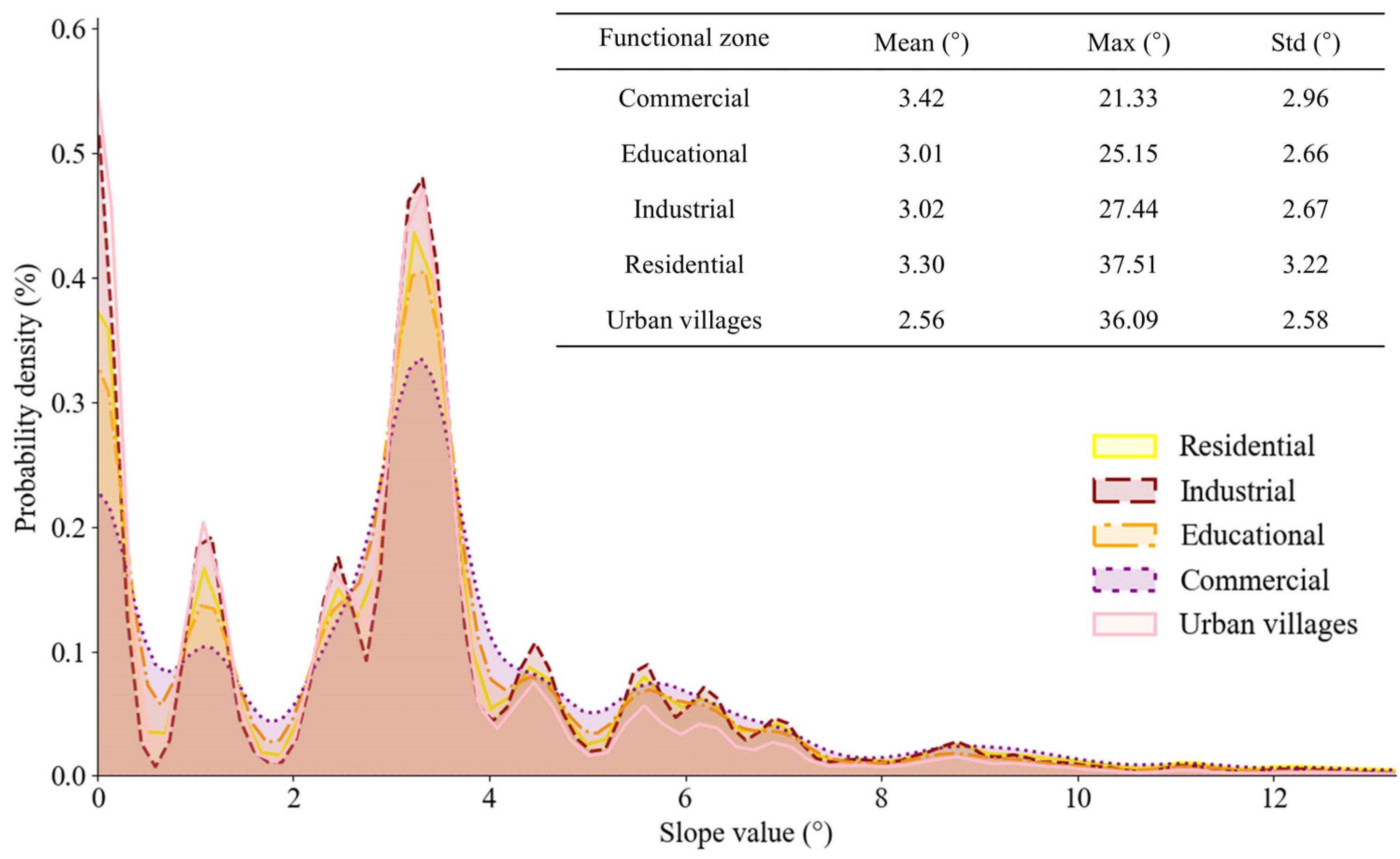
Given the strong association between terrain slope and pollution intensity identified at the street scale in Figure 6, the slope distribution (see Figure S2 for raw data) characteristics across different urban functional zones were further examined at the functional-zone scale (Figure 7). A clear trend is observed in the low-slope range (0–4°), where urban villages and industrial zones exhibit markedly higher probability densities than other functional areas, with urban villages showing the lowest mean slope (2.56°).

4. Discussion

4.1. Pollutant Input–Output Imbalance in Urban Villages

Urban villages (UVs) represent critical areas of environmental vulnerability, where their unique morphological features and high-density human activities create a propensity for pollutant enrichment. Characterized by densely packed “hand-shaking buildings” and fragmented land ownership, these areas function as high-density informal settlements [37]. Although shaped by China’s unique institutional context, UVs share functional similarities with informal settlements or slums worldwide (e.g., favelas in Brazil, kampungs in Indonesia, bustees in India, or informal settlements across sub-Saharan Africa and South Asia), especially regarding infrastructure deficits and pollutant accumulation risks [28,38].
Our results indicate that the role of UVs in urban pollution dynamics is “semi-passive.” They are not merely passive receptors of external pollution, nor are they solely active generators. While high population density (81,900 people/km2, Figure 1) and informal activities actively generate substantial primary pollutants (e.g., domestic waste, sewage leakage), their unique morphology creates a passive “trap effect.” From a hydrodynamic perspective, pollutant wash-off is a threshold-dependent process governed by runoff shear stress, which is linearly proportional to the slope gradient [39,40]. The prevalence of low-gradient terrain in urban villages implies that the runoff energy is often insufficient to overcome the critical shear stress required to mobilize heavy particulate loads. This suggests a shift from a ‘source-limited’ to a ‘transport-limited’ regime specifically within urban villages, where the transport capacity of surface runoff replaces pollutant supply as the primary limiting factor. Consequently, the concentration of urban villages in these low-slope areas creates a structural ‘input–output’ imbalance, where the intensive anthropogenic inputs (high supply) are physically retained by the constrained hydraulic flushing capacity (low output).
This input–output imbalance explains why conventional engineering interventions focused on drainage enhancement often yield limited benefits [21,23,41]. Moreover, the compact building morphology of urban villages promotes aerodynamic trapping of particles, leading to elevated dry deposition and further reinforcing surface accumulation. Together, these processes explain the persistence of high pollutant loads despite infrastructural upgrades. From a management perspective, our findings highlight the necessity of shifting control strategies in urban villages from downstream drainage enhancement to upstream source reduction, such as high-frequency pre-rainfall vacuum sweeping [42,43] and fine-scale regulation of informal discharge sources. Interrupting the accumulation cycle is therefore a prerequisite for effective pollution mitigation in these environments.

4.2. Cross-Media Pollutant Transfer at the Air–Road Interface

The strong correlation between dry deposition fluxes and surface pollutant loads (r ≥ 0.85, p < 0.001, Figure 6) observed in this study underscores the role of urban roads as critical interfaces linking atmospheric pollution and water environment degradation [44]. However, this cross-media pollutant transfer is mechanistically amplified in the study area by the unique morphology of urban villages, specifically the prevalence of ‘hand-shaking buildings’ (extremely close-set structures, see Figure 1). From an aerodynamic perspective, these narrow alleys create deep street canyons with exceptionally high aspect ratios. According to street canyon theory, such deep geometries significantly increase aerodynamic resistance and reduce mean wind speeds at the street level [45,46]. This poor ventilation inhibits the dispersion of atmospheric pollutants, effectively creating a ‘trapping effect’ where airborne particulates are retained within the canyon and undergo enhanced dry deposition [47,48]. Consequently, urban villages act as effective sinks for atmospheric pollutants, accelerating the transfer of nitrogen and phosphorus from the air to road surfaces.
This mechanism fundamentally alters our understanding of urban road surfaces. Rather than functioning solely as runoff conveyance pathways, road surfaces act as accumulation reservoirs where atmospheric pollutants are continuously deposited and stored before being mobilized during rainfall events [9,49]. In this sense, urban runoff pollution represents a delayed hydrological response to deteriorating air quality. This finding reveals a structural limitation in current management frameworks that treat air and water pollution as independent domains: measures targeting runoff interception alone may yield limited benefits if atmospheric deposition continues to replenish these surface reservoirs.
Therefore, our results argue for a coordinated control strategy in which air pollution monitoring and atmospheric conditions are explicitly used to inform water quality management. One practical implication is the establishment of atmospheric deposition thresholds for water quality management; for example, high-deposition periods could serve as triggers for intensified surface cleaning to reduce episodic pollutant export. Such cross-sector coordination among air quality, meteorological, and sanitation agencies could substantially reduce episodic pollution pulses to receiving waters.

4.3. Implications for Urban Planning Under Terrain Constraints

This study demonstrates that the drivers of pollution intensity and pollution load are functionally separated, with important implications for urban planning under terrain constraints. Pollution intensity (pollutant concentration per unit area) is strongly regulated by natural environmental conditions, showing significant positive correlations with precipitation (r = 0.74/0.73, p < 0.001) and terrain slope (r = 0.85/0.83, p < 0.001) (Figure 6). This positive association is likely driven by a topographic selective accumulation mechanism. During inter-storm periods, steeper slopes facilitate the selective removal of larger, inert mineral grains (e.g., sands) through gravity and vehicular vibrations, while the road’s micro-texture effectively retains fine-grained particulates and organic matter with higher nutrient affinities [7,50]. Moreover, higher precipitation enhances nutrient input via wet deposition. On steep slopes, instead of pooling, water moves as thin-film flows, which maximizes the contact interface and adsorption efficiency between nutrient-rich rainwater and residual particles [44]. Consequently, high-energy terrain settings tend to ‘concentrate’ nutrients within a smaller mass of fine-grained sediment, resulting in higher pollution intensity.
In contrast, pollution load (total regional pollutant mass) is primarily shaped by anthropogenic activities and land-use patterns, as reflected by its strong associations with urban village land (r = 0.84/0.83, p < 0.001) and industrial zone land (r = 0.81/0.79, p < 0.001). This decoupling indicates a latent planning risk, whereby land uses generating high pollutant loads may be spatially misaligned with terrain-controlled transport capacity. Understanding these accumulation mechanisms is essential for advancing sustainable urban water management. From an urban planning perspective, terrain slope plays a critical role in modulating environmental risk by influencing the efficiency with which accumulated pollutants are mobilized and exported. When pollution-intensive land uses are located in steep or highly responsive terrain, enhanced runoff energy can rapidly convert stored pollutants into high-intensity export events, amplifying ecological stress and increasing management difficulty [2,51,52]. Current planning practices, which often prioritize functional zoning while underestimating topographic controls, may therefore inadvertently exacerbate non-point source pollution risks [13,53]. Our findings suggest that future urban development and renewal should integrate terrain-aware, transport-sensitivity zoning, steering pollutant-intensive activities away from high-energy transport settings and reserving steep areas for low-intensity land uses or ecological buffers. By explicitly accounting for terrain constraints in spatial planning, cities can reduce pollution export at the source and limit reliance on costly end-of-pipe engineering solutions.

4.4. Advantages and Limitations

Precisely quantifying urban non-point source (NPS) pollution is a critical challenge due to its complex spatio-temporal dynamics [54,55,56]. This study develops a dynamic load estimation method based on detailed functional zoning data, which effectively quantifies RDS accumulation relative to dry days and minimizes estimation uncertainties. By integrating macro-socioeconomic data (e.g., GDP, population) with street-scale micro-monitoring (e.g., dry deposition flux), this approach enables a mechanistic linkage between human activities, atmospheric pollution, and hydrological responses, reinforcing the conceptualization of roads as air–water coupling interfaces.
Despite these strengths, several limitations must be acknowledged to ensure a rigorous interpretation of the findings. First, relying on functional zoning can introduce inaccuracies [57,58]; for instance, the boundary between industrial zones and UVs typically exhibits ambiguity [59,60], which may affect the spatial precision of pollution loads. Future studies can incorporate social media crowdsourced data (e.g., TikTok, Twitter) and geospatial data (e.g., Points of Interest data) to fully quantify the distribution of urban populations and key urban elements, thereby improving the accuracy of functional zoning in large-scale urban spaces. Second, while the 17 sampling sites were strategically selected to represent major functional zones, the limited sample size introduces inherent uncertainties in spatial interpolation. Consequently, the Kriging-based maps should be interpreted as exploratory representations of regional trends rather than precise point-wise predictions. Third, although Pearson correlations provided statistical evidence of driving factors, they do not inherently establish causality. Our mechanistic interpretations are supported by established hydrodynamic principles, but future research employing process-based models is needed to further disentangle these causal pathways. Finally, as the sampling was conducted during a single dry-season period, the results reflect specific meteorological conditions; seasonal variability warrants further investigation.

5. Conclusions

This study systematically investigated the nitrogen and phosphorus accumulation characteristics and driving mechanisms in road-deposited sediment (RDS) across a rapidly urbanizing megacity. Our findings offer three major contributions: (1) quantifying the significantly higher RDS pollution risk in urban villages compared to formal built-up areas; (2) identifying the mechanistic decoupling between pollution intensity (terrain-driven) and pollution load (supply-driven); and (3) establishing a theoretical basis for transitioning from “end-of-pipe” treatment to terrain-aware source reduction strategies. While this research is based on a representative single-season campaign, providing a critical baseline for peak pollution accumulation, it also opens several pathways for future investigation. Moving forward, integrating process-based hydrodynamic modeling and multi-seasonal monitoring will be essential to further disentangle the complex causal pathways of pollutant mobilization. Furthermore, the incorporation of emerging geospatial big data could refine the identification of functional hotspots. Overall, this study reveals that effective mitigation requires adaptive urban planning that explicitly accounts for terrain constraints and air–water interactions, moving beyond standard engineering solutions to address the unique non-point source pollution challenges in the Global South.

Supplementary Materials

The following supporting information can be downloaded at: https://www.mdpi.com/article/10.3390/su18031543/s1, Figure S1: Sampling control schematic; Figure S2: The raw terrain slope distribution of Longgang District, Shenzhen; Table S1: Basic information, economic and industrial sectors of different streets in Longgang District, Shenzhen; Table S2: Sanitation frequencies of different functional zones in Longgang District, Shenzhen; Table S3: TN and TP pollution indicators in RDS and environmental driving factor data of 11 streets in Longgang District, Shenzhen.

Author Contributions

M.H.: conceptualization, writing—original draft, writing—review and editing, visualization. C.C.: conceptualization, supervision and project administration. J.Z.: supervision. J.M.: supervision. Y.L.: data curation and visualization. All authors have read and agreed to the published version of the manuscript.

Funding

This work was supported by the National Key Research and Development Program of China (2023YFC3208900), the National Nature Science Foundation of China (52121006, 52279071).

Institutional Review Board Statement

Not applicable.

Informed Consent Statement

Not applicable.

Data Availability Statement

The original data supporting this study has been submitted as Supplementary Materials, and any further detailed data will be made available by the authors upon reasonable request.

Acknowledgments

C.C. acknowledges the support from Cooperative Innovation Center for Water Safety and Hydro Science, Hohai University.

Conflicts of Interest

The authors declare no conflicts of interest.

Abbreviations

The following abbreviations are used in this manuscript:
NPSNon-point source
RDSRoad-deposited sediment
UVsUrban villages
CZCommercial zone
EZEducational zone
RZResidential zone
IZIndustrial zone

References

  1. Zeng, J.; Huang, G.; Luo, H.; Mai, Y.; Wu, H. First flush of non-point source pollution and hydrological effects of LID in a Guangzhou community. Sci. Rep. 2019, 9, 13865. [Google Scholar] [CrossRef]
  2. Rong, Q.; Liu, Q.; Yue, W.; Xu, C.; Su, M. Optimal design of low impact development at a community scale considering urban non-point source pollution management under uncertainty. J. Clean. Prod. 2024, 434, 139934. [Google Scholar] [CrossRef]
  3. Liu, S.; Chen, Q.Q.; Ding, H.J.; Song, Y.Q.; Pan, Q.X.; Deng, H.P.; Zeng, E.Y. Differences of microplastics and nanoplastics in urban waters: Environmental behaviors, hazards, and removal. Water Res. 2024, 260, 121895. [Google Scholar] [CrossRef] [PubMed]
  4. Zhang, J.; Li, R.; Zhang, X.; Ding, C.; Hua, P. Traffic contribution to polycyclic aromatic hydrocarbons in road dust: A source apportionment analysis under different antecedent dry-weather periods. Sci. Total Environ. 2019, 658, 996–1005. [Google Scholar] [CrossRef] [PubMed]
  5. Li, J.Y.; Cui, D.L.; Yang, Z.Y.; Ma, J.Y.; Liu, J.J.; Yu, Y.X.; Huang, X.F.; Xiang, P. Health risk assessment of heavy metal(loid)s in road dust via dermal exposure pathway from a low latitude plateau provincial capital city: The importance of toxicological verification. Environ. Res. 2024, 252, 118890. [Google Scholar] [CrossRef]
  6. Yang, J.; Wang, X.; Li, X.; Tian, Z.; Zou, G.; Du, L.; Guo, X. Potential Risk Identification of Agricultural Nonpoint Source Pollution: A Case Study of Yichang City, Hubei Province. Sustainability 2023, 15, 16324. [Google Scholar] [CrossRef]
  7. Ahn, C.H.; Park, Y. Build-up and wash-off behavior of heavy metals in road-deposited sediments on asphalt surfaces: A grain-size-resolved modeling approach for urban runoff risk. J. Hazard. Mater. Adv. 2025, 19, 100856. [Google Scholar] [CrossRef]
  8. Gopal, V.; Krishnamurthy, R.R.; Bhuvaneswari, M.; Deepika, R.; Nathan, C.S.; Bharath, K.M.; Magesh, N.S.; Kalaivanan, R.; Ayyamperumal, R. Hazardous trace elemental contamination in urban river sediments: Distribution, source identification, and Environmental impacts. J. Hazard. Mater. Adv. 2025, 18, 100733. [Google Scholar] [CrossRef]
  9. Behrouz, M.S.; Sample, D.J.; Kisila, O.B.; Harrison, M.; Yazdi, M.N.; Garna, R.K. Parameterization of nutrients and sediment build-up/wash-off processes for simulating stormwater quality from specific land uses. J. Environ. Manag. 2024, 358, 120768. [Google Scholar] [CrossRef]
  10. Li, H.; Shi, A.; Zhang, X. Particle size distribution and characteristics of heavy metals in road-deposited sediments from Beijing Olympic Park. J. Environ. Sci. 2015, 32, 228–237. [Google Scholar] [CrossRef]
  11. Wang, J.; Qin, M.; Huang, T.; Tu, N.; Li, B. Particle size distribution and pollutant dissolution characteristics of road-deposited sediment in different land-use districts: A case study of Beijing. Environ. Sci. Pollut. Res. 2021, 28, 38497–38505. [Google Scholar] [CrossRef]
  12. Zhang, J.; Hua, P.; Krebs, P. Influences of land use and antecedent dry-weather period on pollution level and ecological risk of heavy metals in road-deposited sediment. Environ. Pollut. 2017, 228, 158–168. [Google Scholar] [CrossRef] [PubMed]
  13. Wang, J.F.; Yu, J.; Gong, Y.; Wu, L.L.; Yu, Z.; Wang, J.; Gao, R.; Liu, W.W. Pollution characteristics, sources and health risk of metals in urban dust from different functional areas in Nanjing, China. Environ. Res. 2021, 201, 11607. [Google Scholar] [CrossRef] [PubMed]
  14. Chen, Y.; Yang, Z.; Dong, J.; Hong, N.; Tan, Q. Understanding phosphorus fractions and influential factors on urban road deposited sediments. Sci. Total Environ. 2024, 921, 170624. [Google Scholar] [CrossRef]
  15. Zhao, H.; Li, X. Risk assessment of metals in road-deposited sediment along an urban–rural gradient. Environ. Pollut. 2013, 174, 297–304. [Google Scholar] [CrossRef]
  16. Yang, Z.L.; Chen, Y.S.; Dong, J.W.; Hong, N.; Tan, Q. Characterizing nitrogen deposited on urban road surfaces: Implication for stormwater runoff pollution control. Sci. Total Environ. 2024, 952, 175692. [Google Scholar] [CrossRef]
  17. Yan, H.; Zhu, D.Z.; Loewen, M.R.; Zhang, W.; Yang, Y.; Zhao, S.; van Duin, B.; Chen, L.; Mahmood, K. Particle size distribution of total suspended sediments in urban stormwater runoff: Effect of land uses, precipitation conditions, and seasonal variations. J. Environ. Manag. 2024, 365, 121467. [Google Scholar] [CrossRef]
  18. Du, B.L.; Wu, L.; Ruan, B.N.; Xu, L.J.; Liu, S.; Guo, Z.J. Can the best management practices resist the combined effects of climate and land-use changes on non-point source pollution control? Sci. Total Environ. 2024, 946, 174260. [Google Scholar] [CrossRef]
  19. Zhang, X.P.; Cheng, G.; Xu, S.J.; Bi, Y.L.; Jiang, C.C.; Ma, S.L.; Wang, D.S.; Zhuang, X.L. Temporal and spatial changes of water quality in intensively developed urban rivers and water environment improvement: A case study of the Longgang River in Shenzhen, China. Environ. Sci. Pollut. Res. 2023, 30, 99454–99472. [Google Scholar] [CrossRef]
  20. Huang, J.C.; Zhang, Y.J.; Bing, H.J.; Peng, J.; Dong, F.F.; Gao, J.F.; Arhonditsis, G.B. Characterizing the river water quality in China: Recent progress and on-going challenges. Water Res. 2021, 201, 117309. [Google Scholar] [CrossRef] [PubMed]
  21. Li, Y.P.; Zhou, Y.X.; Wang, H.Y.; Jiang, H.Z.; Yue, Z.W.; Zheng, K.; Wu, B.; Banahene, P. Characterization and sources apportionment of overflow pollution in urban separate stormwater systems inappropriately connected with sewage. J. Environ. Manag. 2022, 303, 114231. [Google Scholar] [CrossRef]
  22. Wen, T.; Li, C.; Liu, J.; Wang, P. Risk Assessment of Dynamic Diffusion of Urban Non-Point Source Pollution Under Extreme Rainfall. Toxics 2025, 13, 385. [Google Scholar] [CrossRef] [PubMed]
  23. Xu, Z.X.; Xu, J.; Yin, H.L.; Jin, W.; Li, H.Z.; He, Z. Urban river pollution control in developing countries. Nat. Sustain. 2019, 2, 158–160. [Google Scholar] [CrossRef]
  24. Sun, Y.; Li, M.; Hu, W.; Xia, X. Reshaping urban governance: Vertical adaptation of the integrated LRF model through urban village renewal in Hangzhou, China. J. Urban Manag. 2025, in press. [Google Scholar] [CrossRef]
  25. Jiang, L.; Lai, Y.; Wu, Y.; Wang, R.; Tang, X.; Li, X.; Ma, D.; Guo, R. Public attitudes toward state-led urban village rehabilitation in Shenzhen, China. Habitat Int. 2025, 160, 103404. [Google Scholar] [CrossRef]
  26. Nations, U. Transforming Our World: The 2030 Agenda for Sustainable Development; A/RES/70/1; United Nations: New York, NY, USA, 2015. [Google Scholar]
  27. Jnawali, S.S.; McBroom, M.; Zhang, Y.; Stafford, K.; Wang, Z.; Creech, D.; Cheng, Z. Effectiveness of Rain Gardens for Managing Non-Point Source Pollution from Urban Surface Storm Water Runoff in Eastern Texas, USA. Sustainability 2025, 17, 4631. [Google Scholar] [CrossRef]
  28. Ezeh, A.; Oyebode, O.; Satterthwaite, D.; Chen, Y.-F.; Ndugwa, R.; Sartori, J.; Mberu, B.; Melendez-Torres, G.J.; Haregu, T.; Watson, S.I. The history, geography, and sociology of slums and the health problems of people who live in slums. Lancet 2016, 389, 547–558. [Google Scholar] [CrossRef] [PubMed]
  29. Hao, P.; Sliuzas, R.; Geertman, S. The development and redevelopment of urban villages in Shenzhen. Habitat Int. 2011, 35, 214–224. [Google Scholar] [CrossRef]
  30. Tan, Y. Evaluation of Renovation Projects of Urban Villages and Historic Buildings in Shenzhen. Commun. Humanit. Res. 2023, 6, 468–475. [Google Scholar] [CrossRef]
  31. Laird, D.; Martens, D.; Kingery, W. Nature of clay-humic complexes in an agricultural soil: I. Chemical, biochemical, and spectroscopic analyses. Soil Sci. Soc. Am. J. 2001, 65, 1413–1418. [Google Scholar] [CrossRef]
  32. Horváth, L. Dry deposition velocity of PM2.5 ammonium sulfate particles to a Norway spruce forest on the basis of S- and N-balance estimations. Atmos. Environ. 2003, 37, 4419–4424. [Google Scholar] [CrossRef]
  33. Mirzaei, F.; Abbasi, Y.; Sohrabi, T.; Mirhashemi, S.H. Investigation of heavy metalloid pollutants in the south of Tehran using kriging method and HYDRUS model. Geosci. Lett. 2022, 9, 27. [Google Scholar] [CrossRef]
  34. Blott, S.J.; Pye, K. GRADISTAT: A grain size distribution and statistics package for the analysis of unconsolidated sediments. Earth Surf. Process. Landf. 2001, 26, 1237–1248. [Google Scholar] [CrossRef]
  35. Liu, F.Q.; Yu, T.; Leng, W.J.; Zhang, X. Distribution and Fractal Characteristics of Outdoor Particles in High-Rise Buildings Based on Fractal Theory. Fractal Fract. 2023, 7, 669. [Google Scholar] [CrossRef]
  36. Ball, J.E.; Jenks, R.; Auborg, D. An assessment of the availability of pollutant constituents on road surfaces. Sci. Total Environ. 1998, 209, 243–254. [Google Scholar] [CrossRef]
  37. Zhang, W.H.; Yuan, Q.; Cai, H.L. Unravelling urban governance challenges: Objective assessment and expert insights on livability in Longgang District, Shenzhen. Ecol. Indic. 2023, 155, 110989. [Google Scholar] [CrossRef]
  38. Andersson, K.; Dickin, S.; Rosemarin, A. Towards “Sustainable” Sanitation: Challenges and Opportunities in Urban Areas. Sustainability 2016, 8, 1289. [Google Scholar] [CrossRef]
  39. Vaze, J.; Chiew, F.H. Experimental study of pollutant accumulation on an urban road surface. Urban Water 2002, 4, 379–389. [Google Scholar] [CrossRef]
  40. Egodawatta, P.; Thomas, E.; Goonetilleke, A. Mathematical interpretation of pollutant wash-off from urban road surfaces using simulated rainfall. Water Res. 2007, 41, 3025–3031. [Google Scholar] [CrossRef]
  41. Botturi, A.; Ozbayram, E.G.; Tondera, K.; Gilbert, N.; Rouault, P.; Caradot, N.; Gutierrez, O.; Daneshgar, S.; Frison, N.; Akyol, Ç.; et al. Combined sewer overflows: A critical review on best practice and innovative solutions to mitigate impacts on environment and human health. Crit. Rev. Environ. Sci. Technol. 2021, 51, 1585–1618. [Google Scholar] [CrossRef]
  42. Li, J.L.; Wu, D.S.; Kuang, Q.; Wu, Q.Q.; Wei, L.S.; Huang, H.; Zhou, F.B. Strategy and consequence of intermittent segmented pulse-jet cleaning for long-box-shaped filter dust collector. Powder Technol. 2018, 340, 311–320. [Google Scholar] [CrossRef]
  43. Wu, Q.Q.; Li, X.H.; Xing, Z.Q.; Kuang, Q.; Li, J.L.; Huang, S.; Huang, H.; Ma, Z.F.; Wu, D.S. Inhibition of Dust Re-Deposition for Filter Cleaning Using a Multi-Pulsing Jet. Atmosphere 2023, 14, 1173. [Google Scholar] [CrossRef]
  44. Gunawardena, J.; Egodawatta, P.; Ayoko, G.A.; Goonetilleke, A. Atmospheric deposition as a source of heavy metals in urban stormwater. Atmos. Environ. 2013, 68, 235–242. [Google Scholar] [CrossRef]
  45. Vardoulakis, S.; Fisher, B.E.; Pericleous, K.; Gonzalez-Flesca, N. Modelling air quality in street canyons: A review. Atmos. Environ. 2003, 37, 155–182. [Google Scholar] [CrossRef]
  46. Zhang, Y.; Gu, Z.; Yu, C.W. Impact factors on airflow and pollutant dispersion in urban street canyons and comprehensive simulations: A review. Curr. Pollut. Rep. 2020, 6, 425–439. [Google Scholar] [CrossRef]
  47. Oke, T.R. Street design and urban canopy layer climate. Energy Build. 1988, 11, 103–113. [Google Scholar] [CrossRef]
  48. Li, X.-X.; Liu, C.-H.; Leung, D.Y.; Lam, K.M. Recent progress in CFD modelling of wind field and pollutant transport in street canyons. Atmos. Environ. 2006, 40, 5640–5658. [Google Scholar] [CrossRef]
  49. Faisal, M.; You, Z.J.; Idrees, M.B.; Ali, S.; Buttar, N.A. Exploring urban runoff complexity: Road-deposited sediment wash-off mechanisms and dynamics of constraints. J. Hydroinform. 2024, 26, 1396–1408. [Google Scholar] [CrossRef]
  50. Zhao, H.; Jiang, Q.; Ma, Y.; Xie, W.; Li, X.; Yin, C. Influence of urban surface roughness on build-up and wash-off dynamics of road-deposited sediment. Environ. Pollut. 2018, 243, 1226–1234. [Google Scholar] [CrossRef] [PubMed]
  51. Xiao, Y.; Luan, B.; Zhang, T.T.; Liang, D.F.; Zhang, C. Experimental study of sediment wash-off process over urban road and its dependence on particle size distribution. Water Sci. Technol. 2022, 86, 2732–2748. [Google Scholar] [CrossRef] [PubMed]
  52. Dong, Y.K.; Guo, Y.Y.; Wang, Y.; Zeng, W.J. Spatial and temporal evolution of the “source-sink” risk pattern of NPS pollution in the upper reaches of Erhai Lake Basin under land use changes in 2005–2020. Water Air Soil Pollut. 2022, 233, 202. [Google Scholar] [CrossRef]
  53. Mohammadi, M.; Khaledi Darvishan, A.; Bahramifar, N.; Alavi, S.J. Spatio-temporal suspended sediment fingerprinting under different land management practices. Int. J. Sediment Res. 2023, 38, 481–493. [Google Scholar] [CrossRef]
  54. Wang, Y.X.; Li, C.L.; Qiao, J.M.; Hu, Y.M.; Zhang, Q.; Yin, J.B.; Slater, L. Meta-Analysis of Urban Non-Point Source Pollution From Road and Roof Runoff Across China. Earth Future 2025, 13, e2024EF005296. [Google Scholar] [CrossRef]
  55. Saby, L.; Herbst, R.S.; Goodall, J.L.; Nelson, J.D.; Culver, T.B.; Stephens, E.; Marquis, C.M.; Band, L.E. Assessing and improving the outcomes of nonpoint source water quality trading policies in urban areas: A case study in Virginia. J. Environ. Manag. 2023, 345, 118724. [Google Scholar] [CrossRef] [PubMed]
  56. Wang, S.; Liu, G.W.C.; Zhang, X.Y.; Fu, Y.J.; Wang, J.Y.; Meng, X.Y.; Gao, S.H.; Ma, Y.K.; Shen, Z.Y.; Chen, L. Changes in the effectiveness of low impact development practices and their role in optimal design. J. Hydrol. 2025, 660, 133505. [Google Scholar] [CrossRef]
  57. Zheng, Y.Y.; Dian, Y.; Guo, Z.Q.; Yao, C.H.; Wu, X.F. A Functional Zoning Method in Rural Landscape Based on High-Resolution Satellite Imagery. Remote Sens. 2023, 15, 4920. [Google Scholar] [CrossRef]
  58. Ji, C.A.; Heiden, U.; Lakes, T.; Feilhauer, H. Are urban material gradients transferable between areas? Int. J. Appl. Earth Obs. Geoinf. 2021, 100, 102332. [Google Scholar] [CrossRef]
  59. Haldar, S.; Chatterjee, U.; Bhattacharya, S.; Paul, S.; Bindajam, A.A.; Mallick, J.; Abdo, H.G. Peri-urban dynamics: Assessing expansion patterns and influencing factors. Ecol. Process. 2024, 13, 58. [Google Scholar] [CrossRef]
  60. Kurnia, A.A.; Rustiadi, E.; Fauzi, A.; Pravitasari, A.E.; Saizen, I.; Zenka, J. Understanding Industrial Land Development on Rural-Urban Land Transformation of Jakarta Megacity’s Outer Suburb. Land 2022, 11, 670. [Google Scholar] [CrossRef]
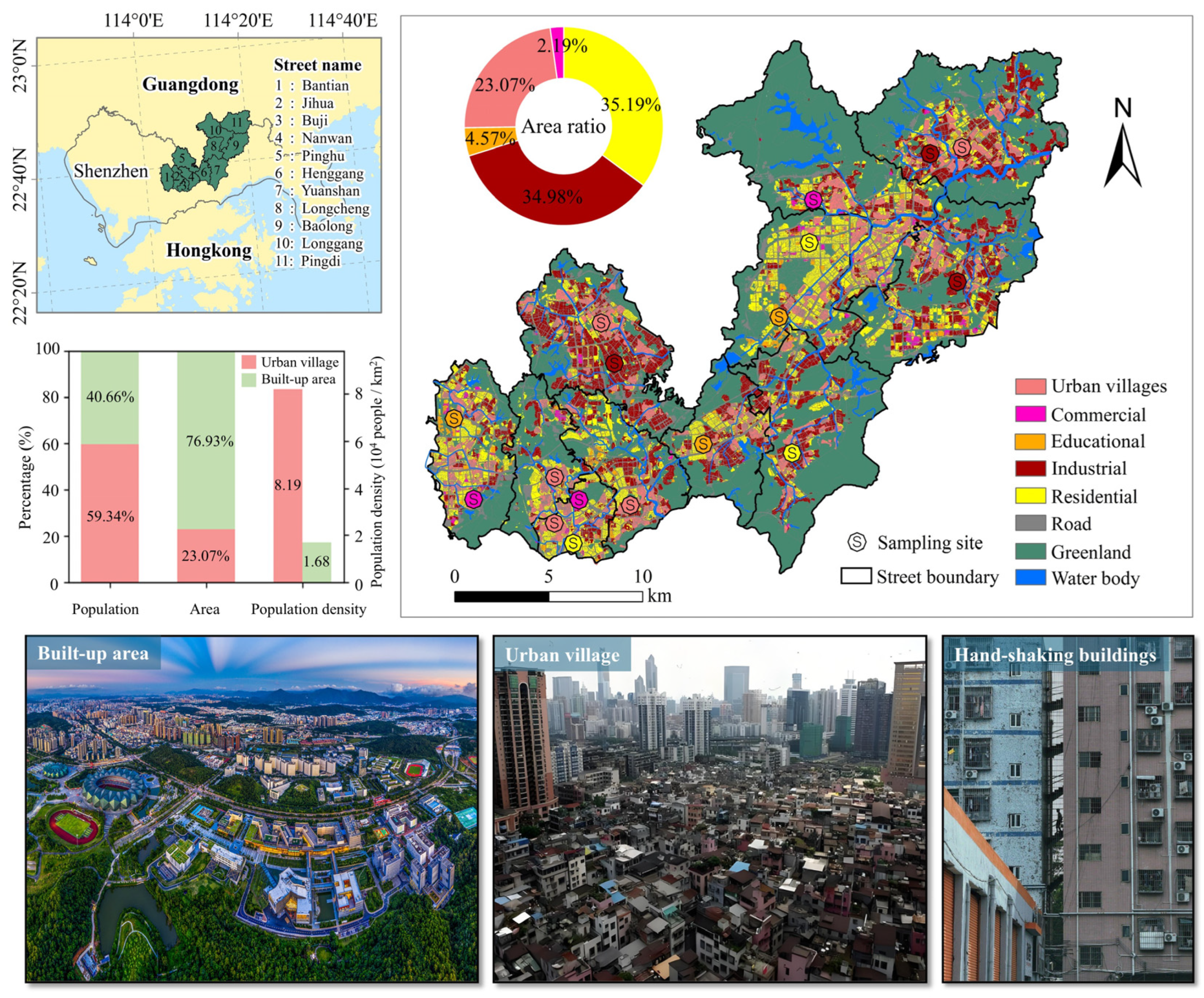
Figure 1. Functional zoning spatial distribution, and morphological characteristics of urban villages in Longgang District, Shenzhen. Data sources: Functional zones from Dataset of Major Urban Landscapes in China, Peking University; Demographic data from Longgang Statistical Bulletin 2020–2023; Landscape photos: Representative street views of Longgang District from public media.
Sustainability 18 01543 g001
Figure 2. Accumulation process of RDS in different functional zones, where the pink area represents the data fluctuation range of urban villages, and the green area that of built-up zones.
Sustainability 18 01543 g002
Figure 3. Particle size distribution of RDS in (a) residential zone, (b) commercial zone, (c) educational zone, (d) industrial zone, and (e) urban villages. The colored areas represent the data fluctuation range of particle size distribution for each functional zone.
Sustainability 18 01543 g003
Figure 4. TN & TP concentration and load contribution of different particle size groups.
Sustainability 18 01543 g004
Figure 5. Spatial distribution of nitrogen and phosphorus pollution intensities under different antecedent dry days: (a) TN intensity 1 day, (b) TP intensity 1 day, (c) TN intensity 5 days, (d) TP intensity 5 days, (e) TN intensity 10 days, (f) TP intensity 10 days.
Sustainability 18 01543 g005
Figure 6. Correlation heatmap of multiple driving factors and N & P pollution in RDS.
Sustainability 18 01543 g006
Figure 7. Slope distribution characteristics across different urban functional zones.
Sustainability 18 01543 g007
Table 1. Environmental driver data: variables and sources.
Data TypeVariable NameSource
Socio-economicpopulation (Pop), population density (PD), and gross domestic product (GDP, billion CNY)Statistical Bulletin on National Economic and Social Development of Longgang District, annual (2020–2023)
Geo-environmentalFunctional types (UVs, CZ, EZ, RZ, IZ), construction land area (CLA, m2), proportion of construction land (PCL, %)Geographic Data Sharing Infrastructure, College of Urban and Environmental Science, Peking University, http://geodata.pku.edu.cn (accessed on 2 January 2025)
Terrain slope (TS, °)Derived from 30 m DEM data, Geospatial Data Cloud, https://www.gscloud.cn/ (accessed on 6 October 2025)
PrecipitationYearly precipitation (Prcp, mm)China Meteorological Data Network, http://data.cma.cn/ (accessed on 6 October 2025)
Dry depositionDry deposition flux (DDF, kg·day−1)Shenzhen Ecological Environment Bureau, https://meeb.sz.gov.cn/, calculated using PM2.5 data
Table 2. Particle size metrics of RDS in different functional zones.
Functional TypeParticle Size Distribution (%)Granularity Parameters
≤4 μm4~63 μm63~125 μm≤l00 μmMz (μm)SdKuD
UVs5.7235.4120.6355.07158.970.161.352.29
RZ7.0135.122.0757.53152.930.21.712.30
CZ5.3630.8520.7849.94157.710.181.382.31
EZ8.4338.0219.7560.01145.060.191.832.33
IZ11.4846.4118.6871.2685.510.142.252.36
Disclaimer/Publisher’s Note: The statements, opinions and data contained in all publications are solely those of the individual author(s) and contributor(s) and not of MDPI and/or the editor(s). MDPI and/or the editor(s) disclaim responsibility for any injury to people or property resulting from any ideas, methods, instructions or products referred to in the content.