Article

A Local Climate Zone-Based Seasonal Net-Benefit Assessment Model for the Urban Thermal Environment—A Case Study in a Cold-Region City

School of Architecture and Fine Art, Dalian University of Technology, Dalian 116024, China
*
Author to whom correspondence should be addressed.
Sustainability 2026, 18(3), 1533; https://doi.org/10.3390/su18031533
Submission received: 22 December 2025 / Revised: 17 January 2026 / Accepted: 28 January 2026 / Published: 3 February 2026
(This article belongs to the Section Green Building)

Abstract

The combined effects of urbanization and climate warming subject cold coastal cities to summer heatwaves and winter extreme cold, yet most studies emphasize built-environment modifications for summer overheating and lack evaluation methods and planning-oriented strategies to balance seasonal trade-offs. Using Dalian as a case study, we develop a seasonal net-benefit model that quantitatively characterizes and reconciles seasonally differentiated built-environment effects on land surface temperature (LST) and interprets urban heterogeneity within the Local Climate Zone (LCZ) framework. Summer LST is mainly governed by static factors such as greenspace configuration and topography, whereas winter LST is more sensitive to development intensity and locational factors, including building density and the Normalized Difference Built-up Index (NDBI). Coastal areas and mountainous green corridors are net-benefit zones performing well in both seasons, while dense industrial and compact low-rise areas account for ~80% of pronounced net-penalty zones. Compact mid- and high-rise neighborhoods show more favorable structural climatic conditions but with substantial retrofit potential (Retrofit Seasonal Net-Benefit Index (R-SNBI) markedly lower than Structural Seasonal Net-Benefit Index (S-SNBI) by ~3). Large low-rise problems mainly stem from an unfavorable structure rather than insufficient greenness, whereas industrial land has greater improvement potential via blue–green spaces. The framework supports refined climate adaptation, sustainability-oriented planning, and identifying urban renewal priority areas in cold-climate cities.

1. Introduction

Rapid urbanization, compounded by climate warming, has intensified urban thermal-environment challenges worldwide [1]. In mid- and high-latitude cities where space heating is essential, summer heatwaves and winter extreme cold coexist, creating a compound burden that links heat-related health risks, rising cooling energy use, and persistent winter heating demand [2,3,4,5]. The Intergovernmental Panel on Climate Change (IPCC)’s Sixth Assessment Report indicates that the 2011–2020 global mean temperature was approximately 1.1 °C higher than pre-industrial levels, accompanied by a broadly increasing frequency and intensity of extreme heat events [6]. Globally, an estimated ~5 million deaths per year are associated with exposure to non-optimal temperatures; heat-related mortality accounts for 0.91% of all-cause deaths and is increasing, whereas cold-related mortality accounts for ~8.52% [7]. Warming substantially boosts cooling demand and elevates peak loads on hot days [8]. By contrast, although heating demand shows an overall downward tendency, heating-climate cities still face non-negotiable requirements to maintain minimum heating services, resulting in a dual burden in which summer cooling pressure coexists with winter heating constraints [2,3].
The Local Climate Zone (LCZ) scheme provides a unified framework for representing fine-scale urban thermal environments; however, its applicability and classification approaches across different climate regimes and cities warrant further investigation [9,10]. By partitioning the urban surface into a set of built and natural classes and jointly encoding key attributes such as building height, building density, and surface cover, the LCZ framework has been widely used for urban heat-island assessments, ventilation-corridor identification, and climate-adaptive planning [9,11,12,13]. Nevertheless, widely used LCZ mapping pipelines often rely on World Urban Database and Access Portal Tools (WUDAPT)-based training data and random-forest classifiers. While this facilitates cross-city comparisons, classification accuracy and local suitability can be constrained in cities with pronounced topographic complexity, strong land–sea thermal contrasts, or distinctive climatic conditions [14,15,16,17]. Recent advances in deep-learning classifiers—particularly semi-supervised frameworks—enable a unified network architecture to leverage both a small set of high-quality labeled samples and large volumes of unlabeled remote-sensing imagery, thereby learning multi-scale spatial textures and semantic representations automatically. Compared with traditional machine-learning approaches, such methods typically exhibit stronger representational power and generalization in complex urban scenes [18,19,20]. In this context, adopting semi-supervised learning approaches that fully exploit local sample information for fine-scale LCZ mapping can substantially improve city-specific mapping accuracy and spatial expressiveness while preserving overall methodological consistency [21].
Machine learning has become a widely used approach for mapping the fine-scale spatial distribution of LST and probing its driving mechanisms based on indicators that describe the built environment and static surface attributes [22,23,24]. A range of multi-source predictors—including building height and density, the normalized difference vegetation index (NDVI), the normalized difference built-up index (NDBI), albedo, distance to the coastline, slope, and aspect—have been shown to be closely associated with seasonal variations in LST [25,26,27,28]. Ensemble learning models such as Random Forest and LightGBM are widely applied to LST modeling because they can effectively capture nonlinear relationships and accommodate high-dimensional feature spaces [22,29,30,31]. Meanwhile, SHapley Additive exPlanations (SHAP) provides a powerful tool for quantifying marginal contributions, identifying threshold effects, and revealing seasonal differences across predictors [32,33,34,35]. Despite these advances, much of the existing literature focuses on heat-risk identification and cooling-potential assessments under hot conditions, such as summer daytime extremes [36,37], or models different seasons separately and compares their drivers in parallel [38]. By comparison, studies that systematically examine and contrast summer- and winter-built environment–LST relationships within a unified modeling framework, and that explicitly characterize the mechanisms underlying their seasonal divergences, remain relatively limited [39,40].
In cold-region cities, a key unresolved challenge is how to integrate the differential impacts of built-form characteristics on winter versus summer thermal environments into a unified analytical framework and to conduct explicit trade-off assessments [41,42,43,44,45]. From an energy perspective, even subtle built-environment-induced changes in near-surface temperature can be disproportionately magnified in space-heating and space-cooling demand [2,3,46]. Evidence from heating/cooling degree-day analyses and building-energy studies indicates that, in mid- and high-latitude cities, a warming climate tends to reduce winter heating loads overall while markedly increasing summer cooling loads; moreover, the energy implications per unit temperature change are asymmetric between winter and summer [47]. Widely adopted climate-adaptation measures—such as urban greening, cool roofs, and high-albedo pavements—typically deliver substantial summer cooling and energy-saving benefits, yet in cold climates they may reduce solar heat gains in winter and thus increase heating demand [48,49,50]. Furthermore, compact high-density urban forms often exhibit a seasonal trade-off: while they provide beneficial shading in summer, they simultaneously restrict ventilation; conversely, their winter heat-retention capacity is offset by the challenges of increased heating demands. Although prior studies have systematically characterized seasonal LST patterns and identified key drivers—including LCZ, greenspace configuration, topography, and land–sea thermal contrasts [51,52,53,54]—few have integrated these effects into a unified framework that connects built-environment features to both seasonal LST fluctuations and the resulting building energy consumption and adaptation benefits [41,55].
The main objectives of this study are as follows: (1) to produce high-accuracy LCZ maps using semi-supervised learning, thereby establishing a refined morphological baseline for fine-scale urban analyses; (2) to systematically elucidate winter–summer built environment–LST relationships within a unified machine learning–SHAP framework, with particular attention to the seasonality of dominant drivers and their nonlinear threshold behaviors; and (3) to develop a seasonal net-benefit evaluation model that consolidates summer cooling benefits and winter warming effects into a unified metric framework, and—through integration with LCZ classes—identify the spatial patterns of seasonal net benefits across neighborhood types, providing quantitative evidence to support built-environment optimization and climate-adaptive renewal under a winter–summer trade-off perspective. Within a unified LCZ–machine-learning analytical framework, we further operationalize these seasonal mechanisms of built-environment impacts on LST into a seasonal net-benefit assessment and combine it with LCZ-stratified analyses, offering a quantitative pathway for reconciling winter–summer differences and optimizing urban thermal environments.

2. Materials

2.1. Study Area

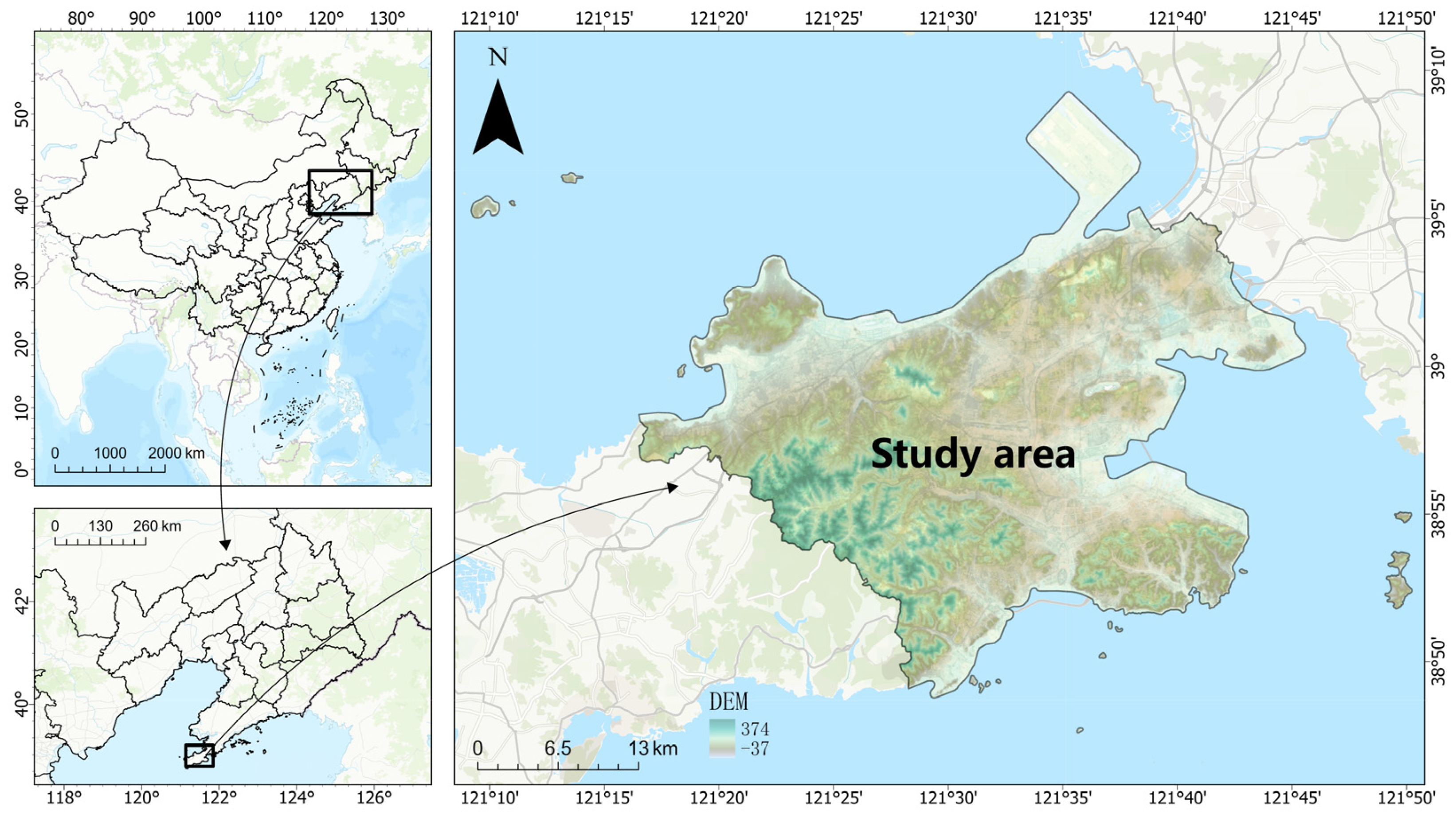
The study area comprises the four core urban districts of Dalian—Zhongshan, Xigang, Shahekou, and Ganjingzi (Figure 1)—covering a total area of approximately 120.14 km2. Dalian is situated at the southern tip of the Liaodong Peninsula and is surrounded by the sea on three sides; its topography descends from the southwest to the northeast, with a mosaic of mountainous–hilly terrain and coastal plains. Under the Köppen–Geiger classification, Dalian is categorized as Dwa, characterized by cold, dry winters and hot, humid summers with pronounced seasonal temperature contrasts [56]. According to the Seventh National Population Census, the study area hosts more than 2.8 million residents and concentrates the city’s population and construction activities (www.citypopulation.de (accessed on 16 December 2025)) [57]. The combined mountain–sea terrain and intensive urban development generate substantial local climatic heterogeneity, making this region a representative setting for examining how urban-form differences interact with seasonal thermal environments [58,59,60].

2.2. Data

The datasets used in this study include LCZ mapping inputs, LST, and a suite of built-environment and static surface indicators. All raster layers were resampled to a common spatial resolution of 30 m and integrated for spatial overlay analyses. This resolution matches the native sampling of the land surface temperature product, avoiding artificial downscaling of temperature data and reducing scale inconsistencies in multi-source raster overlays. It also provides a favorable trade-off between capturing neighborhood-scale thermal variability and limiting noise and computational burden. All computations were implemented in Python 3.10. Data sources and key dataset information are summarized in Table 1.
The LCZ mapping inputs consist of Sentinel-1 synthetic aperture radar (SAR) and Sentinel-2 optical imagery, together with expert-labeled training samples delineated on high-resolution Google Earth imagery (344 polygon samples in total). LST was obtained from thermal-infrared satellite products accessed via Google Earth Engine (GEE); scenes were filtered using quality-control criteria and then resampled to 30 m. The digital elevation model (DEM) was derived from global elevation data, clipped in GEE, and used to compute slope. NDVI, NDBI, MNDWI, and surface albedo were calculated from multispectral surface-reflectance products using standard formulations (Table 2). BH and BD were generated by rasterizing building footprints and associated height attributes from OpenStreetMap. Neighborhood metrics (NLBD, NSBD, NGVI, and NGWI) were computed from building or spectral rasters using neighborhood statistics. Euclidean distance layers—including the distance to water bodies, distance to green space, and distance to the city center—were derived from vector boundaries for water and green space and a city-center point. Nighttime light intensity was obtained from nighttime-light remote-sensing products, and population density was sourced from global gridded population datasets (e.g., WorldPop); both layers were resampled to 30 m and clipped to the study area.

3. Methods

3.1. Research Framework and Technical Workflow

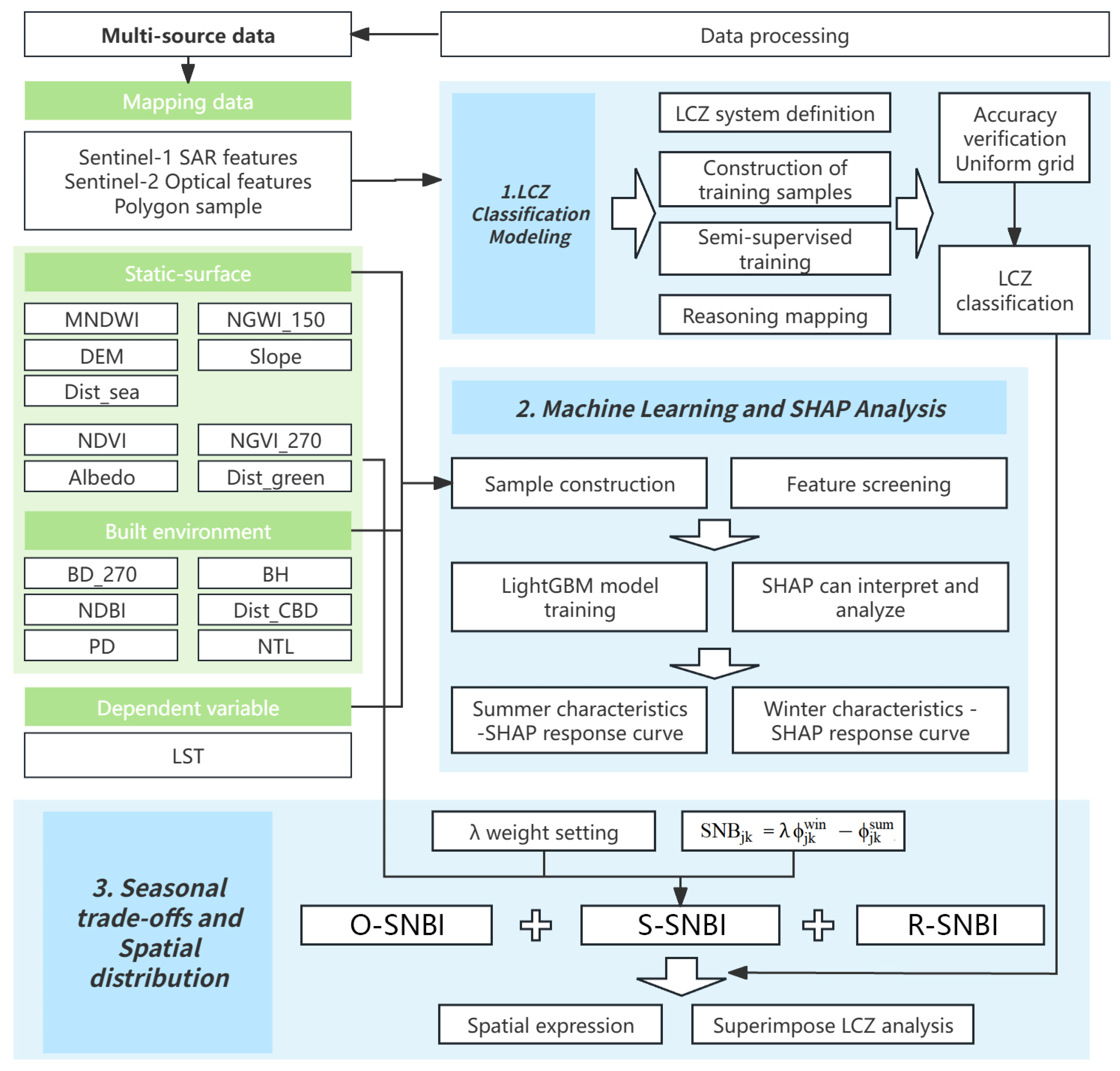
Figure 2 illustrates the overall workflow of this study. The analysis comprises two components: (i) assessing the seasonal impacts of LCZ types on the urban thermal environment, and (ii) leveraging the inferred seasonal-difference mechanism to construct a Seasonal Net-Benefit Index. The workflow includes four stages. First, urban morphology is classified via semi-supervised learning. Second, remote-sensing and OSM datasets are integrated on a common 30 m grid to build an indicator library for the built environment and static surface attributes. Third, separate LightGBM regression models are developed for summer and winter LST, and SHAP is used to quantify predictor contributions and characterize nonlinear response patterns. Building on these results, SHAP outputs from both seasons are converted into O-SNBI, yielding R-SNBI and S-SNBI, which are then overlaid with LCZ classes for spatial analyses. Finally, this study derives practical strategies for planners and managers to optimize urban form and maximize seasonal net benefits.

3.2. LCZ Mapping Methodology

This study follows the LCZ scheme proposed by Stewart and Oke and delineates 14 LCZ classes within the study area, comprising 8 built classes and 6 natural classes [9]. LCZ7, LCZ9, and LCZC were excluded because they were rarely observed in the study area and/or insufficiently represented in the samples (Table 3).
The workflow is as follows. First, representative training polygons for each LCZ class were manually delineated on high-resolution Google Earth imagery (at least 24 polygons per class), and a 10 m optical–SAR multimodal image-patch dataset was constructed. Training polygons were selected using three explicit criteria: (i) class purity (homogeneous urban form/land cover, avoiding boundaries and mixed areas); (ii) sufficient size to support patch extraction at 10 m; and (iii) spatial representativeness across the study area to reduce clustering. Next, a self-supervised multimodal contrastive-learning approach was used to pre-train the model on large volumes of unlabeled patches, followed by supervised fine-tuning with the labeled samples to obtain a deep LCZ classifier. The trained model was then applied across the entire study area using sliding-window inference to generate an initial 10 m LCZ raster. Subsequently, pixels that were clearly inconsistent with the underlying urban form were manually corrected to produce the final LCZ map. Classification accuracy was assessed using independent validation samples, and the LCZ results were aggregated to a 30 m regular grid via a majority-vote rule. Finally, the summer and winter LST layers were overlaid with the LCZ map to characterize LST distributions and quantify deviations relative to the citywide mean.

3.3. Selection of Built-Environment Indicators and Static Surface Attributes

In this study, a built-environment and static land-surface indicator system was constructed from dimensions such as remote-sensing spectra, topography and location, and urban morphology and activity intensity, to characterize the relationships between summer and winter LST and underlying-surface characteristics in the central urban area of Dalian. Indicator selection followed three principles: first, they have been relatively maturely applied in urban thermal-environment studies; second, they have clear physical meanings and are convenient for interpretation and intervention in planning and renewal practices; third, multicollinearity was reduced as much as possible through correlation tests.
In this study, the features used are roughly divided into two categories: static land-surface indicators and built-environment indicators. The former mainly include surface and neighborhood greenness, surface albedo, proximity to water bodies and the coast, and topographic elevation and slope, which are used to characterize the cold-source pattern and basic energy-balance conditions; the latter include building height and density, degree of imperviousness, and distance to the city center, which are used to reflect the intensity of block morphology and locational differences [69,70,71]. Considering the existing mechanisms and data availability, a total of 15 indicators, including NDVI, NGVI, NDBI, building density, and albedo, were finally selected as model inputs. All indicators were calculated in GEE (web-based platform; accessed in October 2025) and ArcGIS Pro 3.1.5 based on a 30 m regular grid, and the indicators related to vegetation status were extracted independently based on summer and winter imagery, respectively [72]. The calculation formulas and physical meanings of each variable are shown in Table 4.

3.4. Machine Learning and Statistical Analyses

3.4.1. LightGBM Modeling and SHAP-Based Interpretation

We employed LightGBM to model the nonlinear relationships between LST and predictors describing the built-environment and static surface attributes. Separate regression models were developed for summer and winter at the 30 m grid-cell level, and multicollinearity was controlled using variance inflation factors (VIF < 10). Samples were split into training and test sets using a 7:3 ratio. To manage model complexity and mitigate overfitting, we applied five-fold cross-validation with hyperparameter optimization, and evaluated predictive performance using R2, RMSE, and MAE.
To improve interpretability, SHAP was used to attribute each grid-cell prediction to the additive contributions of individual features, yielding both the sign and magnitude of each contribution. We then computed global mean SHAP values for summer and winter to quantify predictor importance, and used feature value–SHAP response curves to characterize the nonlinear and threshold effects of individual predictors on LST.

3.4.2. Seasonal Net-Benefit Indices and Spatial Statistical Analyses

To jointly account for summer cooling gains and winter warming gains within a unified framework, we adopt the additive structure of the net-benefit concept widely used in health economics (Net Monetary Benefit, NMB) [73,74,75] and transform the LightGBM–SHAP outputs into a Seasonal Net-Benefit Index. For each grid cell j and feature k , the SHAP values from the summer and winter models are denoted as ϕ j k s u m and ϕ j k w i n , respectively (both measured as marginal contributions to LST, in °C). The seasonal net benefit (SNB) associated with this feature is defined as Equation (1):
S N B j k =   λ ϕ j k w i n ϕ j k s u m ,
where λ = 1.5 represents, from an energy-consumption perspective, the relative weight assigned to winter warming gains compared to summer cooling gains. Summer cooling ( ϕ j k s u m < 0) and winter warming ( ϕ j k w i n > 0) jointly increase the S N B j k . For seasonal indicators such as NDVI and NGVI, SHAP values are extracted separately from the summer and winter models, matched by grid-cell ID, and then substituted into the above equation.
Finally, three indices are constructed by summing seasonal net-benefit values over different feature subsets: (1) Overall Seasonal Net-Benefit Index (O-SNBI): this summarizes the winter–summer integrated seasonal net benefit of each grid cell across all features, as defined in Equation (2);
O - SNBI j = k K SNB jk ,
(2) Retrofit Seasonal Net-Benefit Index (R-SNBI): this aggregates seasonal net-benefit values only over short-term adjustable factors, where C denotes the feature set consisting of NDVI, NGVI, and albedo, as defined in Equation (3).
R - SNBI j = k C SNB jk ,
(3) Structural Seasonal Net-Benefit Index (S-SNBI): this aggregates seasonal net-benefit values only over static factors that are difficult to modify through engineering retrofits, where S denotes the feature set excluding C , as defined in Equation (4).
S - SNBI j = k S SNB jk ,
The three indices are classified into multiple benefit tiers using symmetric thresholds, and then overlaid with the LCZ map to quantify the area shares and index distributions of different built-type LCZ classes. Specifically, O-SNBI used symmetric breakpoints at ±1, ±3, and ±6; S-SNBI used ±4, ±2, 0, and 8; and R-SNBI used ±0.5, ±1.5, and ±2.5. This scheme uses 0 to preserve the direction of net benefit and establishes an interpretable mild–moderate–strong gradient within each index, enabling the identification of priority intervention neighborhoods that combine high structural suitability with strong retrofit potential.

4. Results

4.1. LCZ Classification Results

Using a semi-supervised deep learning framework, we classified the four central districts of Dalian into 14 LCZ classes. The overall accuracy is 0.93 and Cohen’s kappa is 0.91, indicating high classification performance.
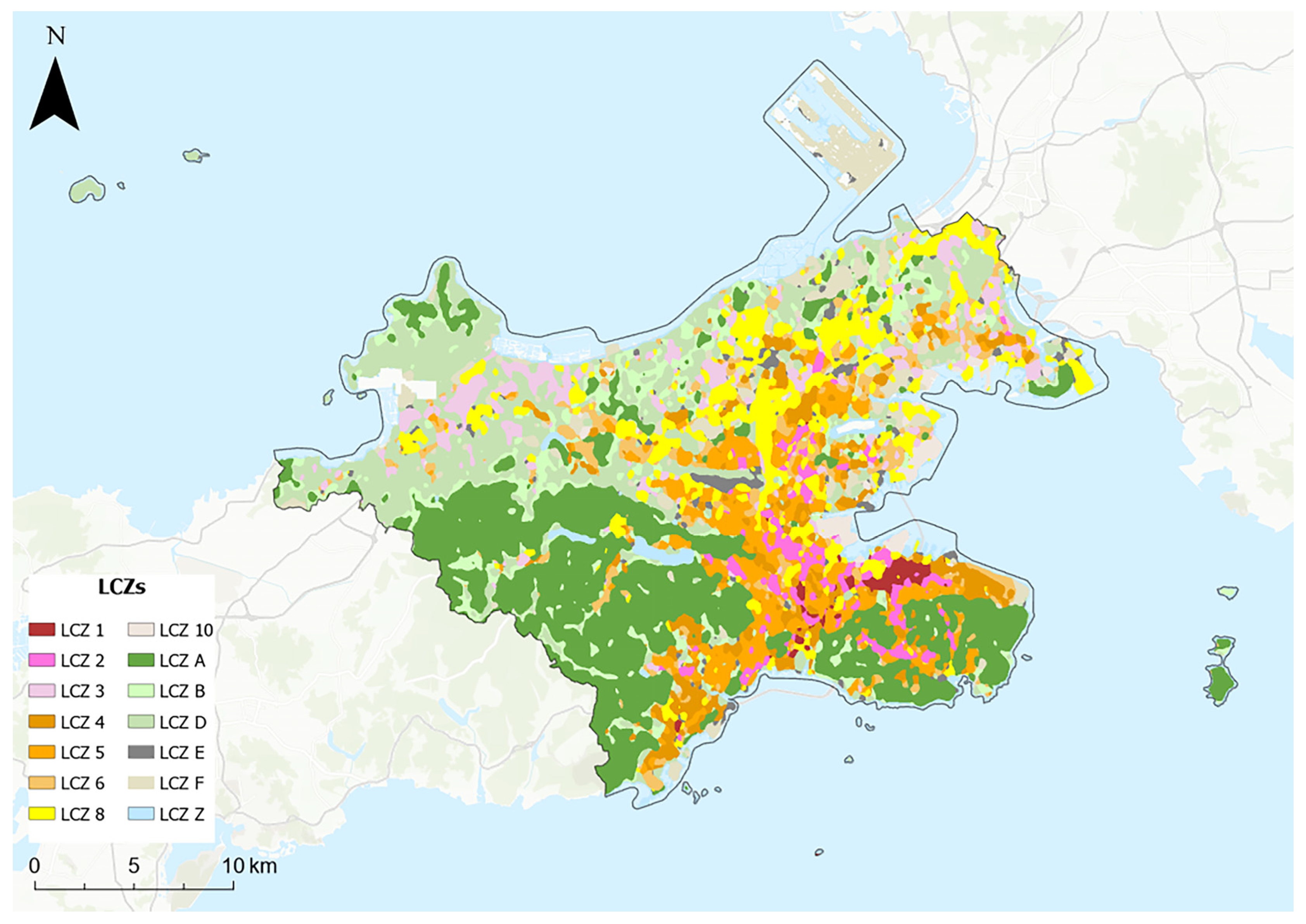
The spatial heterogeneity of LCZ classes and their area shares are presented in Figure 3 and Table 5, respectively. Built types account for 38.33% of the study area, whereas natural types account for 61.67%. Compact built types (LCZ 1–3) comprise 8.36% and are mainly concentrated in the urban core and along transportation corridors to the north. Open built types (LCZ 4–6) comprise 18.34%; mid- and high-rise areas are distributed in central and coastal residential zones, while low-rise areas are scattered toward the urban fringe. Large low-rise and heavy industry areas (LCZ 8 and LCZ 10) together account for approximately 11.61%, clustering in the northern logistics park and the eastern coastal industrial belt, respectively. Among natural types, dense forest (LCZ A) accounts for 25.75% and is primarily located in the western and southeastern mountainous areas, while LCZ B, LCZ C, LCZ E, and LCZ F occur as mosaics along the coastline, river valleys, and around large, developed land parcels.

4.2. Summer–Winter Contrasts in LST

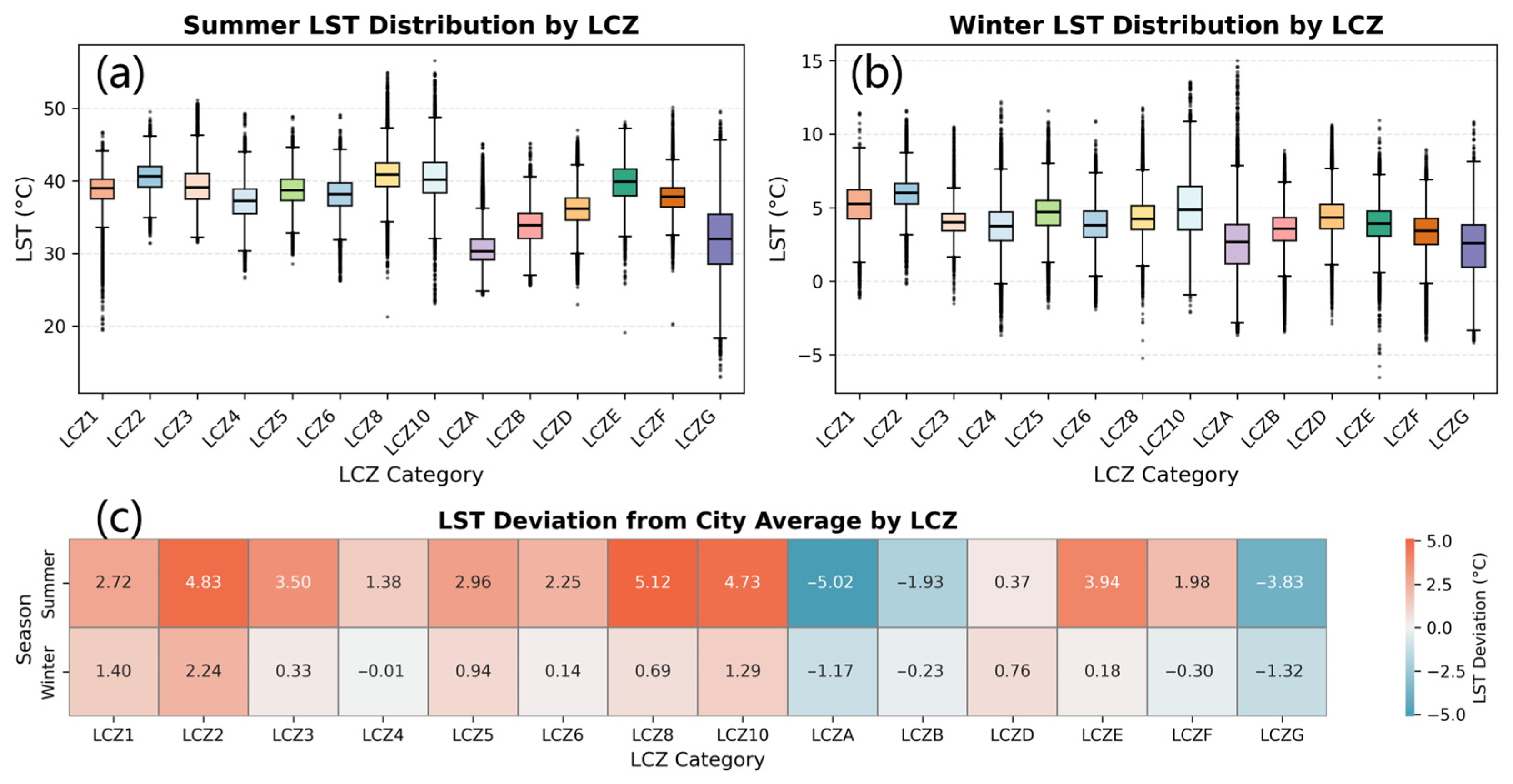
Figure 4 presents the summer and winter LST distributions for each LCZ class and their departures from the citywide mean. In summer, LST in the built-up areas is markedly higher than that over natural surfaces. Dense built classes—such as compact mid-rise, large low-rise, and industrial LCZs—exhibit the largest positive departures, typically about 5 °C above the city average, with large low-rise showing the highest median LST. In contrast, open and low-rise residential classes are only slightly warmer than the mean. Natural LCZ classes, including water and dense forest, act as persistent cool areas, with LST generally below the city mean and exhibiting a tighter distribution. In winter, inter-class LST contrasts a narrow overall distribution: most built types are only slightly warmer than the city mean, and the negative departures of natural types weaken substantially. However, the relative ordering remains broadly consistent, with large low-rise (LCZ 8) areas showing the largest seasonal shift. The hottest dense built-up areas in summer remain relatively warm in winter, while water and forest continue to be cooler, although the warm–cool gradient is weaker than in summer.

4.3. Impacts of Indicators on Temperature in the Study Area

4.3.1. Overall Simulation Results

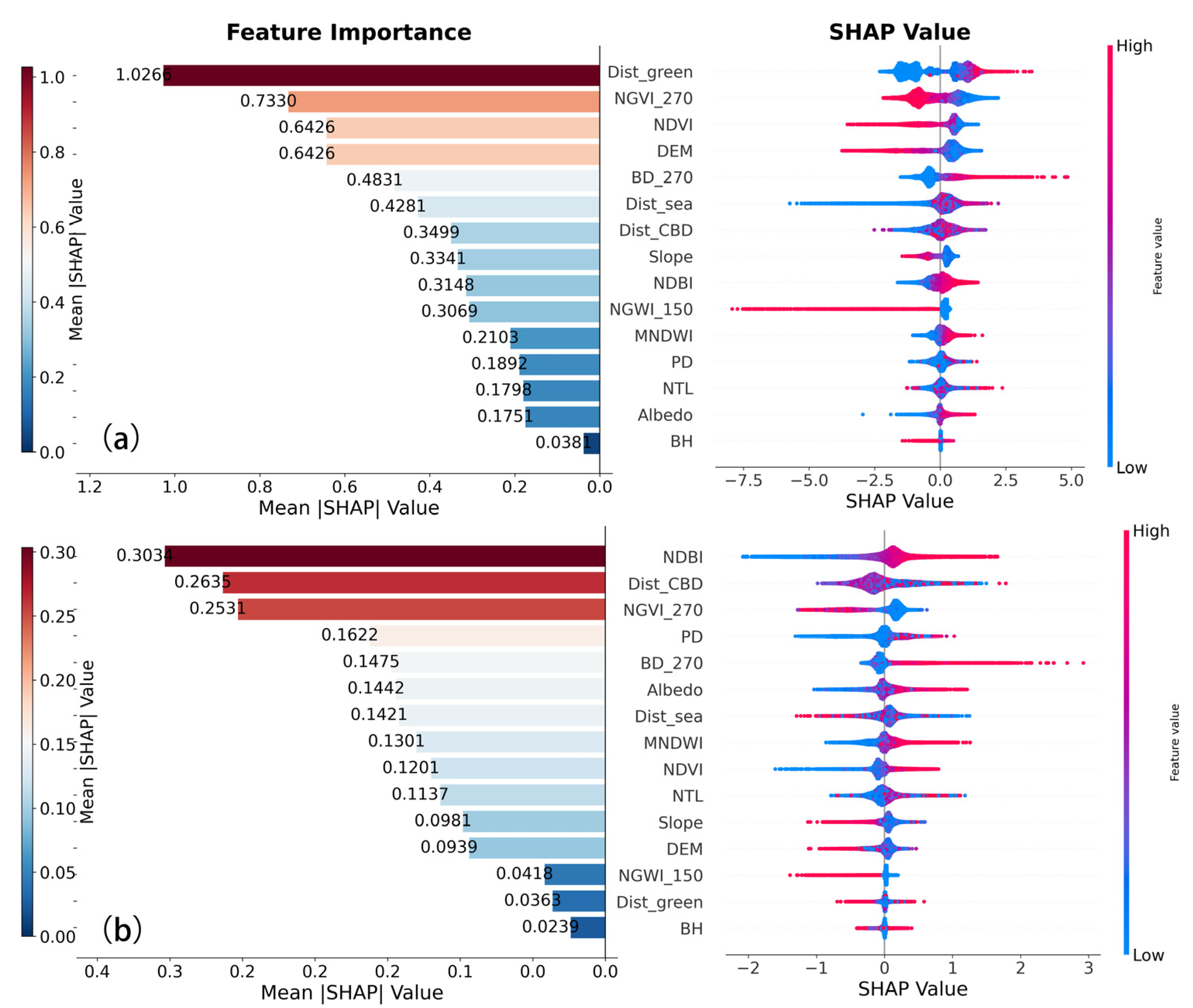
To analyze the impacts of indicators on LST and identify dominant factors, LightGBM regression models were trained separately based on summer and winter data. The summer model has an average R2 of 0.92, an RMSE of 1.24 °C, and an MAE of 0.95 °C; the winter model has an average R2 of 0.76, an RMSE of 0.88 °C, and an MAE of 0.68 °C. The summer model shows a higher R2 and lower RMSE, indicating that summer LST is mainly controlled by underlying-surface characteristics; in winter, it is more easily disturbed by large-scale circulation and cold-air processes, and the explanatory power of static surface and built-environment factors is relatively weakened.
Figure 5 summarizes overall feature importance and effect directions using absolute SHAP values. In summer, greenness and proximity-to-green-space metrics dominate (Dist_green, NGVI_270, NDVI), indicating higher LSTs where large green spaces are distant and neighborhood greenness is low. Topographic and built-intensity variables (DEM, BD_270) and coastal proximity (Dist_sea) also contribute. High Dist_green/Dist_sea, BD_270, NDBI, and albedo values are associated with positive SHAP contributions (warming), whereas greenness and water metrics (NGVI_270, NDVI, MNDWI, NGWI_150) and terrain/coastal settings tend to show negative SHAP contributions (cooling).
In winter, urban-intensity and urbanization-gradient indicators become more prominent (NDBI, Dist_CBD, NGVI_270). Higher NDBI/BD_270/NTL values and greater distance from the sea generally correspond to positive SHAP contributions, while greenness and water metrics remain linked to negative contributions, albeit with weaker marginal cooling effects than in summer. Overall, summer LST is most sensitive to greenness and coastal–inland structure, whereas winter LST is more controlled by built intensity and urbanization gradients; the cooling effect of green space persists across seasons but is stronger in summer.

4.3.2. Nonlinear Effects of Static-Surface and Built-Environment Features on LST

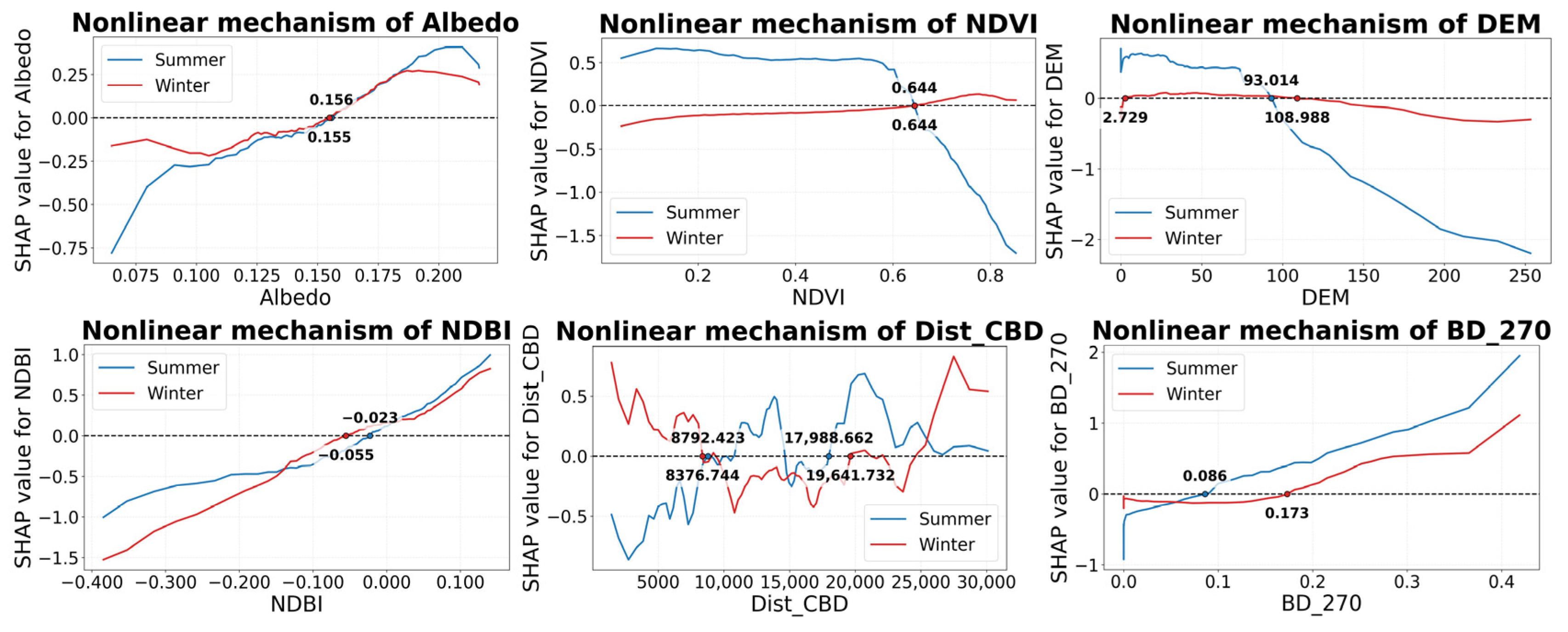
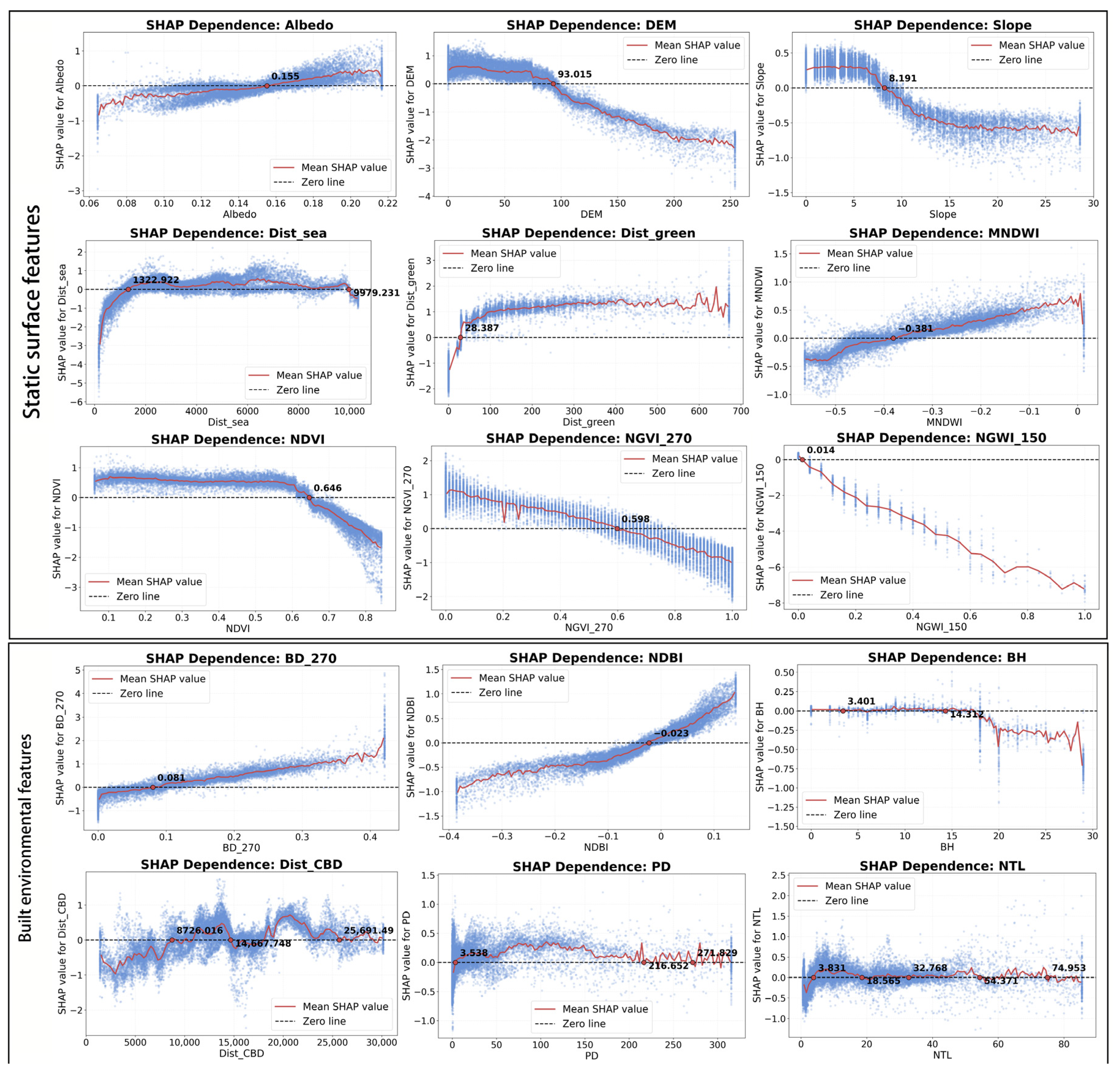
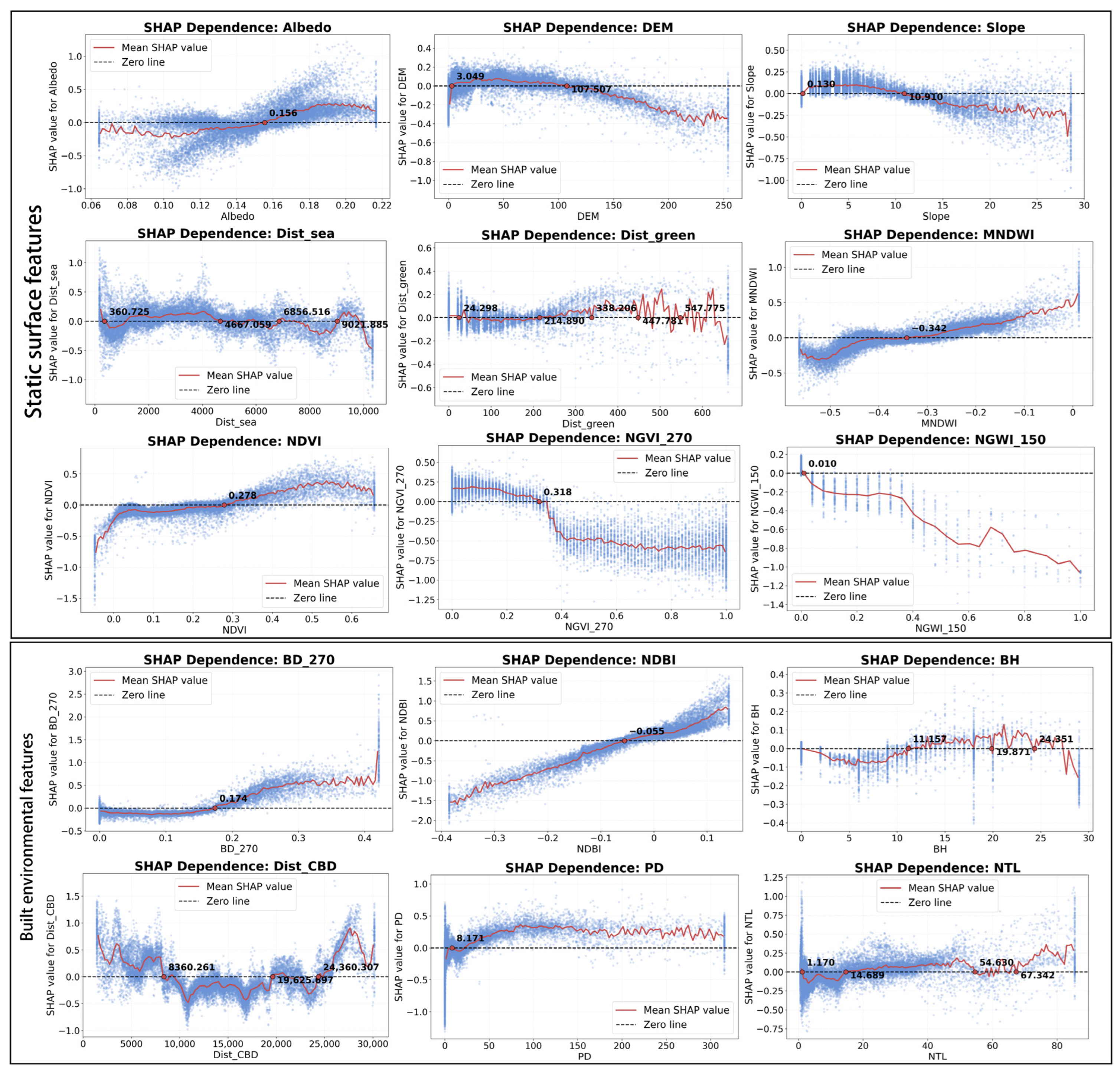
Figure 6 illustrates representative nonlinear SHAP response curves for selected features in summer and winter; the full set of response curves is provided in Appendix A (Figure A1 and Figure A2). The x-axis denotes the feature value, and the y-axis shows the corresponding SHAP value, representing the marginal contribution of each indicator to LST across its value range.
Static-surface factors exhibit broadly consistent effect directions across seasons, but differ in threshold locations and effect magnitudes. Albedo shows similar responses in both seasons, with a common threshold around 0.15. DEM exhibits a markedly lower turning point in summer than in winter, while a unit change in DEM corresponds to a larger SHAP contribution in summer. Pixel-level NDVI displays opposite seasonal effects: a low NDVI value is associated with pronounced warming in summer but a weak cooling contribution in winter, and the summer transition point occurs at a higher NDVI value than in winter, consistent with local phenology and vegetation composition. Dist_green shows stronger variability and a clearer threshold in summer, indicating that areas farther from major green spaces are more prone to forming hot patches, whereas its winter effect is comparatively limited.
Built-environment indicators generally exhibit convex-shaped warming responses. For BD_270 and NDBI, SHAP values increase approximately monotonically in both seasons: effects are near zero below the median but amplify rapidly beyond mid-to-high quantiles, with a steeper increase in summer. Dist_CBD shows opposite seasonal patterns, reflecting an urban functional ring structure. BH has limited influence from low-rise to mid-rise ranges; when approaching or slightly exceeding the citywide mean height, it is associated with slight cooling in summer but shifts to weak warming in winter. PD shows broadly similar warming patterns across seasons, with SHAP contributions typically on the order of 0.1–0.4 °C, although the onset of positive contributions occurs at lower PD values in summer.

4.4. Seasonal Net-Benefit Indices and Their Spatial Patterns

4.4.1. Seasonal Net-Benefit Response Curves

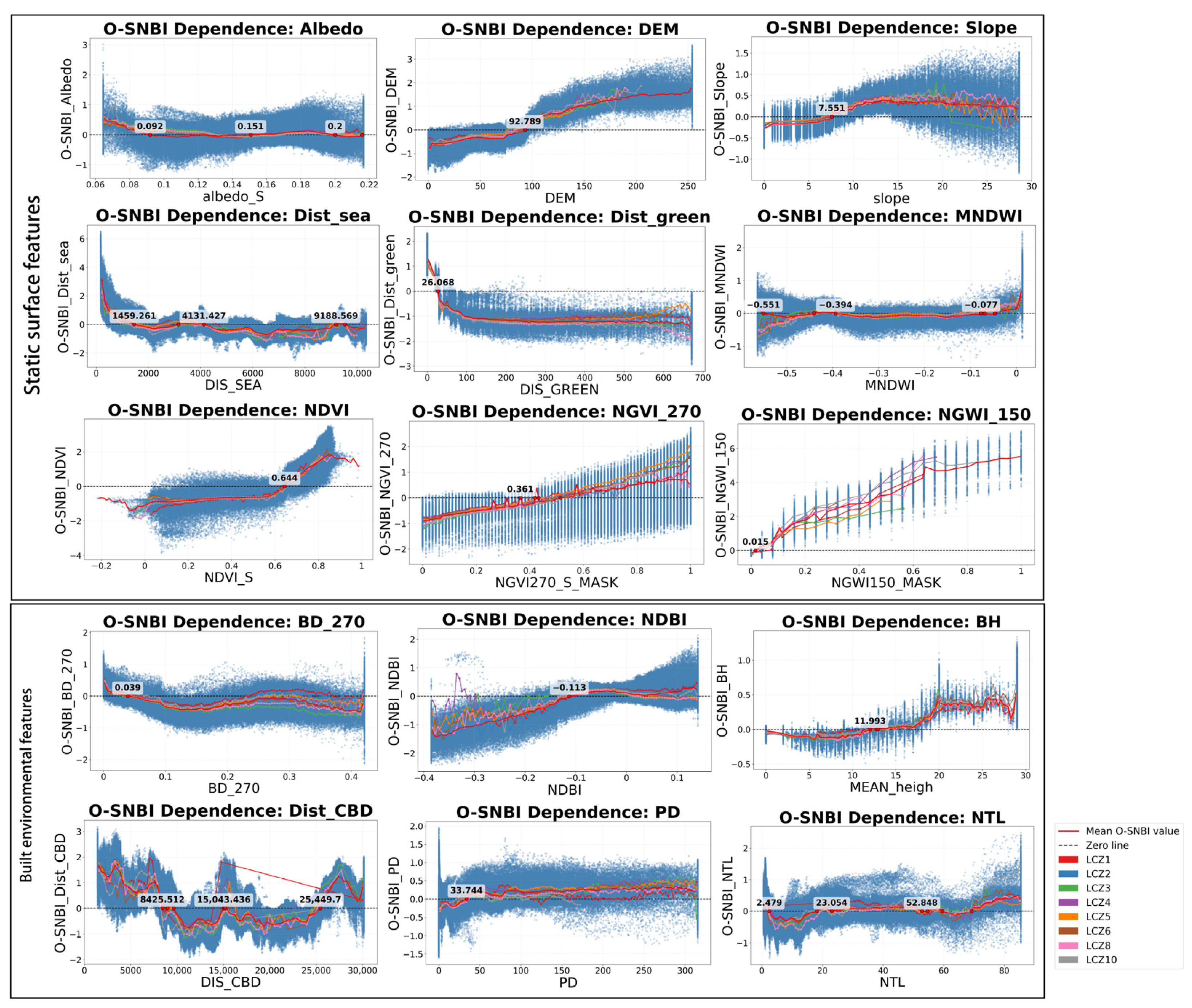
Figure 7 presents feature-wise SNB response curves under λ = 1.5, together with mean-value trajectories for built-type LCZ classes. Most features show strongly nonlinear associations with SNB. Across built-type LCZ classes, curve shapes broadly follow the overall SNB trend, while amplitudes and threshold positions vary.
For static-surface features, SNB response curves can be summarized into three patterns: transitions from positive to negative, transitions from negative to positive, and fluctuations around zero. In general, the integrated gains from increasing vegetation at the pixel and neighborhood scales outweigh potential winter shading-related penalties. Specifically, the SNB increases almost monotonically with the NDVI and NGVI_270, with the NDVI shifting from a net penalty to a net benefit at approximately 0.65. Likewise, the NGWI_150 rises nearly linearly with an increasing water fraction. Location-related indicators display clear distance gradients: the SNB is positive at small Dist_sea and Dist_green, but drops rapidly with distance and becomes negative in the far-distance regime. Built-type LCZ mean trajectories for these static-surface factors align closely with the overall curves, with differences mainly emerging at the high- or low-SNB ends.
Built-environment features exhibit more pronounced nonlinear SNB patterns. Morphology and intensity variables show a clear multi-regime structure: for BD_270, the SNB is slightly positive at a low density, declines sharply as density increases and remains negative over a broad range, with a modest rebound at the extreme high-density tail. The SNB increases approximately monotonically with the NDBI and BH, switching from a net penalty to a net benefit around an NDBI ≈ −0.1 and a building height ≈ 12 m. Dist_CBD displays marked non-monotonicity: the SNB is lowest in intermediate rings and slightly positive in both the core and far suburbs (over approximately 8.4–25.5 km). Overall, built-type LCZ trajectories track the overall curves, and class differences become substantially larger only at extreme height/density levels and within high-NDBI segments.

4.4.2. Spatial Distribution of Seasonal Net-Benefit Indices

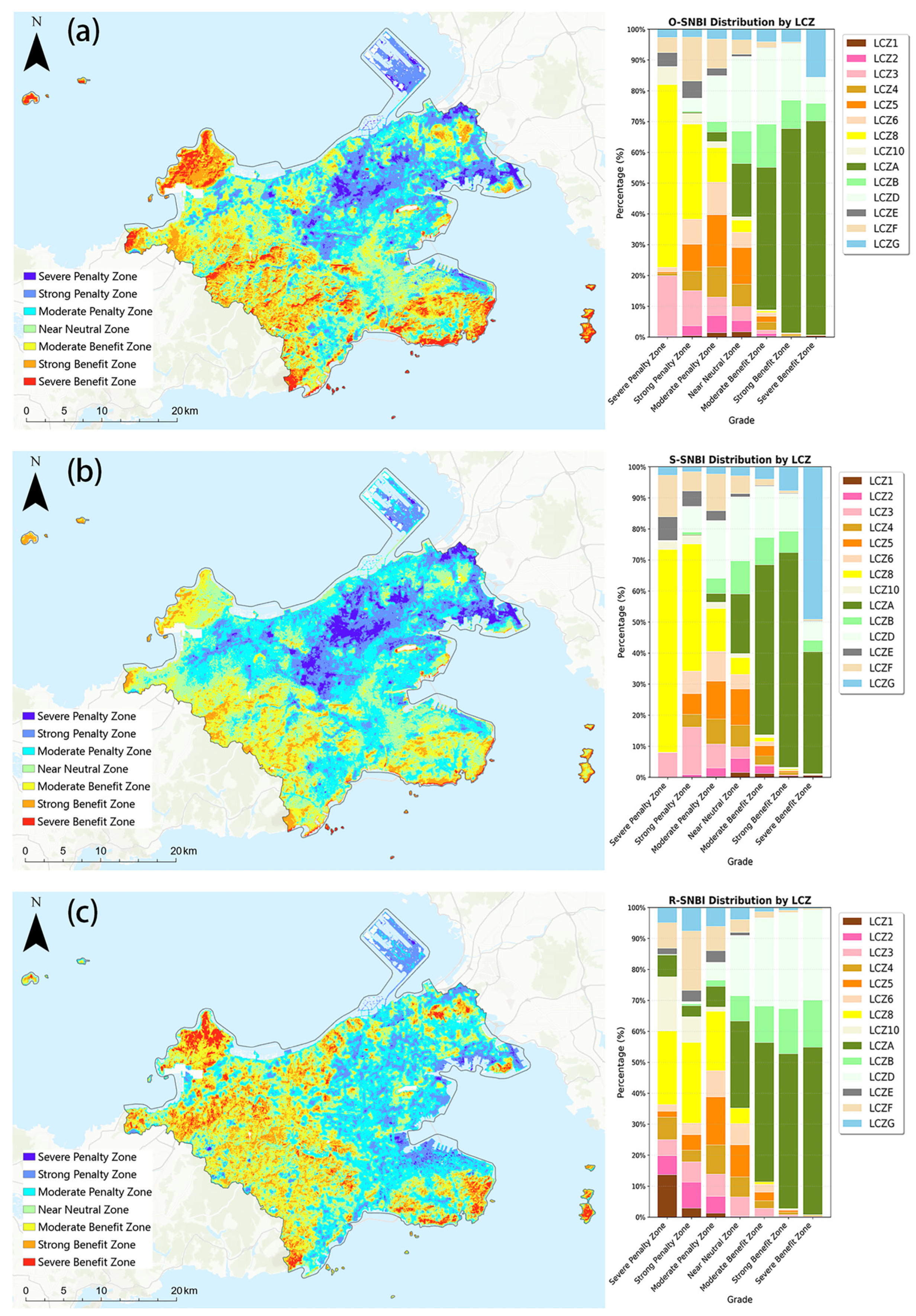
Figure 8 maps the seven-tier classifications of the three Seasonal Net-Benefit Indices. For the O-SNBI, approximately 60% of grid cells fall within −3 to 3 (weak penalty to weak benefit), while strongly penalized and strongly benefited cells together account for less than ~3%. Medium-to-high O-SNBI clusters occur along the coastline, in mountainous–hilly areas, and near major green corridors. In contrast, low-lying, highly impervious, and vegetation-sparse continuous built-up areas are mostly near-neutral or mildly penalized, and strongly penalized patches concentrate in the northern sector characterized by fragmented development and the co-location of industry and bare land. In terms of LCZ composition, strong penalty tiers are mainly associated with LCZ 8, LCZ 10, and parts of LCZ 3, whereas strong benefit tiers are dominated by LCZ A–C.
The S-SNBI captures inherent climatic advantages/disadvantages driven by topography, coastal–inland setting, and the overarching development structure. Its spatial pattern closely mirrors that of the O-SNBI: high values concentrate in coastal belts, mountainous green areas, and potential ventilation corridors, indicating favorable baseline conditions. The low-S-SNBI areas are more widespread; notably, some locations show positive R-SNBI values despite persistently low S-SNBI values, suggesting that short-term greening/albedo measures may help, but long-term limitations from terrain and location remain.
The R-SNBI represents short-term seasonal gains achievable through adjustments to vegetation and albedo. Its distribution is more concentrated, with most grid cells within −2 to 2. High-R-SNBI patches tend to appear at the urban fringe or on well-vegetated slopes, whereas low-R-SNBI cells are embedded in high-density built-up areas—especially compact high-rise zones and areas adjacent to industrial land—highlighting priority targets for near-term climate-adaptation retrofits. Strong penalty tiers are mainly linked to LCZ 1–3 and LCZ 8/10, while strong benefit tiers remain dominated by LCZ A–C.

4.4.3. Seasonal Net-Benefit Profiles of Built-Type LCZ Classes

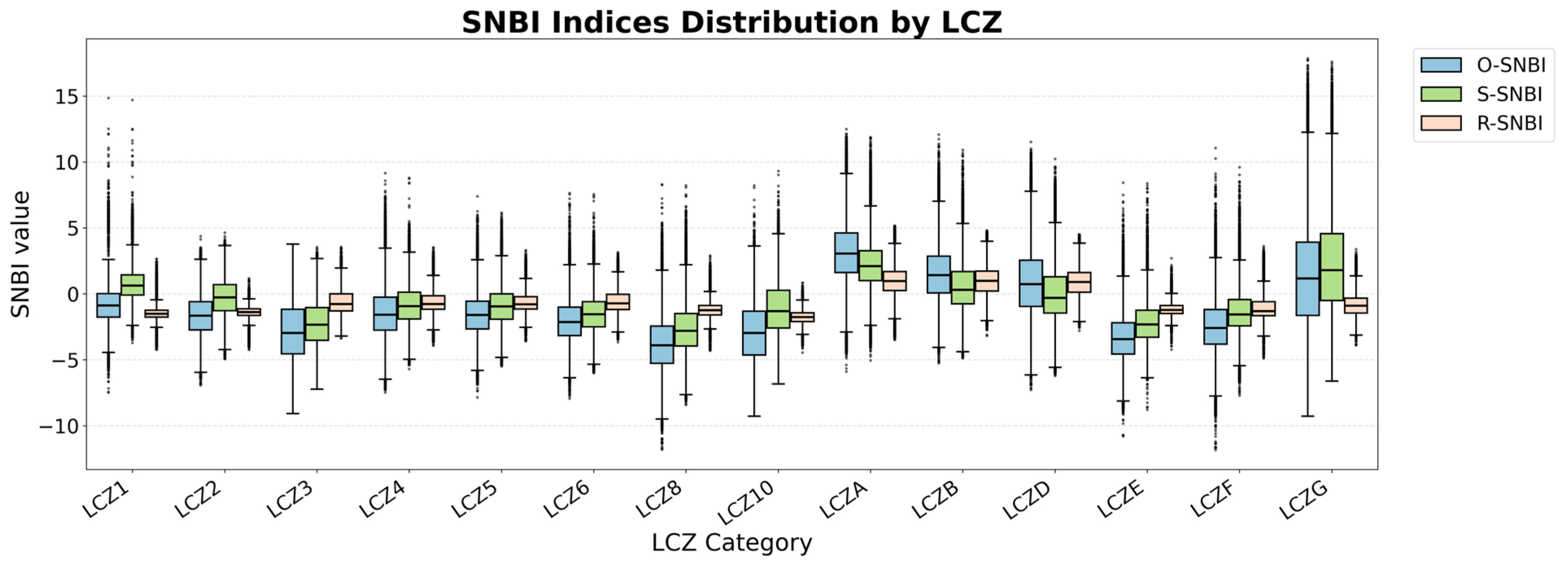
Based on the mapped patterns of the three indices, we compiled LCZ-wise distributions as boxplots (Figure 9), with an emphasis on eight built-type LCZ classes (LCZ 1–6, LCZ 8, and LCZ 10). Overall, the median O-SNBI values for built LCZ classes are generally below zero, yet their spreads and extremes vary markedly, indicating combined differences in baseline structural conditions and retrofit-related opportunities.
LCZ 1 and LCZ 2 have O-SNBI medians close to zero with relatively narrow interquartile ranges, implying limited within-class variability. Their median S-SNBI is about 1–2, the highest among the built types, whereas R-SNBI is distinctly negative, suggesting favorable baseline conditions but substantial room for improvement in current greenness-related measures. For LCZ 4 and LCZ 5, the three indices show broadly similar distributions clustered around (and slightly below) zero; O-SNBI and S-SNBI are modestly lower than those of LCZ 1–2, and R-SNBI is near zero, placing them in a mid-range category for both overall seasonal net benefit and retrofit potential.
LCZ 3, characterized by contiguous low-rise blocks, lies in the lower range for both the O-SNBI and S-SNBI, indicating a weaker overall seasonal net benefit and structural suitability. Its R-SNBI median is slightly higher but with larger dispersion, suggesting limited average gains from greening, while retrofit potential differs substantially across neighborhoods. LCZ 8 exhibits the lowest O-SNBI median, with the lower quartile extending into the strong-penalty tier; the S-SNBI is also clearly negative, whereas the R-SNBI—though still negative—is higher than the S-SNBI, implying that the deficit is driven primarily by unfavorable structural conditions rather than a simple lack of greenness. In contrast, LCZ 10 shows a lower median R-SNBI than S-SNBI, suggesting greater scope for improvement through blue–green enhancement and surface-property retrofits, and therefore, merits priority intervention.

5. Discussion

5.1. Winter and Summer LST Characteristics and Urban Fabric

Within the LCZ framework, summer and winter LST exhibit broadly stable spatial patterns with clear seasonal contrasts. Built LCZ classes are consistently warmer than natural classes in both seasons, while bare ground shows an LST signature comparable to compact low-rise areas. In summer, highly impervious and dense classes—compact mid-/low-rise, large low-rise, and heavy industry—form the most pronounced heat-island cores, consistent with prior studies [76]. In winter, inter-class thermal gradients are strongly compressed [77], yet LCZ2 and LCZ10 remain relatively warm, suggesting that heat storage and delayed release persist across seasons [78]. Open built classes are only slightly above the city mean in summer and return to near-mean conditions in winter. Among the natural classes, forests/green spaces (LCZ A–D) and water bodies maintain the lowest LST in both seasons, forming persistent cool belts along mountainous and coastal settings [59,79]. By contrast, bare land and sparsely vegetated classes lack shading and evapotranspiration, resulting in a higher summer LST and weak winter cooling [80]. Overall, seasonal LST contrasts are robust, but their intensity and practical relevance differ: summer highlights mitigation targets and cooling sources, whereas winter presents a weaker heat-island signal with potential implications for heating demand.

5.2. Seasonal Effects of Selected Features and the Seasonal Net-Benefit Index

Selected features exhibit both shared directional effects on LST and a seasonal shift in dominant controls. In summer, greenness metrics, proximity to major green/water bodies, distance to the sea, and terrain variability contribute most, consistent with cooling from shading and evapotranspiration as well as enhanced coastal ventilation and moisture influences [69,81,82]. In winter, the importance of built-environment intensity indicators (e.g., NDBI and BD) increases, likely reflecting stronger anthropogenic heat and energy-use signals associated with dense development and district heating, in line with Chen et al. [83]. Overall, summer LST is more sensitive to the spatial configuration of cooling sources, whereas winter LST is more influenced by development intensity and energy use; notably, highly impervious, low-greenness areas far from cooling sources tend to exhibit warming in both seasons [84].
To synthesize these seasonal mechanisms for more targeted planning, we construct a Seasonal Net-Benefit Index (SNBI) based on SNB, enabling a quantitative comparison of combined feature effects. Greenness-related features exhibit threshold ranges where SNB shifts from a net penalty to a net benefit [85], while proximity to water bodies or the coastline is consistently associated with a positive SNB [86]. In contrast, building height, density, and imperviousness often show inverted U-shaped SNB responses, suggesting that moderate development intensity can yield more balanced seasonal performance. Together, the proposed framework offers a new lens for interpreting nonlinear seasonal coupling between environmental indicators and LST and for identifying neighborhoods with substantial regulation potential.

5.3. Limitations

This study has several limitations. First, the analysis was implemented on a 30 m regular grid; the robustness of the feature-importance rankings and SNBI estimates remains to be tested through multi-scale sensitivity analyses. Second, the Seasonal Net-Benefit Index adopts the additive structure of the NMB framework from health economics, which places benefits and costs on a common scale to enable summation and comparison [87]. Accordingly, we set the winter-weight parameter to λ = 1.5, guided by evidence from heating/cooling degree-day studies showing that, in mid- to high-latitude cold regions, heating demand exhibits a larger magnitude and temperature sensitivity than cooling demand for a unit temperature change [3,88]. Nonetheless, treating λ as a fixed constant is a simplifying assumption: it likely varies with region, building type, and climatic year. Future work could therefore estimate the plausible ranges of λ and quantify its uncertainty via parameter calibration and sensitivity analysis [89]. Finally, our predictors focus on relatively static surface and built-environment attributes and do not explicitly account for dynamic processes (e.g., wind fields) or household energy-use behaviors. Given that the empirical evidence is derived from a single cold coastal city and a limited set of years, the transferability of our findings to other climate regimes, urban morphologies, and longer-term climate contexts requires further validation using multi-city, multi-year comparisons and robustness checks.

5.4. Future Work

Future work will focus on three directions. First, we will test the robustness of the seasonal net-benefit patterns and the SHAP-based interpretations through multi-scale sensitivity analyses and alternative spatial supports. Second, we will calibrate the winter-weight parameter (λ), estimate plausible ranges, and quantify uncertainty using independent evidence such as proxies of heating and cooling demand, so that the index can better support planning interpretation. Third, we will extend the framework by incorporating additional dynamic factors such as wind and temporal variability, and evaluate transferability through applications across multiple cities and years.

6. Conclusions

In this study, we focus on the four central districts of Dalian and implement the analysis on a 30 m grid within the LCZ framework. We first produce an LCZ map using a semi-supervised learning pipeline, then apply machine-learning models to quantify nonlinear relationships between multi-source predictors and LST, and finally adopt the additive NMB structure to synthesize summer and winter effects and characterize their trade-offs through the SNBI. The main conclusions are as follows:
  • Semi-supervised learning enables high-accuracy LCZ mapping. With self-supervised pretraining followed by fine-tuning using limited labeled samples, we achieve an overall accuracy of 0.93, capturing the morphological gradient across mountainous areas, coastal zones, and dense built-up districts.
  • Multi-source predictors exhibit seasonally consistent yet asymmetric nonlinear effects on LST. Dense and highly impervious built LCZ classes remain pronounced heat-island cores year-round, whereas blue–green spaces and mountain–sea corridors act as persistent cooling sources. Summer LST is more sensitive to cooling-source factors (e.g., greenness configuration), while winter importance shifts toward development-intensity indicators (e.g., NDBI). Many predictors display clear threshold behaviors, consistent with prior evidence.
  • The seasonal net-benefit framework integrates summer and winter effects into a unified metric system and, combined with LCZ classes, reveals neighborhood-specific seasonal performance. Compact/large low-rise and heavy-industry-related built types show consistently poor two-season outcomes dominated by structural penalties, whereas mid- to high-rise neighborhoods—despite only moderate baseline conditions—can still improve seasonal net benefits through near-term retrofit measures, such as increasing greenness and modifying surface properties.
Overall, building on established LCZ–thermal environment insights, this work highlights the value of explicitly accounting for summer–winter trade-offs via a seasonal net-benefit perspective. Although Dalian serves as a single case, the findings offer practical implications for fine-scale climate adaptation and urban renewal in cold-region coastal and mountainous cities, and provide a transferable analytical framework for future multi-city, multi-climate investigations of seasonal thermal trade-offs.

Author Contributions

Conceptualization, Z.Z. and F.G.; methodology, Z.Z.; software, Z.Z.; validation, Z.Z., H.Z. and J.D.; formal analysis, Z.Z.; investigation, Z.Z.; resources, F.G.; data curation, Z.Z.; writing—original draft preparation, Z.Z.; writing—review and editing, Z.Z., F.G., H.Z. and J.D.; visualization, Z.Z.; supervision, F.G.; project administration, F.G.; funding acquisition, F.G. All authors have read and agreed to the published version of the manuscript.

Funding

This study was funded by the National Natural Science Foundation of China (No.52108044).

Data Availability Statement

The raw data supporting the conclusions of this article will be made available by the authors on request.

Acknowledgments

We sincerely thank all members who participated in this project.

Conflicts of Interest

The authors declare no conflicts of interest.

Abbreviations

The following abbreviations are used in this manuscript:
LCZLocal Climate Zone
LightGBMLight Gradient Boosting Machine
LSTLand Surface Temperature
SNBSeasonal Net Benefit
SNBISeasonal Net-Benefit Index
O-SNBIOverall Seasonal Net-Benefit Index
S-SNBIStructural Seasonal Net-Benefit Index
R-SNBIRetrofit Seasonal Net-Benefit Index
NMBNet Monetary Benefit

Appendix A

Figure A1. Nonlinear relationships between summer features and LST.
Sustainability 18 01533 g0a1
Figure A2. Nonlinear relationships between winter features and LST.
Sustainability 18 01533 g0a2

References

  1. Intergovernmental Panel on Climate Change (IPCC). Climate Change 2021—The Physical Science Basis: Working Group I Contribution to the Sixth Assessment Report of the Intergovernmental Panel on Climate Change, 1st ed.; Cambridge University Press: Cambridge, UK, 2023; ISBN 978-1-009-15789-6. [Google Scholar]
  2. Petri, Y.; Caldeira, K. Impacts of Global Warming on Residential Heating and Cooling Degree-Days in the United States. Sci. Rep. 2015, 5, 12427. [Google Scholar] [CrossRef]
  3. Large Uncertainties in Trends of Energy Demand for Heating and Cooling Under Climate Change-Web of Science Core Collection. Available online: https://webofscience.clarivate.cn/wos/woscc/full-record/WOS:000692406300006 (accessed on 16 December 2025).
  4. Guo, F.; Fan, G.; Zhao, J.; Zhang, H.; Dong, J.; Ma, H.; Li, N. Urban Heat Health Risk Inequality and Its Drivers Based on Local Climate Zones: A Case Study of Qingdao, China. Build. Environ. 2025, 275, 112827. [Google Scholar] [CrossRef]
  5. Khatoon, S.; Shah, A.N. Prediction of Comfort Parameters for Naturally Ventilated Underground Car Parks. Nucleus 2016, 53, 214–220. [Google Scholar] [CrossRef]
  6. Calvin, K.; Dasgupta, D.; Krinner, G.; Mukherji, A.; Thorne, P.W.; Trisos, C.; Romero, J.; Aldunce, P.; Barrett, K.; Blanco, G.; et al. IPCC, 2023: Climate Change 2023: Synthesis Report. Contribution of Working Groups I, II and III to the Sixth Assessment Report of the Intergovernmental Panel on Climate Change; Core Writing Team, Lee, H., Romero, J., Eds.; IPCC: Geneva, Switzerland, 2023. [Google Scholar]
  7. Zhao, Q.; Guo, Y.; Ye, T.; Gasparrini, A.; Tong, S.; Overcenco, A.; Urban, A.; Schneider, A.; Entezari, A.; Vicedo-Cabrera, A.M.; et al. Global, Regional, and National Burden of Mortality Associated with Non-Optimal Ambient Temperatures from 2000 to 2019: A Three-Stage Modelling Study. Lancet Planet. Health 2021, 5, E415–E425. [Google Scholar] [CrossRef] [PubMed]
  8. Xia, D.; Wu, Z.; Zou, Y.; Chen, R.; Lou, S. Developing a Bottom-up Approach to Assess Energy Challenges in Urban Residential Buildings of China. Front. Archit. Res. 2025, 14, 1810–1833. [Google Scholar] [CrossRef]
  9. Stewart, I.D.; Oke, T.R. Local Climate Zones for Urban Temperature Studies. Bull. Am. Meteorol. Soc. 2012, 93, 1879–1900. [Google Scholar] [CrossRef]
  10. Bechtel, B.; Alexander, P.J.; Beck, C.; Boehner, J.; Brousse, O.; Ching, J.; Demuzere, M.; Fonte, C.; Gal, T.; Hidalgo, J.; et al. Generating WUDAPT Level 0 Data-Current Status of Production and Evaluation. Urban Clim. 2019, 27, 24–45. [Google Scholar] [CrossRef]
  11. Fernandes, R.; Nascimento, V.; Freitas, M.; Ometto, J. Local Climate Zones to Identify Surface Urban Heat Islands: A Systematic Review. Remote Sens. 2023, 15, 884. [Google Scholar] [CrossRef]
  12. Zhao, Z.; Shen, L.; Li, L.; Wang, H.; He, B.-J. Local Climate Zone Classification Scheme Can Also Indicate Local-Scale Urban Ventilation Performance: An Evidence-Based Study. Atmosphere 2020, 11, 776. [Google Scholar] [CrossRef]
  13. Perera, N.G.R.; Emmanuel, R. A “Local Climate Zone” Based Approach to Urban Planning in Colombo, Sri Lanka. Urban Clim. 2018, 23, 188–203. [Google Scholar] [CrossRef]
  14. Demuzere, M.; Bechtel, B.; Mills, G. Global Transferability of Local Climate Zone Models. Urban Clim. 2019, 27, 46–63. [Google Scholar] [CrossRef]
  15. Bechtel, B.; Alexander, P.J.; Boehner, J.; Ching, J.; Conrad, O.; Feddema, J.; Mills, G.; See, L.; Stewart, I. Mapping Local Climate Zones for a Worldwide Database of the Form and Function of Cities. ISPRS Int. J. Geo-Inf. 2015, 4, 199–219. [Google Scholar] [CrossRef]
  16. Shi, Y.; Lau, K.K.-L.; Ren, C.; Ng, E. Evaluating the Local Climate Zone Classification in High-Density Heterogeneous Urban Environment Using Mobile Measurement. Urban Clim. 2018, 25, 167–186. [Google Scholar] [CrossRef]
  17. Xu, C.; Hystad, P.; Chen, R.; Van Den Hoek, J.; Hutchinson, R.A.; Hankey, S.; Kennedy, R. Application of Training Data Affects Success in Broad-Scale Local Climate Zone Mapping. Int. J. Appl. Earth Obs. Geoinf. 2021, 103, 102482. [Google Scholar] [CrossRef]
  18. Yoo, C.; Han, D.; Im, J.; Bechtel, B. Comparison between Convolutional Neural Networks and Random Forest for Local Climate Zone Classification in Mega Urban Areas Using Landsat Images. ISPRS-J. Photogramm. Remote Sens. 2019, 157, 155–170. [Google Scholar] [CrossRef]
  19. Rosentreter, J.; Hagensieker, R.; Waske, B. Towards Large-Scale Mapping of Local Climate Zones Using Multitemporal Sentinel 2 Data and Convolutional Neural Networks. Remote Sens. Environ. 2020, 237, 111472. [Google Scholar] [CrossRef]
  20. Liu, S.; Shi, Q. Local Climate Zone Mapping as Remote Sensing Scene Classification Using Deep Learning: A Case Study of Metropolitan China. ISPRS-J. Photogramm. Remote Sens. 2020, 164, 229–242. [Google Scholar] [CrossRef]
  21. Nawaz, A.; Yang, W.; Zeng, H.; Wang, Y.; Chen, J. Restricted Label-Based Self-Supervised Learning Using SAR and Multispectral Imagery for Local Climate Zone Classification. Remote Sens. 2025, 17, 1335. [Google Scholar] [CrossRef]
  22. Pande, C.B.; Egbueri, J.C.; Costache, R.; Sidek, L.M.; Wang, Q.; Alshehri, F.; Din, N.M.; Gautam, V.K.; Pal, S.C. Predictive Modeling of Land Surface Temperature (LST) Based on Landsat-8 Satellite Data and Machine Learning Models for Sustainable Development. J. Clean. Prod. 2024, 444, 141035. [Google Scholar] [CrossRef]
  23. Wang, Q.; Wang, X.; Zhou, Y.; Liu, D.; Wang, H. The Dominant Factors and Influence of Urban Characteristics on Land Surface Temperature Using Random Forest Algorithm. Sustain. Cities Soc. 2022, 79, 103722. [Google Scholar] [CrossRef]
  24. Hu, Y.; Dai, Z.; Guldmann, J.-M. Modeling the Impact of 2D/3D Urban Indicators on the Urban Heat Island over Different Seasons: A Boosted Regression Tree Approach. J. Environ. Manag. 2020, 266, 110424. [Google Scholar] [CrossRef]
  25. Weng, Q.H.; Lu, D.S.; Schubring, J. Estimation of Land Surface Temperature-Vegetation Abundance Relationship for Urban Heat Island Studies. Remote Sens. Environ. 2004, 89, 467–483. [Google Scholar] [CrossRef]
  26. Jeon, G.; Park, Y.; Guldmann, J.-M. Impacts of Urban Morphology on Seasonal Land Surface Temperatures: Comparing Grid- and Block-Based Approaches. ISPRS Int. J. Geo-Inf. 2023, 12, 482. [Google Scholar] [CrossRef]
  27. Peng, J.; Jia, J.; Liu, Y.; Li, H.; Wu, J. Seasonal Contrast of the Dominant Factors for Spatial Distribution of Land Surface Temperature in Urban Areas. Remote Sens. Environ. 2018, 215, 255–267. [Google Scholar] [CrossRef]
  28. Zhou, D.; Xiao, J.; Bonafoni, S.; Berger, C.; Deilami, K.; Zhou, Y.; Frolking, S.; Yao, R.; Qiao, Z.; Sobrino, J.A. Satellite Remote Sensing of Surface Urban Heat Islands: Progress, Challenges, and Perspectives. Remote Sens. 2019, 11, 48. [Google Scholar] [CrossRef]
  29. Ke, G.; Meng, Q.; Finley, T.; Wang, T.; Chen, W.; Ma, W.; Ye, Q.; Liu, T.-Y. LightGBM: A Highly Efficient Gradient Boosting Decision Tree. In Proceedings of the Advances in Neural Information Processing Systems 30 (nips 2017); Guyon, I., Luxburg, U.V., Bengio, S., Wallach, H., Fergus, R., Vishwanathan, S., Garnett, R., Eds.; Neural Information Processing Systems (nips): La Jolla, CA, USA, 2017; Volume 30. [Google Scholar]
  30. Hoang, N.-D.; Tran, V.-D.; Huynh, T.-C. From Data to Insights: Modeling Urban Land Surface Temperature Using Geospatial Analysis and Interpretable Machine Learning. Sensors 2025, 25, 1169. [Google Scholar] [CrossRef] [PubMed]
  31. Mansourmoghaddam, M.; Rousta, I.; Ghafarian Malamiri, H.; Sadeghnejad, M.; Krzyszczak, J.; Ferreira, C.S.S. Modeling and Estimating the Land Surface Temperature (LST) Using Remote Sensing and Machine Learning (Case Study: Yazd, Iran). Remote Sens. 2024, 16, 454. [Google Scholar] [CrossRef]
  32. Lundberg, S.M.; Lee, S.-I. A Unified Approach to Interpreting Model Predictions. In Proceedings of the Advances in Neural Information Processing Systems 30 (nips 2017); Guyon, I., Luxburg, U.V., Bengio, S., Wallach, H., Fergus, R., Vishwanathan, S., Garnett, R., Eds.; Neural Information Processing Systems (nips): La Jolla, CA, USA, 2017; Volume 30. [Google Scholar]
  33. Luo, P.; Yu, B.; Li, P.; Liang, P.; Zhang, Q.; Yang, L. Understanding the Relationship between 2D/3D Variables and Land Surface Temperature in Plain and Mountainous Cities: Relative Importance and Interaction Effects. Build. Environ. 2023, 245, 110959. [Google Scholar] [CrossRef]
  34. Bansal, P.; Quan, S.J. Examining Temporally Varying Nonlinear Effects of Urban Form on Urban Heat Island Using Explainable Machine Learning: A Case of Seoul. Build. Environ. 2024, 247, 110957. [Google Scholar] [CrossRef]
  35. Hu, C.; Tao, Y.; Zhang, M.; Fan, H.; Xu, N.; Sun, Y.; Yuan, R.; Zhao, J. Unveiling the Impact of 2D/3D Urban Morphology on Thermal Comfort across Urban-Rural Gradients Using Machine Learning. Energy Build. 2025, 346, 116220. [Google Scholar] [CrossRef]
  36. Tanoori, G.; Soltani, A.; Modiri, A. Machine Learning for Urban Heat Island (UHI) Analysis: Predicting Land Surface Temperature (LST) in Urban Environments. Urban Clim. 2024, 55, 101962. [Google Scholar] [CrossRef]
  37. Zhou, Y.; Luo, Y.; Yi, X.; Lun, F.; Hu, Q.; Huang, N.; Wen, G.; Zhou, H.; Hu, X. Exploring the Influence of Local Urban Heat Features on Park Cooling Effects: Insights from Chinese Cities. Build. Environ. 2024, 262, 111782. [Google Scholar] [CrossRef]
  38. Suthar, G.; Kaul, N.; Khandelwal, S.; Singh, S. Predicting Land Surface Temperature and Examining Its Relationship with Air Pollution and Urban Parameters in Bengaluru: A Machine Learning Approach. Urban Clim. 2024, 53, 101830. [Google Scholar] [CrossRef]
  39. Xu, Y. Identifying the Dominant Seasonal Drivers of Land Surface Temperature on Xiamen Island: An Urban Functional Zone Perspective. Front. Environ. Sci. 2025, 13, 1661441. [Google Scholar] [CrossRef]
  40. Wang, Z.; Zhou, R.; Rui, J.; Yu, Y. Revealing the Impact of Urban Spatial Morphology on Land Surface Temperature in Plain and Plateau Cities Using Explainable Machine Learning. Sustain. Cities Soc. 2025, 118, 106046. [Google Scholar] [CrossRef]
  41. Wang, S.; Zhan, W.; Zhou, B.; Tong, S.; Chakraborty, T.C.; Wang, Z.; Huang, K.; Du, H.; Middel, A.; Li, J.; et al. Dual Impact of Global Urban Overheating on Mortality. Nat. Clim. Change 2025, 15, 497–504. [Google Scholar] [CrossRef]
  42. Macintyre, H.L.; Heaviside, C.; Cai, X.; Phalkey, R. The Winter Urban Heat Island: Impacts on Cold-Related Mortality in a Highly Urbanized European Region for Present and Future Climate. Environ. Int. 2021, 154, 106530. [Google Scholar] [CrossRef]
  43. Macintyre, H.L.; Heaviside, C.; Cai, X.; Phalkey, R. Comparing Temperature-Related Mortality Impacts of Cool Roofs in Winter and Summer in a Highly Urbanized European Region for Present and Future Climate. Environ. Int. 2021, 154, 106606. [Google Scholar] [CrossRef] [PubMed]
  44. Jia, S.; Weng, Q.; Yoo, C.; Xiao, H.; Zhong, Q. Building Energy Savings by Green Roofs and Cool Roofs in Current and Future Climates. npj Urban Sustain. 2024, 4, 23. [Google Scholar] [CrossRef]
  45. Xu, S.; Guo, F.; Zhu, P.; Zhang, H.; Li, W.; Miao, S.; Zhao, J.; Dong, J. Winter–Summer Trade-Offs and Spatial Heterogeneity of the Urban Thermal Environment in a Cold Coastal City: A Local Climate Zone–Based In. Build. Environ. 2026, 290, 114130. [Google Scholar] [CrossRef]
  46. Vartholomaios, A. A Parametric Sensitivity Analysis of the Influence of Urban Form on Domestic Energy Consumption for Heating and Cooling in a Mediterranean City. Sustain. Cities Soc. 2017, 28, 135–145. [Google Scholar] [CrossRef]
  47. Karagiannidis, A.; Lagouvardos, K.; Kotroni, V.; Galanaki, E. Expected Changes in Heating and Cooling Degree Days over Greece in the near Future Based on Climate Scenarios Projections. Atmosphere 2024, 15, 393. [Google Scholar] [CrossRef]
  48. Bamdad, K. Cool Roofs: A Climate Change Mitigation and Adaptation Strategy for Residential Buildings. Build. Environ. 2023, 236, 110271. [Google Scholar] [CrossRef]
  49. Zhang, K.; Zhao, L.; Oleson, K.; Li, X.; Lee, X. Enhancing Urban Thermal Environment and Energy Sustainability with Temperature-Adaptive Radiative Roofs. Earth Future 2025, 13, e2024EF005246. [Google Scholar] [CrossRef]
  50. Wang, A.; Dai, Y.; Zhang, M.; Chen, E. Exploring the Cooling Intensity of Green Cover on Urban Heat Island: A Case Study of Nine Main Urban Districts in Chongqing. Sustain. Cities Soc. 2025, 124, 106299. [Google Scholar] [CrossRef]
  51. Yang, J.; Xin, J.; Zhang, Y.; Xiao, X.; Xia, J.C. Contributions of Sea-Land Breeze and Local Climate Zones to Daytime and Nighttime Heat Island Intensity. npj Urban Sustain. 2022, 2, 12. [Google Scholar] [CrossRef]
  52. Xiang, Y.; Tang, Y.; Wang, Z.; Peng, C.; Huang, C.; Dian, Y.; Teng, M.; Zhou, Z. Seasonal Variations of the Relationship between Spectral Indexes and Land Surface Temperature Based on Local Climate Zones: A Study in Three Yangtze River Megacities. Remote Sens. 2023, 15, 870. [Google Scholar] [CrossRef]
  53. Wang, A.; Dai, Y.; Zhang, M.; Chen, E.; Shu, T. Urban Heat Risk under Land Cover Change and Climate Scenarios: A Seasonal LST Assessment of the Chengdu–Chongqing Megaregion. Energy Build. 2025, 347, 116229. [Google Scholar] [CrossRef]
  54. Zhang, H.; Wang, Y.; Guo, F.; Zhao, J.; Dong, J.; Zhu, P. Factors Influencing Outdoor Thermal Comfort in a Coastal Park during the Transition Seasons in Cold Regions of China. Urban Climate 2024, 55, 101856. [Google Scholar] [CrossRef]
  55. Pasandi, L.; Qian, Z.; Woo, W.L.; Palacin, R. A Comprehensive Review of Applications and Feedback Impact of Microclimate on Building Operation and Energy. Build. Environ. 2024, 263, 111855. [Google Scholar] [CrossRef]
  56. Beck, H.E.; Zimmermann, N.E.; McVicar, T.R.; Vergopolan, N.; Berg, A.; Wood, E.F. Present and Future Koppen-Geiger Climate Classification Maps at 1-Km Resolution. Sci. Data 2018, 5, 180214. [Google Scholar] [CrossRef] [PubMed]
  57. China: Provinces and Major Cities-Population Statistics, Maps, Charts, Weather and Web Information. Available online: https://www.citypopulation.de/en/china/cities/ (accessed on 17 January 2026).
  58. Guo, F.; Zhang, H.; Fan, Y.; Zhu, P.; Wang, S.; Lu, X.; Jin, Y. Detection and Evaluation of a Ventilation Path in a Mountainous City for a Sea Breeze: The Case of Dalian. Build. Environ. 2018, 145, 177–195. [Google Scholar] [CrossRef]
  59. Guo, F.; Zhao, J.; Zhang, H.; Dong, J.; Zhu, P.; Lau, S.S.Y. Effects of Urban Form on Sea Cooling Capacity under the Heatwave. Sustain. Cities Soc. 2023, 88, 104271. [Google Scholar] [CrossRef]
  60. Meng, Y.; Gao, C.; Yu, W.; Zhao, E.; Li, W.; Wang, R.; Zhao, Y.; Zhao, H.; Zeng, J. The Spatiotemporal Evolution and Driving Factors of Surface Urban Heat Islands: A Comparative Study of Beijing and Dalian (2003–2023). Remote Sens. 2025, 17, 1793. [Google Scholar] [CrossRef]
  61. Tucker, C. Red and Photographic Infrared Linear Combinations for Monitoring Vegetation. Remote Sens. Environ. 1979, 8, 127–150. [Google Scholar] [CrossRef]
  62. Zha, Y.; Gao, J.; Ni, S. Use of Normalized Difference Built-up Index in Automatically Mapping Urban Areas from TM Imagery. Int. J. Remote Sens. 2003, 24, 583–594. [Google Scholar] [CrossRef]
  63. Xu, H. Modification of Normalised Difference Water Index (NDWI) to Enhance Open Water Features in Remotely Sensed Imagery. Int. J. Remote Sens. 2006, 27, 3025–3033. [Google Scholar] [CrossRef]
  64. Liang, S.L. Narrowband to Broadband Conversions of Land Surface Albedo I Algorithms. Remote Sens. Environ. 2001, 76, 213–238. [Google Scholar] [CrossRef]
  65. Jimenez, R.B.; Lane, K.J.; Hutyra, L.R.; Fabian, M.P. Spatial Resolution of Normalized Difference Vegetation Index and Greenness Exposure Misclassification in an Urban Cohort. J. Expo. Sci. Environ. Epidemiol. 2022, 32, 213–222. [Google Scholar] [CrossRef]
  66. Chen, Y.; Yuan, Y.; Zhou, Y. Exploring the Association between Neighborhood Blue Space and Self-Rated Health among Elderly Adults: Evidence from Guangzhou, China. Int. J. Environ. Res. Public Health 2022, 19, 16342. [Google Scholar] [CrossRef]
  67. Zhang, H.; Wang, C.; Yang, H.; Ma, Z. How Do Morphology Factors Affect Urban Heat Island Intensity? An Approach of Local Climate Zones in a Fast-Growing Small City, Yangling, China. Ecol. Indic. 2024, 161, 111972. [Google Scholar] [CrossRef]
  68. Lin, Z.; Xu, H.; Han, L.; Zhang, H.; Peng, J.; Yao, X. Day and Night: Impact of 2D/3D Urban Features on Land Surface Temperature and Their Spatiotemporal Non-Stationary Relationships in Urban Building Spaces. Sustain. Cities Soc. 2024, 108, 105507. [Google Scholar] [CrossRef]
  69. Naserikia, M.; Hart, M.A.; Nazarian, N.; Bechtel, B. Background Climate Modulates the Impact of Land Cover on Urban Surface Temperature. Sci. Rep. 2022, 12, 15433. [Google Scholar] [CrossRef]
  70. Song, J.; Chen, W.; Zhang, J.; Huang, K.; Hou, B.; Prishchepov, A. Effects of Building Density on Land Surface Temperature in China: Spatial Patterns and Determinants. Landsc. Urban Plan. 2020, 198, 103794. [Google Scholar] [CrossRef]
  71. Jeong, H.; Shin, Y.; An, K. City-Specific Drivers of Land Surface Temperature in Three Korean Megacities: XGBoost-SHAP and GWR Highlight Building Density. Land 2025, 14, 2232. [Google Scholar] [CrossRef]
  72. Gorelick, N.; Hancher, M.; Dixon, M.; Ilyushchenko, S.; Thau, D.; Moore, R. Google Earth Engine: Planetary-Scale Geospatial Analysis for Everyone. Remote Sens. Environ. 2017, 202, 18–27. [Google Scholar] [CrossRef]
  73. Claxton, K. The Irrelevance of Inference: A Decision-Making Approach to the Stochastic Evaluation of Health Care Technologies. J. Health Econ. 1999, 18, 341–364. [Google Scholar] [CrossRef] [PubMed]
  74. Willan, A.R.; Lin, D.Y. Incremental Net Benefit in Randomized Clinical Trials. Stat. Med. 2001, 20, 1563–1574. [Google Scholar] [CrossRef]
  75. Chen, S.; Bang, H.; Hoch, J.S. A Tutorial on Net Benefit Regression for Real-World Cost-Effectiveness Analysis Using Censored Data from Randomized or Observational Studies. Med. Decis. Mak. 2024, 44, 239–251. [Google Scholar] [CrossRef] [PubMed]
  76. Zhang, L.; Nikolopoulou, M.; Guo, S.; Song, D. Impact of LCZs Spatial Pattern on Urban Heat Island: A Case Study in Wuhan, China. Build. Environ. 2022, 226, 109785. [Google Scholar] [CrossRef]
  77. Xi, Y.; Wang, S.; Zou, Y.; Zhou, X.; Zhang, Y. Seasonal Surface Urban Heat Island Analysis Based on Local Climate Zones. Ecol. Indic. 2024, 159, 111669. [Google Scholar] [CrossRef]
  78. Wang, R.; Wang, M.; Zhang, Z.; Hu, T.; Xing, J.; He, Z.; Liu, X. Geographical Detection of Urban Thermal Environment Based on the Local Climate Zones: A Case Study in Wuhan, China. Remote Sens. 2022, 14, 1067. [Google Scholar] [CrossRef]
  79. Yang, J.; Zhan, Y.; Xiao, X.; Xia, J.C.; Sun, W.; Li, X. Investigating the Diversity of Land Surface Temperature Characteristics in Different Scale Cities Based on Local Climate Zones. Urban Clim. 2020, 34, 100700. [Google Scholar] [CrossRef]
  80. Kang, X.; Yang, J.; Zhang, Y.; Li, Z.; Feng, Y.; Xiao, X.; Xia, J. (Cecilia) Mitigating the Thermal Environment in Built-up Local Climate Zones: Expanding from Internal to Surrounding Greenspace. Build. Environ. 2026, 287, 113841. [Google Scholar] [CrossRef]
  81. Zhou, Y.; Guan, H.; Huang, C.; Fan, L.; Gharib, S.; Batelaan, O.; Simmons, C. Sea Breeze Cooling Capacity and Its Influencing Factors in a Coastal City. Build. Environ. 2019, 166, 106408. [Google Scholar] [CrossRef]
  82. Guha, S.; Govil, H.; Taloor, A.K.; Gill, N.; Dey, A. Land Surface Temperature and Spectral Indices: A Seasonal Study of Raipur City. Geod. Geodyn. 2022, 13, 72–82. [Google Scholar] [CrossRef]
  83. Chen, X.; Gu, X.; Zhan, Y.; Wang, D.; Zhang, Y.; Mumtaz, F.; Shi, S.; Liu, Q. The Impact of Central Heating on the Urban Thermal Environment Based on Multi-Temporal Remote Sensing Images. Remote Sens. 2022, 14, 2327. [Google Scholar] [CrossRef]
  84. Meng, Y.; Luo, Q.; Bai, B.; Li, Y.; Lu, J.; Ren, J. Analysis of Spatial Heterogeneity in Xi’an’s Urban Heat Island Effect Using Multi-Source Data Fusion. PLoS ONE 2025, 20, e0332885. [Google Scholar] [CrossRef]
  85. Liu, Z.; Ma, X.; Hu, L.; Liu, Y.; Lu, S.; Chen, H.; Tan, Z. Nonlinear Cooling Effect of Street Green Space Morphology: Evidence from a Gradient Boosting Decision Tree and Explainable Machine Learning Approach. Land 2022, 11, 2220. [Google Scholar] [CrossRef]
  86. Chen, L.; Zhang, Y.; Zhu, E.; Che, Y.; Wu, Y. Segregation of Sea Breezes and Cooling Effects on Land-Surface Temperatures in a Coastal City. Sustain. Cities Soc. 2025, 118, 106017. [Google Scholar] [CrossRef]
  87. Stinnett, A.A.; Mullahy, J. Net Health Benefits: A New Framework for the Analysis of Uncertainty in Cost-Effectiveness Analysis. Med. Decis. Mak. 1998, 18, S68–S80. [Google Scholar] [CrossRef] [PubMed]
  88. Isaac, M.; van Vuuren, D.P. Modeling Global Residential Sector Energy Demand for Heating and Air Conditioning in the Context of Climate Change. Energy Policy 2009, 37, 507–521. [Google Scholar] [CrossRef]
  89. Zou, Y.; Wu, Z.; Li, B.; Jia, Y. Cooling Energy Challenges in Residential Buildings during Heat Waves: Urban Heat Island Impacts in a Hot-Humid City. Buildings 2024, 14, 4030. [Google Scholar] [CrossRef]
Figure 1. Study area.
Sustainability 18 01533 g001
Figure 2. Workflow of this study.
Sustainability 18 01533 g002
Figure 3. Spatial distribution of LCZ classes in the study area.
Sustainability 18 01533 g003
Figure 4. Summer and winter LST across LCZ classes and departures from the citywide mean. (a) Mean summer LST for each LCZ class. (b) Mean winter LST for each LCZ class. (c) Departures of LCZ-specific LST from the citywide mean.
Sustainability 18 01533 g004
Figure 5. SHAP-based feature importance. (a) Summer feature-importance bar chart and SHAP summary plot. (b) Winter feature-importance bar chart and SHAP summary plot.
Sustainability 18 01533 g005
Figure 6. Nonlinear relationships between selected features and LST.
Sustainability 18 01533 g006
Figure 7. SNB response curves for selected features across summer and winter.
Sustainability 18 01533 g007
Figure 8. Spatial distributions of the three Seasonal Net-Benefit Indices: (a) O-SNBI; (b) S-SNBI; and (c) R-SNBI.
Sustainability 18 01533 g008
Figure 9. Distribution of Seasonal Net-Benefit Indices across LCZ classes.
Sustainability 18 01533 g009
Table 1. Data source.
DataResolution PeriodSource Link
Sentinel-1 SAR:VV;VH and Sentinel-2 MSI: B2 (490 nm); B3 (560 nm); B4 (665 nm); B8 (842 nm)10 m2024https://developers.google.com/earth-engine/datasets/catalog/ (accessed on 5 June 2025)
High-resolution Google Earth imagery (for LCZ training samples)1 m2024Google Earth Pro 7.3
Landsat 8/9 OLI/TIRS30 mSummer and winter clear scenes (July–August, January–February, 2024)https://earthexplorer.usgs.gov/ (accessed on 8 June 2025)
NASADEM NASA/NASADEM_HGT/00130 mStatic (~2000)https://search.earthdata.nasa.gov/ (accessed on 6 June 2025)
JRC Global Surface Water30 m1984–2020 https://global-surface-water.appspot.com/ (accessed on 16 October 2025)
OpenStreetMap building footprints and roadsVector2024https://www.openstreetmap.org/ (accessed on 18 October 2025)
VIIRS Nighttime Lights (VNL V2, DNB composite)500 m2020https://eogdata.mines.edu/ (accessed on 16 October 2025)
WorldPop gridded population100 m2020https://www.worldpop.org/ (accessed on 16 October 2025)
Table 2. Feature calculation formula.
FactorsFormula
NDVI [61] N D V I ( j ) = ρ N I R ( j ) ρ R e d ( j ) ρ N I R ( j ) + ρ R e d ( j ) ρ N I R ( j ) : surface reflectance of the near-infrared band in cell j
ρ R e d ( j ) : surface reflectance of the red band in cell j
NDBI [62] N D B I ( j ) = ρ S W I R ( j ) ρ N I R ( j ) ρ S W I R ( j ) + ρ N I R ( j ) ρ S W I R ( j ) : surface reflectance of the short-wave infrared band in cell j
ρ N I R ( j ) : surface reflectance of the near-infrared band in cell j
MNDWI [63] M N D W I ( j ) = ρ G r e e n ( j ) ρ S W I R ( j ) ρ G r e e n ( j ) + ρ S W I R ( j ) ρ G r e e n ( j ) : surface reflectance of the green band in cell j
ρ S W I R ( j ) : surface reflectance of the short-wave infrared band in cell j
Albedo [64] A l b e d o ( j ) = b B α b ρ b ( j ) ρ b ( j ) : surface reflectance of band b in cell j
α b : weighting coefficient of band b in the broadband albedo calculation
B: set of spectral bands used for albedo estimation
NGVI_270 [65] N G V I 270 ( j ) = 1 N 270 ( j ) k Ω 270 ( j ) G k Ω 270 ( j ) : set of pixels within 270 m
of cell j
N 270 ( j ) : number of pixels in Ω 270 ( j )
G k : masked NDVI at pixel k
NGWI_150 [66] N G W I 150 ( j ) = 1 N 150 ( j ) k Ω 150 ( j ) W k Ω 150 ( j ) : set of pixels within 150 m
of cell j
N 150 ( j ) : number of pixels in Ω 150 ( j )
W k : masked MNDWI at pixel k
BD [67] B D L ( j ) = i Ω b ( j ) A i A c e l l Ω b ( j ) : set of building footprints intersecting grid cell j
A i : plan area of building footprint i
A c e l l : area of grid cell j
BH [68] B H m e a n ( j ) = i Ω b ( j ) A i h i i Ω b ( j ) A i Ω b ( j ) : set of building footprints intersecting grid cell j
A i : plan area of building footprint i
h i : height of building i
i Ω b ( j ) A i : total building footprint area within grid cell j
Table 3. LCZ classification results and descriptions.
Built-Up TypesDefinitionLand-Cover TypesDefinition
LCZ 1Dense high-rise buildings; very high impervious fraction; little vegetation.LCZ AContinuous, densely wooded cover (closed canopy).
LCZ 2Dense mid-rise buildings; high impervious fraction; little vegetation.LCZ BDiscontinuous tree cover with significant open ground/grass.
LCZ 3Dense low-rise buildings; high impervious fraction; little vegetation.LCZ DGrasses/crops and other low vegetation dominate.
LCZ 4High-rise buildings with open spacing; more pervious/vegetated surfaces than compact classes.LCZ EExposed rock or paved/built hard surfaces with minimal vegetation.
LCZ 5Mid-rise buildings with open spacing; mixed impervious and pervious surfaces.LCZ FUnvegetated or sparsely vegetated soil/sand surfaces.
LCZ 6Low-rise buildings with open spacing; relatively abundant pervious surfaces/vegetation.LCZ GOpen water bodies (rivers, lakes, sea).
LCZ 8Large-footprint low-rise buildings (e.g., warehouses, malls); extensive paved surfaces; low vegetation.
LCZ 10Industrial facilities with large structures and paved/industrial surfaces; sparse vegetation.
Table 4. Details of the selected indicators.
Category IndicatorAbbreviationAttribute
Static-surfaceNormalized Difference Vegetation IndexNDVISurface vegetation cover and evapotranspiration intensity
Neighborhood Green Vegetation Index (270 m)NGVI_270Shading and cooling from nearby greenspaces
Modified Normalized Difference Water IndexMNDWIPresence of open water bodies
Neighborhood Water Index (150 m)NGWI_150Influence of nearby water bodies within 150 m on local cooling
Broadband surface albedoAlbedoFraction of short-wave radiation reflected by the surface
ElevationDEMTopographic height
SlopeSlopeCold-air drainage
Distance to coastlineDist_seaPosition along sea–land breeze corridor
Distance to major greenspaceDist_greenProximity to large urban parks/green corridors
Built environmentBuilding density (270 m)BD_270Planar compactness of buildings within 270 m neighborhood
Mean building heightBHAverage building height
Normalized Difference Built-up IndexNDBIImperviousness
Distance to city centerDist_CBDUrbanization gradient
Population densityPDResidential population concentration
Night-time light intensityNTLHuman activity level and anthropogenic heat
Table 5. Area shares of LCZ classes in the study area.
Built typesLCZ1LCZ2LCZ3LCZ4LCZ5LCZ6LCZ8LCZ10
Pixel count535418,57533,88336,52055,78934,51869,97210,329
Share (%)0.77%2.69%4.90%5.28%8.07%4.99%10.12%1.49%
Natural typesLCZALCZBLCZCLCZDLCZELCZF
Pixel count177,96949,514115,87512,07841,57829,227
Share (%)25.75%7.16%16.76%1.75%6.02%4.23%
Disclaimer/Publisher’s Note: The statements, opinions and data contained in all publications are solely those of the individual author(s) and contributor(s) and not of MDPI and/or the editor(s). MDPI and/or the editor(s) disclaim responsibility for any injury to people or property resulting from any ideas, methods, instructions or products referred to in the content.