1. Introduction
Economic growth serves as a fundamental driver for corporate profitability and financial asset appreciation, facilitating higher income levels and improved living standards through increased labor demand [
1,
2]. Conventionally modeled as a function of labor, physical aspects, and technology, economic expansion relies on qualitative improvements in the workforce and the efficient integration of technological tools into production processes [
1,
3]. However, in the contemporary global landscape, the traditional focus on quantitative GDP expansion is increasingly scrutinized. The global discourse has shifted toward sustainable development, an integrated vision that seeks to balance economic, social, and environmental objectives without compromising the ability of future generations to meet their own needs [
4].
As articulated by Edward Barbier, this paradigm emphasizes maximizing social welfare while maintaining the integrity of natural resources and minimizing environmental externalities [
5]. Sustainable development standards have become a global benchmark for ensuring the equitable distribution of wealth across generations.
The framework of sustainable development is traditionally categorized into three pillars. The economic dimension focuses on improving living standards and economic health by maximizing income flows while preserving asset stocks [
6]. The social dimension emphasizes human capital development, prioritizing education, healthcare, and political participation as tools for social equity [
7,
8]. Finally, the environmental dimension targets the conservation of natural resources and the mitigation of pollution through renewable energy transitions and the adoption of green technologies [
7,
9]. The relationship between economic growth and sustainable development remains a central theme in contemporary literature. While growth provides the financial resources necessary for infrastructure and eco-friendly innovation, it is not a sufficient condition for sustainability. Uncontrolled economic expansion often leads to resource depletion, environmental degradation, and exacerbated social inequality. Thus, sustainable development acts as a qualitative framework that ensures growth is based on resource efficiency and social justice rather than mere production increases.
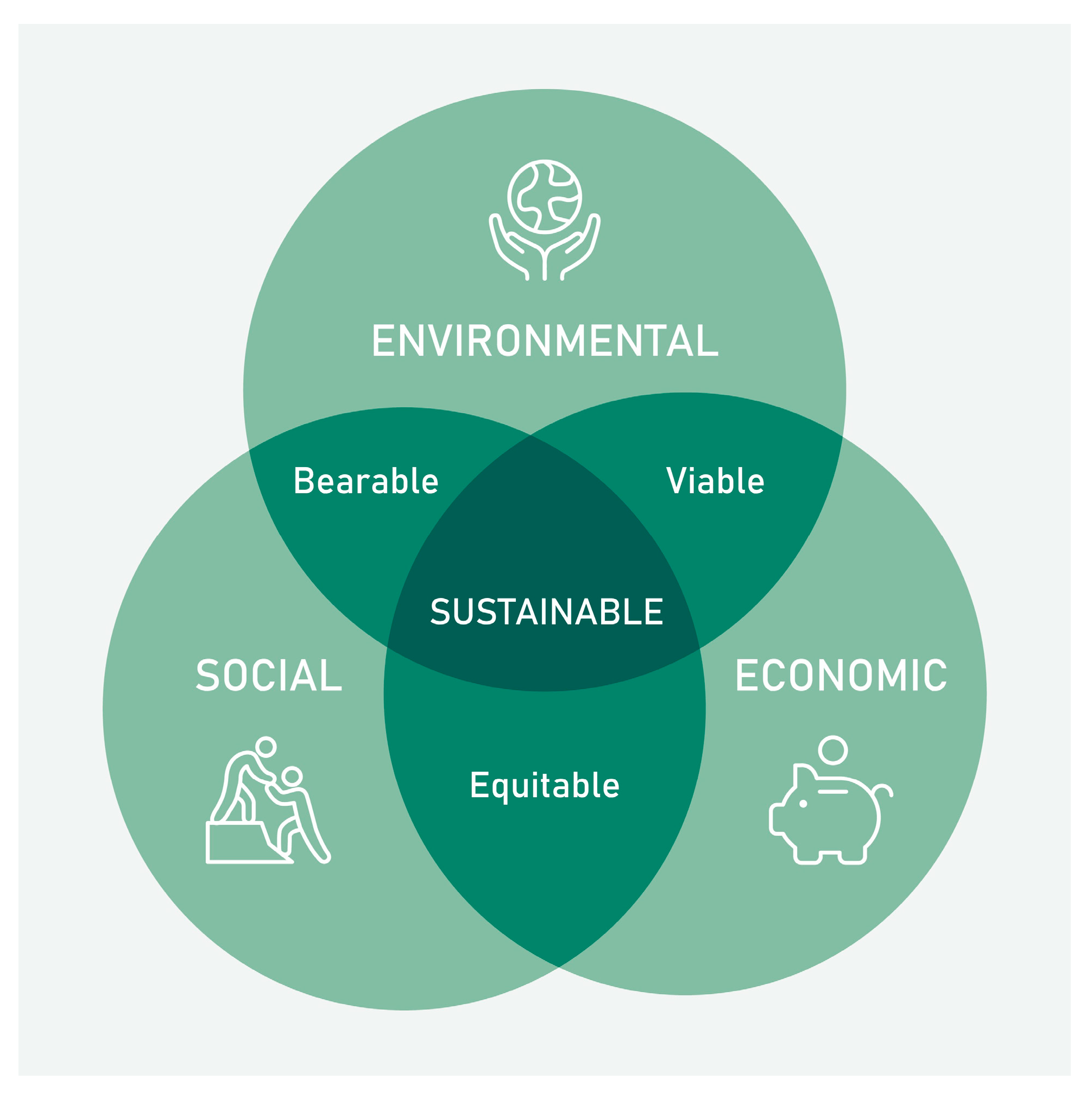
Figure 1 explains the three fundamental dimensions of sustainability: environmental, social, and economic. When environmental and social factors intersect, the result is
‘bearable’; when environmental and economic factors come together, the outcome is
‘viable’; and when social and economic factors overlap, the structure becomes
‘equitable.’ The intersection of all three dimensions represents a truly
sustainable system.
The nexus between economic growth and sustainability is a central theme in modern economic literature. While growth provides the financial resources necessary to improve infrastructure and eco-friendly technologies, uncontrolled expansion can lead to the depletion of natural resources and exacerbated social inequality [
6,
12]. Therefore, sustainable development acts as a qualitative framework that transforms growth from a mere increase in production into a rational process based on resource efficiency and social justice [
2,
4].
Despite the extensive theoretical discussions, there is a distinct need for empirical research that simultaneously analyzes the impact of multifaceted sustainability indicators, specifically R&D, health, education, and energy, on growth within the context of major emerging economies. This study addresses this research gap by examining the impact of sustainable development indicators on the Gross Domestic Product (GDP) of seven strategic countries: China, Türkiye, Brazil, Malaysia, Iran, Argentina, and Egypt, for the period 2002–2023. The selection of these seven strategic emerging economies is predicated on their pivotal role in the global sustainability transition. Unlike developed economies, which possess stabilized industrial infrastructures and mature regulatory frameworks, these nations face a unique double burden. They must sustain high growth rates to escape the middle-income trap while simultaneously navigating the costly transition toward international carbon-neutral and social equity standards. Therefore, the expectation for these economies differs significantly from advanced nations. While sustainability investments in developed countries often yield incremental benefits, in emerging markets, factors such as R&D, health, and renewable energy are expected to have a more transformative yet volatile impact on GDP due to institutional quality gaps and rapid structural shifts.
Accordingly, this study fills a significant gap in the literature by focusing on the ‘double burden’ of emerging markets. By utilizing a Random Effects model and rigorous panel data analysis, this research contributes to the literature by identifying how these sustainability dimensions vary in their influence on growth performance. The findings aim to provide evidence-based insights for policymakers to align macroeconomic targets with environmental and social standards, ensuring a comprehensive developmental trajectory.
2. Literature Review
The impact of sustainable development on economic growth has emerged as a significant area of research in recent years, particularly within the context of emerging economies. The relationship between environmental sustainability, energy utilization, research and development (R&D) investments, health indicators, and general economic performance has been analyzed in numerous empirical studies utilizing panel data models. The literature suggests that sustainable development indicators generally foster long-term economic growth, although certain indicators may exhibit more complex dynamics in the short term.
Ref. [
13] emphasizes in R&D-based growth models that innovation is a fundamental determinant of sustainable growth. Similarly, Ref. [
14] states in innovation-oriented growth models that technological progress accelerates economic expansion by enhancing productivity. This theoretical framework is well-supported by empirical findings. For instance, Ref. [
15] conducted a panel analysis across 63 countries and demonstrated that R&D intensity significantly and positively impacts economic growth. Furthermore, Ref. [
16] highlighted that R&D activity possess a particularly strong influence on growth, especially in middle-income countries.
Health indicators constitute a core pillar of the social dimension of sustainable development. Ref. [
17] argues that improvements in public health bolster economic growth by increasing labor productivity. Ref. [
18] notes that such improvements raise the quality of human capital, which in turn reflects positively on economic performance. Additionally, Barro [
19] emphasizes that health expenditures are a vital driver of growth in developing nations, asserting that an increasing share of health spending within the GDP strengthens long-term productivity and human capital accumulation. The nexus between renewable energy consumption and economic growth is also extensively discussed in the literature. Ref. [
20] identified a reciprocal causality between renewable energy consumption and economic growth. While Ref. [
21] and other regional studies have reached similar conclusions, the relationship between carbon emissions and growth appears more complex within the framework of the Environmental Kuznets Curve (EKC) hypothesis. Ref. [
22] showed that environmental degradation typically increases during the initial stages of growth but begins to decline as income levels rise. Ref. [
23] further observed that emissions correlate positively with growth in energy-intensive economies, whereas the use of renewable energy tends to mitigate this effect.
Other studies indicate that the impact of sustainability indicators on growth varies across regions and country groups. Ref. [
24], in a panel analysis of 91 countries, identified a long-term positive relationship between energy consumption and economic growth. Similarly, Ref. [
25] demonstrated that renewable energy consumption supports growth in emerging economies, while carbon emissions exert a negative impact.
Ref. [
12] Argue that the components of sustainable development affect economic growth simultaneously and interdependently. In this context, the integrated analysis of R&D expenditures, health investments, renewable energy consumption, and environmental indicators contributes to a more accurate understanding of economic growth dynamics in developing countries. Since 2020, the literature examining the impact of sustainable development indicators on economic growth has expanded significantly. Recent research has predominantly focused on the relationships between environmental sustainability, renewable energy utilization, R&D expenditures, and health investments in emerging economies. Modern studies confirm that sustainable development goals support long-term growth, while certain environmental variables exhibit more volatile and complex effects in the short term.
Ref. [
26], in an analysis of 35 developing countries, found that high R&D expenditures accelerate technological progress and positively influence economic growth. These findings are corroborated by Ref. [
27] as well as Ref. [
28], who verify that R&D investments contribute to sustainable economic growth through productivity gains. Innovation capacity is emphasized as a primary determinant of growth, particularly in middle-income nations.
The sustainable development literature emphasizes that the alignment of environmental and economic objectives supports long-term economic growth. The positive relationship between renewable energy consumption and economic expansion demonstrates that energy efficiency improvements, reductions in carbon emissions, and effective environmental regulations are key factors enhancing economic performance. Ref. [
29]. highlighted the impact of health expenditures on economic growth, while Ref. [
30] Moreover, the effects of economic growth on sustainable development exhibit a more complex pattern. While growth may initially increase environmental pressures, rising income levels, the adoption of environmentally friendly technologies, strengthened institutional capacity, and higher investments in renewable energy eventually contribute to sustainable development. In addition, institutional quality and international trade relations play a decisive role in shaping environmental performance and are therefore critical in achieving sustainable development goals.
Renewable energy remains one of the most intensely researched areas within the framework of sustainable development. Ref. [
31] found that renewable energy consumption supports long-term economic growth in emerging countries. An empirical study by Ref. [
32] covering 17 countries indicates that renewable energy plays a crucial role in both reducing emissions and promoting sustainable growth.
A more recent study by Ref. [
33] further highlights the direct and indirect positive effects of renewable energy consumption on economic growth across countries, showing both statistically significant long-run relationships and policy implications for sustainable development. Conversely, some studies, such as [
34], have identified negative or limited relationships between renewable energy and economic growth. Additionally, Ref. [
35] emphasizes that fossil fuel consumption and carbon emissions create adverse effects on long-term economic performance.
Finally, the recent literature shows that the relationship between carbon dioxide emissions and economic growth has become increasingly evident. Ref. [
36] obtained findings confirming the validity of the Environmental Kuznets Curve hypothesis in emerging economies. Ref. [
37] demonstrated that renewable energy and low-carbon technologies contribute to a more sustainable growth path by mitigating the negative impact of emissions.
Overall, the literature spanning the 2020–2024 period indicates that the core components of sustainable development, namely R&D expenditures, health investments, and renewable energy consumption, support economic growth in developing countries, whereas carbon emissions continue to exert pressure. These findings suggest that sustainable development indicators must be evaluated in an integrated manner to achieve a holistic understanding of economic growth dynamics.
3. Materials and Methods
This study aims to analyze the impact of sustainable development indicators on economic growth using a panel dataset for the period 2002–2023. The analysis covers seven countries: China, Turkey, Brazil, Malaysia, Iran, Argentina, and Egypt. In this study, real Gross Domestic Product (GDP) in USD dollars is used as the dependent variable. The independent variables consist of the ratio of total research and development (R&D) expenditure to GDP, the ratio of total health expenditure to GDP, the share of renewable energy consumption in total energy consumption, and per capita carbon dioxide (CO2) emissions.
The study utilizes annual data obtained from the World Bank and “The Global Economy” databases. The descriptive statistics for the variables used in the study for the 2002–2023 period are presented in
Table 1 below.
Using the Ordinary Least Squares (OLS) method and panel data (pd), the econometric model for this study is formulated as follows:
Here, is a constant and , …, represent the coefficients of the explanatory variables included in the estimated model. : Represents the error limit values for the predicted model. = 1, 2, … to 7 of the countries included in the study. The study specifies time periods ranging from t …, 2, 1 = up to 22 years. Dependent variable (Y) represents the gross domestic product of the selected countries, measured at constant prices and in US dollars. Independent variables: Below is a summary of the explanatory variables included in the estimated standard models.
Total expenditure on Research and Development (R&D) as a percentage of GDP.
. Total expenditure on Education as a percentage of GDP.
. Total expenditure on Health as a percentage of GDP.
. Renewable energy consumption as a percentage of total energy consumption.
. Per capita Carbon Dioxide (CO2) emissions.
3.1. Stationarity Test (Unit Root Test—UR)
According to the unit root test results presented in
Table 2, utilizing the Levin, Lin and Chu (LLC) and Fisher-Augmented Dickey–Fuller (ADF) tests, it was found that all variables are non-stationary at their original values (at Level). However, all variables achieved stationarity after taking their first difference, indicating that they are integrated of order one, denoted as I (1).
Three static econometric models were estimated: the Pooled OLS Regression (PR), the Fixed Effects (FE) model, and the Random Effects (RE) model. To determine the most appropriate model, three statistical tests were conducted: the Fisher (F) test, the Breusch–Pagan Lagrange Multiplier (LM) test, and the Hausman test. The results of these tests are presented in
Table 3. The first and second tests indicated that both the FE and RE models are superior to the PR model. Furthermore, the third test the Hausman test revealed that the Random Effects (RE) model is more efficient and appropriate than the Fixed Effects (FE) model. Consequently, the analysis and interpretation of the results will be based solely on the estimated RE model.
The study results indicate a positive and statistically significant relationship between expenditure on Research and Development (R&D) and Gross Domestic Product (GDP) in the selected countries. As shown in
Table 4, a one-unit increase in R&D expenditure leads to a 0.353-unit increase in GDP. This positive impact is attributed to the pivotal role of R&D in fostering innovation and enhancing productive efficiency, which subsequently drives output and stimulates economic growth. Furthermore, investment in this field facilitates industrial development, the adoption of modern technologies, and the strengthening of long-term economic competitiveness. The results in
Table 4 indicate an inverse (negative) and statistically insignificant relationship between education expenditure and GDP in the selected countries.
The study reveals a positive and significant relationship between health expenditure and economic growth. According to
Table 4, a one-unit increase in health spending results in a 0.218-unit rise in GDP. This positive effect is attributed to the efficient management of health and human resources, as well as the role of health spending in developing the sector’s infrastructure through the provision of modern medical equipment and the employment of qualified medical personnel. Additionally, health expenditure improves public health and quality of life, which enhances productivity and bolsters overall economic performance.
Table 4 shows that renewable energy consumption, as a percentage of total energy, has a positive and significant impact on GDP, as indicated by its positive coefficient. A one-unit increase in renewable energy consumption leads to a 0.313-unit increase in GDP. This is explained by the fact that energy is a fundamental engine of growth, playing a vital role in stimulating economic activities, supporting investment, and achieving sustainable development. This impact also reflects the efficiency and relative cost-effectiveness of renewable sources compared to traditional ones, as well as their contribution to energy diversification and reduced fossil fuel dependency, which enhances economic and environmental stability.
The study reveals a positive and significant relationship (1.381) between per capita CO2 emissions and GDP. Conceptually, this result indicates that economic expansion in the selected countries remains heavily reliant on fossil fuel consumption, reflecting energy-intensive growth rather than sustainable development. While this aligns with the initial stage of the Environmental Kuznets Curve (EKC), the absence of a non-linear specification (GDP) in our model means that a ‘turning point’ cannot be empirically identified. Therefore, while our findings confirm that environmental degradation rises with income in these economies, any discussion regarding a future decline in emissions (the inverted U-shape) remains theoretical and speculative within this linear framework.
Diagnostic Evaluation and Methodological Remarks: The interpretability of these coefficients is subject to several diagnostic considerations. First, the Durbin-Watson statistic of 1.42 suggests the presence of potential positive serial correlation in the residuals. In panel data analysis, a value significantly below 2.0 indicates that standard errors might be underestimated, potentially inflating the t-statistics and the perceived significance of the variables. Furthermore, while the Panel EGLS (Random Effects) method was employed to account for the variance structure, it is important to note that GLS relies on specified variance assumptions rather than guaranteeing absolute robustness against heteroskedasticity. Lastly, the definition of the dependent variable as real GDP in USD terms introduces concerns regarding cross-country comparability and exchange rate volatility. Future refinements should clarify whether deflation was based on local currency units or PPP-adjusted terms to ensure more robust international comparisons.
3.2. Statistical Criteria
F-Test: Since the calculated F-value is 233.189 (as shown in
Table 4), which is greater than the critical F-value at the 1% significance level, we reject the null hypothesis (H
0). The null hypothesis states that the coefficients of all explanatory variables are equal to zero, meaning they have no effect on changes in GDP. Consequently, we conclude that these variables collectively have a statistically significant impact on the variations in the GDP of the selected countries. Furthermore, the high calculated F-statistic indicates the goodness of fit of the estimated model.
Adjusted R-squared: The adjusted R-squared value indicates that the explanatory variables account for approximately 88.4% of the variations in the dependent variable (GDP). The remaining 11.6% of the variations are attributed to other factors not included in the model’s estimation.
3.3. Econometric Criteria
Multicollinearity Test: To ensure the absence of high or severe multicollinearity among the explanatory variables, the Variance Inflation Factor (VIF) was utilized for the variables included in the selected Random Effects (RE) model. As shown in
Table 5, the highest VIF value recorded was 2.588, which is well below the threshold of 5. This indicates that multicollinearity between the explanatory variables is not a serious concern and does not negatively affect the accuracy of the estimated results.
3.4. Econometric Criteria (Post-Estimation Tests)
Autocorrelation test for autocorrelation, the estimation results presented in
Table 6 show that the lagged effect of the residuals of the estimated model is not statistically significant. The calculated F-statistic is 0.034 and the corresponding probability value (
p-value) is 0.967, both above the 5% significance level. This confirms that there is no autocorrelation in the residuals of the estimated model.
Heteroscedasticity test (Homogeneity of Variance) the ARCH test results presented in
Table 7, the calculated F-statistic is 0.444 and the corresponding probability value (
p-value) is 0.507. This value is above the 5% significance level, indicating that the residuals do not contain autocorrelation and that the model does not suffer from a variance heteroscedasticity problem.
3.5. Cross-Sectional Dependence Test
According to the results presented in
Table 8, the Breusch–Pagan LM, Pesaran scaled LM, bias-corrected scaled LM, and Pesaran CD tests were conducted. The probability values (
p-values) for the four tests were 0.30, 0.67, 0.71, and 0.82, respectively. Since all these values are greater than the 0.05 significance level, we fail to reject the null hypothesis, which states that there is no cross-sectional dependence (correlation) in the residuals. Consequently, it is concluded that there is no correlation between the error terms across the different cross-sectional units (countries) in the model.
3.6. Normality Test of Residuals
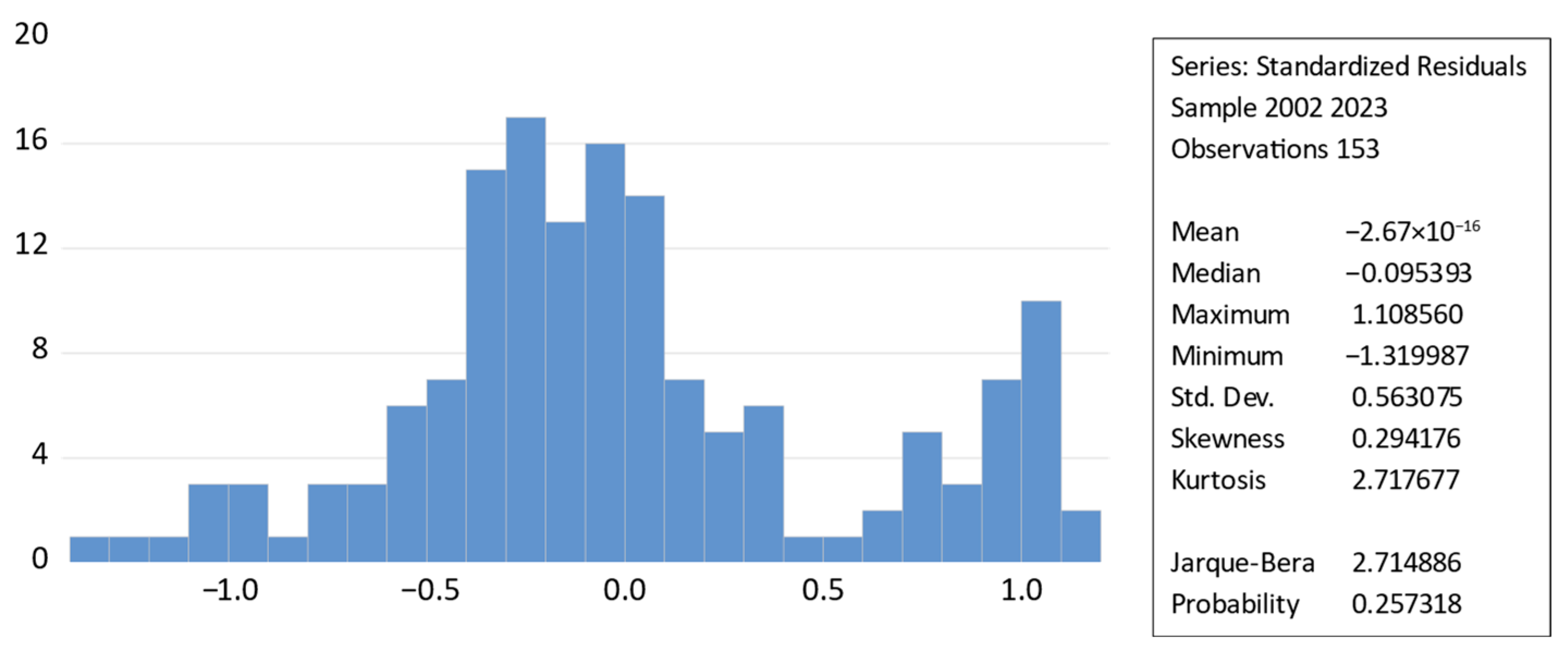
The results of the Jarque–Bera (JB) normality test, conducted to determine the distributional properties of the models’ residuals, are presented in
Figure 2. Upon examining the empirical findings, the JB statistic for the estimated model was found to be 2.714886, with a corresponding probability value (
p-value) of 0.257318. Since the calculated
p-value exceeds the critical significance level of 0.05 (
p > 0.05), we fail to reject the null hypothesis (H
0), which posits that the error terms are normally distributed. This finding confirms that the assumption of normality of error terms crucial for the reliability of regression analysis is satisfied, thereby validating that the obtained coefficients are suitable for statistical inference (t and F tests).
4. Discussion
This study empirically examines the impact of sustainable development indicators on economic growth (GDP) in seven selected developing economies (China, Turkey, Brazil, Malaysia, Iran, Argentina, and Egypt) for the period 2002–2023. The findings obtained from the Random Effects model indicate that the social, economic, and environmental dimensions of sustainability have a decisive and substantial influence on growth performance.
Regarding environmental indicators, the result that renewable energy consumption supports economic growth is consistent with the findings of [
6,
31,
32]. Conversely, the direct positive relationship (1.381) between per capita CO
2 emissions and growth requires a rigorous conceptual interpretation. Rather than signifying sustainable progress, this positive coefficient reflects an “energy-intensive” growth model where economic expansion is strictly coupled with carbon emissions. While this result aligns with the expansionary phase of the Environmental Kuznets Curve (EKC) hypothesis [
22], the current study does not test for non-linear specifications (GDP) or estimate a specific turning point. Therefore, the applicability of the EKC in its full inverted-U form remains speculative within this linear framework. As noted by [
38], the analyzed countries still rely on fossil fuel-intensive production, meaning that the “decoupling” between environmental pollution and growth has not yet been achieved.
However, this positive relationship between CO2 emissions and GDP requires a critical reassessment. While it confirms the expansionary phase of the EKC, it also underscores a non-sustainable growth trajectory heavily dependent on fossil fuels for short-term economic gains. Such a reliance on carbon-intensive energy reflects a structural vulnerability that threatens long-term ecological stability. Therefore, these countries must prioritize strategic shifts to break this fossil fuel dependency, as continuing this trajectory is fundamentally incompatible with the principles of sustainable development.
Furthermore, it is crucial to acknowledge the structural heterogeneity among the seven selected economies, as a “one-size-fits-all” interpretation may overlook country-specific dynamics. For instance, the industrial scale and technological infrastructure of China represent a high-capacity developmental model that differs significantly from economies like Egypt or Iran, which are more susceptible to regional instabilities and energy price fluctuations. These disparities imply that the magnitude of impact for each sustainable indicator varies; while R&D is a primary engine for China and Malaysia, health expenditures and renewable energy transitions may play a more foundational role in the developmental trajectories of Turkey, Brazil, and Argentina. Recognizing this heterogeneity ensures a more nuanced understanding, emphasizing that policy effectiveness is contingent upon each nation’s specific industrial base and institutional quality.
The high explanatory power of the model (adjusted R
2 = 88.4%) supports the view of [
12] that the components of sustainable development influence economic growth simultaneously and holistically. Consequently, R&D, health, and renewable energy investments emerge as strategic tools to promote economic growth. For these countries, achieving long-term prosperity requires adopting holistic strategies that focus not only on the volume of expenditures but also on efficiency and that integrate growth targets with environmental and social indicators.
5. Conclusions
In this study, the impact of sustainable development indicators on economic growth was analyzed using data from 2002 to 2023. Although Pooled Ordinary Least Squares (OLS) and Fixed Effects models were initially conducted to evaluate different estimation dynamics, rigorous model selection tests such as the Hausman and Breusch-Pagan tests identified the Random Effects model as the most statistically appropriate approach. The findings reveal that R&D expenditures, health expenditures, and the share of renewable energy in total energy consumption are positively and significantly associated with Gross Domestic Product (GDP). In contrast, education expenditures were observed to have a negative impact on GDP, a result that contradicts theoretical expectations in the literature.
Additionally, it was determined that per capita carbon dioxide emissions are directly related to GDP, that the residuals of the estimated model are free from autocorrelation problems, and that the calculated F-statistic indicates that all variables collectively explain GDP significantly. The adjusted R2 value of 88.4% shows that the independent variables account for a substantial portion of the variation in GDP.
In light of these findings, it is essential to diversify income sources by supporting the agriculture, industry, and tourism sectors; to improve labor productivity by enhancing education quality and developing vocational training programs; and to implement effective environmental policies to ensure environmental sustainability. Furthermore, intensifying efforts to improve sustainable development indicators, promoting green investments, and implementing innovative economic projects based on efficient resource use are of great importance. Adopting modern industrial technologies, improving infrastructure, and expanding circular economy practices will support the transition to a more sustainable and innovative development model.
The significance of this study stems from its focus on the growing interest in maximizing the economic value of sustainable development indicators across countries; these indicators serve as strategic tools for promoting economic growth. The importance of this approach lies in its fundamental role in supporting economic policies and balancing economic, social, and environmental dimensions, thus contributing to improvements in quality of life and intergenerational equity.